Singapore 2H2026 GLS Programme Guide: 9 Sites, 4,745 New Homes and What the Pipeline Means

Singapore 2H2026 GLS Programme Guide: 9 Sites, 4,745 New Homes and What the Pipeline Means

Quick Answer: Singapore’s 2H2026 Government Land Sales (GLS) Confirmed List, announced by URA on 3 June 2026, offers nine sites that can yield 4,745 private homes — including 735 Executive Condo units and 1,200 homes in the landmark Jurong Lake District white site. Full-year Confirmed List supply reaches 9,320 units: 50 per cent above the ten-year annual average. Nine sites span five regions; competition remains robust with an average of 4.6 bidders per GLS tender in 2026.

  • Total supply: 4,745 units — 4,010 private + 735 executive condo (EC).
  • Sites: Nine Confirmed List sites (eight private residential + one white site), plus a separate Reserve List of thirteen sites.
  • Announced: 3 June 2026 by the Ministry of National Development (MND).
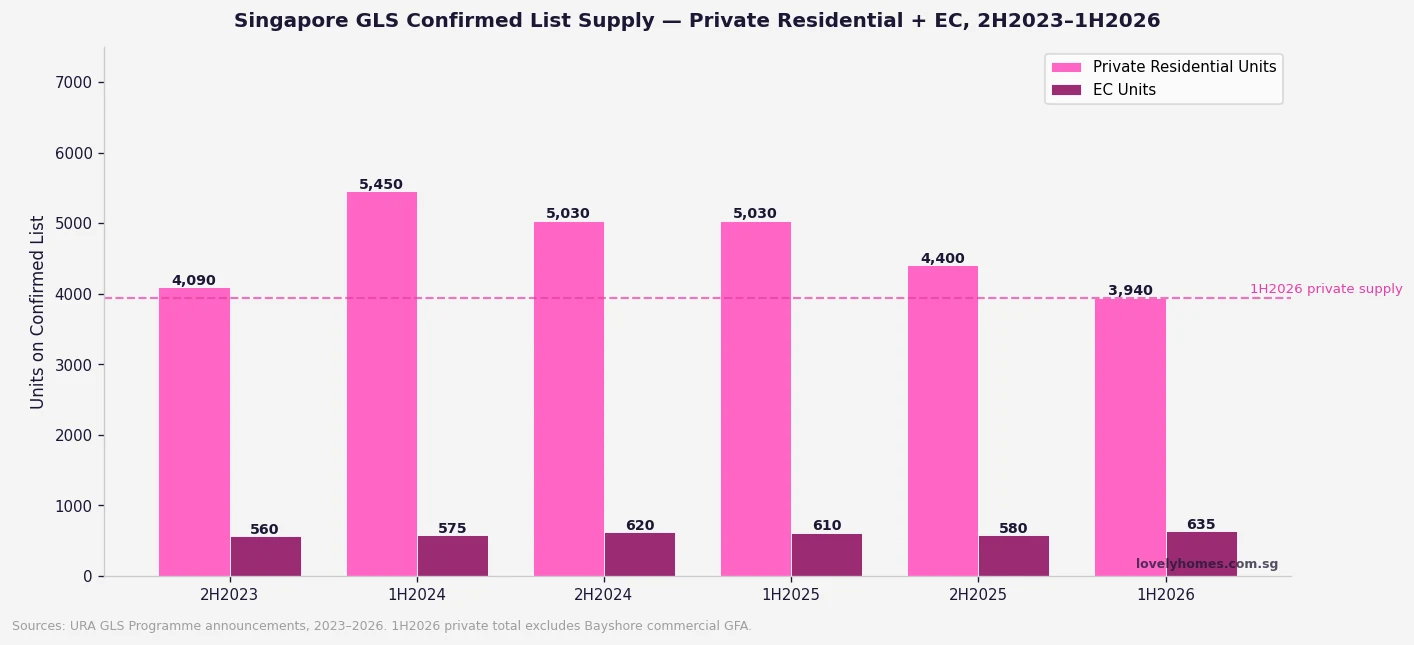
  • Full-year supply: 9,320 Confirmed List units in 2026 — 50% above the 10-year annual average of approximately 6,200 units.
  • Standout plot: Townhall Link white site in Jurong Lake District — 3.72 ha, 1,200 homes + 83,350 sqm commercial GFA; tender opens July 2026.
  • First EC in Jurong East in ~30 years: Jurong East Avenue 1 (735 units) under new 10-year MOP rules.
  • Orchard Boulevard: Boutique CCR site (110 units); expected top bid up to S$1,700 psf ppr, up to 8 bidders.
  • Market temperature: Average 4.6 bidders per GLS tender in 2026 vs 2.4 in 2024 — developer confidence remains firm.

What Is the Government Land Sales Programme?

The Government Land Sales programme is the primary mechanism through which the Singapore government releases state land for private residential and mixed-use development. Administered jointly by URA (for private residential sites) and HDB (for EC sites), the GLS programme is announced twice a year — once for the first half (1H) and once for the second half (2H) of the calendar year. Sites are categorised into two lists: the Confirmed List, which is released unconditionally for tender regardless of market conditions, and the Reserve List, which is released only when a developer submits a minimum bid above URA’s reserve price and triggers an application.

The GLS programme is the government’s single most powerful tool for managing private housing supply. Historically, the annual volume of Confirmed List sites has been calibrated against unsold developer inventory, price trends, and macroeconomic conditions. A high Confirmed List release — as in 2026 — signals a government intent to pre-empt price overheating by ensuring adequate forward supply. Buyers, investors, and developers all watch the programme closely because the sites released today shape the supply of completions three to four years ahead.

The Nine 2H2026 Confirmed List Sites

Singapore 2H2026 GLS Confirmed List: all nine sites with regions, unit yields and key highlights
Figure 1: 2H2026 Confirmed List — nine sites with unit yields and key details. Source: URA press release, 3 June 2026. Click to enlarge.

The nine sites span four broad market segments. Two Core Central Region (CCR) sites — Orchard Boulevard and Holland Plain — introduce 610 units in the city’s most premium residential precinct, continuing the measured release of CCR supply that has characterised government policy since 2023. Four Rest of Central Region (RCR) sites — Marina Gardens Lane, Tanjong Rhu Close, Berlayar Close, and East Coast Road — concentrate development in emerging waterfront and city-fringe precincts with excellent transport connectivity. One Outside Central Region (OCR) site at De Souza Avenue adds mass-market supply in the Bukit Timah planning area. The white site at Townhall Link is the most transformative, anchoring the second phase of the Jurong Lake District’s development as Singapore’s second Central Business District. And the EC site at Jurong East Avenue 1 is the first such site offered in the Jurong East area in nearly three decades.

Unit Supply by Site and Region

2H2026 GLS Confirmed List unit yield by site: Orchard Blvd 110, Holland Plain 500, Marina Gardens 390, Tanjong Rhu 505, Berlayar Close 695, East Coast Road 85, De Souza Ave 415, JLD white site 1200, Jurong East EC 735
Figure 2: Unit yield per site, 2H2026 GLS Confirmed List. The JLD white site (1,200 homes) and Jurong East EC (735 units) account for 41% of total supply. Source: URA, 3 June 2026. Click to enlarge.

Orchard Boulevard (CCR, 110 units)

Situated at the corner of Orchard Boulevard and Tomlinson Road, this 0.34-hectare residential site is described by market observers as “probably one of the last few land plots along Orchard Boulevard”. At a projected top bid of up to S$1,700 per square foot per plot ratio (psf ppr), the site offers a manageable unit yield that limits absolute development risk and is expected to draw up to eight bidders. For context, the most recently awarded CCR site in the vicinity — which became Upperhouse at Orchard Boulevard — was sold in February 2024 at S$1,616 psf ppr and has moved about 80 per cent of units to date, providing developers confidence in the precinct’s demand fundamentals. The boutique scale of the site (likely to yield a 20-storey tower of approximately 110 units) appeals to buyers seeking exclusivity and the proximity to the Thomson-East Coast Line’s Orchard station.

Holland Plain (CCR, ~500 units)

This site is the second CCR site in the 2H2026 Confirmed List and is adjacent to two recently-awarded sites — one at Holland Link awarded to Sim Lian Group at S$1,432 psf ppr in 2025, and a neighbouring Holland Plain site awarded at S$1,391 psf ppr one month prior to the 2H2026 programme announcement. The clustering of three adjacent sites serves a dual purpose: building critical mass in a precinct that is still largely characterised by landed housing and ageing condominiums, while potentially moderating bidding behaviour by reducing the scarcity premium that developers might otherwise price in for isolated plots.

Marina Gardens Lane (RCR, ~390 units)

This is the third site to be offered in the Marina South precinct — Singapore’s emerging waterfront residential neighbourhood on reclaimed land adjacent to Marina Bay. Measuring 0.6 hectares with a residential-with-commercial-at-first-storey zoning, it can yield approximately 390 homes and 150 square metres of commercial space. The site is within walking distance of the upcoming Marina South MRT station on the Thomson-East Coast Line. It is adjacent to One Marina Gardens (937 units), which a Kingsford-led consortium developed and which has sold approximately 68 per cent of units since its April 2025 launch at around S$2,280 psf. The smaller scale of this site is expected to attract mid-sized developers who might otherwise be deterred by the very large plot sizes typical of Marina South.

Tanjong Rhu Close (RCR, ~505 units)

Industry observers consistently rank this as one of the most attractive plots in the 2H2026 programme. Measuring 1.23 hectares, the site is immediately adjacent to a site on Tanjong Rhu Road that was awarded in February 2026 to a City Developments–Woh Hup joint venture at S$1,455 psf ppr — a record land rate for a pure residential site in the Rest of Central Region. The site benefits from its position in a well-regarded enclave close to Marina Bay and the Kallang sports precinct, with the Katong Park and Tanjong Rhu MRT stations approximately ten minutes on foot. Future units are likely to command sea views, adding a premium that historically commands 5–10 per cent above comparable units without such aspects.

Berlayar Close (RCR, ~695 units)

Spanning 2.82 hectares, the Berlayar Close site is the largest of the RCR plots and represents the third site in the Greater Southern Waterfront — a 30-kilometre stretch from Marina East to Pasir Panjang that the government has earmarked for a new waterfront city over the coming decades. The first Greater Southern Waterfront site, at Telok Blangah, was awarded in November 2025 to Kingsford Group at S$1,326 psf ppr and can yield about 745 units. A second Berlayar Drive site (about 415 units) is currently open for tender, closing in August 2026. The Telok Blangah MRT station on the Circle Line is approximately ten minutes on foot.

East Coast Road (RCR, ~85 units)

At 0.55 hectares, this is the smallest of the eight private residential sites, yielding approximately 85 units — a boutique development in the Siglap area, one of Singapore’s last remaining low-density residential enclaves characterised by landed housing and pre-war bungalows. The site carries a minimum unit size requirement of 100 square metres, limiting the ability to create smaller high-yield units and naturally targeting buyers who prioritise space. The site’s distance from the nearest MRT is expected to temper competition, making it more attractive to niche developers focused on landed-style condominium product than to volume builders.

De Souza Avenue (OCR, ~415 units)

Located in the Bukit Timah planning area, this 2.22-hectare site is adjacent to the site of The Sen (347 units), which developer Sustained Land purchased in July 2024 at S$841 psf ppr. The Sen launched in November 2025 and moved about 23 per cent of units on its launch weekend. Interest in De Souza Avenue is expected to be moderate — the site is some distance from an MRT station and lacks a strong HDB upgrader catchment nearby. However, the Bukit Timah address and proximity to good schools, including Pei Hwa Presbyterian, Bukit Timah Primary, and Methodist Girls’ School, give it a defined appeal to families in the primary-school balloting window.

The JLD White Site: Singapore’s Next CBD Pillar

The Townhall Link white site is the most consequential release in the 2H2026 GLS programme. At 3.72 hectares, it is the largest Confirmed List plot and the only mixed-use white site. It can yield up to 1,200 housing units alongside a minimum of 40,000 square metres of office space and 44,000 square metres of additional uses — retail, serviced apartments, hotel, and community facilities — for a total commercial gross floor area of approximately 83,350 square metres.

The site was carved from the former 6.5-hectare master developer plot at Jurong Lake District, which attracted a sole bid of S$640 psf ppr in 2024 that URA rejected as too low. The decision to sub-divide the master plot into smaller parcels reflects a pragmatic acknowledgement that the scale of the original site was deterring competitive bidding and delaying the JLD’s transformation. The Townhall Link site is connected to or in close proximity to four MRT lines: the North-South, East-West, Jurong Region, and the under-construction Cross Island line. It is intended to “spearhead the transformation of JLD into Singapore’s secondary CBD”, in URA’s own words. Its tender opens in July 2026.

The Jurong East EC Site: A 30-Year Gap Closes

The EC site at Jurong East Avenue 1 is the first executive condominium to be offered in Jurong East since Westmere in 1996 — a gap of approximately 30 years. The site can yield 735 units across an area of approximately 2 hectares, making it a large EC development by any measure. It will be the first EC launched under the new ten-year MOP and 15-year privatisation rules announced on 8 May 2026, making its bid result and eventual launch price a critical data point for how the rule changes affect developer land valuations and end-unit pricing.

Demand for EC in the western region — specifically in Jurong East — has historically been strong, driven by a large pool of young Singaporean families working in the Jurong Industrial Estate, the International Business Park, and the growing Jurong Lake District commercial cluster. The site brings full-year EC supply on the Confirmed List to 1,370 units (635 from 1H2026 + 735 from 2H2026), substantially below the 1,970 EC units supplied in 2025. This measured reduction likely reflects the government’s intent to assess how market participants respond to the new MOP framework before recommitting to higher EC volumes.

Historical Context: 2026 Supply at a 10-Year High

Singapore GLS Confirmed List annual supply 2016-2026: 9,320 units in 2026 is 50% above the 10-year average of around 6,200 units
Figure 3: GLS Confirmed List annual supply 2016–2026F. The 2026 combined total of 9,320 units is 50% above the 10-year annual average. Source: URA / MND. Click to enlarge.

Combining the 1H2026 Confirmed List (4,575 units) with the 2H2026 Confirmed List (4,745 units) yields a full-year total of 9,320 Confirmed List units for 2026. This is 50 per cent above the ten-year annual average of approximately 6,200 units and represents the highest Confirmed List supply since at least 2013. The elevated supply programme is a deliberate policy response to private property price growth that has outpaced income growth in Singapore — the private residential property price index (PPI) reached 208.8 in Q1 2026 (URA data), up from 131.5 at the start of 2020, a 59 per cent increase over six years.

The high supply programme has been accompanied by sustained developer appetite. The average number of bidders per GLS tender (excluding ECs) has risen from 2.4 in 2024 to 4.6 in 2026 year-to-date — close to the 5.6 recorded in 2025, a historically active year. Recent launches such as Pinery Residences, River Modern, and Tengah Garden Residences have moved over 90 per cent of units on their respective launch weekends, confirming that end-user demand remains robust despite the elevated ABSD rates introduced in April 2023.

2H2026 GLS Programme: Summary Table

Site Region Est. Units Area Notable Feature
Orchard Boulevard CCR 110 0.34 ha Boutique; among last Orchard Blvd plots; up to 8 bidders
Holland Plain CCR ~500 ~2 ha Third adjacent site; precinct-building strategy
Marina Gardens Lane RCR ~390 0.60 ha Third Marina South plot; near future Marina South MRT
Tanjong Rhu Close RCR ~505 1.23 ha Adjacent to Feb 2026 RCR record; sea views; highly sought-after
Berlayar Close RCR ~695 2.82 ha Greater Southern Waterfront; third GSW site
East Coast Road RCR ~85 0.55 ha Boutique Siglap landed enclave; 100 sqm min unit size
De Souza Avenue OCR ~415 2.22 ha Bukit Timah school belt; some distance from MRT
Townhall Link (White Site) JLD ~1,200 homes
+83,350 sqm GFA
3.72 ha Largest site; mega mixed-use; anchors JLD as Singapore’s 2nd CBD
Jurong East Ave 1 (EC) Western 735 EC ~2 ha First EC in Jurong East since 1996; new 10-yr MOP rules apply
TOTAL 9 sites 4,745 units 4,010 private + 735 EC | Full-year Confirmed List: 9,320 units

Worked Example: What the GLS Programme Means for a Buyer Targeting a Launch in 2027–2028

Mr and Mrs Tan are Singapore Citizens planning to upgrade from their HDB flat in Jurong West to a private condominium. Their combined income is S$15,000 per month. They are watching two sites from the 2H2026 GLS programme: the Jurong East Avenue 1 EC (for its income-ceiling alignment and proximity) and the De Souza Avenue site (for its school catchment and OCR pricing).

Option A — Jurong East EC: Land tender expected mid-2H2026; launch likely 2027. At the 2H2026 land release price, comparable EC units in western Singapore have been pricing at S$1,000–S$1,150 psf. A three-bedroom 95 sqm unit might launch at approximately S$1.1M. BSD: S$24,600. ABSD: 0% (first-time SC couple, EC is first property). If the Tans sell their HDB first, down payment at 25% = S$275,000 (5% cash S$55,000 + 20% CPF S$220,000). Bank loan: S$825,000 at 3.1% 30yr = S$3,527/month. TDSR: 23.5% (PASS). However, the ten-year MOP means this unit cannot be sold until approximately 2037–2038 — a significant illiquidity constraint for a couple in their thirties.

Option B — De Souza Avenue private condo: Land tender expected 3Q2026; launch likely 2027–2028. Comparable OCR condominiums near Bukit Timah are launching at S$1,900–S$2,200 psf. A three-bedroom 90 sqm unit might launch at S$1.75M. BSD: S$54,600. ABSD: S$350,000 (20%, SC second property — payable upfront if HDB not yet sold; eligible for remission upon HDB sale within six months). Bank loan: S$1,312,500 at 3.1% 30yr = S$5,619/month. TDSR: 37.5% (PASS under 55%). The private condo has no MOP (Sellers’ Stamp Duty applies for three years post-purchase: 12%/8%/4%), giving far greater flexibility.

Conclusion: The EC route offers substantially lower upfront cost and zero ABSD for a first-time buyer, but the ten-year MOP creates a fifteen-year horizon to liquid resale that requires careful long-term planning. The private condo route demands significantly more cash and ABSD outlay but provides full flexibility and an open buyer pool upon privatisation from day one. For the Tans, if they are highly confident about remaining in the western region for at least fifteen years and do not anticipate significant financial changes, the EC represents better value for money. If their circumstances are likely to change — relocation, family expansion, employment shifts — the private condo’s liquidity premium is well worth paying.

Why the 2H2026 Programme Matters for Singapore’s Property Market

Singapore’s approach to GLS supply management has historically been counter-cyclical: the government releases more land when prices are rising and less when they are correcting. The 2026 Confirmed List total of 9,320 units — the highest in at least a decade — is a clear signal that the government views the prevailing price trajectory as requiring active supply-side management. Private residential prices rose 2.63 per cent year-on-year in Q1 2026 (URA PPI), and the broader context of elevated ABSD rates since April 2023 has not fully dampened demand from genuine owner-occupiers and local investors.

The concentration of RCR sites (Marina Gardens Lane, Tanjong Rhu Close, Berlayar Close, East Coast Road) reflects a deliberate policy to develop Singapore’s waterfront precincts — Marina South, Tanjong Rhu, and the Greater Southern Waterfront — as premium residential addresses that can absorb demand from residents upgrading from ageing RCR stock. The JLD white site, by contrast, is an economic-development play as much as a housing play: the combined residential and commercial component at Townhall Link is intended to accelerate the transformation of Jurong into a self-sufficient live-work-play district.

Peer cities have drawn different supply-side lessons. Hong Kong’s chronic supply shortage and sky-high prices are a cautionary tale for what happens when GLS supply lags consistently behind demand for decades. Sydney’s experience with developer-driven oversupply in the mid-2010s showed that excessive releases can cause sharp short-term corrections. Singapore’s managed approach — calibrated half-yearly, responsive to data — has broadly achieved its goal of a stable market, though at the cost of perpetually high price levels relative to household income.

What Might Come Next

With the 2H2026 Confirmed List sites feeding into the launch pipeline for 2027 and 2028, buyers watching the GLS programme should expect a well-supplied private residential market for the next two to three years. The key swing factor will be the outcome of the JLD Townhall Link tender: if multiple developers bid competitively, it signals robust institutional confidence in the Singapore market; if the tender attracts few bidders or a below-reserve outcome, it may prompt URA to revise the Reserve List strategy. URA Q2 2026 Flash Estimates — expected in the first week of July 2026 — will be the next major data point for whether the elevated supply programme is having the intended moderating effect on prices.

The 1H2027 GLS programme, likely to be announced in December 2026, will also be closely watched. If unsold developer inventory remains elevated (42,561 units in the pipeline as at Q1 2026, of which 17,032 remain unsold), the government may maintain or marginally reduce Confirmed List supply. If take-up continues at the robust pace seen in H1 2026, the supply programme may be sustained or expanded.

Frequently Asked Questions

What is the difference between the Confirmed List and the Reserve List?

The Confirmed List is released for tender by URA regardless of market conditions — developers can submit bids at any time once the site is listed. The Reserve List is held back: a developer must submit a minimum-price application to trigger an official tender for a Reserve List site. The government uses this structure to maintain supply certainty (Confirmed List) while keeping optionality for responsive releases (Reserve List). In practice, a strong Reserve List application signals developer appetite and is often seen as a leading indicator of market activity.

How long does it take from a GLS award to a new launch?

Typically, a developer needs six to twelve months after land award to complete design planning, obtain approvals, and prepare sales materials before launching the project. Construction then takes three to four years from launch before TOP is achieved. So a 2H2026 GLS site awarded in late 2026 or early 2027 would likely launch in mid-2027 to mid-2028 and reach TOP around 2030–2032. Buyers planning to purchase on the primary market should factor in this timeline when deciding whether to buy a new launch or a completed resale unit.

What does “psf ppr” mean and why does it matter?

PSF ppr stands for “price per square foot per plot ratio” — the standard land-value metric used in Singapore GLS tenders. It is calculated as (bid price ÷ land area in sqft ÷ plot ratio). Plot ratio is the zoning parameter that determines how much total floor area a developer may build on a given site. A higher psf ppr means the developer paid more for each unit of developable floor area, which generally flows through to higher end-unit launch prices. Comparing psf ppr across adjacent sites is the most reliable way to track land cost trends across a precinct over time.

Can foreigners buy units launched from 2H2026 GLS sites?

Yes — private residential units launched from all 2H2026 GLS sites (excluding the EC) are open for purchase by foreigners. However, the Additional Buyer’s Stamp Duty for foreigners purchasing any residential property in Singapore is 60 per cent of the purchase price (as at June 2026), making foreign purchases of new private condominiums extremely expensive. The EC at Jurong East Avenue 1 is subject to the standard EC rules: foreigners may not purchase new ECs at all, and can only enter the EC market after full privatisation (15 years from TOP under the new rules).

Does a high GLS supply programme necessarily mean lower prices?

Not necessarily, at least not in the short term. GLS supply translates into completions three to four years after the land award date, meaning the pipeline from 2H2026 will add meaningful inventory only around 2030–2032. In the interim, the supply of completed private homes available for immediate purchase is relatively thin, which can sustain price levels even when forward supply is high. The government’s primary intent is to prevent a structural undersupply from driving prices to extreme levels — as has occurred in Hong Kong — rather than to engineer a price correction. Whether 2026’s elevated supply pipeline produces meaningful price moderation will depend heavily on interest-rate trends, immigration policy, and overall economic growth through 2030.

When can I buy a unit in the 2H2026 GLS sites?

Units in 2H2026 GLS sites will only be available for sale once developers have been awarded the land and prepared their sales launches. Based on the typical timeline, most 2H2026 sites will tender in Q3–Q4 2026, with awards following in early 2027. Launches are likely between mid-2027 and end-2028, depending on developer readiness. The JLD Townhall Link white site tender opens in July 2026 and is likely to be awarded later in 2026; given its complexity, the launch of its residential component may be 2028 or later. Keep an eye on URA’s new sale launches page and the official project showroom announcements for confirmed launch dates.

Related Articles

Disclaimer: This article is for general informational and educational purposes only. GLS programme details, site unit yields, and timeline estimates are based on the URA press release of 3 June 2026 and subsequent market commentary. Actual tender outcomes, launch prices, unit counts, and development timelines are subject to change depending on market conditions, regulatory requirements, and developer decisions. Readers should verify all information directly with the Urban Redevelopment Authority (ura.gov.sg), the Housing and Development Board (hdb.gov.sg), and the Ministry of National Development (mnd.gov.sg), and consult a licensed property agent or financial adviser before making any investment or purchase decision.

×

Jurong West Neighbourhood Guide Singapore 2026: Property Prices, Schools, JRL MRT and Investment Outlook

Jurong West Neighbourhood Guide Singapore 2026: Property Prices, Schools, JRL MRT and Investment Outlook

Jurong West is Singapore’s largest public housing new town by residential population — a sprawling western estate in District 22 (D22) that has evolved from its early industrial-adjacent origins into a well-equipped, MRT-connected community. Long viewed as a budget-friendly OCR option for first-time buyers and HDB upgraders, Jurong West is now attracting a broader investor audience, driven by the transformative Jurong Lake District (JLD) masterplan and the incoming Jurong Region Line (JRL).

This guide covers everything buyers, investors, and tenants need to know about Jurong West property in 2026: HDB and condo prices, MRT network, schools, lifestyle amenities, rental yields, capital growth prospects, and a full buyer worked example.

Quick Answer: Key Facts About Jurong West

  • District: D22 (Jurong West, Boon Lay, Pioneer, Taman Jurong)
  • MRT access: EWL — Lakeside, Chinese Garden, Boon Lay, Pioneer, Joo Koon; JRL opening from 2027; CRL Phase 2 JLD interchange ~2030
  • HDB resale prices: 3-room S$288,000–S$430,000; 4-room S$405,000–S$590,000; 5-room S$535,000–S$760,000
  • Private/EC prices: EC resale S$820,000–S$1,180,000; condo 2BR S$1,050,000–S$1,450,000; condo 3BR S$1,380,000–S$1,850,000
  • Gross rental yield: HDB 4.1–4.8%; condo/EC 3.4–4.2%
  • 3-year capital growth: private condos +10.5–11.8%; HDB flats +7.2–8.8%
  • JLD uplift catalyst: 100,000 jobs target, S$100B+ investment pipeline; Cross Island Line (CRL) Jurong Lake District interchange ~2030
  • Notable projects: Lake Grande (99yr, D22 flagship); Parc Riviera (99yr); Lakeville (99yr); J’den (JLD adjacent, fully sold)
  • Buyer profile: First-time HDB buyers; NTU/NIE faculty and student tenants; industrial-worker tenants; JLD long-term investors

What Is Jurong West and Where Is It?

Jurong West is a planning area in Singapore’s Western Region, administered by URA. It encompasses the subzones of Boon Lay, Chin Bee, Kian Teck, Taman Jurong, Wenya, Yunnan, and the residential precincts stretching west from Chinese Garden to Joo Koon. The planning area is classified as Outside Central Region (OCR) throughout, making it Singapore’s quintessential value-segment residential market.

The estate was developed from the 1970s onward as Singapore’s answer to housing the industrial workforce of the Jurong Industrial Estate — then the backbone of the nation’s manufacturing economy. Today, Jurong West has matured into a self-sufficient community with comprehensive amenities, though it retains its character as Singapore’s most affordable major HDB town.

Jurong West D22 property prices by type 2026 — HDB, EC and condo price ranges
Figure 1: Jurong West / D22 property prices by type, 2026. Source: HDB resale portal, URA REALIS, indicative market data.

MRT Connectivity: EWL, JRL and the CRL Catalyst

Jurong West is served by five East West Line (EWL) stations — Lakeside (EW26), Chinese Garden (EW25), Boon Lay (EW27), Pioneer (EW28), and Joo Koon (EW29) — giving residents direct westbound access to Jurong East interchange and eastbound access to the CBD (City Hall, Raffles Place) within 35–45 minutes.

The transformative addition is the Jurong Region Line (JRL), a new MRT line opening in phases from 2027. The JRL will provide cross-island connectivity independent of the EWL trunk, serving the Tengah, Jurong Industrial Estate, and Nanyang Technological University (NTU) corridors. Key stations serving Jurong West precincts include Boon Lay JRL (interchange with EWL), and the Taman Jurong and Enterprise nodes. LTA has confirmed JRL Stage 1 (Choa Chu Kang to Boon Lay) targeting completion in mid-2027, with Stage 2 and Stage 3 by 2028.

Looking further ahead, the Cross Island Line (CRL) Phase 2 is planned to include a Jurong Lake District station, creating a future CRL–EWL–JRL interchange at Jurong East — one of the most powerful multimodal nodes outside the CBD. This interchange, expected around 2030, is the single largest infrastructure catalyst underpinning the JLD property investment thesis.

Property Prices in Jurong West 2026

Jurong West offers the most affordable HDB resale flats among Singapore’s mature towns, making it a popular choice for first-time buyers and families on tighter budgets. A 4-room resale flat in Boon Lay or Taman Jurong typically commands S$405,000 to S$590,000 in 2026, with premium blocks in Lakeside precinct (near waterfront and MRT) occasionally reaching S$600,000–S$630,000. Five-room flats trade at S$535,000 to S$760,000, reflecting their larger floor area and suitability for multigenerational families.

The private residential market in D22 is more limited than in eastern or central districts. The flagship developments are the three Jurong lakeside condos — Lake Grande (710 units, 99yr, launched 2016 at ~S$1,350 PSF, now trading at approximately S$1,500–S$1,700 PSF resale), Parc Riviera (752 units, 99yr), and Lakeville (696 units, 99yr). These projects form the benchmark private condo tier for D22 OCR. EC resale — particularly Westwood Residences and The Topiary (both past 5-year MOP) — provides an intermediate option between HDB and private, with transacted prices of S$820,000 to S$1,180,000 for units that have fully privatised.

Jurong West D22 amenities grid — EWL MRT, schools, retail, parks, hospital, key stats
Figure 2: Jurong West / D22 amenities at a glance — transport, schools, retail, parks and healthcare.

Schools in Jurong West

Jurong West is well-stocked with primary schools spread across its precincts, providing good within-1km options for families with young children. Key schools include Jurong West Primary School, Yuhua Primary School, Lakeside Primary School (in the waterfront precinct), and the SAP school Nan Hua Primary School on Clementi Avenue 1 (within reach of the western Clementi–Jurong border).

At secondary level, Nan Hua High School, River Valley High School (a centralised independent school, accessible via EWL), Yuan Ching Secondary, and Jurong Secondary all fall within the D22 ecosystem. For tertiary education, Nanyang Technological University (NTU) and the National Institute of Education (NIE) — both in the adjacent Jurong/Boon Lay area — generate a steady pool of academic-sector tenants, making the estate attractive for buy-to-let investors targeting the education cluster.

Lifestyle, Amenities and the JLD Masterplan

Jurong West’s retail anchor is Jurong Point — Singapore’s largest suburban shopping mall with over 500 tenants — located adjacent to Boon Lay MRT. The nearby WestGate and JEM malls at Jurong East further expand the retail catchment for western residents. For recreation, the Jurong Lake Gardens (an 80-hectare lakeside park opened in 2019) and the iconic Chinese Garden and Japanese Garden heritage parks provide significant green space at the estate’s eastern fringe.

The most consequential transformation for Jurong West buyers, however, is the Jurong Lake District (JLD) masterplan. URA has designated JLD as Singapore’s second Central Business District — a 360-hectare precinct centred on Jurong East, targeting 100,000 jobs and attracting major institutional anchors including the Singapore Tourism Board’s planned Tourism 2.0 hub. The URA masterplan envisions JLD as a mixed-use lakeside precinct with commercial towers, hotels, recreational facilities, and residential developments, all served by the future EWL–JRL–CRL mega-interchange. Healthcare in Jurong West is served by Ng Teng Fong General Hospital (NTFGH) — a 700-bed acute-care hospital opened in 2015 and designated as the western regional hospital — and Jurong Community Hospital on the same campus.

Rental Yields and Investment Case

Jurong West’s primary investment draw is its high gross rental yield relative to the rest of Singapore. HDB 3-room flats in the estate yield approximately 4.8% gross, the highest among Singapore’s major HDB towns, driven by affordable entry prices and consistent demand from blue-collar workers, NTU/NIE staff, and junior industrial-sector tenants. Four-room flats yield around 4.4% gross, and 5-room flats approximately 4.1%.

Jurong West D22 rental yield vs 3-year capital growth by property type 2026
Figure 3: Jurong West / D22 — gross rental yield vs 3-year capital growth by property type (2026). Source: indicative estimates based on URA/HDB Q1 2026 data.

Private condo yields in D22 are lower due to higher entry PSF, but the JLD re-rating thesis has driven stronger capital appreciation. Lake Grande 2BR units have appreciated approximately +11.8% on a 3-year basis through Q1 2026, in line with the broader lakeside corridor outperformance. EC resale units — benefiting from their mixed private/HDB character and fully privatised status after MOP — have delivered the strongest combined return profile: yield around 4.2% with 3-year capital growth of approximately +10.2%.

Summary: Jurong West Property Types at a Glance

Property Type Typical Price Range Gross Yield 3yr Capital Growth Tenure
HDB 3-Room Resale S$288,000–S$430,000 ~4.8% +7.2% 99-yr (HDB)
HDB 4-Room Resale S$405,000–S$590,000 ~4.4% +8.1% 99-yr (HDB)
HDB 5-Room Resale S$535,000–S$760,000 ~4.1% +8.8% 99-yr (HDB)
EC Resale (5yr+ MOP) S$820,000–S$1,180,000 ~4.2% +10.2% 99-yr (privatised)
Condo 2BR (Lakeside OCR) S$1,050,000–S$1,450,000 ~3.8% +11.8% 99-yr
Condo 3BR (Lakeside OCR) S$1,380,000–S$1,850,000 ~3.4% +10.5% 99-yr

Worked Example: First-Time Buyer Purchasing an HDB Resale Flat in Jurong West

Profile: Mr and Mrs Rajan, both Singapore Citizens, joint monthly income S$7,200. First-time buyers seeking an HDB resale flat in Jurong West close to Boon Lay MRT for Mr Rajan’s commute to the Jurong Industrial Estate.

Target unit: 4-room resale flat, Boon Lay Drive, asking price S$498,000.

  • CPF Housing Grants available: Enhanced CPF Housing Grant (EHG) — joint income S$7,200, within EHG ceiling of S$9,000; EHG for family = S$30,000. Proximity Housing Grant (PHG) — not applicable (not buying near parents). Total grants: S$30,000.
  • Effective purchase price after grants: S$498,000 − S$30,000 = S$468,000
  • Buyer’s Stamp Duty (BSD): S$1–S$180,000 @ 1% = S$1,800 + S$180,001–S$360,000 @ 2% = S$3,600 + S$360,001–S$468,000 @ 3% = S$3,240 = BSD S$8,640
  • ABSD: Nil — SC first residential property
  • Loan option — HDB Loan: 80% LTV on purchase price = S$398,400 (before EHG offset); effective loan after EHG S$368,400 at 2.6% p.a. over 25 years = approximately S$1,669/month
  • Mortgage Servicing Ratio (MSR): S$1,669 ÷ S$7,200 = 23.2% — well within the 30% MSR cap
  • CPF/cash upfront: 20% downpayment from CPF OA = S$99,600; BSD S$8,640 from CPF; legal fees ~S$2,500 cash; total CPF draw ~S$108,240; cash ~S$2,500

The Rajans are comfortably within MSR at 23.2% and their CPF OA savings (assuming S$120,000 combined) are sufficient for the downpayment. The HDB loan — while carrying a higher interest rate than a bank loan — provides the security of no lock-in penalty and the ability to overpay without fee. Monthly repayments of S$1,669 represent a very sustainable 23.2% of joint income, leaving ample capacity for savings and family expenditure.

Why Jurong West Matters: The JLD Long-Term Thesis

Jurong West’s investment case rests substantially on the Jurong Lake District masterplan, which URA has been developing since 2008 and accelerated post-2020. JLD is Singapore’s most significant decentralisation initiative: the government is deliberately shifting high-value economic activity, including financial services, technology, and medical tourism, from the traditional CBD to the western lakeside precinct. The S$100 billion development pipeline, anchor commitments from major corporations, and the planned CRL–JRL–EWL interchange at Jurong East by 2030 collectively underpin a structural case for western property appreciation that stretches well into the 2030s.

Comparable precedents exist elsewhere in Singapore: the build-out of Marina Bay from the 2000s transformed adjacent Districts 1 and 2 values; the development of Punggol Digital District has re-rated Punggol condos. JLD is a substantially larger initiative by both scale and investment quantum, with government backing and legislative commitment.

What Might Come Next for Jurong West

This section contains forward-looking analysis and should not be construed as a prediction of future prices.

The most significant near-term catalyst is JRL Stage 1 opening in mid-2027. Historically, property values within a 500m radius of new MRT stations have appreciated 3–8% in the 12–24 months around station opening, based on LTA and academic studies of prior line openings. Jurong West precincts near planned JRL stations — particularly Taman Jurong — could see notable uplift. The CRL Phase 2 confirmation (expected from MND/LTA around 2026–2027) will also provide a milestone catalyst for JLD-adjacent properties. Conversely, the large public housing pipeline for Tengah (a new HDB town adjacent to Jurong West, expected to deliver 42,000 homes through the late 2020s) could exert moderate supply-side pressure on Jurong West HDB resale prices in the medium term.

Frequently Asked Questions

Is Jurong West a good area to buy property in 2026?

For value-seeking buyers and yield-focused investors, Jurong West offers the most affordable entry point among Singapore’s MRT-served estates, with the JLD masterplan providing a credible long-term capital appreciation case. The trade-off is a less vibrant lifestyle compared with central or eastern estates, longer commute times to the CBD for non-western employment nodes, and proximity to industrial zones in the southern precincts. For families on moderate incomes buying their first HDB home, or investors seeking the highest gross rental yield, Jurong West is one of Singapore’s more compelling value propositions in 2026.

Which MRT stations serve Jurong West?

Five EWL stations serve Jurong West: Lakeside (EW26), Chinese Garden (EW25), Boon Lay (EW27), Pioneer (EW28), and Joo Koon (EW29). The upcoming JRL (Jurong Region Line), opening from mid-2027, will add further stations in the Boon Lay, Taman Jurong, and Enterprise corridors, providing east–west connectivity independent of the EWL trunk. The CRL Phase 2 Jurong Lake District interchange (~2030) will link the Cross Island Line to both EWL and JRL at Jurong East, making the western node one of Singapore’s best-connected transport hubs outside the city.

What is the Minimum Occupation Period (MOP) for Jurong West HDB flats?

Standard (Open Market) HDB BTO flats in Jurong West carry a 5-year MOP from the date of key collection. During MOP, the flat cannot be sold on the open market, rented out in full (subletting individual rooms is permitted with HDB approval), or used to fulfil CPF accrued interest clawback. Jurong West is classified as a Standard location under HDB’s classification framework — not Plus or Prime — so no extended MOP applies. After MOP, HDB resale flats in Jurong West can be sold freely, and owners can purchase a private property concurrently (though they would pay 20% ABSD if retaining the HDB).

How does Jurong West compare with Tampines or Woodlands?

Jurong West offers the lowest HDB resale prices of the three, reflecting its OCR western location and industrial-adjacent character. Tampines (D18) commands a premium of approximately S$100,000–S$180,000 for equivalent HDB flat types, driven by its mature town status, stronger amenity base, and Tampines Regional Centre employment cluster. Woodlands (D25) is similarly priced to Jurong West but has a different JLD-equivalent catalyst in the Woodlands Regional Centre and the RTS Link to Johor Bahru. For JLD uplift exposure, Jurong West is unique. For established amenity and eastern-facing employment, Tampines is stronger.

Can a Singapore PR buy an HDB resale flat in Jurong West?

Yes. Permanent Residents who meet HDB eligibility — forming a family nucleus with another SPR or SC family member, and having held PR status for at least 3 years — can purchase HDB resale flats in Jurong West. However, SPRs pay a 5% ABSD on their first residential purchase and 15% ABSD on their second. SPRs are also subject to the Ethnic Integration Policy (EIP) quotas and SPR quota (8% per block, 5% per neighbourhood) when purchasing HDB flats.

What is the best precinct in Jurong West to buy?

For capital appreciation potential, the Lakeside precinct (near Lakeside MRT and Jurong Lake Gardens) offers the strongest JLD adjacency and lifestyle amenity. Lake Grande, Parc Riviera, and Lakeville are the benchmark developments here. For rental yield and affordability, the Boon Lay and Taman Jurong precincts offer higher yields from a lower entry base and benefit from Jurong Point’s retail anchor and Boon Lay MRT access. Families prioritising school catchments should focus on precincts within 1km of Nan Hua or Lakeside Primary schools.

How will the Tengah new town affect Jurong West property prices?

HDB’s Tengah new town — Singapore’s newest HDB estate, adjacent to Jurong West’s northern boundary — is expected to add approximately 42,000 public housing units through the late 2020s. In the short to medium term, this supply injection could exert modest downward pressure on Jurong West HDB resale prices, particularly for units competing with similarly priced Tengah BTO flats. However, Tengah BTO flats carry a 5-year MOP and are new-build (typically priced at a discount to resale), limiting direct substitution. The JRL will also serve Tengah, potentially enhancing connectivity of both estates and mitigating resale price pressure.

Related Articles

Disclaimer

This article is for general informational purposes only and does not constitute financial, legal, or property advice. All property prices, rental yields, and capital growth figures are indicative estimates drawn from URA REALIS data, HDB resale portal transactions, and market analysis as at Q1 2026. Actual transaction prices vary by unit, floor, condition, and prevailing market conditions. ABSD, BSD, CPF rules, HDB eligibility, MSR, and TDSR policies are set by the Singapore Government (IRAS, HDB, MAS, CPF Board) and are subject to change. Readers should conduct their own due diligence and consult a licensed property agent, lawyer, and financial adviser before making any property transaction. For authoritative data, refer to URA (ura.gov.sg), HDB (hdb.gov.sg), IRAS (iras.gov.sg), MAS (mas.gov.sg), and CPF Board (cpf.gov.sg).

Singapore Prime District Property Guide 2026: D9, D10 and D11 Complete Buyer’s Guide

Singapore Prime District Property Guide 2026: D9, D10 and D11 Complete Buyer’s Guide

⚡ Quick Answer — Singapore Prime District Property 2026

  • Prime district refers to Districts 9, 10 and 11 — Singapore’s Core Central Region (CCR), covering Orchard, River Valley, Bukit Timah, Holland Village, Newton and Novena.
  • Prices range from approximately S$2,200 to S$5,500 psf for non-landed condominiums; Good Class Bungalows (GCBs) in D10 can exceed S$3,500 psf or S$30–S$65M per plot.
  • ABSD for foreigners buying in prime districts is 60% on residential property — making CCR far more expensive for non-Singapore Citizens than OCR or RCR alternatives.
  • CCR price growth since 2018 is +40% (URA PPI), lagging OCR’s +73% — but CCR’s rental yields (2.5–3.8%) and tenant quality (expats, HNW individuals) remain superior.
  • No ABSD exemption for prime districts specifically — buyer profile (SC, PR, foreigner) determines ABSD, not location.
  • Bank loans only for prime condos above S$4M; TDSR 55% applies; most buyers will need 25–40% cash/CPF downpayment.
  • Rental demand remains strong: D9/D10/D11 house the bulk of Singapore’s international community and senior expatriate workers.

What Are Singapore’s Prime Districts?

When property professionals and analysts refer to “prime” residential property in Singapore, they mean Districts 9, 10 and 11 — three postal districts that together constitute the Core Central Region (CCR) residential belt. Administered under Singapore’s Urban Redevelopment Authority (URA) planning framework, the CCR is distinguished by its central location, high land values, superior amenity density and a tenant pool dominated by international businesses, embassies and high-net-worth individuals.

District 9 covers Orchard Road, River Valley, Cairnhill, Killiney and the Somerset corridor — Singapore’s retail and entertainment spine. District 10 encompasses Bukit Timah, Holland Road, Holland Village, Balmoral, Tanglin and the Good Class Bungalow (GCB) enclave of Nassim Road and Dalvey Estate. District 11 spans Newton, Novena, Thomson, Moulmein and the Dunearn Road corridor — a quieter, hospital-cluster area with strong medical professional demand. Together, these three districts contain some of Singapore’s most prestigious addresses, and set the benchmark against which all other residential property is measured.

This guide covers what you need to know in 2026: current prices by type and district, URA price index trends, stamp duty calculations by buyer profile, financing constraints, rental dynamics, and a full worked example for a Singapore Citizen purchasing a S$3.5M D10 condominium.

Singapore prime district PSF price ranges 2026 — D9, D10, D11 residential and landed property per square foot
Figure 1: Prime district price per square foot ranges 2026 — D9 (Orchard/River Valley), D10 (Bukit Timah/Holland), D11 (Newton/Novena) for non-landed condominiums and landed housing. Source: URA REALIS, LovelyHomes research.

District 9 — Orchard and River Valley: Singapore’s Glamour Belt

District 9 commands the highest non-landed residential values in Singapore outside of Sentosa Cove. The Orchard Road corridor — stretching from Tanglin Mall to Plaza Singapura — anchors the district’s commercial identity, while the River Valley residential enclave (along River Valley Road, Kim Seng Road and Great World City) offers a slightly less frantic but equally prestigious residential address. Key developments in D9 include the freehold Ardmore Park (Scotts Road, ~S$4,200–5,500 psf), Claymore Connect, Cairnhill 16, and newer launches such as Haus on Handy and Orchard Sophia.

As at Q1 2026, URA REALIS data shows median non-landed transacted prices in D9 at approximately S$3,100–3,800 psf for newer freehold units and S$2,400–2,900 psf for 999-year leasehold or older freehold stock. Rental yields in D9 average 2.8–3.6% gross, supported by demand from multinational executives, banking professionals and the region’s diplomatic community. Studio and 1-bedroom units (400–700 sqft) targeting single expatriates rent for S$5,500–9,000 per month; 3-bedroom units (1,200–1,600 sqft) command S$8,000–14,000 per month in prime D9 buildings.

District 10 — Bukit Timah and Holland Village: GCBs and the Green Corridor

District 10 is arguably Singapore’s most prestigious postal district by land value and per-plot price. The Good Class Bungalow (GCB) Areas — including Nassim Road, Dalvey Estate, Swettenham Road, Ford Avenue and Bin Tong Park — are restricted to Singapore Citizens and house some of Singapore’s wealthiest individuals. GCBs in D10 have transacted at S$3,000–9,000 psf on land area, with entire plots changing hands at S$15M–S$65M. Under URA rules, GCBs must have a minimum land area of 1,400 sqm; demolition and rebuild is common, driving construction activity even in established enclaves.

For non-landed condominiums, D10 offers a range from established projects such as One Holland Village Residences (Holland Village MRT, ~S$3,100–3,600 psf), Leedon Green (Farrer Road, S$2,600–3,000 psf freehold), The Grange (S$3,000–3,500 psf) and boutique developments along Bukit Timah Road. The recently awarded Holland Plain GLS site (Sim Lian, S$1,491 psf ppr, April 2026) is expected to launch in Q3–Q4 2027 at indicative prices of S$3,100–3,800 psf, reinforcing D10’s CCR premium.

Proximity to international schools — United World College of South East Asia (UWCSEA), Anglo-Chinese School (International) and Tanglin Trust School — makes D10 especially attractive for families with school-age children. This factor consistently underpins rental demand even during market downturns.

District 11 — Newton and Novena: Medical Hub and Quiet Prestige

District 11 occupies the northern edge of the CCR belt, anchored by the Novena medical cluster (Tan Tock Seng Hospital, Mount Elizabeth Novena, KK Women’s and Children’s Hospital) and the Thomson/Newton MRT interchange. It is quieter and less trophy-centric than D9/D10, making it attractive to medical professionals, senior expats and buyers seeking CCR addresses at a slight PSF discount relative to Orchard or Bukit Timah.

Key non-landed developments in D11 include Pullman Residences (Newton Road, ~S$3,000–3,400 psf), The Atelier (Makeway Avenue, ~S$2,400–2,900 psf), and older leasehold stock along Thomson Road and Balestier. The Thomson-East Coast Line’s Stage 4 (TEL4) with Novena, Newton and Stevens stations puts D11 on Singapore’s most comprehensive transit corridor. Gross rental yields for D11 condominiums average 2.5–3.2%, with studios at S$3,800–5,500/month and 3-bedrooms at S$7,000–11,000/month.

District Coverage Area Non-Landed PSF Range (2026) Landed / GCB Avg Gross Yield Key MRT Stations
D9 Orchard, River Valley, Cairnhill, Somerset S$2,400–S$5,500 psf Limited (no GCB area) 2.8–3.6% Orchard, Somerset, Dhoby Ghaut (NSL/CCL/NEL)
D10 Bukit Timah, Holland, Balmoral, Nassim, Tanglin S$2,600–S$5,200 psf GCBs: S$3,000–9,000 psf land; S$15M–S$65M/plot 2.5–3.5% Holland Village (CC21/TE17), Farrer Road (CC28), Stevens (DT10/TE11)
D11 Newton, Novena, Thomson, Moulmein, Dunearn S$2,200–S$4,800 psf Semi-D / terrace: S$2,600–4,500 psf land 2.5–3.2% Newton (NSL/DTL), Novena (NSL), Thomson (TEL)

URA private residential price index by region 2018–2026 — CCR, RCR, OCR growth comparison
Figure 2: URA Private Residential Property Price Index — Core Central Region (CCR), Rest of Central Region (RCR) and Outside Central Region (OCR), rebased 2018 = 100. CCR +40%, RCR +49%, OCR +73% over 8 years. Source: URA.

CCR vs RCR vs OCR — Price Growth, Yield and What the Data Shows

A common question from buyers is why CCR — the premium region housing D9/D10/D11 — has recorded the lowest absolute price growth over the past eight years. URA’s Private Residential Property Price Index (rebased 2018=100) shows CCR at approximately 140 as at Q1 2026 (+40%), versus RCR at 149 (+49%) and OCR at 173 (+73%). The explanation lies in three structural factors.

First, CCR’s 2017–2019 base was already elevated. Before the 2018 cooling measures, CCR prices were at multi-year highs driven by foreign buyer demand and en bloc proceeds; the 60% ABSD imposed in April 2023 then sharply curtailed new foreign buyer activity, which had historically been a CCR price driver. Second, OCR’s strong growth was partly driven by the HDB upgrader cohort — Singapore Citizens paying zero ABSD on their first private purchase — who targeted affordable OCR mass market condos. CCR’s price floor (~S$2,000 psf) is already beyond many upgraders’ reach, narrowing the buyer pool. Third, the sheer volume of new OCR and RCR supply from government land sales in Tengah, Jurong, Woodlands and Punggol has compressed per-unit land cost for developers in those regions.

However, CCR’s lower capital growth must be read alongside rental dynamics. CCR’s tenant pool — primarily multinational corporations on housing allowances, and high-net-worth individuals — tends to sustain rental demand through economic cycles better than mass-market OCR. During the 2022–2023 rental surge, CCR rents climbed 30–40% in absolute terms, narrowing the yield disadvantage versus OCR.

Stamp Duty and Total Acquisition Cost in Prime Districts

Buying in the prime districts involves the same stamp duty framework applied across all Singapore residential property — Buyer’s Stamp Duty (BSD) administered by the Inland Revenue Authority of Singapore (IRAS) and Additional Buyer’s Stamp Duty (ABSD) at rates set by the Ministry of Finance. No premium or surcharge exists simply because a property is in D9/D10/D11; however, the higher absolute prices mean BSD dollars are substantially larger.

BSD rates effective from 15 February 2023: 1% on first S$180,000; 2% on next S$180,000; 3% on next S$640,000; 4% on next S$500,000; 5% on next S$1.5M; 6% on any balance above S$3M. For a S$5M prime district condominium, BSD alone is S$234,600.

ABSD rates (as at 25 May 2026): Singapore Citizens purchasing a first residential property — 0%; second property — 20%; third and subsequent — 30%. Singapore Permanent Residents: first property — 5%; second — 30%; third+ — 35%. Foreigners (all residential property) — 60%. Entities — 65%. A German national buying a S$5M Orchard condominium therefore pays S$234,600 BSD + S$3,000,000 ABSD = S$3,234,600 in stamp duties — 65% of the purchase price — before any legal costs, renovation or financing.

Total acquisition cost in Singapore prime district by buyer profile — BSD and ABSD at S$3M and S$5M
Figure 3: Total stamp duty (BSD + ABSD) by buyer profile for S$3M and S$5M prime district properties. Singapore Citizens buying their first property pay BSD only; foreigners face 60% ABSD. Source: IRAS.

Financing a Prime District Purchase — TDSR, LTV and Bank Loan Reality

All private condominium purchases in Singapore are subject to the Total Debt Servicing Ratio (TDSR) limit of 55% of gross monthly income, administered by the Monetary Authority of Singapore (MAS). At CCR price levels, this is often the binding constraint rather than the loan-to-value (LTV) cap.

For a S$3.5M condominium with a 75% LTV bank loan (S$2.625M) at 3.2% over 25 years, the monthly repayment is approximately S$12,748. A borrower would need minimum gross monthly income of S$23,178 to satisfy TDSR at 55%. Total upfront cash/CPF required (25% downpayment + 5% cash minimum + BSD S$154,600 + legal S$8,000–12,000) approximates S$1,050,000. This is the financial reality of prime district ownership and explains why many buyers are either existing asset-rich upgraders, HNW individuals, or institutional buyers.

CPF Ordinary Account (OA) savings may be used to pay the downpayment and monthly instalments for private property, subject to the Withdrawal Limit (WL) — 120% of the property’s Valuation Limit. For a S$3.5M valuation, the WL is S$4.2M; this effectively means CPF OA can fund the full loan until the borrower turns 55 or reaches the WL ceiling, whichever is earlier.

Worked Example: SC Couple Buying S$3.5M D10 Condominium

Mr and Mrs Goh are Singapore Citizens, both in their early 40s, with a joint gross monthly income of S$26,000. They currently own a HDB flat (MOP completed) which they plan to sell prior to completion of their private purchase, making this effectively their first private property (no ABSD applies as they will deregister ownership of the HDB).

Property: 3-bedroom, 1,249 sqft condominium in Holland Village (D10), purchase price S$3.5M. Freehold tenure.

BSD: 1% × S$180,000 (S$1,800) + 2% × S$180,000 (S$3,600) + 3% × S$640,000 (S$19,200) + 4% × S$500,000 (S$20,000) + 5% × S$2,000,000 (S$100,000) = S$144,600 BSD

ABSD: S$0 (SC, first private property after HDB sold)

Bank loan: 75% LTV = S$2,625,000 @ 3.00% fixed 2yr + floating thereafter, 25 years → S$12,474/month

TDSR check: S$12,474 / S$26,000 = 48.0% — within 55% TDSR limit. ✓

Upfront cash/CPF required: 25% downpayment S$875,000 (of which minimum 5% cash = S$175,000) + BSD S$144,600 + legal/disbursements est. S$10,500 + stamp certificate S$72 = approx. S$1,030,000 total

Note: If HDB is sold first (prior to private purchase completion), CPF OA refund and net sale proceeds can fund the downpayment and BSD — reducing the cash requirement substantially depending on outstanding HDB loan.

Why Prime District Property Matters — And Who It’s Really For

Singapore’s prime districts serve a structural role that goes beyond trophy ownership. D9/D10/D11 house the bulk of Singapore’s Grade A residential rental stock, which in turn supports the country’s ability to attract and retain senior multinational executives and wealthy international residents. The URA’s planning intent — preserving D9/D10/D11 as high-density, high-quality residential-commercial precincts — means future supply in these districts is constrained. GLS confirmed sites for CCR in the 1H 2026 GLS programme include only the Holland Plain site and Morrison Lane; there are no large-scale new CCR parcels equivalent to the OCR mega-projects in Jurong or Tengah.

For Singapore Citizens, prime districts offer a first-property opportunity with zero ABSD — but the entry price is S$2,200–3,000 psf minimum, meaning even a 1-bedroom unit costs S$1.2M–S$1.8M. The majority of SC buyers in D9/D10/D11 are upgraders from larger HDB flats or smaller private properties, with existing property equity supporting the jump. Permanent Residents face a 5% ABSD on their first purchase — a material S$60,000–S$150,000 cost on typical D9/D10/D11 units — which tends to push PR buyers toward the upper end of the mass market (D5, D15, D18) instead.

For foreign investors, the 60% ABSD remains prohibitive at CCR prices. A S$5M D9 unit now costs a foreign buyer S$8M all-in before financing. However, some ultra-HNW foreigners continue to purchase in D9/D10/D11 for estate planning, long-term Singapore residency or family lifestyle reasons, viewing the ABSD as a sunk cost against a generational asset. GCB purchases (freehold, D10) remain SC-only under the Residential Property Act, 1976.

What Might Come Next — Prime District Outlook H2 2026

Several factors may influence CCR pricing in the second half of 2026. First, the Federal Reserve rate path: MAS’s exchange rate-based monetary policy means SORA follows USD rate expectations; if the Fed begins cutting rates in late 2026, Singapore bank mortgage rates will ease, potentially unlocking additional buyer demand at current CCR price levels. Second, the Holland Plain GLS launch by Sim Lian (~Q3–Q4 2027) will set a new CCR price benchmark — market consensus is S$3,100–3,800 psf — and if it sells strongly, it may catalyse price momentum across surrounding D10 projects. Third, any changes to ABSD rates (currently at political equilibrium following April 2023 increases) are unlikely in the near term; the government has signalled ABSD as a demand management tool, not a revenue measure, and will only adjust in response to material price overheating.

The wild card for D10 specifically is the GCB market: GCB transactions in 2025 totalled 57 deals (S$2.1B) — near the historical average — and the market remains thin but liquid for the right plots. Any loosening of ABSD for SC buyers on their second property (currently 20%) would disproportionately benefit CCR, as SC upgraders are the largest buyer cohort for S$3M–S$5M prime district condominiums.

Frequently Asked Questions — Singapore Prime District Property 2026

Can foreigners buy property in D9, D10 or D11?

Yes, foreigners may purchase non-landed residential property (condominiums and apartments) in D9, D10 and D11 without restriction — but they must pay the 60% Additional Buyer’s Stamp Duty (ABSD) introduced in April 2023. Foreigners may not purchase landed residential property (including Good Class Bungalows) anywhere in Singapore without specific approval from the Singapore Land Authority (SLA), which is rarely granted outside of Sentosa Cove. Certain nationalities (US citizens, nationals of Iceland, Liechtenstein, Norway and Switzerland) benefit from FTA arrangements and pay 0% ABSD on their first residential property purchase, subject to compliance with the relevant free trade agreement terms.

What is the minimum price I should expect for a D9 or D10 condominium in 2026?

As at Q1–Q2 2026, the practical entry point for a studio or 1-bedroom unit in District 9 (Orchard/River Valley) is approximately S$1.4M–S$1.8M, reflecting unit sizes of 400–650 sqft at S$2,600–3,000 psf. In District 10 (Holland Village precinct), 1-bedrooms in newer developments (post-2020 TOP) begin at S$1.5M–S$2.2M. Larger 2-bedroom units (750–950 sqft) typically start at S$2.5M–S$3.5M across D9/D10/D11. Freehold units carry a 10–20% price premium over 99-year leasehold equivalents in the same location.

Is District 11 (Novena/Newton) cheaper than D9 and D10?

Generally yes — District 11 trades at a modest discount to D9 and D10, typically 8–15% lower in PSF terms for comparable unit types and age. This reflects D11’s less glamorous address (no Orchard Road, no Bukit Timah enclave), slightly longer walk to amenities in some sub-areas, and a more varied building quality mix. However, D11 still falls firmly within the CCR premium tier, and buildings adjacent to the Newton MRT interchange or Novena medical cluster command strong rents from medical professionals. The Thomson-East Coast Line (TEL) has added transit value to D11, partly closing the gap with D9/D10.

Are prime district properties good for rental investment in 2026?

Prime district properties offer lower gross yields (2.5–3.8%) than OCR mass market condos (3.5–5.0%), but the tenant profile is fundamentally different. CCR tenants are predominantly corporate-let expatriates and HNW individuals, who pay on time, cause less wear, and often renew for multi-year terms. Net yield after property tax (10–20% IRAS non-owner-occupier rate on Annual Value), maintenance fees (typically S$500–900/month for prime condos), and occasional vacancy can narrow to 1.8–2.8% net. For yield maximisation, OCR wins; for capital preservation, tenant quality and long-term asset liquidity, CCR prime districts remain the preferred institutional choice.

What is a Good Class Bungalow (GCB) and can I buy one in D10?

A Good Class Bungalow (GCB) is a landed residential property within one of 39 designated GCB Areas gazetted by the URA. GCBs must have a minimum land area of 1,400 sqm and are restricted to Singapore Citizens only — permanent residents and foreigners may not own GCBs without specific SLA approval, which is not granted in GCB Areas. District 10 hosts several of Singapore’s most exclusive GCB Areas, including Nassim Road, Dalvey Estate, Swettenham Road, Ford Avenue and Leedon Park. As at 2026, GCB asking prices range from S$20M (smaller, older rebuilds) to over S$60M for large freehold plots on Nassim Road.

Will cooling measures on prime districts ever be lifted?

The government has not signalled any plans to reduce the 60% ABSD for foreigners or the 20% ABSD for SC second-property buyers, both of which disproportionately affect prime district demand. The April 2023 ABSD increases were explicitly designed to cool the high-end residential market following a sustained post-pandemic surge. Any easing would most likely be incremental and targeted (e.g., reducing SC second-property ABSD from 20% to 15%, or adjusting PR rates), rather than wholesale removal. Buyers should plan on current ABSD rates remaining in place through at least 2027.

Related Articles

Disclaimer

This article is for general informational and educational purposes only. Property prices, stamp duty rates, MAS financing rules, URA planning guidelines and CPF policies are subject to change; readers should verify all figures with official sources including the Urban Redevelopment Authority (ura.gov.sg), Inland Revenue Authority of Singapore (iras.gov.sg), Monetary Authority of Singapore (mas.gov.sg), CPF Board (cpf.gov.sg) and Singapore Land Authority (sla.gov.sg). Nothing in this article constitutes financial, legal, tax or investment advice. Before purchasing any property, consult a licensed financial adviser, a practising lawyer and a CEA-registered property agent. LovelyHomes publishes this content in good faith but accepts no liability for decisions made in reliance on the information presented.
×Click image or press Esc to close

Holland Plain GLS 2026: Sim Lian Wins at S$1,491 psf ppr — D10 CCR Pricing, Investment Outlook and Buyer Analysis

Holland Plain GLS 2026: Sim Lian Wins at S$1,491 psf ppr — D10 CCR Pricing, Investment Outlook and Buyer Analysis

Quick Answer — Holland Plain GLS 2026: What You Need to Know

  • Sim Lian Group won the Holland Plain GLS tender on 12 May 2026 as the sole bidder at S$454 million — translating to S$1,491 psf ppr.
  • The 99-year leasehold site in District 10 (CCR) spans 15,717 sq m with a max GFA of 28,291 sq m and an estimated yield of ~280 residential units.
  • Building height is capped at 6 to 8 storeys, pointing to a low-rise boutique development — a rare product type in the Holland Road / Farrer Road corridor.
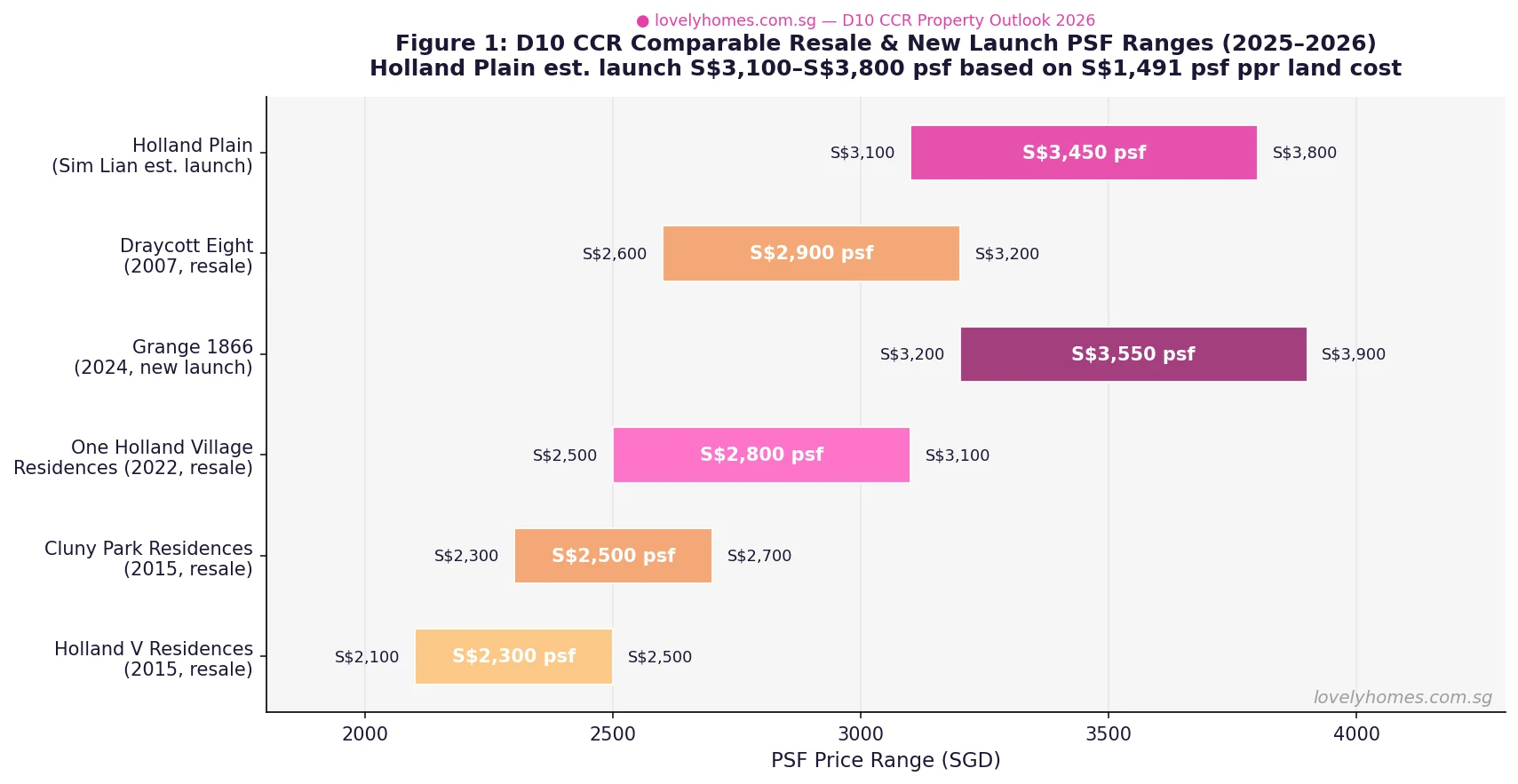
  • Estimated launch price: S$3,100–S$3,800 psf, based on the S$1,491 psf ppr land cost plus construction, financing, and a market premium over One Holland Village Residences resale benchmarks.
  • Preview is likely in Q3–Q4 2027 at the earliest, given the 18–24 month planning and construction mobilisation window typical of CCR boutique sites.
  • The sole-bid outcome reflects cautious developer sentiment in the CCR at current interest rates, but Sim Lian’s calculated entry represents a significant up-market pivot for the group.
  • For SC buyers, no ABSD on a first property purchase. Foreigners face a 65% ABSD surcharge — materially reducing demand from the international pool that traditionally drives CCR volumes.

Holland Plain GLS Awarded to Sim Lian — The Deal Breakdown

On 12 May 2026, the Urban Redevelopment Authority (URA) announced the award of the Government Land Sales (GLS) site at Holland Plain, District 10, to Sim Lian Group — Singapore’s only bidder. The developer tendered S$454,110,000 for the 99-year leasehold parcel, equivalent to approximately S$1,491 per square foot per plot ratio (psf ppr).

The sole-bid outcome drew immediate attention from industry observers. In previous cycles, prime CCR confirmed-list sites in District 10 attracted three to six bidders. The absence of competing bids from large listed developers such as City Developments, CapitaLand Development, UOL Group, or Frasers Property points to a recalibration of risk appetite in the Core Central Region, where the 65% Additional Buyer’s Stamp Duty on foreigners has significantly dampened the international buyer pool that historically underpinned CCR price discovery.

That Sim Lian Group — better known for large-scale Outside Central Region projects such as Treasure at Tampines (2,203 units) and Parc Clematis (1,468 units) — stepped into this site alone is a notable strategic shift for the developer. It signals confidence in the long-term premium of the District 10 address book and suggests Sim Lian has modelled a profitable outcome at launch prices that may be more measured than the aspirational pricing sometimes associated with CCR boutique developers.

Site Specifications — A Boutique Low-Rise in the Heart of D10

Parameter Details
Location Holland Plain, District 10 (CCR), Singapore
Tenure 99-year leasehold from 12 May 2026
Site Area 15,716.9 sq m (approximately 169,148 sq ft)
Max Gross Floor Area 28,291 sq m (approx. 304,590 sq ft)
Gross Plot Ratio 1.8
Permitted Building Height 6 to 8 storeys
Estimated Residential Units ~280 units
Land Use Residential (private condominium)
Developer Sim Lian Group
Award Price S$454,110,000 (S$1,491 psf ppr)
Tender Closed 7 May 2026
Award Date 12 May 2026

The six-to-eight storey height cap is significant. In the Holland Plain and Farrer Road precinct, most condominium developments are low-to-mid-rise, and the Master Plan’s height guidance for this parcel maintains the neighbourhood’s established residential character. Sim Lian is unlikely to build a high-density tower; buyers can expect a product more akin to Cluny Park Residences or Gallop Green — intimate, well-appointed, and positioned for owner-occupier and high-net-worth tenant demand from the nearby international schools.

D10 Comparable PSF — Where Holland Plain Fits

D10 CCR comparable PSF ranges Holland Plain One Holland Village Grange 1866 2026
Figure 1: D10 CCR comparable resale and new-launch PSF ranges for selected condominiums (2025–2026). Holland Plain’s estimated launch range of S$3,100–S$3,800 psf reflects the S$1,491 psf ppr land cost plus construction and a market premium. Source: URA REALIS, EdgeProp, LovelyHomes analysis.

The chart above places Holland Plain’s estimated launch price alongside established D10 benchmarks. One Holland Village Residences — the most proximate recent comparable, launched in 2022 and developed by Far East Organization — traded at roughly S$2,800–S$3,000 psf on launch and currently resells at S$2,500–S$3,100 psf depending on floor level and facing. Grange 1866 in D9 launched in 2024 at S$3,200–S$3,900 psf. Draycott Eight — an older freehold project in D10 — commands S$2,600–S$3,200 psf on resale despite its 2007 completion date, underlining the sustained value of CCR addresses.

Holland Plain’s 99-year leasehold tenure will attract a discount versus freehold and 999-year leasehold projects in the same district. Buyers accustomed to Cluny Park Residences or Good Class Bungalow (GCB) adjacency-premium projects will note that freehold equivalents in the Farrer Road–Grange Road belt command a 10–15% premium over comparable 99-year leasehold product. This suggests the achievable PSF at Holland Plain may cluster towards S$3,100–S$3,500 psf for the majority of units, with penthouses and premium stacks potentially touching S$3,800 psf.

Estimated Launch Pricing and Unit Mix

Holland Plain Sim Lian estimated cost stack land construction breakeven launch price 2026
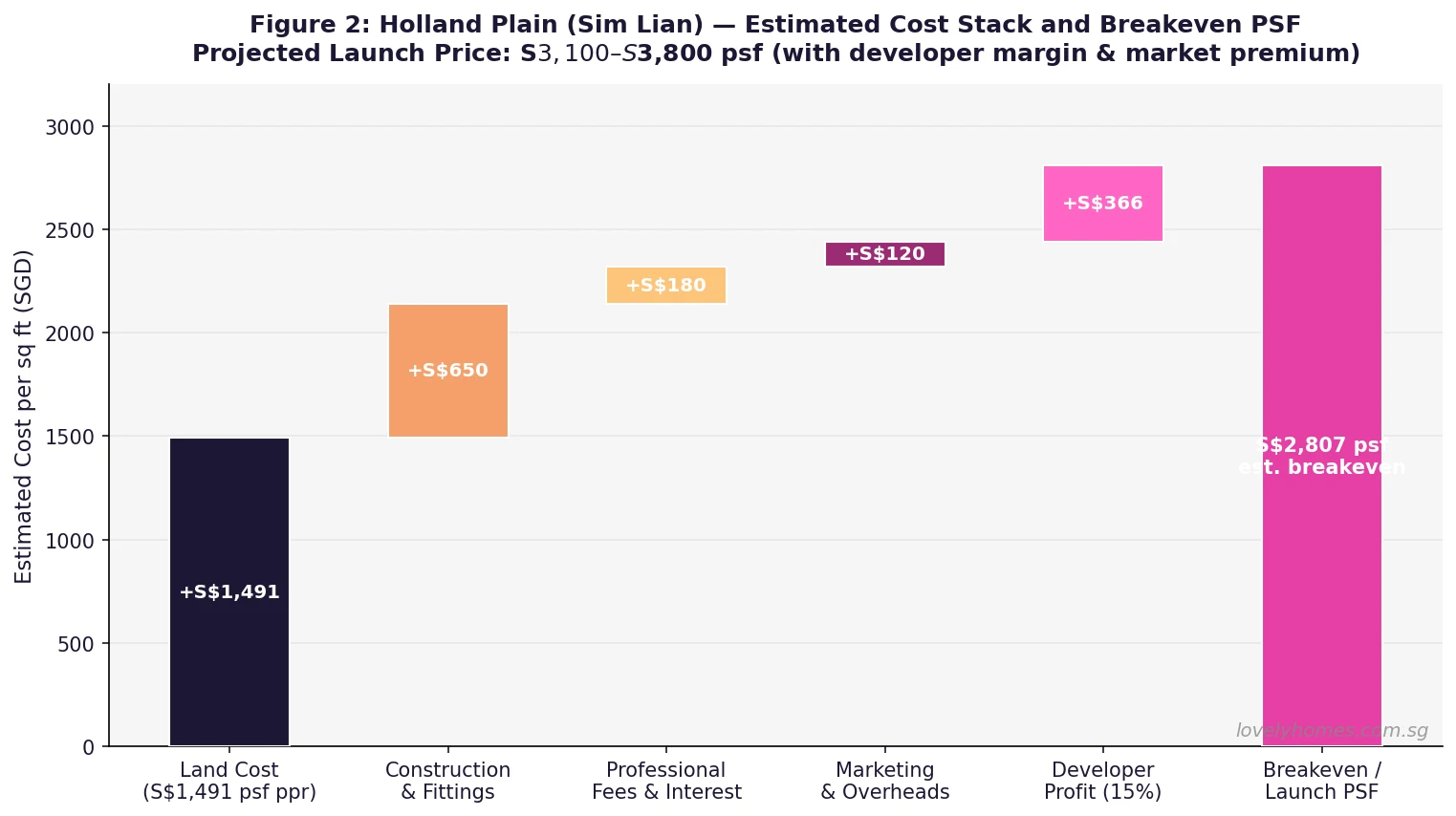
Figure 2: Holland Plain (Sim Lian) estimated cost-stack and breakeven PSF analysis. Land at S$1,491 psf ppr plus construction, professional fees, interest carry, and a 15% developer margin points to a breakeven of approximately S$2,800 psf, with the likely launch range of S$3,100–S$3,800 psf allowing for market positioning and a D10 CCR brand premium. Source: LovelyHomes analysis based on industry cost benchmarks.

With 280 units across ~304,590 sq ft of GFA, the average unit will be approximately 1,088 sq ft — consistent with a mix weighted towards 2- and 3-bedroom configurations appropriate for the family-oriented D10 demographic. LovelyHomes estimates the following indicative pricing grid, based on a blended average launch PSF of S$3,300:

Unit Type Est. Size (sq ft) Indicative Price Range
1-Bedroom 450–550 S$1.40M – S$2.09M
2-Bedroom 700–900 S$2.17M – S$3.42M
3-Bedroom 1,000–1,300 S$3.10M – S$4.94M
4-Bedroom / Penthouse 1,500–2,000 S$4.65M – S$7.60M+

Indicative only. Actual pricing will depend on Sim Lian’s unit mix strategy, prevailing SORA rates at the time of launch, and market conditions in 2027–2028. Consult a licensed property professional before making any commitment.

D10 GLS Land Rate Progression — Context

D10 CCR GLS land rate progression selected sites Holland Plain Sim Lian Singapore 2026
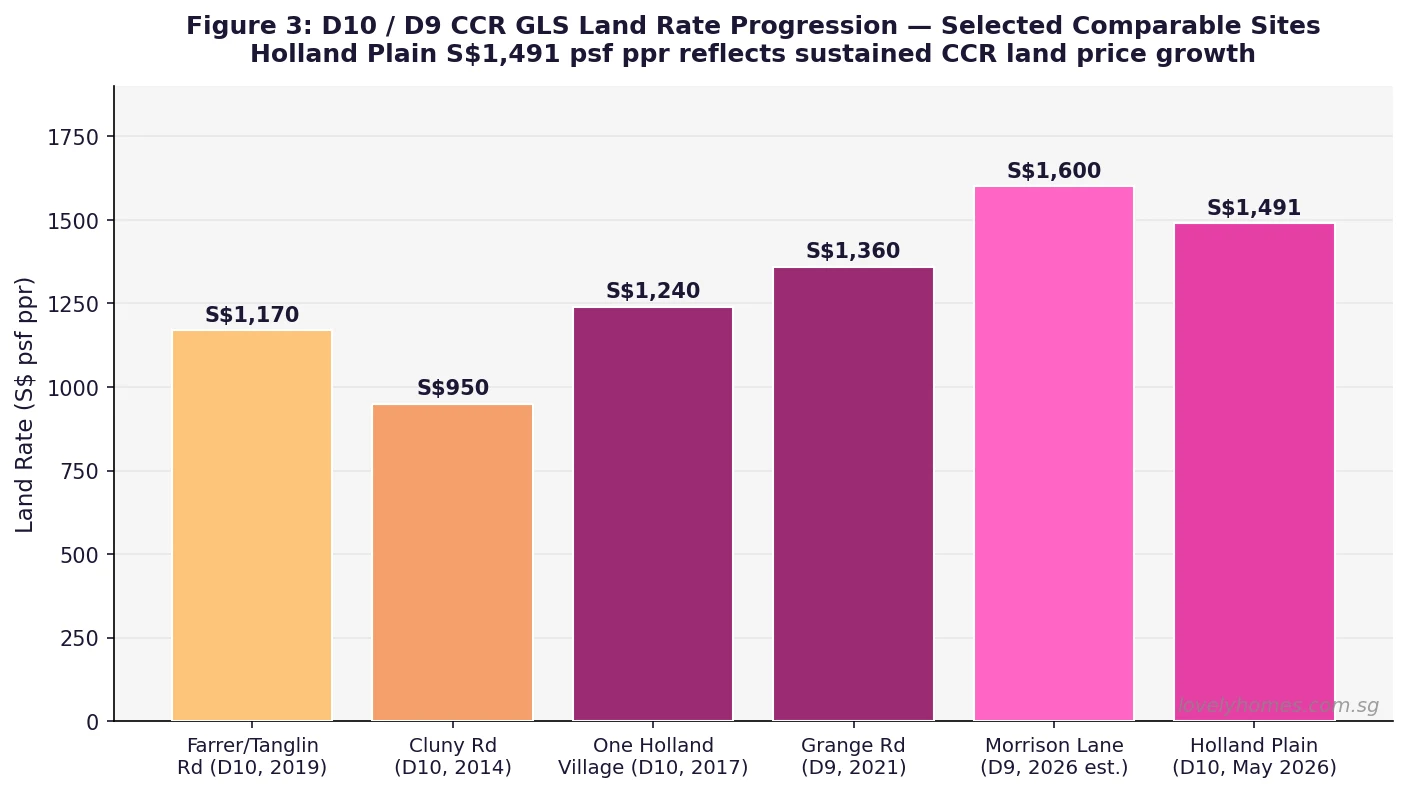
Figure 3: Historical D10 and D9 CCR GLS land rates for selected comparable sites, showing the broad upward trend in CCR land values since 2014. Holland Plain’s S$1,491 psf ppr reflects measured (not euphoric) CCR pricing, consistent with developers’ caution given the 65% foreigner ABSD. Source: URA GLS programme data, LovelyHomes analysis.

Holland Plain’s S$1,491 psf ppr land rate is notable for what it is not: a record. In the pre-cooling-measure era, CCR land bids regularly pushed past S$2,000 psf ppr. The 60% Additional Buyer’s Stamp Duty on foreigners (raised to 65% in April 2023) has structurally redirected international capital away from the new-launch CCR pipeline, removing the speculative demand layer that previously compressed developer margins and pushed bids skyward. What remains is the durable owner-occupier and long-term investment demand from Singapore Citizens and Permanent Residents, which is more price-sensitive and longer in decision horizon.

Sim Lian’s S$1,491 psf ppr bid is broadly consistent with a financially disciplined modelling exercise rather than a prestige land-banking move. The developer is betting on a specific thesis: that D10 boutique, low-rise product at 280 units will sell through comfortably to local families and returning expatriates, even at S$3,100–S$3,500 psf, given the paucity of new launch supply in the Holland Road–Farrer Road corridor since 2022.

Who Will Buy Holland Plain — The Target Buyer Profile

Several distinct buyer archetypes are likely to drive take-up at Holland Plain:

SC upgraders from the OCR. With OCR private condo prices rising 2.2% in Q1 2026 and MOP waves releasing large numbers of resale HDB flats into the market, a cohort of Singapore Citizens who purchased OCR condominiums or HDB flats in 2018–2021 are now sitting on significant capital gains. For couples with household incomes of S$20,000–S$30,000 per month, a 3-bedroom unit at Holland Plain at S$3.5M–S$4.5M represents an aspirational CCR upgrade with no ABSD on a first private property purchase.

D10 residents downsizing or lateral moving. Freehold condominium owners in the Farrer Road, Grange Road, and Tanglin Road precinct who seek newer infrastructure, modern facilities, and professional property management without leaving the district will look seriously at Holland Plain, even with the 99-year leasehold caveat.

Expat tenants’ employers and parents. The international schools immediately adjacent — United World College of South East Asia (Dover campus), the Australian International School, the German European School — generate sustained demand for family-sized rental units in D10. Investor-buyers who target the expat tenant pool will find Holland Plain’s 3-bedroom stock particularly compelling, especially given one-north and the Buona Vista biomedical employment cluster’s continued expansion driving corporate housing budgets.

High-net-worth Singaporeans for own stay. At six to eight storeys in a low-density neighbourhood, Holland Plain will offer a level of privacy and exclusivity rarely available in new launches. The limited unit count of ~280 means the development will feel intimate — a selling point for buyers accustomed to landed living who want managed-property convenience.

ABSD Implications — The Foreigner Market Is Largely Sidelined

The 65% Additional Buyer’s Stamp Duty on foreign buyers, in force since 27 April 2023, means that any foreigner purchasing a S$2M 2-bedroom unit at Holland Plain would face an ABSD bill of S$1.3 million — on top of BSD of approximately S$57,600. Total acquisition cost before loan: over S$3.35M. This is not a purchase case that works for most foreign nationals who do not have deep Singapore roots or a specific business reason to own in the CCR.

The practical implication: Holland Plain will be absorbed almost entirely by Singapore Citizens and Permanent Residents. SPR buyers pay 5% ABSD on a first property — manageable at S$100,000–S$180,000 on a typical unit — and a meaningful segment of the take-up will come from this pool. SC buyers on a first property pay zero ABSD. SC buyers on a second or subsequent property pay 20% ABSD — a S$640,000 bill on a S$3.2M unit — which remains a significant friction, though less prohibitive for high-net-worth upgraders than the foreigner rate.

For more on ABSD rates by buyer profile, see our ABSD Singapore 2026 complete guide.

Worked Example — Mr & Mrs Chua: SC Upgraders Buying a 3-Bedroom at Holland Plain

Mr & Mrs Chua are Singapore Citizens in their early 40s. They sold their OCR condominium in Tampines in late 2025 for S$1.55M (purchased in 2019 for S$1.1M), banking approximately S$350,000 in net cash after paying off the outstanding mortgage. They are now renting in D10 and plan to purchase a 3-bedroom unit at Holland Plain when it launches, estimated at approximately S$4.1M.

ABSD: As SC buyers on their second private residential property (they now own zero properties — the Tampines unit was sold), they are effectively first-time owners at point of purchase. Zero ABSD applies. ✓

BSD on S$4.1M: 1% × S$180k = S$1,800; 2% × S$180k = S$3,600; 3% × S$640k = S$19,200; 4% × S$500k = S$20,000; 5% × S$1.1M = S$55,000; 6% × S$1M = S$60,000. Wait — let me apply the correct BSD tiers. On S$4.1M: 1%×180k + 2%×180k + 3%×640k + 4%×500k + 5%×2.6M. Actually: First S$180k at 1% = S$1,800; next S$180k at 2% = S$3,600; next S$640k at 3% = S$19,200; next S$500k at 4% = S$20,000; above S$1.5M: next S$1.5M at 5% = S$75,000; above S$3M: remaining S$1.1M at 6% = S$66,000. Total BSD = S$185,600.

Financing: At a blended bank fixed rate of approximately 2.0% per annum (estimated for 2027), the Chua couple borrows 75% of the S$4.1M purchase price = S$3,075,000. Monthly instalment over 25 years ≈ S$13,020. TDSR check: assuming joint gross income S$35,000/mth — TDSR = 37.2% (below 55% cap). ✓

Down payment and cash needed: 25% down = S$1,025,000 (can be funded from CPF OA and cash); BSD S$185,600 in cash. Using S$350,000 cash from the Tampines sale and drawing S$675,000 from CPF OA, the couple meets both the down payment and stamp duty requirements with ~S$164,000 CPF OA remaining as a buffer.

Summary for Mr & Mrs Chua: S$4.1M Holland Plain 3-bedroom → ABSD nil → BSD S$185,600 → bank loan S$3.075M @ 2.0% for 25yr → monthly S$13,020 → TDSR 37.2% → cash outlay S$535,600 (cash from Tampines proceeds + stamp duty) + CPF drawdown S$675,000.

Development Timeline and What to Watch

Following the tender award on 12 May 2026, Sim Lian will enter the planning and approvals phase with URA. A provisional building plan is typically submitted within six months of award, with a building plan approval following three to six months later. Construction commencement generally occurs 18–24 months post-award for CCR boutique sites. Based on this trajectory, the likely public preview window is Q3–Q4 2027, with expected project completion (Temporary Occupation Permit) in 2030–2031.

Watch for: Sim Lian’s project name announcement (likely within six months), architectural rendering release, showflat construction in the Holland Plain vicinity, and any pre-indication of pricing through EdgeProp or Stacked Homes developer briefings approximately 60–90 days before the official launch date.

What This Means for D10 Buyers and the Broader CCR

The Holland Plain award is a data point in a larger story about CCR supply discipline. With the 65% foreigner ABSD in place and a generation of Singaporean private property owners sitting on significant unrealised equity from 2019–2024 price appreciation, the CCR market in 2026–2028 will be one where supply is lean, developer caution is visible (sole bids, measured land rates), and local buyers — particularly SC upgraders — will find themselves as the dominant demand driver for the first time in decades.

For buyers considering Holland Plain, the opportunity is clear: a boutique, low-rise D10 CCR address in a school belt with strong expat tenant demand, delivered by a developer with an established sales track record, at land rates that suggest a measured (rather than euphoric) launch PSF. The risk factors are the 99-year leasehold tenure, the reliance on local SC/SPR demand, and the long wait time (2027–2028 launch, 2030–2031 completion) during which market conditions may shift.

What Might Come Next — GLS Pipeline and CCR Outlook

This is speculative. The remaining 1H 2026 GLS confirmed list site — River Valley Green Parcel C — closes for tender on 18 June 2026 and is expected to attract two to four bidders given its smaller site area. If it also draws a sole bid at conservative land rates, it would confirm a broader pattern of developer restraint in the CCR. The URA may respond to this signal when compiling the 2H 2026 GLS programme (expected announcement December 2026) by adjusting the CCR mix on the confirmed list, potentially holding back sites to avoid depressing land values further or to allow existing pipeline to absorb before adding new confirmed-list supply.

Watch also for any policy review of the 65% foreigner ABSD. If global capital flows to Singapore property are assessed to have become too restricted and if housing prices stabilise, there is a non-trivial possibility of a partial relaxation (e.g., from 65% to 30–45% for longer-term PRs or certain FTA-holder nationalities) in the 2026–2027 National Day Rally or Budget cycle. Any such relaxation would immediately revive international demand at D10 project launches and push achievable PSF upwards — a significant upside scenario for early Holland Plain buyers.

FAQ: Holland Plain GLS 2026 — Sim Lian Award
Why did only one developer bid for Holland Plain?

The sole-bid outcome reflects a combination of factors: the 65% Additional Buyer’s Stamp Duty on foreigners has substantially reduced the addressable buyer pool for CCR new launches, narrowing the demand basis that developers model when deciding how aggressively to bid. Many larger listed developers were also managing existing CCR inventory — including ongoing projects in D9 (Peck Hay Road, River Valley) — and may have chosen to preserve capital rather than pursue a concurrent D10 commitment. Sim Lian’s willingness to bid alone at S$1,491 psf ppr suggests the group has a specific product and pricing thesis that pencils out within that land cost, without requiring the foreign buyer premium that other developers may have deemed necessary to justify a higher bid.

Is Holland Plain’s 99-year leasehold a concern for long-term value?

Leasehold tenure is always a consideration in the CCR, where freehold and 999-year projects exist as alternatives. A 99-year leasehold in D10 will typically trade at a 10–15% discount to a freehold equivalent on a like-for-like basis. However, for buyers with a 10–20 year investment horizon, the leasehold discount at point of purchase can represent a compelling entry point, particularly if the area’s rental demand and capital growth story remain intact. The critical factor is the remaining lease at the point of future sale: a buyer who purchases a 99-year leasehold unit in 2028 and sells in 2043 will be transacting a unit with approximately 84 years remaining — still well above the HDB housing grant lease-coverage threshold and broadly financeable for the next generation of buyers.

When is the expected launch date for Sim Lian’s Holland Plain project?

Based on the typical CCR boutique development timeline — URA planning approvals (6–12 months), building plan submission and approval (3–6 months), showflat construction and marketing preparation (3–6 months) — the most likely preview window is Q3 to Q4 2027. Construction commencement would follow in late 2027 or early 2028, with a Temporary Occupation Permit (TOP) date of approximately 2030–2031. This is an estimate based on typical timelines; Sim Lian has not publicly confirmed any milestones.

What is the nearest MRT station to Holland Plain?

The Holland Plain site is located approximately 700 metres to 1 kilometre from Holland Village MRT station (Circle Line CC21 and Thomson-East Coast Line TE17). The dual-line interchange at Holland Village provides excellent connectivity to Botanic Gardens (CC19/DT9), Buona Vista (CC22/EWL), and Marina Bay (TE20/CC29/NS27/CE1). The Thomson-East Coast Line also connects northward to Caldecott (TE9/CC17) and southward through the city to Bayshore. For commuters working in the CBD or Orchard, Holland Village MRT offers a one- to two-interchange journey of approximately 20–30 minutes.

What schools are near Holland Plain?

The Holland Plain site benefits from proximity to some of Singapore’s most sought-after schools. Henry Park Primary School is located within approximately 1 kilometre, making the project eligible for Phase 2B HDB priority balloting for future owners with children. Nanyang Primary School in Buona Vista is another highly-regarded option within approximately 2 km. For international school demand — which drives a significant portion of D10 rental volumes — United World College of South East Asia (Dover campus), the Australian International School, and the German European School Singapore are all within a 3–4 km radius. This cluster is a major driver of family tenant demand at S$5,000–S$9,000 per month for 3- to 4-bedroom units.

Should I register interest now to buy Holland Plain?

Sim Lian has not opened any registration of interest (ROI) process as at 22 May 2026. The project has not been named, priced, or publicly marketed. It is premature to commit funds or make any financial arrangement based solely on this GLS award. LovelyHomes recommends monitoring Sim Lian’s official announcements, EdgeProp project launch alerts, and URA’s building plan approvals database for planning-permission milestones, which will give approximately 60–90 days’ advance notice before a formal marketing launch. Do not rely on unofficial registration lists maintained by individual marketing agents, as these carry no legal weight and may involve data privacy risks.

Related Articles


Disclaimer: This article contains LovelyHomes’ independent analysis and projections based on publicly available URA GLS data, industry cost benchmarks, and comparable transaction information. Projected launch prices, unit mixes, timelines, and investment outcomes are estimates only and do not constitute financial advice, a solicitation to purchase, or a guarantee of any outcome. The Singapore property market is subject to government policy changes, interest rate movements, and macroeconomic conditions that may materially alter outcomes. Always consult a licensed real estate agent, licensed financial adviser, and qualified conveyancing solicitor before making any property purchase decision. Source data: URA GLS programme 1H 2026, URA REALIS, MND, CPF Board.

×

Click anywhere to close

Punggol Neighbourhood Guide Singapore 2026: Waterfront Living, Digital District and Property Investment Outlook

Punggol Neighbourhood Guide Singapore 2026: Waterfront Living, Digital District and Property Investment Outlook

Quick Answer — Punggol 2026 at a Glance

  • HDB 4-Room median resale price: S$700,000 (2026); 5-Room median ~S$840,000; record transaction S$1.47M for a 5-room flat
  • EC resale: Rivercove Residences ~S$1.05M–S$1.25M psf basis; Northwave EC ~S$1.0M–S$1.2M psf basis
  • Private condo: Watertown and A Treasure Trove resale at ~S$1,150–S$1,500 psf
  • Connectivity: North East Line (NEL) Punggol MRT; Punggol LRT East & West loops; Cross Island Line (CRL) Phase 2 planned ~2031
  • Investment catalyst: Punggol Digital District — 28,000 jobs in tech, media, and design; JTC, SIT Punggol Campus
  • Schools: Waterway Primary, Punggol Primary, North Spring Primary, Punggol Crest Primary, Punggol View Primary
  • Gross rental yields: HDB 3.6–4.3%; EC 3.5%; private condo ~3.1%; 3-year EC capital growth ~13.8%

What and Where Is Punggol?

Punggol is one of Singapore’s youngest and most ambitiously planned new towns, located in the northeastern tip of the main island. Designated by the Housing & Development Board (HDB) as the centrepiece of Singapore’s “next generation” estate development under the Punggol 21 and Punggol 21-Plus master plans, the town is built around the 4.2-kilometre Punggol Waterway — an artificial freshwater channel connecting the Punggol and Serangoon rivers and serving as the spine of the town’s lifestyle and recreational offer.

Under the Urban Redevelopment Authority’s (URA) Master Plan, Punggol sits in Planning Area 22 and is divided into four planning precincts: Northshore, Punggol Field, Punggol Town Centre, and Waterway. The town is home to approximately 160,000 residents in about 52,000 HDB flats, with a population expected to grow to 300,000 as development continues through the 2030s.

What sets Punggol apart from other OCR towns is not just its waterway aesthetic but its role as Singapore’s testbed for smart and sustainable living concepts — intelligent waste management systems, sensor-driven municipal infrastructure, and energy-efficient building designs are woven into the town’s fabric. The opening of Punggol Digital District (PDD) in 2024, housing JTC Corporation’s new campus and Singapore Institute of Technology (SIT)’s Punggol Campus, has added an employment dimension to Punggol’s residential identity that most OCR towns lack.

Punggol property prices 2026 — HDB 4-room 5-room EC private condo median Singapore
Figure 1: Punggol median/typical property prices by type, 2026. HDB figures reflect URA resale transaction data and HDB Resale Portal caveats. EC prices based on post-MOP resale caveat data. Sources: URA, HDB, SRX Singapore.

Punggol Property Market Overview 2026

The Punggol HDB resale market has been one of the most active in Singapore’s OCR over the past three years, driven by a combination of the waterway lifestyle premium, the Punggol Digital District employment catalyst, and a steady flow of BTO flats completing their 5-year Minimum Occupation Period (MOP) and entering the resale pool.

Price trajectory 2026: The median 4-Room HDB resale in Punggol reached S$700,000 in 2026, up from approximately S$540,000 in 2022 — a 3-year appreciation of roughly 30%. Five-room median prices stand at S$840,000. The most remarkable data point for 2026 is the Punggol 5-room record: a unit along Punggol Drive transacted at S$1.47 million (approximately S$929 psf) in early 2026, setting a new HDB record for 5-room flats in the town and signalling the extent of the waterway premium that buyers are willing to pay.

EC resale market: Rivercove Residences (Sengkang Avenue, adjacent to Punggol boundary) and Northwave EC (Woodlands Road) represent the main EC resale supply in the northeast corridor. Post-MOP Rivercove units transact at S$1,050–S$1,250 psf, while Northwave EC commands S$1,000–S$1,200 psf, reflecting its more mature stage of MOP completion. Parc Canberra EC (Sembawang), further from Punggol, provides pricing comparison at S$1,020–S$1,180 psf.

Private condo market: Watertown (Punggol Central, directly above Punggol MRT) commands premium pricing at S$1,250–S$1,500 psf — an integrated retail and residential development that benefits uniquely from the MRT-integrated format. A Treasure Trove (Punggol Walk) transacts at S$1,150–S$1,380 psf as a large-scale 99-year leasehold project. The private condo market in Punggol is constrained by limited supply, which supports pricing but restricts buyer choice.

Punggol Digital District — Singapore’s Largest Employment Catalyst

The Punggol Digital District (PDD) is one of the most significant employment-driven property catalysts in Singapore’s suburban history. Developed by JTC Corporation and announced under the Punggol 21-Plus master plan, the PDD is designed to house 28,000 jobs in the tech, media, creative, and design sectors across approximately 600,000 square metres of gross floor area.

The district hosts JTC Corporation’s new campus and the Singapore Institute of Technology (SIT)’s Punggol Campus, which opened progressively from 2023 to 2024, with a full student and faculty population expected by 2026. SIT’s Punggol Campus offers engineering, applied health sciences, hospitality, and information technology programmes — drawing a population of students and young professionals who rent in the surrounding Punggol HDB estates.

The PDD’s effect on Punggol’s rental market is already visible: rental demand for 2-room and 3-room HDB units within a 15-minute walk of Punggol MRT has strengthened notably since 2024, supporting gross yields of 4.3% for 3-room flats — among the strongest in the OCR for that flat type.

Getting Around — MRT, LRT and Future CRL Phase 2

Punggol’s primary rail connection is the North East Line (NEL) Punggol MRT station (NE17), operated by SBS Transit under the Land Transport Authority’s (LTA) regulatory framework. From Punggol MRT, commuters reach Serangoon (NEL/CCL interchange) in 9 minutes, Dhoby Ghaut in 26 minutes, and HarbourFront in 33 minutes. The station is integrated with the Watertown shopping mall podium, offering a seamless retail and transit experience.

The Punggol LRT system mirrors Sengkang’s in structure, with an East Loop and West Loop running 10 stations from the Punggol MRT interchange. East Loop: Damai, Kadalur, Meridian, Coral Edge, Riviera, Layar, Tongkang, Nasi, Sam Kee. West Loop shares the Cove and Meridian stations. The LRT extends connectivity to waterway-adjacent precincts that would otherwise require a longer walk from the MRT.

The most anticipated infrastructure upgrade is Cross Island Line (CRL) Phase 2 (~2031), which will serve Punggol as a terminus station, offering direct cross-island rail access to Jurong Lake District, one-north, and the eastern end of Singapore via a single continuous line. The CRL’s Punggol connection will dramatically reduce commute times to western Singapore — a major competitive disadvantage of northeastern estates today — and is widely expected to support further HDB and private property price appreciation in Punggol from the mid-2020s.

Punggol amenities 2026 — MRT schools Digital District waterway parks healthcare statistics
Figure 2: Punggol key amenities, schools, employment anchors, parks, healthcare and town statistics 2026. Sources: JTC, SIT, HDB, LTA, MOE, SingStat 2026.

Schools and Education in Punggol

Punggol’s school landscape reflects the town’s relatively young age — many of its primary schools were built in the 2010s to accommodate the rapid population growth from BTO completions. Families in the estate’s earlier precincts (Waterway, Punggol Town Centre) have a wider choice of established schools within the 1-kilometre priority registration radius.

Primary schools: Waterway Primary School (Punggol Waterway), Punggol Primary School (Edgedale Plains), North Spring Primary School (Sengkang, within close proximity), Punggol Crest Primary School, and Punggol View Primary School together cover the estate’s primary school catchment. Demand at these schools in Phase 2B registration rounds reflects the strong family-oriented demographic composition of Punggol.

Secondary and post-secondary: Punggol Secondary School and Greendale Secondary School serve the town. Anderson Serangoon Junior College and Serangoon Garden Secondary are accessible by LRT and bus. The most significant education catalyst is, of course, SIT’s Punggol Campus — which draws tertiary enrolment directly into the district, creating a live-work-learn environment that property investors regard as a long-term demand anchor.

Lifestyle — Waterway, Coney Island and Family Living

Punggol Waterway Park is Punggol’s signature asset — a 2.8-kilometre linear park along the Punggol Waterway offering kayaking pontoons, boardwalks, cycling paths, and F&B pavilions. The waterway connects to Punggol Point Park at the town’s northern tip, where a cluster of seafood restaurants and the Punggol Point Jetty offer a distinctly different urban-meets-nature experience from anywhere else in Singapore’s HDB landscape.

Coney Island Park, accessible via the Samudera LRT station, is a 50-hectare nature reserve and recreational island — one of Singapore’s more unexpected green assets within an HDB estate boundary. The island’s beaches, trails, and wildlife attract weekend visitors from across Singapore, reinforcing Punggol’s lifestyle brand.

Retail is centred on Waterway Point, an integrated shopping mall directly above Punggol MRT with a cinema, supermarket, and extensive F&B. Northshore Plaza I & II in the Northshore precinct provide neighbourhood-scale retail for the newer HDB clusters. The planned commercial component of Punggol Digital District will further expand the estate’s retail and F&B offering as tenancies are filled out through 2026 and beyond.

Punggol HDB Resale — Key Facts Summary

Property Type Typical Price Range (S$) Median 2026 (S$) Key Notes
HDB 3-Room 430,000 – 600,000 510,000 Strong rental demand from PDD and SIT students; good yield entry point
HDB 4-Room 560,000 – 950,000 700,000 Most active transaction segment; waterway units command 15–20% premium
HDB 5-Room 680,000 – 1,470,000 840,000 Record S$1.47M (Punggol Drive, Feb 2026); waterway-facing commands exceptional prices
EC (Rivercove/Northwave resale) 900,000 – 1,400,000 1,100,000 Limited supply post-MOP; strong demand from upgraders
Private Condo (Watertown) 1,100,000 – 1,900,000 1,380,000 MRT-integrated; premium for integrated living; thin resale market

Worked Example — SC Couple Upgrading to Punggol 2026

Mr and Mrs Lim, Singapore Citizens, joint monthly income S$11,500. Selling their Tampines 4-room HDB (MOP cleared) for S$730,000, buying a 4-Room Punggol resale with waterway view at S$880,000 as their second property.

Purchase price (Punggol 4-Room HDB resale) S$880,000
Buyer’s Stamp Duty (BSD, administered by IRAS) S$22,200
ABSD — SC buying 2nd property (administered by IRAS) S$176,000 (20%)
Concurrent ownership note Must sell Tampines flat within 6 months to claim ABSD remission
HDB Loan (80% LTV at 2.6% p.a.) S$704,000
Down payment (20%) S$176,000 (CPF OA eligible)
Conveyancing and caveat fees ~S$3,800
Monthly instalment (30-year HDB loan) S$3,196/month
Mortgage Servicing Ratio (MSR, cap ≤ 30%) 27.8% ✓
Total Debt Servicing Ratio (TDSR, cap ≤ 55%) 27.8% ✓

BSD calculated at IRAS progressive rates: 1% on S$180k + 2% on next S$180k + 3% on balance S$520k = S$22,200. ABSD of 20% applies on the full purchase price as the Lims own an existing HDB flat. Under the SC married-couple ABSD remission, the S$176,000 ABSD may be refunded by IRAS if the Tampines flat is sold within 6 months of purchasing the Punggol flat. MSR capped at 30% of gross monthly income by MAS; TDSR at 55%.

Is Punggol a Good Property Investment in 2026?

Punggol presents one of the most compelling long-term investment narratives in Singapore’s OCR, driven by the convergence of three independent demand drivers: Punggol Digital District employment, CRL Phase 2 connectivity, and the Punggol General Hospital pipeline. Unlike many HDB estates that rely on historical infrastructure and a single MRT line, Punggol’s investment case is forward-looking — its best catalysts are still years away from full realisation.

Yield versus capital growth trade-off: Gross rental yields for Punggol HDB are slightly lower than Sengkang (3.6–4.3% versus 3.9–4.5%) because prices have risen faster than rents. For investors prioritising yield, Sengkang’s more affordable entry points and comparable rental income produce a stronger initial return. For investors prioritising capital growth, Punggol’s combination of PDD employment density, CRL connectivity, and the waterway lifestyle premium makes it the more compelling choice on a 7–10 year horizon.

HDB classification: Punggol BTO flats are classified as Standard under HDB’s 2024 framework, with the exception of units in the Northshore Straits precinct which were designated Plus classification. Buyers should check the classification of specific BTO projects before purchasing, as Plus flats carry a 10-year enhanced MOP and income ceiling at first resale — factors that may affect both exit strategy and buyer pool.

Punggol gross rental yield vs 3-year capital growth 2026 — HDB EC private condo investment Singapore
Figure 3: Punggol gross rental yield versus 3-year capital growth by property type, 2026. Yields based on 2026 median transaction prices and estimated annual market rents. Capital growth reflects 2023–2026 price movement. Sources: URA, HDB Resale Portal, SRX Singapore, EdgeProp.

What Might Come Next for Punggol Property?

The following section reflects the editorial analysis and projections of LovelyHomes as at 19 May 2026. It is speculative in nature and should not be construed as financial or investment advice.

The three most important forward catalysts for Punggol property are well-defined but not yet fully priced in. The Cross Island Line Phase 2 (~2031) is the most transformative: a direct rail link to Jurong Lake District — Singapore’s second CBD — would reduce Punggol’s western commute time by 15–20 minutes, materially expanding the estate’s buyer and tenant catchment. Proximity to a CRL station has historically added 10–15% to residential prices in the 2–3 years before opening based on patterns observed at other MRT lines.

The Punggol General Hospital, announced by the Ministry of Health and expected to open around 2030–2032, will join Sengkang General Hospital as a major healthcare employer in the northeast, further anchoring the corridor’s population base and creating white-collar employment demand for nearby housing. Healthcare workers — a stable, income-regular demographic — are consistent tenants and buyers in proximity to their workplace.

Finally, the continued infilling of Punggol Digital District tenancies as technology companies, media firms, and government agencies take up space in the JTC campus buildings will steadily raise the daytime population and supporting retail demand in Punggol. Each additional large employer anchored in PDD adds a cohort of potential renters to the estate’s rental demand base.

Frequently Asked Questions — Punggol Property 2026

Is Punggol a good place to buy property in 2026?

Punggol is widely regarded as one of Singapore’s strongest long-term OCR investment stories, with a forward-looking infrastructure pipeline (CRL Phase 2, PDD employment, Punggol General Hospital) that justifies its current premium over comparable northeast towns. For owner-occupiers, the waterway lifestyle, newer flats, and strong school cluster make it a highly desirable family location. For investors, the capital growth case is stronger than the yield case — buyers seeking the highest immediate rental returns may find better entry in Sengkang or Woodlands, but those with a 7–10 year horizon targeting capital appreciation have strong reasons to consider Punggol.

How much does a Punggol HDB flat cost in 2026?

Punggol HDB resale prices in 2026 range from approximately S$430,000–S$600,000 for a 3-room flat to S$680,000–S$1,470,000 for a 5-room flat, with waterway-facing units commanding a 15–25% premium over non-waterway-facing units. The median 4-room resale price is S$700,000 and the median 5-room is S$840,000. The record transaction for a Punggol HDB flat stands at S$1.47 million for a 5-room unit along Punggol Drive transacted in February 2026. Buyers should verify current transaction data with the HDB Resale Portal (homes.hdb.gov.sg) and URA’s Realis system before finalising their price assessment.

What is Punggol Digital District and how does it affect property values?

Punggol Digital District (PDD) is a 50-hectare, 600,000 sqm GFA employment cluster developed by JTC Corporation, anchored by JTC’s new campus and Singapore Institute of Technology (SIT)’s Punggol Campus. At full build-out, the PDD is expected to house approximately 28,000 workers in technology, media, creative, and design industries. For property investors, the PDD functions as a direct rental-demand generator — drawing SIT students, young professionals, and tech workers who prefer to live close to their workplace. Market data from 2024–2025 already shows above-average rental demand growth for 2-room and 3-room HDB units within 15 minutes’ walk of Punggol MRT, the gateway to PDD.

What is the Cross Island Line and will it add to Punggol property values?

The Cross Island Line (CRL) is Singapore’s eighth MRT line, being built in phases. CRL Phase 2 will extend the line from its current Phase 1 terminus to include a Punggol terminus, offering direct cross-island connectivity to Jurong Lake District, one-north, and the western half of Singapore from the northeast. Phase 2 is targeted for completion around 2031. The CRL will significantly reduce Punggol’s biggest commute disadvantage — limited westward connectivity — and is widely expected by analysts to provide a measurable uplift to Punggol residential values from around 2028 onwards as the opening approaches. LTA manages MRT construction and operations under the National Land Transport Master Plan.

Are there upcoming BTO launches in Punggol in 2026?

HDB’s confirmed June 2026 BTO exercise does not include Punggol sites (it covers Ang Mo Kio, Bishan, Bukit Merah, Sembawang, and Woodlands). Punggol is likely to feature in subsequent BTO exercises in 2026 or early 2027 as development of the Northshore and Punggol Field precincts continues. Prospective BTO buyers should monitor the HDB website (hdb.gov.sg) for announcements and note that some Punggol precincts may carry Plus classification with its associated 10-year enhanced MOP — an important consideration for buyers who may need to sell within a decade of purchase.

Can a foreigner buy property in Punggol?

Foreigners cannot purchase HDB flats in Punggol under any circumstances — HDB public housing is restricted to Singapore Citizens and, in the resale market, Singapore Permanent Residents (subject to family nucleus and 3-year PR waiting period requirements). Foreigners may purchase private residential properties in Punggol — specifically, condominium units (stratum titles) — but are subject to Additional Buyer’s Stamp Duty (ABSD) of 65% on the purchase price, administered by IRAS. Foreigners may not purchase landed residential properties in Punggol without approval from the Land Dealings Approval Unit. Given the 65% ABSD rate, foreign ownership of Punggol private condos is very limited.

How does Punggol compare with Sengkang for property investment?

Punggol and Sengkang are immediate neighbours with broadly similar demographics but different investment profiles. Sengkang currently offers slightly higher rental yields (4.2–4.5% for 4-room HDB versus Punggol’s 3.6–3.9%) and a slightly lower entry price for equivalent flat types. Punggol offers a stronger capital growth narrative (3-year HDB appreciation ~9.2% versus ~8.1% for Sengkang) driven by PDD employment and CRL Phase 2 anticipation. For buyers choosing between the two in 2026, the decision often hinges on time horizon: short-to-medium term yield optimisation favours Sengkang, while longer-term capital growth targeting favours Punggol.

Related Articles

Disclaimer

This article is intended for general information and educational purposes only and does not constitute financial, investment, legal, or property advice. All property prices, rental yields, market data, and regulatory information are based on sources available as at 19 May 2026 and are subject to change. Buyers, sellers, and investors should verify current information directly with the Housing & Development Board (HDB) at hdb.gov.sg, the Urban Redevelopment Authority (URA) at ura.gov.sg, the Inland Revenue Authority of Singapore (IRAS) at iras.gov.sg for stamp duty matters, and the Monetary Authority of Singapore (MAS) at mas.gov.sg for loan and MSR/TDSR regulations. Always engage a licensed financial adviser, mortgage specialist, and Law Society-accredited conveyancing solicitor before making any property transaction decision.


Click anywhere to close

Jurong Lake District Property Outlook 2026: Prices, Investment Potential and What Is Coming

Jurong Lake District Property Outlook 2026: Prices, Investment Potential and What Is Coming

Jurong Lake District Property Outlook 2026: Prices, Investment Potential and What Is Coming

Quick Answer

  • Jurong Lake District (JLD) is Singapore’s largest mixed-use development outside the city centre, planned by the Urban Redevelopment Authority (URA) to become the country’s second Central Business District.
  • Private condominium prices in the JLD corridor currently range from approximately S$1,100–S$1,600 psf for resale, with new launches in the area reaching S$2,100 psf at LakeGarden Residences.
  • The district sits in the Outside Central Region (OCR) but is transitioning to near-RCR pricing as major commercial anchors — the Jurong Regional Library, JTC’s Jurong Innovation District, the future Cross-Island Line (CRL) interchange, and a new integrated tourism belt — take shape.
  • HDB resale flats in Lakeside, Jurong East, and Boon Lay average S$550–S$750 per flat, offering affordable entry points with strong upgrader demand upstream.
  • Gross rental yields in the JLD corridor range from 3.2%–4.1% for private condominiums and up to 4.8% for HDB flats.
  • A URA Reserve List site at Town Hall Link — capable of yielding approximately 1,200 residential units — adds significant future supply potential once triggered.
  • The Cross-Island Line (CRL) Phase 1, opening in 2030, will connect Jurong directly to the east-west corridor via Aviation Park and Bright Hill, materially improving accessibility and underpinning long-term price support.

What Is the Jurong Lake District?

The Jurong Lake District is a long-term urban transformation project anchored around Jurong East MRT interchange station and the Jurong Lake Gardens — a 90-hectare national garden that opened progressively from 2019. The district spans approximately 410 hectares and is envisaged to accommodate 100,000 workers and 20,000 residents when fully developed. The Urban Redevelopment Authority (URA) gazetted the JLD Special Planning Area in 2008 and has pursued a phased approach to development, with initial commercial anchors followed by progressive residential densification.

JLD is significant not merely as a suburban office cluster but as Singapore’s strategic answer to the decentralisation of its economic activity. With the Central Business District historically concentrated in Raffles Place, Tanjong Pagar, and Marina Bay, JLD represents the government’s most ambitious attempt to create a second major economic hub, offering comparable connectivity and amenity at a fraction of the Central Region’s land cost. For property investors, this long-arc transformation thesis — backed by sustained public capital expenditure — is a key valuation driver.

Figure 1: Jurong Lake District — Property Price Trajectory & Key Projects (2016–2030). Sources: URA, PropertyGuru, LovelyHomes research.

Key Developments Shaping JLD in 2026

Several large-scale developments are advancing concurrently and collectively driving the district’s transformation. The Jurong Innovation District (JID), developed by JTC Corporation on the western fringe near Tengah, is Singapore’s next-generation advanced manufacturing hub, targeting anchor tenants in robotics, aerospace, clean energy, and precision engineering. When fully operational, JID is expected to accommodate over 95,000 jobs — a significant employment base that creates sustained residential rental demand in the surrounding JLD area.

J’den, the 368-unit mixed-use development on the former JCube site along Jurong East Central, set the tone for new-launch pricing in JLD. Launched in late 2023, J’den sold 89% of units in its launch weekend at an average of approximately S$2,100 psf, establishing a new price benchmark for the district. The development integrates directly with Jurong East MRT interchange — providing covered, air-conditioned pedestrian access to the NEL and EWL networks — a connectivity premium that buyers clearly priced in. J’den’s success signals strong latent demand for well-located, transit-integrated new launches in the western corridor.

LakeGarden Residences, a 306-unit condominium on Yuan Ching Road beside Jurong Lake Gardens, offers a different value proposition: lakeside living with garden frontage rather than MRT integration. Sales at an average of S$2,106 psf in 2026 confirm that the lake-facing premium is real. For resale buyers and investors, this pricing sets the ceiling for the immediate sub-market, with older condominiums along the same corridor — Lakepoint Condo, Lake Grande, Parc Riviera — trading at a 30–50% discount on a psf basis.

Price Landscape: Where JLD Sits in the Singapore Market

Figure 2: PSF Price Comparison — JLD vs Surrounding Districts (2026). Sources: URA, SRX, LovelyHomes research.
Property Type Sub-location Typical PSF / Price Range (2026) Notes
New Launch Condo Jurong East (MRT-integrated) S$2,050–S$2,200 psf J’den benchmark
New Launch Condo Lakeside / Yuan Ching S$1,900–S$2,150 psf Lake frontage premium
Resale Condo JLD corridor (freehold/99yr) S$1,100–S$1,600 psf Lake Grande, Parc Riviera
HDB 4-Room (resale) Jurong East / Boon Lay S$500k–S$680k Strong upgrader supply base
HDB 5-Room (resale) Lakeside estate / Jurong West S$620k–S$800k Tenure varies; newer flats command premium
EC (resale, privatised) Tengah / Jurong West S$1,100–S$1,400 psf Cheaper entry vs private

Connectivity: The Cross-Island Line Catalyst

The single most consequential infrastructure project for JLD’s medium-term price trajectory is the Cross-Island Line (CRL). When Phase 1 opens in approximately 2030, the CRL will pass through Jurong Lake District — with Jurong Lake station providing an interchange with the existing East-West Line at Jurong East. This will dramatically reduce travel times between the western corridor and eastern Singapore (Pasir Ris, Tampines, Changi), slashing what is currently a 60–80 minute journey to 25–35 minutes.

Historical data from Singapore’s MRT expansions consistently shows that properties within a 500-metre walk of new MRT stations appreciate by 8–12% in the 18–24 months prior to line opening, as anticipatory buying picks up. With CRL Phase 1 opening approximately 4 years away, properties along the JLD corridor are entering the historical window where this premium typically begins to materialise. This is not a guarantee of appreciation — supply additions, financing conditions, and broader market sentiment all play roles — but it is a structurally bullish factor that distinguishes the JLD sub-market from other OCR locations.

Investment Metrics: Rental Yield and Capital Growth

Figure 3: JLD Investment Metrics — Gross Rental Yield & 3-Year Capital Growth (2026). Sources: URA, SRX, LovelyHomes research.

The JLD rental market benefits from a diversified tenant base: multinational executives relocating to work at Jurong Innovation District or existing MNC campuses (PSA International, FMC Technologies, the International Enterprise Singapore building), students at NUS and NTU (both within a 10–15 minute drive), and young professionals seeking west-side connectivity. This demand breadth provides resilience against sector-specific downturns, differentiating JLD from purely corporate-dependent rental markets.

Gross rental yields for private condominiums in the JLD corridor currently sit between 3.2% and 4.1%, with one-bedroom units commanding the highest yields (4.0–4.1%) due to lower entry prices relative to rents. Two-bedroom units yield approximately 3.6%, while three-bedroom units drop to 3.2–3.5%. These yields compare favourably to the CCR average of approximately 2.8–3.2% and are broadly in line with RCR averages of 3.3–3.7%, suggesting that JLD has already captured much of the yield compression typical of maturing sub-markets while still offering potential capital appreciation upside.

Worked Example: Buying a JLD Resale Condo as Investment

Worked Example: Mr Rajan — SPR Buying S$1.2M JLD Condo (2nd Property)

Mr Rajan is a Singapore Permanent Resident who owns an HDB resale flat in Clementi with his wife. He wishes to purchase a resale two-bedroom condominium in Lake Grande (JLD corridor) at S$1.2M as a rental investment. As a PR buying his second residential property, Mr Rajan pays 30% ABSD in addition to BSD.

Purchase Price (2BR resale condo, ~840 sqft) S$1,200,000
Buyer’s Stamp Duty (BSD) S$33,600
ABSD (SPR 2nd property @ 30%) S$360,000
25% downpayment (bank loan, 75% LTV) S$300,000
Legal fees (estimated) S$4,200
Total Upfront Outlay S$697,800
Monthly mortgage (S$900k @ 2.1%, 25 yrs) ~S$3,900
Estimated monthly rental (2BR, JLD corridor) ~S$3,600–S$4,000
Gross rental yield 3.6–4.0%
Net yield (after mortgage interest, tax, maintenance) ~1.8–2.4%
ABSD breakeven at 2.1% net yield ~25 years

The 30% ABSD severely stretches the investment case for PR buyers. Mr Rajan would likely achieve a better risk-adjusted return by converting his PR to citizenship (removing the 25% ABSD differential for second properties) or by restructuring so that only the SC spouse holds the investment property — subject to legal and financing implications. An independent financial adviser can model the optimal structure for his specific circumstances.

The Reserve List Factor: What 1,200 More Units Mean

The URA’s 1H 2026 GLS Reserve List includes a mixed-use site at Town Hall Link, adjacent to the planned Jurong Lake District commercial core, capable of supporting approximately 1,200 residential units. Reserve List sites are not immediately tendered — they are released only when a qualifying developer submits an application with an acceptable minimum bid price. Given the current pace of JLD commercial development and the strong sales performance of J’den and LakeGarden Residences, some developers may trigger this site within the next 12–24 months.

When triggered, this site would represent a significant addition to JLD’s private residential supply base, potentially exerting modest downward pressure on new-launch prices in the immediate vicinity while providing buyers with a fresh alternative to the existing resale stock. For existing condo owners in the corridor, the key question is whether the new launch is positioned as a super-premium product (which would validate their asset values) or as a more affordable option targeting a different buyer segment. URA’s tendency to bundle commercial and residential uses in JLD sites suggests any new launch will be mixed-use with MRT connectivity — a premium product profile that typically supports, rather than compresses, surrounding prices.

What Might Come Next for JLD

This section reflects editorial opinion based on announced plans and is not investment advice. The JLD narrative is a 20–30 year transformation story; investors entering today are buying into the middle chapter. The most plausible near-term catalysts for price appreciation include: the announcement of a major anchor tenant or institution relocating to JLD (comparable to the National University of Singapore’s role in one-north’s development); the opening of the first CRL stations (2030) converting theoretical connectivity into lived experience; and the phased completion of the Jurong Lake District mixed-use precincts, which will progressively eliminate the “too far from amenities” objection that currently deters some buyers.

The principal risk is execution delay. JLD has been planned since 2008 and has delivered significant infrastructure, but the core commercial precinct has developed more slowly than some early projections suggested. The 2020–2022 pandemic years disrupted anchor tenant negotiations and construction timelines, pushing some milestones back by 2–3 years. Buyers who purchased JLD properties in 2010–2015 on a 5–10 year capital appreciation thesis may have found their holding period extended beyond initial expectations — a realistic scenario to price in for any long-horizon investment thesis today.

Frequently Asked Questions

Is JLD a good place to buy property in Singapore right now?

JLD offers a compelling medium-to-long term investment case underpinned by sustained public sector capital commitment — Jurong Lake Gardens, the Cross-Island Line interchange, the Jurong Innovation District, and the planned second CBD. However, it is not an immediate rental yield or short-term capital gain play. Buyers seeking yield should look for older resale condominiums in the Lake Grande and Parc Riviera generation, which offer 3.5–4% gross yields at lower psf entry prices. Those seeking capital appreciation should focus on assets with direct CRL exposure and a long (10+ year) holding horizon. JLD is best suited to patient capital.

How does JLD compare to one-north as an investment location?

One-north (Buona Vista / Rochester) is the closest comparable precedent — a planned mixed-use district combining research institutions, commercial tenants, and residential uses, developed over 20+ years. One-north is now firmly an RCR location with private condominiums trading at S$2,100–S$2,800 psf. JLD’s ambition is larger in scale and commercial scope. The key difference is that one-north benefited from the early anchor of NUS and A*STAR, which brought a reliable tenant base of researchers and executives quickly. JLD’s employment anchor — the broader western industrial and commercial cluster — is more diffuse, potentially making the residential rental market more volatile in the short term.

What HDB grants are available for buyers in the JLD area?

HDB resale buyers in Jurong East, Lakeside, and Boon Lay can access the full suite of CPF Housing Grants for resale purchases: the Enhanced Housing Grant (EHG) of up to S$120,000 for qualifying first-timer families, the CPF Housing Grant (CHG) of up to S$80,000, and the Proximity Housing Grant (PHG) of up to S$30,000 if living near parents or children. These areas are generally non-mature estates, so the EHG income ceiling and quantum apply in full. For a first-timer couple earning S$6,500/month buying a S$600,000 4-room resale flat, combined grants could reach S$165,000 — effectively reducing the purchase price by over 27% before loan assistance.

Will the CRL really push JLD property prices up?

Historical evidence from Singapore’s MRT network expansion strongly suggests that new MRT connectivity has a measurable positive price impact for properties within 500m of stations, typically emerging 12–24 months before line opening and persisting for 3–5 years post-opening. The Thomson-East Coast Line (TEL) delivered 6–12% resale price premiums for properties near its new stations in the Newton-Orchard and Bright Hill corridors. The CRL’s Jurong Lake interchange should replicate this effect — but the magnitude will depend on timing, supply conditions at the point of opening, and whether broader market sentiment is positive. Buyers who enter 3–4 years before CRL opening are historically positioned in the zone where station proximity premiums begin to appear.

Are there any upcoming JLD new launch condominiums in 2026?

As of May 2026, no new private residential launches within the JLD core precinct are confirmed for the remainder of 2026. The Reserve List site at Town Hall Link remains untriggered. However, the broader Jurong-Tengah corridor has active projects at various stages: Tengah Plantation Close EC (Sim Lian, targeting 3Q 2026 launch under old 5-year MOP rules), and a 575-unit site along Jurong Lakeside Drive that may be developed in the 2026–2027 window. Buyers keen on new-launch pricing should monitor URA tender results and developer announcements closely.

Is JLD considered OCR, RCR, or CCR?

The Jurong Lake District is classified in the Outside Central Region (OCR) by URA, which means it is subject to OCR loan-to-value rules and is generally more accessible to HDB upgraders and owner-occupiers than RCR or CCR properties. However, with new-launch pricing at J’den reaching S$2,100 psf, JLD now overlaps with the lower end of RCR pricing — a convergence that reflects the district’s growing amenity and connectivity profile. URA does not alter regional classifications based on price alone, so JLD remains technically OCR, but buyers and analysts increasingly treat it as a hybrid market sitting between traditional OCR and the city fringe.

Related Articles

Disclaimer: Property price data, rental yield figures, and investment projections in this article are for general informational purposes only and are sourced from publicly available data including URA, JLD.gov.sg, and SRX market indices. Past performance of property prices and rental yields is not indicative of future results. Property investment involves significant financial risk and is subject to market conditions, regulatory changes, and individual circumstances. Readers should seek independent financial and legal advice before making any investment decision. LovelyHomes does not provide financial, legal, or investment advice.

Translate »