HDB vs Condo Singapore 2026: Complete Comparison Guide

HDB vs Condo Singapore 2026: Complete Comparison Guide

Quick Answer: HDB vs Condo in 2026 — Key Takeaways

  • Cost gap is wide: a new 4-room BTO costs from S$350,000–S$500,000; an equivalent OCR condo easily costs S$900,000–S$1,200,000 — two to three times more upfront.
  • Only Singapore Citizens can buy new HDB flats; Singapore Permanent Residents (SPRs) and foreigners are restricted to resale HDB (SPR only, with limitations) or private residential.
  • ABSD applies to condos as a second property: a SC buying a second condo pays 20% ABSD on top of BSD; HDB upgraders face this fully.
  • CPF can fund both, but the accrued interest rule means proceeds from selling an HDB flat are partially returned to CPF, reducing actual cash profit.
  • Rental yield: HDB resale flats gross 3.0%–4.5%; OCR condos 3.2%–4.0%; the HDB advantage narrows significantly when considering non-owner-occupancy restrictions (10-year MOP rule for subletting applies).
  • Capital appreciation (2015–2026): HDB resale PPI is up approximately 44%; private residential PPI is up approximately 45% — broadly similar over a 10-year horizon.
  • Condos offer facilities (pool, gym, function rooms, 24-hour security) that HDB blocks do not; this premium is priced in and reflected in maintenance fees of S$300–S$700/month.
  • Decision rule of thumb: if your household income is below S$14,000/month, start with HDB (BTO or resale) to benefit from CPF grants and lower entry cost; graduate to private once equity has built up.

For most Singaporeans, the question is not simply “which is better?” — it is “which is right for me, right now?” The HDB vs condo decision shapes your finances, lifestyle and options for the next decade. This guide breaks down every dimension — purchase cost, ongoing fees, rental potential, capital growth, rules and restrictions — with real 2026 numbers so you can make an informed call.

The Financial Case: Upfront Costs Compared

The starkest difference between HDB and private condominium ownership is the entry cost. A new HDB Build-To-Order (BTO) 4-room flat in a non-mature estate is priced from around S$350,000–S$500,000, subsidised by the Housing & Development Board (HDB) under the principle that public housing should remain affordable. An equivalent-sized (800–900 sqft) resale condominium in the Outside Central Region (OCR) typically changes hands at S$950,000–S$1,300,000 — roughly double to triple the cost.

This gap widens further once you account for BSD, legal fees, and the minimum downpayment. A first-timer Singapore Citizen (SC) buying a BTO flat pays no ABSD and a modest BSD of S$9,000–S$14,000 on an S$450,000 flat; the same buyer purchasing an S$1,000,000 condo pays BSD of S$32,600 and must stump up at least S$250,000 in cash or CPF as the 25% minimum downpayment (with at least 5% in cash if using a bank loan).

Cost comparison HDB vs condo Singapore 2026 — purchase price, BSD, downpayment
Figure 1: Cost comparison across four property types for a Singapore Citizen first-timer (2026 figures). New Launch CCR condo shown at S$2,100,000 — typical of D9/D10/D11; note that BSD alone exceeds the entire purchase price of a BTO flat. Source: HDB, URA, IRAS.

HDB grants add another layer of advantage for eligible buyers. A first-timer SC household with combined monthly income of S$9,000 qualifies for the Enhanced Housing Grant (EHG) of up to S$80,000 on a BTO flat, plus a Family Grant of S$50,000 on a resale HDB flat. These grants are non-repayable and come directly off the purchase price. No such grants exist for private property purchases.

The Minimum Occupation Period (MOP) is the trade-off: HDB flat owners must live in the flat for five years (ten years for Prime and Plus classification flats since August 2024) before selling or renting out the entire flat. Condo owners face no MOP restriction — they can sell or rent from day one, subject only to Seller’s Stamp Duty (SSD) if selling within three years.

Ongoing Costs: Monthly Commitments

Purchase price is only the beginning. The true cost of ownership includes monthly mortgage repayments, MCST maintenance fees (condos), conservancy and service charges (HDB), property tax, fire insurance and — for condos — sinking fund contributions.

For a 4-room HDB resale flat at S$560,000, the monthly mortgage on an HDB concessionary loan (2.60% per annum, 25 years, 80% loan) is approximately S$2,040. Monthly Service & Conservancy Charges (S&CC) for a 4-room flat average S$60–S$80 per month. Property tax for an owner-occupied HDB flat is effectively zero for most flat values, as the Annual Value (AV) is low and owner-occupier rates are 0% on the first S$8,000 AV.

For a 3-bedroom condo at S$1,200,000 (OCR), the monthly mortgage on a bank loan (3.50% fixed for two years, 75% LTV, 25 years) is approximately S$4,498. On top of this, MCST monthly fees typically range from S$350 to S$700 depending on the development’s facilities and share value. Property tax for a S$1,200,000 condo is roughly S$2,400–S$3,000 per year (owner-occupier rate on the estimated AV).

Over a 25-year holding period, the total interest cost is another S$180,000–S$300,000 for HDB borrowers versus S$300,000–S$550,000 for condo borrowers — a function of both the higher principal and higher interest rates on bank loans.

Rental Yield and Investment Returns

A common misconception is that condos automatically deliver higher rental yields. In Singapore, rental yields are a function of entry price, not just rental income — and since HDB flats are bought at subsidised prices, their yield on cost is frequently competitive with, or even superior to, condos.

Gross rental yield comparison HDB vs condo Singapore 2026
Figure 2: Gross rental yield ranges across property types in Singapore (2026, based on URA and HDB rental transaction data). HDB resale flats frequently match OCR condos on a gross yield basis. Net yield narrows further for condos due to maintenance fees and property tax. Source: URA, HDB.

However, the comparison is not straightforward. HDB flat owners face the five-year MOP restriction: you cannot rent out the entire flat during the MOP. After the MOP, you can sublet the whole flat with HDB’s approval (renewable every two or three years). Condo owners can rent out their unit immediately with no approval required. This flexibility premium is significant for investors who need early income.

For HDB upgraders buying a second property (a condo), ABSD applies at 20% for SCs — a substantial carry cost that compresses net returns. At S$1,200,000, ABSD of S$240,000 alone represents roughly 14 years of net rental income at S$18,000 per year. The breakeven horizon for an HDB upgrader buying an investment condo is therefore much longer than it appears at first glance.

Capital Appreciation: 2015–2026 in Data

Over the past decade, both HDB resale and private residential markets have delivered broadly similar capital appreciation. The HDB Resale Price Index (RPI) rose from a base of 100 in 2015 to approximately 144 by mid-2026 — a gain of around 44%. The URA Private Residential Property Price Index (PPI) moved from 100 to approximately 145 over the same period — a gain of about 45%.

HDB resale vs private residential price index 2015 to 2026 Singapore
Figure 3: HDB Resale Price Index versus URA Private Residential PPI, indexed to 100 in Q1 2015. Both asset classes have appreciated by approximately 44–45% over the 10-year horizon, though private residential showed greater volatility during 2021–2022. Source: HDB, URA.

The similarity masks important nuances. Private residential, particularly in the Core Central Region (CCR), outperformed in the 2021–2022 run-up, with some freehold D9/D10 developments gaining 25–35% in that window alone. HDB resale surged particularly in 2021–2023 as the pandemic-era demand for larger flats collided with restricted BTO supply, pushing mature estate 5-room flat prices above S$800,000 in some cases.

The key driver for private property appreciation is often freehold tenure and location within the CCR or RCR. A 999-year leasehold condo in Buona Vista has historically held its value better than a 60-year leasehold shoebox unit in an OCR new launch. HDB flats, by contrast, are all 99-year leasehold from the date the land was granted — and the lease decay effect becomes visible once the flat crosses 40 years, reducing bank loan quantum and CPF withdrawal eligibility.

Rules and Restrictions

Ownership eligibility is a fundamental constraint. HDB flats can only be owned by Singapore Citizens (BTO) or SCs/SPRs together (resale, with restrictions on ethnic composition under the Ethnic Integration Policy). Foreigners cannot own HDB flats at all. Private condominiums are open to all nationalities, though foreigners pay a punishing 60% ABSD on residential property purchases.

Subletting rules differ sharply. An HDB resale owner must wait for the MOP before subletting the entire flat; individual bedroom subletting is permitted during the MOP (maximum two non-Malaysian foreigners or six occupants). Condo owners can sublet their entire unit immediately, subject to a minimum rental period of three consecutive months (per URA rules since 2017). No renewal approval is required.

Redevelopment risk affects both. HDB estates are periodically redeveloped under SERS (Selective En-bloc Redevelopment Scheme) — owners are compensated at market value and offered replacement flats in the same or nearby precinct. For private condos, collective sales (en bloc) require 80% owner consent (90% for those less than ten years old) and full market pricing. En bloc payouts can be transformative for owners of older developments in prime locations.

Lifestyle Considerations

Condos typically offer facilities that HDB estates cannot match: swimming pools, gymnasiums, BBQ pavilions, function rooms, tennis courts and 24-hour concierge security. These amenities command a monthly maintenance fee but can significantly improve daily quality of life, particularly for families with young children or individuals who value recreational facilities within walking distance of home.

HDB towns are generally well-served by public transport, hawker centres, supermarkets and community clubs — the infrastructure of neighbourhood life is built into the planning template. Mature estates such as Toa Payoh, Tampines and Ang Mo Kio offer a richness of amenity that many suburban condos cannot match. For families prioritising proximity to good primary schools, both HDB and private addresses are relevant depending on the school’s 1 km radius — ownership type does not automatically determine school access.

Summary Comparison Table

Factor New HDB BTO (4-room) HDB Resale (4-room) New Launch Condo (OCR) Resale Condo (OCR)
Typical price range S$350k–S$500k S$450k–S$750k S$900k–S$1.4M S$850k–S$1.3M
Who can buy SC only (family/single ≥35) SC + SPR (family nucleus) All nationalities All nationalities
ABSD (SC 1st property) Nil Nil Nil Nil
ABSD (SC 2nd property) N/A (can’t buy BTO if owns private) 20% (if owns private) 20% 20%
CPF grants available Up to S$120,000 (EHG + others) Up to S$130,000 (EHG + FG + PHG) None None
MOP / subletting restriction 5 years (Prime/Plus: 10 years) 5 years from completion None — rent immediately None — rent immediately
Gross rental yield (2026) N/A (MOP applies) 3.0%–4.5% 3.2%–4.0% (OCR) 3.2%–4.0% (OCR)
Monthly maintenance S&CC: ~S$65/month S&CC: ~S$65/month MCST: S$350–S$700/month MCST: S$350–S$700/month
Tenure 99-year leasehold 99-year leasehold (residual) 99-year or freehold 99-year or freehold
En bloc potential SERS (government-initiated) SERS (government-initiated) Collective sale (80% consent) Collective sale (80% consent)

Worked Example: The Lim Family Decision

Mr and Mrs Lim are a Singapore Citizen couple, aged 32, with a combined monthly income of S$9,200. They are first-time buyers and must decide between a resale HDB 4-room flat in Tampines at S$560,000 and a resale 3-bedroom condo in Pasir Ris at S$1,050,000.

Option A — HDB Resale 4-room at S$560,000:

  • Enhanced Housing Grant (EHG): S$55,000 (income S$9,200/month)
  • Family Grant: S$50,000 (buying resale from non-related seller)
  • Total grants: S$105,000
  • Effective purchase price net of grants: S$455,000
  • BSD on S$560,000: S$11,400
  • HDB loan at 80%: S$448,000 @2.60% per annum, 25 years → S$2,030/month
  • MSR check: S$2,030 ÷ S$9,200 = 22.1% — well within 30% cap. PASS
  • Monthly S&CC: ~S$65
  • Total monthly housing cost: approximately S$2,095

Option B — Condo resale at S$1,050,000:

  • BSD: S$33,900 (no grants)
  • ABSD: S$0 (first property for SC)
  • Bank loan at 75%: S$787,500 @3.50% fixed, 25 years → S$3,940/month
  • Minimum cash downpayment (5%): S$52,500 cash
  • TDSR check: S$3,940 ÷ S$9,200 = 42.8% — within 55% TDSR. PASS
  • Monthly MCST fees: approximately S$450
  • Total monthly housing cost: approximately S$4,390

Verdict: Option A leaves S$2,295/month more in monthly cash flow — that is S$27,540 per year, or roughly S$275,000 over 10 years that can be redeployed into investments, education or a future upgrade to private property. For the Lim family at their income level, the HDB route captures S$105,000 in grants, stays well within the Mortgage Servicing Ratio (MSR) limit, and preserves significant financial flexibility.

What Might Come Next

The gap between HDB and private property prices is a live policy concern for the government. The August 2024 classification of BTO flats into Prime, Plus and Standard tiers — with differentiated MOP and subsidy recovery rules — signals that HDB will continue to be the primary vehicle for owner-occupier housing, while private property is positioned as a step-up or investment option for those who have built equity.

Cooling measures, including the current ABSD framework (20% for SCs on their second property), are explicitly designed to deter HDB upgraders from treating condo investment as a wealth-building short-cut. Whether the 20% rate will be adjusted in the near term is speculative; the Ministry of Finance (MOF) has consistently stated that measures will remain “calibrated” to prevent property from becoming a speculative asset class.

For buyers who are watching the market, the coming quarters offer one potential catalyst: the URA Q2 2026 full data release (expected 24 July 2026) will show whether the +0.5% QoQ private residential price gain in Q2 reflects stabilisation or early softening. HDB resale volumes have remained resilient at around 6,000–7,000 transactions per quarter, suggesting continued strong end-user demand regardless of investment sentiment.

Is it better to buy HDB or condo as a first-time buyer in Singapore?
For most first-time Singapore Citizen buyers, the HDB route delivers better value at the point of entry — government grants of up to S$120,000 (BTO) or S$130,000 (resale), lower purchase prices, lower BSD, and the option of an HDB concessionary loan at 2.60% per annum. A condo purchase as a first property is financially viable only if your household income and existing savings can comfortably service the higher loan amount within TDSR limits and fund the larger cash downpayment. Many buyers follow a two-step path: BTO or resale HDB first, build equity over the MOP period (5 years), then sell and upgrade to private property — potentially without ABSD if the HDB flat is sold before purchasing the condo.
Can I buy both an HDB flat and a condo at the same time?
You can own an HDB flat and a private property concurrently, but only after the HDB flat’s MOP has been fulfilled. During the MOP, you must dispose of any private residential property you own (or co-own) within 6 months of taking possession of the HDB flat. Once the MOP is complete, you may purchase a condo — but as a second property, Additional Buyer’s Stamp Duty (ABSD) of 20% (for SCs) applies on the condo’s purchase price. This ABSD is payable in cash (it cannot come from CPF). If you sell the HDB flat and purchase the condo within 6 months, the MAS Remission allows the ABSD to be waived for SCs buying their replacement private property — but the HDB flat must already be sold before the condo is purchased.
Do HDB flats appreciate as well as condos?
Over the past decade (2015–2026), HDB resale and private residential prices have appreciated at broadly similar rates — approximately 44% and 45% respectively on a price index basis. However, the absolute dollar gains differ greatly due to the price differential. An HDB flat bought at S$450,000 that appreciates 44% gains S$198,000; a condo bought at S$1,100,000 that appreciates 45% gains S$495,000. The condo’s larger absolute gain can be leveraged (bank loans allow 75% LTV vs HDB’s 80%) but comes at the cost of a larger initial outlay and higher carrying costs. Additionally, HDB flats with 50 or fewer years remaining on their lease face declining value as CPF withdrawal rules become more restrictive and bank loan quantum shrinks.
What are the ABSD implications when upgrading from HDB to condo?
When a Singapore Citizen upgrades from an HDB flat to a private condo, ABSD of 20% applies on the condo’s purchase price if the HDB flat is still owned at the time of the condo purchase. To avoid ABSD, the HDB flat must be sold first — you then buy the condo as a “first property” (no ABSD for SC). If for practical reasons you need to buy the condo before the HDB sale is completed, you will pay the full 20% ABSD upfront. IRAS allows a ABSD Remission for SCs who are replacing their sole residential property: you must sell the HDB flat within 6 months of the condo’s Temporary Occupation Permit (TOP) or purchase date, whichever is later, and apply for the remission within 6 months of selling the HDB flat. This remission is only available to SCs, not SPRs.
Can foreigners buy HDB flats in Singapore?
No. Singapore Permanent Residents (SPRs) can purchase HDB resale flats only (not new BTO flats), provided they form a family nucleus with at least one other SPR or SC. SPRs must also observe the Non-Citizen Quota for the block and neighbourhood they are buying into, and are subject to their own MOP of five years before they may sell. Foreigners (non-citizens, non-PRs) are not permitted to purchase any HDB flat. Foreigners may only own private residential property in Singapore, including condominiums and apartments in non-landed developments. They pay ABSD of 60% on any residential property purchase, making the Singapore private market among the most heavily taxed for foreign buyers globally.
What is the difference in monthly costs between HDB and condo ownership?
The monthly cost gap is substantial. A 4-room HDB resale flat at S$560,000 with an HDB loan (2.60%, 25 years, 80% LTV) costs approximately S$2,030 in mortgage repayments plus S$65 in Service & Conservancy Charges — around S$2,095 total. An equivalent-sized condo at S$1,100,000 with a bank loan (3.50%, 25 years, 75% LTV) costs approximately S$4,130 in mortgage repayments plus S$450 in MCST maintenance fees — around S$4,580 total. The monthly gap of approximately S$2,485 represents significant funds that HDB owners can redirect to savings, investments or early loan repayment. Property tax is another differentiator: owner-occupied HDB flats are effectively zero-rated for most income brackets, while a S$1.1M condo carries approximately S$2,000–S$3,000 per year in property tax at owner-occupier rates.
Should I wait for BTO or buy HDB resale?
The BTO route offers lower prices (subsidised by HDB) and higher grant quantum, but involves a waiting time of 3–5 years from ballot to key collection. The resale route offers immediate possession and a wider selection of locations, including mature estates near top schools or MRT stations, but at higher market prices. In terms of financial outcome over 10 years, BTO buyers typically fare better on cost-per-square-foot — but the 3–5 year waiting period has a real opportunity cost if rental costs must be borne in the interim. Buyers who need a flat quickly, are closer to 40 and want certainty, or prefer a specific mature estate, often find resale more practical. The EHG and Family Grant are available for both BTO and resale purchases, though resale buyers also qualify for the Proximity Housing Grant (S$30,000 if living within 4 km of parents) which BTO buyers do not.
Disclaimer: The information in this article is intended for general educational purposes only and does not constitute financial, legal or property investment advice. Property prices, rental yields, stamp duty rates, CPF rules, HDB eligibility criteria, and mortgage interest rates can change at any time. The figures cited reflect publicly available data from the Urban Redevelopment Authority (URA), Housing & Development Board (HDB), Inland Revenue Authority of Singapore (IRAS), Monetary Authority of Singapore (MAS), and CPF Board as at July 2026. Readers should verify all information with the relevant government agencies and consult a licensed property agent, financial adviser or lawyer before making any property purchase or investment decision.

×

Click anywhere to close

Singapore Foreign Buyer Property Guide 2026: ABSD 60%, Eligibility, Property Types and Stamp Duties Explained

Singapore Foreign Buyer Property Guide 2026: ABSD 60%, Eligibility, Property Types and Stamp Duties Explained

Quick Answer: Buying Property in Singapore as a Foreigner

  • ABSD rate: Foreigners (non-PR individuals) pay 60% Additional Buyer’s Stamp Duty on any residential property purchase — effective 27 April 2023.
  • Entities (companies, trusts): Pay 65% ABSD on any residential purchase.
  • FTA nationals (USA, Switzerland, Iceland, Liechtenstein, Norway): Treated as Singapore Citizens for ABSD purposes — 0% on first property, 20% on second.
  • What foreigners can buy: Private condominiums, commercial shophouses, fully privatised Executive Condominiums (over 10 years old), and — with SLA approval — Sentosa Cove landed homes.
  • What foreigners cannot buy: HDB flats (resale or BTO), Housing & Urban Development Company (HUDC) estates, or mainland landed property (bungalows, semi-Ds, terraces).
  • BSD applies too: Buyer’s Stamp Duty at progressive rates from 1–6% is payable on top of ABSD.
  • Bank financing: Foreign buyers can access Singapore bank loans; LTV cap is 75% on first property, repayment period up to 30 years, subject to TDSR 55%.
  • Stamp duty deadline: Both BSD and ABSD must be paid within 14 days of signing the Option to Purchase (OTP) acceptance.

What Makes Singapore Property Law Distinct for Foreign Buyers?

Singapore occupies a rare position in global real estate: its private condominium market is freely accessible to foreign nationals, yet it surrounds that openness with some of the steepest entry costs in Asia. The centrepiece is the Additional Buyer’s Stamp Duty (ABSD), which since 27 April 2023 has stood at 60% for foreigners purchasing any residential property. On a S$2 million condominium, that translates to a stamp duty bill of more than S$1.2 million — before Buyer’s Stamp Duty (BSD) is even counted.

This guide explains, in plain terms, who qualifies as a foreigner under Singapore property law, what you can and cannot purchase, how ABSD and BSD are calculated, how bank financing works for non-residents, and what a realistic buying transaction looks like from OTP signing to key collection. All figures and rules reflect the position as at June 2026.

Governing legislation includes the Stamp Duties Act (Cap 312) administered by IRAS, the Residential Property Act (Cap 274) administered by the Singapore Land Authority (SLA), and the Housing and Development Act (Cap 129) administered by HDB.

ABSD Rates for Foreign Buyers: 60% Since 27 April 2023

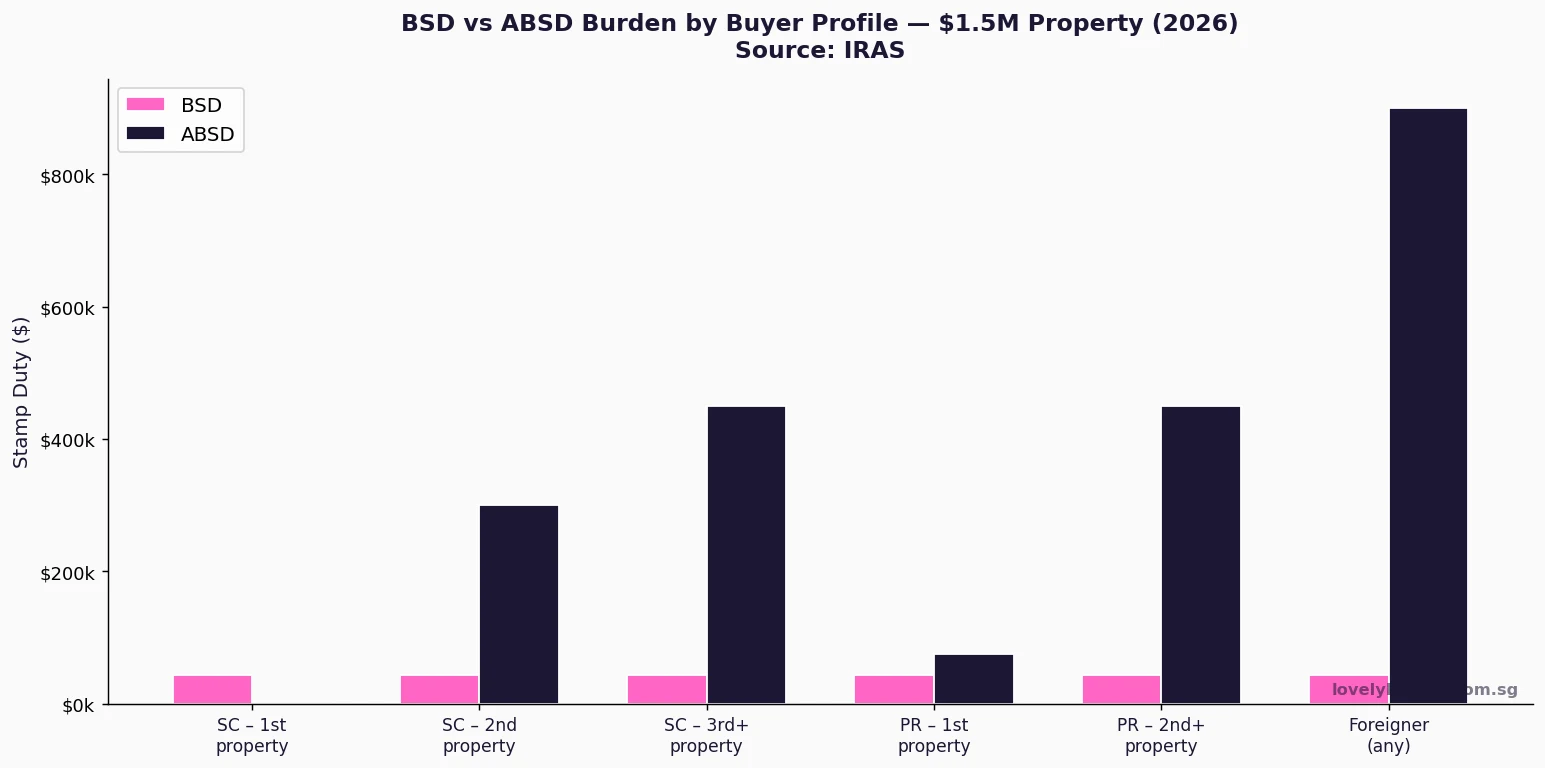
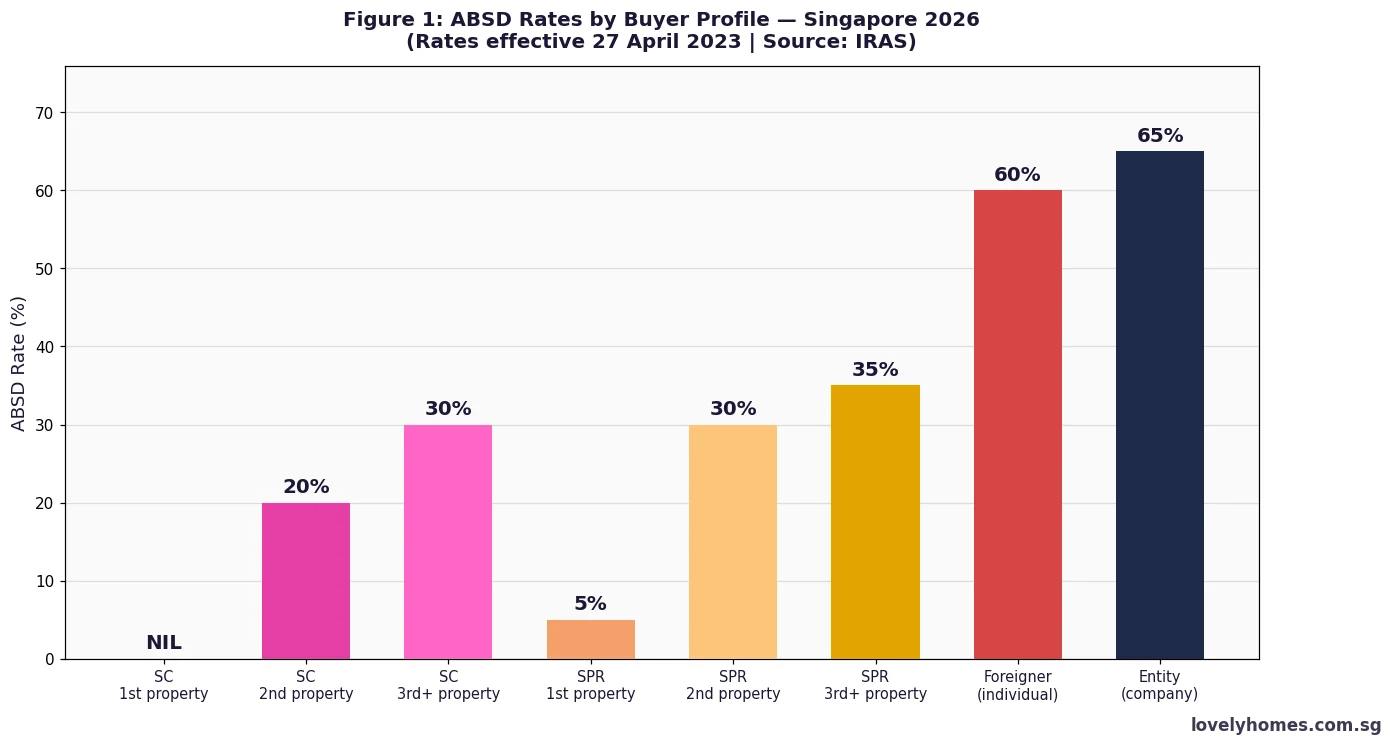
The ABSD is a tax layered on top of BSD whenever a residential property in Singapore is purchased. Rates are set by IRAS under the Stamp Duties Act and are tiered by the buyer’s residency status and how many residential properties they already own (globally, not just in Singapore).

Since the Government’s 27 April 2023 cooling-measure announcement, foreigners purchasing any Singapore residential property — regardless of whether it is their first or fifth — pay a flat 60% ABSD. Entities (companies, trusts) pay 65%.

ABSD rates by buyer profile Singapore 2026 — SC, SPR and foreigner rates table
Figure 1: ABSD Rates by Buyer Profile, Singapore 2026. Source: IRAS, Stamp Duties Act (Cap 312). Rates effective 27 April 2023.

Free Trade Agreement (FTA) Nationals: A Critical Exception

Citizens of a small number of countries are treated as Singapore Citizens for ABSD calculation purposes, by virtue of bilateral Free Trade Agreements. This means they pay 0% ABSD on their first residential property, 20% on the second, and 30% on the third and above — the same schedule as a Singapore Citizen. The qualifying nationalities are:

  • United States nationals (US-Singapore FTA)
  • Swiss nationals (Trans-Pacific Partnership / bilateral treaty)
  • Nationals of Iceland, Liechtenstein, and Norway (Singapore-EFTA FTA)

Citizens of all other countries — including the United Kingdom, France, Germany, Australia, China, India, Japan, and Malaysia — pay the full 60% ABSD on any purchase. The Singapore-EU FTA does not extend to ABSD relief for EU nationals.

The FTA concession applies to the individual’s citizenship, not their work pass or residency status. A French national on an Employment Pass is not eligible; a Norwegian national on a Student’s Pass is.

Key takeaway: If you hold a US, Swiss, Icelandic, Liechtenstein or Norwegian passport, confirm this with your solicitor before paying ABSD — you may be entitled to the Citizen schedule (0% on first property). All other nationalities pay 60% flat, with no exceptions based on employment, tax residency, or length of stay in Singapore.

What Property Can Foreigners Buy in Singapore?

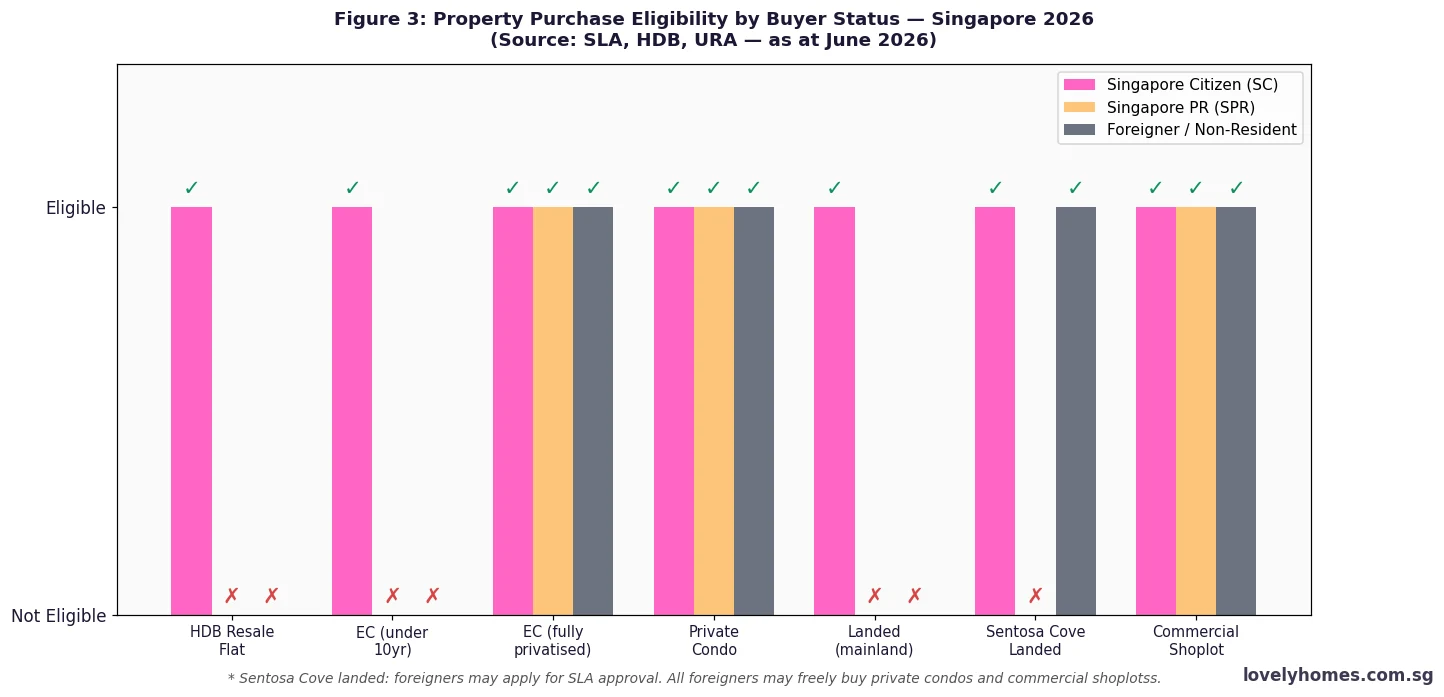
The Residential Property Act (Cap 274) is the key statute governing foreign purchases. Its restrictions apply to “restricted residential property” — essentially, low-rise residential land and housing. Strata-titled properties (condominiums, apartments) are generally unrestricted for foreign purchase. The practical breakdown is as follows:

Property purchase eligibility by buyer status Singapore 2026 — SC, SPR and foreigner comparison
Figure 3: Property Purchase Eligibility by Buyer Status, Singapore 2026. Source: SLA, HDB, URA. ✓ = eligible; ✗ = not eligible.

Permitted: Private Condominiums and Apartments

Any private condominium or apartment (strata-titled, not landed) may be purchased freely by foreign nationals. This includes new launch units sold directly by developers, resale market units, and units in mixed-use developments with a residential component. There is no cap on the number of units a foreigner may own, no minimum value requirement, and no minimum holding period before resale — though the Seller’s Stamp Duty (SSD) regime imposes a financial penalty for sales within three years of purchase (12% in year one, 8% in year two, 4% in year three).

Permitted: Executive Condominiums (ECs) After Full Privatisation

ECs are a hybrid housing type built by private developers on government land with HDB subsidy. They are subject to a staged ownership opening: only eligible Singapore Citizens and PRs may purchase during the first five years; PRs may also purchase in the resale market from the sixth year. Foreign nationals may purchase an EC in the open resale market only after the full 10-year privatisation period, at which point the development is treated as a fully private condominium.

Permitted: Commercial Shophouses and Non-Residential Properties

Commercial and industrial properties — shophouses zoned for commercial or mixed commercial/residential use, office units, retail space, factory space — are generally purchasable by foreign nationals without the ABSD applicable to residential property. However, if the shophouse contains a residential component (for example, a “mixed” shophouse with living quarters on the upper floor), ABSD at the foreigner rate applies to the entire purchase price. Buyers should obtain a URA written permission confirmation before assuming a mixed-use property is exempt from ABSD.

Permitted (with SLA Approval): Sentosa Cove Landed Homes

Sentosa Cove is the only precinct in Singapore where foreigners may apply to purchase landed property. Applications go through the SLA’s Land Dealings Approval Unit (LDAU). Approval is not guaranteed, and conditions may be imposed. Even with SLA approval, the 60% ABSD still applies to the purchase. Sentosa Cove landed homes — primarily bungalows and strata-landed cluster housing — are among the most internationally traded properties in Singapore, with prices typically ranging from S$5 million to S$30 million and above.

Not Permitted: HDB Flats

HDB flats — both the Build-To-Order (BTO) primary market and the open resale market — are reserved exclusively for Singapore Citizens (and, in the resale market, for Singapore Permanent Residents and mixed-nationality couples involving at least one SC or SPR). Foreign nationals on any visa type cannot purchase an HDB flat, regardless of how long they have lived and worked in Singapore.

Not Permitted: Mainland Landed Residential Property

Bungalows (detached houses), semi-detached houses, terrace houses, and strata-landed housing on the Singapore mainland are restricted residential property under the Residential Property Act. Foreign nationals may not purchase these without special approval from the Minister for Law — approval that is rarely granted and typically limited to cases of exceptional economic contribution. This restriction applies irrespective of the buyer’s wealth, tenure in Singapore, or investment intentions.

Buyer’s Stamp Duty (BSD): Rates and Calculation

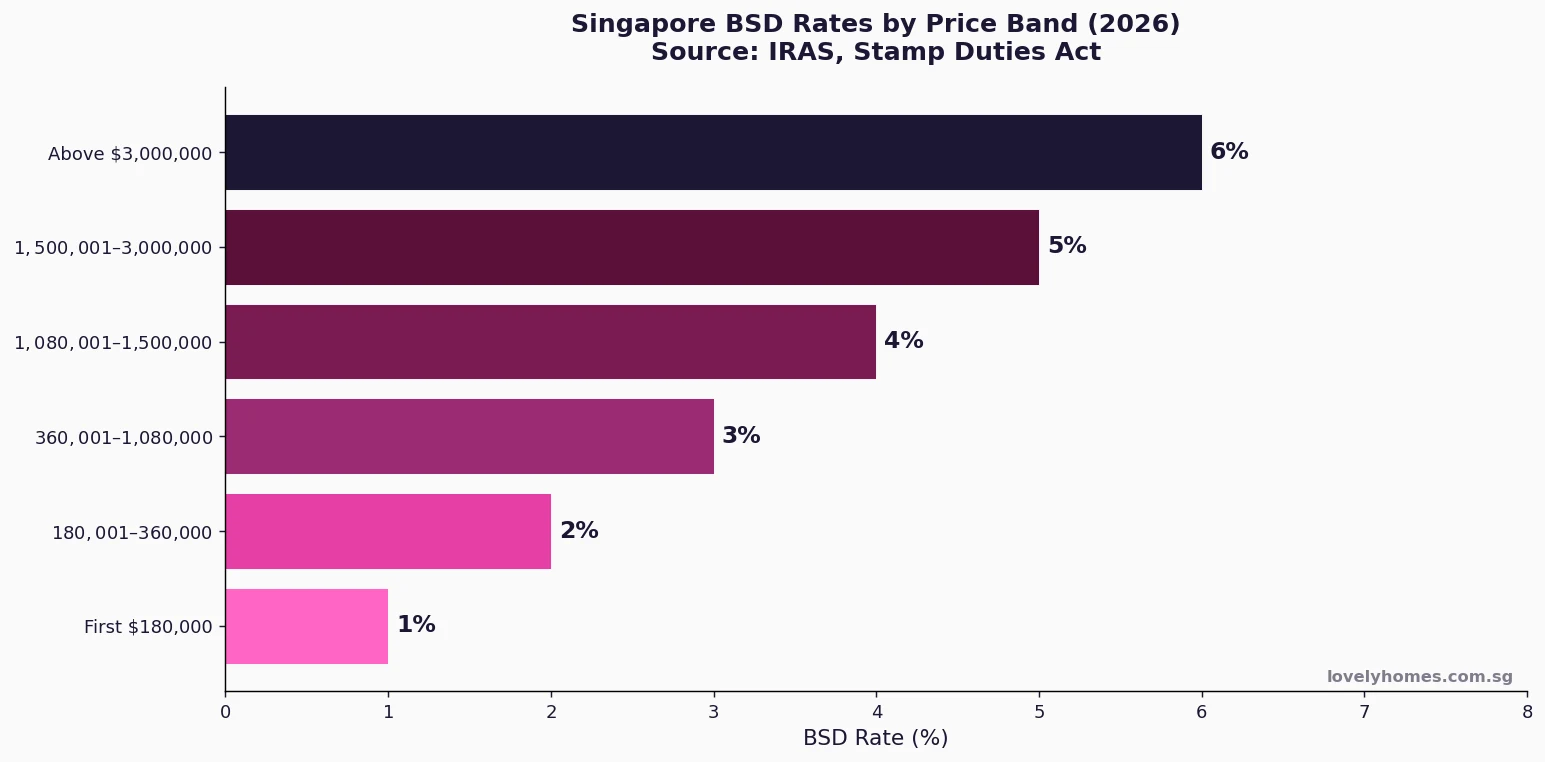
BSD is payable by every purchaser of Singapore property — residents and foreigners alike — and is calculated on the purchase price or market value, whichever is higher. The progressive BSD tiers as at June 2026 (revised 15 February 2023) are:

Purchase Price Band BSD Rate Maximum Duty in Band
First S$180,000 1% S$1,800
Next S$180,000 (S$180k–S$360k) 2% S$3,600
Next S$640,000 (S$360k–S$1.0M) 3% S$19,200
Next S$500,000 (S$1.0M–S$1.5M) 4% S$20,000
Next S$1,500,000 (S$1.5M–S$3.0M) 5% S$75,000
Amount above S$3,000,000 6% Uncapped

BSD is administered by IRAS and must be paid within 14 days of signing the acceptance of the OTP (for private residential property) or the S&P Agreement. Payment is made via IRAS e-Stamping. Failure to pay on time attracts penalties of up to four times the stamp duty amount.

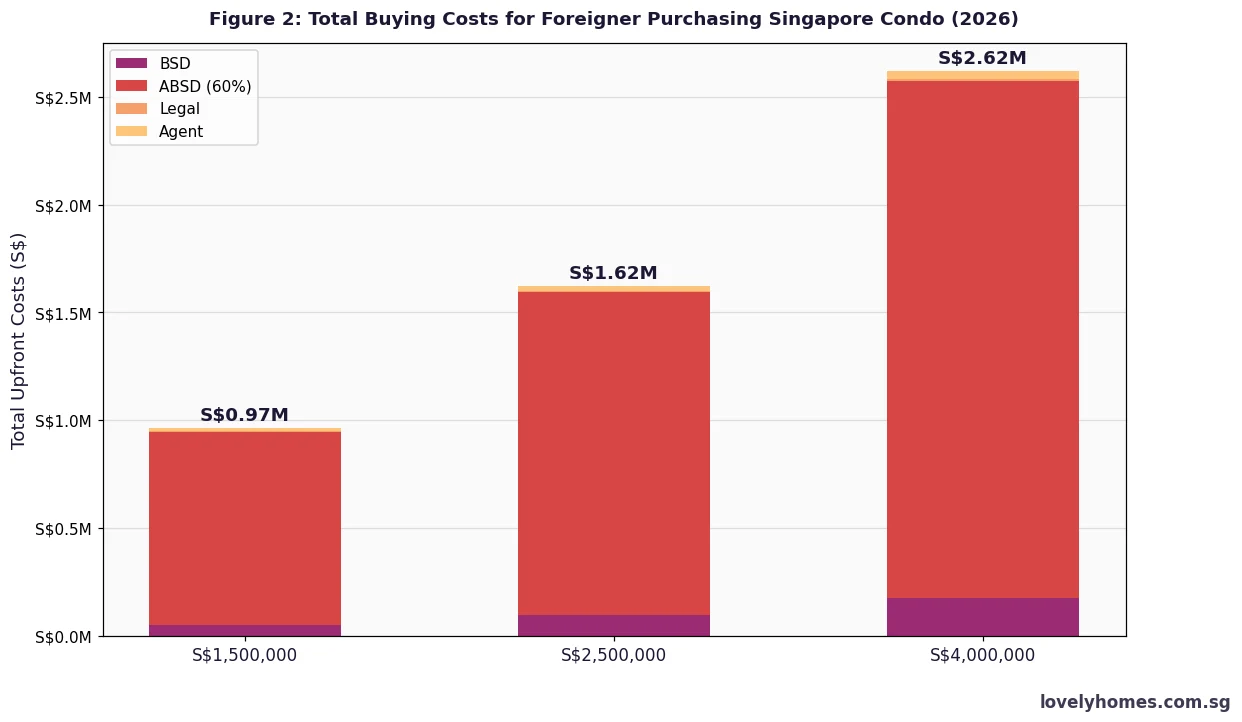
Total buying costs for foreigner purchasing Singapore condo 2026 — BSD, ABSD and fees
Figure 2: Total Buying Costs for a Foreigner Purchasing a Singapore Condominium, at Three Price Points (2026). Includes BSD, 60% ABSD, estimated legal and agent fees.

Bank Financing for Foreign Buyers: LTV, TDSR and Practical Limits

Foreign nationals may borrow from Singapore-licensed banks to finance a property purchase here. The key regulatory parameters are set by MAS (Monetary Authority of Singapore):

  • LTV cap: 75% of purchase price or valuation (whichever is lower) for the first property loan. This falls to 45% for the second and 35% for the third and subsequent loans. Loan amounts above S$1.5 million may attract more conservative lender assessments.
  • TDSR (Total Debt Servicing Ratio): Introduced by MAS in June 2013, TDSR limits total monthly debt obligations (including the proposed new loan) to 55% of gross monthly income. Lenders apply a stressed rate — typically 4.0% p.a. or the contractual rate, whichever is higher — when computing TDSR for variable-rate loans.
  • CPF: Foreign nationals who are not Singapore PRs or citizens do not have CPF accounts and therefore cannot use CPF Ordinary Account funds for the down payment or monthly instalments. All costs must be funded from personal savings or foreign income.
  • Minimum cash down payment: At least 5% of the purchase price must be paid in cash (not CPF). The remaining 20% of the 25% down payment (i.e., the amount not covered by the bank loan) may also be paid in cash.

In practice, a foreign buyer of a S$2 million condominium needs approximately S$500,000 in cash for the down payment alone — before accounting for stamp duties. This effectively means most foreigner purchasers in Singapore are self-funding the ABSD component entirely from liquid savings or overseas wealth.

Step-by-Step Buying Process for Foreign Purchasers

The transactional mechanics are the same as for any private property purchase in Singapore, with the additional stamp duty burden being the primary difference:

  1. Engage a Singapore-licensed solicitor: Choose a law firm experienced in foreign purchaser transactions. Confirm your ABSD status (FTA eligibility check).
  2. Obtain an In-Principle Approval (IPA) from a bank: Singapore banks lend to foreign nationals on Employment Passes or other long-term visas; some will lend to non-residents. IPA confirms your loan quantum and helps set your budget before you negotiate on price.
  3. Issue or accept the OTP: For new launches, developers issue the OTP automatically. For resale, the seller’s agent issues the OTP. You pay the option fee (typically 1% of purchase price) to secure the property.
  4. Exercise the OTP within 21 days: Pay the exercise price (typically 4% further deposit, making 5% total). At this stage the sale is legally binding.
  5. Pay BSD and ABSD within 14 days of OTP exercise: This is the single largest cash outflow for foreign buyers. Payment is through IRAS e-Stamping, and your solicitor handles the process.
  6. Complete the sale: Typically 8–12 weeks after OTP exercise for resale; or on the developer’s progressive payment schedule for new launches. For new launches, BSD and ABSD are typically stamped on the Sales & Purchase Agreement rather than the OTP.
  7. Register the transfer with SLA: Your solicitor lodges the instrument of transfer at the Singapore Land Authority. The Certificate of Title is issued upon completion.

Summary: Key Facts for Foreign Buyers at a Glance

Parameter Detail
ABSD rate (non-FTA foreigner) 60% flat on all residential properties (effective 27 April 2023)
ABSD rate (entity/company) 65% flat on all residential properties
FTA nationals (US, Swiss, EEA-3) Same ABSD schedule as SC: 0% first, 20% second, 30% third+
BSD Progressive 1–6% on purchase price; applies to all buyers
ABSD + BSD deadline 14 days from OTP acceptance or S&P Agreement date
LTV cap (first property) 75% bank loan; no HDB loan available to foreigners
TDSR 55% of gross monthly income (MAS, Jun 2013)
Minimum cash down payment 5% cash + up to 20% cash/CPF; foreigners must fund all from cash
Properties foreigners may freely buy Private condominiums, privatised ECs (10yr+), commercial property
Properties foreigners may NOT buy HDB flats, ECs under 10 years, mainland landed property
Sentosa Cove landed Purchasable with SLA/LDAU approval; ABSD still applies
SSD on resale within 3 years 12% (yr 1), 8% (yr 2), 4% (yr 3) — applies to all buyers

Worked Example: Mr & Mrs Laurent (French Nationals) — Purchasing a 2BR Condo at S$1,800,000

Profile: Mr Laurent (37) and Mrs Laurent (34), both French citizens on Employment Passes, joint gross income S$16,000/month. This is their first Singapore property purchase. They have S$1.8 million in savings and a S$350,000 CPF OA balance between them — however, as foreign nationals, CPF funds are not available for property purchase. All costs must be cash-funded.

Step 1 — BSD calculation on S$1,800,000:

  • 1% × S$180,000 = S$1,800
  • 2% × S$180,000 = S$3,600
  • 3% × S$640,000 = S$19,200
  • 4% × S$500,000 = S$20,000
  • 5% × S$300,000 (S$1.5M–S$1.8M) = S$15,000
  • Total BSD = S$59,600

Step 2 — ABSD calculation:

  • French nationals are not FTA-eligible → 60% ABSD applies
  • 60% × S$1,800,000 = S$1,080,000

Step 3 — Total stamp duties: S$59,600 + S$1,080,000 = S$1,139,600 (payable within 14 days of OTP exercise)

Step 4 — Bank loan and TDSR check:

  • LTV 75%: loan = S$1,800,000 × 75% = S$1,350,000
  • At 3.0% p.a. over 30 years: monthly instalment ≈ S$5,691
  • TDSR = S$5,691 ÷ S$16,000 = 35.6% — PASS (below 55% threshold)
  • Lender will stress-test at 4.0%: S$6,444/mth ÷ S$16,000 = 40.3% — PASS

Step 5 — Cash outlay summary:

Item Amount (S$)
25% down payment (cash — no CPF) S$450,000
BSD S$59,600
ABSD (60%) S$1,080,000
Legal fees (est.) S$4,000
Agent commission (buyer side, 1%) S$18,000
Total cash required upfront S$1,611,600

Note: The Laurents’ S$1.8M savings just covers the total cash outlay, leaving minimal liquidity. Most foreigner buyers at this price point fund the ABSD from offshore savings or liquidity events (asset sales, equity release elsewhere). A US national purchasing the same property would pay 0% ABSD (first property) — total stamp duty just S$59,600, cash upfront S$531,600: a S$1.08M difference.

Why Singapore Charges Foreigners 60% ABSD

Singapore’s property market is one of the most liquid and transparent in the world, and it serves as a preferred wealth-preservation vehicle for a globally mobile, high-net-worth demographic. The Government’s ABSD policy has three stated objectives: to maintain housing affordability for Singaporeans, to ensure a stable and sustainable property market, and to give priority to citizens in the accumulation of residential property assets. Deputy Prime Minister Lawrence Wong, speaking at the April 2023 cooling-measure announcement, described the 60% rate as necessary to prevent the market from being “driven by speculative demand from foreigners”.

The 2023 doubling (from 30% to 60%) had a tangible effect: foreign purchases as a share of total private residential transactions fell from approximately 4–5% in 2022 to around 1–2% in 2024–2025, according to URA caveats data. Despite this, transaction volumes in the luxury CCR (Core Central Region) segment — the typical market for foreign buyers — held firm, suggesting that high-net-worth foreign demand persists even at elevated ABSD levels, though the typical buyer profile has shifted towards those with the most compelling reasons to own Singapore property rather than those treating it as a convenient investment.

Peer-Country Comparison: How Singapore’s Foreign Buyer Policy Stacks Up

Singapore is not unique in restricting or taxing foreign property buyers, but its approach is among the most explicit globally. Australia charges foreign nationals an application fee plus a vacant residential land tax surcharge, and state-level duties in Victoria and New South Wales include foreign purchaser surcharges of 8% and 9% respectively — steep, but still well below Singapore’s 60%. New Zealand outright bans most foreigners from purchasing existing residential property. Canada introduced a two-year ban on foreign residential purchases in 2023. Hong Kong imposes a 15% New Residential Stamp Duty on foreign buyers. Against this backdrop, Singapore’s 60% rate stands out as a revenue-generating deterrent rather than a blanket prohibition, allowing the market to remain open in principle while pricing out all but the most committed foreign purchasers.

What Might Come Next for Foreign Buyer Policy?

This section represents editorial speculation and should not be relied upon for investment decisions. The 60% ABSD rate was set deliberately high, and the Government has indicated that any easing would be considered only if the market has “clearly stabilised”. As at June 2026, private residential prices continue to edge upward — URA’s Q1 2026 Private Residential Property Index rose 2.1% quarter-on-quarter — suggesting there is no near-term pressure on policymakers to reduce the foreign buyer burden.

Some market observers speculate that the Government might introduce a tiered ABSD regime that distinguishes between Singapore Permanent Residents who have been granted PR for over five years (and who contribute economically) and genuinely non-resident foreign investors. Others have suggested that the FTA concession framework could be extended to additional trading partners as Singapore negotiates further bilateral agreements. For now, however, the policy landscape appears settled: 60% ABSD for foreigners, 65% for entities, with FTA relief remaining narrowly targeted.

Frequently Asked Questions

Can a foreigner buy an HDB flat if they are married to a Singapore Citizen?

A foreign national married to a Singapore Citizen (SC) may purchase an HDB flat under the Public Scheme, provided the SC is the primary applicant and the couple meets HDB’s income ceiling (S$14,000/month for standard resale and BTO flats). The foreign national does not count as an SC or SPR, so the household eligibility depends entirely on the SC spouse’s status. The couple would not be eligible for the Enhanced CPF Housing Grant (EHG) if the foreign national has income, and must meet all other HDB eligibility criteria. Under the Citizen-Foreigner Public Scheme, the foreigner spouse is listed as a non-owner occupier, and the SC spouse must bear full ownership. Upon purchasing an HDB flat under this scheme, the SC spouse is treated as owning a first HDB — future HDB or private purchases will be subject to the usual MOP and ABSD implications for the SC owner.

Do Free Trade Agreement (FTA) nationals pay zero ABSD on their first Singapore property?

Yes — qualifying FTA nationals (US, Swiss, Icelandic, Liechtenstein, Norwegian citizens) are treated as Singapore Citizens for ABSD purposes. They pay 0% ABSD on their first residential property, 20% on the second, and 30% on the third and subsequent properties. This does not exempt them from Buyer’s Stamp Duty (BSD), which applies to all purchasers. The FTA concession is tied to citizenship, not to work-pass status, length of stay, or tax residency. A US citizen on an EP purchasing their first Singapore condo pays 0% ABSD; a UK citizen on an EP pays 60%. To claim the concession, the buyer’s solicitor submits proof of citizenship at the IRAS e-Stamping portal when paying stamp duty.

Can foreigners use a Singapore company to buy residential property and save ABSD?

No — and attempting this will result in a higher ABSD bill. Entities (including companies, trusts, and other legal persons) pay a flat 65% ABSD on any residential property purchase, five percentage points higher than the individual foreigner rate of 60%. Singapore’s ABSD framework was specifically designed to close corporate-vehicle loopholes. IRAS also has anti-avoidance provisions in the Stamp Duties Act that allow it to look through arrangements where the substance of the transaction is a residential property purchase, even if structured differently. There is no ABSD exemption for residential properties held through corporate vehicles, except for licensed housing developers who qualify for the conditional remission regime (which requires the developer to complete and sell all units within a prescribed period).

What is the Seller’s Stamp Duty (SSD) and does it apply to foreigners?

SSD is a tax on the seller of a residential property, payable if the property is sold within three years of purchase. The rates are 12% of the sale price or market value (year one), 8% (year two), and 4% (year three). SSD applies to all sellers in Singapore regardless of nationality — there is no foreigner exemption or additional rate. SSD is intended to deter short-term speculation. For a foreigner who buys a S$2 million condominium and sells it 18 months later, the SSD would be 8% × S$2 million = S$160,000, on top of the 60% ABSD they paid on entry. Given these dual costs, most foreigner buyers approach Singapore property as a medium-to-long-term holding rather than a short-term trade.

Can foreigners on a Tourist Pass or Short-Term Visit Pass buy Singapore property?

Yes — there is no requirement to hold a work pass or long-term visa in order to purchase Singapore private residential property. The transaction is governed by the Residential Property Act and the Stamp Duties Act, and the buyer’s immigration status does not affect eligibility to purchase a private condominium. However, practical considerations apply: Singapore banks will not extend a mortgage to someone with no Singapore income or no long-term visa, so cash purchasers are typically the only buyers in this category. Additionally, non-residents purchasing property may be subject to home-country tax reporting and capital controls depending on their jurisdiction of domicile.

Are there minimum income or minimum stay requirements to buy a Singapore condo as a foreigner?

There are no minimum income or minimum stay requirements to purchase a private condominium in Singapore as a foreign national. The Singapore property market does not operate an investors’ visa scheme that ties property purchase to immigration status. Foreign nationals do not receive any immigration benefit from purchasing property here. However, as noted above, if you wish to finance the purchase with a Singapore bank mortgage, you will need to demonstrate sufficient income and financial standing to satisfy the bank’s credit assessment and MAS’s TDSR requirements. Without a Singapore income, banks may require evidence of overseas income, asset statements, or a guarantor.

What happens to ABSD if a foreigner later becomes a Singapore Permanent Resident (SPR)?

ABSD is levied at the point of purchase and is assessed based on the buyer’s status at the time of signing the OTP or S&P Agreement. If a foreign national purchases a property paying 60% ABSD and subsequently becomes an SPR, there is no refund of the excess ABSD already paid. The change in residency status only affects future purchases: as an SPR, any subsequent residential property purchase would attract ABSD at SPR rates (5% on first property, 30% on second). There is also an ABSD refund mechanism for married couples involving a Singapore Citizen, where the couple initially pays ABSD on a second property and then sells the first within six months — but this remission scheme does not apply to foreigners paying the 60% rate on a first purchase.

Disclaimer: This article is intended for general informational purposes only and does not constitute legal, financial, or taxation advice. ABSD rates, BSD tiers, LTV ratios, and property ownership rules are subject to change by the Government at any time. The information in this article reflects the position as at June 2026. Before making any property transaction, readers should consult a Singapore-licensed solicitor, a Monetary Authority of Singapore (MAS)-licensed financial adviser, and the relevant government authorities including IRAS (iras.gov.sg), HDB (hdb.gov.sg), SLA (sla.gov.sg), and URA (ura.gov.sg). LovelyHomes does not accept liability for any loss arising from reliance on information in this article.

Inheriting Property in Singapore 2026: Probate, Stamp Duty & Estate Planning Essentials

Inheriting Property in Singapore 2026: Probate, Stamp Duty & Estate Planning Essentials

Inheriting property in Singapore is one of those events most families confront only once or twice in a lifetime. The legal mechanics are forgiving compared with the United Kingdom or the United States — Singapore has no estate duty, no inheritance tax, and no capital-gains tax on residential property — but the process is still demanding. The deceased’s estate must clear probate, the heir must understand how the property fits into their existing ABSD count, and several stamp-duty deadlines run from the date of death rather than the date of transfer. Get any of these wrong and you can either lose months of clear title or unwittingly trigger ABSD on a future purchase.

This 2026 guide walks the entire journey end to end — what happens whether or not the deceased left a Will, the statutory shares set by the Intestate Succession Act, the typical costs of probate, the stamp-duty position on transfer to the heir, and the all-important interaction with ABSD on the heir’s next property purchase. All figures and rules below reflect Singapore’s position as of 29 April 2026. For the live position, always check Family Justice Courts, the Intestate Succession Act, and IRAS Stamp Duty.

Quick Answer — inheriting property in Singapore

  • Singapore abolished estate duty for deaths from 15 February 2008. There is no longer an inheritance tax.
  • The deceased’s estate goes through probate (with a Will) or Letters of Administration (without one).
  • Without a Will, the Intestate Succession Act (ISA) sets statutory shares between spouse, children and parents.
  • Transfer of property to the heir is a transmission, not a sale — no BSD or ABSD on that transfer.
  • BUT — the inherited property counts toward the heir’s property tally for ABSD on their next purchase.
  • Joint-tenancy property passes automatically by survivorship — outside the Will or ISA.
  • HDB flats follow extra rules — only Singapore Citizen/PR family members who meet eligibility can inherit and remain in occupation.

The Two Pathways: With a Will and Without

The first question after a death is the same one solicitors ask: was there a Will? The answer determines which application the executors or family must make to the Family Justice Courts, who has standing to administer the estate, and how the property is ultimately divided.

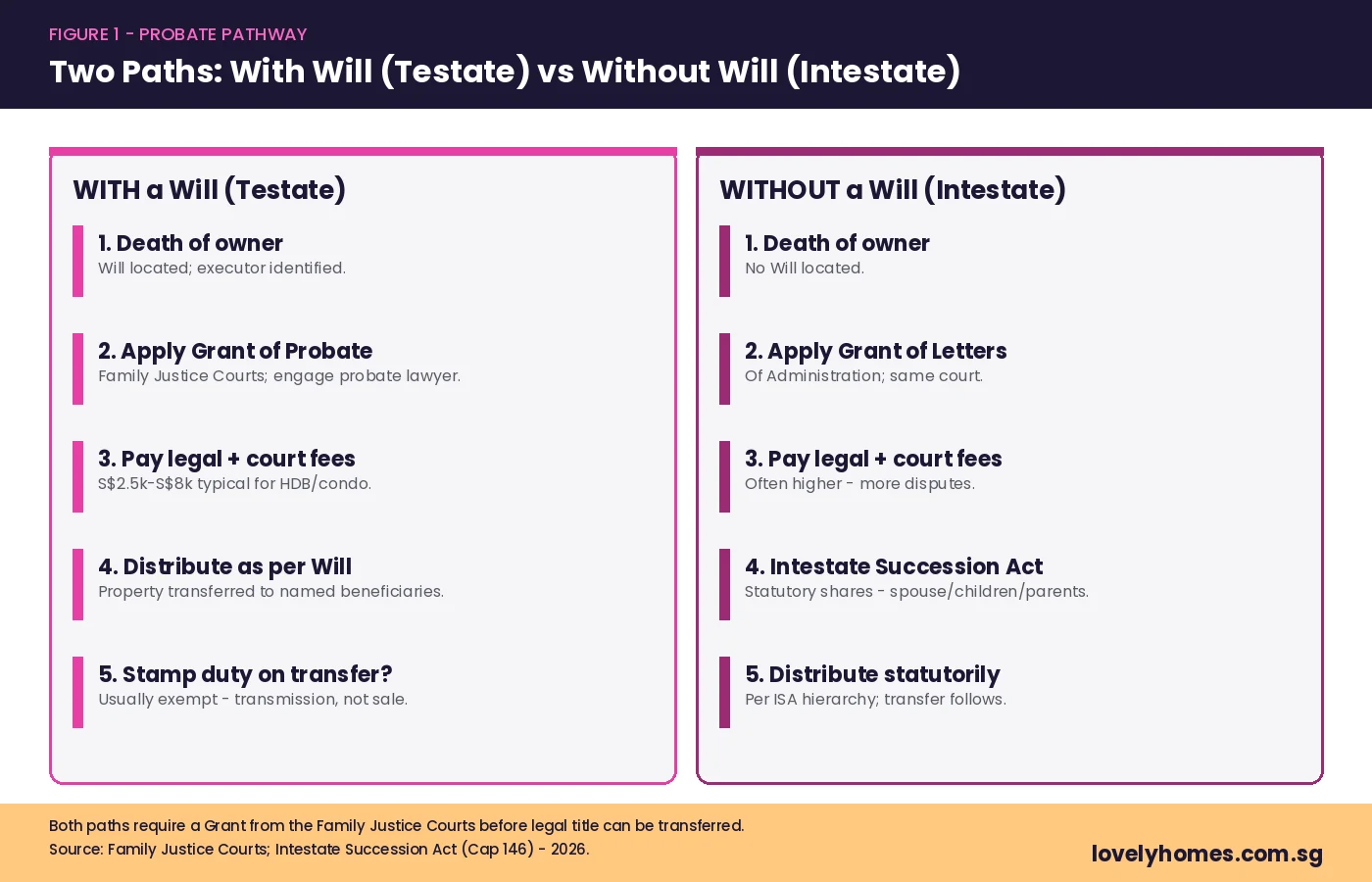
Probate pathway diagram - testate vs intestate inheritance Singapore 2026
Figure 1: The two pathways for inheriting property in Singapore. Both end with the property being transmitted into the heir’s name once the Court issues the Grant.

With a Will (Testate Succession)

If the deceased left a valid Will, the named executor applies to the Family Justice Courts for a Grant of Probate. The Will dictates who inherits the property — the executor’s job is to carry out those instructions after settling the estate’s debts. For a clean estate (no caveats, no contests, full documentation), a Grant of Probate is typically issued within 4–8 weeks. Probate fees range roughly S$3,000 to S$8,000 in legal costs for a single residential property, plus court filing fees of a few hundred dollars.

Without a Will (Intestate Succession)

Where there is no Will, the next-of-kin applies for a Grant of Letters of Administration. The applicant administers the estate and distributes it according to the statutory shares set out in the Intestate Succession Act (ISA). Letters of Administration take longer than probate — typically 8–16 weeks — because the Court must satisfy itself who is entitled to apply, what the estate consists of, and that no contest exists. Where the estate is over S$5 million or contains foreign assets, the timeline extends materially.

Joint-Tenancy — The Quiet Third Path

For property held by spouses as joint tenants, the surviving spouse takes the deceased’s share automatically by survivorship — outside the Will, outside the ISA, and outside probate altogether. The surviving spouse simply lodges a Notice of Death with the Singapore Land Authority (SLA) along with the death certificate, and the title is updated. This is the cleanest of the three pathways. By contrast, tenancy-in-common property passes through the Will or the ISA like any other estate asset. For the difference, see our Joint Tenancy vs Tenancy in Common Singapore 2026 guide.

The Intestate Succession Act — How an Estate Without a Will Is Split

If you die intestate (without a Will) and you are domiciled in Singapore, the Intestate Succession Act (Cap 146) determines exactly who gets what. The Act is gender-neutral but assumes a fairly traditional family structure — spouse, children, parents, siblings — in that order of priority.

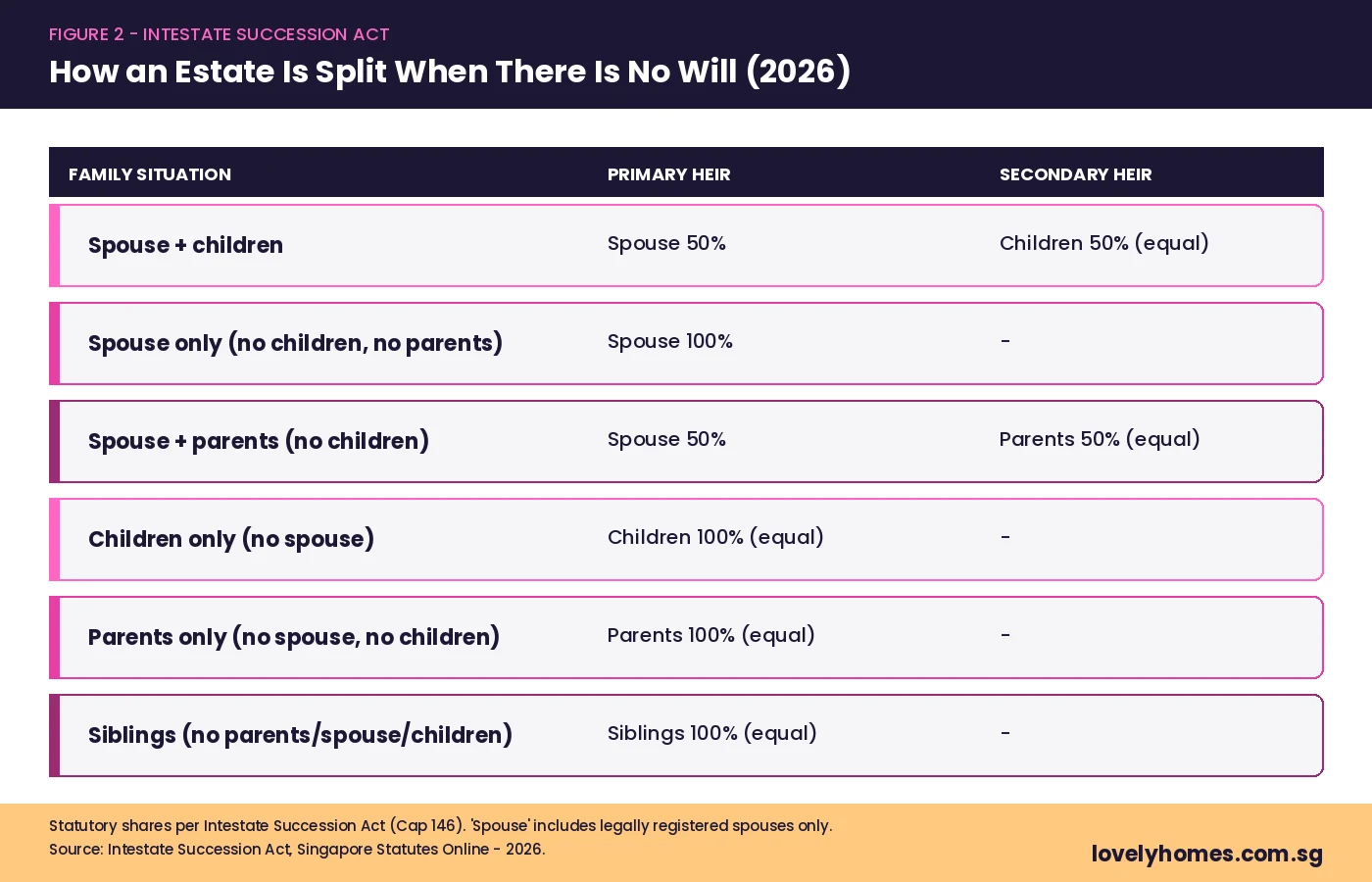
Intestate Succession Act statutory shares chart for 2026
Figure 2: Intestate Succession Act statutory shares, 2026. Where there is no Will, distribution follows the Act’s strict order.
Family Situation Statutory Distribution
Spouse + children Spouse 50%; children 50% (split equally between children)
Spouse only (no children, no parents) Spouse takes 100%
Spouse + parents (no children) Spouse 50%; parents 50% (equally)
Children only (no spouse) Children 100% (equal shares per stirpes)
Parents only (no spouse, no children) Parents 100% (equally)
Siblings (no parents, no spouse, no children) Siblings 100% (equally)
No surviving immediate or extended family Estate goes to the Singapore Government (bona vacantia)

Two practical points worth highlighting. First, “spouse” in the Act means a legally registered spouse only — long-term partners, fiancés, and ex-spouses are excluded, no matter how long the relationship. Second, step-children are not statutory heirs unless legally adopted. If you have a blended family, you almost certainly need a Will — the ISA will not deliver the outcome most blended families assume.

HDB Inheritance — Special Rules That Override the General Position

HDB flats are not just real estate — they are part of Singapore’s public housing system, with eligibility rules that override the general law of succession. When a HDB owner dies, the flat does not simply transfer to the heir named in the Will or the ISA share — HDB still has to approve who can inherit and remain in the flat. The rules are roughly:

  • The heir must be Singapore Citizen or PR. Foreigner heirs cannot inherit and remain on title for an HDB flat.
  • The heir must satisfy HDB’s family-nucleus or single-buyer eligibility. A 28-year-old single child cannot inherit the flat outright until age 35 under the Single Singapore Citizen Scheme — the flat is held in trust until then or sold on the open market.
  • Existing property by the heir matters. If the heir already owns a private residential property, HDB’s ownership rules require the heir to dispose of the private property within 6 months of the inheritance to retain the HDB flat, or vice versa.
  • The flat’s remaining MOP and SC quota apply. Inheritance does not reset the Minimum Occupation Period or trigger any quota issues, but the heir must continue to comply with rental, sublet, and EIP/SPR quota rules.

For a HDB-specific deep-dive, our How to Sell an HDB Flat 2026 guide covers the complications when an inherited HDB flat must be sold to fund the estate or to free the heir to remain on private property. The HDB section of the official HDB site sets out the live position.

Stamp Duty on the Inheritance — What You Actually Pay

Singapore’s tax position on inheritance is unusually generous compared with major Western jurisdictions:

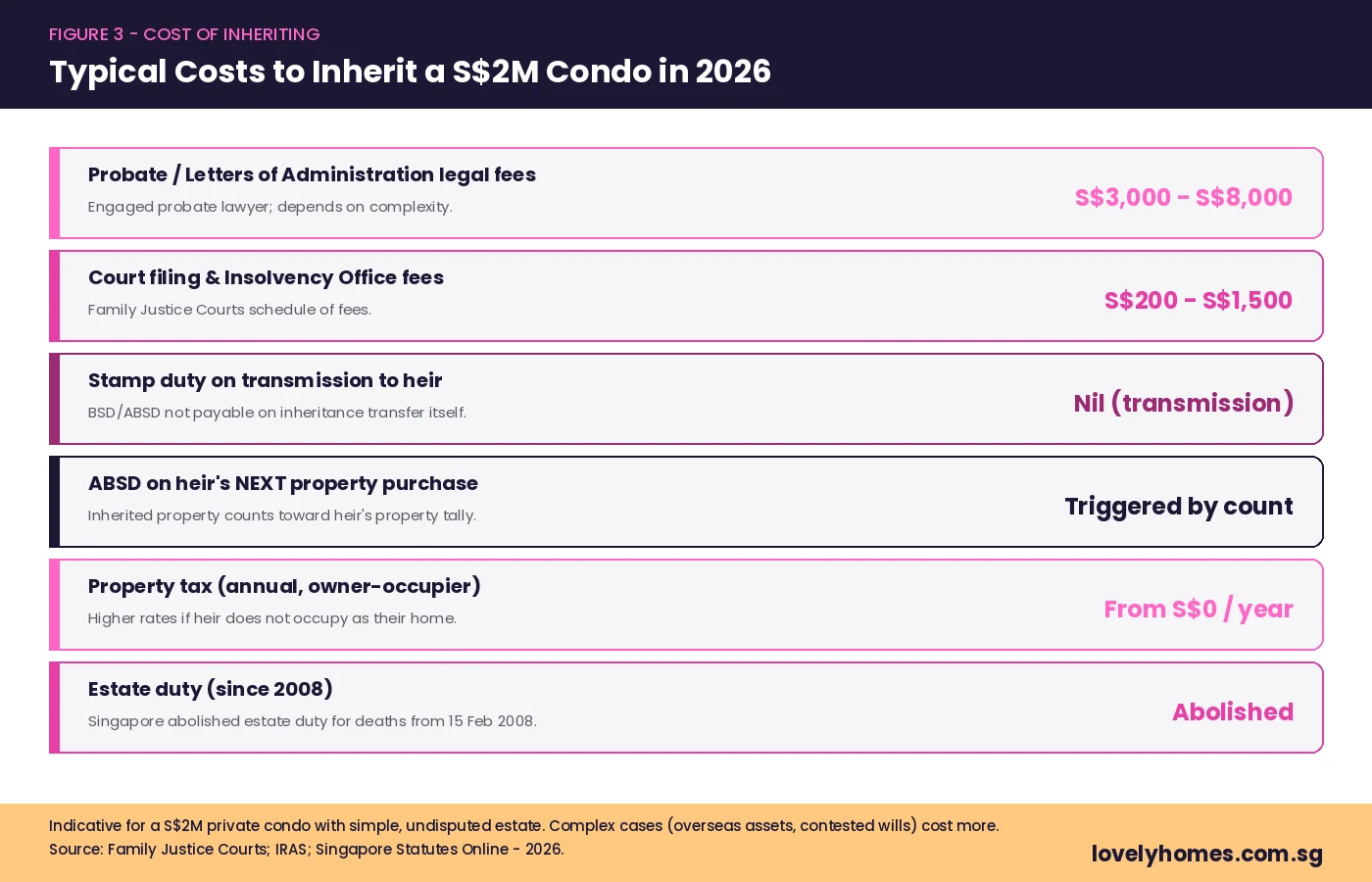
Cost breakdown of inheriting a S$2 million property in Singapore 2026
Figure 3: Indicative cost of inheriting a S$2M private condo in 2026. Singapore charges no estate duty and no BSD/ABSD on the transmission itself.

1. No estate duty since 15 February 2008

Singapore abolished estate duty for deaths occurring on or after 15 February 2008. There is no “death tax”, no “inheritance tax”, and no “estate tax” on the value of the property at the date of death. This is a major reason why Singapore is favoured by family-office structures over the UK (40% inheritance tax) or the US federal estate tax.

2. No BSD or ABSD on transmission

The transfer of the property from the deceased’s estate to the heir is a transmission — not a sale — and therefore not subject to Buyer’s Stamp Duty (BSD) or Additional Buyer’s Stamp Duty (ABSD). This is consistent with IRAS’s position that ABSD only applies on a purchase. Inheriting your parent’s flat does not, in itself, trigger any stamp-duty bill.

3. BUT — ABSD count is affected for the heir’s next purchase

Here is the trap. While the inheritance itself attracts no ABSD, the inherited property counts toward the heir’s property tally for any future purchase. A Singapore Citizen who inherits their parent’s HDB flat now owns one residential property — their next purchase will be an SC-2nd at 20% ABSD, not the SC-1st at 0%.

Heirs who are mid-purchase when the inheritance arrives need to plan carefully. A common workaround is to renounce the inherited interest in favour of another beneficiary — legally permissible under the Probate & Administration Act, provided the renunciation is done before the heir takes any benefit from the property. We strongly recommend speaking to a probate lawyer before renouncing because the implications are irreversible. For broader context on ABSD, see our ABSD Singapore Complete Guide 2026.

4. Property tax continues, billed to the new owner

The annual property tax obligation passes to the heir on transmission. If the heir occupies the property as their home, owner-occupier rates (lowest band) apply. If the heir already has another home and rents the inherited property out, IRAS will apply the higher non-owner-occupier rates. See our Singapore Property Tax 2026 guide for current rates and bands.

CPF Refund — The Easily-Missed Step

If the deceased used CPF to fund the property, the principal sum used plus accrued interest must be refunded to their CPF account on transfer. The CPF refund is paid to the deceased’s estate (effectively to the named CPF nominees, if any, or otherwise distributed by the executor). This is not a tax — it is the final clearing of the deceased’s CPF position. The figure can be substantial: a 4-room HDB flat that was funded with S$200,000 of CPF in 2000 might owe over S$400,000 of principal-plus-accrued-interest in 2026.

Heirs sometimes mistake this CPF refund for a charge that they have to pay personally. They do not — the refund comes out of the estate’s share of any sale proceeds, or, if the property is being retained, the estate must arrange for the refund from cash assets. The refund is a precondition for clear title and cannot be deferred.

How Long Does the Whole Process Take?

For a simple estate — one residential property, undisputed Will or clean intestacy, one or two heirs, no overseas assets — the typical journey looks like this:

Stage Typical Timeline Who Drives It
Locate Will & gather documents 1–2 weeks Family
Engage probate lawyer 1 week Family
File Grant application (probate or LA) 2–4 weeks Lawyer
Court issues Grant 2–6 weeks for probate; 8–16 for LA Court
Lodge Grant + Notice of Death with SLA 1–2 weeks Lawyer
CPF refund & outstanding loan settlement 2–4 weeks Lawyer / family
Title transmitted to heir 2–3 weeks after CPF/loan clearance SLA
Total simple estate ~3–4 months testate; ~5–7 months intestate

Contested estates, estates over S$5 million, estates with overseas immovable property, or estates where the deceased’s domicile is uncertain all add months to the timeline. Engaging an experienced probate solicitor early is the single most important action a family can take to keep the timeline on track.

A Worked Example — What Mr Tan’s Family Actually Pays

Mr Tan, a Singapore Citizen aged 78, dies in March 2026. He leaves behind:

  • A 4-room HDB flat in Bedok (held in his sole name), valued at S$650,000.
  • A S$2 million private condominium in District 15 (held jointly with his wife as joint tenants).
  • A simple Will leaving the HDB flat equally to his two adult children, both Singapore Citizens.

The flow:

  1. Condo — immediate transfer. The District 15 condominium passes automatically to Mrs Tan by survivorship. No probate, no Will, no ISA. Mrs Tan lodges the death certificate with SLA. Cost: roughly S$300 in lodgement fees.
  2. HDB flat — through probate. The executor (eldest son) applies for a Grant of Probate. Court issues the Grant in five weeks. Probate legal fees: ~S$4,500. The HDB flat is then transmitted equally to the two children. Both children are Singapore Citizens, but each already owns a private condo — under HDB rules, they cannot retain the inherited HDB flat and must dispose of either the HDB or the private property within six months. Family decides to sell the flat on the open market.
  3. CPF refund. Mr Tan had used S$280,000 of CPF (principal + accrued interest) on the HDB flat. The refund flows from sale proceeds to his CPF account, then to nominees.
  4. Sale proceeds distributed. Net of the CPF refund and S$8,000 selling costs, the remaining S$362,000 is divided equally between the two children (S$181,000 each).
  5. ABSD impact for the children. Because each child took beneficial ownership of the HDB flat before selling it, each had two residential properties on title for that brief window. Their next condo purchase will be an SC-3rd-property at 30% ABSD — not 0%. The family should have spoken to a probate lawyer about renouncing in favour of the surviving spouse, or selling the flat directly out of the estate without taking transmission.

This is the textbook example of why estate planning matters. With one Will revision — leaving the HDB flat to Mrs Tan instead — the entire ABSD complication for the children would have been avoided.

How Estate Planning Works in Singapore (Briefly)

Three estate-planning instruments do most of the heavy lifting:

  1. A valid Will. Drafted, signed, and witnessed per the Wills Act. Costs from S$300 (simple Will at a high-street firm) up to several thousand for a complex estate. The single highest-leverage action any property-owning Singaporean can take.
  2. CPF nominations. CPF moneys do not pass through the Will or the ISA — they go to nominees. Without a CPF nomination, balances go to the Public Trustee for distribution per ISA. Update CPF nominations whenever there is a major life event.
  3. Manner of co-ownership. Married couples buying property together should consciously choose between joint tenancy (survivorship transfers automatically) and tenancy in common (each owner’s share passes through their estate). The choice has profound implications for inheritance, divorce, and ABSD planning.

For an even more direct approach, large families with significant property holdings sometimes use private trusts — though Singapore’s ABSD-on-trustees position (65% on the trustee’s entity rate) means trust structures need careful structuring to avoid triggering punitive ABSD. This is well outside the scope of a general guide and demands specialist trust counsel.

What Might Come Next

Two areas to watch. First, Singapore’s policy stance on intergenerational transfer is generally favourable, but the ABSD position on inherited property has been quietly tightening since 2018. Expect IRAS to continue scrutinising arrangements where inheritance is structured to avoid ABSD — in particular “in-life gifts” and trust structures that benefit a Singapore property owner’s children. Second, the Family Justice Courts have signalled that they may digitise more of the probate process by 2027, which should compress the testate timeline below 4 weeks for simple estates. None of this is policy yet, and these paragraphs are editorial speculation only.

Frequently Asked Questions

Do I have to pay any tax when I inherit property in Singapore?

No tax is payable on the transmission itself — Singapore abolished estate duty for deaths from 15 February 2008, and no BSD or ABSD applies on a transfer that is not a sale. You will, however, pick up the annual property-tax obligation from the date of transmission, and any future purchase you make will count the inherited property toward your ABSD tally.

My parent died without a Will. Can I just sign over my share to my sibling?

Yes — this is called a Deed of Family Arrangement, signed after the Grant of Letters of Administration is issued. All ISA-statutory heirs must agree, and the deed is filed with the Court. It allows the family to redirect the estate without having to go to a full reapplication. Engage a probate solicitor to draft the deed and ensure stamp duty implications are covered.

Can I refuse the inheritance?

Yes. A beneficiary can renounce their interest under the Probate & Administration Act before taking any benefit from the property. The renunciation must be in writing and is irrevocable. Heirs sometimes do this to avoid the ABSD-count consequence of inheriting, channelling the property to a sibling who would not be affected.

What happens to the deceased’s outstanding mortgage on the property?

Most Singaporean homeowners carry Mortgage Reducing Term Assurance (MRTA) or the Home Protection Scheme (HPS) for HDB. Either policy pays off the outstanding loan on death — the heir takes the property unencumbered. If no MRTA/HPS exists, the mortgage continues and the heir must either continue servicing it (if eligible to take over the loan) or sell the property to discharge it.

If I am a Singapore Citizen and inherit a Malaysian property, do I need to declare it in Singapore?

Yes. Even though no Singapore tax is due on the inheritance itself, you must declare any overseas residential property you own when applying for ABSD remission, HDB schemes, or LBS — the Singapore Government counts overseas residential property toward eligibility tests. You will also have Malaysian filing obligations, including the Real Property Gains Tax position on any future disposal.

Can a foreigner inherit a Singapore property?

Yes for private property — foreigners can inherit and own non-restricted private residential property in Singapore, subject to the Residential Property Act for landed homes. For HDB flats, foreigners cannot inherit the flat directly — the HDB flat must be sold and the proceeds distributed instead. Engage a Singapore lawyer who deals with cross-border probate.

How much do probate lawyers cost in 2026?

For a simple estate with one residential property and no contests, expect around S$3,000–S$8,000 in legal fees (with a Will) or S$4,000–S$10,000 (without a Will, since Letters of Administration take longer and require a personal-representative bond). Court filing fees are typically a few hundred dollars more.

Related Articles

Disclaimer: This guide is for general information only and does not constitute legal, tax, or financial advice. Probate, succession, stamp duty, and HDB inheritance rules change over time and depend on individual circumstances. Always verify the live position with the Family Justice Courts, the Intestate Succession Act, the HDB website, and IRAS, and consult a Singapore-qualified probate solicitor before acting on any estate matter.

Translate »