Singapore Buyer’s Stamp Duty (BSD) 2026: Rates, Calculations and Worked Examples

Singapore Buyer’s Stamp Duty (BSD) 2026: Rates, Calculations and Worked Examples

📌 Quick Answer: Buyer’s Stamp Duty (BSD) in Singapore 2026

  • BSD is paid by every buyer of property in Singapore — residential or commercial — regardless of nationality, residency, or how many properties they own.
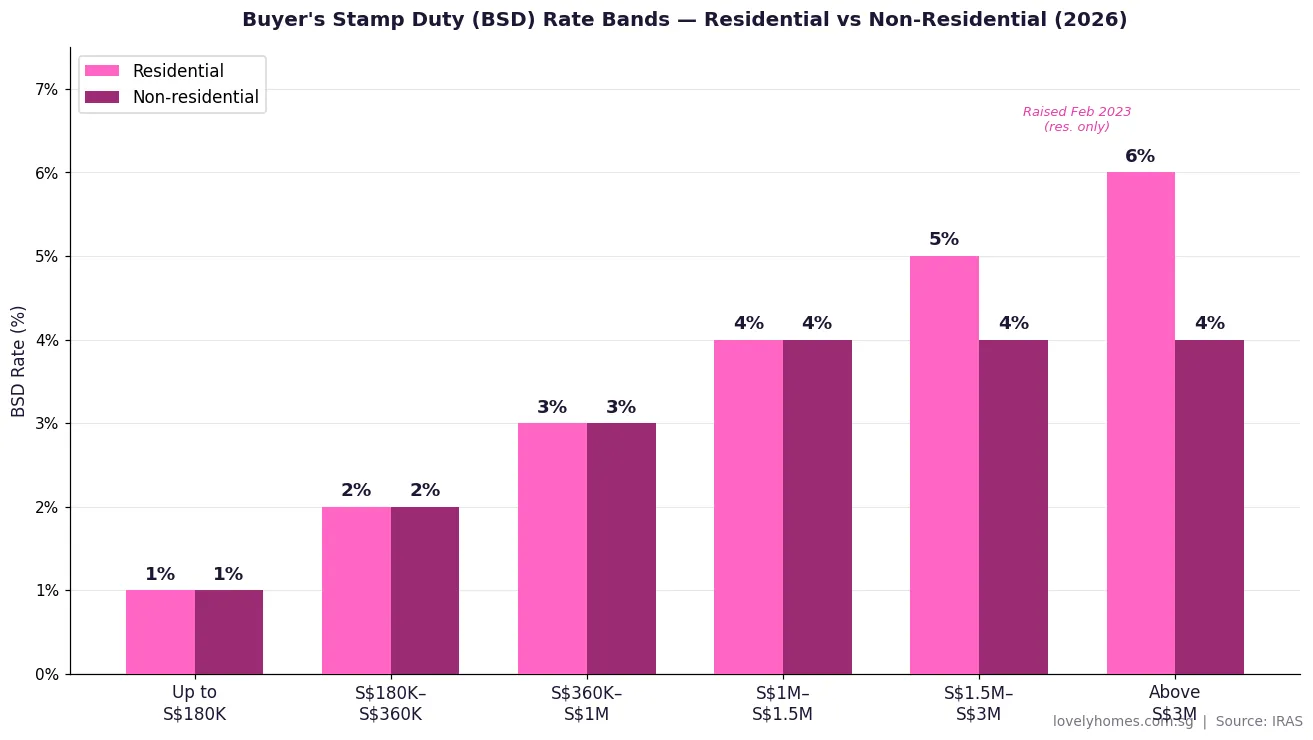
  • Residential BSD rates are progressive: 1% on the first S$180,000, rising to 6% on amounts above S$3 million (rates raised in February 2023 Budget).
  • Non-residential BSD is capped at 4% (no 5% or 6% tiers apply).
  • BSD must be paid within 14 days of exercising the Option to Purchase (OTP) or signing the Sale & Purchase (S&P) agreement.
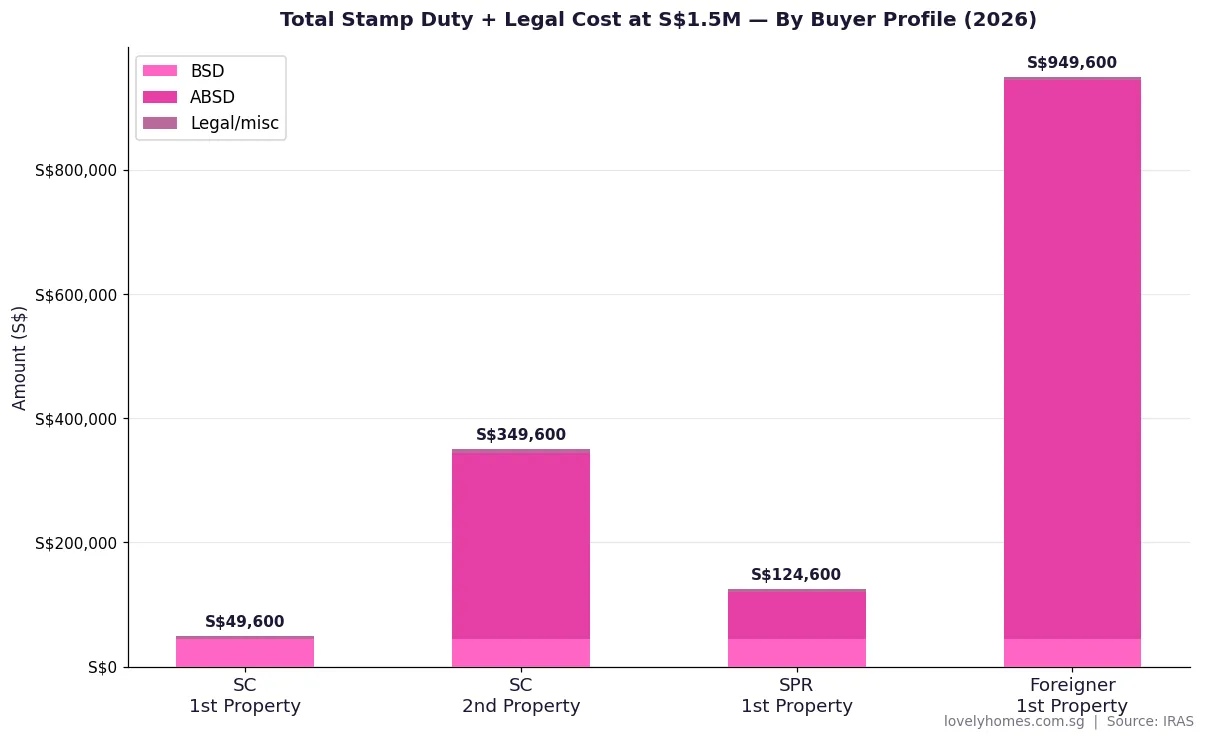
  • On a S$1.5 million condo, BSD is S$44,600 — that is before any Additional Buyer’s Stamp Duty (ABSD) kicks in.
  • BSD is separate from ABSD: ABSD applies only to second or subsequent properties (for Singapore Citizens) or all properties (for Permanent Residents and foreigners).
  • No exemptions for first-time buyers — BSD applies to everyone; only certain inherited or court-ordered transfers are exempt.
  • CPF Ordinary Account funds may be used to pay BSD on eligible residential properties.

What Is Buyer’s Stamp Duty (BSD)?

Buyer’s Stamp Duty (BSD) is a tax levied by the Inland Revenue Authority of Singapore (IRAS) on every purchase or acquisition of property in Singapore. Unlike the Additional Buyer’s Stamp Duty (ABSD) — which applies only to certain buyers — BSD is universal: it falls on every transaction regardless of whether the buyer is a Singapore Citizen (SC), Permanent Resident (PR), foreigner, or corporate entity, and regardless of how many properties they already own.

BSD is calculated on the higher of the purchase price or the market value of the property. IRAS uses the property’s assessed annual value and recent comparable sales to determine market value; if your agreed price is below market value, IRAS will compute BSD on the higher market-value figure. The tax is administered under the Stamp Duties Act (Cap. 312) and must be paid promptly — late payment attracts penalties.

The February 2023 Budget introduced new higher rate tiers for residential property, bringing the top marginal rate to 6% for portions of the price above S$3 million. For non-residential property (commercial, industrial, mixed-use), the maximum rate remains 4%. Understanding BSD is therefore a mandatory step in any property budget — you cannot legally complete a purchase without stamping the documents.

BSD rate bands residential vs non-residential Singapore 2026
Figure 1: BSD Rate Bands — Residential vs Non-Residential (2026). Source: IRAS / Stamp Duties Act.

BSD Rates for Residential Property (2026)

The following progressive rate schedule applies to all residential property purchases from 15 February 2023 onwards (Budget 2023). Note that the rates are marginal — each band applies only to the portion of the price falling within that range, not the entire purchase price.

Purchase Price Band BSD Rate Maximum BSD in Band
First S$180,000 1% S$1,800
Next S$180,000 (S$180,001 – S$360,000) 2% S$3,600
Next S$640,000 (S$360,001 – S$1,000,000) 3% S$19,200
Next S$500,000 (S$1,000,001 – S$1,500,000) 4% S$20,000
Next S$1,500,000 (S$1,500,001 – S$3,000,000) 5% S$75,000
Remaining amount (above S$3,000,000) 6% Unlimited

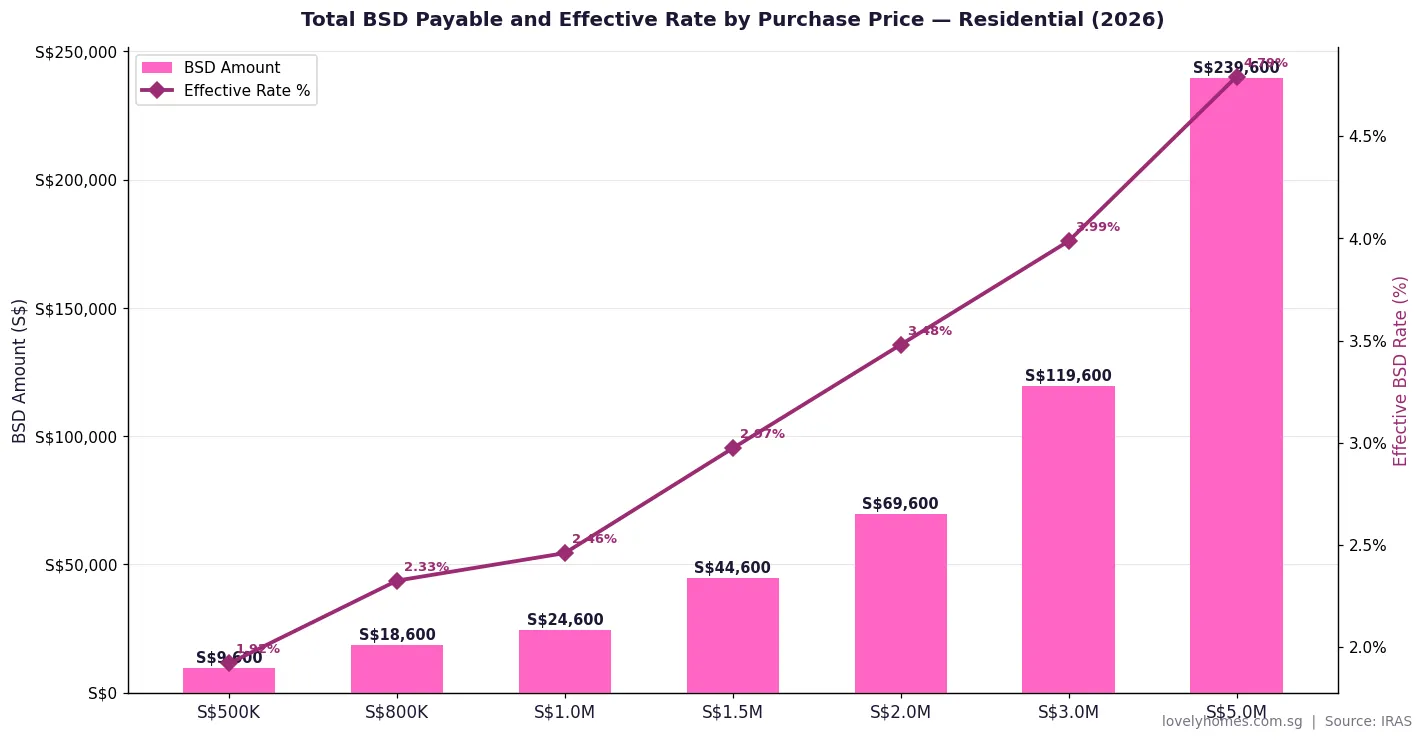
The cumulative BSD payable at the top of each band is S$1,800 → S$5,400 → S$24,600 → S$44,600 → S$119,600 and beyond. For a S$1 million property the BSD is exactly S$24,600; for a S$1.5 million property it is S$44,600; for a S$3 million property it is S$119,600.

BSD Rates for Non-Residential Property (2026)

Industrial, commercial, and mixed-use properties follow a different schedule that was last revised in 2018. The rates are lower and the top marginal rate is capped at 4%, reflecting government policy to keep transaction costs manageable for business property buyers.

Purchase Price Band BSD Rate Maximum BSD in Band
First S$180,000 1% S$1,800
Next S$180,000 (S$180,001 – S$360,000) 2% S$3,600
Next S$640,000 (S$360,001 – S$1,000,000) 3% S$19,200
Remaining amount (above S$1,000,000) 4% Unlimited

On a S$2 million shophouse, for instance, the BSD is S$24,600 (the S$1 million cumulative) plus 4% of S$1 million = S$40,000 → total S$64,600. Compare this to a residential property of the same price where BSD would be S$69,600. The difference is modest at S$2 million but widens materially at S$5 million and above.

Total BSD payable and effective rate by purchase price Singapore 2026
Figure 2: Total Residential BSD Payable and Effective Rate by Purchase Price (2026). Effective rate is BSD ÷ purchase price. Source: IRAS.

How to Calculate BSD Step by Step

BSD is a progressive tax, so the calculation requires applying each marginal rate to the corresponding band of the purchase price. The cleanest method is to use the marginal-band approach. Consider a S$1,800,000 residential property:

  1. 1% × S$180,000 = S$1,800
  2. 2% × S$180,000 = S$3,600
  3. 3% × S$640,000 = S$19,200
  4. 4% × S$500,000 = S$20,000
  5. 5% × S$300,000 (the remaining S$1.8M − S$1.5M = S$0.3M) = S$15,000
  6. Total BSD = S$59,600

IRAS also publishes a shortcut formula for common brackets. For residential properties priced between S$1 million and S$1.5 million the formula is: BSD = (4% × price) − S$15,400. For S$1 million: (4% × S$1M) − S$15,400 = S$40,000 − S$15,400 = S$24,600 ✓. These formulae are available in IRAS’s stamp duty calculator at iras.gov.sg.

When and How to Pay BSD

BSD must be paid within 14 days of the document being signed or executed — that is, within 14 days of exercising the Option to Purchase (OTP) for resale properties, or within 14 days of the date of the Sale & Purchase agreement for new launches. Late payment attracts a penalty of S$10 or the unpaid duty, whichever is higher, plus additional penalties of up to 4× the original duty for prolonged non-payment.

Payment is made through e-Stamping at the IRAS portal, accessible via Singpass. Solicitors acting for buyers routinely handle this on their clients’ behalf. The stamped document is legal evidence of the transaction; an unstamped instrument cannot be admitted as evidence in court.

BSD may be paid using CPF Ordinary Account (OA) funds for eligible residential properties — subject to the CPF withdrawal limit and valuation limit rules. If paying by CPF, the CPF Board will typically release the BSD payment to IRAS directly on completion. Cash payment via GIRO, credit/debit card, or bank transfer is also accepted. Foreigners without a Singpass account must pay through their appointed solicitor.

📌 Worked Example: Mr & Mrs Nair — D11 Condo S$2,200,000

Mr Nair is a Singapore Citizen; Mrs Nair is a Singapore Permanent Resident. This will be their first property. They are purchasing a 3-bedroom condominium in Newton / Novena (D11, RCR) at S$2,200,000. The solicitor will compute BSD as follows:

  • 1% × S$180,000 = S$1,800
  • 2% × S$180,000 = S$3,600
  • 3% × S$640,000 = S$19,200
  • 4% × S$500,000 = S$20,000
  • 5% × S$700,000 (S$2.2M − S$1.5M) = S$35,000
  • Total BSD = S$79,600 (effective rate: 3.62%)

ABSD position: because this is a joint purchase and Mrs Nair is a PR, the joint ABSD rate is determined by the buyer with the higher rate. SC buying 1st property = 0%; PR buying 1st property = 5%. As a mixed-citizenship couple, IRAS applies the higher rate — so ABSD of 5% × S$2,200,000 = S$110,000 applies. (They may request an ABSD remission if they intend to occupy the property, but remission is not automatic for SC/PR joint purchases on first property.)

Combined stamp duties: BSD S$79,600 + ABSD S$110,000 = S$189,600. Legal fees approximately S$5,500. Total transaction costs at completion: approximately S$195,100 (excluding down payment and financing costs).

Bank loan (SC income S$18,000/mth): 75% LTV = S$1,650,000 at 3.0% p.a. over 30 years → monthly instalment S$6,955. TDSR: (S$6,955 ÷ S$18,000) = 38.6% ✓ (below 55% TDSR limit).

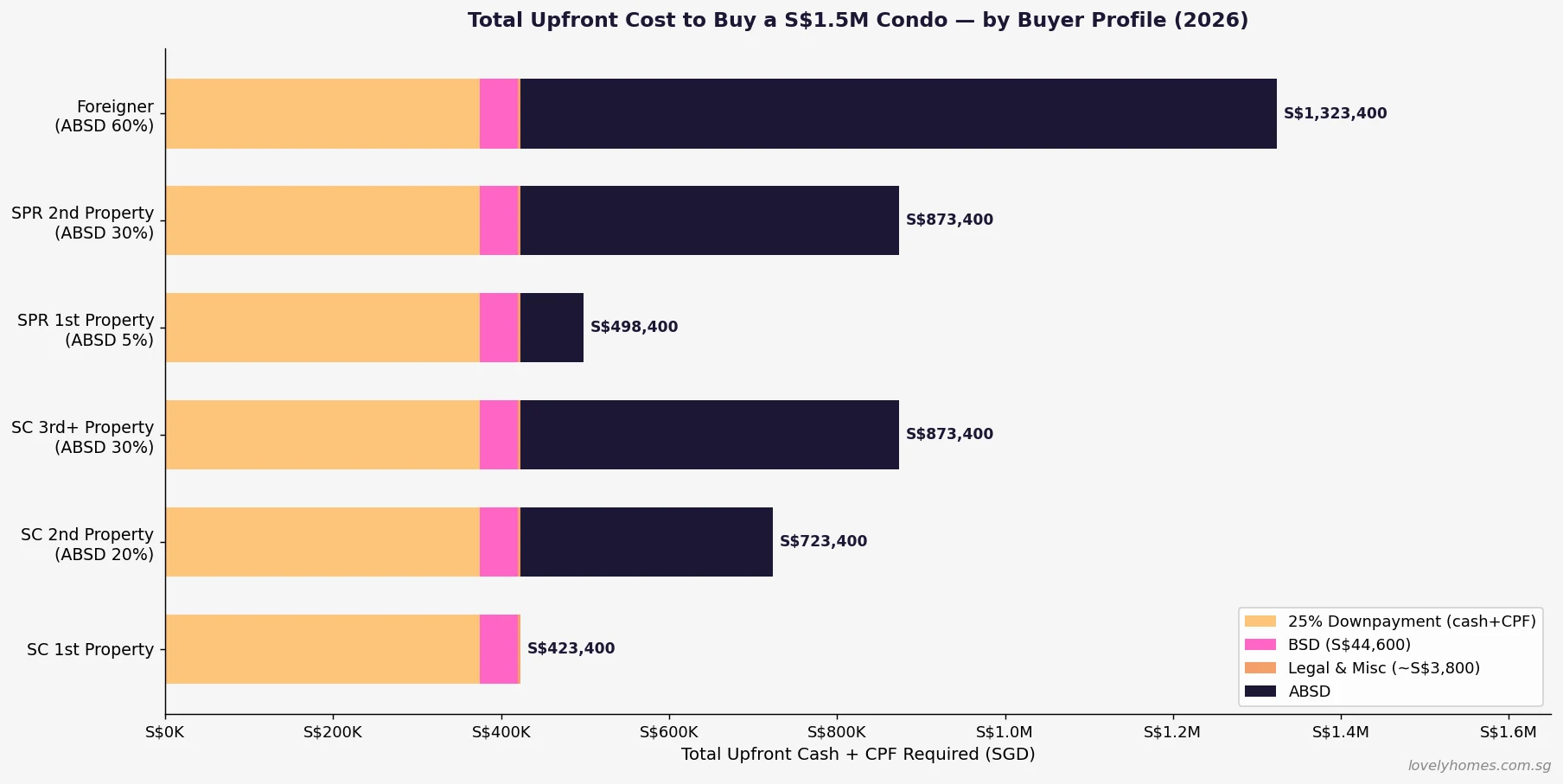
BSD and ABSD total stamp duty by buyer profile Singapore 2026 at S$1.5 million
Figure 3: Total Stamp Duty (BSD + ABSD + legal) at S$1.5M by Buyer Profile (2026). BSD is constant at S$44,600; ABSD varies by citizenship and property count. Source: IRAS.

Why BSD Matters: The True Cost of Buying Property in Singapore

BSD is a non-negotiable transaction cost that must be factored into every property budget from day one. At S$1 million, BSD alone is S$24,600 — roughly 2.5% of the purchase price. At S$3 million, it reaches S$119,600. For buyers stretching their budget to the maximum under Total Debt Servicing Ratio (TDSR) rules, forgetting to account for BSD can push a deal beyond their financial reach. Solicitors and mortgage advisers always incorporate BSD into the cashflow calculation alongside down payment, valuation fees, legal fees, and agent commissions.

Compared to peer jurisdictions, Singapore’s BSD is moderate but has been rising. Hong Kong’s stamp duty on residential property ranges from HK$100 to 4.25% of the price for the basic rate, with additional buyer’s stamps up to 30% for non-residents. Australia’s stamp duty varies by state and can exceed 5% in New South Wales and Victoria. Singapore’s BSD at an effective rate of around 2.5–4% for typical residential purchases sits within the regional norm, though the additional ABSD layers make total stamp costs for repeat or foreign buyers among the highest globally.

📊 What Might Come Next: BSD Outlook

This section is speculative and based on publicly available signals. It is not investment advice.

The February 2023 BSD increase targeted high-value transactions (above S$1.5 million), nudging effective rates higher for luxury properties. In the near term — through 2026 and into 2027 — industry observers do not anticipate a further upward revision to BSD, given that ABSD rates (raised to 60% for foreigners and 20% for SC second properties in April 2023) already provide strong price-stability signals. However, should the private residential price index continue its upward trajectory into the upper percentiles, a further adjustment to the S$3 million+ band (currently at 6%) cannot be ruled out in a future Budget.

For commercial and industrial BSD, a revision has been discussed informally in property finance circles, particularly given that strata industrial and shophouse prices have risen sharply since 2021. Any Budget announcement would take effect immediately on the date of the Budget speech, as has historically been the case.

Frequently Asked Questions: Buyer’s Stamp Duty Singapore

Does BSD apply to HDB flat purchases?

Yes. BSD applies to all residential property acquisitions in Singapore, including HDB resale flats and new BTO flat purchases. However, most HDB flats are priced well below S$1 million, so the effective BSD rate is typically 1–2%. For a S$600,000 4-room resale HDB flat, BSD is: (1% × S$180,000) + (2% × S$180,000) + (3% × S$240,000) = S$1,800 + S$3,600 + S$7,200 = S$12,600. The BSD on HDB purchases is significantly lower than on private condominiums. Note that for HDB purchases, CPF OA funds are routinely used to pay BSD, and the HDB will typically manage the stamping process on your behalf.

Is BSD different from ABSD? Can I avoid one but not the other?

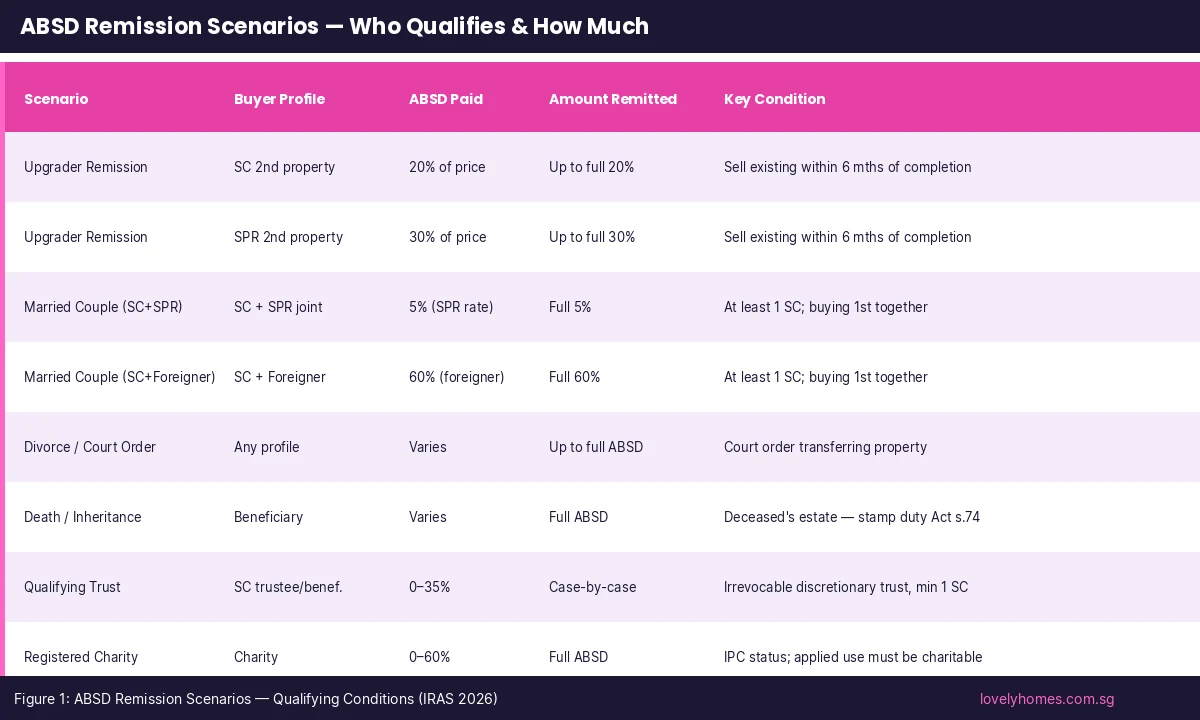
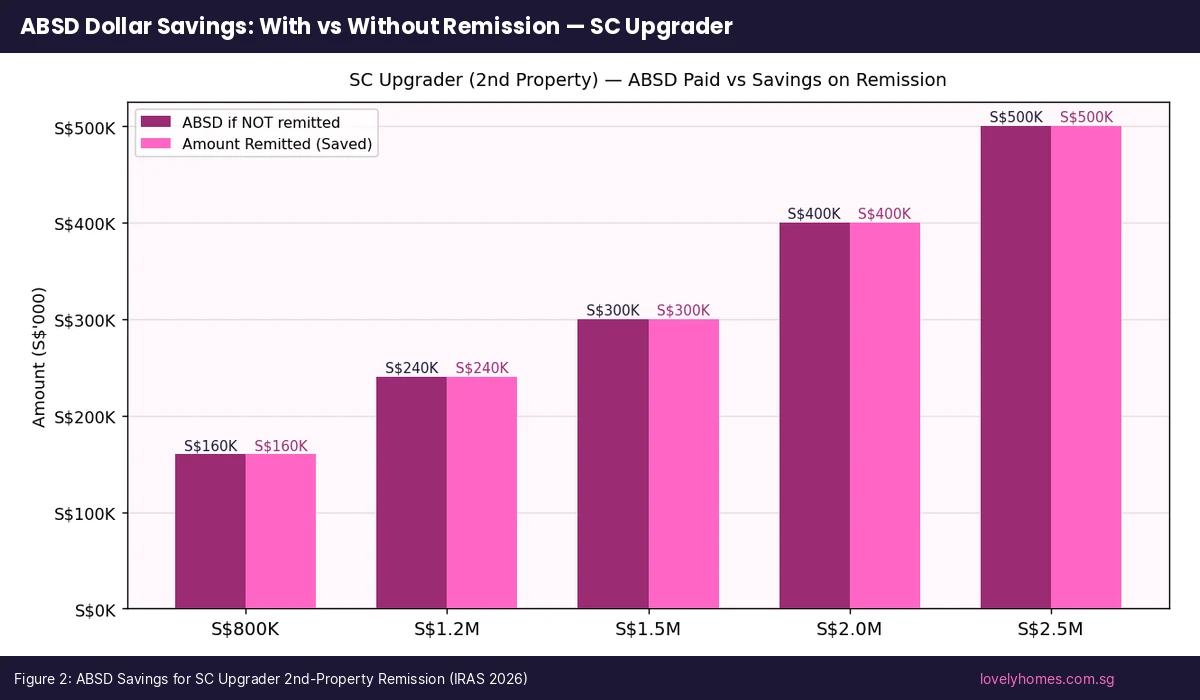
BSD and ABSD are two separate taxes levied by IRAS. BSD applies to every buyer on every property — there is no exemption for first-time buyers. ABSD is an additional tax that applies to: Singapore Citizens buying a second or subsequent residential property (20% for second, 30% for third or more); Singapore PRs buying any residential property (5% first, 25% second and beyond); all foreigners buying any residential property (60% as of April 2023, with limited FTA exemptions for certain nationalities). It is impossible to avoid BSD; ABSD can be avoided by Singapore Citizens on their first property and in certain limited circumstances (e.g., FTA exemptions, ABSD remission for married couples). BSD is always payable on both residential and non-residential acquisitions.

What is the BSD deadline and what happens if I pay late?

BSD must be paid within 14 days of the date the relevant instrument is executed or signed. For resale properties, this means within 14 days of exercising the Option to Purchase (OTP). For new launch properties, within 14 days of signing the Sale & Purchase agreement. IRAS imposes penalties for late payment: S$10 or the unpaid duty (whichever is higher) for the first default, scaling up to 4× the outstanding duty for extended non-payment. In practice, conveyancing solicitors almost always handle BSD stamping within the 14-day window as a standard part of their service. You should therefore ensure you have the BSD funds ready to transfer to your solicitor’s client account well before the stamping deadline.

Can I use CPF to pay BSD in Singapore?

Yes, for eligible residential properties. CPF Ordinary Account (OA) savings may be used to pay BSD, subject to the applicable CPF withdrawal limits. The property must be used as a principal place of residence, and the purchase must satisfy CPF Board criteria (e.g., remaining lease of the property must meet the minimum occupation period requirements). CPF cannot be used to pay BSD on non-residential property purchases (shophouses, industrial, commercial). If you are using CPF for BSD, inform your solicitor at the start of the conveyancing process so they can arrange the CPF withdrawal in time. Any CPF withdrawn for BSD forms part of your total CPF withdrawal and attracts accrued interest at the OA rate of 2.5% per annum, which must be refunded to your CPF upon the eventual sale of the property.

Are there any exemptions from BSD in Singapore?

BSD exemptions are narrow. Transfers pursuant to a court order (e.g., divorce proceedings under section 112 of the Women’s Charter) may be exempt or subject to ad valorem duty on a different basis. Inherited property transferred via probate or letters of administration under intestate succession is also exempt from BSD (as it is a transmission, not a purchase). Government land acquisitions under the Land Acquisition Act are exempt. However, gifts of property between family members (including parents, siblings, and children) are generally not exempt unless effected as a court order; such transfers attract BSD at market value. There is no general first-time buyer exemption and no BSD discount for owner-occupiers — every voluntary purchase triggers the full progressive rate.

Is BSD based on the purchase price or the market value?

BSD is computed on the higher of the purchase price or the market value as assessed by IRAS at the time of the transaction. If you purchase a property below its assessed market value — for example, buying from a relative at a discounted price or acquiring a distressed-sale unit below prevailing comparable prices — IRAS will compute BSD on the market value, not the agreed price. Conversely, if you pay above market value (rare, but possible in competitive bidding situations), BSD is based on the actual price paid. IRAS cross-references the Urban Redevelopment Authority’s (URA) caveats database and the HDB resale transaction data to assess market value. Disputes about assessed value may be referred to the Stamp Duties Appeal Board.

Does BSD apply to property acquired through a company?

Yes. When a company — whether a Singapore-incorporated or foreign-incorporated entity — acquires property, BSD applies on the same basis as for individual buyers. The company must pay BSD on the higher of the purchase price or market value. In addition, corporate buyers are subject to ABSD at 65% for residential property (as of April 2023), making entity-held residential acquisitions extremely expensive. For commercial and industrial property, companies pay BSD at the non-residential rates (up to 4%) with no ABSD. Transfers of shares in a property-holding company may also attract stamp duty under Section 15 of the Stamp Duties Act; the rules are complex and specialist tax advice is recommended for such structures.

Related Articles on Singapore Property Taxes and Buying Costs

Disclaimer

This article is for general informational purposes only and does not constitute legal, financial, or tax advice. BSD rates and rules are set by the Inland Revenue Authority of Singapore (IRAS) and may change with each annual Budget. Always verify current rates and your personal BSD and ABSD obligations at iras.gov.sg before transacting. For a formal computation and to ensure timely stamping, engage a licensed Singapore conveyancing solicitor. LovelyHomes is not a licensed financial adviser or solicitor; no reliance should be placed on this article as a substitute for professional advice tailored to your specific circumstances.

Singapore Seller’s Stamp Duty (SSD) 2026: New 4-Year Holding Period, Rates and Exemptions Explained

Singapore Seller’s Stamp Duty (SSD) 2026: New 4-Year Holding Period, Rates and Exemptions Explained

Singapore Seller Stamp Duty SSD 2026 complete guide new 4-year holding period rates
Singapore Seller’s Stamp Duty 2026 — New 4-year holding period, updated rates and exemptions guide.
Quick Answer: Singapore SSD 2026 — Key Facts

  • What is SSD? Seller’s Stamp Duty is a tax on residential (and industrial) property sellers who dispose of their property within a specified holding period. Administered by IRAS.
  • New 2025 regime (effective 4 July 2025): 4-year holding period. Rates: Year 1 = 16%, Year 2 = 12%, Year 3 = 8%, Year 4 = 4%, after Year 4 = 0%.
  • Old regime (11 March 2017 to 3 July 2025): 3-year holding period. Rates: Year 1 = 12%, Year 2 = 8%, Year 3 = 4%, after Year 3 = 0%.
  • Applies to: All residential properties purchased on or after the respective effective dates — HDB flats, condominiums, landed homes, and ECs.
  • Calculated on: The higher of the actual selling price or the market value at date of sale.
  • Payment deadline: Within 14 days of signing the OTP acceptance or S&P agreement via the IRAS e-Stamping Portal.
  • Key exemptions: Divorce, death of owner, en-bloc collective sale, compulsory Government acquisition, HDB disposal back to HDB.
  • Industrial SSD (separate): 3-year regime — 15%/10%/5%/0%.

What is Seller’s Stamp Duty?

Seller’s Stamp Duty (SSD) is a tax levied by the Singapore Government on sellers who dispose of residential property within a prescribed holding period. The rationale is anti-speculation: by making it financially punishing to flip property shortly after purchase, the Government moderates short-term price volatility and encourages genuine owner-occupier demand. SSD was first introduced for residential property on 20 February 2010 in response to a rapid price run-up following the global financial crisis. It has been calibrated several times since, most recently on 4 July 2025 when the Government extended the holding period to four years and raised all rate tiers by four percentage points.

SSD is administered by the Inland Revenue Authority of Singapore (IRAS) under the Stamp Duties Act (Cap 312). It operates alongside the Additional Buyer’s Stamp Duty (ABSD) and Buyer’s Stamp Duty (BSD) as part of Singapore’s property market stabilisation toolkit. Where BSD and ABSD are levied on buyers, SSD is the only stamp duty that falls on the seller.

SSD Rates in 2026: The New 4-Year Regime

The 2025 tightening — announced on 3 July 2025 and effective for all residential properties purchased on or after 4 July 2025 — extended the SSD holding period from three to four years and raised each rate tier by four percentage points. The chart below makes the difference between the old and new regimes vivid:

Singapore SSD rate comparison pre and post 4 July 2025 holding period rates by year
Figure 1: SSD Rates — Pre-4 July 2025 (3-year regime) vs Post-4 July 2025 (4-year regime) | Source: IRAS / Stamp Duties Act

Under the current regime, a seller who purchased a condominium on 1 August 2025 and sells it on 30 June 2026 — 10 months later — will pay SSD at 16% on the higher of the sale price or market value. On a S$1,500,000 sale, that is S$240,000 in SSD alone, on top of outstanding mortgage costs and agent commissions. The new rates make very short-duration property investments economically unviable in most scenarios.

For properties purchased between 11 March 2017 and 3 July 2025, the previous three-year regime applies: 12% (Year 1), 8% (Year 2), 4% (Year 3), 0% thereafter.

Which Properties Are Subject to SSD?

SSD applies to the following categories of residential property in Singapore:

  • Private residential property: Condominiums, apartments, landed homes (terraces, semi-detached, bungalows, GCBs), strata landed units, and mixed-use units with a residential component.
  • Executive Condominiums (ECs): Subject to SSD during the initial privatisation period for units resold on the open market within the holding period.
  • HDB flats: SSD technically applies, but the 5-year Minimum Occupation Period (MOP) required before open-market resale means most HDB sales occur outside the 4-year SSD window anyway. See our HDB resale guide for details.
  • Partial disposals and gifts: SSD applies to any disposal of a residential property interest — including gifts and transfers at below-market value — within the holding period. Computed on market value, not consideration paid.

SSD does not apply to commercial property or industrial property (the latter has its own separate SSD regime).

How SSD is Calculated

The computation is: SSD = applicable rate × max(selling price, market value).

IRAS uses the higher of two figures to prevent sellers from artificially deflating the declared sale price to reduce their SSD liability. If IRAS determines the declared price is below open-market value, it substitutes the market value — typically determined by a licensed valuation firm or IRAS’s own assessment — as the calculation base.

The holding period runs from the date of purchase (date of OTP or S&P, whichever is earlier) to the date of disposal (date the seller signs the acceptance of OTP or S&P agreement). If you bought on 1 March 2025 and sell on 2 March 2026, you have crossed into Year 2, and the Year 2 rate applies.

Singapore Seller Stamp Duty dollar cost by property selling price 2026 new regime Year 1 Year 2 Year 3 Year 4
Figure 2: SSD Dollar Cost by Selling Price and Holding Year — Post-4 July 2025 Regime | Source: IRAS

Figure 2 illustrates how costly an early sale can be under the new regime. A seller disposing of a S$1,800,000 property in Year 1 pays S$288,000 in SSD — more than the typical agent commission, legal fees, and BSD combined. The prudent investor’s minimum exit window is now four years and one day.

SSD Payment — Deadline and Process

SSD falls legally on the seller and is incorporated into the conveyancing process by the seller’s solicitor. Key steps:

  1. Date of disposal: The date you sign the acceptance of OTP or S&P agreement (whichever is earlier).
  2. 14-day deadline: SSD must be paid to IRAS within 14 days of the date of disposal. Late payment attracts a penalty of up to four times the unpaid duty.
  3. e-Stamping: Payment via the IRAS e-Stamping Portal. Your conveyancing lawyer handles this on your behalf.
  4. Funded from sale proceeds: SSD is deducted from the sale proceeds at completion — sellers do not need to fund it upfront.

SSD Exemptions — When the Tax Does Not Apply

Not every disposal within the holding period triggers SSD. IRAS provides specific exemptions for involuntary or non-commercial transfers:

Singapore Seller Stamp Duty exemptions divorce death en-bloc compulsory acquisition HDB
Figure 3: SSD Exemptions — When Seller’s Stamp Duty Does Not Apply | Source: IRAS / Stamp Duties Act
  • Divorce or judicial separation: Transfer between spouses pursuant to a court order under the Women’s Charter or Matrimonial Proceedings Act — SSD waived. Voluntary spouse transfers without a court order are NOT exempt.
  • Death of owner: Transmission of a deceased owner’s share to beneficiaries via intestacy or valid will is not treated as a disposal for SSD purposes.
  • En-bloc collective sale: Where a Strata Titles Board (STB) or High Court order compels the collective sale, individual owners selling pursuant to that order are not subject to SSD. See our Singapore en-bloc guide.
  • Compulsory acquisition: Where the Government acquires the property under the Land Acquisition Act (Cap 152), no SSD applies.
  • HDB disposal back to HDB: Sale back to HDB (e.g., through voluntary early redemption schemes) is exempt.
  • Gift to lineal relatives: A specific remission order may reduce SSD in qualifying circumstances, but ad valorem stamp duty on the transfer may still apply — consult a lawyer.

Industrial Property SSD — A Separate Regime

Industrial property — factories, warehouses, logistics facilities, and flatted factories — has its own SSD regime introduced on 12 January 2013. The holding period is three years with higher base rates:

Holding Period (from purchase date) Industrial SSD Rate
Up to 1 year 15%
More than 1 year and up to 2 years 10%
More than 2 years and up to 3 years 5%
More than 3 years Nil

Industrial SSD rates effective 11 March 2017 | Source: IRAS

Summary Table: Residential SSD Regimes at a Glance

Purchase Date Year 1 Year 2 Year 3 Year 4 After Year 4
On/after 4 July 2025 (current) 16% 12% 8% 4% Nil
11 March 2017 to 3 July 2025 12% 8% 4% Nil Nil
14 January 2011 to 10 March 2017 16% 12% 8% 4% Nil
20 February 2010 to 13 January 2011 3% 2% 1% Nil Nil

Source: IRAS / Stamp Duties Act Cap 312 | Properties purchased before 20 February 2010 were not subject to SSD.

Worked Example: Mr Lee Sells His Condo 18 Months After Purchase

Mr Lee, a Singapore Citizen, purchases a resale condominium in Buona Vista for S$1,650,000 on 15 September 2025. His employment situation changes and he lists the property for sale in early 2027. He accepts an OTP at S$1,720,000 on 12 March 2027 — approximately 18 months after purchase.

Since the property was purchased after 4 July 2025, the new regime applies. The holding period from 15 September 2025 to 12 March 2027 is just over 18 months — meaning Mr Lee is in Year 2. The SSD rate for Year 2 is 12%.

IRAS compares the sale price (S$1,720,000) against the market value. An independent valuation confirms market value at S$1,700,000. The higher figure is the sale price of S$1,720,000.

  • SSD base: S$1,720,000 (higher of sale price vs market value)
  • SSD payable: 12% x S$1,720,000 = S$206,400
  • Payment deadline: 14 days from 12 March 2027 = 26 March 2027
  • Agent commission (approx. 1%): S$17,200
  • Legal fees: S$2,500 to S$3,500
  • Total selling costs: approximately S$226,100 to S$227,100

Had Mr Lee waited until 16 September 2029 — four years and one day after purchase — his SSD would be nil, saving him S$206,400. This is the clearest possible illustration of why the four-year holding period matters fundamentally to investment planning.

Why SSD Matters — What It Means for Property Investors

SSD is the Government’s most direct lever for curbing short-horizon speculation. Unlike ABSD — which targets buyers — SSD makes the exit itself expensive, creating a two-sided cost barrier that effectively locks investors in for at least four years under the current regime. For genuine owner-occupiers, this is largely irrelevant: they have no intention of selling quickly. For investors, the SSD calculus must be front-loaded into any acquisition model.

The July 2025 tightening came as the private residential price index rose 0.9% in Q1 2026 (following a 0.6% rise in Q4 2025, per URA Q1 2026 real estate statistics), signalling that investor appetite was returning. By extending the SSD window to four years and returning rates to the 2011-2017 levels (16%/12%/8%/4%), the Government effectively replicated the strictest historical SSD regime. For buy-to-let investors, the four-year minimum hold conveniently encompasses roughly two two-year lease cycles, allowing investors to cover carrying costs through rental income before an SSD-free exit.

What Might Come Next for SSD

This section reflects editorial analysis and is speculative in nature.

Having just restored the 2011-2017 rate structure in 2025, it would be unusual for the Government to tighten SSD further in 2026 absent a sharp market acceleration. The more likely near-term scenario is a data-driven review in mid-2027, 18 months after the July 2025 measures. If private residential prices cool to under 2% year-on-year growth, the framework will likely remain unchanged. A relaxation — possibly reverting to a three-year regime — would only be expected if the market corrects sharply due to external shocks such as a global recession or material rises in financing costs. Investors should plan on the four-year structure being the baseline through at least 2027.

Frequently Asked Questions

Does SSD apply if I bought my condo in 2023 and want to sell now in 2026?

Yes — under the old (pre-4 July 2025) three-year regime, since you purchased before 4 July 2025. If you bought in early 2023 and sell in mid-2026, you are within Year 3 of the three-year window, so the SSD rate is 4% on the higher of the selling price or market value. If you bought in mid-2023 and sell after mid-2026, you are past Year 3 and no SSD applies. The holding period is measured precisely from the date of your OTP or S&P agreement.

Can I avoid SSD by transferring the property to my spouse or child?

No. IRAS treats a transfer to a family member — even a spouse or child — as a disposal for SSD purposes. The SSD is computed on the market value of the property at the date of transfer, not the consideration paid. The only exempt family transfers are those made pursuant to a divorce court order, or specific lineal-relative remission scenarios under the Remission of Stamp Duties Order. If you are considering a transfer to a family member as part of a tax planning or decoupling strategy, consult a Singapore property lawyer first. See also our guide on property decoupling in Singapore.

My property is going en-bloc — will I pay SSD?

If the collective sale is effected by a Strata Titles Board (STB) order or High Court order, SSD is waived regardless of how long you have held your unit. However, if all owners agree to a private treaty collective sale without a STB or court order, the sale is treated as a voluntary disposal and SSD may apply. In practice, most collective sales proceed via the STB route, and the exemption applies. More detail at our Singapore en-bloc guide.

Does SSD apply if I sell my HDB flat?

Technically yes — SSD applies to HDB flat sales within the holding period. However, the HDB Minimum Occupation Period (MOP) of 5 years prohibits you from selling on the open market until 5 years from the date of collection of keys. Since the new SSD window is 4 years, by the time your MOP expires, you will typically be past the SSD window, and no SSD is payable. Plus and Prime flats have a 10-year MOP, making SSD entirely academic for them. The SSD overlap with HDB MOP is thus a theoretical rather than practical concern for the vast majority of flat owners.

Who pays SSD — the buyer or the seller?

SSD is legally the liability of the seller. Unlike BSD and ABSD which are buyer obligations, SSD is accounted for in the seller’s completion statement and deducted from sale proceeds at completion. Buyers are not responsible for paying it, though if SSD is unpaid IRAS has recovery powers that could cloud the title. Your conveyancing lawyer will confirm all stamp duties are paid before releasing title documents to the buyer’s lawyer.

I am relocating overseas — can I apply for an SSD waiver?

There is no general hardship or relocation waiver for SSD. The exemptions are limited to the specific statutory categories (divorce, death, en-bloc, compulsory acquisition, HDB disposal). A job relocation, financial hardship, or change in visa status does not qualify. If you are certain you will relocate within the holding period, it may be more cost-effective to rent out the property rather than sell it — provided you are eligible to do so. See our HDB rental landlord guide for how to do this compliantly.

How does SSD interact with ABSD remission for upgrading couples?

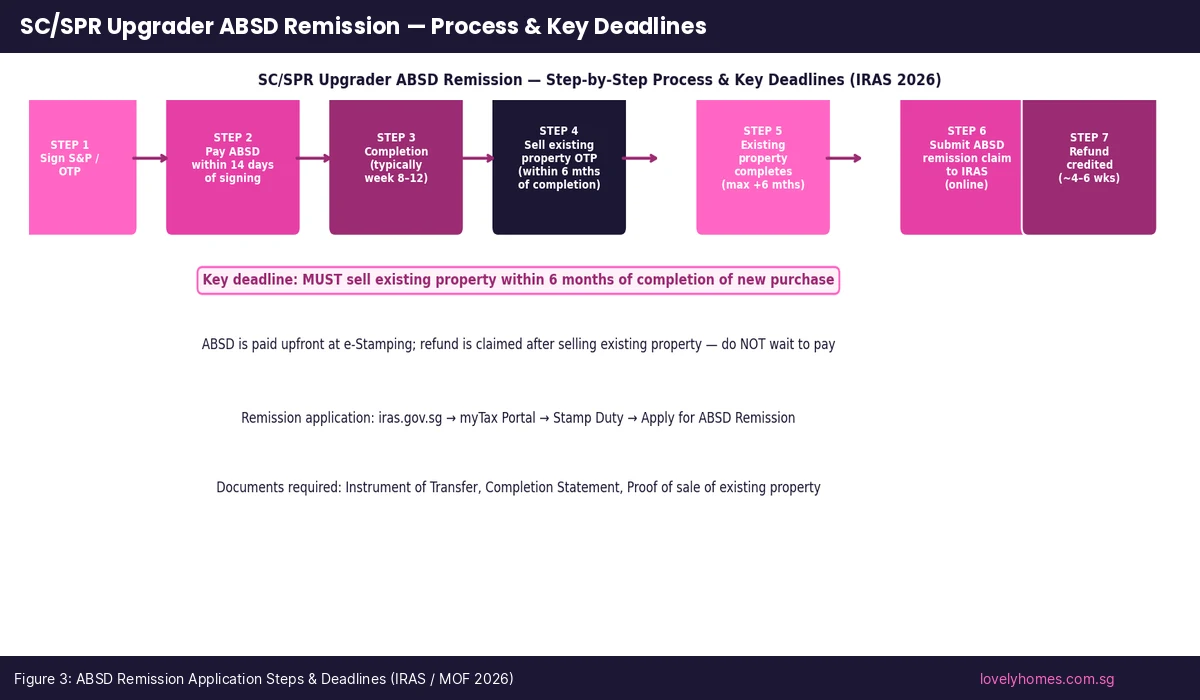
These are separate stamp duties and do not offset each other. ABSD remission for married SC couples allows the ABSD paid on a second property to be refunded if the first property is sold within 6 months of acquiring the second. SSD, if applicable on the first property being sold, is still payable — the ABSD remission does not waive or offset SSD. In the upgrading scenario, couples must factor in both: buyer pays BSD/ABSD on the new purchase, and seller pays SSD on the disposed property if within the SSD holding period. See our HDB upgrading guide for the full analysis.

Related Articles

Disclaimer

This article is for general informational purposes only and does not constitute legal, tax, or financial advice. Stamp duty legislation and IRAS administrative practice can change at any time. Always verify current rates and exemptions directly with the IRAS website and consult a qualified Singapore conveyancing lawyer or tax adviser before making property decisions. Property values, interest rates, and government policy cited are based on information available as at 7 June 2026.

Buying Landed Property Singapore 2026: Eligibility, GCB Rules, BSD and Step-by-Step Guide

Buying Landed Property Singapore 2026: Eligibility, GCB Rules, BSD and Step-by-Step Guide

Quick Answer: Buying Landed Property in Singapore 2026

  • Who can buy: Singapore Citizens (SCs) may freely purchase all landed property types on the mainland. Singapore Permanent Residents (PRs) require approval from the Controller of Residential Property (CRP). Foreign nationals generally cannot purchase mainland landed property.
  • Good Class Bungalows (GCBs): Reserved exclusively for Singapore Citizens — PRs and foreigners are excluded even with CRP or SLA approval. Minimum plot 1,400 sqm; 39 gazetted areas across Singapore.
  • Strata-landed (cluster housing, townhouses): Generally purchasable by PRs and foreigners as these are classified as private residential (non-restricted) — but ABSD applies at the buyer’s applicable rate.
  • Sentosa Cove landed: Foreign nationals may apply to the SLA for approval; 60% ABSD still applies.
  • ABSD: SC first private property purchase: 0% ABSD. SC buying landed while still owning an HDB: 20% ABSD (or use the 6-month remission window). PR: 5% on first private property.
  • BSD: Progressive 1–6% on all purchases; for a S$4.2M terrace, BSD is S$191,600.
  • Property tax: Owner-occupied landed properties pay progressive property tax on Annual Value; revised rates effective 2023 can exceed S$10,000/year for higher-value landed homes.
  • Bank financing: LTV 75% (first property), TDSR 55%. No HDB concessionary loan — bank loans only for private property.

Why Landed Property Remains Singapore’s Most Coveted Real Estate

Singapore has roughly 73,000 landed residential properties — terraces, semi-detached houses, bungalows, and Good Class Bungalows — on an island of just 733 square kilometres. As a share of total housing stock, landed property represents less than 5% of all units. That scarcity, combined with land tenure that is often freehold, makes Singapore landed property one of the most tightly held and appreciating asset classes in Asia-Pacific.

For buyers who qualify — primarily Singapore Citizens — purchasing a landed home represents not just a lifestyle upgrade but a substantive long-term wealth accumulation strategy. URA data shows that the landed residential property price index has risen approximately 73% from Q1 2019 to Q1 2026, outpacing even the robust gains in the private non-landed segment.

This guide covers who may buy landed property in Singapore, the types of landed homes available, eligibility rules under the Residential Property Act (Cap 274) administered by the Singapore Land Authority (SLA), how stamp duties are calculated, and what a realistic transaction looks like from start to finish. All rules and figures reflect the position as at June 2026.

Types of Landed Property in Singapore

Singapore’s landed residential market is divided into five principal categories, each with its own planning parameters, price band, and ownership rules:

Landed property price ranges Singapore 2026 — terrace, semi-D, bungalow and GCB
Figure 1: Indicative Price Ranges by Landed Property Type, Singapore 2026. Source: URA caveats, industry data — Q1 2026. Ranges reflect the broad market; trophy assets and GCBs in prime districts can exceed the upper end shown.

1. Terrace Houses (Intermediate and End-Lot)

Terrace houses are the most accessible entry point into Singapore’s landed market. An intermediate terrace sits between two other units in a row; an end-lot terrace has one open side and typically commands a 10–20% premium. Standard terraces cover a land area of roughly 150–300 sqm (about 1,600–3,200 sqft). Prices range from approximately S$2.2 million for an older intermediate terrace in a non-prime district to S$5 million or more for a renovated freehold end-lot in a desirable estate like Serangoon Gardens (D19), Frankel Estate (D15), or Joo Chiat (D15).

2. Semi-Detached Houses

A semi-detached house shares one party wall with an adjacent unit; the other three sides are free-standing. Land areas typically range from 250 to 500 sqm. Semi-Ds in prime freehold estates (Bukit Timah D11, Holland Road D10) can fetch S$6–9 million, while newer leasehold developments in the north may trade at S$3.5–5 million.

3. Detached Bungalows

A detached bungalow stands on its own plot with no shared walls. Singapore’s Urban Redevelopment Authority (URA) stipulates minimum plot sizes for new detached dwellings, typically 400 sqm and above. Bungalows range widely: a mid-size freehold bungalow in D21 might list at S$6–8 million, while a trophy bungalow in prime D10 or D11 can exceed S$20 million.

4. Good Class Bungalows (GCBs)

GCBs are the pinnacle of Singapore’s residential hierarchy. Regulated by URA’s Good Class Bungalow Areas planning rules, these properties must sit on plots of at least 1,400 sqm (approximately 15,000 sqft), be capped at two storeys above ground plus one basement, and may not subdivide below the minimum plot size. There are 39 gazetted GCB areas across Singapore — concentrated in districts 10, 11, and 21 — including Nassim Road, Bishopsgate, Dalvey Estate, Swiss Club Road, Ridgewood, Caldecott Hill, and Frankel Estate. GCBs are reserved exclusively for Singapore Citizens; PRs and foreigners are ineligible regardless of wealth or residency track. Prices range from approximately S$18 million to over S$60 million, with the rarest Nassim Road GCBs occasionally transacting at S$3,500–S$5,000 psf of land.

5. Strata-Landed Housing

Strata-landed properties — cluster housing, townhouses, and similar formats that sit within a private condominium development on a strata title — occupy a unique middle ground. They are landed in appearance (each unit has its own ground floor and outdoor space) but are legally classified as strata units within a development, placing them outside the Residential Property Act’s “restricted residential property” regime. This means PRs and foreign nationals may purchase strata-landed homes without CRP or SLA approval (subject to the applicable ABSD). Prices are typically lower than equivalent standalone landed: a cluster terrace in a popular development might list at S$2.5–4 million.

Who Can Buy Landed Property: Eligibility by Buyer Status

Landed property purchase eligibility Singapore 2026 — SC, SPR and foreigner rules
Figure 2: Landed Property Purchase Eligibility by Buyer Status, Singapore 2026. Source: SLA, Residential Property Act (Cap 274). * PRs require CRP approval; foreigners require SLA approval for Sentosa Cove only.

Singapore Citizens (SC): Full Access to All Mainland Landed Types

Singapore Citizens may purchase any landed residential property on the Singapore mainland — terrace, semi-detached, bungalow, or GCB — without any prior approval from the SLA or CRP. The only constraint is financial: stamp duties, financing limits, and the HDB ownership rules discussed below. SC buyers who already own an HDB flat face an important restriction: under HDB rules, a flat owner who acquires a private residential property (including landed) must dispose of the HDB flat within six months of completing the private purchase, unless they qualify for the married-couple ABSD remission scheme and choose to retain the HDB temporarily.

Singapore Permanent Residents (PRs): Approval Required

PRs wishing to purchase mainland landed property must first obtain approval from the Controller of Residential Property (CRP), a statutory position within the SLA established under the Residential Property Act (Cap 274). Applications are assessed individually, with the CRP considering factors such as the length of PR status, economic contributions to Singapore (including taxes paid and businesses run), family ties, and the applicant’s immigration trajectory. There is no guarantee of approval, and processing typically takes several months. If approval is granted, conditions may be attached — for example, a prohibition on subletting the property.

PRs may, however, purchase strata-landed housing freely, without CRP approval, as it falls outside the “restricted residential property” definition. PRs are also ineligible for GCBs even if they obtain CRP approval for other landed types.

Foreign Nationals: Mainland Landed Prohibited

Foreign nationals (including those on Employment Passes, Dependent Passes, Long-Term Visit Passes, or any other Singapore immigration status short of PR or citizenship) may not purchase any mainland landed property in Singapore. This prohibition is absolute under the Residential Property Act and does not vary based on wealth, tenure in Singapore, or the type of visa held. The only exceptions are Sentosa Cove landed properties (purchasable with SLA/LDAU approval, with the 60% ABSD still applying) and strata-landed homes in private estates, which foreigners may purchase freely as private residential property.

Key distinction — strata-landed vs standalone landed: A foreigner or PR looking at a “landed” property must always check the title. If it is a strata title within a condominium development (cluster housing), it is purchasable without SLA/CRP approval. If it is a Torrens title on its own plot of land (standalone terrace, semi-D, bungalow), it is restricted under the Residential Property Act and requires approval for PRs, and is prohibited for foreigners on the mainland entirely.

Stamp Duties on Landed Property: BSD and ABSD

Stamp duty on landed property transactions works identically to other residential purchases — BSD is payable by all buyers, ABSD is layered on depending on buyer status and property count. The key difference is that the transaction values are significantly higher, which means BSD in the 5% and 6% brackets applies to a large portion of the purchase price.

Buying costs landed property Singapore 2026 — BSD and down payment at S$3.5M, S$6M and S$12M
Figure 3: Upfront Costs for SC Buying Landed Property as First Private Purchase (2026). BSD calculated at progressive 1–6% tiers effective 15 February 2023. 0% ABSD assumes SC first private property, HDB sold prior. 25% down payment shown on right axis.

ABSD and Landed Property: Critical Points for Upgraders

Many landed buyers in Singapore are HDB flat owners upgrading to private residential property. For a Singapore Citizen purchasing their first private residential property (having either sold the HDB first, or qualifying under the married-couple remission window), ABSD is 0%. However, a SC who buys landed before selling their existing HDB or private property must pay 20% ABSD upfront on the second property and may apply for a remission of this ABSD if the first property (HDB or private) is sold within six months of the second purchase’s completion date. This remission applies to married SC couples only; single buyers are not eligible.

PRs buying their first private residential property (including landed with CRP approval) pay 5% ABSD. A second PR purchase attracts 30% ABSD. Foreigners buying strata-landed or Sentosa Cove landed pay 60% ABSD.

Financing Landed Property: LTV, TDSR and Practical Considerations

Landed property purchasers in Singapore must use bank financing — there is no HDB concessionary loan option for private residential property. The MAS-regulated parameters are the same as for condominiums: LTV cap of 75% for the first property loan, subject to TDSR of 55% of gross monthly income. For a S$5 million semi-detached property, a 75% LTV loan equals S$3.75 million — carrying a monthly repayment of approximately S$15,800 at 3.0% over 30 years, requiring a household income of at least S$28,700/month to pass TDSR (with no other debts). This reflects the buyer demographic typical of the Singapore landed market.

One practical consideration specific to landed property transactions is the use of CPF. While SC buyers may use CPF Ordinary Account savings for the down payment and monthly loan instalments on private property (subject to the Valuation Limit and Withdrawal Limit rules), the higher absolute values involved mean that CPF often covers only a fraction of the total cost. Most landed buyers also deploy significant savings or proceeds from prior property sales.

Property Tax on Landed Homes

Property tax is levied annually by IRAS on the Annual Value (AV) of a property — the estimated gross annual rent it could command in the open market. AV for landed homes depends on the property type, size, location, and condition. A terrace in Serangoon Gardens might carry an AV of S$60,000–80,000; a Nassim Road bungalow might have an AV of S$200,000 or more.

Owner-occupied residential property tax rates (revised upward from 1 January 2024) are progressive:

Annual Value (AV) Owner-Occupied Rate Non-Owner-Occupied Rate
First S$8,000 0% 10%
S$8,001–S$30,000 4% 12%
S$30,001–S$40,000 6% 14%
S$40,001–S$55,000 10% 16%
S$55,001–S$70,000 14% 18%
S$70,001–S$85,000 18% 20%
S$85,001–S$100,000 22% 22%
Above S$100,000 32% 36%

For an owner-occupied terrace with an AV of S$72,000, annual property tax would be approximately S$8,160. A non-owner-occupied landed home (i.e., one that is tenanted or vacant) is taxed at the higher non-owner-occupied rate, which could result in an annual property tax bill of S$11,400 or more on the same AV.

Summary: Key Rules for Buying Landed Property in Singapore 2026

Parameter Singapore Citizen Singapore PR Foreigner
Terrace / Semi-D / Bungalow (mainland) ✓ Free to buy CRP approval needed ✗ Prohibited
Good Class Bungalow (GCB) ✓ Free to buy ✗ Ineligible ✗ Prohibited
Strata-landed (cluster housing) ✓ Free to buy ✓ Free to buy ✓ Free to buy
Sentosa Cove landed ✓ Free to buy ✓ Free to buy SLA/LDAU approval needed
ABSD (first private property) 0% 5% 60%
BSD Progressive 1–6% Progressive 1–6% Progressive 1–6%
SSD (if sold within 3 years) 12%/8%/4% 12%/8%/4% 12%/8%/4%
LTV cap (first property loan) 75% 75% 75% (bank only)
Minimum cash down payment 5% cash + CPF 5% cash + CPF 5% cash only (no CPF)
HDB ownership: must dispose Within 6 months of private purchase Within 6 months N/A (no HDB ownership)

Worked Example: Mr & Mrs Tan (Singapore Citizens) — Upgrading to a Serangoon Gardens Terrace at S$4,200,000

Profile: Mr Tan (46) and Mrs Tan (42), both Singapore Citizens, joint gross income S$28,000/month. They currently own a Tampines HDB 5-room flat that they sell for S$950,000. After repaying the outstanding HDB loan (S$150,000) and refunding CPF accrued interest (S$220,000 principal + S$32,000 interest = S$252,000), they net approximately S$548,000 in cash proceeds. They have additional savings of S$550,000. Combined liquid assets: S$1,098,000.

Step 1 — BSD calculation on S$4,200,000:

  • 1% × S$180,000 = S$1,800
  • 2% × S$180,000 = S$3,600
  • 3% × S$640,000 = S$19,200
  • 4% × S$500,000 = S$20,000
  • 5% × S$1,500,000 (S$1.5M–S$3.0M) = S$75,000
  • 6% × S$1,200,000 (S$3.0M–S$4.2M) = S$72,000
  • Total BSD = S$191,600

Step 2 — ABSD: The Tans sell their HDB before exercising the OTP on the terrace, so this is their first private residential purchase — ABSD = 0%.

Step 3 — Bank loan and TDSR:

  • LTV 75%: loan = S$4,200,000 × 75% = S$3,150,000
  • At 3.0% p.a. over 30 years: monthly instalment ≈ S$13,280
  • TDSR = S$13,280 ÷ S$28,000 = 47.4% — PASS (below 55% threshold)
  • Stressed at 4.0%: S$15,037/month ÷ S$28,000 = 53.7% — borderline; lender may require 25-year tenure instead

Step 4 — Cash outlay summary:

Item Amount (S$) Funding Source
25% down payment (incl. 5% cash minimum) S$1,050,000 5% cash S$210k + CPF S$420k + cash S$420k
BSD S$191,600 CPF OA (if sufficient) / cash
Legal fees (conveyancing + bank) S$7,500 Cash
Property valuation fee S$800 Cash
Total upfront (excl. ABSD) S$1,249,900 Cash available: S$1,098,000 + CPF used

CPF OA balance (combined) assumed at S$380,000 — covers BSD and part of down payment. The Tans’ total cash and CPF resources of approximately S$1,478,000 comfortably cover the S$1,249,900 needed, leaving a liquidity buffer of approximately S$228,100 plus ongoing CPF contributions. Monthly instalment S$13,280 at 3.0%/30yr.

Why Landed Property Holds a Special Place in Singapore’s Wealth Architecture

Singapore’s land constraints are structural and permanent. The Government has stated that no new landed residential land will be released through the Government Land Sales programme — landed supply growth comes only from existing plots being redeveloped or amalgamated. This fixed supply, combined with relentless demand from Singapore’s growing population of high-net-worth Citizens, underpins the asset’s long-run outperformance. Industry data suggests that freehold landed property has appreciated at approximately 5–7% per annum over two decades in prime districts, with GCBs in particular serving as wealth-preservation vehicles for Singapore’s wealthiest families.

Unlike condominiums, landed homes generate no management fee or sinking fund contributions (for standalone properties), offer true ground-floor living, and permit significant customisation through rebuilding or A&A (additions and alterations) works subject to URA guidelines. The combination of scarcity, control, and customisation makes landed property a distinct asset class rather than simply “a more expensive condo”.

What Might Come Next for Landed Property Policy?

This section represents editorial analysis and should not form the basis of any investment decision. The core restrictions on PR and foreign purchases of mainland landed property have been in place since the Residential Property Act’s enactment in 1976 and are unlikely to change materially. There has been no policy signal of any relaxation. The GCB rules in particular — which restrict purchases to SCs only — reflect a deliberate policy to preserve the nation’s most prestigious residential stock for citizens.

Looking further ahead, some observers speculate that as Singapore’s population of long-tenured, economically integrated PRs grows, there may be gradual liberalisation of the CRP approval process for PR buyers in the mid-tier landed market. Others have suggested that the Government could use landed property supply to reward exceptional talent (through a fast-tracked CRP approval linked to an enhanced-tier talent scheme). For now, however, the policy stance is unchanged: landed ownership on the Singapore mainland remains principally a citizen prerogative.

Frequently Asked Questions

Can a Singapore PR apply to buy a landed property on their own?

Yes — a Singapore Permanent Resident may apply to the Controller of Residential Property (CRP) at the Singapore Land Authority (SLA) for approval to purchase mainland landed residential property. The application is assessed individually. Key factors include the applicant’s length of PR status, economic contribution to Singapore (employment, taxes paid, business ownership), family ties to Singapore Citizens, and whether the applicant has applied for or is eligible to apply for citizenship. There is no published approval rate, and decisions are at the CRP’s discretion. PRs who are granted approval may purchase terrace houses, semi-detached houses, and detached bungalows, but not Good Class Bungalows (which are restricted to SCs only). The CRP approval does not reduce or waive the applicable ABSD — a PR buying a first private property still pays 5% ABSD.

What is the minimum plot size for a Good Class Bungalow?

A Good Class Bungalow (GCB) must sit on a plot of at least 1,400 sqm (approximately 15,069 sqft), as stipulated in URA’s Good Class Bungalow Areas planning rules. The building envelope is limited to two storeys above ground plus one basement storey. GCBs may not be subdivided below this minimum plot size, and amalgamation (combining two or more plots) is permitted only if the resulting plot meets the minimum size requirement. The 39 gazetted GCB areas are concentrated primarily in Districts 10, 11, and 21, with pockets in Districts 15 and 16. Any redevelopment or rebuilding on a GCB plot requires BCA and URA approval and must comply with the GCB planning parameters. Singapore Citizens wishing to purchase a GCB do not need any special government approval beyond the standard conveyancing process.

Can an SC who owns an HDB flat buy a landed property without selling the HDB first?

Yes, but with significant stamp duty consequences. A Singapore Citizen who owns an HDB flat and purchases a private residential property (including landed) without first selling the HDB will pay 20% ABSD on the private property. This ABSD is payable within 14 days of the OTP exercise. However, if the HDB flat is sold — and the sale is completed — within six months of the private purchase’s completion date, the SC (or married SC couple) may apply to IRAS for a remission of the 20% ABSD. This is the “married couple ABSD remission” scheme under the Stamp Duties Act. Note: the remission requires the couple to be lawfully married, and both spouses must be Singapore Citizens to qualify. Single SCs are not eligible for this remission and must sell their HDB first to avoid ABSD.

What are the typical costs to rebuild a landed property in Singapore?

Rebuilding a landed property in Singapore — demolishing the existing structure and constructing a new home — typically costs between S$2.5 million and S$5 million or more depending on the plot size, the architectural specification, the quality of finishes, and the contractor selected. Rebuilding a standard two-storey terrace on a 200 sqm plot might cost S$1.5–2.5 million for a mid-range build (around S$500–900 psf of built-up area). A GCB rebuild to a high specification can cost S$5–15 million. Before any demolition or reconstruction, the owner must obtain Planning Permission from URA and a Building Plan approval from BCA. Typically the entire process from appointment of an architect to receipt of a Temporary Occupation Permit (TOP) takes 2–4 years. During the rebuild period, the owner must either rent alternative accommodation or — if they have not yet moved in — remain patient.

Are landed property gains subject to capital gains tax in Singapore?

No — Singapore does not impose a general capital gains tax. Gains realised on the sale of landed (or any other) residential property are not taxable under the Income Tax Act, as long as the seller is not considered to be carrying on a trade or business in property. IRAS may assess an individual as a property trader — and therefore liable for income tax on gains — if they demonstrate a pattern of frequent buying and selling with the intention of profit rather than genuine long-term ownership. In practice, IRAS’s scrutiny is most intense for buyers who flip properties shortly after purchase and for those with professional connections to the property industry. For most individual landed property owners who hold their home for several years, there is no capital gains liability on a sale. The Seller’s Stamp Duty (SSD) at 12%/8%/4% for sales within the first three years of ownership is a deterrent to short-term flipping, but this is a stamp duty obligation rather than a capital gains tax.

Can foreigners who become PRs apply for CRP approval immediately?

Technically, an applicant may apply for CRP approval as soon as they are granted PR status. However, in practice the CRP’s assessment places significant weight on the duration of PR status as evidence of genuine long-term residence commitment. A fresh PR applicant applying immediately after receiving their PR is unlikely to succeed unless there are exceptional circumstances. Most approved applicants have held PR status for several years and have additional compelling ties to Singapore. The CRP does not publish a minimum qualifying period, and decisions are made on a case-by-case basis. Would-be PR buyers of landed property are generally advised by solicitors to wait at least three to five years after receiving PR before applying, and to build a strong profile of economic and social contributions to Singapore in the meantime.

What is “strata-landed” property and is it a good substitute for a standalone landed home?

Strata-landed housing — cluster houses, townhouses, and similar formats within a private estate — offers a landed-style living experience (ground-floor access, small garden, no unit above or below) within a condominium’s legal framework. They are generally more affordable than equivalent standalone landed homes, often located in suburban or newer estates, and available to PRs and foreigners without CRP approval. However, strata-landed homes come with condominium management fees (covering common facilities and security), are subject to the strata title’s collective management and by-laws, and may carry restrictions on exterior modifications. The land beneath a strata-landed unit is held collectively, unlike the exclusive freehold or leasehold land title of a standalone landed property. For buyers who prioritise the lifestyle of a landed home but face eligibility constraints (PRs, foreigners) or budget constraints (strata-landed is often S$500k–S$1.5M cheaper than comparable standalone), strata-landed can be an attractive alternative — albeit one that does not carry the same scarcity premium as a true standalone landed property in a prime estate.

Disclaimer: This article is for general informational purposes only and does not constitute legal, financial, or taxation advice. Eligibility rules, stamp duty rates, property tax schedules, and planning regulations are subject to change by the Government at any time. The information reflects the position as at June 2026. Before making any property transaction — particularly one involving the Residential Property Act, ABSD remission applications, or CRP approvals — readers should consult a Singapore-licensed solicitor, MAS-licensed financial adviser, and the relevant authorities: SLA (sla.gov.sg), IRAS (iras.gov.sg), URA (ura.gov.sg), and HDB (hdb.gov.sg). LovelyHomes does not accept liability for any loss arising from reliance on this article.
Translate »