Jurong Lake District White Site 2026: Town Hall Link GLS Tender, 1,200 Homes and CRL CR19

Jurong Lake District White Site 2026: Town Hall Link GLS Tender, 1,200 Homes and CRL CR19

Quick Answer: JLD Town Hall Link White Site at a Glance

  • Site: Town Hall Link, Jurong Lake District (JLD), adjacent to the Jurong Town Hall national monument.
  • Total GFA: 186,139 sqm — one of the largest mixed-use sites launched in Singapore in recent years.
  • Residential: up to 1,200 private residential units.
  • Office: minimum 40,000 sqm — anchoring JLD’s ambition as the largest business node outside the city centre.
  • Complementary uses: up to 44,000 sqm for retail, serviced apartments, hotel, sports, community and medical facilities.
  • Connectivity: integrated with Jurong East MRT interchange (EWL/NSL), future JRL JE5 station, and upcoming CRL CR19 station (planned 2032).
  • Tender closes: 17 November 2026.
  • Why it matters: the White site designation gives developers flexibility to configure uses — residential, commercial, or mixed — based on market conditions at launch, making it one of Singapore’s most strategically significant land sales of 2026.

URA Launches JLD White Site: Singapore’s Most Anticipated 2H 2026 GLS Tender

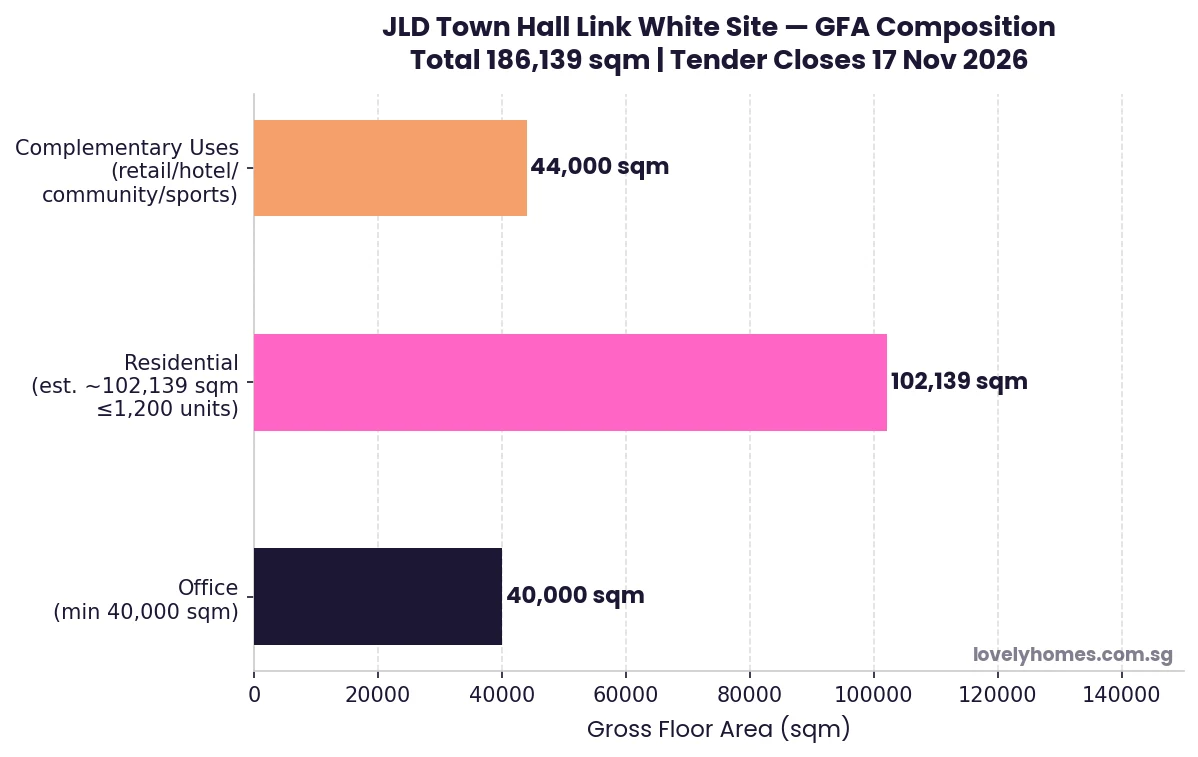
The Urban Redevelopment Authority (URA) launched the tender for a White site at Town Hall Link in the Jurong Lake District (JLD) on 3 July 2026, marking one of the most significant Government Land Sales (GLS) moves of the year. At 186,139 sqm of total potential Gross Floor Area (GFA) — comprising a minimum 40,000 sqm of office, up to 1,200 private residential units, and 44,000 sqm of complementary uses — this site has the potential to define the next chapter of Singapore’s western regional centre.

The tender forms part of the Confirmed List for the 2H 2026 GLS Programme and will close at 12 noon on 17 November 2026. It comes less than two weeks after URA released its Q2 2026 property price flash estimate showing the overall private residential PPI rising a modest 0.5% — a market context that is stable enough for developers to bid with confidence, but not so frothy as to suggest over-payment risk.

JLD is Singapore’s flagship decentralisation initiative: a vision to create a vibrant live-work-play precinct in the western part of Singapore that can absorb commercial, residential, and civic activity without adding further pressure on the already-congested central business district. The Town Hall Link site occupies a prime position within this vision — sited next to the Jurong Town Hall national monument, directly connected to the Jurong East MRT interchange, and in the future path of two new MRT lines.

What Is a White Site?

A White site in Singapore’s GLS framework is a land parcel that developers may develop for any combination of uses permitted under the Master Plan, subject to a minimum requirement for one or more specified uses. Unlike purpose-specific GLS sites (e.g., residential-only or commercial-only), a White site allows developers to calibrate the use mix based on their read of market conditions at the time of design and launch.

For the Town Hall Link site specifically, the conditions are: minimum 40,000 sqm office; up to 1,200 residential units; and up to 44,000 sqm for complementary uses. The developer awarded the site will have latitude to decide the precise mix of hotel, serviced apartments, retail, community facilities, and sports/recreation components — creating significant design flexibility in exchange for the commitment to deliver a meaningful commercial core.

White sites have historically attracted strong bidding interest in Singapore because they reduce the development risk associated with committing entirely to a single use in a market that can shift between residential launch and commercial occupation. The last major White site in JLD — the site that became J Gateway and the surrounding cluster — generated keen bidding when it was first introduced.
Jurong Lake District JLD Town Hall Link white site GFA breakdown office residential complementary 2026

Figure 1: Town Hall Link White Site — indicative GFA breakdown by use. Total 186,139 sqm. Source: URA pr26-53, 3 July 2026.

The JLD Masterplan: Context for This Site

JLD’s transformation has been driven by two decades of sustained government investment in infrastructure and planning. The revitalised Jurong Lake Gardens (90 hectares) provides the greenery spine at the district’s heart. Two new MRT lines are changing the connectivity calculus dramatically:

  • Jurong Region Line (JRL): JE5 station at Jurong East and JE6 station at International Business Park (planned to open 2028).
  • Cross Island Line (CRL): CR19 station at the heart of the new JLD precinct (planned to open 2032).

The addition of CRL is particularly significant: it will provide a direct east-west connection from JLD to Ang Mo Kio, Pasir Ris, and eventually Changi — transforming what has historically been perceived as a “western” destination into a genuinely cross-island node. For the Town Hall Link site, the multi-level pedestrian connections to Jurong East MRT interchange and the upcoming CR19 station mean that residents and office workers at this development will enjoy arguably the best public transport connectivity of any mixed-use site currently on the GLS market.

The site sits next to the Jurong Town Hall, a gazetted national monument. This adjacency imposes design constraints — any development will need to respect the monument’s visual and physical setting — but also provides a distinctive civic character that differentiates the JLD precinct from purely commercial developments elsewhere.

Development Mix Analysis

Use Component GFA (sqm) Status Commentary
Office 40,000 minimum Mandatory Anchors JLD’s role as business node; positions site as corporate headquarters address
Private Residential Up to ~102,139 (est.), max 1,200 units Optional (developer discretion) 1,200 units at typical 80–90 sqm average ≈ 102,000 sqm; adds residential critical mass to district
Complementary Uses Up to 44,000 Optional (developer discretion) Can include: retail, hotel, serviced apartments, sports/recreation, medical clinics, community facilities, visitor attractions
Total GFA 186,139 One of Singapore’s largest mixed-use GLS sites

At 1,200 residential units, this would represent one of Singapore’s larger single-site condominium developments — comparable in scale to recent developments like Canninghill Piers (696 units) and Lentor Modern (605 units), but notably larger. The scale is appropriate for JLD’s ambition to create residential density that sustains the commercial base.

Key Catalysts and Infrastructure Timeline

The development that occupies this site will benefit from a series of planned catalysts over the 2026–2035 horizon:

Catalyst Timeline Impact on Site
JRL JE5 (Jurong East) and JE6 (International Business Park) Phased opening, 2027–2028 Improved east-west connectivity within JLD; connects IBP to Jurong East interchange
New Science Centre at JLD Expected by 2027 Adds visitor attraction and civic anchor to the precinct; drives weekend footfall
Jurong Gateway Hub (bus interchange + office + retail + community club + library + sports) Expected by 2028 Integrated civic hub immediately adjacent; dramatically increases JLD’s daytime and evening population
CRL CR19 station at JLD Planned 2032 Cross-island connectivity; potential 15% to 20% capital value uplift for residential units at this site based on historical TEL/MRT proximity premiums

Residential Investment Angle: 1,200 Units in JLD

If the awarded developer proceeds with the full 1,200-unit residential allocation, this will be among the more significant new private residential supply additions to JLD since the area last saw major development activity in the 2013–2017 era (J Gateway, Westwood Residences, Lake Grande, Twin Vew). JLD has historically commanded a premium relative to other OCR locations — driven by the live-work-play narrative, the lake setting, and the Jurong East MRT interchange’s accessibility to both the western industrial belt and the central business district via the East-West Line.

A new-launch condo at this site, post-CRL connectivity, could plausibly target $2,000–$2,400 psf based on the trajectory of comparable new launches in OCR/RCR boundary locations in 2025–2026. The tender price paid by the developer will be the key determinant of eventual launch pricing — a high land bid will translate into a premium launch price, while a competitive-but-measured bid could allow the developer to price attractively and generate strong take-up. The tender close date of 17 November 2026 gives the market approximately four and a half months to assess these dynamics.

What This Means for the Broader Market

The JLD White Site launch is a policy signal as well as a commercial opportunity. URA’s decision to include a major White site in the 2H 2026 Confirmed List — rather than deferring it to the Reserve List — indicates confidence that developer demand is sufficient to support a committed bid within the current market cycle. The White site mechanism also signals flexibility: if the residential market softens before design completion, the developer can weight the mix toward commercial and serviced apartment uses.

For existing JLD residential owners — in projects like J Gateway, Lake Grande, Twin Vew, and the upcoming The LakeGarden Residences — the Town Hall Link development represents both an opportunity (improved amenity and connectivity as the precinct builds out) and a risk (increased residential supply within the immediate catchment). On balance, the infrastructure and amenity uplift from the New Science Centre, Jurong Gateway Hub, and CRL CR19 is likely to outweigh the supply effect, particularly for well-located existing units.

What Might Come Next

The following is editorial commentary — not official guidance.

Bidding for the Town Hall Link site is expected to attract Singapore’s larger developers and possibly joint ventures. The scale of the site (186,139 sqm) requires significant capital — a land price in the S$1.5–S$2.5 billion range would not be surprising, depending on the assumed residential launch pricing and the developer’s commercial income projections. International developers with Asian regional headquarters-in-a-hub ambitions could also consider the mandatory 40,000 sqm office component as a corporate campus opportunity.

The CRL CR19 station opening in 2032 is a known future catalyst — developers will model this into their land bid assumptions. A project that launches residential units in 2028–2029 (assuming a 2027 tender award, 1-year design/approval, and early 2028 launch) would be telling buyers that their units will be CRL-connected by the time they reach the 5-year mark of ownership.

Frequently Asked Questions

What does “White site” mean for buyers of the eventual development?

A White site designation affects the developer’s design choices, not individual buyers’ rights. When the eventual development is launched for sale, buyers will purchase units in a standard private condominium development. They will benefit from the mixed-use amenities — retail, food and beverage, possibly a hotel or serviced apartment building within the same development — that result from the White site configuration. The White site label itself conveys no special lease conditions or restrictions on buyers beyond the standard conditions of a freehold or 99-year leasehold private condominium.

When will the residential units at Town Hall Link be available for sale?

The tender closes 17 November 2026. Assuming the tender is awarded in Q1 2027, and accounting for design, planning approval, and construction timelines, the earliest a residential launch could realistically occur is late 2027 or 2028. Physical completion (Temporary Occupation Permit) would likely follow in 2030–2032. Prospective buyers interested in this development should monitor URA and the awarded developer’s announcements in 2027.

How does the JLD CRL station affect property values nearby?

Historical evidence from Singapore MRT openings — most recently the Thomson-East Coast Line (TEL) stages 1–4 and the Downtown Line — suggests that residential properties within 500 metres of a new MRT station tend to appreciate by 8–15% relative to comparable properties further away in the 3–5 years following station opening. The effect is partially priced in ahead of the opening as buyers and investors anticipate the connectivity uplift. For CR19 (planned 2032), properties in the immediate JLD precinct likely already incorporate some forward-looking CRL premium in 2026. The full premium crystallises as the opening date approaches and actual connectivity is confirmed.

Is the Town Hall Link site freehold or leasehold?

GLS sites in Singapore are typically sold on 99-year leasehold terms. The Town Hall Link site is expected to follow this standard. Buyers of units in the eventual development will hold 99-year leasehold titles, with the lease commencement date tied to the date of the land award. Leasehold tenure is the norm for new GLS-sourced developments in Singapore; the premium-location attributes of the site — MRT connectivity, JLD masterplan, CRL uplift — are expected to sustain long-term value notwithstanding the leasehold structure.

What other major GLS sites were launched in 2H 2026?

The 2H 2026 GLS Confirmed List provides a total of 4,745 private residential units. In addition to the Town Hall Link White site, URA also launched sites at Lorong Puntong/Sin Ming Avenue (~140 units, TEL Bright Hill MRT, tender closes 15 September 2026) and Kitchener Link (~145 units, Reserve List, Farrer Park MRT NEL). The full 2H 2026 GLS programme — including industrial and commercial sites — is available on the URA website at ura.gov.sg/land-sales.

Related Articles

Disclaimer

This article is for general informational purposes only and does not constitute financial or investment advice. Details of the Town Hall Link White site are sourced from URA press release pr26-53 (3 July 2026) and the URA website. Developer bidding, design outcomes, launch pricing, and project timelines are speculative editorial commentary and do not represent commitments by URA or any developer. For authoritative site details and tender conditions, refer to ura.gov.sg. Consult a licensed financial adviser before making any property investment decision.
URA Q2 2026 Singapore Property Price Index: Market Softens as CCR Rebounds

URA Q2 2026 Singapore Property Price Index: Market Softens as CCR Rebounds

Quick Answer: URA Q2 2026 PPI Flash Estimate

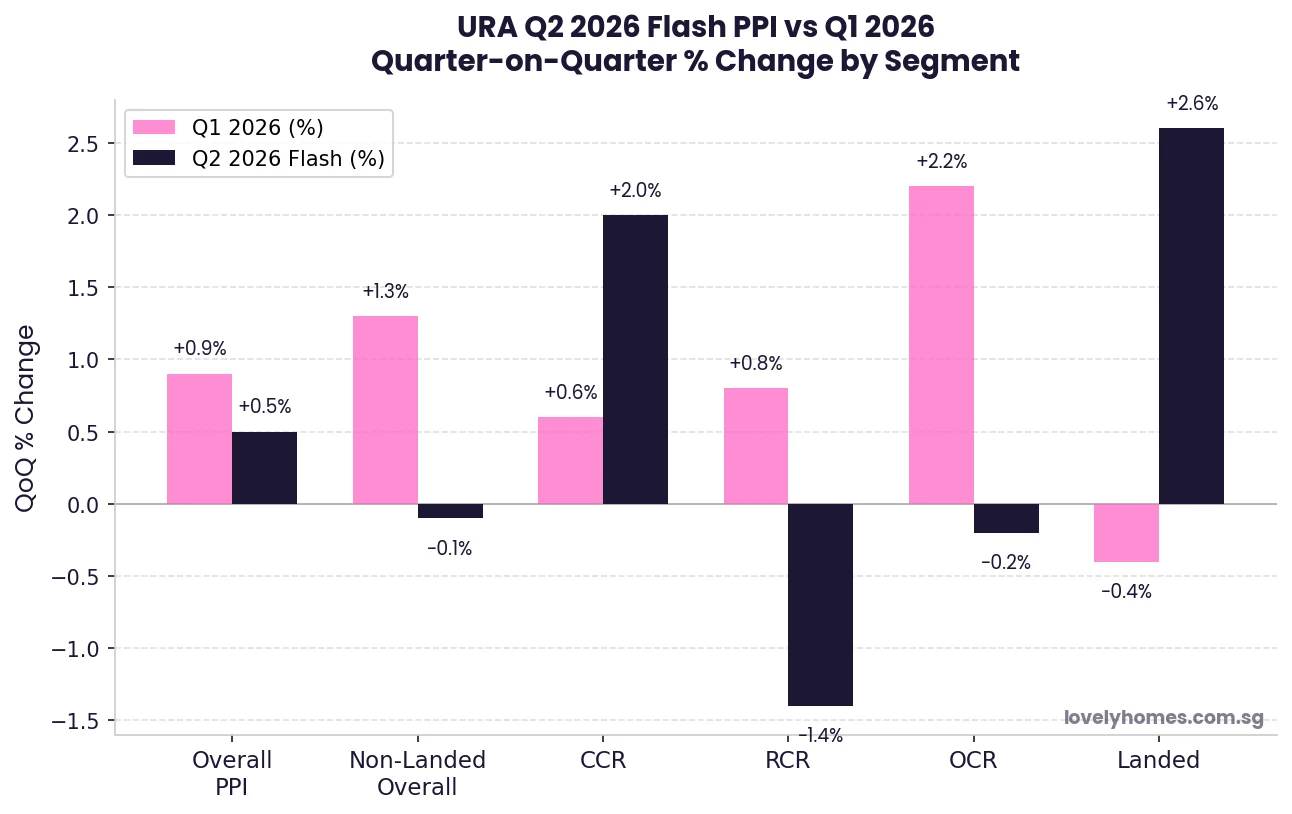
  • Overall PPI: +0.5% QoQ — a deceleration from +0.9% in Q1 2026. Prices are still rising but at a slower pace.
  • Core Central Region (CCR) rebounded: +2.0% (vs +0.6% in Q1 2026) — luxury segment recovering after two quarters of underperformance.
  • Rest of Central Region (RCR): −1.4% (vs +0.8% in Q1) — notable reversal; high-priced new launches in this segment may have peaked.
  • Outside Central Region (OCR): −0.2% (vs +2.2% in Q1) — mass market segment cools after a strong Q1.
  • Landed properties: +2.6% (vs −0.4% in Q1) — sharp rebound in the landed segment, driven by supply scarcity.
  • Transaction volume: 5,420 units (up to mid-June) — broadly comparable to Q1’s 5,413. No supply glut or demand collapse.
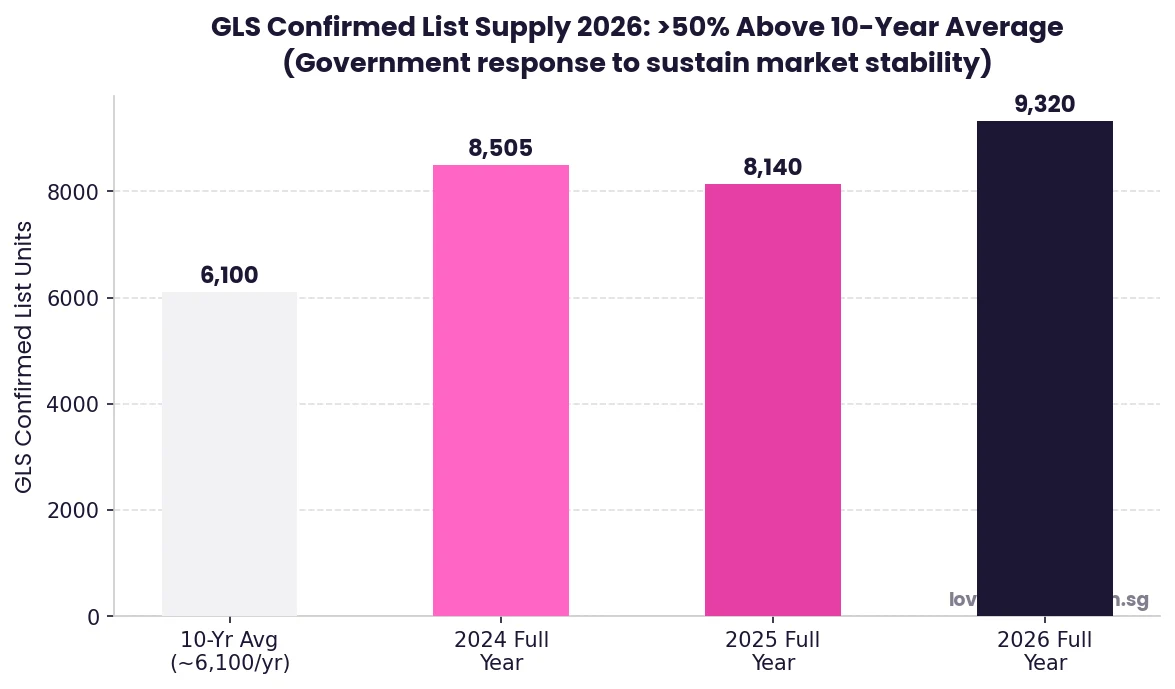
  • Government response: 2H 2026 Confirmed List GLS supply = 4,745 units; full-year 2026 Confirmed List = 9,320 units, over 50% above the 10-year average.
  • Full Q2 statistics will be released by URA on 24 July 2026.

Singapore Q2 2026 Private Residential Property Prices: A Measured Softening

Singapore’s private residential property market continued its gradual moderation in the second quarter of 2026, according to the flash estimate released by the Urban Redevelopment Authority (URA) on 1 July 2026. The overall Private Residential Property Price Index (PPI) rose by 0.5% on a quarter-on-quarter basis — a visible step down from the 0.9% gain recorded in Q1 2026 and a world away from the 3%+ quarterly swings seen during the 2021–2022 boom.

The headline figure conceals a striking divergence beneath the surface: the Core Central Region (CCR) — Singapore’s luxury prime district covering the traditional Central Business District fringe, Orchard Road, and Sentosa Cove — rebounded strongly with a 2.0% gain, while the Rest of Central Region (RCR) and Outside Central Region (OCR) recorded modest declines of 1.4% and 0.2% respectively. Landed properties, which had dipped 0.4% in Q1, surged 2.6% in Q2 — reflecting the structural supply scarcity of this asset class.

The flash estimate is based on transaction prices submitted for stamp duty payment and developer sales data from 1 April 2026 up to mid-June 2026. The full Q2 2026 real estate statistics — covering HDB resale, rental, and the complete development pipeline — will be published by URA on 24 July 2026.

URA Q2 2026 private residential property price index flash estimate QoQ by segment CCR RCR OCR Singapore

Figure 1: URA Q2 2026 PPI flash estimate — quarter-on-quarter % change by segment, compared to Q1 2026. Source: URA press release pr26-51, 1 July 2026.

Segment-by-Segment Analysis

Segment Q1 2026 QoQ % Q2 2026 Flash QoQ % Direction
Overall PPI +0.9% +0.5% ↓ Deceleration
Non-Landed Overall +1.3% −0.1% ↓ Turned Negative
CCR (Core Central Region) +0.6% +2.0% ↑ Sharp Recovery
RCR (Rest of Central Region) +0.8% −1.4% ↓ Sharp Reversal
OCR (Outside Central Region) +2.2% −0.2% ↓ Turned Negative
Landed Properties −0.4% +2.6% ↑ Sharp Rebound

CCR rebound: The 2.0% CCR gain in Q2 is the strongest single-quarter reading for this segment since early 2024. The CCR has historically lagged the OCR/RCR recovery because foreign buying — the CCR’s key demand driver — was hit hardest by the April 2023 cooling measures (which raised the foreigners’ ABSD from 30% to 60%). The Q2 2026 recovery suggests that either (a) some internationally mobile buyers are re-engaging despite the 60% ABSD, or (b) domestic upgrader demand from Singaporeans and PRs is filling the luxury segment. The URA’s full Q2 data release on 24 July will shed more light on the transaction mix.

RCR contraction: The −1.4% RCR reading is notable. The RCR has been the market’s most active new-launch corridor, with several high-profile projects launching in 2025–2026 at elevated per-square-foot prices. A reversion in Q2 may reflect buyers’ price resistance after the aggressive pricing of some recent launches, combined with increased competition from HDB upgraders who are now also being drawn by improving BTO supply timelines.

Landed recovery: The 2.6% landed rebound follows a brief Q1 pause. Singapore’s landed housing supply is essentially fixed — there is virtually no new landed housing land being released — and as such, landed prices reflect pure demand dynamics. The Q2 strength likely reflects pent-up demand from local ultra-high-net-worth families who had been watching the market from the sidelines.

Transaction Volume: Stable, Not Surging

Sale transaction volume for Q2 2026 (up to mid-June) totalled 5,420 units, broadly comparable to Q1 2026’s 5,413 units. This stability is significant: it indicates that the market is transacting at a healthy pace without the frenzied turnover of 2021–2022 (when quarterly volumes regularly exceeded 6,000–7,000 units). A market that transacts steadily at moderate volumes — without speculative churning — is precisely what Singapore’s property policy framework has been calibrated to achieve.

The comparable volume across Q1 and Q2, combined with decelerating overall price growth, is broadly consistent with URA’s characterisation of the market as “broadly stable.” There is no sign of a demand-side collapse, nor of a renewed speculative surge.

Government Policy Response: GLS Supply Elevated

In its press release accompanying the Q2 2026 flash estimate, URA noted that the Government is sustaining a high and steady supply of private housing through the Government Land Sales (GLS) Programme. Key supply data:

  • 2H 2026 Confirmed List: 4,745 private residential units to be launched.
  • Full-year 2026 Confirmed List: 9,320 units — over 50% higher than the past 10-year annual average of approximately 6,100 units.
  • Total pipeline (including ECs): around 61,000 private residential units expected to be completed over the next few years.
GLS confirmed list supply 2026 versus 10 year average Singapore government land sales

Figure 2: GLS Confirmed List supply — 2026 full year at 9,320 units is more than 50% above the 10-year average, reflecting the government’s commitment to market stability. Source: URA.

What This Means for Property Buyers and Sellers

For buyers, the Q2 2026 data reinforces a cautious but constructive outlook. The market is not in free fall, but neither is it in a runaway boom. Price growth is positive but subdued at the overall level, meaning buyers who act carefully — securing financing, doing diligent market research, and buying at realistic prices — are unlikely to face an immediately adverse market movement. The government’s elevated GLS supply commitment over the coming years means that the supply pipeline will continue to exert a moderating influence on prices in the medium term.

For sellers, the divergence between CCR strength and RCR/OCR softness matters. Sellers of mass-market condominiums in the RCR and OCR face a more challenging environment than they did in early 2026, when Q1 showed strong gains. Setting realistic asking prices — based on recent comparable transactions rather than the 2021–2022 peak — will be critical to achieving timely sales.

URA reminds buyers that “the macroeconomic outlook remains highly uncertain,” and that “households are advised to exercise prudence when purchasing property and taking out mortgage loans.” In a global environment where interest rates remain elevated and economic uncertainty persists, this is sound counsel.

What Might Come Next

The following is analytical commentary — not official guidance.

The Q2 2026 flash PPI reading, combined with the full-year supply trajectory, suggests the most likely scenario is continued modest positive overall price growth through H2 2026 — perhaps in the +0.2% to +0.8% range per quarter — with the CCR outperforming and OCR/RCR remaining relatively flat or slightly negative. A material downside scenario (sharp price falls) would require a severe external shock — a global recession, a sharp rise in Singapore unemployment, or a significant tightening of MAS monetary conditions. None of these appear imminent as at early July 2026.

The June 2026 JLD White Site tender launched by URA (Town Hall Link; tender closes 17 November 2026) adds a significant new mixed-use supply node to the western corridor. Investor sentiment around this site will be a useful bellwether for developer confidence in the H2 2026 market — a strong bid premium would signal that private developers remain bullish despite the moderating price environment.

Frequently Asked Questions

What is the URA PPI and how is it calculated?

The URA Private Residential Property Price Index (PPI) measures the change in prices of private residential properties in Singapore on a quarterly basis. It is compiled by URA using transaction data from stamp duty submissions and developer sale returns, covering all private residential transactions (both new sales and resale). The index uses a hedonic regression model that controls for property characteristics (size, location, floor level, age) to isolate pure price change from changes in the mix of properties transacted. The flash estimate, released around the first day of the following quarter, is a preliminary reading based on transactions up to mid-quarter; the full estimate, released three to four weeks later, incorporates complete quarter data and may differ from the flash figure.

Why did CCR prices rise so sharply in Q2 2026?

The CCR’s 2.0% rebound likely reflects a combination of factors: (1) limited new CCR supply coming to market in Q2 2026, creating upward price pressure on the available stock; (2) renewed demand from Singapore Citizens and PRs upgrading to prime-district condominiums, partially replacing the foreign demand that was curtailed by the 2023 cooling measures; and (3) the delayed effect of earlier GLS site launches around the Orchard / River Valley / Marina Bay corridors. The CCR has historically been more volatile than OCR/RCR — large individual transactions can move the segment average. The full Q2 data release on 24 July 2026 will clarify whether this rebound is broad-based or driven by a handful of high-value transactions.

What is 61,000 units in pipeline mean for future prices?

URA’s announcement that approximately 61,000 private residential units (including executive condominiums) are expected to be completed “in the next few years” represents a substantial supply pipeline. As a reference point, annual demand for private homes in Singapore has typically ranged from 8,000 to 13,000 units per year over the past decade. A pipeline of 61,000 units spread over approximately 5–6 years implies a continued period of elevated completions that is expected to moderate demand-supply imbalances and limit sharp price appreciation. This is a deliberate policy signal from the government: it is committed to keeping supply well ahead of demand to prevent the kind of price spike seen in 2021–2022.

Should I buy now or wait for the full Q2 data on 24 July 2026?

For most buyers, the difference between the flash estimate and the full Q2 data release (on 24 July 2026) will be immaterial to their purchase decision. The flash estimate is generally close to the final figure. Waiting for the full release — if you are ready to buy and have found a suitable property — is unlikely to reveal a dramatically different picture. More meaningful than the index number is individual property pricing relative to comparable transactions, your personal financing capacity, and your long-term holding horizon. The PPI is a broad market average; individual properties in specific locations can diverge significantly from the average.

Is now a good time to invest in Singapore property given this data?

This article does not constitute financial advice. The Q2 2026 data presents a mixed but broadly stable picture: limited overall price growth, elevated supply pipeline, divergent performance across segments. For owner-occupiers, Singapore property remains a significant but generally sound long-term asset — the fundamentals (limited land, stable governance, strong rule of law, robust demand from domestic upgraders) are intact. For investors, the combination of elevated ABSD (for second-property and foreign purchases), 4% SSD on early disposals, moderate rental yields (typically 2.5%–3.5% for private condominiums), and elevated mortgage rates means that the return calculus is tighter than it was in 2019 or 2021. Independent financial advice from a licensed professional is strongly recommended before making any investment property decision.

Related Articles

Disclaimer

This article is for general informational purposes only and does not constitute financial or investment advice. Property market data is sourced from URA press release pr26-51 (1 July 2026) and supplementary URA publications. All analysis and projections are LovelyHomes editorial commentary and should not be relied upon as predictions of future prices or market movements. For authoritative data, refer to www.ura.gov.sg. Before making any property purchase or investment decision, consult a licensed financial adviser and a licensed real estate salesperson registered with the Council for Estate Agencies (CEA).

Buyer’s Stamp Duty Singapore 2026: Complete Guide to BSD Rates, Calculation and Remissions

Buyer’s Stamp Duty Singapore 2026: Complete Guide to BSD Rates, Calculation and Remissions

Buyer’s Stamp Duty (BSD) is the foundational property transaction tax that every buyer in Singapore must pay, regardless of nationality, residency status, or how many properties they own. Unlike the Additional Buyer’s Stamp Duty (ABSD) — which targets second-and-subsequent-property buyers and foreigners — BSD is universal. Whether you are a first-time Singapore Citizen buying a public housing flat or a foreign investor acquiring a luxury penthouse, BSD applies equally. Get it wrong in your budget, and you will face an unexpected six-figure bill at the point of signing.

This guide covers everything you need to know about BSD in 2026: the current rates, exactly how the duty is calculated, what is included in the taxable base, how it differs from ABSD, and the complete picture of stamp duty costs for different buyer profiles. All rates reflect the framework introduced on 15 February 2023 for residential property and remain in force as at the date of publication. For official confirmation, always consult the IRAS Stamp Duty for Property page.

Quick Answer — BSD at a Glance

  • BSD applies to every buyer — Citizens, PRs, foreigners, companies, and trusts alike.
  • Residential rates: 1% → 2% → 3% → 4% → 5% → 6% in progressive tiers (w.e.f. 15 Feb 2023).
  • Non-residential rates: 1% → 2% → 3% (simpler three-tier structure, w.e.f. 20 Feb 2018).
  • Taxable base is the higher of the purchase price or the property’s open market value.
  • BSD must be paid within 14 days of signing the Option to Purchase (OTP) or Sale & Purchase Agreement.
  • BSD for a S$1.5 million condo: S$44,600 (effective rate: 2.97%).
  • BSD for a S$3 million condo: S$109,600 (effective rate: 3.65%).
  • BSD is administered by the Inland Revenue Authority of Singapore (IRAS).

What Is BSD and Why Does It Exist?

Buyer’s Stamp Duty is a documentary tax levied on instruments related to the purchase of property in Singapore. It has existed in Singapore law since the country was a British colony and is codified in the Stamp Duties Act (Cap. 312), administered by IRAS. In contrast to ABSD — which was introduced in December 2011 purely as a demand-management cooling measure — BSD is a revenue instrument: it is part of Singapore’s general tax base and applies to virtually all property acquisitions, not just speculative or investment-driven ones.

BSD was most recently restructured for residential property on 15 February 2023, when the Government added two new upper tiers (5% and 6%) targeting high-value transactions above S$1.5 million and S$3 million respectively. Prior to that, the top residential rate was 4%. The change was targeted at luxury-end transactions and was announced alongside the same cooling-measure package that raised ABSD rates significantly. You can read about the full cooling-measures context in our ABSD Singapore 2026 Complete Guide.

BSD Rates for Residential Property in Singapore (2026)

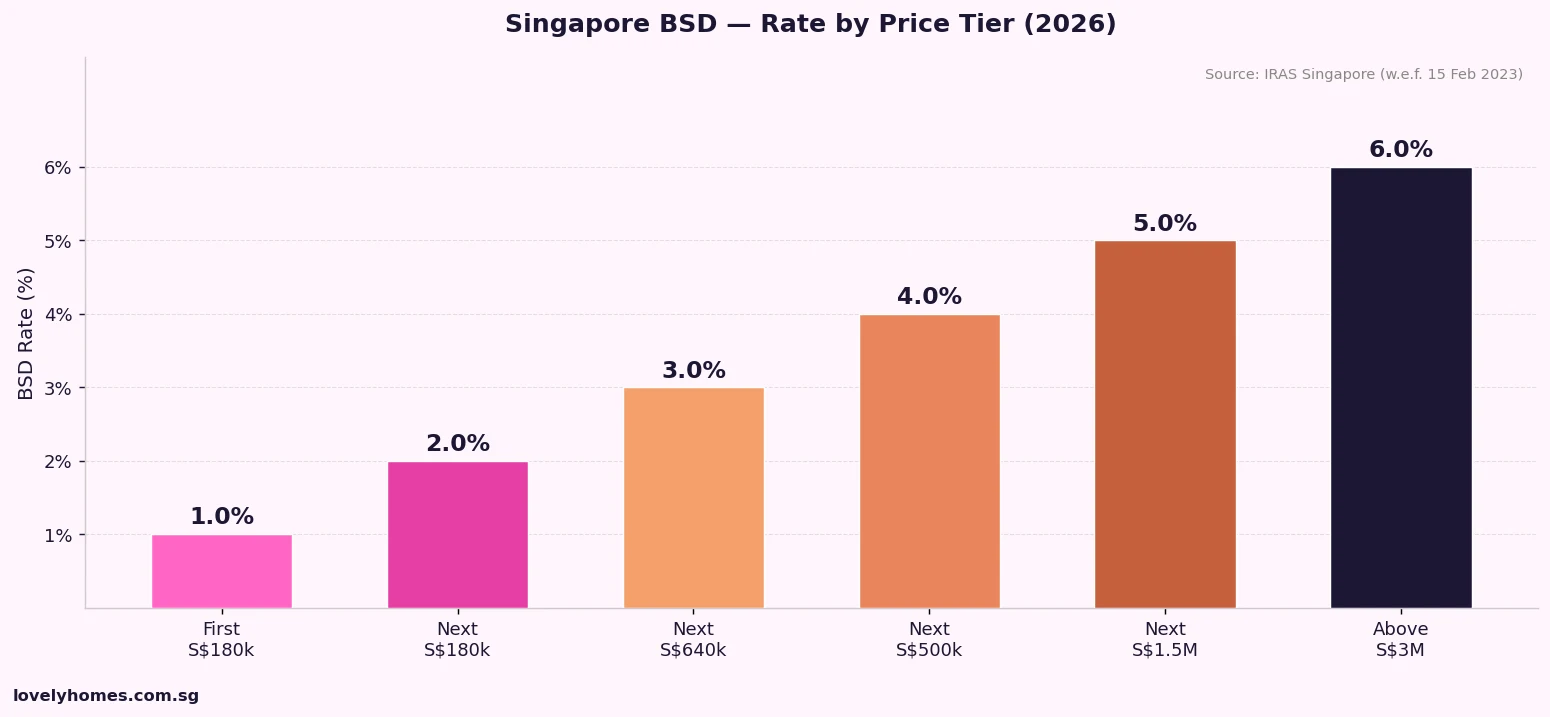
The current residential BSD rate schedule is progressive, meaning each tier applies only to the portion of the purchase price (or market value, if higher) that falls within that band. The table below sets out the tiers in full.

Singapore BSD rate by price tier 2026 bar chart — 1% to 6% progressive
Figure 1: BSD rate by purchase-price tier for residential property — effective 15 February 2023. Source: IRAS Singapore.
Purchase Price (or Market Value) Tier BSD Rate Maximum BSD from This Tier
First S$180,000 1% S$1,800
Next S$180,000 2% S$3,600
Next S$640,000 3% S$19,200
Next S$500,000 4% S$20,000
Next S$1,500,000 5% S$75,000
Amount exceeding S$3,000,000 6% Uncapped

Source: IRAS Singapore. Rates effective 15 February 2023.

The cumulative BSD cap for a S$3 million property — the last tier before the 6% rate kicks in — is S$109,600. For every dollar above S$3 million, the marginal BSD rate is 6%. A S$5 million property, for instance, attracts BSD of S$109,600 + 6% × S$2,000,000 = S$229,600.

BSD for Non-Residential Property (Industrial, Commercial, Mixed-Use)

Non-residential property — offices, shops, industrial units, mixed-use strata titles, and HDB shophouses — attracts a simpler three-tier BSD structure that has been in place since 20 February 2018.

Purchase Price Tier BSD Rate
First S$180,000 1%
Next S$180,000 2%
Amount exceeding S$360,000 3%

Non-residential BSD is therefore considerably less progressive than its residential counterpart. A S$2 million commercial unit attracts BSD of: 1% × S$180,000 + 2% × S$180,000 + 3% × S$1,640,000 = S$1,800 + S$3,600 + S$49,200 = S$54,600 — compared to S$64,600 for a residential property at the same price. Notably, non-residential property is exempt from ABSD, making it an important consideration for investors who have already consumed their ABSD-free residential quota.

How BSD Is Calculated — Step by Step

BSD is calculated on a progressive basis, applying each tier’s rate only to the portion of value that falls within that band. The taxable base is the higher of the agreed purchase price and the property’s open market value as assessed by IRAS. In practice, for arm’s-length transactions, these figures are usually the same. Where a buyer acquires at below market value — for example, from a related party — IRAS will assess BSD on the market value.

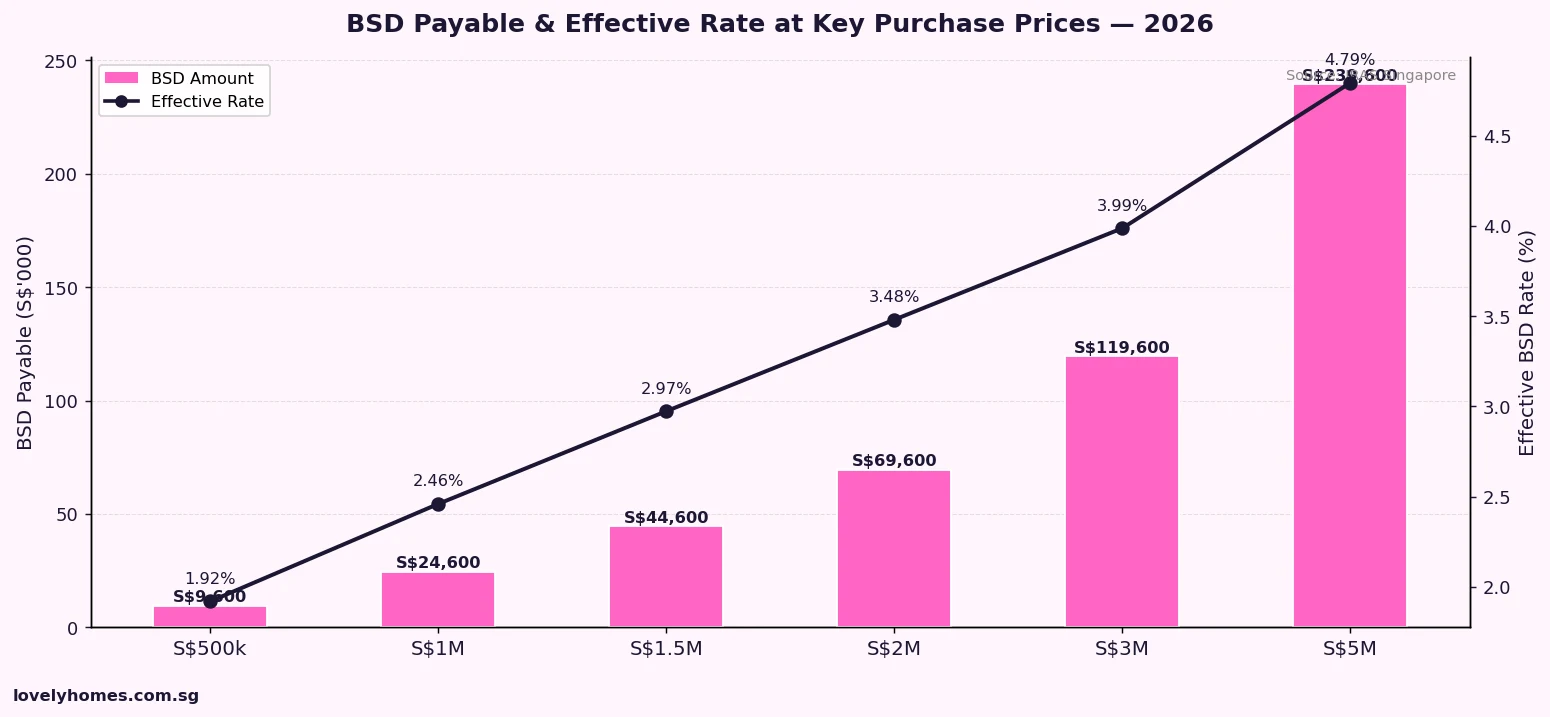
BSD payable and effective rate at key purchase prices Singapore 2026
Figure 2: BSD payable (bars, left axis) and effective BSD rate (line, right axis) at six key purchase prices — Singapore residential property 2026.

The chart above illustrates a key feature of BSD’s progressive structure: the effective rate (total BSD as a percentage of purchase price) rises gradually but never reaches the 6% marginal rate. Even at S$5 million, the effective rate is approximately 4.6%. This distinguishes BSD from ABSD, where — for a foreigner — the entire purchase price is taxed at a flat 60%.

Worked Example — S$1,580,000 Resale Condominium

Mr and Mrs Lim are Singapore Citizens purchasing a resale 3-bedroom condominium in Clementi for S$1,580,000 as their first property. Here is the full BSD calculation:

Price Tier Tier Limit Rate BSD for This Tier
First S$180,000 1% S$1,800
Second S$180,000 2% S$3,600
Third S$640,000 3% S$19,200
Fourth S$500,000 4% S$20,000
Fifth S$80,000 (remaining) 5% S$4,000
Total BSD S$1,580,000 Effective 3.04% S$48,600

Since this is the Lims’ first residential property and both are Singapore Citizens, their ABSD is S$0. Their total stamp duty outlay is therefore S$48,600. This must be paid within 14 days of exercising the OTP. BSD is typically paid via IRAS’s myTax Portal (e-Stamping). Their lawyer will ordinarily manage this on their behalf as part of the conveyancing process.

If this were instead the Lims’ second residential property, they would also owe ABSD at 20% × S$1,580,000 = S$316,000, bringing total stamp duty to S$364,600. The BSD component is identical regardless of how many properties they own.

BSD vs ABSD — Understanding the Key Difference

BSD and ABSD are two distinct taxes that can apply simultaneously to the same transaction. The confusion between them is understandable — both are calculated as a percentage of the purchase price and both are paid to IRAS — but they serve entirely different purposes and have very different rate structures.

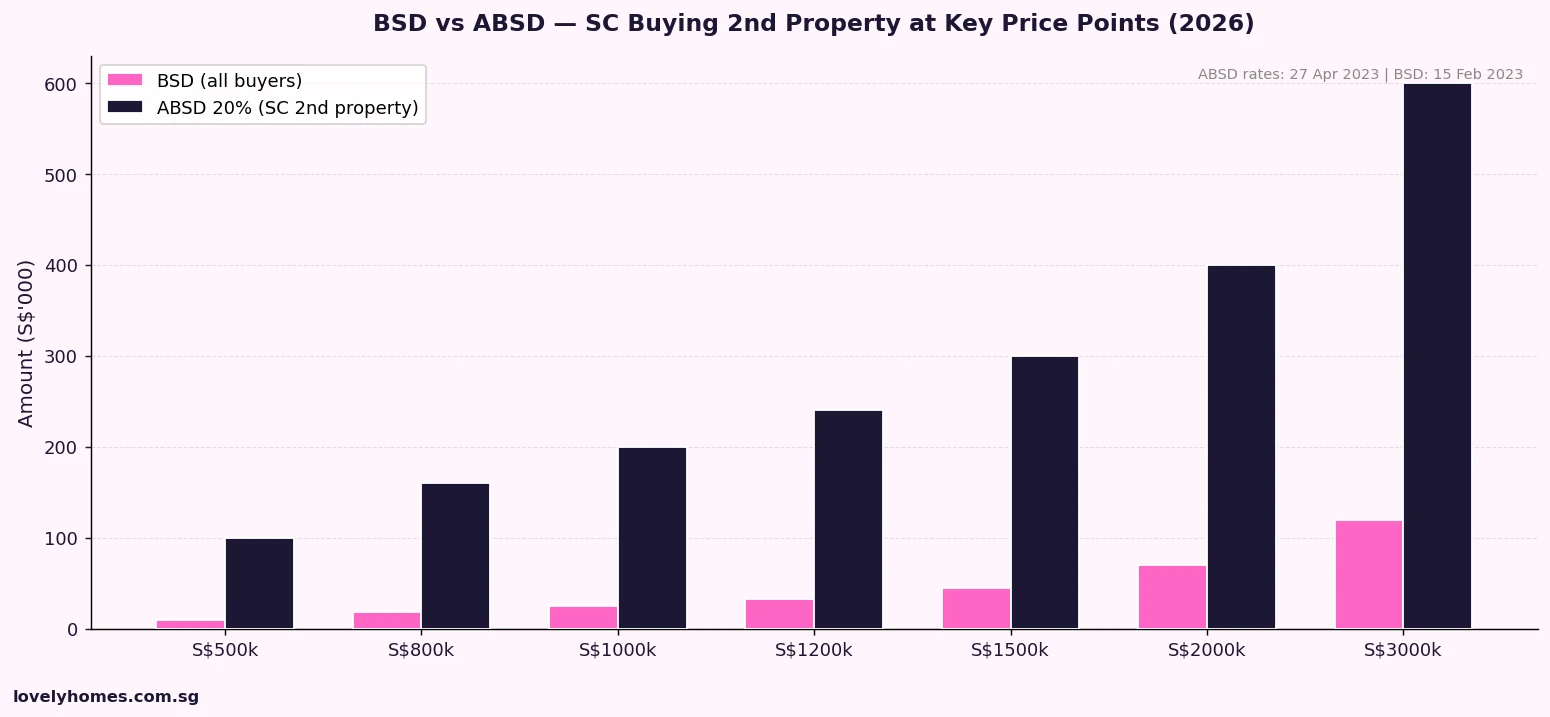
BSD versus ABSD comparison Singapore citizen buying second property 2026 bar chart
Figure 3: BSD (universal) vs ABSD at 20% (SC buying a second property) at key purchase prices — Singapore 2026.
Feature Buyer’s Stamp Duty (BSD) Additional Buyer’s Stamp Duty (ABSD)
Who pays? All buyers Selected profiles only (see ABSD guide)
Policy purpose Revenue instrument (general tax) Demand-management cooling measure
Rate structure Progressive (1–6%) Flat rate on full purchase price (0–65%)
Maximum rate 6% (marginal, above S$3M) 65% (entities & trusts)
Remissions available? Very limited (developer builds only) Yes — married SC/SPR upgrader, developers, etc.
Applies to HDB? Yes Yes (but HDB buyers are usually SC 1st-timers at 0%)
Non-residential? Yes (1%/2%/3% structure) No — ABSD does not apply to non-residential

The practical upshot: for most Singapore Citizens buying their first property, BSD is the only stamp duty they pay. For all other buyer profiles — PRs, foreigners, second-time and subsequent Singapore Citizen buyers, and entities — both BSD and ABSD apply simultaneously. To model your full stamp duty liability, use our ABSD Complete Guide, which includes full worked scenarios for every buyer profile.

Total Stamp Duty by Buyer Profile — S$1.5 Million Residential Property

Buyer Profile BSD ABSD Rate ABSD Amount Total Stamp Duty
SC — 1st property S$44,600 0% S$0 S$44,600
SC — 2nd property S$44,600 20% S$300,000 S$344,600
SC — 3rd+ property S$44,600 30% S$450,000 S$494,600
SPR — 1st property S$44,600 5% S$75,000 S$119,600
SPR — 2nd+ property S$44,600 30% S$450,000 S$494,600
Foreigner — any property S$44,600 60% S$900,000 S$944,600
Entity / Trust S$44,600 65% S$975,000 S$1,019,600

BSD = S$44,600 on S$1.5M (1%×S$180k + 2%×S$180k + 3%×S$640k + 4%×S$500k). ABSD rates: 27 April 2023 framework. SC = Singapore Citizen; SPR = Singapore Permanent Resident.

When and How to Pay BSD

BSD must be paid within 14 days of signing the instrument that triggers the liability. For private residential property, the trigger is typically the Option to Purchase (OTP) or, if no OTP is issued, the Sale and Purchase Agreement (S&P). For HDB flats, the trigger is the signing of the HDB Agreement for Lease.

Payment is made through IRAS’s e-Stamping Portal (accessible via myTax Portal). In practice, your conveyancing lawyer will handle the stamping on your behalf as part of the standard legal process. The stamp certificate is generated electronically and must be produced at completion. Late payment attracts penalties of up to 4× the duty payable under Section 46 of the Stamp Duties Act.

BSD Remissions and Exemptions

Unlike ABSD, BSD has very limited remission provisions. The most relevant situations where BSD may not apply in full are:

Developer remissions for building residential property: Property developers who purchase residential land or existing residential property for the purpose of constructing and selling new residential units may apply to IRAS for BSD remission. This is a specific commercial exception designed to avoid double taxation in the development chain — it does not apply to individual buyers.

Transfers between spouses and immediate family members: The Stamp Duties Act provides for concessionary treatment in limited intra-family transfers, but these are narrow and do not eliminate BSD — they may affect the valuation base or trigger date. Consult a property lawyer before relying on any such arrangement.

HDB Resale Levy and BSD interaction: BSD applies normally to HDB resale flat purchases. There is no interaction between the HDB Resale Levy and BSD — they are entirely separate obligations.

In short: for the vast majority of buyers, there are no BSD remissions. Budget for BSD in full.

What BSD Means for Buyers in 2026

BSD’s restructuring in February 2023 materially increased the cost of high-value acquisitions. A buyer of a S$3 million property now pays S$109,600 in BSD alone — up from S$74,600 under the pre-February 2023 structure, a S$35,000 increase. For S$5 million properties, the increase is S$65,000. These are meaningful sums that affect both the budgeting and the financing of such transactions.

In the broader context of property affordability, BSD at the sub-S$1.5 million residential price range — where most HDB upgraders and first-time private property buyers transact — is relatively modest: S$44,600 on S$1.5 million is 2.97% of the purchase price. The real pinch of Singapore’s stamp duty system comes from ABSD, not BSD. For buyers planning their first property purchase with CPF Housing Grants and a bank loan, BSD is a known, budgetable cost that fits within standard conveyancing estimates.

Singapore’s BSD structure compares favourably with many comparable jurisdictions. Hong Kong charges a flat-rate stamp duty of up to 15% for non-first-time buyers. Australia’s stamp duty is state-based and can reach 5–6% of property value at lower price points. Singapore’s progressive structure, where the 6% rate only applies to the marginal amount above S$3 million, is notably more buyer-friendly at the S$1–2 million range where most transactions occur.

What Might Come Next

BSD rates for residential property have been adjusted three times in the past decade (2018, 2021, and 2023). Each adjustment has moved in one direction: upward, particularly at the high end of the market. If the Government continues its stated objective of moderating luxury segment demand and narrowing the wealth-effects gap between high-end and mass-market property, further BSD increases above S$3 million cannot be ruled out.

Conversely, at the sub-S$1.5 million end — where most owner-occupier transactions occur — there is no political appetite to raise BSD, given the Government’s ongoing commitment to ensuring that public and private housing remains accessible to ordinary Singaporeans. Any future BSD changes are therefore likely to be targeted at the top of the market only. As always, changes to stamp duty rates take effect immediately on the date of announcement and apply to all OTPs granted on or after that date.

Frequently Asked Questions

Does BSD apply to HDB flat purchases?

Yes. BSD applies to all residential property purchases in Singapore, including HDB resale flats, BTO flats (on the Agreement for Lease), and Executive Condominium units. There is no HDB exemption from BSD. For a typical 4-room resale flat at S$550,000, BSD would be: 1%×S$180k + 2%×S$180k + 3%×S$190k = S$1,800 + S$3,600 + S$5,700 = S$11,100.

Is BSD the same as ABSD?

No. They are two separate taxes paid to IRAS on the same transaction. BSD is universal (all buyers, all properties) and progressive (1–6%). ABSD is a surcharge that applies only to selected buyer profiles — foreigners, entities, PRs buying a first property, and all buyers from their second property onward — and is charged as a flat rate on the entire purchase price. You always pay BSD; you only pay ABSD if your buyer profile attracts it. See our ABSD Singapore 2026 Guide for the full rate schedule.

Can BSD be paid using CPF?

Yes, BSD can be paid from your CPF Ordinary Account (OA) for HDB flat purchases. For private residential property, CPF OA funds can also be used to pay BSD, but only after meeting the CPF Minimum Sum requirements and subject to CPF withdrawal limits. In practice, many buyers use cash for stamp duties to preserve their CPF balance for the monthly mortgage servicing — consult your financial planner or mortgage adviser on the optimal approach.

What happens if BSD is paid late?

Under Section 46 of the Stamp Duties Act, late payment penalties are substantial. The penalty is a multiple of the duty payable, depending on the length of the delay: one to three times the duty for delays up to six months, and up to four times for longer delays. In extreme cases, IRAS has the power to seek a court order to enforce payment. In practice, your conveyancing lawyer will ensure that BSD is stamped within the 14-day window. Late stamping almost always results from buyers attempting to handle the stamping themselves without legal assistance.

Does BSD apply to the purchase of a share in a property?

Yes. Where a buyer acquires a fractional share in a property — for example, a 50% interest in a jointly owned private property — BSD is calculated on the proportionate market value of the property that corresponds to the share being acquired. The progressive BSD tiers apply to the full market value of the underlying property first, and the resulting duty is then apportioned to the share acquired. This means the effective BSD rate on a 50% share of a S$2 million property is calculated as if the full S$2 million were the taxable base, then halved — not calculated on S$1 million at a lower tier. IRAS guidance on this is set out in their e-Stamping FAQ.

Is BSD refundable if the sale falls through?

BSD that has been paid on a stamped instrument is generally not refundable if the sale subsequently fails to complete. However, if the instrument itself is rescinded before it takes legal effect — for example, if the OTP lapses without exercise — and the buyer can demonstrate to IRAS that no property changed hands, a refund application under Section 22 of the Stamp Duties Act may be possible. The application must be made within six months of the date of the instrument. IRAS assesses each case on its facts. Always take legal advice before assuming a refund is available.

Do foreign buyers in Singapore pay more BSD than locals?

No. BSD rates are identical for all buyers regardless of nationality or residency status. A Singapore Citizen and a foreign national buying the same S$2 million property both pay exactly the same BSD — S$64,600. The difference in overall stamp duty cost arises entirely from ABSD, which for a foreigner is 60% of the purchase price (S$1,200,000 on a S$2M purchase) versus 0% for a Singapore Citizen buying their first home. This is why total stamp duty for a foreigner buying a S$2 million property (S$1,264,600) is dramatically higher than for a first-time SC buyer (S$64,600).

Related Articles

Disclaimer: This article is for general informational purposes only and does not constitute tax, legal, or financial advice. BSD rates and payment rules are governed by the Stamp Duties Act and IRAS administrative guidelines, which may be amended at any time. Always refer to the IRAS official website for the most current rates and verify your stamp duty liability with a licensed conveyancing lawyer or property tax adviser before transacting. LovelyHomes is not a licensed tax or legal advisory firm.

Singapore Property Checklist for First-Time Buyers 2026: Complete Step-by-Step Guide

Singapore Property Checklist for First-Time Buyers 2026: Complete Step-by-Step Guide

Singapore Property Checklist for First-Time Buyers 2026: Complete Step-by-Step Guide

Quick Answer — Key Facts for First-Time Buyers in 2026

  • Singapore Citizens buying their first residential property pay 0% ABSD — only BSD applies
  • Maximum grants for HDB buyers: EHG S$120,000 + CPF Housing Grant S$80,000 = up to S$200,000 combined
  • Bank loan LTV: 75% (private property); HDB concessionary loan: 90% — but you must not own other property and meet income ceiling
  • TDSR ceiling: 55% of gross monthly income; MSR ceiling for HDB/EC: 30%
  • BSD on S$700k HDB resale: ~S$17,400; on S$1.4M condo: ~S$44,600 — payable within 14 days of OTP
  • Always sell your current home before buying a second one to avoid triggering the 20% SC second-property ABSD
  • Conveyancing lawyer and IPA (In-Principle Approval) should be secured before you commit to an OTP

Buying your first property in Singapore is one of the largest financial decisions you will ever make — and one of the most bureaucratically complex. Between eligibility rules, grant calculations, loan approvals, stamp duties, and legal processes, first-time buyers in 2026 face a matrix of decisions that can take months to navigate correctly. The cost of getting it wrong — particularly on ABSD, CPF rules, or MOP requirements — can run into the hundreds of thousands of dollars.

This checklist is designed to walk you through every step of the Singapore property buying process in the right sequence. Whether you are planning to buy an HDB flat (BTO or resale), an executive condominium, or a private condo or landed property, the framework below applies — with notes on where the process diverges for each property type.

The 10-Step Singapore Property Buying Checklist

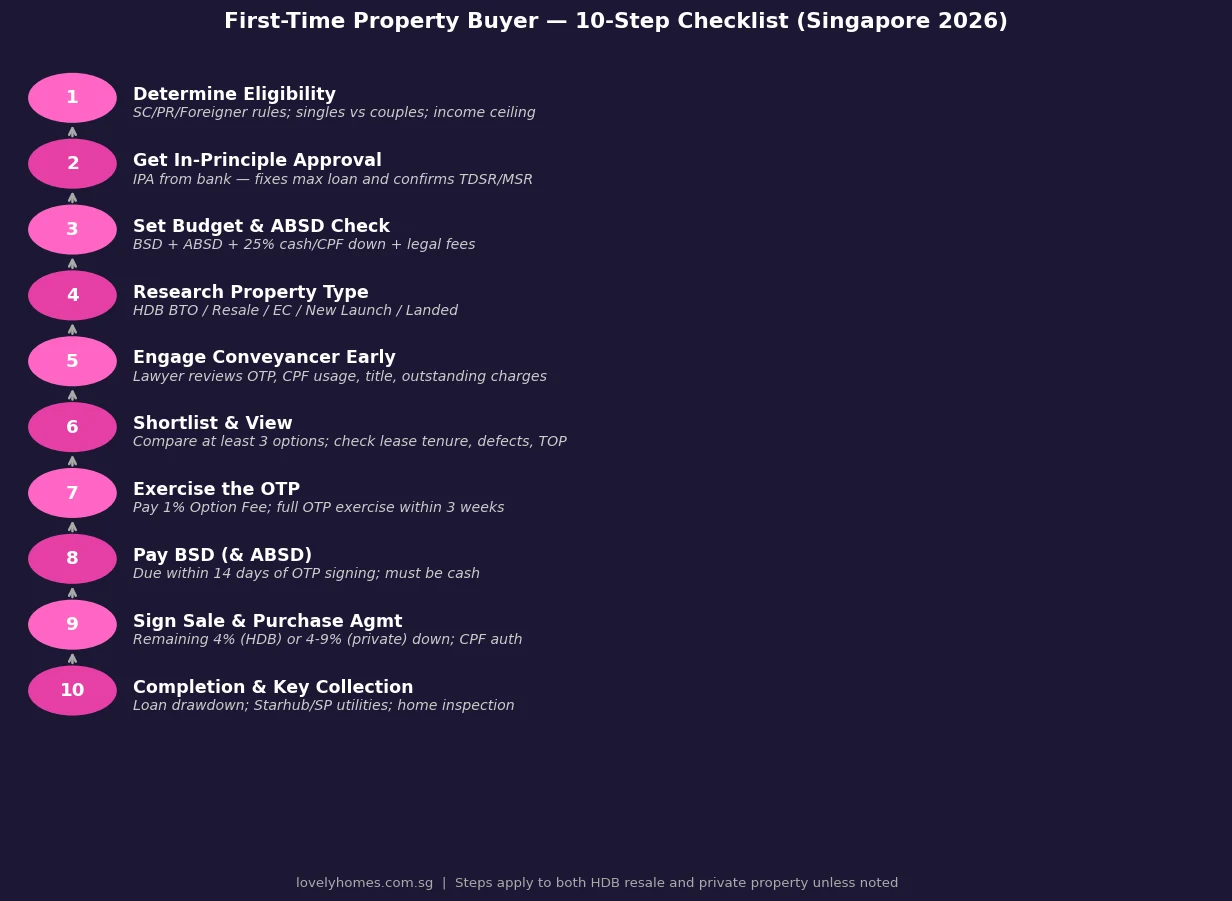
Singapore first-time property buyer 10-step checklist 2026
Figure 1: The 10-step Singapore property buying process — applicable to HDB resale and private property purchases, 2026.

Step 1 — Determine Your Eligibility

Before browsing listings, you need to know what you are legally allowed to buy. Singapore’s property eligibility framework is citizenship-dependent and property-type-specific.

Singapore Citizens (SC) have the broadest access: they can purchase HDB flats (BTO, resale, EC), private condominiums, and (with restrictions) landed property. There is no property ownership limit per se, but each additional residential property increases your ABSD exposure significantly — from 0% on the first to 20% on the second.

Singapore Permanent Residents (SPR) may purchase resale HDB flats (with a family nucleus and after three years of PR), private condominiums, and certain ECs on the open market. SPRs pay 5% ABSD on their first residential property purchase. They cannot buy new BTO flats directly and face additional HDB Ethnic Integration Policy (EIP) restrictions on resale flats.

Foreigners (non-PR) are restricted to private condominiums and certain commercial properties. They pay 60% ABSD on any Singapore residential property. Nationals from Iceland, Liechtenstein, Norway, Switzerland, and the United States are treated as Singapore Citizens for ABSD purposes under FTA provisions.

If you are buying a BTO HDB flat, additional eligibility conditions apply: income ceiling (S$7,000/mth for 2-room Flexi, S$14,000/mth for 3-room and above), family nucleus requirement for most schemes, first-timer status, and the Ethnic Integration Policy quota at the block and neighbourhood level.

Step 2 — Secure Your In-Principle Approval (IPA)

An IPA (also called an AIP — Approval In Principle) from a bank or, for HDB loans, HDB itself, is your preliminary loan commitment. It is not the final loan offer, but it tells you — and the seller’s agent — how much you can borrow, which in turn defines your maximum purchase price.

For bank loans, the key constraints are the Total Debt Servicing Ratio (TDSR) at 55% of gross monthly income, and the Loan-to-Value (LTV) limit of 75% for private property. For HDB concessionary loans, the Mortgage Servicing Ratio (MSR) of 30% applies (your monthly loan repayment cannot exceed 30% of gross income), and the LTV is 90%. However, to qualify for a HDB loan, your household income must not exceed S$14,000/mth, and you must not own any private residential property.

Secure your IPA before viewing seriously or making any offers. An IPA is typically valid for 30 days (bank) or 6 months (HDB HLE), and it will save you from falling in love with a property you cannot actually finance.

Step 3 — Set Your Total Budget Including All Costs

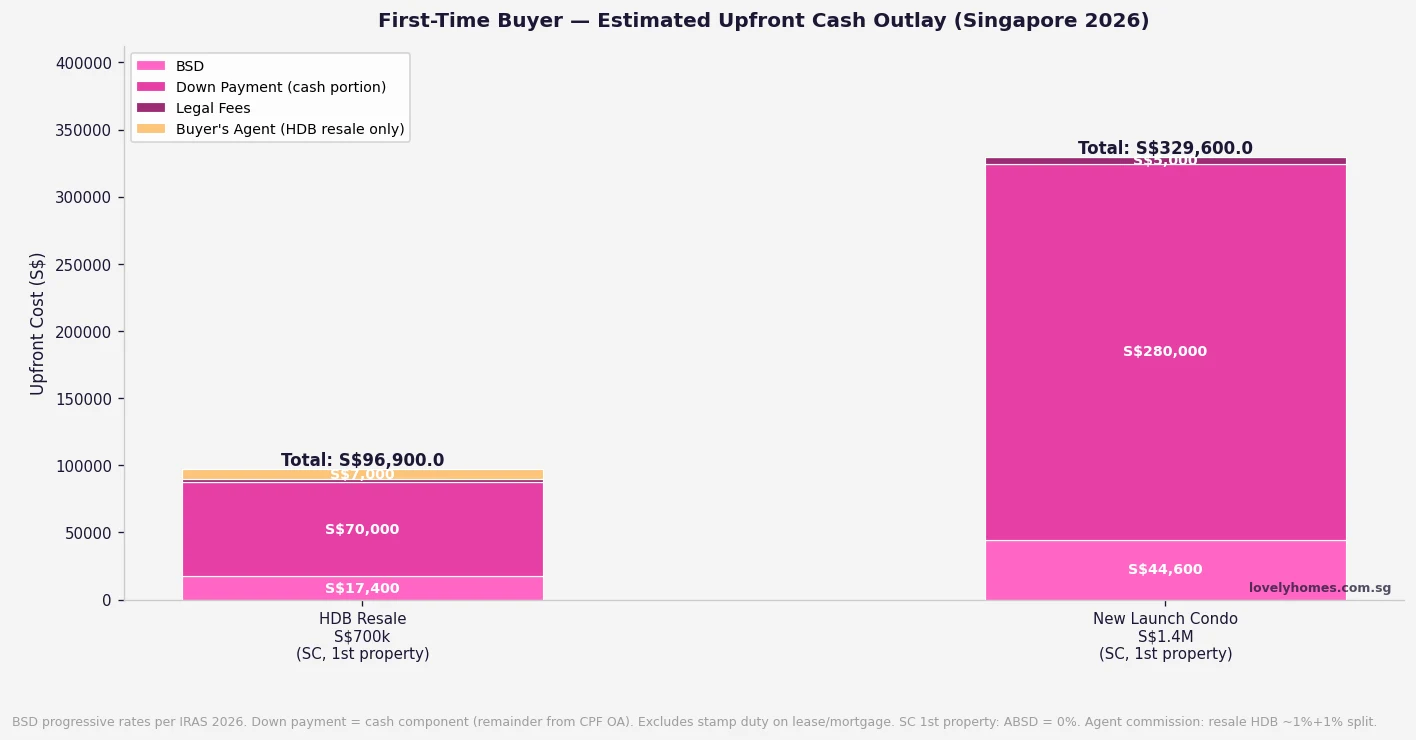
First-time buyer upfront costs comparison HDB resale versus private condo Singapore 2026
Figure 2: Estimated upfront cash outlay for a Singapore Citizen first-time buyer — HDB resale S$700k vs new launch private condo S$1.4M. Source: IRAS BSD tables, MAS LTV framework, May 2026.

Your headline property price is just the beginning. The full upfront cost of purchasing includes Buyer’s Stamp Duty (BSD), the down payment (with a mandatory cash component), legal fees, and in some cases agent commission. For a first-time SC buyer, ABSD is zero — but BSD is unavoidable.

Cost Item HDB Resale S$700k Private Condo S$1.4M Notes
Buyer’s Stamp Duty (BSD) S$17,400 S$44,600 Payable in cash within 14 days of OTP
ABSD (SC, 1st property) S$0 S$0 0% for SC first property — confirm ownership count
Down Payment (cash portion) S$70,000 (10%) S$280,000 (20% of 25%) Minimum 5% cash for HDB; 5% cash for private (rest CPF)
Legal Fees (conveyancing) ~S$2,500 ~S$5,000 Includes title search, CPF charge registration
Agent Commission (buyer side) ~S$7,000 (1%) S$0 New launch: developer pays; resale private: negotiated
Total Estimated Cash Outlay ~S$96,900 ~S$329,600 Remainder of down payment can use CPF OA

Note that for private property, only the first 5% of the purchase price must be paid in cash (before or at OTP exercise). The remaining 20% of the 25% down payment can come from CPF Ordinary Account. For HDB loans, only 5% cash is required upfront — the remaining 85% is funded by the HDB concessionary loan.

Steps 4–6 — Research, Engage Your Lawyer Early, and View Properties

The biggest mistake first-time buyers make is viewing properties extensively before understanding their financing ceiling and legal standing. The reverse sequence — finance and legal first, then view — saves both time and negotiating leverage.

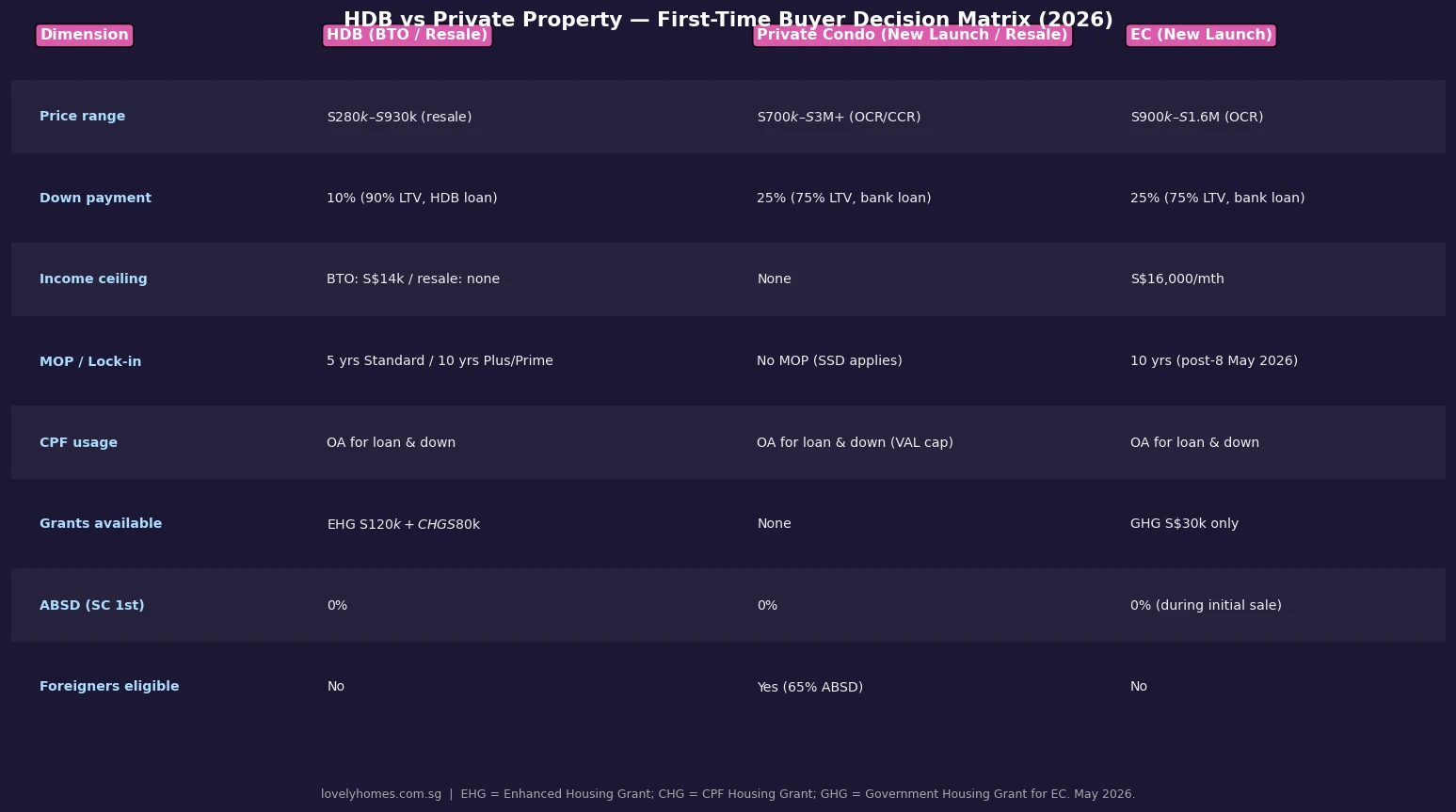
Property type selection (Step 4) depends on your income, CPF balance, timeline, and lifestyle priorities. The decision matrix in Figure 3 below compares HDB, private condo, and EC across the key dimensions first-time buyers care about most.

HDB versus private condo versus EC decision matrix for first-time buyers Singapore 2026
Figure 3: HDB vs Private Condo vs Executive Condominium — first-time buyer decision matrix, May 2026.

Engaging a conveyancing lawyer early (Step 5) is advice most first-time buyers receive too late. A good conveyancing lawyer will review the OTP before you sign it, not after. They will flag title issues, outstanding mortgages on the property, caveat searches, and CPF charge implications — all of which affect whether and at what price you should proceed. Legal fees for a straightforward purchase are modest (S$2,500–S$5,000) relative to the transaction value; do not treat them as a cost to defer.

When viewing properties (Step 6), check the remaining lease tenure carefully — especially for HDB flats and older freehold condominiums. CPF Ordinary Account funds cannot be used if the remaining lease does not cover the youngest buyer to age 95. A 60-year-old resale HDB flat may look attractively priced, but the financing and CPF limitations will materially alter your actual cost of acquisition.

Steps 7–8 — Exercise the OTP and Pay Stamp Duty

When you have identified your property, the seller will issue an Option to Purchase (OTP) in exchange for an option fee (typically 1% of the purchase price). You have a defined window — 21 calendar days for private property under the standard Law Society OTP — to exercise the option by paying the exercise price (typically another 4–9% for private, with the first 1% option fee credited) or walk away (forfeiting the 1% option fee).

Within 14 days of the OTP signing date, you must pay Buyer’s Stamp Duty (and ABSD if applicable) to IRAS via e-Stamping. Late payment attracts penalties starting at 5% of the duty payable. BSD cannot be paid from CPF — it must be in cash. This is why ensuring you have sufficient liquidity before signing the OTP is essential.

Steps 9–10 — Sale & Purchase Agreement and Completion

After exercising the OTP, your lawyer will coordinate the formal Sale and Purchase (S&P) Agreement, CPF Ordinary Account authorisation, and the loan drawdown with your bank. For new launch condominiums, the payment schedule follows the Progressive Payment Scheme (NPS) — where each tranche is tied to construction milestones — or the full lump-sum payment at completion for resale. The Deferred Payment Scheme (DPS) for executive condominiums was abolished on 8 May 2026 — all new EC purchases now follow the Normal Payment Scheme (NPS).

At completion (or key collection for BTO), your lawyer discharges their obligations and you register as the new owner at the Singapore Land Authority. Arrange for SP Group and StarHub connectivity, conduct a thorough defects inspection, and retain the developer’s or seller’s maintenance obligations where applicable.

Worked Example — SC First-Time Buyer, S$700k HDB Resale in Tampines

Ms Tan, a 31-year-old Singapore Citizen, is buying her first home — a 4-room HDB resale flat in Tampines listed at S$700,000. She earns S$6,800 per month. She has applied for an Enhanced Housing Grant (EHG) and CPF Housing Grant (CHG), and has S$120,000 in her CPF Ordinary Account.

Grants calculation: At S$6,800/mth (singles scheme), EHG = S$35,000 (approximately, based on the singles-rate EHG table at ~S$6,500–S$7,000 bracket). If she buys with a co-applicant (e.g. her mother, Singles scheme not applicable — assuming she buys as a single first-timer), or as a couple. For simplicity, assume Ms Tan buys jointly with her fiancé (combined income S$10,500/mth): EHG = S$40,000 + CHG = S$80,000 = S$120,000 total grants applied to the purchase price, reducing the effective cost.

BSD: On S$700,000 = (1%×S$180k) + (2%×S$180k) + (3%×S$340k) = S$1,800 + S$3,600 + S$10,200 = S$15,600 (payable in cash within 14 days).

Financing: Grants reduce the purchase price for grant disbursement, but BSD is still calculated on the full S$700,000 transaction price. HDB concessionary loan: 90% LTV on S$700,000 – grants S$120,000 = net S$580,000 → 90% = S$522,000 loan. Monthly repayment at 2.6% over 25 years: approximately S$2,370. MSR check: S$2,370 ÷ S$10,500 = 22.6% — within the 30% MSR ceiling.

Cash outlay at purchase: BSD S$15,600 + 10% down payment S$70,000 (min S$35,000 cash; balance from CPF OA) + legal S$2,500 + agent S$7,000 = approximately S$95,100 total, of which a minimum S$57,600 must be in cash (with the rest from CPF OA).

What to Watch in 2H 2026

Singapore’s property market for first-time buyers in the second half of 2026 will be shaped by three key developments. First, the June 2026 BTO exercise offering 6,900 flats across Bishan, Ang Mo Kio, Bukit Merah, Sembawang, and Woodlands will open for applications in mid-June — this is the largest BTO exercise of the year and the first to include Bishan Lakeview units in over four decades. First-timers with strong ballot positioning should register their interest before the application window closes.

Second, bank interest rates continue to ease in Singapore: the three-month SORA fell to approximately 1.20% as at May 2026, and major banks’ fixed-rate packages (2-year) now sit in the 1.75–1.85% range. For first-time buyers with long planning horizons, locking a rate now before any policy shift is worth discussing with a mortgage broker.

Third, the EC market is adjusting to the 8 May 2026 changes: the Deferred Payment Scheme is gone, the MOP is 10 years (up from five), and the first-timer quota has expanded to 90%. First-timers with the income and budget to qualify for an EC now have a higher allocation probability than at any point in the past five years — but they also face a longer hold requirement before they can monetise the property.

Frequently Asked Questions

Do I need to pay ABSD as a first-time Singapore Citizen buyer?

No. Singapore Citizens purchasing their first residential property pay 0% ABSD. You pay only Buyer’s Stamp Duty (BSD), which is a progressive tax starting at 1% on the first S$180,000 and rising to 6% on the portion above S$3,000,000. However, if you own any residential property at the time of OTP signing — including inherited property or a share in a property — you will be treated as a second-property buyer and face 20% ABSD. Always verify your property ownership profile via the IRAS myTax Portal before signing any OTP.

Can I use CPF to pay Buyer’s Stamp Duty?

No. BSD (and ABSD, if applicable) cannot be paid from your CPF Ordinary Account. These duties must be paid in cash within 14 days of the OTP signing date. CPF OA funds can, however, be used toward the property’s down payment (subject to the Valuation Limit), monthly mortgage instalments, and certain legal fees. Ensure you have sufficient cash liquidity to cover stamp duties before you exercise any OTP.

What is the difference between HDB loan and bank loan for first-time buyers?

An HDB concessionary loan charges a fixed rate of 2.6% per annum (0.1% above CPF OA rate), allows up to 90% LTV, and can be refinanced to a bank later (irreversibly — you cannot switch back to HDB loan once moved to a bank). A bank loan currently offers fixed rates of approximately 1.75–1.85% for a two-year lock-in (as at May 2026), requires a minimum 25% down payment with 5% in cash, and requires a stress test. For buyers who prioritise certainty and lower initial cash outlay, the HDB loan is simpler. For those who want to minimise total interest over a long loan tenure, a bank loan often saves significantly more — but exposes you to rate refixing risk every 2–3 years. See our Home Loan Comparison Singapore 2026 guide for a detailed worked comparison.

How long does the HDB BTO process take from ballot to key collection?

The full BTO cycle — from launch ballot to key collection — typically takes four to five years for standard construction timelines, though some projects take longer. The sequence is: Launch (application window) → Ballot result (2–3 months) → Flat selection queue (typically 6–12 months) → Sign S&P Agreement (within the selection window) → Construction period (3–4 years typically) → Temporary Occupation Permit (TOP) → Key collection. For buyers who need housing sooner, resale HDB flats, Sale of Balance Flats (SBF), or private property are the alternatives. See our HDB BTO Ballot System 2026 guide for full ballot probability data by flat type and estate classification.

What happens if I sign an OTP and then cannot secure a loan?

If your bank does not approve the final loan (distinct from the IPA, which is only in-principle), you will forfeit the option fee (typically 1% of the purchase price) and potentially face claims from the seller if the failure to complete is attributable to financing. This is why securing a firm IPA before signing the OTP is essential. Most conveyancing lawyers will recommend including a financing condition in the OTP for resale transactions, which allows you to withdraw and recover the option fee if you cannot secure financing by a specified date — though sellers do not always agree to such conditions in competitive markets.

Can foreigners buy HDB flats or ECs in Singapore?

No. Foreigners (non-PR) cannot purchase HDB flats (BTO or resale) or new ECs from developers. They are restricted to private condominiums and most commercial/industrial property. A foreign national would pay 60% ABSD on any Singapore residential property purchase. The only exception is citizens of the five FTA countries (Iceland, Liechtenstein, Norway, Switzerland, USA) who are treated as Singapore Citizens for ABSD purposes — but even these buyers cannot purchase HDB flats or new ECs, as that restriction is based on citizenship/PR status, not on ABSD rates.

Related Articles

Disclaimer: This checklist is for general informational purposes only and does not constitute financial, legal, or property advice. All figures, grant amounts, BSD rates, LTV limits, and loan terms cited are based on publicly available sources including IRAS, HDB, MAS, and CPF Board as at May 2026, and are subject to change. Past performance is not indicative of future results. Consult a licensed conveyancing lawyer, financial adviser, and HDB/CEA-registered property agent before making any property transaction. Verify current grants, rates, and eligibility conditions at HDB.gov.sg, IRAS.gov.sg, and MAS.gov.sg.

HDB BTO Application Guide Singapore 2026: Eligibility, Income Ceilings, Ballot & the EIP Quota

HDB BTO Application Guide Singapore 2026: Eligibility, Income Ceilings, Ballot & the EIP Quota

The Build-To-Order (BTO) flat is the default starting point for most Singaporean households — subsidised, brand-new, and built on land released by the Housing & Development Board (HDB) only when there are enough committed buyers. In 2026, every BTO launch in a mature estate sees a 4-7x oversubscription rate; popular projects in Queenstown or Kallang/Whampoa cross 10x. That ballot pressure is why understanding the eligibility schemes, income ceilings, grant stack, and Ethnic Integration Policy quota is the single most leveraged hour you will spend before keying in your application.

This 2026 guide walks you through every gate — from the four eligibility schemes and the S$14,000 income ceiling, through the ballot mechanics and queue numbers, into the grants stack that can knock S$80,000 off your purchase price, and the EIP/SPR quota that decides which racial profiles can bid for which units. Figures reflect HDB’s policy stack as at April 2026.

Quick Answer — BTO at a glance

  • Income ceiling: S$14,000 (combined, family scheme); S$21,000 (extended-family or joint singles); S$7,000 (single SC, 2-room Flexi only).
  • Citizenship: at least one Singapore Citizen for any scheme except Joint Singles (which requires all SC).
  • Minimum age: 21 for couples; 35 for singles applying alone.
  • Ballot: queue number is randomly drawn within priority groups; first-timers get up to 3 queue numbers (vs 1 for second-timers).
  • Top grant stack (first-timer SC+SC): EHG S$120k + Family Grant S$80k + Proximity Grant S$30k = up to S$230k for resale; up to S$80k for BTO.
  • EIP/SPR quotas: apply at both block and neighbourhood level; a unit may show as “quota reached” for your race even if available physically.
  • Application fee: S$10 non-refundable; ballot results in 4–6 weeks.

What is BTO and Why Does the Scheme Exist?

The Build-To-Order scheme is HDB’s primary public-housing supply channel: instead of speculatively building flats and trying to sell them, HDB collects applications first and only proceeds to construction when at least 65–70% of units in a project have committed buyers. The buyer commits early (signing the lease and paying the 5% downpayment) and waits 3.5–4.5 years for completion, in exchange for a steeply subsidised price relative to comparable resale stock.

The scheme replaced an earlier system called Registration for Flats (RFS) in April 2002 and has since become the dominant route for first-time HDB buyers. Roughly 20,000–25,000 BTO flats are launched per year across four launches (typically February, May, August, November). The 2026 supply target announced by the Ministry of National Development is 22,000 units.

The Five Eligibility Schemes — Pick One

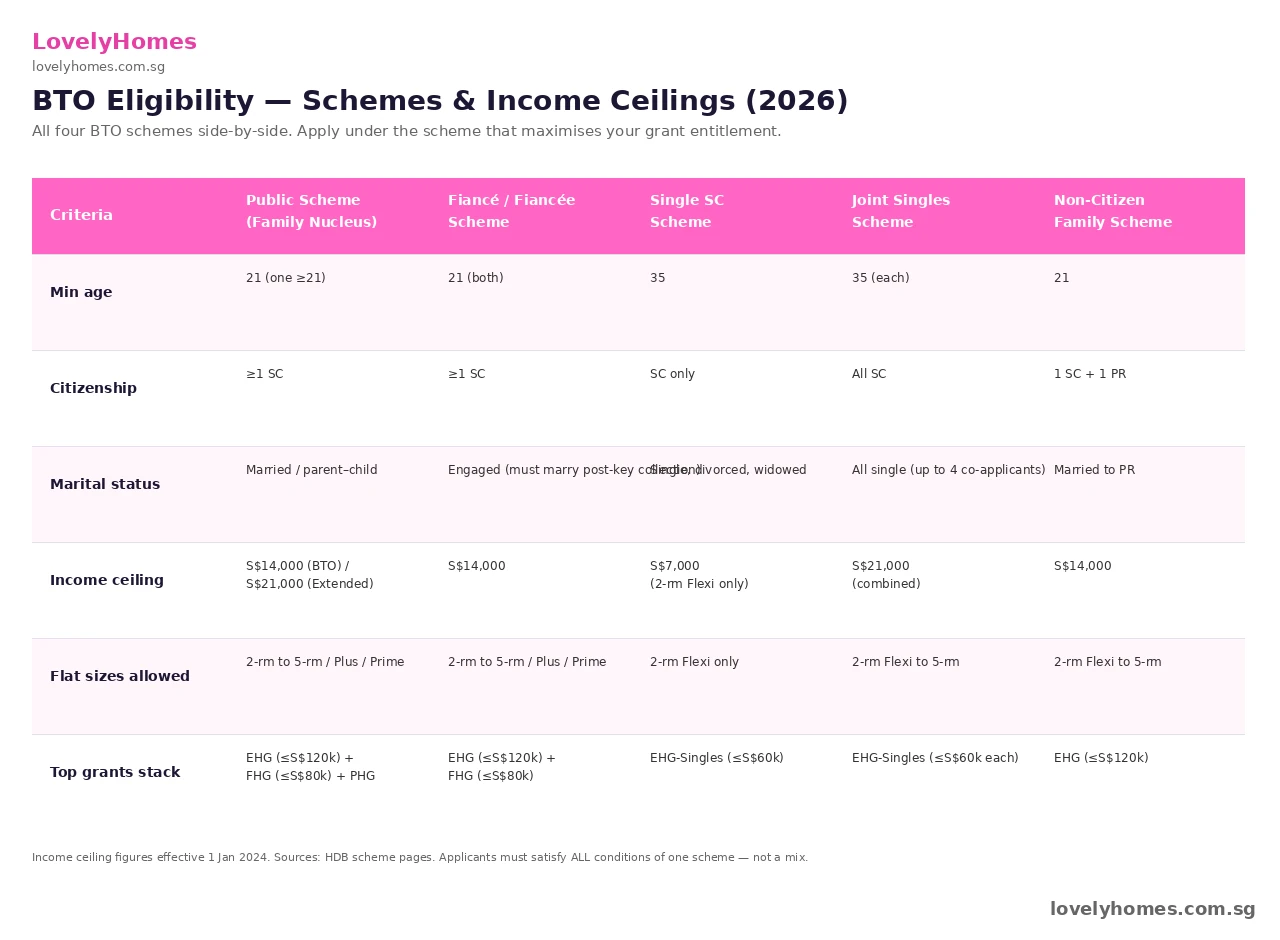
HDB classifies every applicant into exactly one of five schemes. Your scheme determines the income ceiling, age limits, allowed flat sizes, and the grant stack you qualify for. Choosing the right scheme is not optional — HDB will reject the application if you fit one scheme but apply under another.

HDB BTO application guide Singapore 2026 — eligibility schemes and income ceilings comparison
Figure 1: All five BTO eligibility schemes side-by-side — pick the one that maximises your grant entitlement.

Public Scheme (Family Nucleus)

The default scheme for married SC couples or parent-child households. At least one applicant must be a Singapore Citizen and at least one must be 21 or older. Combined gross household income is capped at S$14,000 for a standard application, or S$21,000 for an Extended-Family application (applicant + parents). The full range of flat types is available — 2-room Flexi to 5-room and 3Gen, including Plus and Prime locations.

Fiancé/Fiancée Scheme

For couples not yet married. Both applicants must be 21 or older and at least one a Singapore Citizen. The S$14,000 ceiling applies. The catch: you must produce a marriage certificate within 3 months of key collection, otherwise HDB has the right to repossess the unit. Couples who break off the engagement before key collection can withdraw without forfeiting the option fee.

Single Singapore Citizen Scheme

For singles aged 35 or older holding Singapore Citizenship. Only 2-room Flexi flats are available, and only in selected non-mature estates. Income ceiling is S$7,000. Couples who do not qualify under the Family or Fiancé schemes (e.g. one party is a foreigner) cannot use this route — it is genuinely a singles-only scheme.

Joint Singles Scheme

Two to four singles aged 35+ may co-apply. All must be Singapore Citizens. The combined income ceiling rises to S$21,000. Flat types extend up to 5-room. Joint singles must all hold equal shares; ownership cannot be reorganised after key collection. This scheme is increasingly used by adult siblings and long-term unmarried partners.

Non-Citizen Family Scheme

Where a Singapore Citizen is married to a Singapore Permanent Resident. The SC applicant must be 21 or older, the income ceiling sits at S$14,000, and only 2-room Flexi to 5-room flats are available (Plus and Prime are off-limits). Note: a Singapore Citizen married to a foreigner who is not a PR cannot apply under any HDB scheme — the household must wait for the foreigner to obtain PR status.

Income Ceilings — What Counts and How They Calculate

HDB’s income ceiling is based on average gross monthly household income. “Gross” means before CPF and tax. “Average” means the trailing 12-month average for salaried income; for variable income (commissions, bonuses, self-employment), HDB uses the most recent 24 months, divides by 24, then adds a 30% buffer to be conservative.

Applicants must submit Notice of Assessment (NOA) tax statements, the latest 3 months of payslips, and an Income Declaration (IRAS-issued for self-employed). HDB cross-checks against IRAS records. Inflated declarations to qualify for higher grants will be caught at the HFE (HDB Flat Eligibility) letter stage and the application rescinded; the ban from re-applying is 5 years.

For couples planning a BTO purchase but expecting one party to receive a windfall bonus or commission, timing matters: buy now while the trailing-12-month average is still under the ceiling, or wait until the 12 months have rolled past the bonus event.

The Application Process — What to Do, In Order

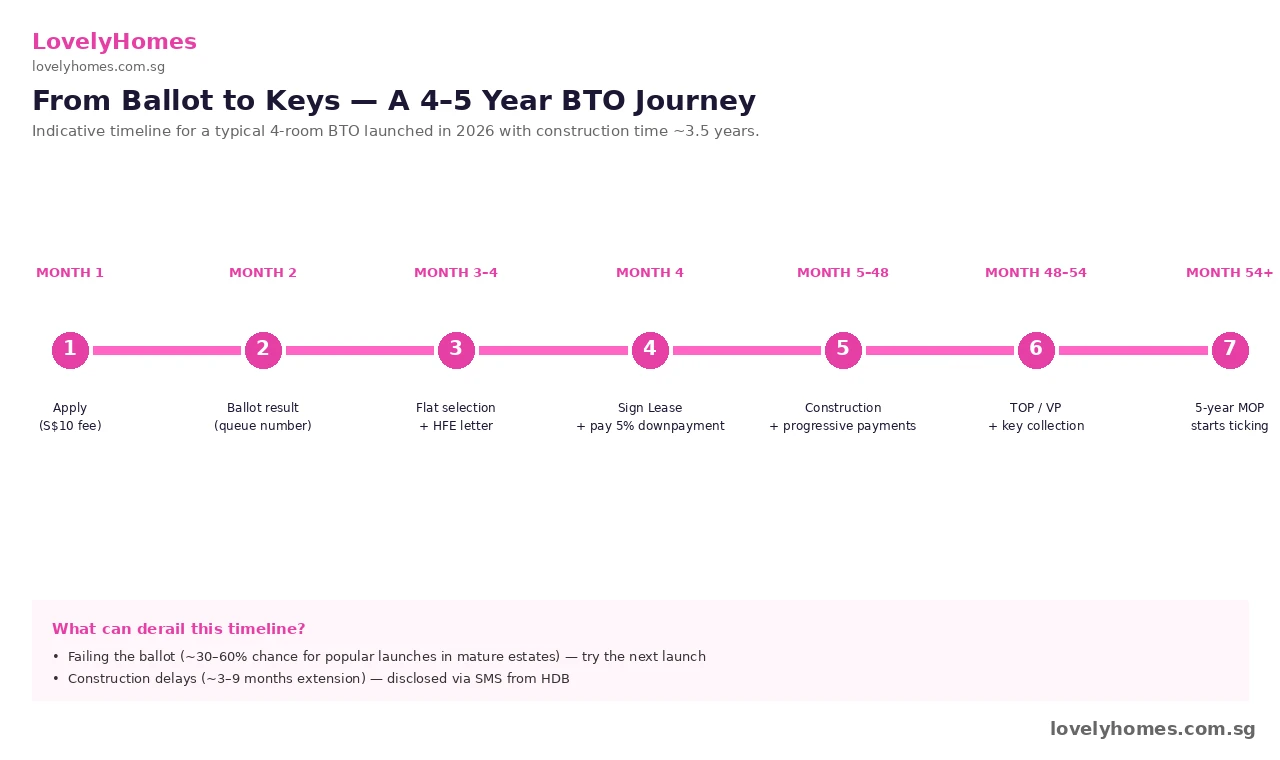
HDB BTO application guide Singapore 2026 — application timeline from ballot to key collection
Figure 2: Indicative 4–5 year BTO journey from ballot to key collection.

The mechanics of a BTO application have not changed materially since 2018, but the digital tooling has. Today every step bar key collection happens through the HDB Flat Portal and CPF/MyInfo integration:

  1. Obtain HFE Letter — the HDB Flat Eligibility letter (introduced 9 May 2023) bundles eligibility assessment, grant assessment, and loan eligibility into one document valid for 6 months. You need it before you can apply for any BTO. Generated through the HDB Flat Portal in 21 working days; lenders use it to issue an in-principle approval.
  2. Application window — each launch opens for 7 days. Apply via the HDB Flat Portal; the application fee is S$10 non-refundable. Applicants choose up to two flat types in their preferred town.
  3. Ballot — 3–5 weeks after close. Each application is randomly drawn within its priority group (First-Timer Family, First-Timer Single, Second-Timer, etc.) and assigned a queue number. First-timers receive up to 3 queue-number chances (the “3 queue numbers” rule introduced in 2022); second-timers receive 1.
  4. Flat selection appointment — you are booked into a 4-hour slot starting from queue number 1 onward. Lower queue numbers see the full selection; later applicants see only what is left. Bring your spouse, your HFE letter, and the option fee (S$500–2,000 by flat type, paid by NETS).
  5. Sign Agreement for Lease — about 4 months after selection. You pay 5% downpayment, less the option fee already paid. Funds may come from CPF OA + cash; if you are taking an HDB concessionary loan, no cash is required.
  6. Construction — typically 3.5–4 years. HDB releases progress updates by SMS and the Flat Portal.
  7. Notice of Vacant Possession + Key Collection — the final 5% of the price is paid; you collect keys and the 5-year Minimum Occupation Period (MOP) clock starts ticking.

The Ballot — How Queue Numbers Are Decided

The single biggest source of confusion among first-time applicants is the difference between “ballot” and “flat selection”. The ballot determines your queue number; flat selection is when you actually pick a unit. The queue is sequenced by:

  1. Priority groups (in order): Married Couples Priority Scheme (MCPS); Parenthood Priority Scheme (PPS); Multi-Generation Priority Scheme (MGPS); Tenants Priority Scheme; First-Timer Family; First-Timer Single; Second-Timer; Joint Singles.
  2. Within a priority group: a random ballot.
  3. Tiebreakers: later launches have started using the SC1 (sole-citizen 1-applicant) tiebreaker first.

Practical implication: a first-timer SC+SC couple with one child applying under PPS gets a meaningfully better queue position than the same couple without the priority application. Each launch reserves 30% of supply for first-timers, with the balance for second-timers and singles — so even a poor queue number does not necessarily mean exclusion if you are a first-timer.

The EIP and SPR Quotas — Why “Available” Doesn’t Mean “Available to You”

The Ethnic Integration Policy (EIP) was introduced in 1989 to prevent the formation of mono-ethnic enclaves. Every HDB block and every neighbourhood has a maximum proportion of flats that may be sold to each ethnic group:

  • Chinese: 84% of a neighbourhood, 87% of a block.
  • Malay: 22% of a neighbourhood, 25% of a block.
  • Indian / Other: 10% of a neighbourhood, 13% of a block.

The Singapore Permanent Resident (SPR) Quota sits on top of EIP and limits the proportion of non-Malaysian SPR households per neighbourhood (5%) and per block (8%). Malaysian SPRs are exempt because they are considered demographically and culturally close to Singaporean groups.

Each unit at flat selection shows the live EIP/SPR status. A unit may be physically vacant but unavailable to your ethnic group because the quota is full. You see this most acutely in popular projects in Bishan, Queenstown, or Bukit Merah, where Chinese-quota units sell out first while Indian-quota units may still be open at queue number 200+. Plan your back-up unit choices accordingly.

Grants — The Stack That Can Pay for Your Furniture

For BTO applicants, grants are awarded in fewer types than for resale buyers, but the absolute amounts are still material. As of 1 February 2024 the BTO-side grants are:

  • Enhanced CPF Housing Grant (EHG): S$5,000 to S$120,000 sliding scale by household income. The full S$120k is available for households earning up to S$1,500/month; the grant tapers to S$5,000 at the S$9,000–9,500 income band.
  • Family Grant: S$10,000 to S$80,000 depending on flat type and income, available only for resale BTO and for Plus/Prime BTO under the new classification. Standard BTOs do not qualify (the subsidy is built into the price).
  • Proximity Housing Grant (PHG): S$30,000 if buying with parents living in the same household; S$15,000 if buying within 4 km of parents’ existing flat.
HDB BTO application guide Singapore 2026 — S$520K 4-room cost stack with grants
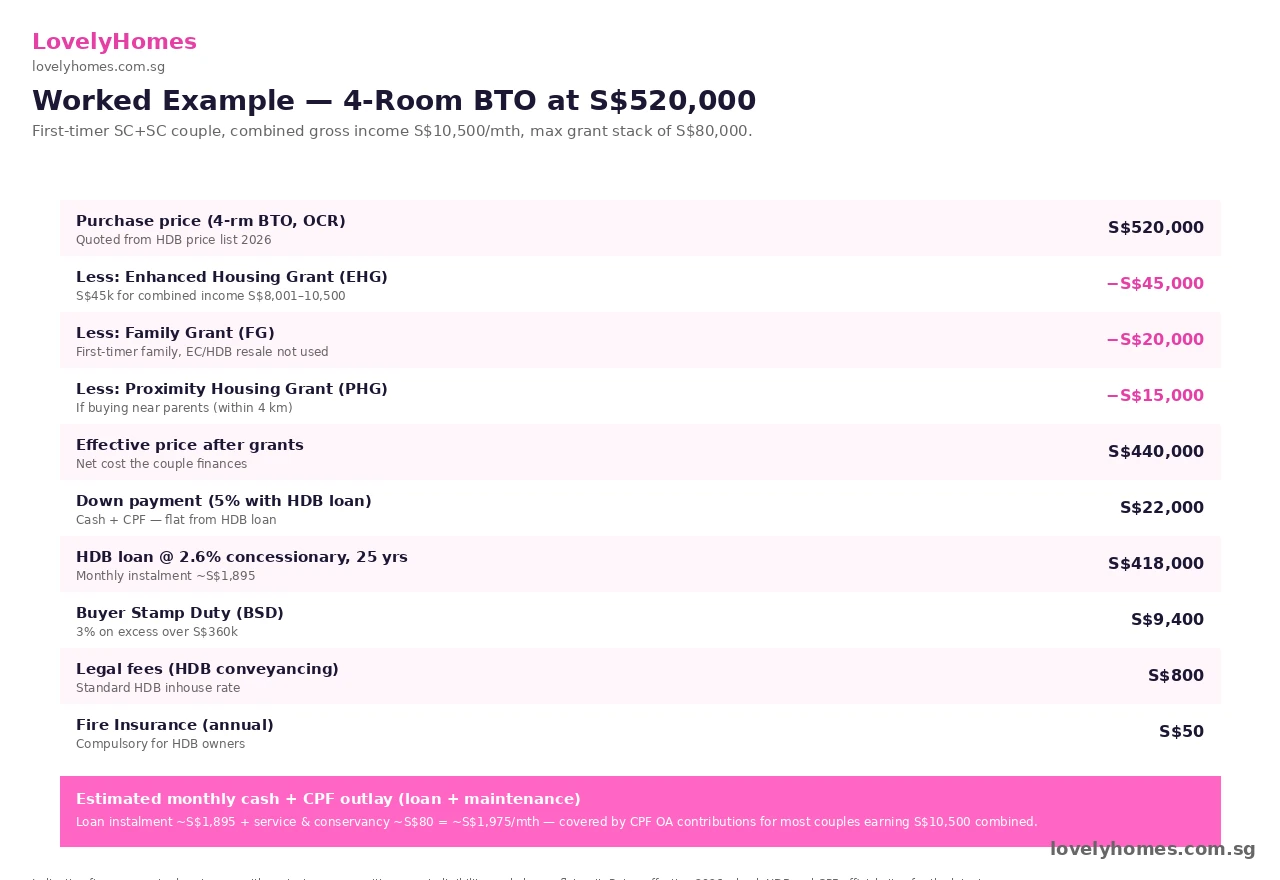
Figure 3: Worked example — SC+SC couple buying a S$520K 4-room BTO with a S$80K grant stack.

BTO Classification — Standard, Plus, Prime

From October 2024 onwards, every new BTO is classified as Standard, Plus, or Prime. This shifts the subsidy structure and the resale rules:

  • Standard: the legacy framework. 5-year MOP, no resale-price clawback, no income ceiling on the resale buyer. The default for non-mature estates.
  • Plus: 10-year MOP, income ceiling of S$14k applies even on resale, partial subsidy clawback at resale. Found in choicer locations within outer-mature estates.
  • Prime: 10-year MOP, S$14k income ceiling on resale, 6% subsidy clawback, no whole-flat rental ever (only room rental). Reserved for the most attractive locations like Queenstown and Kallang/Whampoa.

The classification affects your effective return on the flat 10 years out. A Plus flat in Hougang sold to a quota-restricted resale buyer will trade at a discount to the equivalent Standard flat in nearby Sengkang — that is the design intent, to keep the subsidy in the public-housing system.

Worked Example — SC+SC Couple, Combined S$10,500/Month

Take a 32-year-old + 30-year-old SC+SC couple, married, no children, combined gross income S$10,500/month. They are first-timers and applying under the Family Scheme. They target a 4-room BTO at S$520,000 in Punggol Coast (a Standard project).

  • Income ceiling check: S$10,500 < S$14,000. PASS.
  • Grants: EHG at the S$8,001–10,500 income band = S$45,000. Family Grant: not applicable for Standard BTOs. PHG: S$15,000 if their parents live within 4 km. Total: S$60,000.
  • Effective price: S$520,000 − S$60,000 = S$460,000.
  • Down payment (5% with HDB loan): S$23,000, payable from CPF OA.
  • HDB loan @ 2.6%, 25 years: S$437,000 principal × 2.6% ⇒ monthly instalment ~S$1,985.
  • BSD: 1% on first S$180k + 2% on next S$180k + 3% on next S$160k ≈ S$8,200, payable in cash or CPF OA.
  • Legal fees (HDB conveyancing): ~S$800.

Total upfront cash + CPF outlay: ~S$32,000 (downpayment + BSD + legal + option fee). Monthly outlay during construction: ~S$95/month service & conservancy charges only. Monthly outlay after key collection: ~S$2,070 (loan + S&C). Against a household income of S$10,500/month gross (~S$8,400 take-home), the loan is comfortably within the 30% MSR (Mortgage Servicing Ratio) limit for HDB loans.

Common Mistakes BTO Applicants Make

  1. Skipping the HFE letter — without it, you cannot apply. Generate the HFE 6–8 weeks before the launch you want.
  2. Choosing a project where your ethnic quota is already full — check the EIP status on the launch site before applying.
  3. Underestimating the income ceiling buffer — HDB adds a 30% buffer for variable income. Sit just under the ceiling, not at it.
  4. Applying as Family before marriage — if you are not yet married, you must use the Fiancé scheme. The Family scheme is for already-married couples.
  5. Ignoring the 5-year MOP — or now 10-year for Plus/Prime. The MOP starts on key collection, not application; selling within MOP requires HDB’s express consent and is rarely granted.

What This Means for You

For most Singaporean first-timer households, BTO remains the single most subsidised real-estate transaction available. A successful 4-room BTO in 2026 typically delivers a paper gain of 60–100% by the end of the 5-year MOP — not because the project is special, but because the price gap between BTO and resale is structurally maintained. The key is winning the ballot. Increase your odds by applying under the right priority scheme (PPS for couples with children, MCPS for newlyweds), targeting non-mature estates where oversubscription is lower, and being flexible on flat type (4-room ballots have higher success rates than 5-room).

What Might Come Next

The Ministry of National Development has signalled three policy directions for the 2026–2028 horizon. First, BTO supply is forecast to remain at 22,000–25,000 per year through 2028, after which the pipeline tapers to 18,000 as the demographic bulge passes. Second, the Plus/Prime classification is expected to be applied to roughly 30% of new launches by 2028, up from ~15% in 2025. Third, the Joint Singles Scheme age threshold may be lowered from 35 to 30 if the Singapore Together Forward dialogue feedback gains policy traction. None of these is yet officially confirmed; watch the COS speech each March for the firm announcements.

Summary — Eligibility & Grant Stack by Scheme (Quick Reference)

Scheme Min Age Citizenship Income Ceiling Flat Sizes Top Grant Stack
Public (Family Nucleus) 21 (one) ≥1 SC S$14,000 2-rm to 5-rm + 3Gen EHG up to S$120k + PHG S$30k
Fiancé/Fiancée 21 (both) ≥1 SC S$14,000 2-rm to 5-rm EHG up to S$120k + PHG
Single SC 35 SC only S$7,000 2-rm Flexi only EHG-Singles up to S$60k
Joint Singles 35 (each) All SC S$21,000 (combined) 2-rm Flexi to 5-rm EHG-Singles up to S$60k each
Non-Citizen Family 21 (SC) 1 SC + 1 PR S$14,000 2-rm Flexi to 5-rm EHG up to S$120k

Frequently Asked Questions

Can I apply for a BTO if I already own a private property?

Yes, but you must dispose of your private property within 30 months of key collection of the BTO. If you fail to do so, HDB may compulsorily acquire the BTO at original cost. The 30-month window is intended to allow for sale logistics. You also forfeit any first-timer status — you will be treated as a second-timer for grant calculations. Most second-time HDB applicants in this position are downsizing from a private property after children leave home, or rebalancing portfolios after en-bloc proceeds.

How long does the entire process take, from application to keys?

Plan for 4 to 4.5 years from application close to key collection on a typical BTO project, with a further 5 years (Standard) or 10 years (Plus/Prime) of Minimum Occupation Period before you can sell. The construction stage is the longest phase — typically 36–48 months from breaking ground. Projects in Tengah and Punggol have generally tracked the lower end; mature-estate projects in Queenstown and Bishan have hit the upper end due to site constraints.

What happens if I fail the ballot?

You forfeit only the S$10 application fee and may apply again at the next launch. There is no penalty or queue-number penalty for non-selection — in fact, first-timers retain their first-timer status and the 3-queue-number allocation. Many couples cycle through 4–6 launches before securing a unit in their preferred town. To shorten the wait, broaden the geographies you are willing to apply in, or apply under a priority scheme like Parenthood Priority if you have children.

Can I use a private bank loan instead of an HDB concessionary loan?

Yes — bank financing is allowed for BTO buyers, and currently many do because SORA-pegged floating rates have hovered around 3.5–3.8% (vs the HDB concessionary rate at 2.6%, fixed at CPF OA + 0.1%). The trade-off: bank loans require a 25% downpayment (5% cash + 20% cash/CPF) instead of the 0% cash + 20% CPF on an HDB loan. Once you choose bank financing for your first BTO, you cannot switch back to an HDB concessionary loan for the same flat. Most first-timer BTO buyers stay on the HDB loan for the cash-flow flexibility.

If we are not yet married, can we still apply?

Yes — under the Fiancé/Fiancée Scheme. Both applicants must be 21+ and at least one a Singapore Citizen. You declare your intention to marry; HDB requires you to produce a marriage certificate within 3 months of key collection. If the relationship breaks down before key collection, you may withdraw from the application and forfeit only the option fee — HDB will not pursue you for damages.

How does the EIP affect resale value of my flat?

The EIP can constrain the buyer pool when you eventually sell. If your block’s Chinese quota is full and you are Chinese, you can only sell to a non-Chinese buyer — which is a smaller market and typically yields a 1–3% price discount. The reverse is also true: minority-quota sellers in mature estates often see a small premium. Most owners do not feel this until they list; consult your conveyancing lawyer for an EIP-aware listing strategy.

Can I rent out my BTO flat after MOP?

For Standard BTOs: yes, after the 5-year MOP, you may rent out the entire flat under HDB’s Whole Flat Rental scheme (subject to a 6-monthly registration). For Plus and Prime BTOs: only room rental is permitted, never whole-flat rental. The whole-flat rental rule is a permanent restriction designed to keep the subsidy in the owner-occupier pool. Non-citizen sub-tenant quotas also apply: the Non-Citizen Quota caps non-Malaysian PRs at 5% of a neighbourhood and 8% of a block.

Related Articles

Disclaimer

This guide is for general information only and does not constitute legal, financial, or housing advice. Eligibility schemes, income ceilings, grant amounts, EIP/SPR quotas, and BTO classification rules are illustrative as at April 2026 and are subject to change at the discretion of the Housing & Development Board, the Ministry of National Development, and the Central Provident Fund Board. Always verify the latest figures with primary sources — the Housing & Development Board, the CPF Board, the Inland Revenue Authority of Singapore, and consult a qualified housing consultant or conveyancing lawyer before signing any agreement.

Translate »