HDB HFE Letter Guide Singapore 2026: How to Apply, Check Status & Use Your Letter

HDB HFE Letter Guide Singapore 2026: How to Apply, Check Status & Use Your Letter

Quick Answer — HDB HFE Letter at a glance

  • The HDB Flat Eligibility (HFE) letter replaced the old HDB Loan Eligibility (HLE) letter from 9 May 2023.
  • You must have a valid HFE letter before submitting a BTO application, selecting a resale flat, or exercising an Option to Purchase (OTP).
  • An HFE letter is issued within 14 working days and is valid for 9 months.
  • It covers in one document: flat eligibility, CPF housing grant eligibility, and HDB concessionary loan eligibility.
  • The application is done entirely online via HDB My Flat Journey (MFJ) using SingPass; all co-applicants must consent.
  • Income ceiling for most grants: S$14,000/month for couples; S$7,000/month for singles (select flat types).
  • HDB concessionary loan LTV: up to 80%; bank loan LTV: up to 75%.

If you are buying an HDB flat in Singapore — whether a new Build-To-Order (BTO) flat, a Sale of Balance Flat (SBF), or a resale flat from the open market — the HDB Flat Eligibility (HFE) letter is the gateway document that determines what you can buy, how much you can borrow from HDB, and how much in CPF housing grants you qualify for. Without it, you cannot proceed to application.

This guide explains exactly what the HFE letter is, who needs it, how to apply step by step, what to do if your application is rejected, and how to use your HFE letter once you have it. All figures reflect the rules administered by the Housing & Development Board (HDB) as at 31 July 2026.
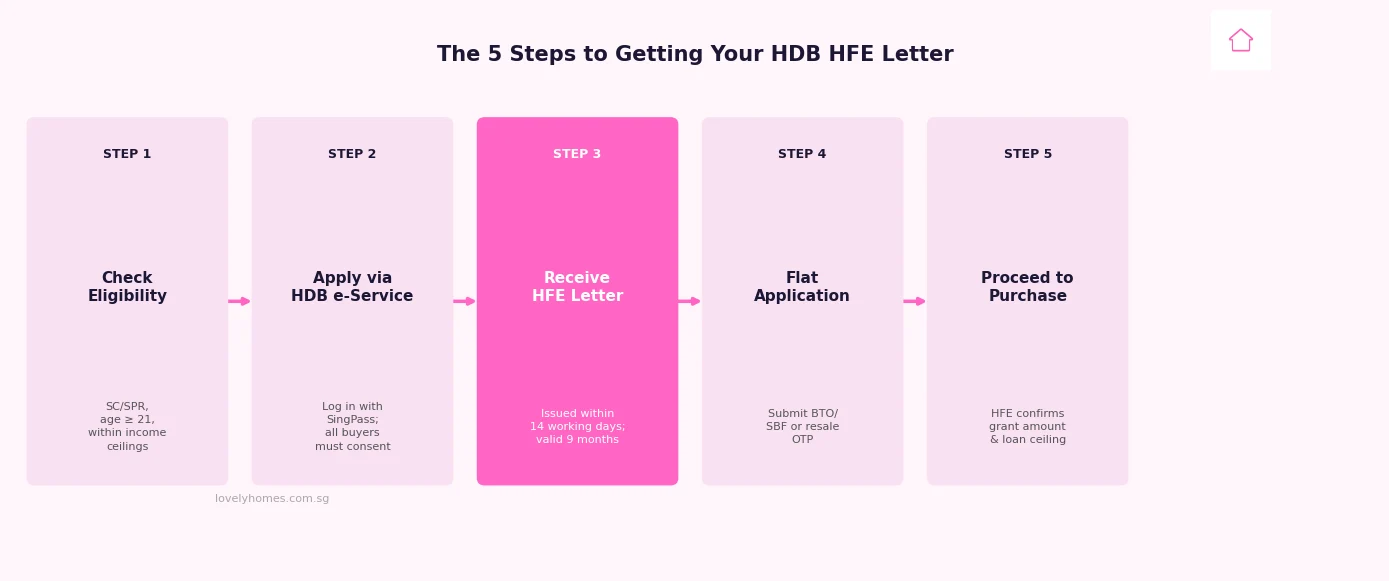
HDB HFE Letter application 5-step process Singapore 2026
Figure 1: The 5 steps to obtaining your HDB HFE Letter — from eligibility check to flat purchase.

What is the HDB HFE Letter?

The HDB Flat Eligibility (HFE) letter is an integrated eligibility assessment issued by HDB. Prior to 9 May 2023, buyers had to obtain separate documents: a Housing Loan Eligibility (HLE) letter for HDB loans, a CPF housing grant eligibility check, and a general flat eligibility check. The HFE letter consolidates all three into a single, time-limited document. HDB administers it; the CPF Board and the Monetary Authority of Singapore (MAS) inform the underlying eligibility rules for grants and loan-to-value (LTV) caps respectively.

The HFE letter tells you three things before you spend a single dollar:

  1. Which HDB flat types you are eligible to purchase (BTO, SBF, resale, or Executive Condominium).
  2. The CPF housing grants you qualify for — the Enhanced CPF Housing Grant (EHG), Additional CPF Housing Grant (AHG, resale), Family Grant, Proximity Housing Grant (PHG), and Step-Up CPF Housing Grant.
  3. Whether you qualify for an HDB concessionary loan and the maximum loan quantum HDB will extend to you based on your income, CPF balances, and existing property.

Who Needs an HFE Letter?

You need a valid HFE letter if you intend to:

  • Apply for a new flat under a BTO, SBF, or Open Booking exercise;
  • Register intent to buy a resale HDB flat; or
  • Exercise an Option to Purchase (OTP) for a resale flat.

You do not need an HFE letter if you are buying a private condominium or landed property — that falls outside HDB’s remit entirely. However, if you intend to use CPF Ordinary Account (OA) savings toward a private property purchase, you will need a CPF withdrawal application separately.

Eligibility Criteria: Who Can Apply?

To be eligible for an HFE letter, you and your co-applicant(s) must meet HDB’s flat eligibility conditions. The core criteria are citizenship and family nucleus requirements — HDB does not sell new flats to individuals; a qualifying family nucleus is the fundamental test. The following applies as at 2026:

Criterion Requirement (General)
Citizenship At least one applicant must be a Singapore Citizen (SC). Co-applicants may be SC or Singapore Permanent Resident (SPR). Foreigners may not purchase HDB flats.
Age All applicants must be at least 21 years old (single or widowed orphan schemes: 35 years old).
Family nucleus Must form a qualifying family nucleus: married couple, fiancé/fiancée couple, parent(s) with child(ren), siblings, or single (35+, specific schemes only).
Property ownership Must not own or have disposed of any HDB flat, DBSS flat, or private residential property in the 30 months before application (resale) or flat application (BTO).
Income ceiling Combined gross monthly household income ≤ S$14,000 for most schemes; ≤ S$7,000 for singles (2-Room Flexi BTO). Executive Condominiums: ≤ S$16,000.
Previous housing subsidies Second-timer restrictions apply if you have previously received a CPF housing grant or purchased a subsidised flat.

CPF Housing Grants Available via the HFE Letter

The HFE letter is the gateway to CPF housing grants. These grants are funded by the Singapore Government and administered through HDB. The amount you receive is calculated based on your household income, citizenship composition, and flat type. Grants are used to offset the purchase price directly — they reduce the amount you need to pay in cash or CPF OA, or they reduce your outstanding mortgage with HDB.
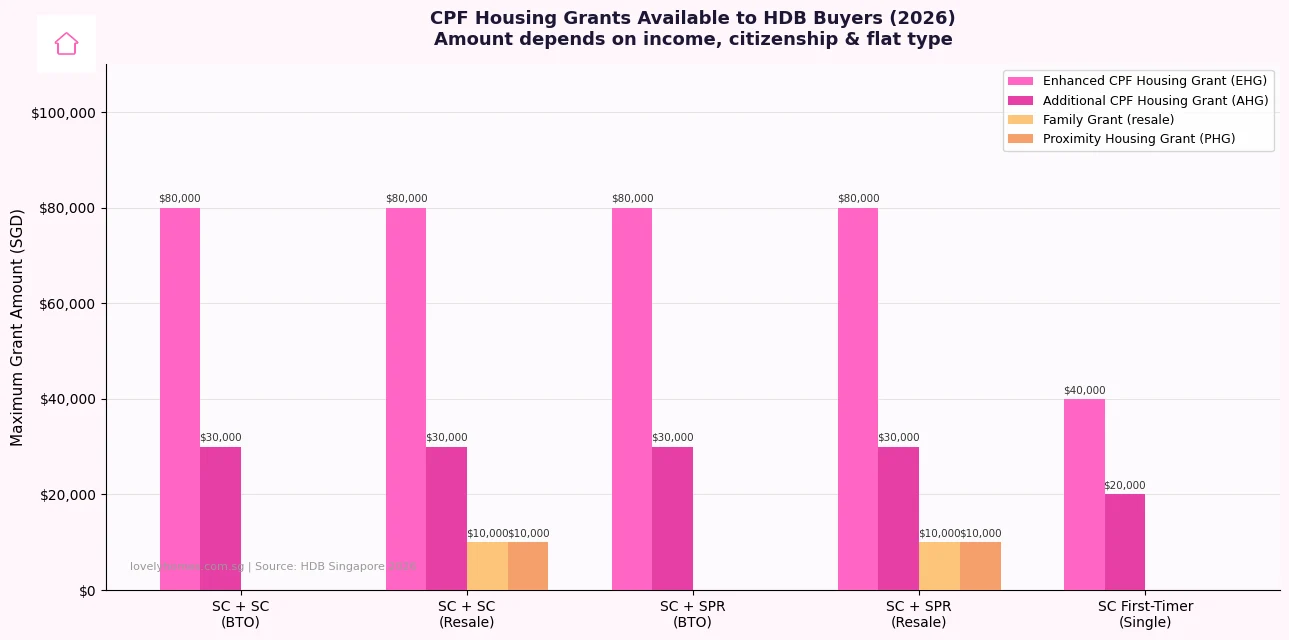
CPF housing grants HDB buyers Singapore 2026 — EHG AHG Family Grant PHG
Figure 2: Maximum CPF housing grant amounts by buyer profile and flat type (2026). Actual amounts depend on income tier.

Enhanced CPF Housing Grant (EHG)

The EHG is the largest grant available and replaced the Special CPF Housing Grant (SHG) and Additional CPF Housing Grant (AHG) for new flat purchases. It is available to first-timer families earning ≤ S$9,000/month. The maximum is S$80,000 for couples earning up to S$1,500/month; the grant tapers to S$5,000 for incomes near the S$9,000 ceiling. Critically, EHG can be used toward both BTO and resale HDB flats — the grant amount is determined at application based on the preceding 12 months’ income.

Additional CPF Housing Grant (AHG — Resale)

The AHG for resale flat purchases (up to S$40,000) applies to first-timer families earning ≤ S$5,000/month who are buying a resale flat. It is used alongside the EHG to give lower-income buyers meaningful purchasing power in the resale market without requiring a new BTO flat.

Family Grant

The Family Grant (up to S$30,000 for SC+SC couples, S$20,000 for SC+SPR couples) applies to resale flat purchases. It does not have an income ceiling but does require a qualifying family nucleus. It is used with the EHG for resale purchases.

Proximity Housing Grant (PHG)

The PHG (up to S$30,000 for living with parents; S$20,000 for living within 4 km of parents) is available for resale flat purchases only. It has no income ceiling. The PHG is designed to encourage multi-generational living and reduce the burden on Singapore’s public transport and caregiving infrastructure.

Step-Up CPF Housing Grant

The Step-Up Grant (S$15,000) is specifically for second-timer families who currently live in a 2-Room or smaller HDB flat and are moving to a 3-Room or larger resale flat. Income ceiling: S$7,000/month. This grant bridges the gap for families who have already used previous housing subsidies.

HDB Concessionary Loan vs Bank Loan: What the HFE Tells You

Once the HFE letter is issued, it also states your eligibility for the HDB concessionary loan. This loan charges an interest rate pegged at 0.1% above the prevailing CPF Ordinary Account (OA) interest rate, which has been 2.5% per annum since 1999 — giving an effective rate of 2.6% p.a. (as at July 2026). This is generally lower than bank mortgage rates, which in mid-2026 have drifted between 3.2–3.7% p.a. for 2-year fixed packages.

Key differences the HFE letter determines:

Feature HDB Concessionary Loan Bank Loan
Max LTV (new flat) 80% of purchase price 75% of purchase price / valuation
Interest rate (Jul 2026) 2.6% p.a. (CPF OA + 0.1%) 3.2–3.7% p.a. (market rates)
Down payment (cash) None required (can be fully CPF) Minimum 5% in cash
Eligibility restriction Must not own private property; income ceiling applies Assessed by lender on TDSR/MSR
Refinancing No — fixed for life of loan Refinanceable after lock-in period
Prepayment penalty None May apply within lock-in

HDB’s LTV cap of 80% means you must fund the remaining 20% from CPF OA savings and/or cash. If your CPF OA balance is sufficient, you may pay no cash at all at the point of purchase — a critical advantage for first-time buyers.
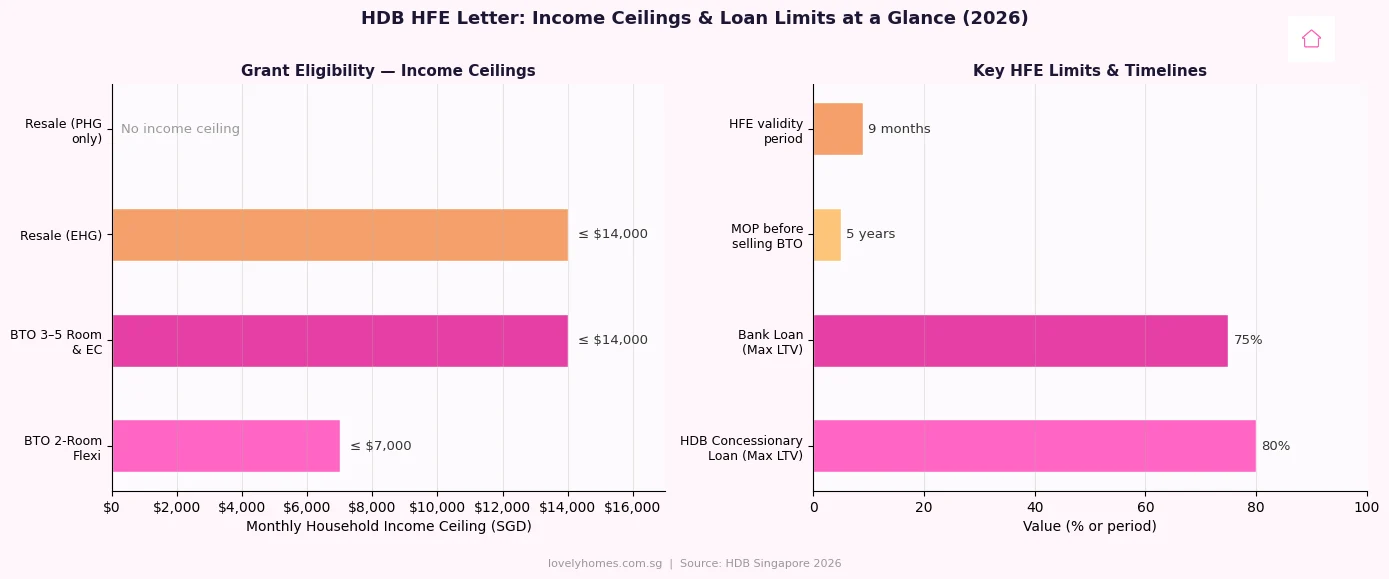
HDB HFE letter income ceiling loan limits eligibility Singapore 2026
Figure 3: HDB HFE letter income ceilings and key borrowing limits at a glance.

How to Apply for the HFE Letter: Step by Step

The entire HFE application process is handled online through HDB’s My Flat Journey (MFJ) portal. There is no physical form, no queue at the HDB Hub, and no in-person interview required for a standard application. Here is the process in full:

  1. Step 1 — Check flat eligibility. Log in to HDB My Flat Journey with SingPass. Use the online self-assessment tool to confirm you meet the basic eligibility criteria before investing time in the full application.
  2. Step 2 — Initiate the HFE application. All co-applicants must log in and give their digital consent via SingPass. HDB will draw on Myinfo data (income records from IRAS, CPF balances, property ownership records) automatically. You do not need to upload payslips separately if your employer reports income through SingPass Myinfo.
  3. Step 3 — Wait for processing. HDB targets a turnaround of 14 working days. Complex cases (self-employed applicants, overseas income, undischarged bankrupts) may take longer. You will be notified via the MFJ portal and by SMS/email when the letter is ready.
  4. Step 4 — Receive and review your HFE letter. The letter will state: (a) flat types you may purchase; (b) grant amounts you qualify for; (c) whether you are eligible for an HDB concessionary loan and the maximum loan ceiling. Review it carefully — the loan ceiling is calculated conservatively and may differ from your actual borrowing capacity under TDSR.
  5. Step 5 — Proceed to flat application or OTP exercise. Your HFE letter is valid for 9 months from the date of issue. You must submit your BTO/SBF application, register intent to buy, or exercise the OTP within this window. If it lapses, you must reapply.

Worked Example: The Lim Family’s HFE Journey

Mr and Mrs Lim are a Singapore Citizen couple, both aged 30, getting married in October 2026. Their combined gross monthly income is S$7,200. They want to apply for a BTO 4-Room flat in Tengah (OCR). Here is how the HFE letter plays out for them:

  • Eligibility: Married couple, both SC, income ≤ S$14,000 — eligible for BTO.
  • EHG: Combined income S$7,200/month → EHG = S$25,000 (grant tapers; full S$80,000 is for ≤ S$1,500/month couples).
  • HDB concessionary loan: Maximum loan quantum is calculated at approximately 30% of monthly income × loan tenure in months. At S$7,200/month income and 25-year tenure: roughly S$720,000 ceiling (subject to TDSR and MSR). The 4-Room BTO in Tengah is estimated at S$490,000 — well within the loan ceiling.
  • Down payment required: 20% × S$490,000 = S$98,000. EHG of S$25,000 offsets the purchase price → effective amount to fund: S$73,000 from CPF OA. If CPF OA balance is sufficient, zero cash required at purchase.
  • Monthly instalment (HDB loan 2.6% p.a., 25 yr): Loan = S$465,000 (S$490,000 less S$25,000 EHG) × 0.8 = S$372,000 → approximately S$1,700/month, payable entirely from CPF OA.

This example illustrates why the HFE letter is not bureaucracy for its own sake — it gives buyers a precise financial picture before they commit to a flat.

Minimum Occupation Period (MOP) and Why It Matters

Once you purchase an HDB flat, you are subject to a Minimum Occupation Period (MOP) before you can sell or rent out the entire flat. The MOP for most HDB flats is 5 years from the date you collect your keys. For new BTO flats in prime locations under the Prime Location Public Housing (PLH) model, the MOP is extended to 10 years. The HFE letter does not state the MOP directly, but the flat type it confirms eligibility for will determine which MOP applies.

Understanding MOP is critical for buyers who may wish to upgrade to a private property in the medium term. The MOP clock starts only from key collection — not from the BTO application date or the signing of the sale agreement. For a BTO flat with a typical 3–5 year construction period, a buyer applying in 2026 might not complete their MOP until 2033 or 2034.

What if Your HFE Letter is Rejected or Shows Lower Entitlements?

An HFE letter may come back with lower grant amounts than expected, or it may indicate ineligibility entirely. Common reasons include: income exceeding the ceiling; a previous HDB flat disposal within the 30-month window; undischarged debts to HDB from a prior flat; or a co-applicant who owns private property. If you believe an error has been made, you may appeal in writing to HDB within 30 days of the letter’s issuance date, providing documentary evidence (IRAS tax assessments, CPF statements, deed of sale for previous property, etc.).

What This Means for You: HFE as a Planning Tool

The HFE letter is best understood not as an obstacle but as a planning tool. By applying early — before you even know which BTO exercise you want to ballot for — you gain five advantages: (1) you know your maximum loan ceiling under the HDB concessionary rate; (2) you have exact grant figures to plug into your financial model; (3) you avoid the risk of exercising an OTP and then discovering you cannot access the loan or grants you assumed; (4) the 9-month validity window gives you two full BTO ballot cycles to use it; and (5) it demonstrates to property agents and sellers that you are a financially ready buyer.

What Might Come Next: HFE and the Evolving HDB Landscape

As at July 2026, HDB has signalled an ambitious BTO pipeline for the remainder of 2026 and into 2027, with projects in Tengah, Kallang/Whampoa, and Queenstown expected in the October 2026 exercise. The PLH model continues to expand to more prime-location sites, which will carry a 10-year MOP and subsidy clawback on resale. Buyers should consider whether PLH restrictions align with their 10–15 year plans before balloting.

There is also ongoing discussion around whether the income ceilings for grants will be adjusted in the next Budget. The S$14,000 combined income ceiling has been in place since 2019; with median household incomes rising, a revision upward has been speculated. No official announcement has been made as at this article’s publication date.

Related Articles

Frequently Asked Questions

Do I need an HFE letter to buy a resale HDB flat?

Yes — you need a valid HFE letter before you can register your Intent to Buy (ITB) on the HDB Resale Portal. The ITB is the first step in the resale process and must be completed before the seller can register their Intent to Sell. Without a valid HFE letter, you cannot proceed with the resale transaction. The HFE letter for resale purchases also confirms your eligibility for the Family Grant, AHG (resale), and PHG.

How long is the HFE letter valid, and can I renew it?

An HFE letter is valid for 9 months from the date of issuance. If you do not complete your purchase or flat application within this window, you must reapply for a new HFE letter. There is no formal “renewal” — each application is a fresh assessment based on current income and circumstances. If your income has changed significantly (promotion, job change, becoming self-employed), your new HFE letter may reflect different grant amounts or loan ceiling figures. There is no fee to apply for or reapply for an HFE letter.

What is the difference between the HFE letter and the old HLE letter?

The Housing Loan Eligibility (HLE) letter was the predecessor document, phased out on 9 May 2023. It covered only HDB loan eligibility and did not include a full grant eligibility assessment or flat eligibility determination. Buyers previously had to navigate three separate checks: HLE, a grant eligibility tool on HDB’s website, and a flat eligibility self-assessment. The HFE letter consolidates all three. One practical difference: the HFE letter requires all co-applicants to give SingPass consent simultaneously, which the HLE did not strictly enforce.

Can singles apply for an HFE letter and purchase an HDB flat?

Yes, but with restrictions. Singapore Citizens aged 35 and above may apply under the Single Singapore Citizen (SSC) scheme for a 2-Room Flexi BTO flat (income ceiling S$7,000/month) or resale flats of any type. The EHG for singles is up to S$40,000. Singles may not purchase 3-Room or larger BTO flats under the SSC scheme. Divorced or widowed Singapore Citizens with children may apply under the Orphan Scheme or other applicable schemes with different eligibility conditions. SPR singles cannot purchase new HDB flats.

Does an HFE letter mean I am guaranteed an HDB concessionary loan?

No — the HFE letter indicates your eligibility for the HDB concessionary loan and the maximum ceiling, but the final loan offer is made only at the point of flat booking (BTO) or after valuation (resale). Between the HFE issuance and your actual flat purchase, your financial circumstances may change (income drop, new liabilities, default on another loan). HDB will re-assess your loan quantum at disbursement. You should also be aware that the HDB loan amount is subject to the Mortgage Servicing Ratio (MSR) cap of 30% of gross monthly income and the Total Debt Servicing Ratio (TDSR) cap of 55%.

What happens to my HFE letter if I miss the BTO ballot or do not find a suitable resale flat?

Nothing happens automatically — the HFE letter simply remains valid until it expires at the end of its 9-month window. You can use it for any number of BTO applications or Intent to Buy registrations during that period. If the HFE letter expires before you complete a purchase, you reapply. There is no penalty for an unused HFE letter, nor is there a limit on how many times you may apply. The only cost is the 14-working-day wait for each new letter.

Can I use an HFE letter for an Executive Condominium (EC)?

Yes. The HFE letter also covers Executive Condominium purchases. However, ECs are developed and sold by private developers under a hybrid scheme — HDB sets eligibility rules, but the developer signs the Sales and Purchase Agreement. The income ceiling for ECs is S$16,000/month. ECs do not qualify for the HDB concessionary loan (you must take a bank loan), but eligible buyers may receive the EHG (capped depending on income). ECs are subject to a 5-year MOP from key collection, after which they may be sold on the open market to Singapore Citizens and PRs, and become fully privatised after 10 years.

Disclaimer

This article is for general informational purposes only and does not constitute legal, financial, or housing advice. Eligibility conditions, grant amounts, income ceilings, loan-to-value limits, and interest rates are subject to change without notice. Always verify current figures directly with the Housing & Development Board (HDB), the Central Provident Fund Board (CPF Board), and the Monetary Authority of Singapore (MAS). For loan-specific advice, consult a licensed financial adviser or mortgage broker.

Singapore Rental Stamp Duty Guide 2026: Rates, Calculation and How to Pay

Singapore Rental Stamp Duty Guide 2026: Rates, Calculation and How to Pay

🏠 Quick Answer — Singapore Rental Stamp Duty 2026

  • Rental Stamp Duty (RSD) is a tax administered by IRAS on tenancy agreements for property in Singapore. It applies to virtually all signed rental agreements, whether residential or commercial.
  • The standard rate is 0.4% of the total rent payable for leases of up to one year. For leases exceeding one year, the rate still works out to approximately 0.4% of the average annual rent, but the calculation base changes — making longer leases proportionally cheaper per dollar of rent.
  • Legally, the tenant pays RSD, but landlords and tenants may contractually agree otherwise. The obligation to stamp the agreement within the prescribed deadline remains regardless of who bears the cost.
  • Deadline: 14 days from signing if the tenancy agreement is executed in Singapore; 30 days if signed overseas. Late payment attracts penalties of up to four times the original stamp duty.
  • Payment is made via IRAS e-Stamping at mytax.iras.gov.sg. The stamped agreement serves as legally admissible evidence in court; an unstamped tenancy agreement cannot be produced as evidence without first paying the outstanding duty (plus penalty).
  • Exemptions are narrow: certain government-to-government leases and specific short-term licence arrangements may be exempt, but most residential and commercial tenancies are stampable.
  • Rental stamp duty is separate from and in addition to GST on rent (if the landlord is GST-registered), and should not be confused with ABSD/BSD on property purchases.

What is Rental Stamp Duty and Why Does It Exist?

Stamp duty in Singapore has a long history rooted in colonial taxation: the original principle was that documents conveying rights — whether over property, shares, or contracts — should bear a “stamp” as evidence that a duty had been paid to the Crown. Today, Rental Stamp Duty (RSD) — formally called “lease duty” under the Stamp Duties Act (Cap. 312) — is the charge IRAS imposes whenever a tenancy agreement or lease is executed for property located in Singapore.

Unlike BSD and ABSD, which fall on property purchases, RSD is a tax on the right to occupy rather than the right to own. Its effect is relatively modest in absolute dollar terms compared with purchase stamp duties, but it is frequently misunderstood — particularly by tenants who may not realise they are legally required to pay it, and by landlords who may not realise that an unstamped tenancy agreement is inadmissible in court should a dispute arise.

IRAS administers RSD under the Stamp Duties Act and has digitised the entire process through its e-Stamping Portal. Since 2017, physical revenue stamps have been abolished; all stamping is done electronically, and a Certificate of Stamp Duty (or Digital Stamp) is generated upon payment.

Singapore rental stamp duty 2026 chart — RSD payable by monthly rent and lease term 12 24 36 months
Figure 1: Rental Stamp Duty by Monthly Rent and Lease Term 2026. For all lease terms shown, the duty is 0.4% of the average annual rent (or total rent for ≤12 months). A S$7,000/month lease incurs S$336 stamp duty regardless of whether the lease is 12, 24 or 36 months — the duty is effectively annual. Source: IRAS Stamp Duties Act 2026.

How RSD is Calculated: The Three Lease-Term Formulas

Singapore’s Stamp Duties Act prescribes the duty rate based on the lease term. The rate is expressed as a fixed monetary charge per S$250 (or part thereof) of “chargeable rent” — which in practice simplifies to the percentages most property practitioners use.

Lease Term Chargeable Rent Base Effective Rate Formula
Up to 1 year Total rent for the entire lease 0.4% 0.004 × (monthly rent × number of months)
Over 1 year up to 3 years Average Annual Rent (AAR) 0.4% of AAR 0.004 × (total rent ÷ number of years)
Over 3 years 4× Average Annual Rent 0.4% × 4× AAR 0.004 × 4 × (total rent ÷ number of years)

In practical terms, for the most common residential lease length of 12 or 24 months, the stamp duty works out to 0.4% of the annual rent. A S$3,500/month 12-month lease has total rent of S$42,000; duty = 0.4% × S$42,000 = S$168. A S$3,500/month 24-month lease has AAR of S$42,000; duty = 0.4% × S$42,000 = S$168. The duty is identical: longer leases within the 1–3 year band do not incur higher total stamp duty.

For leases over 3 years, the multiplier of 4× the AAR effectively applies a penalty on very long-term leases. A S$5,000/month 5-year lease would have AAR = S$60,000; duty = 0.4% × 4 × S$60,000 = S$960. This is significantly higher than a S$5,000/month 36-month lease (AAR = S$60,000; duty = 0.4% × S$60,000 = S$240).

Where a lease includes an option to renew, IRAS takes the view that the full expected lease term — including the renewal period — should be used to determine the chargeable rent base, unless the renewal is genuinely at the tenant’s option with no assurance from the landlord. This is a common area of dispute, and tenants and landlords should take specific legal advice on complex renewal clauses.

Singapore rental stamp duty calculation steps 2026 — how to calculate RSD on tenancy agreement
Figure 2: How to Calculate and Pay Rental Stamp Duty in Singapore 2026. The four-step process: identify lease term → compute chargeable rent base → apply 0.4% rate → pay via IRAS e-Stamping within 14 days (Singapore) or 30 days (overseas). Source: IRAS Stamp Duties Act (Cap. 312).

Who Pays: Legal Obligation vs Contractual Practice

Under the Stamp Duties Act, the person liable to pay stamp duty on a lease is the lessee — the tenant. This is the default legal position. However, Singapore law does not prohibit parties from contractually agreeing that the landlord will bear the cost of stamping instead. Many commercial leases, for example, provide that the landlord stamps the agreement and the stamp duty is absorbed as part of the landlord’s cost of leasing.

In residential lettings, standard practice in Singapore varies. A typical HDB or condo tenancy agreement often states that the tenant pays the stamp duty; in practice, some landlords absorb it, particularly in competitive rental markets. Regardless of who pays, the legal obligation to ensure the agreement is stamped rests on the tenant. If a landlord promises to stamp but fails to do so, the tenant — not the landlord — faces the legal consequences: an unstamped agreement cannot be produced as evidence in court without first paying the outstanding duty plus a late-payment penalty.

This is a particularly important point for tenants who are new to Singapore. Rental contracts are legally binding once signed, but if the agreement is not stamped, neither party can rely on it in formal dispute resolution (e.g., in the Small Claims Tribunal or civil court) without first remedying the stamping deficiency.

How to Pay: The IRAS e-Stamping Process

IRAS requires all stamp duty on leases to be paid electronically through its e-Stamping Portal at mytax.iras.gov.sg. The process is straightforward:

First, log in using Singpass (for individuals with a Singpass account) or CorpPass (for companies). Second, navigate to “Stamp a Document” and select “Lease” as the document type. Third, enter the details of the tenancy agreement — property address, lease commencement date, monthly rent, lease duration, and any additional rent components (such as a maintenance contribution or parking charge, which may or may not be included in the chargeable rent depending on their nature). Fourth, confirm the computed stamp duty and make payment via PayNow, GIRO, or credit/debit card. IRAS immediately generates a Digital Stamp (a PDF certificate bearing the stamp reference number), which should be appended to the original tenancy agreement.

Foreign tenants or landlords without Singpass may use the Stamp Duty Calculator on IRAS’s website to compute the duty and then authorise a Singapore-registered solicitor or property agent to stamp on their behalf. The stamping must still be completed within the prescribed 14-day (Singapore execution) or 30-day (overseas execution) window.

Late Payment, Penalties and Unstamped Documents

IRAS imposes penalties for failure to stamp a lease agreement within the prescribed period. The penalty scale under the Stamp Duties Act is:

Delay Period Penalty
Up to 3 months late S$10 or the unpaid duty, whichever is higher
Over 3 months but not more than 6 months late S$25 or 4× unpaid duty, whichever is higher
Over 6 months late S$50 or 4× unpaid duty, whichever is higher

In addition to the monetary penalty, an unstamped document has serious evidentiary consequences. Section 52 of the Evidence Act provides that an unstamped instrument that should have been stamped is not admissible in evidence in civil proceedings until the stamp duty — together with any penalty — has been paid. In practice, this means that a landlord seeking to enforce a tenancy agreement in the Small Claims Tribunal or District Court, or a tenant seeking to rely on the lease to resist an unlawful eviction, may find their key document inadmissible until they have first remedied the stamping deficiency. Parties can often remedy this by paying the outstanding duty and penalty immediately before or during proceedings, but this adds cost and delay.

Variable Rent, Turnover Rent, and Inclusive vs Exclusive Clauses

Stamp duty on leases with variable rent — such as commercial leases tied to turnover (a percentage of the tenant’s sales) — is a more complex area. IRAS’ position is that the stamp duty should be computed on the highest annual rent payable, including variable components, at the time the lease is signed. Where the variable component is genuinely unascertainable, the parties may seek an assessment from IRAS.

Rent that is described as inclusive of maintenance charges or service charges is typically fully chargeable for stamp duty purposes if it is paid as a single lump sum under the lease. Landlords who break out maintenance charges as a separate contractual payment (not part of the “rent” clause in the tenancy agreement) may reduce the chargeable rent base, but this must be reflected accurately in the agreement — IRAS can disregard artificial arrangements that separate components of what is economically a single rent payment.

Rental incentives such as rent-free periods at the start of a lease reduce the total rent payable and therefore reduce the chargeable rent base. A 24-month lease at S$4,000/month with one month rent-free has effective rent of S$4,000 × 23 = S$92,000; AAR = S$46,000; stamp duty = 0.4% × S$46,000 = S$184 (not 0.4% × S$48,000 = S$192).

Singapore rental stamp duty 2026 worked scenarios — stamp duty amount and total rent for common lease types
Figure 3: RSD Amount and Total Rent for Common Lease Scenarios 2026. The stamp duty (left bars) remains constant whether the lease is 12, 24, or 36 months — because the formula uses average annual rent. The total rent (right axis, dashed line) doubles and triples correspondingly. Source: IRAS Stamp Duties Act.

Worked Example: The Ramirez Family’s HDB Lease

📊 Worked Example — Mr and Mrs Ramirez, Tenant

Mr and Mrs Ramirez (Employment Pass holders) are renting a 4-room HDB flat in Tampines from Mr Lim (SC landlord) at S$3,800/month for 24 months commencing 1 August 2026. The tenancy agreement was signed in Singapore on 28 July 2026.

Step 1 — Identify lease term: 24 months. This falls in the “over 1 year, up to 3 years” band. Chargeable rent base = Average Annual Rent (AAR).

Step 2 — Compute AAR: Total rent = S$3,800 × 24 = S$91,200. Number of years = 2. AAR = S$91,200 ÷ 2 = S$45,600.

Step 3 — Apply rate: RSD = 0.4% × S$45,600 = S$182.40. IRAS rounds up to the nearest S$1, so payable = S$183.

Step 4 — Deadline: Agreement signed in Singapore on 28 July 2026. Deadline = 28 July + 14 days = 11 August 2026. The Ramirez family (or their agent) must log in to mytax.iras.gov.sg and pay S$183 by 11 August 2026.

Responsibility: Under the tenancy agreement, the stamp duty is stated to be the tenant’s liability. Mrs Ramirez logs in via Singpass, selects “Stamp a Document → Lease”, enters the property address (HDB flat in Tampines), monthly rent (S$3,800), lease period (24 months), and pays S$183 via PayNow. She downloads the Digital Stamp and attaches it to the signed tenancy agreement. Both she and Mr Lim retain a copy.

What if they forget? If they stamp on 15 September 2026 (48 days late), the penalty for delay up to 3 months = maximum of S$10 or the unpaid duty. Duty = S$183. Penalty = S$183 (duty) + S$183 (penalty, since S$183 > S$10) = S$366 total. If they leave it 7 months, the penalty is 4× the unpaid duty = S$183 × 4 = S$732, paid in addition to the original duty of S$183 = S$915 total.

RSD on Commercial Property and Industrial Leases

Rental stamp duty applies equally to commercial and industrial leases — offices, retail shops, F&B units, factories, and warehouses. The same formula and deadline rules apply. Commercial leases often involve higher rent quantum and longer lease terms (3–5 years is common), meaning the “over 3 years” penalty multiplier (4× AAR) comes into play more frequently.

For commercial leases, it is standard practice for the landlord’s or tenant’s lawyers to handle the stamping at the time of execution, and the stamp duty cost is typically factored into lease negotiations. Commercial tenants should also note that if they sub-let part of the premises to a sub-tenant, the sub-lease is independently stampable — the stamp duty on the head lease does not cover the stamp duty on the sub-lease.

What Might Change in Singapore Rental Stamp Duty Rules

Singapore’s stamp duty regime is periodically reviewed as part of broader property market management. RSD rates have remained at 0.4% for decades — the most significant recent changes to Singapore’s stamp duty landscape have been on the purchase side (ABSD rounds in 2021, 2022, and 2023), not the lease side.

There are no publicly announced plans as at July 2026 to change RSD rates. However, the government has in recent years shown willingness to adjust property-related taxes quickly and without advance notice when market conditions warrant. Tenants and landlords entering multi-year leases should factor in that stamp duty regulations may change at renewal.

IRAS has also been digitalising its stamp duty administration progressively. The full move to e-Stamping was completed in 2017, and IRAS now processes the vast majority of stamp duty transactions without human review. Automated flagging of anomalous arrangements (suspiciously low rent, excessive rent-free periods, or rent structures that appear to understate chargeable rent) is improving. Parties should ensure their lease agreements accurately reflect the true economic rent.

Summary: Key Rental Stamp Duty Facts 2026

Item Detail
Governing law Stamp Duties Act (Cap. 312), administered by IRAS
Applies to All signed tenancy agreements / leases for Singapore property
Rate (≤1 year lease) 0.4% of total rent
Rate (1–3 year lease) 0.4% of average annual rent (AAR)
Rate (>3 year lease) 0.4% × 4 × AAR (effectively 1.6% of AAR)
Who pays (by law) Tenant (lessee) — contractually may be varied
Deadline (SG execution) 14 days from date of signing
Deadline (overseas execution) 30 days from date of signing
Payment channel IRAS e-Stamping Portal (mytax.iras.gov.sg)
Penalty (up to 3 mths late) S$10 or unpaid duty, whichever is higher
Penalty (3–6 mths late) S$25 or 4× unpaid duty, whichever is higher
Penalty (>6 mths late) S$50 or 4× unpaid duty, whichever is higher
Consequence of no stamping Tenancy agreement inadmissible in court (Evidence Act, s.52)
GST on stamp duty? No — stamp duty is a government tax, not subject to GST

Frequently Asked Questions

Does rental stamp duty apply to HDB flats sublet to non-citizens?

Yes. Rental stamp duty applies to all tenancy agreements for property in Singapore, regardless of whether the property is an HDB flat, a private condominium, a landed home, or a commercial unit. The citizenship or residency status of the landlord or tenant does not affect whether stamp duty is payable. Note, however, that HDB flat subletting has its own separate regulatory requirements — HDB must approve the subletting, and there are restrictions on who can rent an HDB flat and for how long. These HDB subletting rules are administered by HDB and are separate from the stamp duty obligation administered by IRAS.

Is stamp duty payable on a verbal or oral tenancy agreement?

No — stamp duty under the Stamp Duties Act is payable on written instruments (documents), not on oral agreements. A purely verbal tenancy arrangement does not attract stamp duty because there is no written document to stamp. However, this does not mean that oral tenancies are advisable: an oral tenancy agreement is extremely difficult to enforce in practice because neither party can produce a written contract in dispute resolution. IRAS cannot compel stamping of a document that does not exist. If the parties subsequently reduce the oral agreement to writing, that written document becomes stampable at that point. In practice, almost all residential tenancies in Singapore involve a written tenancy agreement, making stamp duty applicable in the overwhelming majority of cases.

Does rental stamp duty apply to short-term rentals like Airbnb?

Short-term rentals — typically defined as leases of fewer than 3 months for residential property in Singapore — occupy a complex regulatory space. First, under the Planning Act and HDB regulations, residential property in Singapore (HDB flats, condominiums, landed homes) may not legally be rented out for periods of less than 3 consecutive months. Short-term platforms such as Airbnb are therefore generally prohibited for residential property in Singapore. If a tenancy agreement for less than 3 months is signed (illegally, for residential property), it would technically be stampable under the Stamp Duties Act since the Act does not exclude short-term agreements. However, enforcing the tenancy itself would be problematic given the underlying regulatory breach. For commercial serviced apartments and licensed hotels, different rules apply and stamp duty on any written rental agreement would still be applicable.

If the rent is paid partly in cash and partly as a service charge, is all of it stampable?

This depends on how the tenancy agreement is structured. If a single monthly figure is described as “rent” in the contract, the entire amount is chargeable for stamp duty purposes. If the agreement separately itemises a “maintenance fee” or “service charge” as a genuinely distinct component — not part of the rent clause — IRAS may, depending on the specific facts, agree that the separate charge is not part of the chargeable rent. However, IRAS scrutinises arrangements where rent is split into components that appear artificial. If the effect is that the tenant pays a combined sum for the right to occupy the property and it is economically equivalent to rent, IRAS may treat the whole as chargeable. Parties wishing to structure leases with service charges separated from rent for stamp duty purposes should obtain specific advice from their solicitors and be prepared to justify the arrangement if queried.

What happens if the tenant breaks the lease early and the agreed rent is never fully paid?

Stamp duty is assessed at the time the tenancy agreement is executed — based on the contractually agreed rent for the full lease term — not based on the rent actually paid if the lease is terminated early. If a tenant signs a 24-month lease at S$4,000/month (stamp duty = S$192), pays 6 months, then breaks the lease, the stamp duty already paid is not refunded. IRAS does not retrospectively adjust stamp duty for lease breaks. The stamp duty is a tax on the right created by the document at execution, not a tax on the economic benefit eventually received. This is one reason why tenants should be cautious about committing to long lease terms with high rent — beyond the financial exposure of the rent itself, the stamp duty is crystallised upfront.

Can the stamp duty be paid by the landlord’s property agent on behalf of the tenant?

Yes. A licensed property agent or solicitor may handle the e-Stamping process on behalf of either party. The agent or solicitor logs into the IRAS e-Stamping Portal using their own credentials and stamps the document on the client’s behalf, then passes the Digital Stamp to the parties. The agent’s stamping on behalf of the tenant does not change the legal liability — the tenant remains legally responsible for ensuring stamping occurs within the deadline. Property agents in Singapore routinely handle the stamping as part of their transaction coordination service. Note that if the agent fails to stamp on time, any penalty falls on the legally liable party (the tenant), not the agent — though the tenant may have a separate claim against the agent for negligence if the agent explicitly undertook to handle stamping and failed to do so.

Disclaimer: The information in this article is provided for general educational purposes only and reflects the Stamp Duties Act (Cap. 312) and IRAS guidelines as publicly available up to July 2026. Stamp duty rates, deadlines, penalty scales, and administrative procedures are subject to change without notice. Nothing in this article constitutes legal, financial, or tax advice. Readers should verify stamp duty obligations directly with IRAS or seek advice from a qualified solicitor or tax professional before executing any tenancy agreement. Official IRAS resources: iras.gov.sg — Stamp Duty: Renting a Property. For property-related regulatory guidance: ura.gov.sg and hdb.gov.sg.

Singapore Property Ownership Types 2026: Tenure, Title & Buyer Restrictions

Singapore Property Ownership Types 2026: Tenure, Title & Buyer Restrictions

🏠 Quick Answer — Singapore Property Ownership Types 2026

  • Five tenure types exist in Singapore: true freehold (999yr/9999yr/perpetuity), 99-year leasehold, 60-year leasehold, 30-year leasehold, and HDB lease (a form of 99-year leasehold from the state).
  • Three property classes apply: public housing (HDB), private residential (landed and non-landed), and commercial/industrial.
  • CPF Ordinary Account funds can be fully used for freehold and leasehold properties where the remaining lease covers the youngest buyer to age 95. Short leases below 30 years cannot be funded by CPF at all.
  • Foreigners (non-PRs) may purchase non-landed private condominiums and Sentosa Cove landed property but are barred from HDB flats, executive condominiums (within or outside MOP), and mainland landed homes.
  • Joint tenancy (JT) grants equal shares with automatic survivorship rights, while tenancy-in-common (TIC) allows flexible ownership splits and individual bequeathals — the structure used in “decoupling” to manage ABSD liability.
  • ABSD (Additional Buyer’s Stamp Duty) counts each owner’s total property holdings. Adding a co-owner who already holds property triggers ABSD based on that co-owner’s profile, not the primary buyer’s.
  • Permanent Residents purchasing landed property require approval from the Singapore Land Authority (SLA) and are rarely granted such permission.

What “Property Ownership Type” Means in Singapore

When property professionals in Singapore talk about ownership type, they are simultaneously describing at least three separate legal concepts: tenure (how long you own the land), property class (public versus private, landed versus non-landed), and ownership structure (who holds the title and in what proportions). These three dimensions interact with one another in ways that determine your eligibility to buy, how much you can borrow, whether CPF Ordinary Account funds may be applied, the stamp duties you pay, and ultimately the resale value and liquidity of the asset.

The Urban Redevelopment Authority (URA) and the Housing & Development Board (HDB) jointly administer Singapore’s land-sale and housing framework, with the Singapore Land Authority (SLA) maintaining the land register and the Inland Revenue Authority of Singapore (IRAS) administering stamp duties. Understanding how their overlapping rules affect each ownership type is essential before signing any option to purchase.

Singapore property tenure type comparison — CPF, LTV loan and resale liquidity by freehold and leasehold 2026
Figure 1: Tenure Type Comparison — CPF Eligibility, Loan LTV and Resale Liquidity Score by tenure type. Freehold and 99-year leasehold score identically on CPF (100%) and LTV (75%); 60-year leasehold begins to attract CPF proration; resale liquidity drops sharply for 30-year leases. Source: URA/SLA/CPF Board guidelines 2026.

The Five Tenure Types in Singapore

Tenure determines the fundamental nature of your ownership relationship with the state. Singapore sits on land that ultimately belongs to the Singapore government; private landowners hold either a perpetual grant or a time-limited lease from the state.

True freehold (Freehold in perpetuity) means the owner holds the land and building indefinitely, subject only to compulsory acquisition under the Land Acquisition Act if the state requires it for public purposes. True freehold plots are rare — they originated largely from pre-independence Crown grants and old colonial titles. Examples include many shophouses in the historic districts and certain older private estates in prime districts. In practice, “freehold” in Singapore’s property listings almost always means 999-year or 9999-year leasehold, which is treated as commercially equivalent to perpetual freehold because the lease outlasts any human concern.

999-year and 9999-year leasehold are historical tenures used before Singapore standardised GLS (Government Land Sales) to the 99-year format. Properties such as Nassim Road black-and-white bungalows and some Tanglin-area condominiums carry 999-year titles granted in the colonial era. For all practical purposes — CPF eligibility, bank lending, resale values — these are treated identically to true freehold.

99-year leasehold is the dominant tenure for private condominiums, executive condominiums (ECs), and most post-independence landed homes sold under GLS. The 99-year clock starts from the date the state grants the lease to the developer, not from the date you purchase from the developer or on the resale market. A new launch condo may offer you 99 years; a 20-year-old resale unit may offer only 79 years — a critical difference for CPF eligibility, bank loan quantum, and eventual en-bloc prospects.

60-year leasehold is less common and appears mainly in older HDB upgrader-type private apartments from the 1980s–1990s and some industrial or commercial sites. When the remaining lease dips below 30 years, CPF cannot be used at all; between 30 and 59 years, CPF usage is prorated, reducing the maximum CPF withdrawal progressively.

30-year leasehold is primarily found in commercial contexts — some shophouses and industrial units. Bank financing becomes difficult: MAS-regulated financial institutions typically require the loan tenure to end before the lease expires, so a 25-year-old property on a 30-year lease can support only a 5-year loan. CPF is generally unavailable. Investors in this space are largely cash buyers or institutional funds.

HDB flats are technically a distinct form of 99-year lease between HDB (as lessor) and the flat buyer (as lessee). Unlike private leasehold property held under a land title, HDB flats are governed by the Housing & Development Act, which imposes eligibility, resale, subletting, and Minimum Occupation Period (MOP) rules that do not apply to private property.

Property Classes: Public, Private Landed, and Private Non-Landed

Singapore’s property market is stratified into distinct classes, each with different eligibility criteria, price points, and regulatory frameworks.

Public housing (HDB) accounts for roughly 80% of Singapore’s resident population. Built and managed by HDB, these flats are sold under a 99-year lease on heavily subsidised terms to eligible Singapore Citizens (SCs) and, in limited circumstances, Singapore Permanent Residents (SPRs). The Ethnic Integration Policy (EIP) limits the proportion of any ethnic group in each HDB block to maintain social cohesion. HDB flats cannot be sub-let entirely without HDB approval, and short-term lettings (Airbnb-style) are prohibited.

Executive condominiums (ECs) are a hybrid tenure: built by private developers but sold at subsidised prices to eligible SC/SPR households who meet income ceilings (S$16,000/month as at 2026). ECs are fully privatised after the 10-year mark from the issuance of the Temporary Occupation Permit (TOP) — only then can they be sold to foreigners. Between TOP and the 5-year MOP, ECs may not be sold at all on the open market. Between the MOP and 10 years, they can be sold to SCs and SPRs on the open market.

Private non-landed residential property — condominiums, apartments, and serviced residences — is available to SCs, SPRs, and foreigners without restriction (subject to ABSD). These properties are governed by the Building Maintenance and Strata Management Act (BMSMA), which requires a Management Corporation Strata Title (MCST) to maintain common property and set maintenance fees and sinking fund contributions.

Private landed residential property — detached bungalows, semi-detached homes, and terraced houses — is the most tightly regulated class. Under the Residential Property Act, foreigners (non-ERM) are generally barred from buying mainland landed property. SPRs may apply to SLA for approval to purchase landed homes, but approvals are rare and subject to demonstrating economic or professional contribution to Singapore. Sentosa Cove, a designated area on Sentosa Island, is the sole exception: foreigners and SPRs may purchase landed property there without SLA approval, albeit subject to ABSD.

Commercial and industrial property — shophouses, offices, retail units, and industrial facilities — carries no citizenship restrictions. Foreigners may purchase these freely. However, ABSD does not apply to commercial properties, and mortgage conditions differ significantly from residential financing.

Singapore foreign ownership restrictions matrix 2026 — who can buy HDB, condo, landed, EC by buyer profile
Figure 2: Who Can Buy What — Foreign Ownership Restrictions Matrix 2026. Green = permitted; amber = conditions apply; red = not permitted. Sources: Residential Property Act, Housing & Development Act, SLA, URA guidelines 2026.

Title and Strata: How You Actually Hold the Property

In Singapore, how you hold title to property is as important as what you hold. There are two principal title structures for private property.

Strata title (under the Land Titles (Strata) Act) is the ownership structure for condominiums, cluster homes, and many commercial properties. Each owner holds a strata lot — their individual unit — alongside an undivided share in the common property (corridors, lifts, pools, carparks). The share value, expressed as a fraction of the total share values in the development, determines the owner’s pro-rata obligation for management fund and sinking fund contributions, as well as their voting weight in MCST general meetings.

The MCST — a body corporate automatically constituted upon registration of the strata subdivision plan — governs the common property. MCST fees are set by the council and passed at general meetings. Every buyer of a strata unit inherits any outstanding MCST levies as a statutory charge on the property; it is therefore essential to search for MCST-level encumbrances before completion.

Landed title operates under the Land Titles Act. The owner holds the land parcel and the structures on it outright. There is no MCST; maintenance, insurance, and structural repairs are entirely the owner’s responsibility. Landed property within a “housing estate” managed by a town council (mostly HDB estates) may be subject to estate maintenance levies, but this is unusual for private landed homes.

HDB flats do not use either strata or landed title in the same way. HDB retains ownership of the land and building; the flat buyer acquires a leasehold interest documented in a lease agreement with HDB, not a land-titles strata lot. This means HDB flat owners do not have the same proprietary rights as private strata title holders — for example, they cannot mortgage the flat to a non-bank lender and are subject to HDB’s ongoing consent for major alterations.

Ownership Structures: Sole, Joint Tenancy, and Tenancy-in-Common

When two or more people buy property together, Singapore law offers two co-ownership structures, each with materially different legal and tax consequences.

Sole ownership is the simplest structure: one individual holds the entire title. All CPF, mortgage servicing, stamp duty obligations, and eventual sale proceeds belong to that one owner. ABSD is assessed based solely on that owner’s property holdings.

Joint tenancy (JT) is the default when married couples purchase property together in Singapore. In a JT, co-owners hold the property as a single indivisible unit in equal shares. The defining feature is the right of survivorship: if one owner dies, their interest does not pass through their estate — it automatically vests in the surviving co-owner(s) by operation of law, regardless of what the will says. JT cannot be bequeathed and cannot be sold piecemeal; to transfer a share, the co-owners must first sever the JT into a TIC.

Tenancy-in-common (TIC) allows co-owners to hold defined, distinct shares — 50/50, 60/40, 99/1, or any other split. Each share can be independently bequeathed, mortgaged (subject to lender consent), or sold. This flexibility is the basis of the “decoupling” strategy used by some couples to manage ABSD exposure: one spouse transfers their TIC share to the other (paying BSD on the transferred share), effectively becoming a sole owner, freeing the other spouse to purchase a second property without paying ABSD as a co-owner of the first.

IRAS has tightened scrutiny on decoupling arrangements; the transfer is subject to BSD (and ABSD if applicable), and the entire structure must be commercially genuine. MAS mortgage rules also apply independently to each borrower post-decoupling, so TDSR (Total Debt Servicing Ratio) and LTV compliance must be rechecked after any ownership change.

CPF and Financing Rules by Ownership Type

The CPF Board’s housing withdrawal limits interact directly with the tenure and class of property. In broad terms:

For freehold or long-lease (999yr/9999yr/99yr) properties where the remaining lease at the time of purchase covers the youngest buyer to the age of 95, the full CPF Ordinary Account (OA) balance can be used for the downpayment and mortgage servicing. There is no CPF usage cap beyond the standard Valuation Limit (VL) and Withdrawal Limit (WL) based on loan-to-value (LTV) ratio.

For properties with a shorter remaining lease, CPF usage is prorated. If the remaining lease at the point of purchase is below 30 years, no CPF may be used at all — only cash and bank mortgage. Properties with a remaining lease of between 30 and 59 years attract partial CPF limits, calculated by a formula that considers the youngest buyer’s age and the lease remaining. Buyers often underestimate how sharply CPF restrictions affect their liquidity on leasehold properties purchased in the resale market.

For HDB flats, the CPF rules are broadly similar to private 99-year leasehold property, but with additional HDB-specific rules: HDB flats can also be financed by an HDB Concessionary Loan (at 2.6% per annum as at 2026, pegged to CPF OA interest rate plus 0.1%) or a bank loan. The HDB loan allows 80% LTV; bank loans for HDB resale flats are capped at 75% LTV under MAS regulations.

ABSD and Stamp Duty Implications by Ownership Profile

Both BSD (Buyer’s Stamp Duty) and ABSD (Additional Buyer’s Stamp Duty) are administered by IRAS and are payable within 14 days of signing the Sale & Purchase Agreement. The ABSD rate is determined by the buyer’s citizenship status and the number of residential properties they own at the point of purchase — counting both Singapore and overseas residential properties.

ABSD as at 2026:

Buyer Profile 1st Property 2nd Property 3rd+ Property
Singapore Citizen (SC) 0% 20% 30%
Singapore PR (SPR) 5% 30% 35%
Foreigner (non-ERM) 60% 60% 60%
Entity (company/trust) 65% 65% 65%
SC + SPR (joint) 5% 25% 30%
SC + Foreigner (joint) 60% 60% 60%

When two buyers purchase jointly, the ABSD rate applied is the higher of the two buyer profiles’ applicable rates, based on each person’s total property count at the date of the option exercise. This means that adding a co-owner who is a foreigner to a purchase immediately invites the 60% ABSD rate, regardless of the primary buyer’s SC status.

Upfront costs by property ownership profile and buyer type Singapore 2026 — BSD ABSD downpayment comparison
Figure 3: Total Upfront Costs by Buyer Profile — S$1.5M Condo Purchase 2026. BSD (S$44,600) is identical across all profiles; ABSD varies from S$0 (SC 1st property) to S$900,000 (foreigner). Source: IRAS stamp duty schedules 2026.

Worked Example: The Chen Family’s Tenure Trade-Off

📊 Worked Example — Mr and Mrs Chen, Singapore Citizens

Mr and Mrs Chen (both SC, ages 38 and 36) currently own a 4-room HDB resale flat in Ang Mo Kio purchased in 2019 for S$520,000 under joint tenancy. They want to upgrade to a private condominium in District 20 (Bishan/Thomson) at S$1,450,000. Their combined income is S$14,500/month. The HDB flat still has 7 years left on its MOP (they bought a resale unit with 12yr MOP achieved in 2031, but let’s assume MOP has been served).

Scenario A — Sell HDB first, then buy: Selling the HDB removes it from their property count. Both are first-time private property buyers. ABSD = 0% (SC, 1st private property). BSD on S$1,450,000 = S$43,600. Bank loan 75% LTV = S$1,087,500; monthly repayment at 3.5% over 25yr = S$5,442. TDSR = 37.5% ✓. Downpayment 25% = S$362,500. Total upfront: BSD S$43,600 + downpayment S$362,500 + legal ~S$3,500 ≈ S$409,600.

Scenario B — Buy first (HDB retained as joint tenancy), then sell: Both spouses hold the HDB flat. Buying a second residential property: ABSD 20% on S$1,450,000 = S$290,000 cash (ABSD cannot be paid from CPF). This pushes total upfront cost to ≈S$699,600. The couple must sell the HDB within 6 months of TOP of the new purchase to obtain an ABSD remission (applicable to SC married couples buying their first private property while retaining an existing HDB flat and selling it within 6 months of TOP).

Decision: Sell first saves S$290,000 in ABSD and avoids bridge financing risk. Buy first is justifiable only if the HDB sale proceeds are needed to bridge the downpayment gap and the couple is confident of completing the HDB sale within the 6-month window. In either case, they must check that TDSR remains below 55% after all debt obligations are factored in.

What Might Come Next for Property Ownership Rules

Singapore’s property ownership framework is reviewed periodically by MAS, URA, HDB, and SLA in response to market conditions. Several developments are worth monitoring in 2026 and beyond.

The government has indicated it will sustain a high Confirmed List supply under the GLS Programme — 9,320 units for 2026 full-year — to moderate price growth. This elevated supply pipeline may eventually compress the freehold-leasehold price premium as more 99-year sites enter the market.

The ABSD framework — last revised in April 2023 — remains under ongoing review. Market observers note that the 60% foreigner ABSD is a deliberately prohibitive rate designed to preserve housing affordability for locals rather than generate revenue. The rate may be adjusted if foreign demand patterns change materially.

The CPF housing usage rules for short-lease properties were tightened in 2019 to protect buyers from locking retirement savings into depreciating leasehold assets. Further refinements are possible if market data shows buyers systematically underestimating lease-decay risk on resale leasehold properties.

Finally, the en-bloc collective sale cycle — which periodically transforms ageing freehold and 99-year leasehold estates — depends heavily on the land sales cycle and government GLS pricing. Property owners in older developments should monitor MCST votes and URA master plan changes, both of which affect en-bloc potential.

Summary Table: Singapore Property Ownership Types 2026

Ownership Type Tenure Who Can Buy CPF OA Max LTV ABSD Applies?
HDB flat (new BTO) 99yr (HDB lease) SC / SC+SPR (eligible) Yes (full) 80% (HDB loan) / 75% (bank) No (residential only, 1st property SC)
HDB resale 99yr (HDB lease, residual) SC / SPR (limited) Yes (lease-prorated) 75% bank ABSD if SPR 1st (5%) or 2nd+ SC (20%)
EC (within MOP) 99yr (private) SC / SC+SPR (eligible) Yes (full) 75% bank ABSD if SPR
EC (after 10yr) 99yr (private, privatised) All nationalities Yes (full) 75% Yes (full ABSD schedule)
Freehold condo / apt Freehold / 999yr All (ABSD applies to foreigners) Yes (full) 75% Yes (full ABSD schedule)
99yr leasehold condo 99yr (residual) All (ABSD applies) Yes (lease-prorated) 75% Yes
Mainland landed (SC/SPR) Freehold or 99yr SC (free); SPR (SLA approval); Foreigner (barred) Yes 75% Yes
Sentosa Cove landed 99yr All (including foreigners) Yes 75% Yes (60% for foreigners)
Commercial shophouse Freehold or 99yr / 60yr All No (commercial) ~50–55% (commercial rate) No ABSD (non-residential)

Frequently Asked Questions

Can a Singapore Permanent Resident buy landed property in Singapore?

SPRs may apply to the Singapore Land Authority (SLA) for approval to purchase restricted residential property, which includes all mainland landed homes — detached, semi-detached, and terrace — outside Sentosa Cove. In practice, SLA approvals are granted rarely and generally require the applicant to demonstrate a strong economic, professional, or social contribution to Singapore. SPRs who have been PRs for many years and who have children in Singapore schools, for example, may have a marginally better chance, but there is no published threshold. Sentosa Cove landed property is the notable exception: SPRs and even non-PR foreigners may purchase there freely, subject to the applicable ABSD rate (60% for foreigners, 5%/30%/35% for SPR first/second/third+ properties).

What happens to joint tenancy property when one owner dies?

Under joint tenancy, the right of survivorship operates automatically upon death: the deceased co-owner’s interest passes directly to the surviving co-owner(s) by operation of law, without going through the estate or probate process. This means a will cannot override the right of survivorship on JT-held property — even if the deceased’s will bequeaths their “share” of the property to someone else, the will has no effect on the JT interest. If the couple wishes the property to pass to children or other beneficiaries on death, they should sever the JT into a tenancy-in-common, which allows each co-owner to bequeath their defined share independently. Note that severance of a JT itself does not attract stamp duty, but it must be properly registered with SLA.

How does lease decay affect resale value for 99-year leasehold property?

Lease decay — the progressive reduction in remaining lease years — has an increasingly pronounced effect on resale value, CPF eligibility, and bank financing as a property ages. URA transaction data shows that 99-year leasehold condominiums with fewer than 60 years remaining typically trade at a meaningful discount to comparable freehold or newer-lease units in the same area, reflecting restricted buyer pools (fewer CPF-eligible buyers, tighter bank-loan terms) and lower en-bloc potential. The CPF Board’s 2019 rules, which restrict CPF usage where the remaining lease does not cover the youngest buyer to age 95, have further compressed the buyer pool for older leasehold units. Buyers considering a 20–30-year-old leasehold unit should model their exit assumptions carefully — factoring in the remaining lease at the time of anticipated sale, not just the current lease.

Is decoupling still viable for SC married couples in 2026?

Decoupling — where one spouse transfers their TIC share to the other, exiting co-ownership so they can purchase a second property without ABSD — remains legally permissible and is used by some couples. However, the transaction is no longer as cost-free as it once was. BSD applies to the transferred share: on a S$1.5M condo, transferring a 50% share (S$750,000) incurs BSD of approximately S$19,300. ABSD may also apply if the transferring spouse is acquiring another property simultaneously. IRAS has made clear it scrutinises decoupling arrangements to confirm they are genuine rather than artificial. Additionally, MAS mortgage stress-tests apply independently post-transfer, so the sole remaining owner must individually qualify for the full outstanding mortgage under TDSR rules — a hurdle that has become more challenging as interest rates have risen from the near-zero era of 2020–2022.

Can foreigners buy an HDB flat if they are married to a Singapore Citizen?

A foreigner (non-PR) married to a Singapore Citizen may purchase an HDB resale flat under the Public Scheme, where the SC spouse is the applicant and the foreigner spouse is listed as an occupier (not an owner). The HDB flat is owned solely by the SC spouse in this case. The foreigner spouse does not appear on the title and does not count as a property owner for ABSD purposes. New BTO flats, by contrast, require both applicants to be SC or SPR; a non-PR foreigner cannot be on the BTO application at all. Under the Non-Citizen Spouse Scheme (previously called the Non-Citizen Family Scheme), the foreigner spouse may eventually be included as an owner if they obtain PR status.

What is the difference between an HDB lease and a private strata title?

An HDB flat lease is a contractual lease agreement between HDB (as lessor) and the flat buyer (as lessee) for a 99-year term. The flat buyer does not own a strata lot in the legal sense; HDB retains the underlying land and building ownership. The buyer’s rights are extensively regulated by the Housing & Development Act — including rules on who may reside, sub-letting, renovation, and resale eligibility. A private strata title, by contrast, is a property right registered under the Land Titles (Strata) Act. The strata lot owner holds a legal interest in their unit and an undivided share in the common property, enforceable against the world. The owner has significantly more autonomy over use, sub-letting, short-term letting (within regulations), and mortgaging than an HDB flat lessee.

Do the same ABSD rules apply to commercial shophouses as residential property?

No. ABSD applies only to acquisitions of residential properties. Commercial shophouses — whether the entire unit is commercial or whether it is a mixed strata-commercial unit — do not attract ABSD. BSD still applies at the standard commercial BSD rate (1% on first S$180,000; 2% on next S$180,000; 3% on next S$640,000; 4% on remainder for properties up to S$1M; further progressive rates apply above S$1M). Buyers of commercial shophouses should note that mortgage terms differ substantially from residential financing: LTV ratios are typically 50–55% rather than 75%, loan tenures are shorter, and CPF OA funds may not be used for commercial property purchases. Foreign ownership is permitted for commercial shophouses without restriction.

Disclaimer: The information in this article is provided for general educational purposes only and reflects Singapore laws, regulations, and government policies as publicly available up to July 2026. Property ownership rules, stamp duty rates, CPF housing withdrawal limits, and financing regulations are subject to change. Eligibility criteria for HDB flats, executive condominiums, and any grants or subsidies should be verified directly with HDB, CPF Board, IRAS, URA, and SLA respectively. Nothing in this article constitutes legal, financial, or property investment advice. Readers are strongly advised to consult a licensed property agent, qualified solicitor, and independent financial adviser before making any property transaction decision. Official sources: iras.gov.sg, hdb.gov.sg, ura.gov.sg, sla.gov.sg, cpf.gov.sg.

ABSD Remission Singapore 2026: Complete Guide to Remissions & Concessions

ABSD Remission Singapore 2026: Complete Guide to Remissions & Concessions

⚡ Quick Answer: ABSD Remission Singapore 2026

  • ABSD remission allows eligible buyers to receive a refund or waiver of Additional Buyer’s Stamp Duty (ABSD) — administered by the Inland Revenue Authority of Singapore (IRAS).
  • Married Singapore Citizens buying their first joint residential property together pay 0% ABSD — no stamp duty remission claim needed; the rate is already zero.
  • SC + SPR married couples buying their first residential property pay 5% ABSD upfront, then apply for a full remission if they meet the conditions — effectively 0% net.
  • The 6-month remission lets SC or SPR buyers who already own one property get their ABSD refunded if they sell the first property within 6 months of purchasing the second.
  • Developers receive remission of up to 35% ABSD on land purchases subject to conditions — this is the largest single remission in Singapore’s stamp duty framework.
  • Trustees and executors may obtain ABSD remission when dealing with property held for others under specific estate and trust conditions.
  • All remission claims are filed with IRAS — most claims must be submitted within 6 months of the triggering event. Late claims may be rejected.
  • ABSD remission does NOT apply to Buyer’s Stamp Duty (BSD) — BSD is payable in full by all buyers regardless of ABSD status.

What Is ABSD and Why Does Remission Exist?

Additional Buyer’s Stamp Duty (ABSD) is a tax levied by the Singapore government — through IRAS under the Stamp Duties Act — on purchases of residential property. It sits on top of the standard Buyer’s Stamp Duty (BSD) and is deliberately tiered to discourage speculative purchases and manage demand in Singapore’s property market.

As at 2026, ABSD rates for Singapore Citizens range from 0% on a first property to 20% on a second and 30% on a third or subsequent residential property. Singapore Permanent Residents pay 5% on a first property and 30% on a second. Foreigners pay 60% on every purchase. Entities such as companies pay 65%.

These rates were substantially raised in April 2023 as part of the government’s most recent round of property cooling measures. At those levels — S$300,000 ABSD on a S$1.5 million second-home purchase by a Singapore Citizen — the policy creates powerful behavioural incentives. Remission provisions exist to avoid penalising genuine situations such as married couples, housing developers acquiring land to build homes for sale, and executors administering estates. Understanding which remissions you qualify for, and how to claim them correctly, is one of the most valuable pieces of information any property buyer in Singapore can possess.

ABSD remission types Singapore 2026 eligibility overview
Figure 1: ABSD Remission Types — Who Qualifies and What Is Remitted (Source: IRAS 2026)

Remission Type 1: Married Couples Buying Their First Residential Property

This is the most commonly encountered ABSD remission in Singapore’s residential property market. The rules differ depending on the citizenship status of each spouse.

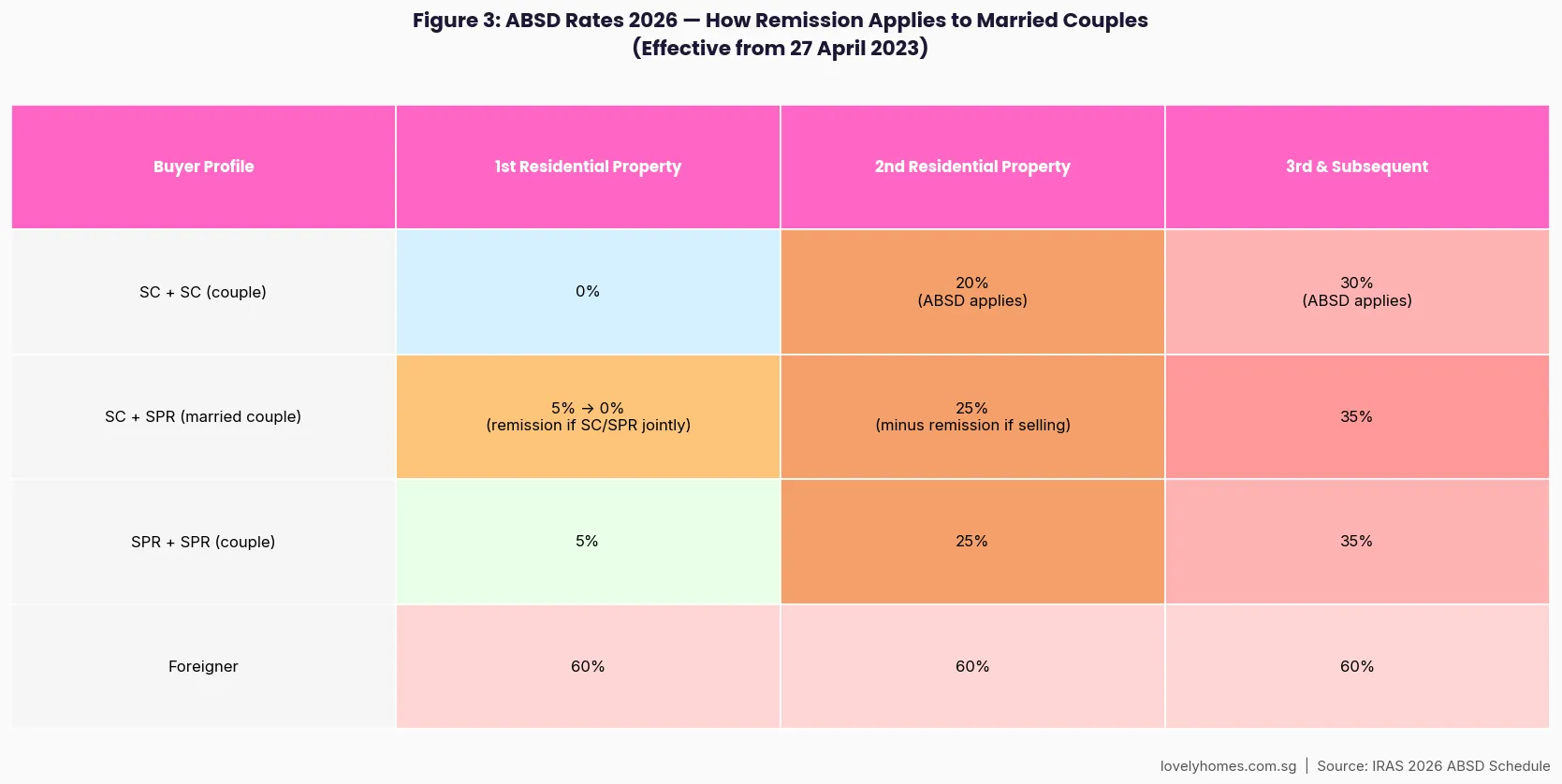
Both spouses are Singapore Citizens (SC + SC): The first residential property purchase by an SC couple is subject to 0% ABSD by default. There is no remission to claim — the rate schedule itself returns zero. Both spouses must not individually own any other residential property at the time of purchase. If one spouse already owns a residential property in their own name, the couple’s purchase is treated as a “second property” for the SC who owns one, and ABSD of 20% applies to the entire purchase price.

One spouse is an SC and the other is a Singapore Permanent Resident (SPR): The SPR-rate of 5% ordinarily applies to the first residential property purchased by an SPR. However, where the couple is legally married and both names appear on the purchase as joint buyers, IRAS provides a remission — the 5% ABSD paid upfront is refunded, resulting in a net 0% ABSD burden on the first property. The remission claim must be filed with IRAS, together with the marriage certificate and evidence that neither spouse owns any other residential property. The claim window is typically 6 months from the date of ABSD payment.

Both spouses are SPRs (SPR + SPR): There is no remission for an SPR couple buying their first property; the standard 5% ABSD applies and is not refundable.

Remission Type 2: The 6-Month Window for a Second Residential Property

This is arguably the most financially consequential ABSD remission in practice. It applies where a buyer — whether SC or SPR — already owns one residential property and wishes to purchase a replacement (i.e., upgrade or right-size) without being permanently saddled with the full 20% ABSD on the new purchase.

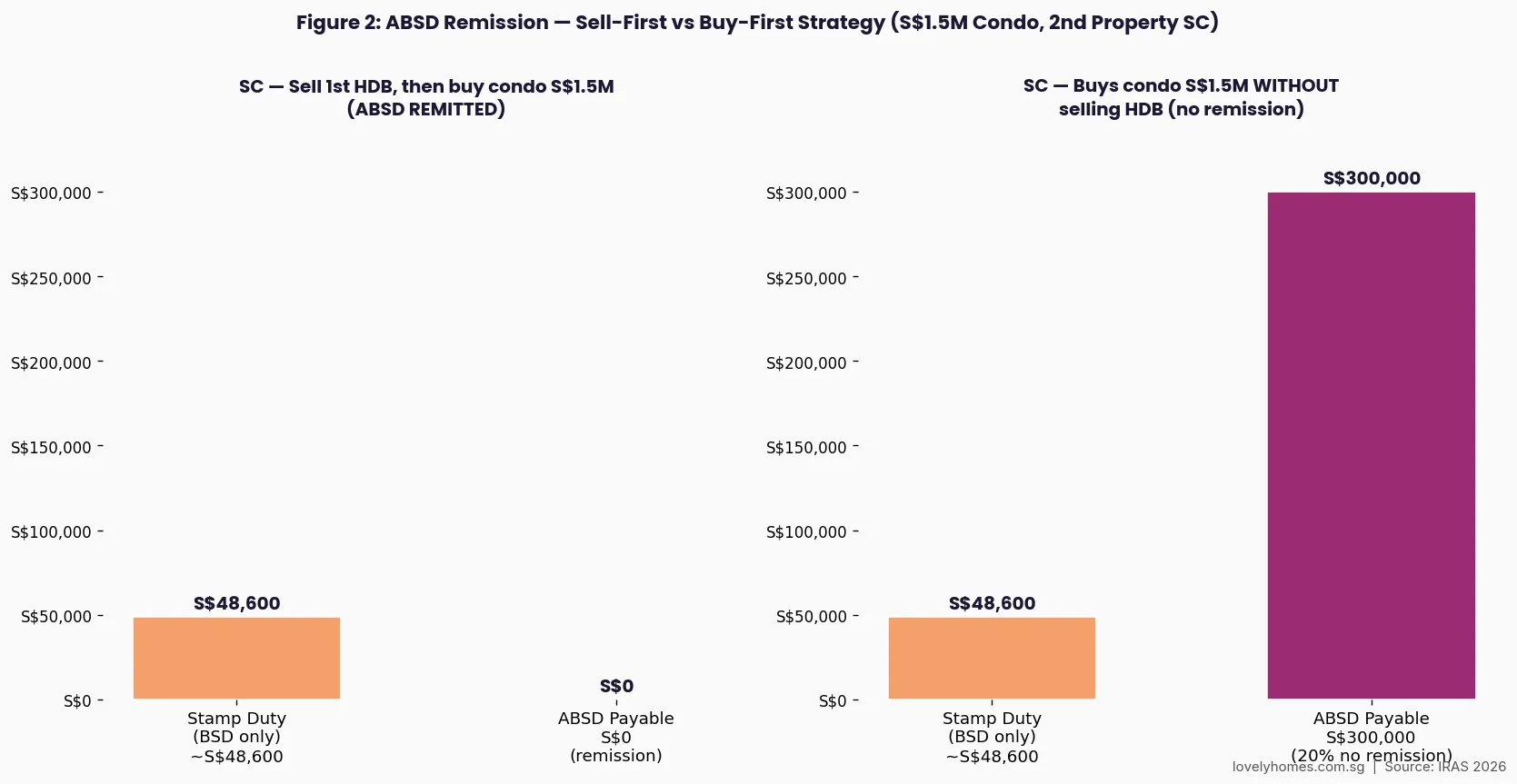
The mechanism works as follows. The buyer purchases the second property and pays ABSD upfront at the applicable rate (20% for SC, 30% for SPR). They then sell the first property within 6 months of the date of purchase (for a completed property) or within 6 months of the date the Temporary Occupation Permit (TOP) is issued (for an uncompleted unit). Once the disposal of the first property is registered, IRAS refunds the ABSD paid on the second property — subject to a successful remission claim.

This window is strictly enforced. A sale that completes even one day outside the 6-month window forfeits the entire remission. Buyers who rely on this strategy must plan carefully: factor in time to find a buyer, negotiate, and complete the conveyancing. In a slow market, the 6-month window may be uncomfortably short. A standard HDB resale transaction takes 8–14 weeks from Option to Purchase (OTP) grant to completion; a private property sale typically takes 10–12 weeks. Sellers should begin marketing the first property the moment the OTP for the new purchase is exercised.

ABSD sell-first strategy vs no remission cost comparison Singapore 2026
Figure 2: ABSD Remission — Sell-First Strategy vs No Remission (SC Buying S$1.5M Condo as 2nd Property)

Remission Type 3: Developer ABSD Remission

Housing developers in Singapore are required to pay ABSD when they purchase residential land for development. However, as a policy measure to encourage construction activity and housing supply, IRAS grants a remission of the developer ABSD — typically in the range of 25–35% of the purchase price — subject to conditions.

The primary condition is that the developer must complete the development and sell all residential units within a specified period. For sites acquired from the Government Land Sales (GLS) programme, the development must be completed and all units sold within 5 years of the date of the land purchase. For sites acquired through the open market (including en bloc sales), the timeframe is also 5 years. If the developer fails to sell all units within the window, ABSD plus 5% interest per annum becomes payable on the entire land price — a significant penalty that strongly incentivises developers to launch and sell quickly.

This is why new launches in Singapore are typically priced to sell: developers face a compounding ABSD penalty if they hold back units. Industrial-use developers face a lower 25% remission (versus up to 35% for residential developers) under a separate schedule.

Remission Type 4: SC Buying Jointly with Non-Resident Spouse

Where a Singapore Citizen is married to a foreigner (non-SPR, non-SC) and they jointly purchase a residential property, the foreigner rate of 60% ABSD would ordinarily apply to the foreigner spouse’s ownership interest. This creates a particularly punishing stamp duty burden on internationally married couples who wish to buy a home together in Singapore.

IRAS provides a remission in this specific scenario: if the property is their first jointly purchased residential property and neither spouse owns any other residential property in Singapore, the ABSD applicable to the foreigner spouse’s interest is remitted. The result is that the couple effectively pays ABSD at the SC rate for a first property — which is 0%. The claim process requires submission of marriage certificate, immigration documents, and a statutory declaration. Where the foreign spouse subsequently acquires citizenship or PR status, earlier remission claims are not affected.

ABSD rates married couples Singapore 2026 SC SPR foreigner table
Figure 3: ABSD Rates 2026 — How Remission Applies to Married Couples by Citizenship Profile (Source: IRAS)

Remission Type 5: Death of a Joint Owner

When a joint tenant dies, the surviving joint tenant automatically inherits the deceased’s share under the right of survivorship. No sale or transfer of property occurs in the legal sense — ownership vests by operation of law. IRAS acknowledges this by providing ABSD relief: the surviving joint owner is not treated as having “purchased” the share they inherit. Accordingly, no ABSD is levied on the survivor’s acquisition of the deceased’s interest through right of survivorship.

However, this relief does not extend to tenancy-in-common arrangements. Under tenancy-in-common, each owner holds a discrete, defined share of the property. On death, that share passes under the will or intestacy rules — which involves a transfer or transmission of an identifiable share. IRAS may levy ABSD on the recipient of a tenancy-in-common share if it causes them to own more than one residential property. Estate planning for property owners should account for this distinction; legal advice from a Singapore-qualified conveyancing lawyer is essential.

Remission Type 6: Trustee and Executor Remissions

Where a person holds residential property as a trustee for another (as is common in family trusts and estate planning structures), IRAS has provisions to avoid double-counting the trustee’s ownership interest when determining ABSD liability. Similarly, executors dealing with a deceased estate are generally not treated as personally owning the estate’s properties while administering them. The specific conditions and filing requirements for trust and executor remissions are fact-specific and should be confirmed directly with IRAS or a qualified property lawyer.

Summary Table: ABSD Remission at a Glance (2026)

Remission Type Who Qualifies Condition Amount Remitted
First property — SC + SPR couple SC + SPR married, both first property No other residential property held 5% (full remission to 0%)
First property — SC + Foreigner couple SC + foreign spouse, both first property No other residential property held 60% on foreign spouse’s interest
6-month sell-first window SC/SPR owning 1 property, buying replacement Dispose of 1st property within 6 months Full ABSD refund on 2nd purchase
Developer ABSD remission Licensed housing developer Complete + sell all units within 5 years Up to 35% ABSD waived on land
Death of joint tenant Surviving joint tenant Right of survivorship vests No ABSD on inherited share
Trustee/executor Property trustees and estate executors IRAS approval required Case-by-case relief

Worked Example: The 6-Month Remission Strategy in Practice

📋 Case Study: Mr & Mrs Tan — Upgrading from HDB to Condo

Profile: SC + SC married couple. Combined monthly income S$14,000. Mr Tan owns a 4-room HDB flat in Bishan, purchased 10 years ago at S$380,000 (fully paid, current market value ~S$650,000). They have fulfilled the 5-year Minimum Occupation Period (MOP).

New purchase: 2-bedroom condo in D20 Ang Mo Kio, price S$1,420,000.

Stamp duty without remission:
BSD: S$39,400 (standard — payable regardless)
ABSD (20% on 2nd property SC): S$284,000
Total stamp duty: S$323,400

Strategy — sell first, buy second: Mr Tan signs OTP for the condo on 1 August 2026. The 6-month window opens. He launches HDB resale exercise immediately, grants HDB OTP on 15 August 2026, and the HDB sale completes on 10 October 2026 — within the 6-month window. ABSD remission claim is filed with IRAS.

Outcome with remission:
BSD: S$39,400 (payable — no remission on BSD)
ABSD: S$0 (S$284,000 refunded by IRAS on successful claim)
Net stamp duty: S$39,400
Saving: S$284,000 in cash.

Note: Mr Tan must fund S$284,000 ABSD upfront at completion of the condo purchase and await refund after the HDB sale. Bridge financing or ensuring sufficient liquidity for the interim period is critical. The remission refund is typically processed by IRAS within 3–4 months of claim submission.

Why This Matters: ABSD Remission as a Cornerstone of Singapore Property Strategy

At S$284,000 on a S$1.42 million property, the difference between qualifying for the 6-month remission and missing the deadline by a single day is greater than many Singaporeans’ annual salary. No other single decision in the property purchase process — not negotiating the purchase price, not choosing the right mortgage rate — carries this magnitude of financial consequence.

ABSD remissions are therefore not simply a technical footnote to Singapore’s stamp duty framework. They are a central pillar of property planning strategy, particularly for the very large segment of HDB upgraders who constitute Singapore’s most active private property buyers. Every conveyancing lawyer in Singapore will walk clients through remission options; every financial planner working with property clients should understand the 6-month rule intimately.

By comparison, peers such as Hong Kong and Australia levy stamp duties on property purchases without equivalent remission provisions for married couples or trading-up scenarios. Singapore’s remission framework is a deliberate policy choice: it preserves the cooling effect of high ABSD rates on speculative demand while protecting genuine upgraders and owner-occupiers from punitive costs.

What Might Come Next: ABSD Policy Outlook

(This section represents editorial analysis and speculation — not IRAS or government guidance.)

Singapore’s ABSD rates have been raised five times since 2011. The April 2023 round — which doubled the SC second-property rate from 17% to 20% and raised foreigner ABSD from 30% to 60% — was the most aggressive. With the URA Q2 2026 private residential property price index showing a softening pace of growth (+0.5% QoQ versus +0.9% in Q1 2026), some market observers are beginning to speculate whether a partial relaxation of the foreigners’ 60% rate could be used as a catalyst to attract ultra-high-net-worth buyers if market conditions soften materially. The government has historically been cautious about signalling such relaxations prematurely, as the announcement effect can itself stimulate demand.

For remissions specifically, the 6-month window has been in place since 2013 and has survived multiple ABSD rate revisions. Its continued existence reflects the government’s view that genuine owner-occupier upgrading is a socially desirable activity. Any future tightening would most likely come through rate adjustments rather than removal of the remission mechanism itself.

Frequently Asked Questions

Can I claim the 6-month ABSD remission if I am buying an uncompleted new launch?

Yes, but the 6-month window for an uncompleted purchase runs from the date of issue of the Temporary Occupation Permit (TOP), not from the date you sign the Option to Purchase (OTP) or the Sale and Purchase Agreement (S&P). This means you may have several years between signing the S&P and the start of your 6-month window, giving you ample time to sell your existing property. However, you must still pay the ABSD upfront at completion of the new purchase and claim the refund after the existing property is sold. Confirm the expected TOP date with the developer before committing to this strategy.

What happens if I fail to sell my first property within 6 months?

The ABSD remission is forfeited entirely. IRAS does not grant extensions or partial remissions for late disposals. In practice, this means you permanently bear the full ABSD cost on the second property. If the 6-month deadline is at serious risk — for example, due to an unsuccessful resale attempt — some buyers resort to transferring the first property to a family member. However, this may itself trigger ABSD and additional buyer’s stamp duty on the transferee, and must be evaluated carefully with legal and tax advisers before taking action.

My spouse is a foreigner. Can we buy our first home together in Singapore and claim ABSD remission?

Yes, provided you are legally married (Singapore-registered marriage or a foreign marriage registered with the Registry of Marriages or Civil Marriages in Singapore), neither of you owns any other residential property in Singapore, and the property is intended as your primary family residence. The 60% foreigner ABSD applicable to your spouse’s interest is remitted, resulting in an effective ABSD rate of 0% on the purchase. You must file the remission claim with IRAS and submit supporting documents including the marriage certificate, declarations of no other residential property ownership, and your spouse’s immigration documents.

Does ABSD remission apply to HDB flats, or only private property?

ABSD does not apply to the purchase of a new HDB flat directly from HDB — HDB sales are exempt from ABSD regardless of the buyer’s profile. ABSD applies to resale HDB transactions and all private residential purchases. So if you are buying a resale HDB flat as a second property (having already sold your first), ABSD would ordinarily apply; the 6-month remission would apply if you had sold your first property within the qualifying window. In practice, most Singapore Citizen HDB resale buyers purchasing as a second property structure the sale-and-buy sequence to avoid ABSD entirely — the remission framework is essential to making this work.

How long does IRAS take to process an ABSD remission refund?

IRAS targets processing ABSD remission refund claims within 3 to 4 months of a complete claim submission. The process requires you to file IRAS Form SD-ABSD-REM (or the equivalent digital filing through myTax Portal) and attach all supporting documents — including the conveyancing documents for both the purchase and the disposal, proof of marriage (where applicable), and statutory declarations. Incomplete submissions will delay processing. If your remission claim involves a complex scenario — such as a trust or an estate — allow for up to 6 months. IRAS will not pay interest on delayed refunds, so accuracy and completeness at the time of initial filing are important.

Can I avoid ABSD entirely if I decouple ownership before buying a second property?

Decoupling — where one spouse transfers their share of a jointly owned property to the other, so that one spouse holds the property solely and the other is “freed up” to buy a new property as a first-time buyer — was a popular strategy before the April 2023 ABSD hikes. It remains technically legal, but the transferring spouse’s share will attract ABSD at the rate applicable to the receiving spouse (who is acquiring an additional ownership interest). Whether decoupling makes financial sense now depends on the current valuation of the existing property, the ABSD rate applicable, the legal costs of transfer, and the price of the intended second property. Detailed worked-number analysis with a qualified property lawyer is strongly recommended before proceeding.

Is ABSD remission the same as ABSD waiver?

Not precisely. A “remission” technically means the ABSD is paid upfront and then refunded upon meeting conditions — as in the 6-month sell-first window. A “concession” or “exemption” means the ABSD is not charged in the first place, as with the SC couple buying their first property at 0%. The practical difference matters for cash flow: under the remission mechanism, buyers must have sufficient liquidity to pay the full ABSD at completion and hold those funds in limbo until the refund arrives. Where ABSD quantum is S$200,000 or more, this creates a real bridging finance consideration. Discuss with your banker whether a bridging loan facility is available to cover the ABSD pending the remission refund.

Disclaimer: This article is produced for general informational purposes only and does not constitute legal, tax, or financial advice. ABSD rates, remission conditions, and filing requirements are set by the Inland Revenue Authority of Singapore (IRAS) and may be updated at any time. Readers should verify all information directly with IRAS at www.iras.gov.sg, consult the Stamp Duties Act (Cap. 312), and obtain advice from a qualified Singapore-licensed conveyancing solicitor and property tax adviser before making any property purchase decisions. LovelyHomes.com.sg is an independent editorial platform and is not affiliated with IRAS, HDB, URA, MAS, or any government body.

×

Click anywhere to close

Using CPF Ordinary Account for Property in Singapore: Complete Guide 2026

Using CPF Ordinary Account for Property in Singapore: Complete Guide 2026

Quick Answer — Key Takeaways

  • CPF Ordinary Account (OA) funds can be used for the down payment, monthly mortgage instalments, stamp duty, and legal fees on eligible Singapore properties.
  • Your usable CPF is capped by two limits: the Valuation Limit (VL = lower of purchase price or market value) and the Withdrawal Limit (WL = 120% of VL).
  • Every dollar of CPF used accrues interest at 2.5% per annum, compounded monthly — this must be returned to your CPF (not cash) when you sell.
  • CPF can be used for HDB flats, private condominiums, and Executive Condominiums (ECs), but not for commercial or industrial properties.
  • For older leasehold properties, CPF usage is pro-rated or disallowed if the remaining lease does not cover the youngest buyer to age 95.
  • If you are aged 55 or older, you may only use CPF for property after setting aside the Basic Retirement Sum (BRS) in your Retirement Account (RA).
  • The accrued interest obligation can significantly reduce your net cash proceeds on sale — the worked example below shows the full mathematics.

What Is CPF OA and Why Does It Matter for Property?

The Central Provident Fund (CPF) Ordinary Account is one of three CPF sub-accounts held by every Singapore citizen and permanent resident. Administered by the CPF Board, the OA earns a minimum interest rate of 2.5% per annum (with a floor of 3.5% on the first S$20,000 of combined CPF savings under the Extra Interest policy, subject to conditions), making it one of the highest-yielding risk-free savings instruments in Singapore.

For most Singaporeans, CPF OA constitutes the single largest source of accessible funds outside their take-home pay. The rules governing how OA savings may be deployed for property are therefore among the most practically important aspects of personal finance in Singapore. Understanding them — including the less-publicised accrued interest obligation — is essential before committing to any property purchase.

The CPF Board regulates all property-related OA withdrawals under the CPF Act and the Housing Withdrawal Limits framework. The relevant rules apply to purchases from Housing and Development Board (HDB), private developers, and resale sellers alike.

What Can You Use CPF OA For?

CPF OA funds may be applied to four categories of property-related expenditure, subject to the limits described in the next section.

CPF OA usage table 2026 - down payment monthly instalments stamp duty accrued interest
Figure 1: CPF OA usage — what you can and cannot pay for. OA funds cover down payment, monthly loan instalments, stamp duty, and legal fees; commercial property and non-SC buyer shares are excluded.

Down Payment. For an HDB loan, there is no mandatory cash down payment — the full 10% option fee and 10% balance downpayment required by HDB may be funded from OA. For a bank loan on an HDB flat, the Loan-to-Value (LTV) ceiling is 75%, requiring a 25% downpayment of which at least 5% must be cash; the remaining 20% may come from OA. For private property with a bank loan at 75% LTV, the 25% downpayment may be funded entirely from OA subject to the Valuation Limit.

Monthly Mortgage Instalments. As long as the outstanding loan amount plus accrued CPF interest used does not exceed the Withdrawal Limit, OA may be applied monthly to reduce or eliminate your cash instalment. Many buyers use a combination of OA and cash once OA is running low.

Buyer’s Stamp Duty (BSD). BSD, payable to the Inland Revenue Authority of Singapore (IRAS) within 14 days of the Option to Purchase being exercised, may be paid from OA. On a S$750,000 HDB resale flat, BSD is S$18,600 — a substantial saving in upfront cash.

Legal and Conveyancing Fees. Solicitor fees for the purchase (typically S$2,000–S$3,500 for HDB, S$3,000–S$6,000 for private) may be paid from OA up to the actual amount charged.

How Much CPF Can You Use? Valuation Limit and Withdrawal Limit

CPF property withdrawals are governed by two thresholds set by the CPF Board:

  • Valuation Limit (VL): the lower of (a) the purchase price and (b) the market value assessed at the date of purchase. For new HDB BTO flats, the VL is the purchase price. For resale properties, the VL is whichever is lower — a resale flat purchased above valuation does not allow additional CPF withdrawals above the CPF Board’s assessed value.
  • Withdrawal Limit (WL): 120% of the Valuation Limit. Once total CPF withdrawals (including accrued interest) equal the WL, no further CPF may be used for that property. At that point, all further mortgage instalments must be paid in cash.

Example: a resale HDB flat purchased at S$680,000 where the CPF Board’s assessed value is S$660,000 gives a VL of S$660,000 and a WL of S$792,000. If you have used S$550,000 CPF principal and S$180,000 accrued interest (total S$730,000), you still have S$62,000 of headroom before hitting the WL.

The Accrued Interest Obligation — The Hidden Cost

This is the aspect of CPF property usage that catches many owners off guard. Every dollar of CPF withdrawn from your OA for property continues to earn the 2.5% OA interest rate as though it had never left. The CPF Board records the principal withdrawn plus the compound interest that would have accrued had the funds remained in OA. This running total is your accrued interest obligation.

When you sell the property, the full amount — principal plus accrued interest — must be refunded to your CPF account. It does not go to your bank account. You receive cash only from whatever is left after repaying the mortgage, returning CPF, and paying transaction costs.

CPF accrued interest compounding chart 2026 - principal and interest to return on HDB sale
Figure 2: Accrued interest grows at 2.5% p.a. on S$500K of CPF used. After 25 years, approximately S$172K in additional interest must be returned to CPF on top of the S$500K principal. The right panel illustrates net cash proceeds for an HDB sold at S$1.2M.

At 2.5% compounded monthly over 25 years, a S$500,000 CPF withdrawal balloons to approximately S$672,000 that must return to CPF — a S$172,000 obligation that reduces your cash-in-hand on sale. This is not a penalty; the money goes back to your own CPF account and continues earning interest. But it profoundly affects the cash you receive at the point of sale, which matters for upgraders who need proceeds to fund the next purchase.

CPF Usage by Property Type

The rules differ slightly depending on the type of property being purchased.

HDB BTO Flats. Citizens buying a new BTO flat enjoy the most straightforward CPF access. Down payment, BSD, legal fees, and monthly HDB loan instalments may all be paid from OA. There is no minimum cash requirement if you take an HDB loan.

HDB Resale Flats. CPF may be used in the same way for resale flats, subject to the Valuation Limit. If you pay a Cash-over-Valuation (COV) premium above the assessed value, that excess cannot be funded from CPF — it must be cash.

Private Condominiums and ECs. Bank loans for private property and ECs follow the same VL/WL framework. The minimum cash requirement of 5% of the purchase price still applies for first-time buyers under the Mortgage Servicing Ratio (MSR) rules for ECs, but the remainder of the 25% downpayment may come from OA. For private condominiums, only the Total Debt Servicing Ratio (TDSR) applies — there is no MSR constraint.

Executive Condominiums. ECs are treated as private property from the CPF perspective, but buyers must also satisfy HDB’s income ceiling (S$16,000 per month for standard ECs) and eligibility criteria. CPF usage follows the standard private property rules.

Leasehold Properties and the Age-95 Rule

Since 1 May 2019, CPF usage for properties with shorter remaining leases has been restricted under the CPF Housing Withdrawal Limits for properties with shorter leases framework. The core principle is that the lease must cover the youngest buyer to at least age 95 to allow unrestricted CPF usage.

If the remaining lease covers the youngest buyer to exactly age 95, full CPF usage up to the WL is allowed. If it falls short, the CPF usage cap is pro-rated in proportion to the remaining lease as a fraction of the age-95 benchmark. If the remaining lease at purchase is below 20 years, CPF cannot be used at all. This rule particularly affects older private condominiums and some HDB flats approaching the end of their 99-year or 103-year leases.

CPF OA eligibility matrix 2026 - which properties can use CPF Singapore
Figure 3: CPF OA eligibility matrix — leasehold restrictions, commercial exclusions, and joint-purchase rules summarised by property type.

Using CPF After Age 55

When a CPF member turns 55, a Retirement Account (RA) is created by transferring funds from the OA and Special Account. To continue using OA for property after age 55, the member must first set aside the Basic Retirement Sum (BRS) in the RA. For 2026, the BRS is S$106,500, the Full Retirement Sum (FRS) is S$213,000, and the Enhanced Retirement Sum (ERS) is S$319,500. Members who have pledged their property may use a lower threshold, but the pledge reduces eventual CPF LIFE payouts. Any OA balance above the BRS threshold remains available for property use.

Summary Table

Item HDB (Loan / Bank) Private Condo / EC Key Restriction
Down Payment Up to 100% OA (HDB loan); 20% OA + 5% cash (bank loan) Up to 20% OA + 5% cash min VL applies
Monthly Instalment Full from OA (up to WL) From OA (up to WL) Cash after WL hit
BSD From OA From OA Pay within 14 days of OTP
Legal Fees From OA From OA Capped at actual fees
Accrued Interest Rate 2.5% p.a. compounded monthly 2.5% p.a. compounded monthly Returned to CPF on sale
Valuation Limit Lower of price/value Lower of price/value COV must be cash
Withdrawal Limit 120% of VL 120% of VL No CPF use after WL hit
After Age 55 OA above BRS (S$106,500 in 2026) OA above BRS RA must be funded first
Leasehold <60yr remaining Pro-rated by age-95 rule Pro-rated by age-95 rule Nil if <20yr remaining
Commercial / Industrial Not permitted Not permitted Residential property only

Worked Example: Mr and Mrs Lim — HDB Resale in Bishan 2026

Mr and Mrs Lim (both Singapore Citizens, aged 32 and 30) purchase a 5-Room HDB resale flat in Bishan for S$780,000. The CPF Board assesses the market value at S$770,000, giving a Valuation Limit of S$770,000 and a Withdrawal Limit of S$924,000.

They take a bank loan at 75% LTV: loan S$585,000 at 3.0% p.a. over 25 years = S$2,773 per month. The 25% downpayment is S$195,000, of which 5% (S$39,000) must be cash; the remaining S$156,000 comes from their combined OA.

Item Amount (S$) Source
Down Payment (20%) 156,000 CPF OA
Down Payment (5% min cash) 39,000 Cash
BSD (1%x180K + 2%x180K + 3%x390K) 19,500 CPF OA
Legal Fees (est.) 3,200 CPF OA
Total CPF at Completion 178,700

After 15 years, assuming the Lims have used their combined OA consistently to service the mortgage, total CPF withdrawn is approximately S$498,000 (principal instalments plus upfront costs). At 2.5% p.a. compounded monthly, accrued interest over 15 years on the average CPF balance used is approximately S$112,000, bringing total CPF to return to S$610,000.

If the flat sells for S$1,050,000 (appreciation of approximately 35% over 15 years), the net position is as follows. Outstanding loan balance after 15 years of a 25-year mortgage: approximately S$255,000.

Item Amount (S$)
Sale Price 1,050,000
Less: Outstanding Loan Balance (255,000)
Less: Agent Commission (1%) (10,500)
Less: Legal Fees (conveyancing) (2,500)
Less: CPF Refund (principal plus accrued interest) (610,000)
Net Cash Proceeds 172,000
CPF Returned to Account (available for next property) 610,000

The S$172,000 cash proceeds plus S$610,000 returned to CPF gives the Lims a total of S$782,000 to deploy toward their next property — roughly equivalent to their original property purchase price. This illustrates how CPF recycling works across property transactions.

Why This Matters: The OA Rate vs. Mortgage Rate Decision

With CPF OA earning 2.5% and current bank mortgage rates ranging from 2.8% to 3.3% (3-month compounded SORA plus bank spread as of mid-2026), the gap between CPF earning rate and borrowing cost has narrowed substantially from the peaks of 4% and above seen in 2023–2024. This changes the calculus on whether to maximise CPF usage or conserve OA for retirement. When borrowing costs exceed OA returns by more than 1%, deploying CPF to reduce the loan balance is mathematically superior. When rates are close or below 2.5%, retaining OA to compound for retirement may be more advantageous.

The Monetary Authority of Singapore (MAS) and the CPF Board periodically review the OA rate floor. Currently, the OA floor of 2.5% has been maintained since 1 January 1999 as a legislative minimum under the CPF Act, providing a reliable benchmark for planning.

What Might Come Next

CPF housing policy tends to evolve incrementally rather than through sudden overhauls. The most likely near-term adjustments involve the leasehold age-95 rule, which may be extended or refined as Singapore’s ageing housing stock becomes a more pressing policy issue. The CPF Advisory Panel’s 2016 recommendations (on which the BRS/FRS/ERS structure is based) are due for periodic review, and the BRS itself rises by approximately 3.5% annually, making future property top-up obligations modestly more demanding for older buyers each year. Buyers considering leveraging CPF for property in 2027 and beyond should monitor the CPF Board’s annual circular for BRS adjustments, typically published each January.

Frequently Asked Questions

Can I use CPF OA to pay the Additional Buyer’s Stamp Duty (ABSD)?

No. CPF OA cannot be used to pay ABSD. ABSD is a separate stamp duty charge levied by IRAS on top of the standard BSD, and the CPF Board’s Housing Withdrawal Scheme only permits OA withdrawals for BSD, not ABSD. ABSD must be paid in cash. On a second property purchase in 2026, a Singapore Citizen pays 20% ABSD — on a S$1.2M condo, that is S$240,000 in cash that cannot be sourced from CPF. This is one reason why the ABSD is a significant barrier to property investment for most CPF-dependent buyers. See our complete ABSD guide for full rate tables.

What happens to CPF accrued interest if I never sell the property?

If you never sell during your lifetime, the accrued interest obligation forms part of your estate. Upon your death, the property may be transferred to beneficiaries, but any CPF used must still be accounted for under the CPF Nomination and Housing Withdrawal Scheme. Beneficiaries who receive the property inherit both the asset and the outstanding CPF charge — if they subsequently sell, the full principal plus accrued interest still returns to the deceased’s CPF account (and is distributed per the nomination or Public Trustee rules). For a detailed discussion of property inheritance mechanics, see our Singapore Property Succession Guide 2026.

Can I use my spouse’s CPF OA for my property?

Yes, if you are co-owners on the property title. Both owners listed on the title deed may each deploy their individual OA toward the same property — the Valuation Limit and Withdrawal Limit apply to the property as a whole, not to each individual. The CPF Board tracks each member’s contribution separately. If one party’s OA is exhausted first, the other’s OA can continue funding monthly instalments. A spouse who is not listed on the title deed cannot use their CPF for that property. This is why adding a co-owner with strong CPF reserves is a common strategy for financing larger purchases.

Can a Singapore Permanent Resident (SPR) use CPF OA for property?

Yes. SPRs contribute to CPF and are eligible to use their OA for property under the same framework as Singapore Citizens, with two key differences: SPRs cannot purchase new HDB BTO flats (they may only buy resale HDB flats after obtaining SPR status for at least 3 years), and SPRs pay higher ABSD rates (5% on first property purchase as of 2026, versus 0% for SCs). Within those eligibility constraints, the OA usage rules — Valuation Limit, Withdrawal Limit, accrued interest, leasehold restrictions — apply identically to SPRs and SCs.

Should I maximise CPF OA use or pay more cash to reduce my loan?

The answer depends on the spread between your mortgage rate and the OA rate. If your bank mortgage rate is 3.0% and your OA earns 2.5%, deploying OA saves you 3.0% but foregoes 2.5% — a net benefit of 0.5% per annum. If rates fall below 2.5% (which occurred briefly in 2021), retaining OA is mathematically better. Beyond pure arithmetic, CPF provides a capital buffer for unexpected liquidity needs (subject to CPF Act withdrawal rules after age 55), whereas cash reduces the loan balance immediately. Most financial advisers in Singapore recommend a hybrid approach: use OA for monthly instalments while maintaining a cash buffer of 6–12 months of mortgage payments for emergencies.

Can I top up my CPF OA with cash specifically to pay for property?

Not directly. You cannot make a voluntary cash top-up designated for property payments — CPF top-ups go to the Special Account (for retirement savings) or Retirement Account (after age 55), not the OA. However, if you make a Voluntary Contribution to CPF (splitting across OA/SA/Medisave in proportion to the prevailing allocation rates), the OA portion increases and becomes available for property use in the normal way. The 2026 allocation rate for members below 35 is 23% of wages to OA out of a total 37% CPF contribution rate. Top-ups and their tax-relief implications are governed by IRAS guidelines.

Related Articles

Disclaimer

This article is intended for general informational purposes only and does not constitute financial, legal, or investment advice. CPF rules, interest rates, retirement sums, and withdrawal limits are subject to change — readers should verify all figures with the CPF Board at cpf.gov.sg, HDB at hdb.gov.sg, and IRAS at iras.gov.sg before making any property or financial decisions. Consult a licensed mortgage broker, financial adviser, or conveyancing solicitor for advice tailored to your personal circumstances.

Translate »