Singapore HDB Upgrading Guide 2026: Costs, ABSD, CPF and Step-by-Step Process

Singapore HDB Upgrading Guide 2026: Costs, ABSD, CPF and Step-by-Step Process

Quick Answer: HDB Upgrading Guide 2026

  • Who can upgrade? SC and PR households who have fulfilled the HDB Minimum Occupation Period (MOP) — 5 years for standard flats, 10 years for Plus/Prime flats classified from October 2024.
  • Typical upgrade path: Sell HDB first (avoid ABSD), then buy a private condo. Alternatively, buy first and claim ABSD remission within 6 months of selling.
  • ABSD on 2nd property: SC pays 20%, PR pays 30%, foreigners 65%. Selling HDB first means the condo is your 1st private purchase — 0% ABSD for SC couples.
  • Upgrader costs at S$1.35M condo: BSD ~S$37,200 + agent ~S$27,000 (selling + buying). No ABSD if HDB is sold first.
  • CPF: All CPF used for HDB (principal + 2.5% p.a. accrued interest) must be refunded to your CPF OA on sale. Net cash proceeds fund the condo down payment.
  • TDSR cap: 55% of gross monthly income. For a S$1.35M condo at 30-year tenor, monthly repayment at 3.0% is ~S$5,690 — household income of at least S$10,345/mth needed.
  • Sell-first vs buy-first: Sell-first saves 20% ABSD but carries gap-period risk. Buy-first triggers ABSD upfront, claimable back within 6 months of HDB sale completion.

For many Singaporean families, the journey from an HDB flat to a private property is the single largest financial milestone of their lives. The HDB upgrading guide process — commonly called “upgrading” — involves selling your public housing flat and buying a condominium, landed property, or Executive Condominium (EC) once your Minimum Occupation Period (MOP) is met. In 2026, upgrading remains very much alive: URA Q1 2026 data shows Outside Central Region (OCR) condo prices up 2.2% quarter-on-quarter, and HDB resale volumes continue to provide upgraders with strong equity to deploy.

Upgrading is simultaneously a financial decision, a tax-planning exercise, and a lifestyle transition. This guide, updated for Singapore HDB upgrading 2026, covers everything from MOP eligibility and ABSD implications to working through the exact stamp duties, CPF obligations, and loan calculations that determine whether the numbers stack up for your household.
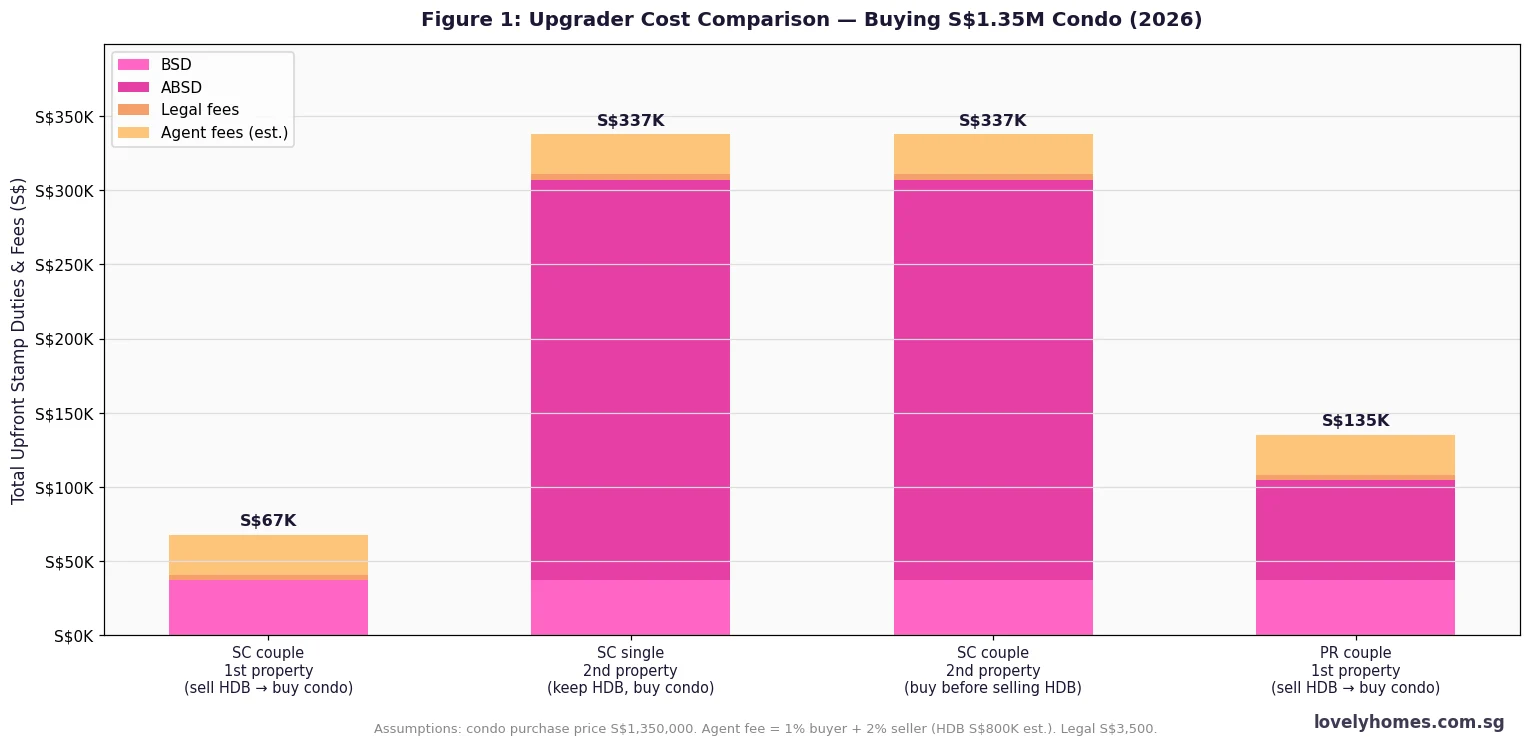
Upgrader cost comparison chart showing BSD, ABSD and fees for 4 buyer profiles at S$1.35M condo Singapore 2026
Figure 1: Upgrader cost comparison — buying a S$1,350,000 condo under four common profiles. SC couples who sell their HDB first face only BSD + agent fees, with zero ABSD. (Source: IRAS BSD schedule; author calculations.)

Who Is Eligible to Upgrade from HDB?

The primary eligibility gate is the Minimum Occupation Period administered by the Housing & Development Board (HDB) under the Housing & Development Act. For most HDB flats bought on the open market or through BTO exercises before October 2024, the MOP is 5 years from the date the keys are collected. For Plus and Prime flats classified under the new framework introduced in October 2024, the MOP is 10 years. If you purchased a Prime Location Public Housing (PLH) flat before October 2024, the MOP for that flat is also 10 years.

During the MOP, you cannot sell the flat, rent out the entire flat, or acquire any private residential property in Singapore or overseas. Once the MOP is fulfilled, these restrictions are lifted — you are free to sell your HDB and buy private property simultaneously or in sequence. Singapore Citizens (SC) have the most favourable ABSD profile for this transition; Permanent Residents (PR) and foreigners face significantly higher stamp duties on private property acquisition.

The Core Upgrade Decision: Sell-First or Buy-First?

The most consequential choice in the upgrading journey is sell-first versus buy-first. Both strategies are legal and used regularly; the right answer depends on your household’s liquidity, risk appetite, and the current market cycle.

Under sell-first, you obtain an Option to Purchase (OTP) for your HDB buyer, complete the HDB sale, then use the proceeds to exercise an OTP on your chosen condo. Because your HDB is sold before you acquire private property, the condo is treated as your first private residential purchase — 0% ABSD for SC couples, 5% for PRs. The downside is a gap period between vacating your HDB and taking possession of the condo (typically 3–6 months if buying resale, or 3–5 years if buying a new launch off-plan).

Under buy-first, you exercise the condo OTP before completing the HDB sale. Because you momentarily own both properties, IRAS treats the condo as a second property and levies ABSD upfront — 20% for SC couples at the time of writing. The Inland Revenue Authority of Singapore (IRAS), however, provides a ABSD remission window of 6 months from the date the condo is purchased (or the date the condo is completed, for new launches). If you sell and complete the HDB transfer within that window, 20% ABSD is refunded in full. If you miss the 6-month window, the ABSD is forfeited.
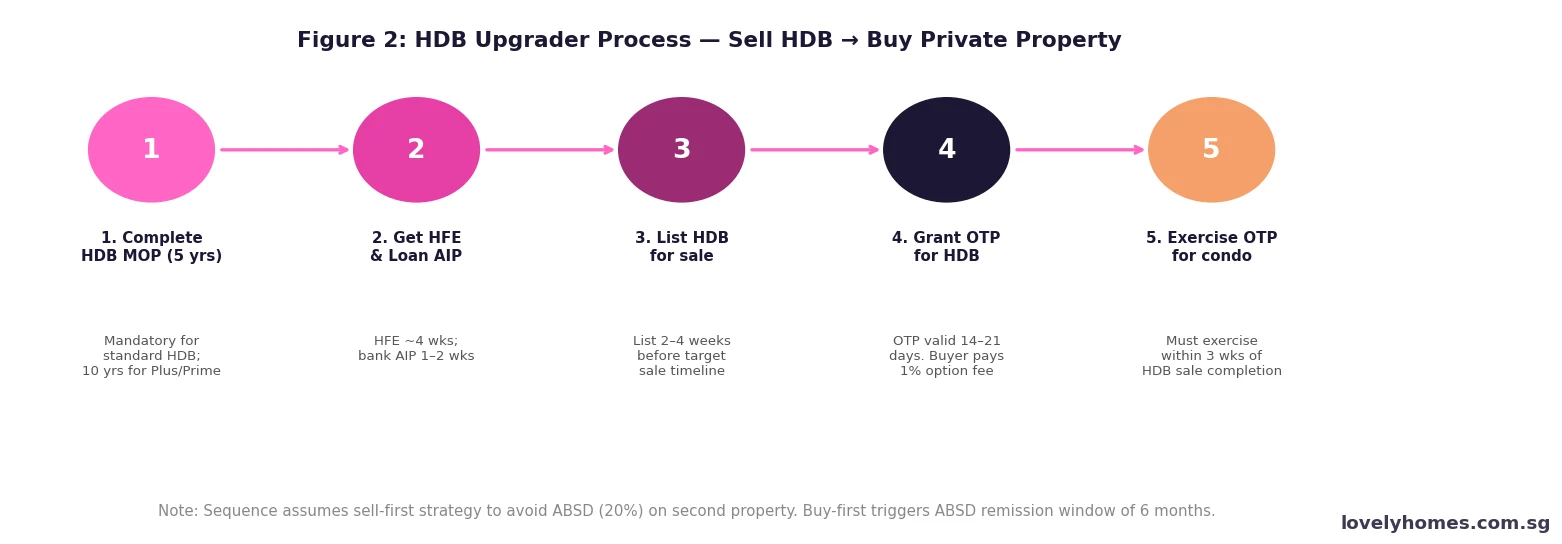
HDB upgrader 5-step process timeline from MOP completion to condo purchase Singapore 2026
Figure 2: HDB upgrader process — 5 steps from MOP fulfilment to condo purchase (sell-first strategy). Completing the HDB sale before exercising the private property OTP eliminates ABSD exposure entirely for SC couples. (Source: HDB, IRAS.)

Stamp Duties: BSD, ABSD and Seller’s Stamp Duty

Stamp duties administered by IRAS are the biggest variable cost in any upgrading exercise. Three taxes are relevant.

Buyer’s Stamp Duty (BSD) is payable by the condo purchaser on a slab-rate schedule: 1% on the first S$180,000, 2% on the next S$180,000, 3% on the next S$640,000, 4% on the next S$500,000, 5% on the next S$1,500,000, and 6% on amounts above S$3,000,000. For a S$1,350,000 purchase, BSD works out to S$37,200.

Additional Buyer’s Stamp Duty (ABSD) is levied on the acquisition of private residential property. The 2026 ABSD rates, effective since 27 April 2023, are: SC buying 1st property — 0%; SC buying 2nd property — 20%; SC buying 3rd or subsequent — 30%. For PR buying 1st — 5%; 2nd — 30%. Foreigners — 65% (with limited exemptions for nationals of countries with FTA provisions). If you sell your HDB first, your condo purchase is your 1st private property and you pay 0% ABSD.

Seller’s Stamp Duty (SSD) does not apply to HDB flats (HDB imposes its own MOP rules instead). SSD applies to private residential properties sold within 3 years of acquisition: 12% in year 1, 8% in year 2, 4% in year 3. If you are buying a new launch condo off-plan, SSD starts running from the date you exercise the OTP, not the date of key collection.

Upgrader Stamp Duty Summary

Scenario BSD (S$1.35M condo) ABSD SSD Total Duties
SC couple, sell HDB first (condo = 1st private) S$37,200 0% Nil (hold >3 yrs) S$37,200
SC couple, buy-first + remission (sell HDB within 6 mths) S$37,200 20% → refunded Nil S$37,200 net
SC couple, buy-first — miss 6-mth window S$37,200 S$270,000 (20%) Nil S$307,200
SC single, keep HDB + buy condo (2nd property) S$37,200 S$270,000 (20%) Nil S$307,200
PR couple, sell HDB first (condo = 1st private) S$37,200 S$67,500 (5%) Nil S$104,700
PR couple, buy-first (2nd property, 30%) S$37,200 S$405,000 Nil S$442,200

Worked Example: The Tan Family Upgrade

Mr and Mrs Tan are Singapore Citizens, joint owners of a 5-room HDB flat in Tampines purchased in January 2019 at S$620,000. Their combined gross monthly income is S$14,000. The flat is MOP-cleared in January 2024. In Q1 2026, they list the flat at S$820,000 and receive an offer.

Step 1 — Net proceeds from HDB sale. Outstanding HDB loan at point of sale: S$280,000. CPF drawn (principal + 2.5% p.a. accrued interest over 7 years): S$180,000 (principal) + S$33,600 (accrued interest) = S$213,600. Agent commission at 2%: S$16,400. Legal fees (seller): S$2,800. Net calculation: S$820,000 − S$280,000 (loan) − S$213,600 (CPF refund) − S$16,400 (agent) − S$2,800 (legal) = net cash S$307,200. The S$213,600 is returned to the Tans’ CPF OA and is available for reuse on the condo purchase.

Step 2 — Condo purchase. The Tans target a 3-bedroom OCR condo at S$1,450,000. BSD: S$40,600. Agent (buyer): S$14,500 (1%). Legal (purchaser): S$3,500. Total acquisition costs: S$58,600. CPF OA balance after HDB refund: S$213,600 + regular contributions ≈ S$230,000 available. Minimum cash down at LTV 75%: 5% = S$72,500 cash + 20% CPF/cash = S$290,000 combined. Total down payment: S$362,500. Of this, S$230,000 from CPF, S$132,500 from cash. Bank loan: S$1,087,500 at 3.0% for 30 years → monthly repayment S$4,584. TDSR: S$4,584 ÷ S$14,000 = 32.7% — well within the 55% cap.

Cash position check: Net cash from HDB sale S$307,200 less cash down S$132,500 less acquisition costs S$58,600 = surplus cash S$116,100. The Tans proceed comfortably.
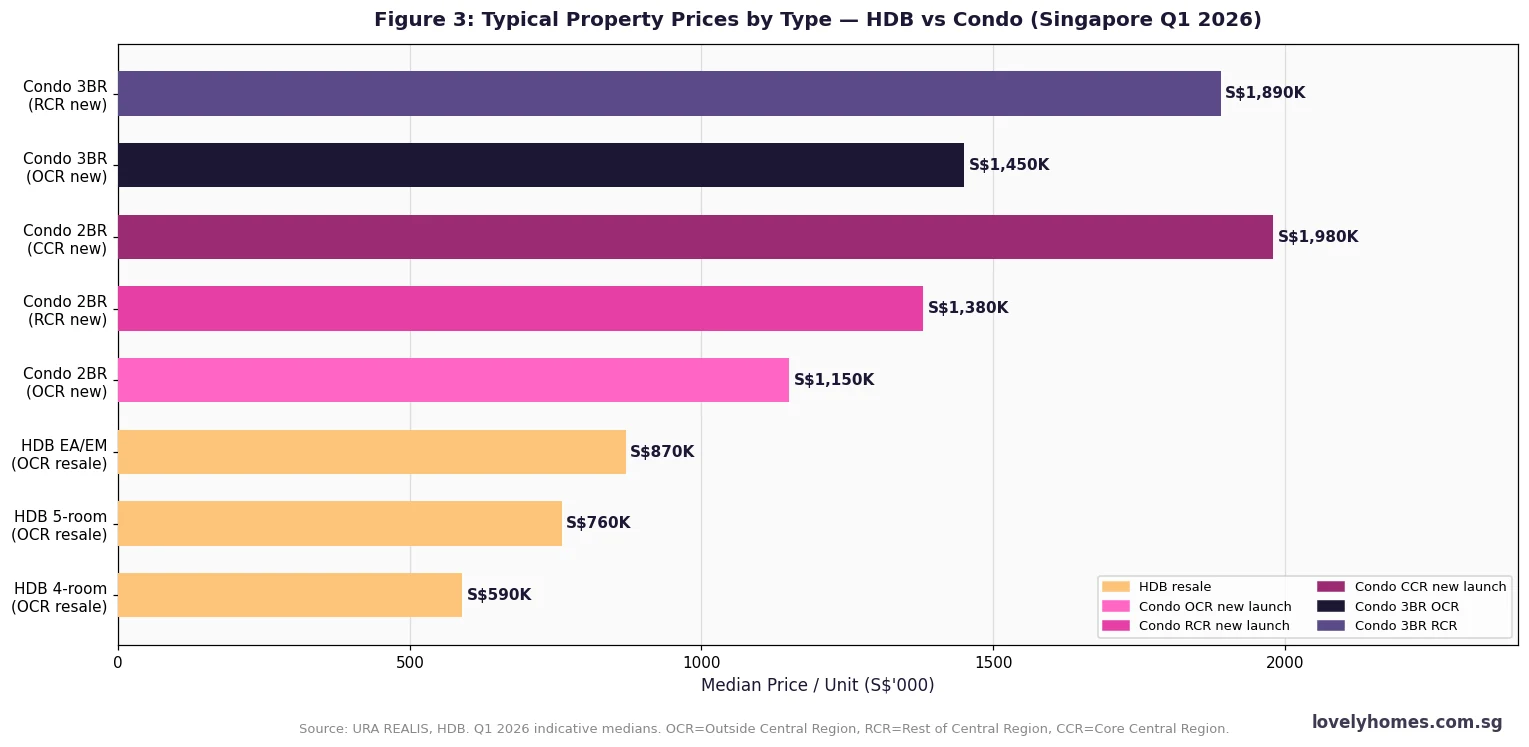
Singapore property price comparison HDB resale versus new launch condo by region Q1 2026
Figure 3: Typical unit prices by property type and region — HDB resale versus condominium new launches, Singapore Q1 2026. OCR condos remain the most accessible rung for HDB upgraders. (Source: URA REALIS, HDB.)

CPF in the Upgrading Equation

CPF is both your biggest asset and the most misunderstood element of the upgrading calculation. When you sell your HDB, the Central Provident Fund Board (CPF Board) requires you to return to your CPF OA the full amount withdrawn — principal plus accrued interest at 2.5% per annum, compounded annually. This refund is mandatory regardless of whether you have an outstanding mortgage.

The good news: the money does not disappear. It goes back into your CPF OA, where it can immediately be reused for the private property purchase (BSD, initial down payment, or progressive payments on a new launch). The CPF Withdrawal Limits on private property are governed by the Valuation Limit (VL) and the Withdrawal Limit (WL): you can use CPF OA up to the VL (property market value or purchase price, whichever is lower) freely, and up to 120% of VL if the property’s remaining lease covers the youngest buyer to age 95.

Why Upgrading Still Makes Financial Sense in 2026

Three structural factors continue to make the HDB-to-private upgrade compelling. First, HDB resale prices have risen 41% since Q1 2019 (RPI 153.2 → 216.3 as of Q1 2026), materially increasing the equity pool available to upgraders. A household that bought a 4-room HDB in an OCR town for S$450,000 in 2018 may now realise S$620,000–S$680,000 on sale — generating S$150,000–S$200,000 in net equity above the original purchase price.

Second, OCR condo prices have appreciated 73% since Q1 2019, but entry-level 2-bedroom units in OCR developments remain accessible at S$1.0M–S$1.3M for resale or S$1.15M–S$1.4M for new launches. For a dual-income SC household earning S$12,000–S$16,000/mth, these price points sit comfortably within TDSR thresholds at current bank loan rates of approximately 3.0–3.5%.

Third, the absence of capital gains tax in Singapore means any appreciation in your private property value — whether you eventually sell, rent, or pass it on — accrues entirely to you. This structural advantage makes Singapore property one of the most tax-efficient long-term wealth vehicles available to residents.

What Might Come Next for Upgraders

This section reflects editorial analysis and is speculative in nature. The government has signalled a sustained commitment to housing supply: 19,600 BTO flats are scheduled for 2026, and the 2H 2026 GLS Confirmed List adds approximately 4,010 private residential units to pipeline supply. Greater supply should moderate new launch price growth, potentially improving affordability for upgraders who are not yet MOP-cleared. Conversely, a prolonged high-interest-rate environment (3M SORA at approximately 2.4% in mid-2026) raises mortgage servicing costs, and any reversal of ABSD policy is not anticipated — the 20% rate for a second residential property has been stable since April 2023 and serves a deliberate demand-management function.

Frequently Asked Questions

Can I buy a condo while still living in my HDB during the MOP?

No. During the MOP you cannot acquire any interest in a private residential property in Singapore or overseas. Doing so constitutes a breach of the HDB ownership conditions and may result in compulsory acquisition of the flat by HDB at below-market rates. You must wait until the MOP is fulfilled before exercising an OTP on any private property. For Plus and Prime flats (classified from October 2024 onwards), the MOP is 10 years.

What happens to my CPF when I sell my HDB?

All CPF monies withdrawn from your CPF Ordinary Account for the HDB purchase — including the down payment, progressive mortgage payments, and BSD — must be refunded to your CPF OA upon sale, together with accrued interest at 2.5% per annum compounded annually. This refund is deducted from the sale proceeds before you receive any cash. The refunded amount is then available in your OA for use on your next property purchase, subject to CPF Withdrawal Limits. It is not lost — it simply moves from property equity back into your CPF account.

Is the ABSD remission for buy-first upgraders automatic?

No. It must be applied for. After completing the HDB sale within the 6-month window, you must submit an ABSD remission application to IRAS within 6 months of the later of: (a) the date of purchase of the private property, or (b) the date of completion of the HDB disposal. IRAS will process the refund of the 20% ABSD (SC couple on 2nd property) back to you. If you miss the window or fail to apply, the ABSD is permanently forfeited. It is strongly advisable to appoint a conveyancing lawyer who tracks these timelines for you.

How does the TDSR affect how much I can borrow?

The Total Debt Servicing Ratio (TDSR), introduced by the Monetary Authority of Singapore (MAS) in June 2013, caps all debt obligations (mortgage + car loan + personal loans + credit card minimum payments) at 55% of verified gross monthly income. For a S$1.35M condo at 3.0% over 30 years, the monthly repayment is approximately S$5,690. To pass TDSR on this loan alone, a household needs gross income of at least S$10,345/mth (S$5,690 ÷ 55%). If you carry a car loan of S$1,200/mth, your required income rises to S$12,527/mth. Clear outstanding personal loans and credit card balances before applying for a bank loan to maximise your borrowing capacity.

Can I keep my HDB and buy a condo at the same time?

Yes, SC households may own one HDB and one private residential property simultaneously, provided the HDB MOP has been met. However, the condo purchase would be treated as a second property and attract 20% ABSD (SC rate) — approximately S$270,000 on a S$1.35M condo. Many owners with sufficient financial capacity choose this route to retain rental income from the HDB or for personal family use. Note that you cannot rent out the entire HDB flat during MOP; once MOP is cleared, HDB resale flat owners may apply to rent out the whole flat subject to HDB approval.

What is the difference between upgrading to a resale condo versus a new launch?

A resale condo can be occupied within 8–12 weeks of completion, eliminating the gap period. You pay the full purchase price in one tranche. A new launch (off-plan) typically takes 3–5 years to complete, during which you make progressive payments tied to construction milestones. This gives cash-flow breathing room — you do not need to fund the full purchase at once — but you carry developer and construction risk. New launches also attract a 12%/8%/4% SSD if sold within the first 3 years. Buyers purchasing at launch must ensure their financial position can sustain both any interim rental during the construction period and mortgage servicing once the loan disburses progressively.

Do ECs count as private property for ABSD purposes after privatisation?

Yes. Executive Condominiums (ECs) are considered HDB flats for the first 5 years (during MOP) and private property thereafter. After 10 years from the date of purchase, ECs are fully privatised and become indistinguishable from private condominiums for all regulatory purposes, including ABSD. If you are an EC owner past the 5-year MOP, you may buy a private property — but the EC’s privatisation status at 10 years means your EC becomes “private property held” from ABSD counting at that point. Seek legal advice on timing if you hold an EC and are planning to acquire additional private property.

Related Articles

Disclaimer: This article is for general informational purposes only and does not constitute financial, legal, or property advice. ABSD rates, CPF rules, HDB policies, and bank lending criteria are subject to change. Always verify current rates with the Inland Revenue Authority of Singapore (IRAS) at iras.gov.sg, the Housing & Development Board (HDB) at hdb.gov.sg, the Central Provident Fund Board (CPF Board) at cpf.gov.sg, and the Monetary Authority of Singapore (MAS) at mas.gov.sg. Consult a licensed conveyancing lawyer and, where appropriate, a MAS-licensed financial adviser before making any property transaction.
Executive Condominium Singapore 2026: Complete Guide to Eligibility, MOP, Privatisation & Pricing

Executive Condominium Singapore 2026: Complete Guide to Eligibility, MOP, Privatisation & Pricing

Executive Condominiums (ECs) are Singapore’s most distinctive housing hybrid — built by private developers, regulated by HDB for the first ten years, then quietly graduating into full private property. For the right buyer profile, an EC delivers condo facilities, family-sized layouts and capital appreciation at a 25–35% discount to comparable mass-market private condos. For the wrong buyer profile, the eligibility rules, MOP restrictions and resale-levy traps can be expensive surprises.

This guide walks through how ECs work in 2026 — who can buy, how much you can borrow, what happens at the 5-year MOP and 10-year privatisation milestones, and the worked maths on a typical S$1.46 million Tampines unit. Figures reflect the rules administered by the Housing & Development Board (HDB) and the financing limits set by the Monetary Authority of Singapore (MAS).

Quick Answer — Executive Condominium 2026 at a glance

  • Income ceiling: S$16,000 gross monthly household income
  • At least one applicant must be a Singapore Citizen; co-applicant can be SC or PR
  • Minimum Occupation Period (MOP): 5 years owner-occupier from key collection
  • After MOP: sell to SCs or PRs only on the open market
  • Privatisation: 10 years from TOP — sell to anyone, including foreigners
  • Loan: 75% LTV from a bank, 30% MSR cap (HDB-style during MOP), 55% TDSR stress-tested at 4.0%
  • CPF Enhanced Housing Grant (EHG): up to S$30,000 for first-timers (vs S$120,000 for BTO/resale)
  • Stamp duty: BSD applies normally; ABSD is 0% on a first EC bought from the developer

What is an Executive Condominium — and Why Does It Exist?

An Executive Condominium is a class of housing introduced in 1995 to bridge the gap between HDB flats and private condominiums. The Government’s logic was simple: a sandwich class of professionals earned too much to qualify for a BTO flat, but could not yet afford a S$1.5 million private condo. ECs solved that with a structured concession — private-condo developers build to private specifications (gym, pool, security, full Strata-Title), but the units are sold at HDB-style prices to eligible Singaporean families, with restrictions on resale and ownership for the first ten years.

The economic trade-off is straightforward. Buyers accept a 5-year MOP (no selling, no whole-unit subletting) and a further 5-year ban on selling to foreigners, in exchange for entry pricing roughly 25–35% below comparable mass-market private condos. After ten years, the EC is fully privatised and trades like any other private property — at which point much of the discount has typically been realised as capital gain.

The EC Lifecycle — From Public to Private in 10 Years

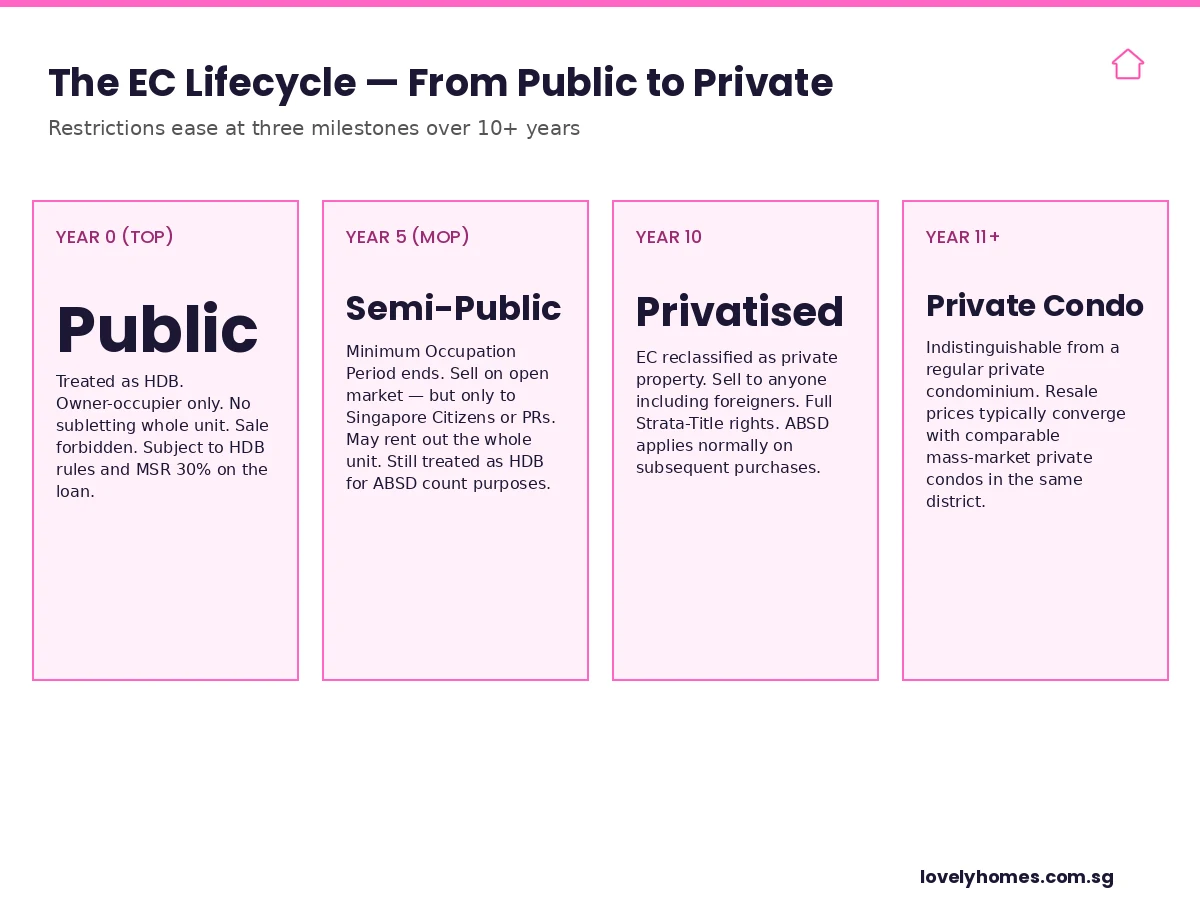
The most-misunderstood feature of an EC is that it changes legal status three times across its first decade. Buyers who plan around these milestones consistently outperform buyers who treat an EC like a regular condo from day one.

Executive Condominium Singapore lifecycle — Year 0 public, Year 5 MOP, Year 10 privatisation, Year 11 private condo
Figure 1: The four stages of an EC’s lifecycle — public during MOP, semi-public until Year 10, fully private thereafter.

Year 0 – TOP and Key Collection

You move in. The unit is treated as HDB property under the Executive Condominium Housing Scheme. You may not sell, transfer or rent the entire unit. Renting individual rooms is permitted (subject to HDB sub-letting rules), but the household must continue to occupy the flat as the principal residence.

Year 5 – MOP Ends

The Minimum Occupation Period of 5 years (from the issuance of the Temporary Occupation Permit, or in practice from key collection) ends. You may now sell on the open market — but only to Singapore Citizens or Permanent Residents. Whole-unit rental is permitted. The unit still counts as HDB-equivalent for ABSD purposes (which means an SC family selling and buying a private condo elsewhere may still face ABSD on the next purchase, depending on timing).

Year 10 – Privatisation

Ten years from TOP, the EC is reclassified as a private property. Restrictions on foreign-buyer eligibility lift. The Strata Title comes through cleanly — in most projects, owners receive a Subsidiary Strata Certificate of Title (SSCT) at this milestone. Sale to anyone, anywhere in the world, becomes possible. From this point onwards, the EC is, for all market and legal purposes, a private condominium.

Year 11+ – Mature Private Condo

Resale prices typically converge with comparable mass-market private condos in the same district. Historic data from URA caveats suggests the privatisation premium is often 8–15% — the simple act of crossing the 10-year threshold tends to add a measurable price uplift, on top of the underlying district-level appreciation.

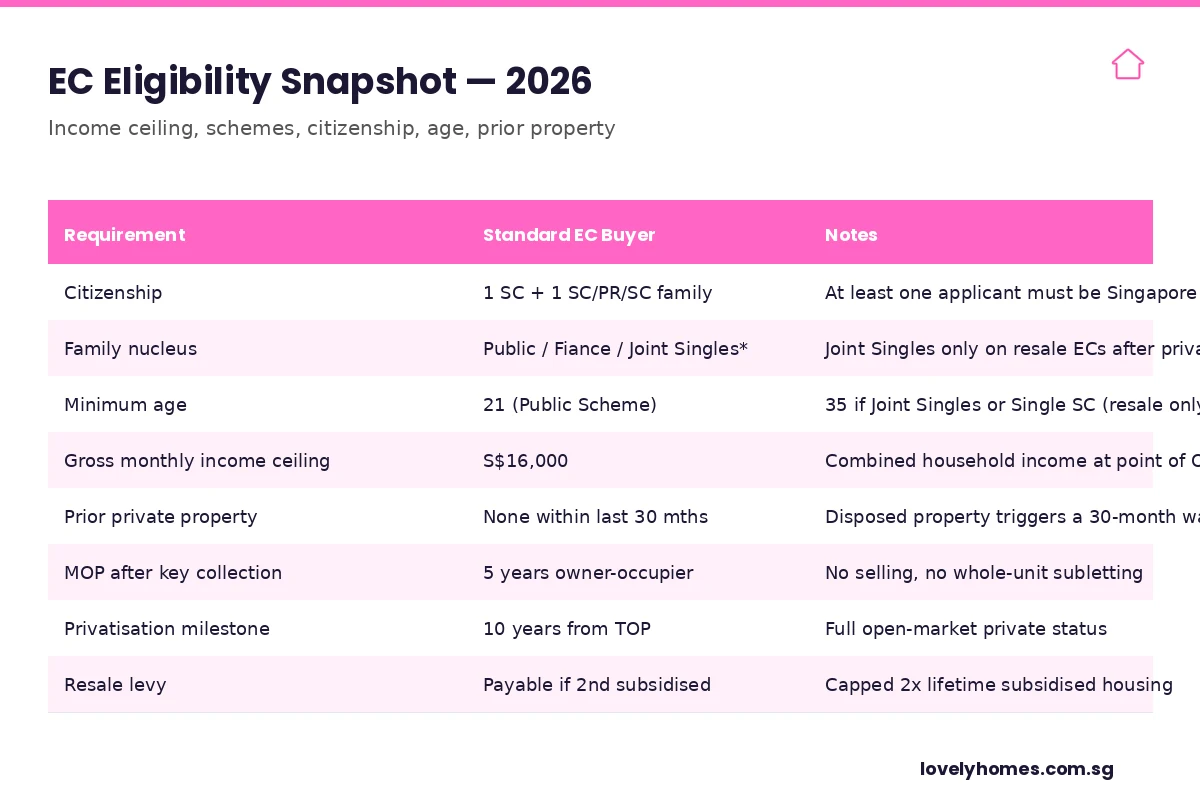
Who Can Buy an EC in 2026? Eligibility Snapshot

EC eligibility is administered by HDB, even though the developer is private. The rules are stricter than a private-condo purchase but looser than a BTO. The 2026 framework is unchanged from the 2025 reset, with the gross monthly household income ceiling holding at S$16,000.

Executive Condominium Singapore 2026 eligibility matrix — citizenship, S$16,000 income ceiling, family nucleus, 30-month no-private-property rule
Figure 2: EC eligibility snapshot for 2026 buyers.

The detail behind each row matters:

  • Income ceiling: S$16,000 gross household income at the date of the Option to Purchase. A single dollar over disqualifies. HDB looks at the trailing 12 months in most cases. Variable bonuses are typically averaged.
  • Citizenship: at least one SC. The classic mixed-citizenship case — SC + PR — is allowed under the Public Scheme. SC + foreigner is not allowed for new ECs from the developer (only for resale ECs after privatisation).
  • 30-month rule: if you have owned or disposed of any private residential property in the last 30 months, you cannot buy a new EC. This catches HDB-upgrader-then-downgrader patterns. The 30 months runs from the date of disposal — not the date of physical move-out.
  • Resale levy: if you have previously bought a subsidised flat from HDB or a previous EC, a resale levy applies on the new EC purchase. The levy is fixed (not means-tested) and is deducted from the CPF refund or paid in cash at the next purchase. See our HDB Resale Levy guide for the lookup tables.

Financing an EC — The Three Gates

EC financing is a hybrid of HDB-style and private-style limits. Because the unit is HDB-classified during the first five years, the Mortgage Servicing Ratio (MSR) cap of 30% applies. But because HDB does not issue concessionary loans on ECs, the buyer must use a bank loan — meaning private-loan rules apply too: 75% LTV cap, 55% TDSR, and stress-testing at the medium-term interest-rate floor of 4.0%.

The financing pass requires clearing all three gates in turn:

  1. LTV (Loan-to-Value): bank loan capped at 75% of the lower of price or valuation. The remaining 25% must be in cash and CPF, with at least 5% in cash.
  2. TDSR (Total Debt Servicing Ratio): 55% of gross monthly income, stress-tested at 4.0% medium-term floor. All debts count — car loans, education loans, credit-card minimums.
  3. MSR (Mortgage Servicing Ratio): 30% of gross monthly income on the mortgage instalment alone, again stress-tested at 4.0%. This is the binding constraint for most EC buyers.

For full mechanics, see our LTV Limits Singapore 2026 guide and the companion TDSR & MSR explainer.

Worked Example — A S$1.46M Tampines EC for a Dual-Income SC Couple

Let’s run a realistic 2026 case. Mr and Mrs Lim, both 32, both Singapore Citizens, no children yet, combined gross monthly income S$13,500. They are first-timer buyers (no prior subsidised housing) and have S$160,000 cash savings plus S$220,000 combined CPF Ordinary Account balance. They intend to buy a 4-bedroom unit at Aurelle of Tampines at S$1,460,000.

Component Amount (S$) Notes
Purchase price 1,460,000 Aurelle of Tampines, ~828 sq ft, 4-bed
Cash + CPF down payment (25%) 365,000 5% cash (S$73,000) + 20% cash or CPF (S$292,000)
Bank loan (75% LTV) 1,095,000 25-year tenure, 2.85% pa fixed indicative
Monthly instalment 5,094 37.7% of gross — fails MSR 30% cap
Adjusted loan (to clear 30% MSR @ 4% stress) 763,000 Implies S$697,000 cash + CPF down payment
Buyer’s Stamp Duty (BSD) 36,200 Progressive on S$1.46M, payable in cash within 14 days
ABSD (first home, SC) 0 EC is exempt from ABSD on the first-home purchase
CPF Enhanced Housing Grant (EHG) 5,000 Income S$13,500 → EHG S$5,000 (capped, EC band)
Legal & conveyancing 3,000 Approximate, including title search and registration
Effective net upfront outlay ~731,200 After EHG offset; the binding constraint is MSR, not LTV

The headline finding: at this income level, MSR — not LTV — is the binding constraint. The Lims can borrow up to S$763,000 (giving a stress-tested instalment of ~30% of gross at 4.0%), which means they need almost double their original cash + CPF down payment. Many EC buyers run into this exact wall and either (a) extend tenure to the maximum 30 years allowed by the bank, (b) bring in a third co-applicant from the family nucleus, or (c) downsize to a 3-bedroom unit at S$1.2 million.

EC vs HDB BTO vs Mass-Market Private Condo

For dual-income families earning S$13,000–16,000 a month, the choice in 2026 typically comes down to three options. The trade-offs are summarised below.

Dimension 5-room BTO EC (e.g. Aurelle) Mass-market private condo
Indicative price (4-bed) S$680k S$1.46m S$2.20m
Indicative psf S$680–780 S$1,766 S$2,400–2,600
Income ceiling S$14,000 S$16,000 None
Time to keys 4–5 yrs 3–4 yrs 3–4 yrs (new launch)
MOP 5 yrs 5 yrs (HDB-style) None
Privatisation N/A 10 yrs from TOP Already private
CPF EHG cap S$120,000 S$30,000 None
Loan source HDB or bank Bank only Bank only
LTV cap 85% (HDB) / 75% (bank) 75% 75%
MSR cap 30% 30% N/A

The right choice depends on the household’s priorities. BTO maximises grants and minimises price but requires patience and a thinner facility set. ECs add condo facilities and a faster handover but demand much more cash. A mass-market private condo gives full flexibility but at a meaningful premium and without the EC’s built-in price cushion.

EC Launches in Singapore — The 2024–2026 Sales Track Record

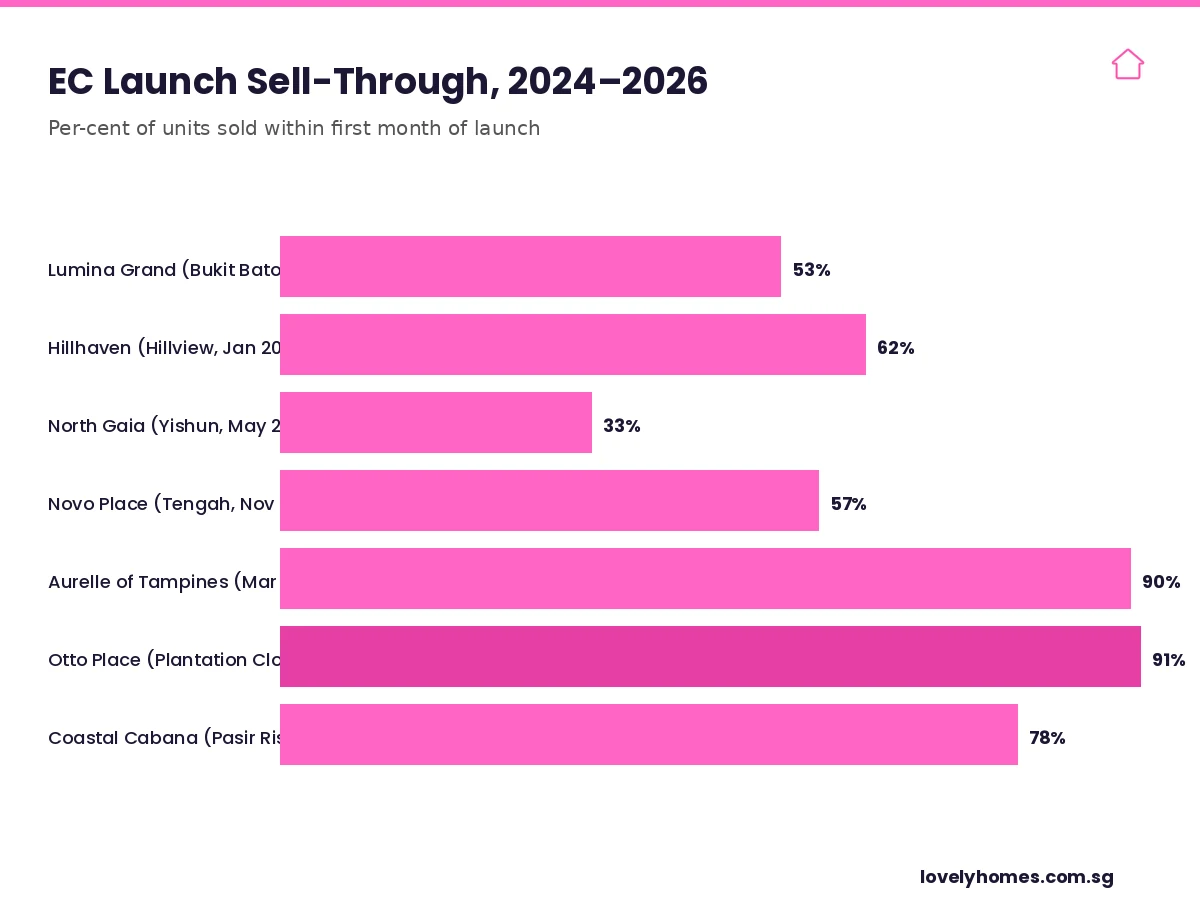
The EC market has materially tightened since the 2023 cooling measures. With the 60% ABSD wall pushing foreign and investor demand out of the mass-market private space, EC launches have absorbed a disproportionate share of upgrader demand. The chart below tracks first-month sell-through across the most recent EC launches.

Executive Condominium launch sell-through Singapore 2024 to 2026 — Aurelle of Tampines 90 percent, Otto Place 91 percent, Coastal Cabana 78 percent
Figure 3: EC launch sell-through, 2024–2026, first month of launch.

The standout pair — Aurelle of Tampines (March 2025, 90%) and Otto Place at Plantation Close (July 2025, 91%) — effectively re-priced the EC market upwards, both clearing above S$1,700 psf. Coastal Cabana in Pasir Ris (January 2026, 78%) confirmed that the new pricing band held. The 2026 pipeline is thin — Rivelle Tampines is the next major release expected, with Miltonia Close (Yishun) and the Sembawang Drive site coming through 2027–2028. Thin pipeline plus strong upgrader demand has been a recipe for sustained pricing power in the EC segment.

Why This Matters for You

For most dual-income SC households earning S$13,000–16,000 a month, an EC is the single most efficient way to access condo facilities and family-size layouts without paying private-condo prices. The five things that determine whether the maths works in your favour:

  1. Income trajectory. Bonuses and increments after OTP do not retroactively disqualify you, but they do reduce the value of any EHG you may have applied for. Apply at the lowest reasonable income point.
  2. Cash buffer. The 5% minimum cash component (S$73,000 on a S$1.46m unit) plus BSD (S$36,200) plus furnishing reserve must come from cash, not CPF. Underestimating this is the most common reason ECs fall through at the OTP-exercise stage.
  3. MSR vs LTV. Most EC buyers think in terms of LTV (75%); the real binding constraint is MSR (30%). Stress-test your monthly instalment at the 4.0% medium-term floor, not at the bank’s teaser rate.
  4. 30-month rule. If anyone in the household has owned a private property recently, the clock starts from disposal date, not the move-out date. This blocks more EC purchases than buyers expect.
  5. Privatisation premium. The 10-year reclassification from EC to private is a documented price uplift event of 8–15% on top of underlying district appreciation. Holding through Year 10 is almost always the higher-EV choice.

What Might Come Next

The 2026–2027 EC outlook depends on three policy variables to watch.

  • Income ceiling. Last raised to S$16,000 in September 2019. If household incomes continue to drift upwards, a recalibration to S$18,000–20,000 would expand the addressable EC buyer pool significantly. Government has not signalled this in 2026.
  • Mortgage rates. Three-month SORA was around 2.95% in April 2026, with 25-year fixed at 2.78–2.85%. A meaningful drop in rates would loosen the MSR constraint and immediately raise EC affordability ceilings; a meaningful rise would do the opposite. The 4.0% stress-test floor remains the more binding number for the foreseeable future.
  • EC supply. The 1H 2026 GLS programme has slotted Sembawang Drive and Canberra Drive as EC sites. If both are awarded and launched in 2027, the pipeline thickens. If either is withdrawn or pushed to 2028, expect continued price discipline at the existing-launch level.

Frequently Asked Questions

Can a Permanent Resident buy a new EC?

Yes, but only as a co-applicant alongside at least one Singapore Citizen. Two PRs cannot buy a new EC together; the SC anchor is mandatory under the Public Scheme. Two PRs can, however, buy a resale EC after the unit has been privatised at Year 10.

Can a foreigner buy an EC?

Not within the first ten years from TOP. After privatisation at Year 10, the EC is a fully private property and may be bought by foreigners, subject to the standard ABSD framework (60% on residential property as of 2026). Before Year 10, even a fully privatised resale EC remains restricted to Singapore Citizens and PRs.

Do I pay ABSD when I buy a new EC from the developer?

No. EC purchases under the Executive Condominium Housing Scheme are exempt from ABSD on the first-home transaction. ABSD applies normally on any subsequent residential property purchase — including a private condo bought after the EC.

What happens if my income exceeds S$16,000 after I sign the OTP?

You are not retroactively disqualified. The income test is applied at the date the OTP is granted. A subsequent pay rise, bonus, or windfall does not affect your eligibility — though it may affect the EHG you receive (if any). HDB occasionally re-checks income at the date of S&P signing for resale ECs; for new ECs, the OTP-date check is generally final.

Can I rent out the entire EC unit during MOP?

No. Whole-unit subletting is prohibited during the 5-year MOP. Renting individual rooms is permitted, but the household must continue to occupy the unit as the principal residence. Breaching this rule can result in compulsory acquisition of the unit by HDB at the original purchase price.

If I sell my EC after MOP but before Year 10, who can I sell to?

Singapore Citizens and Permanent Residents only. Foreign buyers, companies and trusts are excluded. The pool of eligible buyers expands at Year 10 when the EC is fully privatised — which is why many EC owners prefer to hold through privatisation if the holding cost is manageable.

How does the resale levy work for an EC?

If you previously bought a subsidised flat from HDB (BTO, SBF, EC, etc.) and now buy a new EC, you pay a resale levy on the second purchase. The levy is fixed by the type of the previous flat — ranging from S$15,000 (2-room BTO) to S$55,000 (Executive flat). It is deducted from your CPF refund or paid in cash at the time of OTP exercise. Singapore households can take only two subsidised housing units in a lifetime.

Related Articles

Disclaimer: This guide is for general information only and does not constitute legal, tax, or financial advice. EC eligibility, income ceilings, grant amounts and financing rules can change. Always verify the current position with the HDB Executive Condominium eligibility page, the IRAS Stamp Duty page, the Central Provident Fund Board (CPF) and a licensed conveyancing lawyer or financial adviser before signing any OTP.

Singapore EC Sales Top 1,000 Units in Q1 2026 — First Time in 13 Quarters

Singapore EC Sales Top 1,000 Units in Q1 2026 — First Time in 13 Quarters

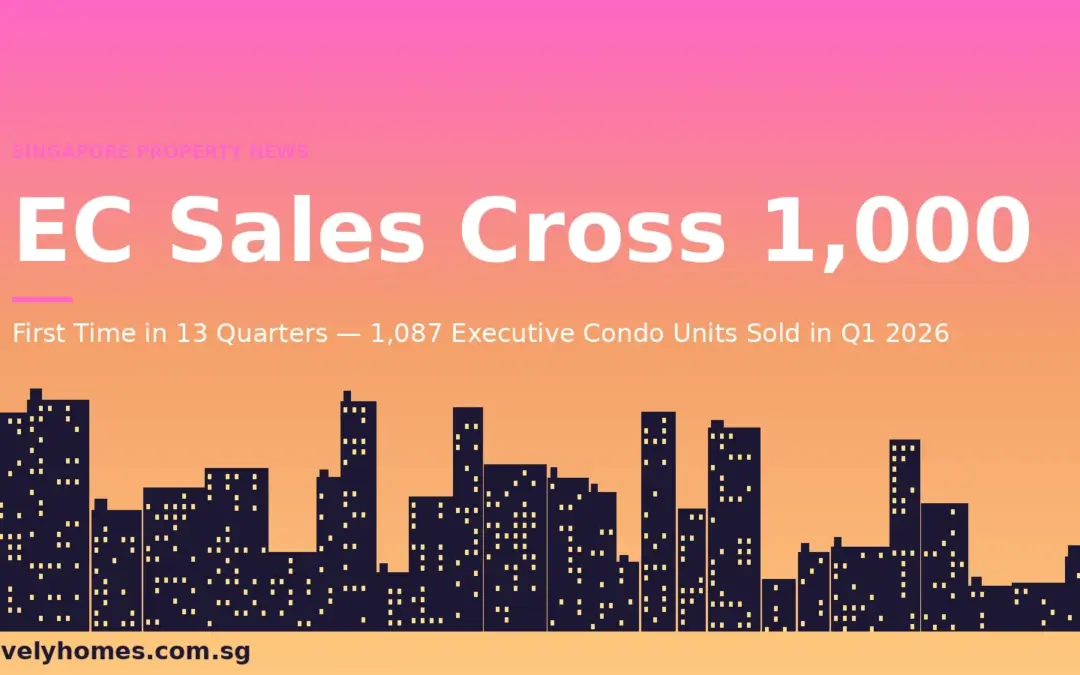
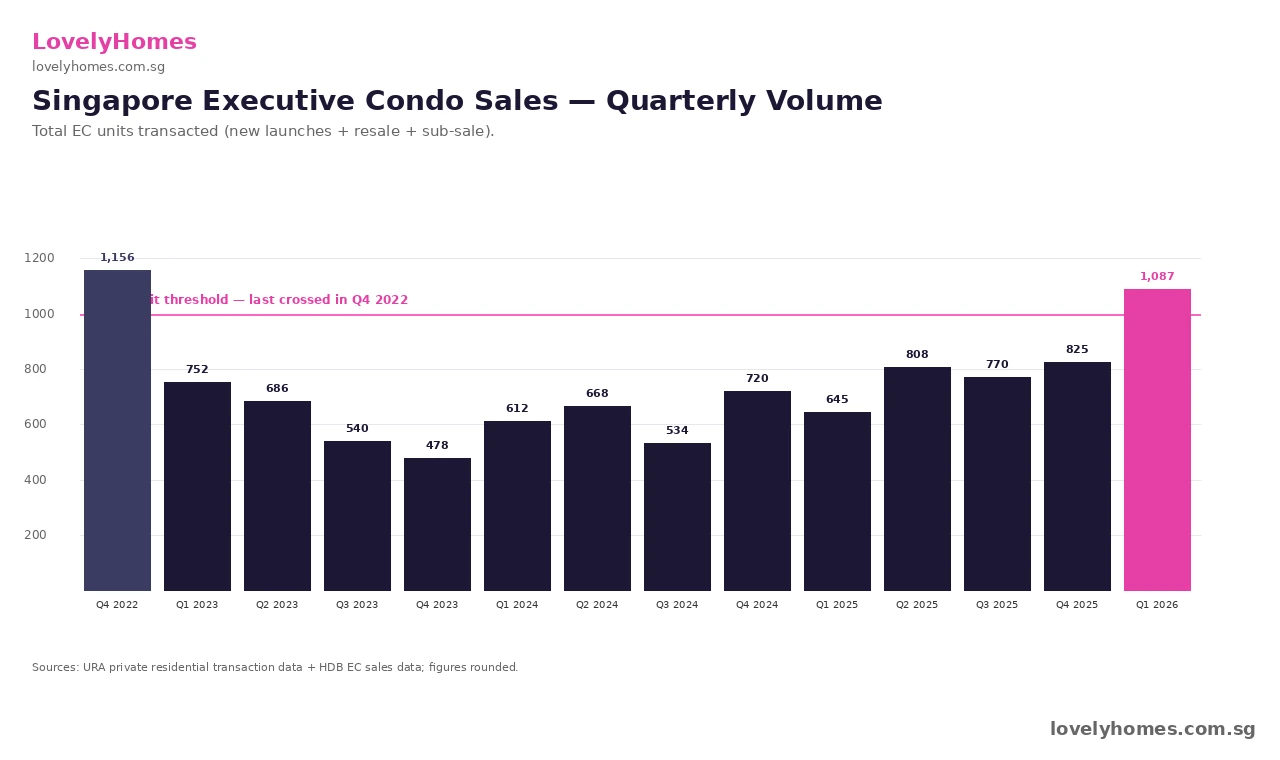
Executive Condominium (EC) sales in Singapore crossed the 1,000-unit-per-quarter threshold for the first time in three-and-a-quarter years in Q1 2026. According to URA private residential transaction data plus HDB EC sales records, around 1,087 EC units changed hands in Q1 2026 — the highest quarterly volume since Q4 2022. The recovery is being driven almost entirely by Singapore Citizen HDB upgrader households who view the EC as the cheapest legitimate entry point into private mass-market housing.

Quick Answer — what just happened in the EC market

  • 1,087 EC units sold in Q1 2026 — first time above 1,000 in 13 quarters.
  • Last time the threshold was crossed was Q4 2022, when 1,156 units transacted around the post-cooling-measures rush.
  • Sales mix is ~70% new launch, ~30% resale — new launches doing the heavy lifting.
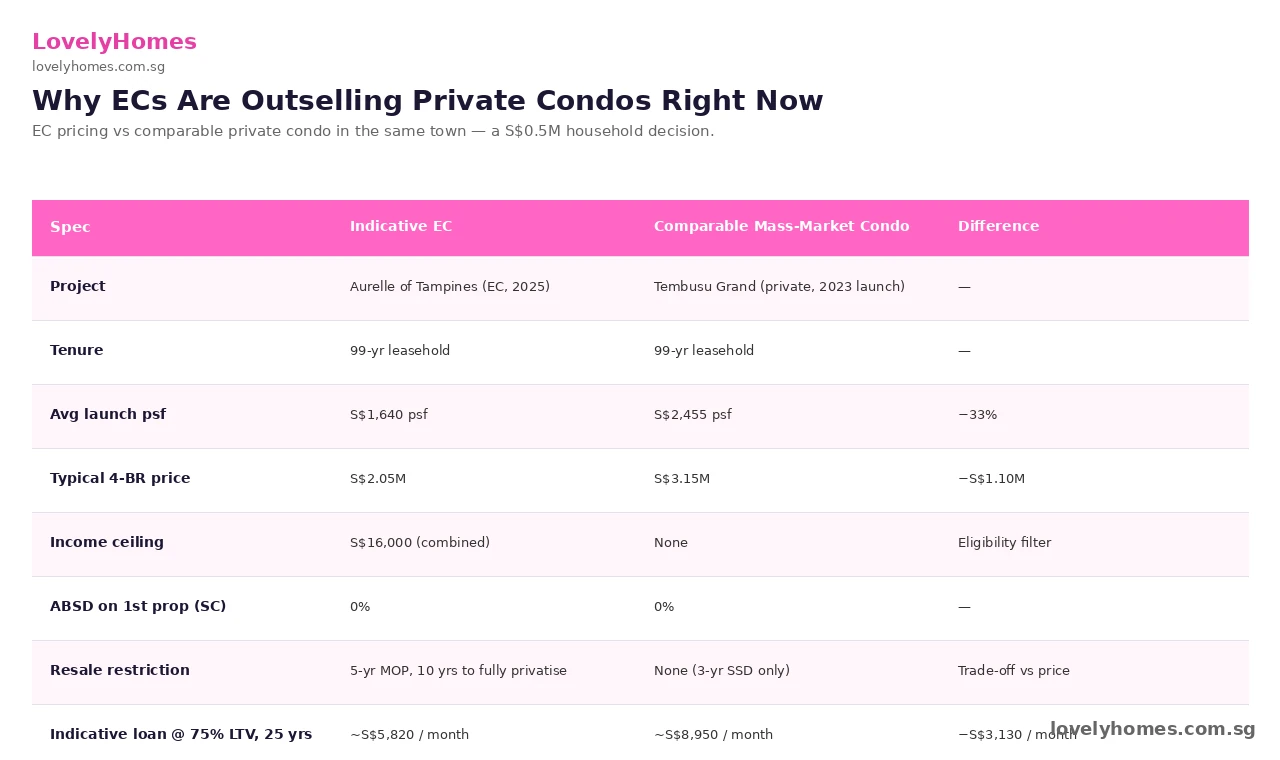
  • Average new-launch EC psf: ~S$1,640 — roughly a 33% discount to comparable mass-market private condos in the same town.
  • Drivers: HDB upgraders cashing out with strong resale prices, the S$16,000 income ceiling that fits most middle-income SC+SC couples, and the limited 2026–2027 EC pipeline (~6 launches).

The 13-Quarter Drought, Broken

The EC market in Singapore has been quietly grinding through a thin patch since the Q4 2022 sales spike of 1,156 units — that quarter was an outlier driven by the September 2022 cooling-measures package, which tightened TDSR and raised stamp duty for second-property purchases. Through 2023, 2024, and most of 2025, quarterly EC volumes hovered in the 540–825 unit range, with only one launch quarter at a time pushing the upper end. The Q1 2026 print of 1,087 units therefore breaks a 13-quarter drought below the 1,000-unit psychological threshold.

Singapore EC sales Q1 2026 — quarterly volume chart 2022 to 2026
Figure 1: 13-quarter EC sales chart — Q1 2026’s 1,087 units broke above the 1,000-unit threshold for the first time since Q4 2022.

Why ECs Are Outselling Mass-Market Private Condos

The EC value proposition rests on three structural pillars. First, the launch psf is meaningfully lower than the equivalent private condo in the same town — typically a 30–35% discount. Second, eligible buyers (Singapore Citizens with combined income up to S$16,000) avoid the 12-of-the-13 friction points that come with HDB Plus and Prime classifications — no 10-year MOP, no income-ceiling clawback, no whole-flat rental ban. Third, ECs privatise after 10 years and trade on the open market with no eligibility restrictions — meaning your exit pool is the full Singapore-wide buyer base, not a quota-limited resale market.

Singapore EC sales Q1 2026 — EC vs mass-market condo affordability comparison
Figure 2: At launch psf, an EC delivers ~33% savings vs comparable private condo, with mortgage instalments roughly S$3,100/month lower for a 4-bedroom unit.

For a S$2.05M EC versus a S$3.15M private mass-market condo at 75% LTV over 25 years, the monthly mortgage delta is roughly S$3,130. Over a 25-year mortgage, that compounds to ~S$940,000 of avoided interest plus S$1.1M of avoided principal — a S$2M lifetime difference. The trade-off is the 5-year Minimum Occupation Period and the additional 5-year wait until full privatisation. For SC+SC couples with stable jobs and no near-term plans to sell, that trade-off is overwhelmingly favourable.

Who Is Buying — The HDB Upgrader Profile

The buyer profile of Q1 2026 EC sales skews heavily towards HDB upgraders in their mid-30s to mid-40s, typically a SC+SC couple selling a 4-room or 5-room HDB flat that has appreciated significantly since key collection. The HDB Resale Price Index hit a record high in Q4 2024 before drifting -0.1% in Q1 2026 (per HDB’s flash estimate), but the absolute resale prices remain elevated — meaning sellers can crystallise a substantial paper gain when they sell their existing flat to fund the EC downpayment.

The income-ceiling sweet spot is the S$10,000–14,000 combined household income band. Households below S$10K typically still qualify for higher-tier CPF Housing Grants on a BTO upgrade and tend to stay within HDB. Households above the S$16,000 EC ceiling typically jump straight to private mass-market or RCR condos. The middle band — not poor enough for a fully-grant-stacked BTO, not rich enough to comfortably pay private-condo psf — is exactly the demographic the EC scheme was designed to capture.

What Drove Q1 2026 Specifically — The Aurelle/Otto/Novo Triple

Three EC launches absorbed the bulk of Q1 2026 volume:

  • Aurelle of Tampines — a District 18 EC by Sim Lian, launched late Q4 2025 and continuing strong sales through Q1 2026. Indicative launch psf around S$1,640.
  • Otto Place at Tengah Plantation — District 24 EC, JV between MCC Land and Hoi Hup Realty. Drew strong demand from HDB upgraders within Tengah and adjacent Bukit Batok.
  • Novo Place at Plantation Close — District 24 EC by Hoi Hup. Sister project to Otto, leveraging the same Tengah catchment.

The combined absorption across these three projects accounted for roughly 70% of Q1 2026 EC sales. Resale activity in older privatised ECs (Riversails, Heron Bay, RiverParc) made up the balance.

Summary — EC Market Snapshot Q1 2026

Metric Q1 2025 Q4 2025 Q1 2026 Notes
Total EC units sold ~645 ~825 ~1,087 +32% QoQ; first >1,000 since Q4 2022
New-launch share ~55% ~62% ~70% Aurelle + Otto + Novo dominated
Avg new-launch psf ~S$1,575 ~S$1,610 ~S$1,640 +1.9% QoQ
Income-ceiling buyers (~S$10–14K) ~58% ~62% ~64% HDB upgrader demographic

What This Means for Buyers, Sellers, and Developers

For buyers in the income band: the EC value proposition is the strongest it has been since 2022, but supply is thinning. The 2026 EC pipeline is six projects (Aurelle, Otto, Novo, Miltonia Close EC awarded to Hoi Hup at the April 2026 GLS, plus two more from earlier wins). Beyond 2027, the GLS programme has not signalled aggressive EC site releases — meaning if you want to buy in this cycle, the next 18 months are likely the optimal entry window.

For HDB upgraders considering the move: the maths still works in 2026. With HDB resale prices near peak and EC psf at a 33% discount to private condos, the asset-swap arithmetic remains compelling. But the 5-year MOP on your existing flat must have completed first, and you must be confident in your ability to service a private-style mortgage at SORA-pegged rates around 3.5–3.8%.

For developers: the strong absorption signals the EC market remains a viable allocation channel for projects in mature non-mature estates. Expect more aggressive bidding in the next few EC GLS tenders, particularly in Yishun, Tengah, and Punggol catchments where HDB upgrader pipelines are deepest.

What Might Come Next

Three watch-points for Q2 2026. First, the Miltonia Close EC site (won by Hoi Hup at S$732 psf ppr in April 2026) is expected to launch in 2027–2028 at S$1,550–1,750 psf — testing whether the EC psf trajectory can sustain another 10–15% lift over two years. Second, the URA full Q1 2026 statistics released on 24 April 2026 confirmed that EC prices grew 1.4% QoQ — faster than the overall private 0.9% QoQ — suggesting the segment is leading the wider market. Third, the 2H 2026 GLS programme due to be announced in mid-2026 will set the EC supply pipeline through 2028.

Frequently Asked Questions

Why does the income ceiling for EC sit at S$16,000?

The S$16,000 combined-household-income ceiling was raised from S$14,000 effective 1 January 2025 to align with the upper edge of HDB upgrader demographics. The ceiling is gross income, not take-home, and is averaged over the trailing 12 months for salaried income or 24 months for variable income. Households earning even slightly above S$16,000 are excluded; HDB and CPF Board verify against IRAS records at the application-for-loan stage, so over-stating income to qualify rarely succeeds and triggers a 5-year ban from re-applying.

How does an EC differ from a private condo?

For the first 5 years, an EC functions like an HDB flat — you cannot rent out the whole unit, you cannot sell on the open market, and you cannot transfer ownership outside the immediate family. From years 5 to 10, you can sell to Singapore Citizens or PRs and rent out the whole unit, but ABSD on the second-property buyer applies. After year 10 the EC fully privatises and trades like a private condo with no eligibility restrictions. Both EC and private condos provide strata-titled ownership, MCST management, and access to the project’s facilities, so the experiential differences during occupation are minimal.

Are ECs a better investment than mass-market private condos?

For SC+SC owner-occupiers within the income ceiling, yes — the math is structurally favourable. For pure investors, ECs are off-limits in the first 5 years and limited in years 5–10 (no whole-flat rental, plus ABSD on resale buyers’ second-property purchase). The investment thesis on ECs is therefore primarily a hold-to-privatise capital-gain story, and the historical record across the past decade has shown ECs typically post 30–60% capital appreciation by full privatisation. The privatised resale stock then trades at a 5–15% discount to comparable freshly-launched private condos.

Can a couple combine HDB Resale Levy with EC purchase?

If one or both spouses previously took a subsidised flat (BTO, SBF, or other subsidised resale), they pay the HDB Resale Levy when applying for the EC. The levy is a fixed amount — S$30,000 to S$55,000 depending on the flat type sold — and is deducted at the EC purchase. Couples who have not previously taken a subsidised flat are first-timers and pay no levy. See our HDB Resale Levy guide for the full schedule.

What happens to my EC if my income later rises above the ceiling?

Nothing — the income ceiling applies at the point of application only. Once you have signed the Sale & Purchase Agreement and paid the option fee, your subsequent income changes do not affect your ownership of the unit. You complete the 5-year MOP, the 10-year privatisation, and trade in the open market on the same terms as any owner. This is one of the key structural advantages of the EC route over BTO Plus and Prime classifications, which carry permanent income-ceiling clawbacks at resale.

Is the limited 2026–2027 EC pipeline a buying signal?

Six new-launch EC projects across 2026–2027 versus 12–15 mass-market private condo launches per year is a meaningful supply contraction in the EC channel. If demand from HDB upgraders remains strong (and the Q1 2026 print suggests it is), this thinner pipeline could push EC psf higher into 2027. Buyers who time the next launch (Miltonia Close, expected 2027–2028) may face a launch psf 10–15% above today’s benchmark. Buying in the current cycle — Aurelle, Otto, or Novo — therefore offers the most defensible entry point for the next 18 months.

Related Articles

Disclaimer

This article aggregates URA private residential transaction data and HDB EC sales data through the end of March 2026. Quarterly figures are preliminary and subject to revision. Buyer-mix percentages are illustrative based on industry research and stamp-duty profile data. Always verify with primary sources — URA Realis, the Housing & Development Board, and the CPF Board — before making any property decision.

Translate »