Singapore HDB Inheritance and Transfer Guide 2026: Joint Tenancy, CPF Rules and Who Can Inherit

Singapore HDB Inheritance and Transfer Guide 2026: Joint Tenancy, CPF Rules and Who Can Inherit

Quick Answer: Singapore HDB Inheritance & Transfer Guide 2026

  • HDB flats held under Joint Tenancy (JT) pass automatically to the surviving owner by right of survivorship — no probate required and no Will can override this.
  • Flats held under Tenancy-in-Common (TIC) pass according to the deceased’s Will or, if there is no Will, the Intestate Succession Act (ISA). Muslim estates are governed by the Administration of Muslim Law Act (AMLA) and Faraid rules.
  • The deceased owner’s CPF principal and accrued interest used for the flat is refunded to their CPF account — not to the estate — and distributed to CPF nominees or the CPF Public Trustee.
  • Any outstanding HDB loan on the flat must be assumed by the inheriting owner (subject to HDB approval) or discharged; the flat cannot be retained if the inheritor cannot service the loan.
  • The inheritor must meet HDB eligibility criteria to retain the flat. Ineligible inheritors (including foreigners) must sell within 6 months or HDB may compulsorily acquire the flat.
  • Singapore Citizens generally have the widest inheritance eligibility; SPRs and family members in non-standard situations require case-by-case HDB assessment.
  • The Minimum Occupation Period (MOP) typically restarts from the date of the transfer for the new owner when the flat is transferred (other than via JT survivorship).
  • Making a Will and CPF nomination while alive is the single most important step HDB owners can take to ensure their wishes are carried out on death.

Introduction: When a HDB Owner Passes Away

The death of a Housing & Development Board (HDB) flat owner raises a series of consequential legal and practical questions: Who takes over the flat? What happens to the outstanding mortgage? Are there CPF refunds? How long does the process take? For the 1.1 million HDB households in Singapore, understanding the inheritance and transfer rules is not just academic — it is part of responsible property ownership and estate planning.

Singapore’s framework for HDB flat inheritance is governed by several bodies of law operating concurrently: HDB’s own eligibility and transfer rules, the Conveyancing and Law of Property Act which recognises the right of survivorship for Joint Tenancy, the Intestate Succession Act (ISA) which distributes estates without Wills, and — for Muslim Singaporeans — the Administration of Muslim Law Act (AMLA) and the principles of Faraid Islamic inheritance. The CPF Board administers the refund of CPF monies on death separately from the flat transfer.

HDB Flat Ownership Structures: Joint Tenancy vs Tenancy-in-Common

When two or more people purchase an HDB flat together, they must choose between two forms of co-ownership: Joint Tenancy (JT) or Tenancy-in-Common (TIC). The choice made at purchase has profound consequences on what happens to the flat when one owner dies.

Under Joint Tenancy, all owners hold the flat jointly without defined individual shares. The central legal feature of JT is the right of survivorship: on the death of any one joint tenant, that person’s interest in the flat automatically vests in the surviving joint tenant(s). No probate or letters of administration are required; no Will can override this automatic transfer. HDB flats purchased by couples are registered in Joint Tenancy by default.

Under Tenancy-in-Common, each owner holds a specified, separate share — for example, 50%/50% or 60%/40%. On the death of a TIC owner, their share forms part of their estate and is distributed according to their Will, or the ISA if they die intestate (without a Will). TIC must be specifically elected at the time of purchase or during ownership via a legal severance of the JT arrangement.
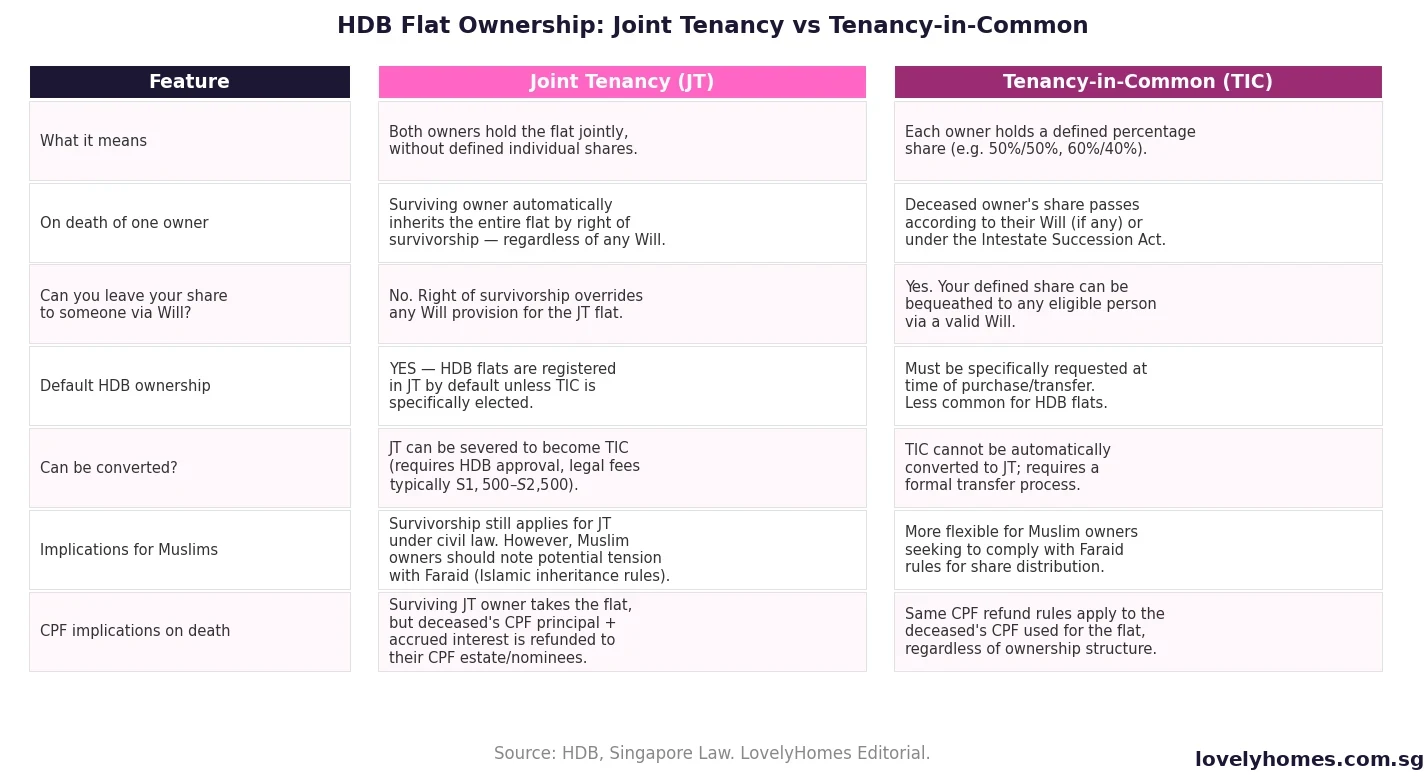
Singapore HDB Joint Tenancy vs Tenancy-in-Common comparison table — right of survivorship inheritance Will implications 2026
Figure 1: Joint Tenancy vs Tenancy-in-Common — seven key differences for HDB flat co-owners. Source: HDB, Singapore Law. Click to enlarge.

The Right of Survivorship: How Joint Tenancy Works on Death

The right of survivorship is a powerful legal mechanism that simplifies the transfer of HDB flats in the common scenario where a married couple owns a flat and one spouse passes away. When the first spouse dies, the surviving spouse automatically becomes the sole owner of the flat — there is no need to go through the courts, apply for probate, or even instruct a solicitor for the transfer itself (though an application must be made to HDB to update the records).

The process involves notifying HDB within 30 days of the death, submitting the death certificate, the original title deeds or relevant HDB documentation, and completing HDB’s survivorship transfer form. HDB will then update its records to reflect the surviving owner as the sole registered proprietor. The entire administrative process typically takes 3–6 weeks once documents are submitted.

The surviving JT owner inherits the flat subject to any outstanding HDB or bank loan. If the deceased was the primary borrower and the surviving spouse does not meet the bank’s income criteria to assume the sole loan, they may need to make other arrangements — including partial repayment, sourcing a guarantor, or selling the flat. It is advisable for couples to ensure both spouses are listed as co-borrowers on any mortgage to avoid this complication.

Tenancy-in-Common and the Intestate Succession Act

For flat owners holding the property under Tenancy-in-Common, the death of one owner requires a formal estate administration process before the flat can be transferred to the inheritor. If the deceased left a valid Will, executors named in the Will apply for a Grant of Probate from the Singapore High Court. If there is no Will, the next-of-kin applies for Letters of Administration. Both processes take 3–6 months on average for uncontested estates, though complex cases can take longer.

Where there is no Will, the ISA prescribes how the estate is distributed based on the family structure. For example, if the deceased leaves a spouse and children, the spouse receives 50% of the estate and the children share the remaining 50% equally. If only a spouse survives (no children, no living parents), the spouse receives the entire estate. The ISA does not apply to Muslim Singaporeans, whose estates are governed by Faraid rules under AMLA, administered through the Syariah Court for distribution certificates.

CPF and HDB on the Death of an Owner

CPF monies used to purchase an HDB flat do not form part of the flat’s transfer on death — they are handled separately by the CPF Board. When an owner dies, all CPF funds used to purchase the flat — including both the original principal withdrawn and the accrued interest at 2.5% p.a. compounded — must be refunded to the deceased’s CPF account. These funds are then distributed to CPF nominees (designated by the deceased via a CPF nomination form before death), or — if there is no nomination — to the Public Trustee for distribution under the Intestate Succession Act.

This CPF refund is separate from the flat’s ownership transfer. The inheritor who takes over the flat does not receive the deceased’s CPF monies as part of the flat — they receive only the flat itself, potentially subject to an outstanding mortgage. The CPF refund may significantly reduce the equity available in the flat if the loan is outstanding, as the CPF monies do not offset the mortgage on death.

If the flat has an outstanding HDB concessionary loan at the time of death, the surviving owner or inheritor must arrange with HDB to either assume the loan (if they qualify) or repay it. In some cases where the deceased had Home Protection Scheme (HPS) insurance (a mortgage-reducing insurance administered by CPF Board), the outstanding HDB loan may be discharged on death, passing the flat to the inheritor debt-free. All HDB flat owners with an outstanding HDB loan are required to maintain HPS cover, making this a meaningful protection for families.
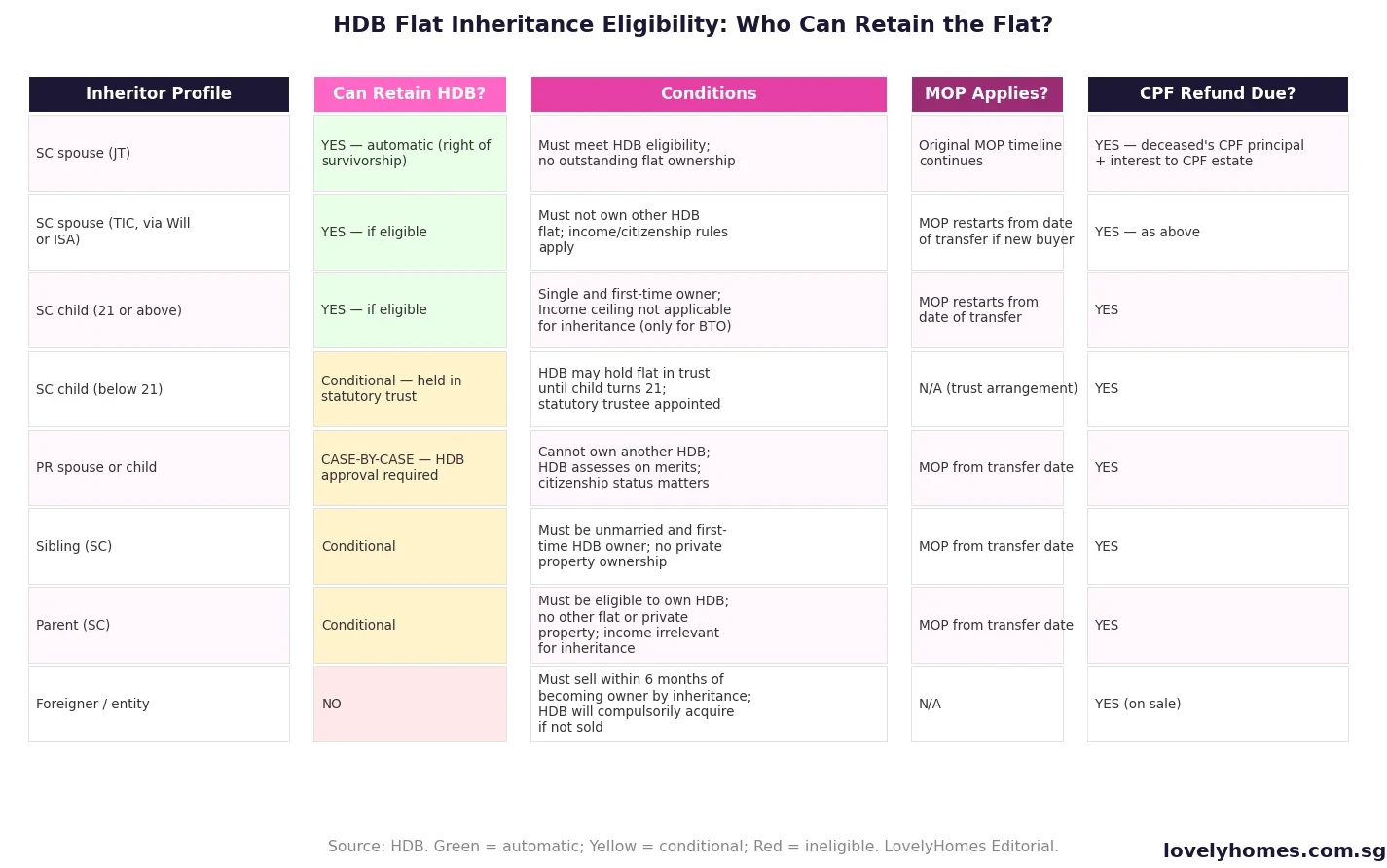
HDB flat inheritance eligibility Singapore 2026 — who can retain an HDB flat SC spouse child PR sibling parents foreigners
Figure 2: HDB Inheritance Eligibility — who can retain an HDB flat and under what conditions. Green = generally eligible; Yellow = conditional/HDB approval required; Red = must sell. Source: HDB. Click to enlarge.

Who Can Retain an Inherited HDB Flat?

The right to retain an inherited HDB flat is subject to HDB’s standard eligibility criteria. The core principle is that HDB flats are public housing meant for Singapore citizens and permanent residents who meet the relevant conditions. Simply inheriting a flat does not guarantee the right to keep it if the inheritor does not meet HDB’s eligibility framework.

Singapore Citizen beneficiaries in a nuclear family context — such as a surviving SC spouse or adult SC children — generally have the widest eligibility to retain an HDB flat. However, they must not already own another HDB flat (subject to the non-concurrent ownership rule) and must not hold any private residential property at the time of inheritance (or must dispose of private property within 6 months). Singapore Permanent Resident inheritors are assessed on a case-by-case basis by HDB and face more restrictions. Foreigners (non-PRs) are not eligible to own HDB flats and must sell any inherited flat within 6 months; failure to do so can result in HDB compulsorily acquiring the flat.

Where a flat is inherited by a minor (below 21), HDB typically holds the flat in a statutory trust arrangement until the child reaches majority. A statutory trustee (often a parent or guardian) is appointed to manage the flat in the interim.

Applying to Transfer or Retain the HDB Flat

The formal process of applying to retain or transfer an HDB flat after a death involves several steps that typically span 3–9 months depending on the estate complexity, whether probate is required, and HDB’s processing time. The beneficiary or executor must submit an application to HDB with the death certificate, identity documents, Grant of Probate or Letters of Administration (if TIC), and supporting documents evidencing eligibility (e.g. income documents, CPF statement, private property declaration).

HDB will assess the application, verify eligibility, check for any outstanding charges or HDB loans on the flat, and — where the inheritor is taking over a loan — require the inheritor to meet the relevant debt servicing criteria. If approved, the transfer is completed via a legal instrument lodged with the Singapore Land Authority (SLA), and the Land Register is updated to reflect the new owner.
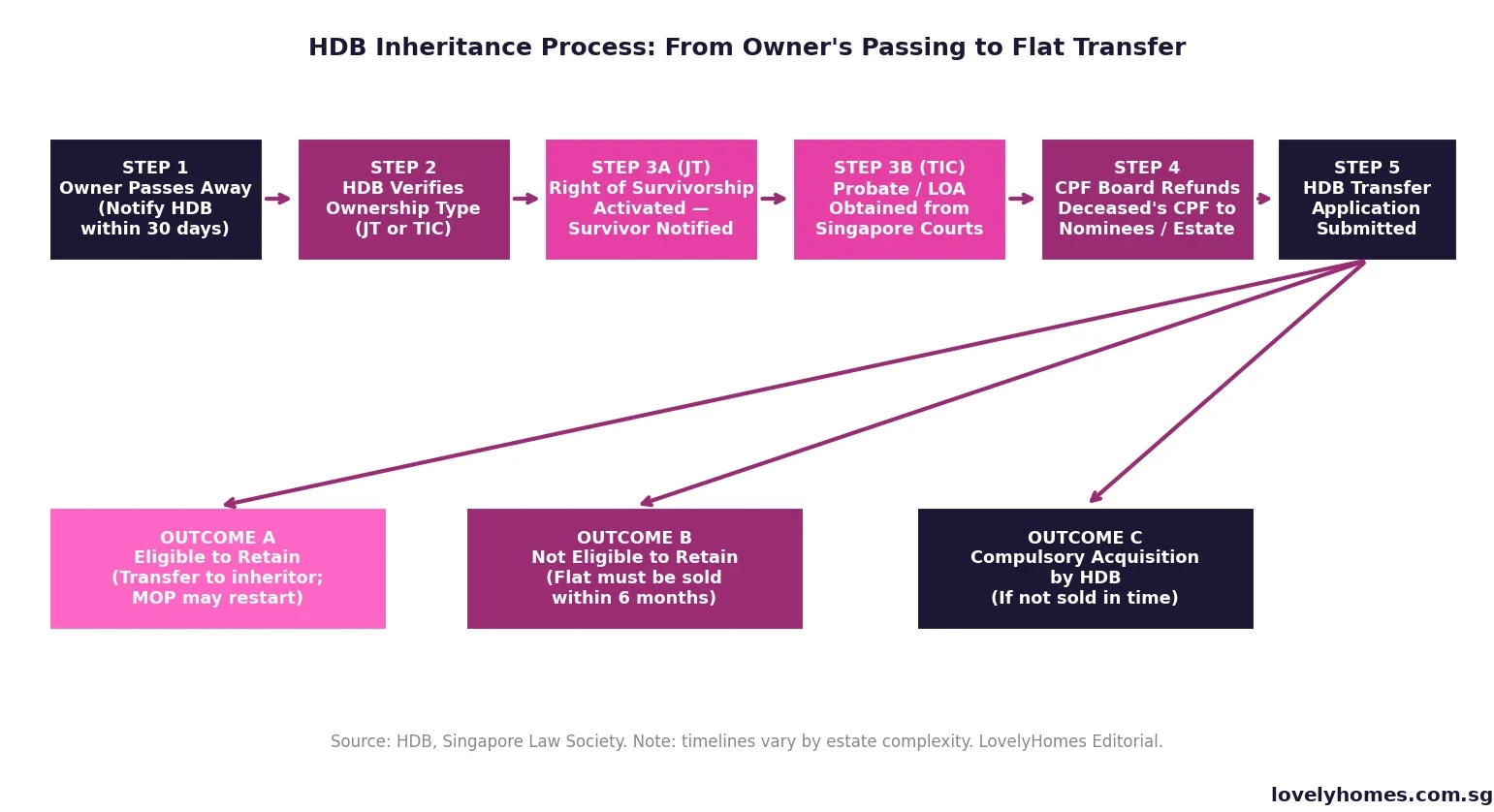
HDB inheritance process flowchart Singapore 2026 — steps from death notification to flat transfer outcomes
Figure 3: HDB Inheritance Process — from the owner’s passing to the three possible outcomes: retention, sale, or compulsory acquisition. Source: HDB, Singapore Law Society. Click to enlarge.

Selling an Inherited HDB Flat

Where the inheritor is ineligible to retain the HDB flat — either because they do not meet HDB’s eligibility criteria or because they choose to liquidate the asset — the flat must be sold on the open HDB resale market. The 6-month timeline begins from when ownership is formally transferred to the ineligible inheritor (not from the date of death), giving families some breathing room to arrange the estate and marketing process.

The sale proceeds are handled as follows: the outstanding HDB loan (if any) is repaid first from the sale price; CPF monies used by all owners over the flat’s ownership history are refunded (with accrued interest) to each respective owner’s CPF account or estate; legal and agent costs are deducted; and the net cash proceeds form part of the estate for distribution. If the flat was sold at the prevailing resale market price, the estate may receive a meaningful cash sum — particularly for flats in mature estates with substantial appreciation.

Scenario Ownership Type Legal Process Required Timeline (est.) MOP Reset?
SC surviving spouse (JT) Joint Tenancy Notify HDB; submit death cert + survivorship docs 3–6 weeks admin No (continuity)
SC child inheriting via Will (TIC) Tenancy-in-Common Grant of Probate + HDB transfer application 4–8 months Yes (from transfer date)
SC child inheriting — intestate (TIC) Tenancy-in-Common Letters of Administration + HDB transfer application 5–10 months Yes
PR beneficiary (TIC or JT estate) Either Probate/LOA + HDB case-by-case assessment 6–12 months Yes
Ineligible beneficiary — must sell Either Transfer to ineligible owner + list for HDB resale Must sell within 6 months of transfer N/A (sold)
Minor inheritor (below 21) Either Statutory trust arrangement via HDB; trustee appointed Until majority Assessed at age 21

Worked Example: The Lim Family — SC Widow Inheriting Under Joint Tenancy

David and Susan Lim are Singapore Citizens who purchased a 4-room HDB flat in Ang Mo Kio in 2015 under Joint Tenancy at S$450,000, financed by an HDB concessionary loan. Their outstanding HDB loan as at June 2026 is S$210,000. David passes away unexpectedly in June 2026 at age 58.

Step 1 — Survivorship: As the flat was held in JT, Susan automatically becomes the sole owner of the flat by right of survivorship. No probate is required. Susan notifies HDB within 30 days and submits the death certificate and survivorship transfer form.

Step 2 — CPF refund: David had used S$180,000 in CPF OA (principal) towards the flat purchase and monthly instalments over 11 years. Accrued interest on these CPF withdrawals at 2.5% p.a. amounts to approximately S$61,000. The total CPF refund of S$241,000 is credited back to David’s CPF account. As David made a CPF nomination naming Susan and their two adult children, the S$241,000 in David’s CPF is distributed per the nomination — not as part of the flat’s transfer.

Step 3 — Mortgage: David maintained Home Protection Scheme (HPS) insurance on the HDB loan. On his death, the outstanding S$210,000 HDB loan is discharged by HPS, passing the flat to Susan debt-free.

Outcome: Susan now owns the flat in sole name, free of mortgage, with the flat’s estimated resale value at ~S$620,000 (based on comparable resale transactions in the area in 2026). The net equity in the flat for Susan is approximately S$620,000 (since the CPF refund went to David’s CPF estate, not reducing the flat’s market value). The HDB admin process took approximately 5 weeks from death notification to registration of Susan as sole owner.

Key lesson: The combination of JT ownership, HPS insurance, and CPF nomination meant that the inheritance process was administratively simple and economically optimal for Susan. Had David not maintained HPS, Susan would have needed to service the S$210,000 loan herself from retirement savings or a new bank loan — a significant burden at age 56.

What This Means for HDB Flat Owners

Estate planning for HDB flat owners in Singapore is not a complex exercise, but it does require deliberate action rather than relying on defaults. The most important steps any HDB owner can take are: first, confirm the current ownership structure of their flat (JT or TIC) and whether it reflects their actual wishes; second, maintain a valid and up-to-date CPF nomination so that CPF monies reach the intended beneficiaries; third, consider making a Will to address any TIC share and other non-CPF assets; and fourth, ensure adequate HPS cover is maintained on any outstanding HDB loan to protect the family from the mortgage burden on death.

Joint Tenancy works well for most married couples as a default — it is simple, automatic, and avoids probate delays. However, for blended families, second marriages, business partners owning flats together, or Muslim families seeking Faraid-compliant distributions, Tenancy-in-Common provides greater flexibility and should be considered with legal advice.

What Might Come Next

There are no announced changes to Singapore’s HDB inheritance framework as at June 2026. The Law Reform Commission has previously considered but not implemented recommendations on simplifying intestate succession for HDB flats, and the Ministry of Law continues to review options for making probate processes faster and less costly for estates with modest assets. The digitisation of the Probate Court and HDB’s integrated estate management platform (accessible via MyHDBPage) has already reduced administrative timelines in recent years. HDB owners and estate practitioners should monitor any future legislative changes to the Probate and Administration Act, the Intestate Succession Act, and HDB’s Housing Policy as Singapore’s population ages and inheritance scenarios become more common.

Frequently Asked Questions: HDB Inheritance & Transfer

Can I change my HDB flat from Joint Tenancy to Tenancy-in-Common?

Yes. A Joint Tenancy in an HDB flat can be severed to become a Tenancy-in-Common through a legal process called a severance of joint tenancy. This involves instructing a solicitor to prepare and lodge the relevant instrument at the Singapore Land Authority. Both owners must consent to the severance. The legal costs typically range from S$1,500 to S$2,500 depending on the complexity. Once severed, each owner’s defined share (usually 50%/50% unless otherwise specified) can be bequeathed to beneficiaries via a Will, bypassing the right of survivorship. HDB’s approval may be required in some cases.

What if the deceased HDB owner did not leave a CPF nomination?

If the deceased did not make a CPF nomination, the CPF Board will transfer the CPF savings (including the refunded flat-related CPF monies) to the Public Trustee’s Office. The Public Trustee distributes these funds according to the Intestate Succession Act — meaning they follow the same intestate distribution rules as other estate assets (e.g., 50% to spouse, 50% to children). This process adds time and cost to the estate administration. It is strongly advisable to make a CPF nomination and to update it whenever family circumstances change.

Does the Minimum Occupation Period (MOP) restart when I inherit an HDB flat?

Generally yes, when a flat is transferred to a new owner via inheritance (other than a Joint Tenancy survivorship transfer, where the surviving owner continues the original MOP timeline), the MOP is assessed from the date the new owner takes legal title of the flat. For example, if you inherit a flat in June 2026, your 5-year MOP (or 10-year MOP for Plus/Prime flats purchased under the new classification rules) begins from June 2026. You must continue to occupy the flat and cannot sublet the whole flat or purchase any other residential property during the MOP period. Always confirm the specific MOP conditions with HDB when applying for the transfer.

What is the Home Protection Scheme (HPS) and is it compulsory?

HPS is a mortgage-reducing insurance administered by CPF Board that covers the outstanding HDB home loan in the event of the insured owner’s death, terminal illness, or total permanent disability. It is compulsory for all HDB flat owners with outstanding HDB concessionary loans who have CPF OA savings. For HDB flat owners with bank loans, HPS cover is not mandatory but CPF Board strongly recommends it. HPS premiums are payable from CPF OA and are relatively affordable. On the insured event (e.g., death), HPS discharges the outstanding loan balance up to the insured amount, passing the flat to the family debt-free. Reviewing your HPS coverage amount (especially if you have refinanced to a bank loan) is an important part of property ownership in Singapore.

Can a Muslim Singaporean’s HDB flat be distributed via Faraid rules?

Under Singapore law, a Muslim person’s estate — including any HDB flat held under Tenancy-in-Common — is governed by Faraid (Islamic inheritance law) as applied by the Syariah Court under the Administration of Muslim Law Act (AMLA), rather than the civil Intestate Succession Act. The Syariah Court issues an Inheritance Certificate specifying the Faraid shares to each beneficiary. For HDB flats under Joint Tenancy, however, the civil right of survivorship technically applies — a tension between civil and religious law that some Muslim families resolve by electing Tenancy-in-Common and making a Will consistent with Faraid requirements. Muslim HDB owners are strongly advised to consult both a Syariah lawyer and HDB to ensure their ownership structure and estate plans align with their religious obligations.

How long does the HDB inheritance transfer process typically take?

The timeline varies significantly by case type. For Joint Tenancy survivorship transfers — the simplest scenario — the HDB administrative process typically takes 3 to 6 weeks once all required documents are submitted. For Tenancy-in-Common cases where probate is needed, the Grant of Probate or Letters of Administration alone typically takes 3–6 months, after which the HDB transfer application takes a further 4–8 weeks. Complex estates involving disputes, overseas beneficiaries, or unusual eligibility circumstances can take 12–24 months or more. Throughout this period, the flat can generally continue to be occupied by eligible family members, though it cannot be sold or rented out until the transfer is completed and any applicable MOP is met.

Disclaimer: This article is produced by LovelyHomes Editorial for informational and educational purposes only. It does not constitute legal, estate planning, or financial advice. HDB eligibility rules, CPF policies, probate procedures, and Islamic inheritance law described are based on information current as at June 2026. These rules can change. In particular, individual circumstances vary greatly — factors including citizenship status, existing property ownership, outstanding loans, and family composition can materially affect outcomes. Always consult a licensed Singapore solicitor (for estate planning and probate matters), a Muslim law practitioner for Syariah-related estates, and refer to HDB, CPF Board, Ministry of Law, and Syariah Court of Singapore official sources.
×

Click anywhere outside to close
Singapore Property Inheritance Guide 2026: Wills, CPF Nominations, HDB Flats and Stamp Duty Explained

Singapore Property Inheritance Guide 2026: Wills, CPF Nominations, HDB Flats and Stamp Duty Explained

Inheriting property in Singapore is rarely straightforward. Whether you are the surviving spouse of an HDB flat owner, a child named in a parent’s will, or a beneficiary who just discovered their loved one died without any estate planning, the rules governing how Singapore residential property passes on death are layered, sometimes counterintuitive, and — if you get them wrong — expensive. This Singapore property inheritance guide 2026 consolidates everything you need to know: the Intestate Succession Act, making a valid will, CPF nomination rules that override your will, HDB flat transfer procedures, stamp duty obligations, the probate process, and the legitimate planning strategies every property owner in Singapore should consider.

Quick Answer — Singapore Property Inheritance at a Glance

  • Without a will, the Intestate Succession Act (Cap 146) governs distribution — your spouse gets 50%, your children share the other 50% (or spouse takes all if no children).
  • CPF savings bypass your will entirely — they go to your CPF nominees, or to the Public Trustee if you have none.
  • HDB flats may be retained by eligible family members under the Right of Occupancy Scheme; if no eligible occupier exists, HDB buys back the flat at market value.
  • No estate duty applies in Singapore — abolished in February 2008. Inherited property itself is not subject to stamp duty on the death transfer.
  • However, a subsequent gift or sale of inherited property to another person can trigger Buyer’s Stamp Duty (BSD) and, critically, ABSD based on the recipient’s property count and citizenship.
  • A properly executed will, CPF nomination, and LPA can prevent months of delays, court applications, and avoidable costs.
  • Probate in Singapore typically takes 4–9 months for a straightforward estate; more complex multi-property or overseas-asset estates may take 12–24 months.

The Intestate Succession Act — What Happens Without a Will

When a Singapore resident who is not a Muslim dies without a valid will, the Intestate Succession Act (Cap 146), administered by the Family Justice Courts, determines who inherits the estate. The Act follows a fixed hierarchy of beneficiaries and applies to both HDB flats and private residential property (subject to the special HDB rules discussed later).

The most important thing to understand is that the Act’s rules are inflexible — the court has no discretion to vary them based on your wishes or circumstances. If you want a different outcome, you need a will.

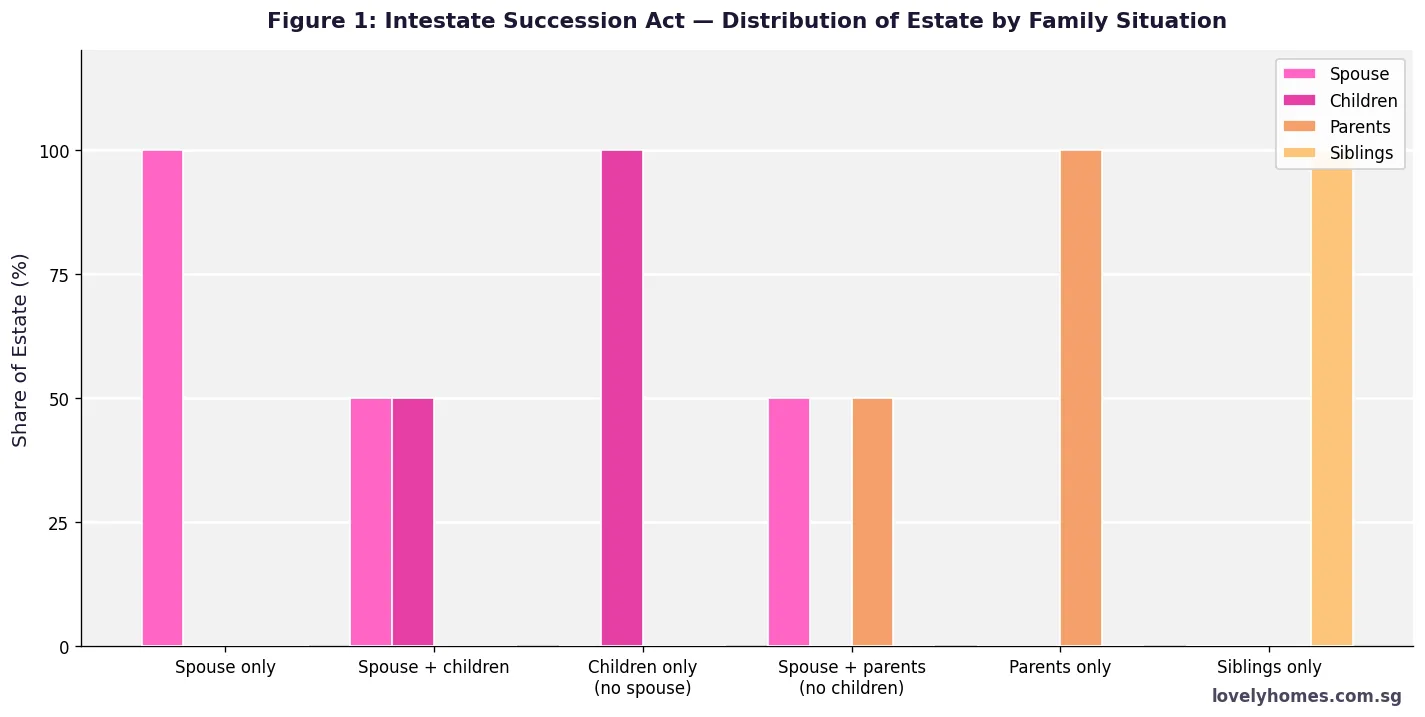
Singapore intestacy distribution chart by family situation 2026 — Intestate Succession Act shares for spouse, children, parents, siblings
Figure 1: Distribution of estate under the Intestate Succession Act by family situation. Percentages represent share of the full estate.
Survivors at Death Who Inherits (and Share)
Spouse only (no children, no parents) Spouse — 100%
Spouse + children Spouse 50% / Children share 50% equally
Children only (no spouse) Children — 100% shared equally
Spouse + parents (no children) Spouse 50% / Parents 50%
Parents only (no spouse, no children) Parents — 100% equally
Siblings only Siblings — 100% equally
No family at all Government — bona vacantia

Critically, the Intestate Succession Act does not apply to Muslims in Singapore — Muslim estates are governed by Islamic inheritance law (faraid) administered through the Syariah Court and Muslim Trust Fund (MUIS). If you are Muslim, consult a lawyer or MUIS directly.

Making a Valid Will in Singapore

A will is the cornerstone of any estate plan. Under the Wills Act (Cap 352), a valid Singapore will must be:

  • In writing (typed or handwritten).
  • Signed by the testator (the person making the will) at the foot of the document.
  • Witnessed by two independent witnesses — both present at the same time when the testator signs. Neither witness (nor their spouse) can be a beneficiary.
  • Made by a person aged 21 or older (or a member of the armed forces on active service).

There is no requirement to register a will with any government body in Singapore, though many solicitors recommend lodging it with the Wills Registry at the Singapore Academy of Law for a small fee (~S$50). A will can be revoked at any time by making a new one or by destroying the original with the intention to revoke. Marriage automatically revokes a prior will in Singapore.

What your will can do: direct who receives your private residential property; name your executor; appoint guardians for minor children; specify funeral wishes; establish testamentary trusts for minors or dependants. What it cannot do: override CPF nominations, bypass HDB rules on flat ownership, or transfer assets held in joint tenancy (these pass automatically to the surviving joint tenant by operation of law).

CPF Nominations — The Rule That Overrides Your Will

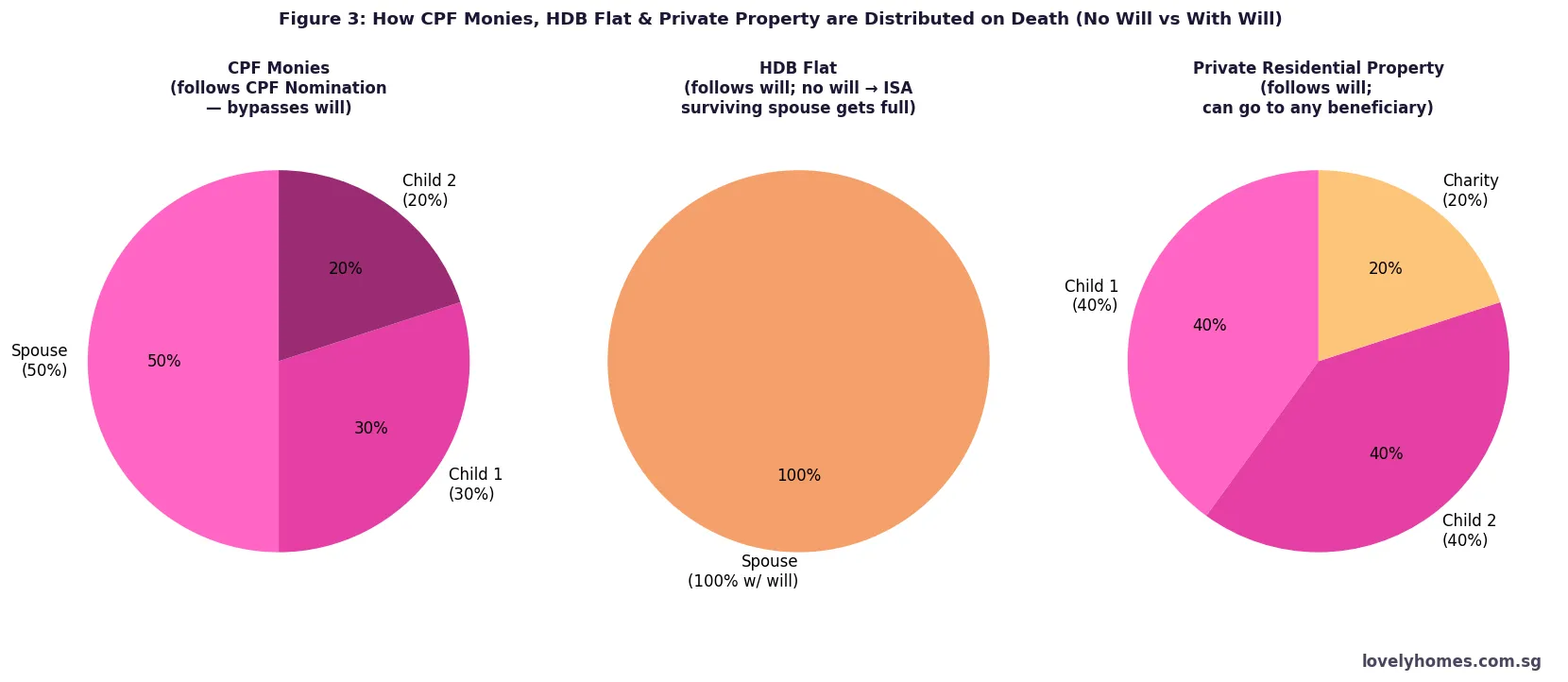
Many Singapore property owners are surprised to learn that their CPF Ordinary Account (OA) savings — which are frequently used to fund property purchases and monthly mortgage instalments — do not form part of their estate and cannot be distributed via a will. CPF monies are governed separately by the Central Provident Fund Act and paid out exclusively to CPF nominees upon death.

If you have not made a CPF nomination, your CPF savings (OA, SA, MediSave) will be transferred to the Public Trustee’s Office, which then distributes them according to the Intestate Succession Act — but charges an administration fee (0.75%–2.75% of the CPF balance, capped at S$6,000). This process can take 6–12 months. A CPF nomination is free, takes about 10 minutes via the CPF Board website, and can be updated any time.

Note also: if you bought your HDB flat using CPF, the CPF funds drawn plus accrued interest must be refunded to your CPF account on the sale or transfer of the flat. This affects the net cash proceeds available to your estate or your surviving family members.

HDB Flat Inheritance — Special Rules Apply

HDB flats come with a unique set of rules on death that do not apply to private residential property. The guiding principle is that an HDB flat should continue to be used as an owner-occupied home for a qualifying Singapore household — it is not freely tradeable inheritance that can be sold at will.

Scenario A: Joint tenancy — surviving joint tenant takes all

Most married couples own their HDB flat as joint tenants. On the death of one owner, the surviving joint tenant automatically becomes the sole owner by right of survivorship — no probate is required, and no will can override this. The surviving owner needs only to lodge a Notice of Death with HDB and the Singapore Land Authority (SLA) to update the title.

Scenario B: Tenancy-in-common — estate share passes via will or ISA

If the flat was held as tenancy-in-common, the deceased’s share passes to the estate and is then distributed via the will or the Intestate Succession Act. The beneficiary of the share must be an eligible person under HDB’s policies — meaning they must form a family nucleus with the remaining flat owner(s), be a Singapore Citizen or PR, and meet the HDB eligibility criteria. If the beneficiary is not eligible (e.g. a foreigner child), HDB will require the flat to be sold.

Scenario C: Sole owner dies — HDB’s Retention Scheme

If the deceased was the sole owner, HDB allows eligible occupiers (family members currently living in the flat who meet eligibility criteria) to apply to retain the flat under the Right of Occupancy Scheme. If no eligible occupier exists, HDB will buy back the flat at market value, and the proceeds go to the estate.

Importantly, the Minimum Occupation Period (MOP) for the inherited flat is assessed separately. An inheriting family member does not automatically “reset” the MOP clock — HDB’s rules on this have specific carve-outs. Always check with HDB directly at the time of inheritance.

Private Residential Property — Inheritance and Stamp Duty

Private condominiums, landed houses, and freehold/leasehold private apartments follow a different set of rules from HDB flats. There is no HDB eligibility requirement — foreigners can inherit private property — but stamp duty implications arise when the property is subsequently transferred or sold.

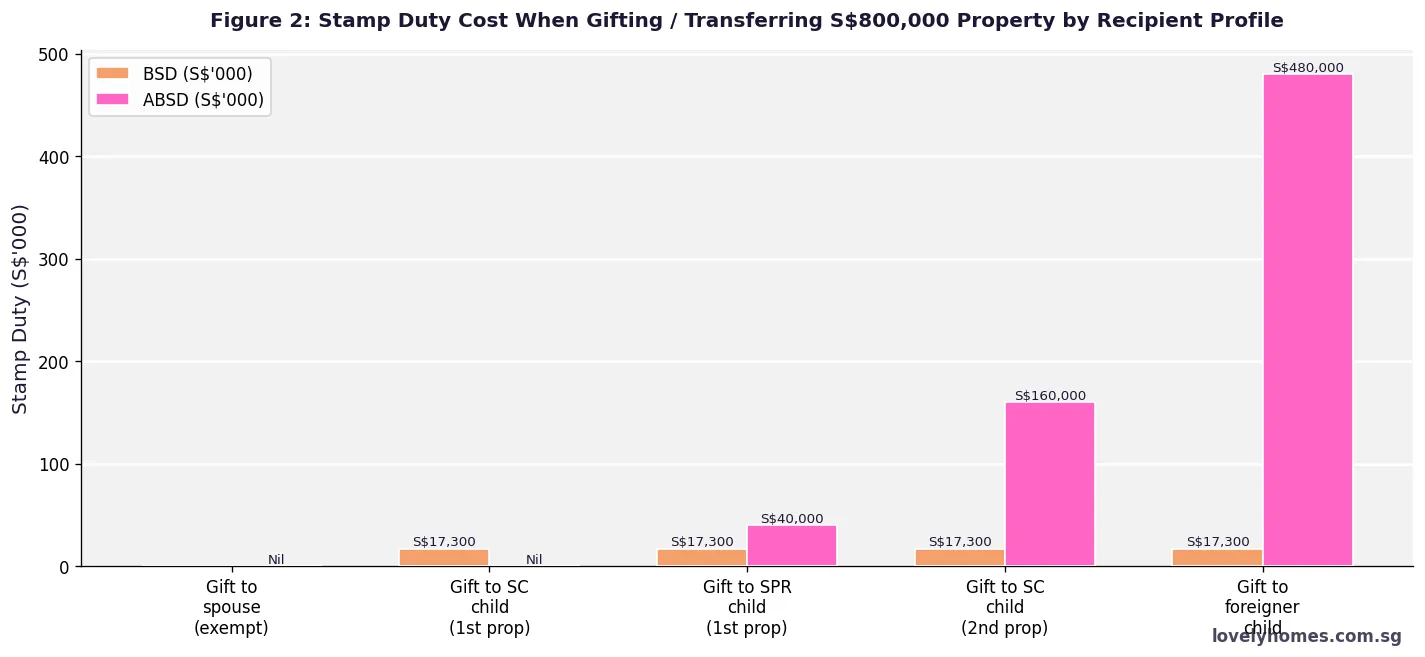
Stamp duty BSD and ABSD costs on property transfer by recipient profile Singapore 2026 — gifting S$800,000 property
Figure 2: Indicative BSD and ABSD payable when gifting/transferring a S$800,000 private residential property by recipient profile. Note: inheritance itself (via estate) is not subject to stamp duty; duty is triggered by a subsequent gift or sale.

No stamp duty on the death transfer itself

The transfer of property to a beneficiary via a will or intestacy is treated as a transmission on death. Under the Stamp Duties Act, such transmissions are exempt from Buyer’s Stamp Duty and ABSD. No duty is payable when the executor or administrator assents the property to the beneficiary. Singapore also abolished estate duty in February 2008, so there is no inheritance tax on the total value of the estate.

ABSD when you inherit a second or third property

However, the inherited property is counted toward your property count for future purchases. This is a critical but frequently misunderstood rule. If you are a Singapore Citizen who already owns one condominium and then inherb a second private property from a deceased parent, your property count becomes two. If you subsequently buy a third property, ABSD of 30% (SC rate for 3rd property) applies. Plan accordingly.

Gifting property inter vivos (lifetime transfers)

If you choose to gift a property to a family member during your lifetime (rather than leaving it via will), BSD is triggered on the market value of the property at the time of transfer. ABSD also applies based on the recipient’s citizenship and property count. A gift to your Singapore Citizen child who already owns one property would attract 20% ABSD on the market value — potentially hundreds of thousands of dollars.

🏠 Worked Example: The Tan Family Estate

Situation: Mr Tan (Singapore Citizen) passed away on 15 March 2026, leaving a 4-bedroom condominium in Bishan worth S$2,100,000 and a 5-room HDB flat in Ang Mo Kio worth S$780,000. Mr Tan had a valid will leaving both properties to his wife (Mrs Tan, SC) and two adult children (both SC, each with their own private condominiums). The HDB flat was held in joint tenancy with Mrs Tan; the condo was held in Mr Tan’s sole name.

HDB flat (joint tenancy):

  • Passes automatically to Mrs Tan by right of survivorship — no probate required for HDB.
  • Mrs Tan lodges a Notice of Death with HDB and SLA. Title updated in her sole name.
  • No stamp duty on this transmission. Mrs Tan now holds the HDB as sole owner.

Bishan condominium (sole name, covered by will):

  • Executor obtains Grant of Probate from the Family Justice Courts — estimated 4–6 months.
  • Will bequeaths the condo 50% to Mrs Tan and 25% each to Child 1 and Child 2.
  • Transmission to all three beneficiaries: BSD = Nil; ABSD = Nil (transmission on death exempt).
  • Mrs Tan’s property count: now HDB flat + 50% share in Bishan condo = 2 properties held.
  • Each child’s property count: now their existing condo + 25% Bishan share = 2 properties each.
  • If any of them buys another property, ABSD will be charged at the 3rd-property SC rate (30%).

BSD + Legal costs for probate:

  • Probate solicitor fees (estimated): S$3,500–S$6,000 for a clean estate
  • Court filing fee (estimated): S$750–S$1,500
  • Assent (Conveyancing for condo transfer): S$1,500–S$2,500 legal fees + SLA registration ~S$165
  • Total estate settlement cost: approximately S$6,500–S$10,000

Key lesson: Having a valid will allowed Mr Tan’s estate to be distributed efficiently. Without a will, the ISA would have given Mrs Tan 50% and split the other 50% equally between the two children — a similar result here, but in more complex family structures the ISA’s rigid hierarchy can produce very different outcomes from what the deceased intended.

The Probate Process in Singapore

When a person dies leaving a will, the executor named in the will applies to the Family Justice Courts for a Grant of Probate, which authorises the executor to administer the estate. If there is no will, the next-of-kin applies for Letters of Administration — a broadly equivalent process but typically requiring two sureties (guarantors).

Key steps in the process:

  1. Death registration — the attending doctor issues a Cause of Death certificate; the Registrar of Deaths (ICA) issues the Death Certificate, usually within a few days.
  2. Identify and value assets — bank accounts, CPF balances, property title searches (SLA), shareholdings, insurance policies, foreign assets.
  3. Engage a probate solicitor — unless the estate is very simple (below S$50,000 with no immovable property), legal representation is strongly recommended.
  4. File for Grant of Probate / Letters of Administration at the Family Justice Courts — fees are payable on a sliding scale based on the estate value.
  5. Advertise for creditors — in a local newspaper, to flush out any outstanding liabilities.
  6. Pay outstanding debts and liabilities — including any outstanding mortgage (the estate must redeem the mortgage or service it until the property is transferred or sold).
  7. Transfer or sell the property — the executor assents (transfers title) to the beneficiary or conducts a sale, remitting proceeds to the estate.
  8. Distribute balance to beneficiaries — with a proper estate account and receipts.

A straightforward Singapore estate with no overseas assets, no disputes, and a valid will typically takes 4–9 months from death to final distribution. Estates with overseas property can take significantly longer due to separate probate requirements in each jurisdiction.

How CPF monies, HDB flat and private property are distributed on death with and without a will Singapore 2026
Figure 3: Distribution of CPF monies, HDB flat, and private residential property on death under different planning scenarios.

Estate Planning — What Every Singapore Property Owner Should Do

Singapore’s property market is one of the most valuable asset classes for most families. Leaving the transmission of that wealth to chance — or to the rigidities of the Intestate Succession Act — is a risk that is easily and cheaply avoided. A comprehensive estate plan for a property-owning Singapore family typically involves four instruments:

Instrument What it Covers Who Administers Cost (Approx.)
Will Private property, bank accounts, personal effects, guardianship of minor children Family Justice Courts (probate) S$300–S$1,200 (straightforward)
CPF Nomination CPF OA, SA, MediSave balances CPF Board (direct payment) Free
HDB Nomination (if applicable) Share in HDB flat (for tenancy-in-common owners) HDB Free
Lasting Power of Attorney (LPA) Decision-making if you lose mental capacity (not on death) Office of the Public Guardian S$75 (standard); free if certified by legal aid

Why Singapore Property Inheritance Matters in 2026

Singapore is in the midst of a significant intergenerational wealth transfer. According to industry estimates, the cohort of HDB flat owners who purchased under SERS and other early schemes in the 1970s–1990s are now in their 70s and 80s. Hundreds of thousands of HDB flats — many now in the S$600,000–S$1,100,000+ resale range — will change hands via inheritance over the next decade. Add private condominiums and landed property to the mix, and the scale of property wealth being inherited is unprecedented in Singapore’s history.

At the same time, the 2023 ABSD increase to 60% for foreigners and 20%/30% for Singapore Citizens on 2nd/3rd properties has made the counting of inherited properties a material financial issue. An unexpected inheritance that tips a SC buyer from “first property” to “second property” status can turn a planned purchase into an ABSD liability of 20% — potentially S$400,000+ on a typical CCR condominium.

What Might Come Next

This section contains editorial speculation and is clearly labelled as such.

Singapore’s government has occasionally reviewed the rules around HDB flat inheritance, particularly in the context of ageing lease profiles and the VERS (Voluntary Early Redevelopment Scheme) pipeline. There is some industry discussion about whether the Right of Occupancy Scheme might be tightened as Singapore’s HDB stock ages and more flats with shorter remaining leases pass between generations — since family members inheriting a flat with 30 or 40 years of lease remaining face a very different investment proposition from those inheriting a newer flat.

On the stamp-duty side, there is no indication that Singapore intends to reintroduce estate duty (abolished 2008). The MND and MOF have historically viewed the abolition as positive for Singapore’s competitiveness as a wealth hub. For now, the transmission-on-death BSD/ABSD exemption also appears stable. Changes to ABSD for inherited properties — e.g. a grace period or exemption from the property count for inherited shares — have been discussed in industry circles but have not been signalled by the Government.

Frequently Asked Questions

Does inheriting a property count toward my ABSD property count?

Yes. Once a property is transmitted to you as a beneficiary and you are registered as owner (or part-owner) at the Singapore Land Authority, it counts toward your residential property count for ABSD purposes. This means that if you already own one private property and you inherit a second one, you are considered a second-property owner. A subsequent purchase would attract the SC third-property ABSD rate of 30%. There is currently no grace period or inherited-property exemption from this counting rule. If you are planning a purchase and know an inheritance is likely, speak to a lawyer about the timing and sequencing.

My parent passed away and left an HDB flat in their sole name. What happens?

If the deceased was the sole HDB owner and there is a valid will, the executor will apply for Grant of Probate. HDB will then assess whether any of the occupiers listed in the flat (or beneficiaries named in the will) qualify to retain it under their eligibility criteria — they must be a Singapore Citizen or PR, form a proper family nucleus, and satisfy income/property ownership requirements. If an eligible person exists, the flat can be transferred to them (subject to HDB’s approval). If no eligible occupier or beneficiary qualifies, HDB has the right to buy back the flat at market value, and the proceeds form part of the estate. Contact HDB’s Branch directly early in the probate process to understand your options.

Can I sell an inherited private property immediately, or do I need to wait?

There is no mandatory holding period for private property inherited via an estate. Once the Grant of Probate or Letters of Administration is obtained and the title is assented to you, you can sell the property. However, Seller’s Stamp Duty (SSD) applies if the property is sold within 3 years of the deceased’s purchase date — not from the date you inherited it. SSD is 12%/8%/4% for disposals in the 1st/2nd/3rd year respectively. Check the original purchase date on the title register before deciding to sell quickly after inheritance. For HDB flats, the 5-year MOP from the original flat purchase date must also be observed before the flat can be sold on the open market.

What is the difference between a CPF nomination and a will for property?

A CPF nomination governs your CPF savings only (OA, SA, MediSave balances) and completely overrides your will for those assets. The CPF Board pays out directly to your nominees without going through probate. A will governs your private property, bank accounts, personal assets, and other estate assets — but not CPF savings. If you have bought your property using CPF funds and there is an outstanding CPF accrued interest amount, that is refunded to the CPF account on sale or transfer of the property, and then distributed to your CPF nominees. You should make both a valid will and a CPF nomination to ensure all assets are covered.

Is there any tax payable on inherited property in Singapore?

Singapore abolished estate duty in February 2008. No estate duty or inheritance tax is levied on the value of an estate. The transmission of a property to a beneficiary via will or intestacy is also exempt from Buyer’s Stamp Duty (BSD) and Additional Buyer’s Stamp Duty (ABSD) at the point of transfer. However, once you are registered as the owner of an inherited property, normal property tax (administered by IRAS) applies going forward at the prevailing rates — owner-occupied or non-owner-occupied depending on whether you live in the property. Annual property tax on a S$800,000 private condominium (non-owner-occupied) is approximately S$3,200–S$6,400 depending on the Annual Value assessed by IRAS.

What happens to an inherited HDB flat if none of the beneficiaries are eligible to own it?

If none of the will’s beneficiaries (or ISA-entitled family members) meet HDB’s eligibility criteria to retain the flat — for instance, all of them are foreigners, or they each already own private property — HDB will issue a directive requiring the estate to sell the flat on the open market or surrender it to HDB. If sold on the open market, any SC or PR eligible buyer can purchase it as a resale HDB flat in the normal manner. The net proceeds (after mortgage redemption and CPF refund obligations) are distributed to the estate’s beneficiaries. HDB typically allows up to 12 months for the estate to resolve the flat’s status before taking further action.

How long does probate take in Singapore and how much does it cost?

A straightforward Singapore estate with a valid will, no overseas assets, and no disputes typically takes 4–9 months from death to final distribution. An estate requiring Letters of Administration (no will) adds 1–3 months for additional surety and advertising requirements. Complex estates with foreign property, trust structures, or contested claims can take 12–36 months or more. Professional costs typically include: probate lawyer fees (S$3,500–S$8,000 for a clean estate, higher for complexity), Court filing fees on a sliding scale based on estate value, property assent legal fees (S$1,500–S$3,000 per property), and SLA registration fees (~S$165 per property). The Public Trustee’s Office also charges a fee of 0.75%–2.75% of CPF monies distributed where there is no CPF nomination.

Disclaimer: This guide is for general information only and does not constitute legal, tax, or financial advice. Inheritance and estate law is complex and fact-specific. Rules around HDB flat eligibility, CPF nominations, stamp duty, and probate procedures may change. Always verify the current position on the Intestate Succession Act (Singapore Statutes Online), the CPF Board nomination portal, and HDB’s official guidance. Consult a licensed Singapore lawyer for advice specific to your situation. For tax implications, refer to IRAS Property Tax.

×

Click anywhere outside the image to close

Inheriting Property in Singapore 2026: Probate, Stamp Duty & Estate Planning Essentials

Inheriting Property in Singapore 2026: Probate, Stamp Duty & Estate Planning Essentials

Inheriting property in Singapore is one of those events most families confront only once or twice in a lifetime. The legal mechanics are forgiving compared with the United Kingdom or the United States — Singapore has no estate duty, no inheritance tax, and no capital-gains tax on residential property — but the process is still demanding. The deceased’s estate must clear probate, the heir must understand how the property fits into their existing ABSD count, and several stamp-duty deadlines run from the date of death rather than the date of transfer. Get any of these wrong and you can either lose months of clear title or unwittingly trigger ABSD on a future purchase.

This 2026 guide walks the entire journey end to end — what happens whether or not the deceased left a Will, the statutory shares set by the Intestate Succession Act, the typical costs of probate, the stamp-duty position on transfer to the heir, and the all-important interaction with ABSD on the heir’s next property purchase. All figures and rules below reflect Singapore’s position as of 29 April 2026. For the live position, always check Family Justice Courts, the Intestate Succession Act, and IRAS Stamp Duty.

Quick Answer — inheriting property in Singapore

  • Singapore abolished estate duty for deaths from 15 February 2008. There is no longer an inheritance tax.
  • The deceased’s estate goes through probate (with a Will) or Letters of Administration (without one).
  • Without a Will, the Intestate Succession Act (ISA) sets statutory shares between spouse, children and parents.
  • Transfer of property to the heir is a transmission, not a sale — no BSD or ABSD on that transfer.
  • BUT — the inherited property counts toward the heir’s property tally for ABSD on their next purchase.
  • Joint-tenancy property passes automatically by survivorship — outside the Will or ISA.
  • HDB flats follow extra rules — only Singapore Citizen/PR family members who meet eligibility can inherit and remain in occupation.

The Two Pathways: With a Will and Without

The first question after a death is the same one solicitors ask: was there a Will? The answer determines which application the executors or family must make to the Family Justice Courts, who has standing to administer the estate, and how the property is ultimately divided.

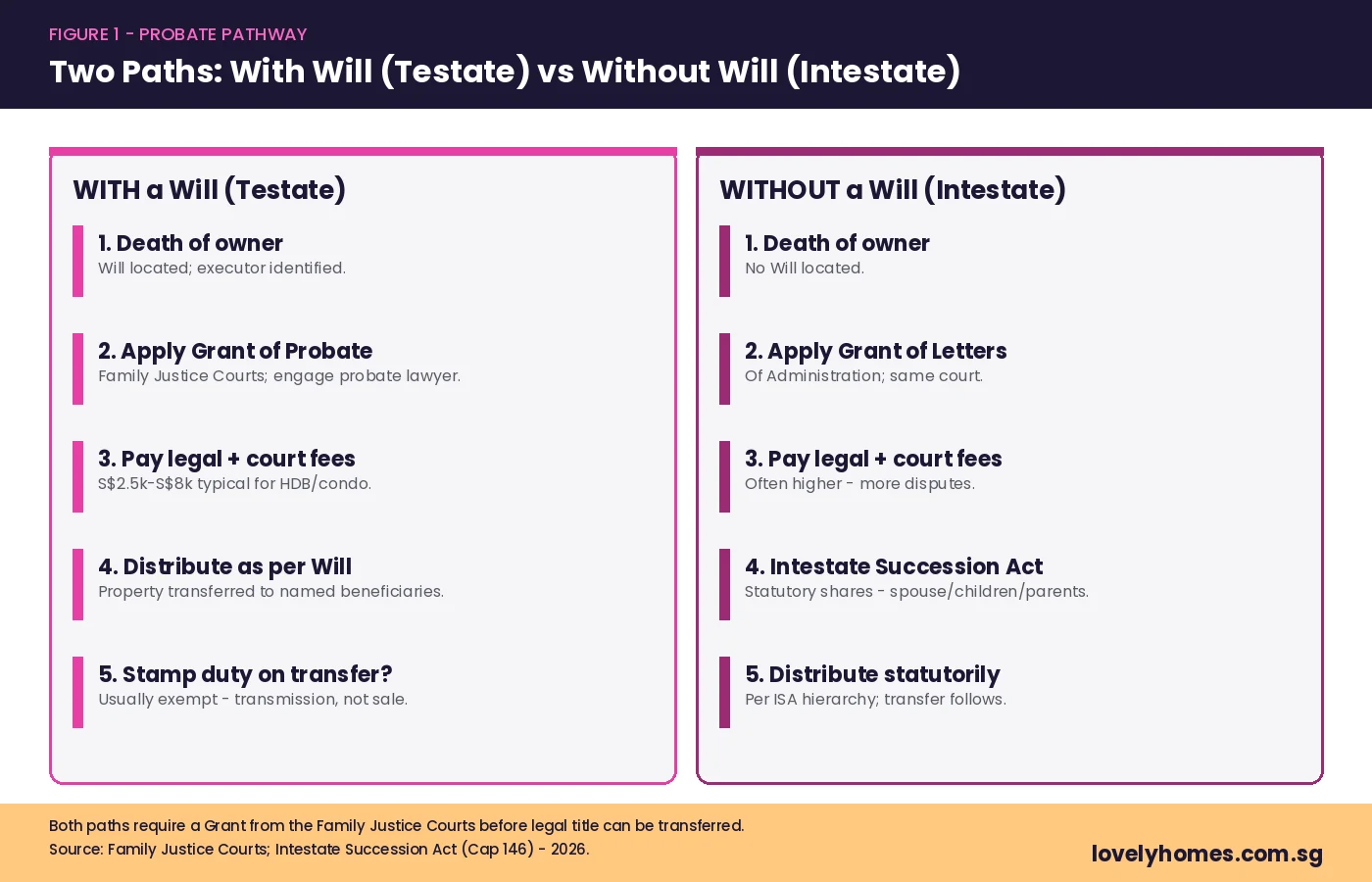
Probate pathway diagram - testate vs intestate inheritance Singapore 2026
Figure 1: The two pathways for inheriting property in Singapore. Both end with the property being transmitted into the heir’s name once the Court issues the Grant.

With a Will (Testate Succession)

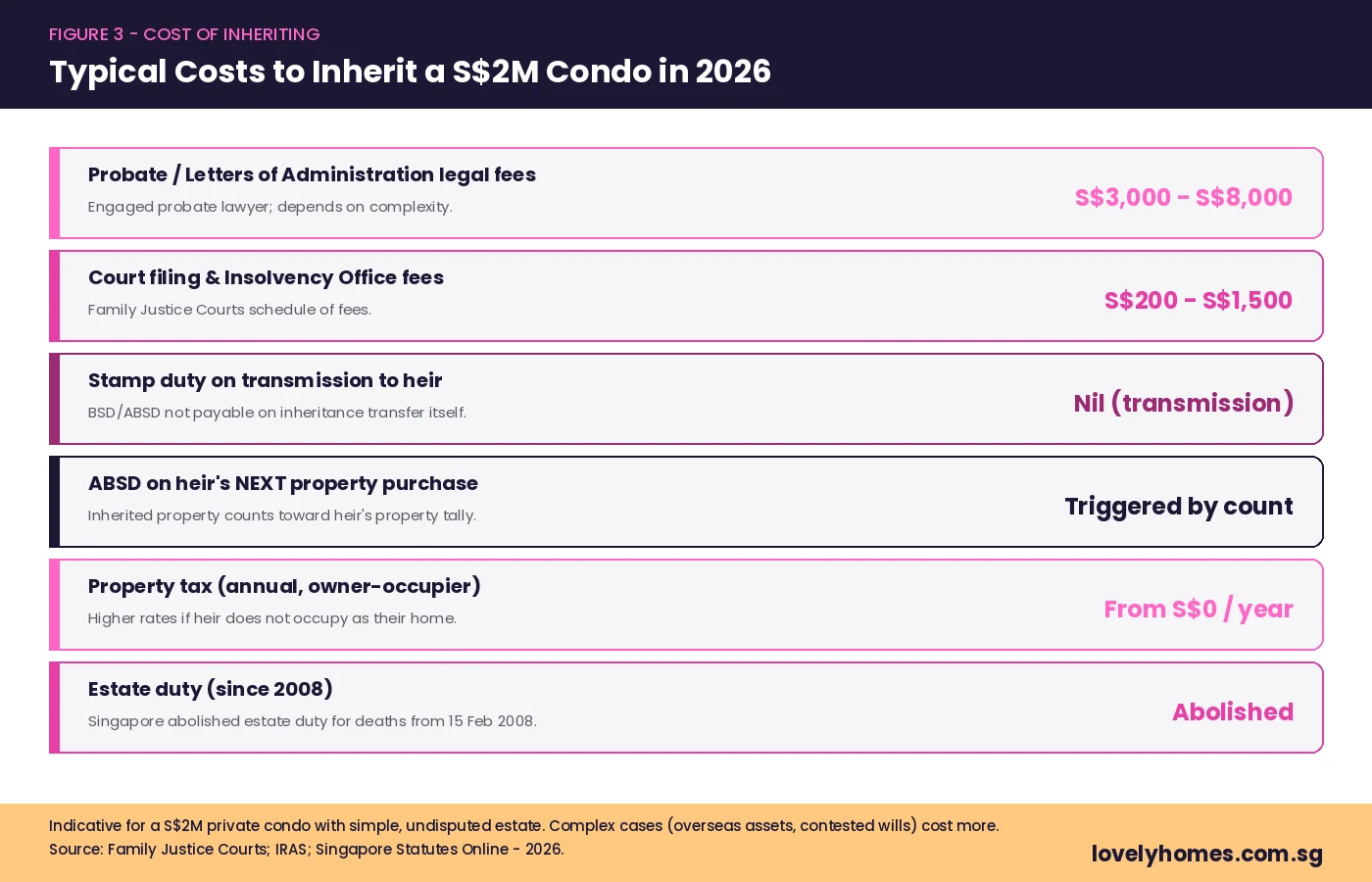
If the deceased left a valid Will, the named executor applies to the Family Justice Courts for a Grant of Probate. The Will dictates who inherits the property — the executor’s job is to carry out those instructions after settling the estate’s debts. For a clean estate (no caveats, no contests, full documentation), a Grant of Probate is typically issued within 4–8 weeks. Probate fees range roughly S$3,000 to S$8,000 in legal costs for a single residential property, plus court filing fees of a few hundred dollars.

Without a Will (Intestate Succession)

Where there is no Will, the next-of-kin applies for a Grant of Letters of Administration. The applicant administers the estate and distributes it according to the statutory shares set out in the Intestate Succession Act (ISA). Letters of Administration take longer than probate — typically 8–16 weeks — because the Court must satisfy itself who is entitled to apply, what the estate consists of, and that no contest exists. Where the estate is over S$5 million or contains foreign assets, the timeline extends materially.

Joint-Tenancy — The Quiet Third Path

For property held by spouses as joint tenants, the surviving spouse takes the deceased’s share automatically by survivorship — outside the Will, outside the ISA, and outside probate altogether. The surviving spouse simply lodges a Notice of Death with the Singapore Land Authority (SLA) along with the death certificate, and the title is updated. This is the cleanest of the three pathways. By contrast, tenancy-in-common property passes through the Will or the ISA like any other estate asset. For the difference, see our Joint Tenancy vs Tenancy in Common Singapore 2026 guide.

The Intestate Succession Act — How an Estate Without a Will Is Split

If you die intestate (without a Will) and you are domiciled in Singapore, the Intestate Succession Act (Cap 146) determines exactly who gets what. The Act is gender-neutral but assumes a fairly traditional family structure — spouse, children, parents, siblings — in that order of priority.

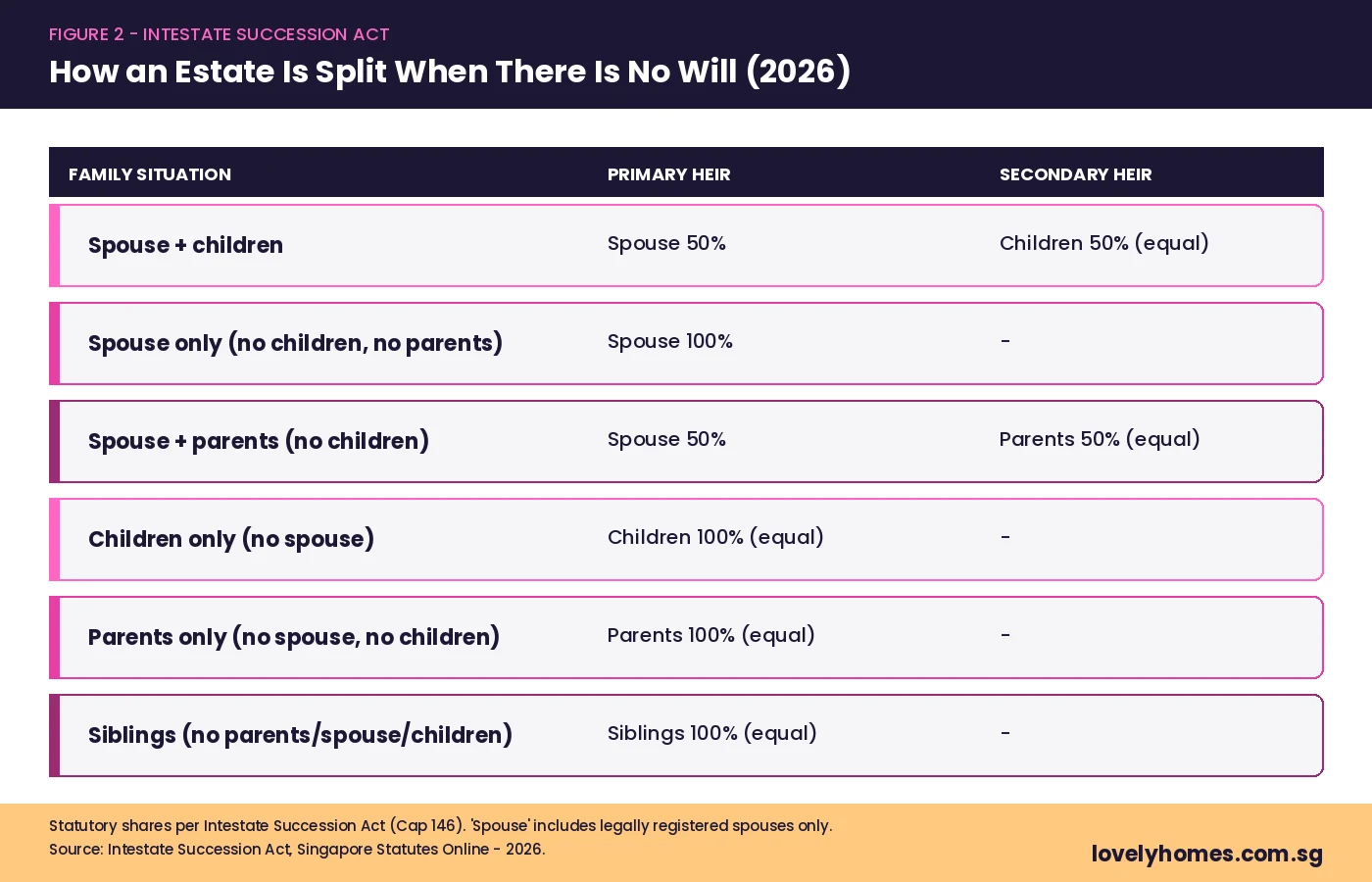
Intestate Succession Act statutory shares chart for 2026
Figure 2: Intestate Succession Act statutory shares, 2026. Where there is no Will, distribution follows the Act’s strict order.
Family Situation Statutory Distribution
Spouse + children Spouse 50%; children 50% (split equally between children)
Spouse only (no children, no parents) Spouse takes 100%
Spouse + parents (no children) Spouse 50%; parents 50% (equally)
Children only (no spouse) Children 100% (equal shares per stirpes)
Parents only (no spouse, no children) Parents 100% (equally)
Siblings (no parents, no spouse, no children) Siblings 100% (equally)
No surviving immediate or extended family Estate goes to the Singapore Government (bona vacantia)

Two practical points worth highlighting. First, “spouse” in the Act means a legally registered spouse only — long-term partners, fiancés, and ex-spouses are excluded, no matter how long the relationship. Second, step-children are not statutory heirs unless legally adopted. If you have a blended family, you almost certainly need a Will — the ISA will not deliver the outcome most blended families assume.

HDB Inheritance — Special Rules That Override the General Position

HDB flats are not just real estate — they are part of Singapore’s public housing system, with eligibility rules that override the general law of succession. When a HDB owner dies, the flat does not simply transfer to the heir named in the Will or the ISA share — HDB still has to approve who can inherit and remain in the flat. The rules are roughly:

  • The heir must be Singapore Citizen or PR. Foreigner heirs cannot inherit and remain on title for an HDB flat.
  • The heir must satisfy HDB’s family-nucleus or single-buyer eligibility. A 28-year-old single child cannot inherit the flat outright until age 35 under the Single Singapore Citizen Scheme — the flat is held in trust until then or sold on the open market.
  • Existing property by the heir matters. If the heir already owns a private residential property, HDB’s ownership rules require the heir to dispose of the private property within 6 months of the inheritance to retain the HDB flat, or vice versa.
  • The flat’s remaining MOP and SC quota apply. Inheritance does not reset the Minimum Occupation Period or trigger any quota issues, but the heir must continue to comply with rental, sublet, and EIP/SPR quota rules.

For a HDB-specific deep-dive, our How to Sell an HDB Flat 2026 guide covers the complications when an inherited HDB flat must be sold to fund the estate or to free the heir to remain on private property. The HDB section of the official HDB site sets out the live position.

Stamp Duty on the Inheritance — What You Actually Pay

Singapore’s tax position on inheritance is unusually generous compared with major Western jurisdictions:

Cost breakdown of inheriting a S$2 million property in Singapore 2026
Figure 3: Indicative cost of inheriting a S$2M private condo in 2026. Singapore charges no estate duty and no BSD/ABSD on the transmission itself.

1. No estate duty since 15 February 2008

Singapore abolished estate duty for deaths occurring on or after 15 February 2008. There is no “death tax”, no “inheritance tax”, and no “estate tax” on the value of the property at the date of death. This is a major reason why Singapore is favoured by family-office structures over the UK (40% inheritance tax) or the US federal estate tax.

2. No BSD or ABSD on transmission

The transfer of the property from the deceased’s estate to the heir is a transmission — not a sale — and therefore not subject to Buyer’s Stamp Duty (BSD) or Additional Buyer’s Stamp Duty (ABSD). This is consistent with IRAS’s position that ABSD only applies on a purchase. Inheriting your parent’s flat does not, in itself, trigger any stamp-duty bill.

3. BUT — ABSD count is affected for the heir’s next purchase

Here is the trap. While the inheritance itself attracts no ABSD, the inherited property counts toward the heir’s property tally for any future purchase. A Singapore Citizen who inherits their parent’s HDB flat now owns one residential property — their next purchase will be an SC-2nd at 20% ABSD, not the SC-1st at 0%.

Heirs who are mid-purchase when the inheritance arrives need to plan carefully. A common workaround is to renounce the inherited interest in favour of another beneficiary — legally permissible under the Probate & Administration Act, provided the renunciation is done before the heir takes any benefit from the property. We strongly recommend speaking to a probate lawyer before renouncing because the implications are irreversible. For broader context on ABSD, see our ABSD Singapore Complete Guide 2026.

4. Property tax continues, billed to the new owner

The annual property tax obligation passes to the heir on transmission. If the heir occupies the property as their home, owner-occupier rates (lowest band) apply. If the heir already has another home and rents the inherited property out, IRAS will apply the higher non-owner-occupier rates. See our Singapore Property Tax 2026 guide for current rates and bands.

CPF Refund — The Easily-Missed Step

If the deceased used CPF to fund the property, the principal sum used plus accrued interest must be refunded to their CPF account on transfer. The CPF refund is paid to the deceased’s estate (effectively to the named CPF nominees, if any, or otherwise distributed by the executor). This is not a tax — it is the final clearing of the deceased’s CPF position. The figure can be substantial: a 4-room HDB flat that was funded with S$200,000 of CPF in 2000 might owe over S$400,000 of principal-plus-accrued-interest in 2026.

Heirs sometimes mistake this CPF refund for a charge that they have to pay personally. They do not — the refund comes out of the estate’s share of any sale proceeds, or, if the property is being retained, the estate must arrange for the refund from cash assets. The refund is a precondition for clear title and cannot be deferred.

How Long Does the Whole Process Take?

For a simple estate — one residential property, undisputed Will or clean intestacy, one or two heirs, no overseas assets — the typical journey looks like this:

Stage Typical Timeline Who Drives It
Locate Will & gather documents 1–2 weeks Family
Engage probate lawyer 1 week Family
File Grant application (probate or LA) 2–4 weeks Lawyer
Court issues Grant 2–6 weeks for probate; 8–16 for LA Court
Lodge Grant + Notice of Death with SLA 1–2 weeks Lawyer
CPF refund & outstanding loan settlement 2–4 weeks Lawyer / family
Title transmitted to heir 2–3 weeks after CPF/loan clearance SLA
Total simple estate ~3–4 months testate; ~5–7 months intestate

Contested estates, estates over S$5 million, estates with overseas immovable property, or estates where the deceased’s domicile is uncertain all add months to the timeline. Engaging an experienced probate solicitor early is the single most important action a family can take to keep the timeline on track.

A Worked Example — What Mr Tan’s Family Actually Pays

Mr Tan, a Singapore Citizen aged 78, dies in March 2026. He leaves behind:

  • A 4-room HDB flat in Bedok (held in his sole name), valued at S$650,000.
  • A S$2 million private condominium in District 15 (held jointly with his wife as joint tenants).
  • A simple Will leaving the HDB flat equally to his two adult children, both Singapore Citizens.

The flow:

  1. Condo — immediate transfer. The District 15 condominium passes automatically to Mrs Tan by survivorship. No probate, no Will, no ISA. Mrs Tan lodges the death certificate with SLA. Cost: roughly S$300 in lodgement fees.
  2. HDB flat — through probate. The executor (eldest son) applies for a Grant of Probate. Court issues the Grant in five weeks. Probate legal fees: ~S$4,500. The HDB flat is then transmitted equally to the two children. Both children are Singapore Citizens, but each already owns a private condo — under HDB rules, they cannot retain the inherited HDB flat and must dispose of either the HDB or the private property within six months. Family decides to sell the flat on the open market.
  3. CPF refund. Mr Tan had used S$280,000 of CPF (principal + accrued interest) on the HDB flat. The refund flows from sale proceeds to his CPF account, then to nominees.
  4. Sale proceeds distributed. Net of the CPF refund and S$8,000 selling costs, the remaining S$362,000 is divided equally between the two children (S$181,000 each).
  5. ABSD impact for the children. Because each child took beneficial ownership of the HDB flat before selling it, each had two residential properties on title for that brief window. Their next condo purchase will be an SC-3rd-property at 30% ABSD — not 0%. The family should have spoken to a probate lawyer about renouncing in favour of the surviving spouse, or selling the flat directly out of the estate without taking transmission.

This is the textbook example of why estate planning matters. With one Will revision — leaving the HDB flat to Mrs Tan instead — the entire ABSD complication for the children would have been avoided.

How Estate Planning Works in Singapore (Briefly)

Three estate-planning instruments do most of the heavy lifting:

  1. A valid Will. Drafted, signed, and witnessed per the Wills Act. Costs from S$300 (simple Will at a high-street firm) up to several thousand for a complex estate. The single highest-leverage action any property-owning Singaporean can take.
  2. CPF nominations. CPF moneys do not pass through the Will or the ISA — they go to nominees. Without a CPF nomination, balances go to the Public Trustee for distribution per ISA. Update CPF nominations whenever there is a major life event.
  3. Manner of co-ownership. Married couples buying property together should consciously choose between joint tenancy (survivorship transfers automatically) and tenancy in common (each owner’s share passes through their estate). The choice has profound implications for inheritance, divorce, and ABSD planning.

For an even more direct approach, large families with significant property holdings sometimes use private trusts — though Singapore’s ABSD-on-trustees position (65% on the trustee’s entity rate) means trust structures need careful structuring to avoid triggering punitive ABSD. This is well outside the scope of a general guide and demands specialist trust counsel.

What Might Come Next

Two areas to watch. First, Singapore’s policy stance on intergenerational transfer is generally favourable, but the ABSD position on inherited property has been quietly tightening since 2018. Expect IRAS to continue scrutinising arrangements where inheritance is structured to avoid ABSD — in particular “in-life gifts” and trust structures that benefit a Singapore property owner’s children. Second, the Family Justice Courts have signalled that they may digitise more of the probate process by 2027, which should compress the testate timeline below 4 weeks for simple estates. None of this is policy yet, and these paragraphs are editorial speculation only.

Frequently Asked Questions

Do I have to pay any tax when I inherit property in Singapore?

No tax is payable on the transmission itself — Singapore abolished estate duty for deaths from 15 February 2008, and no BSD or ABSD applies on a transfer that is not a sale. You will, however, pick up the annual property-tax obligation from the date of transmission, and any future purchase you make will count the inherited property toward your ABSD tally.

My parent died without a Will. Can I just sign over my share to my sibling?

Yes — this is called a Deed of Family Arrangement, signed after the Grant of Letters of Administration is issued. All ISA-statutory heirs must agree, and the deed is filed with the Court. It allows the family to redirect the estate without having to go to a full reapplication. Engage a probate solicitor to draft the deed and ensure stamp duty implications are covered.

Can I refuse the inheritance?

Yes. A beneficiary can renounce their interest under the Probate & Administration Act before taking any benefit from the property. The renunciation must be in writing and is irrevocable. Heirs sometimes do this to avoid the ABSD-count consequence of inheriting, channelling the property to a sibling who would not be affected.

What happens to the deceased’s outstanding mortgage on the property?

Most Singaporean homeowners carry Mortgage Reducing Term Assurance (MRTA) or the Home Protection Scheme (HPS) for HDB. Either policy pays off the outstanding loan on death — the heir takes the property unencumbered. If no MRTA/HPS exists, the mortgage continues and the heir must either continue servicing it (if eligible to take over the loan) or sell the property to discharge it.

If I am a Singapore Citizen and inherit a Malaysian property, do I need to declare it in Singapore?

Yes. Even though no Singapore tax is due on the inheritance itself, you must declare any overseas residential property you own when applying for ABSD remission, HDB schemes, or LBS — the Singapore Government counts overseas residential property toward eligibility tests. You will also have Malaysian filing obligations, including the Real Property Gains Tax position on any future disposal.

Can a foreigner inherit a Singapore property?

Yes for private property — foreigners can inherit and own non-restricted private residential property in Singapore, subject to the Residential Property Act for landed homes. For HDB flats, foreigners cannot inherit the flat directly — the HDB flat must be sold and the proceeds distributed instead. Engage a Singapore lawyer who deals with cross-border probate.

How much do probate lawyers cost in 2026?

For a simple estate with one residential property and no contests, expect around S$3,000–S$8,000 in legal fees (with a Will) or S$4,000–S$10,000 (without a Will, since Letters of Administration take longer and require a personal-representative bond). Court filing fees are typically a few hundred dollars more.

Related Articles

Disclaimer: This guide is for general information only and does not constitute legal, tax, or financial advice. Probate, succession, stamp duty, and HDB inheritance rules change over time and depend on individual circumstances. Always verify the live position with the Family Justice Courts, the Intestate Succession Act, the HDB website, and IRAS, and consult a Singapore-qualified probate solicitor before acting on any estate matter.

Translate »