Thomson-East Coast Line Property Guide Singapore 2026: Best Districts & Investment Opportunities

Thomson-East Coast Line Property Guide Singapore 2026: Best Districts & Investment Opportunities

The Thomson-East Coast Line property guide Singapore 2026 is your complete reference for buying, investing, or upgrading along Singapore’s newest MRT trunk line. The TEL, operated by SMRT under the Land Transport Authority’s network, is the first line to run from the deep north of Singapore — Woodlands North — all the way to the eastern seaboard at Sungei Bedok, connecting eight of Singapore’s twenty-eight districts in a single continuous line. For property buyers, the TEL represents both a connectivity premium already priced into northern and eastern districts and a genuine price-growth runway in catchment areas where development is still maturing.

Quick Answer — TEL Property in 2026 at a Glance

  • The TEL runs 43 stations across 5 phases; all phases are operational as of November 2024
  • North segment (D25–D26): entry prices from S$1.2M–S$1.8M for 1–2 bedroom condos; gross yields 3.8–4.3%
  • Prime central segment (D10–D11): average transaction prices S$2,900–S$3,800 psf; yields compress to 2.5–3.2%
  • East Coast segment (D15–D16): sweet spot for yield investors — S$2,200–S$2,600 psf with yields 3.5–4.0%
  • Three active new launches along the TEL corridor in 2026: Springleaf Residence (D26), UPPERHOUSE (D10), and the Kallang Close GLS
  • The TEL’s opening in D15 (Katong, Marine Parade, Tanjong Rhu) added a 6–12% price premium to catchment condos within 500m, per URA caveat analysis
  • Investors should note: TEL East Coast properties fall under the Rest of Central Region (RCR) and Core Central Region (CCR) frameworks for ABSD and LTV calculations
  • The Tanjong Rhu GLS site (D15) — first new land release in the area in 28 years — signals major upcoming supply in a historically undersupplied waterfront node

What Is the Thomson-East Coast Line?

The Thomson-East Coast Line is the sixth MRT line on Singapore’s Mass Rapid Transit network. Planned by the Land Transport Authority and built in five phases, the TEL broke ground in 2015 and reached full network connection in November 2024 when the final phase linking Bedok South to Sungei Bedok opened, completing the 43-station, approximately 43-kilometre corridor. Unlike older lines that were retrofitted through existing urban fabric, the TEL was master-planned as a north-south-east spine: it reaches previously MRT-unserved residential catchments in Woodlands, Upper Thomson, and the East Coast, while also adding new stations in the premium central districts of Stevens, Napier, and Orchard Boulevard.

The LTA’s long-term transport planning has established a clear correlation between MRT station proximity and private residential price premiums. Researchers at the National University of Singapore’s Institute of Real Estate and Urban Studies have documented average premiums of 5–15% for private properties within 500 metres of a station, with new lines generating the strongest uplift in the two to three years around opening. The TEL’s staged opening created sequential pricing events across its catchments, and property investors who tracked the LTA’s construction timeline were able to position ahead of each phase.

The TEL in Five Segments: A Property Investor’s Map

For analytical purposes, the TEL’s 43 stations divide into five investment segments, each with distinct supply, pricing, and yield characteristics.
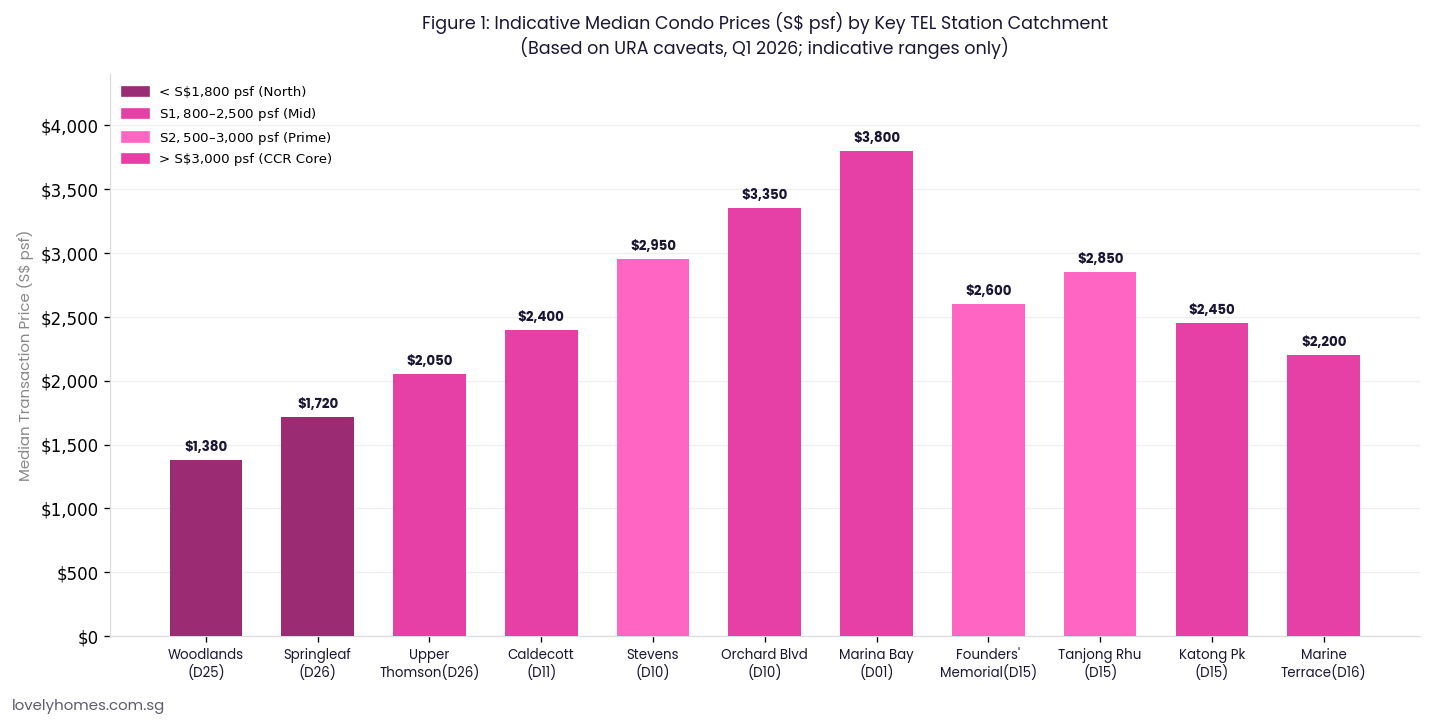
Median condo prices psf by TEL station catchment Singapore 2026 Q1 URA caveats
Figure 1: Indicative median condo transaction prices (S$ psf) by key TEL station catchment area, based on URA caveat data for Q1 2026. The gradient from north (D25–D26) to central CCR reflects Singapore’s established price geography.

Segment 1 — The North (D25–D26): Woodlands to Springleaf

The northern anchor of the TEL serves Woodlands (D25) and Upper Thomson/Mandai (D26). This is the most affordable segment on the line, with median condo transaction prices in the S$1,300–S$1,800 psf range as of Q1 2026 (URA caveats). The key residential projects here are Woodlands-area condos such as The Woodleigh Residences and Canberra Crescent developments, alongside the more recent Springleaf Residence at Upper Thomson. Springleaf Residence — a Wing Tai Holdings and Hong Leong Holdings joint venture — launched at an average S$2,175 psf and achieved 92% sold at launch, validating strong homebuyer demand in the D26 corridor.

Investment fundamentals for the north segment: rental yields are the highest on the TEL, typically 3.8–4.3% gross for 1-bedroom and 2-bedroom units, driven by the presence of international school catchments (Woodlands International School, Singapore Sports School), and the Woodlands Regional Centre transformation under URA’s long-range master plan. Entry prices for 1-bedroom units start from approximately S$850,000–S$1,000,000, making this the most accessible entry point on the line for investors under S$1M. The Woodlands–Johor Bahru RTS Link, due to complete in end-2026, is an additional demand catalyst: cross-border workers commuting from Singapore to the Johor Bahru Bukit Chagar terminus will increasingly seek rental accommodation at or near Woodlands MRT.

Segment 2 — Upper Thomson to Caldecott (D20, D11): The Middle Ground

Between Springleaf and the Orchard stretch, the TEL passes through Upper Thomson Road, the Caldecott interchange (linking to the Circle Line), and Stevens (linking to the Downtown Line). This segment includes Districts 20, 11, and the western edge of D10. Caldecott and Stevens are immediately adjacent to premium private residential estates including Bukit Timah, Holland Road, and the Nassim/Tanglin clusters — traditionally among the most expensive residential districts in Singapore.

The Stevens station, in particular, serves as a gateway to the Good Class Bungalow belt in D10 and the UOL-SingLand UPPERHOUSE at Orchard Boulevard development (101 units, 99-year leasehold, average S$3,350 psf, launched 2024). The connectivity addition of the TEL here — bringing a direct one-seat ride from Stevens all the way to Marina Bay and the East Coast — solidified premium pricing in a corridor that was already well-served by car ownership. For buyers, the TEL has made D10–D11 properties accessible to a broader pool of non-car-owning tenants, improving rental sustainability for high-end CCR units.

Segment 3 — The CCR Core (D01–D10): Orchard to Marina Bay

The TEL’s central stations — Napier, Orchard Boulevard, Great World, Havelock, Outram Park (interchange), Maxwell, Shenton Way, and Marina Bay — traverse the very heart of Singapore’s Core Central Region. Median transaction prices in this segment range from S$2,900 psf (Havelock/Great World catchment) to S$3,800 psf (Orchard Boulevard environs), with top CCR addresses in Orchard exceeding S$4,500 psf. The key driver here is not yield — gross rental yields compress to 2.4–3.0% as capital values are elevated — but capital preservation and long-run appreciation in freehold or near-freehold assets.

The CCR core is where the ABSD differential matters most acutely. Foreigners buying in this segment pay 60% ABSD, which has materially shifted the buyer mix since April 2023 towards Singapore Citizens and PRs on investment purchases. URA Q1 2026 caveats show that CCR transactions remain below their 2021–2022 peak volumes, but median prices have held firm, suggesting that existing CCR owners are not distressed and are holding for long-term appreciation rather than selling at discounts.

Segment 4 — East Coast (D15): Katong to Marine Terrace

The TEL’s East Coast segment — from Tanjong Rhu to Marine Parade and Siglap — is arguably the most exciting investment corridor on the line in 2026. This is a historically low-supply, high-demand residential area. The East Coast has long commanded rental and lifestyle premiums driven by the concentration of international schools (SAS, CIS, UWCSEA East, EtonHouse), the East Coast Park, and a café-and-food-culture character that attracts young expatriate and local professional tenants. Before the TEL, the area had no MRT connectivity at all — residents relied entirely on buses and private transport. The arrival of Katong Park, Marine Parade, and Marine Terrace stations in 2023 was transformative.

URA caveat analysis shows that East Coast condos within 500 metres of the new TEL stations transacted at S$2,400–S$2,700 psf in Q1 2026, representing a 6–12% premium over comparable units further from the stations. Gross rental yields for 1-bedroom units in Katong and Marine Parade run at 3.5–4.1%, benefitting from high expatriate rental demand. The 2025 Tanjong Rhu GLS — the first government land sale in the area in 28 years — will eventually add supply, but the timeline to completion is 3–5 years, leaving the existing stock to absorb near-term rental demand.

Segment 5 — Far East (D16): Bedok to Sungei Bedok

The terminal segment, from Bedok South through Siglap, Bayshore, and Sungei Bedok, represents the TEL’s newest frontier. Bayshore Road — the subject of a significant GLS tender launched by the URA in March 2026, with a S$1.9–2.1B bid estimate and a 1,280-unit mixed-use integrated development — will be the anchor new launch for this segment. This site has MRT integration built into the development brief, meaning future residents will have a covered walk directly from their lobby to Bedok South MRT. The catchment here currently trades at S$1,900–S$2,300 psf, offering the best price-to-TEL-connectivity value on the entire line for medium-term investors who are comfortable with a 2–3 year supply wait.
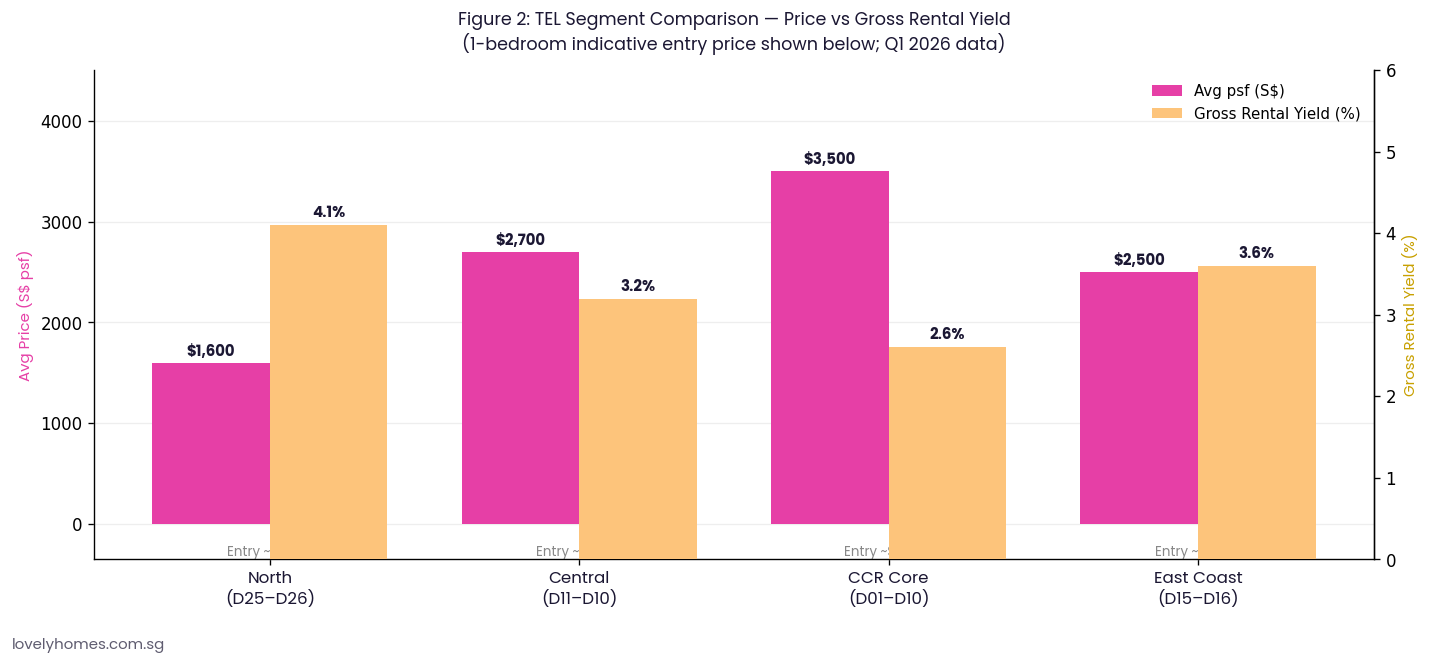
TEL segment comparison price psf versus gross rental yield Singapore condo 2026
Figure 2: TEL segment comparison — average price psf against gross rental yield and indicative 1-bedroom entry price (Q1 2026). The north and east segments offer the superior yield profile; the CCR core delivers capital preservation and prestige.

Summary Table: TEL Segments at a Glance

Segment Districts Median psf (Q1 2026) Gross Yield Entry 1BR (~S$) Best For
North (Woodlands–Springleaf) D25–D26 S$1,300–1,800 3.8–4.3% S$850K–1.0M Yield-focused; RTS uplift play
Mid-North (Thomson–Caldecott) D20–D11 S$2,050–2,400 3.0–3.5% S$1.2M–1.5M Balanced; school proximity
CCR Core (Orchard–Marina Bay) D01–D10 S$3,000–3,800 2.5–3.0% S$2.2M–3.5M Capital preservation; prestige
East Coast (Katong–Marine Parade) D15 S$2,400–2,700 3.5–4.1% S$1.5M–1.8M Expat rental; lifestyle premium
Far East (Bayshore–Sungei Bedok) D16 S$1,900–2,300 3.6–4.0% S$1.1M–1.4M Medium-term upside; Bayshore GLS

Worked Example: Comparing Two TEL Investment Scenarios

To illustrate how the TEL’s price geography affects investor outcomes, consider two hypothetical purchasers buying in April 2026, each with a S$1.8M budget for a 2-bedroom investment unit (Singapore Citizen, first private property, no ABSD).

Option A — East Coast (D15), near Marine Parade MRT: 2BR, 700 sqft at S$2,500 psf = S$1.75M. BSD payable to IRAS: ~S$55,600. Monthly mortgage (75% LTV, S$1.31M at SORA+0.75% = ~3.70%, 25 years): ~S$6,720. Monthly rental income at 3.7% gross yield: ~S$5,390. Net monthly cash flow (before management fee, property tax, sinking fund): −S$1,330 per month. Capital appreciation target: 4–6% per annum over a 7-year hold. Total return (conservative 4% p.a. appreciation + cumulative rental income): estimated IRR of approximately 8–10% over a 7-year hold.

Option B — North (D26), near Springleaf MRT: 2BR, 800 sqft at S$1,850 psf = S$1.48M. BSD payable to IRAS: ~S$43,000. Monthly mortgage (75% LTV, S$1.11M at 3.70%, 25 years): ~S$5,700. Monthly rental at 4.1% gross: ~S$5,060. Net cash flow: −S$640 per month (significantly better than Option A). Capital appreciation at a more conservative 3% p.a. over 7 years. IRR: approximately 7–9%, with a stronger monthly cash flow during the hold period. Option B also leaves S$320K of the budget unused, which could service emergencies or fund a second property later.

Neither option is inherently superior — the trade-off is between location prestige and rental resilience (Option A) versus cash-flow comfort and lower entry risk (Option B). Both outperform a typical fixed deposit or Singapore Savings Bond over a 7-year horizon on a total return basis, based on current market data.
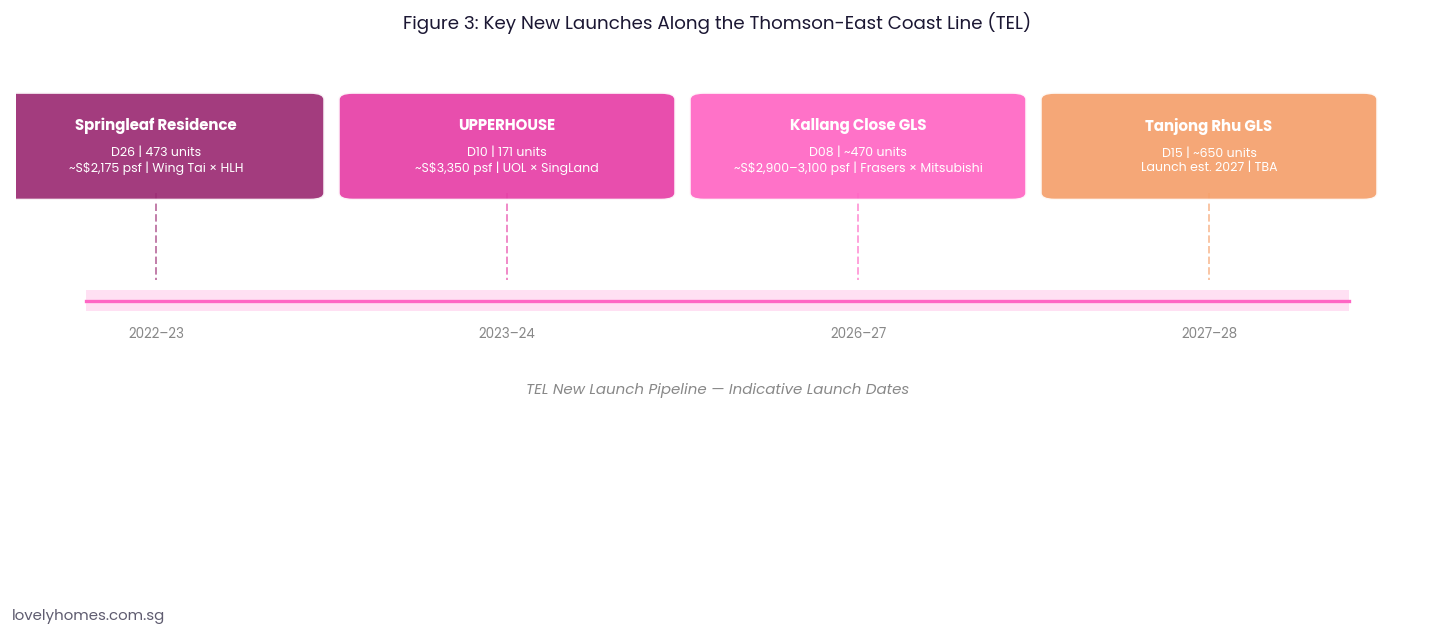
New launch condos along Thomson-East Coast Line TEL pipeline 2026 2027 Singapore
Figure 3: Key new launch projects along the TEL corridor — indicative launch dates and entry pricing. The pipeline includes both live launches and upcoming sites from the Government Land Sales programme.

Why the TEL Matters for Property Investors in 2026

Singapore’s MRT network has historically been the single most reliable infrastructure driver of residential price premiums. The TEL is unique in that it opened across a decade (2019–2024), meaning different catchments are at very different stages of the price-uplift cycle. The north segment is still absorbing the connectivity premium as the Johor Bahru RTS Link nears completion; the East Coast is in the early-mid stage of its premium maturation; and the CCR core stations are fully priced in. For investors, the implication is clear: the North and East Coast segments still offer the better forward-looking return profile relative to entry price.

URA’s Q1 2026 full statistics (released 25 April 2026) showed that private residential prices rose 0.9% quarter on quarter, with the Rest of Central Region — which encompasses much of the East Coast TEL corridor — outperforming the Core Central Region in transaction volume. This divergence suggests that RCR properties, including East Coast condos, are currently absorbing more buyer demand than the premium CCR market, consistent with a pricing cycle where affordability-conscious buyers are moving down the price curve from CCR into RCR catchments along connective infrastructure like the TEL.

What Might Come Next Along the TEL

Looking forward, three developments warrant investor attention. First, the Bayshore Drive GLS (URA tender, closing July 2026) will be the defining new launch for the Far East segment. With 1,280 units and an MRT-integrated brief, the eventual project will set a new price benchmark for D16, potentially pushing neighbouring resale values upward in anticipation. Second, the Tanjong Rhu GLS — where the site was awarded in late 2025 — will bring the first new private development to the Tanjong Rhu waterfront in three decades; market estimates place the launch price at S$3,200–3,500 psf, consistent with D15 premium waterfront comparable transactions. Third, URA’s ongoing Draft Master Plan 2025 consultations include proposals to intensify the East Coast Park corridor and the Katong precinct, which, if implemented, could further bolster lifestyle premiums in the Marine Parade and Siglap catchments.

Frequently Asked Questions

Which TEL station has the best investment value in 2026?

For yield-focused investors, the Upper Thomson and Springleaf catchments (D26) currently offer the best combination of gross yield (3.8–4.3%), reasonable entry price (from S$1.2M for 2BR), and near-term demand catalysts from the Johor Bahru RTS Link. For capital appreciation, Marine Parade and Katong Park (D15) are the standout stations — still absorbing the TEL connectivity premium with a supply shortage that will persist until the Tanjong Rhu GLS project completes circa 2029–2030. For lifestyle owner-occupiers, Stevens and Orchard Boulevard (D10) offer unsurpassed centrality and school proximity at a premium entry point.

How much of a premium do TEL station properties command over non-MRT units?

Research from the Institute of Real Estate and Urban Studies at NUS estimates that properties within 500 metres of a new MRT station command a 5–15% price premium over comparable properties 800–1,500 metres away, with the premium being largest in the first two to three years after the station opens and in areas with low existing MRT coverage (such as the East Coast before the TEL). Properties integrated directly with a station (ground-level covered link) command a further 3–7% premium, per URA caveat analysis. For the East Coast segment, which had zero prior MRT coverage, the observed premium has been at the higher end of the 8–12% range for 500m-radius properties.

Are there new launch condos available along the TEL right now?

As of April 2026, active new launches along the TEL corridor include Springleaf Residence (D26, near Springleaf MRT, 473 units, 92% sold at launch at ~S$2,175 psf by Wing Tai and Hong Leong Holdings) and UPPERHOUSE at Orchard Boulevard (D10, near Orchard Boulevard MRT, 171 units at ~S$3,350 psf by UOL and Singapore Land Group). The Kallang Close GLS site (near Bendemeer MRT, an adjacent north-south TEL interchange station) is expected to launch circa 2027–2028 at S$2,900–3,100 psf by Frasers Property and Mitsubishi Estate. For the East Coast, the Tanjong Rhu waterfront site is in development and expected to preview approximately 2027.

How does ABSD apply to TEL property purchases by foreigners?

Foreigners purchasing any residential property in Singapore — including condos along the TEL — pay 60% ABSD on the full purchase price, regardless of whether it is their first or subsequent property. This applies equally to CCR Orchard Boulevard units and to more affordable East Coast apartments. The 60% rate, introduced in April 2023, has effectively priced most foreign investors out of the Singapore residential market. Singapore Permanent Residents buying their first private property pay 5% ABSD; their second residential property attracts 30% ABSD. Singapore Citizens pay 0% on a first private purchase and 20% on a second. All ABSD is administered by the Inland Revenue Authority of Singapore and is payable within 14 days of exercising the Option to Purchase.

What is the Johor Bahru RTS Link and why does it matter for TEL D25–D26 properties?

The Rapid Transit System (RTS) Link is a cross-border rail connection between Woodlands North MRT (the TEL’s northernmost station) and Bukit Chagar in Johor Bahru, Malaysia, scheduled for completion in late 2026. The RTS Link will allow commuters to travel between Singapore and Johor Bahru in approximately 5 minutes by rail, replacing a congested road crossing that currently takes 30–90 minutes in peak hours. For property investors, the RTS Link is a demand multiplier: Singaporeans working in Johor Bahru’s rapidly developing Iskandar Malaysia economic region, as well as Malaysians working in Singapore who choose to commute rather than rent, both anchor rental demand at or near Woodlands North and Woodlands MRT. Industry data suggests rental demand for 1BR and 2BR units within a 10-minute walk of Woodlands MRT could increase 15–25% once the RTS Link is fully operational.

How do I find resale condos near a specific TEL station?

The most reliable data source for resale condo transactions near any TEL station is the Urban Redevelopment Authority’s real estate information system at URA REIS. You can search by postal district or project name to see actual caveated transaction prices, floor area, and date of transaction. For a broader property search including current listings, URA’s public portal at ura.gov.sg provides planning information and the latest approved development details for each district. Cross-referencing URA caveats with listing prices gives you a reliable indication of the price gap (or premium) being applied by sellers in each catchment.

Related Articles

Disclaimer

This article is for general informational purposes only and does not constitute financial, legal, or property investment advice. All price per square foot figures, yield estimates, and transaction data referenced are indicative, based on publicly available URA caveat records and industry analysis, and are subject to change. Property values may go up or down. ABSD and stamp duty rates are administered by IRAS and are subject to revision. Consult a licensed property professional and a qualified financial adviser before making any investment decision.
HDB Upgrader Guide Singapore 2026: How to Move from HDB to Private Property

HDB Upgrader Guide Singapore 2026: How to Move from HDB to Private Property

The HDB upgrader guide Singapore 2026 is your complete, step-by-step resource for navigating the most financially significant move many Singaporeans will ever make: selling your Housing Development Board flat and purchasing a private condominium. Whether you are a Singapore Citizen approaching Minimum Occupation Period, or a permanent resident re-evaluating your property portfolio, understanding the full financial, regulatory, and timing picture is essential before you commit to either transaction.

Quick Answer — HDB Upgrade at a Glance

  • You must meet a Minimum Occupation Period (MOP) of 5 years before selling your HDB flat (resale) or renting it out entirely
  • Singapore Citizens buying a private condo while retaining their HDB pay 20% ABSD on the private property purchase
  • The sell-first strategy eliminates ABSD and is used by the majority of upgraders; the buy-first strategy preserves housing continuity but incurs ABSD upfront
  • Minimum cash component for a private condo: 5% of purchase price (beyond what CPF can cover)
  • Your Total Debt Servicing Ratio (TDSR) must not exceed 55% of gross monthly income on all loans combined
  • CPF Ordinary Account savings used for the HDB must be refunded with accrued interest of 2.5% per annum upon sale
  • Full upgrade process (sell HDB + buy private): 7–9 months on a sell-first strategy; legal completion to collect keys adds 3–5 months for new launches
  • A Singapore Citizen household with S$800K HDB equity upgrading to a S$1.5M condo typically needs S$350K–$420K in additional cash/CPF

What Is the HDB-to-Private Upgrade Path?

Singapore’s dual-tier housing market — public HDB flats and private residential properties — creates a well-trodden upgrade path that the Housing Development Board and Urban Redevelopment Authority have both shaped through policy. An HDB flat is built on land sold to the HDB by the State under a 99-year lease; the HDB flat grant system, CPF usage rules, and MOP together form a structured subsidy framework designed to support first-time homeownership. The private condominium market, regulated separately by the URA, operates without the same direct subsidies, but also without income ceilings, nationality restrictions (for citizens and PRs), or MOP constraints once purchased.

The “HDB upgrade” is the act of monetising the subsidised first-home equity — essentially converting the benefit of below-market pricing and CPF grants into cash proceeds — and reinvesting those proceeds into the private market. The CPF Housing Grant for resale HDB flats, administered by the Housing Development Board, can total up to S$80,000 for eligible first-time buyer households; this grant accrues interest at 2.5% per annum and must be returned to CPF upon sale. Upgraders therefore need to account for this accrued interest deduction before calculating usable equity.

MOP: When Can You Sell?

The Minimum Occupation Period is the single most important gating rule. Under HDB regulations, resale HDB flat owners must physically occupy the flat for five years from the date of possession (for resale) or five years from the date of key collection (for new BTO flats purchased directly from the HDB). During the MOP you cannot sell your flat on the open market, rent out the entire flat, or own any private residential property in Singapore.

The five-year MOP was first introduced in 2010 and has remained stable since. For Prime Location Public Housing (PLH) flats announced from October 2021, the MOP is 10 years — a significant constraint for buyers in mature estates like Bishan, Queenstown, or the Pearl’s Hill development announced by MND in March 2026. Always verify the applicable MOP from your HDB letter of offer.

ABSD and the Simultaneous-Ownership Question

The single most expensive decision in the upgrade process is whether to sell your HDB flat before or after buying the private property. The difference is the Additional Buyer’s Stamp Duty, which is administered by the Inland Revenue Authority of Singapore (IRAS).

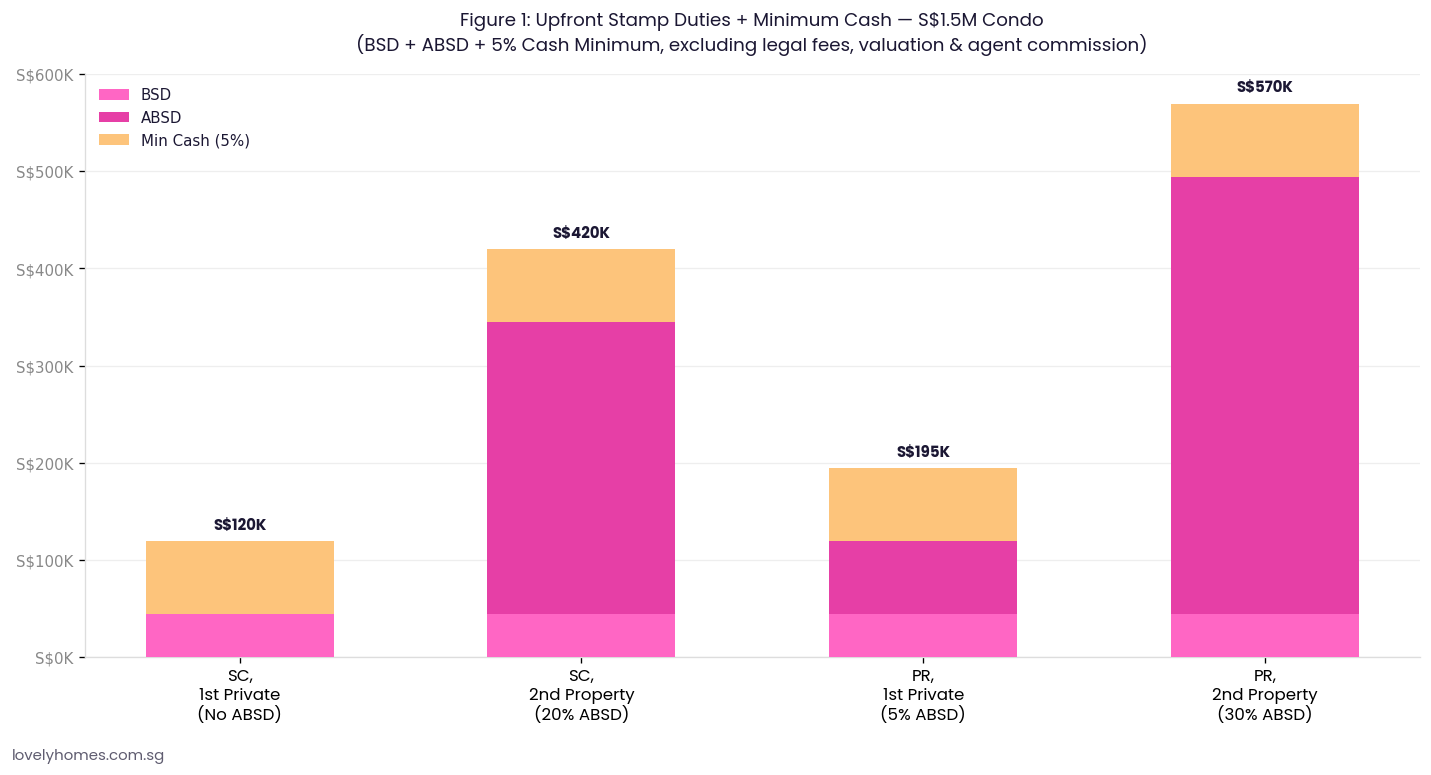
Upfront stamp duties and cash needed when upgrading from HDB to private condo Singapore 2026
Figure 1: Upfront stamp duties + minimum cash for a S$1.5M private condo purchase by buyer profile. ABSD is administered by IRAS and is based on the purchase price or market value, whichever is higher.

At the current rates (effective 27 April 2023), a Singapore Citizen buying a second residential property pays 20% ABSD on the purchase price. On a S$1.5M condominium that is S$300,000 payable within 14 days of exercising the Option to Purchase. Permanent Residents buying their first private residential property pay 5% ABSD; their second attracts 30%.

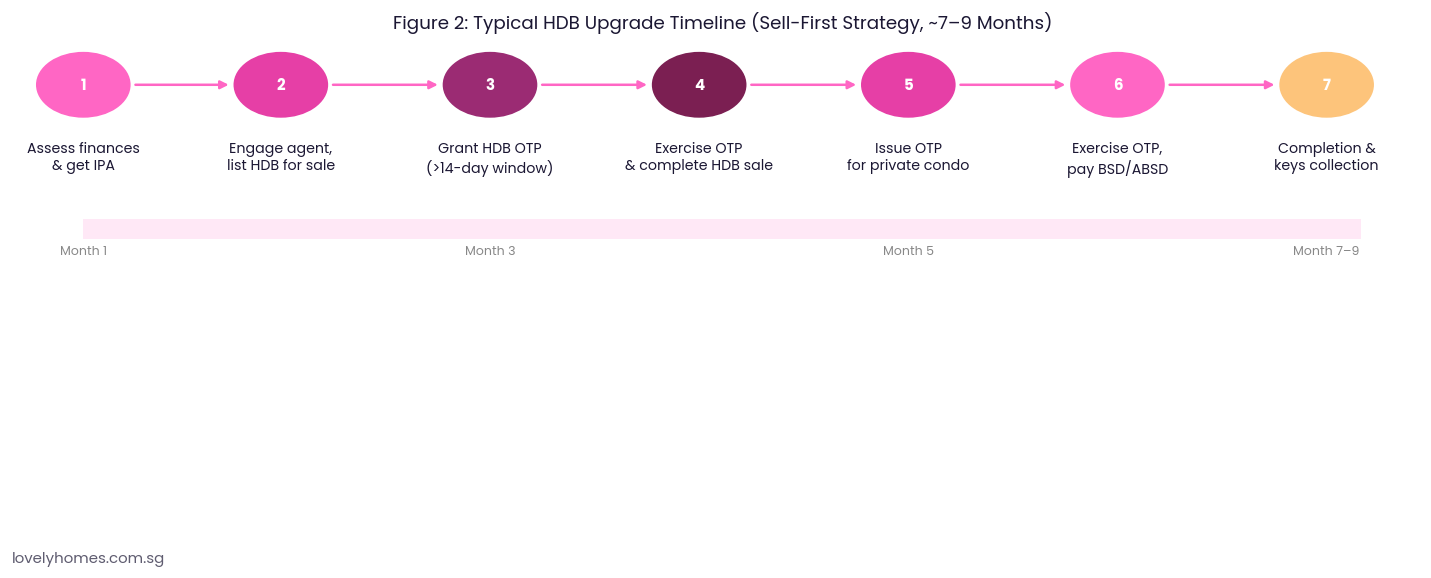
The sell-first strategy means completing the HDB sale (and receiving the full proceeds) before exercising the OTP for the private property. As long as no private residential property is in your name at the point of exercising the OTP, the ABSD charge is 0% for a Singapore Citizen’s first private purchase. This is the financially dominant path for the majority of HDB upgraders and accounts for the bulk of upgrade transactions recorded in URA caveats each year. The downside is an interim period — typically 1–4 months — between HDB completion and private condo collection, during which the family must rent or stay with relatives.

The buy-first strategy preserves residential continuity and is preferred by households with school-age children needing school proximity, or families who cannot face temporary displacement. However, ABSD is payable in full at OTP exercise. IRAS does offer a Remission Scheme for Married Couples: if at least one buyer is a Singapore Citizen and the couple sells the first property within six months of the private purchase date (resale) or key collection date (new launch), IRAS will refund the ABSD on the second property. The refund is not automatic — the couple must apply via the IRAS MyTax Portal within the six-month window.

CPF Usage, Accrued Interest, and Usable Equity

Understanding your actual usable equity from the HDB sale requires two deductions many sellers underestimate. First, the outstanding HDB loan balance (typically financed at the CPF Ordinary Account interest rate of 2.6% per annum) or bank loan must be fully repaid upon completion. Second, all CPF Ordinary Account monies used for the purchase — including the principal plus accrued interest at 2.5% per annum compounded annually — must be refunded to your CPF OA before you receive any cash proceeds. The CPF Board, as custodian of the national retirement savings scheme, enforces this return to ensure retirement adequacy is not eroded by property liquidation.

Practical example: a flat purchased in 2016 for S$500,000 where S$150,000 was used from CPF over nine years will have accrued approximately S$38,000 in interest, meaning S$188,000 must be refunded to CPF. This refunded amount is not lost — it returns to your CPF OA for future use, including towards the new private property — but it does reduce the cash-in-hand proceeds from the HDB sale.

TDSR, MSR, and How Much You Can Borrow

Private property mortgage lending in Singapore is governed by the Total Debt Servicing Ratio framework, administered by the Monetary Authority of Singapore (MAS). Under TDSR rules, the monthly repayment on all outstanding credit facilities — including the new mortgage — must not exceed 55% of the borrower’s gross monthly income. MAS also applies a stress-test rate: variable-rate loans are assessed at the prevailing rate plus a floor, and fixed-rate loans are assessed at the actual fixed rate or 3.5% (whichever is higher, as of the most recent MAS guidance). This means that even if actual SORA-pegged mortgage rates are below 3.5% today, the bank will calculate affordability as if they were 3.5%.

The Mortgage Servicing Ratio — which caps HDB loan repayments at 30% of income — does not apply to private property. However, banks typically retain their own internal MSR-equivalent underwriting floors. For a household with S$12,000 monthly gross income, the maximum monthly debt service across all credit lines is S$6,600 (55%), and after deducting any car loan or personal loan obligations, the remaining capacity determines the maximum mortgage quantum.

HDB upgrade timeline sell-first strategy 7 to 9 months Singapore 2026
Figure 2: The typical sell-first upgrade timeline. Steps 1–4 cover the HDB sale; Steps 5–7 cover the private condo purchase. Total elapsed time is approximately 7–9 months for a resale private condo; add 2–5 years for a new launch.

The Loan-to-Value Framework for Private Property

Under MAS Notice 632, the maximum Loan-to-Value (LTV) ratio for a first housing loan from a financial institution is 75% of the lower of purchase price or market value, provided the loan tenure does not exceed 30 years and the borrower does not exceed 65 years of age at loan maturity. If either condition fails, the LTV drops to 55% or 45%. For upgraders who have fully repaid their HDB loan, the higher 75% LTV applies on the private condo purchase. For those with an outstanding HDB bank loan at the time of application (buy-first strategy), the LTV for the new loan may be reduced to 45%, further increasing the cash component required.

Summary Table: Key Upgrade Figures at a Glance

Parameter Sell-First (No ABSD) Buy-First (ABSD Remission)
ABSD (SC, 2nd property) 0% (sold HDB first) 20% upfront; refundable if HDB sold within 6 months
BSD (on S$1.5M) ~S$44,600 (both strategies) ~S$44,600
Min Cash Required 5% of purchase price 5% + 20% ABSD (cash or financing)
Max LTV 75% (no outstanding loan) 45% (outstanding HDB bank loan retained)
TDSR Limit 55% of gross income 55% of gross income
Typical Timeline 7–9 months (resale condo) 6 months from OTP exercise to sell HDB
CPF OA Accrued Interest 2.5% p.a., must refund to CPF upon HDB sale Same

Worked Example: The Tans Upgrade from Tampines to Condo

Mr and Mrs Tan are a Singapore Citizen couple in their late thirties. They purchased a Tampines HDB 5-room resale flat in 2019 for S$620,000, using S$180,000 from CPF OA and taking an HDB bank loan for S$440,000 at 2.6% per annum. As of April 2026 — seven years into the loan — their outstanding loan balance is approximately S$360,000, and their CPF refund obligation (principal S$180,000 + accrued interest ~S$33,000) totals S$213,000. The flat is valued at S$750,000 on the open market.

Proceeds calculation (sell-first):

  • Sale price: S$750,000
  • Less: outstanding HDB loan repayment: −S$360,000
  • Less: CPF refund obligation: −S$213,000
  • Net cash-in-hand: S$177,000
  • CPF OA balance after refund: S$213,000 (available for new purchase)

New condo purchase at S$1.5M (sell-first, no ABSD):

  • BSD payable to IRAS: ~S$44,600
  • ABSD: S$0 (HDB sold first)
  • 5% minimum cash: S$75,000
  • Loan quantum (75% LTV): S$1,125,000
  • CPF usable (OA): S$213,000 (can cover remaining 20% − 5% cash = S$225,000; short by ~S$12,000 in CPF — top up from cash or savings)
  • Total upfront cash outlay: ~S$132,000 (BSD S$44.6K + cash S$75K + CPF shortfall S$12K)
  • Usable HDB cash proceeds (S$177K) exceed cash outlay (S$132K): surplus ~S$45,000

Combined gross household income for TDSR: S$14,000/month. Monthly mortgage on S$1,125,000 at 3.5% stress rate over 25 years ≈ S$5,630. TDSR = 40.2% — within the 55% cap. The upgrade is financially feasible.

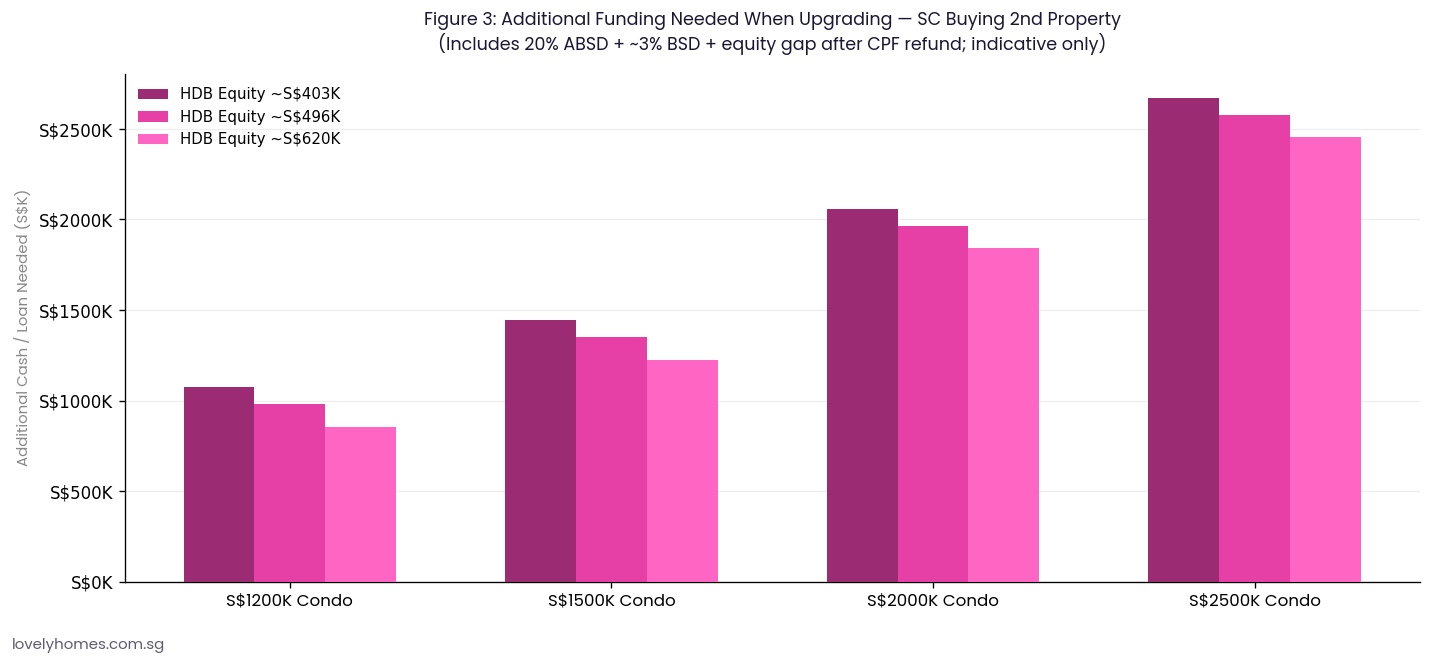
Additional cash needed when HDB upgrading to private condo Singapore citizen second property ABSD 2026
Figure 3: Additional cash or loan funding needed above HDB equity proceeds, by condo price point and usable equity level. All figures assume 20% ABSD (SC 2nd property) and 3% BSD; sell-first scenario removes the ABSD bar entirely.

Why the Upgrade Matters for Singapore Wealth Building

The HDB-to-private upgrade has historically been Singapore’s most reliable individual wealth-building step. URA transaction data consistently shows that private residential prices in the Rest of Central Region (RCR) and Core Central Region (CCR) have outpaced HDB resale price appreciation over 10-year rolling periods, particularly in proximity to MRT interchanges and integrated developments. The 2016–2026 decade saw HDB resale values rise approximately 40–55% in prime estates, while comparable private freehold or 99-year leasehold condos in the same districts appreciated 60–90%.

That said, the upgrade decision is not purely about capital appreciation. Private condo ownership typically involves higher monthly outgoings — management fees, sinking fund contributions, higher property tax under the non-owner-occupier progressive rate (administered by IRAS), and higher mortgage quantum — which compress monthly cash flow for the first 5–10 years. Households should model the cash-flow impact carefully using the actual mortgage rate (SORA + spread, typically 3.4–3.8% as of April 2026 for new floating-rate packages) rather than the stress-test rate.

What Might Come Next: Policy Watch for Upgraders

The current ABSD framework (20% for SC second property) has been in place since April 2023 and shows no sign of immediate revision. MAS and MND have both signalled that macroprudential tools will remain elevated as long as private property prices continue to rise. The URA reported a 0.9% quarter-on-quarter increase in private residential prices in Q1 2026 (full statistics released 25 April 2026), on top of a 0.6% gain in Q4 2025, suggesting sustained upward pressure that gives authorities little reason to ease ABSD. Upgraders planning their move in 2026–2027 should assume the 20% SC ABSD rate persists for the foreseeable future, and should build the sell-first timeline around that assumption.

One area to watch is the Lease Buyback Scheme and CPF use rules for older HDB upgraders (aged 55+), where CPF Retirement Account obligations create a different equity-release calculus. MND’s Committee of Supply 2026 speech hinted at ongoing reviews of CPF Retirement Sum drawdown rules for older owner-occupiers — any loosening could marginally improve equity available for the upgrade among this cohort.

Frequently Asked Questions

Can I buy a private condo before selling my HDB flat?

Yes, but as a Singapore Citizen you will be liable for 20% ABSD on the private condo purchase price, payable within 14 days of exercising the OTP. IRAS provides a Remission Scheme for married couples where at least one is a Singapore Citizen: if you sell your HDB within six months of the private condo’s key collection date (new launch) or OTP exercise date (resale), you may apply to IRAS for a refund of the ABSD paid. The refund is not automatic and requires a formal application within the stipulated window. Note that the 5% cash down payment for the private condo is still required upfront and is not refunded.

What happens to the CPF money I used for my HDB flat?

Upon selling your HDB flat, all CPF Ordinary Account monies used for the purchase — including the initial down payment, subsequent monthly instalments drawn from CPF, and any CPF Housing Grants received — must be refunded to your CPF OA with accrued interest at 2.5% per annum compounded annually. This refunded amount re-enters your CPF OA and can be used immediately for the down payment on your private condo purchase (subject to the CPF Withdrawal Limit and Valuation Limit rules). You do not lose this money — it simply remains within the CPF system rather than being paid out as cash. The CPF Board’s property portal at cpf.gov.sg provides a withdrawal calculator to estimate your exact refund obligation.

How much cash do I actually need to upgrade?

The minimum cash component for any private property purchase in Singapore is 5% of the purchase price. This must be paid in cash — CPF OA funds or bank loans cannot cover this component. For a S$1.5M condominium that is S$75,000. On top of this, you will need cash or CPF for the Buyer’s Stamp Duty (approximately S$44,600 on S$1.5M), legal fees (~S$3,000–$5,000), and a valuation fee (~S$300–$600). If you are using the sell-first strategy and have no ABSD to pay, total cash and CPF outlay to exercise the OTP is approximately S$120,000–$130,000 for a S$1.5M property, with the remainder funded by your mortgage and CPF OA balance.

Can I retain my HDB flat and buy a private condo?

Singapore Citizens and Permanent Residents are not prohibited from simultaneously owning an HDB flat and a private property, but the financial cost is high: as an SC you will pay 20% ABSD on the private property purchase, and as a PR you will pay 30% ABSD on your second property. Additionally, while you own both, the HDB flat remains subject to HDB rules including the restriction on fully subletting the flat until MOP is met (unless you are above 35, divorced, a single with the right to sublet under HDB’s rules, or have specific HDB approval). If you proceed with this dual-ownership approach, you must ensure your TDSR covers both your HDB loan instalments and the new private mortgage simultaneously.

What is the Temporary Housing Solution during the gap between HDB completion and condo collection?

Most sell-first upgraders experience a 1–6 month gap between HDB legal completion and moving into the new private property. The most common approach is a deferred completion arrangement negotiated with the HDB buyer at the point of signing the OTP — you agree to stay in the flat for a fixed rental period (typically 2–3 months at a market rate) after legal completion while your new home is prepared. Alternatively, families rent a unit in the open market at prevailing rates, or stay with extended family. Factoring rental costs of S$2,000–$4,500 per month (depending on unit size and district) into your upgrade budget is essential, particularly for the east and central regions where new launch condo waiting periods can extend to 3–5 years.

Are there specific private condos I cannot buy with my HDB equity?

There are no restrictions on which private condominium an HDB upgrader may purchase. However, two practical constraints often apply. First, Restricted Residential Properties under the Residential Property Act — Good Class Bungalows and most landed housing in Singapore — require Ministerial approval for Singapore Permanent Residents and are unavailable to foreigners entirely; Singapore Citizens may purchase without restriction. Second, if your usable CPF OA balance is below the Valuation Limit (the lower of purchase price and market value), your CPF usage will be capped; you must fund the shortfall from cash. Always check the CPF Board’s updated Valuation Limit rules at cpf.gov.sg before committing to a price point.

What happens if I cannot sell my HDB within the 6-month ABSD remission window?

If you purchased a private condo while retaining your HDB flat (buy-first strategy) and are unable to sell the HDB within six months of the private condo’s key collection date or OTP exercise date, the ABSD remission is forfeited — the 20% ABSD you paid upfront is not refunded. In practice, HDB resale transactions in Singapore typically complete within 8–16 weeks of listing, so the six-month window is generally achievable if you list the HDB promptly after exercising the condo OTP. The risk is greatest when buying a resale condo (shorter completion timeline) while your HDB is slow to sell. If you are uncertain, the sell-first strategy eliminates this risk entirely.

Related Articles

Disclaimer

This article is intended for general informational purposes only and does not constitute financial, legal, or property advice. Stamp duty rates, CPF rules, HDB regulations, and MAS lending guidelines are subject to change; always verify current figures directly with the Inland Revenue Authority of Singapore (IRAS), the CPF Board, the Housing Development Board, and the Monetary Authority of Singapore. Consult a licensed property agent, bank mortgage specialist, and solicitor before making any property transaction decision. Nothing in this article should be treated as a solicitation to buy or sell any property.


Singapore Private Property Q1 2026 Full Statistics: Prices Rise 0.9%, Developer Sales Fall 32%, Rents Recover

Singapore Private Property Q1 2026 Full Statistics: Prices Rise 0.9%, Developer Sales Fall 32%, Rents Recover

URA Q1 2026 Singapore private residential full statistics prices up sales down

Quick Answer — Q1 2026 Key Findings

  • Overall private residential prices rose +0.9% QoQ in Q1 2026 — a significant upward revision from the +0.3% flash estimate issued 1 April
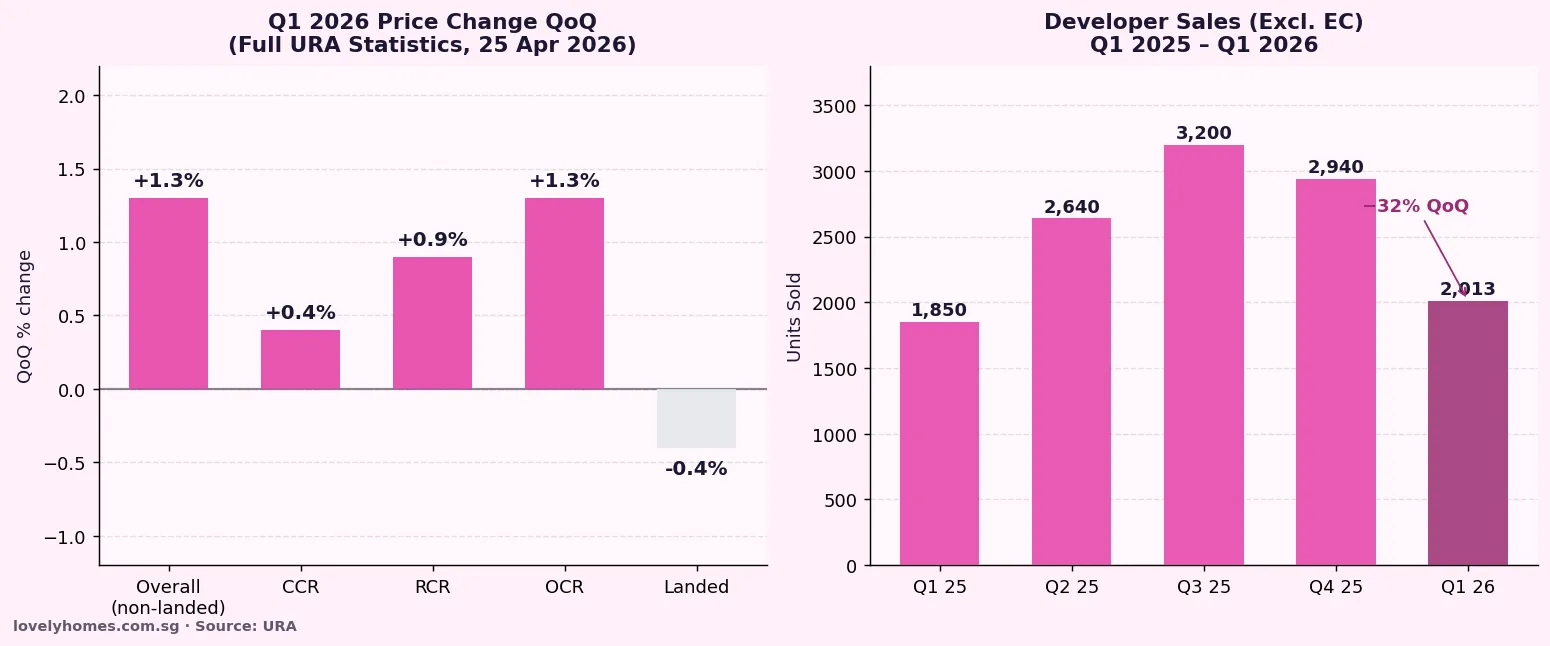
  • Non-landed segment led with +1.3% QoQ; landed homes fell −0.4% (first decline since Q1 2025)
  • Developer sales (excl. EC): 2,013 units — down 32% QoQ from 2,940 in Q4 2025; new launches: 1,844 units
  • Total private home sales (incl. resale & sub-sale): 5,413 units — down 19% QoQ
  • Rental prices reversed: +0.3% QoQ after −0.5% in Q4 2025; leasing volume +4% to 20,861 contracts
  • OCR led price growth at +1.3%; RCR +0.9%; CCR +0.4% — a reversal of the prior quarter’s CCR outperformance
  • Source: URA Full Q1 2026 Real Estate Statistics, released 25 April 2026 (pr26-31)

The Headline: Prices Firmer Than Expected, but Activity Cools

Singapore’s private residential property market ended the first quarter of 2026 on a note that confounded earlier market caution. The Urban Redevelopment Authority’s (URA) full Q1 2026 real estate statistics — released on 25 April 2026 — confirmed a price increase of 0.9% quarter-on-quarter, a significant upward revision from the flash estimate of +0.3% published on 1 April. The upward revision reflects the inclusion of transactions that settled late in the quarter and the complete dataset across all market segments.

This marks the sixth consecutive quarter of overall price appreciation, and comes despite a sharp slowdown in transaction volumes. Developer sales of new private homes (excluding executive condominiums) fell 32% quarter-on-quarter to 2,013 units in Q1 2026, compared with 2,940 in Q4 2025 — the lowest quarterly developer sales figure since Q1 2025. The divergence between resilient prices and declining volumes reflects constrained new supply, selective buyer behaviour, and the legacy of affordability compression from 2023–2025 price appreciation.

URA Q1 2026 Singapore private residential price change by segment developer sales data infographic
Figure 1: Q1 2026 price change by market segment (left) and developer sales trend (right). Source: URA Full Q1 2026 Real Estate Statistics, 25 April 2026.

Price Performance by Segment

Segment Q1 2026 QoQ Change Q4 2025 QoQ Change Commentary
Non-Landed (Overall) +1.3% −0.1% Strongest QoQ in 5 quarters; reversal of Q4 dip
OCR (Outside Central) +1.3% +1.2% Mass market continues to outperform; HDB upgrader demand
RCR (Rest of Central) +0.9% +0.5% Strong; reflects demand for city-fringe new launches
CCR (Core Central) +0.4% +1.1% Moderated from prior quarter; luxury demand more selective
Landed (Overall) −0.4% +3.4% First decline since Q1 2025; mean-reversion after strong 2025

The OCR’s continued leadership at +1.3% QoQ reflects the powerful structural driver of HDB upgraders — households completing their 5-year MOP on government flats and redeploying equity into mass-market private condominiums in districts 18, 19, 20, 23, and 27. This demographic pipeline is well-documented and shows no signs of abating through 2027.

The CCR’s moderation from +1.1% in Q4 2025 to +0.4% is consistent with a market where luxury buyers are more selective in an environment of elevated global uncertainty — including the US-China trade tensions and the spill-over effects of US tariff regimes on Singapore’s export-oriented economy. That said, +0.4% still represents appreciation, and the CCR has not seen negative quarterly price movement since Q3 2023.

The landed segment’s −0.4% retreat follows a very strong Q4 2025 (+3.4%). Landed properties are thinly traded and highly volatile on a quarterly basis; the Q1 dip is best read as mean-reversion rather than trend reversal, particularly given the structural scarcity of landed housing stock in Singapore.

Developer Sales and New Launches

Developers sold 2,013 private residential units (excluding ECs) in Q1 2026 — a 32% drop from the 2,940 sold in Q4 2025, and the weakest quarterly figure since Q1 2025. New project launches totalled 1,844 units, concentrated in the OCR and CCR, reflecting the pipeline of projects that had received sales licences after significant delays in late 2024.

The pull-back in volumes should be contextualised: Q4 2025 was exceptionally strong, driven by the simultaneous launch of multiple large-scale projects (THE ORIE, Promenade Peak, Elta, Parktown Residence) that collectively captured pent-up demand. Q1 2026’s normalisation is partly seasonal and partly a function of the reduced number of new projects in the pipeline following the Q4 burst.

Resale and sub-sale transactions also fell, with total private home sales (all categories) coming to 5,413 units — down 19% from 6,699 in Q4 2025. Industry observers note that the absolute volume remains healthy relative to the 2019–2022 baseline and that the quarter started slowly before accelerating in March 2026 following the Lunar New Year holiday period.

Rental Market Reversal — What It Means

Private residential rents reversed their recent softening trend, rising +0.3% QoQ in Q1 2026 after declining −0.5% in Q4 2025. Leasing volume also strengthened, climbing 4% quarter-on-quarter to 20,861 rental contracts. This is the first positive quarterly rental movement since Q4 2023, and may mark the end of the post-pandemic rental correction that saw prices ease from their 2022–2023 highs.

The rental recovery is supported by two converging forces: a continued influx of foreign professionals amid Singapore’s sustained tech and financial sector hiring, and a temporary tightening of rental supply as a number of large residential projects that reached TOP in 2023–2024 move past initial tenant search periods. The question for Q2 and Q3 2026 is whether this modest recovery sustains, or whether the global economic headwinds translate into reduced expatriate inflows and renewed rental softening.

What Might Come Next

The price upward revision from +0.3% (flash) to +0.9% (full) is the quarter’s most significant data surprise. It suggests that the late-quarter transactions — many of which were sub-sales and resales settled in March — carried higher psf values than the new launch transactions recorded earlier in the quarter. If this pattern holds into Q2 2026, the annual price growth trajectory for 2026 could exceed the more cautious industry forecasts of 2–4%, potentially tracking closer to 4–6%.

The key risk factors for H2 2026 remain: (a) global trade disruption and its impact on Singapore GDP growth and business confidence; (b) SORA rate movements — 3M compounded SORA remains above 2.9% as at April 2026, keeping home loan servicing costs elevated; (c) potential further ABSD measures if price momentum accelerates unexpectedly; and (d) the supply pipeline — with 17+ new project launches anticipated across Q2–Q4 2026, increased competition between developers for buyers could moderate per-unit pricing.

Note: This analysis is editorial commentary based on publicly available URA data. It is not investment advice.

Frequently Asked Questions

Why did the Q1 2026 price figure revise upward from the flash estimate?

The URA flash estimate, published 3–4 weeks into the following quarter, uses only transactions registered up to approximately mid-March. The full statistics incorporate all transactions completed through 31 March 2026, including late-settling resale and sub-sale contracts. These late transactions often involve higher-priced units (larger formats, upper floors, prime locations) that take longer to process — hence the full release tends to show a stronger price outcome than the flash.

Is the slowdown in developer sales a warning sign for the market?

Not necessarily. Developer sales of 2,013 units in Q1 2026 represent a normalisation after a bumper Q4 2025 that saw multiple large launches coincide. Historical Q1 figures often dip due to the Chinese New Year effect — reduced transaction activity during the festive period. The more telling metric is the 12-month trailing average, which remains above 8,500 units annually — a healthy pace for Singapore’s market size. Price resilience at +0.9% QoQ alongside lower volumes actually points to supply-demand balance rather than demand erosion.

What does the rental recovery mean for property investors?

The +0.3% QoQ rental increase in Q1 2026 (after −0.5% in Q4 2025) is a positive signal for landlords who have been holding property through the 2023–2025 rental correction. If rental yields stabilise or improve through H2 2026, the investment case for Singapore residential property — which was weakened during the high-ABSD, high-SORA, lower-yield environment of 2023–2024 — may recover modestly. However, with gross yields for most CCR and RCR condominiums still in the 2.5–3.2% range versus SORA-linked mortgage rates of ~3.5–3.7%, properties remain net-cash-flow negative on a leveraged basis for most investors.

Related Articles

Disclaimer: This article is editorial commentary based on data published by the Urban Redevelopment Authority of Singapore (URA). It is for general information only and does not constitute investment, financial, or property advice. All figures sourced from URA Media Release pr26-31 (25 April 2026). Verify data directly at ura.gov.sg. LovelyHomes.com.sg does not hold a real estate agency licence.


How to Sell Your Property in Singapore 2026: Costs, SSD, CPF Refund & Step-by-Step Process

How to Sell Your Property in Singapore 2026: Costs, SSD, CPF Refund & Step-by-Step Process

How to Sell Your Property in Singapore 2026 Complete Guide

Quick Answer — Key Takeaways

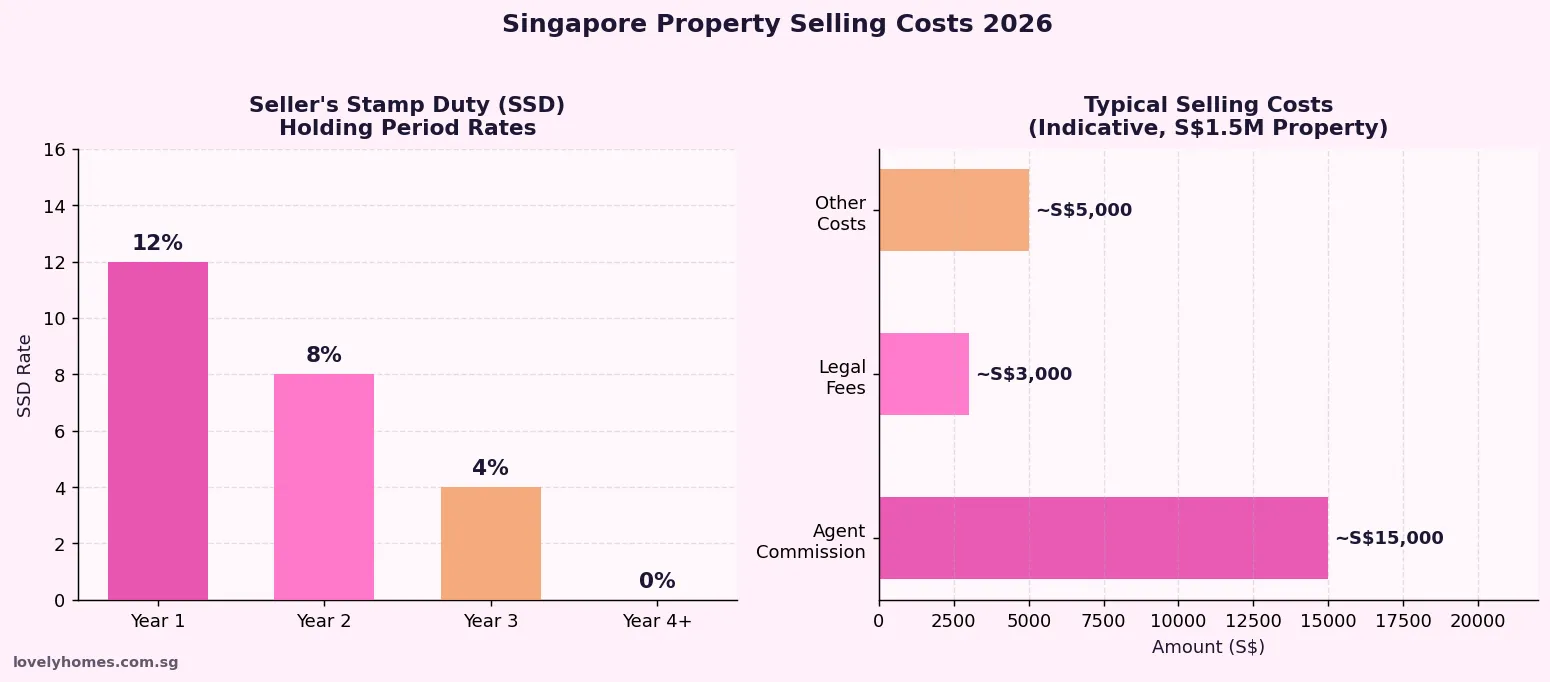
  • Seller’s Stamp Duty (SSD) of 12%, 8%, or 4% applies if you sell within 3 years of purchase (private residential properties)
  • Agent commission is typically 1–2% of sale price — negotiable; CEA-registered agents only
  • CPF funds used must be refunded to CPF OA with Accrued Interest (compounded at 2.5% p.a.) upon sale
  • The sale process from OTP to legal completion typically takes 10–12 weeks for private property; 8–12 weeks for HDB
  • Outstanding mortgage must be discharged from sale proceeds; early repayment penalty may apply (lock-in period)
  • No Capital Gains Tax in Singapore — profits from property sales are generally not taxed unless you are classified as a property trader by IRAS
  • Decoupling a property before sale may reduce ABSD on a subsequent purchase but requires careful legal structuring to avoid Section 33A anti-avoidance provisions

Selling Property in Singapore — Overview

Singapore’s property market has no Capital Gains Tax — meaning that profits from the sale of residential property are generally not subject to income tax, provided IRAS does not classify you as conducting a property trading business. However, selling a property in Singapore does involve a web of stamp duties, CPF refund obligations, agent fees, legal costs, and outstanding loan discharges. Understanding these costs upfront prevents unpleasant surprises at the point of sale.

The Seller’s Stamp Duty (SSD) — introduced in January 2011 and most recently recalibrated in April 2023 — is the most significant policy lever for sellers. At 12% for properties sold within the first year of purchase, SSD is designed to deter speculative flipping. This guide covers every major cost and step for selling a private residential property (condo, landed, or HDB) in Singapore in 2026.

Singapore property selling costs SSD rates 2026 data infographic
Figure 1: Seller’s Stamp Duty (SSD) rates and indicative selling cost components for a S$1.5M property, Singapore 2026.

Seller’s Stamp Duty (SSD) — Rates and Rules

Seller’s Stamp Duty is payable by the seller if a residential property is sold within 3 years of its purchase date (for private properties). The rates are based on the higher of the sale price or market value:

Holding Period SSD Rate (Current, from Apr 2023) SSD on S$1.5M Sale
Up to 1 year 12% S$180,000
More than 1, up to 2 years 8% S$120,000
More than 2, up to 3 years 4% S$60,000
More than 3 years 0% Nil

HDB flats are not subject to SSD, but have their own MOP (Minimum Occupation Period) of 5 years — during which the flat cannot be sold on the resale market at all.

All Costs When Selling Your Property

Cost Typical Amount Paid by / When
Agent Commission 1–2% of sale price Seller; at completion
Legal Fees (conveyancing) ~S$2,500–S$4,000 Seller; at completion
Seller’s Stamp Duty (SSD) 0–12% of sale price (if <3 years) Seller; within 14 days of OTP exercise
Mortgage Early Repayment Penalty 0.75–1.5% of outstanding loan (if in lock-in) Seller; upon full redemption at completion
CPF Refund (OA + Accrued Interest) All CPF used + 2.5% p.a. compound interest Mandatory; deducted from proceeds at completion
Property Tax (prorated to sale date) Varies by AV; prorated to completion date Seller; adjusted at completion
HDB Admin Fee (HDB resale only) S$40–S$80 Seller; to HDB

Worked Example: Selling a S$1.5M Condo Purchased 2 Years Ago

Scenario: SC seller, selling a condo purchased in April 2024 for S$1.4M, now selling in April 2026 at S$1.5M. Outstanding bank loan: S$900,000. CPF used: S$200,000 OA + S$10,000 accrued interest.

  • Gross Sale Price: S$1,500,000
  • Less SSD (8% × S$1.5M, sold in year 2): −S$120,000
  • Less Agent Commission (1.5%): −S$22,500
  • Less Legal Fees: −S$3,000
  • Less Outstanding Loan Redemption: −S$900,000
  • Less CPF Refund (S$200K + S$10K interest): −S$210,000
  • Net Cash Proceeds to Seller: S$1,500,000 − S$120,000 − S$22,500 − S$3,000 − S$900,000 − S$210,000 = S$244,500
  • Of which cash in hand (after CPF returned to CPF, not to pocket): ~S$244,500 (cash) + S$210,000 returned to CPF OA

Note: This example excludes any early repayment penalty on the bank loan. Verify with your bank and a property consultant. IRAS may treat profits as income if you are assessed as a property trader — consult a tax professional if you have sold multiple properties in recent years.

The Private Property Sale Process — Step by Step

For a private residential property (condominium or landed), the sale process broadly follows these stages over 10–12 weeks:

  1. Appoint a CEA-licensed agent (or sell directly). Agent markets the property, manages viewings, and facilitates negotiations.
  2. Accept an offer and grant an OTP. The buyer pays an Option Fee (typically 1% of agreed price). The OTP is valid for 14 days (standard) — extendable to 21 days by agreement.
  3. Buyer exercises OTP — pays the balance 4–9% deposit within the OTP period. Both buyer and seller appoint conveyancing solicitors.
  4. Solicitors conduct due diligence — title search, CPF charge check, Inland Revenue caveats, mortgagee consent if applicable.
  5. Completion — typically 8–10 weeks after OTP exercise. Sale proceeds are disbursed, mortgage is redeemed, CPF is refunded, and keys are handed over.

Frequently Asked Questions

Is there Capital Gains Tax on property sales in Singapore?

No. Singapore does not impose a Capital Gains Tax on property sales by individuals. Profits from property sales are not taxable — provided IRAS does not classify you as a property trader (i.e. someone who buys and sells properties as a business, subject to income tax on profits). If you have sold multiple properties in a short period, consult a tax professional to confirm your IRAS classification. The Inland Revenue Authority of Singapore (IRAS) administers all property tax matters.

How is the CPF refund calculated when I sell my property?

Upon selling your property, you must refund to your CPF OA: (1) all CPF funds withdrawn for the property (down payment, monthly instalments, BSD, legal fees funded by CPF), plus (2) accrued interest at 2.5% per annum, compounded annually, on those withdrawn amounts. This refund goes back into your CPF OA — it is not a tax, but it reduces the cash proceeds you receive. The CPF Board calculates the exact refund amount at completion. For long-held properties with large CPF withdrawals, accrued interest can be significant.

What if the sale price is less than the outstanding loan and CPF refund?

If the sale proceeds are insufficient to fully redeem the outstanding mortgage and refund all CPF funds with accrued interest, you would face a shortfall. In this scenario, you would need to top up the difference in cash. This is sometimes called a “negative sale.” To avoid this situation, sellers should always compute their minimum viable sale price before listing — accounting for loan balance, CPF refund, SSD, agent fees, and legal costs.

Can I avoid SSD by transferring the property to a family member?

No. SSD applies to all legal transfers of residential property within the holding period — including transfers to family members, whether by sale, gift, or trust arrangement. IRAS treats these as disposals subject to SSD. Section 33A of the Stamp Duties Act also provides anti-avoidance powers allowing IRAS to look through artificial arrangements designed to circumvent stamp duty obligations. Seek advice from a qualified stamp duty lawyer before attempting any form of property restructuring.

What happens if I have an HDB bank loan and sell before 3 years?

Unlike private property, HDB flats carry no SSD on their own — however, HDB resale flats cannot be sold during the 5-year MOP. If you have a bank loan (not an HDB concessionary loan) on a private property, an early redemption penalty (clawback) of 0.75%–1.5% of the outstanding loan may apply if you sell during the loan’s lock-in period (typically 1–3 years). Check your bank’s loan terms carefully before committing to sell. HDB concessionary loans do not carry lock-in penalties.

Related Articles

Disclaimer: Information on this page is for general reference only and does not constitute professional property, legal, financial, or tax advice. Stamp duty rules, CPF policies, and property regulations may change — verify all details with IRAS (iras.gov.sg), CPF Board (cpf.gov.sg), and HDB (hdb.gov.sg) before transacting. Consult a CEA-licensed property agent and a qualified solicitor for transaction-specific advice. LovelyHomes.com.sg does not hold a real estate agency licence.


HDB Resale Flat Buying Guide Singapore 2026: Step-by-Step Process, Grants & Costs

HDB Resale Flat Buying Guide Singapore 2026: Step-by-Step Process, Grants & Costs

HDB Resale Flat Buying Guide Singapore 2026

Quick Answer — Key Takeaways

  • Singapore Citizens and Eligible PRs may purchase HDB resale flats; certain restrictions apply to singles and PRs
  • The standard resale process takes 12–16 weeks from Option to Purchase (OTP) to key collection
  • Resale buyers may tap CPF Housing Grants: Enhanced CPF Housing Grant (EHG), Family Grant, and Proximity Grant — up to S$120,000 combined
  • HDB Loan Eligibility (HLE) letter or bank Approval-in-Principle (AIP) must be obtained before OTP is exercised
  • Cash-over-Valuation (COV) must be paid entirely in cash and is no longer disclosed by HDB — buyers and sellers negotiate based on market
  • HDB resale prices fell −0.1% QoQ in Q1 2026 (first decline since Q2 2019), though 412 million-dollar transactions set an all-time record
  • Proximity Housing Grant (S$30,000) available if you live within 4 km of parents/children

What Is an HDB Resale Flat?

A resale HDB flat is a Housing & Development Board flat that has been previously owned by at least one household, has completed its Minimum Occupation Period (MOP) of at least 5 years, and is now available for purchase on the open secondary market through HDB’s resale portal. Unlike a Build-to-Order (BTO) flat — which involves purchasing directly from HDB at a subsidised price with a multi-year wait — a resale purchase is a private transaction between seller and buyer, with HDB administering the eligibility checks and transaction registration.

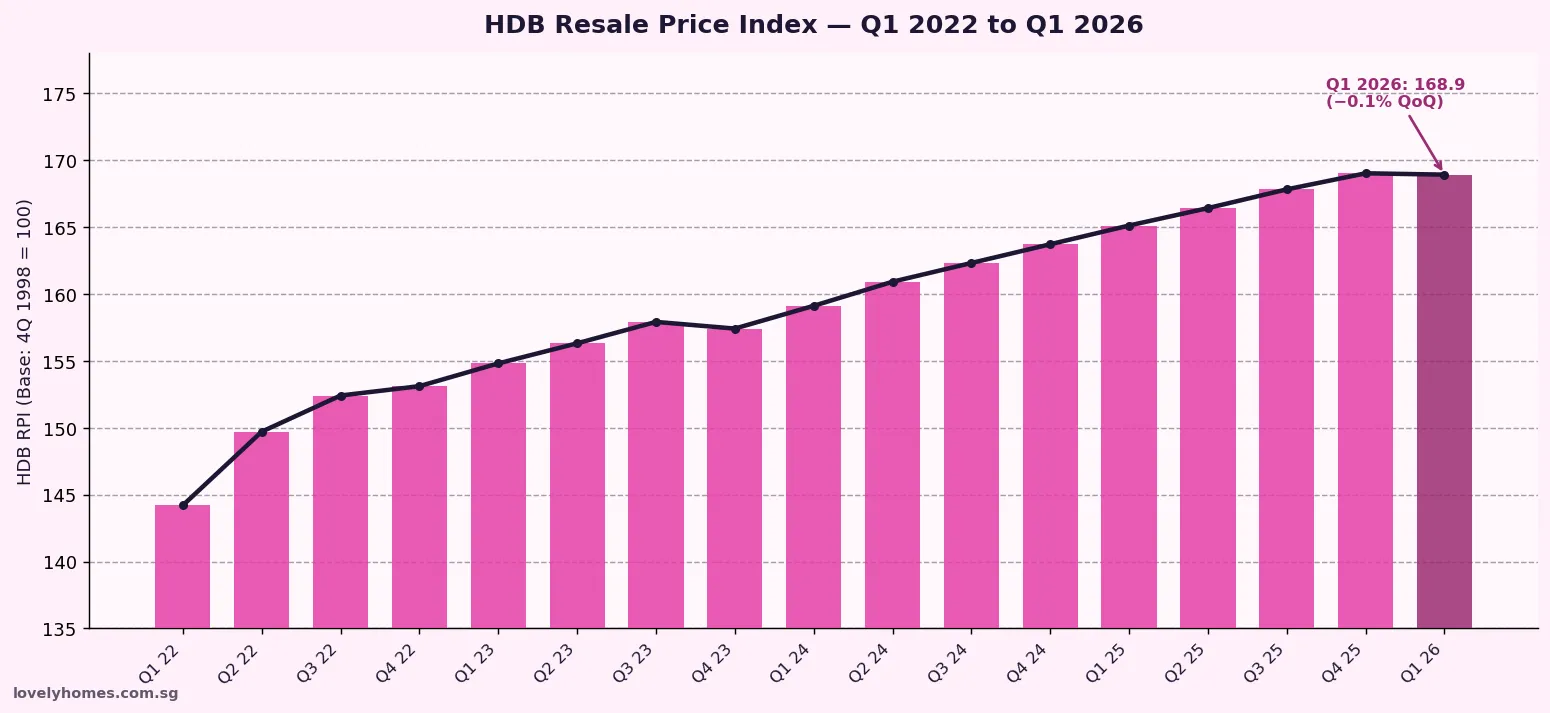
As of Q1 2026, the HDB Resale Price Index (RPI) stands at 168.9 — representing a rise of approximately 17% from Q1 2022 and a slight moderation of −0.1% quarter-on-quarter, the first quarterly dip since Q2 2019. The resale market remains characterised by sustained demand from upgraders, PRs, and those who cannot wait for BTO completion.

HDB Resale Price Index chart Q1 2022 to Q1 2026 Singapore data
Figure 1: HDB Resale Price Index (RPI) — Q1 2022 to Q1 2026. Source: HDB / URA flash estimates.

Who Can Buy an HDB Resale Flat?

Eligibility for HDB resale flat purchase is governed by HDB’s Ethnic Integration Policy (EIP) and Resale Eligibility Scheme. The primary conditions are as follows:

Buyer Type Conditions CPF Grants Available
SC Married Couple (both SC) May buy any HDB resale flat; MOP 5 years EHG (up to S$120K) + Family Grant (up to S$50K) + Proximity Grant
SC + PR Family Nucleus At least 1 SC; can buy any resale flat EHG (SC portion); reduced Family Grant
SC Singles (≥35 years old) May only buy 5-room or smaller HDB flat; income ≤ S$7,000 Singles Grant (up to S$25K); EHG Singles
PR Family (no SC) May buy after PR for 3 years; restricted flat types No CPF grants; must wait 3 years PR
Foreigners Not eligible to buy HDB resale flats N/A

The HDB Resale Purchase Process — Step by Step

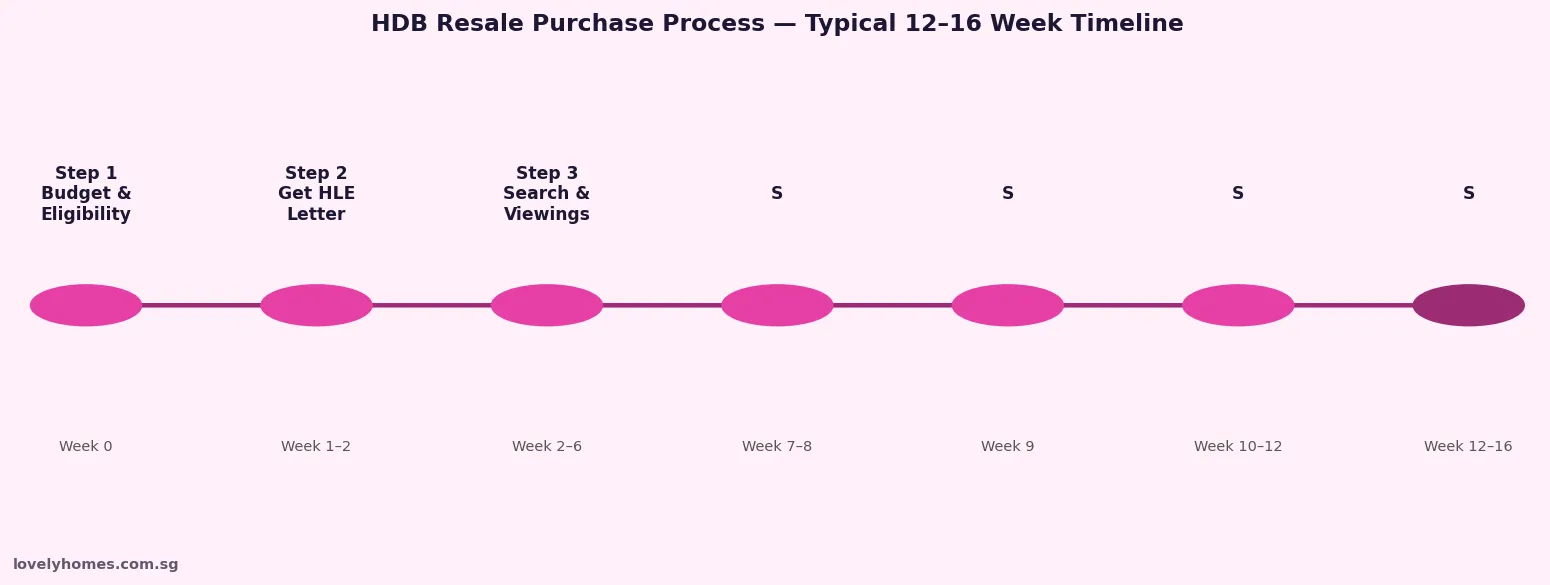
Buying an HDB resale flat involves a structured 12–16 week process administered jointly between the buyer, seller, and HDB’s portal. Below is the typical timeline:

HDB resale purchase process timeline 12 to 16 weeks Singapore 2026 infographic
Figure 2: HDB Resale Purchase Process — Typical 12–16 Week Timeline.

Step 1 — Establish your budget and eligibility. Determine your income ceiling, grant eligibility, CPF OA savings, and maximum loan quantum. Use HDB’s e-Services portal to check eligibility. If using an HDB concessionary loan, apply for a Housing Loan Eligibility (HLE) letter. If using a bank loan, obtain an Approval-in-Principle (AIP).

Step 2 — Engage a CEA-registered property agent (optional but recommended). You may transact directly using HDB’s resale portal, or appoint a Council for Estate Agencies (CEA)-licensed agent. All agents must be CEA-registered. Agent commission of 1–2% of the purchase price is typically borne by the buyer on the buyer’s side.

Step 3 — Search and shortlist. Browse HDB Flat Portal or property portals for listings. Factor in HDB’s Ethnic Integration Policy (EIP) quotas — some blocks may have reached their Chinese, Malay, or Indian quota, restricting the sale to certain ethnic groups.

Step 4 — Grant the Option to Purchase (OTP). The seller grants the buyer an OTP in exchange for an Option Fee of S$1 to S$1,000 (negotiated). The OTP is valid for 21 calendar days. Once the OTP is issued, both parties register their intent on HDB’s resale portal.

Step 5 — Exercise the OTP. Within 21 days, the buyer must exercise the OTP by paying an Exercise Fee (up to S$5,000 minus the Option Fee). At this point, both buyer and seller must submit the resale application to HDB via the portal simultaneously. A conveyancing solicitor is appointed.

Step 6 — HDB Appointment. HDB reviews the application (approximately 4–8 weeks) and schedules a completion appointment. At this appointment, financial documents, CPF pledges, and legal transfers are completed.

Step 7 — Completion and key collection. Keys are handed over, and the transaction is registered with SLA. The buyer officially becomes the registered owner of the flat.

CPF Housing Grants for Resale HDB (2026)

Grant Maximum Amount Eligibility Condition
Enhanced CPF Housing Grant (EHG) S$120,000 (family) / S$60,000 (singles) First-timer; income ≤ S$9,000 (family) / ≤ S$4,500 (singles); must work continuously for 12 months
Family Grant S$50,000 (both SC) / S$40,000 (SC+PR) At least one applicant first-timer; buying for family nucleus
Proximity Housing Grant (PHG) S$30,000 (living with/near parents) / S$15,000 (singles) Buying within 4 km of parents’ or married child’s home (or with them)
Step-Up CPF Housing Grant S$15,000 Second-timer SC households who previously received a CPF housing subsidy; buying a 2-3 room resale flat

Worked Example: Buying a S$650,000 5-Room Resale Flat

Buyer profile: SC married couple, combined income S$7,500/month, first-timer, buying with parents living nearby (within 4 km)

  • Purchase price: S$650,000
  • HDB valuation: S$630,000 → COV of S$20,000 (paid in cash)
  • EHG (income S$7,500): −S$60,000 (from CPF/cash)
  • Family Grant (both SC, 5-room): −S$50,000
  • Proximity Housing Grant: −S$30,000
  • Total grants: S$140,000 (credited to CPF OA, used to offset purchase)
  • Net price after grants: S$650,000 − S$140,000 = S$510,000
  • HDB loan (80% of valuation S$630K): S$504,000 (±)
  • Estimated monthly instalment (25-year HDB loan at 2.6%): ~S$2,285
  • Cash upfront (COV S$20K + option fee + stamps): ~S$30,000+

Note: Figures are illustrative. BSD and legal fees (approximately S$9,600 and S$2,500–4,000 respectively) are additional. Verify your specific scenario with HDB or a licensed property consultant.

Key Costs When Buying an HDB Resale Flat

Cost Item Amount / Rate Payment Method
Option Fee S$1–S$1,000 Cash
Exercise Fee Up to S$5,000 (minus Option Fee) Cash
Cash-over-Valuation (COV) Market-determined (if price > HDB valuation) Cash only
Buyer’s Stamp Duty (BSD) 1–6% progressive on purchase price CPF OA or cash (14 days)
ABSD (if applicable) 5% (PR 1st property) / 20% (SC 2nd property) etc. Cash (14 days)
Legal Fees ~S$2,500–S$4,000 CPF OA or cash
Agent Commission (buyer side) 1–2% of purchase price (if appointed) Cash

Frequently Asked Questions

Can a foreigner buy an HDB resale flat?

No. Only Singapore Citizens and Singapore Permanent Residents (in a family nucleus with at least one SC, and after 3 years of PR status) are eligible to purchase HDB resale flats. Foreigners cannot buy HDB flats under any circumstances.

What is Cash-over-Valuation (COV) and how does it work?

COV is the difference between the agreed purchase price and HDB’s official valuation of the flat. If you agree to pay S$650,000 for a flat valued by HDB at S$620,000, the COV is S$30,000. COV must be paid entirely in cash — it cannot be financed through an HDB or bank loan, and cannot be paid using CPF funds. HDB no longer publishes COV data; buyers and sellers negotiate based on recent transacted prices (available on HDB’s resale flat prices portal).

Can I use CPF to pay for an HDB resale flat?

Yes. You may use your CPF Ordinary Account (OA) savings to pay for the down payment, remaining purchase price (after loan), BSD, and legal fees. However, COV must be paid in cash. CPF usage is subject to the Valuation Limit (you can only use CPF up to the HDB valuation of the flat, not the transacted price). CPF funds used attract Accrued Interest (currently 2.5% per annum), which must be refunded to your CPF account upon sale.

How long does the HDB resale process take?

From the issuance of the OTP to key handover, the HDB resale process typically takes 12 to 16 weeks. The OTP itself has a 21-calendar-day validity period. After both parties register on HDB’s portal, HDB typically takes 4 to 8 weeks to schedule the completion appointment. Delays can occur if eligibility issues arise, if financing takes longer, or if there are outstanding issues with the flat (e.g. renovation works, outstanding season parking).

What is the Ethnic Integration Policy (EIP) and how does it affect buyers?

The Ethnic Integration Policy (EIP) limits the percentage of flats in each HDB block and neighbourhood that can be owned by each ethnic group (Chinese, Malay, Indian/Others). This ensures racial integration. If the EIP quota for your ethnicity in a particular block has been reached, you cannot purchase a flat there — even if the seller is willing. Check EIP quotas using HDB’s online EIP checker before shortlisting a flat.

Related Articles

Disclaimer: Information on this page is published for general reference only and does not constitute professional property, legal, financial, or CPF advice. HDB eligibility rules, grant quantum, and resale procedures may change — verify all details with HDB directly at hdb.gov.sg or through a CEA-registered property consultant before transacting. LovelyHomes.com.sg does not hold a real estate agency licence.


Translate »