Singapore Home Loan Interest Rates 2026: SORA vs Fixed Rate — Complete Guide
- Singapore home loans are now primarily benchmarked to SORA (Singapore Overnight Rate Average) — the official replacement for SIBOR, which was phased out in December 2024.
- As at May 2026, the 3-month compounded SORA is approximately 2.55%, down from its 2023 peak of above 3.7%.
- Major banks offer two main packages: SORA-pegged floating rates (typically SORA + 0.85–0.90%) and fixed rates (typically 2.45–2.65% for a 2-year fixed term).
- The HDB Concessionary Loan is pegged at CPF OA + 0.1%, currently 2.60%; it is available only for HDB flats and requires no lock-in period.
- The Total Debt Servicing Ratio (TDSR) cap of 55% and Mortgage Servicing Ratio (MSR) cap of 30% remain in force and directly limit how much you can borrow.
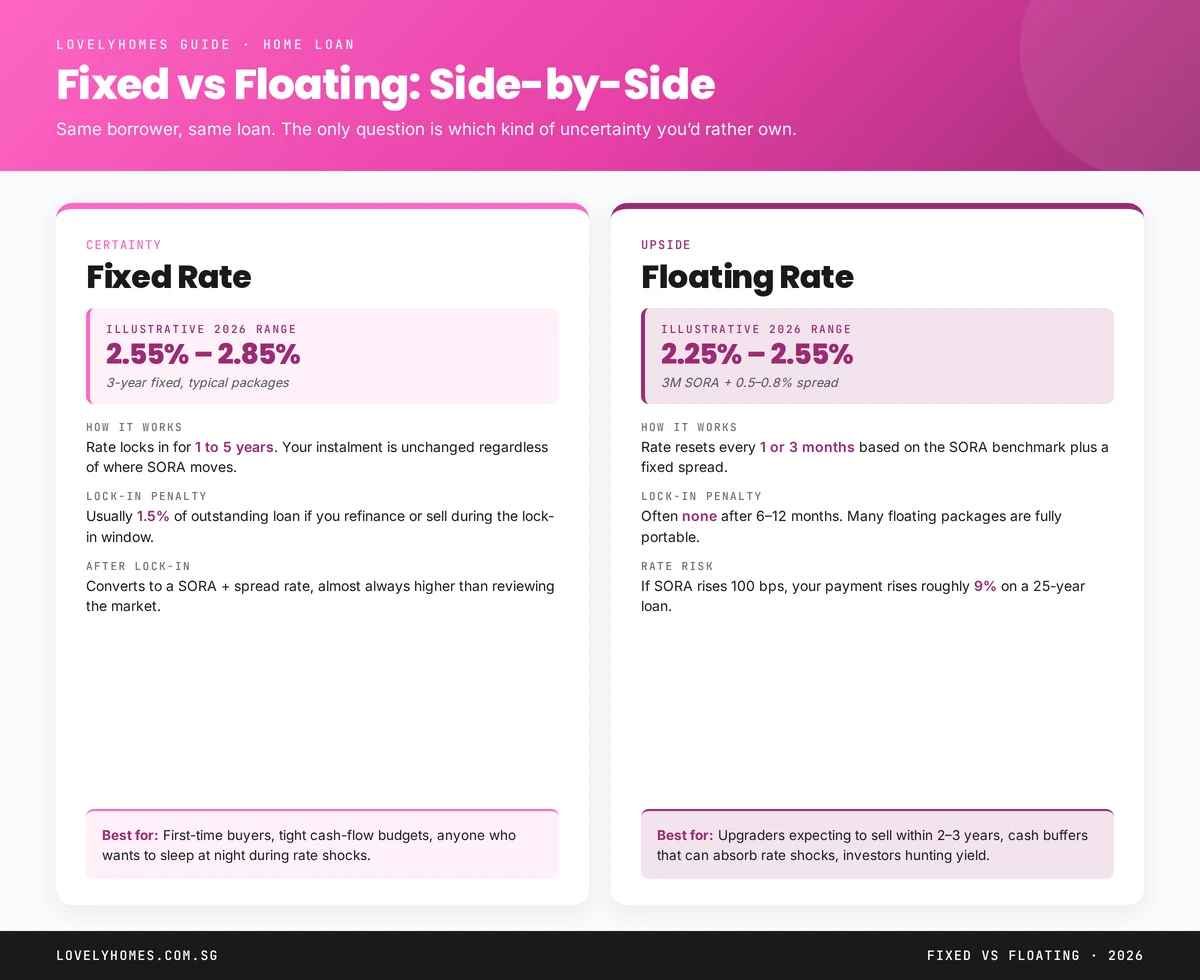
- Fixed rates offer payment certainty but come with a lock-in penalty (typically 1.5% of outstanding loan) if you refinance early.
- SORA-pegged loans offer transparency and flexibility, but your repayment will move with rates — currently favourable as SORA trends down from its 2023 highs.
Understanding Singapore Home Loan Interest Rates in 2026
When you take out a home loan in Singapore, the single most consequential variable is the interest rate. On a S$1 million loan over 25 years, the difference between a 2.45% and a 3.40% rate translates to roughly S$470 more per month — or over S$140,000 in additional interest over the life of the loan. Yet many buyers in Singapore choose their home loan based on convenience, the advice of a mortgage broker with a vested interest, or simply whatever their bank’s relationship manager recommends at point of sale.
This guide explains how Singapore home loan interest rates are structured in 2026, what SORA is and why it replaced SIBOR and SOR, how to read bank package offers correctly, and how to decide between a floating rate and a fixed rate package given the current interest rate environment. It is written for Singaporean and Permanent Resident property buyers — the same principles apply to foreigners but their ABSD liability fundamentally alters the financing calculus.
Monetary Authority of Singapore (MAS) regulates home lending in Singapore under the Monetary Authority of Singapore Act and the Notice MAS 632 on Residential Property Loans. HDB administers the Concessionary Loan under the Housing and Development Act.

What Is SORA and Why Did It Replace SIBOR?
SORA — the Singapore Overnight Rate Average — is the volume-weighted average rate of all overnight unsecured Singapore dollar interbank transactions brokered in Singapore between 08:00 and 18:15 each business day. It is published daily by MAS and is calculated retrospectively, which makes it a backward-looking, transaction-based benchmark rather than a quote-based one like SIBOR was.
SIBOR (Singapore Interbank Offered Rate) was phased out on 31 December 2024 following a global reform of interest rate benchmarks prompted by the 2012 LIBOR manipulation scandal. SOR (Swap Offer Rate), which was partly based on USD LIBOR, was discontinued even earlier. MAS and the Steering Committee for SOR & SIBOR Transition to SORA (SC-STS) oversaw the transition, which required all existing SIBOR-pegged mortgages to be converted to SORA-linked packages by end-2024.
SORA is now used in three primary forms for home loans:
- 1-Month Compounded SORA (1M SORA) — reflects the past 30 days of overnight rates. More reactive to short-term rate changes.
- 3-Month Compounded SORA (3M SORA) — reflects the past 90 days. More commonly used by banks for home loans; provides a slightly smoother signal.
- SORA Board Rates — some banks (notably UOB) have internal board rates that are partially informed by SORA movements but give the bank more discretion over repricing.
SORA-Pegged Floating Rate Packages
A SORA-pegged floating rate package ties your home loan to the prevailing 3M Compounded SORA, plus a fixed spread set by the bank. As at May 2026, spreads across major banks range from +0.85% to +0.90%:
- DBS: 3M Compounded SORA + 0.85%
- OCBC: 3M Compounded SORA + 0.88%
- UOB: 3M Compounded SORA + 0.90%
- Maybank: 3M Compounded SORA + 0.85%
With 3M SORA at approximately 2.55% in May 2026, an all-in floating rate works out to roughly 3.40–3.45%. This is broadly similar to the prevailing 2-year fixed rate, which sits at 2.45–2.65% for Year 1–2 before typically reverting to a board rate or SORA-linked rate from Year 3.
The key characteristics of a SORA floating package are:
- No lock-in period — you can refinance or reprice at any time without a penalty clause.
- Transparent repricing — your rate changes as SORA moves, typically with a 1-month lag for 1M SORA packages or a 3-month lag for 3M packages.
- Currently in a declining environment — if MAS and the Federal Reserve continue rate normalisation through 2026, SORA is expected to drift toward 2.2–2.4% by end-2026, which would bring all-in floating rates to around 3.05–3.30%.

Fixed Rate Packages
Fixed rate packages lock in an interest rate for a specified period — typically 2 years — after which the loan reverts to a floating rate, usually SORA-linked or a bank board rate. As at May 2026, major banks are offering:
| Bank | Year 1 | Year 2 | Year 3+ | Lock-in |
|---|---|---|---|---|
| DBS | 2.45% | 2.55% | FHR8 (board rate) | 2 years |
| OCBC | 2.50% | 2.60% | OHR+ (SORA-linked) | 2 years |
| UOB | 2.45% | 2.55% | SORA + spread | 2 years |
| Standard Chartered | 2.48% | 2.60% | Board rate | 2 years |
| Maybank | 2.50% | 2.65% | SORA + spread | 2 years |
The 2-year fixed period provides payment certainty — you know exactly what you will pay every month for the fixed term, which makes household budgeting straightforward. The risk is that if you need to refinance during the lock-in window — for example, because you sell the property, or a better package becomes available — you will typically pay a penalty of 1.50% of the outstanding loan amount at the time of early redemption.
On a S$1 million loan, that penalty is S$15,000. This is not an insignificant sum, and it is the primary reason experienced property investors often prefer no-lock-in floating packages despite the slightly higher all-in rate today.
The HDB Concessionary Loan — A Third Option
Buyers purchasing an HDB flat have access to a third option: the HDB Concessionary Loan, currently at a flat 2.60% per annum. This rate is set at CPF Ordinary Account interest rate (currently 2.5%) plus 0.1%, and is reviewed quarterly. It has remained at 2.60% since January 2023 when the CPF OA rate was last adjusted.
The HDB Concessionary Loan is notable for several reasons:
- No lock-in — you can switch to a bank loan at any time without penalty.
- LTV up to 80% — the maximum Loan-to-Value for an HDB loan is 80% of the purchase price or valuation (whichever is lower), versus 75% for a bank loan.
- No cash down payment requirement — the 20% down payment can be funded entirely from CPF Ordinary Account (unlike bank loans, which require at least 5% in cash).
- Eligibility conditions — all owners must not own any other residential property; income ceiling of S$14,000 household income applies for most flat types (no ceiling for HDB resale). You must obtain an HDB Flat Eligibility (HFE) Letter before exercising an OTP.
TDSR and MSR — How Much Can You Borrow?
MAS introduced the Total Debt Servicing Ratio (TDSR) framework in June 2013 to ensure borrowers do not over-leverage. TDSR limits total monthly debt obligations (including the new mortgage, car loans, personal loans, credit card minimum payments and all other credit facilities) to 55% of gross monthly income. Banks apply a stress-test rate of 4.0% per annum when assessing TDSR — meaning they calculate your hypothetical monthly payment at 4.0% regardless of the prevailing rate, to ensure you can afford the loan even if rates rise.
For HDB flat purchases (both BTO and resale), the additional Mortgage Servicing Ratio (MSR) cap applies: your monthly mortgage payment must not exceed 30% of gross monthly income. MSR applies to the actual servicing payment, not a stress-tested figure.
These rules mean that on a gross household income of S$10,000 per month, the maximum monthly mortgage payment you can qualify for (under MSR for HDB) is S$3,000; and the maximum all-debt obligation under TDSR is S$5,500. Practically, if you have a car loan of S$800/month, your maximum mortgage under TDSR is reduced to S$4,700/month.

Worked Example — The Tan Family’s Loan Decision
Mr and Mrs Tan are Singapore Citizens purchasing a S$1.4 million OCR condominium in Tampines in June 2026. They are first-time buyers with no outstanding home loans. Their gross combined household income is S$14,000 per month. They have S$180,000 in CPF OA (combined) and S$100,000 in cash savings.
Loan quantum: 75% LTV on S$1.4M = S$1.05M bank loan. Down payment = S$350,000 (25%), of which at least S$70,000 (5%) must be in cash. The Tans comfortably clear this with S$70,000 cash + S$280,000 CPF.
BSD: S$24,600 on S$1.4M (first S$180k at 1%, next S$180k at 2%, next S$640k at 3%, remaining S$400k at 4% — total S$1,800 + S$3,600 + S$19,200 = wait, let me compute correctly: BSD on S$1.4M = 1%×S$180k + 2%×S$180k + 3%×S$640k + 4%×S$400k = S$1,800 + S$3,600 + S$19,200 + S$16,000 = S$40,600). ABSD: S$0 (first purchase, SC).
Rate comparison:
- Option A — 2-year fixed at 2.45%/2.55%: Monthly in Year 1 = S$4,634; Year 2 = S$4,706. Reverts to SORA + spread from Year 3 (est. ~S$4,500–4,800 depending on SORA trajectory). Lock-in penalty if exit before 24 months: ~S$15,750 (1.5% × S$1.05M).
- Option B — SORA float at SORA+0.85% ≈ 3.40%: Monthly = ~S$5,161. No lock-in. If SORA falls to 2.2% by end-2026, rate drops to ~3.05%, monthly ~S$4,956.
- Option C — If they were buying an HDB resale (for illustration): HDB Concessionary Loan at 2.60% → monthly ~S$4,748 on S$1.05M, 80% LTV available.
TDSR check (Option A, Year 1): Monthly payment S$4,634. With no other debts, TDSR = S$4,634 ÷ S$14,000 = 33.1%. Well within 55%. Stress-tested at 4.0%: hypothetical monthly = S$5,534; TDSR = 39.5%. PASS.
Recommendation: Given the declining SORA environment in 2026, the Tans opt for Option A (2-year fixed) to lock in payment certainty during the early years of ownership when their cash position is most stretched. They set a calendar reminder to review and refinance in Month 20, before the lock-in expiry.
Fixed vs Floating — How to Decide in 2026
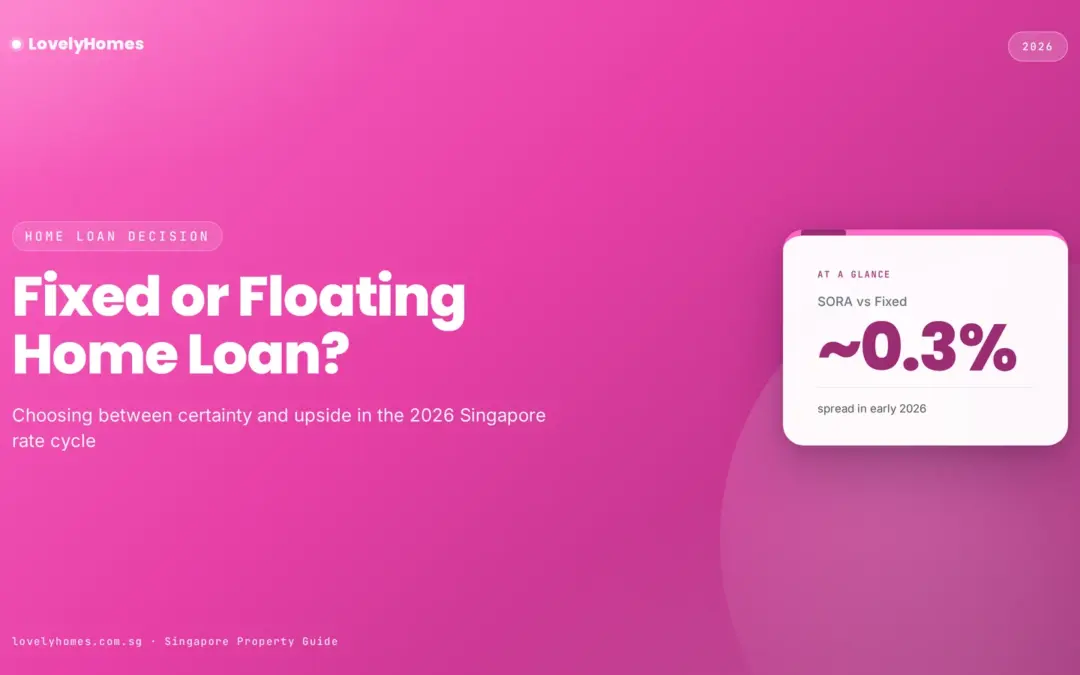
With fixed and floating rates now converging at around 3.35–3.50% all-in, the classic argument — “floating is cheaper, fixed is certain” — no longer cleanly applies. The decision framework for 2026 hinges on three questions:
- How long will you hold the property? If you plan to sell within 3 years (e.g., you are buying a resale flat as a stepping stone and expect to MOP a BTO), a floating package with no lock-in avoids the exit penalty. If you plan to hold for 10+ years, the 2-year fixed-then-float cycle is largely a moot point — both packages will track the same rates over the long run.
- How sensitive is your monthly budget to rate moves? If a S$300–500 increase in monthly repayment would significantly stress your household, a fixed rate gives you a planning buffer. If you have comfortable headroom under TDSR, floating is fine.
- What is the SORA outlook? As at May 2026, MAS and market consensus lean toward SORA continuing a gradual decline through 2026–2027 as the global rate cycle normalises. In a declining rate environment, locking in at today’s fixed rate means you may pay slightly more than the eventual SORA level. However, the gap is likely to be narrow (0.10–0.30%) and the certainty premium may be worth it for first-time buyers.
What Might Come Next — Singapore Loan Rate Outlook
Several factors will shape Singapore home loan rates through end-2026 and into 2027. MAS operates a unique monetary policy framework — it manages the Singapore dollar nominal effective exchange rate (S$NEER) rather than directly setting an overnight rate, meaning SORA is market-determined rather than policy-set. However, SORA is strongly correlated to the US federal funds rate through Singapore’s open capital account.
The US Federal Reserve has signalled two 25-basis-point cuts in the second half of 2026, which, if executed, would likely push 3M SORA from ~2.55% toward ~2.05–2.15% by year-end. This would bring SORA-pegged all-in rates to around 2.90–3.05% — meaningfully below today’s fixed rates of 2.45–2.65% over a 2-year view. Whether banks adjust their fixed rate offerings in anticipation remains to be seen; historically, fixed rates tend to reprice down with a 1–2 quarter lag.
Summary — Home Loan Rate Comparison at a Glance
| Feature | SORA Float | Fixed Rate (2yr) | HDB Concess. |
|---|---|---|---|
| All-in Rate (May 2026) | ~3.40% | 2.45–2.65% | 2.60% |
| Rate Certainty | None | 2 years | Stable (CPF+0.1%) |
| Lock-in Period | None | 2 years | None |
| Exit Penalty | None | ~1.5% of loan | None |
| Max LTV | 75% | 75% | 80% |
| Min Cash Down | 5% | 5% | 0% (CPF ok) |
| Eligible Properties | All | All | HDB only |
| Best For | Flexible holders; declining rate bet | First-timers; budget certainty | HDB buyers; tight cash |
Frequently Asked Questions
What is SORA and how is it different from SIBOR?
SORA (Singapore Overnight Rate Average) is the volume-weighted average of unsecured overnight interbank SGD transactions, published daily by MAS. SIBOR was a forward-looking rate based on bank submissions — susceptible to manipulation, as the 2012 LIBOR scandal revealed globally. SORA is transaction-based and backward-looking, making it more robust and harder to manipulate. SIBOR was fully discontinued on 31 December 2024; all SIBOR-pegged mortgages were converted to SORA or fixed-rate packages during 2023–2024.
Should I choose a fixed or floating rate home loan in 2026?
With SORA declining toward 2.2% by end-2026 and fixed rates at 2.45–2.65%, the all-in rates are converging. For first-time buyers who need budgeting certainty, a 2-year fixed rate is sensible — it protects against any short-term rate surprise and costs only marginally more than today’s floating all-in rate. For investors and experienced buyers who plan to hold long-term or who may sell within 3 years, a no-lock-in SORA floating package avoids exit penalties and will benefit as SORA falls further. In 2026 specifically, the edge is modest either way; the bigger decision is the property itself.
What is the current SORA rate in 2026?
As at May 2026, the 3-month compounded SORA is approximately 2.55% per annum, down from its peak of above 3.74% in mid-2023. It has been declining steadily as the US Federal Reserve began its rate normalisation cycle in late 2024. MAS publishes daily SORA rates on its website at mas.gov.sg/monetary-policy/sora.
What is TDSR and how does it affect how much I can borrow?
The Total Debt Servicing Ratio (TDSR) limits your total monthly debt obligations (including the home loan, car loans, personal loans and other credit facilities) to 55% of your gross monthly income. Banks stress-test your loan at 4.0% per annum when assessing TDSR eligibility — so even if the prevailing rate is 3.0%, the bank calculates whether you could afford the repayment at 4.0%. On top of TDSR, if you are buying an HDB flat, the Mortgage Servicing Ratio (MSR) limits your monthly home loan repayment to 30% of gross monthly income.
Can I use CPF to pay my home loan?
Yes. CPF Ordinary Account savings can be used to service monthly home loan repayments for both HDB flats and private properties, subject to the Valuation Limit (generally the lower of the purchase price or valuation) and the Withdrawal Limit (up to 120% of the Valuation Limit for private properties). Note that CPF monies withdrawn for property earn accrued interest at 2.5% per annum, which must be returned to your CPF account upon sale. This accrued interest does not represent an additional out-of-pocket cost but reduces the net cash proceeds you receive when you sell.
What is a lock-in period and what happens if I break it?
A lock-in period is a contractual commitment to maintain your loan with the same bank for a set duration — typically 2 years for fixed rate packages. If you refinance, prepay or redeem the loan in full before the lock-in expires, you pay a penalty usually equal to 1.5% of the outstanding loan amount at the time of early redemption. On a S$900,000 outstanding balance, that is S$13,500. No-lock-in packages (all SORA floating packages and HDB Concessionary Loans) allow you to exit or refinance at any time without penalty.
What is the difference between refinancing and repricing?
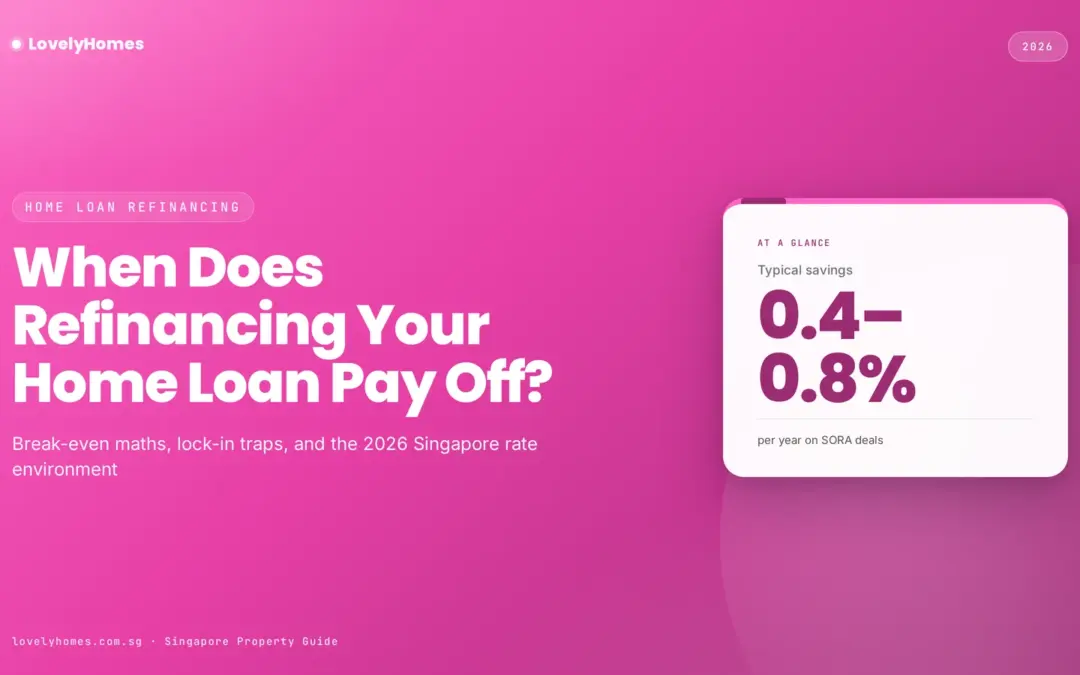
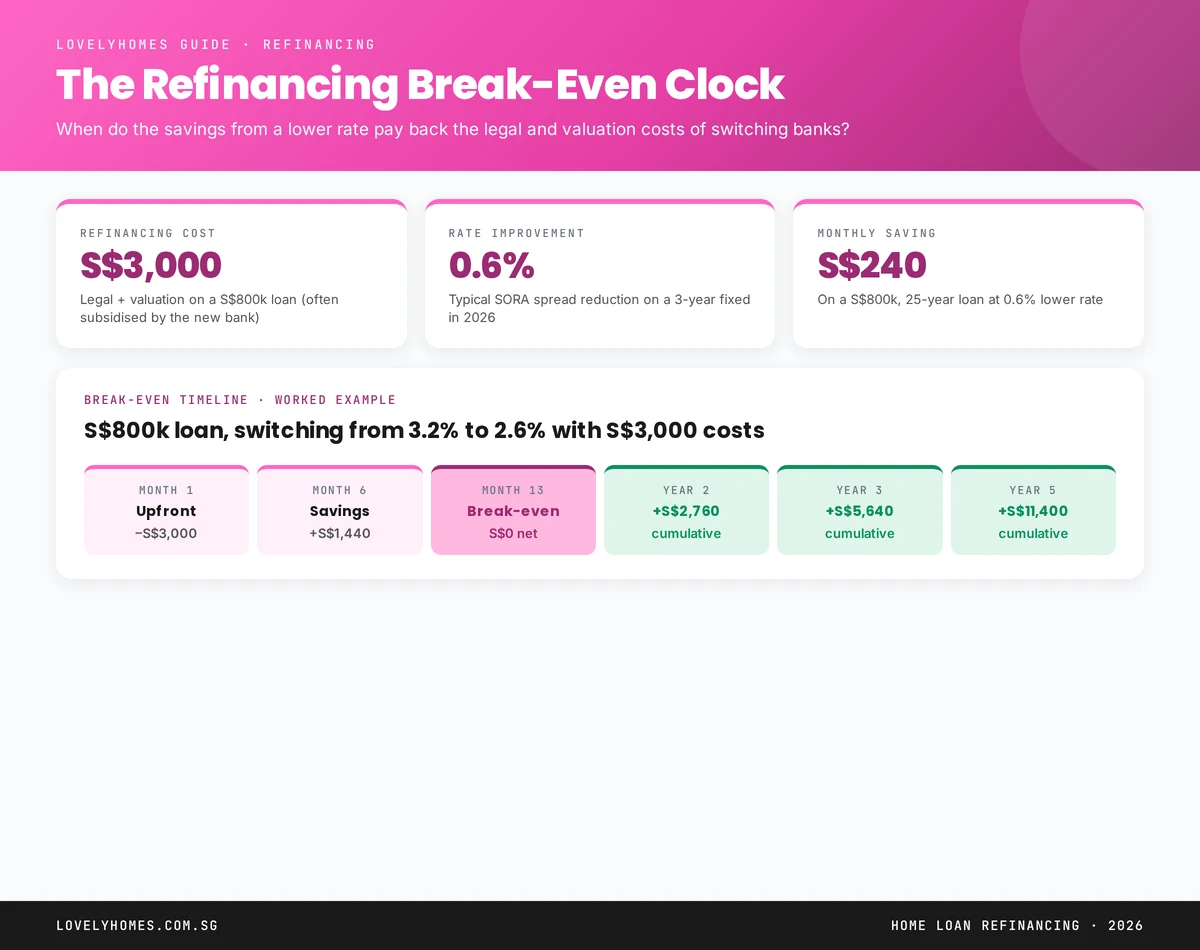
Repricing is when you switch to a different loan package within the same bank — typically cheaper (no legal or valuation fees) but limited to that bank’s available packages. Refinancing is when you move your loan to a different bank entirely. Refinancing typically offers access to sharper rates but incurs legal fees (S$2,000–3,500), valuation fees (S$300–800), and potentially a clawback of cashback incentives if you refinance within the clawback period (usually 3 years). Both options are typically considered when a fixed rate lock-in expires.
Related Articles
- ABSD Singapore 2026: Complete Guide to Additional Buyer’s Stamp Duty
- Stamp Duty Calculator Singapore 2026: BSD, ABSD and SSD Explained
- Buyer’s Stamp Duty Singapore 2026: Rates, Calculator and Worked Examples
- CPF for Property Purchase Singapore 2026: Withdrawal Limits and Accrued Interest
- Singapore Property Valuation Guide 2026: How Banks Value Your Home
- Private Property Buying Process Singapore 2026: Step-by-Step Guide
Disclaimer
This article is for general informational purposes only and does not constitute financial or legal advice. Interest rates quoted are indicative as at May 2026 and are subject to change by individual lenders. The SORA rate is published daily by MAS and can be found at mas.gov.sg. TDSR and MSR rules are set by MAS and are subject to regulatory revision. For personalised advice on home loan selection and eligibility, consult a licensed financial adviser or mortgage specialist regulated by MAS. All stamp duty computations are based on IRAS published rates at iras.gov.sg. HDB Concessionary Loan eligibility criteria are set by HDB and available at hdb.gov.sg. CPF rules on property usage are administered by the CPF Board at cpf.gov.sg.
Click anywhere or press Esc to close