13,480 HDB Flats Reaching MOP in 2026: What the Supply Wave Means for Buyers and Sellers

13,480 HDB Flats Reaching MOP in 2026: What the Supply Wave Means for Buyers and Sellers

Quick Answer: 13,480 HDB Flats Reaching MOP in 2026 — Key Facts

  • Scale: An estimated 13,480 HDB flats will reach their 5-year Minimum Occupation Period (MOP) in 2026 — almost double the ~6,970 that reached MOP in 2025.
  • Hotspots: Punggol Northshore (~3,200 units), Dawson/Queenstown (~2,400 units), Tengah Phase 1 (~1,800 units), and Bidadari (~1,600 units) are the largest contributors.
  • Market effect: The HDB Resale Price Index (RPI) fell 0.1% in Q1 2026 — its first quarterly decline since Q2 2019, partly attributable to rising MOP-flat supply.
  • For buyers: More choices, reduced bidding urgency, and improved negotiating power — especially in estates with cluster supply.
  • For sellers: Longer time-on-market expected (up from the typical 6–8 weeks to 10–12 weeks in high-supply estates) and more realistic pricing required.
  • For upgraders: Demand for private OCR condos remains firm; OCR prices rose 2.2% in Q1 2026 as MOP-flat sellers redirect proceeds to private property.

The MOP Supply Wave: How We Got Here

The Minimum Occupation Period is the mandatory period — typically five years for standard HDB flats, now extended to ten years for certain Plus and Prime classification flats under HDB’s 2024 reclassification framework — during which an HDB flat owner cannot sell their unit on the open resale market. The MOP clock starts from the date of flat key collection, not the date of purchase application or ballot.

The surge in MOP-eligible supply in 2026 is a direct consequence of the unprecedented BTO construction and completion activity that took place between 2019 and 2021. During those years, HDB launched and completed tens of thousands of flats in new growth areas — particularly Tengah, Punggol Northshore, Bidadari, and the rejuvenated Dawson/Queenstown estates — most of which had key collection dates between late 2020 and mid-2021. Five years later, those keys have become resale eligibility certificates.

Industry data compiled by PropertyGuru and HDB estimates the 2026 cohort at approximately 13,480 MOP-eligible flats — a volume not seen since the BTO ramp-up years of 2013–2015. The comparison with 2025’s ~6,970 MOP-eligible units illustrates just how dramatic the step-change is.

HDB MOP supply wave 2026 flats reaching MOP by estate Punggol Northshore Dawson Queenstown Tengah Bidadari Tampines
Figure 1: Estimated HDB flats reaching 5-year MOP in 2026 by major estate. Punggol Northshore and Dawson/Queenstown lead with over 5,600 combined units. Source: HDB / industry research, 2026.

What the Supply Wave Is Doing to HDB Resale Prices

The most immediate market signal came from HDB’s flash estimate for Q1 2026: the Resale Price Index (RPI) fell by 0.1% quarter-on-quarter, registering 203.3 from 203.5 in Q4 2025. This was the first quarterly decline in the RPI since Q2 2019 — ending a 29-quarter streak of quarterly gains or flat readings that had carried the index from around 131 to its recent high.

To put the decline in context: 0.1% is modest, and the RPI remains 33% higher than its pre-pandemic Q1 2020 level. But the direction of travel is significant. Several forces are converging simultaneously: the MOP supply wave, shorter BTO build times reducing the wait for new flats (increasing substitution options), residual effects of the ABSD cooling measures, and a gradual easing of the buyer urgency that characterised the 2021–2023 market.

HDB Resale Price Index RPI trend Q1 2022 to Q1 2026 first quarterly decline seven years
Figure 2: HDB Resale Price Index Q1 2022–Q1 2026. The Q1 2026 reading of 203.3 marks the first quarterly decline since Q2 2019, after 29 consecutive quarters of gains. Source: HDB flash estimates.

Worked Example: What the MOP Wave Means for a Punggol Seller

Mr Tan bought a 4-room BTO flat in Punggol Northshore in 2021, collecting keys in February 2021. His MOP expires in February 2026, giving him the right to list on the open market from that date onwards.

In early 2024, comparable 4-room resale flats in Punggol Northshore (then still pre-MOP and transacting via sub-sale with special conditions) were fetching around S$720,000–S$740,000. When Mr Tan lists in March 2026, he faces a materially different supply environment: an estimated 200–300 comparable units in the same estate are also newly MOP-eligible in Q1–Q2 2026.

Scenario Indicative Price Time-on-Market
Q1 2024 (pre-MOP cluster, limited supply) ~S$730,000 ~5–6 weeks
Q2 2026 (post-MOP wave, clustered supply) ~S$695,000–S$710,000 ~10–12 weeks
Indicative price softening (2024 vs 2026) ~S$20,000–S$35,000 +4–6 weeks
Original BTO purchase price (2021) ~S$410,000
Estimated capital gain (even at lower price) ~S$285,000–S$300,000

Mr Tan’s capital gain, even after the supply-induced price moderation, remains substantial — roughly 69–73% above his original purchase price over five years. The MOP wave reduces margins at the margin, but does not eliminate them. The more important implication for him is patience: in a supply-heavy quarter, chasing the last S$20,000 with an overpriced listing will cost more in time and negotiating leverage than pricing realistically from day one.

What the MOP Wave Means for HDB Buyers

For buyers in 2026, the supply wave is largely positive. More resale supply in desirable, well-located estates — Dawson, Bidadari, Tengah — means genuine choice where previously the listings were sparse and asking prices aggressive. Buyers who were priced out or crowded out of these estates in 2023–2024 may find that the 2026 MOP cohort opens affordable windows.

Notably, many of the MOP-eligible flats are in mature or near-mature estates with established amenities and shorter HDB wait times (since they are resale, not BTO, there is no wait). For young families who need a flat quickly, the MOP wave is creating the most compelling resale market conditions seen since 2019.

What the MOP Wave Means for Private Property and EC Upgraders

Every MOP-eligible seller is a potential upgrader. The strong demand for Outside Central Region (OCR) private condominiums — OCR prices rose 2.2% in Q1 2026, the strongest regional performer — is partly explained by this upgrader flow. MOP sellers, sitting on capital gains of S$200,000–S$400,000 from their BTO purchases, are redeploying proceeds into OCR condos in the S$900,000–S$1.4M range, often as a second property with ABSD implications or as their primary home after selling the HDB flat.

The new 10-year MOP rules for Plus and Prime classification BTO flats (effective from launches from May 2024 onwards) will throttle a future wave of upgrader supply in those categories — but the current 2026 MOP cohort predates those rules, and almost all are standard 5-year MOP flats that feed directly into the upgrader pipeline.

What Might Come Next

The MOP wave is likely to remain elevated through 2026 and into early 2027, as BTO completions from 2021–2022 continue to roll through. HDB’s accelerated build programme — driven by the post-pandemic construction catch-up — means further tranches of completed flats entering the 5-year MOP window. Analysts broadly expect HDB resale price growth to be in the 0–2% range for full-year 2026, a sharp deceleration from the 8–10% growth seen in 2022. The supply-induced softening is a policy success by design — HDB has explicitly timed BTO ramps to moderate resale inflation. Whether prices resume growth in 2027 and 2028 will depend heavily on the pace of upgrader absorption into the private market and any further policy interventions.

Frequently Asked Questions

When exactly does the 5-year MOP start and end?

The MOP clock starts from the date of key collection — not from the date of flat application, ballot, or signing of the Sales of Balance Flat agreement. For BTO flats, this is the date on the key collection acknowledgement letter issued by HDB. The MOP ends exactly five years from that key collection date. Flat owners can check their specific MOP expiry date through the HDB e-Service portal.

Can I rent out my entire flat before MOP?

No. During the MOP, you must physically occupy your HDB flat. You cannot rent out the entire flat. You may, subject to HDB approval, rent out individual bedrooms while continuing to live in the flat. Subletting the entire unit without meeting the post-MOP and quota requirements is a serious breach of HDB’s tenancy rules and can result in compulsory acquisition of the flat.

Does the 10-year MOP apply to all HDB flats bought in 2026?

No. The 10-year MOP applies only to Plus and Prime classification BTO flats launched from May 2024 onwards (under HDB’s new flat classification framework). Standard classification BTO flats retain the 5-year MOP. All resale HDB flats have no MOP obligation for the buyer (the original MOP is with the seller, not the resale purchaser). The current 2026 MOP wave consists entirely of 5-year MOP flats from the pre-2024 launch cohort.

Are the MOP flats from mature or non-mature estates?

The 2026 MOP wave is mixed. Dawson (Queenstown) and Bidadari (Toa Payoh) are in mature estates with strong locational attributes. Punggol Northshore and Tengah are in newer, non-mature estates. The distinction matters for resale pricing: mature estate MOP flats typically command a premium due to established transport, amenities, and school catchments, while non-mature estate flats benefit from newer build quality and larger layouts at lower absolute prices.

Will the MOP wave cause HDB prices to fall significantly?

Industry consensus as at May 2026 expects HDB resale price growth of 0–2% for full-year 2026 — not a significant decline. The Q1 2026 dip of 0.1% is a moderation, not a crash. Singapore’s tight land supply, ongoing population household formation, and strong upgrader demand underpin a structurally supported HDB resale market. A supply wave of 13,480 units — spread across multiple estates over twelve months — is material but not large enough to overwhelm a market that transacts approximately 25,000–27,000 resale flats per year.

Related Articles

Disclaimer: This article is for informational purposes only and does not constitute financial or property advice. MOP unit estimates are based on publicly available industry data and HDB records; exact figures vary by flat and block. Property price data sourced from HDB flash estimates (Q1 2026). Readers should verify MOP expiry dates with HDB directly at www.hdb.gov.sg and consult a licensed property agent or financial adviser before making any purchase or sale decision. References: HDB Q1 2026 Flash Estimates; URA; PropertyGuru; Stacked Homes, May 2026.

Minimum Occupation Period (MOP) Singapore 2026: HDB, EC and Private Property Rules Explained

Minimum Occupation Period (MOP) Singapore 2026: HDB, EC and Private Property Rules Explained

Minimum Occupation Period (MOP) Singapore 2026: HDB, EC and Private Property Rules Explained

With the EC MOP just doubled to 10 years from 8 May 2026, understanding the Minimum Occupation Period is more important than ever for buyers, upgraders and investors.

Quick Answer — Key Takeaways

  • Standard HDB flats (resale and BTO) have a 5-year MOP from the date of key collection. You cannot sell, rent out the entire flat, or purchase another residential property during this period.
  • HDB Plus flats (non-mature estates, higher subsidy) and HDB Prime flats (RCR/CCR locations, highest subsidy) have a 10-year MOP, reflecting the deeper subsidies received.
  • Executive Condominiums (ECs) launched before 8 May 2026 carry a 5-year MOP from TOP. Those launched on or after 8 May 2026 have a new 10-year MOP under cooling measures announced by MND.
  • Private condominiums and landed property have no MOP. The Seller’s Stamp Duty (SSD) — not MOP — is the effective lock-up mechanism for private residential property, applying for up to 3 years after purchase.
  • During HDB MOP, you may rent out individual rooms but not the entire flat.
  • Violation of MOP rules — such as renting out the whole flat illegally or purchasing a 2nd residential property — can result in compulsory acquisition of the HDB flat by HDB at a significantly below-market price.
  • After MOP, EC owners can sell on the resale market to Singapore Citizens and PRs; the EC becomes fully privatised (open market to foreigners) only at the 10-year mark under old rules, or 15-year mark under the new post-8 May 2026 rules.
  • The MOP clock resets if you take a new lease on an existing flat or receive a replacement flat.

What Is the Minimum Occupation Period (MOP)?

The Minimum Occupation Period (MOP) is a mandatory holding requirement imposed by the Housing & Development Board (HDB) on subsidised public housing and Executive Condominiums. It exists to ensure that buyers use their subsidised property as a genuine primary residence rather than immediately flipping it for profit, and to preserve the social intent of Singapore’s public housing programme — which aims to provide affordable, stable homes for resident families, not speculative investment vehicles.

The MOP was first introduced in its current form in the 1990s and has been progressively tightened as part of Singapore’s broader property market stabilisation policy. The most recent and significant change came on 8 May 2026, when Minister Chee Hong Tat (MND) announced that ECs launched from that date would carry a doubled MOP of 10 years (from 5 years) — a major shift for the EC segment, which had previously enjoyed a shorter lock-up than standard HDB flats.

MOP comparison Singapore 2026 — HDB standard, Plus, Prime, EC old and new rules, private condo
Figure 1: MOP rules by property type in Singapore as at May 2026. The EC MOP doubled from 5 to 10 years for projects launched from 8 May 2026 onwards. Standard HDB remains at 5 years; Plus and Prime HDB are at 10 years. Private condominiums have no MOP.

MOP for Standard HDB Flats

For all BTO and resale HDB flats classified as “Standard” — the majority of the HDB stock — the MOP is 5 years. The clock starts from the date of key collection (for BTO flats) or the date of resale completion registered with HDB (for resale flat purchases). Both are known as the “date of possession” or “date of acquisition” in HDB’s official documentation.

During the 5-year MOP, an HDB flat owner:

Cannot: sell the flat on the HDB resale market; sublet the entire flat (individual rooms are allowed); own or purchase any other local residential property (including private condominiums and landed houses — note that overseas properties are not restricted).

Can: take in HDB-approved lodgers; rent out individual bedrooms under HDB’s subletting rules; continue to enjoy CPF housing grants on the existing flat; refinance the HDB loan to a bank loan (the reverse — bank loan to HDB loan — is not permitted).

The 5-year MOP applies regardless of whether the flat was purchased with or without grants. However, flats purchased under the Proximity Housing Grant (PHG) or the Enhanced Housing Grant (EHG) still carry the standard 5-year MOP — the grants do not extend the MOP for Standard flats.

MOP for HDB Plus and Prime Flats (10 Years)

Since the October 2024 BTO launch, HDB has classified new BTO flats into three bands: Standard, Plus, and Prime. The Plus and Prime categories carry enhanced subsidies but come with stricter post-MOP conditions, including a 10-year MOP and a subsidy clawback mechanism when the flat is subsequently sold:

Plus flats are located in non-mature estates near transport nodes or with other locational advantages (e.g., Tengah, parts of Tampines). The 10-year MOP reflects the higher-than-standard subsidies provided. Upon eventual resale, a percentage of the sale proceeds is clawed back by HDB (the exact percentage is determined at time of booking) to account for the subsidy received.

Prime flats are located in the Rest of Central Region (RCR) and Core Central Region (CCR) — historically where market rates would make public housing prohibitively expensive. The 10-year MOP is the same as Plus, but the subsidy clawback is higher and the flat must be sold back to eligible buyers within HDB’s framework for a longer period. Prime flat owners also face income ceiling checks at the time of resale.

The key practical difference between Standard and Plus/Prime flats: a Standard flat buyer can resell on the open HDB resale market after 5 years with no clawback; a Plus or Prime buyer waits 10 years and faces clawback obligations that reduce net proceeds from sale.

EC MOP: The Game-Changing 8 May 2026 Rule

EC lifecycle timeline Singapore — old 5-year MOP versus new 10-year MOP from 8 May 2026
Figure 2: EC lifecycle under old rules (5-year MOP, privatisation at Year 10) compared with new rules announced 8 May 2026 (10-year MOP, privatisation at Year 15). Buyers of ECs launched from 8 May 2026 face a 5-year longer investment horizon before open-market resale.

Executive Condominiums (ECs) occupy a hybrid position — built and sold by private developers, subsidised by the government, and initially available only to eligible Singaporean households (income ceiling S$16,000/month as at May 2026). They are a popular “sandwich class” housing option that offers near-private-condo quality at below-market prices.

Under the rules that applied to all ECs launched before 8 May 2026, the EC MOP was 5 years from TOP (Temporary Occupation Permit). After 5 years, owners could resell on the resale market to eligible SCs and PRs. At the 10-year mark, the EC automatically privatised — becoming legally equivalent to a private condominium, freely tradeable on the open market and available to foreigners.

On 8 May 2026, MND announced a package of EC cooling measures. For ECs in projects whose sales are launched on or after 8 May 2026, the MOP is now 10 years from TOP, and privatisation now occurs at the 15-year mark (not 10). This extends the effective investment lock-up by 5 years across the board.

Milestone EC (before 8 May 2026) EC (from 8 May 2026)
MOP expires (resale to SC/PR opens) Year 5 from TOP Year 10 from TOP
Full privatisation (open market) Year 10 from TOP Year 15 from TOP
First-timer quota for new launch 70% 90%
Deferred Payment Scheme Available Removed

Importantly, the new 10-year MOP does NOT apply retroactively to ECs already launched before 8 May 2026. Buyers who purchased units in projects like Aurea (Tengah), THE ORIE, or other launches before this date retain the original 5-year MOP.

Private Condo and Landed Property: No MOP, but SSD

Private residential property — condominiums, apartments, strata landed units, and non-strata landed houses — is not subject to any MOP. Owners are free to sell at any time after completion of the purchase. However, the Seller’s Stamp Duty (SSD) acts as a de facto short-term lock-up:

SSD rates for private residential property sold within 3 years of purchase: 12% if sold in Year 1; 8% if sold in Year 2; 4% if sold in Year 3. No SSD applies if the property is held for more than 3 years. The SSD is calculated on the sale price or market value, whichever is higher.

In practice, the SSD makes immediate resale of private residential property economically prohibitive in most scenarios. A buyer of a S$2M condo who sells within 12 months faces an SSD of S$240,000 — effectively erasing any short-term appreciation. The MOP concept for public housing is thus paralleled by SSD in the private market, though the SSD is a financial deterrent rather than an absolute prohibition.

Worked Example: EC Buyer Under Old vs New MOP

Worked example EC buyer S$1.35M comparing old 5-year MOP versus new 10-year MOP investment returns Singapore 2026
Figure 3: Impact of the MOP extension on investment horizon and annualised returns for an SC couple buying a S$1.35M EC unit in 2026. The new 10-year MOP reduces the annualised unleveraged return from approximately 4.6% pa to approximately 3.4% pa under comparable capital appreciation assumptions.

Consider Mr and Mrs Lee, a Singapore Citizen couple with a combined gross income of S$12,500/month. They are looking at a new EC launch at S$1,350,000 for a 4-room unit (launched after 8 May 2026). Their HDB flat is rented out to their parents — but for purposes of EC eligibility, they are selling the HDB before the EC application, so they will be treated as first-timers.

Purchase price: S$1,350,000. BSD = S$1,800 + S$3,600 + S$19,200 + S$20,000 + S$25,000 = S$39,600. No ABSD for first-time SC purchase. MSR check: 30% × S$12,500 = S$3,750/month maximum instalment. At 4.0% stress test / 30-yr tenure, this supports a loan of approximately S$643,000 — which is below the 75% LTV cap of S$1,012,500. They can borrow to the MSR limit.

New 10-year MOP scenario: The EC TOP is expected in 2028. Under new rules, MOP expires in 2038. Privatisation occurs in 2043. If they wish to sell after MOP expiry in 2038 assuming a 40% price appreciation (to S$1,890,000), their unleveraged annualised return over 12 years (purchase to 2038) = approximately 3.4% per annum. With leverage (75% LTV bank loan), the equity return is amplified — but the absolute lock-up is doubled versus the old rules.

Old 5-year MOP comparator: Under the pre-8 May 2026 rules, the same buyer could have sold at Year 5 from TOP (approximately 2033) at a 25% appreciation = S$1,687,500 — generating approximately 4.6% pa unleveraged over 7 years. The new rules meaningfully extend the investment horizon and reduce the optionality that made ECs attractive to upgraders who planned to sell at the 5-year mark.

The practical implication: buyers who view EC primarily as a medium-term investment vehicle (buy, MOP, sell) need to adjust their financial models for a 10-year horizon. Buyers who intend to live in the EC for the long term are less affected.

What Happens If You Violate MOP Rules?

HDB takes MOP violations seriously. Penalties include HDB compulsory acquisition of the flat at below-market price, financial penalties of up to S$5,000 per offence for illegal subletting, and disqualification from future HDB flat purchases for a period of between 5 and 10 years. HDB actively audits compliance through utility consumption patterns, mail delivery records, and periodic inspections. Buyers who need to relocate temporarily for work-related reasons overseas may apply to HDB for a subletting waiver, but approval is not guaranteed and must be sought in advance.

What Might Come Next

The EC MOP extension to 10 years is the most significant MOP-related change since 2013. In the near term, property analysts and observers will be watching whether the MOP extension — combined with the removal of the Deferred Payment Scheme and the 90% first-timer quota — causes EC demand to moderate meaningfully at new launches in 2026 and 2027. If EC sales remain robust despite the tighter terms, it would suggest that genuine owner-occupier demand continues to drive the segment. If sales slow sharply, MND may reconsider the pace or scope of implementation. The Standard HDB MOP of 5 years is unlikely to change in the near term — any extension there would affect the vast majority of HDB resale transactions and could significantly dampen resale market liquidity.

FAQ — MOP Singapore 2026

Can I buy a private condominium while my HDB flat is under MOP?

No. During the MOP period, HDB flat owners cannot purchase any other local residential property, including private condominiums, executive condominiums (if you already own one), or landed property. The restriction applies to both new purchases and acquisitions by gift, inheritance, or court order. If you wish to buy a private condo while your HDB is under MOP, you must first divest the HDB flat — but since it cannot be sold during MOP, this is not possible. The only exception is overseas property: owning property outside Singapore does not violate MOP rules and does not affect your HDB flat status. Once the MOP expires, you may purchase a private condo — but ABSD of 20% (for SC on a 2nd residential property) will apply.

Does the MOP reset if I take over ownership of an HDB flat from a family member?

In most cases where a change in ownership occurs — for example, adding or removing a joint owner, or inheriting a flat — the MOP position of the incoming owner is assessed from the date of the ownership change, not the original key collection date. This means that if you are added as a joint owner mid-MOP, you begin your own MOP from the date of registration, which may effectively extend the overall MOP beyond the original 5-year period. The specific treatment depends on the circumstances and HDB’s discretion; buyers should seek written confirmation from HDB before proceeding with any mid-MOP ownership transfer. Estate agents should flag this risk clearly in any transaction involving a flat not yet past MOP.

Does an inherited HDB flat have an MOP?

If you inherit an HDB flat from a deceased owner who had already fulfilled the MOP, the inherited flat does not impose a new MOP on you. You may sell the flat on the resale market (subject to HDB’s eligibility rules for inheritance and co-ownership). However, if the deceased had not yet completed the MOP at time of death, the beneficiary inherits the remaining MOP obligation and must fulfil it before selling. HDB reviews each inheritance case individually, and in genuine hardship circumstances (e.g., the beneficiary already owns property elsewhere), HDB may grant an exemption to sell before MOP expiry — but this is discretionary and requires a formal application.

Does the EC MOP change affect ECs that have already been launched before 8 May 2026?

No — the new 10-year MOP and 15-year privatisation rule apply only to EC projects whose sales are launched on or after 8 May 2026. Buyers in EC projects that launched before this date — including major projects launched in 2024 and early 2025 — are not affected. Their original 5-year MOP and 10-year privatisation schedule remain intact. This “grandfathering” of existing launches is consistent with how MND has historically applied policy changes: prospectively, not retrospectively. Buyers who signed their S&P agreement before 8 May 2026 keep the old rules regardless of when TOP is issued.

Can I rent out rooms in my HDB flat during the MOP?

Yes — renting out individual rooms (subletting of bedrooms) is permitted during the MOP, subject to HDB’s subletting rules. You must continue to live in the flat as your principal place of residence, meaning at least one owner must be ordinarily resident in the flat. You may rent out individual rooms to Singapore Citizens, PRs, or foreign nationals holding valid passes (Employment Pass, S Pass, Work Permit, Student Pass, etc.), subject to HDB’s occupancy cap (maximum 6 occupants for a 3-room or larger flat; 4 occupants for 1- and 2-room flats). Room rental income is subject to income tax as “non-trade income” and must be declared to IRAS annually.

What is the MOP for a resale HDB flat I purchase on the open market?

When you purchase an HDB flat on the resale market, your MOP runs for 5 years from the date of your completed resale transaction (the date HDB registers the change of ownership). The prior owner’s MOP history is irrelevant — each new owner begins their own 5-year MOP from the date of their acquisition. This applies whether you are a first-time buyer purchasing a resale flat with the CPF Housing Grant or an existing flat owner upgrading. Note that Plus and Prime flat classifications apply only to flats sold under HDB’s BTO framework from October 2024 onwards; resale flats transacted on the open market are classified as Standard and carry a 5-year MOP.

Can an SC sell an EC during MOP if it is an urgent financial hardship?

ECs are private property once launched (they are developed by private developers and governed by the Housing Developers Rules), but they are subject to HDB-administered restrictions during the MOP period. Unlike HDB flats, there is no formal HDB “hardship exemption” framework for early EC resale during MOP. An EC owner who experiences genuine financial distress would need to seek legal and financial advice — options might include subletting the whole EC (which is not allowed during EC MOP), selling at a loss to a willing SC/PR buyer before MOP (which is prohibited), or pursuing restructuring of the mortgage. The correct response in financial hardship during EC MOP is to engage your mortgage bank early and seek advice from a MAS-regulated financial adviser.

Related Articles


Disclaimer: This article is for general informational purposes only and does not constitute legal, financial, or tax advice. MOP rules, EC cooling measures, and HDB eligibility requirements are subject to change by government policy; always verify the current position directly with the Housing & Development Board (HDB), the Ministry of National Development (MND), and the Inland Revenue Authority of Singapore (IRAS). EC cooling measure details announced on 8 May 2026 may be subject to further implementing legislation. Consult a licensed conveyancing solicitor, a MAS-regulated financial adviser, and HDB directly before making any property purchase decision.

Sale of Balance Flats Singapore 2026: Open Booking, Eligibility and How They Differ from BTO

Sale of Balance Flats Singapore 2026: Open Booking, Eligibility and How They Differ from BTO

If you have ever logged into the HDB sales portal expecting a Build-To-Order (BTO) ballot and instead found a button labelled “Open Booking of Flats”, you have stumbled onto what used to be called the Sale of Balance Flats (SBF) exercise. SBF was the twice-yearly clean-up sale where HDB pushed out unsold BTO units, returned flats and surplus stock from past launches. From October 2024 the format changed: HDB scrapped the rigid SBF window and replaced it with a continuous Open Booking of Flats (OBF) regime. The flats, the rules and the price-discounts are the same. The selection mechanics are not.

Quick Answer

  • SBF became Open Booking of Flats from October 2024. The flats are the same — returned BTO units, redeveloped flats and surplus stock — but the queue is now first-come-first-served instead of a balloted exercise.
  • Wait times collapse. Many Open Booking units are TOP’d or near-completion, so keys can be in your hand within months rather than the 3 to 5 years a fresh BTO requires.
  • Eligibility mirrors BTO. Singapore Citizens, family-nucleus rules, S$14,000 family / S$21,000 extended income ceilings, and singles aged 35 and above can apply for all flat types since the October 2024 reform.
  • Returned Plus and Prime flats keep their stricter MOP and clawback. A 10-year MOP and a 6 to 9 percent subsidy clawback follow the unit, not the original buyer.
  • Pricing is “prevailing market value” with subsidy. Open Booking flats are typically priced higher than the original BTO launch, but still below resale equivalents.
  • You see the actual unit. Many Open Booking flats are completed; physical viewing is sometimes possible, ending the “buying off a brochure” gamble.
  • Grants stay intact. EHG, Family Grant, Proximity Grant, Singles Grant — all remain claimable subject to first-timer, income and marriage-date conditions.
  • Permanent Residents are not eligible. SBF / OBF is a citizen-only channel; PR families remain confined to the resale market.

The Backdrop — Why HDB Replaced SBF With Open Booking

Up to 2024, SBF ran twice a year alongside the BTO exercise. Each cycle bundled together a few thousand returned and surplus units across multiple estates. Applicants balloted, were queued in priority order, and given a small choice window to pick a unit. The format was orderly but slow — a buyer who needed a flat in three months could not get one through SBF if the next exercise was five months away.

HDB launched Open Booking of Flats in October 2024 to fix that mismatch. Under OBF, units are listed continuously on the HDB sales portal as they become available — when a balloted buyer surrenders a unit, when a redeveloped flat is ready, or when a small block of surplus is released. Eligible buyers can submit an application immediately. Successful applicants are invited to book a flat within a short window (typically 14 to 28 days). When all current units clear, fresh stock is added to the listing as it appears. The result is the same pool of flats, but with a queue that runs all year round instead of two big windows.

BTO vs SBF Open Booking vs Resale Singapore 2026 three routes to an HDB flat compared
Figure 1: BTO, SBF / Open Booking and Resale compared across wait, pricing, selection, eligibility and MOP.

What Sits in the Open Booking Pool

The OBF stock is not random. It is made up of three reliable streams.

Returned flats. A buyer who balloted successfully but later cannot afford the unit, or whose family circumstances changed (engagement broken, divorce, death), surrenders the booking. The unit goes straight back into the HDB pool. Most returns are in their original estate, often near completion, so they are highly attractive to a buyer who wants the same address but does not want to wait through a fresh ballot.

Redeveloped flats. When HDB completes a Selective En-bloc Redevelopment Scheme (SERS) or a Voluntary Early Redevelopment Scheme (VERS) cycle, the rebuilt blocks contain replacement flats for the displaced households plus a surplus that gets sold via OBF. These are typically in mature estates with established amenities — an unusual combination of new build and old neighbourhood.

Surplus from quarterly launches. Even oversubscribed BTO exercises end up with one or two unsold flats per project, usually high-floor odd layouts or low-floor units near the void deck. HDB no longer holds these for the next SBF window — they go straight into Open Booking the moment the BTO selection round closes.

Eligibility — Who Can Actually Book

The SBF / OBF eligibility framework runs on three pillars: citizenship, family nucleus, and income ceiling. The same matrix that governs BTO applies to OBF, but with one significant October 2024 update: singles aged 35 and above can now book all flat types, not just 2-room Flexi units. This unlocked an enormous part of the OBF stock for the older single-buyer cohort.

SBF Open Booking of Flats Singapore 2026 eligibility tiers families singles second-timers seniors PR
Figure 2: Who can book an SBF / Open Booking flat – eligibility, ballot priority and grants by buyer type.

Pricing — Cheaper Than Resale, Pricier Than New BTO

Open Booking pricing is the question that confuses buyers most. The flats are not always at the original BTO launch price. HDB applies a prevailing-price methodology: every OBF flat is repriced to reflect current market conditions, then the standard subsidy is applied. A 4-room Punggol flat that launched at S$420,000 in 2022 might appear in OBF in 2026 at S$485,000 — pricier than the original BTO cohort paid, but still S$80,000 to S$120,000 below resale equivalents in the same block.

The 2024 Plus and Prime classifications complicate the pricing further. Returned Plus units retain the deeper subsidy and the 10-year MOP and 6 percent subsidy clawback, even for the new buyer. Returned Prime units carry the 9 percent clawback. The clawback is computed on the eventual resale price, not the original BTO price, so the bigger the future capital gain, the bigger HDB’s clawback at resale. Buyers occasionally underweight this — a Prime flat that looks cheap in OBF can produce a much smaller realised gain on eventual sale than a Standard flat at resale.

Summary — Open Booking Cycles, October 2024 to April 2026

Cycle Format Approx. Units Released Notes
Aug 2023 SBF Final balloted SBF ~6,000 Last cycle under the old format; oversubscribed in mature estates.
Feb 2024 SBF Balloted; reduced size ~3,500 Smaller pool ahead of the OBF transition; first inclusion of Plus returns.
October 2024 onwards Open Booking of Flats Continuous Listings refreshed on HDB sales portal as units become available; first-come-first-served.
2025 (full year) OBF ~7,800 across the year Heavy weighting toward Tampines, Sengkang, Tengah and Bidadari returns.
Q1 2026 OBF ~2,100 booked First quarter to record more singles bookings than family bookings under the post-Oct-2024 eligibility expansion.

Worked Example — Family of Four, Six-Month Timeline

To make the difference between routes concrete, take a hypothetical family of four — one earner, one homemaker, two primary-school children — whose tenancy in Hougang ends in July 2026. They have S$120,000 in combined CPF Ordinary Account balances, S$60,000 in cash savings, and a household income of S$8,400 per month.

BTO route — ruled out. The next BTO launch in their preferred geographies (Sengkang, Punggol, Pasir Ris) is October 2026. Even a Standard launch with a 3-year build would not TOP until late 2029. The family cannot wait three more years — they would need to rent in the interim, burning roughly S$2,800 per month, or about S$84,000 over three years.

Resale route — viable but expensive. A 4-room resale in Tampines around the S$680,000 mark is achievable. Buyer’s Stamp Duty alone is roughly S$15,000. Cash-Over-Valuation (COV) bidding pushes the buyer beyond the bank valuation; lawyers’ fees, stamp duty and renovation push the all-in cost above S$760,000.

Open Booking route — the choice. The family logs into the HDB sales portal in February 2026. A 4-room return unit in Sengkang (TOP’d 2025, 92 sqm, mid-floor, North-facing) appears at S$565,000. They submit an application that evening, are invited to book within nine days, and pay the standard option fee. Stamp duty is waived under the BSD remission for a first matrimonial home. Keys are collected in the second week of May 2026. Total monetary outlay (including option fee, stamp duty, lawyers and basic renovation) lands at about S$610,000 — roughly S$110,000 below the resale equivalent and roughly S$84,000 below the rental-while-waiting BTO scenario.

SBF Open Booking Singapore 2026 wait time comparison BTO Plus Prime resale with worked example family of four
Figure 3: How long until you get keys – median wait by route, with a worked example of a family of four needing a flat by mid-2026.

Why This Matters for You

Three big takeaways follow from how OBF actually works in 2026.

First, the queue is genuine and the listing is live. In a balloted SBF cycle, an unsuccessful applicant simply lost out and waited five months for the next exercise. Under OBF, the same buyer can refresh the portal that evening and find a different flat the next morning. Buyers who used to feel locked out of SBF often come away with a flat in OBF inside two or three weeks of patience and persistence.

Second, the value engineering shifted to “where” rather than “when”. Under SBF, the binding constraint was the next ballot. Under OBF, the binding constraint is whether a flat in your preferred neighbourhood happens to be in the listing this week. Buyers who can flex on estate (Sengkang or Yishun rather than Tampines, for example) routinely get keys faster than buyers fixed on a single town.

Third, Plus and Prime returns are subtle traps. A Plus flat in Bidadari at S$650,000 looks like a steal next to the resale market. But a 10-year MOP and a 6 percent clawback can erase the headline saving over a typical 12 to 15-year hold. Buyers should run the maths on the after-clawback resale gain before booking a Plus or Prime return. The deeper subsidy is real; so is the deeper friction on resale.

What Might Come Next

Two changes are on the horizon and worth tracking.

HDB has hinted that physical viewings of completed OBF flats may become a default rather than an exception. Today only some completed Open Booking flats can be viewed; many are still booked off floor plans because a previous owner’s option was only just surrendered. A formal viewing window — even a one-week public access — would change the buyer experience materially, especially for families and second-timers.

The second is a probable expansion of cross-listing with the BTO portal, so that buyers who do not get their first-choice BTO flat are nudged toward equivalent Open Booking listings before the next ballot. This would close the perception gap between BTO and OBF, which currently treat them as separate journeys.

Frequently Asked Questions

Is “SBF” still a thing in 2026, or has it been completely replaced?

Officially, the twice-yearly Sale of Balance Flats exercise was retired in October 2024 and replaced by Open Booking of Flats. Practically, many buyers and even some HDB material still refer to “SBF” as shorthand for the same flats. The flats, eligibility rules, pricing methodology and grants are unchanged — only the queue mechanic moved from balloted batches to continuous listing.

Are Open Booking flats cheaper than BTO?

No, usually they are slightly pricier than the BTO they were originally launched at. HDB reprices to “prevailing market value” before applying the subsidy, so a flat returned in 2026 will be priced against 2026 market conditions, not the 2022 launch price. Open Booking flats are still typically S$80,000 to S$150,000 below resale equivalents in the same project.

Can singles aged 35 and above book any flat type via OBF?

Yes, since October 2024. Before the reform, singles were limited to 2-room Flexi units. After the reform, singles aged 35 and above can apply for any flat type — 3-room, 4-room and 5-room — across Standard, Plus and Prime classifications, subject to the singles income ceiling (S$7,000 for solo applicant, S$14,000 with co-applicant).

If I book a returned Plus flat, do I inherit the 10-year MOP and the clawback?

Yes. The Plus and Prime classifications are attached to the flat, not the original buyer. A subsequent OBF buyer of a Plus return takes on the same 10-year MOP and the same 6 percent subsidy clawback (9 percent for Prime) on eventual resale. There is no “reset” because the flat changes hands.

Can I view the actual flat before booking?

Sometimes. Completed Open Booking units, particularly those returned by previous bookers after TOP, may have viewing windows arranged through HDB. Returns from BTO projects still under construction are booked off the brochure as before. The HDB sales portal flags whether a viewing is possible for each listing.

Do CPF Housing Grants still apply on OBF flats?

Yes. The Enhanced CPF Housing Grant (EHG, up to S$80,000), Family Grant (S$25,000 to S$30,000) and Proximity Housing Grant (S$30,000) all remain claimable on OBF flats subject to the same eligibility rules as BTO — first-timer status, gross monthly income, and citizenship of household members. Singles equivalents apply for solo bookers.

Can a Permanent Resident family book an OBF flat?

No. Open Booking, like BTO and SBF before it, is a Singapore Citizen channel. PR-PR families and PR-foreigner families remain confined to the resale HDB market under the Permanent Resident quota and a three-year-after-PR-grant waiting rule.

Related Articles

Disclaimer

This article is general information for Singapore property buyers and not legal, tax, financial or eligibility advice. Eligibility, pricing, and grants under HDB’s Open Booking of Flats regime are set by the Housing & Development Board and may change. Always verify current rules at the official HDB sales portal (hdb.gov.sg), the CPF Board (cpf.gov.sg) and the Inland Revenue Authority of Singapore (iras.gov.sg) before making any booking decision. Where individual circumstances are complex (divorce, deceased estate, second-timer status, mixed citizenship household), seek advice from a qualified solicitor or HDB officer.

HDB BTO Application Guide Singapore 2026: Eligibility, Income Ceilings, Ballot & the EIP Quota

HDB BTO Application Guide Singapore 2026: Eligibility, Income Ceilings, Ballot & the EIP Quota

The Build-To-Order (BTO) flat is the default starting point for most Singaporean households — subsidised, brand-new, and built on land released by the Housing & Development Board (HDB) only when there are enough committed buyers. In 2026, every BTO launch in a mature estate sees a 4-7x oversubscription rate; popular projects in Queenstown or Kallang/Whampoa cross 10x. That ballot pressure is why understanding the eligibility schemes, income ceilings, grant stack, and Ethnic Integration Policy quota is the single most leveraged hour you will spend before keying in your application.

This 2026 guide walks you through every gate — from the four eligibility schemes and the S$14,000 income ceiling, through the ballot mechanics and queue numbers, into the grants stack that can knock S$80,000 off your purchase price, and the EIP/SPR quota that decides which racial profiles can bid for which units. Figures reflect HDB’s policy stack as at April 2026.

Quick Answer — BTO at a glance

  • Income ceiling: S$14,000 (combined, family scheme); S$21,000 (extended-family or joint singles); S$7,000 (single SC, 2-room Flexi only).
  • Citizenship: at least one Singapore Citizen for any scheme except Joint Singles (which requires all SC).
  • Minimum age: 21 for couples; 35 for singles applying alone.
  • Ballot: queue number is randomly drawn within priority groups; first-timers get up to 3 queue numbers (vs 1 for second-timers).
  • Top grant stack (first-timer SC+SC): EHG S$120k + Family Grant S$80k + Proximity Grant S$30k = up to S$230k for resale; up to S$80k for BTO.
  • EIP/SPR quotas: apply at both block and neighbourhood level; a unit may show as “quota reached” for your race even if available physically.
  • Application fee: S$10 non-refundable; ballot results in 4–6 weeks.

What is BTO and Why Does the Scheme Exist?

The Build-To-Order scheme is HDB’s primary public-housing supply channel: instead of speculatively building flats and trying to sell them, HDB collects applications first and only proceeds to construction when at least 65–70% of units in a project have committed buyers. The buyer commits early (signing the lease and paying the 5% downpayment) and waits 3.5–4.5 years for completion, in exchange for a steeply subsidised price relative to comparable resale stock.

The scheme replaced an earlier system called Registration for Flats (RFS) in April 2002 and has since become the dominant route for first-time HDB buyers. Roughly 20,000–25,000 BTO flats are launched per year across four launches (typically February, May, August, November). The 2026 supply target announced by the Ministry of National Development is 22,000 units.

The Five Eligibility Schemes — Pick One

HDB classifies every applicant into exactly one of five schemes. Your scheme determines the income ceiling, age limits, allowed flat sizes, and the grant stack you qualify for. Choosing the right scheme is not optional — HDB will reject the application if you fit one scheme but apply under another.

HDB BTO application guide Singapore 2026 — eligibility schemes and income ceilings comparison
Figure 1: All five BTO eligibility schemes side-by-side — pick the one that maximises your grant entitlement.

Public Scheme (Family Nucleus)

The default scheme for married SC couples or parent-child households. At least one applicant must be a Singapore Citizen and at least one must be 21 or older. Combined gross household income is capped at S$14,000 for a standard application, or S$21,000 for an Extended-Family application (applicant + parents). The full range of flat types is available — 2-room Flexi to 5-room and 3Gen, including Plus and Prime locations.

Fiancé/Fiancée Scheme

For couples not yet married. Both applicants must be 21 or older and at least one a Singapore Citizen. The S$14,000 ceiling applies. The catch: you must produce a marriage certificate within 3 months of key collection, otherwise HDB has the right to repossess the unit. Couples who break off the engagement before key collection can withdraw without forfeiting the option fee.

Single Singapore Citizen Scheme

For singles aged 35 or older holding Singapore Citizenship. Only 2-room Flexi flats are available, and only in selected non-mature estates. Income ceiling is S$7,000. Couples who do not qualify under the Family or Fiancé schemes (e.g. one party is a foreigner) cannot use this route — it is genuinely a singles-only scheme.

Joint Singles Scheme

Two to four singles aged 35+ may co-apply. All must be Singapore Citizens. The combined income ceiling rises to S$21,000. Flat types extend up to 5-room. Joint singles must all hold equal shares; ownership cannot be reorganised after key collection. This scheme is increasingly used by adult siblings and long-term unmarried partners.

Non-Citizen Family Scheme

Where a Singapore Citizen is married to a Singapore Permanent Resident. The SC applicant must be 21 or older, the income ceiling sits at S$14,000, and only 2-room Flexi to 5-room flats are available (Plus and Prime are off-limits). Note: a Singapore Citizen married to a foreigner who is not a PR cannot apply under any HDB scheme — the household must wait for the foreigner to obtain PR status.

Income Ceilings — What Counts and How They Calculate

HDB’s income ceiling is based on average gross monthly household income. “Gross” means before CPF and tax. “Average” means the trailing 12-month average for salaried income; for variable income (commissions, bonuses, self-employment), HDB uses the most recent 24 months, divides by 24, then adds a 30% buffer to be conservative.

Applicants must submit Notice of Assessment (NOA) tax statements, the latest 3 months of payslips, and an Income Declaration (IRAS-issued for self-employed). HDB cross-checks against IRAS records. Inflated declarations to qualify for higher grants will be caught at the HFE (HDB Flat Eligibility) letter stage and the application rescinded; the ban from re-applying is 5 years.

For couples planning a BTO purchase but expecting one party to receive a windfall bonus or commission, timing matters: buy now while the trailing-12-month average is still under the ceiling, or wait until the 12 months have rolled past the bonus event.

The Application Process — What to Do, In Order

HDB BTO application guide Singapore 2026 — application timeline from ballot to key collection
Figure 2: Indicative 4–5 year BTO journey from ballot to key collection.

The mechanics of a BTO application have not changed materially since 2018, but the digital tooling has. Today every step bar key collection happens through the HDB Flat Portal and CPF/MyInfo integration:

  1. Obtain HFE Letter — the HDB Flat Eligibility letter (introduced 9 May 2023) bundles eligibility assessment, grant assessment, and loan eligibility into one document valid for 6 months. You need it before you can apply for any BTO. Generated through the HDB Flat Portal in 21 working days; lenders use it to issue an in-principle approval.
  2. Application window — each launch opens for 7 days. Apply via the HDB Flat Portal; the application fee is S$10 non-refundable. Applicants choose up to two flat types in their preferred town.
  3. Ballot — 3–5 weeks after close. Each application is randomly drawn within its priority group (First-Timer Family, First-Timer Single, Second-Timer, etc.) and assigned a queue number. First-timers receive up to 3 queue-number chances (the “3 queue numbers” rule introduced in 2022); second-timers receive 1.
  4. Flat selection appointment — you are booked into a 4-hour slot starting from queue number 1 onward. Lower queue numbers see the full selection; later applicants see only what is left. Bring your spouse, your HFE letter, and the option fee (S$500–2,000 by flat type, paid by NETS).
  5. Sign Agreement for Lease — about 4 months after selection. You pay 5% downpayment, less the option fee already paid. Funds may come from CPF OA + cash; if you are taking an HDB concessionary loan, no cash is required.
  6. Construction — typically 3.5–4 years. HDB releases progress updates by SMS and the Flat Portal.
  7. Notice of Vacant Possession + Key Collection — the final 5% of the price is paid; you collect keys and the 5-year Minimum Occupation Period (MOP) clock starts ticking.

The Ballot — How Queue Numbers Are Decided

The single biggest source of confusion among first-time applicants is the difference between “ballot” and “flat selection”. The ballot determines your queue number; flat selection is when you actually pick a unit. The queue is sequenced by:

  1. Priority groups (in order): Married Couples Priority Scheme (MCPS); Parenthood Priority Scheme (PPS); Multi-Generation Priority Scheme (MGPS); Tenants Priority Scheme; First-Timer Family; First-Timer Single; Second-Timer; Joint Singles.
  2. Within a priority group: a random ballot.
  3. Tiebreakers: later launches have started using the SC1 (sole-citizen 1-applicant) tiebreaker first.

Practical implication: a first-timer SC+SC couple with one child applying under PPS gets a meaningfully better queue position than the same couple without the priority application. Each launch reserves 30% of supply for first-timers, with the balance for second-timers and singles — so even a poor queue number does not necessarily mean exclusion if you are a first-timer.

The EIP and SPR Quotas — Why “Available” Doesn’t Mean “Available to You”

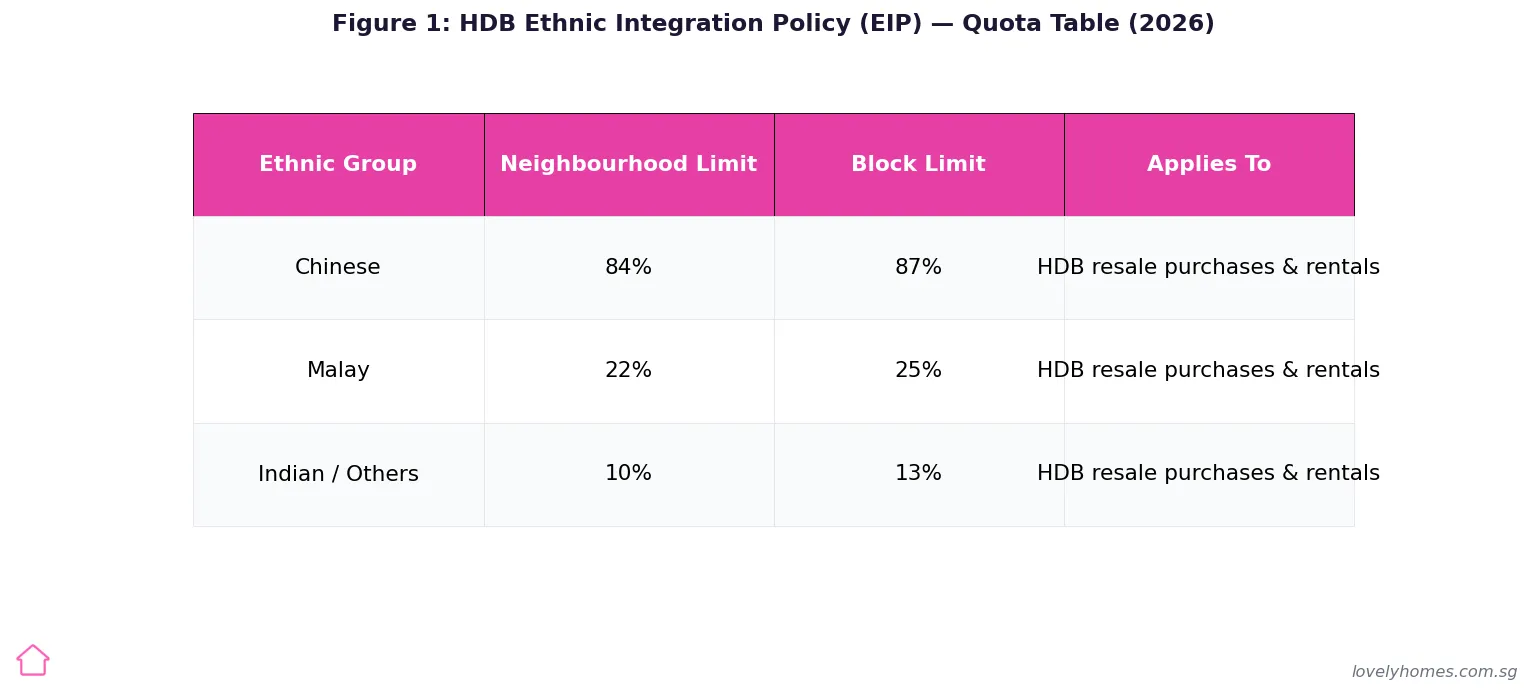
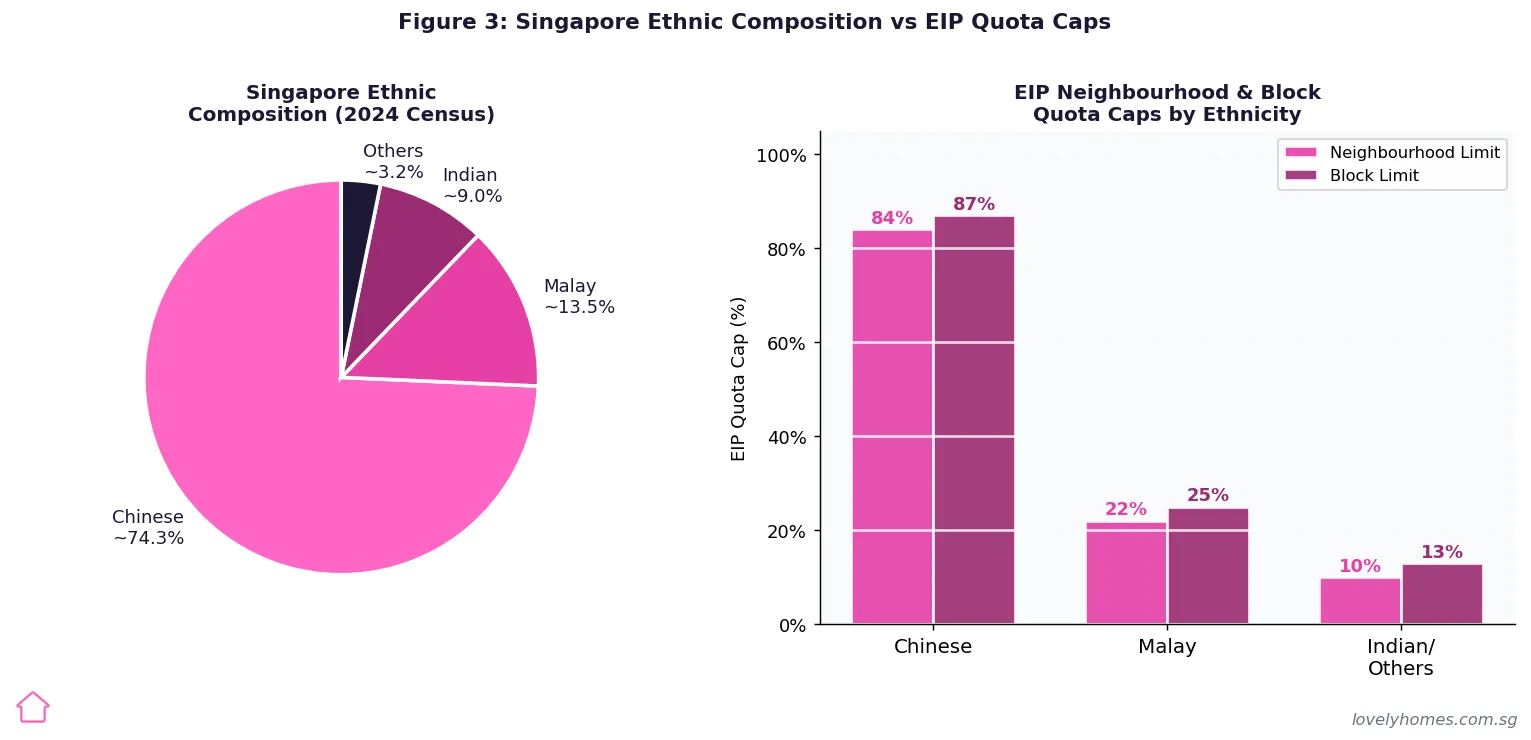
The Ethnic Integration Policy (EIP) was introduced in 1989 to prevent the formation of mono-ethnic enclaves. Every HDB block and every neighbourhood has a maximum proportion of flats that may be sold to each ethnic group:

  • Chinese: 84% of a neighbourhood, 87% of a block.
  • Malay: 22% of a neighbourhood, 25% of a block.
  • Indian / Other: 10% of a neighbourhood, 13% of a block.

The Singapore Permanent Resident (SPR) Quota sits on top of EIP and limits the proportion of non-Malaysian SPR households per neighbourhood (5%) and per block (8%). Malaysian SPRs are exempt because they are considered demographically and culturally close to Singaporean groups.

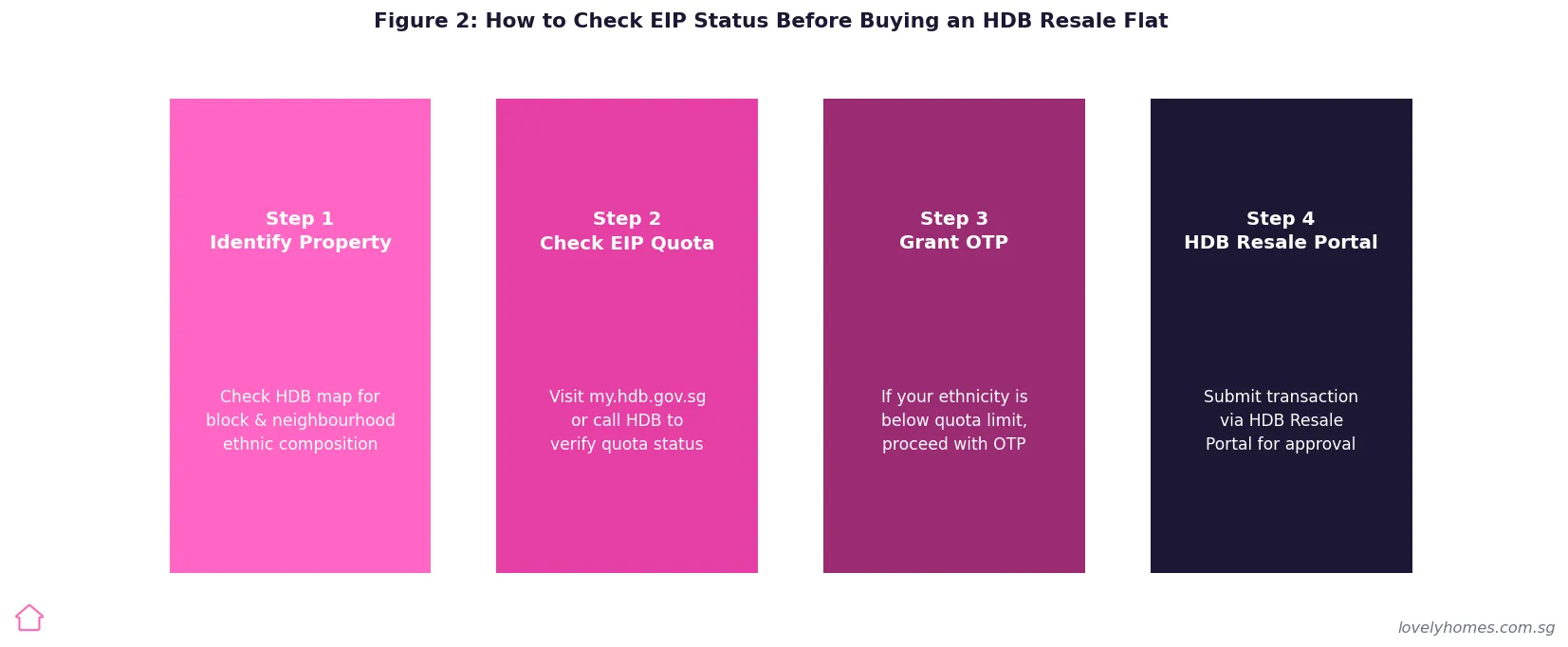
Each unit at flat selection shows the live EIP/SPR status. A unit may be physically vacant but unavailable to your ethnic group because the quota is full. You see this most acutely in popular projects in Bishan, Queenstown, or Bukit Merah, where Chinese-quota units sell out first while Indian-quota units may still be open at queue number 200+. Plan your back-up unit choices accordingly.

Grants — The Stack That Can Pay for Your Furniture

For BTO applicants, grants are awarded in fewer types than for resale buyers, but the absolute amounts are still material. As of 1 February 2024 the BTO-side grants are:

  • Enhanced CPF Housing Grant (EHG): S$5,000 to S$120,000 sliding scale by household income. The full S$120k is available for households earning up to S$1,500/month; the grant tapers to S$5,000 at the S$9,000–9,500 income band.
  • Family Grant: S$10,000 to S$80,000 depending on flat type and income, available only for resale BTO and for Plus/Prime BTO under the new classification. Standard BTOs do not qualify (the subsidy is built into the price).
  • Proximity Housing Grant (PHG): S$30,000 if buying with parents living in the same household; S$15,000 if buying within 4 km of parents’ existing flat.
HDB BTO application guide Singapore 2026 — S$520K 4-room cost stack with grants
Figure 3: Worked example — SC+SC couple buying a S$520K 4-room BTO with a S$80K grant stack.

BTO Classification — Standard, Plus, Prime

From October 2024 onwards, every new BTO is classified as Standard, Plus, or Prime. This shifts the subsidy structure and the resale rules:

  • Standard: the legacy framework. 5-year MOP, no resale-price clawback, no income ceiling on the resale buyer. The default for non-mature estates.
  • Plus: 10-year MOP, income ceiling of S$14k applies even on resale, partial subsidy clawback at resale. Found in choicer locations within outer-mature estates.
  • Prime: 10-year MOP, S$14k income ceiling on resale, 6% subsidy clawback, no whole-flat rental ever (only room rental). Reserved for the most attractive locations like Queenstown and Kallang/Whampoa.

The classification affects your effective return on the flat 10 years out. A Plus flat in Hougang sold to a quota-restricted resale buyer will trade at a discount to the equivalent Standard flat in nearby Sengkang — that is the design intent, to keep the subsidy in the public-housing system.

Worked Example — SC+SC Couple, Combined S$10,500/Month

Take a 32-year-old + 30-year-old SC+SC couple, married, no children, combined gross income S$10,500/month. They are first-timers and applying under the Family Scheme. They target a 4-room BTO at S$520,000 in Punggol Coast (a Standard project).

  • Income ceiling check: S$10,500 < S$14,000. PASS.
  • Grants: EHG at the S$8,001–10,500 income band = S$45,000. Family Grant: not applicable for Standard BTOs. PHG: S$15,000 if their parents live within 4 km. Total: S$60,000.
  • Effective price: S$520,000 − S$60,000 = S$460,000.
  • Down payment (5% with HDB loan): S$23,000, payable from CPF OA.
  • HDB loan @ 2.6%, 25 years: S$437,000 principal × 2.6% ⇒ monthly instalment ~S$1,985.
  • BSD: 1% on first S$180k + 2% on next S$180k + 3% on next S$160k ≈ S$8,200, payable in cash or CPF OA.
  • Legal fees (HDB conveyancing): ~S$800.

Total upfront cash + CPF outlay: ~S$32,000 (downpayment + BSD + legal + option fee). Monthly outlay during construction: ~S$95/month service & conservancy charges only. Monthly outlay after key collection: ~S$2,070 (loan + S&C). Against a household income of S$10,500/month gross (~S$8,400 take-home), the loan is comfortably within the 30% MSR (Mortgage Servicing Ratio) limit for HDB loans.

Common Mistakes BTO Applicants Make

  1. Skipping the HFE letter — without it, you cannot apply. Generate the HFE 6–8 weeks before the launch you want.
  2. Choosing a project where your ethnic quota is already full — check the EIP status on the launch site before applying.
  3. Underestimating the income ceiling buffer — HDB adds a 30% buffer for variable income. Sit just under the ceiling, not at it.
  4. Applying as Family before marriage — if you are not yet married, you must use the Fiancé scheme. The Family scheme is for already-married couples.
  5. Ignoring the 5-year MOP — or now 10-year for Plus/Prime. The MOP starts on key collection, not application; selling within MOP requires HDB’s express consent and is rarely granted.

What This Means for You

For most Singaporean first-timer households, BTO remains the single most subsidised real-estate transaction available. A successful 4-room BTO in 2026 typically delivers a paper gain of 60–100% by the end of the 5-year MOP — not because the project is special, but because the price gap between BTO and resale is structurally maintained. The key is winning the ballot. Increase your odds by applying under the right priority scheme (PPS for couples with children, MCPS for newlyweds), targeting non-mature estates where oversubscription is lower, and being flexible on flat type (4-room ballots have higher success rates than 5-room).

What Might Come Next

The Ministry of National Development has signalled three policy directions for the 2026–2028 horizon. First, BTO supply is forecast to remain at 22,000–25,000 per year through 2028, after which the pipeline tapers to 18,000 as the demographic bulge passes. Second, the Plus/Prime classification is expected to be applied to roughly 30% of new launches by 2028, up from ~15% in 2025. Third, the Joint Singles Scheme age threshold may be lowered from 35 to 30 if the Singapore Together Forward dialogue feedback gains policy traction. None of these is yet officially confirmed; watch the COS speech each March for the firm announcements.

Summary — Eligibility & Grant Stack by Scheme (Quick Reference)

Scheme Min Age Citizenship Income Ceiling Flat Sizes Top Grant Stack
Public (Family Nucleus) 21 (one) ≥1 SC S$14,000 2-rm to 5-rm + 3Gen EHG up to S$120k + PHG S$30k
Fiancé/Fiancée 21 (both) ≥1 SC S$14,000 2-rm to 5-rm EHG up to S$120k + PHG
Single SC 35 SC only S$7,000 2-rm Flexi only EHG-Singles up to S$60k
Joint Singles 35 (each) All SC S$21,000 (combined) 2-rm Flexi to 5-rm EHG-Singles up to S$60k each
Non-Citizen Family 21 (SC) 1 SC + 1 PR S$14,000 2-rm Flexi to 5-rm EHG up to S$120k

Frequently Asked Questions

Can I apply for a BTO if I already own a private property?

Yes, but you must dispose of your private property within 30 months of key collection of the BTO. If you fail to do so, HDB may compulsorily acquire the BTO at original cost. The 30-month window is intended to allow for sale logistics. You also forfeit any first-timer status — you will be treated as a second-timer for grant calculations. Most second-time HDB applicants in this position are downsizing from a private property after children leave home, or rebalancing portfolios after en-bloc proceeds.

How long does the entire process take, from application to keys?

Plan for 4 to 4.5 years from application close to key collection on a typical BTO project, with a further 5 years (Standard) or 10 years (Plus/Prime) of Minimum Occupation Period before you can sell. The construction stage is the longest phase — typically 36–48 months from breaking ground. Projects in Tengah and Punggol have generally tracked the lower end; mature-estate projects in Queenstown and Bishan have hit the upper end due to site constraints.

What happens if I fail the ballot?

You forfeit only the S$10 application fee and may apply again at the next launch. There is no penalty or queue-number penalty for non-selection — in fact, first-timers retain their first-timer status and the 3-queue-number allocation. Many couples cycle through 4–6 launches before securing a unit in their preferred town. To shorten the wait, broaden the geographies you are willing to apply in, or apply under a priority scheme like Parenthood Priority if you have children.

Can I use a private bank loan instead of an HDB concessionary loan?

Yes — bank financing is allowed for BTO buyers, and currently many do because SORA-pegged floating rates have hovered around 3.5–3.8% (vs the HDB concessionary rate at 2.6%, fixed at CPF OA + 0.1%). The trade-off: bank loans require a 25% downpayment (5% cash + 20% cash/CPF) instead of the 0% cash + 20% CPF on an HDB loan. Once you choose bank financing for your first BTO, you cannot switch back to an HDB concessionary loan for the same flat. Most first-timer BTO buyers stay on the HDB loan for the cash-flow flexibility.

If we are not yet married, can we still apply?

Yes — under the Fiancé/Fiancée Scheme. Both applicants must be 21+ and at least one a Singapore Citizen. You declare your intention to marry; HDB requires you to produce a marriage certificate within 3 months of key collection. If the relationship breaks down before key collection, you may withdraw from the application and forfeit only the option fee — HDB will not pursue you for damages.

How does the EIP affect resale value of my flat?

The EIP can constrain the buyer pool when you eventually sell. If your block’s Chinese quota is full and you are Chinese, you can only sell to a non-Chinese buyer — which is a smaller market and typically yields a 1–3% price discount. The reverse is also true: minority-quota sellers in mature estates often see a small premium. Most owners do not feel this until they list; consult your conveyancing lawyer for an EIP-aware listing strategy.

Can I rent out my BTO flat after MOP?

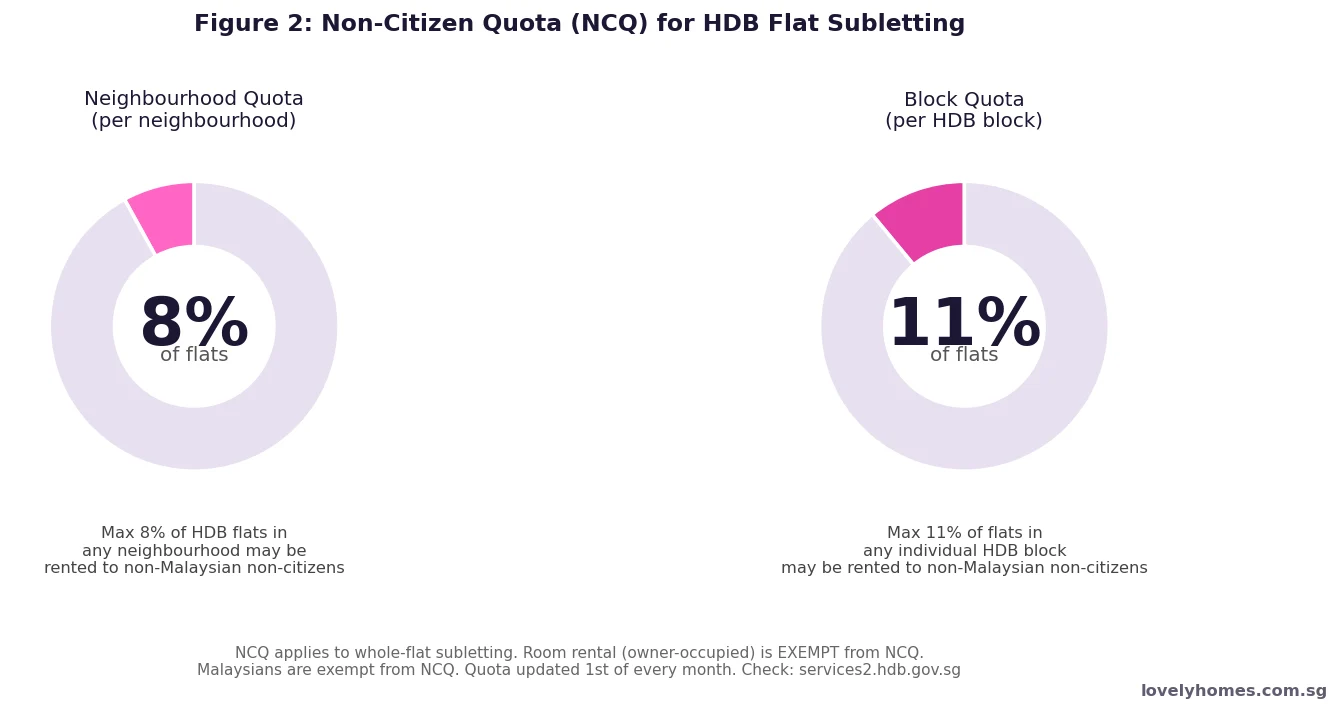
For Standard BTOs: yes, after the 5-year MOP, you may rent out the entire flat under HDB’s Whole Flat Rental scheme (subject to a 6-monthly registration). For Plus and Prime BTOs: only room rental is permitted, never whole-flat rental. The whole-flat rental rule is a permanent restriction designed to keep the subsidy in the owner-occupier pool. Non-citizen sub-tenant quotas also apply: the Non-Citizen Quota caps non-Malaysian PRs at 5% of a neighbourhood and 8% of a block.

Related Articles

Disclaimer

This guide is for general information only and does not constitute legal, financial, or housing advice. Eligibility schemes, income ceilings, grant amounts, EIP/SPR quotas, and BTO classification rules are illustrative as at April 2026 and are subject to change at the discretion of the Housing & Development Board, the Ministry of National Development, and the Central Provident Fund Board. Always verify the latest figures with primary sources — the Housing & Development Board, the CPF Board, the Inland Revenue Authority of Singapore, and consult a qualified housing consultant or conveyancing lawyer before signing any agreement.

HDB Subletting Rules (2026): MOP, Approval, Room Caps and Red Lines

HDB Subletting Rules (2026): MOP, Approval, Room Caps and Red Lines

QUICK ANSWER

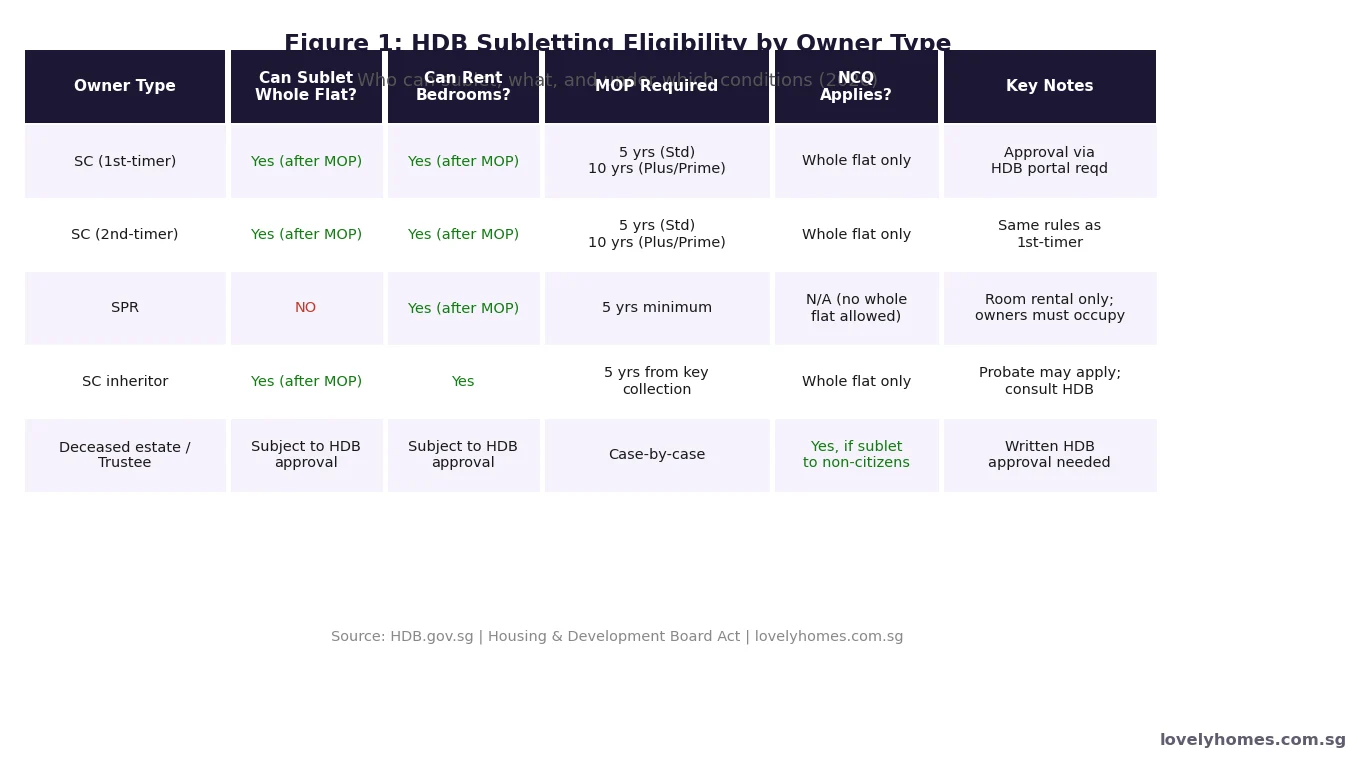
HDB owners can sublet whole flat after 5-year MOP (HDB approval required, max 3 years per approval, non-citizen quota applies) or sublet bedrooms after 3-year MOP (5 years for 2-room, no HDB approval needed but online registration required, owner must still live in the flat). Minimum lease is 6 months per tenant — no Airbnb, no short-stay. Breaches risk fines up to S$50,000 and compulsory flat acquisition.

HDB subletting is the single most rule-bound corner of the Singapore rental market. The policies exist because HDB is public housing, funded by subsidies and grants, and subletting concessions try to balance owner flexibility with social objectives (owner-occupation, ethnic integration, housing supply). The rules are enforced — HDB audits tenanted flats and compulsory acquisition is a real outcome for breaches.

This guide lays out the two subletting paths (whole flat vs bedrooms), the occupant caps, and the red lines you cannot cross.

For broader landlord obligations (licensing, tax, TA clauses), see our landlord’s guide. For more context on HDB rules generally, read our MOP rules guide.

HDB subletting rules infographic
Whole-flat vs bedroom subletting, occupant caps, and breach penalties

The two subletting paths at a glance

Rule Whole-flat subletting Bedroom subletting
MOP required 5 years (all flat types) 3 years (5 yrs for 2-room)
HDB approval Required before tenancy Register online; no approval needed
Owner must occupy No — owner can live elsewhere Yes — owner must still live in the flat
Max approval term 3 years per renewal 3 years per tenant
Min lease per tenant 6 months 6 months
Non-citizen quota Applies (block + neighbourhood) Does not apply
Ethnic quota (EIP/SPH) Applies Applies in certain cases

Whole-flat subletting in depth

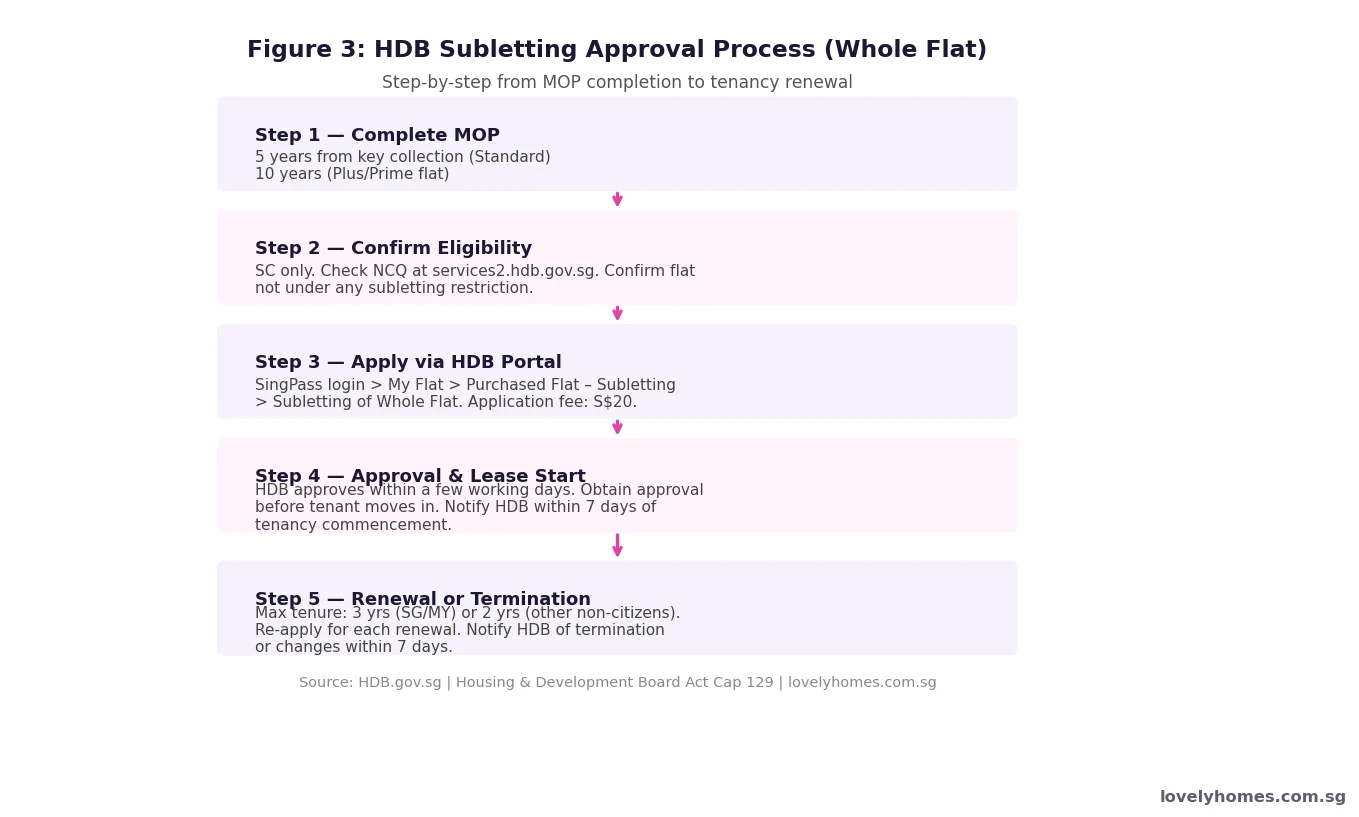
Whole-flat subletting is allowed only after the full 5-year Minimum Occupation Period from key collection. Apply via HDB InfoWEB with:

  • Tenant’s NRIC/FIN and work/student/dependent pass
  • Proposed tenancy term and rent
  • S$20 non-refundable admin fee
  • Declaration of the owner’s temporary residential address

HDB typically approves within 2–3 weeks. The approval is valid for up to 3 years and can be renewed. Non-Citizen Quota (NCQ) may block some rentals if the block or neighbourhood has already reached its foreigner cap.

Bedroom subletting in depth

Bedroom subletting is simpler because the owner stays — HDB treats it more like house-sharing than a full rental. Register the tenant’s details on HDB InfoWEB within 7 days of the tenancy starting. No formal approval needed.

Key constraint: the occupant cap includes both the owner’s household and any subletted bedroom tenants.

Maximum occupants by flat type

Flat type Max occupants Max bedrooms rented
1-room / 2-room 4 1 bedroom
3-room 6 1 bedroom
4-room and above 6 2 bedrooms

Where the occupant cap used to be based on flat size, HDB moved to a hard cap of 6 persons in 2024 for most flat types to curb overcrowding and nuisance complaints.

What counts as a breach

Red-line breaches that trigger HDB enforcement:

  1. Short-stay rentals under 6 months — includes Airbnb, Booking.com short lets, weekend stays, room-by-night.
  2. Subletting the whole flat before MOP.
  3. Subletting rooms before 3-year MOP, or 5-year for 2-room flats.
  4. Subletting rooms without the owner residing in the flat.
  5. Exceeding the occupant cap (even by one person).
  6. Letting to tenants without a valid pass or to unauthorised nationalities.
  7. Not registering bedroom subletting on HDB InfoWEB.
  8. Accepting rental payments in cash without records (complicates dispute resolution and IRAS audits).

Penalties

HDB’s enforcement ladder, from lightest to most severe:

  • Written warning for minor paperwork lapses.
  • Financial penalty — fines up to S$50,000.
  • Compulsory acquisition of the flat for serious or repeated breaches. Owner receives compensation at HDB’s determined valuation — typically below market.
  • Debarment from buying another HDB flat or applying for HDB rental.

Frequently asked questions

Can I rent my HDB flat on Airbnb even if it’s for friends only?

No. The 6-month minimum lease rule applies regardless of who the tenant is. Any stay below 6 months is a breach, even if unpaid.

Can I sublet while I’m overseas for work?

Yes — this is a common use case for whole-flat subletting after MOP. You need HDB approval and must notify HDB of your overseas address. You can return any time.

Does bedroom subletting affect my PR sponsorship or home loan?

No direct effect on PR or citizenship applications. It may affect your TDSR if banks treat rental income as supplementary (they typically use 70–80% of the rent in TDSR calculations).

What’s the non-citizen quota?

HDB caps the percentage of non-Malaysian foreigners who can occupy flats in a block and neighbourhood. If your block has hit the cap, HDB will reject your subletting application until a spot opens up.

Disclaimer

This guide is for general information only. Singapore’s rental rules, HDB policies, and IRAS stamp duty rates change periodically. Always verify against the HDB, URA and IRAS websites before signing a lease or filing with IRAS. LovelyHomes is not a licensed property agent or tax adviser. For personalised advice, please engage a registered CEA agent or a qualified tax professional.


Singapore PR Property Purchase Rules: HDB, Condo, ABSD (2026)

Singapore PR Property Purchase Rules: HDB, Condo, ABSD (2026)

Quick answer
A Singapore Permanent Resident can buy private condos from day one of PR status, paying 5% ABSD on the first residential purchase (30% on second, 35% on third+). HDB resale flats open to PRs only after 3 years of PR status, and require a qualifying family nucleus. PRs cannot buy new BTO, Plus, Prime or EC flats. Landed property on the mainland needs LDAU approval. If you buy an HDB flat as a PR, MOP and subletting rules mirror citizens.

Permanent Residency fundamentally changes a buyer’s property menu in Singapore — but not overnight. From day one, private property opens. HDB resale still waits three years. New HDB (BTO/Plus/Prime) and new ECs remain closed to PRs regardless of wait time.

This guide maps the PR property timeline, the full 2026 ABSD ladder for PR buyers, the most common mistakes PRs make when disposing of existing property, and the rules PRs should know before taking out a CPF loan. For the foreigner-side equivalent, see our foreigner property guide.

PR property purchase timeline — 3-year HDB wait, MOP, ABSD ladder, common mistakes
A PR’s 3-year path to HDB resale.

The PR property timeline

Day 1 as PR

Private condo, landed-via-LDAU, and Sentosa Cove landed open immediately. CPF usage opens once the PR has active OA/SA balances. LTV, TDSR and MSR frameworks are identical to citizens.

3 years as PR

HDB resale opens. A PR household must form a qualifying family nucleus — typically a PR applicant with a spouse (PR or SG citizen), or the PR-PR Scheme (both applicants PRs for at least 3 years).

5 years after HDB purchase (if you buy HDB)

Minimum Occupation Period. Same 5-year MOP as citizens. Cannot sub-let the entire flat, cannot buy private residential, cannot sell on the open market. See our MOP rules guide.

Lifetime rule

PRs cannot buy new BTO, new Plus, new Prime or new EC flats. These are reserved for SG citizens with a citizen spouse or fiancé(e). The only HDB route for PRs remains the resale market.

ABSD for PRs — the 2026 ladder

Residential count ABSD (PR) Notes
1st SG residential 5% Up from 0% that citizens pay
2nd SG residential 30% Raised from 25% in Apr 2023
3rd or more 35% Raised from 30% in Apr 2023

ABSD is payable within 14 days of Option exercise, on top of BSD. If two PRs buy jointly, the ABSD is calculated on the highest-count profile among the buyers.

The HDB-specific rules PRs must follow

Dispose of private within 6 months

A PR who owns private residential (in Singapore or overseas) must dispose of it within 6 months of the HDB resale completion. This is usually the biggest surprise for incoming PR buyers — overseas apartments count.

CPF usage and the lease rule

CPF can fund the purchase only if remaining lease covers the youngest buyer to age 95. For older HDB stock this is a real constraint — see our CPF for property guide.

No grants (mostly)

Most HDB grants (EHG, Family Grant, Proximity Housing Grant) are reserved for SG-citizen first-timer households. A PR-PR couple does not qualify for EHG. However, a PR with an SG-citizen spouse may qualify under the standard first-timer framework — see our grants guide.

Landed and Sentosa Cove

PRs need LDAU approval under the Residential Property Act to buy landed on the mainland — rarely granted except for long-tenured PRs with strong local ties. Sentosa Cove landed is much more accessible: SLA approval is routinely granted for owner-occupation.

Common PR mistakes

  • Forgetting the 3-year HDB wait. Newly-minted PRs cannot buy HDB until year 3.
  • Holding overseas property while buying HDB. HDB will compel disposal within 6 months.
  • Attempting decoupling to reset ABSD. IRAS actively scrutinises PR decoupling post-2022 and may claw back ABSD. See our decoupling guide.
  • Using CPF on a lease-short flat. Always check the lease-to-95 calculator first.

Frequently asked questions

Can a PR buy an EC?

Not a brand new EC — that’s citizen-only. A PR can buy a privatised EC (post-10-year MOP + privatisation), because by then it is effectively private property.

Can two PRs buy HDB resale together?

Yes — under the PR-PR Scheme, both must have been PR for at least 3 years. Grants are not available.

What if I become a citizen after buying HDB as a PR?

The flat becomes a citizen-owned flat. Any remaining rules (MOP, subletting) still apply from the purchase date.

Does a PR pay the 60% foreigner ABSD?

No. PR status attracts the PR ladder (5% / 30% / 35%) — not the foreigner flat rate.


This guide is for general information only and is accurate as of April 2026. Singapore property rules, taxes and cooling measures change frequently — always verify current figures with URA, IRAS, HDB or a licensed professional before committing. LovelyHomes is not a financial, legal or tax advisor.


Translate »