Singapore EC Buying Guide 2026: Complete Guide to Executive Condominiums

Singapore EC Buying Guide 2026: Complete Guide to Executive Condominiums

For Singapore’s “sandwich class” — households who earn too much to qualify for subsidised HDB flats but find new private condominiums financially out of reach — the Executive Condominium (EC) remains the most important rung on the property ladder. Priced typically S$400–S$700 per square foot lower than comparable private condominiums at launch, ECs are purpose-built by private developers on government land, sold to eligible buyers with CPF grants, and eventually privatised ten years after their Temporary Occupation Permit (TOP) date. At that point, they trade freely on the open market like any private condominium.

This guide covers everything you need to know about buying an EC in Singapore in 2026 — who is eligible, how much you can borrow, which CPF grants apply, the full cost breakdown, and how the new cooling measures announced on 8 May 2026 change the landscape. Where relevant, we cross-reference the EC rule changes in our separate article Singapore EC Rule Changes May 2026: 10-Year MOP, No DPS and 90% First-Timer Quota Explained.

Quick Answer — EC Buying Guide at a Glance

  • ECs are built by private developers but sold under HDB rules — eligibility, income ceiling (S$16,000/month for families), and a 5-year MOP apply.
  • New ECs in 2026 are launching at an estimated S$1,400–S$1,550 psf — roughly S$400–S$600 psf lower than comparable OCR private condominiums.
  • Eligible buyers can access the CPF Additional Housing Grant (AHG) of up to S$30,000 and the Family Housing Grant (FHG) of up to S$10,000.
  • As of 8 May 2026, new EC rules include: 10-year MOP before an EC unit can be rented out in its entirety, 15-year privatisation period (up from 10), 90% first-timer priority ballot, and abolition of the Deferred Payment Scheme (DPS).
  • ABSD is not payable on a first EC purchase from the developer; standard ABSD rates apply if buying a fully privatised EC on the open market.
  • You cannot own any private property for 30 months before applying, and must not own another HDB flat at the time of EC application.
  • The Minimum Occupation Period is 5 years for selling; the unit cannot be rented out in its entirety during this 5-year period (and now 10 years for full-unit rental under the new rules).
  • At privatisation (15 years from TOP under the new rules), the EC may be purchased by foreigners at standard ABSD rates.

What Is an Executive Condominium?

An Executive Condominium is a hybrid residential property type unique to Singapore, introduced by the Housing and Development Board (HDB) in 1995. It is developed by private developers on land sold by HDB under the Government Land Sales (GLS) programme, and comes with private condominium facilities — swimming pool, gymnasium, clubhouse, security, and landscaped grounds — at a price point made accessible through an eligibility framework similar to HDB flats.

Unlike a standard HDB flat, an EC is sold under a hybrid legal framework: it is a private strata-title property governed by the Building Maintenance and Strata Management Act (BMSMA), but for the first ten to fifteen years (depending on the vintage), it is subject to HDB ownership rules including the Minimum Occupation Period (MOP) and eligibility requirements. After the privatisation date, these HDB rules fall away entirely and the property trades as a full private condominium.

HDB administers the EC scheme. The Singapore Land Authority (SLA) maintains the land register. The Urban Redevelopment Authority (URA) tracks EC transaction data under the same REALIS system that covers private condominiums. Applications for new EC launches are made through the HDB portal at hdb.gov.sg.

EC vs private condo vs HDB comparison Singapore 2026 — eligibility, price, MOP, grants
Figure 1: Executive Condominium vs Private Condo vs HDB — key differences at a glance (Singapore 2026). Source: HDB, URA, CPF Board.

EC Eligibility in 2026 — Who Can Buy?

Eligibility for purchasing a new EC from the developer is strictly governed by HDB. The primary eligibility schemes are the Public Scheme (family nucleus), Fiance/Fiancee Scheme, Orphans Scheme, and Joint Singles Scheme. The overwhelming majority of EC buyers purchase under the Public Scheme: a Singapore Citizen applicant forms a family nucleus with a spouse, children, or parents.

Eligibility Criterion Requirement
Citizenship At least one applicant must be a Singapore Citizen. The other occupier may be a Singapore Citizen or Permanent Resident.
Age At least 21 years old (18 years old for orphans scheme)
Income ceiling Monthly household gross income ≤ S$16,000 (families); ≤ S$8,000 (singles — Joint Singles Scheme only, age 35+)
First-timer status Must not have previously owned a private residential property in the 30 months before the EC application. Both applicant and occupier must not currently own an HDB flat (unless selling within 6 months of EC key collection).
Previous subsidies If previously purchased an HDB flat with CPF grants or sold an HDB flat with HDB loan, there are waiting periods or resale levy implications. Check HDB’s eligibility calculator.
30-month private property rule Neither the applicant nor any listed occupier may have disposed of a private residential property within 30 months before the EC application date.
Ownership of HDB flat Must not own an HDB flat unless you commit to sell within 6 months of EC TOP (for existing HDB owners upgrading).

Under the new rules effective 8 May 2026, 90% of units in each EC launch are balloted exclusively to first-timer families in the initial launch phase. This is a significant increase from the previous 70% first-timer priority, and is designed to ensure that ECs continue to serve their target demographic — upgraders who have not previously benefited from a subsidised property. Second-timer families (who have previously owned an HDB flat) are permitted to ballot only for the remaining 10% allocation during the first month of launch, and gain unrestricted access from the second month.

EC Pricing, CPF Grants, and Affordability in 2026

The pricing advantage of an EC over a comparable OCR private condominium has been the scheme’s defining attraction since its introduction. In the 2026 launch pipeline, new ECs are expected to price at S$1,400–S$1,550 per square foot, against OCR private condominiums averaging S$1,900–S$2,200 psf. For a 1,000 sq ft three-bedroom unit, that translates to a launch price of approximately S$1.4M–S$1.55M for the EC versus S$1.9M–S$2.2M for a comparable private condo — a saving of S$450,000–S$700,000 before grants.

On top of the pricing discount, eligible EC buyers may apply for CPF housing grants. The two principal grants for new EC purchases are the CPF Additional Housing Grant (AHG) and the Family Housing Grant (FHG), both administered by the CPF Board and HDB:

EC income ceiling and CPF grant amounts Singapore 2026 — AHG FHG and EC eligibility income
Figure 2: EC income ceiling and CPF grant amounts for EC buyers (Singapore 2026). AHG = Additional Housing Grant; FHG = Family Housing Grant. Source: HDB, CPF Board.
Grant Maximum Amount Income Ceiling to Qualify Notes
CPF Additional Housing Grant (AHG) S$30,000 ≤ S$10,000/month (family) Tiered based on income; only first-timers eligible; credited to CPF OA
Family Housing Grant (FHG) S$10,000 ≤ S$16,000/month (family) Available to all eligible EC first-timer families; credited to CPF OA
Step-Up CPF Housing Grant S$15,000 ≤ S$7,000/month (2nd-timer) For 2nd-timer families who previously lived in a 2-room or smaller HDB flat; not stacked with AHG

CPF grants for ECs are credited to your CPF Ordinary Account (OA) and may be used to offset the purchase price or reduce the mortgage. Unlike HDB resale grants, EC grants do not require you to hold the property for the MOP before they are “used up” — but CPF OA funds used are subject to the standard CPF accrued interest rules on eventual sale.

Financing an EC: Bank Loans, CPF, and the TDSR/MSR Framework

ECs may only be financed via bank loans — HDB concessionary loans are not available for EC purchases. The loan is subject to the standard Monetary Authority of Singapore (MAS) framework: Total Debt Servicing Ratio (TDSR) of 55% and, for EC purchases, the Mortgage Servicing Ratio (MSR) of 30% of gross monthly income. The MSR applies because ECs are treated as HDB-type properties for the purposes of borrowing limits during the initial eligibility period.

Under the prevailing LTV rules, a buyer with no outstanding property loans may borrow up to 75% of the purchase price (or market valuation, whichever is lower) from a financial institution. With the new 2026 rules abolishing the Deferred Payment Scheme (DPS), buyers are required to service the loan from the point of purchase or from when construction milestones are reached under the Normal Progressive Payment scheme.

Financing Parameter Applicable Rule
Loan type Bank loan only (no HDB concessionary loan for ECs)
Maximum LTV 75% of purchase price / valuation (whichever is lower), assuming no existing property loans
Minimum cash payment 5% in cash; remaining 20% downpayment may come from CPF OA
TDSR (total debt) All monthly debt obligations ≤ 55% of gross monthly income
MSR (mortgage only) EC mortgage repayment ≤ 30% of gross monthly income
Maximum loan tenure 30 years (capped such that loan maturity does not exceed age 65 of youngest borrower)
DPS (Deferred Payment Scheme) Abolished effective 8 May 2026 — all purchases use Normal Progressive Payment

EC Cooling Measures 2026: What Changed on 8 May 2026?

The Government announced a package of EC-specific cooling measures on 8 May 2026 — the most significant changes to the EC framework in over a decade. The changes are designed to reinforce the EC’s role as a subsidised housing product for genuine owner-occupiers and to curtail speculative demand. The four key changes are:

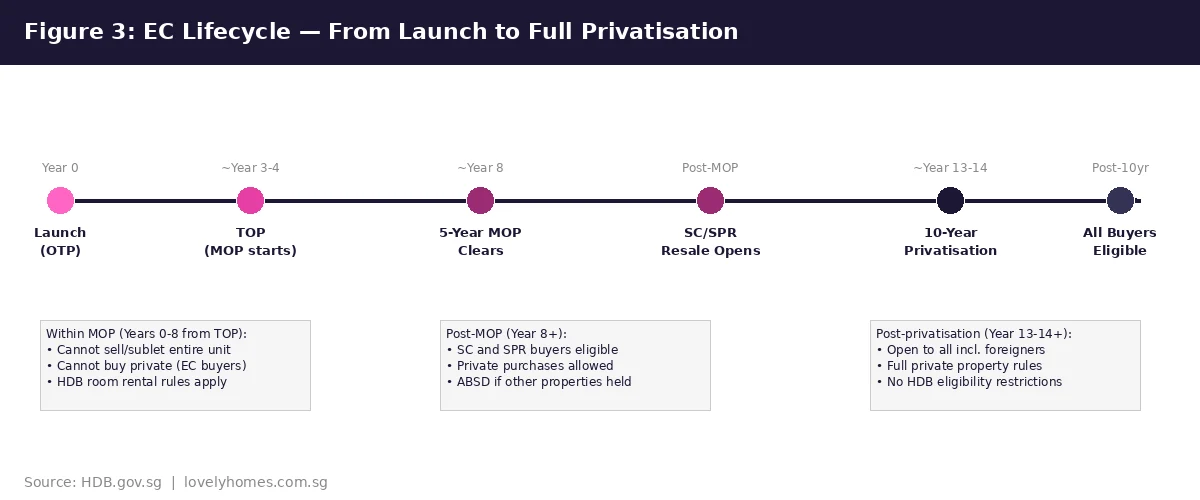
  • 10-year full-unit rental restriction: EC owners may not rent out their entire unit for 10 years from the unit’s TOP date (up from the previous 5-year restriction). During this period, individual rooms may still be rented to authorised occupants. This effectively extends the owner-occupier commitment period significantly.
  • 15-year privatisation period: An EC is now privatised 15 years from its TOP date (up from 10 years previously). Until privatisation, the HDB ownership rules continue to apply. From the privatisation date, the EC becomes a full private condominium and may be sold to foreigners and entities without restriction.
  • 90% first-timer priority ballot: In the first month of each EC launch, 90% of units are reserved for first-timer families — up from 70%. This ensures that the primary beneficiaries of the EC subsidy are those who have not previously owned a subsidised property.
  • Abolition of the Deferred Payment Scheme (DPS): Buyers can no longer defer mortgage repayments until TOP. All EC purchases from 8 May 2026 onwards use the Normal Progressive Payment scheme, which ties payments to construction milestones. This is consistent with the progressive payment rules that already apply to most new launches.

For a detailed analysis of these changes and their implications, read our companion article: Singapore EC Rule Changes May 2026: 10-Year MOP, No DPS and 90% First-Timer Quota Explained.

EC Minimum Occupation Period (MOP) — What You Can and Cannot Do

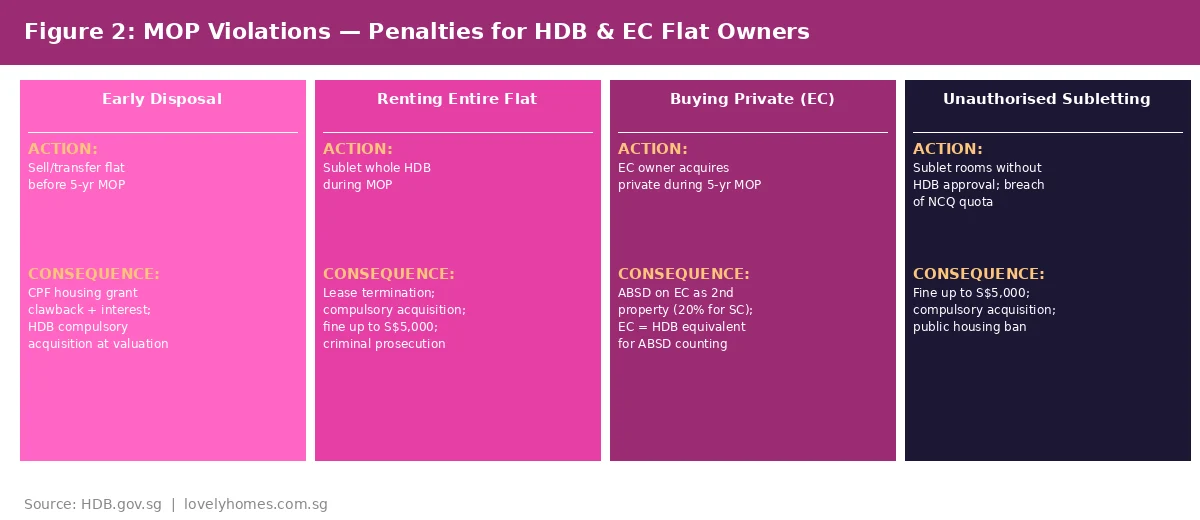
The EC Minimum Occupation Period is 5 years, measured from the date of key collection (i.e., from the date the unit is physically occupied, not from TOP or purchase date). During the 5-year MOP, the EC owner must live in the unit and cannot sell or sublet the entire unit to a third party. Individual rooms may be rented to authorised occupants, subject to HDB’s prevailing subletting rules.

After completing the 5-year MOP, the EC may be sold on the open market to Singapore Citizens and PRs (but not yet foreigners or entities, as the privatisation has not yet occurred). After the 15-year privatisation milestone (under the new rules), the EC may be sold to any buyer worldwide including foreigners and companies — at which point standard ABSD rates apply to the buyer based on their profile and property count.

EC vs Private Condo: Price Gap and Value Proposition (2016–2026)

The persistent price gap between EC new launches and comparable OCR private condominiums has historically closed over time as the EC approaches and then passes privatisation. Buyers who purchased ECs at launch in 2014–2017 have typically seen capital appreciation of 25–45% by the time of privatisation around 2024–2027, in many cases outperforming comparable OCR condominiums on a per-unit basis given the lower entry price.

EC versus OCR private condo launch PSF price trend Singapore 2016 to 2026
Figure 3: EC new launch PSF vs OCR private condo average — Singapore 2016 to 2026. The shaded area represents the price gap available to EC buyers. Source: URA REALIS, HDB, LovelyHomes research.

The 2026 EC launch pipeline includes several projects across the OCR and RCR, including Altura EC (Bukit Batok West Avenue 8) and Novo Place (Tengah Garden Avenue), which are near-completion or recently TOP’d, as well as upcoming launches in Tampines, Tengah, and Bedok areas. Under the new 15-year privatisation rule, buyers of 2026 ECs should note that the privatisation milestone does not arrive until approximately 2040–2041, extending the HDB-rule period compared with earlier vintages.

Worked Example: The Lim Family Buying a 2026 EC Launch

Mr and Mrs Lim are a Singapore Citizen couple, both aged 34. Their combined gross monthly income is S$12,000. They are first-time buyers who have never owned any private property or subsidised HDB flat. They are applying for a new EC launch at Tengah, priced at S$1.45M for a 1,000 sq ft three-bedroom unit.

Item Amount Notes
Purchase price S$1,450,000 1,000 sq ft, 3-bedroom EC at ~S$1,450 psf
CPF AHG (income S$12,000 — no AHG; AHG requires ≤S$10,000) S$0 Income S$12,000 exceeds AHG S$10,000 ceiling
CPF Family Housing Grant (FHG) S$10,000 First-timer family; income ≤ S$16,000 — fully eligible
Effective purchase price after grant S$1,440,000 Grant applied against CPF OA balance
ABSD S$0 First EC purchase from developer — ABSD-exempt
BSD S$43,400 On S$1.45M: 1%×180k + 2%×180k + 3%×640k + 4%×450k
Bank loan (75% LTV) S$1,087,500 Based on purchase price S$1.45M × 75%
Minimum cash downpayment (5%) S$72,500 Must be paid in cash
CPF OA (remaining 20% downpayment) S$290,000 From CPF OA (including FHG S$10,000)
Monthly mortgage (25 years @ 3.5%) ~S$5,440/month MSR = 45.3% — EXCEEDS 30% MSR; must increase downpayment or reduce loan
Adjusted: loan S$800,000 (55.2% LTV), 30 yrs @ 3.5% ~S$3,593/month MSR = 29.9% — within 30% MSR limit. Requires additional S$287,500 in CPF/cash.

This worked example illustrates a critical affordability tension: the MSR of 30% cap on the EC mortgage can force buyers with a combined income of S$12,000 to make a larger downpayment than the minimum 25% required by LTV rules. At S$1.45M and a 3.5% bank rate, a 75% LTV loan of S$1.0875M requires monthly repayments of approximately S$5,440 — an MSR of 45.3%, far above the 30% limit. The Lim family would need to either reduce the loan amount (by increasing their downpayment to approximately 44.8%), buy a smaller or lower-priced unit, or wait until their income increases. This is a common challenge for buyers in the S$11,000–S$16,000 income band looking at 3-bedroom ECs in 2026.

EC Buying Summary — Key Rules at a Glance (2026)

Rule / Parameter Current Position (Post–8 May 2026)
Income ceiling (family) S$16,000/month
Income ceiling (singles, age 35+) S$8,000/month (Joint Singles Scheme)
First-timer priority at launch 90% of units — raised from 70% on 8 May 2026
ABSD on new EC purchase Nil (ABSD-exempt for eligible buyers under EC scheme)
Minimum Occupation Period 5 years (from key collection date)
Full-unit rental restriction 10 years from TOP (new rule from 8 May 2026)
Privatisation period 15 years from TOP (new rule; previously 10 years)
Deferred Payment Scheme Abolished — Normal Progressive Payment only (8 May 2026)
CPF AHG (max) S$30,000 (income ≤ S$10,000/month)
CPF FHG (max) S$10,000 (income ≤ S$16,000/month)
Loan type Bank loan only (no HDB concessionary loan)
MSR cap 30% of gross monthly income
TDSR cap 55% of gross monthly income
Maximum LTV 75% (no existing property loans)

What Might Come Next for the EC Scheme?

The 8 May 2026 cooling measures signal a clear policy intent: the Government views the EC as a genuine first-home product for middle-income Singaporeans, not a short-to-medium-term investment vehicle. The extension of the rental restriction to 10 years and the privatisation period to 15 years both reduce the speculative premium that early-privatisation buyers have historically captured.

Going forward, it is possible that: the income ceiling is revised upward to keep pace with nominal wage growth; additional GLS sites are released to increase EC supply given strong demand from HDB upgraders; or that the 30-month private property wait-out period for EC applicants is extended further. These are speculative scenarios — any changes would be announced by HDB and take effect from the announcement date.

For buyers evaluating ECs in the 2026 pipeline, the longer privatisation horizon means a re-pricing of the “privatisation premium” into the expected hold period. Buyers who are genuinely owner-occupiers over a 15-year horizon are largely unaffected — but those who were banking on a 10-year exit into the private market will need to revise their investment thesis.

Related Articles

Frequently Asked Questions

Can a Singapore PR buy a new EC directly from the developer?

No. At least one applicant in the household must be a Singapore Citizen to buy a new EC from the developer. A Singapore PR may be listed as an occupier or co-applicant only if the primary applicant is a Singapore Citizen. After the EC completes its 5-year MOP, it may be sold to SC or SPR buyers. After privatisation (15 years from TOP under the new rules), it may be sold to foreigners and entities as well.

Do I pay ABSD when buying an EC from the developer?

No, ABSD is not payable on a first EC purchase from the developer under the EC eligibility scheme, provided you qualify under one of HDB’s approved eligibility schemes and the purchase is your first-ever subsidised property. However, if you already own a private residential property (and have not disposed of it within 30 months before applying), you are ineligible for the EC scheme entirely. ABSD applies normally if you purchase a fully privatised EC on the resale market after the 15-year privatisation milestone, as that is treated as a standard private property purchase.

What is the difference between an EC’s MOP and the rental restriction?

These are two distinct rules. The MOP (5 years from key collection) governs when you can sell the EC unit — you must hold and occupy it for 5 years before selling on the open market. The full-unit rental restriction (now 10 years from TOP under the 8 May 2026 rules) governs when you can rent out the entire unit to a third-party tenant. You can rent individual rooms at any time to authorised occupants, but cannot vacate the unit entirely and sublet it as a whole during the 10-year period. Both rules apply concurrently — you may therefore sell after 5 years, but the buyer cannot rent it out until the 10-year rental restriction expires.

Can I use CPF to buy an EC?

Yes. CPF Ordinary Account (OA) savings may be used to pay the downpayment (except the mandatory 5% cash portion), stamp duties, and monthly mortgage instalments for an EC, subject to the Valuation Limit and Withdrawal Limit rules. CPF housing grants (AHG and FHG) are credited to your CPF OA and can be applied against the purchase price. The standard CPF accrued interest rules apply — any CPF OA used must be returned with accrued interest (currently 2.5% per annum) when the property is eventually sold.

Is an EC a good investment in 2026?

The investment case for ECs has historically been strong for genuine owner-occupiers. The entry price discount (versus comparable private condominiums) combined with appreciation to private-market values at and after privatisation has generated solid capital gains for many EC buyers over 10–15-year hold periods. However, the new 15-year privatisation rule extends the investment horizon and reduces the liquid exit window. ECs are best regarded as a long-term owner-occupier decision with an embedded investment component, not a short-cycle flip. Gross rental yields for EC units approaching privatisation (around 3.5–4.5%) are competitive with OCR private condominiums. Buyers should factor in the MSR borrowing constraint, which can require a higher-than-minimum downpayment at today’s price levels, reducing their effective leverage and upfront capital efficiency compared with a similarly-sized HDB flat purchase.

What upcoming EC projects are launching in 2026?

The 2026 EC launch pipeline includes several projects across the OCR. Watch the LovelyHomes EC Launches page for the latest project information as details are confirmed. Key sites in the URA 1H2026 GLS Confirmed List include Tengah Garden Avenue (multiple phases), Tampines North, and a Bedok South site. Pricing at new launches has been in the S$1,400–S$1,550 psf range based on recent comparable awards; final prices depend on developer cost structures and market conditions at the time of launch.


Disclaimer: This article is for general information and educational purposes only. It does not constitute legal, financial, or investment advice. EC eligibility rules, income ceilings, CPF grant amounts, and cooling-measure parameters are set by HDB and the Singapore Government and may change at any time. Always verify the current position on the HDB website and consult a licensed property agent (CEA-registered), conveyancing lawyer, and/or licensed financial adviser before making any property decision. LovelyHomes is not a licensed property agent and does not represent any developer, agent, or financial institution.

HDB Flat Subletting Singapore 2026: Complete Guide to Rules, MOP, Occupancy Cap and Rental Income Tax

HDB Flat Subletting Singapore 2026: Complete Guide to Rules, MOP, Occupancy Cap and Rental Income Tax

Last updated: 17 May 2026  |  Authority: HDB, IRAS

Quick Answer: Can I Rent Out My HDB Flat?

  • Singapore Citizens (SC) can sublet the whole flat or individual bedrooms after meeting the 5-year Minimum Occupation Period (MOP), with HDB approval.
  • Permanent Residents (PR) can only rent out spare bedrooms — not the entire flat — and must continue living in the flat.
  • You must physically occupy the flat for at least 5 years from key collection before subletting; overseas postings do not pause the clock.
  • Minimum rental period: 6 months per tenancy. Short-term lettings (Airbnb-style) are strictly prohibited and can result in flat acquisition.
  • The occupancy cap has been temporarily raised: 4-room flats and larger may now accommodate 8 unrelated persons (up from 6) until 31 December 2028, under a joint HDB/URA directive.
  • All rental income must be declared to IRAS annually. You may deduct actual allowable expenses or elect the 15% deemed deduction — actual expenses typically save more.
  • Penalties for subletting without HDB approval: fine up to S$5,000 for a first offence; compulsory flat acquisition for repeat or serious offences.
  • Always register the tenancy with HDB within 7 days of the start of the lease.

What Is HDB Subletting?

Subletting — or renting out — your HDB flat or its spare bedrooms is permitted under the Housing and Development Act (Cap. 129) and is administered by the Housing and Development Board (HDB). It allows eligible flat owners to generate rental income while providing accommodation to tenants who cannot or prefer not to buy their own home. As at Q1 2026, approximately 58,600 HDB flats are being rented out in Singapore’s private rental market, with HDB subletting constituting an important segment of the broader rental ecosystem. HDB rental data is monitored by URA and published quarterly as part of Singapore’s official rental market statistics.

HDB subletting eligibility matrix 2026 — SC vs PR rules
Figure 1: HDB subletting eligibility matrix 2026 — who can sublet what, MOP requirement, and approval pathway. Source: HDB.

Eligibility: Who Can Sublet and What

HDB’s subletting rules distinguish sharply between Singapore Citizens and Permanent Residents, and between subletting a whole flat versus individual bedrooms.

Whole Flat Subletting — Singapore Citizens Only

Only SC flat owners may sublet the entire flat (i.e., move out and rent the property to tenants). The owner and his/her household members are not required to remain in the flat during the subletting period. Conditions:

  • MOP met: 5 years of physical occupation from the date of key collection, calculated on the basis of the flat’s registration period at HDB. Importantly, if the owner relocates overseas for work, the overseas period does not count towards the MOP — the clock pauses.
  • Only 3-room flats or larger may be sublet. 1-room and 2-room Flexi flats cannot be sublet as whole units.
  • Owner must not own other residential property in Singapore concurrently, unless HDB grants prior approval (typically for medical or employment reasons).
  • Tenants must be eligible: Singapore Citizens, PRs, and certain non-citizen pass holders (Employment Pass, S-Pass, Dependent Pass, Long-Term Visit Pass) are accepted. Tourists are not.

Bedroom Subletting — SC and PR Owners

Both SC and PR owners may sublet spare bedrooms in a 3-room or larger flat, provided the owner (and their household members) continue to reside in the flat. This is sometimes called the “stay-in landlord” model. Only spare bedrooms may be rented — the HDB does not allow the sublet of common spaces (living room, dining room, kitchen) as standalone tenancies.

The 5-Year MOP Requirement — A Critical Threshold

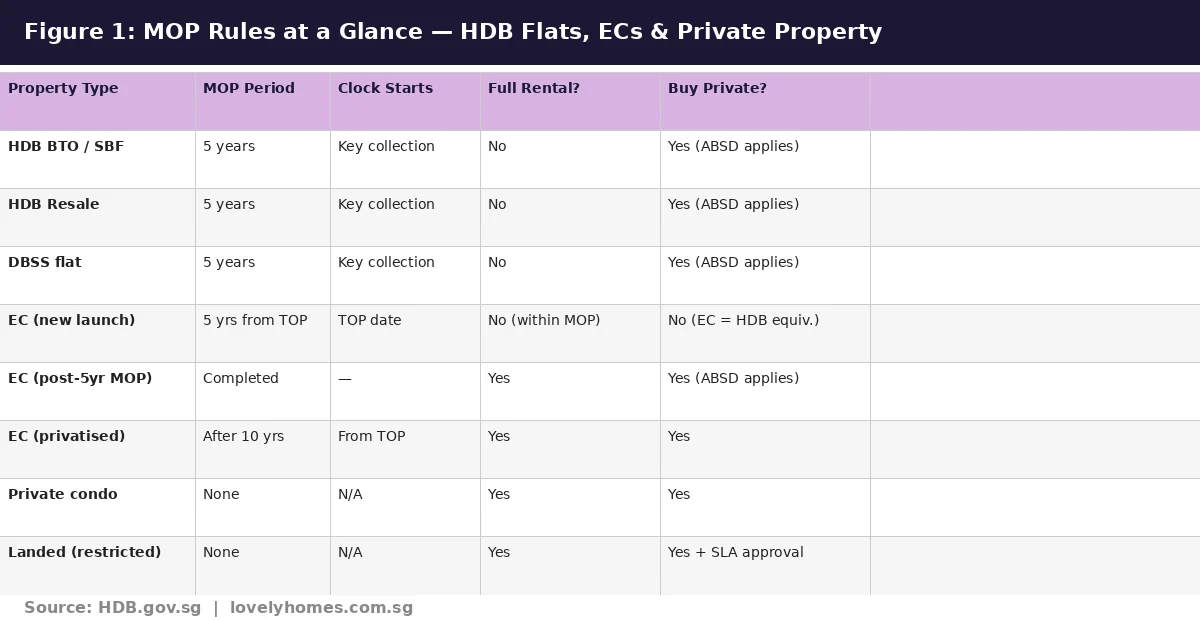
The Minimum Occupation Period (MOP) is the most common eligibility barrier for would-be HDB landlords. It is administered by HDB under the Housing and Development Act and applies to all HDB flat types, including flats purchased via the Build-To-Order (BTO) scheme, the Sale of Balance Flats (SBF) exercise, and the open market resale market.

The MOP clock starts from the date the flat’s keys are collected, not from the date of legal completion or the date the purchase price was paid. For BTO flats, this means the MOP begins when the owner takes physical possession of the flat after construction is completed — sometimes 3–5 years after the application. The 5-year MOP must be met in full before a subletting application can be submitted.

For HDB Plus and Prime classification flats (introduced under the new 2024 HDB flat classification framework), the MOP is extended to 10 years, and additional restrictions apply, including a clawback subsidy on resale. Owners of Plus/Prime flats must therefore wait a full 10 years from key collection before subletting.

HDB occupancy cap rules 2026 — temporary relaxation to 8 persons
Figure 2: HDB occupancy cap rules 2026 — temporary relaxation from 6 to 8 unrelated persons for 4-room+ flats, effective 22 January 2024 and extended to 31 December 2028. Sources: HDB, URA.

Occupancy Cap: How Many Tenants Can I Have?

HDB has long imposed a cap on the total number of occupants in a rented flat to prevent overcrowding. Under a joint press release issued by HDB and URA on 20 December 2023, and subsequently extended in January 2026 to run until 31 December 2028, a temporary relaxation is in force:

Flat Type Standard Cap Relaxed Cap (until 31 Dec 2028) Notes
1-Room / 2-Room Flexi 4 4 (no change) Cannot be sublet as whole unit
3-Room HDB 6 6 (no change) Relaxation applies to 4-room+ only
4-Room HDB and larger 6 8 Temporary relaxation; extended to Dec 2028
Private apt ≥ 90 m² 6 8 URA parallel relaxation

The relaxation was introduced to help meet demand from Singapore’s growing foreign workforce during a period of constrained housing supply. The counting of occupants includes all residents in the flat — so an owner who lives in the flat with their family of four and rents out two spare bedrooms must ensure that the combined headcount of family members plus tenants does not exceed the applicable cap.

How to Apply for HDB Subletting Approval

HDB has moved entirely to an online approval process via its My HDBPage portal at hdb.gov.sg. The process, administered by HDB’s Resale and Rental Policy Division, typically takes 7–14 working days for approval:

  1. Confirm MOP status — log in to My HDBPage and verify that the flat’s MOP has been met.
  2. Submit subletting application — provide details of the proposed tenancy: start date, number of tenants, nationality of each tenant, and proposed rental amount.
  3. Await HDB approval — do NOT allow tenants to move in before written approval is received. Early occupation is treated as unauthorised subletting.
  4. Register tenant(s) — once approved, register the tenancy on My HDBPage within 7 days of the tenancy start date.
  5. Renewal — subletting approvals are granted for a fixed period (maximum 3 years at a time). Renewals must be applied for before expiry; you must reconfirm tenant details and the rental amount.
HDB rental income tax 2026 — actual vs 15 percent deemed deduction
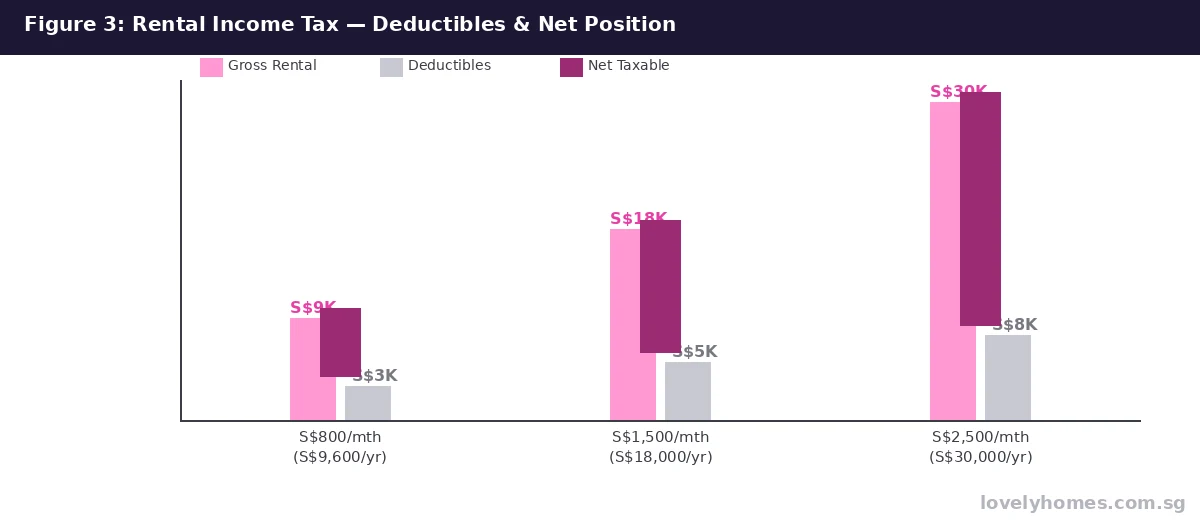
Figure 3: HDB rental income tax 2026 — comparing Path A (actual deductions) vs Path B (15% deemed deduction) for a landlord receiving S$24,000 gross annual rent. Source: IRAS.

Rental Income Tax: What You Must Declare to IRAS

All HDB rental income — whether from subletting the whole flat or individual rooms — must be declared to the Inland Revenue Authority of Singapore (IRAS) in your annual income tax return (Form B for self-employed; Form B1 for employees). This obligation applies regardless of the amount received; even a single room rented out at S$500/month represents S$6,000 of annual taxable income if no deductions are claimed.

Two Deduction Paths

IRAS allows flat owners to reduce their taxable rental income by choosing one of two approaches:

  • Path A — Actual Deductions: Deduct your actual allowable expenses, which include: mortgage interest (the interest component of your bank loan instalment); property tax on the flat; costs of maintenance and repair; and the annual HDB subletting administration fee (S$20). You may not deduct principal repayment, renovation costs, furniture, or appliances.
  • Path B — 15% Deemed Deduction: Simply deduct 15% of your gross rental income as a flat rate to cover all expenses. This is simpler but almost always results in a higher taxable income than Path A for landlords with a mortgage.

Worked Example: Rental Tax Calculation

Worked Example — Mdm Tan, 52, SC, renting out 2 spare bedrooms in her Tampines 5-room HDB
Gross annual rent received: S$24,000 (two rooms at S$1,000/month each).
Mdm Tan’s mortgage interest component (on her outstanding bank loan): S$6,500/yr.
Property tax (non-owner-occupier rate not applicable since she still lives in flat): S$1,260/yr.
Repair and maintenance: S$800/yr. HDB fee: S$20.

Path A (Actual): S$24,000 − S$6,500 − S$1,260 − S$800 − S$20 = S$15,420 taxable.
Path B (15% Deemed): S$24,000 × 85% = S$20,400 taxable.

Path A is S$4,980 lower in this case and should be elected. At a 7% marginal tax rate, that difference saves approximately S$348 in income tax annually.

Important: Since Mdm Tan continues to live in the flat, she retains her owner-occupier property tax rate (lower rate). She should ensure her tenancy agreement is stamped as “partially let” — not “wholly let” — so that IRAS treats the entire flat at the owner-occupier rate rather than the non-owner-occupier rate.

Penalties for Subletting Without Approval

HDB takes unauthorised subletting seriously. Under the Housing and Development Act, penalties include:

Offence Penalty Notes
Subletting without HDB approval Fine up to S$5,000 (first offence) Court can order eviction of tenants
Repeat/serious subletting violations Compulsory flat acquisition HDB buys flat at below-market price
Short-term letting (Airbnb-style) Fine up to S$5,000 + possible acquisition Minimum 6-month tenancy strictly enforced
Failure to register tenancy within 7 days Warning / fine Administrative penalty; HDB portal tracks this

What the Rental Market Means for HDB Landlords in 2026

The Singapore private rental market, which encompasses HDB subletted flats, private condos, and landed property, has seen rents ease modestly in 2026 after a record-breaking run in 2022–2023. URA’s non-landed private residential rental index showed a marginal uptick of 0.3% quarter-on-quarter in Q1 2026 — ending a seven-quarter declining streak — with the rental market stabilising as the supply wave of 55,800 pipeline units is absorbed.

For HDB room rentals specifically, demand has remained robust from Singapore’s Employment Pass and S-Pass workforce, particularly in mature estates with MRT access (Tampines, Bedok, Jurong, Bishan). A spare bedroom in a well-located 4-room HDB flat typically commands S$800–S$1,200 per month in 2026, with the upper end driven by proximity to MRT stations on the Downtown Line or Thomson-East Coast Line.

FAQ: HDB Subletting Questions Answered

Can I sublet my HDB flat if I go overseas for work?
Generally no, unless you have met your 5-year MOP in full before you depart. The MOP clock requires physical occupation — periods spent overseas do not count towards MOP. However, if you have already cleared MOP and obtained HDB approval for subletting, you may sublet the flat even while living abroad (whole-flat subletting by SC owners is permitted). HDB does grant administrative exceptions for overseas work postings in very limited circumstances; applications must be made to HDB’s Branch Service Centre in advance.
Can I rent out my HDB flat short-term on Airbnb?
No. Short-term accommodation rentals below 6 months are strictly prohibited for HDB flats (and private residential properties) under Singapore law. The minimum tenancy period is 6 months. HDB and URA conduct active enforcement, including inspections triggered by neighbour complaints. First-time offenders face fines of up to S$5,000; repeat offenders may face compulsory flat acquisition. There is no “grace period” or de minimis exception — even a single night’s Airbnb rental is a violation.
Do I need to pay tax on HDB rental income?
Yes. All rental income received from subletting your HDB flat or bedrooms is taxable in Singapore under the Income Tax Act (Cap. 134), administered by IRAS. You must declare the gross rental income in your annual income tax return. You may reduce your taxable income by choosing between actual allowable deductions (mortgage interest, property tax, repairs, HDB fee) or the 15% deemed deduction. In most cases with an outstanding mortgage, Path A (actual deductions) yields a lower taxable income. Failure to declare rental income is a tax offence and may result in penalties and back taxes.
Can a Permanent Resident sublet their whole HDB flat?
No. Permanent Residents (PRs) are only permitted to rent out spare bedrooms in their HDB flat, and only while they continue to reside in the flat themselves. PRs cannot sublet the whole flat and move out. This restriction reflects HDB’s policy that the flat must serve the owner’s residential needs as its primary purpose. If a PR couple were to both move out and rent the entire flat, they would be in violation of HDB’s subletting rules, even if they have cleared their 5-year MOP.
What is the new 8-person occupancy cap and when does it expire?
Under a joint HDB/URA directive that took effect on 22 January 2024 and was extended in January 2026, 4-room and larger HDB flats (and private apartments ≥ 90 m²) may now accommodate up to 8 unrelated persons, up from the previous cap of 6. This temporary relaxation was introduced to alleviate rental market pressure during a period of high workforce demand and constrained housing supply. It is scheduled to remain in force until 31 December 2028, at which point the caps are expected to revert to their standard levels. 3-room HDB flats remain subject to the 6-person cap and were not included in the relaxation.
How do HDB Plus and Prime flat owners sublet under the new flat classification system?
HDB’s new flat classification framework (Standard, Plus, Prime), which applies to BTO flats launched from the August 2024 exercise onwards, extends the MOP to 10 years for Plus and Prime flats. This means owners of such flats must wait 10 years from key collection before they can sublet their flat. In addition, Plus and Prime flats carry a subsidy clawback of 6% and 9% respectively on the resale price, and they come with tighter eligibility rules. For HDB Standard flats (the majority of BTO supply), the MOP remains 5 years and subletting rules are unchanged.

Related Articles

Disclaimer: This guide to HDB subletting rules is produced for general informational purposes only. HDB’s subletting policies, eligibility criteria, approval processes, and occupancy caps are subject to change. Always verify the current rules on HDB’s official website at hdb.gov.sg or by contacting HDB directly before proceeding. Rental income tax treatment is subject to IRAS guidelines; consult a tax professional or the IRAS website for the latest guidance. LovelyHomes does not provide legal or tax advice.

HDB Minimum Occupation Period (MOP) Singapore 2026: Standard, Plus and Prime Rules Explained

HDB Minimum Occupation Period (MOP) Singapore 2026: Standard, Plus and Prime Rules Explained

Quick Answer

  • The HDB Minimum Occupation Period (MOP) is the mandatory period you must physically occupy your HDB flat before you can sell it on the open market, rent out the entire flat, or purchase a second private residential property without incurring the full ABSD burden. MOP is administered by HDB (Housing and Development Board).
  • For Standard BTO flats, the MOP is 5 years from the date of key collection. For Plus and Prime BTO flats (introduced for BTO exercises from May 2023), the MOP is 10 years.
  • During the MOP, you cannot sell the flat, rent out the entire unit, or transfer ownership. You can, however, rent out individual rooms with HDB approval, and you may purchase private property (subject to ABSD).
  • After the MOP, Standard flat owners may sell to any eligible HDB buyer (SC or SPR). Plus flat owners must sell to SC or SPR buyers whose household income is within the prevailing income ceiling. Prime flat owners may only sell to Singapore Citizens whose household income is within the income ceiling.
  • Whole-flat rental after MOP is permitted for Standard flats (subject to HDB approval). It is not permitted at any time for Plus or Prime flats.
  • A subsidy clawback applies when Plus and Prime flats are sold on the open market — HDB recovers a portion of the housing grant and pricing subsidy. The clawback amount is higher for Prime flats.
  • The MOP clock starts from the date of key collection — not the date of BTO application, booking fee payment, or Temporary Occupation Permit (TOP). A flat collected in June 2024 has its Standard MOP expiry in June 2029.

What Is the MOP and Who Administers It?

The Minimum Occupation Period (MOP) is a statutory requirement under the Housing and Development Act, administered by the Housing and Development Board (HDB). It requires owners of HDB flats to physically occupy their flat for a minimum period before certain rights become available — primarily the right to sell on the open market, rent out the entire unit, or purchase a second private residential property.

The MOP exists for two complementary policy reasons. First, it ensures that subsidised HDB flats are used as genuine owner-occupied homes rather than short-term investment instruments. Second, it moderates the supply of resale HDB flats that enter the market at any one time, which helps to stabilise resale prices. The requirement has been part of Singapore’s public housing policy for decades, and HDB enforces it through its ownership records, which are cross-referenced against the buyer’s NRIC address for SC/SPR buyers.

HDB MOP rules by BTO classification Standard Plus Prime Singapore 2026 comparison table
Figure 1: HDB MOP Rules by BTO Classification — Standard, Plus and Prime (2026) | Source: HDB

Standard, Plus and Prime: The Three BTO Classifications

From the May 2023 BTO exercise onwards, HDB classifies all new BTO flats into one of three tiers based on location and subsidy level. This classification directly determines MOP length, post-MOP resale eligibility, rental rights, and subsidy clawback:

  • Standard flats are located in non-central, typically suburban estates (such as Tengah, Woodlands, Sembawang, and Punggol). They carry the lowest subsidies relative to market value and have the most permissive rules: 5-year MOP, resale to any eligible SC/SPR buyer, and whole-flat rental allowed after MOP with HDB approval.
  • Plus flats are located near transport nodes or commercial hubs, in estates that would otherwise be too pricey for first-timer buyers without additional subsidy. They come with a 10-year MOP, resale restricted to SC/SPR buyers within the prevailing income ceiling, and no whole-flat rental at any time.
  • Prime flats are located in the choicest sites — city-fringe, waterfront, or mature central estates like Kallang, Toa Payoh, and Marina South — where HDB provides the heaviest subsidies. They carry a 10-year MOP, SC-only resale (SPR buyers are ineligible), income ceiling restrictions, no whole-flat rental at any time, and the highest clawback rate.

Buyers are told which classification a flat falls under at the time of BTO application. The classification is permanently attached to the flat and does not change over time, even after resale. A Prime flat remains a Prime flat in every subsequent transaction.

HDB MOP timeline by BTO classification Standard 5 years Plus Prime 10 years Singapore 2026
Figure 2: HDB MOP Timeline by BTO Classification — Years from Key Collection (Singapore 2026)

What You Can and Cannot Do During the MOP

The MOP does not mean you are locked away from all activity — it specifically restricts disposal and whole-unit rental. The table below summarises key permitted and prohibited actions:

Activity During MOP After MOP (Standard) After MOP (Plus/Prime)
Sell flat on open market Not permitted Permitted (SC/SPR buyers) SC/PR (Plus); SC only (Prime); income ceiling applies
Rent out entire flat Not permitted Permitted (HDB approval) Not permitted (ever)
Rent out rooms (sub-let) Not permitted during MOP Permitted (HDB approval) Permitted (HDB approval)
Buy private property Permitted (ABSD applies if SC 2nd property: 20%) Permitted Permitted
Transfer ownership (gift / divorce / death) HDB approval case-by-case Yes Yes (subject to Plus/Prime resale rules)
Renovate / alter the flat Permitted (HDB renovation permit) Permitted Permitted

Buying Private Property During the MOP

One of the most common questions from HDB flat owners is whether they can buy a private condominium before their MOP is up. The answer is yes — you are allowed to purchase private residential property in Singapore while your MOP is running. However, there are important financial consequences to consider.

If you are a Singapore Citizen owning an HDB flat (which counts as your first residential property) and you buy a private condo during the MOP, you are buying a second property. This means you pay 20% ABSD on the private property purchase. If you are an SPR, your second-property ABSD is 30%. The HDB flat itself remains subject to the MOP and cannot be sold until the MOP expires.

This means you will be servicing two housing loans simultaneously until the HDB can be sold — which requires careful TDSR planning. The TDSR cap of 55% applies across all outstanding loans. HDB loans (from HDB directly) and bank loans on HDB flats are both counted in TDSR. If the combined debt servicing ratio exceeds 55% when adding the private mortgage, financing for the private property may be declined.

What Happens When You Sell After the MOP

Once the MOP is fulfilled, the key restrictions are lifted — but resale rules still apply, especially for Plus and Prime flats:

  • Standard flats: May be sold to any eligible HDB resale buyer — SC or SPR, subject to standard HDB eligibility criteria (Ethnic Integration Policy quotas, family nucleus requirements, etc.). No income ceiling on the buyer.
  • Plus flats: May only be sold to buyers whose household income does not exceed the prevailing income ceiling (currently S$14,000/month for families, S$7,000 for singles). SPR buyers are eligible. A subsidy clawback is deducted from the sale proceeds on the first open-market resale.
  • Prime flats: May only be sold to Singapore Citizen buyers (SPR buyers are not eligible) whose household income does not exceed the income ceiling. The subsidy clawback rate is higher than for Plus flats and is also deducted from the first open-market resale proceeds.

The subsidy clawback is calculated as a percentage of the resale price (or market value, whichever is higher) and is paid to HDB at the point of resale. HDB has not publicly released a fixed clawback percentage table; the exact rate is determined and communicated at the time of application. This is intended to recover some of the subsidy advantage enjoyed by Plus/Prime buyers while still allowing them a fair profit on genuine capital appreciation.

The MOP and CPF Accrued Interest

When you sell an HDB flat after the MOP, any CPF funds used to purchase the flat (including the option fee, downpayment, and monthly mortgage instalments paid from your CPF Ordinary Account) must be refunded to your CPF accounts — along with accrued interest at the CPF OA interest rate (currently 2.5% per annum). This accrued interest represents what your CPF savings would have earned had they not been used for housing. On a long MOP (10 years), accrued interest can be substantial and reduces the net cash proceeds from the sale.

Worked Example: The Wong Family and the MOP Decision

Mr and Mrs Wong, both Singapore Citizens, purchase a 4-room BTO flat in Bishan (classified as a Plus flat) in June 2024. Key collection is in June 2024. Their household income is S$9,000/month. The purchase price is S$550,000.

HDB upgrading timeline Wong family Standard Plus Prime BTO scenarios Singapore 2026
Figure 3: HDB Upgrading Timeline — BTO Scenario Comparison (Singapore 2026)
Scenario Event Year Notes
Plus BTO — Bishan Key collection 2024 MOP clock starts
Buy private condo (2nd property, if desired) Any time 20% ABSD applies; TDSR must clear; HDB MOP still running
MOP expires — eligible to sell HDB 2034 10-year MOP; income ceiling on buyer (S$14k); clawback on sale proceeds
Can rent out rooms (sub-let) From 2034 HDB approval required; cannot rent entire flat (ever)

Over the 10-year MOP, if the flat appreciates from S$550,000 to S$800,000 (a not unreasonable assumption for a Plus-classified Bishan flat), the Wongs would make a nominal gross gain of S$250,000. From this, HDB deducts the clawback (amount TBD at point of sale), plus CPF refund with accrued interest. On a S$550,000 purchase with 25% CPF downpayment (S$137,500) at 2.5% CPF OA rate over 10 years, accrued interest alone would be approximately S$38,700 — reducing net cash-in-hand from the sale. This is still a solid return, but buyers should model it carefully before factoring in the Plus flat subsidy as pure profit.

What This Means for HDB Buyers in 2026

The 10-year MOP for Plus and Prime flats is a significant commitment. A buyer collecting keys in 2026 cannot sell their Plus or Prime flat until 2036 at the earliest. Over that decade, Singapore’s property market will go through multiple cycles, interest rate shifts, and policy changes. Buyers who select Plus or Prime flats primarily because of the lower purchase price — and not because they genuinely intend to occupy the flat for 10 years — may find themselves in a difficult position if circumstances change (job relocation overseas, family expansion, divorce).

For those who do plan to stay, the Plus and Prime schemes deliver real value. A Prime flat in a central location at a subsidised price, occupied for 10 years with a no-rental restriction, is likely to appreciate meaningfully in absolute terms even after clawback. The restriction is the price of the subsidy.

What Might Come Next

The May 2023 introduction of Plus and Prime classifications represented a significant shift from the old Mature/Non-Mature estate binary. The April 2023 announcement also removed the ability of EC buyers to use the Deferred Payment Scheme from May 2026 — suggesting the government continues to tighten across all public and quasi-public housing tiers. Any further changes to MOP duration are unlikely in the near term given that the 10-year Plus/Prime MOP is relatively new and the government will want to assess its impact before adjusting. The resale income ceiling may, however, be revised upwards over time to track median income growth in Singapore.

Related Articles

Frequently Asked Questions

When does the MOP start — from key collection or from BTO ballot application?

The MOP starts from the date of key collection — not the date of BTO application, not the ballot exercise date, and not the date you pay the option fee or sign the lease agreement. The key collection date is when you physically receive the keys to your flat and formally take possession. This date is recorded by HDB and serves as the MOP commencement date. For a Standard flat collected in July 2024, the MOP expires in July 2029. For a Plus or Prime flat collected in the same month, it expires in July 2034.

Can I rent out rooms in my HDB flat while the MOP is running?

No. During the MOP, you may not rent out any part of your flat — neither the entire unit nor individual rooms. Room rental (sub-letting) is only permitted after the MOP has been fulfilled and only with HDB’s prior written approval. After the MOP, Standard flat owners may rent out rooms or the entire flat (with HDB approval); Plus and Prime flat owners may rent out rooms after the MOP but may never rent out the entire flat under any circumstances.

What happens if I need to move overseas for work during the MOP?

If you need to work overseas temporarily, you must continue to maintain your HDB flat as your Singapore residence — meaning a family member must continue to reside in the flat, and you must return periodically. You cannot rent out the flat during the MOP even if you are overseas. If your overseas stint is long-term and the flat will genuinely be unoccupied, you should consult HDB directly. Abandoning the occupancy requirement during the MOP can result in HDB compulsorily acquiring the flat at a below-market price under the Housing and Development Act — a severe consequence that buyers should be aware of.

Can I buy a private condo while my HDB MOP is still running?

Yes. Purchasing a private residential property while your HDB MOP is outstanding is permitted. However, since your HDB flat counts as your first residential property, the private condo purchase is classified as a second property for ABSD purposes. A SC pays 20% ABSD on the private condo. An SPR pays 30%. You must also have the financial capacity to service both housing loans simultaneously and remain within the 55% TDSR cap. Many HDB owners choose to exercise this option a year or two before their MOP expires, so the HDB can be sold shortly after the MOP milestone — reducing the period of dual-loan exposure.

What is the subsidy clawback for Plus and Prime flats, and when is it paid?

The subsidy clawback for Plus and Prime flats is paid to HDB at the point of the first open-market resale (i.e., the first resale transaction after the MOP). It is deducted from the sale proceeds before any balance is paid to the seller. The clawback is calculated as a percentage of the resale price or market valuation (whichever is higher). HDB has not published a fixed percentage table publicly; the exact rate is communicated in the flat purchase document at the time of BTO booking and is specific to the flat’s classification and location. The clawback only applies to the first open-market resale — subsequent owners of a Plus or Prime flat do not face an additional clawback when they eventually sell.

Do MOP rules apply to HDB flats purchased on the open resale market?

Yes. When you purchase an HDB resale flat — whether Standard, Plus, or Prime — the MOP requirement applies afresh from the date you collect the keys. A Standard resale flat has a 5-year MOP from your key collection date; a Plus resale flat has a 10-year MOP; and a Prime resale flat has a 10-year MOP. The classification (Standard, Plus, Prime) of the flat follows it through all transactions. You cannot shorten the MOP on a resale flat because the previous owner already fulfilled their MOP.

Can an SPR buyer purchase a Plus or Prime HDB flat on the open resale market?

For Plus flats: yes, subject to the income ceiling (S$14,000/month household income) and standard SPR eligibility criteria. For Prime flats: no — Prime flats may only be resold to Singapore Citizens (not SPR). This restriction applies to every resale of a Prime flat in perpetuity, not just the first resale. SPR buyers wishing to purchase Plus flats must also form an eligible family nucleus (e.g., SC/SPR family or SPR household of two or more) to qualify under HDB’s resale eligibility framework.

Disclaimer: This article is for general information only and does not constitute legal or financial advice. HDB rules, MOP durations, clawback rates, and eligibility criteria are subject to change by HDB and the Ministry of National Development. Always verify the latest requirements at hdb.gov.sg and consult HDB directly or a licensed HDB resale agent for guidance specific to your situation. All figures and scenarios are illustrative and based on publicly available data as at 16 May 2026.

HDB BTO Application and Ballot System Singapore 2026: Priority Schemes, Ballot Odds and the Full Application Timeline

HDB BTO Application and Ballot System Singapore 2026: Priority Schemes, Ballot Odds and the Full Application Timeline

Quick Answer

  • HDB’s BTO ballot is a computerised random draw, not a first-come-first-served queue. All applications received during the 7-day window are pooled and drawn simultaneously after the close of the exercise.
  • Priority schemes mean not all applicants are in the same pool. First-timer families are guaranteed at least 70% of 2-room to 5-room flats. Parenthood Priority (PPS) and Married Child Priority (MCP) carve out additional sub-quotas within that 70%.
  • Your queue position number determines the order in which you are invited to select a flat — the lower the number, the earlier you choose. A ballot number does not guarantee a flat; it only determines your selection turn.
  • Ballot odds vary enormously by flat type and town. 4-room and 5-room flats in mature towns are the most competitive — success rates can be as low as 6–8% per exercise for first-timers. 2-room Flexi in non-mature towns are the most accessible at ~65%.
  • First-timers who do not receive a flat twice accumulate a 2-Ballot chance (2BC) — doubled ballot entries — from the third application onwards, significantly improving odds.
  • From the June 2026 BTO launch onwards, all flats are classified as Standard, Plus, or Prime — with different MOP and subsidy recovery conditions. The classification affects pricing, restrictions, and resale eligibility.
  • The entire process from application to key collection typically takes 3 to 5 years for Standard flats; shorter wait times are available for some Plus and Prime sites where construction is already underway.
HDB BTO ballot system Singapore 2026 — application priorities queue ballot odds first-timer guide LovelyHomes
HDB BTO ballot and application system Singapore 2026: a full guide to priority schemes, ballot odds, and the application timeline.

How the BTO Ballot Works

A Build-To-Order (BTO) exercise is the primary channel through which Singapore Citizens and Permanent Residents purchase new HDB flats directly from HDB at subsidised prices. HDB announces each exercise with approximately 2–4 weeks’ notice, and applications are accepted for a period of roughly one week through the HDB Flat Portal (homes.hdb.gov.sg).

The ballot itself is a computerised random draw conducted by HDB after the application window closes. Every valid application is assigned a random ballot number. These numbers are drawn in order, and applicants are invited to select a flat in that sequence. Critically, the draw happens after all applications close — submitting your application on the first day of the exercise gives you exactly the same odds as applying on the last day. There is no advantage to applying early.

However, not all applicants enter the same draw. HDB partitions the available flats into several allocations based on applicant profile — priority scheme, first-timer vs second-timer status, and flat type. An applicant’s pool is determined by their eligibility for priority schemes, which can materially improve their effective odds even if their random ballot number itself is unchanged.

HDB BTO priority schemes Singapore 2026 — MCP, PPS, first-timer quota, senior priority, ASSIST, singles
Figure 1: HDB BTO priority scheme matrix — six schemes that determine allocation priority in 2026.

Priority Schemes Explained

HDB administers several priority schemes that provide applicants with preferential access to a share of the available flats before the general ballot pool is opened. Understanding which schemes you qualify for — and applying to projects where those schemes are most beneficial — is the key lever available to applicants seeking to improve their chances.

Married Child Priority Scheme (MCP). This is the most widely used priority scheme. It applies when a first-timer applicant is seeking to live near (within 4km) an existing HDB flat owned by their parents, or when parents are seeking to live near their married child. Up to 30% of 2-room to 5-room flats are reserved for MCP applicants within each project. Applicants who qualify for MCP enter a smaller, dedicated ballot for these reserved units — their odds within that pool are typically much better than the general ballot.

Parenthood Priority Scheme (PPS). Available to first-timer married couples with a child under 16 years of age, or to pregnant applicants. Up to 30% of 2-room to 5-room flats are also reserved for PPS applicants. A couple may apply under both MCP and PPS if they meet both criteria — providing access to reserved units across two schemes, though the actual units reserved are counted together, not doubled.

First-Timer Quota. By regulation, at least 70% of 2-room to 5-room flats in every BTO exercise are reserved for first-timer families. The remaining 30% is open to second-timers and first-timers (overflow from the first-timer pool, if any). This quota is the fundamental structural advantage that first-timers have over second-timers in the BTO system.

Senior Priority Scheme (SPR). Applicants aged 55 and above applying for 2-room Flexi flats — to right-size or to live near family — may qualify for this scheme, gaining priority access within the Senior flat quota of each project. This scheme is specifically designed to facilitate downsizing among elderly Singaporeans.

Assistance Scheme for Second-Timers (ASSIST). A special allocation for second-timers who are divorced or widowed and have children under 16. This carves out 5–10% of units from the second-timer allocation to provide a priority queue for this group, who would otherwise compete with all other second-timers.

Singles (35+). Singapore Citizens aged 35 and above who are unmarried, divorced, or widowed may apply for 2-room Flexi flats only, under a separate 50% quota. This means that in any given BTO exercise, 50% of 2-room Flexi units in Standard-classified projects are set aside for singles. The odds here are generally more favourable than for families — 2-room Flexi in non-mature towns has historically seen success rates of 50–65% for eligible singles.

Ballot Odds by Flat Type

HDB BTO ballot odds Singapore 2026 — success rates by flat type mature vs non-mature town first-timer families
Figure 2: Indicative BTO ballot odds by flat type and estate maturity — success rate percentage for first-timer families, based on 2024–2025 HDB indicative data.

Ballot odds are not published in real time by HDB for each exercise, but the Board does publish indicative success rates periodically, and market data aggregators have tracked historical patterns across multiple exercises. The general picture as at 2026 is as follows.

Non-mature town flats are significantly easier to ballot successfully than mature town flats of the same type. A 4-room flat in a non-mature town (such as Tengah, Sembawang, or Woodlands) has a first-timer success rate of roughly 20–25% per exercise — meaning a typical applicant expects to ballot 4–5 times before receiving a flat. The same flat in a mature estate (Bishan, Toa Payoh, Queenstown, Kallang/Whampoa) may see a success rate of just 5–8%, implying 12 or more applications over several years before success.

The 2-Ballot Chance (2BC) scheme partially addresses this disparity. First-timer applicants who have been unsuccessful in two or more previous BTO applications (for 2-room to 5-room flats) receive double ballot entries from their third application onwards. This effectively doubles the probability of selection in any given exercise and meaningfully improves the expected number of applications needed before success for high-demand flat types.

The BTO Application Timeline

HDB BTO application timeline Singapore 2026 — from launch to key collection 6 stages
Figure 3: HDB BTO application timeline — six stages from the launch announcement to key collection.

The BTO process from launch to key collection involves six distinct stages, spanning 3 to 5 years for most applicants. Understanding each stage — and particularly the financial obligations at each point — is essential for financial planning.

Launch and application (Week 1). HDB announces the BTO exercise and opens applications via the HDB Flat Portal. A non-refundable application fee of S$10 is payable. During this week, applicants choose which project and flat type they wish to apply for. Applicants may only apply for one flat type in one project per exercise.

Ballot result (4–8 weeks after close). HDB runs the ballot, applies priority schemes, and issues queue numbers to successful applicants. Unsuccessful applicants are notified with their ballot outcome and, if eligible, automatically accumulate ballot entries for future exercises.

Flat selection (staggered over weeks/months). Applicants are invited in queue number order to attend a selection appointment at HDB Hub. At selection, they choose their specific unit (floor, orientation, stack) from remaining available units, pay the Option Fee (typically 5% of the flat price, or S$2,000–S$10,000 as capped), and sign the Agreement for Lease.

Sign Agreement for Lease and first instalment (months 2–4). The formal Agreement for Lease is executed. The first instalment — approximately 10% of the flat price less the Option Fee paid — is due, payable via CPF OA or cash. This triggers the legal commitment to the purchase.

Construction (3–5 years). HDB constructs the flat. Standard classified flats typically have a wait of 3–5 years from the launch date. From 2026, HDB has committed to shortening wait times, particularly for Plus and Prime projects in already-developed estates where some enabling works are further along. Buyers may use the BTO WaitTime Estimator on the HDB Flat Portal for the specific project’s estimated completion date.

Key collection. Upon Temporary Occupation Permit (TOP) issuance, HDB invites buyers to collect keys and make the final payment. The remaining flat price (after CPF and cash already paid) is settled, together with BSD, legal fees, and any renovation charges. The Minimum Occupation Period — 5 years for Standard flats, 10 years for Plus and Prime flats — begins from the date of key collection.

Summary Table: BTO Application Key Facts 2026

Item Details
Application window ~7 days; applying on Day 1 vs Day 7 has no impact on ballot odds
Application fee S$10 (non-refundable)
First-timer quota At least 70% of 2-room to 5-room flats reserved for first-timers
2-Ballot Chance (2BC) Activated after 2 unsuccessful applications; doubles ballot entries from 3rd application
Option Fee S$2,000–S$10,000 (capped; forms part of purchase price; payable at flat selection)
Flat classification (from 2026) Standard (5-yr MOP), Plus (10-yr MOP + 6% subsidy clawback), Prime (10-yr MOP + 9% clawback)
Typical wait time 3–5 years (Standard); some Plus/Prime sites shorter
Exercises per year (2026) 3 exercises: February, June, October — total ~19,600 flats across 2026
HDB portal homes.hdb.gov.sg — application, queue number check, flat selection appointment booking

Worked Example: The Wong Family

Mr and Mrs Wong are both Singapore Citizens, married in 2024, with no prior HDB applications. Their combined gross monthly income is S$8,200. They apply for a 4-room flat in Tengah (Standard classification) in the June 2026 BTO exercise. They do not qualify for PPS (no children yet) but Mrs Wong’s parents own an HDB flat in Jurong West, 3.8km from the Tengah site — within the 4km threshold for MCP.

The Wongs apply under MCP. HDB reserves 30% of 4-room flats in the Tengah project for MCP applicants. With approximately 200 MCP applications competing for 120 reserved units, the MCP pool success rate is about 60% — significantly better than the general pool rate of ~22% for first-timers (1,800 first-timer applications for 280 remaining units after MCP allocation).

The Wongs are assigned queue number 48 out of 120 successful MCP draws. They attend their selection appointment and choose a 17th-floor north-facing 4-room unit at S$465,000. Option Fee: S$5,000 (capped). CPF OA balance: S$62,000 (combined). They apply for an HDB concessionary loan. MSR at 30% of S$8,200 = S$2,460/month. HDB loan: S$418,000 (90% LTV, since HDB loan allows 90%). Monthly repayment over 25 years at 2.6% = ~S$1,904/month (MSR: 23.2% — within cap). First instalment: ~S$41,500 less S$5,000 option fee = S$36,500. Estimated key collection: Q4 2029 (Standard, ~3.5 years). MOP ends: Q4 2034.

What This Means for Applicants in 2026

HDB is launching approximately 19,600 BTO flats in 2026 across three exercises — February, June, and October. This is consistent with the elevated supply pipeline that HDB has committed to maintaining through 2027 in response to the high demand evident in 2021–2023 exercises. For applicants, the increased supply means aggregate success rates are likely somewhat higher in 2026 than in the 2021–2022 period, when oversubscription was at its most acute.

The introduction of the Standard/Plus/Prime classification in 2023 — with Plus and Prime flats carrying 10-year MOPs and subsidy clawback — has meaningfully reduced competition for these locations compared to what they would have attracted under the old framework. Applicants who are willing to accept the longer MOP and resale restrictions of Plus or Prime flats may find better ballot odds than historical data would suggest for mature estate locations.

What Might Come Next

HDB has committed to reviewing BTO wait times and reducing them for well-located projects. There is ongoing policy discussion about whether the Standard/Plus/Prime framework should be adjusted, or whether additional priority scheme categories should be introduced to address specific demographic needs (e.g., caregivers, multigenerational households). Any changes to the priority scheme would be announced at the start of a new BTO exercise rather than applied retroactively. Applicants who have already accumulated 2BC status will not lose it under any current proposals.

FAQ

If my queue number is very high, should I decline the flat selection appointment?

If your queue number is late in the draw and most desirable units are already taken by the time your selection appointment arrives, you may attend and select from remaining units, or decline and forgo this application. Declining (or failing to attend) does not penalise you — your first-timer status and accumulated ballot entries (including 2BC if applicable) are retained for future exercises. However, if HDB offers you a flat and you decline, you are recorded as having “rejected a flat” for that application. This does not affect your priority scheme eligibility, but is tracked in your application history.

Can I apply for more than one flat type in a BTO exercise?

No. Each applicant household may submit only one application per BTO exercise, and that application is for a specific flat type in a specific project. You cannot apply for a 3-room and a 4-room simultaneously in the same exercise. If you are undecided between flat types, you must choose one. This makes the choice of flat type and project — not just the application itself — strategically important. Couples who apply under priority schemes (MCP, PPS) should choose the project where those schemes are most advantageous.

Does a failed BTO application affect eligibility for the Open Booking of Flats (OBF)?

No. BTO ballot outcomes and OBF eligibility are separate. Open Booking allows eligible applicants to purchase available unsold BTO flats on a first-come, first-served basis (without a ballot) through a time-slot system. First-timer status and 2BC entries accumulated through BTO applications remain intact regardless of how many times you have applied or been unsuccessful. OBF is typically open between major BTO exercises and offers units that were returned or unsold in previous launches.

What income ceiling applies to BTO applications in 2026?

For 3-room and larger flats (Standard, Plus, or Prime classification), the household income ceiling is S$14,000 per month (combined gross income of all persons listed in the application). For 2-room Flexi flats, the ceiling is S$7,000 per month for family applicants and S$7,000 for singles. These ceilings have been unchanged since September 2019. CPF Housing Grants (EHG and CHG) are separately income-tested at lower thresholds, but the BTO eligibility ceiling is the S$14,000 figure for most flat types.

How does the 2-Ballot Chance (2BC) work in practice?

After a first-timer applicant is unsuccessful in two or more BTO exercises for 2-room to 5-room flats, they are automatically granted 2BC status. From their next application onwards, HDB treats their single application as if they submitted two — doubling their probability of being drawn in the ballot. The 2BC is applied automatically by HDB’s system; applicants do not need to register or apply for it. 2BC status is cumulative and permanent until a flat is successfully booked. It applies to both the general ballot and any priority scheme pool the applicant qualifies for.

What is the difference between Standard, Plus, and Prime BTO flats?

Standard flats are located in non-mature estates or less central locations and carry a 5-year MOP with no subsidy recovery on resale. Plus flats are in good locations (well-connected, near amenities) with a 10-year MOP and a 6% subsidy recovery payable to HDB upon first resale. Prime flats occupy the most central and sought-after locations (e.g., Queenstown, Bishan, Toa Payoh) and carry a 10-year MOP plus 9% subsidy recovery on first resale. Plus and Prime flats are priced more cheaply than the market would otherwise demand, with the recovery mechanism ensuring that buyers who benefit from the subsidy return a portion to HDB upon sale.

Can Singapore Permanent Residents apply for BTO flats?

SPRs cannot apply for BTO flats as sole applicants. They may only apply as a co-applicant with at least one Singapore Citizen in the household. The primary applicant must be an SC. The household must include at least one SC at the time of application. An SPR+SPR household (with no SC member) is not eligible for BTO flats and must purchase through the HDB resale market instead.

Related Articles

Disclaimer

This article is for general information only. HDB BTO eligibility rules, priority schemes, income ceilings, and ballot processes are administered by the Housing & Development Board (HDB) under the Housing & Development Act. CPF Housing Grant conditions are governed by the CPF Board. Flat classification policies are determined by MND and HDB. All figures — including ballot odds, success rates, income ceilings, and pricing examples — are indicative and subject to change at each BTO exercise. Readers should verify current eligibility criteria, pricing, and application procedures directly with HDB at hdb.gov.sg before making any application or financial commitment.

HDB Resale Flat Eligibility Singapore 2026: Who Can Buy, Citizenship Rules and How to Qualify

HDB Resale Flat Eligibility Singapore 2026: Who Can Buy, Citizenship Rules and How to Qualify

HDB Resale Flat Eligibility Singapore 2026: Who Can Buy, Citizenship Rules and How to Qualify

Quick Answer

  • No income ceiling to purchase an HDB resale flat — income caps apply only to the HDB Concessionary Loan (≤ S$14,000/month for families; ≤ S$7,000 for singles) and to grants such as the EHG (≤ S$9,000/month).
  • Singapore Citizens may buy under the Public Scheme, Singles Scheme (35+), Joint Singles, Fiancé/Fiancée, Non-Citizen Spouse or Orphans Scheme depending on their household composition.
  • Singapore PRs must have held PR status for at least 3 continuous years and must form a valid family nucleus. PR singles cannot buy HDB resale.
  • Foreigners and non-PRs are not eligible under any HDB resale purchase scheme.
  • Private property owners are subject to a 30-month wait-out period (introduced 30 September 2022) after disposing of their private property before they may buy a resale HDB flat. Exception: Singapore Citizens aged 55 and above buying a 4-room or smaller flat.
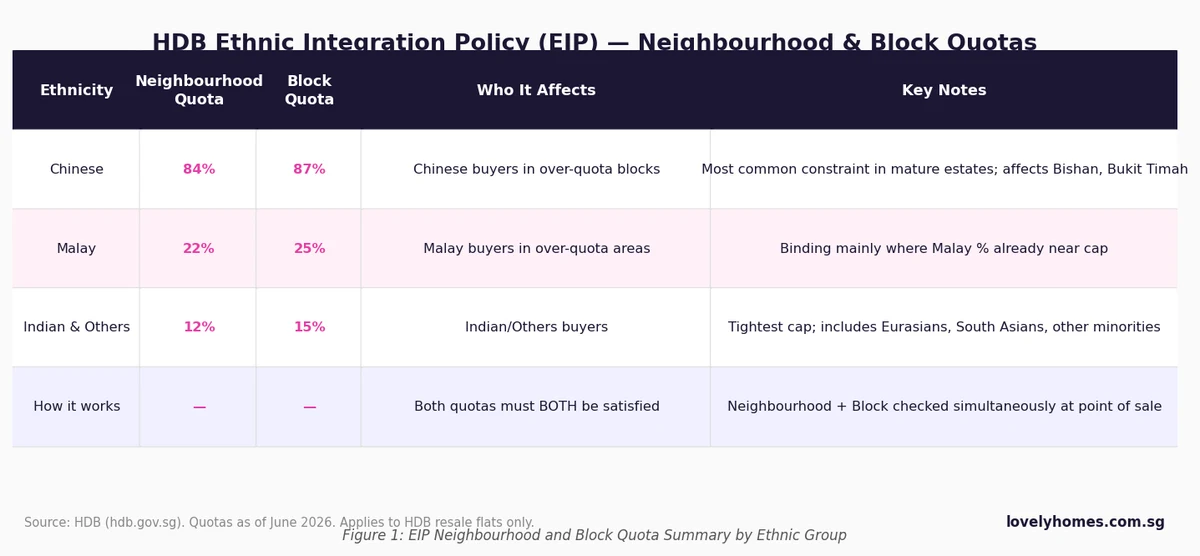
  • EIP quotas apply to all resale purchases — available units depend on the ethnic composition of the block and neighbourhood (see our HDB Ethnic Integration Policy guide).
  • Eligibility is determined at the date of HDB application, not the Option to Purchase date.

What Is HDB Resale Flat Eligibility?

HDB resale flat eligibility refers to the set of rules administered by the Housing and Development Board (HDB) that determine who may purchase a resale flat on the open market in Singapore. Unlike Build-To-Order (BTO) flats, which are sold directly by HDB at subsidised prices, resale flats are transacted between a seller and a buyer at market prices. The resale market is open to a broader range of buyers than the BTO programme — including Singapore PRs — but it still operates within a strict framework of nationality, household composition, age, and ownership rules.

Understanding eligibility is the essential first step before placing an Option to Purchase (OTP). Submitting an HDB application for a flat you are not eligible to buy will result in rejection and the forfeiture of the OTP exercise fee (typically 1% of the purchase price). Eligibility is confirmed at the point of HDB application, so it is important that you qualify on the date you submit — not just on the date you sign the OTP.

The Eight Eligibility Schemes at a Glance

HDB administers eight distinct eligibility schemes for resale flat purchases. Each scheme defines who may be listed as an essential occupier or co-applicant. The table below summarises all eight.

HDB resale flat eligibility matrix 2026 — eight buyer profiles including public scheme, singles, PR family, foreigners
Figure 1: HDB resale eligibility at a glance — the eight buyer profiles and their flat-type entitlements under 2026 rules. Source: HDB Singapore.

Singapore Citizens: Eligibility Schemes in Detail

Singapore Citizens (SCs) have the broadest access to the HDB resale market. Most SC buyers will purchase under the Public Scheme, which requires at least one SC applicant forming a family nucleus with a spouse (SC, PR or foreigner on a long-term pass), children, parents, or unmarried siblings. There is no age restriction under the Public Scheme beyond the minimum legal age of 21.

For singles, the Singles Scheme allows an unmarried, divorced, or widowed SC aged 35 and above to purchase a resale flat of any room type (2-room to 5-room) independently. Two or more single SCs who each meet the age criterion may combine under the Joint Singles Scheme to co-purchase a flat — this is particularly useful for siblings or friends who wish to buy together before meeting eligibility under the Public Scheme.

Other SC-specific schemes include the Fiancé/Fiancée Scheme (for couples who will marry within three months of the HDB application) and the Non-Citizen Spouse Scheme (for SCs whose spouses hold neither SC nor PR status but are on a long-term Singapore pass). Under the Non-Citizen Spouse Scheme, the flat is restricted to 2-room through 5-room types. The Orphans Scheme enables a single SC who has lost both parents and is at least 35 years old to purchase a resale flat, listing unmarried siblings as essential occupiers.

Singapore Permanent Residents: What You Need to Know

Singapore PRs can purchase HDB resale flats — but with important restrictions that do not apply to SCs. The key rules are summarised in the infographic below.

Singapore PR rules for HDB resale purchase 2026 — 3-year PR minimum, family nucleus required, PR singles not eligible
Figure 2: Singapore PR eligibility rules for HDB resale purchases — the 3-year minimum, family nucleus requirement and restrictions at a glance. Source: HDB Singapore.

The most significant PR restriction is the 3-year minimum: every PR applicant (and co-applicant) must have held PR status for at least three continuous years before submitting the HDB application. This clock starts from the date on the PR In-Principle Approval (IPA) letter, not the date of collection of the NRIC. A couple where both spouses obtained PR status in January 2023 would not be eligible to buy a resale HDB flat until January 2026 at the earliest.

PRs must also form a valid family nucleus. A PR may co-purchase with an SC spouse, SC parents, SC children, or another PR who is a spouse or parent. Critically, PR singles cannot buy HDB resale — there is no singles or joint-singles scheme equivalent for PRs. A single, unmarried PR has no pathway to HDB ownership and must rent or purchase private property instead.

PRs are also limited to the resale market. BTO flats, new HDB flats sold under the Sale of Balance Flats (SBF) exercise, and EC projects during their initial launch window are reserved for SCs only (ECs become available to PRs only after they pass their 5-year Minimum Occupation Period). Additionally, PR households cannot own a private residential property simultaneously with an HDB resale flat — they must dispose of their private property within six months of completing the HDB resale purchase.

Foreigners and Non-Residents

Non-citizens who are not PRs are generally not eligible to purchase any HDB flat — resale or new. This includes foreigners on Employment Passes, Dependant Passes, Student Passes, and Long-Term Visit Passes. The only limited exception is the Non-Citizen Spouse Scheme, which allows an SC to co-purchase with a foreign spouse (not holding PR status) — but the SC must be the sole applicant and the flat is restricted to 2-room through 5-room resale types. The foreign spouse is listed as an essential occupier, not a co-owner, and cannot hold legal title to the flat.

Key Disqualifications and the 30-Month Private Property Wait-Out

Even if you meet the citizenship and household composition requirements, you may be disqualified from buying an HDB resale flat if certain ownership or financial conditions apply. The most significant disqualification to understand in 2026 is the 30-month private property wait-out period, which was introduced as part of the September 2022 cooling measures.

HDB resale flat eligibility disqualifications 2026 — 30-month private property wait-out period, concurrent HDB ownership, income ceiling
Figure 3: Key disqualifications for HDB resale purchases, including the 30-month private property wait-out period introduced in September 2022. Source: HDB Singapore.

The 30-month wait-out period means that if you or any listed occupier have disposed of a private residential property (local or overseas), you must wait 30 months from the date of disposal before you can apply for a resale HDB flat. This rule was specifically designed to prevent buyers from “downgrading” to a subsidised HDB flat while pocketing private property gains. The exception is for Singapore Citizens aged 55 and above buying a 4-room or smaller resale flat — they are exempt from the 30-month wait-out entirely, recognising that downsizing in retirement is a legitimate and healthy housing progression.

Summary Table: HDB Resale Eligibility at a Glance

Buyer Profile Min Age Family Nucleus Flat Types Key Restrictions
SC (Public Scheme) 21 Required All types EIP quotas apply
SC (Singles Scheme) 35 Not required 2–5 room Single, divorced or widowed
SC (Joint Singles) 35 each Co-purchasers 2–5 room All co-purchasers must be SC
SC (Non-Citizen Spouse) 21 SC applicant only 2–5 room Spouse is occupier, not co-owner
Singapore PR 21 Required 2–5 room 3-yr PR minimum; no BTO
PR Single Not eligible No HDB scheme available
Foreigner / Non-PR Not eligible No HDB scheme available

Worked Example: Divorced SC Buying Under the Singles Scheme

Scenario. Ms Tan Wei Ling, 39, is a Singapore Citizen who divorced in 2023. She has one child, aged 9. She sold her former matrimonial HDB flat as part of the divorce settlement in early 2023. She has not owned any private property. She earns S$6,800 per month and is looking at a 4-room resale flat in Tampines priced at S$620,000.

Eligibility check. As a divorced SC aged 35 or above, Ms Tan qualifies under the Singles Scheme. Her child (a minor) can be listed as an essential occupier on the application — this does not change the scheme type. She has not owned private property, so the 30-month wait-out does not apply. Her previous HDB flat was sold in 2023, and she is not concurrently owning another HDB flat, so concurrent ownership is not an issue.

Loan and grant eligibility. Ms Tan’s gross monthly income of S$6,800 is just under the S$7,000 singles income ceiling for the HDB Concessionary Loan. She is eligible to apply for the HDB loan at 2.6% per annum. At 80% LTV, her loan would be S$496,000. Over a 25-year tenure, the monthly repayment is approximately S$2,230. Her Mortgage Servicing Ratio (MSR) is 2,230 ÷ 6,800 = 32.8%, which slightly exceeds the 30% MSR cap. To stay within MSR, she can: extend her tenure to 30 years (monthly ~S$1,975, MSR 29.0% ✓); or switch to a bank loan at ~1.5% (monthly ~S$1,706 on S$464,250 at 75% LTV, MSR 25.1% ✓, though requiring more cash upfront). For the Enhanced Housing Grant (EHG), her income of S$6,800 is under the S$9,000 ceiling — she may qualify for EHG of up to S$40,000 as a single first-timer.

What This Means for You

The HDB resale market offers a pragmatic pathway to home ownership for groups who cannot access BTO flats — including PRs, older singles, divorced buyers, and those who need to move quickly without a BTO wait of several years. The key trade-off is price: resale flats are priced at market rates, which in 2026 means a 4-room flat in a mature estate typically costs S$580,000–S$780,000, substantially more than BTO pricing for comparable units. However, the grants system (EHG, CPF Housing Grant, Proximity Housing Grant) can offset S$30,000–S$160,000 of the purchase price depending on your household profile.

Understanding which scheme you qualify under is more than a bureaucratic exercise — it determines your flat-type entitlements, whether you need a co-applicant, and the grants you can access. If you are unsure which scheme applies to your situation, HDB’s e-Service portal provides an eligibility self-assessment tool, and HDB sales teams at HDB Hub (Toa Payoh) can advise on individual circumstances.

What Might Come Next

The HDB eligibility framework has remained broadly stable since the September 2022 cooling measures, but there are two areas to watch. First, the government has signalled continued attention to the resale market — if the Resale Price Index (RPI) resumes material increases after Q1 2026’s modest 0.1% dip, further demand-side measures targeting eligibility or wait-out periods cannot be ruled out. Second, the ongoing rollout of HDB’s new flat classification system (Standard, Plus and Prime) is reshaping what constitutes a “subsidised” flat — future eligibility amendments may further restrict resale proceeds from Plus and Prime flats, which already carry a 6%–9% subsidy clawback on sale.

Frequently Asked Questions

Can I buy an HDB resale flat if I own a private property overseas?

No. The disqualification applies to any private residential property, whether in Singapore or overseas. If you or any listed occupier own a foreign private property, you must dispose of it before applying for an HDB flat. The 30-month wait-out period runs from the date of disposal, unless you are an SC aged 55 and above buying a 4-room or smaller flat (who is exempt from the wait-out).

My spouse is a foreigner on an Employment Pass. Can we buy an HDB resale flat?

Yes, under the Non-Citizen Spouse Scheme, you (as the SC applicant) can purchase a 2-room to 5-room resale flat with your foreign spouse listed as an essential occupier. Your spouse will not be a co-owner — the flat is held in your name only. You must be the sole applicant, and the flat type is limited to 2-room through 5-room (not 3Gen or certain premium flat types). Standard EIP quotas and CPF/grant rules apply based on your citizenship and income.

I became a PR three years ago. Does that mean I can buy an HDB resale flat immediately?

Yes, provided you meet all other eligibility conditions — you must form a valid family nucleus (you cannot buy as a PR single), you cannot own another HDB flat concurrently, and you cannot own a private residential property. The 3-year PR minimum is measured from the date on your In-Principle Approval (IPA) letter, not your NRIC collection date. If your PR was granted in April 2023, you would be eligible from April 2026 onwards, assuming all other criteria are met.

I sold my condo in January 2025. Can I buy an HDB resale flat now in May 2026?

Yes — by May 2026, 16 months have passed since your January 2025 disposal. However, the 30-month wait-out period requires 30 months from disposal, which means you would not be eligible until July 2027 (30 months after January 2025). Unless you are an SC aged 55 and above buying a 4-room or smaller flat, you will need to wait until July 2027 before submitting an HDB resale application.

What is the difference between an applicant and an essential occupier?

The HDB applicant (and any co-applicant) is the legal owner of the flat. An essential occupier is someone who forms part of the family nucleus for the purpose of qualifying for the flat, but who does not hold any ownership interest. For example, under the Non-Citizen Spouse Scheme, the foreign spouse is an essential occupier — they live in the flat and are listed on the application, but are not on the title. Essential occupiers are bound by certain ownership restrictions and must remain listed for a minimum period as specified by HDB.

Can I apply for an HDB resale flat if I am an undischarged bankrupt?

Yes, with conditions. HDB does allow undischarged bankrupts to apply for a resale flat, but you cannot use an HDB Concessionary Loan if you are bankrupt — you must finance using a bank loan or cash. Additionally, your co-applicant (if any) may face restrictions on CPF usage. You should disclose your bankruptcy status in the HDB application; non-disclosure is an offence under the Housing and Development Act and can result in compulsory acquisition of the flat.

Does the Ethnic Integration Policy (EIP) affect my eligibility to buy a specific flat?

Yes. The EIP sets ethnic quotas at both the block level and neighbourhood level to maintain racial integration across HDB estates. If the block or neighbourhood quota for your ethnic group has been reached, you will not be able to purchase that specific flat, regardless of your broader eligibility. The EIP quota is checked at the time of the HDB application — it is possible to receive an OTP and then find the flat is unavailable under EIP when you apply. See our detailed guide on the HDB Ethnic Integration Policy for block-level and neighbourhood quota mechanics.

Related Articles

Disclaimer: This article is for general informational purposes only and does not constitute legal, financial or housing advice. HDB eligibility rules are subject to change. Always verify your eligibility directly with HDB via the MyHDBPage portal or by visiting an HDB sales office. Grants, loan eligibility and specific scheme conditions should be confirmed with HDB and, where relevant, a MAS-licensed financial adviser. For conveyancing, consult a Singapore-qualified lawyer. Official source: www.hdb.gov.sg.

HDB Ethnic Integration Policy Singapore 2026: Block Quotas, Neighbourhood Limits and SPR Rules Explained

HDB Ethnic Integration Policy Singapore 2026: Block Quotas, Neighbourhood Limits and SPR Rules Explained

HDB Ethnic Integration Policy Singapore 2026: Block Quotas, Neighbourhood Limits and SPR Rules Explained

Quick Answer

  • The HDB Ethnic Integration Policy (EIP) caps the proportion of each ethnic group allowed in an HDB block and neighbourhood to promote racial harmony.
  • Chinese buyers face a 84% block / 78% neighbourhood limit; Malay buyers 22% block / 16% neighbourhood; Indian and Others 12% block / 10% neighbourhood.
  • If a block or neighbourhood has already hit its ethnic quota for your group, you cannot buy that flat — regardless of price or seller agreement.
  • Singapore Permanent Residents (SPRs) count under their registered race and face an additional 8% SPR community cap per block.
  • The EIP applies to HDB resale flat purchases and rentals of whole units; it does not apply to BTO sales or commercial premises.
  • Sellers who sell to a buyer of the same ethnic group are exempt from the quota check.
  • Check any block’s EIP headroom for free at hdb.gov.sg → e-Services → EIP / SPR Enquiry before making an offer.
  • Violations are not fined but rather the HDB application is simply rejected — the buyer must find a different flat.

What Is the Ethnic Integration Policy?

The Ethnic Integration Policy, commonly abbreviated EIP, is a Government-administered quota system that controls the ethnic composition of HDB resale flats at the level of individual blocks and planning neighbourhood areas. It was introduced in 1989 by the Ministry of National Development (MND) and administered by the Housing & Development Board (HDB) with the explicit goal of preventing ethnic enclaves from forming in public housing estates.

Before the EIP existed, certain blocks and estates had become almost entirely monoethnic — a legacy of voluntary clustering and the earlier resettle-and-rehouse programmes of the 1960s–70s. The Government concluded that such enclaves risked weakening the inter-racial bonds that Singapore depends on for social cohesion, and the EIP was the structural remedy: no block or neighbourhood may exceed defined ethnic proportions, measured as a share of total residential units.

The policy is purely demand-side. It does not tell sellers whom they may approach or what price to charge; it simply means that HDB will only approve the resale transaction if the buyer’s ethnic group is still within quota in the block and neighbourhood in question. If the quota is full for that group, the application is declined — and the flat remains on the market until a buyer from an under-quota group steps in, or until the overall block mix shifts as other owners move out.

HDB EIP ethnic quota limits block neighbourhood Singapore 2026 table
Figure 1: HDB Ethnic Integration Policy block and neighbourhood quota limits (2026). Source: HDB.

The Quota Numbers: Block vs Neighbourhood

HDB measures EIP compliance at two geographic levels, and both must be within limit for a transaction to proceed. A buyer’s application will be rejected if either the block quota or the neighbourhood quota is breached — even if only one is at the ceiling.

As at 2026, the limits are:

Ethnic Group Block Limit Neighbourhood Limit Rationale
Chinese 84% 78% Reflects Chinese share of Singapore population (~74% SC + SPR combined)
Malay 22% 16% Malay population ~13%; buffer above national share to allow normal movement
Indian & Others 12% 10% Indian population ~9%; others ~4%; combined buffer limit
Same-group sale Exempt Exempt Selling to own ethnic group does not affect the quota; no check required

Neighbourhoods in HDB terminology typically correspond to HDB town or planning zones within a town — for instance, Tampines as a neighbourhood encompasses multiple blocks. A block hitting 84% Chinese while the neighbourhood sits at 70% is still blocked (the block ceiling is breached). Both must clear simultaneously.

Who the EIP Applies To — and Who It Does Not

The EIP applies to every resale HDB flat transaction where the buyer and seller are of different ethnic groups. This covers the vast majority of open-market resale transactions. The following categories are exempt from the quota check:

  • Sales where the buyer and seller share the same registered ethnic group (the most common exemption).
  • HDB BTO (Build-To-Order) flat sales — the EIP only applies to the resale market, not new flat allocations from HDB.
  • Transfers within immediate family (inheritance, gifts, adding or removing a co-owner on the same flat) — these are not resale transactions.
  • Short-term room rentals (renting out individual bedrooms, not the whole flat) — the EIP does not restrict room rental.

The EIP does apply to the rental of entire flats to tenants of a different ethnic group. A landlord must verify that approving a new tenant would not cause the block or neighbourhood quota to be exceeded before submitting the rental application to HDB.

How SPRs Are Treated Under the EIP

Singapore Permanent Residents are counted under their registered race as it appears on their NRIC or Re-entry Permit. A Malaysian-Chinese SPR counts as Chinese; a Malaysian-Indian SPR counts as Indian. SPRs have no special exemption from the ethnic quota — they are subject to the same block and neighbourhood limits as Singapore Citizens of the same ethnic group.

In addition to the standard ethnic quota, HDB imposes a separate SPR community cap of 8% per block. This means that even if the ethnic quota for a particular group has headroom, the transaction will still be rejected if the proportion of SPR households in the block has already reached 8%. The 8% cap is computed across all ethnicities combined — it is not per-ethnicity.

HDB EIP SPR Singapore permanent resident ethnic integration policy 2026
Figure 2: How SPRs are counted under the EIP — block limits and the 8% SPR community cap. Source: HDB.

How to Check the EIP Before Making an Offer

HDB provides a free online tool — the EIP / SPR Enquiry — accessible via the HDB website’s e-Services portal. Any member of the public can enter a block number and street name to see the current EIP status for all three ethnic groups and the SPR community quota. The tool shows whether the block and neighbourhood are within limit, at limit, or exceeding the limit for each group.

This check is essential for buyers and their property agents to conduct before submitting an Offer to Purchase or Option to Purchase, because:

  • Once an OTP is exercised and the buyer has paid the 1% option fee and 4% exercise consideration (totalling 5% of purchase price), the buyer has contractual obligations to proceed. Discovering an EIP block only after this stage causes financial loss.
  • Real estate agents have a professional obligation under the CEA Code of Ethics to verify EIP status before advising clients to submit an offer on a flat.
  • HDB’s Resale Portal will flag an EIP breach at the point of HDB application, but this is after OTP exercise and typically 2–3 weeks into the process.

As a rule of thumb, run the EIP check as the very first step — before viewing arrangements, before price negotiations, and certainly before signing any document.

What Happens When a Block Is at Quota?

A block “at quota” means the current proportion of flats occupied by that ethnic group has reached or exceeded the ceiling. In practice, blocks rarely sit exactly at 84% or 22% — the numbers shift continuously as owners move out and in. A block that is at quota today may have a vacancy next month when a household of the same ethnic group moves out.

For buyers who find their preferred flat in a quota-full block, the realistic options are:

  • Search for comparable flats in the same estate or town where the block still has headroom for their ethnic group.
  • If the seller is of the same ethnic group as the buyer, the transaction is exempt from the quota check — this is the most direct route if matching-group sellers exist in the block.
  • Wait — quota positions change over time, though this is rarely a practical strategy when the buyer has a fixed moving timeline.

Worked Example: EIP in Action

HDB ethnic integration policy worked example resale purchase blocked approved 2026
Figure 3: Two real-world EIP scenarios — one blocked, one approved — in the HDB resale market.

Scenario A — Blocked Purchase

Mr Rahman is a Malay Singapore Citizen looking to buy a 4-room flat in Tampines from Mr Tan (Chinese). He finds a well-priced unit, negotiates terms, and is about to exercise the OTP when his property agent runs the EIP check. The block has 22.1% Malay occupancy — just above the 22% ceiling. HDB’s system would reject the application. Mr Rahman’s options: find a different flat in a block with Malay headroom, or seek a seller who is Malay (same-group, exempt from quota).

Scenario B — Approved Purchase

Ms Lim is a Chinese SC buying from Ms Rahim (Malay) in Bishan. The block has 71% Chinese occupancy — 13 percentage points below the 84% ceiling. The neighbourhood Chinese occupancy is 65% — 13 points below the 78% ceiling. Both checks pass. HDB approves the application, and the parties proceed to completion, typically 8 weeks from HDB’s letter of approval to key collection.

Historical Context: Why Singapore Chose a Quota System

The EIP has its roots in the 1964 race riots and the post-separation social engineering that characterised Singapore’s early decades. By the late 1980s, data showed that voluntary ethnic clustering in HDB estates had resumed — not at pre-independence levels, but enough to alarm planners concerned about long-term social cohesion. The Government concluded that without a structural mechanism, market forces would gradually re-segregate the housing stock even within the same HDB town.

Critics of the EIP — including some academics and civil society commentators — have argued that it can trap Malay and Indian sellers in blocks that have reached quota, forcing them to sell to buyers of the same ethnicity (often a smaller pool) at potentially lower prices. HDB has acknowledged these concerns in occasional policy reviews but has maintained that the social stability benefits outweigh the market distortions. The quotas have been adjusted several times since 1989; the current figures were last revised in 2010.

What This Means for Buyers and Investors

For buyers, the EIP is a hard constraint that must be baked into property search strategy. It is not a legal technicality to be negotiated around — HDB’s system enforces it automatically at the application stage. Missing this check is one of the most avoidable sources of OTP-related financial loss.

For property investors holding resale HDB flats as rental assets, the EIP also caps the pool of permissible tenants (whole-unit rentals are quota-subject), which can slow leasing in tight-quota blocks. Savvy investors check the EIP status of a block not just when buying but periodically during holding — a block drifting towards quota limits the exit pool too.

What Might Come Next

Periodic academic discussions have raised the question of whether the EIP thresholds should be adjusted to better reflect Singapore’s current demographic composition — the 2020 census showed the Chinese share of the resident population had declined slightly to around 74% while the Malay and Indian shares held broadly steady. The current 84% Chinese block ceiling was last revised in 2010 and arguably has more room than needed for the Chinese community. A recalibration could give Malay and Indian buyers slightly more flexibility at the margin.

There is also ongoing discussion about whether a digital, real-time EIP dashboard — beyond the current per-block lookup tool — could be integrated into property listing platforms to surface quota status directly alongside price and size. This would reduce the risk of buyers only discovering quota blocks during the due diligence phase.

Frequently Asked Questions

Can a seller refuse to sell to a buyer of a different ethnicity to avoid the EIP?

Technically, private negotiations are between buyer and seller and a seller may choose not to accept any offer for any reason. However, in practice, sellers list broadly and are simply informed by their agents that an OTP to a buyer whose ethnic group is at quota in that block will not be approved by HDB — so neither party wastes time pursuing a transaction that will fail at the HDB portal stage. The EIP is not a discrimination right; it is an administrative approval gate.

Does the EIP apply when I buy from my own ethnic group?

No. The quota check is only triggered when the buyer’s ethnic group differs from the seller’s. If a Chinese buyer buys from a Chinese seller, no EIP check applies, and the transaction proceeds as long as all other HDB eligibility criteria are met. Same-group transactions cannot cause the quota to rise because the total count of that ethnic group in the block remains unchanged (one household out, one in).

What is the SPR community cap and how does it interact with the ethnic quota?

The SPR community cap is an 8% limit on the proportion of all SPR households (of any ethnicity combined) in any single HDB block. It operates independently of the ethnic quota. This means a Malay SPR purchasing a flat in a block that is within the Malay ethnic quota could still be rejected if the block’s SPR community proportion is at or above 8%. Both the ethnic quota and the SPR community cap must be within limits for the application to succeed.

Does the EIP affect new BTO flat applications?

No. BTO flats are allocated by HDB via the ballot system, and EIP quotas do not apply to new flat sales. The EIP is solely a resale-market mechanism. When BTO flat owners later wish to sell on the open resale market (typically after the 5-year Minimum Occupation Period), the EIP will apply to the new buyer at that point in time.

What if I am of mixed ethnicity — which quota applies to me?

HDB uses the ethnic group as it appears on your Singapore identity documents (NRIC). For persons of mixed heritage, this is typically the ethnic group that was registered at birth under the Registration of Births and Deaths Act. You cannot choose which quota applies to you based on your heritage alone — the NRIC ethnic group is what counts. If you believe your registered ethnicity is incorrect, you would need to approach ICA (Immigration and Checkpoints Authority) to rectify this separately.

Can a landlord rent to any tenant regardless of EIP?

No. When a landlord rents out a whole HDB flat to tenants of a different ethnic group, HDB checks the EIP and SPR community cap at the time of the rental application. If approving the tenancy would breach the quota, HDB will not approve the rental. Landlords are responsible for checking before entering into a tenancy agreement. Renting out individual rooms (not the entire flat) is not subject to the EIP.

How often do blocks hit their quota ceiling?

There is no published aggregate figure from HDB on how many blocks are at quota at any given time, but industry practitioners report that certain mature estates (Bishan, Toa Payoh, Queenstown) with older Chinese-majority compositions can periodically see Chinese quotas at the ceiling in particular blocks. Malay-majority blocks in towns like Bedok, Tampines, or Geylang may reach the Malay ceiling in some sub-blocks. It varies significantly by block and by time of year. The online EIP checker is the authoritative real-time source.

Related Articles


Disclaimer: This article is for general informational purposes only and does not constitute legal, financial, or property advice. EIP limits are set by HDB and may be revised. Always verify the current quota position using HDB’s official EIP / SPR Enquiry tool at hdb.gov.sg before making any offer on a resale flat. For advice specific to your circumstances, consult a licensed property agent registered with the Council for Estate Agencies (CEA) or a qualified property lawyer.

Translate »