HDB Minimum Occupation Period (MOP) Singapore 2026: Complete Guide

HDB Minimum Occupation Period (MOP) Singapore 2026: Complete Guide

Quick Answer: What Is the HDB Minimum Occupation Period?

  • The Minimum Occupation Period (MOP) is a mandatory holding period during which you must live in your HDB flat and cannot sell it on the open market.
  • The MOP is 5 years for all HDB flat types — BTO, resale, DBSS, and Executive Condominiums (ECs measured from TOP date).
  • The MOP clock starts from key collection for new flats and from the resale completion date for resale purchases.
  • During MOP: you cannot sell the flat on the open market, cannot sublet the entire flat, and cannot own private residential property in Singapore.
  • You can sublet individual rooms with HDB approval, and you may own overseas private property (subject to your citizenship status).
  • After MOP: you can sell on the open resale market, sublet the entire flat (register with HDB), and Singapore Citizens may buy private property while keeping their HDB flat.
  • Selling before MOP is over results in no Seller’s Stamp Duty (SSD) issue per se, but you will be in breach of HDB conditions — HDB will compulsorily acquire the flat and penalties may apply.
  • The resale levy applies when you purchase a second HDB flat with housing subsidy after completing the MOP on your first subsidised flat.

What Is the HDB Minimum Occupation Period and Why Does It Exist?

The Minimum Occupation Period (MOP) is a rule administered by the Housing and Development Board (HDB) that requires flat owners to physically occupy their HDB flat for a minimum period before they may sell it on the open resale market, rent it out in full, or purchase other subsidised or private residential property in Singapore.

The MOP serves as a public housing policy tool designed to achieve three objectives: to ensure that subsidised public housing is used for genuine owner-occupation rather than speculative investment; to moderate short-term resale supply and maintain price stability in the HDB resale market; and to preserve the social intent of Singapore’s public housing system, under which citizens and PRs who receive government housing grants and subsidies are expected to occupy the flat as their primary residence for a substantive period.

The MOP concept was strengthened progressively over the years, most significantly in 2010 when HDB raised the MOP for non-subsidised resale flats from 1 year to 5 years. As at July 2026, the 5-year MOP applies uniformly across all HDB flat types regardless of whether the purchase was subsidised or unsubsidised.

MOP Duration by Property Type

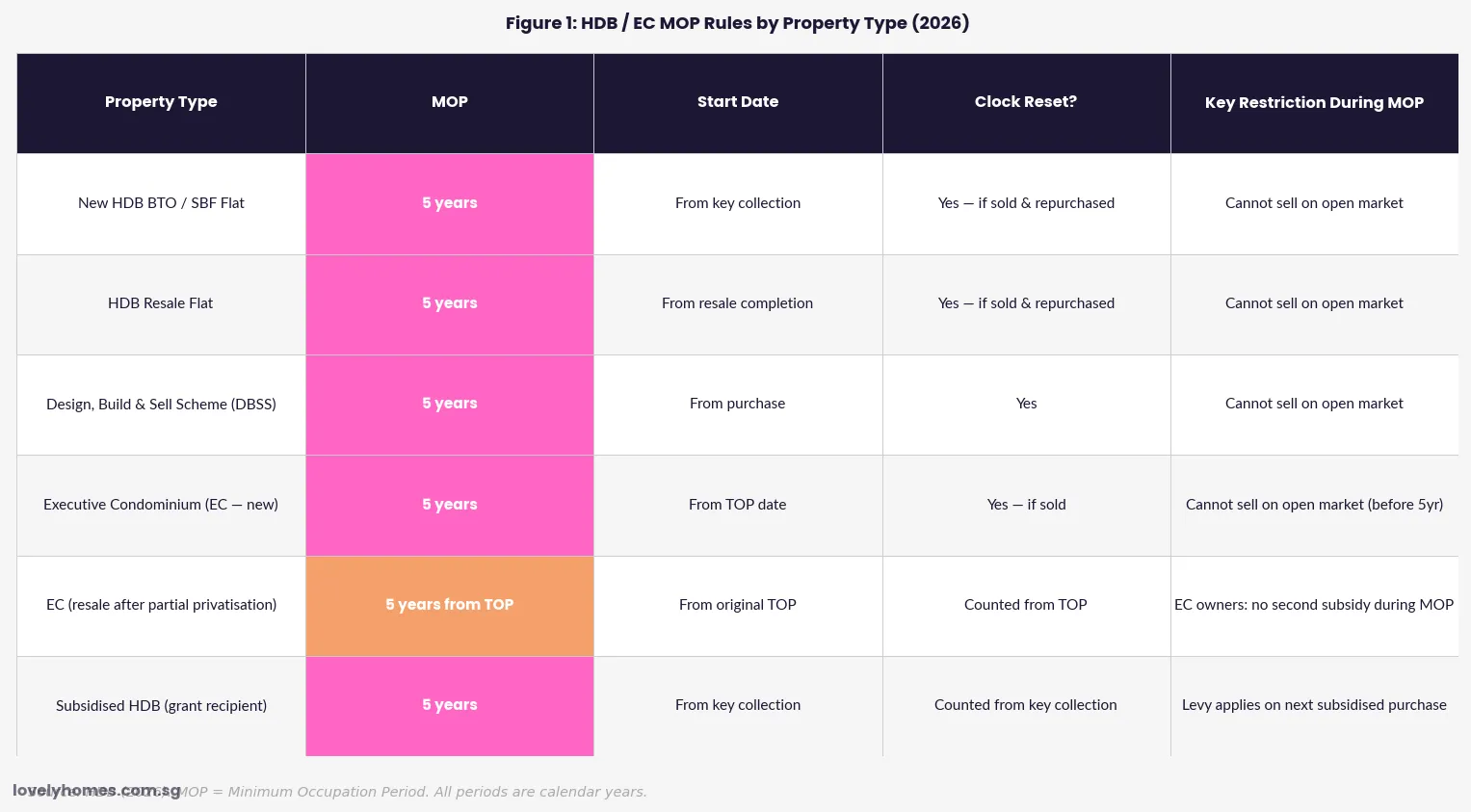
The MOP rules vary slightly in their application depending on the type of HDB or EC property involved. The table and infographic below set out the key parameters for each category.
HDB MOP rules by property type 2026 BTO resale EC minimum occupation period
Figure 1: HDB / EC Minimum Occupation Period Rules by Property Type (2026). Source: HDB.
Property Type MOP Duration MOP Start Date Reset if Sold?
New HDB BTO / SBF flat 5 years Date of key collection Yes — resets on each new purchase
HDB Resale flat 5 years Resale completion date Yes — resets on each resale purchase
DBSS (Design, Build & Sell Scheme) 5 years Date of key collection Yes
Executive Condominium (new launch) 5 years TOP date of the EC project Yes — if flat is sold & repurchased
EC (resale, after partial privatisation) Counted from original TOP Original TOP date No reset for resale buyers post-privatisation

Key distinction — BTO vs resale: For BTO buyers, the MOP starts from the date they collect the keys from HDB. For resale buyers, it starts from the date the resale transaction is completed and registered. This matters practically: a resale flat whose previous owner completed MOP years ago does not pass on an outstanding MOP to the new buyer — the new buyer’s fresh 5-year MOP commences from their own purchase date.

What You Can and Cannot Do During Your MOP

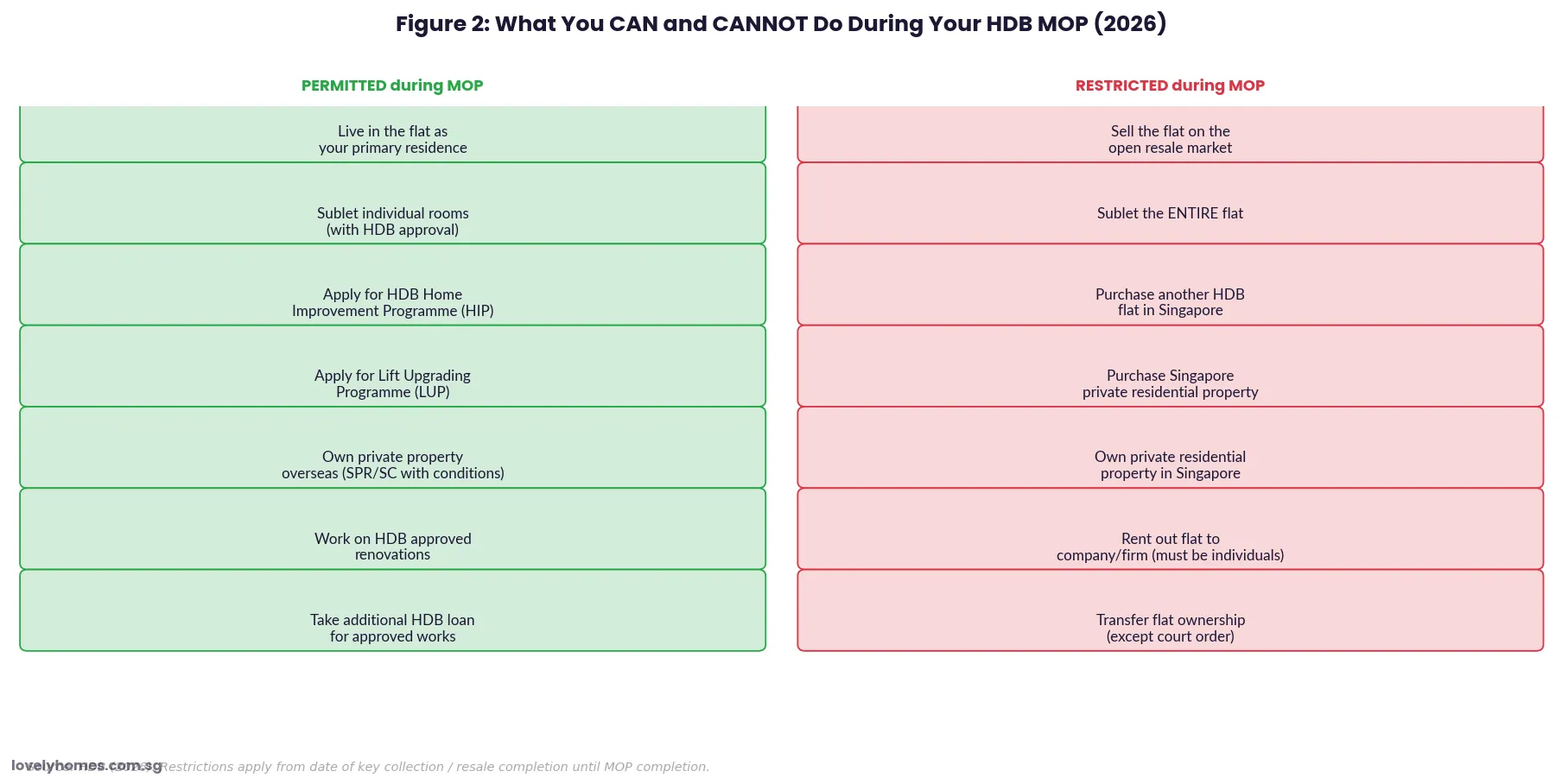
The most common questions HDB flat owners have are about what they are permitted to do — and what is prohibited — during the 5-year MOP. The restrictions are specific and HDB monitors compliance actively.
HDB MOP what you can and cannot do during minimum occupation period 2026
Figure 2: What You CAN and CANNOT Do During the HDB MOP (2026). Source: HDB.

You are NOT allowed to:

  • Sell the flat on the HDB Resale Portal or via any private arrangement.
  • Sublet the entire flat — renting out the whole unit to tenants is prohibited during MOP.
  • Purchase any Singapore private residential property, whether a condominium, apartment, landed home, or EC in the initial restricted period.
  • Own any Singapore private residential property — if you already own private property at the time of HDB purchase, you must dispose of it within 6 months (SPR) or within a stipulated period (SC — typically required to sell before or at point of HDB key collection).
  • Transfer ownership of the flat to another party, except by a court order in matrimonial or inheritance proceedings.

You are permitted to:

  • Sublet individual rooms in the flat — but you must apply for HDB’s approval and must continue to physically reside in the flat yourself.
  • Apply for and benefit from HDB’s Home Improvement Programme (HIP) and Lift Upgrading Programme (LUP).
  • Carry out approved renovation works — whether cosmetic or structural, subject to HDB and BCA requirements.
  • Own overseas private property — Singapore Citizens may own overseas property during their HDB MOP. SPRs face additional restrictions and should check current HDB rules, which require SPRs to obtain HDB’s prior approval.

Room Rental During MOP: The Rules in Detail

Room rental is the one form of income-generating activity permitted during the MOP period. Under HDB’s room rental rules, you may rent out up to 6 bedrooms in a flat (depending on flat size), provided you continue to physically reside in the flat as your primary residence. Subletting of individual rooms requires HDB approval — the application is made through the HDB Flat Portal. You must also register each tenant’s identity with HDB and notify HDB of any changes in tenancy within the stipulated timeframe.

The rental period for approved room subletting is typically granted in 1- or 2-year increments, renewable subject to re-application. Tenants must be Singapore Citizens, PRs, or eligible non-citizens holding valid passes. Short-term letting (such as via holiday rental platforms) is not permitted for HDB flats at any time, whether within or outside the MOP — this applies without exception.

Worked Example: The Tan Family’s MOP Journey

Mr & Mrs Tan (SC/SC), BTO 4-Room Flat, Tengah, Key Collection 15 August 2024

MOP start date: 15 August 2024

MOP completion date: 15 August 2029

Purchase price: S$545,000 (BTO)

Grants received: Enhanced Housing Grant (EHG) S$30,000 + CPF Family Grant S$50,000 = S$80,000 total subsidies

During MOP (Aug 2024 – Aug 2029):

  • Cannot sell the flat on the resale market — if they attempt to transfer ownership, HDB may compulsorily acquire it at below-market value
  • Cannot purchase any Singapore private residential property or EC in its restricted period
  • Can sublet the spare bedroom — applied for HDB approval in Jan 2026, approved for 1-year subletting at S$1,200/month

After MOP (from 15 August 2029):

  • May sell on HDB Resale Portal — current comparable 4-room Tengah prices estimated at S$620,000–S$680,000 (2029 projection, illustrative)
  • CPF housing refund (principal used + accrued interest at 2.5% p.a.) must be returned to CPF OA upon sale
  • Resale levy of S$40,000 (4-room) applies if they purchase another subsidised HDB flat
  • Mr Tan may buy a private condo while Mrs Tan retains the HDB flat — SC privilege post-MOP

Your Post-MOP Options

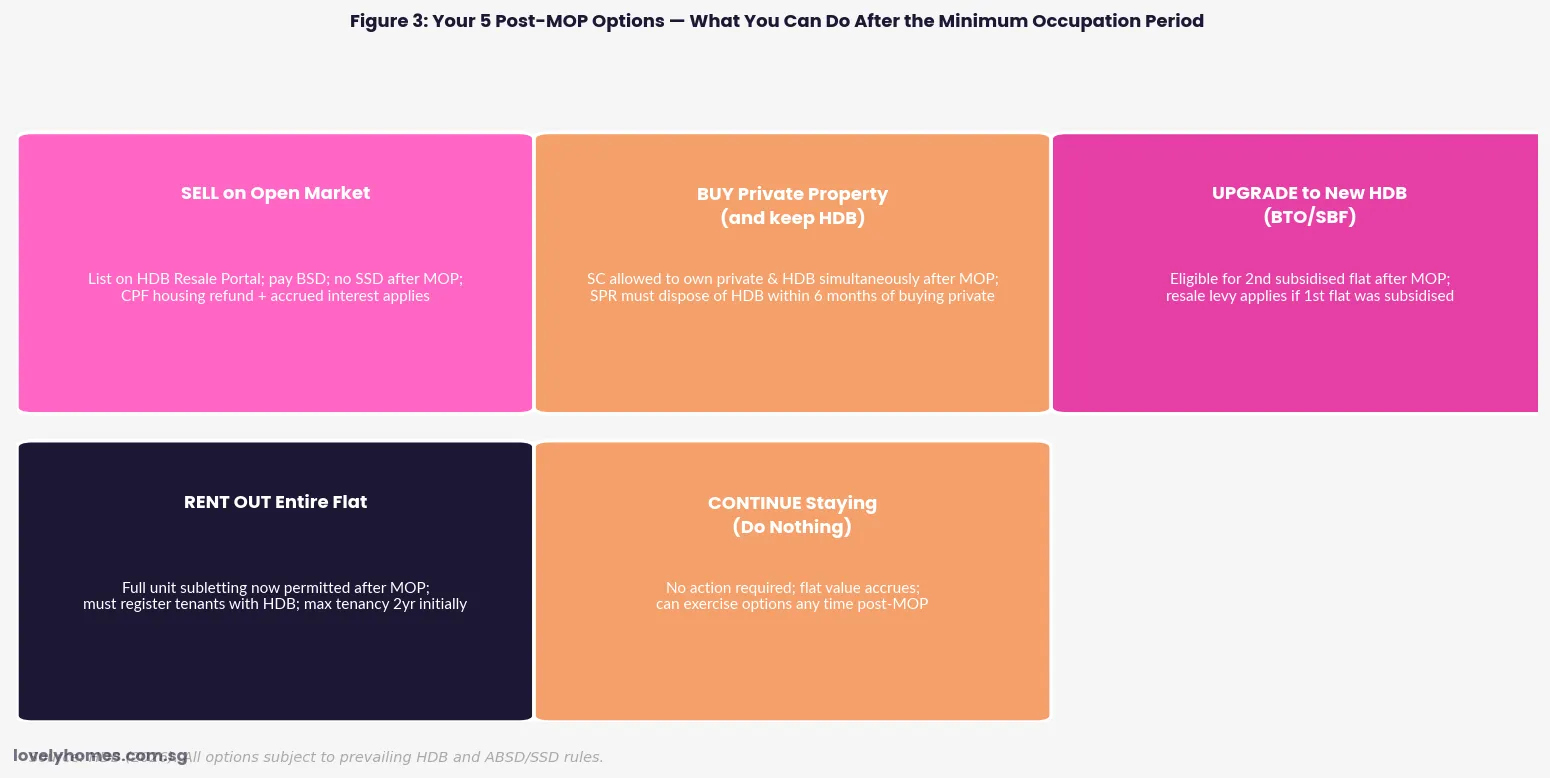
Completing the MOP unlocks a range of options for HDB flat owners. There is no single right answer — the best choice depends on your household income, family size, retirement goals, and property market conditions at the time.
HDB post MOP options sell rent buy private property upgrade Singapore 2026
Figure 3: Post-MOP Options — What You Can Do After the HDB Minimum Occupation Period (2026). Source: HDB.

Option 1 — Sell on the open resale market. List on the HDB Resale Portal at your asking price. BSD (refundable if previously paid via CPF) and CPF housing refund plus accrued interest will reduce your net cash proceeds. No Seller’s Stamp Duty applies after MOP completion (SSD applies only in the first 3 years after purchase, not tied to MOP).

Option 2 — Upgrade to a larger HDB flat (BTO/SBF/resale). After MOP, you are eligible to purchase a second HDB flat. If your first flat was purchased with a housing grant (subsidy), a resale levy applies on the second subsidised purchase (S$40,000 for 4-room sellers as at 2026). The levy is automatically deducted from your CPF refund proceeds at the point of resale.

Option 3 — Buy private property (Singapore Citizens only). Post-MOP, SC flat owners may purchase a Singapore private residential property while retaining their HDB flat. ABSD of 20% applies on the private purchase (SC 2nd property rate). SPRs must sell their HDB flat within 6 months of completing the private property purchase.

Option 4 — Sublet the entire flat. Full-unit subletting is only permitted after MOP is complete. The flat owner need not remain in residence. Subletting must be registered with HDB and is approved for up to 2 years initially (renewable). Subletting income is subject to income tax as rental income.

Option 5 — Continue staying. No action is required after MOP. Many owner-occupiers choose to continue living in their flat, especially if the location, neighbourhood amenities, or proximity to schools and family remain central to their needs. The flat continues to appreciate in value; the owner retains full optionality to exercise any of the above options at any future point.

What This Means for You: MOP as a Policy Signal

The 5-year MOP is one of Singapore’s most effective housing policy tools for a simple reason: it aligns the interests of subsidised homeowners with the long-term community stability goals of the HDB programme. Flats received at below-market BTO prices include substantial government subsidies — the MOP ensures the beneficiary of that subsidy provides genuine owner-occupier usage before extracting any speculative gain.

In the context of the current HDB resale market (RPI at 202.7 in Q2 2026 flash estimate, having declined for two consecutive quarters after peaking), the MOP continues to act as a supply damper: flats purchased during the 2021–2023 BTO boom are still largely within their MOP windows and will begin entering the resale market progressively from 2026 onwards. This anticipated supply pipeline is one reason analysts expect further moderation in HDB resale price growth over 2026–2028.

What Might Come Next: Could the MOP Change?

The 5-year MOP has been the standard for over a decade and there is no publicly signalled intention to change it as at July 2026. The government’s focus has instead been on differentiating between Standard, Plus, and Prime classification flats (introduced in the October 2024 BTO framework), which carry enhanced restrictions: Plus and Prime flats have a 10-year MOP, are subject to an income ceiling at resale, and can only be sold back to HDB in the first instance. This two-tier MOP framework — 5 years for Standard, 10 years for Plus/Prime — reflects a targeted approach rather than a blanket MOP extension.

For the vast majority of HDB buyers purchasing Standard-classification flats in non-prime areas, the 5-year MOP remains the applicable rule.

Frequently Asked Questions

What happens if I sell my HDB flat before the MOP is over?

Selling a HDB flat before the MOP expires is a breach of the sale conditions under the Housing and Development Act. HDB has the authority to compulsorily acquire the flat at its assessed market value (which may be lower than the transacted value). In addition to the financial loss, HDB may impose penalties and the owner’s eligibility for future HDB subsidies may be affected. Practically speaking, no conveyancing firm will facilitate a sale before MOP completion given the clear legal prohibition — the HDB Resale Portal’s system also prevents listing of flats within their MOP period.

Can I rent out my entire HDB flat during the MOP if I work overseas?

No. Full-unit subletting is not permitted during the MOP period under any circumstances, including when the owner is posted overseas for work. If you must relocate for employment, you may sublet individual rooms (with HDB approval) but must maintain the flat as your registered Singapore address and must return to physically occupy it. If you are overseas for an extended period, you must seek HDB’s advice in advance. Returning to Singapore and being unable to occupy the flat does not suspend the MOP clock — MOP runs continuously from key collection regardless of where the owner is physically located.

Can I own private property while I am under HDB MOP?

No, you may not own Singapore private residential property during the MOP. At the point of purchasing your HDB flat, you must not own any private residential property in Singapore — if you do, you must dispose of it before or within the stipulated period after HDB key collection. The prohibition includes any form of direct or indirect ownership, including through a company or trust. You may, however, own residential property overseas (SC holders may do so freely; SPR holders require HDB’s prior written consent). After completing the 5-year MOP, Singapore Citizens may purchase Singapore private property and retain the HDB flat simultaneously.

Does the MOP apply to both the buyer and all registered flat owners?

Yes. The MOP applies to all registered owners on the HDB title — not just the main applicant. All registered occupiers and co-owners must comply with the occupancy requirement during the MOP period. This means that if any registered owner or occupier moves out and acquires other housing, HDB may treat this as non-compliance. If a couple divorces during the MOP period and one party acquires a separate property, they must seek HDB’s guidance as the occupancy conditions may be affected. Transfers between co-owners on the title (such as adding or removing a spouse) during MOP typically require HDB approval.

What is the resale levy and when does it apply?

The resale levy is a payment required when an HDB flat owner who received a housing subsidy on their first flat purchases a second subsidised HDB flat or a new EC. It is administered by HDB and designed to ensure fairness between first-time and second-time subsidised buyers. As at 2026, the levy amounts are: 2-Room Flexi S$15,000; 3-Room S$30,000; 4-Room S$40,000; 5-Room S$45,000; Executive flat S$50,000; DBSS S$55,000; EC — 5% of resale price capped at S$55,000. The levy is paid to HDB from your CPF refund at the point of resale completion. It does not apply if you sell your first flat on the open resale market and buy a non-subsidised resale HDB flat or private property.

Does the MOP apply to Executive Condominiums?

Yes, but with differences. New ECs are subject to a 5-year MOP measured from the EC’s Temporary Occupation Permit (TOP) date — not from the individual buyer’s key collection date. During the EC MOP, owners cannot sell on the open market and private ownership restrictions apply. After 5 years from TOP (partial privatisation), EC owners may sell on the open market to SC and SPR buyers only. After 10 years from TOP (full privatisation), the EC is treated as private property and may be sold to any buyer including foreigners. Second-timer EC buyers (those who have previously owned an HDB flat) must sell their HDB flat within 6 months of TOP.

Can I inherit an HDB flat during my own MOP?

Inheriting an HDB flat through a deceased estate while you are still within the MOP of your own flat is a situation that requires immediate attention from HDB. Generally, you cannot simultaneously own two HDB flats. HDB will typically require you to either retain the inherited flat (and dispose of your existing flat) or disclaim your share of the inheritance. The specific resolution depends on your citizenship status, your existing flat’s MOP stage, and the value of the respective properties. You should contact HDB directly upon becoming aware of the inheritance situation — early engagement prevents inadvertent breaches of the MOP conditions.
Related Articles

Disclaimer: This article is provided for general information purposes only and does not constitute legal, financial, or professional advice. HDB rules, MOP periods, resale levy amounts, and eligibility conditions are subject to change by HDB and the Singapore government. The information in this article reflects rules as at 8 July 2026. Readers are advised to verify all information directly with HDB (hdb.gov.sg), CPF Board (cpf.gov.sg), and IRAS (iras.gov.sg) before making any property or financial decisions. LovelyHomes.com.sg is not a licensed real estate agency or legal practice.

Singapore Home Insurance Guide 2026: HDB Fire Insurance, Home Contents, MRTA and FDW Cover Explained

Singapore Home Insurance Guide 2026: HDB Fire Insurance, Home Contents, MRTA and FDW Cover Explained

Home insurance in Singapore is one of the most consistently misunderstood areas of property ownership. Many HDB flat owners believe they are fully covered by the mandatory HDB Fire Insurance policy that comes with their flat. Most are not. Private condo owners sometimes assume their building’s master policy protects their contents. It typically does not. And across all property types, the gap between what a homeowner thinks they are insured for and what they would actually receive in a claim can run to tens of thousands of Singapore dollars.

This guide explains exactly what each category of Singapore home insurance covers, what it does not cover, how much it costs, and what the appropriate level of coverage looks like for an HDB flat owner, a condominium resident, and a landed property owner in 2026.

Quick Answer — Singapore Home Insurance 2026 at a glance

  • HDB Fire Insurance is mandatory for HDB flat owners with an outstanding HDB loan. It covers only the building structure, not contents. Annual premiums start from approximately S$5.50 per year for a 2-room flat.
  • Home Contents Insurance is optional but highly recommended. It covers furniture, electronics, clothing, and valuables against fire, theft, water damage, and other perils.
  • Mortgage Reducing Term Assurance (MRTA) and Mortgage Level Term Assurance (MLTA) are life insurance policies that pay off the mortgage if the borrower dies or becomes totally and permanently disabled.
  • Foreign Domestic Worker (FDW) Insurance is mandatory for all households employing a maid in Singapore, administered under the Employment of Foreign Manpower Act.
  • Most comprehensive home insurance packages for a 4-room HDB flat with S$100,000 contents cover cost approximately S$120–S$200 per year in 2026.
  • Premiums are not regulated by MAS — shop around and compare at least three insurers before buying.
  • ABSD and stamp duties do not apply to insurance premiums; see our ABSD Singapore 2026 guide for property transaction costs

The Four Main Categories of Singapore Home Insurance

Singapore’s home insurance market is structured around four distinct insurance categories, each addressing a different layer of financial risk. Understanding which category applies to your situation is the essential first step before comparing policies or premiums.

The first category, HDB Fire Insurance, is a government-mandated basic policy administered under the HDB’s Fire Insurance Scheme. The second category, Home Contents Insurance, is a commercial product sold by private insurers to cover the movable assets inside your home. The third category encompasses Mortgage Insurance products (MRTA and MLTA), which are life-insurance instruments designed to discharge a mortgage on death or total permanent disability. The fourth category, FDW Insurance, is a mandatory cover for employers of foreign domestic workers.

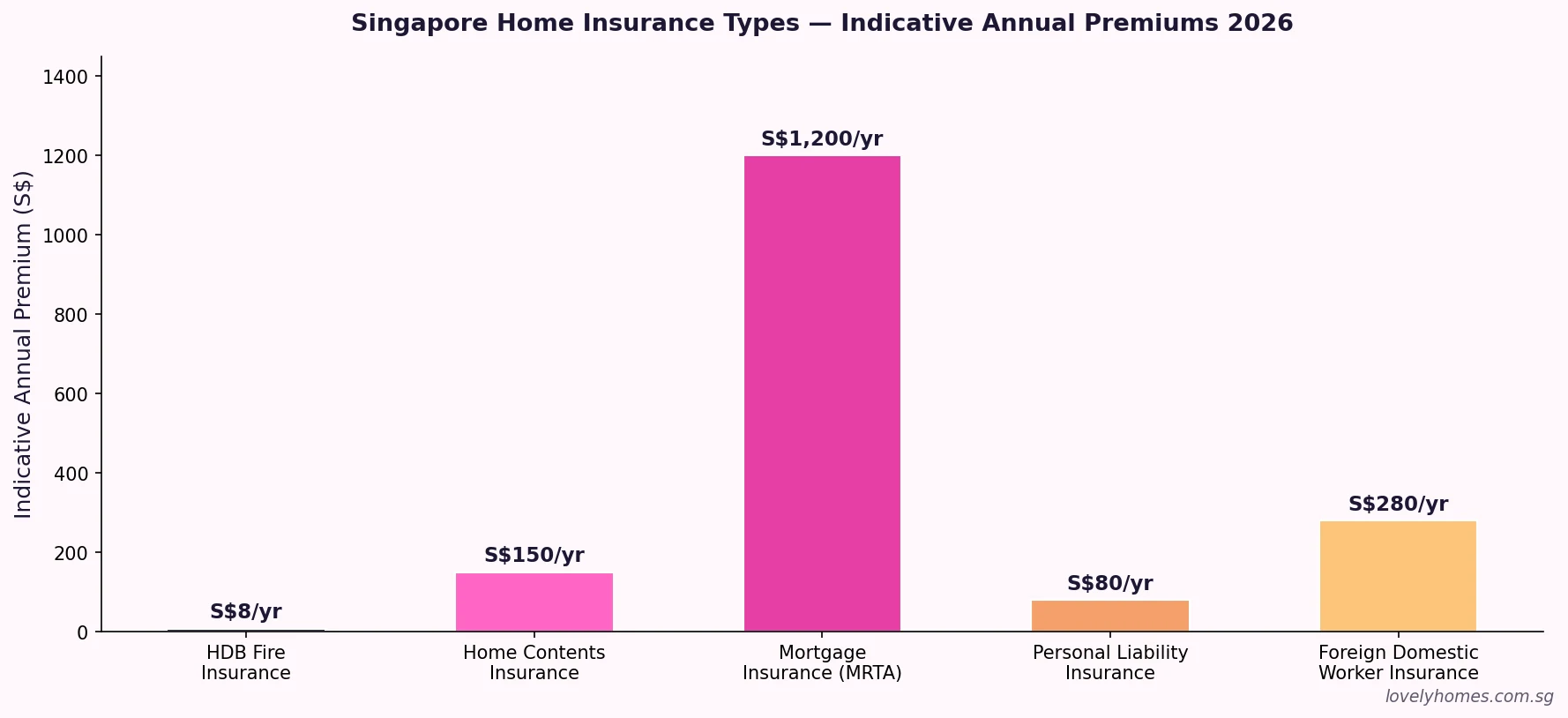
Singapore home insurance types and indicative annual premiums 2026 comparison
Figure 1: Singapore Home Insurance Types — Indicative Annual Premiums 2026. Premiums are indicative only; actual quotes vary by insurer, property type, and individual risk profile.

HDB Fire Insurance: What It Covers and What It Does Not

The HDB Fire Insurance Scheme is administered by the Housing & Development Board and is compulsory for all HDB flat owners with an outstanding HDB loan. Private bank loans on HDB flats do not legally require HDB Fire Insurance, but most banks impose an equivalent building insurance requirement as a loan condition. The scheme is underwritten by a single insurer appointed by HDB through a tender process — as at 2026, Etiqa Insurance Pte Ltd holds the mandate.

What HDB Fire Insurance covers: The policy insures the structural components of the flat, including the original fixtures, internal walls, floors, ceilings, and the built-in fittings that were installed by HDB when the flat was first built (kitchen cabinets, bathroom fittings, electrical wiring). The insured sum is the estimated cost to rebuild the structural elements in the event of fire or an allied peril (smoke, explosion, lightning, impact).

What HDB Fire Insurance does NOT cover: It does not cover any renovations, additions, or alterations made by the flat owner after purchase. It does not cover furniture, electrical appliances, clothing, jewellery, art, or any other movable contents. It does not cover accidental damage, water damage from external sources (such as a burst pipe in the unit above), theft, or public liability. For most HDB owners, the renovation work they commission after purchase — which can cost S$30,000–S$100,000 for a 4-room flat — is entirely uninsured under the HDB Fire Insurance Scheme.

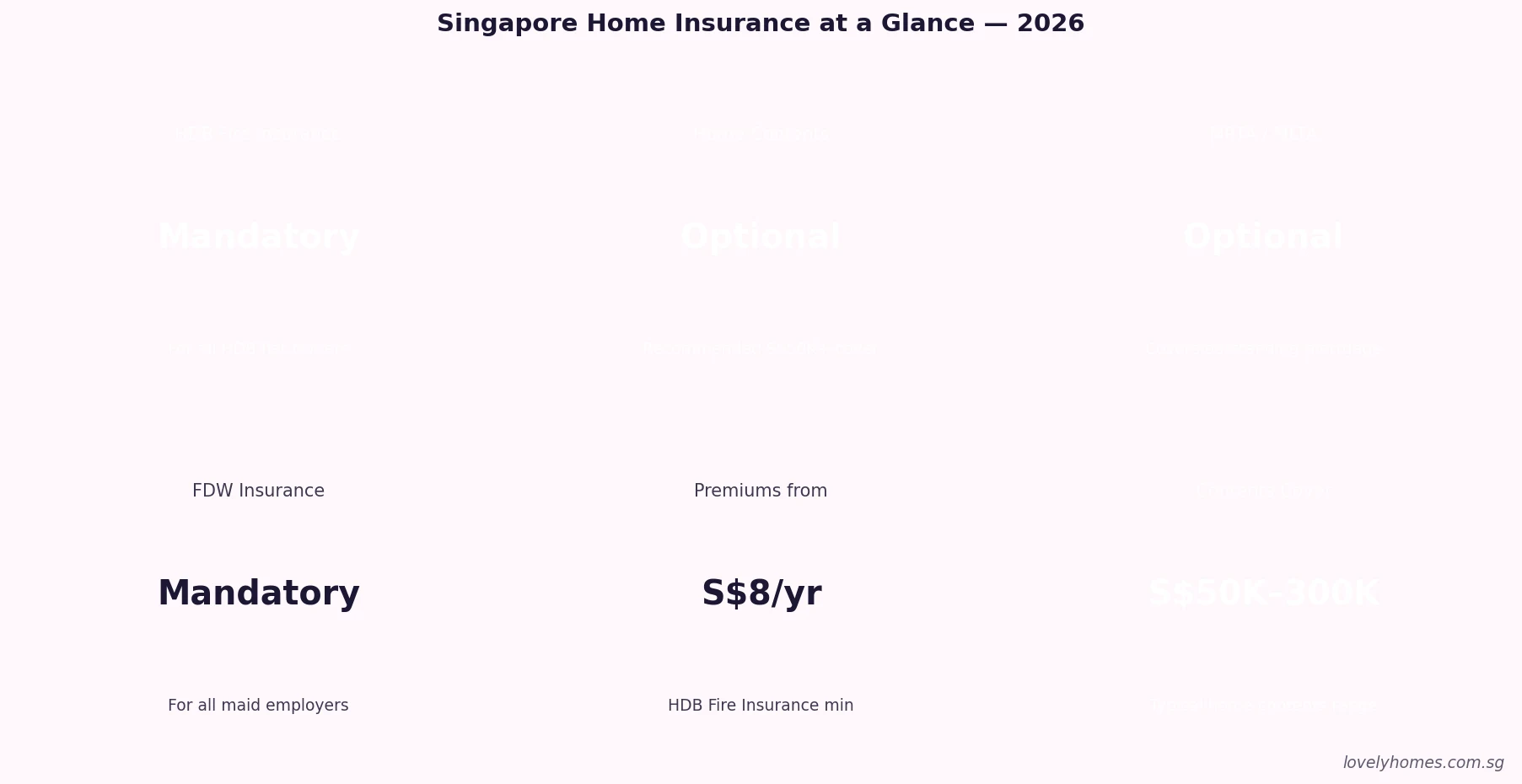
Singapore home insurance key facts 2026 mandatory optional HDB FDW MRTA contents cover
Figure 2: Singapore Home Insurance at a Glance — 2026 Key Statistics. Sources: HDB, MOM, MAS, industry data.

Home Contents Insurance: What It Is and How Much You Need

Home Contents Insurance is a private commercial product sold by insurers including NTUC Income, AIA, AXA, Sompo (formerly Sompo Japan), Great Eastern, and Etiqa, among others. Policies are not standardised, so coverage, exclusions, and premiums vary significantly between providers. Buyers should compare policy wordings carefully, not just premium prices.

A standard Home Contents Insurance policy typically covers: furniture and fittings (including renovation works), electronic appliances, clothing and personal effects, and jewellery (subject to per-item and aggregate sub-limits). Perils covered typically include fire, lightning, explosion, theft, vandalism, water damage from burst pipes or overflowing tanks, and in some policies, accidental damage. Most policies exclude flood, earthquake, and subsidence, though Singapore’s geography makes these perils relatively rare.

The key figure to determine is your sum insured — the amount of cover you are purchasing. Many homeowners significantly underestimate the replacement value of their contents. A practical exercise is to walk through your home and estimate the current replacement cost (not original purchase price) of every item: bedroom furniture, mattresses, wardrobe and clothing, kitchen appliances, television, computer equipment, power tools, jewellery, and children’s toys and equipment. For a 4-room HDB flat with moderate furnishings and a mid-range renovation, the replacement cost of contents and renovation works combined often exceeds S$100,000–S$150,000.

Mortgage Insurance: MRTA vs MLTA

Mortgage insurance addresses a different risk: the risk that the borrower dies or becomes totally and permanently disabled (TPD) before the mortgage is paid off, leaving the surviving family with a property but no capacity to service the loan.

Mortgage Reducing Term Assurance (MRTA) is the simpler instrument. It provides a death/TPD benefit that reduces over time in line with the outstanding mortgage balance. If you borrow S$500,000 and die in Year 5, the MRTA pays out approximately S$460,000 (the remaining balance), discharging the mortgage. MRTA does not pay out a lump sum beyond the mortgage balance; there is no residual benefit to the estate. Premiums for MRTA are typically paid as a single lump sum at loan inception, often capitalised into the loan amount itself. Indicative single-premium MRTA for a S$500,000 loan over 25 years for a 35-year-old non-smoker is approximately S$15,000–S$25,000.

Mortgage Level Term Assurance (MLTA) is a level-sum-assured life policy that provides a fixed death/TPD benefit (e.g. S$500,000) throughout the policy term regardless of the outstanding mortgage balance. If the insured dies in Year 20 and the mortgage balance is S$200,000, the MLTA pays S$500,000 — S$200,000 discharges the mortgage and S$300,000 goes to the estate. MLTA premiums are paid monthly or annually and are higher than MRTA on an equivalent sum-assured basis, but the policy accrues surrender value and provides greater financial protection for the family.

The Monetary Authority of Singapore (MAS) regulates both MRTA and MLTA as insurance products. HDB Home Loan borrowers are required to have adequate life insurance covering the loan amount, but are not required to purchase any specific product. Buyers who take a bank loan for a private property are typically not legally required to purchase mortgage insurance, though banks may offer (and recommend) these products as part of the loan package.

Foreign Domestic Worker (FDW) Insurance

Any household employing a Foreign Domestic Worker in Singapore must purchase FDW Insurance as a condition of the work permit, administered under the Employment of Foreign Manpower Act and enforced by the Ministry of Manpower (MOM). The mandatory minimum coverage includes personal accident insurance of S$60,000, hospitalisation and surgical expenses of S$15,000 per year, and a security bond of S$5,000 (waived if the employer meets certain criteria).

MOM-approved FDW Insurance policies are available from a range of insurers at annual premiums of approximately S$220–S$350, depending on the insurer, the coverage level, and whether optional add-ons (such as repatriation costs, maternity cover, or third-party liability) are included. Premiums have risen modestly since 2022 due to increased hospitalisation cost claims. Employers must renew FDW Insurance annually and cannot allow it to lapse without risking permit revocation and MOM sanctions.

Summary Table: Singapore Home Insurance Types 2026

Insurance Type Mandatory? What It Covers What It Does NOT Cover Indicative Annual Cost
HDB Fire Insurance Yes (HDB loan) Structure, original HDB fixtures & fittings Renovation, contents, accidental damage, water ingress from outside S$5.50–S$14.50
Home Contents Insurance No Furniture, appliances, renovation, clothing, jewellery Flood, earthquake, wear & tear, high-value items above sub-limit S$80–S$350+
MRTA (Mortgage) No Outstanding mortgage balance on death/TPD Critical illness, income protection, residual estate benefit Single premium ~S$15K–S$25K total
MLTA (Mortgage) No Fixed life sum assured on death/TPD Critical illness unless rider added S$800–S$1,800/yr (monthly premiums)
FDW Insurance Yes (maid employers) PA, hospitalisation, security bond Employer liability unless optional add-on purchased S$220–S$350
Personal Liability No Third-party bodily injury/property damage from your home Intentional acts, business use, motorised vehicles S$60–S$120

Worked Example: How Much Should a 4-Room HDB Owner Spend on Home Insurance?

Mr and Mrs Lim own a 4-room HDB flat in Tampines, purchased for S$580,000 with an outstanding HDB loan of S$380,000. They spent S$65,000 on renovation (kitchen, bathrooms, built-in wardrobes, flooring). Their home contents include furniture (S$15,000), electronics and appliances (S$12,000), clothing and personal effects (S$8,000), and Mrs Lim’s jewellery (S$25,000). They employ a Foreign Domestic Worker.

Mandatory insurance they already have: HDB Fire Insurance (approximately S$8.50/year for a 4-room flat), covering the original HDB structure. FDW Insurance for their domestic worker (approximately S$260/year). Total mandatory: approximately S$269/year.

What they need but do not yet have: The HDB Fire Insurance does NOT cover their S$65,000 renovation, S$55,000 in contents, or the S$25,000 jewellery. A Home Contents Insurance policy with S$150,000 sum insured (covering renovation and contents) with a jewellery rider up to S$30,000 would cost approximately S$170/year from a typical Singapore insurer. Personal Liability cover (S$500,000 limit for accidental injury to a third party in their home) would add approximately S$80/year.

Total recommended insurance spend: Mandatory S$269 + Home Contents S$170 + Personal Liability S$80 = approximately S$519/year for comprehensive home insurance protection. This represents approximately 0.09% of the flat’s purchase price annually — a modest cost relative to the financial risk of being uninsured against a fire, water damage event, or theft.

Mortgage insurance: For an outstanding loan of S$380,000, a single-premium MRTA would cost approximately S$12,000–S$18,000 capitalised into the loan, or an MLTA at S$500,000 sum assured would cost approximately S$1,200/year in monthly premiums for Mr Lim aged 38. Whether to choose MRTA or MLTA depends on their broader financial planning, life insurance coverage from existing policies, and whether they value the surrender value and estate planning aspects of MLTA.

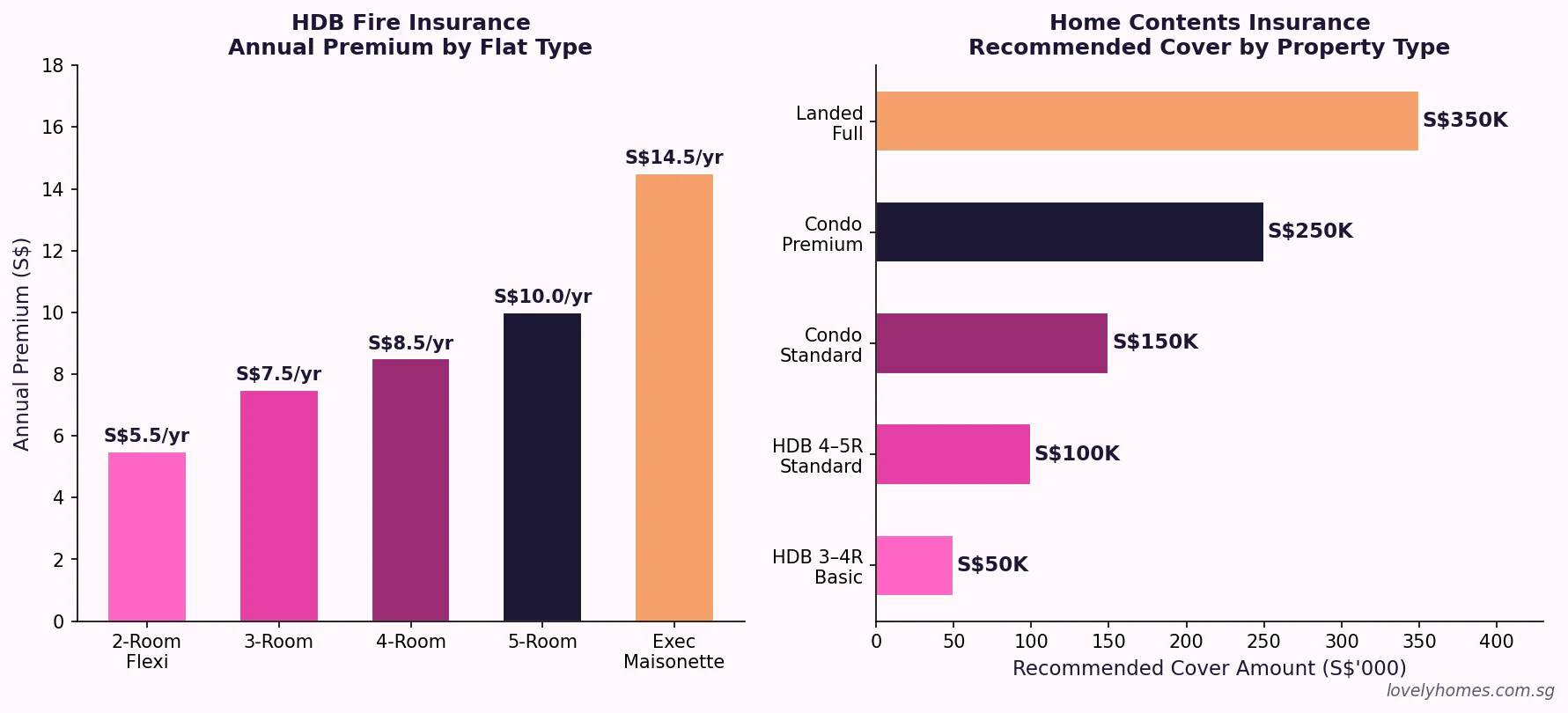
Singapore home insurance HDB fire insurance premium by flat type and home contents cover tiers 2026
Figure 3: HDB Fire Insurance Annual Premiums by Flat Type (left) and Recommended Home Contents Cover by Property Type (right) — 2026. Data: indicative based on insurer premium schedules and industry estimates.

Why This Matters for Singapore Homeowners

Singapore’s property prices mean that most homeowners’ single largest financial asset is their property. The paradox is that many of these same homeowners carry inadequate insurance against the events most likely to cause a partial or total loss of that asset — fire, water damage, and theft. Insurance penetration for home contents in Singapore has historically been low relative to the value of assets at risk, a fact that the General Insurance Association of Singapore (GIA) has repeatedly flagged in its annual market reports.

The situation is compounded by two misunderstandings. First, HDB flat owners conflate the mandatory HDB Fire Insurance with comprehensive home protection, and feel covered when they are not. Second, strata condo owners assume their MCST’s building insurance covers the interior of their unit and its contents, when in fact the building policy typically covers only the structure and common areas — not renovations, fittings, or personal property within individual units. Understanding precisely what your current insurance does and does not cover is the critical first step.

From an investment standpoint, home insurance also protects rental income. If a flood or fire damages a tenanted property and makes it uninhabitable, most comprehensive policies include Loss of Rent cover (typically 10–15% of the sum insured) to compensate the landlord for the rental income lost during the repair period. Without this cover, a landlord faces both repair costs and lost income simultaneously — a double financial impact that can take years to recover from.

What Might Come Next for Singapore Home Insurance

Several developments are likely to shape the home insurance market over the medium term. Rising renovation costs — up an estimated 20–30% since 2019 due to supply chain disruptions and labour shortages — mean that sum-insured amounts set several years ago may be materially inadequate today. Homeowners who have not reviewed their Home Contents Insurance policy since completing their renovation should reassess their sum insured.

Climate-related risks are also receiving increasing attention from Singapore’s insurance regulators. The MAS’s climate risk framework has prompted insurers to review their underwriting models for flood and extreme weather events. While Singapore’s drainage infrastructure is among the world’s best, flash flooding in low-lying residential areas has caused property damage in recent years, and some insurers have introduced flood exclusions or sub-limits in their home policies. Buyers should read policy wordings carefully for flood coverage.

Finally, the increasing value of jewellery, watches, and art collections in Singapore homes — driven in part by the Ultra High Net Worth influx since 2021 — has prompted specialist insurers to develop dedicated high-value personal property floaters that sit above standard home contents policies. For homeowners with individual items worth more than S$10,000–S$15,000, a standard Home Contents policy’s per-item sub-limit (typically S$1,500–S$5,000) may be inadequate, and a specialist all-risks policy should be considered.

Frequently Asked Questions

Is HDB Fire Insurance compulsory if I take a bank loan instead of an HDB loan?

The HDB Fire Insurance Scheme is legally mandatory only for HDB flat owners with an outstanding HDB loan. If you take a bank loan for your HDB flat, you are not legally required to purchase HDB Fire Insurance specifically. However, most banks impose their own building insurance requirement as a loan condition — they typically require you to purchase a fire insurance policy covering at least the reinstatement value of the structural components. You may purchase this from any MAS-licensed insurer, not only the HDB scheme provider. In practice, most bank-loan HDB buyers do purchase fire insurance, and some also purchase comprehensive home contents insurance on top. Confirm your bank’s specific requirement in your loan letter of offer.

Does my condo’s MCST master policy cover my unit’s contents and renovation?

No. The MCST’s master building insurance policy covers the common areas, external structure, and the original building components — the concrete structure, lift shafts, roof, corridors, and shared facilities. It does not cover any renovations, fittings, furniture, appliances, or personal effects inside individual units. It also typically does not cover accidental damage or water ingress originating within your own unit (as distinct from structural ingress through the building envelope). As a condo owner, you need your own Home Contents Insurance policy to cover your interior renovations, contents, and personal effects. The MCST policy exists to protect the collective asset — not the individual unit owner’s possessions.

What is the difference between MRTA and MLTA, and which should I choose?

MRTA (Mortgage Reducing Term Assurance) is a pure protection product — the sum insured reduces over time in line with the outstanding loan balance. If you die or become totally and permanently disabled, the insurer pays out the remaining mortgage balance, clearing the debt. MRTA has no surrender value and no residual benefit beyond the mortgage discharge. It is typically cheaper than MLTA, especially when the premium is calculated at loan inception on a single-premium basis. MLTA (Mortgage Level Term Assurance) is a level-sum life policy. The sum assured remains constant throughout the term. If the insured dies in Year 20 and the remaining mortgage is S$150,000, the MLTA pays the full sum assured (e.g. S$500,000), clearing the mortgage and leaving S$350,000 for the estate. MLTA accrues surrender value and typically includes whole-of-life or extended coverage options. The choice between MRTA and MLTA depends on your broader life insurance holdings, estate planning objectives, and budget. Consult a licensed Financial Adviser before deciding.

How much Home Contents Insurance do I actually need?

The correct sum insured is the current replacement cost of everything in your home that is not part of the building structure — furniture, electronics, appliances, clothing, books, children’s equipment, sports gear, and jewellery — plus the full reinstatement cost of any renovation works you have carried out (new flooring, built-in wardrobes, kitchen cabinets, bathroom fittings, lighting, painting). For a 4-room HDB flat with a moderate renovation (S$50,000–S$70,000) and standard furnishings, the total replacement cost typically falls in the S$120,000–S$180,000 range. Many homeowners significantly underestimate this figure by forgetting to include renovation costs, systematically undervaluing their belongings, and failing to account for appreciation in replacement costs since the items were purchased. Reviewing and updating your sum insured every two to three years is advisable.

Can I use CPF to pay for home insurance premiums?

No. CPF funds may not be used to pay general insurance premiums, including Home Contents Insurance, HDB Fire Insurance, or FDW Insurance. CPF OA funds may be used for the purchase of a home (down payment, BSD, monthly loan instalments for certain loan types) but not for ongoing insurance premium payments. MLTA (Mortgage Level Term Assurance) premiums may be payable from CPF OA funds in certain approved schemes — verify this directly with the insurer and CPF Board. MRTA premiums capitalised into the loan amount are funded by the loan itself, not directly from CPF. For most home insurance products, premiums must be paid by GIRO, credit card, or cheque from a bank account.

What happens if my neighbour causes a fire that damages my flat?

If a fire originates in a neighbouring unit and spreads to damage your flat, your recourse depends on the specific facts and whether your neighbour was negligent. Under Singapore tort law, you may have a civil claim against a negligent neighbour for damage to your property. In practice, pursuing such claims can be lengthy and uncertain. The practical protection is to ensure you have your own Home Contents Insurance (and where applicable, Houseowner Insurance) that covers fire damage regardless of origin — your insurer will then subrogate against your neighbour’s insurer if negligence is established, relieving you of the burden of pursuing the claim directly. Never rely solely on a third party’s insurance to protect your assets.

Related Articles

Disclaimer

All insurance premium figures in this article are indicative and based on publicly available market information as at July 2026. Actual premiums depend on the insurer, policy terms, property type, sum insured, and individual risk factors. The MAS’s Financial Institutions Directory at mas.gov.sg lists all licensed insurers operating in Singapore. HDB Fire Insurance scheme details are published at hdb.gov.sg. FDW Insurance requirements are administered by MOM at mom.gov.sg. This article is for general information purposes only and does not constitute financial, legal, or insurance advice. Readers should consult a licensed Financial Adviser or insurance professional before purchasing any insurance product. LovelyHomes is an independent editorial property information platform and does not receive commissions from or recommend any specific insurer.

Novena Neighbourhood Guide Singapore 2026: D11 Medical Hub, Prices & Investment Outlook

Novena Neighbourhood Guide Singapore 2026: D11 Medical Hub, Prices & Investment Outlook

⚡ Quick Answer: Novena Neighbourhood D11 at a Glance

  • District 11 (D11) — Newton and Novena planning areas in the Core Central Region (CCR). Almost entirely private residential.
  • Freehold condos average S$2,600–3,200 psf in Q1 2026; 99-year leasehold condos range from S$2,100–2,600 psf.
  • Medical hub demand: Mount Elizabeth Hospital, Mount Elizabeth Novena Hospital, and Tan Tock Seng Hospital (TTSH) generate sustained rental demand from healthcare professionals and medical tourists.
  • MRT connectivity: Novena (North South Line) and Newton (NSL + Downtown Line) provide direct access to Raffles Place, Marina Bay, and Orchard Road.
  • Gross rental yield: approximately 2.5%–3.2% for condos, comparable to other prime CCR districts.
  • Supply constraint: no new Government Land Sales (GLS) sites have been released in D11 since 2019, reinforcing price resilience for existing freehold stock.
  • Ideal buyer: upgraders, medical professionals, expatriate tenants, long-term capital preservation investors.

What Makes Novena Singapore’s Medical Hub Precinct?

Novena sits within District 11 — one of Singapore’s most established and tightly held residential precincts. Bounded roughly by Thomson Road to the north, Bukit Timah Road to the west, Newton Circus to the south, and Balestier Road to the east, D11 is home to a cluster of private hospitals that is unmatched anywhere else on the island. Mount Elizabeth Hospital on Orchard Road, its sister facility Mount Elizabeth Novena Hospital on Novena Rise, and Tan Tock Seng Hospital on Moulmein Road together form Singapore’s largest private medical hub. This concentration of world-class healthcare institutions is not just a lifestyle amenity — it is a structural driver of residential demand.

Medical professionals, hospital support staff, and visiting doctors on short-term rotations all need housing within comfortable distance of these facilities. International patients and their families, many from across Southeast Asia, the Middle East, and China, often prefer to base themselves in Novena rather than Orchard so they can be close to treatment. The result is a rental market that is unusually resilient even during broader property downturns, because hospital activity does not follow the economic cycle in the same way that corporate leasing does.

Beyond healthcare, Novena offers the quiet residential character of the old Central Region without the intensity of Orchard Road. United Square on Thomson Road is Singapore’s best-known education mall, drawing families with school-age children. Novena Square 1 and 2 and Square 2 along Thomson Road provide everyday retail and dining. St. Joseph’s Institution International, Anglo-Chinese School (Primary), and the Singapore Chinese Girls’ School are all within close proximity, adding an education premium on top of the medical one.

D11 Property Price Ranges — What Buyers Pay in 2026

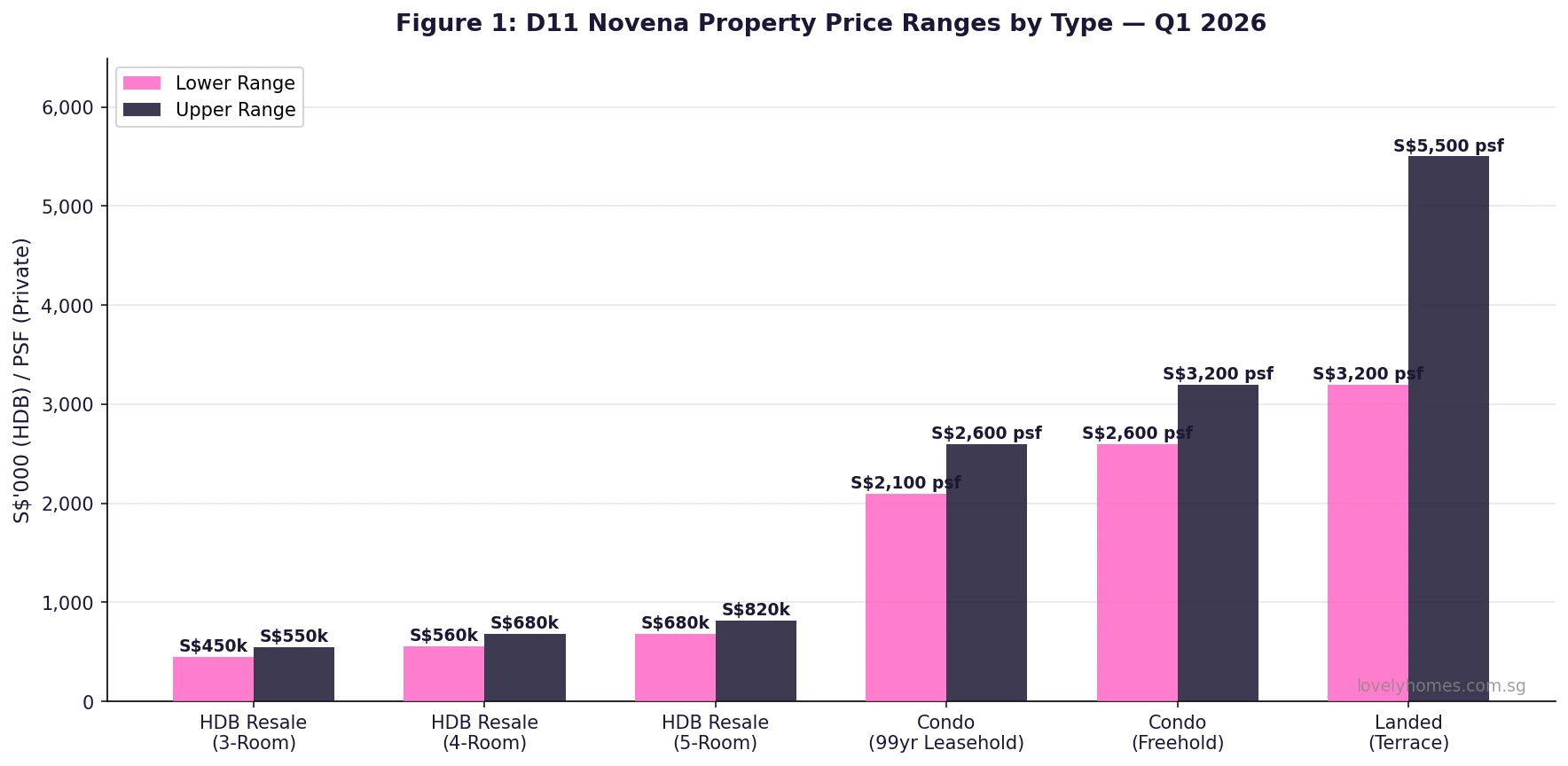
D11 Novena property price ranges by type Q1 2026 — HDB resale and condo PSF bar chart

Figure 1: D11 Newton/Novena residential property price ranges by type — Q1 2026. HDB resale figures reflect fringe estates (Moulmein/Thomson). Sources: URA REALIS, HDB Resale Portal Q1 2026.

District 11 is overwhelmingly private residential. The handful of HDB resale flats that fall within or immediately adjacent to the planning area — mainly in the Moulmein and Newton fringe — transact at a premium to equivalent flat types elsewhere, given their central address. A 4-room HDB resale in this catchment has fetched S$560,000–680,000 in Q1 2026, reflecting the locational scarcity: only a few hundred HDB flats exist across the entire D11 footprint.

The dominant residential product in D11 is the private condo. Freehold condos — which make up the majority of stock given the age of development — have held between S$2,600 and S$3,200 psf in Q1 2026. Key developments such as City Square Residences (freehold, Kitchener Road), Novena Regency (freehold, Thomson Road), and The Trizon (freehold, off Mount Sinai) sit in this range. Newer 99-year developments have traded at a 15–20% discount to equivalent freehold stock, at S$2,100–2,600 psf, reflecting the leasehold haircut that remains deeply ingrained in Singapore buyer psychology.

Landed property in D11 — predominantly terrace and semi-detached houses in the Upper Thomson and Spring Road areas — commands S$3,200–5,500 psf on land area depending on remaining lease, configuration, and orientation. Good Class Bungalow (GCB) plots in the adjacent Ridout Road and Nassim areas start well above S$15 million for eligible parcels.

Property Type Typical Size Price From Price To Notes
HDB Resale (3-Room) 65–70 sqm S$450,000 S$550,000 Moulmein/Newton fringe only
HDB Resale (4-Room) 90–100 sqm S$560,000 S$680,000 Moulmein/Newton fringe only
Condo 1-Bed (FH) 45–55 sqm S$1,200,000 S$1,600,000 Strong rental demand from medical staff
Condo 2-Bed (FH) 75–95 sqm S$1,700,000 S$2,400,000 Most liquid unit type in D11
Condo 3-Bed (FH) 120–150 sqm S$2,800,000 S$4,200,000 Family-friendly, education catchment
Landed Terrace (FH) 150–200 sqm land S$3,200 psf land S$5,500 psf land Only Singapore Citizens eligible

Location and Connectivity: MRT, TEL and Road Networks

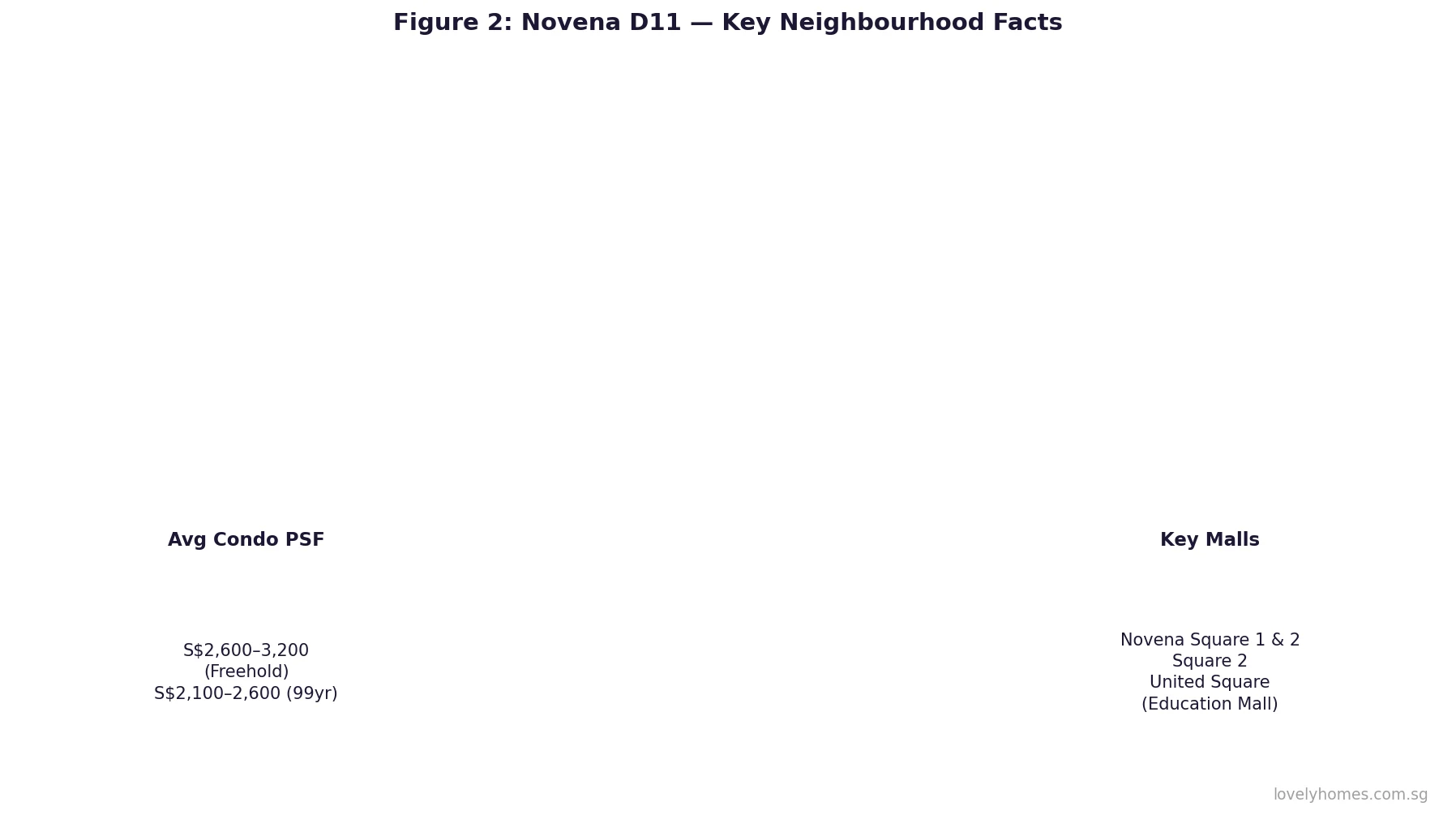
Novena neighbourhood key facts 2026 — district D11 MRT lines medical hub condo yields and malls

Figure 2: Novena D11 — key neighbourhood facts for property buyers and investors, 2026.

Novena station on the North South Line (NSL) gives residents a 4-minute train ride to Toa Payoh and a 6-minute ride to Orchard. Newton interchange station — one of only five interchange stations on the NSL — connects to the Downtown Line (DTL), enabling direct access to Buona Vista, one-north, and the Botanic Gardens without a transfer. Journey times to Raffles Place run at approximately 13–15 minutes, making D11 one of the best-connected residential precincts for CBD workers in Singapore.

The Thomson-East Coast Line (TEL) has further enhanced D11’s connectivity position without D11 itself sitting on the new line. Stevens interchange (TEL + DTL, opened December 2022) is a 5-minute drive or short bus ride from Novena, linking residents to TE1 (Woodlands North) and the full TEL corridor south through Stevens, Napier, Orchard Boulevard, and Orchard into the eastern spine. For Novena residents, TEL Stage 4’s opening in 2024 — connecting Founders’ Memorial, Tanjong Rhu, and the East Coast corridor — extended journey time savings for those commuting eastward.

By road, the Central Expressway (CTE) entrance at Moulmein Road provides fast north-south access. The Pan Island Expressway (PIE) junction at Adam Road is under 10 minutes from Novena. These road links are especially valued by residents who need to reach Changi Airport, the western industrial corridor, or the north.

The Medical Hub Premium: Why Hospitals Drive Novena Property Values

Singapore’s position as Southeast Asia’s foremost medical tourism destination directly benefits D11 landlords. Mount Elizabeth Novena Hospital — a 333-bed private tertiary hospital opened in 2012 by Parkway Pantai — anchors the Novena Specialist Centre cluster along Irrawaddy Road, home to more than 200 specialist clinics. Tan Tock Seng Hospital, Singapore’s second-largest public acute care hospital with approximately 1,700 beds, generates thousands of shift-based healthcare workers who need residential options within cycling or walking distance.

The practical implication is a rental market that outperforms broader D11 yield expectations in the sub-S$5,000/month segment. A typical 1-bedroom freehold condo (50–55 sqm) in Novena commands S$3,800–4,500/month, yielding approximately 2.8–3.2% gross on an acquisition cost of S$1.4–1.6 million. Two-bedroom units (80–95 sqm) attract medical families and senior specialists, renting at S$5,500–7,000/month for a gross yield of 2.5–3.0% on a S$2.0–2.4 million entry price.

This yield compression relative to fringe districts reflects the capital value premium commanded by CCR freehold stock — buyers are partly paying for capital preservation and the scarcity of new supply, not just income return. Investors who entered D11 between 2017 and 2020 and chose freehold units are now sitting on total returns (rental + capital appreciation) of approximately 30–45% over six years, comfortably outperforming CPF Ordinary Account returns and most balanced investment portfolios.

D11 Condo Price Trend 2019–2026

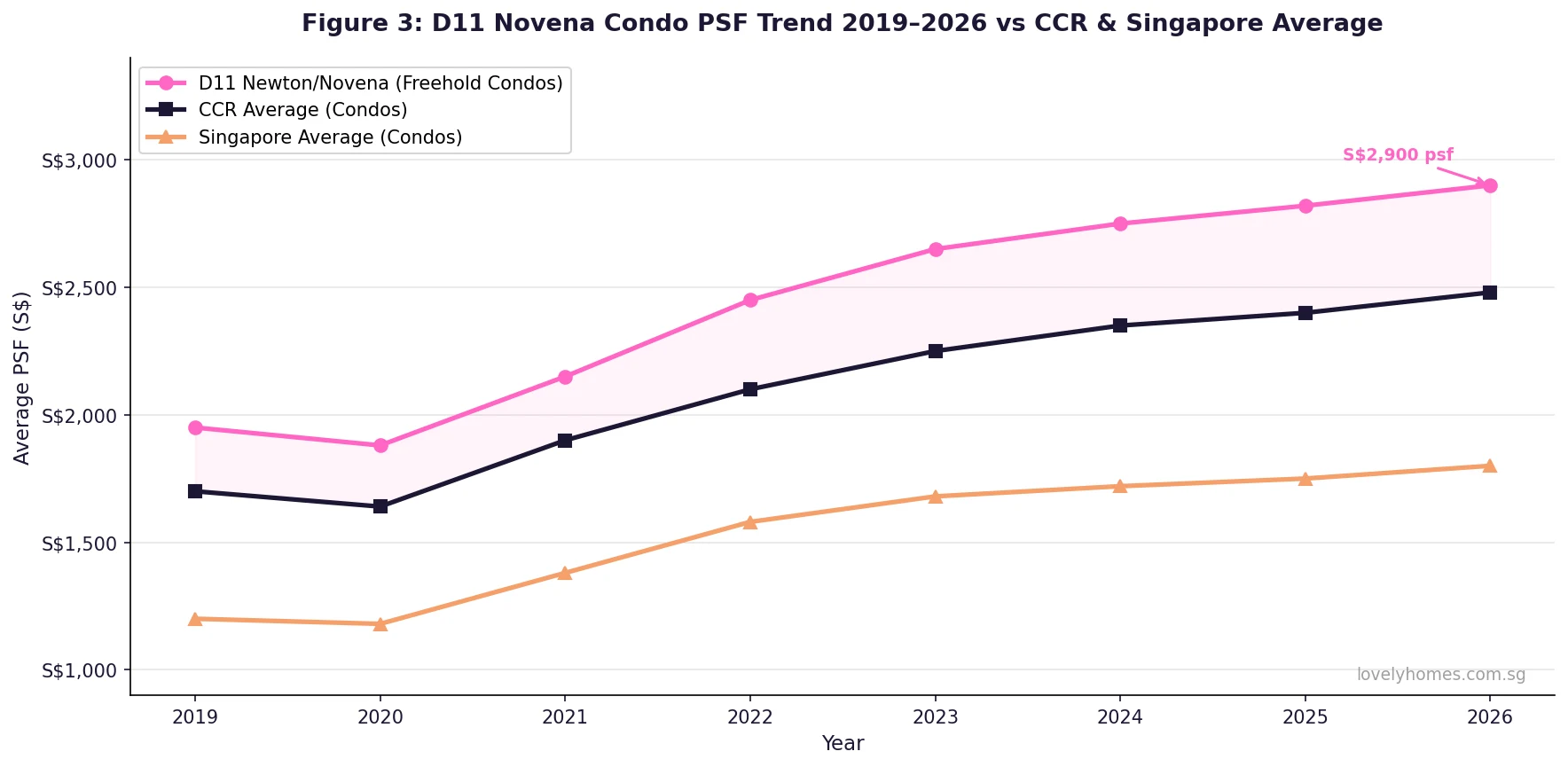
D11 Novena condo PSF trend 2019 to 2026 versus CCR and Singapore average line chart

Figure 3: D11 Newton/Novena average condo PSF trend 2019–2026 versus CCR and Singapore overall average. Source: URA REALIS, LovelyHomes analysis.

The chart above illustrates D11’s trajectory over the past seven years. Starting from roughly S$1,950 psf in 2019, freehold D11 condos contracted slightly during the pandemic-affected 2020 period before recovering strongly through 2021–2022 on the back of Singapore’s post-Covid reopening and a structural shift in buyer demand toward quality freehold assets. By 2023, D11 average freehold condo PSF had crossed S$2,600 psf for the first time. The 2022 and 2023 ABSD increases tempered transaction volumes — particularly for foreigners and second-property buyers — but did not dent per-unit pricing meaningfully, as supply in D11 is too constrained for any oversupply dynamic to emerge.

The shaded pink band in Figure 3 represents the D11 freehold premium over the broader CCR average. This premium has widened from approximately S$250 psf in 2019 to over S$420 psf in Q1 2026, reflecting both the structural scarcity of freehold stock in D11 and growing buyer preference for fully private, low-density living with minimal commercial encroachment.

Worked Example: Buying a 2-Bedroom Freehold Condo in Novena

📋 Case Study: Mr & Mrs Lee (SC/SC) — 2-Bed Freehold Condo, Novena, S$2,100,000

Profile: Singapore Citizens, first property purchase for both, combined gross income S$14,000/month. Buying a 2-bedroom freehold condo in Novena at S$2,100,000 for owner-occupation, no existing properties.

  • ABSD: S$0 (SC buying first residential property — no ABSD)
  • BSD (Buyer’s Stamp Duty):
    • 1% on first S$180,000 = S$1,800
    • 2% on next S$180,000 = S$3,600
    • 3% on next S$640,000 = S$19,200
    • 4% on next S$500,000 = S$20,000
    • 5% on next S$600,000 = S$30,000 (i.e. 2,100k less 1,500k threshold)
    • Total BSD: S$74,600 (effective 3.55%)
  • Loan: 75% LTV = S$1,575,000. At 3.5% p.a. over 25 years → monthly repayment ≈ S$7,882
  • TDSR check: S$7,882 / S$14,000 = 56.3% — exceeds the 55% TDSR limit. FAIL.
  • Resolution: Increase down payment to 35% (S$735,000), reducing loan to S$1,365,000 (65% LTV). Monthly repayment ≈ S$6,830. TDSR = 48.8% — PASS.
  • Or: Look at 99yr leasehold option at S$1,750,000 — TDSR at 75% LTV = S$6,568/mth = 46.9% — PASS with standard down payment.
  • Total upfront (with increased 35% down payment + BSD + legal fees ~S$8,000): approximately S$817,600

This example illustrates that D11 freehold condos at S$2M+ often push buyers to the TDSR boundary. Buyers with household income below S$13,000/month should model carefully before committing to prime CCR property at full 75% LTV.

What This Means for You: Investment Outlook for Novena 2026

D11’s investment case rests on three pillars: supply scarcity, institutional demand from the medical cluster, and the freehold tenure of the majority of its stock. No new GLS residential sites have been released in D11 since 2019, and URA’s long-term planning approach for the Novena area — classified as a Medical and Healthcare Hub in the 2019 Concept Plan — is to intensify medical uses rather than add residential supply. This means existing condo owners benefit from a structurally undersupplied rental market.

Peer-country comparison is instructive: Singapore’s medical tourism arrivals have recovered to pre-2020 levels and are projected to grow at 6–8% per year through 2030, according to Singapore Tourism Board data. Bangkok’s Sukhumvit medical precinct and Kuala Lumpur’s Bangsar medical cluster — both D11 comparators — trade at significantly lower absolute values but have shown similar rental demand dynamics when anchored by hospital clusters.

The 2023 ABSD increase to 20% for Singapore Citizens purchasing their second property has been the primary headwind, reducing the pool of upgrader-investors who would previously have held a D11 condo as a rental asset. However, institutional landlords, family offices, and HNW individuals — many of whom hold D11 property through structures exempt from or partially insulated from ABSD — have partially absorbed this demand withdrawal. Transaction volumes in D11 are lower than 2021–2022 peaks but prices have held firm.

For owner-occupiers, Novena remains one of Singapore’s best-value CCR living addresses on a “livability per dollar spent” basis: lower psf than Orchard/River Valley (D09/D10), with arguably better day-to-day amenities (healthcare, education, F&B) and equivalent MRT connectivity. First-time buyers with sufficient income ($13,000+/month household) priced out of Orchard condos will increasingly look to D11 freehold units as a value entry point into the CCR.

What Might Come Next for Novena?

URA’s Draft Master Plan 2025 (public consultation 2025–2026) has not released any residential-zoned GLS parcels within D11. The long-term direction for Novena is healthcare intensification: the Novena Health City vision positions the precinct as a full-service integrated medical district, with possible expansion of outpatient facilities and specialist centres along Irrawaddy Road and Balestier. Any rezoning of existing commercial or industrial sites in the area for residential use would be a meaningful catalyst — but industry observers see this as unlikely before 2030.

In the shorter term, the broader TEL completion in 2025 (Stages 4–5) and the continued growth of the Cross Island Line (CRL) network — which brings better connectivity to D11 feeder suburbs — are expected to sustain buyer appetite for CCR property including D11. If Singapore’s government chooses to recalibrate ABSD for second properties (reducing the 20% SC rate) as part of a future cooling-measures review, D11 would be among the prime beneficiaries given its investor-grade stock base.

Frequently Asked Questions: Buying Property in Novena

Are there HDB flats available in Novena for purchase?

Very few. D11 is almost entirely private residential, with only a small number of HDB resale flats in the Moulmein and Thomson fringe of the district. Buyers seeking public housing close to D11 typically look at nearby Toa Payoh (D12) or Novena-adjacent blocks in Moulmein Road. There are no BTO launches planned for D11 given the Master Plan’s designation of the area as a Medical and Healthcare Hub.

Can foreigners buy property in Novena?

Foreigners (non-Singapore Citizens and non-Permanent Residents) may purchase private condominiums (strata-titled, non-landed) in D11, including Novena, subject to paying Additional Buyer’s Stamp Duty (ABSD) of 60% on the purchase price as of April 2023. Landed property in D11 is restricted to Singapore Citizens only, with limited exceptions requiring Singapore Land Authority (SLA) approval for Permanent Residents in non-GCB landed categories.

What is the ABSD rate for a second property purchase in Novena?

As at 1 July 2026, a Singapore Citizen purchasing a second residential property pays ABSD of 20% on the purchase price. A Permanent Resident buying a first property pays 5% ABSD. A foreign buyer pays 60%. There is no ABSD for a Singapore Citizen purchasing their first residential property. For a D11 condo priced at S$2.0 million, the ABSD for a SC second-property purchase would be S$400,000 — a significant holding cost that most investors factor into their return model before committing.

What is the typical rental yield for condos in Novena?

Gross rental yields for condominiums in D11 Newton/Novena typically range from 2.5% to 3.2% per year in 2026, depending on unit size, floor level, and age of development. Smaller 1-bedroom units (45–55 sqm) tend to achieve the highest yields (2.9–3.2%) due to strong demand from single medical professionals, while larger 3-bedroom family units yield closer to 2.5% gross. Net yields after maintenance fees, property tax, and agent fees are typically 0.5–0.8% lower than gross.

What is the Minimum Occupation Period (MOP) for a condo in D11?

Private condominiums do not have a Minimum Occupation Period (MOP) requirement. Only HDB flats are subject to MOP (5 years for Standard flats, 10 years for Prime and Plus BTO flats). Private condo owners may rent out their unit from day one of ownership, provided they comply with URA tenancy regulations including the 3-month minimum rental period. This makes D11 condos immediately income-generating for buyers who intend to lease the property out.

How does Novena compare to Orchard Road (D09/D10) for property investment?

Novena (D11) generally offers lower entry prices than Orchard (D09) and River Valley (D10) at equivalent quality levels, with freehold condos in D11 averaging S$2,600–3,200 psf versus D09/D10 freehold at S$3,200–4,500 psf. Rental yields are comparable (2.5–3.2% across both zones). D11 benefits from the medical hub demand driver, which is more stable than the expatriate corporate demand that historically underpinned D09/D10 rentals. Buyers seeking CCR exposure with lower absolute outlay and a differentiated demand driver typically favour D11 over D09/D10.

Is Novena suitable for families with school-age children?

Yes — D11 is one of Singapore’s best-positioned districts for families prioritising education access alongside healthcare. Anglo-Chinese School (Primary) is located off Barker Road within the district. The Singapore Chinese Girls’ School (SCGS) is on Emerald Hill in adjacent D10. St. Joseph’s Institution International (SJI International) on Malcolm Road serves the international school market. United Square on Thomson Road is Singapore’s premier education-focused mall, housing enrichment centres, tuition providers, and learning-focused retail. Proximity to the Botanic Gardens (5 minutes by car) adds park space for families.

Related Articles

Disclaimer: This article is for general information purposes only and does not constitute financial, legal, or property advice. Property prices, stamp duty rates, HDB eligibility rules, and mortgage terms are subject to change. All figures cited are indicative based on publicly available URA REALIS data and industry analysis as at Q1/Q2 2026. Readers should verify current rules with the Urban Redevelopment Authority (ura.gov.sg), Housing & Development Board (hdb.gov.sg), Inland Revenue Authority of Singapore (iras.gov.sg), and seek advice from a licenced property agent, mortgage broker, and solicitor before making any property transaction decision.

Singapore Landlord Guide 2026: Rental Income Tax, Tenancy Agreements, Property Tax and Landlord Rights

Singapore Landlord Guide 2026: Rental Income Tax, Tenancy Agreements, Property Tax and Landlord Rights

Quick Answer: Singapore Landlord Key Facts 2026

  • Rental income is taxable: Resident landlords pay progressive income tax (0–22%) on net rental income after allowable deductions. Non-residents pay a flat 24% on gross rent.
  • Allowable deductions include: mortgage interest, property tax, fire insurance, maintenance and repair costs, and agent letting fees. Furniture, renovation, and capital improvements are not deductible.
  • Property tax on rental property: the Non-Owner-Occupied (NOO) progressive rate applies — from 10% on the first S$30,000 of Annual Value up to 24% on amounts above S$75,000 (IRAS, from 1 January 2024).
  • Stamp duty on tenancy agreement: 0.4% of total rent for leases of one year or less; tiered rates for longer leases. Must be stamped via IRAS within 14 days of signing.
  • HDB landlords must complete their Minimum Occupation Period (MOP) — 5 years for standard flats, 10 years for Plus/Prime BTO — and obtain HDB’s written approval before renting out the entire flat.
  • Short-term rentals (e.g. Airbnb): prohibited for all residential properties in Singapore. Minimum rental term is three consecutive months under the Planning Act.
  • Security deposit: typically one to two months’ rent. Disputes up to S$30,000 can be filed at the Small Claims Tribunal (SCT).

What Does It Mean to Be a Landlord in Singapore?

A landlord in Singapore is any person or entity that lets a residential property to a tenant in exchange for rent. The term covers the full spectrum: from an HDB flat owner renting out a spare bedroom, to a property investor managing a portfolio of private condominiums in the Core Central Region.

Singapore’s rental market is regulated by multiple government bodies. The Inland Revenue Authority of Singapore (IRAS) collects income tax on rental proceeds and administers stamp duty on tenancy agreements. The Housing and Development Board (HDB) regulates the subletting of public housing flats. The Urban Redevelopment Authority (URA) sets rules for private residential properties, including the minimum rental period. The Building and Construction Authority (BCA) governs strata management corporations (MCSTs) for condominiums. Understanding who regulates what is the first step to staying compliant and protecting your net yield.

Singapore’s residential rental market encompasses an estimated 58,000 private units and 56,000 HDB flats listed for rent at any given time. With median gross rental yields at 2.5–3.5% for condominiums and 3.5–4.5% for HDB flats (indicative 2026 figures), understanding the full cost and compliance picture is essential for any landlord.

Rental Income Tax: What Landlords Owe IRAS

Rental income received by a Singapore tax resident is assessable income under the Income Tax Act 1947. It must be declared on IRAS Form B1 (individuals) or Form B (self-employed persons and those with non-employment income) by 15 April each year, covering income from the preceding calendar year.

IRAS defines rental income broadly: monthly rent, any payment for the right to use the property, furniture rent charged separately, and even a lump-sum premium or key-money received at the start of a tenancy are all assessable.

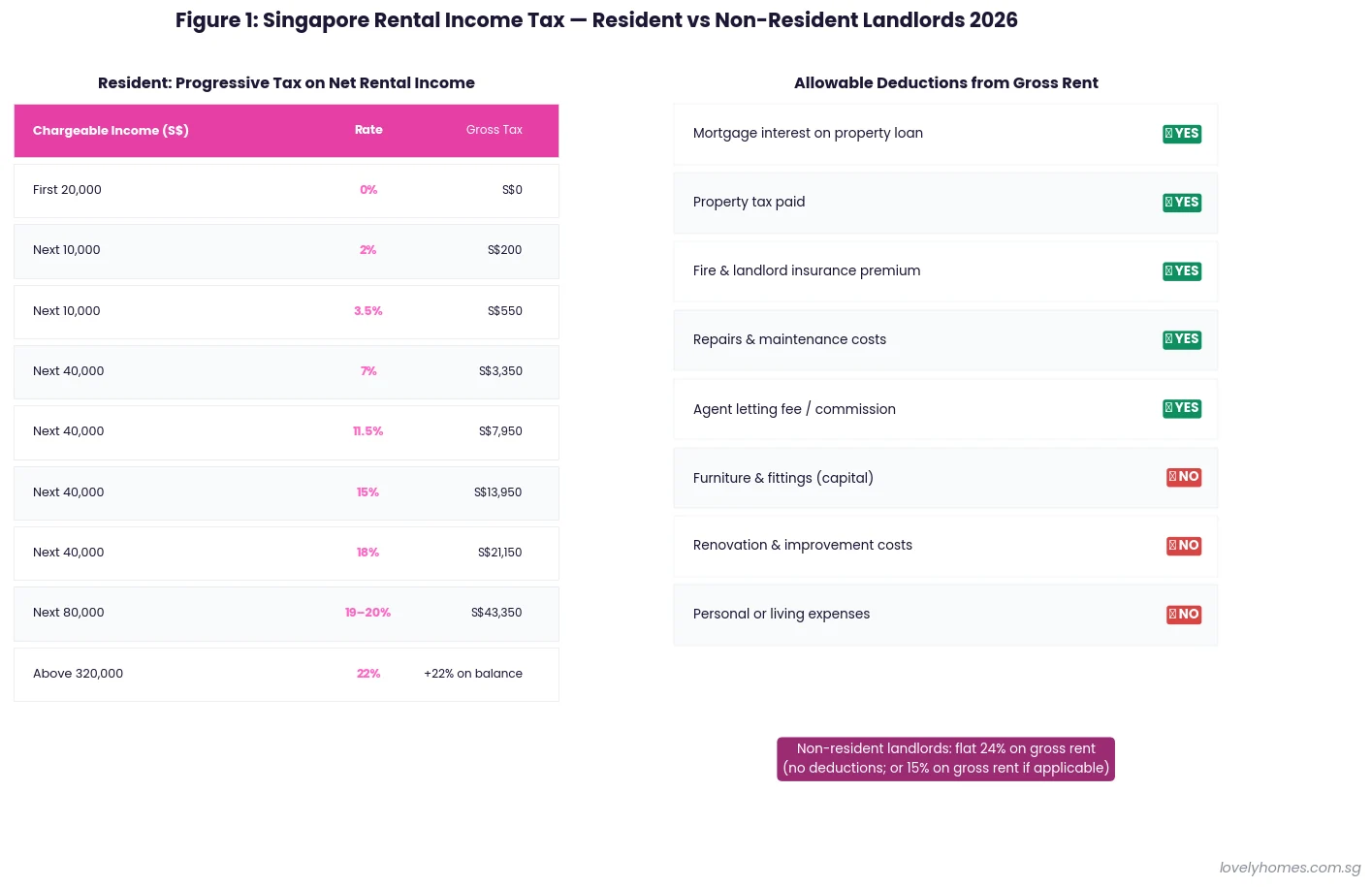
Singapore rental income tax rates 2026 resident vs non-resident landlords allowable deductions
Figure 1: Singapore Rental Income Tax — Resident Progressive Rates and Allowable Deductions (IRAS 2026). Non-resident landlords pay a flat 24% on gross rent with no deductions.

Resident Landlords: Net Income After Allowable Deductions

For Singapore tax residents, the taxable base is net rental income: gross rent received less the following allowable deductions recognised by IRAS:

  • Mortgage interest: interest on the loan used to purchase the property. Principal repayments are not deductible. For joint owners, only the portion of interest proportional to each individual’s share applies.
  • Property tax: the annual IRAS property tax bill for the rented property.
  • Fire and landlord insurance premiums taken out on the property.
  • Maintenance and repair costs: reasonable wear-and-tear repairs — replacing broken fixtures, repainting between tenancies. Capital improvements that enhance property value are not deductible.
  • Agent letting commission: the fee paid to a property agent for sourcing the tenant. Typically one month’s rent for a two-year lease, deductible in the year paid.

Net rental income is then added to the landlord’s total chargeable income and taxed at the applicable progressive resident rates: 0% on the first S$20,000, rising to 22% on amounts exceeding S$320,000.

Non-Resident Landlords: Flat-Rate Tax on Gross Rent

Non-resident individuals — for example, a foreigner who owns Singapore property but is not tax-resident here — are taxed at a flat rate of 24% on gross rent, with no deductions permitted. Non-residents may elect to be taxed at the resident progressive rates if this produces a lower liability, subject to IRAS rules. Where tax is withheld by a tenant, the landlord is responsible for ensuring accurate filing.

Property Tax for Landlords: The NOO Rate

Every property owner in Singapore pays property tax, regardless of whether the property is occupied or rented. When a residential property is rented out, the Non-Owner-Occupied (NOO) progressive rate applies — substantially higher than the owner-occupied (OO) rate. This differential is a deliberate policy to discourage speculative property holding.

The NOO rate is applied to the property’s Annual Value (AV) — IRAS’s estimate of the property’s annual market rent if let unfurnished. The AV is reviewed periodically. As a reference: a typical 4-room HDB flat in a mature estate carries an AV of approximately S$16,000–S$22,000; a mid-range condominium 2-bedroom unit in the Rest of Central Region may carry an AV of S$28,000–S$40,000. NOO property tax for a condo unit with AV S$30,000 is approximately S$3,000 per year (IRAS, 2024 rates).

Landlords should budget for this cost at the start of each financial year. IRAS issues property tax bills in December for the following year; the due date is 31 January.

Stamp Duty on Tenancy Agreements

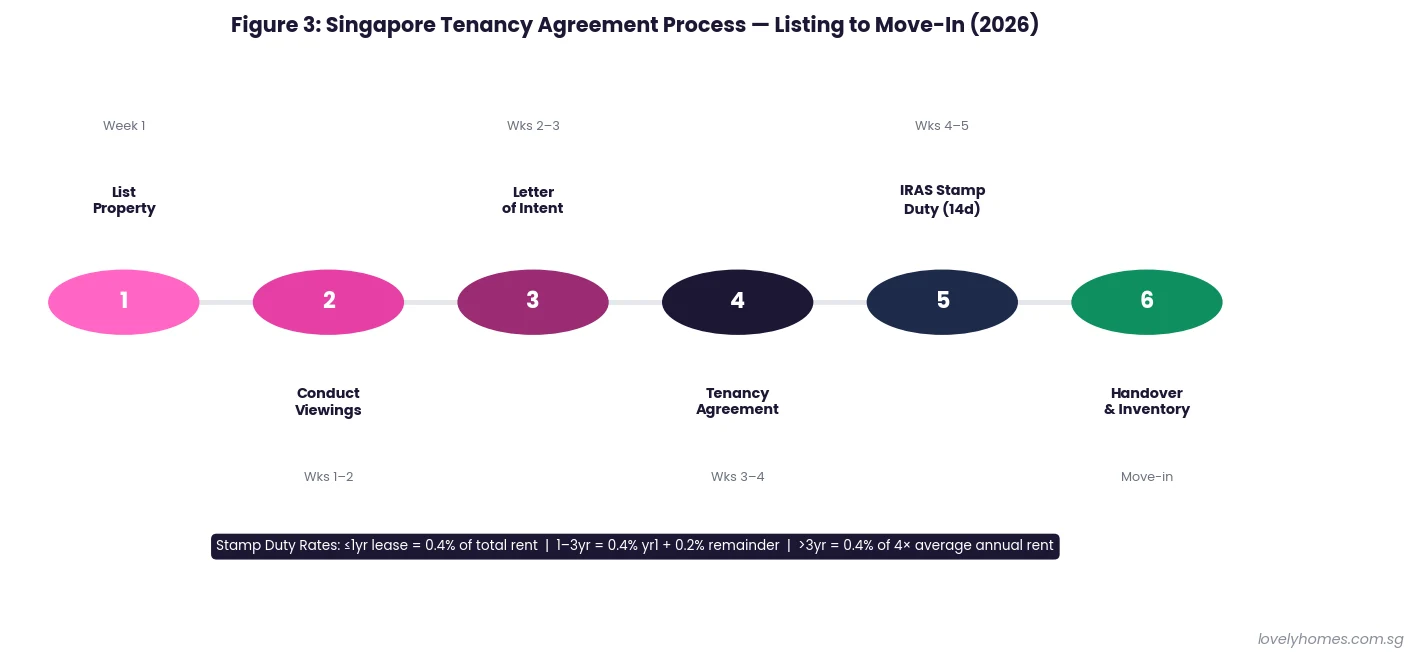
A tenancy agreement is a dutiable document under the Stamp Duties Act. Stamp duty must be paid via the IRAS myStampDuty portal within 14 days of signing if the document is signed in Singapore, or within 30 days if signed overseas.

The stamp duty rate depends on the length of the lease:

  • Lease of one year or less: 0.4% of the total rent for the full lease period.
  • Lease of more than one year up to three years: 0.4% of average annual rent for the first year, plus 0.2% of average annual rent for each remaining year.
  • Lease of more than three years or indefinite period: 0.4% of four times the average annual rent.

Who pays? By default, the tenant pays. However, landlord and tenant may agree otherwise and should record this in the tenancy agreement. Failure to stamp on time incurs a penalty of up to four times the duty owed.

Singapore tenancy agreement process timeline 2026 LOI stamp duty move-in
Figure 3: Tenancy Agreement Process in Singapore — Six Stages from Listing to Move-In (2026). IRAS stamping must be completed within 14 days of signing.

HDB-Specific Subletting Rules 2026

Owners of HDB flats face a more regulated environment than private property owners. The key rules as at 7 July 2026 are as follows.

Minimum Occupation Period (MOP): A flat owner must complete the MOP before renting out the entire flat. The MOP is five years for standard BTO, resale, and DBSS flats, measured from the date of key collection. For Plus and Prime BTO flats launched from the February 2024 exercise onwards, the MOP is ten years. There is no MOP restriction on renting out individual bedrooms, provided the owner continues to physically reside in the flat.

HDB Approval Required: Before renting out the entire flat, the owner must obtain HDB’s written approval via the HDB Resale Portal. Approval is granted online and must be renewed every three years. Renting out without approval may result in enforcement action, including compulsory acquisition of the flat by HDB.

Eligible Tenants: HDB flats may only be rented to Singapore Citizens, Singapore Permanent Residents, and non-citizens holding a valid long-term or work pass (Employment Pass, S Pass, Work Permit, Dependant’s Pass, Long-Term Visit Pass). Visitors and tourists are ineligible tenants for both entire flats and individual bedrooms.

Occupancy Cap: HDB 1- to 3-room flats: maximum four occupants total. HDB 4-room flats and larger: maximum six occupants. This includes all persons residing in the flat, whether family members, tenants, or sub-tenants.

Short-Term Rentals Prohibited: Renting any HDB flat or private residential unit for periods shorter than three consecutive months is prohibited under the Planning Act. URA enforces this actively; owners face composition fines and court action.

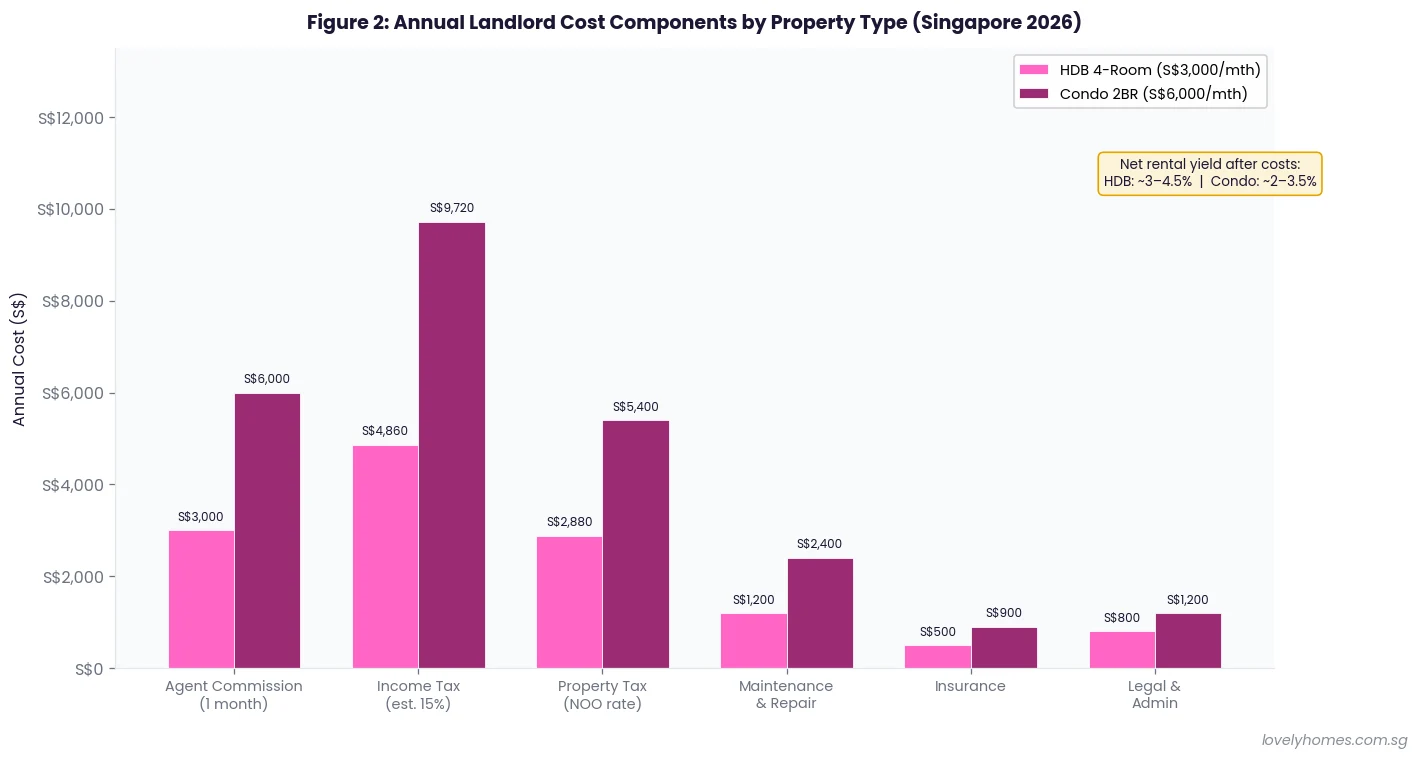
Annual Landlord Costs: What Eats Into Your Yield

Singapore landlord annual cost components 2026 HDB condo income tax property tax maintenance
Figure 2: Annual Landlord Cost Components — HDB 4-Room (S$3,000/mth) vs Condo 2BR (S$6,000/mth) — Singapore 2026. Indicative estimates based on current IRAS rates and market data.

A landlord’s gross rent is not the same as net yield. Several recurring cost lines erode returns:

  • Agent commission: typically one month’s rent for a new two-year lease. Some landlords negotiate a reduced fee for renewal tenancies.
  • Income tax on net rental income: a landlord in the 11.5% marginal bracket with S$20,000 net rental income may pay approximately S$2,300 in tax attributable to rental.
  • NOO property tax: significantly higher than OO rates. An HDB 4-room flat with AV S$18,000 incurs approximately S$1,800/year at NOO rates; a condominium 2BR with AV S$30,000 incurs approximately S$3,000/year.
  • MCST maintenance fees (condo landlords): typically S$200–S$600/month. These continue even during vacancy periods and cannot be passed to tenants unless contractually agreed.
  • Void periods: vacancy between tenancies reduces annual yield. In 2026, average void periods range from two to eight weeks depending on property type, location, and prevailing demand.

Summary: Key Landlord Obligations at a Glance

Obligation Authority Requirement Penalty for Non-Compliance
Declare rental income IRAS Form B / B1, by 15 April annually Penalty, back taxes, and interest
Stamp tenancy agreement IRAS Within 14 days of signing Up to 4× stamp duty owed
HDB subletting approval HDB Before renting out entire HDB flat Compulsory acquisition possible
Minimum 3-month rental period URA All residential properties Composition fine; court action
Pay property tax (NOO rate) IRAS Annual bill; due 31 January 5% surcharge on arrears
Maintain structure and fittings Common law Quiet enjoyment and habitability Tenant may withhold rent or sue
Register HDB tenants HDB Register via HDB Resale Portal Warning and enforcement action

Worked Example: Mr Ng Rents Out His 4-Room HDB in Bishan

Mr Ng (Singapore Citizen) owns a 4-room HDB flat in Bishan. He completed his MOP in August 2023 and obtained HDB subletting approval in September 2023. He rents the entire flat to a Korean couple on Employment Passes for S$3,000/month on a two-year lease commencing 1 October 2023.

Annual gross rental income: S$3,000 × 12 = S$36,000.

Allowable deductions for Year of Assessment 2024:

  • Mortgage interest (HDB loan S$350,000, approximately 25 years remaining, ~3.2% annual interest): S$11,200
  • NOO property tax (AV S$18,000, first S$18,000 at 10%): S$1,800
  • Fire and landlord insurance: S$380
  • Maintenance and minor repairs: S$720
  • Agent letting commission (1 month, amortised over 2-year lease): S$1,500

Total deductions: S$15,600. Net rental income: S$20,400.

Stamp duty on tenancy (paid by tenant): 2-year lease, total rent S$72,000. Stamp duty = 0.4% × S$36,000 (Year 1) + 0.2% × S$36,000 (Year 2) = S$144 + S$72 = S$216.

Income tax on rental income: Mr Ng’s total chargeable income (employment income S$82,000 + net rental S$20,400 = S$102,400). Tax at resident rates: approximately S$5,920. Rental’s share (~20%): approximately S$1,184 attributable to rental income.

Net yield analysis: S$36,000 gross rent − S$15,600 deductions − S$1,184 rental-attributable tax = S$19,216 net annual income, on an assumed flat value of S$580,000. Net yield: approximately 3.3%. The effective tax rate on rental income is approximately 3.3% of gross rent — substantially lower than the nominal income tax bracket because mortgage interest and property tax heavily reduce the taxable base.

Why This Matters for Singapore Landlords in 2026

The Singapore rental market has undergone significant structural change since 2022. Post-COVID demand from expatriates pushed prime condominium rents 30–40% above 2019 levels by 2023. By 2025–2026, those gains moderated as a record Government land sales pipeline — 9,320 units in the 2026 Confirmed List alone — fed new supply into the market. HDB rents similarly softened by 4–8% in 2025 as demand normalised.

The HDB Resale Price Index fell for a second consecutive quarter in Q2 2026 (to 202.7, down 0.3% quarter-on-quarter), a sign of broader market softening that affects rental demand confidence. For landlords, pricing discipline and tenant retention matter more than they did in the peak years.

Compared with other regional cities, Singapore stands out for regulatory transparency: IRAS publishes clear guidance on rental tax, HDB’s portal is fully digital, and Small Claims Tribunal procedures are accessible to ordinary landlords and tenants alike. The administrative burden is manageable for compliant landlords who treat property rental as the regulated business activity it is.

What Might Come Next

Several policy developments are worth monitoring. The Government’s ongoing BTO completions in Tengah, Bidadari, and Bayshore — adding more than 30,000 units through 2027–2028 — will sustain downward pressure on HDB resale and rental prices in the medium term. IRAS is also expected to review Annual Values for private residential properties in late 2026, reflecting the more moderate rental market of 2025; any downward revision would reduce NOO property tax bills.

There are ongoing policy discussions about whether to introduce more formal licensing requirements for private residential landlords, similar to frameworks in the United Kingdom and Australia. No formal proposal has been tabled as at July 2026, but landlords with multiple properties should monitor parliamentary proceedings and Ministry of National Development announcements closely.

Frequently Asked Questions

Do I need to declare rental income if I am only renting out a spare bedroom?

Yes. Any payment received for the right to use your property — including a single bedroom — is assessable rental income. You may claim deductions proportional to the rented area (for example, 25% of mortgage interest and property tax if one of four rooms is let). Declare on Form B1 by 15 April. There is no de minimis exemption threshold for rental income in Singapore.

Can I use CPF to pay my property tax or income tax on rental income?

No. CPF Ordinary Account (OA) funds may only be used for specific property-related payments: the downpayment, monthly mortgage instalments, and Buyer’s Stamp Duty on purchase. Annual property tax, income tax on rental proceeds, agent commissions, and all other landlord costs must be paid in cash. This is a common point of confusion for first-time landlords.

What can I do if my tenant stops paying rent?

First, issue a formal written notice of the breach and allow a reasonable cure period (typically 14 days). If unpaid rent does not exceed S$30,000, the Small Claims Tribunal (SCT) provides a faster and lower-cost route than the civil courts. For larger amounts, a civil suit in the District Court or High Court may be necessary. The landlord may also apply for a Writ of Distress to seize the tenant’s goods. The security deposit held may be applied against arrears at the end of the tenancy, but not unilaterally mid-lease unless the agreement expressly permits this.

Do I need HDB approval to rent out a bedroom in my flat before completing the MOP?

The MOP restriction applies only to renting out the entire flat. Before completing the MOP, you may rent out individual bedrooms, provided you continue to physically reside in the flat alongside the tenants. You must still register the subletting of bedrooms with HDB via the Resale Portal. Tourists and visitors without valid passes remain ineligible as tenants for rooms as well as for entire flats.

Is the security deposit I receive from a tenant taxable income?

No, not when received. A security deposit is a refundable sum held as security against the tenant’s obligations; it is not income at the point of receipt. However, if you legitimately forfeit all or part of the deposit — for example, because the tenant terminated early and the agreement entitles you to retain one month as a penalty — the forfeited amount becomes assessable income in the year of forfeiture and must be declared to IRAS.

Can foreigners rent HDB flats in Singapore?

Foreigners may rent HDB flats provided they hold a valid long-term pass. Eligible pass types include the Employment Pass (EP), S Pass, Work Permit, Dependant’s Pass (DP), and Long-Term Visit Pass (LTVP). Tourists and visitors on Social Visit Passes, Student’s Passes used for short stays, and persons without a valid pass are not eligible tenants for HDB flats — whether for an entire flat or a room. The HDB Resale Portal enables flat owners to verify a prospective tenant’s eligibility before signing.

Disclaimer: This article is for general informational purposes only and does not constitute tax, legal, or financial advice. Rental income tax rules, property tax rates, and HDB subletting regulations are subject to change. Information reflects publicly available guidance from IRAS (iras.gov.sg), HDB (hdb.gov.sg), and URA (ura.gov.sg) as at 7 July 2026. Please consult a qualified tax adviser, conveyancing solicitor, or licensed property agent before making rental property decisions.

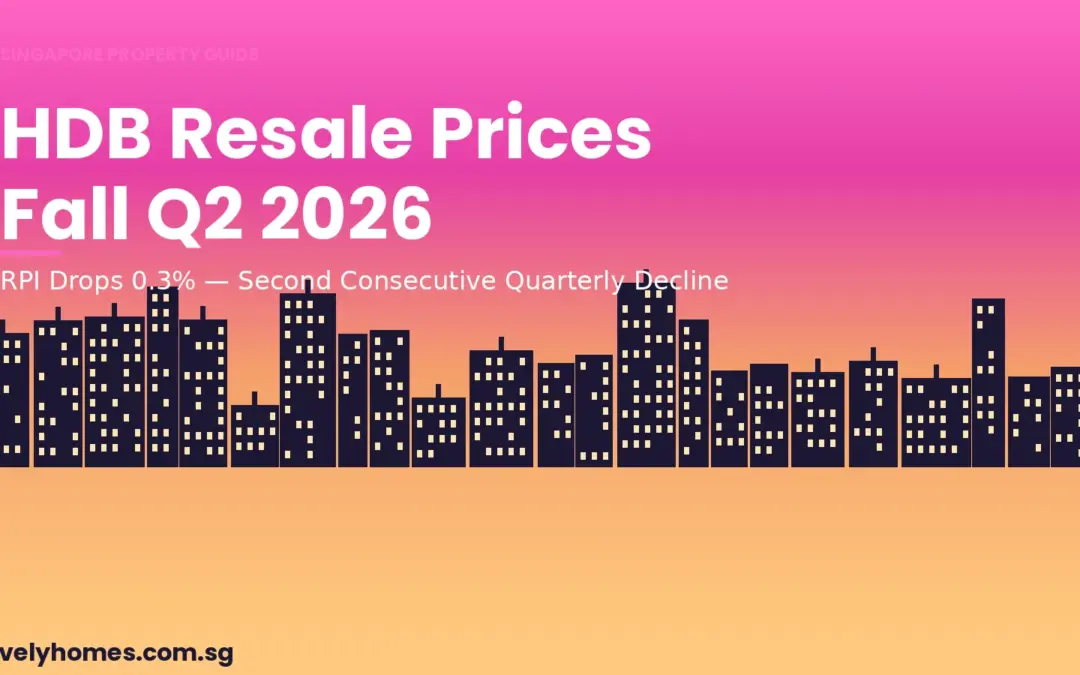
HDB Resale Prices Fall for Second Consecutive Quarter in Q2 2026: RPI Slips to 202.7

HDB Resale Prices Fall for Second Consecutive Quarter in Q2 2026: RPI Slips to 202.7

×Click or press Esc to close
Quick Answer — HDB Resale Q2 2026 Flash Estimates

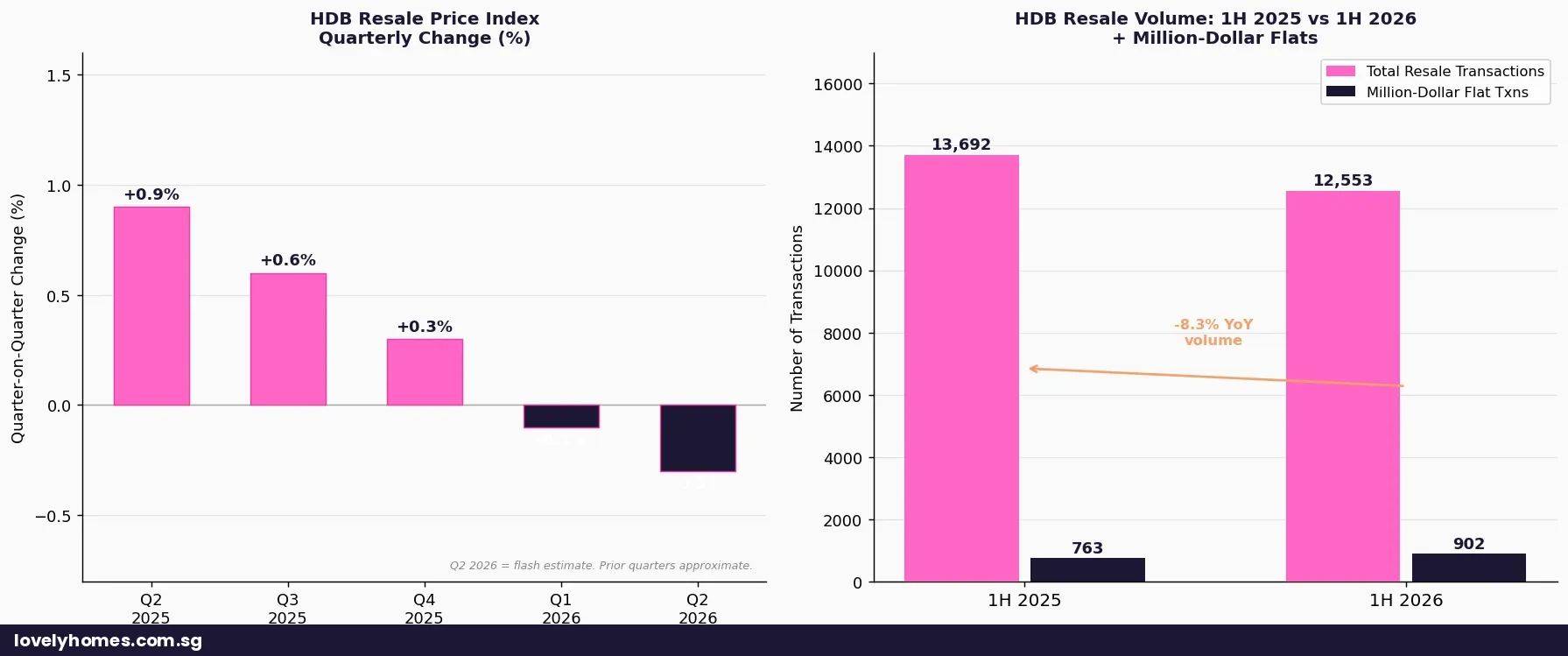
  • The HDB Resale Price Index (RPI) fell 0.3% in Q2 2026 (quarter-on-quarter), bringing the index to 202.7. This is the second consecutive quarterly decline.
  • Combined with Q1 2026’s −0.1%, this marks the first back-to-back decline since the four-quarter fall from Q3 2018 to Q2 2019.
  • Resale volume in Q2 2026: 6,268 transactions — nearly unchanged from Q1’s 6,285, but the 1H 2026 total of 12,553 is 8.3% below 1H 2025’s 13,692.
  • Million-dollar flat transactions rose to 491 in Q2 2026 alone, bringing 1H 2026 to 902 — surpassing the 763 recorded in all of 1H 2025.
  • These are flash estimates released by HDB on 1 July 2026; full Q2 2026 statistics are expected around 23 July 2026.
  • The decline reflects the combined impact of property cooling measures (15-month wait-out period, tightened HDB loan conditions introduced in 2023–2024) and increased BTO supply.
  • Private property prices rose 0.5% in Q2 2026, widening the gap between the HDB resale and private residential markets.

HDB Resale Prices Slip for the Second Consecutive Quarter

Singapore’s public housing resale market posted its second consecutive quarterly price decline in Q2 2026, according to flash estimates released by the Housing and Development Board (HDB) on 1 July 2026. The HDB Resale Price Index fell 0.3% to 202.7, following the 0.1% dip recorded in Q1 2026.

While the absolute magnitude of the decline remains modest, the back-to-back nature of the falls is significant. Prior to Q1 2026, the HDB resale market had not recorded a single quarterly price decline since Q3 2018 — a stretch of more than six years of unbroken price appreciation that weathered the COVID-19 pandemic, successive rounds of cooling measures, and record-breaking million-dollar flat transactions.

The Q2 2026 data points to a market that is adjusting — gradually but meaningfully — to higher interest rates, an expanded BTO supply pipeline, and the cumulative weight of demand-side cooling measures introduced since September 2022. At the same time, the continued surge in million-dollar flat transactions to 491 in Q2 suggests that the prestige end of the market remains resilient, even as broad prices soften.

HDB resale price index Q2 2026 quarterly change and transaction volume flash estimate Singapore
Figure 1: HDB Resale Price Index — Quarterly % Change (Q2 2025 to Q2 2026 Flash Estimate) and Transaction Volume Comparison 1H 2025 vs 1H 2026. Source: HDB flash estimates, 1 July 2026.

Reading the Data: Three Dimensions

Price: The Second Consecutive Dip

The 0.3% decline in Q2 2026 follows the 0.1% fall in Q1, giving a cumulative 1H 2026 decline of approximately 0.4% from the Q4 2025 peak. In absolute terms, the RPI at 202.7 is approximately 2.5% below the peak recorded in Q3 2023 (estimated 207.8), when a series of aggressive cooling measures first began to deflect demand. For context, the RPI stood at roughly 168 before the pandemic surge of 2020 — meaning prices are still some 20% above pre-pandemic levels even after the current decline.

Volume: Stable Quarter but Down Year-on-Year

At 6,268 transactions, Q2 2026 resale volume was broadly steady versus Q1’s 6,285. The constancy suggests that the market is softening on price, not experiencing a liquidity freeze — there is still a functioning market of willing buyers and sellers. However, the 1H 2026 total of 12,553 transactions is 8.3% below the 13,692 recorded in 1H 2025, signalling that fewer households are choosing to enter or exit the HDB resale market compared to a year ago. This may reflect buyers waiting for BTO completions, or sellers reluctant to accept lower prices.

Million-Dollar Flats: The Paradox of Rising Premium Transactions

The 491 million-dollar resale transactions in Q2 2026 is one of the highest quarterly counts on record, bringing the 1H 2026 total to 902 — compared to 763 in 1H 2025. This appears paradoxical given the broader price decline. The explanation lies in composition: a greater proportion of large, well-located flats (such as mature-estate 5-Rooms, Executive flats in Bishan, Queenstown, and Toa Payoh, and high-floor units with unobstructed views) are transacting at S$1 million or above, even as median prices for standard flat types ease. The million-dollar threshold is increasingly a function of location and flat specifications rather than broad market inflation.

Why Are HDB Resale Prices Falling?

Several structural and policy-driven factors help explain the shift:

  • BTO supply ramp-up: HDB is on track to launch approximately 19,600 new BTO flats in 2026 alone, including major tranches in Tengah, Bedok, and Toa Payoh. A substantial portion of buyers who might otherwise have purchased resale flats are opting to wait for BTO completions, particularly after the government’s introduction of the Plus and Prime flat classifications in 2024 which offer new flats in desirable locations at subsidised prices.
  • 15-month wait-out period: the wait-out period imposed in September 2022 — requiring owners of private residential properties to wait 15 months before purchasing a resale HDB flat — has reduced upgrader-to-downgrader demand for HDB resale. Private property owners who previously used HDB resale as a “cashing out” destination are constrained.
  • Tighter HDB loan criteria: the reduction in HDB concessionary loan LTV from 85% to 80% introduced in 2023, combined with HDB’s stress test at 3.0%, has reduced the maximum loan quantum for some buyers, dampening purchasing power.
  • Interest rate environment: while Singapore interbank rates have moderated from 2022–2023 peaks, bank mortgage rates remain above 2.5%, increasing monthly repayment obligations and constraining affordability relative to the 2019–2020 era when rates were near zero.

What the Data Means for Buyers and Sellers

For buyers, two consecutive declining quarters represent a modest but real opportunity to negotiate. The market is softer than at any point since 2019, and sellers are generally more realistic about pricing than during the frenzy of 2021–2023. However, buyers should not expect a dramatic correction — the fundamental demand for housing in Singapore remains strong, and government policy is explicitly designed to maintain market stability rather than to allow sharp corrections.

For sellers, the data confirms that the period of listing and achieving above-valuation prices within days has passed in most segments. Realistic pricing at or near recent transacted values — checked via HDB’s HDB Resale Flat Prices portal — is now essential for a timely sale. Premium-location flats (mature estates, near MRT, high floor) continue to command strong demand even as median prices ease.

Metric Q1 2026 Q2 2026 (Flash) Change
HDB Resale Price Index (RPI) ~203.3 202.7 −0.3% QoQ
Consecutive quarters of decline 1 (first since 2018) 2
Resale transactions 6,285 6,268 −0.3%
1H 2026 vs 1H 2025 volume 12,553 vs 13,692 −8.3% YoY
Million-dollar flat transactions 411 (1H total partial) 491 1H total: 902 (+18.2% vs 1H 2025)
Full data release ~23 July 2026 (HDB full Q2 2026 statistics)

Table 1: HDB Resale Market Q2 2026 Flash Estimate Summary. Source: HDB, 1 July 2026.

What Might Come Next

The full Q2 2026 HDB resale statistics — due around 23 July 2026 — will provide complete data including town-by-town breakdowns, flat-type analysis, and cash-over-valuation (COV) trends. LovelyHomes will publish a comprehensive analysis at that time.

Looking ahead, the direction of HDB resale prices through the second half of 2026 will be shaped primarily by the pace of BTO completions and move-ins (which should free up additional resale supply), the trajectory of interest rates in Singapore (closely linked to US Federal Reserve policy), and any policy adjustments HDB may announce in the August or October BTO exercises. Market consensus among analysts tracked by LovelyHomes suggests a further modest decline of 0–1% in Q3 2026 before the market stabilises around year-end.

Frequently Asked Questions

What is the HDB Resale Price Index (RPI) and how is it calculated?

The HDB Resale Price Index is a measure published by the Housing and Development Board that tracks movements in the overall level of resale flat prices in Singapore. It is calculated using a hedonic regression model that controls for factors such as flat type, floor area, storey height, remaining lease, and location, allowing like-for-like comparison across periods. The index base year is Q1 2012 = 100. A reading of 202.7 in Q2 2026 means that prices are broadly 102.7% above Q1 2012 levels. The flash estimate published in the first week of each quarter uses a partial transaction dataset; the final figure is revised approximately three weeks later when the full quarter’s data is available.

Does a second consecutive quarterly decline mean the market is crashing?

No. A cumulative decline of 0.4% over two quarters is far from a crash — by any measure it represents a gentle correction after a multi-year price surge. For context, the 2018–2019 cooling cycle saw four consecutive quarters of decline totalling approximately 4% before prices stabilised and resumed their upward trend. The current environment is different: housing supply is expanding deliberately via BTO, borrowing conditions are tighter, and government policy is actively calibrated to engineer a soft landing rather than a correction. Buyers should view the current data as a modest softening, not a distress signal.

Should I wait for further price falls before buying an HDB resale flat?

Market timing in property is notoriously difficult, even for professional analysts. If your housing need is immediate — for example, you have a growing family, your existing lease is ending, or you have just passed the five-year MOP on your current flat — then market timing is largely irrelevant: the right time to buy is when it meets your household’s needs and financial capacity. If you are buying purely as an investment or as an upgrade with flexibility on timing, then the current softening does offer a more favourable negotiating environment than 2022 or 2023. However, attempting to call the exact bottom is speculative. For personalised financial planning, consult a licensed financial adviser.

Why are million-dollar flat transactions rising even as the overall RPI falls?

The million-dollar threshold is not itself a price index — it is a count of transactions above S$1 million regardless of flat size or type. The rising count reflects several factors: more large flats (5-Room and Executive) in desirable mature estates were completed with MOP five or more years ago and are now entering the resale market; the premium placed on location, floor height, and remaining lease has widened the spread between ordinary and premium flats; and a cohort of upgrading couples with substantial CPF savings and equity from earlier BTO flats are willing to pay for well-located resale units. In essence, the prestige segment is diverging from the mass-market segment within the same index.

When will the full Q2 2026 HDB resale statistics be released?

The full Q2 2026 HDB resale statistics are expected around 23 July 2026, based on HDB’s historical release calendar. The full data will include town-by-town price indices, volume by flat type and estate classification (mature vs non-mature), median resale prices by town, and COV trends. LovelyHomes will publish a comprehensive analysis at that time — see our ongoing Singapore Private Property Market Q2 2026 coverage for context on the broader residential market.

Related Articles

Disclaimer

This article is published by LovelyHomes Editorial Team based on HDB flash estimates released on 1 July 2026. Flash estimates are preliminary and subject to revision when full Q2 2026 data is published (~23 July 2026). Price indices and transaction volumes cited are sourced from HDB.gov.sg. Prior-quarter trend comparisons for indicative RPI changes are approximate. This article does not constitute property, financial, or legal advice. Readers are encouraged to consult official HDB resources and licensed professionals before making any property decision. All figures cited are as at 6 July 2026.

Singapore Condo Rental Guide 2026: Costs, Process, Stamp Duty and Tenant Rights

Singapore Condo Rental Guide 2026: Costs, Process, Stamp Duty and Tenant Rights

×Click or press Esc to close
Quick Answer — Renting a Condo in Singapore 2026

  • Who can rent: Singapore citizens, permanent residents, and most foreigners holding valid work or long-term passes may rent a private condo unit. There is no separate approval required from HDB or URA for non-landed private property rentals.
  • Typical upfront costs on a 1-year lease include the first month’s advance rent, a security deposit (typically one month’s rent for a 1-year lease), and stamp duty on the Tenancy Agreement.
  • Stamp duty on the lease is borne by the tenant and is approximately 0.4% of the total contract rent. A S$4,000/mth 1-year lease incurs approximately S$192 in stamp duty.
  • The Tenancy Agreement (TA) must be stamped with IRAS within 14 days of the date it was signed.
  • Lease durations are typically 1 or 2 years. 3-year leases exist but are less common for condos.
  • Diplomatic Clause: most landlords grant this for 2-year leases, allowing early termination (usually after 12 months) with 2 months’ notice — important for foreign tenants.
  • Rental prices in 2026 range from approximately S$2,400/mth for a studio in the Outside Central Region (OCR) to over S$14,000/mth for a 4-bedroom unit in the Core Central Region (CCR).
  • Property tax and maintenance fees are the landlord’s responsibility — not the tenant’s, unless otherwise agreed in the TA.

Singapore’s Condominium Rental Market in 2026

Singapore’s condo rental market is one of the most active in Asia. With a permanent resident and expatriate population generating sustained demand, and a growing professional class of Singaporeans choosing to rent rather than buy, private condominium rentals remain a key pillar of the residential property market. According to URA rental data, over 70,000 non-landed private residential rental transactions are registered annually in Singapore, the majority being condominiums.

Rental prices rose sharply between 2021 and 2023 as pandemic-era supply disruptions and surging demand from returning expatriates pushed rents to record highs. Since late 2023 and into 2024–2026, the market has moderated as a substantial pipeline of new completions — including major integrated developments and Build-To-Rent projects — has added supply. As at Q1 2026, URA’s condo rental index shows rents broadly stable, with pockets of softness in the OCR and selective strength in CCR luxury units.

Who Can Rent a Condo in Singapore?

Any person with a legal right to reside in Singapore may rent a private condominium unit. This includes Singapore citizens, permanent residents, Employment Pass holders, S Pass holders, Dependent Pass holders, and Long-Term Visit Pass holders. There is no application to HDB or the Urban Redevelopment Authority (URA) required for non-landed private property rentals — the agreement is directly between landlord and tenant, governed by general contract law and the Residential Tenancies Act framework.

However, landlords are obligated under the Residential Property Act and Immigration Act rules to verify that all tenants hold valid passes allowing them to reside in Singapore. Tourist visa holders may not enter into a rental agreement. Short-term rentals of less than three months are prohibited under URA’s short-term accommodation rules (which also restrict Airbnb-style platforms for private residential units).

Rental Prices by Region and Flat Type (2026)

average condo rental prices Singapore 2026 by region CCR RCR OCR and flat type
Figure 1: Average Monthly Condo Rental Prices by Region and Flat Type — Indicative Q1 2026 (Source: URA/SRX median data)

Singapore’s condo rental prices differ substantially across the three planning regions. The Core Central Region (CCR) — comprising Districts 1–4, 9, 10, 11 and Sentosa Cove — commands premium rents driven by proximity to the Central Business District, prestigious schools, and international amenities. The Rest of Central Region (RCR) offers a middle ground, with maturing townships such as Queenstown, Bishan, and Toa Payoh appealing to both expatriates and local professionals. The Outside Central Region (OCR) spans the suburban heartlands from Jurong to Tampines, Woodlands to Pasir Ris, offering the most accessible rental entry points.

Flat Type CCR (Monthly S$) RCR (Monthly S$) OCR (Monthly S$)
Studio / 1-Bedroom S$3,500–S$6,000 S$2,800–S$3,800 S$2,200–S$3,000
2-Bedroom S$5,000–S$9,000 S$3,800–S$5,500 S$3,000–S$4,200
3-Bedroom S$8,000–S$14,000 S$5,500–S$8,500 S$4,200–S$6,000
4-Bedroom / Penthouse S$12,000–S$25,000+ S$8,500–S$13,000 S$6,000–S$10,000

Table 1: Indicative monthly condo rental ranges by region and flat type, as at Q1 2026. Actual rents vary by project, floor, furnishing, and lease tenure. Source: URA rental caveats and SRX median data.

The Condo Rental Process: Step-by-Step

Renting a condominium in Singapore follows a relatively standard process. Unlike buying a property, there is no government portal or pre-approval required — the process is market-driven, though stamp duty obligations and pass verification requirements are mandatory.

  1. Define your budget and requirements: determine your affordable monthly rent (typically no more than 30–40% of net take-home income), preferred region, flat type, and preferred MRT or school proximity.
  2. Search and viewings: search listings on property portals or engage a salesperson. Note that landlords and tenants typically each engage their own representative, with fees negotiated case by case — typically one month’s rent for a 1-year lease paid by the tenant, or co-broking arrangements.
  3. Letter of Intent (LOI) / Offer to Lease: once you identify a unit, submit a Letter of Intent with your proposed rental terms, key money (typically one to two weeks’ rent), and requested lease commencement date. The landlord may accept, reject, or counter.
  4. Tenancy Agreement (TA): upon acceptance, the TA is drafted (typically by the landlord’s salesperson). Review it carefully — key clauses include rent amount, lease period, security deposit, Diplomatic Clause, permitted use, and maintenance responsibilities. Seek legal advice for any non-standard terms.
  5. Sign and stamp: both parties sign the TA. The tenant pays the first month’s advance rent and the security deposit upon signing. The TA must be stamped with IRAS within 14 days of the signing date. Stamp duty is payable by the tenant.
  6. Move-in inventory check: conduct a joint inspection with the landlord on or before the lease commencement date. Document all existing defects in writing and by photographs — this protects both parties on the security deposit at the end of the tenancy.

Upfront Costs When Renting a Condo

condo rental upfront costs Singapore 2026 security deposit stamp duty agent fee
Figure 2: Upfront Costs When Renting a Condo — Illustrative for a S$4,000/mth 2BR OCR 1-Year Lease (2026)

The security deposit is typically one month’s rent for a 1-year lease or two months’ rent for a 2-year lease. This deposit is held by the landlord (or sometimes in escrow) and refunded within a reasonable time after the tenancy ends, less any justified deductions for rent arrears or damages beyond fair wear and tear.

Stamp Duty on Tenancy Agreements

Under the Inland Revenue Authority of Singapore (IRAS), tenants are required to stamp their Tenancy Agreements. The stamp duty rate is:

  • 0.4% of the average annual rent for leases with a fixed term (simplified computation: 0.4% × total rent for leases up to 4 years).
  • For a 1-year lease at S$4,000/mth: total rent = S$48,000; stamp duty = S$48,000 × 0.4% = S$192.
  • For a 2-year lease at S$4,500/mth: total rent = S$108,000; stamp duty = S$108,000 × 0.4% = S$432.
  • Stamp duty is payable by the tenant, though this is occasionally negotiated otherwise in the TA.
  • Failure to stamp within 14 days incurs a late penalty (initially S$10, then escalating).

The TA must be stamped via the IRAS myStamp portal or at any IRAS service centre. Many salespersons handle this on behalf of their clients, but the legal obligation remains with the tenant unless the TA specifies otherwise.

Key Clauses to Check in Your Tenancy Agreement

The TA is a legally binding contract. Clauses worth scrutinising carefully include:

  • Diplomatic Clause: allows early termination after a minimum period (usually 12 months for a 2-year lease) with 2 months’ written notice. Essential for foreign tenants whose employment situation may change. Not standard on all leases — negotiate before signing.
  • Landlord’s access: the landlord should only enter the unit with reasonable advance notice (24 hours is customary) except in emergencies. Any clause allowing entry without notice should be queried or struck out.
  • Maintenance responsibilities: the TA typically requires the tenant to be responsible for minor maintenance (e.g., replacing light bulbs, unblocking drains) while the landlord covers structural and major appliance repairs. Clarify what constitutes “fair wear and tear”.
  • Air-conditioner servicing: standard practice is quarterly servicing at the tenant’s cost. This is often stated explicitly in the TA and is a reasonable tenant obligation.
  • Subletting: subletting the entire unit without the landlord’s written consent is generally prohibited. If you require the right to sublet individual rooms, negotiate this explicitly.
  • Handover condition: confirm the exact condition in which the unit must be returned (e.g., professionally cleaned, walls repainted).
tenant rights Singapore 2026 condo rental quiet enjoyment security deposit stamp duty diplomatic clause
Figure 3: Key Tenant Rights and Obligations in Singapore Condo Rentals (2026)

Worked Example: James Rents a 2BR OCR Condo

James is a British national on an Employment Pass, earning S$8,500/mth. He wants to rent a 2-bedroom unit in the OCR (Jurong East area) on a 2-year lease.

  • Agreed rent: S$3,500/mth for a 2BR 840 sqft unit at a leasehold condo 8 minutes’ walk from Jurong East MRT.
  • Lease period: 1 July 2026 to 30 June 2028 (2 years), with Diplomatic Clause from 1 July 2027 (12 months + 2 months’ notice).
  • Security deposit: 2 months × S$3,500 = S$7,000 (standard for 2-year lease).
  • 1st month advance rent: S$3,500 paid at signing.
  • Stamp duty: total rent = 24 × S$3,500 = S$84,000; stamp duty = S$84,000 × 0.4% = S$336 (stamped by salesperson via IRAS within 14 days).
  • Agent fee (co-broke): S$3,500 × 1 = S$3,500 (1 month’s rent, split between landlord’s and tenant’s representatives on co-broking basis; tenant’s representative absorbed by landlord in this example).
  • Total upfront outlay for James: S$7,000 (deposit) + S$3,500 (1st month) + S$336 (stamp duty) = S$10,836.
  • Monthly on-going: S$3,500 rent + quarterly air-con servicing ~S$80 + SP Group utilities (metered) ~S$200/mth estimated = approximately S$3,780/mth all-in.
  • Rental as % of income: S$3,500 / S$8,500 = 41.2% — on the higher end of affordability benchmarks, but manageable given no CPF obligations for EP holders.

What This Means for You

Renting a condo in Singapore is one of the most transparent and well-regulated rental experiences in Asia. The stamp duty obligation, while modest (0.4%), ensures leases are formally registered. The emphasis on written TAs and inventory checks protects both parties. The Diplomatic Clause — while not legally mandated — is widely accepted practice and critically important for expatriates.

From a cost perspective, 2026 represents a more balanced rental market than the peak of 2022–2023. Tenants have more negotiating power on lease terms, furniture packages, and rent-free periods than they did two years ago. Vacancy rates have risen in several OCR and newer RCR developments as completions accelerate, meaning landlords in these pockets are more willing to negotiate. The CCR luxury segment, however, remains tight — driven by sustained demand from financial sector and tech-sector professionals.

What Might Come Next

Singapore’s rental market in the medium term (2026–2028) faces two countervailing forces. On the supply side, a significant pipeline of private residential completions — approximately 8,000–10,000 units per year through 2027 according to URA’s construction data — should continue to exert moderating pressure on rents, particularly in the OCR and new RCR townships. On the demand side, Singapore’s continued attractiveness as a regional business hub and the government’s restrained foreign manpower policies mean rental demand from pass holders is unlikely to collapse.

Regulatory watch: MAS and URA are studying the residential tenancies framework, including possible standardisation of TA templates and security deposit handling. A formal Residential Tenancies Act — modelled on frameworks in Hong Kong or Australia — has been discussed but not yet enacted as at mid-2026. Any such legislation would likely strengthen tenant protections around deposit refunds and repair obligations, which are currently governed primarily by contract terms rather than statute.

Frequently Asked Questions

Can I negotiate on condo rental price in 2026?

Yes, and more so than in 2022–2023. With a softer rental market across the OCR and parts of the RCR, landlords are more flexible on headline rent, rent-free fit-out periods (1–2 weeks free rent at the start of the lease to allow for minor touch-ups), furniture packages, and minor TA terms. In the CCR luxury segment, negotiating room is narrower but still exists for high-quality tenants with strong employment credentials. Always make any rent concession explicit in the TA — verbal assurances are not enforceable.

What happens to my security deposit if the landlord sells the property during my lease?

Your Tenancy Agreement is binding on successors in title — a new owner takes the property subject to your existing lease. The security deposit should be transferred to the new owner at completion of the sale. However, this transfer is the landlord’s legal obligation, not yours. If the new owner denies holding your deposit, you may have a claim against the original landlord. It is therefore prudent to keep a stamped copy of the TA and your payment receipt for the deposit for the full duration of the tenancy. Some tenants negotiate for the deposit to be held in a separate account.

Can foreigners buy or rent a condo in Singapore?

Foreigners can freely rent any private condominium unit in Singapore, provided they hold a valid pass allowing them to reside here. Purchasing a private condominium (non-landed) is also legally permitted for foreigners, though the Additional Buyer’s Stamp Duty (ABSD) of 65% on the purchase price applies to all foreign buyers as at July 2026. There are no ownership restrictions on non-landed private residential property (condominiums and apartments) for foreigners — restrictions apply only to landed property (which requires SLA approval) and HDB flats (which foreigners cannot purchase). For a full breakdown of ABSD rates, see our ABSD Singapore 2026 Complete Guide.

What is a “break clause” or “diplomatic clause” and who benefits from it?

A Diplomatic Clause (also called a break clause) is a contractual provision in the TA that allows the tenant to terminate the lease early, typically after the first 12 months of a 24-month lease, by giving 2 months’ written notice. On termination under the Diplomatic Clause, the tenant forfeits no deposit and pays only rent up to the notice period. The clause exists to protect foreign tenants who may need to relocate due to job changes or repatriation at short notice. Most Singapore landlords accept the Diplomatic Clause for 2-year leases, particularly when renting to corporate-sponsored expatriate tenants. For 1-year leases, early termination is more complex as there is no standard clause — tenants seeking to break a 1-year lease typically negotiate a settlement with the landlord, often involving partial deposit forfeiture.

Is the tenant required to pay property tax or maintenance fees (MCST fees)?

No. Property tax (payable to IRAS) and MCST maintenance fees (payable to the condo’s Management Corporation Strata Title) are the landlord’s responsibility, not the tenant’s. These costs are factored into the landlord’s rental pricing decision but are not directly charged to or payable by the tenant, unless the TA explicitly (and unusually) states otherwise. You should confirm this in your TA. Conversely, the tenant is typically responsible for all utility costs (electricity, water, gas via SP Group), internet, and parking charges.

What should I do if the landlord refuses to return my security deposit?

If the landlord has deducted all or part of your deposit after the lease ends and you dispute the deductions, the first step is written communication — formally requesting an itemised breakdown of deductions with supporting receipts or quotes. If this fails, Singapore offers several avenues for resolution: the Community Disputes Resolution Tribunal (CDRT) handles disputes between neighbours; for financial claims below S$30,000, the Small Claims Tribunal (SCT) is a fast and inexpensive route to adjudication. Alternatively, Singapore Mediation Centre (SMC) offers pre-litigation mediation. As at 2026, there is no dedicated tenancy dispute tribunal in Singapore (unlike Hong Kong’s Lands Tribunal), which is why clear inventory documentation at move-in and move-out is critical.

Related Articles

Disclaimer

This article is published by LovelyHomes Editorial Team for general informational purposes only and does not constitute legal, financial, or property advice. Rental prices cited are indicative market ranges as at Q1 2026 and will vary by project, floor, furnishing level, and individual negotiation. Stamp duty obligations are administered by the Inland Revenue Authority of Singapore (IRAS). Tenancy law is governed by Singapore’s Residential Property Act, the Stamp Duties Act, and general contract law. Readers should refer to official URA, IRAS, and Ministry of Law publications for the most current regulations, and obtain independent legal advice before signing any Tenancy Agreement. Pass validity requirements for foreign tenants are governed by the Immigration and Checkpoints Authority (ICA) and the Ministry of Manpower (MOM).

Translate »