Singapore Prime District Property Guide 2026: D9, D10 and D11 Complete Buyer’s Guide

Singapore Prime District Property Guide 2026: D9, D10 and D11 Complete Buyer’s Guide

⚡ Quick Answer — Singapore Prime District Property 2026

  • Prime district refers to Districts 9, 10 and 11 — Singapore’s Core Central Region (CCR), covering Orchard, River Valley, Bukit Timah, Holland Village, Newton and Novena.
  • Prices range from approximately S$2,200 to S$5,500 psf for non-landed condominiums; Good Class Bungalows (GCBs) in D10 can exceed S$3,500 psf or S$30–S$65M per plot.
  • ABSD for foreigners buying in prime districts is 60% on residential property — making CCR far more expensive for non-Singapore Citizens than OCR or RCR alternatives.
  • CCR price growth since 2018 is +40% (URA PPI), lagging OCR’s +73% — but CCR’s rental yields (2.5–3.8%) and tenant quality (expats, HNW individuals) remain superior.
  • No ABSD exemption for prime districts specifically — buyer profile (SC, PR, foreigner) determines ABSD, not location.
  • Bank loans only for prime condos above S$4M; TDSR 55% applies; most buyers will need 25–40% cash/CPF downpayment.
  • Rental demand remains strong: D9/D10/D11 house the bulk of Singapore’s international community and senior expatriate workers.

What Are Singapore’s Prime Districts?

When property professionals and analysts refer to “prime” residential property in Singapore, they mean Districts 9, 10 and 11 — three postal districts that together constitute the Core Central Region (CCR) residential belt. Administered under Singapore’s Urban Redevelopment Authority (URA) planning framework, the CCR is distinguished by its central location, high land values, superior amenity density and a tenant pool dominated by international businesses, embassies and high-net-worth individuals.

District 9 covers Orchard Road, River Valley, Cairnhill, Killiney and the Somerset corridor — Singapore’s retail and entertainment spine. District 10 encompasses Bukit Timah, Holland Road, Holland Village, Balmoral, Tanglin and the Good Class Bungalow (GCB) enclave of Nassim Road and Dalvey Estate. District 11 spans Newton, Novena, Thomson, Moulmein and the Dunearn Road corridor — a quieter, hospital-cluster area with strong medical professional demand. Together, these three districts contain some of Singapore’s most prestigious addresses, and set the benchmark against which all other residential property is measured.

This guide covers what you need to know in 2026: current prices by type and district, URA price index trends, stamp duty calculations by buyer profile, financing constraints, rental dynamics, and a full worked example for a Singapore Citizen purchasing a S$3.5M D10 condominium.

Singapore prime district PSF price ranges 2026 — D9, D10, D11 residential and landed property per square foot
Figure 1: Prime district price per square foot ranges 2026 — D9 (Orchard/River Valley), D10 (Bukit Timah/Holland), D11 (Newton/Novena) for non-landed condominiums and landed housing. Source: URA REALIS, LovelyHomes research.

District 9 — Orchard and River Valley: Singapore’s Glamour Belt

District 9 commands the highest non-landed residential values in Singapore outside of Sentosa Cove. The Orchard Road corridor — stretching from Tanglin Mall to Plaza Singapura — anchors the district’s commercial identity, while the River Valley residential enclave (along River Valley Road, Kim Seng Road and Great World City) offers a slightly less frantic but equally prestigious residential address. Key developments in D9 include the freehold Ardmore Park (Scotts Road, ~S$4,200–5,500 psf), Claymore Connect, Cairnhill 16, and newer launches such as Haus on Handy and Orchard Sophia.

As at Q1 2026, URA REALIS data shows median non-landed transacted prices in D9 at approximately S$3,100–3,800 psf for newer freehold units and S$2,400–2,900 psf for 999-year leasehold or older freehold stock. Rental yields in D9 average 2.8–3.6% gross, supported by demand from multinational executives, banking professionals and the region’s diplomatic community. Studio and 1-bedroom units (400–700 sqft) targeting single expatriates rent for S$5,500–9,000 per month; 3-bedroom units (1,200–1,600 sqft) command S$8,000–14,000 per month in prime D9 buildings.

District 10 — Bukit Timah and Holland Village: GCBs and the Green Corridor

District 10 is arguably Singapore’s most prestigious postal district by land value and per-plot price. The Good Class Bungalow (GCB) Areas — including Nassim Road, Dalvey Estate, Swettenham Road, Ford Avenue and Bin Tong Park — are restricted to Singapore Citizens and house some of Singapore’s wealthiest individuals. GCBs in D10 have transacted at S$3,000–9,000 psf on land area, with entire plots changing hands at S$15M–S$65M. Under URA rules, GCBs must have a minimum land area of 1,400 sqm; demolition and rebuild is common, driving construction activity even in established enclaves.

For non-landed condominiums, D10 offers a range from established projects such as One Holland Village Residences (Holland Village MRT, ~S$3,100–3,600 psf), Leedon Green (Farrer Road, S$2,600–3,000 psf freehold), The Grange (S$3,000–3,500 psf) and boutique developments along Bukit Timah Road. The recently awarded Holland Plain GLS site (Sim Lian, S$1,491 psf ppr, April 2026) is expected to launch in Q3–Q4 2027 at indicative prices of S$3,100–3,800 psf, reinforcing D10’s CCR premium.

Proximity to international schools — United World College of South East Asia (UWCSEA), Anglo-Chinese School (International) and Tanglin Trust School — makes D10 especially attractive for families with school-age children. This factor consistently underpins rental demand even during market downturns.

District 11 — Newton and Novena: Medical Hub and Quiet Prestige

District 11 occupies the northern edge of the CCR belt, anchored by the Novena medical cluster (Tan Tock Seng Hospital, Mount Elizabeth Novena, KK Women’s and Children’s Hospital) and the Thomson/Newton MRT interchange. It is quieter and less trophy-centric than D9/D10, making it attractive to medical professionals, senior expats and buyers seeking CCR addresses at a slight PSF discount relative to Orchard or Bukit Timah.

Key non-landed developments in D11 include Pullman Residences (Newton Road, ~S$3,000–3,400 psf), The Atelier (Makeway Avenue, ~S$2,400–2,900 psf), and older leasehold stock along Thomson Road and Balestier. The Thomson-East Coast Line’s Stage 4 (TEL4) with Novena, Newton and Stevens stations puts D11 on Singapore’s most comprehensive transit corridor. Gross rental yields for D11 condominiums average 2.5–3.2%, with studios at S$3,800–5,500/month and 3-bedrooms at S$7,000–11,000/month.

District Coverage Area Non-Landed PSF Range (2026) Landed / GCB Avg Gross Yield Key MRT Stations
D9 Orchard, River Valley, Cairnhill, Somerset S$2,400–S$5,500 psf Limited (no GCB area) 2.8–3.6% Orchard, Somerset, Dhoby Ghaut (NSL/CCL/NEL)
D10 Bukit Timah, Holland, Balmoral, Nassim, Tanglin S$2,600–S$5,200 psf GCBs: S$3,000–9,000 psf land; S$15M–S$65M/plot 2.5–3.5% Holland Village (CC21/TE17), Farrer Road (CC28), Stevens (DT10/TE11)
D11 Newton, Novena, Thomson, Moulmein, Dunearn S$2,200–S$4,800 psf Semi-D / terrace: S$2,600–4,500 psf land 2.5–3.2% Newton (NSL/DTL), Novena (NSL), Thomson (TEL)

URA private residential price index by region 2018–2026 — CCR, RCR, OCR growth comparison
Figure 2: URA Private Residential Property Price Index — Core Central Region (CCR), Rest of Central Region (RCR) and Outside Central Region (OCR), rebased 2018 = 100. CCR +40%, RCR +49%, OCR +73% over 8 years. Source: URA.

CCR vs RCR vs OCR — Price Growth, Yield and What the Data Shows

A common question from buyers is why CCR — the premium region housing D9/D10/D11 — has recorded the lowest absolute price growth over the past eight years. URA’s Private Residential Property Price Index (rebased 2018=100) shows CCR at approximately 140 as at Q1 2026 (+40%), versus RCR at 149 (+49%) and OCR at 173 (+73%). The explanation lies in three structural factors.

First, CCR’s 2017–2019 base was already elevated. Before the 2018 cooling measures, CCR prices were at multi-year highs driven by foreign buyer demand and en bloc proceeds; the 60% ABSD imposed in April 2023 then sharply curtailed new foreign buyer activity, which had historically been a CCR price driver. Second, OCR’s strong growth was partly driven by the HDB upgrader cohort — Singapore Citizens paying zero ABSD on their first private purchase — who targeted affordable OCR mass market condos. CCR’s price floor (~S$2,000 psf) is already beyond many upgraders’ reach, narrowing the buyer pool. Third, the sheer volume of new OCR and RCR supply from government land sales in Tengah, Jurong, Woodlands and Punggol has compressed per-unit land cost for developers in those regions.

However, CCR’s lower capital growth must be read alongside rental dynamics. CCR’s tenant pool — primarily multinational corporations on housing allowances, and high-net-worth individuals — tends to sustain rental demand through economic cycles better than mass-market OCR. During the 2022–2023 rental surge, CCR rents climbed 30–40% in absolute terms, narrowing the yield disadvantage versus OCR.

Stamp Duty and Total Acquisition Cost in Prime Districts

Buying in the prime districts involves the same stamp duty framework applied across all Singapore residential property — Buyer’s Stamp Duty (BSD) administered by the Inland Revenue Authority of Singapore (IRAS) and Additional Buyer’s Stamp Duty (ABSD) at rates set by the Ministry of Finance. No premium or surcharge exists simply because a property is in D9/D10/D11; however, the higher absolute prices mean BSD dollars are substantially larger.

BSD rates effective from 15 February 2023: 1% on first S$180,000; 2% on next S$180,000; 3% on next S$640,000; 4% on next S$500,000; 5% on next S$1.5M; 6% on any balance above S$3M. For a S$5M prime district condominium, BSD alone is S$234,600.

ABSD rates (as at 25 May 2026): Singapore Citizens purchasing a first residential property — 0%; second property — 20%; third and subsequent — 30%. Singapore Permanent Residents: first property — 5%; second — 30%; third+ — 35%. Foreigners (all residential property) — 60%. Entities — 65%. A German national buying a S$5M Orchard condominium therefore pays S$234,600 BSD + S$3,000,000 ABSD = S$3,234,600 in stamp duties — 65% of the purchase price — before any legal costs, renovation or financing.

Total acquisition cost in Singapore prime district by buyer profile — BSD and ABSD at S$3M and S$5M
Figure 3: Total stamp duty (BSD + ABSD) by buyer profile for S$3M and S$5M prime district properties. Singapore Citizens buying their first property pay BSD only; foreigners face 60% ABSD. Source: IRAS.

Financing a Prime District Purchase — TDSR, LTV and Bank Loan Reality

All private condominium purchases in Singapore are subject to the Total Debt Servicing Ratio (TDSR) limit of 55% of gross monthly income, administered by the Monetary Authority of Singapore (MAS). At CCR price levels, this is often the binding constraint rather than the loan-to-value (LTV) cap.

For a S$3.5M condominium with a 75% LTV bank loan (S$2.625M) at 3.2% over 25 years, the monthly repayment is approximately S$12,748. A borrower would need minimum gross monthly income of S$23,178 to satisfy TDSR at 55%. Total upfront cash/CPF required (25% downpayment + 5% cash minimum + BSD S$154,600 + legal S$8,000–12,000) approximates S$1,050,000. This is the financial reality of prime district ownership and explains why many buyers are either existing asset-rich upgraders, HNW individuals, or institutional buyers.

CPF Ordinary Account (OA) savings may be used to pay the downpayment and monthly instalments for private property, subject to the Withdrawal Limit (WL) — 120% of the property’s Valuation Limit. For a S$3.5M valuation, the WL is S$4.2M; this effectively means CPF OA can fund the full loan until the borrower turns 55 or reaches the WL ceiling, whichever is earlier.

Worked Example: SC Couple Buying S$3.5M D10 Condominium

Mr and Mrs Goh are Singapore Citizens, both in their early 40s, with a joint gross monthly income of S$26,000. They currently own a HDB flat (MOP completed) which they plan to sell prior to completion of their private purchase, making this effectively their first private property (no ABSD applies as they will deregister ownership of the HDB).

Property: 3-bedroom, 1,249 sqft condominium in Holland Village (D10), purchase price S$3.5M. Freehold tenure.

BSD: 1% × S$180,000 (S$1,800) + 2% × S$180,000 (S$3,600) + 3% × S$640,000 (S$19,200) + 4% × S$500,000 (S$20,000) + 5% × S$2,000,000 (S$100,000) = S$144,600 BSD

ABSD: S$0 (SC, first private property after HDB sold)

Bank loan: 75% LTV = S$2,625,000 @ 3.00% fixed 2yr + floating thereafter, 25 years → S$12,474/month

TDSR check: S$12,474 / S$26,000 = 48.0% — within 55% TDSR limit. ✓

Upfront cash/CPF required: 25% downpayment S$875,000 (of which minimum 5% cash = S$175,000) + BSD S$144,600 + legal/disbursements est. S$10,500 + stamp certificate S$72 = approx. S$1,030,000 total

Note: If HDB is sold first (prior to private purchase completion), CPF OA refund and net sale proceeds can fund the downpayment and BSD — reducing the cash requirement substantially depending on outstanding HDB loan.

Why Prime District Property Matters — And Who It’s Really For

Singapore’s prime districts serve a structural role that goes beyond trophy ownership. D9/D10/D11 house the bulk of Singapore’s Grade A residential rental stock, which in turn supports the country’s ability to attract and retain senior multinational executives and wealthy international residents. The URA’s planning intent — preserving D9/D10/D11 as high-density, high-quality residential-commercial precincts — means future supply in these districts is constrained. GLS confirmed sites for CCR in the 1H 2026 GLS programme include only the Holland Plain site and Morrison Lane; there are no large-scale new CCR parcels equivalent to the OCR mega-projects in Jurong or Tengah.

For Singapore Citizens, prime districts offer a first-property opportunity with zero ABSD — but the entry price is S$2,200–3,000 psf minimum, meaning even a 1-bedroom unit costs S$1.2M–S$1.8M. The majority of SC buyers in D9/D10/D11 are upgraders from larger HDB flats or smaller private properties, with existing property equity supporting the jump. Permanent Residents face a 5% ABSD on their first purchase — a material S$60,000–S$150,000 cost on typical D9/D10/D11 units — which tends to push PR buyers toward the upper end of the mass market (D5, D15, D18) instead.

For foreign investors, the 60% ABSD remains prohibitive at CCR prices. A S$5M D9 unit now costs a foreign buyer S$8M all-in before financing. However, some ultra-HNW foreigners continue to purchase in D9/D10/D11 for estate planning, long-term Singapore residency or family lifestyle reasons, viewing the ABSD as a sunk cost against a generational asset. GCB purchases (freehold, D10) remain SC-only under the Residential Property Act, 1976.

What Might Come Next — Prime District Outlook H2 2026

Several factors may influence CCR pricing in the second half of 2026. First, the Federal Reserve rate path: MAS’s exchange rate-based monetary policy means SORA follows USD rate expectations; if the Fed begins cutting rates in late 2026, Singapore bank mortgage rates will ease, potentially unlocking additional buyer demand at current CCR price levels. Second, the Holland Plain GLS launch by Sim Lian (~Q3–Q4 2027) will set a new CCR price benchmark — market consensus is S$3,100–3,800 psf — and if it sells strongly, it may catalyse price momentum across surrounding D10 projects. Third, any changes to ABSD rates (currently at political equilibrium following April 2023 increases) are unlikely in the near term; the government has signalled ABSD as a demand management tool, not a revenue measure, and will only adjust in response to material price overheating.

The wild card for D10 specifically is the GCB market: GCB transactions in 2025 totalled 57 deals (S$2.1B) — near the historical average — and the market remains thin but liquid for the right plots. Any loosening of ABSD for SC buyers on their second property (currently 20%) would disproportionately benefit CCR, as SC upgraders are the largest buyer cohort for S$3M–S$5M prime district condominiums.

Frequently Asked Questions — Singapore Prime District Property 2026

Can foreigners buy property in D9, D10 or D11?

Yes, foreigners may purchase non-landed residential property (condominiums and apartments) in D9, D10 and D11 without restriction — but they must pay the 60% Additional Buyer’s Stamp Duty (ABSD) introduced in April 2023. Foreigners may not purchase landed residential property (including Good Class Bungalows) anywhere in Singapore without specific approval from the Singapore Land Authority (SLA), which is rarely granted outside of Sentosa Cove. Certain nationalities (US citizens, nationals of Iceland, Liechtenstein, Norway and Switzerland) benefit from FTA arrangements and pay 0% ABSD on their first residential property purchase, subject to compliance with the relevant free trade agreement terms.

What is the minimum price I should expect for a D9 or D10 condominium in 2026?

As at Q1–Q2 2026, the practical entry point for a studio or 1-bedroom unit in District 9 (Orchard/River Valley) is approximately S$1.4M–S$1.8M, reflecting unit sizes of 400–650 sqft at S$2,600–3,000 psf. In District 10 (Holland Village precinct), 1-bedrooms in newer developments (post-2020 TOP) begin at S$1.5M–S$2.2M. Larger 2-bedroom units (750–950 sqft) typically start at S$2.5M–S$3.5M across D9/D10/D11. Freehold units carry a 10–20% price premium over 99-year leasehold equivalents in the same location.

Is District 11 (Novena/Newton) cheaper than D9 and D10?

Generally yes — District 11 trades at a modest discount to D9 and D10, typically 8–15% lower in PSF terms for comparable unit types and age. This reflects D11’s less glamorous address (no Orchard Road, no Bukit Timah enclave), slightly longer walk to amenities in some sub-areas, and a more varied building quality mix. However, D11 still falls firmly within the CCR premium tier, and buildings adjacent to the Newton MRT interchange or Novena medical cluster command strong rents from medical professionals. The Thomson-East Coast Line (TEL) has added transit value to D11, partly closing the gap with D9/D10.

Are prime district properties good for rental investment in 2026?

Prime district properties offer lower gross yields (2.5–3.8%) than OCR mass market condos (3.5–5.0%), but the tenant profile is fundamentally different. CCR tenants are predominantly corporate-let expatriates and HNW individuals, who pay on time, cause less wear, and often renew for multi-year terms. Net yield after property tax (10–20% IRAS non-owner-occupier rate on Annual Value), maintenance fees (typically S$500–900/month for prime condos), and occasional vacancy can narrow to 1.8–2.8% net. For yield maximisation, OCR wins; for capital preservation, tenant quality and long-term asset liquidity, CCR prime districts remain the preferred institutional choice.

What is a Good Class Bungalow (GCB) and can I buy one in D10?

A Good Class Bungalow (GCB) is a landed residential property within one of 39 designated GCB Areas gazetted by the URA. GCBs must have a minimum land area of 1,400 sqm and are restricted to Singapore Citizens only — permanent residents and foreigners may not own GCBs without specific SLA approval, which is not granted in GCB Areas. District 10 hosts several of Singapore’s most exclusive GCB Areas, including Nassim Road, Dalvey Estate, Swettenham Road, Ford Avenue and Leedon Park. As at 2026, GCB asking prices range from S$20M (smaller, older rebuilds) to over S$60M for large freehold plots on Nassim Road.

Will cooling measures on prime districts ever be lifted?

The government has not signalled any plans to reduce the 60% ABSD for foreigners or the 20% ABSD for SC second-property buyers, both of which disproportionately affect prime district demand. The April 2023 ABSD increases were explicitly designed to cool the high-end residential market following a sustained post-pandemic surge. Any easing would most likely be incremental and targeted (e.g., reducing SC second-property ABSD from 20% to 15%, or adjusting PR rates), rather than wholesale removal. Buyers should plan on current ABSD rates remaining in place through at least 2027.

Related Articles

Disclaimer

This article is for general informational and educational purposes only. Property prices, stamp duty rates, MAS financing rules, URA planning guidelines and CPF policies are subject to change; readers should verify all figures with official sources including the Urban Redevelopment Authority (ura.gov.sg), Inland Revenue Authority of Singapore (iras.gov.sg), Monetary Authority of Singapore (mas.gov.sg), CPF Board (cpf.gov.sg) and Singapore Land Authority (sla.gov.sg). Nothing in this article constitutes financial, legal, tax or investment advice. Before purchasing any property, consult a licensed financial adviser, a practising lawyer and a CEA-registered property agent. LovelyHomes publishes this content in good faith but accepts no liability for decisions made in reliance on the information presented.
×Click image or press Esc to close

Singapore Landed Property Buying Guide 2026: Terrace, Semi-D, Bungalow and GCB

Singapore Landed Property Buying Guide 2026: Terrace, Semi-D, Bungalow and GCB

Landed property in Singapore carries a special weight in the local property psyche. A terrace house or bungalow in a good district is simultaneously a home, an heirloom, and one of the most illiquid but historically appreciating assets on the island. Supply is scarce by design — landed residential land accounts for less than 5% of Singapore’s total land area, and the Government strictly regulates who may buy it. Prices range from S$1.6 million for a modest intermediate terrace in an outlying town to S$50 million or beyond for a Good Class Bungalow (GCB) in Districts 10 or 11.

This guide covers the full landscape of landed property buying in Singapore in 2026 — the property types and their legal definitions, who is eligible to buy (including the restrictions under the Residential Property Act), the full stamp-duty and financing picture, the practical transaction process, and the investment considerations that distinguish landed from strata-title property.

Quick Answer — Landed Property Buying in Singapore at a Glance

  • Singapore Citizens (SCs) may buy any landed property. Singapore PRs and foreigners need Singapore Land Authority (SLA) approval under the Residential Property Act 1976 (RPA), and approval is generally restricted to Singapore citizens only for GCBs.
  • Landed property in Singapore comes in six main types: Good Class Bungalow, detached bungalow, semi-detached house, corner terrace (Type I and II), intermediate terrace, and cluster house (strata-title landed).
  • Prices range from approximately S$1.6M (intermediate terrace, outer ring) to S$65M+ (GCB, prime districts).
  • ABSD applies to landed property at standard rates — a Singapore Citizen buying a second landed property pays 20% ABSD. Foreigners pay 60% ABSD and need SLA approval.
  • Gross rental yields for landed property are lower than condominiums (1.9–2.0% for semi-D and bungalow), but capital appreciation over the last five years has been strong (18–22%).
  • The landed property market is highly illiquid — transaction volumes are thin and price discovery can be slow. Buyers should plan for a 3–6 month search and transaction process.
  • BSD for a S$5M landed purchase is approximately S$199,600. For a foreigner buying at S$5M, ABSD adds another S$3,000,000 — making the total stamp duty S$3,199,600 (64.0% of purchase price).
  • Land area, plot ratio, and development baseline rights all need verification before purchase — especially for older properties or those in conservation areas.

Types of Landed Property in Singapore

Singapore’s landed property landscape is legally defined by the Urban Redevelopment Authority (URA) through its development control plans and the Planning Act. The key property types are:

Type Key Characteristics Min. Land Area Typical 2026 Price Range
Good Class Bungalow (GCB) Singapore’s most prestigious landed category. Gazetted GCB areas only (39 areas, mainly D10/D11). SCs only — PRs and foreigners may not purchase even with SLA approval. 1,400 sq m (15,069 sq ft) land S$10M – S$65M+
Detached Bungalow (non-GCB) Single-family detached home outside GCB areas. May be freehold or 999/99-year leasehold. 400 sq m S$5.5M – S$18M
Semi-Detached House Shares one party wall with one neighbour. Often sold in pairs (mirror units). Good balance of space and price. 200 sq m S$3.2M – S$7M
Corner Terrace (Type I / Type II) End-unit in a terrace row; larger plot than intermediate. Type I has a wider frontage; Type II has a smaller side garden. 200 sq m (Type I); 80 sq m (Type II) S$2.2M – S$4.5M
Intermediate Terrace Most affordable landed type. Shares both party walls with neighbours. Typically 1,400–1,800 sq ft built-up. 80 sq m land (approx) S$1.6M – S$3.2M
Cluster House Strata-title landed within a gated development. Governed by BMSMA (like a condo). No individual land title; owner holds a strata lot. Eligible for purchase by SCs and PRs in some cases. Varies by development S$1.8M – S$4M
Singapore landed property types and price ranges 2026 — terrace semi-detached bungalow GCB
Figure 1: Singapore landed property types and approximate price ranges (2026). Source: URA REALIS, EdgeProp, LovelyHomes research.

Who Can Buy Landed Property? The Residential Property Act 1976

The purchase of landed residential property in Singapore is regulated by the Residential Property Act 1976 (RPA), administered by the Singapore Land Authority (SLA). The RPA’s underlying policy is to prioritise landed property ownership for Singapore Citizens, given the scarcity of land.

Buyer Profile GCB Other Landed (non-GCB) Cluster House (Strata)
Singapore Citizen (SC) ✓ Permitted (no approval needed) ✓ Permitted (no approval needed) ✓ Permitted
Singapore PR (SPR) ✗ Not permitted (even with SLA approval) Requires SLA approval under RPA; approval criteria are strict and rarely granted for non-GCB landed to SPRs ✓ Permitted (no SLA approval needed for strata-title cluster houses)
Foreigner (non-PR) ✗ Not permitted Requires SLA approval; approval criteria very strict; Sentosa Cove bungalows are a specific gazetted area where foreigners may apply ✓ Permitted for fully privatised cluster houses (subject to standard ABSD)
Companies / Entities ✗ Not permitted ✗ Not permitted (RPA restricts landed to individuals only) Subject to strata title rules

SLA approval for non-GCB landed property is theoretically available to Singapore PRs and foreigners under Section 25 of the RPA, but in practice approvals are granted rarely and only where the applicant can demonstrate a substantial economic contribution to Singapore (e.g., founding a significant local business, long-term residency, or contribution to arts/sciences). The processing time for an SLA application is typically 4–6 weeks. Engaging a conveyancing lawyer experienced in RPA applications is essential before proceeding.

Sentosa Cove exception: The Sentosa Cove precinct on Sentosa Island was gazetted under the RPA as an area where foreigners may apply to purchase bungalows. Approvals are not guaranteed and standard ABSD (60% for a foreigner) still applies on top of BSD. Sentosa Cove bungalows are 99-year leasehold and carry additional levy and maintenance costs.

Stamp Duties for Landed Property Purchases

BSD and ABSD apply to landed property purchases in exactly the same way as for any other residential property in Singapore. However, given the higher price points of landed property, the absolute BSD and ABSD figures are substantially larger. The BSD schedule for residential property is: 1% on the first S$180,000; 2% on the next S$180,000; 3% on the next S$640,000; 4% on the next S$500,000; 5% on the next S$1,500,000; and 6% on the portion above S$3,000,000.

BSD and ABSD costs for Singapore landed property 2026 — three buyer profiles at three price points
Figure 2: BSD and ABSD costs for Singapore landed property at three price points (S$3M, S$5M, S$8M) and three buyer profiles. Source: IRAS 2026 BSD schedule; ABSD rates effective 27 April 2023.

As the infographic illustrates, ABSD transforms the economics dramatically. For a Singapore Citizen buying a S$5M semi-detached house as a second property, ABSD at 20% adds S$1,000,000 to the stamp duty bill — bringing total stamp duties to S$1,199,600 (24.0% of the purchase price). For a foreigner buying the same property at 60% ABSD, the stamp duty reaches S$3,199,600 — effectively making foreign landed property ownership economically prohibitive except at the very top of the market.

Financing a Landed Property Purchase

Landed property is financed via bank loans, with LTV, TDSR, and loan tenure rules set by MAS. There is no HDB concessionary loan or MSR rule for landed property — only TDSR (55% of gross monthly income) applies to the mortgage servicing requirement. CPF Ordinary Account savings may be used for downpayment and monthly instalments, subject to the Withdrawal Limit (150% of valuation for properties with remaining lease of at least 60 years).

A key financing consideration for landed property is the mortgage stress test. Banks in Singapore will loan only up to 75% LTV on a first property with no existing loans, but landed property valuations — particularly for older homes or those requiring significant rebuilding — can diverge from transaction prices. Where a bank’s valuation comes in below the purchase price, the shortfall must be funded in cash (the “cash over valuation” or COV).

Financing Parameter Applicable Rule
Maximum LTV (no existing loans) 75% of purchase price or valuation (lower of the two)
Minimum cash downpayment 5% of purchase price in cash (cannot use CPF)
TDSR All monthly debt obligations ≤ 55% of gross monthly income
MSR Not applicable to landed property (MSR is HDB/EC-specific)
Maximum loan tenure 30 years for residential properties (capped so loan matures before borrower turns 65)
CPF Ordinary Account May be used for remaining 20% downpayment and monthly instalments, subject to Withdrawal Limit (150% of valuation)
Stamp duty financing BSD and ABSD cannot be funded by bank loans — must be paid in cash (or CPF OA after stamping)

Worked Example: Mr and Mrs Wong Buying a Semi-Detached House

Mr and Mrs Wong are Singapore Citizens, both aged 45. They have sold their Toa Payoh condominium and wish to purchase a semi-detached house in Serangoon Gardens (District 19) at S$4,200,000. This would be their first landed property and their only property after selling the condo.

Item Amount Notes
Purchase price S$4,200,000 Semi-detached house, District 19, freehold
ABSD S$0 First property after selling condo — no existing property at date of OTP
BSD S$158,600 1%×180k + 2%×180k + 3%×640k + 4%×500k + 5%×1,500k + 6%×1,200k = S$1,800 + S$3,600 + S$19,200 + S$20,000 + S$75,000 + S$72,000 = S$191,600. Wait — recalculate: S$1,800+S$3,600+S$19,200+S$20,000+S$75,000 = S$119,600 to S$3M; 6% × S$1.2M = S$72,000; total S$191,600
BSD (correct) S$191,600 On S$4.2M: progressive calculation per IRAS schedule
Conveyancing fees (buyer) ~S$6,000–S$9,000 Ad valorem legal fee + disbursements for S$4.2M transaction
Bank loan (75% LTV) S$3,150,000 75% of S$4.2M
Cash downpayment (5%) S$210,000 Minimum cash; must be paid in cash
CPF OA (remaining 20%) S$840,000 If CPF OA balance is sufficient; Withdrawal Limit applies (150% of valuation = S$6.3M — sufficient headroom)
Monthly mortgage (25 yrs @ 3.5%) ~S$15,765/mth TDSR: if combined income is S$40,000/mth, TDSR = 39.4% — within 55%
Total upfront cash required ~S$401,600 BSD S$191,600 + cash downpayment S$210,000 (conveyancing fees funded from CPF/cash)

This example shows that even a relatively straightforward landed purchase — with no ABSD because the Wongs are first-time buyers after selling their condo — requires significant upfront cash. The BSD alone of S$191,600 represents 4.6% of the purchase price. Buyers considering landed property must ensure they have not only the downpayment and stamp duties available in liquid form, but also an emergency fund given the ongoing maintenance and renovation costs that landed homes typically require.

Landed Property as an Investment: Yield, Capital Growth, and Liquidity

Landed property in Singapore is widely regarded as a store of wealth rather than a yield-generating asset. Gross rental yields for detached and semi-detached properties are typically 1.9–2.0%, well below the 3–4% achievable on OCR condominiums and the 4–5% available on HDB flats. However, the capital appreciation case has historically been compelling.

Singapore landed property vs condo vs HDB rental yield and capital growth 2021 to 2026
Figure 3: Landed property vs private condominium vs HDB resale — gross rental yield and 5-year capital growth (2021–2026). Source: URA PPI, HDB, LovelyHomes research.

Over the five years to 2026, landed residential property in Singapore has appreciated approximately 18–22% on a PSF basis, slightly below OCR condominiums (+19.5%) but ahead of RCR condominiums (+14%) on a capital growth percentage basis. The URA Private Residential Property Price Index (PPI) for landed property, which rose sharply in 2021–2022 and softened slightly in 2023, resumed growth in 2024–2025. The Q1 2026 URA flash estimate showed landed property prices declining a modest 0.4% quarter-on-quarter — a brief softening after five years of strong appreciation — while the non-landed segment rose 0.9%.

Key structural drivers that support landed property values over the long term include: absolute supply constraint (landed residential zoning cannot be easily converted to other uses); freehold or long-leasehold tenure for many prime properties (GCBs are predominantly freehold); and the premium that Singaporean families place on land ownership and the ability to rebuild or add on extension structures. These factors make the asset class resilient to short-term market cycles.

The Landed Property Transaction Process — Key Steps

The legal mechanics of buying a landed property follow the same OTP-SPA framework as any private property purchase, with one additional step for PRs and foreigners: the SLA approval application must be obtained before the OTP is exercised. The full process:

  1. Identify and inspect the property. For landed homes, physical inspection is particularly important — check structural condition, drainage, boundary walls, and any URA permission for existing structures (e.g., attic rooms, outbuildings).
  2. Verify title and planning conditions. Your lawyer will search the SLA land register to confirm ownership, encumbrances, caveats, and any deed restrictions. A URA enquiry confirms the plot ratio, development baseline, and any conservation status.
  3. SLA RPA application (for PRs/foreigners only). Apply to the SLA’s Land Dealings Approval Unit (LDAU) via the Integrated Land Information Service (INLIS) portal. Allow 4–6 weeks. Proceed to OTP only after approval is received.
  4. Option to Purchase (OTP) granted. Standard 14-day exercise period. For landed property, a lawyer should review the OTP before payment of the option fee.
  5. Exercise OTP and pay stamp duties. BSD (and ABSD if applicable) within 14 days of exercising the OTP.
  6. Completion (10–12 weeks from OTP exercise). Title transferred; funds released; keys received.

What Might Come Next: Landed Property Policy Outlook

The Government has historically used the ABSD framework as its primary tool for managing landed property demand, particularly from foreign buyers. The April 2023 ABSD increase to 60% for foreigners was a decisive statement on this front. Going forward, it is speculative to predict whether further cooling measures will target the landed segment specifically, but the structural dynamics — limited supply, strong SC demand at the mid-to-high end, and near-zero foreign demand given 60% ABSD — suggest landed prices are driven primarily by domestic wealth accumulation and generational property transfer rather than by investment flows.

One policy area to watch is the development baseline rules for older landed areas. The URA periodically reviews Development Charge tables and floor area allowances for landed sites, which can affect the rebuilding potential of a property. Buyers of older landed homes should check the prevailing Gross Plot Ratio (GPR) and whether the existing built-up area is compliant with current rules before proceeding.

Landed Property Buying — Key Facts at a Glance

Parameter Rule / Typical Figure (2026)
SCs eligible? Yes — any landed type, no approval needed
PRs eligible? Non-GCB only, SLA approval required; rarely granted
Foreigners eligible? SLA approval required; Sentosa Cove bungalows only in practice; 60% ABSD applies
GCBs to foreigners/PRs? Not permitted under any circumstances
Cluster houses (strata-title) No RPA restriction; purchased like condominiums; standard ABSD applies
HDB concessionary loan? Not available — bank loan only
MSR applicable? No — TDSR (55%) applies only
Max LTV (no existing loans) 75% of purchase price / valuation (lower)
BSD on S$3M landed S$99,600
BSD on S$5M landed S$199,600
BSD on S$8M landed S$349,600
ABSD (SC 2nd property) 20% of full purchase price
Gross rental yield (terrace) ~2.0% per annum
5-yr capital growth (terrace) ~18–22% (2021–2026, URA PPI basis)

Related Articles

Frequently Asked Questions

Can a Singapore PR buy a terrace house in Singapore?

Technically yes, but only with SLA approval under the Residential Property Act, and such approvals are rarely granted to permanent residents for non-GCB landed property. A Singapore PR’s most practical route into the landed segment is to purchase a strata-title cluster house, which is treated as a condominium under the law and does not require RPA approval. GCBs are completely off-limits to PRs and foreigners regardless of SLA application.

Is freehold or leasehold better for landed property?

Most prime landed property in Singapore is freehold or 999-year leasehold (which is effectively freehold for all practical purposes). For GCBs, near-all are freehold. For intermediate and corner terraces in outlying towns, 99-year leasehold is common. The freehold premium for landed property is more pronounced than for condominiums — partly because landed homes are frequently passed down through generations and partly because CPF usage is restricted for properties with less than 60 years remaining lease. Buyers of leasehold landed homes should model the lease-decay trajectory carefully, particularly for properties with less than 70 years remaining.

Can I rebuild a landed property after purchasing it?

Yes, subject to URA planning permission and development control guidelines. The key parameters are the Gross Plot Ratio (GPR), maximum building height, setback requirements, and the development baseline for the specific landed housing zone. Most landed homes are in zones with a GPR of 1.4 (allowing a built-up area of 1.4 times the land area) and a height limit of two or three storeys. Before purchase, commission a feasibility study with an architect if you intend to rebuild — particularly for older properties where the existing built-up area may exceed current allowances (grandfathered as existing non-conforming development).

Does ABSD apply when I inherit a landed property?

No. Property acquired by inheritance is not a purchase and does not attract ABSD. However, the inherited property does count toward your property count for future purchases. If you subsequently buy another residential property, the inherited landed home is counted as an existing property when calculating your ABSD liability. BSD also does not apply to inherited property as there is no consideration paid.

What is a Good Class Bungalow and can anyone buy one?

A Good Class Bungalow is a gazetted category of landed property in Singapore, defined by URA as a detached house within one of 39 designated GCB areas (mainly Districts 10 and 11), with a minimum land area of 1,400 sq m (approximately 15,069 sq ft). Only Singapore Citizens may own a GCB — PRs and foreigners may not purchase a GCB under any circumstances, even with SLA approval. GCBs are predominantly freehold, single-storey to three-storey in height, and represent the pinnacle of Singapore residential property. Transaction volumes are thin — typically 30–60 transactions per year island-wide — and prices start at around S$10M, reaching S$65M or more for prime locations in Nassim Road, White House Road, or Dalvey Road areas.

How do I find out the development potential of a landed property before buying?

Submit a planning enquiry to URA via their online Development Control enquiry system before committing to any purchase. The enquiry will confirm the zoning (residential/landed housing zone), plot ratio allowance, height controls, and any conservation designation. Your conveyancing lawyer can also commission government requisitions to URA, LTA (for road-line setbacks), PUB (drainage reserves), and NEA (environmental restrictions). For properties you intend to redevelop, engage a licensed architect or Qualified Person (QP) for a preliminary feasibility assessment — this can often be done within 2–3 weeks and gives you the development ceiling before you commit to the purchase price.


Disclaimer: This article is for general information and educational purposes only. It does not constitute legal, financial, property, or architectural advice. Landed property eligibility under the Residential Property Act, stamp duty rates, CPF rules, and URA planning controls are subject to change. Always verify the current position with the Singapore Land Authority, Urban Redevelopment Authority, IRAS, and CPF Board, and consult a licensed conveyancing lawyer and CEA-registered property agent before making any property decision.

Rental Yield vs Capital Gain Singapore 2026: The Property Investor’s Decision Framework

Rental Yield vs Capital Gain Singapore 2026: The Property Investor’s Decision Framework

Quick Answer: Rental Yield or Capital Gain?

  • Rental yield measures annual rental income as a percentage of property value. Gross yields in Singapore range from roughly 2.2% (landed, CCR) to 5.0% (OCR condos, non-mature HDB). Net yield after tax, maintenance, and vacancy is typically 1–1.5 percentage points lower.
  • Capital gain is the appreciation in property value over the holding period. Singapore private residential prices rose roughly 30% between 2020 and 2022, but growth has moderated to 1–3% per annum post-cooling measures.
  • At current mortgage rates of ~3.5–4.2% per annum (SORA-pegged and fixed), most Singapore investment properties produce neutral to negative cash flow — the investor is effectively subsidising the mortgage in exchange for capital appreciation.
  • HDB flats as investment properties produce the highest net yields (4–5%) but are subject to owner-occupier rules — you cannot buy an HDB resale flat purely as an investment while owning other property.
  • The correct choice depends on your liquidity needs, tax position, holding period, and leverage tolerance.
  • The 60% ABSD on foreigners and 20% on Singapore Permanent Residents for second property purchases fundamentally reshape yield maths for those cohorts.
  • A Singapore Citizen paying 20% ABSD on a second property raises the effective entry cost by S$300,000 on a S$1.5M condo — requiring a higher yield or longer hold to break even.
  • Diversification into Singapore REITs offers yield exposure with no ABSD, no management burden, and far lower minimum capital.

Understanding Rental Yield: Gross vs Net

Rental yield is the simplest metric for property investors — it tells you how much income the property generates relative to its cost. However, the headline gross yield figure can mislead. Gross yield divides annual rental income by the property price. Net yield, which is far more meaningful, deducts all recurring ownership costs: property tax (at the non-owner-occupier rate), maintenance fees, agent commissions and vacancy allowance, insurance, and any management costs.

In Singapore’s high-tax environment for investment properties, the gap between gross and net yield is substantial. Investment-rate property tax for a non-owner-occupied residential unit is assessed on the Annual Value (AV) — which the Inland Revenue Authority of Singapore (IRAS) estimates at market rent — at rates of 11% on the first S$30,000 AV and up to 27% on AV above S$90,000 (effective 2024). This alone can reduce your gross yield by 0.8–1.2 percentage points. See our guide to capital gains and rental income tax for the full deduction analysis.

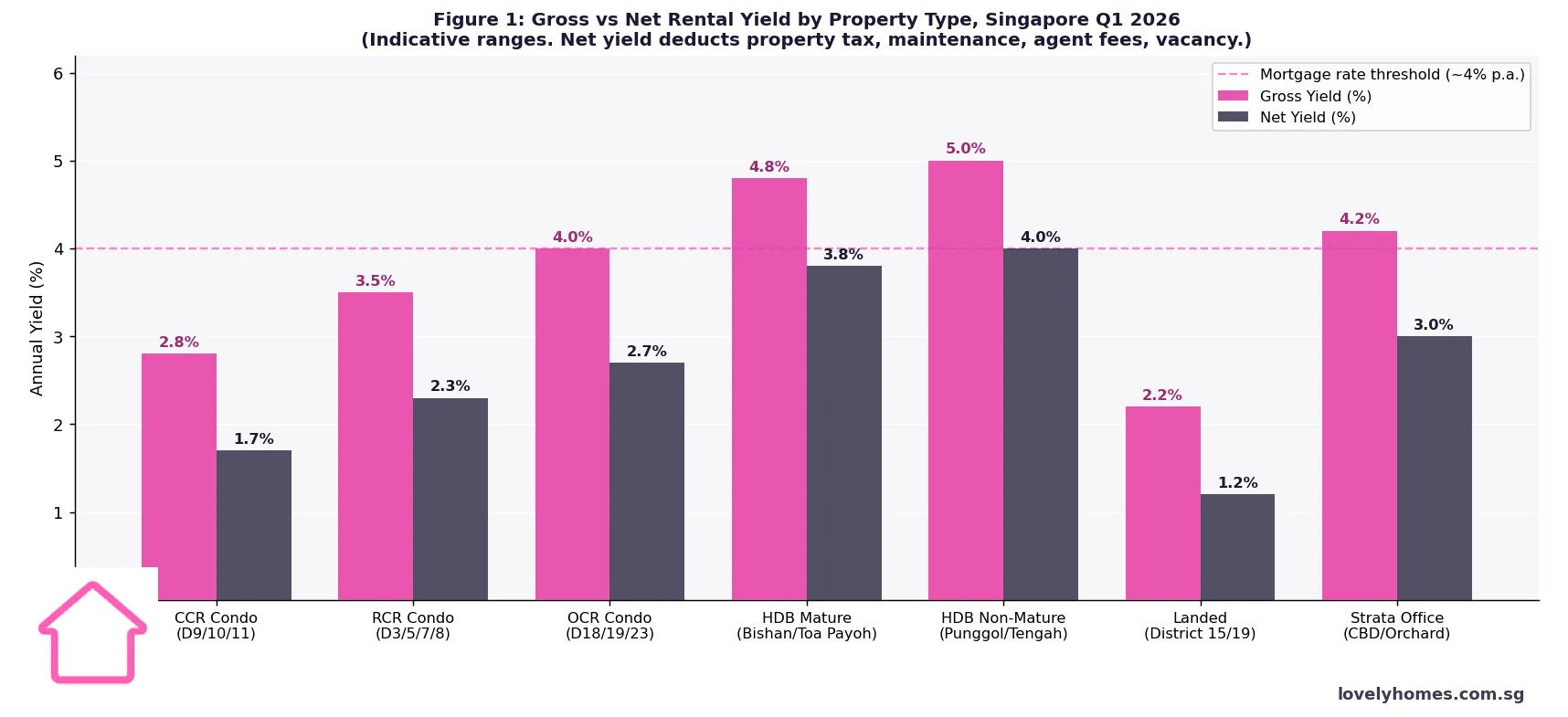
Gross vs net rental yield by property type Singapore Q1 2026 — CCR RCR OCR HDB condo
Figure 1: Gross vs Net Rental Yield by Property Type, Singapore Q1 2026. Sources: URA, HDB, IRAS. Figures are indicative market averages; individual properties will vary.

The yield picture in Q1 2026 tells a clear story. OCR condominiums and non-mature HDB flats offer the most attractive net yields (2.7–4.0%) for Singapore Citizen investors who own no other residential property. CCR condominiums, where purchase prices have risen fastest, show compressed net yields of 1.7% — well below the prevailing mortgage rate of 3.5–4.2%. A CCR investor at current prices is implicitly betting on capital appreciation rather than income.

The mortgage-rate threshold line on Figure 1 is critical: any property with a net yield below the investor’s mortgage rate produces negative cash flow. The investor’s equity is being drawn down each month until either (a) rental rates rise, (b) the mortgage is refinanced to a lower rate, or (c) the property is sold. For most CCR and landed investments at current prices, this is the reality.

Understanding Capital Gain: The Singapore Track Record

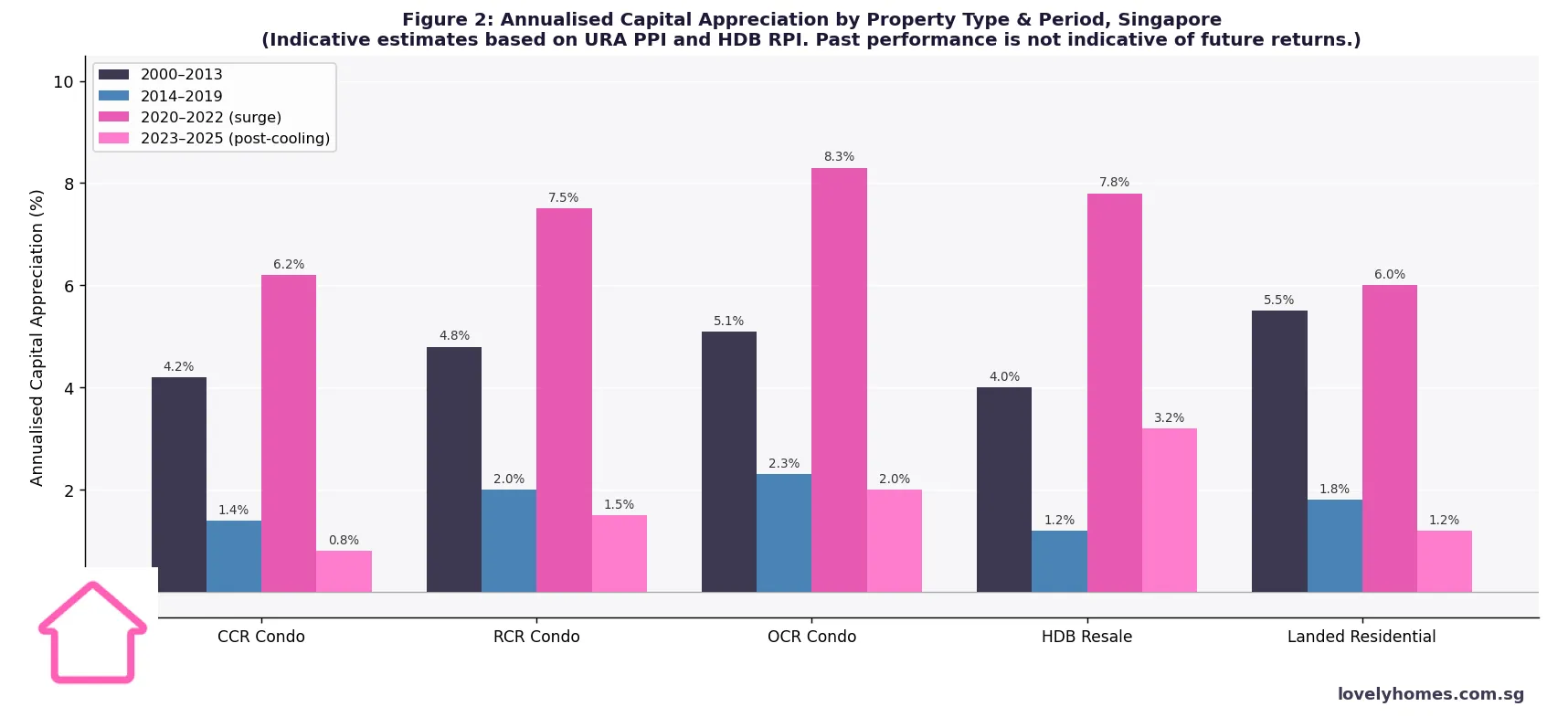
Annualised capital appreciation by property type and period Singapore 2000 to 2025
Figure 2: Annualised Capital Appreciation by Property Type & Period, Singapore. Sources: URA Private Residential Property Price Index, HDB Resale Price Index. Past performance is not indicative of future returns.

Singapore residential property delivered strong long-run capital appreciation — particularly the 2000–2013 period, which included the post-SARS recovery, two rounds of quantitative easing, and robust population growth. OCR condos and landed property produced annualised gains of 5–6% over that period. However, the 2014–2019 period — dominated by progressive rounds of cooling measures, the Total Debt Servicing Ratio (TDSR) framework, and population growth moderation — saw annualised gains compress to 1.2–2.3% across all property types.

The 2020–2022 surge was exceptional: the pandemic-era ultra-low interest rate environment (SORA briefly fell to 0.22% in 2021), pent-up demand, and a structurally undersupplied resale market drove annualised gains of 6–8% across OCR and HDB. This period is unlikely to repeat in the near term given current mortgage rates of 3.5–4.5% and the government’s demonstrated willingness to deploy cooling measures.

The 2023–2025 post-cooling stabilisation shows OCR condos and HDB resale at 2–3.2% per annum — more sustainable but insufficient to justify a leveraged investment at current LTV and mortgage rate assumptions unless the investor has a 10+ year horizon.

The ABSD Factor: How Stamp Duty Reshapes the Calculus

Singapore Citizens purchasing a second residential property pay 20% ABSD on the purchase price, effective from 27 April 2023. On a S$1.5M OCR condo, this amounts to S$300,000 — an additional upfront cost that must be recovered before the investment breaks even. At a net yield of 2.7% (post all costs), the investor earns approximately S$40,500 per annum in net rental income. At that rate, it takes over seven years of rental income alone to recover the ABSD cost — before accounting for mortgage interest subsidisation.

This is why the property-vs-REIT comparison has become increasingly compelling. Singapore REITs attract zero ABSD, no property tax, no maintenance fees, and no tenant management burden, with gross distributions of 5–8% in many sectors. The trade-off is that REITs do not offer the leverage of a mortgage-financed property and are subject to equity market volatility. See the dedicated S-REIT Investment Guide 2026 for a detailed comparison.

For Singapore Permanent Residents (SPR), the ABSD on a second residential property rises to 30%, making the break-even period even longer. For foreigners, the 60% ABSD renders residential property investment (as opposed to owner-occupation) economically untenable in most cases. Commercial property, which does not attract ABSD and where foreigners can invest freely, offers a structurally more favourable framework for non-citizen investors.

Summary Table: Rental Yield vs Capital Gain at a Glance

Factor Rental Yield Focus Capital Gain Focus
Best property type OCR condo, non-mature HDB CCR / RCR condo, landed
Typical gross yield 3.5–5.0% 2.2–3.5%
Monthly cash flow Near break-even to positive Typically negative (subsidised)
Ideal hold period 3–7 years 7–15 years
Liquidity risk Lower (OCR wider buyer pool) Higher (CCR narrower pool)
Key risk Vacancy, yield compression Cooling measures, rate rises
ABSD impact (2nd property, SC) Significant — 7+ yr payback Significant — 10+ yr payback
Alternative S-REITs (5–8% distributions) Growth REITs / commercial

Worked Example: Ms Tan’s S$1.5M OCR Condo

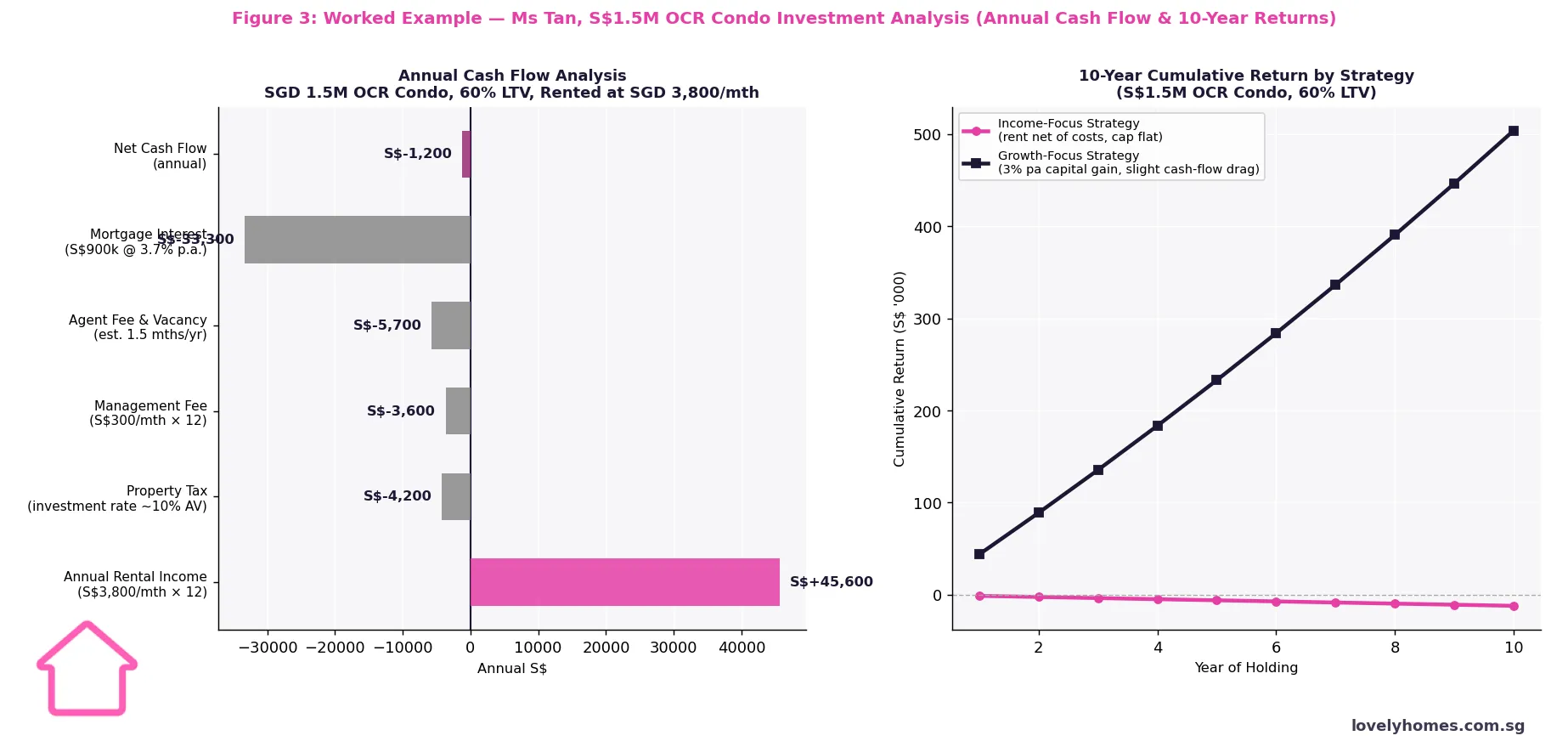
Worked example Ms Tan S$1.5M OCR condo annual cash flow and 10-year cumulative returns
Figure 3: Ms Tan — S$1.5M OCR Condo Annual Cash Flow & 10-Year Returns. Figures are indicative. Consult a licensed adviser before investing.

Ms Tan, 42, is a Singapore Citizen with one HDB flat (fully paid). She wishes to invest S$1.5M in a second residential property — a 2-bedroom OCR condo in Tampines. She pays 20% ABSD (S$300,000) plus 5% BSD (S$44,600), bringing the total acquisition cost to S$1,844,600. She finances 60% of the purchase price (S$900,000) via a bank loan at 3.7% per annum (SORA spread, 25-year tenure) after satisfying the TDSR Singapore 2026 constraint at her household income of S$18,000/month.

Annual cash flow breakdown:

  • Rental income: S$3,800/month × 12 = S$45,600
  • Property tax (investment rate, estimated AV S$33,600): ~S$4,200
  • Management fee (S$300/month): S$3,600
  • Agent and vacancy allowance (1.5 months/year): S$5,700
  • Mortgage interest (S$900k × 3.7%): S$33,300
  • Net annual cash flow: approximately –S$1,200 (slightly negative)

The gross yield on the purchase price is 3.04%. The net yield (after all costs, before mortgage principal) is approximately 2.72% — below the mortgage rate of 3.7%. Ms Tan is effectively subsidising the mortgage by about S$1,200 per annum, plus the opportunity cost of the S$300,000 ABSD (foregone investment return at 3% = S$9,000/year).

Capital appreciation scenario: If the property appreciates at 3% per annum over 10 years, the gross capital gain is approximately S$515,000. After selling costs (BSD on seller side N/A — no SSD after 3 years), agent commission (~1%), and assuming no further Seller’s Stamp Duty (the Seller’s Stamp Duty applies for 3 years post-purchase per the property’s holding period), the net gain before tax is approximately S$495,000. Over 10 years, total net return (rental income net + capital gain) is approximately S$483,000 — an annualised return on total equity deployed of roughly 5.5% per annum.

By comparison, the same S$300,000 ABSD + S$600,000 downpayment (S$900,000 total equity) invested in a diversified S-REIT portfolio at a conservative 6% gross distribution yield with 2% capital growth would yield approximately S$690,000 over 10 years — a meaningfully higher outcome with no tenant management, no maintenance, and no mortgage. The direct property route wins primarily if capital appreciation exceeds 3% per annum or if rental rates rise materially.

Why This Matters for Singapore Investors in 2026

The investment property thesis in Singapore has always rested on three pillars: land scarcity, population growth, and government commitment to maintaining a stable housing market. All three remain broadly intact, but the near-term environment is more challenging than the 2020–2022 peak. Mortgage rates have risen from near-zero to 3.5–4.5%, vacancy rates in the private rental market have crept up from sub-5% to 7–10% in CCR and RCR, and the government has maintained or tightened cooling measures (most recently the EC cooling measures of May 2026).

Investors entering the market in 2026 should model conservatively: assume net yields of 2.5–3.5% for OCR condos, capital appreciation of 2–3% per annum (not the 7–8% of 2021–2022), a mortgage rate of 3.5–4.0%, and a 10+ year hold period for the investment to produce an acceptable risk-adjusted return. The ABSD payback period must be factored into the break-even analysis.

What Might Come Next

Several factors could materially shift the yield/growth calculus in the medium term. On the positive side: a sustained decline in Singapore Overnight Rate Average (SORA) benchmarks (linked to US Federal Reserve easing) would reduce mortgage rates and improve cash flows; continued strong foreign talent attraction supporting rental demand; and the progressive unveiling of the Greater Southern Waterfront and Jurong Lake District transformations creating new capital appreciation pockets. On the negative side: an expansion of the pipeline of private residential completions from the record 1H 2026 Government Land Sales programme could compress rents; any tightening of the foreign talent inflow policy would reduce rental demand; and a deterioration in the global economic environment could dampen transaction volumes and prices.

Investors are encouraged to treat property as one component of a diversified portfolio, weigh the liquidity and ABSD constraints explicitly, and consult a licensed financial adviser before committing capital at these price levels.

Frequently Asked Questions

What is the difference between gross yield and net yield in Singapore property?

Gross yield divides annual rental income by the property’s market value or purchase price — it gives you a quick comparison benchmark. Net yield deducts all recurring ownership costs: property tax (charged by IRAS at the investment rate, not the lower owner-occupier rate), maintenance fees, sinking fund contributions, agent commission for finding tenants (typically half a month’s rent per year), vacancy allowance, and insurance. For Singapore condominiums, the gap between gross and net yield is typically 1.0–1.5 percentage points, meaning a property with a 4% gross yield might deliver only 2.5–3.0% net. When evaluating a property for investment, always use net yield as the baseline for comparison against mortgage costs and alternative investments.

Is rental income from Singapore property taxable?

Yes. Rental income from a Singapore property is subject to personal income tax at your marginal rate, which can be as high as 24% for high-income individuals. However, the income is assessed on a net basis — you may deduct allowable expenses including mortgage interest (the interest component, not principal), property tax, maintenance fees, agent commissions, and a deemed 15% allowance on gross rent as an alternative to tracking actual expenses. A property generating S$45,600 gross rent with actual deductible expenses of S$46,800 would produce a taxable loss — which can offset other income in some circumstances. See our guide to capital gains and rental income tax for a full worked example of both the actual-expense and deemed-expense paths.

Can I use CPF to fund an investment property in Singapore?

Yes, you can use CPF Ordinary Account (OA) funds to fund the downpayment and monthly instalments for a second residential property, subject to certain conditions. The CPF usage limit is generally 120% of the property’s valuation limit, and the property must have a remaining lease of at least 20 years. However, all CPF funds used — plus accrued interest at 2.5% per annum — must be refunded to your CPF account from the sale proceeds when you sell. This accrued interest effectively reduces your net profit from the investment. Many investors underestimate this cost; a property held for 20 years could have an accrued interest liability of 65% or more of the original CPF amount used.

How does Seller’s Stamp Duty affect my investment exit strategy?

Seller’s Stamp Duty (SSD) applies to private residential properties sold within 3 years of purchase: 12% in year 1, 8% in year 2, and 4% in year 3. If you purchase a S$1.5M condo and sell within 12 months, SSD is S$180,000 — a massive cost that eliminates most short-term investment gains. SSD does not apply after the 3-year holding period. This means the effective minimum hold for a leveraged property investment is at least 3 years; most investors target 5–10 years to allow the ABSD, SSD, and acquisition costs to be absorbed into a meaningful capital gain. The ABSD guide contains a full table of stamp duty rates by buyer profile and property type.

What are the best alternatives to direct property investment in Singapore?

Singapore offers several liquid alternatives to direct residential property investment. Singapore REITs (S-REITs) trade on SGX and offer diversified exposure to commercial, industrial, retail, healthcare, and data-centre real estate with gross distributions of 5–8% and no ABSD, no management burden, and high liquidity. Freehold strata offices in the CBD carry no ABSD for foreigners and offer yields of 3.5–5%. CPF Investment Scheme (CPFIS) products allow some CPF OA and SA funds to be invested in REITs and property-linked instruments. For investors who want Singapore property exposure without the capital outlay, some private funds and family-office structures offer fractional exposure to residential or commercial portfolios. The commercial property guide and REITs guide provide detailed comparisons.

Should I prioritise yield or growth when buying an investment property?

The correct priority depends on your financial profile. If you have high monthly cash commitments and cannot sustain a negative-cash-flow property for an extended period, yield should take priority — an OCR condo or resale HDB (if eligible) provides a better income cushion. If you have substantial savings, a long investment horizon (10+ years), and a high income that covers any monthly shortfall, a CCR or prime-location property may deliver superior absolute capital gains over the long run, even if the annual cash flow is negative. In the current rate environment (mortgage rates 3.5–4.2%), properties with gross yields below 4% are cash-flow negative even without accounting for ABSD, so ensure you model both the yield and the capital appreciation case explicitly before committing.

How do I calculate the net return on a Singapore investment property?

Total net return = (Net rental income over hold period) + (Sale price – Purchase price – Acquisition costs – Selling costs). Acquisition costs include BSD, ABSD, legal fees (roughly S$3,000–S$6,000 for a condo purchase), and agent commission. Selling costs include agent commission (1–2% of sale price), legal fees, and any SSD if sold within 3 years. If CPF was used, you must also account for CPF accrued interest repaid to the CPF account on sale. Divide total net return by the equity deployed (downpayment + ABSD + all upfront costs) and the number of years held to derive an annualised return on equity. For most S$1.5M OCR condos purchased in 2026 with 20% ABSD, you need a minimum 3.5% per annum capital appreciation and a 10-year hold to match a 6% p.a. REIT distribution on the same equity.

Related Articles

Disclaimer

This article is for general informational purposes only and does not constitute financial, tax, or investment advice. Rental yields, capital appreciation figures, and return projections are illustrative estimates based on publicly available data and should not be relied upon for investment decisions. Past performance of Singapore property markets is not indicative of future returns. All investments carry risk, including the possible loss of principal. Consult a licensed financial adviser, MAS-licensed investment adviser, and IRAS for your specific circumstances. ABSD, SSD, and other stamp duty rates are subject to change without notice.

Tags: Rental Yield Singapore, Capital Gain Property Singapore, Singapore Property Investment 2026, Gross Net Yield, Investment Property Singapore, ABSD Second Property, Singapore Condo Investment, Property vs REITs, OCR Condo Yield, Singapore Property Returns

Singapore REITs Investment 2026: Distribution Yields, Tax Treatment and How S-REITs Compare to Direct Property

Singapore REITs Investment 2026: Distribution Yields, Tax Treatment and How S-REITs Compare to Direct Property

Most Singaporeans know that property is a favoured investment asset. What fewer realise is that they can access Singapore’s real estate returns without buying a physical unit, without paying Additional Buyer’s Stamp Duty (ABSD), and with as little as the price of a single share on the Singapore Exchange (SGX). Singapore Real Estate Investment Trusts — known as S-REITs — are listed vehicles that pool capital to own income-producing real estate, distribute the bulk of their rental income to unitholders, and trade like stocks on SGX. In 2026, with interest rates easing and cap rates compressing, S-REITs are once again attracting strong attention from retail and institutional investors alike.

Quick Answer — Singapore REITs Investment 2026

  • What: Listed property investment vehicles traded on SGX; own commercial, industrial, retail, healthcare or hospitality properties
  • Minimum investment: As low as S$1 per unit (or one lot = 100 units for standard board lots)
  • Tax transparency: Singapore individuals pay no withholding tax on REIT distributions (subject to MAS rules)
  • ABSD: Zero — REITs are securities, not direct property purchases
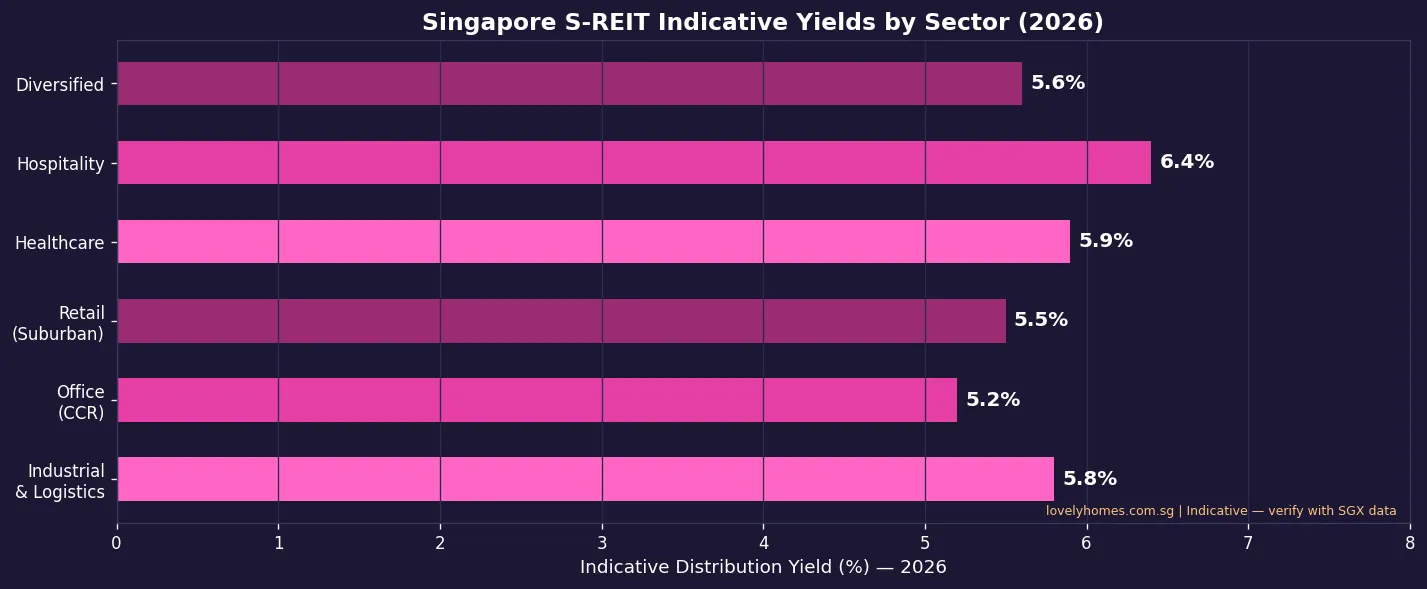
  • Indicative yields: 5.2%–6.4% distribution yield depending on sector (2026)
  • Leverage cap: 50% aggregate leverage ratio (MAS guidelines)
  • Key risk: Interest rate sensitivity — REIT unit prices fell sharply when rates rose 2022–2024; recovering in 2026
  • Best for: Investors wanting passive income, diversification, or property exposure without ABSD or large capital outlay

What Are S-REITs and How Do They Work?

A Real Estate Investment Trust is a collective investment scheme structured to own and operate income-producing real estate. In Singapore, REITs are regulated by the Monetary Authority of Singapore (MAS) under the Securities and Futures Act. To qualify for tax transparency treatment, a Singapore REIT must distribute at least 90% of its taxable income to unitholders each financial year. In return, MAS-regulated S-REITs pay no corporate tax on distributed income, and individual Singapore resident unitholders receive distributions free of withholding tax.

S-REITs raise capital by issuing units on SGX. They use this capital, plus debt (up to the 50% aggregate leverage cap), to acquire properties that generate rental income. A REIT Manager — a MAS-licensed entity — makes investment, financing, and asset management decisions on behalf of unitholders. Management fees (typically 0.3%–0.8% of assets under management per annum) reduce net distributions to unitholders.

Singapore S-REIT indicative distribution yields by sector 2026 — industrial, office, retail, healthcare, hospitality
Figure 1: Singapore S-REIT Indicative Yields by Sector (2026) — indicative figures; verify with SGX data

Types of S-REITs and Their Characteristics

Singapore hosts one of Asia’s deepest REIT markets, with approximately 40 S-REITs and property trusts spanning several asset classes. Industrial and Logistics REITs own warehouses, data centres, and business parks with long leases (5–15 years) and strong demand from technology occupiers; indicative yields around 5.5%–6.0%. Office REITs own Grade A commercial buildings in the CBD; yields around 5.0%–5.5%. Retail REITs own shopping malls — suburban malls have proven resilient post-pandemic; yields around 5.3%–5.8%. Healthcare REITs own hospitals and nursing homes on long triple-net leases; yields around 5.5%–6.0%. Hospitality REITs own hotels and serviced residences; more volatile income but recovering with Singapore tourism; yields around 6.0%–6.5%. Diversified REITs own a mix of asset types, offering built-in diversification; yields around 5.3%–5.8%.

S-REITs vs Direct Property — The Critical Differences

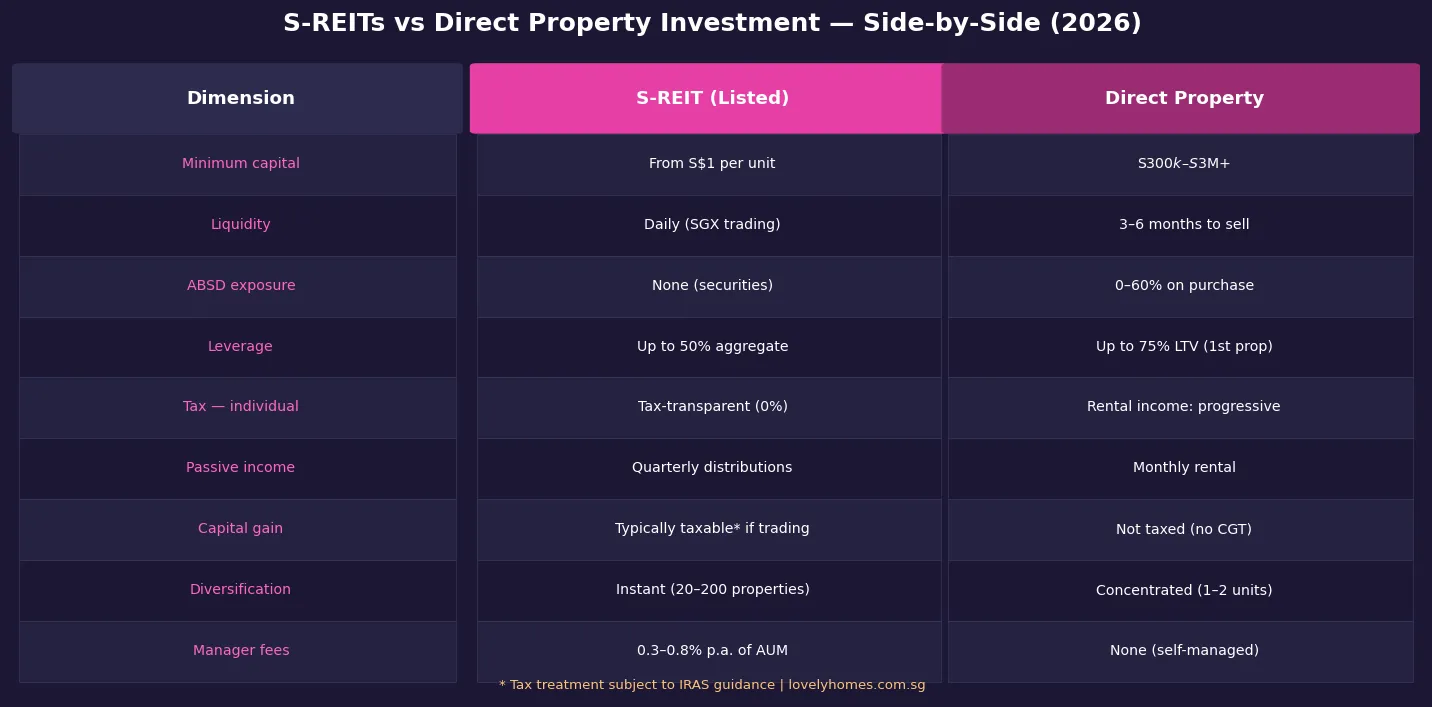
S-REITs vs direct property investment comparison — minimum capital, liquidity, ABSD, leverage and tax Singapore 2026
Figure 2: S-REITs vs Direct Property Investment — Side-by-Side Comparison (2026)

The most significant advantage of S-REITs for Singapore residents is zero ABSD exposure. A Singapore Citizen buying a second residential property pays 20% ABSD on the entire purchase price — on a S$1.5 million condo, that is S$300,000 in ABSD before accounting for the regular Buyer’s Stamp Duty (BSD). Buying S$300,000 worth of a diversified S-REIT incurs no ABSD, no BSD, no conveyancing fees, and no mortgage-related costs.

Liquidity is another major difference. A direct property investment typically takes three to six months to sell, involves legal costs, agent commissions, and Seller’s Stamp Duty (SSD) if sold within three years. A REIT unit can be sold on SGX in seconds during market hours, and settlement occurs within two business days. The trade-off is stock market volatility: many quality S-REITs declined 20%–35% in unit price terms between 2022 and 2024 as the US Federal Reserve raised interest rates aggressively, even as their underlying properties continued generating stable rental income. In 2026, with SORA easing, S-REIT valuations have partially recovered.

Tax Treatment for Singapore Individual Investors

Singapore residents who are individuals receive S-REIT distributions free of withholding tax under the MAS tax transparency framework, provided the REIT distributes at least 90% of its income. This is one of the most favourable tax treatments for any income-generating investment in Singapore. By contrast, rental income from a directly owned investment property is taxed at the individual’s marginal income tax rate (up to 24% for income above S$1 million) after deducting allowable expenses. There is no Capital Gains Tax in Singapore, so gains on disposal of REIT units held for investment are generally not taxable — though IRAS may tax gains as income if the frequency and pattern of trading suggests a business of buying and selling REITs.

Key Facts: S-REIT Investment at a Glance

Dimension S-REIT (Listed) Direct Property
Minimum capital From S$1 per unit S$300k–S$3M+
Liquidity Daily (SGX trading) 3–6 months to sell
ABSD exposure None (securities) 0%–60% on purchase
Leverage Up to 50% aggregate (MAS cap) Up to 75% LTV (1st property)
Tax — individual Tax-transparent (0% withholding) Rental income: progressive rates
Indicative yield 5.2%–6.4% (2026) 2.5%–4.5% gross OCR (2026)
Diversification Instant (20–200 properties) Concentrated (1–2 units)
Manager fees 0.3%–0.8% p.a. of AUM None (self-managed) or agent fees

Worked Example — Ms Chen Considers Her Options

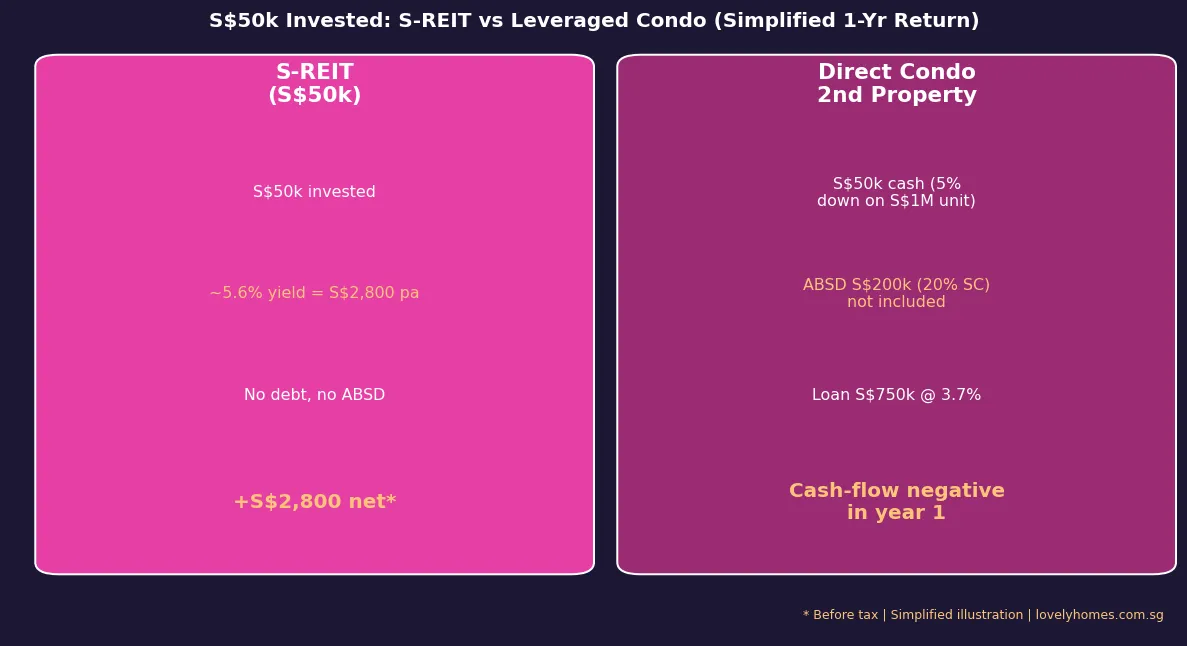
S$50k invested in S-REIT vs leveraged condo 2nd property — simplified year-1 return illustration Singapore 2026
Figure 3: S$50,000 Capital Deployed: S-REIT vs Direct 2nd Condo — simplified 1-year illustration (2026)

Ms Chen is 38, a Singapore Citizen who already owns her HDB flat and has S$50,000 in investable savings. Option A — S-REIT: She invests S$50,000 in a diversified industrial S-REIT yielding 5.8% per annum. Annual distribution income: S$2,900. No ABSD, no BSD, no legal fees. Option B — Second Condo: She targets a S$1 million OCR condo as a second property. ABSD as a Singapore Citizen = 20% = S$200,000. BSD ≈ S$24,600. Total upfront stamp duties: S$224,600. Her S$50,000 would not even cover the stamp duties — she would need an additional S$174,600 just to clear the stamp duty obligation, plus the 25% down payment (S$250,000) and legal costs. For investors at Ms Chen’s capital level who already own one property, the REIT route offers immediate, tax-efficient property income with no stamp duty barrier.

Why This Matters — REITs as a Portfolio Complement

Singapore has actively developed the S-REIT market since the first REIT listed on SGX in 2002. Today, Singapore is the third-largest REIT market in Asia by market capitalisation. For retail investors, S-REITs provide access to institutional-quality properties — prime CBD office towers, logistics parks, hospitals, and data centres — that would otherwise be entirely out of reach. A S$5,000 investment in a well-managed industrial REIT gives proportional exposure to a portfolio of properties worth hundreds of millions of dollars, managed by professionals and audited to MAS standards.

What Might Come Next

In 2026, the REIT market is benefiting from a gradual easing in SORA rates. As the 3-month compounded SORA trends lower from its 2024 peak, financing costs for S-REITs ease and the distribution yield spread above the risk-free rate widens, making S-REITs more attractive relative to fixed deposits and Singapore Government Securities (SGS bonds). Investors should monitor SORA trajectory, MAS interest rate guidance, and individual REIT occupancy rates and lease expiry profiles. Always check the latest REIT financial statements on SGX before deploying capital.

Frequently Asked Questions

Do I pay ABSD when buying S-REIT units?

No. ABSD applies to purchases of residential property. S-REIT units are securities — not direct property ownership — and are bought and sold on SGX in the same manner as shares. There is no Buyer’s Stamp Duty, no ABSD, and no conveyancing process. The only transaction cost is brokerage commission (typically 0.05%–0.28% per trade on standard Singapore platforms).

How often do S-REITs pay distributions?

Most Singapore REITs distribute income quarterly, though some distribute semi-annually. The distribution is declared per unit (in cents per unit) and paid to unitholders on the register as at the ex-dividend date, received in your brokerage account within a few weeks of the payment date. Check each REIT’s investor relations page for its historical distribution per unit (DPU) track record.

Can I use CPF to invest in S-REITs?

Yes, subject to the CPF Investment Scheme (CPFIS). You can invest CPF OA savings in approved S-REITs listed on SGX under CPFIS-OA. You may invest up to 35% of your investable savings (OA balance above S$20,000) in stocks and REITs under CPFIS. Note that the 2.5% OA interest rate is the opportunity cost benchmark — if your REIT does not beat 2.5% on a total-return basis, leaving the money in your OA would have been better.

What are the key risks of investing in S-REITs?

Key risks include: (1) Interest rate risk — rising rates increase REIT borrowing costs and make their yields less attractive relative to bonds. (2) Occupancy/tenant risk — if key tenants vacate or become insolvent, rental income falls. (3) Currency risk — many S-REITs own properties overseas (Australia, Japan, Europe, US); income is earned in foreign currencies and translated back to SGD. (4) Rights issue dilution — to fund acquisitions, REITs frequently issue new units at a discount. (5) Manager quality risk — poor capital allocation erodes long-term value. Diversifying across multiple REITs and asset classes mitigates several of these risks.

Is S-REIT income taxable for Singapore residents?

Distributions from S-REITs to Singapore individual residents are generally exempt from withholding tax under MAS’s tax transparency framework. You receive distributions gross, with no tax deducted at source, and generally do not declare them as taxable income on your personal tax return. Capital gains from selling REIT units are also generally not taxable for investors. Non-residents and entities are subject to withholding tax on distributions. Verify your specific position with a tax adviser, as IRAS guidance may evolve.

What is the MAS 50% leverage cap and why does it matter?

MAS requires Singapore REITs to maintain an aggregate leverage ratio (total debt divided by total assets) of no more than 50%. REITs meeting an interest coverage ratio (ICR) of at least 2.5× can access the upper 50% limit; others are capped at 45%. This protects unitholders from excessive debt risk. When evaluating a REIT, check its reported leverage ratio and ICR trend in its financial statements — these are disclosed quarterly.

How do I start investing in S-REITs?

Open a brokerage account with a SGX-licensed broker (DBS Vickers, OCBC Securities, UOB Kay Hian, Moomoo, Tiger Brokers, or Interactive Brokers). Fund it with SGD. Search for SGX-listed REITs on the broker’s platform — filter by sector, yield, and market capitalisation. Standard board lots are 100 units. Research each REIT’s annual report, distribution history, and investor presentation before investing. The SGX REITs and Property Trusts section is the authoritative listing of all Singapore-listed vehicles.

Disclaimer: This article is for general informational purposes only and does not constitute financial, legal, or professional advice. Property rules, grant amounts, eligibility criteria, and tax treatments are subject to change. Always verify current details with the relevant authorities — HDB, IRAS, CPF Board, URA — and consult a licensed professional before making any property or financial decision.

Chinese Capital Surge into Singapore Property 2026: What Mainland Investment Means for Buyers

Chinese Capital Surge into Singapore Property 2026: What Mainland Investment Means for Buyers

Quick Answer — Chinese capital and Singapore property in 2026

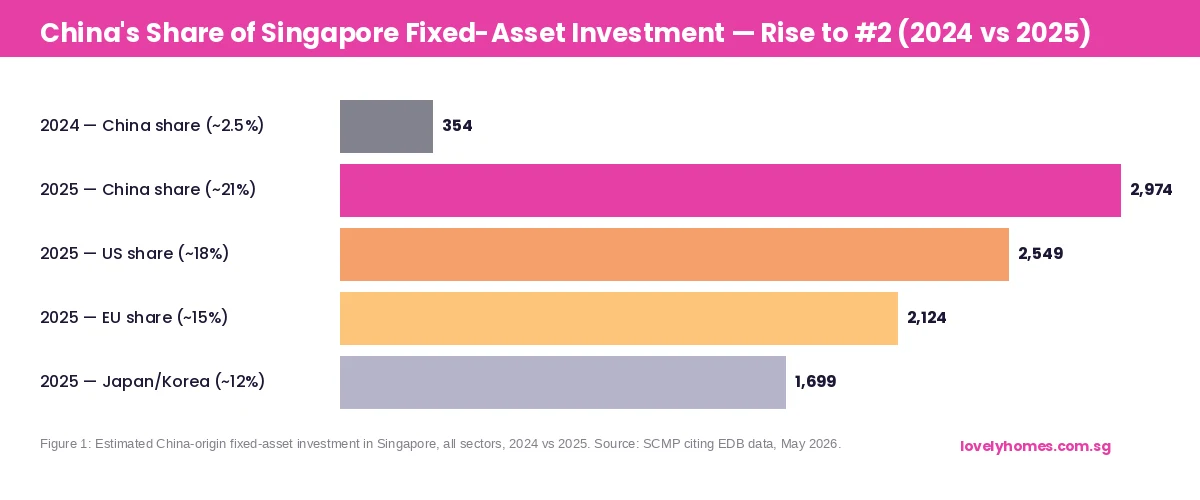
  • China became the second-largest source of fixed-asset investment in Singapore in 2025, accounting for approximately 21% of S$14.16 billion in total committed fixed-asset investment across all sectors — up from around 2.5% the prior year.
  • Chinese-linked developers are actively bidding for Government Land Sales (GLS) sites and replenishing their residential land banks in Singapore.
  • The 60% ABSD on foreign residential purchases has not deterred Chinese developers, who pay 40% developer ABSD (5% non-remittable, 35% remittable on qualifying sale of all units).
  • Individual Chinese nationals buying Singapore residential property still face the full 60% ABSD on any purchase — there is no bilateral tax treaty carve-out between China and Singapore on ABSD.
  • The Singapore government has acknowledged the investment flows but has given no indication of relaxing the existing cooling-measures framework in response.

China’s Investment Surge — From Marginal to Major Player

Singapore has always been a destination for global capital. What is new in 2026 is the pace and scale at which mainland Chinese money has repositioned itself within the city-state’s investment ecosystem. According to data cited by South China Morning Post and corroborated by regional financial media in early May 2026, China-origin fixed-asset investment in Singapore across all sectors totalled an estimated S$2.97 billion in 2025 — representing around 21% of Singapore’s total S$14.16 billion in committed fixed-asset investment. This compares to approximately S$354 million (2.5%) in 2024.

The drivers of this shift are multiple and mutually reinforcing. Geopolitical tensions between China and the United States, ongoing uncertainty in Hong Kong’s role as a regional financial hub, a domestic Chinese property market that remains structurally stressed, and Singapore’s well-understood legal and regulatory environment have all contributed to capital outflows from China that disproportionately target Singapore. For Chinese institutional investors, Singapore is familiar — the legal system is English-language common law, property rights are robustly protected, and there is a large existing Mandarin-speaking business community.

China share of Singapore fixed-asset investment 2025 vs 2024 — Chinese capital property market
Figure 1: Estimated China-origin fixed-asset investment in Singapore vs selected other sources, 2025. Source: SCMP citing EDB data, May 2026.

How This Flows Into the Property Market

Fixed-asset investment encompasses manufacturing plants, data centres, logistics hubs, financial services operations, and real estate. The property-market channel specifically manifests in three ways.

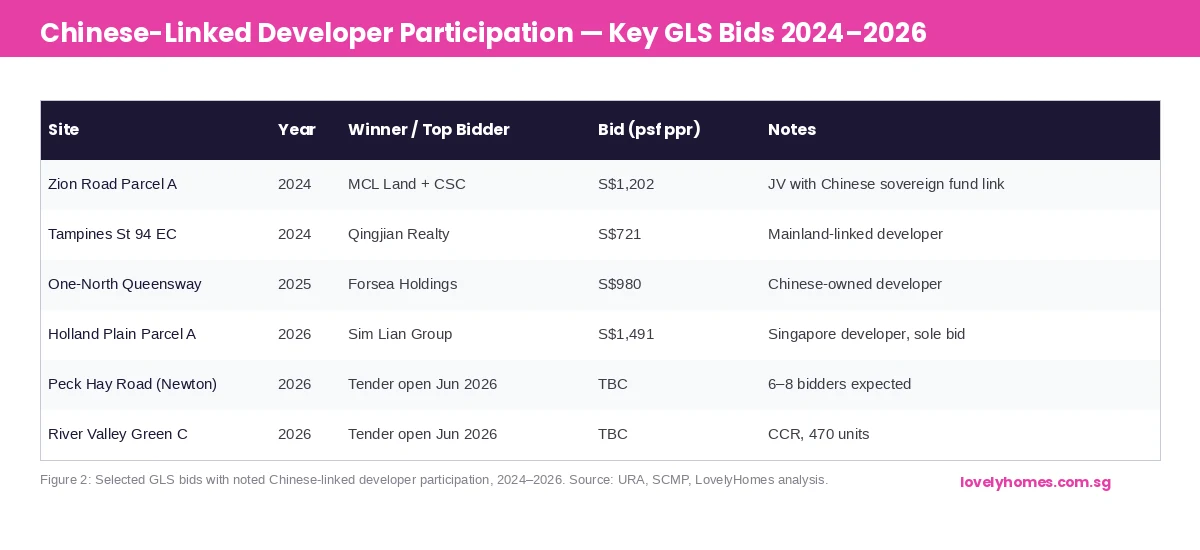
Developer land banking. Chinese-linked property developers — firms with mainland Chinese ownership or significant Chinese institutional backing — have become active bidders in Singapore’s GLS programme. Forsea Holdings (Chinese-owned) was awarded the one-north Queensway residential site in 2025. Qingjian Realty (with Chinese sovereign-fund links via its parent Qingjian Group) remains active in EC and private residential land. These firms are not new to Singapore but their bidding frequency and scale have increased materially since 2024.

Commercial real estate. Chinese institutional investors have been acquiring strata-titled commercial and industrial assets — office floors, retail shophouses, and industrial units — which do not attract ABSD. For investors seeking Singapore-dollar exposure to Singapore real estate without the 60% ABSD drag, commercial property is the natural vehicle. Freehold shophouses along heritage corridors in Districts 1, 2, and 7 have attracted particular interest from Chinese family offices.

Residential purchases by high-net-worth individuals. Despite the 60% ABSD, ultra-high-net-worth (UHNW) Chinese nationals continue to purchase Singapore condominiums and Good Class Bungalows (GCBs). The motivation is not yield — at 60% ABSD, net yields are essentially negligible relative to purchase cost. The motivation is capital preservation, residency (Singapore PR applications are often easier to support when accompanied by a significant economic footprint), and portfolio currency diversification into Singapore dollars.

GLS Bidding — Chinese-Linked Developer Participation

Chinese-linked developer GLS bids Singapore 2024-2026 — land sales demand analysis
Figure 2: Selected GLS bids with noted Chinese-linked developer participation, 2024–2026. Source: URA, industry research, LovelyHomes analysis.

The two CCR GLS sites currently on tender — Peck Hay Road (closing 11 June 2026, ~315 units) and River Valley Green Parcel C (closing 18 June 2026, ~470 units) — are expected to attract bids in the S$1,600–S$1,800 psf per plot ratio (ppr) range based on comparable recent transactions. Industry observers cite Chinese-linked developers as likely participants in both tenders, noting that CCR sites present strong brand positioning for marketing to Chinese UHNW buyers, whose preference for Core Central Region addresses remains robust even at 60% ABSD rates. The alternative interpretation is that units are priced to reflect the ABSD cost as part of the marketing proposition for other buyer profiles — mixed-nationality couples, FTA nationals, or Singapore Citizen investors — rather than purely targeting foreign buyers.

Factor Impact on Singapore Property Market
Chinese developer GLS bids Supports land price floors; higher bid confidence means higher implied launch prices, positive for existing condo valuations in surrounding areas
Commercial property demand Compresses shophouse and strata commercial yields; buyers seeking income plays face tighter cap rates
UHNW residential purchases Supports CCR luxury segment; limited volume impact on mass-market prices
60% ABSD on foreigners Continues to substantially limit volume of Chinese individual purchases; policy unchanged
Developer ABSD (40%) Requires developers to sell all units within 5 years to recover 35% remittable component; creates inventory-clearing incentive

What Singapore’s Position Means for Local Buyers

The surge in Chinese institutional investment is primarily a commercial and developer-side phenomenon. For the Singaporean household buying their first home or upgrading from HDB to private, the direct impact is limited. The mass-market Outside Central Region (OCR) residential segment — where most Singaporean buyers transact — is not significantly influenced by Chinese developer activity, which is concentrated in the CCR and selected RCR developments.

The more relevant indirect effect is on GLS land prices. Increased international developer competition for GLS sites elevates winning bid prices, which flow through to higher launch prices and, with a lag, higher resale prices in surrounding areas. This is a slow-moving structural force rather than a near-term price driver. The Holland Plain Parcel B result (Sim Lian sole bid at S$1,491 psf ppr) in May 2026 — noticeably below the S$1,600–S$1,750 psf ppr range that six-to-eight-bidder competition would have implied — illustrates that developer caution persists even as Chinese interest in the broader investment landscape grows.

For property investors evaluating Singapore condos against a 60% ABSD exposure for Chinese buyers, the read-through is nuanced. Strong Chinese interest in Singapore as an investment destination is a medium-term positive for capital values. But the 60% ABSD is a sufficiently high barrier that it effectively segments the market: Chinese buyers are a price-setter in the ultra-luxury CCR segment but not a material volume driver in broader residential transaction statistics.

What Might Come Next

The Singapore government has consistently calibrated the ABSD framework to domestic affordability and market stability objectives rather than to the source of inbound investment. The April 2023 doubling of the foreigner ABSD rate to 60% was a clear signal that capital-flow considerations do not override the domestic affordability mandate. There is no indication that the government will relax foreigner ABSD to capture Chinese investment flows — the policy calculus runs the other way: allow commercial and industrial investment to flow freely (no ABSD on commercial property, no foreign ownership restrictions on most commercial assets) while maintaining robust residential market protection.

What to watch in the near term: the results of the Peck Hay Road and River Valley Green Parcel C tenders (closing June 2026), which will give a fresh read on bidder depth and the role of Chinese-linked developers in the CCR pipeline. If either tender attracts five or more bidders including at least two Chinese-linked firms, it would confirm that the investment thesis remains active at current GLS pricing levels.

FAQ 1: Can a Chinese national buy a Singapore HDB flat?

No. HDB flats may only be purchased by Singapore Citizens (and in some schemes, Permanent Residents). Foreign nationals — including those from China — cannot purchase HDB flats regardless of ABSD considerations. The eligibility rules for HDB ownership are set by HDB under the Housing and Development Act and are entirely separate from the stamp duty framework.

FAQ 2: Does the 60% ABSD apply to Chinese developers as well as individual buyers?

No. Entities (including developers) purchasing residential property pay 65% ABSD, but housing developers who meet BCA licensing conditions pay 40% ABSD on residential land (5% non-remittable, 35% remittable provided all units are sold within five years of the acquisition date). This structure allows developers — including Chinese-linked ones — to effectively defer or recover most of the ABSD if they develop and sell the project on schedule.

FAQ 3: Does buying a Singapore condo help a Chinese national get Singapore PR or citizenship?

Property ownership is not a direct pathway to Singapore Permanent Residency or citizenship. Singapore’s PR application process is primarily employment-based and discretionary. However, significant economic contributions — including investment through the Global Investor Programme (GIP), which requires a minimum S$10 million commitment into a Singapore-registered company or fund — can support a PR application. Simple residential property ownership does not qualify as a GIP investment and carries no preferential PR weighting.

FAQ 4: Are there any restrictions on Chinese companies owning Singapore commercial property?

Singapore imposes very few restrictions on foreign ownership of commercial or industrial property. Chinese companies and individuals can purchase strata-titled offices, retail units, and industrial units without ABSD and without requiring special approval. Certain sensitive sectors (near defence facilities, for example) may require clearances, but this applies to the use of the property rather than ownership. The Residential Property Act restrictions that limit foreign ownership of landed residential property do not apply to commercial or industrial assets.

FAQ 5: Should I be concerned that Chinese investment is inflating Singapore property prices beyond fair value?

The evidence does not support a conclusion that Chinese investment is systematically inflating residential prices to unsustainable levels. The 60% ABSD effectively quarantines the Chinese buyer pool from the mass-market residential segment where most Singaporeans transact. The URA Q1 2026 Private Residential Property Price Index showed a modest +0.9% quarterly increase — consistent with long-run averages and not indicative of a speculative spike. The government’s clear willingness to tighten the ABSD further if needed (as demonstrated in April 2023) provides a credible policy backstop. The more direct affordability issue for Singaporean households is domestic supply and the pace of BTO completions — not the level of Chinese investment activity.

Related Articles

Disclaimer: This article is for informational purposes only and does not constitute investment or financial advice. Data on fixed-asset investment flows are sourced from third-party media reports citing Singapore EDB figures and are directional estimates rather than official published statistics. Verify all figures against primary sources before making any investment decision. ABSD rates and foreign ownership regulations are subject to change — refer to IRAS and URA for current rules.

Singapore Property as a Safe Haven in 2026: What the URA Data Shows Amid Global Uncertainty

Singapore Property as a Safe Haven in 2026: What the URA Data Shows Amid Global Uncertainty

As trade tensions, currency volatility and geopolitical fractures reshape capital allocation globally, Singapore’s residential property market is drawing renewed attention from high-net-worth investors. This analysis examines what the data actually shows — and what it does not.

Quick Answer

  • Singapore’s private residential price index rose 0.3% quarter-on-quarter in Q1 2026, per URA flash estimates, with the OCR leading at +1.3% — a measured performance that belies the “booming market” narrative in some international headlines.
  • The CCR (Core Central Region) — the segment most exposed to foreign UHNW demand — has appreciated modestly but steadily since Q1 2024, driven by wealth-preservation flows from Europe, the Middle East and Southeast Asia.
  • Singapore’s 65% ABSD for foreign buyers, introduced in April 2023, has not reversed this structural demand — it has filtered out speculative short-term buyers while leaving long-horizon wealth-preservation purchasers largely undeterred.
  • The Asia-Pacific UHNW population grew by approximately 24.8% between 2021 and 2026, generating a larger pool of potential buyers even at elevated ABSD rates.
  • Singapore’s macroeconomic fundamentals — GDP growth forecast 2–4% in 2026, inflation ~1–2%, MAS-managed SGD, AAA sovereign credit — underpin the safe-haven thesis more than any single property market metric.
  • Key risks: rising private housing completions in 2026–2027, softening HDB resale prices, and TDSR constraints limiting domestic upgrader demand.

The Global Context: Why Investors Are Looking at Singapore

In the first quarter of 2026, global financial markets contended with renewed trade tensions, a volatile US dollar and a broader reassessment of risk assets in key emerging-market economies. Against this backdrop, Singapore has attracted significant commentary as a potential beneficiary of capital-flight demand.

Singapore offers a stable rule-of-law jurisdiction under the Singapore Land Authority and the Urban Redevelopment Authority; transparent property transaction records through the URA’s caveat system; a currency managed by MAS under a nominal effective exchange rate framework that has historically appreciated against peer currencies during risk-off periods; and a property market with deep liquidity in the resale condominium segment.

What Singapore does not offer — and this is the corrective that international analysis sometimes omits — is a low-friction entry for foreign buyers. The 65% ABSD on any residential property purchased by a non-Singapore national (excluding US/Iceland/Liechtenstein/Norway/Swiss nationals who receive SC-equivalent rates under FTA arrangements) means the effective purchase premium is extraordinary. A S$5M CCR condominium purchased by a foreign buyer carries an ABSD bill of S$3.25M, bringing total acquisition cost to approximately S$8.43M. That is the price of safe-haven status in Singapore.

URA private residential price index CCR RCR OCR Q1 2024 to Q1 2026
Figure 1: URA Private Residential Price Index — CCR, RCR and OCR sub-markets, Q1 2024 to Q1 2026. Source: URA pr26-31.

What the URA Data Actually Shows

URA’s Q1 2026 release (pr26-31, 25 April 2026) reported an overall private residential price increase of 0.3% q-o-q, down from 0.6% in Q4 2025. The sub-regional breakdown: OCR +1.3% (domestic upgrader and new-launch driven); RCR +0.9% (mid-tier, mix of domestic and regional demand); CCR +0.4% (internationally exposed, softest performer). Transaction volume softened to ~4,041 caveats in Q1 2026, 39.7% below Q4 2025’s 6,699 — a seasonal correction amplified by Chinese New Year, not a structural demand collapse.

UHNW Demand: Real But Measured

UHNW foreign buyer ABSD cost share S$5M CCR condo Singapore 2026
Figure 2: For a foreign UHNW buyer, the 65% ABSD represents 38.5% of total acquisition cost on a S$5M CCR condominium. Source: IRAS ABSD schedule 2023–2026.

Asia-Pacific UHNW population growth of ~24.8% between 2021 and 2026 has expanded the pool of potential buyers even at elevated ABSD rates. For buyers at this wealth tier, the 65% ABSD may represent an acceptable price for: no inheritance tax (abolished 2008), no capital gains tax on property, political neutrality in a fractured geopolitical environment, and world-class infrastructure supporting family relocation. The volume of such buyers is small — perhaps 200–400 transactions annually in the CCR above S$3M — but their price-setting impact is disproportionate.

Structural Safeguards: Why Singapore’s Market Is Different

Singapore’s residential market benefits from structural safeguards that collectively reduce speculative volatility: MAS property loan rules (TDSR 55%, LTV 75%/45%, MSR 30%) enforced since 2013; Sellers’ Stamp Duty (12%/8%/4% on years 1–3) that eliminates short-horizon flipping; URA’s calibrated GLS programme managing supply against demand signals; and an approximately 90% homeownership rate among resident households providing a stable owner-occupier base. Taken together, these mechanisms make Singapore’s residential market more resistant to sharp price swings than most international comparators.

Summary: Singapore Property Safe Haven — Key Metrics at a Glance

Indicator Singapore (Q1 2026) Context
Overall private residential price growth (q-o-q) +0.3% Source: URA pr26-31
OCR price growth (q-o-q) +1.3% Strongest sub-market Q1 2026
CCR price growth (q-o-q) +0.4% UHNW-exposed segment — stable
ABSD for foreign buyers 65% Effective since 27 April 2023 (IRAS)
ABSD for FTA nationals (US/CH etc.) SC rates (0–30%) Only 5 nationalities qualify
Capital gains tax on property None Subject to IRAS badge-of-trade test
Sellers’ Stamp Duty (year 1) 12% Eliminates short-term flipping
SG GDP growth forecast 2026 2–4% MAS macroeconomic review
Private residential pipeline (2025–2027) ~40,000 units Key supply-side risk to watch

Worked Example: The UHNW Relocation Decision

A European technology entrepreneur, Ms K, relocating to Singapore on an Entrepreneur Pass targets a S$6M freehold 4BR unit in District 10. As a foreigner: ABSD 65% = S$3.9M. Total acquisition cost ~S$10.23M (plus BSD ~S$329,600 + legal). On a 10–15-year horizon, she foregoes yield (estimated gross yield 2.1%) and treats the property as a wealth-preservation vehicle. At a 3% annual SGD appreciation against EUR, the currency return alone adds S$2.4M over 10 years on a S$8M net asset position. For this buyer profile, the 65% ABSD is the cost of accessing the full Singapore safe-haven package — not a deterrent.

Key Risks to Watch

The safe-haven thesis for Singapore property in 2026 is credible but conditional. A synchronised global recession would pressure Singapore’s open economy (trade-to-GDP ratio above 300%), affecting employment, wages and domestic demand. The ~40,000-unit private residential completion pipeline for 2025–2027 could generate a supply overhang if demand softens concurrently. MAS’s higher-for-longer rate environment (effective mortgage rates 3.5–4.2%) keeps carrying costs elevated for leveraged buyers. And any relaxation of ABSD or TDSR rules — unlikely but not impossible — could paradoxically signal government concern about market weakness, dampening rather than stimulating confidence.

What Might Come Next

The URA April 2026 new home sales data (expected ~15 May 2026) will provide the next empirical test of whether OCR demand has been sustained after the strong Q1 new-launch take-up. If the April figure confirms momentum above 800–900 units sold, the safe-haven/OCR-upgrader thesis for 2026 looks intact. A print below 600 would flag a more cautious consumer posture and would likely see analysts revise full-year private residential price forecasts toward the lower end of the 3–5% annual range.

Frequently Asked Questions

Does the 65% ABSD apply to all foreigners buying Singapore property?

Yes, with one group of exceptions. Nationals of the United States, Iceland, Liechtenstein, Norway and Switzerland pay ABSD at Singapore Citizen rates under respective FTA provisions — 0% for first property, 20% for second, 30% for third and beyond. All other foreign nationals, including those on Employment Passes or Long-Term Visit Passes, pay 65% ABSD on any residential property purchase. The rate was set at this level effective 27 April 2023 by the Ministry of Finance and administered by IRAS.

Is Singapore property really capital gains tax free?

Singapore does not impose a capital gains tax. Gains from the sale of Singapore property are not taxed, provided the transaction is an investment rather than a trading activity. IRAS applies a “badges of trade” test (frequency of transactions, holding period, leverage, stated intent) to determine whether gains are assessable as income. For genuine long-hold investors, capital appreciation on Singapore property is effectively untaxed. This policy could change in future — investors should model scenarios that include a potential capital gains tax, which several peer jurisdictions have introduced in recent years.

How does Singapore compare to Hong Kong as a safe-haven property market?

Hong Kong reduced its Buyer’s Stamp Duty for non-permanent residents from 30% to 7.5% in February 2024 to revive its property market. Despite this, transaction volumes and prices in Hong Kong’s residential market have remained subdued, weighed by political uncertainty, reduced expatriate headcount and weak domestic economic confidence. Singapore, by contrast, has maintained its cooling measures and seen stable, positive price growth. Many international investors currently rate Singapore above Hong Kong for residential real estate, given rule-of-law certainty, financial-sector depth and the SGD’s track record of appreciation.

Can a Singapore PR benefit from safe-haven demand dynamics?

Yes, indirectly. PRs purchasing their first residential property in Singapore pay 5% ABSD — a fraction of the foreigner rate. If global uncertainty continues to drive wealth flows into Singapore, demand-support effects on CCR and RCR prices benefit all existing property owners, including PRs. PRs also benefit from the SGD’s safe-haven appreciation effect in their overall balance sheet if they hold Singapore-denominated assets. A PR who became a Singapore Citizen before purchasing a second property saves 25 percentage points in ABSD (0% SC first property vs 5% PR + 25% differential on second).

What are the most sought-after districts for UHNW foreign buyers in 2026?

Districts 9 (Orchard, River Valley), 10 (Tanglin, Bukit Timah, Holland) and 11 (Novena, Thomson) remain the primary targets for UHNW foreign buyers in Singapore’s CCR. Sentosa Cove (District 4) is the only area where foreigners may purchase landed property without separate government approval — though its pricing and yield dynamics are highly specific. D9 and D10 freehold condominiums with full-facility buildings in the S$5M–S$15M range have seen the most sustained foreign interest in 2025–2026 per URA caveat data.

Related Articles


Disclaimer: This article is a news analysis and commentary piece, not financial or investment advice. Data cited from URA, HDB, MAS and IRAS as at Q1–Q2 2026. ABSD rates, tax policies and MAS regulations are subject to change. Readers should consult a MAS-regulated financial adviser, a licensed property agent and qualified legal counsel before making any property investment decision. Foreign nationals should also obtain independent legal advice on residency, visa and tax implications in their home jurisdiction before purchasing Singapore property.

Translate »