Bedok 4-Room HDB Resale Hits S$1.17M — Bedok South Horizon Sets Record at MOP

Bedok 4-Room HDB Resale Hits S$1.17M — Bedok South Horizon Sets Record at MOP

Bedok South Horizon 4-room resale S$1.17 million record April 2026 hero
Bedok South Horizon — the November 2016 BTO project that just reset the OCR resale ceiling.

Quick Answer

  • A 4-room flat at Block 154B Bedok South Road (Bedok South Horizon) sold for S$1.17 million in April 2026 — a new resale record for any 4-room HDB flat in Bedok.
  • The unit measures 1,001 sqft, translating to S$1,168 psf, with around 94 years of lease left.
  • It was the second record-breaker in the same block within a few weeks: an earlier transaction at S$1.12 million had already taken the previous best, S$995,000 at 430A Bedok North Road, off the top.
  • Bedok South Horizon was launched in the November 2016 BTO exercise and only reached its 5-year Minimum Occupation Period in early 2026, so this is the first wave of post-MOP supply hitting the market.
  • The transaction comes despite the Q1 2026 HDB Resale Price Index falling 0.1% — the first quarterly decline in almost seven years — confirming that top-quartile flats in OCR estates can still set records even in a softening index.
  • Several other November 2016 BTO estates are due to MOP across 2026 (Punggol Northshore, Tampines GreenGem, Senja Heights, Bidadari Alkaff Vista). Their first sales will be the comparables to watch.

What Happened

Bedok South Horizon, a 5-room and 4-room BTO project located along Bedok South Road, has just produced two record-setting resale transactions within the space of a month. The first, at S$1.12 million, was reported earlier in April 2026 and was already the highest 4-room price ever paid in Bedok. A second flat in the same block, Block 154B, then sold for S$1.17 million — beating the first record by S$50,000 within weeks and setting a new ceiling at S$1,168 per square foot.

The flat in question is a standard 1,001 sqft 4-room layout. With its November 2016 launch date, the Minimum Occupation Period only lifted in early 2026, which means this is among the very first batches of resale supply emerging from this BTO cohort. Bedok South Horizon flats still carry roughly 94 years of lease, which is structurally important for buyer financing — both bank loans and HDB Concessionary Loans get the cleanest treatment when the lease can comfortably cover the youngest occupier’s age plus 95.

Bedok South Horizon resale record progression
Figure 1: Two record sales in one month — Bedok South Horizon resets the 4-room benchmark.

Why the Record Matters

The headline number is dramatic, but the context matters more than the price. Three things make this transaction noteworthy.

It happened against a falling index. The official HDB Resale Price Index slipped 0.1% in Q1 2026, the first quarterly decline since Q2 2019. That index is a town-and-flat-type-mix-adjusted average. A single record-setting unit does not move it. But the gap between the index and individual standout transactions has widened in 2026 — a pattern that often surfaces during a market plateau, when buyers concentrate on the very best stock.

The neighbourhood is non-mature OCR. Bedok is mature in colloquial terms but classified as part of the East Region in HDB’s official segmentation. The estate has a long-established food culture, multiple Circle Line and East-West Line stations, and direct expressway access. Bedok South Horizon’s specific cluster also benefits from being a short walk from Tanah Merah MRT and the East Coast Park linear route — amenities that lift price more than psf-level supply curves predict.

The MOP wave is just beginning. The November 2016 BTO exercise was substantial. Bedok South Horizon’s MOP in early 2026 is the first significant supply event from that cohort. Senja Heights (Bukit Panjang), Bidadari Alkaff Vista (Toa Payoh), Punggol Northshore and Tampines GreenGem are scheduled to MOP across the rest of 2026. Each of those will produce its own first-MOP comparables, and brokers will be benchmarking back to Bedok South Horizon for the rest of the year.

The Numbers in Context

Metric Value Context
Sale price S$1,170,000 New 4-room Bedok record
Floor area 1,001 sqft Standard 4-room BTO layout
Effective psf S$1,168 Sets a new OCR 4-room MOP-fresh psf benchmark
Lease remaining ~94 years Comfortable for any buyer profile
Original BTO launch November 2016 5-year MOP lifted early 2026
Block 154B Bedok South Road Same block produced two consecutive records in April 2026
Q1 2026 HDB Resale Index -0.1% QoQ First quarterly decline in nearly 7 years (URA + HDB)

What This Tells Us About the OCR HDB Market

The signal here is not that the market is broadly heating up. The Q1 2026 RPI says the opposite — town-mix-adjusted prices have just turned negative for the first time in seven years. The signal is that quality differentiation is widening. In a softening index, the top-quartile of flats — fresh-MOP, low-lease-decay, near MRT, in established food and retail catchments — keep getting bid. The bottom quartile is where the index decline is being felt: older flats, longer-distance MRT walks, smaller resale liquidity.

For buyers, this means the headline decline in the RPI will not be felt evenly. A first-time upgrader looking at a fresh MOP unit in Bedok, Tampines or Punggol should not expect to negotiate down on the assumption that “the market is falling”. A buyer hunting in older non-mature pockets with longer commutes may have more leverage than they did in 2024.

For sellers in the November 2016 BTO cohort, the timing of MOP versus first listing is a real lever. Pricing the unit at “first-mover premium” in the first three months after MOP — when there are very few comparables — has produced strong outcomes on the OCR fringe in 2024 and 2025. Bedok South Horizon’s two records reinforce that pattern.

Comparable November 2016 BTO projects reaching MOP 2026
Figure 2: Other November 2016 BTO estates due to MOP across the rest of 2026.

What’s Next on the MOP Calendar

Several projects from the same November 2016 BTO cohort are scheduled to MOP across 2026, and brokers will be using Bedok South Horizon as the comparable. Senja Heights in Bukit Panjang is the next in line. Bidadari Alkaff Vista in Toa Payoh, on the much-watched Bidadari estate, is a more direct urban comparison and likely to clear higher psf because of mature-estate proximity. Punggol Northshore waterfront flats and Tampines GreenGem are the next two that will benchmark against the OCR fringe.

Watch for two leading indicators: (a) the first listing prices on PropertyGuru and 99.co immediately after each project’s MOP date, and (b) the first three completed sales filed on the HDB Resale Portal. Together those are the cleanest first read on whether the Bedok South Horizon record is a one-off or a template for the cohort.

Frequently Asked Questions

How much income do you need to buy a S$1.17 million HDB flat?

Under MAS rules, a Mortgage Servicing Ratio (MSR) cap of 30% applies to HDB flats financed by a bank loan, and a Total Debt Servicing Ratio (TDSR) cap of 55% applies on top. At an indicative bank fixed rate of 2.85% and a 30-year tenure, the maximum loan on a S$1.17 million flat (after 25% downpayment) is roughly S$877,500. Stress-tested at 4.0%, that loan requires monthly household income of approximately S$13,950 to fit MSR. Cash and CPF down payment plus stamp duties take the entry-cost figure to roughly S$310,000.

Why is Bedok considered non-mature when it feels mature?

HDB classifies estates as “mature” or “non-mature” based on the age of the township, the size of the dwelling stock and the level of amenity development. Bedok feels mature culturally — Bedok 85 hawker centre, Bedok Reservoir, multiple shopping malls — but in HDB’s official BTO segmentation it is part of the broader East Region grouping where some pockets are still classified as non-mature for sales-launch eligibility purposes. The classification matters mainly for BTO pricing tiers and grant eligibility, not for resale.

Does CPF Accrued Interest reduce the seller’s net proceeds significantly?

Bedok South Horizon flats were bought as BTO at much lower prices in 2017-2018 (typical 4-room BTO price in that period was S$430k-S$500k). The CPF used for downpayment and instalments has compounded at the OA rate of 2.5% for around 8-9 years. On a typical buyer profile, CPF Accrued Interest at this stage is roughly S$70k-S$110k. Sellers receiving the S$1.17m gross will see roughly S$950k-S$1.05m net of mortgage redemption and CPF refund — still a healthy capital gain.

Are Bedok South Horizon prices reflective of the wider Bedok 4-room market?

Not directly. These are MOP-fresh flats with 94 years of lease, in a relatively new BTO project. The wider Bedok 4-room market includes flats with 60-70 years of lease in older blocks closer to Bedok Reservoir, which transact at very different price points. Bedok South Horizon sets a ceiling for what fresh-MOP top-quartile stock can achieve in the area, not the median.

Will the next MOP cohort match Bedok South Horizon’s pricing?

Mature-estate projects (Bidadari, Toa Payoh) typically clear higher psf than non-mature OCR fringe. Punggol waterfront flats in Northshore should clear comparable psf because of the lifestyle premium. Tampines GreenGem will be a closer Bedok analogue. Whether all of them break the S$1.17m mark depends on unit size and floor — Bedok South Horizon’s record was set on a high floor, which is a meaningful price-lift factor.

What does this mean for buyers in HDB BTO June 2026 ballot?

The June 2026 BTO exercise covers Ang Mo Kio, Bishan, Bukit Merah, Sembawang and Woodlands — all at BTO pricing tiers, well below resale levels. Bedok South Horizon’s record is not directly relevant. What is relevant is the implicit signal: prime-location MOP-fresh 4-room flats can clear above S$1m even in a softening index, which is a useful data point for first-time buyers weighing BTO ballot vs resale entry.

Disclaimer. This article reports a Singapore HDB resale transaction filed in April 2026, drawn from publicly disclosed HDB Resale Portal data and reporting by EdgeProp, Stacked Homes, and Yahoo Singapore. Specific lot, price, and lease numbers should be verified directly via the HDB Resale Flat Prices portal. Nothing here is financial advice. Verify all financing assumptions with the MAS TDSR/MSR rules and a licensed mortgage adviser before acting.

Singapore Double-Launch Weekend April 2026: TGR + Vela Bay Move 1,224 Homes in 48 Hours

Singapore Double-Launch Weekend April 2026: TGR + Vela Bay Move 1,224 Homes in 48 Hours

Published 28 April 2026. Reflects developer launch-weekend announcements and Singapore property press coverage of 25–26 April 2026.

Quick Answer — what happened

  • Two major Singapore new condo launches went live on the weekend of 25–26 April 2026: Tengah Garden Residences (863 units, 99-yr leasehold, GuocoLand × CSC Land) and Vela Bay (515 units, 99-yr leasehold, SingHaiyi × Haiyi Holdings).
  • Combined, the two projects sold 1,224 of 1,378 units (89%) over the launch weekend.
  • Tengah Garden Residences cleared 853 of 863 units (~99%) by Saturday afternoon, the strongest launch-day take-up since ParkTown Residences in February 2025.
  • Vela Bay sold 371 of 515 units (~72%), becoming the first private launch in the 60-hectare Bayshore waterfront precinct.
  • Average prices: Tengah Garden Residences ≈ S$1,700 psf, with units from S$980,000. Vela Bay ≈ S$2,886 psf, with units from S$1.27 million.
  • The weekend’s combined gross sales value is approximately S$2.4 billion, the largest dual-launch weekend on record for Singapore residential property.

The headline numbers

Singapore’s primary condo market has been described as “thin but priced firm” through Q1 2026. The weekend of 25–26 April 2026 ended that narrative with a single set of launch figures. By close of business Sunday, two new projects in different parts of the island had between them moved more units than the entire month of February 2026.

Tengah Garden Residences, the first private condominium launched inside the Tengah HDB-led new town, registered 853 sales out of 863 units — a 99% sell-through rate. Vela Bay, the first private residential launch in the Bayshore precinct in the East, sold 371 of 515 units. The two projects together absorbed buyer demand worth roughly S$2.4 billion in 48 hours.

Tengah Garden Residences and Vela Bay launch weekend results 25–26 April 2026 — combined 1,224 of 1,378 units sold
Figure 1: 1,224 of 1,378 units sold across the two projects — roughly 89% of available stock cleared in two days.

Tengah Garden Residences — the suburb story

Developed jointly by GuocoLand and CSC Land Group on a 99-year leasehold parcel along Tengah Garden Avenue (District 24), Tengah Garden Residences was launched at indicative prices from S$980,000 for one-bedroom units. Average pricing landed at roughly S$1,700 per square foot, slotting in between recent Outside-Central-Region (OCR) launches and the older Bukit Batok mass-market resale stack.

Key drivers of the near-sellout:

  • Pent-up Tengah demand. Tengah’s residential identity has been HDB-led since 2018, with no private launches inside the estate. The opening of the first private project tested an aspirational segment that had been waiting four years.
  • Pricing that read as “below ParkTown”. ParkTown Residences in Tampines launched at a higher OCR psf in February 2025; the Tengah price point felt restrained by comparison.
  • Singapore-Citizen-heavy buyer mix. Over 90% of buyers are reported to be Singapore Citizens, consistent with the post-2023 ABSD regime where foreign demand at OCR price points has thinned.
  • Connectivity story. Future Tengah MRT (Jurong Region Line, opening 2027–2028) and the proximity of the new Tengah town centre supported the long-hold buyer thesis.

Vela Bay — the Bayshore opener

Vela Bay, by SingHaiyi Group and Haiyi Holdings, launched at average prices of around S$2,886 psf, with one-bedroom units from S$1.27 million. The 515-unit project sits inside the Bayshore precinct, an emerging 60-hectare master-planned waterfront on the East Coast.

The Vela Bay take-up of 72% is more modest than Tengah Garden Residences’ 99%, but no less interesting:

  • Higher absolute price point. A typical 2-bedroom Vela Bay unit lands above S$2 million; that is a different buyer profile from Tengah.
  • First-mover premium. As the only private launch in a precinct still under construction, Vela Bay’s price had to absorb the discount buyers usually demand for “go-first” risk on infrastructure delivery.
  • Nine new sites in 1H 2026 GLS. URA’s 1H 2026 Government Land Sales programme released nine confirmed-list sites with capacity for ~9,185 units. The sequencing of those sites — including the Bayshore Drive mixed-use plot whose tender closes 15 July 2026 — is shaping how buyers price first-mover Bayshore stock.
  • SingHaiyi balance-sheet narrative. SingHaiyi has been a heavy participant in en-bloc and GLS bids in 2026 (it was also part of the consortium that won Loyang Valley en-bloc at S$880 million); its Bayshore launch is a clear conviction trade by the developer.
2026 Singapore condo launch sell-through rate comparison across major launches
Figure 2: Tengah Garden Residences sits at the top of the 2026 launch sell-through table. Vela Bay’s 72% is also above the 2026 OCR/RCR average.

What the weekend tells us about 2026 demand

Metric Reading Implication
Combined launch-weekend take-up 1,224 / 1,378 units (89%) Latent demand absorbing strongly when supply opens at the right price
OCR launch psf — Tengah ~S$1,700 Below recent comparable OCR launches; a “value” anchor for 2026 OCR pricing
RCR/East launch psf — Vela Bay ~S$2,886 Setting the benchmark for the Bayshore precinct ahead of the Bayshore Drive GLS tender
Buyer mix Predominantly Singapore Citizen Foreign demand still suppressed by the 60% ABSD; the market is local-driven
2026 launch pipeline ~17 projects, ~8,100 units 30% lower than 2025 — supply scarcity supports launch-day pricing power

What this means for buyers

For prospective Tengah buyers who missed the launch ballot, the resale option will likely sit at a 3–7% premium once units start changing hands — typical for a near-sellout launch. Tengah Garden Residences will not have additional release tranches for some months given the sell-through.

For Vela Bay, with 144 units (28%) still available, the post-launch phase remains accessible at launch pricing. Buyers should monitor whether units in Towers 1 and 2 are released before infrastructure milestones in the Bayshore precinct — first-mover units historically appreciate as the precinct fills out, but only if pricing on later launches doesn’t undercut them.

For the broader market, the weekend confirms that well-priced, well-located new launches in Singapore can still clear at speed in 2026, against the narrative of cooling-measure overhang. The discipline is on launch-day pricing: Tengah’s near-sellout came at a psf below what some industry watchers had projected for an OCR launch this cycle. Vela Bay’s slower (but still strong) take-up suggests that buyers in the higher-price RCR segment remain willing to pay up only for clearly differentiated locations.

What might come next

Two near-term watchpoints:

  • Bayshore Drive mixed-use GLS tender (closes 15 July 2026). The land bid will be read against Vela Bay’s launch psf as a price discovery point for the precinct.
  • BTO June 2026 ballot (~6,900 flats). If HDB pricing continues to compress against private OCR pricing, the substitution effect supports a second wave of OCR private demand later in 2026.

The next major private launches in the calendar — Bayshore Drive (if the tender awards in 1H 2026), Sembawang Drive EC, and a likely 2H 2026 District 5 OCR launch — will tell us whether the 25–26 April weekend was a one-off catch-up after a thin Q1, or the start of a measurably stronger primary market.

Frequently asked questions

Why did Tengah Garden Residences sell so much faster than Vela Bay?

Three reasons. First, price: at ~S$1,700 psf, Tengah’s entry price of S$980,000 sits below the typical OCR launch and is reachable for HDB upgrader couples. Vela Bay at ~S$2,886 psf and S$1.27 million entry sits in a different affordability cohort. Second, Tengah is a four-year-old new town with a built-out HDB community already in occupation; Vela Bay is the first launch in a precinct still under construction. Third, Tengah was the first private launch in the new town — a one-off scarcity premium that Vela Bay does not enjoy because more Bayshore launches will follow.

Is this evidence that cooling measures aren’t working?

Not necessarily. Cooling measures (the April 2023 ABSD hike, the September 2022 LTV / TDSR tightening) have visibly suppressed foreign demand and kept investor flows thin. The April 2026 launches were powered overwhelmingly by Singapore Citizen owner-occupier and upgrader demand, which is exactly the segment policy-makers wanted to remain active. The strong take-up reflects pent-up local demand meeting limited new supply, not a re-acceleration of speculative buying.

Should buyers chase a near-sellout launch like Tengah?

Generally no. Once a launch clears 90%+, the remaining stock is typically the less attractive layouts or units, and the resale market opens at a premium. The discipline for buyers is to be at the front of the queue at launch — or wait for the resale market to settle 6–9 months later when the urgency premium has softened.

What does this mean for the Bayshore Drive GLS tender?

Vela Bay’s 72% sell-through at ~S$2,886 psf gives bidders a reference point for what a Bayshore launch can absorb at price. If the Bayshore Drive GLS tender bids land at above S$1,400 psf ppr, the implied launch psf for the next Bayshore project would be approximately S$3,000+, which is testable against Vela Bay’s revealed demand curve.

How does this compare to historical strong launches?

The 99% Tengah figure is the highest launch-weekend take-up since ParkTown Residences in February 2025, which moved 87% on launch day. Going further back, Lentor Mansion (2024), Amo Residence (2022), and Treasure at Tampines (2019) all booked similar 90%+ launch-day percentages. Each of those projects shared the same ingredients as Tengah: a clear price-point anchor, an underserved sub-market, and a strong upgrader cohort.

Will more units be released?

For Tengah Garden Residences, the developer has not announced a second tranche; with only 10 units unsold, there is little to release. For Vela Bay, the remaining 144 units (28%) will be released in batches over the coming weeks at the same indicative price band; movements above launch pricing typically follow demonstrated take-up of 80%+.

Disclaimer. All sales figures, prices and dates are based on developer launch-day announcements and public reporting in the Singapore property press. Final transaction figures will be reflected in URA Realis caveats over the coming weeks. This article is general market commentary and does not constitute investment, legal or financial advice. Buyers should always verify current pricing and availability with the developer’s appointed sales gallery and consult a licensed Singapore conveyancing lawyer before exercising any Option to Purchase. Cooling-measure thresholds and ABSD rates are administered by the Inland Revenue Authority of Singapore and the Monetary Authority of Singapore.
New Launch
Tengah Garden Residences
Vela Bay
Singapore Property Market
Property News
OCR
Bayshore
Tengah
SingHaiyi
GuocoLand

HDB Resale Prices Slip 0.1% in Q1 2026 — First Quarterly Decline in Almost Seven Years

HDB Resale Prices Slip 0.1% in Q1 2026 — First Quarterly Decline in Almost Seven Years

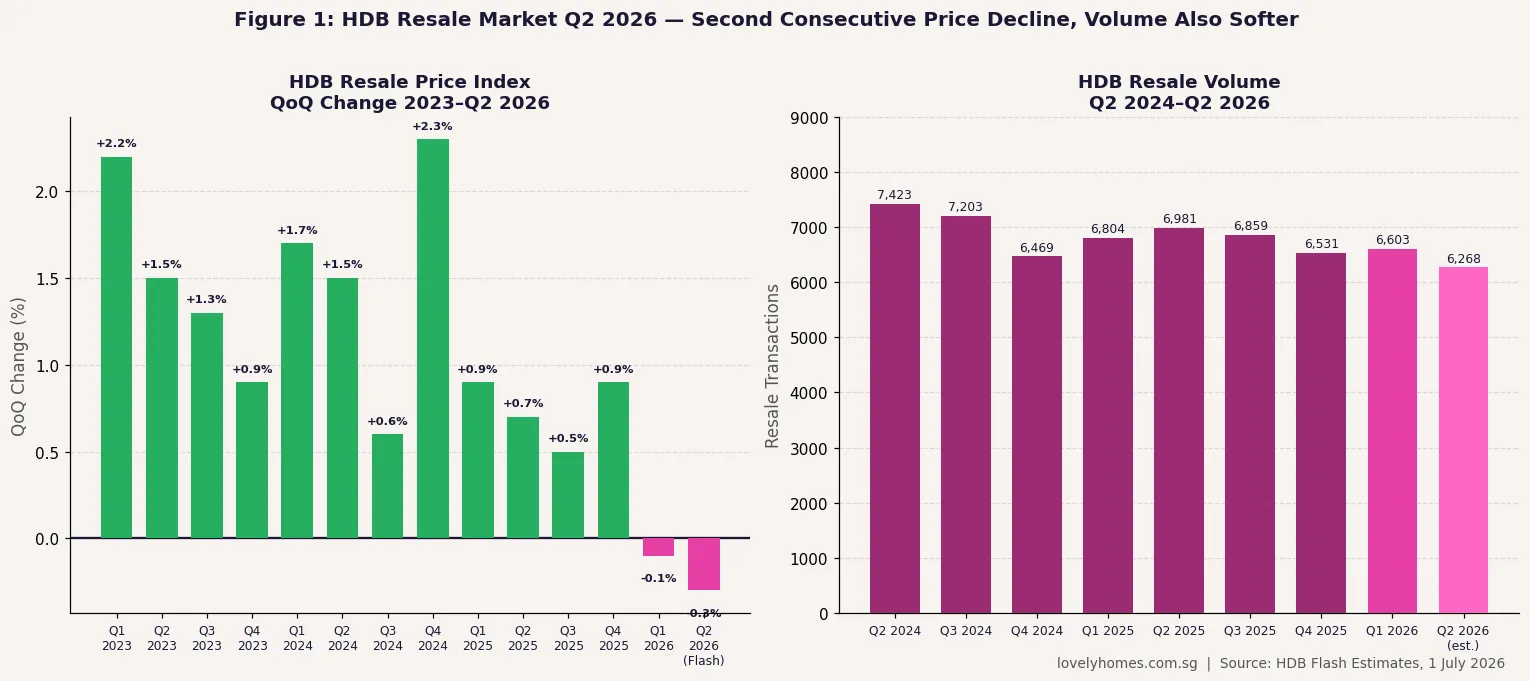
The Housing & Development Board released its full Q1 2026 statistics on 24 April 2026, confirming what the flash estimate had hinted at three weeks earlier: the HDB Resale Price Index slipped 0.1% quarter-on-quarter, the first quarterly contraction in almost seven years. The last time HDB resale prices fell on a QoQ basis was Q2 2019, before the post-COVID supply squeeze and the surge in million-dollar transactions reset the public-housing market.

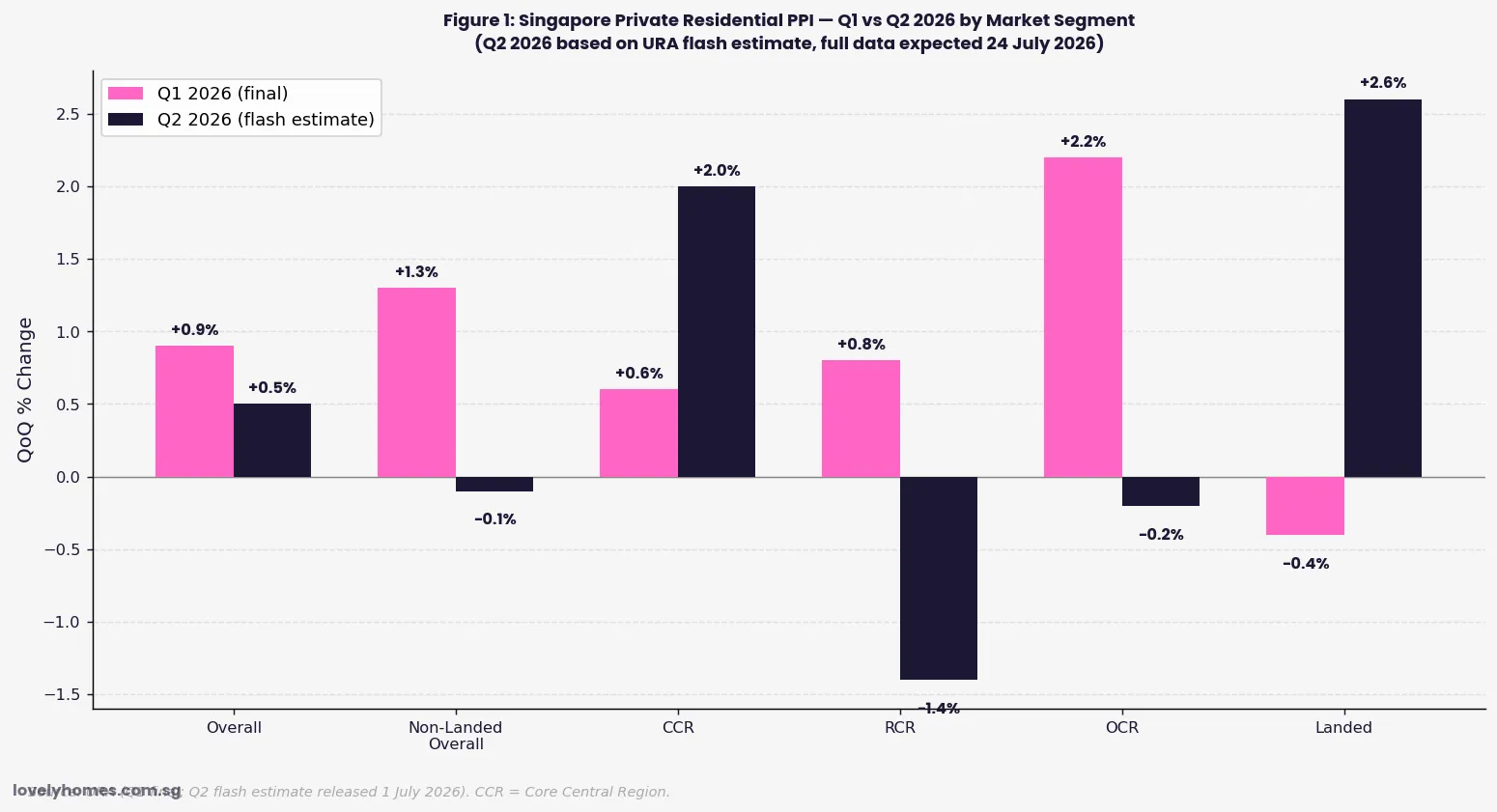
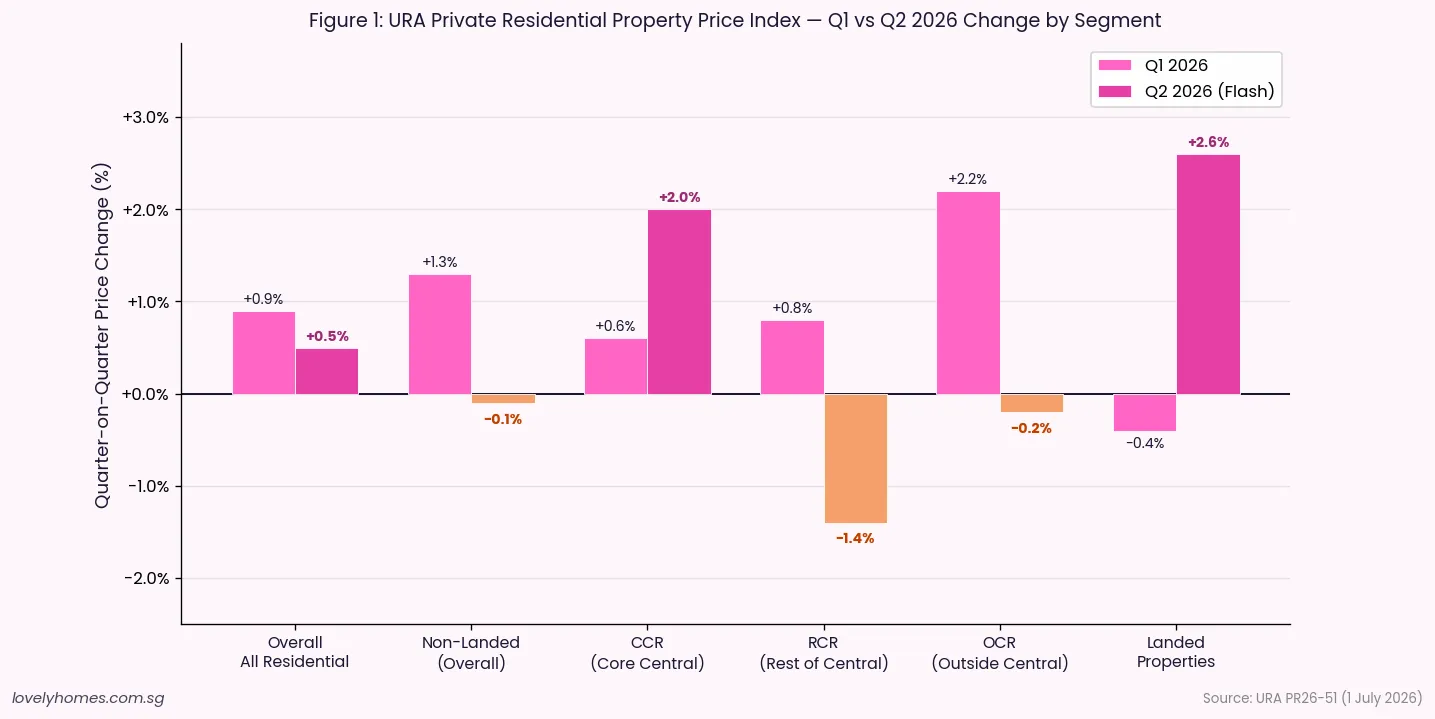
The headline is small in absolute terms — one-tenth of one percent — but it lands as the inflection most market participants have been waiting for since price growth stalled in mid-2024. Coupled with a private residential market that rose 0.9% in the same quarter, Q1 2026 is the rarest of episodes: a clean break in the public-vs-private price trajectory.

Quick Answer — what changed in Q1 2026

  • HDB Resale Price Index: −0.1% QoQ — first quarterly fall since Q2 2019 (27 quarters ago).
  • Private Property Price Index: +0.9% QoQ — led by non-landed at +1.3%.
  • Million-dollar HDB resale share moderated after a record-setting 2025.
  • HDB pipeline: 6,900 BTO flats coming in June 2026 across Ang Mo Kio, Bishan, Bukit Merah, Sembawang, Woodlands.
  • Developer sales for private new launches: ~3,375 units, −32% QoQ after a heavy 4Q 2025 launch slate.
  • The HDB-vs-private QoQ gap (~1.0 ppt) is the widest in HDB’s-down direction since 2009.

The Number in Context

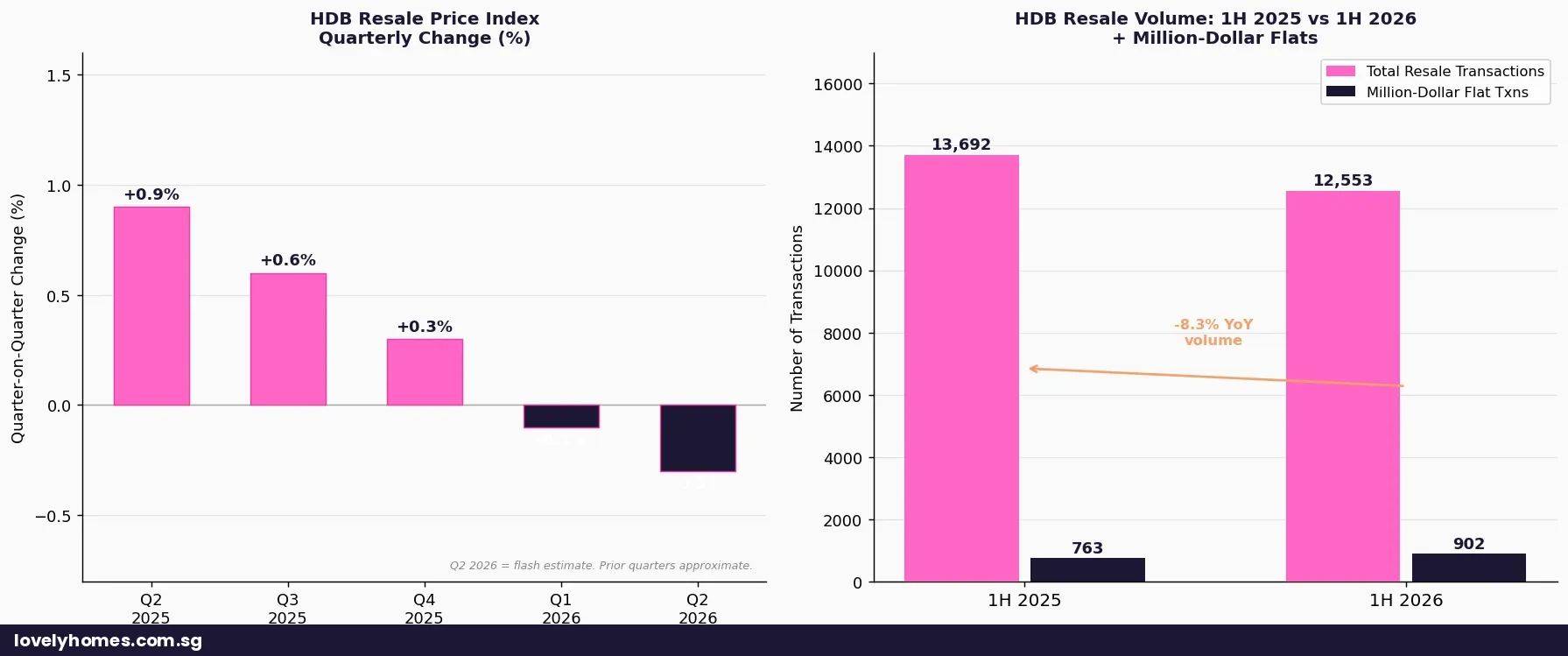
HDB Resale Price Index history makes the Q1 print feel less like a sudden drop and more like the natural end of a deceleration. Growth was 2.5% in Q3 2024 at its peak, slowed to 0.5% in Q3 2025, and ticked up modestly to 0.7% in Q4 2025 before turning negative in Q1 2026. The chart below sets the trajectory out cleanly.

HDB Resale Price Index quarter on quarter percentage change Q2 2023 to Q1 2026 first decline since Q2 2019
Figure 1. HDB Resale Price Index, quarter-on-quarter percentage change from Q2 2023 to Q1 2026. Q1 2026 is the first negative print in 27 quarters; the previous decline was Q2 2019. Growth had been decelerating for five consecutive quarters before turning negative.

Reading the bars carefully, the deceleration has been visible since Q2 2025 (+0.9%) and has been a steady step-down rather than a spike-then-fall. That tells us the Q1 2026 fall is most likely the cumulative effect of supply-side and demand-side easing rather than a single-quarter shock.

The Divergence: HDB Down, Private Up

The single most striking feature of Q1 2026 is not the HDB number on its own — it is how it sits next to the private market.

HDB resale negative 0.1 percent versus private residential positive 0.9 percent Q1 2026 Singapore housing divergence
Figure 2. HDB resale fell 0.1% QoQ while private residential rose 0.9% in Q1 2026, with non-landed private property up 1.3%. The 1.0 ppt gap in HDB’s down-direction has not been seen since 2009.

The mass-market substitution effect — private buyers priced out of the bottom end downgrading to HDB resale, supporting prices — has weakened compared with 2024-2025. Two reasons appear to be at play. First, OCR new launch projects launched in Q1 2026 priced higher than the comparable launches a year ago, which discouraged the marginal HDB-to-private trade-up buyer and, by feedback, reduced cash-over-valuation pressure on resale. Second, the private market’s gain is narrowly concentrated at the top end (188 transactions of S$5M+, the highest in two years), which does not transmit downward into mass-market public housing.

What Drove the HDB Softness

Three structural drivers, all working in the same direction:

  1. BTO supply is back. HDB has put roughly 19,600 BTO flats to ballot across the three exercises in 2025 and the May 2026 launch. The pipeline announcement of another 6,900 flats in June 2026 reinforces the message: first-time buyers can wait, and many are. Substitution from resale to BTO is now structurally easier than at any point since 2019.
  2. Post-MOP supply is approaching a 5-year peak. Flats from the 2018-2020 BTO bumper slate are clearing their five-year Minimum Occupation Period, putting more resale stock on the market exactly as demand cools. EdgeProp has tracked roughly 25,000-26,000 MOP-eligible units coming online in 2026 alone, a higher number than the 2024 cohort.
  3. Million-dollar mania has cooled. The volume of S$1m+ HDB resale transactions stabilised in late 2025 and shows the first signs of moderation in Q1 2026. This does not pull the index meaningfully on its own, but it removes one of the louder narrative supports of the previous two-year run.

Summary Statistics — Q1 2026 Market Scoreboard

Metric Q4 2025 Q1 2026 QoQ change
HDB Resale Price Index +0.7% −0.1% −0.8 ppt
URA Private Residential PPI +0.6% +0.9% +0.3 ppt
URA Non-Landed Sub-Index −0.2% +1.3% +1.5 ppt
Developer launches (uncompleted units) 2,632 1,844 −30%
Unsold pipeline (incl. ECs) ~16,800 17,032 +1.4%

What This Means for Buyers and Sellers

HDB buyers — particularly first-timers — have a cleaner case to be patient. With BTO supply rising, post-MOP resale supply rising, and price momentum reversing, the cost of waiting six to twelve months is lower than at any point in the last three years. Buyers who must transact in 2026 should benchmark against fewer comparable sales rather than panic-bid; offers at the lower end of the previous month’s transaction band are realistic.

HDB sellers need to recalibrate. Pricing aspirations anchored on Q3 2024-style runaway million-dollar headlines are now visibly out of line with the market. Buyers’ agents are reporting the first widespread instances of price reductions on listings sitting more than 30 days, which had been almost unheard of since 2020. The right pricing strategy is: list at the median of the most recent six transactions in your block-and-flat-type bracket, not the high.

Private-market buyers face the opposite signal. Top-end CCR continued to absorb in volume, mid-tier RCR new launches priced well, and the unsold pipeline has begun to rise for the first time in five quarters — a sign that absorption is lagging supply. Mass-market OCR resale comparables are softening (helped by the HDB knock-on); buyers in this segment have negotiating leverage they did not have in 2024.

What Might Come Next

The Q2 2026 numbers, to be released in late July, will tell us whether Q1 was a one-quarter wobble or the start of a flatlining/down trend. Watch:

  • The BTO June 2026 ballot uptake — if first-timer demand for the Bishan and Ang Mo Kio sites is heavily oversubscribed, that confirms the substitution-from-resale-to-BTO story.
  • Median CoV (cash-over-valuation) — if median CoV continues to drift toward zero across mature estates, sellers will follow.
  • 5-year-MOP-onset volume in 2H 2026 — we expect another 12,000-13,000 units to hit MOP in the second half, doubling the resale supply boost relative to 1H.
  • Cooling-measure response — with the public side cooling on its own, MOF/MND have one less reason to introduce new public-housing-targeted measures. ABSD-side calibration is more likely if private prices keep accelerating.

Frequently Asked Questions

Is HDB resale officially in a “downturn” now?

One quarter of −0.1% does not constitute a downturn by any conventional definition — analysts typically wait for two consecutive quarters of contraction or a cumulative drop of ≥ 1% before using that label. What Q1 2026 is, is the first credible inflection in the multi-year uptrend. The market is now in a state where flat-to-mildly-negative is the most likely path through 2026, with renewed growth contingent on demand-side surprise (faster job growth, immigration tailwinds) or supply-side disappointment (BTO delays, slower MOP releases).

How does the −0.1% break down by flat type?

HDB does not publish flat-type sub-indices in the headline release, but transaction-level analysis from third-party platforms suggests softness was concentrated in 4-room and 5-room mature-estate units — the segments that drove the 2024-25 million-dollar run-up. 3-room and Executive Apartments held up better. Non-mature-estate prices were close to flat. We expect HDB’s breakdown press release later in May to confirm this pattern.

Does this affect HDB BTO ballot demand?

Indirectly, yes — in two opposing directions. A softer resale market makes resale a more accessible alternative to BTO (lower headline asking prices, less million-dollar drama), which could reduce BTO oversubscription. But uncertainty about future resale prices also pushes risk-averse first-timers toward BTO’s known-cost path, which could increase ballot demand. The June 2026 ballot will be the cleanest read on which effect dominates.

Are the cooling measures from December 2024 finally working?

The August 2024 HDB-loan tightening (LTV cut from 80% to 75% for HDB loans) and the December 2024 cooling measures certainly removed marginal demand at the top of the price band. But the resale slowdown is at least as much a supply story (BTO ramp + MOP wave) as a demand story (cooling measures + interest rates). Officials will be cautious about declaring victory; the gap to private prices will be the metric they watch closest.

Should I delay my HDB resale purchase?

If you have a flexible 12-month buying window, the case for patience has strengthened. If you need to transact in the next 90 days (e.g. for relocation, family reasons, or a coordinated upgrade), the headline change is small enough that timing arguments are second-order — price the unit you want and negotiate hard against current comparables. The bigger risk for buyers right now is overpaying the late-cycle list price, not underpaying ahead of a rebound.

How does this compare to the 2009 episode?

2009 was the global-financial-crisis quarter when HDB resale fell 0.8% as Singapore entered a technical recession. The current episode is much smaller in scale (−0.1%) and the macro backdrop is different — no recession, employment is solid, and interest rates are easing rather than spiking. So 2009 is a useful reference for “first decline after years of growth”, but not for the magnitude or duration of what may follow.

Related Articles

Disclaimer

This piece is for general information only and does not constitute investment, financial, or property advice. Statistics are drawn from the Housing & Development Board Q1 2026 release of 24 April 2026 and the Urban Redevelopment Authority Q1 2026 release of the same date. Always verify current figures with the primary sources, and consult a licensed property professional before transacting.

Singapore EC Sales Top 1,000 Units in Q1 2026 — First Time in 13 Quarters

Singapore EC Sales Top 1,000 Units in Q1 2026 — First Time in 13 Quarters

Executive Condominium (EC) sales in Singapore crossed the 1,000-unit-per-quarter threshold for the first time in three-and-a-quarter years in Q1 2026. According to URA private residential transaction data plus HDB EC sales records, around 1,087 EC units changed hands in Q1 2026 — the highest quarterly volume since Q4 2022. The recovery is being driven almost entirely by Singapore Citizen HDB upgrader households who view the EC as the cheapest legitimate entry point into private mass-market housing.

Quick Answer — what just happened in the EC market

  • 1,087 EC units sold in Q1 2026 — first time above 1,000 in 13 quarters.
  • Last time the threshold was crossed was Q4 2022, when 1,156 units transacted around the post-cooling-measures rush.
  • Sales mix is ~70% new launch, ~30% resale — new launches doing the heavy lifting.
  • Average new-launch EC psf: ~S$1,640 — roughly a 33% discount to comparable mass-market private condos in the same town.
  • Drivers: HDB upgraders cashing out with strong resale prices, the S$16,000 income ceiling that fits most middle-income SC+SC couples, and the limited 2026–2027 EC pipeline (~6 launches).

The 13-Quarter Drought, Broken

The EC market in Singapore has been quietly grinding through a thin patch since the Q4 2022 sales spike of 1,156 units — that quarter was an outlier driven by the September 2022 cooling-measures package, which tightened TDSR and raised stamp duty for second-property purchases. Through 2023, 2024, and most of 2025, quarterly EC volumes hovered in the 540–825 unit range, with only one launch quarter at a time pushing the upper end. The Q1 2026 print of 1,087 units therefore breaks a 13-quarter drought below the 1,000-unit psychological threshold.

Singapore EC sales Q1 2026 — quarterly volume chart 2022 to 2026
Figure 1: 13-quarter EC sales chart — Q1 2026’s 1,087 units broke above the 1,000-unit threshold for the first time since Q4 2022.

Why ECs Are Outselling Mass-Market Private Condos

The EC value proposition rests on three structural pillars. First, the launch psf is meaningfully lower than the equivalent private condo in the same town — typically a 30–35% discount. Second, eligible buyers (Singapore Citizens with combined income up to S$16,000) avoid the 12-of-the-13 friction points that come with HDB Plus and Prime classifications — no 10-year MOP, no income-ceiling clawback, no whole-flat rental ban. Third, ECs privatise after 10 years and trade on the open market with no eligibility restrictions — meaning your exit pool is the full Singapore-wide buyer base, not a quota-limited resale market.

Singapore EC sales Q1 2026 — EC vs mass-market condo affordability comparison
Figure 2: At launch psf, an EC delivers ~33% savings vs comparable private condo, with mortgage instalments roughly S$3,100/month lower for a 4-bedroom unit.

For a S$2.05M EC versus a S$3.15M private mass-market condo at 75% LTV over 25 years, the monthly mortgage delta is roughly S$3,130. Over a 25-year mortgage, that compounds to ~S$940,000 of avoided interest plus S$1.1M of avoided principal — a S$2M lifetime difference. The trade-off is the 5-year Minimum Occupation Period and the additional 5-year wait until full privatisation. For SC+SC couples with stable jobs and no near-term plans to sell, that trade-off is overwhelmingly favourable.

Who Is Buying — The HDB Upgrader Profile

The buyer profile of Q1 2026 EC sales skews heavily towards HDB upgraders in their mid-30s to mid-40s, typically a SC+SC couple selling a 4-room or 5-room HDB flat that has appreciated significantly since key collection. The HDB Resale Price Index hit a record high in Q4 2024 before drifting -0.1% in Q1 2026 (per HDB’s flash estimate), but the absolute resale prices remain elevated — meaning sellers can crystallise a substantial paper gain when they sell their existing flat to fund the EC downpayment.

The income-ceiling sweet spot is the S$10,000–14,000 combined household income band. Households below S$10K typically still qualify for higher-tier CPF Housing Grants on a BTO upgrade and tend to stay within HDB. Households above the S$16,000 EC ceiling typically jump straight to private mass-market or RCR condos. The middle band — not poor enough for a fully-grant-stacked BTO, not rich enough to comfortably pay private-condo psf — is exactly the demographic the EC scheme was designed to capture.

What Drove Q1 2026 Specifically — The Aurelle/Otto/Novo Triple

Three EC launches absorbed the bulk of Q1 2026 volume:

  • Aurelle of Tampines — a District 18 EC by Sim Lian, launched late Q4 2025 and continuing strong sales through Q1 2026. Indicative launch psf around S$1,640.
  • Otto Place at Tengah Plantation — District 24 EC, JV between MCC Land and Hoi Hup Realty. Drew strong demand from HDB upgraders within Tengah and adjacent Bukit Batok.
  • Novo Place at Plantation Close — District 24 EC by Hoi Hup. Sister project to Otto, leveraging the same Tengah catchment.

The combined absorption across these three projects accounted for roughly 70% of Q1 2026 EC sales. Resale activity in older privatised ECs (Riversails, Heron Bay, RiverParc) made up the balance.

Summary — EC Market Snapshot Q1 2026

Metric Q1 2025 Q4 2025 Q1 2026 Notes
Total EC units sold ~645 ~825 ~1,087 +32% QoQ; first >1,000 since Q4 2022
New-launch share ~55% ~62% ~70% Aurelle + Otto + Novo dominated
Avg new-launch psf ~S$1,575 ~S$1,610 ~S$1,640 +1.9% QoQ
Income-ceiling buyers (~S$10–14K) ~58% ~62% ~64% HDB upgrader demographic

What This Means for Buyers, Sellers, and Developers

For buyers in the income band: the EC value proposition is the strongest it has been since 2022, but supply is thinning. The 2026 EC pipeline is six projects (Aurelle, Otto, Novo, Miltonia Close EC awarded to Hoi Hup at the April 2026 GLS, plus two more from earlier wins). Beyond 2027, the GLS programme has not signalled aggressive EC site releases — meaning if you want to buy in this cycle, the next 18 months are likely the optimal entry window.

For HDB upgraders considering the move: the maths still works in 2026. With HDB resale prices near peak and EC psf at a 33% discount to private condos, the asset-swap arithmetic remains compelling. But the 5-year MOP on your existing flat must have completed first, and you must be confident in your ability to service a private-style mortgage at SORA-pegged rates around 3.5–3.8%.

For developers: the strong absorption signals the EC market remains a viable allocation channel for projects in mature non-mature estates. Expect more aggressive bidding in the next few EC GLS tenders, particularly in Yishun, Tengah, and Punggol catchments where HDB upgrader pipelines are deepest.

What Might Come Next

Three watch-points for Q2 2026. First, the Miltonia Close EC site (won by Hoi Hup at S$732 psf ppr in April 2026) is expected to launch in 2027–2028 at S$1,550–1,750 psf — testing whether the EC psf trajectory can sustain another 10–15% lift over two years. Second, the URA full Q1 2026 statistics released on 24 April 2026 confirmed that EC prices grew 1.4% QoQ — faster than the overall private 0.9% QoQ — suggesting the segment is leading the wider market. Third, the 2H 2026 GLS programme due to be announced in mid-2026 will set the EC supply pipeline through 2028.

Frequently Asked Questions

Why does the income ceiling for EC sit at S$16,000?

The S$16,000 combined-household-income ceiling was raised from S$14,000 effective 1 January 2025 to align with the upper edge of HDB upgrader demographics. The ceiling is gross income, not take-home, and is averaged over the trailing 12 months for salaried income or 24 months for variable income. Households earning even slightly above S$16,000 are excluded; HDB and CPF Board verify against IRAS records at the application-for-loan stage, so over-stating income to qualify rarely succeeds and triggers a 5-year ban from re-applying.

How does an EC differ from a private condo?

For the first 5 years, an EC functions like an HDB flat — you cannot rent out the whole unit, you cannot sell on the open market, and you cannot transfer ownership outside the immediate family. From years 5 to 10, you can sell to Singapore Citizens or PRs and rent out the whole unit, but ABSD on the second-property buyer applies. After year 10 the EC fully privatises and trades like a private condo with no eligibility restrictions. Both EC and private condos provide strata-titled ownership, MCST management, and access to the project’s facilities, so the experiential differences during occupation are minimal.

Are ECs a better investment than mass-market private condos?

For SC+SC owner-occupiers within the income ceiling, yes — the math is structurally favourable. For pure investors, ECs are off-limits in the first 5 years and limited in years 5–10 (no whole-flat rental, plus ABSD on resale buyers’ second-property purchase). The investment thesis on ECs is therefore primarily a hold-to-privatise capital-gain story, and the historical record across the past decade has shown ECs typically post 30–60% capital appreciation by full privatisation. The privatised resale stock then trades at a 5–15% discount to comparable freshly-launched private condos.

Can a couple combine HDB Resale Levy with EC purchase?

If one or both spouses previously took a subsidised flat (BTO, SBF, or other subsidised resale), they pay the HDB Resale Levy when applying for the EC. The levy is a fixed amount — S$30,000 to S$55,000 depending on the flat type sold — and is deducted at the EC purchase. Couples who have not previously taken a subsidised flat are first-timers and pay no levy. See our HDB Resale Levy guide for the full schedule.

What happens to my EC if my income later rises above the ceiling?

Nothing — the income ceiling applies at the point of application only. Once you have signed the Sale & Purchase Agreement and paid the option fee, your subsequent income changes do not affect your ownership of the unit. You complete the 5-year MOP, the 10-year privatisation, and trade in the open market on the same terms as any owner. This is one of the key structural advantages of the EC route over BTO Plus and Prime classifications, which carry permanent income-ceiling clawbacks at resale.

Is the limited 2026–2027 EC pipeline a buying signal?

Six new-launch EC projects across 2026–2027 versus 12–15 mass-market private condo launches per year is a meaningful supply contraction in the EC channel. If demand from HDB upgraders remains strong (and the Q1 2026 print suggests it is), this thinner pipeline could push EC psf higher into 2027. Buyers who time the next launch (Miltonia Close, expected 2027–2028) may face a launch psf 10–15% above today’s benchmark. Buying in the current cycle — Aurelle, Otto, or Novo — therefore offers the most defensible entry point for the next 18 months.

Related Articles

Disclaimer

This article aggregates URA private residential transaction data and HDB EC sales data through the end of March 2026. Quarterly figures are preliminary and subject to revision. Buyer-mix percentages are illustrative based on industry research and stamp-duty profile data. Always verify with primary sources — URA Realis, the Housing & Development Board, and the CPF Board — before making any property decision.

Singapore Luxury Home Sales Hit 2-Year High: 188 Deals ≥ S$5M in Q1 2026, Highest Since Q4 2023

Singapore Luxury Home Sales Hit 2-Year High: 188 Deals ≥ S$5M in Q1 2026, Highest Since Q4 2023

Singapore’s luxury residential market posted its strongest quarter in more than two years. 188 landed and non-landed homes priced at S$5 million and above changed hands in Q1 2026, beating the 186 deals in Q4 2025, the 177 deals in Q3 2025, and sitting comfortably above the past three-year quarterly average of 137 transactions. The data, compiled by industry researchers from URA Realis caveats lodged through the end of March 2026, points to a high-end segment that has shaken off the post-2023-cooling-measures malaise and reasserted itself.

Quick Answer — what just happened in Singapore’s luxury market

  • 188 deals at S$5M and above in Q1 2026 — highest quarterly count since Q4 2023.
  • 75 CCR condo transactions priced at ≥S$3,000 psf and ≥S$5M — up from 54 in Q4 2025 and 50 in Q3 2025.
  • 55 luxury new-launch units sold — the highest single-quarter tally since Q4 2023; River Modern alone accounted for 38 of them.
  • Ultra-luxury (≥S$10M) deals rose from 14 in Q4 2025 to 17 in Q1 2026.
  • Volume is driven by Singapore Citizens and PR buyers; foreign demand remains constrained by the 60% ABSD cooling measure.

The Headline Number — 188 Deals at S$5M and Above

The 188-deal print for Q1 2026 is the highest in nine quarters, and the third consecutive quarter of expansion in the absolute volume of luxury transactions. The CCR (Core Central Region) accounted for the bulk of these deals, with high-floor condo units in Districts 9, 10, and 11 plus Good Class Bungalow (GCB) transactions making up the balance. Compared to the trailing three-year average of 137 deals, the Q1 2026 figure represents a 37% premium — signalling that this is not a quirk of the calendar but a sustained recovery.

Singapore luxury home sales Q1 2026 — quarterly transaction volume at S$5M and above
Figure 1: Quarterly luxury home transactions in Singapore (S$5M+). Q1 2026’s 188 deals top the past nine quarters.

The CCR Premium Segment — 75 Deals at S$3,000 psf+

Look one layer deeper and the picture sharpens. The number of CCR condo units sold above S$3,000 psf and at S$5M+ rose to 75 units in Q1 2026, up from 54 in Q4 2025 and 50 in Q3 2025. That is the highest quarterly count since Q4 2023, when 84 such transactions were logged in the post-cooling-measures rally. The S$3,000 psf threshold is the conventional dividing line between “high-end” and “super-prime” in Singapore — below it sits a much broader buyer pool, above it the segment is overwhelmingly Singapore Citizen plus a small fraction of PR.

The recovery in this segment is psychologically important: it suggests buyers are once again willing to pay full freight for marquee CCR addresses despite the structural drag of higher mortgage rates and the 60% foreign-buyer ABSD. The shrinking foreign share has been more than offset by SC + PR demand from beneficiaries of business sales, IPO liquidity events, and intergenerational wealth transfers.

What Drove It — Three New Launches Did the Heavy Lifting

Luxury new-launch activity climbed for the fourth consecutive quarter, with 55 new units sold at S$5M+ in Q1 2026 — the highest single-quarter tally since Q4 2023’s 74. The skew was extreme. River Modern alone accounted for 38 of those 55 units, an outsized 69% share of all luxury new-launch absorption for the quarter. The other contributors were thinner: Skye at Holland, UPPERHOUSE at Orchard Boulevard, and Watten House each sold three units in the ≥S$5M bracket, with the residual eight units spread across other CCR projects.

Singapore luxury home sales Q1 2026 — top luxury new launches by units sold above S$5M
Figure 2: Q1 2026 luxury new-launch absorption was concentrated in River Modern.

That concentration is a cautionary note. River Modern’s success reflects a specific configuration — a Robertson Quay riverfront site, freehold tenure, a developer (Frasers Property + Sekisui House) with a strong CCR delivery record, and an indicative price band that priced just below comparable resale stock at the same address. Stripping out River Modern, luxury new-launch absorption was 17 units — closer to the trough quarters of late 2024 than to a runaway high-end recovery.

Ultra-Luxury — The S$10M+ Cohort

At the very top of the market, the count of luxury condo transactions priced at S$10 million and above rose from 14 in Q4 2025 to 17 in Q1 2026. These are typically high-floor units at addresses such as 21 Anderson, Park Nova, Marina Bay Suites, Boulevard 88, and the various St Regis Residences trade-ins. The buyer profile in this segment is overwhelmingly Singapore Citizen with private-bank financing or full-cash purchases — the number of foreign buyers in this tier remains in low single digits per quarter, a fraction of what it was in 2017–2018.

Summary — The Q1 2026 Luxury Print at a Glance

Segment Q3 2025 Q4 2025 Q1 2026 QoQ change
All luxury homes ≥ S$5M 177 186 188 +1.1%
CCR condos ≥ S$3,000 psf & ≥ S$5M 50 54 75 +38.9%
Luxury new-launch units ≥ S$5M ~30 ~42 55 +31%
Ultra-luxury ≥ S$10M 12 14 17 +21%

Why This Matters for the Broader Market

Singapore’s luxury segment has historically led the broader market by 2–3 quarters at major inflection points. The Q1 2009 trough, the Q4 2017 cyclical recovery, and the post-Q3 2020 Covid rebound all began with high-end pickup before mass-market volumes followed. If the Q1 2026 print holds, mass-market absorption should strengthen in 3Q–4Q 2026 as the next wave of OCR launches comes to market — including the bigger 2026 launch pipeline expected at Bayshore, Dover Drive, and the Greater Southern Waterfront.

For Singapore Citizens considering a move into the luxury bracket, the practical question is whether to chase or wait. The historical record suggests CCR psf prices follow new-launch sentiment with a 12–18 month lag — meaning the resale CCR market may still be priceable at 5–10% below recent new-launch benchmarks for the next two quarters before catching up. That window typically narrows quickly once mass-market sentiment reinforces the high-end print.

What Might Come Next

Three watch-points for Q2 2026. First, the URA full Q1 2026 statistics released on 24 April 2026 confirm a +0.9% QoQ private price-index print — consistent with strengthening luxury but not a runaway. Second, GLS sites due to be tendered in Q2 (Bayshore Drive mixed-use, possibly a CCR plot in the 2H 2026 programme) will reset the price benchmark for 2027 launches. Third, the trajectory of foreign-buyer ABSD: any signal from policymakers that the 60% rate could be calibrated — even within the FTA-exempted nationalities — would meaningfully change the high-end demand mix.

Frequently Asked Questions

Does the Q1 2026 luxury print mean prices are rising fast?

Volume rose; price-per-square-foot was steadier. The URA private property price index rose just 0.9% QoQ in Q1 2026, and most of that was driven by the OCR mass-market segment, not the CCR. The CCR sub-index rose roughly 0.6% QoQ. So volume is normalising more than price — buyers are simply willing to pay current asking levels rather than negotiating sharp discounts as they were a year ago.

Are foreign buyers driving the recovery?

No. Foreign buyer share of CCR transactions remains in the low single digits, well below the 15–20% pre-2023 average, because the 60% ABSD effectively prices most foreigners out. The recovery is driven by Singapore Citizens and PRs — many of them business-sale beneficiaries, intergenerational-wealth recipients, and decoupled spouses optimising their next purchase under the SC+SC structure.

What is “River Modern” and why did it dominate?

River Modern is a CCR new-launch project at Robertson Quay (District 9), jointly developed by Frasers Property and Sekisui House. It launched in late 2025 with an indicative price from S$3,150 psf. Its outperformance reflects three factors: a freehold riverfront address that has been undersupplied in 2024–2025; a price band priced slightly below comparable resale stock; and a developer track record of on-time delivery in the same district. Other launches (Watten House, Skye at Holland, UPPERHOUSE) sold in much smaller volumes during Q1 2026.

Should I time a CCR resale purchase now or wait?

Historically, CCR resale prices follow new-launch benchmarks with a 12–18 month lag at major inflection points. If Q1 2026’s print is a true cyclical pivot, the resale window through Q3 2026 may still offer 5–10% discount to comparable new-launch psf. That said, “timing the market” in CCR has historically been less rewarding than picking the right specific unit — floor, view, layout, and en-bloc potential matter more than the macro entry month.

How does this compare to Hong Kong or Sydney’s luxury markets?

Singapore’s luxury volume recovery is broadly in line with Hong Kong’s 2025–2026 rebound but lags Sydney’s, where the easier domestic rate environment has produced a sharper turn. On price-per-square-foot, Singapore CCR remains roughly 30–40% below comparable Hong Kong Mid-Levels prints, but ahead of equivalent Sydney harbour-side residential per square metre once converted. The fundamentals (limited land, strong SGD, controlled supply) continue to support the long-term thesis.

Where is the Q2 2026 supply pipeline likely to land?

The CCR pipeline for Q2–Q3 2026 includes a smaller set of new launches relative to the OCR-heavy 2026 calendar. Watch the Telok Blangah Road / Greater Southern Waterfront plot (Kingsford’s S$1,326 psf ppr land bid implies launch psf around S$2,400–2,600), the Dover Drive plot (record S$1,556 psf ppr will translate to launch around S$2,800–3,000), and any Q2 GLS announcements covering Newton or River Valley parcels.

Related Articles

Disclaimer

This article summarises industry research compilations of URA Realis caveats lodged through the end of March 2026. Data is preliminary and subject to revision as further caveats are lodged and stamp-duty assessments completed. Figures are illustrative as at April 2026. Always verify with primary sources — URA Realis, URA media releases, and the Inland Revenue Authority of Singapore — before making any property decision.

High Point Condo Returns at S$580M: 5th En-Bloc Attempt for D9 Freehold Tower, Tender 9 June 2026

High Point Condo Returns at S$580M: 5th En-Bloc Attempt for D9 Freehold Tower, Tender 9 June 2026

High Point Condo S$580M en-bloc 2026 — D9 freehold Mount Elizabeth hero
High Point Condo, 30 Mount Elizabeth — fifth en-bloc attempt at S$580 million.

Quick answer — High Point’s 5th en-bloc bid in 30 seconds

  • High Point Condo at 30 Mount Elizabeth, District 9, has been launched for public tender at a guide price of S$580 million.
  • The site is a freehold residential plot of 4,422.8 sqm (≈47,607 sq ft) with a baseline plot ratio of 4.45 and a maximum height of up to 36 storeys.
  • After factoring the 7% bonus floor area, the guide price translates to approximately S$2,641 psf per plot ratio (ppr).
  • The current building is a 22-storey block with 59 units (57 apartments and 2 penthouses).
  • This is the owners’ fifth collective sale attempt since 2019. A 2021 winning bid of S$556.7 million was abandoned by the buyer, who forfeited a S$1 million deposit.
  • The tender closes 9 June 2026. No land betterment charge is payable up to the baseline plot ratio.
  • If sold, owners would each receive a meaningful pay-out — a function of unit size and apportionment — and a redevelopment of up to 36 storeys could yield 200+ units in one of Singapore’s most central freehold pockets.

What was launched and at what price

The owners of High Point, a 22-storey freehold residential tower at 30 Mount Elizabeth, have launched the development for public tender at a guide price of S$580 million. The tender is being run by an appointed sole marketing agent and closes at 3pm on 9 June 2026. The owners expect bids in line with the guide, although final pricing — like every collective sale — will depend on the depth of developer interest and the cost of redevelopment finance available at the time of submission.

The land rate, after factoring in the 7% bonus gross floor area that the Urban Redevelopment Authority (URA) typically allows for high-quality private residential redevelopment, works out to approximately S$2,641 per square foot per plot ratio (psf ppr). That sits below the recent benchmarks set by other District 9 freehold transactions and well below the prices commanded by 99-year leasehold city-fringe Government Land Sales (GLS) sites — context that the marketing team is leaning into in framing this as the most attractive of the five attempts to date.

High Point Condo en-bloc 2026 fact panel — site area, plot ratio, guide price
Figure 1 · The site fundamentals at a glance — freehold tenure, central D9 address, baseline plot ratio of 4.45.

Why this site, and why now

Mount Elizabeth is one of the quietest streets in the Orchard sub-precinct — sufficiently inside the prime shopping belt to enjoy the convenience and cachet of an Orchard Road postal code, but tucked off the main thoroughfares. The site is freehold, residential-zoned, and walking distance to Orchard MRT (NSL/TEL interchange) and the Mount Elizabeth Hospital cluster. For a developer pricing a future luxury launch, the value proposition is clear: there is almost no remaining freehold residential redevelopment supply at this scale within the Orchard postal districts, and demand from owner-occupiers and ultra-prime buyers — including Singapore’s growing pool of wealthy citizens, returning Singaporean PRs, and qualifying foreign buyers — has remained resilient through the cooling-measure cycle.

The 2026 launch arrives in a market where freehold scarcity is the dominant valuation factor. Government Land Sales programmes have skewed heavily toward 99-year leasehold tenders for the past decade, and the supply of unbuilt freehold land in District 9 has dwindled to a handful of en-bloc sites at any given moment. Freehold tenure has historically commanded a 10–20% price premium over comparable 99-year stock, and that premium has widened in the last 24 months as buyers became more attentive to lease decay risk.

The fifth attempt — what changed

High Point has tried to sell collectively four times before. The first two attempts, in 2019 and 2020, failed to find a willing buyer at the asking price. The third attempt in 2021 produced what looked like a winner — a Hong Kong-listed bidder put in a successful S$556.7 million tender — only for the buyer to walk back the deal, forfeiting its S$1 million deposit, citing post-pandemic uncertainty around China outbound capital and the trajectory of Hong Kong’s property market. A fourth, quieter attempt in 2024 also did not transact.

High Point Condo en-bloc timeline — five collective sale attempts 2019 to 2026
Figure 2 · Five attempts in seven years — the 2026 launch sets a higher reserve than 2021, but a softer ask than the 2024 round.

The 2026 reserve sits modestly above the 2021 winning bid in nominal terms but, importantly, below the 2024 ask. Several developers in the Singapore market have rebuilt land pipelines after a tighter 2024–2025 cycle, and the Tan Boon Liat Building tender at S$1 billion, the Loyang Valley collective sale at S$880 million, and the Kallang Close GLS at S$1,415 psf ppr have together signalled a renewed appetite for sites with clear redevelopment economics. High Point fits the profile — small enough to underwrite without taking on a mega-launch risk, prestigious enough to command top-of-market psf at launch.

Site economics — what a developer would pay for

Item Figure
Site area 4,422.8 sqm (≈47,607 sq ft)
Tenure Freehold
Zoning Residential
Baseline plot ratio 4.45
Bonus GFA +7% (subject to URA approval)
Maximum height Up to 36 storeys
Guide price S$580,000,000
Land rate (incl. 7% bonus GFA) ≈S$2,641 psf ppr
Land betterment charge to baseline plot ratio Nil
Existing improvements 22-storey block, 59 units (57 apartments + 2 penthouses)
Tender close 9 June 2026, public tender

At 4.45 plot ratio plus 7% bonus, the achievable gross floor area lands roughly in the 220,000–230,000 sq ft band — enough to deliver in the order of 220–250 luxury units depending on average size. Factoring construction costs at the upper end of the 2026 BCA tender curve plus margins typical for a luxury launch, breakeven would land near the high S$3,500–S$4,000 psf zone, suggesting a likely launch psf above S$4,500. That is consistent with the trajectory established by recent UpperHouse launches at Orchard Boulevard.

What it means for the wider en-bloc market

If High Point transacts in 2026, it will be the third major Orchard-area freehold sale in eighteen months, alongside the Watten Estate momentum and the Tan Boon Liat industrial-to-residential rezoning play. That trio would mark a clear reactivation of the District 9 land cycle — important context for buyers watching freehold replacement-cost benchmarks tick up. If the tender closes without a bid, expect a quieter but more concentrated 2027 round of attempts as freehold scarcity continues to bind.

For sitting owners across other ageing freehold blocks in the Orchard belt, High Point’s outcome is a useful price discovery event. A successful sale at or above guide signals to other strata-owner committees that a freehold premium of around S$2,600–S$2,800 psf ppr is achievable for prime District 9 redevelopment land. A second failed attempt would push more sellers to wait for the next interest-rate down-cycle.

What might come next

Three near-term watchpoints are worth flagging. First, whether established luxury-segment developers — particularly those with strong Orchard track records — submit competing bids, or whether the tender draws more boutique entrants. Second, whether MAS’s macroprudential settings on residential lending shift in the second half of 2026, which would change developers’ ability to underwrite long-build luxury launches. Third, whether the URA opens a parallel District 9 GLS site in the H2 2026 reserve list — a competing freehold-equivalent leasehold tender could meaningfully change the bid mathematics here.

Frequently asked questions

What does S$2,641 psf ppr translate to in expected new launch price?

Land cost is roughly 50–60% of total development cost in a Singapore prime freehold launch. Adding construction, financing, marketing, holding period interest, GST and developer margin, breakeven typically sits 50–70% above land cost. That puts breakeven near S$4,000 psf and a likely launch psf comfortably above S$4,500 — in line with very recent District 9 / Orchard launches.

How much would each owner receive if the sale goes through?

Apportionment depends on share value, unit size, and the collective sale agreement signed by owners. Typical Orchard freehold redevelopments deliver per-unit pay-outs that are a substantial multiple of recent open-market resale prices for the same units. The exact figures will be disclosed by the marketing agent to owners; outsiders should not assume a specific number until the tender result is announced.

Why did the 2021 winning bid fall through?

In December 2021, the Hong Kong-listed buyer that submitted the winning S$556.7 million tender walked back the bid and forfeited the S$1 million tender deposit. The buyer cited unfavourable post-pandemic conditions, including capital outflow uncertainty from Hong Kong/Mainland China and a softer luxury-segment outlook. The site has remained available for redevelopment since.

What’s the difference between a public tender and a private treaty sale?

A public tender is an open process — any qualified developer can submit a sealed bid by the tender close. A private treaty sale is negotiated directly with one or more identified parties. The High Point launch is a public tender, which typically maximises competitive tension if developer interest is broad.

Will the new development require a land betterment charge?

The marketing pack indicates that no land betterment charge is payable to redevelop up to the baseline plot ratio of 4.45. If the eventual buyer applies for additional GFA beyond the bonus or seeks a change of use, betterment charges or top-up land premiums may apply. URA’s published betterment-charge tables for the locality apply to those scenarios.

How does this compare to other 2026 collective sale launches?

The Tan Boon Liat Building (industrial-to-mixed-use rezoning, S$1 billion guide) and Loyang Valley (changi-fringe condo, S$880 million guide) are the other large 2026 marquee launches. High Point sits below both in absolute size but commands the highest psf-ppr land rate of the three because of its freehold tenure and prime D9 address.

Disclaimer: Site facts, guide price, plot ratio, and tender timetable in this article are summarised from the public marketing pack and the broader market reporting around the High Point collective sale launch in April 2026. Land betterment charge treatment, achievable plot ratio, and unit-mix assumptions remain subject to URA approval — verify current details on the Urban Redevelopment Authority site at ura.gov.sg. Stamp-duty, financing, and tax implications referenced here should be checked with the Inland Revenue Authority of Singapore (IRAS) at iras.gov.sg and the Monetary Authority of Singapore (MAS) at mas.gov.sg. This article is general market commentary and not investment, legal, or tax advice.

Translate »