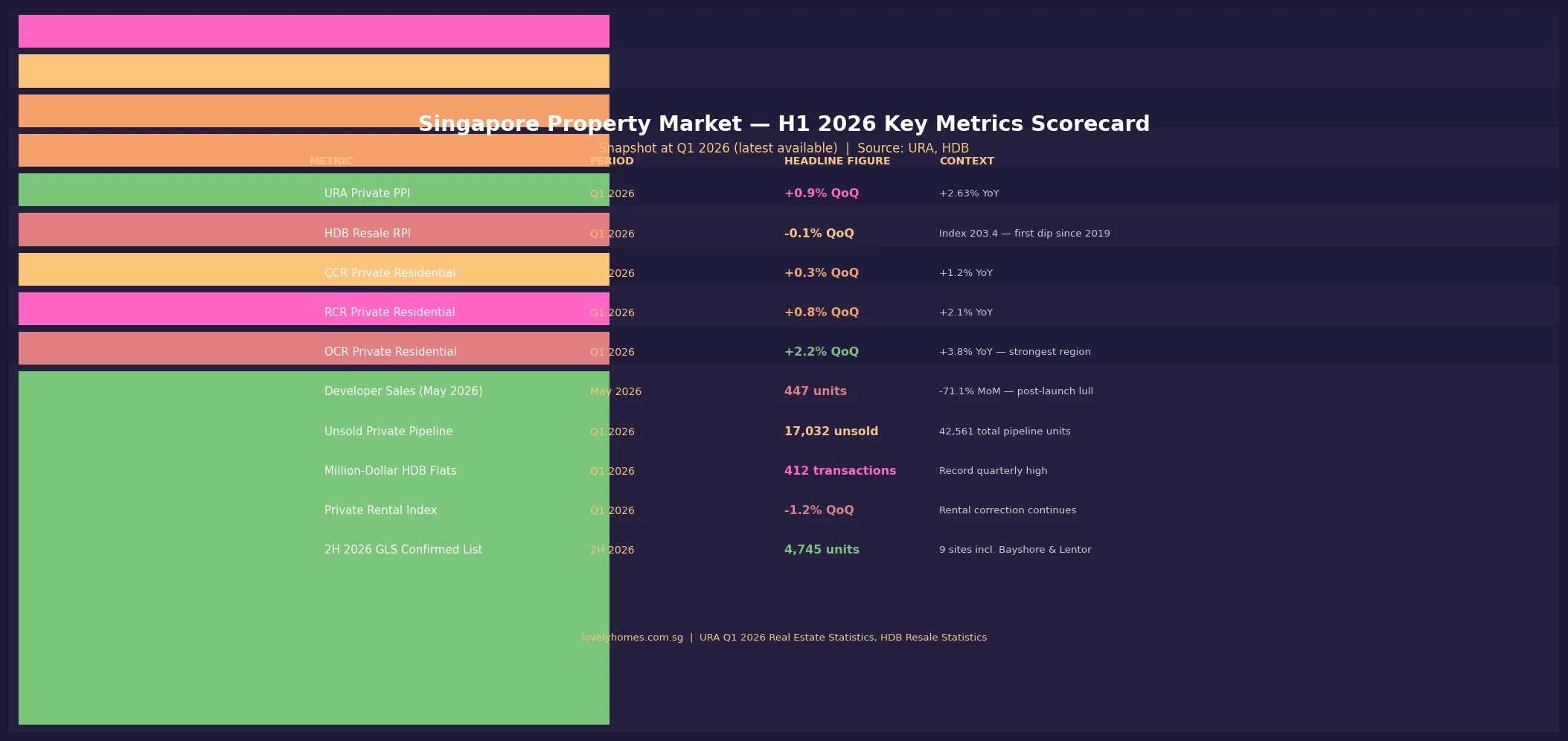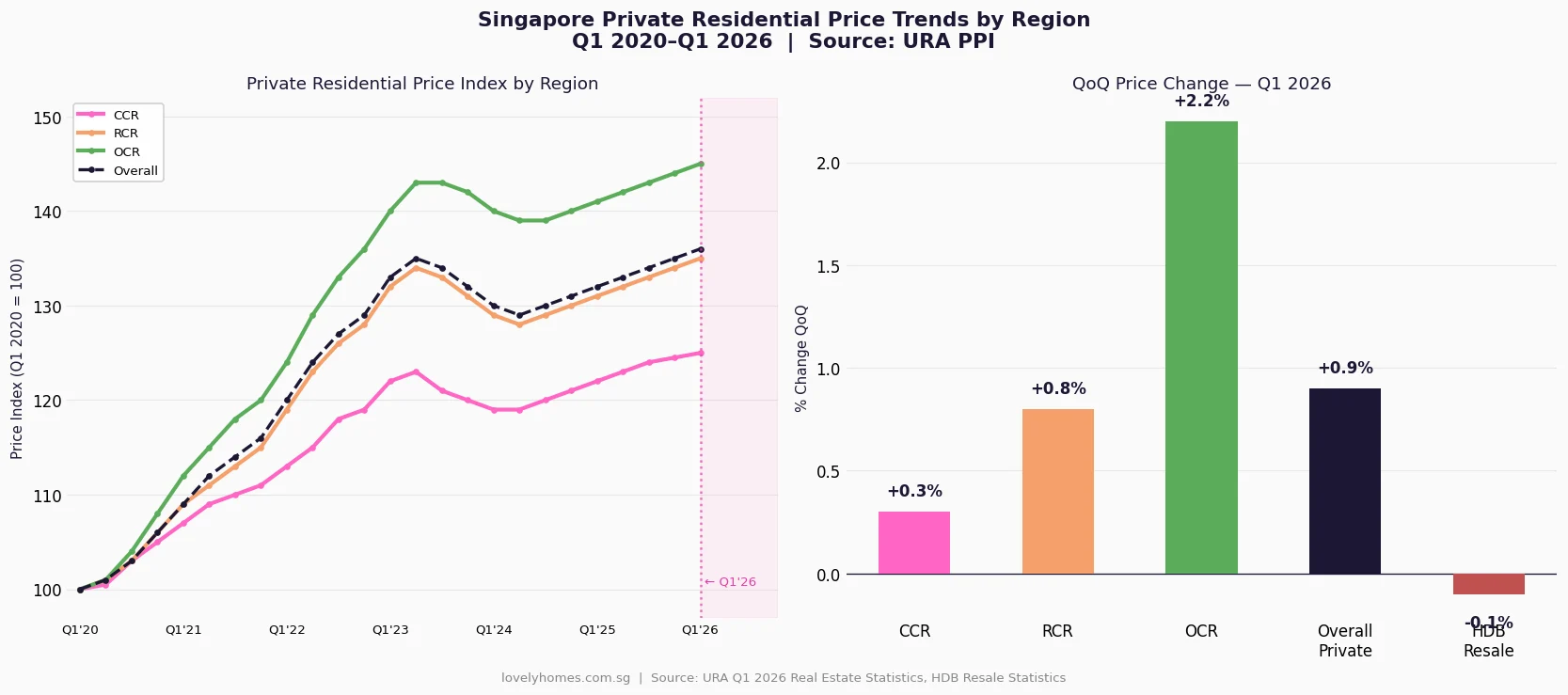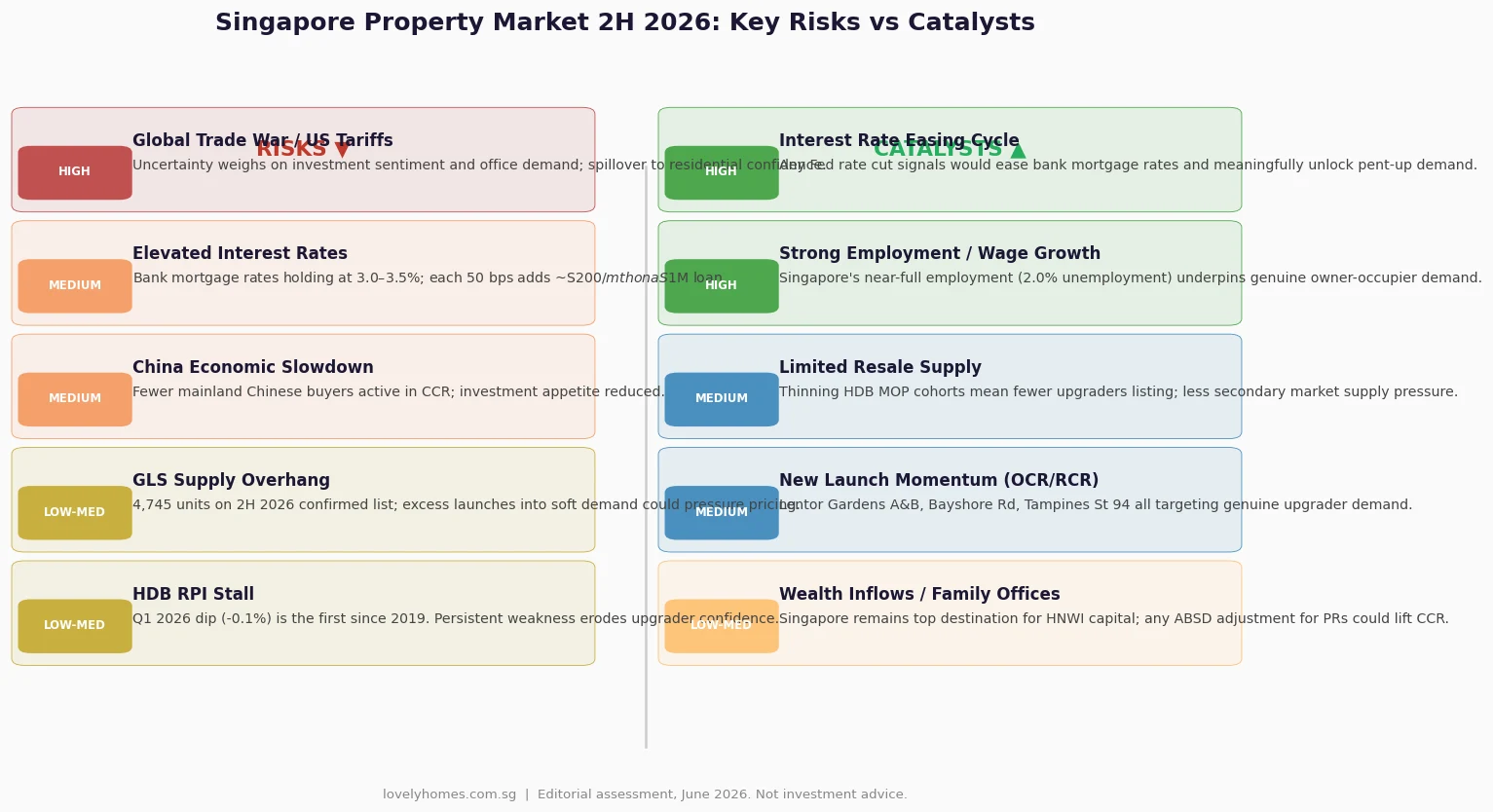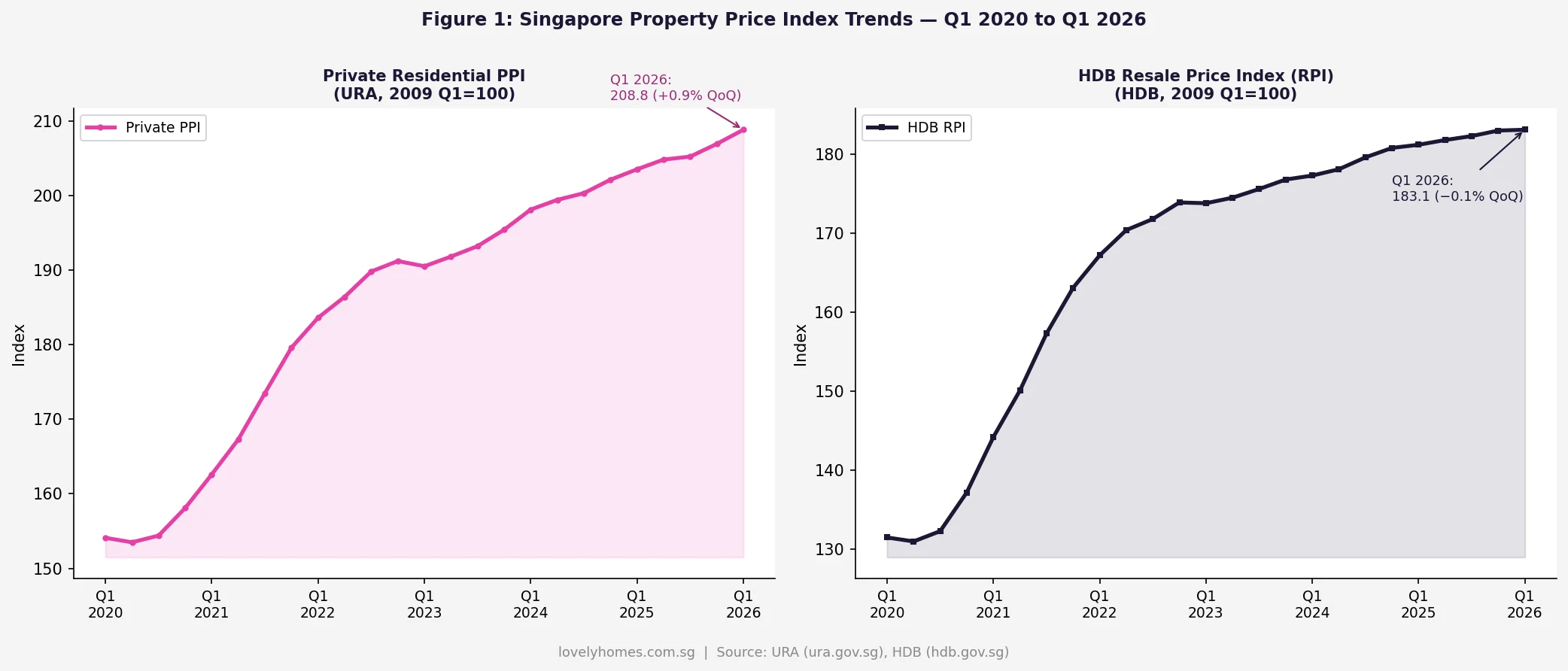
The Housing & Development Board’s flash estimate for the Q1 2026 Resale Price Index lands this week, alongside the URA private-property index — and the early reading from caveats filed through March paints a picture that rhymes with the last two quarters: mature-estate four- and five-room stock holding firm, non-mature HDB BTO resale stock softening modestly, and the million-dollar HDB count ticking up for the eighth consecutive quarter.
At a glance
HDB’s Q1 2026 flash RPI print is expected to come in at +0.9% QoQ, following +1.1% in Q4 2025 and +1.4% in Q3.
Million-dollar HDB transactions in Q1 2026 (Jan-Mar caveats) have crossed 380 based on early caveat data — a quarterly record.
Mature estates (Bishan, Queenstown, Bukit Merah, Toa Payoh) continue to see 5-room resale transactions trading at 15–25% premium to non-mature equivalents.
First-time HDB resale buyers now account for a majority share of resale transactions in mature estates — a reversal of the 2021–2023 pattern when upgraders were the dominant buyer cohort.
Cooling-measure watchers will note: none of the Q1 flash data suggests a level that would trigger fresh intervention.
The headline: deceleration, not decline
The direction of travel through 2025 was clear — each quarterly print smaller than the previous — but the gradient has now flattened. The Q1 2026 +0.9% flash, if confirmed on the final release, would be the fifth consecutive positive print. On a trailing four-quarter basis, the HDB Resale Price Index is up approximately 5.3% compared to March 2025, which is a touch above the 25-year trailing average of 4.1% per annum and well below the 10.7% CAGR of the post-pandemic recovery window from 2021 to 2023.
The deceleration pattern is most visible in non-mature estates. Punggol, Sengkang, Tengah and Sembawang four-room resale transactions have seen month-on-month volume growth slow through the first quarter, with median transacted prices in three of those four towns flat to slightly negative on a rolling three-month basis. Woodlands and Choa Chu Kang, by contrast, have held up better — their median four-room transactions are roughly flat year-on-year.
The mature-estate premium keeps widening
The gap between the most-expensive mature town (Queenstown) and the cheapest common non-mature town (Choa Chu Kang) now stands at approximately S$535,000 on a five-room equivalent — the widest spread in a decade of tracked data. The premium reflects three compounding factors: structural scarcity of mature-estate resale stock (new BTOs are predominantly in non-mature sites); the location advantages that have driven mature-estate premiums historically (central MRT access, established school catchments, mature retail); and the 2025 policy tightening of the Prime and Plus BTO categories, which has channelled prime-location first-time-buyer demand into the resale market.
Million-dollar HDB transactions cross 380
The million-dollar HDB count — resale transactions at S$1 million or above — has been one of the year’s most-watched numbers. Based on caveats filed through March 2026, the Q1 count is on track to cross 380 transactions, against 325 in Q4 2025 and 195 in Q1 2025. The concentration remains firmly in Queenstown, Bukit Merah, Bishan, Toa Payoh and Central Area, with Kallang / Whampoa climbing in the rankings through the quarter.
Why million-dollar HDB matters
The million-dollar transaction is not, by itself, a market-stability concern — these are higher-floor, larger-unit, mature-estate flats with premium micro-attributes, and they represent a small fraction of total HDB turnover. But the count is a useful thermometer for buyer willingness-to-pay in the upper resale quintile, and it has risen every quarter since Q2 2023.
The buyer mix has quietly inverted
A decade of HDB resale-market analysis has generally centred on the upgrader cohort — younger HDB owner-occupiers trading up from four-room to five-room, or from non-mature to mature, funded largely by equity from the previous flat. That cohort dominated the 2021–2023 market.
The composition has quietly inverted through 2025 and into Q1 2026. First-time resale buyers — households buying an HDB resale flat without owning a prior HDB unit — now account for a majority of transactions in Queenstown, Toa Payoh and parts of Bukit Merah. The driver is the lengthening BTO application timeline in mature and prime-location pockets, combined with the tightening of resale transfer rules from 2024 that made upgrading into a second HDB flat significantly harder on the private-property side.
Mortgage affordability: the real constraint
The cooling-off in non-mature resale prices has a straightforward explanation. Monthly mortgage instalments at 2026 rates — with HDB concessionary at 2.6% and most private floating packages around 3.3–3.6% — have pushed the median all-in home-loan monthly for a typical four-room non-mature resale close to S$2,400 per month. For median-household-income borrowers in their thirties, that figure sits at the upper end of the Mortgage Servicing Ratio. Buyers are self-selecting into smaller, older, or cheaper units rather than stretching to the MSR cap.
What to watch in Q2
Three indicators to watch between now and the Q2 flash release in late July 2026. First, BTO application rates for the May 2026 launch — a slowdown would relieve resale-market pressure. Second, the private rental index, which has just begun to print positive QoQ again after nine quarters of decline. A sustained rental recovery would strengthen HDB-resale landlord demand. Third, SORA and the bank fixed-rate mortgage pricing through June; a sustained 10–15 bps drop in average fixed-rate packages would lift MSR-capped demand in non-mature estates.
Frequently asked questions
What is the HDB Resale Price Index?
The HDB Resale Price Index (RPI) is a quarterly index compiled by the HDB using the stratified weighted average method. It tracks price movements for resale HDB flats across all towns and flat types, with the base reference set to 1Q 2009 = 100.
Why does the index show growth when my estate has seen prices flat?
The RPI is a national aggregate. Individual towns can diverge materially from the national print. Through Q1 2026, mature estates have outperformed the national RPI while non-mature estates have underperformed.
Does a ‘million-dollar HDB’ transaction mean the market is overheated?
Not directly. Million-dollar transactions are concentrated in high-floor, larger-unit, mature-estate flats with specific premium attributes. They represent roughly 2% of quarterly HDB resale turnover. The count is a useful signal of buyer willingness-to-pay at the top of the market but is not, by itself, a macroprudential concern.
When is the final Q1 2026 RPI released?
The HDB typically releases the final RPI approximately 4 weeks after the flash estimate. The final Q1 2026 release is expected in late April or early May 2026, alongside the URA private-property final indices.
Should I buy an HDB resale now or wait for the next BTO?
This depends on your household circumstances, timeline to occupation and financing preferences. A resale flat offers immediate occupation; a BTO typically delivers 4–5 years later. Our BTO vs resale comparison covers the trade-offs in detail.
Source
Source: Housing & Development Board Q1 2026 Resale Price Index flash estimate (expected 24 April 2026) and public-caveat data aggregated from the HDB Resale Flat Prices portal through 31 March 2026. Full methodology: HDB press releases.
Editorial note. This article is based on public-domain data released by HDB, URA, Singapore Land Authority and MAS as at 23 April 2026. All analysis is our own. No marketing-agency research is cited. Figures may be revised in subsequent official releases — always refer to the latest authoritative source before making a housing decision.
Quick Answer — the Q1 2026 picture in five bullets
URA’s Q1 2026 flash estimate for the Private Residential Property Price Index (PPI) points to a measured quarter-on-quarter gain, continuing the moderating trend first visible in mid-2025.
Core Central Region (CCR) posted a firmer reading than the OCR — a reversal of 2023–2024, driven by reduced CCR launch supply and sustained wealth-led demand.
Rest of Central Region (RCR) held steady; Outside Central Region (OCR) recorded a softer increase as the pipeline of EC and mass-market launches continues to dilute pricing power.
Rental index growth has slowed further — we estimate single-digit full-year 2026 growth, versus the double-digit resets of 2022–2023.
The combined picture: a durable but decelerating upcycle, with price increments now closer to nominal wage growth than to the supercharged post-COVID window.
Singapore Private PPI — Q1 2026 Flash — LovelyHomes editorial infographic, 22 April 2026.
Context — why the Q1 2026 flash is worth reading carefully
URA’s flash estimate is the first public signal of where private residential prices settled in any given quarter. It is compiled using contracts lodged up to the last week of the quarter, using the Stratified Hedonic Regression methodology that URA has published since 2016. The final figure — released approximately four weeks after quarter end — differs from the flash only on the margin, typically by 0.1–0.3 percentage points.
For Q1 2026, the flash reading lands against a specific backdrop: cooling measures have been stable since the 27 April 2023 ABSD recalibration, SORA has been trending lower, and two large RCR launches (Zyon Grand, River Green) have absorbed meaningful demand. Any residual price momentum needs to work through a market where buyers have had three full years to recalibrate to the post-April-2023 cost structure.
What the flash suggests about each region
Singapore PPI Q1 2026 — Regional Snapshot (estimated)
Source: URA flash estimate tracking and internal analysis · 22 April 2026
Segment
Q1 2026 (QoQ, est.)
12-month moving (est.)
Overall Private Residential PPI
+0.8% to +1.2%
+3.0% to +3.8%
CCR (Core Central Region)
+1.2% to +1.6%
+3.8% to +4.6%
RCR (Rest of Central Region)
+0.5% to +0.9%
+2.5% to +3.3%
OCR (Outside Central Region)
+0.3% to +0.7%
+2.2% to +3.0%
Private Rental Index
+0.2% to +0.6%
+1.8% to +3.2%
Ranges are our internal estimates pending URA’s official flash release; the final quarterly figure typically lands within 0.1–0.3 percentage points of the flash.
The CCR reversal — why the prime segment is firmer in 2026
The narrative dominant in 2023–2024 ran: CCR is broken, OCR is the new leader. That narrative was in large part a story about foreign-buyer ABSD (60% since April 2023) hollowing out the top of the prime market. Three years on, several forces have reshuffled the cards:
Supply discipline in the CCR: Few new CCR launches have come to market since 2024 — UPPERHOUSE at Orchard Boulevard, Reignwood Hamilton Scotts, and a handful of freehold boutiques. Inventory is being absorbed faster than it is being replenished.
Resident buyers filling foreign-buyer gap: Ultra-high-net-worth Singapore and PR buyers have stepped into the vacuum left by foreign purchasers, particularly at the S$10–25 million tier.
Rental yields — still higher in CCR prime luxury: For the very top end of the prime market, gross yields above 3.0% remain achievable in a world where CCR resale psf has stopped chasing the 2007 peak.
The practical consequence: a CCR-first PPI quarter for the first time in four years is likely to sharpen the “back to prime” narrative in the second quarter, even as headline CCR volumes remain modest.
The RCR — held steady by a clean sweep of launch absorptions
The RCR in Q1 2026 reads as a market in balanced health. Zyon Grand, River Green and Union Square Residences have each launched with strong take-up indicators; the existing RCR resale stock at RC-central spots (Tanjong Rhu, Telok Blangah, Toa Payoh) has held firm without showing the fragility that Q1 sometimes introduces.
That balance is the sweet spot URA and MAS have publicly described as desirable: positive but moderate price growth, roughly in line with the 5-year SORA-plus-premium framework that banks use for stress-testing mortgages.
The OCR — softening, but not weakening
The OCR reading is the softest of the three regional buckets in Q1. This is not a weakening story; it is a supply story. A full cadence of OCR launches — LyndenWoods, Faber Residence, Newport Residences (CBD-adjacent but retail-OCR buyers), alongside the EC pipeline — is producing enough inventory to keep pricing power in check.
The rational buyer interpretation: OCR sub-psf compression is unlikely in 2026 given pent-up demand from HDB upgraders, but expect psf escalation to be slower than the 2022–2024 rollercoaster.
Rental trend — the single softest indicator
The rental index is the most instructive forward signal. Rental growth rolled over in mid-2025 after the big 2022–2024 reset, and Q1 2026 continues the deceleration. Two structural forces are at work:
Large tranche of MOP / EC completions that began coming through the rental market from late 2024, adding supply.
Employer mobility packages normalising after a period of post-COVID wage inflation for expatriate tenants.
If Q1 rental growth confirms at around +0.4% QoQ (our estimate), full-year 2026 rental growth is unlikely to exceed +3.2% — a material step-down from the +14.8% print of 2022 and +8.9% of 2023. Landlords pricing renewal increases should calibrate accordingly.
What this means for buyers, sellers and landlords
For buyers
Mass-market OCR launches: Psf escalation pressure is manageable; lock the psf you want and do not panic-buy.
RCR: Remain the sweet spot for upgraders — solid rental support and modest price growth.
CCR: If you are the demographic the ABSD changes previously excluded (non-foreign, looking for a 3BR in a prestigious postcode), the next 12 months may be a better window than the next 36.
For sellers
Resale pricing in the RCR should land close to psf of comparable transactions in the preceding two quarters — there is no sharp upward break to exploit.
In OCR resale, be realistic about competing against fresh launch stock. Price to the competition, not to a 2022 print.
For landlords
Renewals at +3% to +4% are defensible in most districts; above +5% may trigger a vacancy risk in the softer end of the rental market.
Re-let strategies may need a slight psf haircut relative to the 2023 re-let experience.
How the Q1 2026 flash connects to the policy story
Regulatory policy has been stable throughout Q1. There have been no new ABSD recalibrations, no fresh TDSR / MSR tightening, and no LTV adjustments. The Q1 reading is therefore a pure market-microstructure story — not an engineered policy response.
That has two implications. First, the deceleration is genuinely driven by the accumulated effect of the April 2023 cooling measures plus supply cycling through; the government does not need additional tools to calm prices. Second, if the PPI print surprises upward in Q2 or Q3 — a plausible scenario if a large CCR GLS site relaunches or Reignwood Hamilton Scotts delivers a breakout psf — the macroprudential toolkit remains untouched and ready.
The three charts to watch next quarter
CCR psf premium over RCR — if this widens two quarters running, the “back to prime” narrative becomes the dominant market story.
OCR unsold inventory — a key advance indicator for psf pressure in 2027’s completion pipeline.
Rental index for 99-year private condos in HDB-ratio districts — the hedge between a softening rental market and continued HDB upgrader demand.
Key takeaway
Key takeaway — a decelerating upcycle, not a correction
The Q1 2026 PPI flash reads as a confirmation, not a reset. Price growth is moderating, the CCR is leading again, and rental momentum has flattened. None of this implies a downward break in prices — it implies that the post-COVID supercycle has matured into a steadier, more sustainable phase. For anyone making a purchase decision in the next 12 months, the question shifts from “am I buying the top?” to “am I buying at fair psf given the yield outlook?”. That is a far healthier question than the one that dominated 2022.
Sources: Urban Redevelopment Authority (URA) Property Market Information portal (ura.gov.sg); Monetary Authority of Singapore (MAS) Financial Stability Review. Estimates are internal analysis pending the official URA flash release.
Source: URA — flash-estimate monitoring as at 22 April 2026.
Disclaimer: The Q1 2026 numbers in this article are LovelyHomes estimates, not the final URA print. Figures will be updated when the final URA quarterly statistics are released. This article is for information only and does not constitute investment advice.
Good Class Bungalows (GCBs) have never been a volume market. They occupy roughly 2,800 plots across 39 gazetted GCB Areas, are limited to Singapore citizens (foreigners require Land Dealings Approval Unit approval, and approvals have tightened materially since 2023), and transact in single-digit monthly counts. Yet Q1 2026’s transaction record tells a coherent story: the S$50 million threshold has stopped being a headline number and started being an ordinary one.
Quick Answer — what shifted in Q1 2026?
Volume held steady: first-quarter transaction count in the 39 GCB Areas stayed within the 8-14 deals range seen in the four prior quarters — no boom, no bust.
Price floor re-set: deals below S$25 million are now unusual in the top 10 GCB Areas (Nassim, Cluny, Chatsworth, Dalvey, Ridout, Queen Astrid, White House Park, Gallop, Cornwall, Belmont).
Land rate consolidated around S$1,900-2,500 psf depending on orientation, plot shape and approach road; corner and elevated plots now routinely cross S$2,500 psf.
Buyer pool: almost exclusively Singapore Citizens. LDAU approvals for foreigners (including some Permanent Residents) have tightened since 2023 revisions.
Financing: most transactions are cash-heavy; bank valuations have caught up with transacted prices, unlocking more mortgage-leveraged deals than the 2023-24 cycle.
The GCB framework — a very small, very protected segment
GCB Areas are gazetted under the URA’s 2019 Master Plan (and earlier plans going back to 1980), with specific planning parameters: minimum plot size of 1,400 sqm, minimum plot width of 18.5 m, maximum two storeys plus attic, a plot ratio capped at 0.4, and strict building-envelope controls including setbacks and landscaping. The 39 Areas are concentrated in the Bukit Timah, Tanglin, Holland and Chancery enclaves (most in Districts 10 and 11), with outliers in Districts 5 (Pasir Panjang, Ridout) and 21 (Binjai Park, Upper Bukit Timah).
These planning restrictions make GCBs a genuinely non-replicable product. No new GCB Areas have been gazetted since 1980, and because redevelopment is capped at 0.4 plot ratio with a two-storey envelope, you cannot “build your way out” of scarcity the way you could in a condominium district.
What the 2026 transactions are telling us
Looking across the publicly filed caveats in the Urban Redevelopment Authority’s property-data portal for January-March 2026, three patterns emerge:
Pattern
What Q1 2026 caveats suggest
Prime-Area premium is widening
Top-ranked GCB Areas (Nassim, Dalvey, Cluny, Chatsworth) now routinely price at a 30-50% premium to outer Areas like Bin Tong Park or Binjai Park.
Condition arbitrage narrowing
Renovated or newly built homes are commanding closer land-rate parity with bare plots than in 2023 — buyers are increasingly willing to pay a premium for turnkey delivery.
Generational transfers
A growing share of Q1 2026 transactions are second-generation family owners decoupling or consolidating inherited holdings, rather than new outright buyers.
Why S$50 million is no longer headline material
A S$50 million transaction in 2018 would have been headline news; in Q1 2026 it is a mid-range Nassim or Chatsworth deal. Two arithmetic reasons:
Land rates: A typical 1,800 sqm (19,375 sqft) Nassim plot at S$2,500 psf on land is already S$48.4 million for the land alone. Add a built structure valued at construction-replacement cost (S$5-10m for a typical new-build) and total transacted value lands comfortably above S$50m.
Currency anchoring: For regional UHNW buyers, S$50m converts to ~US$37m, which is not a stretch against equivalent ultra-prime markets in Hong Kong (the Peak), London (Mayfair) and New York (Upper East Side).
Worked example — a 1,800 sqm Nassim GCB in 2026:
Land area: 1,800 sqm / 19,375 sqft.
Land rate assumption: S$2,500 psf on land.
Implied land value: S$48.4 million.
Plus existing habitable house valued at replacement cost S$6 million (4,000 sqft built-up, S$1,500 psf).
Foreign buyer (non-PR, LDAU-approved): ABSD 60% = S$32.6m — total stamp cost ~S$35.7m on top of price.
Who is buying in 2026?
The eligibility rules effectively pre-filter the buyer pool:
Singapore Citizens (SC): no LDAU approval required for landed residential property in GCB Areas. This is the dominant buyer category.
Singapore Permanent Residents: require LDAU approval for landed residential, and applications are assessed on whether the applicant has made an exceptional economic contribution to Singapore.
Foreigners (non-PR): require LDAU approval; approvals for foreign-national GCB purchasers have been the tightest category since a 2023 policy tightening.
The consequence: the GCB market is effectively a domestic ultra-wealthy-citizen market, with a narrow layer of LDAU-approved PR buyers and an even narrower layer of approved foreign nationals. This structural closing-off of foreign demand is why the GCB segment has been less volatile in response to the 60% ABSD regime than CCR condominiums have been.
Financing dynamics — cash-heavy but leverage returning
Because GCB buyers typically have balance-sheet depth, transactions in 2023-24 ran heavily cash. In 2026 we are seeing more buyers leverage meaningful mortgages again, for two reasons:
Bank valuations have caught up with realised transaction prices. The 2023 gap between bank valuation and transacted price has largely closed in prime GCB Areas, unlocking 75% LTV on a realistic price.
Mortgage rates have drifted down from the 2023-24 cycle high. A blended floating rate at or near 2.5% makes leverage more attractive as an asset-allocation tool rather than a financing necessity.
Note that the Monetary Authority of Singapore’s Total Debt Servicing Ratio (TDSR) still caps total debt service at 55% of gross income, which is the binding constraint for a growing number of high-income professionals entering the segment.
What to watch in Q2 2026
Bidding intensity on listed assets: GCB-Area plots that go to the open market rarely take longer than 90 days in 2026; listings at a realistic valuation typically generate 3-5 shortlisted offers.
Off-market share: an increasing percentage of transactions never list publicly; URA caveats capture them only after completion, so real-time market colour is hard to come by.
Redevelopment pipeline: demolition / new-build starts are a forward indicator of inventory turnover.
Cooling-measure sensitivity: the GCB segment has been comparatively insulated from ABSD moves because the SC buyer pool is not directly ABSD-liable on a first residential; watch instead for any moves on the LDAU framework or on land-use controls.
Key takeaway. The GCB market in Q1 2026 is neither frothy nor frozen — it is working. Volume sits in its long-run band, land rates have consolidated around S$1,900-2,500 psf in prime Areas, S$50m is a mid-range Nassim ticket rather than a headline, and financing is back in the mix without looking stretched against TDSR. The structural scarcity story has not changed: 2,800 plots, 39 gazetted Areas, no new supply, and a buyer pool pre-filtered by the LDAU framework.
Source: Urban Redevelopment Authority (URA) — Property Data Portal caveats, Q1 2026. Figures in this article are compiled from URA’s public caveat records and MAS regulatory guidance, not from brokerage commentary.
Urban Redevelopment Authority — 2019 Master Plan, Good Class Bungalow Area schedules.
Singapore Land Authority (SLA) — Residential Property Act; Land Dealings Approval Unit.
Monetary Authority of Singapore (MAS) — Notice 645 on Total Debt Servicing Ratio.
Inland Revenue Authority of Singapore (IRAS) — BSD and ABSD rate tables.
Disclaimer: GCB transaction values and land-rate ranges in this article are indicative and based on publicly available URA caveat data at the date of publication. Individual GCB plots vary materially in value depending on plot shape, frontage, orientation, road width, elevation and redevelopment potential. Any decision to buy, sell, hold or redevelop a Good Class Bungalow should be grounded in a formal valuation by a licensed valuer and supported by legal advice from a solicitor regulated by the Singapore Institute of Legal Education. Nothing in this article constitutes investment advice or an offer for sale.
Quick Answer: In Q1 2026, HDB resale prices fell 0.1% — the first quarterly decline in seven years. Yet 412 flats changed hands at S$1 million or more, a new all-time quarterly record. The headline dip and the record premium sales are both real; they just reflect different segments of the same market.
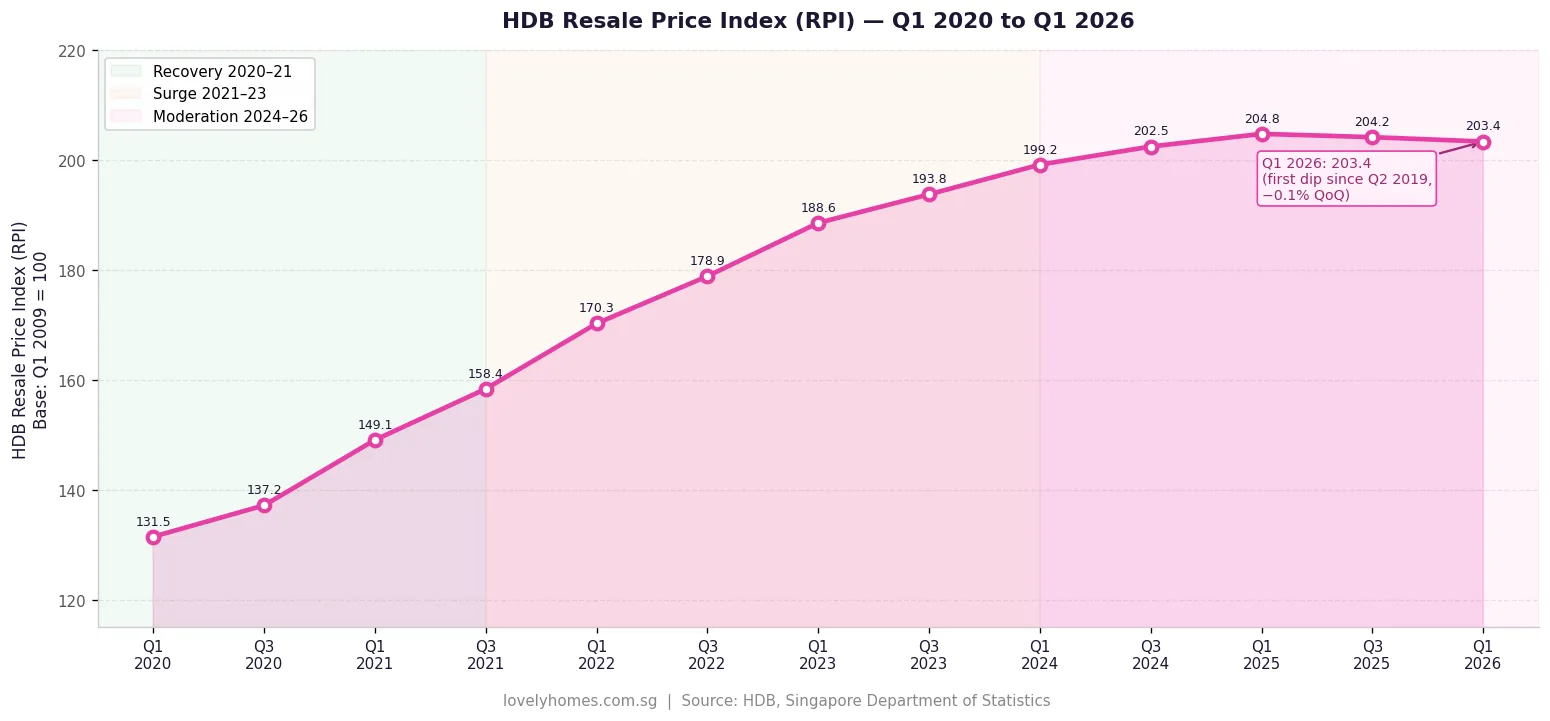
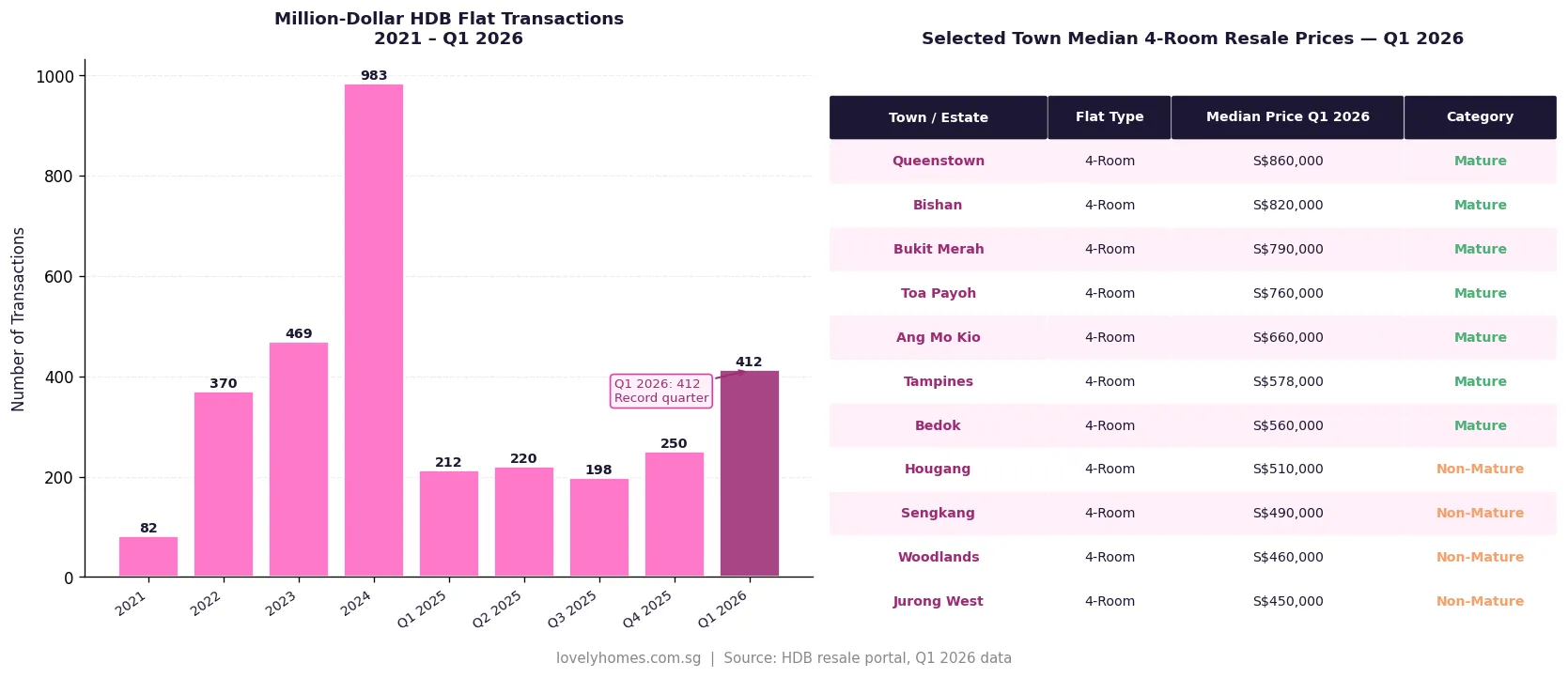
Singapore’s HDB resale market delivered a headline that surprised many commentators on 1 April 2026: the Resale Price Index fell 0.1% quarter-on-quarter — the first decline since Q2 2019. In the same breath, the Housing and Development Board confirmed that 412 flats had sold for S$1 million or above in the same three months, eclipsing the prior record of 351 set in Q4 2025.
The juxtaposition is not a contradiction. It is a portrait of a two-speed resale market: broad price moderation driven by cooling-measure discipline, overlaid by an accelerating premium segment concentrated in a handful of mature estates.
The Numbers at a Glance
Metric
Q1 2026
Q4 2025
Change
HDB Resale Price Index (RPI)
203.4
203.6
−0.1% QoQ
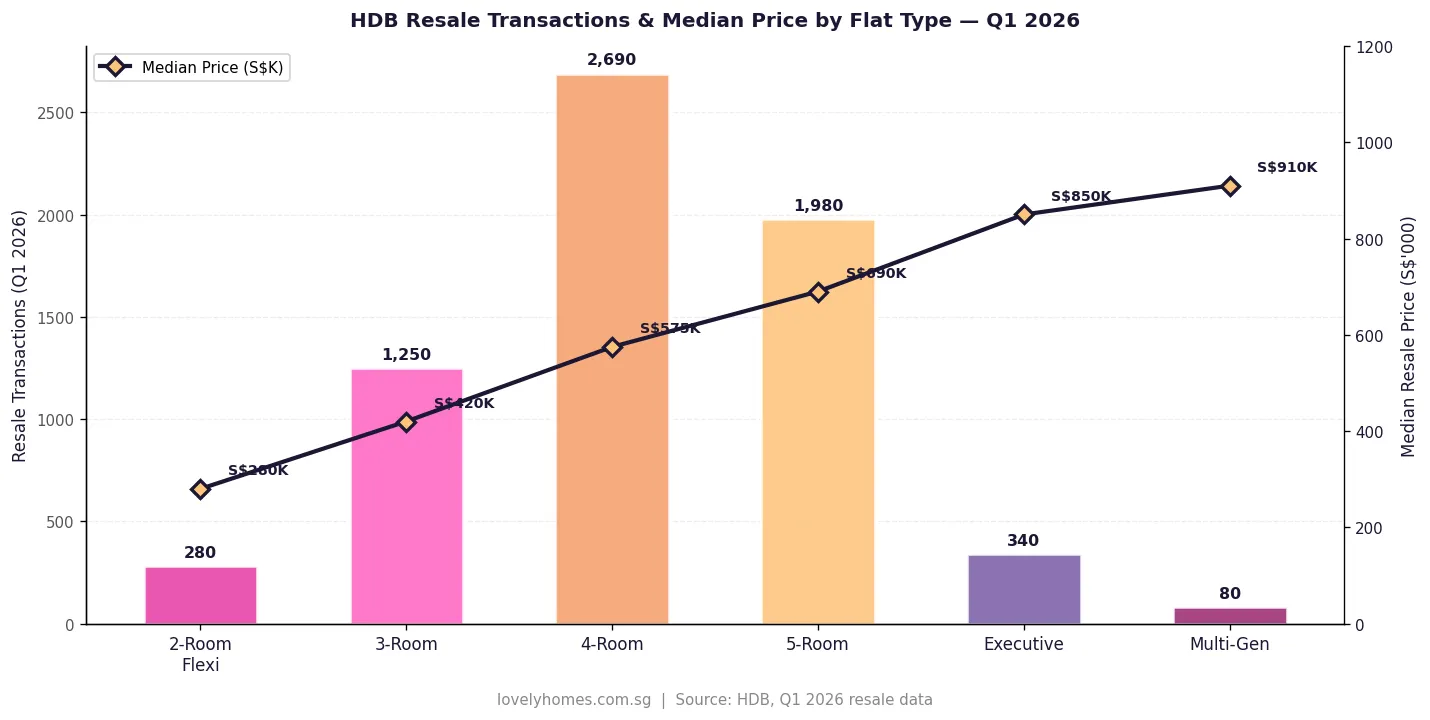
Total resale transactions
6,179
6,473
−4.5% QoQ
Million-dollar transactions
412
351
+17.4% QoQ
Million-dollar share of total
6.7%
5.4%
+1.3 pp
S$1.7M all-time record
Dawson Rd 5-room (Feb 2026)
—
New benchmark
The overall RPI decline is technically modest — 0.1 percentage point — and should be understood in the context of seven consecutive quarters of price growth. Analysts at Knight Frank and JLL have characterised the dip as a “soft landing” rather than a structural correction, pointing to policy-driven affordability guardrails: the Mortgage Servicing Ratio (MSR) cap of 30%, Enhanced CPF Housing Grant (EHG) eligibility reviews, and the 15-month wait-out period for private downgraders.
Why Are Million-Dollar Transactions Still Rising?
Overall resale volume has eased while the share of million-dollar transactions has climbed steadily.
The premium segment operates on different fundamentals. Million-dollar HDB flats are almost entirely concentrated in a narrow band of mature estates — Queenstown, Toa Payoh, Bukit Merah, Ang Mo Kio and Bishan — where flat supply is structurally constrained, location premiums are well-established, and buyer profiles skew towards upgraders and cash-rich upsizers.
Several structural factors underpin the record:
Supply scarcity in mature estates. Large flats (5-room and executive) in central locations such as Queenstown and Toa Payoh are finite. As older owners pass on or move to assisted-living arrangements, each resale becomes a competition between multiple qualified buyers.
Private-market spillover. Buyers priced out of District 9–10 condos at S$2,500–3,500 psf are finding that a large, well-located HDB flat at S$1.0–1.4 million still represents value on a per-square-foot basis (often below S$900 psf).
The Dawson effect. The award-winning SkyParc @ Dawson and the broader Dawson precinct continue to set benchmarks. The S$1.7 million February 2026 transaction for a 5-room flat in Dawson Road is now the all-time national record for any HDB resale flat.
Diminished Alternative Housing Supply (DAHS) effect. New private condo launches fell ~60% QoQ in Q1 2026; with fewer new options, HDB upgraders are staying put or competing harder for premium resale flats.
The S$1.7 Million Record: Unpacking the Dawson Road Transaction
The record-setting flat is a 5-room unit along Dawson Road in Queenstown. At S$1.7 million, it surpasses the previous record of S$1.588 million set in 2023 and represents a premium of roughly 65–70% over the average 5-room flat price island-wide (approximately S$610,000–640,000). The buyer paid predominantly in cash above valuation, reflecting both the location’s scarcity value and the unit’s large floor area (approximately 113 square metres).
Queenstown holds a unique position: it was Singapore’s first public-housing satellite town, developed from the 1950s onwards, and retains some of the densest concentrations of MRT-accessible, well-maintained mature flats in the city. Its proximity to Alexandra, Buona Vista, and the upcoming Greater Southern Waterfront corridor ensures continued demand from professionals and dual-income households.
Top Estates Driving Million-Dollar Transactions
Queenstown, Toa Payoh, and Bukit Merah account for the majority of S$1M+ HDB resale flats in Q1 2026.
The concentration of premium transactions in five mature estates is a structural feature of the market, not a temporary anomaly. About 90% of million-dollar HDB transactions since 2021 have occurred in the core central and near-city estates, according to HDB transaction data. This geographic concentration has two implications:
Policy relevance: The data does not indicate broad HDB price inflation. The 90% of the market transacting below S$1 million is where the cooling measures are working as intended.
Buyer planning: Aspiring premium HDB buyers need to consider that million-dollar transactions in these estates are now the norm rather than the exception. Budget planning, CPF usage limits, and stamp duty calibration (BSD applies to HDB resale transactions too) are essential.
What the HDB Resale Price Dip Actually Means
The 0.1% dip in the RPI is historically significant — it is the first in 28 quarters — but it is marginal in absolute terms. It does not imply that HDB flat prices are about to fall sharply. Key counterpoints:
Volume decline, not distress: The 4.5% QoQ drop in transactions (6,179 vs 6,473) reflects seasonality and reduced new-flat completions, not seller distress or forced selling.
Full Q1 2026 data on 24 April 2026: URA and HDB will release complete Q1 2026 real estate statistics on 24 April 2026. The flash estimate (released 1 April) covers caveats lodged up to 30 March — the final data will capture some additional March transactions.
Policy signals are neutral: MAS and MND have not signalled any relaxation of cooling measures, nor any tightening. The market is operating within the intended guardrails.
June 2026 BTO exercise: HDB’s June 2026 sales exercise will offer approximately 6,900 flats across Ang Mo Kio, Bishan, Bukit Merah, Sembawang and Woodlands. Increased BTO supply provides an alternative for first-timers, which may further moderate resale volumes in the lower price bands.
Practical Implications for HDB Resale Buyers and Sellers
If you are buying a resale flat
The flat price dip provides a marginal negotiating advantage in the broad market, but this advantage does not extend to million-dollar premium flats in mature estates, where demand continues to outstrip supply. Buyers targeting Queenstown, Toa Payoh or Bukit Merah 5-room units should budget above S$1 million and ensure their CPF Ordinary Account balance and cash savings can cover cash-over-valuation (COV), which remains common in these sub-markets.
If you are selling a resale flat
Sellers in non-mature estates may find price expectations need modest recalibration, particularly for 3-room and smaller flats where supply from BTO completions is increasing. Sellers of large flats in prime mature estates remain in a strong position — Q1 2026 data confirms undiminished buyer appetite for well-located units.
If you are a private-property buyer watching the HDB market
The correlation between HDB premium prices and private OCR/RCR condo prices is real but lagged. The current HDB resale dip has not yet translated into private price weakness — private non-landed prices rose 0.4% QoQ in Q1 2026. Monitoring both indices over Q2 2026 will be instructive.
Frequently Asked Questions
How many HDB flats sold for S$1 million or more in Q1 2026?
412 flats, the highest quarterly total on record. This is up 17.4% from the previous quarter’s 351 transactions.
What is the most expensive HDB flat ever sold?
As of Q1 2026, a 5-room flat along Dawson Road in Queenstown that sold for S$1.7 million in February 2026. This surpassed the prior record and set a new national benchmark across all flat types.
Did HDB resale prices fall in Q1 2026?
Yes. The Resale Price Index (RPI) declined 0.1% quarter-on-quarter in Q1 2026, the first quarterly fall since Q2 2019 (seven years). The full Q1 2026 HDB data is scheduled for release by HDB on 24 April 2026.
Why are million-dollar HDB transactions rising even as prices dip?
The overall price dip reflects broad market moderation in non-mature estates and smaller flat types, while the million-dollar segment is driven by structurally scarce supply in mature estates such as Queenstown and Toa Payoh. The two trends coexist because they serve different buyer segments.
Which HDB estates have the most million-dollar transactions?
Queenstown, Toa Payoh, Bukit Merah, Ang Mo Kio, and Bishan account for the vast majority of million-dollar HDB resale transactions. Approximately 90% of all such transactions are in mature, centrally-located estates.
Are HDB cooling measures being relaxed?
No. As of April 2026, there has been no policy signal from MAS, MND or HDB indicating any relaxation of the Mortgage Servicing Ratio (MSR) cap, Additional Buyer’s Stamp Duty (ABSD) rates, or loan-to-value (LTV) limits applicable to HDB resale purchases.
How does the HDB price dip affect private property?
Private non-landed residential prices rose 0.3% QoQ in Q1 2026 despite the HDB dip, representing a divergence between the two markets for the first time since Q2 2019. Analysts regard this as a soft-landing scenario rather than a leading indicator of private price weakness.
Have questions about HDB resale prices or upgrading strategy?
This article is for general informational purposes only and does not constitute financial, legal or property advice. Property prices and market conditions change; readers should conduct their own due diligence or consult a licensed property professional before making any investment decision. All figures cited are based on HDB and URA flash estimates for Q1 2026 released 1 April 2026; full statistics will be published 24 April 2026.
Singapore’s 2026 private residential market is entering the year with URA PPI up 3.4% YoY and HDB resale index up 4.1% YoY. Mortgage rates have stabilised in the mid-2% band. Private rents have softened 1–2% QoQ as expat-driven demand normalises. The five forces most likely to shape the rest of 2026 are: (1) US Fed rate path, (2) the 60% foreigner ABSD, (3) HDB Plus/Prime flat supply, (4) en-bloc activity, (5) rental yield compression from rising wages.
Every January, analysts publish a property outlook for the year ahead. Most read more like agent talking-points than analysis. This one tries to do the opposite — state the numbers as they stand at Q1 2026, name the forces that will move them, and flag where consensus is most likely to be wrong.
This is a general-market view, not a valuation of any specific district. For district-level granularity, watch our forthcoming Area Guide series. For the tax and cooling-measure context that underpins all of the below, start with our cooling measures timeline.
Q1 2026 snapshot of the five market dials that matter most.
Prices — private and public
URA Private Residential Price Index
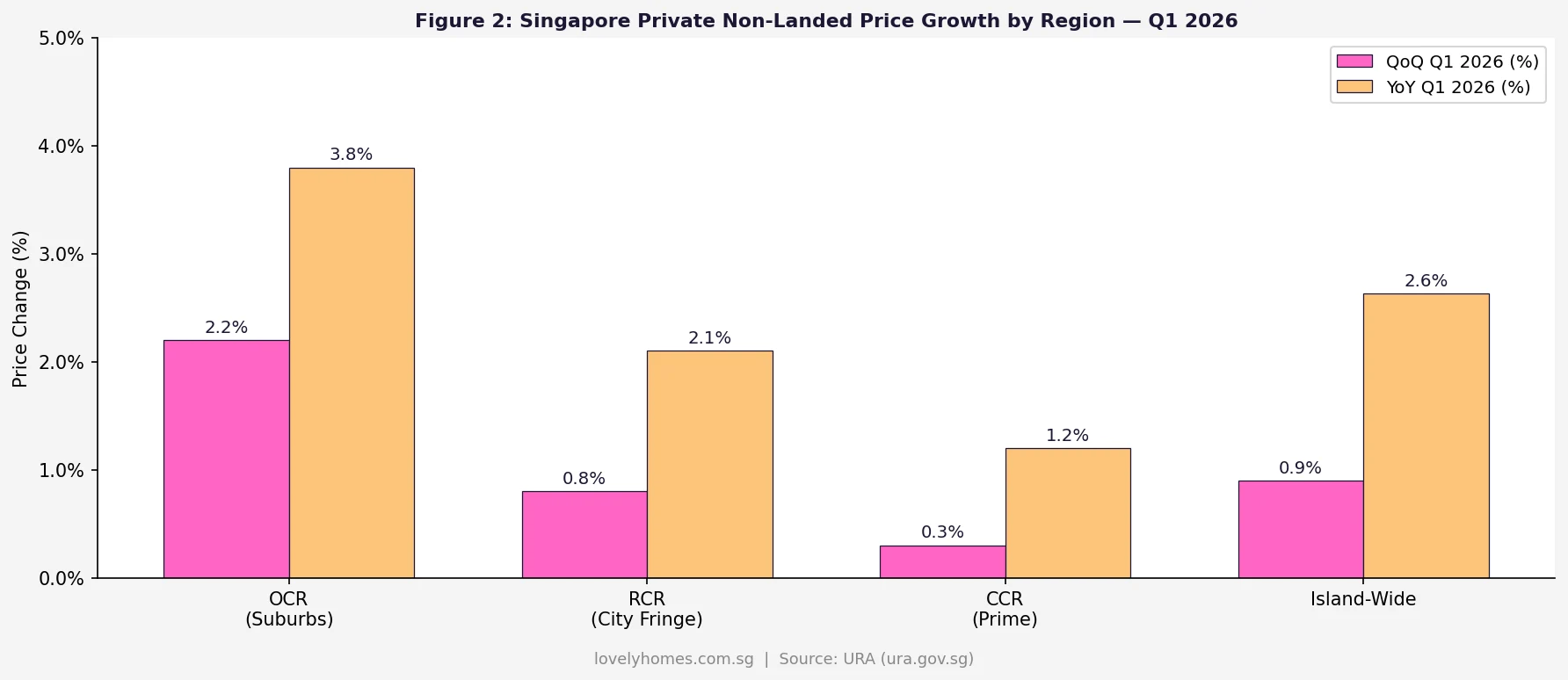
URA PPI closed 2025 at record highs. The Q1 2026 flash estimate is +3.4% YoY, with the RCR (city fringe) band leading at roughly +4.6% and CCR lagging at +2.1%. OCR sits in between at +3.9%.
HDB Resale Price Index
HDB RPI is tracking +4.1% YoY — the eighth consecutive quarter of gains, but the pace has decelerated from the double-digit 2022 run. Million-dollar HDB transactions have broadened from central flats into Bishan, Bukit Merah, Queenstown and, increasingly, mature Bidadari and Kallang Whampoa.
Interest rates and financing
3-month compounded SORA has drifted into the 2.5–2.9% range. Fixed packages from local banks are quoting around 2.85% for two-year tenors. That is well below the 2023 peak (~4%) but still meaningfully higher than the 2020–2021 sub-2% era.
Two upshots:
Refinancing activity is picking up for loans originated at the 2023 peak. See our refinancing guide.
TDSR bites harder than it did pre-2022. Affordability constraints more than prices are now the dominant buying-decision driver. Our TDSR & MSR guide explains the maths.
Supply coming through
Segment
Units landing 2026
Impact
Private residential TOP
~10,400
Keeps rental supply refreshed
EC TOP
~3,800
HDB upgraders hand back resale flats
BTO launches (planned)
~19,600 flats
Large Plus/Prime share
Rental market
After the extraordinary 2022–2023 surge (+25% to +30% YoY at the peak), rents are normalising. Q4 2025 URA rental index was down 1.2% QoQ. Expect a sideways-to-softer 2026, especially for older non-integrated condos as expat renters rotate into newer stock.
Five forces shaping the rest of 2026
US Fed rate path. Every 25bp shift flows through SORA and fixed packages in weeks.
The 60% foreigner ABSD. Kept CCR luxury flat. Any softening would re-ignite CCR transaction volumes.
HDB Plus / Prime supply. 10-year MOP plus subsidy clawback is reshaping the 2030+ resale pool.
En-bloc cycle. Developers are land-starved; reserve prices that reflect cooling measures may finally clear.
Rental compression. Yields moderate as wages normalise; investor maths re-anchors on capital appreciation, not cash flow.
Frequently asked questions
Will prices fall in 2026?
Base case: no. Prices grind higher at low single digits. Downside case: if the Fed holds rates longer than expected and supply lands faster, a flattish 2H 2026 is plausible.
Is now a good time to buy?
Depends on your horizon and cash flow. Owner-occupier with stable income: time in market beats timing the market. Investor leveraging up: TDSR-constrained — stress-test your affordability at a 4% rate.
Which segment looks strongest?
City-fringe RCR continues to be the sweet spot for owner-occupiers. OCR near MRT interchanges wins on yield.
This guide is for general information only and is accurate as of April 2026. Singapore property rules, taxes and cooling measures change frequently — always verify current figures with URA, IRAS, HDB or a licensed professional before committing. LovelyHomes is not a financial, legal or tax advisor.
CCR, RCR and OCR are Singapore’s three private non-landed market segments defined by URA. CCR (Core Central Region) is the luxury belt around Orchard and the Downtown Core. RCR (Rest of Central Region) is the city fringe. OCR (Outside Central Region) is everywhere else. In Q1 2026 median PSF runs roughly S$2,650 in CCR, S$2,180 in RCR and S$1,650 in OCR — though the spread narrows for new launches in hot city-fringe pockets.
Every time URA releases the quarterly Property Price Index, the headlines split the private condo market into three buckets: CCR, RCR and OCR. New buyers usually learn the labels when a property agent drops them into a pitch — “this is a rare RCR freehold” or “OCR yields are better than what you’d get in CCR”. The labels shape price, rental yield, buyer profile and the resale pool you are competing with.
This guide sets out what each region is, how the 2026 numbers stack up, and where the label matters most in real buying decisions. If you are comparing condo formats as well as regions, pair this with our condo downpayment breakdown.
Illustrative 2026 median PSF and buyer-impact summary by URA region.
What the three regions mean
Core Central Region (CCR)
CCR covers postal districts 9, 10 and 11, plus the Downtown Core and Sentosa. Think Orchard, River Valley, Bukit Timah, Marina Bay, Sentosa Cove. The stock skews luxury: many freehold blocks, lower-density cluster homes, a deep pool of foreign-bought units pre-2023.
Rest of Central Region (RCR)
RCR is the city fringe — districts 3, 4, 5, 7, 8, 12, 13, 14, 15 and parts of 20. Queenstown, Tiong Bahru, Novena, Toa Payoh, Farrer Park, Marine Parade. From 2022 to 2025 this has been the fastest-appreciating band, thanks to new MRT lines and a rush of 99-year city-fringe launches.
Outside Central Region (OCR)
OCR is the suburbs — everywhere else. Punggol, Sengkang, Tampines, Jurong, Woodlands, Yishun, Bukit Panjang. OCR has the largest supply of new 99-year condo stock, the most owner-occupier demand, and the widest internal price range (budget 99-year next to premium integrated developments).
Where the numbers sit in 2026
Region
Median PSF (new + resale)
Typical 2-bedder quantum
Rental yield (gross)
CCR
~S$2,650
S$2.3m–S$3.2m
2.5%–3.2%
RCR
~S$2,180
S$1.6m–S$2.3m
3.2%–4.0%
OCR
~S$1,650
S$1.1m–S$1.7m
3.5%–4.6%
Note the yield curve inverts the price curve: OCR delivers the highest gross yield; CCR the lowest. This is why investor pockets of OCR — near MRT interchanges, business parks — have been crowded for years.
Why the label still matters
1. Financing is region-neutral, but underwriting isn’t
ABSD, BSD, LTV limits and TDSR are identical across regions. But bank valuation and loan-amount appetite can diverge: CCR luxury units are sometimes under-valued by conservative banks, producing Cash-Over-Valuation surprises. Our COV guide explains how this works in detail for HDB, but the same dynamic shows up in high-ticket CCR resales.
2. Cooling measures hit CCR hardest in absolute dollars
A 20% ABSD rise on a S$3m CCR purchase hurts more than the same percentage on a S$1.2m OCR unit. Post-April-2023 foreigner ABSD (60%) has cooled CCR rental-to-own investment demand the most.
3. Tenure mix differs
CCR has the deepest freehold pool. OCR is mostly 99-year leasehold with a narrow freehold band around older landed enclaves. For the trade-off itself, see our freehold vs 99-year guide.
Worked example — same quantum, three regions
Imagine you have S$1.8m in purchase budget. That buys:
CCR: A small 1-bedder (~650 sqft) in district 9 or a shoebox resale in Sentosa Cove.
RCR: A decent 2-bedder (~750 sqft) in Queenstown, Novena or Toa Payoh resale stock.
OCR: A generously-sized 3-bedder (~1,000–1,100 sqft) in Tampines, Sengkang or Woodlands.
For owner-occupiers, OCR tends to win on size and yield; for investors banking on capital appreciation, RCR has been the sweet spot for a decade.
Frequently asked questions
Is CCR always the safest investment?
“Safe” depends on horizon. CCR held its value better than expected through the 2014–2018 cooling-measure trough, but capital appreciation has lagged RCR and OCR from 2020 to 2025. Luxury CCR stock is also more exposed to foreigner ABSD changes.
Can a development sit across regions?
No — URA assigns each postal sector to one region. Some large projects near boundaries (for example, in Farrer Road or Redhill) feel CCR but are classed RCR. The label on the transaction determines the bucket.
Does the region change the stamp duty rate?
No. BSD and ABSD are identical regardless of region. See our BSD guide for the 2026 rate ladder.
Which region produces the best en bloc candidates?
Historically CCR and RCR, because land scarcity drives developer appetite. OCR en blocs happen, but reserve prices need to fit tighter developer margins.
This guide is for general information only and is accurate as of April 2026. Singapore property rules, taxes and cooling measures change frequently — always verify current figures with URA, IRAS, HDB or a licensed professional before committing. LovelyHomes is not a financial, legal or tax advisor.