Singapore HDB Resale Checklist 2026: Complete Step-by-Step Buying Guide

Singapore HDB Resale Checklist 2026: Complete Step-by-Step Buying Guide

Quick Answer — HDB Resale Checklist 2026: Key Takeaways

  • You must obtain an HDB Flat Eligibility (HFE) letter before exercising any Option to Purchase (OTP) for an HDB resale flat; the HFE letter is valid for six months.
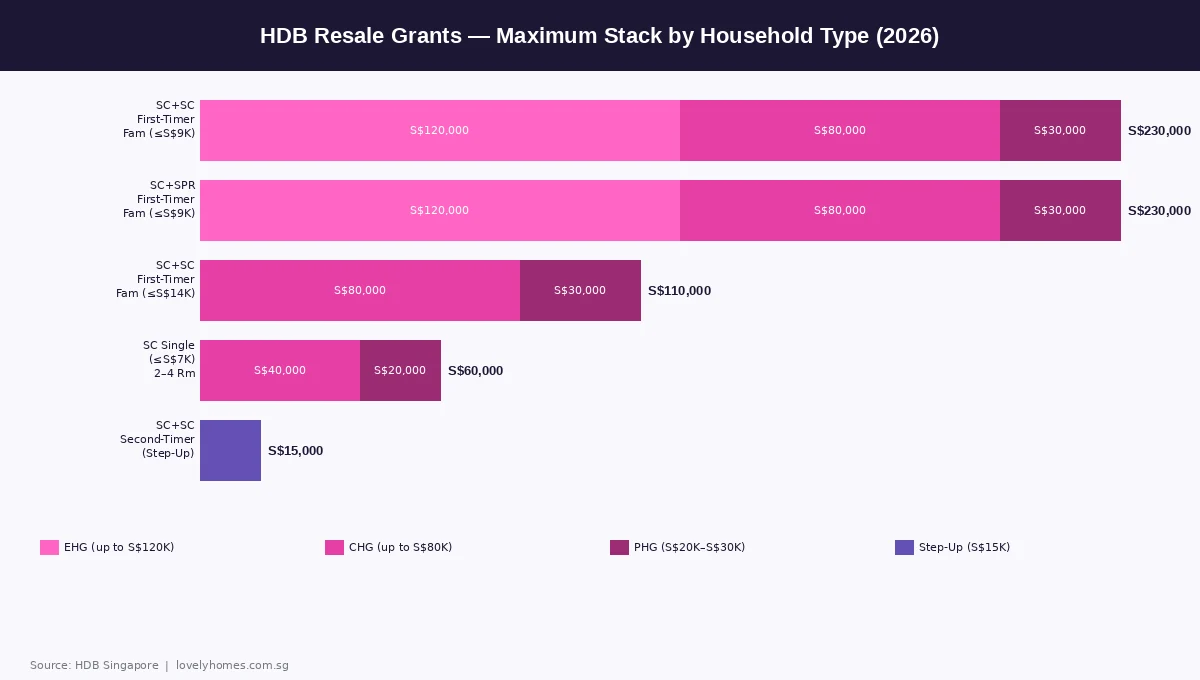
  • Eligible first-timer SC households can receive up to S$200,000+ in combined grants (EHG S$120K + CHG S$80K + PHG S$30K), subject to income ceilings and proximity conditions.
  • The full buying process — from eligibility check to key collection — typically takes 12 to 18 weeks (three to four months).
  • Buyer’s Stamp Duty (BSD) is payable within 14 days of exercising the OTP; it ranges from S$4,200 (on a S$400,000 flat) to S$31,100 (on a S$900,000 flat).
  • The Ethnic Integration Policy (EIP) quota may restrict which buyer profiles can purchase a specific block or neighbourhood; check the HDB EIP/SPR Quota Check before negotiating.
  • HDB resale flats carry a five-year Minimum Occupation Period (MOP) — counted from the date you collect the keys — before you can sell or rent out the entire flat.
  • The Resale Levy applies if you previously received a direct housing subsidy; it ranges from S$15,000 (2-room) to S$50,000 (5-room or Executive flat).

What Is an HDB Resale Flat?

An HDB resale flat is a Housing and Development Board (HDB) public housing unit previously owned by another Singapore household and now offered on the open market. Unlike a Build-To-Order (BTO) flat — which is purchased directly from HDB at a subsidised price with a ballot — a resale flat is transacted between private parties at a negotiated price, with no ballot and no waiting period for construction.

HDB administers the resale process through its Resale Portal. The transaction remains governed by a comprehensive set of rules covering eligibility, financing limits, grants, and the Minimum Occupation Period — all aimed at preserving the public housing system’s social objectives while allowing households flexibility to move.

As of Q2 2026, the HDB Resale Price Index (RPI) stood at 202.7, marginally lower than the Q4 2025 peak of 203.4, reflecting modest cooling after several years of strong appreciation. Over 25,000 resale transactions were recorded in 2025, and demand has remained robust, particularly for well-located mature-estate units. Understanding the full end-to-end checklist — eligibility, financing, grants, the OTP process, and post-completion obligations — is essential for any buyer entering this market.

Phase 1 — Eligibility and Financial Planning
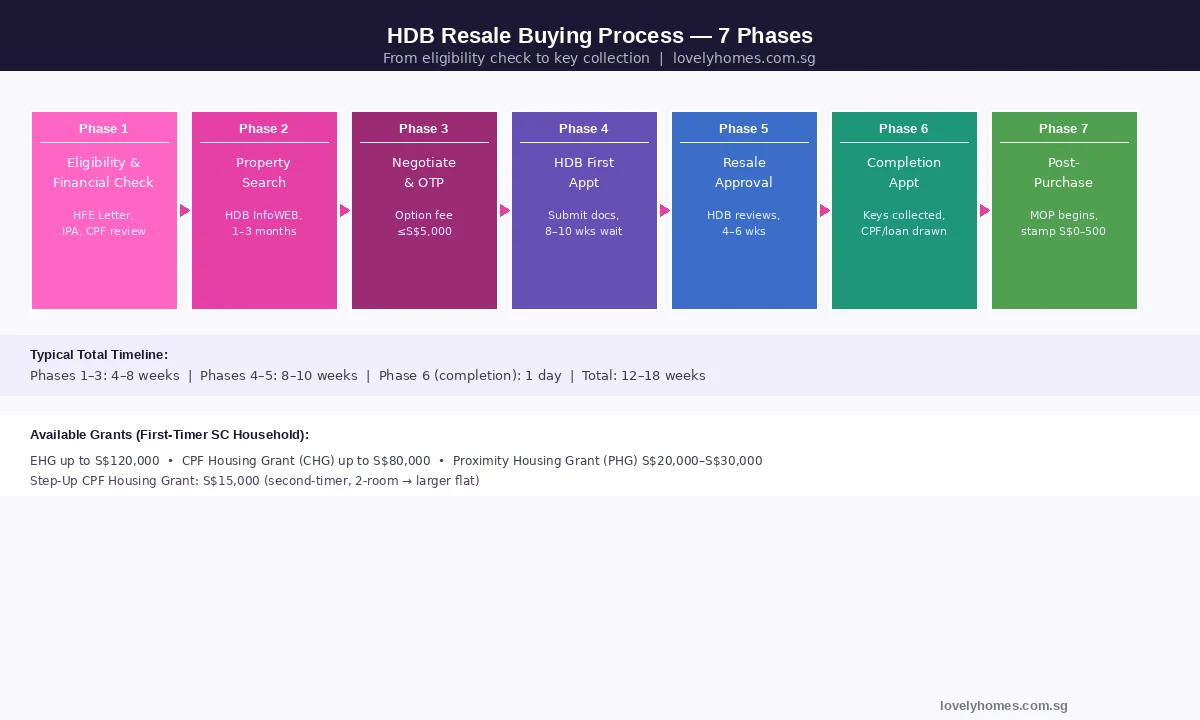
HDB resale buying process 7 phases from eligibility check to key collection
Figure 1: HDB Resale Buying Process — Seven Phases from Eligibility to Key Collection

Before you begin your property search, you must first confirm that you are eligible to purchase an HDB resale flat and obtain your financing paperwork. The HDB Flat Eligibility (HFE) letter, introduced in May 2023, consolidates the old HDB Loan Eligibility (HLE) letter and eligibility assessment into a single online application. You must have an in-principle HFE letter before you can exercise any OTP.

Who is eligible? At least one buyer must be a Singapore Citizen (SC). Singapore Permanent Residents (SPRs) may purchase jointly with an SC spouse, but an SPR household alone may only purchase after a minimum three-year residency in Singapore. Buyers must be at least 21 years old. You must not currently own or have a legal interest in any private residential property locally or overseas. If you previously purchased a direct-subsidised flat (BTO or Sale of Balance Flat), you must have completed your existing flat’s MOP before buying a resale flat in certain circumstances. The Public Scheme (SC plus spouse/children/parents), Fiancé/Fiancée Scheme, Single Singapore Citizen Scheme (age 35+, up to 5-room), and Non-Citizen Family Scheme each carry additional conditions.

Financial pre-checks: Apply for an HFE letter at HDB InfoWEB. This tells you your HDB loan eligibility, CPF housing grant quantum, and maximum flat price. Separately, if you intend to use a bank loan, obtain an In-Principle Approval (IPA) from your bank; banks will assess your Total Debt Servicing Ratio (TDSR, capped at 55% of gross monthly income) and apply a stress-test rate of 4% per annum. For HDB loans, the Mortgage Servicing Ratio (MSR) must not exceed 30%.

Check your CPF Ordinary Account (OA) balance — this is the primary source for the downpayment and BSD. If using an HDB loan (Loan-to-Value 80%), the minimum downpayment is 20%, of which 5% must be in cash; the remaining 15% may be from CPF OA. For a bank loan (LTV 75%), the downpayment is 25% — again minimum 5% cash, with 20% from CPF.

Phase 2 — Property Search and EIP Quota Check

Search for resale flats on the HDB Resale Flat Listings portal or property portals. Before making any offer, check the EIP/SPR Quota for the specific block: each HDB block and neighbourhood has ethnic quotas under the Ethnic Integration Policy (administered by HDB since 1989) to maintain racial harmony. If the quota for your ethnic group is full in that block or neighbourhood, you cannot purchase that unit. Check at HDB’s EIP/SPR Quota website.

Also review the remaining lease on the flat. HDB leases are 99 years; older flats have shorter remaining tenures. CPF usage is prorated if the remaining lease is less than 60 years (and cannot be used below 20 years). Financing restrictions also apply: HDB will not grant a loan for a flat where the remaining lease does not cover the youngest buyer to age 95; banks have similar policies. Use the remaining lease to plan your CPF withdrawal ceiling carefully.

Phase 3 — Negotiating Price and Issuing the OTP

Once you agree on a price, the seller issues an Option to Purchase (OTP). The option fee is capped by HDB based on the agreed price: up to S$1,000 for flats priced at S$500,000 or below; up to S$2,000 for flats between S$500,001 and S$1,000,000; and up to S$5,000 for flats above S$1,000,000. The OTP is valid for 21 calendar days. During this period, you must exercise the OTP (by signing and paying the option exercise fee, typically the balance 9–10% of the negotiated price) or allow it to lapse and lose the option fee.

Check the HDB resale transaction records on the HDB Resale Statistics portal to understand recent transacted prices in the block and town. The Cash Over Valuation (COV) — the amount you pay above HDB’s assessed valuation — must be paid entirely in cash; CPF cannot be used for COV.

Phase 4 — Registering the Resale Application (First Appointment)

After exercising the OTP, both buyer and seller independently submit their respective portions of the resale application on HDB’s Resale Portal. This triggers the First Appointment with HDB (now conducted online via the portal). At this stage, you submit your HFE letter, confirm your financing (HDB loan letter or bank’s Letter of Offer), and provide supporting documents: NRIC, marriage certificate (if applicable), birth certificates of children (if applying under the Parenthood Priority Scheme), and any grant-related documents. HDB will assess the application, verify eligibility, and send notification of the Second Appointment date — typically four to eight weeks later.

BSD payment: Buyer’s Stamp Duty must be paid to IRAS within 14 days of exercising the OTP. BSD is calculated on the higher of the purchase price or HDB’s assessed valuation using IRAS’s progressive bands: 1% on the first S$180,000; 2% on the next S$180,000; 3% on the next S$640,000; 4% on the next S$500,000; 5% on amounts from S$1.5 million; and 6% for amounts above S$3 million. There is no Additional Buyer’s Stamp Duty (ABSD) for first-time SC and SC-SPR couple buyers of HDB resale flats.

Phase 5 — Grant Assessment and Resale Approval
HDB resale housing grants maximum amounts by household type 2026
Figure 2: HDB Resale Grants — Maximum Combined Grant Stack by Household Type (2026)

During this phase, HDB assesses your eligibility for housing grants. The three main grants for resale flat buyers are:

Enhanced CPF Housing Grant (EHG): Up to S$120,000 for households earning S$9,000 or below per month (first-timer couples or families). The EHG scales down with income in eight tiers: at ≤S$1,500/mth the grant is S$120K; at S$8,501–S$9,000/mth it is S$5K. The EHG is deposited directly into CPF OA and applied towards the flat purchase. Singles (age ≥35) may receive up to S$60,000 (income ≤S$4,500/mth). Both buyer and spouse must not have received the EHG or its predecessor grant previously.

CPF Housing Grant (CHG): Up to S$80,000 for first-timer families purchasing a 4-room or smaller resale flat (income ≤S$14,000/mth); S$40,000 for 5-room and Executive flats. Singles buying 2–4 room resale flats under the Single Singapore Citizen Scheme receive up to S$40,000 (mature estates) or S$40,000 (non-mature estates) depending on the scheme. The CHG is available to both first-timer couples and, in some scenarios, second-timer families.

Proximity Housing Grant (PHG): S$30,000 for buyers living with their parents (within the same household); S$20,000 for buyers living near their parents (within 4km). The PHG also applies if you are buying to live near a married child. The PHG is not means-tested but requires the buyer and the qualifying family member to maintain the proximity for at least five years after the purchase (i.e., through the MOP).

Step-Up CPF Housing Grant: S$15,000 for second-timer SC households moving from a 2-room flat to a larger resale flat (3-room or bigger), subject to income ≤S$7,000/mth.

HDB will issue a Resale Approval letter once all checks are complete. This approval confirms that the transaction can proceed to completion.

Phase 6 — Second Appointment and Key Collection

The Second Appointment is the completion of the transaction. You, the seller, and (if applicable) CPF Board and the bank’s lawyer attend (or the process is handled through HDB’s online system for straightforward cases). At this appointment: the outstanding purchase price is settled (from your CPF OA and bank loan drawdown); the seller receives their sale proceeds net of any outstanding HDB loan, CPF refund obligation, and HDB administrative fees; and HDB transfers the flat to you. You collect the keys on the same day.

HDB charges an administrative fee of S$80 (1-room/2-room flat) to S$640 (5-room or Executive flat) for registering the resale. The legal conveyancing for HDB resale transactions is handled by HDB’s own in-house legal team, so you do not need to engage a private solicitor for the conveyancing — though you may wish to seek independent legal advice for any non-standard aspects.

Phase 7 — Post-Purchase Obligations
HDB resale all-in upfront costs by purchase price 2026 breakdown
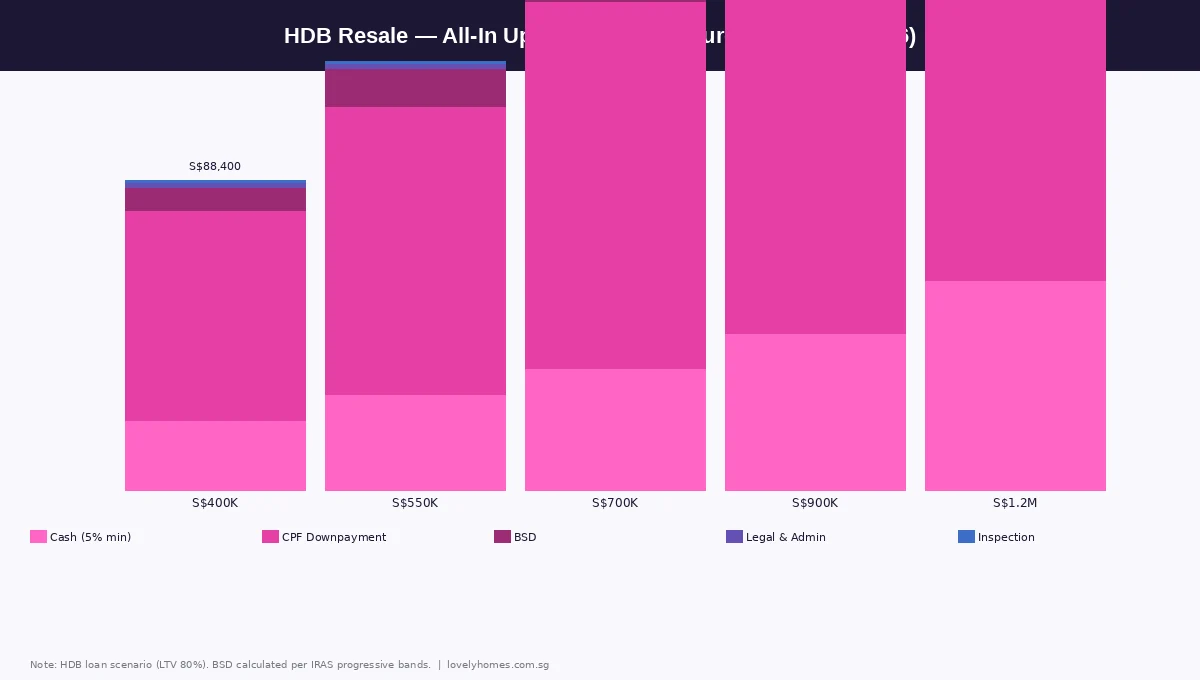
Figure 3: HDB Resale — All-In Upfront Costs by Purchase Price (2026)

After key collection, the five-year Minimum Occupation Period begins. During the MOP you may not sell the flat or rent it out in its entirety (though you may rent out individual rooms with HDB’s approval). You may not own private residential property in Singapore during the MOP. Violations of MOP rules are taken seriously: HDB may compulsorily acquire the flat and impose financial penalties.

If you later wish to purchase a second subsidised HDB flat (BTO or SBF), the Resale Levy will apply, ranging from S$15,000 (2-room BTO) to S$50,000 (5-room or Executive flat) depending on the first flat type. This levy is deducted from your CPF proceeds or paid in cash at the point of purchasing the second subsidised flat.

Property tax is payable annually to IRAS. For owner-occupied HDB flats, the effective property tax rate is well below the non-owner-occupied rate; a typical 4-room flat has an Annual Value of approximately S$12,000–S$20,000, resulting in an owner-occupier tax of just S$160–S$900 per year at the progressive owner-occupier rates in force from 1 January 2024.

Summary Checklist Table

Phase Key Action Who / Where Deadline
1 — Eligibility Apply for HFE letter HDB InfoWEB Before OTP exercise; valid 6 months
1 — Finance Get bank IPA (if bank loan) Your bank / mortgage broker Before property search
2 — Search Check EIP/SPR quota for target block HDB EIP/SPR Quota portal Before making offer
2 — Search Review remaining lease and CPF cap HDB InfoWEB / SLA Before making offer
3 — OTP Pay option fee (≤S$5,000) To seller Day of OTP
3 — OTP Exercise OTP (sign + pay exercise fee) Return to seller Within 21 calendar days of OTP
4 — BSD Pay Buyer’s Stamp Duty to IRAS IRAS e-Stamping portal Within 14 days of exercising OTP
4 — Application Submit resale application on HDB portal HDB Resale Portal Within 7 days of OTP exercise
5 — Documents Submit supporting docs for grant assessment HDB Resale Portal As directed by HDB (First Appt)
6 — Completion Attend Second Appointment; collect keys HDB Hub / online As scheduled by HDB (8–12 wks)
7 — Post Comply with 5-year MOP N/A (ongoing) From key collection date
7 — Tax Pay annual property tax IRAS January each year

Worked Example — The Tan Family, Tampines 4-Room Resale

Scenario

Mr and Mrs Tan are a Singapore Citizen couple, both aged 34. They earn a combined gross income of S$8,000 per month. They are first-time buyers purchasing a 4-room resale flat in Tampines (a non-mature estate) at a negotiated price of S$620,000. The flat has 68 years remaining on its lease.

Eligibility

Both are SC; combined income S$8,000 qualifies them for the EHG (≤S$9,000 ceiling). First-timer status confirmed (no prior subsidised flat). Mrs Tan’s parents live 2.5km away, qualifying for the PHG (within 4km). EIP quota for the block is open for their ethnic group.

Grants Applied

  • EHG (S$8,001–S$9,000 income tier): S$10,000 (lowest tier; if income were ≤S$1,500 it would be S$120,000)

Note: At S$8,000/mth combined income the EHG is S$20,000 (tier S$7,501–S$8,000). Let us use a cleaner example: if combined income were S$6,000/mth, EHG = S$60,000.

Using combined income S$6,000/mth for illustration:

  • EHG: S$60,000 (income tier S$5,501–S$6,000)
  • CHG (4-room, non-mature estate): S$50,000
  • PHG (within 4km): S$20,000
  • Total grants: S$130,000 (deposited to CPF OA)

Financing (HDB Loan, LTV 80%)

  • Purchase price: S$620,000
  • BSD: S$12,600 (1%×S$180K + 2%×S$180K + 3%×S$260K)
  • HDB Loan (80%): S$496,000 at 2.60% p.a., 25-year tenure = S$2,256/mth
  • MSR: S$2,256 ÷ S$6,000 = 37.6% — exceeds 30% MSR; reduce tenure or loan amount
  • Adjusted (20-year tenure): S$496,000 at 2.60% = S$2,666/mth → 44.4% MSR — still exceeds 30%
  • HDB Loan adjusted (MSR 30% = max S$1,800/mth): max HDB loan ≈ S$396,000 at 2.6%/25yr; downpayment must be S$224,000
  • Grants cover S$130,000; remaining CPF OA needed: S$94,000 — feasible with working years of contributions

Lesson: At S$620,000 and S$6,000/mth income, the MSR constraint bites hard. The couple should consider a more affordable flat or a higher income before committing.

Timeline

HFE letter applied → 7 days; EIP quota confirmed → same day; OTP negotiated and signed 3 August 2026; OTP exercised 18 August 2026 (day 15); BSD S$12,600 paid to IRAS 25 August 2026; resale application submitted 19 August 2026; HDB First Appointment 26 August 2026; Resale Approval expected 10–20 October 2026; Second Appointment (key collection) estimated 25–30 October 2026. Total timeline: approximately 12 weeks.

Why This Matters — the Resale Premium and Market Context

The Singapore resale market offers an immediate supply of completed flats across all mature and non-mature estates, with no waiting period and the full range of flat types (2-room to Executive Maisonette). Unlike BTO flats — which have experienced waiting times of four to six years for most projects since 2021 — resale flats allow buyers to move in within three months of exercising the OTP.

The trade-off is price. Resale flats transact at market rates, and the COV (if any) must be paid in cash; BTO prices remain deeply subsidised. Industry figures show that a typical 4-room BTO in a non-mature estate launched in 2024 prices at S$340,000–S$400,000, while comparable resale units in the same estate trade at S$480,000–S$550,000 — a gap of S$100,000–S$150,000 or more. However, the generous grant stack (EHG + CHG + PHG totalling up to S$230,000 for the most grant-eligible households) substantially narrows this premium, particularly for lower-income buyers.

What Might Come Next

HDB is expected to continue ramping up BTO supply through 2026 and 2027, with approximately 19,600 BTO flats offered in 2026 and a further 19,000 in 2027. Increased supply typically moderates resale price growth, particularly in non-mature estates where BTO competition is strongest. The Resale Price Index declined marginally in Q2 2026 (-0.3% quarter-on-quarter), suggesting the market may have peaked for the current cycle. Whether cooling continues into H2 2026 will depend on interest rate movements, BTO ballot ratios, and employment conditions. Buyers who are not grant-constrained by income ceilings should monitor the BTO calendar as an alternative before committing to the resale premium.

Frequently Asked Questions

Can I purchase an HDB resale flat if I already own a private property?

No. You must dispose of all private residential properties — in Singapore and overseas — before or on the date of completing the HDB resale purchase. This applies to both the main applicant and their spouse (if included in the application). You should allow sufficient time to sell your private property before the HDB resale completion date. Note that the completion of the HDB resale transaction is typically 8–12 weeks after the OTP exercise, so if your private property has not been fully sold and transferred by then, the resale application will not proceed.

What happens if the EIP quota is full for my ethnic group when I want to buy?

If the Ethnic Integration Policy quota is full for your ethnic group in the target block or neighbourhood, you simply cannot purchase that specific unit under your profile. You must look for a unit in a different block or neighbourhood where the quota is not yet full. The EIP quota is checked in real time on HDB’s portal. This situation most commonly affects buyers of Chinese ethnicity in blocks with a high concentration of Chinese households, or Malay/Indian buyers in blocks where their group’s quota has been reached. There is no appeal mechanism to override the EIP quota.

Can I use CPF to pay the Cash Over Valuation (COV)?

No. COV — the portion of the agreed purchase price that exceeds HDB’s assessed valuation — must be paid in cash. CPF funds can only be applied up to the assessed valuation (subject to the Withdrawal Limit). If you are buying at a significant COV, plan your cash reserves accordingly. It is prudent to confirm the valuation before exercising the OTP so you know the cash commitment upfront.

Can I rent out my HDB resale flat after I move in?

You may rent out individual bedrooms to approved occupants from the day you receive the keys, subject to HDB’s rental conditions (no more occupants than the approved flat capacity, no short-term rentals under three months). However, you may not rent out the entire flat during the five-year MOP. After completing the MOP, you may apply to HDB for approval to sublet the whole flat, subject to income and citizenship conditions. The HDB subletting guide covers the full conditions, including the 3-year subletting approval period and the subletting income declaration requirement.

Does the Resale Levy apply to my purchase?

The Resale Levy applies only if you are a second-timer — meaning you previously purchased a subsidised BTO, Sale of Balance Flat, or DBSS flat from HDB. Buying an HDB resale flat at market price does not trigger the Resale Levy. If you have previously purchased a subsidised flat, the levy ranges from S$15,000 (2-room BTO) to S$50,000 (5-room or Executive flat). It is deducted from CPF OA or paid in cash at the point of purchasing a second subsidised flat in the future. Purchasing a resale flat (which is not subsidised by HDB) after selling your first subsidised flat does not in itself trigger the levy, but any subsequent return to the subsidised market will.

What is the difference between an HFE letter and an HDB Loan Eligibility (HLE) letter?

The HDB Flat Eligibility (HFE) letter replaced the HLE letter in May 2023. The old HLE letter confirmed only your loan eligibility. The new HFE letter is a consolidated assessment that covers both your eligibility to purchase an HDB flat and your eligibility for HDB housing loans and grants. It replaces the separate grant application process that previously required multiple steps. You apply for the HFE letter at HDB’s website, and it is processed within 21 working days. The HFE letter is valid for six months, during which you can exercise any OTP.

What documents do I need to submit at the First Appointment?

The First Appointment for HDB resale is now largely conducted via the online Resale Portal, but you should have the following documents ready: NRIC (buyer and all occupants), marriage certificate (if applicable), birth certificates of children (if applying under family or priority schemes), latest CPF statement, HFE letter, bank IPA or bank letter of offer (if using a bank loan), proof of employment or self-employment income, and any documents supporting your grant applications (e.g., payslips for EHG income assessment, proximity documents for PHG). HDB’s portal will specify the exact list for your application.
Disclaimer: This article is for general information only and does not constitute financial, legal, or property advice. HDB rules, grant amounts, eligibility conditions, and stamp duty rates are subject to change. Always verify the latest requirements directly with HDB (hdb.gov.sg), IRAS (iras.gov.sg), and CPF Board (cpf.gov.sg) before making any property decision. Consult a licensed property agent (CEA-registered) or solicitor for advice specific to your circumstances.

Singapore Property Buyers Checklist 2026: Complete Step-by-Step Guide for HDB and Private Property Buyers

Singapore Property Buyers Checklist 2026: Complete Step-by-Step Guide for HDB and Private Property Buyers


Quick Answer: Singapore Property Buyers Checklist 2026

  • Singapore property buyers need a valid HDB Flat Eligibility (HFE) Letter (for HDB) or Approval-in-Principle (AIP) (for private) before making any offer.
  • Buyer’s Stamp Duty (BSD) is payable within 14 days of signing the Option to Purchase. For a S$1.5M property, BSD is approximately S$44,600.
  • Additional Buyer’s Stamp Duty (ABSD) applies to second and subsequent properties, and to SPRs on their first purchase. Singapore Citizens buying their first property pay no ABSD.
  • The Total Debt Servicing Ratio (TDSR) cap is 55% of gross monthly income. For HDB loans, the Mortgage Servicing Ratio (MSR) cap is 30%.
  • HDB buyers need a minimum cash outlay of 5% for bank loans; the remainder of the downpayment may be from CPF OA.
  • Private property completions follow a 10- to 12-week timeline from OTP exercise; BTO flats take 4–5 years from selection.
  • Legal fees for a S$1.5M property typically run S$3,500–S$5,000 for conveyancing.
  • Hire a CEA-registered agent (verify at cea.gov.sg) and engage an independent conveyancing solicitor separate from the seller’s.

I. Why a Property Buyers Checklist Matters in 2026

Buying property in Singapore is the largest financial commitment most households will ever make. A typical OCR condominium in 2026 transacts at between S$1.1 million and S$2.0 million; an HDB resale flat in a prime town can breach S$900,000. Yet the buying process involves more than a dozen discrete steps spread across multiple government agencies, financiers, and legal professionals — and missing any single one can cost thousands of dollars in penalties or stamp duties, or forfeit an Option to Purchase.

This checklist consolidates every step that property buyers in Singapore need to complete, from the initial financial health check to the moment keys are handed over. It applies to both HDB (resale and Build-to-Order) and private residential property (new launch and resale). Where rules differ between the two, both are stated explicitly.

Singapore property buyer journey 8 phases checklist 2026
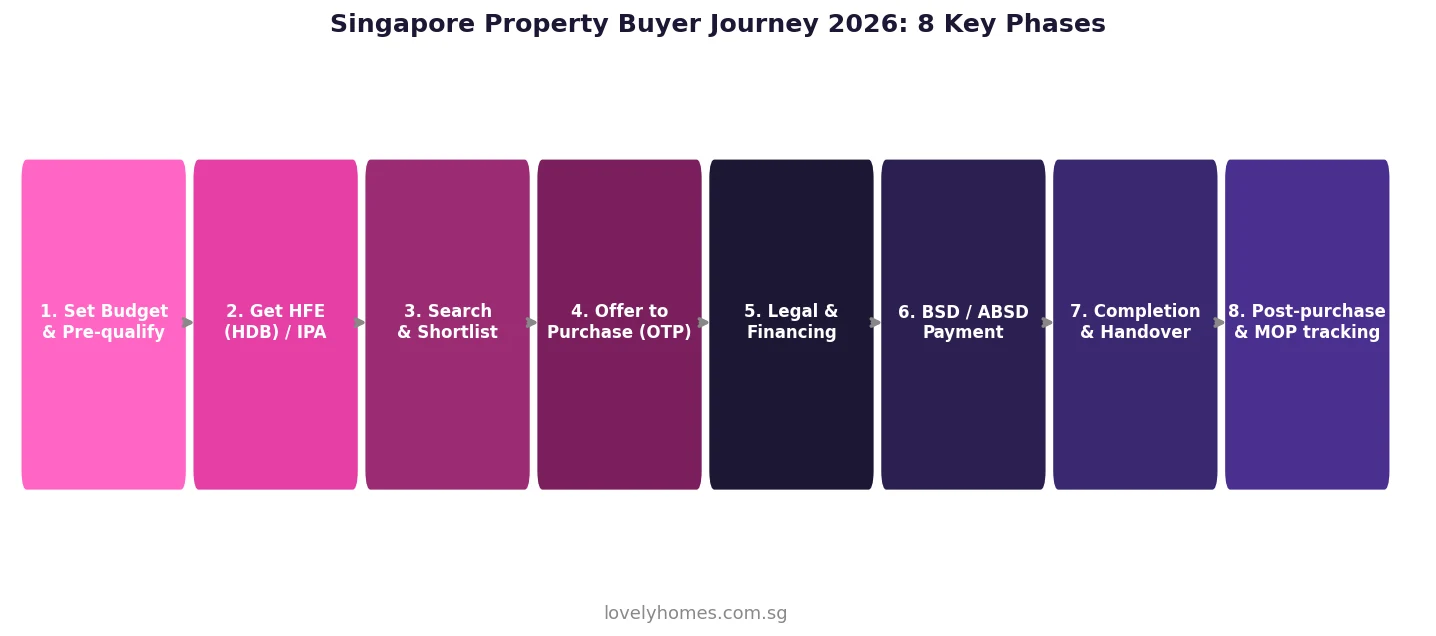
Figure 1: The eight-phase Singapore property buyer journey — from setting your budget to collecting your keys. BTO buyers face a 4–5 year wait between Phase 1 and Phase 8; resale and private buyers typically complete the full arc in 8–16 weeks.

II. Phase 1 — Set Your Budget and Eligibility

Before viewing a single property, every buyer should run through a financial and eligibility checklist. This phase sets the parameters for everything that follows.

Financial ceiling checks

Your maximum loan quantum is determined by the TDSR (55% of gross monthly income for bank loans) and the MSR (30% for HDB loans on HDB flats). Your CPF Ordinary Account balance, less any accrued interest owed, determines how much CPF you can deploy toward the downpayment and monthly repayments. For private property, the CPF Withdrawal Limit (WL) caps how much you can ever draw from CPF for a given property based on its remaining lease at time of purchase — buyers of leasehold properties with fewer than 60 years remaining face proration.

Stamp duty exposure

Compute your BSD and ABSD before you set your price limit. BSD on a S$1.5M property is S$44,600 (effective rate 2.97%). A Singapore Citizen buying a first property owes nil ABSD; a first-property SPR buyer owes 5% (S$75,000 on S$1.5M). These sums must come from cash or CPF within 14 days of signing the OTP — they cannot be folded into the loan. Budget for them upfront.

Phase 1 Checklist:

  • Calculate maximum loan (TDSR 55% / MSR 30% for HDB)
  • Check CPF OA balance and Ordinary Account statement
  • Compute BSD and ABSD amounts for target price range
  • Confirm citizenship/PR status and ABSD profile
  • Check if HDB MOP has been satisfied (if upgrading from HDB)
  • Confirm Resale Levy position (if buying a second subsidised flat)

III. Phase 2 — Secure Financing and Get Pre-Approval

For HDB flats, buyers must obtain a valid HDB Flat Eligibility (HFE) Letter from HDB before booking or submitting an application. The HFE Letter is digital, valid for 6 months, and confirms your eligibility to buy an HDB flat, the maximum loan quantum from HDB, and any CPF Housing Grants you qualify for. The application is submitted through the HDB Flat Portal and typically takes up to 30 working days.

For bank loans — whether for HDB resale or private property — obtain an Approval-in-Principle (AIP) letter from your chosen bank. The AIP is not binding but gives you a credible upper limit when negotiating. It is typically valid for 30 days and can be renewed. Shop at least two to three banks; interest rate differentials of even 0.2% on a S$1M loan compound to over S$20,000 across a 25-year tenure.

Phase 2 Checklist:

  • Apply for HFE Letter at HDB Flat Portal (allow 30 working days)
  • Obtain AIP from at least 2 banks if taking a bank loan
  • Compare fixed-rate vs floating-rate packages across tenures
  • Check TDSR and MSR at the stress-test rate (AIP rate + 0.5–1%)
  • Confirm CPF usage eligibility for the target property’s lease tenure

IV. Phase 3 — Property Search and Due Diligence

With financing confirmed, begin your search. For HDB BTO, register interest for the exercise that suits your flat type and town preference, noting that Plus and Prime classification flats carry a 10-year Minimum Occupation Period (MOP) versus the standard 5-year MOP. For resale, instruct a CEA-registered agent (verify at cea.gov.sg) or conduct a direct search via the HDB Resale Portal. For private, engage a licensed agent; new launches require a separate appointment and balloting process.

Due diligence for every property should cover: title search at Singapore Land Authority (SLA) to confirm no encumbrances; checking outstanding maintenance arrears with the MCST (for condominiums); verifying the remaining lease term; and inspecting for defects, especially in older HDB blocks and resale condominiums.

Phase 3 Checklist:

  • Verify agent’s CEA registration number at cea.gov.sg
  • Request SLA title search (confirm no caveats, mortgages, or court orders)
  • For condo: request MCST sinking fund balance and outstanding maintenance arrears
  • Check remaining lease (especially for properties below 60 years)
  • Verify HDB eligibility scheme for resale (public scheme, singles, etc.)
  • Run URA property research to see comparable transacted prices

V. Phase 4 — Option to Purchase, BSD and ABSD

When you and the seller agree on price, the seller issues an Option to Purchase (OTP). The OTP is a legal instrument granting you the exclusive right to buy the property at the stated price, within a specified option period (typically 14 days for HDB resale; up to 21 days for private). You pay an option fee (1% for private; S$1,000–S$5,000 for HDB depending on flat type) to secure it. Exercising the OTP requires paying the exercise fee (4% for private, net of option fee; up to 10% for OTP exercise for private).

Both BSD and ABSD are assessed on the higher of the purchase price or market value. IRAS’s e-Stamping portal (iras.gov.sg) must be used to pay. BSD and ABSD are due within 14 days of signing the OTP (or within 30 days of exercising it, for private property completing later). Late payment attracts a penalty of up to 4× the stamp duty payable, so this deadline is absolute.

Singapore property upfront costs by buyer profile 2026 cash CPF BSD ABSD
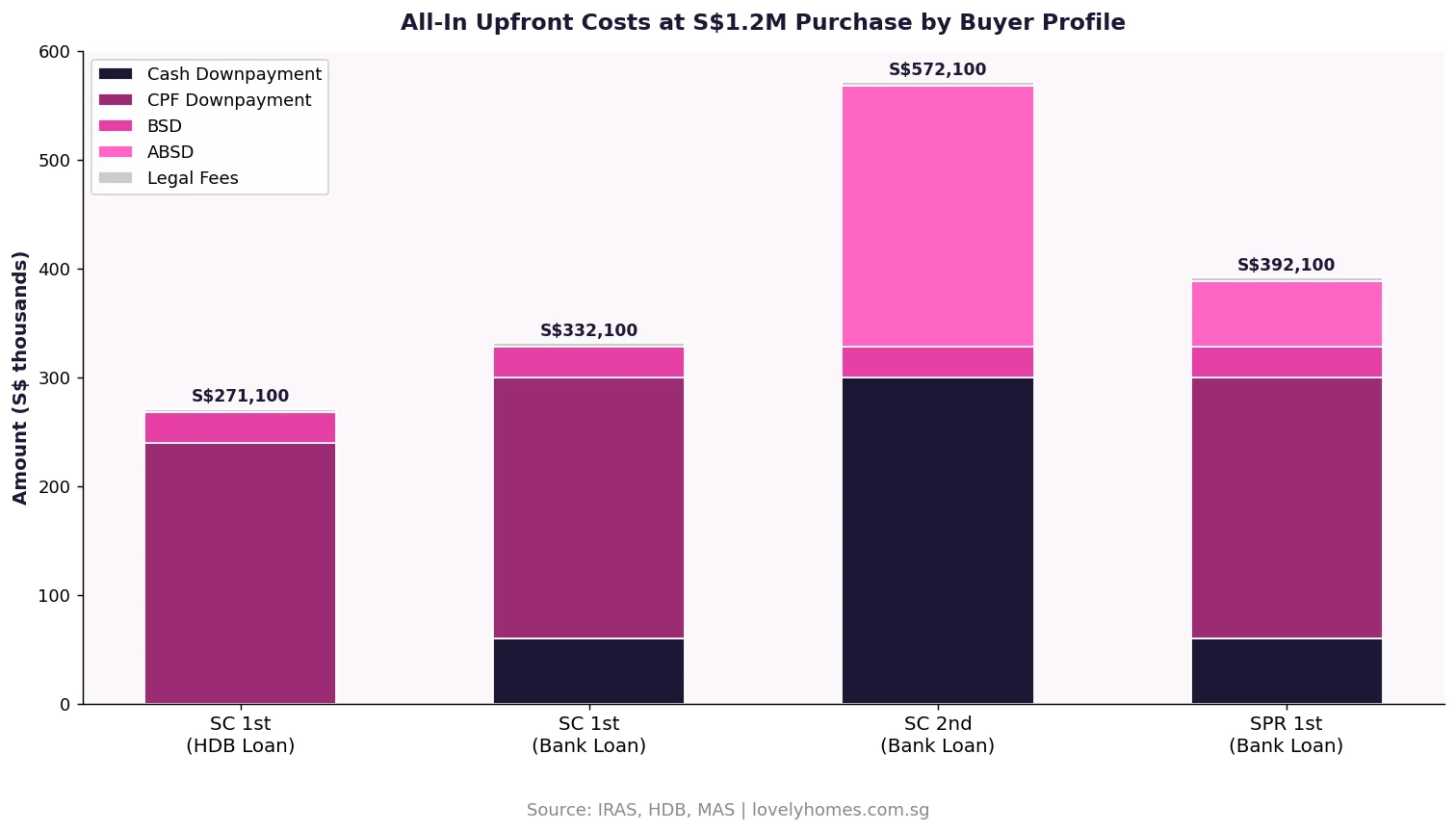
Figure 2: All-in upfront costs at S$1,200,000 purchase price by buyer profile. A Singapore Citizen buying their first property with a bank loan needs approximately S$266,600 (cash + CPF + BSD + legal). A Foreigner buyer owes an additional 60% ABSD on top — over S$1 million in total upfront costs.
Phase 4 Checklist:

  • Review OTP terms (price, completion date, conditions, vacant possession)
  • Pay option fee within agreed deadline to secure OTP
  • Engage conveyancing solicitor (separate from seller’s law firm)
  • Pay BSD via IRAS e-Stamping within 14 days of signing OTP
  • Pay ABSD (if applicable) at same time as BSD
  • Exercise OTP by paying exercise fee within the option period

VI. Phase 5 — Legal Completion and Financing Drawdown

Once the OTP is exercised, your solicitor lodges a caveat with the Singapore Land Authority to protect your interest in the property. For HDB resale, the HDB Resale Portal is the primary platform: both buyer and seller submit their portions, and HDB conducts its eligibility checks before approving the resale. For private property, completion typically follows within 8–12 weeks of OTP exercise, culminating in the legal completion date when ownership transfers.

At legal completion, the bank drawdown funds are used to pay the seller’s outstanding mortgage (if any), with the balance going to the seller. Your solicitor handles the flow of funds. CPF contributions drawn for the purchase are submitted by your solicitor via the CPF Board portal. Ensure your CPF investment account has sufficient OA balance — CPF Board takes 2–3 business days to process withdrawal requests.

Phase 5 Checklist:

  • Confirm loan offer letter terms with bank (lock-in, penalty, package details)
  • Accept bank’s loan offer and arrange fire insurance (mandatory for mortgaged properties)
  • Instruct CPF Board to release CPF OA funds (via solicitor)
  • Caveat lodged by solicitor at SLA
  • For HDB: complete HDB Resale Checklist; attend HDB appointment if required
  • Confirm completion date and prepare for vacant possession inspection

VII. Phase 6 — Pre-Completion Inspection and Key Collection

Before accepting keys, conduct a thorough defect inspection. For new private launches, developers are legally obligated to rectify defects within one year of Temporary Occupation Permit (TOP). For resale properties, the principle is caveat emptor (buyer beware) — inspect carefully and document all defects before signing vacant possession. A professional property inspector typically charges S$400–S$800 for a thorough report.

On the legal completion date (for private) or the HDB appointment date (for resale), keys are handed over and the purchase is complete. Notify relevant parties: inform your employer of your change of address, update NRIC with ICA, apply for conservancy/maintenance fee giro arrangements, and arrange home contents insurance. For HDB buyers, remember that the MOP clock starts from the date of key collection, not from any earlier date.

Phase 6 Checklist:

  • Conduct pre-completion defect inspection; document with photos
  • Confirm all agreed furniture and fittings are present (if furnished sale)
  • Ensure utilities are transferred (SP Group for electricity and gas)
  • Update NRIC address with ICA within 28 days of moving in
  • Note MOP start date (for HDB buyers)
  • Arrange home contents insurance and home protection scheme (for HDB with CPF loan)

VIII. Summary Checklist Table

Phase Key Action Deadline / Authority HDB Private
1. Budget Calculate TDSR/MSR and stamp duty Before any offer Yes Yes
2. Financing HFE Letter / AIP Before OTP / 30 working days HFE via HDB Portal AIP from bank
3. Search SLA title search, MCST check Before offer HDB Resale Portal SLA / conveyancer
4. OTP & Stamp Option fee → BSD/ABSD payment 14 days from OTP signing IRAS e-Stamp IRAS e-Stamp
5. Legal Caveat, CPF drawdown, loan drawdown Before completion HDB appointment Solicitor-led
6. Keys Defect list, NRIC update, MOP date Completion day HDB appointment Completion date

IX. Worked Example — Mr & Mrs Kumar: Buying a Private Condo in Tampines

Scenario: First-property purchase, OCR 3-bedroom condo, S$1,500,000

Buyer profile: Mr & Mrs Kumar, both Singapore Citizens, first property purchase. Combined gross monthly income: S$14,000.

TDSR check: Maximum monthly loan repayment at 55% TDSR = S$7,700/month. Stress-test rate 4.0%. At 4.0% over 30 years, S$7,700/month services a loan of approximately S$1,614,000. Actual loan at 75% LTV = S$1,125,000. Monthly repayment at 3.2% 30yr = S$4,856/month. TDSR = 34.7% — well within 55% cap.

Downpayment: 25% of S$1,500,000 = S$375,000. Minimum 5% cash = S$75,000. Remaining 20% CPF OA = S$300,000.

BSD: First S$180,000 × 1% = S$1,800; next S$180,000 × 2% = S$3,600; next S$640,000 × 3% = S$19,200; next S$500,000 × 4% = S$20,000. Total BSD = S$44,600. ABSD = nil (first property, SC).

Legal fees: approximately S$4,000 (conveyancing) + S$500 (CPF lodgement) = S$4,500.

Total upfront outlay: Cash S$75,000 + CPF S$300,000 + BSD S$44,600 + legal S$4,500 = S$424,100.

Timeline: AIP obtained in 3 days. OTP signed: 1 March 2026. BSD paid: 14 March 2026. OTP exercised: 19 March 2026. Caveat lodged: 20 March 2026. Legal completion: 25 June 2026 (approximately 98 days from OTP).

Singapore property financing eligibility matrix HDB loan bank loan TDSR MSR 2026
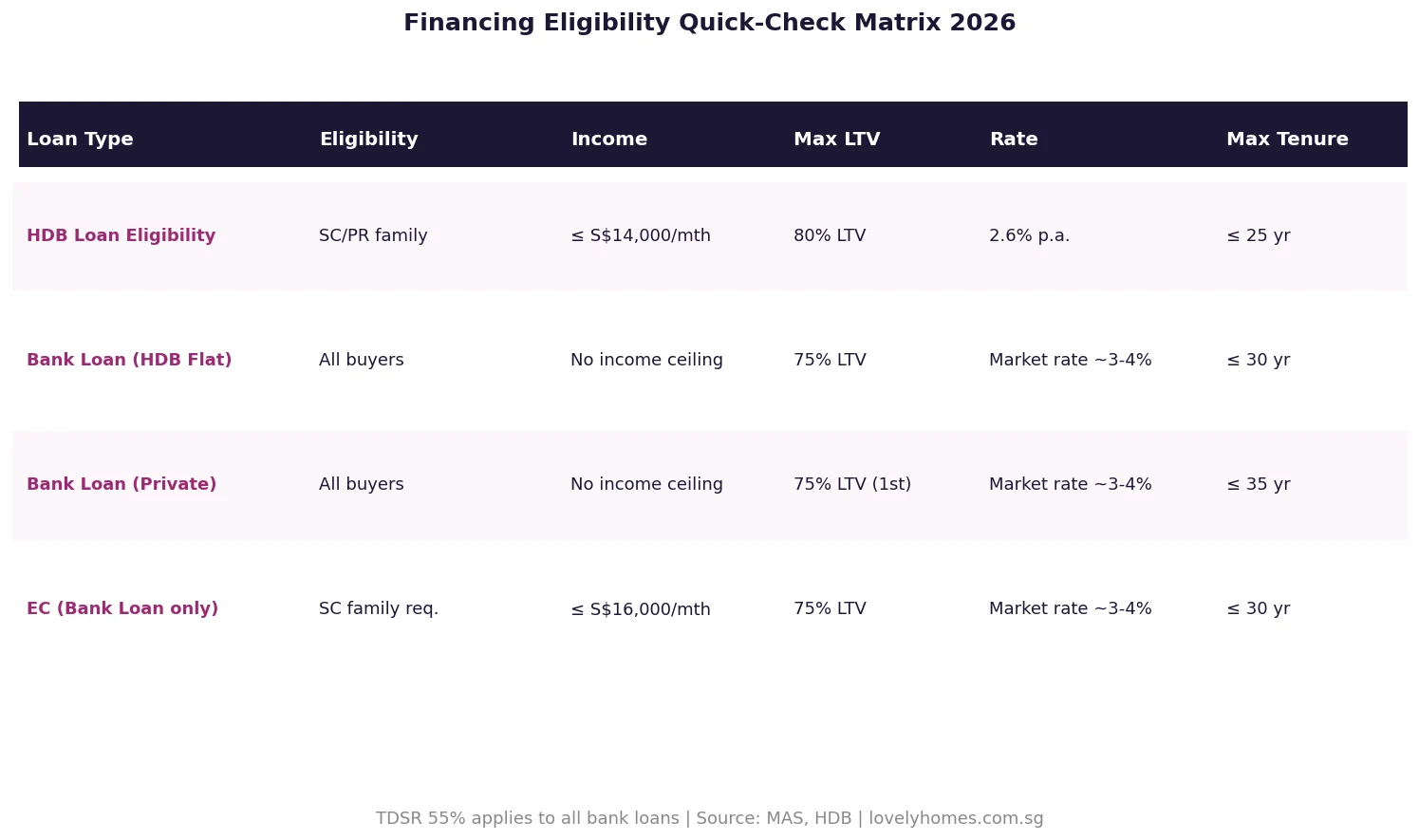
Figure 3: Financing eligibility quick-check matrix — HDB Loan versus Bank Loan across 9 criteria. HDB loans offer lower minimum cash outlay (zero) and no TDSR, but carry an income ceiling (S$14,000/month for families) and a higher minimum downpayment than many first-time buyers expect.

X. Why This Checklist Matters: The Cost of Missed Steps

Singapore’s stamp duty and property financing rules carry penalties that are disproportionately large relative to the underlying transaction. A buyer who misses the 14-day BSD deadline faces a penalty of up to four times the BSD payable — on a S$1.5M property, that is up to S$178,400 in penalties on top of the S$44,600 BSD itself. An HDB buyer who fails to obtain their HFE Letter before exercising the OTP may forfeit their option fee entirely. A borrower who underestimates their TDSR exposure may find their bank loan offer reduced or withdrawn after the OTP is signed, leaving them in breach of contract.

The 2024 MAS update to LTV limits (HDB loan reduced from 80% to 75% in August 2024) added S$25,000 to the minimum cash requirement on a S$500,000 HDB resale flat. Buyers who had planned their finances before August 2024 and purchased after it sometimes found themselves short at the OTP exercise stage. This underscores why the financial check must be done at current rates, not rates remembered from a friend’s transaction a year earlier.

XI. What May Change in 2027 and Beyond

The MAS’s macro-prudential stance in 2026 remains cautious. Property prices have continued to rise modestly in 2026, and ABSD rates for foreigners remain at 60% following the April 2023 hike. Any easing of cooling measures would require a sustained period of price moderation, which has not yet materialised in the private market. Buyers planning to buy in 2027 should monitor MAS and HDB announcements, particularly around the ABSD remission framework (which is reviewed periodically) and BTO supply pipelines. The government’s target of ~100,000 HDB flats delivered between 2022–2025 is on track; any supply shortfall could push resale prices higher and tighten the BTO-to-resale price gap further.

XII. Frequently Asked Questions

Can I use my CPF to pay BSD and ABSD?

Yes, for residential property, both BSD and ABSD can be paid from your CPF Ordinary Account, provided the payment is made via the IRAS e-Stamping portal and your solicitor requests the CPF release correctly. However, the funds must be available in your OA at the time of payment. If your OA balance is insufficient, you must top it up in cash before the 14-day deadline. Note that payment of BSD and ABSD from CPF OA reduces the balance available for the downpayment and monthly servicing, so plan the sequencing carefully with your solicitor.

What happens if the seller refuses to complete after I have exercised the OTP?

If the seller backs out after the OTP has been exercised, the buyer is entitled to specific performance (a court order compelling the seller to complete the sale) or damages. In practice, specific performance is rarely sought for residential property in Singapore; most buyers negotiate a return of all monies paid plus a penalty sum, which under standard OTP terms is typically the option fee and exercise fee forfeited by the seller plus additional damages. You should engage your solicitor immediately and preserve all correspondence. For HDB resale, HDB’s approval of the resale application is required before completion — if HDB has already approved it, the seller’s refusal may also trigger HDB administrative consequences.

Is there a cooling-off period after I exercise the OTP?

No. Under Singapore law, there is no statutory cooling-off period for residential property purchases. Once you sign the OTP, you are contractually bound to proceed if you exercise it. The option period (typically 14 to 21 days for private property) is the window during which you can choose not to exercise — doing so forfeits only the option fee paid. Once you exercise the OTP by paying the exercise fee, both parties are legally bound to complete the transaction. This is why due diligence — financing, legal review, inspection — must happen during the option period, not after exercise.

Do I need a property agent? Can I buy without one?

You are not legally required to engage a property agent in Singapore. HDB resale buyers can transact directly via the HDB Resale Portal without an agent; private property buyers can negotiate directly with developers or sellers. However, an unrepresented buyer bears full responsibility for due diligence, price negotiation, OTP drafting, and liaison with HDB or the developer. For first-time buyers or those unfamiliar with the process, a CEA-registered agent adds practical value. If you choose to self-transact, engage a conveyancing solicitor early — they handle the legal completion regardless of agent involvement.

How does the ABSD remission work if I sell my existing property?

Singapore Citizens who own one residential property and buy a second before selling the first must pay ABSD of 20% upfront. However, if they sell their first property within 6 months of the new property’s purchase (or completion for new launches), they may apply to IRAS for a remission (refund) of the ABSD paid. The remission is not automatic — a formal application must be made within the stipulated window. Married couples where one spouse is a Singapore Citizen and the other is an SPR or foreigner may also qualify for remission under specific conditions. The remission only applies to the ABSD paid on the second purchase; BSD is not remitted.

What is the fire insurance requirement and is it mandatory?

Fire insurance is mandatory for any property purchased with a bank loan in Singapore. The insured value must cover the reinstatement cost of the building structure (not the market value of the property). Banks typically arrange fire insurance as part of the loan package, and the premium is collected with the first loan repayment. For HDB flats bought with an HDB loan, the HDB Home Protection Scheme (HPS) is compulsory — this is a mortgage-reducing insurance product that settles your outstanding HDB loan if you die, suffer total permanent disability, or contract a terminal illness. The annual HPS premium is deducted from your CPF OA. Home contents insurance (covering your belongings, fixtures, and fittings) is separate and voluntary but strongly recommended.

When does the HDB Minimum Occupation Period (MOP) start?

The MOP for an HDB flat starts from the date you collect the keys — that is, the date of physical possession, not the date of the application, the signing of the Agreement for Lease, or any earlier administrative milestone. For BTO flats, that is the date of key collection at the HDB Hub or branch office. For resale flats, it is the date of the HDB-appointed completion. The standard MOP is 5 years. Flats in Plus or Prime (PLH) classifications have a 10-year MOP. During the MOP, owners cannot sell the flat on the open market, sublet the entire flat, or purchase private residential property. Room rental within the flat is allowed from the date of key collection, subject to HDB’s prevailing subletting rules.

Disclaimer: This checklist is produced by LovelyHomes Editorial and is accurate as at 19 August 2026. Property rules, stamp duty rates, CPF withdrawal limits, loan-to-value ratios, and HDB eligibility conditions change periodically. Always verify the current rules with official sources: IRAS (stamp duties), HDB (eligibility and grants), MAS (financing rules), CPF Board (CPF usage), and SLA (land titles). Nothing in this article constitutes legal, financial, or property advice. Engage a licensed conveyancing solicitor and a CEA-registered property agent for your specific transaction.

×

Click anywhere to close

Singapore Property Seller’s Complete Guide 2026: OTP, Timeline, Costs and Proceeds

Singapore Property Seller’s Complete Guide 2026: OTP, Timeline, Costs and Proceeds

Selling a property in Singapore involves a legal process that most people will go through only a handful of times in their lives. Whether you are selling a resale HDB flat, a condominium, or a landed home, the steps from decision to receiving your proceeds follow a structured sequence — one where mistakes at any stage can cost tens of thousands of dollars or delay completion by weeks.

This guide walks you through the complete selling process in 2026: from deciding to sell and appointing a property agent, through the Option to Purchase (OTP) and Sales and Purchase Agreement, all the way to receiving your sale proceeds and understanding exactly what comes back to you after CPF, mortgage repayment, agent commission, and stamp duties.

Quick Answer — Singapore Property Selling: Key Facts 2026

  • The standard selling timeline for resale HDB or private property is 4 to 6 months from decision to completion
  • HDB sellers must satisfy the Minimum Occupation Period (MOP) of 5 years (or 10 years for Prime and Plus classification flats) before selling
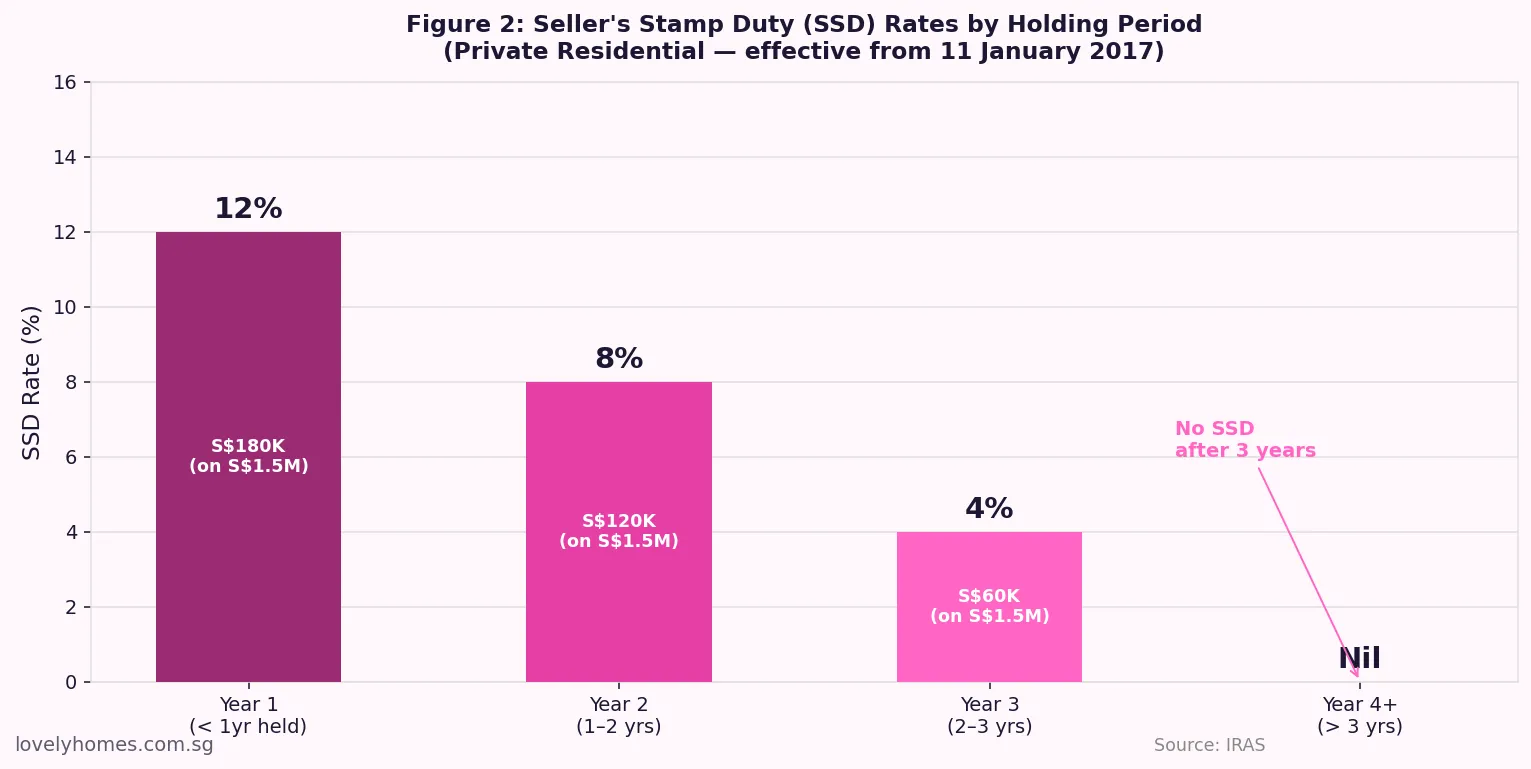
  • Seller’s Stamp Duty (SSD) applies to private property sold within 3 years of purchase: 12% (year 1), 8% (year 2), 4% (year 3)
  • Agent commission for HDB sellers: typically 1–2% of sale price; condo: 1–2% (negotiable); landed: 1–2%
  • CPF Ordinary Account funds used for the purchase must be refunded — with accrued interest at 2.5% p.a. — before you receive any cash proceeds
  • The OTP grants the buyer 14 calendar days to decide whether to exercise (HDB: 21 days); the seller is bound for that period
  • Completion (from S&P signing) for resale HDB: approximately 8 weeks; private property: typically 10–12 weeks
  • Legal conveyancing fees: S$2,000–S$4,000 for HDB; S$2,500–S$5,000+ for private property

Step 1: Decide to Sell — and Check Your Eligibility

Before instructing an agent or starting viewings, two eligibility checks must be completed. For HDB sellers, the most critical is the MOP. Under HDB rules, a flat purchased directly from HDB (BTO, DBSS, or direct sale) must be occupied for a minimum of five years from the date the keys are collected before it can be sold on the open resale market. For Prime Location Public Housing (PLH) and Plus model flats introduced from late 2021, the MOP is ten years. Selling before MOP is a criminal offence under the Housing and Development Act and can result in compulsory acquisition of the flat and other penalties.

For private property sellers, the eligibility question is Seller’s Stamp Duty. SSD was calibrated in January 2017 to discourage short-term flipping of residential property. If you sell within three years of purchase, SSD is payable at the rates below.

Singapore property selling timeline from decision to proceeds 2026
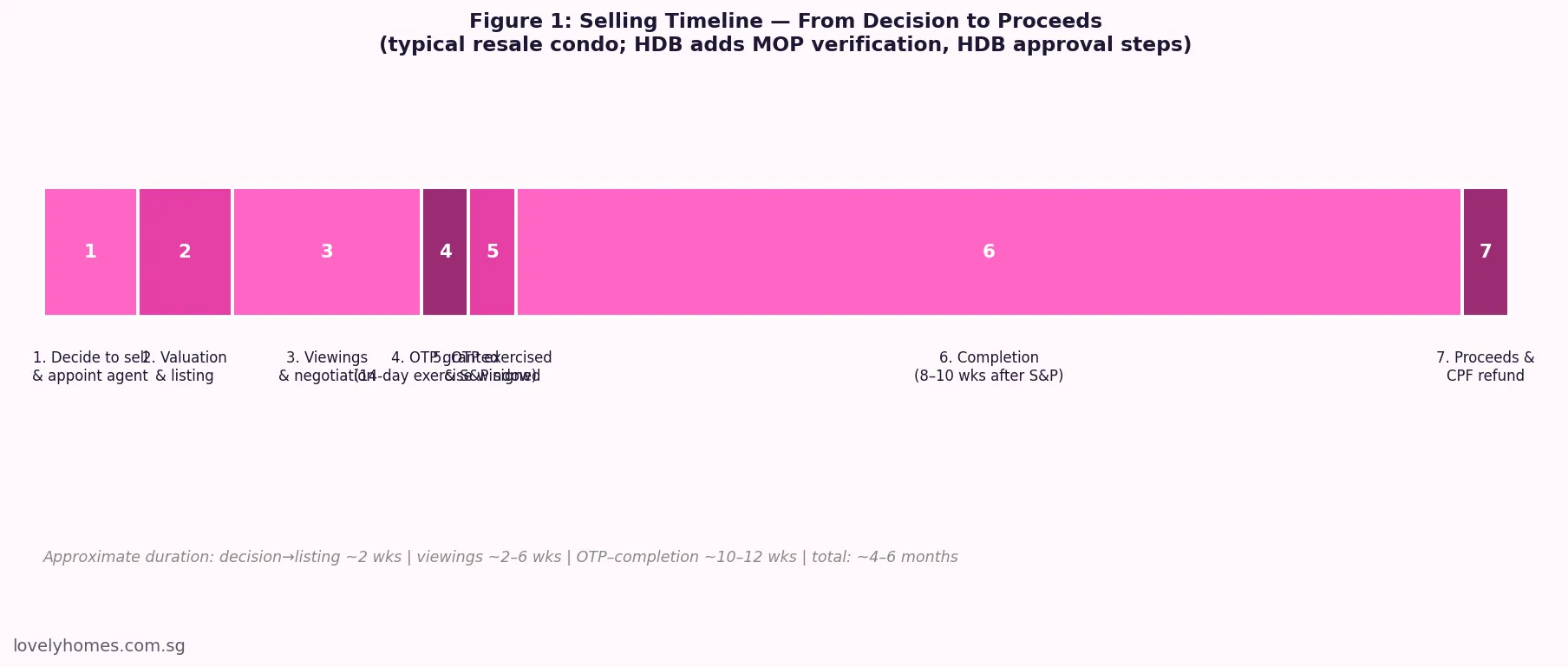
Figure 1: Typical Singapore property selling timeline — from decision to cash proceeds. HDB resale adds HDB approval steps (HFE Letter verification, HDB resale portal submission) between OTP and completion. Source: HDB, CEA.

Step 2: Valuation and Listing — Setting the Right Price

Pricing accurately is the single most important decision a seller makes. An overpriced listing sits on the market, accrues carrying costs (mortgage, maintenance fees, property tax), and acquires a stigma as buyers wonder what is wrong with it. An underpriced listing leaves money on the table. Getting it right requires a Comparative Market Analysis (CMA) — a structured review of recent transactions for comparable properties in the same estate or district, same flat type or size, and similar age and condition.

For HDB sellers, URA’s HDB Resale Statistics portal provides free access to actual transacted prices by town, flat type, storey range, and month. Use this data to identify the price band for your flat before allowing any agent to quote you a price. Agents sometimes inflate initial price estimates to win the listing — so cross-check every agent’s recommended listing price against the data yourself.

For private property, URA’s Property Data portal contains detailed transaction histories by project. Supplement this with a professional valuation from an IRAS-approved valuer if you are in doubt, particularly for older or unusual properties where comparables are scarce.

Step 3: Seller’s Stamp Duty — Know Your Exposure Before You List

Seller’s Stamp Duty is a critical cost that many sellers either forget or underestimate. It applies to residential properties (private only — HDB resale is not subject to SSD). The rates in force from 11 January 2017 are:

Seller Stamp Duty SSD rates by holding period Singapore 2026
Figure 2: Seller’s Stamp Duty (SSD) rates for private residential property by holding period. Effective 11 January 2017. Source: IRAS.
Holding Period SSD Rate SSD on S$1,500,000 Sale SSD on S$2,500,000 Sale
Up to 1 year 12% S$180,000 S$300,000
More than 1 year, up to 2 years 8% S$120,000 S$200,000
More than 2 years, up to 3 years 4% S$60,000 S$100,000
More than 3 years Nil S$0 S$0

SSD is calculated on the higher of the sale price or market value. It is payable by the seller within 14 days of the date the OTP is exercised or the S&P Agreement is signed. IRAS administers SSD via its Stamp Duty portal. If SSD applies to your planned sale, model it explicitly into your net proceeds calculation before you list — it is a very large number at 12% on a S$2 million property.

Step 4: The Option to Purchase (OTP)

The OTP is the first legally binding document in any resale property transaction. Understanding it is essential for sellers.

When a buyer makes an offer that you accept, you grant them an OTP in exchange for an option fee. For private property, the option fee is negotiated — typically 1% of the purchase price, though it can be less for new launches or more for competitive situations. For HDB resale, HDB caps the option fee at S$1,000. The OTP grants the buyer the exclusive right to purchase your property at the agreed price, within a specified window (14 days for private property, 21 days for HDB).

During the option period, you cannot sell to anyone else or accept another offer. If the buyer exercises the OTP (pays the exercise fee and returns the signed copy), a binding Sale and Purchase Agreement comes into existence. If the buyer does not exercise, the OTP lapses, you keep the option fee, and you are free to sell to another party.

For HDB resale, the seller must obtain an HDB Resale Checklist acceptance before granting the OTP. Both buyer and seller submit declarations via the HDB Resale Portal. After the OTP is exercised, both parties have 8 weeks to register the resale application with HDB.

Step 5: Conveyancing and Completion

Once the OTP is exercised, your conveyancing lawyer takes over to complete the legal transfer of title. For private property, the buyer’s lawyer and seller’s lawyer correspond on the Sale and Purchase Agreement, conduct title searches, address outstanding caveats, and coordinate the CPF and bank discharge of your existing mortgage. Completion typically occurs 10 to 12 weeks after the S&P is signed.

At completion, the following typically happen simultaneously: the buyer pays the balance purchase price (via the bank’s loan drawdown and their own CPF OA funds); your outstanding mortgage is discharged and your mortgagee releases the property; CPF refunds your accrued principal and interest from the buyer’s funds; and after all deductions, the net cash proceeds are remitted to you.

Step 6: Net Proceeds — What You Actually Receive

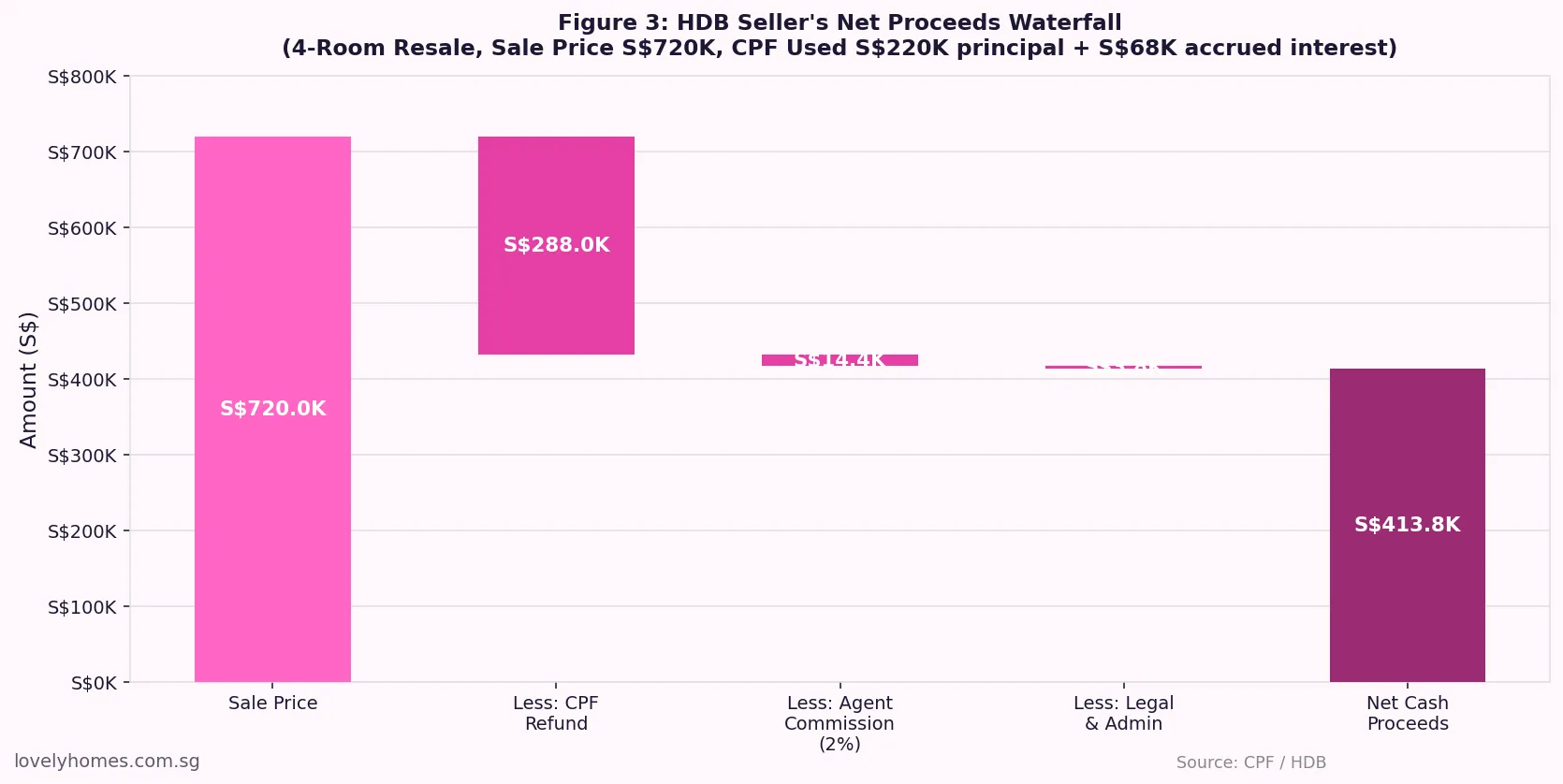
The gap between the headline sale price and the cash you receive in your bank account after completion is often a shock to first-time sellers. Here is how to model it:

HDB seller net proceeds waterfall CPF refund agent commission 2026
Figure 3: Illustrative HDB seller’s net proceeds waterfall. Sale price S$720K, CPF OA principal used S$220K plus accrued interest S$68K. Agent commission 2%. Source: CPF Board / HDB.
Proceeds Component HDB Example (S$720K sale) Private Condo Example (S$1.5M sale)
Gross sale price S$720,000 S$1,500,000
Less: CPF OA refund (principal + accrued interest) (S$288,000) (S$450,000)
Less: Outstanding mortgage discharge (S$0) (fully paid) (S$700,000)
Less: Agent commission (2% + 9% GST) (S$15,696) (S$32,700)
Less: Legal fees (seller’s conveyancing) (S$2,000) (S$3,500)
Less: HDB admin fee / miscellaneous (S$800) (S$0)
Net cash to seller S$413,504 S$313,800

The CPF refund is the item that surprises most sellers. Under CPF rules, all funds withdrawn from your Ordinary Account for housing — the initial downpayment, the monthly mortgage servicing amounts, and any lump-sum top-ups — must be refunded with accrued interest at 2.5% per annum upon sale. This money goes back to your CPF account, not into your bank account. So a seller who used S$220,000 of CPF and held the flat for 15 years might owe S$288,000 back to their CPF account at completion — even if the flat appreciated handsomely, a large portion of the paper gain goes back to CPF, accessible only for retirement or another property purchase.

HDB vs Private: Key Differences for Sellers

The mechanics of selling differ meaningfully between HDB and private property. The table below summarises the most important distinctions:

Factor HDB Resale Private Property (Condo / Landed)
MOP requirement 5 years (10 for PLH/Plus) None
Seller’s Stamp Duty Not applicable 12%/8%/4% if sold within 3 years
OTP option period 21 days 14 days (negotiable)
HDB approval required Yes — HDB Resale Portal submission No
Completion timeline 8 weeks after HDB registration 10–12 weeks after S&P
Valuation required HDB/SRX valuation (for CPF/loan purposes) Bank or IRAS valuation
Resale Levy (if buying subsidised flat next) Yes — S$15,000 to S$50,000 depending on flat type Not applicable
ABSD on next purchase May apply if buying before existing flat is sold May apply — plan carefully with sell-first strategy

Worked Example: Mr and Mrs Tan Sell Their Bishan 4-Room HDB Flat

Mr and Mrs Tan are Singapore Citizens who purchased a 4-room HDB flat in Bishan in June 2020 via the open resale market for S$590,000. They used a bank loan (S$442,500 at 75% LTV) and S$120,000 from their combined CPF OA. They have been servicing S$2,100 per month from CPF OA. As of August 2026 (6 years and 2 months of ownership), the MOP of 5 years has been satisfied.

  • Sale price agreed: S$780,000
  • Outstanding bank loan: S$312,000 (after 74 months of repayment)
  • CPF OA principal used: S$120,000 (downpayment) + S$2,100 × 74 months = S$275,400 total principal
  • CPF accrued interest at 2.5% p.a.: approximately S$34,000
  • Total CPF refund: S$309,400
  • Agent commission (2% + 9% GST): S$17,004
  • Legal fees: S$2,200
  • HDB admin fee: S$800
  • Net cash to Mr and Mrs Tan: S$780,000 – S$312,000 – S$309,400 – S$17,004 – S$2,200 – S$800 = S$138,596
  • CPF account top-up: S$309,400 (returned to their combined OA — available for future property purchase or retirement)

The Tans pocket S$138,596 in cash and have S$309,400 restored to their CPF accounts — a total economic gain of S$447,996 on a property that cost them S$590,000 six years ago, representing a 75.9% nominal return. The cash component, however, is much more modest at 17.8% of the sale price — a reminder that CPF recycling is a significant feature of the Singapore property selling experience.

Agent vs DIY: Should You Sell Without an Agent?

Singapore’s HDB and private resale markets do not legally require a licensed property agent (or Co-Broke Service / CBS for HDB). You can sell your HDB flat directly through the HDB Resale Portal as a DIY transaction, and private property through your conveyancing lawyer. The benefit is saving the agent commission — typically 1–2% of sale price — which on a S$1 million property amounts to S$10,000–S$20,000.

The risks are real, though. Negotiating effectively against buyers represented by experienced agents, writing and managing the OTP correctly, handling viewings and screening serious buyers from time-wasters, and navigating HDB’s administrative submissions are all tasks where professional help has tangible value. DIY is most viable when you have previous experience, when the property is straightforward and in high demand, and when you are willing to invest significant time. For most first-time sellers, the commission is well-spent insurance against costly errors.

What Might Come Next

For sellers active in H2 2026, the market environment is one of moderating prices (particularly for HDB resale and private OCR/RCR) and still-healthy volume. This is a reasonable time to sell if you have held for the requisite period — the market has not collapsed, but the risk of further softening in 2027 as BTO MOP supply increases is real. Private sellers who bought in 2019 to 2021 during the pre-cooling-measures run-up will have seen the strongest gains; those who bought in 2022 to 2024 may need to hold longer to realise meaningful appreciation. SSD for private sellers who bought after mid-2023 remains an active consideration: the three-year clock runs from the date the OTP was granted to you as a buyer, not the date you moved in.

FAQ: When does the Minimum Occupation Period (MOP) start for HDB?

The MOP begins on the date you collect the keys to your flat — not the signing date of the Sales and Purchase Agreement, not the HDB appointment date, and not the date you move in. The five-year MOP period runs from key collection to key collection plus five years. For BTO flats, this is straightforward. For resale flats, the MOP restarts from the date you as the new owner collect the keys after completion of your purchase, regardless of how long the previous owner occupied the flat.

FAQ: Can I rent out my flat during the MOP while planning to sell after?

For whole-flat subletting, you must first satisfy the MOP before applying for HDB’s permission to sublet. Room rental (subletting of individual bedrooms) is permitted during the MOP subject to HDB approval and conditions. You may not use the MOP period to simultaneously rent out the whole flat and purchase another property — that would amount to owning two properties, which violates HDB rules unless you are an approved private property owner who has given up your subsidy.

FAQ: What happens if the buyer pulls out after exercising the OTP?

If a buyer exercises the OTP (that is, pays the exercise fee and returns the signed document), a binding contract exists. If the buyer subsequently defaults — fails to complete on the scheduled completion date — you as the seller have legal remedies including: forfeiture of the deposit paid, specific performance action, and damages. In practice, most failed completions are resolved through negotiation and a revised completion date rather than litigation. Engage your conveyancing lawyer immediately if your buyer signals difficulty completing.

FAQ: Do I pay tax on the profit from selling my property?

Singapore does not impose a capital gains tax on residential property profits for owner-occupiers and most individual investors. The gains are yours to keep, subject to CPF refund obligations. However, if IRAS determines that you are trading in property — buying and selling repeatedly for profit in a manner that constitutes a business — the gains may be taxed as income. This is a case-by-case assessment. Selling one or two properties over a lifetime is almost never caught by this rule; serial short-term flippers may be. Seller’s Stamp Duty (for private property held under 3 years) is a separate tax on the transaction, not on gains.

FAQ: How do I calculate the CPF accrued interest I owe on sale?

CPF accrued interest is calculated at 2.5% per annum (the prevailing Ordinary Account rate) on the principal CPF amounts withdrawn, compounded monthly from the date each withdrawal was made. CPF Board provides an indicative CPF housing refund calculator on their website at cpf.gov.sg. The actual figure is confirmed by CPF Board during the conveyancing process. It is important to model this early — for long-held properties with substantial CPF usage, the accrued interest can exceed S$100,000.

FAQ: Can I sell my HDB flat and immediately buy a private condo?

Yes, provided you have satisfied the MOP on your HDB flat. Once you sell (or even once you have exercised the OTP to sell, provided you notify HDB), you are no longer counted as an HDB flat owner and can purchase private property without triggering the ABSD that would otherwise apply for owning two residential properties simultaneously. Timing is critical: if you buy the private property before your HDB flat is formally sold (OTP exercised by the buyer), you will own two properties simultaneously and ABSD applies. Most upgraders use the sell-first, buy-second approach or the married couple ABSD remission scheme to manage this sequencing.

FAQ: What is the Resale Levy and do I have to pay it?

The Resale Levy is a charge imposed by HDB on sellers of a subsidised flat (BTO or DBSS) who subsequently buy another subsidised flat (a second or third BTO, an EC, or a DBSS). It does not apply if your next purchase is a resale HDB flat or private property. The levy ranges from S$15,000 for a sold two-room flat to S$50,000 for a sold five-room or executive flat. It is payable from the proceeds of the sale at the HDB appointment. If you are selling your first subsidised flat and planning to buy a resale flat instead of a new BTO, no levy applies.

Related Articles

Disclaimer: This guide is for general information only and does not constitute legal, financial, or property advice. CPF rules, stamp duty rates, HDB administrative requirements, and market conditions change over time. Always verify current requirements at hdb.gov.sg, cpf.gov.sg, and iras.gov.sg, and engage a licensed conveyancing lawyer and CEA-registered property agent before proceeding with any transaction.

Singapore Property Conveyancing Guide 2026: Legal Fees, Timeline & Tips

Singapore Property Conveyancing Guide 2026: Legal Fees, Timeline & Tips

Quick Answer: Property Conveyancing in Singapore

  • Conveyancing is the legal process of transferring ownership of real property from seller to buyer; in Singapore it is governed by the Land Titles Act (Cap 157) and administered through the Singapore Land Authority (SLA).
  • For private property, you should appoint a property lawyer as soon as you sign the Option to Purchase (OTP). If you are using CPF savings or a bank mortgage, a lawyer is legally required.
  • Legal fees for a S$1.5M private condo typically run S$2,500–S$3,500 for the buyer and S$2,000–S$3,000 for the seller, on top of disbursements (title searches, registration fees, caveat lodgement) of S$1,200–S$2,000.
  • The full private property conveyancing process takes approximately 8–12 weeks from OTP exercise to completion. HDB resale conveyancing is longer — typically 5–8 months — because it involves HDB’s own approval pipeline.
  • Buyer’s Stamp Duty (BSD) must be paid within 14 days of exercising the OTP (for completed properties) or within 14 days of signing the S&P Agreement, whichever is earlier. ABSD must be paid at the same time.
  • Seller’s Stamp Duty (SSD) applies if the property is sold within 3 years of purchase: 12% (year 1), 8% (year 2), 4% (year 3). SSD is computed on the higher of the sale price and the property’s market value.
  • Joint representation (one law firm acting for both buyer and seller) is permissible where there is no conflict of interest, and is common in straightforward residential transactions — it reduces total legal fees.

What Is Property Conveyancing?

Conveyancing is the branch of law concerned with the legal transfer of property rights from one person to another. In Singapore, every sale and purchase of real property must be recorded on the land register maintained by the Singapore Land Authority (SLA) under the Land Titles Act (Cap 157, 2004 Rev Ed). The act of registering the transfer, mortgage, and any charges (including CPF charges) on that register is what your property lawyer actually does. Until registration is complete, the title does not legally pass to the buyer, which is why conveyancing is not optional — it is the mechanism by which you become a legal property owner.

The legal profession’s role in conveyancing is governed by the Legal Profession Act and the Legal Profession (Professional Conduct) Rules. Only advocates and solicitors of the Singapore Bar may conduct conveyancing for clients. Conveyancing practitioners are subject to the Law Society of Singapore’s practice directions, including those on client monies, title insurance, and anti-money-laundering checks (required under the Estate Agents Act and the Legal Profession (Conveyancing) Rules).

When Do You Need a Property Lawyer?

Singapore law does not require a buyer to appoint a lawyer for a pure cash purchase of private property with no mortgage and no CPF usage. In practice, however, this is vanishingly rare: the vast majority of buyers take a bank mortgage, use CPF Ordinary Account (OA) savings, or both — and for either of these, a lawyer is legally required. The bank’s in-house or panel lawyers act for the mortgagee (the bank) and also typically act for the buyer under a joint representation arrangement, reducing fees. If you use CPF, the CPF Board must be a party to the transaction, and your lawyer handles the CPF charge registration as part of the standard conveyancing package.

For HDB flat purchases, HDB provides its own conveyancing service for first-timer buyers of new flats at no additional cost. For resale HDB flat transactions, buyers and sellers must each appoint their own lawyers (HDB does not accept joint representation for resale). Private property buyers and sellers may use the same firm (joint representation) if there is no conflict of interest, which is common in uncomplicated transactions.

Estimated conveyancing costs by property price Singapore 2026
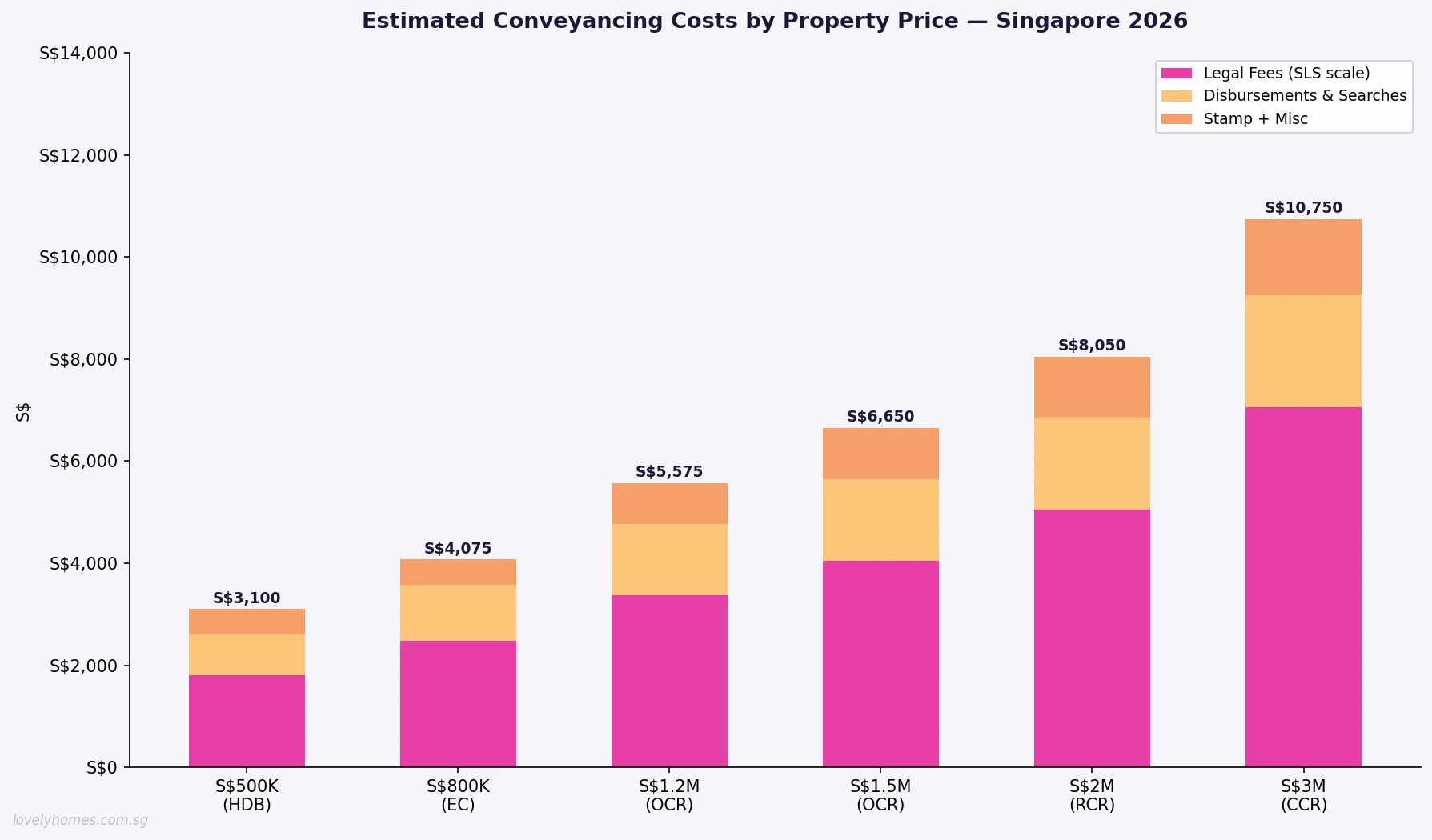
Figure 1: Estimated total conveyancing costs (legal fees + disbursements + stamp) by property price for a buyer (Singapore, 2026). Based on market rates; actual fees vary by firm. Source: Law Society of Singapore, LovelyHomes analysis.

The Conveyancing Process: Step by Step

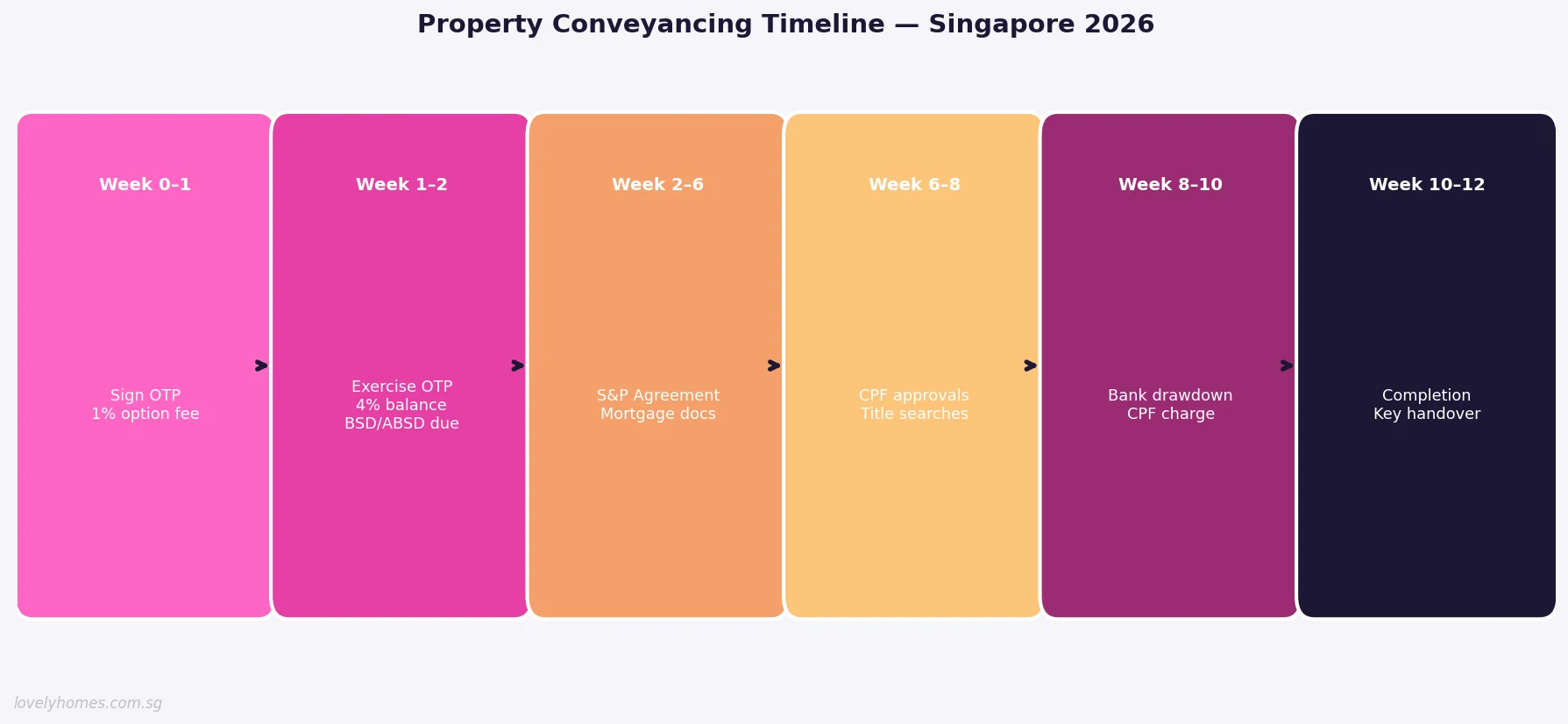
The private property conveyancing process in Singapore follows a predictable sequence, with most transactions completing within 8–12 weeks. HDB resale transactions are managed partly through the HDB portal and take considerably longer.

Property conveyancing timeline Singapore 2026 step by step
Figure 2: Typical private property conveyancing timeline from OTP to completion — Singapore 2026. Times are indicative; complex transactions or financing issues may extend the timeline. Source: LovelyHomes analysis.

Step 1 — Option to Purchase (OTP)

The transaction starts when the seller grants the buyer an OTP in exchange for a 1% option fee (typically). The OTP is a unilateral contract: only the seller is bound to sell; the buyer has the option but not the obligation to proceed. The option period is typically 14 days for private property (extendable by agreement). During this window, the buyer should appoint a lawyer, arrange financing in principle, and complete due diligence searches.

Step 2 — Exercising the OTP

If the buyer proceeds, they exercise the OTP by delivering the signed acceptance copy to the seller’s lawyer and paying the balance of the initial deposit — typically 4%, bringing the total initial deposit to 5%. The balance 5% may be funded from CPF OA or cash. At exercise, BSD and ABSD become due to IRAS within 14 days. Failure to pay stamp duties on time attracts penalties and interest under the Stamp Duties Act.

Step 3 — Sale and Purchase Agreement

Once the OTP is exercised, the parties’ lawyers prepare the formal Sale and Purchase Agreement, which sets out completion conditions, representations, warranties, and the completion date. The S&P Agreement will include standard Law Society conditions of sale, clauses on title, encumbrances, vacant possession, and completion accounts. Your lawyer will conduct title searches through the Integrated Land Information Service (INLIS) to verify ownership, check for caveats, confirm that there are no encumbrances you have not been told about, and ensure the property is not subject to any URA planning restrictions affecting intended use.

Step 4 — CPF and Bank Approvals

If CPF is being used, your lawyer submits the necessary forms to the CPF Board to obtain approval for the CPF withdrawal and the registration of the CPF charge. The CPF Board’s processing typically takes 2–4 weeks. Simultaneously, the bank prepares the Letter of Offer, Facility Agreement, and Mortgage document. Your lawyer reviews and explains the mortgage terms to you, and you execute the documents before a solicitor as required under the Legal Profession (Professional Conduct) Rules.

Step 5 — Requisitions and Searches

Before completion, your lawyer runs the full suite of property searches: bankruptcy search on the seller (to confirm they can pass clear title), building plan search (to ensure there are no unauthorised structures), and road and drainage reserves search (to check for any government acquisition that might affect the property). These disbursements typically total S$400–S$700.

Step 6 — Completion

On completion day, the balance of the purchase price is paid to the seller’s solicitors in exchange for the duly executed Transfer and vacant possession. The buyer’s lawyer immediately lodges the Transfer and Mortgage for registration with the SLA via the electronic lodgement system. Once registered, the buyer becomes the legal owner on the land register. The keys are typically handed over at or shortly after completion.

Legal Fees: What You Will Pay

The Law Society’s mandatory fee scale for conveyancing was abolished in 2009. Since then, fees are negotiated between lawyers and clients. The table below shows typical market rates in 2026 based on the legacy SLS scale, which remains an informal reference point:

Property Price Est. Buyer Legal Fees Est. Disbursements Stamp/Misc Total Estimate
S$500,000 (HDB) S$1,800–S$2,200 S$700–S$900 S$400–S$600 S$2,900–S$3,700
S$800,000 (EC) S$2,300–S$2,800 S$900–S$1,200 S$400–S$600 S$3,600–S$4,600
S$1,200,000 (OCR) S$2,800–S$3,300 S$1,100–S$1,500 S$700–S$900 S$4,600–S$5,700
S$1,500,000 (OCR) S$2,900–S$3,500 S$1,400–S$1,700 S$900–S$1,100 S$5,200–S$6,300
S$2,000,000 (RCR) S$3,800–S$4,500 S$1,600–S$2,000 S$1,000–S$1,300 S$6,400–S$7,800
S$3,000,000 (CCR) S$5,500–S$6,500 S$2,000–S$2,500 S$1,200–S$1,600 S$8,700–S$10,600

Seller’s legal fees run roughly S$2,000–S$4,500 depending on property value, covering the preparation of the Transfer and handling the mortgage redemption. Agent commissions (typically 1%–2% of sale price for the seller) are a separate commercial cost and are not part of conveyancing per se. For context, the seller of a S$1.5M condo paying 2% commission pays S$30,000 to their agent — a larger sum than their legal fees.

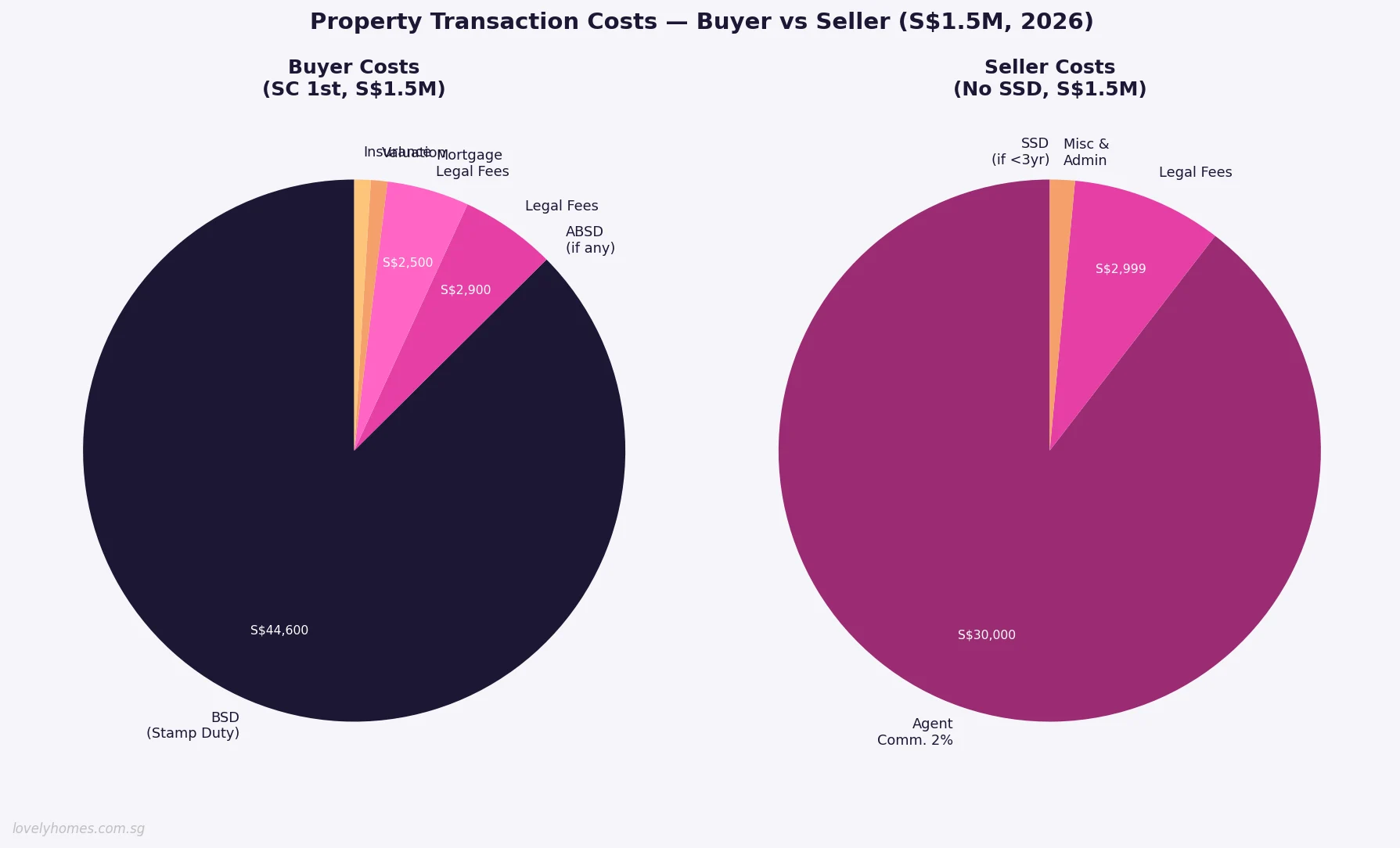
Buyer vs seller property transaction costs Singapore 2026 pie chart
Figure 3: Buyer and seller cost breakdowns for a S$1.5M property transaction (Singapore, 2026). SC first-time buyer (0% ABSD); seller holds more than 3 years (no SSD). Source: IRAS, LovelyHomes analysis.

Stamp Duties: BSD, ABSD, and SSD

Stamp duties are a significant transaction cost that your lawyer administers but that the client pays. The Inland Revenue Authority of Singapore (IRAS) levies three main types relevant to property transactions. Buyer’s Stamp Duty (BSD) is payable by every buyer on every property purchase — there are no exemptions. ABSD applies to buyers who are not SC first-timers: PRs pay 5% on a first property, SCs pay 20% on a second property, and foreigners pay 60%. Both BSD and ABSD must be paid within 14 days of exercising the OTP or signing the S&P Agreement. Seller’s Stamp Duty (SSD) is levied on sellers who dispose of a residential property within 3 years of acquisition — at 12% (year 1), 8% (year 2), or 4% (year 3). SSD was substantially tightened in April 2023 (holding period extended from 1 year at 4% to 3 years at tiered rates) as part of a package of cooling measures. For a detailed breakdown of ABSD rates and remissions, see our complete ABSD guide.

HDB Resale vs Private — Key Conveyancing Differences

HDB resale conveyancing follows a distinct process managed partly through the HDB Resale Portal, which all parties (buyer, seller, and their respective lawyers) must use to submit applications, upload documents, and schedule the final HDB Resale Completion Appointment. The approximate timeline for an HDB resale from OTP exercise to key collection is 5–8 months, much longer than the 8–12 weeks typical for private property. This is because HDB’s approval involves eligibility checks, CPF valuation checks, and the scheduling of the Resale Completion Appointment, which must be booked at HDB’s Hub at Toa Payoh. Legal fees for HDB resale conveyancing are generally lower than for private property because the title is simpler (no freeholds, no complex encumbrances), running S$1,800–S$2,500 for the buyer. For more detail on the HDB resale process, see our HDB resale price and process guide.

Worked Example: Buying a S$1.5M OCR Condo

Case Study: Ms Tan — S$1,500,000 OCR Condo, SC First-Timer

Profile: Ms Tan (SC), 35 years old, gross monthly income S$9,500. First residential property purchase. CPF OA balance: S$120,000. Cash savings: S$350,000.

Stamp Duties (payable to IRAS within 14 days of OTP exercise):

  • BSD on S$1,500,000: (1%×S$180K) + (2%×S$180K) + (3%×S$640K) + (4%×S$500K) = S$1,800 + S$3,600 + S$19,200 + S$20,000 = S$44,600
  • ABSD (SC first property): S$0

Conveyancing (payable to her lawyer over the course of the transaction):

  • Buyer’s legal fees: ~S$3,100
  • Mortgage legal fees (joint representation with bank): ~S$2,500
  • Disbursements (title searches, INLIS, caveat, CPF charge registration): ~S$1,600
  • Valuation fee (required by bank): ~S$500
  • Miscellaneous (photocopying, couriers): ~S$200
  • Total conveyancing costs: ~S$7,900

Financing breakdown:

  • Purchase price: S$1,500,000
  • Bank loan (75% LTV): S$1,125,000 (3.4% p.a. SORA-based, 25-year term)
  • Downpayment (25%): S$375,000 = cash S$75,000 (5%) + CPF OA S$120,000 + residual cash S$180,000
  • Monthly instalment (est.): S$5,590 | TDSR: S$5,590 ÷ S$9,500 = 58.8% — slightly above the 55% cap
  • Adjustment needed: Ms Tan would need to either reduce the loan (larger CPF/cash input), extend tenure to 30 years (~S$5,040/mth, TDSR 53% PASS), or increase her income. A co-borrower (e.g., her partner) would allow joint TDSR assessment.

Total day-1 outlay: S$375,000 (downpayment) + S$44,600 (BSD) + S$7,900 (conveyancing) = S$427,500. This is within her S$350,000 cash savings combined with CPF S$120,000 = S$470,000 total resources. The transaction is feasible if the TDSR issue is resolved by extending the loan tenor to 30 years.

Choosing a Property Lawyer: What to Look For

Not all property lawyers in Singapore are equally experienced in the conveyancing niche. Here are the factors most buyers should evaluate before appointing. First, look for a firm that handles residential conveyancing regularly — some general practice firms do conveyancing only occasionally and may be slower or less familiar with current INLIS query protocols or HDB Resale Portal procedures. Second, ask upfront for a fee quote in writing that distinguishes between professional fees and disbursements — reputable firms will provide this without hesitation. Third, check whether the firm is on your bank’s panel of solicitors; if it is not, you will need to engage separate lawyers for the mortgage, effectively doubling legal fees. Most major Singapore banks maintain panels of approved firms. Finally, check the Singapore Law Society’s Find a Lawyer directory (lawsociety.org.sg) to verify that your chosen solicitor holds a valid practising certificate.

What Might Change Next?

The digitalisation of Singapore’s conveyancing pipeline has accelerated in recent years. SLA’s e-Lodgement system processes most land registry filings electronically, and the CPF Board’s digital portal has significantly reduced the time for CPF charge approvals. Looking ahead, the Law Society’s Law Reform and Revision Committee has indicated interest in reviewing professional fee guidelines — potentially introducing a new non-mandatory reference fee scale to improve market transparency for consumers. Separately, the proposed expansion of the Singapore Land Authority’s Digital Infrastructure platform may eventually allow buyers to track their property title status in near-real time. Neither reform is yet law as at August 2026.

Frequently Asked Questions

Do I need separate lawyers for the purchase and the mortgage?

Not necessarily. Under the Law Society’s practice directions, one law firm may act for both the buyer and the mortgagee bank in the same transaction, provided there is no conflict of interest and the client’s informed consent is obtained. This is called joint representation, and it is the norm in straightforward residential transactions. The firm will charge a single combined fee covering both the conveyancing and the mortgage work. You should confirm that the firm is on your bank’s panel — if it is not on the panel, the bank may insist on appointing its own panel firm for the mortgage work, and you will be charged separately for each.

When exactly must I pay BSD and ABSD?

BSD and ABSD must be paid to IRAS within 14 days of exercising the OTP (for completed private properties where the OTP is the binding instrument) or within 14 days of signing the S&P Agreement for a new launch developer sale, whichever is earlier. Your lawyer will calculate the exact figures and arrange payment through IRAS’s electronic stamp duty system (e-Stamping). Late payment attracts a penalty of S$10 or 10% of the unpaid duty, whichever is greater, plus interest of up to 6% per annum from the date the duty was due. For stamp duty rates see our complete stamp duty guide.

What is a caveat and why does my lawyer lodge one?

A caveat is a notice registered on the land register by your lawyer on your behalf, serving as a public record that you have an equitable interest in the property (arising from the S&P Agreement). Once lodged, no further dealings on the title can be registered without first notifying the caveator. The caveat protects you in the window between signing the S&P Agreement and completion — it prevents the seller from fraudulently selling the property to a second buyer or granting a second mortgage without your knowledge. Caveats are electronically lodged through SLA’s e-Lodgement system at a registration fee of S$64.45 (2026 rate). Your lawyer typically lodges the caveat within days of OTP exercise.

What is the difference between legal title and equitable title?

Singapore uses the Torrens title system, under which registration with SLA confers indefeasible legal title — meaning once registered, your ownership is guaranteed by the state and cannot be challenged except in cases of fraud. Before registration, the signed S&P Agreement gives you equitable title, which is enforceable against the seller in court but is not yet recognised on the land register. This is why the caveat is important: it protects your equitable interest until registration converts it to legal title. For practical purposes, you are the legal owner of the property only from the moment the Transfer is registered at SLA, which typically occurs on or just after completion day.

Can I appoint an overseas law firm to handle Singapore conveyancing?

No. Singapore property conveyancing must be conducted by a Singapore-qualified advocate and solicitor holding a valid practising certificate issued by the Singapore Supreme Court. Foreign-qualified lawyers or law firms — even those with Singapore offices — may not conduct conveyancing unless they hold the relevant Singapore qualifications. This rule protects the integrity of the Torrens title system and ensures that all practitioners are subject to the Law Society’s disciplinary jurisdiction and the Conveyancing Rules’ client account safeguards.

What is Seller’s Stamp Duty and how do I avoid it?

Seller’s Stamp Duty (SSD) is levied on the seller (not the buyer) when a residential property is sold within 3 years of acquisition. The rates as at 2026 are: 12% of the higher of the sale price or market value if sold in the first year; 8% in the second year; 4% in the third year. SSD does not apply if the property is sold after 3 years from the date of acquisition. The acquisition date is the date you exercised the OTP (or for a new launch, the date of the S&P Agreement, not TOP). To avoid SSD entirely, hold the property for at least 3 years. There are limited remissions — for example, if the seller has passed away and the property is transferred to the estate — but commercial transactions do not qualify for remission.

How long does HDB resale conveyancing take compared to private property?

Private property conveyancing typically completes in 8–12 weeks from OTP exercise to key collection. HDB resale conveyancing is substantially longer — usually 5–8 months from OTP exercise — because it involves HDB’s eligibility assessment, CPF Board processing, HDB Resale Portal submissions from both parties’ lawyers, and the scheduling of the HDB Resale Completion Appointment at HDB Hub. During this period, both buyer and seller must respond promptly to HDB’s documentation requests. Delays in obtaining financial documents, resolving flat condition disputes, or scheduling the completion appointment can extend the timeline further. Buyers of HDB resale flats should factor in this waiting period when planning their move or managing the sale of their existing property.

Related Articles


Disclaimer: This article is for general informational purposes only and does not constitute legal advice. Conveyancing fees, stamp duty rates, CPF rules, and SLA registration procedures are subject to change. Readers should obtain independent legal advice from a Singapore-qualified advocate and solicitor and verify current rates and procedures with official sources — SLA.gov.sg, IRAS.gov.sg, LawSociety.org.sg, CPF.gov.sg, and MAS.gov.sg — before proceeding with any property transaction.

HDB Key Collection Singapore 2026: Complete Guide to Defects Inspection, DLP and What to Do After Getting Your Keys

HDB Key Collection Singapore 2026: Complete Guide to Defects Inspection, DLP and What to Do After Getting Your Keys

Quick Answer: HDB Key Collection Singapore 2026 — Key Takeaways

  • Key collection is the final step in both the BTO and resale HDB purchase process — once keys are collected, the 5-year Minimum Occupation Period (MOP) clock starts immediately.
  • Before key collection, HDB invites you to a pre-completion inspection to identify and log defects in the flat.
  • Submit all defects within one month of key collection and before renovation begins — defects reported after renovation starts are much harder to attribute to the original construction.
  • The Defect Liability Period (DLP) is 12 months from the date of key collection — HDB’s main contractor is responsible for rectifying valid defects at no cost to you during this period.
  • Use the MyHDB Portal app (or visit your Building Service Centre) to submit defects electronically with photos — do this room by room within the first week.
  • Bring to key collection: NRIC for all owners, cashier’s orders for outstanding payments, HDB loan letter or bank acceptance, and CPF withdrawal authorisation if applicable.
  • Resale flat key collection follows a different process from BTO — completion happens at HDB Hub, and MOP is calculated from the date on the resale completion letter, not the original TOP date.

What Is HDB Key Collection and Why Does It Matter?

Key collection is the final milestone in the HDB flat purchase journey — the moment when legal ownership is formally transferred and the physical keys to your new home change hands. For a BTO (Build-to-Order) flat, this follows three to five years of waiting from the ballot exercise, triggered when the flat achieves its Temporary Occupation Permit (TOP) and HDB issues individual collection invitations. For a resale flat, key collection happens at the HDB-facilitated completion appointment, typically six to eight weeks after the Option to Purchase is exercised and HDB grants approval.

Beyond the emotional significance of receiving your keys, the date of key collection carries substantial legal and financial consequences. The five-year Minimum Occupation Period — the rule preventing most HDB owners from selling before they have physically occupied the flat — begins on the key collection date. The 12-month Defect Liability Period, during which HDB’s contractor must rectify construction defects at no charge, also starts on this date. Miss the one-month window for defect submission and you significantly weaken your ability to claim rectification from HDB.

HDB key collection process step-by-step flowchart Singapore 2026
Figure 1: HDB key collection — seven-step process from HDB invitation to defect rectification. Source: HDB MyNiceHome 2026.
Click image to zoom

BTO Key Collection: Step-by-Step Process 2026

HDB sends a written invitation by post and through the MyHDB portal approximately two to three months before your flat’s key collection date. The invitation includes a date and time slot for the pre-completion inspection, and separately for the formal key collection appointment itself.

Step 1: Pre-Completion Inspection

Before keys are collected, HDB offers a pre-completion inspection of your flat. This is your first opportunity to walk through the unit with HDB’s building inspector and identify construction defects. Defects identified at this stage are formally logged and HDB’s main contractor is required to rectify them before or shortly after key collection. Do not skip this inspection — defects that are not formally logged during this appointment are more difficult to claim under the DLP later.

Bring a torch, a marble (for tile-tapping), a portable socket tester, a spirit level, and your phone for photography. Walk every room systematically. The inspection is free and takes approximately 45 minutes to one hour for a 4-room flat.

Step 2: Key Collection Appointment

The key collection appointment takes place at HDB Hub, Toa Payoh. You must attend in person (all registered owners must be present or represented by a Power of Attorney). Bring the following documents and payments:

  • NRIC of all flat owners (originals required)
  • Cashier’s order(s) for any outstanding payments (stamp duties, mortgage shortfall, admin fees)
  • HDB loan letter acceptance, or bank’s letter of offer and mortgage documents
  • CPF withdrawal authorisation forms, if CPF Ordinary Account funds are being used
  • Resale levy cashier’s order, if applicable (second-timer buyers)

At the appointment, HDB processes the stamp duties, confirms the CPF and cash components, and registers the transfer with the Singapore Land Authority (SLA). The SLA registration typically completes within a few working days, after which you are the registered owner in the land register. The keys are handed over upon completion of the administrative process — typically within the same appointment.

Step 3: Submit Defects Immediately

Immediately after collecting your keys, conduct a second, more thorough inspection at your own pace. Use the MyHDB Portal (web or mobile app) to submit defects with photographs. The submission system allows you to tag defects by room and type. HDB’s standard rectification target is 14 working days per defect batch, though complex defects such as waterproofing issues or structural cracks may take longer. Submit everything within the first week; all defects must be submitted within one month of key collection and before any renovation work begins.

HDB BTO defects inspection checklist by room Singapore 2026
Figure 2: Room-by-room HDB BTO defects inspection checklist — what to check after key collection 2026. Source: HDB MyNiceHome, MND.
Click image to zoom

The Defects Inspection: What to Check Room by Room

A systematic inspection takes 60–90 minutes for a standard 4-room BTO flat. Work through each room methodically before moving to the next. Bring the following equipment: a torchlight (for dark corners and under cabinets); a marble or coin (for tile-tapping); a portable socket tester; a spirit level (for walls and floors); masking tape and a marker pen (to tag defects in situ); and your phone camera (photo evidence is essential for defect submissions).

Living Room and Dining Area

Tap every tile across the full floor area using a marble — a hollow or dull sound indicates poor bonding, which can cause tiles to crack or lift over time. Walk the entire floor and mark each hollow tile location with masking tape. Inspect all walls for hairline cracks, uneven plaster, paint bubbles, or water stains (especially around skirting boards). Test every power socket with a socket tester. Open and close all windows — they should slide or pivot smoothly with no significant gaps or draught ingress. Check the ceiling for water stains, paint peeling or cracks.

Bathrooms and Toilets

Run every tap and showerhead — check water pressure, drainage speed (should clear the basin within 10 seconds) and confirm no drips from joints. Flush all toilet cisterns — strong, clean flush with no leak at the base seal. Look for water stains or damp patches on walls adjacent to the shower zone, which may indicate waterproofing voids. Test the hot water supply at every bathroom. Inspect tile grouting for cracks, missing sections or staining around floor drains. Check that the bathroom door opens and closes properly and that the privacy lock engages fully.

Kitchen

Test all electrical points and the kitchen circuit — bring a socket tester and check the hood/hob electrical connection points if pre-fitted. Inspect cabinet doors for alignment, smooth hinges and proper magnetic or soft-close engagement. Run the kitchen sink to confirm drainage; check beneath the sink cabinet for moisture or drips. Tap floor tiles near the sink area for hollow sections. Confirm the gas pipe stub-out is present and capped if you are planning a gas hob installation.

Bedrooms

Check all walls for hairline cracks, especially at corners and around window frames. Use your spirit level on at least one wall per bedroom — significant lean may affect built-in carpentry. Test all light switches and power points. Open and close every bedroom door — it should close flush without sticking and the latch should engage cleanly. Check skirting boards for gaps or poor adhesion. Inspect ceiling corners and the top of walls for water staining, which may indicate condensation or waterproofing issues from the flat above.

Area Key Defects to Inspect Tool to Bring
Floor tiles (all rooms) Hollow sound, cracks, misalignment, lippage Marble or coin
Walls (all rooms) Hairline cracks, uneven plaster, paint bubbles, water stains Torch, phone camera
Power sockets Dead outlets, loose fittings, missing earth pin Socket tester
Windows and doors Stiff operation, gaps, misalignment, failed locks Hands only
Ceiling Water stains, paint peeling, cracks near corners Torch
Bathroom walls and floors Damp patches, grouting gaps, hollow tiles near drains Marble, torch
Sanitary fittings Drips from joints, slow drainage, weak flush Running water
Kitchen cabinet doors Misalignment, stiff hinges, failed soft-close Hands only

Resale HDB Key Collection: How It Differs from BTO

For resale flat buyers, the process is compressed into a single completion appointment at HDB Hub, typically held six to eight weeks after HDB approves the resale application. Both the buyer and seller (or their solicitors under the conveyancing process) attend. At the completion appointment: outstanding payments are exchanged; HDB processes the stamp duties and CPF withdrawals; SLA registers the ownership transfer; and the seller hands over the keys. There is no pre-completion inspection equivalent for resale flats — the buyer is expected to have inspected the flat thoroughly during the option exercise period.

A critical difference for resale buyers is that the Defect Liability Period does not apply — that protection only extends to new HDB flats during the original construction period. Resale buyers should instead conduct a thorough pre-purchase inspection, ideally with a professional building inspector, and negotiate any defects or renovation-required conditions into the purchase price or as a condition of the Option to Purchase.

HDB defect liability period DLP 12-month timeline Singapore 2026
Figure 3: HDB Defect Liability Period — 12-month timeline, submission deadlines and what’s covered. Source: HDB MyNiceHome 2026.
Click image to zoom

The Defect Liability Period (DLP): Your Rights in the 12 Months After Key Collection

The Defect Liability Period is a 12-month statutory protection period commencing on the date of key collection. During this period, HDB’s appointed main contractor is contractually obligated to rectify valid construction defects — cracks, waterproofing failures, defective tiles, faulty electrical installations — at no cost to the flat owner. This is a significant consumer protection, particularly given that BTO flat construction typically takes three to five years and construction quality can vary.

How to Submit Defects Under the DLP

The recommended submission method is the MyHDB Portal (via browser at my.hdb.gov.sg or the MyHDB app). Submit photos with each defect, tag the location within the unit, and describe the issue specifically (for example: “living room floor tile at coordinates 2m from entrance door, 1m from left wall — hollow when tapped, produces dull sound across approximately 30×30cm area”). A specific, photo-supported submission is significantly harder to reject than a vague one. Alternatively, visit your Building Service Centre (BSC) and submit a physical Defects Feedback Form.

HDB targets 14 working days for contractors to complete each batch of rectification. For complex defects — waterproofing voids, structural cracks, systemic electrical issues — the timeline may extend. Follow up in writing via the portal if the 14-day window passes without completion.

Submit Before Renovation Begins

This is the most important practical rule of the DLP: submit all defects before your renovation contractor begins work. Once hacking, tiling and carpentry are underway, any pre-existing defect becomes extremely difficult to attribute to the original construction versus the renovation contractor. HDB may decline to rectify a defect that appears after renovation has commenced, even if the underlying cause was a construction fault. Log everything in the first week after key collection, before any furniture is moved in and certainly before a single tile is replaced.

Summary: BTO vs Resale Key Collection at a Glance

Aspect BTO Flat Resale HDB Flat
Timeline to key collection 3–5 years from ballot exercise 6–8 weeks from HDB approval
Pre-collection inspection Yes — HDB-organised pre-completion inspection No — buyer arranges own inspection
Key collection venue HDB Hub, Toa Payoh HDB Hub, Toa Payoh
Defect Liability Period 12 months from key collection date Not applicable
Defect submission window Within 1 month of key collection; before renovation Not applicable (negotiate pre-purchase)
MOP start date Date of key collection Date of key collection (completion date)
Stamp duties payable BSD at completion; no ABSD for eligible first-time buyers BSD and ABSD (if applicable) at completion
Keys from whom HDB (direct from developer) Seller (via completion appointment)

Worked Example: BTO Key Collection for a First-Timer Couple, Tengah 2026

Case Study: Mr Rahman (Singapore Citizen) and Ms Tan (Singapore Citizen) — 4-Room BTO, Tengah Garden Walk, TOP March 2026

Background: First-timer SC couple. Applied in October 2022 ballot. Estimated key collection: Q1 2026. HDB invitation received 10 January 2026.

Pre-completion inspection: 15 January 2026. Defects logged: 3 hollow tiles (living room), 1 hairline crack (bedroom 2 wall, corner), 2 stuck window hinges (bedroom 1 and study), slow drainage (master bathroom). All logged on HDB Defects Inspection Form on the day.

Key collection appointment: 28 January 2026, 10:00am, HDB Hub. Documents brought: NRIC for both owners; cashier’s order S$8,400 (balance stamp duty after CPF); HDB loan letter acceptance; CPF withdrawal authorisation. Time taken: 50 minutes. Keys received 28 January 2026 — MOP starts 28 January 2026, expires 28 January 2031.

Defect submissions: Second inspection conducted 28–29 January 2026. Additional defects found: 4 more hollow tiles (master bedroom), 1 dead power socket (study), grout cracking at master bathroom drain. Submitted via MyHDB Portal on 29 January 2026 (1 day after key collection). Total defects submitted: 11 items.

Rectification: Contractor began rectification 10 February 2026 (9 working days). All 11 items cleared by 21 February 2026.

Renovation commencement: Contractor engaged 1 February 2026; APEX permit issued 14 February 2026; renovation commenced 15 February 2026 — after all DLP defects confirmed submitted. ✓ Compliant.

Financial summary at completion: Purchase price S$510,000. CPF used: S$126,000 (down payment S$51,000 + BSD S$9,600 + legal S$3,400 + balance drawdown S$62,000). Cash: S$8,400. HDB loan: S$382,500 @2.60% pa, 25 years → S$1,728/month. MSR: 24.0% ✓ PASS.

Why Getting Key Collection Right Matters for Your Long-Term Investment

The 12-month DLP is one of the most valuable consumer protections available to a BTO flat buyer — and it is almost entirely wasted if defects are not logged promptly and correctly. HDB’s main contractors typically complete BTO projects at significant scale; individual flat defects, while minor in isolation, accumulate across a project and the contractor has both the obligation and the budget to rectify them during the DLP window. A thorough defect submission in the first week after key collection typically results in clean, contractor-funded rectifications that would otherwise cost S$3,000–S$15,000 to remedy out of pocket after the DLP expires.

Beyond the DLP, getting the MOP start date right matters for investment planning. A common misconception among first-time BTO buyers is that MOP runs from the date of ballot or the TOP date. It runs from key collection date. If you delay key collection — or if administrative issues push the date forward — your MOP and subsequent resale or investment timeline shifts accordingly.

What Might Come Next: HDB Defect Handling and Technology

HDB has been progressively digitalising the defect submission and inspection process. The MyHDB app now supports geo-tagged photo submissions with AI-assisted defect classification — automatically categorising submissions as structural, waterproofing, tiling, electrical or plumbing and routing them to the relevant sub-contractor. HDB’s pilot in selected BTO projects uses smart sensors embedded in wall and floor elements to flag waterproofing failures before they manifest as visible damp patches — potentially allowing proactive rectification before owners even move in. If expanded, this technology could substantially reduce the volume of owner-reported defects at key collection by the time BTO projects launching in 2024–2025 reach TOP around 2028–2030.

Frequently Asked Questions: HDB Key Collection Singapore 2026

What happens if I find defects after the 12-month DLP ends?

Once the 12-month Defect Liability Period expires, HDB’s contractor is no longer obligated to rectify construction defects at no charge. Structural defects — cracks in load-bearing elements, significant waterproofing failures — may still be covered under a longer structural warranty (HDB maintains a 15-year structural defect warranty on the building itself, distinct from the flat-level DLP). For cosmetic and minor defects discovered after the DLP, the cost of rectification falls entirely on the flat owner. This is why thorough and timely defect submission in the first month is so important — it is genuinely your only cost-free window for flat-level defect rectification by the original contractor.

Can I send someone else to collect my HDB keys on my behalf?

All registered flat owners are required to attend the key collection appointment in person, unless you have authorised a representative under a valid Power of Attorney (PA). The PA must be a notarised original, and the representative must bring it along with their own NRIC. HDB does not accept informal authorisation letters or verbal confirmation. If one co-owner genuinely cannot attend due to travel or medical reasons, arrange the PA in advance — the appointment cannot proceed with an absent owner who has not executed a PA.

Do I need to renovate immediately after collecting my BTO keys?

No. There is no obligation to renovate immediately. The BTO renovation permit window is three months from permit issuance — but you do not need to apply for the permit on the day you collect keys. Many flat owners wait several weeks after key collection to engage a contractor, finalise their design, and allow defect rectifications to complete before renovation begins. The practical constraint is that any defects you wish to claim under the DLP must be submitted before renovation work starts, so conduct your full defect inspection and submit to HDB before your renovation contractor commences hacking or tiling.

When does the MOP start for a resale HDB flat?

For a resale flat, the MOP begins on the date stated in the resale completion letter — the date on which the ownership transfer is formally registered by SLA and HDB. This is typically the date of the completion appointment at HDB Hub, at which point the buyer takes physical possession of the keys. The MOP does not start from the original TOP date of the resale flat, nor from the date the OTP was signed. If you are purchasing a resale flat specifically to use or sell after the MOP, count five years from your completion date, not from any earlier milestone in the transaction.

What is the difference between the pre-completion inspection and the defect submission after key collection?

The pre-completion inspection is an HDB-organised walk-through of your flat that takes place before key collection, typically one to four weeks prior. An HDB building inspector accompanies you, and any defects logged at this stage are formally recorded by HDB for contractor rectification. The post-key-collection defect submission is a second, self-conducted inspection that you carry out at your own pace after collecting the keys, submitted through the MyHDB portal or BSC. Both are important: the pre-completion inspection catches obvious construction issues early; the post-key-collection submission documents anything missed on the initial walk-through or discovered during a more thorough personal inspection. Submit all defects within one month and before renovation commences.

What is a Building Service Centre and what can it help me with?

A Building Service Centre (BSC) is an HDB service point located within or near major HDB estates. Each BSC handles the estate-specific management functions for the flats in its area, including defect submissions during the DLP, estate maintenance requests, lift breakdown reports, and minor statutory-regulated matters such as renovation permit endorsements for certain works. You can submit physical Defects Feedback Forms at your BSC as an alternative to the MyHDB portal. To find your BSC, search by your flat’s postal code on the HDB website under “Contact Us → Building Service Centre”.

What stamp duties are payable at BTO key collection?

For a BTO flat, Buyer’s Stamp Duty (BSD) is payable at the key collection appointment. The BSD rates (2026) are: 1% on the first S$180,000; 2% on the next S$180,000; 3% on the next S$640,000; 4% on the next S$500,000; and 5% on the remainder. For example, on a S$510,000 BTO flat: BSD = S$1,800 + S$3,600 + S$9,900 = S$15,300. Additional Buyer’s Stamp Duty (ABSD) does not apply to eligible first-timer Singapore Citizens buying an HDB flat as their first property. CPF Ordinary Account funds can be used to pay both BSD and legal fees at completion.

Related Articles

Disclaimer: This article is for general informational purposes only and does not constitute legal or financial advice. HDB processes, defect liability procedures and stamp duty rates are subject to change. Verify current requirements directly with HDB at www.hdb.gov.sg and IRAS at www.iras.gov.sg. For resale flat transactions and complex conveyancing matters, engage a qualified solicitor.

Translate »