Quick Answer: River Valley Green Parcel C GLS 2026
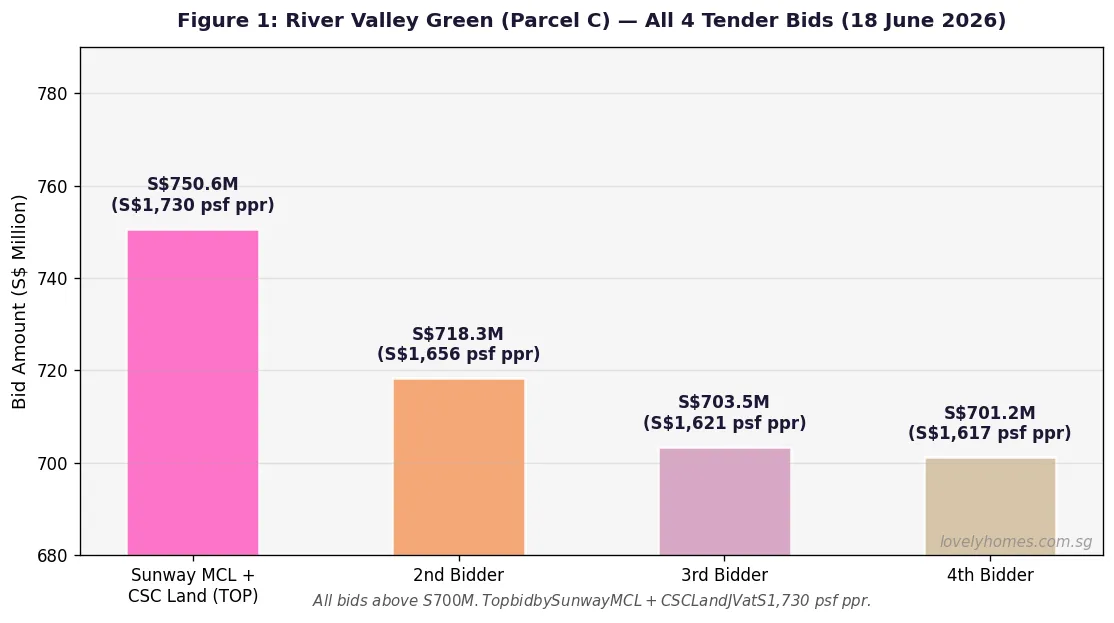
Tender closed: 18 June 2026. The site received 4 bids, all above S$700 million — exceptional confidence from developers in the River Valley / District 9 market.
Top bid: A joint venture between Sunway MCL and CSC Land Group submitted the highest bid of S$750.6 million at S$1,730 psf per plot ratio (ppr) — a new land rate record for the River Valley and Zion precinct.
The site: 123,958 sq ft, Gross Plot Ratio 3.5, maximum GFA 433,854 sq ft, located steps from Great World MRT (Thomson-East Coast Line). Estimated yield: approximately 500 units.
Expected development: Sunway MCL and CSC Land plan twin 36-storey residential towers. Formal URA award is pending; launch expected 2027–2028.
Buyer implications: Higher land cost translates to higher new launch prices in the precinct — industry analysts project future launch prices of S$3,200–S$3,800 psf for this site.
River Valley Green Parcel C: The Last GLS Site in the Great World Precinct
The River Valley Green (Parcel C) Government Land Sales tender closed on 18 June 2026 at 12:00 noon, drawing four bids from established developers — all above S$700 million. The site is the final residential plot to be carved out of the River Valley Green precinct along River Valley Road, bookending a sequence of GLS sales that has transformed the stretch between Great World City and Zion Road.
URA launched the site in April 2026 as part of the 1H2026 GLS programme. At 123,958 sq ft with a GPR of 3.5, it can yield approximately 470–500 residential units. The site occupies a prime position within District 9 (CCR — Core Central Region), within a five-minute walk of Great World MRT Station on the Thomson-East Coast Line, and is flanked by the already-launched River Valley Green developments.
The Bids: A New Land Rate Benchmark for River Valley
Figure 1: All Four Tender Bids — River Valley Green (Parcel C), Closed 18 June 2026
Bidder
Bid (S$ Million)
Land Rate (S$ psf ppr)
Premium vs 2nd Bid
Sunway MCL + CSC Land JV (Top Bidder)
S$750.6M
S$1,730
+4.5% above 2nd
2nd Bidder
~S$718.3M
~S$1,656
—
3rd Bidder
~S$703.5M
~S$1,621
—
4th Bidder
~S$701.2M
~S$1,617
—
The tight clustering of bids — with only S$49.4M separating the top from the bottom bid, and all four above S$700M — reflects strong consensus among developers on the site’s land value. The top bid of S$1,730 psf ppr is approximately 22% higher than the land rate achieved at the most recent comparable River Valley Green tender, and sets a new benchmark for the Zion / River Valley precinct.
How This Compares to Recent CCR Land Sales
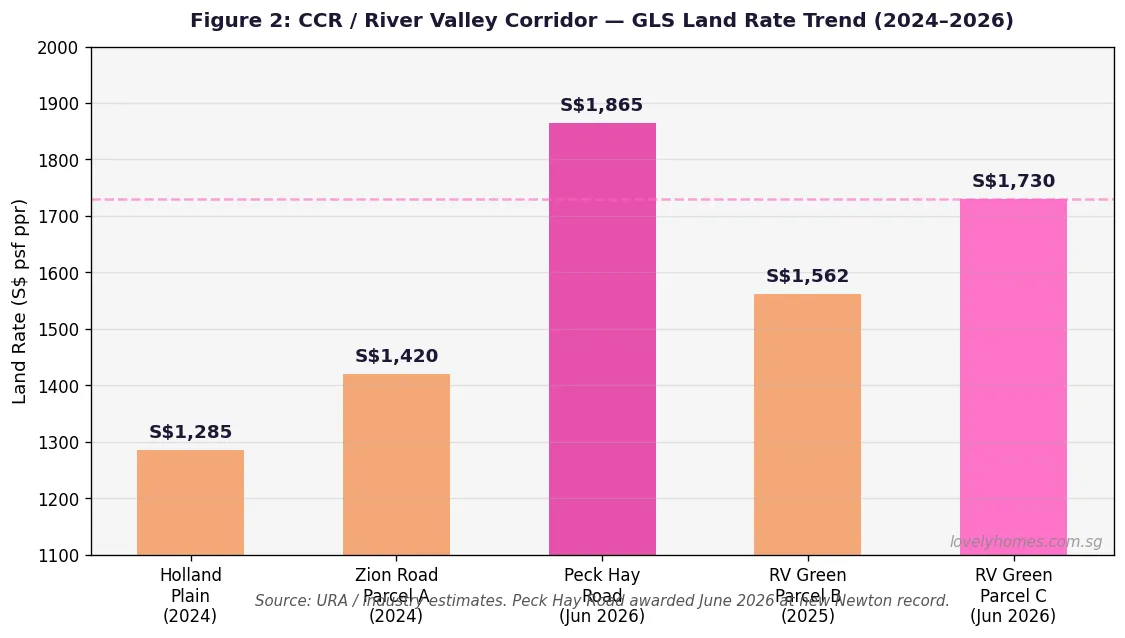
Figure 2: CCR / River Valley Corridor GLS Land Rate Trend (2024–2026)
The S$1,730 psf ppr land rate also trails Peck Hay Road (awarded June 2026 at S$1,865 psf ppr — a new Newton precinct record), placing River Valley Green Parcel C firmly within the upper tier of Singapore’s CCR land market but not at the absolute frontier. The Peck Hay Road site, also in CCR District 11, attracted stronger bids due to its Newton / Cairnhill adjacency and higher-value catchment. The River Valley site, while slightly less premium in location, benefits from the Thomson-East Coast Line connectivity and the established Great World City mixed-use ecosystem.
In comparison, Zion Road Parcel A cleared at approximately S$1,420 psf ppr in 2024, meaning the Parcel C award represents land value appreciation of roughly 22% over that two-year period — consistent with the overall premium property price appreciation of 10–15% across the same period.
What Sunway MCL and CSC Land Plan for the Site
In a joint press release issued on 18 June 2026, Sunway MCL and CSC Land confirmed that if awarded the site, they intend to develop a 500-unit premium residential project comprising twin 36-storey towers. This is the second joint venture between the two developers following their collaboration on ELTA along Clementi Avenue 1 (501 units, launched February 2025). The developers did not disclose pricing but noted their commitment to delivering a premium product reflecting the site’s strategic location and land cost. Formal URA award is expected within weeks of the tender close; launch is anticipated in 2027 or early 2028 subject to planning approvals and construction commencement.
What This Means for Buyers in the River Valley / District 9 Market
Higher land cost at GLS almost always translates into higher launch prices — developers need to recover land, construction, and holding costs, and build in a profit margin. With land at S$1,730 psf ppr and construction costs running at approximately S$600–S$800 psf, industry analysts project break-even prices around S$2,800–S$3,000 psf. A typical developer margin of 15–20% on a prime CCR product would place launch prices in the range of S$3,200–S$3,800 psf. For a 1,000 sq ft unit, that translates to S$3.2M–S$3.8M — firmly above the average SC first-property buyer’s budget, and targeted primarily at SC second-property buyers (20% ABSD), SPR buyers (5% ABSD for 1st property), and overseas purchasers who already pay 60% ABSD on any Singapore condo.
For existing owners in the River Valley, Zion Road, and Great World precinct, the strong GLS result is broadly positive — it reinforces the ceiling for comparable units in the secondary market and supports resale prices in the precinct.
Frequently Asked Questions: River Valley Green Parcel C GLS
What is a GLS tender and what happens next?
A Government Land Sales (GLS) tender is the process by which Singapore’s government — via the Urban Redevelopment Authority (URA) or HDB — sells public land to private developers for residential or mixed-use development. After the tender closes, URA evaluates all bids and formally awards the site, typically within two to four weeks. The developer then pays the accepted bid price, commences planning and design, applies for planning permission, and eventually launches the development for sale — a process that typically takes 18–36 months from GLS award to sales launch.
What does “psf ppr” mean and how does it relate to end prices?
“Per square foot per plot ratio” (psf ppr) is the standard unit for land pricing in Singapore GLS. It normalises land cost across sites of different sizes and densities. To estimate the impact on end unit prices: multiply the land rate (S$1,730) by the GPR (3.5) to get the land cost per square foot of gross floor area — approximately S$4,955 psf GFA. Add construction (S$600–S$800 psf), financing, and marketing costs, plus developer margin, to arrive at approximate launch prices of S$3,200–S$3,800 psf net sellable area.
When will this development launch for sale?
Based on the typical timeline from GLS award to sales launch, the development is expected to launch in 2027 or early 2028. The developers will need to obtain planning approval, finalise design, set up the showflat, and receive the Controller of Housing’s Sale Licence before selling any units. Singapore buyers who are interested should monitor URA’s new sales data and property portals for VIP preview announcements, which typically occur one to three months before the official launch.
Can foreigners buy units in this development?
Yes. Condominiums are open to all buyers including foreigners, subject to ABSD. Foreigners pay ABSD of 60% as at 2026, in addition to Buyer’s Stamp Duty. On a S$3.5M unit, a foreigner would pay BSD of approximately S$184,600 plus ABSD of S$2,100,000 — total stamp duty of S$2,284,600. The high ABSD rate introduced in April 2023 has substantially dampened foreign demand for Singapore condominiums, making CCR new launches now more dependent on Singapore Citizen and SPR buyers than in prior cycles.
Are there any upcoming GLS sites in the River Valley area?
Parcel C is the final GLS residential site in the River Valley Green precinct. The broader 2H2026 GLS programme includes sites in other growth corridors — Jurong Lake District, Tengah, and Bayshore — but no further River Valley or Zion Road residential plots have been announced. Any future supply in this precinct would be from redevelopment of private sites or collective sales (en bloc), which are individually negotiated and not part of the GLS programme. The next significant CCR GLS event to watch is the formal award of River Valley Green Parcel C by URA, expected in late June or early July 2026.
Disclaimer: Bid figures for the 2nd, 3rd, and 4th bidders in the River Valley Green Parcel C tender are estimates based on industry sources at time of publication; only the top bid of S$750.6 million by Sunway MCL and CSC Land has been confirmed via developer press release. Formal URA award is pending. Projected launch prices are analyst estimates and are not representations or warranties. Verify all figures with URA at ura.gov.sg before making any investment decision.
When a property owner dies in Singapore, what happens to their flat or condo depends on three things: how the property is held, whether there is a valid Will, and whether CPF was used to finance the purchase. Get any one of these wrong and the outcome can be starkly different from what the owner intended — delays of months or years, unintended beneficiaries, or unexpected stamp duty costs for heirs. This guide explains Singapore property inheritance law in plain English: the Intestate Succession Act, CPF nomination, survivorship rules for Joint Tenancy and Tenancy-in-Common, the probate process, and the estate-planning steps every property owner should consider.
Quick Answer — Key Takeaways
No estate duty in Singapore since 15 February 2008 (Estate Duty Act repealed).
CPF monies are NOT part of your estate — they pass via CPF nomination and bypass your Will entirely.
Joint Tenancy triggers the right of survivorship: the surviving co-owner receives the deceased’s share automatically, overriding any Will.
Tenancy-in-Common means your share forms part of your estate and is distributed per your Will or the Intestate Succession Act (Cap 146) if you die without one.
Without a valid Will, the Intestate Succession Act governs distribution — it does not follow the wishes of the deceased.
Probate (Grant of Probate or Letters of Administration) is required for TiC shares and sole-ownership properties before the property can be transferred.
Inherited property may attract ABSD if the beneficiary already owns residential property in Singapore.
Muslims in Singapore are governed by Islamic Inheritance Law (Faraid) under the Administration of Muslim Law Act — the Intestate Succession Act does not apply to them.
What Governs Property Inheritance in Singapore?
Singapore property inheritance sits at the intersection of three legal regimes. The Intestate Succession Act (Cap 146), administered by the Ministry of Law, governs who receives a deceased’s estate when there is no valid Will — or when a Will does not dispose of all assets. The Conveyancing and Law of Property Act (Cap 61) and the Land Titles Act (Cap 157) govern how the registered title in a property is dealt with on death, including the operation of survivorship in Joint Tenancy. Finally, the Central Provident Fund Act governs CPF monies separately — CPF savings, including amounts used for property, are handled via a CPF nomination and sit entirely outside the estate.
The result is that two co-owners of the same property can have their shares pass in completely different ways depending solely on whether they hold as Joint Tenants or Tenants-in-Common. Understanding this distinction is arguably the single most important estate-planning decision a Singapore property owner can make.
Intestate Succession: Who Inherits If There Is No Will?
If you own a property share (or own solely) and die without a valid Will, your share passes according to the Intestate Succession Act. The Act lays down a fixed priority order — spouse, children, parents, siblings, and so on — and the proportions are non-negotiable. You cannot “informally” direct assets to a partner, a sibling you are close to, or a charity: only a valid Will achieves that.
Figure 1: Singapore Intestate Succession Act (Cap 146) — How Your Property Share Is Distributed Without a Will. Source: Singapore Statutes Online / Ministry of Law.
A few critical points the Act does not protect against. If you are in a long-term relationship but unmarried, your partner receives nothing under the ISA. If you have step-children but never legally adopted them, they too receive nothing. And if you have children from a prior relationship, the Act distributes equally between all biological children — which may not match your intentions at all. A properly drafted Will, reviewed by a Singapore-qualified solicitor, is the only reliable remedy.
Scenario
Spouse Receives
Children Receive
Parents Receive
Spouse only (no children, no parents)
100%
—
—
Spouse + children
50%
50% equally
—
Spouse + parents (no children)
50%
—
50%
Children only (no spouse)
—
100% equally
—
Parents only (no spouse, no children)
—
—
100%
No spouse, no children, no parents
Siblings → uncles/aunts → grandparents → Government (bona vacantia)
Joint Tenancy vs Tenancy-in-Common: The Death Outcome
How a property is co-owned is registered in the Certificate of Title held by the Singapore Land Authority (SLA). The two modes — Joint Tenancy and Tenancy-in-Common — have diametrically different consequences on death.
In a Joint Tenancy, all co-owners hold the property as a single, undivided whole. On the death of one co-owner, their interest extinguishes and vests automatically in the surviving co-owner(s) by the right of survivorship. This transmission is recorded by SLA via a statutory declaration — no Grant of Probate is needed, no estate administration is required. Critically, a Joint Tenant cannot bequeath their “share” in a Will because they do not hold a severable share to give: the moment you die, it is gone. This makes Joint Tenancy an extremely efficient mechanism for a married couple intending the property to pass to the surviving spouse, but a potentially inflexible one if their wishes are more nuanced.
In a Tenancy-in-Common, each co-owner holds a defined percentage share (e.g., 60%/40%). That share is a distinct legal asset belonging to the individual. On death, it forms part of their estate and passes per their Will — or per the ISA if there is no Will. The estate must go through probate before the share can be transferred to a beneficiary. This extra step takes time and costs money, but it gives the property owner complete flexibility over who receives their share.
Figure 2: Joint Tenancy vs Tenancy-in-Common — How Your Property Share Passes on Death in Singapore.
CPF Nomination: The Asset That Bypasses Your Will
Many Singaporeans do not realise that CPF savings — including amounts used for property under the Public Housing Scheme or the Private Properties Scheme — are not part of the estate on death. Under the Central Provident Fund Act, CPF savings are distributed by the CPF Board directly to nominees in the proportions specified in a CPF nomination form. If no nomination is made, the monies are transferred to the Public Trustee for distribution under the ISA. They cannot be directed by a Will.
This creates a common planning gap. Suppose a homeowner uses S$200,000 of CPF OA to pay for a flat over 15 years. When they die, that S$200,000 (with accrued interest) does not form part of the property — it is a CPF debt secured against the estate. CPF will require the estate to refund the principal plus 2.5% per annum accrued interest before the property net proceeds are distributed. If the CPF nomination names different beneficiaries from the Will’s property beneficiaries, the two streams can conflict: the property proceeds go one way, the CPF refund goes another. Co-ordinating CPF nominations and Will provisions is essential.
The Probate and Estate Administration Process
For any property that passes via the estate — either sole ownership or a Tenancy-in-Common share — the personal representative must obtain a Grant of Probate (if there is a Will) or Letters of Administration (if there is no Will) from the Family Justice Courts before title can be transferred to beneficiaries. The process is administered under the Probate and Administration Act (Cap 251) and the Family Justice Act.
Figure 3: Singapore Estate Administration Flowchart — 7 Steps from Death to Property Transfer.
The timeline for an uncontested, straightforward Singapore estate is typically two to six months from death to completion. Complexity arises when assets are held overseas, when there are disputes between beneficiaries, when the deceased held property under a trust, or when the Will itself is challenged. Cross-border estates involving property in multiple jurisdictions (e.g., a Singapore condo plus a Malaysian property) require re-sealing of the Singapore Grant of Probate or separate proceedings in each jurisdiction.
One important point: no estate duty has applied in Singapore since 15 February 2008. The Estate Duty Act was repealed and the IRAS no longer requires any filing of estate duty returns. This makes Singapore one of the most estate-duty-friendly jurisdictions in Asia.
ABSD on Inherited Property
Receiving a property share by inheritance does not exempt you from Additional Buyer’s Stamp Duty. IRAS treats an inheritance as an acquisition just as any other transfer. If, at the date you inherit the property, you already own one or more residential properties in Singapore, ABSD applies at the rate corresponding to your profile and the number of properties you will then own. As at 2026, for Singapore Citizens, a second residential property attracts ABSD at 20%, and a third or subsequent property attracts 30%.
Buyer Profile
1st Residential Property
2nd Residential Property
3rd+ Residential Property
Singapore Citizen (SC)
0%
20%
30%
Singapore PR (SPR)
5%
30%
35%
Foreigner
60%
60%
60%
Entity (company/trust)
65%
65%
65%
There is a limited ABSD remission for married couples who inherit through a deceased spouse under the Joint Tenancy survivorship mechanism: survivorship does not constitute a separate acquisition, so no ABSD is payable on the automatic transmission to the surviving spouse. However, where a beneficiary inherits via a Will or the ISA and is already a property owner, ABSD is payable.
Worked Example: The Lim Family Estate
Background. Mr Lim Ah Kow (SC) passed away on 1 March 2026. He owned two properties: a 4-room HDB flat in Ang Mo Kio (held in Joint Tenancy with his wife, Mrs Lim) and a 40% share in a D15 condo held as Tenants-in-Common with his brother (60% share).
HDB flat (Joint Tenancy). Mrs Lim, the surviving Joint Tenant, lodges a statutory declaration of survivorship with SLA. The HDB flat vests automatically in Mrs Lim. No probate needed. No ABSD (survivorship is not a fresh acquisition). Total time: approximately 3–4 weeks for SLA to update the title. The HDB flat does not go through Mr Lim’s estate at all.
D15 condo share (40%, Tenancy-in-Common). Mr Lim had a valid Will leaving his entire estate to Mrs Lim. The executor (Mrs Lim’s solicitor) applies for a Grant of Probate at the Family Justice Courts. This takes approximately 6–8 weeks. Once the Grant is issued, SLA transmission orders the condo share registered in Mrs Lim’s name. Because Mrs Lim already owns the HDB flat (her first property), this condo share is her second residential property. ABSD at 20% is payable on the market value of the 40% share. If the condo’s value at the date of transmission is S$2,200,000, the 40% share = S$880,000 × 20% ABSD = S$176,000 payable by Mrs Lim.
CPF refund. Mr Lim used S$95,000 CPF OA principal for the condo, accumulated over 8 years. Accrued interest at 2.5% p.a. ≈ S$21,000. Total CPF refund required from the estate: S$116,000. This is deducted from the condo share’s net sale/transfer proceeds before the estate is distributed.
Takeaway. A well-drafted Will and advance CPF nomination review could have positioned the transfer differently — for example, placing the condo share in trust for adult children who do not yet own property, potentially deferring or eliminating the ABSD exposure.
Why This Matters: Estate Planning for Singapore Property Owners
Singapore’s property market is one of the most valuable wealth stores for middle-class families in Asia. Many households have 70–80% of their net worth locked in residential property. Despite this, surveys consistently find that a large majority of Singaporeans do not have a valid Will. The combination of no estate duty and a straightforward probate system means that the barriers to basic estate planning are genuinely low — a simple Will costs as little as S$200–S$500 through a qualified solicitor, or slightly more through the Public Trustee’s office.
The stakes are high. A Joint Tenant who wants to leave their share to their children (not the co-owner) must first sever the Joint Tenancy — converting to Tenancy-in-Common — before a Will can take effect. Failing to do so means the survivorship mechanism overrides the Will entirely. Conversely, a Tenancy-in-Common owner who wants an immediate, hassle-free transfer to a spouse may benefit from converting to Joint Tenancy to remove the probate burden.
Compared to many Asian jurisdictions, Singapore has no forced heirship rules for non-Muslims (Malaysia, Indonesia, and others do). This means a Singapore resident can, subject to the Inheritance (Family Provision) Act (Cap 138), effectively direct their entire estate to whomever they wish — provided they do so in a valid Will. The flexibility is a planning opportunity that many families leave on the table.
What Might Come Next: Estate Planning Trends in Singapore
Several developments on the horizon are worth monitoring. The Ministry of Law’s ongoing review of the Electronic Wills framework — proposed to allow remote witnessing of Wills in certain circumstances — may reduce friction for Singaporeans who live overseas or who lack access to a physical notary. Any reforms here would be welcome given that Singapore’s expatriate and overseas-resident community is large and mobile.
On the ABSD front, there is no current indication that the government intends to introduce an inheritance exemption for residential property. The ABSD regime, which was significantly tightened in April 2023, continues to treat all acquisitions — including inheritances — on the same footing. Families with complex multi-generation property holdings should seek specialist legal and tax advice rather than assuming future policy relief.
Finally, as more Singapore property assets are held through family trusts and private trust companies — a structure increasingly popular with high-net-worth families — the interaction between trust law and property transmission will become more important. The Trustees Act (Cap 337) and the Variable Capital Companies Act 2018 provide a sophisticated toolkit for those with sufficient assets to justify the complexity.
Frequently Asked Questions
If I hold my HDB flat as Joint Tenants with my spouse, does it still go through my estate when I die?
No. The right of survivorship operates automatically on your death. Your share extinguishes and vests in your surviving spouse without any need for probate or Letters of Administration. The surviving spouse simply files a statutory declaration of survivorship with the Singapore Land Authority (SLA). This process takes approximately three to four weeks. The HDB flat does not form part of your estate and cannot be directed by your Will.
Can I override the Intestate Succession Act by naming someone in my CPF nomination?
No — CPF nominations and the Intestate Succession Act operate on entirely separate assets. A CPF nomination directs only your CPF monies (Ordinary Account, Special Account, Retirement Account, and MediSave), not your property. If you die intestate, your property share passes according to the ISA regardless of what your CPF nomination says. To direct your property to a specific person outside the ISA rules, you must make a valid Will. The two instruments complement each other but address different assets.
My father died without a Will and held his condo solely. How long will it take before I can sell the property?
For an intestate estate (no Will), the appointed administrator must apply for Letters of Administration at the Family Justice Courts. In uncontested cases where the estate is straightforward, this typically takes four to eight weeks from the filing date. Once the Letters are issued, the administrator can instruct solicitors to transfer title to beneficiaries (or to sell). If the estate must first be distributed to multiple beneficiaries who then need to agree to sell, the process can take several months longer. Total timeline from death to sale completion in a typical uncontested case: approximately four to eight months.
Will I have to pay ABSD when I inherit a property from a deceased family member?
It depends on your existing property holdings. IRAS treats an inheritance as an acquisition. If you already own one or more residential properties in Singapore, you will pay ABSD at the applicable rate on the inherited share’s value. The only exception is where property passes via Joint Tenancy survivorship to the surviving co-owner — that automatic vesting is not treated as a fresh acquisition for ABSD purposes. For all other transmissions (Will, intestate succession), ABSD applies. Always seek IRAS and legal advice before accepting an inherited property if you already own residential property.
What is the difference between a Grant of Probate and Letters of Administration?
A Grant of Probate is issued by the Family Justice Courts when the deceased left a valid Will naming an executor, who then applies for the grant. It confirms the Will is valid and authorises the executor to administer the estate. Letters of Administration are issued when there is no Will (intestate), or when the named executor is unable or unwilling to act. An administrator is appointed — usually the next of kin according to a statutory priority order — and letters are issued authorising them to administer the estate. Both documents carry the same practical legal effect: they authorise the holder to deal with the deceased’s assets, including transferring Singapore property via SLA.
Can a Singapore foreigner or Permanent Resident own inherited landed property?
Foreigners (non-Singapore Citizens) are generally prohibited from owning restricted residential property in Singapore, including most landed housing on the mainland (detached houses, semi-detached houses, terrace houses), under the Residential Property Act (Cap 274). However, the RPA contains an exemption for property acquired by inheritance — a foreigner who inherits a restricted property does not automatically breach the RPA. The foreigner has a reasonable period to divest the property. The Singapore Land Authority will generally allow a temporary exemption for estate administration, but the beneficiary should seek legal advice promptly on the timeline and conditions.
Does Singapore recognise foreign Wills for Singapore property?
Singapore courts generally recognise a foreign Will if it is validly executed according to the law of the place where it was made, the place where the testator was domiciled, or the law of Singapore, under the Wills Act (Cap 352). However, even with a recognised foreign Will, a Grant of Probate must still be obtained from the Family Justice Courts (or a foreign grant re-sealed in Singapore) before property in Singapore can be transferred. The practical advice is to make a separate Singapore Will if you own Singapore property and are domiciled overseas — this significantly reduces delay and cost for your estate.
Disclaimer: This article is for general informational purposes only and does not constitute legal or financial advice. Singapore property inheritance law — including intestate succession, probate, CPF nominations, and ABSD on inherited property — is a complex area where individual circumstances vary significantly. Always consult a qualified Singapore solicitor for estate planning, Will drafting, and probate matters, and an IRAS-registered tax professional for stamp duty advice. For authoritative information, refer to the Ministry of Law (mlaw.gov.sg), the Singapore Statutes Online (sso.agc.gov.sg), the IRAS (iras.gov.sg), the CPF Board (cpf.gov.sg), and the Singapore Land Authority (sla.gov.sg). All rates and thresholds are current as at June 2026 and subject to change.
Quick Answer: HDB SERS — What You Need to Know in 2026
SERS stands for Selective En Bloc Redevelopment Scheme, administered by HDB to redevelop ageing public housing estates with good redevelopment potential.
Under SERS, HDB compulsorily acquires selected old flats at fair market compensation and offers residents a replacement flat at a discounted price in a new development nearby.
SERS is rare and selective — only around 79 precincts involving approximately 33,000 flats have been selected since 1995. Most old HDB flats will NOT receive SERS.
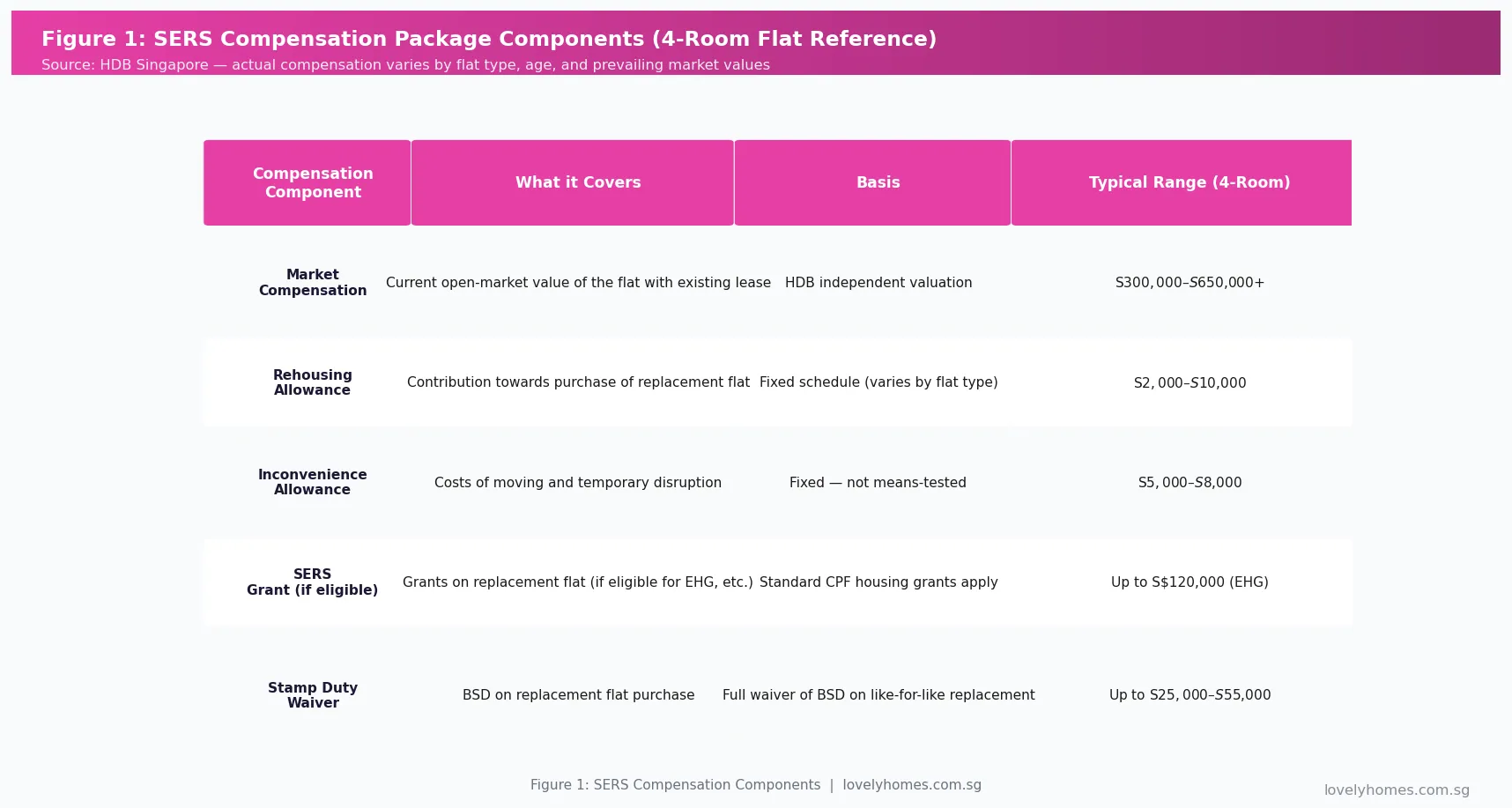
Affected residents receive a compensation package including market value, a rehousing allowance, an inconvenience allowance, and a stamp duty waiver on the replacement flat.
The Voluntary Early Redevelopment Scheme (VERS) was announced in 2018 as a potential future alternative; as at June 2026 it has not been implemented for any estate.
SERS announcements are made by HDB with no prior notice to affected residents. You cannot apply for SERS or nominate your estate.
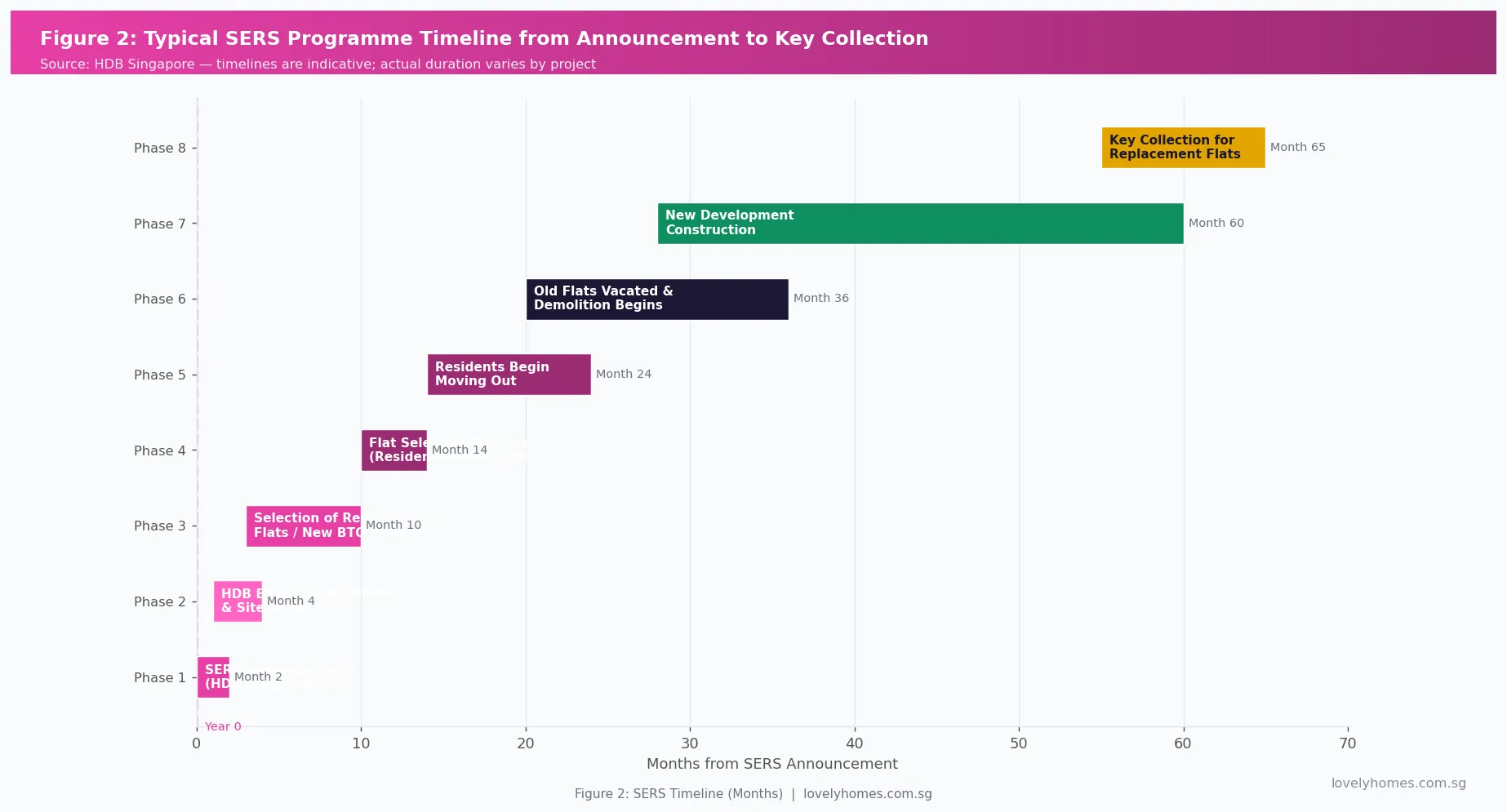
The average SERS programme takes approximately 4–6 years from announcement to key collection for the replacement flat.
What is the HDB Selective En Bloc Redevelopment Scheme (SERS)?
The Selective En Bloc Redevelopment Scheme (SERS) is Singapore’s public housing equivalent of a compulsory en-bloc sale — but in reverse. Instead of private owners voting to sell to a developer, HDB selects specific precincts of ageing public housing for compulsory acquisition and offers residents a comprehensively packaged relocation deal that typically puts them in a newer, better-located flat.
Introduced in 1995 by the Housing & Development Board, SERS applies when HDB identifies a precinct of older flats — typically from the 1960s, 1970s, or 1980s — that has what HDB terms “good redevelopment potential.” This is generally understood to mean the land can be used more intensively: taller blocks, higher density, or repurposed for a different use entirely. The scheme is funded by the Singapore government and is not subject to market forces in the same way that a private en-bloc sale would be.
For residents, SERS is often viewed favourably — HDB’s compensation is generally regarded as fair, the replacement flats are new, and residents receive a bundle of financial support including a rehousing allowance, inconvenience allowance, and a full waiver of Buyer’s Stamp Duty (BSD) on the replacement flat. From a pure financial standpoint, SERS residents almost invariably end up owning a newer flat with a fresh 99-year lease — reversing the lease decay that afflicts all HDB flats over time.
Figure 1: SERS Compensation Package Components (4-Room Flat Reference). Source: HDB Singapore — actual compensation varies by flat type, age and prevailing market values.
How Rare is SERS? The Numbers in Context
This is perhaps the most important thing to understand about SERS: it is exceptional, not a standard entitlement. As at June 2026, HDB has announced SERS for approximately 79 precincts since 1995, covering around 33,000 flats — representing less than 4% of Singapore’s entire public housing stock. Singapore has more than 1.1 million HDB flats; the vast majority will not receive SERS.
In a parliamentary speech in March 2018, then-National Development Minister Lawrence Wong confirmed that only a “small fraction” of flats would qualify, and introduced the concept of a Voluntary Early Redevelopment Scheme (VERS) as a future alternative for estates that do not meet SERS criteria. VERS would allow residents to collectively vote for early redevelopment at an older age (in the flat’s 70th to 80th year), but the scheme remains in conceptual form as at 2026 — no VERS exercise has commenced for any estate.
Metric
Figure
Context
Year SERS introduced
1995
First precinct: Stirling Road, Queenstown
Total precincts selected (1995–2026)
~79 precincts
Approx. 33,000 flats across all selections
Share of HDB stock covered
Less than 4%
Over 1.1 million HDB flats island-wide
Typical programme duration
4–6 years
From announcement to key collection
Last major SERS announcements
2023 (Bukit Merah)
No new SERS announcements in 2024–2026 as at June 2026
VERS status (2026)
Announced 2018, not yet implemented
Applicable in flat’s 70th–80th year; no timeline announced
How Does SERS Work? The Process Step by Step
When HDB decides to proceed with a SERS exercise, the process follows a structured sequence that takes several years. The outline below reflects the typical SERS process based on past exercises. Individual SERS exercises may vary in sequencing and timing:
Figure 2: Typical SERS Programme Timeline — from HDB Announcement to Key Collection for Replacement Flats. Source: HDB Singapore. Timelines are indicative.
Phase 1 — SERS Announcement: HDB issues a press release identifying the affected precincts. This is the first notification residents receive — there is no prior consultation or warning. HDB simultaneously announces the location of the SERS replacement site, which is generally within 1 km of the original location. An HDB SERS team is set up to manage communications and assist residents.
Phase 2 — Flat Selection: Residents select their replacement flat from the new SERS development, following a selection priority order based primarily on the type and size of the existing flat. Residents can generally choose a like-for-like replacement (same flat type) or upgrade at an additional cost. Some SERS exercises also allow residents to take a cash compensation package instead of a replacement flat — particularly relevant for those who no longer wish to remain in public housing.
Phase 3 — Moving Out & Demolition: Residents vacate the old flat by a HDB-specified date and receive their inconvenience and rehousing allowances. HDB then proceeds with demolition and site clearance.
Phase 4 — Construction and Key Collection: The new SERS replacement development is constructed, typically taking 3–5 years from demolition. Key collection follows, completing the SERS cycle. Throughout this period, residents typically live in transitional housing — often renting a flat privately or staying in HDB-managed interim accommodations, with the rehousing allowance helping to offset rental costs.
The SERS Compensation Package
The compensation package under SERS is designed to leave affected residents in a broadly equivalent or better position than before. Its main components are as follows, with representative figures for a 4-room flat as a reference point:
Market Compensation: Based on an independent valuation of the flat’s current open-market value — typically reflecting the value of a comparable flat in the resale market at that time, including a valuation uplift for the lease remaining. For a 4-room flat in a mature estate as at 2026, this might range from S$350,000 to S$650,000+.
Rehousing Allowance: A fixed contribution towards the cost of purchasing the replacement flat. The quantum varies by flat type and is updated periodically.
Inconvenience Allowance: A one-time payment to compensate for the disruption of moving, typically S$5,000–S$8,000 as at recent exercises.
Stamp Duty Waiver: Residents receive a full waiver of Buyer’s Stamp Duty (BSD) on the like-for-like replacement flat purchase. This is a significant concession — BSD on a S$500,000 flat is approximately S$9,600; on a S$800,000 flat, it is S$21,600.
Applicable Housing Grants: SERS residents purchasing the replacement flat remain eligible for standard CPF housing grants (EHG, Family Grant, etc.) if they meet grant eligibility criteria. As at June 2026, the Enhanced Housing Grant (EHG) provides up to S$120,000 for eligible buyers.
SERS vs Lease Expiry: Why Most Old Flats Will Not Be “Rescued”
A persistent misconception in the Singapore property market is the belief that old HDB flats will inevitably receive SERS before their leases expire. This is a flawed assumption that the government has repeatedly and explicitly corrected.
In a landmark National Day Rally speech in 2018, Prime Minister Lee Hsien Loong directly addressed this misconception, stating that the government could not commit to SERS for all ageing flats because not all estates have good redevelopment potential, and because the financial cost of doing so would be unsustainable. The PM confirmed that some HDB flats would indeed “run their full lease to zero” — meaning, at the end of the 99-year lease, the flat and its leasehold interest revert to the state with no residual value.
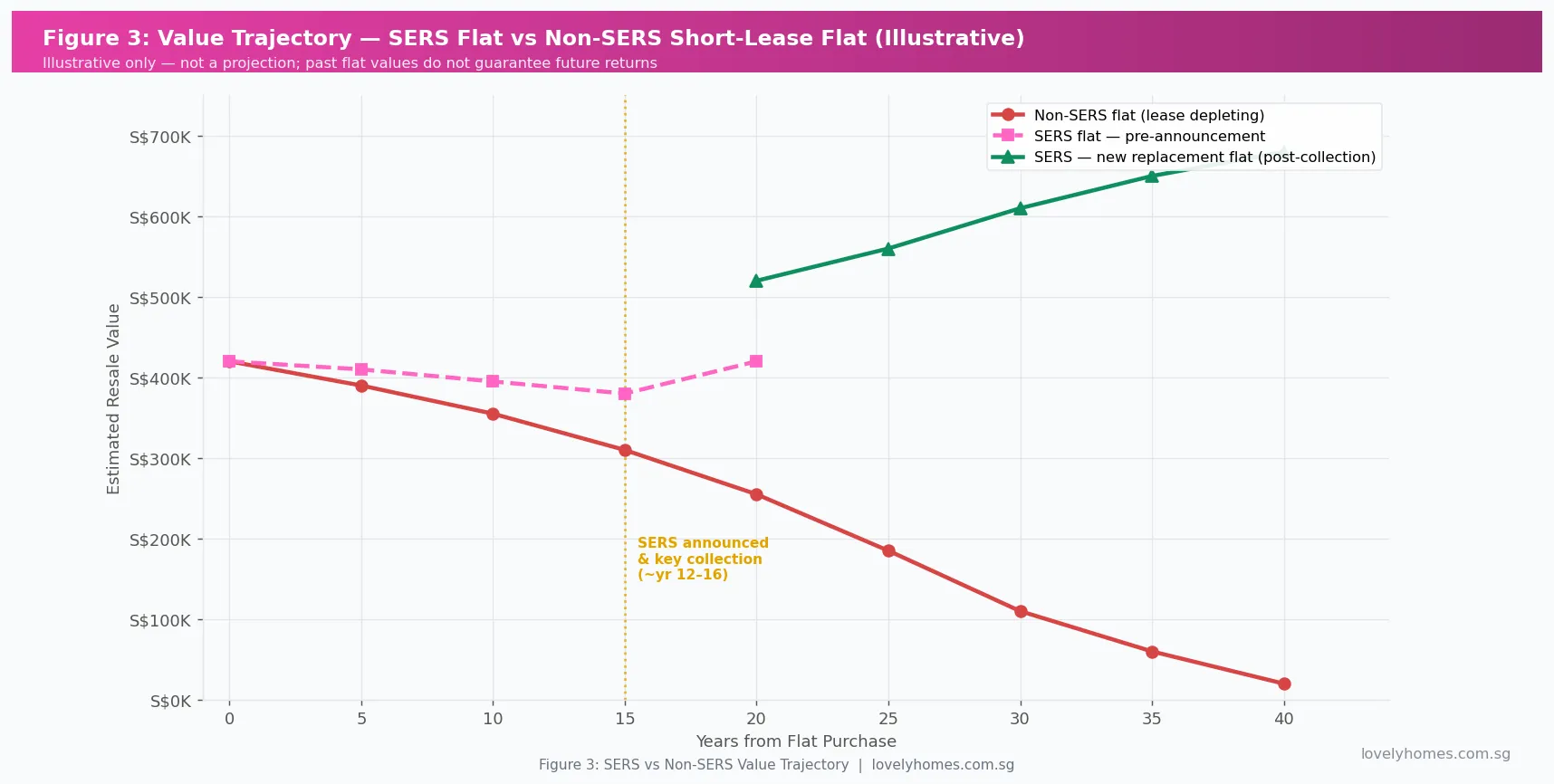
Figure 3: Illustrative Value Trajectory — SERS-Selected Flat vs Non-SERS Flat on a Short/Declining Lease. Not a projection; for illustration purposes only.
The value trajectory of an HDB flat selected for SERS diverges sharply from one that is left to age. A SERS flat effectively receives a “reset” — its owner walks away with market-rate compensation and a new flat on a fresh lease. A non-SERS flat on a depleting lease will, in theory, trend towards zero as the lease count decreases and CPF eligibility narrows. In practice, HDB flats with short leases continue to transact — often to older, cash-rich buyers for owner-occupation rather than investment — but at significant discounts relative to 99-year lease comparables.
Worked Example: The Krishnamurthys, Queenstown 4-Room Flat
Mr and Mrs Krishnamurthy, both Singapore Citizens, purchased a 4-room HDB flat in Queenstown in 1985 for S$65,000. As at June 2026, the flat is approximately 41 years old and has around 58 years remaining on its lease. They have been living in the flat ever since.
In an imagined SERS scenario: HDB announces SERS for their precinct in January 2027. HDB’s independent valuer assesses the flat’s market value at S$550,000 (reflecting Queenstown’s mature estate premium and the 57-year remaining lease at that point). HDB’s full offer is:
Market compensation: S$550,000
Rehousing allowance: S$7,000
Inconvenience allowance: S$5,000
BSD waiver on new flat: S$13,400 (equivalent of BSD on S$650,000 flat)
Total effective package value: ~S$575,400
The Krishnamurthys select a new 4-room SERS replacement flat nearby at S$650,000 (applying S$550,000 compensation + S$7,000 rehousing + S$93,000 top-up from CPF OA savings). They pay no BSD. They take the keys in 2032 to a brand-new flat in Queenstown with a fresh 99-year lease expiring 2131. Net financial position: they spent S$65,000 in 1985 and approximately S$93,000 in 2032 in additional top-up, receiving a new flat worth an estimated S$700,000–S$800,000 in the resale market of that time.
What Might Come Next: VERS and the Future of Ageing Estates
This section contains forward-looking commentary and speculation. It does not constitute financial advice or a prediction of government policy.
By the mid-2030s, Singapore’s earliest HDB estates — particularly Queenstown, Toa Payoh, and parts of the Ang Mo Kio and Bedok new towns — will have leases at or below 60 years. The CPF and financing constraints on these flats will become acutely relevant for the next generation of buyers. The government will face growing political pressure to clarify the future of these estates beyond the binary of SERS (expensive, selective) and lease expiry (politically unpalatable).
The VERS mechanism — if implemented — could offer a middle path: a government-sponsored opt-in collective sale at a modest premium, returning the land for redevelopment without the full costs of a SERS package. Industry commentators have also speculated about hybrid arrangements where some precincts receive partial state acquisition with residents retaining the option to remain in the redeveloped estate as rental tenants. These outcomes remain speculative as at June 2026.
FAQ: HDB SERS Singapore 2026
Can I find out if my flat is likely to receive SERS?
HDB does not publish advance lists of estates or precincts being considered for SERS. You cannot apply to be included, and HDB will not confirm or deny SERS plans in advance. Speculation about SERS eligibility should be treated with caution — it is frequently used as a marketing narrative to justify premium pricing for older flats, and is not supported by any official confirmation process. The general criteria (good redevelopment potential, older estates, land-use efficiency) are publicly stated, but do not translate into predictable selection. As at June 2026, HDB has not announced any new SERS exercises since the 2023 Bukit Merah selections.
What if I do not want the SERS replacement flat?
You can opt for cash compensation instead of a replacement flat. HDB will pay you the market compensation, rehousing allowance, and inconvenience allowance in cash, and you may then apply for a different flat or private housing using those proceeds. The BSD waiver, however, applies only to the SERS replacement flat — it cannot be transferred to another property purchase. If you take the cash option, you will pay standard BSD on any subsequent property purchase.
Does SERS affect my CPF savings?
Yes — when you receive SERS compensation and sell your flat, your CPF OA savings that were used to fund the original purchase (principal drawn down plus the standard 2.5% p.a. accrued interest) must be refunded to your CPF account. This is the same rule that applies to any HDB flat sale. The refunded CPF can then be used towards the SERS replacement flat. Flat owners who used significant CPF for their original purchase should model this carefully — if the market compensation does not cover the CPF refund plus the upgrade cost, additional cash may be required at the point of SERS replacement flat selection.
Will I receive ABSD relief on the SERS replacement flat if I own other properties?
ABSD rules generally apply to the SERS replacement flat purchase based on your total property count at that time. If the SERS flat is your only property and you are a Singapore Citizen purchasing a like-for-like HDB replacement, no ABSD is payable. If you own another property simultaneously — for example, you purchased a private condo while living in the SERS flat — ABSD at 20% (SC second property) would normally apply. SERS compensation is not an ABSD exemption mechanism. IRAS’s ABSD remission for upgrading SC couples does not apply to SERS directly; however, if the sequence of your SERS sale and replacement flat purchase falls within the remission window (replacement flat purchased before SERS flat is compulsorily acquired), you may be eligible. Consult a solicitor for specific advice.
Can SPR flat owners also participate in SERS?
Yes — Singapore Permanent Residents who own HDB flats and are included in a SERS precinct will also receive the SERS compensation package. They are eligible to participate in the replacement flat selection on the same terms as Singapore Citizens. However, SPRs must meet the standard eligibility criteria for the SERS replacement flat (typically, the replacement must be at the same or smaller flat type). If they wish to upgrade beyond the standard replacement tier, they will need to qualify for the additional borrowing required, and standard ABSD rules (SPR 5% first property) apply to any top-up purchase.
How does SERS differ from a private en-bloc sale?
In a private en-bloc (collective sale), private property owners vote to sell the entire development to a developer. The process requires a 80% supermajority vote (for developments over 10 years old) under the Land Titles (Strata) Act, and compensation is the development’s collective sale proceeds divided by share value. SERS is entirely different: it is government-initiated and compulsory — there is no vote, and flat owners cannot block or veto the acquisition. The compensation methodology is also different — SERS uses independent market valuation plus allowances rather than a negotiated collective price. SERS is also not taxable (no capital gains tax in Singapore), and no SSD is triggered by the compulsory acquisition.
What happens to my flat if neither SERS nor VERS applies and the lease runs out?
At the end of the 99-year lease, the leasehold interest expires and the flat reverts to the state (HDB/SLA) with no residual value or compensation. The flat owner and any occupants are required to vacate. This is the theoretical outcome for HDB flats that do not receive SERS or VERS and that are not otherwise redeveloped by HDB through other means. As at 2026, no HDB flat has yet reached its lease expiry (the earliest HDB flats from the 1960s have leases expiring around 2060+), so this remains a future scenario rather than an observed one. However, the declining value trajectory for short-lease flats — well documented in URA and HDB resale transaction data — is consistent with the market pricing in this eventual zero-residual-value outcome.
This article is intended as a general educational resource only and does not constitute financial, legal, or property investment advice. SERS eligibility, compensation packages, timelines, and policies are subject to change by HDB at any time. All figures and descriptions reflect LovelyHomes’ understanding as at June 2026 based on publicly available information. Readers should consult HDB directly at www.hdb.gov.sg, IRAS at www.iras.gov.sg, and the CPF Board at www.cpf.gov.sg for current and authoritative information. Engage a licensed property agent or solicitor for advice tailored to your circumstances. Past SERS outcomes do not guarantee future selection or compensation levels.
📌 Quick Answer: Peck Hay Road GLS Award (June 2026)
Winner: City Developments Limited (CDL) and Hong Realty (a Hong Leong Group subsidiary) joint venture, with a top bid of S$542.4 million or S$1,865 per square foot per plot ratio (psf ppr).
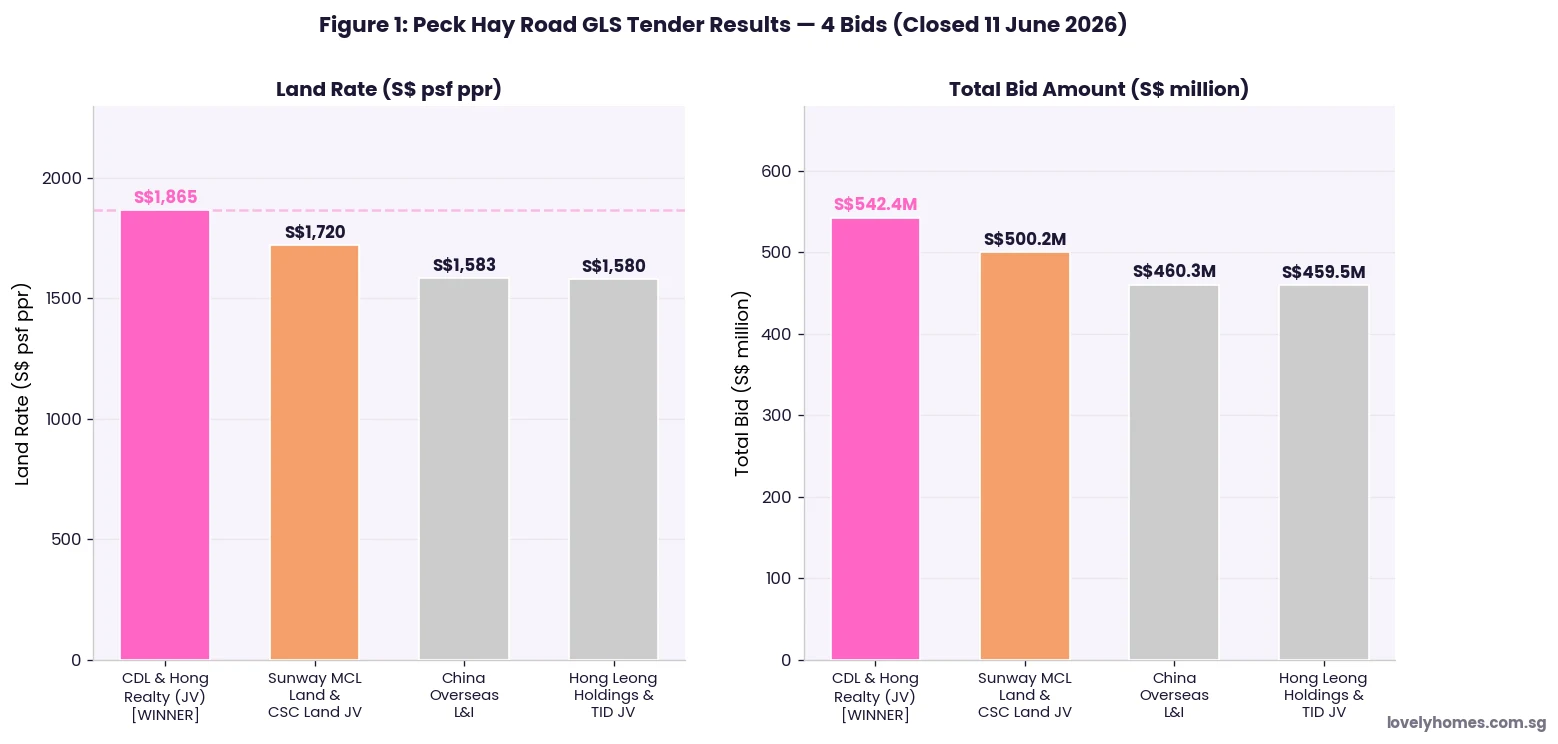
Four bids were received when the tender closed on 11 June 2026, with the CDL-Hong Leong JV coming in 8.4% above the second-highest bidder (Sunway MCL Land & CSC Land Group at S$1,720 psf ppr).
Development potential: The 0.55-hectare site in the Newton area (District 11, CCR) has a gross plot ratio of 4.9 and is expected to yield approximately 315 private residential units.
Projected launch price: Industry observers estimate an average selling price of approximately S$3,600–S$4,000 psf, based on the winning land rate and current CCR construction costs.
Market signal: The confident bidding — four bids, strong premium over second — reflects continued developer conviction in prime Singapore residential despite global headwinds.
Singapore’s Newton District Gets a New Landmark: Peck Hay Road GLS Awarded
The Government Land Sale (GLS) site at Peck Hay Road, Newton, has been awarded to a joint venture between City Developments Limited (CDL) and Hong Realty Private Limited, a subsidiary of the Hong Leong Group, following the close of the tender on 11 June 2026. The winning bid of S$542.4 million — equivalent to S$1,865 psf per plot ratio — sets a new benchmark for land rates in the Newton corridor and is the highest price paid for a residential GLS site in the District 11 area in recent memory.
The site sits within a short walk of Newton MRT Station (North-South Line and Downtown Line interchange) in the prime Core Central Region (CCR), minutes from the Orchard Road shopping belt. It is a rare land parcel in a district that has seen virtually no new GLS activity in recent years, making the award a significant event for luxury property buyers and investors who have been waiting for a premium new launch in Newton.
Figure 1: Peck Hay Road GLS Tender Results — four bids received; CDL-Hong Leong JV won at S$1,865 psf ppr, 8.4% above the second bidder (S$1,720 psf ppr). Tender closed 11 June 2026.
The Bid Results: Four Credible Bids Signal Developer Confidence
The tender drew four bids from established developers — a healthy response by Singapore GLS standards in 2026, where some suburban sites have attracted only two or three bids. The bid results in full:
Bidder
Total Bid
Land Rate (psf ppr)
Premium vs 2nd
CDL & Hong Realty JV 🏆
S$542.4M
S$1,865
+8.4%
Sunway MCL Land & CSC Land Group JV
S$500.2M
S$1,720
—
China Overseas Land & Investment
S$460.3M
S$1,583
—
Hong Leong Holdings & TID JV
S$459.5M
S$1,580
—
Source: URA, tender results 11 June 2026. Land area: 5,578 sqm (0.55 ha). GFA: 27,330 sqm. Gross plot ratio: 4.9. Maximum 315 residential units.
The spread between the highest and lowest bids — roughly 18% — is relatively tight for a prime CCR site, suggesting broad alignment among developers on the land’s underlying value. The 8.4% premium that CDL-Hong Leong paid over the second bidder is, by itself, a meaningful commitment to capturing this particular site, likely driven by both parties’ existing pipeline management and brand positioning in the District 11 premium segment.
Notable: Hong Leong Group entities placed two separate bids — via the CDL-Hong Realty JV (winner) and via Hong Leong Holdings-TID JV (fourth place). This is not unusual for large property groups with multiple subsidiaries; different legal entities bid independently and the group as a whole gains optionality on the outcome.
Site Details and Development Parameters
The Peck Hay Road GLS site is located at the intersection of Peck Hay Road and Bukit Timah Road — a prestigious address within the Newton estate. Key development parameters set by URA in the tender conditions:
Parameter
Specification
Land area
5,578 sqm (approximately 0.55 hectares)
Gross plot ratio
4.9
Maximum GFA (residential)
27,330 sqm
Permitted use
Residential
Estimated unit count
Approximately 315 units
Tenure
99-year leasehold
District
District 11, Core Central Region (CCR)
Nearest MRT
Newton (NS21/DT11) — approximately 300m
The 99-year leasehold tenure is standard for GLS sites in Singapore’s CCR. The site’s location within a short walk of Newton MRT — one of only two MRT interchanges south of the PIE in the CCR — gives it exceptional connectivity: Downtown Line trains reach Marina Bay in approximately 12 minutes, and North-South Line trains reach Orchard in two stops.
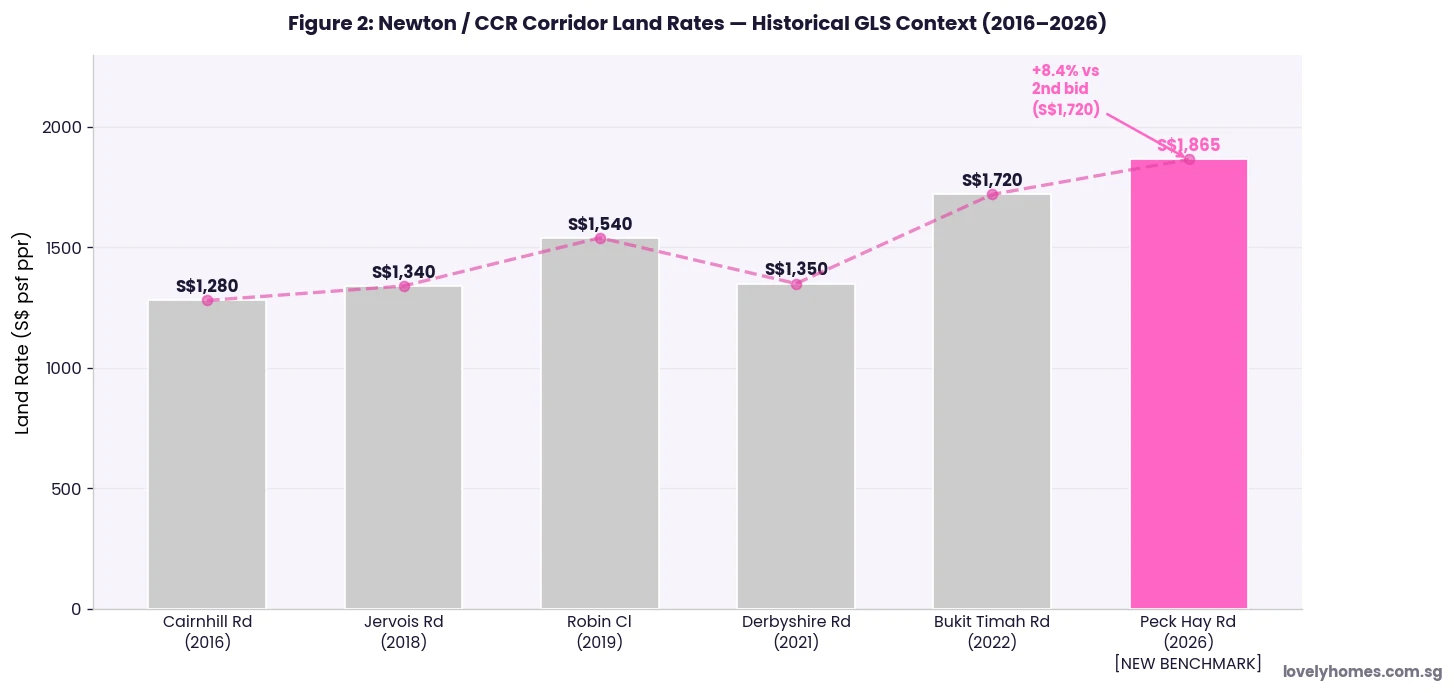
Figure 2: Newton and CCR corridor GLS land rates in historical context — the Peck Hay Road award at S$1,865 psf ppr sets a new benchmark for the Newton/CCR precinct, exceeding the previous Bukit Timah Road benchmark of S$1,720 psf ppr (2022).
What Will the Future Development Be Called and How Much Will It Cost?
CDL and Hong Leong have not yet released a project name or official launch timeline. Based on the winning land rate of S$1,865 psf ppr, plus typical construction costs, professional fees, developer profit margin, and marketing costs in the current environment, industry observers estimate a break-even cost of approximately S$3,100–S$3,300 psf and an anticipated average launch price of S$3,600–S$4,000 psf — potentially pushing above S$4,000 psf for premium high-floor or penthouse units with city or Bukit Timah Hill views.
At S$3,800 psf, a typical 1,000 sqft 2-bedroom unit would be priced at approximately S$3,800,000. A 1,500 sqft 3-bedroom unit would approach S$5,700,000. This places the development squarely in CCR luxury territory, targeting high-net-worth buyers — predominantly Singapore Citizens and Permanent Residents given the 60% ABSD applicable to foreigners.
The typical timeline from GLS award to project launch in Singapore is 18–30 months, meaning the Peck Hay Road development could expect to preview in late 2027 or 2028. CDL has a strong track record in the CCR, having previously developed Gramercy Park (84 units, Grange Road) and New Futura (124 units, Leonie Hill), both considered exemplars of luxury Singapore residential design.
What This Means for the Newton Property Market
The award has several implications for Newton and broader CCR buyers and sellers:
Benchmark land rate effect: At S$1,865 psf ppr, this site establishes a new data point that developers, valuers, and banks will reference in assessing residual land values and resale property prices in the Newton, Novena, and Moulmein precincts. Owners of existing CCR condos in the area may find that their properties are valued slightly higher in subsequent bank valuations, reflecting the premium paid for new land.
Supply context: With only approximately 315 units, this development will not materially alter CCR supply dynamics. The total CCR pipeline (units under construction or recently launched but unsold) remains manageable, and the Newton micro-market has seen almost no significant new launches since the Neu At Novena and Pullman Residences projects. The scarcity of prime Newton new launches is itself a pricing support for the future development.
Buyer profile: At the projected S$3,800–S$4,000 psf, this development will largely serve the Singapore affluent and ultra-high-net-worth segment, alongside institutional and family-office buyers. Given the 60% ABSD applicable to foreign nationals (with limited FTA exemptions for US, Swiss, and selected other nationals), the buyer pool will be predominantly local, supplemented by Permanent Residents and FTA-exempt nationalities.
Frequently Asked Questions
What is a GLS tender, and how does it work?
A Government Land Sale (GLS) tender is the process by which the Singapore Land Authority (SLA), on behalf of the government, releases state land for private development by selling it to the highest qualified bidder. GLS sites are released on a Confirmed List (sites that will definitely be tendered) or a Reserve List (sites that can be triggered by developer application). The Peck Hay Road site was on the Confirmed List for the 1H 2026 GLS Programme. Developers submit sealed bids by the tender closing date; the site is typically awarded to the highest bidder, provided the bid exceeds the government’s reserve price. The winning developer pays the full bid price to the state and then develops the land within the conditions set by the Planning Permission.
What is “psf ppr” and why is it used for GLS bids?
PSF PPR stands for “per square foot per plot ratio.” It is the standard metric for comparing GLS bids because it normalises land costs across sites of different sizes and different development densities. For example, a site with a gross plot ratio (GPR) of 4.9 can yield 4.9 times its land area in gross floor area (GFA). Multiplying the site area by the GPR gives the allowable GFA. The land cost per square foot of GFA is then a direct input into the developer’s break-even cost analysis. A higher psf ppr means a higher land cost per unit of development floor area, which in turn implies a higher launch price is needed to achieve a viable profit margin.
When will the CDL-Hong Leong Newton development launch?
No official launch timeline has been announced. Typically, after a GLS award the developer spends 6–12 months on design, planning, and regulatory approvals (including URA Written Permission) before commencing construction, and a further 12–18 months before the first public preview. Based on this typical timeline, the Peck Hay Road development is likely to preview in late 2027 or mid-to-late 2028. LovelyHomes will publish a dedicated New Launch project page when CDL-Hong Leong announces the project name, preview date, and unit mix.
Can foreigners buy units in this development?
Yes — private condominiums in Singapore are open to foreign buyers. However, foreigners pay a 60% Additional Buyer’s Stamp Duty (ABSD) on the full purchase price in addition to the standard Buyer’s Stamp Duty (BSD). At an estimated purchase price of S$3.8M per unit, the ABSD alone would be S$2.28M, making the total acquisition cost approximately S$6.1M+ for a foreign buyer. Nationals from the United States, Switzerland, Iceland, Liechtenstein, and Norway are exempt from ABSD under their respective Free Trade Agreements with Singapore, making the development more accessible to buyers from those countries.
What other CCR GLS sites are coming up?
The River Valley Green (Parcel C) tender — a mixed-use site in District 9 — closes on 18 June 2026. The outcome of that tender will provide another data point on developer appetite for prime Singapore residential land in mid-2026. Beyond that, the 2H 2026 GLS Programme (announced 3 June 2026) includes one CCR confirmed-list residential site. LovelyHomes will publish coverage of each GLS award as results are announced.
Related Articles
Further Reading: Singapore CCR Property and Market Analysis
Disclaimer: This article is based on publicly available information from URA, property research platforms, and industry commentary as of 12 June 2026. Projected launch prices and development timelines are illustrative estimates based on land rate analysis and historical precedents — they are not confirmed by CDL, Hong Leong Group, or any official source. Property prices, market conditions, and government policy may change. This article does not constitute an offer to buy or sell any property, nor financial or investment advice. Readers should conduct their own due diligence and consult a licensed property agent and financial adviser before making any property investment decision. For official GLS information, visit URA.gov.sg.
Stamp duty in Singapore is not one-size-fits-all. The government has deliberately built a system of remissions and exemptions that recognise legitimate circumstances — the upgrading family, the divorcing couple, the deceased estate, the registered charity — and provides a mechanism to recover the stamp duty paid, or to pay a lower rate in the first place. Understanding these remissions is not an advanced topic for lawyers; it is practical knowledge that can save a Singapore family anywhere from S$40,000 to well over S$1,000,000 in upfront costs.
This guide explains every major stamp duty remission available in Singapore in 2026 — who qualifies, how much is refunded, how to apply, and what the key deadlines are. The framework is administered by the Inland Revenue Authority of Singapore (IRAS) under the Stamp Duties Act (Cap 312). All rates reflect the 27 April 2023 cooling measures, which remain in force.
Quick Answer — Stamp Duty Remissions at a Glance
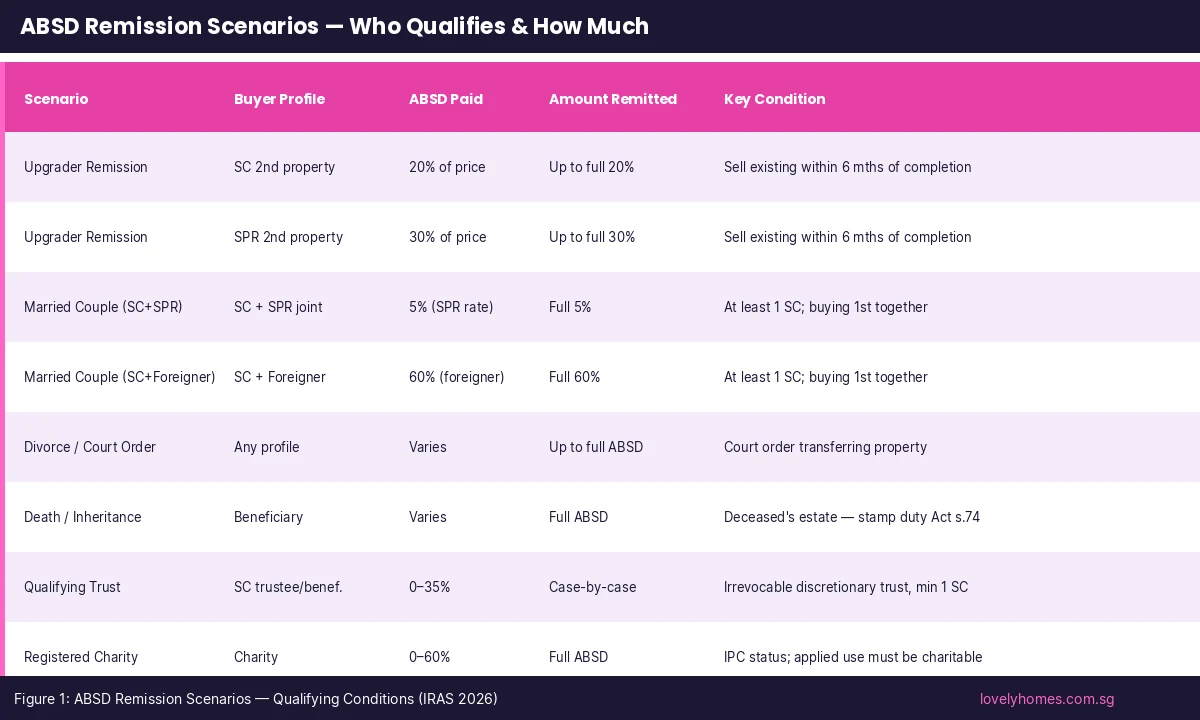
ABSD Upgrader Remission: SC and SPR second-property buyers who sell their existing home within 6 months of completion can reclaim the full ABSD paid (20% for SC; 30% for SPR).
Married Couple Remission: Couples where at least one party is a Singapore Citizen buying their first joint residential property together pay 0% ABSD regardless of the other party’s nationality (subject to conditions).
Divorce / Court Order: A court-ordered transfer of property between divorcing spouses may attract an ABSD remission or BSD exemption on a case-by-case basis.
Death and Inheritance: Properties transferred from a deceased estate to beneficiaries are exempt from ABSD under s.74 of the Stamp Duties Act.
SSD Exemptions: Properties sold under en-bloc, compulsory acquisition, court order (divorce/death), or gifted to lineal descendants are exempt from Seller’s Stamp Duty.
BSD Remissions: Rare — mainly for government bodies, charities, and certain trust arrangements. Most individual buyers do not qualify for BSD remission.
All remission claims are filed at myTax Portal → Stamp Duty → Apply for Remission. ABSD remissions for upgraders require documentary proof of the sale of the existing property.
The key upgrader deadline is 6 months from completion of the new purchase to sell the existing property. Miss this window and the ABSD paid is forfeited.
What Is Stamp Duty Remission?
A remission is a partial or full waiver of stamp duty that would otherwise be payable. Unlike an exemption (which means the duty was never due), a remission often means the duty is paid upfront and then refunded once the qualifying conditions are met. The Ministry of Finance (MOF) and IRAS administer Singapore’s remission framework under Part IV of the Stamp Duties Act. The rationale is to avoid distorting legitimate property transactions — particularly family upgrading, matrimonial transfers, and estate administration — while still collecting duty on speculative purchases.
There are three types of stamp duty in Singapore where remissions may arise:
Additional Buyer’s Stamp Duty (ABSD): The most significant remissions. ABSD can be 0–65% of purchase price depending on buyer profile. Remissions here can be worth hundreds of thousands of dollars.
Buyer’s Stamp Duty (BSD): Remissions are rare and mainly apply to non-individual entities (charities, government bodies). Most homebuyers do not benefit from BSD remission.
Seller’s Stamp Duty (SSD): Certain exit scenarios — en-bloc, compulsory acquisition, divorce, death — are exempt from SSD even within the 4-year holding period.
Figure 1: ABSD Remission Scenarios — Eligibility Matrix by Buyer Profile (IRAS 2026). Click to expand.
ABSD Upgrader Remission — The Most Common Remission in Singapore
The ABSD Upgrader Remission is the single most commonly used remission in Singapore and affects tens of thousands of families each year. It applies when a Singapore Citizen or Singapore Permanent Resident purchases a second residential property while still owning an existing one, intending to sell the existing property after moving into the new one.
How It Works
Under the current rules, a Singapore Citizen purchasing a second residential property must pay ABSD at 20% of the purchase price at the point of signing the Option to Purchase (OTP) or Sale and Purchase (S&P) Agreement — within 14 days. The duty is paid first; the remission is claimed after the fact. If the buyer subsequently sells the existing property within 6 months of completing the new purchase, they may apply to IRAS for a full refund of the ABSD paid. The same mechanism applies to Singapore PRs purchasing a second property at the 30% ABSD rate.
Buyer Profile
ABSD Rate
Remission Available?
Key Condition
SC buying 2nd property
20%
Yes — full 20% refund
Sell existing within 6 mths of completion
SPR buying 2nd property
30%
Yes — full 30% refund
Sell existing within 6 mths of completion
SC buying 3rd+ property
30%
No — not eligible
Must only hold one other property for remission to apply
Foreigner buying any property
60%
No (except FTA nationals on 1st property)
No upgrader remission for foreigners
Entity (company/trust)
65%
Case-by-case only
Qualifying trust structures may apply — see IRAS guidelines
The Critical 6-Month Deadline
The 6-month window runs from the date of completion of the new purchase — not from the date you sign the OTP. For a new launch condominium, completion (when the keys are handed over) may be 3 to 5 years after you sign the OTP. This means upgraders buying off-plan have a generous window: the clock only starts ticking when TOP is obtained and legal completion occurs. For resale properties, completion is typically 8 to 12 weeks after signing the OTP, so the window is tighter in practice.
If you miss the 6-month deadline, IRAS will not extend it except in very exceptional circumstances (documented illness, death in the immediate family, force majeure). Do not rely on an extension being granted.
Worked Example — The SC Upgrader
Mr & Mrs Tan are Singapore Citizens who own a Tampines 5-room HDB flat purchased in 2019. In March 2026, they sign an OTP for an Orchard Rd 2BR condominium at S$2,200,000. Within 14 days, they pay:
BSD: S$79,600 (progressive: 1% on first S$180,000 + 2% on next S$180,000 + 3% on next S$640,000 + 4% on next S$500,000 + 5% on next S$700,000)
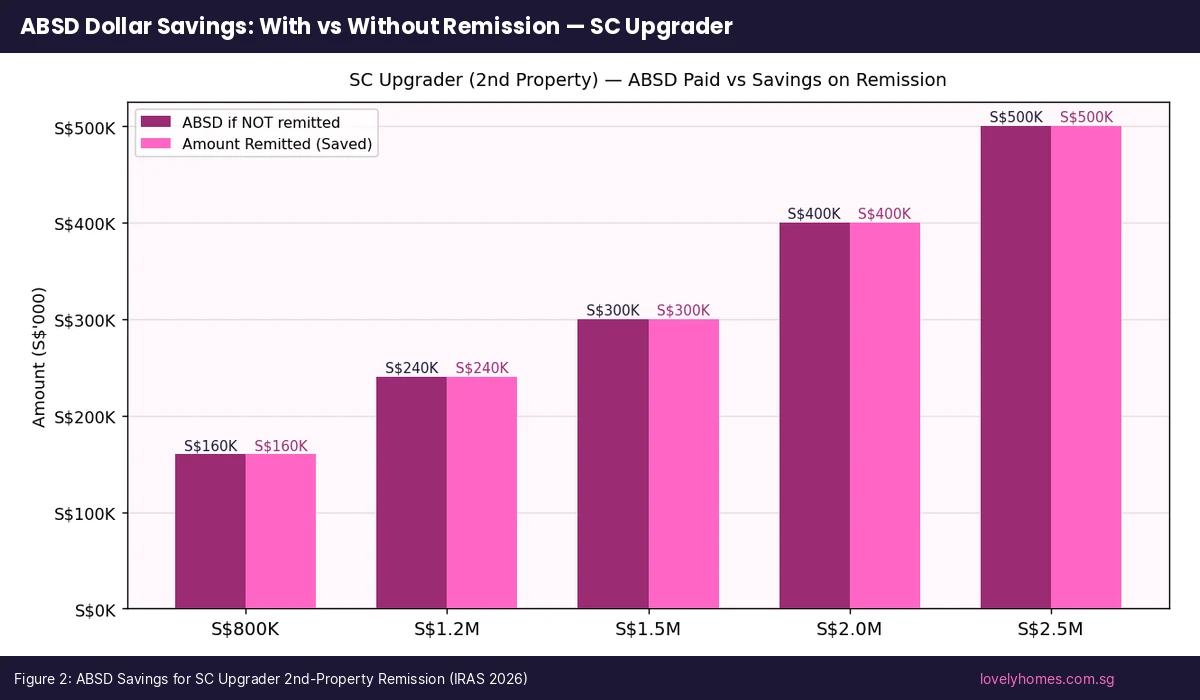
ABSD at 20%: S$440,000
Total stamp duties upfront: S$519,600
They list their HDB flat and complete the sale in August 2026 — 5 months after the new condominium’s completion date in July 2026. They then apply to IRAS for the ABSD remission. IRAS processes the claim and refunds S$440,000 within approximately 4 to 6 weeks. The Tan family’s net stamp duty cost is thus S$79,600 (BSD only) — exactly the same as a first-time buyer at the same purchase price.
Figure 2: ABSD Dollar Savings — SC Upgrader 2nd-Property Remission at Various Price Points (IRAS 2026). Click to expand.
Married Couple Remission — Buying Your First Home Together
The Married Couple Remission (formally the “remission for married couple purchasing first residential property together”) addresses a common scenario: a Singapore Citizen marrying a foreigner or a Permanent Resident, where the couple’s combined nationalities would otherwise attract a higher ABSD rate.
Who Qualifies
The conditions are strict. At the time of purchase, the couple must be legally married (not merely cohabiting). At least one party must be a Singapore Citizen. The property must be their first jointly-owned residential property in Singapore — neither party may own any other residential property in Singapore at the time of purchase. If either party already owns a property, the remission does not apply.
Couple Profile
Rate Without Remission
Rate With Remission
Saving at S$1.5M
SC + SC (both first property)
0%
0%
Nil (no ABSD to begin with)
SC + SPR (first joint purchase)
5% (SPR 1st rate)
0%
S$75,000
SC + Foreigner (first joint purchase)
60% (foreigner rate)
0%
S$900,000
SC (existing property) + SPR
20% (SC 2nd) or 5% (SPR 1st)
Not eligible — SC already owns property
No remission
The most significant application is the SC + Foreigner couple. Without the remission, buying a S$2,000,000 condominium would attract ABSD of S$1,200,000 (foreigner rate of 60%). With the Married Couple Remission, ABSD falls to nil — a saving of S$1,200,000 at that price point. This is why the remission is one of the most financially impactful pieces of property law for internationally mixed families in Singapore.
It is important to note that the remission applies at the time of purchase — the couple does not pay ABSD first and then reclaim it. The conveyancing solicitor applies for the remission before e-Stamping the instrument of transfer, and if approved, the stamp duty assessed is nil ABSD from the outset.
Divorce and Court-Ordered Transfers
When a court orders a matrimonial property to be transferred between spouses as part of a divorce settlement, the question of stamp duty arises. Singapore law provides relief in two forms. First, BSD may be remitted on a court-ordered transfer of a matrimonial home between divorcing spouses — the instrument of transfer lodged pursuant to a court order is submitted to IRAS with the order attached, and IRAS will assess whether BSD is payable. Second, an ABSD remission may be available where the transfer results in one party holding the property as their sole property (so the ABSD for a second property would not apply after the divorce).
These cases are assessed on the specific facts by IRAS. Engage a conveyancing solicitor with experience in divorce property transfers to ensure the application is properly structured and timed. The Stamp Duties Act s.15 provides the general power for IRAS to remit duty; ministerial notifications specify which scenarios qualify.
Deceased Estates and Inheritance
When a property owner dies, the transmission of their property to their beneficiaries under a will or intestacy is not an arm’s length commercial transaction. Singapore law accordingly exempts transfers by way of transmission on death from ABSD (Stamp Duties Act s.74). BSD may still be payable on the transmission instrument, but IRAS has published guidance noting that the transmission of property from a deceased to a beneficiary under an approved will or intestacy is generally exempt from stamp duty provided it is not a sale. Families dealing with an estate should confirm the exact position with their estate lawyer, as the specific structure of the transfer (assent, deed of family arrangement, court order of distribution) affects the stamp duty treatment.
Qualifying Remissions for Trusts
Trusts are a more complex area. IRAS has issued guidelines on ABSD for trust arrangements. Generally, where a residential property is transferred into a trust, ABSD is chargeable at 65% — the rate for entities — unless specific conditions are met. The main qualifying condition for a lower ABSD rate (or nil ABSD) is that the trust is an irrevocable discretionary trust whose beneficiaries are all Singapore Citizens. The ABSD is then assessed at the applicable individual rate for the beneficiaries’ profile rather than the entity rate. This area is highly technical and requires legal and tax advice before any trust structure is implemented.
Seller’s Stamp Duty (SSD) Exemptions
The SSD exemptions are discrete scenarios where the duty simply does not arise, even within the 4-year holding period introduced on 4 July 2025 (rates: 16% / 12% / 8% / 4% in Years 1–4). The following transactions are exempt from SSD:
En-bloc (collective sale): A property sold as part of a collective sale under the Land Titles (Strata) Act is exempt from SSD regardless of how recently the individual unit was purchased. This is a significant carve-out for owners whose development is acquired en-bloc within their first 4 years of ownership.
Compulsory acquisition by the State: Where Singaporean authorities acquire a property under the Land Acquisition Act, SSD is not payable.
Court order (divorce): A property transferred pursuant to a divorce court order is exempt from SSD.
Death: Transmission of a property on the death of the owner is exempt from SSD.
Gift to lineal descendants: A property gifted (not sold) to a child, grandchild, or other lineal descendant is exempt from SSD, provided the gift is not commercially motivated and no consideration passes.
Industrial SSD exemptions: Industrial properties have their own regime (15%/10%/5% over 3 years). The same categories of exemption — compulsory acquisition, death, court orders — apply.
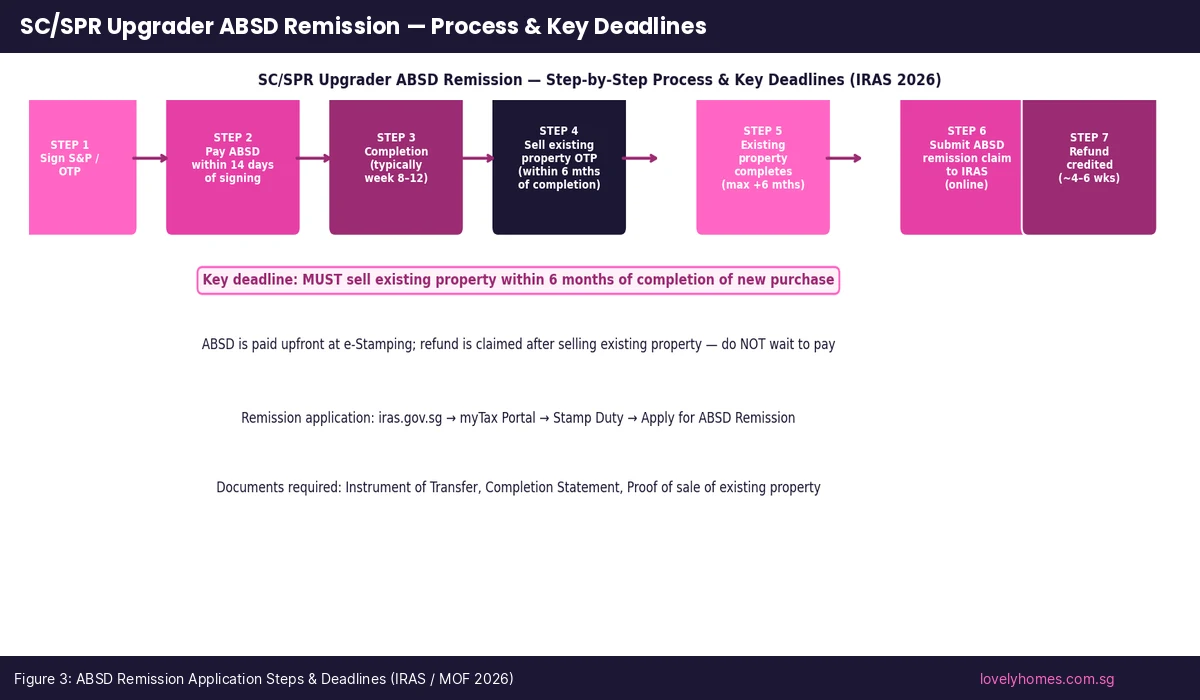
Figure 3: SC/SPR Upgrader ABSD Remission — Step-by-Step Process & Key Deadlines (IRAS 2026). Click to expand.
How to Apply for an ABSD Remission — Step by Step
The process for claiming an ABSD remission for upgraders is well-defined. Your conveyancing solicitor will typically guide you through it, but understanding the steps independently protects you from missing a critical deadline.
Sign OTP or S&P Agreement on the new property. This triggers the 14-day deadline to pay stamp duties (BSD + ABSD).
Pay BSD and ABSD within 14 days via IRAS e-Stamping or through your solicitor. Note: you must pay ABSD upfront even if you intend to claim a remission. Failure to pay by the deadline incurs penalties.
Complete the new property purchase. For resale, this is typically 8–12 weeks after OTP. For new launches, this is when TOP is issued and legal completion occurs (potentially years later).
Sell your existing property within 6 months of the completion date of the new purchase. Sign the OTP, exercise it, and complete the sale — all within the 6-month window.
File the remission claim at IRAS. Go to myTax Portal → Stamp Duty → Apply for Remission. You must file the claim within 6 months of completing the sale of your existing property (i.e., there are two successive 6-month windows).
Submit supporting documents: Completion Statement for the new property, Option to Purchase and Sale & Purchase Agreement for the existing property, Completion Statement confirming the sale of the existing property, and your identity documents.
Receive the refund. IRAS typically processes approved claims within 4 to 6 weeks and credits the refund to the bank account or solicitor’s account you specify.
For married couple remissions, the process is different: your solicitor applies before stamping, submitting the marriage certificate and statutory declarations confirming neither party owns other Singapore residential property. If approved, the instrument is stamped at nil ABSD from the outset.
Common Mistakes and Pitfalls
The most frequent error is missing the 6-month sale deadline. This can happen when sellers are over-confident about finding a buyer, or when the sale falls through at the last minute and the window cannot be recovered. A second common error is assuming the remission applies when one spouse already owns a property — the Married Couple Remission requires both parties to have no existing residential property in Singapore. A third pitfall is failing to maintain the marriage: if a couple applies for the Married Couple Remission and subsequently divorces or annuls the marriage, IRAS may claw back the remission.
Tax professionals also warn against structuring a trust to access lower ABSD rates without proper advice. IRAS scrutinises trust arrangements and applies a facts-and-circumstances test. An arrangement that appears primarily tax-motivated rather than genuinely estate-planning-driven risks being disregarded, with ABSD assessed at the 65% entity rate.
What This Means for You
Singapore’s stamp duty remission framework is materially generous for families following the conventional housing ladder: HDB flat → private property, with a short overlap period. A Singapore Citizen couple upgrading from their HDB flat to a S$1,800,000 condominium will pay S$360,000 in ABSD upfront, but recover every dollar of it within 6 months if they sell the HDB flat on schedule. The net stamp duty cost is simply BSD — S$56,600 at that price, equivalent to 3.1% of the purchase price.
The framework is less generous for those who want to hold multiple properties simultaneously. There is no remission for a Singapore Citizen buying a third property; the 30% ABSD is final. For SPRs and foreigners, the investment calculus must factor in the full ABSD cost as a permanent drag on returns.
The one area where policy may evolve is the trust ABSD regime. The government has signalled that it will continue to monitor whether trust structures are being used to circumvent the cooling measures, and further tightening cannot be ruled out.
Frequently Asked Questions
Can I claim the ABSD upgrader remission if I buy a new launch before my HDB MOP expires?
No. If your HDB flat is still within its Minimum Occupation Period (MOP) — typically 5 years for standard BTO flats, 10 years for Plus/Prime location flats — you are prohibited from privately listing or selling it. This means you cannot sell your HDB flat within the required 6-month window after completing the new purchase. You would therefore be unable to claim the ABSD remission, and the 20% (SC) or 30% (SPR) ABSD paid on the new purchase would be forfeited. Wait until your MOP is completed before purchasing a second property if you intend to rely on the upgrader remission.
What documents does IRAS require for an ABSD remission claim?
You will need: (1) the Instrument of Transfer (stamp certificate) for the new property showing the ABSD paid; (2) the Completion Statement for the new property purchase; (3) the executed Option to Purchase and Sale & Purchase Agreement for the existing property sold; (4) the Completion Statement for the sale of the existing property confirming completion date and proceeds; (5) NRIC / passport copies of the purchasers; and (6) if applicable, proof of marriage (for Married Couple Remission). Your conveyancing solicitor will typically compile this package. IRAS may request additional documents and will reject incomplete applications.
If I paid ABSD on a new launch in 2023 and the TOP is only in 2027, when does the 6-month window start?
The 6-month window starts from the date of legal completion of your new property purchase. For new launch condominiums, this is the date when the developer issues the Certificate of Statutory Completion (CSC), the TOP is obtained, and legal completion takes place — not the date you signed the OTP. So if you signed the OTP in 2023 and TOP/completion is in 2027, you have until approximately 6 months after the 2027 completion date to sell your existing property and file the remission claim. This gives upgraders buying off-plan a significantly longer window than resale purchasers.
Can both the BSD and the ABSD be refunded via remission?
BSD and ABSD are treated separately. The ABSD upgrader remission refunds only the ABSD — not the BSD. BSD is considered a fundamental transaction tax on the acquisition of property and is not remitted for individual buyers under the upgrader framework. The Married Couple Remission also applies only to ABSD (bringing it to nil), not to BSD. BSD remains payable in all standard purchases regardless of remission status. The only scenarios where BSD may be waived are very narrow: government-linked acquisitions, certain approved charities, and specific statutory transfers.
What happens if I cannot sell my existing property within 6 months?
If you miss the 6-month deadline, you lose the right to claim the ABSD remission and the amount paid (20% or 30% of the purchase price) is forfeited. IRAS does not routinely grant extensions. In exceptional cases — certified medical incapacitation of the owner, death of an immediate family member, or an Act of God materially preventing the sale — IRAS may consider an appeal with supporting documentation, but this is discretionary and not guaranteed. Property market conditions (“I could not find a buyer at the price I wanted”) are not accepted as grounds for extension. Plan your sale timeline carefully and engage a property agent well in advance of the deadline.
Does the ABSD upgrader remission apply to the purchase of a commercial or industrial property?
No. The ABSD upgrader remission applies exclusively to the purchase of residential properties (landed houses, apartments, condominiums, executive condominiums before privatisation). Commercial properties (shophouses, offices, retail units) and industrial properties (factories, warehouses) do not attract ABSD in the first place — they are subject only to BSD. There is no equivalent upgrader remission mechanism for commercial or industrial property. The SSD industrial exemptions discussed above are separate and concern selling, not buying.
Is there a remission if my spouse and I decouple ownership of our property?
Decoupling — where one co-owner transfers their share to the other so that the transferee becomes the sole owner and the transferor becomes a “first-time buyer” for ABSD purposes on a future purchase — is a legal strategy but does not enjoy a special remission. BSD is payable by the transferee on the share acquired (at the standard progressive rates). There is no BSD or ABSD remission specifically for decoupling transfers. The tax cost of the decoupling (BSD on the transferred share plus legal and valuation fees) must be weighed against the ABSD saving on the future purchase. IRAS treats the transfer at market value and will assess BSD on the higher of the consideration paid or the market value.
This article is published for general informational purposes only and does not constitute legal, tax, or financial advice. Stamp duty rates, remission conditions, and application procedures are subject to change by the Ministry of Finance and IRAS. Always refer to the IRAS Stamp Duty website and the Stamp Duties Act (Cap 312) on Singapore Statutes Online for the authoritative and current position. Seek independent legal and tax advice from a qualified Singapore solicitor or tax practitioner before making property decisions. LovelyHomes does not accept liability for any decisions made in reliance on this article.