Singapore Buyer’s Stamp Duty (BSD) Complete Guide 2026: All Bands, Rates and Calculations
Buyer’s Stamp Duty (BSD) is the tax every property buyer in Singapore pays at the point of purchase — whether you are buying a Housing Development Board (HDB) flat, a private condominium, a landed home, an industrial unit, or a commercial shophouse. Unlike the Additional Buyer’s Stamp Duty (ABSD), which is an extra layer applied selectively based on citizenship and property count, BSD applies to every single property transaction in Singapore without exception.
This guide covers everything you need to know about BSD in 2026: the full six-band residential rate table, the non-residential rate table, how BSD is calculated on the higher of purchase price or market value, key exemptions and remissions, how BSD interacts with ABSD and the Seller’s Stamp Duty (SSD), and a fully worked example with all arithmetic shown. All figures reflect rates in force as at 18 August 2026. Always verify current rates on the IRAS BSD page.
Quick Answer — BSD at a Glance
- Who pays: every buyer of any Singapore property (residential, commercial, industrial, or land).
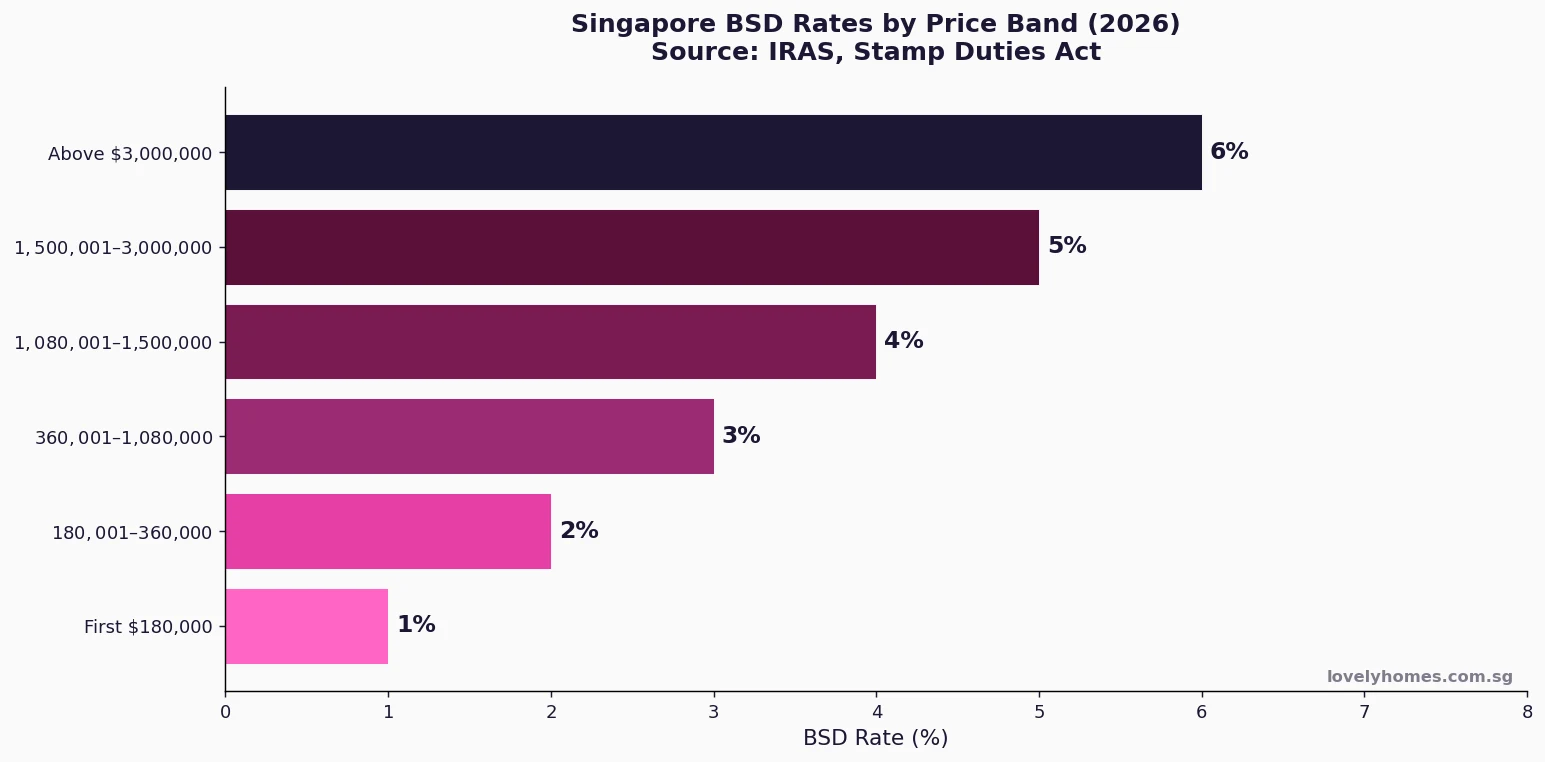
- Residential BSD bands (2026): 1% → 2% → 3% → 4% → 5% → 6% across six progressive bands up to the full purchase price.
- New 6% band (from 15 February 2023): applies to the portion of purchase price above S$3,000,000 for residential property only.
- Non-residential BSD: four bands capped at 4% (no 5% or 6% tier).
- Basis: higher of the purchase price or the market value of the property.
- Deadline: payable within 14 days of signing the Option to Purchase (OTP) or Sale and Purchase Agreement (S&P).
- Payment method: cash (CPF OA can be used to reimburse after stamping for residential property).
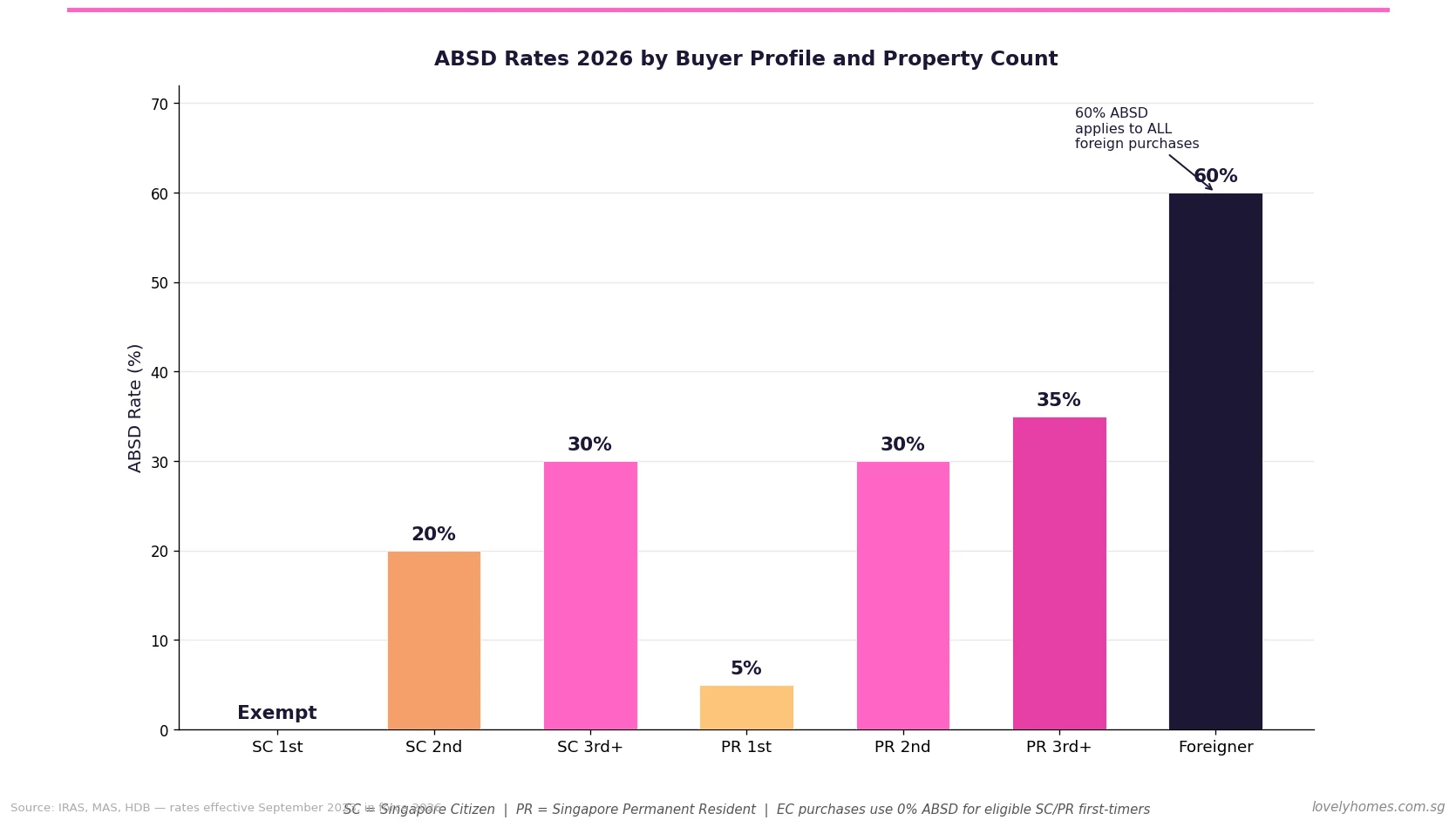
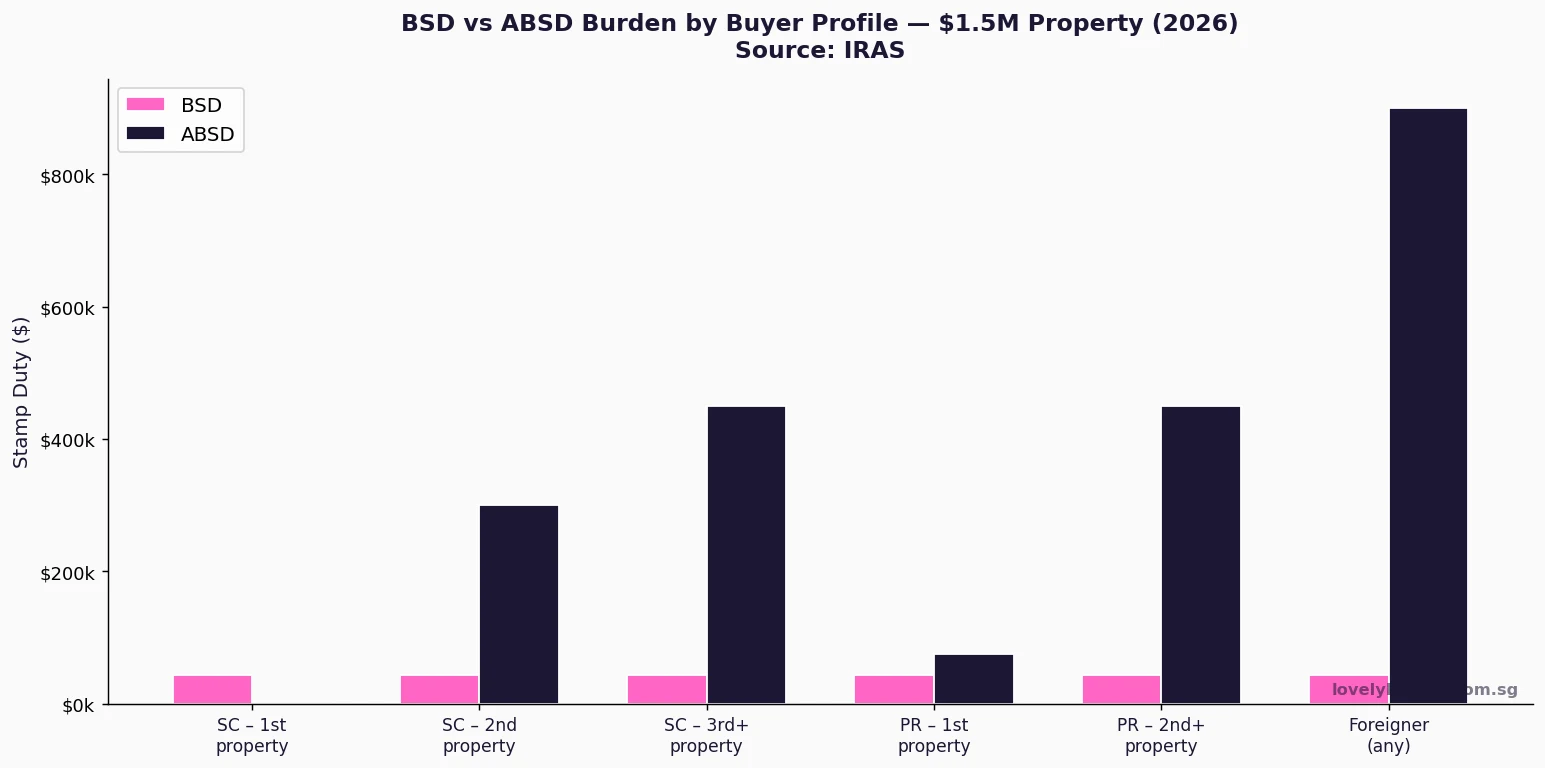
- BSD is separate from ABSD: ABSD is an additional layer; BSD is always owed regardless of how many properties you own.
What is BSD and Why Does It Exist?
BSD is a transaction tax administered by the Inland Revenue Authority of Singapore (IRAS). It is governed by the Stamp Duties Act (Cap 312) and applies to instruments executed in Singapore for the transfer, conveyance, or assignment of immovable property. The duty has existed in some form since Singapore’s colonial era; the current progressive residential rate structure, expanded to six bands in February 2023, reflects the Government’s stated intent to make the tax more equitable — those buying higher-value properties pay a proportionally higher effective rate.
BSD is not a wealth tax, a capital gains tax, or a cooling measure. It is a revenue-raising duty applied proportionately to the transaction value. The proceeds go to the Consolidated Fund. Because BSD is a cost of entry rather than a deterrent (unlike ABSD), it does not vary by citizenship, residency status, or the number of properties owned.
Residential BSD Rate Table 2026
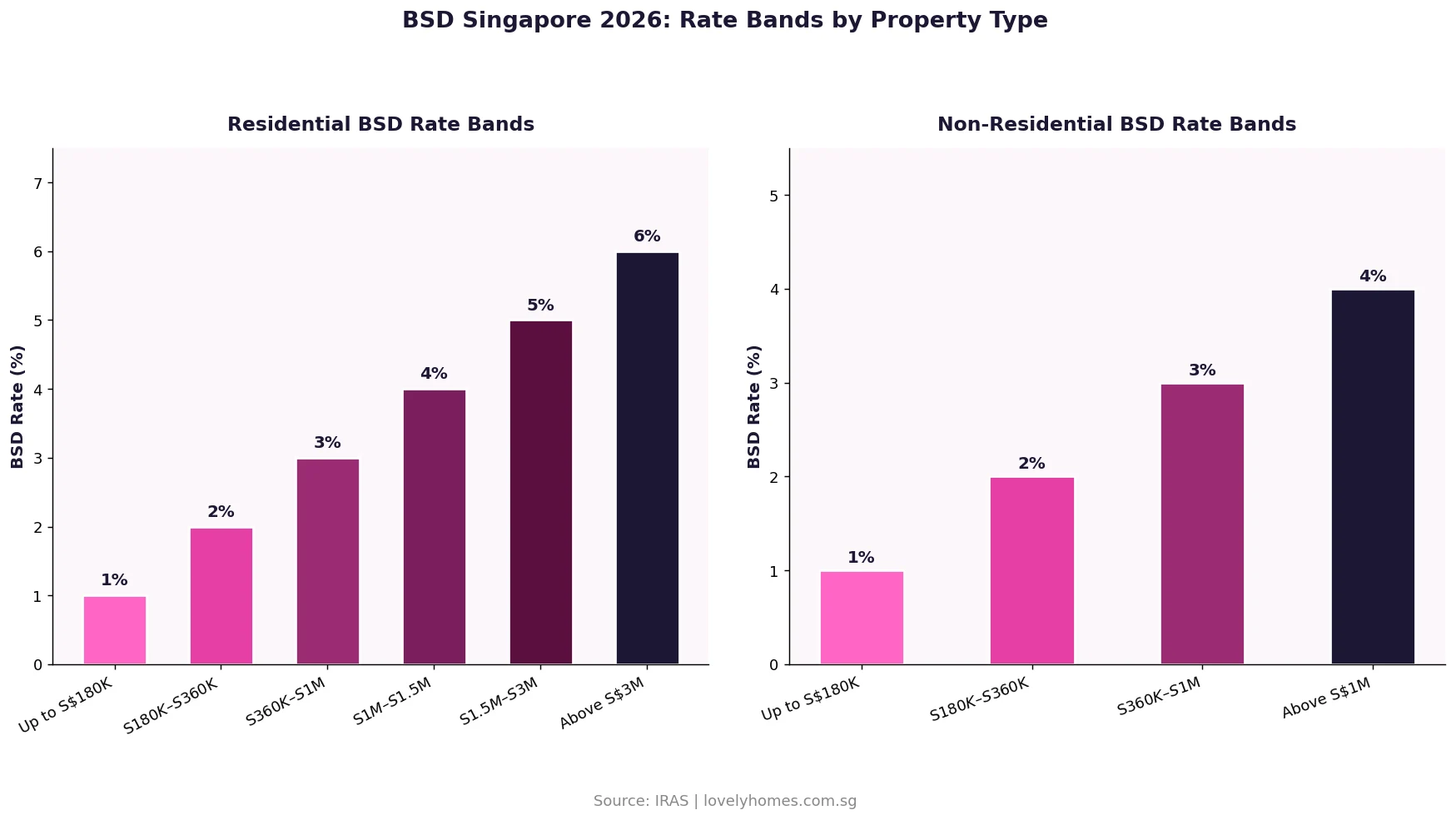
The residential BSD applies to the purchase of any residential property — HDB flats, private apartments and condominiums, Executive Condominiums (ECs), landed homes, and strata-titled mixed-use units classified as residential. The six progressive bands are applied to successive slices of the purchase price:
| Purchase Price (Residential) | BSD Rate | Maximum BSD on Band |
|---|---|---|
| First S$180,000 | 1% | S$1,800 |
| Next S$180,000 (S$180,001–S$360,000) | 2% | S$3,600 |
| Next S$640,000 (S$360,001–S$1,000,000) | 3% | S$19,200 |
| Next S$500,000 (S$1,000,001–S$1,500,000) | 4% | S$20,000 |
| Next S$1,500,000 (S$1,500,001–S$3,000,000) | 5% | S$75,000 |
| Remainder above S$3,000,000 | 6% | No cap |
The cumulative BSD on a S$3,000,000 residential property is S$1,800 + S$3,600 + S$19,200 + S$20,000 + S$75,000 = S$119,600, for an effective rate of 3.99%. Every additional dollar above S$3M is taxed at the marginal rate of 6%.
BSD Dollar Amounts and Effective Rates by Purchase Price
The progressive structure means the effective BSD rate rises as the purchase price increases, but always remains below the top marginal rate. The chart below maps BSD payable and the effective rate across the price spectrum most Singapore buyers encounter:
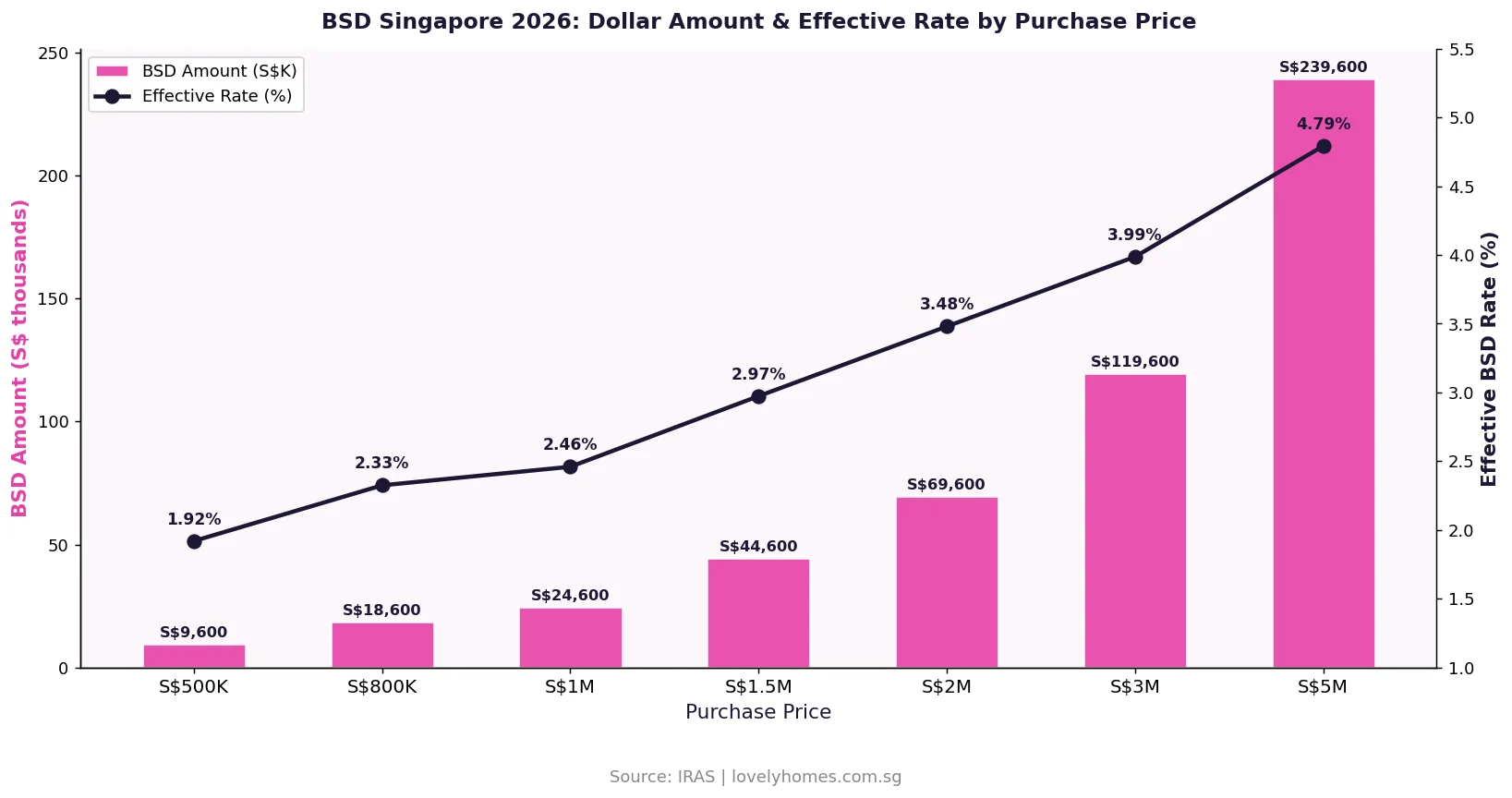
Key reference points worth remembering:
- S$500,000 HDB flat: BSD = S$9,600 (effective 1.92%)
- S$1,000,000 private apartment: BSD = S$24,600 (effective 2.46%)
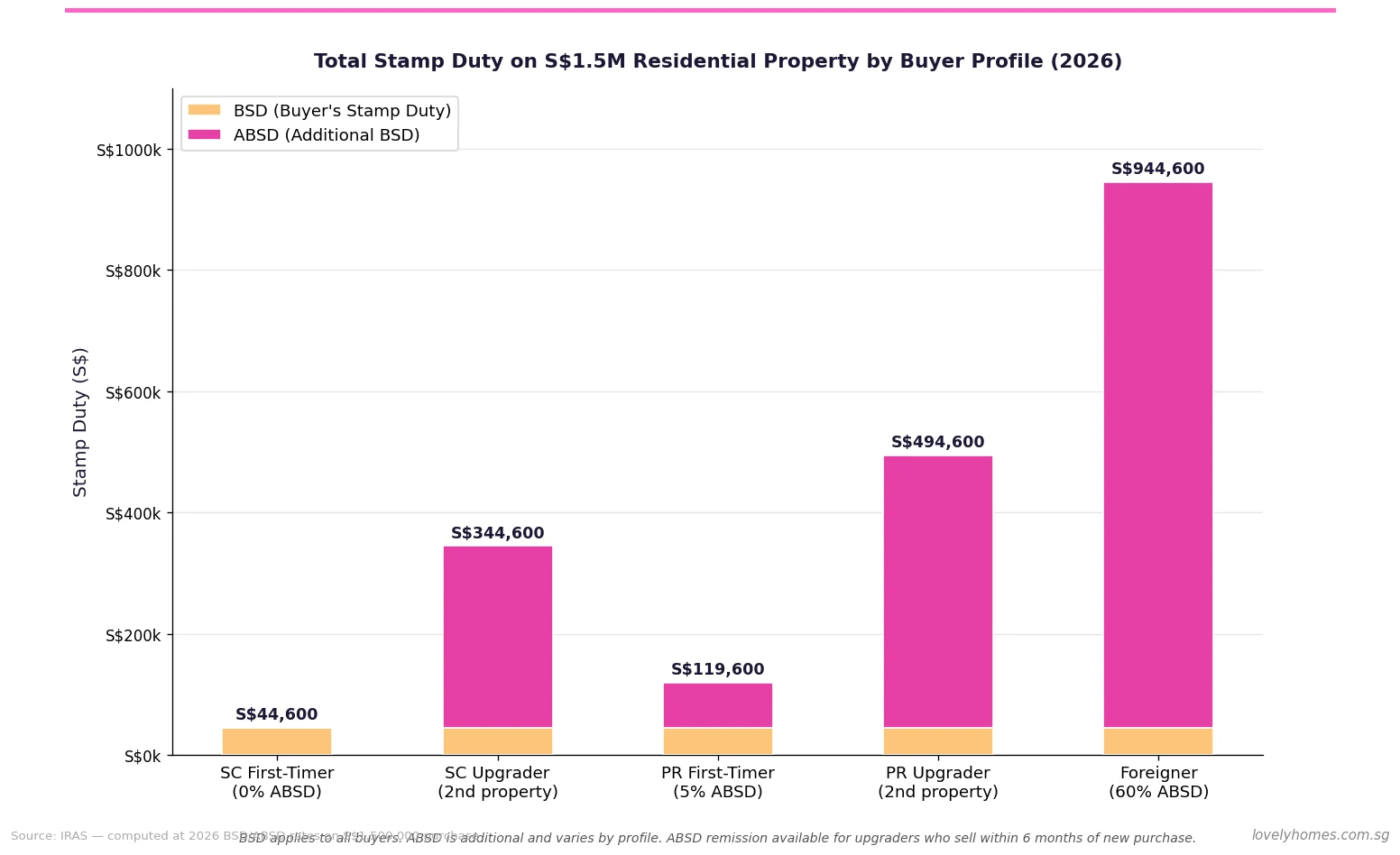
- S$1,500,000 condo (common OCR price point): BSD = S$44,600 (effective 2.97%)
- S$2,000,000 condo: BSD = S$69,600 (effective 3.48%)
- S$3,000,000 at the 6% threshold: BSD = S$119,600 (effective 3.99%)
- S$5,000,000 GCB or penthouse: BSD = S$239,600 (effective 4.79%)
Non-Residential BSD Rate Table 2026
Commercial shophouses, office units, retail space, industrial factories and warehouses, and land not classified as residential all attract BSD under the non-residential rate table. Importantly, the non-residential scale tops out at 4% — there is no 5% or 6% tier regardless of purchase price. This makes high-value commercial property transactions proportionally cheaper to stamp than equivalent-value residential purchases.
| Purchase Price (Non-Residential) | BSD Rate | Maximum BSD on Band |
|---|---|---|
| First S$180,000 | 1% | S$1,800 |
| Next S$180,000 (S$180,001–S$360,000) | 2% | S$3,600 |
| Next S$640,000 (S$360,001–S$1,000,000) | 3% | S$19,200 |
| Remainder above S$1,000,000 | 4% | No cap |
A commercial shophouse purchased at S$5,000,000 would attract BSD of S$1,800 + S$3,600 + S$19,200 + (S$4,000,000 × 4%) = S$184,600 (effective 3.69%), compared with S$239,600 (effective 4.79%) for a S$5,000,000 residential property. The saving of S$55,000 partially explains why some investors prefer commercial real estate for their second and subsequent property purchases — they also avoid ABSD, which does not apply to commercial and industrial property.
How BSD Is Calculated: The Higher-of Rule
BSD is assessed on the higher of the purchase price agreed between buyer and seller, or the market value of the property as determined by IRAS. In practice:
- For resale properties, IRAS may compare the transacted price against its own valuation database. If IRAS determines the property was acquired at below market value (for example, between related parties), BSD will be assessed on the higher market value figure.
- For new launch properties (buying directly from a developer), the developer’s sale price is typically the basis, since it is an arm’s-length commercial transaction.
- For transfers between related parties (spouses, parents and children, companies and directors), IRAS almost always applies market value rather than the consideration stated in the instrument.
This means a gift of property — even if the stated consideration is S$1 — is still subject to BSD on the full market value. There is no gift exemption from BSD for related parties.
BSD and ABSD: How They Interact
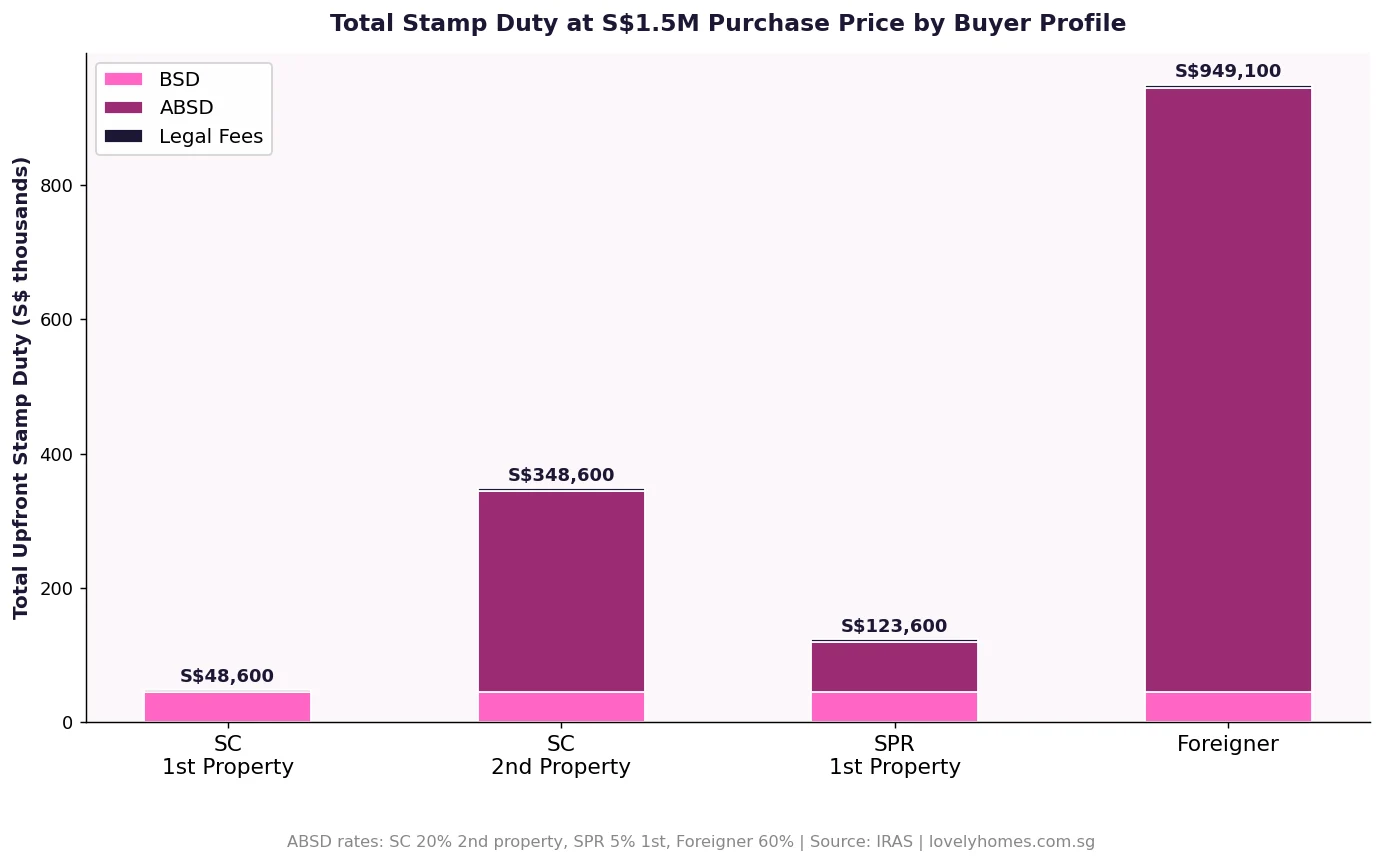
BSD and ABSD are separate levies, calculated independently, and payable together at stamping. They share the same 14-day deadline and the same payment mechanism. The key interaction points are:
- Both apply to the same price basis (higher of purchase price or market value), so your BSD and ABSD are calculated on the same figure.
- ABSD is a remittable tax in some scenarios (upgrader remission, married couple remission); BSD is generally not remittable except in the specific exemptions listed below.
- BSD cannot be paid from CPF at the point of stamping, but ABSD also cannot. Both must be paid in cash first; CPF OA funds can then be drawn for BSD reimbursement (for residential property) after the stamping receipt is obtained.
BSD Exemptions and Remissions
There are a small number of circumstances in which BSD does not apply or is reduced:
- Compulsory acquisition by the Government: where the State acquires your property under the Land Acquisition Act, no BSD is payable on the acquisition instrument.
- Transfers consequent on divorce: court-ordered transfers of matrimonial property between divorcing spouses are exempt from BSD under Section 22A of the Stamp Duties Act.
- Transfers by will or intestacy: property passing on death to a beneficiary is not subject to BSD (estate duty was abolished in 2008; stamp duty on death transfers is also not applicable).
- Registered charities: certain transfers to or from registered charities may attract remission under IRAS administrative concessions.
- HDB upgrading schemes: transfers under specific HDB Housing and Development Board upgrading or SERS (Selective En-bloc Redevelopment Scheme) arrangements may receive administrative remissions.
Note: the Free Trade Agreement (FTA) national treatment that reduces ABSD for US, Swiss, and Icelandic/Norwegian/Liechtenstein nationals does not reduce BSD — BSD is a universal baseline tax unaffected by FTA provisions.
BSD Payment: Deadlines, Methods and Penalties
BSD must be paid within 14 calendar days from the date the instrument of transfer is signed (or the OTP is exercised, for resale properties). For new launch purchases, the trigger date is typically the date of the Sale and Purchase Agreement.
Payment is made through the IRAS e-Stamping portal (stamp.iras.gov.sg). Your conveyancing lawyer normally handles this on your behalf, drawing the funds from your conveyancing account. The IRAS system generates a stamping certificate confirming duty paid, which must be produced at lodgement of the title transfer.
Late payment of BSD attracts a penalty of up to four times the unpaid BSD, at IRAS’s discretion. Penalties are typically lower for short delays with no prior history, but the risk of even a few days’ delay is significant given the multiplier. Most buyers avoid this entirely by ensuring sufficient funds are deposited with their law firm well before the 14-day deadline.
Worked Example: Mr and Mrs Chong — Singapore Citizens, purchasing a S$2,200,000 resale condominium in District 11 as their first property
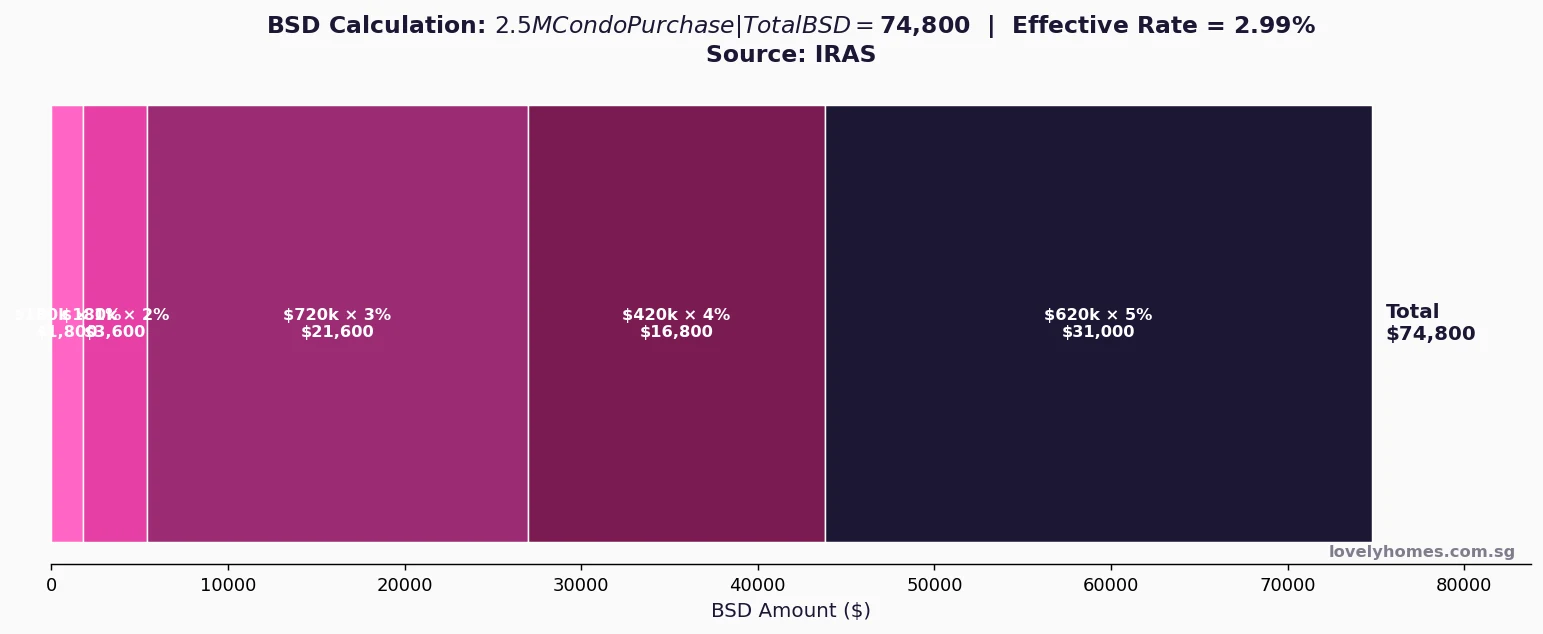
BSD calculation (residential, 6-band progressive):
- First S$180,000 × 1% = S$1,800
- Next S$180,000 × 2% = S$3,600
- Next S$640,000 × 3% = S$19,200
- Next S$500,000 × 4% = S$20,000
- Next S$700,000 × 5% = S$35,000 (S$1,500,001 to S$2,200,000)
- Total BSD = S$79,600 (effective rate: 3.62%)
ABSD: Singapore Citizens buying their first property pay 0% ABSD. Total ABSD = S$0.
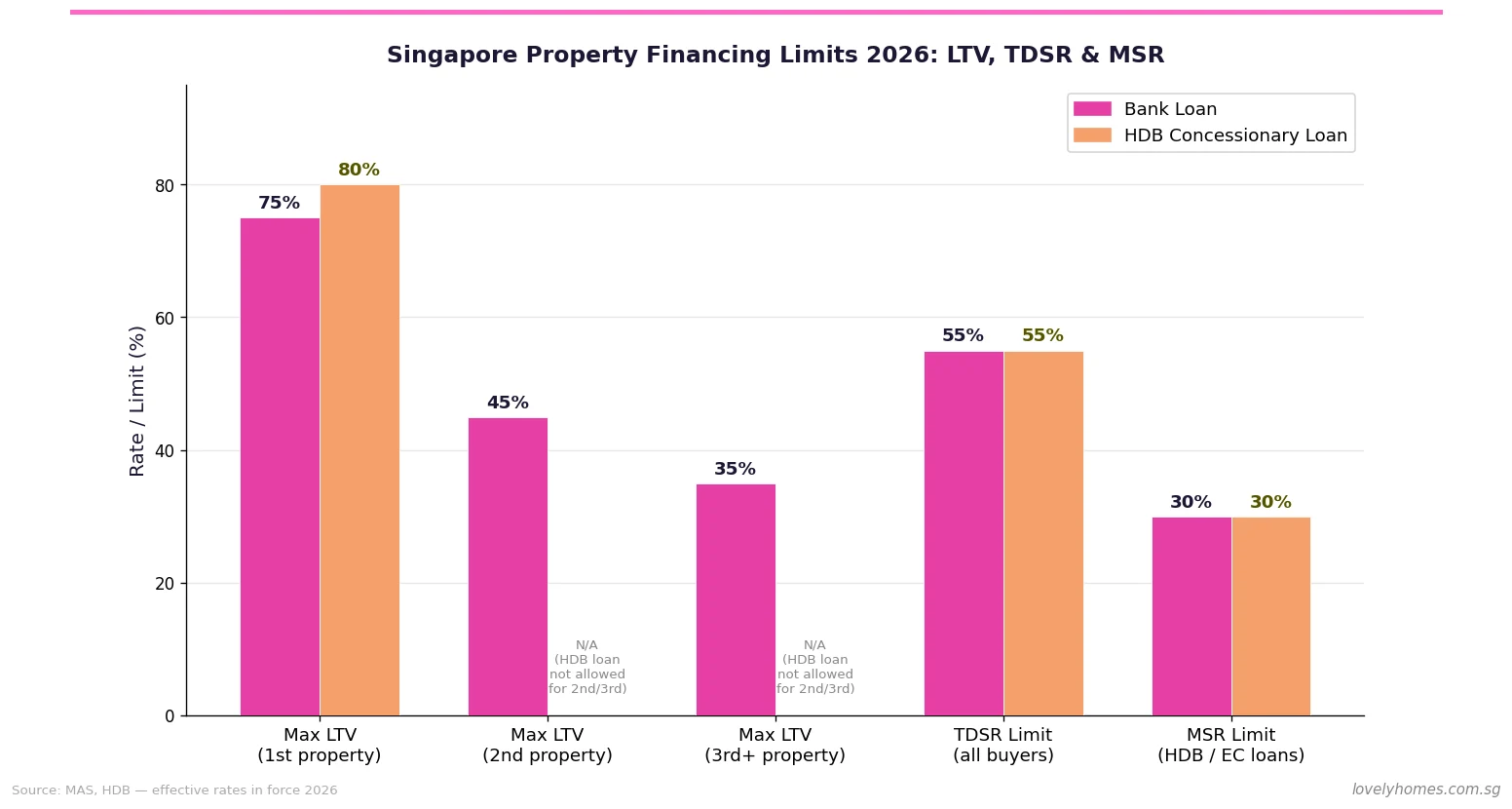
Other upfront costs: legal fees ~S$5,500; CPF OA contribution towards BSD ~S$79,600 (drawn after stamping); bank loan at 75% LTV = S$1,650,000; cash downpayment 5% = S$110,000; CPF/cash combined downpayment 25% = S$550,000.
Total stamp duty: S$79,600. Payable within 14 days of OTP exercise via IRAS e-Stamping. Conveyancing lawyers collect from the buyer’s conveyancing account before lodging caveat at SLA.
BSD History: The Introduction of the 6% Band
BSD existed for decades with a simpler three-band structure (1%/2%/3%). In February 2018, the Government added a fourth band at 4% for the portion above S$1,000,000. The most recent change came on 15 February 2023, when the Government announced — as part of the same package that doubled ABSD for foreigners — two new residential BSD bands: 5% on the slice between S$1,500,001 and S$3,000,000, and 6% on the remainder above S$3,000,000. Non-residential BSD gained a 4% top band (above S$1,000,000) at the same time, replacing the old 3% cap.
The stated rationale was to make Singapore’s property transaction taxes more progressive, ensuring that buyers of very high-value properties — typically ultra-high-net-worth individuals — contribute proportionally more to government revenue. The 6% residential band had an immediate and visible impact on the Singapore prime property market, narrowing price growth in the above-S$3M segment relative to the mass-market OCR in 2023 and 2024.
What BSD Means for Buyers in 2026
BSD is a non-negotiable cost of property ownership in Singapore. Unlike ABSD, there is no strategy to avoid it — it applies regardless of citizenship, residency, or investment structure. The practical implications for different buyer groups are:
- First-time HDB buyers: BSD on a S$400,000–S$700,000 flat is S$7,600–S$15,100 (effective 1.9%–2.2%) — meaningful but manageable relative to the total purchase.
- Mass-market condo buyers (OCR, S$1.0M–S$1.8M): BSD of S$24,600–S$59,600 (effective 2.46%–3.31%). At S$1.5M, BSD alone is S$44,600 — a material addition to the downpayment and ABSD budget.
- Mid-tier condo buyers (RCR, S$2M–S$3M): BSD of S$69,600–S$119,600 (effective 3.48%–3.99%). The 5% band adds significantly to the cost of buying at this tier versus five years ago.
- Prime/luxury buyers (CCR, above S$3M): BSD plus the 6% tier means a S$5M property attracts S$239,600 in BSD alone. For foreigners, adding 60% ABSD (S$3,000,000) makes the total stamp duty S$3,239,600 — larger than most properties’ downpayments.
What Might Come Next for BSD
BSD rates have been raised three times since 2018. Each time, the Government has cited the need for a more progressive transaction tax and used the change as part of a broader property cooling package. As Singapore’s private residential market has remained resilient through 2026 — with URA’s Q2 2026 private residential price index showing continued but moderating growth — there is no immediate indication that the six-band structure will be revised upward in the near term.
However, if the above-S$3M luxury segment sees renewed price acceleration or if foreign buying volumes rise materially despite the 60% ABSD, the Government may consider further raising the 6% BSD band (to 7% or higher) or narrowing the threshold above which it applies. Buyers purchasing above S$3M should factor in the possibility that BSD could rise further if market conditions shift, though no such change is signalled as at August 2026.
Frequently Asked Questions
Is BSD payable on a HDB flat purchase?
Yes. BSD applies to every property purchase in Singapore, including HDB resale flats and new BTO flat purchases from HDB. The same six-band residential rate table applies. For a typical 4-room resale HDB flat at S$550,000, BSD would be S$10,600 (effective rate 1.93%). HDB does not provide a BSD exemption; however, first-time eligible buyers purchasing an HDB flat with an HDB loan may use their CPF Ordinary Account to reimburse BSD after paying it in cash.
Do I pay BSD when buying a commercial shophouse or industrial unit?
Yes, but under the non-residential rate table, which caps at 4%. A commercial shophouse at S$3,000,000 attracts BSD of S$1,800 + S$3,600 + S$19,200 + (S$2,000,000 × 4%) = S$104,600 (effective 3.49%). Crucially, commercial and industrial property purchases do not attract ABSD, making them attractive to investors seeking a second or third property without the 20%–60% ABSD surcharge. BSD still applies at these non-residential rates.
Can I use CPF to pay BSD?
Not directly at the point of payment. BSD (and ABSD) must be paid in cash first, within 14 days of the instrument being signed. However, after stamping is complete and you have obtained the stamping certificate, you can apply to use your CPF Ordinary Account to reimburse the BSD paid — but only for residential property, and subject to the CPF withdrawal limits for your age and the remaining lease of the property. Your conveyancing lawyer will typically handle the CPF reimbursement application as part of the completion process.
What is the BSD on a S$1,800,000 private condominium?
Using the six-band residential table: 1% × S$180,000 = S$1,800; 2% × S$180,000 = S$3,600; 3% × S$640,000 = S$19,200; 4% × S$500,000 = S$20,000; 5% × S$300,000 (from S$1,500,001 to S$1,800,000) = S$15,000. Total BSD = S$59,600 (effective rate 3.31%). If you are a Singapore Citizen buying this as your second property, ABSD of 20% × S$1,800,000 = S$360,000 would also be payable, bringing total stamp duty to S$419,600.
Is BSD payable on a new launch condominium?
Yes. BSD is payable on the Sale and Purchase Agreement (S&P) for a new launch. The 14-day clock starts from the date the S&P is signed (usually within two weeks of exercising the OTP). The purchase price stated in the S&P is the BSD basis. If the developer grants a rebate (for example, a furniture voucher or partial stamp duty absorption), the rebated consideration — not the headline price — forms the BSD basis, provided the rebate is properly reflected in the S&P. Always check your S&P carefully with your conveyancing lawyer to ensure the stamped consideration accurately reflects the true price paid.
How does BSD apply to en-bloc sale proceeds?
In an en-bloc (collective sale), it is the developer buying the site who pays BSD, not the individual subsidiary proprietors (owners) who are selling. The developer pays BSD on the collective sale price (land price plus any differential premium) under the non-residential rate table (since the transaction is land, not a completed residential unit). Individual owners receive their proceeds net of the collective sale committee’s costs; no BSD is payable by the outgoing owners on their sale.
What happens if I miss the 14-day BSD payment deadline?
IRAS imposes penalties for late stamping of up to four times the unpaid BSD. In practice, IRAS has discretion over the penalty level. A short delay for a first-time offence may attract a smaller penalty, but there is no guaranteed grace period. If you realise the deadline will be missed, you or your lawyer should contact IRAS proactively before the deadline to explain the circumstances. Voluntary disclosure before IRAS pursues the matter typically results in lower penalties. The risk of any late payment is that the unstamped instrument is inadmissible as evidence in Singapore courts, which can complicate title transfer proceedings.
Disclaimer: This article is for general information only and does not constitute legal, tax, or financial advice. BSD rates, bands, and remission rules are set by IRAS and may change. Always verify current BSD rates on the IRAS BSD page and consult a licensed conveyancing lawyer before entering into any property transaction. CPF withdrawal rules are governed by the CPF Board; refer to cpf.gov.sg for the latest guidance.