HDB vs Condo Singapore 2026: Complete Comparison Guide

HDB vs Condo Singapore 2026: Complete Comparison Guide

Quick Answer: HDB vs Condo in 2026 — Key Takeaways

  • Cost gap is wide: a new 4-room BTO costs from S$350,000–S$500,000; an equivalent OCR condo easily costs S$900,000–S$1,200,000 — two to three times more upfront.
  • Only Singapore Citizens can buy new HDB flats; Singapore Permanent Residents (SPRs) and foreigners are restricted to resale HDB (SPR only, with limitations) or private residential.
  • ABSD applies to condos as a second property: a SC buying a second condo pays 20% ABSD on top of BSD; HDB upgraders face this fully.
  • CPF can fund both, but the accrued interest rule means proceeds from selling an HDB flat are partially returned to CPF, reducing actual cash profit.
  • Rental yield: HDB resale flats gross 3.0%–4.5%; OCR condos 3.2%–4.0%; the HDB advantage narrows significantly when considering non-owner-occupancy restrictions (10-year MOP rule for subletting applies).
  • Capital appreciation (2015–2026): HDB resale PPI is up approximately 44%; private residential PPI is up approximately 45% — broadly similar over a 10-year horizon.
  • Condos offer facilities (pool, gym, function rooms, 24-hour security) that HDB blocks do not; this premium is priced in and reflected in maintenance fees of S$300–S$700/month.
  • Decision rule of thumb: if your household income is below S$14,000/month, start with HDB (BTO or resale) to benefit from CPF grants and lower entry cost; graduate to private once equity has built up.

For most Singaporeans, the question is not simply “which is better?” — it is “which is right for me, right now?” The HDB vs condo decision shapes your finances, lifestyle and options for the next decade. This guide breaks down every dimension — purchase cost, ongoing fees, rental potential, capital growth, rules and restrictions — with real 2026 numbers so you can make an informed call.

The Financial Case: Upfront Costs Compared

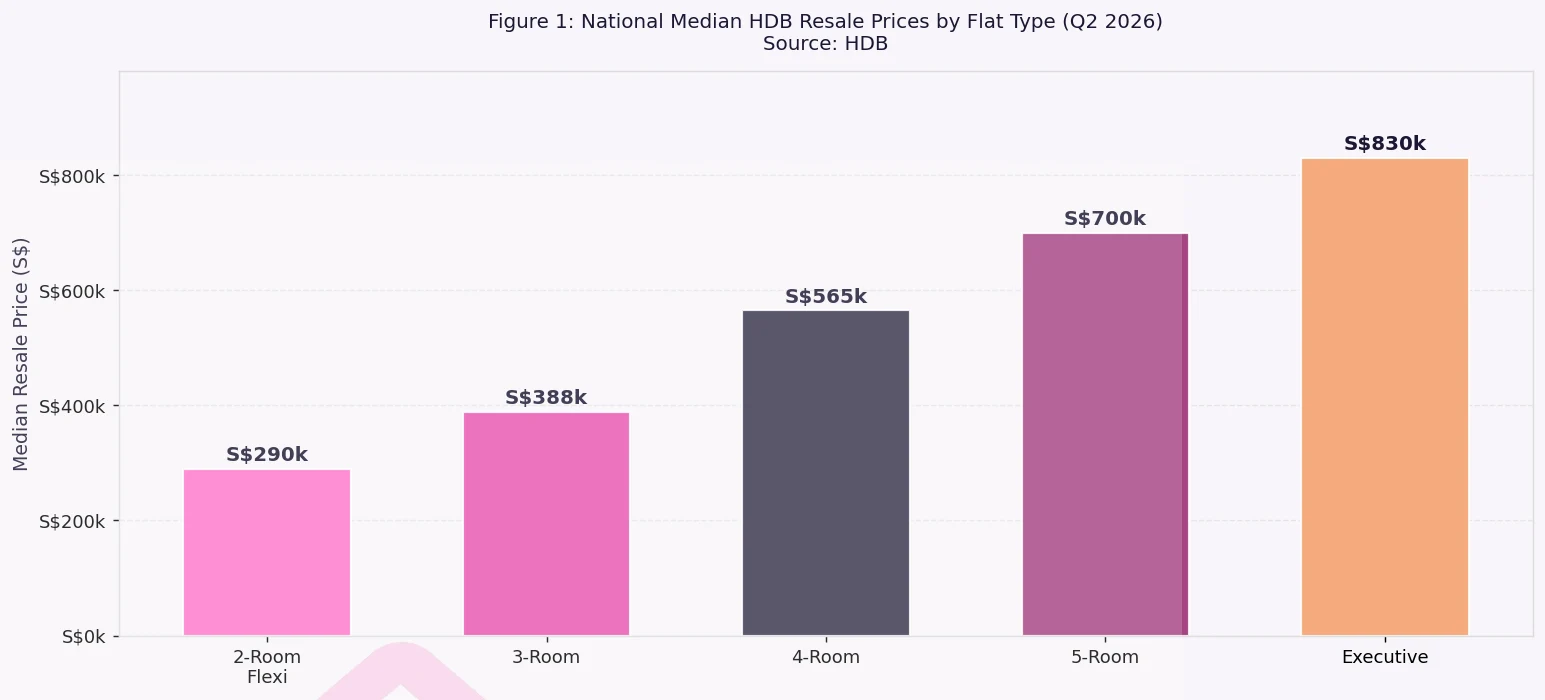
The starkest difference between HDB and private condominium ownership is the entry cost. A new HDB Build-To-Order (BTO) 4-room flat in a non-mature estate is priced from around S$350,000–S$500,000, subsidised by the Housing & Development Board (HDB) under the principle that public housing should remain affordable. An equivalent-sized (800–900 sqft) resale condominium in the Outside Central Region (OCR) typically changes hands at S$950,000–S$1,300,000 — roughly double to triple the cost.

This gap widens further once you account for BSD, legal fees, and the minimum downpayment. A first-timer Singapore Citizen (SC) buying a BTO flat pays no ABSD and a modest BSD of S$9,000–S$14,000 on an S$450,000 flat; the same buyer purchasing an S$1,000,000 condo pays BSD of S$32,600 and must stump up at least S$250,000 in cash or CPF as the 25% minimum downpayment (with at least 5% in cash if using a bank loan).

Cost comparison HDB vs condo Singapore 2026 — purchase price, BSD, downpayment
Figure 1: Cost comparison across four property types for a Singapore Citizen first-timer (2026 figures). New Launch CCR condo shown at S$2,100,000 — typical of D9/D10/D11; note that BSD alone exceeds the entire purchase price of a BTO flat. Source: HDB, URA, IRAS.

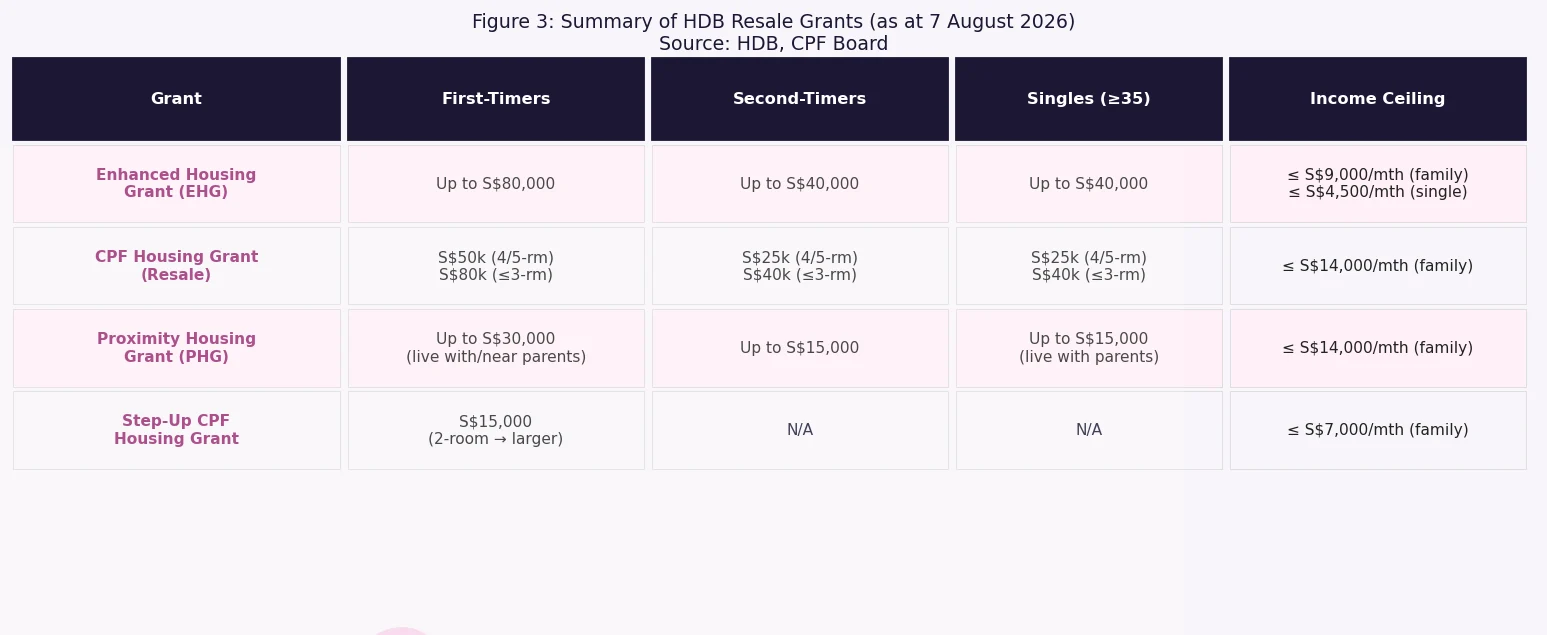
HDB grants add another layer of advantage for eligible buyers. A first-timer SC household with combined monthly income of S$9,000 qualifies for the Enhanced Housing Grant (EHG) of up to S$80,000 on a BTO flat, plus a Family Grant of S$50,000 on a resale HDB flat. These grants are non-repayable and come directly off the purchase price. No such grants exist for private property purchases.

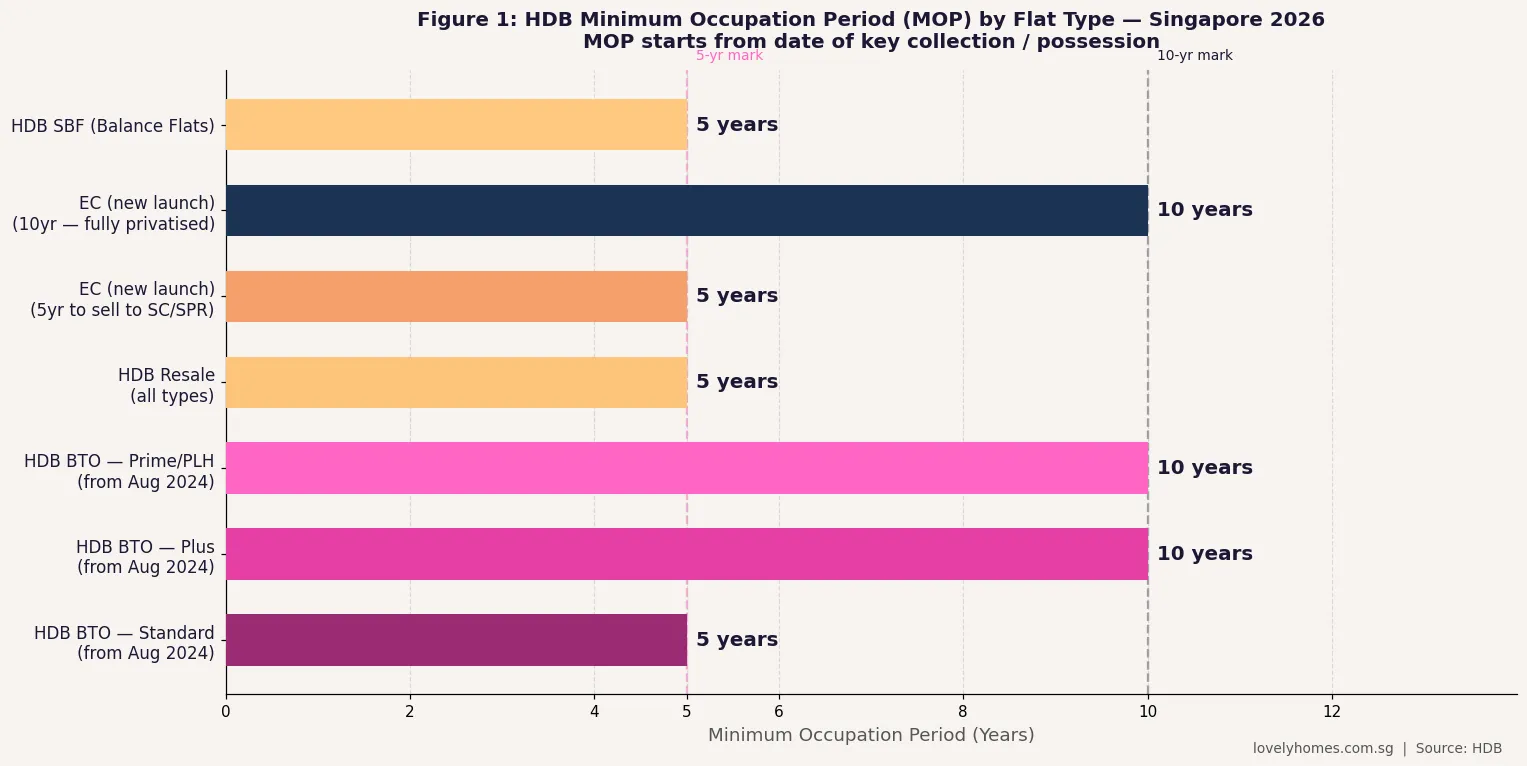
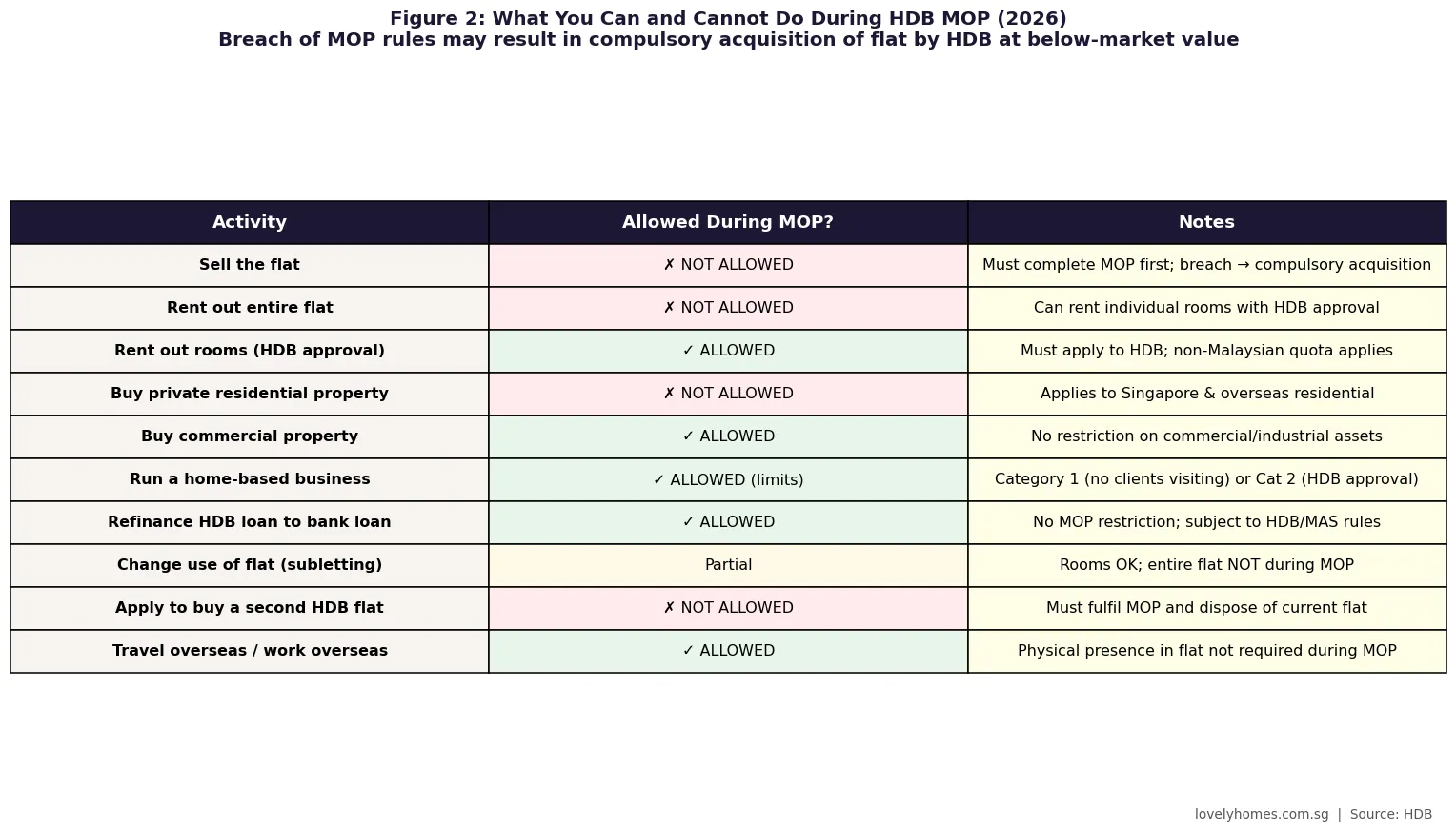
The Minimum Occupation Period (MOP) is the trade-off: HDB flat owners must live in the flat for five years (ten years for Prime and Plus classification flats since August 2024) before selling or renting out the entire flat. Condo owners face no MOP restriction — they can sell or rent from day one, subject only to Seller’s Stamp Duty (SSD) if selling within three years.

Ongoing Costs: Monthly Commitments

Purchase price is only the beginning. The true cost of ownership includes monthly mortgage repayments, MCST maintenance fees (condos), conservancy and service charges (HDB), property tax, fire insurance and — for condos — sinking fund contributions.

For a 4-room HDB resale flat at S$560,000, the monthly mortgage on an HDB concessionary loan (2.60% per annum, 25 years, 80% loan) is approximately S$2,040. Monthly Service & Conservancy Charges (S&CC) for a 4-room flat average S$60–S$80 per month. Property tax for an owner-occupied HDB flat is effectively zero for most flat values, as the Annual Value (AV) is low and owner-occupier rates are 0% on the first S$8,000 AV.

For a 3-bedroom condo at S$1,200,000 (OCR), the monthly mortgage on a bank loan (3.50% fixed for two years, 75% LTV, 25 years) is approximately S$4,498. On top of this, MCST monthly fees typically range from S$350 to S$700 depending on the development’s facilities and share value. Property tax for a S$1,200,000 condo is roughly S$2,400–S$3,000 per year (owner-occupier rate on the estimated AV).

Over a 25-year holding period, the total interest cost is another S$180,000–S$300,000 for HDB borrowers versus S$300,000–S$550,000 for condo borrowers — a function of both the higher principal and higher interest rates on bank loans.

Rental Yield and Investment Returns

A common misconception is that condos automatically deliver higher rental yields. In Singapore, rental yields are a function of entry price, not just rental income — and since HDB flats are bought at subsidised prices, their yield on cost is frequently competitive with, or even superior to, condos.

Gross rental yield comparison HDB vs condo Singapore 2026
Figure 2: Gross rental yield ranges across property types in Singapore (2026, based on URA and HDB rental transaction data). HDB resale flats frequently match OCR condos on a gross yield basis. Net yield narrows further for condos due to maintenance fees and property tax. Source: URA, HDB.

However, the comparison is not straightforward. HDB flat owners face the five-year MOP restriction: you cannot rent out the entire flat during the MOP. After the MOP, you can sublet the whole flat with HDB’s approval (renewable every two or three years). Condo owners can rent out their unit immediately with no approval required. This flexibility premium is significant for investors who need early income.

For HDB upgraders buying a second property (a condo), ABSD applies at 20% for SCs — a substantial carry cost that compresses net returns. At S$1,200,000, ABSD of S$240,000 alone represents roughly 14 years of net rental income at S$18,000 per year. The breakeven horizon for an HDB upgrader buying an investment condo is therefore much longer than it appears at first glance.

Capital Appreciation: 2015–2026 in Data

Over the past decade, both HDB resale and private residential markets have delivered broadly similar capital appreciation. The HDB Resale Price Index (RPI) rose from a base of 100 in 2015 to approximately 144 by mid-2026 — a gain of around 44%. The URA Private Residential Property Price Index (PPI) moved from 100 to approximately 145 over the same period — a gain of about 45%.

HDB resale vs private residential price index 2015 to 2026 Singapore
Figure 3: HDB Resale Price Index versus URA Private Residential PPI, indexed to 100 in Q1 2015. Both asset classes have appreciated by approximately 44–45% over the 10-year horizon, though private residential showed greater volatility during 2021–2022. Source: HDB, URA.

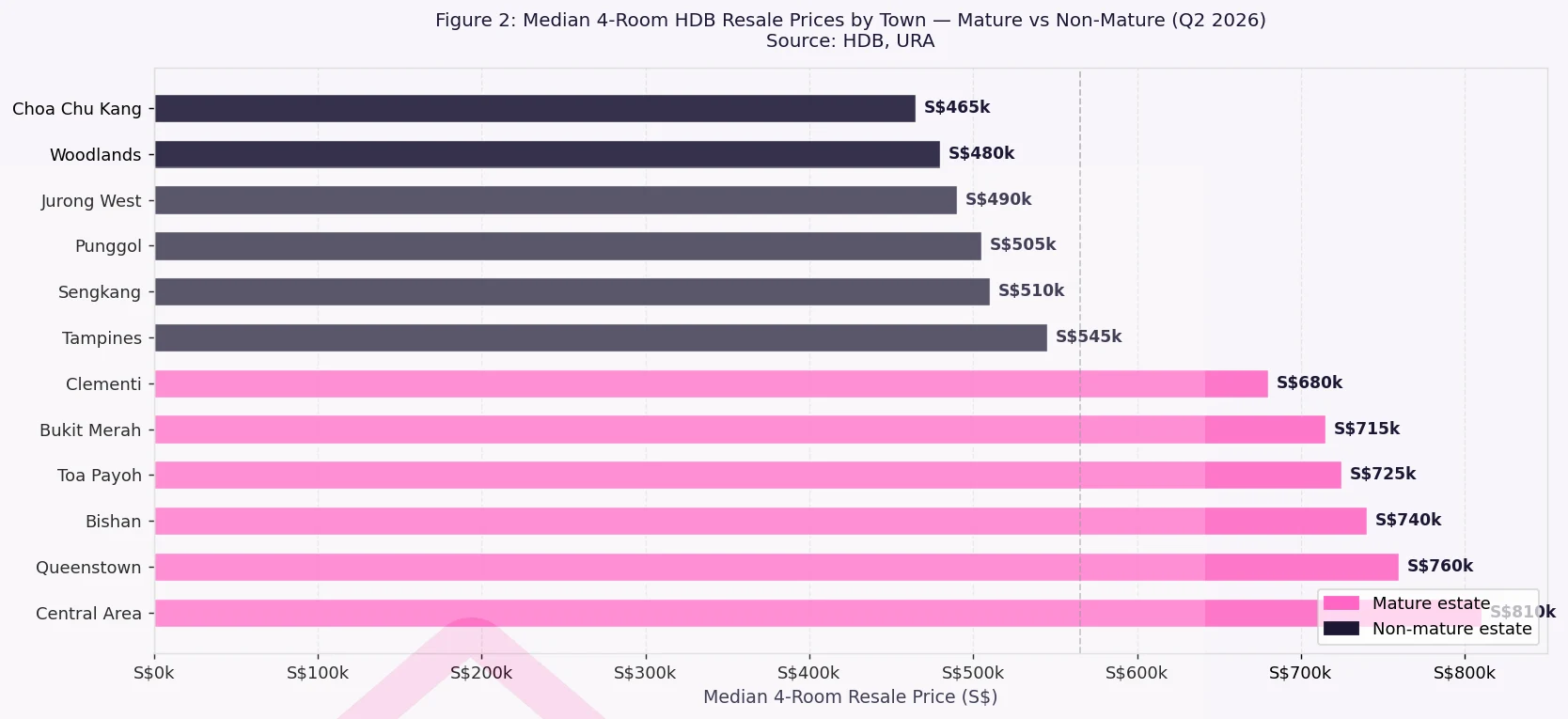
The similarity masks important nuances. Private residential, particularly in the Core Central Region (CCR), outperformed in the 2021–2022 run-up, with some freehold D9/D10 developments gaining 25–35% in that window alone. HDB resale surged particularly in 2021–2023 as the pandemic-era demand for larger flats collided with restricted BTO supply, pushing mature estate 5-room flat prices above S$800,000 in some cases.

The key driver for private property appreciation is often freehold tenure and location within the CCR or RCR. A 999-year leasehold condo in Buona Vista has historically held its value better than a 60-year leasehold shoebox unit in an OCR new launch. HDB flats, by contrast, are all 99-year leasehold from the date the land was granted — and the lease decay effect becomes visible once the flat crosses 40 years, reducing bank loan quantum and CPF withdrawal eligibility.

Rules and Restrictions

Ownership eligibility is a fundamental constraint. HDB flats can only be owned by Singapore Citizens (BTO) or SCs/SPRs together (resale, with restrictions on ethnic composition under the Ethnic Integration Policy). Foreigners cannot own HDB flats at all. Private condominiums are open to all nationalities, though foreigners pay a punishing 60% ABSD on residential property purchases.

Subletting rules differ sharply. An HDB resale owner must wait for the MOP before subletting the entire flat; individual bedroom subletting is permitted during the MOP (maximum two non-Malaysian foreigners or six occupants). Condo owners can sublet their entire unit immediately, subject to a minimum rental period of three consecutive months (per URA rules since 2017). No renewal approval is required.

Redevelopment risk affects both. HDB estates are periodically redeveloped under SERS (Selective En-bloc Redevelopment Scheme) — owners are compensated at market value and offered replacement flats in the same or nearby precinct. For private condos, collective sales (en bloc) require 80% owner consent (90% for those less than ten years old) and full market pricing. En bloc payouts can be transformative for owners of older developments in prime locations.

Lifestyle Considerations

Condos typically offer facilities that HDB estates cannot match: swimming pools, gymnasiums, BBQ pavilions, function rooms, tennis courts and 24-hour concierge security. These amenities command a monthly maintenance fee but can significantly improve daily quality of life, particularly for families with young children or individuals who value recreational facilities within walking distance of home.

HDB towns are generally well-served by public transport, hawker centres, supermarkets and community clubs — the infrastructure of neighbourhood life is built into the planning template. Mature estates such as Toa Payoh, Tampines and Ang Mo Kio offer a richness of amenity that many suburban condos cannot match. For families prioritising proximity to good primary schools, both HDB and private addresses are relevant depending on the school’s 1 km radius — ownership type does not automatically determine school access.

Summary Comparison Table

Factor New HDB BTO (4-room) HDB Resale (4-room) New Launch Condo (OCR) Resale Condo (OCR)
Typical price range S$350k–S$500k S$450k–S$750k S$900k–S$1.4M S$850k–S$1.3M
Who can buy SC only (family/single ≥35) SC + SPR (family nucleus) All nationalities All nationalities
ABSD (SC 1st property) Nil Nil Nil Nil
ABSD (SC 2nd property) N/A (can’t buy BTO if owns private) 20% (if owns private) 20% 20%
CPF grants available Up to S$120,000 (EHG + others) Up to S$130,000 (EHG + FG + PHG) None None
MOP / subletting restriction 5 years (Prime/Plus: 10 years) 5 years from completion None — rent immediately None — rent immediately
Gross rental yield (2026) N/A (MOP applies) 3.0%–4.5% 3.2%–4.0% (OCR) 3.2%–4.0% (OCR)
Monthly maintenance S&CC: ~S$65/month S&CC: ~S$65/month MCST: S$350–S$700/month MCST: S$350–S$700/month
Tenure 99-year leasehold 99-year leasehold (residual) 99-year or freehold 99-year or freehold
En bloc potential SERS (government-initiated) SERS (government-initiated) Collective sale (80% consent) Collective sale (80% consent)

Worked Example: The Lim Family Decision

Mr and Mrs Lim are a Singapore Citizen couple, aged 32, with a combined monthly income of S$9,200. They are first-time buyers and must decide between a resale HDB 4-room flat in Tampines at S$560,000 and a resale 3-bedroom condo in Pasir Ris at S$1,050,000.

Option A — HDB Resale 4-room at S$560,000:

  • Enhanced Housing Grant (EHG): S$55,000 (income S$9,200/month)
  • Family Grant: S$50,000 (buying resale from non-related seller)
  • Total grants: S$105,000
  • Effective purchase price net of grants: S$455,000
  • BSD on S$560,000: S$11,400
  • HDB loan at 80%: S$448,000 @2.60% per annum, 25 years → S$2,030/month
  • MSR check: S$2,030 ÷ S$9,200 = 22.1% — well within 30% cap. PASS
  • Monthly S&CC: ~S$65
  • Total monthly housing cost: approximately S$2,095

Option B — Condo resale at S$1,050,000:

  • BSD: S$33,900 (no grants)
  • ABSD: S$0 (first property for SC)
  • Bank loan at 75%: S$787,500 @3.50% fixed, 25 years → S$3,940/month
  • Minimum cash downpayment (5%): S$52,500 cash
  • TDSR check: S$3,940 ÷ S$9,200 = 42.8% — within 55% TDSR. PASS
  • Monthly MCST fees: approximately S$450
  • Total monthly housing cost: approximately S$4,390

Verdict: Option A leaves S$2,295/month more in monthly cash flow — that is S$27,540 per year, or roughly S$275,000 over 10 years that can be redeployed into investments, education or a future upgrade to private property. For the Lim family at their income level, the HDB route captures S$105,000 in grants, stays well within the Mortgage Servicing Ratio (MSR) limit, and preserves significant financial flexibility.

What Might Come Next

The gap between HDB and private property prices is a live policy concern for the government. The August 2024 classification of BTO flats into Prime, Plus and Standard tiers — with differentiated MOP and subsidy recovery rules — signals that HDB will continue to be the primary vehicle for owner-occupier housing, while private property is positioned as a step-up or investment option for those who have built equity.

Cooling measures, including the current ABSD framework (20% for SCs on their second property), are explicitly designed to deter HDB upgraders from treating condo investment as a wealth-building short-cut. Whether the 20% rate will be adjusted in the near term is speculative; the Ministry of Finance (MOF) has consistently stated that measures will remain “calibrated” to prevent property from becoming a speculative asset class.

For buyers who are watching the market, the coming quarters offer one potential catalyst: the URA Q2 2026 full data release (expected 24 July 2026) will show whether the +0.5% QoQ private residential price gain in Q2 reflects stabilisation or early softening. HDB resale volumes have remained resilient at around 6,000–7,000 transactions per quarter, suggesting continued strong end-user demand regardless of investment sentiment.

Is it better to buy HDB or condo as a first-time buyer in Singapore?
For most first-time Singapore Citizen buyers, the HDB route delivers better value at the point of entry — government grants of up to S$120,000 (BTO) or S$130,000 (resale), lower purchase prices, lower BSD, and the option of an HDB concessionary loan at 2.60% per annum. A condo purchase as a first property is financially viable only if your household income and existing savings can comfortably service the higher loan amount within TDSR limits and fund the larger cash downpayment. Many buyers follow a two-step path: BTO or resale HDB first, build equity over the MOP period (5 years), then sell and upgrade to private property — potentially without ABSD if the HDB flat is sold before purchasing the condo.
Can I buy both an HDB flat and a condo at the same time?
You can own an HDB flat and a private property concurrently, but only after the HDB flat’s MOP has been fulfilled. During the MOP, you must dispose of any private residential property you own (or co-own) within 6 months of taking possession of the HDB flat. Once the MOP is complete, you may purchase a condo — but as a second property, Additional Buyer’s Stamp Duty (ABSD) of 20% (for SCs) applies on the condo’s purchase price. This ABSD is payable in cash (it cannot come from CPF). If you sell the HDB flat and purchase the condo within 6 months, the MAS Remission allows the ABSD to be waived for SCs buying their replacement private property — but the HDB flat must already be sold before the condo is purchased.
Do HDB flats appreciate as well as condos?
Over the past decade (2015–2026), HDB resale and private residential prices have appreciated at broadly similar rates — approximately 44% and 45% respectively on a price index basis. However, the absolute dollar gains differ greatly due to the price differential. An HDB flat bought at S$450,000 that appreciates 44% gains S$198,000; a condo bought at S$1,100,000 that appreciates 45% gains S$495,000. The condo’s larger absolute gain can be leveraged (bank loans allow 75% LTV vs HDB’s 80%) but comes at the cost of a larger initial outlay and higher carrying costs. Additionally, HDB flats with 50 or fewer years remaining on their lease face declining value as CPF withdrawal rules become more restrictive and bank loan quantum shrinks.
What are the ABSD implications when upgrading from HDB to condo?
When a Singapore Citizen upgrades from an HDB flat to a private condo, ABSD of 20% applies on the condo’s purchase price if the HDB flat is still owned at the time of the condo purchase. To avoid ABSD, the HDB flat must be sold first — you then buy the condo as a “first property” (no ABSD for SC). If for practical reasons you need to buy the condo before the HDB sale is completed, you will pay the full 20% ABSD upfront. IRAS allows a ABSD Remission for SCs who are replacing their sole residential property: you must sell the HDB flat within 6 months of the condo’s Temporary Occupation Permit (TOP) or purchase date, whichever is later, and apply for the remission within 6 months of selling the HDB flat. This remission is only available to SCs, not SPRs.
Can foreigners buy HDB flats in Singapore?
No. Singapore Permanent Residents (SPRs) can purchase HDB resale flats only (not new BTO flats), provided they form a family nucleus with at least one other SPR or SC. SPRs must also observe the Non-Citizen Quota for the block and neighbourhood they are buying into, and are subject to their own MOP of five years before they may sell. Foreigners (non-citizens, non-PRs) are not permitted to purchase any HDB flat. Foreigners may only own private residential property in Singapore, including condominiums and apartments in non-landed developments. They pay ABSD of 60% on any residential property purchase, making the Singapore private market among the most heavily taxed for foreign buyers globally.
What is the difference in monthly costs between HDB and condo ownership?
The monthly cost gap is substantial. A 4-room HDB resale flat at S$560,000 with an HDB loan (2.60%, 25 years, 80% LTV) costs approximately S$2,030 in mortgage repayments plus S$65 in Service & Conservancy Charges — around S$2,095 total. An equivalent-sized condo at S$1,100,000 with a bank loan (3.50%, 25 years, 75% LTV) costs approximately S$4,130 in mortgage repayments plus S$450 in MCST maintenance fees — around S$4,580 total. The monthly gap of approximately S$2,485 represents significant funds that HDB owners can redirect to savings, investments or early loan repayment. Property tax is another differentiator: owner-occupied HDB flats are effectively zero-rated for most income brackets, while a S$1.1M condo carries approximately S$2,000–S$3,000 per year in property tax at owner-occupier rates.
Should I wait for BTO or buy HDB resale?
The BTO route offers lower prices (subsidised by HDB) and higher grant quantum, but involves a waiting time of 3–5 years from ballot to key collection. The resale route offers immediate possession and a wider selection of locations, including mature estates near top schools or MRT stations, but at higher market prices. In terms of financial outcome over 10 years, BTO buyers typically fare better on cost-per-square-foot — but the 3–5 year waiting period has a real opportunity cost if rental costs must be borne in the interim. Buyers who need a flat quickly, are closer to 40 and want certainty, or prefer a specific mature estate, often find resale more practical. The EHG and Family Grant are available for both BTO and resale purchases, though resale buyers also qualify for the Proximity Housing Grant (S$30,000 if living within 4 km of parents) which BTO buyers do not.
Disclaimer: The information in this article is intended for general educational purposes only and does not constitute financial, legal or property investment advice. Property prices, rental yields, stamp duty rates, CPF rules, HDB eligibility criteria, and mortgage interest rates can change at any time. The figures cited reflect publicly available data from the Urban Redevelopment Authority (URA), Housing & Development Board (HDB), Inland Revenue Authority of Singapore (IRAS), Monetary Authority of Singapore (MAS), and CPF Board as at July 2026. Readers should verify all information with the relevant government agencies and consult a licensed property agent, financial adviser or lawyer before making any property purchase or investment decision.

×

Click anywhere to close

HDB Resale Procedure Guide 2026: Step-by-Step for Buyers and Sellers

HDB Resale Procedure Guide 2026: Step-by-Step for Buyers and Sellers

Quick Answer: HDB Resale in 2026 — Key Facts

  • Who manages HDB resale: the Housing & Development Board (HDB) via the HDB Resale Portal (my.hdb.gov.sg).
  • Process duration: typically 8–14 weeks from OTP exercise to legal completion.
  • Option to Purchase (OTP): validity up to 21 calendar days; option fee S$1–S$1,000 (non-refundable); exercise fee S$1–S$5,000.
  • Both parties must submit resale application within 7 days of OTP exercise — failure may invalidate the transaction.
  • Grants available: EHG (up to S$120,000), Family Grant (up to S$50,000), Proximity Housing Grant (S$20,000–S$30,000), Singles Grant — subject to eligibility.
  • Minimum Occupation Period (MOP): sellers must have occupied the flat for the MOP (typically 5 years) before listing for resale. Prime and Plus flats have enhanced MOP rules.
  • Ethnic Integration Policy (EIP): buyers must ensure the resale does not breach HDB’s EIP quota for the block and neighbourhood before exercising the OTP.
  • HDB loan vs bank loan: HDB loan offers up to 80% LTV at the concessionary rate (2.6% p.a. as at 2026); bank loans offer up to 75% LTV but competitive variable rates.

What Is the HDB Resale Market?

HDB resale flats are Housing & Development Board flats that have completed their Minimum Occupation Period (MOP) and are being sold by existing flat owners on the open market — as opposed to new BTO (Build-To-Order) or SBF (Sale of Balance Flats) exercises directly from HDB. The resale market offers buyers immediate availability and greater locational choice than BTO exercises, but at higher prices and without the benefit of the new-flat purchase price.

As at the second quarter of 2026, the HDB resale market is active: the HDB regularly publishes resale transaction data showing strong demand across mature and non-mature estates alike. Understanding the resale procedure thoroughly — from the first portal registration through to the handover of keys — is essential for both buyers and sellers navigating this market.

The HDB Resale Portal (accessible via my.hdb.gov.sg with a Singpass login) is the single platform through which all HDB resale transactions are managed. Both buyers and sellers must use this portal, and all key milestones — Intent to Sell, Intent to Buy, resale application, valuation request, and approval confirmation — flow through it.

HDB resale 8-step process guide Singapore 2026

Figure 1: HDB resale transaction — 8 core steps from registration to completion. Source: HDB, LovelyHomes.

Step 1: Register Intent to Sell (Seller) and Intent to Buy (Buyer)

Sellers must register their Intent to Sell (ITS) on the HDB Resale Portal before marketing the flat. This registration is valid for 12 months and can be done at any time — there is no fee. Once the ITS is active, the portal generates an indicative valuation range, a list of financial planning requirements, and eligibility details including whether any co-owners need to be involved. Sellers cannot grant an OTP to a buyer before registering ITS.

Buyers register their Intent to Buy (ITB) on the portal. This is where eligibility checks are made: HDB verifies whether the buyer meets the citizenship and family nucleus requirements, whether the EIP quota is available at the target flat, and whether the buyer has a valid HDB Loan Eligibility (HLE) letter or a bank Approval In Principle (AIP). The ITB is also valid for 12 months.

Both registrations can be done concurrently — buyers and sellers do not need to find each other before registering. In practice, most buyers register ITB first (to get their finances ready) before actively searching for a flat.

Step 2: Secure Financing — HLE Letter or Bank AIP

Before proceeding to the OTP stage, buyers must have their financing in place. There are two routes:

Feature HDB Concessionary Loan Bank Loan
Maximum LTV 80% of lower of valuation/price 75% of lower of valuation/price
Interest rate (2026) 2.6% p.a. (pegged to CPF OA rate + 0.1%) Variable; fixed/floating packages from ~2.5%–3.8% p.a.
MSR limit 30% of gross monthly household income 30% of gross monthly household income (HDB flats)
TDSR 55% (applies in conjunction with MSR) 55%
Cash down payment Minimum 20% (CPF OA can cover) Minimum 25% (5% must be in cash)
Eligibility SC/SC or SC/SPR households; income ceiling S$14,000/mth All eligible flat buyers
Prepayment penalty None Depends on package (typically 1.5% for fixed-rate packages)

A HDB Loan Eligibility (HLE) letter must be obtained from HDB before the buyer can proceed if using an HDB loan. The HLE is valid for 6 months and must be renewed if it lapses before the OTP is exercised. For bank loans, an Approval In Principle (AIP) from the bank serves the equivalent role.

The Mortgage Servicing Ratio (MSR) cap of 30% of gross household income applies specifically to HDB flat purchases. This is more restrictive than the general TDSR of 55% — buyers with higher incomes buying higher-priced resale flats may find the MSR the binding constraint on their loan quantum.

Step 3: Negotiate Price and Grant the Option to Purchase (OTP)

Once buyer and seller agree on a price, the seller issues an Option to Purchase. The OTP is a legally binding option contract: the buyer pays an option fee (S$1 to S$1,000 at the seller’s discretion) in exchange for the right to purchase the flat at the agreed price within the OTP validity period.

The OTP validity period must be at least 7 calendar days and no more than 21 calendar days. This gives the buyer time to exercise the option (i.e., formally commit to buy) while providing a brief cooling-off window. A buyer who decides not to exercise the option forfeits the option fee but has no further obligation to proceed.

Key negotiating points at this stage include: whether the seller agrees to include any fittings (air-conditioners, kitchen cabinets, curtain tracks), the completion timeline, and the allocation of expenses such as property tax for the partial year. These should be documented in the OTP or in a separate Schedule of Fixtures.

Step 4: Exercise the Option to Purchase

To exercise the OTP, the buyer signs the OTP and pays the exercise fee (S$1 to S$5,000) to the seller. Once exercised, the transaction is legally binding on both parties — neither party can withdraw without facing legal consequences. The exercise fee forms part of the overall purchase price (i.e., it is not a separate cost on top of the agreed price).

Before exercising, the buyer should: (a) confirm the EIP quota is available (this can be checked on the HDB Resale Portal using the flat’s postal code), (b) confirm the flat’s resale levy status if upgrading from a subsidised flat, and (c) confirm the CPF and cash amounts needed for completion. Exercising the OTP without completing these checks can result in a failed transaction and forfeiture of the exercise fee.

HDB resale transaction timeline weeks end to end Singapore 2026

Figure 2: Typical HDB resale timeline — ~14 weeks end-to-end from registration to completion. The longest phase is HDB processing (5–8 weeks). Source: HDB, LovelyHomes.

Step 5: Submit Resale Application (Both Parties, Within 7 Days)

After the OTP is exercised, both the buyer and seller must each submit their respective halves of the resale application on the HDB Resale Portal within 7 days of the OTP exercise date. This is a strict requirement — failure by either party to submit within 7 days may cause the application to lapse and require the OTP to be re-issued.

The buyer’s application requires: confirmation of financing (HLE letter or bank AIP), CPF withdrawal details, grant applications (EHG, Family Grant, etc.), and SPR/citizenship verification. The seller’s application requires: confirmation of bank loan redemption details (if there is an outstanding mortgage), CPF refund instructions, and details of any co-owners.

HDB will send an SMS or email to both parties confirming receipt of the complete application and providing an estimated processing timeline.

Step 6: HDB Valuation and Financial Endorsement

For buyers using an HDB concessionary loan, HDB commissions an official valuation of the flat. This valuation determines the loan quantum and the maximum CPF amount that may be used — the LTV ceiling is applied against whichever is lower, the agreed price or the HDB valuation. If the agreed price exceeds the HDB valuation (i.e., there is a Cash-Over-Valuation, or COV), the excess must be paid entirely in cash — CPF cannot be used for COV.

Cash-Over-Valuation became a significant market dynamic in the 2021–2023 resale boom, when median COV for 4-room resale flats in mature estates reached S$30,000–S$60,000. In a more moderate 2026 market, COV remains common in sought-after areas (central districts, near MRT) but has compressed from peak levels.

For bank loan buyers, the bank conducts its own valuation for lending purposes. The buyer should discuss the valuation outcome with the bank’s mortgage specialist before endorsing the financial plan.

Step 7: Resale Approval by HDB

HDB processes the resale application and checks that all eligibility conditions are met: flat ownership rules, EIP compliance, income ceiling (for grants), CPF withdrawal limits, MOP completion, and resale levy (if applicable for second-subsidised-flat buyers). Processing typically takes 5–8 weeks from the complete application date.

HDB notifies both buyer and seller by SMS and email once the resale is approved in principle and a completion appointment is set. At this stage, the conveyancing lawyers for both parties also receive documents to prepare for the transfer of title at completion.

Step 8: Completion Appointment at HDB Hub

The final step is the completion appointment, held at HDB Hub in Toa Payoh (or virtually for eligible straightforward cases). At this appointment:

  • Buyer and seller (or their lawyers) sign the Transfer Deed transferring ownership.
  • CPF refunds to the seller’s CPF OA account are processed (CPF monies used toward the original flat purchase must be returned with accrued interest).
  • The sale proceeds (net of CPF refund, outstanding mortgage redemption, and any resale levy) are disbursed to the seller.
  • Stamp duties (BSD, and ABSD if applicable) are confirmed as paid.
  • Keys are handed over, and the buyer takes possession of the flat.

The entire process from OTP exercise to completion typically takes 8–12 weeks, though complex cases (outstanding mortgage redemptions, CPF disputes, estate matters) may take longer.

HDB resale buyer upfront cost breakdown Singapore S$550,000 flat 2026

Figure 3: Typical upfront costs for a buyer of a S$550,000 4-room HDB resale flat — excluding grants and CPF housing schemes. Source: HDB, IRAS, LovelyHomes calculations.

HDB Resale Grants: Reducing Your Out-of-Pocket Cost

Eligible first-timer buyers of HDB resale flats may receive substantial CPF grants from HDB to reduce the effective purchase price. The main grants in 2026 are:

Grant Maximum Amount Key Eligibility Conditions
Enhanced CPF Housing Grant (EHG) S$120,000 (families); S$60,000 (singles) At least one first-timer applicant; monthly household income ≤ S$9,000 (families) or ≤ S$4,500 (singles); must buy flat that meets income-tiered price ceiling
Family Grant S$50,000 (SC/SC, 4-room and smaller); S$40,000 (SC/SC, 5-room and larger) At least one SC applicant; first-timer buying with SC or SPR spouse/fiancé; income ≤ S$14,000/mth
Half-Housing Grant S$25,000 (4-room and smaller); S$20,000 (5-room and larger) One first-timer, one second-timer applicant in the same household
Proximity Housing Grant (PHG) S$30,000 (moving to be near parents/children within 4km) SC or PR; living within 4km or in the same town as parents or married child; conditions apply
Singles Grant S$40,000 (SC, 4-room and smaller); S$25,000 (SC, 5-room and larger) Singapore Citizen aged 35+; first-timer single; resale flat only; income ≤ S$7,000/mth

Grants are disbursed directly by HDB into the buyer’s CPF OA account and can only be used toward the flat purchase — they cannot be withdrawn as cash. Buyers who receive grants are subject to a resale grant clawback if they sell the flat within 5 years of the grant. Planning the long-term holding horizon is therefore important when maximising grants.

Worked Example: Mr and Mrs Tan’s First HDB Resale Flat

Case Study — 4-room Jurong West Resale, S$550,000

Profile: Mr Tan (SC, 29) and Mrs Tan (SC, 28), first-timer household, combined gross income S$7,500/mth, no existing property.

Target flat: 4-room HDB resale in Jurong West (District 22), agreed price S$550,000. HDB valuation: S$545,000. COV = S$5,000 (to be paid in cash).

Grants:

  • EHG: income S$7,500/mth → S$55,000 (income band S$7,001–S$8,000 for families)
  • Family Grant (SC/SC, 4-room): S$50,000
  • Total grants: S$105,000 — credited to CPF OA

Effective purchase cost after grants: S$550,000 − S$105,000 = S$445,000

Financing: HDB loan at 80% of S$545,000 (valuation) = S$436,000 maximum; MSR check: S$436,000 at 2.6% over 25 years ≈ S$1,982/mth. MSR = 30% × S$7,500 = S$2,250. S$1,982 ≤ S$2,250 → MSR PASS.

Upfront cash/CPF needed (excluding grants):

  • Down payment (20% of S$545,000 valuation): S$109,000 — payable from CPF OA or cash
  • COV: S$5,000 — must be cash (cannot use CPF for COV)
  • BSD: (S$180k×1%) + (S$180k×2%) + (S$190k×3%) = S$1,800 + S$3,600 + S$5,700 = S$11,100 (payable via CPF OA)
  • Legal fees (buyer’s conveyancing): ~S$2,500
  • OTP option fee (non-refundable): up to S$1,000
  • Total cash minimum: ~S$8,500 (COV + legal + option fee)
  • CPF OA used: ~S$109,000 + S$11,100 = S$120,100 (offset by S$105,000 grants → net CPF outflow ~S$15,100 if grants insufficient; actual depends on existing CPF OA balance)

This illustrates why first-timer couples with combined income around S$7,500/mth can often purchase a resale 4-room flat in a non-mature estate with relatively modest cash upfront, provided grants are maximised.

What This Means for Buyers and Sellers in 2026

The HDB resale market in mid-2026 is characterised by solid but moderating demand. With the BTO backlog largely cleared and significant new flat supply coming onstream, buyers have more choices than in the 2021–2022 peak. Resale prices in non-mature estates such as Jurong West, Woodlands, and Sengkang have stabilised or softened modestly, while mature estates — particularly those near Thomson-East Coast Line (TEL) stations — continue to command premiums.

For sellers, the 14-week timeline to completion means planning is critical, especially if the sale proceeds are needed to fund a new home purchase. Sellers should align OTP issuance with their own housing timeline to avoid a gap period. Where a new purchase is concurrent, engaging a conveyancing lawyer who can coordinate both transactions is strongly recommended.

For buyers, the combination of a higher-priced resale market and HDB’s 80% LTV cap means the absolute cash and CPF commitment is substantial. Maximising eligible grants — particularly the EHG and Family Grant — is the single most effective way to reduce upfront costs. Buyers should apply for the HLE letter well in advance and factor in the COV risk for popular precincts.

What Might Come Next

The following is analytical commentary based on publicly available signals — not official guidance.

HDB’s June 2026 BTO exercise produced 6,952 flats across 7 projects, with the Prime-classified Berlayar Rise (Bukit Merah) oversubscribed at 4.5× and Lakeview Cascadia (Bishan) at 4.7×. The continued strong demand for Prime and Plus flats signals that buyers remain willing to accept the enhanced MOP and clawback conditions for well-located flats. Over the medium term, as these new Prime/Plus flats reach their MOP in the early 2030s, they will add an entirely new tier of resale transactions subject to the Prime/Plus resale conditions — including clawback on subsidy.

HDB has signalled it will continue to release BTO supply at elevated levels to address the demand backlog. As supply catches up with demand over 2026–2028, resale prices — particularly in non-mature estates — are expected to moderate gradually. Buyers with a long-term horizon and flexibility on location have a strengthening case to wait for upcoming BTO exercises, while those needing immediate occupation continue to turn to the resale market.

Frequently Asked Questions

Can I buy an HDB resale flat without an HLE letter?

Yes — if you are using a bank loan rather than an HDB concessionary loan, you do not need an HLE letter. You would instead provide your bank’s Approval In Principle (AIP) letter as part of the resale application. However, you will need to have registered your Intent to Buy on the HDB Resale Portal and confirmed your financing method before the OTP is issued. If you wish to switch from a bank loan to an HDB loan at any point before completion, you would need to obtain an HLE letter at that stage — switching mid-way can delay the completion timeline.

What is Cash-Over-Valuation (COV) and how does it affect my purchase?

Cash-Over-Valuation (COV) is the difference between the agreed resale price and the HDB or bank valuation of the flat, when the agreed price is higher than the valuation. Because CPF and HDB loan proceeds are capped at a percentage of the lower of the valuation or the agreed price, any COV must be paid entirely in cash. For example, if the agreed price is S$680,000 but HDB’s valuation is S$650,000, the S$30,000 COV must be paid in cash. Buyers should budget for COV when purchasing in popular precincts where demand regularly pushes prices above HDB’s assessed value — checking recent transaction prices on the HDB website before negotiating helps set realistic expectations.

What happens if the HDB resale application lapses?

An HDB resale application lapses if both parties do not submit within 7 days of the OTP exercise, or if required documents are not provided within HDB’s stipulated timeframe. A lapsed application means the transaction does not proceed; the seller is not obligated to return the option fee and exercise fee, and both parties may face legal liability depending on which party caused the lapse. To prevent this, ensure both parties understand the 7-day submission window, and engage conveyancing lawyers before the OTP is exercised — they can guide both parties through the submission process efficiently.

How long does a seller have to vacate the flat after completion?

The transfer of possession happens at the completion appointment. From the completion date, the seller is typically required to vacate the flat immediately or within a very short grace period agreed in the OTP. In practice, seller and buyer may negotiate a short leaseback arrangement (where the seller continues to occupy for a few weeks post-completion as a tenant) if both parties agree and the terms are documented. Such arrangements must be disclosed to HDB as they may affect certain ownership rules. The flat must be vacant and in the agreed condition (with agreed fittings left in place) by the agreed possession date.

Can a Singapore Permanent Resident (SPR) buy an HDB resale flat?

Yes, Singapore Permanent Residents may purchase HDB resale flats — but with important restrictions. An SPR cannot buy an HDB resale flat alone; they must purchase with an SC spouse, child, or parent (i.e., the household must include at least one SC under the family scheme). SPRs applying under the Non-Citizen Spouse Scheme or the Non-Citizen Family Scheme with at least one SC member can proceed. Fully SPR households (no SC member) cannot buy HDB resale flats. SPRs also pay ABSD on the resale purchase (5% for an SPR purchasing a first residential property), while SCs buying their first residential property pay no ABSD.

What is the Resale Levy and when does it apply?

The HDB Resale Levy is a levy payable by second-timer buyers — those who have previously purchased a subsidised HDB flat (BTO, DBSS, or bought a resale flat with CPF housing grants) and now wish to purchase a second subsidised flat. The levy ranges from S$15,000 (2-room) to S$55,000 (5-room), must be paid in cash (not CPF), and is deducted from the sale proceeds of the first flat if the first flat is sold to HDB. The resale levy applies regardless of whether the second purchase is a BTO or a resale flat purchased with grants. Detailed levy amounts by flat type are covered in our dedicated HDB Resale Levy guide.

Do I need a lawyer for an HDB resale transaction?

Yes. Both buyer and seller in an HDB resale transaction are required to engage licensed conveyancing lawyers to represent their respective interests. Lawyers handle the OTP preparation and review, HDB portal submissions, CPF withdrawal applications, BSD and ABSD stamping, title transfer documentation, and coordination with the seller’s bank (for mortgage redemption). HDB maintains a list of conveyancing law firms and recommended panels for HDB transactions. Legal fees for an HDB resale transaction typically range from S$1,800 to S$3,000 for standard cases.

Related Articles

Disclaimer

This article is for general informational purposes only and does not constitute legal, financial, or housing advice. HDB resale eligibility criteria, grant amounts, interest rates, MOP requirements, and administrative procedures are set by the Housing & Development Board (HDB), IRAS, and the CPF Board and may change without prior notice. Readers should refer to official sources — www.hdb.gov.sg, www.iras.gov.sg, and www.cpf.gov.sg — for authoritative and up-to-date information. Before any property transaction, consult a licensed conveyancing solicitor and a qualified financial adviser.

HDB 2-Room Flexi Flat Singapore 2026: Complete Guide for Singles and Seniors

HDB 2-Room Flexi Flat Singapore 2026: Complete Guide for Singles and Seniors

Quick Answer — HDB 2-Room Flexi Flat at a Glance

  • What it is: A compact HDB flat type (approx. 36–45 sqm) with flexible lease options, designed for seniors aged 55 and above or eligible singles aged 35 and above.
  • Lease flexibility: Seniors may choose a short lease of 15, 20, 25, 30, 35, 40 or 45 years; singles and couples buy on the standard 99-year lease.
  • BTO price range: From approximately S$45,000 (senior, 15-year lease, non-mature estate) to S$140,000 (single, 99-year lease, non-mature estate BTO). Resale 2-room flats are priced by the open market.
  • Who can buy: SC singles (35+), SC/SPR couples where at least one is SC, and SC households aged 55+ (short-lease sub-type).
  • Income ceiling: S$7,000/mth for singles; S$14,000/mth for households.
  • Grants available: Enhanced Housing Grant (EHG) up to S$80,000 for eligible first-timers; Proximity Housing Grant (PHG) up to S$30,000 for resale buyers near family.
  • CPF usage: CPF Ordinary Account savings may be used for downpayment and monthly instalments, subject to CPF withdrawal limits and the flat’s remaining lease covering the youngest buyer to age 95.
  • MOP: Standard 5 years for regular 2-room Flexi flats; subletting of the whole flat is not allowed during MOP.
  • Resale restriction: Short-lease flats (below 99 years) may only be sold back to HDB — they are not on the open resale market.
  • Key regulator: All 2-Room Flexi applications are managed by the Housing & Development Board (HDB) at hdb.gov.sg.

What Is the HDB 2-Room Flexi Flat?

The HDB 2-Room Flexi flat is a purpose-designed public housing type introduced in 2015 to replace the earlier 2-room flat. Measuring between 36 and 45 square metres, it is the smallest flat type offered in Singapore’s public housing system. The “Flexi” in its name refers to the scheme’s most distinctive feature: eligible buyers aged 55 and above may opt for a short, right-sized lease rather than committing to the standard 99-year term.

The 2-Room Flexi was designed primarily in response to Singapore’s rapidly ageing population and the Government’s broader policy aim of allowing seniors to right-size their housing expenditure. A senior who no longer needs a large flat — or who wishes to monetise equity from an existing property — can purchase a short-lease 2-Room Flexi for a fraction of the cost of a standard flat, freeing up capital for retirement while remaining in the public housing ecosystem.

At the same time, the scheme remains open to younger singles aged 35 and above on a 99-year lease basis, giving unmarried Singaporeans their first route to public homeownership without the need to form a household with another person. This makes the 2-Room Flexi structurally significant as the only HDB flat type that a single Singaporean citizen aged 35 or above may purchase directly from HDB in a Build-To-Order (BTO) exercise.

HDB 2-Room Flexi BTO prices by lease option 2026 bar chart
Figure 1: HDB 2-Room Flexi BTO Indicative Prices by Lease Option (2026). Prices are for non-mature estate BTO exercises and will vary by project location, storey and prevailing grant deductions. Source: HDB.

Two Sub-Types of the 2-Room Flexi Flat

The 2-Room Flexi scheme comprises two distinct sub-types, which differ fundamentally in lease term, eligible buyers and exit options:

Feature Standard Lease (99yr) Short Lease (15–45yr)
Who may apply SC singles (35+), SC/SPR couples SC households aged 55+
Lease term 99 years (from land grant) 15, 20, 25, 30, 35, 40 or 45 years (buyer’s choice)
Indicative BTO price From ~S$138,000 (non-mature) From ~S$45,000 (15yr, non-mature)
CPF usage Yes, subject to lease-CPF rules Yes, subject to lease-CPF rules
Resale on open market Yes, after 5-year MOP No — must be sold back to HDB
Subletting (whole flat) After MOP, with HDB approval Not permitted
Key grant available EHG (up to S$80k), PHG Silver Housing Bonus (SHB)

Short-lease buyers should note the critical exit restriction: unlike standard 99-year flats, a flat purchased on a short lease cannot be sold on the open resale market after the MOP. Instead, it must be returned to HDB at the end of the chosen lease term (the flat effectively reverts to HDB), or it may be sold back to HDB before lease expiry if the owner wishes to exit early. This means short-lease 2-Room Flexi flats carry zero capital appreciation potential and are explicitly designed as consumption housing rather than investment assets.

Eligibility — Who Qualifies?

The Housing & Development Board (HDB) sets out clear eligibility conditions for the 2-Room Flexi scheme. As at 2026, the key criteria are:

HDB 2-Room Flexi eligibility matrix 2026
Figure 2: HDB 2-Room Flexi Eligibility Matrix (2026). Sources: HDB, CPF Board. Conditions are subject to change; verify at hdb.gov.sg before applying.

For the Standard 99-Year Lease (Singles and Couples)

  • Citizenship: At least one applicant must be a Singapore Citizen. SPR singles may not apply for a BTO 2-Room Flexi; they may only purchase on the resale market.
  • Age: At least 35 years of age for singles; standard family nucleus formation rules apply for couples (21 years and above).
  • Income ceiling: Gross monthly household income must not exceed S$7,000 for singles or S$14,000 for households (combined all income sources).
  • Property ownership restriction: Applicants must not own or have disposed of any private residential property (local or overseas) within the 30 months preceding application.
  • Existing HDB flat: Singles who currently own an HDB flat and are applying as first-time applicants may still be eligible, subject to conditions regarding the sale of the existing flat.

For the Short Lease (Seniors Aged 55+)

  • Citizenship: Singapore Citizens only.
  • Age: All applicants must be aged 55 or above at point of application.
  • Chosen lease term: The lease selected must cover the youngest applicant to at least age 95. For a 55-year-old, the minimum viable lease is therefore 40 years (55 + 40 = 95). HDB enforces this as a hard minimum.
  • Income ceiling: S$14,000/mth household (same as standard). No income ceiling applies if buyers intend to monetise their flat through the Silver Housing Bonus (SHB) scheme.
  • Existing property: Senior applicants may proceed even if they currently own an HDB flat, provided they commit to selling the existing flat (or subletting where applicable) within a prescribed period after collecting keys.

CPF Usage and Loan Mechanics

CPF Ordinary Account (OA) savings may be used to fund both the downpayment and monthly loan repayments for 2-Room Flexi purchases, subject to the CPF lease coverage requirement: the flat’s remaining lease must be able to cover the youngest buyer to age 95 for full CPF usage to be available.

For a 99-year BTO flat, this is rarely a constraint for applicants under 60. For short-lease buyers, the arithmetic matters. A 60-year-old buying a 35-year lease flat (lease ends when buyer is 95) meets the threshold exactly, allowing full CPF usage. A 60-year-old buying a 30-year lease (expires at 90) does not meet the threshold and will face CPF withdrawal limits, meaning more cash is required for the purchase.

The HDB Concessionary Loan at 2.60% per annum is available for eligible buyers of 2-Room Flexi flats, subject to the standard HLE (HDB Loan Eligibility) letter application and the Mortgage Servicing Ratio (MSR) test: monthly repayments must not exceed 30% of gross monthly household income.

Grants Available for 2-Room Flexi Buyers

Grant Who It Applies To Maximum Amount Eligibility Condition
Enhanced Housing Grant (EHG) First-timer SC buying BTO or resale S$80,000 (individual) / S$160,000 (family) Income ≤ S$9,000/mth; continuous employment ≥12 months
Family Grant SC/SC or SC/SPR couples, resale S$50,000 (SC/SC) / S$40,000 (SC/SPR) First-timer family nucleus; income and property conditions apply
Proximity Housing Grant (PHG) Resale buyers living near/with parents S$30,000 (within 4km) / S$20,000 (same town) At least one applicant lives within 4km of parents/children
Silver Housing Bonus (SHB) Seniors selling existing flat to right-size Up to S$30,000 cash bonus 55+; sold existing flat; purchase ≤ 3-room flat; top up to CPF RA
Singles Grant SC single buying resale ≤ 5-room S$25,000 35+, first-timer, income ≤ S$7,000/mth

Grant stacking rules are complex and income-dependent. As a general principle, BTO buyers may access the EHG only (Family Grant is for resale), while resale buyers may stack the Family Grant, EHG and PHG subject to eligibility. Full grant conditions are published by HDB at hdb.gov.sg and change periodically in line with policy reviews.

HDB 2-Room Flexi purchase price versus net cost after grants 2026
Figure 3: HDB 2-Room Flexi — Indicative Purchase Price vs Net Cost After Grants, by Buyer Profile (2026). Sources: HDB, CPF Board. Amounts are indicative; actual grants depend on household income, citizenship status and first-timer eligibility at point of application.

Worked Example: Senior Buying a 2-Room Flexi (Short Lease)

Case Study — Mr Tan (SC, 62), Right-Sizing to a 2-Room Flexi

Profile: Mr Tan, Singapore Citizen aged 62, retired, monthly income S$1,800 (CPF LIFE payout). Currently owns a 4-room HDB flat in Bishan (sold for S$720,000, net proceeds after CPF refund: S$210,000 cash). No outstanding housing loan.

Target: 2-Room Flexi BTO, Hougang estate (non-mature), 35-year lease (youngest occupier Mr Tan, aged 62 → lease expires at age 97 → meets the age-95 threshold for full CPF usage). Indicative BTO price: S$100,000.

Silver Housing Bonus (SHB) eligibility:

  • Sold 4-room flat: ✓
  • Right-sizing to ≤ 3-room: ✓
  • Top-up to CPF Retirement Account (RA): required for SHB disbursement
  • SHB amount: S$20,000 cash (subject to RA top-up of S$60,000 minimum from sale proceeds)

Financing:

  • Purchase price: S$100,000
  • Less EHG (income S$1,800/mth, eligible): S$20,000 (indicative; exact amount determined by HDB based on income at time of application)
  • Net purchase: S$80,000
  • HDB loan (80% LTV): S$64,000 @ 2.60% over 25 years
  • Monthly repayment: ~S$291/mth
  • MSR check: S$291 / S$1,800 = 16.2% — PASS

Upfront cash:

  • 20% downpayment: S$16,000 (payable via CPF OA, as lease covers to age 97)
  • BSD on S$100,000: 1% × S$100,000 = S$1,000
  • Legal and admin fees: ~S$1,500
  • Total cash needed: approximately S$2,500 (remaining from CPF OA and cash)

Outcome: Mr Tan retains approximately S$210,000 net cash from the sale of his Bishan flat, gains S$20,000 SHB cash, and moves into a new flat with monthly repayments of S$291 — effectively freeing up substantial retirement capital while maintaining HDB homeownership in a new estate close to existing community networks.

Note: SHB amounts, EHG amounts, CPF withdrawal limits and HDB loan eligibility are all subject to prevailing HDB policy at time of application. The above is a simplified indicative illustration only.

What the 2-Room Flexi Scheme Means for Singapore’s Housing Market

The 2-Room Flexi scheme plays a structural role in Singapore’s housing policy architecture. For seniors, it provides a formal right-sizing pathway that releases larger flats back to the resale pool — supporting supply for young families who need more space. For singles, it is the de facto entry point into HDB ownership, filling a gap left by the original public housing framework that was designed around family nuclei.

Internationally, Singapore’s right-to-buy-back policy for short-lease flats is unusual. Most countries with public housing allow open-market resale of all units regardless of lease structure. Singapore’s decision to ring-fence short-lease stock within the HDB system prevents speculative resale of taxpayer-subsidised elderly housing and keeps the scheme’s fiscal cost manageable — but it also means seniors must plan carefully: once a short-lease flat is purchased, capital is largely locked in until the lease expires or the flat is sold back to HDB at a regulated price.

Looking ahead, the Government has signalled continued refinement of the Flexi scheme as the population ages. The Lease Buyback Scheme (LBS) — which allows seniors to sell part of their remaining lease back to HDB in exchange for CPF RA top-ups — complements the Flexi scheme and is likely to be expanded further. Seniors nearing retirement should consider modelling both options (right-sizing via 2-Room Flexi vs staying in their existing flat and using LBS) as part of a holistic retirement planning exercise.

Frequently Asked Questions

Can a single person buy a 2-Room Flexi flat?

Yes. Singapore Citizens aged 35 and above who are single may purchase a 2-Room Flexi flat on the standard 99-year lease basis, either through a BTO exercise or on the open resale market. This is one of the very few HDB flat types available to singles. SPR singles may only purchase 2-Room Flexi flats on the resale market (not BTO). The income ceiling for single applicants is S$7,000/mth gross. Grant eligibility (EHG, Singles Grant for resale) depends on first-timer status, income and other conditions set by HDB. Note that under the HDB eligibility framework, singles purchasing a 2-Room Flexi BTO may only apply in non-mature estates — mature estate BTO exercises for 2-Room Flexi flats are reserved for seniors (55+) on the short-lease sub-type.

Can I sell my 2-Room Flexi flat on the open market?

It depends on the lease type. If you purchased a standard 99-year lease 2-Room Flexi flat, you may sell it on the open HDB resale market after completing the 5-year Minimum Occupation Period (MOP) — the same rules as any other HDB resale flat, subject to EIP quotas and SPR quota restrictions. However, if you purchased a short-lease 2-Room Flexi flat (15–45 year lease), it cannot be sold on the open market at any time. It may only be returned to HDB at the end of the chosen lease or sold back to HDB before lease expiry at a regulated price. This is a critical distinction that buyers must understand before committing.

What is the Minimum Occupation Period for a 2-Room Flexi flat?

The Minimum Occupation Period (MOP) for a 2-Room Flexi flat is 5 years from the date of key collection (or from the date the last registered occupier moves in, if later). During the MOP, the entire flat may not be sublet, though individual rooms may be rented out with HDB’s prior approval. The MOP requirement applies regardless of whether the flat is purchased on a 99-year or short-lease basis. After completing the MOP, the 99-year lease flat may be listed for open-market resale; the short-lease flat may only be returned to HDB. There is no provision to reduce the MOP for 2-Room Flexi flats under current policy.

How does the Silver Housing Bonus work with the 2-Room Flexi?

The Silver Housing Bonus (SHB) is a cash incentive for seniors who right-size from a larger HDB flat to a smaller one (3-room or smaller, including the 2-Room Flexi). Eligible seniors receive a cash bonus of up to S$30,000, paid by HDB, when they use a portion of their flat sale proceeds (typically S$60,000 or more) to top up their CPF Retirement Account (RA) — which in turn boosts their monthly CPF LIFE payouts in retirement. The SHB is designed to be used in conjunction with a 2-Room Flexi purchase: a senior sells their 4- or 5-room flat, receives the SHB cash bonus, tops up their CPF RA for higher LIFE payouts and moves into a new, fully subsidised Flexi flat. The exact SHB amount depends on the total CPF RA top-up made and prevailing policy parameters at time of application. Full details at hdb.gov.sg.

Can I use CPF to buy a 2-Room Flexi short-lease flat?

Yes, CPF Ordinary Account (OA) savings may be used for the downpayment and monthly loan repayments, but only if the flat’s remaining lease is sufficient to cover the youngest buyer to age 95. For example, a 58-year-old buying a 37-year lease flat (58 + 37 = 95) satisfies the threshold and can use CPF OA in full. A 60-year-old buying a 30-year lease flat (expires at age 90) does not meet the threshold and faces CPF withdrawal restrictions, requiring more cash out of pocket. Buyers should model the CPF usage calculation before selecting their preferred lease term, and HDB’s loan eligibility framework should be confirmed via an HLE application before committing to a BTO ballot or resale OTP.

What happens to the flat when the short lease expires?

When a short-lease 2-Room Flexi flat’s lease expires, ownership of the flat reverts to HDB. There is no compensation payable to the former buyer — the flat’s value was fully priced into the discounted purchase price, and the buyer would have received use of the property for the entire chosen lease period. This is analogous to an annuity: the buyer “spent” the purchase price buying the right to live in the flat for a defined number of years. If the owner passes away before the lease expires, the remaining lease value may be inherited by eligible successors (typically a spouse) subject to HDB’s inheritance and transfer rules. The Estate will not receive residual cash value for the remaining lease.

Are 2-Room Flexi flats available in mature estates?

2-Room Flexi BTO flats are launched in both mature and non-mature estates, but with different restrictions. In non-mature estates, both singles (99-year lease) and seniors (short lease) may apply. In mature estates, the BTO 2-Room Flexi allocation is typically prioritised for seniors aged 55 and above on the short-lease sub-type, with a smaller quota for singles. Applications by singles in mature-estate BTO exercises compete in a higher-demand ballot environment. For the open resale market, there are no estate restrictions — singles and couples may purchase any available 2-Room Flexi resale flat islandwide, subject to EIP and SPR quota availability in the target block. Mature estate 2-Room Flexi resale flats command a premium of 20–40% over comparable non-mature estate units due to location and amenity access.

Related Articles

Disclaimer

The information in this article is provided for general informational and educational purposes only as at July 2026 and does not constitute financial, legal or property advice. HDB eligibility conditions, grant amounts, lease rules and CPF usage limits are set by the Housing & Development Board, CPF Board and relevant government agencies and are subject to change without notice. The worked example figures are indicative only and will differ based on individual circumstances. Readers should refer to HDB (hdb.gov.sg), CPF Board (cpf.gov.sg) and IRAS (iras.gov.sg) for authoritative and current information, and should consult a CEA-registered property agent and a licensed financial adviser before making any housing or retirement planning decision.

×

Click anywhere or press Esc to close

HDB Resale Levy Singapore 2026: Amounts, Who Pays, Exemptions and How It Works

HDB Resale Levy Singapore 2026: Amounts, Who Pays, Exemptions and How It Works

HDB resale levy Singapore 2026 complete guide
Figure 0: HDB Resale Levy Singapore 2026 — Complete Guide to Amounts, Exemptions and How It Works

Quick Answer — HDB Resale Levy at a Glance

  • The HDB Resale Levy is a payment required when a second-timer household buys a new subsidised HDB flat or an Executive Condominium (EC) unit after previously enjoying a housing subsidy.
  • Levy amounts range from S$15,000 (for a 2-Room Flexi sold) to S$55,000 (for a DBSS flat sold), with EC buyers paying 5% of resale price (capped at S$55,000).
  • It is paid by deduction from the CPF refund when your first flat is sold — you do not write a cheque.
  • Exemptions apply if you bought your first flat on the resale market without any CPF Housing Grant, inherited the flat, or received it via a court order.
  • The levy does not apply when buying a private property — only a second subsidised HDB flat or EC triggers it.
  • Getting the levy wrong can delay your second flat booking and result in owing HDB cash if your CPF proceeds are insufficient.
  • From 3 March 2006, all levy amounts were fixed at the flat-type level — they are not a percentage of the first flat’s resale price (except for EC).

What Is the HDB Resale Levy?

The HDB Resale Levy is a subsidy recovery mechanism administered by the Housing & Development Board (HDB) under Singapore’s public housing framework. When the government provides a housing subsidy — such as the Central Provident Fund (CPF) Housing Grant, the Additional CPF Housing Grant (AHG), the Special CPF Housing Grant (SHG), or the Enhanced CPF Housing Grant (EHG) — it does so on the understanding that this benefit is tied to one subsidised flat per household. If that household later purchases a second subsidised flat or Executive Condominium unit, they are required to “return” a portion of the earlier subsidy benefit in the form of the resale levy.

The policy was introduced to ensure that public housing subsidies are targeted at households that genuinely need them and to maintain the long-term sustainability of Singapore’s public housing system. HDB administers the levy and collects it automatically at the point of sale of the first flat — it is not a separate bill sent to you but a deduction from your CPF Ordinary Account (OA) proceeds before they are refunded.

As at July 2026, the levy framework has remained stable since the flat-type rate schedule was fixed on 3 March 2006. Understanding it correctly is essential for any second-timer household planning to upgrade or right-size within the public housing system.

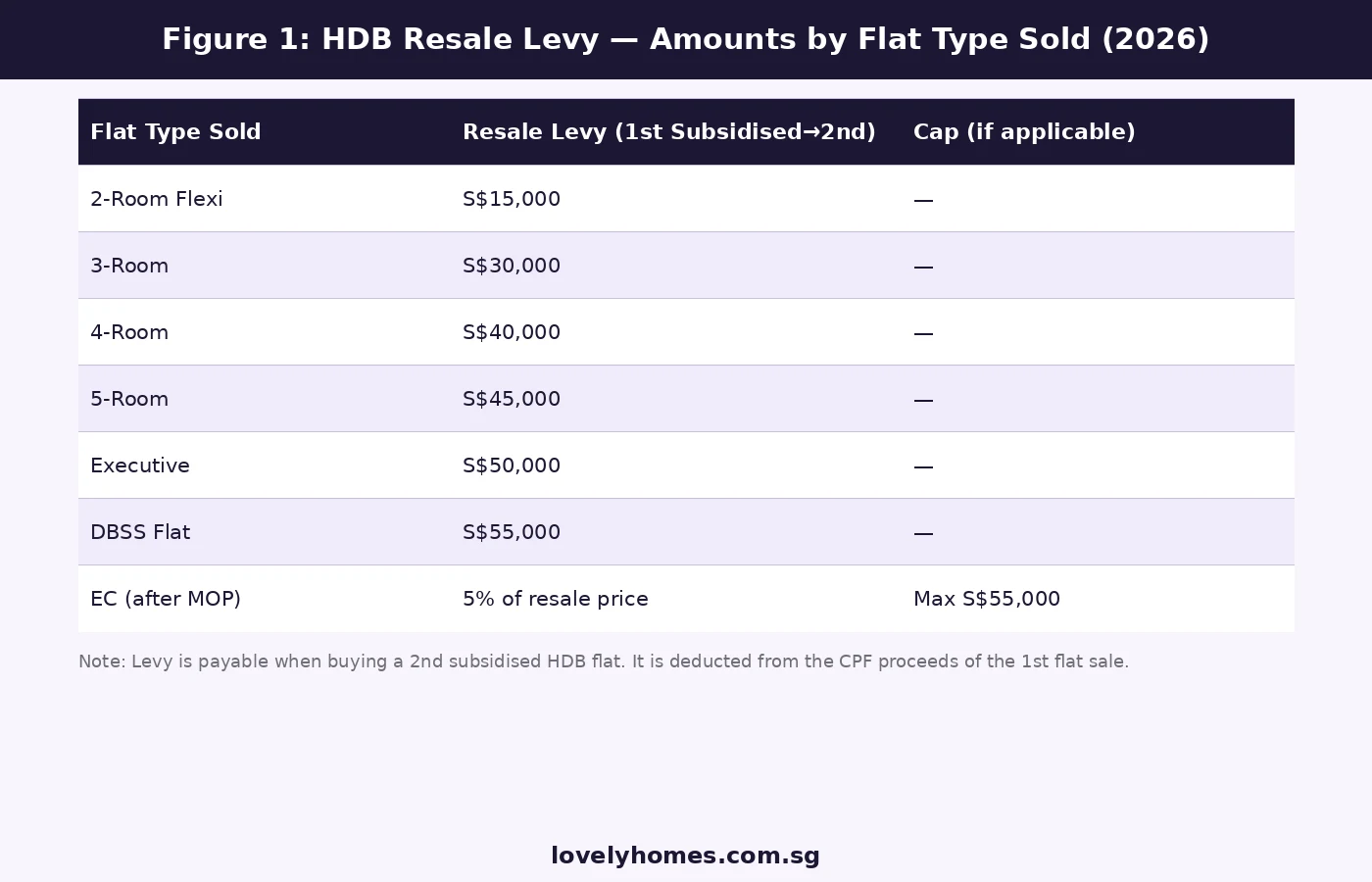
HDB resale levy amounts by flat type 2026 — S$15,000 to S$55,000 table
Figure 1: HDB Resale Levy Amounts by Flat Type Sold (2026). Fixed rates since 3 March 2006; EC applies a 5% rate with S$55,000 cap. Source: HDB Singapore.

Who Pays the HDB Resale Levy?

You are required to pay the resale levy if all three of the following conditions are met:

  1. You (or your co-applicant, spouse, or essential occupier) previously purchased a subsidised HDB flat — meaning you received a CPF Housing Grant, AHG, SHG, EHG, Step-Up CPF Grant, or bought directly from HDB at a subsidised price in a Build-To-Order (BTO) or Selective En-bloc Redevelopment Scheme (SERS) exercise.
  2. You subsequently sold that subsidised flat (or are in the process of doing so).
  3. You are now applying to buy a second subsidised flat from HDB — either a new BTO flat, a SERS flat, a Design, Build and Sell Scheme (DBSS) unit, or an Executive Condominium (EC) unit from a developer.

The key point is that the levy applies to subsidised second-time purchases only. If your second property is a private condominium, a landed home, a resale HDB flat (from the open market), or any commercial property, no resale levy is chargeable. Many upgraders mistakenly believe the levy applies whenever they buy a second property — it does not. It is specifically a tax on accessing public subsidies a second time.

Couples and Joint Applications

For married couples and joint flat buyers, the resale levy status of either party is taken into account. If either the main applicant or the co-applicant previously received a housing subsidy, the levy is applicable to the household. This prevents a household from circumventing the levy simply by swapping the person listed as main applicant on the second purchase. The rule is designed to capture the household’s cumulative subsidy benefit, not merely the individual’s.

Singles

Singles purchasing under the Single Singapore Citizen (SSC) scheme — eligible for 2-Room Flexi BTO flats — are also subject to the levy if they previously benefited from a housing subsidy. As the levy amount for a 2-Room Flexi flat is S$15,000, it is still a meaningful cost for solo buyers planning to upsize.

HDB Resale Levy Amounts (2026)

The levy amount depends on the type of flat you previously sold. Since 3 March 2006, the rates have been fixed at the following flat-type level:

Flat Type Sold (First Flat) Resale Levy Payable Notes
2-Room Flexi S$15,000 Applies to subsidised 2-Room Flexi BTO flats
3-Room S$30,000
4-Room S$40,000 Most common upgrader profile
5-Room S$45,000
Executive Flat S$50,000 HDB Executive flat (not EC)
DBSS Flat S$55,000 Design, Build and Sell Scheme (discontinued)
EC (Executive Condominium) 5% of resale price Capped at S$55,000; applies after the EC’s 5-year MOP when sold on the open market

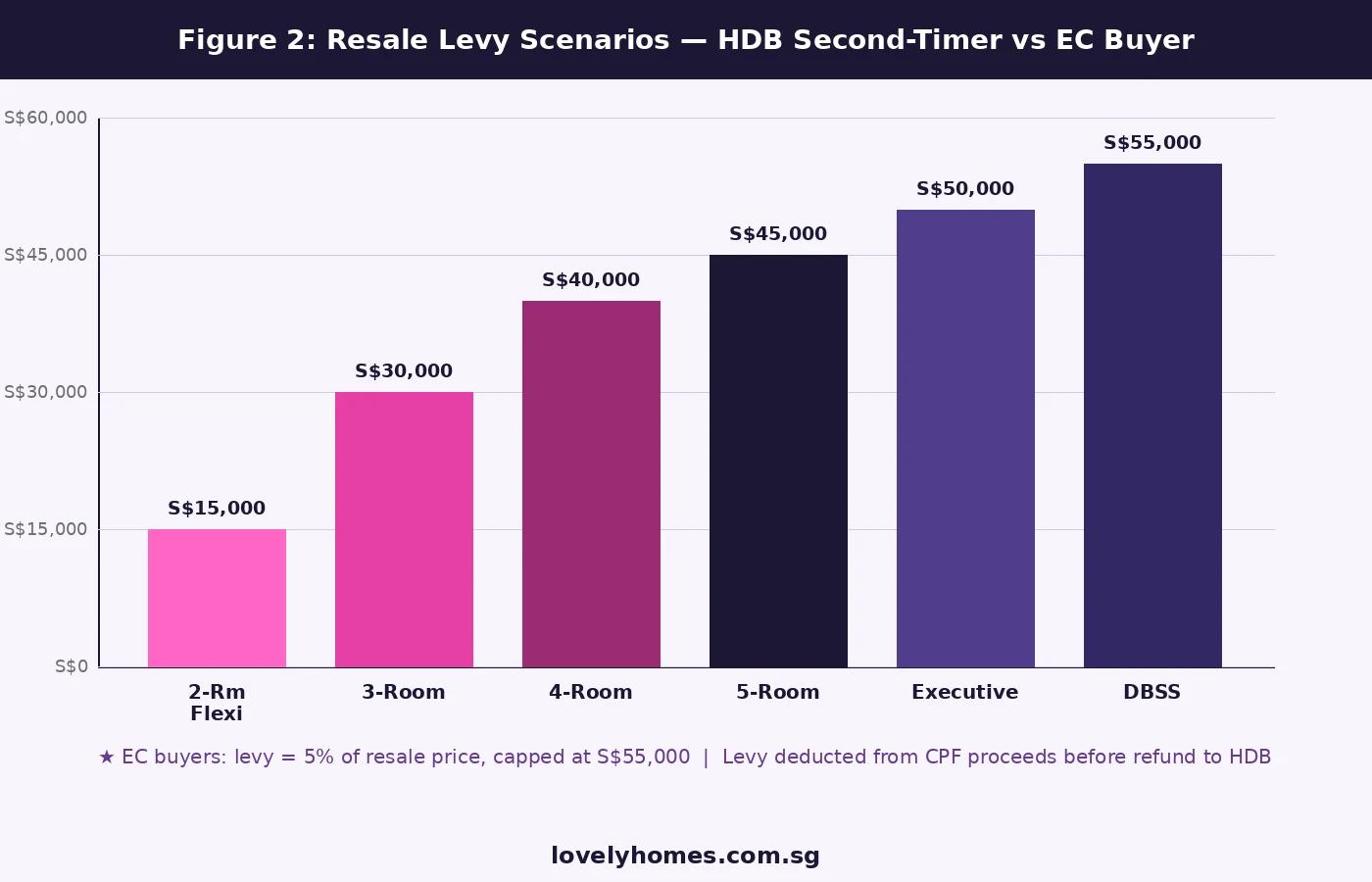
One common source of confusion is that the levy is based on the type of flat you sold, not on its resale price. Whether you sold your 4-Room flat for S$500,000 or S$900,000, the levy is always S$40,000. The EC rule is the sole exception: there the levy is 5% of the EC’s resale price (i.e. the proceeds from selling the EC), subject to a maximum of S$55,000.

HDB resale levy bar chart by flat type Singapore 2026 — S$15,000 to S$55,000
Figure 2: Resale Levy by Flat Type (2026). The levy is flat-based, not price-based — except for EC where it is 5% of resale price, capped at S$55,000. Source: HDB Singapore.

How and When Is the Resale Levy Paid?

The resale levy is settled automatically at the completion of the sale of your first flat. HDB deducts the levy amount from the CPF Ordinary Account (OA) refund you would otherwise receive when the flat sale is completed. You do not receive a separate invoice from HDB and you do not make a cash payment at any counter.

Here is how the sequence works:

  1. Apply to buy second flat: When you apply for a BTO flat or EC as a second-timer, HDB identifies your levy status at the point of application.
  2. HDB confirms levy payable: HDB notifies you of the levy amount in the appointment letter for your second flat booking.
  3. First flat sold: On the day of the legal completion of your first flat sale, the CPF Board refunds your OA principal and accrued interest as usual — but before the refund is credited to you, HDB deducts the levy amount directly from those CPF proceeds.
  4. Balance returned: The net CPF refund (after levy deduction) is credited to your OA account.

What If Your CPF Refund Is Less Than the Levy Amount?

This can happen in rare situations — for instance, if the outstanding HDB loan and CPF accrued interest together consume most of the sale proceeds. In such cases, the shortfall must be made up in cash. HDB will require you to pay the difference out-of-pocket before the second flat booking proceeds. This is one reason why financial planning ahead of an upgrade is important: always model your net CPF position against the levy amount before committing to a second BTO application.

Who Is Exempt from the HDB Resale Levy?

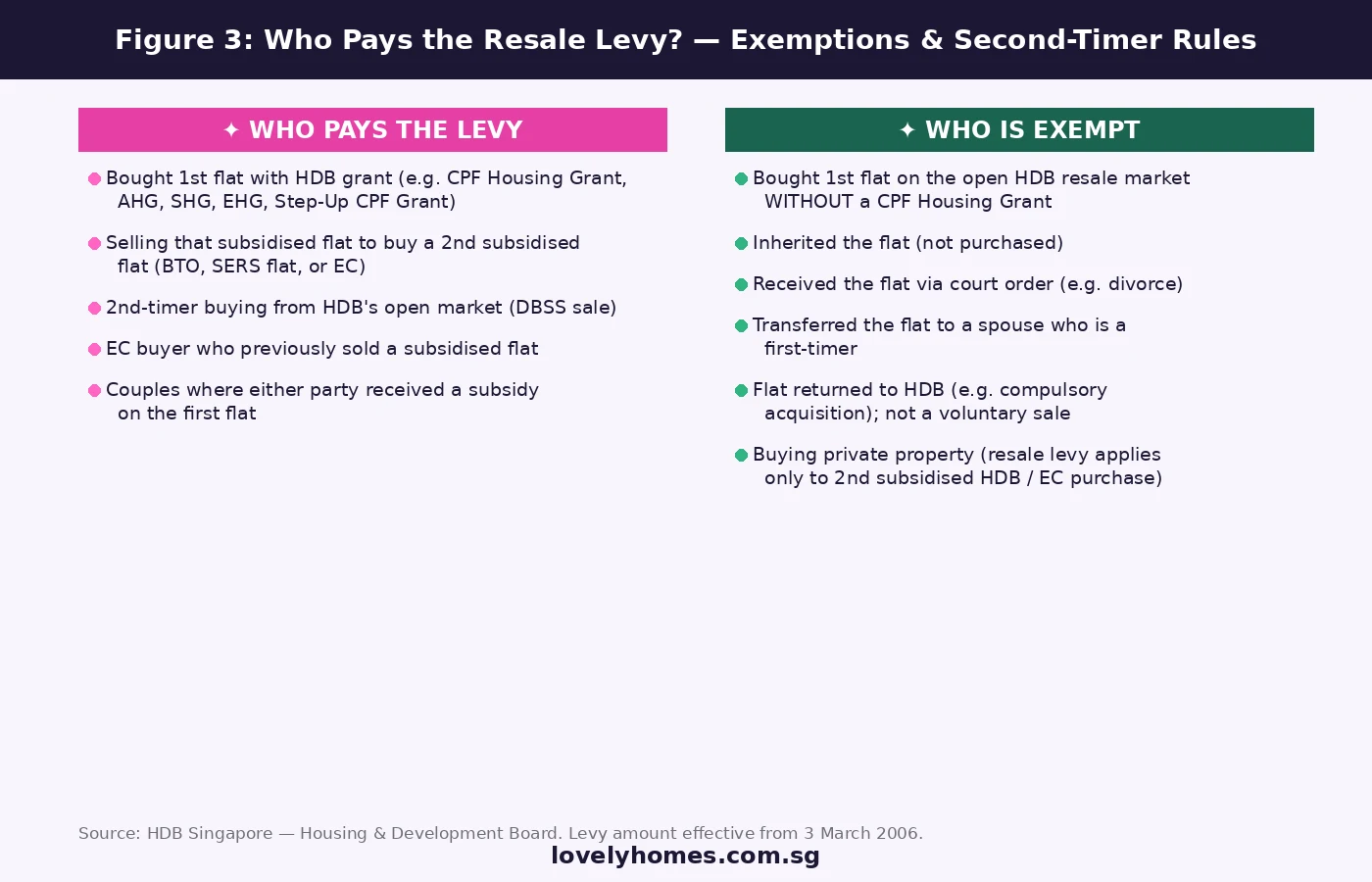
Not everyone who has previously owned an HDB flat will be required to pay the resale levy. Key exemptions include:

  • Resale flat purchased without a CPF Housing Grant: If you bought your first flat on the open HDB resale market and did not receive any CPF Housing Grant (Family Grant, Enhanced Housing Grant, Proximity Housing Grant, or any earlier-generation grant), you are not a “subsidised” flat owner for levy purposes. The levy reflects subsidy recovery — without a subsidy, there is nothing to recover.
  • Inherited flat: If the flat was left to you in a will or through intestacy, you did not receive a direct purchase subsidy, so the levy does not apply.
  • Court order transfer: Flats transferred to one party as part of a divorce settlement are generally exempt because the transfer is not a voluntary purchase attracting a subsidy.
  • Private property purchasers: The levy applies only when the second purchase is a subsidised BTO flat or EC. Upgraders to private property are not subject to the levy — though they face ABSD (Additional Buyer’s Stamp Duty) instead.
  • Flat returned to HDB involuntarily: If your first flat was compulsorily acquired by the government (e.g. for road widening or MRT works), this is not considered a voluntary sale and the levy is not triggered.

HDB resale levy exemptions and second-timer rules Singapore 2026 — who pays vs exempt
Figure 3: Who Pays vs Who Is Exempt — HDB Resale Levy 2026. Source: HDB Singapore.

Worked Example: The Tan Family’s Second BTO Application

Scenario

Mr and Mrs Tan (both Singapore Citizens) purchased a 4-Room BTO flat in Tampines in January 2019 at S$420,000, using a CPF Housing Grant of S$40,000. They have fulfilled the 5-year Minimum Occupation Period (MOP) and sell the flat in July 2026 for S$710,000.

They are applying for a new 5-Room BTO flat in Tengah at a subsidised price of S$620,000 — a second subsidised HDB purchase, making them second-timers.

Levy Calculation

Flat type sold 4-Room
Resale Levy payable S$40,000
Sale price of 1st flat S$710,000
Outstanding HDB loan (est.) S$235,000
CPF principal + accrued interest refund S$278,000
Levy deducted from CPF refund – S$40,000
Net CPF refund after levy S$238,000
Net cash proceeds S$710,000 − S$235,000 (loan) − S$278,000 (CPF) = S$197,000 cash

The Tans’ second flat purchase proceeds normally. The S$40,000 levy is handled automatically by HDB and CPF Board; neither party needs to make a separate payment. The net cash received is S$197,000, which can go toward the downpayment and costs of the new flat.

Special Situations and Edge Cases

EC Owners Selling and Buying a Second BTO

If you bought an EC (fully privatised after 10 years) and now wish to purchase a new BTO flat, you are subject to the resale levy at 5% of the EC’s resale price, subject to a maximum of S$55,000. Because EC prices have risen significantly — many ECs in mature estates now resale at S$1.2M–S$1.8M — the effective levy is almost always the capped S$55,000. For example, an EC sold for S$1.4M would attract a levy of S$70,000 in the absence of the cap; the cap holds it at S$55,000.

SERS Flat Recipients

Households that received a replacement flat under the Selective En-bloc Redevelopment Scheme (SERS) are treated as having received a housing subsidy. If they subsequently wish to buy a second new flat from HDB or an EC, the levy applies based on the type of flat they were re-housed in.

Divorce and Reassignment of Flat Ownership

When a flat is transferred to a divorced spouse under a court order, that spouse is considered a second-timer if the transferred flat was a subsidised purchase. If they later apply for a new BTO flat, the levy will apply. Seeking early legal advice on how divorce asset division affects CPF and HDB subsidy status is advisable.

Concurrent Applications

Some second-timers apply for a BTO flat while still occupying their first flat. HDB allows this — but the levy is held in reserve and deducted at the point of the first flat’s sale completion. You must sell your first flat within 6 months of collecting the keys to the second (this is the standard condition for second-timers purchasing new flats).

Why the Resale Levy Matters for Your Upgrade Strategy

The resale levy is one of several interlocking costs that second-timer households must budget for when planning an upgrade within the public housing system. It is easy to overlook because it is deducted automatically from CPF, making it feel invisible — but it directly reduces the cash and CPF resources available for your second flat.

Consider the total cost of a 4-Room BTO upgrade: beyond the flat price itself, a second-timer household must account for the Buyer’s Stamp Duty (BSD) on the new flat, legal fees, potential income grant reductions (second-timers receive smaller EHG amounts than first-timers), renovation costs, and the S$40,000 resale levy. These costs collectively can reduce the effective CPF buffer you have on hand.

In contrast, upgrading to private property involves no resale levy — but attracts ABSD of 20% as a second property purchase (if you own the HDB flat at the time of buying private, and have not yet sold it). The ABSD on a S$1.5M private property would be S$300,000 — a very different magnitude. Households navigating this choice should consider the full cost picture of each route. Our ABSD Singapore 2026 Complete Guide and HDB Upgrader Guide 2026 cover the private-property upgrade path in detail.

Frequently Asked Questions — HDB Resale Levy 2026

Q1. Can I avoid the resale levy by selling my flat before applying for the BTO?

No. Your levy status is determined by your subsidy history, not by the sequence of sale and purchase. Whether you sell before or after booking the BTO flat, the levy still applies because you previously received a CPF Housing Grant. Selling early may give you more CPF OA funds to draw on, but it does not remove the levy obligation.

Q2. My spouse is a first-timer. Does the household still pay the levy?

Yes. HDB assesses the household as a unit. If either the main applicant or co-applicant has previously received a housing subsidy, the entire household is classified as a second-timer for levy purposes. There is no mechanism to apply as a “first-timer” household if one party is a second-timer. However, in this situation, the household may be eligible for a reduced levy in some cases — consult HDB directly for your specific profile.

Q3. Is the resale levy the same as the CPF accrued interest I must return?

No — these are two completely different obligations. CPF accrued interest (at 2.5% p.a.) is the amount you owe your own CPF account for the OA savings you withdrew to pay for the flat. It is returned to your OA upon sale — you are repaying yourself. The resale levy, in contrast, is paid to HDB as a subsidy recovery charge. Both deductions happen at the point of sale, but they serve entirely different purposes and go to different places.

Q4. Can I use CPF to pay the resale levy, or must it come from cash?

The levy is deducted automatically from the CPF OA refund you receive when your first flat is sold. You do not need to arrange a separate cash payment unless your CPF refund is insufficient to cover the levy — in which case HDB will require the shortfall in cash before releasing the booking fee for your new flat. Always check your estimated CPF refund against the applicable levy amount before committing to a second BTO booking.

Q5. Does the resale levy apply if I buy an EC as a first-time EC buyer but sold an earlier subsidised flat?

Yes. If you are buying an EC and you previously sold a subsidised HDB flat, the resale levy is payable. The EC levy is the higher of: 5% of the resale price of your sold flat or (if you are selling a non-EC subsidised flat) the flat-type levy amount — unless you are selling the EC itself, in which case it is 5% of the EC’s resale price (capped S$55,000). HDB’s levy assessment letter, issued before your EC booking, will specify the exact amount applicable to your situation.

Q6. Has the HDB resale levy changed recently? Will it increase?

The flat-type levy rates have been unchanged since 3 March 2006. As at July 2026, there has been no announcement by HDB or the Ministry of National Development (MND) of any impending change to the levy framework. Given that BTO prices have risen considerably since 2006, some analysts have speculated that a levy increase is overdue — but this is speculative. Decisions on the levy are policy matters resting with MND. Monitor HDB press releases and MND Budget announcements for any changes.

Q7. What happens if I cannot sell my first flat in time to pay the levy before the second flat completion?

Second-timers purchasing a new HDB flat must generally sell their existing flat within 6 months of collecting the keys to the new flat. If you have not sold your first flat by the time you need to complete the purchase of the new flat, HDB may defer key collection or require you to arrange an interim cash payment for the levy amount. Contact HDB directly if your sale is delayed — they may grant a time extension in genuine cases, but this is not guaranteed and is assessed case by case.

Related Articles

Disclaimer: The information in this article is intended for general educational purposes only. HDB policies, levy amounts, and eligibility rules can change. Always verify current requirements directly with the Housing & Development Board (HDB), the CPF Board, and the Ministry of National Development (MND). This article does not constitute financial, legal, or property advice. Consult a licensed property agent (CEA-registered), a qualified financial adviser, or a solicitor for advice specific to your situation.

×

Click anywhere outside to close

Singapore HDB Resale Buying Process Guide 2026: Step-by-Step from HFE to Keys

Singapore HDB Resale Buying Process Guide 2026: Step-by-Step from HFE to Keys

Quick Answer: HDB Resale Buying Process 2026

  • 10 steps from eligibility check to key collection — typically 8–12 weeks end to end.
  • HFE Letter first — apply for the HDB Flat Eligibility letter before searching; it covers loan eligibility, CPF grants, and flat eligibility in one application.
  • Option to Purchase (OTP) — option fee S$1–S$1,000; 21 calendar days to exercise; exercise fee S$1–S$5,000.
  • Resale application must be submitted by both buyer and seller within 7 days of OTP exercise.
  • COV (Cash-Over-Valuation) — if you agree to pay above HDB’s valuation, the excess is cash only; CPF cannot cover it.
  • CPF grants available: EHG (up to S$80K), Family Grant (up to S$80K), Proximity Housing Grant (up to S$30K) — stackable, subject to income ceilings.
  • Administering bodies: HDB (eligibility, valuation, approval), MAS (bank loans), IRAS (BSD).

Buying an HDB Resale Flat in 2026: What Has Changed

Purchasing an HDB resale flat remains one of the most common property transactions in Singapore — approximately 27,000–30,000 resale transactions occur each year. But the process has undergone material changes since 2021, most notably the introduction of the HDB Flat Eligibility (HFE) Letter in May 2023 (replacing the prior HDB Loan Eligibility letter and CPF Housing Grant eligibility check with a single, combined application), and the 15-month wait-out period for private property owners effective 30 September 2022.

This guide walks you through every step — from confirming eligibility to collecting your keys — using the current process as at July 2026. It covers who can buy, how to finance the purchase, what grants are available, how to navigate the OTP and resale application, and what costs to budget for.

HDB resale buying process 10 steps Singapore 2026 — from eligibility check to key collection
Figure 1: The 10-step HDB resale buying process in Singapore, 2026. Typical timeline: 8–12 weeks from OTP exercise to key collection. Source: HDB.

Step 1: Confirm Your Eligibility

Before anything else, you must verify that you and your co-applicant (if any) meet HDB’s eligibility criteria for purchasing a resale flat. The key conditions are:

Citizenship: At least one applicant must be a Singapore Citizen. A Permanent Resident may co-apply, but cannot purchase alone. Singapore Citizens who already own an HDB flat may only purchase a second HDB flat if they dispose of the first within 6 months of completing the resale purchase — they cannot hold two HDB flats simultaneously.

Minimum Occupation Period (MOP): If either applicant currently owns an HDB flat, that flat must have fulfilled its MOP (typically 5 years from date of possession for standard HDB flats; 10 years for Prime or Plus classification flats) before a resale purchase can proceed.

15-Month Wait-Out Period: If either applicant currently owns, or has within the preceding 15 months disposed of, a private residential property, they must wait at least 15 months from the date of disposal before they can purchase an HDB resale flat. This measure was introduced on 30 September 2022 and applies strictly — there are very limited exemptions.

Income ceiling: There is no income ceiling for the purchase of an HDB resale flat itself. Income ceilings apply only to grant eligibility (EHG: S$9,000 household/S$4,500 single; Family Grant: S$14,000; PHG: S$14,000) and HDB loan eligibility (S$14,000 household for concessionary loan).

Step 2: Apply for the HFE Letter

The HDB Flat Eligibility (HFE) Letter, introduced in May 2023, is the single most important document you will obtain before starting your flat search. It is issued by HDB and tells you: (a) whether you are eligible to buy an HDB flat; (b) how much HDB loan you qualify for; and (c) which CPF housing grants you are eligible for and in what amounts.

You apply for the HFE Letter via the HDB Flat Portal (homes.hdb.gov.sg). Processing typically takes 21 business days for HDB loan applicants and about 14 business days if you are seeking a bank loan. The HFE Letter is valid for 6 months from the date of issue. If you plan to take a bank loan rather than an HDB loan, you should also obtain an In-Principle Approval (IPA) from your preferred bank before making an offer — banks do not issue IPAs until after you have the HFE Letter for HDB resale transactions.

HDB strongly recommends — and estate agents have been instructed — that buyers obtain the HFE Letter before signing any OTP. Signing an OTP without a valid HFE Letter exposes you to the risk of being unable to complete the transaction if your financing falls through.

Step 3: Search and Negotiate

HDB resale transactions take place primarily through the HDB Resale Portal (resale.hdb.gov.sg), where sellers list their flats, and through licensed property agents on platforms such as PropertyGuru, 99.co, and the EdgeProp portal. Unlike the BTO process, there is no ballot — you negotiate directly with the seller and agree on a price. HDB does not prescribe or cap resale prices, which are determined entirely by market forces.

Once you identify a flat, check the HDB Resale Price data (available on the HDB and URA websites) to understand recent comparable transactions. Pay attention to the Cash-Over-Valuation (COV) — if you agree to pay more than HDB’s valuation, the excess must be paid in cash only. CPF cannot fund COV. As at July 2026, the median COV in mature estates has been running at S$20,000–S$60,000 depending on flat type and floor level.

CPF housing grants HDB resale buyers 2026 — EHG Family Grant PHG stacked bar chart by buyer profile
Figure 2: CPF Housing Grants available for HDB resale buyers by buyer profile (2026). EHG = Enhanced CPF Housing Grant; FG = Family Grant; PHG = Proximity Housing Grant. Source: HDB / CPF Board.

CPF Housing Grants for HDB Resale

HDB resale buyers — particularly first-timers — may be eligible for generous CPF Housing Grants that substantially reduce their effective purchase price. These grants are paid into your CPF Ordinary Account and deducted from the purchase price at completion, reducing the amount you need to borrow.

The Enhanced CPF Housing Grant (EHG) is the most substantial: up to S$80,000 for eligible couples (household income ≤S$9,000/month) and up to S$40,000 for singles (income ≤S$4,500/month). The EHG tapers based on income — households earning S$9,000 receive no EHG, while those earning S$1,500 or below receive the full amount. The Family Grant (up to S$80,000 for SC-SC couple buying a 4-room or smaller resale flat) and the Proximity Housing Grant (PHG) (up to S$30,000 if buying within 4km of parents or children, or S$20,000 if buying in the same town) are stackable on top of the EHG, subject to their respective income ceilings of S$14,000 household income.

CPF Housing Grants for HDB Resale Buyers — Maximum Amounts (2026)
Grant Max (SC-SC Couple) Max (SC-SPR Couple) Max (SC Single) Income Ceiling Stackable?
Enhanced CPF Housing Grant (EHG) S$80,000 S$60,000 S$40,000 S$9,000/mth (couple); S$4,500 (single) Yes
Family Grant (FG) S$80,000 (4-room or smaller) S$50,000 S$14,000/mth Yes
Proximity Housing Grant (PHG) S$30,000 (same town) / S$20,000 (4km) S$30,000 / S$20,000 S$15,000 / S$10,000 S$14,000/mth Yes
Step-Up CPF Housing Grant S$15,000 (2nd-timer buying 2-room) S$7,000/mth Limited

Steps 4–6: OTP, Exercise, and Resale Application

Once you and the seller agree on a price, the seller grants you an Option to Purchase (OTP). This is a standardised HDB document (not a private OTP — HDB prescribes the form). The option fee is negotiable between S$1 and S$1,000; this sum is paid to the seller at this stage. You then have 21 calendar days to decide whether to exercise the option.

To exercise the OTP, you pay the seller the exercise fee (negotiable between S$1 and S$5,000, less the option fee already paid). You should appoint an HDB-accredited solicitor at this point — HDB-approved conveyancing firms handle the legal transfer and ensure all conditions are met for a valid resale application. Note that the solicitor fees for an HDB resale are regulated and relatively modest compared to private residential conveyancing.

After exercising the OTP, both the buyer and the seller must each independently submit their portions of the HDB Resale Application via the HDB Resale Portal within 7 days of the OTP exercise date. The application is rejected if either party fails to submit within this window — there are no extensions. The buyer’s portion covers loan details, CPF usage, grant applications, and identity verification; the seller’s portion covers their existing loan redemption, CPF refund computation, and property condition declaration.

Steps 7–10: Valuation, Approval, and Key Collection

After both parties submit, HDB appoints an independent valuer. The valuation report is typically issued within 5–10 business days. If the agreed resale price exceeds the valuation, the difference is the COV — the buyer must pay this entirely in cash. CPF cannot cover COV. If the resale price is at or below valuation, there is no COV issue and the full price can be funded by CPF and/or loan.

HDB then reviews the application — checking buyer and seller eligibility, loan amounts, CPF usage, and grant amounts — and issues its approval in principle (also known as the Letter of Offer for HDB loans, or confirmation of grant disbursement). This review takes approximately 4–6 weeks. Once approved, HDB sets a resale completion appointment (usually 3–5 weeks later), at which both buyer and seller sign the final transfer documents, the seller’s outstanding loan is redeemed, CPF principal and accrued interest are refunded to the seller’s CPF account, and the buyer’s grants are applied to reduce the purchase price.

At completion, the buyer pays the remaining purchase price (after deducting CPF, loan, and grants), and keys are handed over. The HDB MOP clock begins on the date of resale completion, not the date of OTP or application.

HDB resale total upfront costs 2026 — downpayment BSD legal fees by price band bar chart
Figure 3: HDB resale total upfront costs for a Singapore Citizen first-time buyer using HDB loan (80% LTV), by price band. BSD = Buyer’s Stamp Duty. Source: HDB, IRAS.

Worked Example: The Tan Family Buying a 4-Room Resale in Tampines

Mr and Mrs Tan are both Singapore Citizens, both first-timers, with a combined gross monthly income of S$7,200. They wish to buy a 4-room resale flat in Tampines. They identify a unit at S$650,000 — the HDB valuation comes in at S$630,000, meaning COV of S$20,000 in cash.

Grants: EHG: household income S$7,200 → approximately S$45,000. Family Grant (SC couple, 4-room resale): S$80,000. PHG (buying in same town as Mrs Tan’s parents): S$30,000. Total grants: S$155,000.

Financing: HDB Loan (at valuation S$630,000); HDB Loan LTV 80% = S$504,000. Monthly repayment at HDB concessionary rate 2.60% p.a. over 25 years: approximately S$2,287/month. MSR check: S$2,287 / S$7,200 = 31.8% — slightly above the 30% MSR. The loan tenure would need to be extended to 27 years to reduce the monthly payment to S$2,147 (29.8%, within MSR).

Cash required: 20% downpayment on S$630,000 = S$126,000 (CPF/cash); COV S$20,000 cash; BSD on S$650,000: first S$180K × 1% + next S$180K × 2% + balance S$290K × 3% = S$1,800 + S$3,600 + S$8,700 = S$14,100 BSD (payable from CPF); Legal fees ~S$2,500. After grants of S$155,000 applied to purchase price, effective loan reduces further. Total cash required on completion day: approximately S$20,000 COV + S$2,500 legal = S$22,500 cash. The downpayment and BSD can be funded entirely from CPF OA.

HDB Resale Buying Process: Summary Checklist

10-Step HDB Resale Buying Process — Summary for 2026
Step Action Key Deadline Portal / Body
1 Confirm eligibility (MOP, citizenship, WOP) Before everything else HDB / self-check
2 Apply for HFE Letter ~2–3 weeks processing homes.hdb.gov.sg
3 Search, view flats, check RPI and COV HFE valid 6 months resale.hdb.gov.sg / portals
4 Receive OTP from seller; pay option fee OTP valid 21 days HDB standard form
5 Exercise OTP; appoint solicitor Within 21 days of OTP HDB-accredited law firm
6 Both parties submit Resale Application Within 7 days of OTP exercise resale.hdb.gov.sg
7 HDB valuation issued ~5–10 business days HDB-appointed valuer
8 HDB resale approval ~4–6 weeks HDB
9 Completion appointment: sign & pay ~3–5 weeks after approval HDB Hub / solicitor
10 Key collection; MOP clock starts Completion date HDB

Why the HFE Letter Changed the Process

Before May 2023, buyers had to separately apply for an HDB Loan Eligibility (HLE) letter (for loan quantum) and individually check grant eligibility through the CPF Board. These were separate processes with separate documentation requirements. The HFE Letter consolidated all three determinations — eligibility to buy, loan quantum, and grant amounts — into a single application with Myinfo integration that pre-populates most fields from government databases. This has reduced the administrative burden significantly and means that by the time a buyer reaches Step 3 (searching for a flat), they already have a comprehensive view of their purchasing power.

The practical implication is that the HFE Letter has become the de facto pre-qualification document for HDB resale transactions. Sellers and their agents increasingly request to see it before entertaining an offer — much like how banks request an IPA before accepting a purchase offer in private transactions. Buyers who have not yet obtained their HFE Letter are at a disadvantage in competitive situations.

What Might Change: HDB Resale in 2H 2026

This section is analytical and speculative; it does not represent government policy.

HDB resale prices fell by 0.3% in Q2 2026 — the second consecutive quarterly decline. Volumes were also down approximately 10% year-on-year. The moderation has been attributed to a combination of the 15-month wait-out period (removing a significant pool of upgrader demand), the large cohort of BTO completions in 2025–2026, and higher mortgage rates. If the moderation continues through 2H 2026, there may be political pressure to consider relaxations such as easing the wait-out period for specific buyer segments or adjusting the EC income ceiling to divert some demand from the resale market. These are speculative — HDB has not signalled any imminent changes. Full Q2 2026 resale transaction data is expected from HDB around 23 July 2026.

Frequently Asked Questions

Do I need to sell my current HDB flat before buying a resale?

You cannot own two HDB flats simultaneously (with limited exceptions for concurrent subletting). If you own an HDB flat and wish to buy a resale flat, you must either sell the existing flat within 6 months of the new resale completion, or ensure the existing flat’s MOP has been met and proceed under HDB’s approved conditions. Singapore Citizens who own a private property and wish to buy an HDB resale must also comply with the 15-month wait-out period from the date of disposing of the private property.

What is Cash-Over-Valuation (COV) and how much should I budget?

COV is the difference between the agreed resale price and HDB’s valuation of the flat. It must be paid entirely in cash — it cannot be covered by CPF, grants, or loans. As at mid-2026, COV in mature estates such as Tampines, Bishan, and Toa Payoh typically ranges from S$20,000 to S$80,000 for 4-room and 5-room flats, with premium units (high floors, well-maintained, near MRT) attracting COV at the upper end or beyond. In non-mature estates, COV is generally lower or even nil. Budget at least S$20,000–S$40,000 in liquid cash specifically for potential COV when considering a mature estate purchase.

Can I use CPF to pay BSD for an HDB resale flat?

Yes. Buyer’s Stamp Duty for an HDB resale flat can be paid from your CPF Ordinary Account. The BSD is assessed on the higher of the purchase price or valuation. For a flat priced at S$650,000 (with valuation at S$630,000), BSD is assessed on S$650,000: 1% on first S$180,000 + 2% on next S$180,000 + 3% on balance S$290,000 = S$14,100. This amount can be deducted from your CPF OA balance and paid directly to IRAS by your conveyancing solicitor. Note that Additional BSD (ABSD) does not apply to most HDB resale purchases by first-time buyers.

My HFE Letter has expired. Can I still exercise the OTP?

No — a valid HFE Letter is required at the point of submitting the HDB Resale Application (Step 6). If your HFE Letter expires before you submit the application, you will need to apply for a fresh one. The HFE Letter is valid for 6 months from the date of issue. Given that the HDB resale process from HFE application to key collection can take 3–6 months in total, it is best to time your HFE application so it remains valid through to at least the expected date of resale application submission. If you expect to search for a flat for several months, consider applying for the HFE Letter approximately 2–3 months before you plan to make serious offers.

Is a property agent required to buy an HDB resale flat?

No. HDB’s resale portal (resale.hdb.gov.sg) is designed to allow buyers and sellers to transact directly without agents. HDB provides standard OTP forms, step-by-step guided submissions, and appointment scheduling through the portal. That said, many buyers choose to engage a licensed property agent for negotiation support, flat search assistance, and procedural guidance — particularly first-timers unfamiliar with the process. If you engage an agent, ensure they hold a valid CEA practitioner licence. Agent commission for a buyer is negotiable; it is often 1% of the purchase price, sometimes waived or subsidised by the co-broking arrangement with the seller’s agent.

What happens if I back out after exercising the OTP?

Once you exercise the OTP, you are legally bound to complete the purchase on the agreed terms. If you withdraw after exercising, the seller is entitled to forfeit your option and exercise fees and may seek further damages depending on the circumstances. Unlike private residential transactions (which involve a more complex contractual structure under the Sale and Purchase Agreement), HDB resale OTPs are relatively straightforward — but the principle of contractual commitment applies equally. If you are genuinely uncertain about proceeding, it is better to let the OTP lapse (forfeiting only the option fee of up to S$1,000) rather than exercise it and then withdraw.

Related Articles

Disclaimer

This article is for general informational purposes and does not constitute legal, financial, or professional advice. HDB eligibility rules, CPF grant amounts, loan limits, and stamp duty rates are subject to change. All figures cited are accurate as at 3 July 2026. Readers should verify current rules with HDB (hdb.gov.sg), IRAS (iras.gov.sg), MAS (mas.gov.sg), and the CPF Board (cpf.gov.sg) before making any decisions. LovelyHomes is not a licensed property agent, financial adviser, or legal practitioner.

Translate »