Singapore HDB Minimum Occupation Period (MOP) 2026: Complete Guide — Rules, Restrictions and Upgrade Options

Singapore HDB Minimum Occupation Period (MOP) 2026: Complete Guide — Rules, Restrictions and Upgrade Options

Quick Answer: HDB MOP Singapore 2026

  • Standard HDB BTO and resale flats have a 5-year Minimum Occupation Period (MOP) counted from the date you collect the keys (TOP/possession date), not from when you sign the Sales & Purchase agreement.
  • Plus and Prime (PLH) classification flats introduced from the August 2024 BTO exercise have a longer 10-year MOP, reflecting their more desirable locations and heavier subsidy.
  • During MOP, you cannot sell your flat, rent out the entire flat, or purchase any other residential property in Singapore — including private property or an overseas residential investment.
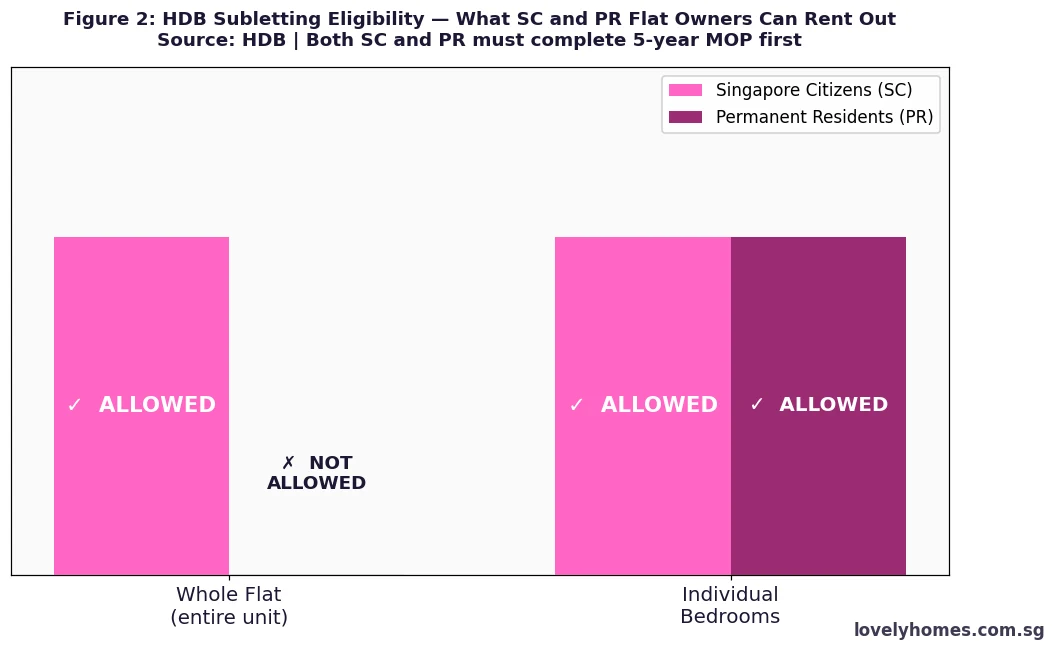
  • You CAN rent out individual HDB bedrooms with prior HDB approval, and run approved home-based businesses from your flat during MOP.
  • Executive Condominiums (ECs) have a 5-year MOP before they can be sold to Singapore Citizens and PRs, and a 10-year window before they are fully privatised and open to foreign buyers.
  • Breaching MOP rules can result in compulsory acquisition of the flat by HDB at a value set by HDB — typically below market value. Criminal penalties may also apply under the Housing & Development Act.
  • After MOP, you can sell the flat, upgrade to a private property, and — for HDB sellers upgrading to private — apply for ABSD remission if you complete the sale within 6 months of purchasing the private property.

What Is the HDB Minimum Occupation Period (MOP)?

The Minimum Occupation Period (MOP) is a statutory rule administered by the Housing & Development Board (HDB) that requires flat owners to physically occupy their HDB flat for a minimum period before they can sell it on the open market, rent it out entirely, or purchase other residential property in Singapore. The MOP is a key plank of Singapore’s public housing philosophy: HDB flats are subsidised national assets intended primarily as homes rather than investment vehicles, and the MOP is one mechanism through which HDB ensures flats remain owner-occupied.

The MOP was first introduced in the 1970s and has been refined multiple times since, most recently in 2024 with the introduction of the Plus and Prime flat classifications under the enhanced HDB framework. Understanding which MOP applies to your flat — and what you can and cannot do during that period — is critical before making any property decisions.

HDB MOP by flat type Singapore 2026 — Standard 5 years, Plus and Prime 10 years, EC 5 then 10 years
Figure 1: HDB Minimum Occupation Period by flat type, Singapore 2026. Plus and Prime classification flats (introduced from August 2024 BTO exercise) carry a 10-year MOP, double the Standard flat MOP. Source: HDB.

MOP Duration by Flat Type (2026)

Flat Type MOP Duration MOP Start Date Notes
Standard BTO Flat 5 years Date of key collection Applies to all pre-Aug 2024 BTO; continued for Standard classification from Aug 2024
Plus Classification BTO Flat 10 years Date of key collection From Aug 2024 BTO exercise; typically near MRT/town centres; subsidy clawback on resale
Prime / PLH Classification BTO Flat 10 years Date of key collection Central-location flats; subsidy clawback ~6–9% of resale price; income ceiling at resale
HDB Resale Flat 5 years Date of resale completion Fresh 5-year MOP runs from the date the resale transaction is completed (not from when the previous owner moved in)
Executive Condominium (EC) 5 years → 10 years Date of TOP At 5yr can sell to SC/PR; at 10yr fully privatised — open to foreigners (60% ABSD applies)
HDB Sale of Balance Flats (SBF) 5 years Date of key collection SBF flats unsold from previous BTO exercises; Standard classification MOP applies

Important note on the Plus and Prime MOP: The new 10-year MOP for Plus and Prime flats applies only to flats launched under the August 2024 BTO exercise onwards. Flats purchased in earlier exercises, even if they are in desirable locations that would now be classified as Plus or Prime, retain their original 5-year MOP. To confirm which classification applies to your flat, check your HDB flat portal or the original flat details under your BTO exercise.

What You Cannot Do During the HDB MOP

HDB MOP rules matrix 2026 — what you can and cannot do during the minimum occupation period
Figure 2: HDB MOP rules — allowed and prohibited activities during the Minimum Occupation Period. Source: HDB Housing & Development Act.

Selling the Flat

You cannot sell your HDB flat on the open resale market before your MOP is complete. This applies even if you face financial hardship — HDB does not grant MOP exemptions for distressed sellers. The only exception is a compulsory acquisition by HDB or by the State for public purposes, which is not initiated by the flat owner. If you attempt to sell before MOP, the transaction will be rejected by HDB’s system during the eligibility check.

Renting Out the Entire Flat

Renting out the entire flat (as a whole unit) is not allowed during MOP. This applies to both short-term and long-term rental arrangements. Platforms such as Airbnb and similar short-term rental services are also not permitted on HDB flats — the minimum lease tenure for any rental on HDB flats is three consecutive months. After MOP, whole-flat rental is allowed with HDB prior approval and is subject to the non-Malaysian foreign tenant quota.

Purchasing Other Residential Property in Singapore

During MOP, you and your co-owners on the flat cannot purchase any other private residential property in Singapore. This restriction extends to new launch condominiums, resale condominiums, Executive Condominiums (as a new buyer), landed property, and private apartments. Purchasing a second HDB flat is also not allowed during MOP.

Crucially, HDB’s definition of “residential property” in the MOP context refers to Singapore property only. There is no restriction on purchasing overseas residential property during MOP — only Singapore residential property is covered.

Purchasing a Second HDB Flat

HDB’s policy generally allows only one HDB flat per family nucleus at any time. Applying for a second BTO, SBF, or resale flat during MOP is not permitted. Once MOP is fulfilled, you may apply for a second HDB flat under specific schemes (e.g., the Studio Apartment scheme for elderly, or a new BTO after disposing of the first flat).

What You CAN Do During the HDB MOP

Rent Out Individual Rooms

Renting out individual bedrooms in your HDB flat (while you continue to live in the flat) is permitted during MOP, subject to HDB’s prior written approval. You must apply through the HDB Flat Portal before subletting. Each tenancy must be for a minimum of six months (for whole-flat subletting after MOP) or at least three months for room rental. Non-Malaysian foreign tenants are subject to the non-Malaysian quota: a maximum of two non-Malaysian foreign tenants per flat in the same block is the guideline, though HDB publishes real-time quota data by block.

Run Approved Home-Based Businesses

HDB permits flat owners to operate home-based businesses during MOP, subject to type and scale restrictions. Category 1 businesses (no employees visiting, no clients visiting, no signage) are allowed without prior approval. Category 2 businesses (up to two non-resident employees, clients may visit in small numbers) require prior approval from HDB. Manufacturing, food businesses, or any business that involves goods storage, noise, or frequent deliveries is not permitted.

Refinance to a Bank Loan

Switching from an HDB housing loan to a bank loan (or switching between bank loan packages) is allowed during MOP. There is no MOP restriction on refinancing decisions, and many flat owners take advantage of the 5-year MOP period to monitor interest rate movements and refinance when rates are favourable. MAS’s LTV and TDSR rules govern the refinancing terms.

When Does the MOP Start and End?

The MOP starts from the date you collect your keys (for BTO and SBF flats, this is the TOP date; for resale flats, this is the date of completion of the resale transaction — both milestones are reflected in your HDB Flat Portal). The MOP does not start from the date you sign the Sales & Purchase Agreement or from the date you pay the initial booking fee.

You can check your MOP end date in the HDB Flat Portal under “My Flat” → “Purchase Details”. The portal clearly shows whether your MOP has been fulfilled. Do not rely on verbal estimates from agents or CPF advisers — always verify on the portal directly.

One nuance: physical occupation is expected during MOP. HDB conducts periodic checks to ensure flat owners are residing in the flat. Extended overseas absences without HDB’s knowledge have been cited in compulsory acquisition cases. If you must be overseas for an extended period (e.g., for work), inform HDB and keep the flat in a lived-in condition.

Executive Condominium (EC): The Hybrid MOP Rules

Executive Condominium EC MOP and privatisation timeline Singapore 2026 — 5-year and 10-year milestones
Figure 3: Executive Condominium MOP and privatisation timeline. During the first 5 years, EC owners face HDB-equivalent MOP restrictions. At the 5-year mark, ECs can be sold on the open market to SC and PR buyers. At 10 years, ECs are fully privatised and open to foreign buyers (60% ABSD applies). Source: HDB, URA.

Executive Condominiums occupy a hybrid position between public and private housing. They are built by private developers but are sold at a subsidised price to qualifying buyers (income ceiling S$16,000 per month household income as of 2026). From a MOP standpoint, ECs are treated like HDB flats for the first 5 years:

During years 1–5: EC owners cannot sell their unit, rent out the whole unit, or purchase any other Singapore residential property. The rules are identical to HDB MOP. Critically, the 5-year MOP runs from the TOP date, not the booking date — for large EC projects, this can mean a 3–4 year gap between booking and TOP, followed by 5 more years of MOP, making the effective holding period 8–9 years from initial purchase commitment.

After year 5 (first privatisation): The EC can be sold on the open resale market to Singapore Citizens and Singapore PRs. It cannot yet be sold to foreigners, and ECs in the first 5–10 year window are not listed on the private market as “privatised condos” — they trade in a narrower SC/SPR market. ABSD rules for the buyer apply (5% for PR 1st property, 30% for PR 2nd+, etc.).

After year 10 (full privatisation): The EC is fully privatised and treated identically to a private condominium. Foreigners may purchase it, though the 60% foreigner ABSD applies. Owners may also rent the entire unit without prior HDB approval at this stage.

Plus and Prime Flat Additional Restrictions After MOP

The 2024 housing framework introduced substantive additional conditions for Plus and Prime classification flats beyond just the longer 10-year MOP. These are restrictions that run with the flat even after MOP and affect future resale:

Subsidy clawback: When you sell a Plus or Prime flat after your MOP, HDB claws back a portion of the subsidy embedded in the original purchase price — approximately 6–9% of the resale price, payable to HDB. This clawback is calculated as a percentage of the resale transaction price, not the original purchase price, so it increases in dollar terms as the flat appreciates.

Income ceiling for buyers: Buyers of Plus and Prime resale flats are subject to an income ceiling (the ceiling is the same as for BTO buyers — S$14,000/month for 4-room and larger Plus flats as of 2026). This narrows the pool of eligible resale buyers and may dampen price appreciation relative to Standard flats.

Ethnic Integration Policy (EIP): As with all HDB resale flats, EIP quotas apply — both block and neighbourhood levels. Buyers must check the relevant block’s EIP availability before submitting an offer.

After MOP: Your Property Upgrade Options

Once your MOP is fulfilled, your options expand significantly. The most common upgrade path is from HDB flat to private condominium. The timing of this upgrade carries stamp duty implications:

Option A — Sell HDB first, then buy private: You clear the HDB flat, receive sale proceeds (net of CPF refund), and purchase the private property as a “first property” — no ABSD for SC buyers, 5% ABSD for PR buyers. This is the most common and financially efficient path but requires temporary accommodation between the two transactions.

Option B — Buy private first, then sell HDB (concurrent ownership): As an SC buying private property while still owning an HDB flat (post-MOP), you pay 20% ABSD on the private property purchase. You then have six months from the private property’s completion (or from the purchase date for resale private properties) to sell the HDB flat and apply for an ABSD remission from IRAS. If the HDB is sold within six months, IRAS refunds the 20% ABSD. If you miss the six-month window, the 20% ABSD is forfeited.

The six-month window starts from either the issue of Temporary Occupation Permit (TOP) for a new private property or the date of exercise of the OTP for a resale private property. Given the complexity of timing, many HDB upgraders consult a lawyer and financial adviser before committing to Option B.

The 15-Month Wait-Out Period: From Private Back to HDB

The wait-out period is often confused with MOP. They are different rules targeting different situations. The 15-month wait-out period (introduced in September 2022) applies to private property owners who want to purchase an HDB resale flat. If you own or recently disposed of a private property, you must wait 15 months from the date of disposal before you can purchase an HDB resale flat.

This rule does not apply to HDB MOP — it is a separate downstream restriction. For example, if you complete your HDB MOP, sell your HDB flat, buy a private condo, and then later want to downgrade back to HDB, you must wait 15 months after selling the private condo before buying an HDB resale flat. This rule applies to both SC and PR private property owners.

Worked Example: The Tan Family’s Upgrade Journey

Mr and Mrs Tan (both Singapore Citizens) purchased a 4-room BTO flat in Punggol under the Standard classification in September 2019. They collected their keys in August 2021. Their MOP end date is therefore August 2026 — five years from key collection.

In March 2026, Mrs Tan checks the HDB portal and sees MOP will end in 5 months. The couple begin their private condo search. They find a 3-bedroom OCR resale condo in Jurong East priced at S$1.5M in June 2026.

They choose Option B (buy private first). As SC buying a second property: BSD ~S$42,600 + ABSD 20% = S$300,000. They pay S$342,600 in stamp duties. Their flat is still within MOP (keys August 2021, MOP August 2026 — they are just before MOP end), so HDB must confirm MOP end before they list the flat for sale.

After August 2026 (MOP fulfilled), they list their HDB flat. Sell it in October 2026 for S$780,000 — within the 6-month window from the condo OTP exercise date of June 2026. IRAS refunds the S$300,000 ABSD. Net stamp duty retained: S$42,600 BSD only. The family books temporary accommodation for 2 months while bridging the purchase and sale timelines.

Total net proceeds from HDB: S$780,000 − CPF refund S$220,000 (principal + accrued interest) − agent 1% S$7,800 − legal S$2,500 = net S$549,700 cash. The upgrade is financially viable.

Will MOP Rules Change?

The 10-year MOP for Plus and Prime flats is a relatively recent policy (from August 2024) and unlikely to be rolled back in the near term. If anything, the trend in Singapore public housing policy has been toward tightening MOP and adding post-MOP conditions rather than relaxing them, as the government works to ensure HDB flats remain primary homes rather than investment properties. The subsidy clawback mechanism for Plus and Prime flats may be extended to more flat types if HDB determines that Standard flat resale prices are diverging too sharply from BTO prices in certain areas. Buyers should model their long-term exit strategy under current rules and build in buffer for possible tightening.

Frequently Asked Questions

Can I stay overseas during my HDB MOP?

You are expected to physically occupy the flat during MOP, but there is no absolute rule against overseas travel. Extended absences (months or years) without HDB’s knowledge can attract scrutiny, and in confirmed cases of non-occupation, HDB may commence compulsory acquisition proceedings. If you need to relocate overseas temporarily for work (e.g., on a company secondment), inform HDB in writing and keep the flat utilities active. HDB conducts inspection exercises and spot checks and has compulsorily acquired flats where owners were clearly not residing in them during MOP.

Does my MOP reset if I add or remove an owner from the flat?

No — adding or removing an owner (for example, through marriage or divorce) does not reset the MOP clock. The MOP continues to run from the original key collection date. However, any change of ownership within MOP is a restricted transaction and must be approved by HDB. Not all ownership changes are approved during MOP — for example, transferring a flat to an ineligible person would be rejected. Consult HDB or a lawyer before any ownership change within the MOP window.

Can I buy an overseas investment property during MOP?

Yes. The HDB MOP restriction applies only to Singapore residential property. There is no restriction on purchasing overseas property (residential or commercial) during MOP. You are not required to declare overseas property purchases to HDB. However, if you are financing an overseas property purchase with a Singapore bank loan, that loan will be factored into your TDSR for future Singapore loan applications. From a Singapore tax perspective, rental income from overseas property is taxable in Singapore as foreign-sourced income if remitted to Singapore.

What happens if I breach the MOP?

A breach of MOP (typically: selling the flat, subletting the entire flat, or buying other residential property in Singapore without completing MOP) can result in HDB compulsorily acquiring the flat. HDB sets the acquisition price, which is typically the assessed market value minus a penalty deduction — in practice, this means the owner receives significantly less than the open-market value they would have received after MOP. In the most serious cases involving deliberate deception or fraud (e.g., falsely declaring occupancy), criminal charges may be brought under the Housing & Development Act, which carries fines of up to S$5,000 and/or imprisonment.

Does MOP apply to inherited HDB flats?

If you inherit an HDB flat from a deceased owner, the MOP of the original owner does not transfer to you as a fresh 5-year obligation. Instead, the inherited flat is subject to HDB’s estate rules — the eligible inheritor (e.g., a spouse or child who meets eligibility criteria) may retain the flat. If the inheritor already owns a flat, they may need to dispose of one within six months. Inherited flats that have not yet met MOP at the time of death are subject to HDB’s direction — in practice, HDB often allows the eligible inheritor to complete the remaining MOP. Always consult HDB’s estate administration team for inherited flat cases.

Can I buy a private property if my HDB is still within MOP and my spouse is not on the HDB title?

No — the restriction applies to the entire family nucleus (owner and spouse / co-habitant), not just the named owners on the HDB title. If one spouse is within MOP on an HDB flat, the other spouse (even if not on the HDB title) is also restricted from purchasing Singapore residential property. HDB looks at the family nucleus holistically. Attempting to buy private property in a non-owning spouse’s name to circumvent MOP is a known scheme that HDB and IRAS are alert to — it will be scrutinised and may result in both the stamp duty assessment and a referral for investigation.

Is there a MOP for HDB shophouses or commercial units?

No. MOP is specific to HDB residential flat units. HDB shophouses (commercial properties on the ground floor of HDB blocks) are governed by different rules and do not carry a MOP. Commercial properties generally do not have any MOP equivalent — you can sell or rent them freely at any time after purchase. The restrictions and ABSD rules that apply to residential property do not apply to commercial property purchases.

Related Articles

Disclaimer

This article provides general information about HDB MOP rules as at July 2026 and is not legal or financial advice. MOP durations, clawback percentages, and related policy conditions may change. Always verify current MOP status for your flat at hdb.gov.sg and check the specific BTO exercise details in your Lease Agreement. For estate planning, inheritance, and structural ownership changes, consult a Singapore-qualified lawyer. For ABSD remission eligibility, consult IRAS at iras.gov.sg.

HDB CPF Housing Grant Guide 2026: EHG, Family Grant, Step-Up, PHG and Singles Grant Explained

HDB CPF Housing Grant Guide 2026: EHG, Family Grant, Step-Up, PHG and Singles Grant Explained

×

Click outside or press Esc to close

For most Singaporeans, the CPF Housing Grant system is the single most valuable financial lever available when buying an HDB flat. The right grant — or combination of grants — can reduce the purchase price by S$30,000 to S$160,000 and cut the cash outlay needed at the point of sale dramatically. Yet many buyers remain unclear about which grants they qualify for, how the grants interact, and what happens when eligibility conditions change before completion. This guide covers every HDB CPF Housing Grant available in 2026: the Enhanced CPF Housing Grant (EHG), Family Grant, Step-Up CPF Housing Grant, Proximity Housing Grant (PHG), and the Singles Grant — with full eligibility tables, income ceiling rules, and a worked example.

Quick Answer — HDB Grants at a Glance (2026)

  • The Enhanced CPF Housing Grant (EHG) provides up to S$80,000 for first-timer SC couples buying BTO or resale flats (income ceiling S$9,000/mth).
  • The Family Grant provides S$80,000 (SC couple, BTO) to S$50,000 (resale), on top of EHG — making combined grants up to S$160,000 for qualifying couples.
  • The Step-Up CPF Housing Grant gives second-timer SC families S$15,000 towards a 4-room or smaller BTO flat.
  • The Proximity Housing Grant (PHG) provides S$30,000 (living with) or S$20,000 (living near) parents or child — for resale buyers.
  • The Singles Grant gives eligible single SC applicants aged ≥35 up to S$25,000 towards a resale flat or S$25,000 for a 2-room BTO.
  • All grants are administered by HDB and applied via the HDB Flat Portal (homes.hdb.gov.sg) — not through the CPF Board directly.
  • Grants offset the purchase price and reduce the HDB loan quantum required; they are not paid in cash to the buyer.

What Are HDB CPF Housing Grants and Who Administers Them?

HDB CPF Housing Grants are subsidies provided by the Housing and Development Board (HDB) under Singapore’s public housing policy. Despite the “CPF” label, the grants are designed and administered entirely by HDB; the Central Provident Fund (CPF) Board plays a secondary role in that CPF Ordinary Account (OA) savings may be used to fund the portion of the flat price not covered by grants. The grants exist because HDB’s policy mandate — set by the Ministry of National Development (MND) — is to ensure that public housing remains affordable across a wide income range. Grants are structured to taper off as household income rises, so they provide the greatest assistance to lower-income first-time buyers.

Importantly, grants are credited directly to reduce the flat’s purchase price or loan quantum — they are never paid to buyers in cash. This means they reduce the amount you borrow (and therefore the interest you pay over the loan tenure) rather than arriving as a lump sum in your bank account. Understanding this distinction is critical when doing upfront cost planning.

Grant Amounts by Household Income — EHG and Family Grant

HDB CPF Housing Grant EHG and Family Grant amounts by household income 2026
Figure 1: Enhanced CPF Housing Grant (EHG) and Family Grant amounts by average household income — HDB BTO, SC couple first-timer, 2026. Source: HDB.

The EHG is the largest single grant available and applies across a wide income spectrum. Its key feature is that the grant amount decreases as income rises, in S$5,000–S$10,000 steps, from a maximum of S$80,000 for couples earning S$1,500 per month or less, stepping down to S$5,000 for couples earning between S$8,500 and S$9,000 per month. Couples with a gross monthly income above S$9,000 do not qualify for the EHG. Importantly, “household income” for grant purposes is the average gross monthly income of all working persons listed on the flat application, typically the two applicants and any occupants who are working.

Grant Eligibility Matrix — Who Qualifies for What

HDB CPF Housing Grant eligibility matrix 2026 — EHG Family Grant Step-Up PHG Singles
Figure 2: HDB CPF Housing Grant eligibility matrix — key buyer profiles versus grant type (2026). Source: HDB Grant Guide.

The matrix above illustrates how grants are layered across buyer profiles. An SC couple buying a BTO as first-timers can potentially stack the EHG (up to S$80,000) and the Family Grant (S$80,000), for a combined S$160,000 grant — the maximum available under any HDB grant combination. SC/SPR mixed-citizenship couples receive the Family Grant at a lower quantum (S$60,000 for BTO; S$50,000 for resale) and are eligible for the EHG, but at the EHG rate applicable to the SPR-tier income rules. Singles aged 35 and above receive a dedicated Singles Grant and are eligible for a scaled-down EHG.

Deep Dive: The Five Main HDB Grants in 2026

1. Enhanced CPF Housing Grant (EHG)

The EHG replaced the Additional CPF Housing Grant (AHG) and Special CPF Housing Grant (SHG) in September 2019. It is the most broadly applicable grant and covers both BTO and resale applications. Key conditions include: both applicants must have worked continuously for at least 12 months before the application date; the flat must not exceed a purchase price ceiling (for resale, the flat must be valued within the HDB resale price cap for the flat type and town); and applicants must not currently own or have disposed of private residential property within 30 months of application. The EHG applies regardless of flat type or location — a unique feature distinguishing it from the old SHG, which was restricted to non-mature estates.

2. Family Grant (BTO and Resale)

The Family Grant is citizenship-tiered and applies on top of the EHG. For SC-SC couples purchasing a new BTO flat, the Family Grant is S$80,000 regardless of income (subject to the S$14,000/mth income ceiling). For SC-SPR couples, the BTO Family Grant is S$60,000. For resale purchases, the quantum is S$50,000 (SC-SC) or S$40,000 (SC-SPR). The Family Grant can also be claimed by first-timer applicants who are singles applying under the Joint Singles Scheme, though the quantum is halved. There is no separate income ceiling for the Family Grant beyond the general resale/BTO eligibility income ceiling of S$14,000 per month gross household income.

3. Step-Up CPF Housing Grant

The Step-Up Grant is specifically for second-timer SC families — meaning applicants who previously owned or occupied an HDB flat, received a housing subsidy (including previous BTO application grant), or are currently living in a subsidised rental flat. The grant amount is S$15,000 and applies only to the purchase of a 4-room or smaller BTO flat. It is HDB’s way of facilitating the upgrading or right-sizing journey for mature families, while channelling the most significant grants to genuine first-timers. The income ceiling is S$7,000 per month.

4. Proximity Housing Grant (PHG)

The PHG is unique in that it is available for resale flat purchases only — it does not apply to BTO. It rewards buyers who choose to live near their parents or adult children. The quantum is S$30,000 if you buy a resale flat to live with parents or an unmarried child, and S$20,000 if you buy within 4 km of parents or a married child’s home. PHG can be combined with the EHG and Family Grant for resale purchases, making it a powerful stacking grant for families with a proximity reason to choose resale over BTO. There is no income ceiling for the PHG — it is available across all income levels subject to basic HDB eligibility.

5. Singles Grant

The Singles Grant is available to SC singles aged 35 and above applying for a 2-Room Flexi BTO flat or a resale flat. The quantum is S$25,000 for resale (4-room or smaller) and a scaled-down EHG for 2-Room Flexi BTO applications. Since January 2024, singles have been able to apply for 4-room resale flats (previously restricted to 5-room or smaller), broadening the effective pool. Singles who subsequently marry and upgrade to a larger flat may be treated as first-timers for the purposes of the EHG and Family Grant, subject to HDB’s conditions at the time of the subsequent purchase.

Summary Table — 2026 HDB Grant Quantum at a Glance

Grant Max Quantum Income Ceiling BTO / Resale
Enhanced CPF Housing Grant (EHG) S$80,000 S$9,000/mth Both
Family Grant (SC couple, BTO) S$80,000 S$14,000/mth BTO
Family Grant (SC couple, Resale) S$50,000 S$14,000/mth Resale
Family Grant (SC+SPR, BTO) S$60,000 S$14,000/mth BTO
Step-Up CPF Housing Grant S$15,000 S$7,000/mth BTO (4-room or smaller)
Proximity Housing Grant — With S$30,000 No ceiling Resale only
Proximity Housing Grant — Near S$20,000 No ceiling Resale only
Singles Grant (Resale) S$25,000 S$7,000/mth Resale (4-room or smaller)

Grant Impact on Upfront Cost — Three Worked Scenarios

HDB grant impact on upfront cost before and after grants BTO resale 2026
Figure 3: Illustrative upfront cost (downpayment + BSD) before and after applying maximum available grants — three buyer scenarios (2026). Source: LovelyHomes estimates based on HDB data.

Scenario A — BTO 4-Room, SC Couple, S$9,000/mth household income: A 4-room BTO flat in a non-mature estate at S$420,000. Gross monthly income is S$9,000 — at the EHG ceiling, so EHG is S$5,000. Family Grant (BTO, SC couple) is S$80,000. Total grants: S$85,000. Adjusted purchase price for grant purposes: S$335,000. 10% downpayment (HDB loan): S$33,500 cash/CPF. BSD on S$335,000: S$5,350. Estimated upfront: ~S$38,850. Without grants: 10% of S$420,000 = S$42,000 + BSD S$6,900 = ~S$48,900. Grant saving: ~S$10,050 in upfront costs, plus S$85,000 reduction in loan principal.

Scenario B — Resale 4-Room, SC+SPR Couple, S$6,000/mth income: Resale flat at S$560,000. EHG at S$6,000 income = S$35,000; Family Grant (resale, SC+SPR) = S$40,000; PHG (living near parents) = S$20,000. Total grants: S$95,000. Adjusted price: S$465,000. 25% downpayment (bank loan): S$116,250. BSD on S$560,000: S$12,200. Upfront: ~S$128,450. Without grants: 25% of S$560,000 = S$140,000 + BSD S$12,200 = ~S$152,200. Grant saving upfront: ~S$23,750 — largely via reduced loan principal.

Scenario C — Single SC, Aged 38, Resale 4-Room, S$5,000/mth income: Resale flat at S$380,000. Singles Grant: S$25,000. EHG (single, S$5,000 income) = S$40,000. Total: S$65,000. Adjusted price: S$315,000. HDB loan 90% LTV: S$283,500; 10% downpayment cash/CPF: S$31,500. BSD on S$380,000: S$6,300. Upfront: ~S$37,800. Without grants: S$38,000 + S$6,300 = ~S$44,300.

Common Pitfalls and Misconceptions

The most common misconception is that HDB grants are paid out as cash. They are not — they reduce the assessed purchase price or outstanding loan, so the benefit is realised over the loan tenure (less interest) rather than immediately. A second common error is failing to check whether either applicant has previously received a housing subsidy. Any prior CPF Housing Grant, AHG, SHG, or EHG will classify you as a “second-timer” for certain grants, which can significantly reduce your eligible quantum. Third, buyers sometimes conflate the EHG income ceiling (S$9,000/mth) with the general HDB eligibility income ceiling (S$14,000/mth for families; S$7,000/mth for singles buying new 2-room BTO). These are separate thresholds — you can be eligible to buy an HDB flat but not eligible for the EHG if your income exceeds S$9,000/mth.

What Might Change — HDB Grant Policy Outlook (2026–2028)

Editorial analysis — not financial advice or a government forecast. Grant amounts have been periodically revised upward since the EHG’s introduction in 2019 to keep pace with rising HDB resale prices. Given that median resale prices have risen materially since 2021, there is broad industry expectation that the income ceilings and/or grant quanta will be reviewed again in either the FY2026 or FY2027 Budget. The Singles Grant was enhanced in January 2024 to allow 4-room resale access; further extension to cover 5-room flats remains a periodic policy discussion. The PHG’s absence from BTO purchases is another area where advocacy groups have sought extension, particularly for couples who choose resale specifically for proximity to elderly parents.

Frequently Asked Questions

Can I get both the EHG and the Family Grant at the same time?
Yes — the EHG and Family Grant are designed to be stacked. A first-timer SC couple buying a BTO flat can receive both grants simultaneously, for a combined maximum of S$160,000 (S$80,000 EHG + S$80,000 Family Grant) if their household income is S$1,500 per month or below. For most couples in the S$6,000–S$9,000 income range, the combined grant will be in the S$95,000–S$130,000 range. For resale purchases, the EHG (up to S$80,000) and Family Grant (up to S$50,000 for SC-SC couples) can similarly be stacked, and the Proximity Housing Grant can be added on top if proximity conditions are met.
What counts as “household income” for grant eligibility?
HDB uses the “average gross monthly household income” over the 12 months before your HDB application as the reference figure. This includes the gross income of all applicants and any listed occupants who are working. Income from employment (salary, allowances, commissions) and self-employment is included. CPF contributions, rental income from existing property, and investment returns are generally excluded. If one applicant is unemployed, their income is counted as S$0 for averaging purposes — which can actually raise grant eligibility for some couples where only one partner works.
Can permanent residents (SPRs) receive HDB grants?
SPRs cannot receive HDB grants in their own right — grants are tied to Singapore Citizenship status. However, in a SC-SPR couple, the SC spouse’s citizenship status makes the household eligible for the Family Grant (at the SC+SPR quantum: S$60,000 for BTO, S$40,000 for resale) and the EHG. The PHG and Step-Up Grant are also available to SC-SPR couples. Couples where both applicants are SPR receive no CPF Housing Grants and must pay full market price for their HDB flat.
What happens to the grant if I sell the flat within the Minimum Occupation Period (MOP)?
Selling an HDB flat before meeting the Minimum Occupation Period (MOP — typically 5 years for standard BTO/resale, 10 years for Prime/Plus location BTO flats purchased on or after the new classification framework) is not permitted. If you are forced to sell due to approved exceptional circumstances before MOP, HDB may claw back the grant amount. After the MOP, you retain the benefit of the grant — but you will not be eligible for further CPF Housing Grants on your next HDB purchase if you have already been classified as a second-timer.
Does the Proximity Housing Grant apply if I buy near a sibling rather than a parent?
No — the Proximity Housing Grant (PHG) applies only to proximity with parents or an unmarried child living with you, or proximity to a married child’s home. Siblings, grandparents, aunts, uncles, or other relatives are not eligible as the proximity anchor. The “living with” condition means the parents are registered as occupants of the flat you purchase. The “living near” condition means your new resale flat must be within 4 km of the parents’ or child’s current home. HDB verifies proximity using registered addresses.
If I previously took a CPF Housing Grant, can I get another one for my next flat?
Generally, no — once you have received a CPF Housing Grant (including the old AHG, SHG, or the current EHG or Family Grant), you are classified as a “second-timer” for subsequent flat purchases. Second-timers can apply for the Step-Up CPF Housing Grant (S$15,000 for 4-room or smaller BTO), but are not eligible for the EHG or Family Grant again. The Singles Grant and PHG may still be available in specific circumstances. This is why it is important to use your first-timer grant status strategically — ideally for the property where you will stay for the long term.
How do I apply for HDB grants and how long does approval take?
Grant applications are integrated into the HDB Flat Portal (homes.hdb.gov.sg) — you apply for grants as part of the flat application process, not as a separate standalone application. For BTO applications, grant eligibility is assessed after the HDB Letter of Offer (LOO) is issued, typically within 3–5 months of the ballot outcome. For resale transactions, grant eligibility is confirmed at the HDB appointment stage, after the Option to Purchase (OTP) has been granted and exercised. HDB typically completes the eligibility assessment within 2–4 weeks of receiving the required income documents. The grant credit appears on your HDB Resale Completion Appointment confirmation or your BTO Signing of Agreement for Lease document.

Related Articles


Disclaimer: This article is produced by the LovelyHomes Editorial Team for informational purposes only and does not constitute financial, legal, or housing advice. Grant amounts, income ceilings, and eligibility conditions are set by HDB and are subject to change without prior notice. All figures cited are based on publicly available HDB data as at June 2026. Readers should verify current grant eligibility and quantum directly with HDB via the HDB Flat Portal (homes.hdb.gov.sg), the HDB InfoWEB, or by calling the HDB Sales/Resale Enquiry hotline. Consult a licensed financial adviser before making any housing or financial decisions.

Singapore HDB Ethnic Integration Policy Guide 2026: EIP Quotas, Resale Impact and Buyer Strategy

Singapore HDB Ethnic Integration Policy Guide 2026: EIP Quotas, Resale Impact and Buyer Strategy

Quick Answer: HDB EIP Singapore 2026 — Key Takeaways

  • The Ethnic Integration Policy (EIP) was introduced by HDB in 1989 to prevent racial enclaves from forming in Singapore’s public housing estates.
  • EIP sets neighbourhood and block quotas for each ethnic group: Chinese 84%/87%, Malay 22%/25%, Indian & Others 12%/15%.
  • EIP applies only to HDB resale flats — it does not apply to new BTO flats, private property, or HDB rental flats.
  • If a block or neighbourhood has already reached the quota for your ethnic group, you cannot buy a resale flat there — regardless of any other eligibility criteria.
  • Sellers in over-quota blocks face a restricted buyer pool: they can only sell to buyers whose ethnic group still has quota headroom, which can affect pricing and time on market.
  • Always check the HDB Resale Portal before making any offer — EIP status is block-specific and changes as transactions are registered.
  • EIP constraints are tightening in mature estates such as Bishan, Bukit Timah, Marine Parade, and Toa Payoh as proportions converge.
  • Indian & Others buyers face the tightest cap (12% neighbourhood / 15% block) and are most frequently constrained in desirable central-region towns.
  • Understanding EIP before shortlisting flats can save weeks of wasted negotiation and prevent abortive OTP costs.

What Is the Ethnic Integration Policy (EIP) and Why Does It Exist?

Singapore’s HDB towns are not only housing estates — they are, by deliberate government design, microcosms of the nation’s multiracial society. The Ethnic Integration Policy, administered by the Housing and Development Board (HDB) since 1 March 1989, is the mechanism that ensures Singapore’s public housing estates remain ethnically diverse rather than gradually concentrating into racial enclaves.

Before EIP, Singapore had begun to experience informal ethnic clustering in older estates. Certain mature towns developed notably higher concentrations of particular ethnic groups through natural social networks and community preferences. The government, recognising that segregated neighbourhoods could erode social cohesion — a cornerstone of Singapore’s national identity — introduced EIP to cap each ethnic group’s share at both the block and neighbourhood level, locking in a composition broadly reflective of Singapore’s national demographic make-up.

The rationale is straightforward: when neighbours share staircases, lifts, and void decks with people of different backgrounds, cross-cultural interaction occurs organically. EIP is the structural guarantee of that interaction. It operates not through direct regulation of individual choice — Singaporeans can still prefer certain towns, floor levels, or orientations — but by imposing a ceiling on the cumulative ethnic composition of any given block or neighbourhood.

How EIP Quotas Work: Neighbourhood and Block Levels

EIP operates at two simultaneous levels, and both must be satisfied for any resale transaction to proceed.

HDB EIP neighbourhood and block quota table by ethnicity Singapore 2026
Figure 1: HDB EIP Neighbourhood and Block Quota Summary — as of June 2026. Source: HDB.

The neighbourhood quota reflects the ethnic composition of an entire planning area or neighbourhood zone (typically a cluster of several blocks). The block quota is more granular — it governs the ethnic proportion within a single HDB block. Because ethnic distributions are rarely uniform across a neighbourhood, a specific block may hit its ethnic ceiling even when the surrounding neighbourhood still has headroom. This means a buyer can be blocked at the block level even if the neighbourhood quota is technically not yet exhausted.

Crucially, these quotas are based on the resident population, not floor area. Each time a resale transaction is completed and a new household registers with HDB, the ethnic composition of that block and neighbourhood is recalculated. The thresholds — Chinese 84%/87%, Malay 22%/25%, Indian & Others 12%/15% — were originally calibrated to Singapore’s 1989 census ethnic composition and have remained substantially unchanged, though HDB reviews them periodically.

One important clarification: these quotas apply to the buyer’s ethnicity as declared on their NRIC, not to the seller’s ethnicity. A Chinese seller in a block that has reached its Chinese quota can only sell to a non-Chinese buyer — specifically, a Malay or Indian & Others buyer whose group still has remaining quota in that block. This restriction flips the usual power dynamic: in some over-quota blocks, sellers effectively have a constrained buyer pool regardless of the flat’s quality or market price.

EIP and Buyers: What to Check Before You Bid

For buyers, EIP is the first filter to apply — before engaging any conveyancer, before negotiating price, and certainly before exercising an Option to Purchase (OTP). The HDB Resale Portal (resale.hdb.gov.sg) provides a real-time EIP check for any block address. Buyers enter the block address and their NRIC ethnicity, and the system returns a pass or fail result. This check takes under a minute and is freely available to the public.

HDB EIP block quota constraint trend 2021 to Q1 2026 rising pressure by ethnicity
Figure 2: Rising EIP Block-Quota Constraints Across HDB Towns (2021–Q1 2026). More towns now have over-quota blocks in every ethnic category.

The trend in Figure 2 is instructive: the proportion of HDB towns with at least one over-quota block has risen steadily across all three ethnic categories since 2021. This is partly a function of natural demographic equilibration — as resale market activity in mature estates normalises ethnic proportions toward the cap — and partly driven by the prolonged resale boom since 2021. Higher transaction volumes accelerate quota convergence. Indian & Others buyers, working with the tightest caps, face the fastest-tightening constraints in central-region towns.

The practical implication is that buyers from minority groups should widen their shortlist geographically or be prepared to act quickly when a suitable flat in a quota-compliant block appears. It also means that a flat you viewed and loved on a Saturday may no longer be accessible by the following Wednesday if another transaction in that block tips it over the quota.

EIP and Sellers: Restricted Pools and Pricing Implications

For sellers, the EIP dynamic is less immediately visible but equally significant. If the block has reached or is near its quota for the seller’s ethnic group, the universe of eligible buyers shrinks to only those whose ethnic group still has headroom. In practice, this means a Chinese owner in a block already at 87% Chinese cannot sell to another Chinese buyer. The flat must be sold to a Malay or Indian & Others purchaser — and their demand in that specific block, at that price point, may be materially thinner.

HDB EIP quota pressure by town in Singapore Q1 2026 highest constraint towns
Figure 3: HDB Towns with Highest Estimated EIP Block Quota Pressure (Q1 2026). Mature central-region estates face the greatest constraint burden.

Towns with the highest EIP pressure (Figure 3) — including Bishan, Bukit Timah, Marine Parade, and Toa Payoh — are, notably, some of Singapore’s most sought-after mature estates with strong historical price appreciation. Sellers in these towns who happen to own flats in over-quota blocks may find that a smaller buyer pool translates to longer time-on-market and a need to price more competitively to attract the eligible ethnic minority. This can depress achieved prices relative to neighbouring quota-compliant blocks in the same town.

Conversely, sellers in blocks that remain quota-compliant — particularly in estates with robust Chinese demand — face no restriction on their buyer pool and can generally command fuller market prices. This creates an intra-town pricing differential that is sometimes overlooked by buyers and sellers alike.

EIP Rules at a Glance: Summary Table

Rule / Parameter Details
Administered by Housing and Development Board (HDB)
Introduced 1 March 1989
Applies to HDB resale flat transactions (not BTO launches, not private property)
Chinese quota 84% (neighbourhood) / 87% (block)
Malay quota 22% (neighbourhood) / 25% (block)
Indian & Others quota 12% (neighbourhood) / 15% (block)
Determined by Buyer’s declared ethnicity on NRIC
Both levels must pass Yes — neighbourhood AND block quota checked simultaneously
How to check HDB Resale Portal (resale.hdb.gov.sg) — free, real-time, block-specific
Consequence of breach Transaction cannot proceed; no OTP can be exercised
Applies to SPR buyers Yes — Singapore Permanent Residents declared on their Blue IC are subject to EIP

Worked Example: The Tan Family’s EIP Navigation

Scenario: SC Indian couple upgrading to a 4-room resale flat in Queenstown

Mr and Mrs Selvam are Singapore Citizens (Indian ethnicity, NRIC declared). They have completed their HDB MOP on their 3-room Yishun flat and wish to upgrade to a 4-room resale flat in Queenstown (Queen’s Close / Tanglin Halt area) for the schools and proximity to work. Budget: S$700,000–S$750,000.

Step 1 — EIP Pre-check: They identify three blocks in the area. Using the HDB Resale Portal, they check each block against their Indian & Others ethnicity:

  • Block A, Tanglin Halt Road — FAIL: Indian & Others block quota at 15% (over-quota). Cannot proceed.
  • Block B, Commonwealth Drive — PASS: Indian & Others at 11%, headroom remains. Can proceed.
  • Block C, Holland Avenue — FAIL: Neighbourhood quota at 12% ceiling. Cannot proceed.

Step 2 — Focus on Block B: A 4-room flat in Block B is listed at S$730,000. Valuation commissioned by HDB: S$718,000. Cash Over Valuation (COV): S$12,000 (must be paid in cash, cannot use CPF).

Step 3 — Cost breakdown:
BSD on S$730,000: First S$180,000 @ 1% = S$1,800 + Next S$180,000 @ 2% = S$3,600 + Remaining S$370,000 @ 3% = S$11,100 = S$16,500
ABSD: S$0 (SC couple buying first property as Indian & Others is not subject to ABSD on 1st purchase)
HDB resale admin fee: S$80 (for flat application)
Legal conveyancing: ~S$2,500
COV: S$12,000 (cash)
Total cash outlay (excluding down payment and loan): ~S$31,080

Outcome: By running the EIP check before negotiating, the Selvams avoided two abortive OTP exercises and focused their offer on the only compliant block. They secured the flat and received the HDB Flat Eligibility (HFE) letter confirming they meet all requirements including EIP.

Why EIP Matters: Social Engineering That Shapes Your Investment

EIP is one of the most distinctive features of Singapore’s housing system — a policy with no direct parallel in Hong Kong, South Korea, or Australia’s public housing sectors, all of which have faced varying degrees of ethnic concentration in social housing. Singapore’s approach is deliberately top-down: rather than leaving ethnic integration to market forces or individual goodwill, the government mandated it structurally.

From an investment standpoint, EIP creates a two-tier reality within the resale market. Quota-compliant blocks command the full market price because the buyer pool is unrestricted. Over-quota blocks may see price suppression — not because the flat is inferior, but because the eligible buyer pool is structurally smaller. Buyers who can only consider certain ethnic-group quotas must be particularly attentive to this dynamic, as it affects not only their own purchase but their eventual exit when they resell.

For upgraders from HDB to private property, EIP does not apply to the private transaction. However, the HDB flat they sell must comply with EIP — if they are selling from an over-quota block, they must find a buyer from the eligible ethnic group, which can extend the sale timeline and affect whether they can meet the 6-month window for ABSD remission on their subsequent private purchase.

What Might Come Next: The EIP in a Tightening Market

EIP quotas have remained largely static since 1989, calibrated to demographic proportions that have since shifted — Singapore’s Indian and Other Minority population share has grown modestly, while the Malay share has remained relatively stable. There is periodic academic and policy debate about whether the thresholds should be recalibrated to reflect updated census data, but HDB has not announced any revision as of June 2026.

As the resale market continues to transact at elevated volumes — driven by BTO supply shortfalls and strong demand from upgraders — EIP constraints in mature estates are likely to tighten further before any policy adjustment. Buyers in minority ethnic groups planning purchases in desirable central-region towns should factor in longer search timelines and a readiness to move quickly when compliant blocks become available. Those in the Chinese majority group face less immediate concern but should remain aware of the policy’s seller-side implications when they eventually exit their flats.

Frequently Asked Questions

Does EIP apply when I buy a new BTO flat directly from HDB?

No. EIP applies only to HDB resale transactions between private parties in the open market. When you purchase a new BTO flat directly from HDB at a launch exercise, HDB controls the allocation and manages ethnic integration through its own internal allocation criteria. You do not need to check EIP quotas for BTO applications. EIP becomes relevant only if you later sell your flat on the resale market, or if you are buying a resale flat from another owner.

Can I appeal to HDB if I fail the EIP check for a block I want?

There is no formal appeal mechanism to override an EIP failure for a specific block. The quotas are administered by HDB as hard limits — if the block or neighbourhood is over-quota for your ethnic group, the transaction simply cannot proceed in that block. Your practical options are: (a) search for another flat in a different block in the same town that is quota-compliant; (b) expand your search to a different town where quota headroom exists for your ethnic group; or (c) wait for an existing household in the over-quota block to sell and move out, which marginally reduces the ethnic proportion and may eventually restore headroom. HDB does not grant exceptions to EIP quotas for individual buyers.

Does EIP affect Singapore Permanent Residents (SPRs) buying HDB resale flats?

Yes. Singapore Permanent Residents are subject to the same EIP quotas as Singapore Citizens. HDB uses the ethnicity declared on the SPR’s Blue Identity Card (NRIC) to assess which ethnic group the buyer falls under for quota purposes. SPR buyers must satisfy both neighbourhood and block EIP quotas, in addition to the separate SPR eligibility rules for HDB resale flats (SPRs must form a family nucleus, must have held SPR status for at least 3 years, and are subject to their own resale eligibility conditions). Foreigners without SPR status cannot purchase HDB resale flats at all and are therefore unaffected by EIP.

What happens if EIP is breached after a sale — for example, if I make an error in my ethnicity declaration?

Making a false ethnic declaration to circumvent EIP is a serious offence under HDB’s framework and can constitute fraud. If HDB discovers that a buyer misrepresented their ethnicity — for example, declaring a different ethnic identity than that shown on their NRIC — HDB has the power to compulsorily acquire the flat at a price lower than market value, cancel the resale approval, or take other enforcement action. Buyers should use only the ethnicity as declared on their NRIC, even if they are mixed-race or identify differently culturally. Mixed-race buyers typically use the ethnicity registered with ICA on their NRIC, which may be either parent’s ethnicity depending on the registration at birth.

I am an Indian buyer. Can I buy a resale flat in a block where the Chinese quota is not yet reached, even if the Indian quota is full?

No. Your EIP eligibility is assessed based on your own ethnic group’s quota, not other groups’ quotas. If the Indian & Others block quota has been reached (15%), you cannot purchase that flat — regardless of whether the Chinese or Malay quotas still have headroom. The quotas function independently: each ethnic group’s proportion is measured against its own ceiling. The fact that another ethnic group still has room in the block does not create eligibility for an Indian & Others buyer whose group’s quota is full.

Does the EIP restriction affect landed HDB housing, such as terrace or semi-detached HDB properties?

HDB landed housing (such as the older HDB terrace houses in estates like Toa Payoh and Queenstown) is subject to EIP in the same way as HDB flats, as they are resale transactions on the open market. However, there is very limited HDB landed stock, and most of it is in mature estates where quota pressures can be acute. If you are considering an HDB landed property, you must run the same EIP check on the HDB Resale Portal. Note that HDB landed housing transactions are subject to all the usual HDB resale eligibility rules, MOP requirements, and HFE letter requirements in addition to EIP.

If I am selling an HDB flat in an over-quota block, how do I find eligible buyers efficiently?

The most effective approach is to advertise the listing with the EIP status disclosed upfront — noting which ethnic group(s) can purchase the flat — so that only eligible buyers engage with your listing. This saves time for both parties and reduces abortive OTP risks. Because the eligible buyer pool is smaller, you may need to price the flat more competitively or allow a longer marketing period. Note that while CEA-registered salespersons can help you market the flat, you remain responsible for ensuring EIP compliance — the HDB system will reject a resale application that fails the EIP check regardless of what has been agreed between buyer and seller. Always verify the buyer’s ethnicity against the current EIP status on the Resale Portal before exercising the OTP.

Disclaimer: This article is for general informational purposes only and does not constitute legal, financial, or property advice. EIP quotas are subject to change by HDB and should be verified directly at the HDB Resale Portal (resale.hdb.gov.sg) before any transaction. Always consult a licensed conveyancer, HDB-registered salesperson, or qualified financial adviser before making any property purchase or sale decision. Figures and estimates in this article are based on publicly available HDB data as of June 2026.

Singapore Property Market Mid-Year Outlook 2026: Prices, Trends and What the Second Half Holds

Singapore Property Market Mid-Year Outlook 2026: Prices, Trends and What the Second Half Holds

Quick Answer: Singapore Property Market Mid-Year 2026

  • Private residential prices rose 0.9% in Q1 2026 — the sixth consecutive quarter of increase, with the price index reaching 208.8 (2009 Q1 = 100).
  • HDB resale prices edged down 0.1% in Q1 2026 — the first quarterly decline since Q1 2023, though the Resale Price Index remains at a historically elevated 183.1.
  • Suburbs (OCR) led price gains at 2.2% QoQ, outpacing the city fringe (RCR) at 0.8% and prime districts (CCR) at 0.3%.
  • 42,561 private units in the pipeline as at Q1 2026, with 17,032 remaining unsold — adequate supply is expected to keep price growth measured in 2H 2026.
  • Full-year 2026 forecast: industry research desks project approximately 3% private residential price growth, with suburban condominiums and mid-market segments continuing to outperform.
  • River Valley Green (Parcel C) tender closed today (18 June 2026) — award expected in approximately four weeks; signals continued institutional appetite for prime residential land.

Singapore’s property market enters the second half of 2026 in a state of cautious optimism. Prices are rising, but at a measured pace that reflects both MAS cooling measures and tighter buyer affordability. Transaction volumes have moderated, yet well-located new launches continue to see strong take-up at launch weekends. This mid-year analysis draws on URA and HDB Q1 2026 data — the most current available — to assess where the market stands and what the second half may hold.

Private Residential Market: Six Quarters of Unbroken Growth

The URA Private Residential Property Price Index reached 208.8 in Q1 2026, up 0.9% from Q4 2025’s 206.9. This marks six consecutive quarters of positive growth — a run that began after the brief pause in Q1 2023 following the April 2023 cooling measure increase. The cumulative gain since Q1 2023 (190.5) stands at 9.6%, equivalent to a modest but consistent appreciation trajectory.

Singapore private residential price index PPI and HDB resale price index RPI trend Q1 2020 to Q1 2026
Figure 1: Singapore Private Residential Price Index (PPI) vs HDB Resale Price Index (RPI) — Q1 2020 to Q1 2026. Source: URA, HDB

The trajectory in Figure 1 reveals a key structural shift: the steep post-2021 rise has moderated into a gentle upward slope, suggesting that the market has absorbed the 2023 cooling measures and found a new equilibrium. Critically, prices have not corrected significantly — the cooling measures slowed momentum rather than reversed it.

OCR Leads: Suburban Condominiums Driving Growth

Not all segments of the private market moved equally in Q1 2026. The Outside Central Region (OCR) — encompassing HDB upgrader demand in the suburbs — recorded the strongest growth at 2.2% QoQ, against the Rest of Central Region (RCR) at 0.8% and the Core Central Region (CCR) at 0.3%. This pattern has been consistent since 2023 and reflects a structural demand driver: the large cohort of HDB flat owners whose Minimum Occupation Periods are maturing, giving them access to their CPF proceeds and equity to fund private property purchases.

Singapore private non-landed property price growth by region OCR RCR CCR Q1 2026
Figure 2: Singapore Private Non-Landed Price Growth by Region — Q1 2026 (QoQ and YoY). Source: URA

The year-on-year (YoY) figures reinforce the OCR leadership: at 3.8% YoY, suburban condominiums have outperformed the island-wide average of 2.63%. For buyers targeting long-term capital appreciation, the data continues to favour well-located OCR projects near MRT stations in growth corridors such as Punggol Digital District, Jurong Lake District, and Woodlands Regional Centre.

HDB Resale: The First Dip in Three Years

The HDB Resale Price Index registered a marginal -0.1% in Q1 2026 — the first quarterly decline since Q1 2023. This does not signal a market downturn; at 183.1, the RPI remains close to its all-time high (183.1 in Q4 2025) and the volume of million-dollar HDB transactions remained elevated in early 2026. Rather, the mild softening reflects a combination of factors: the additional 30-month wait for buyers with prior private property experience, the expanded HDB BTO supply pipeline, and general affordability pressure at the upper end of the HDB resale market.

For HDB upgraders, the moderation in resale prices may actually be beneficial — it reduces the risk of overpaying for an HDB flat just before a condo purchase, as the HDB asset they are selling remains close to peak value whilst the risk of further HDB price acceleration is tempered. Read our HDB Resale Flat Prices Guide 2026 for detailed data by flat type and town.

Supply: 42,561 Units in the Pipeline

As at Q1 2026, URA reports 42,561 private residential units (including Executive Condominiums) with planning approval, of which 17,032 remain unsold by developers. This inventory level is above the recent 5-year average of approximately 14,000 unsold units, providing a meaningful supply buffer against price spikes in 2H 2026 and into 2027.

Market Segment Q1 2026 Price Change (QoQ) YoY Change 2H 2026 View
Private Non-Landed (OCR) +2.2% +3.8% Continued support from HDB upgrader demand
Private Non-Landed (RCR) +0.8% +2.1% Selective strength; site-specific
Private Non-Landed (CCR) +0.3% +1.2% Muted; foreign buyer ABSD effect persists
Landed Residential +0.5% +1.8% Constrained supply; stable demand
HDB Resale (RPI) −0.1% +1.5% Mild moderation; supported by BTO delays

GLS Market: River Valley Green Parcel C Closes Today

The Government Land Sales (GLS) market provided a timely data point today (18 June 2026) as the tender for River Valley Green (Parcel C) closed at noon. This 11,516 sqm site next to Great World City MRT station — the last undeveloped plot in the River Valley Green enclave — is expected to yield approximately 470 residential units. The adjacent Parcel B attracted five bids when it closed in February 2025 at a land rate of $1,420 per square foot per plot ratio (psf ppr).

The tender award (expected in approximately 4 weeks) will be a closely watched indicator of developer confidence in the prime residential segment. A land rate above $1,500 psf ppr would signal continued appetite for CCR sites despite the 60% ABSD on foreign buyers. The 2H 2026 GLS programme, which HDB and URA released in June, continues to inject supply — particularly in the suburban corridors.

What Might Come Next: Second Half 2026 Outlook

The following is forward-looking analysis, not a price forecast or investment advice.

The consensus view from industry research desks points to full-year 2026 private residential price growth of approximately 3%, with OCR non-landed leading and CCR lagging. Three factors could alter this trajectory in either direction:

  • MAS interest rate environment: SORA-linked floating rates remain at approximately 3.0–3.4% as at June 2026. Any reduction in US Federal Reserve rates — expected by some analysts in late 2026 — would ease SORA and reduce effective mortgage costs for Singapore borrowers, potentially stimulating upgrader activity in Q4 2026 and Q1 2027.
  • ABSD policy review: The government has signalled no near-term review of ABSD rates. Any reduction of the SC second-property rate (currently 20%) would significantly unlock pent-up HDB upgrader demand. Conversely, any further increase would weigh on the OCR segment that has been the market’s growth engine.
  • New launch pipeline quality: Several large-scale OCR new launches are expected in 2H 2026 from GLS sites awarded in 2024–2025. Strong opening weekends at these launches would validate the upgrader demand thesis; weak take-up would signal affordability limits have been reached at current price points.

What This Means for Buyers in Mid-2026

For first-time buyers: the market is not cheap, but it is not in a speculative bubble either. Price growth is moderate, supply is adequate, and interest rates — whilst elevated versus 2021 — are stable. If your financial position qualifies you for a bank loan and your timeline is 5 years or longer, the current environment does not present an extraordinary risk of a sharp near-term correction.

For HDB upgraders: the HDB-to-private upgrade window remains open. HDB resale values are near peak, giving you maximum equity to deploy. The OCR condo segment continues to see the strongest demand from buyers in similar circumstances to yours — buy into quality, not just momentum. See our HDB Upgrader Condo Buying Guide 2026 for a full financial roadmap.

For investors: the rental market remained resilient through early 2026 despite earlier forecasts of rental corrections. Gross yields for well-located OCR condos are approximately 3.0–3.8%, providing a positive carry on leveraged purchases at current bank rates. Rental income is taxable — see our Singapore Property Rental Income Tax Guide 2026 for the full IRAS framework.

Frequently Asked Questions

Where can I find official Singapore property price data?

URA publishes quarterly private residential price statistics at ura.gov.sg. The Urban Redevelopment Authority releases flash estimates in the first week of each new quarter, followed by full statistics approximately 4–5 weeks later. HDB publishes its Resale Price Index and transaction data at hdb.gov.sg. Both datasets are freely available and updated quarterly.

What is the difference between the PPI and individual condo prices?

The URA Private Property Price Index (PPI) is a volume-weighted aggregate index of all private residential transactions island-wide. Individual condo prices can diverge significantly from the PPI — a new launch in a prime location may appreciate 10% in a year whilst the PPI rises 2%. Use the PPI as a broad directional indicator, but base purchase and sale decisions on comparable transaction (caveats) data for the specific development or district you are evaluating.

Will the River Valley Green Parcel C award affect condo prices in the area?

GLS land awards typically influence pricing in the surrounding micro-market. A high land rate at River Valley Green Parcel C would signal developer confidence in the Great World City / River Valley corridor and may support asking prices at nearby resale condos (including the completed Parcel A and Parcel B projects). However, new launch pricing from the awarded parcel is unlikely to enter the market for 3–4 years (construction to TOP), so the near-term impact on existing resale condos is mostly psychological.

Has the 30-month wait for private property sellers affected the resale market?

Yes. The 30-month wait — introduced in September 2022 — requires sellers of private residential properties to wait 30 months before they can purchase an HDB resale flat (if they intend to downgrade). This has reduced the supply of private resale properties from buyers who might otherwise have sold to downgrade into an HDB flat. The effect has been most visible in reducing transaction volume at the lower end of the condo market (1-bedroom to 2-bedroom units in the OCR priced below $1.5M), where owner-occupiers seeking to downgrade to HDB have been deterred from selling.

When will URA release Q2 2026 flash estimates?

URA typically releases quarterly flash estimates in the first week of the following quarter. Q2 2026 flash estimates are expected in the first week of July 2026, with full Q2 2026 statistics released approximately 4–5 weeks thereafter (likely early-to-mid August 2026). LovelyHomes will publish a full analysis immediately upon release — bookmark our Q2 2026 URA Flash Estimates page for that update.

Disclaimer: This analysis is based on publicly available data from URA and HDB as at Q1 2026 and does not constitute investment, financial, or property advice. Property prices can rise or fall; past performance is not indicative of future results. Consult a licensed financial adviser and accredited property agent before making any property investment decision. Official sources: ura.gov.sg, hdb.gov.sg, mas.gov.sg.
×

Click anywhere or press Esc to close

Bukit Batok Neighbourhood Guide Singapore 2026: HDB Prices, JRL and Investment Outlook

Bukit Batok Neighbourhood Guide Singapore 2026: HDB Prices, JRL and Investment Outlook

⚡ Bukit Batok at a Glance — Quick Answer

  • District & Region: D23, West Region — predominantly HDB town with mature estate status and ~27,000 flats.
  • Transport: EW Line (Bukit Batok MRT, Bukit Gombak MRT); Jurong Region Line opening 2027 adds two new stations at Tengah Park and Bahar Junction.
  • HDB Resale Prices (Q1 2026): 4-room flats S$480k–S$640k; 5-room S$620k–S$790k.
  • Private Condos: OCR pricing ~S$1,300–S$1,550 psf; notable projects include Le Quest, Altura EC, and West Scape.
  • Rental Yields: ~3.2%–3.6% gross for HDB and condo units.
  • Schools: Six primary schools within 1 km of most precincts, including Bukit Batok Primary, St. Anthony’s Primary, and Bukit View Primary.
  • Key Catalysts: JRL Phase 1 (2027), Tengah new town development, and potential Bukit Timah–Dairy Farm masterplan uplift.
  • Best For: HDB upgraders, first-time buyers seeking OCR value, and investors targeting yield over capital appreciation.

Tucked between Bukit Timah Nature Reserve and the emerging Tengah new town, Bukit Batok is one of Singapore’s most established yet persistently underrated residential precincts. Administered under the West Region of Singapore’s planning framework, it occupies District 23 (D23) alongside Choa Chu Kang — a zone that has historically traded at a meaningful discount to the Rest of Central Region (RCR) while offering mature estate infrastructure, abundant greenery, and very strong rental fundamentals.

For buyers in 2026, Bukit Batok presents a compelling proposition: the Jurong Region Line (JRL), delayed but now confirmed for Phase 1 opening in 2027, will add two stations directly serving the estate and cut travel times to Jurong Lake District (JLD) significantly. Combined with the Tengah “Forest Town” development next door — which will eventually add 42,000 new public and private housing units — Bukit Batok is positioned as a quiet beneficiary of Singapore’s largest urban transformation project since Punggol.

This guide covers everything buyers, renters, and investors need to know about Bukit Batok in 2026: HDB resale prices, private condo options, school landscapes, transport connectivity, and the investment thesis for the decade ahead.
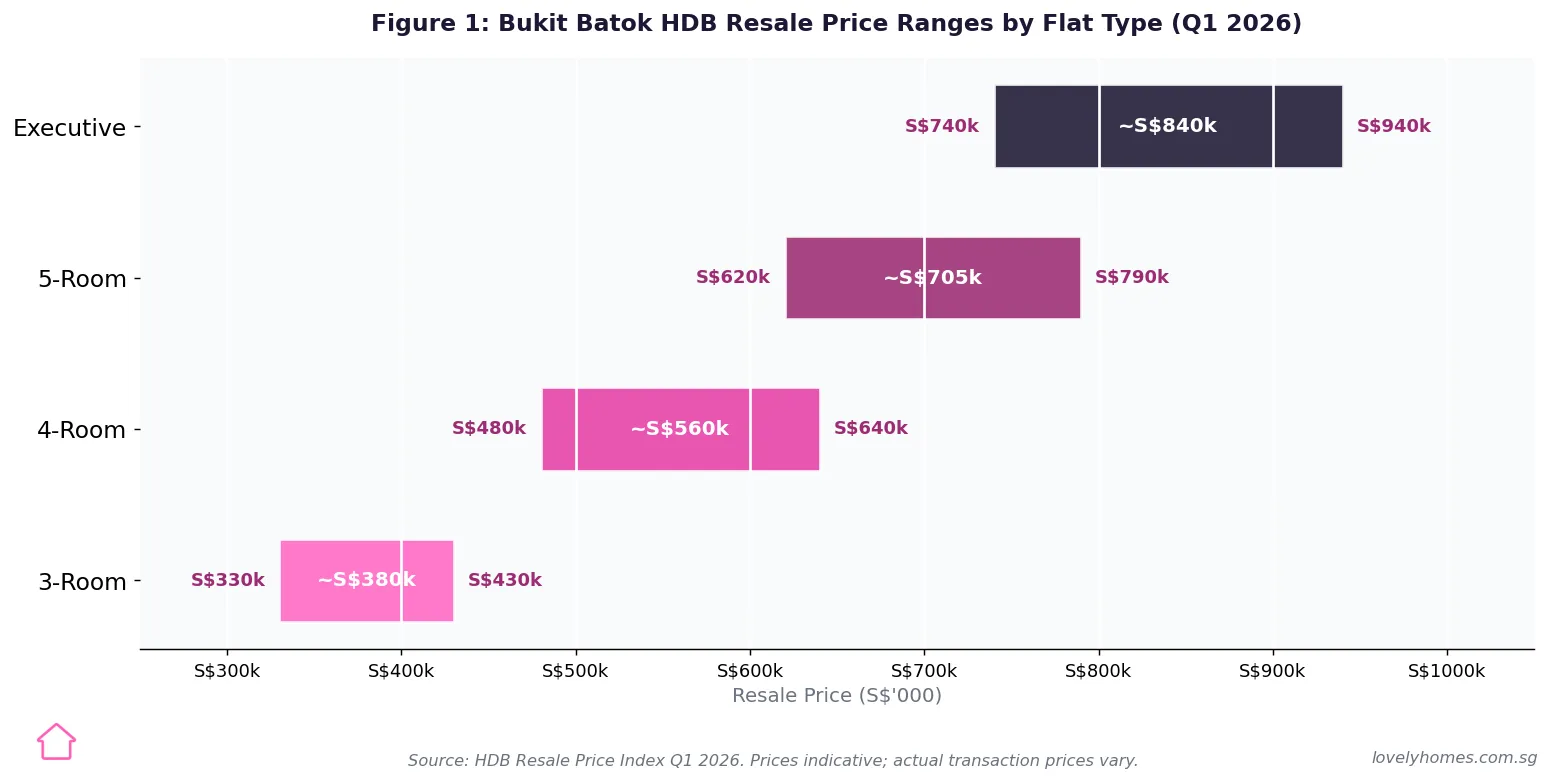
Figure 1: Bukit Batok HDB resale price ranges by flat type Q1 2026
Figure 1: Bukit Batok HDB resale price ranges by flat type, Q1 2026. Source: HDB Resale Statistics.

Location and Transport Connectivity

Bukit Batok sits in the West Region of Singapore, bounded by Bukit Timah to the east, Jurong East to the south, Choa Chu Kang to the north, and the emerging Tengah planning area to the west. The estate is roughly 20–25 km from the Central Business District (CBD), placing it firmly in Outside Central Region (OCR) pricing territory.

MRT Access

Today, Bukit Batok is served by two East-West Line (EW) stations: Bukit Batok (EW27) and Bukit Gombak (EW28). Journey time to Jurong East (the regional hub) is two stops (~5 minutes); to City Hall, it is 25–30 minutes with no transfers. The Jurong Region Line (JRL), confirmed for Phase 1 opening in 2027, will introduce stations at Tengah Park and Bahar Junction within or adjacent to Bukit Batok’s boundary, connecting directly to the JLD White Site and the future Jurong-Tuas Corridor.

Road and Bus

Bukit Batok sits along the Bukit Timah Expressway (BKE) and is well-served by trunk bus routes to Jurong East, Clementi, and the CBD. Cycling infrastructure under the Bukit Batok Active Mobility Network connects residential precincts to Bukit Batok Nature Park and West Mall.

Housing Stock: HDB, Executive Condominiums and Private Condos

Bukit Batok is overwhelmingly a public housing town, with approximately 27,000 HDB flats distributed across 17 precincts — from Bukit Batok West Avenue 5 to Bukit Batok Crescent. The flat stock skews toward the 1990s and early 2000s, meaning most flats carry 67–75 years of remaining lease — generally comfortable for CPF usage and bank lending under current HDB and MAS rules.

Private residential supply is limited but growing:

  • Le Quest (completed 2022): 516-unit mixed-development with a retail podium; one of the first integrated private-residential-commercial projects in Bukit Batok.
  • Altura EC (2023 launch, under construction): 360-unit executive condominium on Bukit Batok West Avenue 8; the first EC in Bukit Batok in over a decade. Fully sold.
  • West Scape: Smaller boutique private condo serving the Bukit Gombak catchment.

The limited private supply and proximity to Tengah — which will generate a substantial volume of new BTO launches — mean Bukit Batok’s HDB resale market is likely to face moderate upward price pressure over the next five to seven years as Tengah buyers seek established amenities nearby.
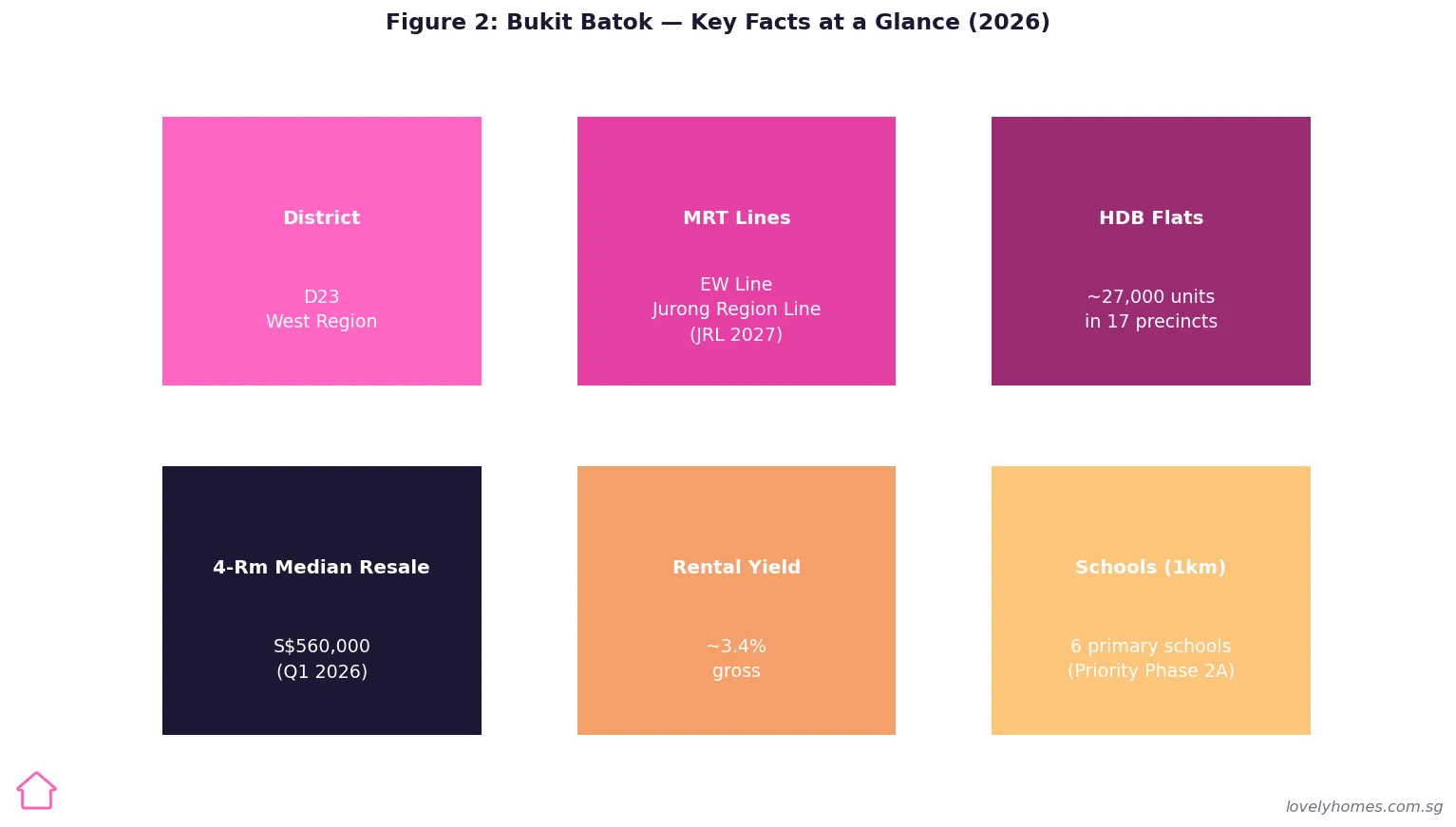
Figure 2: Bukit Batok key facts at a glance — district, MRT, schools, yield 2026
Figure 2: Bukit Batok — key facts at a glance (2026).

Property Prices and Rental Market in 2026

HDB Resale

Bukit Batok HDB resale prices have appreciated steadily since 2020, driven by broad OCR resale market strength and limited new private supply. In Q1 2026, the median 4-room resale transaction in Bukit Batok stood at approximately S$560,000 — below the OCR average of S$570,000 and the Singapore-wide average of S$618,000, presenting a modest value opportunity for buyers comparing like-for-like. Five-room flats command S$620k–S$790k depending on location, floor, and remaining lease.

Private Condominiums

For private property, Bukit Batok / D23 transacts at S$1,300–S$1,550 psf for non-landed units — well below the RCR average (~S$2,100 psf) and meaningfully below Districts 21 and 22 despite comparable green surrounds. Le Quest’s resale units have traded in the S$1,380–S$1,520 psf range in 2025–2026, anchoring buyer expectations.

Rental Market

HDB rental demand in Bukit Batok benefits from proximity to the International Business Park and Jurong Lake District, which house a growing expat and professional workforce. Gross rental yields for 4-room HDB flats average ~3.2%–3.6%; private condos (Le Quest) yield ~3.0%–3.4% gross, broadly in line with OCR benchmarks.

Schools and Amenities

Primary Schools (within 1–2 km)

Bukit Batok has six primary schools within a 1 km radius of most residential precincts, giving families access to the HDB Priority Admission (Phase 2A) advantage:

  • Bukit Batok Primary School
  • Bukit View Primary School
  • St. Anthony’s Primary School (Catholic; popular, competitive ballot)
  • Dazhong Primary School
  • Lianhua Primary School
  • Hillgrove Secondary School (secondary)

Shopping and Lifestyle

Bukit Batok’s main retail node is West Mall (Bukit Batok MRT), a mid-sized mall anchored by Giant Hypermarket, Cathay Cineplexes, and a public library. The nearby Le Quest Mall adds a boutique lifestyle component. Residents are also within driving distance of Jurong Point (15 min), one of the largest suburban malls in Singapore. Nature assets include Bukit Batok Nature Park, Little Guilin (a scenic granite quarry pool), and foot access to the Central Catchment Nature Reserve via Bukit Timah.

Bukit Batok Property Summary (2026)

Property Type Price Range Gross Yield Typical Size Notes
3-Room HDB Resale S$330k–S$430k 3.4%–3.9% 65–75 sqm Lease typically 55–70 yrs remaining
4-Room HDB Resale S$480k–S$640k 3.2%–3.6% 90–105 sqm Median ~S$560k Q1 2026
5-Room HDB Resale S$620k–S$790k 3.0%–3.4% 120–130 sqm Best lease: 2000s blocks
Executive HDB (EA/EM) S$740k–S$940k 2.8%–3.2% 140–155 sqm Rare; check lease carefully
Private Condo (Le Quest) S$1,380–S$1,520 psf 3.0%–3.4% 430–1,400 sqft Integrated mall; 99-yr lease
Altura EC ~S$1,300 psf (launch) N/A (TOP 2027) 614–1,711 sqft Fully sold; watch resale from 2028 (MOP 5yr)

Worked Example: SC Couple Buying a 4-Room HDB Resale in Bukit Batok

👥 The Wong Family — Joint SC Buyers, S$9,200/mth Household Income

Property: 4-room HDB resale flat, Bukit Batok West Avenue 6, 12th floor, 1999 block (64 years lease remaining), transacted at S$568,000 (no COV in this example; buyers paid valuation).

Financing: HDB Loan (2.60% p.a., 25-year tenure). Loan eligibility: up to 80% LTV = S$454,400. Downpayment 20% = S$113,600 (can be partly from CPF OA).

CPF check (lease sufficiency): Wong couple aged 32 + 29. Youngest buyer is 29. Lease of 64 years + 29 = 93 years — falls below the 95-year threshold, so CPF usage is pro-rated. Maximum CPF withdrawal = (64/65) × Valuation = 98.5% of S$568,000 = S$559,480. Full CPF usage effectively available; no material restriction here.

Monthly repayment: HDB loan S$454,400 @ 2.60%, 25 years = S$2,058/mth.
MSR check: S$2,058 ÷ S$9,200 = 22.4% — well below the 30% MSR cap. ✓

Stamp duty (BSD): First S$180k @ 1% = S$1,800; next S$180k @ 2% = S$3,600; next S$640k @ 3% = S$6,240; total BSD = S$11,640. (No ABSD — first property for both; both SC.)

Total upfront cost: Downpayment S$113,600 + BSD S$11,640 + HDB admin fee ~S$2,000 + legal S$3,500 ≈ S$130,740 (a portion covered by CPF OA balance).

CPF Housing Grant: Wong couple, first-timer HDB resale buyers. Family Grant: S$50,000 (income S$9,200 ≤ S$14,000 ceiling). Applied to reduce loan — effective outlay S$404,400. Monthly repayment drops to ~S$1,831/mth (MSR 19.9% ✓).

Why Bukit Batok Matters for Property Buyers in 2026

Bukit Batok punches above its weight for several structural reasons that differentiate it from comparable OCR towns such as Choa Chu Kang or Jurong West:

1. Bukit Timah nature premium at OCR prices. Few mature HDB towns can offer direct trail access to the Central Catchment Nature Reserve — a premium that adds lifestyle value without adding Central Region pricing. Bukit Batok’s proximity to Bukit Timah and Little Guilin is a genuine differentiator that does not show up in psf numbers yet.

2. JRL connectivity uplift arriving in 2027. The Jurong Region Line’s Phase 1 will connect Bukit Batok’s western fringe to Jurong Lake District — Singapore’s second CBD and the planned site of the Tuas Mega Port, the Singapore Terminus (HSR), and a major white-site commercial cluster. JRL accessibility is already being priced into Tengah BTO launches; Bukit Batok’s established resale stock has not moved as sharply, suggesting residual value.

3. Tengah demand spillover. Tengah new town will eventually house ~42,000 units, many of which are Standard and Plus classification with 5-year MOPs. Residents completing MOP from 2031 onwards will look for nearby resale options — and Bukit Batok, with its larger flat sizes, nature access, and established amenities, is a natural landing zone.

Key insight: Bukit Batok’s 4-room resale median is approximately 7–8% below the Singapore-wide OCR 4-room median in Q1 2026. This gap is narrower than the 12–15% discount seen in 2020–2021, suggesting gradual convergence — but there may still be buying opportunity before JRL opens.

What Might Come Next for Bukit Batok (Speculative)

The following are forward-looking possibilities, not confirmed plans, and should not be relied upon for financial decisions:

  • JRL Phase 1 (2027): The Land Transport Authority has confirmed Tengah Park and Bahar Junction stations in Phase 1 of the JRL. Once operational, Bukit Batok will be within two stops of both the EW Line (existing) and the JRL, enhancing its multi-modal connectivity.
  • Bukit Timah–Dairy Farm Long Valley: URA’s masterplan indicates a potential linear park and cycling-friendly corridor through this corridor. If realised, Bukit Batok would be a key access point, adding recreational value.
  • New BTO Supply: HDB has indicated potential BTO sites in the Bukit Batok West Extension area in 2026–2027. New BTO launches would set fresh pricing benchmarks and could generate resale demand 5 years post-occupation.
  • Commercial cluster at Le Quest: CapitaLand’s ongoing placemaking of the Le Quest podium retail could catalyse further F&B and lifestyle tenants, deepening the town’s amenity profile.
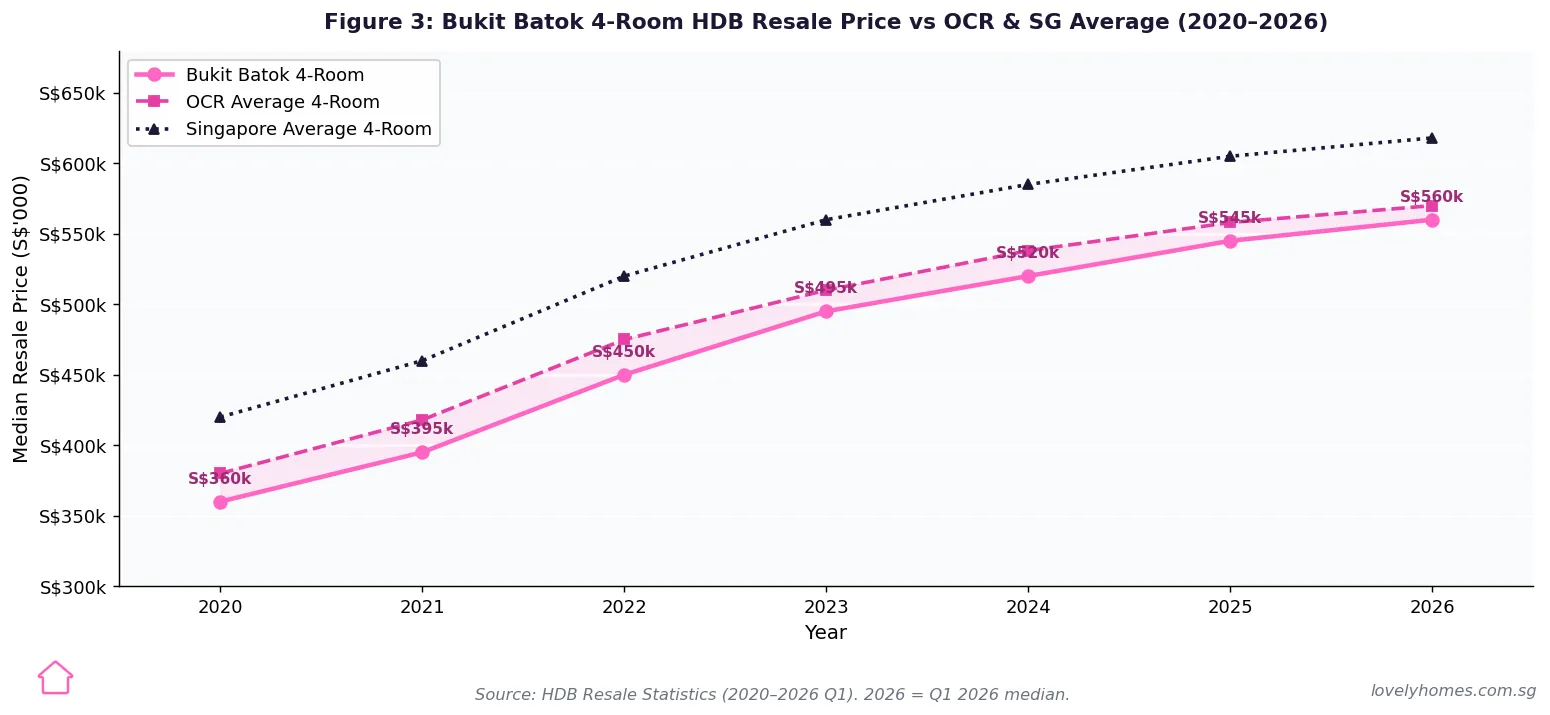
Figure 3: Bukit Batok 4-room HDB resale price trend vs OCR and Singapore average 2020 to 2026
Figure 3: Bukit Batok 4-room HDB resale price trend vs OCR average and Singapore average (2020–Q1 2026). Source: HDB Resale Statistics.

Frequently Asked Questions

Is Bukit Batok a good place to buy property in 2026?

Bukit Batok offers a solid value proposition for buyers prioritising lifestyle, nature access, and OCR pricing. HDB resale values have appreciated steadily since 2020, and the upcoming JRL Phase 1 (2027) adds a structural connectivity catalyst. For investors, gross rental yields of 3.2%–3.6% are competitive for an OCR town. The main risks are the estate’s age (much of the HDB stock dates to the 1990s), which means lease-decay considerations for CPF and bank financing become relevant for older blocks.

When will the Jurong Region Line (JRL) serve Bukit Batok?

JRL Phase 1 is confirmed for opening in 2027, according to the Land Transport Authority (LTA). Bukit Batok will benefit from the Tengah Park and Bahar Junction stations in the adjacent Tengah planning area, which are within cycling and bus-feeder distance of Bukit Batok West. The full JRL network, stretching from Jurong Lake District to Choa Chu Kang, is expected to be completed by 2028–2029. Property values in JRL-adjacent areas have historically seen 5–8% appreciation in the 12–24 months surrounding a line opening.

What is the minimum income needed to buy a 4-room HDB resale in Bukit Batok?

Using a median 4-room transacted price of S$568,000 and an HDB loan at 2.60% over 25 years, the monthly repayment is approximately S$2,058. The MSR cap is 30% of gross income, which implies a minimum household income of ~S$6,860/mth to service the loan without grants. With the Family Grant (up to S$50,000 for first-timer couples), the effective loan reduces and the income requirement drops to ~S$6,100/mth. Note: the actual income ceiling for HDB loans is S$14,000/mth for couples, so most buyers will be within the eligible range.

How does Bukit Batok compare to Choa Chu Kang or Jurong West for property investment?

All three are D23–D22 OCR towns with broadly similar HDB resale price ranges. Bukit Batok distinguishes itself through: (1) nature access (Bukit Timah, Little Guilin), which commands a lifestyle premium; (2) better MRT connectivity today via two EW Line stations; (3) slightly lower median prices than Choa Chu Kang’s most popular blocks. Jurong West offers lower psf pricing and is closer to the JLD employment cluster, making it a stronger pure-yield play. Choa Chu Kang (served by CCK MRT on both the EW and NS Lines) has the edge on MRT coverage for now. Bukit Batok’s JRL upgrade in 2027 may tip the balance for medium-term capital appreciation.

Are there any en-bloc opportunities in Bukit Batok?

Bukit Batok has limited private residential stock, meaning true private en-bloc activity is rare. Le Quest (2022 completion) is too new to be a realistic en-bloc candidate for at least a decade. For HDB owners, the SERS (Selective En Bloc Redevelopment Scheme) administered by HDB is the analogous process — HDB selects older, strategically located estates for redevelopment and offers residents replacement flats. Blocks in older precincts near Bukit Batok Town Centre have been SERS candidates historically, though HDB has not announced any new SERS exercises in Bukit Batok as at mid-2026. Any SERS announcement would be a strong positive catalyst for nearby resale values.

What CPF housing grants are available for Bukit Batok HDB resale buyers?

The main grants for first-timer couples buying HDB resale flats in Bukit Batok are: (1) Family Grant — S$50,000 (income ≤ S$9,000) or S$40,000 (income S$9,001–S$12,000) or S$20,000 (income S$12,001–S$14,000); (2) Half-Housing Grant — S$25,000 for couples where one partner is a first-timer; (3) Proximity Housing Grant (PHG) — S$30,000 (living with parents) or S$20,000 (within 4 km), provided the resale flat is within the stipulated proximity. Grants are administered by HDB and are credited to the CPF OA to reduce the outstanding loan. Eligibility rules are set by HDB and updated periodically; buyers should verify on the HDB website before OTP exercise.

Is Bukit Batok suitable for foreigners or permanent residents?

HDB resale flats are generally not available to foreigners (non-Singapore Citizens or Permanent Residents). Singapore Permanent Residents (SPRs) may purchase resale HDB flats subject to the Ethnic Integration Policy (EIP) and SPR quota, and must form an eligible SPR family nucleus. Foreigners are restricted to private residential properties in Singapore. In Bukit Batok, the only private options are Le Quest (99-year leasehold) and boutique private condos such as West Scape — both accessible to foreigners, though ABSD of 60% applies to all foreigners purchasing residential property in Singapore. SPRs pay ABSD of 5% on their first purchase and 30% on subsequent properties.

Disclaimer: This article is for general informational purposes only and does not constitute financial, legal, or property investment advice. Property prices, grant amounts, loan rates, and government policies are subject to change. HDB resale price data is indicative and sourced from the HDB Resale Price Index and publicly available transaction records. Readers should verify all figures and eligibility criteria directly with HDB (www.hdb.gov.sg), the Urban Redevelopment Authority (www.ura.gov.sg), and CPF Board (www.cpf.gov.sg) before making any property decision. LovelyHomes recommends consulting a licensed property agent (CEA-registered) and a licensed financial adviser before proceeding with any transaction.

×

Click anywhere to close

Translate »