Pasir Ris Neighbourhood Guide Singapore 2026: Property Prices, Schools, MRT and Investment Outlook

Pasir Ris Neighbourhood Guide Singapore 2026: Property Prices, Schools, MRT and Investment Outlook

Pasir Ris Neighbourhood Guide Singapore 2026: Property Prices, Schools, MRT and Investment Outlook

Quick Answer — Pasir Ris at a Glance

  • HDB 4-room resale: median S$638,000; 5-room: S$735,000; Executive: S$930,000
  • Private condo (resale): S$1,550–S$1,900 psf; Pasir Ris 8 (new launch): S$1,934–S$3,728 psf
  • MRT: EW1 Pasir Ris on East West Line today; Elias MRT on Cross Island Line (Punggol Extension) expected ~2032
  • Gross rental yield (HDB 4-room): ~4.1–4.2% — among the higher-yielding OCR estates
  • ~1,200–1,400 HDB flats reaching MOP in Pasir Ris during 2026 — creating upgrader demand
  • Pasir Ris Park (70 ha), White Sands, Downtown East and Changi General Hospital all within the estate
  • Investment catalyst: Elias MRT, Neighbourhood 8 precinct development, and growing CRL network

Pasir Ris sits at the far east of Singapore — coastal, spacious, and historically associated with family living rather than prestige addresses. But in 2026, that picture is changing. Cross Island Line infrastructure is being built, a new Neighbourhood 8 precinct is taking shape around the former MINDEF land near Elias Road, and Pasir Ris 8 — the integrated development at the MRT station — has firmly repriced what private property in this estate can command. For HDB upgraders watching MOP numbers and investors hunting yield in the Outside Central Region, Pasir Ris is an estate worth examining carefully.

This guide covers everything you need to know about buying, renting, or investing in Pasir Ris in 2026 — from exact resale prices by flat type, to the MRT connectivity timeline, to a worked upgrader cost analysis.

Property Prices in Pasir Ris — 2026 Overview

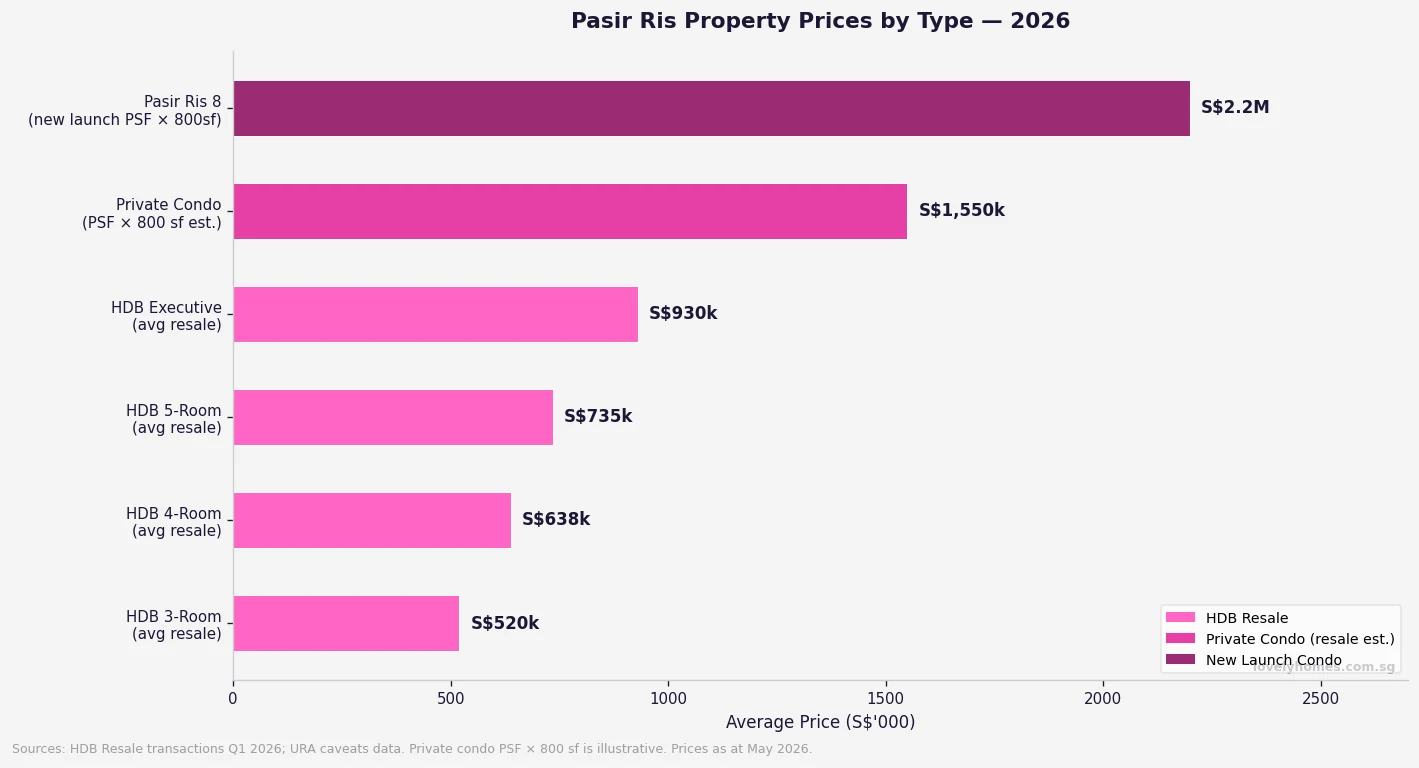
Pasir Ris is predominantly an HDB estate, with approximately 50,600 public housing flats across the town. Private residential supply is anchored by Pasir Ris 8 (the integrated development directly above Pasir Ris MRT station) and a small number of older condominiums and landed houses along the coastal and park-fronting streets.
Pasir Ris property prices by type 2026 — HDB resale and private condo comparison
Figure 1: Pasir Ris property prices by type — HDB resale averages and private condo estimates, May 2026. Sources: HDB Resale Statistics, URA Caveats.
Property Type Typical Price Range Median / Avg Notes
HDB 3-Room (resale) S$400k – S$620k ~S$520k Older stock; strong rental demand from singles
HDB 4-Room (resale) S$548k – S$720k ~S$638k Most traded flat type; strong median
HDB 5-Room (resale) S$650k – S$850k ~S$735k Larger format; MOP supply wave lifting liquidity
HDB Executive / Jumbo (resale) S$800k – S$1.08M ~S$930k Limited supply; strong demand from large families
Private Condo (resale, OCR) S$1,200 – S$1,900 psf ~S$1,550 psf Older projects; limited resale stock
Pasir Ris 8 (new launch) S$1,934 – S$3,728 psf ~S$2,600 psf est. Integrated development above MRT; luxury positioning

The wide range within Pasir Ris 8 reflects its mixed product offering — from studio-format units to spacious 4-bedroom penthouses. For buyers focused on yield, the older resale condominiums at S$1,200–S$1,600 psf offer a more favourable entry point relative to rental demand, though they come with shorter remaining lease durations.

HDB Resale Market Dynamics

Pasir Ris has approximately 700 HDB resale transactions per year across all flat types, placing it in the mid-tier for transaction volume among OCR estates. Of these, 4-room flats account for roughly 40% of transactions, making them the most liquid asset class in the estate.

A notable dynamic in 2026 is the MOP wave. Nationally, around 13,480 HDB flats are reaching the end of their five-year (or ten-year Plus/Prime) minimum occupation period this year. Of these, Pasir Ris contributes an estimated 1,200–1,400 flats — primarily 4-room and 5-room units from developments built in 2019–2021. Sellers from these developments are typically younger upgraders, and their exit into the resale market is creating both additional supply and, indirectly, upgrader demand for private condominiums within and around the estate.

MRT Connectivity — Today and Tomorrow

Pasir Ris’s connectivity story is defined by two chapters: today’s East West Line (EWL) coverage and tomorrow’s Cross Island Line (CRL) expansion.

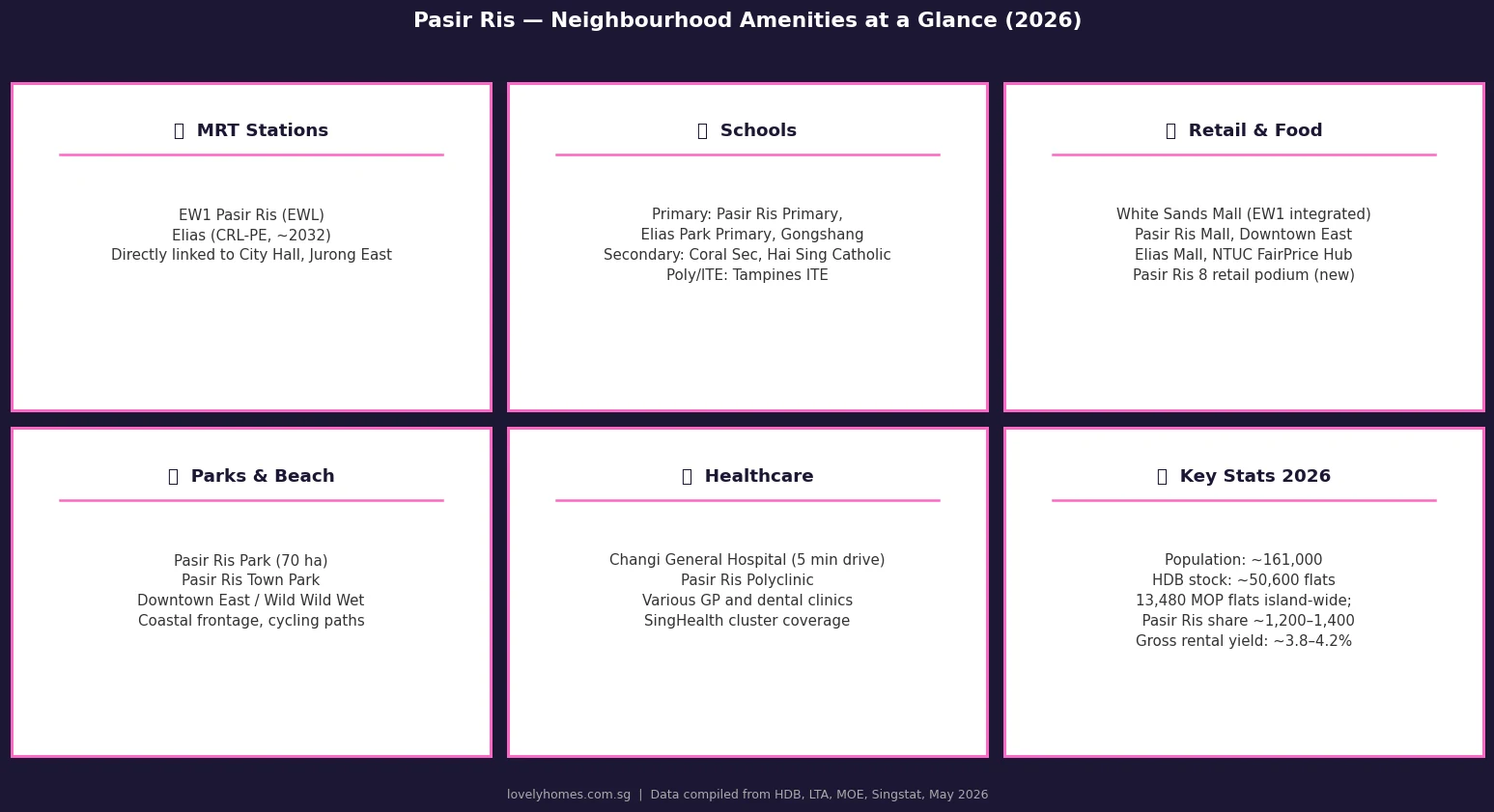
Today, Pasir Ris MRT station (EW1) is the eastern terminus of the East West Line — one of Singapore’s busiest rail corridors. From Pasir Ris, commuters can reach Raffles Place in approximately 38 minutes and Jurong East in roughly 55 minutes. The station is integrated with Pasir Ris 8, White Sands shopping centre, and a bus interchange, making it one of the better-connected suburban interchanges in the east.

By approximately 2032, the Cross Island Line’s Punggol Extension will add a second MRT station to the estate: Elias MRT, located at the junction of Pasir Ris Drive 10 and Pasir Ris Drive 3. Pasir Ris main station itself will also become an interchange with the CRL Punggol Extension, creating a direct link to Punggol, Sengkang, and the broader north-eastern corridor without requiring a change at Tampines. This dual-line connectivity, when realised, would meaningfully reduce Pasir Ris’s current perceived remoteness for residents commuting to the north-east.

Neighbourhood Amenities at a Glance
Pasir Ris neighbourhood amenities grid 2026 — MRT, schools, retail, parks, healthcare, key stats
Figure 2: Pasir Ris neighbourhood amenities — schools, retail, healthcare, parks and key statistics, 2026. Source: HDB, MOE, LTA, SingStat.

Schools and Education

Pasir Ris is well-served for primary education, with several schools within 1–2 km of most residential blocks. Pasir Ris Primary School, Elias Park Primary School, and Gongshang Primary School are the main feeder schools for the estate. For secondary education, Coral Secondary School and Hai Sing Catholic School sit within the town’s boundaries, while Dunman High School (an autonomous school offering the Integrated Programme) is accessible via a short bus or car journey near the Tampines–Pasir Ris border.

The MOE School Finder shows that families seeking a primary school within 1 km of popular Pasir Ris residential streets — particularly around Pasir Ris Drive 1, 3, and 6 — generally have strong in-zone admission chances at Pasir Ris Primary and Elias Park Primary. This factor alone drives family buyer demand for 5-room and executive HDB flats in those streets.

For post-secondary and tertiary education, the ITE College East and Tampines Meridian Junior College are both accessible within 20 minutes by bus or rail.

Retail, Food and Lifestyle

White Sands (integrated with Pasir Ris MRT) is the estate’s anchor mall, offering a full suite of food courts, supermarkets, pharmacies, and lifestyle retailers. Downtown East — one of Singapore’s largest lifestyle and entertainment hubs — sits adjacent to Pasir Ris Park and provides a Wild Wild Wet waterpark, indoor sports facilities, hotel accommodation, and an extensive food and beverage offering. Elias Mall and Pasir Ris Mall serve the internal town areas.

The upcoming Pasir Ris 8 development adds a retail podium above the MRT station, expanding the commercial offering with higher-end dining and lifestyle options that have historically been absent in the estate.

Pasir Ris Park and Outdoor Living

One of Pasir Ris’s most tangible lifestyle advantages is its greenery. Pasir Ris Park covers 70 hectares of managed parkland abutting the coastline — featuring cycling paths, mangrove boardwalks, a family-friendly beach, and barbecue pits. Singaporeans who value nature proximity will find Pasir Ris among the more green-affluent estates in the OCR, comparable to Bishan’s proximity to Bishan-AMK Park but with the added dimension of coastal access.

Investment Outlook — Rental Yield and Capital Growth
Pasir Ris gross rental yield versus 3-year capital growth by property type 2026
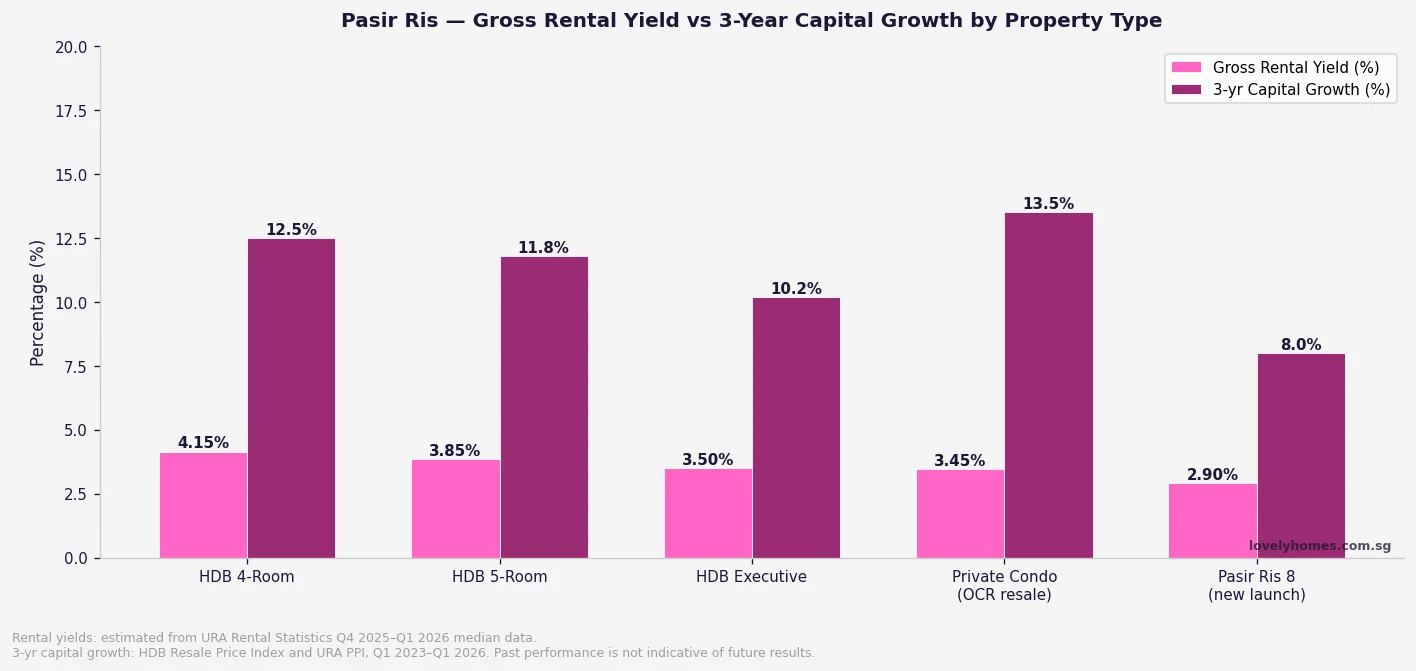
Figure 3: Pasir Ris gross rental yield vs 3-year capital growth by property type, Q1 2023–Q1 2026. Sources: URA Rental Statistics, HDB Resale Price Index, URA Private Property Price Index.

For HDB landlords, Pasir Ris delivers gross rental yields of approximately 3.8–4.2% on 4-room and 5-room flats — above the HDB island-wide average and driven by proximity to Changi Airport, Changi Business Park, and the wider east industrial corridor. Median monthly rents for a 4-room flat in Pasir Ris were approximately S$2,600–S$2,900 as at Q1 2026, according to HDB rental data.

For private condo investors, the older resale condominiums in Pasir Ris generate gross yields of approximately 3.4–3.6%, while Pasir Ris 8’s premium pricing means net yields will be tighter. The investment case for Pasir Ris 8 buyers rests more on capital appreciation (from MRT connectivity, new-launch premium, and precinct gentrification) than on near-term rental income cover.

Over the three years from Q1 2023 to Q1 2026, HDB resale prices in Pasir Ris have appreciated approximately 11–13% on a total-return basis across 4-room and 5-room flats, in line with broader OCR HDB trends as tracked by the HDB Resale Price Index.

Worked Example — HDB Upgrader Buying a Pasir Ris Condo in 2026

Consider Mr and Mrs Lim, a Singapore Citizen couple aged 38 and 36, with a combined monthly income of S$14,500. They own a 5-room HDB flat in Pasir Ris that cleared its five-year MOP in early 2026. They purchased the flat as a BTO for S$350,000; it is now transacting at S$750,000 on the resale market. They have S$260,000 in CPF Ordinary Account used for the flat, with accrued interest of S$48,000 (at 2.5% p.a. over six years).

Step 1 — Sale proceeds: Gross sale S$750,000 → outstanding bank loan S$220,000 → CPF principal refund S$260,000 → accrued interest S$48,000 → legal and agent costs S$12,000. Estimated cash-in-hand: approximately S$210,000.

Step 2 — Buying a S$1.60M Pasir Ris condo: As they are selling first, they hold zero residential properties at OTP signing. ABSD: 0% (Singapore Citizens, first property). BSD on S$1.60M = 1%×S$180k + 2%×S$180k + 3%×S$640k + 4%×S$600k = S$1,800 + S$3,600 + S$19,200 + S$24,000 = S$48,600.

Step 3 — Financing: 75% LTV (bank loan on private property, SC first property) = S$1,200,000 loan. 25% down = S$400,000 (S$308,000 CPF OA re-deposited after refund + S$92,000 cash). Legal and miscellaneous costs: ~S$7,000 cash. Total immediate cash outlay: S$48,600 (BSD) + S$92,000 (cash top-up on down payment) + S$7,000 = ~S$147,600.

Step 4 — Monthly repayment: S$1,200,000 at a fixed rate of 1.80% over 25 years = approximately S$4,930/mth. TDSR check: S$4,930 ÷ S$14,500 = 34.0% — comfortably within the 55% TDSR ceiling. The couple’s post-purchase cash reserve is approximately S$62,000, providing a meaningful liquidity buffer.

What Might Come Next for Pasir Ris

The 2032 completion of Elias MRT is the most significant near-term catalyst for the estate. New MRT stations in Singapore have historically generated price premium expansion in the two-to-four years leading up to opening, as market participants anticipate connectivity improvements. Areas within 600–800 metres of the future Elias station — particularly the emerging Neighbourhood 8 precinct — will be worth tracking.

The former MINDEF training land adjacent to Elias Road is earmarked for public and private housing development as part of Neighbourhood 8. While no definitive URA masterplan details or GLS tenders have been announced for this precinct as at May 2026, it represents a potential supply of several thousand new homes on relatively underutilised land in an estate where new private supply has historically been scarce.

On the rental side, Changi Airport’s continued expansion (Terminal 5, expected post-2030) and the growth of Changi Business Park as a technology and financial services hub both support sustained rental demand in the eastern corridor, benefiting Pasir Ris landlords.

Frequently Asked Questions

Is Pasir Ris a good place to buy property in 2026?

Pasir Ris offers a compelling combination of yield (HDB gross yields of 4%+), greenery, family-friendly infrastructure, and a clear near-term catalyst in the Cross Island Line’s Elias station (~2032). It is not a prestige address and will not command the PSF of Bishan, Queenstown, or the CCR — but for owner-occupiers seeking space and affordability, and for investors prioritising yield, it performs well within the OCR category. The key risk is the estate’s current single-line MRT exposure (EWL only) until the CRL Punggol Extension is operational.

Which MRT stations serve Pasir Ris?

Currently, Pasir Ris MRT (EW1) on the East West Line is the sole station. It is the eastern terminus of the EWL and is integrated with the Pasir Ris Bus Interchange. By approximately 2032, the Cross Island Line’s Punggol Extension will add Elias MRT within the estate (at Pasir Ris Drive 10 / Drive 3), and Pasir Ris station itself will become an interchange with the CRL Punggol Extension — enabling direct connectivity to Punggol, Sengkang, and Bishan without changing trains.

What is the HDB resale record in Pasir Ris?

The highest recorded HDB resale transaction in Pasir Ris, as at our research date, is an Executive flat that transacted at approximately S$1.08M — reflecting the scarcity of large-format flats in the estate. For 5-room flats, transactions in excess of S$850,000 have been recorded for well-located blocks near Pasir Ris Park and the MRT. These represent outlier premium transactions; the estate-wide median for 5-room flats remains approximately S$735,000 as at Q1 2026.

How does Pasir Ris compare to Tampines and Bedok for property investment?

Compared to Tampines, Pasir Ris tends to offer slightly higher HDB rental yields (4%+ vs Tampines’ ~3.8%) but lower private condo capital growth potential in the short term, as Tampines benefits from more established commercial infrastructure and multiple MRT lines. Compared to Bedok, Pasir Ris offers lower entry prices for similar flat types but lacks Bedok’s three-MRT-line advantage. The upcoming Elias MRT and Neighbourhood 8 development are Pasir Ris-specific catalysts that neither Tampines nor Bedok can replicate on the same timeline.

Can HDB upgraders avoid ABSD when buying Pasir Ris 8?

Yes — if the HDB flat is sold before (or simultaneously with) the OTP signing for the private property. When a Singapore Citizen sells their only existing residential property before acquiring a new one, they hold zero properties at the point of OTP and therefore pay 0% ABSD. This is the standard “sell-first, then buy” upgrader route. The key constraint is timing: you will need to arrange bridging accommodation between your HDB sale completion and your new condo’s TOP date. See our Upgrading from HDB to Private Property guide for the full timeline and cost analysis.

Are there BTO flats available in Pasir Ris in 2026?

As at May 2026, no standard BTO launch has been announced specifically for Pasir Ris in the June 2026 BTO exercise, which covers Bishan, Ang Mo Kio, Bukit Merah, Sembawang, and Woodlands. However, the emerging Neighbourhood 8 precinct (former MINDEF land near Elias Road) is expected to yield future BTO launches — likely announced in the 2027–2028 BTO exercise window once planning and land clearance is completed. Prospective buyers wanting to live in Pasir Ris in the near term should look at the resale market, the Sale of Balance Flats (SBF) exercises, or the Pasir Ris EC at Jalan Loyang Besar for qualifying buyers.

Related Articles

Disclaimer: This neighbourhood guide is for general informational purposes only and does not constitute financial, investment, or property advice. All prices, yields, and market data cited are drawn from publicly available sources including HDB Resale Statistics, URA Caveats Lodged, LTA announcements, and SingStat as at May 2026, and are subject to change without notice. Past performance and historical price trends are not indicative of future results. Always conduct independent verification and consult a licensed property agent, financial adviser, or conveyancing lawyer before making any property decision. For official data, refer to HDB, URA, LTA, SingStat, and MAS.
HDB Minimum Occupation Period (MOP) Singapore 2026: Standard, Plus and Prime Rules Explained

HDB Minimum Occupation Period (MOP) Singapore 2026: Standard, Plus and Prime Rules Explained

Quick Answer

  • The HDB Minimum Occupation Period (MOP) is the mandatory period you must physically occupy your HDB flat before you can sell it on the open market, rent out the entire flat, or purchase a second private residential property without incurring the full ABSD burden. MOP is administered by HDB (Housing and Development Board).
  • For Standard BTO flats, the MOP is 5 years from the date of key collection. For Plus and Prime BTO flats (introduced for BTO exercises from May 2023), the MOP is 10 years.
  • During the MOP, you cannot sell the flat, rent out the entire unit, or transfer ownership. You can, however, rent out individual rooms with HDB approval, and you may purchase private property (subject to ABSD).
  • After the MOP, Standard flat owners may sell to any eligible HDB buyer (SC or SPR). Plus flat owners must sell to SC or SPR buyers whose household income is within the prevailing income ceiling. Prime flat owners may only sell to Singapore Citizens whose household income is within the income ceiling.
  • Whole-flat rental after MOP is permitted for Standard flats (subject to HDB approval). It is not permitted at any time for Plus or Prime flats.
  • A subsidy clawback applies when Plus and Prime flats are sold on the open market — HDB recovers a portion of the housing grant and pricing subsidy. The clawback amount is higher for Prime flats.
  • The MOP clock starts from the date of key collection — not the date of BTO application, booking fee payment, or Temporary Occupation Permit (TOP). A flat collected in June 2024 has its Standard MOP expiry in June 2029.

What Is the MOP and Who Administers It?

The Minimum Occupation Period (MOP) is a statutory requirement under the Housing and Development Act, administered by the Housing and Development Board (HDB). It requires owners of HDB flats to physically occupy their flat for a minimum period before certain rights become available — primarily the right to sell on the open market, rent out the entire unit, or purchase a second private residential property.

The MOP exists for two complementary policy reasons. First, it ensures that subsidised HDB flats are used as genuine owner-occupied homes rather than short-term investment instruments. Second, it moderates the supply of resale HDB flats that enter the market at any one time, which helps to stabilise resale prices. The requirement has been part of Singapore’s public housing policy for decades, and HDB enforces it through its ownership records, which are cross-referenced against the buyer’s NRIC address for SC/SPR buyers.

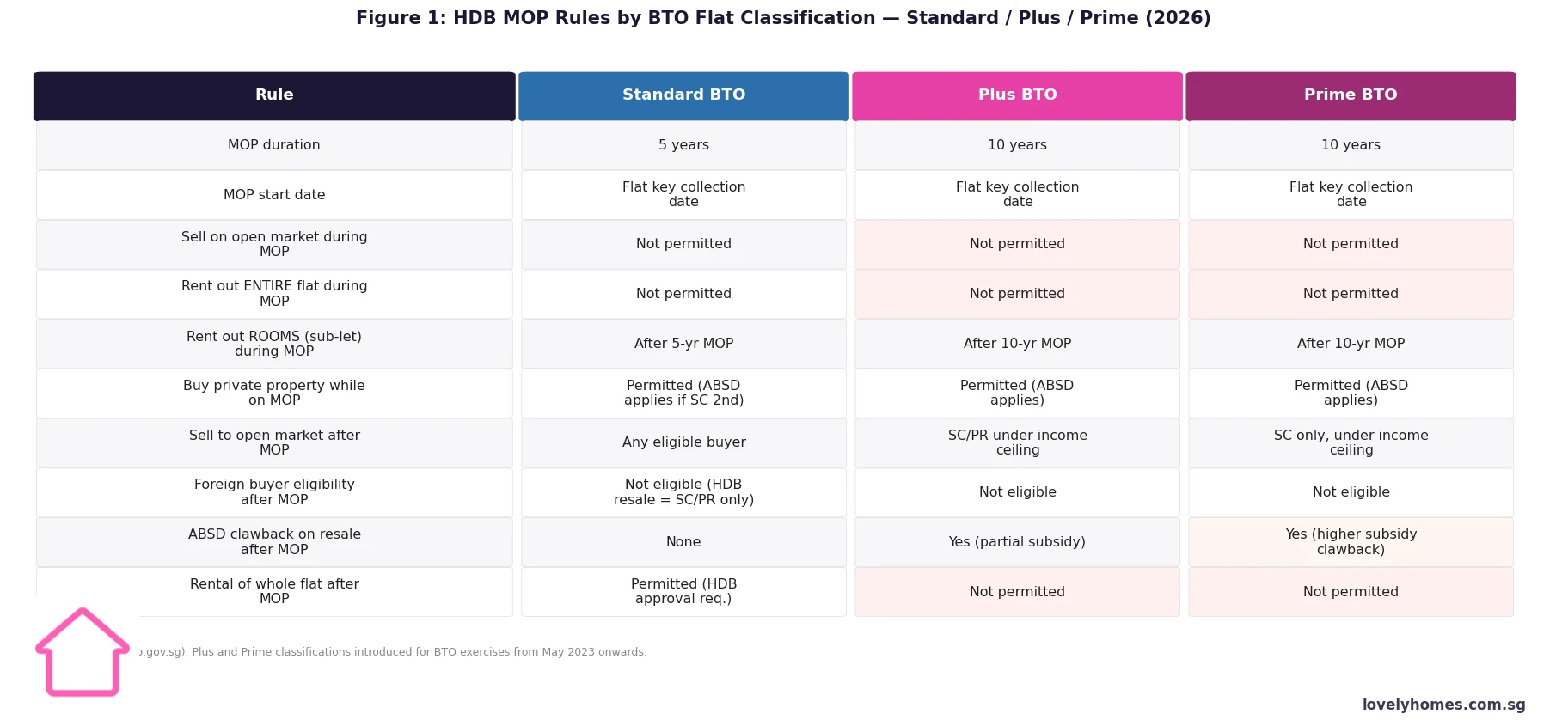
HDB MOP rules by BTO classification Standard Plus Prime Singapore 2026 comparison table
Figure 1: HDB MOP Rules by BTO Classification — Standard, Plus and Prime (2026) | Source: HDB

Standard, Plus and Prime: The Three BTO Classifications

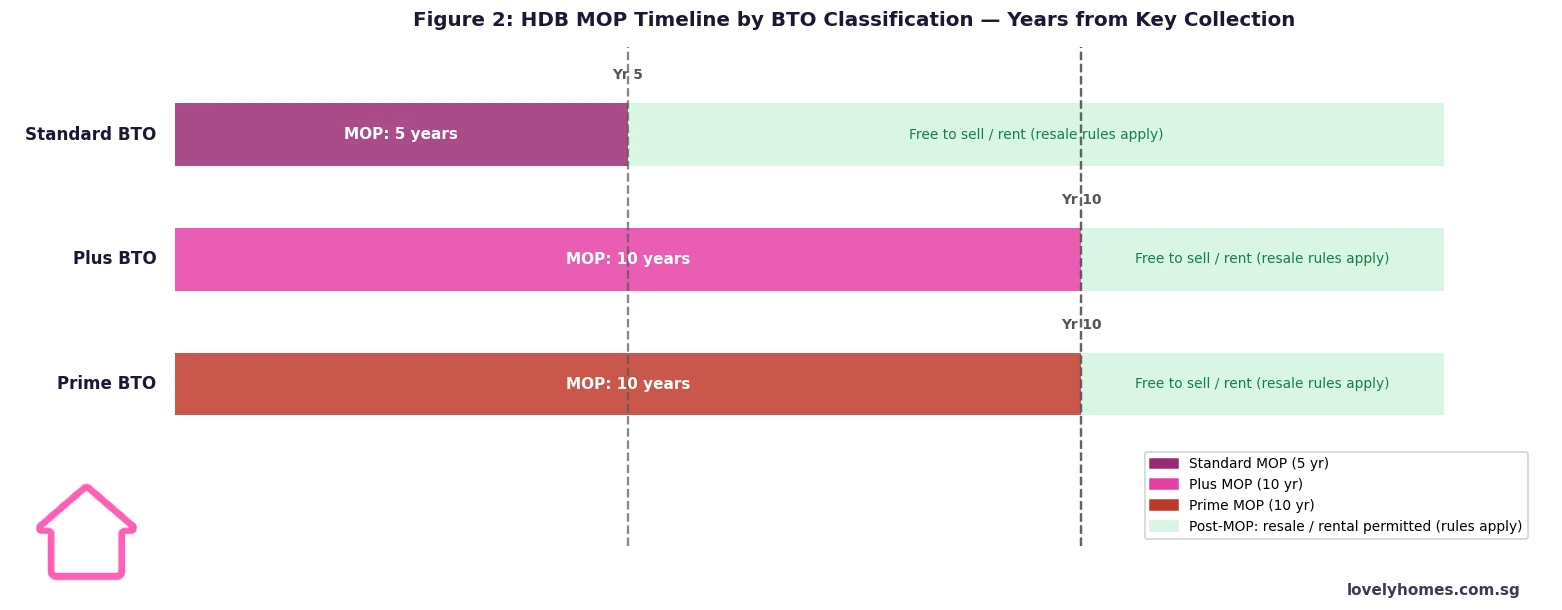
From the May 2023 BTO exercise onwards, HDB classifies all new BTO flats into one of three tiers based on location and subsidy level. This classification directly determines MOP length, post-MOP resale eligibility, rental rights, and subsidy clawback:

  • Standard flats are located in non-central, typically suburban estates (such as Tengah, Woodlands, Sembawang, and Punggol). They carry the lowest subsidies relative to market value and have the most permissive rules: 5-year MOP, resale to any eligible SC/SPR buyer, and whole-flat rental allowed after MOP with HDB approval.
  • Plus flats are located near transport nodes or commercial hubs, in estates that would otherwise be too pricey for first-timer buyers without additional subsidy. They come with a 10-year MOP, resale restricted to SC/SPR buyers within the prevailing income ceiling, and no whole-flat rental at any time.
  • Prime flats are located in the choicest sites — city-fringe, waterfront, or mature central estates like Kallang, Toa Payoh, and Marina South — where HDB provides the heaviest subsidies. They carry a 10-year MOP, SC-only resale (SPR buyers are ineligible), income ceiling restrictions, no whole-flat rental at any time, and the highest clawback rate.

Buyers are told which classification a flat falls under at the time of BTO application. The classification is permanently attached to the flat and does not change over time, even after resale. A Prime flat remains a Prime flat in every subsequent transaction.

HDB MOP timeline by BTO classification Standard 5 years Plus Prime 10 years Singapore 2026
Figure 2: HDB MOP Timeline by BTO Classification — Years from Key Collection (Singapore 2026)

What You Can and Cannot Do During the MOP

The MOP does not mean you are locked away from all activity — it specifically restricts disposal and whole-unit rental. The table below summarises key permitted and prohibited actions:

Activity During MOP After MOP (Standard) After MOP (Plus/Prime)
Sell flat on open market Not permitted Permitted (SC/SPR buyers) SC/PR (Plus); SC only (Prime); income ceiling applies
Rent out entire flat Not permitted Permitted (HDB approval) Not permitted (ever)
Rent out rooms (sub-let) Not permitted during MOP Permitted (HDB approval) Permitted (HDB approval)
Buy private property Permitted (ABSD applies if SC 2nd property: 20%) Permitted Permitted
Transfer ownership (gift / divorce / death) HDB approval case-by-case Yes Yes (subject to Plus/Prime resale rules)
Renovate / alter the flat Permitted (HDB renovation permit) Permitted Permitted

Buying Private Property During the MOP

One of the most common questions from HDB flat owners is whether they can buy a private condominium before their MOP is up. The answer is yes — you are allowed to purchase private residential property in Singapore while your MOP is running. However, there are important financial consequences to consider.

If you are a Singapore Citizen owning an HDB flat (which counts as your first residential property) and you buy a private condo during the MOP, you are buying a second property. This means you pay 20% ABSD on the private property purchase. If you are an SPR, your second-property ABSD is 30%. The HDB flat itself remains subject to the MOP and cannot be sold until the MOP expires.

This means you will be servicing two housing loans simultaneously until the HDB can be sold — which requires careful TDSR planning. The TDSR cap of 55% applies across all outstanding loans. HDB loans (from HDB directly) and bank loans on HDB flats are both counted in TDSR. If the combined debt servicing ratio exceeds 55% when adding the private mortgage, financing for the private property may be declined.

What Happens When You Sell After the MOP

Once the MOP is fulfilled, the key restrictions are lifted — but resale rules still apply, especially for Plus and Prime flats:

  • Standard flats: May be sold to any eligible HDB resale buyer — SC or SPR, subject to standard HDB eligibility criteria (Ethnic Integration Policy quotas, family nucleus requirements, etc.). No income ceiling on the buyer.
  • Plus flats: May only be sold to buyers whose household income does not exceed the prevailing income ceiling (currently S$14,000/month for families, S$7,000 for singles). SPR buyers are eligible. A subsidy clawback is deducted from the sale proceeds on the first open-market resale.
  • Prime flats: May only be sold to Singapore Citizen buyers (SPR buyers are not eligible) whose household income does not exceed the income ceiling. The subsidy clawback rate is higher than for Plus flats and is also deducted from the first open-market resale proceeds.

The subsidy clawback is calculated as a percentage of the resale price (or market value, whichever is higher) and is paid to HDB at the point of resale. HDB has not publicly released a fixed clawback percentage table; the exact rate is determined and communicated at the time of application. This is intended to recover some of the subsidy advantage enjoyed by Plus/Prime buyers while still allowing them a fair profit on genuine capital appreciation.

The MOP and CPF Accrued Interest

When you sell an HDB flat after the MOP, any CPF funds used to purchase the flat (including the option fee, downpayment, and monthly mortgage instalments paid from your CPF Ordinary Account) must be refunded to your CPF accounts — along with accrued interest at the CPF OA interest rate (currently 2.5% per annum). This accrued interest represents what your CPF savings would have earned had they not been used for housing. On a long MOP (10 years), accrued interest can be substantial and reduces the net cash proceeds from the sale.

Worked Example: The Wong Family and the MOP Decision

Mr and Mrs Wong, both Singapore Citizens, purchase a 4-room BTO flat in Bishan (classified as a Plus flat) in June 2024. Key collection is in June 2024. Their household income is S$9,000/month. The purchase price is S$550,000.

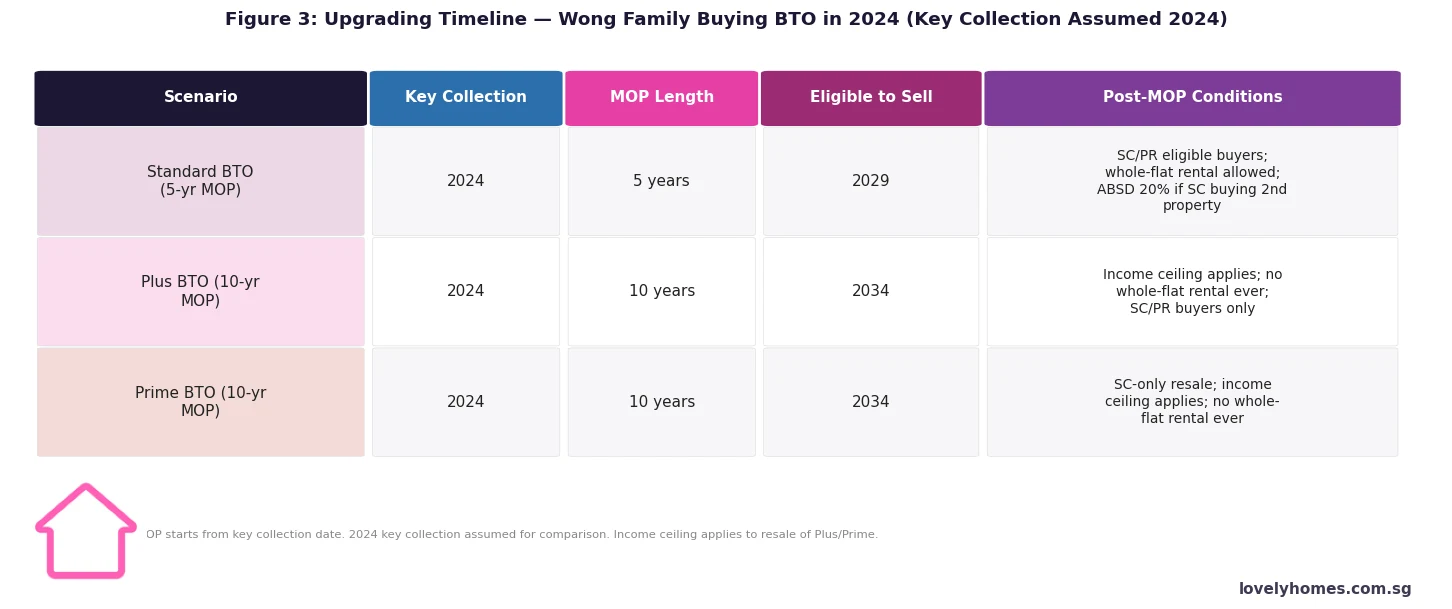
HDB upgrading timeline Wong family Standard Plus Prime BTO scenarios Singapore 2026
Figure 3: HDB Upgrading Timeline — BTO Scenario Comparison (Singapore 2026)
Scenario Event Year Notes
Plus BTO — Bishan Key collection 2024 MOP clock starts
Buy private condo (2nd property, if desired) Any time 20% ABSD applies; TDSR must clear; HDB MOP still running
MOP expires — eligible to sell HDB 2034 10-year MOP; income ceiling on buyer (S$14k); clawback on sale proceeds
Can rent out rooms (sub-let) From 2034 HDB approval required; cannot rent entire flat (ever)

Over the 10-year MOP, if the flat appreciates from S$550,000 to S$800,000 (a not unreasonable assumption for a Plus-classified Bishan flat), the Wongs would make a nominal gross gain of S$250,000. From this, HDB deducts the clawback (amount TBD at point of sale), plus CPF refund with accrued interest. On a S$550,000 purchase with 25% CPF downpayment (S$137,500) at 2.5% CPF OA rate over 10 years, accrued interest alone would be approximately S$38,700 — reducing net cash-in-hand from the sale. This is still a solid return, but buyers should model it carefully before factoring in the Plus flat subsidy as pure profit.

What This Means for HDB Buyers in 2026

The 10-year MOP for Plus and Prime flats is a significant commitment. A buyer collecting keys in 2026 cannot sell their Plus or Prime flat until 2036 at the earliest. Over that decade, Singapore’s property market will go through multiple cycles, interest rate shifts, and policy changes. Buyers who select Plus or Prime flats primarily because of the lower purchase price — and not because they genuinely intend to occupy the flat for 10 years — may find themselves in a difficult position if circumstances change (job relocation overseas, family expansion, divorce).

For those who do plan to stay, the Plus and Prime schemes deliver real value. A Prime flat in a central location at a subsidised price, occupied for 10 years with a no-rental restriction, is likely to appreciate meaningfully in absolute terms even after clawback. The restriction is the price of the subsidy.

What Might Come Next

The May 2023 introduction of Plus and Prime classifications represented a significant shift from the old Mature/Non-Mature estate binary. The April 2023 announcement also removed the ability of EC buyers to use the Deferred Payment Scheme from May 2026 — suggesting the government continues to tighten across all public and quasi-public housing tiers. Any further changes to MOP duration are unlikely in the near term given that the 10-year Plus/Prime MOP is relatively new and the government will want to assess its impact before adjusting. The resale income ceiling may, however, be revised upwards over time to track median income growth in Singapore.

Related Articles

Frequently Asked Questions

When does the MOP start — from key collection or from BTO ballot application?

The MOP starts from the date of key collection — not the date of BTO application, not the ballot exercise date, and not the date you pay the option fee or sign the lease agreement. The key collection date is when you physically receive the keys to your flat and formally take possession. This date is recorded by HDB and serves as the MOP commencement date. For a Standard flat collected in July 2024, the MOP expires in July 2029. For a Plus or Prime flat collected in the same month, it expires in July 2034.

Can I rent out rooms in my HDB flat while the MOP is running?

No. During the MOP, you may not rent out any part of your flat — neither the entire unit nor individual rooms. Room rental (sub-letting) is only permitted after the MOP has been fulfilled and only with HDB’s prior written approval. After the MOP, Standard flat owners may rent out rooms or the entire flat (with HDB approval); Plus and Prime flat owners may rent out rooms after the MOP but may never rent out the entire flat under any circumstances.

What happens if I need to move overseas for work during the MOP?

If you need to work overseas temporarily, you must continue to maintain your HDB flat as your Singapore residence — meaning a family member must continue to reside in the flat, and you must return periodically. You cannot rent out the flat during the MOP even if you are overseas. If your overseas stint is long-term and the flat will genuinely be unoccupied, you should consult HDB directly. Abandoning the occupancy requirement during the MOP can result in HDB compulsorily acquiring the flat at a below-market price under the Housing and Development Act — a severe consequence that buyers should be aware of.

Can I buy a private condo while my HDB MOP is still running?

Yes. Purchasing a private residential property while your HDB MOP is outstanding is permitted. However, since your HDB flat counts as your first residential property, the private condo purchase is classified as a second property for ABSD purposes. A SC pays 20% ABSD on the private condo. An SPR pays 30%. You must also have the financial capacity to service both housing loans simultaneously and remain within the 55% TDSR cap. Many HDB owners choose to exercise this option a year or two before their MOP expires, so the HDB can be sold shortly after the MOP milestone — reducing the period of dual-loan exposure.

What is the subsidy clawback for Plus and Prime flats, and when is it paid?

The subsidy clawback for Plus and Prime flats is paid to HDB at the point of the first open-market resale (i.e., the first resale transaction after the MOP). It is deducted from the sale proceeds before any balance is paid to the seller. The clawback is calculated as a percentage of the resale price or market valuation (whichever is higher). HDB has not published a fixed percentage table publicly; the exact rate is communicated in the flat purchase document at the time of BTO booking and is specific to the flat’s classification and location. The clawback only applies to the first open-market resale — subsequent owners of a Plus or Prime flat do not face an additional clawback when they eventually sell.

Do MOP rules apply to HDB flats purchased on the open resale market?

Yes. When you purchase an HDB resale flat — whether Standard, Plus, or Prime — the MOP requirement applies afresh from the date you collect the keys. A Standard resale flat has a 5-year MOP from your key collection date; a Plus resale flat has a 10-year MOP; and a Prime resale flat has a 10-year MOP. The classification (Standard, Plus, Prime) of the flat follows it through all transactions. You cannot shorten the MOP on a resale flat because the previous owner already fulfilled their MOP.

Can an SPR buyer purchase a Plus or Prime HDB flat on the open resale market?

For Plus flats: yes, subject to the income ceiling (S$14,000/month household income) and standard SPR eligibility criteria. For Prime flats: no — Prime flats may only be resold to Singapore Citizens (not SPR). This restriction applies to every resale of a Prime flat in perpetuity, not just the first resale. SPR buyers wishing to purchase Plus flats must also form an eligible family nucleus (e.g., SC/SPR family or SPR household of two or more) to qualify under HDB’s resale eligibility framework.

Disclaimer: This article is for general information only and does not constitute legal or financial advice. HDB rules, MOP durations, clawback rates, and eligibility criteria are subject to change by HDB and the Ministry of National Development. Always verify the latest requirements at hdb.gov.sg and consult HDB directly or a licensed HDB resale agent for guidance specific to your situation. All figures and scenarios are illustrative and based on publicly available data as at 16 May 2026.

HDB Upgrader Guide Singapore 2026: How to Move from HDB to Private Property

HDB Upgrader Guide Singapore 2026: How to Move from HDB to Private Property

The HDB upgrader guide Singapore 2026 is your complete, step-by-step resource for navigating the most financially significant move many Singaporeans will ever make: selling your Housing Development Board flat and purchasing a private condominium. Whether you are a Singapore Citizen approaching Minimum Occupation Period, or a permanent resident re-evaluating your property portfolio, understanding the full financial, regulatory, and timing picture is essential before you commit to either transaction.

Quick Answer — HDB Upgrade at a Glance

  • You must meet a Minimum Occupation Period (MOP) of 5 years before selling your HDB flat (resale) or renting it out entirely
  • Singapore Citizens buying a private condo while retaining their HDB pay 20% ABSD on the private property purchase
  • The sell-first strategy eliminates ABSD and is used by the majority of upgraders; the buy-first strategy preserves housing continuity but incurs ABSD upfront
  • Minimum cash component for a private condo: 5% of purchase price (beyond what CPF can cover)
  • Your Total Debt Servicing Ratio (TDSR) must not exceed 55% of gross monthly income on all loans combined
  • CPF Ordinary Account savings used for the HDB must be refunded with accrued interest of 2.5% per annum upon sale
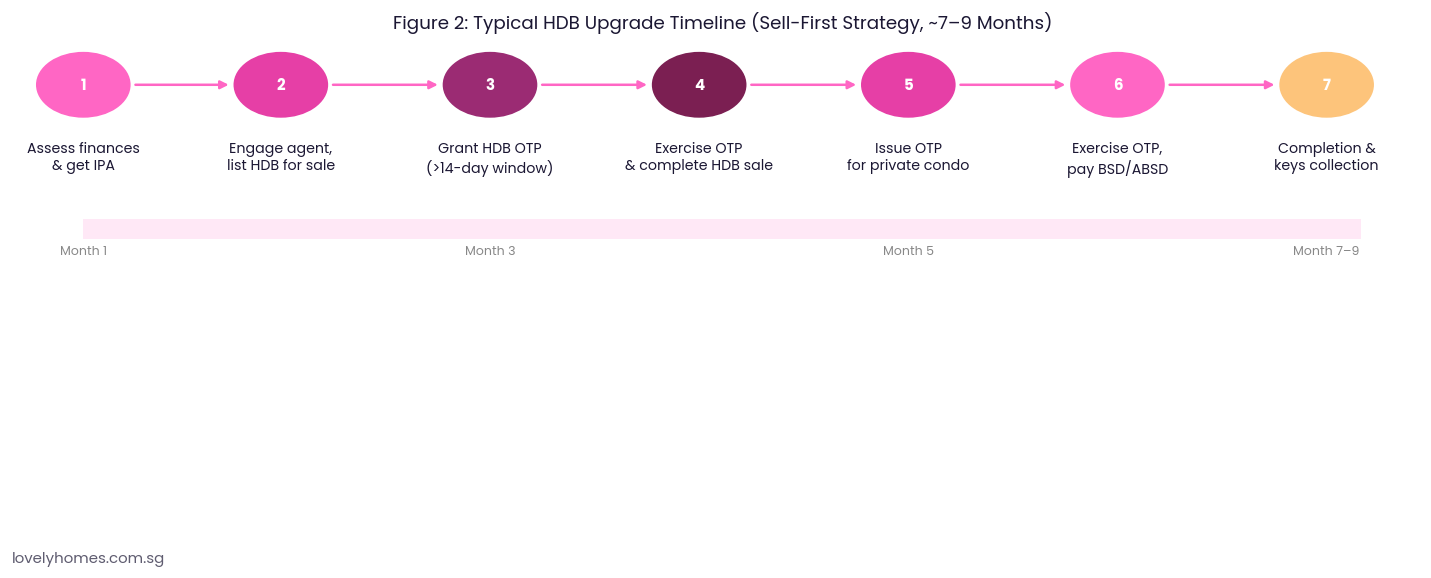
  • Full upgrade process (sell HDB + buy private): 7–9 months on a sell-first strategy; legal completion to collect keys adds 3–5 months for new launches
  • A Singapore Citizen household with S$800K HDB equity upgrading to a S$1.5M condo typically needs S$350K–$420K in additional cash/CPF

What Is the HDB-to-Private Upgrade Path?

Singapore’s dual-tier housing market — public HDB flats and private residential properties — creates a well-trodden upgrade path that the Housing Development Board and Urban Redevelopment Authority have both shaped through policy. An HDB flat is built on land sold to the HDB by the State under a 99-year lease; the HDB flat grant system, CPF usage rules, and MOP together form a structured subsidy framework designed to support first-time homeownership. The private condominium market, regulated separately by the URA, operates without the same direct subsidies, but also without income ceilings, nationality restrictions (for citizens and PRs), or MOP constraints once purchased.

The “HDB upgrade” is the act of monetising the subsidised first-home equity — essentially converting the benefit of below-market pricing and CPF grants into cash proceeds — and reinvesting those proceeds into the private market. The CPF Housing Grant for resale HDB flats, administered by the Housing Development Board, can total up to S$80,000 for eligible first-time buyer households; this grant accrues interest at 2.5% per annum and must be returned to CPF upon sale. Upgraders therefore need to account for this accrued interest deduction before calculating usable equity.

MOP: When Can You Sell?

The Minimum Occupation Period is the single most important gating rule. Under HDB regulations, resale HDB flat owners must physically occupy the flat for five years from the date of possession (for resale) or five years from the date of key collection (for new BTO flats purchased directly from the HDB). During the MOP you cannot sell your flat on the open market, rent out the entire flat, or own any private residential property in Singapore.

The five-year MOP was first introduced in 2010 and has remained stable since. For Prime Location Public Housing (PLH) flats announced from October 2021, the MOP is 10 years — a significant constraint for buyers in mature estates like Bishan, Queenstown, or the Pearl’s Hill development announced by MND in March 2026. Always verify the applicable MOP from your HDB letter of offer.

ABSD and the Simultaneous-Ownership Question

The single most expensive decision in the upgrade process is whether to sell your HDB flat before or after buying the private property. The difference is the Additional Buyer’s Stamp Duty, which is administered by the Inland Revenue Authority of Singapore (IRAS).

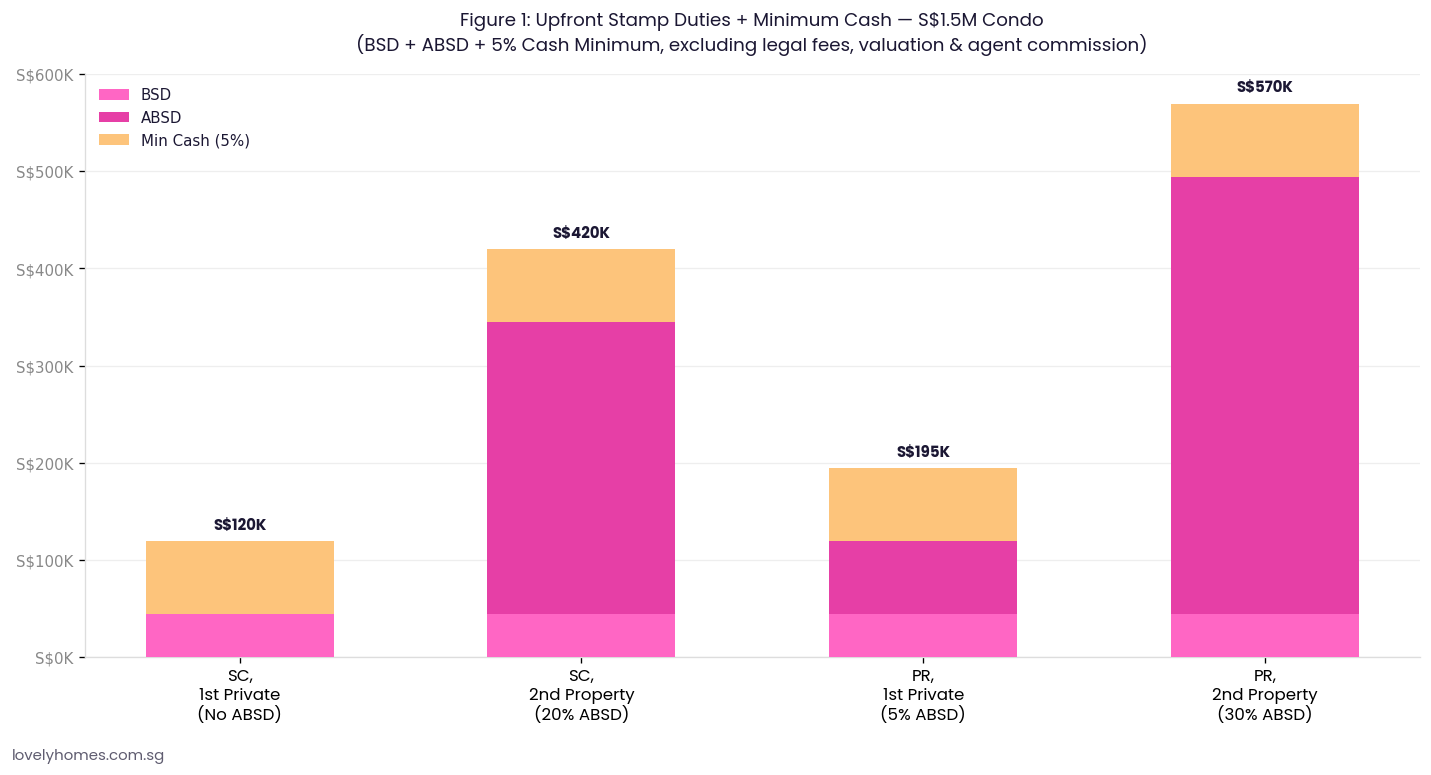
Upfront stamp duties and cash needed when upgrading from HDB to private condo Singapore 2026
Figure 1: Upfront stamp duties + minimum cash for a S$1.5M private condo purchase by buyer profile. ABSD is administered by IRAS and is based on the purchase price or market value, whichever is higher.

At the current rates (effective 27 April 2023), a Singapore Citizen buying a second residential property pays 20% ABSD on the purchase price. On a S$1.5M condominium that is S$300,000 payable within 14 days of exercising the Option to Purchase. Permanent Residents buying their first private residential property pay 5% ABSD; their second attracts 30%.

The sell-first strategy means completing the HDB sale (and receiving the full proceeds) before exercising the OTP for the private property. As long as no private residential property is in your name at the point of exercising the OTP, the ABSD charge is 0% for a Singapore Citizen’s first private purchase. This is the financially dominant path for the majority of HDB upgraders and accounts for the bulk of upgrade transactions recorded in URA caveats each year. The downside is an interim period — typically 1–4 months — between HDB completion and private condo collection, during which the family must rent or stay with relatives.

The buy-first strategy preserves residential continuity and is preferred by households with school-age children needing school proximity, or families who cannot face temporary displacement. However, ABSD is payable in full at OTP exercise. IRAS does offer a Remission Scheme for Married Couples: if at least one buyer is a Singapore Citizen and the couple sells the first property within six months of the private purchase date (resale) or key collection date (new launch), IRAS will refund the ABSD on the second property. The refund is not automatic — the couple must apply via the IRAS MyTax Portal within the six-month window.

CPF Usage, Accrued Interest, and Usable Equity

Understanding your actual usable equity from the HDB sale requires two deductions many sellers underestimate. First, the outstanding HDB loan balance (typically financed at the CPF Ordinary Account interest rate of 2.6% per annum) or bank loan must be fully repaid upon completion. Second, all CPF Ordinary Account monies used for the purchase — including the principal plus accrued interest at 2.5% per annum compounded annually — must be refunded to your CPF OA before you receive any cash proceeds. The CPF Board, as custodian of the national retirement savings scheme, enforces this return to ensure retirement adequacy is not eroded by property liquidation.

Practical example: a flat purchased in 2016 for S$500,000 where S$150,000 was used from CPF over nine years will have accrued approximately S$38,000 in interest, meaning S$188,000 must be refunded to CPF. This refunded amount is not lost — it returns to your CPF OA for future use, including towards the new private property — but it does reduce the cash-in-hand proceeds from the HDB sale.

TDSR, MSR, and How Much You Can Borrow

Private property mortgage lending in Singapore is governed by the Total Debt Servicing Ratio framework, administered by the Monetary Authority of Singapore (MAS). Under TDSR rules, the monthly repayment on all outstanding credit facilities — including the new mortgage — must not exceed 55% of the borrower’s gross monthly income. MAS also applies a stress-test rate: variable-rate loans are assessed at the prevailing rate plus a floor, and fixed-rate loans are assessed at the actual fixed rate or 3.5% (whichever is higher, as of the most recent MAS guidance). This means that even if actual SORA-pegged mortgage rates are below 3.5% today, the bank will calculate affordability as if they were 3.5%.

The Mortgage Servicing Ratio — which caps HDB loan repayments at 30% of income — does not apply to private property. However, banks typically retain their own internal MSR-equivalent underwriting floors. For a household with S$12,000 monthly gross income, the maximum monthly debt service across all credit lines is S$6,600 (55%), and after deducting any car loan or personal loan obligations, the remaining capacity determines the maximum mortgage quantum.

HDB upgrade timeline sell-first strategy 7 to 9 months Singapore 2026
Figure 2: The typical sell-first upgrade timeline. Steps 1–4 cover the HDB sale; Steps 5–7 cover the private condo purchase. Total elapsed time is approximately 7–9 months for a resale private condo; add 2–5 years for a new launch.

The Loan-to-Value Framework for Private Property

Under MAS Notice 632, the maximum Loan-to-Value (LTV) ratio for a first housing loan from a financial institution is 75% of the lower of purchase price or market value, provided the loan tenure does not exceed 30 years and the borrower does not exceed 65 years of age at loan maturity. If either condition fails, the LTV drops to 55% or 45%. For upgraders who have fully repaid their HDB loan, the higher 75% LTV applies on the private condo purchase. For those with an outstanding HDB bank loan at the time of application (buy-first strategy), the LTV for the new loan may be reduced to 45%, further increasing the cash component required.

Summary Table: Key Upgrade Figures at a Glance

Parameter Sell-First (No ABSD) Buy-First (ABSD Remission)
ABSD (SC, 2nd property) 0% (sold HDB first) 20% upfront; refundable if HDB sold within 6 months
BSD (on S$1.5M) ~S$44,600 (both strategies) ~S$44,600
Min Cash Required 5% of purchase price 5% + 20% ABSD (cash or financing)
Max LTV 75% (no outstanding loan) 45% (outstanding HDB bank loan retained)
TDSR Limit 55% of gross income 55% of gross income
Typical Timeline 7–9 months (resale condo) 6 months from OTP exercise to sell HDB
CPF OA Accrued Interest 2.5% p.a., must refund to CPF upon HDB sale Same

Worked Example: The Tans Upgrade from Tampines to Condo

Mr and Mrs Tan are a Singapore Citizen couple in their late thirties. They purchased a Tampines HDB 5-room resale flat in 2019 for S$620,000, using S$180,000 from CPF OA and taking an HDB bank loan for S$440,000 at 2.6% per annum. As of April 2026 — seven years into the loan — their outstanding loan balance is approximately S$360,000, and their CPF refund obligation (principal S$180,000 + accrued interest ~S$33,000) totals S$213,000. The flat is valued at S$750,000 on the open market.

Proceeds calculation (sell-first):

  • Sale price: S$750,000
  • Less: outstanding HDB loan repayment: −S$360,000
  • Less: CPF refund obligation: −S$213,000
  • Net cash-in-hand: S$177,000
  • CPF OA balance after refund: S$213,000 (available for new purchase)

New condo purchase at S$1.5M (sell-first, no ABSD):

  • BSD payable to IRAS: ~S$44,600
  • ABSD: S$0 (HDB sold first)
  • 5% minimum cash: S$75,000
  • Loan quantum (75% LTV): S$1,125,000
  • CPF usable (OA): S$213,000 (can cover remaining 20% − 5% cash = S$225,000; short by ~S$12,000 in CPF — top up from cash or savings)
  • Total upfront cash outlay: ~S$132,000 (BSD S$44.6K + cash S$75K + CPF shortfall S$12K)
  • Usable HDB cash proceeds (S$177K) exceed cash outlay (S$132K): surplus ~S$45,000

Combined gross household income for TDSR: S$14,000/month. Monthly mortgage on S$1,125,000 at 3.5% stress rate over 25 years ≈ S$5,630. TDSR = 40.2% — within the 55% cap. The upgrade is financially feasible.

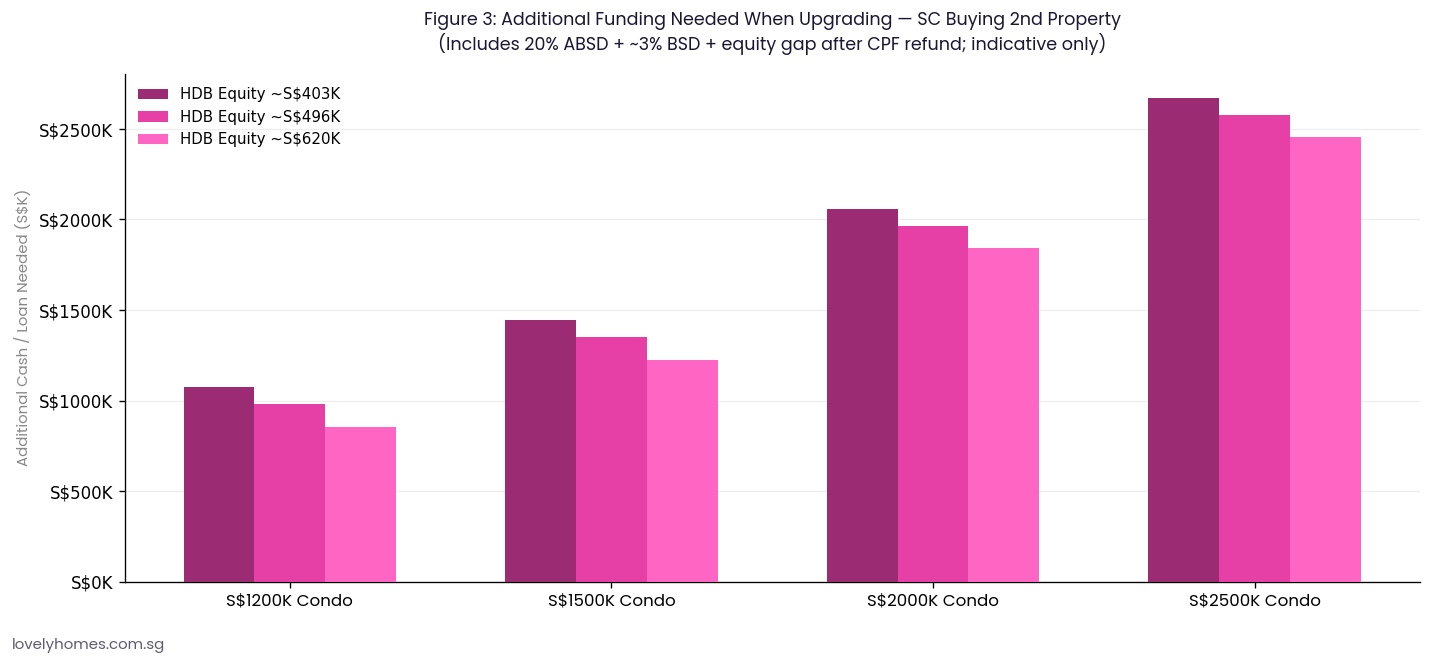
Additional cash needed when HDB upgrading to private condo Singapore citizen second property ABSD 2026
Figure 3: Additional cash or loan funding needed above HDB equity proceeds, by condo price point and usable equity level. All figures assume 20% ABSD (SC 2nd property) and 3% BSD; sell-first scenario removes the ABSD bar entirely.

Why the Upgrade Matters for Singapore Wealth Building

The HDB-to-private upgrade has historically been Singapore’s most reliable individual wealth-building step. URA transaction data consistently shows that private residential prices in the Rest of Central Region (RCR) and Core Central Region (CCR) have outpaced HDB resale price appreciation over 10-year rolling periods, particularly in proximity to MRT interchanges and integrated developments. The 2016–2026 decade saw HDB resale values rise approximately 40–55% in prime estates, while comparable private freehold or 99-year leasehold condos in the same districts appreciated 60–90%.

That said, the upgrade decision is not purely about capital appreciation. Private condo ownership typically involves higher monthly outgoings — management fees, sinking fund contributions, higher property tax under the non-owner-occupier progressive rate (administered by IRAS), and higher mortgage quantum — which compress monthly cash flow for the first 5–10 years. Households should model the cash-flow impact carefully using the actual mortgage rate (SORA + spread, typically 3.4–3.8% as of April 2026 for new floating-rate packages) rather than the stress-test rate.

What Might Come Next: Policy Watch for Upgraders

The current ABSD framework (20% for SC second property) has been in place since April 2023 and shows no sign of immediate revision. MAS and MND have both signalled that macroprudential tools will remain elevated as long as private property prices continue to rise. The URA reported a 0.9% quarter-on-quarter increase in private residential prices in Q1 2026 (full statistics released 25 April 2026), on top of a 0.6% gain in Q4 2025, suggesting sustained upward pressure that gives authorities little reason to ease ABSD. Upgraders planning their move in 2026–2027 should assume the 20% SC ABSD rate persists for the foreseeable future, and should build the sell-first timeline around that assumption.

One area to watch is the Lease Buyback Scheme and CPF use rules for older HDB upgraders (aged 55+), where CPF Retirement Account obligations create a different equity-release calculus. MND’s Committee of Supply 2026 speech hinted at ongoing reviews of CPF Retirement Sum drawdown rules for older owner-occupiers — any loosening could marginally improve equity available for the upgrade among this cohort.

Frequently Asked Questions

Can I buy a private condo before selling my HDB flat?

Yes, but as a Singapore Citizen you will be liable for 20% ABSD on the private condo purchase price, payable within 14 days of exercising the OTP. IRAS provides a Remission Scheme for married couples where at least one is a Singapore Citizen: if you sell your HDB within six months of the private condo’s key collection date (new launch) or OTP exercise date (resale), you may apply to IRAS for a refund of the ABSD paid. The refund is not automatic and requires a formal application within the stipulated window. Note that the 5% cash down payment for the private condo is still required upfront and is not refunded.

What happens to the CPF money I used for my HDB flat?

Upon selling your HDB flat, all CPF Ordinary Account monies used for the purchase — including the initial down payment, subsequent monthly instalments drawn from CPF, and any CPF Housing Grants received — must be refunded to your CPF OA with accrued interest at 2.5% per annum compounded annually. This refunded amount re-enters your CPF OA and can be used immediately for the down payment on your private condo purchase (subject to the CPF Withdrawal Limit and Valuation Limit rules). You do not lose this money — it simply remains within the CPF system rather than being paid out as cash. The CPF Board’s property portal at cpf.gov.sg provides a withdrawal calculator to estimate your exact refund obligation.

How much cash do I actually need to upgrade?

The minimum cash component for any private property purchase in Singapore is 5% of the purchase price. This must be paid in cash — CPF OA funds or bank loans cannot cover this component. For a S$1.5M condominium that is S$75,000. On top of this, you will need cash or CPF for the Buyer’s Stamp Duty (approximately S$44,600 on S$1.5M), legal fees (~S$3,000–$5,000), and a valuation fee (~S$300–$600). If you are using the sell-first strategy and have no ABSD to pay, total cash and CPF outlay to exercise the OTP is approximately S$120,000–$130,000 for a S$1.5M property, with the remainder funded by your mortgage and CPF OA balance.

Can I retain my HDB flat and buy a private condo?

Singapore Citizens and Permanent Residents are not prohibited from simultaneously owning an HDB flat and a private property, but the financial cost is high: as an SC you will pay 20% ABSD on the private property purchase, and as a PR you will pay 30% ABSD on your second property. Additionally, while you own both, the HDB flat remains subject to HDB rules including the restriction on fully subletting the flat until MOP is met (unless you are above 35, divorced, a single with the right to sublet under HDB’s rules, or have specific HDB approval). If you proceed with this dual-ownership approach, you must ensure your TDSR covers both your HDB loan instalments and the new private mortgage simultaneously.

What is the Temporary Housing Solution during the gap between HDB completion and condo collection?

Most sell-first upgraders experience a 1–6 month gap between HDB legal completion and moving into the new private property. The most common approach is a deferred completion arrangement negotiated with the HDB buyer at the point of signing the OTP — you agree to stay in the flat for a fixed rental period (typically 2–3 months at a market rate) after legal completion while your new home is prepared. Alternatively, families rent a unit in the open market at prevailing rates, or stay with extended family. Factoring rental costs of S$2,000–$4,500 per month (depending on unit size and district) into your upgrade budget is essential, particularly for the east and central regions where new launch condo waiting periods can extend to 3–5 years.

Are there specific private condos I cannot buy with my HDB equity?

There are no restrictions on which private condominium an HDB upgrader may purchase. However, two practical constraints often apply. First, Restricted Residential Properties under the Residential Property Act — Good Class Bungalows and most landed housing in Singapore — require Ministerial approval for Singapore Permanent Residents and are unavailable to foreigners entirely; Singapore Citizens may purchase without restriction. Second, if your usable CPF OA balance is below the Valuation Limit (the lower of purchase price and market value), your CPF usage will be capped; you must fund the shortfall from cash. Always check the CPF Board’s updated Valuation Limit rules at cpf.gov.sg before committing to a price point.

What happens if I cannot sell my HDB within the 6-month ABSD remission window?

If you purchased a private condo while retaining your HDB flat (buy-first strategy) and are unable to sell the HDB within six months of the private condo’s key collection date or OTP exercise date, the ABSD remission is forfeited — the 20% ABSD you paid upfront is not refunded. In practice, HDB resale transactions in Singapore typically complete within 8–16 weeks of listing, so the six-month window is generally achievable if you list the HDB promptly after exercising the condo OTP. The risk is greatest when buying a resale condo (shorter completion timeline) while your HDB is slow to sell. If you are uncertain, the sell-first strategy eliminates this risk entirely.

Related Articles

Disclaimer

This article is intended for general informational purposes only and does not constitute financial, legal, or property advice. Stamp duty rates, CPF rules, HDB regulations, and MAS lending guidelines are subject to change; always verify current figures directly with the Inland Revenue Authority of Singapore (IRAS), the CPF Board, the Housing Development Board, and the Monetary Authority of Singapore. Consult a licensed property agent, bank mortgage specialist, and solicitor before making any property transaction decision. Nothing in this article should be treated as a solicitation to buy or sell any property.


HDB Resale Price Index Q1 2026: Mature-Estate Squeeze Persists as First-Time Buyers Outbid Upgraders

HDB Resale Price Index Q1 2026: Mature-Estate Squeeze Persists as First-Time Buyers Outbid Upgraders

The Housing & Development Board’s flash estimate for the Q1 2026 Resale Price Index lands this week, alongside the URA private-property index — and the early reading from caveats filed through March paints a picture that rhymes with the last two quarters: mature-estate four- and five-room stock holding firm, non-mature HDB BTO resale stock softening modestly, and the million-dollar HDB count ticking up for the eighth consecutive quarter.

At a glance
  • HDB’s Q1 2026 flash RPI print is expected to come in at +0.9% QoQ, following +1.1% in Q4 2025 and +1.4% in Q3.
  • Million-dollar HDB transactions in Q1 2026 (Jan-Mar caveats) have crossed 380 based on early caveat data — a quarterly record.
  • Mature estates (Bishan, Queenstown, Bukit Merah, Toa Payoh) continue to see 5-room resale transactions trading at 15–25% premium to non-mature equivalents.
  • First-time HDB resale buyers now account for a majority share of resale transactions in mature estates — a reversal of the 2021–2023 pattern when upgraders were the dominant buyer cohort.
  • Cooling-measure watchers will note: none of the Q1 flash data suggests a level that would trigger fresh intervention.

HDB Resale Price Index — Quarter-on-Quarter % Change % QoQ CHANGE 2.3Q1 20251.8Q2 20251.4Q3 20251.1Q4 20250.9Q1 2026 Source: HDB · URA public data · LovelyHomes editorial lovelyhomes.com.sg

The headline: deceleration, not decline

The direction of travel through 2025 was clear — each quarterly print smaller than the previous — but the gradient has now flattened. The Q1 2026 +0.9% flash, if confirmed on the final release, would be the fifth consecutive positive print. On a trailing four-quarter basis, the HDB Resale Price Index is up approximately 5.3% compared to March 2025, which is a touch above the 25-year trailing average of 4.1% per annum and well below the 10.7% CAGR of the post-pandemic recovery window from 2021 to 2023.

The deceleration pattern is most visible in non-mature estates. Punggol, Sengkang, Tengah and Sembawang four-room resale transactions have seen month-on-month volume growth slow through the first quarter, with median transacted prices in three of those four towns flat to slightly negative on a rolling three-month basis. Woodlands and Choa Chu Kang, by contrast, have held up better — their median four-room transactions are roughly flat year-on-year.

The mature-estate premium keeps widening

Q1 2026 Median Resale Prices — 5-Room Flat, Select Towns TOWNCATEGORYQ1 2026 MEDIAN QueenstownMatureS$ 1,195,000BishanMatureS$ 1,085,000Toa PayohMatureS$ 1,040,000Bukit MerahMatureS$ 995,000ClementiMatureS$ 945,000PunggolNon-matureS$ 755,000SengkangNon-matureS$ 735,000TengahNon-matureS$ 710,000WoodlandsNon-matureS$ 680,000Choa Chu KangNon-matureS$ 660,000 Source: HDB · URA · LovelyHomes editorial · 23 April 2026 lovelyhomes.com.sg

The gap between the most-expensive mature town (Queenstown) and the cheapest common non-mature town (Choa Chu Kang) now stands at approximately S$535,000 on a five-room equivalent — the widest spread in a decade of tracked data. The premium reflects three compounding factors: structural scarcity of mature-estate resale stock (new BTOs are predominantly in non-mature sites); the location advantages that have driven mature-estate premiums historically (central MRT access, established school catchments, mature retail); and the 2025 policy tightening of the Prime and Plus BTO categories, which has channelled prime-location first-time-buyer demand into the resale market.

Million-dollar HDB transactions cross 380

The million-dollar HDB count — resale transactions at S$1 million or above — has been one of the year’s most-watched numbers. Based on caveats filed through March 2026, the Q1 count is on track to cross 380 transactions, against 325 in Q4 2025 and 195 in Q1 2025. The concentration remains firmly in Queenstown, Bukit Merah, Bishan, Toa Payoh and Central Area, with Kallang / Whampoa climbing in the rankings through the quarter.

Why million-dollar HDB matters

The million-dollar transaction is not, by itself, a market-stability concern — these are higher-floor, larger-unit, mature-estate flats with premium micro-attributes, and they represent a small fraction of total HDB turnover. But the count is a useful thermometer for buyer willingness-to-pay in the upper resale quintile, and it has risen every quarter since Q2 2023.

The buyer mix has quietly inverted

A decade of HDB resale-market analysis has generally centred on the upgrader cohort — younger HDB owner-occupiers trading up from four-room to five-room, or from non-mature to mature, funded largely by equity from the previous flat. That cohort dominated the 2021–2023 market.

The composition has quietly inverted through 2025 and into Q1 2026. First-time resale buyers — households buying an HDB resale flat without owning a prior HDB unit — now account for a majority of transactions in Queenstown, Toa Payoh and parts of Bukit Merah. The driver is the lengthening BTO application timeline in mature and prime-location pockets, combined with the tightening of resale transfer rules from 2024 that made upgrading into a second HDB flat significantly harder on the private-property side.

Mortgage affordability: the real constraint

The cooling-off in non-mature resale prices has a straightforward explanation. Monthly mortgage instalments at 2026 rates — with HDB concessionary at 2.6% and most private floating packages around 3.3–3.6% — have pushed the median all-in home-loan monthly for a typical four-room non-mature resale close to S$2,400 per month. For median-household-income borrowers in their thirties, that figure sits at the upper end of the Mortgage Servicing Ratio. Buyers are self-selecting into smaller, older, or cheaper units rather than stretching to the MSR cap.

What to watch in Q2

Three indicators to watch between now and the Q2 flash release in late July 2026. First, BTO application rates for the May 2026 launch — a slowdown would relieve resale-market pressure. Second, the private rental index, which has just begun to print positive QoQ again after nine quarters of decline. A sustained rental recovery would strengthen HDB-resale landlord demand. Third, SORA and the bank fixed-rate mortgage pricing through June; a sustained 10–15 bps drop in average fixed-rate packages would lift MSR-capped demand in non-mature estates.

Frequently asked questions

What is the HDB Resale Price Index?

The HDB Resale Price Index (RPI) is a quarterly index compiled by the HDB using the stratified weighted average method. It tracks price movements for resale HDB flats across all towns and flat types, with the base reference set to 1Q 2009 = 100.

Why does the index show growth when my estate has seen prices flat?

The RPI is a national aggregate. Individual towns can diverge materially from the national print. Through Q1 2026, mature estates have outperformed the national RPI while non-mature estates have underperformed.

Does a ‘million-dollar HDB’ transaction mean the market is overheated?

Not directly. Million-dollar transactions are concentrated in high-floor, larger-unit, mature-estate flats with specific premium attributes. They represent roughly 2% of quarterly HDB resale turnover. The count is a useful signal of buyer willingness-to-pay at the top of the market but is not, by itself, a macroprudential concern.

When is the final Q1 2026 RPI released?

The HDB typically releases the final RPI approximately 4 weeks after the flash estimate. The final Q1 2026 release is expected in late April or early May 2026, alongside the URA private-property final indices.

Should I buy an HDB resale now or wait for the next BTO?

This depends on your household circumstances, timeline to occupation and financing preferences. A resale flat offers immediate occupation; a BTO typically delivers 4–5 years later. Our BTO vs resale comparison covers the trade-offs in detail.

Source

Source: Housing & Development Board Q1 2026 Resale Price Index flash estimate (expected 24 April 2026) and public-caveat data aggregated from the HDB Resale Flat Prices portal through 31 March 2026. Full methodology: HDB press releases.

Related guides on LovelyHomes

Editorial note. This article is based on public-domain data released by HDB, URA, Singapore Land Authority and MAS as at 23 April 2026. All analysis is our own. No marketing-agency research is cited. Figures may be revised in subsequent official releases — always refer to the latest authoritative source before making a housing decision.


Singapore Q1 2026 Flash Estimates: Private Up, Public Down — The First Divergence in Seven Years

Singapore Q1 2026 Flash Estimates: Private Up, Public Down — The First Divergence in Seven Years

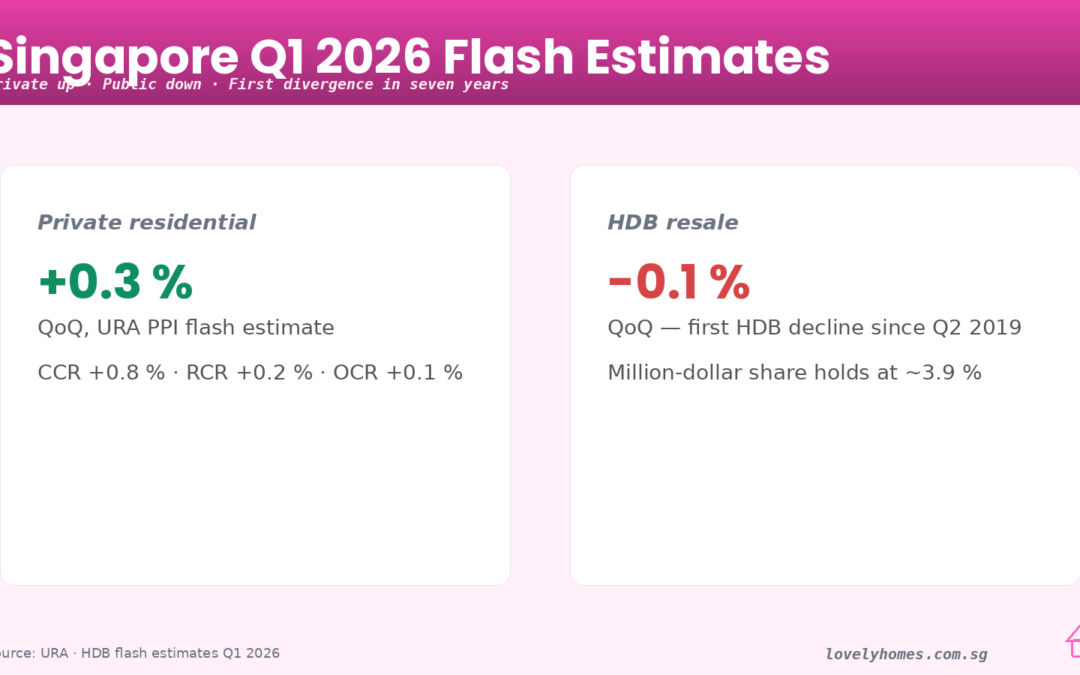
Singapore Q1 2026 flash estimates: private residential +0.3% vs HDB resale -0.1%
Private residential and HDB resale flash indices diverged for the first time in seven years. Source: URA and HDB flash estimates, 1 April 2026.

Quick take: On 1 April 2026, URA’s flash estimate showed the overall private residential price index rising 0.3% quarter-on-quarter in Q1 2026, while HDB’s flash estimate put the Resale Price Index at -0.1% quarter-on-quarter — the first public-housing decline since Q2 2019. The two segments have moved in the same direction almost every quarter since mid-2019. This quarter, they have not.

What the numbers actually say

URA’s flash estimate is a fast read on transactions caveated in the first ten weeks of the quarter. For Q1 2026, the non-landed segment carried the whole index: non-landed prices were up an estimated 1.0%, led by the Outside Central Region at +1.3%, followed by the Rest of Central Region at +0.8% and the Core Central Region at +0.4%. Landed homes pulled the headline the other way at about -2.4%, a reminder that the landed market trades thinly and can swing on a handful of deals.

The other private-market signal behind the flash is volume. New-sale launches collapsed to roughly 60% below Q4 2025. With only a thin slate of launches in January and February and most developers holding fire until after Chinese New Year, the bulk of Q1 price action came from resale and sub-sale transactions rather than showflat pricing power. When new launches return in strength from Q2, the price signal will widen again.

On the public side, HDB’s flash estimate at -0.1% is small in headline terms but large in narrative. The Resale Price Index has risen in every single quarter since Q3 2019 — twenty-six consecutive quarters of gains. A flash print at zero, or marginally below it, breaks that run. Final numbers, due in late April, may revise the estimate either way by a tenth or two, but the direction is the news.

Why the two markets are diverging now

Three forces are separating private and public prices this quarter.

1. The cooling measures have landed unevenly. The August 2024 LTV tightening for HDB loans (90% to 75%) and the continued 15-month wait-out rule for private downgraders have compressed HDB resale demand more than the private market. Private buyers financing with bank loans at lower LTV ceilings were already used to higher cash-and-CPF components; HDB resale buyers, many of whom are upgraders or first-timers, feel the tightening at the margin where deals close.

2. BTO supply has materially improved. HDB is pushing through roughly 50,000 flats across the 2025 and 2026 programmes. The June 2026 BTO exercise will offer about 6,900 flats across Ang Mo Kio, Bishan, Bukit Merah, Sembawang and Woodlands. When first-timers have a realistic shot at a BTO within 18 to 24 months, the urgency premium in resale prices eases. That is exactly the mechanism HDB publicly described when it reintroduced the Prime, Plus and Standard classification in late 2024.

3. The private market found a new OCR anchor. The OCR leading at +1.3% reflects the mass-market bid for newer freehold and 99-year projects where the price-per-square-foot still reads as a discount to the RCR. Buyers priced out of the core are not disappearing — they are rotating outward. HDB resale, by contrast, has no similar pressure valve; the product is the product.

How the divergence compares historically

The last time HDB resale fell while the URA index rose was Q2 2019 — the final stretch of the post-2018-cooling-measures adjustment, when public housing was absorbing ABSD-driven demand shifts. Before that, divergence episodes clustered around the 2013-2014 tightening and the 2008-2009 cycle. Divergence is not unprecedented; what is unusual is how long the two markets have moved together. From Q3 2019 to Q4 2025, both indices posted gains in every single quarter.

One quarter is not a trend. The signal here is less “HDB is falling” and more “HDB has stopped rising.” That is still a meaningful shift after seven years of one-way pressure.

What this means for buyers and sellers

HDB resale buyers: The urgency is lower. If the June BTO ballot in a town you would consider is a serious option, running both tracks in parallel is now a more defensible strategy than it was 12 months ago. Million-dollar resale records will continue to happen in flagship locations, but the median flat in a mature estate is no longer compounding at 8-10% a year.

HDB sellers: Price realism matters. COV (cash-over-valuation) expectations set in 2024 no longer hold in most estates. Sellers who fix an asking price based on a neighbour’s Q3 2025 transaction are increasingly missing the window and sitting on the listing for two to three months before cutting.

Private buyers: The OCR is where the action is, and the Q2 launch slate will test how much pricing power developers actually have. Watch median PSF for OCR new launches in Q2 against late-2025 comparable projects. If developers push prices 3-5% above comparables and still clear 30% on launch weekend, the private cycle re-accelerates. If they stall, the flash estimate flatters a cooler underlying market.

Private sellers and sub-sale owners: The CCR-to-OCR spread narrowed again in Q1. Holders of older freehold CCR stock should benchmark against current RCR new-launch pricing rather than historical CCR premiums — the buyer pool has shifted.

What to watch between now and late April

Three things will sharpen the picture in the next three weeks:

  • Final Q1 numbers (late April): URA and HDB publish the full quarterly indices with sub-indices by region and flat type. The flash can revise by up to 0.2 percentage points in either direction.
  • April and May new-launch pricing: Two to three large OCR launches are pencilled in for Q2. Median PSF at launch will tell us whether developers are testing the ceiling or holding.
  • June 2026 BTO application rates: First-timer subscription ratios in Ang Mo Kio and Bishan will signal how much pressure is still in the resale market. Application rates above 3x in non-mature estates typically foreshadow resale strength; ratios closer to 1x suggest buyers are comfortable waiting.

The bigger frame

Singapore’s residential market has been remarkable for its synchronised climb since 2019. That era is pausing. Whether Q1 2026 turns out to be a one-quarter wobble or the start of a sustained rebalancing between public and private depends on three things: the new-launch pipeline in Q2 and Q3, the pace of BTO completions absorbing first-timer demand, and whether any further cooling measures are signalled in the mid-year review.

For now, the most honest read of the flash estimates is this: the private market is still advancing, the public market has stopped, and the gap between them is the most interesting number in Q1.

FAQ

How reliable is the URA flash estimate?

The flash estimate is based on the first ten weeks of caveated transactions and is typically revised by ±0.1 to ±0.2 percentage points when the final index is published three to four weeks later. Direction is usually preserved; magnitude can shift.

Is the HDB flash estimate the first decline since 2019?

Yes. HDB’s Resale Price Index last posted a quarter-on-quarter decline in Q2 2019. The Q1 2026 flash at -0.1% is the first negative print in twenty-seven quarters. The final number, due in late April, will confirm or revise this.

Why did private new launches drop 60% QoQ?

Q1 is seasonally slow because of Chinese New Year and because developers typically time launches to coincide with stronger post-Lunar-New-Year demand in Q2. Q1 2026 had a thinner launch slate than usual with most of the pipeline deferred to April onwards, which amplified the quarter-on-quarter drop.

Will the June 2026 BTO exercise affect resale prices?

At the margin, yes. 6,900 flats across five towns is a meaningful supply signal, especially in non-mature estates where first-timer application ratios drive most of the urgency pricing in resale. Towns included are Ang Mo Kio, Bishan, Bukit Merah, Sembawang and Woodlands.

Should I wait to buy?

Flash estimates are one input among many. If you have found the right unit at the right price relative to comparable transactions in the last 60-90 days, macro prints rarely change the calculus. If you are timing the cycle, wait for the final Q1 numbers and the Q2 launch pricing before committing.


Disclaimer: This article reports on URA and HDB flash estimates published on 1 April 2026 and is for general information only. Flash estimates are preliminary and subject to revision. Individual transactions vary by project, unit, tenure and timing. This is not financial, investment or property advice. Buyers and sellers should seek advice from qualified professionals and verify figures against the official URA and HDB releases before making decisions.

Related reading on lovelyhomes.com.sg: TDSR and MSR: How Much Can You Actually Borrow in Singapore 2026 · Freehold vs 99-Year Leasehold Singapore 2026: The Real Price of Time.

Translate »