Singapore HDB Flat Inheritance Guide 2026: CPF Nomination, Transmission and Estate Rules

Singapore HDB Flat Inheritance Guide 2026: CPF Nomination, Transmission and Estate Rules

When a Singapore Housing & Development Board (HDB) flat owner dies, the flat does not automatically pass to surviving family members the way many people assume. Whether the flat is transferred, sold, or administered by a government body depends on whether the owner made a CPF nomination, an HDB Flat Nomination, or neither. Understanding the distinction — and acting on it while still alive — is one of the most important estate-planning steps any HDB flat owner can take.

This guide explains every pathway in plain language, sets out the eligibility rules a beneficiary must satisfy to keep an inherited flat, walks through the transmission process step by step, and answers the questions HDB owners most commonly ask. All information reflects Housing & Development Board rules, CPF Board procedures, and Public Trustee Office (PTO) practice as at 20 August 2026. Always verify current requirements directly with HDB, CPF Board, and the Public Trustee Office.

Quick Answer — HDB Flat Inheritance at a Glance

  • Three pathways exist: CPF nomination (if flat was bought using CPF), HDB Flat Nomination (if flat was bought with cash or the CPF nomination does not cover the flat), and Public Trustee or probate (if no nomination was made).
  • CPF nomination overrides your will for the CPF component of the flat’s value. An HDB Flat Nomination similarly overrides your will for the flat itself.
  • No inheritance tax and no estate duty apply in Singapore. Estate duty was abolished on 15 February 2008.
  • The beneficiary must meet HDB eligibility to keep the flat. A Singapore Citizen or Singapore Permanent Resident with no other private property may generally retain the flat; a foreigner or a beneficiary who owns private property must sell.
  • If the owner dies within the Minimum Occupation Period (MOP), the MOP clock does not restart — it continues from the original purchase date.
  • Multiple beneficiaries may jointly inherit a flat, but all must meet HDB eligibility or the flat must be sold.
  • Typical processing time: 3–9 months for a clear nomination; 6–24 months if the Public Trustee is involved; longer if the estate is contested.

The Three HDB Inheritance Pathways Explained

How an HDB flat is dealt with when its owner dies is determined primarily by whether a valid nomination exists and what kind of nomination it is. The flat does not form part of the deceased’s general estate in the same way a bank account does — it has its own transfer rules that sit alongside, and sometimes override, a will.

Pathway 1 — CPF Nomination

Most HDB flat purchases involve CPF Ordinary Account (OA) savings, either as the down payment, for monthly repayments, or both. When CPF savings are used, the CPF Board becomes a mortgagee. On the owner’s death, the CPF Board pays the outstanding CPF principal plus accrued interest back to the CPF estate (or to the nominated person if a CPF nomination is in place). That CPF money does not go to the flat’s beneficiary directly — it goes to the nominated CPF beneficiary in cash, not as a share of the flat.

What this means in practice: the CPF nomination determines what happens to the CPF money, while the HDB Flat Nomination (or the will, or intestacy rules) determines what happens to the flat itself. The two are separate. A flat owner who used CPF to buy the flat should therefore make both a CPF nomination and an HDB Flat Nomination to ensure both the cash component and the flat are directed as intended.

Pathway 2 — HDB Flat Nomination

The HDB Flat Nomination Scheme, administered by HDB, allows an owner to nominate one or more persons to receive the flat on death. Unlike a will, an HDB nomination is registered directly with HDB and takes effect automatically — it does not need to go through probate. The nominated person (the “nominee”) must be a Singapore Citizen or Permanent Resident who meets HDB’s eligibility criteria at the time of the owner’s death.

An owner can nominate the flat to multiple persons in specified shares, or solely to one person. Where shares are nominated, all nominated persons must jointly meet the eligibility criteria. The nomination can be updated at any time by submitting a new HDB Flat Nomination form; the latest signed nomination supersedes all previous ones.

Pathway 3 — No Nomination: Public Trustee or Probate

Where no valid HDB Flat Nomination exists and the deceased did not leave a will, the Intestate Succession Act (Cap 146) determines who inherits the flat. In this scenario, a family member must either obtain Letters of Administration from the court (which typically takes 6–18 months) or apply to the Public Trustee Office if the estate is straightforward and under the monetary threshold. The PTO will administer the estate, collect the assets, and distribute them according to the intestacy order: spouse first, then children, then parents, then siblings, and so on.

If a will exists but no HDB nomination, the flat passes under the will — but the executor must apply for a Grant of Probate before the flat can be transferred. This is slower and more expensive than an HDB nomination, which bypasses probate entirely for the flat.
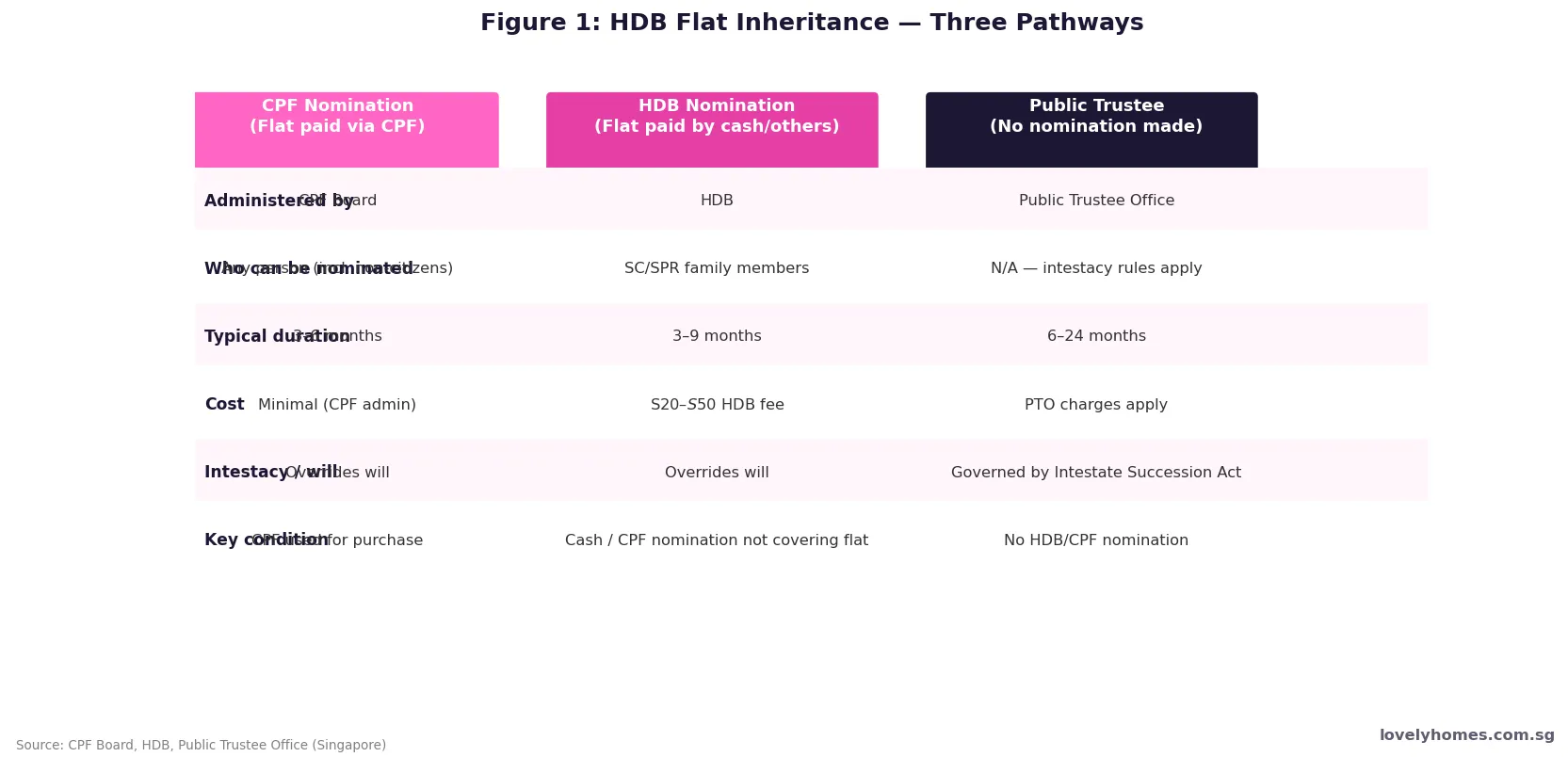
HDB flat inheritance pathways — CPF nomination vs HDB nomination vs Public Trustee
Figure 1: The three HDB flat inheritance pathways and the government body that administers each. Source: CPF Board, HDB, Public Trustee Office.

Timeline: How Long Does Each Pathway Take?

Processing time varies considerably. A clean CPF nomination with a straightforward HDB Flat Nomination can be completed in three to six months from the date of death. The Public Trustee pathway, by contrast, can take six months for a simple, uncontested estate or extend beyond two years if there are disputes, overseas assets, or complex beneficiary situations. The Grant of Probate pathway (testate estate with a will) typically takes six to eighteen months depending on court workload and the complexity of the estate.

During the period of administration, the surviving co-owner (if any) may continue to live in the flat. If the deceased was the sole owner, HDB will generally not require the other occupants to vacate immediately, but the situation should be formally regularised as quickly as possible.
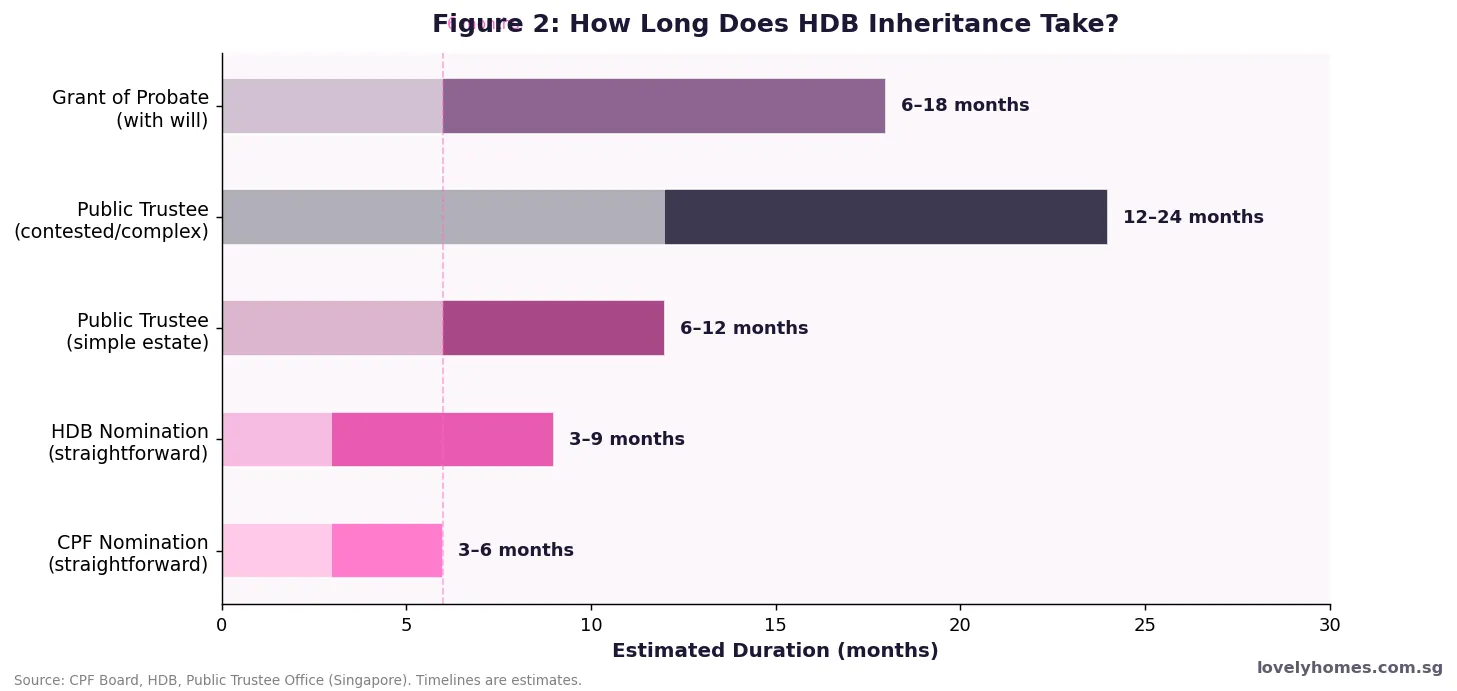
HDB inheritance timeline — how long each pathway takes in months
Figure 2: Estimated processing times by inheritance pathway. Timelines are indicative; complex estates take longer. Source: HDB, Public Trustee Office.

Can the Beneficiary Keep the HDB Flat?

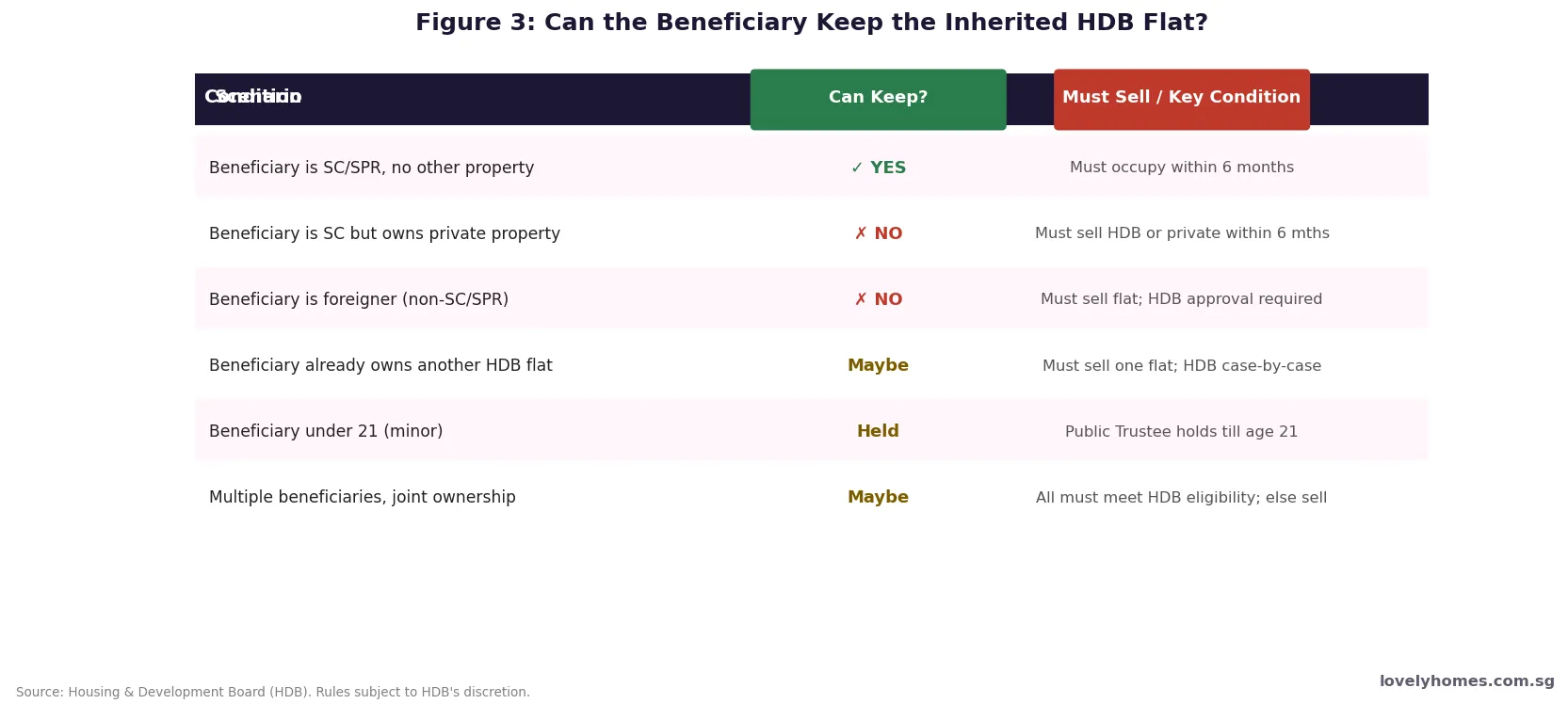
Even where a valid nomination directs the flat to a named beneficiary, that beneficiary must satisfy HDB’s eligibility conditions before HDB will consent to the transfer. If the beneficiary does not qualify, the flat must generally be sold and the proceeds distributed. This is one of the most common surprises families face — a loving parent may have nominated a child who owns a private condominium, only for HDB to require that child to sell one property.

The key eligibility rules as at 2026 are as follows. First, the beneficiary must be a Singapore Citizen or Permanent Resident (foreigners cannot hold HDB flats). Second, the beneficiary must form a valid family nucleus with the deceased or another SC/SPR — for example, a spouse, child, parent, or sibling. Third, if the beneficiary already owns a private residential property in Singapore or overseas, they must sell either the HDB flat or the private property within six months of the flat being transferred to them. Fourth, if the beneficiary is a minor (under 21), the flat is held by the Public Trustee until the minor reaches majority. Fifth, if multiple beneficiaries jointly inherit and not all meet the criteria, HDB assesses the matter on a case-by-case basis and may require a sale.
Can beneficiary keep inherited HDB flat — eligibility rules table
Figure 3: At-a-glance eligibility matrix for common inheritance scenarios. Source: HDB. Always confirm with HDB directly for your specific situation.

The Transmission Process — Step by Step

Once the appropriate documents are in order, the HDB transmission process follows a structured series of steps. The first step is to notify HDB of the death by submitting the death certificate and the relevant supporting documents (the nomination form, or the Grant of Probate, or the Letters of Administration). HDB will then assess the eligibility of the nominated beneficiary. If the beneficiary qualifies, HDB issues a letter of acceptance and the transfer is registered with the Singapore Land Authority (SLA). If the beneficiary does not qualify or chooses to sell, HDB facilitates the sale and disburses the proceeds accordingly.

Administrative costs are modest: HDB charges a conveyancing fee of around S$20 to S$50 for the flat transfer. If the beneficiary engages a private solicitor to manage the estate, legal fees typically range from S$500 to S$3,000 depending on complexity. The PTO charges a sliding-scale fee based on the value of the estate assets administered, which can amount to 1–2.5% of the estate’s gross value.

Estate Duty, Taxes, and the Minimum Occupation Period

Singapore abolished estate duty on 15 February 2008. There is no inheritance tax and no capital gains tax on property in Singapore. A beneficiary who receives an HDB flat pays no tax simply by virtue of inheriting it. If the beneficiary subsequently sells the flat in the open market, the sale proceeds are not subject to income tax. Seller’s Stamp Duty (SSD) does not apply to HDB flat sales (SSD applies only to private residential properties held for four years or fewer).

One important point concerns the Minimum Occupation Period. If the deceased owner died before the MOP expired, the MOP clock does not restart for the beneficiary. The beneficiary must wait out the remaining MOP from the date the flat was first purchased, not from the date of inheritance. A beneficiary who inherits a flat with two years remaining in its MOP must live in the flat for those two years before they are eligible to sell or rent it out.

Scenario Outcome for Beneficiary Key Condition or Restriction
SC beneficiary, no other property May keep flat Must occupy within 6 months of transfer
SC beneficiary, owns private property Must sell one 6-month window to dispose of either HDB or private property
SPR beneficiary, no other property May keep flat (HDB case-by-case) Subject to HDB’s prevailing SPR eligibility rules
Foreigner beneficiary Must sell flat Foreigners cannot hold HDB flats; HDB arranges sale
Minor beneficiary (under 21) PTO holds flat Released to beneficiary upon turning 21; MOP rules apply
Multiple beneficiaries, mixed eligibility HDB case-by-case May require all eligible parties to buy out ineligible parties, or sale
No eligible beneficiary Flat sold by HDB Proceeds distributed under intestacy rules or will

Worked Example

Worked Example: Mr Tan SC Sole Owner, Dies Without HDB Nomination

Situation: Mr Tan, a Singapore Citizen, purchased a 4-room HDB flat in Tampines in 2018 for S$450,000. He paid a S$30,000 CPF down payment and has been making monthly repayments of S$1,500 from CPF OA. By 2026, the outstanding HDB loan is S$280,000, and the CPF principal withdrawn (including monthly repayments) totals S$130,000, with accrued CPF interest of S$18,000. The flat’s current market value is approximately S$680,000. Mr Tan dies in August 2026 without having made an HDB Flat Nomination, but he did make a CPF nomination directing his CPF savings to his wife, Mrs Tan (SC).

What happens:

  • CPF Board pays S$148,000 (S$130,000 principal + S$18,000 accrued interest) from the CPF estate to Mrs Tan per the CPF nomination. This is a cash payment, not a flat transfer.
  • The flat itself — because there is no HDB Flat Nomination — passes under the Intestate Succession Act. Since Mr Tan is survived by a spouse and children, the wife receives half the estate and the children share the other half.
  • Mrs Tan engages a solicitor and applies for Letters of Administration. The process takes approximately 9 months.
  • Mrs Tan is the sole named beneficiary eligible to retain the flat (the children are minors). HDB agrees to transfer the flat solely to Mrs Tan, who satisfies the eligibility criteria.
  • Outstanding HDB loan of S$280,000 is assumed by Mrs Tan; she must meet HDB’s loan-to-value and financial criteria.
  • Total costs: PTO/legal fees approximately S$3,500; HDB conveyancing fee S$38.
  • Lesson: Had Mr Tan made an HDB Flat Nomination directing the flat to Mrs Tan, the 9-month probate process could have been avoided and the estate settled in approximately 4–5 months.

Estate Planning: What HDB Owners Should Do Now

The practical lesson from every case study is the same: make your nominations. An HDB flat owner should make both a CPF nomination (directing the CPF savings) and a separate HDB Flat Nomination (directing the flat itself). The two nominations complement each other and together ensure that neither component of your most valuable asset is left to intestacy rules or a protracted court process.

The CPF nomination is made online at the CPF website or in person at a CPF Service Centre. The HDB Flat Nomination is submitted to HDB — forms are available at HDB Hub or online via the HDB Portal. Both nominations should be reviewed whenever family circumstances change: marriage, divorce, birth of children, death of a nominee. A stale nomination that names a deceased person as the nominee creates exactly the complications it was meant to prevent.

Beyond nominations, flat owners should also consider whether their flat’s ownership structure — joint tenancy versus tenancy-in-common — fits their estate planning intentions. Joint tenancy means the surviving co-owner automatically inherits the flat’s full interest on the other owner’s death (right of survivorship), bypassing both nominations and the will. Tenancy-in-common means each owner holds a defined share that passes according to the nomination or will.

What Might Come Next for HDB Inheritance Rules

HDB’s eligibility rules for inheriting flats have remained broadly stable in recent years, but the policy tension between preserving HDB as a home-ownership scheme for eligible residents and accommodating modern family structures (blended families, overseas beneficiaries, beneficiaries with mixed property portfolios) is an ongoing one. Future rule changes — such as extended time windows for beneficiaries to divest a private property, or relaxed eligibility for SPR beneficiaries — cannot be ruled out. Flat owners with complex family situations should monitor HDB’s circular updates and consult HDB directly rather than relying solely on any published guide.

FAQ — HDB Flat Inheritance

Does a will override an HDB Flat Nomination?

No. An HDB Flat Nomination takes precedence over a will for the flat it covers. If you have nominated Person A in your HDB Flat Nomination but your will says the flat should go to Person B, the flat goes to Person A. This is why estate lawyers in Singapore strongly advise that your HDB nomination and your will be aligned, and that both be updated whenever family circumstances change. CPF nominations similarly override a will for the CPF savings component.

What if the nominated beneficiary dies before the flat owner?

If the sole nominated beneficiary predeceases the flat owner and the owner does not update the nomination, the nomination lapses and the flat falls back into the estate — governed by the will (if any) or the Intestate Succession Act. HDB will not attempt to contact the deceased beneficiary’s family. This is one of the most common pitfalls: owners make a nomination and then forget to update it when the nominated person dies. Review your nomination every few years and after any significant family event.

Can I nominate a non-family member to inherit my HDB flat?

The HDB Flat Nomination Scheme generally requires the nominated person to be a family member who forms a valid family nucleus with the owner — for example, a spouse, parent, child, or sibling. You cannot typically nominate a friend or a colleague. However, a CPF nomination (which covers the cash value of CPF savings used in the flat) can be made in favour of any person, including non-family members. That person would receive the CPF cash, not the flat itself.

What happens if the flat is still under a bank or HDB loan when the owner dies?

The outstanding loan does not disappear on the owner’s death. If the beneficiary inherits and retains the flat, they take over the loan obligations. For an HDB loan, the beneficiary must meet HDB’s loan eligibility criteria to assume the loan. For a bank mortgage, the bank will typically require the estate or the beneficiary to refinance or settle the outstanding amount. Most homeowners should carry term life insurance or mortgage protection insurance precisely to ensure the loan can be discharged if they die unexpectedly.

Does the Minimum Occupation Period restart when a flat is inherited?

No — the MOP does not restart. The clock continues from the date the flat was originally purchased (or the date the keys were collected for a BTO flat). If Mr Tan bought a flat in January 2023 (5-year MOP) and died in January 2026 after only three years, the beneficiary must occupy the flat until at least January 2028 before selling. The beneficiary cannot sublet the whole flat during the remaining MOP either, as the same occupation rules apply.

Are there any taxes payable on an inherited HDB flat?

There is no inheritance tax and no estate duty in Singapore (abolished 15 February 2008). The beneficiary pays no tax on receiving the flat. If the beneficiary later sells the flat, the sale proceeds are not subject to income tax or capital gains tax. Buyer’s Stamp Duty (BSD) would apply to a subsequent buyer of the flat in the normal way, but the seller (the beneficiary) does not bear BSD. Seller’s Stamp Duty (SSD) does not apply to HDB flats.

Disclaimer: This article is for general information only and does not constitute legal, estate-planning, or financial advice. HDB inheritance rules, CPF nomination procedures, and Public Trustee Office requirements are subject to change. Always verify current rules directly with the Housing & Development Board (hdb.gov.sg), the CPF Board (cpf.gov.sg), the Public Trustee Office (pto.mlaw.gov.sg), and a licensed solicitor. Eligibility decisions rest with HDB and are made on a case-by-case basis. LovelyHomes is not responsible for reliance on information in this article.
Singapore Property Renovation Guide 2026: HDB Rules, Costs, Permits and Renovation Loan Explained

Singapore Property Renovation Guide 2026: HDB Rules, Costs, Permits and Renovation Loan Explained

Whether you have just collected the keys to your new HDB flat, completed your MOP and are preparing to resell, or are refreshing a resale condo ahead of moving in, a renovation in Singapore involves navigating a specific set of rules, permits, and cost benchmarks that every homeowner should understand before engaging a contractor. Get it wrong, and you risk fines from HDB, stop-work orders from the Building and Construction Authority (BCA), or a renovation that looks impressive but adds little resale value.

This guide covers the full landscape of Singapore property renovation in 2026: HDB rules and what needs approval, BCA permits for structural work, realistic cost ranges by flat type and scope, the HDB Renovation Loan, timelines to plan around, and an evidence-based look at which renovation types deliver the strongest return on investment (ROI) at resale.

Quick Answer — Singapore Renovation 2026 at a Glance

  • HDB renovations require an HDB-registered contractor and — for certain works — advance written approval from HDB.
  • Structural works (hacking beams, columns, load-bearing walls) are prohibited in HDB flats regardless of approval status.
  • BCA permits are required for additions and alterations to private property that affect the building structure, external appearance, or gross floor area.
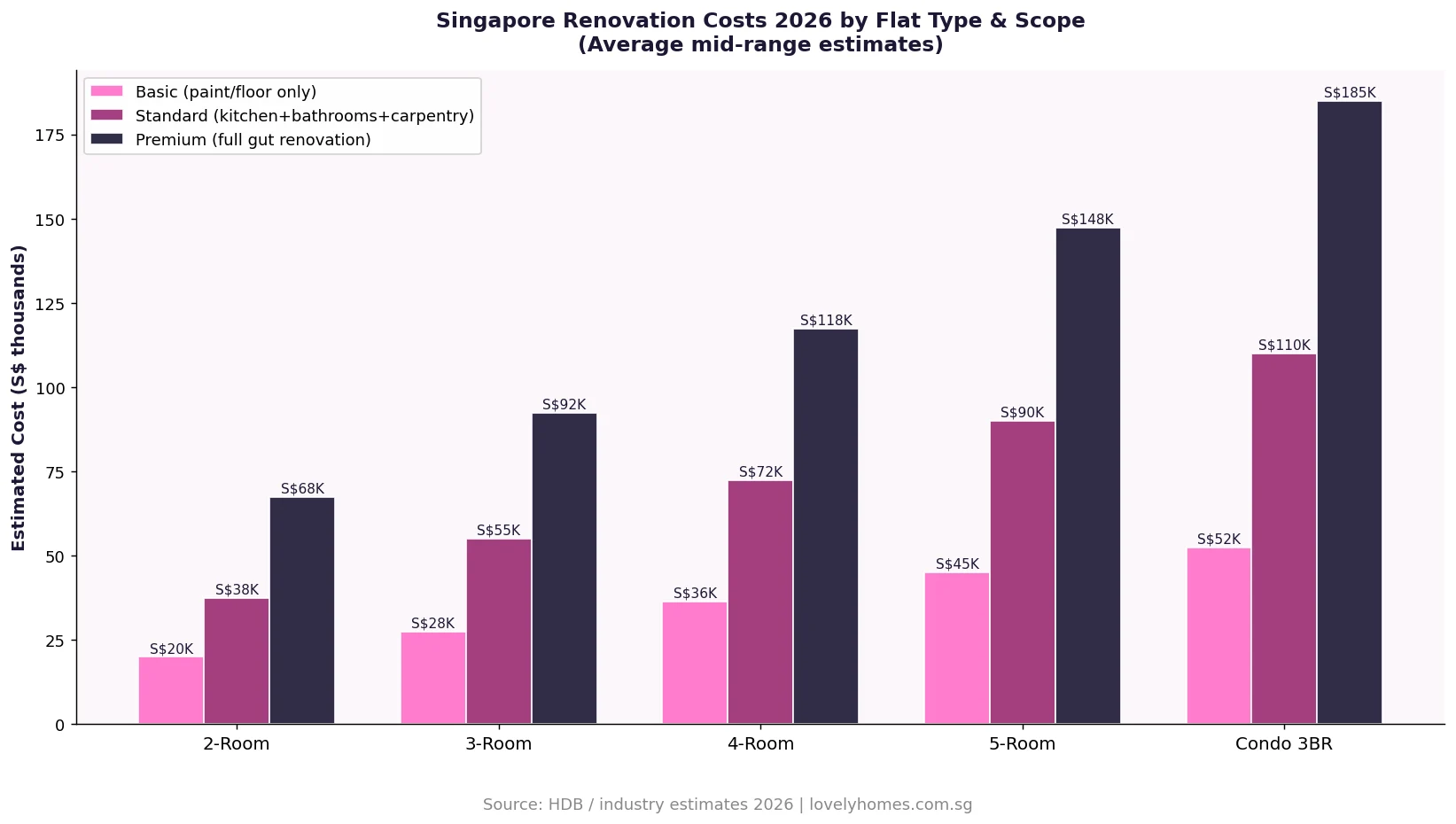
  • Costs range from S$18,000 for a basic 2-room HDB refresh to S$185,000+ for a premium condo 3-bedroom renovation.
  • Renovation Loan: up to S$30,000 for HDB flat owners, at interest rates from 5.5%–6.5% p.a. (check with your bank).
  • Duration: typically 8–16 weeks for a full flat; carpentry lead times of 6–10 weeks are the most common schedule bottleneck.
  • Best ROI renovations (by resale uplift relative to cost): kitchen refacing, bathroom remodelling, flooring replacement, and a fresh full repaint.

HDB Renovation Rules: What You Need to Know

HDB renovation rules exist to protect the structural integrity of blocks, ensure the safety of residents above and below, maintain the external facade of the estate, and prevent noise and disruption beyond acceptable hours. The rules apply regardless of whether you own a BTO flat, a resale flat, or a Design, Build and Sell Scheme (DBSS) flat.

The core requirements are:

  • Use an HDB-registered renovation contractor. All HDB renovation work must be carried out by a contractor on HDB’s approved register. Working with an unregistered contractor voids your rights under any HDB dispute resolution process and may result in fines. You can verify registration at the HDB renovation portal.
  • Submit a Renovation Permit application through your contractor’s HDB-registered account before commencing works that require approval.
  • Work hours: Monday–Friday 9:00 am–6:00 pm; Saturday 9:00 am–1:00 pm. No renovation work on Sundays or public holidays.
  • Inform your neighbours at least 3 working days before renovation commences (HDB policy; many MCSTs have their own protocols for private condos).
HDB renovation permit requirements 2026 — permitted, permit required, and prohibited renovation works
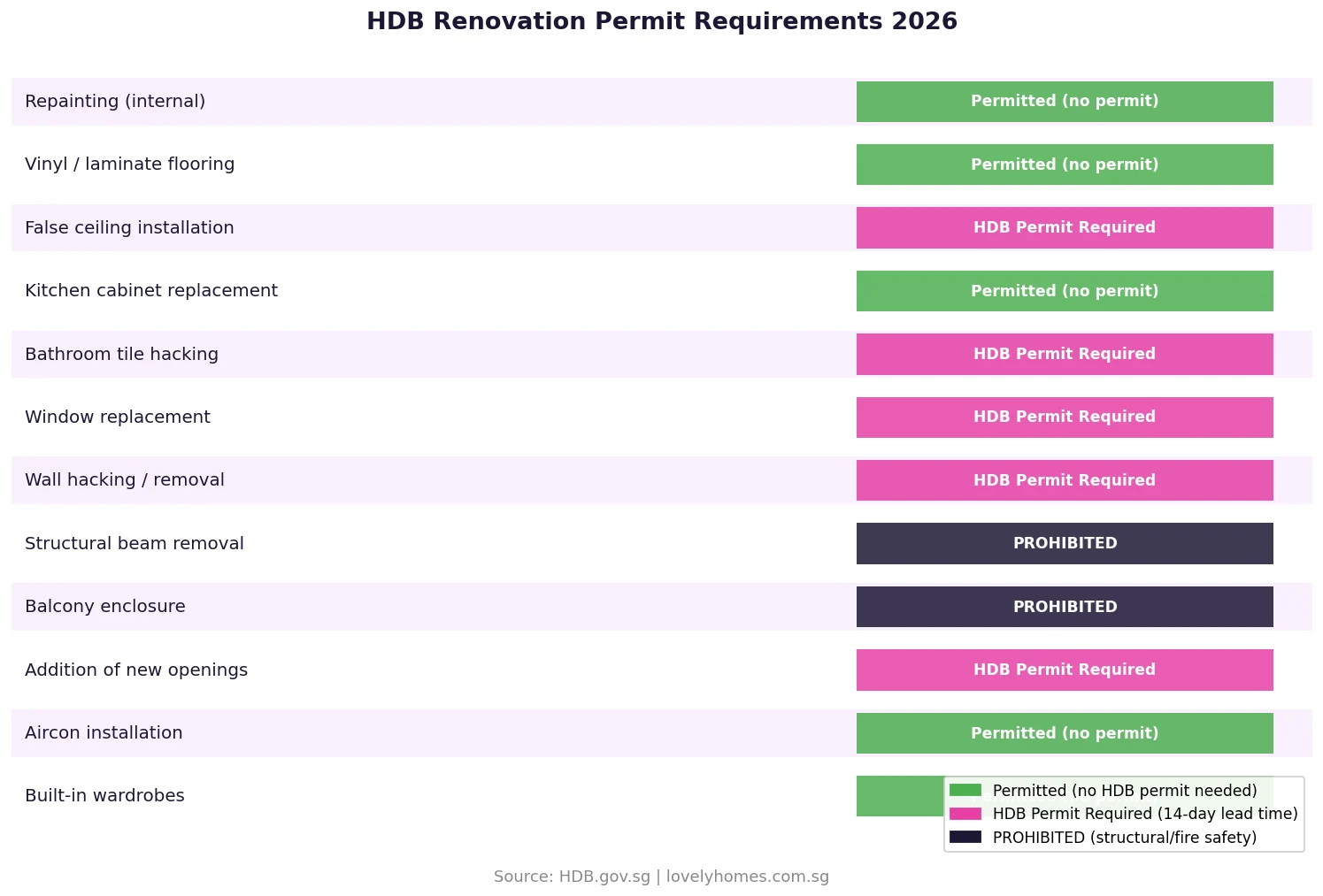
Figure 1: HDB renovation works categorised by permit requirement: no permit needed (pink), HDB permit required (orange), and prohibited (navy).
Renovation Type HDB Rule Notes
Painting (walls, ceilings) No permit needed Any colour; no structural impact
Wallpaper / wall panels No permit needed Must not damage structural surfaces
Built-in carpentry (wardrobes, TV console) No permit needed Contractor must be HDB-registered
Kitchen cabinets / countertops No permit needed Replacing like-for-like; plumbing changes need permit
Flooring (overlay, no hacking) No permit needed Vinyl overlay on tiles — no hacking needed
Flooring (hacking and relaying tiles) HDB Permit Required Submit via contractor’s account before starting
Bathroom fittings (sink, WC, shower screen) No permit for like-for-like Moving waste pipes = permit required
Hacking non-structural internal walls HDB Permit Required HDB confirms wall classification first
Hacking structural walls / beams / columns Prohibited No exceptions — structural integrity risk
Window grille installation / replacement HDB Permit Required Must meet HDB bar-spacing standards
Air-conditioning installations No permit for standard split units Outdoor unit placement must comply with HDB guidelines
Electrical rewiring (minor) No permit; must use licensed electrician SP PowerGrid licence required for main panel work

BCA Permits for Private Property Renovation

For private property (condominiums, landed homes, commercial units), the Building and Construction Authority (BCA) administers the approvals framework under the Building Control Act. Unlike HDB rules, which regulate the use of approved contractors and specific work types, BCA permits focus on structural safety, gross floor area, and external facade changes.

Works that typically require a BCA permit (Addition and Alteration, or A&A works) include:

  • Any structural alteration (adding or removing load-bearing elements, changing structural openings)
  • Extensions that increase gross floor area (GFA)
  • Changes to the external facade or roof of landed property
  • Swimming pool installations at landed property
  • Major electrical or mechanical system upgrades in commercial units

For condominium owners, all renovation work must also comply with the Management Corporation Strata Title (MCST) by-laws. Most MCSTs require homeowners to submit renovation plans and obtain written MCST approval before any work begins, and to pay a renovation deposit (typically S$1,000–S$5,000) refunded upon satisfactory completion without damage to common areas.

Renovation Costs by Flat Type and Scope

Renovation costs in Singapore vary enormously depending on the size of the unit, the scope of works, and the finish level targeted. The figures below reflect market rates as at mid-2026 based on indicative quotations from HDB-registered contractors. They exclude furniture, electrical appliances, and curtains, which are typically supplied separately.

Singapore renovation costs 2026 by flat type and scope — HDB and condo renovation cost ranges
Figure 2: Estimated renovation cost ranges (S$) by flat type and renovation scope — Basic (mainly cosmetic), Standard (full wet works and carpentry), and Premium (bespoke finishes throughout).
Property Type Basic Renovation (S$) Standard Renovation (S$) Premium Renovation (S$)
HDB 2-Room (35–45 sqm) 18,000–25,000 30,000–45,000 50,000–70,000
HDB 3-Room (65–75 sqm) 25,000–35,000 45,000–60,000 70,000–100,000
HDB 4-Room (90–100 sqm) 32,000–42,000 58,000–75,000 95,000–130,000
HDB 5-Room / EA (110–145 sqm) 40,000–55,000 72,000–95,000 120,000–160,000
Condo 2-Bedroom (65–80 sqm) 35,000–50,000 65,000–85,000 110,000–150,000
Condo 3-Bedroom (90–120 sqm) 48,000–65,000 85,000–115,000 150,000–220,000

What the tiers mean:

  • Basic renovation covers repainting, vinyl flooring overlay (no hacking), replacement of bathroom fittings and kitchen tap/sink, and basic built-in storage in one or two rooms. Typically 8–10 weeks to complete.
  • Standard renovation includes full hacking and retiling of bathrooms and kitchen, installation of full kitchen cabinetry with solid surface countertop, carpentry throughout all bedrooms, feature wall treatment in living room, false ceiling with LED lighting, and air-conditioning installation. Typically 12–16 weeks.
  • Premium renovation encompasses all standard works plus imported tiles, bespoke joinery with soft-close mechanisms and premium hardware, kitchen island, walk-in wardrobe, feature wall with natural stone or specialty panels, smart home integration, and designer sanitary ware. 16–20 weeks or more.

The HDB Renovation Loan

HDB flat owners who need financing for their renovation can apply for an HDB Renovation Loan through participating financial institutions. Key terms as at August 2026:

  • Maximum loan amount: S$30,000 (or 6 months’ gross household income, whichever is lower)
  • Eligibility: HDB flat owners; at least one applicant must be a Singapore Citizen or Permanent Resident; flat must be under the applicant’s name
  • Loan tenor: up to 5 years
  • Interest rate: typically 5.5%–6.5% p.a. (fixed or floating; compare rates across OCBC, UOB, DBS, Standard Chartered)
  • Monthly repayment example: S$30,000 at 6% p.a. over 5 years = approximately S$580/month
  • Approved works: must be used for renovation works carried out by HDB-registered contractors; loan funds disbursed directly to the contractor after works inspection

Private property owners can use personal loans or renovation loans offered by banks (not HDB), which typically allow borrowing up to 6× monthly income, up to S$30,000, at broadly similar interest rates.

Renovation ROI: Which Works Add the Most Value at Resale

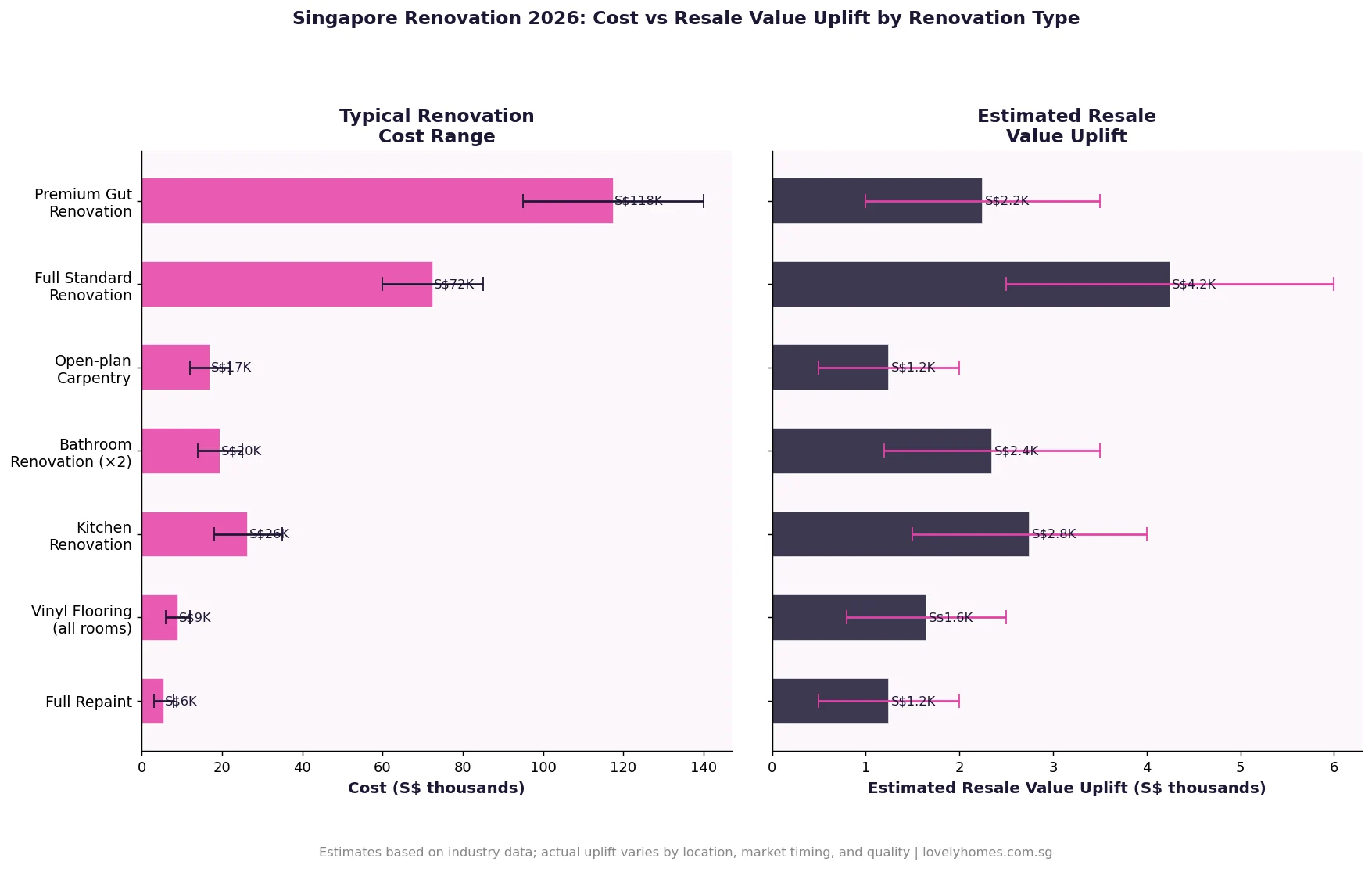
Not all renovation dollars are created equal. A premium renovation that costs S$150,000 does not necessarily add S$150,000 to your resale price — and in the HDB resale market especially, over-renovating above the neighbourhood price ceiling can result in negative ROI, where the renovation cost exceeds the premium buyers are willing to pay.

Singapore property renovation ROI 2026 by renovation type — range from full repaint to full gut renovation
Figure 3: Estimated resale ROI range and typical cost by renovation type. The dot on each range bar indicates the midpoint ROI. A fresh full repaint often delivers the highest ROI relative to cost.

General principles that hold across the Singapore resale market:

  • Kitchens and bathrooms sell flats. Buyers consistently rank clean, functional kitchens and bathrooms as the top priority. A bathroom remodel at S$15,000–S$20,000 typically commands a premium of S$15,000–S$30,000 or more in the HDB resale market, making it one of the highest-ROI renovations in absolute terms.
  • Repainting is the highest-ROI cosmetic upgrade. A full repaint of a 4-room flat costs S$2,500–S$4,500 and can lift perceived value by 5%–12% by making the flat feel newer and well-maintained. At S$550,000 resale, a 5% uplift = S$27,500 on a S$4,000 spend.
  • Flooring matters. Replacing old mosaic tiles with vinyl plank flooring (S$8,000–S$12,000) upgrades the look of the entire flat and appeals strongly to younger buyers. ROI of 8%–18% relative to cost is commonly observed.
  • Over-specified kitchens rarely pay back. A Häfele full-imported kitchen at S$45,000 in a S$450,000 flat is unlikely to recover its cost. Buyers in that price bracket expect a functional kitchen, not a luxury one.
  • Open-plan conversions (hacking the wall between kitchen and living room) are high-risk. They require HDB permit approval, add S$15,000–S$25,000 in costs, and appeal to a subset of buyers. If your buyer prefers a separate kitchen (common among families with elderly members), the conversion may reduce marketability.

Worked Example: Ms Tan — selling her Bishan 4-Room HDB flat after MOP

Ms Tan’s 4-room flat is 12 years old. She purchased it at S$370,000 and is targeting a resale at S$720,000. Market comparables show recently transacted flats in her block at S$700,000–S$740,000 — a standard finish range.

Renovation plan (standard scope, targeting resale within 3 months):

  • Full repaint (4 rooms + common areas): S$3,800
  • Bathroom retiling and new fittings (2 bathrooms): S$22,000
  • Kitchen hacking, retiling, new cabinets with quartz countertop: S$28,000
  • Vinyl plank flooring (bedrooms and living room): S$9,500
  • False ceiling with LED downlights (living and dining): S$5,200
  • Minor carpentry (master bedroom built-in wardrobe): S$6,500
  • Total renovation cost: S$75,000

Resale outcome: After renovation, the flat transacted at S$735,000 — S$35,000 above the pre-renovation comparable median. Net renovation benefit = S$35,000 uplift at an outlay of S$75,000. However, the renovation also allowed Ms Tan to sell at top-of-market speed (16 days on the market vs. average 45 days for unrenovated flats in her block), reducing holding costs and the risk of a prolonged sale at a lower price.

Renovation Loan used: Ms Tan borrowed S$30,000 via UOB Renovation Loan at 6.0% over 3 years (S$913/month), repaid fully on completion of the sale. Total interest paid = approximately S$2,860.

Renovation Timelines and Planning Tips

Renovation projects in Singapore typically follow this sequence:

  • Week 1–2: Hacking (tiles, walls where permitted). Noisiest phase — schedule within HDB allowed hours.
  • Week 2–4: Plumbing, electrical conduit laying, plastering.
  • Week 4–6: Tiling (wet areas first), waterproofing, window grilles.
  • Week 6–10: Carpentry fabrication off-site (cabinets, wardrobes — this is where most delays occur).
  • Week 10–12: Carpentry installation, painting, flooring.
  • Week 12–14: Air-conditioning, light fittings, final touches, snag inspection.

The single most reliable way to compress the schedule is to finalise your carpentry design before the main contractor starts hacking, so fabrication can begin in parallel. Many homeowners also run a parallel procurement track for appliances (ovens, hobs, refrigerators) so delivery aligns with carpentry installation.

Choosing a Renovation Contractor

For HDB flats, all renovation works must be carried out by a contractor registered with HDB. You can search HDB’s renovation contractor directory on the HDB InfoWEB. When shortlisting, ask each contractor for:

  • Proof of HDB registration (registration number and expiry date)
  • A full itemised quotation — not a lump-sum figure
  • References from at least two recent projects in a similar flat type
  • Their renovation permit application timeline and workflow
  • Payment schedule (industry norm: 20% deposit, progress payments, 5%–10% final retention)

Avoid contractors who ask for more than 20%–30% upfront, cannot provide an itemised quotation, or pressure you to sign before the permit is approved.

What Might Change for Renovations in 2026–2027

HDB has been progressively tightening rules around noise levels and renovation hours in high-density estates. In 2025, HDB trialled a decibel monitoring pilot in selected blocks in Punggol and Tengah to identify repeat hacking offenders. Industry observers expect these monitoring standards to be formalised and extended to all HDB towns by 2027, potentially shortening permitted hacking hours or requiring noise-dampening shrouding for heavy hacking works. Homeowners planning major renovations should factor this into their contractor selection — asking specifically about noise control practices.

BCA is also reviewing the A&A permit threshold for landed property additions, with proposed changes to streamline minor facade alterations for terrace and semi-detached homes. These changes are expected to reduce permit processing times from 6–8 weeks to 2–3 weeks for qualifying minor works.

Frequently Asked Questions

Can I start renovation immediately after collecting HDB flat keys?

Not immediately. Your HDB-registered contractor must first obtain the required Renovation Permit(s) from HDB before any chargeable works can begin. The permit application is submitted online by your contractor and typically approved within 3–5 working days for standard works. Painting and minor non-permit works (such as installing curtain rods or shelf brackets) can begin while the permit is pending. Hacking, tiling, and any structural involvement must wait for permit approval.

What happens if I carry out unauthorised renovation works in my HDB flat?

HDB takes unauthorised renovation seriously. Depending on the nature of the breach, penalties can range from written warnings and mandatory rectification (at the owner’s cost) to fines of up to S$5,000 under the Housing and Development Act. For structural breaches — such as hacking a structural wall — HDB may require the owner to engage a Professional Engineer (PE) to assess and remediate the damage at the owner’s full expense, which can easily run to S$30,000–S$80,000. HDB also maintains records of renovation violations, which can affect future applications for flat-related approvals.

Do I need MCST approval for my condo renovation?

Yes. Almost all condo MCSTs require prior written approval before any renovation works begin. The standard process is: submit your renovation plans and contractor details to the managing agent; pay a renovation deposit (S$1,000–S$5,000, refundable); receive written approval specifying permitted hours, noise restrictions, and waste disposal requirements. Works that affect the common property — changing external windows, modifying air-conditioning compressor locations, altering plumbing stacks — typically require additional MCST approval and may need a BCA permit as well.

Can I claim renovation costs against income tax?

No. Renovation costs for your owner-occupied residential property are not deductible for personal income tax purposes in Singapore. However, if you own the property as a rental investment and incur renovation costs to maintain the property in its income-earning condition, those costs may be deductible against rental income under IRAS’s rules for rental expense deductions. Capital expenditure that improves the property beyond its original condition is not deductible; revenue expenditure on repairs and maintenance is. Consult a tax professional or refer to the IRAS rental expense guide for the applicable distinction.

What is the maximum I can borrow on an HDB Renovation Loan?

As at August 2026, the maximum HDB Renovation Loan is S$30,000 or six times your monthly household income, whichever is lower. For a household with a combined income of S$6,000/month, the income cap is S$36,000 — so the S$30,000 cap applies. The loan must be used exclusively for renovation works carried out by an HDB-registered contractor and supported by invoices. The bank disburses funds directly to the contractor, not to you. Applications are processed by participating banks (DBS, OCBC, UOB, Standard Chartered, and others); compare interest rates as they vary by institution and promotion.

How long do I have to complete renovation after collecting BTO keys?

HDB does not set a strict deadline for completing renovation after key collection, but the Renovation Permit has a validity period (typically one year from issuance, extendable). Practically, most BTO buyers complete their renovation within 3–6 months of key collection. If your renovation will take significantly longer — for example, because you are waiting for a customised furniture lead time — ensure your contractor extends the permit validity before it lapses. A lapsed permit means all subsequent work is technically unauthorised until a new permit is obtained.

Disclaimer: This article provides general guidance only and does not constitute professional legal, financial, or construction advice. HDB renovation rules, BCA permit requirements, and renovation loan terms change from time to time. Always verify current HDB rules at hdb.gov.sg, BCA permit requirements at bca.gov.sg, and IRAS rental expense deduction rules at iras.gov.sg before committing to any renovation programme. Renovation costs are indicative estimates; obtain written quotations from at least three HDB-registered contractors before committing.

HDB Resale Market Q2 2026: Price Index Falls -0.3% as Million-Dollar Flat Sales Hit Record High

HDB Resale Market Q2 2026: Price Index Falls -0.3% as Million-Dollar Flat Sales Hit Record High

Singapore’s HDB resale market delivered a paradox in the second quarter of 2026: prices fell for the second consecutive quarter, yet million-dollar flat transactions hit their highest-ever quarterly count. Understanding both trends, and what sits beneath them, is essential for any buyer, seller, or investor making decisions in the second half of 2026.

This analysis draws on HDB’s official Q2 2026 public housing data (published 24 July 2026) and URA’s Q2 2026 real estate statistics to give you a ground-level view of where the market stands and where it is heading.

Quick Answer — HDB Resale Q2 2026 at a Glance

  • HDB Resale Price Index (RPI): 202.7 — a decrease of 0.3% QoQ (second consecutive quarterly decline)
  • Total resale transactions Q2 2026: 6,396 units — up 1.8% from Q1’s 6,285
  • Million-dollar flat sales Q2 2026: 491 transactions — a new quarterly record, up 19.5% QoQ
  • Average price of million-dollar flats: S$1,147,216 — down slightly (-0.3%) from Q1
  • Share of million-dollar flats in total resale: 7.7% (up from 6.5% in Q1)
  • Top towns by volume: Jurong West, Punggol, Sengkang, Tampines, Woodlands
  • BTO supply in 2026: approximately 19,600 flats planned across three sales exercises
  • Private residential comparison: overall private PPI +0.5% QoQ (landed +2.5%; most non-landed segments flat or negative)

The Resale Price Index: Two Consecutive Quarterly Declines

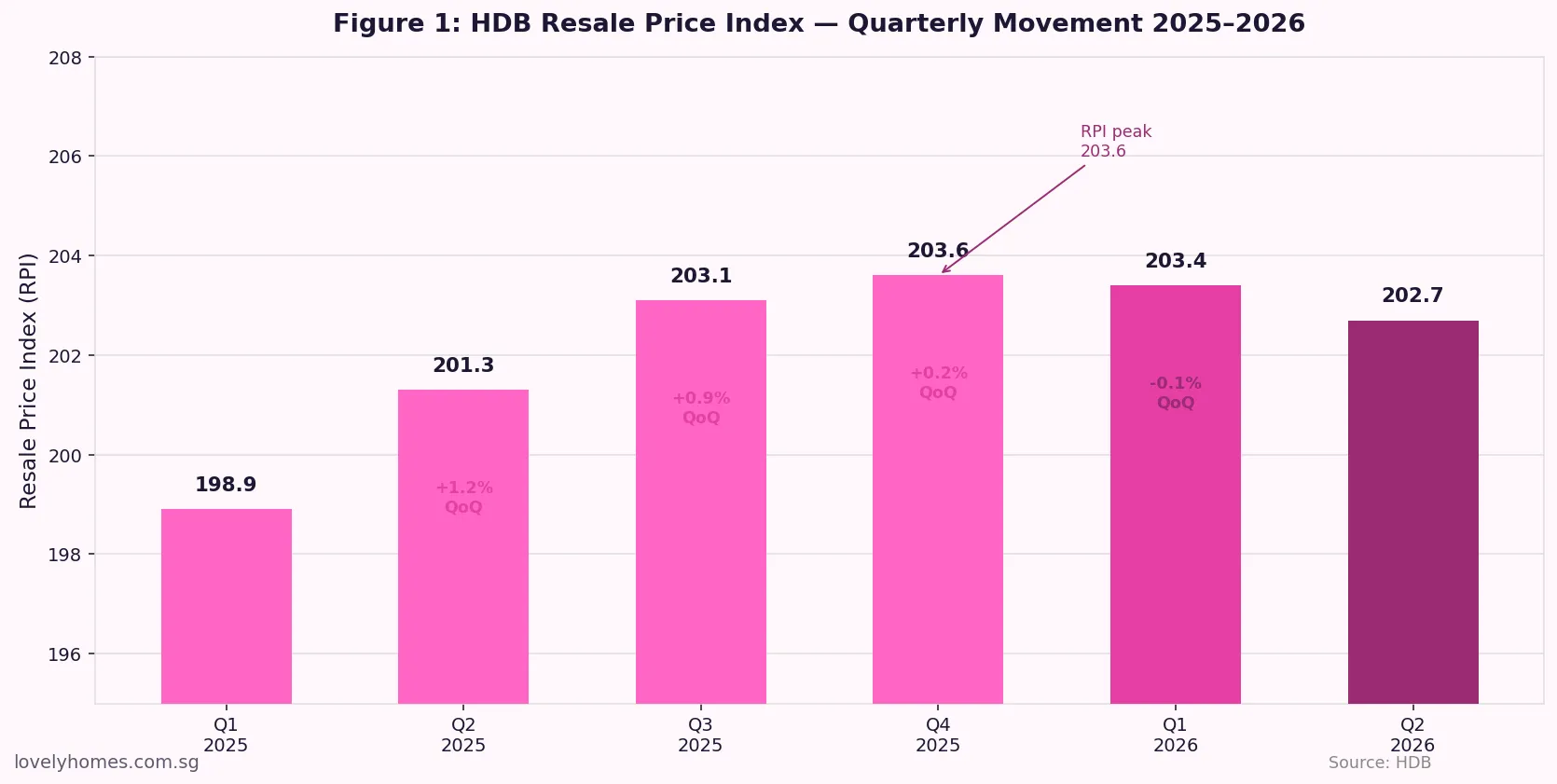
The HDB Resale Price Index for Q2 2026 came in at 202.7 — a decrease of 0.3% from 203.4 in Q1 2026. This follows a 0.1% decline in Q1 2026 from the Q4 2025 peak of 203.6. Taken together, the RPI has now shed 0.9 index points, or 0.44%, from its peak.

To put that in perspective: the RPI has not entered a sustained downward correction. The peak reached in Q4 2025 followed one of the strongest recovery runs in the HDB resale market’s history. Over the calendar year 2025, the RPI rose from 198.9 to 203.6 — a gain of 4.7 index points, or roughly 2.4%. The current two-quarter softening represents a very modest retracement, not a crash.

What is driving the softness? Two structural factors are at play. First, a significant volume of BTO flats completed in 2022 and 2023 are reaching their five-year Minimum Occupation Period (MOP) and flowing onto the resale market as sellers who bought at subsidised prices look to cash out. This supply pressure is most visible in the OCR and newer estates. Second, affordability constraints are biting: the TDSR and MSR frameworks cap borrowing, and rising resale prices over 2024 and 2025 mean that fewer first-time buyers can stretch to larger or better-located flats.

HDB Resale Price Index quarterly movement 2025 to 2026
Figure 1: HDB Resale Price Index — quarterly movement 2025 to Q2 2026. Source: HDB.

Million-Dollar Flat Sales: A Record That Needs Context

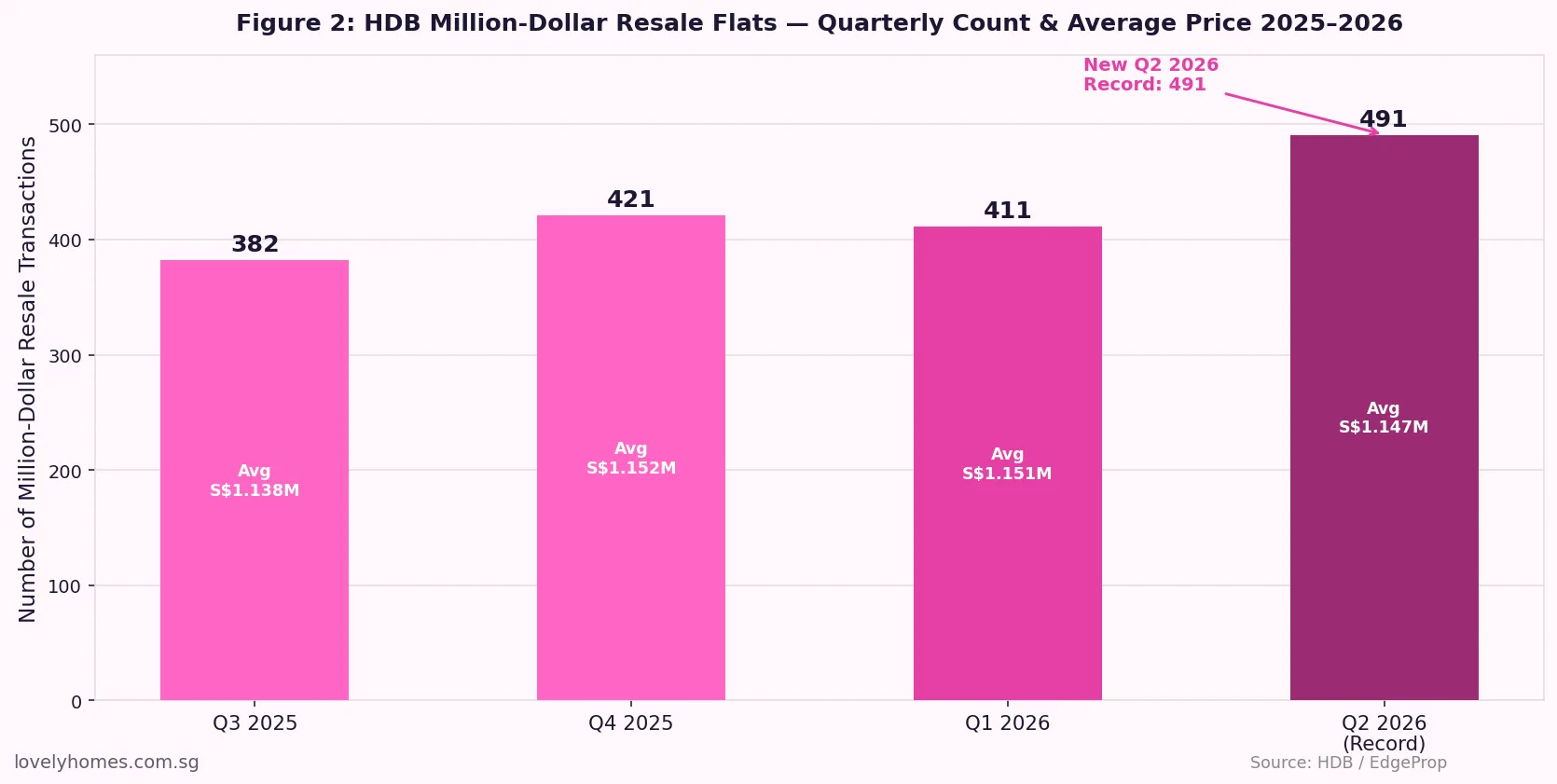
The headline that grabbed attention in Q2 2026 was the record 491 million-dollar resale transactions — up from 411 in Q1 2026 and well above the previous quarterly record. At first glance, a falling RPI alongside a record number of million-dollar sales seems contradictory. The explanation lies in market segmentation.

The HDB resale market is not one market — it is several markets stacked on top of each other. Larger flat types (five-room and executive) in prime or sought-after locations (Bishan, Queenstown, Toa Payoh, Buona Vista, Kallang) have continued to command strong prices because demand from asset-rich buyers or upgraders downsizing from private property remains robust. These are precisely the buyers most likely to cross the million-dollar threshold. Meanwhile, the broader market — four-room and below, in the OCR towns — experienced the softening that pulled the aggregate RPI downward.

The average price of million-dollar flats softened marginally, from S$1,150,651 in Q1 2026 to S$1,147,216 in Q2 2026. This 0.3% decline in average price, alongside a 19.5% surge in volume, confirms that more flats crossed the million-dollar mark at prices just above the threshold rather than the upper end of the premium segment rising sharply.

HDB million-dollar resale flat transactions Q3 2025 to Q2 2026 quarterly record
Figure 2: HDB million-dollar resale flat transactions by quarter, Q3 2025 to Q2 2026. Average price shown per bar. Source: HDB, EdgeProp.

Transaction Volume and Top Towns

At 6,396 resale transactions, Q2 2026 volume rose 1.8% from Q1’s 6,285 — a modest quarter-on-quarter improvement that nonetheless keeps the annual run rate above 25,000 transactions for the second year running. Volume held up despite the price softening, suggesting that buyers who had been waiting on the sidelines returned once prices began to moderate.

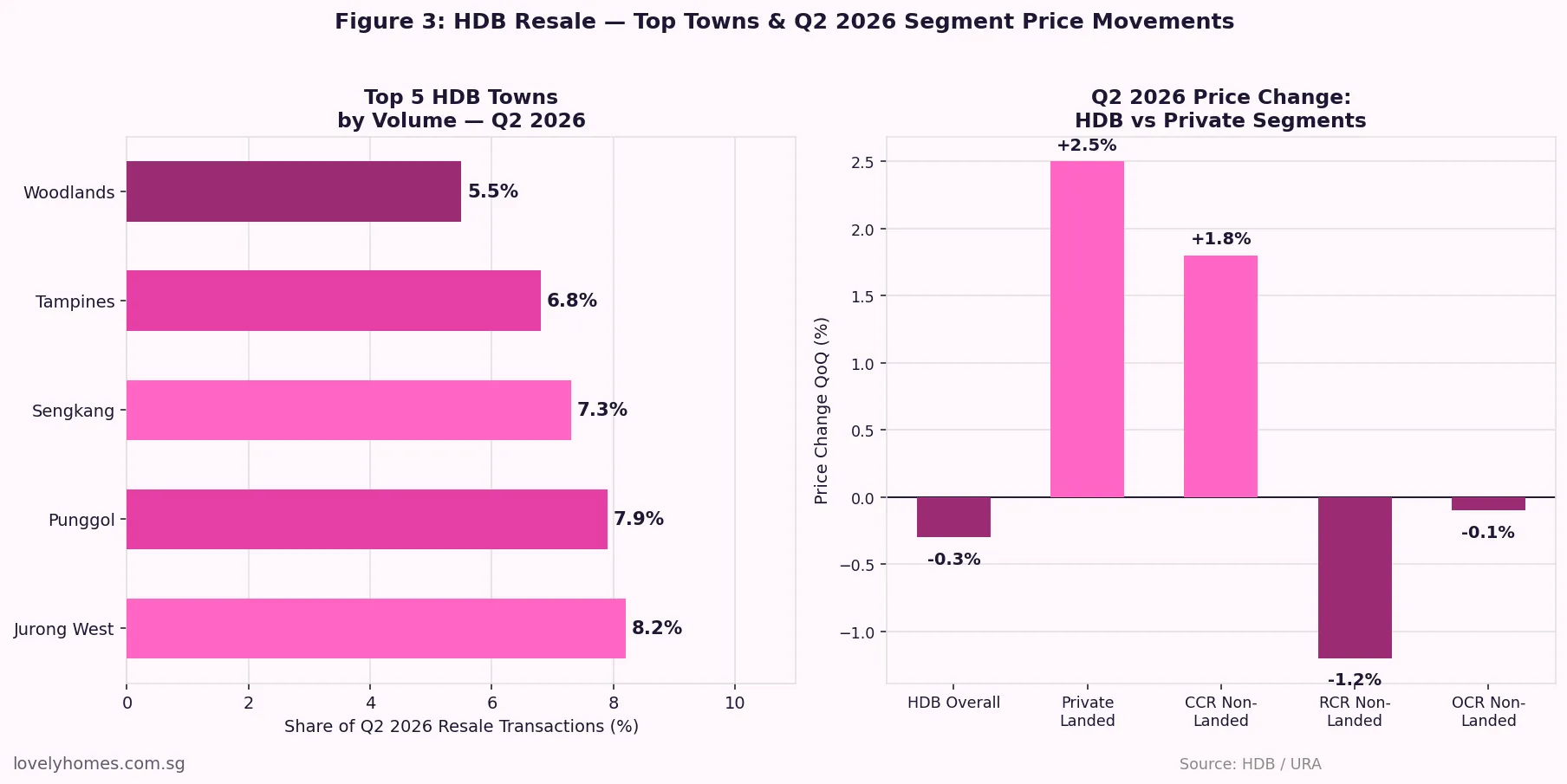
The top five HDB towns by resale volume in Q2 2026 were Jurong West, Punggol, Sengkang, Tampines, and Woodlands, collectively accounting for 35.7% of all transactions. These are predominantly OCR towns characterised by high BTO supply, relatively younger flat stock coming off MOP, and strong demand from first-time buyers priced out of the central region. Their dominance in volume statistics helps explain the RPI softness: OCR transactions, which skew lower in absolute price, are pulling the aggregate index down even as CCR and prime RCR transactions remain strong.

Figure 3 top HDB towns by resale volume Q2 2026 and segment price changes comparison
Figure 3: Top HDB towns by share of Q2 2026 resale volume (left) and Q2 2026 price movements across HDB and private residential segments (right). Source: HDB, URA.

HDB vs Private Residential: A Tale of Two Markets

Comparing the HDB resale market with private residential in Q2 2026 reveals an interesting divergence. The overall private residential Property Price Index rose 0.5% QoQ — apparently stronger than HDB’s -0.3%. But the private sector figure masks sharp segmentation of its own.

Segment Q2 2026 QoQ Price Change Context
HDB Resale (overall) -0.3% Second consecutive quarterly decline; OCR BTO supply overhang
Private Landed +2.5% Strong demand, very limited supply; reversal of Q1’s -0.4%
Private Non-Landed CCR +1.8% Foreign and high-net-worth demand; luxury segment resilient despite 60% ABSD
Private Non-Landed RCR -1.2% Mass-market competition from HDB and OCR condos; supply from recent completions
Private Non-Landed OCR -0.1% Broadly flat; same supply pressures as HDB but mitigated by upgrader demand
Private Residential Rental +0.7% Rental market recovering after sharp corrections in 2024; vacancy 6.4%

The private market’s +0.5% aggregate figure is heavily influenced by the landed segment’s 2.5% bounce and CCR’s 1.8% gain — segments where supply is tightest and buyers are least price-sensitive. The HDB market’s softness reflects the same affordability pressure visible in RCR and OCR private condos. In this sense, the two markets are telling the same story: the upper end holds, the mid-to-mass market moderates.

BTO Supply Pipeline: The Structural Overhang

HDB plans to launch approximately 19,600 BTO flats in 2026 across three sales exercises (February, June, and October). Of these, over 4,000 units are expected to have waiting times of under three years — a deliberate policy response to the BTO queue bottleneck that stretched to five years or longer for some estates during the COVID disruption years of 2020 to 2022.

The medium-term implication for the resale market is straightforward. The cohort of flats built in 2021 to 2023 — many of which were bought as emergency “market rate” BTO applications during the queue crisis — will reach MOP in the period from 2026 to 2028. This flow of supply is expected to maintain moderate price pressure on resale HDB, particularly in the OCR, for at least the next two years. Sellers in these estates who bought at subsidised BTO prices with a relatively short wait will still profit handsomely; buyers entering the resale market should expect continued modest price softening, which actually works in their favour.

Worked Example: Buying a Million-Dollar 5-Room Flat in Bishan

Mrs Rahman, a Singapore Citizen, is purchasing a 35-year-old 5-room flat in Bishan from an upgrader for S$1,100,000. She is 42, has an HDB loan eligibility (HLE), and plans to use a bank loan. Her husband’s gross monthly income is S$9,500; hers is S$5,500. Here is how the numbers work:

  • Purchase price: S$1,100,000
  • BSD: S$31,100 (1% on first S$180K + 2% on next S$180K + 3% on next S$640K + 4% on next S$100K)
  • ABSD: Nil (first residential property for both, Singapore Citizens)
  • Bank loan (75% LTV): S$825,000 — bank stress-test rate 4.0%, 25-year tenure, monthly instalment S$4,358
  • MSR check (HDB rule): S$4,358 / S$15,000 = 29.1% (below 30% MSR cap — PASS)
  • TDSR check: S$4,358 / S$15,000 = 29.1% (below 55% TDSR cap — PASS)
  • Downpayment (25%): S$275,000 — minimum 5% cash (S$55,000) + balance CPF OA (S$220,000)
  • Total upfront costs: S$275,000 (DP) + S$31,100 (BSD) + legal S$4,500 = S$310,600
  • CPF caveat: Flat has 65 years remaining. CPF usage is not restricted (above 60-year threshold). If the flat were below 60 years remaining, CPF withdrawal would be prorated.

The transaction qualifies comfortably, but it is worth noting that the S$55,000 minimum cash requirement must come from the buyer’s own savings — no CPF OA funds can substitute for this tranche. This is the single most common stumbling block for buyers stretching to the million-dollar segment.

What This Means for Buyers and Sellers

For buyers: the two-quarter price softening in the HDB resale market is a genuine opportunity window, particularly in the OCR. Estate towns such as Punggol, Sengkang, and Woodlands that dominate volume figures are seeing the largest supply overhang — which means the most negotiating headroom. Buyers should still model their TDSR and MSR carefully using stressed interest rates (4.0%+), and should factor in the CPF accrued interest obligation that will need to be refunded on eventual resale. Read our TDSR and MSR complete guide before applying for any bank loan.

For sellers: if you are considering selling a resale HDB flat, Q3 and Q4 2026 may prove to be better windows than Q3 2027, when additional BTO MOP supply is expected to hit the market. Volume in the S$800K–S$1.1M segment remains strong, and the million-dollar record demonstrates that premium flats in desirable locations are still attracting robust demand. Price your property accurately against recent comparables — the days of 20% premiums over asking are gone for most estates.

What Might Come Next

The trajectory for the second half of 2026 is moderately bearish for the HDB resale RPI in the near term, with a stabilisation expected in 2027 as the BTO MOP supply overhang begins to thin. Several external factors could shift this scenario: a sharper-than-expected global slowdown that prompts interest rate cuts could ease monthly instalment burdens and re-energise demand; conversely, any re-acceleration of inflation would force rates higher and squeeze affordability further. The October 2026 BTO launch will be closely watched — if demand for short-wait-time flats is strong, it may absorb some of the pressure from the resale pipeline. The Government has reiterated its commitment to maintaining a high and steady supply of public housing and has ruled out rolling back cooling measures in the current environment.

FAQ: Is the HDB resale market in a downturn?

Not in any structural sense. Two consecutive quarterly declines of -0.1% and -0.3% amount to a combined drop of approximately 0.44% from the Q4 2025 peak. By comparison, the market rose roughly 2.4% over all of 2025. This is a modest price correction, not a market collapse. Volume remains healthy at over 6,300 transactions per quarter. The correction is supply-driven and concentrated in the OCR, not a sign of deteriorating demand fundamentals.

FAQ: Why are million-dollar HDB flat sales at a record if prices are falling?

Market segmentation is the answer. The HDB resale market covers everything from three-room flats in Woodlands at S$300,000 to five-room executive flats in Queenstown at S$1.3 million. The aggregate RPI captures the average across all flat types and locations. When OCR volume dominates (as it does), the aggregate index is pulled lower even if the premium segment (large flats in mature, central estates) is holding or rising. In Q2 2026, 7.7% of all resale transactions crossed the million-dollar mark — which is itself a record share.

FAQ: Should I buy HDB resale now or wait for prices to fall further?

Timing the market is notoriously difficult, and the answer depends heavily on your personal circumstances. If you need housing now, the current softening is a reasonable entry point — particularly in high-supply OCR towns where negotiating headroom is greatest. If you are buying primarily as an investment and can afford to wait, there may be slightly more supply-driven softening to come over the next two to three quarters. What you should absolutely not do is wait indefinitely: HDB public housing exists to provide affordable, stable homes, and the risk of waiting for a lower price while interest rates, inflation, or policy changes shift the goalposts is real.

FAQ: Does the falling HDB RPI mean private property is a better buy?

Not necessarily. Private non-landed prices in the RCR fell 1.2% in Q2 2026 — worse than HDB’s -0.3%. OCR private condos were broadly flat. The landed segment rose 2.5%, but that is accessible only to Singapore Citizens and Permanent Residents with significant capital. HDB resale remains considerably cheaper on a per-square-foot basis than comparable private alternatives and carries no ABSD for first-time citizen buyers. The comparison depends on your profile, budget, and long-term plans.

FAQ: How does the BTO supply pipeline affect resale prices?

When BTO flats reach their five-year Minimum Occupation Period, sellers who bought them at subsidised prices enter the resale market. Since their entry cost is far below market, they can price competitively and still generate a healthy profit. This supply pressure — particularly in the OCR towns where BTO volume was highest during 2021 to 2023 — is the primary structural driver of the current price softening. The pressure should begin to ease in 2028 to 2029 as that cohort thins out.

FAQ: What is the outlook for HDB resale in H2 2026?

Industry watchers broadly expect the RPI to remain range-bound in the region of 200 to 203, with a possible further quarter or two of marginal declines before stabilising. Volume is expected to hold up, driven by the steady flow of owner-occupier demand and upgraders. Million-dollar flat transactions are likely to maintain elevated levels given the structural shift in the share of larger, well-located flats trading at or above that threshold. Any government intervention — whether additional cooling measures or stimulus — would materially change this outlook.

Related Articles

Disclaimer: This analysis is for general information only and is not financial or investment advice. Property prices can rise and fall. All figures are drawn from HDB and URA official releases (July 2026) and third-party research. Always verify current data on hdb.gov.sg and ura.gov.sg, and consult a licensed property agent or financial adviser before making any property decision.

Singapore TDSR & MSR Borrowing Limits Guide 2026: How Much Can You Borrow?

Singapore TDSR & MSR Borrowing Limits Guide 2026: How Much Can You Borrow?

Quick Answer: TDSR & MSR at a Glance

  • TDSR 55%: The Total Debt Servicing Ratio caps all your monthly debt repayments at 55% of gross monthly income. Introduced by MAS in 2013 and tightened to 55% in September 2022.
  • MSR 30%: The Mortgage Servicing Ratio applies only to HDB and Executive Condominium (EC) loans, capping the housing loan instalment at 30% of gross monthly income.
  • LTV limits: First property (bank loan) 75%; first property (HDB loan) 80%; second property 45%; third and subsequent 35%.
  • Stress-test rates: Bank loan TDSR calculations use the higher of the actual rate or 4% p.a. (floating), or 3% p.a. (fixed). HDB loans are assessed at 2.6% p.a. actual rate.
  • Minimum cash: Bank loans require at least 5% cash for a first property; 25% cash for a second or subsequent property.
  • Both rules stack: For HDB and EC purchases with a bank loan, BOTH TDSR and MSR must be satisfied simultaneously. The binding constraint is whichever gives the lower maximum loan.
  • Variable income: MAS requires lenders to apply a 30% haircut to variable or commission-based income (e.g. bonuses, overtime) when computing TDSR.
  • Existing debt matters: Car loans, personal loans, student loans and outstanding credit card balances all reduce how much you can borrow for a property loan.

What Is TDSR and Why Does It Exist?

The Total Debt Servicing Ratio (TDSR) is a borrowing framework administered by the Monetary Authority of Singapore (MAS) under MAS Notice 632. It was introduced in June 2013 to prevent households from over-borrowing against their incomes, and it applies to all property loans granted by financial institutions in Singapore — including banks, merchant banks and finance companies.

In practical terms, TDSR means that the total of all your monthly debt repayments — your housing loan instalment plus every other loan you service — must not exceed 55% of your gross monthly income. This 55% ceiling was tightened from 60% in September 2022 as part of a broader package of cooling measures aimed at moderating property demand. If your combined debt obligations would breach this threshold, the lender is required to reduce or reject the loan.

The TDSR framework applies to loans for any property purchase: HDB resale flats, private condominiums, landed homes, and commercial property. What changes depending on the property type is whether the Mortgage Servicing Ratio (MSR) also comes into play.

What Is MSR and When Does It Apply?

The Mortgage Servicing Ratio is a tighter, property-specific rule that sits inside the TDSR framework. MSR caps the monthly instalment on a housing loan used to purchase an HDB flat or an Executive Condominium (EC) at no more than 30% of the borrower’s gross monthly income. It applies to both HDB concessionary loans and bank loans where the security is an HDB flat or an EC.

MSR does not apply to private condominium purchases. For private property, only TDSR binds. This is a common source of confusion: many buyers assume a 30% limit applies to all property loans, but in reality the 30% cap is exclusive to the public and EC market. A buyer of a private apartment is free to commit up to 55% of income to total debt servicing, provided the housing loan does not push combined repayments above that ceiling.

If you are buying an EC with a bank loan, you must satisfy both TDSR (55%) and MSR (30%) at the same time. In practice, MSR is almost always the binding constraint for EC buyers, because 30% is more restrictive than 55%.

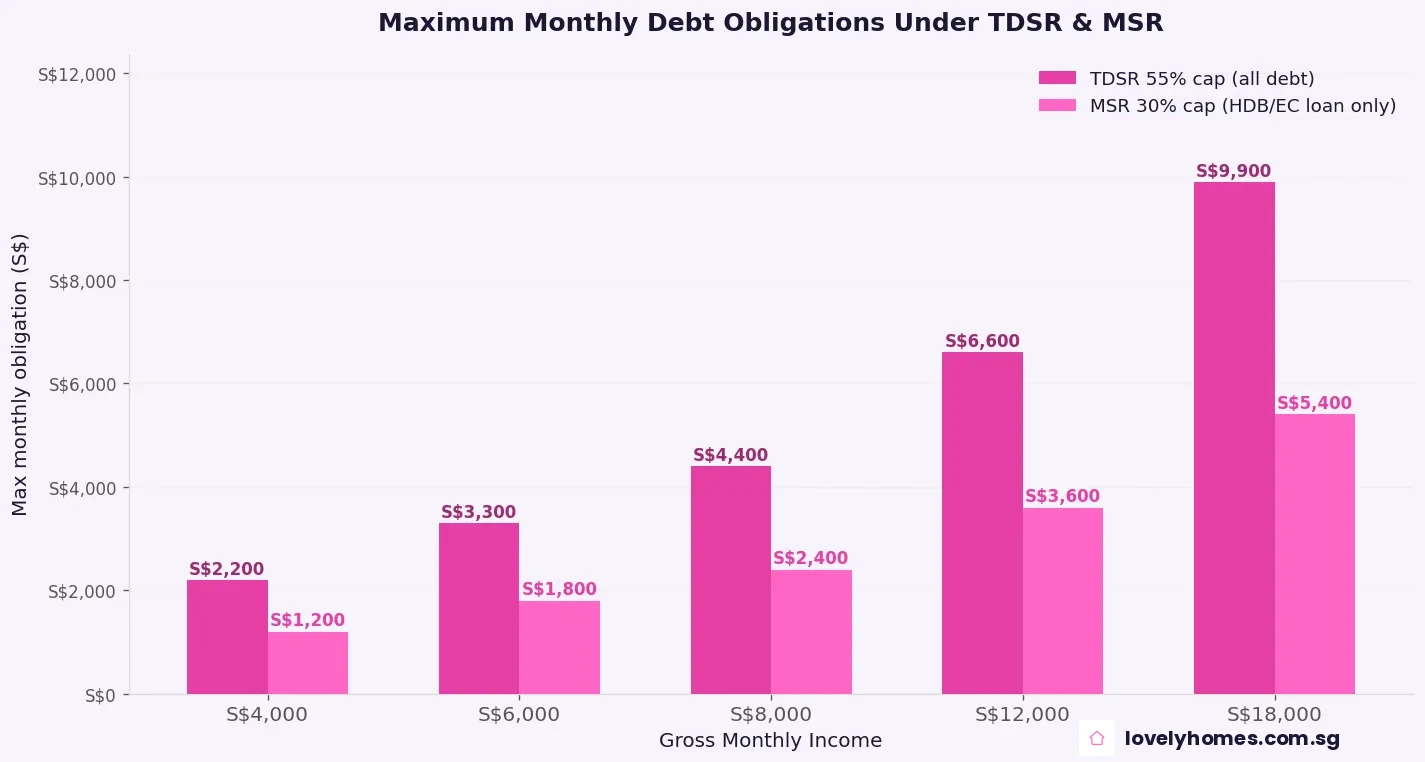
TDSR 55% vs MSR 30% maximum monthly debt obligations by gross monthly income Singapore 2026
Figure 1: Maximum monthly debt obligations under TDSR (55%) and MSR (30%) for gross monthly incomes of S$4,000 to S$18,000. MSR applies only to HDB and EC loans; TDSR applies to all property types.

LTV Limits: How Much Can You Borrow?

The Loan-to-Value (LTV) ratio sets the maximum loan amount as a percentage of the property’s purchase price or market valuation, whichever is lower. LTV rules are set by MAS and the HDB and operate independently of TDSR — both must be satisfied, and the lower of the two maximum loan amounts applies.

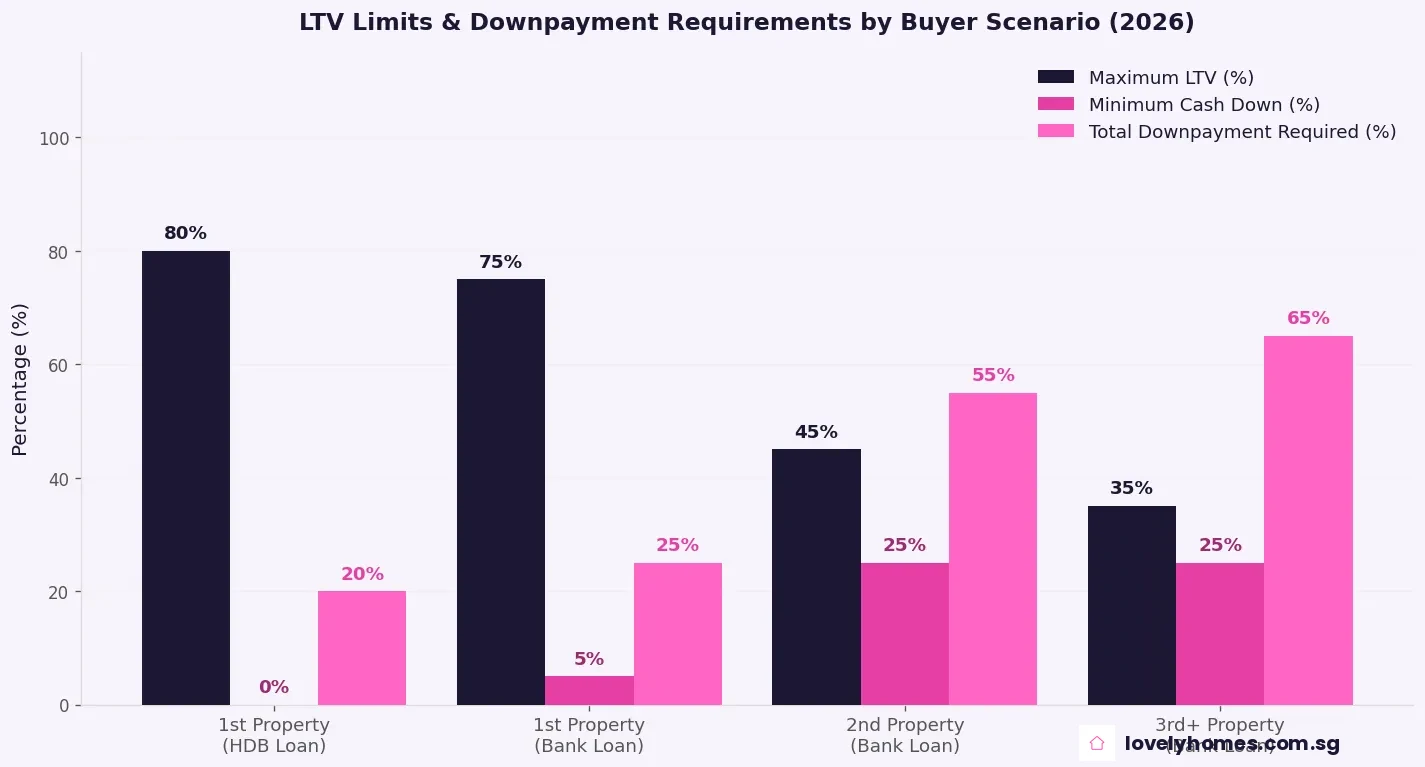
For a first residential property purchased with a bank loan, the LTV limit is 75%, meaning you can borrow up to three-quarters of the property value and must fund the remaining 25% from your own resources. Of that 25%, at least 5% must be paid in cash; the balance can come from CPF Ordinary Account (OA) savings. For second properties, the LTV drops sharply to 45%, with a minimum cash requirement of 25% of the purchase price. For third and subsequent properties, the LTV is 35%.

For HDB concessionary loans, the LTV is 80%, and HDB does not impose a minimum cash downpayment — the entire downpayment can be funded from CPF OA. This makes HDB loans particularly accessible for buyers with limited cash savings but healthy CPF balances.

LTV limits and downpayment requirements by buyer scenario Singapore 2026 first second third property
Figure 2: LTV limits and downpayment requirements by buyer scenario in Singapore 2026. Bank loans require 5% cash for first property and 25% cash for second or subsequent properties.

How TDSR Is Computed: What Counts as Debt?

Understanding what income and debt figures your bank will use is critical to knowing your real borrowing limit. The following guidelines apply under MAS Notice 632.

Income included in TDSR calculation: Fixed monthly salary, regular allowances confirmed by the employer, rental income (after a 30% haircut), and investment income (after a 30% haircut). Variable income such as commissions, bonuses and overtime is eligible but subject to a 30% haircut — meaning only 70% of your average variable income over the past 12 months is recognised.

Debt counted in TDSR: All monthly loan repayments must be included: the proposed housing loan instalment (calculated at the stress-test rate — see below), car loans, personal loans, outstanding credit card balances (counted at 5% of the outstanding balance per month, or the minimum monthly repayment if higher), student loans, and other secured or unsecured borrowings. Investment property loan instalments also count, even if the property is tenanted and generating rental income.

Debt excluded from TDSR: Insurance premiums, utility bills, hire-purchase agreements for vehicles entered into before 26 August 2013, and medisave contributions are excluded from the TDSR computation.

Stress-Test Rates: Why Your Maximum Loan Is Lower Than You Think

Banks do not use the actual prevailing interest rate when computing your TDSR. Instead, MAS requires them to use a stress-test rate — a notional higher rate designed to ensure you can still service the loan if interest rates rise. The stress-test rates currently prescribed under MAS Notice 632 are:

  • For floating-rate loans (e.g. SORA-pegged): the higher of the prevailing floating rate plus 1 percentage point, or 4% p.a.
  • For fixed-rate loans: the higher of the prevailing fixed rate, or 3% p.a.

In practice, with SORA currently well below 3%, the 4% floor is the binding constraint for most floating-rate borrowers. This means your maximum eligible loan is calculated assuming you are already paying instalments at 4% p.a., even if the rate on offer today is significantly lower. This is a deliberate policy choice by MAS to build a buffer against rising rates.

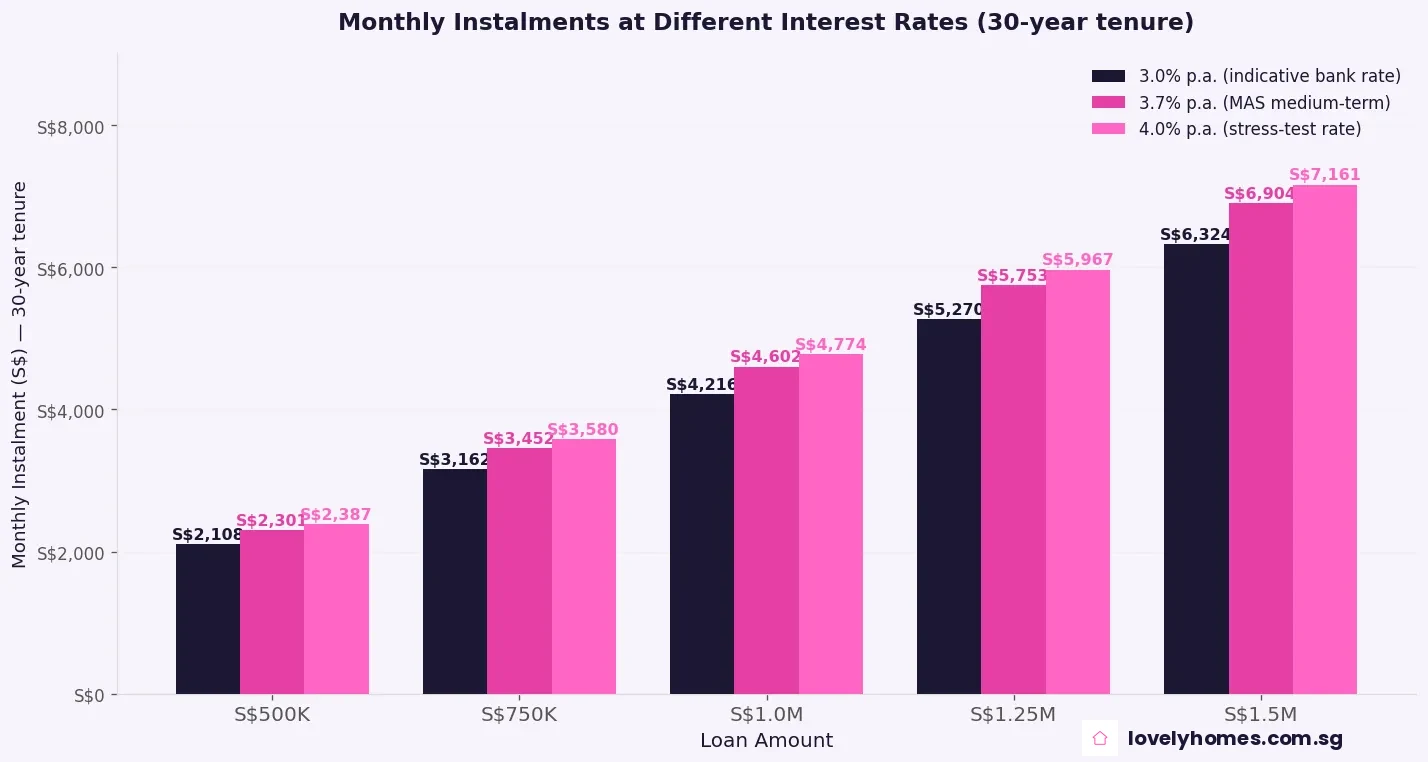
Monthly instalments at different interest rates 3% 3.7% 4% stress test Singapore property loan 30-year tenure
Figure 3: Monthly instalments at 3.0% (indicative bank rate), 3.7% (MAS medium-term benchmark) and 4.0% (stress-test rate) for loan amounts from S$500,000 to S$1.5 million on a 30-year tenure. TDSR is assessed at the stress-test rate, not the actual rate.

Summary: TDSR & MSR Rules at a Glance (2026)

Rule Limit Applies To Administered By
TDSR 55% of gross monthly income All property loans (HDB, private, commercial) MAS (Notice 632)
MSR 30% of gross monthly income HDB and EC loan instalments only MAS / HDB
LTV (1st property, bank) 75% of value Bank loan for any property MAS
LTV (1st property, HDB loan) 80% of value HDB concessionary loan only HDB
LTV (2nd property, bank) 45% of value Any second property bank loan MAS
LTV (3rd+ property, bank) 35% of value Third or subsequent property MAS
Minimum cash (1st, bank) 5% of purchase price First property bank loan MAS
Minimum cash (2nd/3rd+, bank) 25% of purchase price Second and subsequent properties MAS

Worked Example: TDSR, MSR and LTV in Action

Mr and Mrs Wong are Singapore Citizens. Their combined gross monthly income is S$11,000 (Mr Wong S$7,000 fixed salary; Mrs Wong S$4,000 fixed salary). They have a car loan with a monthly instalment of S$900. They wish to purchase a 4-room HDB resale flat in Tampines for S$635,000. They are evaluating both an HDB concessionary loan and a bank loan on a 25-year tenure.

HDB concessionary loan scenario:
LTV 80%: maximum loan = S$635,000 x 80% = S$508,000.
Monthly instalment at 2.6% p.a. over 25 years: approximately S$2,305/month.
MSR check: S$2,305 / S$11,000 = 20.9% — well within the 30% MSR limit. PASS.
TDSR check: (S$2,305 + S$900) / S$11,000 = 29.1% — well within the 55% TDSR limit. PASS.
Minimum downpayment: 20% = S$127,000 (can be fully funded from CPF OA; no minimum cash required for HDB loans).

Bank loan scenario:
LTV 75%: maximum loan = S$635,000 x 75% = S$476,250.
Stress-test rate at 4% p.a. over 25 years: monthly instalment = approximately S$2,508/month.
MSR check: S$2,508 / S$11,000 = 22.8% — within 30% MSR limit. PASS.
TDSR check (stress test): (S$2,508 + S$900) / S$11,000 = 30.98% — within 55% TDSR limit. PASS.
Actual instalment at 3.5%: approximately S$2,383/month.
Minimum downpayment: 25% = S$158,750; of which at least 5% cash = S$31,750 (balance S$127,000 from CPF OA).

In this scenario, TDSR and MSR are easily met for both loan types. The practical constraint is the LTV: the HDB loan allows borrowing S$508,000 versus S$476,250 for the bank loan. Buyers who have CPF OA savings but limited cash liquidity will find the HDB loan more accessible (no minimum cash downpayment). Buyers with strong CPF balances and competitive fixed-rate offers from banks may prefer the bank loan to obtain a potentially lower effective rate.

Why These Rules Matter for Singapore Property Buyers

Singapore’s TDSR and MSR framework is among the most comprehensive borrower-protection regimes in the region. The rules serve two distinct purposes. First, they protect households from the financial distress that follows over-borrowing: a borrower who commits 70% of income to debt servicing has almost no buffer for unexpected expenses, job loss, or rising interest rates. Second, they cool speculative demand by making it harder to pyramid property loans across multiple properties without meaningful income growth.

In practice, buyers frequently misjudge how tightly the rules bind. A family with S$12,000 combined gross income and a S$1,500/month car loan can only allocate S$5,100 to housing (TDSR: S$6,600 minus S$1,500 car). At the 4% stress-test rate on a 30-year tenure, that limits the loan to approximately S$1.07 million — well below the 75% LTV on many private condominiums in the Outside Central Region. Knowing your TDSR headroom before you start viewing properties prevents disappointment.

Peer-country context: Hong Kong’s TDSR equivalent caps at 50% (with a 60% ceiling at higher LTV thresholds), and Australia imposes a 3 percentage-point serviceability buffer above the applicable rate under APRA guidelines. Singapore’s 55% TDSR with a 4% stress-test floor is broadly in line with international standards — firm enough to prevent excess, flexible enough not to freeze out creditworthy middle-income buyers.

What Might Change Next: Forward-Looking Considerations

MAS reviews the TDSR stress-test rates periodically. With the global rate cycle having peaked in 2023 and benchmark rates declining through 2025 and into 2026, some commentators have speculated that MAS may soften the 4% floor for floating-rate loans if SORA remains suppressed. However, as at August 2026, MAS has given no indication of adjusting TDSR parameters, and the existing framework is viewed as the appropriate long-term calibration. Buyers should plan on the basis of existing rules rather than anticipated relaxation.

The MSR 30% limit for HDB and EC loans has been stable since its introduction in 2013. Any increase in income ceilings for HDB flats or ECs (currently S$14,000 per month for standard HDB; S$16,000 for ECs) would expand the pool of eligible buyers without adjusting the MSR percentage itself.

Frequently Asked Questions

Does TDSR apply if I am buying a property under a sole name while my spouse has no income?

Yes. TDSR is applied to the borrower or borrowers named on the loan application. If you are the sole borrower, your gross monthly income alone is used. Your spouse’s income is only included if they are a co-borrower on the loan. Adding a co-borrower with income can increase your eligible loan amount, but both parties become jointly liable for the debt. If your spouse has no income and you are the sole earner, only your income is recognised by the lender.

How does rental income affect TDSR?

Rental income from an investment property is recognised in TDSR calculations, but only at 70% of its value (a 30% haircut, consistent with the treatment of other variable income). You will need to provide tenancy agreements, tax documents, or a lender-accepted declaration to have rental income recognised. Note that the full outstanding loan on the tenanted property (including its monthly instalment) still counts as debt in your TDSR calculation, so the net benefit of rental income on your TDSR position depends on the rental yield relative to the loan instalment.

Does MSR apply to EC purchases with a bank loan?

Yes. ECs are classified as public housing for the first 10 years (until privatisation), and MAS applies MSR to any bank loan used to purchase an EC during this period. This means your monthly EC loan instalment must not exceed 30% of gross monthly income, regardless of whether a bank or the developer is financing the purchase. For buyers comparing ECs with private condominiums, this is a material difference: the same gross income unlocks a meaningfully larger private loan under TDSR alone.

What happens to my TDSR if I have an outstanding renovation loan?

Renovation loans are unsecured personal loans and count in full toward your TDSR calculation. If you took a S$50,000 renovation loan repayable over 5 years at S$900/month, that S$900 reduces your TDSR headroom for the proposed mortgage. It is therefore advisable to either fully repay renovation and personal loans before applying for a property loan, or factor them into your borrowing plan from the outset. Most banks will decline or reduce a property loan application where existing debt already consumes a significant portion of the 55% ceiling.

Can I use my CPF savings to reduce the loan amount and improve my TDSR position?

Absolutely. Making a larger CPF downpayment reduces the loan principal, which in turn reduces the monthly instalment and therefore the TDSR ratio. For example, if you put 40% down using CPF OA rather than the minimum 20%, the loan drops from 80% to 60% of the property value, cutting the monthly instalment roughly proportionally. However, note that CPF savings earmark a 2.5% p.a. accrued interest charge: when you sell the property, the CPF board recoups the principal plus all accrued interest, which reduces your net sale proceeds. Using CPF to improve TDSR does not eliminate this cost.

Are there any exemptions from TDSR?

MAS provides a limited TDSR exemption for owner-occupier purchases where the outstanding loan amount does not exceed S$200,000. In practice, very few Singapore properties are priced low enough to benefit from this exemption. There is no general TDSR exemption for first-time buyers, for purchases of HDB flats, or for any particular nationality or residency status. The exemption for purely commercial properties (non-residential) is governed separately under a different MAS notice, and is generally not applicable to residential purchases.

Related Articles

Disclaimer

This article is for general information purposes only and does not constitute financial, legal or mortgage advice. TDSR, MSR and LTV rules are subject to change by MAS and HDB at any time. Borrowing limits depend on your individual financial profile, income documentation, and the specific property and loan product. Always consult a licensed financial adviser and your bank before committing to any property purchase or loan. Official sources: MAS (mas.gov.sg) and HDB (hdb.gov.sg).

TDSR and MSR Singapore 2026: Complete Guide to Property Borrowing Limits

TDSR and MSR Singapore 2026: Complete Guide to Property Borrowing Limits

Quick Answer — TDSR and MSR at a Glance

  • TDSR (Total Debt Servicing Ratio): Your total monthly debt obligations — including the new home loan — must not exceed 55% of your gross monthly income. Applies to all property purchases.
  • MSR (Mortgage Servicing Ratio): Your monthly HDB or EC loan instalment must not exceed 30% of your gross monthly income. Applies only to HDB flat and new EC purchases.
  • Both are assessed at the point of loan application, using a stress-test interest rate set by MAS — currently 4.0% p.a. for private property and 3.0% p.a. for HDB loans (floor rates; lenders use whichever is higher).
  • Variable income (commissions, bonuses) is typically discounted by 30% when computing TDSR/MSR.
  • Both rules are administered under MAS Notice 645 (for banks) and parallel HDB Board regulations.
  • Exceeding either limit means the bank cannot grant the loan — regardless of your credit score or property value.

What Are TDSR and MSR? Why Do They Exist?

The Total Debt Servicing Ratio and the Mortgage Servicing Ratio are Singapore’s two primary borrower-level safeguards in the property financing framework. Where measures like ABSD and SSD are transaction taxes designed to moderate demand, TDSR and MSR go deeper — they regulate how much any individual borrower can take on, regardless of the property’s value or the borrower’s wealth.

TDSR was introduced on 29 June 2013 by the Monetary Authority of Singapore (MAS), replacing an earlier and less comprehensive framework. It applies to all property loans — for purchases, refinancing, and equity loans on any residential, commercial, or industrial property. MSR — a tighter, supplementary ratio — applies specifically to loans for HDB flats and Executive Condominiums, reflecting the government’s commitment to keeping public and quasi-public housing genuinely affordable for owner-occupiers.

Together, these two ratios are one of the most powerful levers in Singapore’s financial stability toolkit. For a full picture of the broader cooling-measures context, see our Property Cooling Measures Timeline.

TDSR and MSR — The Framework Explained

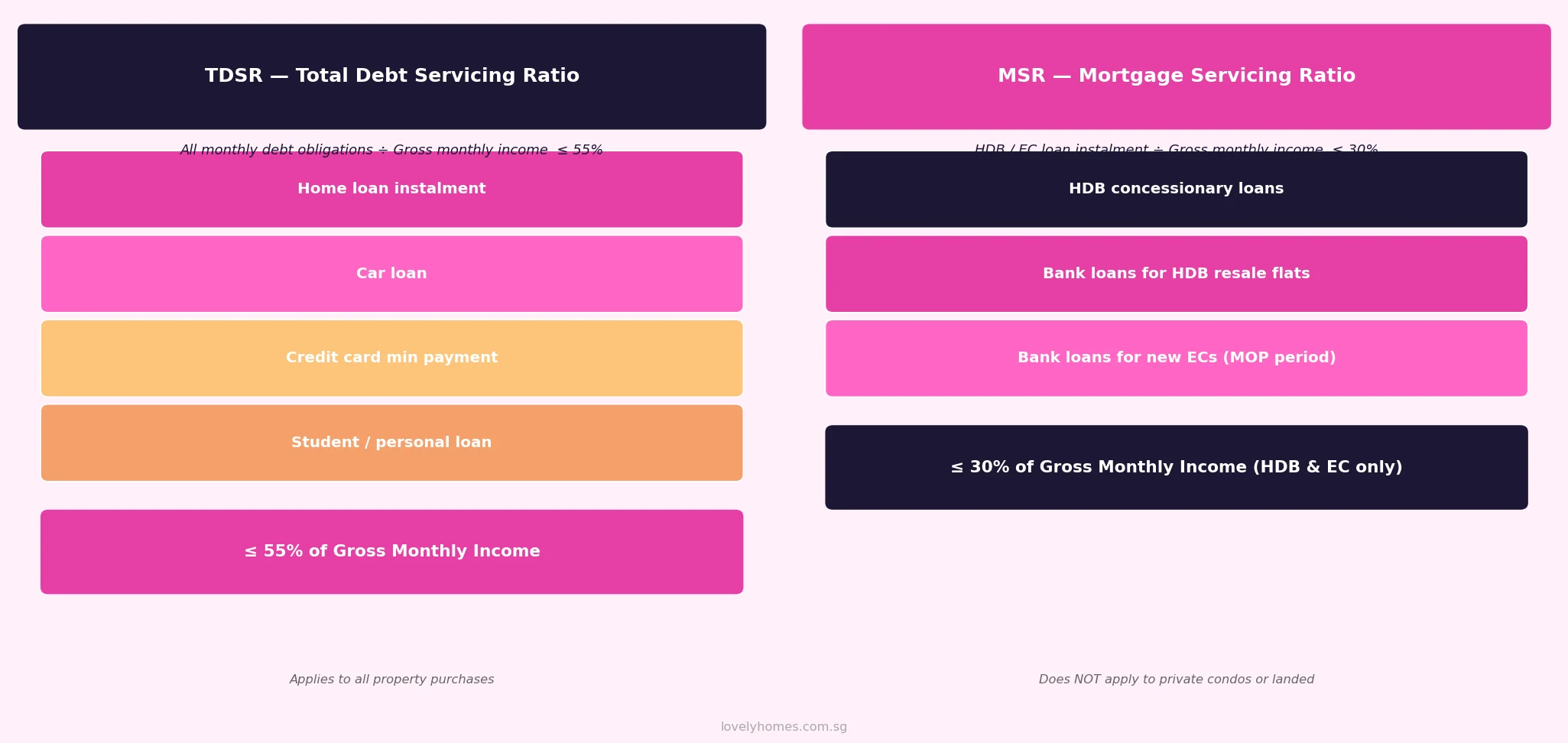
TDSR Total Debt Servicing Ratio and MSR Mortgage Servicing Ratio Singapore 2026 framework diagram
Figure 1: TDSR and MSR frameworks side by side — what counts, the applicable cap, and who each applies to. Source: MAS Notice 645 / HDB Board.

TDSR — Total Debt Servicing Ratio (55%)

The TDSR calculation adds up all monthly debt obligations — the proposed new home loan instalment, car loans, student loans, credit card minimum payments, personal loans, and any other outstanding borrowing — and divides the total by the borrower’s gross monthly income. The result must not exceed 55%.

TDSR = (All monthly debt obligations ÷ Gross monthly income) × 100 ≤ 55%

The computation is not quite as simple as it sounds. MAS rules require lenders to apply the following adjustments:

  • Stress-test rate: The home loan instalment is computed using the higher of the actual loan interest rate or the MAS floor rate (currently 4.0% p.a. for non-HDB residential properties, 3.5% p.a. for the medium-term rate). This means your TDSR-qualifying instalment is calculated on a higher hypothetical rate than the bank’s actual offer rate.
  • Variable income haircut: If part of your income is variable — commissions, overtime, bonuses, rental income — lenders typically apply a 30% discount. A borrower earning S$8,000 base + S$2,000 monthly commission would have an assessed income of S$8,000 + (S$2,000 × 70%) = S$9,400 for TDSR purposes.
  • Joint borrowers: Where two or more people take a loan together, the TDSR is assessed on the combined monthly income and combined monthly obligations. This can significantly increase the loan quantum available to a couple.

MSR — Mortgage Servicing Ratio (30%)

MSR applies only when you take a loan to buy an HDB resale flat or a new Executive Condominium (EC) during its initial owner-occupation period. It is an additional, tighter constraint on top of TDSR. Where TDSR considers all debts, MSR focuses only on the monthly instalment of the specific HDB or EC loan in question:

MSR = (Monthly HDB or EC loan instalment ÷ Gross monthly income) × 100 ≤ 30%

MSR does not apply to private condominiums or landed property — even those on 99-year leasehold land. When buying a private condo, only TDSR applies (plus the standard LTV limits). When buying an HDB flat or new EC, both TDSR and MSR apply; the borrower must satisfy whichever is the more restrictive of the two.

Worked Example — TDSR and MSR in Practice

Mr and Mrs Lim are a Singapore Citizen couple. Mr Lim earns S$7,500/month salary; Mrs Lim earns S$5,500/month. Combined gross income: S$13,000/month. They have a car loan with a monthly instalment of S$1,200.

Scenario A: Buying an S$800,000 HDB resale flat (bank loan)

  • MSR limit: 30% × S$13,000 = S$3,900/month for the HDB loan instalment.
  • TDSR limit: 55% × S$13,000 = S$7,150/month for all debts. Less car loan S$1,200 = S$5,950/month available for home loan.
  • The binding constraint is MSR at S$3,900/month.
  • Maximum loan at 4.0% stress-test, 25-year tenure: approximately S$741,000.
  • Property price S$800,000; 20% LTV floor for HDB → minimum 20% cash + CPF = S$160,000. Loan fits within LTV (S$640,000 < S$741,000 MSR limit). ✓

Scenario B: Buying a S$1.5 million private condo (bank loan, MSR does not apply)

  • TDSR limit: S$7,150/month for home loan (after car loan S$1,200).
  • Maximum loan at 4.0% p.a., 25-year tenure: approximately S$1.36 million.
  • LTV for second property (they still own a first property): 45% → maximum loan S$675,000. LTV is now the binding constraint, not TDSR.
  • This is why for investors buying second properties, ABSD and LTV often matter more than TDSR.

How TDSR Affects Your Maximum Loan Quantum

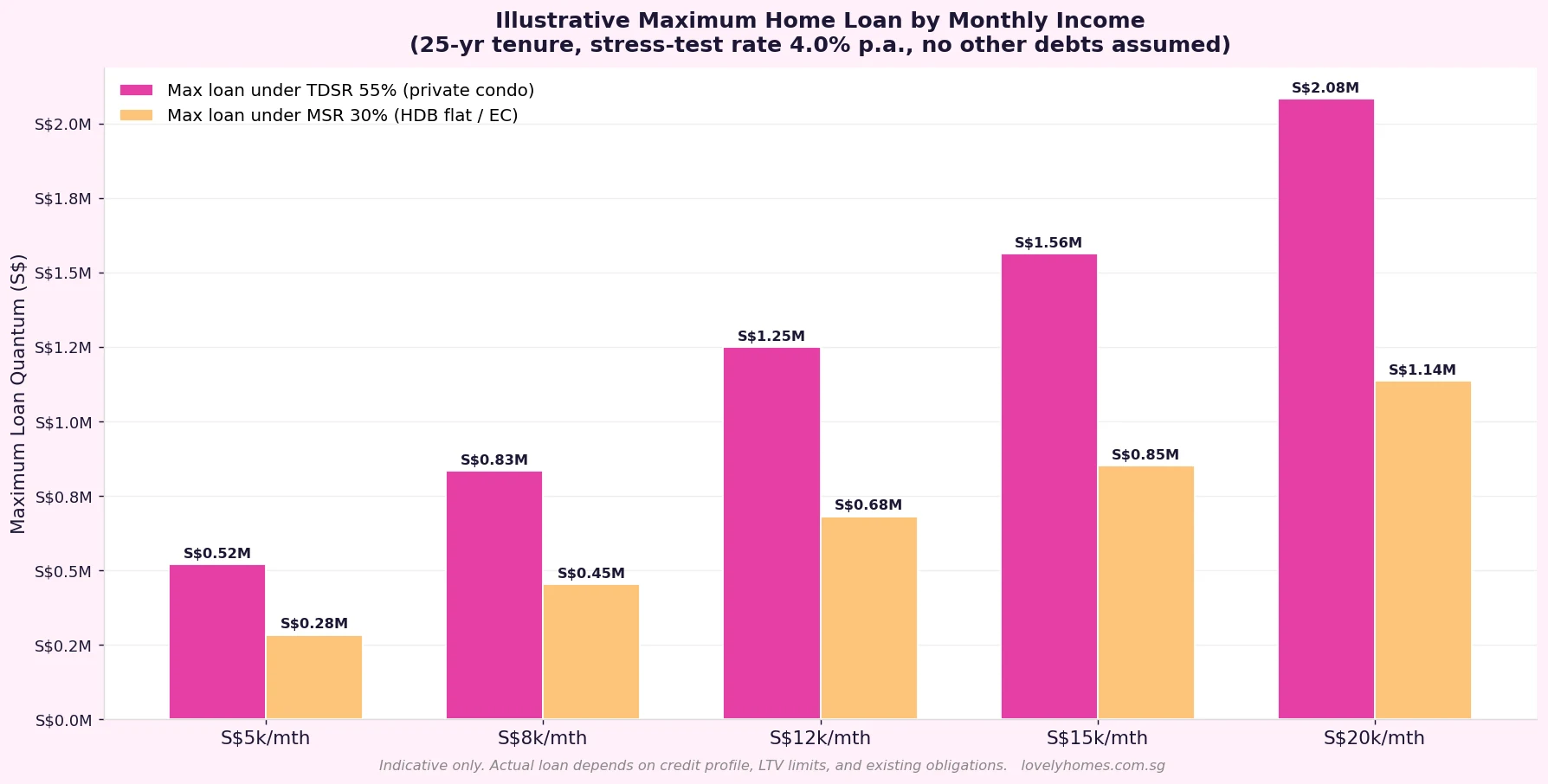
Maximum home loan by monthly income under TDSR 55% and MSR 30% Singapore 2026 bar chart
Figure 2: Illustrative maximum loan quantum by gross monthly income, assuming no other debts, 25-year loan tenure and 4.0% p.a. stress-test rate. Actual loan amounts depend on credit profile and LTV limits.

The chart illustrates how the 55% TDSR cap translates into loan quantum across different income levels, assuming no other debts. In practice, most borrowers have existing obligations — car loans, credit cards, study loans — that compress the available TDSR headroom and reduce the maximum home loan accordingly.

The Hidden TDSR Trap: Other Debts

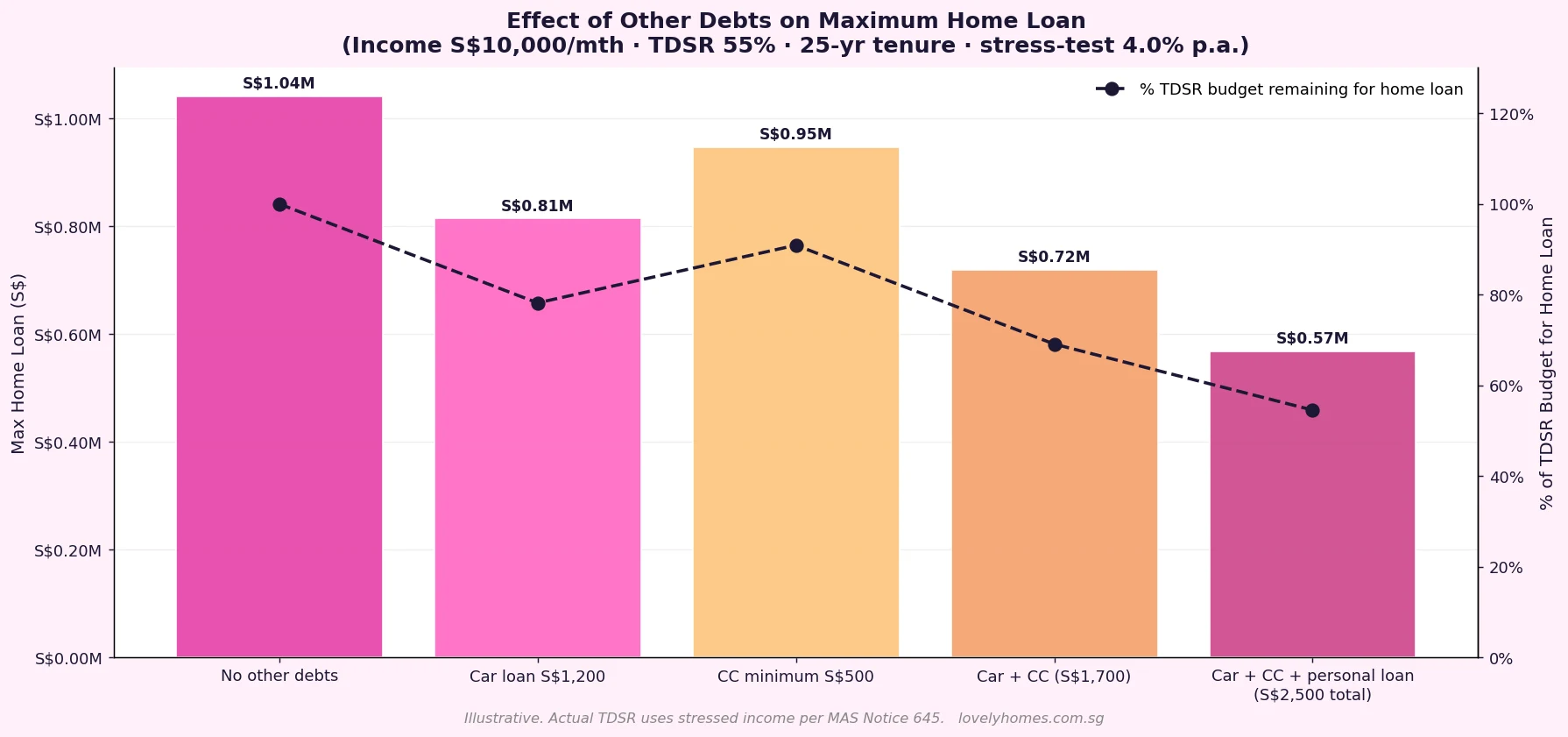
Many first-time buyers underestimate how much existing debt erodes their borrowing capacity. Every dollar of existing monthly debt obligation reduces the monthly instalment available for a home loan, which translates into a smaller maximum loan.

Effect of other debts on maximum home loan under TDSR 55% Singapore income S$10000 per month 2026
Figure 3: How car loans, credit card minimums, and personal loans reduce the maximum home loan for a borrower on S$10,000/month gross income. Stress-test rate 4.0% p.a., 25-year tenure.

A borrower earning S$10,000/month with a car loan of S$1,200/month and credit card minimum payments of S$500/month has only S$3,800/month left for a home loan instalment under the 55% TDSR cap — compared to S$5,500 if they had no other debts. That S$1,700 monthly reduction translates into roughly S$330,000 less in maximum loan quantum at current stress-test rates. This is why financial planners consistently advise property aspirants to pay down or close outstanding credit facilities before applying for a mortgage.

TDSR, MSR and the Loan-to-Value (LTV) Framework

TDSR and MSR cap how much you can service; the Loan-to-Value limits cap how much you can borrow as a proportion of the property value. The two frameworks operate in parallel — both must be satisfied simultaneously. The applicable LTV limit depends on whether you are buying with HDB loan or bank loan, and how many outstanding property loans you have:

Loan Type 1st Property Loan 2nd Property Loan 3rd+ Property Loan
HDB concessionary loan 80% of flat value N/A (only for 1st HDB purchase) N/A
Bank loan (no outstanding loans) 75% of property value 45% 35%
Bank loan (1+ outstanding loan) 45% 35% 35%

In practice, it is common for the LTV limit to be the binding constraint when buying investment properties (2nd or 3rd property), while TDSR / MSR is more likely to bite first-time buyers with lower incomes or significant existing debts.

TDSR Exemptions and Special Cases

A small number of situations fall outside the standard TDSR computation:

  • Bridging loans: Bridging loans used for the express purpose of financing a property being simultaneously sold are treated differently — the outstanding bridging instalment is excluded from TDSR until the property is sold, subject to conditions.
  • Retirees and elderly borrowers: Banks may use retirement income, CPF LIFE payouts, or annuity income to support TDSR calculations, though the assessment is more complex and requires additional documentation.
  • Refinancing with no cash-out: From August 2021, MAS allowed certain refinancing transactions — specifically owner-occupier residential loans where no equity is being extracted — to be exempt from TDSR. The borrower must have been servicing the existing loan for at least 12 months and must not be extracting equity.

Why TDSR and MSR Matter for Sellers Too

TDSR and MSR are typically framed as buyer concerns. But sellers are affected too:

  • Pricing strategy: A seller asking S$1.5 million for a condo needs to consider whether the pool of buyers who can qualify for a S$1.05 million bank loan (70% LTV) under TDSR is large enough to generate competitive offers. A listing price that implies a loan instalment near the TDSR limit for the target buyer profile will attract fewer bidders.
  • Timing of your own purchase: If you are selling to fund a new purchase, be aware that even after the sale proceeds come in, your TDSR is still assessed on your ongoing monthly income — not on net worth or cash in the bank.

What Might Change?

The TDSR framework has been remarkably stable since 2013, though MAS adjusted the cap from 60% to 55% in December 2021 as part of a broader tightening round. As of May 2026, MAS has not signalled any further changes to TDSR or MSR thresholds. However, MAS publishes annual Financial Stability Reviews (typically in November) which assess household leverage and mortgage risk — these are the best early indicators of possible future adjustments. Read the latest review at mas.gov.sg.

Frequently Asked Questions

What counts as “gross monthly income” for TDSR?

Gross monthly income includes fixed salary, director’s fees, and recognised recurring income. Variable components — commissions, bonuses, overtime — are typically discounted by 30% per MAS guidance. Self-employed individuals use their assessed income from NOA (Notice of Assessment) averaged over 2 years. Rental income is included but also subject to a discount. The bank will determine the applicable figure based on supporting documents submitted at loan application.

Why is my loan computed at a higher rate than the bank’s offer rate?

MAS requires lenders to stress-test all property loans using a minimum floor rate — currently 4.0% p.a. for private residential properties (or the actual rate if higher). This ensures borrowers can still service their loans if interest rates rise after the lock-in period expires. The bank’s actual offer rate (e.g. 3.0% in a low-rate environment) is used for the actual instalment calculation, but the TDSR computation uses the stress-test rate to determine affordability.

Does CPF count as income for TDSR purposes?

No. CPF contributions and balances are not counted as income for TDSR calculations — they are savings, not income. However, using CPF to fund the down payment or monthly instalment does reduce the cash instalment burden, and CPF usage is factored into your overall mortgage planning. The TDSR calculation is based on cash-equivalent gross income per MAS Notice 645.

Does paying off a car loan before applying for a mortgage really help?

Yes, significantly. Each S$1,000 in monthly debt obligations you eliminate frees up S$1,000 in TDSR headroom. At a 4.0% stress-test rate over 25 years, that translates into roughly S$190,000 in additional loan quantum. If you are planning a property purchase in the next 1–2 years, clearing high-instalment debts well in advance is one of the most concrete steps you can take to maximise your borrowing capacity.

I am buying an HDB flat. Do I need to satisfy both TDSR and MSR?

Yes. When taking a bank loan for an HDB resale flat, both TDSR (55%) and MSR (30%) apply. You must satisfy whichever is the more restrictive constraint. In most cases, for HDB buyers, the MSR 30% cap is the binding constraint because it is narrower. If you take an HDB concessionary loan (the HDB loan), the rules are similar but administered by HDB rather than MAS — the MSR cap of 30% still applies.

Can I use a guarantor to get around TDSR?

A guarantor’s income can be included in the TDSR computation only if the guarantor is a co-borrower — i.e. their name is on the loan. If the guarantor is merely guaranteeing repayment without being a borrower, their income cannot be used to support TDSR. Adding a co-borrower is a legitimate approach, but also means the co-borrower’s ABSD property count and LTV position are affected by the loan.

How do TDSR and MSR interact with HDB’s income ceiling for BTO?

HDB’s income ceiling for BTO applications (currently S$14,000/month for couples for most flat types) is a separate eligibility criterion — it determines whether you can apply for a BTO flat, not how much you can borrow. TDSR and MSR determine the loan quantum once you are eligible. A couple earning S$14,000 may pass the HDB income ceiling but still be limited in their borrowing by TDSR/MSR, particularly if they have significant existing debt obligations.

Related Articles

Disclaimer

This article is for general informational purposes only and does not constitute financial, legal, or mortgage advice. TDSR and MSR rules are administered by the Monetary Authority of Singapore under MAS Notice 645 and MAS Notice 645A, and by HDB under its loan policies — these are subject to change. The loan quantum illustrations in this article are indicative only and assume simplified conditions. Always consult a licensed mortgage broker or financial adviser, and verify the current rules directly at mas.gov.sg and hdb.gov.sg before making any borrowing decisions.

×

Click anywhere or press Esc to close

Translate »