Sembawang Neighbourhood Guide Singapore 2026: Property Prices, Schools, MRT and Investment Outlook

Sembawang Neighbourhood Guide Singapore 2026: Property Prices, Schools, MRT and Investment Outlook

Quick Answer — Sembawang at a Glance (2026)

  • District: D27, Outside Central Region (OCR). Predominantly HDB, with a small private condominium and EC segment.
  • MRT: North–South Line (NSL) — Sembawang (NS11), Canberra (NS12), Yishun (NS13). Approximately 15 minutes to Orchard Road.
  • Property prices: HDB 4-room resale S$470k–S$650k; condo 2-bedroom S$900k–S$1.32M; EC 4-bedroom S$1.25M–S$1.62M.
  • Gross rental yield: HDB 4-room ~4.8% p.a.; condo 2-bedroom ~3.2% p.a. — above-average for OCR.
  • 5-year HDB price growth: ~9.8% (4-room) — in line with the broader OCR HDB market.
  • June 2026 BTO: Approximately 2,000 new HDB units in Sembawang as part of the June 2026 exercise, including Nee Soon South Crescent — the largest allocation in the exercise.
  • Investment thesis: Proximity to the Johor Strait, upcoming RTS Link (Woodlands–JB, 2027) spillover, and NSC (Nee Soon Central) urban renewal make Sembawang a watch-list OCR name for long-term buyers.

Where Is Sembawang? A District Overview

Sembawang occupies the northernmost residential area of mainland Singapore, forming part of District 27 alongside neighbouring Yishun. The estate sits on the Johor Strait waterfront — a fact that shaped its character as a former British naval base, the site of HMS Terror and HMS Sultan, before being handed over to Singapore in 1971 and progressively redeveloped as an HDB new town from the 1970s onwards. Sembawang Park, located on the Johor Strait waterfront, preserves a small slice of that colonial-era landscape.

Today, Sembawang is administered by the Housing & Development Board as a mature HDB town, with approximately 60,000 residents housed predominantly in newer BTO flats and upgraded 1980s–1990s blocks. The private residential segment is modest: Parc Canberra EC (496 units, 99-year, launched 2019, MOP October 2024), The Brownstones EC (638 units, fully privatised), and a small cluster of strata-titled condominiums along Sembawang Drive and Admiralty Road West. Sembawang is not a headline district for luxury buyers, but it offers a compelling affordability-and-liveability proposition for first-time HDB buyers and yield-focused investors.

Sembawang Property Prices by Type (Q2 2026)

Prices below reflect Q2 2026 transaction data from the Urban Redevelopment Authority (URA) and HDB resale portal. All figures are indicative ranges and will vary by storey, facing and condition.

Sembawang District 27 property price ranges by type 2026 HDB condo EC Singapore
Figure 1: Sembawang (D27) Property Price Ranges by Type, Q2 2026. Source: URA, HDB.

HDB resale prices in Sembawang remain among the most affordable in the OCR for larger flat types. A 4-room resale flat typically transacts between S$470,000 and S$650,000 depending on storey and location; 5-room flats run S$600,000–S$820,000. Executive Apartments and Multi-Generation flats (where available) can reach S$720,000–S$950,000. The condo segment, dominated by Parc Canberra EC and The Brownstones, trades at S$900,000–S$1,320,000 for 2-bedroom units — pricing that aligns with upgraded OCR condominiums in Woodlands and Yishun rather than the tighter core OCR markets of Tampines or Bedok.

MRT Connectivity, Schools and Key Amenities

Sembawang is served by three North–South Line (NSL) stations — Sembawang (NS11), Canberra (NS12) and Yishun (NS13) — providing direct access to the city. Journey times from Sembawang MRT to Orchard Road (NS22) are approximately 25–28 minutes without interchange; to Woodlands Checkpoint (NS9) approximately 8–10 minutes for those with business or family ties across the Causeway.

The June 2027 opening of the Johor Bahru–Singapore Rapid Transit System (RTS) Link at Woodlands North (2 stops from Sembawang) is expected to increase demand for Sembawang and Woodlands properties from Johor-resident workers and families who commute to Singapore. Historical precedent from the opening of MRT extensions suggests a 5–15% property price uplift in the catchment area within 2 years of a new connectivity announcement materialising.

Sembawang key amenities 2026 MRT connectivity schools shopping parks healthcare Singapore
Figure 2: Sembawang — Key Amenities and Infrastructure at a Glance (2026).

The main retail anchor is Sun Plaza near Sembawang MRT, complemented by the newer Canberra Plaza (opened 2022) which houses a wet market, hawker centre, supermarket and F&B outlets. Northpoint City in neighbouring Yishun — the largest shopping mall in northern Singapore — is approximately 8 minutes by MRT. The Canberra Hawker Centre has quickly become one of northern Singapore’s most popular food destinations since opening in 2020.

For healthcare, Khoo Teck Puat Hospital (KTPH) in Yishun — 5 km from central Sembawang — is the primary acute hospital. The Admiralty Medical Centre (near Admiralty MRT, NS10) and Yishun Polyclinic serve as the primary care network. Schools within the catchment include Sembawang Primary, Canberra Primary, Canberra Secondary, Yishun Town Secondary, CHIJ St Joseph’s Convent and ITE College Central (Yishun campus).

Rental Yield and 5-Year Price Growth

Sembawang’s OCR location means it offers higher rental yields than CCR counterparts, driven by a combination of lower purchase prices and steady demand from NSF families (close to Sembawang Camp and Mandai precinct), Johor-side workers, and younger families priced out of more central estates.

Sembawang District 27 gross rental yield and 5 year price growth by property type 2026
Figure 3: Sembawang D27 — Gross Rental Yield vs 5-Year Price Growth by Property Type (Q2 2026). Source: URA, SRX, HDB.

HDB 3-room flats deliver the highest gross yield at approximately 5.1% p.a., reflecting the strong demand for affordable rental units from singles and young couples. EC units (Parc Canberra post-MOP, The Brownstones) offer a yield of approximately 3.0% — lower than HDB but with superior capital appreciation potential given their condo-equivalent finishes at OCR pricing. 5-year price growth for 4-room HDB flats runs at approximately 9.8%, consistent with the OCR HDB market average reported by HDB’s Resale Price Index (RPI reaching 216.3 in Q1 2026, up 41.2% from Q1 2021).

Sembawang vs Woodlands vs Yishun — Investment Comparison

Sembawang, Woodlands and Yishun form the northern residential triumvirate of Singapore. Each has a distinct investment profile. Woodlands commands a slight premium thanks to its Woodlands Regional Centre designation and the RTS Link station at Woodlands North — but higher prices compress yields. Yishun offers the most diversified amenity mix (Northpoint City, KTPH, Loop & Dine, Yishun Park Hawker Centre) but has a perception overhang that has historically kept prices lower than fundamentals might otherwise support. Sembawang sits between the two: less developed than Woodlands’ commercial node but benefiting from the same RTS Link proximity spillover, with prices that are still among the most affordable in the NSL corridor. For a first-time buyer prioritising yield and manageable entry cost, Sembawang offers a differentiated value proposition relative to the more competitive Tampines or Bishan markets.

Summary Table — Sembawang Property Overview 2026

Property Type Price Range (S$) Approx. PSF Gross Yield 5yr Growth
HDB 3-Room 350k–480k S$410–S$560 ~5.1% ~9.2%
HDB 4-Room 470k–650k S$400–S$550 ~4.8% ~9.8%
HDB 5-Room 600k–820k S$390–S$535 ~4.3% ~10.2%
HDB EA/EM 720k–950k S$370–S$510 ~4.0% ~9.5%
Condo 1-Bedroom 680k–980k S$1,200–S$1,500 ~3.8% ~8.5%
Condo 2-Bedroom 900k–1,320k S$1,150–S$1,450 ~3.2% ~9.0%
Condo 3-Bedroom 1,150k–1,680k S$1,100–S$1,400 ~2.8% ~9.5%
EC 4-Bedroom 1,250k–1,620k S$1,050–S$1,380 ~3.0% ~11.8%

Worked Example — Mr & Mrs Rajan Buying Sembawang 4-Room HDB Resale

Mr & Mrs Rajan are a Singapore Citizen couple. Joint gross income: S$8,200 per month. They plan to buy a 4-room HDB resale flat along Sembawang Drive for S$560,000. This is their first property. Combined CPF OA: S$75,000. They qualify for an Enhanced Housing Grant (EHG) of S$75,000 (income bracket S$8,001–S$9,000, per the HDB EHG schedule) and a Proximity Housing Grant (PHG) of S$30,000 (within 4 km of parents). Total grants: S$105,000.

  • Purchase price: S$560,000
  • HDB Loan (80% LTV): S$448,000
  • Downpayment (20%): S$112,000 — CPF OA S$75,000 + cash S$37,000
  • Grants applied: S$105,000 — EHG S$75,000 + PHG S$30,000 (reduce net outlay)
  • Monthly instalment (HDB loan, 2.6%, 25yr): S$2,028/month
  • MSR check: S$2,028 ÷ S$8,200 = 24.7% — PASS (threshold 30%)
  • BSD: 1% × S$180k + 2% × S$180k + 3% × S$200k = S$1,800 + S$3,600 + S$6,000 = S$11,400
  • ABSD: Nil (SC first property)
  • Legal fees: ~S$2,500
  • Total cash outlay: S$37,000 + S$11,400 + S$2,500 = ~S$50,900

The grants cover more than the CPF OA balance, meaning the Rajans’ effective upfront cash of ~S$51,000 is among the lowest feasible entry costs in the OCR market. At a 4.8% gross yield, a comparable Sembawang 4-room flat rented out would generate approximately S$2,688 per month — well above the S$2,028 monthly HDB loan instalment — confirming the estate’s investment-grade yield profile for future upgraders who may hold the flat as a rental asset post-MOP.

Is Sembawang a Good Place to Buy in 2026?

Sembawang is a solid choice for first-time HDB buyers and long-term OCR investors who prioritise affordability, community amenities and the NSL corridor’s proven long-term price trajectory. The key investment thesis rests on three legs: the RTS Link spillover (Woodlands North station from 2027, benefiting the entire northern corridor), the Nee Soon South urban renewal under HDB’s Remaking Our Heartland programme, and the June 2026 BTO supply absorption which, once MOP-cleared in 2031–2032, will add resale liquidity and benchmark new pricing for the estate. On a pure affordability-per-square-metre basis, Sembawang 4-room flats at S$400–S$550 psf remain significantly below the OCR HDB average of ~S$580–S$640 psf, suggesting room for mean reversion.

Risks to note: the estate’s northern periphery location means commute times to the Central Business District are relatively long (35–40 minutes by MRT). The private residential market is thin — Parc Canberra and The Brownstones are the primary liquid assets — which can widen bid-ask spreads and make exit timing less flexible than more liquid OCR markets like Tampines or Punggol.

Frequently Asked Questions

Is Sembawang a good place to buy property in 2026?

Yes, particularly for first-time HDB buyers and yield-focused investors. Sembawang offers some of the most affordable 4-room and 5-room HDB prices in the OCR corridor, strong grant eligibility (EHG up to S$80,000 for lower-income families), and above-average gross yields of 4.3–5.1% for HDB flat types. The June 2026 BTO exercise’s large Sembawang allocation (~2,000 units) signals HDB’s continued commitment to the estate. The RTS Link at Woodlands North (2027) is a medium-term catalyst for the entire NSL northern corridor.

What MRT stations serve Sembawang?

Three NSL stations cover the Sembawang estate: Sembawang (NS11), Canberra (NS12) and Yishun (NS13). From Sembawang MRT, journey time to Orchard Road (NS22) is approximately 26 minutes direct; to Raffles Place (NS26/EW14 interchange) approximately 35–38 minutes. From Canberra MRT (opened 2019), Orchard is approximately 24 minutes. There is no Downtown Line or Circle Line coverage in Sembawang, so NSL is the sole rail option — a consideration for buyers who work in eastern or western Singapore.

Can PRs and foreigners buy property in Sembawang?

Singapore Permanent Residents can purchase HDB resale flats in Sembawang but are not eligible to buy new BTO flats (only the Fiancé/Fiancée Scheme permits a non-citizen applicant, with restrictions). PRs pay 5% ABSD on their first residential property and 30% on their second. Foreigners can only purchase private residential property — they cannot buy HDB flats at all. For the private market in Sembawang (Parc Canberra, The Brownstones), foreigners pay 60% ABSD on any purchase. This effectively limits foreign buyers to the higher end of the market where yields can absorb the stamp-duty premium.

What are the best condos and ECs in Sembawang?

The most notable private and EC developments are Parc Canberra EC (496 units, 99-year leasehold, completed 2022, MOP cleared October 2024 — now resaleable on open market) and The Brownstones EC (638 units, 99-year, fully privatised). Both are well-maintained and reasonably priced relative to CCR and RCR condominiums. Outside the EC segment, there are limited private condo options within the Sembawang estate boundary — buyers seeking a broader private market choice tend to look at Yishun’s The Criterion EC, Skies Miltonia, or Eight Courtyards.

Sembawang vs Woodlands vs Yishun — which is best for investment?

Each estate has a different risk-reward profile. Woodlands offers the strongest near-term catalyst (RTS Link station directly in Woodlands North, Woodlands Regional Centre designation) but commands a price premium. Yishun has the best amenities (Northpoint City, KTPH) but has historically traded at a slight discount due to reputation. Sembawang offers the most affordable entry price in the corridor, the highest gross yields, and benefits from the same RTS Link spillover without Woodlands’ price premium. For a first-time buyer prioritising affordability and yield, Sembawang is the preferred starting point. For a buyer focused on capital appreciation and prepared to pay up, Woodlands is the stronger choice.

What is the HDB Minimum Occupation Period (MOP) for Sembawang flats?

Standard HDB BTO and resale flats in Sembawang carry a 5-year MOP from the date you collect keys. Plus and Prime classification flats have a 10-year MOP. During the MOP, you cannot sell the flat on the open market or rent out the entire flat (renting individual rooms is permitted under the HDB subletting rules). After MOP, you may sell the flat on the resale market, rent it out in full, or buy a private property whilst retaining the HDB flat (subject to ABSD on the private purchase). HDB flat owners who buy private property before selling the HDB flat are treated as holding two properties and pay SC second-property ABSD of 20%.

Related Articles

Disclaimer: This guide is for general information only and does not constitute financial, legal, or property advice. Property prices, rental yields, and grant eligibility figures are indicative and subject to change. Always verify transaction data on the URA and HDB portals, and consult a licensed property agent or financial adviser before making any purchase decision. HDB grant eligibility should be confirmed via the HDB HFE letter application.
Ang Mo Kio Neighbourhood Guide Singapore 2026: Property Prices, MRT, Schools and Investment Outlook

Ang Mo Kio Neighbourhood Guide Singapore 2026: Property Prices, MRT, Schools and Investment Outlook

Quick Answer — Ang Mo Kio at a Glance (2026)

  • Location: Central-North Singapore; URA planning area “Ang Mo Kio”; part of District 20 corridor.
  • MRT: NSL stations — Ang Mo Kio (NS16), Yio Chu Kang (NS15), Marymount (NS18). Cross Island Line (CRL) Phase 2 station in AMK expected ~2030.
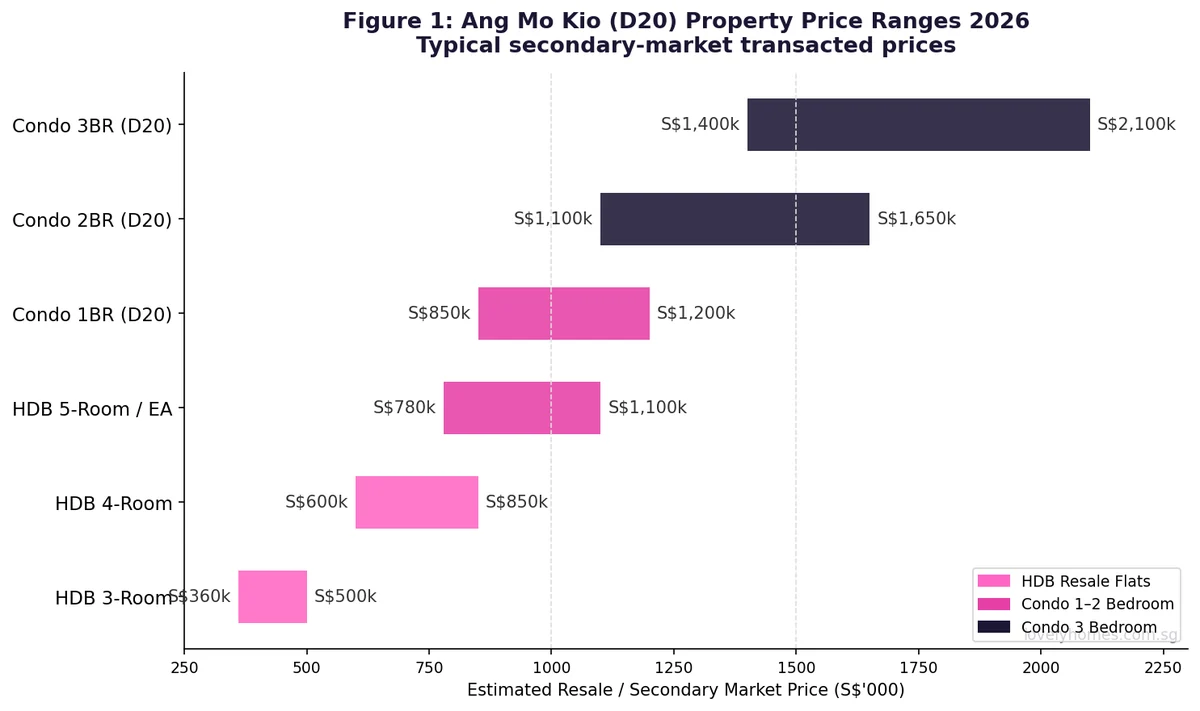
  • HDB resale prices (2026): 3-Room S$360k–S$500k · 4-Room S$600k–S$850k · 5-Room S$780k–S$1,050k. First million-dollar 4-room deal (S$1.11M) recorded at AMK Court in January 2026.
  • Private condo prices: 2-Bedroom S$1.1M–S$1.65M · 3-Bedroom S$1.5M–S$2.2M (limited supply, mostly 99-year leasehold).
  • Gross rental yield (2026 est.): HDB 4-Room ~4.0–4.4% · Condo 2BR ~3.2–3.5%.
  • Schools: Ai Tong Primary (SAP), CHIJ AMK Primary, Nanyang Junior College, Anderson Serangoon Junior College.
  • Healthcare: Khoo Teck Puat Hospital (762 beds), AMK Polyclinics (2 branches).
  • June 2026 BTO: HDB is launching two Plus-class projects in Ang Mo Kio as part of the June 2026 exercise — expect tighter resale restrictions (10-year MOP, subsidy clawback) on these units.

What Is Ang Mo Kio — and Why Does It Matter to Property Buyers?

Ang Mo Kio (AMK) is one of Singapore’s oldest and most established Housing & Development Board (HDB) new towns, planned by the HDB and URA in the 1970s and progressively built out through the 1980s. The name — loosely translated from Hokkien as “junction of the Ang Mo (European/Western) bridge” — hints at its colonial-era heritage. Today, AMK is a thriving, self-contained community of approximately 149,600 HDB residents spread across 12 subzones and roughly 48,915 flats.

For property buyers, AMK sits at an interesting intersection: it is close enough to the city (Ang Mo Kio MRT is approximately 20 minutes from Raffles Place by North–South Line) to command a pricing premium over more distant towns such as Woodlands or Jurong West, yet its predominantly HDB landscape keeps prices meaningfully below the Core Central Region (CCR). In the first quarter of 2026, four-room resale flats in AMK transacted at a median of S$720,000–S$750,000 — competitive with neighbouring Bishan and Toa Payoh, and well below the CCR’s equivalent private housing.

The URA’s master plan for AMK focuses on renewal: upgrading ageing commercial nodes, expanding park connectivity through the 62-hectare Bishan–Ang Mo Kio Park, and improving public transport with the forthcoming Cross Island Line (CRL) Phase 2 station, which will add a second rail line to the town by around 2030.

Ang Mo Kio Property Prices 2026 — HDB Resale and Private Market

AMK’s property market is dominated by HDB resale flats, which account for well over 95% of all transactions in the planning area. Private condominiums are relatively scarce, making the few available developments — such as The Panorama (698 units, 99-year leasehold, AMK Avenue 2) — significant benchmarks for the area.

Ang Mo Kio D20 property price ranges 2026 — HDB 3-room to condo 3BR
Figure 1: Ang Mo Kio property price ranges (2026 secondary market). Sources: HDB Resale Flat Prices dataset, URA Realis, industry transaction data.

HDB resale highlights (Q1 2026):

  • 3-Room flats: S$360,000–S$500,000. Common in older precincts such as AMK Avenue 3 and AMK Avenue 6. Compact at 60–69 sqm, these are popular with singles (age 35+), divorcees, and small families on tighter budgets.
  • 4-Room flats: S$600,000–S$850,000. The workhorse of AMK’s resale market. The first million-dollar 4-room deal in AMK Court was registered in January 2026 at S$1,110,000 — a landmark that signals premium-located units (high floor, near MRT) now breach seven figures even in non-CCR towns.
  • 5-Room and Executive Apartments (EA): S$780,000–S$1,150,000+. Larger families and upgraders seeking spacious HDB living without the private-condo price tag favour these units. EA layouts in AMK typically offer around 140–145 sqm.

Private condominium prices (2026): With very limited new supply, AMK condominiums trade on scarcity. The Panorama (TOP 2018, 698 units) remains the main 2BR benchmark at S$1.1M–S$1.55M; 3BR units range from S$1.5M to S$2.2M depending on floor level and facing. Gross rental yields on AMK condominiums are estimated at 3.2–3.5% for 2BR units — lower than equivalent HDB yields but supported by a steady tenant pool including Nanyang Junior College lecturers, hospital staff from Khoo Teck Puat Hospital, and corporate professionals working in the nearby Ang Mo Kio industrial estate.

The June 2026 BTO Launch and Its Implications

HDB’s June 2026 BTO exercise — the largest single launch of the year at approximately 6,900 flats across seven projects in five towns — includes two Plus-class projects in Ang Mo Kio. Under HDB’s classification framework (Prime, Plus, Standard), Plus flats carry tighter resale conditions: a 10-year Minimum Occupation Period (MOP), income ceiling of S$14,000/month for buyers, and a subsidy clawback upon resale. Buyers considering these BTO units should factor in that the longer MOP reduces near-term liquidity, and the clawback mechanism limits capital appreciation on the resale of Plus flats compared with Standard flats in the same town.

MRT Access and Transport Connectivity

AMK’s North–South Line (NSL) connectivity is its biggest transport asset. Three NSL stations serve the planning area:

  • Ang Mo Kio (NS16): The town’s primary interchange. Train travel time to Orchard is approximately 14 minutes; Raffles Place approximately 22 minutes. AMK MRT is directly integrated with AMK Hub shopping centre and the AMK bus interchange.
  • Yio Chu Kang (NS15): Serves the northern AMK precincts and the Yio Chu Kang Stadium area. Journey time to City Hall is approximately 25 minutes.
  • Marymount (NS18): Serves the southern AMK fringe bordering Bishan; useful for residents in AMK Avenue 1 and the Thomson area.

The upcoming Cross Island Line (CRL) Phase 2, currently under planning by the Land Transport Authority (LTA), is expected to include a station in the AMK planning area by approximately 2030. A second rail line would significantly improve east–west connectivity for AMK residents — currently, all NSL journeys into town require heading south before branching east or west.

Schools and Education

AMK has long been one of Singapore’s most sought-after school belts, anchored by several high-demand primary schools within the 1-km priority registration radius of key precincts:

  • Ai Tong School: Special Assistance Plan (SAP) primary school; one of the most oversubscribed schools in AMK, drawing buyers to precincts within 1 km of AMK Avenue 6.
  • CHIJ Ang Mo Kio Primary: All-girls school under the Singapore Catholic Mission; strong ballot demand in Phase 2B registration.
  • Pei Chun Public School: Bilingual SAP school near Marymount MRT.
  • Mayflower Primary School: Government school serving AMK’s northern subzones.
  • Anderson Serangoon Junior College (ASRJC): Formed in 2020 from the merger of Anderson JC and Serangoon JC; located on Upper Serangoon Road, approximately 2.5 km from AMK MRT.
  • Nanyang Junior College (NYJC): On Serangoon Avenue 3, near the AMK–Serangoon border; one of Singapore’s highest-performing JCs by A-Level results.
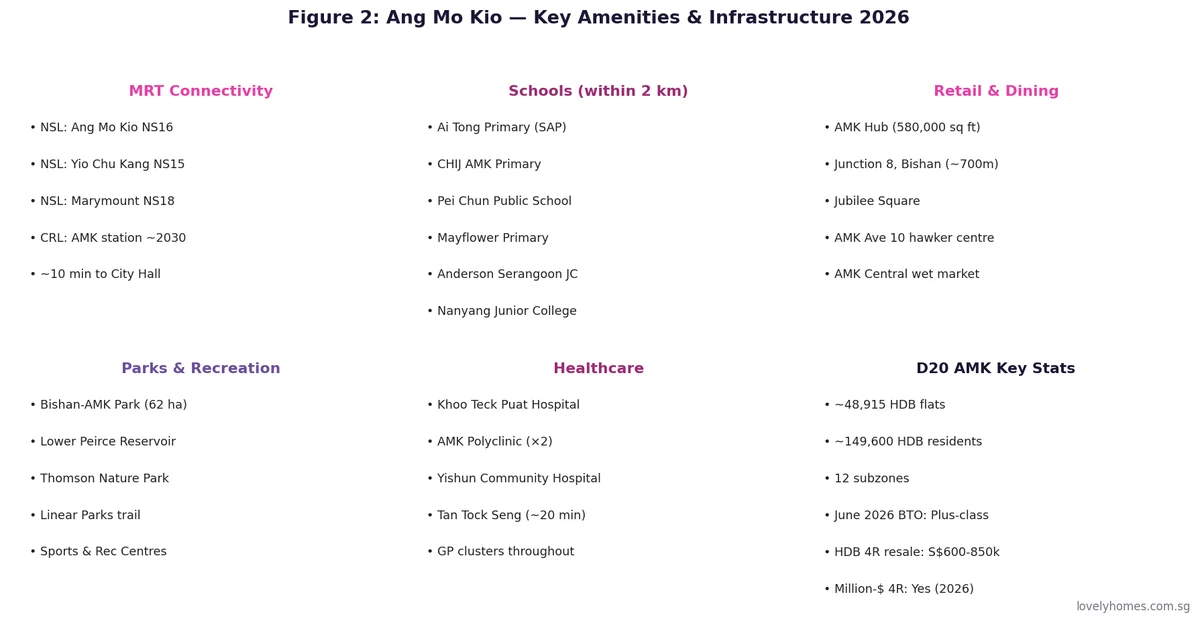
Ang Mo Kio amenities grid 2026 — MRT schools retail parks healthcare stats
Figure 2: Ang Mo Kio key amenities and infrastructure summary (2026). Sources: URA, LTA, MOH, HDB.

Amenities: Retail, Recreation and Healthcare

Retail: AMK Hub at the town centre is the neighbourhood’s retail anchor — a six-storey, 580,000 sq ft mall directly connected to AMK MRT. It houses over 200 tenants spanning food, fashion, electronics, and family services. Junction 8 in Bishan (approximately 700 m from the AMK border) provides additional retail depth for residents in southern AMK precincts near Marymount MRT.

Recreation: The 62-hectare Bishan–Ang Mo Kio Park is Singapore’s largest urban park and one of the country’s best examples of biophilic urban design — the Kallang River was naturalised in 2012 to run through the park, creating a rain garden ecosystem. It is a favourite for cycling, jogging, kayaking, and weekend picnics. Thomson Nature Park and the Lower Peirce Reservoir Park add further green buffer to AMK’s northern fringe.

Healthcare: Khoo Teck Puat Hospital (KTPH), a 762-bed acute-care hospital administered by the National Healthcare Group (NHG), is located approximately 700 m from AMK MRT. Two Ang Mo Kio Polyclinics (AMK Ave 10 and AMK Ave 9) serve primary care needs. Residents requiring specialist care can access Tan Tock Seng Hospital (TTSH) in Novena, approximately 20 minutes by NSL.

Investment Analysis — Why Ang Mo Kio Holds Its Value

AMK’s investment case rests on four structural pillars:

  1. Scarcity of private supply: Unlike Tampines, Bedok, or Woodlands — which have significant private condo pipelines — AMK has no meaningful new private residential launch since The Panorama in 2014. Scarcity supports secondary-market pricing.
  2. Transport upgrade optionality: The CRL Phase 2 station represents a structural re-rating catalyst. Investors tracking Singapore’s MRT pipeline history will note that the opening of TEL stations in Marine Parade and Marine Terrace (June 2023) triggered a 12–18% uplift in nearby transaction prices within 12 months. An equivalent re-rating in AMK is plausible upon CRL opening.
  3. School belt premium: Properties within 1 km of Ai Tong School consistently command a 6–10% price premium over equivalent flats in the same precinct but outside the priority radius — a durable premium driven by annual demand from parents in the Phase 2B registration priority window.
  4. Rental demand: AMK’s employment node (AMK Industrial Park and the Ang Mo Kio Avenue 10 light industrial precinct) sustains a tenant base of technicians, healthcare professionals, and small-business owners who prefer proximity to their workplace. KTPH’s ~4,000 staff represent a structural rental demand pool.
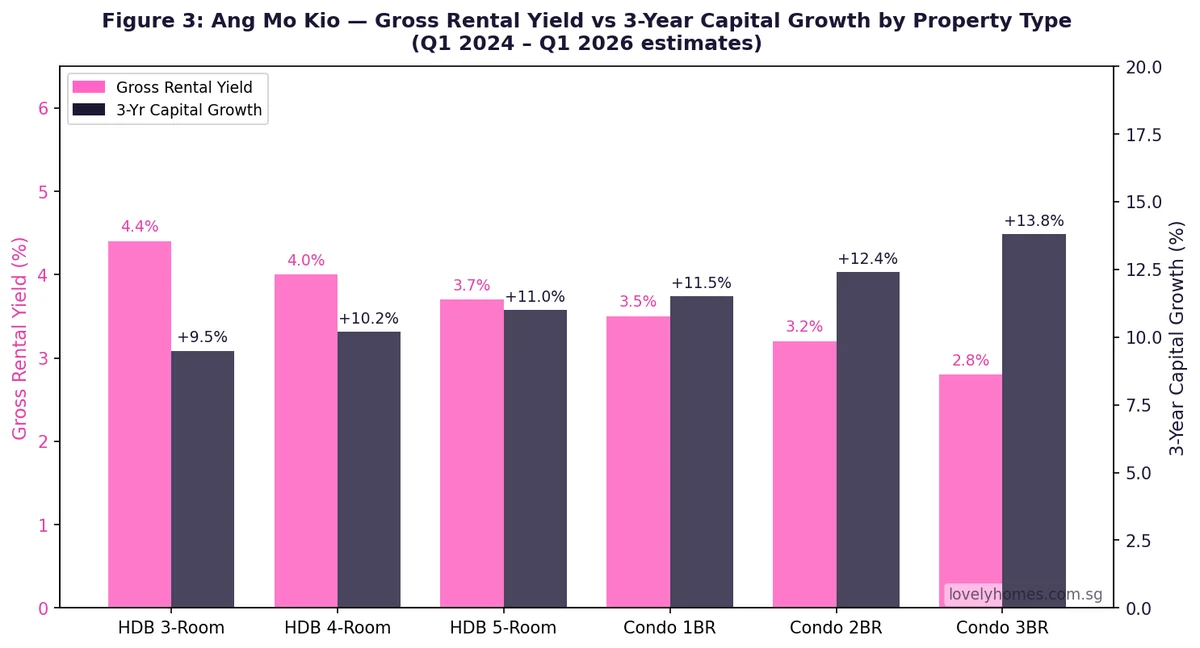
Ang Mo Kio gross rental yield vs 3-year capital growth by property type 2026
Figure 3: Ang Mo Kio — Gross Rental Yield vs 3-Year Capital Growth by property type (Q1 2024–Q1 2026 estimates). Sources: HDB, URA Realis, industry estimates.

Ang Mo Kio Property Price Summary Table

Property Type Est. Price Range (2026) Typical Size Gross Yield (est.) Tenure
HDB 3-Room S$360k – S$500k 60–69 sqm ~4.2–4.6% 99-yr lease (HDB)
HDB 4-Room S$600k – S$850k 90–105 sqm ~4.0–4.4% 99-yr lease (HDB)
HDB 5-Room / EA S$780k – S$1,150k 110–145 sqm ~3.6–4.0% 99-yr lease (HDB)
Condo 2BR (D20) S$1.1M – S$1.65M 65–90 sqm ~3.2–3.5% 99-yr leasehold
Condo 3BR (D20) S$1.5M – S$2.2M 90–120 sqm ~2.8–3.2% 99-yr leasehold

Table 1: AMK property price summary. Prices are estimated secondary-market ranges for Q1–Q2 2026. Yields are gross estimates based on advertised rental data and HDB/URA transaction records. Not a valuation or financial advice.

Worked Example — Upgrading to AMK: Mr & Mrs Lim

Profile: Mr & Mrs Lim, Singapore Citizens, joint gross income S$10,500/month. Selling their Toa Payoh 4-room HDB flat (Minimum Occupation Period cleared). Moving to a larger 4-room HDB flat in Ang Mo Kio to be closer to parents (qualifying for the Proximity Housing Grant).

  • Purchase price: AMK 4-room resale HDB at S$728,000
  • Proximity Housing Grant (PHG): S$30,000 (parents/in-laws living within 4 km of proposed purchase, applicable to SC second-timers buying within 30 km of family)
  • Buyer’s Stamp Duty (BSD): First S$180k × 1% = S$1,800 + next S$180k × 2% = S$3,600 + remaining S$368k × 3% = S$11,040 → Total BSD: S$16,440
  • Additional Buyer’s Stamp Duty (ABSD): Nil — sell-first approach: Toa Payoh flat sold and transferred before exercising AMK OTP. At point of purchase, property count = 0 for SCs. (See our ABSD complete guide for remission options.)
  • HDB loan quantum (80% LTV): S$582,400 at 2.6% p.a. (CPF OA rate + 0.1%) over 25 years = approx. S$2,638/month
  • Mortgage Servicing Ratio (MSR) check: S$2,638 ÷ S$10,500 = 25.1% — PASS (MSR ceiling 30%, administered by MAS)
  • Upfront CPF/cash outlay: 20% downpayment S$145,600 − PHG S$30,000 = S$115,600 from CPF OA + BSD S$16,440 payable from CPF OA + legal/admin ~S$3,250 = approx. S$135,290 total (largely from CPF OA savings; zero min-cash requirement under an HDB loan)

Outcome: The Lims comfortably qualify on MSR. The sell-first approach eliminates ABSD entirely. The PHG grant reduces their effective CPF draw by S$30,000 at the point of downpayment. On a joint income of S$10,500/month, the monthly repayment of S$2,638 (25.1% MSR) leaves meaningful household cash flow for living expenses and savings. For CPF withdrawal limit rules, see our CPF property withdrawal limits guide.

Why Ang Mo Kio Matters — and What Comes Next

AMK occupies a strategic position in Singapore’s property hierarchy: it offers the school-belt credentials of Bishan and Toa Payoh at a modest discount, the healthcare infrastructure of a regional hub, and the CRL optionality of a town that investors have not yet fully priced in. For owner-occupiers — particularly HDB upgraders with school-age children — AMK’s combination of established amenities, transport access, and community facilities makes it one of the more defensible choices in Singapore’s non-CCR market.

Looking ahead to 2026–2030, three catalysts could reshape AMK’s property landscape: (1) the finalisation of CRL Phase 2 station details and tender award, which would crystallise the re-rating thesis; (2) the wave of maturing Plus-class BTO units from the June 2026 exercise becoming resaleable after 2036 — reshaping the supply composition of AMK’s resale market; and (3) possible Urban Redevelopment Authority master plan revisions under the forthcoming Long-Term Plan Review, which could unlock higher plot ratios in AMK’s town centre precinct.

None of these are certainties. Buyers should weigh AMK’s established fundamentals against the fact that the town has fewer “upside surprises” than less-developed areas such as Tengah or Bayshore — the infrastructure is largely in place, which means less speculative upside but also lower execution risk.

Frequently Asked Questions — Ang Mo Kio Property 2026

Is Ang Mo Kio a good place to buy property in 2026?

AMK is well-regarded for its school belt (Ai Tong, CHIJ AMK, Nanyang JC), mature HDB infrastructure, and proximity to Khoo Teck Puat Hospital. It is competitively priced relative to Bishan and Toa Payoh yet significantly cheaper than CCR neighbourhoods such as Orchard or Newton. The upcoming CRL Phase 2 station adds long-term transport upside. For buyers prioritising liveability, school proximity, and healthcare access, AMK scores highly. However, private condo supply is very limited, restricting choice for buyers who require private residential options.

Which MRT lines serve Ang Mo Kio?

AMK is served by three stations on the North–South Line (NSL): Ang Mo Kio (NS16), Yio Chu Kang (NS15), and Marymount (NS18). There is no current East–West or Downtown Line access within the planning area. The Cross Island Line (CRL) Phase 2 is expected to add at least one station in the AMK corridor, improving east–west connectivity, but construction is not expected to complete until approximately 2030.

Can a Singapore Permanent Resident (PR) or foreigner buy property in AMK?

HDB resale flats in AMK — like all HDB flats — are available to eligible Singapore PRs (subject to HDB’s ethnic integration policy, income ceilings, and the PR scheme eligibility rules under the Public Scheme or Fiancé/Fiancée Scheme). PRs buying an HDB flat must occupy it as their principal residence and are subject to a 5-year resale levy deferral rule under certain conditions. Foreigners (non-PR, non-SC) cannot purchase HDB flats at all, but may purchase private condominiums in AMK subject to the Additional Buyer’s Stamp Duty (ABSD) of 60% as of April 2023. See our ABSD guide for the full rate table.

What are the best condominiums in Ang Mo Kio?

AMK has very limited private condominium supply. The most prominent completed development is The Panorama (698 units, 99-year leasehold, TOP 2018, AMK Avenue 2), which is the dominant price benchmark for 2- and 3-bedroom private units in the planning area. Grandeur 8 (99yr, earlier vintage) and Thomson Three (on the AMK–Thomson border) are secondary benchmarks. Given the scarcity of supply, buyers considering AMK condominiums should also compare nearby Bishan options — such as Sky Vista — which offer similar school-belt access with slightly different MRT coverage.

How does AMK compare to Bishan or Toa Payoh for property investment?

All three are mature NSL towns with strong school belts and established amenities. AMK typically offers slightly lower pricing than Bishan (which benefits from the Junction 8/Bishan MRT dual interchange) and is broadly comparable to Toa Payoh. Bishan commands a premium due to its CCR-adjacent positioning and the Thomson–East Coast Line (TEL) overlay at Caldecott (one stop from Bishan). Toa Payoh has a tighter new HDB supply pipeline but older flat leases. AMK’s differentiator is its forthcoming CRL re-rating potential and the Ai Tong/CHIJ school belt. For most buyers, the choice hinges on specific school requirements and whether proximity to Junction 8 or AMK Hub better suits daily life.

What is the impact of the June 2026 BTO Plus-class projects on AMK’s resale market?

Plus-class BTO flats are subject to a 10-year Minimum Occupation Period (double the standard 5 years), an income ceiling of S$14,000/month for buyers on the resale market, and a subsidy clawback upon resale that reduces the seller’s net proceeds. These restrictions mean that Plus flats will transact at a discount to Standard resale flats in the same town once they become eligible for resale — effectively creating a two-tier resale market within AMK by the mid-2030s. Buyers of existing Standard-class AMK resale flats are unlikely to be directly affected; if anything, restricted supply of Plus flats on the resale market may support pricing on the unrestricted Standard inventory.

What grants are available when buying an AMK HDB resale flat?

Eligible Singapore Citizen buyers purchasing HDB resale flats in AMK can access the Enhanced Housing Grant (EHG) of up to S$120,000 (families) or S$60,000 (singles), subject to income ceilings and a first-timer eligibility requirement. The Proximity Housing Grant (PHG) provides up to S$30,000 for families (S$15,000 for singles) who buy within 4 km of parents or children. The Step-Up CPF Housing Grant of S$15,000 is available to eligible second-timer families purchasing 2- or 3-room resale flats. See our CPF Housing Grant guide for full eligibility conditions and stacking rules.

Related Articles

Disclaimer

This article is produced by LovelyHomes for general informational and educational purposes only. Property prices, rental yields, grant amounts, and stamp duty rates are subject to change; figures cited reflect publicly available data as of Q1–Q2 2026 and are estimates only. This article does not constitute financial, legal, or property valuation advice. Readers should verify current rates and eligibility conditions directly with the relevant authorities: Housing & Development Board (HDB) at hdb.gov.sg, Urban Redevelopment Authority (URA) at ura.gov.sg, Inland Revenue Authority of Singapore (IRAS) at iras.gov.sg, and Central Provident Fund Board (CPF) at cpf.gov.sg. Engage a licensed property agent and, where appropriate, a lawyer and financial adviser before making any property decision.

Good Class Bungalow (GCB) Singapore 2026: Complete Guide to Eligibility, Areas, Prices and Acquisition Costs

Good Class Bungalow (GCB) Singapore 2026: Complete Guide to Eligibility, Areas, Prices and Acquisition Costs

Quick Answer: Good Class Bungalow (GCB) at a Glance

  • Eligibility: Singapore Citizens only — Permanent Residents and foreigners cannot purchase GCBs
  • Minimum Plot: 1,400 sqm (~15,069 sqft) as defined by URA; maximum site coverage 40%; height limit 2 storeys plus attic
  • Price Range: S$15M–S$150M+ depending on area tier and plot size; median psf ~S$2,100 (2025)
  • Number of GCBs: Approximately 2,700–2,800 units across 39 gazetted GCB areas in Singapore
  • BSD (S$28M example): Approximately S$2.07M (8% marginal rate above S$6M)
  • ABSD: Nil for SC buying first residential property; 20% for SC buying second; 35% for PR; 60% for foreigners
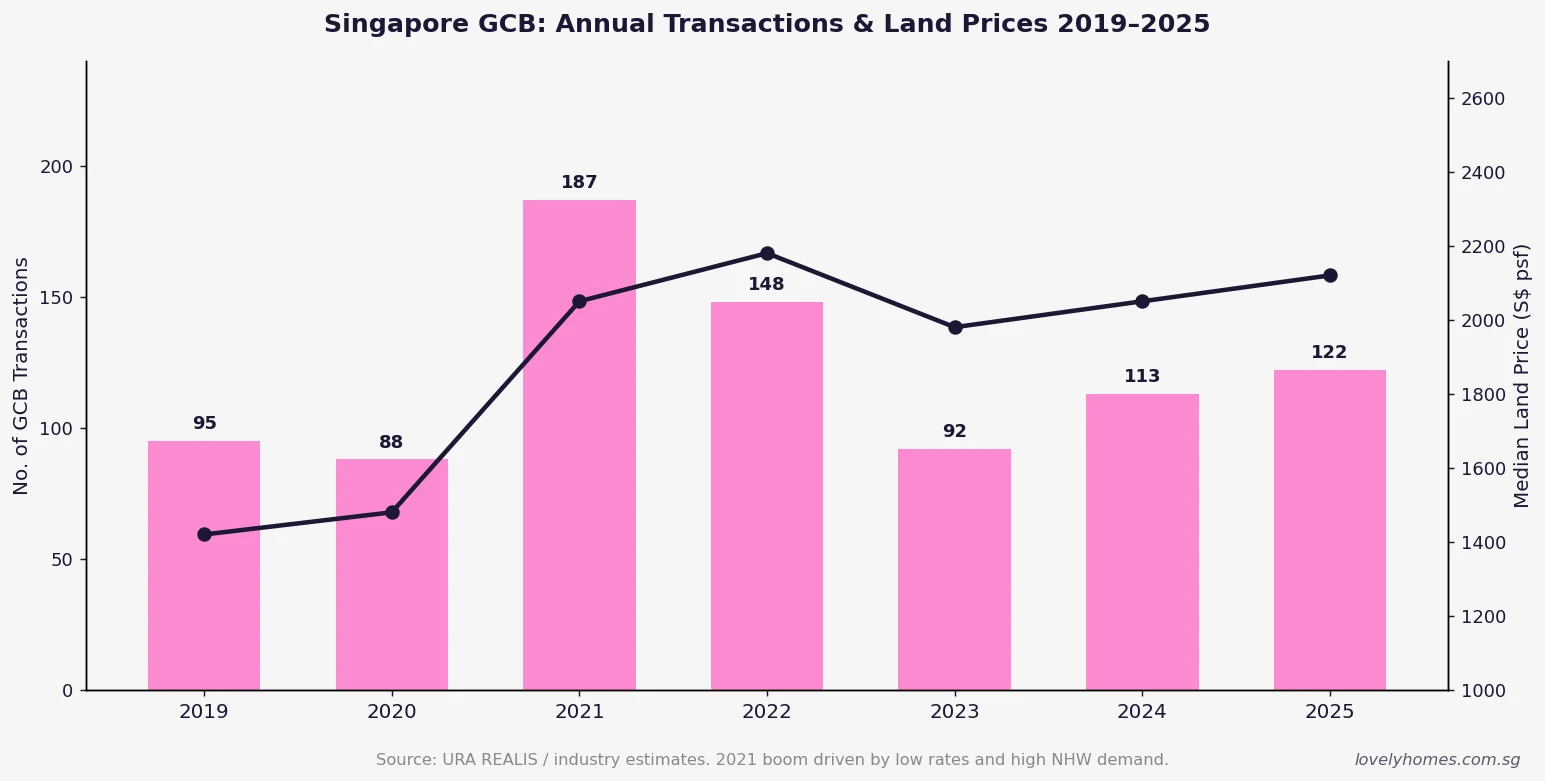
  • Annual Transactions: ~90–190 transactions per year; 2021 peak of ~187 driven by low interest rates
  • Key GCB Areas: Nassim Road/Hill (ultra-prime), Cluny Hill, Caldecott Hill, Leedon Road, Swiss Club Road

In the hierarchy of Singapore’s residential property market, the Good Class Bungalow (GCB) occupies a category of its own. Protected by strict URA planning parameters and restricted to Singapore Citizens only, GCBs are the most tightly regulated — and among the most coveted — properties in the country. With fewer than 2,800 units spread across 39 designated areas, the GCB market is defined by scarcity, exclusivity, and the kind of long-term value resilience that institutional investors typically associate with trophy assets.

This guide explains the planning rules, buyer eligibility, price tiers, transaction trends, and acquisition costs that define Singapore’s GCB market in 2026 — with a full worked example of what it costs a Singapore Citizen to purchase a S$28 million bungalow in a prime GCB area.

What Is a Good Class Bungalow? The URA Definition

A Good Class Bungalow is a detached dwelling house located within one of URA’s 39 gazetted GCB Areas. The planning parameters are set by URA’s Master Plan and are non-negotiable: the minimum land area is 1,400 sqm (approximately 15,069 sqft). Unlike standard landed property elsewhere in Singapore, GCBs cannot be subdivided below this threshold — a deliberate policy choice by URA to preserve the low-density, high-greenery character of these enclaves.

Additional development controls apply: site coverage is capped at 40% (meaning at most 560 sqm of a 1,400 sqm plot can be covered by the building footprint); building height is limited to two storeys plus an attic and a basement; and setback requirements ensure generous greenery between structures. The effect is a de facto exclusivity floor: even a plot at the minimum threshold costs between S$15 million and S$50 million depending on location, and the construction of a purpose-built bungalow adds a further S$3 million–S$8 million at current build costs.

Who Can Buy a GCB in Singapore?

Only Singapore Citizens may purchase landed residential property in gazetted GCB Areas. This restriction is absolute — Singapore Permanent Residents, foreigners, and companies (including Singapore-incorporated entities) are ineligible unless specific ministerial approval is obtained, which is rarely granted for private residential purposes. The restriction applies regardless of whether the buyer is a high-net-worth individual, a family office, or a foreign sovereign wealth fund — GCBs are citizen-only assets.

This legal restriction is administered under the Residential Property Act (RPA), overseen by the Singapore Land Authority (SLA). Any transaction involving a non-citizen buyer requires prior written approval from the Minister for Law, and approvals for GCBs are essentially never granted for purely residential purposes. Prospective foreign buyers wishing to invest in Singapore’s landed property market are directed to Sentosa Cove, which operates under a separate framework.

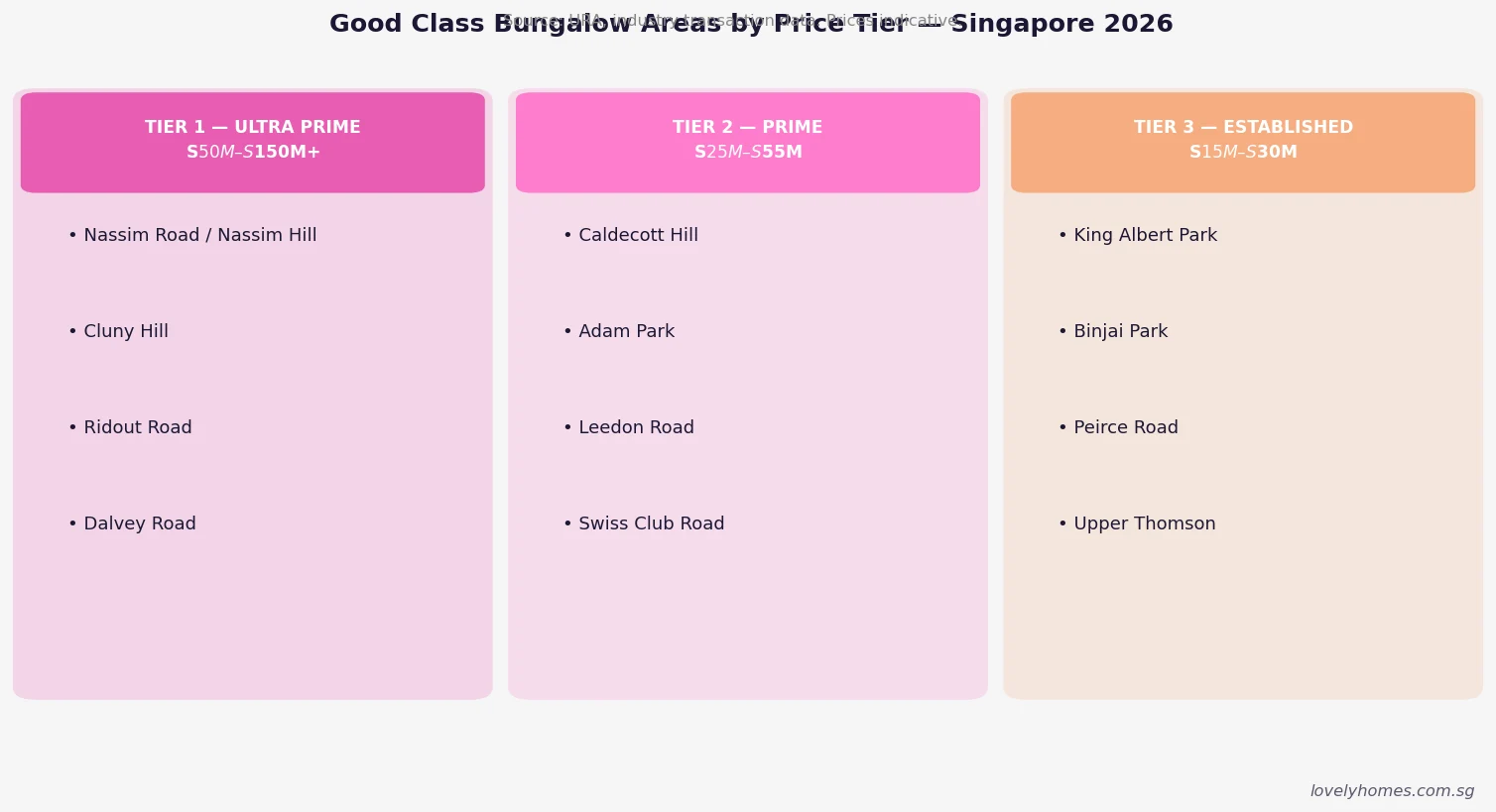
Good Class Bungalow area price tiers Singapore 2026 showing ultra prime prime and established GCB areas
Figure 1: GCB areas by price tier — ultra-prime (Nassim, Cluny Hill), prime (Caldecott, Leedon), and established (King Albert Park, Binjai Park). Source: URA, industry transaction data.

The 39 GCB Areas: Location, Tier, and Character

URA has gazetted 39 GCB Areas across Singapore, concentrated primarily in the central-west corridor between Bukit Timah, Tanglin, and Holland. The areas range from ultra-prime enclaves — where plots on Nassim Road have traded at record prices exceeding S$4,000 psf of land — to more established residential pockets in Peirce Road or Binjai Park where values are more accessible.

The three broad pricing tiers (illustrated in Figure 1) reflect differences in land scarcity, proximity to Orchard Road and the CBD, plot sizes, and the historic prestige of each enclave. Tier 1 (Ultra-Prime) covers Nassim Road/Hill, Cluny Hill, Ridout Road, and Dalvey Road — areas where transaction prices typically start at S$50 million and have reached S$148 million (Nassim Road, 2021) for landmark plots. Tier 2 (Prime) encompasses Caldecott Hill, Adam Park, Leedon Road, and Swiss Club Road — where a mid-sized plot at S$25 million–S$55 million represents reasonable market value. Tier 3 (Established) includes King Albert Park, Binjai Park, Peirce Road, and Upper Thomson, where the GCB premium is significant but entry-level plots can be found in the S$15 million–S$30 million range.

GCB Transaction Trends: Volume and Pricing 2019–2025

Despite representing a tiny slice of Singapore’s overall residential property market, GCB transactions attract disproportionate attention from analysts and media because they serve as a barometer of ultra-high-net-worth (UHNW) confidence in Singapore as a wealth hub.

Singapore GCB annual transactions and median land price 2019 to 2025 bar and line chart
Figure 2: Singapore GCB annual transaction volume (bars) and median land price per sqft (line), 2019–2025. Source: URA REALIS / industry estimates.

The 2021 boom — when GCB transactions surged to approximately 187 — was driven by a confluence of factors: historically low global interest rates, Singapore’s successful management of COVID-19 relative to peer cities, and an influx of ultra-high-net-worth families relocating their base to Singapore. Median land prices peaked around S$2,180 psf in 2022 before softening modestly as global interest rates rose. By 2025, transaction volumes had stabilised at approximately 120 per year and median land prices had recovered to roughly S$2,120 psf — demonstrating the market’s characteristic price resilience even as volumes remained well below the 2021 peak.

The long-run story is one of consistent appreciation: GCB land values have risen from approximately S$1,420 psf in 2019 to S$2,120 psf in 2025 — a compound annual growth rate of approximately 6.9% over six years, outpacing Singapore’s Private Residential Property Price Index over the same period.

Buying Costs: BSD, ABSD, and Total Acquisition Outlay

Acquiring a GCB involves several layers of transaction cost. The most significant are Buyer’s Stamp Duty (BSD) and, where applicable, Additional Buyer’s Stamp Duty (ABSD). Both are administered by the Inland Revenue Authority of Singapore (IRAS).

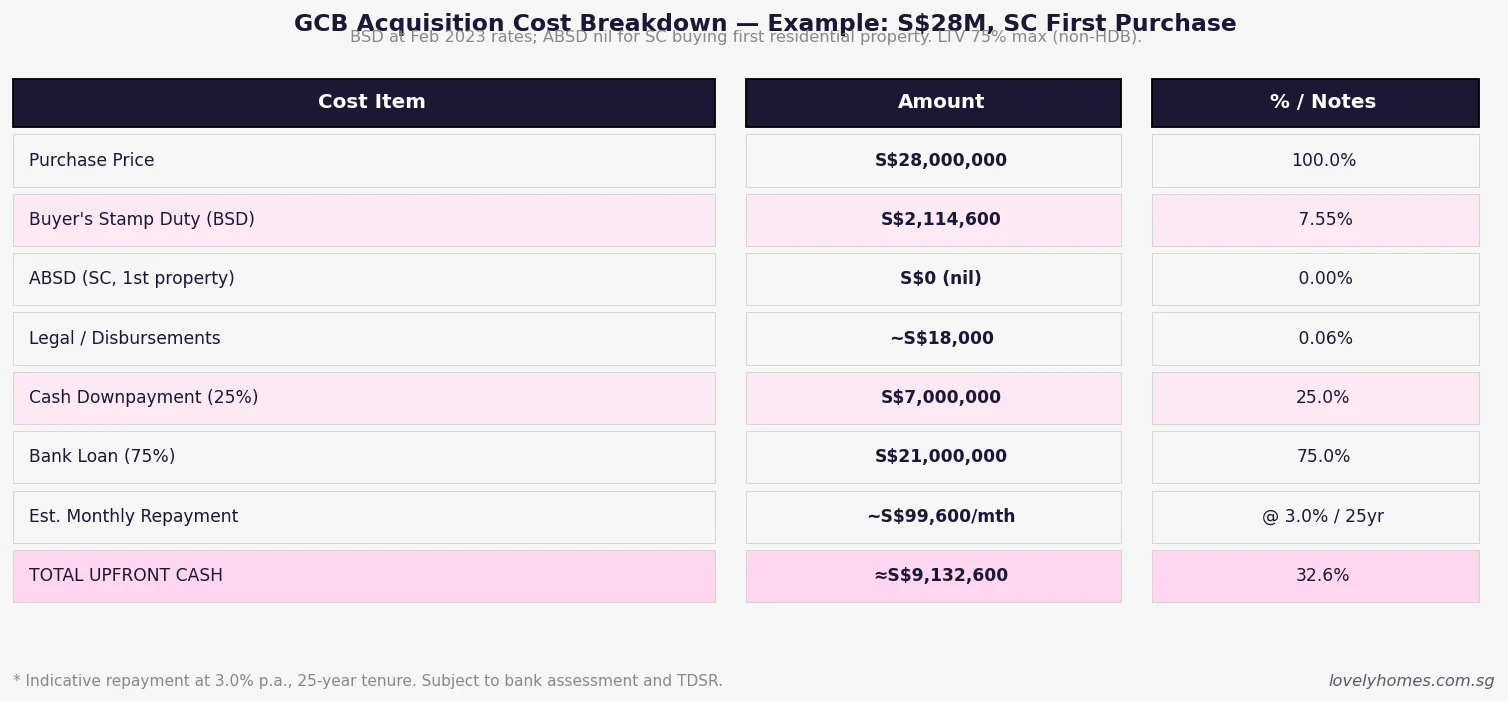
BSD applies to all property purchases in Singapore and is computed on the purchase price or market value (whichever is higher) at progressive rates. For a GCB purchase at S$28 million, the BSD calculation is: 1% on the first S$180,000 (S$1,800) + 2% on the next S$180,000 (S$3,600) + 3% on the next S$640,000 (S$19,200) + 4% on the next S$500,000 (S$20,000) + 5% on the next S$1,500,000 (S$75,000) + 6% on the next S$1,500,000 (S$90,000) + 7% on the next S$1,500,000 (S$105,000) + 8% on the remaining S$22,000,000 (S$1,760,000). Total BSD: approximately S$2,074,600.

ABSD is determined by the buyer’s residency status and the number of residential properties already owned. Singapore Citizens buying their first residential property pay nil ABSD; buying a second, 20%; buying a third or subsequent, 30%. PRs pay 5% on first, 30% on second. Foreigners pay 60% flat.

GCB acquisition cost breakdown Singapore 28 million worked example showing BSD ABSD downpayment and total upfront cash
Figure 3: GCB acquisition cost breakdown — worked example for a S$28M purchase by a SC buying their first residential property.

GCB Key Facts: Summary Table

Parameter Detail Governing Body
Minimum plot size 1,400 sqm (~15,069 sqft) URA Master Plan
Maximum site coverage 40% of plot area URA
Maximum height 2 storeys + attic + basement URA
Buyer eligibility Singapore Citizens only SLA / Residential Property Act
No. of gazetted GCB areas 39 URA
Estimated GCB stock ~2,700–2,800 units URA / industry
Annual transactions (2025 est.) ~120 URA REALIS
Median land price (2025 est.) ~S$2,100–S$2,200 psf URA REALIS
BSD (at S$28M) ~S$2,074,600 (~7.4% of price) IRAS
ABSD (SC, 1st property) Nil IRAS

Worked Example: Buying a S$28M GCB (SC, First Property)

Mr Tan Wei Ming is a Singapore Citizen entrepreneur, aged 52, with no existing residential properties. He wishes to acquire a freehold GCB plot in the Caldecott Hill area (Tier 2 prime) measuring 1,650 sqm at a price of S$28,000,000 — approximately S$1,697 psf of land.

BSD: Computed per IRAS progressive rates as detailed above. Total BSD: approximately S$2,074,600 (7.4% of purchase price).

ABSD: Nil — Mr Tan is a Singapore Citizen buying his first residential property.

Financing: Maximum Loan-to-Value (LTV) for a non-HDB property purchase by an individual with no existing mortgage is 75% from a bank. Loan quantum = S$21,000,000. At an indicative 3.0% per annum over a 25-year tenure, the estimated monthly instalment is approximately S$99,600/month (indicative; subject to TDSR compliance and bank assessment). Cash downpayment (25%) = S$7,000,000.

Total upfront cash outlay: S$7,000,000 (downpayment) + S$2,074,600 (BSD) + approximately S$18,000 (legal/disbursements) = approximately S$9,092,600.

TDSR: At a monthly income of S$300,000 (indicative for this profile), monthly mortgage of S$99,600 equates to a TDSR of 33.2% — within MAS’s 55% TDSR cap. UHNW buyers with predominantly investment or dividend income should note that banks apply haircuts to variable income streams in TDSR assessment; structuring advice from a private bank relationship manager is advisable before committing.

Why GCBs Matter: The Investment Perspective

GCBs are among the few truly scarce assets in Singapore’s property market. The total GCB stock is essentially fixed — URA’s planning framework prevents new GCB areas from being gazetted, and the subdivision rules prevent existing plots from being broken up. This structural supply ceiling, combined with Singapore’s political stability, rule of law, and its role as a global wealth management hub, creates a long-run demand and supply dynamic that has supported price appreciation even through global financial crises and pandemic disruptions.

Compared with trophy residential property in peer cities — Hong Kong, London, Sydney — Singapore’s GCB market offers a relatively transparent transaction environment (URA REALIS provides full transaction history), robust title security (Torrens system administered by SLA), and no capital gains tax on property disposal. The absence of estate duty (abolished in 2008) further enhances GCBs as intergenerational wealth transfer vehicles for Singapore Citizens.

What Might Come Next in the GCB Market

Several macro factors are worth monitoring. Singapore’s Family Office (FO) sector has grown to over 1,500 registered single-family offices as at 2025, and while GCB purchases require Singapore Citizenship, FO principals who have naturalised as Citizens represent a growing pool of qualified buyers. This gradual structural demand increment — as wealth migration matures into citizenship — is a medium-term tailwind for GCB values, all else equal.

On the supply side, there is occasional discussion of whether URA might ever revise GCB area boundaries or minimum plot sizes. No such revisions have been announced or signalled as at writing. Any regulatory tightening (e.g. raising the minimum plot threshold) would, if anything, reduce future supply and could be price-supportive for existing GCBs. Conversely, a sustained period of high global interest rates constraining UHNW liquidity could suppress transaction volumes further, though historical evidence suggests GCB prices are relatively price-inelastic because they are purchased largely without leverage stress.

Frequently Asked Questions

Can a Singapore Permanent Resident buy a GCB?

No. Only Singapore Citizens may purchase Good Class Bungalows or any landed residential property within gazetted GCB Areas. This restriction is legislated under the Residential Property Act (RPA) and is administered by the Singapore Land Authority (SLA). PRs who wish to purchase landed property in Singapore are limited to non-GCB landed homes (e.g. terrace houses, semi-detached, detached outside GCB Areas), subject to ministerial approval on a case-by-case basis. Even for non-GCB landed, PR buyers must satisfy SLA’s criteria, which are not routinely granted.

How many GCB areas are there in Singapore?

URA has gazetted 39 GCB Areas across Singapore, concentrated primarily in the central-west region (Bukit Timah, Tanglin, Holland, and Caldecott corridors). The total estimated GCB stock is approximately 2,700–2,800 individual bungalows across all 39 areas, making GCBs one of the most limited housing categories in the country. The 39 areas range from the ultra-prime Nassim Road enclave to more accessible established areas such as King Albert Park and Binjai Park.

What is the minimum plot size for a GCB?

The minimum land area for a Good Class Bungalow is 1,400 square metres (approximately 15,069 sqft), as defined in URA’s Master Plan and the Residential Property Act. Plots below this threshold cannot be classified as GCBs. Site coverage is capped at 40%, meaning the building footprint may not exceed 560 sqm on a minimum-sized plot. The height limit is two storeys above ground, with an attic and one basement storey permitted. These controls are enforced by URA as part of Singapore’s statutory development approval process.

What is the BSD on a S$28M GCB purchase?

Buyer’s Stamp Duty (BSD) is calculated at IRAS’s progressive rates: 1% on the first S$180,000 (S$1,800); 2% on the next S$180,000 (S$3,600); 3% on the next S$640,000 (S$19,200); 4% on the next S$500,000 (S$20,000); 5% on the next S$1,500,000 (S$75,000); 6% on the next S$1,500,000 (S$90,000); 7% on the next S$1,500,000 (S$105,000); and 8% on the remaining S$22,000,000 (S$1,760,000). The total BSD is approximately S$2,074,600, equal to about 7.4% of the purchase price. ABSD is nil for a Singapore Citizen purchasing their first residential property.

Are there capital gains taxes when selling a GCB?

Singapore does not levy a capital gains tax on the disposal of property, including GCBs. However, the Seller’s Stamp Duty (SSD) may apply if the property is disposed of within three years of purchase: 12% if sold in the first year, 8% in the second year, and 4% in the third year. SSD does not apply to disposals after the three-year holding period. Property tax — an annual charge based on Annual Value computed by IRAS — continues to apply during ownership at non-owner-occupier rates if the property is tenanted, or owner-occupier rates if it is the owner’s primary residence.

Can a GCB be rented out?

Yes. GCBs may be rented out subject to URA’s rental regulations, which require a minimum tenancy of three consecutive months for the entire dwelling (whole-unit rental). Short-term rentals (less than three months) are not permitted for any private residential property in Singapore. Rental income from a GCB is treated as taxable income for the owner and must be declared to IRAS, though allowable deductions (mortgage interest, property tax, insurance, maintenance) can offset the taxable rental amount. Overseas owners should note that rental income may also trigger tax reporting obligations in their country of tax residence.

How liquid is the GCB market?

The GCB market is characterised by low liquidity relative to the mass-market residential sector. With only 90–190 transactions per year across all 39 areas, average time-on-market for a GCB can range from several months to over a year depending on the specific area, asking price, and macro conditions. This illiquidity is a key risk consideration for buyers who may need to exit within a short timeframe. On the other hand, the market’s depth of UHNW demand — particularly in ultra-prime areas — means that correctly priced GCBs in Tier 1 areas rarely trade at distressed prices even in down-cycles.

Related Articles


Disclaimer: All GCB prices, transaction volumes, and land price figures cited in this article are estimates based on publicly available data from URA REALIS, industry research, and secondary sources as at Q1 2026. They are for general information purposes only and do not constitute financial, investment, legal, or tax advice. GCB transactions involve substantial sums and complex regulatory requirements. Prospective buyers should engage a Singapore-qualified solicitor, consult the Singapore Land Authority (sla.gov.sg), verify BSD and ABSD liabilities directly with IRAS (iras.gov.sg), and obtain independent property valuations before making any commitment. This article does not constitute an offer to sell or a solicitation to purchase any property.

Pasir Ris Neighbourhood Guide Singapore 2026: HDB Prices, Condos, Schools and the CRL Opportunity

Pasir Ris Neighbourhood Guide Singapore 2026: HDB Prices, Condos, Schools and the CRL Opportunity

Quick Answer: Pasir Ris at a Glance

  • Location: North-east Singapore, District 18 (Outside Central Region)
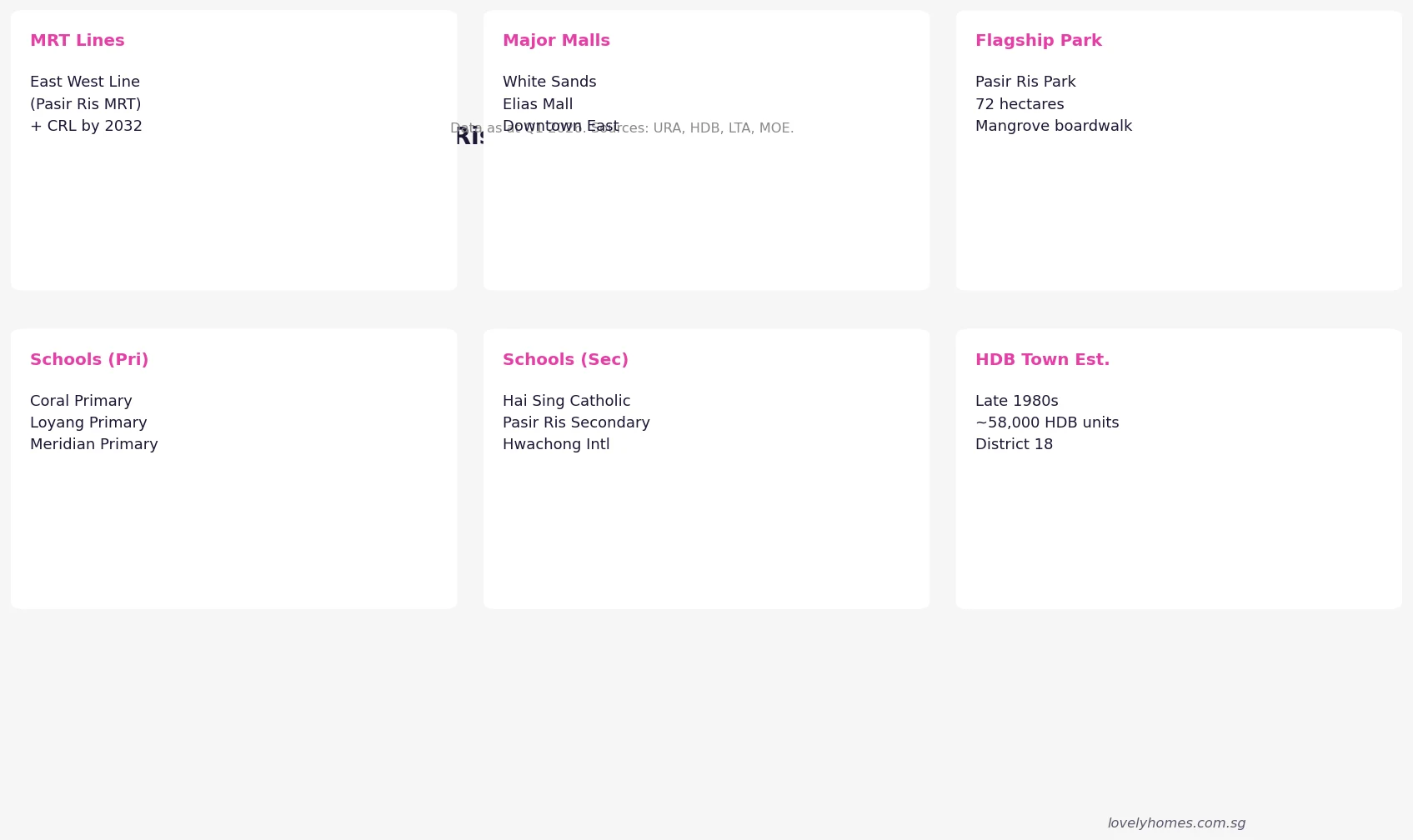
  • MRT: Pasir Ris EWL station; Cross Island Line (CRL) Pasir Ris Town station by 2032
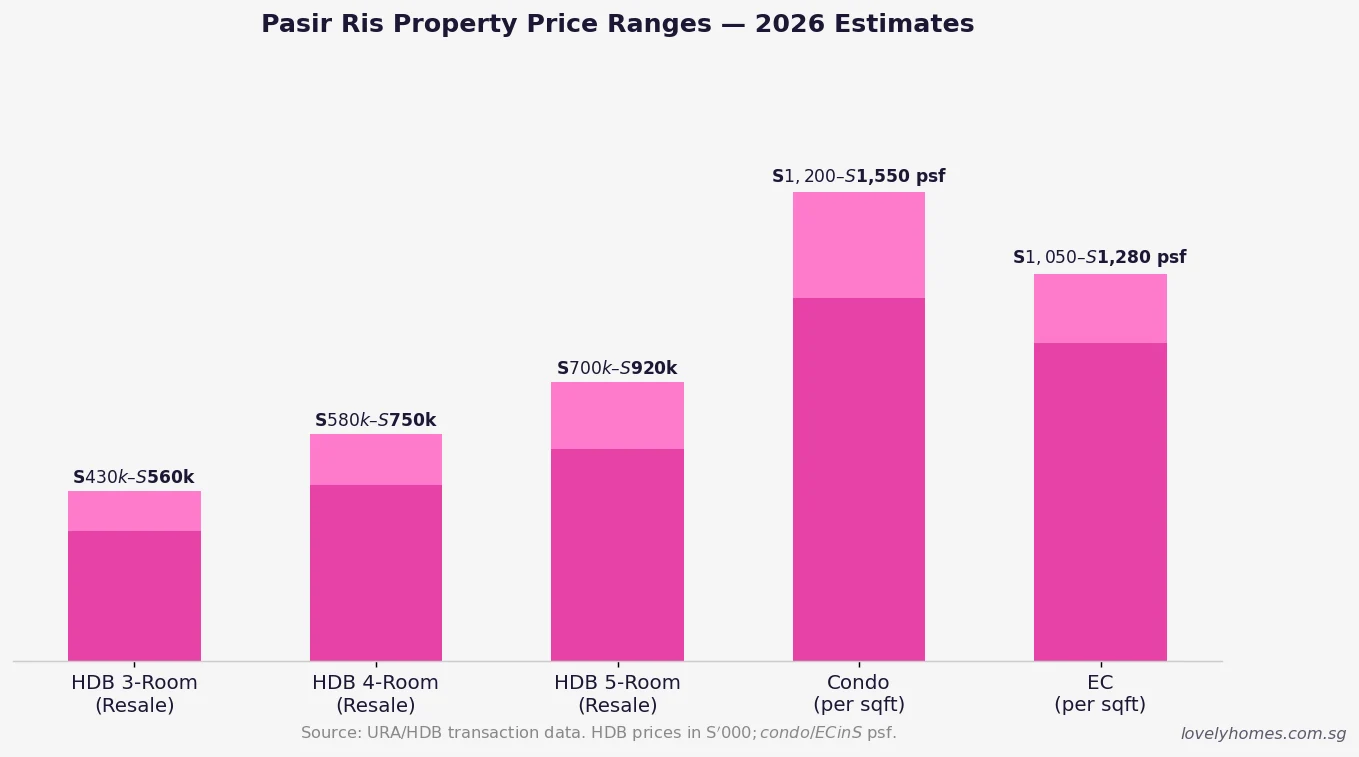
  • HDB Resale (2026): 3-room S$430k–S$560k; 4-room S$580k–S$750k; 5-room S$700k–S$920k
  • Private Condo psf: S$1,200–S$1,550 psf (Q1 2026 OCR benchmark); EC S$1,050–S$1,280 psf
  • Gross Rental Yield: HDB 4-room ~4.8%; Condo 2BR ~3.8%; EC 3BR ~3.5%
  • Key Lifestyle Draws: Pasir Ris Park (72 ha, mangrove boardwalk), Downtown East, White Sands Mall
  • Schools: Coral Primary, Loyang Primary, Hai Sing Catholic School, Meridian Junior College
  • Coming Up: CRL Phase 2 station by 2032; New Upper Changi Road GLS site (D16, ~1,010 units, tender Sep 2026)

Pasir Ris sits at the easternmost fringe of Singapore’s public housing map — a town of wide roads, generous parks, and a relaxed waterfront atmosphere that has made it a consistent favourite among families and right-sizers for more than three decades. Built up from the late 1980s onward, it lacks the heritage cachet of Tiong Bahru or the hipster draw of Joo Chiat, yet property analysts consistently rank it among the best-value large-family towns in the OCR. With the Cross Island Line bringing a second MRT interchange by 2032 and a major new GLS site in adjacent D16, Pasir Ris is quietly entering a new phase of relevance for both owner-occupiers and investors.

This guide covers everything prospective buyers, tenants, and investors need to know about Pasir Ris in 2026 — from HDB resale prices and private condo benchmarks to schools, connectivity, rental yields, and the key catalysts that could lift values over the coming decade.

Property Prices in Pasir Ris: What You Will Pay in 2026

Pasir Ris sits firmly in the Outside Central Region (OCR), Singapore’s most affordable private residential corridor. HDB dominates the landscape, with roughly 58,000 public flats across 18 neighbourhoods. Private condominiums and executive condominiums (ECs) occupy the western and central fringes, typically closer to the MRT and main expressways.

Pasir Ris property price ranges 2026 bar chart showing HDB resale, condo and EC benchmarks
Figure 1: Pasir Ris property price ranges across all major tenure and flat types (2026 estimates). Source: URA/HDB transaction data.

HDB resale prices have moved steadily higher since the 2022 cooling measures stabilised demand. In Q1 2026, a typical 4-room flat in established Pasir Ris streets — Pasir Ris Drive 1, Pasir Ris Street 11, Pasir Ris Street 21 — transacted between S$580,000 and S$750,000. Five-room flats, especially those on higher floors with unobstructed greenery views, have crossed S$900,000. Million-dollar HDB transactions in Pasir Ris remain rare but are no longer impossible for premium 5-room units in sought-after blocks near the park.

Private condominiums in District 18 trade at S$1,200–S$1,550 per square foot, reflecting a modest premium over deeper OCR towns such as Choa Chu Kang or Jurong West, justified by the proximity to Changi Business Park and the broader East employment corridor. The integrated Pasir Ris 8 development, which sits directly atop the MRT station, commands the top of this range given its lifestyle and transport conveniences. Older freehold condominiums nearby trade closer to S$1,200 psf.

Location and Connectivity: East End Accessibility

Pasir Ris is bounded by Tampines to the west, Loyang to the north, and the Strait of Johor to the north-east. The Pasir Ris MRT station is the eastern terminus of the East West Line (EWL), placing it approximately 44 minutes by train from Raffles Place — manageable rather than fast for CBD commuters, but well-suited to those working in Changi, Tampines Regional Centre, or along the EWL corridor.

By road, residents enjoy direct access to the Tampines Expressway (TPE) and Kallang–Paya Lebar Expressway (KPE), making Changi Airport reachable in under 15 minutes. Tampines Regional Centre — Singapore’s largest regional commercial hub — is one bus stop or a short cycle away.

The transformative upgrade arrives with the Cross Island Line (CRL). Phase 2 of the CRL will include a Pasir Ris Town station (separate from the existing EWL station), creating an interchange that connects residents directly to key growth nodes including Jurong Lake District, Ang Mo Kio, and Tuas. LTA has targeted CRL Phase 2 completion around 2032. Property analysts generally expect this infrastructure upgrade to add 5–10% to local values in the preceding three to four years, mirroring the Tampines price trajectory following the Downtown Line integration in 2017.

Pasir Ris key facts 2026 highlights including MRT, schools, parks and shopping
Figure 2: Pasir Ris at a Glance — key facts and amenity highlights as at Q1 2026.

HDB Housing: Town Character, Parks, and Flat Types

Pasir Ris was planned as a comprehensive town with its own commercial centre, neighbourhood parks, and a clear separation between residential clusters and industrial uses. The result is one of Singapore’s most liveable HDB towns — wide pavements, cycling paths, and generous inter-block greenery characterise virtually every neighbourhood.

The flagship amenity is Pasir Ris Park, a 72-hectare coastal park that is the largest waterfront park in Singapore’s east. It incorporates a mangrove boardwalk (gazetted as a nature area by URA), bird-watching areas, barbecue pits, cycling paths, and beach volleyball courts. Few HDB towns in Singapore can claim a natural asset of this scale within walking distance of the MRT station.

For everyday convenience, residents rely on White Sands (a mid-sized suburban mall anchored by NTUC FairPrice and Popular Bookstore), Elias Mall, and the Downtown East leisure complex, which houses E!Hub, Wild Wild Wet, and a broad range of food and entertainment options. Downtown East underwent a significant redevelopment and now serves as a regional leisure hub drawing visitors from across the east.

HDB flat types in Pasir Ris range from 3-room (typically 60–68 sqm) to 5-room (approximately 110–122 sqm), with a small stock of executive flats in older blocks. The town was built predominantly in the 1990s and early 2000s, meaning most flats carry 65–75 years of lease remaining — well within CPF and HDB loan thresholds for maximum financing, though buyers in their mid-40s and above should confirm lease adequacy against their own age parameters before committing.

Private Property and the Rental Market

Pasir Ris’s private residential inventory is concentrated along Pasir Ris Grove and Pasir Ris Close, with notable projects including Costa Riá (freehold, 398 units, TOP 2003), Coco Palms EC (944 units, privatised 2021), and the more recent Pasir Ris 8 — a 487-unit mixed-use development integrated with Pasir Ris MRT station and a retail podium. Pasir Ris 8’s psf range sets the benchmark for new-generation OCR integrated projects in the east.

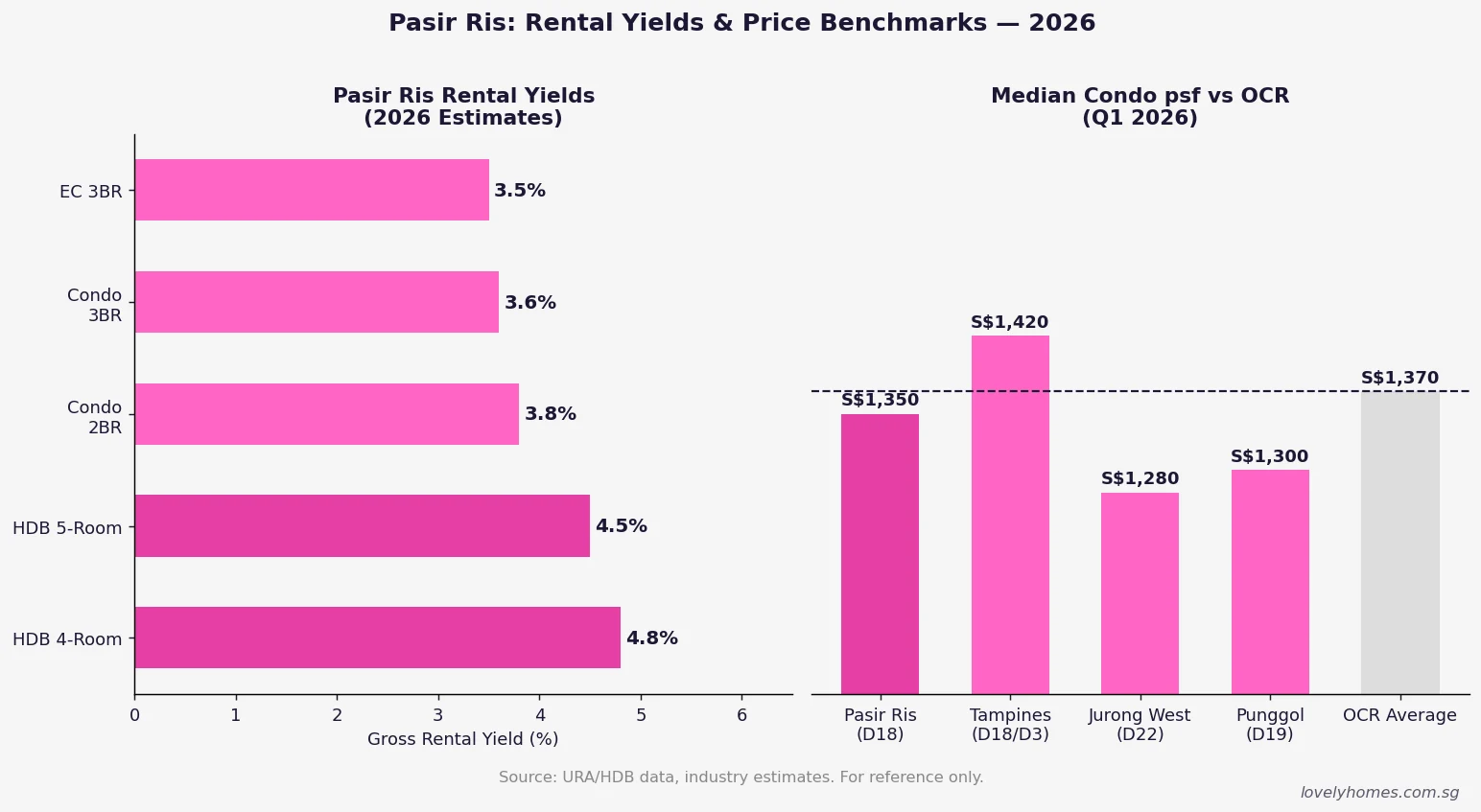
The rental market reflects steady demand from Changi Business Park, Loyang Industrial Estate, and the broader East employment corridor. HDB 4-room units command S$2,800–S$3,800 per month depending on floor level and proximity to amenities. Condo 3-bedroom units typically rent for S$4,200–S$5,500 per month. Gross yields on HDB 4-room flats run approximately 4.5–5.0% at 2026 transaction values; private condo yields range from 3.5–4.2% gross.

Pasir Ris rental yields by property type and median condo psf benchmarks vs OCR average 2026
Figure 3: Pasir Ris gross rental yields by unit type (left) and median condo psf vs OCR peers (right), Q1 2026.

Pasir Ris vs OCR Peers: Summary Comparison

Factor Pasir Ris (D18) Tampines (D18) Punggol (D19) Jurong West (D22)
HDB 4-Room Resale S$580k–S$750k S$590k–S$780k S$550k–S$700k S$480k–S$620k
Private Condo psf S$1,200–S$1,550 S$1,300–S$1,600 S$1,200–S$1,450 S$1,100–S$1,380
MRT Lines EWL + CRL (2032) EWL + DTL NEL + LRT EWL + JRL
Gross Rental Yield 3.5%–5.0% 3.4%–4.8% 3.6%–5.2% 3.8%–5.4%
Key Catalyst CRL Phase 2 (2032) Tampines North EC Waterway eco-park JLD + Jurong Rail Corridor
Park/Coastal Access Excellent (72 ha park) Good (Bedok Reservoir) Very Good (Waterway) Good (Jurong Lake)

Worked Example: First-Timer Buying HDB Resale in Pasir Ris

Mr and Mrs Lim are a Singapore Citizen couple, both aged 34, with a combined gross monthly income of S$10,000. They wish to purchase a 4-room resale HDB flat in Pasir Ris Street 21 for S$680,000 — their first residential property.

Stamp Duty (BSD): Computed on S$680,000 per IRAS rates: 1% × S$180,000 = S$1,800; 2% × S$180,000 = S$3,600; 3% × S$320,000 = S$9,600. Total BSD: S$15,000. ABSD is nil for Singapore Citizens purchasing their first residential property.

HDB Loan (80% LTV): Maximum loan = S$544,000 at HDB concessionary rate of 2.60% p.a. over 25 years. Estimated monthly instalment: approximately S$2,462/month.

Mortgage Servicing Ratio (MSR): S$2,462 ÷ S$10,000 = 24.6% — PASS (MAS MSR cap is 30% for HDB purchases). TDSR: 24.6% — PASS (cap is 55%, assuming no other debt obligations).

Upfront requirements: 20% cash/CPF downpayment = S$136,000 + BSD S$15,000 = approximately S$151,000. CPF Ordinary Account savings can fund the bulk of this amount, subject to the CPF Withdrawal Limit and Valuation Limit. Budget an additional S$20,000–S$30,000 cash for legal fees, survey, and moving costs.

At 2026 rental market rates, a comparable 4-room flat in the same area rents for approximately S$3,400/month — meaning the Lims’ monthly ownership cost of S$2,462 is materially below the rental equivalent, reinforcing the financial case for purchasing rather than renting.

Why Pasir Ris Matters: The Investment Perspective

Pasir Ris occupies a distinctive position in Singapore’s OCR hierarchy: it is not the cheapest town (that distinction belongs to Woodlands or Jurong West in many flat-type comparisons), nor the most sought-after (Bishan and Clementi command higher psf). What it delivers is a quality-of-life proposition that many more expensive estates cannot match — the 72-hectare park, coastal exposure, uncrowded residential feel, and proximity to Changi Airport and the East employment corridor are structural advantages unlikely to erode regardless of broader market cycles.

The CRL uplift is the single most important medium-term catalyst. Infrastructure upgrades of this nature — new MRT interchanges where a town previously had a single line — have historically preceded 8–15% price appreciation in the two to three years around opening. Investors who position in the 2026–2029 window still have a reasonable opportunity to benefit ahead of the 2032 CRL opening.

What Might Come Next for Pasir Ris

The New Upper Changi Road GLS site (tender closes 1 September 2026) will introduce approximately 1,010 new homes in adjacent D16. This adds medium-term supply but also signals continued government confidence in the Bedok–Pasir Ris east corridor as a residential growth zone. As Pasir Ris 8’s retail podium matures — with more F&B and lifestyle tenants completing fit-out — its pull on surrounding property values should intensify over 2026–2028.

There is also ongoing discussion — nothing confirmed by NParks or URA as at writing — of further enhancements to the Pasir Ris waterfront under Singapore’s Blue Plan framework for coastal recreation. Such upgrades, if they materialise, would reinforce the park’s status as the town’s defining asset.

Frequently Asked Questions

Is Pasir Ris a good place to buy property in 2026?

For owner-occupiers seeking a family-friendly OCR town with strong amenities and an upcoming transport upgrade, Pasir Ris ranks highly. The combination of reasonable HDB resale prices, the 72-hectare park, good schools, and the forthcoming CRL interchange creates a compelling case. Investors should note that rental yields are solid (3.5–5.0% depending on unit type) but the stronger investment thesis rests on capital appreciation via the CRL catalyst rather than current yield alone.

What are the HDB resale prices in Pasir Ris in 2026?

As at Q1 2026, HDB 3-room flats in Pasir Ris transact between S$430,000 and S$560,000; 4-room flats between S$580,000 and S$750,000; and 5-room flats between S$700,000 and S$920,000. Premium blocks near Pasir Ris Park, with high floors and unobstructed views, command the top of these ranges. Prices have held broadly stable since the 2022 cooling measures, with modest upward drift in 2025–2026 as the CRL’s potential becomes more widely understood by the market.

When will the CRL station at Pasir Ris open?

The Land Transport Authority (LTA) has announced that CRL Phase 2 will include a Pasir Ris Town station — separate from the existing Pasir Ris EWL station — with an indicative completion target around 2032. Exact dates are subject to LTA’s construction milestones and should be verified directly with LTA (lta.gov.sg). The CRL will run from Aviation Park in the east to Jurong Lake District in the west, connecting Pasir Ris to Ang Mo Kio, Clementi, and Tuas without changing trains.

Can foreigners buy property in Pasir Ris?

Foreign nationals (non-Singapore Citizens) cannot purchase HDB flats. They may purchase private condominiums and commercial properties in Pasir Ris. However, Additional Buyer’s Stamp Duty (ABSD) of 60% applies to foreign buyers of all residential properties in Singapore as at 2026, making private condo investment unattractive for most overseas buyers. Singapore Permanent Residents purchasing their first residential property pay 5% ABSD. For full details, see our guide to foreigners buying property in Singapore 2026.

What private condominiums are available in Pasir Ris?

Key private condo projects in District 18 include Pasir Ris 8 (487 units, MRT-integrated, TOP 2023), Costa Riá (398 units, freehold, TOP 2003), Coco Palms EC (944 units, privatised 2021), and Ballota Park Condo (96 units, freehold). Pasir Ris 8 is the premium benchmarker at the top of the D18 psf range; older freehold condos trade closer to S$1,200–S$1,300 psf. The adjacent New Upper Changi Road GLS (tender closes September 2026) will introduce further supply that may influence price formation in the medium term.

What primary schools are within 1 km of Pasir Ris MRT?

Coral Primary School, Loyang Primary School, and Meridian Primary School are among the primary schools within approximately 1–2 km of the Pasir Ris MRT station. Buyers prioritising school proximity for Phase 2A or Phase 2B registration should check the MOE’s official school registration distance lists (moe.gov.sg) when making their shortlist, as exact distances vary by flat block. At the secondary level, Hai Sing Catholic School and Pasir Ris Secondary serve the town.

How does the MSR work, and how does it affect a Pasir Ris HDB purchase?

The Mortgage Servicing Ratio (MSR), set by MAS, caps monthly mortgage instalments on HDB residential property at 30% of the borrower’s gross monthly income for both HDB loans and bank loans used to purchase HDB flats. In the worked example above, the Lim couple’s estimated instalment of S$2,462 on a joint income of S$10,000 equates to 24.6% MSR — comfortably within the cap. The Total Debt Servicing Ratio (TDSR) of 55% covers all debt obligations, including car loans, personal loans, and existing mortgages. Both ratios are assessed by the lender at the point of application.

Related Articles


Disclaimer: All property prices and rental figures cited in this article are estimates based on publicly available transaction data and industry benchmarks as at Q1 2026. They are provided for general information only and do not constitute financial, investment, or legal advice. Individual transactions vary depending on flat condition, floor level, lease remaining, and market conditions at the time of sale. Prospective buyers should obtain independent valuations, consult a licensed property agent registered with the Council for Estate Agencies (CEA), seek advice from a qualified mortgage broker, and read official guidelines published by HDB (hdb.gov.sg), URA (ura.gov.sg), IRAS (iras.gov.sg), CPF Board (cpf.gov.sg), and MAS (mas.gov.sg) before making any property decisions.

URA 1H 2026 GLS Programme: All 9 Confirmed List Sites Analysed — Supply, Locations and Price Outlook

URA 1H 2026 GLS Programme: All 9 Confirmed List Sites Analysed — Supply, Locations and Price Outlook

URA 1H 2026 GLS Programme: All 9 Confirmed List Sites Analysed — Supply, Locations and Price Outlook

Quick Answer — 1H 2026 GLS Confirmed List at a Glance

  • 9 sites on the 1H 2026 Confirmed List: 6 private residential, 1 mixed-use, 2 EC plots
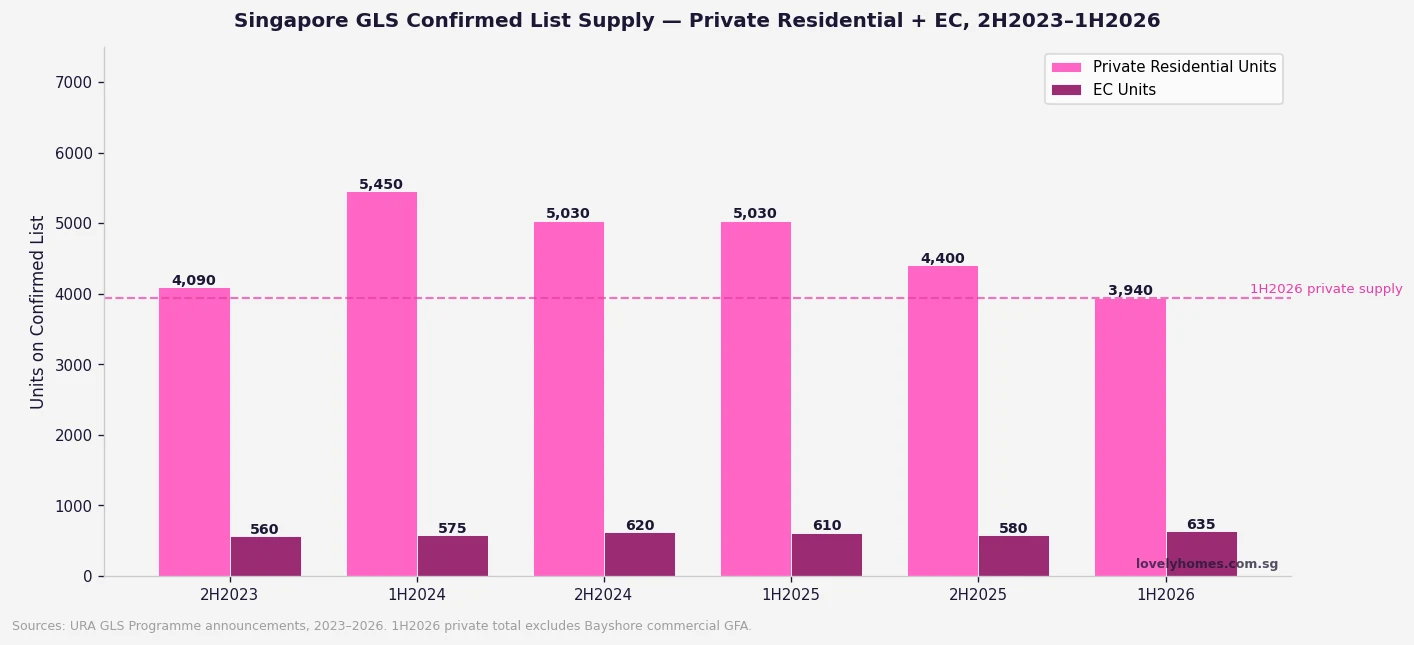
  • Total supply: 3,940 private residential units + 635 EC units = 4,575 units via confirmed list
  • Bayshore Drive mixed-use site is the headline parcel — 1,280 residential units + 22,500 sqm commercial
  • Holland Plain (2nd site) sole bid received: Sim Lian at S$1,491 psf ppr (tender closed 7 May 2026)
  • Peck Hay Road (Newton CCR) tender closes 11 June 2026; River Valley Green Parcel C closes 18 June 2026
  • 1H 2026 confirmed list private supply is ~50% above the 10-year average — Government signalling adequate pipeline
  • Two EC sites at Canberra Drive (185 units) and Sembawang Drive (450 units) — now subject to 10-year MOP post-8 May reforms

The Urban Redevelopment Authority’s Government Land Sales (GLS) programme is the primary tool through which Singapore manages its private residential and executive condominium housing pipeline. Every new launch condo you see advertised — from Vela Bay to Tengah Garden Residences — originates with a developer winning a GLS tender years earlier. Understanding what is on the 1H 2026 confirmed list, where those sites sit, and what developers are likely to pay for them tells you a great deal about where new private supply will come from in 2028 and beyond.

This analysis covers all nine confirmed list sites from the 1H 2026 GLS programme, tracking tender timelines, indicative psf ppr ranges, expected launch pricing implications, and the macro supply picture. We cross-reference each site’s outcome against the most recent tender awards to give the clearest picture available as at 17 May 2026.

The 9 Confirmed List Sites — Overview and Unit Yield

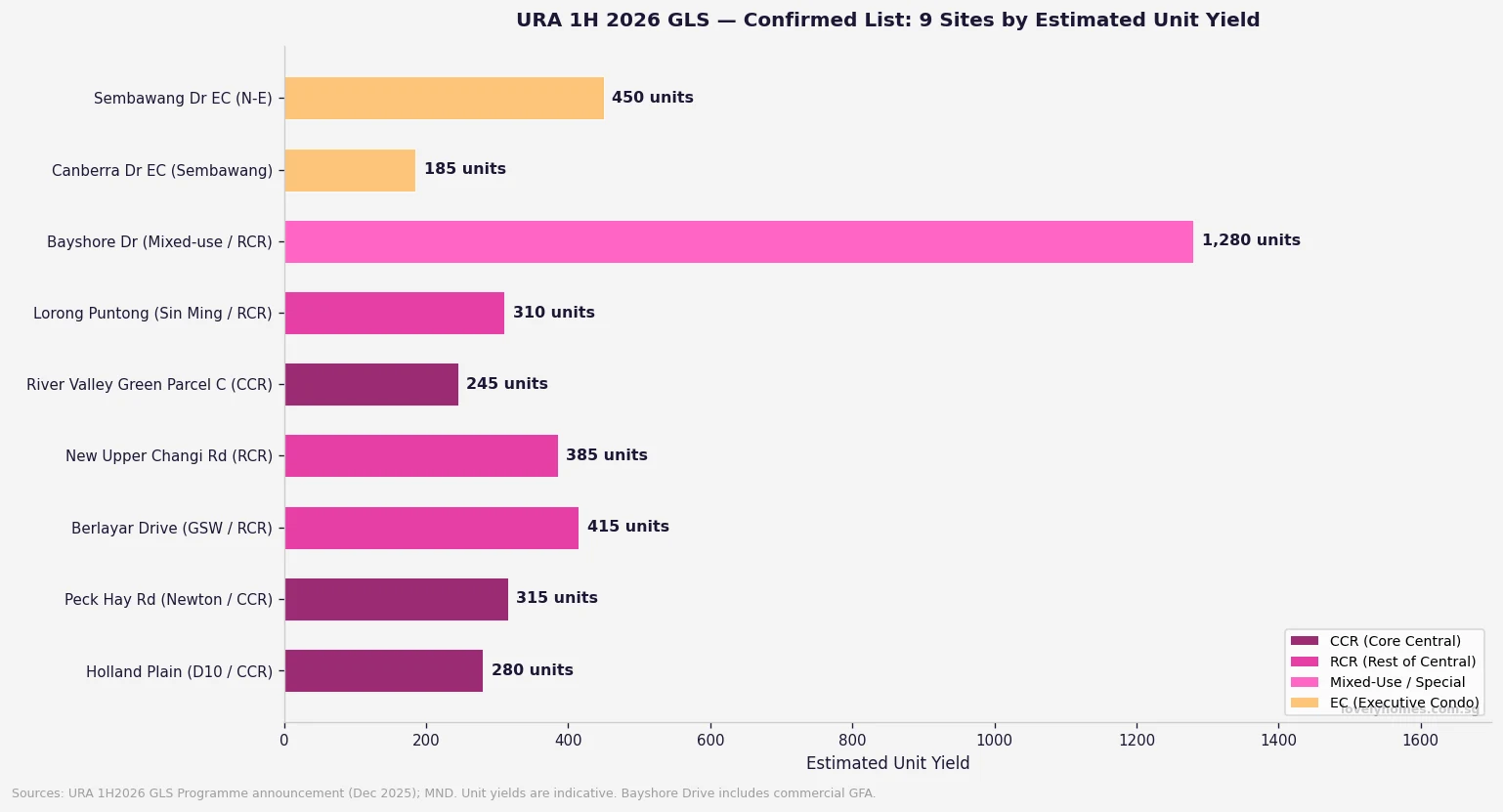
URA 1H 2026 GLS confirmed list 9 sites by unit yield Singapore
Figure 1: URA 1H 2026 GLS Confirmed List — all 9 sites by estimated unit yield, colour-coded by market segment (CCR, RCR, Mixed-Use, EC). Sources: URA, MND, December 2025.
Site Location / Region Units Tender Status (May 2026) Indicative Launch PSF
Holland Plain (2nd site) D10 / CCR, Bukit Timah ~280 Closed 7 May; Sim Lian sole bid S$1,491 psf ppr S$2,800–S$3,200+
Peck Hay Road Newton / CCR ~315 Tender closes 11 June 2026 S$3,200–S$3,800+
Berlayar Drive Gr Southern Waterfront / RCR ~415 Tender open / result pending S$2,400–S$2,900
New Upper Changi Road Bedok / RCR-adjacent OCR ~385 Tender open / result pending S$2,100–S$2,500
River Valley Green Parcel C River Valley / CCR ~245 Tender closes 18 June 2026 S$3,500–S$4,000+
Lorong Puntong (Sin Ming) Bishan–AMK / RCR ~310 Tender open / result pending S$2,400–S$2,800
Bayshore Drive (Mixed-Use) Bayshore / RCR-adjacent ~1,280 Tender just opened; est. closes Jul 2026 S$2,750–S$3,100
Canberra Drive EC Sembawang / North ~185 Tender result pending S$1,400–S$1,600 (EC)
Sembawang Drive EC Sembawang / North-East ~450 Tender result pending S$1,350–S$1,550 (EC)

The Supply Context — Is 1H 2026 GLS Generous or Restrained?

Singapore GLS confirmed list supply trend private residential and EC 2023 to 2026
Figure 2: Singapore GLS Confirmed List supply, 2H2023–1H2026 — private residential and EC units. Sources: URA GLS Programme announcements.

The 1H 2026 confirmed list private residential supply of 3,940 units is approximately 50% above the 10-year average for a half-year GLS confirmed list, according to URA’s own commentary on the programme at announcement in December 2025. The Government has explicitly stated that this elevated supply is intended to “provide adequate housing options to cater to housing demand” and to moderate price growth — particularly after private residential prices rose 0.9% in Q1 2026 (following 0.6% in Q4 2025), driven by outside central region (OCR) outperformance.

However, the 3,940 private units across six sites is still meaningfully below the 5,450 units offered in 1H 2024 (the cyclical peak). The pattern reflects the Government’s calibrated approach: high enough to signal commitment to supply, but not so aggressive as to flood the pipeline and depress developer sentiment. The Reserve List (which requires developer applications to activate) provides an additional buffer of approximately 5,200 private units that can be unlocked if demand signals warrant it.

Site-by-Site Analysis

Holland Plain (2nd Site) — A Sole Bid That Surprised Analysts

The second Holland Plain site drew a single bid from Sim Lian Group at S$1,491 psf ppr (S$454 million) when the tender closed on 7 May 2026. Analysts had expected three to five bidders; the sole bid reflects elevated construction cost pressure, the lingering premium already embedded in District 10 pricing, and the fact that Sim Lian already holds the adjacent first Holland Plain site. A sole bid does not automatically mean the site will be awarded — URA typically evaluates whether the bid meets the reserve price — but Sim Lian’s continued strategic interest in Holland Plain is clear.

If awarded at S$1,491 psf ppr, market observers indicate a launch PSF of approximately S$2,800–S$3,200 would be needed for the developer to achieve a reasonable margin. This would mark a modest premium to recent CCR resale comparables in the D10 corridor, but is not out of step with the broader trajectory of central region new launches.

Peck Hay Road — Newton’s Newest CCR Site (Closes 11 June 2026)

The Peck Hay Road site is arguably the most competitively positioned residential plot in the 1H 2026 programme. Located in the Newton MRT interchange area (North South and Downtown Lines), the 0.55-hectare former transitional office site is expected to yield approximately 315 units. Newton is one of Singapore’s most liquid and sought-after CCR sub-markets; recent comparable projects in the vicinity have transacted at S$3,000–S$3,800 psf for new launches.

The tender closes 11 June 2026. Given Newton’s track record with competing bids — the area consistently attracts four to six developers per tender — this is likely to be one of the more competitive tenders of the half. A top bid in the S$1,600–S$1,900 psf ppr range is plausible.

River Valley Green Parcel C — CCR Premium Pricing (Closes 18 June 2026)

River Valley Green Parcel C is the third plot in the River Valley Green precinct and sits within Singapore’s prime residential core. The previous two parcels in this precinct were awarded at S$1,246 psf ppr (Parcel A, 2023) and S$1,402 psf ppr (Parcel B, 2024). Parcel C is expected to follow this upward trajectory, with a likely bid range of S$1,450–S$1,700 psf ppr. At those land costs, launch pricing of S$3,500–S$4,000+ psf is feasible. The tender closes 18 June 2026.

Bayshore Drive Mixed-Use — The Billion-Dollar Site

Bayshore Drive is the marquee site of the 1H 2026 programme. As a mixed-use parcel combining 1,280 residential units with 22,500 sqm of commercial space and a direct underground link to Bayshore MRT station (Thomson-East Coast Line), it is the largest and most complex tender in the current cycle. URA and EdgeProp analysis suggests bids of S$1.2–S$2 billion are plausible — making it one of the largest single GLS transactions in Singapore’s history if realised at the upper end. The tender was recently opened and is expected to close around July 2026. We will report on the results as they emerge. See our full Bayshore Drive analysis published 17 May 2026 for detailed site-level commentary.

The Two EC Sites — First Launches Under the New Rules

Canberra Drive (185 units, Sembawang) and Sembawang Drive (450 units) are the first EC tender sites to be marketed entirely under the 8 May 2026 rule changes — specifically the 10-year MOP, 90% first-timer quota, Normal Payment Scheme only, and 15-year privatisation. Developers bidding for these sites must now price in a longer hold requirement and potentially reduced secondary-market liquidity for buyers, which may moderate land bids slightly relative to pre-May 2026 EC tenders. That said, the 90% first-timer quota actually increases base demand, partially offsetting the downward pricing pressure from the MOP extension.

Worked Example — How GLS Land Cost Translates to Launch Price

To understand why these GLS tender outcomes matter for buyers, consider a simple breakeven analysis. If Peck Hay Road is awarded at S$1,750 psf ppr (the psf per plot ratio applied to the maximum permissible gross floor area), a developer builds 315 units on a 0.55 ha site with a plot ratio of approximately 3.5 (hypothetical). Total land cost per unit: approximately S$960,000–S$1,100,000 per unit across a mix of 1-bedroom to 3-bedroom formats.

Adding construction costs (approximately S$450–S$550 psf of GFA in 2026), financing costs (~5–7% of total development cost over 4–5 years), professional fees, and developer margin (~15–18% on cost), the resulting launch price to achieve commercial viability is approximately S$3,200–S$3,600 psf for a typical Newton CCR new launch. This is the arithmetic that underpins the price forecasts in our summary table above.

For buyers, the practical implication is straightforward: land acquired in 1H 2026 tenders will yield projects launching in approximately 2028–2029. The prices you see in those launch brochures will reflect today’s land cost, construction cost inflation over the next two years, and developer expectations for market conditions at launch.

What to Watch in 2H 2026

The three immediate milestones for the GLS programme are: the Peck Hay Road tender result (11 June), River Valley Green Parcel C result (18 June), and the Bayshore Drive tender outcome (expected ~July 2026). Each will provide a live read on developer appetite, construction cost pressures, and land pricing at different market segments.

The 2H 2026 GLS programme (expected to be announced in June 2026) will also be watched closely for whether the Government adjusts the confirmed list size up or down — a signal of its read on both housing demand and developer capacity. Given Q1 2026’s 0.9% private price rise, any material reduction in the 2H confirmed list would likely be read as a market-positive signal by developers and investors alike.

Frequently Asked Questions

What is the GLS programme and how does it affect property prices?

The Government Land Sales (GLS) programme is the mechanism through which URA and HDB release state land for private and public housing development. Developers bid competitively for confirmed list sites, and the winning bid establishes the land cost that feeds through into eventual new-launch pricing approximately 3–5 years after the tender award. A higher volume of GLS sites — and more competitive bidding — generally anchors the supply pipeline and moderates price growth. Conversely, a lean GLS programme or weak bidding signals supply tightening and can anticipate future price pressure. For buyers of new launch condominiums, understanding the GLS pipeline helps set realistic expectations for the prices and supply timing of projects coming to market in 2027–2029.

Why did Holland Plain attract only one bid?

The sole bid for the Holland Plain second site reflects a combination of factors: (1) construction costs remain elevated in Singapore, squeezing developer margins on premium CCR land; (2) Sim Lian already holds the adjacent first Holland Plain site, giving them a strategic advantage that reduces other developers’ relative competitiveness; (3) rising interest rates globally (despite Singapore’s SORA decline) have increased the cost of development financing; and (4) the site’s expected launch PSF of S$2,800–S$3,200 sits in a segment where buyer depth (given ABSD and TDSR constraints) is more limited than in the OCR. A sole bid is unusual but not unprecedented in CCR tenders.

What is the Bayshore Drive mixed-use site and why is it significant?

The Bayshore Drive site is a 3.4-hectare mixed-use parcel that combines 1,280 residential units with 22,500 sqm of commercial gross floor area and a direct underground pedestrian connection to Bayshore MRT (Thomson-East Coast Line). Its significance lies in scale (it is among the largest single GLS parcels offered in several years), location (the emerging Bayshore precinct next to East Coast Park), and mixed-use zoning (which adds commercial value alongside residential). If awarded at estimated values of S$1.2–S$2 billion, it will be one of the highest-value individual land sales in Singapore’s GLS history. See our Bayshore Drive GLS Tender 2026 piece for full site analysis.

How does the 1H 2026 GLS supply compare to previous years?

The 3,940 private residential units on the 1H 2026 confirmed list is approximately 50% above the 10-year average for a half-year confirmed list, but below the 5,450-unit peak seen in 1H 2024. URA has explicitly framed the elevated supply as a measure to ensure adequate pipeline and moderate price growth. Combined with the 12-site reserve list providing a further ~5,200 private units that can be activated on demand, total potential supply from the 1H 2026 GLS programme is approximately 9,185 units — a robust buffer against near-term supply shortfalls.

Should I wait for GLS results before buying a new launch?

GLS results affect new launches that will be built and sold approximately 3–5 years from now — they do not directly affect the pricing of projects already in the market today (such as Bayshore Parcel A, Tengah Garden Residences, or projects under construction). If you are considering a new launch purchase in 2026, the relevant supply is what is already available and selling, not what developers will bid for land this year. That said, monitoring GLS demand (bid volumes, psf ppr paid) gives a useful forward signal: when developers bid aggressively, they believe in future demand and pricing — which is supportive for current buyers. When they bid conservatively or not at all (as with Holland Plain’s sole bid), it may suggest more caution about the premium segment’s near-term outlook.

Related Articles

Disclaimer: This analysis is for general informational and commentary purposes only and does not constitute financial, investment, or property advice. GLS tender outcomes, indicative unit yields, and launch price projections are estimates based on publicly available data from URA, MND, and industry commentary as at 17 May 2026, and are subject to change. Actual tender results, awarded prices, and developer launch strategies may differ materially from projections. Always conduct independent research and consult a licensed conveyancing lawyer, financial adviser, or property consultant before making any investment decision. For official data, refer to URA.gov.sg, MND.gov.sg, and HDB.gov.sg.

Translate »