Foreigners Buying Property in Singapore 2026: ABSD, Eligibility and the Full Cost Guide

Foreigners Buying Property in Singapore 2026: ABSD, Eligibility and the Full Cost Guide

Quick Answer

  • Foreigners (non-PR, non-SC) may purchase private residential property — condominiums, apartments, strata-titled units — in Singapore without restriction, subject to a 60% Additional Buyer’s Stamp Duty (ABSD) payable to IRAS.
  • Foreigners cannot buy HDB flats (resale or BTO) and cannot buy landed residential property (houses, semi-detached, bungalows) without prior approval from the Singapore Land Authority (SLA), which is rarely granted.
  • Executive Condominiums (ECs) become available to foreigners only after privatisation. For ECs from GLS sites tendered from 8 May 2026 onwards, privatisation occurs at 15 years from TOP; earlier ECs remain at 10 years.
  • The 60% ABSD applies to the entire purchase price and must be paid within 14 days of exercising the Option to Purchase (OTP).
  • Buyer’s Stamp Duty (BSD) is payable by all buyers regardless of nationality. On a S$2.5M purchase, BSD is approximately S$94,600.
  • Foreigners can obtain a mortgage from Singapore-licensed banks. LTV limit is 75% for a first property loan with no existing housing loans, subject to Total Debt Servicing Ratio (TDSR) of 55%.
  • Commercial and industrial property carries no ABSD — foreigners may purchase shophouses, office units, factories, and warehouses without the 60% surcharge.
  • Nationals of the USA, Iceland, Liechtenstein, Norway, and Switzerland are exempt from ABSD on their first residential purchase under Free Trade Agreement commitments.

What Is the ABSD and Who Administers It?

The Additional Buyer’s Stamp Duty (ABSD) is a surcharge levied by the Inland Revenue Authority of Singapore (IRAS) on the purchase or acquisition of residential property in Singapore, on top of the standard Buyer’s Stamp Duty (BSD). Introduced in December 2011 as a demand-side cooling measure, the ABSD has been adjusted multiple times. The most significant recent change for foreigners was on 27 April 2023, when the rate was doubled from 30% to 60%.

The policy objective is explicit: ABSD prioritises home ownership for Singaporeans and ensures that property remains affordable for residents. Non-resident buyers must bear a substantial additional cost — and this is intentional. Singapore’s Ministry of National Development has consistently maintained that residential property is primarily for citizens, and the 60% rate is designed to reflect that priority firmly.

Singapore property eligibility by buyer type 2026 — foreigners PRs and citizens comparison table
Figure 1: Property Eligibility by Buyer Type — Singapore 2026 | Source: HDB, URA, SLA, IRAS

ABSD Rates by Buyer Profile (Effective 27 April 2023)

ABSD is charged on the higher of the purchase price or the property’s market value. The table below shows the current rates, administered by IRAS, for residential property in Singapore:

Buyer Profile 1st Property 2nd Property 3rd+ Property
Singapore Citizen 0% 20% 30%
Singapore Permanent Resident (PR) 5% 30% 35%
Foreigner (non-PR, non-SC) 60% — flat rate, regardless of how many properties held in Singapore
Corporate entity / trust 65% — flat rate on residential property

Source: IRAS, effective 27 April 2023. FTA exemptions apply for nationals of the USA, Switzerland, Iceland, Liechtenstein, and Norway.
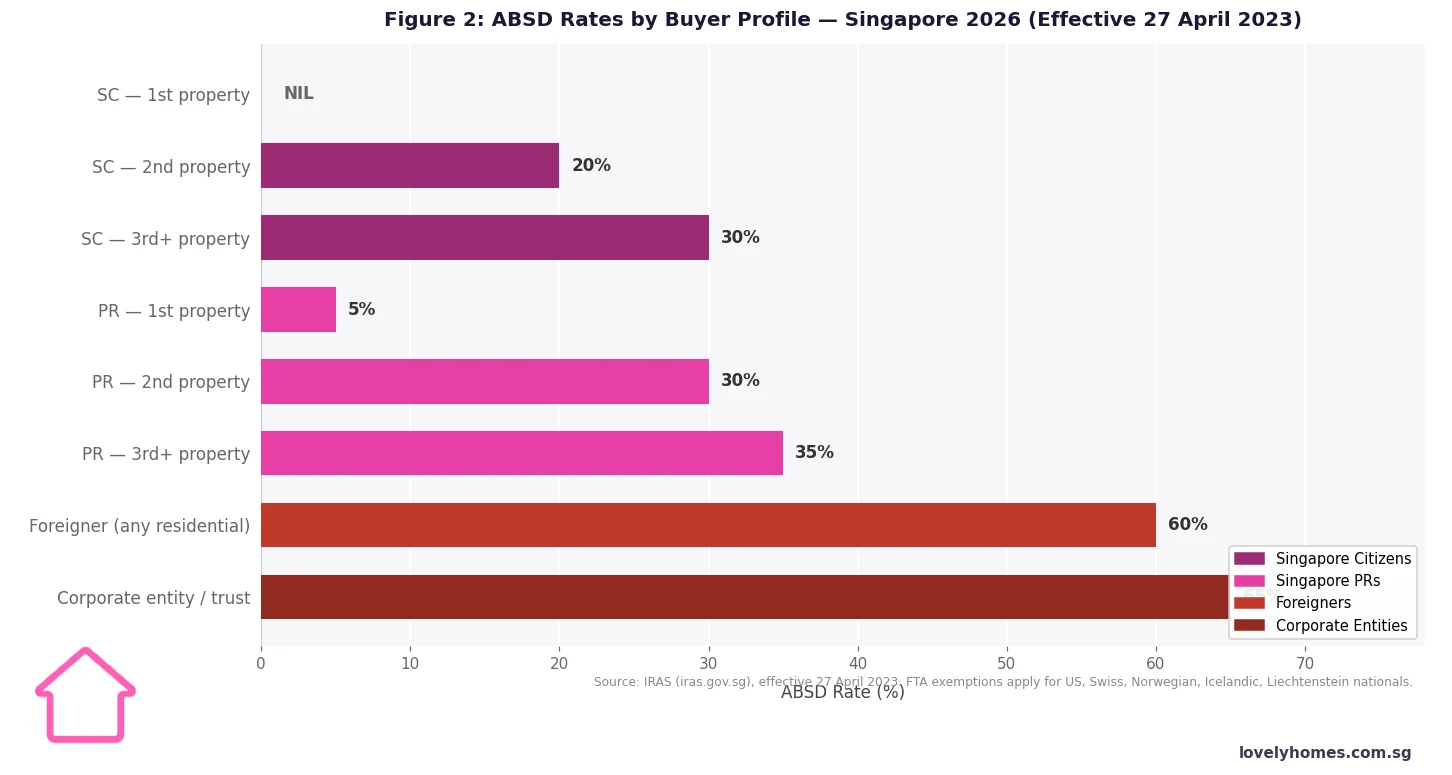
ABSD rates by buyer profile Singapore 2026 — foreigners pay 60% on all residential property
Figure 2: ABSD Rates by Buyer Profile — Singapore 2026 | Source: IRAS, effective 27 April 2023

Free Trade Agreement (FTA) Exemptions

Under Singapore’s FTA commitments, nationals of the USA, Iceland, Liechtenstein, Norway, and Switzerland are treated on par with Singapore Citizens for ABSD on their first residential property purchase. This means a US national buying their first Singapore condo pays 0% ABSD. On second and subsequent purchases, the SC schedule applies. The exemption is for individuals only; US-incorporated companies do not benefit. IRAS requires passport proof of nationality when claiming the FTA exemption.

What Foreigners Can Buy — and Cannot Buy

Permitted (60% ABSD where residential): Private condominiums, private apartments, strata-titled units, SOHO units with residential classification. ECs after privatisation (15 years from TOP for new GLS-launched ECs from 8 May 2026; 10 years for earlier ECs). Sentosa Cove landed property. Commercial shophouses, strata office units, retail units, industrial factories, warehouses — all without residential ABSD.

Not permitted without special approval: Landed residential property outside Sentosa Cove (houses, semi-detached, bungalows, terraced houses). The SLA may grant approval under the Residential Property Act in exceptional circumstances, but approvals are rare.

Strictly prohibited: HDB flats (both new BTO and resale). HDB housing is reserved for Singapore citizens and permanent residents under the Housing and Development Act. ECs during their MOP and privatisation period are also off-limits to foreigners.

Buyer’s Stamp Duty (BSD) — Payable by Everyone

BSD is levied by IRAS on every property purchase in Singapore, regardless of nationality. For residential property, the tiered rates are: 1% on the first S$180,000; 2% on the next S$180,000; 3% on the next S$640,000; 4% on the next S$500,000; 5% on the next S$1,500,000; and 6% on amounts above S$3,000,000. On a S$2.5M purchase, total BSD = S$94,600.

Purchase Price Tier BSD Rate BSD on This Tier
First S$180,000 1% S$1,800
Next S$180,000 (up to S$360,000) 2% S$3,600
Next S$640,000 (up to S$1,000,000) 3% S$19,200
Next S$500,000 (up to S$1,500,000) 4% S$20,000
Next S$1,500,000 (up to S$3,000,000) 5% Up to S$75,000
Remainder above S$3,000,000 6% Variable

Sellers’ Stamp Duty (SSD) — The Anti-Flip Tax

SSD is administered by IRAS and applies to all sellers who dispose of residential property within three years of purchase, regardless of nationality. The rates are: 12% within 1 year; 8% within 2 years; 4% within 3 years; nil thereafter. For a foreigner who has paid 60% ABSD, an SSD liability on a short-term resale would be a severe additional burden. Foreign buyers must plan for a meaningful long-term holding horizon.

Holding Period SSD Rate
Up to 1 year 12%
1 to 2 years 8%
2 to 3 years 4%
More than 3 years Nil

Financing — LTV, TDSR, and Mortgage Options

Foreigners may borrow from Singapore-licensed banks subject to MAS macro-prudential rules identical to those applied to residents. The LTV limit is 75% for a first property loan with no existing housing loans (reducing to 55% for a second and 35% for a third). The TDSR cap is 55% of gross monthly income. Loan tenors run up to 35 years, typically reduced by age exceeding 65. Most major Singapore banks lend to foreigners — DBS, OCBC, UOB, Standard Chartered, and HSBC all do so, subject to enhanced documentation requirements including overseas income proof and a valid work pass or Long-Term Visit Pass.

The Buying Process — Step by Step

  1. Arrange in-principle approval: Approach at least two Singapore banks before making offers. Allow 5–10 working days.
  2. Engage a CEA-licensed agent: For new launches, no buyer commission is payable; for resale, co-broking arrangements vary.
  3. Option to Purchase (OTP): On resale, the seller grants an OTP valid for 21 days; a 1% option fee is paid. For new launches, a 5% booking fee is paid directly to the developer.
  4. Pay BSD and ABSD: Both due within 14 days of OTP exercise. On a S$2.5M purchase, this means wiring S$94,600 (BSD) + S$1,500,000 (ABSD) to IRAS — a total of S$1,594,600 within a fortnight of signing.
  5. Engage a conveyancing solicitor: A Singapore-qualified solicitor handles title searches, mortgage documentation, and lodgement with SLA’s eConveyancing portal.
  6. Completion: For resale, typically 8–12 weeks. For new launches, completion occurs at TOP/CSC, which may be 3–5 years away.

Worked Example: Mr David Harrington Buys a S$2.5M CCR Condo

Mr David Harrington, 42, is a British national on an Employment Pass earning S$25,000/month gross. He purchases a two-bedroom unit in District 9 at S$2,500,000, with no existing property loans in Singapore.

Total upfront cash required for foreigner buying SGD 2.5M condo Singapore 2026 cost breakdown
Figure 3: Total Upfront Cash Required — Foreigner Buying SGD 2.5M CCR Condo (2026)
Cost Item Amount (SGD) Notes
25% downpayment (cash) 625,000 75% LTV → loan of S$1,875,000
Buyer’s Stamp Duty (BSD) 94,600 IRAS; payable within 14 days of OTP
ABSD (60% x S$2,500,000) 1,500,000 IRAS; payable within 14 days of OTP
Stamp duty on mortgage (0.4% x loan) 7,500 On S$1,875,000 loan amount
Legal / conveyancing fees (est.) 3,500 Singapore-licensed solicitor
Valuation fee (est.) 600 Required by lender
Total upfront cash required 2,231,200 Excluding ongoing mortgage payments

Monthly mortgage at 3.30% p.a. over 20 years on S$1,875,000 ≈ S$10,633/month. TDSR check: S$10,633 ÷ 55% = S$19,333 minimum monthly gross income required. Mr Harrington’s S$25,000/month comfortably qualifies. However, stamp duties alone represent 63.8% of the purchase price — the property must appreciate significantly for the investment to make financial sense on a net basis.

What This Means for Foreign Buyers

Despite the 60% ABSD headline rate, Singapore continues to attract foreign buyers for structurally sound reasons. Singapore offers secure freehold and 99-year leasehold titles with one of the most transparent property title systems in Asia. There is no capital gains tax, no inheritance tax, and no wealth tax. The SGD has historically been stable and appreciating against most major currencies, and Singapore’s rule of law is consistently ranked among the best globally.

For high-net-worth buyers from jurisdictions with currency risk, political instability, or restricted capital mobility — particularly from certain parts of Southeast Asia, China, and the Middle East — paying 60% ABSD is the premium for a stable, internationally recognised store of value. For US nationals, who pay 0% ABSD on their first purchase thanks to the FTA, Singapore offers one of the most favourable entry points into any developed-market property system globally.

What Might Come Next

The 60% ABSD rate for foreigners is unlikely to be reduced in the near term. Singapore’s government has consistently adjusted rates upward when demand has been firm, and the April 2023 doubling was a clear statement of direction. The EC policy changes of 8 May 2026 — extending MOP to 10 years and privatisation to 15 years, abolishing the Deferred Payment Scheme — further indicate a tightening trajectory. Foreign buyers should plan their acquisitions assuming the 60% rate will persist for the foreseeable future and structure their financial planning accordingly.

Related Articles

Frequently Asked Questions

Can a foreigner on an Employment Pass buy a condo in Singapore?

Yes. Holding an Employment Pass does not confer Singapore PR status, so the buyer is classified as a foreigner for ABSD purposes — meaning 60% ABSD applies. There is no minimum residency duration requirement to purchase private residential property. The buyer must satisfy the bank’s TDSR requirements using their Singapore employment income (fully counted) and any overseas income (subject to a bank haircut, typically around 30% on variable income).

Are there properties foreigners can buy without the 60% ABSD?

Yes. Commercial and industrial properties do not attract the residential ABSD. Strata office units, retail units, commercial shophouses, industrial factories, and warehouses can all be purchased by foreigners without the 60% surcharge. Many foreign investors therefore channel their Singapore property exposure through commercial assets or Singapore REITs listed on SGX, which provide property-linked returns without the ABSD burden.

Can a foreigner married to a Singapore Citizen pay lower ABSD?

Not directly on a joint purchase. If the property is purchased in the Singapore Citizen spouse’s name alone (sole ownership) and it is the SC’s first property, no ABSD is payable. However, if both names appear on the title, the foreigner’s inclusion triggers 60% ABSD. Many cross-nationality couples place the first property in the SC’s sole name. On subsequent purchases in joint names, ABSD at the SC second-property rate of 20% applies. Seek independent legal and tax advice before structuring ownership this way, as there are CPF, mortgage liability, and estate planning implications.

When exactly must the ABSD be paid?

ABSD must be paid within 14 days of the date on which the liability arises — typically the date of exercising the OTP or the date of the Sale and Purchase Agreement, whichever is earlier. Late payment attracts a 5% per annum penalty interest plus potential IRAS prosecution under the Stamp Duties Act. There is no grace period. The full ABSD amount must be available on or before the deadline, not merely committed in a loan facility.

Is ABSD refundable if the purchase falls through after the OTP is exercised?

Generally, no. Once the ABSD liability arises, it is payable regardless of whether the transaction completes. IRAS may consider a remission application in exceptional circumstances if a transaction is aborted, but this is not guaranteed. The ABSD Married Couple Remission — which allows one SC/PR spouse to sell their existing property within six months of a joint purchase and claim a refund — does not apply to foreigners. Always consult a licensed conveyancing solicitor before exercising any OTP if there is uncertainty about financing, as the ABSD liability is triggered on signing.

Can a foreigner buy a shophouse and occupy the upper residential floor?

This depends on the shophouse’s URA zoning and approved use. If the upper floors are classified as residential under the Residential Property Act, a foreigner cannot purchase without SLA approval (rarely granted). Some shophouses are zoned entirely commercial or approved for mixed use with the upper floors treated as non-residential. The correct approach is to check the URA Master Plan zoning and the specific approved use with a conveyancing solicitor before making any offer, as the legal classification is significant and not always obvious from the building’s physical appearance.

Does a foreigner pay ABSD on a privatised Executive Condominium?

Yes. Once an EC is privatised, it is treated as private residential property and all standard ABSD rules apply — including the 60% rate for foreigners. For ECs launched under GLS tenders from 8 May 2026, privatisation occurs at 15 years from TOP; earlier ECs privatise at 10 years from TOP. Buyers purchasing privatised ECs in the secondary market should verify the specific EC’s TOP date and calculate the privatisation milestone accordingly before making an offer.

Disclaimer: This article is for general information only and does not constitute legal, tax, or financial advice. Stamp duty rates, eligibility rules, and financing guidelines are subject to change by IRAS, MAS, HDB, SLA, and URA. Always verify current rates at iras.gov.sg and consult a licensed Singapore conveyancing solicitor, a CEA-registered real estate professional, and a licensed mortgage adviser before committing to any property transaction. All figures are illustrative based on publicly available data as at 16 May 2026.
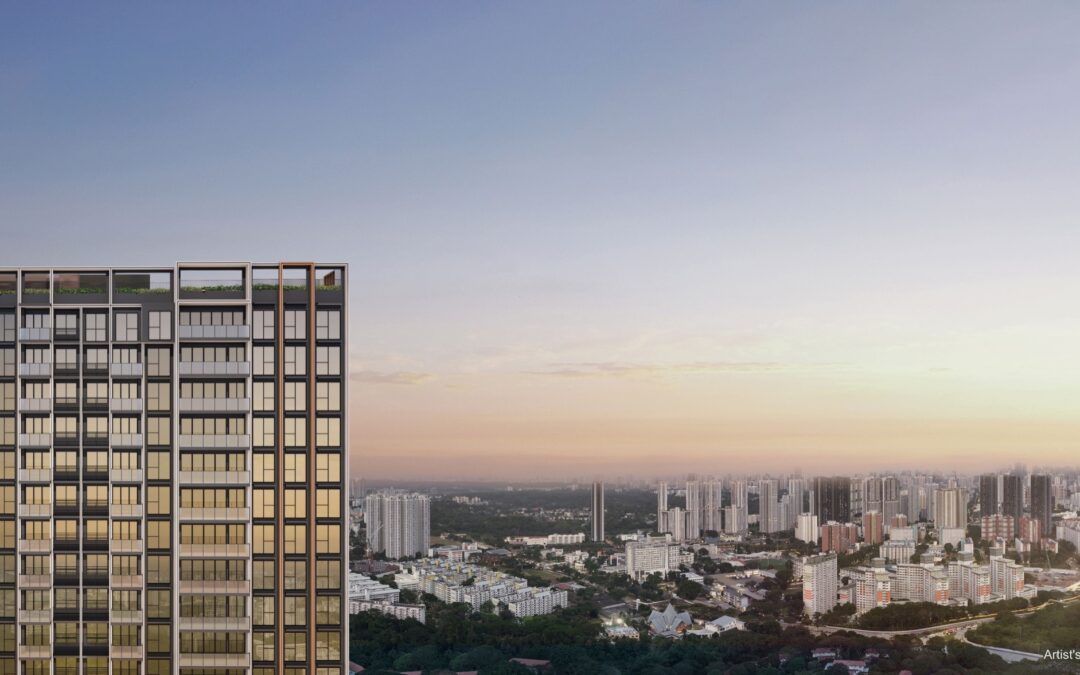
Hudson Place Residences

Hudson Place Residences


District 5 New Launch

Hudson Place Residences

327 premium homes and up to 400 sqm of retail space at 18 and 20 Media Circle, in the heart of one-north’s technology, media and biomedical cluster.

327
Units
99 years
Tenure
Sep 2029
Expected TOP
2BR-4BR + PH
Unit Mix
D05
one-north
18 & 20
Media Circle
7,629.7 sqm
Site Area
28,230 sqm
Gross Floor Area
400 sqm
Retail Space
New Town
Primary within 1km

Why Hudson Place Residences

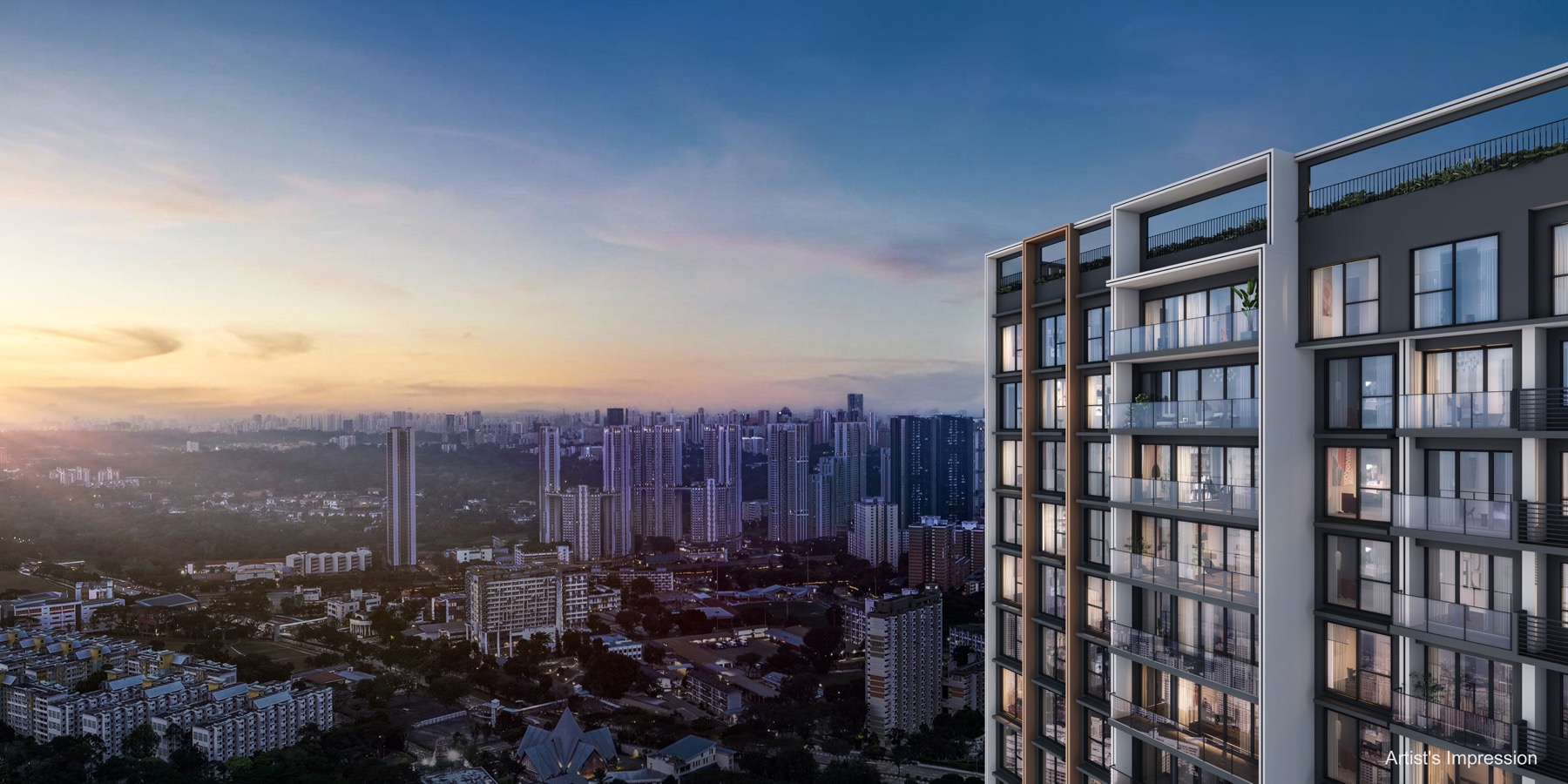
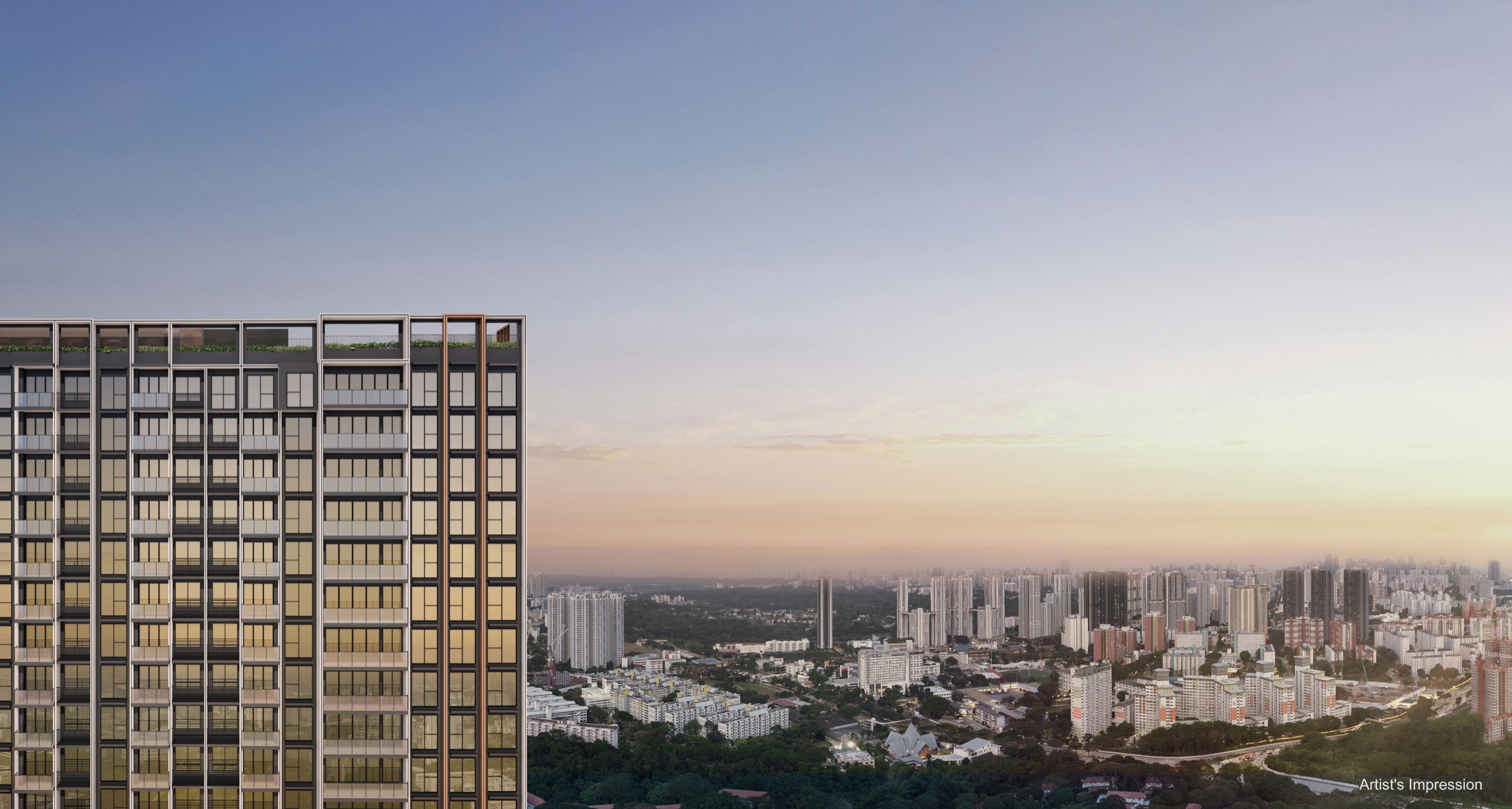
Hudson Place Residences is a mixed-use residential launch in one-north, Singapore’s established research, technology, media and biomedical hub. The source materials position it for residents who want proximity to the one-north employment base, education cluster and the wider Greater one-north transformation.

Live-Work Demand

one-north is described in the source pack as a 200-hectare business park with a growing professional base across technology, media and biomedical sectors.

Mixed-Use Convenience

The development includes up to 400 sqm of non-strata commercial space on the first storey, adding day-to-day convenience within the estate.

Education Cluster

New Town Primary is stated as within 1 km, with Fairfield Methodist and Queenstown Primary listed in the 1-2 km band. Tanglin Trust, INSEAD, NUS and ACS (I) are highlighted nearby.

Project Facts At A Glance

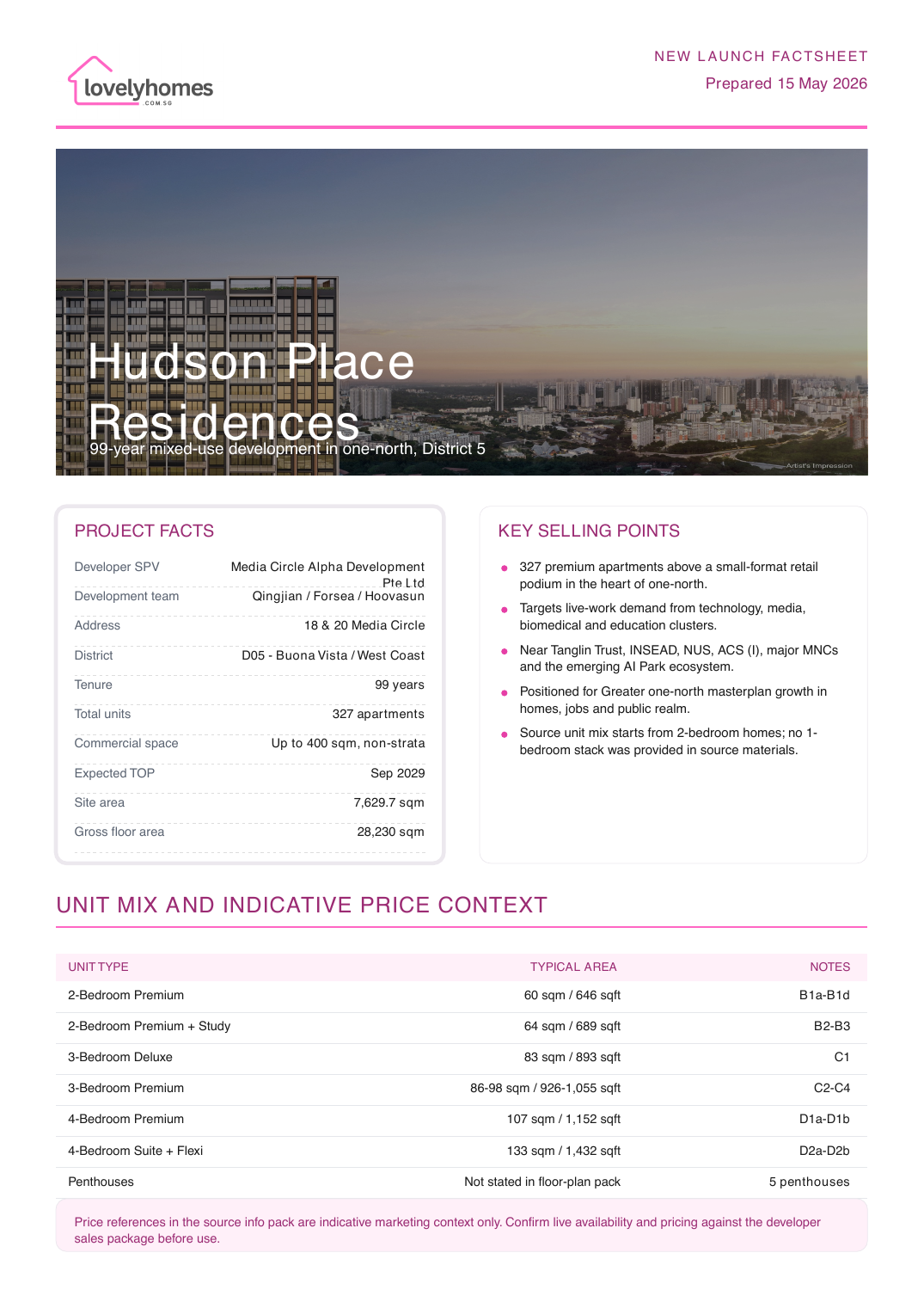
Project name Hudson Place Residences
Developer SPV Media Circle Alpha Development Pte Ltd
Development team Qingjian Realty, Forsea Holdings & Hoovasun Holding
Address 18 & 20 Media Circle
District D05 – Buona Vista / West Coast
Planning area Queenstown / one-north
Tenure 99 years
Expected TOP Sep 2029
Total units 327 apartments
Commercial space Up to 400 sqm, non-strata
Site area 7,629.7 sqm
Gross floor area 28,230 sqm
Blocks 1 block of 23 storeys, 1 block of 15 storeys
Parking Estimated 40% allocation
Unit range 2- to 4-bedroom homes and 5 penthouses
Source status Compiled from local source materials dated Jan-Apr 2026

Unit Mix And Indicative Pricing

Unit Type Typical Area Source Notes
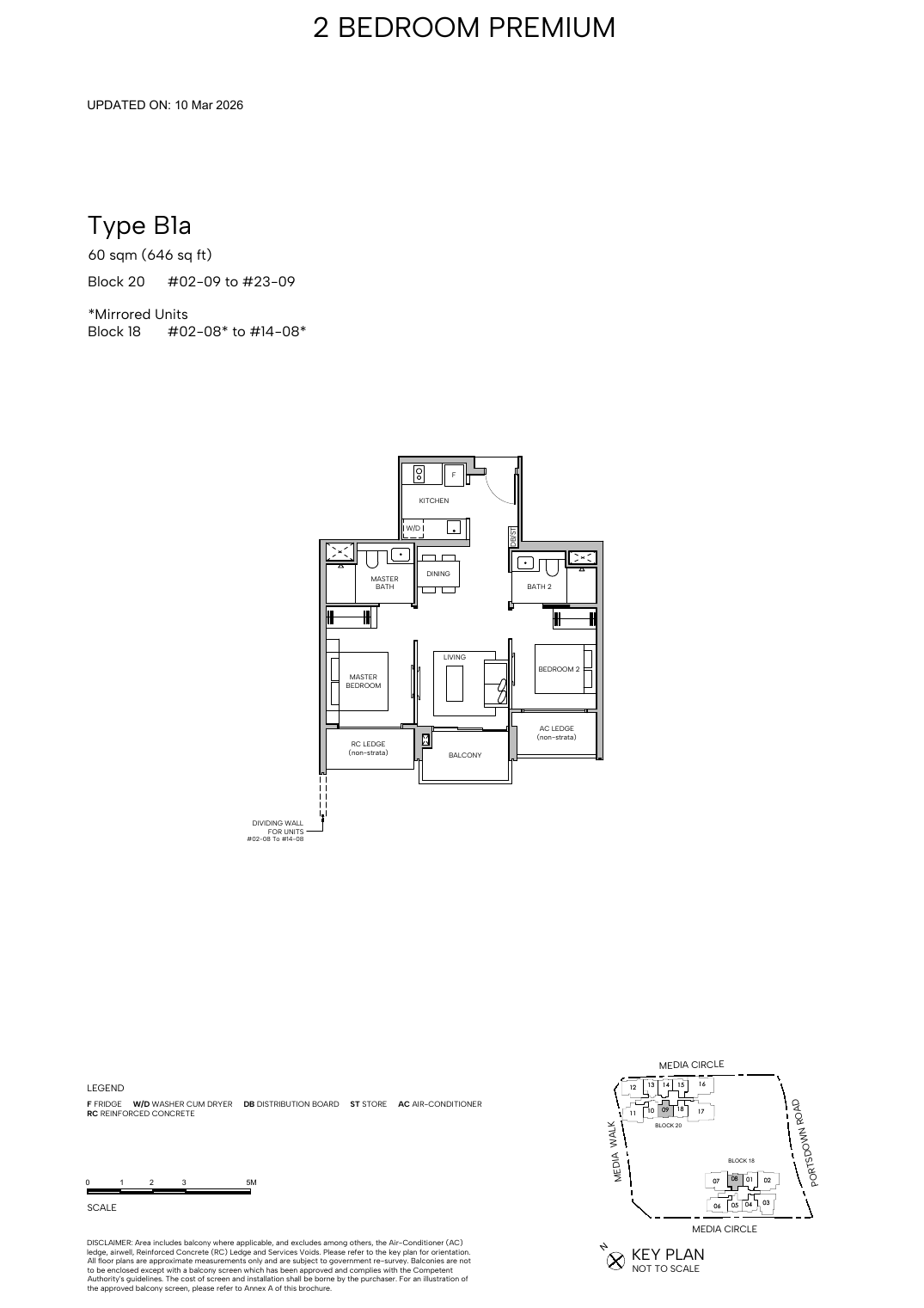
2-Bedroom Premium 60 sqm / 646 sqft B1a-B1d
2-Bedroom Premium + Study 64 sqm / 689 sqft B2-B3
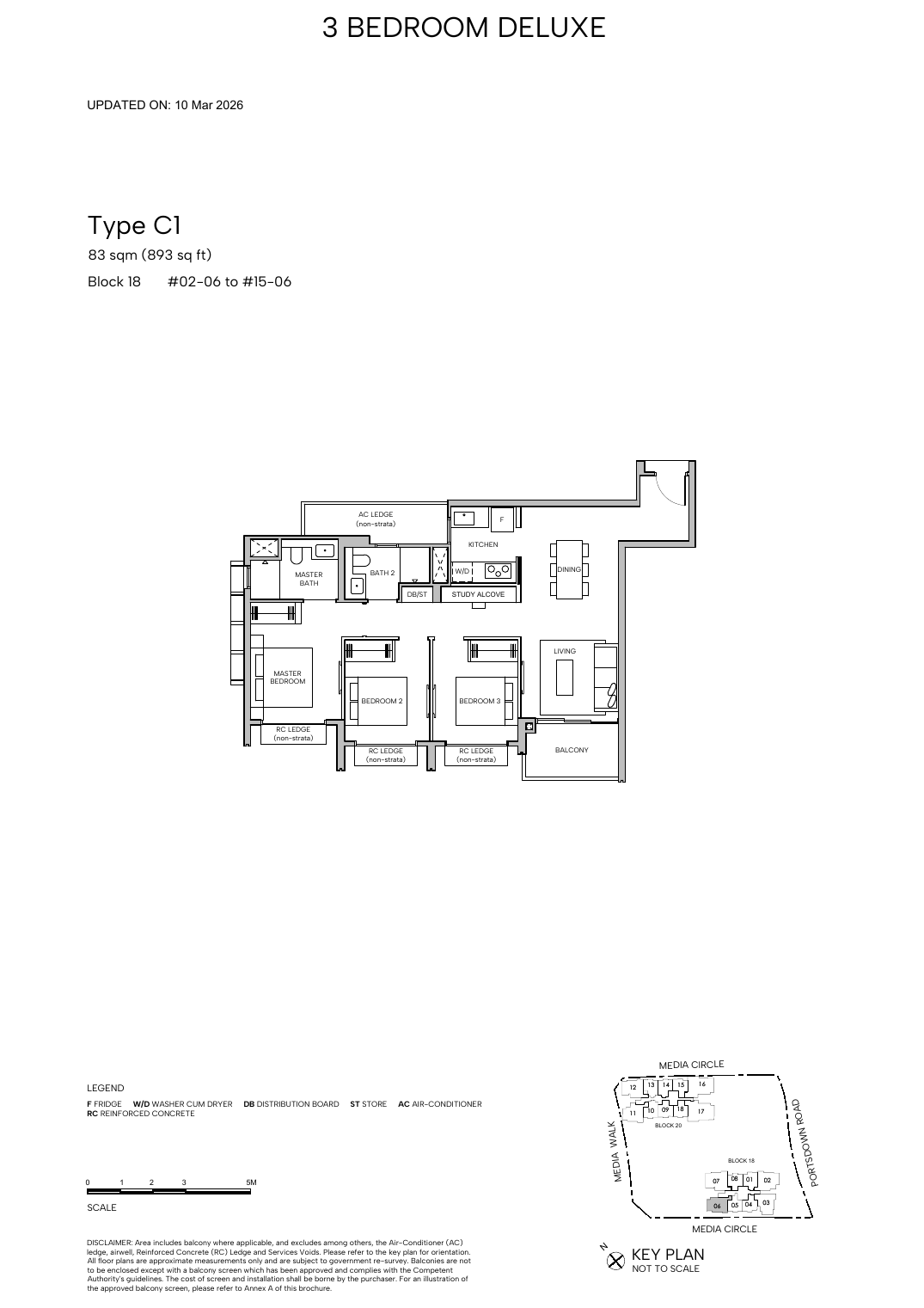
3-Bedroom Deluxe 83 sqm / 893 sqft C1
3-Bedroom Premium 86-98 sqm / 926-1,055 sqft C2-C4
4-Bedroom Premium 107 sqm / 1,152 sqft D1a-D1b
4-Bedroom Suite + Flexi 133 sqm / 1,432 sqft D2a-D2b
Penthouses Not stated in floor-plan pack 5 penthouses listed in unit distribution
Pricing note: source marketing materials include indicative examples such as 2-bedroom homes around S$1.5x million and 2-bedroom + study homes around S$1.6x million. Treat all pricing as indicative only and confirm against the latest developer sales package.

Location And Connectivity

Business Park
one-north ecosystem
Home to technology, media, biomedical and research employers across the wider 200-hectare business park.
Roads
AYE / CTE access
Source materials reference major expressway access for islandwide connectivity.
Car-lite
Shuttle mobility
The source pack lists SWAT Mobility, Alice Shuttle and One North Rider options within one-north.
Lifestyle
Star Vista / Ghim Moh / NUS
Source materials highlight nearby retail, market and education nodes in the west.

Schools And Amenities

Within 1km New Town Primary School, according to source material.
Within 1-2km Fairfield Methodist School and Queenstown Primary School are listed in the source location pack.
Education cluster Tanglin Trust, INSEAD, ESSEC, NUS and ACS (I) are highlighted in the project information pack and local project details.
Business demand The one-north cluster includes MNCs and institutions cited in the source materials, including Grab, SEA, P&G and Razer.

Site Plan

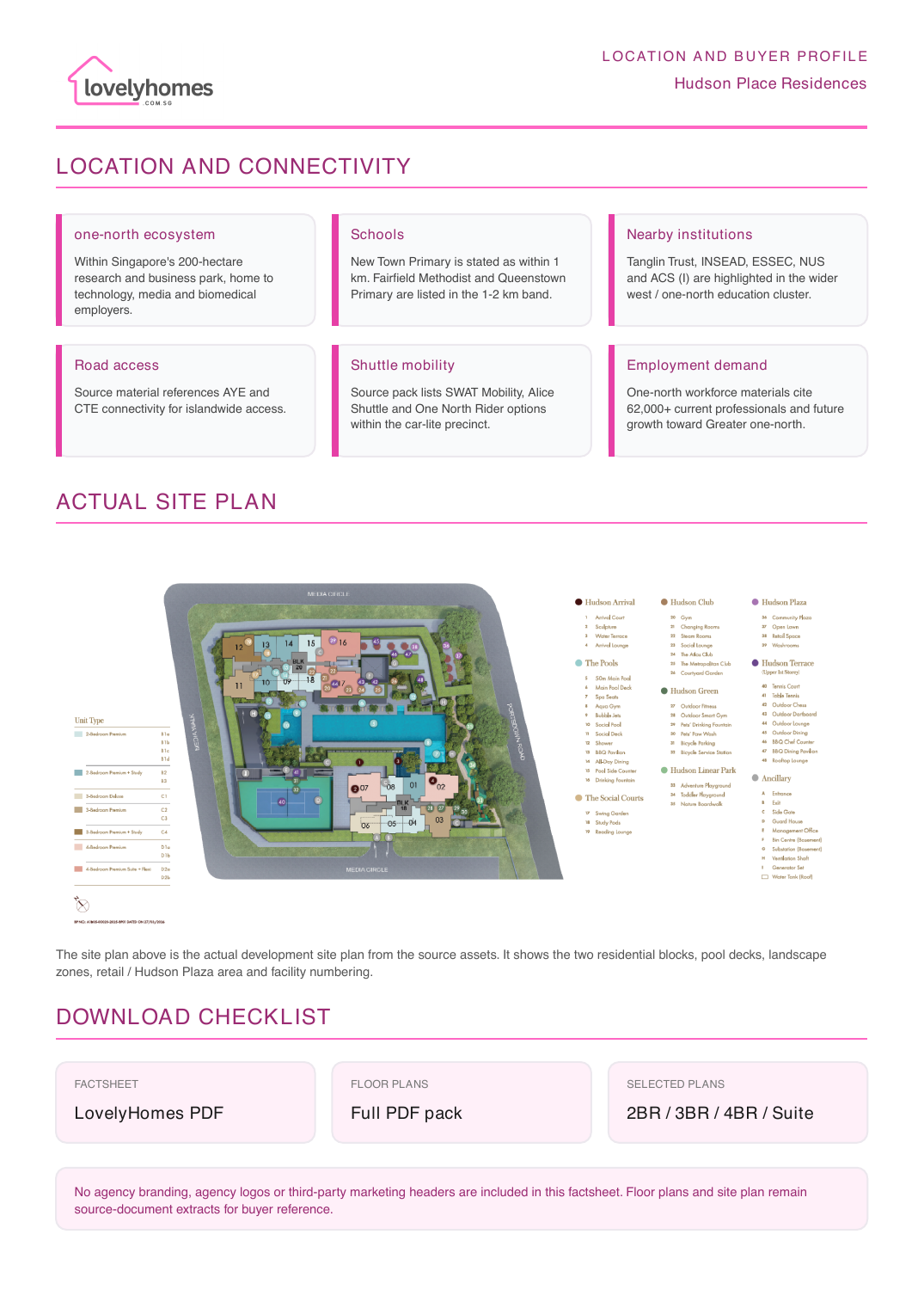
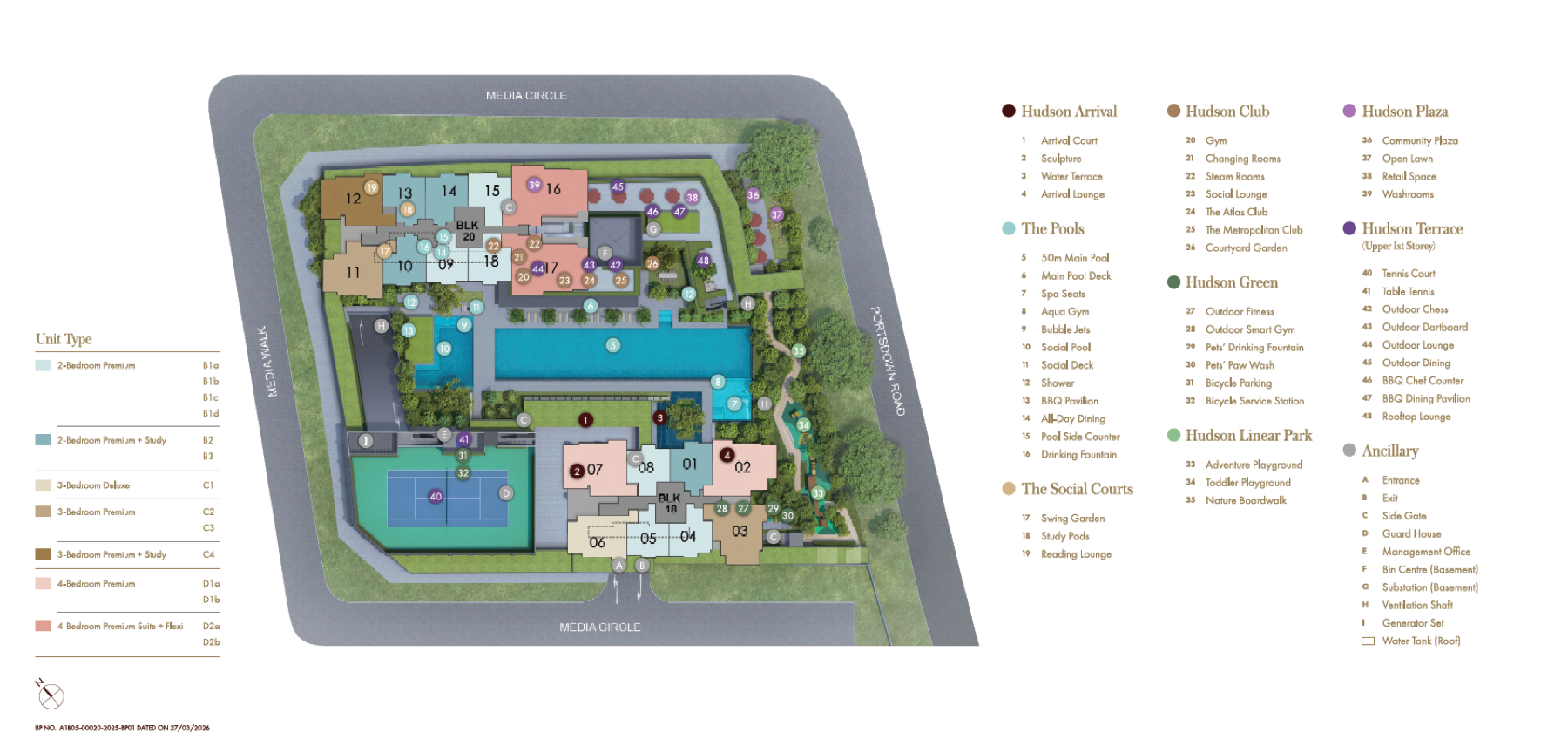
Hudson Place Residences actual site plan showing blocks, pools and facilities

Actual site plan from source material – not a location map or brochure cover.

Facilities And Development Images

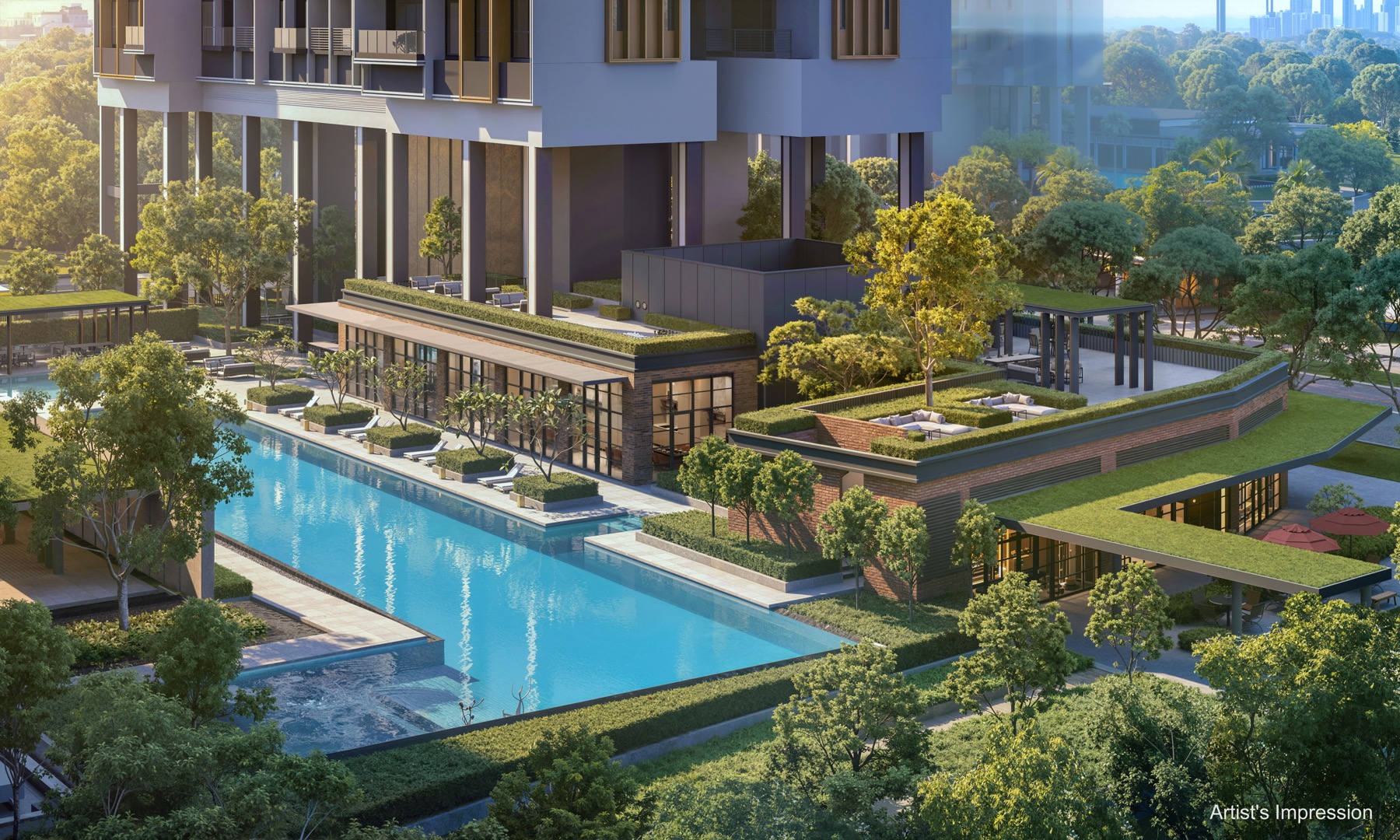
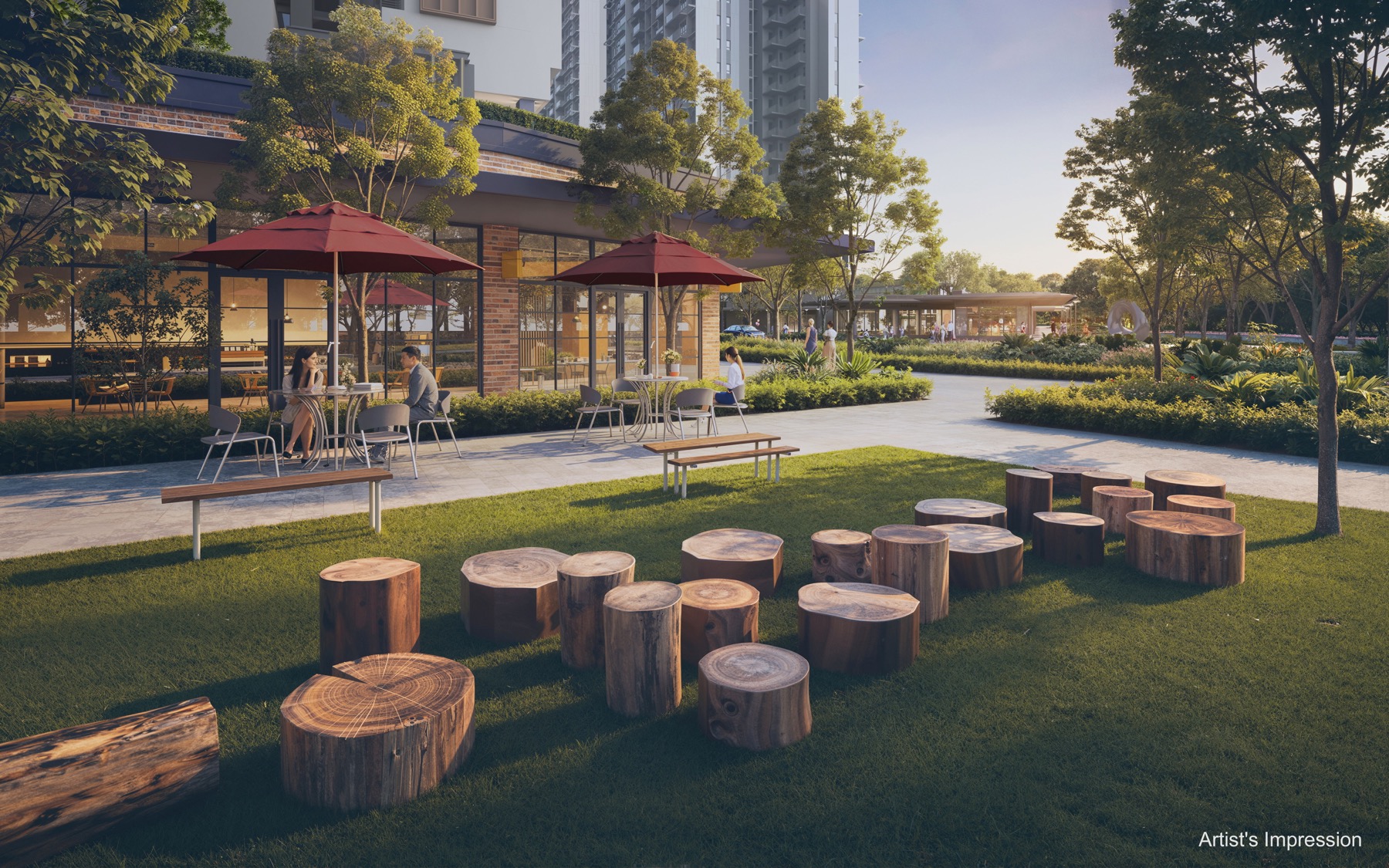
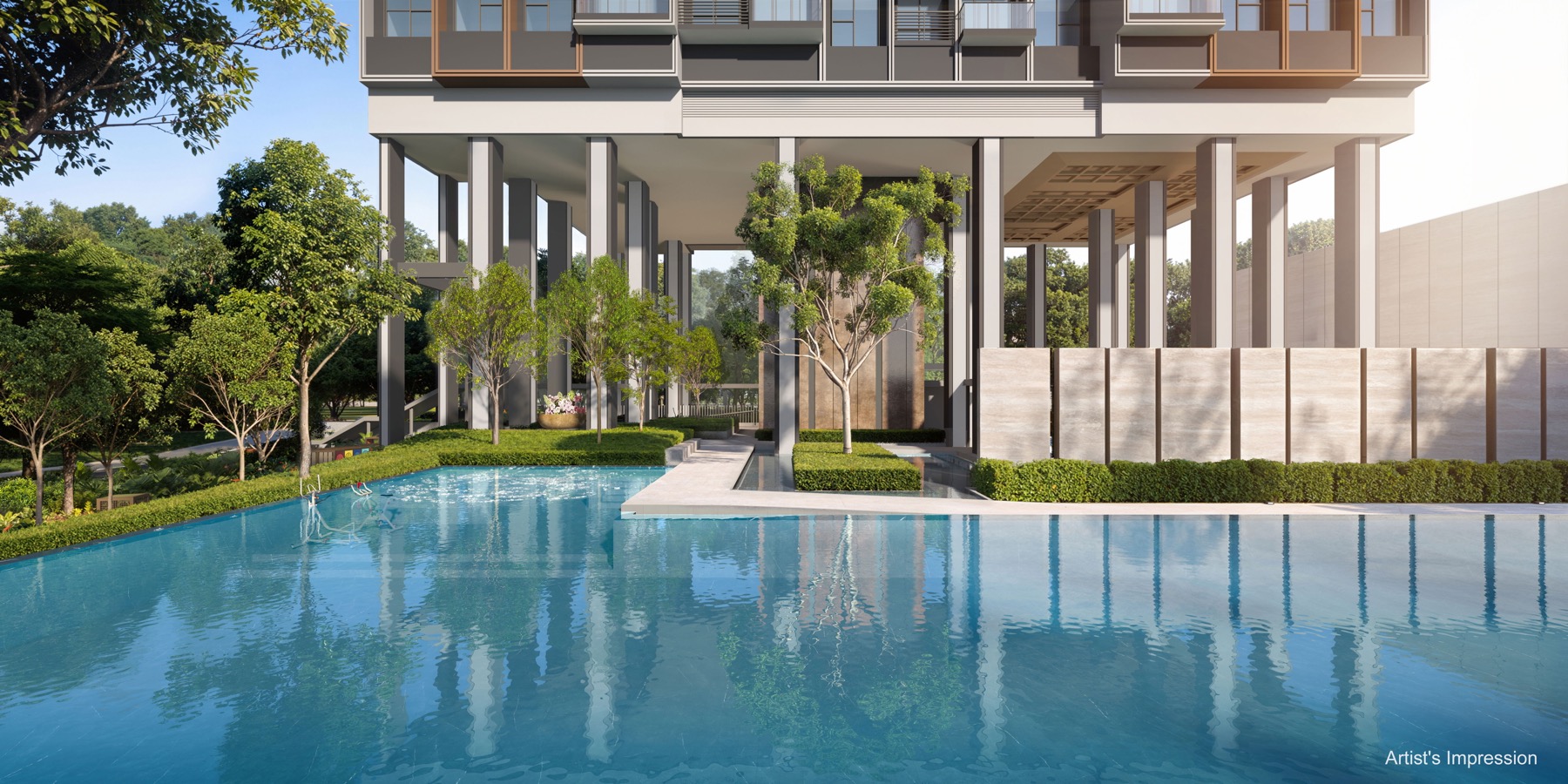
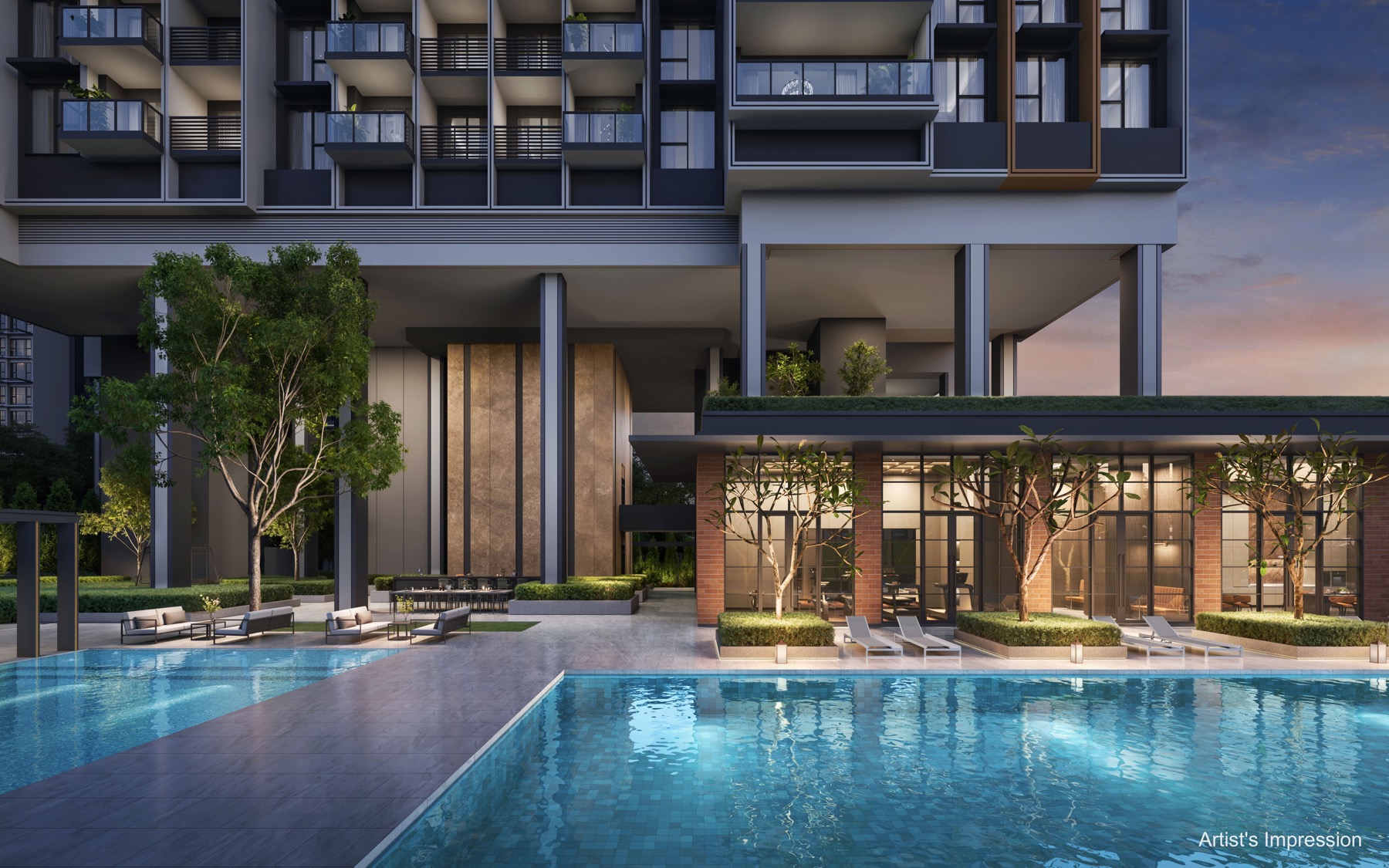
Arrival court50m main poolSocial poolTennis courtGymSteam roomsCo-working gardenPet parkOutdoor diningHudson Plaza retail

Selected Floor Plans

Unit-type note: Hudson source materials begin at 2-bedroom homes. No 1-bedroom floor plan or 1-bedroom stack was available in the supplied source floor-plan pack.
Hudson Place Residences 2-bedroom premium Type B1a floor plan

2-Bedroom Premium – Type B1a, 60 sqm / 646 sqft
Hudson Place Residences 3-bedroom deluxe Type C1 floor plan

3-Bedroom Deluxe – Type C1, 83 sqm / 893 sqft
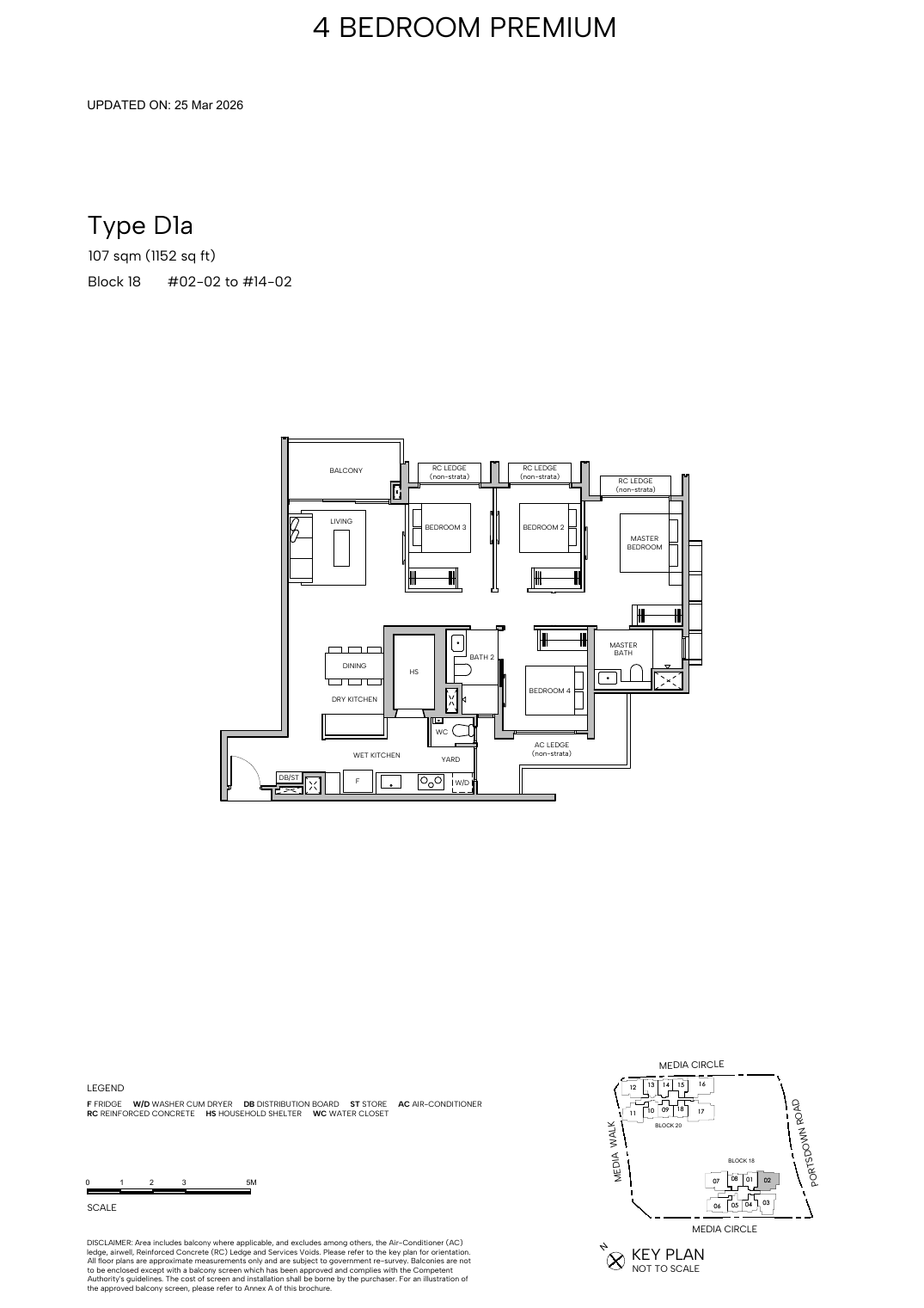
Hudson Place Residences 4-bedroom premium Type D1a floor plan

4-Bedroom Premium – Type D1a, 107 sqm / 1,152 sqft
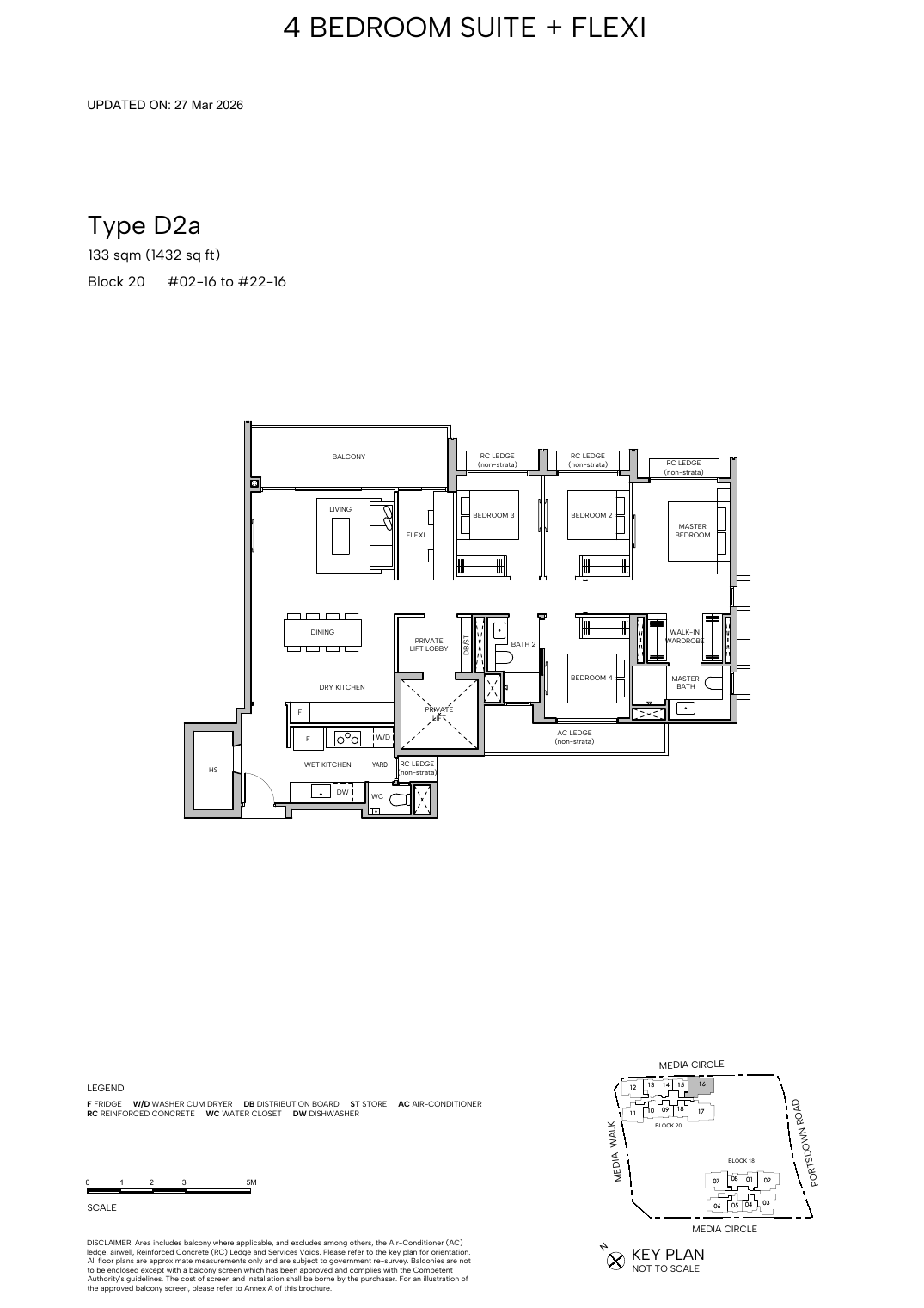
Hudson Place Residences 4-bedroom suite plus flexi Type D2a floor plan

4-Bedroom Suite + Flexi – Type D2a, 133 sqm / 1,432 sqft
Need every stack and orientation?
Download the full source floor-plan PDF below.

Download Full Floor Plans

LovelyHomes Factsheet

Downloads

Factsheet

Hudson Place Factsheet

LovelyHomes-branded concise factsheet with clean formatting.

Download

Floor Plans

Full Floor-Plan Pack

Full source PDF for typical unit plans and stack references.

Download

WhatsApp

Ask For Availability

Request the latest units, prices and viewing slots.

Message

Frequently Asked Questions

Where is Hudson Place Residences located?
The project is at 18 and 20 Media Circle in District 5, within the Queenstown / one-north planning area.
How many units are there?
The source project details list 327 apartments, with up to 400 sqm of non-strata commercial space.
Does Hudson Place Residences have 1-bedroom units?
No 1-bedroom stack was provided in the source unit mix or floor-plan pack used for this page. The supplied unit mix starts from 2-bedroom homes.
Which primary school is within 1 km?
New Town Primary School is listed by the source location materials as within 1 km.

Ready to explore Hudson Place Residences?

Speak to LovelyHomes on WhatsApp for the latest availability, pricing and showflat arrangements. We will share the clean factsheet and floor plans for quick review.

Message on WhatsApp

Related Buying Guides

Stamp Duty

ABSD Singapore 2026 Guide

Rates and remissions for local and foreign buyers.

Financing

Home Loan Singapore 2026

Bank loan, LTV and monthly payment planning.

Regions

CCR, RCR and OCR Explained

Understand where one-north sits in the market.

Disclaimer. Prices, unit mix, specifications, site plans, floor plans and facility lists are indicative only and subject to change by the developer without notice. Information has been compiled from local source materials including the Hudson Place Residences project details document, information pack, site plan and floor-plan pack, verified for this update on 15 May 2026. LovelyHomes.com.sg is not the project developer. Artist impressions are for illustrative purposes only.

Singapore REITs Investment 2026: Distribution Yields, Tax Treatment and How S-REITs Compare to Direct Property

Singapore REITs Investment 2026: Distribution Yields, Tax Treatment and How S-REITs Compare to Direct Property

Most Singaporeans know that property is a favoured investment asset. What fewer realise is that they can access Singapore’s real estate returns without buying a physical unit, without paying Additional Buyer’s Stamp Duty (ABSD), and with as little as the price of a single share on the Singapore Exchange (SGX). Singapore Real Estate Investment Trusts — known as S-REITs — are listed vehicles that pool capital to own income-producing real estate, distribute the bulk of their rental income to unitholders, and trade like stocks on SGX. In 2026, with interest rates easing and cap rates compressing, S-REITs are once again attracting strong attention from retail and institutional investors alike.

Quick Answer — Singapore REITs Investment 2026

  • What: Listed property investment vehicles traded on SGX; own commercial, industrial, retail, healthcare or hospitality properties
  • Minimum investment: As low as S$1 per unit (or one lot = 100 units for standard board lots)
  • Tax transparency: Singapore individuals pay no withholding tax on REIT distributions (subject to MAS rules)
  • ABSD: Zero — REITs are securities, not direct property purchases
  • Indicative yields: 5.2%–6.4% distribution yield depending on sector (2026)
  • Leverage cap: 50% aggregate leverage ratio (MAS guidelines)
  • Key risk: Interest rate sensitivity — REIT unit prices fell sharply when rates rose 2022–2024; recovering in 2026
  • Best for: Investors wanting passive income, diversification, or property exposure without ABSD or large capital outlay

What Are S-REITs and How Do They Work?

A Real Estate Investment Trust is a collective investment scheme structured to own and operate income-producing real estate. In Singapore, REITs are regulated by the Monetary Authority of Singapore (MAS) under the Securities and Futures Act. To qualify for tax transparency treatment, a Singapore REIT must distribute at least 90% of its taxable income to unitholders each financial year. In return, MAS-regulated S-REITs pay no corporate tax on distributed income, and individual Singapore resident unitholders receive distributions free of withholding tax.

S-REITs raise capital by issuing units on SGX. They use this capital, plus debt (up to the 50% aggregate leverage cap), to acquire properties that generate rental income. A REIT Manager — a MAS-licensed entity — makes investment, financing, and asset management decisions on behalf of unitholders. Management fees (typically 0.3%–0.8% of assets under management per annum) reduce net distributions to unitholders.

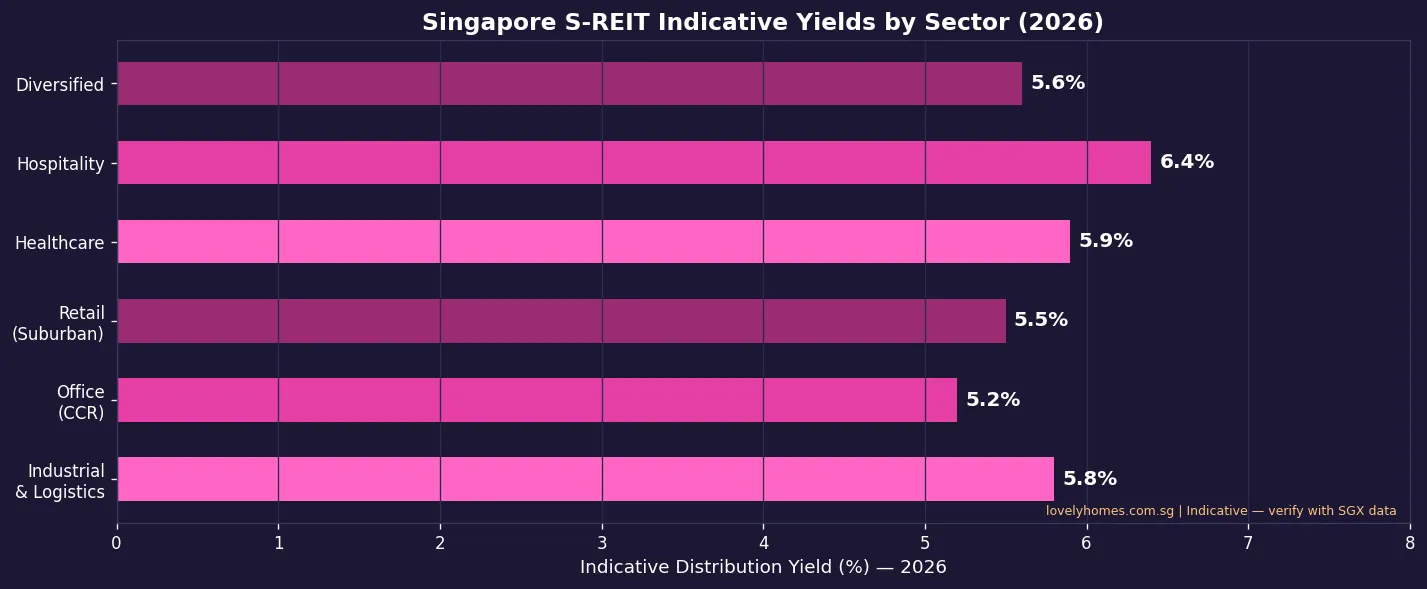
Singapore S-REIT indicative distribution yields by sector 2026 — industrial, office, retail, healthcare, hospitality
Figure 1: Singapore S-REIT Indicative Yields by Sector (2026) — indicative figures; verify with SGX data

Types of S-REITs and Their Characteristics

Singapore hosts one of Asia’s deepest REIT markets, with approximately 40 S-REITs and property trusts spanning several asset classes. Industrial and Logistics REITs own warehouses, data centres, and business parks with long leases (5–15 years) and strong demand from technology occupiers; indicative yields around 5.5%–6.0%. Office REITs own Grade A commercial buildings in the CBD; yields around 5.0%–5.5%. Retail REITs own shopping malls — suburban malls have proven resilient post-pandemic; yields around 5.3%–5.8%. Healthcare REITs own hospitals and nursing homes on long triple-net leases; yields around 5.5%–6.0%. Hospitality REITs own hotels and serviced residences; more volatile income but recovering with Singapore tourism; yields around 6.0%–6.5%. Diversified REITs own a mix of asset types, offering built-in diversification; yields around 5.3%–5.8%.

S-REITs vs Direct Property — The Critical Differences

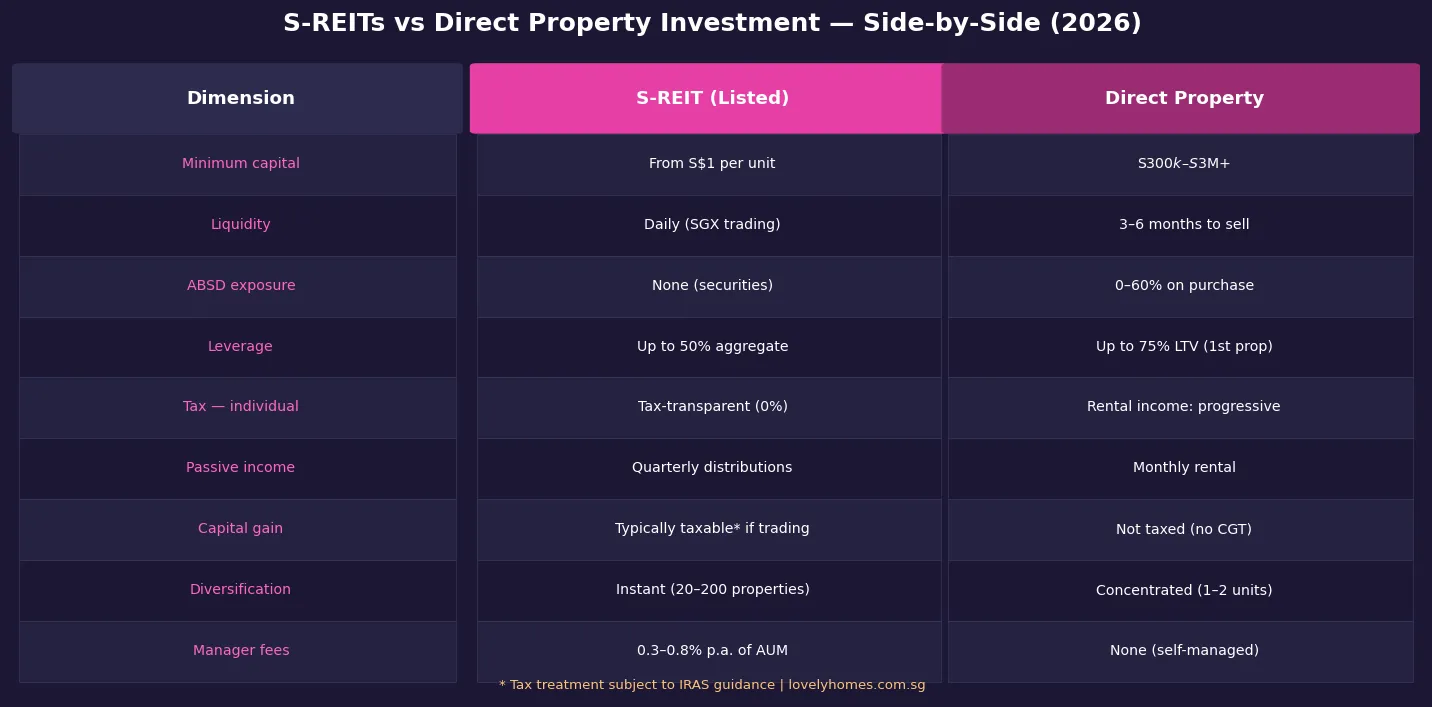
S-REITs vs direct property investment comparison — minimum capital, liquidity, ABSD, leverage and tax Singapore 2026
Figure 2: S-REITs vs Direct Property Investment — Side-by-Side Comparison (2026)

The most significant advantage of S-REITs for Singapore residents is zero ABSD exposure. A Singapore Citizen buying a second residential property pays 20% ABSD on the entire purchase price — on a S$1.5 million condo, that is S$300,000 in ABSD before accounting for the regular Buyer’s Stamp Duty (BSD). Buying S$300,000 worth of a diversified S-REIT incurs no ABSD, no BSD, no conveyancing fees, and no mortgage-related costs.

Liquidity is another major difference. A direct property investment typically takes three to six months to sell, involves legal costs, agent commissions, and Seller’s Stamp Duty (SSD) if sold within three years. A REIT unit can be sold on SGX in seconds during market hours, and settlement occurs within two business days. The trade-off is stock market volatility: many quality S-REITs declined 20%–35% in unit price terms between 2022 and 2024 as the US Federal Reserve raised interest rates aggressively, even as their underlying properties continued generating stable rental income. In 2026, with SORA easing, S-REIT valuations have partially recovered.

Tax Treatment for Singapore Individual Investors

Singapore residents who are individuals receive S-REIT distributions free of withholding tax under the MAS tax transparency framework, provided the REIT distributes at least 90% of its income. This is one of the most favourable tax treatments for any income-generating investment in Singapore. By contrast, rental income from a directly owned investment property is taxed at the individual’s marginal income tax rate (up to 24% for income above S$1 million) after deducting allowable expenses. There is no Capital Gains Tax in Singapore, so gains on disposal of REIT units held for investment are generally not taxable — though IRAS may tax gains as income if the frequency and pattern of trading suggests a business of buying and selling REITs.

Key Facts: S-REIT Investment at a Glance

Dimension S-REIT (Listed) Direct Property
Minimum capital From S$1 per unit S$300k–S$3M+
Liquidity Daily (SGX trading) 3–6 months to sell
ABSD exposure None (securities) 0%–60% on purchase
Leverage Up to 50% aggregate (MAS cap) Up to 75% LTV (1st property)
Tax — individual Tax-transparent (0% withholding) Rental income: progressive rates
Indicative yield 5.2%–6.4% (2026) 2.5%–4.5% gross OCR (2026)
Diversification Instant (20–200 properties) Concentrated (1–2 units)
Manager fees 0.3%–0.8% p.a. of AUM None (self-managed) or agent fees

Worked Example — Ms Chen Considers Her Options

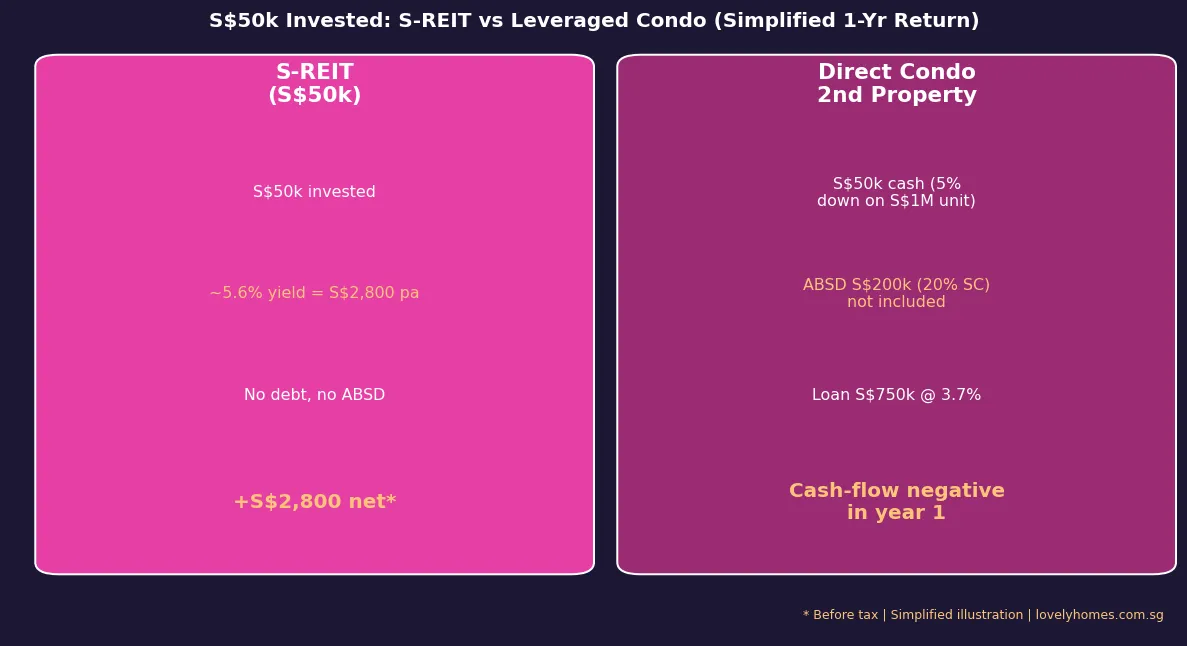
S$50k invested in S-REIT vs leveraged condo 2nd property — simplified year-1 return illustration Singapore 2026
Figure 3: S$50,000 Capital Deployed: S-REIT vs Direct 2nd Condo — simplified 1-year illustration (2026)

Ms Chen is 38, a Singapore Citizen who already owns her HDB flat and has S$50,000 in investable savings. Option A — S-REIT: She invests S$50,000 in a diversified industrial S-REIT yielding 5.8% per annum. Annual distribution income: S$2,900. No ABSD, no BSD, no legal fees. Option B — Second Condo: She targets a S$1 million OCR condo as a second property. ABSD as a Singapore Citizen = 20% = S$200,000. BSD ≈ S$24,600. Total upfront stamp duties: S$224,600. Her S$50,000 would not even cover the stamp duties — she would need an additional S$174,600 just to clear the stamp duty obligation, plus the 25% down payment (S$250,000) and legal costs. For investors at Ms Chen’s capital level who already own one property, the REIT route offers immediate, tax-efficient property income with no stamp duty barrier.

Why This Matters — REITs as a Portfolio Complement

Singapore has actively developed the S-REIT market since the first REIT listed on SGX in 2002. Today, Singapore is the third-largest REIT market in Asia by market capitalisation. For retail investors, S-REITs provide access to institutional-quality properties — prime CBD office towers, logistics parks, hospitals, and data centres — that would otherwise be entirely out of reach. A S$5,000 investment in a well-managed industrial REIT gives proportional exposure to a portfolio of properties worth hundreds of millions of dollars, managed by professionals and audited to MAS standards.

What Might Come Next

In 2026, the REIT market is benefiting from a gradual easing in SORA rates. As the 3-month compounded SORA trends lower from its 2024 peak, financing costs for S-REITs ease and the distribution yield spread above the risk-free rate widens, making S-REITs more attractive relative to fixed deposits and Singapore Government Securities (SGS bonds). Investors should monitor SORA trajectory, MAS interest rate guidance, and individual REIT occupancy rates and lease expiry profiles. Always check the latest REIT financial statements on SGX before deploying capital.

Frequently Asked Questions

Do I pay ABSD when buying S-REIT units?

No. ABSD applies to purchases of residential property. S-REIT units are securities — not direct property ownership — and are bought and sold on SGX in the same manner as shares. There is no Buyer’s Stamp Duty, no ABSD, and no conveyancing process. The only transaction cost is brokerage commission (typically 0.05%–0.28% per trade on standard Singapore platforms).

How often do S-REITs pay distributions?

Most Singapore REITs distribute income quarterly, though some distribute semi-annually. The distribution is declared per unit (in cents per unit) and paid to unitholders on the register as at the ex-dividend date, received in your brokerage account within a few weeks of the payment date. Check each REIT’s investor relations page for its historical distribution per unit (DPU) track record.

Can I use CPF to invest in S-REITs?

Yes, subject to the CPF Investment Scheme (CPFIS). You can invest CPF OA savings in approved S-REITs listed on SGX under CPFIS-OA. You may invest up to 35% of your investable savings (OA balance above S$20,000) in stocks and REITs under CPFIS. Note that the 2.5% OA interest rate is the opportunity cost benchmark — if your REIT does not beat 2.5% on a total-return basis, leaving the money in your OA would have been better.

What are the key risks of investing in S-REITs?

Key risks include: (1) Interest rate risk — rising rates increase REIT borrowing costs and make their yields less attractive relative to bonds. (2) Occupancy/tenant risk — if key tenants vacate or become insolvent, rental income falls. (3) Currency risk — many S-REITs own properties overseas (Australia, Japan, Europe, US); income is earned in foreign currencies and translated back to SGD. (4) Rights issue dilution — to fund acquisitions, REITs frequently issue new units at a discount. (5) Manager quality risk — poor capital allocation erodes long-term value. Diversifying across multiple REITs and asset classes mitigates several of these risks.

Is S-REIT income taxable for Singapore residents?

Distributions from S-REITs to Singapore individual residents are generally exempt from withholding tax under MAS’s tax transparency framework. You receive distributions gross, with no tax deducted at source, and generally do not declare them as taxable income on your personal tax return. Capital gains from selling REIT units are also generally not taxable for investors. Non-residents and entities are subject to withholding tax on distributions. Verify your specific position with a tax adviser, as IRAS guidance may evolve.

What is the MAS 50% leverage cap and why does it matter?

MAS requires Singapore REITs to maintain an aggregate leverage ratio (total debt divided by total assets) of no more than 50%. REITs meeting an interest coverage ratio (ICR) of at least 2.5× can access the upper 50% limit; others are capped at 45%. This protects unitholders from excessive debt risk. When evaluating a REIT, check its reported leverage ratio and ICR trend in its financial statements — these are disclosed quarterly.

How do I start investing in S-REITs?

Open a brokerage account with a SGX-licensed broker (DBS Vickers, OCBC Securities, UOB Kay Hian, Moomoo, Tiger Brokers, or Interactive Brokers). Fund it with SGD. Search for SGX-listed REITs on the broker’s platform — filter by sector, yield, and market capitalisation. Standard board lots are 100 units. Research each REIT’s annual report, distribution history, and investor presentation before investing. The SGX REITs and Property Trusts section is the authoritative listing of all Singapore-listed vehicles.

Disclaimer: This article is for general informational purposes only and does not constitute financial, legal, or professional advice. Property rules, grant amounts, eligibility criteria, and tax treatments are subject to change. Always verify current details with the relevant authorities — HDB, IRAS, CPF Board, URA — and consult a licensed professional before making any property or financial decision.

HDB 2-Room Flexi for Seniors Singapore 2026: Short Lease, Silver Housing Bonus and Lease Buyback Explained

HDB 2-Room Flexi for Seniors Singapore 2026: Short Lease, Silver Housing Bonus and Lease Buyback Explained

Singapore’s HDB system includes a category of flat specifically designed for seniors and older singles who want to right-size, reduce their mortgage burden, or access their housing equity without leaving public housing. The HDB 2-Room Flexi flat — and its cousin, the Studio Apartment — give buyers aged 55 and above a route to a smaller, more manageable home, often with significant grant support on top. If you are approaching retirement and wondering what to do with a large, nearly-paid-off flat, this guide explains every option available to you in 2026.

Quick Answer — HDB 2-Room Flexi for Seniors 2026

  • Who can buy: Singles aged 35+; couples where at least one party is 55+ (for Short Lease option)
  • Short Lease option: 15, 20, 25, 30, or 35 years — choose a lease matching your remaining life expectancy
  • Studio Apartments: Available at Selective En-bloc Redevelopment Scheme (SERS) sites; 30-year lease; for buyers 55+
  • Silver Housing Bonus (SHB): Up to S$30,000 cash when right-sizing from a larger flat
  • Lease Buyback Scheme (LBS): Sell part of your remaining HDB lease back to HDB; proceeds top up your CPF Retirement Account
  • CPF use: Proportional for short leases — you can only use CPF savings up to the value of the remaining lease
  • No resale market for Studio Apartments; 2-Room Flexi 99-year units can be resold after 5-year MOP

What Is a HDB 2-Room Flexi Flat?

The 2-Room Flexi flat is a Build-To-Order (BTO) flat type rolled out by HDB in 2015 to replace the discontinued Studio Apartment in new BTO exercises. It comes in two variants. The first is the Short Lease option, designed specifically for seniors aged 55 and above and singles aged 35 and above, with a lease of 15 to 35 years (in five-year increments) chosen at the point of application. The second is the Standard 99-Year Lease option, available to singles aged 35 and above and to families. Floor area is modest by design: Type 1 units are 36 sqm and Type 2 units are 45 sqm. Both include a living/dining area, one bedroom, one bathroom, a kitchen, and a service yard.

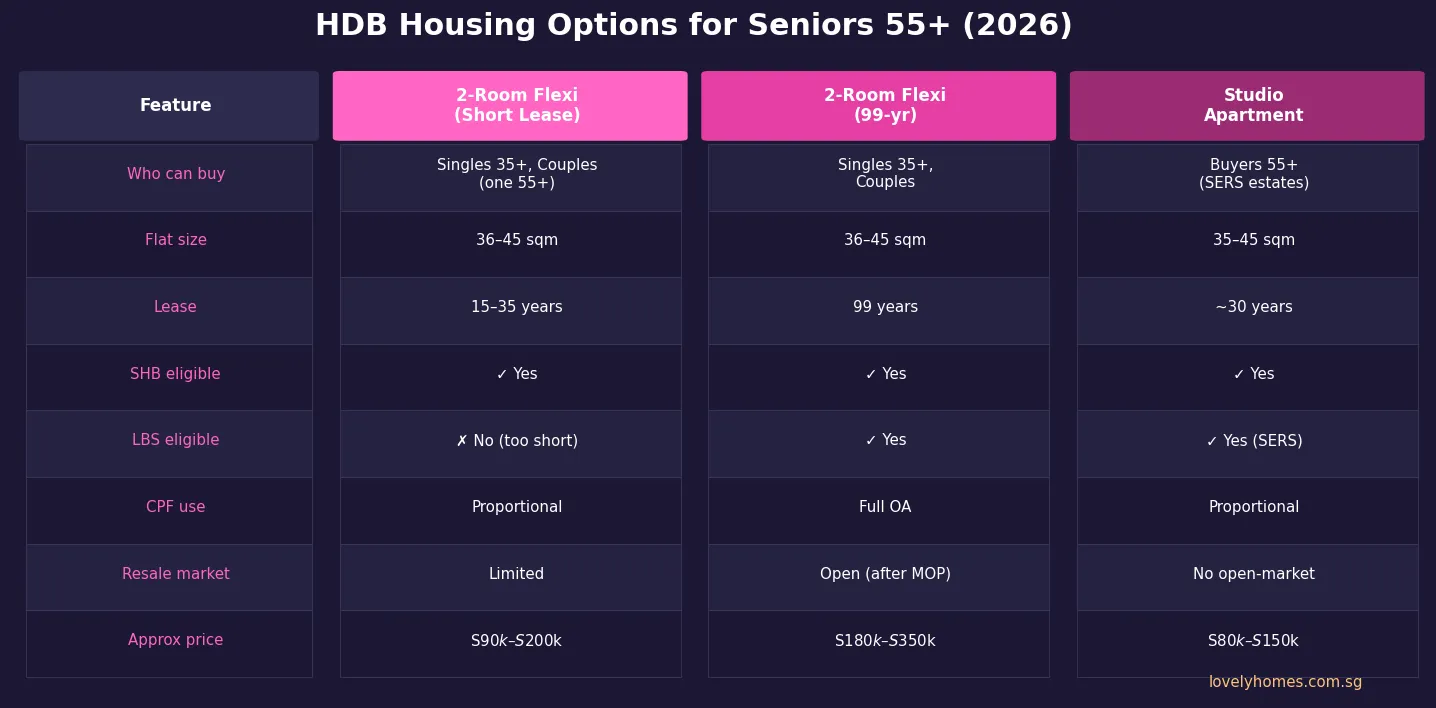
HDB flat types for seniors 55+ comparison 2026 — 2-Room Flexi short lease vs 99-year vs Studio Apartment
Figure 1: HDB Housing Options for Seniors 55+ — key features compared (2026)

Short Lease vs 99-Year: Which Should Seniors Choose?

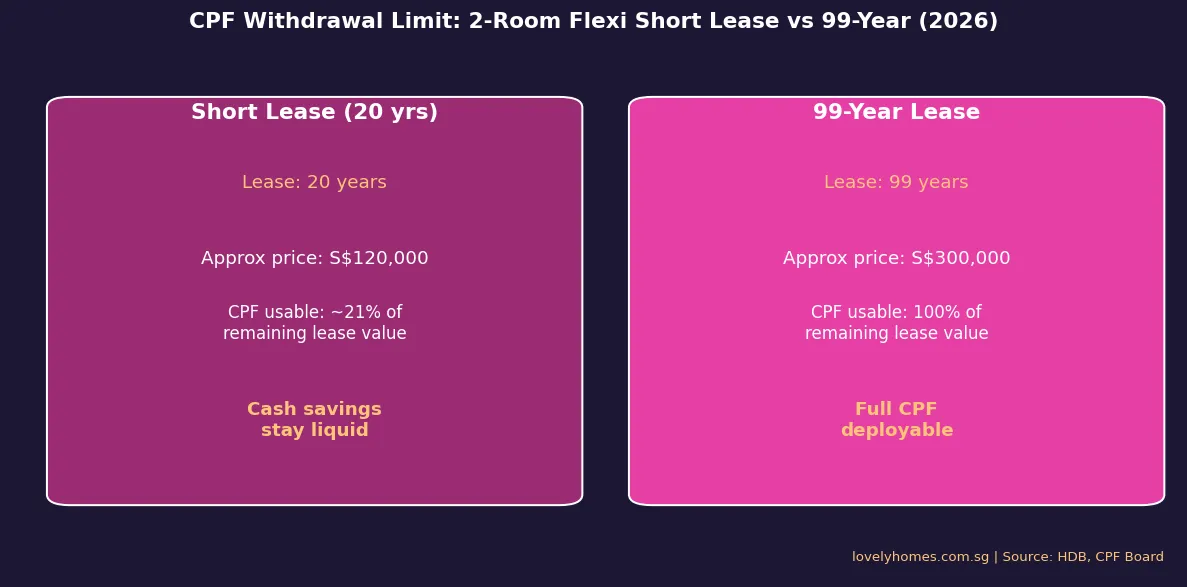
The Short Lease variant is usually the financially smarter choice for buyers who are primarily right-sizing for comfort, not investment. By choosing a shorter lease — say, 25 years for a buyer aged 65 — you pay a significantly lower price for the flat. The sale proceeds from your current, larger flat are then available for other needs. CPF use on a short-lease flat is proportional: the CPF Board limits your Ordinary Account (OA) withdrawal to a fraction of the flat’s valuation based on the ratio of the chosen lease relative to 65 years. In practice, buyers on a 20-year short lease will use mostly cash and have less CPF deployed in the flat, leaving more CPF savings liquid for drawdown in retirement.

The 99-Year Lease option makes more sense for younger singles in their 30s or early 40s who want a small flat as a starter or long-term home with full resale flexibility. After the 5-year MOP, the unit can be sold on the open market.

CPF withdrawal limit comparison — HDB 2-Room Flexi short lease vs 99-year lease Singapore 2026
Figure 2: CPF Use for Short Lease vs 99-Year HDB Flat — how the proportional rule works (2026)

Studio Apartments — The Legacy Option

Studio Apartments were HDB’s original senior-friendly product, built from the 1990s. They are no longer built in new BTO exercises (replaced by the 2-Room Flexi from 2015), but existing units occasionally come up through SERS (Selective En-bloc Redevelopment Scheme) rehousing exercises. Studio Apartments are typically 35–45 sqm, carry a 30-year lease from the date of offer, and are sold to buyers aged 55 and above. There is no open-market resale — you can only surrender the flat back to HDB if you need to leave.

Silver Housing Bonus — Up to S$30,000 in Cash

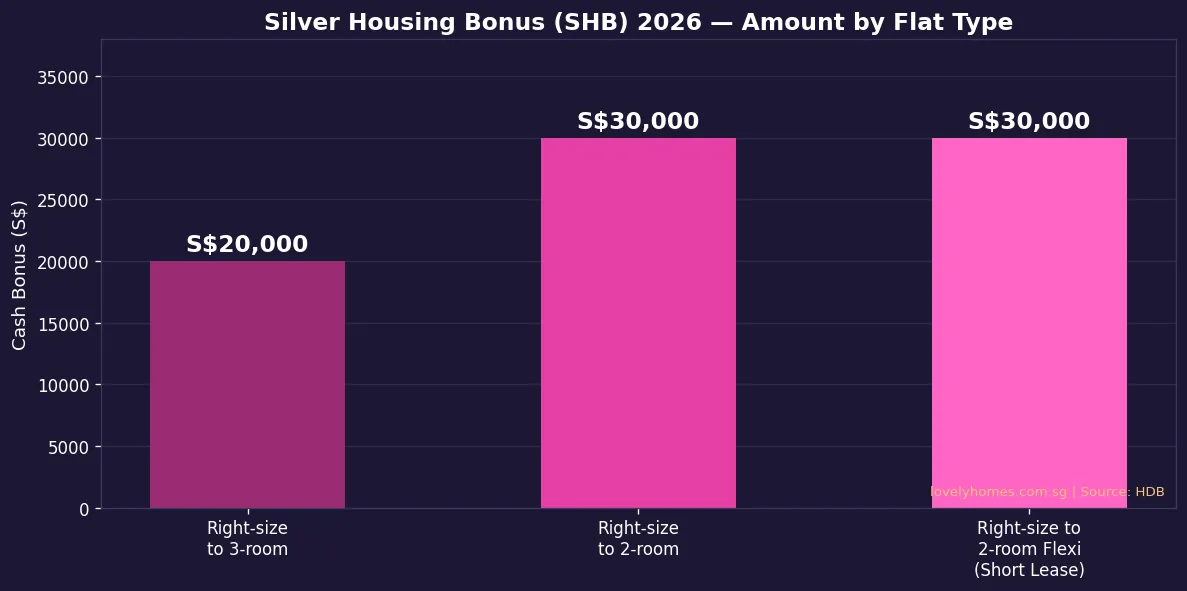
The Silver Housing Bonus (SHB), administered by the CPF Board and HDB, provides eligible seniors with a cash bonus of up to S$30,000 when they right-size to a smaller flat. Eligibility: At least one flat owner must be a Singapore Citizen aged 55 or above. The seller must use the net sale proceeds of their current flat to top up their CPF Retirement Account (RA) up to the current Enhanced Retirement Sum (ERS). For right-sizing to a 2-room or 2-Room Flexi flat (Short Lease), the maximum bonus is S$30,000. For right-sizing to a 3-room flat, the bonus is S$20,000.

Silver Housing Bonus amounts by flat type — right-sizing to 3-room, 2-room or 2-Room Flexi Singapore 2026
Figure 3: Silver Housing Bonus (SHB) 2026 — cash bonus amount by target flat type

Lease Buyback Scheme — Converting Your Flat’s Value to Retirement Income

The Lease Buyback Scheme (LBS) allows eligible seniors to sell part of their flat’s remaining lease to HDB for a lump sum, which is used to top up their CPF Retirement Account. The retained lease must be at least 20 years and cover the youngest owner to age 95. HDB buys the tail end of the lease at assessed market value of that lease proportion, with proceeds going into the owner’s CPF RA to meet the Full Retirement Sum (FRS) or Basic Retirement Sum (BRS) — excess is paid in cash. The couple continues living in the flat under the retained lease and receives monthly CPF LIFE payouts from the topped-up RA.

LBS is not available for 2-Room Flexi Short Lease flats because the chosen lease is already short by design. It is available for 2-Room Flexi 99-Year flats and for larger flats (3-room and above).

Summary: HDB Senior Housing Options at a Glance

Scheme Who Qualifies Key Benefit Amount / Price Range
2-Room Flexi Short Lease Singles 35+; couples with one 55+ Smaller, cheaper flat; choose lease ~S$90k–S$200k
2-Room Flexi 99-Year Singles 35+; families Full resale rights after MOP ~S$180k–S$350k
Studio Apartment Buyers 55+ (SERS estates) Below-market; 30-yr lease ~S$80k–S$150k
Silver Housing Bonus SC 55+, right-sizing from larger flat Cash bonus S$20k (3-rm) / S$30k (2-rm)
Lease Buyback Scheme SC/SPR 65+, own 3-room or larger HDB Convert lease equity to CPF LIFE Lump sum into RA; monthly payout
Proximity Housing Grant Buyers near parents/children Grant on resale purchase S$20k (1km) / S$30k (same estate)

Worked Example — The Lim Couple Right-Sizes at 68

Mr and Mrs Lim, both aged 68, Singapore Citizens, live in a 5-room HDB flat in Bishan with 55 years of lease remaining. Their children have moved out. They right-size to a 2-Room Flexi, Short Lease (25 years) in the same estate.

  • Sale proceeds from the 5-room flat: S$650,000 (after refunding CPF + accrued interest of S$220,000)
  • Purchase price of 2-Room Flexi (25-year short lease): S$145,000
  • CPF use for purchase: proportional to 25/65 years ≈ 38% of flat value → S$55,000 from OA (if available)
  • Cash needed: S$145,000 − S$55,000 = S$90,000 cash
  • Silver Housing Bonus: S$30,000 cash (right-sizing to 2-room)
  • CPF RA top-up from sale proceeds to meet ERS (say S$190,000 per person)
  • Net free cash in hand after purchase, SHB, and CPF RA top-up: approximately S$235,000
  • Monthly CPF LIFE payout after RA top-up (ERS scheme): approximately S$2,200–S$2,500 per person

Why This Matters — Housing as a Retirement Asset

A very large proportion of household wealth in Singapore is locked inside HDB flats. The 2-Room Flexi, SHB, and LBS framework is the Government’s systematic answer: offering seniors structured, HDB-administered routes to convert housing equity into retirement cash flow without moving out of public housing. The 2026 environment makes right-sizing particularly attractive — HDB resale prices remain elevated after years of growth, while 2-Room Flexi Short Lease prices remain relatively modest, offering a significant arbitrage between what seniors receive for their existing flat and what they pay for the right-sized replacement.

What Might Come Next

HDB has been gradually expanding 2-Room Flexi supply in mature and prime estates. The Government may introduce enhancements to the Silver Housing Bonus quantum or Lease Buyback Scheme proceeds as Singapore’s population continues to age. Monitor the annual MND Budget statement, National Day Rally, and the HDB website for the latest BTO schedule and grant amounts before committing to any right-sizing decision.

Frequently Asked Questions

Can a single person buy a 2-Room Flexi short-lease flat?

Yes. Singapore Citizens and Permanent Residents aged 35 and above who are singles can apply for a 2-Room Flexi flat — both the 99-year and Short Lease variants. For the Short Lease, HDB targets it at buyers aged 55 and above, but the formal eligibility lower bound is 35. Singles are not eligible for most family-tier HDB grants, but may qualify for the Silver Housing Bonus if they are at least 55 and right-sizing from a larger flat.

What happens when the short-lease flat’s chosen tenure expires?

When the lease expires, the flat reverts to HDB with no residual value or compensation. This is by design — the flat’s utility is fully consumed during the chosen lease period. Buyers should choose a lease length covering at least to age 95 per CPF Board guidelines. If the owner passes away before expiry, the remaining lease value may be passed to eligible family members under HDB estate transmission rules.

Can I use CPF OA to buy a 2-Room Flexi Short Lease flat?

Yes, but proportionally. The CPF Board allows OA use up to the value corresponding to the lease coverage from your youngest owner’s age to 95. For a 25-year lease chosen by a 65-year-old (covering to age 90), the CPF-usable proportion is roughly 25/65 ≈ 38% of assessed value. A significant portion must therefore be paid in cash. This is intentional — it preserves CPF savings for retirement income rather than locking them into housing.

How do I apply for the Silver Housing Bonus?

The Silver Housing Bonus is administered jointly by HDB and the CPF Board. You apply at the point of booking your new (smaller) flat or during the resale application process. HDB assesses eligibility and the bonus amount based on the size of your current flat, your new flat, and whether you meet the RA top-up requirement from sale proceeds. The cash bonus is paid directly to you — not into CPF — once the transaction is completed. Check HDB’s 2-Room Flexi page for current SHB quantum and conditions.

Does the Lease Buyback Scheme work with a 2-Room Flexi flat?

LBS is available for 3-room and larger HDB flats and for Studio Apartments in SERS estates. It is not available for 2-Room Flexi Short Lease flats because the chosen lease is already short. For 2-Room Flexi 99-year flats, LBS is in principle available but less commonly used, since most LBS participants hold larger flats with more lease equity to monetise. Contact HDB directly to assess eligibility for your specific lease position.

Can I rent out my 2-Room Flexi flat?

You may rent out individual bedrooms after satisfying the MOP (5 years for the 99-year variant). HDB generally does not approve whole-unit rentals for short-lease 2-Room Flexi flats. Renting a bedroom is subject to HDB’s standard subletting approval process and tenant nationality quotas. You may not rent out the entire flat while listed as the owner-occupier.

What is the difference between the 2-Room Flexi and the old Studio Apartment?

Studio Apartments (1990s–2000s) are no longer available in new BTO exercises — replaced by the 2-Room Flexi from 2015. Studio Apartments carry a 30-year lease and are offered at SERS estates to sitting residents. The 2-Room Flexi offers greater flexibility: choice of lease from 15–35 years or a full 99-year lease, two floor-area variants, and (for the 99-year unit) open-market resale rights after MOP. Studio Apartments have no resale market. For most seniors today, the 2-Room Flexi is the primary option.

Disclaimer: This article is for general informational purposes only and does not constitute financial, legal, or professional advice. Property rules, grant amounts, eligibility criteria, and tax treatments are subject to change. Always verify current details with the relevant authorities — HDB, IRAS, CPF Board, URA — and consult a licensed professional before making any property or financial decision.

HDB Resale Market Q1 2026: Prices Fall 0.6% in First Decline Since 2019

HDB Resale Market Q1 2026: Prices Fall 0.6% in First Decline Since 2019

HDB Resale Market Q1 2026: Prices Fall 0.6% in First Decline Since 2019

Quick Answer

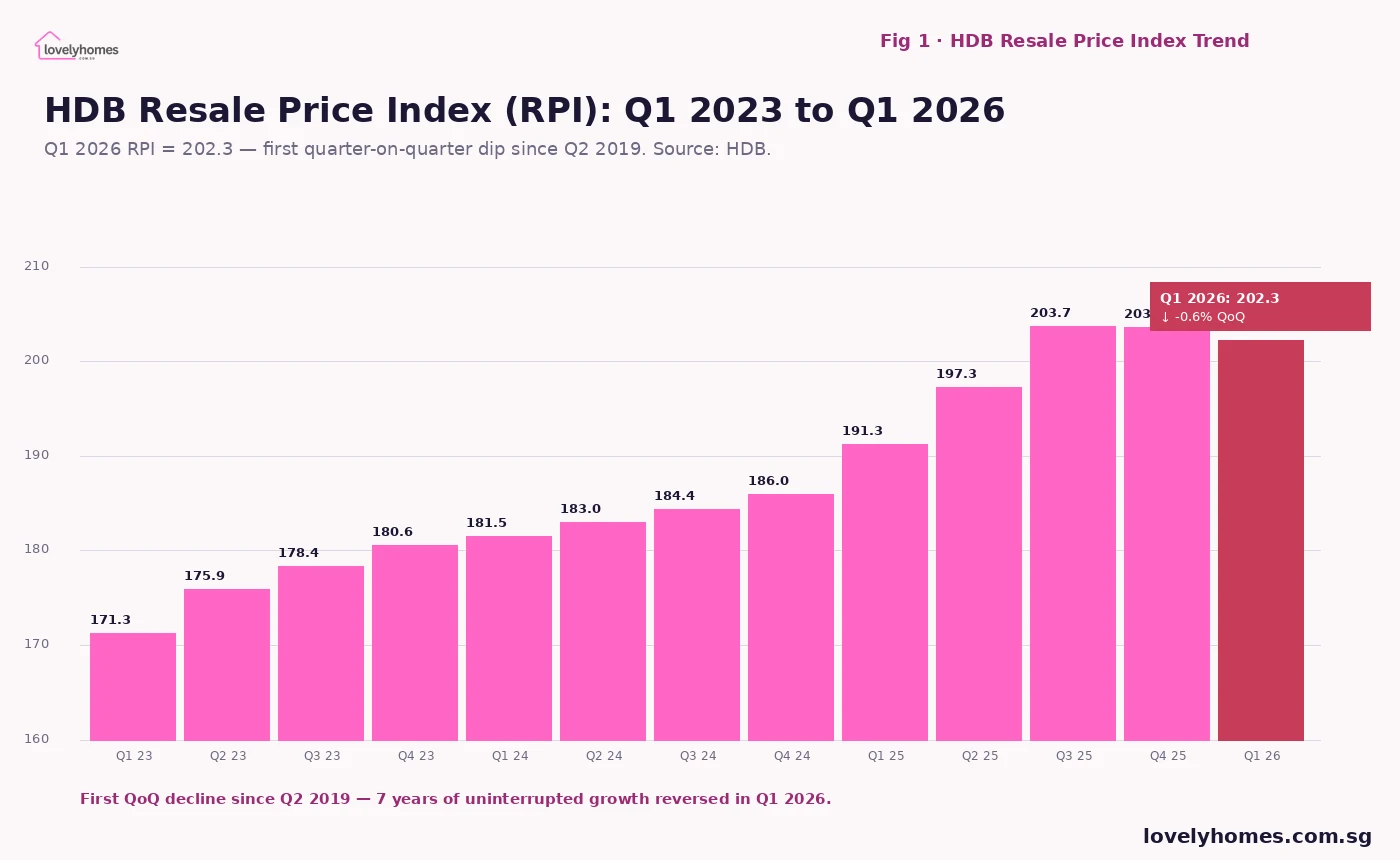
  • The HDB Resale Price Index (RPI) fell 0.6% quarter-on-quarter in Q1 2026, from 203.6 in Q4 2025 to 202.3 — the first decline since Q2 2019.
  • The dip breaks a 27-quarter streak of flat or rising resale prices, signalling early-stage market cooling after years of post-pandemic appreciation.
  • Transaction volumes were 6,107 resale flats in Q1 2026, broadly in line with Q4 2025 levels — the price softening is driven by supply rather than a demand collapse.
  • The MOP supply wave — 13,480 HDB flats reaching their 5-year Minimum Occupation Period in 2026 — is the structural factor adding resale supply.
  • HDB rents held relatively steady: 58,598 flats rented at end-Q1, with median rents ranging from S$2,300 (3-room Jurong West) to S$4,200/mth (executive Bedok).
  • Million-dollar resale transactions continued to feature, with a new record of S$1.728M at City Vue @ Henderson (Henderson Road, April 2026).
  • Analysts describe the trajectory as a “soft landing” — the price dip is small and unlikely to accelerate sharply unless interest rates rise again or unemployment climbs.

What the Q1 2026 HDB Resale Data Shows

HDB released its 1st Quarter 2026 Public Housing Statistics on 25 April 2026, revealing that the Resale Price Index — the primary measure of HDB resale flat price movements — dipped 0.6% quarter-on-quarter to 202.3. This ends a remarkable run: from Q3 2019 through Q4 2025, the RPI rose or held flat in every single quarter, a 27-quarter streak fuelled first by the pandemic-era demand surge (2020–2022), then by the post-pandemic upgrader wave and tight resale supply (2023–2024), then by continued above-median-income household demand (2025).

The 0.6% dip is modest in absolute terms — the RPI remains 18% above its Q1 2023 level — but its direction is significant. It confirms what market practitioners have been observing since late 2025: sellers are taking longer to find buyers, price gaps between asking and transacted prices have widened, and the buyer pool is showing greater selectivity.

HDB Resale Price Index quarterly trend Q1 2023 to Q1 2026 bar chart
Figure 1: HDB Resale Price Index (RPI) from Q1 2023 to Q1 2026. Q1 2026 marks the first quarter-on-quarter decline since 2019. Source: HDB.

Why Prices Dipped: The MOP Supply Effect

The primary explanation for the price softening is straightforward: supply. As LovelyHomes reported in May 2026, approximately 13,480 HDB flats are reaching their 5-year Minimum Occupation Period (MOP) in 2026, up 93% year-on-year from the approximately 6,980 that crossed MOP in 2025. This is partly a consequence of the BTO surge years of 2016–2018, when HDB completed large volumes of units in towns including Punggol (est. 3,200 MOP units), Sengkang (est. 2,400), Tengah (est. 1,900), and Bidadari (est. 1,800).

As these flat owners become eligible to sell on the open market, many are choosing to do so — either to capture appreciation gains, to upgrade to private property, or to rightsize. The resulting increase in resale listings gives buyers more choice and more negotiating room, which compresses prices at the margin.

A structural supply increase of this magnitude does not typically reverse quickly. The MOP pipeline into 2027 remains elevated, meaning the resale supply overhang is likely to persist through much of 2026 and into 2027. This is not a liquidity crisis or a demand collapse — transaction volumes remain healthy — but it is a period where sellers who need to move quickly will likely accept modest discounts to achieve a timely sale.

Transaction Volume: Stable, Not Falling

Notably, the price dip in Q1 2026 was not accompanied by a volume collapse. HDB reported approximately 6,107 resale transactions in Q1 2026, broadly in line with the approximately 6,200 recorded in Q4 2025. This is an important distinction: a falling price index alongside stable volume suggests a price-discovery adjustment driven by supply rather than a demand retreat. When markets fall on low volume, it often signals more serious stress; when they adjust modestly on normal volume, it is more consistent with a soft landing.

Million-dollar resale flats continued to transact. There were 165 million-dollar HDB transactions in Q1 2026, slightly below the 188 recorded in Q4 2025 but still historically elevated. The most expensive transaction in recent months was a 5-room flat at City Vue @ Henderson (Henderson Road) that transacted at S$1,728,000 in April 2026 — a new island-wide record, surpassing the previous S$1.7M record at SkyTerrace @ Dawson (February 2026).

The Rental Market: Holding Steady

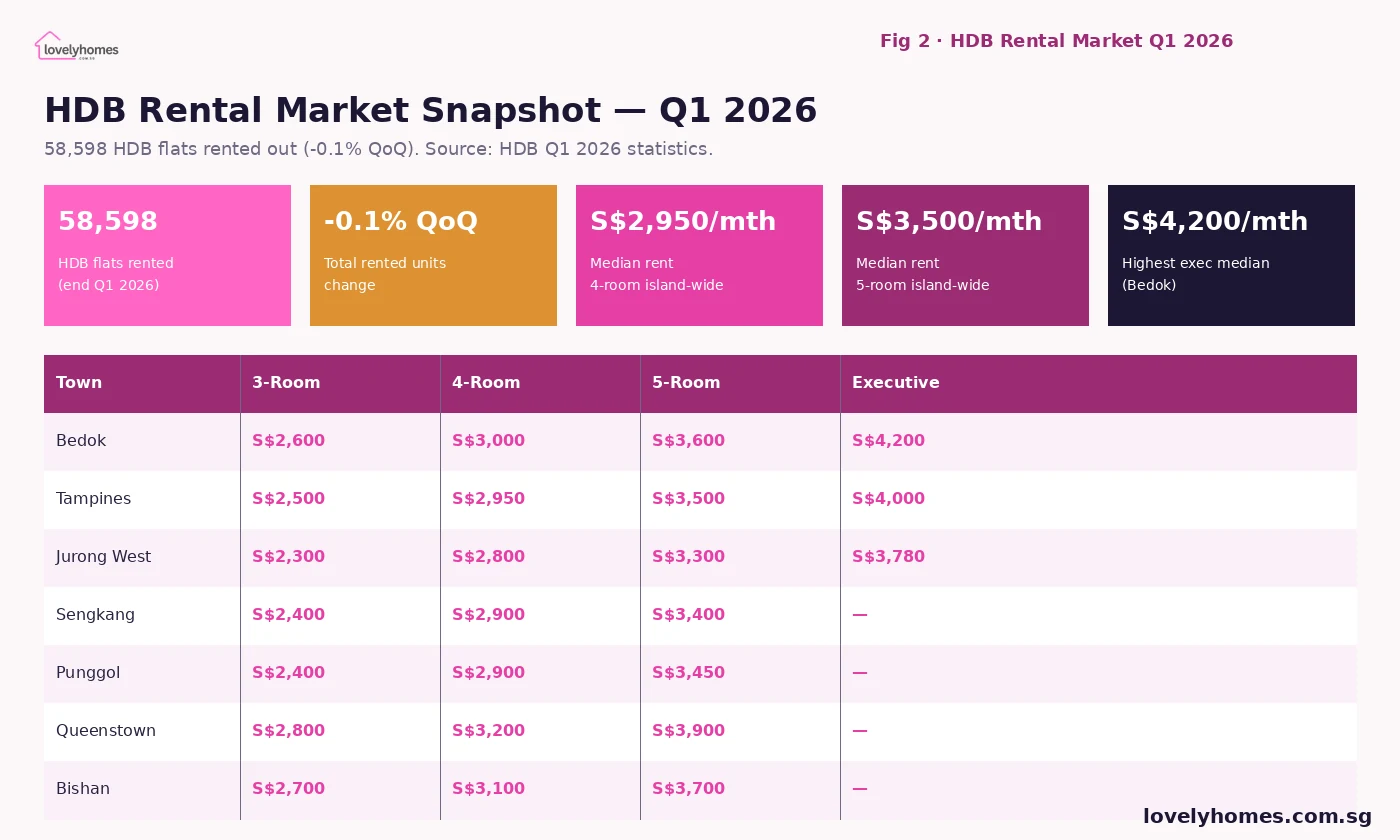
HDB’s Q1 2026 data also covered the rental sub-market. As at end of March 2026, there were 58,598 HDB flats rented out on the open market — down marginally (-0.1%) from the 58,775 rented at end of Q4 2025. The occupancy rental market has broadly plateaued after the 2022–2023 surge, reflecting a more balanced supply-demand dynamic at current rent levels.

HDB rental market Q1 2026 median rent by town flat type Singapore
Figure 2: HDB rental market snapshot Q1 2026 — total units rented, and median monthly rent by town and flat type. Source: HDB.

Median monthly rents by flat type as at Q1 2026:

Flat Type Median Rent (Island-wide) Highest Town (Est.) Lowest Town (Est.)
3-Room S$2,450/mth Queenstown ~S$2,800 Jurong West ~S$2,300
4-Room S$2,950/mth Queenstown ~S$3,200 Jurong West ~S$2,800
5-Room S$3,500/mth Bishan ~S$3,700 Jurong West ~S$3,300
Executive S$3,900/mth Bedok ~S$4,200 Jurong West ~S$3,780

Worked Example: Seller Navigating the Q1 2026 Market

Consider Ms Chen, a 48-year-old SC who bought a 5-room flat in Punggol in 2021 at S$640,000. Her flat crossed MOP in March 2026. She lists it at S$820,000 based on comparable transaction data from late 2025. By April 2026, the market has softened: similar units in her block are closing at S$795,000–S$805,000. After 6 weeks on market, she accepts S$800,000 — S$20,000 below her initial ask.

At S$800,000, her net proceeds (after clearing the HDB loan balance of S$180,000, CPF refund of S$195,000 including accrued interest, agent commission of S$16,000 at 2%, and legal fees of S$2,500) amount to approximately S$406,500 in cash. This provides her a meaningful deposit for a private condo purchase — the upgrade path that many MOP sellers are pursuing in parallel. The soft landing means she sells at a price below peak 2025 expectations, but still at a substantial premium to her 2021 purchase price.

What Analysts Expect Next

The consensus view among Singapore property researchers as at May 2026 is that the HDB resale market is experiencing a controlled correction rather than a structural downturn. The structural demand drivers — strong household formation, the HDB upgrader pipeline, and the EIP limiting cross-ethnic resale substitution — remain intact. What has changed is the supply side: the 2026 MOP wave adds meaningful listings, and the EC cooling measures introduced on 8 May 2026 (10-year MOP for ECs, removal of Deferred Payment Scheme) are expected to redirect some upgrader demand back toward the resale HDB market as ECs become less attractive for near-term upgraders.

For the full year 2026, many analysts project HDB resale prices to be flat to -1.5% year-on-year — a modest correction rather than a collapse. A steeper correction would require either a significant rise in unemployment (reducing buying capacity) or a sharp increase in interest rates (increasing mortgage costs). Neither scenario appears imminent as at May 2026.

Frequently Asked Questions

Does the 0.6% price dip mean it’s a buyer’s market?

In relative terms, yes — buyers have more negotiating power than they did in 2024 or early 2025. Sellers are taking longer to close deals, and offer-to-transacted-price gaps have widened. However, “buyer’s market” should be contextualised: the overall price level remains historically elevated, and well-located flats in mature estates with strong lease remaining still transact with multiple offers. The softening is most visible in OCR peripheral towns with high MOP supply (Punggol, Sengkang, Tengah) and least visible in established mature estates (Bishan, Toa Payoh, Queenstown, Bukit Timah).

Should I sell my MOP flat now or wait?

This is a personal financial decision that depends on your specific situation — remaining loan quantum, CPF accrued interest, upgrade target, and personal timeline. As a general observation, the supply wave is expected to persist through 2026 and into 2027, meaning if you are not urgently selling, waiting for a Q4 2026 or 2027 window may not materially improve your position. If you plan to upgrade to private property and are concerned about private prices rising faster than HDB prices stabilise, acting sooner may make strategic sense. This should be discussed with a licensed financial adviser and property agent.

How does the MOP supply wave affect HDB rental demand?

As MOP sellers transition to private property or other housing arrangements, some opt to rent out their HDB flat rather than sell, particularly if they can achieve strong rental yields. This adds to the HDB rental supply pool. Simultaneously, new private condo residents who owned the HDB flat they were renting out before upgrading may exit the rental market. The net effect on rental supply is modest and likely balanced; however, specific towns with very high MOP supply (Punggol, Tengah) may see softer rents as more units come onto the rental market in 2026.

Are million-dollar HDB flats still transacting?

Yes. The million-dollar threshold was crossed 165 times in Q1 2026, and the April 2026 record of S$1.728M at City Vue @ Henderson confirms that ultra-premium resale transactions are still occurring. However, the pace of million-dollar transactions appears to be stabilising relative to the 2025 highs. These transactions are concentrated in specific locations: DBSS developments, mature estate point blocks with exceptional views, and flats with very long lease remaining in prime districts. They are the exception rather than the norm.

What is the HDB resale market outlook for H2 2026?

The outlook is cautiously stable with a soft-landing bias. The MOP supply wave will continue adding listings through the year. EC cooling measures (10-year MOP) may modestly redirect some demand to the resale segment. Interest rates, while elevated versus pre-2022 levels, have stabilised. Private-to-HDB downgraders remain limited in number. Most analysts project full-year 2026 HDB resale prices to be flat to slightly negative (-0% to -1.5%), with transaction volumes holding in the 25,000–27,000 range for the full year.

Related Articles


Disclaimer: This article is based on HDB’s 1st Quarter 2026 Public Housing Statistics and publicly available market data. All figures are for general informational purposes only. Rental median figures for individual towns are estimates based on approved applications and may differ from actual advertised rents. This is not financial or investment advice. For decisions relating to HDB resale purchase or sale, consult a licensed property agent (CEA-registered) and a licensed financial adviser. Official data is available at hdb.gov.sg and ura.gov.sg.

Translate »