HDB BTO October 2026 Guide: All 7 Projects, Prices, Grants and Application Tips for Bedok Bayshore, Toa Payoh Caldecott, Yishun, Tengah and More

HDB BTO October 2026 Guide: All 7 Projects, Prices, Grants and Application Tips for Bedok Bayshore, Toa Payoh Caldecott, Yishun, Tengah and More

Quick Answer: HDB BTO October 2026 Key Facts

  • Total supply: approximately 7,970 flats across 7 projects in 6 towns.
  • Towns: Bedok (Bayshore ×2), Toa Payoh (Caldecott), Geylang (Mattar), Yishun (Chencharu), Tengah (Garden Avenue), Sembawang North.
  • Classification: Bedok Bayshore (Prime), Toa Payoh Caldecott (Prime), Geylang Mattar (Plus), Yishun/Tengah/Sembawang (Standard).
  • HFE letter deadline: Submit all supporting documents to HDB by 15 September 2026 to ensure your HDB Flat Eligibility (HFE) letter is ready for the October sales exercise.
  • Estimated 4-room prices: Standard (Yishun/Tengah) ~S$360K–S$400K; Plus (Geylang) ~S$500K–S$540K; Prime (Bedok/Toa Payoh) ~S$500K–S$555K.
  • MOP: 5 years for Standard; 10 years for Plus and Prime classifications.
  • Subsidy clawback: Plus and Prime flats are subject to a subsidy clawback on resale, calculated as a percentage of the resale price or value.
  • Hottest picks: Toa Payoh Caldecott (only Prime project; next to Caldecott MRT interchange); Bedok Bayshore (waterfront precinct; near East Coast Park).

Overview: Singapore’s Final BTO Launch of 2026

The October 2026 Build-To-Order (BTO) exercise is the final sales launch of the year and one of the largest in recent memory, with the Housing and Development Board (HDB) offering approximately 7,970 flats across seven projects in six towns. The October exercise completes the government’s 2026 BTO calendar, which has collectively offered around 19,600 new flats — matching HDB’s earlier public commitment to sustain high supply to moderate resale prices and address first-timer demand.

The exercise is notable for the geographic spread of its projects: it spans the sought-after east (Bedok’s new Bayshore waterfront precinct), the central region (Toa Payoh’s Caldecott precinct), an inner-city mixed area (Geylang’s Mattar neighbourhood near the Downtown Line), and the established growth corridors of Yishun and Tengah. For first-timer applicants who missed earlier launches, this is a high-stakes application exercise with a meaningful mix of price points and location quality.

HDB BTO October 2026 all 7 projects overview table classification units MRT prices
Figure 1: All 7 projects in the HDB BTO October 2026 exercise — location, classification, flat types, unit count, nearest MRT station and indicative 4-room prices. Prices are pre-launch market estimates and will be confirmed only when HDB releases official pricing during the sales exercise.

Project-by-Project Analysis

Bedok — Bayshore I & II Prime

The two Bedok Bayshore projects together supply 2,500 flats (1,640 and 860 units respectively) in the new Bayshore housing estate along Bayshore Drive, adjacent to East Coast Park. Both are served by Bayshore MRT station on the Thomson-East Coast Line (TEL), which provides direct access to the CBD via Marina Bay. The Bayshore precinct is a purpose-built waterfront residential neighbourhood — the first HDB estate developed in this part of Singapore — and the BTO flats sit alongside private condominiums and commercial amenities in a mixed-use environment.

Both projects carry Prime classification under HDB’s 2023 flat classification framework, meaning buyers are subject to a ten-year Minimum Occupation Period (MOP) and a subsidy clawback on resale. Flat types span 2-room Flexi, 3-room, and 4-room, with no 5-room units offered — reflecting the Prime classification’s intent to maximise accessibility for first-timers rather than offer larger investment-grade units. Indicative 4-room pricing is estimated at approximately S$500,000–S$520,000.

Toa Payoh — Caldecott Prime

The Toa Payoh Caldecott project is expected to be the single most competitive project in October 2026. With 1,430 units — comprising around 590 two-room Flexi flats, 580 four-room flats, and a tranche of public rental units — it occupies land immediately adjacent to Caldecott MRT station, the interchange between the Circle Line (CCL) and the Downtown Line (DTL). This provides unparalleled MRT connectivity in a mature estate known for its proximity to Bishan, Ang Mo Kio, and Novena.

Caldecott is the only Pure Prime project in this exercise. Indicative 4-room prices are estimated to start from approximately S$550,000, reflecting the mature estate premium and the exceptional MRT interchange location. The ten-year MOP and subsidy clawback apply. Ballot competition is expected to be intense — the June 2026 Queenstown Prime project saw approximately 8× first-timer ballot rates for 4-room units, and Caldecott may approach similar demand.

Geylang — Mattar Plus

The Geylang Mattar project offers approximately 440 flats near Mattar MRT station on the Downtown Line (DTL3), within walking distance of MacPherson and the MacPherson estate. Geylang carries Plus classification — a ten-year MOP and subsidy clawback — reflecting its central location and good MRT connectivity without meeting the full Prime threshold. Flat types are expected to be 2-room Flexi and 4-room, with indicative 4-room pricing around S$500,000–S$540,000. The Geylang Mattar neighbourhood is undergoing gradual upgrading, and the BTO project sits in an area with established hawker centres, schools, and neighbourhood commercial facilities.

Yishun — Chencharu Standard

The Yishun Chencharu project is the largest single project in the October 2026 exercise at 1,580 units. Flat types run the full range — 390 two-room Flexi, 80 three-room, 460 four-room, and 650 five-room units — making it the most options-rich project for buyers seeking larger flat types at Standard pricing. Chencharu is the fifth BTO project launched in this new Yishun sub-precinct, which HDB is systematically building out on the former Chencharu estate lands near Khatib MRT station. Standard classification means a five-year MOP and no subsidy clawback. Indicative 4-room prices are estimated around S$360,000–S$400,000 — among the most affordable in this exercise.

Tengah — Garden Avenue Standard

Tengah Garden Avenue continues the ongoing build-out of Tengah New Town, the first car-lite eco-town in Singapore’s western corridor. The project is expected to offer approximately 620 units with 3-room, 4-room, and 5-room flat types. Tengah’s future MRT stations on the Jurong Regional Line (JRL) are under construction; the nearest current public transport option is bus connectivity to Bukit Gombak and Bukit Batok MRT stations. Standard classification applies; indicative 4-room prices are approximately S$360,000–S$380,000. Tengah’s car-free town centre design and green corridors are a lifestyle draw for buyers who prioritise environment over MRT proximity.

Sembawang — North Standard

The Sembawang North project adds approximately 400 units in the northern growth corridor, near Canberra MRT on the North-South Line. Flat types are expected to include 2-room Flexi, 3-room, 4-room, and 5-room options. Standard classification; indicative 4-room prices around S$320,000–S$360,000 — the most affordable in this exercise. Sembawang has seen a consistent stream of BTO launches in recent years as HDB continues to develop the Sembawang New Town precinct. The area is served by Canberra Plaza (opened 2020), Sembawang Shopping Centre, and a growing number of amenities. Bus connectivity is the primary mode of access to the town centre from the BTO site.

HDB BTO October 2026 indicative 4-room prices and unit count by project bar chart
Figure 2: Left — Indicative 4-room BTO prices by town and classification. Right — Unit count by project. Prime projects (Bedok, Toa Payoh) are expected to command the highest ballot rates. Prices are indicative pre-launch estimates; actual prices will be confirmed by HDB at launch.

BTO Flat Classification — Standard, Plus and Prime in October 2026

The October 2026 exercise marks the third full year under HDB’s revised flat classification framework (Standard / Plus / Prime), which replaced the former Open Market / Prime Location Housing (PLH) and Mature / Non-Mature estate designations. The classification is determined by HDB based on locational advantage, transport connectivity, and proximity to the city centre:

Feature Standard Plus Prime
MOP 5 years 10 years 10 years
Subsidy clawback on resale None Yes (% of resale price) Yes (higher % of resale price)
Private property ownership during MOP Not allowed Not allowed Not allowed
Eligible buyers Usual HDB eligibility Only first-timers (for 95% of units at launch) Only first-timers (for 95% of units at launch)
Rental during MOP With HDB approval after 3 yrs (rooms only) Not allowed during MOP Not allowed during MOP
October 2026 projects Yishun, Tengah, Sembawang Geylang Mattar Bedok Bayshore, Toa Payoh Caldecott

A critical implication of Plus and Prime classification is the subsidy clawback: when you resell a Plus or Prime flat after the ten-year MOP, HDB recovers a percentage of the gross resale price. This amount is not refunded to you — it is recovered by HDB as a repayment of the additional subsidy embedded in the below-market launch price. For buyers who plan to sell their flat after MOP to unlock equity, the subsidy clawback meaningfully reduces net sale proceeds.

Grants — What First-Timers Can Receive in October 2026

First-timer Singapore Citizen households applying for BTO flats may be eligible for the following CPF housing grants:

Grant Maximum Amount Eligibility Income Ceiling
Enhanced CPF Housing Grant (EHG) S$80,000 (couple); S$40,000 (single) First-timer SC couple or single; buying new or resale HDB S$9,000/mth (couple); S$4,500/mth (single)
CPF Housing Grant — BTO S$40,000 (SC couple); S$20,000 (single) First-timer buying directly from HDB (BTO, SBF) S$14,000/mth
Step-Up CPF Housing Grant S$25,000 Second-timer moving from 2-room to larger BTO in non-mature/Standard estate S$7,000/mth
Proximity Housing Grant (Resale only) S$30,000 (couple); S$20,000 (single) Buying resale HDB within 4km of parents; does not apply to BTO Not applicable for BTO

For a qualifying SC first-timer couple with household income below S$9,000 per month, the maximum combined BTO grant (EHG + CPF Housing Grant) is S$120,000. This means a Yishun Standard 4-room BTO estimated at S$380,000 could effectively cost as little as S$260,000 after grants — making it among the most subsidised home-ownership options available in 2026.

HDB BTO October 2026 CPF housing grant EHG by buyer profile eligibility bar chart
Figure 3: Maximum CPF housing grant amounts by buyer profile and grant type for the October 2026 BTO exercise. SC couples (both first-timers) are eligible for the highest total grant quantum of up to S$120,000 for BTO. Grants are means-tested against average household income over the 12 months preceding application.

How to Apply — Key Steps and Dates

The October 2026 BTO application process follows the standard HDB BTO application procedure:

1. Obtain a valid HDB Flat Eligibility (HFE) Letter. An HFE letter confirms your eligibility to buy an HDB flat, the loan amount you qualify for, and the grants you may receive. HFE letters are valid for six months. HDB recommends applying for the HFE letter early — submit all required documents by 15 September 2026 to ensure your letter is processed before the October application window opens. Apply via the HDB Flat Portal at homes.hdb.gov.sg.

2. Select your project and flat type. When the October 2026 sales exercise opens (HDB will announce the exact application window), log into the HDB Flat Portal, browse available projects, and submit your application for one project and flat type.

3. Ballot and queue number. HDB conducts a computer ballot. First-timer SC applicants receive priority balloting status (two ballot chances before being deemed a second-timer). Your queue number determines the order in which you book a flat. A lower queue number (closer to 1) means you have first pick of available units within your shortlisted flat type.

4. Flat selection and signing of Agreement for Lease (AFL). When called for flat selection, you choose a specific unit, pay the option fee (typically S$2,000), and subsequently sign the Agreement for Lease and pay the down payment (5% of flat price from cash/CPF, plus stamp duty).

5. Keys collection. BTO construction timelines typically run 3–5 years. For most projects in non-mature towns (Yishun, Tengah, Sembawang), expected completion is 2029–2031. For Prime projects in mature areas, timelines may be shorter given higher development priority, though HDB has not yet released official completion estimates for the October 2026 projects.

Worked Example: The Wong Family Apply for Yishun Chencharu 4-Room

Scenario

Mr and Mrs Wong, both Singapore Citizens aged 28, are first-time home buyers. Combined gross monthly income: S$7,500/mth. Both are applying for the Yishun Chencharu 4-room BTO in October 2026.

Grant eligibility:

  • EHG (S$7,500/mth income → proportionate to income): approximately S$50,000
  • CPF Housing Grant (BTO, SC couple): S$40,000
  • Total grants: S$90,000

Estimated 4-room flat price: S$380,000

Effective price after grants: S$380,000 − S$90,000 = S$290,000

HDB Loan (90% LTV on post-grant price, subject to MSR):

  • Maximum HDB loan: 80% of flat price = S$304,000 (before grants reduce the price quantum; HDB loan is on flat price, grants reduce initial outlay)
  • Monthly instalment at HDB loan rate 2.6% p.a., 25 years on ~S$290,000: approximately S$1,320/mth
  • MSR check: S$1,320 / S$7,500 = 17.6% — well within the 30% MSR cap — PASS

Cash outlay at sign of AFL: approximately S$3,200 (option fee S$2,000 + legal S$1,200)

BSD payable: S$290,000 × 1% = S$2,900 (paid from CPF OA)

Estimated waiting time: approximately 3.5–4 years; expected keys collection 2030–2031.

For this couple, the Yishun BTO is an exceptionally affordable path to home ownership — the effective post-grant cost of S$290,000 for a new 4-room flat in a growth precinct compares favourably to current HDB resale 4-room prices in Yishun (~S$420,000–S$490,000).

What Might Come Next — BTO Supply and Policy Outlook

The October 2026 exercise completes the government’s publicly stated 19,600-flat target for 2026. For 2027, HDB is expected to announce the BTO supply target in January — industry observers anticipate a maintained high supply of 18,000–22,000 units given continued strong first-timer demand. The government has signalled that BTO supply will remain elevated until the HFE application-to-first-timer-receipt wait time is consistently below four years for most non-Prime projects.

The longer-term supply story for October 2026 buyers is positive: Bedok Bayshore (TEL fully operational 2025), Toa Payoh Caldecott (Caldecott interchange operational), and Yishun Chencharu (fifth project in a maturing precinct) will all benefit from continued infrastructure investment and precinct maturation during the waiting period. Tengah buyers face a longer MRT wait — the Jurong Regional Line stations serving Tengah are not expected to open until 2028–2029 — but the car-free town centre design and cycling-focused layout are increasingly valued by younger buyers.

Summary: October 2026 BTO At-a-Glance

Town Project Class Units MOP Est. 4-Room MRT
Bedok Bayshore I Prime 1,640 10 yrs ~S$510K Bayshore (TEL)
Bedok Bayshore II Prime 860 10 yrs ~S$510K Bayshore (TEL)
Toa Payoh Caldecott Prime 1,430 10 yrs ~S$555K Caldecott (CCL+DTL)
Geylang Mattar Plus ~440 10 yrs ~S$520K Mattar (DTL)
Yishun Chencharu Standard 1,580 5 yrs ~S$380K Near Khatib (NSL)
Tengah Garden Avenue Standard ~620 5 yrs ~S$370K Future JRL
Sembawang North Standard ~400 5 yrs ~S$340K Canberra (NSL)
Total ~7,970 HFE deadline: 15 September 2026

Frequently Asked Questions

What is the difference between Prime, Plus and Standard BTO flats in October 2026?

The classification reflects the locational advantage of each project and determines the restrictions placed on the flat. Prime flats (Bedok Bayshore, Toa Payoh Caldecott) carry a ten-year MOP, a subsidy clawback on resale, and a restriction on renting out the whole flat or any room during the MOP period. Plus flats (Geylang Mattar) have the same ten-year MOP and clawback, but the subsidy is calibrated as less than Prime. Standard flats (Yishun, Tengah, Sembawang) have a five-year MOP and no subsidy clawback — they behave like traditional BTO flats and can be resold on the open market at prevailing prices after the MOP. If you are buying primarily as a home rather than as an investment, the classification matters mainly for your lifestyle flexibility during MOP. If you intend to sell after five to seven years, Standard is strongly preferable.

Can I apply if I currently own a private property?

No. HDB BTO eligibility requires that you do not own a private residential property (in Singapore or overseas) at the time of application, and that you have not disposed of any private property within 30 months before the HDB flat application date. If you or your co-applicant own or recently sold a private property, you are ineligible to apply for a BTO flat. This 30-month wait-out period also applies if your private property is held through a company or other entities where you hold a significant interest. Check your eligibility carefully via the HDB Flat Eligibility portal before submitting an application.

What happens if my ballot number is beyond the available units — can I try again for free?

Yes. If you applied as a first-timer and your ballot number is beyond the available units (or you did not receive any ballot chance), you are considered to have made an unsuccessful attempt. Your first-timer priority status is not used up by simply not receiving a queue number low enough to select a flat. You retain your first-timer priority ballot chips for future exercises. However, if you receive a queue number and are called for flat selection but decline to select a flat, you lose one ballot chip and may be deemed a non-first-timer for subsequent exercises. HDB provides two priority ballot attempts for first-timer SC households before reclassifying them as second-timers.

Can Singapore Permanent Residents (SPRs) apply for October 2026 BTO flats?

SPRs cannot apply for BTO flats as the sole applicant or as two SPR co-applicants. However, a SPR can co-apply as a joint applicant with a Singapore Citizen spouse or family member under the Public Scheme or Fiance/Fiancee Scheme. In that case, the SC-SPR household is eligible to apply for Standard and Plus classification BTO flats but may not apply for Prime classification flats (which are restricted to SC households only at launch). The SC-SPR household also qualifies for a reduced set of CPF grants — for example, the CPF Housing Grant for BTO is capped at S$20,000 (rather than S$40,000 for SC-SC couples), and EHG applies at the SC first-timer level for the SC co-applicant only.

How is the EHG (Enhanced CPF Housing Grant) calculated — is it always S$80,000?

The EHG is means-tested. The maximum of S$80,000 (for SC couples) is only available to households with an average gross monthly income of S$1,500 or less. As income rises, the EHG tapers down in steps. At S$4,500/mth the EHG for a couple is approximately S$50,000; at S$6,000/mth it is approximately S$30,000; at S$9,000/mth (the income ceiling) it is S$5,000. Income is assessed as the average gross monthly household income over the 12 months preceding the flat application, including variable components such as overtime, commissions, and bonuses. Check the official HDB EHG calculator at hdb.gov.sg for your specific income band.

Can I buy a BTO flat on a single income if I am not applying as a single?

Yes, but your borrowing capacity and grant eligibility are assessed on the household’s combined income. If you are applying as a couple (Public Scheme or Fiance/Fiancee Scheme) but only one person is currently working, HDB assesses your income ceiling based on the working person’s income alone for grant purposes, but the MSR (Mortgage Servicing Ratio) of 30% is applied to the working person’s gross monthly income for loan affordability. At an income of S$4,000/mth, MSR 30% allows a monthly HDB loan repayment of up to S$1,200, which at 2.6% over 25 years supports a loan of approximately S$268,000. Combined with grants, this can comfortably support a 4-room BTO in a Standard estate like Yishun or Tengah.

Is there a priority ballot for applicants near the project location?

Yes, under certain conditions. HDB provides a Married Child Priority Scheme (MCPS) for applicants whose parents live in the same town or within 4km of the BTO project. MCPS allocates a portion of units (typically 30% for those in the same town, 15% for within 4km) to eligible applicants before the general ballot. This priority scheme is separate from the EHG and does not require an income ceiling. To qualify, both the applicant household and the parents’ household must be Singapore Citizens, and the parents must be registered at an HDB address in the applicable town or within 4km of the BTO site. There is no corresponding scheme for applicants working near the project — only family proximity qualifies.
Disclaimer: This article is for general informational and educational purposes only. Flat prices shown are indicative pre-launch estimates compiled from publicly available market commentary and are not official HDB figures. Actual flat prices, flat types, unit counts and specific project details will be confirmed only when HDB officially launches the October 2026 sales exercise. Grant eligibility and amounts are subject to HDB’s assessment of your specific household circumstances. Always verify eligibility, pricing, and grant quantum directly with HDB at hdb.gov.sg or homes.hdb.gov.sg before making any decision. This article does not constitute financial, legal, or housing advice.

Singapore Property Seller Complete Guide 2026: OTP, Valuation, SSD, Agent Fees and Net Proceeds

Singapore Property Seller Complete Guide 2026: OTP, Valuation, SSD, Agent Fees and Net Proceeds

Quick Answer: Selling Property in Singapore 2026

  • Minimum occupation period: 5 years for HDB flats before you can sell on the open market; no MOP for private property.
  • Seller’s Stamp Duty (SSD): 12% / 8% / 4% / NIL for private property sold within Year 1 / 2 / 3 / 4+ of purchase. HDB flats are exempt from SSD.
  • Agent commission: typically 1–2% of sale price for the seller’s agent; 0% for the buyer’s agent (paid by buyer).
  • CPF refund: every dollar of CPF used (plus 2.5% p.a. accrued interest) must be returned to CPF at completion — this reduces your cash proceeds.
  • OTP process: Seller grants a 14-day Option to Purchase; buyer pays 1% option fee; upon exercise buyer pays another 4–9%.
  • Completion timeline: typically 10–16 weeks from OTP grant to key handover; HDB resale takes 8–16 weeks.
  • Net proceeds formula: Sale Price − Outstanding Loan − CPF Refund (principal + accrued interest) − SSD − Agent Fee − Legal Fees = Cash in Hand.
  • Valuation: Banks and HDB commission independent valuations; if you sell above valuation on an HDB flat the buyer must pay the difference (“Cash Over Valuation”) in cash.

What Does It Mean to Sell Property in Singapore?

Selling a property in Singapore is a structured, legally regulated process administered by the Urban Redevelopment Authority (URA), the Housing and Development Board (HDB), the Inland Revenue Authority of Singapore (IRAS), and the Central Provident Fund Board (CPF). Whether you are selling a Housing and Development Board flat or a private condominium, the transaction follows a defined sequence — Option to Purchase, valuation, loan redemption, stamp duty, CPF refund, legal completion — and each step carries financial consequences that sellers must understand before listing.

In 2026, Singapore’s resale property market is active but more deliberate than the pandemic-era surge. HDB resale transaction volumes have moderated, private resale prices have risen a measured 2–3% year-on-year, and the government’s Seller’s Stamp Duty framework remains in full force. This guide explains the complete selling process from the first decision to sell to the final cash deposit — and equips you to compute your actual net proceeds before you sign anything.

Singapore property selling process 8-step timeline infographic 2026
Figure 1: The 8-step property selling timeline in Singapore — from engaging an agent to receiving your keys-handover proceeds. Most HDB resales complete in 10–14 weeks; private resales in 12–16 weeks.

Step 1: Deciding to Sell — Eligibility and Timing

Before listing your property, confirm that you are legally entitled to sell. For HDB flat owners, the critical gate is the Minimum Occupation Period (MOP), which is five years from the date of key collection for most flats. Prime and Plus-classification flats (under the 2023 HDB flat classification framework) carry a ten-year MOP. During the MOP, you may not sell on the open market, rent out the entire flat, or purchase a private residential property in Singapore. Selling before the MOP ends is a serious breach of HDB regulations and can result in compulsory acquisition of the flat.

For private residential properties — condominiums, landed houses, executive condominiums after the five-year privatisation period — there is no MOP. However, the Seller’s Stamp Duty framework imposes a financial penalty for selling within three years of purchase, which effectively discourages short-term flipping.

Once eligibility is confirmed, consider the market context. Check URA’s Private Residential Property Price Index (PPI) and HDB’s Resale Price Index (RPI) for trend data. In Q1 2026, the URA PPI rose 0.9% quarter-on-quarter (+2.63% year-on-year) while the HDB RPI dipped a marginal 0.1% — the first dip since Q2 2019, though volume remains high. Timing your sale to a period of stable or rising prices, and avoiding major political or economic events, is prudent.

Step 2: Valuation — Setting the Right Price

Property valuation in Singapore has two purposes: establishing a credible asking price and satisfying bank loan requirements for the buyer. For HDB flats, HDB commissions valuations through its panel of approved valuers. For private property, banks engage their own valuers (from their panel of approved valuation firms) as a condition of the mortgage loan offer.

As a seller, you may commission your own valuation — at approximately S$300–S$700 depending on property type — to anchor your asking price. This is not compulsory but is advisable for unique properties (high-floor penthouses, large freehold units, unusual configurations) where comparable transaction data is sparse.

For HDB resale, if your agreed transacted price exceeds the HDB-commissioned valuation, the difference — known as Cash Over Valuation (COV) — must be paid entirely in cash by the buyer. COV is non-fundable from CPF or HDB loan proceeds. In the current market, COV for popular estates (Queenstown, Bishan, Buona Vista) can reach S$30,000–S$80,000, while non-mature towns typically transact at or below valuation. As a seller, setting an aspirational price above valuation is legitimate but risks a longer time-on-market.

Step 3: Engaging an Agent — What You Pay and What You Get

Under the Council for Estate Agencies (CEA) guidelines, property agents must be licensed and registered. CEA introduced major reforms in 2024 requiring co-broking arrangements to be disclosed and prohibiting dual representation without written consent from both parties. As a seller, you typically engage one agent (the “seller’s agent”) and pay that agent a commission of 1–2% of the transaction price, negotiated upfront in a written agreement.

The buyer’s agent commission is typically paid by the buyer, though in practice some co-broking arrangements share the seller’s commission. Always confirm in writing who pays what before signing any engagement letter.

Singapore property seller net proceeds waterfall and agent commission rates 2026
Figure 2: Left — Net proceeds breakdown for a typical HDB 4-room (S$850K sale) and an OCR condo 3-bedroom (S$1.8M sale), both held more than three years. Right — Typical agent commission rates by sale price band in 2026.

Step 4: Marketing and the Option to Purchase

Once you have signed an exclusive agreement with your agent (usually for 3 months, though non-exclusive arrangements are permissible), your property will be listed on PropertyGuru, 99.co, and SRX. ViewThat, Carousell Property, and direct developer channels are secondary platforms.

When a buyer makes an offer you wish to accept, the transaction proceeds via an Option to Purchase (OTP). The OTP is a standardised legal document — HDB provides its own form; private property uses the CEA-prescribed format or a solicitor-drafted version. Key OTP terms:

OTP Term HDB Resale Private Resale
Option fee (on grant) S$1 (symbolic) to S$5,000 max 1% of agreed price
Option exercise period 21 calendar days 14 calendar days (customary)
Exercise fee (on exercise) S$5,000 − option fee (HDB loan) or up to 9% (bank loan) 4% of agreed price
OTP validity 21 days, non-extendable 14 days; extendable by agreement
If buyer does not exercise Option fee forfeited to seller Option fee forfeited to seller
Administering body HDB Resale Portal Law Society / solicitors

Once the buyer exercises the OTP, the transaction is binding. Both parties must engage solicitors to proceed to legal completion.

Step 5: Seller’s Stamp Duty — Know Your Exit Cost

The Seller’s Stamp Duty (SSD), administered by IRAS, applies to private residential property sold within three years of acquisition. It is calculated on the higher of the sale price or market value:

Holding Period SSD Rate Example: S$1.5M Sale Price
Year 1 (within 12 months) 12% S$180,000
Year 2 (12–24 months) 8% S$120,000
Year 3 (24–36 months) 4% S$60,000
Year 4 and beyond NIL S$0

SSD does not apply to HDB flats. For private property sellers, SSD must be paid within 14 days of the option exercise date. It cannot be funded from CPF and is payable in cash. Failing to pay SSD on time incurs a penalty of up to four times the duty owed.

Exemptions exist for inherited property (where the holding period restarts from the date of inheritance), court-ordered sale, and transfers pursuant to divorce proceedings. Check IRAS’s e-Stamping portal for the precise holding period calculation — the clock starts from the date of OTP exercise, not the date of completion.

Step 6: CPF Refund — The Cost That Surprises Most Sellers

If you used CPF Ordinary Account (OA) savings to fund your property purchase — whether for the down payment, monthly mortgage instalments, or BSD — you are required by the CPF Act to return the full amount withdrawn, plus accrued interest at the CPF OA rate of 2.5% per annum compounded annually. This refund is deducted from your sale proceeds at completion and credited back to your CPF OA. It does not go to you in cash.

The accrued interest calculation compounds monthly over the period you held the property. On a S$300,000 CPF withdrawal held for ten years, accrued interest amounts to approximately S$83,000 — meaning S$383,000 is refunded to CPF, not the original S$300,000. Many sellers underestimate this figure and are surprised to find their cash proceeds are far lower than expected.

CPF Board’s online CPF Property Withdrawal Statement is the authoritative source for your specific CPF amount to be refunded. Request this before accepting an offer so you can compute net proceeds accurately.

CPF accrued interest compounding and seller stamp duty SSD impact Singapore 2026
Figure 3: Left — CPF accrued interest compounding on S$300K used over different holding periods at 2.5% p.a. Right — How SSD reduces (or eliminates) the net gain on a S$1.5M property bought for S$1.35M (S$150K gross gain), depending on when you sell.

Step 7: Computing Your Net Proceeds

Your actual cash payout at completion is not your sale price. The correct formula is:

Item Example: HDB 4-Room S$850K Sale Example: Condo OCR 3BR S$1.8M Sale
Sale Price S$850,000 S$1,800,000
Less: Outstanding HDB/Bank Loan −S$0 (paid off) −S$560,000
Less: CPF Refund (principal + accrued) −S$420,000 −S$630,000
Less: Agent Commission (1%) −S$8,500 −S$18,000
Less: Legal Fees (seller’s solicitor) −S$3,000 −S$5,500
Less: Seller’s Stamp Duty (if applicable) NIL (HDB exempt) NIL (held >3 yrs)
Net Cash Proceeds S$418,500 S$586,500

Note that the CPF refund goes back into your CPF OA, not your bank account. If you plan to use CPF again for your next property purchase, this is neutral — but if you need cash liquidity (for retirement or other purposes), plan around this constraint.

Worked Example: The Lim Family Sell Their Tampines 5-Room HDB

Scenario

Mr and Mrs Lim, both Singapore Citizens in their early 50s, purchased their Tampines 5-room HDB flat in July 2019 for S$530,000. They took an HDB loan of S$477,000 at 2.6% per annum over 25 years. They have made regular monthly CPF contributions to service the mortgage. They are now upgrading to an OCR condominium and wish to sell the flat in July 2026 (exactly 7 years’ hold, MOP fully satisfied).

Sale agreed: S$785,000 (a COV of approximately S$18,000 above the HDB-commissioned valuation of S$767,000)

Outstanding HDB loan at completion: approximately S$362,000 (after 7 years of repayments)

CPF OA used (principal withdrawn): S$148,600

CPF accrued interest @ 2.5% over 7 years: approximately S$27,400

Total CPF refund to CPF OA: S$176,000

Agent commission (1%): S$7,850

Seller’s legal fees: S$2,800

SSD: NIL (HDB exempt)

Net cash proceeds: S$785,000 − S$362,000 − S$176,000 − S$7,850 − S$2,800 = S$236,350 cash in hand

Additionally, S$176,000 is credited to their CPF OA — available for the next property purchase.

Total equity released: S$236,350 cash + S$176,000 CPF = S$412,350 — significantly less than the S$785,000 sale price, illustrating why understanding the net proceeds formula is essential before committing to an upgrade.

What This Means for You: Key Considerations Before Selling

Singapore’s property market has historically rewarded patient long-term ownership. The government’s SSD framework, CPF accrued interest rules, and agent commission structure all work in the same direction: discouraging short-term transactions and encouraging owners to hold property for meaningful periods. Before deciding to sell, ask yourself:

  • Have you satisfied MOP? (HDB sellers only — non-negotiable)
  • Is SSD payable? (Private sellers within 3 years of purchase — calculate the cost against your expected gain)
  • What is your actual CPF refund? (Get the exact figure from CPF Board before accepting any offer)
  • Do you have a replacement housing plan? (If selling HDB and upgrading to private, the 15-month wait-out period applies if you buy first)
  • Is the market timing favourable? (Track URA PPI and HDB RPI quarterly; selling in a rising quarter often justifies a short delay)

What Might Come Next: Singapore Property Market and Seller Policy Outlook

As at mid-2026, there are no credible signals of an SSD rate change or new seller-specific cooling measures. The government has consistently stated that the existing ABSD-SSD-TDSR framework is sufficient to manage speculative demand. The more likely policy development affecting sellers is the ongoing refinement of the HDB flat classification system (Standard / Plus / Prime), which introduces a subsidy clawback on resale if the flat is sold within the enhanced MOP.

For the second half of 2026, the primary variable affecting seller proceeds is interest rate direction. If the US Federal Reserve continues its easing cycle (as widely anticipated), Singapore mortgage rates — priced off SORA — should trend modestly lower, improving buyer affordability and potentially supporting seller-side pricing power in Q3 and Q4 2026. The URA Q2 2026 Flash Estimates, expected in the first week of July 2026, will provide the next definitive data point on private residential price momentum.

Summary: Seller’s At-a-Glance Table

Item HDB Flat Private Property
Minimum Occupation Period 5 years (standard); 10 years (Plus/Prime) None
Seller’s Stamp Duty Exempt 12% / 8% / 4% / NIL (Yrs 1–4+)
Agent commission (seller pays) 1–2% negotiable 1–2% negotiable
Legal fees (seller) ~S$2,500–S$4,000 ~S$3,500–S$8,000
CPF accrued interest 2.5% p.a. compounded on all CPF used 2.5% p.a. compounded on all CPF used
OTP option period 21 days 14 days (customary)
Completion timeline 8–14 weeks from OTP exercise 10–16 weeks
Key regulator HDB (flat) + IRAS (stamp duty) + CPF Board URA + IRAS + CPF Board
Administering portal HDB Resale Portal SLA e-lodgement + IRAS e-Stamping

Frequently Asked Questions

Can I sell my HDB flat if I still have an outstanding HDB loan?

Yes. At completion, your solicitors will arrange for the outstanding HDB loan to be repaid from your sale proceeds. HDB provides a “Loan Balance Statement” that gives the exact redemption figure as at the completion date. You do not need to clear the loan before listing — the redemption is handled at the point of legal completion. However, if the outstanding loan and CPF refund together exceed your sale price, you may have a “negative sale” — meaning you would owe money at completion. This is rare but possible if you purchased at a high price and have not held long enough for equity to build. Always compute your net proceeds before committing.

What happens if I sell my property at a loss — do I still pay CPF accrued interest?

Yes, with an important exception. If your sale proceeds are insufficient to cover the full CPF refund (principal + accrued interest), CPF Board will only recover what is available from the proceeds. The shortfall is waived — you are not personally liable to make up the difference from other savings. However, if you took a bank loan and the bank’s outstanding loan is redeemed first (which is typical), the CPF amount recovered may be further reduced. This scenario arises in cases of significant negative equity, usually only following a sharp market correction or after a very short holding period with SSD also payable. For most long-term sellers, selling at a nominal loss after holding for many years is uncommon in the Singapore market, but not impossible in specialised segments like commercial shophouses or declining lease leasehold properties.

Do I need a lawyer to sell my property in Singapore?

Yes. Unlike some jurisdictions where private sales without solicitors are possible, Singapore requires conveyancing solicitors for all property transactions. As a seller, you must engage a Singapore-qualified solicitor (or a law firm with a licensed conveyancing practice) to handle the title transfer, prepare the completion documents, redeem your outstanding mortgage, arrange the CPF refund, and liaise with the buyer’s solicitors. Solicitor fees for a seller typically range from S$2,500 to S$8,000 depending on property type, transaction complexity, and whether a mortgage is involved. Always obtain a fee quote from at least two firms before engaging. The Law Society of Singapore maintains a directory of licensed conveyancing lawyers at lawsociety.org.sg.

What is the 15-month wait-out period and how does it affect HDB sellers who want to buy private?

The 15-month wait-out period, introduced in September 2022, requires that Singapore Citizens and Permanent Residents who own an HDB flat — or who have sold an HDB flat — must wait 15 months from the date of the HDB flat sale before purchasing a private residential property. The measure was designed to prevent HDB sellers from immediately using sale proceeds to compete in the private market, which was driving up private prices. If you sell your HDB flat in July 2026, you cannot exercise an OTP for a private property until October 2027 at the earliest. Note that the wait-out period applies from the date of HDB sale completion, not the date of OTP grant. Buying under a spouse’s name alone does not avoid the restriction if the spouse also owns or has owned an HDB flat. Check with your solicitor for any exemptions applicable to your specific circumstances (e.g., purchase of a completed private property where the OTP was granted before the HDB sale was completed, subject to specific conditions).

Can I grant an OTP while my flat is still within the MOP?

No. HDB does not allow you to grant an OTP, list on the open market, or accept any purchase deposit while the MOP is still running. Any such agreement would be void and could expose both buyer and seller to HDB enforcement action. For HDB resale, the HDB Resale Portal is the official platform for registering the OTP — it will reject submissions where the MOP has not been satisfied. The MOP clock starts from the date of flat purchase (key collection), not from the date of legal completion. For PLH (Prime Location Public Housing) and Plus flats launched from 2023 onwards, the enhanced MOP is ten years.

What is Cash Over Valuation (COV) and is it normal to pay it?

COV is the amount by which the agreed transaction price of an HDB resale flat exceeds HDB’s commissioned valuation. It must be paid entirely in cash by the buyer — it cannot be funded from CPF or HDB loan proceeds. COV is legal and common in desirable estates (mature towns, near MRT, high floors) but can range from zero to over S$100,000 depending on market conditions and unit specifics. As a seller, setting a price that implies COV is your right, but it narrows your buyer pool to those with sufficient cash reserves. In 2026, COV is present in popular estates but has moderated from the elevated levels seen during the 2021–2023 market peak. HDB publishes quarterly resale transaction data which allows you to benchmark transacted prices by block and floor range before setting your asking price.

When is the best time of year to sell property in Singapore?

Historically, the Singapore property market sees higher transaction volumes in Q2 (April–June) and Q3 (July–September), with Q4 (October–December) being softer as the year-end holiday period approaches and buyers delay decisions. The Chinese New Year period (January–February) is typically the quietest. However, market-wide price trends matter far more than seasonal patterns — selling in a rising market at any time of year will generally yield better proceeds than selling in a falling market during the “peak” season. If you have flexibility, tracking URA PPI and HDB RPI quarterly and listing when momentum is positive is more impactful than calendar timing. In 2026, the private market is in a modest uptrend with URA PPI at +0.9% QoQ in Q1; the Q2 flash estimates (expected July 2026) will indicate whether momentum is sustained.

Disclaimer: This article is for general informational purposes only and does not constitute legal, financial, or tax advice. Property transactions in Singapore are subject to specific rules and regulations that may have changed since publication. Always verify stamp duty rates, CPF rules, and HDB eligibility with the official authorities: IRAS (iras.gov.sg), CPF Board (cpf.gov.sg), HDB (hdb.gov.sg), and URA (ura.gov.sg). Engage a licensed solicitor and, where appropriate, a licensed financial adviser before making any property transaction decisions. Agency commission rates and transaction costs used in this article are indicative only and may vary.

Seller’s Stamp Duty (SSD) Singapore 2026: When You Pay, How Much, and How to Avoid It Legally

Seller’s Stamp Duty (SSD) Singapore 2026: When You Pay, How Much, and How to Avoid It Legally

Seller’s Stamp Duty (SSD) is the Singapore Government’s anti-flipping tax. If you sell a residential property within three years of buying it, you pay a percentage of the sale price — up to 12% — on top of every other selling cost. Get the holding period wrong by even a single day, and a profitable sale can flip into a six-figure loss.

This guide walks you through SSD in 2026: who pays it, how the rate ladder works, when the holding clock starts and stops, who is exempt, and the strategies sellers actually use to manage it. All rates reflect the framework in force since 11 March 2017, which remains current. For the authoritative figures, always check the IRAS Seller’s Stamp Duty page.

Quick Answer — SSD at a glance

  • SSD applies only to residential property sold within 3 years of acquisition.
  • Rate ladder: 12% (year 1) · 8% (year 2) · 4% (year 3) · 0% thereafter.
  • The clock starts on the date you signed the OTP or accepted the S&P — not the day you collected the keys.
  • Payable within 14 days of contract for sale, on the higher of price or market value.
  • Most short-term sales are caught: divorce sales, job relocations, second properties — SSD applies to nearly all of them.
  • Industrial property has a separate (shorter) ladder; commercial property is exempt.

What Is SSD and Why Does It Exist?

SSD is a transaction tax levied on the seller of a residential property in Singapore when the property is sold within a defined holding period. It is administered by the Inland Revenue Authority of Singapore (IRAS), calculated on the higher of the sale price or the market value, and payable within 14 days of the contract for sale.

The tax was first introduced in February 2010 and progressively widened in 2011 and 2013 as part of the Government’s suite of property cooling measures. The most recent recalibration was in March 2017, which shortened the SSD holding period from four years to three and lowered the headline rate from 16% to the present 12% — a deliberate easing aimed at supporting genuine homeowners rather than speculators. The 2017 framework is still the live rule book in 2026.

The policy goal is simple: discourage speculative flipping while leaving genuine end-users untouched. By the time you have held a private condo or HDB flat for three full years, the cooling-measure case for taxing your sale is gone, and SSD falls to zero.

Seller's Stamp Duty Singapore 2026 — guide cover
Seller’s Stamp Duty Singapore 2026 — the cost of selling too soon.

The 2026 SSD Rate Ladder

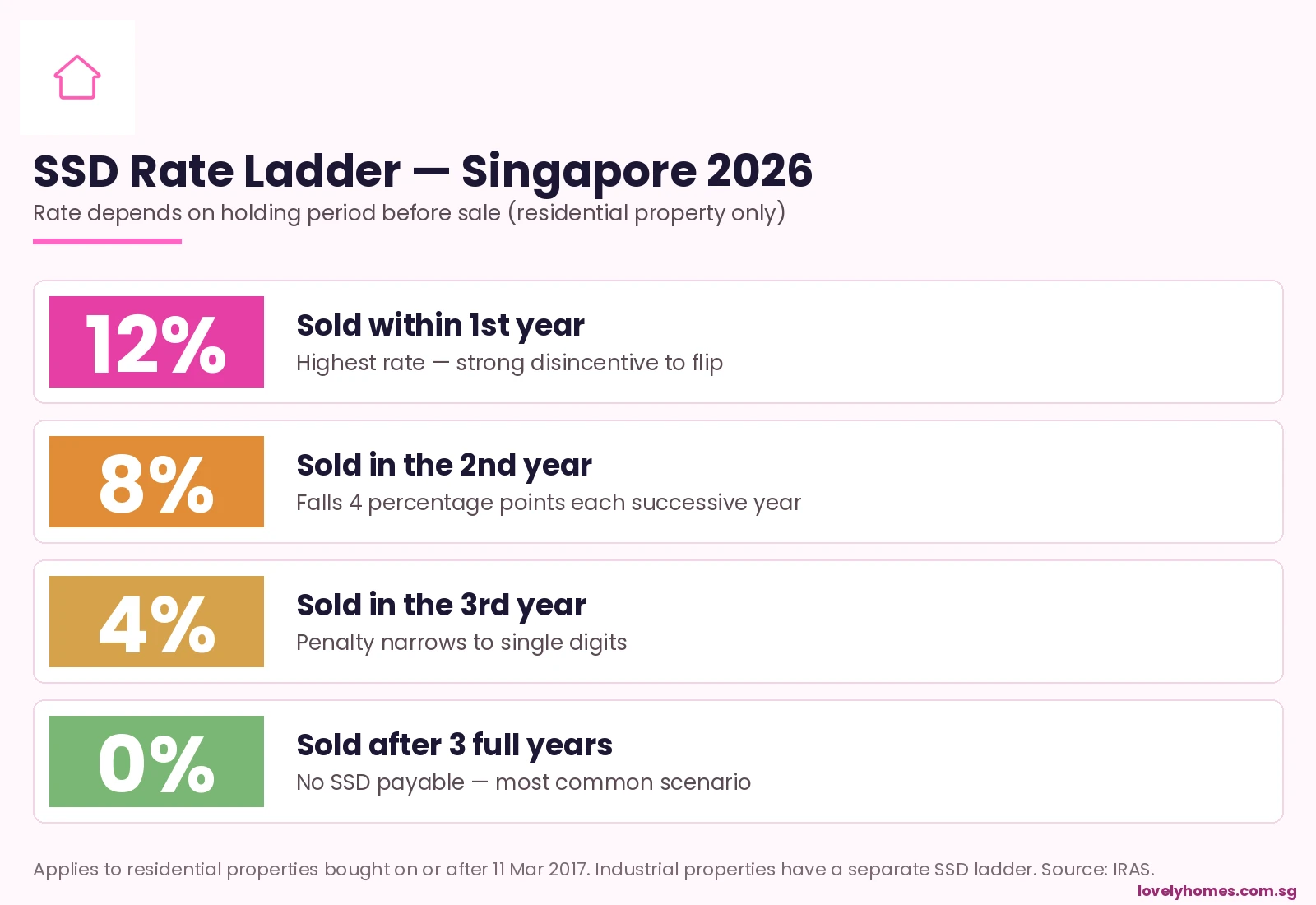
The rate you pay depends entirely on how long you held the property before signing the contract for sale. The ladder is steep at the top and falls four percentage points each subsequent year:

SSD rate ladder Singapore 2026 — 12% within first year, 8% second year, 4% third year, 0% after
Figure 1: SSD rate ladder by holding period — residential property, 2026.
Holding period at sale SSD rate Apparent on a S$1.5M sale
Up to 1 year (within 1st year) 12% S$180,000
More than 1 to 2 years 8% S$120,000
More than 2 to 3 years 4% S$60,000
More than 3 years 0% Nil

The rate is applied to the higher of the contracted sale price or IRAS’s assessed market value — sellers cannot lower their SSD bill by deliberately under-pricing a transaction.

When Does the Holding Clock Start — and Stop?

This is where most disputes arise, because the holding period is calculated to the day. The general rule is:

  • Start: the date the buyer signs the Option to Purchase (OTP) or, if there is no OTP, the date of the Sale & Purchase Agreement (S&P).
  • End: the date the buyer signs the next OTP or S&P when reselling.

Note carefully — the keys handover (TOP for new condos, vacant possession for resale) is irrelevant to SSD. A buyer who signs an OTP on 1 March 2024 and signs the next OTP on 28 February 2027 has held for one day under three years — SSD at 4% applies. Sign on 2 March 2027 and SSD drops to zero. Conveyancers routinely time exercise dates around this calendar boundary.

For new launches under construction, the start date is the OTP exercise date, not the TOP date. This means a buyer who signed an OTP in early 2023 for a project that only TOP’d in 2026 is already past the SSD window when they collect the keys.

Who Is Exempt or Remitted?

The exemptions list is narrow. SSD remission is granted only in specific situations, including:

  • HDB flats — not subject to SSD because HDB has its own Minimum Occupation Period (MOP) regime, which generally bars resale within five years.
  • Compulsory acquisition by the State (for example, road or MRT line widening).
  • Bankruptcy of the owner, with proof of insolvency proceedings.
  • Owners required by HDB to sell on grounds of policy violation.
  • Inherited property — the holding period is reckoned from the original purchase by the deceased, not the date of inheritance.
  • Property transferred between spouses as part of a court-ordered division on divorce, in some cases.

Standard life events — relocation overseas for work, family expansion, or financial difficulty — are not grounds for SSD remission. The tax applies even if the seller is selling at a loss.

Worked Example — A S$1.5M Condo Flipped in 6 Months

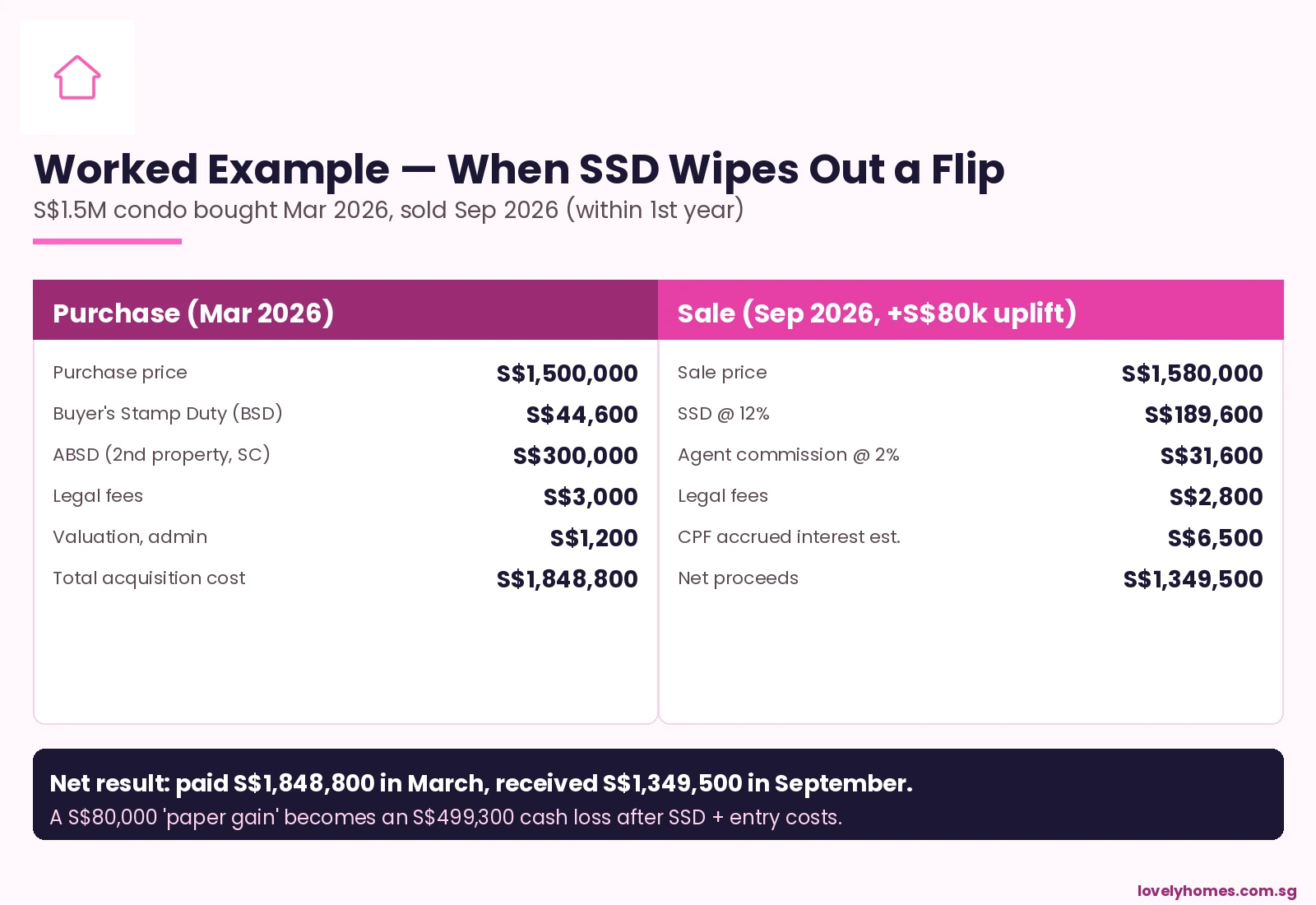
Imagine a Singapore Citizen who buys a S$1.5M private condo as a second property in March 2026, then receives a job offer in Hong Kong six months later and decides to sell at S$1.58M (a S$80,000 paper gain). Here is what the maths actually looks like:

SSD worked example: S$1.5M condo bought Mar 2026 sold Sep 2026 — S$499k cash loss after SSD
Figure 2: Worked example — an apparent S$80k gain becomes an S$499k cash loss when SSD is applied.

Acquisition costs (BSD, ABSD on the second property at 20%, legal fees) total S$348,800. The owner has paid S$1,848,800 to take possession. Six months later, the sale at S$1,580,000 attracts SSD at 12% (S$189,600), broker commission, legal fees, and CPF accrued interest. Net proceeds: S$1,349,500. Cash loss: S$499,300.

The lesson is brutal: SSD is designed to make short-term residential property sales economically unattractive even when the underlying market has moved up. For most second-property buyers, the only way to make the maths work is to stay invested for at least three years.

Strategies Sellers Actually Use

If you find yourself needing to sell within the SSD window, there are a small number of strategies practitioners commonly consider:

1. Run the holding-period calendar to the day

Conveyancers often time the OTP issue and exercise so that the sale falls just outside the next rate band. Selling on day 365 versus day 367 of the second year can mean a four-percentage-point swing on the sale price.

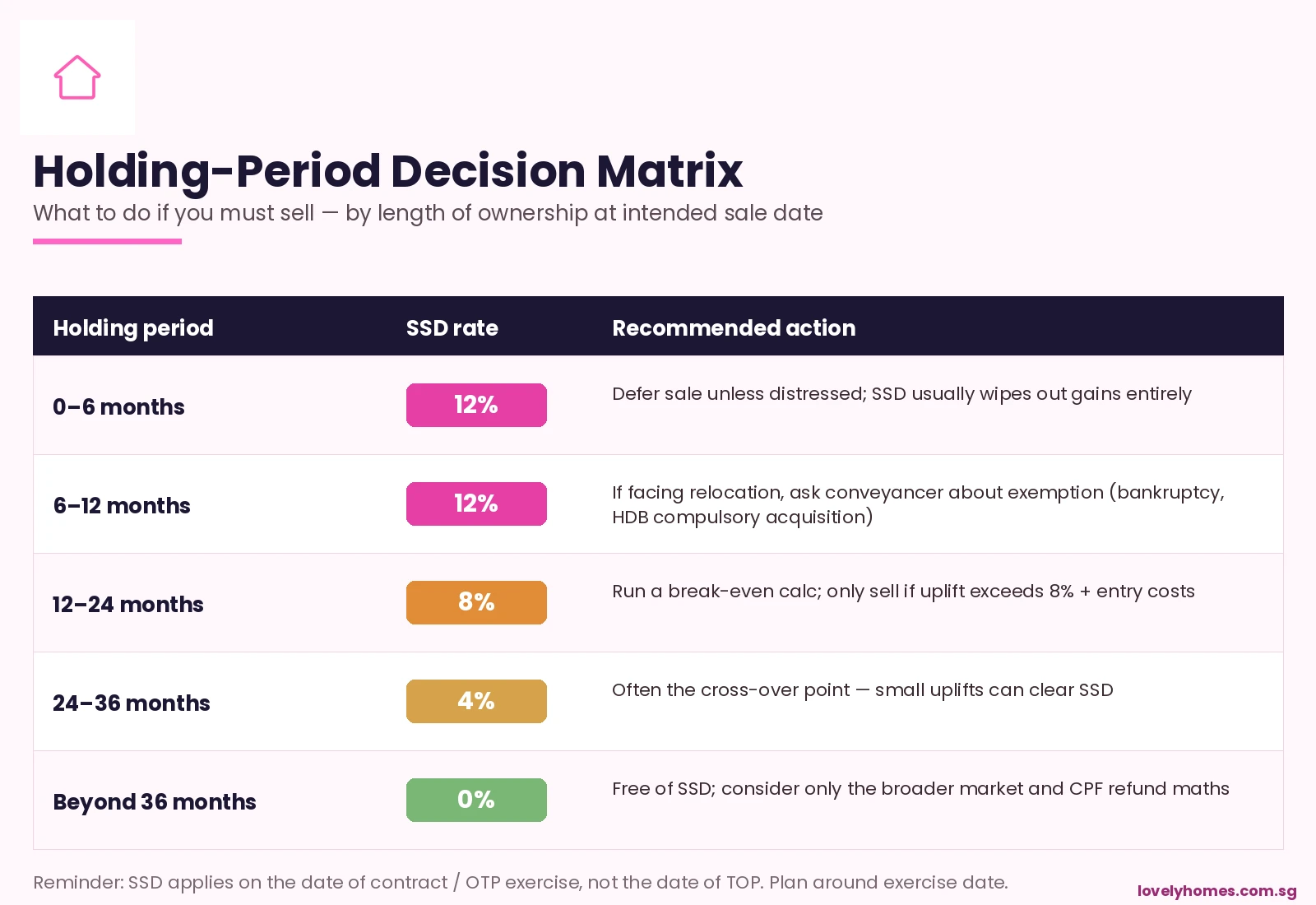
SSD holding-period decision matrix — what to do if you must sell, by length of ownership
Figure 3: Decision matrix — what to do if you must sell, by length of ownership.

2. Rent out instead of selling

If holding-period maths do not work, leasing the unit until SSD falls to zero can preserve value. Singapore rental yields on private condos run 3.0–3.8% gross in 2026, which often covers the carrying cost of the mortgage during the wait.

3. Decoupling within marriage

Where one spouse needs to free up ABSD allowance for a future purchase, transferring a property between spouses (a Part-Disposal arrangement) may attract SSD on the transferred share. Practitioners check carefully whether the holding clock survives the transfer.

4. Swap residential for commercial

Commercial property (offices, shops) is not subject to SSD. Investors with a short horizon sometimes pivot from residential plays to commercial plays specifically to avoid the SSD window. Commercial does carry GST, however, so the trade-off is real.

SSD on HDB — Yes, Technically — But MOP Comes First

Strictly, SSD does not apply to HDB flats sold during the SSD window because the HDB Minimum Occupation Period (MOP) usually prevents resale within five years anyway. The rare exceptions — flats sold under HDB’s compulsory-sale rules, or flats where MOP has been waived by HDB — are also exempt from SSD.

For practical purposes, most HDB sellers should treat MOP as the binding constraint and ignore SSD entirely.

SSD on Industrial Property — A Different (Shorter) Ladder

SSD on industrial property uses a separate, shorter ladder introduced in January 2013: 15% within the first year, 10% in the second year, 5% in the third year, and 0% thereafter — harsher in headline terms but with the same three-year horizon. Commercial property (offices, shops, hotels) attracts no SSD at all.

What This Means for You as a Buyer in 2026

The 2026 environment makes the holding-period calculus even more important. With ABSD at 20% on the second property for Singapore Citizens and 60% for foreigners, entry costs are already punishing. Adding a 12% SSD on a quick exit means roughly one-third of an investment property’s purchase price is consumed by transaction taxes if the holding period is mismanaged.

For buyer-occupiers, the practical advice is unchanged: buy what you can hold through three full years and a typical Singapore property cycle (roughly 7 to 10 years). For investors, the calculus is whether the projected three-to-five-year capital appreciation comfortably exceeds the entry-cost stack — not just SSD but BSD, ABSD, conveyancing, agent commission, and CPF accrued interest combined.

Frequently Asked Questions

Does SSD apply if I bought before 11 March 2017?

Yes, but at the older rate ladder applicable on the date of acquisition. Properties bought between 14 January 2011 and 10 March 2017 use the four-year, 16% / 12% / 8% / 4% ladder. Properties bought between 20 February 2010 and 13 January 2011 use a three-year, 3% / 2% / 1% ladder. IRAS publishes the historical rate tables for cross-reference.

Is SSD payable on the sale of a property at a loss?

Yes. SSD is calculated on the higher of the contracted sale price or the assessed market value, regardless of whether the seller realised a profit or loss on the transaction. Loss-making short-term sales remain fully taxable.

How is SSD different from ABSD?

ABSD (Additional Buyer’s Stamp Duty) is paid by the buyer at purchase based on residency status and number of properties already owned. SSD (Seller’s Stamp Duty) is paid by the seller at sale based on how long the property was held. They are independent taxes and can both apply to the same transaction at different ends.

What if I co-own a property with my spouse and only my spouse’s share is sold (decoupling)?

SSD applies to the share being transferred, calculated on the value of that share. The holding period for the transferred share is reckoned from the original date of acquisition. Conveyancers will typically structure the transfer documentation so that SSD exposure is calculated correctly for the share at issue.

Can I deduct SSD against my income tax?

No. SSD is a transaction tax, not a deductible business expense for an individual seller. Property held by a corporate vehicle may treat SSD differently — consult a Singapore tax adviser for any company-held holding.

Does SSD apply to gifts or transfers within the family?

Generally yes, where the transfer is treated as a sale at market value. There are limited remissions for transfers between spouses incident to divorce or for inherited property where the holding period is reckoned from the deceased’s original acquisition. Always verify with IRAS directly for non-arm’s-length transfers.

When exactly is SSD due?

SSD must be paid within 14 days of the contract for sale — that is, the date the buyer exercises the OTP or signs the S&P. Late payment attracts penalty interest of 5% on the unpaid duty per annum, plus possible additional charges. The seller’s conveyancer typically pays SSD out of the sale proceeds at completion.

Related Articles

Disclaimer

This article is intended as general information about Seller’s Stamp Duty in Singapore as at May 2026 and does not constitute tax, legal, or financial advice. Rates, exemptions, and procedures are set by the Inland Revenue Authority of Singapore and may be amended at any time without notice. For authoritative figures, refer to IRAS, the Housing & Development Board, the Monetary Authority of Singapore, the Urban Redevelopment Authority, and CPF Board for related procedures. For transactions of any size, engage a licensed Singapore conveyancing solicitor and, if relevant, a chartered accountant or tax practitioner before signing an OTP or S&P.

Translate »