Singapore TDSR & MSR Borrowing Limits Guide 2026: How Much Can You Borrow?
Quick Answer: TDSR & MSR at a Glance
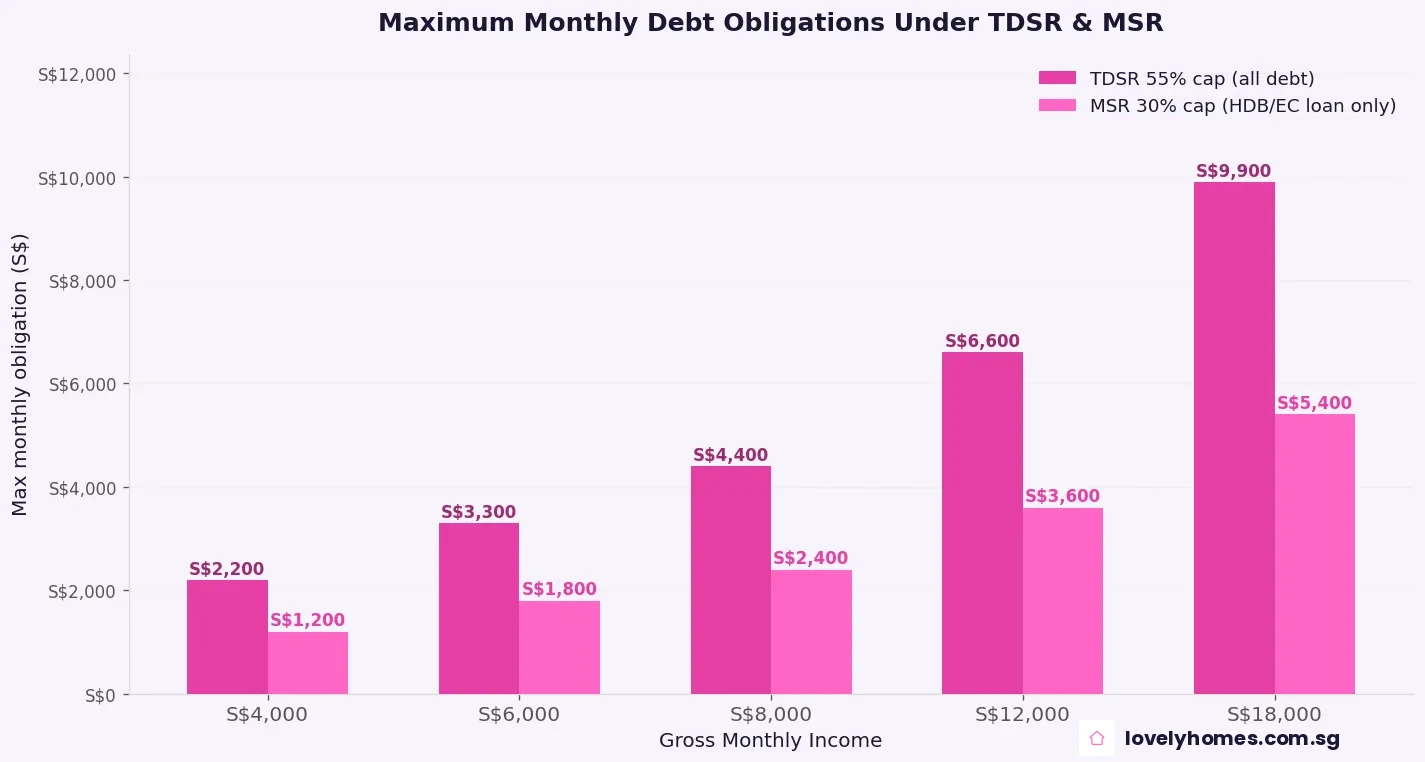
- TDSR 55%: The Total Debt Servicing Ratio caps all your monthly debt repayments at 55% of gross monthly income. Introduced by MAS in 2013 and tightened to 55% in September 2022.
- MSR 30%: The Mortgage Servicing Ratio applies only to HDB and Executive Condominium (EC) loans, capping the housing loan instalment at 30% of gross monthly income.
- LTV limits: First property (bank loan) 75%; first property (HDB loan) 80%; second property 45%; third and subsequent 35%.
- Stress-test rates: Bank loan TDSR calculations use the higher of the actual rate or 4% p.a. (floating), or 3% p.a. (fixed). HDB loans are assessed at 2.6% p.a. actual rate.
- Minimum cash: Bank loans require at least 5% cash for a first property; 25% cash for a second or subsequent property.
- Both rules stack: For HDB and EC purchases with a bank loan, BOTH TDSR and MSR must be satisfied simultaneously. The binding constraint is whichever gives the lower maximum loan.
- Variable income: MAS requires lenders to apply a 30% haircut to variable or commission-based income (e.g. bonuses, overtime) when computing TDSR.
- Existing debt matters: Car loans, personal loans, student loans and outstanding credit card balances all reduce how much you can borrow for a property loan.
What Is TDSR and Why Does It Exist?
The Total Debt Servicing Ratio (TDSR) is a borrowing framework administered by the Monetary Authority of Singapore (MAS) under MAS Notice 632. It was introduced in June 2013 to prevent households from over-borrowing against their incomes, and it applies to all property loans granted by financial institutions in Singapore — including banks, merchant banks and finance companies.
In practical terms, TDSR means that the total of all your monthly debt repayments — your housing loan instalment plus every other loan you service — must not exceed 55% of your gross monthly income. This 55% ceiling was tightened from 60% in September 2022 as part of a broader package of cooling measures aimed at moderating property demand. If your combined debt obligations would breach this threshold, the lender is required to reduce or reject the loan.
The TDSR framework applies to loans for any property purchase: HDB resale flats, private condominiums, landed homes, and commercial property. What changes depending on the property type is whether the Mortgage Servicing Ratio (MSR) also comes into play.
What Is MSR and When Does It Apply?
The Mortgage Servicing Ratio is a tighter, property-specific rule that sits inside the TDSR framework. MSR caps the monthly instalment on a housing loan used to purchase an HDB flat or an Executive Condominium (EC) at no more than 30% of the borrower’s gross monthly income. It applies to both HDB concessionary loans and bank loans where the security is an HDB flat or an EC.
MSR does not apply to private condominium purchases. For private property, only TDSR binds. This is a common source of confusion: many buyers assume a 30% limit applies to all property loans, but in reality the 30% cap is exclusive to the public and EC market. A buyer of a private apartment is free to commit up to 55% of income to total debt servicing, provided the housing loan does not push combined repayments above that ceiling.
If you are buying an EC with a bank loan, you must satisfy both TDSR (55%) and MSR (30%) at the same time. In practice, MSR is almost always the binding constraint for EC buyers, because 30% is more restrictive than 55%.
LTV Limits: How Much Can You Borrow?
The Loan-to-Value (LTV) ratio sets the maximum loan amount as a percentage of the property’s purchase price or market valuation, whichever is lower. LTV rules are set by MAS and the HDB and operate independently of TDSR — both must be satisfied, and the lower of the two maximum loan amounts applies.
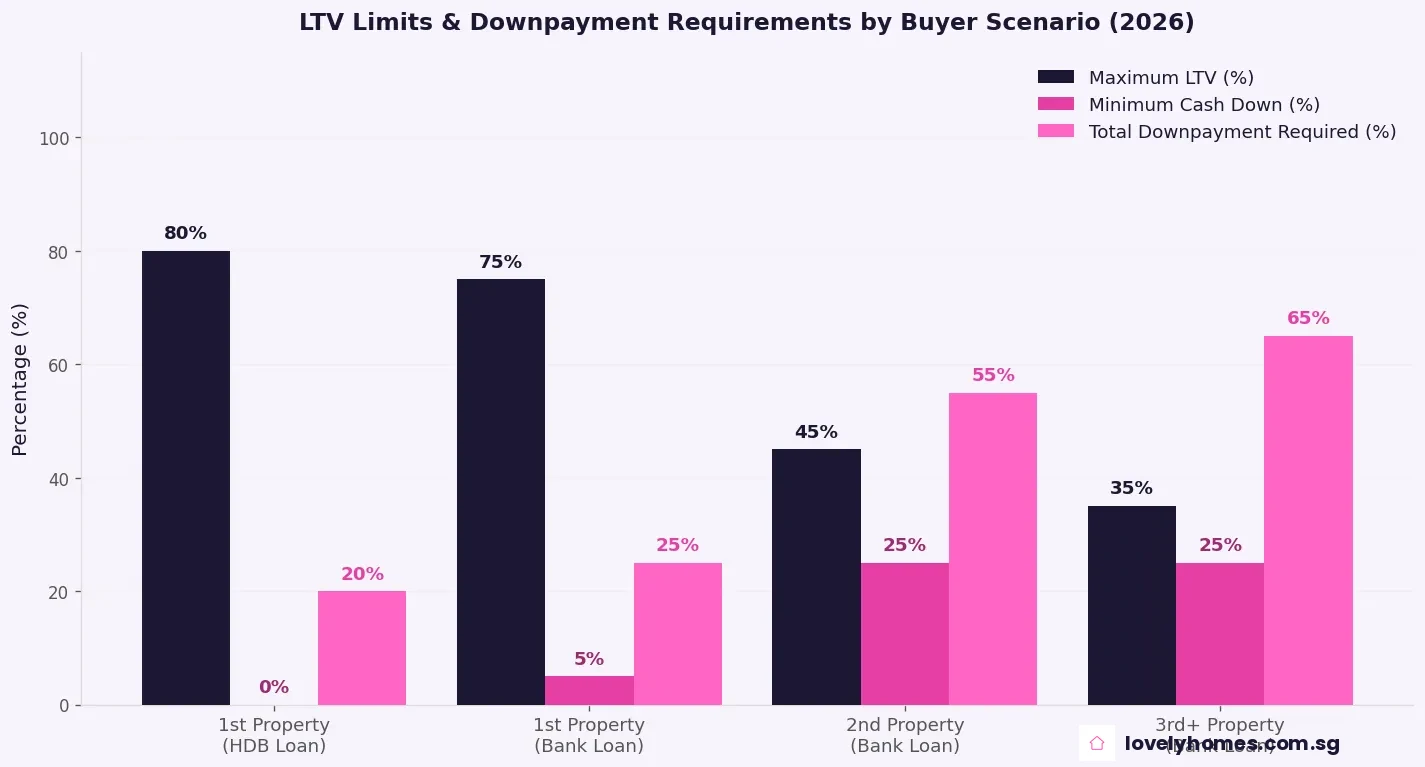
For a first residential property purchased with a bank loan, the LTV limit is 75%, meaning you can borrow up to three-quarters of the property value and must fund the remaining 25% from your own resources. Of that 25%, at least 5% must be paid in cash; the balance can come from CPF Ordinary Account (OA) savings. For second properties, the LTV drops sharply to 45%, with a minimum cash requirement of 25% of the purchase price. For third and subsequent properties, the LTV is 35%.
For HDB concessionary loans, the LTV is 80%, and HDB does not impose a minimum cash downpayment — the entire downpayment can be funded from CPF OA. This makes HDB loans particularly accessible for buyers with limited cash savings but healthy CPF balances.
How TDSR Is Computed: What Counts as Debt?
Understanding what income and debt figures your bank will use is critical to knowing your real borrowing limit. The following guidelines apply under MAS Notice 632.
Income included in TDSR calculation: Fixed monthly salary, regular allowances confirmed by the employer, rental income (after a 30% haircut), and investment income (after a 30% haircut). Variable income such as commissions, bonuses and overtime is eligible but subject to a 30% haircut — meaning only 70% of your average variable income over the past 12 months is recognised.
Debt counted in TDSR: All monthly loan repayments must be included: the proposed housing loan instalment (calculated at the stress-test rate — see below), car loans, personal loans, outstanding credit card balances (counted at 5% of the outstanding balance per month, or the minimum monthly repayment if higher), student loans, and other secured or unsecured borrowings. Investment property loan instalments also count, even if the property is tenanted and generating rental income.
Debt excluded from TDSR: Insurance premiums, utility bills, hire-purchase agreements for vehicles entered into before 26 August 2013, and medisave contributions are excluded from the TDSR computation.
Stress-Test Rates: Why Your Maximum Loan Is Lower Than You Think
Banks do not use the actual prevailing interest rate when computing your TDSR. Instead, MAS requires them to use a stress-test rate — a notional higher rate designed to ensure you can still service the loan if interest rates rise. The stress-test rates currently prescribed under MAS Notice 632 are:
- For floating-rate loans (e.g. SORA-pegged): the higher of the prevailing floating rate plus 1 percentage point, or 4% p.a.
- For fixed-rate loans: the higher of the prevailing fixed rate, or 3% p.a.
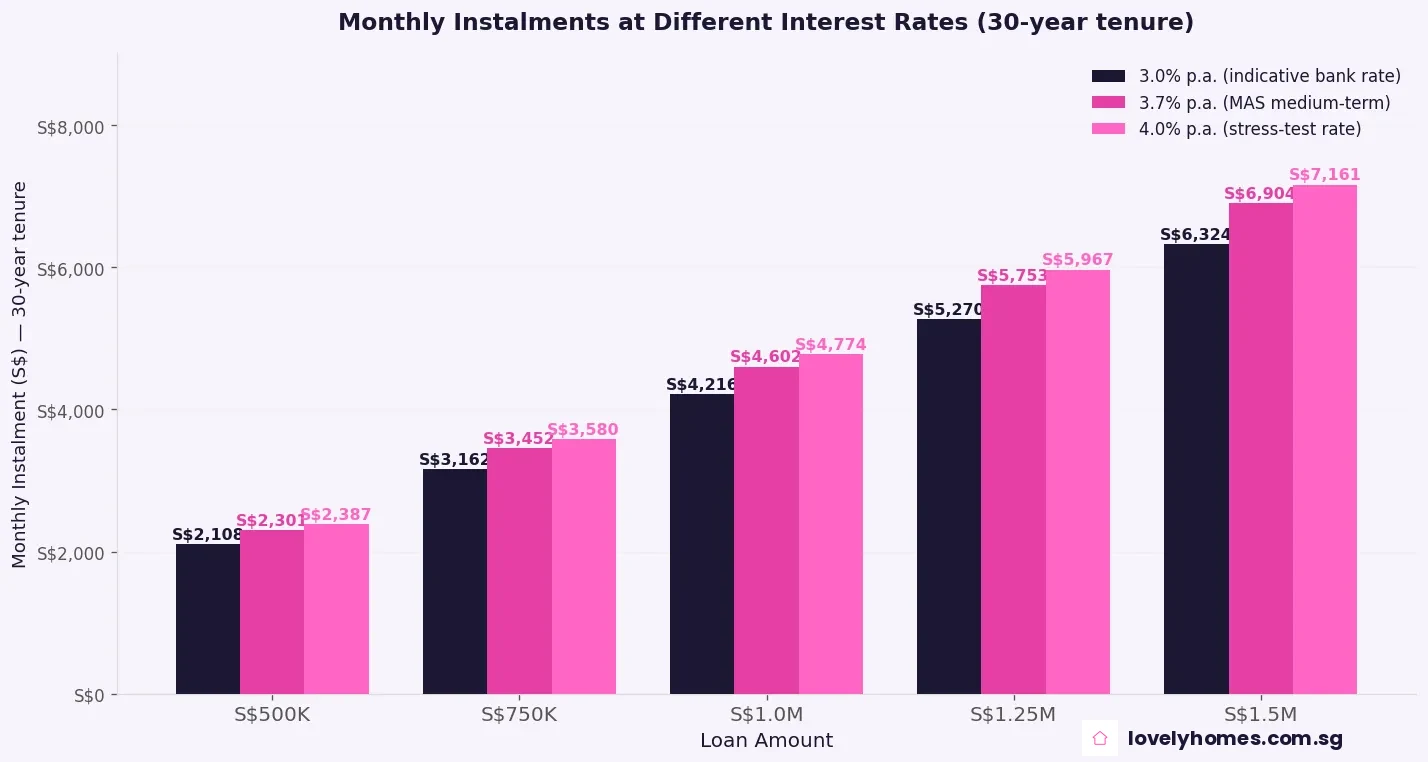
In practice, with SORA currently well below 3%, the 4% floor is the binding constraint for most floating-rate borrowers. This means your maximum eligible loan is calculated assuming you are already paying instalments at 4% p.a., even if the rate on offer today is significantly lower. This is a deliberate policy choice by MAS to build a buffer against rising rates.
Summary: TDSR & MSR Rules at a Glance (2026)
| Rule | Limit | Applies To | Administered By |
|---|---|---|---|
| TDSR | 55% of gross monthly income | All property loans (HDB, private, commercial) | MAS (Notice 632) |
| MSR | 30% of gross monthly income | HDB and EC loan instalments only | MAS / HDB |
| LTV (1st property, bank) | 75% of value | Bank loan for any property | MAS |
| LTV (1st property, HDB loan) | 80% of value | HDB concessionary loan only | HDB |
| LTV (2nd property, bank) | 45% of value | Any second property bank loan | MAS |
| LTV (3rd+ property, bank) | 35% of value | Third or subsequent property | MAS |
| Minimum cash (1st, bank) | 5% of purchase price | First property bank loan | MAS |
| Minimum cash (2nd/3rd+, bank) | 25% of purchase price | Second and subsequent properties | MAS |
Worked Example: TDSR, MSR and LTV in Action
Mr and Mrs Wong are Singapore Citizens. Their combined gross monthly income is S$11,000 (Mr Wong S$7,000 fixed salary; Mrs Wong S$4,000 fixed salary). They have a car loan with a monthly instalment of S$900. They wish to purchase a 4-room HDB resale flat in Tampines for S$635,000. They are evaluating both an HDB concessionary loan and a bank loan on a 25-year tenure.
HDB concessionary loan scenario:
LTV 80%: maximum loan = S$635,000 x 80% = S$508,000.
Monthly instalment at 2.6% p.a. over 25 years: approximately S$2,305/month.
MSR check: S$2,305 / S$11,000 = 20.9% — well within the 30% MSR limit. PASS.
TDSR check: (S$2,305 + S$900) / S$11,000 = 29.1% — well within the 55% TDSR limit. PASS.
Minimum downpayment: 20% = S$127,000 (can be fully funded from CPF OA; no minimum cash required for HDB loans).
Bank loan scenario:
LTV 75%: maximum loan = S$635,000 x 75% = S$476,250.
Stress-test rate at 4% p.a. over 25 years: monthly instalment = approximately S$2,508/month.
MSR check: S$2,508 / S$11,000 = 22.8% — within 30% MSR limit. PASS.
TDSR check (stress test): (S$2,508 + S$900) / S$11,000 = 30.98% — within 55% TDSR limit. PASS.
Actual instalment at 3.5%: approximately S$2,383/month.
Minimum downpayment: 25% = S$158,750; of which at least 5% cash = S$31,750 (balance S$127,000 from CPF OA).
In this scenario, TDSR and MSR are easily met for both loan types. The practical constraint is the LTV: the HDB loan allows borrowing S$508,000 versus S$476,250 for the bank loan. Buyers who have CPF OA savings but limited cash liquidity will find the HDB loan more accessible (no minimum cash downpayment). Buyers with strong CPF balances and competitive fixed-rate offers from banks may prefer the bank loan to obtain a potentially lower effective rate.
Why These Rules Matter for Singapore Property Buyers
Singapore’s TDSR and MSR framework is among the most comprehensive borrower-protection regimes in the region. The rules serve two distinct purposes. First, they protect households from the financial distress that follows over-borrowing: a borrower who commits 70% of income to debt servicing has almost no buffer for unexpected expenses, job loss, or rising interest rates. Second, they cool speculative demand by making it harder to pyramid property loans across multiple properties without meaningful income growth.
In practice, buyers frequently misjudge how tightly the rules bind. A family with S$12,000 combined gross income and a S$1,500/month car loan can only allocate S$5,100 to housing (TDSR: S$6,600 minus S$1,500 car). At the 4% stress-test rate on a 30-year tenure, that limits the loan to approximately S$1.07 million — well below the 75% LTV on many private condominiums in the Outside Central Region. Knowing your TDSR headroom before you start viewing properties prevents disappointment.
Peer-country context: Hong Kong’s TDSR equivalent caps at 50% (with a 60% ceiling at higher LTV thresholds), and Australia imposes a 3 percentage-point serviceability buffer above the applicable rate under APRA guidelines. Singapore’s 55% TDSR with a 4% stress-test floor is broadly in line with international standards — firm enough to prevent excess, flexible enough not to freeze out creditworthy middle-income buyers.
What Might Change Next: Forward-Looking Considerations
MAS reviews the TDSR stress-test rates periodically. With the global rate cycle having peaked in 2023 and benchmark rates declining through 2025 and into 2026, some commentators have speculated that MAS may soften the 4% floor for floating-rate loans if SORA remains suppressed. However, as at August 2026, MAS has given no indication of adjusting TDSR parameters, and the existing framework is viewed as the appropriate long-term calibration. Buyers should plan on the basis of existing rules rather than anticipated relaxation.
The MSR 30% limit for HDB and EC loans has been stable since its introduction in 2013. Any increase in income ceilings for HDB flats or ECs (currently S$14,000 per month for standard HDB; S$16,000 for ECs) would expand the pool of eligible buyers without adjusting the MSR percentage itself.
Frequently Asked Questions
Does TDSR apply if I am buying a property under a sole name while my spouse has no income?
Yes. TDSR is applied to the borrower or borrowers named on the loan application. If you are the sole borrower, your gross monthly income alone is used. Your spouse’s income is only included if they are a co-borrower on the loan. Adding a co-borrower with income can increase your eligible loan amount, but both parties become jointly liable for the debt. If your spouse has no income and you are the sole earner, only your income is recognised by the lender.
How does rental income affect TDSR?
Rental income from an investment property is recognised in TDSR calculations, but only at 70% of its value (a 30% haircut, consistent with the treatment of other variable income). You will need to provide tenancy agreements, tax documents, or a lender-accepted declaration to have rental income recognised. Note that the full outstanding loan on the tenanted property (including its monthly instalment) still counts as debt in your TDSR calculation, so the net benefit of rental income on your TDSR position depends on the rental yield relative to the loan instalment.
Does MSR apply to EC purchases with a bank loan?
Yes. ECs are classified as public housing for the first 10 years (until privatisation), and MAS applies MSR to any bank loan used to purchase an EC during this period. This means your monthly EC loan instalment must not exceed 30% of gross monthly income, regardless of whether a bank or the developer is financing the purchase. For buyers comparing ECs with private condominiums, this is a material difference: the same gross income unlocks a meaningfully larger private loan under TDSR alone.
What happens to my TDSR if I have an outstanding renovation loan?
Renovation loans are unsecured personal loans and count in full toward your TDSR calculation. If you took a S$50,000 renovation loan repayable over 5 years at S$900/month, that S$900 reduces your TDSR headroom for the proposed mortgage. It is therefore advisable to either fully repay renovation and personal loans before applying for a property loan, or factor them into your borrowing plan from the outset. Most banks will decline or reduce a property loan application where existing debt already consumes a significant portion of the 55% ceiling.
Can I use my CPF savings to reduce the loan amount and improve my TDSR position?
Absolutely. Making a larger CPF downpayment reduces the loan principal, which in turn reduces the monthly instalment and therefore the TDSR ratio. For example, if you put 40% down using CPF OA rather than the minimum 20%, the loan drops from 80% to 60% of the property value, cutting the monthly instalment roughly proportionally. However, note that CPF savings earmark a 2.5% p.a. accrued interest charge: when you sell the property, the CPF board recoups the principal plus all accrued interest, which reduces your net sale proceeds. Using CPF to improve TDSR does not eliminate this cost.
Are there any exemptions from TDSR?
MAS provides a limited TDSR exemption for owner-occupier purchases where the outstanding loan amount does not exceed S$200,000. In practice, very few Singapore properties are priced low enough to benefit from this exemption. There is no general TDSR exemption for first-time buyers, for purchases of HDB flats, or for any particular nationality or residency status. The exemption for purely commercial properties (non-residential) is governed separately under a different MAS notice, and is generally not applicable to residential purchases.
Related Articles
- Singapore Property Downpayment Guide 2026: How Much Cash and CPF You Need
- Singapore HDB Loan vs Bank Loan 2026: Which Should You Choose?
- Using CPF to Buy Private Property in Singapore 2026
- Singapore Property Investment Guide 2026
- ABSD Singapore 2026: Complete Guide to Additional Buyer’s Stamp Duty
- Singapore Buyer’s Stamp Duty (BSD) 2026: Rates and Calculations
Disclaimer
This article is for general information purposes only and does not constitute financial, legal or mortgage advice. TDSR, MSR and LTV rules are subject to change by MAS and HDB at any time. Borrowing limits depend on your individual financial profile, income documentation, and the specific property and loan product. Always consult a licensed financial adviser and your bank before committing to any property purchase or loan. Official sources: MAS (mas.gov.sg) and HDB (hdb.gov.sg).