Singapore Property Loan Refinancing Guide 2026: When, How and How Much You Save

Singapore Property Loan Refinancing Guide 2026: When, How and How Much You Save

Quick Answer: Property Loan Refinancing in Singapore 2026

  • Refinancing means switching your home loan to a different bank at a lower interest rate — typically saving S$100–S$375 per month on a S$400k–S$1.5M loan.
  • Repricing is staying with your existing bank and moving to a new package — faster and cheaper but with less rate competition.
  • The best time to refinance is when your lock-in period expires (usually after 2–3 years) — exiting early triggers a clawback of 1–1.5% of your outstanding loan.
  • All refinancing applications in Singapore are subject to the Monetary Authority of Singapore (MAS) Total Debt Servicing Ratio (TDSR) of 55%, stress-tested at 4% per annum.
  • Since August 2024, most bank packages are pegged to the Singapore Overnight Rate Average (SORA) — typically 3-month compounded SORA plus a spread of 0.8–1.2%.
  • Refinancing costs include legal fees (S$2,000–S$3,000), valuation (S$500–S$900), and admin charges — total usually S$3,000–S$4,500, partially offset by bank cash rebates.
  • HDB flat owners can refinance to a bank loan but cannot switch back to an HDB concessionary loan once they have taken a bank loan.
  • CPF accrued interest does not directly affect refinancing but must be refunded to CPF when you sell — keep this in mind if your purpose is to extract equity.

What Is Property Loan Refinancing?

Property loan refinancing in Singapore means replacing your existing home loan — whether from a bank or from HDB — with a new loan from a different financial institution. The primary motivation is almost always interest rate reduction: if your current loan rate is materially higher than what the market offers, switching can trim hundreds of dollars off your monthly instalment and save tens of thousands over the remaining loan tenure.

Refinancing is distinct from repricing. When you reprice, you stay with the same bank and simply move to a different loan package they offer. Repricing is quicker and involves no legal fees, but you are limited to whatever rates your existing bank is willing to give you. Refinancing gives you access to the full market — every bank’s current promotional rates — and typically delivers a larger rate reduction, especially if your current bank has not updated its offerings recently.

The Monetary Authority of Singapore (MAS) administers the regulatory framework governing home loans in Singapore, including the TDSR framework introduced in June 2013 and revised in September 2022. Under TDSR, your total monthly debt obligations — inclusive of the new loan instalment — must not exceed 55% of your gross monthly income, with the bank required to stress-test at a floor rate of 4% per annum (or the actual contracted rate, whichever is higher).

Repricing vs refinancing comparison table Singapore 2026
Figure 1: Repricing vs Refinancing — Key Differences | Source: LovelyHomes analysis, 2026

Repricing vs Refinancing: Which Is Right for You?

The choice between repricing and refinancing comes down to three variables: the rate differential, the cost of switching, and how much time remains on your current package.

Choose repricing if you want a quick, low-cost adjustment and your existing bank offers a competitive rate. Repricing is typically completed within two to four weeks with no legal conveyancing or valuation required. Many banks process repricings through their digital banking portals. The downside is that you are negotiating with only one bank, and their loyalty pricing is rarely their sharpest offer.

Choose refinancing if your existing bank’s new packages are materially uncompetitive, or if you want access to cash rebates (some banks offer S$2,000–S$4,000 for refinanced loans above certain quantum thresholds). Refinancing takes six to ten weeks end-to-end. You will need a conveyancing lawyer to discharge the existing mortgage and register the new one — typically S$2,000–S$3,000 all-in — and the new bank may require a fresh valuation of your property (S$500–S$900 for residential properties).

As a rule of thumb, refinancing becomes worthwhile when the rate reduction is at least 0.25–0.30% and your outstanding loan is S$400,000 or more. Below these thresholds, the cost savings may not justify the paperwork and fees over the new lock-in period.

When Should You Refinance?

The single most important factor is your lock-in period. Most bank home loan packages in Singapore impose a lock-in of two to three years. Refinancing during the lock-in triggers a prepayment penalty — commonly called a clawback — of 1.0–1.5% of the outstanding loan amount. On a S$600,000 loan, that is S$6,000–S$9,000, which would wipe out a year or more of savings. Always check your existing loan agreement before approaching any bank.

The optimal refinancing window is therefore one to three months before your lock-in expires. This gives you time to compare packages, apply, satisfy the bank’s underwriting requirements, and complete the legal conveyancing without a gap in coverage. Many Singaporeans set a calendar reminder for two years and nine months after signing their current loan agreement.

Outside of lock-in management, other triggers to consider refinancing include: a major income change that affects your TDSR headroom; interest rates falling by 0.4% or more from your contracted rate; and approaching a mortgage cliff where your rate resets from a promotional to a board/prime rate if you do not act.

SORA, Fixed Rates, and What the Market Looks Like in 2026

Since MAS phased out SIBOR (Singapore Interbank Offered Rate) in December 2024, virtually all floating-rate home loans in Singapore are now pegged to the Singapore Overnight Rate Average (SORA), administered by MAS. SORA is a transaction-based overnight rate derived from unsecured interbank borrowing in Singapore dollars.

Most banks offer loans pegged to the 3-month compounded SORA (3M SORA), published daily by MAS. In mid-2026, 3M SORA trades in a range of 2.80–3.10%, with banks adding a spread of 0.80–1.20% to arrive at effective rates of approximately 3.60–4.30% per annum, depending on loan quantum, LTV ratio, and the applicant’s creditworthiness.

Fixed-rate packages — where the interest rate is locked regardless of SORA movements for the fixed period (typically two or three years) — are available at 2.90–3.40% per annum from major banks in August 2026. Fixed packages suit borrowers who want payment certainty and believe SORA will rise, while SORA packages suit those who expect rates to fall and are comfortable with variability.

HDB flat owners who currently hold an HDB concessionary loan (at 2.6% per annum in 2026, pegged to CPF OA rate + 0.1%) may find refinancing to a bank loan attractive when bank promotional rates are below 2.6%. However, the one-way nature of this decision — once you take a bank loan you cannot revert to HDB financing — means it should not be taken purely to chase a short-term rate advantage.

Monthly savings from property loan refinancing by loan size Singapore 2026
Figure 2: Estimated monthly savings from a 0.30% rate reduction at different loan sizes | Source: LovelyHomes, 2026

How TDSR Affects Your Refinancing Eligibility

The Total Debt Servicing Ratio (TDSR) framework, administered by MAS, applies to every new home loan application — including refinancing. This means your existing bank’s waiver of TDSR assessment (applicable to some legacy loans) does not carry over to the new bank. The new bank must assess your TDSR from scratch, stress-testing the new loan instalment at the higher of the contracted rate or 4% per annum.

In practical terms: if you took your original loan at a time when your income was higher and your other debts were lower, and your financial position has since changed, you may find your refinancing options constrained. Common scenarios include borrowers who took on car loans, personal credit facilities, or are now paying for a second property — all of which count toward the TDSR numerator.

For owner-occupier properties, the 55% TDSR applies. For investment properties (non-owner-occupied), the same 55% threshold applies but lenders scrutinise rental income inclusion more carefully — typically only 70% of rental income is credited when computing the TDSR denominator.

If your TDSR is borderline, strategies include: paying down other debts before applying; increasing your declared income base if you have rental, freelance, or bonus income; or applying jointly with a co-borrower whose income strengthens the combined TDSR position.

Step-by-Step: How to Refinance Your Property Loan in Singapore

Property loan refinancing 6-step process Singapore 2026
Figure 3: Property loan refinancing — 6-step process | Source: LovelyHomes, 2026

The refinancing process in Singapore follows a broadly standard path across all lenders, though timelines vary:

Step 1 — Review your current loan. Retrieve your latest loan statement and note: the outstanding principal, the lock-in expiry date, the current interest rate, and any prepayment penalty clauses. This is the starting point for any breakeven calculation.

Step 2 — Compare market rates. Obtain indicative quotes from at least three banks. Use MAS’s published home loan rate comparison tool as a starting reference. Mortgage brokers (who are remunerated by the banks, not borrowers) can do this comparison work for you and often have access to unpublished promotional rates.

Step 3 — Apply to the preferred bank. Submit your Income Tax Notice of Assessment (NOA), CPF statements, recent payslips, existing loan statements, and the property title or HDB flat information. The bank will run a TDSR assessment and, if satisfied, issue a Letter of Offer typically within two to four weeks.

Step 4 — Property valuation. The new bank will commission a valuation of your property, typically from a panel valuer. For most residential properties in Singapore, this costs S$500–S$900 and takes five to ten working days. The bank’s loan quantum is capped at 75% (LTV) of the lower of the purchase price or valuation — though for refinancing the benchmark is the open market value, not any historical price.

Step 5 — Legal completion. Engage a conveyancing law firm (either your own or the bank’s panel solicitor) to discharge the existing mortgage and register the new one with the Singapore Land Authority (SLA). This takes two to four weeks and costs S$2,000–S$3,000 inclusive of disbursements. Many banks offer a subsidised legal fee package or absorb the cost for loans above certain quantum thresholds.

Step 6 — First payment at the new rate. Once the old bank has been redeemed and the new mortgage registered, your first instalment under the new rate kicks in. Set a reminder for the new lock-in expiry date to repeat the exercise in two to three years.

Costs and Fees: The Full Refinancing Bill

Cost Item Typical Range Notes
Legal / conveyancing fees S$2,000–S$3,000 Includes mortgage discharge, registration. Some banks subsidise or absorb.
Property valuation S$500–S$900 HDB flats: HDB valuation (free via HDB portal). Private property: bank panel valuer.
Admin / processing fee S$0–S$500 Most banks waive this for refinancing above S$500k.
Fire insurance S$150–S$400/yr Required for all mortgaged properties. Switch to new bank’s panel insurer.
Mortgage reducing term assurance (MRTA) Varies Optional but commonly required for HDB loans. Re-evaluate on refinancing.
Cash rebate from new bank (S$1,000)–(S$4,000) Offered by many banks for loans above S$500k–S$800k. Credited to loan account.
Net typical cost S$500–S$3,500 After rebates, many refinancings break even in under 12 months of savings.

Worked Example: Mr and Mrs Phua Refinance Their Condo Loan

Mr and Mrs Phua (both Singapore citizens) bought a 3-bedroom condominium in Queenstown in March 2022 for S$1,650,000. They took a 25-year bank loan of S$1,237,500 (75% LTV) at a 2-year fixed rate of 2.0% per annum — a very competitive rate at that time. Their lock-in expired in March 2024, but they did not refinance. By August 2026, their loan has been riding on the bank’s board rate of 4.45% per annum for over two years.

Outstanding loan balance as at August 2026: approximately S$1,060,000. Remaining tenure: 20 years and 7 months. Current monthly instalment at 4.45%: approximately S$6,640.

They obtain a refinancing quote from a competitor bank at 3.65% per annum (3M SORA + 0.85% spread), fixed for two years. New monthly instalment at 3.65%: approximately S$6,190. Monthly saving: S$450.

Refinancing costs: legal S$2,600 + valuation S$700 + misc S$200 = S$3,500 total. Cash rebate from new bank: S$3,000. Net out-of-pocket: S$500.

Breakeven: S$500 ÷ S$450/month ≈ 1.1 months. Over the two-year lock-in, total savings: S$450 × 24 = S$10,800 before compounding.

TDSR check: Combined gross monthly income S$22,000. New instalment S$6,190 (28.1% of income). No other debts. TDSR = 28.1% — well within the 55% cap. Refinancing proceeds without issue.

Summary: Key Refinancing Facts at a Glance

Factor Key Point
Best timing 1–3 months before lock-in expiry; never during lock-in without checking penalty
Typical savings S$100–S$450/month depending on loan size and rate differential
Breakeven point Typically 6–18 months after refinancing costs net of rebates
TDSR limit 55% of gross monthly income, stress-tested at 4% p.a. (MAS rule)
HDB → Bank loan One-way: cannot revert to HDB concessionary loan after switching
SORA rate (Aug 2026) 3M compounded ≈ 2.80–3.10%; effective bank rates ≈ 3.60–4.30%
Fixed rate packages Approximately 2.90–3.40% p.a. for 2–3 year fixed periods
Clawback penalty 1.0–1.5% of outstanding principal if you exit during lock-in

What Might Come Next for Singapore Mortgage Rates

Interest rate speculation is inherently uncertain, and readers should treat the following as analytical framing rather than financial advice. The trajectory of SORA tracks closely with the US Federal Reserve’s federal funds rate, given Singapore’s open capital account and currency-board-adjacent monetary framework administered by MAS.

As at August 2026, MAS has maintained its exchange-rate-centred monetary policy stance, with the Singapore dollar nominal effective exchange rate (S$NEER) at the upper bound of its policy band following the tightening cycles of 2022–2023. A return to historically low mortgage rates (sub-1.5%) appears unlikely in the near to medium term, given global structural factors including elevated sovereign debt levels, energy transition capex, and sustained wage growth in advanced economies.

For Singapore homeowners, the practical implication is that SORA-pegged variable rates are likely to remain in the 3.0–3.8% effective range through H1 2027 absent a recession-driven rate cut cycle. Borrowers with a higher risk tolerance and a view that rates will fall may prefer floating SORA packages; those who want payment certainty over the next two to three years may prefer a fixed package — particularly if it is priced below the prevailing SORA-equivalent.

Frequently Asked Questions

Can I refinance an HDB flat if I used an HDB loan originally?

Yes. You can refinance your HDB flat from an HDB concessionary loan to a bank loan at any time, provided you meet the new bank’s TDSR and LTV requirements. However, once you switch to a bank loan for an HDB flat, you cannot revert to HDB financing in the future. The decision is therefore permanent. HDB’s concessionary rate in 2026 is 2.6% per annum (CPF OA rate + 0.1%), and you should model the actual rate differential carefully before switching. HDB also allows partial refinancing — maintaining the HDB loan for a portion while taking a bank package for the remainder — subject to HDB’s approval.

What happens to my CPF if I refinance?

Refinancing itself does not trigger any CPF action. Your CPF Ordinary Account (OA) continues to service the new loan’s monthly instalments exactly as before — you simply redirect the CPF deduction to the new bank. The CPF Board tracks your cumulative CPF usage for the property (principal withdrawn plus accrued interest at 2.5% per annum compounded). This accrued interest amount grows over time and must be refunded to your CPF account when you sell or transfer the property. Refinancing does not reset, reduce, or otherwise alter this accrued interest obligation.

Is there a minimum or maximum loan amount for refinancing?

There is no statutory minimum, but as a practical matter most banks decline to underwrite refinancing transactions below S$150,000–S$200,000 in outstanding loan quantum — the processing costs are disproportionate at smaller amounts. There is no maximum outstanding loan amount per se, though the LTV cap of 75% for bank loans (or 55%/35% for subsequent properties) applies to the new loan quantum as a percentage of the current open market value. If property values have fallen significantly since your original purchase, you may find the bank’s new loan quantum is lower than your outstanding debt — leaving a shortfall you would need to top up with cash or CPF.

Can I refinance if I am currently unemployed or have changed jobs recently?

Refinancing requires the new bank to assess your current income for TDSR compliance. If you are unemployed at the time of application, most banks will decline unless you have demonstrable assets or other income (rental income, dividends, etc.) sufficient to satisfy TDSR. If you changed jobs recently — typically within the last three months — some banks require an additional payslip or an employer’s letter confirming permanent employment. Self-employed applicants must provide two years of Notice of Assessment and, in many cases, business bank statements. The safest approach is to initiate the refinancing process before any anticipated income changes if possible.

Does refinancing affect my Additional Buyer’s Stamp Duty (ABSD) position?

No. Refinancing is a change of financing arrangement only — no transfer of ownership occurs, so no stamp duty of any kind (ABSD or BSD) is triggered. However, if you are in the middle of an ABSD remission window — for example, if you are a Singapore citizen couple who sold your first property and have six months to complete the purchase of a new one — take care that the refinancing does not delay the completion timeline of the purchase transaction. The ABSD remission is tied to completion dates, not financing arrangements.

Should I use a mortgage broker or go direct to the bank?

Mortgage brokers in Singapore are paid by the banks (a referral fee) rather than by borrowers — so their services cost you nothing directly. The benefit of using a broker is access to multiple banks’ current promotional rates simultaneously, plus guidance on document preparation and TDSR structuring. The limitation is that some banks offer rates only through direct channels. For a first-time refinancer, or for loan amounts above S$600,000 where the negotiating leverage is meaningful, a broker adds genuine value. For straightforward repricing transactions, going directly to your existing bank’s home loan team is usually faster and simpler.

Related Articles


Disclaimer: This article is for general informational purposes only and does not constitute financial, legal, or mortgage advice. Interest rates, MAS regulations, CPF rules, and bank product terms change regularly. Readers should verify all figures with the Monetary Authority of Singapore (mas.gov.sg), CPF Board (cpf.gov.sg), and consult a licensed financial adviser or mortgage broker before making any refinancing decision. LovelyHomes does not endorse any bank, product, or adviser mentioned in this article.
Buying a Condo in Singapore 2026: OTP, Stamp Duties, TDSR and Step-by-Step Process Explained

Buying a Condo in Singapore 2026: OTP, Stamp Duties, TDSR and Step-by-Step Process Explained

×

Click anywhere to close
Quick Answer — Buying a Condo in Singapore 2026: Key Facts

  • Any Singapore Citizen (SC), Permanent Resident (SPR), or foreigner may buy a private condominium — no eligibility restrictions apply beyond the owner-occupier requirement lifted for private property.
  • Bank loans cover up to 75% LTV; minimum cash downpayment is 5% of purchase price; the remaining 20% may come from CPF OA.
  • Total Debt Servicing Ratio (TDSR) cap: 55% of gross monthly income. No Mortgage Servicing Ratio (MSR) applies to private property.
  • Buyer’s Stamp Duty (BSD) is payable by everyone: S$44,600 on a S$1.5M condo; S$69,600 on S$2.0M.
  • Additional Buyer’s Stamp Duty (ABSD): 0% for SC buying their first property; 20% for SC second property; 60% for foreigners.
  • For resale condos, the Option to Purchase (OTP) process runs 14 days; completion typically 70–90 days. New launch condos use a booking fee/S&P process taking 8–12 weeks to first payment milestone.
  • Condo prices range from roughly S$700K (OCR 1BR) to S$6.5M+ (CCR 4BR) in 2026.
  • No Capital Gains Tax applies in Singapore — profits on sale are generally tax-free (Seller’s Stamp Duty applies if sold within 4 years).

A private condominium is the most aspirational stepping stone in Singapore’s property ladder. It represents the point at which a buyer exits the HDB framework — and its attendant rules — and enters the open market. Yet the process of buying a condo, especially for first-timers, involves a layer of documents, timelines, and financial calculations that can feel daunting. This guide walks through every stage: from eligibility and financing, to the Option to Purchase (OTP), stamp duties, CPF rules, and what you will actually pay before you get the keys.

All figures are current as at 11 June 2026. Regulations on loan-to-value (LTV), TDSR, and stamp duties are set by the Monetary Authority of Singapore (MAS), the Inland Revenue Authority of Singapore (IRAS), and the CPF Board respectively.

Who Can Buy a Condo in Singapore?

Private condominium units are open to all buyers regardless of citizenship or residency status — Singapore Citizens, Singapore Permanent Residents, and foreigners may all purchase. There is no income ceiling, no minimum occupation period restriction prior to purchase, and no ethnic integration quota. The key constraints are purely financial: ABSD rates, LTV limits, and TDSR/income requirements.

One constraint that often surprises first-time private buyers: if you currently own an HDB flat, you must dispose of it within six months of taking possession of the condo (if you are an SC) — failing to do so means you will have paid 20% ABSD on the condo and will face IRAS penalties. This “sell first” obligation is the operational heart of the Singapore upgrader journey and we cover it in detail in our HDB Upgrading Guide 2026.

Condo Price Ranges in Singapore 2026

Prices vary dramatically by location. Singapore’s private residential market is segmented into three main regions: Outside Central Region (OCR), Rest of Central Region (RCR), and Core Central Region (CCR). OCR encompasses the heartland suburbs — Tampines, Sengkang, Jurong, Punggol. RCR covers the city fringe — Queenstown, Toa Payoh, Bishan, Eunos. CCR is prime — Districts 9, 10, 11, Marina Bay, Sentosa.

Singapore condo price ranges by region 2026 — OCR RCR CCR comparison bar chart
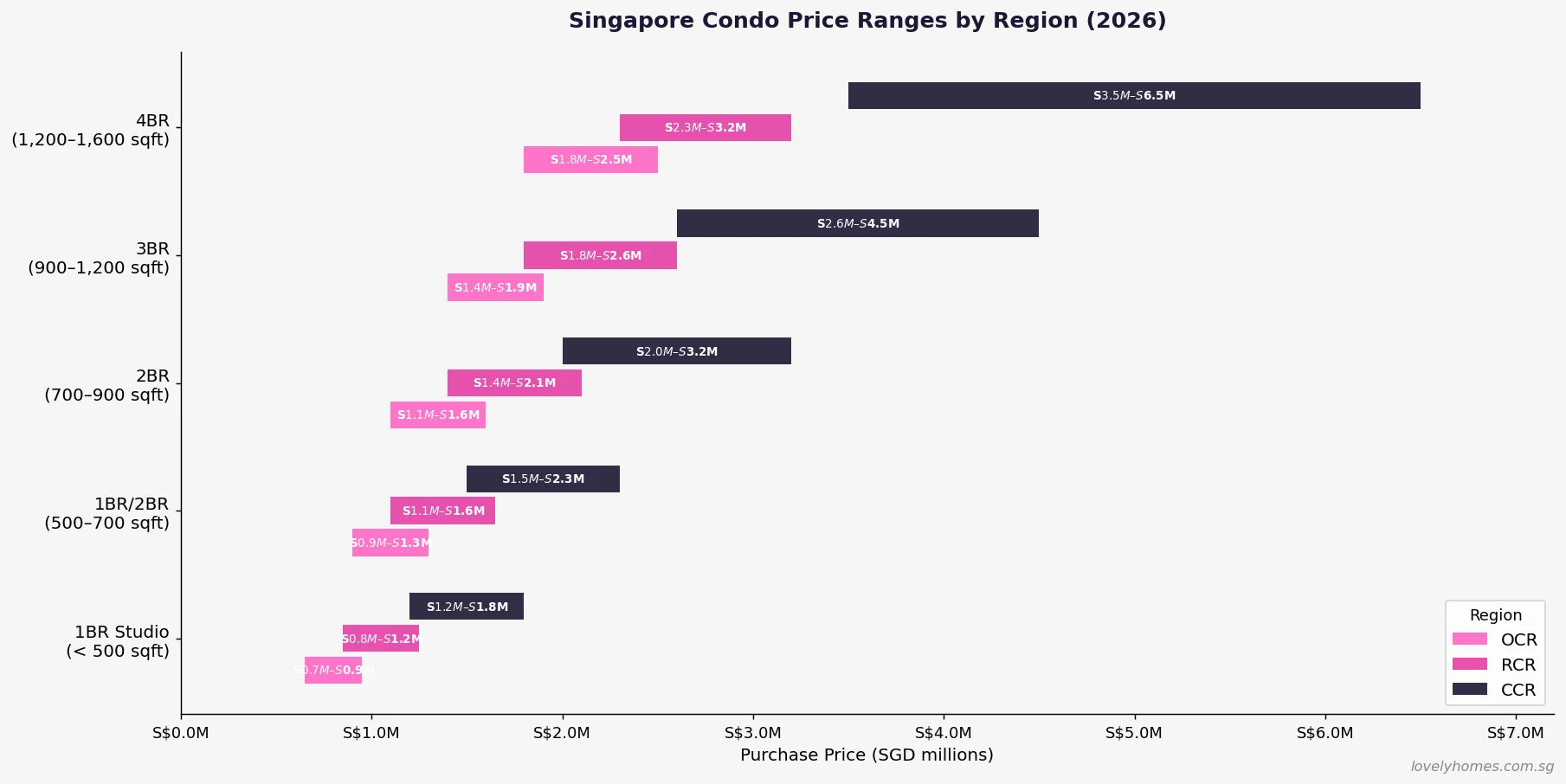
Figure 1: Singapore private condo price ranges by unit type and region (2026). OCR = Outside Central Region; RCR = Rest of Central Region; CCR = Core Central Region. Source: URA, industry transaction data.

For a 3-bedroom unit in 2026, an OCR condo typically transacts at S$1.4M–S$1.9M; the same unit in the CCR can reach S$2.6M–S$4.5M or beyond for prime addresses. New launches carry a new-launch premium over resale units of roughly 5–15% in most districts.

New Launch vs Resale: Key Differences

The most fundamental decision before buying a condo is whether you are looking at a new launch (bought directly from the developer, often before the building is complete) or a resale unit (bought from a private seller on the open market).

New launches are typically launched with deferred payment: a booking fee of 5% (cash only), then 15% at S&P signing (within 8 weeks), then progressive payments tied to construction milestones. You take possession 3–5 years after booking. During that period, no rental income and no physical inspection of the unit. The upside: you lock in today’s price and CPF/mortgage cashflow spreads across years. Developers often offer stamp-duty absorption or furniture voucher promotions on slow-moving units.

Resale condos are completed units. You can inspect them, move in within 10–12 weeks of OTP exercise, and rent them out immediately. The OTP process involves a 1% option fee, followed by 14 days to decide and exercise. On exercise, you pay a further 4% (totalling 5% of purchase price), then complete within 70–90 business days.

Feature New Launch Resale Condo
Payment structure Progressive (booking fee → milestones) Full 5% on OTP + balance at completion
Time to possession 3–5 years (from booking) 10–12 weeks from OTP exercise
Physical inspection Show unit only (not actual unit) Full inspection possible
Rental income Only after TOP (3–5 years) Immediately after completion
CPF + loan drawdown Progressive during construction Full drawdown at completion
SSD risk Only on re-sale within 4 years of TOP Applies if sold within 4 years of purchase
Price premium vs resale Typically +5–15% for comparable location Benchmark price
Renovation needed? Bare unit; full reno required Often move-in ready or partial reno

The Condo Buying Process — Step by Step

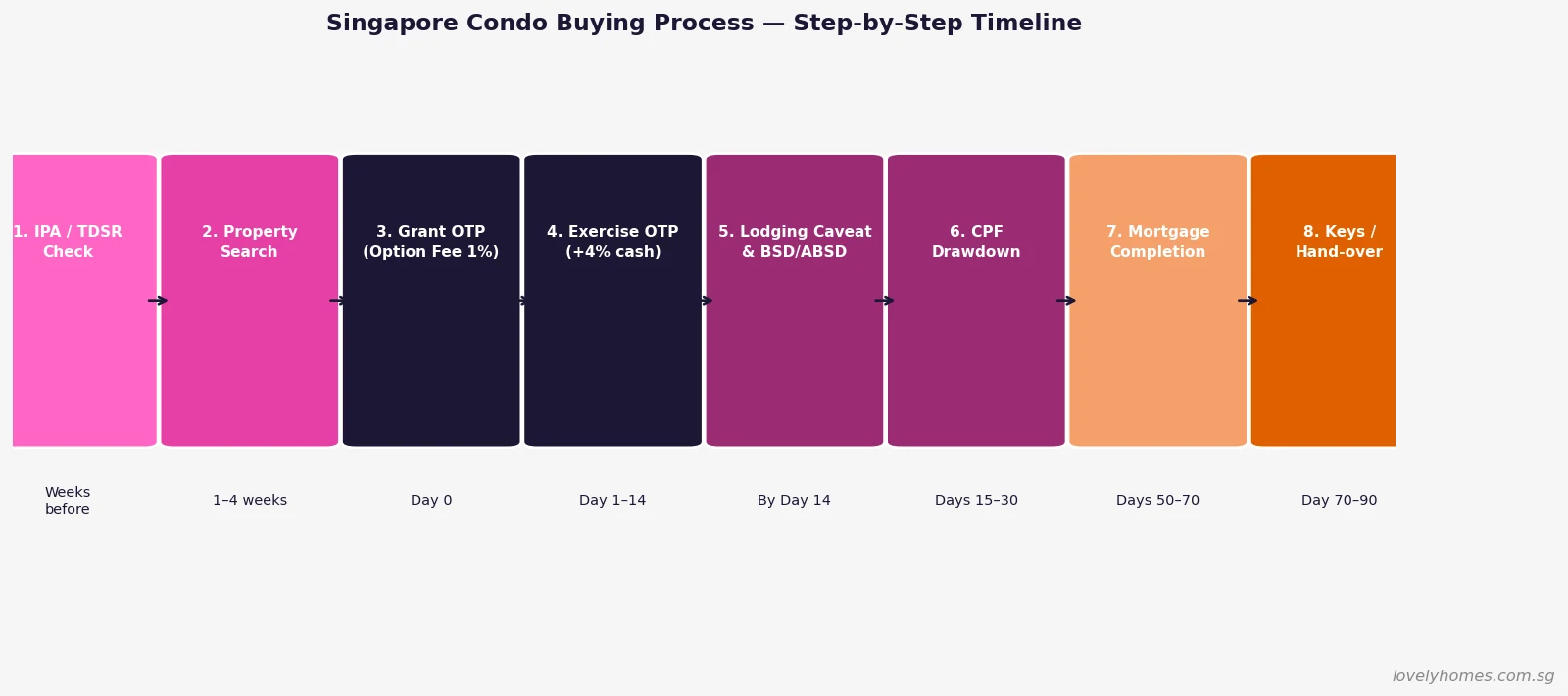
Singapore condo buying process step-by-step timeline 2026 — OTP exercise BSD ABSD completion
Figure 2: Step-by-step condo buying timeline for a resale transaction. New launch timelines differ: milestone payments replace the single-completion structure.

For a resale condo, the legal process is tightly choreographed:

Step 1 — Loan Pre-Approval (IPA). Before making any offer, obtain an In-Principle Approval (IPA) from your chosen bank. This confirms your borrowing capacity and signals seriousness to sellers. IPAs are valid for 30 days.

Step 2 — Property Search & Negotiation. View units, compare recent caveats on URA’s Real Estate Information System (REALIS), and negotiate the price. Once agreed, the seller’s representative issues the OTP.

Step 3 — Receive and Pay OTP Option Fee (1%). The option fee is typically 1% of the purchase price (negotiable for very high-value properties). This gives you the exclusive right to purchase for 14 days.

Step 4 — Exercise OTP (+ 4% cash). Within 14 days, your lawyers will advise you to exercise the OTP by paying the remaining 4% exercise fee (total 5% paid). At this stage, you engage a conveyancing lawyer if you haven’t already.

Step 5 — Stamp Duty: BSD + ABSD (within 14 days of OTP). Both BSD and ABSD must be stamped within 14 calendar days of signing the OTP. Late payment incurs IRAS penalties. BSD can be reimbursed from CPF post-stamping; ABSD must be paid in cash.

Step 6 — CPF Drawdown & Mortgage Disbursement. Your lawyers submit the CPF withdrawal application and lodge a caveat at the Singapore Land Authority (SLA). The bank releases the loan funds.

Step 7 — Completion (S&P / Transfer). Typically within 70–90 days of OTP exercise for a resale condo. Title transfers, keys are handed over.

Financing a Condo Purchase: LTV, TDSR and Loan Options

Private condo buyers borrow from commercial banks (not HDB). The key regulatory frameworks are:

Loan-to-Value (LTV) limits. For your first property mortgage with a bank: LTV 75%, meaning you can borrow up to 75% of the purchase price or valuation (whichever is lower). For a second property, LTV drops to 45%; third and subsequent to 35%. These MAS limits were last updated in August 2024, when the HDB loan LTV was reduced from 80% to 75%.

Total Debt Servicing Ratio (TDSR). No more than 55% of your gross monthly income may be committed to total debt obligations — home loan, car loan, credit card minimum payments, personal loans, all included. Banks apply a stress test interest rate of 4.0% (as at 2026) regardless of the actual offered rate, which is usually lower.

No MSR for private property. The Mortgage Servicing Ratio (MSR) — which caps housing loan payments at 30% of income — only applies to HDB flats and ECs bought from developers. Private condo buyers only need to satisfy TDSR.

Interest rates. Most banks in 2026 offer SORA-pegged packages (3-month SORA at approximately 2.4%) or fixed-rate packages. All-in rates for 30-year private property loans typically range 3.1%–3.8% in mid-2026. Always compare SIBOR-to-SORA transition implications with your relationship manager. More detail in our Singapore Home Loan Complete Guide 2026.

Stamp Duties: BSD and ABSD Explained

Every condo buyer pays Buyer’s Stamp Duty (BSD) — a progressive tax on purchase price. On top of that, ABSD applies for second-and-subsequent properties or non-citizens:

Purchase Price BSD Payable Effective BSD Rate
S$800,000 S$18,600 2.33%
S$1,200,000 S$33,600 2.80%
S$1,500,000 S$44,600 2.97%
S$2,000,000 S$69,600 3.48%
S$2,500,000 S$94,600 3.78%
S$3,000,000 S$119,600 3.99%
S$4,000,000 S$219,600 5.49%

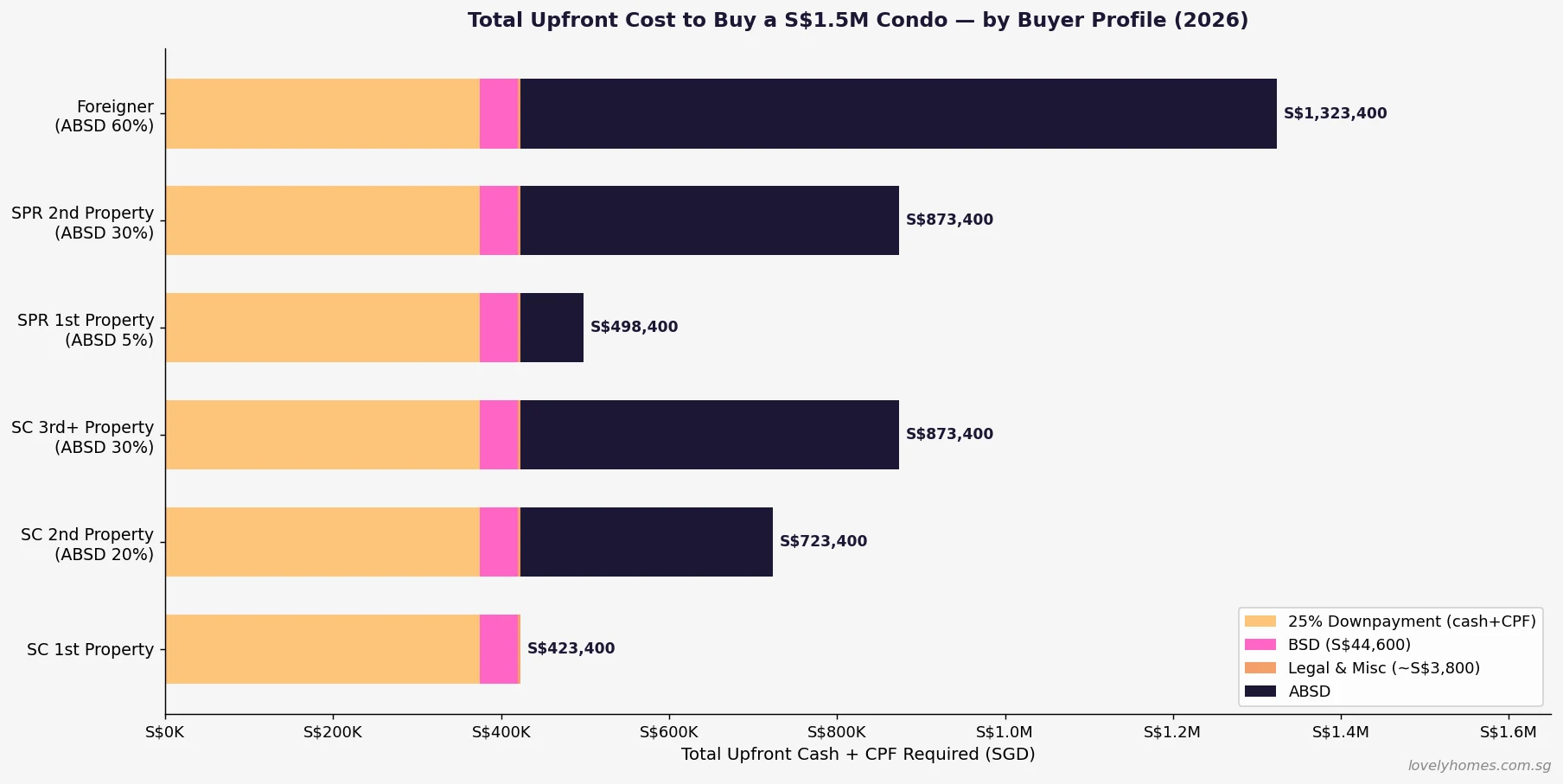
For ABSD, remember: SC 1st property = 0% ABSD; SC 2nd = 20%; SC 3rd+ = 30%; SPR 1st = 5%; SPR 2nd = 30%; Foreigner = 60% (all properties). Full details in our ABSD Complete Guide 2026.

Total upfront cost to buy S$1.5M condo by buyer profile 2026 — BSD ABSD downpayment comparison
Figure 3: Total upfront cash and CPF required for a S$1.5M condo across buyer profiles (2026). LTV 75% assumed (25% downpayment). BSD S$44,600 applies to all profiles.

Using CPF to Buy a Condo

Your CPF Ordinary Account (OA) may be used to pay the downpayment (the 20% non-cash portion) and ongoing monthly mortgage instalments for a private condo, subject to:

The Valuation Limit (VL): total CPF usage cannot exceed the lower of the purchase price or the valuation at the time of purchase — so if you pay S$1,650,000 for a condo valued at S$1,600,000, your CPF ceiling is S$1,600,000.

The Withdrawal Limit (WL): once you have drawn CPF up to the VL and still have an outstanding bank loan, you may draw a further 20% of VL provided you have set aside the applicable Basic Retirement Sum (BRS — S$106,500 in 2026) in your CPF accounts.

The 5% cash rule: the minimum 5% downpayment must be in cash. CPF may only fund the remaining 20% of the 25% total downpayment.

Critically: every dollar of CPF drawn for property accrues interest at 2.5% per annum compounding. When you eventually sell, you must refund the principal plus all accrued interest back to your CPF OA. This does not reduce your profit on paper, but it does reduce the cash you take home from the sale. Read the full analysis in our CPF Private Property Guide 2026.

Choosing Between OCR, RCR and CCR

The three-region framework is more than a price guide — it reflects fundamentally different buyer profiles, rental markets, and investment theses:

OCR (Outside Central Region) is where most Singaporean families and HDB upgraders buy. Yields are strongest here — typically 3.8%–4.8% gross for 2BR/3BR units — because rental demand from expats, young professionals, and domestic upgraders is broad. Capital appreciation can be rapid when an infrastructure catalyst (a new MRT line, a GLS announcement) lands nearby. The tradeoff: commute times to CBD are longer, and CCR-calibre tenants (senior bankers, diplomats) rarely rent in OCR.

RCR (Rest of Central Region) is the sweet spot for many: city-fringe convenience, more manageable entry prices than CCR, yet close enough to attract both expat and local renters. Districts 3, 10 (parts), 14, 15, 20 are all RCR. Yields run 3.2%–4.2%. New launches here have outperformed on price appreciation in the 2020–2026 run, driven by URA master-plan transformations (Queenstown, Kallang, Pearl’s Hill).

CCR (Core Central Region) is Singapore’s luxury and investment-grade market. Prices per square foot range from S$2,500 to S$5,000+ for prime District 9/10/11 addresses. Rental yields are the weakest (2.5%–3.5%) because asset values are high, but capital preservation in USD/GBP/EUR terms attracts significant foreign (FTA-exempt) and ultra-high-net-worth demand. The 60% ABSD has effectively handed CCR supply to the FTA-exempt buyer pool.

Worked Example: Mr & Mrs Chen Buy Their First Condo

Profile: SC couple, first private property, joint income S$16,000/mth

Property: 3-bedroom OCR condo in Sengkang, S$1,650,000. Freehold.

BSD: S$180K×1% + S$180K×2% + S$640K×3% + S$500K×4% + S$150K×5% = S$1,800 + S$3,600 + S$19,200 + S$20,000 + S$7,500 = S$52,100

ABSD: 0% (SC, first residential property)

Financing: Bank loan 75% LTV = S$1,237,500 @3.2% 30yr
Monthly repayment = approximately S$5,354/mth
TDSR = S$5,354 / S$16,000 = 33.5% — PASS (below 55% ceiling)

Downpayment (25%): S$412,500
  — Cash (min 5%): S$82,500
  — CPF OA (up to 20%): S$330,000

Total upfront outlay:
Downpayment: S$412,500
BSD (can reimburse from CPF after stamping): S$52,100
Legal & conveyancing fees: ~S$4,200
Grand total: ~S$468,800

Note on SSD: If the Chens sell within 4 years of purchase, SSD applies: 16% (Year 1), 12% (Year 2), 8% (Year 3), 4% (Year 4). They plan to hold long-term, so SSD is not a concern. Full details: SSD Guide 2026.

What This Means for Singapore Property Buyers in 2026

The private condo market in 2026 sits in a period of relative stability after the sharp price run of 2020–2023. URA’s private residential price index for Q1 2026 shows OCR prices up 1.1% quarter-on-quarter — moderate, not frothy. Interest rates, while above the near-zero era of 2010–2021, have stabilised: 3M SORA has hovered around 2.4% since late 2025. The TDSR and LTV framework means buyers are better-capitalised than in previous cycles.

For SC first-timers, the 0% ABSD window is exceptionally powerful: you can buy a S$1.6M condo and pay zero ABSD. Compare this to your SPR peer who pays 5% (S$80,000) or your foreigner colleague who pays 60% (S$960,000). Singapore citizenship carries extraordinary financial value in the property market — an advantage worth leveraging before your second purchase triggers the 20% ABSD.

What Might Come Next for the Condo Market

The Government’s track record on cooling measures is well-established: when private prices accelerate beyond what income growth can justify, additional rounds of ABSD increases, LTV tightening, or supply-side intervention (GLS increases) follow. The 2H2026 GLS programme announced in June 2026 adds approximately 4,010 private residential units to the Confirmed List — a signal that supply is being managed upward to prevent affordability deterioration.

Speculation (not official MAS guidance): if private price growth accelerates beyond 5–6% annually in the second half of 2026, the Government may revisit ABSD or TDSR thresholds, as it has done in April 2023. Buyers with strong holding power and clear owner-occupier intent are best insulated from policy risk; leveraged short-term investors should be especially mindful of SSD exposure within the four-year window.

Frequently Asked Questions

Can I buy a condo while still owning an HDB flat?

Yes — but with significant financial consequences. An SC who holds an HDB flat and buys a private condo will trigger 20% ABSD on the condo (second property rate), as they are deemed to hold two residential properties. To avoid ABSD, most upgraders adopt a “sell first, buy second” sequence, disposing of the HDB before exercising the condo OTP. Alternatively, the ABSD remission scheme allows an SC couple to buy a replacement home while still owning the first property, provided they sell the first within six months of the later of the condo’s purchase or its TOP date. See our full analysis in the HDB Upgrading Guide 2026.

Is there a minimum income to buy a private condo?

There is no statutory minimum income requirement. However, the TDSR framework means that your borrowing capacity — and therefore the price range you can access with a loan — is directly tied to gross income. A borrower with S$6,000/mth gross income is limited to a monthly mortgage payment of approximately S$3,300 (55% TDSR). At 3.2% over 30 years, that equates to roughly a S$762,000 loan. At 75% LTV, the maximum purchase price would be around S$1,016,000. Buyers with no debt obligations will find this headroom useful; those with car loans and credit card debt will find it tighter.

What is the difference between freehold and 99-year leasehold condos?

In Singapore, freehold (FH) and 999-year leasehold condos hold title in perpetuity, while 99-year leasehold (LH99) condos revert to the State at lease expiry. As a practical matter, a 99-year leasehold condo built today has roughly 92–95 years remaining — well within the CPF “cover to age 95” rule for most buyers. LH99 condos are typically 10–15% cheaper than equivalent freehold units, and price growth on LH99 units can be equally strong within the first 30 years. CPF usage becomes restricted once remaining lease falls below a threshold that does not cover the youngest buyer to age 95. Read more about lease decay implications in our related investment analysis.

Can I use CPF to pay ABSD?

No. ABSD (and BSD) must be paid in cash within 14 days of signing the OTP or S&P Agreement. However, you may apply to CPF Board to reimburse BSD from your OA after it has been stamped — so while the cash must flow out first, you can recover the BSD component from CPF. ABSD remains a pure cash cost and cannot be reimbursed from CPF.

What happens if I cannot exercise the OTP within 14 days?

If you fail to exercise the OTP within 14 days, the option lapses and the seller retains your 1% option fee as forfeiture. You have no further obligation to proceed with the purchase. If you have already stamped the OTP (i.e. paid BSD), you may apply to IRAS for a refund of part of the stamp duty paid — though this process involves fees and is not guaranteed. Always ensure your financing is in order before paying the option fee.

Is there Capital Gains Tax on condo profits in Singapore?

Singapore does not levy a Capital Gains Tax (CGT). Profits from the sale of a private condo are generally not taxable, provided the activity is not deemed a trade (i.e. you are not treated as a property dealer by IRAS). The exception is the Seller’s Stamp Duty (SSD) — introduced as a transaction deterrent — which applies at 16%/12%/8%/4% if you sell within 4 years of purchase respectively. Beyond the four-year holding window, there is no SSD and no CGT. See our detailed SSD Guide 2026.

Can a foreigner buy a condo in Singapore, and how much does it cost?

Yes — foreigners may purchase private condominium units without restrictions (other than ABSD). However, the ABSD rate for foreigners is 60% of the purchase price or valuation (whichever is higher). On a S$1.5M condo, that is S$900,000 in ABSD alone, on top of BSD of S$44,600. Citizens of Iceland, Liechtenstein, Norway, Switzerland, and the United States are entitled to Singapore Citizen ABSD rates under Free Trade Agreement provisions — so an American buying their first Singapore condo pays 0% ABSD. Our Foreign Buyer Guide 2026 covers the full picture.

Disclaimer: This guide is for general information purposes only and does not constitute legal, financial, or tax advice. All figures are current as at 11 June 2026 and are subject to change by MAS, IRAS, CPF Board, or HDB. LTV, TDSR, and ABSD rules are regularly reviewed by the Singapore Government. Always verify current rates at IRAS, MAS, and CPF Board, and engage a licensed conveyancing lawyer and mortgage broker before committing to any property transaction.

TDSR and MSR Singapore 2026: Complete Guide to Property Borrowing Limits

TDSR and MSR Singapore 2026: Complete Guide to Property Borrowing Limits

Quick Answer — TDSR and MSR at a Glance

  • TDSR (Total Debt Servicing Ratio): Your total monthly debt obligations — including the new home loan — must not exceed 55% of your gross monthly income. Applies to all property purchases.
  • MSR (Mortgage Servicing Ratio): Your monthly HDB or EC loan instalment must not exceed 30% of your gross monthly income. Applies only to HDB flat and new EC purchases.
  • Both are assessed at the point of loan application, using a stress-test interest rate set by MAS — currently 4.0% p.a. for private property and 3.0% p.a. for HDB loans (floor rates; lenders use whichever is higher).
  • Variable income (commissions, bonuses) is typically discounted by 30% when computing TDSR/MSR.
  • Both rules are administered under MAS Notice 645 (for banks) and parallel HDB Board regulations.
  • Exceeding either limit means the bank cannot grant the loan — regardless of your credit score or property value.

What Are TDSR and MSR? Why Do They Exist?

The Total Debt Servicing Ratio and the Mortgage Servicing Ratio are Singapore’s two primary borrower-level safeguards in the property financing framework. Where measures like ABSD and SSD are transaction taxes designed to moderate demand, TDSR and MSR go deeper — they regulate how much any individual borrower can take on, regardless of the property’s value or the borrower’s wealth.

TDSR was introduced on 29 June 2013 by the Monetary Authority of Singapore (MAS), replacing an earlier and less comprehensive framework. It applies to all property loans — for purchases, refinancing, and equity loans on any residential, commercial, or industrial property. MSR — a tighter, supplementary ratio — applies specifically to loans for HDB flats and Executive Condominiums, reflecting the government’s commitment to keeping public and quasi-public housing genuinely affordable for owner-occupiers.

Together, these two ratios are one of the most powerful levers in Singapore’s financial stability toolkit. For a full picture of the broader cooling-measures context, see our Property Cooling Measures Timeline.

TDSR and MSR — The Framework Explained

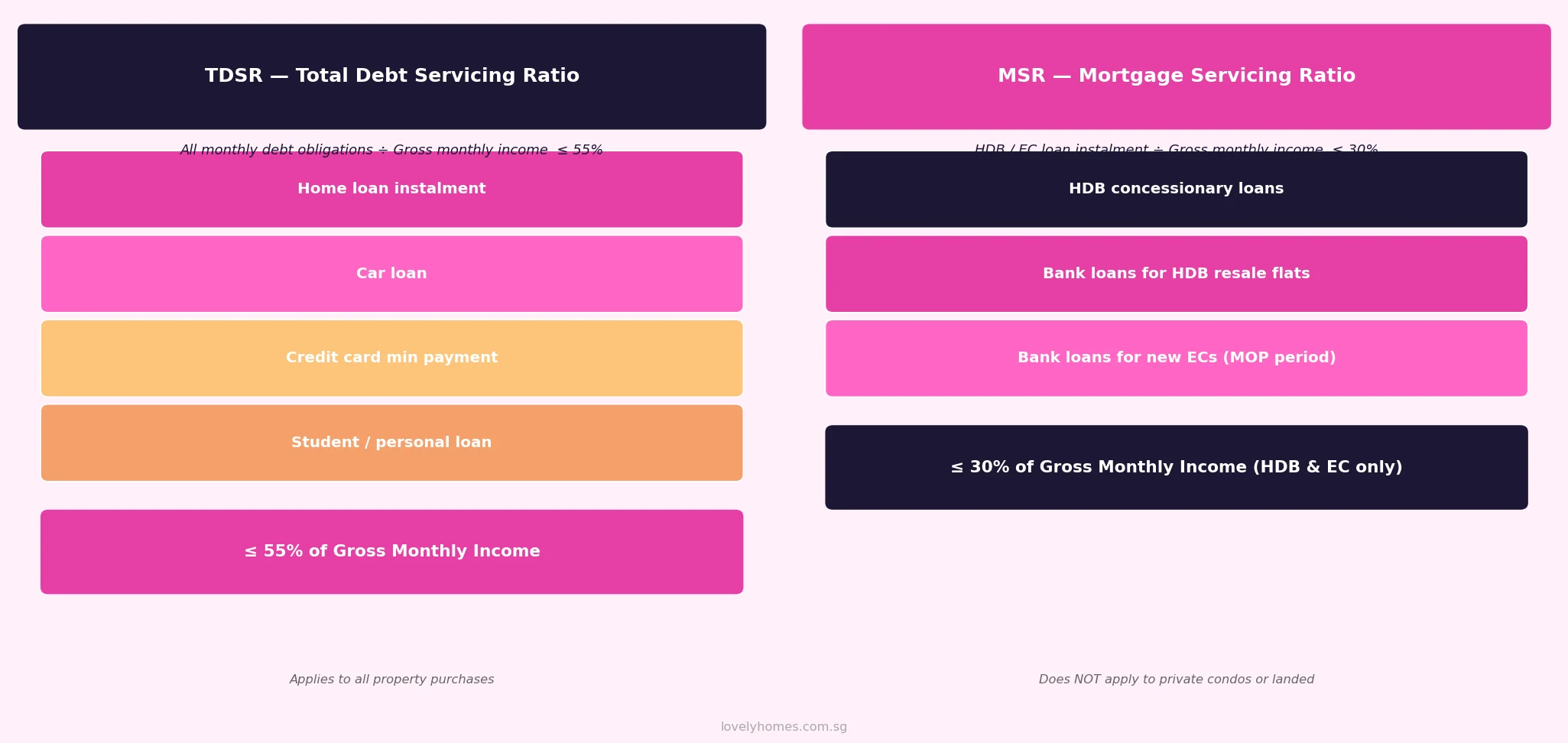
TDSR Total Debt Servicing Ratio and MSR Mortgage Servicing Ratio Singapore 2026 framework diagram
Figure 1: TDSR and MSR frameworks side by side — what counts, the applicable cap, and who each applies to. Source: MAS Notice 645 / HDB Board.

TDSR — Total Debt Servicing Ratio (55%)

The TDSR calculation adds up all monthly debt obligations — the proposed new home loan instalment, car loans, student loans, credit card minimum payments, personal loans, and any other outstanding borrowing — and divides the total by the borrower’s gross monthly income. The result must not exceed 55%.

TDSR = (All monthly debt obligations ÷ Gross monthly income) × 100 ≤ 55%

The computation is not quite as simple as it sounds. MAS rules require lenders to apply the following adjustments:

  • Stress-test rate: The home loan instalment is computed using the higher of the actual loan interest rate or the MAS floor rate (currently 4.0% p.a. for non-HDB residential properties, 3.5% p.a. for the medium-term rate). This means your TDSR-qualifying instalment is calculated on a higher hypothetical rate than the bank’s actual offer rate.
  • Variable income haircut: If part of your income is variable — commissions, overtime, bonuses, rental income — lenders typically apply a 30% discount. A borrower earning S$8,000 base + S$2,000 monthly commission would have an assessed income of S$8,000 + (S$2,000 × 70%) = S$9,400 for TDSR purposes.
  • Joint borrowers: Where two or more people take a loan together, the TDSR is assessed on the combined monthly income and combined monthly obligations. This can significantly increase the loan quantum available to a couple.

MSR — Mortgage Servicing Ratio (30%)

MSR applies only when you take a loan to buy an HDB resale flat or a new Executive Condominium (EC) during its initial owner-occupation period. It is an additional, tighter constraint on top of TDSR. Where TDSR considers all debts, MSR focuses only on the monthly instalment of the specific HDB or EC loan in question:

MSR = (Monthly HDB or EC loan instalment ÷ Gross monthly income) × 100 ≤ 30%

MSR does not apply to private condominiums or landed property — even those on 99-year leasehold land. When buying a private condo, only TDSR applies (plus the standard LTV limits). When buying an HDB flat or new EC, both TDSR and MSR apply; the borrower must satisfy whichever is the more restrictive of the two.

Worked Example — TDSR and MSR in Practice

Mr and Mrs Lim are a Singapore Citizen couple. Mr Lim earns S$7,500/month salary; Mrs Lim earns S$5,500/month. Combined gross income: S$13,000/month. They have a car loan with a monthly instalment of S$1,200.

Scenario A: Buying an S$800,000 HDB resale flat (bank loan)

  • MSR limit: 30% × S$13,000 = S$3,900/month for the HDB loan instalment.
  • TDSR limit: 55% × S$13,000 = S$7,150/month for all debts. Less car loan S$1,200 = S$5,950/month available for home loan.
  • The binding constraint is MSR at S$3,900/month.
  • Maximum loan at 4.0% stress-test, 25-year tenure: approximately S$741,000.
  • Property price S$800,000; 20% LTV floor for HDB → minimum 20% cash + CPF = S$160,000. Loan fits within LTV (S$640,000 < S$741,000 MSR limit). ✓

Scenario B: Buying a S$1.5 million private condo (bank loan, MSR does not apply)

  • TDSR limit: S$7,150/month for home loan (after car loan S$1,200).
  • Maximum loan at 4.0% p.a., 25-year tenure: approximately S$1.36 million.
  • LTV for second property (they still own a first property): 45% → maximum loan S$675,000. LTV is now the binding constraint, not TDSR.
  • This is why for investors buying second properties, ABSD and LTV often matter more than TDSR.

How TDSR Affects Your Maximum Loan Quantum

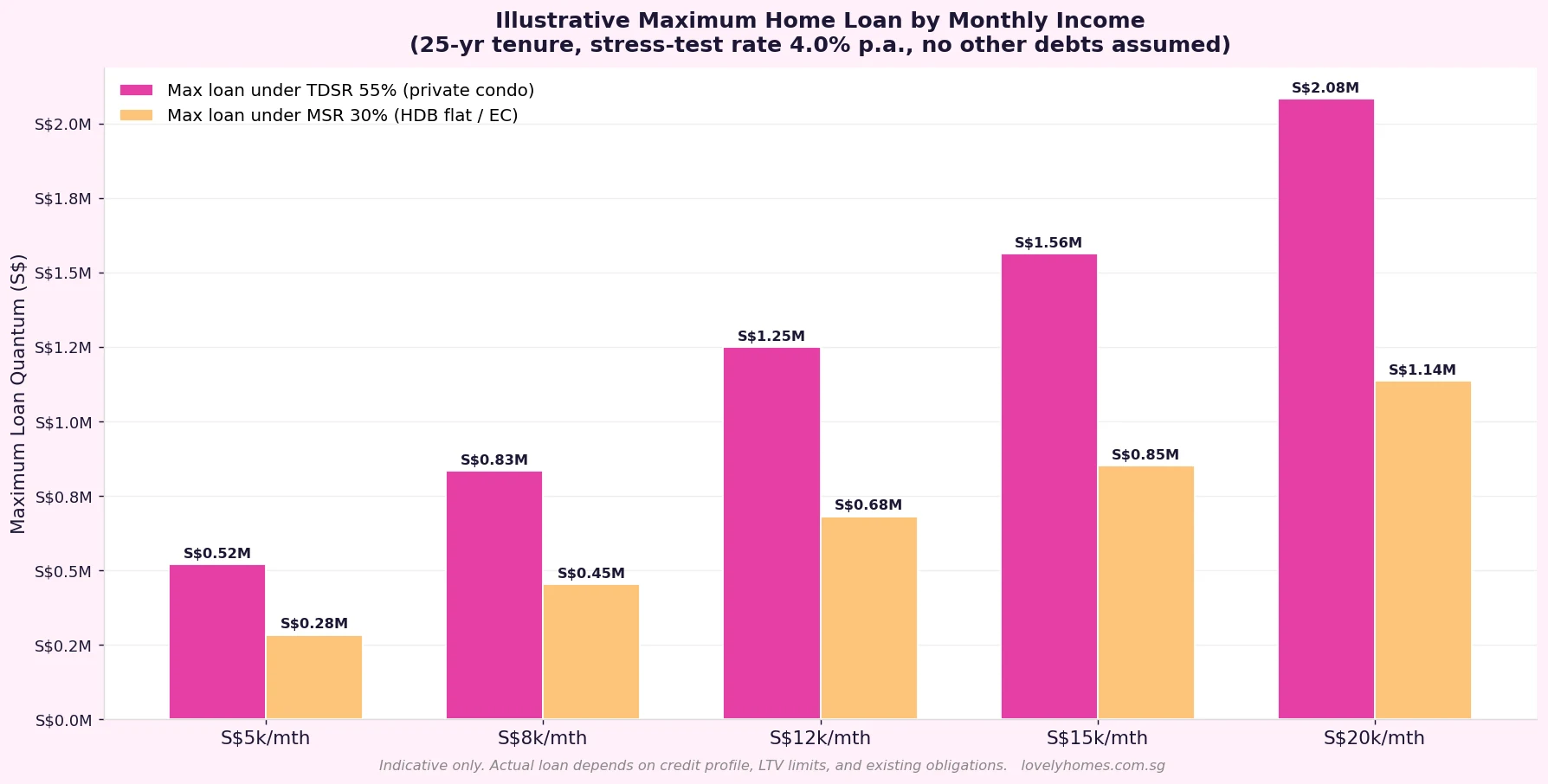
Maximum home loan by monthly income under TDSR 55% and MSR 30% Singapore 2026 bar chart
Figure 2: Illustrative maximum loan quantum by gross monthly income, assuming no other debts, 25-year loan tenure and 4.0% p.a. stress-test rate. Actual loan amounts depend on credit profile and LTV limits.

The chart illustrates how the 55% TDSR cap translates into loan quantum across different income levels, assuming no other debts. In practice, most borrowers have existing obligations — car loans, credit cards, study loans — that compress the available TDSR headroom and reduce the maximum home loan accordingly.

The Hidden TDSR Trap: Other Debts

Many first-time buyers underestimate how much existing debt erodes their borrowing capacity. Every dollar of existing monthly debt obligation reduces the monthly instalment available for a home loan, which translates into a smaller maximum loan.

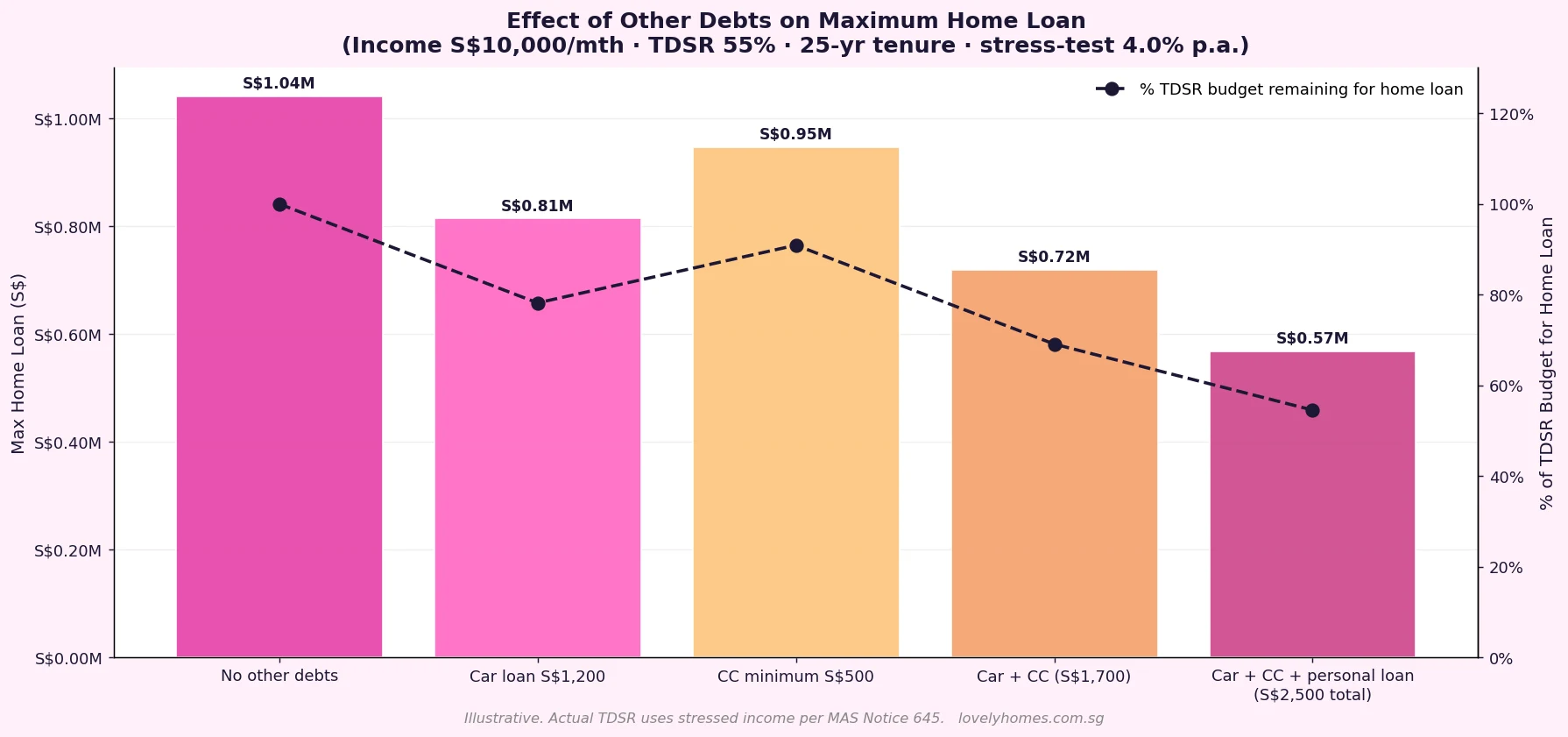
Effect of other debts on maximum home loan under TDSR 55% Singapore income S$10000 per month 2026
Figure 3: How car loans, credit card minimums, and personal loans reduce the maximum home loan for a borrower on S$10,000/month gross income. Stress-test rate 4.0% p.a., 25-year tenure.

A borrower earning S$10,000/month with a car loan of S$1,200/month and credit card minimum payments of S$500/month has only S$3,800/month left for a home loan instalment under the 55% TDSR cap — compared to S$5,500 if they had no other debts. That S$1,700 monthly reduction translates into roughly S$330,000 less in maximum loan quantum at current stress-test rates. This is why financial planners consistently advise property aspirants to pay down or close outstanding credit facilities before applying for a mortgage.

TDSR, MSR and the Loan-to-Value (LTV) Framework

TDSR and MSR cap how much you can service; the Loan-to-Value limits cap how much you can borrow as a proportion of the property value. The two frameworks operate in parallel — both must be satisfied simultaneously. The applicable LTV limit depends on whether you are buying with HDB loan or bank loan, and how many outstanding property loans you have:

Loan Type 1st Property Loan 2nd Property Loan 3rd+ Property Loan
HDB concessionary loan 80% of flat value N/A (only for 1st HDB purchase) N/A
Bank loan (no outstanding loans) 75% of property value 45% 35%
Bank loan (1+ outstanding loan) 45% 35% 35%

In practice, it is common for the LTV limit to be the binding constraint when buying investment properties (2nd or 3rd property), while TDSR / MSR is more likely to bite first-time buyers with lower incomes or significant existing debts.

TDSR Exemptions and Special Cases

A small number of situations fall outside the standard TDSR computation:

  • Bridging loans: Bridging loans used for the express purpose of financing a property being simultaneously sold are treated differently — the outstanding bridging instalment is excluded from TDSR until the property is sold, subject to conditions.
  • Retirees and elderly borrowers: Banks may use retirement income, CPF LIFE payouts, or annuity income to support TDSR calculations, though the assessment is more complex and requires additional documentation.
  • Refinancing with no cash-out: From August 2021, MAS allowed certain refinancing transactions — specifically owner-occupier residential loans where no equity is being extracted — to be exempt from TDSR. The borrower must have been servicing the existing loan for at least 12 months and must not be extracting equity.

Why TDSR and MSR Matter for Sellers Too

TDSR and MSR are typically framed as buyer concerns. But sellers are affected too:

  • Pricing strategy: A seller asking S$1.5 million for a condo needs to consider whether the pool of buyers who can qualify for a S$1.05 million bank loan (70% LTV) under TDSR is large enough to generate competitive offers. A listing price that implies a loan instalment near the TDSR limit for the target buyer profile will attract fewer bidders.
  • Timing of your own purchase: If you are selling to fund a new purchase, be aware that even after the sale proceeds come in, your TDSR is still assessed on your ongoing monthly income — not on net worth or cash in the bank.

What Might Change?

The TDSR framework has been remarkably stable since 2013, though MAS adjusted the cap from 60% to 55% in December 2021 as part of a broader tightening round. As of May 2026, MAS has not signalled any further changes to TDSR or MSR thresholds. However, MAS publishes annual Financial Stability Reviews (typically in November) which assess household leverage and mortgage risk — these are the best early indicators of possible future adjustments. Read the latest review at mas.gov.sg.

Frequently Asked Questions

What counts as “gross monthly income” for TDSR?

Gross monthly income includes fixed salary, director’s fees, and recognised recurring income. Variable components — commissions, bonuses, overtime — are typically discounted by 30% per MAS guidance. Self-employed individuals use their assessed income from NOA (Notice of Assessment) averaged over 2 years. Rental income is included but also subject to a discount. The bank will determine the applicable figure based on supporting documents submitted at loan application.

Why is my loan computed at a higher rate than the bank’s offer rate?

MAS requires lenders to stress-test all property loans using a minimum floor rate — currently 4.0% p.a. for private residential properties (or the actual rate if higher). This ensures borrowers can still service their loans if interest rates rise after the lock-in period expires. The bank’s actual offer rate (e.g. 3.0% in a low-rate environment) is used for the actual instalment calculation, but the TDSR computation uses the stress-test rate to determine affordability.

Does CPF count as income for TDSR purposes?

No. CPF contributions and balances are not counted as income for TDSR calculations — they are savings, not income. However, using CPF to fund the down payment or monthly instalment does reduce the cash instalment burden, and CPF usage is factored into your overall mortgage planning. The TDSR calculation is based on cash-equivalent gross income per MAS Notice 645.

Does paying off a car loan before applying for a mortgage really help?

Yes, significantly. Each S$1,000 in monthly debt obligations you eliminate frees up S$1,000 in TDSR headroom. At a 4.0% stress-test rate over 25 years, that translates into roughly S$190,000 in additional loan quantum. If you are planning a property purchase in the next 1–2 years, clearing high-instalment debts well in advance is one of the most concrete steps you can take to maximise your borrowing capacity.

I am buying an HDB flat. Do I need to satisfy both TDSR and MSR?

Yes. When taking a bank loan for an HDB resale flat, both TDSR (55%) and MSR (30%) apply. You must satisfy whichever is the more restrictive constraint. In most cases, for HDB buyers, the MSR 30% cap is the binding constraint because it is narrower. If you take an HDB concessionary loan (the HDB loan), the rules are similar but administered by HDB rather than MAS — the MSR cap of 30% still applies.

Can I use a guarantor to get around TDSR?

A guarantor’s income can be included in the TDSR computation only if the guarantor is a co-borrower — i.e. their name is on the loan. If the guarantor is merely guaranteeing repayment without being a borrower, their income cannot be used to support TDSR. Adding a co-borrower is a legitimate approach, but also means the co-borrower’s ABSD property count and LTV position are affected by the loan.

How do TDSR and MSR interact with HDB’s income ceiling for BTO?

HDB’s income ceiling for BTO applications (currently S$14,000/month for couples for most flat types) is a separate eligibility criterion — it determines whether you can apply for a BTO flat, not how much you can borrow. TDSR and MSR determine the loan quantum once you are eligible. A couple earning S$14,000 may pass the HDB income ceiling but still be limited in their borrowing by TDSR/MSR, particularly if they have significant existing debt obligations.

Related Articles

Disclaimer

This article is for general informational purposes only and does not constitute financial, legal, or mortgage advice. TDSR and MSR rules are administered by the Monetary Authority of Singapore under MAS Notice 645 and MAS Notice 645A, and by HDB under its loan policies — these are subject to change. The loan quantum illustrations in this article are indicative only and assume simplified conditions. Always consult a licensed mortgage broker or financial adviser, and verify the current rules directly at mas.gov.sg and hdb.gov.sg before making any borrowing decisions.

×

Click anywhere or press Esc to close

Singapore Home Loan Interest Rates 2026: SORA vs Fixed Rate — Complete Guide

Singapore Home Loan Interest Rates 2026: SORA vs Fixed Rate — Complete Guide

Quick Answer — Key Takeaways

  • Singapore home loans are now primarily benchmarked to SORA (Singapore Overnight Rate Average) — the official replacement for SIBOR, which was phased out in December 2024.
  • As at May 2026, the 3-month compounded SORA is approximately 2.55%, down from its 2023 peak of above 3.7%.
  • Major banks offer two main packages: SORA-pegged floating rates (typically SORA + 0.85–0.90%) and fixed rates (typically 2.45–2.65% for a 2-year fixed term).
  • The HDB Concessionary Loan is pegged at CPF OA + 0.1%, currently 2.60%; it is available only for HDB flats and requires no lock-in period.
  • The Total Debt Servicing Ratio (TDSR) cap of 55% and Mortgage Servicing Ratio (MSR) cap of 30% remain in force and directly limit how much you can borrow.
  • Fixed rates offer payment certainty but come with a lock-in penalty (typically 1.5% of outstanding loan) if you refinance early.
  • SORA-pegged loans offer transparency and flexibility, but your repayment will move with rates — currently favourable as SORA trends down from its 2023 highs.

Understanding Singapore Home Loan Interest Rates in 2026

When you take out a home loan in Singapore, the single most consequential variable is the interest rate. On a S$1 million loan over 25 years, the difference between a 2.45% and a 3.40% rate translates to roughly S$470 more per month — or over S$140,000 in additional interest over the life of the loan. Yet many buyers in Singapore choose their home loan based on convenience, the advice of a mortgage broker with a vested interest, or simply whatever their bank’s relationship manager recommends at point of sale.

This guide explains how Singapore home loan interest rates are structured in 2026, what SORA is and why it replaced SIBOR and SOR, how to read bank package offers correctly, and how to decide between a floating rate and a fixed rate package given the current interest rate environment. It is written for Singaporean and Permanent Resident property buyers — the same principles apply to foreigners but their ABSD liability fundamentally alters the financing calculus.

Monetary Authority of Singapore (MAS) regulates home lending in Singapore under the Monetary Authority of Singapore Act and the Notice MAS 632 on Residential Property Loans. HDB administers the Concessionary Loan under the Housing and Development Act.

SORA 3M compounded vs fixed rate Singapore 2020 to 2026 chart
Figure 1: SORA 3-Month Compounded Average vs 2-year Fixed Rate — Major Singapore Banks, 2020–2026. Data: MAS, bank publications.

What Is SORA and Why Did It Replace SIBOR?

SORA — the Singapore Overnight Rate Average — is the volume-weighted average rate of all overnight unsecured Singapore dollar interbank transactions brokered in Singapore between 08:00 and 18:15 each business day. It is published daily by MAS and is calculated retrospectively, which makes it a backward-looking, transaction-based benchmark rather than a quote-based one like SIBOR was.

SIBOR (Singapore Interbank Offered Rate) was phased out on 31 December 2024 following a global reform of interest rate benchmarks prompted by the 2012 LIBOR manipulation scandal. SOR (Swap Offer Rate), which was partly based on USD LIBOR, was discontinued even earlier. MAS and the Steering Committee for SOR & SIBOR Transition to SORA (SC-STS) oversaw the transition, which required all existing SIBOR-pegged mortgages to be converted to SORA-linked packages by end-2024.

SORA is now used in three primary forms for home loans:

  • 1-Month Compounded SORA (1M SORA) — reflects the past 30 days of overnight rates. More reactive to short-term rate changes.
  • 3-Month Compounded SORA (3M SORA) — reflects the past 90 days. More commonly used by banks for home loans; provides a slightly smoother signal.
  • SORA Board Rates — some banks (notably UOB) have internal board rates that are partially informed by SORA movements but give the bank more discretion over repricing.

SORA-Pegged Floating Rate Packages

A SORA-pegged floating rate package ties your home loan to the prevailing 3M Compounded SORA, plus a fixed spread set by the bank. As at May 2026, spreads across major banks range from +0.85% to +0.90%:

  • DBS: 3M Compounded SORA + 0.85%
  • OCBC: 3M Compounded SORA + 0.88%
  • UOB: 3M Compounded SORA + 0.90%
  • Maybank: 3M Compounded SORA + 0.85%

With 3M SORA at approximately 2.55% in May 2026, an all-in floating rate works out to roughly 3.40–3.45%. This is broadly similar to the prevailing 2-year fixed rate, which sits at 2.45–2.65% for Year 1–2 before typically reverting to a board rate or SORA-linked rate from Year 3.

The key characteristics of a SORA floating package are:

  • No lock-in period — you can refinance or reprice at any time without a penalty clause.
  • Transparent repricing — your rate changes as SORA moves, typically with a 1-month lag for 1M SORA packages or a 3-month lag for 3M packages.
  • Currently in a declining environment — if MAS and the Federal Reserve continue rate normalisation through 2026, SORA is expected to drift toward 2.2–2.4% by end-2026, which would bring all-in floating rates to around 3.05–3.30%.

Singapore home loan bank package comparison table May 2026
Figure 2: Singapore Home Loan Package Comparison — DBS, OCBC, UOB, HDB Concessionary Loan and others, May 2026. Rates indicative; verify with lender.

Fixed Rate Packages

Fixed rate packages lock in an interest rate for a specified period — typically 2 years — after which the loan reverts to a floating rate, usually SORA-linked or a bank board rate. As at May 2026, major banks are offering:

Bank Year 1 Year 2 Year 3+ Lock-in
DBS 2.45% 2.55% FHR8 (board rate) 2 years
OCBC 2.50% 2.60% OHR+ (SORA-linked) 2 years
UOB 2.45% 2.55% SORA + spread 2 years
Standard Chartered 2.48% 2.60% Board rate 2 years
Maybank 2.50% 2.65% SORA + spread 2 years

The 2-year fixed period provides payment certainty — you know exactly what you will pay every month for the fixed term, which makes household budgeting straightforward. The risk is that if you need to refinance during the lock-in window — for example, because you sell the property, or a better package becomes available — you will typically pay a penalty of 1.50% of the outstanding loan amount at the time of early redemption.

On a S$1 million loan, that penalty is S$15,000. This is not an insignificant sum, and it is the primary reason experienced property investors often prefer no-lock-in floating packages despite the slightly higher all-in rate today.

The HDB Concessionary Loan — A Third Option

Buyers purchasing an HDB flat have access to a third option: the HDB Concessionary Loan, currently at a flat 2.60% per annum. This rate is set at CPF Ordinary Account interest rate (currently 2.5%) plus 0.1%, and is reviewed quarterly. It has remained at 2.60% since January 2023 when the CPF OA rate was last adjusted.

The HDB Concessionary Loan is notable for several reasons:

  • No lock-in — you can switch to a bank loan at any time without penalty.
  • LTV up to 80% — the maximum Loan-to-Value for an HDB loan is 80% of the purchase price or valuation (whichever is lower), versus 75% for a bank loan.
  • No cash down payment requirement — the 20% down payment can be funded entirely from CPF Ordinary Account (unlike bank loans, which require at least 5% in cash).
  • Eligibility conditions — all owners must not own any other residential property; income ceiling of S$14,000 household income applies for most flat types (no ceiling for HDB resale). You must obtain an HDB Flat Eligibility (HFE) Letter before exercising an OTP.

TDSR and MSR — How Much Can You Borrow?

MAS introduced the Total Debt Servicing Ratio (TDSR) framework in June 2013 to ensure borrowers do not over-leverage. TDSR limits total monthly debt obligations (including the new mortgage, car loans, personal loans, credit card minimum payments and all other credit facilities) to 55% of gross monthly income. Banks apply a stress-test rate of 4.0% per annum when assessing TDSR — meaning they calculate your hypothetical monthly payment at 4.0% regardless of the prevailing rate, to ensure you can afford the loan even if rates rise.

For HDB flat purchases (both BTO and resale), the additional Mortgage Servicing Ratio (MSR) cap applies: your monthly mortgage payment must not exceed 30% of gross monthly income. MSR applies to the actual servicing payment, not a stress-tested figure.

These rules mean that on a gross household income of S$10,000 per month, the maximum monthly mortgage payment you can qualify for (under MSR for HDB) is S$3,000; and the maximum all-debt obligation under TDSR is S$5,500. Practically, if you have a car loan of S$800/month, your maximum mortgage under TDSR is reduced to S$4,700/month.

Monthly repayment comparison by interest rate scenario S$1M loan 25 years
Figure 3: Monthly Repayment by Rate Scenario — S$1M Loan, 25-Year Tenure. Illustrative; based on standard annuity formula.

Worked Example — The Tan Family’s Loan Decision

Mr and Mrs Tan are Singapore Citizens purchasing a S$1.4 million OCR condominium in Tampines in June 2026. They are first-time buyers with no outstanding home loans. Their gross combined household income is S$14,000 per month. They have S$180,000 in CPF OA (combined) and S$100,000 in cash savings.

Loan quantum: 75% LTV on S$1.4M = S$1.05M bank loan. Down payment = S$350,000 (25%), of which at least S$70,000 (5%) must be in cash. The Tans comfortably clear this with S$70,000 cash + S$280,000 CPF.

BSD: S$24,600 on S$1.4M (first S$180k at 1%, next S$180k at 2%, next S$640k at 3%, remaining S$400k at 4% — total S$1,800 + S$3,600 + S$19,200 = wait, let me compute correctly: BSD on S$1.4M = 1%×S$180k + 2%×S$180k + 3%×S$640k + 4%×S$400k = S$1,800 + S$3,600 + S$19,200 + S$16,000 = S$40,600). ABSD: S$0 (first purchase, SC).

Rate comparison:

  • Option A — 2-year fixed at 2.45%/2.55%: Monthly in Year 1 = S$4,634; Year 2 = S$4,706. Reverts to SORA + spread from Year 3 (est. ~S$4,500–4,800 depending on SORA trajectory). Lock-in penalty if exit before 24 months: ~S$15,750 (1.5% × S$1.05M).
  • Option B — SORA float at SORA+0.85% ≈ 3.40%: Monthly = ~S$5,161. No lock-in. If SORA falls to 2.2% by end-2026, rate drops to ~3.05%, monthly ~S$4,956.
  • Option C — If they were buying an HDB resale (for illustration): HDB Concessionary Loan at 2.60% → monthly ~S$4,748 on S$1.05M, 80% LTV available.

TDSR check (Option A, Year 1): Monthly payment S$4,634. With no other debts, TDSR = S$4,634 ÷ S$14,000 = 33.1%. Well within 55%. Stress-tested at 4.0%: hypothetical monthly = S$5,534; TDSR = 39.5%. PASS.

Recommendation: Given the declining SORA environment in 2026, the Tans opt for Option A (2-year fixed) to lock in payment certainty during the early years of ownership when their cash position is most stretched. They set a calendar reminder to review and refinance in Month 20, before the lock-in expiry.

Fixed vs Floating — How to Decide in 2026

With fixed and floating rates now converging at around 3.35–3.50% all-in, the classic argument — “floating is cheaper, fixed is certain” — no longer cleanly applies. The decision framework for 2026 hinges on three questions:

  1. How long will you hold the property? If you plan to sell within 3 years (e.g., you are buying a resale flat as a stepping stone and expect to MOP a BTO), a floating package with no lock-in avoids the exit penalty. If you plan to hold for 10+ years, the 2-year fixed-then-float cycle is largely a moot point — both packages will track the same rates over the long run.
  2. How sensitive is your monthly budget to rate moves? If a S$300–500 increase in monthly repayment would significantly stress your household, a fixed rate gives you a planning buffer. If you have comfortable headroom under TDSR, floating is fine.
  3. What is the SORA outlook? As at May 2026, MAS and market consensus lean toward SORA continuing a gradual decline through 2026–2027 as the global rate cycle normalises. In a declining rate environment, locking in at today’s fixed rate means you may pay slightly more than the eventual SORA level. However, the gap is likely to be narrow (0.10–0.30%) and the certainty premium may be worth it for first-time buyers.

What Might Come Next — Singapore Loan Rate Outlook

Several factors will shape Singapore home loan rates through end-2026 and into 2027. MAS operates a unique monetary policy framework — it manages the Singapore dollar nominal effective exchange rate (S$NEER) rather than directly setting an overnight rate, meaning SORA is market-determined rather than policy-set. However, SORA is strongly correlated to the US federal funds rate through Singapore’s open capital account.

The US Federal Reserve has signalled two 25-basis-point cuts in the second half of 2026, which, if executed, would likely push 3M SORA from ~2.55% toward ~2.05–2.15% by year-end. This would bring SORA-pegged all-in rates to around 2.90–3.05% — meaningfully below today’s fixed rates of 2.45–2.65% over a 2-year view. Whether banks adjust their fixed rate offerings in anticipation remains to be seen; historically, fixed rates tend to reprice down with a 1–2 quarter lag.

Summary — Home Loan Rate Comparison at a Glance

Feature SORA Float Fixed Rate (2yr) HDB Concess.
All-in Rate (May 2026) ~3.40% 2.45–2.65% 2.60%
Rate Certainty None 2 years Stable (CPF+0.1%)
Lock-in Period None 2 years None
Exit Penalty None ~1.5% of loan None
Max LTV 75% 75% 80%
Min Cash Down 5% 5% 0% (CPF ok)
Eligible Properties All All HDB only
Best For Flexible holders; declining rate bet First-timers; budget certainty HDB buyers; tight cash

Frequently Asked Questions

What is SORA and how is it different from SIBOR?

SORA (Singapore Overnight Rate Average) is the volume-weighted average of unsecured overnight interbank SGD transactions, published daily by MAS. SIBOR was a forward-looking rate based on bank submissions — susceptible to manipulation, as the 2012 LIBOR scandal revealed globally. SORA is transaction-based and backward-looking, making it more robust and harder to manipulate. SIBOR was fully discontinued on 31 December 2024; all SIBOR-pegged mortgages were converted to SORA or fixed-rate packages during 2023–2024.

Should I choose a fixed or floating rate home loan in 2026?

With SORA declining toward 2.2% by end-2026 and fixed rates at 2.45–2.65%, the all-in rates are converging. For first-time buyers who need budgeting certainty, a 2-year fixed rate is sensible — it protects against any short-term rate surprise and costs only marginally more than today’s floating all-in rate. For investors and experienced buyers who plan to hold long-term or who may sell within 3 years, a no-lock-in SORA floating package avoids exit penalties and will benefit as SORA falls further. In 2026 specifically, the edge is modest either way; the bigger decision is the property itself.

What is the current SORA rate in 2026?

As at May 2026, the 3-month compounded SORA is approximately 2.55% per annum, down from its peak of above 3.74% in mid-2023. It has been declining steadily as the US Federal Reserve began its rate normalisation cycle in late 2024. MAS publishes daily SORA rates on its website at mas.gov.sg/monetary-policy/sora.

What is TDSR and how does it affect how much I can borrow?

The Total Debt Servicing Ratio (TDSR) limits your total monthly debt obligations (including the home loan, car loans, personal loans and other credit facilities) to 55% of your gross monthly income. Banks stress-test your loan at 4.0% per annum when assessing TDSR eligibility — so even if the prevailing rate is 3.0%, the bank calculates whether you could afford the repayment at 4.0%. On top of TDSR, if you are buying an HDB flat, the Mortgage Servicing Ratio (MSR) limits your monthly home loan repayment to 30% of gross monthly income.

Can I use CPF to pay my home loan?

Yes. CPF Ordinary Account savings can be used to service monthly home loan repayments for both HDB flats and private properties, subject to the Valuation Limit (generally the lower of the purchase price or valuation) and the Withdrawal Limit (up to 120% of the Valuation Limit for private properties). Note that CPF monies withdrawn for property earn accrued interest at 2.5% per annum, which must be returned to your CPF account upon sale. This accrued interest does not represent an additional out-of-pocket cost but reduces the net cash proceeds you receive when you sell.

What is a lock-in period and what happens if I break it?

A lock-in period is a contractual commitment to maintain your loan with the same bank for a set duration — typically 2 years for fixed rate packages. If you refinance, prepay or redeem the loan in full before the lock-in expires, you pay a penalty usually equal to 1.5% of the outstanding loan amount at the time of early redemption. On a S$900,000 outstanding balance, that is S$13,500. No-lock-in packages (all SORA floating packages and HDB Concessionary Loans) allow you to exit or refinance at any time without penalty.

What is the difference between refinancing and repricing?

Repricing is when you switch to a different loan package within the same bank — typically cheaper (no legal or valuation fees) but limited to that bank’s available packages. Refinancing is when you move your loan to a different bank entirely. Refinancing typically offers access to sharper rates but incurs legal fees (S$2,000–3,500), valuation fees (S$300–800), and potentially a clawback of cashback incentives if you refinance within the clawback period (usually 3 years). Both options are typically considered when a fixed rate lock-in expires.

Related Articles

Disclaimer

This article is for general informational purposes only and does not constitute financial or legal advice. Interest rates quoted are indicative as at May 2026 and are subject to change by individual lenders. The SORA rate is published daily by MAS and can be found at mas.gov.sg. TDSR and MSR rules are set by MAS and are subject to regulatory revision. For personalised advice on home loan selection and eligibility, consult a licensed financial adviser or mortgage specialist regulated by MAS. All stamp duty computations are based on IRAS published rates at iras.gov.sg. HDB Concessionary Loan eligibility criteria are set by HDB and available at hdb.gov.sg. CPF rules on property usage are administered by the CPF Board at cpf.gov.sg.

×

Click anywhere or press Esc to close

Foreigners Buying Property in Singapore 2026: ABSD, Eligibility and the Full Cost Guide

Foreigners Buying Property in Singapore 2026: ABSD, Eligibility and the Full Cost Guide

Quick Answer

  • Foreigners (non-PR, non-SC) may purchase private residential property — condominiums, apartments, strata-titled units — in Singapore without restriction, subject to a 60% Additional Buyer’s Stamp Duty (ABSD) payable to IRAS.
  • Foreigners cannot buy HDB flats (resale or BTO) and cannot buy landed residential property (houses, semi-detached, bungalows) without prior approval from the Singapore Land Authority (SLA), which is rarely granted.
  • Executive Condominiums (ECs) become available to foreigners only after privatisation. For ECs from GLS sites tendered from 8 May 2026 onwards, privatisation occurs at 15 years from TOP; earlier ECs remain at 10 years.
  • The 60% ABSD applies to the entire purchase price and must be paid within 14 days of exercising the Option to Purchase (OTP).
  • Buyer’s Stamp Duty (BSD) is payable by all buyers regardless of nationality. On a S$2.5M purchase, BSD is approximately S$94,600.
  • Foreigners can obtain a mortgage from Singapore-licensed banks. LTV limit is 75% for a first property loan with no existing housing loans, subject to Total Debt Servicing Ratio (TDSR) of 55%.
  • Commercial and industrial property carries no ABSD — foreigners may purchase shophouses, office units, factories, and warehouses without the 60% surcharge.
  • Nationals of the USA, Iceland, Liechtenstein, Norway, and Switzerland are exempt from ABSD on their first residential purchase under Free Trade Agreement commitments.

What Is the ABSD and Who Administers It?

The Additional Buyer’s Stamp Duty (ABSD) is a surcharge levied by the Inland Revenue Authority of Singapore (IRAS) on the purchase or acquisition of residential property in Singapore, on top of the standard Buyer’s Stamp Duty (BSD). Introduced in December 2011 as a demand-side cooling measure, the ABSD has been adjusted multiple times. The most significant recent change for foreigners was on 27 April 2023, when the rate was doubled from 30% to 60%.

The policy objective is explicit: ABSD prioritises home ownership for Singaporeans and ensures that property remains affordable for residents. Non-resident buyers must bear a substantial additional cost — and this is intentional. Singapore’s Ministry of National Development has consistently maintained that residential property is primarily for citizens, and the 60% rate is designed to reflect that priority firmly.

Singapore property eligibility by buyer type 2026 — foreigners PRs and citizens comparison table
Figure 1: Property Eligibility by Buyer Type — Singapore 2026 | Source: HDB, URA, SLA, IRAS

ABSD Rates by Buyer Profile (Effective 27 April 2023)

ABSD is charged on the higher of the purchase price or the property’s market value. The table below shows the current rates, administered by IRAS, for residential property in Singapore:

Buyer Profile 1st Property 2nd Property 3rd+ Property
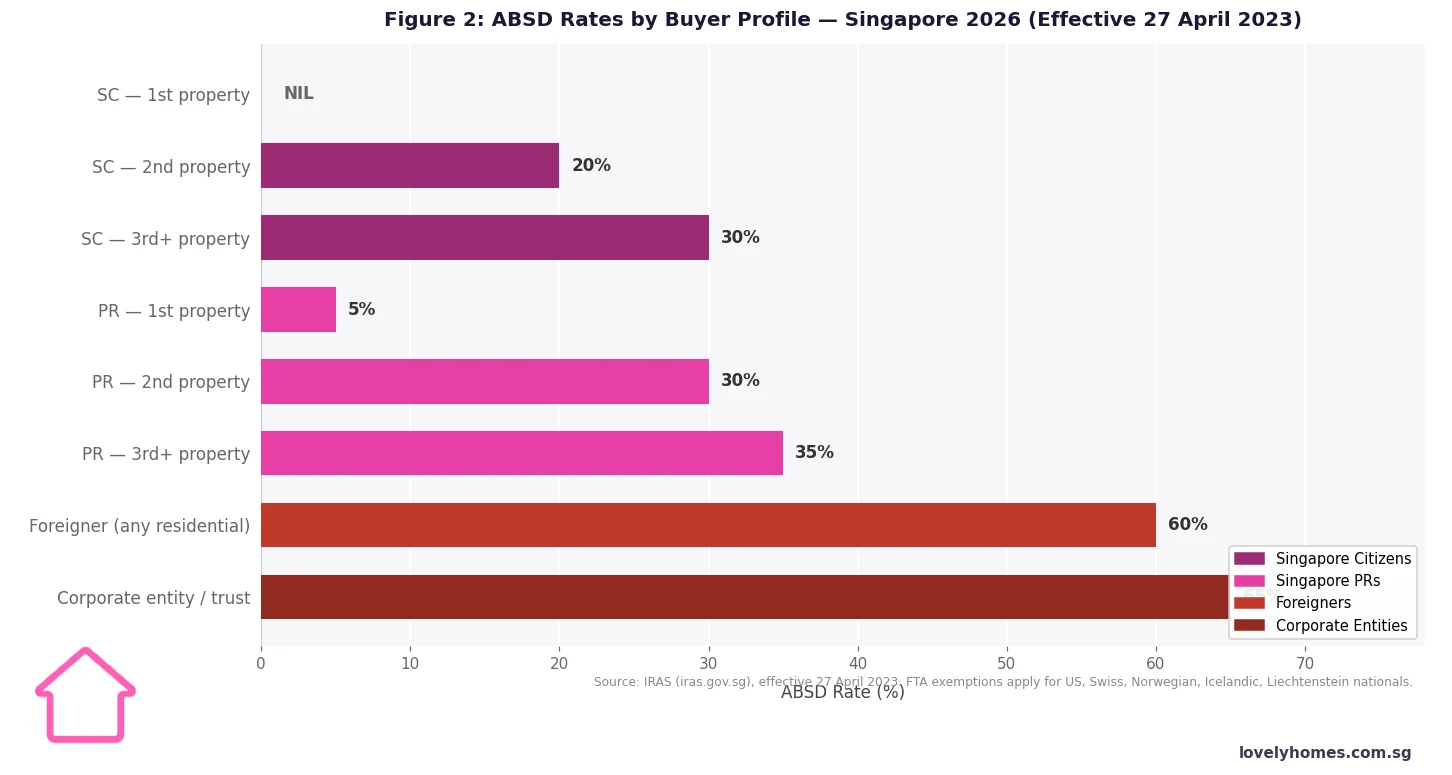
Singapore Citizen 0% 20% 30%
Singapore Permanent Resident (PR) 5% 30% 35%
Foreigner (non-PR, non-SC) 60% — flat rate, regardless of how many properties held in Singapore
Corporate entity / trust 65% — flat rate on residential property

Source: IRAS, effective 27 April 2023. FTA exemptions apply for nationals of the USA, Switzerland, Iceland, Liechtenstein, and Norway.

ABSD rates by buyer profile Singapore 2026 — foreigners pay 60% on all residential property
Figure 2: ABSD Rates by Buyer Profile — Singapore 2026 | Source: IRAS, effective 27 April 2023

Free Trade Agreement (FTA) Exemptions

Under Singapore’s FTA commitments, nationals of the USA, Iceland, Liechtenstein, Norway, and Switzerland are treated on par with Singapore Citizens for ABSD on their first residential property purchase. This means a US national buying their first Singapore condo pays 0% ABSD. On second and subsequent purchases, the SC schedule applies. The exemption is for individuals only; US-incorporated companies do not benefit. IRAS requires passport proof of nationality when claiming the FTA exemption.

What Foreigners Can Buy — and Cannot Buy

Permitted (60% ABSD where residential): Private condominiums, private apartments, strata-titled units, SOHO units with residential classification. ECs after privatisation (15 years from TOP for new GLS-launched ECs from 8 May 2026; 10 years for earlier ECs). Sentosa Cove landed property. Commercial shophouses, strata office units, retail units, industrial factories, warehouses — all without residential ABSD.

Not permitted without special approval: Landed residential property outside Sentosa Cove (houses, semi-detached, bungalows, terraced houses). The SLA may grant approval under the Residential Property Act in exceptional circumstances, but approvals are rare.

Strictly prohibited: HDB flats (both new BTO and resale). HDB housing is reserved for Singapore citizens and permanent residents under the Housing and Development Act. ECs during their MOP and privatisation period are also off-limits to foreigners.

Buyer’s Stamp Duty (BSD) — Payable by Everyone

BSD is levied by IRAS on every property purchase in Singapore, regardless of nationality. For residential property, the tiered rates are: 1% on the first S$180,000; 2% on the next S$180,000; 3% on the next S$640,000; 4% on the next S$500,000; 5% on the next S$1,500,000; and 6% on amounts above S$3,000,000. On a S$2.5M purchase, total BSD = S$94,600.

Purchase Price Tier BSD Rate BSD on This Tier
First S$180,000 1% S$1,800
Next S$180,000 (up to S$360,000) 2% S$3,600
Next S$640,000 (up to S$1,000,000) 3% S$19,200
Next S$500,000 (up to S$1,500,000) 4% S$20,000
Next S$1,500,000 (up to S$3,000,000) 5% Up to S$75,000
Remainder above S$3,000,000 6% Variable

Sellers’ Stamp Duty (SSD) — The Anti-Flip Tax

SSD is administered by IRAS and applies to all sellers who dispose of residential property within three years of purchase, regardless of nationality. The rates are: 12% within 1 year; 8% within 2 years; 4% within 3 years; nil thereafter. For a foreigner who has paid 60% ABSD, an SSD liability on a short-term resale would be a severe additional burden. Foreign buyers must plan for a meaningful long-term holding horizon.

Holding Period SSD Rate
Up to 1 year 12%
1 to 2 years 8%
2 to 3 years 4%
More than 3 years Nil

Financing — LTV, TDSR, and Mortgage Options

Foreigners may borrow from Singapore-licensed banks subject to MAS macro-prudential rules identical to those applied to residents. The LTV limit is 75% for a first property loan with no existing housing loans (reducing to 55% for a second and 35% for a third). The TDSR cap is 55% of gross monthly income. Loan tenors run up to 35 years, typically reduced by age exceeding 65. Most major Singapore banks lend to foreigners — DBS, OCBC, UOB, Standard Chartered, and HSBC all do so, subject to enhanced documentation requirements including overseas income proof and a valid work pass or Long-Term Visit Pass.

The Buying Process — Step by Step

  1. Arrange in-principle approval: Approach at least two Singapore banks before making offers. Allow 5–10 working days.
  2. Engage a CEA-licensed agent: For new launches, no buyer commission is payable; for resale, co-broking arrangements vary.
  3. Option to Purchase (OTP): On resale, the seller grants an OTP valid for 21 days; a 1% option fee is paid. For new launches, a 5% booking fee is paid directly to the developer.
  4. Pay BSD and ABSD: Both due within 14 days of OTP exercise. On a S$2.5M purchase, this means wiring S$94,600 (BSD) + S$1,500,000 (ABSD) to IRAS — a total of S$1,594,600 within a fortnight of signing.
  5. Engage a conveyancing solicitor: A Singapore-qualified solicitor handles title searches, mortgage documentation, and lodgement with SLA’s eConveyancing portal.
  6. Completion: For resale, typically 8–12 weeks. For new launches, completion occurs at TOP/CSC, which may be 3–5 years away.

Worked Example: Mr David Harrington Buys a S$2.5M CCR Condo

Mr David Harrington, 42, is a British national on an Employment Pass earning S$25,000/month gross. He purchases a two-bedroom unit in District 9 at S$2,500,000, with no existing property loans in Singapore.

Total upfront cash required for foreigner buying SGD 2.5M condo Singapore 2026 cost breakdown
Figure 3: Total Upfront Cash Required — Foreigner Buying SGD 2.5M CCR Condo (2026)
Cost Item Amount (SGD) Notes
25% downpayment (cash) 625,000 75% LTV → loan of S$1,875,000
Buyer’s Stamp Duty (BSD) 94,600 IRAS; payable within 14 days of OTP
ABSD (60% x S$2,500,000) 1,500,000 IRAS; payable within 14 days of OTP
Stamp duty on mortgage (0.4% x loan) 7,500 On S$1,875,000 loan amount
Legal / conveyancing fees (est.) 3,500 Singapore-licensed solicitor
Valuation fee (est.) 600 Required by lender
Total upfront cash required 2,231,200 Excluding ongoing mortgage payments

Monthly mortgage at 3.30% p.a. over 20 years on S$1,875,000 ≈ S$10,633/month. TDSR check: S$10,633 ÷ 55% = S$19,333 minimum monthly gross income required. Mr Harrington’s S$25,000/month comfortably qualifies. However, stamp duties alone represent 63.8% of the purchase price — the property must appreciate significantly for the investment to make financial sense on a net basis.

What This Means for Foreign Buyers

Despite the 60% ABSD headline rate, Singapore continues to attract foreign buyers for structurally sound reasons. Singapore offers secure freehold and 99-year leasehold titles with one of the most transparent property title systems in Asia. There is no capital gains tax, no inheritance tax, and no wealth tax. The SGD has historically been stable and appreciating against most major currencies, and Singapore’s rule of law is consistently ranked among the best globally.

For high-net-worth buyers from jurisdictions with currency risk, political instability, or restricted capital mobility — particularly from certain parts of Southeast Asia, China, and the Middle East — paying 60% ABSD is the premium for a stable, internationally recognised store of value. For US nationals, who pay 0% ABSD on their first purchase thanks to the FTA, Singapore offers one of the most favourable entry points into any developed-market property system globally.

What Might Come Next

The 60% ABSD rate for foreigners is unlikely to be reduced in the near term. Singapore’s government has consistently adjusted rates upward when demand has been firm, and the April 2023 doubling was a clear statement of direction. The EC policy changes of 8 May 2026 — extending MOP to 10 years and privatisation to 15 years, abolishing the Deferred Payment Scheme — further indicate a tightening trajectory. Foreign buyers should plan their acquisitions assuming the 60% rate will persist for the foreseeable future and structure their financial planning accordingly.

Related Articles

Frequently Asked Questions

Can a foreigner on an Employment Pass buy a condo in Singapore?

Yes. Holding an Employment Pass does not confer Singapore PR status, so the buyer is classified as a foreigner for ABSD purposes — meaning 60% ABSD applies. There is no minimum residency duration requirement to purchase private residential property. The buyer must satisfy the bank’s TDSR requirements using their Singapore employment income (fully counted) and any overseas income (subject to a bank haircut, typically around 30% on variable income).

Are there properties foreigners can buy without the 60% ABSD?

Yes. Commercial and industrial properties do not attract the residential ABSD. Strata office units, retail units, commercial shophouses, industrial factories, and warehouses can all be purchased by foreigners without the 60% surcharge. Many foreign investors therefore channel their Singapore property exposure through commercial assets or Singapore REITs listed on SGX, which provide property-linked returns without the ABSD burden.

Can a foreigner married to a Singapore Citizen pay lower ABSD?

Not directly on a joint purchase. If the property is purchased in the Singapore Citizen spouse’s name alone (sole ownership) and it is the SC’s first property, no ABSD is payable. However, if both names appear on the title, the foreigner’s inclusion triggers 60% ABSD. Many cross-nationality couples place the first property in the SC’s sole name. On subsequent purchases in joint names, ABSD at the SC second-property rate of 20% applies. Seek independent legal and tax advice before structuring ownership this way, as there are CPF, mortgage liability, and estate planning implications.

When exactly must the ABSD be paid?

ABSD must be paid within 14 days of the date on which the liability arises — typically the date of exercising the OTP or the date of the Sale and Purchase Agreement, whichever is earlier. Late payment attracts a 5% per annum penalty interest plus potential IRAS prosecution under the Stamp Duties Act. There is no grace period. The full ABSD amount must be available on or before the deadline, not merely committed in a loan facility.

Is ABSD refundable if the purchase falls through after the OTP is exercised?

Generally, no. Once the ABSD liability arises, it is payable regardless of whether the transaction completes. IRAS may consider a remission application in exceptional circumstances if a transaction is aborted, but this is not guaranteed. The ABSD Married Couple Remission — which allows one SC/PR spouse to sell their existing property within six months of a joint purchase and claim a refund — does not apply to foreigners. Always consult a licensed conveyancing solicitor before exercising any OTP if there is uncertainty about financing, as the ABSD liability is triggered on signing.

Can a foreigner buy a shophouse and occupy the upper residential floor?

This depends on the shophouse’s URA zoning and approved use. If the upper floors are classified as residential under the Residential Property Act, a foreigner cannot purchase without SLA approval (rarely granted). Some shophouses are zoned entirely commercial or approved for mixed use with the upper floors treated as non-residential. The correct approach is to check the URA Master Plan zoning and the specific approved use with a conveyancing solicitor before making any offer, as the legal classification is significant and not always obvious from the building’s physical appearance.

Does a foreigner pay ABSD on a privatised Executive Condominium?

Yes. Once an EC is privatised, it is treated as private residential property and all standard ABSD rules apply — including the 60% rate for foreigners. For ECs launched under GLS tenders from 8 May 2026, privatisation occurs at 15 years from TOP; earlier ECs privatise at 10 years from TOP. Buyers purchasing privatised ECs in the secondary market should verify the specific EC’s TOP date and calculate the privatisation milestone accordingly before making an offer.

Disclaimer: This article is for general information only and does not constitute legal, tax, or financial advice. Stamp duty rates, eligibility rules, and financing guidelines are subject to change by IRAS, MAS, HDB, SLA, and URA. Always verify current rates at iras.gov.sg and consult a licensed Singapore conveyancing solicitor, a CEA-registered real estate professional, and a licensed mortgage adviser before committing to any property transaction. All figures are illustrative based on publicly available data as at 16 May 2026.

Translate »