HDB MOP Supply Bumper 2026: How 13,484 Newly-Eligible Flats Are Reshaping Resale and Rentals

HDB MOP Supply Bumper 2026: How 13,484 Newly-Eligible Flats Are Reshaping Resale and Rentals

The Housing & Development Board’s flat-supply pipeline has just delivered the largest year-on-year jump in Minimum Occupation Period (MOP) eligibility since 2022. 13,484 HDB flats reach the end of their five-year MOP in 2026 — almost double the 6,973 flats that crossed the same threshold in 2025. The wave is concentrated in young estates that were under construction in 2018–19, and it is large enough to reshape the rental and resale dynamics that have defined Singapore’s HDB market since the post-Covid run-up.

For the household holding a flat that just reached MOP this quarter, the question is when to act. For the household renting one, the question is whether the higher supply finally delivers the rental softening that has been forecast since late 2024. For the prospective upgrader, the question is whether the wave triggers a window of opportunity to dispose of an existing flat into a deeper buyer pool. This piece walks through what the numbers show, where the supply is concentrated, and how the secondary effects are likely to play out across the rest of 2026.

Quick Answer — the 2026 MOP wave at a glance

  • Volume: 13,484 flats reach MOP in 2026 vs 6,973 in 2025 — a 93% increase year-on-year.
  • Why now: the BTO cohort that was launched and built between 2018 and 2019 is hitting its 5-year MOP this year.
  • Top estates: Punggol leads with about 3,200 flats, followed by Sengkang (~2,400), Tengah (~1,900) and Bidadari/Toa Payoh (~1,800).
  • Resale impact: deeper supply moderates the price index — HDB resale fell 0.1% QoQ in Q1 2026, the first decline since Q2 2019, and Q2 is expected to remain flat to mildly negative.
  • Rental impact: the bumper supply is the largest single factor capping HDB rental growth at 1–2% for 2026, after two years of mid-to-high single-digit growth.
  • Window for upgraders: sellers have a deeper buyer pool but face thinner pricing power; upgraders should plan the buy-side leg first to avoid being squeezed.
  • Trajectory: 2027 supply estimates push the figure higher again on the back of the 2019–20 BTO cohort, before normalising in 2028.

How the 2026 Cohort Came to Be

HDB requires owners of a Build-To-Order (BTO) flat to live in the unit as their primary residence for a Minimum Occupation Period of five years before they can sell on the open market or rent the entire flat out. The MOP clock starts ticking from key collection. The 2026 MOP wave is therefore the cohort that received keys in 2020–21, which in turn corresponds to BTO launches in 2018–19. That two-year BTO programme was a particularly high-volume one — HDB launched roughly 17,500 flats in 2018 and 16,000 in 2019, and most of those have now arrived at the moment of release.

Counted purely against the 2025 baseline of just under 7,000 MOP-eligible flats, this is the largest single-year supply uplift since the post-2018 launch surge. The Government has signalled in its 2026 BTO programme announcement that 2027 is likely to remain elevated as the 2019–20 launch cohort completes its MOP, before normalising in 2028 toward a steady-state of around 12,000 flats per year.
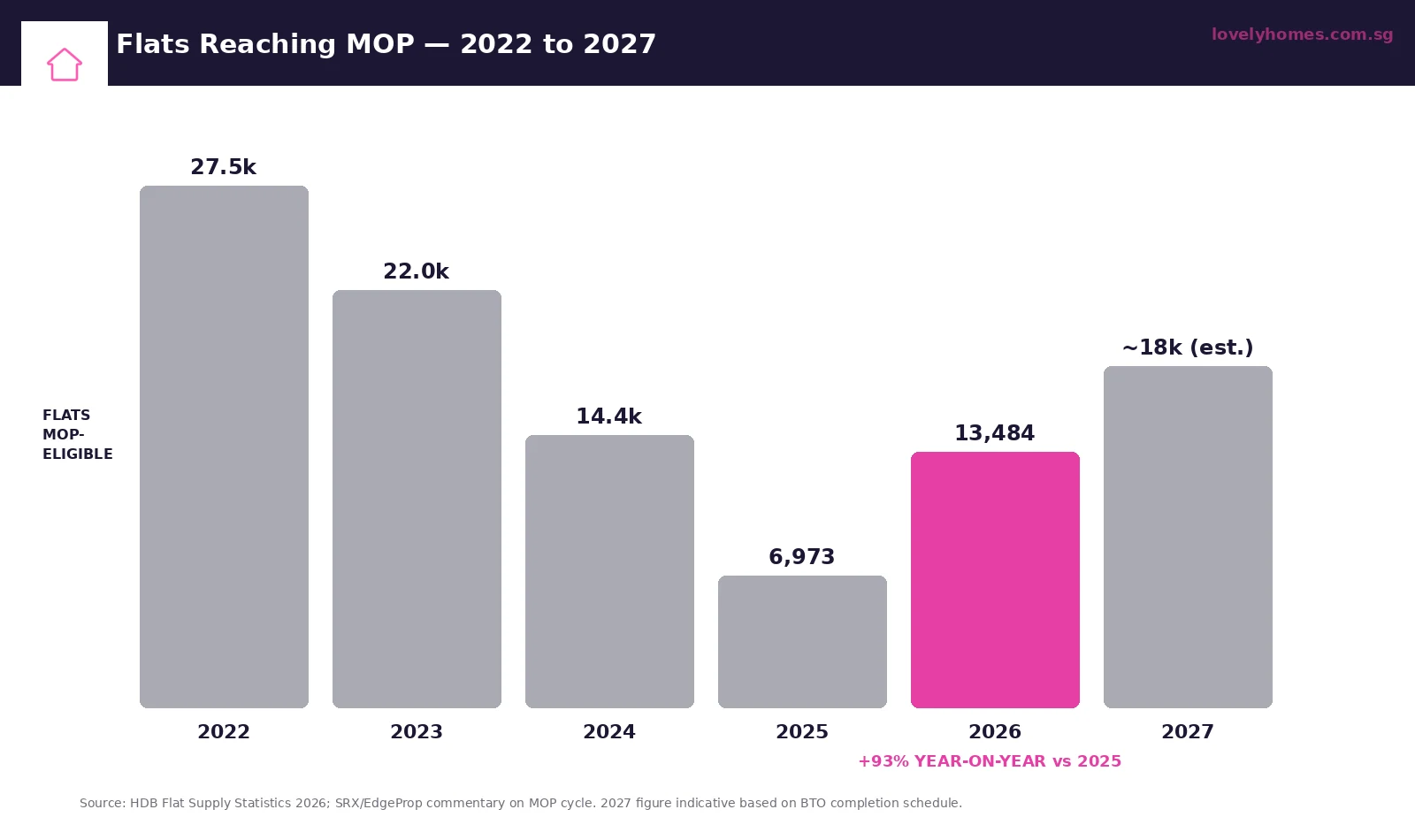
HDB MOP supply Singapore 2022-2027 — bar chart showing 2026 spike to 13,484 flats
Figure 1: Five-year MOP supply by year. The 2025 trough — driven by Covid-era construction slowdown — gives way to a 2026 spike that almost doubles back to a more typical annual volume.

Where the Wave Hits

The 2026 MOP cohort is concentrated geographically in the estates that absorbed the bulk of the 2018–19 BTO launches. Punggol is the single largest contributor, with roughly 3,200 flats reaching MOP across the Punggol Town Centre, Punggol Coast and Punggol Northshore precincts. Sengkang follows with about 2,400 flats, primarily in the Anchorvale Parkway and Compassvale Highway projects. Tengah, the youngest mature estate-in-the-making, contributes around 1,900 flats from the Plantation Acres and Garden Walk launches. Bidadari (administered under Toa Payoh) adds another 1,800 from Park Place and Alkaff.
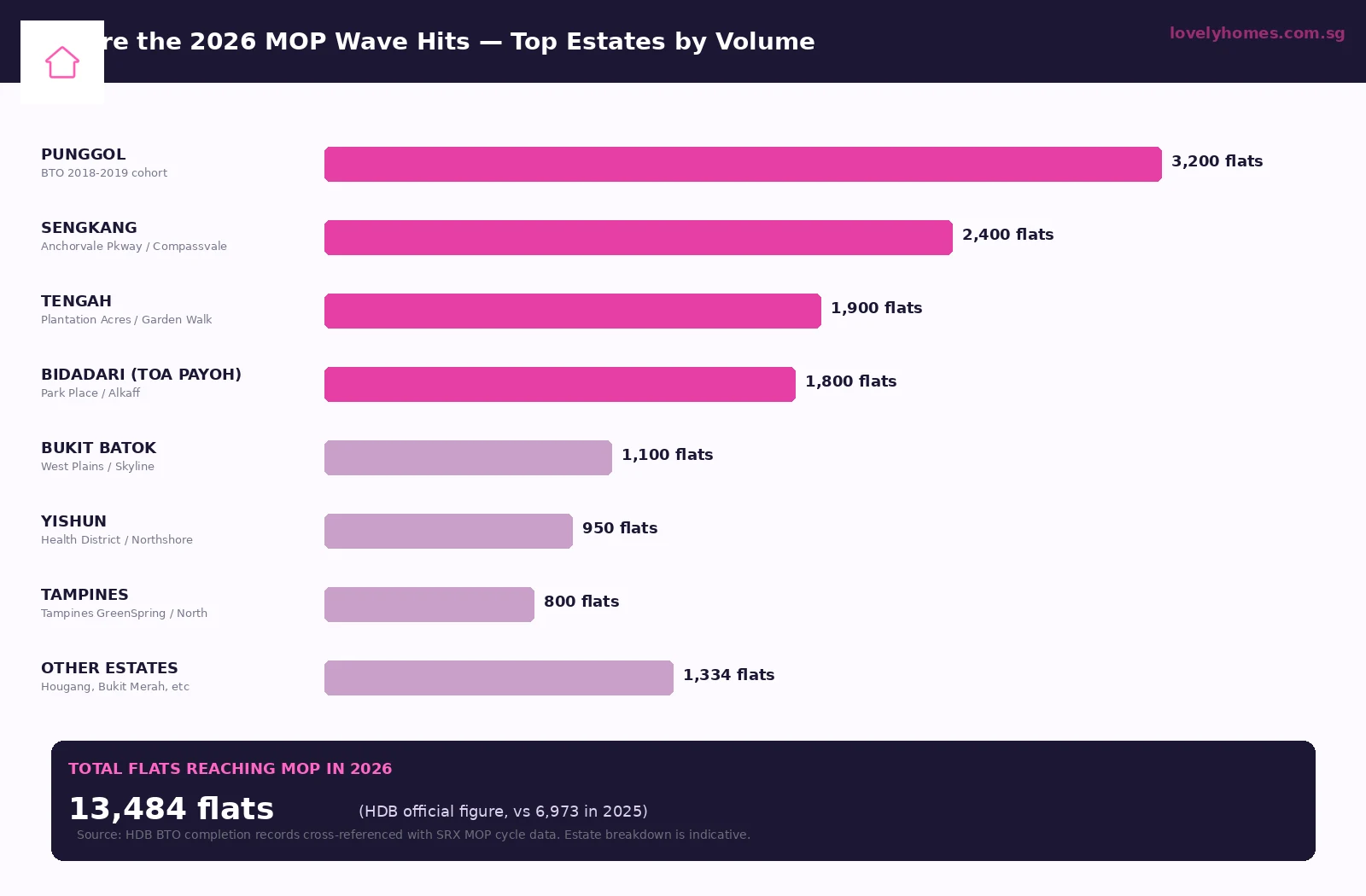
HDB MOP 2026 estate breakdown — Punggol Sengkang Tengah Bidadari lead supply
Figure 2: The 2026 MOP wave is heavily skewed toward young suburban estates and Bidadari. Bukit Batok, Yishun and Tampines round out the top contributors.

The estate composition matters because resale and rental absorption is local. A flood of newly-MOP flats in Punggol does not directly weigh on resale prices in Bishan or Ang Mo Kio; it weighs on Punggol prices and to a smaller degree on the surrounding Sengkang corridor. The implication is that the calmer trajectory in the headline HDB Resale Price Index masks meaningful divergence between estates: young suburban estates with thick MOP supply are likely to see the most price moderation, while mature estates with thin MOP volumes (Bishan, Queenstown, Toa Payoh outside Bidadari) are likely to remain firm.

Resale: From Mid-Single-Digit Growth to a Flat Quarter

The Q1 2026 final HDB resale data, released by the Housing & Development Board on 24 April 2026, showed the Resale Price Index fell 0.1 per cent quarter-on-quarter — the first decline since Q2 2019. Transaction volume came in at 6,285 flats for the quarter, slowing on a year-on-year basis but slightly higher quarter-on-quarter. The combination of softer prices and resilient volumes is consistent with a market entering a digestion phase: more sellers (driven by the MOP wave) meeting steady but not accelerating buyer demand.

The MOP supply is one of three factors moderating the index. The other two are the larger BTO programme (19,600 flats across 2026 versus 6,000 in the depths of the post-Covid pause), which provides a credible primary-market alternative for first-timer demand, and the cumulative effect of the cooling measures introduced between 2021 and 2024 — the 55 per cent TDSR, the 15-month wait-out for ex-private downsizers, and the wider tenure restrictions on HDB Loans. Each contributes; the MOP supply is the new element in 2026 that pushes the index from “moderating” to “flat”.

For owners considering a sale this year, the practical implication is that pricing power is tighter than it was in 2024. The cash-over-valuation (COV) figures that buoyed the 2024 market are normalising back toward listed valuation. Sellers who set realistic asking prices and refresh their listings against current comparables clear the market; sellers who anchor on 2024 valuations are increasingly seeing extended days-on-market.

Rental: The Largest Single-Year Supply Shock Since 2022

Owners who reach MOP in 2026 have two primary monetisation paths — sell, or rent out. Historically the split has run roughly 60:40 in favour of selling, with the rental fraction skewing higher in young estates where the MOP holders are typically dual-income households who are upgrading to a private property and prefer to retain the HDB as a rental asset. Applied to a 13,484-flat cohort, that translates to perhaps 5,000–6,000 newly-MOP flats joining the rental pool over the course of 2026.

That is the single largest quasi-instant supply addition the rental market has absorbed since the 2022 expat reshoring wave drove rents to record highs. URA data shows private residential rents rose just 0.3 per cent quarter-on-quarter in Q1 2026, and HDB rentals have softened by about 0.3 per cent month-on-month entering the year. Industry forecasts now centre on HDB rental growth of 1–2 per cent for 2026, down sharply from the 8–10 per cent annualised pace of 2022–23.

The rental moderation is unevenly distributed. Mature estates like Tiong Bahru, Tampines Central and Queenstown — where MOP supply is thin and expat demand remains anchored — continue to clear rents at firm or even slightly rising levels. Young estates with thick MOP supply, especially Punggol and Sengkang, are seeing rental softness as the new supply meets a tenant pool that is increasingly price-sensitive. The price-sensitivity is itself a shift: companies have tightened relocation budgets, and tenants on longer-term assignments are negotiating harder against the deeper inventory.

Worked Example — The Lim Family in Punggol

Worked Example. Mr and Mrs Lim, both Singapore Citizens in their late 30s, took keys to a 4-room BTO at Punggol Northshore in March 2021. Combined gross income S$13,000/month; outstanding HDB Loan balance approximately S$340,000 at 2.6 per cent over the remaining 21 years; current valuation around S$680,000 based on Q1 2026 transactions in the precinct. Their flat reaches MOP in March 2026.

Path A — Sell now and upgrade. List at S$680,000, expect to clear at S$650,000–S$670,000 given the deeper Punggol supply (~3,200 flats reaching MOP across the year). Net cash and CPF on completion roughly S$310,000–S$330,000 after redeeming the HDB Loan and refunding accrued interest. Transition into a 2-bedroom OCR private condo in the S$1.5–1.7M range using the proceeds plus a fresh bank loan.

Path B — Rent out and retain. Rent out at S$3,400/month — softer than the S$3,600 a similar 4-room would have achieved in early 2025 because of the supply influx. Net of agency fees, HDB Loan instalment and property tax under the non-owner-occupier ladder, monthly cash flow is roughly S$300–S$400. The Lims continue to live in their HDB for the time being, retain optionality for a private upgrade later, and benefit if Punggol prices firm again into 2027–28 once the MOP supply normalises.

Path C — Sell into the resale market and rent in mature estate. Sell as in Path A, but rent a Bishan or Toa Payoh 4-room at roughly S$3,200/month while waiting for a private launch in a preferred location (Bidadari, Tengah extension, or a CCR launch in late 2026). This path frees up CPF and cash, locks in current valuation, and keeps the household nimble while the market digests the MOP wave.

The decision between the three paths is heavily personal — financial, lifestyle and timing — and the right answer for the Lims is not necessarily the right answer for a similar couple in Sengkang or Bidadari. What the analysis does highlight is that the MOP wave creates an asymmetry in 2026 that is worth modelling carefully before acting.

Summary Table — 2026 MOP Wave Quick Reference

Metric 2025 2026 (this year) Implication
Flats reaching MOP 6,973 13,484 +93% supply uplift
HDB RPI (QoQ) +1.0% to +1.7% range −0.1% Q1 (first decline since Q2 2019) Calmer trajectory
HDB rental growth (annual) ~5–6% 1–2% (forecast) Tenant-friendly
BTO programme ~6,000 flats 19,600 flats (3 exercises) Primary-market alternative
Top MOP estate Tampines (~1,400) Punggol (~3,200) Suburban supply skew
Million-dollar HDB flats ~1,030 transactions 412 transactions in Q1 Pace remains elevated
Days-on-market (resale) ~28 days median ~38 days median (estimate) Less seller pricing power

What This Means for You

The 2026 MOP wave is not a price collapse — the HDB Resale Price Index is essentially flat, not down materially — but it is a meaningful repricing of the seller’s position. Five rules of thumb follow from how the wave is reshaping the market.

For sellers in young estates (Punggol, Sengkang, Tengah, Bidadari): price against current Q1 2026 comparables, not against 2024 highs. Refresh listings every 4–6 weeks. Expect a longer time-on-market and weaker COV. The deeper buyer pool is good news for finding a buyer; the asymmetry is in pricing power.

For sellers in mature estates (Bishan, Queenstown, Toa Payoh outside Bidadari): the MOP wave barely touches your supply. Pricing remains firm, days-on-market remain short, and selective premium pricing is still achievable for renovated units. The market segmentation that has defined HDB resale since 2022 — where mature-estate scarcity attracts a premium — continues to hold.

For tenants: 2026 is the first genuinely tenant-friendly year since 2021. Use the leverage. Negotiate harder on renewal rents and on the new-lease-shopping pool. The supply uplift is most visible in young estates and OCR condos; mature-estate rents remain firmer.

For upgraders: sequence the buy-side first. The resale market is no longer a guaranteed quick clearance, especially in young estates with thick MOP supply. Lock in the upgrade purchase before listing the existing flat, or budget for a longer disposal window. Bridging loans are an option if cash-flow allows.

For investors holding HDB-near-MOP: retaining for rental no longer offers the rent-up surprise of 2022–23. The rental yield maths now sits in a 2.5 per cent–3.5 per cent net range for most 4-room flats in young suburban estates, which compares unfavourably to comparable yields on smaller OCR condos for households in higher tax brackets. The case for selling and reallocating capital strengthens at this point in the cycle.

What Might Come Next

Two trajectories are worth watching across the rest of 2026 and into 2027. First, the second half of 2026 brings additional MOP supply from the 2019–20 BTO cohort, particularly the Q3 and Q4 keys collected in 2021. SRX and EdgeProp commentary points toward a 2027 supply that may remain at or above the 2026 figure before normalising in 2028. If true, the price moderation that defined Q1 2026 is likely to extend through the full year and into the early part of 2027.

Second, the rental market is approaching the inflection point where tenant price-sensitivity meets real wage growth. Singapore’s median household income continues to rise at roughly 3 per cent a year nominal; if rental growth caps at 1–2 per cent across 2026 and 2027, rent-to-income ratios moderate for the first time since 2021. That is a meaningful structural improvement for the household sector and may reduce the political pressure that drove some of the cooling-measure calibration of 2023–24.

The structural variable that could disturb both trajectories is the BTO completion pace. If construction delays push the 2027 MOP cohort into 2028, the 2027 supply moderates and the rental softening may reverse earlier than expected. Conversely, if the 2026 BTO programme of 19,600 flats accelerates rather than smooths the pipeline, the 2031 MOP wave (five years out from 2026) could be even larger than 2026’s. The Government’s stated intent is a smooth, predictable supply cadence; markets should plan for that base case while keeping an eye on the construction-completion data that will feed the 2027 picture.

Frequently Asked Questions

What does MOP mean and why is the 5-year clock important?

MOP — the Minimum Occupation Period — is the 5-year minimum during which a household must occupy its HDB flat as primary residence before it can be sold on the open market or rented out as a whole unit. The 5-year clock starts on key collection. Until MOP is served, the flat cannot be sold to anyone other than HDB itself, and rental is restricted to room-by-room arrangements (and only with HDB approval). The MOP is a cornerstone of HDB’s policy that public housing is shelter first and asset second.

Why is the 2026 cohort so much larger than 2025?

The 2025 cohort was unusually small because the 2020 BTO programme was sharply curtailed during the post-Covid construction pause. The 2018–19 cohort that hits MOP in 2026 was a much larger BTO vintage, by design — the Government had ramped up supply ahead of the 2017–18 demand surge. The 2027 figure is also expected to be elevated as the 2019–20 cohort completes its MOP, before the pipeline normalises in 2028.

Will HDB resale prices fall further in 2026?

The Q1 2026 print of −0.1 per cent QoQ is the first decline in seven years, but the consensus across SRX, EdgeProp and HDB’s own commentary is that the full-year trajectory is flat to mildly positive (0–2 per cent), not a meaningful drop. The market is digesting the supply influx, not collapsing under it. Mature estates are likely to remain firm; young suburban estates with thick MOP supply are the segments most exposed to flat or mildly negative prints in Q2 and Q3.

Should I rent out my MOP-eligible flat or sell?

The arithmetic depends on three variables: net rental yield (typically 2.5–3.5 per cent for young suburban 4-rooms in 2026), expected price trajectory of the estate (firmer in mature estates, softer in MOP-heavy ones), and the household’s need for capital from the sale. For households planning to upgrade to private property within the next 12 to 24 months, selling now and crystallising the equity tends to be cleaner. For households happy to retain the HDB and add a private property on top, the rental retention path remains viable but the rent-up surprise of 2022–23 has fully passed.

How do I check when my own flat reaches MOP?

The MOP completion date is 5 years from the date of key collection. Owners can verify the exact MOP date through the HDB Resale Portal (My HDBPage) under “My Flat Details”, which shows the date of key collection and the calculated MOP completion. The portal also shows whether any partial occupation gaps (e.g. for prolonged overseas postings) need to be made up before the MOP is officially served.

Does the new Plus and Prime classification change MOP rules for 2026 flats?

For most flats reaching MOP in 2026 — which were launched in 2018–19 under the old Mature/Non-Mature classification — the standard 5-year MOP applies. The Plus and Prime classifications introduced from October 2024 carry longer 10-year MOPs, with subsidy clawbacks of 6 per cent (Plus) or 9 per cent (Prime) on resale, and a S$14,000 monthly income cap for resale buyers. Those classifications affect the 2034-and-later MOP cohorts; they do not change the 2026 supply picture.

Will the BTO programme of 19,600 flats in 2026 cannibalise resale demand?

Partially, yes. The 19,600 BTO programme is the largest in over a decade and provides a credible primary-market alternative for first-timer households, particularly those with EHG entitlements that work better against a BTO than a resale. The cannibalisation is most visible in non-mature young estates where the BTO and resale segments overlap. In mature estates with no BTO supply (Bishan, Queenstown, Toa Payoh outside Bidadari), the resale market continues to clear at firm prices because the BTO is not a substitute.

Disclaimer

This piece is general analysis of the 2026 HDB MOP supply pipeline and its implications for the resale and rental markets, drawing on data from HDB, the Urban Redevelopment Authority, SRX, EdgeProp and Stacked Homes published as at the date of writing. Estimates of estate-level MOP volumes and the rental/sale split are indicative; the actual mix will depend on individual household decisions and may vary materially across the year. This is not financial, tax or legal advice. For decisions on your own flat, consult HDB Mortgage Servicing, a licensed Singapore property adviser and (where relevant) a tax practitioner. Always rely on official sources — HDB, URA, data.gov.sg — for the latest position before transacting.
Related Articles

99-to-1 Property Purchase Singapore 2026: How Tenancy-in-Common Carve-outs Met IRAS’ ABSD Anti-Avoidance Probe

99-to-1 Property Purchase Singapore 2026: How Tenancy-in-Common Carve-outs Met IRAS’ ABSD Anti-Avoidance Probe

The phrase 99-to-1 Property Purchase Singapore 2026 describes a tenancy-in-common structure where one buyer holds 99 per cent of the property and a second buyer holds 1 per cent. Used legitimately, it is a perfectly valid form of co-ownership recognised under the Land Titles Act. Used as a two-step manoeuvre to add a co-owner after the original purchase, the structure became the subject of one of the most public anti-avoidance probes the Inland Revenue Authority of Singapore (IRAS) has run in the post-2010 cooling-measure era — a probe that recovered an estimated S$60 million in unpaid Additional Buyer’s Stamp Duty (ABSD) and surcharges.

This guide explains how the 99-to-1 structure works, why IRAS has scrutinised it, when a 99-to-1 split is legitimate and when it crosses the line into tax avoidance under the General Anti-Avoidance Rule (Section 33A of the Income Tax Act, with parallel application to stamp duties), and what the practical implications are for any Singapore household considering a tenancy-in-common purchase in 2026. The framework is administered by IRAS under the Stamp Duties Act, with anti-avoidance powers drawn from Section 33A of the Income Tax Act 1947.

Quick Answer — 99-to-1 in Singapore at a glance

  • What it is: a tenancy-in-common (TIC) ownership split where one party holds 99 per cent and another holds 1 per cent of a single residential property.
  • Why people use it: to bring a second income onto a bank loan, to plan an estate, or to manage the marital-asset split.
  • Why IRAS scrutinised it: a two-step variant — Buyer A purchases 100 per cent first, then Buyer B (who already owns property) is added 1 per cent later — was used to dodge ABSD that should have applied at the higher second-property rate.
  • The 2023 IRAS probe: 166 cases reviewed, an estimated S$60 million in ABSD and surcharge recovered, with a 50 per cent surcharge layered on top of the avoided tax.
  • Bright-line test: if the 1 per cent share is added after the original purchase, with the only commercial reason being to avoid a higher ABSD bracket, IRAS treats it as one composite transaction and reassesses ABSD on the full price.
  • Statute of limitations: up to six years backward under Section 33A.
  • Legitimate use is unaffected: a 99-to-1 split applied at the OTP itself, with both parties paying ABSD on their respective shares from Day 1, is fine.

What 99-to-1 Actually Means in Singapore Property Law

Singapore property co-ownership comes in two legal forms — joint tenancy and tenancy-in-common. Joint tenancy means co-owners share an undivided 100 per cent interest, and the property passes by survivorship to the surviving joint tenant on death. Tenancy-in-common means each owner holds a defined percentage of the property, and that share passes by will (or by intestacy) on death rather than to the other co-owners. Two co-owners as tenants-in-common can hold the property in any split that adds to 100 per cent — 50/50 is the default, but 80/20, 70/30 and 99/1 are all permitted. The Land Titles Act recognises any defined share. The 99/1 split is unusual mathematically but unremarkable legally.

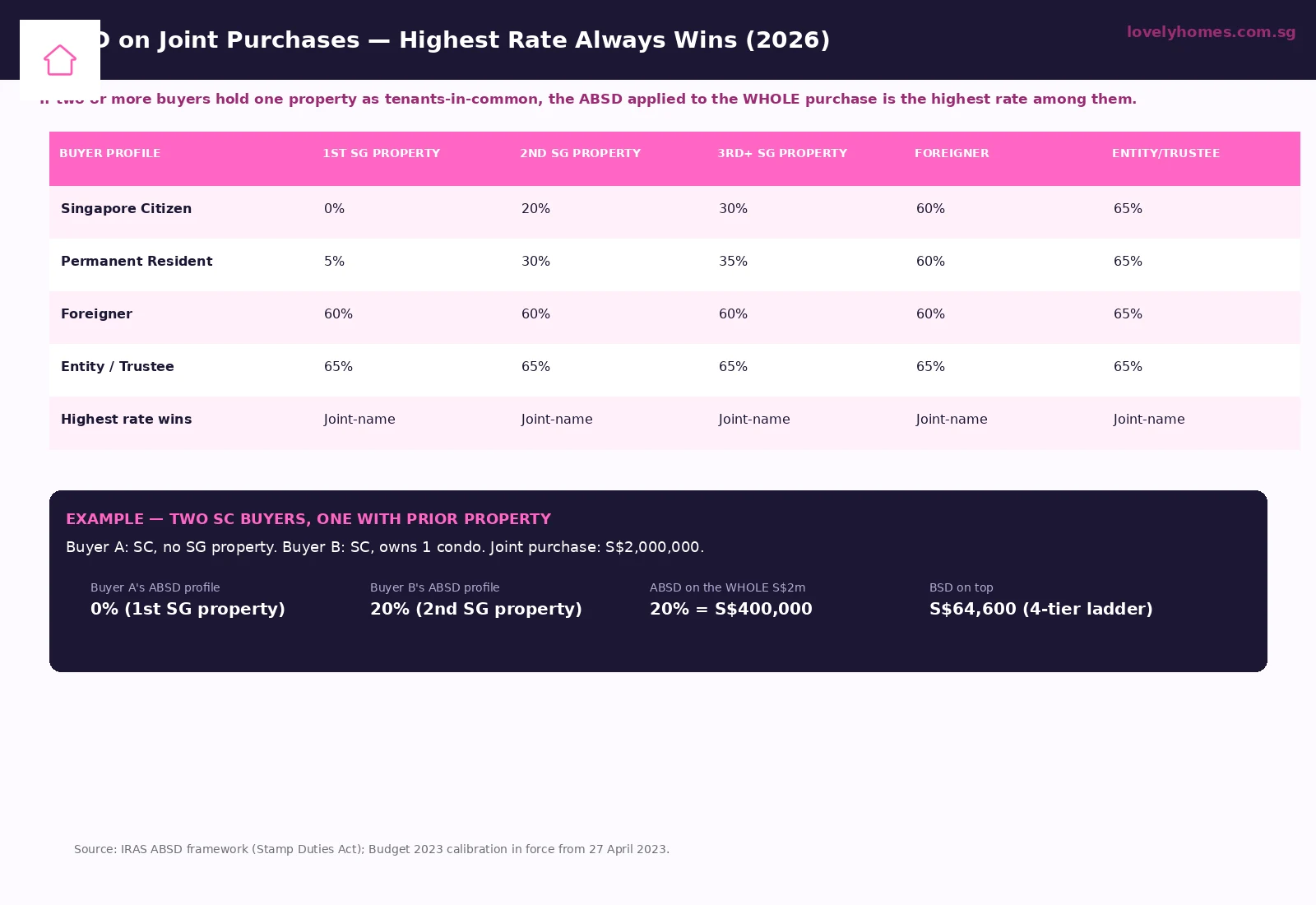
For stamp duty purposes, a tenancy-in-common purchase is treated as a single transaction at the property level. Each co-owner is a “buyer” under the Stamp Duties Act, and ABSD is computed against each buyer’s profile. Where the buyers fall into different ABSD brackets — for example, one with no prior Singapore property (0 per cent) and one with one prior Singapore property (20 per cent) — the rule is unambiguous: the highest ABSD rate among the joint buyers applies to the entire purchase price, not just to the higher-rate buyer’s share.

This rule is what makes the 99-to-1 split structurally different from, say, a 50-50 split. The economic exposure of the 1-per-cent owner is one one-hundredth of the property; but the ABSD effect is the same as if they owned the whole thing. The Government’s logic is straightforward — the rule is meant to plug the obvious workaround of giving a higher-rate buyer a tiny notional share to access a joint loan while ducking the corresponding ABSD.

The Two-Step Mechanic IRAS Targeted

The 99-to-1 manoeuvre that IRAS publicly scrutinised in April 2023 was not the upfront 99-to-1 split. Upfront splits, where both buyers appear on the original Option to Purchase, the Sale and Purchase Agreement and stamping documents, were never the issue — the highest-rate ABSD applies cleanly and the tax is paid in full. The structure that drew IRAS’ attention was a two-step purchase:

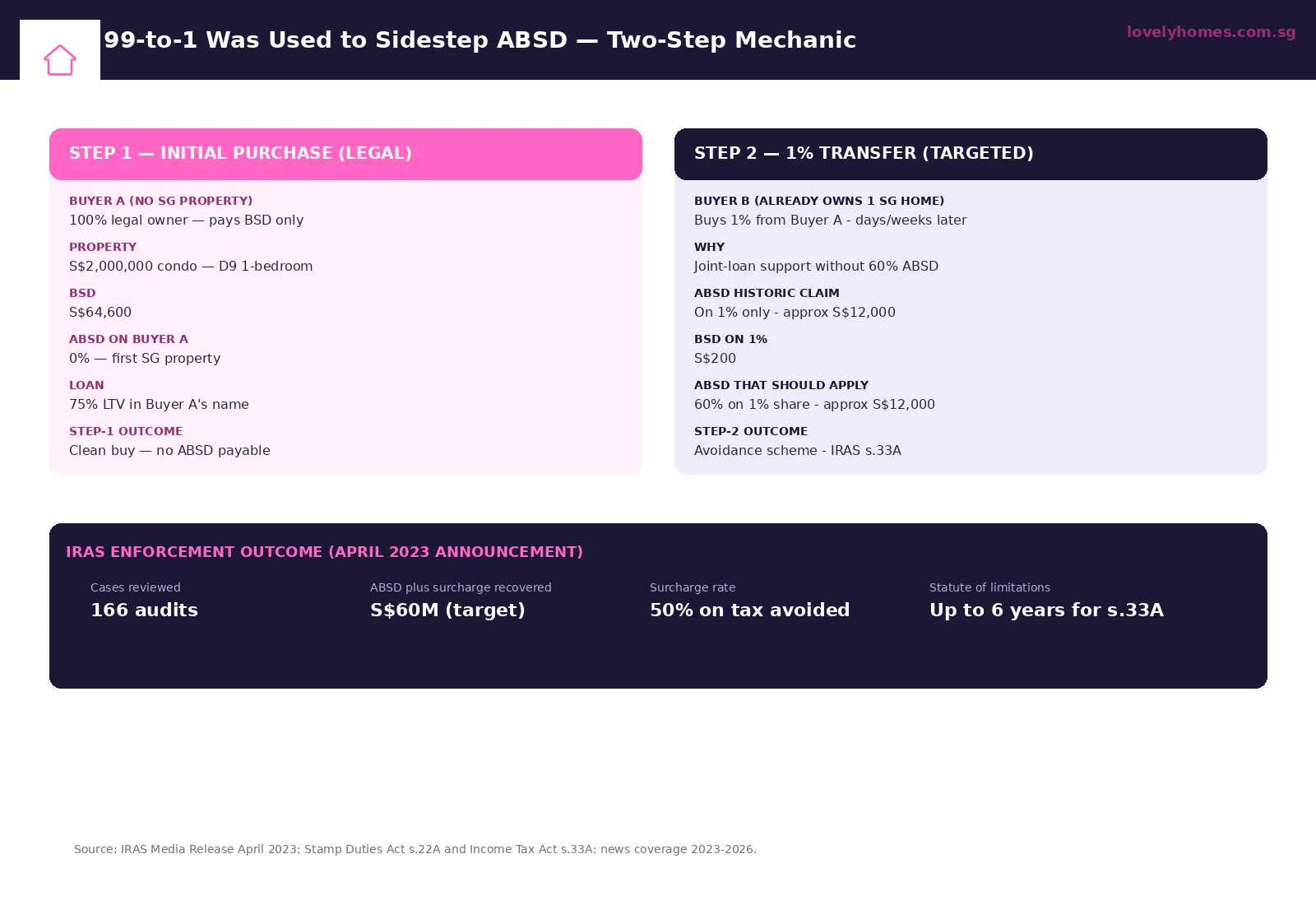
99-to-1 Singapore 2026 two-step ABSD avoidance mechanic — Buyer A first, Buyer B added one per cent later
Figure 1: The two-step pattern targeted by IRAS — original 100% buy by the lower-rate party, followed days or weeks later by a 1% transfer to the higher-rate party.

Step 1. Buyer A — a Singapore Citizen or Permanent Resident with no other Singapore property — exercises the Option to Purchase as the sole 100-per-cent owner of, say, a S$2 million condominium. ABSD on Buyer A is 0 per cent (or 5 per cent for a PR). Buyer’s Stamp Duty is computed normally (about S$64,600 for S$2 million). The buy is clean from the stamp-duty perspective.

Step 2. A short period later — sometimes days, sometimes weeks, occasionally a couple of months — Buyer A executes a transfer of 1 per cent of the property to Buyer B, who already owns one or more Singapore residential properties. Buyer B’s ABSD profile sits at 20, 30 or 60 per cent depending on their citizenship and prior holdings. Stamp duty would be paid on the 1-per-cent transfer at face value (BSD on S$20,000 = S$200; ABSD on S$20,000 at 20 per cent = S$4,000). The household has now achieved its real goal — both names on the title — but has paid only a fraction of the ABSD that would have been due if both names had appeared on the original OTP.

The motivation for the two-step structure is almost always financing-related. Banks underwrite home loans against the income of the named borrowers; many households need both incomes to meet the Total Debt Servicing Ratio (TDSR) cap of 55 per cent. If the higher-income borrower already owns property, putting both names on the OTP triggers the higher ABSD bracket on the entire purchase. The 99-to-1 two-step purports to achieve the loan-support outcome without the ABSD outcome.

How IRAS Pulled the Pattern Apart

IRAS announced in April 2023 that it had reviewed 166 cases of 99-to-1 (and similar structures like 95-to-5 or 90-to-10) where there was no commercial reason for the two-step pattern other than ABSD avoidance. The agency invoked Section 33A of the Income Tax Act 1947 — Singapore’s General Anti-Avoidance Rule — together with its parallel powers under the Stamp Duties Act, to recharacterise the two-step transaction as a single composite purchase. Once recharacterised, the ABSD is recalculated as if both buyers had been on the original OTP at the higher rate.

99-to-1 Singapore 2026 ABSD rates joint buyers — highest rate wins on entire purchase
Figure 2: The ABSD rate matrix for joint buyers in 2026. The highest applicable rate among co-owners applies to the whole purchase, not just to that owner’s share.

The reassessment can be material. On a S$2 million joint purchase by an SC with no prior property and an SC with one prior property, the original transaction collected ABSD only on the 1-per-cent transfer (about S$4,000). The composite reassessment applies 20 per cent ABSD to the entire S$2 million — S$400,000 — with the difference (S$396,000) recovered as additional duty. On top, IRAS imposes a 50 per cent surcharge on the avoided ABSD under the surcharge provisions of the Stamp Duties Act. Total exposure: roughly S$594,000 in additional ABSD, surcharge and interest on an originally clean-looking S$2 million buy.

The surcharge is what makes the structure so dangerous in retrospect. A buyer who would have happily paid the full ABSD upfront — perhaps deciding the higher rate was worth paying for joint-name ownership — is now exposed to half-as-much-again-on-top simply because the structure was used to sidestep it.

The Bright-Line Test — Legitimate vs Avoidance

IRAS does not publish a closed-list rule on which 99-to-1 structures are acceptable. The framework is principles-based, drawn from the long-established interpretation of Section 33A: a transaction or arrangement is voidable for tax purposes if its sole or dominant purpose is to obtain a tax advantage and there is no genuine commercial reason for it. The case law on Section 33A — including the leading Comptroller of Income Tax v AQQ decision — emphasises substance over form, intent over labels, and the natural commercial reality of what the parties actually did.

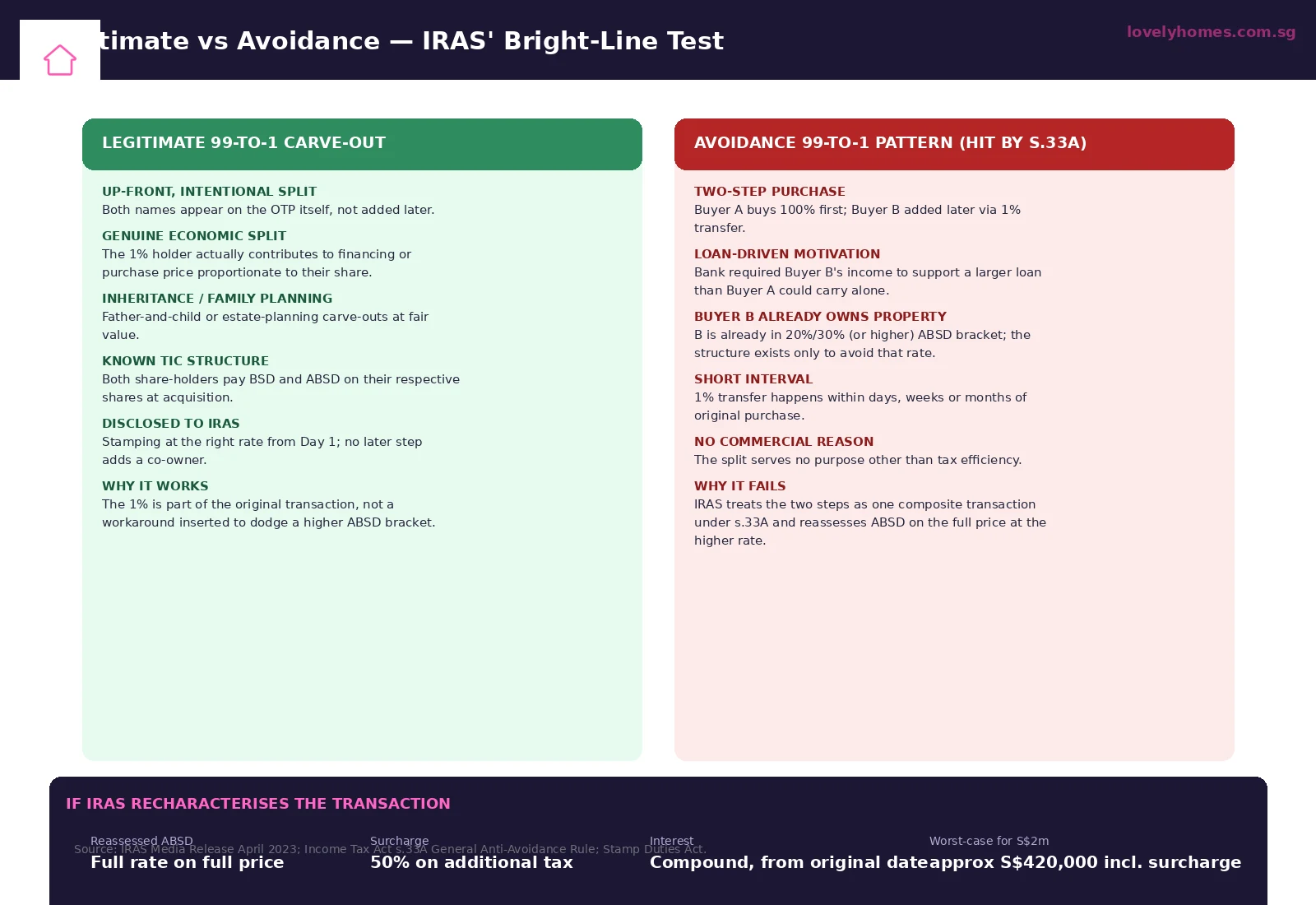
99-to-1 Singapore 2026 legitimate carve-out vs avoidance pattern under section 33A bright-line test
Figure 3: The bright-line markers IRAS uses to separate a legitimate 99-to-1 carve-out from an avoidance pattern. Time gap, contribution, intent and disclosure all matter.

Practically, four indicators tend to push a 99-to-1 split into the legitimate column. First, both names appear on the original OTP itself — the 1 per cent is part of the original transaction, not bolted on later. Second, both parties contribute economic value proportionate to their share — for example, a child contributes a small cash deposit and is rightly entered on the title for that contribution. Third, the structure has a non-tax purpose — estate planning, succession, marital-asset planning, or a parent-and-child purchase with a real intent to leave the 1 per cent in the second name. Fourth, disclosure is clean — both parties stamp at their full ABSD rate from Day 1.

Three indicators tend to push a 99-to-1 split into the avoidance column. First, the 1-per-cent owner is added after the original purchase, with no documented commercial trigger for the late addition. Second, the only practical effect of the addition is to bring the higher-rate party’s income onto a bank loan that would otherwise not have qualified at TDSR 55 per cent. Third, the time gap between the original 100-per-cent purchase and the 1-per-cent transfer is short — days, weeks, or a small number of months — and there is no intervening event (such as a marriage, an inheritance, a job change creating a new income source) that explains the delay.

The IRAS audits in 2023 focused on cases where multiple of these markers were present together. A two-step purchase by itself is not automatically voided; what IRAS looks for is the conjunction of the markers — late addition, no commercial reason, financing motivation, short gap, and the higher-rate party already in a prior-property bracket.

What “Legitimate” Looks Like in Practice

Three real-world patterns of 99-to-1 are routinely accepted by IRAS as commercially sound and not subject to anti-avoidance recharacterisation. The first is parent-and-child estate planning: a parent buys a property and includes the child as a 1-per-cent tenant-in-common to facilitate eventual succession at fair value. The 1 per cent is part of the original OTP, ABSD is paid at the parent’s full applicable rate (with the child’s portion stamped at the child’s rate, if different), and the structure has a clear non-tax purpose.

The second is marital asset structuring before divorce: a couple in the late stages of separation may carve out a 99-to-1 split to give one party a residual interest pending the matrimonial settlement, with the larger holder having the operational control to sell. As long as the carve-out is at the OTP itself and ABSD is paid at the highest rate, this is unobjectionable.

The third is commercial co-investment with documentation: a friend-of-friend joint purchase where one party puts up the bulk of the equity and the other contributes a small share for a defined investment purpose (renovation works, future development, occupancy rights). Provided ABSD is fully paid at the highest applicable rate from Day 1, IRAS has no anti-avoidance angle to pursue.

Worked Example — Mr Lee and Mrs Lee on a S$2 Million Tampines Condo

Worked Example. Mr Lee, 36, Singapore Citizen, owns one HDB flat already. Mrs Lee, 33, Singapore Citizen, has no other property. They want to buy a S$2 million private condominium in Tampines. Mr Lee’s gross income is S$14,000 a month; Mrs Lee’s is S$5,000. Mr Lee’s prior HDB will continue to be occupied by his parents. Both names are needed on the bank loan to clear the TDSR 55 per cent test on the S$1.5 million loan they have in mind.

The legitimate joint purchase. Mr and Mrs Lee both go on the OTP as tenants-in-common at any agreed split — 50/50, 99/1, 1/99, whatever. Mr Lee falls into the 20 per cent ABSD bracket (second Singapore property). The highest-rate-wins rule applies the 20 per cent rate to the entire S$2 million purchase. ABSD = S$400,000. BSD = S$64,600. The bank underwrites the S$1.5 million loan against both incomes; TDSR clears comfortably. The Lees write the cheque, take the keys, and IRAS is satisfied.

The avoidance variant (do not do this). Mrs Lee buys 100 per cent of the condo on the OTP at S$2 million. ABSD on Mrs Lee is 0 per cent (first Singapore property). BSD = S$64,600. Six weeks later, Mr Lee is added at 1 per cent for a notional consideration of S$20,000. ABSD on the 1 per cent at his 20 per cent rate = S$4,000. The household has paid roughly S$396,000 less ABSD than it would have under the legitimate joint purchase.

The IRAS reassessment. If IRAS audits the file under Section 33A and finds the financing motivation — the bank loan was sized off both incomes from the start, and there is no commercial reason for the six-week delay other than the ABSD differential — the agency reassesses the original transaction as a composite joint purchase. ABSD becomes S$400,000. The avoided amount of approximately S$396,000 attracts a 50 per cent surcharge of S$198,000. Plus simple interest from the original stamping date to the date of the IRAS notice. Total exposure: around S$594,000 in additional duty and surcharge — most of which would have been zero if the household had simply gone on the OTP together at the start.

The arithmetic is the lesson. Households who can afford to pay the ABSD on a joint purchase should do so. Households who cannot afford it should not be using a 99-to-1 to make themselves “afford” it — the 50 per cent surcharge erases the saving and adds a felt embarrassment to the file.

Summary Table — 99-to-1 Considerations 2026

Question Answer (2026)
Is a 99-to-1 split itself illegal? No. Tenancy-in-common at any defined share is recognised under the Land Titles Act.
Is an upfront 99-to-1 acceptable? Yes. As long as both names are on the original OTP and ABSD is paid at the highest applicable rate.
Is a two-step 99-to-1 acceptable? Only if there is a documented commercial reason for the delay. If not, IRAS may invoke Section 33A.
What rule applies on joint name? Highest ABSD rate among the buyers applies to the entire purchase price.
Surcharge if avoidance is found? 50 per cent surcharge on the avoided ABSD, plus simple interest from original stamping date.
Lookback period for IRAS Up to six years from original stamping under Section 33A.
Legitimate alternatives Decoupling (sale of one share to the other after MOP), staggered purchases over time, or paying full ABSD upfront.
Cases reviewed in 2023 probe 166 cases; estimated S$60 million in ABSD and surcharge recovered.
Does HDB allow 99-to-1? Generally not for HDB purchases — HDB applies its own joint-tenancy rules and prohibits decoupling since 10 April 2018.

What This Means for You

The 99-to-1 ABSD episode is one of the clearest illustrations of how Singapore’s tax authorities use a principle-based General Anti-Avoidance Rule rather than a closed-list code. There is no specific rule banning 99-to-1 splits; there is a broader rule that any tax-driven structure with no commercial purpose can be recharacterised. Households making property co-ownership decisions in 2026 should treat this less as a single closed file and more as a continuing posture by IRAS toward stamp-duty avoidance.

The practical advice is simple. If you and a co-buyer want to be on the title, get on the title at the OTP. Pay ABSD at the highest applicable rate from Day 1. Do not invent a delayed structure to manage the bank loan unless there is a real, documentable, non-tax reason for the delay. If you are unsure whether your circumstance qualifies, consult a Singapore conveyancing solicitor before signing the OTP — restructuring is far cheaper than reassessment.

For households who genuinely cannot afford the higher ABSD bracket — for example, an upgrader couple where one spouse already owns property — the legitimate alternative is decoupling after the Minimum Occupation Period on the existing flat (if HDB, subject to the 2018 prohibition), or a staggered purchase strategy over time. These approaches respect the cooling-measure intent and do not invite the 50 per cent surcharge that attaches to recharacterised avoidance.

What Might Come Next

The 99-to-1 enforcement was a high-visibility action that has materially shifted market behaviour since 2023. Conveyancing solicitors now flag two-step structures as a matter of course; banks increasingly require ABSD payment confirmation before disbursing on transfers; and IRAS has signalled that anti-avoidance scrutiny extends to other patterns where the form of a transaction differs materially from its substance — for example, trust structures, nominee purchases, and serial divorce-and-remarriage carve-outs in property settlements.

Looking forward, two areas of policy attention deserve watching. First, the Stamp Duties Act may be tightened to make composite-transaction recharacterisation more procedurally straightforward, replacing the case-by-case Section 33A review with a clearer presumption against short-interval transfers. Second, the surcharge level — currently 50 per cent — has historical precedents at higher levels in other Singapore tax regimes, and could be revisited if avoidance patterns continue to surface. The direction of policy travel since 2010 has been toward closing perceived loopholes, not loosening them; households should plan accordingly.

Frequently Asked Questions

Is the 99-to-1 split itself illegal in Singapore?

No. Tenancy-in-common at any defined share — including 99/1 — is a recognised form of co-ownership under the Land Titles Act. What IRAS scrutinises is the two-step pattern where the 1 per cent is added after the original 100 per cent purchase, with no commercial reason other than to avoid the higher ABSD rate that would have applied if both buyers had been on the OTP from the start.

If both names are on the original OTP, do I avoid the IRAS issue?

Yes. The April 2023 IRAS probe focused exclusively on two-step transactions where the second co-owner was added later. An upfront 99-to-1 split where both names appear on the original Option to Purchase, and ABSD is paid at the highest applicable rate from Day 1, is not subject to anti-avoidance recharacterisation.

What is the IRAS surcharge if avoidance is found?

50 per cent on the additional ABSD assessed, plus simple interest from the original stamping date. On a S$2 million purchase where avoided ABSD is S$396,000, the surcharge is S$198,000 — bringing the total reassessment to roughly S$594,000 plus interest. The surcharge is what makes anti-avoidance recharacterisation economically punitive: paying upfront would have been about two-thirds of the post-audit cost.

How far back can IRAS reassess?

Up to six years from the original stamping date under Section 33A. In practice, the 2023 probe looked at transactions over the preceding several years where the two-step pattern was identifiable from records. The lookback window means structures executed in 2020–22 remained exposed when the probe was announced.

Can I do a 99-to-1 for an HDB flat?

Generally not. HDB applies its own joint-tenancy rules — most BTO and resale purchases must be in joint tenancy, not tenancy-in-common — and decoupling has been prohibited since 10 April 2018 to prevent ABSD-avoidance manoeuvres on second properties. The 99-to-1 conversation is largely confined to private property purchases.

My family bought a property in 2021 with a 99-to-1 split. Should I worry?

Read the structure carefully. If both names appeared on the original OTP and ABSD was paid at the highest applicable rate at the time, there is nothing to worry about — that is a legitimate upfront 99-to-1. If the second name was added after the original purchase and the only motivation was financing or ABSD avoidance, the file is potentially exposed under Section 33A’s six-year lookback. Consult a solicitor or tax adviser to assess the position; voluntary disclosure ahead of an audit attracts considerably more lenient treatment than reactive disclosure.

Are there legitimate alternatives that achieve a similar financing outcome?

For households where one party already owns property and the other does not, the cleanest alternatives are: (a) pay the higher ABSD rate upfront on a joint purchase; (b) execute the purchase under the non-owning party’s name with the financing structured to qualify on that party’s income alone; or (c) wait until the existing property is sold (subject to the 30-month decoupling rule for ABSD remission on a Singaporean married couple’s first new property). Each has trade-offs, but none invites a Section 33A reassessment.

Disclaimer

This article is general guidance on Singapore’s stamp-duty framework as administered by the Inland Revenue Authority of Singapore as at the publication date and is not financial, tax or legal advice. Anti-avoidance enforcement under Section 33A of the Income Tax Act 1947 and the corresponding provisions of the Stamp Duties Act is highly fact-specific; the application to any particular transaction depends on the documents, sequence and intent. For the rule that applies to your circumstances, consult IRAS, a licensed Singapore solicitor and a registered tax practitioner. Always rely on official sources — IRAS, the Stamp Duties Act and the Income Tax Act 1947 — for the latest position before transacting.
Related Articles

HDB Concessionary Loan Singapore 2026: The 2.6% Rate, 80% LTV and Two-Loan Lifetime Cap Explained

HDB Concessionary Loan Singapore 2026: The 2.6% Rate, 80% LTV and Two-Loan Lifetime Cap Explained

The HDB Concessionary Loan Singapore 2026 is the financing instrument that quietly powers the majority of Build-To-Order purchases in this country. It carries a 2.6 per cent annual interest rate, an 80 per cent Loan-to-Value cap, and a one-Singapore-Citizen-per-household eligibility rule. For first-time buyers it is almost always cheaper than any private bank loan a Singapore household can access — and yet it comes with restrictions that catch a surprising number of upgraders out, especially the lifetime two-loan cap and the irreversible direction of refinancing.

This guide walks through how the HDB Concessionary Loan works in 2026, why HDB sets the rules the way it does, what eligibility actually means in practice, and how a typical Singapore Citizen household sees its loan sized and stacked. Figures and rules are administered by the Housing & Development Board, with the rate set in reference to the Central Provident Fund Ordinary Account (CPF OA) rate published by the CPF Board.

Quick Answer — HDB Concessionary Loan at a glance

  • Who can use it: at least one Singapore Citizen in the household (PR-only households are not eligible).
  • The rate: 2.6 per cent per annum, pegged at the CPF OA rate plus 0.1 percentage points; reviewed quarterly in January, April, July and October.
  • Loan-to-Value: up to 80 per cent of the lower of valuation or purchase price.
  • Down-payment: 20 per cent of valuation, of which at least 10 per cent must be cash for first-loan flats; the balance can come from CPF OA.
  • Income ceiling: S$14,000 family / S$7,000 single under the Singles Scheme / up to S$21,000 for Extended and Multi-Generation households.
  • Lifetime cap: each adult is limited to two HDB Concessionary Loans, ever.
  • Penalty for late payment: 7.5 per cent per annum on arrears.
  • Refinancing rule: a homeowner can refinance from an HDB Loan to a bank, but never the reverse. Once you walk away from HDB, you cannot come back.
  • MSR cap: Mortgage Servicing Ratio of 30 per cent of gross household income still applies; TDSR 55 per cent runs in parallel.

What an HDB Concessionary Loan Actually Is

The HDB Concessionary Loan is a fixed-rate housing loan that the Housing & Development Board (HDB) extends directly to eligible Singapore Citizen households for the purchase of an HDB flat — both Build-To-Order (BTO) and resale. Unlike a bank loan, where the lender prices in its own funding cost, profit margin and credit risk, the HDB Loan is a policy instrument: HDB borrows from the Government on the strength of CPF balances, and lends to households at CPF OA plus a 0.1 percentage-point spread. That spread has stayed at 0.1 percentage points since 1993, and the headline rate has tracked CPF OA all the way through Singapore’s interest-rate cycles.

The result is a remarkably stable rate. Through the rate-up cycle of 2022–23, when 3M SORA peaked above 3.7 per cent and bank fixed-rate home loans crossed 4.5 per cent, the HDB Loan rate stayed glued at 2.6 per cent because CPF OA stayed glued at 2.5 per cent. That stability is the single biggest reason why a household with the option to take an HDB Loan almost always should — at least at the point of purchase.

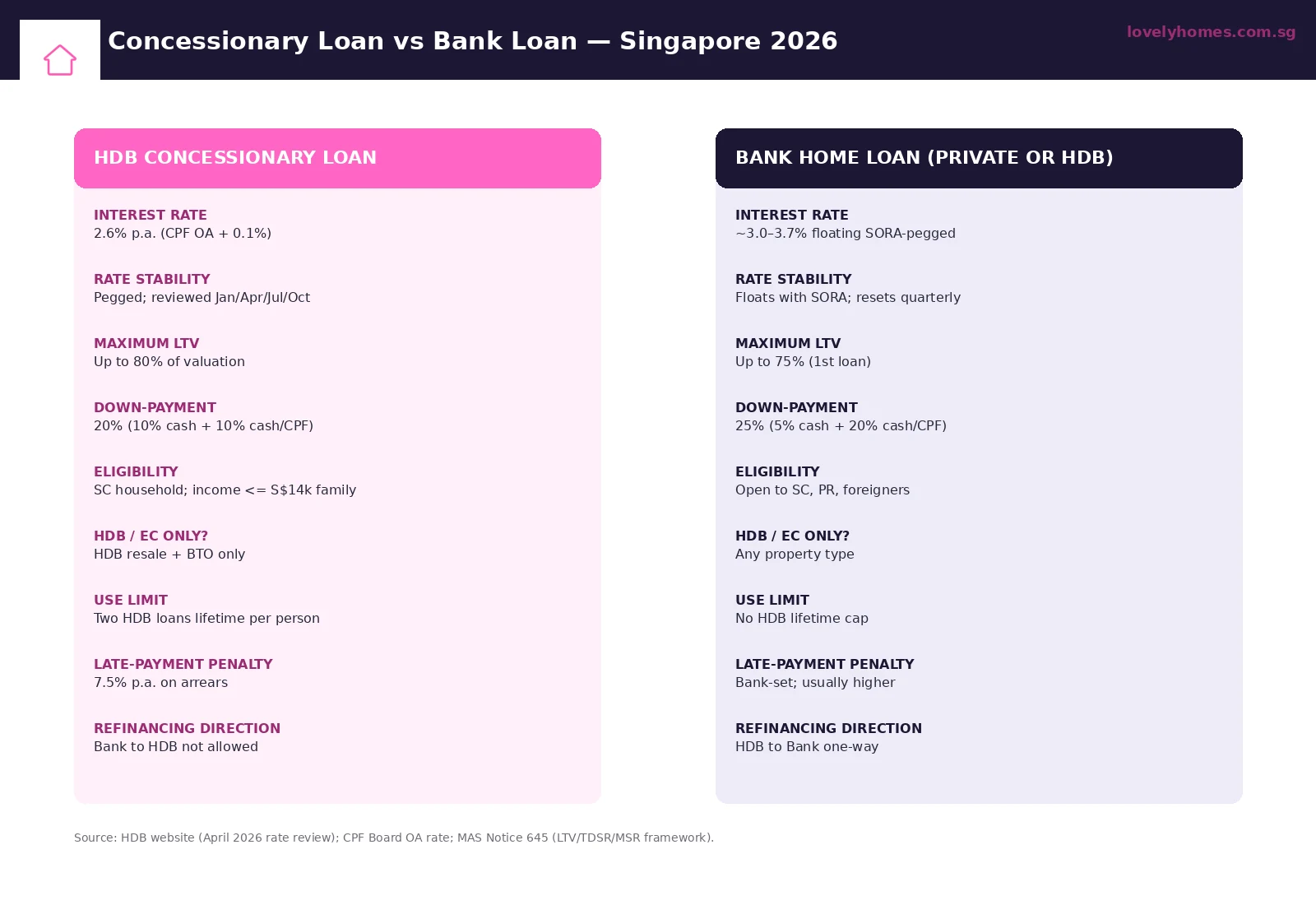
HDB Concessionary Loan vs Bank Loan Singapore 2026 — rate, LTV, eligibility, refinancing direction
Figure 1: HDB Loan versus Bank Loan in 2026 — the HDB Loan trades a tighter eligibility net for a stable rate, a higher LTV, and a friendlier late-payment regime.

How HDB Sets the 2.6 Per Cent Rate

The HDB Concessionary Loan rate is not negotiated, advertised or shopped around. It is computed mechanically as the prevailing CPF OA rate plus 0.1 percentage points, reviewed every quarter at the same time the CPF Board reviews the OA rate. Because the CPF OA rate is itself a floor at 2.5 per cent — set in the CPF Act and changed only by Parliament — the HDB Loan rate has effectively been a 2.6 per cent floor since 1999.

The CPF OA rate is computed off a basket of 12-month and longer fixed deposit and savings rates of the local banks, with a hard 2.5 per cent statutory floor. In practice the basket has not lifted the OA rate above 2.5 per cent in a quarter-century, even when SORA approached 4 per cent. This matters for borrowers because the most likely upward shock to the HDB Loan rate is not a rate-up cycle but a long, sustained period of high deposit rates that drives the basket above the 2.5 per cent floor — which has not happened in living memory.

The practical takeaway: a household stress-testing affordability against the HDB Loan should treat 2.6 per cent as the central case and 3.0 per cent as a pessimistic upper bound. Banks are required to use the MAS-prescribed 4.0 per cent stress test under the Total Debt Servicing Ratio framework even when the actual rate is 3.0 per cent — but the HDB Loan eligibility check uses the actual 2.6 per cent rate, not the 4.0 per cent stress rate. That gap alone widens borrowing capacity by 12 to 15 per cent for the typical first-timer.

The Six Eligibility Gates

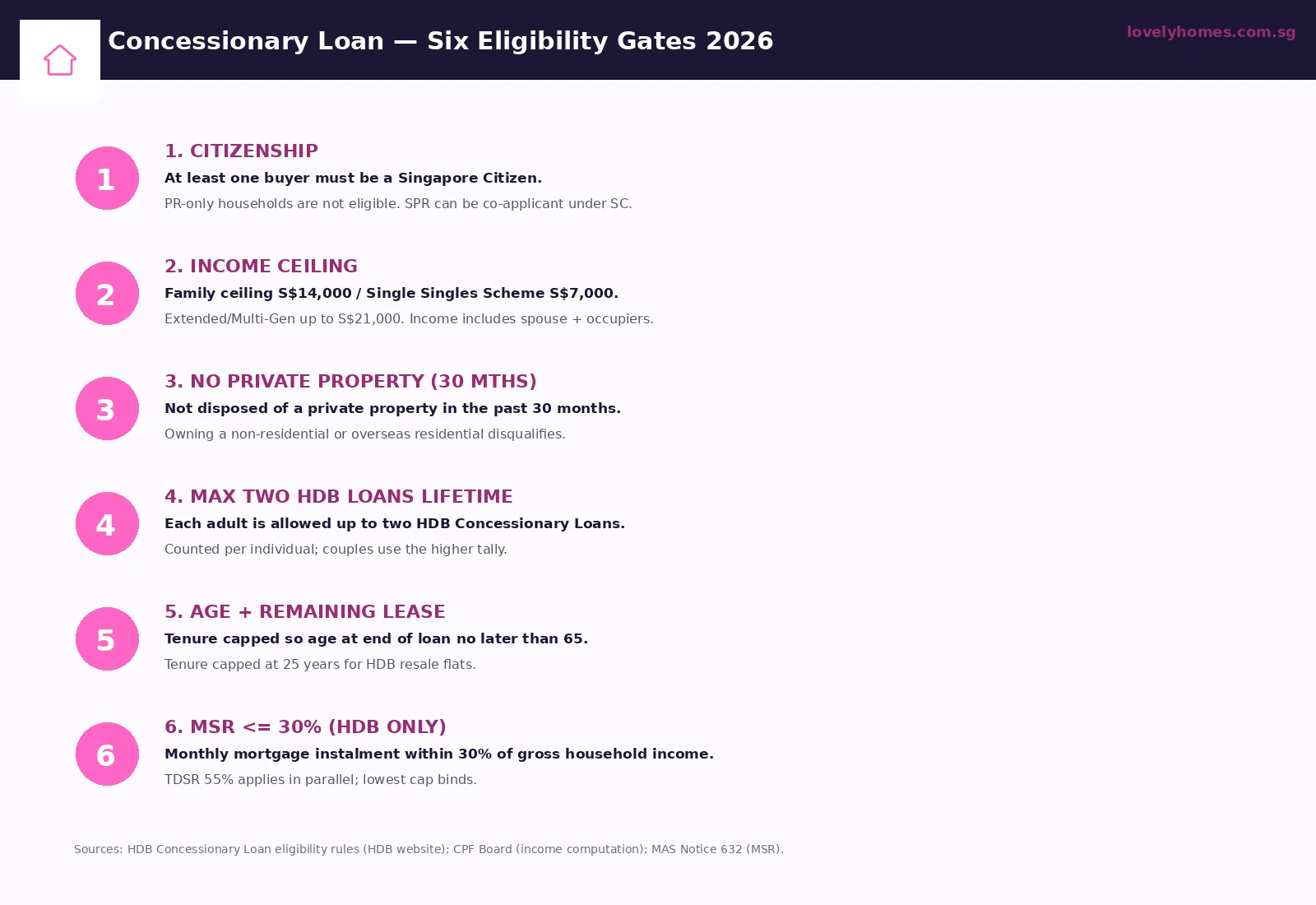
HDB applies six criteria before issuing a Loan Eligibility (HLE) letter, and an applicant must satisfy all six to qualify. The HLE is the gateway document — without it, neither the option-to-purchase nor the conveyancing solicitor can move forward on an HDB Loan.

HDB Concessionary Loan Singapore 2026 — six eligibility gates including citizenship, income, MSR
Figure 2: The six gates that decide whether a household qualifies for the HDB Loan. Failing any one of them defaults the household to a bank loan.

Gate 1 — Citizenship. At least one of the buyers (or proposed occupiers, depending on the scheme) must be a Singapore Citizen. A Singapore Permanent Resident may co-apply, but a PR-only household cannot take an HDB Loan even if they qualify for the flat itself. This is the single largest filter against the HDB Loan: any household that becomes PR-only through citizenship change is automatically pushed to bank financing on its next purchase.

Gate 2 — Income ceiling. The household monthly income ceiling depends on flat type and scheme. Standard families face S$14,000. The Singles Scheme (where one Singapore Citizen aged 35 or above buys alone) caps at S$7,000. Extended Family Schemes — for two-generation households or families assisting parents — go up to S$21,000. The income calculation includes the gross monthly income of all proposed occupiers, with bonuses and variable pay annualised over the past 12 months. Applicants with self-employed income are assessed off two years of IRAS Notice of Assessment.

Gate 3 — No private property in the past 30 months. Buyers (and their proposed occupiers) must not have disposed of a private residential property in Singapore or overseas within the 30 months immediately before the HLE application. This rule is what prevents an upgrader who sold a private condo last year from “downgrading” back into a heavily-subsidised HDB Loan. Owning a non-residential property (industrial, retail, commercial) does not disqualify, but holding any private residential property at the point of application does.

Gate 4 — Two HDB Loans lifetime per adult. Each adult Singapore Citizen is allowed up to two HDB Concessionary Loans in their lifetime. Married couples count separately, but only the higher of the two tallies is recognised when they buy together. A buyer who has already taken two HDB Loans is shut out — full stop — even if every other condition is met. This rule is what nudges most second-time-upgrader households toward bank financing, even when they could theoretically still meet the other five gates.

Gate 5 — Age and remaining lease. The loan tenure must be capped so that the buyer does not exceed age 65 at the end of the loan, or that the remaining lease at the end of the loan is at least 60 per cent of the original lease — whichever is shorter. For HDB resale flats, the maximum tenure is 25 years; for BTO flats, 25 years (the BTO comes with a fresh 99-year lease, so the lease constraint rarely binds for a new flat).

Gate 6 — MSR within 30 per cent of gross income. The Mortgage Servicing Ratio cap, administered under MAS Notice 632, requires the monthly mortgage instalment to fit within 30 per cent of the household’s gross monthly income. The HDB Loan’s eligibility test uses the actual 2.6 per cent rate and proposed tenure to compute the instalment, while bank loans use the 4.0 per cent stress rate. TDSR (Total Debt Servicing Ratio at 55 per cent) runs in parallel — and for HDB purchases by income-leaner households, MSR is what binds.

How the 80 Per Cent LTV Reshapes the Down-Payment

The Loan-to-Value cap on a first HDB Concessionary Loan is 80 per cent of the lower of valuation or purchase price. That is five percentage points more than the 75 per cent LTV cap that a bank can extend on a first private property loan. The translation into the down-payment is meaningful.

For a S$650,000 four-room BTO, the down-payment under an HDB Loan is S$130,000 (20 per cent), of which 10 per cent (S$65,000) must be paid in cash. The other 10 per cent (S$65,000) can be drawn from the buyer’s CPF OA. By contrast, a bank loan on a S$650,000 resale would cap at 75 per cent LTV, giving a S$162,500 down-payment, of which the cash leg is at least S$32,500 (5 per cent) but the cash-or-CPF leg widens to S$130,000. The HDB Loan therefore demands a higher cash leg in absolute terms (S$65,000 versus S$32,500) but a lower total cash-and-CPF outlay (S$130,000 versus S$162,500). For a Singapore Citizen household with healthy CPF OA balances and modest cash savings, the HDB Loan is dramatically the cheaper path to keys.

The Enhanced CPF Housing Grant (EHG), worth up to S$120,000 for first-time families and up to S$60,000 for first-time singles, is layered on top. EHG is paid as cash from the Government to HDB and credited against the purchase price at completion, which directly reduces the buyer’s cash leg. For most lower-and-middle-income BTO buyers, EHG plus the HDB Loan combine to reduce the cash-out-of-pocket leg of the purchase to a few thousand dollars — sometimes less than the cost of furniture for the new flat.

Worked Example — Tan Family, S$650,000 Sengkang BTO

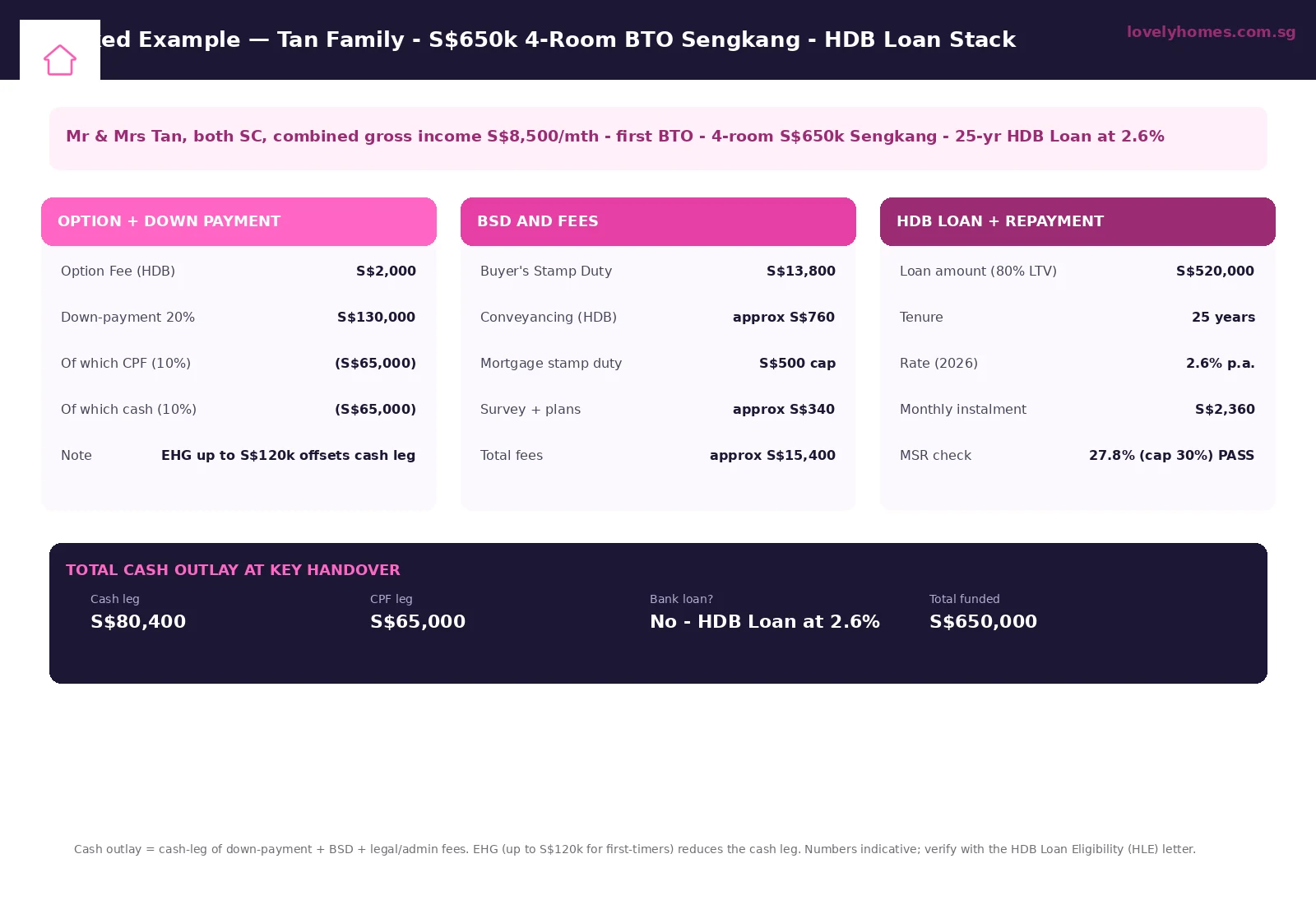
Worked Example. Mr and Mrs Tan are both Singapore Citizens, aged 32 and 30. Their combined gross monthly income is S$8,500 (Mr Tan S$5,000, Mrs Tan S$3,500), no variable pay, no other loans. They have just been allotted a four-room BTO in Sengkang priced at S$650,000 with a 99-year lease commencing on key collection. They have S$200,000 in combined CPF OA and S$110,000 in joint cash savings.

HDB Concessionary Loan worked example — Tan family S$650k Sengkang BTO four-room cash and CPF stack
Figure 3: The Tan family’s S$650,000 Sengkang four-room BTO with an 80 per cent HDB Loan — down-payment, BSD, fees and the monthly instalment that lands inside the 30 per cent MSR cap.

Stacking the price. The maximum HDB Loan is 80 per cent of S$650,000 = S$520,000. The down-payment is S$130,000 (20 per cent), of which the minimum cash leg is S$65,000 (10 per cent of valuation). Mrs Tan can use S$65,000 from the CPF OA for the other 10 per cent.

Stamp duty and fees. Buyer’s Stamp Duty on a S$650,000 flat is computed under the residential rate ladder (1 per cent on first S$180k + 2 per cent on next S$180k + 3 per cent on next S$640k up to S$1m + 4 per cent on next S$500k up to S$1.5m, etc.). For S$650,000: BSD = 1,800 + 3,600 + 8,400 = S$13,800. Conveyancing through HDB Legal is approximately S$760, mortgage stamp duty caps at S$500, and HDB charges minor survey and plan fees of around S$340. The total fee leg is roughly S$15,400.

The repayment. A S$520,000 loan over 25 years at 2.6 per cent has a monthly instalment of S$2,360. Against the household’s S$8,500 gross monthly income, the MSR comes to 27.8 per cent — comfortably within the 30 per cent cap. The TDSR check is not binding because the family has no other debt; the same S$2,360 monthly instalment occupies just 27.8 per cent of income, well within the 55 per cent ceiling.

The grants. Because both buyers are first-timers and the household income is below S$9,000, the family qualifies for the maximum Enhanced CPF Housing Grant of S$80,000 (the full S$120,000 ceiling applies only to households below S$1,500 monthly income; the S$80,000 tier applies in the S$8,001–S$9,000 income band). EHG is paid into the buyer’s CPF OA and credited at key collection, effectively reducing the price to S$570,000 from the household’s perspective — but for HDB Loan computation, the loan and LTV are still anchored to the S$650,000 valuation. The grant flows back into CPF, deepening the OA balance for future top-ups or for offsetting future instalments.

Total cash outlay at key collection. Cash leg of down-payment S$65,000 + BSD S$13,800 + fees S$1,600 + option fee S$2,000 (offset later) = approximately S$80,400 in true cash. CPF OA leg = S$65,000. Total funded into the flat = S$650,000.

This is the structural reason the HDB Loan is the preferred instrument for first-timer BTO households in 2026: the maths simply works at a price-point and an income-level where bank financing leaves the buyer with a five-figure shortfall on the cash leg.

The Two-Loan Lifetime Cap — and Why It Bites

HDB allows each Singapore Citizen up to two HDB Concessionary Loans in a lifetime. The cap counts both BTO purchases and resale purchases that used HDB financing. Loans taken under earlier CPF-grant schemes (like the now-discontinued Special CPF Housing Grant) count toward the cap. Refinancing within the HDB Loan is a continuation of the same loan and does not consume an additional slot, but a redemption-and-reborrow against a new flat purchase does.

The cap binds most often when an upgrader couple — say, a Sengkang BTO bought in 2014 with their first HDB Loan, sold in 2024 for an HDB resale in Bishan with their second HDB Loan — wants to move again to a four-room in 2030. By then, both adults have used both their HDB Loan slots; they are forced into bank financing on the third purchase, even though the third purchase is still an HDB flat. This is a deliberate policy lever: HDB wants to ration its concessional finance toward first-and-second-time buyers and to push the capital-rich third-time buyer into the private banking sector.

The corollary is that an applicant with a partner who has already used both slots cannot extend their own remaining slots to the household — joint loans use the higher individual tally, but they cannot net off a fully-used partner against unused slots from the other side. This is the single most surprising rule for second-marriage households where one spouse has fully-utilised HDB Loan history. The household is forced to bank financing.

The One-Way Refinancing Door

An HDB Concessionary Loan can be refinanced to a bank loan at any time after the Minimum Occupation Period is fulfilled (or earlier with HDB consent for hardship cases). The reverse is not allowed: once an HDB flat owner has refinanced to a bank, they cannot move back to the HDB Loan, even if they later regret the move. The rule is hard and absolute.

This is a critical decision point for HDB-flat households at every quarterly rate review. In a low-rate environment — where bank floating rates briefly drop below 2.6 per cent — the household may be tempted to refinance to a bank for the cash-flow saving. But the saving is illusory if rates rise back above 2.6 per cent within 18 to 24 months: the household cannot reverse the move, and it now sits on a floating-rate loan whose stress-test ceiling at 4.0 per cent could comfortably exceed the original 2.6 per cent HDB rate.

The rule of thumb: do not refinance from HDB to bank unless (a) the bank’s quoted rate is at least 50 basis points below 2.6 per cent for the entire fixed-rate period, AND (b) the household has the cash buffer to absorb a return to 4.0 per cent under the 4.0 per cent TDSR stress without distress. The first condition has held for less than 24 months in the past decade. The second condition is what trips upgrading households who refinanced in 2020–21 and now see their bank rate above 3.5 per cent.

The 7.5 Per Cent Late-Payment Rule

HDB charges 7.5 per cent per annum on arrears, simple interest, computed daily. The penalty is moderate by Singapore lending standards — bank late charges typically run from 8 to 12 per cent per annum on arrears, with some products applying compounded daily charges and minimum monthly fee floors. HDB also has a more flexible posture toward genuine hardship: the borrower can apply for instalment deferment, term extension or partial-payment arrangement directly through the HDB Mortgage Servicing portal, and the back-office tends to accept reasonable hardship documentation without escalation.

This is one of the under-appreciated qualitative differences between HDB and bank financing. HDB does not chase its borrowers into the courts the way an unsecured creditor does; it has a structural mandate to retain the household in the flat. Default and forced sale are very rare outcomes — the system works through deferment and reschedule, not through repossession.

Summary Table — HDB Concessionary Loan 2026

Parameter Rule (2026) Source
Interest rate 2.6% p.a. (CPF OA + 0.1 pp) CPF Board, HDB
Rate review Quarterly (Jan, Apr, Jul, Oct) CPF Act
First-loan LTV Up to 80% of valuation HDB
Down-payment cash leg 10% of valuation in cash; 10% from CPF OA permitted HDB
Tenure ceiling 25 years for resale; 25 years for BTO HDB
Income ceiling — family S$14,000 gross household monthly HDB
Income ceiling — Singles Scheme S$7,000 single Singapore Citizen aged 35+ HDB
Income ceiling — Extended/Multi-Gen Up to S$21,000 HDB
Lifetime loan cap Two HDB Concessionary Loans per adult HDB
MSR cap 30% of gross monthly income (HDB and EC purchases) MAS Notice 632
TDSR cap 55% of gross monthly income (all property loans) MAS Notice 645
Late-payment penalty 7.5% p.a. simple interest on arrears HDB
Refinancing HDB to bank: yes; bank to HDB: no HDB

What This Means for You

The HDB Concessionary Loan is the most heavily subsidised housing finance instrument any Singapore Citizen household will ever access. The combination of a 2.6 per cent fixed-by-policy rate, an 80 per cent LTV cap, a friendly late-payment regime, and the option to layer EHG on top makes it the default starting point for any buyer who can qualify. The strategic question is therefore not whether to take the HDB Loan, but how to preserve access to it across the household’s life cycle.

Three rules of thumb follow. First, do not refinance from HDB to bank unless the bank rate is at least 50 basis points below 2.6 per cent for the duration of the fix, and the household can withstand a return to 4.0 per cent. Second, if a household holds two unused HDB Loan slots between the two adults, treat the second slot as the upgrade slot — preserve it for the move from the BTO into the resale flat or into the EC at the point of family expansion. Third, before any private property purchase, model the 30-month disqualification window: the moment the household sells a private home, the 30-month clock starts ticking on HDB Loan re-eligibility for the next HDB purchase.

What Might Come Next

The HDB Concessionary Loan rate has been pinned at 2.6 per cent since 1999, which is to say through every rate-up cycle of the past 26 years. The most likely vector of change is not the rate itself but the eligibility envelope. The income ceiling has stepped up over the last decade in tandem with median household income, and may continue to creep up in subsequent National Day Rally announcements. The Multi-Generation income ceiling has shown the most sensitivity to policy adjustment.

The two-loan lifetime cap and the citizenship gate are unlikely to change. They are deliberate rationing levers — the Government wants concessional finance flowing to first-time and upgrading citizen households rather than to the third-time mover or to PR-only households. The 30-month no-private-property rule could, in theory, be tightened or loosened depending on private-market dynamics, but the direction of change in recent cooling-measure cycles has been to lengthen lookback periods, not shorten them. A buyer who relies on the HDB Loan to make their housing maths work should plan around the rules as they stand and treat liberalisation as an upside surprise rather than a base case.

Frequently Asked Questions

Can a Permanent Resident take an HDB Concessionary Loan?

No. At least one buyer (or proposed occupier, depending on the scheme) must be a Singapore Citizen for the household to qualify. A PR may co-apply with a Singapore Citizen, but a PR-only household must take a bank loan even if it is buying an HDB resale flat.

What happens if my income exceeds the ceiling between application and key collection?

The income check is taken at the point of HLE application and re-verified at key collection. A modest increase that still leaves the household within the ceiling is fine. Crossing the ceiling between HLE issuance and key collection — for example because of a job change or promotion — does not retroactively cancel the HLE if the loan was already booked, but a new HLE for a fresh purchase would have to satisfy the new income at the time of application.

Does my CPF Special Account or Medisave count toward HDB Loan affordability?

No. Only CPF Ordinary Account (OA) balances can be used to fund the down-payment, monthly instalments, BSD and legal fees on an HDB flat. Special Account, Medisave and Retirement Account balances are not available for housing — the OA is the dedicated housing pocket within the CPF system.

Can the loan tenure go beyond 25 years?

For HDB-purchased flats, no — 25 years is the maximum. A bank loan can extend to 30 years (or 35 for some private property), but extending tenure on a bank loan beyond 30 years (or beyond age 65 at end of loan) triggers a step-down in the LTV cap from 75 per cent to 55 per cent. The HDB Loan does not offer a comparable extended-tenure option.

If I take an HDB Loan and later get a windfall, can I make a partial prepayment without penalty?

Yes. HDB does not impose a prepayment penalty on partial or full early redemption of the Concessionary Loan. The flexibility is one of the under-appreciated benefits versus a fixed-rate bank loan, where partial prepayment during the lock-in period typically attracts a 1.5 per cent fee on the redeemed amount.

Can I use the HDB Loan to buy an Executive Condominium (EC)?

No. The HDB Concessionary Loan funds only HDB flats — BTO and resale. ECs are sold by private developers under a hybrid scheme and must be financed through a bank loan from the developer launch onward. The MSR 30 per cent rule still applies for the first 10 years of an EC’s life (until full privatisation), but the bank rates apply.

What is the cost of switching from an HDB Loan to a bank loan?

Legal fees of approximately S$1,800 to S$2,500 (depending on the bank’s panel solicitor), valuation fee of around S$300, and the bank’s processing or admin fee (typically S$300 to S$500). Some banks subsidise the legal and valuation fees as part of their loan offer; verify the small print. There is no clawback from HDB on grants used at original purchase, provided the Minimum Occupation Period has been served.

Disclaimer

This article provides general guidance for Singapore Citizen households considering the HDB Concessionary Loan and is not financial, tax or legal advice. The 2.6 per cent rate, 80 per cent LTV cap, MSR threshold, eligibility ceilings and lifetime two-loan rule reflect rules administered by the Housing & Development Board, the CPF Board and the Monetary Authority of Singapore in force as at the publication date. For the rule that applies to your specific transaction, consult HDB Mortgage Servicing, the CPF Board, the Monetary Authority of Singapore, the Inland Revenue Authority of Singapore and a licensed Singapore mortgage adviser or solicitor. Always rely on official sources — HDB, CPF, MAS, IRAS — for the latest position before transacting.
Related Articles

June 2026 BTO Launch Preview: 6,900 Flats Across 7 Projects in 5 Towns

June 2026 BTO Launch Preview: 6,900 Flats Across 7 Projects in 5 Towns

HDB has unveiled the June 2026 Build-to-Order (BTO) sales exercise — the largest single launch of the year and the broadest geographic spread Singapore has seen in the post-classification era. Roughly 6,900 flats across seven projects in five towns will go on sale in the second week of June 2026, with the headline names being the first BTO at Lakeview (Bishan) in over forty years, the Berlayer Crescent project in Bukit Merah, two Plus-class projects in Ang Mo Kio, two big-supply Standard projects in Sembawang, and a 640-unit Standard project in Woodlands. About 47% of the supply has been classified Prime, 5% Plus, and the remaining 48% Standard — which means most of June’s launches will sit under HDB’s tighter resale framework with 10-year MOP and subsidy clawback.

This preview consolidates what HDB has confirmed, what industry research desks are guiding on indicative prices, and what Lovelyhomes’ own readers are likely to weigh up before the BTO portal opens. Application closes 15 June 2026 (rounded — exact date in HDB’s portal); ballot results follow approximately three weeks later.

Quick Answer — June 2026 BTO at a glance

  • Total supply: ~6,900 flats across 7 projects.
  • Towns: Bishan, Ang Mo Kio, Bukit Merah, Sembawang, Woodlands.
  • Mix: ~3,250 Prime (47%), ~370 Plus (5%), ~3,280 Standard (48%).
  • First-of-kind: first BTO at Lakeview in over forty years; first Pasir Panjang Prime since the classification framework launched.
  • Indicative 4-room price range: ~S$360k Sembawang/Woodlands → ~S$820k Bishan Lakeview, before EHG / PHG.
  • MOP: 10 years (Prime, Plus); 5 years (Standard).
  • Resale buyer income ceiling: S$14,000/month for Prime and Plus; none for Standard.
  • Application window: opens approximately 11 June 2026; closes mid-June; ballot ~early July.

The Seven Sites

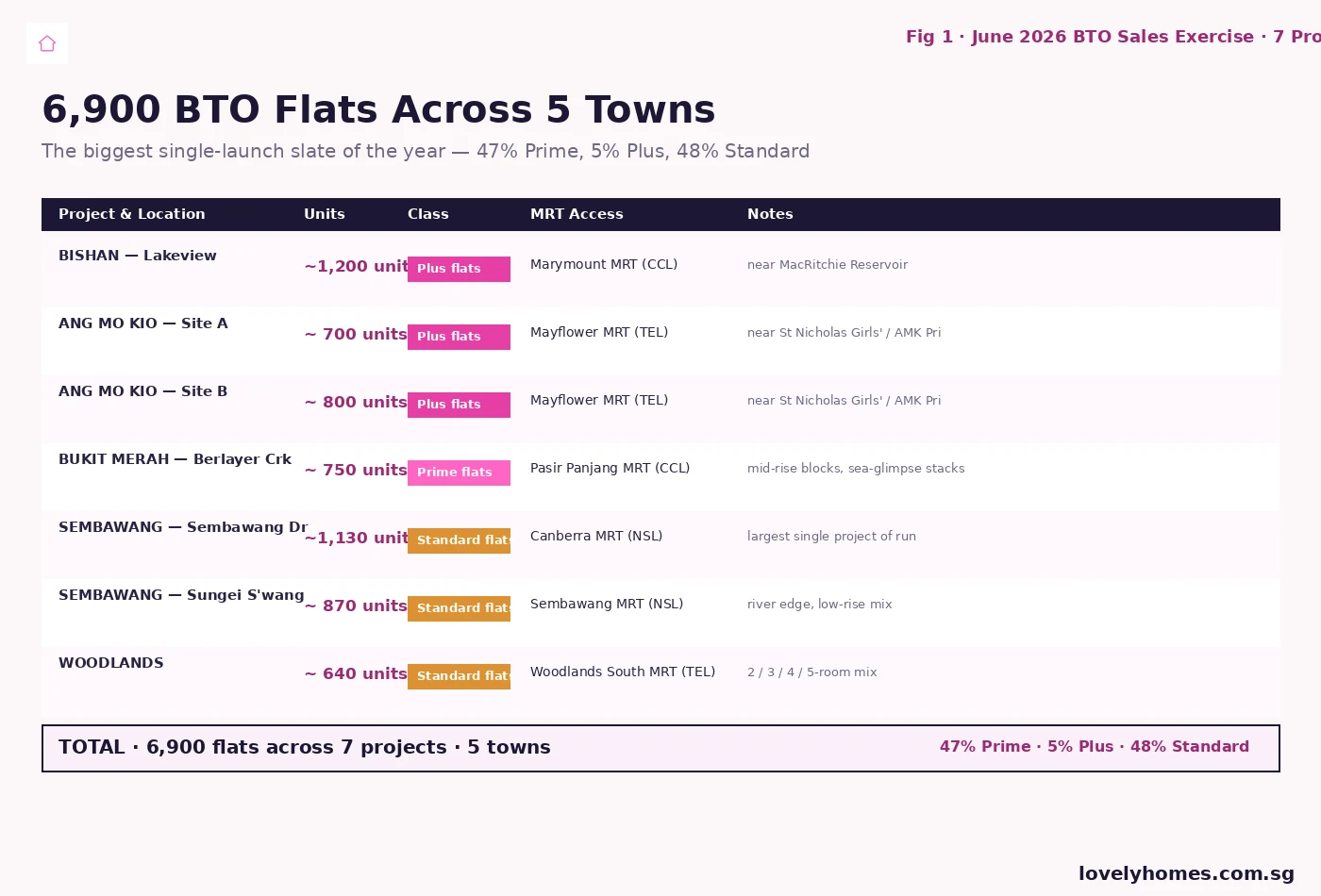
June 2026 BTO seven sites table — Lakeview, Ang Mo Kio twin, Berlayer Crescent, Sembawang Drive, Sungei Sembawang, Woodlands
Figure 1: All seven June 2026 BTO sites, with rough unit counts, classification, and MRT access.

The June launch is dominated by two town clusters. The first is the Sembawang–Woodlands northern corridor, contributing roughly 2,640 of the 6,900 flats. Sembawang Drive alone is the single largest site of the run at around 1,130 units, with the smaller Sungei Sembawang project adding another ~870 units along the river edge near Sembawang MRT. Woodlands South contributes the remaining ~640 units. All three are Standard-class — the cheapest segment, the shortest MOP, and the largest pool of eligible resale buyers come 2031–32.

The second cluster is the central-mature corridor: Bishan’s Lakeview project (~1,200 units, Prime), the twin Ang Mo Kio sites near Mayflower MRT (combined ~1,500 units, Plus), and Bukit Merah’s Berlayer Crescent project near Pasir Panjang MRT (~750 units, Prime). This is where the headline-grabbing prices will sit. Indicative talk on Lakeview 4-room flats has run as high as S$820,000 before grants — a level that historically would have been a Bukit Merah or Tiong Bahru number, not a Bishan one. The Lakeview supply is the first BTO at the site since the late 1970s, and the project is positioned to be the tallest in its immediate area, with stacks oriented for MacRitchie Reservoir views.

Classification — Three Different Resale Worlds

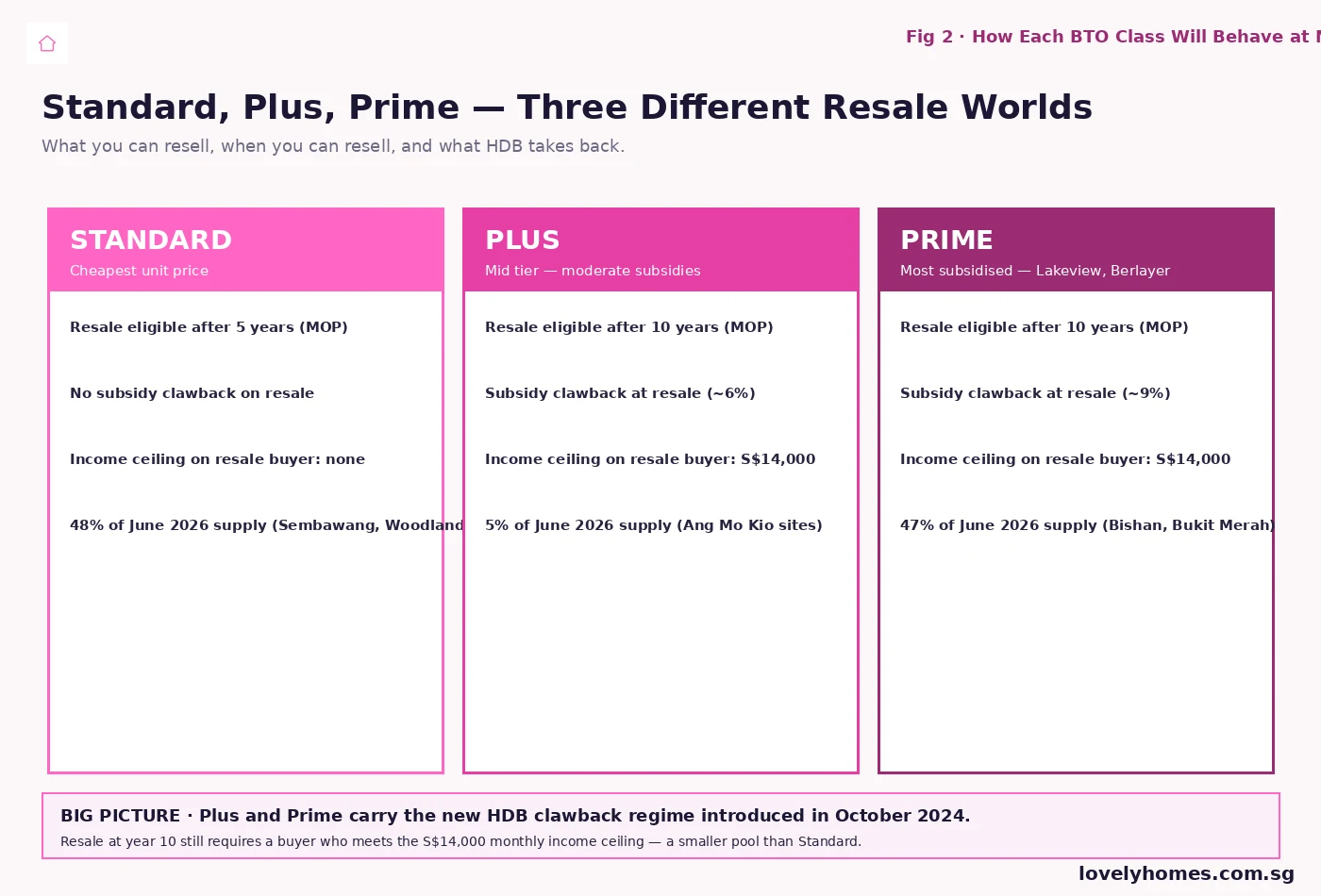
June 2026 BTO Standard Plus Prime classification — MOP, resale rules, subsidy clawback comparison
Figure 2: How each class will behave at MOP — Standard at year 5 with no clawback; Plus and Prime at year 10 with subsidy clawback and a S$14,000 buyer income ceiling.

HDB’s October 2024 classification framework is in full effect for the June 2026 launch. The Standard class behaves like the BTOs of the last two decades: 5-year MOP, open resale market on graduation, no clawback. The Plus class — represented in June by the Ang Mo Kio twin — carries a 10-year MOP, a ~6% subsidy clawback at first resale, and a S$14,000 income ceiling on the resale buyer. The Prime class — Lakeview, Berlayer Crescent — runs the same 10-year MOP and S$14,000 buyer ceiling, with a heavier ~9% clawback on first resale to reflect the deeper original subsidy.

The implication for buyers is that Plus and Prime are explicitly engineered as long-hold homes with a smaller resale pool. Standard is the one that retains the historical “BTO as wealth-builder” pattern. For first-time-buyer households running the affordability vs upside arithmetic, Standard at Sembawang or Woodlands is structurally different from Prime at Bishan — even before the price difference is factored in.

Indicative Pricing — Where the Money Lands

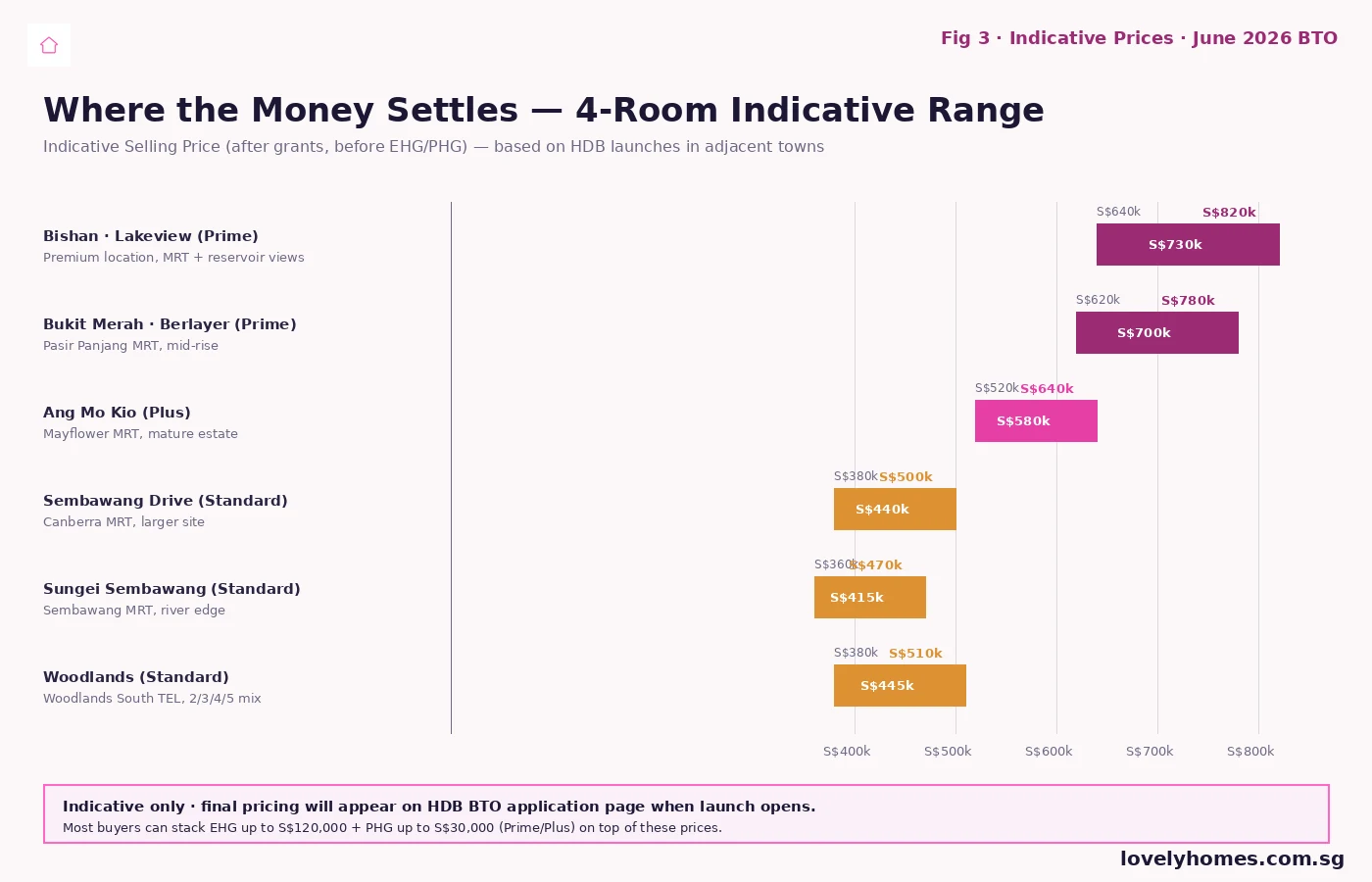
June 2026 BTO indicative 4-room prices — Bishan to Woodlands ranges from S$360k to S$820k before grants
Figure 3: Indicative 4-room prices before EHG and PHG grants. Final selling prices will appear on HDB’s BTO application page when the launch window opens.

HDB will publish the firm price tables when the application window opens. The indicative ranges sit roughly as follows for 4-room flats: Bishan Lakeview at S$640,000 to S$820,000; Bukit Merah Berlayer Crescent at S$620,000 to S$780,000; Ang Mo Kio at S$520,000 to S$640,000; Sembawang sites at S$360,000 to S$500,000; Woodlands at S$380,000 to S$510,000. These are mid-launch indications drawn from neighbouring BTO comparables and the early-2026 launch curve, not committed HDB figures. The Enhanced CPF Housing Grant (EHG) of up to S$120,000 and the Proximity Housing Grant (PHG) of up to S$30,000 are still claimable on top — meaning eligible first-timer households at Sembawang could see net selling prices as low as S$240,000 for a 4-room.

Worked Example — The Lim Household at Lakeview

Consider Mr Lim (33) and Mrs Lim (31), Singapore Citizens, first-timers with combined gross household income S$8,500/month. They apply for a 4-room flat at the Bishan Lakeview Prime project. Indicative price: S$760,000. They qualify for EHG of S$30,000 (combined-income tier) — Prime/Plus PHG of S$30,000 if Mrs Lim’s parents live within 4km, which they do. Net price: S$700,000. CPF OA balance: S$110,000. They opt for an HDB Concessionary Loan at 80% LTV (S$560,000 loan, S$140,000 downpayment).

The MSR check: at HDB’s stress rate of 4%, an S$560,000 loan over 25 years yields a monthly instalment of approximately S$2,956. That is 34.8% of S$8,500 — above the 30% MSR cap. To pass MSR, they must lengthen tenure to 30 years (instalment drops to ~S$2,672 / 31.4% — still over) or accept a smaller loan (~S$481,000 / S$2,539 / 29.9% — clears MSR). The MSR is the hardest constraint here, and at S$8,500 income the Lakeview Prime price point is right at the edge of affordability. Households below S$8,000/month will struggle to pass MSR at S$760,000 even with the maximum-tenure stretch; households at S$10,000–11,000/month clear it comfortably.

What this means for the ballot: Lakeview Prime will draw a higher-income applicant pool than typical first-timer BTO. Sembawang Standard at S$420,000 list pulls a much wider applicant pool that easily clears MSR at S$5,000–6,000/month combined. Application strategy follows the price gradient.

Comparison Table — June 2026 vs Recent Quarters

Sales Exercise Total Flats Towns Prime / Plus / Standard
Feb 2026 BTO ~5,500 Bedok, Bukit Batok, Hougang, Tengah, Toa Payoh ~22% / ~10% / ~68%
May 2026 BTO (preview) ~3,800 Bukit Merah, Tampines, Tengah, Woodlands ~30% / ~12% / ~58%
June 2026 BTO ~6,900 Bishan, AMK, Bukit Merah, Sembawang, Woodlands ~47% / ~5% / ~48%
Oct 2026 BTO (announced) ~7,200 Toa Payoh-Caldecott, Punggol, Yishun, others TBC TBC

What This Means for Different Buyer Profiles

First-time HDB buyer at S$5,000–7,000 combined income. Sembawang Drive, Sungei Sembawang, and Woodlands are the right fit. Standard class, 5-year MOP, prices that pass MSR comfortably with EHG-stacked subsidies. The northern corridor will face heavy first-timer demand but the supply is large enough to keep ballot odds reasonable for first-timers.

First-time HDB buyer at S$8,000–11,000 combined income. Ang Mo Kio Plus is the sweet-spot. Mature estate, MRT proximity, school catchment, and a price band that clears MSR with margin. The 10-year MOP and S$14,000 resale-buyer ceiling are real downsides if the household is upgrade-minded, but for buy-and-hold it is the strongest value-for-money in the launch.

First-time HDB buyer at S$11,000+ combined income. Bishan Lakeview and Bukit Merah Berlayer Crescent become serious. The Prime classification means the household must accept a long hold and a smaller resale pool, but the locations are in the top decile of HDB-accessible neighbourhoods. Affordability at S$760,000–820,000 only works at the higher income tier.

Second-timers and upgraders. The Plus and Prime sites apply the second-timer 70/30 quota; second-timers should expect lower ballot odds at Lakeview and Berlayer specifically. Standard sites at Sembawang and Woodlands are more accessible to second-timers because of the larger supply and the absence of the income ceiling on resale.

What Might Come Next

HDB has guided 19,600 BTO flats across 2026 (Feb + May/June + October). The October 2026 exercise is expected to be even larger than June, anchored by the Toa Payoh West / Caldecott MRT project (~1,600 flats including 240 Community Care Apartments) and supplementary supply at Punggol and Yishun. With Pearl’s Hill (60 storeys, ~1,700 flats) confirmed for the 2027 pipeline as Singapore’s tallest public housing, the next 18 months are looking like the highest-supply year of the post-COVID cycle. Whether that supply pulls down the HDB Resale Price Index — which slipped 0.1% in Q1 2026, the first quarterly decline in seven years — is the watch-point analysts will be tracking through 2H 2026.

Worked Example — Sembawang Drive Standard for the Median Household

Mr & Mrs Wong, both 30, combined income S$6,500/month, apply for Sembawang Drive Standard 4-room at indicative S$430,000. They claim EHG S$70,000 (combined income tier) — net price S$360,000. HDB Concessionary Loan at 80% LTV (S$288,000 loan; S$72,000 downpayment, fully claimable from CPF Ordinary Account). MSR at 4% / 25 years on S$288,000 = approximately S$1,521/month, which is 23.4% of S$6,500 — clears MSR with margin. TDSR not relevant for HDB Concessionary Loan. Cash outlay at completion: roughly S$5,000 of legal and stamp-duty incidentals. This is the median-income BTO arithmetic that the Standard class is engineered to deliver — and Sembawang Drive is one of the cleanest examples of it in the entire 2026 calendar.

Frequently Asked Questions

When does the June 2026 BTO application open and close?

HDB will open the application portal in the second week of June 2026, typically running for one calendar week. Ballot results follow approximately three weeks after the close. The exact dates appear on the HDB BTO application page once the launch is live; this preview was prepared from HDB’s announcement timeline and will be updated when firm dates are published.

What is the difference between Prime, Plus, and Standard?

HDB’s October 2024 framework defines three classes by location desirability and subsidy depth. Prime (~47% of June supply) carries the deepest subsidies, a 10-year MOP, a ~9% subsidy clawback on first resale, and a S$14,000/month income ceiling on the resale buyer. Plus (~5% of June supply) sits one tier below — same 10-year MOP and S$14,000 resale ceiling, with a lighter ~6% clawback. Standard (~48% of June supply) is the historical BTO model — 5-year MOP, no clawback, no resale ceiling.

Can I stack EHG and PHG on a Prime or Plus flat?

Yes. The Enhanced CPF Housing Grant (EHG) of up to S$120,000 for first-timer families is available across all three classes. The Proximity Housing Grant (PHG) of S$30,000 (married applicants living within 4km of parents) and S$10,000 (single applicants) is also available across all classes. Step-up Grant and Family Grant follow the same rules. Grant stacking does not change the MOP or clawback rules.

Why is Bishan Lakeview so much more expensive than Sembawang?

Three reasons. First, the location quality — proximity to MRT, mature estate amenities, and reservoir views — drives a higher base price band before subsidy. Second, Lakeview is Prime, which means HDB is delivering a larger absolute subsidy on a higher base price; the indicative price you see is already net of that subsidy. Third, redevelopment or land-cost factors specific to a central site push the underlying construction and tendering cost above an outer-town site like Sembawang Drive.

What is MSR and will I clear it?

MSR (Mortgage Servicing Ratio) caps your HDB or EC mortgage instalment at 30% of gross monthly income, computed at HDB’s 4% stress-test rate over your chosen tenure. For a 4-room flat at S$760,000 (Lakeview indicative) with an 80% loan and 25-year tenure, MSR clears at roughly S$8,800/month combined household income or higher. At S$420,000 (Sembawang indicative) the clear-MSR threshold drops to roughly S$5,000/month combined. See the LovelyHomes TDSR Singapore 2026 guide for the detailed mechanics.

Can I sell my Plus or Prime BTO before MOP?

Generally no. The MOP for Plus and Prime is 10 years from key collection, during which you cannot sell, rent out the entire flat, or buy a private property. Limited exceptions exist for divorce, financial hardship, and bereavement — applied case by case by HDB. Renting out individual rooms is permitted from the start, subject to HDB’s room-rental rules.

Related Articles

Disclaimer: This preview is based on HDB’s published announcements and industry-research-desk indications as of 04 May 2026. Final unit counts, classifications, indicative prices, and application dates appear on the HDB BTO application page once the sales exercise opens. All figures should be verified against the official HDB website before acting on them. This guide is for general information only and does not constitute legal, tax, or financial advice. Consult a licensed mortgage broker or HDB officer for advice specific to your circumstances.

TDSR Singapore 2026: How the 55% Cap and 4.0% Stress Test Decide Your Home Loan

TDSR Singapore 2026: How the 55% Cap and 4.0% Stress Test Decide Your Home Loan

TDSR Singapore 2026 — short for the Total Debt Servicing Ratio framework — is the single biggest test that decides how much a Singapore bank will lend you for a home loan. Get on the wrong side of it, and a S$2 million property becomes a S$1.4 million budget overnight. This is the rule that quietly resizes every Singapore property purchase, including yours.

The TDSR caps your total monthly debt repayments at 55% of your gross monthly income, calculated using a 4.0% stress-test rate rather than the actual rate your bank quotes you. It applies to all loans secured by residential property in Singapore — first home, investment property, refinancing, and decoupling. Together with the LTV (Loan-to-Value) cap and the MSR (Mortgage Servicing Ratio) for HDB and Executive Condominium purchases, it forms the three-gate framework every borrower must pass.

This guide explains how TDSR works in 2026, why MAS sets the rules the way it does, what the 4.0% stress test actually does to your borrowing power, and how a real Singapore household sees their loan sized in practice. All figures reflect the framework administered by the Monetary Authority of Singapore (MAS Notice 645 to banks; Notice 825 to finance companies), last updated to current effective form in MAS’ 2021 calibration.

Quick Answer — TDSR at a glance

  • What it is: a 55% cap on your monthly debt obligations as a share of your gross monthly income.
  • Who sets it: the Monetary Authority of Singapore (MAS), via Notice 645 to banks and Notice 825 to finance companies.
  • Stress-test rate: 4.0% per annum for residential property loans (3.5% for non-residential), regardless of your actual mortgage rate.
  • What counts as debt: mortgage instalments, car loans, study loans, credit-card minimums, personal loans, and renovation loans — yes, all of them.
  • Income haircut: 30% deduction on rental income, bonuses, and variable income before TDSR is computed.
  • How it interacts with LTV and MSR: all three caps run in parallel; the lowest one binds. For private property, LTV usually binds. For HDB and EC, MSR usually binds before TDSR.
  • Penalty for failing: the bank either reduces your loan, lengthens your tenure (subject to LTV step-down at 30+ years), or rejects the application.

What TDSR Is — and Why MAS Built It

Before 2013, Singapore had no aggregate debt-servicing rule. Buyers could chain a property loan on top of a car loan on top of a personal loan, and as long as each loan passed its own affordability check, the bank cleared the deal. That worked when interest rates were anchored near zero, but the regulator could see what would happen the moment rates normalised: leveraged households would be forced to deleverage in a rising-rate environment, dragging property prices and consumption down with them.

The TDSR was introduced on 28 June 2013 as MAS Notice 645 to banks. The intent, in the regulator’s own framing in the 2013 consultation paper, was to “ensure financial prudence and prevent over-borrowing” by capping the share of household income spent on servicing all forms of debt. The 60% cap was reduced to 55% with effect from 16 December 2021 as part of a broader cooling-measure package — the calibration that still applies in 2026.

The cap is computed against a stress-test rate, not your actual contracted rate. This matters because Singapore mortgage rates float — most home loans here are pegged to a benchmark like SORA or 3M-SOFR rather than locked at a fixed rate for life. If your loan would barely scrape through at today’s 3.0% rate, MAS does not want you discovering at year three that 4.5% means you can no longer make the repayment. The 4.0% test rate is a built-in shock absorber.

TDSR Singapore 2026 three-gate framework — LTV cap, TDSR 55% with 4 percent stress, MSR 30% HDB only
Figure 1: The three-gate borrowing framework — every Singapore home loan must pass LTV, TDSR and (for HDB/EC) MSR. The lowest cap wins.

Who TDSR Applies To

The TDSR framework covers every property loan extended by a MAS-regulated bank or finance company in Singapore. That sweep is wider than people realise:

  • New residential purchases — HDB resale, Executive Condominium, private condo, landed property.
  • Refinancing of an existing home loan if the loan is for an investment property (owner-occupier refinances were exempted in 2017 subject to the borrowing limit not increasing).
  • Equity loans (also called term loans or cash-out loans) secured against residential property.
  • Loans for buy-to-let or buy-to-flip purchases.
  • Joint loans where any borrower is providing income to support the application.

Borrowers exempt from TDSR are limited and specific: the small number of HDB Concessionary Loans (which use HDB’s own affordability framework rather than the bank rules), and a handful of refinancing exemptions for owner-occupiers under MAS’ 2017 calibration. If your loan is from an OCBC, DBS, UOB, Standard Chartered, HSBC, Citibank, Maybank, RHB, Bank of China, ICBC or any other MAS-licensed bank, TDSR applies.

The 55% Cap, Step by Step

The arithmetic looks deceptively simple. Take your gross monthly income, multiply by 55%, and that is the maximum total monthly debt the bank will let you carry. The complication is on either side of the equation.

On the income side: banks accept fixed monthly income at face value, but apply a 30% haircut to anything variable. Bonuses, commissions, allowances, and rental income all get reduced to 70% of their reported value before TDSR. Self-employed income is documented through two years of Notice of Assessment (NOA) from IRAS, and the bank will typically use the lower of the two years (or an average, depending on policy). Foreign-currency income is converted at the bank’s prevailing rate and may take a further haircut.

On the debt side: banks take every monthly debt obligation and add them together. For mortgages, the bank substitutes a 4.0% stress-test rate (residential) or 3.5% (non-residential) and recomputes the instalment as if the loan ran at that rate over the proposed tenure. Car loans, study loans, and personal loans are taken at their actual repayment amounts. For credit cards, MAS prescribes that 3% of the outstanding balance is treated as the monthly obligation, regardless of whether the cardholder pays in full each month — the regulator’s logic is that the credit line itself represents a contingent claim on income.

The 4.0% Stress Test — What It Does to Your Loan

The single biggest mechanism inside TDSR is the stress-test rate. For residential loans, the bank computes your borrowing capacity as if the rate were 4.0% per annum, even when the actual quoted rate is 3.0% or lower.

TDSR Singapore 2026 stress test impact — 4 percent test rate cuts borrowing power versus actual 3 percent rate
Figure 2: The 4.0% stress test removes roughly S$228,000 of borrowing power on a 30-year tenure for a S$15,000-income household compared with a real 3.0% rate.

The arithmetic is unforgiving. At 3.0% over 30 years, S$8,250 of allowable monthly debt service supports a loan of approximately S$1,955,000. At 4.0% over the same tenure, the same S$8,250 supports only S$1,727,000 — a reduction of S$228,000 in maximum borrowing. Lengthening the tenure to ease the monthly figure does not solve the problem either, because tenures beyond 30 years (or that take the borrower past age 65) trigger a step-down in the LTV cap from 75% to 55%.

The buffer matters because Singapore mortgages reprice. A 3M-SOFR-pegged loan written at 3.10% in early 2026 could float up to 4.50% within a single rate-up cycle, as it did in 2022–23. A household that just barely cleared TDSR at 3.10% would be in repayment distress at 4.50%. The 4.0% test makes sure that household’s mortgage was sized with the rate-up baked in.

How TDSR Interacts with LTV and MSR

TDSR does not run in isolation. It is one of three rules — LTV, TDSR, MSR — that all apply to a property purchase, and the lowest cap wins.

LTV (Loan-to-Value) sits in MAS Notice 645 alongside TDSR and caps the loan as a percentage of the property’s value. First housing loans are capped at 75% LTV (55% if tenure exceeds 30 years or the borrower’s age at end of loan exceeds 65). Second housing loans drop to 45%. Third loans to 35%. LTV is what determines your minimum downpayment.

MSR (Mortgage Servicing Ratio) applies only to HDB flats (BTO and resale) and Executive Condominium purchases from the developer. It caps the mortgage instalment alone — not all debts, just the mortgage — at 30% of gross monthly income. MSR exists because HDB and EC purchases use a national affordability lens: the regulator treats first homes for citizens differently from investment property.

For most Singapore Citizen first-time private-condo buyers, LTV at 75% binds before TDSR does. For HDB and EC buyers, MSR at 30% binds before TDSR — because once you’re spending 30% of income on the mortgage alone, you’ve used up most of the 55% TDSR allowance even before adding car loans or credit cards. For private second properties or borrowers with car loans and other commitments, TDSR usually binds before LTV.

Worked Example — Mr & Mrs Lim and the S$1.8M Tampines Condo

Mr Lim is 38, a Singapore Citizen earning S$8,500 fixed plus a S$24,000 annual bonus. Mrs Lim is 36, a Singapore Citizen earning S$5,500 fixed. They have one S$650/month car loan. They are eyeing a S$1.8 million Tampines condo, first private property for both of them, joint name. Tenure 30 years. Below is exactly how a Singapore bank would size their loan in 2026.

TDSR Singapore 2026 worked example Mr and Mrs Lim S$1.8M Tampines condo three-gate cap and cost stack
Figure 3: The Lim household’s S$1.8M purchase walked through the three caps and the resulting cash plus CPF stack.

Step 1 — Compute gross monthly income. Mr Lim’s fixed S$8,500 + 70% of his S$2,000/month bonus equivalent (S$1,400) = S$9,900. Mrs Lim’s fixed S$5,500 = S$5,500. Combined gross monthly income for TDSR = S$15,400. The bank will round and document, but for our purposes call it S$15,000.

Step 2 — Apply the three caps. LTV at 75% caps the loan at S$1,350,000. TDSR allows S$8,250 of monthly debt; subtract S$650 of car-loan repayment and S$8,250 − S$650 = S$7,600 left for the mortgage; at the 4.0% stress rate over 30 years, S$7,600/month supports a loan of approximately S$1,591,000. MSR does not apply (private condo). The lowest cap wins, so the binding cap is the LTV at S$1,350,000.

Step 3 — Build the cash + CPF stack. The S$1.8M purchase requires S$1,350,000 from the bank (75% LTV) and S$450,000 from the buyers (25% downpayment). Of that S$450,000, at least 5% (S$90,000) must be cash by MAS rule; the remaining S$360,000 can be CPF Ordinary Account or cash. Add Buyer’s Stamp Duty of approximately S$64,600 (1% on first S$200,000 + 2% on next S$160,000 + 3% on next S$640,000 + 4% on next S$500,000 + 5% on next S$300,000 of the S$1.8M). Add legal fees of approximately S$3,500 + 9% GST. The total entry cost is roughly S$1,869,600 — of which S$1,350,000 is loan, S$300,000 is typical CPF use, and S$219,600 is cash out of pocket.

Step 4 — What happens if Mrs Lim’s income drops. Suppose Mrs Lim moves to part-time at S$3,000/month. Combined gross drops to S$12,900. TDSR at 55% allows S$7,095 of monthly debt; minus S$650 car loan = S$6,445 for mortgage; at 4% over 30 years that supports about S$1,350,000 — exactly the LTV cap. Any further income drop and TDSR overtakes LTV as the binding constraint, and the loan amount falls. This is why couples about to apply for a mortgage think hard about timing maternity leave or job changes around the application date.

Common TDSR Workarounds and Whether They Work

Buyers and brokers have spent the better part of a decade looking for ways around TDSR. Most do not work, and the ones that do are blunt instruments. The most legitimate is extending tenure, but Singapore’s LTV step-down at 30 years (or age 65) means the cost of stretching tenure to lower the monthly is a 20-percentage-point drop in LTV — usually not worth it. Adding a guarantor works in principle: an additional income contributor is included in the gross-income calculation, but the guarantor must legally be on the loan, takes a property count for ABSD purposes, and is fully liable. Decoupling (one spouse sells out of the marital home, the other buys solo to free up an “additional property” slot) is a real strategy used by upgraders, but it is engineered for ABSD avoidance, not TDSR. Pledging fixed deposits as “show funds” can boost the bank’s recognised income on a pro-rated basis (typically 4-year amortisation), but the pledged amounts are locked. The illegitimate routes — undeclared rental income, hidden side loans, fake bonus letters — are mortgage fraud and the banks’ compliance teams flag them quickly.

What This Means for You

If you are about to apply for a home loan in Singapore in 2026, three actions cut TDSR risk before you even speak to a bank:

Pay down the car loan. A S$1,000/month car loan removes S$1,000 from your TDSR allowance, which removes roughly S$210,000 of mortgage borrowing power at the 4% stress rate over 30 years. If you can clear the car loan before applying, do it.

Settle the credit-card balances. MAS’ 3% rule means a S$30,000 outstanding balance is treated as S$900/month against your TDSR even if you pay in full each month. Pay it down before pulling your credit bureau report for the bank.

Document your variable income properly. If 30% of your income is bonus and commission, the 30% haircut hurts. Two years of consistent NOAs help. A formal letter from your employer setting out the annualised bonus structure helps further. Self-employed and freelance income takes more documentation but can be made to work.

Comparison with Other Asian Markets

Singapore’s 55% TDSR is at the strict end of Asian property regulation. Hong Kong’s HKMA caps total debt at 50% (or 60% for borrowers passing a stress-test buffer), with stress rates that have moved with the cycle. Australia’s APRA prudential rules cap serviceability tests using a buffer of around 3 percentage points above quoted rate — a different approach but similar conservatism. Korea’s DSR (Debt Service Ratio) caps were tightened to 40% for individual borrowers in 2022 in the first wave of post-COVID cooling. Singapore’s framework is closest in spirit to Hong Kong’s, and was explicitly modelled on HKMA’s earlier work — both jurisdictions concluded that household leverage in property cycles is the systemic risk to manage, and both built buffers around stress-test rates.

What Might Come Next

The 55% cap was the December 2021 calibration of a 60% rule that was already eight years old by then. The natural watch-points for the next adjustment are: (a) sustained increases in household-debt-to-income ratios above the 2024 baseline, which would invite a tightening to 50%; (b) a sharp rate-up cycle that exposes a cohort of borrowers stress-tested at 4.0% but underwater at 5.5%, which would invite a higher stress rate; or (c) a turn in the property cycle severe enough to threaten financial-stability metrics, which would invite a temporary loosening as part of a counter-cyclical package. Industry expects the 4.0% stress rate to be revisited within the 2026–27 window if the SORA-based mortgage benchmark moves materially. None of these are signalled by MAS as imminent at this writing.

Summary Table — TDSR Singapore 2026 at a Glance

Element 2026 Value Notes
TDSR cap (residential) 55% Of gross monthly income; lowered from 60% on 16 December 2021.
Stress-test rate (residential) 4.0% p.a. Used to size monthly instalment regardless of contracted rate.
Stress-test rate (non-residential) 3.5% p.a. Lower buffer for commercial and industrial property loans.
Variable-income haircut 30% Applied to bonuses, commissions, rental income, allowances.
Credit-card minimum servicing rule 3% of outstanding Treated as monthly obligation regardless of repayment habit.
LTV cap — first housing loan 75% Steps down to 55% if tenure > 30 yrs OR age at end of loan > 65.
LTV cap — second housing loan 45% Steps down to 25% if tenure > 30 yrs OR age at end of loan > 65.
MSR cap (HDB/EC only) 30% Mortgage instalment alone, gross monthly income basis.
Minimum cash component (private) 5% Rest of downpayment can be CPF Ordinary Account.
Regulator MAS Notice 645 (banks) and Notice 825 (finance companies).

Frequently Asked Questions

Is TDSR the same as MSR?

No. TDSR caps your total monthly debt at 55% of gross monthly income, including car loans, credit cards, study loans, personal loans, and the new mortgage. MSR caps your mortgage instalment alone at 30% of gross monthly income, but only applies to HDB flats and Executive Condominiums purchased from the developer. For an HDB or EC purchase, both run in parallel — and you must pass both. For private property, only TDSR applies.

Can I get around TDSR by lengthening my mortgage tenure?

Yes, but at a cost. Stretching tenure lowers the monthly instalment and improves your TDSR ratio, but the moment your tenure exceeds 30 years (or your age at end of loan exceeds 65), MAS Notice 645 steps your LTV cap down from 75% to 55%. That means a 20-percentage-point reduction in the maximum loan, which usually wipes out the gain from the lower monthly. For most buyers, capping tenure at 30 years and structuring around income or down-payment is a better lever.

Does TDSR apply when I refinance my current home loan?

For an owner-occupied property, TDSR was relaxed in 2017 — you can refinance for the same outstanding amount even if your TDSR exceeds 55%, as long as you do not borrow additional money on top. For an investment property (any home you do not occupy), TDSR applies in full at every refinance. Equity term loans always trigger a fresh TDSR assessment.

How does the bank treat my variable income or rental income?

MAS rules apply a 30% haircut. Bonuses, commissions, allowances, and rental income are reduced to 70% of their reported value before being added to your TDSR income base. Banks typically require two years of NOA from IRAS to evidence variable income. Self-employed income is documented with two years of NOA and may be averaged or assessed at the lower of the two years. Foreign-currency income takes a further FX-conversion haircut at the bank’s prevailing rate.

What counts as “debt” for the TDSR calculation?

Everything on your monthly repayment schedule plus a regulatory rule for credit cards. Mortgage instalments (stress-tested at 4.0%), car loan repayments, study loan repayments, personal loan repayments, and renovation loan repayments are taken at their actual monthly amounts. Credit cards are treated as 3% of the outstanding balance per month, even if you pay in full. Family or informal debts are not included unless they appear on your credit bureau report.

Why is the stress-test rate 4.0% when bank rates are 3.0%?

The 4.0% rate is a buffer against the next rate-up cycle. Singapore mortgages float against benchmarks like SORA and 3M-SOFR, and rate cycles can move 1.5–2.0 percentage points within 12–18 months — as 2022–23 demonstrated when the 3-month SOFR went from 0.05% in early 2022 to above 5% by mid-2023. MAS sizes loans against the higher rate so households can absorb the cycle without falling into repayment distress.

Does TDSR apply to non-residential property loans?

Yes. The same 55% cap applies, but the stress-test rate is 3.5% for non-residential property (commercial, industrial) rather than 4.0% for residential. The lower buffer reflects the different risk profile of commercial real estate loans, where rental yields and cash-flow tests are also tighter at the property level.

Related Articles

Disclaimer: This guide is for general information only and does not constitute legal, tax, or financial advice. TDSR rules and stress-test rates are set by the Monetary Authority of Singapore and may be revised with notice. Always verify the current position on the MAS Notice 645 page and consult a licensed mortgage broker, financial adviser, or banker for advice on your specific circumstances.

Executive Condominium Singapore 2026: Complete Guide to Eligibility, MOP, Privatisation & Pricing

Executive Condominium Singapore 2026: Complete Guide to Eligibility, MOP, Privatisation & Pricing

Executive Condominiums (ECs) are Singapore’s most distinctive housing hybrid — built by private developers, regulated by HDB for the first ten years, then quietly graduating into full private property. For the right buyer profile, an EC delivers condo facilities, family-sized layouts and capital appreciation at a 25–35% discount to comparable mass-market private condos. For the wrong buyer profile, the eligibility rules, MOP restrictions and resale-levy traps can be expensive surprises.

This guide walks through how ECs work in 2026 — who can buy, how much you can borrow, what happens at the 5-year MOP and 10-year privatisation milestones, and the worked maths on a typical S$1.46 million Tampines unit. Figures reflect the rules administered by the Housing & Development Board (HDB) and the financing limits set by the Monetary Authority of Singapore (MAS).

Quick Answer — Executive Condominium 2026 at a glance

  • Income ceiling: S$16,000 gross monthly household income
  • At least one applicant must be a Singapore Citizen; co-applicant can be SC or PR
  • Minimum Occupation Period (MOP): 5 years owner-occupier from key collection
  • After MOP: sell to SCs or PRs only on the open market
  • Privatisation: 10 years from TOP — sell to anyone, including foreigners
  • Loan: 75% LTV from a bank, 30% MSR cap (HDB-style during MOP), 55% TDSR stress-tested at 4.0%
  • CPF Enhanced Housing Grant (EHG): up to S$30,000 for first-timers (vs S$120,000 for BTO/resale)
  • Stamp duty: BSD applies normally; ABSD is 0% on a first EC bought from the developer

What is an Executive Condominium — and Why Does It Exist?

An Executive Condominium is a class of housing introduced in 1995 to bridge the gap between HDB flats and private condominiums. The Government’s logic was simple: a sandwich class of professionals earned too much to qualify for a BTO flat, but could not yet afford a S$1.5 million private condo. ECs solved that with a structured concession — private-condo developers build to private specifications (gym, pool, security, full Strata-Title), but the units are sold at HDB-style prices to eligible Singaporean families, with restrictions on resale and ownership for the first ten years.

The economic trade-off is straightforward. Buyers accept a 5-year MOP (no selling, no whole-unit subletting) and a further 5-year ban on selling to foreigners, in exchange for entry pricing roughly 25–35% below comparable mass-market private condos. After ten years, the EC is fully privatised and trades like any other private property — at which point much of the discount has typically been realised as capital gain.

The EC Lifecycle — From Public to Private in 10 Years

The most-misunderstood feature of an EC is that it changes legal status three times across its first decade. Buyers who plan around these milestones consistently outperform buyers who treat an EC like a regular condo from day one.

Executive Condominium Singapore lifecycle — Year 0 public, Year 5 MOP, Year 10 privatisation, Year 11 private condo
Figure 1: The four stages of an EC’s lifecycle — public during MOP, semi-public until Year 10, fully private thereafter.

Year 0 – TOP and Key Collection

You move in. The unit is treated as HDB property under the Executive Condominium Housing Scheme. You may not sell, transfer or rent the entire unit. Renting individual rooms is permitted (subject to HDB sub-letting rules), but the household must continue to occupy the flat as the principal residence.

Year 5 – MOP Ends

The Minimum Occupation Period of 5 years (from the issuance of the Temporary Occupation Permit, or in practice from key collection) ends. You may now sell on the open market — but only to Singapore Citizens or Permanent Residents. Whole-unit rental is permitted. The unit still counts as HDB-equivalent for ABSD purposes (which means an SC family selling and buying a private condo elsewhere may still face ABSD on the next purchase, depending on timing).

Year 10 – Privatisation

Ten years from TOP, the EC is reclassified as a private property. Restrictions on foreign-buyer eligibility lift. The Strata Title comes through cleanly — in most projects, owners receive a Subsidiary Strata Certificate of Title (SSCT) at this milestone. Sale to anyone, anywhere in the world, becomes possible. From this point onwards, the EC is, for all market and legal purposes, a private condominium.

Year 11+ – Mature Private Condo

Resale prices typically converge with comparable mass-market private condos in the same district. Historic data from URA caveats suggests the privatisation premium is often 8–15% — the simple act of crossing the 10-year threshold tends to add a measurable price uplift, on top of the underlying district-level appreciation.

Who Can Buy an EC in 2026? Eligibility Snapshot

EC eligibility is administered by HDB, even though the developer is private. The rules are stricter than a private-condo purchase but looser than a BTO. The 2026 framework is unchanged from the 2025 reset, with the gross monthly household income ceiling holding at S$16,000.

Executive Condominium Singapore 2026 eligibility matrix — citizenship, S$16,000 income ceiling, family nucleus, 30-month no-private-property rule
Figure 2: EC eligibility snapshot for 2026 buyers.

The detail behind each row matters:

  • Income ceiling: S$16,000 gross household income at the date of the Option to Purchase. A single dollar over disqualifies. HDB looks at the trailing 12 months in most cases. Variable bonuses are typically averaged.
  • Citizenship: at least one SC. The classic mixed-citizenship case — SC + PR — is allowed under the Public Scheme. SC + foreigner is not allowed for new ECs from the developer (only for resale ECs after privatisation).
  • 30-month rule: if you have owned or disposed of any private residential property in the last 30 months, you cannot buy a new EC. This catches HDB-upgrader-then-downgrader patterns. The 30 months runs from the date of disposal — not the date of physical move-out.
  • Resale levy: if you have previously bought a subsidised flat from HDB or a previous EC, a resale levy applies on the new EC purchase. The levy is fixed (not means-tested) and is deducted from the CPF refund or paid in cash at the next purchase. See our HDB Resale Levy guide for the lookup tables.

Financing an EC — The Three Gates

EC financing is a hybrid of HDB-style and private-style limits. Because the unit is HDB-classified during the first five years, the Mortgage Servicing Ratio (MSR) cap of 30% applies. But because HDB does not issue concessionary loans on ECs, the buyer must use a bank loan — meaning private-loan rules apply too: 75% LTV cap, 55% TDSR, and stress-testing at the medium-term interest-rate floor of 4.0%.

The financing pass requires clearing all three gates in turn:

  1. LTV (Loan-to-Value): bank loan capped at 75% of the lower of price or valuation. The remaining 25% must be in cash and CPF, with at least 5% in cash.
  2. TDSR (Total Debt Servicing Ratio): 55% of gross monthly income, stress-tested at 4.0% medium-term floor. All debts count — car loans, education loans, credit-card minimums.
  3. MSR (Mortgage Servicing Ratio): 30% of gross monthly income on the mortgage instalment alone, again stress-tested at 4.0%. This is the binding constraint for most EC buyers.

For full mechanics, see our LTV Limits Singapore 2026 guide and the companion TDSR & MSR explainer.

Worked Example — A S$1.46M Tampines EC for a Dual-Income SC Couple

Let’s run a realistic 2026 case. Mr and Mrs Lim, both 32, both Singapore Citizens, no children yet, combined gross monthly income S$13,500. They are first-timer buyers (no prior subsidised housing) and have S$160,000 cash savings plus S$220,000 combined CPF Ordinary Account balance. They intend to buy a 4-bedroom unit at Aurelle of Tampines at S$1,460,000.

Component Amount (S$) Notes
Purchase price 1,460,000 Aurelle of Tampines, ~828 sq ft, 4-bed
Cash + CPF down payment (25%) 365,000 5% cash (S$73,000) + 20% cash or CPF (S$292,000)
Bank loan (75% LTV) 1,095,000 25-year tenure, 2.85% pa fixed indicative
Monthly instalment 5,094 37.7% of gross — fails MSR 30% cap
Adjusted loan (to clear 30% MSR @ 4% stress) 763,000 Implies S$697,000 cash + CPF down payment
Buyer’s Stamp Duty (BSD) 36,200 Progressive on S$1.46M, payable in cash within 14 days
ABSD (first home, SC) 0 EC is exempt from ABSD on the first-home purchase
CPF Enhanced Housing Grant (EHG) 5,000 Income S$13,500 → EHG S$5,000 (capped, EC band)
Legal & conveyancing 3,000 Approximate, including title search and registration
Effective net upfront outlay ~731,200 After EHG offset; the binding constraint is MSR, not LTV

The headline finding: at this income level, MSR — not LTV — is the binding constraint. The Lims can borrow up to S$763,000 (giving a stress-tested instalment of ~30% of gross at 4.0%), which means they need almost double their original cash + CPF down payment. Many EC buyers run into this exact wall and either (a) extend tenure to the maximum 30 years allowed by the bank, (b) bring in a third co-applicant from the family nucleus, or (c) downsize to a 3-bedroom unit at S$1.2 million.

EC vs HDB BTO vs Mass-Market Private Condo

For dual-income families earning S$13,000–16,000 a month, the choice in 2026 typically comes down to three options. The trade-offs are summarised below.

Dimension 5-room BTO EC (e.g. Aurelle) Mass-market private condo
Indicative price (4-bed) S$680k S$1.46m S$2.20m
Indicative psf S$680–780 S$1,766 S$2,400–2,600
Income ceiling S$14,000 S$16,000 None
Time to keys 4–5 yrs 3–4 yrs 3–4 yrs (new launch)
MOP 5 yrs 5 yrs (HDB-style) None
Privatisation N/A 10 yrs from TOP Already private
CPF EHG cap S$120,000 S$30,000 None
Loan source HDB or bank Bank only Bank only
LTV cap 85% (HDB) / 75% (bank) 75% 75%
MSR cap 30% 30% N/A

The right choice depends on the household’s priorities. BTO maximises grants and minimises price but requires patience and a thinner facility set. ECs add condo facilities and a faster handover but demand much more cash. A mass-market private condo gives full flexibility but at a meaningful premium and without the EC’s built-in price cushion.

EC Launches in Singapore — The 2024–2026 Sales Track Record

The EC market has materially tightened since the 2023 cooling measures. With the 60% ABSD wall pushing foreign and investor demand out of the mass-market private space, EC launches have absorbed a disproportionate share of upgrader demand. The chart below tracks first-month sell-through across the most recent EC launches.

Executive Condominium launch sell-through Singapore 2024 to 2026 — Aurelle of Tampines 90 percent, Otto Place 91 percent, Coastal Cabana 78 percent
Figure 3: EC launch sell-through, 2024–2026, first month of launch.

The standout pair — Aurelle of Tampines (March 2025, 90%) and Otto Place at Plantation Close (July 2025, 91%) — effectively re-priced the EC market upwards, both clearing above S$1,700 psf. Coastal Cabana in Pasir Ris (January 2026, 78%) confirmed that the new pricing band held. The 2026 pipeline is thin — Rivelle Tampines is the next major release expected, with Miltonia Close (Yishun) and the Sembawang Drive site coming through 2027–2028. Thin pipeline plus strong upgrader demand has been a recipe for sustained pricing power in the EC segment.

Why This Matters for You

For most dual-income SC households earning S$13,000–16,000 a month, an EC is the single most efficient way to access condo facilities and family-size layouts without paying private-condo prices. The five things that determine whether the maths works in your favour:

  1. Income trajectory. Bonuses and increments after OTP do not retroactively disqualify you, but they do reduce the value of any EHG you may have applied for. Apply at the lowest reasonable income point.
  2. Cash buffer. The 5% minimum cash component (S$73,000 on a S$1.46m unit) plus BSD (S$36,200) plus furnishing reserve must come from cash, not CPF. Underestimating this is the most common reason ECs fall through at the OTP-exercise stage.
  3. MSR vs LTV. Most EC buyers think in terms of LTV (75%); the real binding constraint is MSR (30%). Stress-test your monthly instalment at the 4.0% medium-term floor, not at the bank’s teaser rate.
  4. 30-month rule. If anyone in the household has owned a private property recently, the clock starts from disposal date, not the move-out date. This blocks more EC purchases than buyers expect.
  5. Privatisation premium. The 10-year reclassification from EC to private is a documented price uplift event of 8–15% on top of underlying district appreciation. Holding through Year 10 is almost always the higher-EV choice.

What Might Come Next

The 2026–2027 EC outlook depends on three policy variables to watch.

  • Income ceiling. Last raised to S$16,000 in September 2019. If household incomes continue to drift upwards, a recalibration to S$18,000–20,000 would expand the addressable EC buyer pool significantly. Government has not signalled this in 2026.
  • Mortgage rates. Three-month SORA was around 2.95% in April 2026, with 25-year fixed at 2.78–2.85%. A meaningful drop in rates would loosen the MSR constraint and immediately raise EC affordability ceilings; a meaningful rise would do the opposite. The 4.0% stress-test floor remains the more binding number for the foreseeable future.
  • EC supply. The 1H 2026 GLS programme has slotted Sembawang Drive and Canberra Drive as EC sites. If both are awarded and launched in 2027, the pipeline thickens. If either is withdrawn or pushed to 2028, expect continued price discipline at the existing-launch level.

Frequently Asked Questions

Can a Permanent Resident buy a new EC?

Yes, but only as a co-applicant alongside at least one Singapore Citizen. Two PRs cannot buy a new EC together; the SC anchor is mandatory under the Public Scheme. Two PRs can, however, buy a resale EC after the unit has been privatised at Year 10.

Can a foreigner buy an EC?

Not within the first ten years from TOP. After privatisation at Year 10, the EC is a fully private property and may be bought by foreigners, subject to the standard ABSD framework (60% on residential property as of 2026). Before Year 10, even a fully privatised resale EC remains restricted to Singapore Citizens and PRs.

Do I pay ABSD when I buy a new EC from the developer?

No. EC purchases under the Executive Condominium Housing Scheme are exempt from ABSD on the first-home transaction. ABSD applies normally on any subsequent residential property purchase — including a private condo bought after the EC.

What happens if my income exceeds S$16,000 after I sign the OTP?

You are not retroactively disqualified. The income test is applied at the date the OTP is granted. A subsequent pay rise, bonus, or windfall does not affect your eligibility — though it may affect the EHG you receive (if any). HDB occasionally re-checks income at the date of S&P signing for resale ECs; for new ECs, the OTP-date check is generally final.

Can I rent out the entire EC unit during MOP?

No. Whole-unit subletting is prohibited during the 5-year MOP. Renting individual rooms is permitted, but the household must continue to occupy the unit as the principal residence. Breaching this rule can result in compulsory acquisition of the unit by HDB at the original purchase price.

If I sell my EC after MOP but before Year 10, who can I sell to?

Singapore Citizens and Permanent Residents only. Foreign buyers, companies and trusts are excluded. The pool of eligible buyers expands at Year 10 when the EC is fully privatised — which is why many EC owners prefer to hold through privatisation if the holding cost is manageable.

How does the resale levy work for an EC?

If you previously bought a subsidised flat from HDB (BTO, SBF, EC, etc.) and now buy a new EC, you pay a resale levy on the second purchase. The levy is fixed by the type of the previous flat — ranging from S$15,000 (2-room BTO) to S$55,000 (Executive flat). It is deducted from your CPF refund or paid in cash at the time of OTP exercise. Singapore households can take only two subsidised housing units in a lifetime.

Related Articles

Disclaimer: This guide is for general information only and does not constitute legal, tax, or financial advice. EC eligibility, income ceilings, grant amounts and financing rules can change. Always verify the current position with the HDB Executive Condominium eligibility page, the IRAS Stamp Duty page, the Central Provident Fund Board (CPF) and a licensed conveyancing lawyer or financial adviser before signing any OTP.

Translate »