Mortgage Refinancing in Singapore 2026: When to Switch, How Much You Save & What It Costs

Mortgage Refinancing in Singapore 2026: When to Switch, How Much You Save & What It Costs
Mortgage refinancing Singapore 2026 sunset hero
Mortgage Refinancing Singapore 2026 — when, why and how to switch.

Quick Answer

  • Refinancing means moving your home loan from one bank to another for a better rate or package — repricing means renegotiating with your existing bank.
  • The Monetary Authority of Singapore’s compounded 3-month SORA sits around 2.95% in April 2026; effective floating-rate packages run 3.60–3.80%, while bank fixed packages re-quote at 2.78–2.85%.
  • Most home loans carry a 2-year lock-in. Refinancing inside lock-in usually triggers a 1.5% penalty on the outstanding balance — wait until expiry.
  • Plan to start the conversation 3 months before lock-in expires: that is the standard required notice period for both repricing and refinancing.
  • Total switching cost is typically S$1,800–S$2,500 in legal and valuation fees, and most banks subsidise legal fees if your loan is at least S$300,000.
  • If your current rate is above 3.40% and you have at least three years left, the new package usually breaks even within 9–14 months.
  • Your TDSR is reassessed each time you refinance. If income has dropped or new debt has appeared, you may not qualify for the lowest rate.

What Refinancing Actually Means

Refinancing a Singapore home loan means closing your existing mortgage with one bank and opening a new mortgage with another bank, secured against the same property. The new lender pays off the old one and you start fresh on a different rate, structure and lock-in. This is not the same thing as repricing, which is staying with your current bank and signing a new internal package — a much lighter administrative move that usually saves you the legal fees of a full refinance.

Both options are common because Singapore mortgage packages are short-dated by design. Almost every fixed-rate package locks in for one to three years, after which the rate floats up to a much higher “thereafter” board rate. Floating SORA packages also reset to less attractive spreads at the same anniversary. The market expects you to switch — and the banks compete fiercely for that switch business twice in the life of a typical 25-year loan.
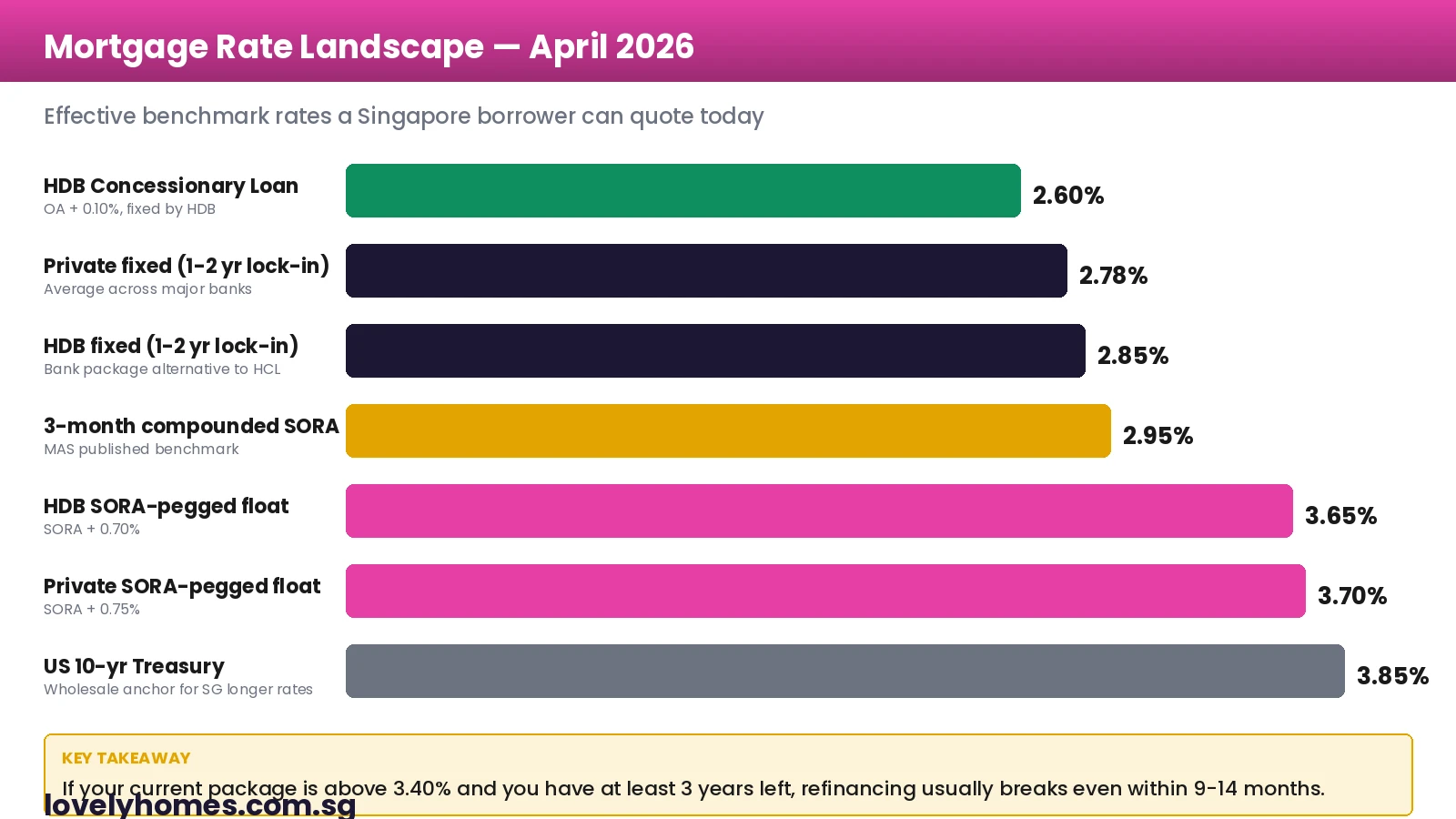
Singapore mortgage rate benchmarks April 2026
Figure 1: Where Singapore mortgage rates sit in April 2026.

The April 2026 Rate Picture

Pricing in 2026 has been shaped by the Monetary Authority of Singapore’s tighter monetary policy stance and by elevated US Treasury yields. The 3-month compounded SORA — the official MAS-published reference rate that has replaced SIBOR — averages around 2.95%. That feeds into floating packages quoted as SORA + a spread: 0.65–0.85% for private property and 0.65–0.75% for HDB, giving effective floating rates of roughly 3.60–3.80%.

Bank fixed packages are pricing inside floating because lenders read the curve as flat to lower over the next 24 months. That is why a private fixed at 2.78% is achievable today even though SORA is at 2.95%. The HDB Concessionary Loan, which is administered by HDB rather than a bank, remains the cheapest mortgage anywhere on the island at 2.60% — fixed at CPF Ordinary Account rate plus 0.10% — and is unaffected by the bank rate cycle.

When Should You Refinance?

The textbook trigger is a rate gap of 0.5% or more between your current effective rate and a fresh fixed package. Below that, the legal-fee drag and the time investment usually do not pay off, especially if your remaining loan is small. Above that, the maths almost always favours the switch, particularly if you can lock in fixed rates while SORA is still elevated.

The other strong trigger is your lock-in expiry. If you signed a 2-year fixed package in mid-2024, that lock-in lifted in mid-2026 and you are now on a much higher reset rate. The bank knows this — its repricing offer will be roughly the market rate plus a small loyalty discount, while a competitor’s refinance offer will be the full headline rate. Compare both in the same fortnight, three months before the anniversary. The notice period is what gives the new bank time to draw fresh facility documents and complete the legal handover without you paying a clawback.

What It Costs to Switch

The all-in cost of a private refinance is normally S$1,800 to S$2,500. That covers the conveyancing legal fees (S$1,500–S$2,000 depending on the firm and complexity), a valuation report (S$300–S$500) and minor disbursements. Banks routinely subsidise legal fees if the new loan is at least S$300,000 and you commit to a clawback period — typically three years. If you refinance again before that clawback ends, you will repay the legal subsidy.

For HDB loans the legal cost is lower because conveyancing is simpler. Expect S$1,200–S$1,800. Repricing is cheaper still, often S$500 or less, because you are simply signing a new package letter with the same lender — no lawyer is needed to discharge and re-mortgage the property.
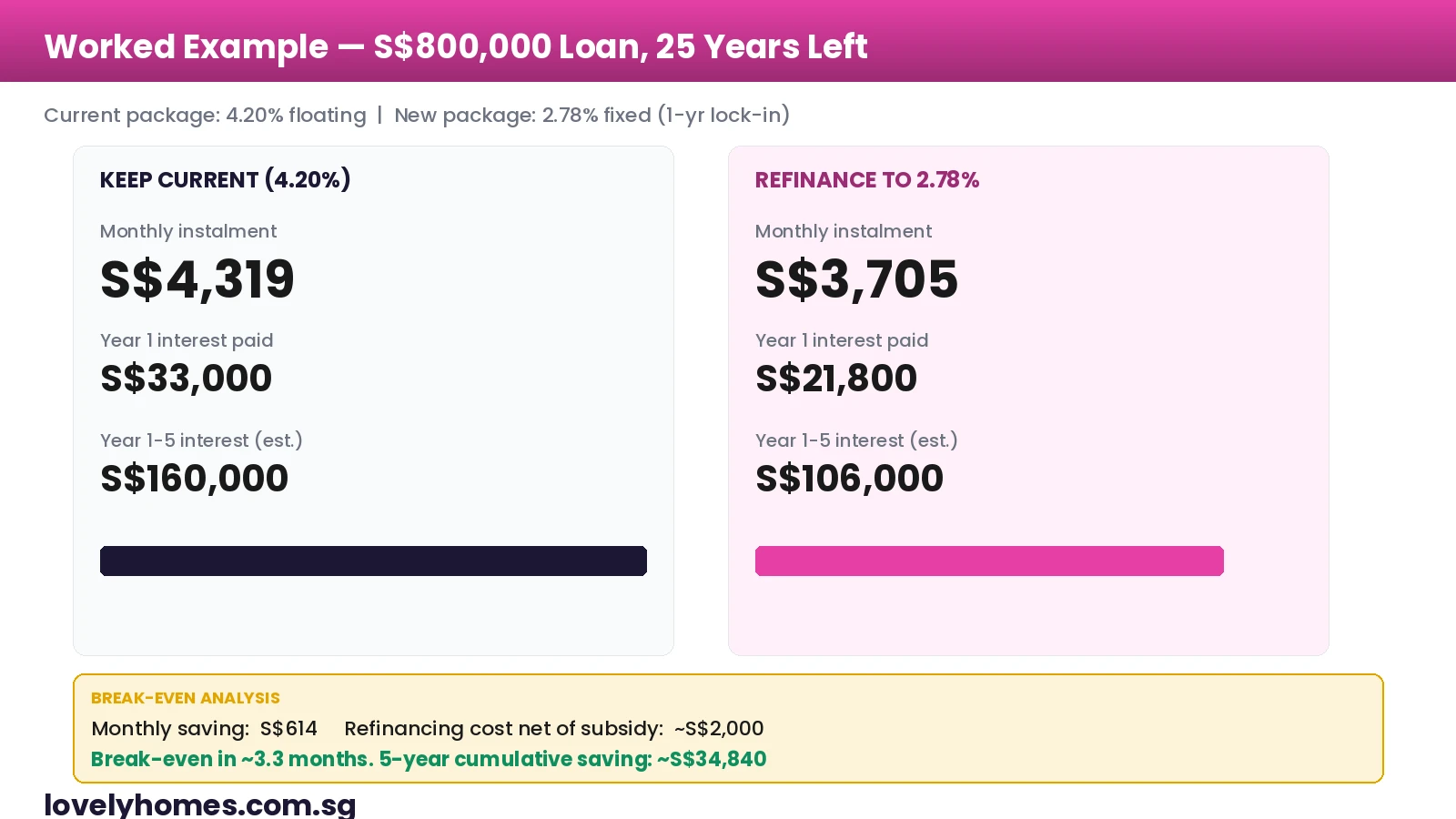
Worked example refinancing S$800,000 loan break-even
Figure 2: A S$800,000 floating-rate mortgage broken down against the same loan refinanced to a 2.78% fixed package.

Worked Example: A S$800,000 Loan, 25 Years to Run

Imagine a private condominium owner sitting on a S$800,000 loan balance with 25 years left. Her current package, a SORA + 1.25% legacy float taken in 2022, has reset to an effective 4.20%. Her monthly instalment is roughly S$4,319, of which around S$33,000 will be interest in year one alone.

If she refinances into a 2.78% one-year fixed package, the same S$800,000 over 25 years drops her instalment to about S$3,705 — a monthly saving of S$614 and a year-one interest bill closer to S$21,800. After legal subsidy from the new bank, her net switching cost is roughly S$2,000.

That puts the break-even point at about 3.3 months. Over the first five years, she pockets roughly S$34,800 of cash-flow savings before any further repricing. Even if she chooses to lock in only one year and then floats again, the pull-forward of those savings is large enough to justify the move.

Repricing vs Refinancing — Which One Should You Choose?

Repricing is the right move if (a) your remaining loan is below S$300,000, (b) you have less than three years to run, or (c) the new offer from your existing bank is within roughly 0.20% of the cheapest competing refinance. The legal-fee saving and the speed of the process — usually two weeks rather than eight — make up for the slightly higher headline rate.

Refinancing is the right move if your loan is large, the rate gap is meaningful, you want to consolidate debt or you want to change the loan structure (for example, switching from a fixed to a SORA-pegged float, or vice versa). It is also the right move if your current bank’s customer service is poor, because once a refinance closes you have no further dealings with the old lender.
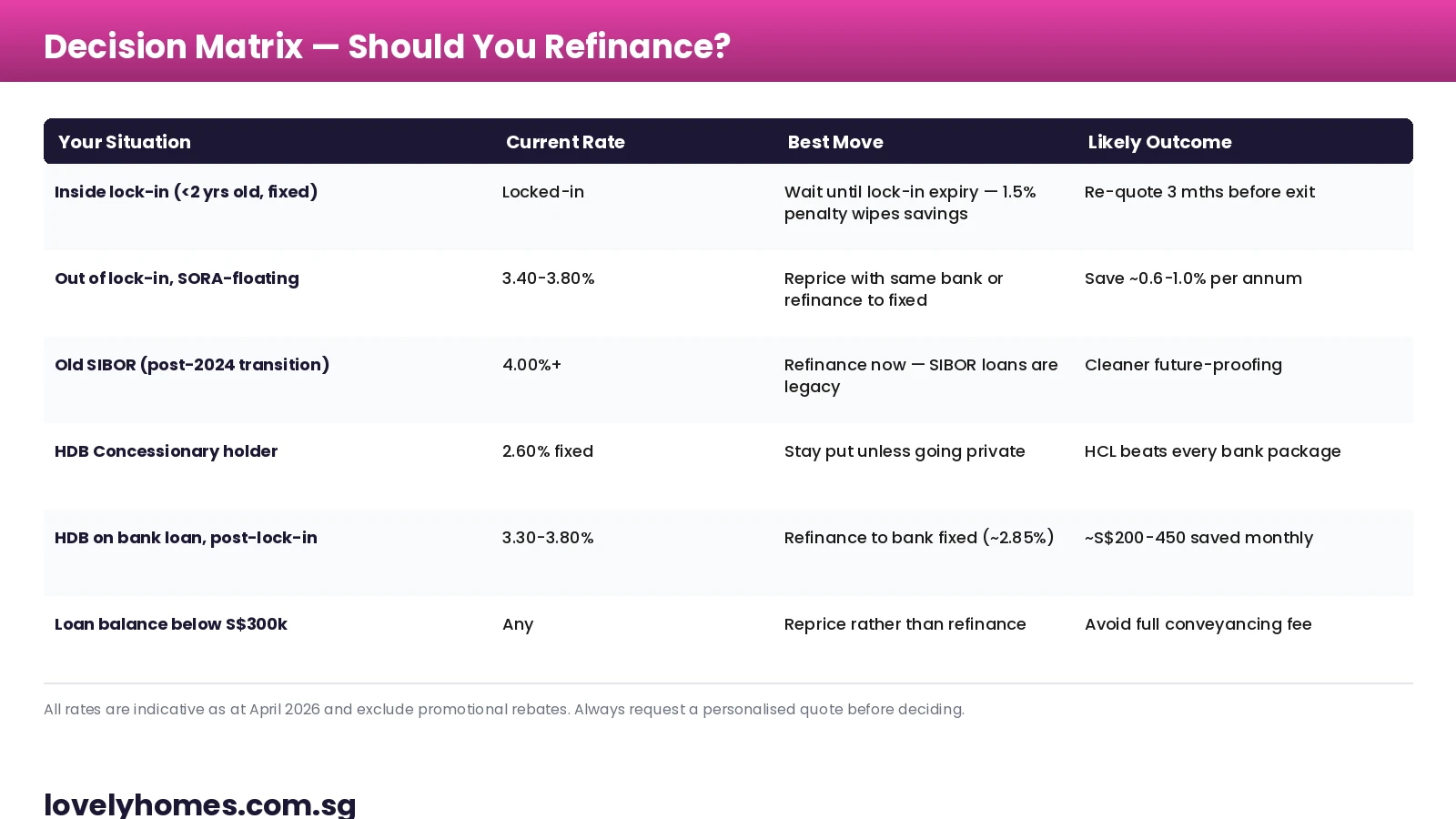
Singapore mortgage refinancing decision matrix 2026
Figure 3: Six common borrower situations and the recommended next move.

The Six Things That Can Sink a Refinance

Even when the rate maths looks compelling, the application can fail at the new bank for any of the following reasons. Each one is worth checking before you start the paperwork.

1. TDSR breach. The Total Debt Servicing Ratio is recalculated at every refinance, even on owner-occupied properties bought before TDSR existed. The standard 55% TDSR cap is stress-tested at a medium-term interest rate of 4.0% for residential property. If your monthly debt obligations have crept up — through a renovation loan, a car loan, or a second property — you may now fail.

2. Income haircut. A bank requires three months of payslips and a Notice of Assessment. If your income has dropped because of a job change or a move to self-employment, the new lender will discount your variable income by 30%, sometimes more. The number that goes into TDSR is lower than your gross.

3. Lock-in penalty. A 1.5% penalty on the outstanding balance is the most common clawback. On a S$800,000 loan that is S$12,000 — usually enough to cancel two years of savings. Always check your facility letter before quoting refinancing offers.

4. Legal subsidy clawback. If you refinanced in the last three years, the prior bank’s legal subsidy may still be repayable on exit. This is rarely waived. Diary-mark the clawback expiry rather than chasing every promotion.

5. Insurance complications. Mortgage Reducing Term Assurance (MRTA) policies are often assigned to the original lender. Reassigning them to the new bank takes time and, in some cases, a small administrative fee. If the policy is portable, no problem; if it is not, you may need a new policy at a new premium.

6. Decoupling and joint-name complications. If a couple has decoupled since the original loan, or if a parent’s name was added or removed for ABSD reasons, the new bank will require fresh underwriting on whoever remains on the title. Plan an extra month for the credit checks.

Documents You Will Need

The refinance pack is largely the same across banks. Have these ready before you ask for in-principle approval:

Category Documents
Identity NRIC for SC/PR; passport + employment pass for foreigners
Property Title deed, sale & purchase agreement, latest property tax notice, CSC or TOP letter
Existing loan Latest loan statement, facility letter, lock-in expiry date, current outstanding balance
Income — employed Latest 3 months’ payslips, latest 1-year Notice of Assessment, CPF contribution history
Income — self-employed Latest 2 years’ Notice of Assessment, 6 months’ bank statements, ACRA business profile
Other liabilities Credit card statements, car loan, renovation loan — anything that goes into TDSR
For HDB HDB resale completion letter or VP letter, HDB loan eligibility letter if any

The Refinancing Timeline

From in-principle approval to legal completion the process runs roughly eight weeks. Plan backwards from your lock-in expiry so the new loan disburses on the day the old loan exits.

Week Action
Week 0 Compile rate sheets from at least three banks and your existing lender’s repricing offer.
Week 1 Submit application + documents to the chosen bank. Receive Letter of Offer.
Week 2 Bank-appointed valuer inspects property; valuation report issued.
Week 3-4 Sign Letter of Offer and engage law firm (often nominated by the bank for subsidy purposes).
Week 5-6 Lawyer prepares discharge of existing mortgage, redemption statement, fresh mortgage instrument.
Week 7 Notice of redemption served on existing bank (the 3-month notice period).
Week 8 New loan disburses; old loan redeemed; new mortgage registered with SLA.

Why It Matters Now

Singapore’s rate cycle is sitting in an unusual window. SORA is high enough that floating-rate borrowers feel the pinch every month, but bank fixed packages are pricing inside SORA because the curve has inverted. That means the gap between an old floating package and a fresh fixed one is unusually wide — often 90 to 130 basis points for borrowers who took loans in 2022–2024. Whether you act on that gap now or wait six months can mean tens of thousands of dollars over the life of a S$1 million loan.

The complement matters too. If MAS pivots back to easing later in the year, the floating rate will fall but bank fixed packages will fall faster — banks reprice off their forward expectations, not spot SORA. A fixed package taken in April 2026 may look high in early 2027. The remedy is to sign one-year fixed rather than three-year fixed unless you genuinely need the cash-flow certainty.

What Might Come Next

Two scenarios are worth thinking through. The first is that MAS holds policy unchanged through October 2026 and the curve flattens further. In that world, fixed rates fall toward 2.50% by mid-year, floating rates compress slightly, and the refinancing window stays open but shrinks. Borrowers who reprice will probably do as well as those who refinance in net terms.

The second scenario is that the US Federal Reserve cuts rates more aggressively because of slower-than-expected growth. Singapore’s domestic rate complex would follow on the floating side but more slowly on fixed. In that world, floating becomes the cheaper bet and refinancing into a SORA-pegged float — rather than fixed — becomes the better trade. Either way, the basic discipline does not change: review the package three months before lock-in expiry and make a decision based on the gap, not on a guess about where rates are headed.

Frequently Asked Questions

How early should I start the refinancing conversation?

Three months before your lock-in expires is the standard cadence. That is the notice period most existing lenders require, and it gives the new bank time to issue the Letter of Offer, complete the valuation, and have your lawyer prepare the discharge — all without overlapping with your current package’s reset date. Starting earlier than three months is fine for shopping around, but the formal application sits at the three-month mark.

Will refinancing reset my loan tenure?

Only if you ask it to. The new loan can match the remaining tenure of your old loan (most common) or it can be re-amortised to a longer tenure (subject to the borrower’s age cap of 65 for residential and the LTV cap, which tightens with longer tenures). Lengthening tenure lowers the monthly instalment but raises the lifetime interest paid and may push you into a lower LTV ceiling, requiring extra cash or CPF.

Can I refinance to take cash out?

Yes, this is called a cash-out refinance or term loan top-up. It is allowed on private property under MAS rules but the loan-to-value cap on the cash-out portion is 75% (or 55% if you have an existing housing loan or your tenure breaches the standard caps). HDB flats cannot be cash-out refinanced — you can only refinance the existing loan balance. The cash-out interest rate is also typically higher than a vanilla refinance.

Does refinancing affect my credit score?

The credit bureau records the new mortgage application as a credit enquiry and the new account as a fresh trade line. There is a minor short-term dip while the old loan is closed and the new one is opened. Within three to six months the score normalises. The bigger credit-score risk is having multiple unsuccessful applications in a short window, so do your homework before you formally apply.

What happens to my CPF Accrued Interest if I refinance?

Refinancing has no effect on your CPF Accrued Interest balance. CPF Accrued Interest is a notional amount tracking what your CPF Ordinary Account would have earned if you had not used it for the property. It accumulates regardless of which bank holds the mortgage and is only crystallised when you sell. Refinancing also does not affect your CPF withdrawal limit or your Valuation Limit.

Should I switch from floating to fixed in 2026?

For most borrowers in 2026 the answer is yes, because bank fixed rates are pricing below spot SORA. The exception is borrowers who believe MAS will ease aggressively in the next six months, or borrowers whose remaining loan is small enough that the lifetime interest difference is modest. If certainty of monthly cash flow matters more than chasing the last 20 basis points, fixed is the right answer in 2026.

What if I am refinancing while between jobs?

Banks treat unemployed applicants as having zero employment income, regardless of savings or assets. If you are between jobs, complete the refinancing while you are still in your current role, or wait until you have at least three months of payslips at the new employer. Self-employed borrowers must show two full years of Notice of Assessment, so a recent move from employment to self-employment is the same problem in slow motion.
Disclaimer. This article is general information about mortgage refinancing in Singapore as at 29 April 2026 and does not constitute financial advice. Rates and bank packages change frequently. Always verify current rates with the lender, the Monetary Authority of Singapore (SORA reference), HDB (HDB Concessionary Loan), and your own licensed financial adviser, mortgage broker or solicitor before making any decision.

Inheriting Property in Singapore 2026: Probate, Stamp Duty & Estate Planning Essentials

Inheriting Property in Singapore 2026: Probate, Stamp Duty & Estate Planning Essentials

Inheriting property in Singapore is one of those events most families confront only once or twice in a lifetime. The legal mechanics are forgiving compared with the United Kingdom or the United States — Singapore has no estate duty, no inheritance tax, and no capital-gains tax on residential property — but the process is still demanding. The deceased’s estate must clear probate, the heir must understand how the property fits into their existing ABSD count, and several stamp-duty deadlines run from the date of death rather than the date of transfer. Get any of these wrong and you can either lose months of clear title or unwittingly trigger ABSD on a future purchase.

This 2026 guide walks the entire journey end to end — what happens whether or not the deceased left a Will, the statutory shares set by the Intestate Succession Act, the typical costs of probate, the stamp-duty position on transfer to the heir, and the all-important interaction with ABSD on the heir’s next property purchase. All figures and rules below reflect Singapore’s position as of 29 April 2026. For the live position, always check Family Justice Courts, the Intestate Succession Act, and IRAS Stamp Duty.

Quick Answer — inheriting property in Singapore

  • Singapore abolished estate duty for deaths from 15 February 2008. There is no longer an inheritance tax.
  • The deceased’s estate goes through probate (with a Will) or Letters of Administration (without one).
  • Without a Will, the Intestate Succession Act (ISA) sets statutory shares between spouse, children and parents.
  • Transfer of property to the heir is a transmission, not a sale — no BSD or ABSD on that transfer.
  • BUT — the inherited property counts toward the heir’s property tally for ABSD on their next purchase.
  • Joint-tenancy property passes automatically by survivorship — outside the Will or ISA.
  • HDB flats follow extra rules — only Singapore Citizen/PR family members who meet eligibility can inherit and remain in occupation.

The Two Pathways: With a Will and Without

The first question after a death is the same one solicitors ask: was there a Will? The answer determines which application the executors or family must make to the Family Justice Courts, who has standing to administer the estate, and how the property is ultimately divided.

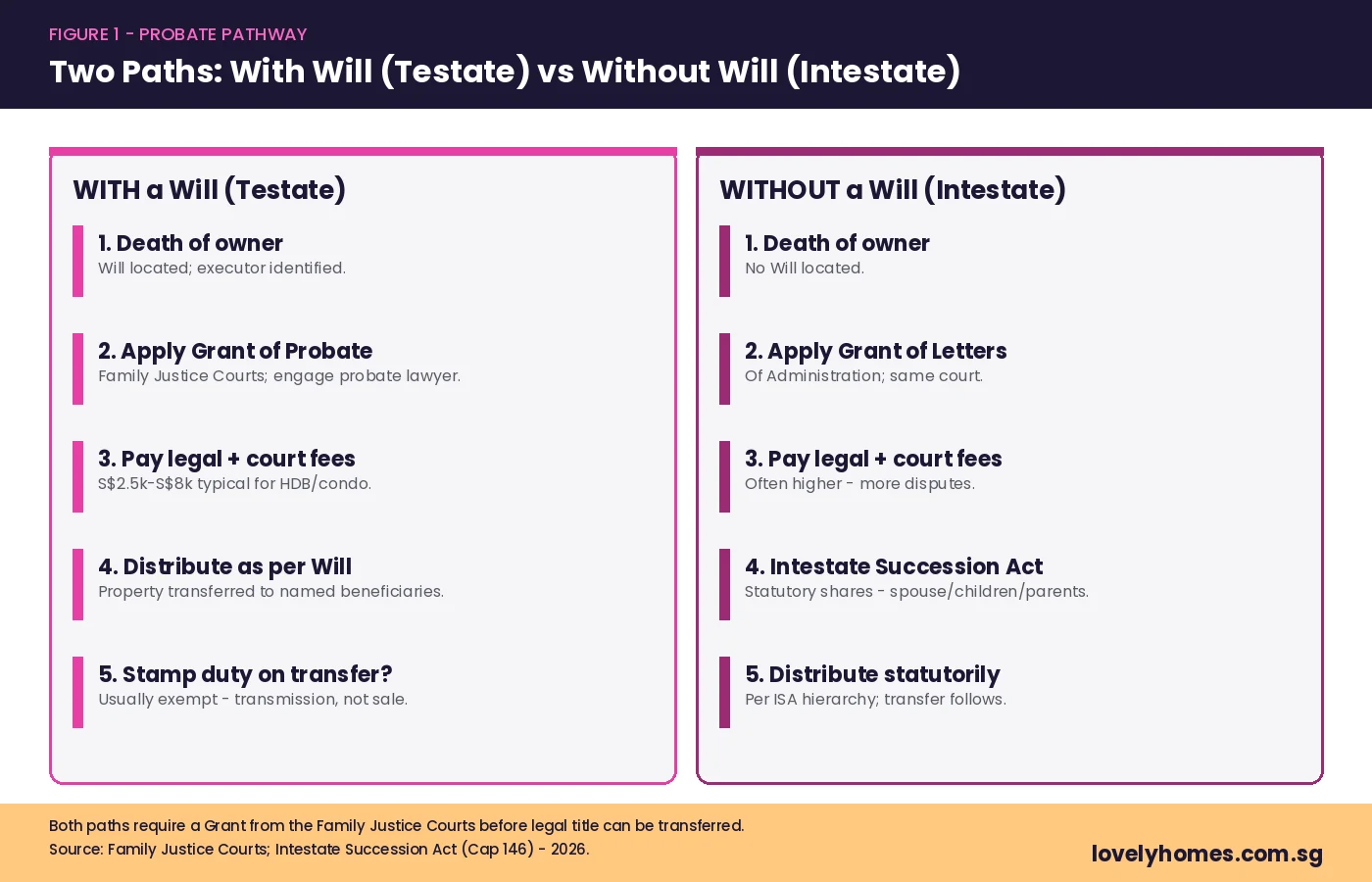
Probate pathway diagram - testate vs intestate inheritance Singapore 2026
Figure 1: The two pathways for inheriting property in Singapore. Both end with the property being transmitted into the heir’s name once the Court issues the Grant.

With a Will (Testate Succession)

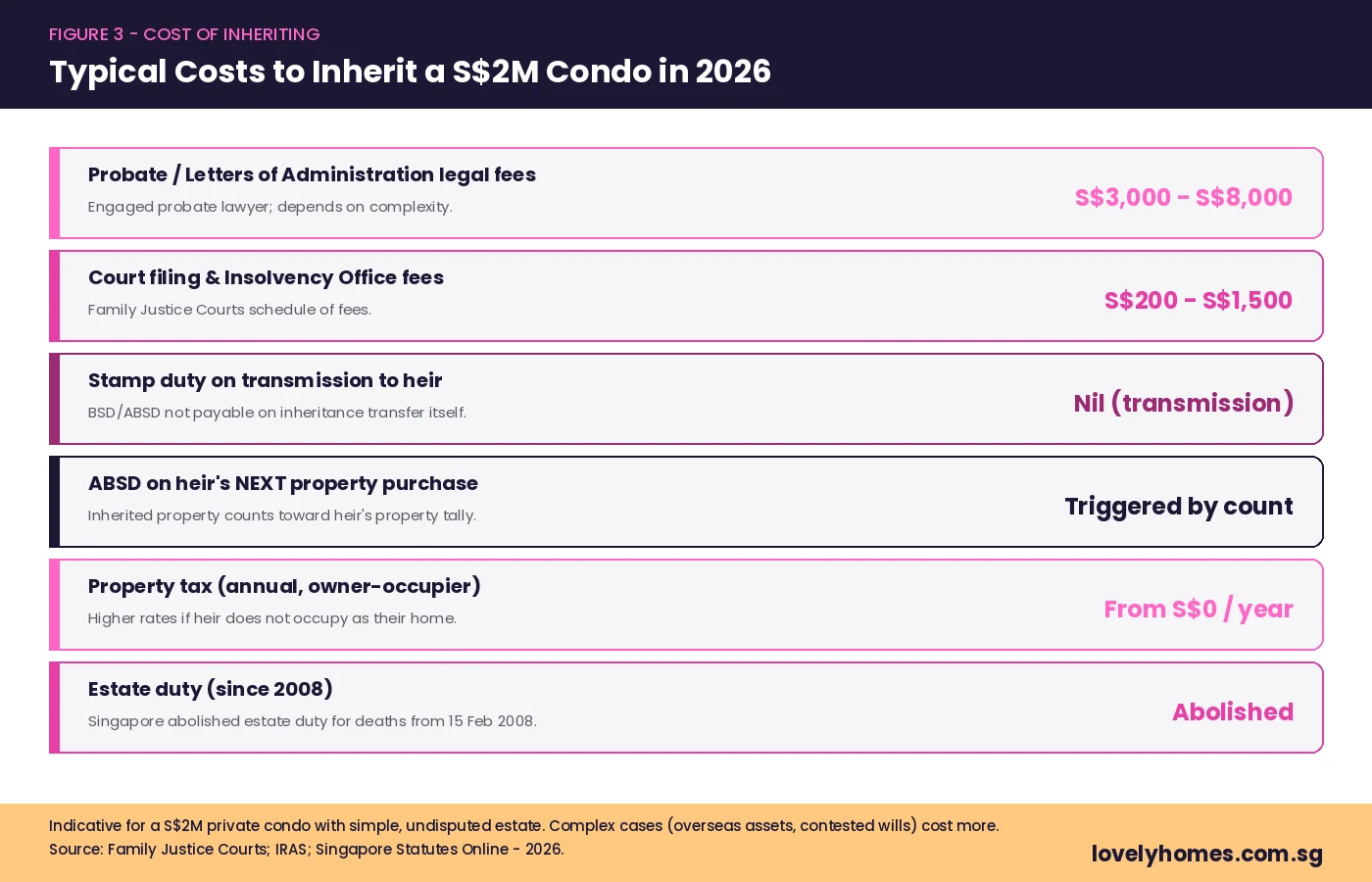
If the deceased left a valid Will, the named executor applies to the Family Justice Courts for a Grant of Probate. The Will dictates who inherits the property — the executor’s job is to carry out those instructions after settling the estate’s debts. For a clean estate (no caveats, no contests, full documentation), a Grant of Probate is typically issued within 4–8 weeks. Probate fees range roughly S$3,000 to S$8,000 in legal costs for a single residential property, plus court filing fees of a few hundred dollars.

Without a Will (Intestate Succession)

Where there is no Will, the next-of-kin applies for a Grant of Letters of Administration. The applicant administers the estate and distributes it according to the statutory shares set out in the Intestate Succession Act (ISA). Letters of Administration take longer than probate — typically 8–16 weeks — because the Court must satisfy itself who is entitled to apply, what the estate consists of, and that no contest exists. Where the estate is over S$5 million or contains foreign assets, the timeline extends materially.

Joint-Tenancy — The Quiet Third Path

For property held by spouses as joint tenants, the surviving spouse takes the deceased’s share automatically by survivorship — outside the Will, outside the ISA, and outside probate altogether. The surviving spouse simply lodges a Notice of Death with the Singapore Land Authority (SLA) along with the death certificate, and the title is updated. This is the cleanest of the three pathways. By contrast, tenancy-in-common property passes through the Will or the ISA like any other estate asset. For the difference, see our Joint Tenancy vs Tenancy in Common Singapore 2026 guide.

The Intestate Succession Act — How an Estate Without a Will Is Split

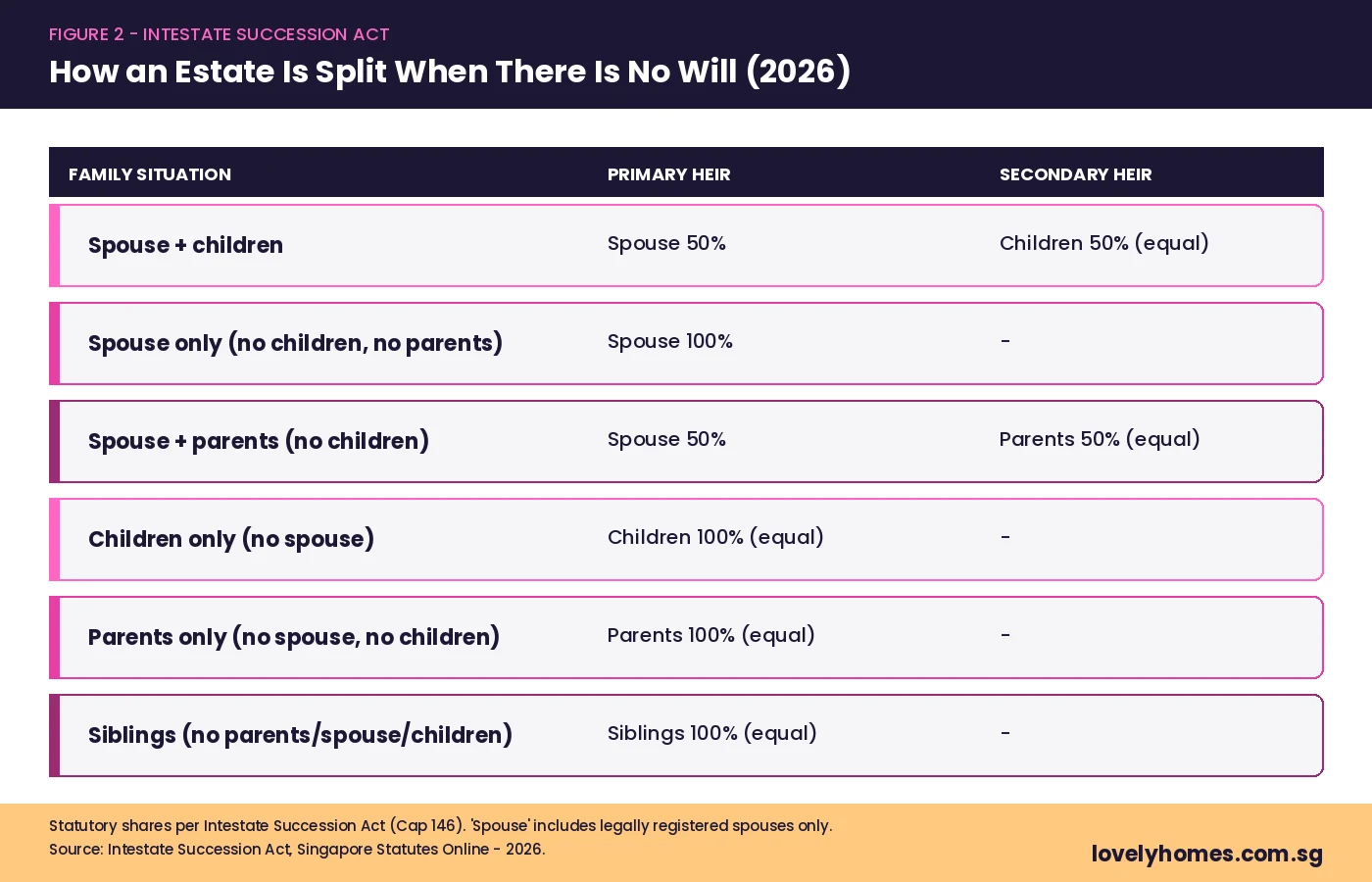
If you die intestate (without a Will) and you are domiciled in Singapore, the Intestate Succession Act (Cap 146) determines exactly who gets what. The Act is gender-neutral but assumes a fairly traditional family structure — spouse, children, parents, siblings — in that order of priority.

Intestate Succession Act statutory shares chart for 2026
Figure 2: Intestate Succession Act statutory shares, 2026. Where there is no Will, distribution follows the Act’s strict order.
Family Situation Statutory Distribution
Spouse + children Spouse 50%; children 50% (split equally between children)
Spouse only (no children, no parents) Spouse takes 100%
Spouse + parents (no children) Spouse 50%; parents 50% (equally)
Children only (no spouse) Children 100% (equal shares per stirpes)
Parents only (no spouse, no children) Parents 100% (equally)
Siblings (no parents, no spouse, no children) Siblings 100% (equally)
No surviving immediate or extended family Estate goes to the Singapore Government (bona vacantia)

Two practical points worth highlighting. First, “spouse” in the Act means a legally registered spouse only — long-term partners, fiancés, and ex-spouses are excluded, no matter how long the relationship. Second, step-children are not statutory heirs unless legally adopted. If you have a blended family, you almost certainly need a Will — the ISA will not deliver the outcome most blended families assume.

HDB Inheritance — Special Rules That Override the General Position

HDB flats are not just real estate — they are part of Singapore’s public housing system, with eligibility rules that override the general law of succession. When a HDB owner dies, the flat does not simply transfer to the heir named in the Will or the ISA share — HDB still has to approve who can inherit and remain in the flat. The rules are roughly:

  • The heir must be Singapore Citizen or PR. Foreigner heirs cannot inherit and remain on title for an HDB flat.
  • The heir must satisfy HDB’s family-nucleus or single-buyer eligibility. A 28-year-old single child cannot inherit the flat outright until age 35 under the Single Singapore Citizen Scheme — the flat is held in trust until then or sold on the open market.
  • Existing property by the heir matters. If the heir already owns a private residential property, HDB’s ownership rules require the heir to dispose of the private property within 6 months of the inheritance to retain the HDB flat, or vice versa.
  • The flat’s remaining MOP and SC quota apply. Inheritance does not reset the Minimum Occupation Period or trigger any quota issues, but the heir must continue to comply with rental, sublet, and EIP/SPR quota rules.

For a HDB-specific deep-dive, our How to Sell an HDB Flat 2026 guide covers the complications when an inherited HDB flat must be sold to fund the estate or to free the heir to remain on private property. The HDB section of the official HDB site sets out the live position.

Stamp Duty on the Inheritance — What You Actually Pay

Singapore’s tax position on inheritance is unusually generous compared with major Western jurisdictions:

Cost breakdown of inheriting a S$2 million property in Singapore 2026
Figure 3: Indicative cost of inheriting a S$2M private condo in 2026. Singapore charges no estate duty and no BSD/ABSD on the transmission itself.

1. No estate duty since 15 February 2008

Singapore abolished estate duty for deaths occurring on or after 15 February 2008. There is no “death tax”, no “inheritance tax”, and no “estate tax” on the value of the property at the date of death. This is a major reason why Singapore is favoured by family-office structures over the UK (40% inheritance tax) or the US federal estate tax.

2. No BSD or ABSD on transmission

The transfer of the property from the deceased’s estate to the heir is a transmission — not a sale — and therefore not subject to Buyer’s Stamp Duty (BSD) or Additional Buyer’s Stamp Duty (ABSD). This is consistent with IRAS’s position that ABSD only applies on a purchase. Inheriting your parent’s flat does not, in itself, trigger any stamp-duty bill.

3. BUT — ABSD count is affected for the heir’s next purchase

Here is the trap. While the inheritance itself attracts no ABSD, the inherited property counts toward the heir’s property tally for any future purchase. A Singapore Citizen who inherits their parent’s HDB flat now owns one residential property — their next purchase will be an SC-2nd at 20% ABSD, not the SC-1st at 0%.

Heirs who are mid-purchase when the inheritance arrives need to plan carefully. A common workaround is to renounce the inherited interest in favour of another beneficiary — legally permissible under the Probate & Administration Act, provided the renunciation is done before the heir takes any benefit from the property. We strongly recommend speaking to a probate lawyer before renouncing because the implications are irreversible. For broader context on ABSD, see our ABSD Singapore Complete Guide 2026.

4. Property tax continues, billed to the new owner

The annual property tax obligation passes to the heir on transmission. If the heir occupies the property as their home, owner-occupier rates (lowest band) apply. If the heir already has another home and rents the inherited property out, IRAS will apply the higher non-owner-occupier rates. See our Singapore Property Tax 2026 guide for current rates and bands.

CPF Refund — The Easily-Missed Step

If the deceased used CPF to fund the property, the principal sum used plus accrued interest must be refunded to their CPF account on transfer. The CPF refund is paid to the deceased’s estate (effectively to the named CPF nominees, if any, or otherwise distributed by the executor). This is not a tax — it is the final clearing of the deceased’s CPF position. The figure can be substantial: a 4-room HDB flat that was funded with S$200,000 of CPF in 2000 might owe over S$400,000 of principal-plus-accrued-interest in 2026.

Heirs sometimes mistake this CPF refund for a charge that they have to pay personally. They do not — the refund comes out of the estate’s share of any sale proceeds, or, if the property is being retained, the estate must arrange for the refund from cash assets. The refund is a precondition for clear title and cannot be deferred.

How Long Does the Whole Process Take?

For a simple estate — one residential property, undisputed Will or clean intestacy, one or two heirs, no overseas assets — the typical journey looks like this:

Stage Typical Timeline Who Drives It
Locate Will & gather documents 1–2 weeks Family
Engage probate lawyer 1 week Family
File Grant application (probate or LA) 2–4 weeks Lawyer
Court issues Grant 2–6 weeks for probate; 8–16 for LA Court
Lodge Grant + Notice of Death with SLA 1–2 weeks Lawyer
CPF refund & outstanding loan settlement 2–4 weeks Lawyer / family
Title transmitted to heir 2–3 weeks after CPF/loan clearance SLA
Total simple estate ~3–4 months testate; ~5–7 months intestate

Contested estates, estates over S$5 million, estates with overseas immovable property, or estates where the deceased’s domicile is uncertain all add months to the timeline. Engaging an experienced probate solicitor early is the single most important action a family can take to keep the timeline on track.

A Worked Example — What Mr Tan’s Family Actually Pays

Mr Tan, a Singapore Citizen aged 78, dies in March 2026. He leaves behind:

  • A 4-room HDB flat in Bedok (held in his sole name), valued at S$650,000.
  • A S$2 million private condominium in District 15 (held jointly with his wife as joint tenants).
  • A simple Will leaving the HDB flat equally to his two adult children, both Singapore Citizens.

The flow:

  1. Condo — immediate transfer. The District 15 condominium passes automatically to Mrs Tan by survivorship. No probate, no Will, no ISA. Mrs Tan lodges the death certificate with SLA. Cost: roughly S$300 in lodgement fees.
  2. HDB flat — through probate. The executor (eldest son) applies for a Grant of Probate. Court issues the Grant in five weeks. Probate legal fees: ~S$4,500. The HDB flat is then transmitted equally to the two children. Both children are Singapore Citizens, but each already owns a private condo — under HDB rules, they cannot retain the inherited HDB flat and must dispose of either the HDB or the private property within six months. Family decides to sell the flat on the open market.
  3. CPF refund. Mr Tan had used S$280,000 of CPF (principal + accrued interest) on the HDB flat. The refund flows from sale proceeds to his CPF account, then to nominees.
  4. Sale proceeds distributed. Net of the CPF refund and S$8,000 selling costs, the remaining S$362,000 is divided equally between the two children (S$181,000 each).
  5. ABSD impact for the children. Because each child took beneficial ownership of the HDB flat before selling it, each had two residential properties on title for that brief window. Their next condo purchase will be an SC-3rd-property at 30% ABSD — not 0%. The family should have spoken to a probate lawyer about renouncing in favour of the surviving spouse, or selling the flat directly out of the estate without taking transmission.

This is the textbook example of why estate planning matters. With one Will revision — leaving the HDB flat to Mrs Tan instead — the entire ABSD complication for the children would have been avoided.

How Estate Planning Works in Singapore (Briefly)

Three estate-planning instruments do most of the heavy lifting:

  1. A valid Will. Drafted, signed, and witnessed per the Wills Act. Costs from S$300 (simple Will at a high-street firm) up to several thousand for a complex estate. The single highest-leverage action any property-owning Singaporean can take.
  2. CPF nominations. CPF moneys do not pass through the Will or the ISA — they go to nominees. Without a CPF nomination, balances go to the Public Trustee for distribution per ISA. Update CPF nominations whenever there is a major life event.
  3. Manner of co-ownership. Married couples buying property together should consciously choose between joint tenancy (survivorship transfers automatically) and tenancy in common (each owner’s share passes through their estate). The choice has profound implications for inheritance, divorce, and ABSD planning.

For an even more direct approach, large families with significant property holdings sometimes use private trusts — though Singapore’s ABSD-on-trustees position (65% on the trustee’s entity rate) means trust structures need careful structuring to avoid triggering punitive ABSD. This is well outside the scope of a general guide and demands specialist trust counsel.

What Might Come Next

Two areas to watch. First, Singapore’s policy stance on intergenerational transfer is generally favourable, but the ABSD position on inherited property has been quietly tightening since 2018. Expect IRAS to continue scrutinising arrangements where inheritance is structured to avoid ABSD — in particular “in-life gifts” and trust structures that benefit a Singapore property owner’s children. Second, the Family Justice Courts have signalled that they may digitise more of the probate process by 2027, which should compress the testate timeline below 4 weeks for simple estates. None of this is policy yet, and these paragraphs are editorial speculation only.

Frequently Asked Questions

Do I have to pay any tax when I inherit property in Singapore?

No tax is payable on the transmission itself — Singapore abolished estate duty for deaths from 15 February 2008, and no BSD or ABSD applies on a transfer that is not a sale. You will, however, pick up the annual property-tax obligation from the date of transmission, and any future purchase you make will count the inherited property toward your ABSD tally.

My parent died without a Will. Can I just sign over my share to my sibling?

Yes — this is called a Deed of Family Arrangement, signed after the Grant of Letters of Administration is issued. All ISA-statutory heirs must agree, and the deed is filed with the Court. It allows the family to redirect the estate without having to go to a full reapplication. Engage a probate solicitor to draft the deed and ensure stamp duty implications are covered.

Can I refuse the inheritance?

Yes. A beneficiary can renounce their interest under the Probate & Administration Act before taking any benefit from the property. The renunciation must be in writing and is irrevocable. Heirs sometimes do this to avoid the ABSD-count consequence of inheriting, channelling the property to a sibling who would not be affected.

What happens to the deceased’s outstanding mortgage on the property?

Most Singaporean homeowners carry Mortgage Reducing Term Assurance (MRTA) or the Home Protection Scheme (HPS) for HDB. Either policy pays off the outstanding loan on death — the heir takes the property unencumbered. If no MRTA/HPS exists, the mortgage continues and the heir must either continue servicing it (if eligible to take over the loan) or sell the property to discharge it.

If I am a Singapore Citizen and inherit a Malaysian property, do I need to declare it in Singapore?

Yes. Even though no Singapore tax is due on the inheritance itself, you must declare any overseas residential property you own when applying for ABSD remission, HDB schemes, or LBS — the Singapore Government counts overseas residential property toward eligibility tests. You will also have Malaysian filing obligations, including the Real Property Gains Tax position on any future disposal.

Can a foreigner inherit a Singapore property?

Yes for private property — foreigners can inherit and own non-restricted private residential property in Singapore, subject to the Residential Property Act for landed homes. For HDB flats, foreigners cannot inherit the flat directly — the HDB flat must be sold and the proceeds distributed instead. Engage a Singapore lawyer who deals with cross-border probate.

How much do probate lawyers cost in 2026?

For a simple estate with one residential property and no contests, expect around S$3,000–S$8,000 in legal fees (with a Will) or S$4,000–S$10,000 (without a Will, since Letters of Administration take longer and require a personal-representative bond). Court filing fees are typically a few hundred dollars more.

Related Articles

Disclaimer: This guide is for general information only and does not constitute legal, tax, or financial advice. Probate, succession, stamp duty, and HDB inheritance rules change over time and depend on individual circumstances. Always verify the live position with the Family Justice Courts, the Intestate Succession Act, the HDB website, and IRAS, and consult a Singapore-qualified probate solicitor before acting on any estate matter.

Decoupling for Married Couples Singapore 2026: Saving ABSD on a Second Home — Legally and Step-by-Step

Decoupling for Married Couples Singapore 2026: Saving ABSD on a Second Home — Legally and Step-by-Step

Last updated 28 April 2026. Reflects ABSD rates effective 27 April 2023 and Buyer’s Stamp Duty rates effective 14 February 2023.

Quick Answer — 30-second takeaways

  • Decoupling is the legal restructuring of a co-owned residential property so that one spouse ends up holding 100% of it. The other spouse is then restored to first-time-buyer status and can buy a second residential property without paying ABSD.
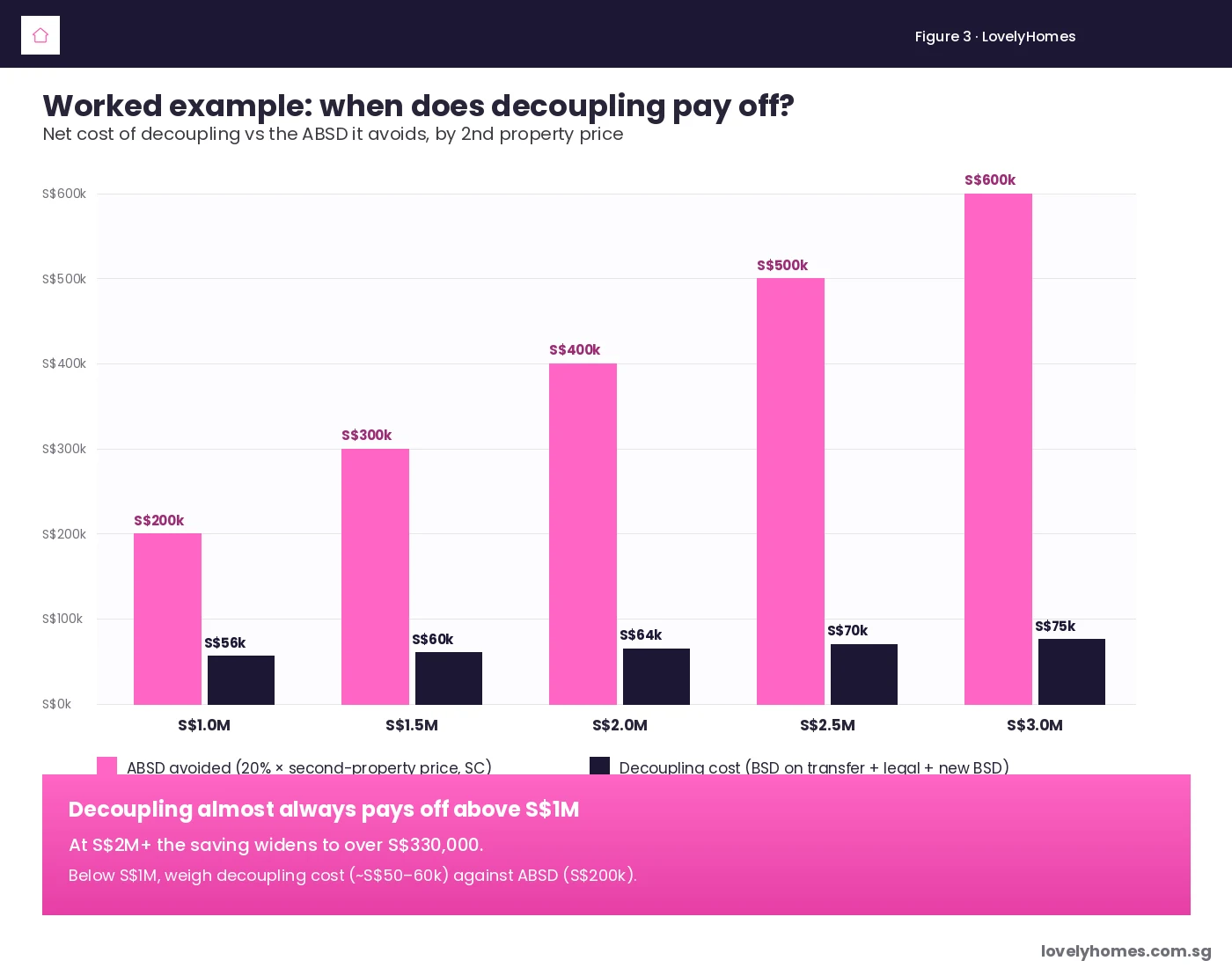
  • For a married Singapore Citizen (SC) couple, ABSD on a S$1.5 million second home is 20% (S$300,000). Decoupling typically costs S$50,000–S$70,000 in BSD on the internal transfer plus legal fees.
  • The maths almost always favours decoupling once the second property is above S$1 million.
  • Decoupling is only legal for private residential property. HDB flats cannot be decoupled (since 1 April 2016, except in narrow exceptions like divorce, death or financial hardship).
  • The receiving spouse must be able to solo-service the loan under TDSR (60%) and refund any CPF used by the outgoing spouse with 2.5% accrued interest.
  • Decoupling is administered by IRAS for stamp duty and CPF Board for refund of utilised CPF; conveyancing must be handled by a licensed Singapore lawyer.
  • Allow 6 to 10 weeks end-to-end. Add 2–4 weeks if the loan must be refinanced into one name.

What is decoupling?

“Decoupling” is the informal name for a transaction in which co-owners of a Singapore residential property restructure their ownership so that one party transfers their share to the other. The receiving owner ends up with 100% legal title; the outgoing owner ends up with no residential property in their name.

The reason this is done is rarely sentimental. It is an Additional Buyer’s Stamp Duty (ABSD) avoidance technique — and a perfectly legal one, provided it is structured as an arms-length sale at market value, with stamp duty correctly paid on the transferred share. Once the outgoing spouse no longer owns any residential property, they are restored to “first residential property” status with the Inland Revenue Authority of Singapore (IRAS), and any subsequent purchase falls outside the punitive ABSD net.

The technique was already common before the 27 April 2023 ABSD hike that took the second-property rate for SCs from 17% to 20%. After that hike, decoupling became one of the most-discussed topics on Singapore property forums — and a regular line item in mass-affluent household financial plans.

Decoupling property Singapore 2026 — ABSD vs decoupling cost comparison for a S$1.5M second home
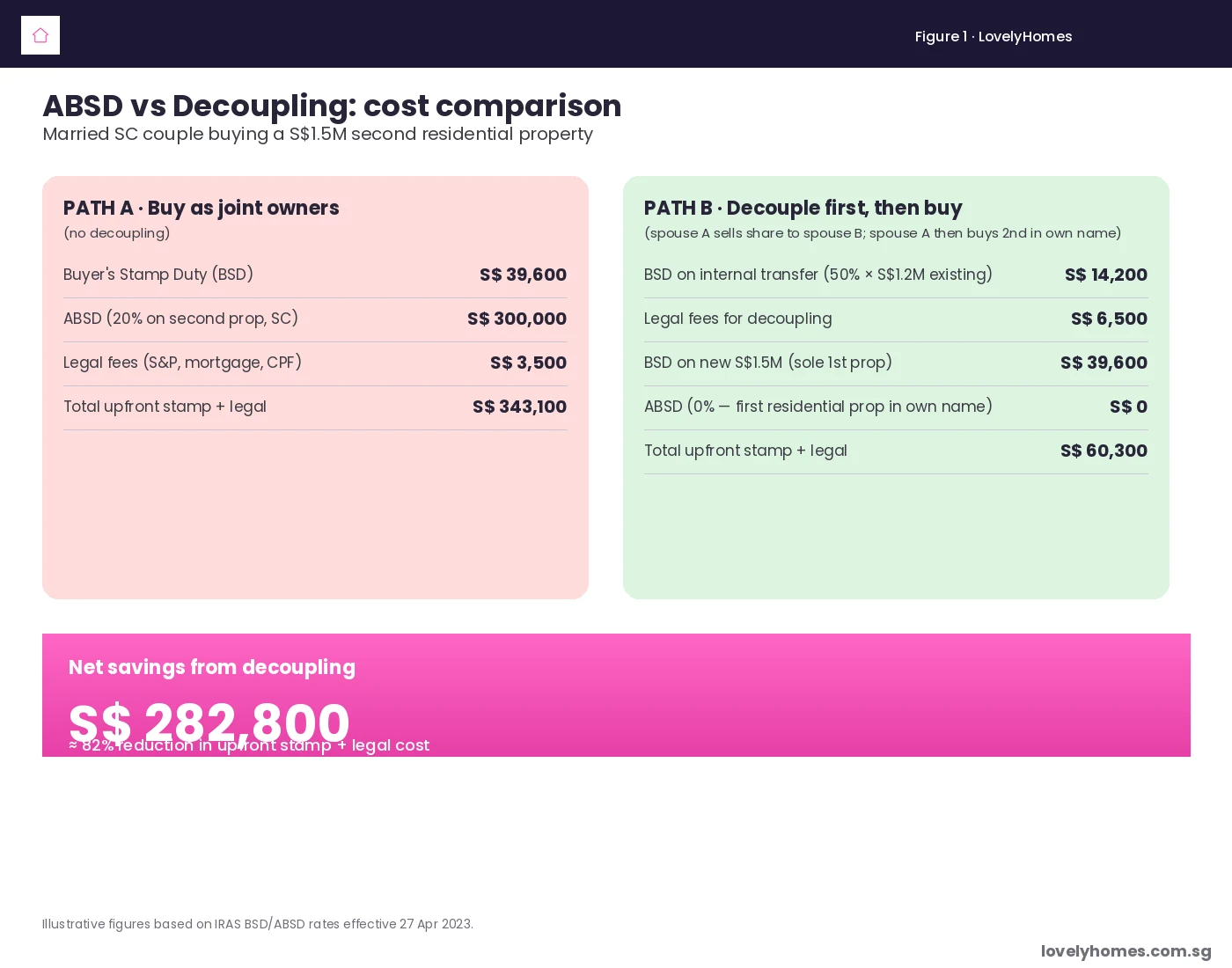
Figure 1: For a married SC couple buying a S$1.5 million second residential property, decoupling cuts upfront stamp + legal cost from S$343,100 to S$60,300 — a saving of S$282,800.

Why decoupling exists — the ABSD wall

Singapore’s ABSD regime treats any residential property held by either spouse as a household-level holding for stamp duty purposes. Under IRAS rules a married couple is taxed as a single buyer profile: if either spouse has an existing residential property, the next purchase is treated as a second (or third) property and attracts ABSD at the higher band, even if the new property is bought solely in the unencumbered spouse’s name.

The 2026 ABSD ladder for residential property is:

Buyer profile 1st residential 2nd residential 3rd & subsequent
Singapore Citizen (SC) 0% 20% 30%
Singapore PR 5% 30% 35%
Foreigner 60% 60% 60%
Entity / Trust 65% 65% 65%

For a married SC couple, the 20% band on a S$1.5 million purchase is S$300,000 — payable upfront, in cash or CPF, within 14 days of exercising the Option to Purchase. That is the wall decoupling is designed to remove.

Who can decouple — and who cannot

Decoupling is only available for private residential property: condos, executive condominiums (after the privatisation date), and landed homes. It is not available for HDB flats — the Housing and Development Board removed the loophole on 1 April 2016, requiring HDB flats to be held jointly under specified eligibility schemes (Public, Fiance, Joint Singles, etc.) and prohibiting “part-share” transfers between named owners except in narrow circumstances like divorce, death of co-owner, financial hardship or marriage to an existing co-owner.

Within private residential property, decoupling typically works for couples where:

  • The property has appreciated enough that BSD on the transferred share is meaningfully smaller than the avoided ABSD;
  • The receiving spouse can solo-service the existing mortgage under the 60% Total Debt Servicing Ratio (TDSR);
  • Both parties are aligned that the outgoing spouse will end up holding the new property in their sole name (with the implications that brings on inheritance, CPF refund and divorce settlement).

The 4-step decoupling process

Decoupling property Singapore 2026 — 4-step process timeline from valuation to second purchase
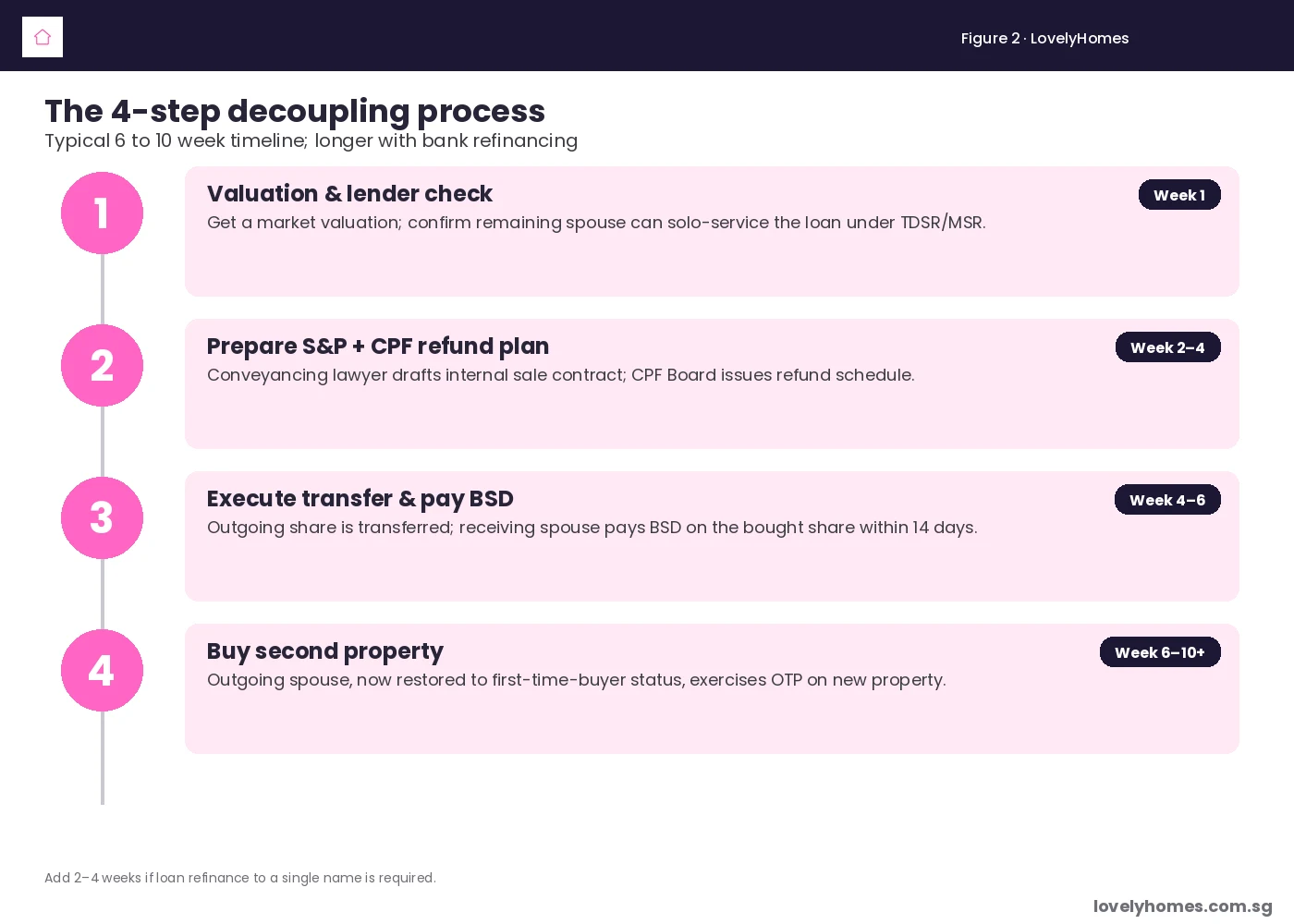
Figure 2: The decoupling timeline: valuation, S&P drafting, transfer + BSD payment, then the second purchase.

Step 1 — Valuation and lender check

The conveyancing lawyer obtains a market valuation. The receiving spouse approaches the existing mortgagee bank (or an alternative bank) to confirm they can solo-service the loan under TDSR — meaning total monthly debt repayments cannot exceed 60% of gross monthly income. The Monetary Authority of Singapore caps the loan tenure at 30 years for private property and the loan-to-value ratio at 75% for the first housing loan.

Step 2 — Prepare S&P agreement and CPF refund schedule

The lawyer drafts an internal sale and purchase agreement at market value. CPF Board issues a refund schedule covering all CPF principal previously used by the outgoing spouse plus 2.5% accrued interest from the date each contribution was used. This is non-negotiable: the CPF refund is a lien on the property and must be settled at completion.

Step 3 — Execute the transfer and pay BSD

On completion, legal title transfers from joint to sole ownership. The receiving spouse pays BSD on the value of the share bought (i.e., 50% of the market valuation in a 50/50 joint tenancy, scaled accordingly for tenancy-in-common). BSD must be paid within 14 days of execution; late payment attracts IRAS penalties.

Step 4 — Buy the second property

The outgoing spouse, now restored to “no residential property” status, exercises the Option to Purchase on the new property and pays standard BSD only — no ABSD. There is no waiting period required between Step 3 and Step 4, but in practice the second OTP is often timed to coincide with the new launch ballot date or resale negotiation.

What decoupling actually costs

Decoupling is not free. The cost stack is dominated by BSD on the share transferred at market value. Other line items include legal fees, valuation, and any bank refinancing/discharge fees if the loan moves to a single name.

Cost line Typical range Notes
BSD on internal transfer S$8,000 – S$30,000+ Calculated on 50% of market value at standard BSD rates
Conveyancing legal fees S$5,000 – S$8,000 One firm typically acts for both spouses; ask for an itemised quote
Bank legal subsidy clawback up to S$2,000 If the existing mortgage was taken < 3 years ago
Valuation report S$300 – S$600 Required by both bank and lawyer
Bank early-repayment penalty 1.50% of outstanding loan Only if existing loan is within lock-in period; waived if simply refinancing in same name
CPF refund (with accrued 2.5% interest) Varies Cash flow item, not a sunk cost — money is returned to your CPF account

When does decoupling pay off?

Decoupling property Singapore 2026 — worked example showing ABSD avoided vs decoupling cost across S$1M to S$3M second-property prices
Figure 3: Across the S$1 million to S$3 million range, decoupling produces large net savings — and the gap widens with second-property price.

Worked example — Mr and Mrs Tan

Mr and Mrs Tan are both Singapore Citizens. They own a S$1.2 million Outside-Central-Region condo as joint tenants (50/50). They are looking to buy a S$1.5 million Rest-of-Central-Region condo for investment.

Path A — buy as joint owners, no decoupling:

  • BSD on S$1.5M = S$39,600
  • ABSD at 20% (second residential property, SC) = S$300,000
  • Legal fees on the new S&P = S$3,500
  • Total upfront: S$343,100

Path B — Mrs Tan sells her 50% share to Mr Tan first; Mr Tan then buys the new property in his sole name:

  • BSD on internal transfer of 50% × S$1.2M = S$14,200 (paid by Mr Tan)
  • Legal + valuation + bank fees ≈ S$6,500
  • Mrs Tan now has no residential property. She buys the S$1.5M ROC condo in her sole name.
  • BSD on new S$1.5M = S$39,600
  • ABSD = S$0 (first residential property in her name)
  • Total upfront: S$60,300

Net saving: S$282,800, or roughly 82% of the original cost. That number is the entire reason decoupling exists as a household financial-planning lever.

The risks people forget to weigh

Decoupling looks like a tax-arbitrage layup. It is — but the structure has consequences that linger long after the BSD is paid.

  • Loss of joint protection. Once the property is in one name, the outgoing spouse has no automatic legal interest in it. In divorce, ancillary matrimonial property division still applies — but creditor exposure (e.g. the sole owner’s business debts) shifts.
  • Loss of right of survivorship. Joint tenancy carries automatic survivorship: when one spouse dies, the survivor takes the whole property. After decoupling, the property passes via the sole owner’s will (or intestacy rules) — make sure both estate plans are updated immediately.
  • CPF cash-flow sting. The accrued-interest refund on CPF used can be substantial — often S$50,000 to S$150,000 in cash that has to be parked back in the outgoing spouse’s CPF account.
  • Refinance friction. If TDSR fails on a single income, decoupling cannot proceed. Some couples bridge this by adding a parent or adult child as a co-borrower, but this triggers fresh ABSD considerations.
  • Future ABSD changes. The outgoing spouse only retains “first residential property” status until they buy. If the new purchase is delayed and ABSD is hiked again, the saving narrows.

Decoupling vs alternatives

Decoupling is one of three structural ways for couples to manage ABSD. The other two are:

  • Buying in one spouse’s name from the start. Cheaper than decoupling because there is no internal transfer cost — but only works if you start the journey with this in mind. Most couples don’t.
  • Buying through a trust for a child. ABSD at the trust rate (65%) is usually paid upfront and refunded if the trust beneficiary is a citizen child under 21 and meets IRAS conditions. This is a niche structure for high-net-worth families.

For most existing joint-owner couples, decoupling is the most direct route. The “buy from one name” technique is preferable for new couples planning their property ladder before the first purchase.

What might come next

The Ministry of Finance has reviewed the decoupling loophole multiple times since 2017 without closing it for private property. The April 2023 ABSD hike effectively made decoupling more attractive, not less, because the avoided amount grew. If a future cooling-measures package extends the post-2016 HDB anti-decoupling rule to private property — for example, by treating the receiving spouse’s holding as a “household second property” if the divestment was within 3 years — the technique would be neutered overnight. As of April 2026 there is no public signal of such a move, and Singapore’s policy preference has been to raise stamp duty rather than restrict ownership structures. Treat this as policy risk, not a base case.

Frequently asked questions

Can I decouple my HDB flat?

No. Since 1 April 2016, HDB flats can only be held under HDB’s eligibility schemes (Public Scheme, Fiance Scheme, Joint Singles, etc.), and “part-share” transfers between named owners are not permitted except in narrow circumstances: divorce, death of co-owner, financial hardship, marriage of a co-owner, or renunciation of citizenship by a co-owner. The pre-2016 path of selling one party’s share to the other to free up an ABSD slot is closed for HDB.

Will IRAS treat decoupling as tax avoidance?

IRAS has consistently treated genuine decoupling as a legitimate restructuring, provided the transfer is at market value and BSD is correctly paid on the share transferred. The General Anti-Avoidance Provision in section 33 of the Stamp Duties Act has not been used to challenge bona fide decoupling. The risk arises only if the transfer is not at arm’s length or if the receiving spouse subsequently transfers the property back — that pattern would attract scrutiny.

How long does the whole process take?

Six to ten weeks is typical: one to two weeks for valuation and S&P drafting, three to four weeks to the transfer completion and BSD payment, and a further two weeks of buffer for the second property’s OTP timeline. If the loan needs to be refinanced into a single name with a different bank, add another two to four weeks for credit underwriting.

Can I decouple just before retirement?

Yes, but think carefully. The receiving spouse must continue to solo-service any remaining loan; if their income drops in retirement, TDSR may already be tight. Many retirees opt to redeem the loan in full at decoupling, which avoids TDSR issues but pulls cash or CPF out of liquid reserves.

Can I decouple if my property is still within Seller’s Stamp Duty (SSD) holding period?

Yes. SSD only applies on a sale to a third party within the holding period (3 years from purchase for residential property). An internal transfer between spouses is ordinarily exempt from SSD, but check with your conveyancing lawyer because the exemption depends on documentation of the transfer being a transfer of beneficial interest, not a market sale to an unrelated party.

Does CPF need to be refunded immediately?

Yes. The outgoing spouse’s CPF principal plus 2.5% accrued interest must be refunded to their CPF Ordinary Account at completion. The CPF refund is a lien on the property — completion will not proceed without it. The funds can subsequently be used by that spouse for the second property’s downpayment, subject to CPF housing rules.

What if I’m not married — can two siblings or partners decouple?

Decoupling is structurally available to any joint owners, not only married couples. However, the ABSD treatment is different: unmarried co-owners are not aggregated for ABSD by IRAS in the same way spouses are. Two unmarried joint owners who each own only one residential property are already at first-property ABSD on their respective slots. Decoupling for unmarried co-owners is mostly relevant for estate planning, debt segregation, or pre-marriage clean-up rather than ABSD avoidance.

Disclaimer. This article is general guidance only and does not constitute legal, tax or financial advice. Stamp duty, CPF and conveyancing rules in Singapore are administered by the Inland Revenue Authority of Singapore (IRAS), the CPF Board and the Singapore Land Authority respectively. Always consult a licensed Singapore conveyancing lawyer and verify current rates against iras.gov.sg, cpf.gov.sg and mas.gov.sg before acting. Loan eligibility under TDSR/MSR is set by the Monetary Authority of Singapore.
Decoupling
ABSD
Buyer’s Stamp Duty
Property Tax
Singapore Property
Conveyancing
Property Investment
Tax & Legal
Joint Tenancy
CPF Refund

Rental Income Tax in Singapore 2026: A Landlord’s Guide to Declaring, Deducting and Saving

Rental Income Tax in Singapore 2026: A Landlord’s Guide to Declaring, Deducting and Saving

Renting out your Singapore condo or HDB flat sounds simple — sign a tenancy agreement, collect a monthly transfer, repeat. Then April rolls around, and the IRAS e-filing portal asks you to declare your net rental income. Suddenly you are wrestling with deductible mortgage interest, the 15% deemed-expense option, what counts as “repairs” versus “improvements”, and whether your S$420 monthly MCST bill is a write-off (it is). Get it wrong by a thousand dollars in either direction, and the result is either a real cash tax overpayment, or an IRAS query letter you do not want to receive.

This guide walks you through how rental income is taxed in Singapore in 2026, what the IRAS rules actually say, the two paths you can choose between for expense deductions, and a fully-worked example using realistic 2026 numbers for a typical leveraged condo investor. By the end you should be able to fire up your IRAS Income Tax e-Filing screen, key in Total Annual Rent, Allowable Expenses and Net Rental Income, and be confident the numbers reconcile to your actual cashflow.

Quick Answer — how Singapore taxes your rental income in 2026

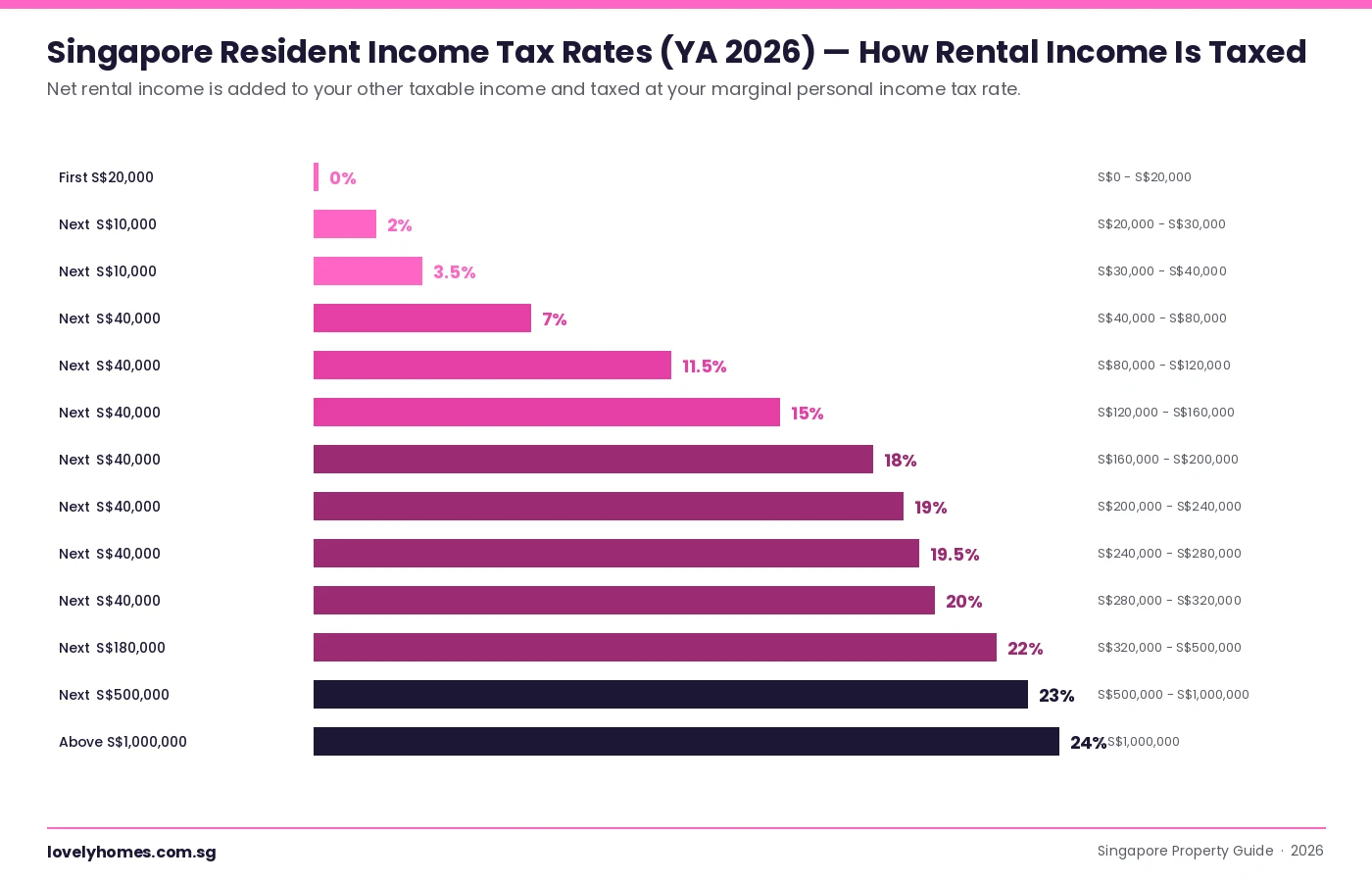
  • Rental income is not a separate tax — net rental is added to your other income and taxed at your marginal personal income tax rate (0% to 24% for residents in YA 2026).
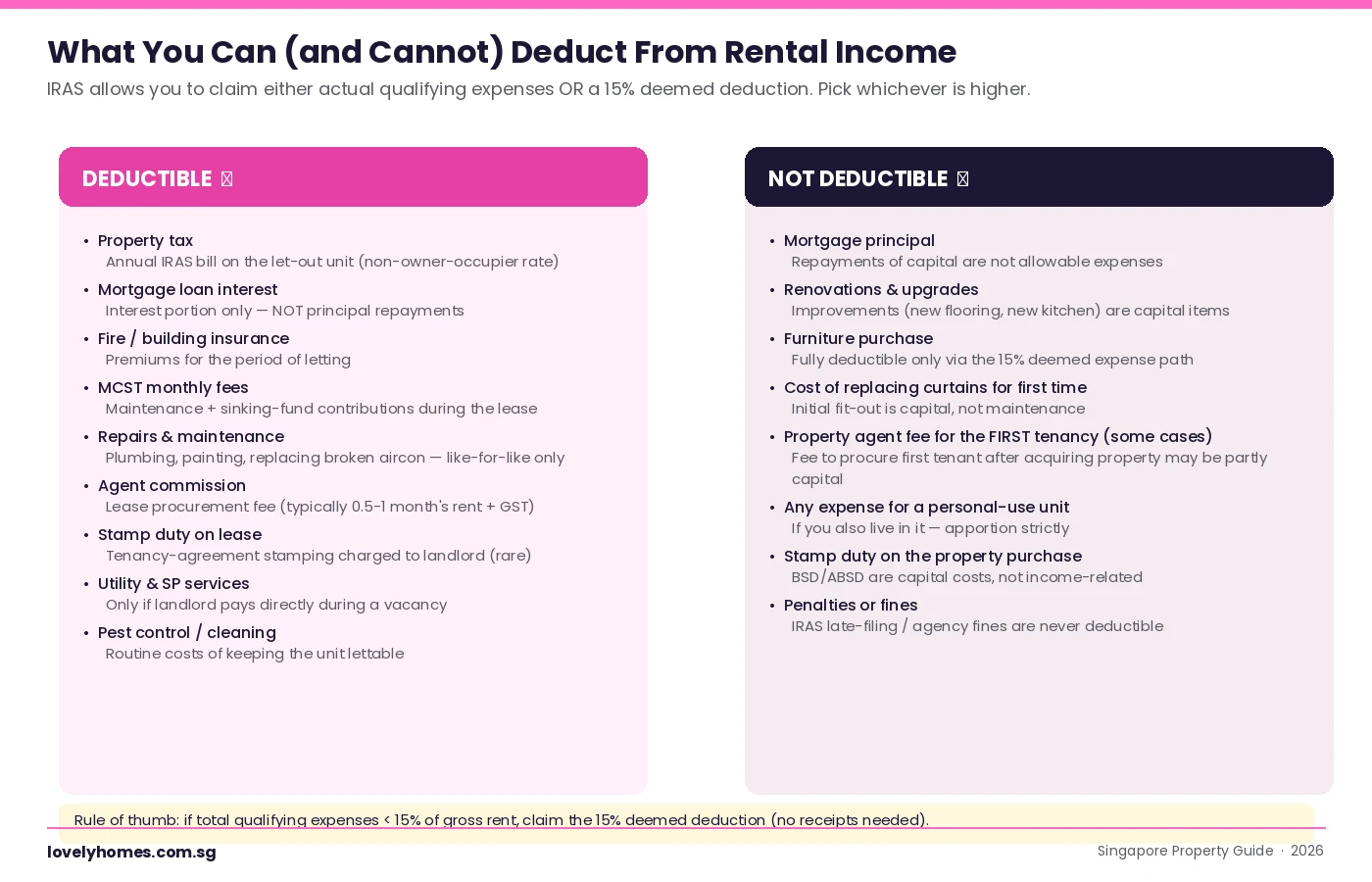
  • You can claim actual qualifying expenses (with receipts) OR a flat 15% deemed-expense deduction. Pick whichever is higher.
  • Mortgage loan interest is always deductible on top of the 15% deemed deduction — do not forget this; it is the single largest line for most leveraged landlords.
  • Property tax for a tenanted unit is at the higher non-owner-occupier rate (12-36% of AV in YA 2026). It is fully deductible from rental income.
  • Furniture, renovations and capital upgrades are not deductible — they are capital items.
  • Foreign-property rents owned by a Singapore tax resident are taxable only if remitted to Singapore (with conditions).
  • Filing deadline: 15 April (paper) or 18 April (e-Filing) for individuals, every year of assessment.

What “Rental Income” Means for IRAS Purposes

Under section 10(1)(f) of the Income Tax Act 1947, “rents” derived from any property in Singapore are chargeable to tax. The Comptroller of Income Tax interprets this broadly: it covers the basic monthly rent, anything else the tenant pays you under the tenancy agreement, and certain non-cash benefits.

What goes into your gross rent figure on your tax return:

  • Monthly rent — the headline figure on the tenancy agreement.
  • Furniture and fittings rent — if your tenant pays a separate fee for furnishings, it is rent.
  • Maintenance fees billed to the tenant if they pass through you (uncommon but valid).
  • Compensation for early termination of the lease (if not specifically structured as damages).
  • Any non-refundable lease premium received.

What is not rental income: the tenant’s security deposit while you still hold it (you owe it back), and any reimbursement of utility bills paid by the tenant directly to SP Group, M1, etc. Forfeited security deposits, however, do count as rental income at the time of forfeiture.

How Rental Income Is Taxed: The Marginal-Rate Mechanic

Singapore does not have a separate “rental tax” or a flat rate on rental income. Instead, your net rental income — gross rent less allowable expenses — is added to all your other taxable income (employment income, trade or self-employment profits, interest, royalties) and taxed at the resident progressive rates.

Singapore resident progressive income tax rates YA 2026 used to tax net rental income — 13-band structure from 0 to 24 percent
Figure 1. The 13-band Singapore resident personal income tax structure for YA 2026. The point at which your additional rental income is taxed depends on where the slice falls on the ladder — for someone earning S$120,000 from employment, an extra dollar of rental income is taxed at 11.5%; for someone earning S$250,000, the same dollar is taxed at 19%.
Existing income before rent Marginal rate on next S$1 of rental income Tax on +S$10,000 net rent
S$30,000 (e.g. retiree) 3.5% / 7% ~S$525
S$80,000 (mid-career employee) 11.5% S$1,150
S$120,000 11.5% / 15% ~S$1,250
S$200,000 (senior professional) 18% / 19% ~S$1,850
S$500,000 (top tier) 22% / 23% ~S$2,250

The same rental property therefore generates very different tax outcomes for two landlords. A retired SC with no employment income may pay almost no tax on a S$60,000 gross rent year, while a senior professional earning S$250,000 from employment can lose 19-22% of every dollar of net rent to the marginal-rate stack. This is why high-income Singaporean landlords often plan property purchases under the lower-earning spouse’s name — a perfectly legitimate (though ABSD-sensitive) way to lower household tax.

What You Can Deduct: The Two Paths

Once you have your gross rent, IRAS lets you choose between two paths to compute net rental income. The choice is made property by property on each year’s filing — there is no lock-in.

Singapore rental income deductible versus non-deductible expenses 2026 IRAS actual expenses path versus 15 percent deemed deduction shortcut
Figure 2. Allowable vs disallowable rental-income deductions in Singapore 2026, with the 15% deemed-expense shortcut highlighted. Mortgage interest is uniquely allowable on top of the deemed expense — do not double-count it under Path A.

Path A: Actual qualifying expenses

You add up every expense incurred wholly and exclusively in earning the rent during the year and deduct it from gross rent. Required to keep receipts and supporting documentation for 5 years (IRAS Income Tax Records Keeping Requirement). The full list of typical deductible items:

  • Property tax on the tenanted unit (non-owner-occupier rate, 12-36% of AV in 2026).
  • Mortgage loan interest — the interest portion of every monthly instalment. The principal repayment portion is not deductible.
  • Fire / building insurance premiums.
  • MCST monthly fees (maintenance + sinking-fund contributions) for the period of letting.
  • Repairs and maintenance — like-for-like fixes only. Replacing a broken aircon compressor is repair; replacing the entire aircon system with a higher-end model is partly improvement (not deductible).
  • Agent commission on lease procurement (typically 0.5-1 month of rent + GST). The first-tenancy commission may be partly disallowable; subsequent commissions are fully deductible.
  • Stamp duty on the tenancy agreement — if landlord has agreed to bear it (rare; usually tenant pays).
  • Vacancy-period utilities and SP Services when paid directly by the landlord.
  • Routine cleaning, pest control, gardening attributable to the unit during letting.

Path B: 15% deemed expense + mortgage interest

From YA 2017 onwards, IRAS allows residential-property landlords to claim a flat 15% deemed deduction on gross rent in lieu of itemising actual expenses, plus their actual mortgage interest. No receipts are needed for the 15% portion.

This is a real shortcut for low-cost landlords. If you own a HDB flat free-and-clear (no mortgage interest), with low MCST and minimal repairs, your actual qualifying expenses might be 8-12% of rent — the 15% path delivers a higher deduction, with no admin. For leveraged condo landlords, by contrast, mortgage interest alone often runs 50-70% of rent; the actual-expense path almost always wins.

Important: the 15% deemed-expense path is only available for residential property let to a tenant who occupies the unit. Commercial property landlords, AirBnB-style serviced-apartment hosts, and corporate-structured property trusts cannot use it.

Worked Example: A S$1.5M Condo Let at S$5,000/Month

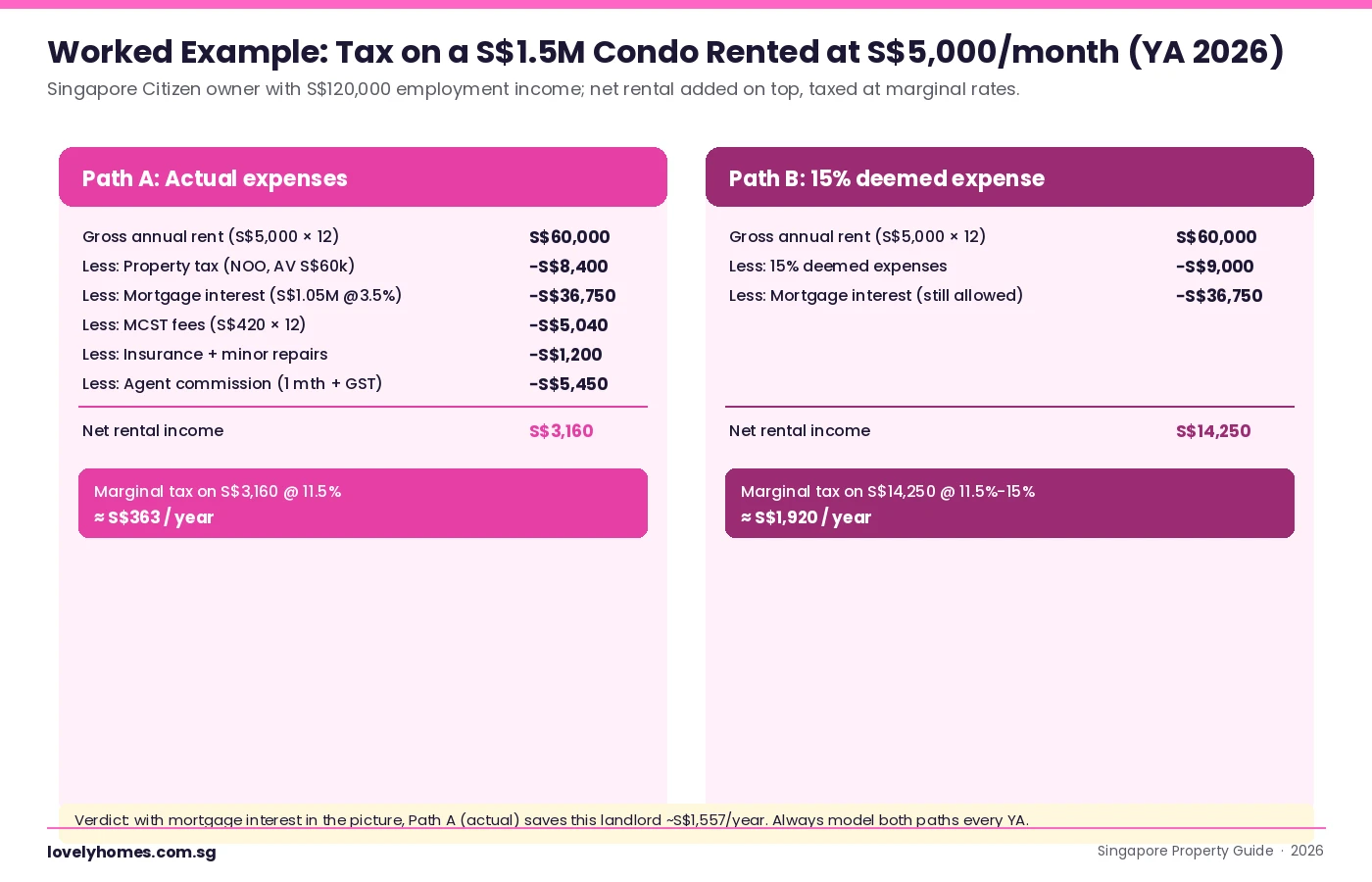
Numbers make this concrete. Consider a Singapore Citizen owner-occupier of a 1,000-sqft 3-bedroom OCR condo bought at S$1.5M with a S$1.05M loan (LTV 70%) at 3.5% all-in. The unit is rented at S$5,000/month from January to December. The owner has S$120,000 of employment income.

Worked rental income tax example S$1.5M Singapore condo S$5000 monthly rent YA 2026 — actual expense path versus 15 percent deemed deduction
Figure 3. Side-by-side comparison of the two computational paths for the same property. With S$36,750 of mortgage interest in the picture, the actual-expense path produces near-zero net rental income; the 15% deemed path gives a worse outcome and saddles the landlord with ~S$1,557 of avoidable tax for the year.

Three lessons from this example:

  1. For any landlord with a meaningful mortgage, Path A almost always wins. Mortgage interest is the single biggest deductible.
  2. If you remortgage and your interest expense changes mid-year, your tax position changes mid-year — track it monthly.
  3. The marginal rate matters as much as the deduction. A landlord at the 22% bracket saves ~S$340 more on the same S$1,557 deduction than the same landlord at the 15% bracket.

Property Tax for Tenanted Units

The instant your property is rented out, IRAS automatically reclassifies it from owner-occupied to non-owner-occupied (NOO). The tax rate ladder differs sharply:

  • Owner-occupier rates: 0% on the first S$8,000 of AV, rising progressively to 32% on AV above S$100,000.
  • Non-owner-occupier rates: 12% on the first S$30,000 of AV, rising to 36% above S$60,000 AV in 2026.

For a typical S$1.5M OCR condo with an AV of around S$60,000, the owner-occupier annual property tax would be about S$8,400; the same unit as a NOO investment is taxed at S$8,400 (owing to the band structure crossing 12%/24%/36%) — in this band, NOO is significantly higher. You must notify IRAS within 15 days of the unit becoming tenanted (or vacated) so the rate is correctly applied. This NOO property tax is then a fully deductible expense against your rental income on the income-tax side.

Joint Owners and Couples

For jointly-held properties, IRAS apportions rental income and deductions equally by default among co-owners, regardless of who actually pays the mortgage or collects the rent. If you want a different split (e.g. 70/30 to reflect actual capital contributions or beneficial ownership), you must file a declaration of beneficial interest and IRAS may ask for evidence.

This is the heart of the Singapore tax-planning playbook for couples: where one spouse earns in the top marginal bracket and the other earns less, splitting the rental income via a 50/50 joint-tenancy or a deliberately-skewed tenancy-in-common can lower household tax materially. The trade-off — ABSD — is covered in our Joint Tenancy vs Tenancy in Common guide.

Vacancy, Mid-Year Letting, and Voids

When you let your property only for part of the year, only the rent received is taxable, and only the expenses attributable to the letting period are deductible (pro-rated). Common scenarios:

  • Owner moves overseas mid-year and rents out from August. Pro-rate the property tax (NOO rate from 1 August), MCST fees, and insurance from August onwards. Mortgage interest is fully deductible against rent because the loan continues throughout, but only the August-December portion is matched against the August-December rent.
  • Tenant moves out, unit vacant for 2 months, new tenant moves in. Vacancy-period expenses (utilities, MCST, mortgage interest) are still deductible if the property was actively marketed for re-letting during the void.
  • Property partly let, partly self-occupied. Only the let portion’s expenses are deductible; the personal-occupation portion is not. Apportion strictly by floor area and time.

What Might Come Next: Rental Tax Watchpoints

The basic IRAS framework has been stable since the 15% deemed-expense option was introduced in YA 2017. Two areas to watch in 2026:

  • Short-term let crackdown. URA’s 3-month minimum residential let rule is now policed more aggressively. AirBnB-style sub-3-month lets are not legal residential lettings and may also be reclassified as a trade by IRAS, attracting higher tax and disqualifying the 15% deemed path.
  • NOO property-tax escalation. The NOO rate ladder has steepened in each Budget since 2022 (peak rate raised from 27% to 36% over three years). Investors should model continuing escalation when underwriting yield.

None of the above is a tax-rate change yet. We will update this guide when Budget 2027 announcements land in February 2027.

Frequently Asked Questions

I let out a single room in my owner-occupied flat. Is that rental income?

Yes. The rent received from a sub-let or room-let is taxable on the same basis as a whole-unit let. You can deduct a fair-share portion of expenses — typically based on the floor area of the let room versus total floor area, multiplied by the days let. The 15% deemed-expense path is also available. You do not have to convert the entire property’s tax status to NOO — that conversion only applies if the whole unit is let out and you no longer occupy it.

Can I deduct the cost of a new sofa I bought when I started renting out the unit?

Not under Path A — the initial fit-out of furnishings is a capital cost, not a maintenance cost. However, if you choose Path B (15% deemed deduction), the deemed-expense covers wear-and-tear and replacement furnishings implicitly. If you replace a broken sofa with a like-for-like sofa later, that is deductible as a repair under Path A.

I am a Singapore tax resident with an apartment in London that I rent out. Is the UK rent taxable in Singapore?

Foreign-source rental income earned by a Singapore tax-resident individual is taxable only when remitted to Singapore (and even then, certain remittances are tax-exempt under section 13(7A) of the Income Tax Act). If the UK rental income stays in a UK bank account and you do not bring it back, it is generally not taxable in Singapore. UK tax on the rent (HMRC Self Assessment) is a separate matter — you should keep that compliance current to avoid double-tax issues. Singapore has a Double Taxation Agreement with the UK that provides relief.

Can my parent (who has no employment income) be the named landlord to lower household tax?

The beneficial owner of the property is the person taxed on the rental income, not necessarily the legal title-holder. If your parent merely holds the title but you funded the deposit, paid the mortgage, and collect the rent, IRAS will still tax you. Genuine transfers to a parent (with proper SDL stamping, ABSD implications, and a real change in beneficial ownership) can shift the tax base, but the costs and ABSD trigger usually outweigh the income-tax savings unless the property has a long runway. Always model the all-in cost across BSD, ABSD, conveyancing, and 5+ years of expected tax savings before transferring.

What happens if I file the wrong figure?

If IRAS detects a discrepancy via its automated checks against your bank records, agent-reported tenancy stampings, and property-tax NOO classification, you will receive an enquiry letter (typically 1-2 years after filing) asking you to reconcile. Genuine errors made in good faith can be self-corrected via an Objection or Amendment within 4 years. Deliberate under-declaration can attract a penalty of up to 200% of the tax undercharged plus interest, plus criminal prosecution in serious cases. The honest path is materially cheaper than the alternative.

Is there any way to claim depreciation on the building structure?

No. Singapore tax law does not allow capital allowances (depreciation) on residential buildings or land. This is one of the structural differences from the US, UK and Australian regimes, where depreciation can shelter meaningful rental cashflow. The only “depreciation-equivalent” reliefs available to Singapore landlords are repairs (Path A) and the 15% deemed expense (Path B).

Do I need to register for GST as a residential landlord?

No. Residential lettings are exempt supplies under the Goods and Services Tax Act — you do not charge GST on rent, and you cannot register for GST on the basis of residential rental income alone. Commercial-property landlords are different: they charge 9% GST (in 2024 onwards) on rent, and must register if their taxable turnover exceeds S$1 million per year.

Related Articles

Disclaimer

This guide is for general information only and does not constitute tax, legal, or financial advice. Singapore income tax law — including the rates, deductibility rules, and remission frameworks discussed above — is subject to change at the discretion of the Minister for Finance and the Comptroller of Income Tax. Always verify the current position on the Inland Revenue Authority of Singapore rental-income page, the relevant individual income tax rate schedules, and the latest annual Ministry of Finance Budget statement — and consult a licensed tax adviser before acting on any specific position. Worked examples are illustrative only; your actual tax outcome will depend on your full facts.

Strata Title and MCST in Singapore 2026: How Your Condo Is Actually Run

Strata Title and MCST in Singapore 2026: How Your Condo Is Actually Run

If you own a condominium, executive condo, or strata-titled landed home in Singapore, you do not really own a building — you own a slice of one, a “strata lot“. Everything outside that slice (the lift you ride to work, the pool you swim in, the lobby that smells faintly of Diptyque) is common property, and it is run by a body corporate called the Management Corporation Strata Title — the MCST.

Most owners pay their monthly maintenance fee, attend an AGM once in a blue moon, and never think about it again. Then a leak appears in the carpark, the lifts hit 25 years and need a S$2 million modernisation, or someone wants to put a new awning on their balcony — and suddenly the structure that runs your home becomes very real, very fast. This guide walks you through how strata title actually works in Singapore, what your MCST does, where your money goes, and the rights and obligations you signed up for the moment your conveyancing lawyer registered your title at the Singapore Land Authority.

Quick Answer — strata title and MCST in 30 seconds

  • You own a strata lot (your unit + accessory areas) plus a share value in common property.
  • The MCST manages common property under the Building Maintenance and Strata Management Act (BMSMA 2004).
  • Your monthly bill funds two ring-fenced pots: a Management Fund (~75%) for day-to-day running and a Sinking Fund (~25%) for major capital works.
  • Decisions are made at AGMs by share-value vote — ordinary majority for routine matters, ≥75% special resolution for capital expenditure above S$200,000.
  • Indicative monthly fees: S$280-450 OCR mass-market, S$420-680 mid-tier RCR, S$780-1,400 luxury CCR, S$1,500+ ultra-luxury.
  • Renovations affecting common property require written MCST approval before BCA submission (BMSMA s.37).
  • Disputes above the council level go to the Strata Titles Boards — not the civil courts in the first instance.

What Is Strata Title and Why Does Singapore Use It?

Strata title is the legal mechanism that makes vertical, multi-owner property possible. When a developer builds a condominium, the Singapore Land Authority registers a strata plan dividing the building into individual lots (the units, plus accessory lots like balconies, planter boxes and air-con ledges) and common property (everything else). Each lot is a separate parcel of land in law, with its own title deed, its own share value, and its own set of rights to the common property.

Without strata title, only the developer or a single co-owner group could hold the title to a multi-storey building — you would be buying a long lease from them, not freehold ownership of a defined unit. Strata title gives you genuine real-estate ownership, the right to mortgage your lot independently, and the right to participate in governance of the building. The trade-off is that you must accept a co-ownership regime: a council elected by other owners, by-laws that bind you, and a duty to contribute to communal expenses whether you use the facilities or not.

Singapore’s strata regime sits inside the Building Maintenance and Strata Management Act 2004 (BMSMA), supplemented by the Land Titles (Strata) Act 1967. Together they cover roughly 12,000 strata-titled developments and over 750,000 strata lots across the island as at the start of 2026. If you own anywhere in Singapore that is not landed-on-its-own-plot, you are almost certainly subject to BMSMA.

The Core Concept: Strata Lot, Common Property, Share Value

Three pieces of paper are issued when your conveyancing completes: the certificate of title for your strata lot, the strata plan for the development, and the schedule of share values. They define everything that follows.

Strata lot

Your physical unit, defined by the centre line of internal walls, the upper surface of the floor, and the under-side of the ceiling slab. Accessory lots include balconies, private enclosed spaces (PES), aircon ledges, and any car-park or storage spaces specifically allocated to your unit on the strata plan. You can renovate inside your strata lot largely as you wish — subject to BCA rules, MCST house rules, and structural integrity.

Common property

Everything outside your strata lot that is not somebody else’s lot. Lifts, lobbies, pools, gyms, gardens, common corridors, the external façade, the roof, the basement carpark, M&E plant rooms, and the structural slabs themselves. Common property is owned collectively by all subsidiary proprietors as tenants-in-common in the proportion of their share values, and managed by the MCST.

Share value

A whole number assigned to each lot in the strata plan that determines (a) your voting weight at general meetings and (b) your contribution to the common funds. Larger units get higher share values. A typical 1,000 sqft 3-bedroom unit might carry 10 share values; a 600 sqft 2-bedroom might carry 6. If your unit’s share value is 10 out of a building total of 5,000, you pay 0.2% of every common-fund expense and cast 10 votes (out of 5,000) on every resolution.

Indicative MCST Fees by Condo Segment (2026)

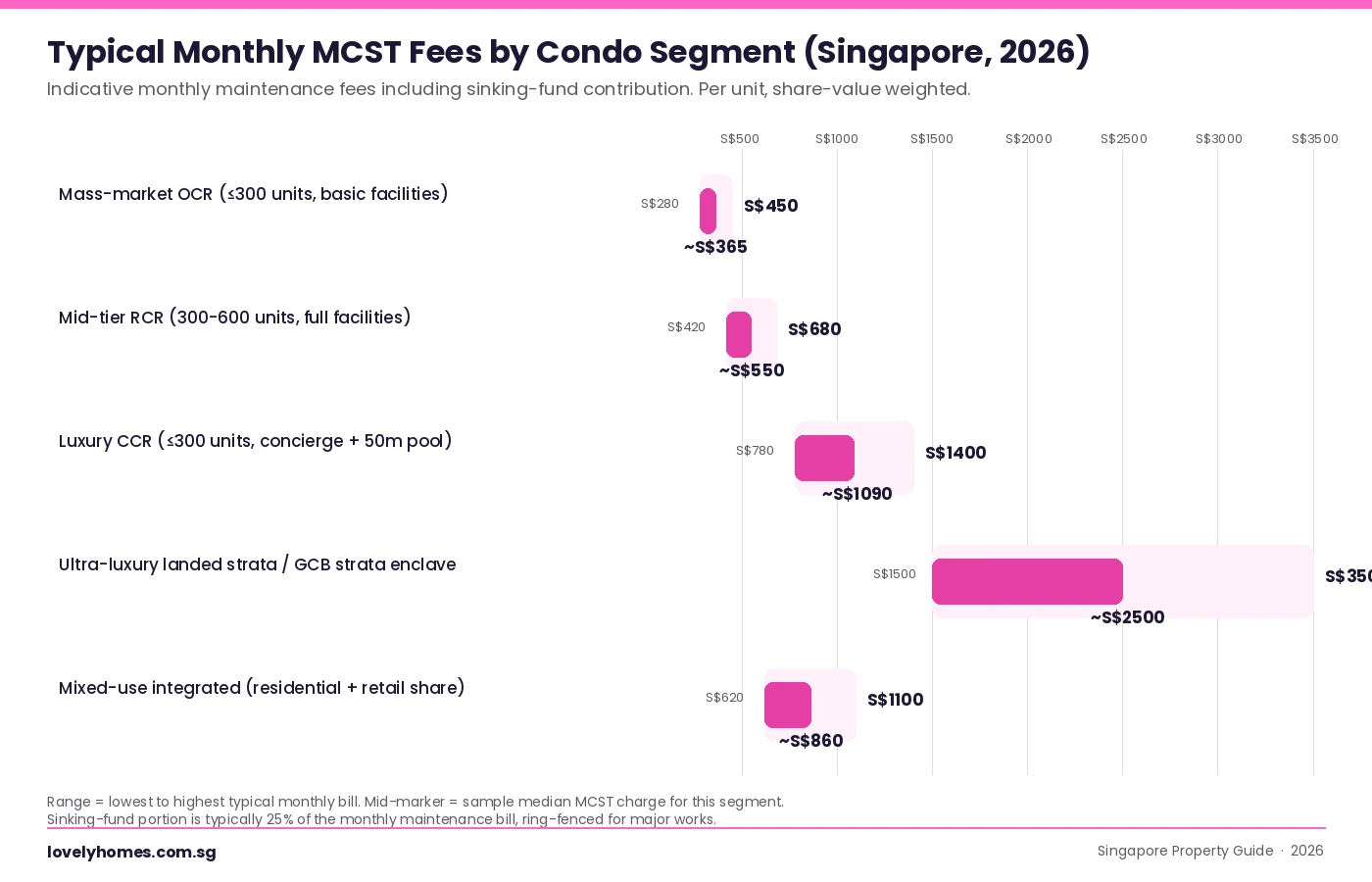
Before you commit to a unit, look at the monthly maintenance bill. It is the single biggest variable holding cost of ownership and varies enormously by segment. The figure below sets out what most owners actually pay across five common segments of the Singapore market in 2026.

Singapore MCST monthly maintenance fees by condo segment 2026 — OCR mid-tier RCR luxury CCR ultra-luxury mixed-use comparison
Figure 1. Typical monthly MCST fees by condo segment, 2026. Mid-tier RCR developments cluster around S$550/month; CCR luxury and integrated mixed-use developments routinely exceed S$1,000/month due to higher staffing, premium finishes and shared retail-component costs.
Segment Typical monthly fee (per unit) Sinking fund share Drivers of cost
Mass-market OCR S$280-450 ~25% Basic facilities, lower headcount, fewer lifts, surface carparks
Mid-tier RCR S$420-680 ~25% Full facilities suite, multi-deck basement carpark, larger landscape
Luxury CCR S$780-1,400 ~25-30% 24-hr concierge, valet, branded F&M for plant, smaller lot count to share costs
Strata landed / GCB enclave S$1,500-3,500 ~30% Few lots, large land area, perimeter security, private roads
Mixed-use integrated S$620-1,100 ~25% Shared cost-allocation with retail/commercial component, dual-MCST structures

One important nuance: integrated developments often have two MCSTs — one for the residential strata, one for the entire development. Your monthly bill is therefore the sum of both layers. Always ask the marketing agent for the dual-MCST cost breakdown before signing.

The Two Funds Inside Every MCST Bill

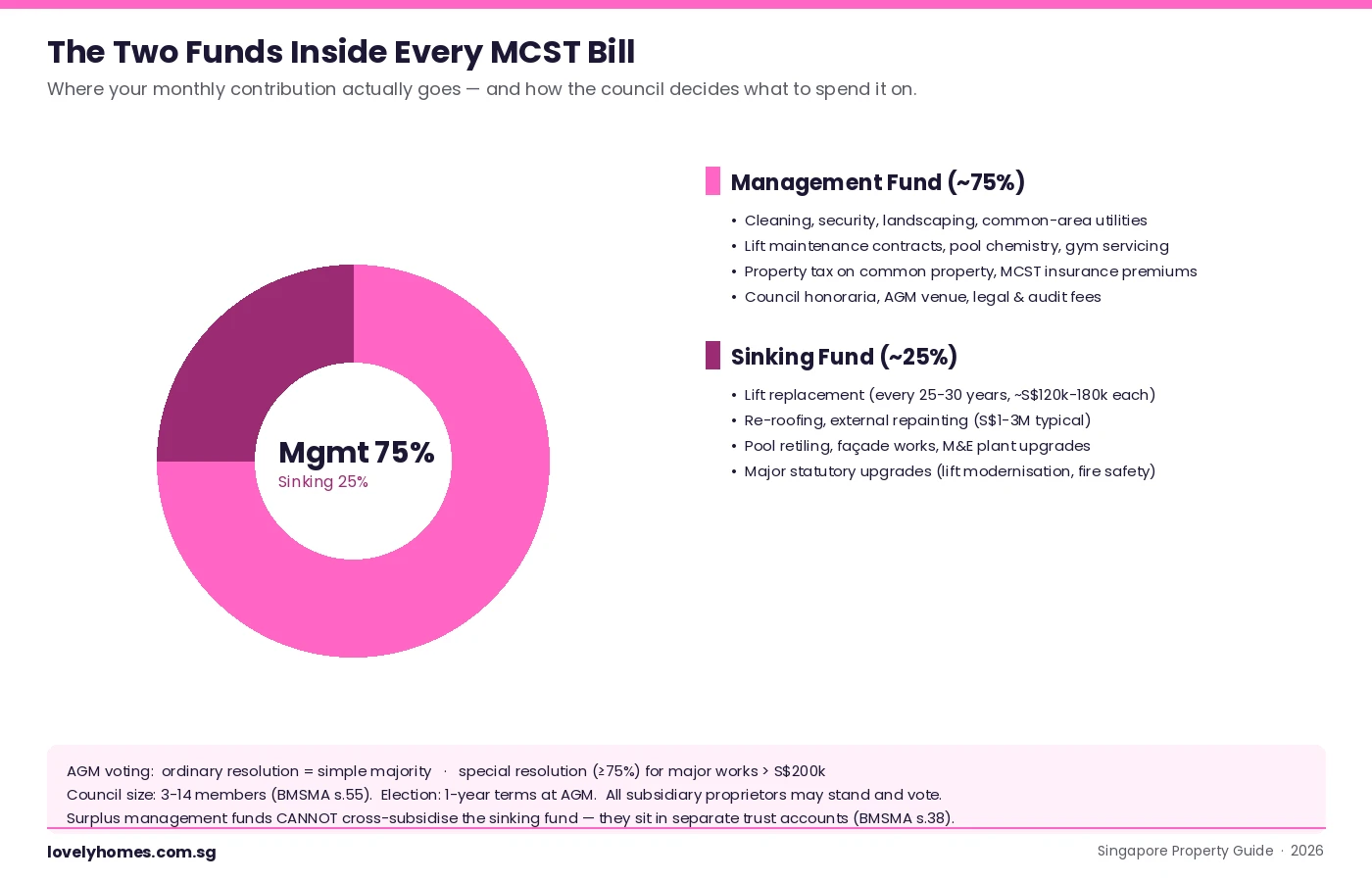
Your monthly maintenance fee is not a single pot of money. By law it splits into two ring-fenced trust accounts — the Management Fund (general operations) and the Sinking Fund (capital reserves) — and the council cannot move money freely between them.

Singapore MCST management fund vs sinking fund 75-25 split with AGM voting structure under BMSMA 2026
Figure 2. Where your MCST contribution actually goes. The 75/25 management/sinking split is convention, not law — specific developments may sit anywhere between 70/30 and 80/20 depending on age, plant complexity, and council appetite.

Management Fund

Pays for everything that recurs: cleaning contracts, security guarding, lift maintenance, pool chemistry, gym servicing, common-area utilities, landscaping, MCST insurance premiums, property tax on common property (yes — the building itself is taxed on the rental value of its common areas), council members’ honoraria, AGM venue, audit and legal fees, and the salary of the appointed managing agent. If the toilet roll runs out in the lobby, the management fund replaces it.

Sinking Fund

Funds large, infrequent capital works that would otherwise hit owners with sudden special levies. Lift modernisation (typically required at 25-30 years and costing S$120k-180k per lift), exterior repainting, re-roofing, façade re-cladding, pool retiling, M&E plant replacement, and statutory upgrades (e.g. lift safety upgrades mandated by BCA, fire-system retrofits required by SCDF). A well-run building should hold roughly 2-3 years of operating expenditure in the sinking fund at any time.

Why the wall between them matters

Section 38 of the BMSMA prohibits using management-fund money to pay for sinking-fund items, and vice versa. This protects future owners: if the council were free to spend the sinking fund on day-to-day items, you would arrive at the 25-year mark with no money for the lift modernisation, and the council would have to issue a one-off levy of, say, S$15,000 per unit to make up the gap. Always read the audited accounts before bidding on a resale unit — a depleted sinking fund is a hidden liability the buyer inherits.

Governance: Council, AGMs, Voting

The MCST is the body corporate; the council is its elected board. Owners (subsidiary proprietors) elect a council of 3 to 14 members at the AGM, each serving one-year terms. The council appoints office-bearers (chair, secretary, treasurer) and engages a managing agent — a licensed property-management firm that runs the day-to-day operation.

Annual General Meeting (AGM)

Must be held within 15 months of the previous one. Owners receive at least 14 days’ written notice with the agenda, audited accounts, the proposed annual budget, and any resolutions for vote. Standard agenda items: receive the audited accounts, fix the next year’s budget and contribution rates, elect the council, appoint the auditor, transact special resolutions.

Resolution thresholds

  • Ordinary resolution — simple majority of the share values voted. Used for routine business: budget approval, council elections, day-to-day spending decisions within budget.
  • Special resolution — ≥75% of share values voted in favour, with ≤25% against. Required for capital expenditure exceeding S$200,000 (s.40 BMSMA), variation of by-laws, and certain by-law-affecting matters.
  • 90% resolution — required to vary common property boundaries or transfer common property.
  • Unanimous resolution — required for any change that affects an individual lot owner’s title or rights.

Extraordinary General Meetings (EGM)

Called between AGMs for urgent matters — usually a special-resolution capital project (e.g. lift modernisation), an unplanned major repair, or to vote on a collective sale resolution. Owners holding ≥20% of share values can requisition an EGM directly.

Worked Example: What a S$1.5M OCR Condo Owner Pays in a Year

Numbers ground the abstract. Here is what a typical Singapore Citizen owner-occupier of a 1,000-sqft, 3-bedroom unit in a mid-tier OCR development worth S$1.5 million actually pays the MCST and IRAS over a year, assuming no leasehold-related issues and no rental income.

Worked example annual ownership cost S$1.5M Singapore OCR condo 2026 — MCST sinking property tax insurance special levy stack
Figure 3. Annual ownership cost stack for a S$1.5M OCR 3-bedroom condo unit, 2026. Maintenance and sinking-fund contributions dominate; property tax is comparatively small at this AV tier. A one-off lift modernisation special levy of S$600 is included to show how capital works can spike a single year’s bill.

Three observations stand out. First, the recurring carry on a S$1.5M unit is a real number — about S$5,000-7,000 per year, or 0.4-0.5% of unit value, before any one-off special levies. Second, the property-tax line at this AV tier is genuinely small; most of your tax burden was paid up front as BSD when you bought. Third, special levies are not in the monthly bill — they are voted at AGM/EGM and sit on top, often with 3-6 months’ notice. Plan a 1-2% capital reserve of unit value over a 10-year horizon if you want to avoid surprises.

Your Rights and Obligations as a Subsidiary Proprietor

Buying a strata lot binds you to a contract you may never have read — the by-laws of the development, set out in the First Schedule of the BMSMA (the prescribed by-laws) and in any additional by-laws passed by special resolution at the AGM. Key obligations every owner has:

  • Pay contributions on time — arrears attract interest (often 10% p.a.) and the MCST may register a charge on your title under s.34 BMSMA after 30 days, blocking refinancing or sale until paid.
  • Get written approval before altering common property — even private balcony tinting or aircon-ledge enclosures usually need MCST consent under s.37.
  • Comply with the by-laws on noise hours, pet keeping, short-let restrictions (typically minimum 3 months for residential), commercial use limitations, and exterior-facade alterations.
  • Allow access for the MCST or its contractors to perform repairs to common property running through your lot, on reasonable notice.

Conversely, the rights you can enforce:

  • Inspect the records — minutes, accounts, contracts. Owners are entitled to see anything in the corporate register on reasonable notice (a small fee may apply).
  • Stand for council, attend and vote at general meetings, and propose resolutions.
  • Requisition an EGM if you can muster 20% of share values.
  • Apply to the Strata Titles Boards if the council acts unreasonably, refuses by-law-approved alterations, or makes invalid decisions.

Disputes: The Strata Titles Boards

The Strata Titles Boards (STB) — constituted under the BMSMA and the Building Maintenance Act — are the specialised tribunal that hears strata disputes. Most owner-vs-MCST or owner-vs-owner strata disputes cannot go to the High Court in the first instance; they must come through the STB. Common applications:

  • Section 92 applications to compel the MCST to take a specific action (e.g. carry out a long-overdue repair).
  • Section 31 applications to vary or invalidate a by-law that is unreasonable or oppressive.
  • Collective-sale applications under the Land Titles (Strata) Act — the 80%/90% en-bloc consent threshold mechanic is litigated here.
  • Disputes over share values, accessory-lot rights, and exclusive-use grants over common property.

STB filing fees are modest (S$500-1,000 typically) and the process is faster and lighter than the High Court — expect 6-9 months from filing to determination on most matters.

What to Watch When Buying Resale

If you are buying a strata-titled resale, the MCST is going to be your landlord-of-sorts. A few things to inspect before exercising the OTP:

  1. Last 3 years of audited accounts. Look for a healthy sinking fund, no qualified audit opinions, and no pattern of outsized recurring deficits.
  2. Latest AGM minutes. Check for upcoming capital works that may trigger a special levy. Lift modernisation, repainting, and façade works in the pipeline will hit your wallet.
  3. Outstanding maintenance arrears on the lot. Ask your conveyancer to obtain a section 50 certificate from the MCST — arrears transfer with the lot.
  4. By-laws. Read the additional by-laws — some buildings restrict pet weight, prohibit short-lets entirely, ban exterior changes, or impose dress codes in common areas.
  5. Legal disputes. Ask whether the MCST is currently in any STB or High Court proceedings — ongoing disputes can mean a deteriorating building or financial drain.

How Strata Title Differs From Other Tenure Forms

Singapore’s strata regime is similar in principle to Hong Kong’s multi-storey buildings regime, the Australian strata title system (from which the term originates), and US condominium ownership — but the BMSMA framework is more prescriptive than most. By comparison:

  • vs HDB ownership — HDB flat owners are not subsidiary proprietors of an MCST. The HDB itself manages the estate. Town councils handle the day-to-day common-property functions, funded by service-and-conservancy charges (S&CC).
  • vs landed property — A standalone landed home on a freehold or 99-year leasehold parcel has no MCST and no shared common property. You bear all costs and decisions yourself, but you also have full autonomy.
  • vs strata-landed — Cluster housing and strata-landed enclaves do have an MCST, but with a much smaller lot count (often 30-100). Their fees are correspondingly higher per unit because fixed costs are spread thin.

What Might Come Next: Strata Reform Watch

BCA and the Ministry of National Development have been quietly consulting on a third tranche of BMSMA amendments since 2024. The most-talked-about proposals as at April 2026:

  • Mandatory minimum sinking-fund balance tied to building age (e.g. 18 months of opex once the building is over 10 years old). Aimed at preventing under-funded sinking funds.
  • Compulsory professional MCST chairs for buildings of over 500 lots, in response to dispute volumes from large integrated developments.
  • Streamlined STB process for routine repairs — a fast-track procedure to compel obvious common-property maintenance.
  • Stricter rules on short-term lets — aligning the BMSMA with URA’s 3-month minimum-let regime to give MCSTs cleaner enforcement teeth.

None of the above is yet law. We will update this guide when the next round of amendments is gazetted.

Frequently Asked Questions

Can the MCST force me to renovate or repair my own unit?

Generally no — renovations inside your strata lot are your decision, subject to BCA structural rules and any by-law restrictions (e.g. flooring requirements above the second storey). The MCST can however require you to remedy a condition inside your lot that is causing damage to common property or to neighbouring lots — a leaking bathroom waterproofing membrane, for example, where moisture is reaching the unit below. If you fail to act, the MCST can perform the works and charge them back to your lot under s.41 BMSMA.

What happens if the council goes broke?

If the management fund runs out, the MCST cannot pay contractors or salaries. The council must call an EGM to pass a special levy (a one-off contribution from all owners pro-rata to share value) to recapitalise. Repeated insolvency is a sign of either chronic under-budgeting or council misconduct — in extreme cases the STB can appoint an interim manager to run the MCST under s.85.

Can I rent out my parking space to non-residents?

It depends on whether your parking lot is an accessory lot, an exclusive-use common-property right, or a transient-use right. Accessory lots can typically be sublet to anyone in some buildings but most modern by-laws restrict carpark sub-letting to residents of the development only for security reasons. Always check the additional by-laws and house rules — sub-letting to non-residents in breach of by-laws is enforceable by the STB.

How are votes weighted — one-lot-one-vote or by share value?

Share-value votes apply by default. So a penthouse with a share value of 24 has roughly 4 times the voting weight of a 1-bedroom unit with a share value of 6. This is intentional: larger units pay more to the common funds and bear more of the financial impact of decisions, so they vote in proportion. Some routine matters (e.g. council elections) may also be conducted on a one-vote-per-lot basis under the BMSMA’s voting rules.

If I am buying a brand-new condo, when does the MCST actually come into existence?

The MCST is constituted automatically on the date the strata-title plan is registered with the SLA. In practice, the developer manages the building from TOP onwards under an “interim period” with an interim management committee (often staffed by the developer and a few early-mover owners). The first AGM — where the permanent council is elected — must be held within 13 months of the first lot being conveyed (s.27 BMSMA). Until then, your monthly fee is charged at developer-set rates, which may be re-budgeted up or down at the first AGM.

Do I need MCST consent for a kitchen renovation?

If the renovation is purely cosmetic and stays within your lot — new countertops, replacement appliances, repainting — you usually only need to notify the managing agent and pay any renovation deposit / debris fee under house rules. If you are touching any wet area, structural element, exterior, or anything that could affect a neighbouring lot or common property, you need written MCST approval before submitting plans to BCA. Most buildings require approved-contractor lists, work-hour windows (typically 9am-6pm Monday-Saturday, no Sundays/public holidays), and a renovation deposit of S$1,000-3,000.

How do collective sales fit into the strata regime?

Collective sale (en-bloc) is the process by which the MCST as a whole sells the entire development to a redeveloper, with proceeds distributed among lot owners. Under the Land Titles (Strata) Act, an 80% share-value-and-floor-area consent threshold applies to developments over 10 years old (90% for younger ones). The STB hears applications and may approve, vary, or reject the sale. Successful collective sales effectively dissolve the MCST on completion. We cover the process in detail in our En-Bloc Sale Process Guide.

Related Articles

Disclaimer

This guide is for general information only and does not constitute legal, tax, or financial advice. The Building Maintenance and Strata Management Act, the Land Titles (Strata) Act, and associated subsidiary legislation are the authoritative sources of strata-title law in Singapore and have been amended several times since 2004. Always verify the current position with the Building and Construction Authority, the Singapore Land Authority, the Ministry of Law, and the Inland Revenue Authority of Singapore — and consult a licensed conveyancing or strata-management lawyer before acting on any specific matter.

Translate »