Singapore Property Cooling Measures 2026: Complete Guide to ABSD, TDSR, LTV and SSD

Singapore Property Cooling Measures 2026: Complete Guide to ABSD, TDSR, LTV and SSD

Quick Answer: Singapore Property Cooling Measures 2026

  • ABSD — Additional Buyer’s Stamp Duty applies to 2nd+ residential properties; foreigners pay 60%; entities pay 65%.
  • TDSR — Total Debt Servicing Ratio capped at 55% of gross monthly income for all bank property loans.
  • MSR — Mortgage Servicing Ratio capped at 30% for HDB and Executive Condo loans before TOP.
  • LTV — Loan-to-Value limit is 75% for a first bank loan, 45% for a second, and 35% for a third and beyond.
  • SSD — Seller’s Stamp Duty of 4%–12% applies if a residential property is sold within 3 years of purchase.
  • 15-Month Wait-Out Period — Private residential property owners must wait 15 months after disposal before buying an HDB resale flat.
  • Administering bodies: Ministry of Finance (MOF), Monetary Authority of Singapore (MAS), IRAS, and the Housing & Development Board (HDB).
  • Singapore has implemented 10 rounds of cooling since 2009; the most recent was 27 April 2023, which raised ABSD sharply.

What Are Property Cooling Measures?

Singapore’s property cooling measures are a suite of demand-management and financing regulations designed to keep the residential property market stable, affordable, and free from speculative excess. They are not merely bureaucratic obstacles — they are the primary tool through which the Singapore Government actively steers the balance between home ownership aspirations and financial prudence.

The measures are administered jointly by four bodies: the Ministry of Finance (MOF), which sets and reviews stamp duty policy; the Monetary Authority of Singapore (MAS), which governs loan limits and debt servicing ratios; IRAS, which collects and assesses stamp duties; and the Housing & Development Board (HDB), which administers HDB-specific rules on eligibility, pricing and resale conditions. Together, they form a layered framework that operates on both the demand side (who can buy, how much ABSD they pay) and the supply side (loan limits, holding periods).

As of 3 July 2026, the core cooling measures in force were established by the major rounds of 2021, 2022, and — most significantly — 27 April 2023. This guide consolidates all current measures into a single reference, explains why each exists, and shows you exactly how they affect your purchasing decision.

Singapore property cooling measures framework 2026 — ABSD TDSR MSR LTV SSD overview table
Figure 1: Singapore’s current property cooling measures — regulator, applicability, key rate and last update date (as at 3 July 2026). Sources: MOF, MAS, IRAS, HDB.

Additional Buyer’s Stamp Duty (ABSD)

The Additional Buyer’s Stamp Duty, first introduced on 8 December 2011 and most recently revised on 27 April 2023, is the most visible and financially significant of Singapore’s cooling tools. It is collected by IRAS and applies in addition to the ordinary Buyer’s Stamp Duty (BSD) on every residential property purchase that falls within its scope.

ABSD is calibrated by two factors: the buyer’s citizenship or residency status, and the count of residential properties already owned (or being purchased simultaneously). Singapore Citizens purchasing their first and only residential property are exempt from ABSD entirely. However, a Singapore Citizen buying a second property immediately incurs ABSD at 20% of the purchase price or valuation, whichever is higher. Foreigners — regardless of how many properties they own — pay 60%, a rate that was doubled from 30% in the April 2023 round specifically to reduce the proportion of foreign purchasers in the private residential segment. Corporate entities and trusts pay an even higher rate of 65%.

ABSD rates by buyer profile 2026 — Singapore citizen PR foreigner entity horizontal bar chart
Figure 2: ABSD rates by buyer profile as at 27 April 2023 — the most recent revision. SC = Singapore Citizen; SPR = Singapore Permanent Resident. Source: MOF / IRAS.
ABSD Rates at a Glance — Singapore 2026 (effective 27 April 2023)
Buyer Profile 1st Property 2nd Property 3rd and Beyond
Singapore Citizen (SC) 0% 20% 30%
Singapore Permanent Resident (SPR) 5% 30% 35%
Foreigner (any nationality) 60% (all purchases)
Entity (company / trust) 65% (all purchases) + 5% additional for housing developers

ABSD must be paid in cash within 14 days of the date of the document effecting the sale (or, for uncompleted properties, within 14 days of the date of the Sale & Purchase Agreement). It cannot be funded from CPF Ordinary Account savings. For a Singapore Citizen couple where one spouse is a foreigner, the higher of the two applicable ABSD rates will apply unless the foreign spouse is decoupled from the title and the property is purchased in the SC’s sole name alone — in which case ABSD is based solely on the SC’s property count.

The one significant ABSD remission pathway for Singapore Citizens is the 99-to-1 arrangement elimination and the simultaneous disposal rule: a married SC couple upgrading from an existing private property to a new private property may apply for ABSD remission on the replacement property if the first property is sold within six months of the purchase (or within six months of TOP for uncompleted properties). This remission is limited to one replacement property and is handled by IRAS on application.

Financing Limits: TDSR, MSR, and Loan-to-Value

MAS administers the loan framework that constrains how much any buyer can borrow against any residential property. The three pillars are the Total Debt Servicing Ratio, the Mortgage Servicing Ratio, and the Loan-to-Value limit.

The Total Debt Servicing Ratio (TDSR), effective since 29 June 2013 and tightened on 16 December 2021 from 60% to 55%, requires that the borrower’s total monthly debt obligations — including the property loan being applied for — do not exceed 55% of gross monthly income. The TDSR applies to all bank property loans; it does not apply to HDB concessionary loans.

The Mortgage Servicing Ratio (MSR), capped at 30% of gross monthly income, applies specifically to loans for HDB flats and Executive Condos purchased before TOP. Unlike the TDSR, the MSR uses only the mortgage being applied for — not total outstanding debt — in its calculation. For couples, income is computed on a joint basis. This means that a household earning S$7,000 combined per month has a monthly MSR ceiling of S$2,100 for their HDB loan.

Singapore property financing limits 2026 — LTV loan to value TDSR MSR guide
Figure 3: LTV limits by loan count, and TDSR/MSR debt-servicing ratio ceilings — as at 3 July 2026. Source: MAS, HDB.

The Loan-to-Value (LTV) limits cap the maximum loan amount as a percentage of the property’s value (or price, whichever is lower). A buyer taking their first bank loan may borrow up to 75% LTV, meaning they must stump up at least 25% in cash and/or CPF savings. A buyer with an existing outstanding bank loan faces an LTV of 45% (55% downpayment required), and a buyer with two or more outstanding loans faces an LTV of just 35%. For HDB concessionary loans, the LTV was reduced from 85% to 80% on 20 August 2024 — meaning an HDB loan buyer must find at least 20% from CPF and/or cash.

LTV Limits by Outstanding Loan Count — Singapore 2026
Outstanding Loans Max LTV (Bank Loan) Min Cash Min Cash + CPF
0 (first bank loan) 75% 5% 25%
1 outstanding 45% 25% 55%
2 or more outstanding 35% 25% 65%
HDB Concessionary Loan 80% 0% 20% (CPF/cash)

Seller’s Stamp Duty (SSD)

The Seller’s Stamp Duty is a holding-period tax designed to discourage short-term flipping. Currently calibrated at 12% if a residential property is sold within the first year of purchase, 8% in Year 2, and 4% in Year 3, with no SSD payable from Year 4 onwards. The SSD applies to all private residential properties in Singapore; HDB flats are exempt. It is collected by IRAS based on the selling price or market value, whichever is higher, and must be paid in cash — like ABSD, it cannot be funded from CPF.

For a buyer who purchased a private condominium at S$1.5 million and sold it 18 months later at S$1.65 million, the SSD would be 8% × S$1.65 million = S$132,000 — wiping out most of the S$150,000 gross gain and rendering the transaction loss-making after legal fees and agent commissions.

15-Month Wait-Out Period for HDB Resale

Introduced on 30 September 2022, the 15-month wait-out period (WOP) requires that private residential property owners — and those who have previously owned private property — wait at least 15 months from the date of disposal (completion of sale) before they may purchase an HDB resale flat. This measure targets the segment of upgraders and en-bloc beneficiaries who were purchasing HDB resale flats immediately after selling private property, pushing up resale prices.

There are limited exceptions: buyers aged 55 and above purchasing a 4-room or smaller HDB flat, and those in urgent housing need under specific circumstances, may apply for an exemption from the Ministry of National Development. Importantly, the WOP does not apply to Singapore Citizens purchasing HDB BTO flats — only to resale transactions.

Summary: All Current Cooling Measures at a Glance

Singapore Property Cooling Measures — Complete Summary (effective 3 July 2026)
Measure Regulator Scope Key Threshold Effective Date
ABSD MOF / IRAS Residential property purchases 0%–65% by buyer profile 27 Apr 2023
BSD IRAS All property (residential & non-res.) 1%–6% on purchase price Feb 2023
TDSR MAS All bank property loans ≤ 55% gross income 16 Dec 2021
MSR MAS / HDB HDB & EC (pre-TOP) ≤ 30% gross income 12 Jan 2013
LTV (bank) MAS Bank loans for property 75%→45%→35% 16 Dec 2021
LTV (HDB loan) HDB HDB concessionary loan 80% 20 Aug 2024
SSD IRAS Private residential disposals 12%/8%/4% (Yr 1/2/3) 11 Mar 2017
15-Mth WOP HDB / MND Private owners buying HDB resale 15 months from disposal 30 Sep 2022
EC Rules HDB EC buyers Income ceil. S$16K; PR resale 10yr 20 Aug 2024

Worked Example: How Cooling Measures Affect a Real Purchase Decision

Consider the Lee family. Mr Lee is a Singapore Citizen who owns a 4-room HDB flat in Tampines purchased in 2018. Mrs Lee is a Singapore Permanent Resident. They wish to upgrade to a private condominium in the Outside Central Region (OCR) priced at S$1.4 million while retaining the HDB flat as a rental investment.

ABSD impact: Mr Lee already owns one residential property (the HDB flat), so the condo is his second purchase. ABSD rate: 20% × S$1.4 million = S$280,000 — payable in cash within 14 days of the S&P Agreement. Mrs Lee, as an SPR with one existing property, would face ABSD of 30% × S$1.4 million = S$420,000. To minimise ABSD, the condo should be purchased in Mr Lee’s sole name only, incurring S$280,000.

Financing impact: Mr Lee’s gross monthly income is S$9,500. TDSR limit: S$9,500 × 55% = S$5,225. His existing HDB mortgage: S$1,350/month. Remaining TDSR room for condo loan: S$5,225 − S$1,350 = S$3,875/month. At 3.5% for 25 years, this supports a loan of approximately S$756,000. LTV limit on second bank loan: 45% × S$1.4 million = S$630,000. TDSR permits up to S$756,000 but LTV caps at S$630,000 — LTV is the binding constraint. Downpayment required: 55% × S$1.4 million = S$770,000 (of which at least 25% = S$350,000 must be in cash). Total upfront cash: BSD S$37,600 + ABSD S$280,000 + 25% cash downpayment S$350,000 + legal S$3,500 ≈ S$671,100 cash plus CPF of S$420,000 for the remaining downpayment.

Why Singapore’s Cooling Measures Are Structurally Unique

Singapore is often studied internationally as a model for demand-side property regulation. Unlike pure price controls — which distort supply incentives — or interest rate manipulation — which carries systemic financial risk — Singapore’s measures target specific buyer segments with calibrated stamp duties. The result is a market that has historically avoided the speculative boom-bust cycles seen in Hong Kong, Sydney, and Vancouver, while still delivering significant long-term capital appreciation to home owners.

The 60% ABSD for foreigners, introduced in April 2023, is the highest of any Asian gateway city and effectively prices out most foreign investors from the residential segment. This is a deliberate policy choice: Singapore wants foreigners to participate in the economy as workers and entrepreneurs — not as speculative property buyers. The corresponding result is that the Singapore residential market is predominantly owner-occupied, with the private speculative segment limited in scale.

What Might Come Next: Outlook for 2026–2027

The following section contains analytical speculation and is not a statement of government policy.

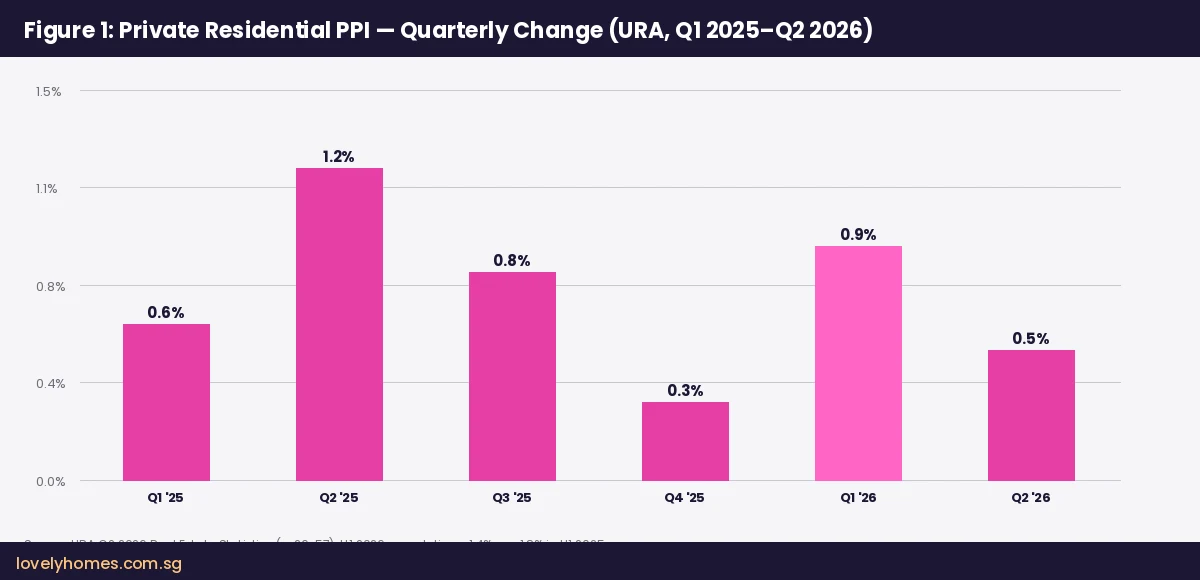
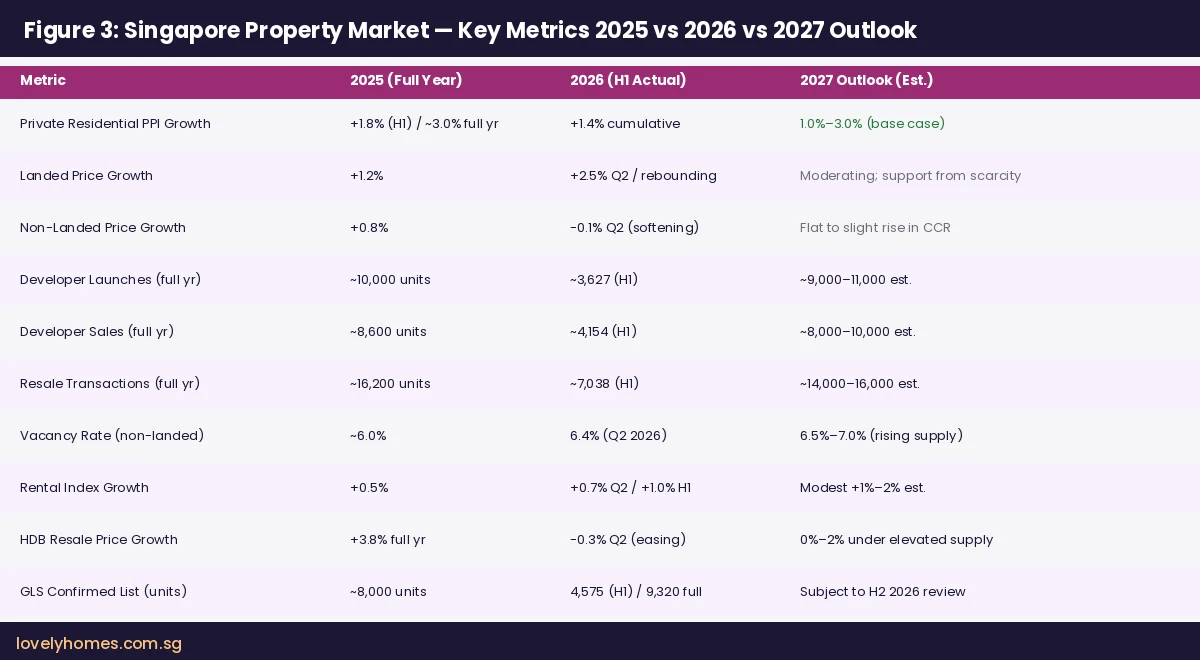
The Q2 2026 URA flash estimates showed private residential prices rising just +0.5% — a marked deceleration from Q1’s +0.9% and well below the 2021–2022 era acceleration. HDB resale prices fell for a second consecutive quarter (−0.3% in Q2 2026). Both indicators suggest the current measures are broadly achieving their goal: a cooling but not crashing market. Industry observers believe the probability of a further tightening round in 2026–2027 is low given these moderating trends. A partial relaxation — such as a modest reduction in the ABSD surcharge for SPR first-time buyers, or raising EC income ceilings to S$18,000 — is more plausible as a next move, particularly if HDB resale prices continue their downward drift. However, any relaxation for foreigners is considered highly unlikely given the political sensitivity and the Government’s stated commitment to keeping Singapore homes primarily for Singaporeans.

Frequently Asked Questions

Can I use CPF to pay ABSD?

No. ABSD must be paid entirely in cash. Unlike Buyer’s Stamp Duty (BSD), which can be funded from CPF Ordinary Account savings for the purchase of an HDB flat or private residential property, ABSD cannot be funded from CPF under any circumstances. This is an important cash-flow consideration: on a S$1.4 million condo with 20% ABSD, the buyer must have S$280,000 in liquid cash available at contract signing.

Does the TDSR apply to HDB loans?

No. The TDSR, which is governed by MAS Notice 632 and Notice MAS-655, applies only to bank and finance company property loans. HDB concessionary loans are not subject to TDSR. Instead, HDB loan applicants are subject to the MSR (≤ 30% of gross monthly income) and income ceiling eligibility criteria. However, if a buyer later refinances an HDB loan with a bank, the bank loan becomes subject to TDSR from that point forward.

My spouse is a foreigner — which ABSD rate applies?

If the property is purchased in both names (Singapore Citizen and foreign spouse), IRAS applies the higher of the two applicable ABSD rates. For a first property, the SC pays 0% and the foreigner pays 60% — so the transaction would be assessed at 60% on the full purchase price. To avoid this, the SC spouse may purchase in their sole name only, in which case ABSD is assessed solely based on the SC’s property count — potentially 0% for a first purchase. However, purchasing in sole name removes the foreign spouse from the title and has implications for CPF usage, estate planning, and stamp duty remission on future disposals. Legal advice is strongly recommended.

Do cooling measures apply to commercial properties?

ABSD and MSR apply only to residential properties. Commercial and industrial properties — shophouses, offices, factories, and retail units — are not subject to ABSD, and buyers of commercial property are not constrained by MSR. However, commercial property purchases are still subject to standard BSD, and the TDSR (which applies to all property loans from banks) may still constrain the loan amount available. The LTV limits for non-residential properties also differ from residential: typically 55%–80% depending on property type and loan count.

Will cooling measures ever be removed entirely?

The Singapore Government has consistently maintained that cooling measures are calibrated to market conditions and are not permanent fixtures, but their track record suggests they are structurally embedded in the regulatory landscape. Since 2009, every relaxation has eventually been followed by a tightening. The more realistic expectation is that individual components — such as specific ABSD rates for narrow buyer profiles — may be adjusted incrementally, but the framework itself (ABSD, TDSR, LTV) is likely to remain. Government spokespeople have explicitly stated that a stable, sustainable property market is a long-term national objective, and the measures are the mechanism for achieving it.

What is the property count for ABSD — does an inherited property count?

Yes. For ABSD purposes, an inherited residential property is counted as part of the buyer’s existing property count if the estate has been distributed and the property vested in the heir. This means a Singapore Citizen who inherits a private apartment and then purchases a new property is subject to ABSD at the rate applicable to their second property (20% as at 2026). The count also includes overseas residential properties for Singapore Citizens, although assessing overseas holdings is practically more complex. IRAS assesses property count at the time of the purchase being assessed.

Related Articles

Disclaimer

This article is published for general informational and educational purposes and does not constitute legal, financial, tax, or professional advice. Stamp duty rates, loan limits, and regulatory rules are subject to change by the relevant Singapore government authorities at any time; all figures cited are accurate as at 3 July 2026. Readers should verify current rates directly with IRAS (iras.gov.sg), MAS (mas.gov.sg), HDB (hdb.gov.sg), and MOF (mof.gov.sg) before making any property purchase or investment decision. LovelyHomes is not a licensed property agent, financial adviser, or legal practitioner. Always consult a qualified professional for advice specific to your circumstances.

HDB Resale Prices Fall for Second Consecutive Quarter: Q2 2026 Flash Estimate Breakdown

HDB Resale Prices Fall for Second Consecutive Quarter: Q2 2026 Flash Estimate Breakdown

Quick Summary: HDB Resale Market Q2 2026

  • The HDB Resale Price Index (RPI) fell 0.3% in Q2 2026 (flash estimate, 1 July 2026), following a 0.1% decline in Q1 2026.
  • This marks the first back-to-back quarterly RPI decline since early 2019 — a meaningful shift after a 12-quarter streak of price growth from mid-2020.
  • Estimated transactions: ~6,268 in Q2 2026 (as at 29 June 2026), down about 10.2% versus Q2 2025’s 6,981 transactions.
  • The full Q2 data from HDB — including town-level breakdowns and flat-type analysis — is expected by 23 July 2026.
  • Meanwhile, private residential prices rose 0.5% in Q2 2026 (URA flash estimate), a divergence between public and private markets.
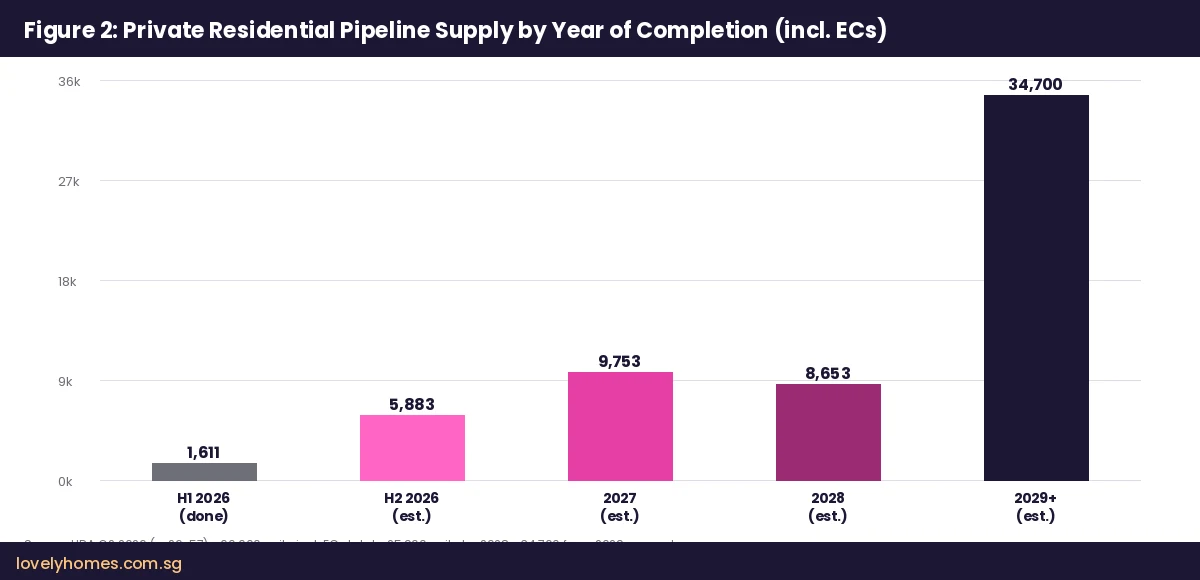
  • The October 2026 BTO exercise (~8,000 flats, 7 projects) and a growing private pipeline should continue to moderate resale demand in 2H 2026.

HDB Resale Prices Fall for a Second Consecutive Quarter in Q2 2026

The Housing & Development Board released its Q2 2026 flash estimate on 1 July 2026, showing the Resale Price Index (RPI) declined 0.3% quarter-on-quarter — deepening the 0.1% dip recorded in Q1 2026. The two consecutive quarterly declines are the first since early 2019, ending a remarkable run of price growth that had seen the RPI climb more than 30% from its 2020 post-pandemic lows.

The data point comes on the same day as URA’s Q2 2026 private residential flash estimate, which showed a more modest picture: private home prices rising 0.5%, with gains concentrated in the Core Central Region (+2.0%) and landed segment (+2.6%), while the Rest of Central Region (-1.4%) and Outside Central Region (-0.2%) softened. The divergence between the two markets — private prices edging up while HDB resale prices retreat — is a notable feature of Singapore’s mid-2026 property landscape.

HDB Resale Price Index QoQ change 2023 to Q2 2026 and resale transaction volume trend
Figure 1: (Left) HDB Resale Price Index QoQ change, Q1 2023 to Q2 2026. Two consecutive declines in Q1 and Q2 2026 mark the first back-to-back quarterly retreat since early 2019. (Right) Estimated resale transaction volume, Q2 2024 to Q2 2026 — Q2 2026 volume (~6,268) is the softest in the chart window. Source: HDB Flash Estimates, 1 July 2026.

Why Are HDB Resale Prices Softening?

Several structural forces are bearing down on HDB resale demand in mid-2026. First, the sheer volume of BTO supply entering the market is creating competition at the margins. HDB launched approximately 19,600 BTO flats across 2026, with the October exercise alone adding close to 8,000 units across seven projects — including two projects at Bayshore (Prime classification, 2,500 units combined), Caldecott (Prime, 1,430 units), and Yishun Chencharu (Standard, 1,580 units). Buyers who might previously have turned to the resale market for faster access to housing in desired towns now have BTO options that, while involving a wait of several years, offer meaningful subsidies.

Second, resale volume has been declining. An estimated 6,268 transactions in Q2 2026 represents a drop of approximately 10.2% compared to 6,981 in Q2 2025. Fewer transactions mean fewer comparable sales pushing prices higher — the resale market is losing the self-reinforcing momentum it enjoyed during 2021–2024.

Third, the cooling measures introduced in 2022–2023 — the 15-month wait-out period for private property owners wanting to buy HDB resale flats, tightened income ceilings under the HFE framework, and the introduction of Plus and Prime classifications — have added friction for demand that was previously unconstrained. The Ethnic Integration Policy (EIP) also continues to block transactions in certain blocks, narrowing the effective buyer pool in popular mature estates.

What the Divergence Between Private and HDB Prices Means

The contrast between private (+0.5%) and HDB resale (-0.3%) prices in Q2 2026 reflects different demand profiles. Private residential demand in Singapore is increasingly driven by upgraders, high-net-worth individuals, and (at the CCR end) wealthy foreigners paying the 60% ABSD — a buyer cohort that is relatively insensitive to BTO supply. HDB resale demand, by contrast, comes principally from first-timers who cannot get a BTO (due to ballot failure, income ceiling, or timing), second-timers who have completed their MOP and want a larger resale flat before upgrading, and PRs who have been resident long enough to qualify. This segment is more directly substitutable with BTO supply.

The CCR’s 2.0% private price gain in Q2 2026 also reflects some flight-to-quality within the private market — buyers who can afford CCR are moving upstream as OCR and RCR sentiment softens. This bifurcation is a characteristic of a market entering a more discerning phase after broad-based appreciation.

Context: Is This a Correction or a Reset?

A 0.3% quarterly decline does not in isolation constitute a correction — it represents a modest pullback after an extended run-up. The HDB RPI reached its cycle high in Q4 2025 or Q1 2026 (the full data will clarify the exact peak). From cycle trough in Q2 2019 to approximate peak in Q4 2025, the RPI gained roughly 30%+ over six years. A mild two-quarter retreat is, from a long-term perspective, a normalisation.

Industry figures suggest the retreat is orderly rather than distressed. Median resale flat prices remain close to or at multi-year highs on an absolute basis — it is the rate of growth that has reversed, not a broad-based collapse. The Bidadari estate’s record S$945,000 resale transaction (a 3-room flat at 118A Alkaff Crescent in June 2026, as reported by LovelyHomes) shows that premium locations can still command record prices even as the broader index softens.

What to Watch in 2H 2026

The full Q2 2026 HDB statistics (expected 23 July 2026) will provide the town-level and flat-type breakdown that the flash estimate lacks. Market participants will be looking at whether the price softening is concentrated in particular flat types (5-room and executive flats, which saw the sharpest run-up) or distributed across the board. The MOP unlock pipeline — the volume of BTO flats reaching their 5-year MOP in 2026 — is also a factor: a large cohort of flats from 2019–2021 BTO launches reaching MOP simultaneously could add resale supply.

With the October BTO exercise applications opening in September 2026 (HFE deadline 15 September 2026), buyer attention is likely to shift toward the BTO market in 3Q 2026, further dampening resale activity near term. The 2H 2026 private pipeline includes several significant new launches — any softening in developer sales could, through the upgrader channel, reduce demand for HDB resale from MOP-cleared flat owners looking to cash out for a private upgrade.

Frequently Asked Questions

Does the -0.3% RPI mean my flat is worth less than last quarter?

At a market level, yes — the flash estimate indicates that the average resale flat transacted in Q2 2026 sold at prices approximately 0.3% lower than the average in Q1 2026. However, individual flat values depend on estate, block, floor, flat condition, and proximity to amenities. A Bidadari flat in a sought-after block may still have appreciated even as the overall index dipped. The RPI is a market-level index, not a valuation of your specific flat. For an accurate current valuation, engage an HDB-registered salesperson for a Comparative Market Analysis or use HDB’s official transaction data portal.

Why are private prices rising while HDB resale prices fall?

The two markets have different demand drivers. Private residential demand in Singapore is partly sustained by high-income upgraders, global wealth, and CCR buyers who are relatively insulated from BTO supply effects. HDB resale demand, by contrast, is more directly substitutable with BTO supply — buyers who want an HDB flat can increasingly choose a new BTO over a resale flat, especially with the expanded supply in 2026. The 15-month wait-out period also constrains one source of HDB resale demand (private property sellers downsizing). The result is diverging price trends.

Should I wait to buy an HDB resale flat if prices are declining?

Market timing in housing is notoriously difficult, and the decision to buy an HDB resale flat should primarily be driven by your housing needs, financial readiness, and family circumstances — not by short-term RPI movements. A 0.3% quarterly decline is small relative to the transaction costs of delaying a purchase (rental costs, stamp duties). That said, if you are financially able to wait and are flexible on timing, the 2H 2026 market may offer a wider selection at steady or modestly lower prices given the pipeline of October BTO and new private launches drawing attention away from resale. Always work with a qualified professional and check your HFE letter status before making any commitment.

When will the full Q2 2026 HDB data be released?

HDB typically releases the full quarterly resale statistics approximately three weeks after the flash estimate — so the full Q2 2026 data (with flat-type and town-level breakdowns, median transaction prices, and complete volume figures) is expected around 23 July 2026. LovelyHomes will publish an in-depth analysis when the full data is available. The full URA Q2 2026 private residential statistics are also expected on 25 July 2026.

Is this the start of a bigger HDB resale price correction?

Based on Q2 2026 flash data alone, it is premature to call a structural correction. Two consecutive quarters of mild declines (−0.1% and −0.3%) are consistent with a soft landing rather than a downturn. The HDB government remains committed to ensuring an adequate supply of BTO flats and has levers — including BTO supply pacing and eligibility criteria — to manage the market. Historical context is useful: the last significant HDB resale correction (2013–2019) saw the RPI decline approximately 13% over six years, driven by a deliberate policy supply surge. The current situation — a mild two-quarter pullback within a broadly healthy economy — does not yet suggest a repeat of that trajectory.

Related Articles

Disclaimer

The data in this article is drawn from HDB and URA flash estimates released on 1 July 2026. Flash estimates are preliminary and subject to revision when the full quarterly statistics are published. Transaction volume figures (as at 29 June 2026) are unaudited estimates. This article is not financial or investment advice. For current HDB resale data, visit hdb.gov.sg. For URA private residential data, visit ura.gov.sg.

×

Click anywhere to close

Singapore HDB Minimum Occupation Period (MOP) 2026: Complete Guide — Rules, Restrictions and Upgrade Options

Singapore HDB Minimum Occupation Period (MOP) 2026: Complete Guide — Rules, Restrictions and Upgrade Options

Quick Answer: HDB MOP Singapore 2026

  • Standard HDB BTO and resale flats have a 5-year Minimum Occupation Period (MOP) counted from the date you collect the keys (TOP/possession date), not from when you sign the Sales & Purchase agreement.
  • Plus and Prime (PLH) classification flats introduced from the August 2024 BTO exercise have a longer 10-year MOP, reflecting their more desirable locations and heavier subsidy.
  • During MOP, you cannot sell your flat, rent out the entire flat, or purchase any other residential property in Singapore — including private property or an overseas residential investment.
  • You CAN rent out individual HDB bedrooms with prior HDB approval, and run approved home-based businesses from your flat during MOP.
  • Executive Condominiums (ECs) have a 5-year MOP before they can be sold to Singapore Citizens and PRs, and a 10-year window before they are fully privatised and open to foreign buyers.
  • Breaching MOP rules can result in compulsory acquisition of the flat by HDB at a value set by HDB — typically below market value. Criminal penalties may also apply under the Housing & Development Act.
  • After MOP, you can sell the flat, upgrade to a private property, and — for HDB sellers upgrading to private — apply for ABSD remission if you complete the sale within 6 months of purchasing the private property.

What Is the HDB Minimum Occupation Period (MOP)?

The Minimum Occupation Period (MOP) is a statutory rule administered by the Housing & Development Board (HDB) that requires flat owners to physically occupy their HDB flat for a minimum period before they can sell it on the open market, rent it out entirely, or purchase other residential property in Singapore. The MOP is a key plank of Singapore’s public housing philosophy: HDB flats are subsidised national assets intended primarily as homes rather than investment vehicles, and the MOP is one mechanism through which HDB ensures flats remain owner-occupied.

The MOP was first introduced in the 1970s and has been refined multiple times since, most recently in 2024 with the introduction of the Plus and Prime flat classifications under the enhanced HDB framework. Understanding which MOP applies to your flat — and what you can and cannot do during that period — is critical before making any property decisions.

HDB MOP by flat type Singapore 2026 — Standard 5 years, Plus and Prime 10 years, EC 5 then 10 years
Figure 1: HDB Minimum Occupation Period by flat type, Singapore 2026. Plus and Prime classification flats (introduced from August 2024 BTO exercise) carry a 10-year MOP, double the Standard flat MOP. Source: HDB.

MOP Duration by Flat Type (2026)

Flat Type MOP Duration MOP Start Date Notes
Standard BTO Flat 5 years Date of key collection Applies to all pre-Aug 2024 BTO; continued for Standard classification from Aug 2024
Plus Classification BTO Flat 10 years Date of key collection From Aug 2024 BTO exercise; typically near MRT/town centres; subsidy clawback on resale
Prime / PLH Classification BTO Flat 10 years Date of key collection Central-location flats; subsidy clawback ~6–9% of resale price; income ceiling at resale
HDB Resale Flat 5 years Date of resale completion Fresh 5-year MOP runs from the date the resale transaction is completed (not from when the previous owner moved in)
Executive Condominium (EC) 5 years → 10 years Date of TOP At 5yr can sell to SC/PR; at 10yr fully privatised — open to foreigners (60% ABSD applies)
HDB Sale of Balance Flats (SBF) 5 years Date of key collection SBF flats unsold from previous BTO exercises; Standard classification MOP applies

Important note on the Plus and Prime MOP: The new 10-year MOP for Plus and Prime flats applies only to flats launched under the August 2024 BTO exercise onwards. Flats purchased in earlier exercises, even if they are in desirable locations that would now be classified as Plus or Prime, retain their original 5-year MOP. To confirm which classification applies to your flat, check your HDB flat portal or the original flat details under your BTO exercise.

What You Cannot Do During the HDB MOP

HDB MOP rules matrix 2026 — what you can and cannot do during the minimum occupation period
Figure 2: HDB MOP rules — allowed and prohibited activities during the Minimum Occupation Period. Source: HDB Housing & Development Act.

Selling the Flat

You cannot sell your HDB flat on the open resale market before your MOP is complete. This applies even if you face financial hardship — HDB does not grant MOP exemptions for distressed sellers. The only exception is a compulsory acquisition by HDB or by the State for public purposes, which is not initiated by the flat owner. If you attempt to sell before MOP, the transaction will be rejected by HDB’s system during the eligibility check.

Renting Out the Entire Flat

Renting out the entire flat (as a whole unit) is not allowed during MOP. This applies to both short-term and long-term rental arrangements. Platforms such as Airbnb and similar short-term rental services are also not permitted on HDB flats — the minimum lease tenure for any rental on HDB flats is three consecutive months. After MOP, whole-flat rental is allowed with HDB prior approval and is subject to the non-Malaysian foreign tenant quota.

Purchasing Other Residential Property in Singapore

During MOP, you and your co-owners on the flat cannot purchase any other private residential property in Singapore. This restriction extends to new launch condominiums, resale condominiums, Executive Condominiums (as a new buyer), landed property, and private apartments. Purchasing a second HDB flat is also not allowed during MOP.

Crucially, HDB’s definition of “residential property” in the MOP context refers to Singapore property only. There is no restriction on purchasing overseas residential property during MOP — only Singapore residential property is covered.

Purchasing a Second HDB Flat

HDB’s policy generally allows only one HDB flat per family nucleus at any time. Applying for a second BTO, SBF, or resale flat during MOP is not permitted. Once MOP is fulfilled, you may apply for a second HDB flat under specific schemes (e.g., the Studio Apartment scheme for elderly, or a new BTO after disposing of the first flat).

What You CAN Do During the HDB MOP

Rent Out Individual Rooms

Renting out individual bedrooms in your HDB flat (while you continue to live in the flat) is permitted during MOP, subject to HDB’s prior written approval. You must apply through the HDB Flat Portal before subletting. Each tenancy must be for a minimum of six months (for whole-flat subletting after MOP) or at least three months for room rental. Non-Malaysian foreign tenants are subject to the non-Malaysian quota: a maximum of two non-Malaysian foreign tenants per flat in the same block is the guideline, though HDB publishes real-time quota data by block.

Run Approved Home-Based Businesses

HDB permits flat owners to operate home-based businesses during MOP, subject to type and scale restrictions. Category 1 businesses (no employees visiting, no clients visiting, no signage) are allowed without prior approval. Category 2 businesses (up to two non-resident employees, clients may visit in small numbers) require prior approval from HDB. Manufacturing, food businesses, or any business that involves goods storage, noise, or frequent deliveries is not permitted.

Refinance to a Bank Loan

Switching from an HDB housing loan to a bank loan (or switching between bank loan packages) is allowed during MOP. There is no MOP restriction on refinancing decisions, and many flat owners take advantage of the 5-year MOP period to monitor interest rate movements and refinance when rates are favourable. MAS’s LTV and TDSR rules govern the refinancing terms.

When Does the MOP Start and End?

The MOP starts from the date you collect your keys (for BTO and SBF flats, this is the TOP date; for resale flats, this is the date of completion of the resale transaction — both milestones are reflected in your HDB Flat Portal). The MOP does not start from the date you sign the Sales & Purchase Agreement or from the date you pay the initial booking fee.

You can check your MOP end date in the HDB Flat Portal under “My Flat” → “Purchase Details”. The portal clearly shows whether your MOP has been fulfilled. Do not rely on verbal estimates from agents or CPF advisers — always verify on the portal directly.

One nuance: physical occupation is expected during MOP. HDB conducts periodic checks to ensure flat owners are residing in the flat. Extended overseas absences without HDB’s knowledge have been cited in compulsory acquisition cases. If you must be overseas for an extended period (e.g., for work), inform HDB and keep the flat in a lived-in condition.

Executive Condominium (EC): The Hybrid MOP Rules

Executive Condominium EC MOP and privatisation timeline Singapore 2026 — 5-year and 10-year milestones
Figure 3: Executive Condominium MOP and privatisation timeline. During the first 5 years, EC owners face HDB-equivalent MOP restrictions. At the 5-year mark, ECs can be sold on the open market to SC and PR buyers. At 10 years, ECs are fully privatised and open to foreign buyers (60% ABSD applies). Source: HDB, URA.

Executive Condominiums occupy a hybrid position between public and private housing. They are built by private developers but are sold at a subsidised price to qualifying buyers (income ceiling S$16,000 per month household income as of 2026). From a MOP standpoint, ECs are treated like HDB flats for the first 5 years:

During years 1–5: EC owners cannot sell their unit, rent out the whole unit, or purchase any other Singapore residential property. The rules are identical to HDB MOP. Critically, the 5-year MOP runs from the TOP date, not the booking date — for large EC projects, this can mean a 3–4 year gap between booking and TOP, followed by 5 more years of MOP, making the effective holding period 8–9 years from initial purchase commitment.

After year 5 (first privatisation): The EC can be sold on the open resale market to Singapore Citizens and Singapore PRs. It cannot yet be sold to foreigners, and ECs in the first 5–10 year window are not listed on the private market as “privatised condos” — they trade in a narrower SC/SPR market. ABSD rules for the buyer apply (5% for PR 1st property, 30% for PR 2nd+, etc.).

After year 10 (full privatisation): The EC is fully privatised and treated identically to a private condominium. Foreigners may purchase it, though the 60% foreigner ABSD applies. Owners may also rent the entire unit without prior HDB approval at this stage.

Plus and Prime Flat Additional Restrictions After MOP

The 2024 housing framework introduced substantive additional conditions for Plus and Prime classification flats beyond just the longer 10-year MOP. These are restrictions that run with the flat even after MOP and affect future resale:

Subsidy clawback: When you sell a Plus or Prime flat after your MOP, HDB claws back a portion of the subsidy embedded in the original purchase price — approximately 6–9% of the resale price, payable to HDB. This clawback is calculated as a percentage of the resale transaction price, not the original purchase price, so it increases in dollar terms as the flat appreciates.

Income ceiling for buyers: Buyers of Plus and Prime resale flats are subject to an income ceiling (the ceiling is the same as for BTO buyers — S$14,000/month for 4-room and larger Plus flats as of 2026). This narrows the pool of eligible resale buyers and may dampen price appreciation relative to Standard flats.

Ethnic Integration Policy (EIP): As with all HDB resale flats, EIP quotas apply — both block and neighbourhood levels. Buyers must check the relevant block’s EIP availability before submitting an offer.

After MOP: Your Property Upgrade Options

Once your MOP is fulfilled, your options expand significantly. The most common upgrade path is from HDB flat to private condominium. The timing of this upgrade carries stamp duty implications:

Option A — Sell HDB first, then buy private: You clear the HDB flat, receive sale proceeds (net of CPF refund), and purchase the private property as a “first property” — no ABSD for SC buyers, 5% ABSD for PR buyers. This is the most common and financially efficient path but requires temporary accommodation between the two transactions.

Option B — Buy private first, then sell HDB (concurrent ownership): As an SC buying private property while still owning an HDB flat (post-MOP), you pay 20% ABSD on the private property purchase. You then have six months from the private property’s completion (or from the purchase date for resale private properties) to sell the HDB flat and apply for an ABSD remission from IRAS. If the HDB is sold within six months, IRAS refunds the 20% ABSD. If you miss the six-month window, the 20% ABSD is forfeited.

The six-month window starts from either the issue of Temporary Occupation Permit (TOP) for a new private property or the date of exercise of the OTP for a resale private property. Given the complexity of timing, many HDB upgraders consult a lawyer and financial adviser before committing to Option B.

The 15-Month Wait-Out Period: From Private Back to HDB

The wait-out period is often confused with MOP. They are different rules targeting different situations. The 15-month wait-out period (introduced in September 2022) applies to private property owners who want to purchase an HDB resale flat. If you own or recently disposed of a private property, you must wait 15 months from the date of disposal before you can purchase an HDB resale flat.

This rule does not apply to HDB MOP — it is a separate downstream restriction. For example, if you complete your HDB MOP, sell your HDB flat, buy a private condo, and then later want to downgrade back to HDB, you must wait 15 months after selling the private condo before buying an HDB resale flat. This rule applies to both SC and PR private property owners.

Worked Example: The Tan Family’s Upgrade Journey

Mr and Mrs Tan (both Singapore Citizens) purchased a 4-room BTO flat in Punggol under the Standard classification in September 2019. They collected their keys in August 2021. Their MOP end date is therefore August 2026 — five years from key collection.

In March 2026, Mrs Tan checks the HDB portal and sees MOP will end in 5 months. The couple begin their private condo search. They find a 3-bedroom OCR resale condo in Jurong East priced at S$1.5M in June 2026.

They choose Option B (buy private first). As SC buying a second property: BSD ~S$42,600 + ABSD 20% = S$300,000. They pay S$342,600 in stamp duties. Their flat is still within MOP (keys August 2021, MOP August 2026 — they are just before MOP end), so HDB must confirm MOP end before they list the flat for sale.

After August 2026 (MOP fulfilled), they list their HDB flat. Sell it in October 2026 for S$780,000 — within the 6-month window from the condo OTP exercise date of June 2026. IRAS refunds the S$300,000 ABSD. Net stamp duty retained: S$42,600 BSD only. The family books temporary accommodation for 2 months while bridging the purchase and sale timelines.

Total net proceeds from HDB: S$780,000 − CPF refund S$220,000 (principal + accrued interest) − agent 1% S$7,800 − legal S$2,500 = net S$549,700 cash. The upgrade is financially viable.

Will MOP Rules Change?

The 10-year MOP for Plus and Prime flats is a relatively recent policy (from August 2024) and unlikely to be rolled back in the near term. If anything, the trend in Singapore public housing policy has been toward tightening MOP and adding post-MOP conditions rather than relaxing them, as the government works to ensure HDB flats remain primary homes rather than investment properties. The subsidy clawback mechanism for Plus and Prime flats may be extended to more flat types if HDB determines that Standard flat resale prices are diverging too sharply from BTO prices in certain areas. Buyers should model their long-term exit strategy under current rules and build in buffer for possible tightening.

Frequently Asked Questions

Can I stay overseas during my HDB MOP?

You are expected to physically occupy the flat during MOP, but there is no absolute rule against overseas travel. Extended absences (months or years) without HDB’s knowledge can attract scrutiny, and in confirmed cases of non-occupation, HDB may commence compulsory acquisition proceedings. If you need to relocate overseas temporarily for work (e.g., on a company secondment), inform HDB in writing and keep the flat utilities active. HDB conducts inspection exercises and spot checks and has compulsorily acquired flats where owners were clearly not residing in them during MOP.

Does my MOP reset if I add or remove an owner from the flat?

No — adding or removing an owner (for example, through marriage or divorce) does not reset the MOP clock. The MOP continues to run from the original key collection date. However, any change of ownership within MOP is a restricted transaction and must be approved by HDB. Not all ownership changes are approved during MOP — for example, transferring a flat to an ineligible person would be rejected. Consult HDB or a lawyer before any ownership change within the MOP window.

Can I buy an overseas investment property during MOP?

Yes. The HDB MOP restriction applies only to Singapore residential property. There is no restriction on purchasing overseas property (residential or commercial) during MOP. You are not required to declare overseas property purchases to HDB. However, if you are financing an overseas property purchase with a Singapore bank loan, that loan will be factored into your TDSR for future Singapore loan applications. From a Singapore tax perspective, rental income from overseas property is taxable in Singapore as foreign-sourced income if remitted to Singapore.

What happens if I breach the MOP?

A breach of MOP (typically: selling the flat, subletting the entire flat, or buying other residential property in Singapore without completing MOP) can result in HDB compulsorily acquiring the flat. HDB sets the acquisition price, which is typically the assessed market value minus a penalty deduction — in practice, this means the owner receives significantly less than the open-market value they would have received after MOP. In the most serious cases involving deliberate deception or fraud (e.g., falsely declaring occupancy), criminal charges may be brought under the Housing & Development Act, which carries fines of up to S$5,000 and/or imprisonment.

Does MOP apply to inherited HDB flats?

If you inherit an HDB flat from a deceased owner, the MOP of the original owner does not transfer to you as a fresh 5-year obligation. Instead, the inherited flat is subject to HDB’s estate rules — the eligible inheritor (e.g., a spouse or child who meets eligibility criteria) may retain the flat. If the inheritor already owns a flat, they may need to dispose of one within six months. Inherited flats that have not yet met MOP at the time of death are subject to HDB’s direction — in practice, HDB often allows the eligible inheritor to complete the remaining MOP. Always consult HDB’s estate administration team for inherited flat cases.

Can I buy a private property if my HDB is still within MOP and my spouse is not on the HDB title?

No — the restriction applies to the entire family nucleus (owner and spouse / co-habitant), not just the named owners on the HDB title. If one spouse is within MOP on an HDB flat, the other spouse (even if not on the HDB title) is also restricted from purchasing Singapore residential property. HDB looks at the family nucleus holistically. Attempting to buy private property in a non-owning spouse’s name to circumvent MOP is a known scheme that HDB and IRAS are alert to — it will be scrutinised and may result in both the stamp duty assessment and a referral for investigation.

Is there a MOP for HDB shophouses or commercial units?

No. MOP is specific to HDB residential flat units. HDB shophouses (commercial properties on the ground floor of HDB blocks) are governed by different rules and do not carry a MOP. Commercial properties generally do not have any MOP equivalent — you can sell or rent them freely at any time after purchase. The restrictions and ABSD rules that apply to residential property do not apply to commercial property purchases.

Related Articles

Disclaimer

This article provides general information about HDB MOP rules as at July 2026 and is not legal or financial advice. MOP durations, clawback percentages, and related policy conditions may change. Always verify current MOP status for your flat at hdb.gov.sg and check the specific BTO exercise details in your Lease Agreement. For estate planning, inheritance, and structural ownership changes, consult a Singapore-qualified lawyer. For ABSD remission eligibility, consult IRAS at iras.gov.sg.

Foreigner Buying Property in Singapore 2026: Complete Guide — ABSD, Eligible Properties and Process

Foreigner Buying Property in Singapore 2026: Complete Guide — ABSD, Eligible Properties and Process

Quick Answer: Can Foreigners Buy Property in Singapore?

  • Foreigners may freely purchase private condominiums and apartments in Singapore — there is no quota or prior approval requirement for these properties.
  • Additional Buyer’s Stamp Duty (ABSD) of 60% applies to any foreigner buying any Singapore residential property (effective 27 April 2023).
  • Foreigners cannot buy HDB flats (public housing) or Executive Condominiums during their 10-year Minimum Occupation Period.
  • Foreigners cannot buy mainland Singapore landed property without Singapore Land Authority (SLA) approval; Sentosa Cove is a designated exception.
  • Singapore Permanent Residents (PRs) pay 5% ABSD on their first residential property and 30% on subsequent purchases; PRs can buy HDB resale flats but not BTO flats.
  • The Loan-to-Value (LTV) limit is 75% for most foreign buyers on their first property from a Singapore-regulated bank — a minimum 5% cash downpayment is required.
  • BSD (Buyer’s Stamp Duty) also applies to all buyers; on a S$2M purchase BSD is approximately S$69,600 (effective 3.48%).

Foreigners Buying Property in Singapore: The Full Picture

Singapore has long attracted foreign capital into its property market, offering political stability, rule of law, transparent ownership records, and strong capital preservation. Despite the 60% ABSD surcharge introduced in April 2023, the city-state remains one of Asia’s most liquid and credible real estate markets for overseas investors.

Understanding Singapore’s property restrictions is, however, non-negotiable before committing capital. This guide explains who qualifies as a foreign buyer, what you can and cannot purchase, the full stamp duty liability, the buying process, and what due diligence steps are essential before signing an Option to Purchase (OTP).

The statutory framework governing foreign property ownership in Singapore is primarily the Residential Property Act (Chapter 274), administered by the Singapore Land Authority (SLA), and the Stamp Duties Act, administered by the Inland Revenue Authority of Singapore (IRAS).

ABSD rates by buyer profile Singapore 2026 — foreigner 60%, PR 5%/30%, SC 0%/20%/30%
Figure 1: ABSD rates by buyer status, Singapore 2026. Effective rates per IRAS/MND as of 27 April 2023. Foreigner rate (any residential property) is 60%. Source: IRAS, Ministry of National Development.

Who Is Classified as a Foreign Buyer in Singapore?

For the purposes of Singapore property law and stamp duty, buyers are classified into three main groups:

Buyer Type Definition HDB Resale? Private Condo? ABSD (1st Prop.)
Singapore Citizen (SC) Holds Singapore citizenship 0%
Singapore Permanent Resident (SPR/PR) Holds Singapore PR (Blue IC) ✓ (with quota) 5%
Foreigner Neither SC nor PR 60%
Entity (company/trust) Any non-individual legal entity ✓ (with caveats) 65%

For couples where one partner is an SC and the other is a foreigner, the ABSD rate used depends on the higher-rated buyer — so an SC+foreigner couple purchasing together pays ABSD at the foreigner rate of 60% (or a remission may apply if the SC spouse is purchasing their first property — check with your solicitor). Married couples who are both SC and PR also have specific treatment and should get a stamp duty assessment before exercising an OTP.

What Can Foreigners Buy (and Not Buy) in Singapore?

The Residential Property Act places strict controls on foreign ownership of “restricted residential property”, which covers landed housing on the Singapore mainland. Non-restricted residential property (including all private condominiums and apartments in strata-titled developments) may be purchased freely by foreigners, subject to paying the applicable ABSD.

Singapore property eligibility matrix 2026 — what foreigners, PRs and citizens can buy
Figure 2: Property Eligibility Matrix for Singapore Buyers (2026). Foreigners have unrestricted access to private condominiums and commercial property, but are excluded from HDB flats, ECs during MOP, and mainland landed housing without prior SLA approval. Source: SLA, HDB, URA.

What Foreigners CAN Buy (Freely)

Private strata-titled condominiums and apartments are the primary vehicle for foreign property investment in Singapore. This includes condominiums in CCR (Core Central Region, Districts 9, 10, 11), RCR (Rest of Central Region), and OCR (Outside Central Region). Foreigners may purchase new launches from developers, resale units on the open market, and serviced apartments under residential titles.

Sentosa Cove landed property is an exception to the landed restriction. The government has designated Sentosa Cove as an approved area where foreigners may purchase bungalows, semi-detached and terrace houses. A Restricted Residential Property Approval is still processed through SLA, but approval is generally granted for bona fide purchasers. Sentosa Cove units attract a Land Betterment Charge (LBC) alongside normal stamp duties.

Commercial and industrial property — shophouses, office units, retail strata units, industrial buildings, and similar non-residential assets — may be purchased by foreigners without ABSD (though BSD and other charges apply). Many investors access Singapore property through shophouses and commercial strata units precisely to avoid the residential ABSD.

What Foreigners CANNOT Buy (Without Approval)

HDB flats (all types: BTO, resale, DBSS) are restricted to Singapore Citizens and Permanent Residents, and even PRs face sub-quotas under the Ethnic Integration Policy. Foreigners have no pathway to HDB ownership.

Executive Condominiums (ECs) are hybrid public-private housing. During the first 10 years (from TOP), ECs cannot be sold to foreigners. After 10 years, ECs are fully privatised and foreigners may purchase them, but ABSD at 60% applies.

Mainland Singapore landed residential property — including detached houses, semi-detached houses, terrace houses, and cluster housing — requires prior SLA approval. In practice, the SLA rarely approves applications from foreigners without substantive economic contribution to Singapore (e.g., Global Investor Programme). Applications that are approved often involve conditions and lengthy processing times.

Additional Buyer’s Stamp Duty (ABSD): The 60% Reality

The 60% ABSD rate for foreigners, introduced on 27 April 2023 under the Stamp Duties (Amendment) Act, doubled the previous rate of 30%. It is assessed on the higher of the purchase price or the market value of the property, and must be paid within 14 days of the exercise of the OTP (or within 30 days for documents executed overseas).

ABSD is administered by the Inland Revenue Authority of Singapore (IRAS). Penalties for late payment are 5% of the ABSD due per annum, and IRAS does not grant extensions except in extraordinary circumstances. Importantly, ABSD cannot be financed through a bank loan — it must be paid entirely in cash from the buyer’s own funds. On a S$2M purchase, that is S$1.2M in cash for ABSD alone, payable within two weeks of exercising the OTP.

For Singapore Permanent Residents, the ABSD rate on a first residential property is 5% (S$100,000 on a S$2M purchase) and 30% on any subsequent residential property. PRs who hold a joint purchase with an SC spouse buying their first property may apply for an ABSD remission to reduce the effective ABSD to 0% — this requires both parties to be first-time residential property owners.

ABSD remission schemes exist for certain qualifying situations: developers remission (for licensed developers undertaking development), housing upgrader remission (for SCs who sell their HDB/private property within six months of purchasing a new private property), and the joint-purchase SC/PR first-timer remission. None of these apply to typical foreigner purchasers.

Buyer’s Stamp Duty (BSD): Applies to Everyone

Buyer’s Stamp Duty applies to all property purchases regardless of nationality. The progressive rate schedule for residential property is: 1% on the first S$180,000; 2% on the next S$180,000; 3% on the next S$640,000; 4% on the next S$500,000; 5% on the next S$1,500,000; and 6% on the remainder. On a S$2M purchase, BSD amounts to approximately S$69,600 (an effective rate of about 3.48%). BSD must also be paid within the same 14-day window as ABSD.

Total acquisition cost comparison S$2M condo Singapore 2026 — SC vs PR vs foreigner
Figure 3: Total upfront acquisition cost for a S$2M private condominium (1st property) in Singapore 2026. For a foreign buyer, BSD + ABSD alone amount to S$1,269,600 — approximately 63.5% of the purchase price. Source: IRAS, MND.

Financing: LTV Limits, Downpayment and the TDSR

Contrary to some misconceptions, foreigners are not automatically barred from obtaining Singapore bank loans. Singapore-regulated banks (DBS, OCBC, UOB, Standard Chartered, Citibank, HSBC, and others) will assess foreign borrowers on the basis of their income, credit history, Total Debt Servicing Ratio (TDSR), and Loan-to-Value (LTV) limits set by the Monetary Authority of Singapore (MAS).

For a first property purchase, the LTV limit is 75%. The minimum 5% cash downpayment must come from the buyer’s own cash (CPF is only available to Singapore Citizens and PRs). Foreign buyers with no Singapore income need to satisfy the TDSR threshold — monthly total debt obligations must not exceed 55% of gross monthly income. Banks will typically require at least 12 months of salary crediting, employment letters, and often a personal visit to the branch or relationship manager in Singapore.

Foreign buyers should also note that rental income from the property cannot be used to service the TDSR calculation until it is actually received — only documented, existing income is recognised. A pre-approval (Approval-in-Principal) from the bank before exercising the OTP is strongly recommended.

Step-by-Step: How a Foreigner Buys a Singapore Condo

  1. Engage a Singapore-registered property lawyer before viewing properties. The lawyer will advise on eligibility, stamp duty liability, and contract review. (Note: marketing agents in Singapore are CEA-licensed but are not lawyers — do not rely on agents for legal advice.)
  2. Identify the property and negotiate the price with the seller or developer. For new launches, register for the sales chart; for resale, negotiate via the seller’s agent or directly.
  3. Obtain an Approval-in-Principal (AIP) from your chosen bank before committing to an OTP. This confirms your borrowing capacity and avoids the risk of losing your OTP fee if financing falls through.
  4. Exercise the Option to Purchase (OTP). For resale condos, an OTP fee (typically 1% of the purchase price) is paid to reserve the unit. The buyer then has 14 days to exercise the OTP by paying a further 4% (totalling 5% as initial deposit). For new launches, the process involves an Expression of Interest (EOI), booking fee (typically 5%), and signing the Sale and Purchase (S&P) Agreement.
  5. Pay ABSD and BSD within 14 days of exercising the OTP (or 30 days for overseas documents). Both must be paid in cash — ABSD cannot be financed.
  6. Complete legal requisitions. Your solicitor conducts title searches, confirms the title is free of encumbrances, and coordinates with the seller’s solicitor.
  7. Complete the purchase (typically 8–12 weeks after exercising the OTP for resale; longer for new launches under progressive payment). The balance of the purchase price is funded by the bank loan drawdown and your cash downpayment (after netting off the 5% deposit).
  8. Register the transfer at the Singapore Land Registry (part of SLA). Your solicitor handles this.

Worked Example: Mr Tanaka — Japanese Expat Buying His First Singapore Condo

Mr Tanaka is a Japanese national on an Employment Pass, working in Singapore in financial services. He earns S$22,000 per month and wants to purchase a 2-bedroom resale condominium in the Tanjong Pagar area (CCR, District 2) priced at S$2,200,000.

Stamp duties: BSD on S$2.2M = S$77,600. ABSD at 60% = S$1,320,000. Total stamp duties = S$1,397,600 (all payable in cash within 14 days of OTP exercise).

Downpayment: LTV 75% → bank loan S$1,650,000. Minimum 5% cash = S$110,000. Total cash for downpayment = S$110,000 (at minimum; remainder to 25% = S$440,000 may come from own funds).

Total cash required at exercise/completion: Stamp duties S$1,397,600 + cash downpayment (25% = S$550,000) + legal fees ~S$5,500 = approximately S$1,953,100 in cash.

Financing: Bank loan S$1,650,000 at 3.2% for 25 years = approx S$7,960/month. TDSR: S$7,960 / S$22,000 = 36.2% — within the 55% threshold. Mr Tanaka qualifies.

Annual property tax (non-owner-occupied, AV ~S$60,000): approximately S$8,100/year at the progressive non-owner-occupied rate.

Mr Tanaka proceeds. His total acquisition cost is S$2,200,000 (purchase) + S$1,397,600 (ABSD+BSD) + S$5,500 (legal) + S$1,200 (valuation) = S$3,604,300 — 63.8% more than the purchase price alone. This underscores why ABSD materially changes the investment economics for foreign buyers.

Permanent Residents (PRs): A Different Calculation

Singapore Permanent Residents occupy a middle ground between citizens and foreigners. PRs may purchase private condominiums and HDB resale flats (subject to EIP quotas). PRs cannot buy HDB BTO flats, HDB SBF flats, or DBSS flats. PRs cannot purchase Executive Condominiums in the open market during the first 5 years from TOP.

ABSD for a PR on a first residential property is 5%. On a S$2M condo, that is S$100,000 — significantly less than the 60% charged to foreigners. A PR who already owns one residential property pays 30% ABSD on any subsequent purchase.

PR couples where one spouse holds SC status buying their first property together may apply for ABSD remission to 0%, provided neither party has previously owned a Singapore residential property. This remission is claimed after purchase and ABSD must first be paid upfront — the refund is processed by IRAS typically within 6–9 months.

Is Singapore Property Still Worth Buying at 60% ABSD?

The 60% ABSD is a deliberate policy tool designed to cool speculative demand from foreign buyers while preserving market access for Singapore residents. For most retail foreign buyers, the financial case for buying residential property is difficult to justify when stamp duties exceed 60% of the purchase price — the break-even point on a 3% annual rental yield, after accounting for stamp duties, legal fees, property tax, and mortgage costs, extends beyond most reasonable investment horizons.

Where foreign buyers continue to transact is typically at the very high end of the market — ultra-high-net-worth individuals purchasing CCR properties as wealth preservation, Singapore-listed family offices, and buyers relocating permanently who intend to apply for PR or citizenship within a few years and factor in the eventual ABSD remission refund.

The data supports this: in the first half of 2026, foreign buyers accounted for approximately 3–5% of private residential transactions, compared to 8–12% before April 2023. That said, Singapore’s fundamentals — rule of law, transparent land registry, liquid resale market, strong SGD, and proximity to Southeast Asian business flows — mean demand endures at the right price point.

Could the 60% ABSD Come Down?

The 60% ABSD rate is not permanent by law but reflects current government policy priorities around housing affordability for Singaporeans. Any relaxation would require the government to be satisfied that the local property market has cooled sufficiently and that the risk of foreign-driven price inflation has abated. As of mid-2026, with private home prices continuing to rise modestly and HDB resale prices experiencing back-to-back quarterly declines, there is no indication the government intends to reduce the 60% rate in the near term. However, targeted remissions — for specific investor visa holders, for instance — are possible as policy instruments.

PRs seeking eventual SC status should also note that citizenship typically takes 2–5 years from the grant of PR, and SC buyers receive ABSD remission on their primary residence. Those who purchase property as a PR and subsequently acquire citizenship may apply to IRAS for a partial ABSD refund under the transitional remission framework, subject to specific conditions on timing and property use.

Frequently Asked Questions

Can a foreigner on an Employment Pass buy a Singapore condo?

Yes. Employment Pass or other work visa holders are classified as foreigners for property purchase purposes. They may freely purchase private strata-titled condominiums and apartments in Singapore, subject to paying 60% ABSD plus BSD. There is no minimum residency period, income requirement, or government approval needed — only sufficient funds and a qualifying bank loan assessment.

Does buying Singapore property help with a PR or citizenship application?

Property ownership does not directly count as a contribution for Permanent Residency or citizenship applications, which are assessed by the Immigration and Checkpoints Authority (ICA) based on employment, economic contribution, and community integration. However, property ownership may be a supporting indicator of long-term commitment to Singapore in an immigration file. Investing through the Global Investor Programme (GIP) — which involves minimum fund investments or business set-up — is a more direct pathway to PR for high-net-worth individuals.

Can foreigners buy landed property in Sentosa Cove?

Yes. Sentosa Cove is a designated area under the Residential Property Act where foreigners may purchase landed residential property (bungalows, semi-detached, and terrace houses) subject to SLA approval, which is generally granted for bona fide buyers. The 60% ABSD still applies to the purchase. Sentosa Cove units also attract Land Betterment Charge if the land use intensity is being maximised, and buyers should factor in the annual property tax, MCST fees for island-wide facilities, and the higher-than-average maintenance costs of landed property.

Can a foreigner avoid ABSD by buying through a Singapore company?

No — and attempting to do so is treated as tax avoidance under Singapore law. Entities (companies, trusts, LLPs) pay 65% ABSD on residential property, which is higher than the foreigner rate. The government has also introduced anti-avoidance provisions under the Stamp Duties Act to disregard arrangements that are designed to circumvent ABSD. IRAS has the power to assess ABSD on the underlying beneficial owner in such cases. The correct approach is always to take proper legal and tax advice before structuring any property acquisition.

Can a foreigner rent out a Singapore condo after buying?

Yes, subject to URA rules on short-term versus long-term rental. Private condominiums may be rented on leases of at least three consecutive months under URA’s guidelines (short-term rentals of less than three months require special use authorisation). Rental income is taxable under Singapore income tax; non-residents pay a flat 22% withholding tax on gross rental income unless a tax filing is made to IRAS to claim deductions for mortgage interest and maintenance, which typically reduces the effective tax rate. A tax agent or CPA familiar with Singapore non-resident landlord rules is recommended.

What happens to my property if I leave Singapore?

Foreigners may retain ownership of Singapore private property indefinitely regardless of their visa status or residence in Singapore. If you sell within three years of purchase, Seller’s Stamp Duty (SSD) of 12% (Year 1), 8% (Year 2), or 4% (Year 3) applies. There is no restriction on repatriating sale proceeds out of Singapore. Capital gains are not taxed in Singapore (there is no capital gains tax), and gains from the disposal of a property investment are generally treated as capital and not taxable income — though if disposal is frequent enough to constitute a trade, IRAS may take a different view.

What documents does a foreigner need to buy Singapore property?

You will need: a valid passport; evidence of source of funds (bank statements, investment account records, or proof of the sale of another asset); proof of income (payslips, employment contract, and — for business owners — audited accounts and bank statements for your business); an Approval-in-Principal (AIP) from a Singapore bank if financing; and a Singapore Tax Identification Number or NRIC/FIN for IRAS stamp duty payment purposes. Your Singapore property solicitor will guide you through the precise documentation checklist, which varies slightly by bank and by whether you are buying new launch or resale.

Related Articles

Disclaimer

This article provides general information about the rules applicable to foreigners purchasing property in Singapore as of July 2026. It is not legal, financial, or tax advice. The ABSD, BSD, and LTV figures cited reflect the most recently published rates from IRAS and MAS; always verify current rates at iras.gov.sg and mas.gov.sg before transacting. The Residential Property Act and Stamp Duties Act are administered by the SLA and IRAS respectively — consult both official sources and a Singapore-qualified lawyer before making any property purchase decision. Past property performance does not guarantee future returns.

Singapore MCST Guide 2026: Management Fees, Sinking Fund, By-Laws and Your Rights as a Condo Owner

Singapore MCST Guide 2026: Management Fees, Sinking Fund, By-Laws and Your Rights as a Condo Owner

Quick Answer: Singapore MCST and Condo Management 2026

  • MCST stands for Management Corporation Strata Title — the legal body that owns and manages common property in every privatised strata development in Singapore.
  • Management Council (MC) is elected by all unit owners at the Annual General Meeting (AGM) and is responsible for running the estate on their behalf.
  • Two statutory funds: the Management Fund (day-to-day operations) and the Sinking Fund (capital expenditure reserve, minimum 10% of total contributions under BMSMA).
  • Typical fees range from S$200–S$600/month for a 2–3 bedroom unit, depending on development size, facilities, and location.
  • By-laws are the rules governing unit owners’ rights and obligations — breach can result in fines of up to S$5,000 under the Building Maintenance and Strata Management Act (BMSMA).
  • Dispute resolution follows a clear pathway: raise with MC → formal complaint → Strata Titles Board (STB) mediation → STB Order (legally binding).
  • Legislation: the BMSMA (Cap. 30C) governs all strata management in Singapore, administered by the Building and Construction Authority (BCA).

What Is an MCST? The Legal Foundation of Condo Living

Every private strata development in Singapore — be it a condo, mixed development, or strata-titled commercial building — is governed by a Management Corporation Strata Title, commonly abbreviated as MCST. The MCST is not a service provider or a management company: it is a statutory body corporate created automatically by law when a strata development’s subsidiary strata certificates of title are issued. In plain terms, the moment you become a subsidiary proprietor (i.e., a unit owner) in a strata development, you automatically become a member of the MCST. You have voting rights, you share in the obligations, and you benefit from the management of common property.

The legal framework is the Building Maintenance and Strata Management Act (BMSMA), Chapter 30C of Singapore’s statutes. The BMSMA is administered by the Building and Construction Authority (BCA) under the Ministry of National Development (MND). It prescribes how MCSTs are constituted, how they manage funds, how by-laws are made and enforced, and how disputes are resolved. For buyers and investors, understanding the MCST is not optional — it directly affects your monthly costs, your rights in the estate, and your ability to renovate or use your unit.

The Management Council: Who Runs Your Condo?

The day-to-day affairs of the MCST are delegated to the Management Council (MC), a committee of elected subsidiary proprietors. Under BMSMA, the MC must have a minimum of 3 members and a maximum of 14, and council members must be unit owners (or nominees of corporate owners). The MC is elected at the AGM, which must be held within 15 months of the previous AGM.

The MC holds significant authority: it sets the annual budget, approves expenditure from both the Management Fund and Sinking Fund, engages and supervises the Managing Agent (MA), enforces by-laws, grants or denies renovation approvals, and represents the MCST in legal matters. In practice, the MC also exercises considerable informal authority over the day-to-day “feel” of an estate — how promptly maintenance issues are addressed, how strictly by-laws are enforced, how transparently accounts are reported to owners.

Most MCSTs engage a professional Managing Agent (MA) — a licensed company that handles operational tasks on the MC’s behalf, including maintenance scheduling, security rostering, contractor management, accounting, and AGM administration. The MA operates under a service contract and is accountable to the MC, not to individual unit owners. Disputes with the MA are resolved through the MC.

Management Fund and Sinking Fund: Your MCST Levies Explained

Every subsidiary proprietor pays monthly contributions (commonly called “maintenance fees”) to the MCST. Under BMSMA, these contributions are split between two statutory funds:

The Management Fund covers recurring operational costs: security services, cleaning, common area utilities (lifts, lighting, pool pumps), landscaping, insurance (fire and public liability), administration, audit fees, and routine minor repairs. Think of this as the MCST’s operating budget.

The Sinking Fund is a capital reserve for major future expenditure: lift overhauls, façade waterproofing, roof replacement, mechanical and electrical system replacements, pool refurbishment, road resurfacing, and similar major works. BMSMA requires that the Sinking Fund must receive contributions equivalent to at least 10% of the total contributions collected (i.e., at least one-tenth of the combined Management Fund and Sinking Fund contributions must go to the Sinking Fund). Most well-managed developments set a higher target — 25–35% of total contributions — to build an adequate reserve.

Singapore MCST management fund sinking fund breakdown BMSMA
Figure 1: MCST Management Fund vs Sinking Fund — Typical Contribution Split and Indicative Expenditure Categories. Source: BMSMA Cap. 30C, BCA Building Maintenance Guidelines.

Contributions are allocated per unit according to share values — a number assigned to each unit based on its area and type when the development is first surveyed. A larger unit typically carries a higher share value and pays a proportionately larger monthly contribution. Share values are fixed and cannot be changed without a unanimous resolution.

How Much Are MCST Fees? A Guide by Condo Type

MCST fees vary enormously across Singapore’s condo landscape. Key factors include the number of units in the development (more units spread fixed costs over a larger base, reducing per-unit fees), the range of facilities (pools, gyms, tennis courts, concierge all cost money to maintain), the age of the development (older buildings have higher maintenance costs), and the quality of financial management by the MC.

Singapore MCST annual fees by condo type 2026 indicative range
Figure 2: Indicative Annual MCST Fees per Unit by Condo Type (2BR–3BR Reference Unit), 2026. Figures are estimates based on typical fee structures; actual fees depend on each development’s budget.

As a general benchmark: a mass-market OCR condominium with 500 or more units and standard facilities (pool, gym, BBQ area) might charge S$200–S$300 per month for a 3BR unit. A mid-range RCR development with around 300 units and a fuller facility suite (multiple pools, function rooms, tennis court) might charge S$250–S$400 per month. A boutique freehold development in Districts 9 or 10 with 80 units and concierge services might charge S$350–S$600 or more per month — the smaller the development, the fewer units to share fixed costs.

Buyers should always request and study the MCST’s audited financial statements (particularly the Sinking Fund balance and adequacy ratio) before purchasing any resale unit. A development with an underfunded Sinking Fund is a red flag — owners will face either a special levy or deteriorating maintenance when major capital works are required.

By-Laws: The Rules of Strata Living

MCST by-laws govern the obligations and restrictions on subsidiary proprietors and their tenants and visitors. Singapore law establishes two tiers of by-laws. The Model By-Laws, set out in the Fourth Schedule of BMSMA, apply automatically to all strata developments and cover fundamentals: prohibiting nuisance to neighbours, keeping common areas clean, not obstructing stairways and corridors, maintaining smoke and cooking fumes within units, and not damaging common property.

Developments may additionally pass additional by-laws by ordinary resolution at an AGM. These can cover matters such as pet policies (breed or size restrictions), short-term rental rules (many condos have by-laws restricting Airbnb-style rentals to a minimum 3-month or 6-month tenancy), renovation hours and noise restrictions, car park allocation rules, and use of facilities. Critically, additional by-laws cannot override the BMSMA or conflict with it — a by-law purporting to ban all pets entirely, for example, may be challengeable as unreasonable.

Breach of by-laws can result in fines of up to S$5,000 per breach under BMSMA, imposed by order of the Strata Titles Boards (STB). In practice, MCSTs typically issue written warnings first; formal enforcement action is reserved for persistent or serious breaches.

Renovation Approvals: What You Need the MCST’s Permission For

If you own a strata unit, you generally have the right to carry out renovation works within your unit, subject to certain approvals and restrictions. Works that affect common property — balcony modifications, structural walls that may be shared, roof access, plumbing in common risers — require MCST approval in addition to any Building and Construction Authority (BCA) or Urban Redevelopment Authority (URA) permits. Internal reconfigurations (knocking down non-structural internal walls, replacing flooring, kitchen refits) typically do not require MCST approval but must comply with time and noise restrictions in the by-laws.

A common area of confusion is the aircon ledge and balcony enclosure. These are typically common property, meaning any modification (enclosing, expanding, adding screens) requires MCST approval. Unauthorised enclosures are one of the most frequent by-law enforcement issues in Singapore condominiums. Always confirm with the MC in writing before commencing any works that touch external walls, balconies, or roof areas.

Summary: Key MCST Rules at a Glance

Topic Rule / Key Point Legislation / Source
MCST formation Automatically formed when strata title issued; all unit owners are members BMSMA s. 29
Management Council size 3–14 members elected at AGM; must be unit owners or nominees BMSMA s. 53
AGM frequency Must be held annually; not more than 15 months since last AGM BMSMA s. 27
Sinking Fund minimum At least 10% of total contributions; MC can set higher target BMSMA s. 38
By-law breach fines Up to S$5,000 per breach, by STB order BMSMA s. 32
Common property works Require MCST written consent; MC can set conditions BMSMA s. 37
Dispute resolution STB mediation → STB Order → High Court appeal (law only) BMSMA Part VI
Quorum for ordinary resolution ≥30% of total share values represented at a general meeting BMSMA s. 75
Pets Governed by by-laws; model by-laws do not prohibit pets; additional by-laws may impose restrictions BMSMA 4th Schedule
Short-term rentals Permitted subject to by-laws and URA regulations; many MCSTs have by-laws requiring minimum 3–6 month tenancy URA guidelines

Worked Example: Mr Tan’s S$9,000 Balcony Dispute

Mr Tan owns a 3BR unit in a mid-range RCR condominium. His balcony faces a pleasant courtyard and he wishes to enclose it with floor-to-ceiling glass panels to create a larger living area. He proceeds without MCST consent and engages a contractor who completes the works over two weekends.

The MC sends a formal notice of breach under the by-laws: the balcony is common property under the strata plan, and any modification requires prior written MCST approval. The MC orders the works to be removed at Mr Tan’s expense within 30 days. Mr Tan disputes this — he argues the panels are removable and he is not damaging the building.

The MC applies to the Strata Titles Boards (STB) for an order requiring reinstatement. At mediation, the STB mediator helps both parties reach a compromise: Mr Tan may retain the glass enclosure provided it is a fully removable system (no drilling into structural walls), an engineer certifies it does not affect load-bearing elements, and he pays a S$500 administrative fee to the MCST. Without compromise, a formal STB Order could have required full reinstatement at an estimated cost of S$8,000–S$12,000 in contractor fees, plus a potential fine of up to S$5,000.

Lesson: always obtain MCST written approval before any works touching common property. The cost of a dispute far exceeds the inconvenience of applying in advance. For guidance on tenant-related strata disputes, see our Rental Tenant Rights Guide 2026.

Dispute Resolution: The Strata Titles Boards (STB)

When a dispute arises between a subsidiary proprietor and the MCST (or between two unit owners about strata matters), Singapore provides a dedicated tribunal: the Strata Titles Boards (STB), established under BMSMA and administered by the Ministry of Law (MinLaw). STB proceedings are designed to be accessible and affordable — filing fees are modest, legal representation is optional, and the process is less adversarial than court litigation.

Common STB applications include: orders requiring the MCST to carry out maintenance works; disputes about by-law enforcement or breach penalties; objections to special levies; disputes about the allocation of car park lots; and applications to invalidate decisions made at AGMs where proper notice was not given. The STB first attempts mediation — parties meet with a mediator in a structured session. If mediation fails, the STB constitutes a formal hearing panel, receives evidence, and issues an Order. STB Orders are legally binding and enforceable in the courts. Appeal lies to the High Court, but only on questions of law.

Singapore MCST governance structure dispute resolution pathway STB BMSMA
Figure 3: Singapore MCST Governance Structure and Dispute Resolution Pathway — from unit owners through Management Council to Strata Titles Boards. Source: BMSMA Cap. 30C, MinLaw.

What Might Change: BMSMA Review and Future Reforms

The BMSMA was comprehensively amended in 2010 and has been updated periodically since. BCA periodically reviews strata management regulations in response to industry feedback and changing market conditions. Areas of ongoing discussion as at mid-2026 include: tightening rules on managing agents’ qualifications and licensing; improving transparency of MCST financial reporting to unit owners; and clarifying the rules on short-term rental by-laws in the context of Singapore’s broader short-term rental regulatory framework. Buyers should monitor BCA and MinLaw announcements for any legislative updates that might affect their rights and obligations as condo owners.

Frequently Asked Questions About Singapore MCSTs

Can the MCST increase maintenance fees without my consent?

Yes. The Management Council has the authority to set the annual budget and the contribution amounts (maintenance fees) required from each unit owner, subject to approval at the AGM by ordinary resolution. An ordinary resolution requires a simple majority of votes cast (by share value) at a general meeting. If you disagree with a fee increase, you can vote against it at the AGM or requisition an extraordinary general meeting to challenge it. Practically speaking, however, fee increases are usually incremental and reflect genuine cost increases — MCSTs that chronically underfund their budgets end up with deteriorating estates and greater special levy calls down the line.

What is a special levy and when can the MCST impose one?

A special levy is a one-time additional contribution imposed on all unit owners to fund a specific capital expenditure that has arisen unexpectedly or that the Sinking Fund is insufficient to cover. Common triggers include emergency structural repairs, lift replacements ahead of schedule, or the costs of defending the MCST in legal proceedings. Under BMSMA, a special levy must be approved by ordinary resolution at a general meeting. The amount allocated to each unit is based on share value. Special levies are a red flag in developments that have historically underfunded their Sinking Fund — which is why buyers should always check the Sinking Fund balance and recent spending history before purchasing a resale unit. A healthy Sinking Fund protects against special levies.

What happens if I stop paying my MCST fees?

Unpaid MCST contributions are a debt owed to the MCST. Under BMSMA, the MCST has a statutory lien over your unit for unpaid contributions — it can register this lien with the Singapore Land Authority (SLA) and ultimately pursue recovery through the courts. If you are selling your unit, solicitors acting on the sale will identify any outstanding MCST arrears, which must be settled before completion. Persistent non-payment can also result in the MCST applying to the STB for enforcement orders. There is no grace period prescribed in law, though most MCSTs will issue demand letters before proceeding to formal enforcement action.

Can I attend an AGM and vote even if I have outstanding MCST fees?

Under BMSMA, unit owners who are in arrears of contributions may be denied the right to vote at a general meeting. Specifically, a subsidiary proprietor is not entitled to vote at any general meeting if any contribution payable in respect of their lot has been in arrears for more than 30 days before the date of the meeting. You retain the right to attend and speak, but you lose voting rights until the arrears are cleared. This is an important incentive for timely payment, particularly for contentious AGM resolutions such as special levies or managing agent contract renewals.

My neighbour is violating the condo by-laws — what can I do?

The primary enforcement mechanism for by-law breaches is through the MCST, not individual unit owners. You should first report the breach in writing to the Managing Agent or Management Council, providing clear details (date, nature of breach, evidence where available). The MC has the authority and obligation to investigate and take enforcement action. If the MC fails to act on a legitimate complaint, you can raise the matter at the AGM or requisition an extraordinary general meeting. As a last resort, you may apply to the STB directly under BMSMA section 111 for an order requiring the MC to take enforcement action. The STB process is designed to be accessible — you do not need a lawyer to file an application.

Can I rent out my condo unit on Airbnb or short-term rental platforms?

Short-term rental of private residential properties in Singapore is regulated by URA under its Short-Term Accommodation (STA) Framework. As at 2026, private residential properties listed for short-term rental must meet URA’s requirements, including a minimum rental period of three consecutive months per tenant. Many MCSTs additionally pass by-laws imposing their own minimum tenancy periods or restricting short-term rentals entirely within their estates. You should check both URA’s current STA guidelines and your specific development’s by-laws before listing your property. Breach of URA regulations can result in fines, and breach of MCST by-laws can result in STB enforcement. For the rental rules from the tenant’s perspective, see our Singapore Rental Tenant Rights Guide 2026.

I want to buy an en bloc / collective sale — how does the MCST factor in?

In an en bloc (collective sale), the MCST plays a key administrative role but does not initiate or block the sale. The en bloc process is governed by the Land Titles (Strata) Act (LTSA), not BMSMA. Owners seeking a collective sale form a collective sale committee (CSC), separate from the MC. The CSC must obtain consent from subsidiary proprietors holding 80% of total share value (for developments over 10 years old) or 90% (for developments under 10 years old) before applying to the STB for a sale order. Dissenting owners can file objections with the STB. The MC continues to manage the estate throughout the en bloc process, including collecting maintenance fees and addressing day-to-day repairs, until the sale is completed and the strata title scheme is wound up.

Related Articles

Disclaimer: This article is for general informational purposes only and does not constitute legal, financial, or property advice. Information on BMSMA provisions is based on the Act as at June 2026; amendments may occur — readers should verify against the current statutes at sso.agc.gov.sg and consult the Building and Construction Authority (bca.gov.sg), the Strata Titles Boards (mlaw.gov.sg/strata-titles-boards), or a qualified lawyer for advice specific to their strata development and circumstances.

Translate »