Singapore Property Market Forecast 2H 2026: Price Outlook, Key Risks and What Buyers Should Know

Singapore Property Market Forecast 2H 2026: Price Outlook, Key Risks and What Buyers Should Know

Quick Answer: Singapore Property Market Forecast 2H 2026

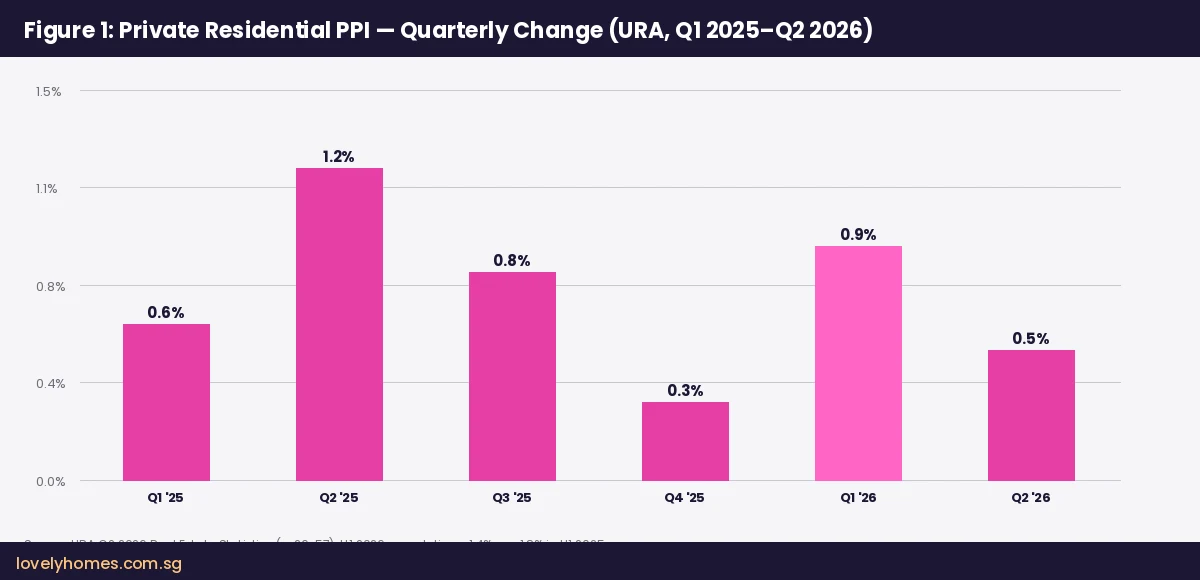
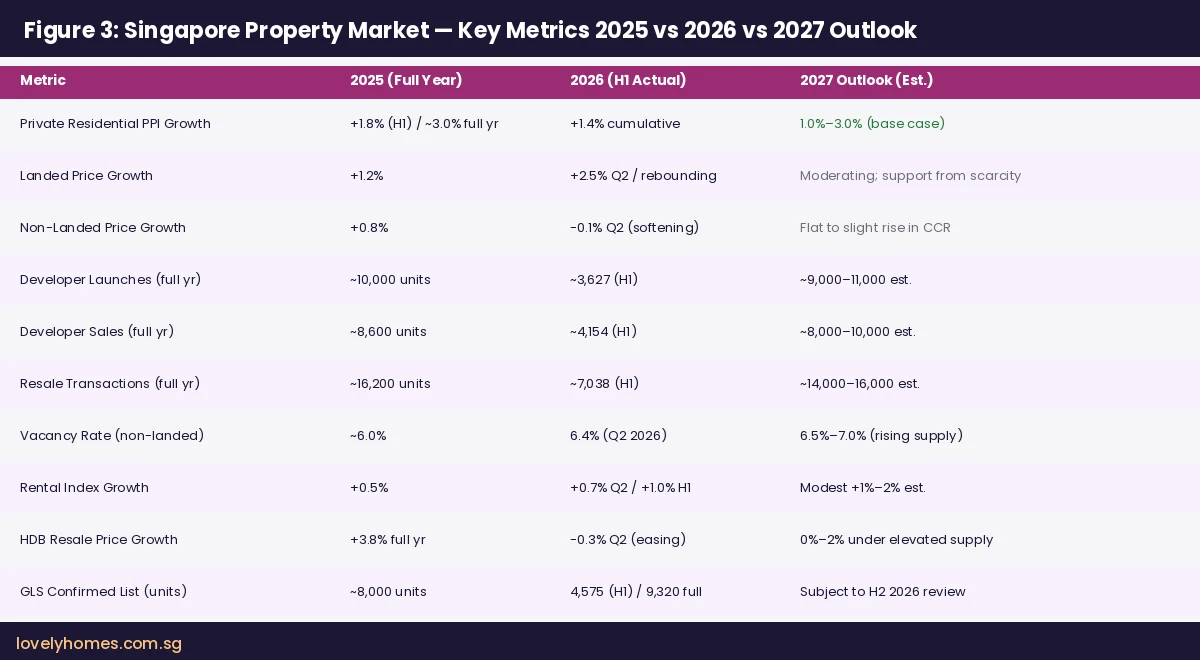
  • Private residential prices rose 0.9% QoQ and 2.63% YoY in Q1 2026, with the Outside Central Region (OCR) leading at +2.2% QoQ — price growth is positive but moderating.
  • HDB resale recorded its first quarterly dip (-0.1% QoQ) since Q2 2019; index sits at 203.4. Not a crash — more of a pause after a five-year run.
  • 2H 2026 GLS launches 9 confirmed-list sites (4,745 units), adding meaningful supply to OCR and RCR. Pricing discipline from developers is expected.
  • Key risk: interest rates remain elevated at 3.0–3.5% for bank mortgages; affordability is stretched for many first-time buyers.
  • Key catalyst: any US Federal Reserve rate cut signals would unlock significant pent-up demand — watch the September and December 2026 Fed meetings.
  • For buyers: fundamentals remain sound — Singapore’s employment is near-full, rental demand supports investment yield, and supply is finite. Timing the market is less reliable than time in the market.
  • URA Q2 2026 Flash Estimates are expected in early July 2026 and will be the next major data point.

H1 2026 in Review: Where the Singapore Property Market Stands

As the calendar turns to the second half of 2026, Singapore’s property market presents a nuanced picture. Private residential prices continued their gradual upward trajectory in Q1 2026, with the Urban Redevelopment Authority (URA) reporting a Property Price Index (PPI) increase of 0.9% quarter-on-quarter — a modest but consistent gain that extends a trend stretching back to the post-pandemic recovery that began in mid-2020. On a year-on-year basis, the private residential index is up 2.63%, a pace that is firm but well below the double-digit growth seen during the post-pandemic surge of 2021 to 2023.

The Housing Development Board’s Resale Price Index (RPI), however, told a slightly different story. At 203.4 in Q1 2026, the HDB resale market recorded a 0.1% quarterly decline — the first such dip since Q2 2019. This is not alarming in isolation: the index had surged more than 54% since its 2019 trough, and a modest pause is consistent with natural market digestion. What it does signal is that the exceptional run of HDB resale price appreciation is transitioning into a more measured phase.

Singapore property market H1 2026 key metrics scorecard URA HDB data
Figure 1: Singapore Property Market H1 2026 Key Metrics Scorecard — URA Q1 2026 Real Estate Statistics and HDB Resale Statistics.

Private Residential Market: A Three-Speed Story

The defining characteristic of Singapore’s private residential market in 2026 is regional divergence. The three planning zones administered by URA — the Core Central Region (CCR), Rest of Central Region (RCR), and Outside Central Region (OCR) — have performed at markedly different speeds in 2026.

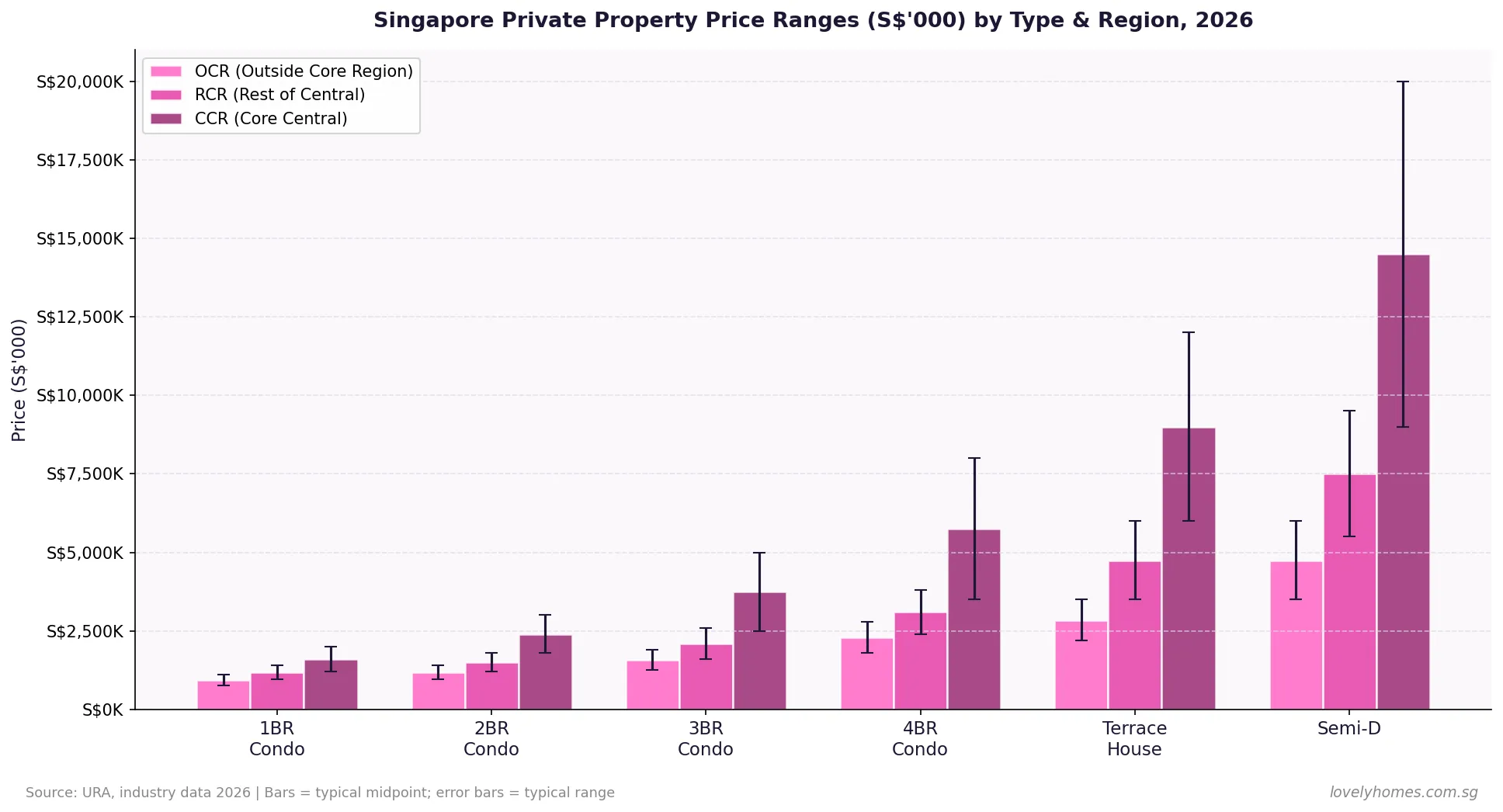
The OCR is the undisputed pace-setter. A 2.2% quarterly gain in Q1 2026, following similar momentum in late 2025, reflects genuine demand from HDB upgraders — a cohort whose Minimum Occupation Period (MOP) clears in waves and who target mass-market new launches in the S$1.3M–S$1.8M range. The 2H 2026 GLS programme deliberately concentrates supply here (Tampines Street 94, Bayshore Road), which should moderate any further sharp price acceleration without causing a price correction.

The RCR recorded 0.8% QoQ growth — solid mid-field performance driven by a mix of first-time private buyers, professionals, and some foreign-related buying in the city-fringe. River Valley Green Parcel C (awarded June 2026 at a top bid of approximately S$1,730 psf ppr) is the headline indicator of developer confidence in this zone.

The CCR grew just 0.3% QoQ, a subdued reading that reflects several headwinds: the 60% Additional Buyer’s Stamp Duty (ABSD) on foreigners that has been in place since April 2023 continues to suppress international transaction volumes; and the global macro uncertainty discussed in the risk section below has weighed on ultra-high-net-worth discretionary buying. That said, CCR is not in distress — it remains a long-term beneficiary of Singapore’s family office growth and wealth inflows.

Singapore private residential price index CCR RCR OCR Q1 2026 regional trends
Figure 2: Singapore Private Residential Price Index by Region (Q1 2020–Q1 2026) and QoQ Change for Q1 2026. Source: URA Q1 2026 Real Estate Statistics.

HDB Resale Market: A Healthy Pause, Not a Reversal

Singapore’s HDB resale market has been one of the defining investment stories of the 2020s. From a low point in 2019 (RPI ≈ 132), prices surged to an index of 203.4 by Q1 2026 — a 54% cumulative increase. The Q1 2026 dip of 0.1% QoQ is, in that context, the market catching its breath after an exceptional run rather than a structural reversal.

Two counterintuitive data points reinforce this view. First, million-dollar HDB transactions reached a record quarterly high of 412 in Q1 2026 — indicating that at the premium end of the resale market (large mature-estate flats, high-floor units in sought-after towns), demand remains fierce. Second, overall HDB resale transaction volumes for Q1 2026 remained healthy, with four-room flats accounting for the largest share (approximately 2,690 transactions in Q1 2026 alone) at a median price of around S$575,000.

For 2H 2026, the HDB resale market is likely to remain range-bound rather than sharply appreciating or correcting. MOP cohorts from the 2016–2019 BTO launches are gradually clearing, releasing units back to the resale market — but supply from this channel is relatively thin compared to the 2013–2016 peak cycle. Demand remains supported by couples who cannot access BTO (due to income ceiling, citizenship mix, or urgency) and Permanent Residents who remain ineligible to buy BTO directly.

Developer Sales and the New Launch Pipeline

Developer sales activity is the indicator most directly shaped by new launch timing. The monthly data tells a story of feast and famine: January to April 2026 saw 1,120, 895, 1,348 and 1,548 units sold respectively — solid months driven by a cluster of project launches. May 2026 crashed to 447 units (-71.1% month-on-month), not because demand evaporated, but because there were few projects launching that month.

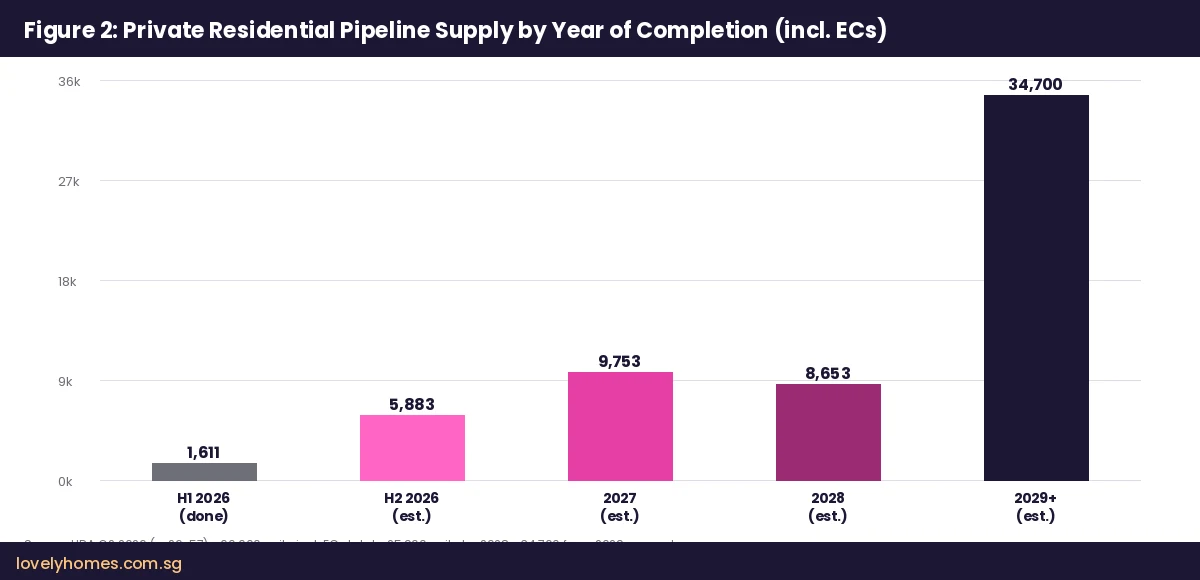
The pipeline going into 2H 2026 remains substantial. URA data shows 17,032 unsold units in the private pipeline as of Q1 2026 (total pipeline including units not yet launched: 42,561). The 2H 2026 GLS Confirmed List adds nine further sites including Lentor Gardens Parcel A and B, Bayshore Road, Tampines Street 94, and an EC site at Jurong East. These launches are phased across 2H 2026 into 2027, so the impact on completed supply will be felt primarily in 2028–2030.

Rental Market: Correction Underway, Yields Compressing

Singapore’s private residential rental market began correcting in 2024 after a record two-year surge and that correction extended into 2026. The URA rental index fell 1.2% QoQ in Q1 2026, following declines across 2024 and 2025. In absolute terms, rents remain significantly above their pre-pandemic levels — a 2BR in D15 that rented for S$2,800/month in 2019 may still command S$4,200–S$4,800/month in 2026 depending on specification — but the exceptional post-pandemic pricing has normalised.

For investors, this rental correction compresses gross yields. A S$1.5M 2BR in the RCR yielding S$4,500/month gross generates a gross yield of approximately 3.6%, which is broadly comparable to bank deposit rates in 2026. Net yield after management fees, property tax, and maintenance is lower — making the case for property investment in 2026 primarily a capital appreciation thesis rather than a pure income play.

2H 2026 Market Outlook Summary

Segment Base Case Bull Case Bear Case
Private Residential (Overall) +1%–2% for full year 2026 +3%–4% if rates ease and demand recovers Flat to -1% if global recession deepens
OCR (Mass Market) Continues outperforming; +2%–3% YoY +4%–5% with strong HDB upgrader demand Supply pressure from GLS launches moderates gains
RCR (City Fringe) Steady +1%–2% YoY +3% with new launch interest Flat if affordability ceiling is hit
CCR (Core Central) Sideways to +1%; foreign buyer ABSD drag +2%–3% if ABSD reviewed or wealth inflows surge -1%–2% if global HNW sentiment deteriorates
HDB Resale ±0.5% QoQ; range-bound in H2 +1%–2% if upgrader demand stays robust -1% if affordability stress bites flat demand
Private Rental Further -2%–4% as supply catches up Stabilises if employment influx resumes Deeper correction if expat headcount falls

Worked Example: The Chen Family — Buy in 2H 2026 or Wait?

Mr and Mrs Chen are Singapore Citizens in their early 30s. They have cleared their HDB MOP on their Bishan 4-room flat and are looking to upgrade to a 3-bedroom OCR condo. They have combined income of S$13,500 per month, CPF OA savings of S$180,000, and cash of S$120,000.

They are eyeing a 3BR at an upcoming OCR launch in Q3 2026 priced at S$1.65M. Under the ABSD SC couple remission scheme, they can purchase the new condo and claim a full refund of the 20% ABSD (S$330,000) provided they sell their HDB flat within six months of the condo purchase date.

Key numbers: BSD S$47,600 (payable from CPF); ABSD S$330,000 (cash, but refundable within six months of HDB sale); 5% cash S$82,500; legal fees ~S$5,500. Bank loan: 75% LTV = S$1,237,500 at 3.2% over 30 years → monthly repayment approximately S$5,338. TDSR = S$5,338 ÷ S$13,500 = 39.5% (PASS, under 55%). Total cash needed upfront: ~S$208,000 (cash component + ABSD float pending HDB sale).

Should they wait? If OCR prices rise another 2% by Q1 2027, the same unit would cost S$1,683,000 — an additional S$33,000. If interest rates fall 50 bps by then, monthly repayments fall by ~S$300/month. The calculus slightly favours acting when they are ready rather than trying to time the market precisely, provided the ABSD remission window can be managed. See our guide on ABSD remission for SC couples for the full rules.

What Might Come Next: Risks and Catalysts for 2H 2026

The Singapore property market operates at the intersection of domestic fundamentals (employment, wage growth, HDB upgrader cohorts) and global macro forces (US interest rates, geopolitical risk, capital flows). For the second half of 2026, both sides of that equation are in play.

Key downside risks include the persistence of elevated interest rates — if the US Federal Reserve holds rates through 2026 without cutting, Singapore bank mortgage rates (which track SORA and swap rates) will remain in the 3.0–3.5% range, keeping affordability stretched. Continued global trade disruptions from US tariff policy create a dampening effect on business investment sentiment and, indirectly, on expatriate headcounts and rental demand. China’s economic slowdown reduces the pool of Chinese-origin buyers who were historically active in the CCR.

Key upside catalysts include the prospect of Fed rate cuts in September or December 2026 — even one 25-basis-point cut would move Singapore’s forward rates and boost buyer confidence. Singapore’s own fundamentals remain strong: the unemployment rate is approximately 2.0%, wage growth is positive, and the Government’s managed-supply approach via the GLS programme means developers are not flooding the market with distressed inventory. Any relaxation of ABSD for permanent residents (which has been debated, though there is no official signal) would be an immediate CCR and RCR catalyst.

Singapore property market second half 2026 risks catalysts analysis
Figure 3: Singapore Property Market 2H 2026 — Key Risks vs Catalysts. Editorial assessment as at June 2026. Not investment advice.

Frequently Asked Questions

Will Singapore property prices drop in 2H 2026?

A broad price correction in 2H 2026 is not the base-case scenario for most analysts. Singapore’s property market is underpinned by limited land supply, robust employment, and the Government’s disciplined GLS programme which calibrates supply to demand. The most likely outcome for 2H 2026 is modest positive growth in the private residential segment (0%–2% for the full year in a base case) and range-bound movement in HDB resale. A sharp correction would require a confluence of events unlikely to materialise simultaneously: a major spike in unemployment, a severe global financial shock, and a government decision to release large additional land supply. None of these is the current outlook.

When will the URA Q2 2026 Flash Estimates be released?

Based on URA’s established release pattern, the Q2 2026 Flash Estimates for the private residential property price index are expected in the first week of July 2026 — likely 1 or 2 July. The full Q2 2026 real estate statistics (including detailed regional breakdowns, rental index, and developer sales data) typically follow approximately three to four weeks later. The flash estimate gives a preliminary QoQ price change figure; the full release provides granular transaction and rental data. LovelyHomes will publish a dedicated analysis article as soon as the data is available.

What does the HDB resale -0.1% dip in Q1 2026 actually mean for sellers?

A -0.1% quarterly change in the HDB Resale Price Index is, in practical terms, negligible. On a S$600,000 flat, it represents a S$600 notional price movement — far smaller than the typical negotiation buffer in any individual transaction. What it signals is a shift in market psychology: buyers are less willing to pay premiums above valuation (Cash-Over-Valuation, or COV), and the exceptional seller’s market conditions of 2021–2024 have normalised. Sellers should still expect good prices — the index is 54% above its 2019 trough — but they should set realistic expectations and price to comparable transactions rather than aspirationally. For guidance on reading HDB data, see our HDB Resale Price Index Guide.

Is this a good time to buy a private property in Singapore?

This depends entirely on your personal financial circumstances, intended holding period, and purpose. If you are buying for genuine owner-occupation (primary home or long-term family residence), timing the market precisely is less important than buying within your means — ensuring your TDSR is comfortable, that you have adequate cash reserves, and that your loan tenor is appropriate. If you are buying as an investment (rental yield or capital appreciation), you need to stress-test the numbers at current mortgage rates (3.0–3.5%) and assess whether the rental yield justifies the carrying cost. For a personalised assessment, consult a licensed financial adviser and a property professional. See also our Singapore Property Financing Guide for a full breakdown of LTV, TDSR, and MSR rules.

How does the 2H 2026 GLS supply affect new launch prices?

The 2H 2026 Government Land Sales Confirmed List adds nine sites capable of yielding approximately 4,745 private and EC units. This is a substantial supply injection, particularly into the OCR and RCR. In theory, more supply means developers compete harder for buyers, which moderates launch prices. In practice, Singapore developers rarely slash prices — they tend to phase launches to match demand and hold firm on pricing. The more likely outcome is that new launches in 2H 2026 are priced at modest premiums (5%–8%) to recent comparables rather than at exceptional premiums. Buyers interested in specific sites such as Lentor Gardens Parcels A and B, Bayshore Road, or Tampines Street 94 should monitor the URA tender awards and developer launch announcements as they are made throughout 2H 2026. Full details of all 2H GLS sites are in our 2H 2026 GLS Programme Guide.

What is the ABSD rate for Singapore Citizens buying a second property in 2026?

A Singapore Citizen purchasing a second residential property pays 20% ABSD on the purchase price or market value, whichever is higher. This is paid in cash (CPF cannot be used for ABSD). For SC couples who own an HDB flat, the 20% ABSD on their second private property can be refunded under the SC Couple ABSD Remission Scheme, provided the HDB flat is sold within six months of the completion of the private property purchase. The full rules are detailed in our ABSD Remission Guide and Complete ABSD Singapore 2026 Guide.

How do I track the Singapore property market between official URA releases?

Between URA quarterly releases, you can monitor real-time trends through several free sources. The URA REALIS portal (accessible via My SingPass) provides transaction-level data for private residential properties. The HDB Resale Flat Prices portal shows individual HDB transactions. SRX Property and EdgeProp Singapore publish weekly market commentaries based on caveats lodged. The Business Times Real Estate section and Channel NewsAsia Property cover major announcements and tender results. For a guide on how to interpret the data you find, see our HDB Resale Price Index Guide and CCR RCR OCR Property Guide.

Related Articles

Disclaimer: This article is for general informational purposes only and does not constitute financial, investment, or property advice. All property market data is sourced from the Urban Redevelopment Authority (URA) and Housing Development Board (HDB) official releases as at Q1 2026. Property prices, interest rates, and government policies can change — readers should refer to the latest official URA (ura.gov.sg), HDB (hdb.gov.sg), MAS (mas.gov.sg), and IRAS (iras.gov.sg) publications and consult a licensed financial adviser or property professional before making any property-related decision. Past price performance is not indicative of future results.

June 2026 BTO Results: Berlayar Rise and Lakeview Cascadia Dominate With 4.5-4.7 Times Oversubscription

June 2026 BTO Results: Berlayar Rise and Lakeview Cascadia Dominate With 4.5-4.7 Times Oversubscription

The June 2026 Build-To-Order (BTO) sales exercise closed on 24 June 2026 after five days of applications, confirming a pattern that has defined Singapore’s public housing market all year: Prime-classified projects in central and mature estates are dramatically oversubscribed, while Standard projects in the north and north-east attract softer demand — in some cases failing to reach full first-timer subscription. Here is the complete picture.

Quick Answer — June 2026 BTO Results at a Glance

  • 6,952 flats launched across 7 projects in Ang Mo Kio, Bishan, Bukit Merah, Sembawang, and Woodlands.
  • Total applications: 22,634 — overall subscription rate of 3.3 times (as at 5pm, 24 June 2026).
  • Star project: Berlayar Rise (Bukit Merah, Prime) — 8,824 applications, 4.5× oversubscribed. Nearly 40% of all applications in the exercise.
  • Runner-up: Lakeview Cascadia (Bishan, Prime) — 5,799 applications, 4.7× for certain flat types.
  • Weakest demand: Sembawang Portico and Sembawang Brook — first-timer family rates fell below 1× for all 3-room and larger flat types.
  • Singles demand surge: Woodgrove Acres (Woodlands) 2-bedroom flexi units hit 17.8× for first-timer singles.
  • More than 2,500 flats offered have wait times of three years or less under HDB’s expedited build programme.

The Full Project-by-Project Breakdown

June 2026 BTO exercise application rate by project bar chart — Berlayar Rise, Lakeview Cascadia, Woodgrove Acres, Kebun Baru, Sembawang
Figure 1: Overall application rate by project, June 2026 BTO exercise (as at 5pm, 24 June 2026). Source: HDB Singapore.
Project Town Classification Units Applications Overall Rate
Berlayar Rise Bukit Merah Prime 1,976 8,824 4.5×
Lakeview Cascadia Bishan Prime 1,221 5,799 4.7×
Woodgrove Acres Woodlands Standard ~650 ~2× (singles 17.8×)
Kebun Baru Ridge Ang Mo Kio Plus ~480 ~1.1× (3-room 2T: 22.9×)
Kebun Baru Breeze Ang Mo Kio Plus ~490 ~1.0×
Sembawang Portico Sembawang Standard ~1,060 <1× (families)
Sembawang Brook Sembawang Standard ~1,075 <1× (families)

Source: HDB. Application rates as at 5pm, 24 June 2026. Woodgrove Acres, Kebun Baru, and Sembawang project unit counts are approximate; official HDB breakdown shows total 6,952 units across all 7 projects.

Berlayar Rise: The Greater Southern Waterfront Magnet

Berlayar Rise in Bukit Merah accounted for nearly 40% of all applications in the June exercise — a remarkable concentration of demand in a single project. The draw is straightforward: this is a Prime-classified development integrated with Telok Blangah MRT station on the Circle Line, positioned squarely within the Greater Southern Waterfront (GSW) transformation precinct. Prices for 4-room flats are estimated to start from around S$580,000 — a figure that, while elevated for public housing, represents a meaningful discount to what an equivalent private resale unit in the Telok Blangah/Bukit Merah corridor would cost (typically S$1.2–1.6 million for a comparable size).

The Prime designation means buyers are subject to the standard Prime location conditions: a 10-year Minimum Occupation Period (MOP), an income ceiling of S$14,000 for families, and subsidy clawback on resale (estimated at approximately 14%, based on the precedent set by the nearby Berlayar Residences project). For buyers who can meet those conditions and want a foothold in the GSW story, Berlayar Rise offers compelling long-term value. The development sits near the future Telok Blangah market and hawker centre, and the broader GSW transformation — connecting Keppel, Harbourfront, and Pasir Panjang — is a generational urban-planning project that will unfold over the next 15–20 years.

Prime vs Plus vs Standard: A Market Verdict

June 2026 BTO units offered versus applications by Prime Plus Standard classification chart
Figure 2: Units offered vs applications by BTO classification — June 2026 exercise. Prime projects (Bukit Merah + Bishan) absorbed the majority of demand despite representing fewer units. Source: HDB.

The June 2026 results are the clearest data point yet that Singapore’s three-tier BTO classification system (Prime, Plus, Standard) is functioning broadly as intended — but with some unintended consequences at the Standard end.

Prime projects (Berlayar Rise and Lakeview Cascadia) together offered 3,197 units but attracted approximately 14,623 applications — an average rate of 4.6 times. This is precisely the outcome the Government anticipated when it introduced the classification: demand for centrally located, well-connected projects is intense, and the subsidy recovery and MOP conditions are not deterring buyers who value location above all else.

Plus projects (Kebun Baru Breeze and Ridge in Ang Mo Kio) sat at approximately 1× overall subscription for first-timer families — marginally fully subscribed, which means successful ballots are likely but not certain for this cohort. The Plus designation was designed to sit between Prime and Standard in both location quality and subsidy level, and the Ang Mo Kio projects are genuinely well-located (D20, established mature estate, near Yio Chu Kang and Ang Mo Kio MRT). The lukewarm response may reflect the Plus conditions — 6-year MOP and clawback provisions — deterring the upgrader segment that has traditionally been the main buyer of Ang Mo Kio BTO flats.

Standard projects in Sembawang fell below full subscription for families. This is consistent with the market’s verdict on northern Singapore’s accessibility: despite the upcoming Cross Island Line (CRL) timeline, Sembawang remains a long commute for most CBD workers. The two projects together offered over 2,100 units — the largest supply block in the exercise — but attracted insufficient family demand to be oversubscribed. Unsuccessful ballot applicants from more competitive projects will likely be allocated here under HDB’s concession scheme.

The Singles Story: Woodlands Breaks Records

The most striking single data point in the June exercise was Woodgrove Acres in Woodlands: 2-bedroom flexi flats — the designated flat type for first-timer singles — were 17.8 times oversubscribed. This is an extraordinary figure that reflects both the shortage of BTO supply for singles (who are restricted to 2-bedroom flexi flats) and the growing demographic weight of single-person households in Singapore. The government has been incrementally expanding singles’ eligibility for BTO housing, but the 17.8× rate suggests the supply pipeline for singles remains severely constrained relative to demand.

What This Means for BTO Applicants

For applicants who were unsuccessful in the Berlayar Rise and Lakeview Cascadia ballots, the practical options are to re-apply in the October 2026 BTO exercise (details not yet announced), consider the concession flat allocation scheme which may direct them to Sembawang, or explore the HDB resale market where wait times are zero. Resale prices in mature estates have risen, but the Enhanced CPF Housing Grant (EHG) is available for resale purchases and can offset up to S$120,000 of the purchase price for eligible first-timers.

For families considering Sembawang, the below-1× first-timer rate means that applicants in this tranche are virtually guaranteed a flat if they apply — a rare situation in the BTO context. The trade-off is location and commute time, but Sembawang does offer genuine value: 4-room BTO flats in Standard Sembawang projects are typically priced in the S$330,000–S$430,000 range, representing the lowest entry point into new public housing available anywhere in the exercise.

What Might Come Next

The October 2026 BTO exercise is expected to launch in mid-October. HDB has indicated it will continue offering at least one Prime project per exercise to maintain supply at the most competitive tier. Industry observers expect the next Prime project to be in the Queenstown or Geylang/Kallang corridor, given the land parcels currently under preparation. For the Sembawang and Woodlands Standard supply overhang, HDB may consider adjusting pricing or flat-type mix in future launches to better match demand.

Frequently Asked Questions

What happens if a BTO project is undersubscribed?

If a BTO project does not receive sufficient applications to fill all available units within a flat type during the initial application period, HDB opens unsold flats for Sale of Balance Flats (SBF) exercises or re-offers them in subsequent BTO exercises. For the Sembawang Standard projects in June 2026, HDB’s concession flat scheme may direct unsuccessful applicants from oversubscribed projects to take up these units, often with a priority queue position. Buyers who accept concession flats in less popular projects lose the right to re-ballot in the same exercise but gain a guaranteed flat allocation.

What is the subsidy clawback for Berlayar Rise (Prime)?

The exact clawback percentage for Berlayar Rise has not yet been officially confirmed by HDB, but based on the precedent of the nearby Berlayar Residences (a Prime project from the October 2025 exercise), the clawback is estimated at approximately 14% of the resale price on first resale after the 10-year MOP. This means that if you sell a Berlayar Rise flat in 2036+ at, say, S$900,000, approximately S$126,000 would be clawed back by HDB before you receive your net sale proceeds. The clawback is intended to recover some of the Prime location subsidy from sellers who benefit from the price appreciation in the GSW area. Always check the specific clawback terms in your sales agreement.

Can first-timer singles apply for Berlayar Rise or Lakeview Cascadia?

First-timer singles (aged 35 and above) may apply for 2-bedroom flexi flats in Prime and Plus projects, subject to the same income ceiling (S$7,000 per month for singles) and the additional MOP/clawback conditions. However, the quota for singles in Prime projects is limited, and competition for 2-bedroom flexi units in Prime projects is historically intense. The June 2026 exercise did not publicly disclose the singles-specific application rate for Berlayar Rise or Lakeview Cascadia, but based on past exercises, 2-bedroom flexi units in Prime projects typically see subscription rates well above 5×.

What is the Minimum Occupation Period for these projects?

The MOP varies by classification: Prime projects (Berlayar Rise, Lakeview Cascadia) have a 10-year MOP. Plus projects (Kebun Baru Breeze and Ridge in Ang Mo Kio) have a 6-year MOP. Standard projects (Woodgrove Acres, Sembawang Portico, Sembawang Brook) have the standard 5-year MOP. During the MOP, owners cannot sell the flat on the open market or rent out the entire flat. Partial renting of individual rooms is permitted after an owner has fulfilled occupation requirements. The longer MOP for Prime and Plus projects is part of the policy design to moderate speculative demand and ensure these subsidised flats serve genuine owner-occupiers over the medium term.

When will the October 2026 BTO exercise launch?

HDB typically announces each BTO exercise approximately one month before applications open. Based on the 2025–2026 schedule, the October 2026 exercise is likely to open for applications in mid-to-late October 2026, with flat details announced in mid-September 2026. LovelyHomes will cover the October 2026 BTO launch as soon as HDB releases official details. You can subscribe to HDB’s e-alerts at homes.hdb.gov.sg to be notified when new launches are announced.

Related Articles

Disclaimer: Application rates and project details are sourced from HDB Singapore (as at 5pm, 24 June 2026) and industry reporting. Figures are subject to change as HDB publishes final ballot results. Subsidy clawback estimates are indicative based on comparable projects and are not official HDB figures for Berlayar Rise. Always refer to HDB’s official flat listings and consult a licensed property agent or HDB directly before making any application or purchase decision. LovelyHomes is not affiliated with HDB or any property agency.

Singapore Condo Sinking Fund and Maintenance Fee Guide 2026: What Every Owner Needs to Know

Singapore Condo Sinking Fund and Maintenance Fee Guide 2026: What Every Owner Needs to Know

When Singaporeans talk about the monthly cost of owning a condominium, they usually quote the mortgage repayment. What often gets overlooked — until the first few months after moving in — are the maintenance fee and sinking fund levy: two mandatory monthly contributions that every strata-titled condo owner must pay to the Management Corporation Strata Title (MCST). Together, these can add S$300 to S$1,200 per month to the cost of condo ownership, and failing to pay them has real legal consequences. This guide explains exactly what these charges are, how they are set, what they pay for, and how to plan for them when buying a condo in Singapore.

Quick Answer — Condo Fees at a Glance

  • Maintenance fee: monthly contribution for day-to-day estate running costs (security, cleaning, utilities, landscaping).
  • Sinking fund levy: monthly contribution to a reserve for major capital expenditure (lift replacement, roof waterproofing, facade repainting).
  • Both are collected by the MCST, the legal body representing all owners in a strata development.
  • Contributions are set at the Annual General Meeting (AGM) based on unit share value — larger units pay more.
  • Typical total condo fee (maintenance + sinking fund): S$300–S$1,200/month, depending on development size, age, and facilities.
  • The sinking fund must be maintained at a minimum of 10% of the preceding year’s management fund under the BMSMA.
  • Non-payment can result in MCST filing a court order against the owner. There is no grace period in law.
  • Governed by the Building Maintenance and Strata Management Act (BMSMA), administered by the Commissioner of Buildings (COB) under HDB.

What Is the MCST and Who Sets the Fees?

Every strata-titled development in Singapore — from a two-unit walk-up to a 1,000-unit mega-project — is governed by a Management Corporation Strata Title (MCST). The MCST is a body corporate constituted automatically when the strata title plan is registered with the Singapore Land Authority (SLA). It has its own legal personality: it can sue, be sued, hold property, and enter contracts.

The MCST is governed by a Management Council, elected by subsidiary proprietors (owners) at the AGM. The Council sets annual budgets for two distinct funds: the Management Fund (covering day-to-day operations) and the Sinking Fund (covering capital expenditure). Individual owner contributions to each fund are proportional to their unit’s share value — an integer assigned to each lot at the time of development based on floor area and usage. A 1,500 sqft unit might have a share value of 10; a 600 sqft studio might have a share value of 5. Your monthly levy is therefore your unit’s share value divided by the total share values of all units in the development, multiplied by the total annual budget for that fund, divided by 12.

The legal framework governing all of this is the Building Maintenance and Strata Management Act (BMSMA), Cap. 30C. Key rules include: the sinking fund must hold at least 10% of the management fund budget; the MCST must prepare audited accounts annually; and owners who are in arrears can have their contribution recovered as a civil debt.

Feature Management Fund Sinking Fund
Purpose Day-to-day operations Long-term capital expenditure reserve
Examples of use Security, cleaning, gardening, utilities Lift replacement, waterproofing, facade repainting
BMSMA minimum No statutory minimum set Must equal at least 10% of management fund budget
Planning horizon Annual (reset each year) Cumulative — builds over time; does not reset
Typical monthly levy S$200–S$1,200 (varies by unit size) S$30–S$200 (10–15% of management fee)
Recoverable on sale? No — stays with MCST No — stays with MCST

Maintenance Fee — What It Covers

The maintenance fee (sometimes called the management fee or conservancy charge) finances the Management Fund, which covers the development’s recurring, day-to-day operating costs. These typically include:

Security services (24-hour guardpost, patrols, CCTV monitoring), cleaning and housekeeping of common areas, landscaping and horticultural maintenance, utility bills for common area lighting and lifts, pool and gymnasium upkeep (water treatment, equipment servicing), insurance for the building fabric and common property, property management agent fees, and routine maintenance and minor repairs. For luxury developments with concierge services, valet parking, or hotel-grade amenities, the management fund also covers these premium services — which is why fees in such projects can reach S$900+ per month for a large unit.

Monthly condo maintenance fee range by flat size Singapore 2026
Figure 1: Indicative monthly maintenance fee range by unit size — Singapore private condominium 2026. Actual amounts vary by development age, facilities, and MCST budget.
Unit Size Typical Monthly Maintenance Fee Key Variables
Studio / 1-bed (<500–700 sqft) S$150–S$380 Older projects, fewer facilities: lower end
2-bedroom (700–1,000 sqft) S$300–S$520 Most common resale condo bracket
3-bedroom (1,000–1,400 sqft) S$420–S$700 City-fringe projects with full facilities
4-bed / large unit (>1,400 sqft) S$580–S$950 CCR luxury projects at high end
Penthouse / duplex (>2,000 sqft) S$900–S$1,500+ Top-tier city projects, concierge, valet

Sinking Fund — What It Covers and Why It Matters

The sinking fund is a long-term capital reserve. Where the management fund covers ongoing operating costs, the sinking fund accumulates money for expenditure that is infrequent but extremely expensive — the kind of expenditure that cannot be funded from a single year’s management budget without creating a financial crisis for the MCST. Examples include: full lift replacement (typically every 20–25 years, S$200,000–S$500,000 per lift), external facade repainting (every 5–7 years for projects with extensive external surfaces), roof waterproofing membrane replacement, major mechanical and electrical (M&E) infrastructure overhaul, and swimming pool resurfacing.

Singapore condo MCST sinking fund expenditure breakdown pie chart 2026
Figure 2: Typical sinking fund expenditure allocation by category — Singapore MCST 2026. Proportions vary significantly by development age and building system profile.

The BMSMA requires the sinking fund to be maintained at a minimum of 10% of the preceding year’s management fund amount. In practice, well-managed MCSTs maintain a sinking fund that is a multiple of this minimum — particularly for older developments approaching major capital expenditure cycles. A prudent MCST will commission a 5-year capital expenditure plan and set sinking fund contributions accordingly. Buyers of older condos (15+ years old) should always ask for the current sinking fund balance and the 5-year capex plan before purchasing, as a depleted sinking fund may result in a special levy — a one-time extraordinary contribution demanded of all owners to fund urgent repairs.

Worked Example — Monthly Fees for a 3-Bedroom Condo in Clementi

Mr and Mrs Tan are purchasing a 1,100 sqft 3-bedroom resale condominium in Clementi (District 5) for S$1,580,000. The development has 320 units, was built in 2008, and has a shared value allocation of 8 for their unit. Total share values across all units sum to 2,240. The MCST’s annual budgets are: Management Fund S$1,680,000; Sinking Fund S$210,000.

Item Calculation Monthly Amount
Management Fund contribution (8 ÷ 2,240) × S$1,680,000 ÷ 12 S$500
Sinking Fund contribution (8 ÷ 2,240) × S$210,000 ÷ 12 S$62.50
Total monthly MCST levy S$562.50

On top of this, the Tans’ estimated monthly mortgage repayment on a bank loan of S$1,185,000 (75% LTV) at 3.5% over 25 years is approximately S$5,926. Their total monthly ownership cost is therefore approximately S$6,488. When running TDSR calculations, the bank will factor in the maintenance fee as a financial commitment — check with your mortgage adviser on how this is treated.

Total Monthly Ownership Cost — Mortgage, Maintenance and Sinking Fund

Total monthly condo ownership cost Singapore 2026 — mortgage plus maintenance fee plus sinking fund
Figure 3: Estimated total monthly cost of owning a condo at three market segments — Singapore 2026. Mortgage assumes 75% LTV, 3.5% p.a., 25-year tenure.

What Happens If You Don’t Pay?

MCST contributions are not optional. Under Section 40 of the BMSMA, unpaid contributions (whether management fund or sinking fund) are a debt recoverable by the MCST in the same way as any civil debt. The MCST can file a Magistrate’s Court claim for outstanding amounts and, if judgment is obtained, apply for enforcement including attachment of the owner’s bank accounts or garnishment of rental income. The MCST also has the right to charge interest on late contributions at a rate fixed in its by-laws (commonly 10–12% per annum).

For landlords renting out their unit, unpaid MCST contributions remain the owner’s liability — not the tenant’s. If a seller has outstanding arrears at the point of property transfer, the arrears must be settled before the strata certificate of title is transferred. In practice, the conveyancing lawyers for both sides will conduct an MCST search to confirm that no arrears exist before completion.

Checking Sinking Fund Health Before You Buy

Before committing to a resale condo purchase, particularly in an older development, always request the following from the seller’s lawyers or directly from the MCST:

The current sinking fund balance (a healthy reserve is generally more than 3× the annual sinking fund budget); the 5-year capital expenditure plan (if available — well-run MCSTs have one); any pending special levies that have been voted on at an AGM but not yet collected; and the MCST financial statements for the past two years. A development with a healthy sinking fund and a documented capital plan is significantly lower risk than one that is underfunded and approaching major lift or roof works. In the latter case, you may be buying into an imminent S$10,000–S$50,000 special levy per unit.

What This Means for Condo Buyers in 2026

Condo maintenance fees have risen materially over the past three years, driven by higher labour costs for security and cleaning personnel, increased utility tariffs, and the generally higher cost of building materials for maintenance works. Industry data suggests average maintenance fees in mass-market condos have increased by 10–20% since 2022. For buyers underwriting their total monthly cost of ownership, this trend means that the maintenance fee is no longer a rounding error — it is a genuine budget line item that deserves the same scrutiny as the mortgage rate.

For investment buyers, maintenance fees directly affect net rental yield. A S$4,500/month rental on a unit with S$600/month in MCST fees represents a net operating yield (before mortgage) of about 3.2% on a S$1.5 million purchase — meaningful compression compared to the gross yield of 3.6%. Understanding and modelling the net yield after maintenance and sinking fund is essential for any investment analysis.

What Might Come Next

The COB has been increasingly attentive to poorly managed MCSTs. In 2024, the Building and Construction Authority (BCA) and COB jointly issued updated guidance on sinking fund adequacy, pushing MCSTs toward more rigorous 5-year planning. There is also ongoing discussion in the property management industry about whether the statutory minimum sinking fund (10% of management fund) is adequate for older developments — some practitioners argue it should be raised to 15–20% for projects over 20 years old. If such a change were legislated, monthly sinking fund levies would rise accordingly. Buyers of properties approaching their 15–20 year mark should factor in this regulatory risk.

Frequently Asked Questions

Can the management fee change from year to year?

Yes. The MCST Council proposes the annual budget at each AGM, and subsidiary proprietors vote on it. If costs have risen — for example, because security guard wages have increased or a landscaping contract was renewed at a higher rate — the management fee will be adjusted upward. Conversely, if the MCST finds cost savings, fees can decrease. In practice, fees rarely decrease; they tend to rise gradually with inflation. Buyers should ask for the last three years of AGM minutes to understand the fee trajectory of any development they are considering purchasing.

What is a special levy and when can the MCST charge one?

A special levy is an extraordinary, one-time contribution that the MCST can demand from all owners to fund urgent capital expenditure that cannot be covered by the existing sinking fund balance. Special levies require approval by a resolution at a general meeting (either an AGM or an Extraordinary General Meeting). They are most common in older developments where the sinking fund is under-provisioned and a major repair (such as lift replacement or waterproofing) is overdue. Special levies can range from S$5,000 to S$50,000 per unit depending on the size of the development and the scope of work. For this reason, checking the sinking fund balance before purchasing is critical.

Do maintenance fees apply to Executive Condominiums (ECs)?

Yes. Executive Condominiums are privately managed after the 10-year mark and are subject to the same BMSMA rules as private condominiums. During the initial period when HDB retains certain oversight, the management corporation is still constituted and maintenance fees apply from the date of key collection. EC buyers should budget for maintenance fees in the same way as any private condo buyer. EC maintenance fees are often somewhat lower than comparable private condos because ECs are typically built without the premium facilities found in luxury private developments, but the difference is not dramatic for mass-market comparisons.

Can landlords pass maintenance fees on to tenants?

In Singapore’s private residential tenancy market, there is no legal prohibition on a landlord including maintenance fees in the rent (i.e., charging a gross rent inclusive of the condo fee). In practice, however, most residential leases are structured on a net basis — the landlord pays the MCST contributions from the rental income and quotes the rent as an all-in figure. Some tenancy agreements explicitly state that maintenance fees are the landlord’s responsibility. Whatever the arrangement, the legal obligation to pay the MCST remains with the owner — the MCST cannot pursue the tenant for arrears.

How does share value affect my monthly levy?

Share value is a fixed integer assigned to each lot in the strata title plan at the time of development. It is broadly proportional to floor area but is also influenced by unit type and usage. A larger unit will have a higher share value and therefore pay a proportionally higher monthly levy. Share value cannot be changed by the MCST — it is set in the strata plan lodged with SLA and can only be altered by a unanimous resolution of all subsidiary proprietors followed by an amendment to the strata plan. Before buying, you can find out a unit’s share value by requesting the strata title plan from the developer, property agent, or MCST.

Is the sinking fund transferable when I sell?

No. The sinking fund belongs to the MCST, not to any individual owner. When you sell your unit, the accumulated sinking fund contributions you have made over the years remain with the MCST for the benefit of the development as a whole. You do not receive a refund of your share of the sinking fund balance on completion of sale. This is one reason why buying into a development with a healthy, well-funded sinking fund is in your interest even if you plan to sell within a few years — the sinking fund supports the quality of the common property, which in turn supports property values.

Where can I find out the exact maintenance fee before I buy?

For new launch condominiums, the developer is required to provide an estimated monthly maintenance fee in the sales documentation. For resale condos, the actual fee is best confirmed by requesting a copy of the latest MCST notice of contribution (which sets out the monthly levy per share value) or by asking the seller’s lawyer to conduct an MCST search. The MCST search will confirm the contribution rate, any arrears on the specific unit, and the sinking fund balance. This search is a standard step in any Singapore property conveyancing and costs approximately S$150–S$200.

Related Articles

Disclaimer: This article is for general informational and educational purposes only and does not constitute legal, financial, or property management advice. MCST contribution rates, sinking fund balances, and BMSMA requirements are subject to change and vary by development. Always verify actual maintenance fees with the relevant MCST, confirm current statutory requirements with the Commissioner of Buildings (HDB Strata Management portal), and obtain independent legal and financial advice before purchasing any property. LovelyHomes is not a licensed property management, legal, or financial advisory firm.

Buyer’s Stamp Duty Singapore 2026: Complete Guide to BSD Rates, Calculation and Remissions

Buyer’s Stamp Duty Singapore 2026: Complete Guide to BSD Rates, Calculation and Remissions

Buyer’s Stamp Duty (BSD) is the foundational property transaction tax that every buyer in Singapore must pay, regardless of nationality, residency status, or how many properties they own. Unlike the Additional Buyer’s Stamp Duty (ABSD) — which targets second-and-subsequent-property buyers and foreigners — BSD is universal. Whether you are a first-time Singapore Citizen buying a public housing flat or a foreign investor acquiring a luxury penthouse, BSD applies equally. Get it wrong in your budget, and you will face an unexpected six-figure bill at the point of signing.

This guide covers everything you need to know about BSD in 2026: the current rates, exactly how the duty is calculated, what is included in the taxable base, how it differs from ABSD, and the complete picture of stamp duty costs for different buyer profiles. All rates reflect the framework introduced on 15 February 2023 for residential property and remain in force as at the date of publication. For official confirmation, always consult the IRAS Stamp Duty for Property page.

Quick Answer — BSD at a Glance

  • BSD applies to every buyer — Citizens, PRs, foreigners, companies, and trusts alike.
  • Residential rates: 1% → 2% → 3% → 4% → 5% → 6% in progressive tiers (w.e.f. 15 Feb 2023).
  • Non-residential rates: 1% → 2% → 3% (simpler three-tier structure, w.e.f. 20 Feb 2018).
  • Taxable base is the higher of the purchase price or the property’s open market value.
  • BSD must be paid within 14 days of signing the Option to Purchase (OTP) or Sale & Purchase Agreement.
  • BSD for a S$1.5 million condo: S$44,600 (effective rate: 2.97%).
  • BSD for a S$3 million condo: S$109,600 (effective rate: 3.65%).
  • BSD is administered by the Inland Revenue Authority of Singapore (IRAS).

What Is BSD and Why Does It Exist?

Buyer’s Stamp Duty is a documentary tax levied on instruments related to the purchase of property in Singapore. It has existed in Singapore law since the country was a British colony and is codified in the Stamp Duties Act (Cap. 312), administered by IRAS. In contrast to ABSD — which was introduced in December 2011 purely as a demand-management cooling measure — BSD is a revenue instrument: it is part of Singapore’s general tax base and applies to virtually all property acquisitions, not just speculative or investment-driven ones.

BSD was most recently restructured for residential property on 15 February 2023, when the Government added two new upper tiers (5% and 6%) targeting high-value transactions above S$1.5 million and S$3 million respectively. Prior to that, the top residential rate was 4%. The change was targeted at luxury-end transactions and was announced alongside the same cooling-measure package that raised ABSD rates significantly. You can read about the full cooling-measures context in our ABSD Singapore 2026 Complete Guide.

BSD Rates for Residential Property in Singapore (2026)

The current residential BSD rate schedule is progressive, meaning each tier applies only to the portion of the purchase price (or market value, if higher) that falls within that band. The table below sets out the tiers in full.

Singapore BSD rate by price tier 2026 bar chart — 1% to 6% progressive
Figure 1: BSD rate by purchase-price tier for residential property — effective 15 February 2023. Source: IRAS Singapore.
Purchase Price (or Market Value) Tier BSD Rate Maximum BSD from This Tier
First S$180,000 1% S$1,800
Next S$180,000 2% S$3,600
Next S$640,000 3% S$19,200
Next S$500,000 4% S$20,000
Next S$1,500,000 5% S$75,000
Amount exceeding S$3,000,000 6% Uncapped

Source: IRAS Singapore. Rates effective 15 February 2023.

The cumulative BSD cap for a S$3 million property — the last tier before the 6% rate kicks in — is S$109,600. For every dollar above S$3 million, the marginal BSD rate is 6%. A S$5 million property, for instance, attracts BSD of S$109,600 + 6% × S$2,000,000 = S$229,600.

BSD for Non-Residential Property (Industrial, Commercial, Mixed-Use)

Non-residential property — offices, shops, industrial units, mixed-use strata titles, and HDB shophouses — attracts a simpler three-tier BSD structure that has been in place since 20 February 2018.

Purchase Price Tier BSD Rate
First S$180,000 1%
Next S$180,000 2%
Amount exceeding S$360,000 3%

Non-residential BSD is therefore considerably less progressive than its residential counterpart. A S$2 million commercial unit attracts BSD of: 1% × S$180,000 + 2% × S$180,000 + 3% × S$1,640,000 = S$1,800 + S$3,600 + S$49,200 = S$54,600 — compared to S$64,600 for a residential property at the same price. Notably, non-residential property is exempt from ABSD, making it an important consideration for investors who have already consumed their ABSD-free residential quota.

How BSD Is Calculated — Step by Step

BSD is calculated on a progressive basis, applying each tier’s rate only to the portion of value that falls within that band. The taxable base is the higher of the agreed purchase price and the property’s open market value as assessed by IRAS. In practice, for arm’s-length transactions, these figures are usually the same. Where a buyer acquires at below market value — for example, from a related party — IRAS will assess BSD on the market value.

BSD payable and effective rate at key purchase prices Singapore 2026
Figure 2: BSD payable (bars, left axis) and effective BSD rate (line, right axis) at six key purchase prices — Singapore residential property 2026.

The chart above illustrates a key feature of BSD’s progressive structure: the effective rate (total BSD as a percentage of purchase price) rises gradually but never reaches the 6% marginal rate. Even at S$5 million, the effective rate is approximately 4.6%. This distinguishes BSD from ABSD, where — for a foreigner — the entire purchase price is taxed at a flat 60%.

Worked Example — S$1,580,000 Resale Condominium

Mr and Mrs Lim are Singapore Citizens purchasing a resale 3-bedroom condominium in Clementi for S$1,580,000 as their first property. Here is the full BSD calculation:

Price Tier Tier Limit Rate BSD for This Tier
First S$180,000 1% S$1,800
Second S$180,000 2% S$3,600
Third S$640,000 3% S$19,200
Fourth S$500,000 4% S$20,000
Fifth S$80,000 (remaining) 5% S$4,000
Total BSD S$1,580,000 Effective 3.04% S$48,600

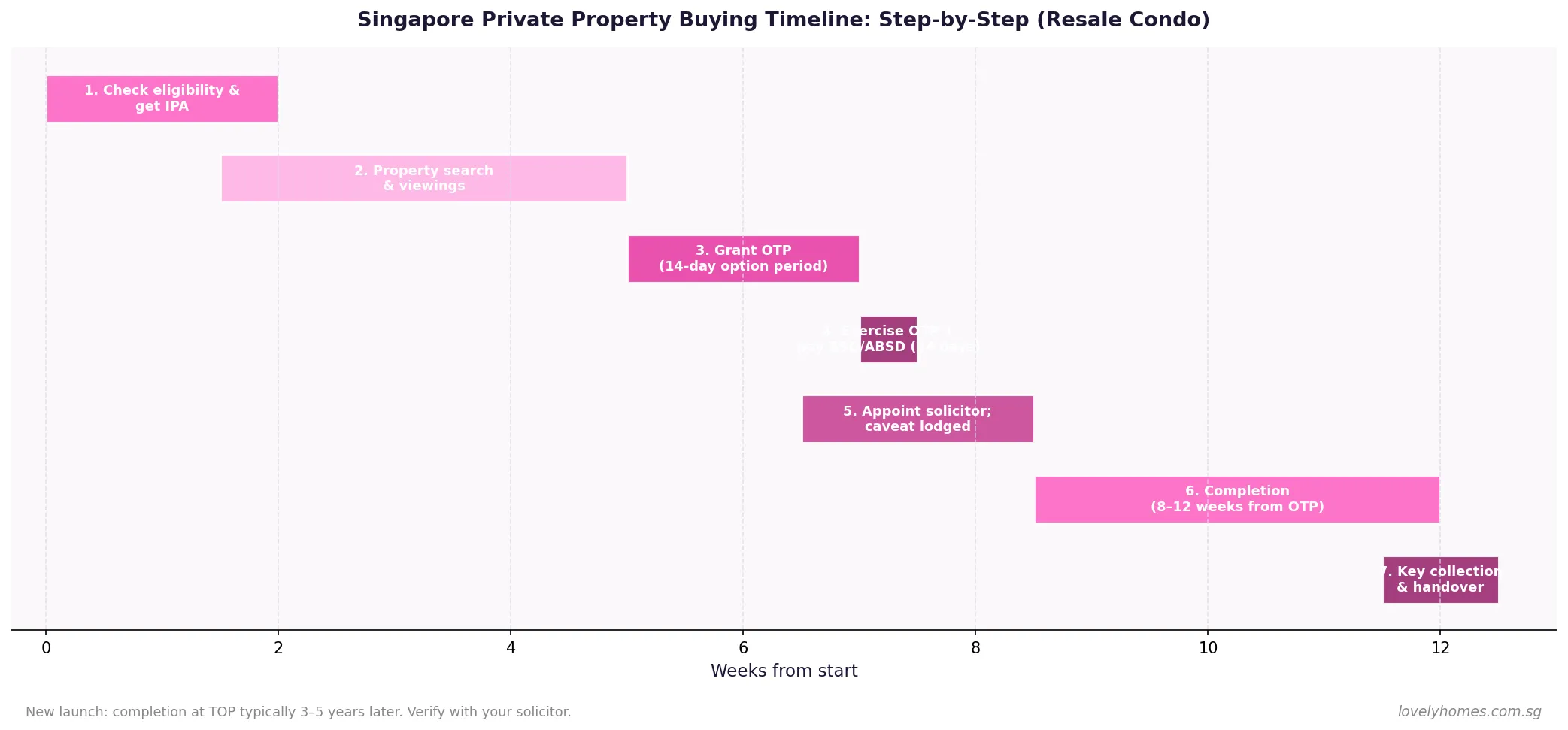
Since this is the Lims’ first residential property and both are Singapore Citizens, their ABSD is S$0. Their total stamp duty outlay is therefore S$48,600. This must be paid within 14 days of exercising the OTP. BSD is typically paid via IRAS’s myTax Portal (e-Stamping). Their lawyer will ordinarily manage this on their behalf as part of the conveyancing process.

If this were instead the Lims’ second residential property, they would also owe ABSD at 20% × S$1,580,000 = S$316,000, bringing total stamp duty to S$364,600. The BSD component is identical regardless of how many properties they own.

BSD vs ABSD — Understanding the Key Difference

BSD and ABSD are two distinct taxes that can apply simultaneously to the same transaction. The confusion between them is understandable — both are calculated as a percentage of the purchase price and both are paid to IRAS — but they serve entirely different purposes and have very different rate structures.

BSD versus ABSD comparison Singapore citizen buying second property 2026 bar chart
Figure 3: BSD (universal) vs ABSD at 20% (SC buying a second property) at key purchase prices — Singapore 2026.
Feature Buyer’s Stamp Duty (BSD) Additional Buyer’s Stamp Duty (ABSD)
Who pays? All buyers Selected profiles only (see ABSD guide)
Policy purpose Revenue instrument (general tax) Demand-management cooling measure
Rate structure Progressive (1–6%) Flat rate on full purchase price (0–65%)
Maximum rate 6% (marginal, above S$3M) 65% (entities & trusts)
Remissions available? Very limited (developer builds only) Yes — married SC/SPR upgrader, developers, etc.
Applies to HDB? Yes Yes (but HDB buyers are usually SC 1st-timers at 0%)
Non-residential? Yes (1%/2%/3% structure) No — ABSD does not apply to non-residential

The practical upshot: for most Singapore Citizens buying their first property, BSD is the only stamp duty they pay. For all other buyer profiles — PRs, foreigners, second-time and subsequent Singapore Citizen buyers, and entities — both BSD and ABSD apply simultaneously. To model your full stamp duty liability, use our ABSD Complete Guide, which includes full worked scenarios for every buyer profile.

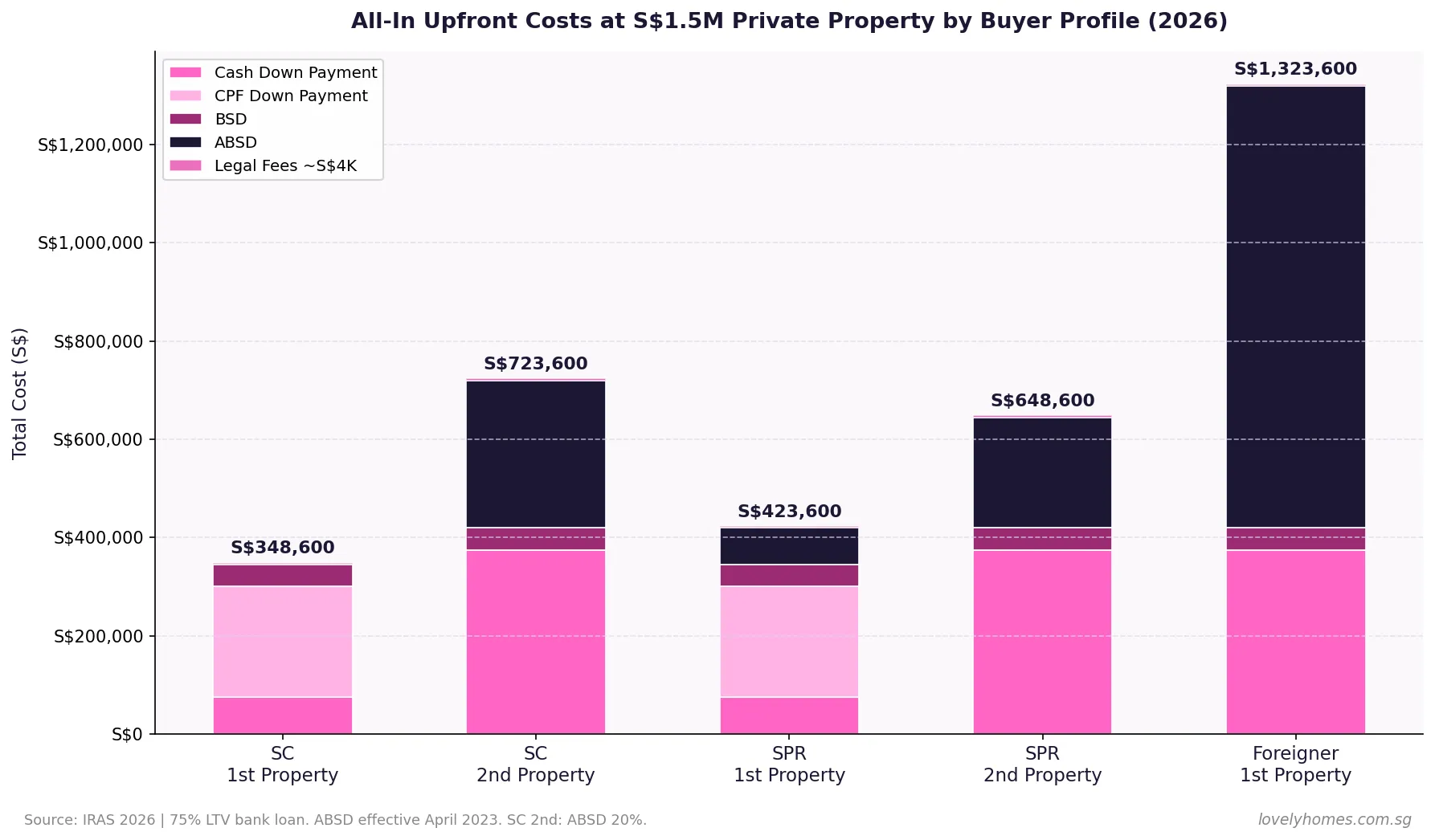
Total Stamp Duty by Buyer Profile — S$1.5 Million Residential Property

Buyer Profile BSD ABSD Rate ABSD Amount Total Stamp Duty
SC — 1st property S$44,600 0% S$0 S$44,600
SC — 2nd property S$44,600 20% S$300,000 S$344,600
SC — 3rd+ property S$44,600 30% S$450,000 S$494,600
SPR — 1st property S$44,600 5% S$75,000 S$119,600
SPR — 2nd+ property S$44,600 30% S$450,000 S$494,600
Foreigner — any property S$44,600 60% S$900,000 S$944,600
Entity / Trust S$44,600 65% S$975,000 S$1,019,600

BSD = S$44,600 on S$1.5M (1%×S$180k + 2%×S$180k + 3%×S$640k + 4%×S$500k). ABSD rates: 27 April 2023 framework. SC = Singapore Citizen; SPR = Singapore Permanent Resident.

When and How to Pay BSD

BSD must be paid within 14 days of signing the instrument that triggers the liability. For private residential property, the trigger is typically the Option to Purchase (OTP) or, if no OTP is issued, the Sale and Purchase Agreement (S&P). For HDB flats, the trigger is the signing of the HDB Agreement for Lease.

Payment is made through IRAS’s e-Stamping Portal (accessible via myTax Portal). In practice, your conveyancing lawyer will handle the stamping on your behalf as part of the standard legal process. The stamp certificate is generated electronically and must be produced at completion. Late payment attracts penalties of up to 4× the duty payable under Section 46 of the Stamp Duties Act.

BSD Remissions and Exemptions

Unlike ABSD, BSD has very limited remission provisions. The most relevant situations where BSD may not apply in full are:

Developer remissions for building residential property: Property developers who purchase residential land or existing residential property for the purpose of constructing and selling new residential units may apply to IRAS for BSD remission. This is a specific commercial exception designed to avoid double taxation in the development chain — it does not apply to individual buyers.

Transfers between spouses and immediate family members: The Stamp Duties Act provides for concessionary treatment in limited intra-family transfers, but these are narrow and do not eliminate BSD — they may affect the valuation base or trigger date. Consult a property lawyer before relying on any such arrangement.

HDB Resale Levy and BSD interaction: BSD applies normally to HDB resale flat purchases. There is no interaction between the HDB Resale Levy and BSD — they are entirely separate obligations.

In short: for the vast majority of buyers, there are no BSD remissions. Budget for BSD in full.

What BSD Means for Buyers in 2026

BSD’s restructuring in February 2023 materially increased the cost of high-value acquisitions. A buyer of a S$3 million property now pays S$109,600 in BSD alone — up from S$74,600 under the pre-February 2023 structure, a S$35,000 increase. For S$5 million properties, the increase is S$65,000. These are meaningful sums that affect both the budgeting and the financing of such transactions.

In the broader context of property affordability, BSD at the sub-S$1.5 million residential price range — where most HDB upgraders and first-time private property buyers transact — is relatively modest: S$44,600 on S$1.5 million is 2.97% of the purchase price. The real pinch of Singapore’s stamp duty system comes from ABSD, not BSD. For buyers planning their first property purchase with CPF Housing Grants and a bank loan, BSD is a known, budgetable cost that fits within standard conveyancing estimates.

Singapore’s BSD structure compares favourably with many comparable jurisdictions. Hong Kong charges a flat-rate stamp duty of up to 15% for non-first-time buyers. Australia’s stamp duty is state-based and can reach 5–6% of property value at lower price points. Singapore’s progressive structure, where the 6% rate only applies to the marginal amount above S$3 million, is notably more buyer-friendly at the S$1–2 million range where most transactions occur.

What Might Come Next

BSD rates for residential property have been adjusted three times in the past decade (2018, 2021, and 2023). Each adjustment has moved in one direction: upward, particularly at the high end of the market. If the Government continues its stated objective of moderating luxury segment demand and narrowing the wealth-effects gap between high-end and mass-market property, further BSD increases above S$3 million cannot be ruled out.

Conversely, at the sub-S$1.5 million end — where most owner-occupier transactions occur — there is no political appetite to raise BSD, given the Government’s ongoing commitment to ensuring that public and private housing remains accessible to ordinary Singaporeans. Any future BSD changes are therefore likely to be targeted at the top of the market only. As always, changes to stamp duty rates take effect immediately on the date of announcement and apply to all OTPs granted on or after that date.

Frequently Asked Questions

Does BSD apply to HDB flat purchases?

Yes. BSD applies to all residential property purchases in Singapore, including HDB resale flats, BTO flats (on the Agreement for Lease), and Executive Condominium units. There is no HDB exemption from BSD. For a typical 4-room resale flat at S$550,000, BSD would be: 1%×S$180k + 2%×S$180k + 3%×S$190k = S$1,800 + S$3,600 + S$5,700 = S$11,100.

Is BSD the same as ABSD?

No. They are two separate taxes paid to IRAS on the same transaction. BSD is universal (all buyers, all properties) and progressive (1–6%). ABSD is a surcharge that applies only to selected buyer profiles — foreigners, entities, PRs buying a first property, and all buyers from their second property onward — and is charged as a flat rate on the entire purchase price. You always pay BSD; you only pay ABSD if your buyer profile attracts it. See our ABSD Singapore 2026 Guide for the full rate schedule.

Can BSD be paid using CPF?

Yes, BSD can be paid from your CPF Ordinary Account (OA) for HDB flat purchases. For private residential property, CPF OA funds can also be used to pay BSD, but only after meeting the CPF Minimum Sum requirements and subject to CPF withdrawal limits. In practice, many buyers use cash for stamp duties to preserve their CPF balance for the monthly mortgage servicing — consult your financial planner or mortgage adviser on the optimal approach.

What happens if BSD is paid late?

Under Section 46 of the Stamp Duties Act, late payment penalties are substantial. The penalty is a multiple of the duty payable, depending on the length of the delay: one to three times the duty for delays up to six months, and up to four times for longer delays. In extreme cases, IRAS has the power to seek a court order to enforce payment. In practice, your conveyancing lawyer will ensure that BSD is stamped within the 14-day window. Late stamping almost always results from buyers attempting to handle the stamping themselves without legal assistance.

Does BSD apply to the purchase of a share in a property?

Yes. Where a buyer acquires a fractional share in a property — for example, a 50% interest in a jointly owned private property — BSD is calculated on the proportionate market value of the property that corresponds to the share being acquired. The progressive BSD tiers apply to the full market value of the underlying property first, and the resulting duty is then apportioned to the share acquired. This means the effective BSD rate on a 50% share of a S$2 million property is calculated as if the full S$2 million were the taxable base, then halved — not calculated on S$1 million at a lower tier. IRAS guidance on this is set out in their e-Stamping FAQ.

Is BSD refundable if the sale falls through?

BSD that has been paid on a stamped instrument is generally not refundable if the sale subsequently fails to complete. However, if the instrument itself is rescinded before it takes legal effect — for example, if the OTP lapses without exercise — and the buyer can demonstrate to IRAS that no property changed hands, a refund application under Section 22 of the Stamp Duties Act may be possible. The application must be made within six months of the date of the instrument. IRAS assesses each case on its facts. Always take legal advice before assuming a refund is available.

Do foreign buyers in Singapore pay more BSD than locals?

No. BSD rates are identical for all buyers regardless of nationality or residency status. A Singapore Citizen and a foreign national buying the same S$2 million property both pay exactly the same BSD — S$64,600. The difference in overall stamp duty cost arises entirely from ABSD, which for a foreigner is 60% of the purchase price (S$1,200,000 on a S$2M purchase) versus 0% for a Singapore Citizen buying their first home. This is why total stamp duty for a foreigner buying a S$2 million property (S$1,264,600) is dramatically higher than for a first-time SC buyer (S$64,600).

Related Articles

Disclaimer: This article is for general informational purposes only and does not constitute tax, legal, or financial advice. BSD rates and payment rules are governed by the Stamp Duties Act and IRAS administrative guidelines, which may be amended at any time. Always refer to the IRAS official website for the most current rates and verify your stamp duty liability with a licensed conveyancing lawyer or property tax adviser before transacting. LovelyHomes is not a licensed tax or legal advisory firm.

HDB CPF Housing Grant Guide 2026: EHG, Family Grant, Step-Up, PHG and Singles Grant Explained

HDB CPF Housing Grant Guide 2026: EHG, Family Grant, Step-Up, PHG and Singles Grant Explained

×

Click outside or press Esc to close

For most Singaporeans, the CPF Housing Grant system is the single most valuable financial lever available when buying an HDB flat. The right grant — or combination of grants — can reduce the purchase price by S$30,000 to S$160,000 and cut the cash outlay needed at the point of sale dramatically. Yet many buyers remain unclear about which grants they qualify for, how the grants interact, and what happens when eligibility conditions change before completion. This guide covers every HDB CPF Housing Grant available in 2026: the Enhanced CPF Housing Grant (EHG), Family Grant, Step-Up CPF Housing Grant, Proximity Housing Grant (PHG), and the Singles Grant — with full eligibility tables, income ceiling rules, and a worked example.

Quick Answer — HDB Grants at a Glance (2026)

  • The Enhanced CPF Housing Grant (EHG) provides up to S$80,000 for first-timer SC couples buying BTO or resale flats (income ceiling S$9,000/mth).
  • The Family Grant provides S$80,000 (SC couple, BTO) to S$50,000 (resale), on top of EHG — making combined grants up to S$160,000 for qualifying couples.
  • The Step-Up CPF Housing Grant gives second-timer SC families S$15,000 towards a 4-room or smaller BTO flat.
  • The Proximity Housing Grant (PHG) provides S$30,000 (living with) or S$20,000 (living near) parents or child — for resale buyers.
  • The Singles Grant gives eligible single SC applicants aged ≥35 up to S$25,000 towards a resale flat or S$25,000 for a 2-room BTO.
  • All grants are administered by HDB and applied via the HDB Flat Portal (homes.hdb.gov.sg) — not through the CPF Board directly.
  • Grants offset the purchase price and reduce the HDB loan quantum required; they are not paid in cash to the buyer.

What Are HDB CPF Housing Grants and Who Administers Them?

HDB CPF Housing Grants are subsidies provided by the Housing and Development Board (HDB) under Singapore’s public housing policy. Despite the “CPF” label, the grants are designed and administered entirely by HDB; the Central Provident Fund (CPF) Board plays a secondary role in that CPF Ordinary Account (OA) savings may be used to fund the portion of the flat price not covered by grants. The grants exist because HDB’s policy mandate — set by the Ministry of National Development (MND) — is to ensure that public housing remains affordable across a wide income range. Grants are structured to taper off as household income rises, so they provide the greatest assistance to lower-income first-time buyers.

Importantly, grants are credited directly to reduce the flat’s purchase price or loan quantum — they are never paid to buyers in cash. This means they reduce the amount you borrow (and therefore the interest you pay over the loan tenure) rather than arriving as a lump sum in your bank account. Understanding this distinction is critical when doing upfront cost planning.

Grant Amounts by Household Income — EHG and Family Grant

HDB CPF Housing Grant EHG and Family Grant amounts by household income 2026
Figure 1: Enhanced CPF Housing Grant (EHG) and Family Grant amounts by average household income — HDB BTO, SC couple first-timer, 2026. Source: HDB.

The EHG is the largest single grant available and applies across a wide income spectrum. Its key feature is that the grant amount decreases as income rises, in S$5,000–S$10,000 steps, from a maximum of S$80,000 for couples earning S$1,500 per month or less, stepping down to S$5,000 for couples earning between S$8,500 and S$9,000 per month. Couples with a gross monthly income above S$9,000 do not qualify for the EHG. Importantly, “household income” for grant purposes is the average gross monthly income of all working persons listed on the flat application, typically the two applicants and any occupants who are working.

Grant Eligibility Matrix — Who Qualifies for What

HDB CPF Housing Grant eligibility matrix 2026 — EHG Family Grant Step-Up PHG Singles
Figure 2: HDB CPF Housing Grant eligibility matrix — key buyer profiles versus grant type (2026). Source: HDB Grant Guide.

The matrix above illustrates how grants are layered across buyer profiles. An SC couple buying a BTO as first-timers can potentially stack the EHG (up to S$80,000) and the Family Grant (S$80,000), for a combined S$160,000 grant — the maximum available under any HDB grant combination. SC/SPR mixed-citizenship couples receive the Family Grant at a lower quantum (S$60,000 for BTO; S$50,000 for resale) and are eligible for the EHG, but at the EHG rate applicable to the SPR-tier income rules. Singles aged 35 and above receive a dedicated Singles Grant and are eligible for a scaled-down EHG.

Deep Dive: The Five Main HDB Grants in 2026

1. Enhanced CPF Housing Grant (EHG)

The EHG replaced the Additional CPF Housing Grant (AHG) and Special CPF Housing Grant (SHG) in September 2019. It is the most broadly applicable grant and covers both BTO and resale applications. Key conditions include: both applicants must have worked continuously for at least 12 months before the application date; the flat must not exceed a purchase price ceiling (for resale, the flat must be valued within the HDB resale price cap for the flat type and town); and applicants must not currently own or have disposed of private residential property within 30 months of application. The EHG applies regardless of flat type or location — a unique feature distinguishing it from the old SHG, which was restricted to non-mature estates.

2. Family Grant (BTO and Resale)

The Family Grant is citizenship-tiered and applies on top of the EHG. For SC-SC couples purchasing a new BTO flat, the Family Grant is S$80,000 regardless of income (subject to the S$14,000/mth income ceiling). For SC-SPR couples, the BTO Family Grant is S$60,000. For resale purchases, the quantum is S$50,000 (SC-SC) or S$40,000 (SC-SPR). The Family Grant can also be claimed by first-timer applicants who are singles applying under the Joint Singles Scheme, though the quantum is halved. There is no separate income ceiling for the Family Grant beyond the general resale/BTO eligibility income ceiling of S$14,000 per month gross household income.

3. Step-Up CPF Housing Grant

The Step-Up Grant is specifically for second-timer SC families — meaning applicants who previously owned or occupied an HDB flat, received a housing subsidy (including previous BTO application grant), or are currently living in a subsidised rental flat. The grant amount is S$15,000 and applies only to the purchase of a 4-room or smaller BTO flat. It is HDB’s way of facilitating the upgrading or right-sizing journey for mature families, while channelling the most significant grants to genuine first-timers. The income ceiling is S$7,000 per month.

4. Proximity Housing Grant (PHG)

The PHG is unique in that it is available for resale flat purchases only — it does not apply to BTO. It rewards buyers who choose to live near their parents or adult children. The quantum is S$30,000 if you buy a resale flat to live with parents or an unmarried child, and S$20,000 if you buy within 4 km of parents or a married child’s home. PHG can be combined with the EHG and Family Grant for resale purchases, making it a powerful stacking grant for families with a proximity reason to choose resale over BTO. There is no income ceiling for the PHG — it is available across all income levels subject to basic HDB eligibility.

5. Singles Grant

The Singles Grant is available to SC singles aged 35 and above applying for a 2-Room Flexi BTO flat or a resale flat. The quantum is S$25,000 for resale (4-room or smaller) and a scaled-down EHG for 2-Room Flexi BTO applications. Since January 2024, singles have been able to apply for 4-room resale flats (previously restricted to 5-room or smaller), broadening the effective pool. Singles who subsequently marry and upgrade to a larger flat may be treated as first-timers for the purposes of the EHG and Family Grant, subject to HDB’s conditions at the time of the subsequent purchase.

Summary Table — 2026 HDB Grant Quantum at a Glance

Grant Max Quantum Income Ceiling BTO / Resale
Enhanced CPF Housing Grant (EHG) S$80,000 S$9,000/mth Both
Family Grant (SC couple, BTO) S$80,000 S$14,000/mth BTO
Family Grant (SC couple, Resale) S$50,000 S$14,000/mth Resale
Family Grant (SC+SPR, BTO) S$60,000 S$14,000/mth BTO
Step-Up CPF Housing Grant S$15,000 S$7,000/mth BTO (4-room or smaller)
Proximity Housing Grant — With S$30,000 No ceiling Resale only
Proximity Housing Grant — Near S$20,000 No ceiling Resale only
Singles Grant (Resale) S$25,000 S$7,000/mth Resale (4-room or smaller)

Grant Impact on Upfront Cost — Three Worked Scenarios

HDB grant impact on upfront cost before and after grants BTO resale 2026
Figure 3: Illustrative upfront cost (downpayment + BSD) before and after applying maximum available grants — three buyer scenarios (2026). Source: LovelyHomes estimates based on HDB data.

Scenario A — BTO 4-Room, SC Couple, S$9,000/mth household income: A 4-room BTO flat in a non-mature estate at S$420,000. Gross monthly income is S$9,000 — at the EHG ceiling, so EHG is S$5,000. Family Grant (BTO, SC couple) is S$80,000. Total grants: S$85,000. Adjusted purchase price for grant purposes: S$335,000. 10% downpayment (HDB loan): S$33,500 cash/CPF. BSD on S$335,000: S$5,350. Estimated upfront: ~S$38,850. Without grants: 10% of S$420,000 = S$42,000 + BSD S$6,900 = ~S$48,900. Grant saving: ~S$10,050 in upfront costs, plus S$85,000 reduction in loan principal.

Scenario B — Resale 4-Room, SC+SPR Couple, S$6,000/mth income: Resale flat at S$560,000. EHG at S$6,000 income = S$35,000; Family Grant (resale, SC+SPR) = S$40,000; PHG (living near parents) = S$20,000. Total grants: S$95,000. Adjusted price: S$465,000. 25% downpayment (bank loan): S$116,250. BSD on S$560,000: S$12,200. Upfront: ~S$128,450. Without grants: 25% of S$560,000 = S$140,000 + BSD S$12,200 = ~S$152,200. Grant saving upfront: ~S$23,750 — largely via reduced loan principal.

Scenario C — Single SC, Aged 38, Resale 4-Room, S$5,000/mth income: Resale flat at S$380,000. Singles Grant: S$25,000. EHG (single, S$5,000 income) = S$40,000. Total: S$65,000. Adjusted price: S$315,000. HDB loan 90% LTV: S$283,500; 10% downpayment cash/CPF: S$31,500. BSD on S$380,000: S$6,300. Upfront: ~S$37,800. Without grants: S$38,000 + S$6,300 = ~S$44,300.

Common Pitfalls and Misconceptions

The most common misconception is that HDB grants are paid out as cash. They are not — they reduce the assessed purchase price or outstanding loan, so the benefit is realised over the loan tenure (less interest) rather than immediately. A second common error is failing to check whether either applicant has previously received a housing subsidy. Any prior CPF Housing Grant, AHG, SHG, or EHG will classify you as a “second-timer” for certain grants, which can significantly reduce your eligible quantum. Third, buyers sometimes conflate the EHG income ceiling (S$9,000/mth) with the general HDB eligibility income ceiling (S$14,000/mth for families; S$7,000/mth for singles buying new 2-room BTO). These are separate thresholds — you can be eligible to buy an HDB flat but not eligible for the EHG if your income exceeds S$9,000/mth.

What Might Change — HDB Grant Policy Outlook (2026–2028)

Editorial analysis — not financial advice or a government forecast. Grant amounts have been periodically revised upward since the EHG’s introduction in 2019 to keep pace with rising HDB resale prices. Given that median resale prices have risen materially since 2021, there is broad industry expectation that the income ceilings and/or grant quanta will be reviewed again in either the FY2026 or FY2027 Budget. The Singles Grant was enhanced in January 2024 to allow 4-room resale access; further extension to cover 5-room flats remains a periodic policy discussion. The PHG’s absence from BTO purchases is another area where advocacy groups have sought extension, particularly for couples who choose resale specifically for proximity to elderly parents.

Frequently Asked Questions

Can I get both the EHG and the Family Grant at the same time?
Yes — the EHG and Family Grant are designed to be stacked. A first-timer SC couple buying a BTO flat can receive both grants simultaneously, for a combined maximum of S$160,000 (S$80,000 EHG + S$80,000 Family Grant) if their household income is S$1,500 per month or below. For most couples in the S$6,000–S$9,000 income range, the combined grant will be in the S$95,000–S$130,000 range. For resale purchases, the EHG (up to S$80,000) and Family Grant (up to S$50,000 for SC-SC couples) can similarly be stacked, and the Proximity Housing Grant can be added on top if proximity conditions are met.
What counts as “household income” for grant eligibility?
HDB uses the “average gross monthly household income” over the 12 months before your HDB application as the reference figure. This includes the gross income of all applicants and any listed occupants who are working. Income from employment (salary, allowances, commissions) and self-employment is included. CPF contributions, rental income from existing property, and investment returns are generally excluded. If one applicant is unemployed, their income is counted as S$0 for averaging purposes — which can actually raise grant eligibility for some couples where only one partner works.
Can permanent residents (SPRs) receive HDB grants?
SPRs cannot receive HDB grants in their own right — grants are tied to Singapore Citizenship status. However, in a SC-SPR couple, the SC spouse’s citizenship status makes the household eligible for the Family Grant (at the SC+SPR quantum: S$60,000 for BTO, S$40,000 for resale) and the EHG. The PHG and Step-Up Grant are also available to SC-SPR couples. Couples where both applicants are SPR receive no CPF Housing Grants and must pay full market price for their HDB flat.
What happens to the grant if I sell the flat within the Minimum Occupation Period (MOP)?
Selling an HDB flat before meeting the Minimum Occupation Period (MOP — typically 5 years for standard BTO/resale, 10 years for Prime/Plus location BTO flats purchased on or after the new classification framework) is not permitted. If you are forced to sell due to approved exceptional circumstances before MOP, HDB may claw back the grant amount. After the MOP, you retain the benefit of the grant — but you will not be eligible for further CPF Housing Grants on your next HDB purchase if you have already been classified as a second-timer.
Does the Proximity Housing Grant apply if I buy near a sibling rather than a parent?
No — the Proximity Housing Grant (PHG) applies only to proximity with parents or an unmarried child living with you, or proximity to a married child’s home. Siblings, grandparents, aunts, uncles, or other relatives are not eligible as the proximity anchor. The “living with” condition means the parents are registered as occupants of the flat you purchase. The “living near” condition means your new resale flat must be within 4 km of the parents’ or child’s current home. HDB verifies proximity using registered addresses.
If I previously took a CPF Housing Grant, can I get another one for my next flat?
Generally, no — once you have received a CPF Housing Grant (including the old AHG, SHG, or the current EHG or Family Grant), you are classified as a “second-timer” for subsequent flat purchases. Second-timers can apply for the Step-Up CPF Housing Grant (S$15,000 for 4-room or smaller BTO), but are not eligible for the EHG or Family Grant again. The Singles Grant and PHG may still be available in specific circumstances. This is why it is important to use your first-timer grant status strategically — ideally for the property where you will stay for the long term.
How do I apply for HDB grants and how long does approval take?
Grant applications are integrated into the HDB Flat Portal (homes.hdb.gov.sg) — you apply for grants as part of the flat application process, not as a separate standalone application. For BTO applications, grant eligibility is assessed after the HDB Letter of Offer (LOO) is issued, typically within 3–5 months of the ballot outcome. For resale transactions, grant eligibility is confirmed at the HDB appointment stage, after the Option to Purchase (OTP) has been granted and exercised. HDB typically completes the eligibility assessment within 2–4 weeks of receiving the required income documents. The grant credit appears on your HDB Resale Completion Appointment confirmation or your BTO Signing of Agreement for Lease document.

Related Articles


Disclaimer: This article is produced by the LovelyHomes Editorial Team for informational purposes only and does not constitute financial, legal, or housing advice. Grant amounts, income ceilings, and eligibility conditions are set by HDB and are subject to change without prior notice. All figures cited are based on publicly available HDB data as at June 2026. Readers should verify current grant eligibility and quantum directly with HDB via the HDB Flat Portal (homes.hdb.gov.sg), the HDB InfoWEB, or by calling the HDB Sales/Resale Enquiry hotline. Consult a licensed financial adviser before making any housing or financial decisions.

Translate »