Singapore GLS Guide 2026: How the Government Land Sales Programme Works

Singapore GLS Guide 2026: How the Government Land Sales Programme Works

Quick Answer — Key Takeaways

  • The Government Land Sales (GLS) programme is the primary mechanism by which the Singapore government releases state land for private residential, commercial, and mixed-use development.
  • GLS operates through two lists: the Confirmed List (sites released on a fixed schedule regardless of demand) and the Reserve List (sites released only when triggered by developer interest).
  • For 2H 2026, the Urban Redevelopment Authority (URA) placed 9 sites on the Confirmed List yielding 4,745 residential units — part of a full-year record of 9,320 units, over 50% above the 10-year annual average.
  • GLS supply directly influences new launch pricing: high supply generally moderates price growth; constrained supply in 2021–2022 contributed to the sharp private property price surge of 8–10% per year.
  • Key 2H 2026 sites include the JLD White Site (Town Hall Link, up to 1,200 units plus major office component) and new launches at Lentor Gardens, Dunearn House (Turf City), and two EC sites.
  • The full-year Q2 2026 private residential statistics — including detailed take-up by GLS site — will be released by URA on 24 July 2026.
  • Understanding GLS helps buyers and investors anticipate pipeline supply, assess whether a launch represents fair value, and time their entry into the market.

What Is the Government Land Sales Programme?

The Government Land Sales programme is administered by the Urban Redevelopment Authority (URA) and the Housing and Development Board (HDB) on behalf of the Singapore Land Authority (SLA) and the Ministry of National Development (MND). Since its formalisation in the 1990s, GLS has been the cornerstone of Singapore’s land supply policy — ensuring that private housing, commercial space, and mixed-use developments remain adequately supplied to meet demand without stoking speculative excess.

Each calendar half-year (1H and 2H), the government announces the GLS programme for that period, specifying which sites will be sold and whether they sit on the Confirmed List or the Reserve List. Developers bid for these sites through public tender, and the winning bid — assessed not only on price but on concept proposals for White sites — determines the land cost that ultimately feeds into new launch pricing.

For property buyers, the GLS programme is the earliest possible signal of future new launch supply. A large Confirmed List means more launches in 12–24 months; a reduced supply signals potential price pressure. Singapore’s land supply policy is explicitly counter-cyclical: the government increases GLS supply when prices rise strongly, and eases it when the market softens — a pattern clearly visible in the data since 2010.

Confirmed List vs Reserve List — How They Work

The two-list structure is deliberately designed to balance certainty of supply with responsiveness to market conditions.

Confirmed List sites are released for tender on a published schedule regardless of developer demand. These sites represent the government’s baseline supply commitment for the half-year. Developers know the tender timeline in advance and can plan their acquisition strategy accordingly. The Confirmed List is typically used for sites in areas where the government has strong urban planning reasons to catalyse development — for instance, new growth corridors like Tengah, Jurong Lake District, or the Greater Southern Waterfront.

Reserve List sites are only triggered when a developer submits an Application to Purchase (ATP) committing to a minimum price. If the government finds the minimum price acceptable, the site is formally launched for tender. If no developer submits an ATP, the site remains undeveloped. Reserve List sites thus act as a buffer — they expand effective supply precisely when developer appetite is high, dampening the price spikes that a purely fixed-supply regime might allow.
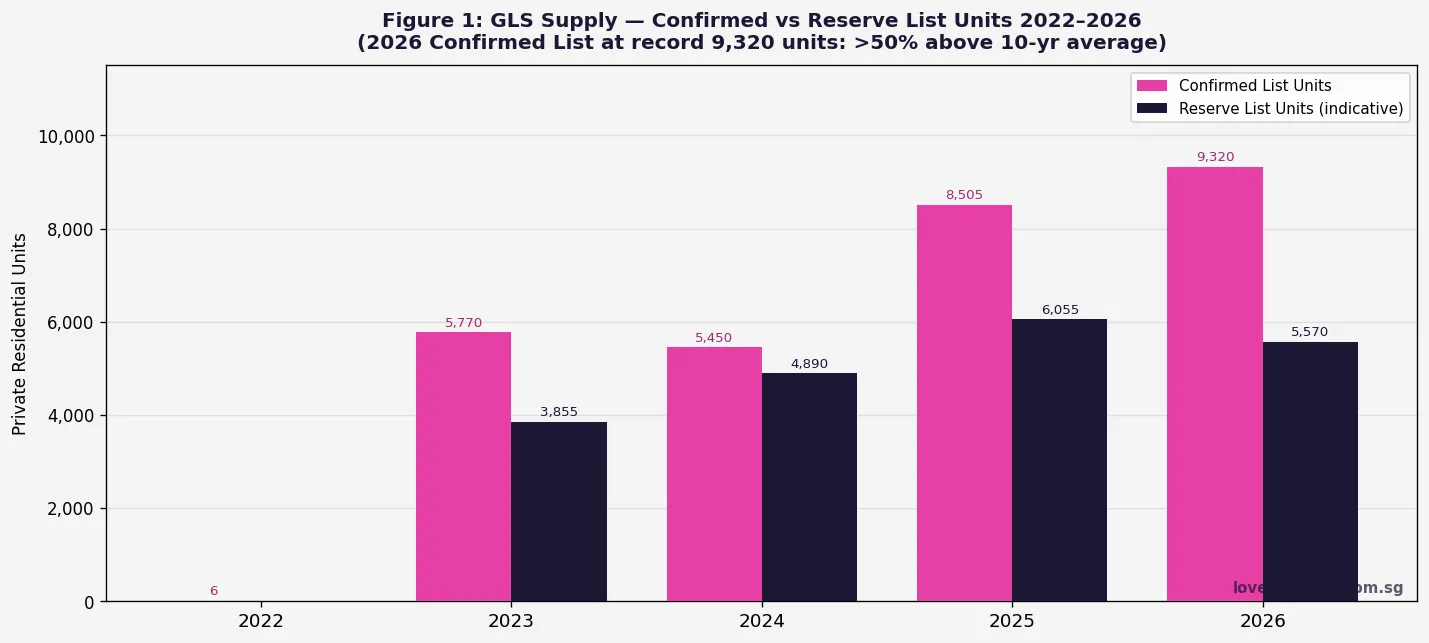
GLS confirmed and reserve list supply units 2022 to 2026 Singapore
Figure 1: GLS Confirmed List units 2022–2026. The 2026 programme stands at 9,320 Confirmed List units — the highest in over a decade and more than 50% above the 10-year annual average of approximately 6,100 units.

The 2026 GLS Programme — Record Supply

The 2026 GLS programme represents the most aggressive supply injection since the post-2013 cooling measures suppressed demand. For the full year 2026, the Confirmed List totals 9,320 private residential units (including 735 Executive Condominium units) across two half-year programmes, plus substantial commercial and white-site GFA.

The 2H 2026 Confirmed List, announced by URA, comprises eight private residential sites and one White site, with a combined potential yield of 4,745 private residential units (including 735 EC units) and 83,350 sqm gross floor area (GFA) of commercial space. Taken together with 1H 2026’s 4,575 units, the full-year total of 9,320 units is over 50% higher than the past 10-year annual average of approximately 6,100 units.
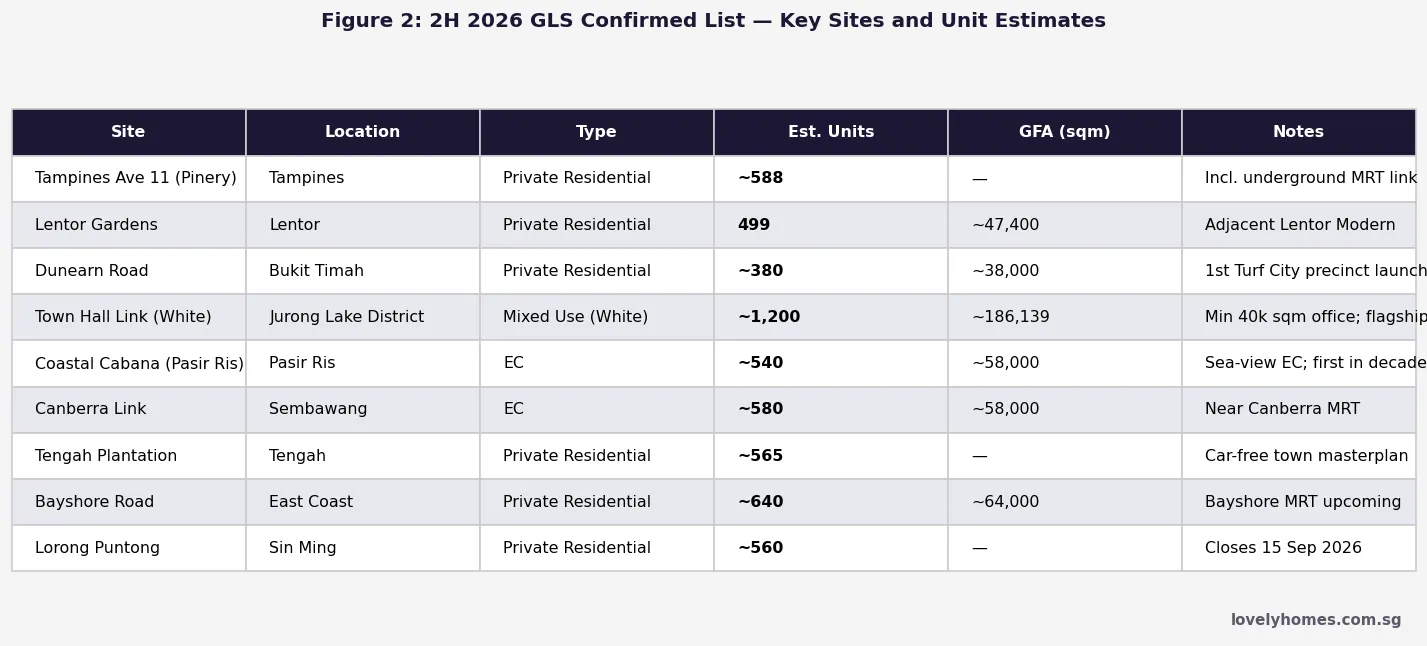
2H 2026 GLS confirmed list sites locations unit estimates Singapore
Figure 2: Key 2H 2026 GLS Confirmed List sites, locations, and unit estimates. The JLD White Site (Town Hall Link) is the most significant, with up to 1,200 residential units and a minimum 40,000 sqm office component.

The Jurong Lake District White Site — Singapore’s Most Ambitious GLS Parcel

The centrepiece of the 2H 2026 GLS programme is the White site at Town Hall Link in Jurong Lake District (JLD), launched for tender on 3 July 2026 (URA Press Release pr26-53). White sites differ from standard residential or commercial tenders: developers must propose a concept for the entire parcel, and evaluation criteria include urban design quality, environmental sustainability, and integration with the surrounding masterplan — not just the land bid price.

The JLD White site has a total potential GFA of 186,139 sqm, comprising a minimum of 40,000 sqm of office space, up to 1,200 private residential units, and 44,000 sqm of complementary uses (retail, hotel, community facilities). The site reflects the government’s vision to transform Jurong into Singapore’s second Central Business District — a project that has been two decades in the making and will reshape the western corridor of Singapore’s property market. The tender closes on 17 November 2026.

How GLS Pricing Flows to New Launch Prices

The relationship between GLS land cost and new launch prices is direct but not perfectly linear. Developers account for land cost, construction cost (currently elevated at approximately S$450–S$600 per sqft for mid-range condominiums, driven by labour and materials), financing charges, and their target margin (typically 12–20%) when setting indicative prices. The break-even price for a developer with a land cost of S$1,200 psf ppr (price per square foot per plot ratio) and build costs of S$530 psf might be approximately S$1,800–S$1,900 psf at a target yield — before marketing and sales overheads.

This is why GLS tender results, when reported by URA, attract intense industry scrutiny. A land bid that exceeds market expectations (a “bullish bid”) signals that the developer expects strong selling prices; a conservative bid signals caution. The Lentor Gardens site (land cost approximately S$920 psf ppr), resulting in launch prices averaging S$2,350 psf, illustrates the mechanics: at a plot ratio of approximately 2.5, the land contribution per saleable sqft works out to roughly S$920 / 2.5 ≈ S$368 psf, plus build cost, fees, margin.

GLS and the Executive Condominium (EC) Market

ECs occupy a unique position in the GLS framework. EC sites are sold exclusively to developers who must then offer the units to eligible buyers (Singapore Citizens and SPRs meeting HDB income and eligibility criteria) at capped prices before the EC is privatised after 10 years. The MND sets EC GLS sites separately from standard private residential sites, with two EC sites on the 2H 2026 Confirmed List: Coastal Cabana at Pasir Ris (approximately 540 units) and a site at Canberra Link (approximately 580 units). The effective land cost per EC unit is generally lower than private residential, reflecting the restrictions on initial buyer eligibility and resale during the Minimum Occupation Period (MOP).

Notably, from 8 May 2026, the MOP for future EC sites (those with tender closing dates on or after that date) was extended from 5 years to 10 years — a significant policy tightening that reduces the liquidity appeal of ECs as investment vehicles while preserving their affordability role for first-time buyers. The 2H 2026 EC sites are subject to this new 10-year MOP requirement.
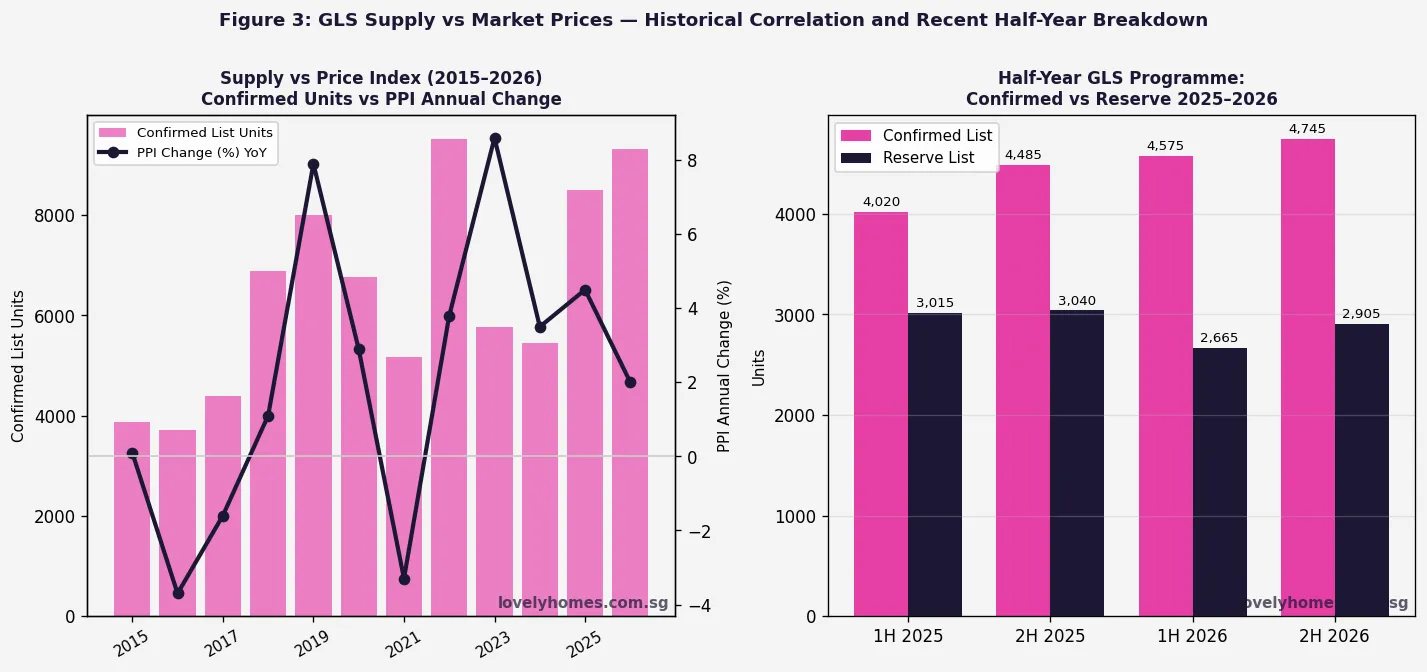
GLS supply versus private residential property price index PPI correlation 2015 to 2026 Singapore
Figure 3: Historical GLS Confirmed List units versus the Private Residential Property Price Index (PPI) annual change (left), and the half-year GLS programme breakdown for 2025–2026 (right). High supply years generally correspond to moderating price growth, with a 12–18 month lag.

Summary Table: GLS Programme 2025–2026 at a Glance

Parameter 1H 2025 2H 2025 1H 2026 2H 2026
Confirmed List Units 4,020 4,485 4,575 4,745
Reserve List Units (est.) 3,015 3,040 2,665 2,905
Total Programme 7,035 7,525 7,240 7,650
EC Units (within Confirmed) 640 695 0 735
White Sites 1 (JLD Town Hall Link)
Commercial GFA (Confirmed) ~28,000 sqm ~32,000 sqm ~35,000 sqm 83,350 sqm
Full-Year Confirmed 8,505 (2025) 9,320 (2026) — 10-yr high

Worked Example: Reading a GLS Tender Result as a Buyer

In June 2026, Kingsford was awarded the Lentor Gardens site at approximately S$920 psf ppr (price per square foot per plot ratio) against a site area of approximately 18,900 sqm and a gross plot ratio of 2.5, yielding 499 units. The land cost per saleable unit works out to approximately S$920 × 2.5 × average unit size 500 sqft / 499 units ≈ S$2.3M land component per unit.

Adding estimated construction cost (S$530 psf × 500 sqft = S$265,000), developer overhead and margin (~15%), and marketing costs, the break-even for a 500 sqft unit is approximately S$2.9M to S$3.0M — or roughly S$5,800–S$6,000 psf break-even before profit. The launch average of S$2,350 psf implies a unit size closer to 700 sqft (S$1.645M average), consistent with the development’s product mix. This breakdown helps buyers assess whether a launch price is commercially justifiable or whether a developer is selling at a margin that leaves room for future appreciation.

The key takeaway: GLS land cost sets a price floor for the surrounding resale market. When developers pay record land prices, they launch at record prices — and those prices become the new benchmark for nearby resale units. Buyers tracking GLS results in their target district are effectively monitoring the minimum that future launches must achieve, and thus the direction of resale competition.

Why This Matters: Supply Overshooting vs. Structural Demand

The 9,320-unit 2026 Confirmed List is large by historical standards, but Singapore’s structural property demand is equally robust. Net household formation runs at approximately 20,000–25,000 per year, immigration adds a steady flow of new permanent residents and employment pass holders, and owner-occupier replacement demand (upgrading, right-sizing) generates consistent transaction volumes. Against this backdrop, even a record 9,320-unit programme represents roughly 4–5 months of annual demand absorption. Analysts at major research desks argue that the supply wave will moderate price growth — particularly in the Outside Central Region where GLS supply is most concentrated — but is unlikely to cause a sustained price correction of the magnitude seen in 2013–2017, when cooling measures and oversupply combined to push prices down approximately 12% over four years.

The Core Central Region and landed market remain structurally supply-constrained: fewer GLS sites exist in prime districts, freehold land is not created through GLS, and the luxury buyer profile is less sensitive to GLS supply volumes. This bifurcation between a moderating mass market and resilient prime and landed segment is the dominant property market narrative for the second half of 2026.

What Might Come Next

Several key GLS milestones are approaching in the remainder of 2026 and into 2027. The Lorong Puntong/Sin Ming site tender closes on 15 September 2026, and the JLD White Site tender closes on 17 November 2026 — both will be closely watched as barometers of developer confidence. URA’s full Q2 2026 private residential statistics, expected on 24 July 2026, will provide detailed take-up data for recent GLS launches and will likely influence the quantum of the 1H 2027 programme. If new-home sales remain above 7,000 units for the full year 2026, the government will likely maintain or even expand the confirmed list in 2027. If sales disappoint, a modest pullback in GLS quantum — as seen in 2015–2016 — is the most probable policy response.

Frequently Asked Questions

How long does it take from a GLS award to a new launch?

Typically 12 to 24 months. Once a developer wins a GLS tender, it must obtain planning approval, finalise the development’s concept and design, and satisfy various conditions before launching for sale. For straightforward residential sites, the timeline from award to launch preview is usually 12–18 months. For complex mixed-use or White sites, it can run to 24–36 months. The JLD White Site, for example, is unlikely to launch for sale before late 2028 or 2029, given the complexity of the development brief. Buyers tracking a GLS award as a proxy for future supply in their target district should add at least 18 months to the tender date to estimate when competition might appear on the market.

Can individual buyers participate in GLS tenders directly?

No. GLS tenders are open to developers and property companies, not individual buyers. The minimum land parcel values involved (typically S$200M to over S$1 billion for larger sites) and the development obligations attached to the tender conditions are designed for institutional participants. Individual investors participate in the GLS ecosystem indirectly — by purchasing units from developers who have won GLS sites and developed them into saleable projects. The closest an individual can get to a direct land transaction is through a collective sale (en bloc) of an existing strata development, or through a private land auction — neither of which is part of the GLS programme.

What is a White site and how does it differ from a standard residential GLS parcel?

A White site is a GLS parcel where the permissible uses are not pre-specified — the developer has flexibility to propose a mix of residential, commercial, hotel, and community uses, subject to minimum requirements and the Urban Redevelopment Authority’s concept proposal evaluation. Standard residential sites have a defined use (private housing), a specified gross plot ratio, and are awarded purely on the highest bid price. White sites are evaluated on a combination of price and concept quality, with URA assessing the urban design, public realm, sustainability, and programming. The JLD White site, Paya Lebar Central, and Marina South are examples of major White site developments in Singapore’s recent history. White sites typically result in more architecturally and programmatically complex developments that become landmark projects in their district.

Does high GLS supply mean property prices will fall?

Not necessarily, and not immediately. The GLS-to-prices relationship operates with a 12–24 month lag and is moderated by demand conditions, interest rates, and the composition of sites. High GLS supply increases the pipeline of future new launches, which gives buyers more options and reduces urgency — typically moderating the pace of price increases rather than causing outright falls. Singapore experienced a genuine price correction (12% over 2013–2017) only when a record GLS pipeline coincided with significant cooling measures, rising interest rates, and softening foreign demand simultaneously. In 2026, cooling measures remain in place (ABSD, SSD, TDSR) but demand is supported by historically low mortgage rates (3M SORA near 1%) and resilient employment. The base case from industry research is price growth of 2–4% for 2026 despite the record supply programme — a soft landing rather than a reversal.

Where can I track GLS tenders and results?

The URA publishes the current GLS programme, all active tenders, and awarded tender results on its official website at ura.gov.sg/Corporate/Land-Sales/Sites-For-Tender. The SLA also publishes related information at sla.gov.sg. For EC sites and HDB land sales, the HDB website at hdb.gov.sg publishes the relevant information. URA press releases accompanying new tender launches and awards are the primary source for official quantum, GFA, and evaluation outcomes. Industry portals compile GLS data in more digestible formats, but always cross-reference against the primary URA/SLA source for accuracy.

How does GLS land cost affect HDB resale prices?

The relationship is indirect but real. GLS-derived new launch prices set a psychological reference point: when buyers compare an HDB resale flat in the same area against a new private condo launched at S$2,200 psf, the HDB flat at S$700–S$900 psf appears relatively affordable — supporting demand and prices. Conversely, if GLS supply moderates new launch prices, the urgency premium embedded in HDB resale prices may also ease. The more direct driver of HDB resale prices is HDB’s own build programme (BTO supply) and the Minimum Occupation Period pipeline: the 2026 surge of over 13,000 resale flats entering the market (5-year MOP completions from the 2021 BTO launches) is a stronger supply signal for the HDB resale market than GLS data. For a detailed discussion of the HDB resale market outlook, see our Singapore Property Market Outlook 2H 2026.

Related Articles

Disclaimer

This article is intended for general informational purposes only and does not constitute investment, financial, or legal advice. GLS programme details, unit yield estimates, and site information are based on publicly available URA and SLA announcements and may change. All supply figures, land cost estimates, and pricing illustrations are indicative. Readers should verify current GLS programme details with the Urban Redevelopment Authority at ura.gov.sg and the Singapore Land Authority at sla.gov.sg before making property decisions. Consult a licensed property professional or financial adviser for personalised guidance.

Singapore Joint Property Ownership Guide 2026: Tenancy-in-Common vs Joint Tenancy Explained

Singapore Joint Property Ownership Guide 2026: Tenancy-in-Common vs Joint Tenancy Explained

Quick Answer — Joint Property Ownership Singapore 2026

  • Two legal structures: Joint Tenancy (equal shares, right of survivorship) and Tenancy-in-Common (any split, no survivorship — shares pass via will).
  • ABSD is profile-based: each co-buyer pays ABSD according to their own buyer profile and property count — there is no ABSD discount for buying jointly.
  • CPF is individual: each co-owner draws from their own CPF Ordinary Account (OA) in proportion to their ownership share.
  • TDSR applies jointly: both co-buyers’ incomes are combined, and so are all their existing financial obligations — the 55% TDSR ceiling covers the full loan repayment.
  • Decoupling is possible for properties held as Tenancy-in-Common — one co-owner buys out the other’s share, paying ABSD only on the acquired portion. Not possible for Joint Tenancy without first converting.
  • Right of survivorship in Joint Tenancy automatically transfers the deceased’s share to the surviving owner — bypassing probate. TIC shares fall under the estate and require a will or intestacy rules.
  • Singapore Citizens buying together as first-time buyers pay 0% ABSD. If either buyer already owns a residential property, they pay 20% ABSD on the full price.

What is Joint Property Ownership in Singapore?

When two or more people purchase a residential property together in Singapore, they become co-owners. Singapore law recognises two forms of co-ownership: Joint Tenancy and Tenancy-in-Common. The choice between them affects inheritance, the ability to sell independently, stamp duty strategy, and — crucially — your exposure to the Additional Buyer’s Stamp Duty (ABSD) on future purchases.

Joint ownership is extremely common in Singapore. Most married couples purchasing an HDB flat or private condominium do so as joint owners, combining incomes to pass the Total Debt Servicing Ratio (TDSR) and Mortgage Servicing Ratio (MSR) thresholds set by the Monetary Authority of Singapore (MAS). Unmarried siblings, parents and children, and business partners also frequently co-purchase investment properties.

Understanding the legal and financial mechanics before you sign the Option to Purchase (OTP) is essential. The ownership structure you choose on day one determines what options you have years later — including whether you can decouple to buy a second property without ABSD.

Joint Tenancy vs Tenancy-in-Common: The Core Differences

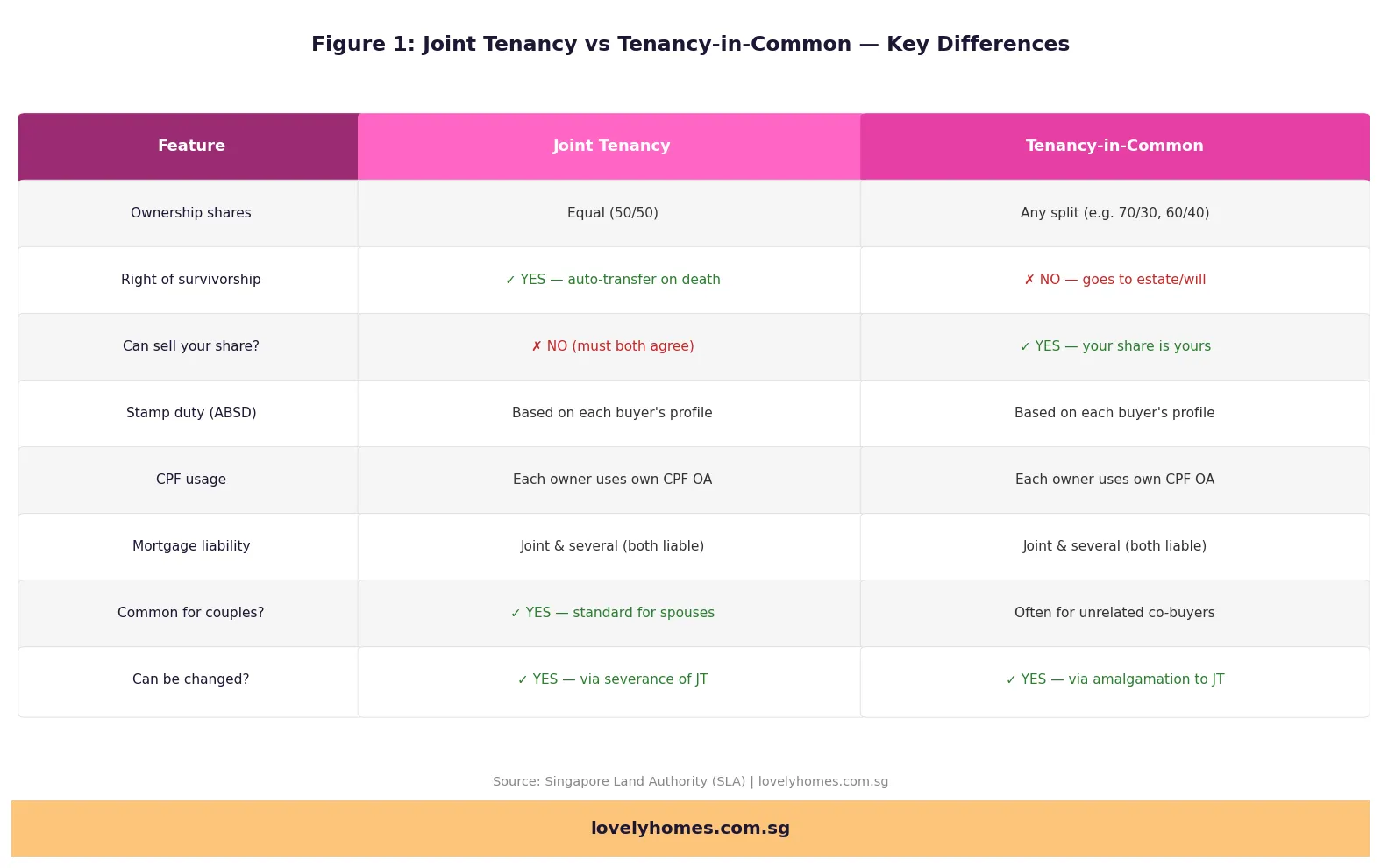
The two ownership structures share the feature that all co-owners are equally responsible for the mortgage — both are jointly and severally liable to the lender. Beyond that, they diverge significantly.

Joint Tenancy treats the property as a single, indivisible whole. Each owner holds an equal share by law — a married couple in joint tenancy each hold 50%, regardless of how much each contributed to the purchase. If one owner dies, their interest automatically passes to the surviving owner(s) by the right of survivorship, outside of the deceased’s estate. This is why joint tenancy is the default choice for married couples: it avoids probate complications and ensures the family home passes seamlessly.

Tenancy-in-Common, by contrast, allows co-owners to hold defined, unequal shares — for example, 70/30 or 80/20 — reflecting their respective CPF and cash contributions. Each co-owner’s share is a distinct legal interest that they can will to a beneficiary, sell independently (with the other owner’s knowledge but not necessarily consent, depending on the sale structure), or use as a platform for decoupling. There is no right of survivorship: if a Tenancy-in-Common co-owner dies intestate, their share passes under Singapore’s Intestate Succession Act, not automatically to the co-owner.

Joint tenancy vs tenancy-in-common comparison table Singapore 2026

Figure 1: Key differences between Joint Tenancy and Tenancy-in-Common in Singapore. Source: Singapore Land Authority (SLA) | lovelyhomes.com.sg

How ABSD Applies to Joint Property Purchases

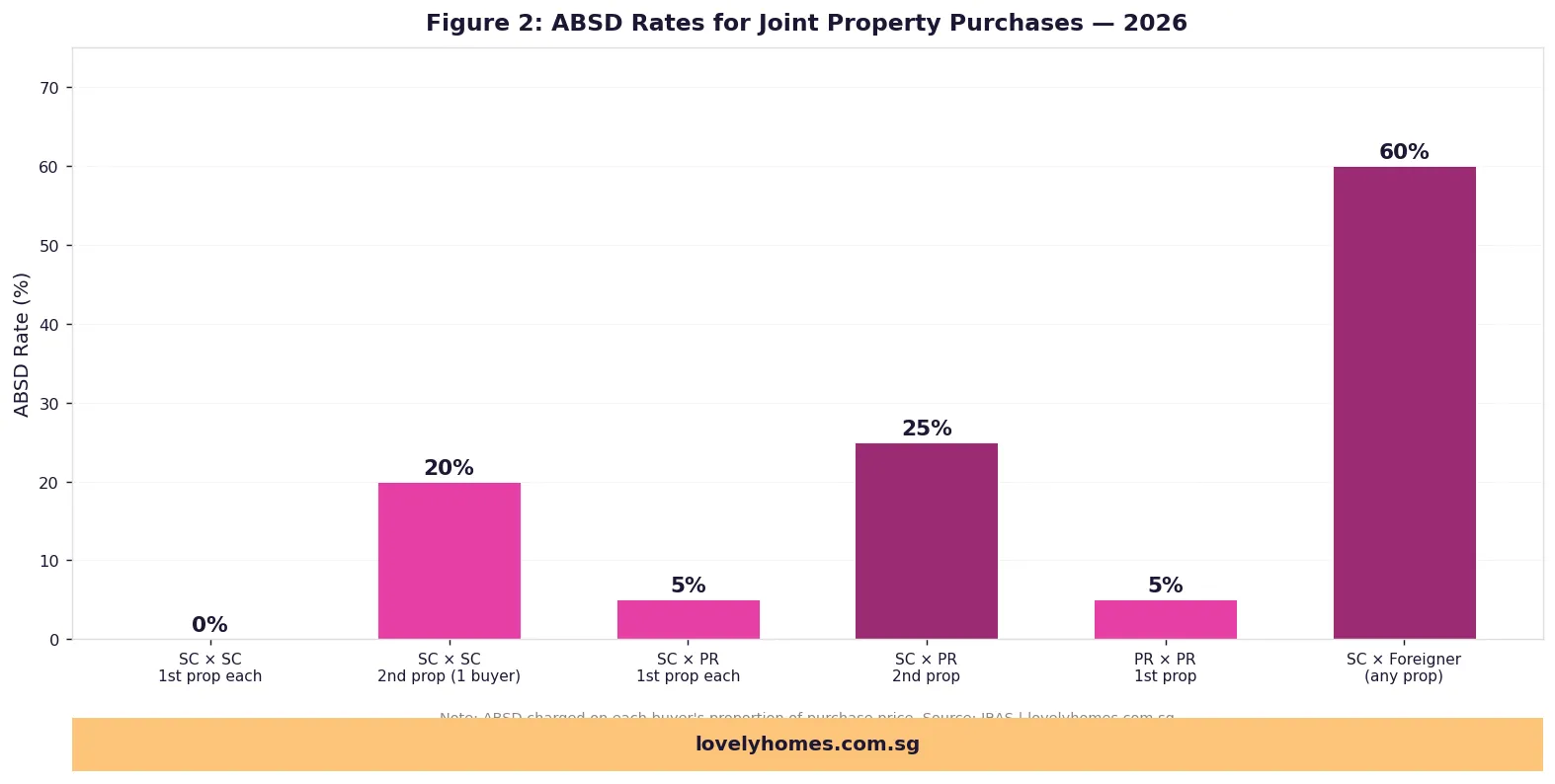
The Additional Buyer’s Stamp Duty (ABSD), administered by the Inland Revenue Authority of Singapore (IRAS), applies whenever a buyer acquires an additional residential property. For joint purchases, the rule is straightforward but often misunderstood: ABSD is computed based on the profile of the buyer who attracts the higher rate.

This means that if a Singapore Citizen (SC) and a Permanent Resident (PR) buy together, and the PR is deemed to be acquiring a second property (5% ABSD applies to PRs on their first property, 25% on their second), the ABSD rate applicable to that joint purchase reflects the higher-rate buyer’s position. The full ABSD is computed on the full purchase price.

More practically: an SC married couple buying their first property together pay 0% ABSD. But if either spouse already owns a property — even one inherited or received as a gift — the couple faces a 20% ABSD on the full price of the new purchase. At S$1.5 million, that is S$300,000 payable in cash (ABSD cannot be funded from CPF OA). This is the biggest single financial surprise for HDB upgraders who have not sold their flat before exercising an OTP on a new property.

ABSD rates for joint property purchases by buyer profile Singapore 2026

Figure 2: ABSD rates for joint purchases by buyer-profile combination. ABSD is computed on the full purchase price. Source: IRAS | lovelyhomes.com.sg

CPF Usage in Joint Property Purchases

The Central Provident Fund (CPF) Board allows each co-owner to use their own CPF Ordinary Account (OA) savings towards a jointly-owned property, subject to the Valuation Limit and Withdrawal Limit rules. Each co-owner’s CPF usage is capped in proportion to their ownership share.

For HDB properties, this is straightforward: each co-owner uses their OA for the down payment and monthly mortgage servicing, with the Mortgage Servicing Ratio (MSR) capping total repayments at 30% of gross monthly income. For private properties (condominiums, landed homes, ECs post-privatisation), the TDSR cap of 55% of gross monthly income applies. Critically, CPF usage for private property is also subject to the Valuation Limit — once total CPF withdrawn equals the property’s original purchase price or valuation (whichever is lower), further CPF can only be used if the property has at least 60 years’ remaining lease at the time of purchase, and CPF usage may be further pro-rated for properties with shorter leases.

In a Tenancy-in-Common structure, CPF accrued interest — the interest CPF Board charges on OA monies withdrawn for property — must be refunded to each co-owner’s CPF account upon sale, proportionally. This accrued interest accumulates at the CPF OA interest rate (currently 2.5% per annum on the first S$20,000, 3.5% thereafter — effective 1 January 2024) and can significantly reduce the net cash proceeds from a property sale after many years of ownership.

Decoupling: Converting Ownership to Access a Second Property

Decoupling is a legal strategy whereby one co-owner transfers or sells their share in a jointly-owned property to the other, so that the departing co-owner is no longer a property owner and can subsequently purchase a second property as a “first-time buyer” — paying 0% ABSD (for SCs) instead of 20%.

Decoupling requires the property to be held as Tenancy-in-Common. A Joint Tenancy must first be severed (converted to TIC) via a Deed of Severance lodged with the Singapore Land Registry before decoupling can proceed. The process involves: (1) severing the joint tenancy if applicable; (2) the selling co-owner executing a Transfer Instrument conveying their share to the buying co-owner; (3) the buying co-owner paying ABSD on the acquired share’s value (not the full property value, if they already own the remaining share); and (4) legal fees typically S$3,000–S$5,000 per party.

IRAS scrutinises decoupling transactions under anti-avoidance provisions. Where the transfer is purely nominal and consideration is not reflective of market value, IRAS may challenge the arrangement. Always engage a licensed conveyancing solicitor and ensure the transfer price is at or close to open-market value for the share being transferred.

Note: As at 2026, HDB flats cannot be decoupled in the same manner as private residential properties, due to HDB rules prohibiting partial transfers of HDB flat ownership except in specific circumstances (e.g. matrimonial transfers upon divorce, or change in family nucleus for eligibility purposes). The decoupling strategy is therefore most relevant to private residential property owners.

Upfront Cost Comparison: Sole vs Joint Purchase

Upfront costs comparison sole vs joint property purchase Singapore 2026 at S$1.5M

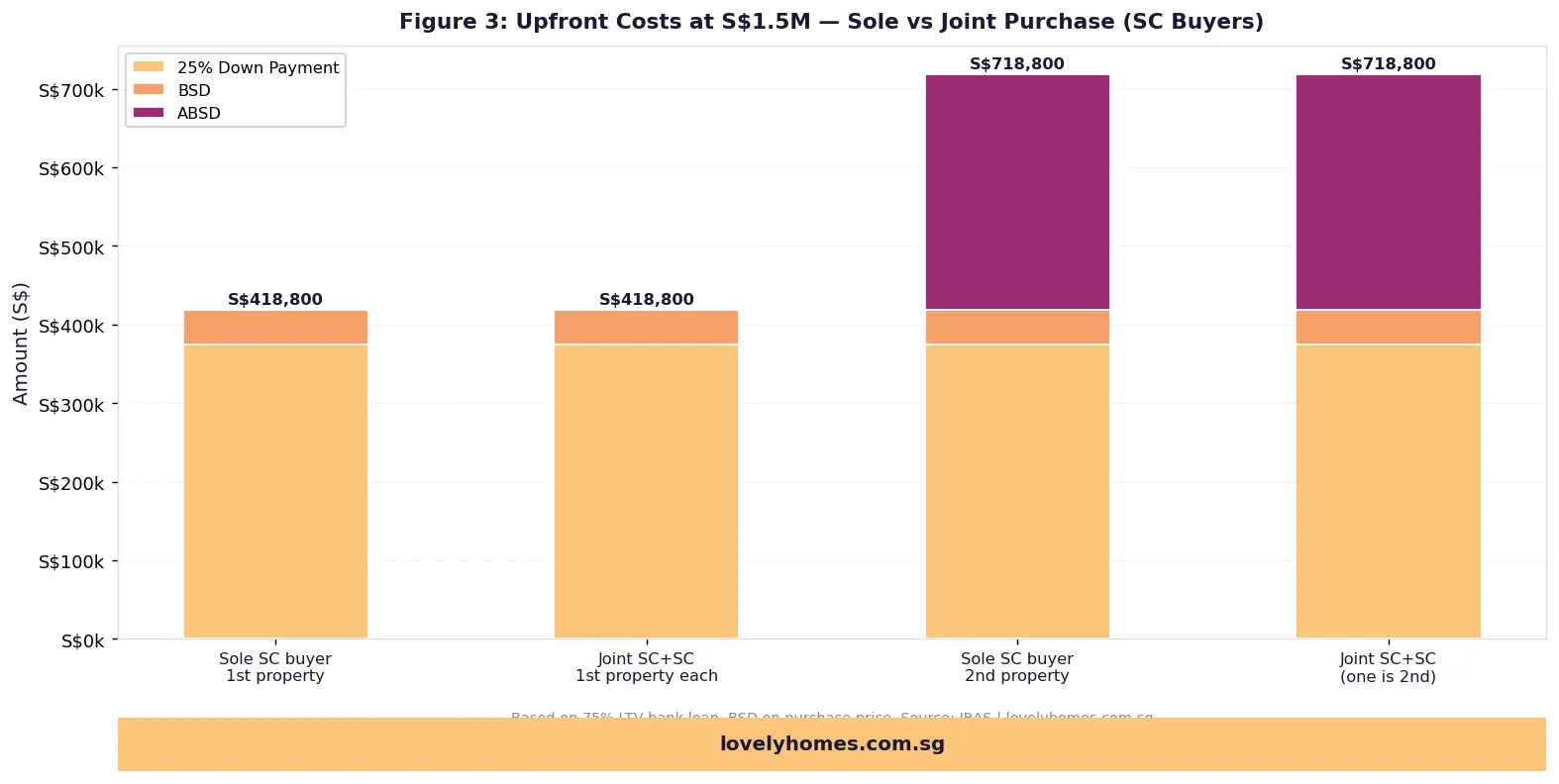
Figure 3: Upfront costs for sole vs joint purchase at S$1.5M — SC buyer profiles (25% down payment assumed, bank financing). Source: IRAS | lovelyhomes.com.sg

The upfront cost difference between a joint first-time purchase and a joint purchase where one party already owns a property is substantial. The chart above illustrates the ABSD component: for a couple buying their first property together at S$1.5 million, there is no ABSD. If either party already owns a home, the couple pays S$300,000 in ABSD — entirely in cash — in addition to the 25% down payment of S$375,000 and BSD of approximately S$43,800. Total upfront outlay jumps from roughly S$418,800 to S$718,800.

Summary Table: Joint Ownership at a Glance

Factor Joint Tenancy Tenancy-in-Common
Shares Equal (50/50 by law) Any ratio (e.g. 70/30)
Survivorship Auto-transfer to survivor Passes to estate / will
Independent sale of share Not possible Possible (co-owner’s interest)
Decoupling eligibility Must sever JT first Yes — directly possible
CPF usage Each owner’s OA (50/50) Each owner’s OA (in share ratio)
ABSD profile Higher of two profiles applies Higher of two profiles applies
TDSR calculation Combined income, combined obligations Combined income, combined obligations
Best suited for Married couples, family home Investors, unequal contributors, decoupling strategy

Worked Example: Lim Couple — Joint Purchase with ABSD Implication

Scenario: Mr Lim (SC, 38) and Mrs Lim (SC, 36) are HDB flat owners (4-room in Tampines, purchased 2019 — MOP completed August 2024). They wish to buy a 2-bedroom resale condominium in District 19 for S$1,350,000 as a joint investment property without first selling their HDB flat.

Buyer profiles: Both Mr and Mrs Lim own the HDB flat jointly. A second property purchase makes both of them “second-time buyers”.

ABSD payable: SC buying 2nd residential property = 20% ABSD.

  • ABSD = 20% × S$1,350,000 = S$270,000 (payable in cash within 14 days of OTP exercise)
  • BSD = 1% × S$180,000 + 2% × S$180,000 + 3% × S$640,000 + 4% × S$350,000 = S$1,800 + S$3,600 + S$19,200 + S$14,000 = S$38,600 (can use CPF OA)
  • 25% down payment = S$337,500 (at least 5% in cash, remainder CPF OA)
  • Total upfront ≈ S$646,100 (cash component alone ≈ S$337,500 + S$270,000 = S$607,500)

TDSR check: Bank loan 75% × S$1,350,000 = S$1,012,500 at 4.0% over 25 years → monthly repayment ~S$5,330. Combined gross income S$14,000/month. TDSR = S$5,330 / S$14,000 = 38.1% — well within the 55% cap. ✓

Alternative (sell first): If the Lims sell their HDB flat before exercising the OTP on the condo, their subsequent purchase is as first-time buyers (assuming they have no other property). ABSD = 0%. Total upfront drops by S$270,000. The trade-off: interim accommodation costs and the risk of timing the property market.

Why This Matters: Common Joint-Ownership Mistakes

Joint property ownership mistakes in Singapore typically fall into three categories. The first is choosing the wrong structure: couples who intend to decouple later but buy in Joint Tenancy find they must pay additional legal fees for the severance step — a cost and delay that Tenancy-in-Common would have avoided from the outset.

The second is overlooking the ABSD trigger: many buyers assume that buying jointly means only one of them “owns” the property, or that ownership below 50% is somehow exempt from ABSD. IRAS does not distinguish — any ownership interest in a residential property, however small, counts for ABSD-profile purposes.

The third is CPF accrued interest surprise at exit: couples who have used substantial CPF OA funds over a long holding period are often shocked to discover that the CPF Board requires full refund of withdrawn amounts plus accrued interest upon sale. On a property held for 15 years with S$300,000 CPF withdrawn, accrued interest at 2.5–3.5% per annum compounds to over S$130,000 — meaningfully reducing net cash proceeds.

What Might Come Next: Policy Outlook

The Singapore government has made clear in successive Budget and National Day Rally statements that property cooling measures — including ABSD — remain calibrated to prevent speculative demand and preserve housing affordability. There is no current signal that ABSD rates for joint purchases will be relaxed. If anything, the 2023 rate hikes (to 60% for foreigners and 20% for SC second-time buyers) indicate that the authorities remain willing to tighten when prices surge.

On decoupling, IRAS has not yet announced specific anti-avoidance regulations targeting Tenancy-in-Common transfers between spouses, but practitioners note increased scrutiny on transactions where the transferring price deviates materially from open-market value. Buyers considering decoupling in 2026 should document their transactions carefully and obtain an independent valuation.

The Urban Redevelopment Authority’s (URA) long-run supply pipeline — including the Government Land Sales (GLS) programme’s 4,745-unit Confirmed List for the second half of 2026 — is intended to moderate price growth over the medium term, which may reduce the urgency of complex joint-ownership strategies for buyers who can wait.

Frequently Asked Questions

1. Can a Singapore Citizen and a foreigner buy a property together in Singapore?

Yes, but the ABSD implication is significant. Where one co-buyer is a foreigner (non-SPR), the applicable ABSD rate for the joint purchase is the foreigner rate of 60%, applied to the full purchase price. This applies regardless of which co-owner holds what share. Foreigners purchasing residential property in Singapore are restricted to non-landed residential property (condominiums, apartments) in most cases — landed residential property requires prior approval from the Minister for Law under the Residential Property Act.

2. How does Joint Tenancy affect my estate planning?

In a Joint Tenancy, the right of survivorship overrides any will you have written with regard to that property. If you hold your home in Joint Tenancy and your will directs that the property should go to your children, your will is ineffective on that point — the property passes automatically to the surviving joint tenant(s). If you want to direct your property interest via your will, you must convert your ownership to Tenancy-in-Common first by executing a Deed of Severance. The conversion does not affect the mortgage and can be done at any time without triggering ABSD or BSD.

3. Does adding a co-owner to an existing property trigger ABSD?

Yes. Adding a co-owner to a property that you already own involves a transfer of a partial interest in that property. The new co-owner is treated as acquiring a property interest, and ABSD applies based on their buyer profile and property count — on the market value of the share being transferred. An exception applies for transfers between spouses under certain conditions (e.g., for love and affection or matrimonial transfer), but these require careful legal structuring. Always consult a solicitor before adding a co-owner.

4. Can I use my CPF OA to pay the other co-owner’s share of the purchase price?

No. CPF OA funds can only be used to service your own share of the property — you cannot top up a co-owner’s shortfall using your CPF. Each co-owner’s CPF contribution is limited to their proportional ownership share. For example, in a 70/30 Tenancy-in-Common property priced at S$1,000,000, the 70% owner can withdraw from their CPF OA up to 70% of the Valuation Limit, and the 30% owner up to 30%.

5. What is the ABSD remission for married couples buying their first property together?

There is no ABSD to remit in the first place — Singapore Citizens buying their first residential property pay 0% ABSD regardless of whether they buy jointly or alone. The relevant remission for couples applies when an SC married couple buys a second property together: they can apply for an ABSD remission (refund) if they sell their existing property within 6 months of completing the purchase of the new private property. The remission is not automatic — it must be applied for via IRAS within 6 months of the sale completion of the first property.

6. What happens to a jointly-owned property during a divorce?

Upon divorce, jointly-owned property is subject to the division of matrimonial assets under the Women’s Charter. The court may order the property to be sold and proceeds split, or direct one spouse to transfer their share to the other — with the receiving spouse paying any applicable stamp duty on the transfer. Transfers ordered by the court in matrimonial proceedings may be eligible for ABSD and BSD remission; consult a family law solicitor for the applicable rules, which have specific conditions.

7. Can I decouple if my property has an outstanding HDB concessionary loan?

Decoupling is only relevant for private residential properties — not HDB flats. HDB flats cannot be decoupled in the same way because HDB rules prohibit partial transfers of flat ownership except in prescribed circumstances (divorce, death, change of flat ownership for eligibility purposes, etc.). If you want to apply decoupling strategy, you must first complete your HDB flat’s Minimum Occupation Period, sell the flat, and then purchase two separate private properties — one in each spouse’s name — to avoid the ABSD on a second property.

Related Articles

Disclaimer: This article is for general informational purposes only and does not constitute legal, financial, or tax advice. Property ownership structures, ABSD rates, CPF rules, and HDB regulations are subject to change. Readers should verify information with the relevant authorities — the Inland Revenue Authority of Singapore (IRAS) at iras.gov.sg, the Central Provident Fund Board (CPF) at cpf.gov.sg, the Singapore Land Authority (SLA) at sla.gov.sg, and the Housing & Development Board (HDB) at hdb.gov.sg — and consult a licensed conveyancing solicitor and/or a registered property agent before making any property transaction decisions.

Singapore Stamp Duty Calculator 2026: BSD and ABSD Explained

Singapore Stamp Duty Calculator 2026: BSD and ABSD Explained

Singapore stamp duty is not a single charge — it is two separate taxes that stack on top of each other depending on who you are and what you already own. The Buyer’s Stamp Duty (BSD) applies to every residential purchase. The Additional Buyer’s Stamp Duty (ABSD) applies on top if you are buying a second property, if you are a Singapore Permanent Resident, or if you are a foreigner. Understanding both — and being able to calculate them accurately before you commit — is the single most important financial step in any Singapore property transaction.

This guide explains the 2026 BSD and ABSD rate schedules in full, shows you how to calculate your stamp duty liability step by step, and works through concrete examples at common price points. All figures reflect the rate schedules currently in force: the 2023 BSD schedule and the 27 April 2023 ABSD rates. For the authoritative source, always verify at iras.gov.sg/taxes/stamp-duty/for-property.

Quick Answer — Singapore Stamp Duty Calculator 2026

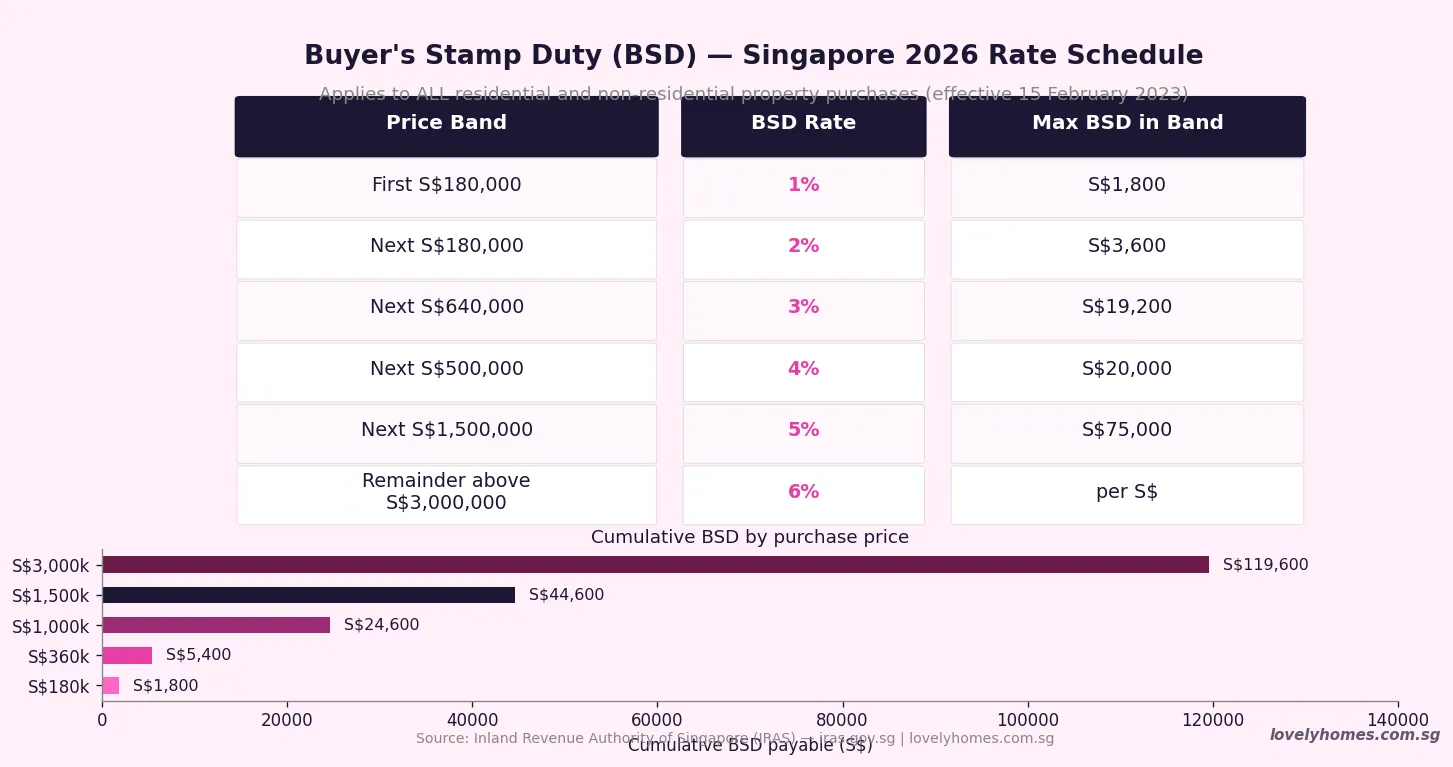
  • BSD applies to ALL buyers at the same progressive rate: 1% on first S$180k, 2% next S$180k, 3% next S$640k, 4% next S$500k, 5% next S$1.5M, 6% above S$3M.
  • ABSD stacks on top: Singapore Citizens pay 0% on their first property, 20% on a second, 30% on a third or more.
  • PRs pay 5% ABSD on a first property, 30% on a second, 35% on a third or more.
  • Foreigners pay 60% ABSD on any residential property.
  • For a S$1.5M property, a Singapore Citizen buying their first home pays BSD of S$44,600 — roughly 3% of the price. A foreigner buying the same property pays S$44,600 BSD plus S$900,000 ABSD.
  • BSD is typically payable within 14 days of signing the Option to Purchase (OTP); ABSD within 14 days of signing the Sale & Purchase Agreement, or within 14 days of exercising the OTP.
  • ABSD may be financed by CPF Ordinary Account for Singapore Citizens buying their first or subsequent homes, but BSD can also be paid from CPF OA.
  • Married SC/SPR couples may claim an ABSD remission on a second property if they dispose of the first within 6 months of purchase (or TOP for new launches).
  • Developers are subject to 35% ABSD with a remission available on residential development land if units are sold within the prescribed period.

What Is Buyer’s Stamp Duty (BSD)?

BSD is a tax levied by the Inland Revenue Authority of Singapore (IRAS) on the purchase or acquisition of property — residential and non-residential alike. It is calculated on the higher of the purchase price or the property’s market value. BSD has existed in Singapore since 1929 and was most recently revised upward in February 2023 when the Government added the 5% band (on the portion from S$1.5M to S$3M) and the 6% band (above S$3M) as part of its broader property market management effort.

BSD is non-negotiable: every buyer — Singapore Citizen, PR, foreigner, or entity — pays BSD. The rate schedule is progressive, meaning each increment of purchase price is taxed at its own marginal rate. The total BSD payable grows with the purchase price but as a percentage of price it rises only gradually because the higher rates apply only to the marginal portion above each threshold.

BSD Buyer Stamp Duty rates by price band Singapore 2026
Figure 1: BSD rate schedule by price band (2023 schedule, effective 15 February 2023) and cumulative BSD payable at selected purchase prices. Source: IRAS.

BSD Calculation — Step by Step

To calculate BSD manually, work through each price band in order and tax only the portion that falls within that band:

Price Band Rate Max BSD in Band
First S$180,000 1% S$1,800
Next S$180,000 2% S$3,600
Next S$640,000 3% S$19,200
Next S$500,000 4% S$20,000
Next S$1,500,000 5% S$75,000
Remainder above S$3,000,000 6%

Quick BSD shortcuts: For a S$1,000,000 purchase, BSD = S$1,800 + S$3,600 + S$19,200 + S$15,000 (S$500k × 3%) = S$24,600. For S$1,500,000: S$1,800 + S$3,600 + S$19,200 + S$20,000 = S$44,600. For S$2,000,000: S$44,600 + S$25,000 (S$500k × 5%) = S$69,600.

What Is Additional Buyer’s Stamp Duty (ABSD)?

ABSD is a separate tax introduced by the Government in December 2011, initially to cool a rapidly rising residential property market. It has been raised five times since — most recently and most significantly on 27 April 2023, when ABSD for foreigners doubled from 30% to 60% and rates for Singaporeans and PRs buying additional properties were substantially increased. ABSD is not a progressive tax: it applies at a flat percentage rate to the entire purchase price.

Unlike BSD, ABSD depends on who you are and how many residential properties you already own. “Already own” means at any point in the world — IRAS will ask for a statutory declaration confirming your existing property holdings, including overseas properties for the purpose of determining if you are an SC or PR “first-time” buyer.

ABSD Additional Buyer Stamp Duty rates by buyer profile Singapore 2026
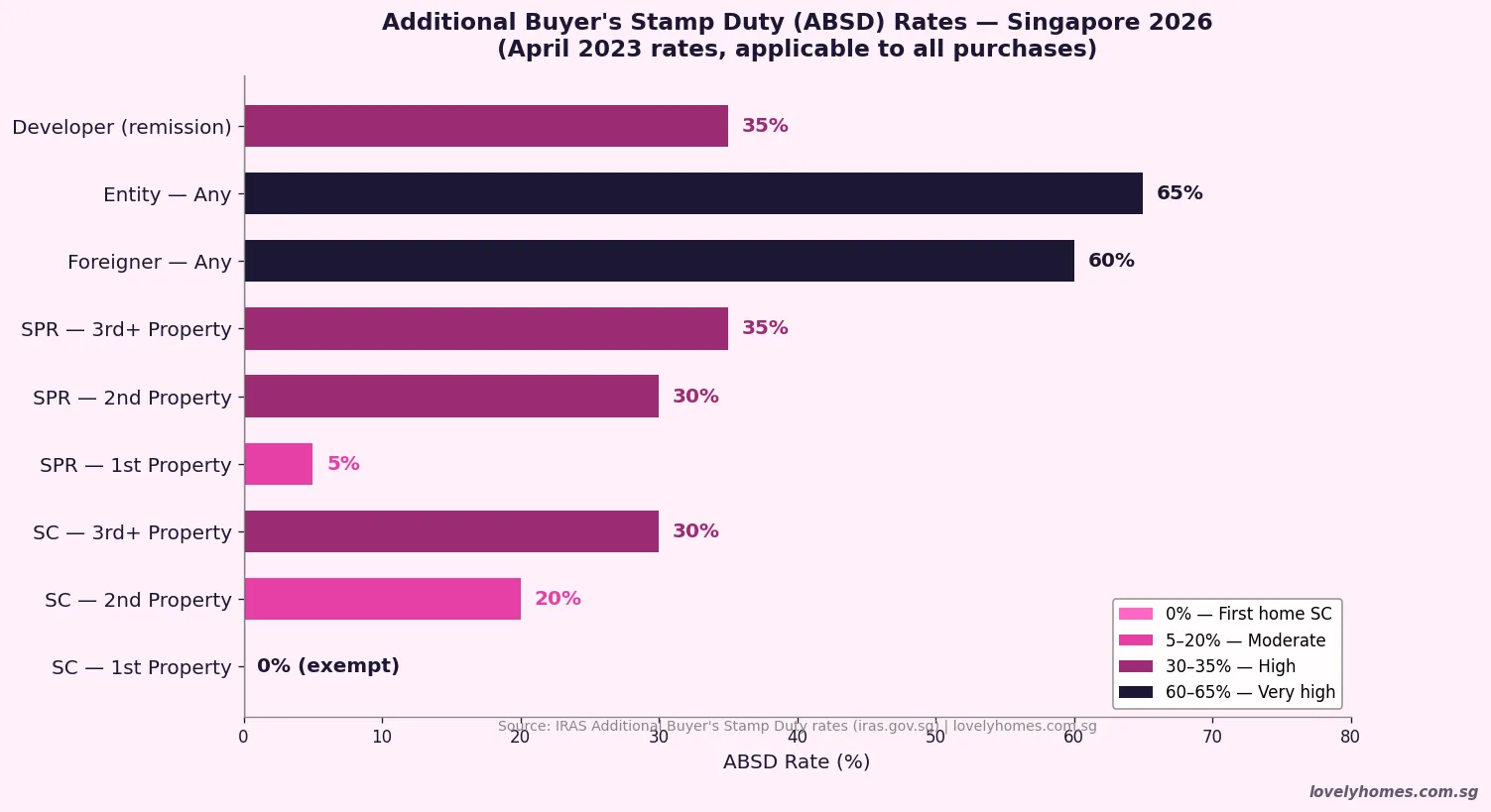
Figure 2: ABSD rates by buyer profile as at 27 April 2023. Rates are applied to the full purchase price. Source: IRAS.

ABSD by Buyer Profile — The Key Numbers

The table below summarises the complete 2026 ABSD rate schedule:

Buyer Profile 1st Property 2nd Property 3rd+ Property
Singapore Citizen (SC) 0% 20% 30%
Singapore Permanent Resident (SPR) 5% 30% 35%
Foreigner (non-SC, non-SPR) 60% 60% 60%
Entity (company, trust, etc.) 65% 65% 65%

Important nuance — joint purchases: When a property is bought jointly, the higher rate applies to the entire transaction. A Singapore Citizen buying with a foreigner spouse pays 60% ABSD on the whole purchase price — not a blended rate. This is one of the most commonly misunderstood aspects of ABSD and catches many buyers off guard.

Stamp Duty Worked Example — Three Buyer Profiles

The following three worked examples use a purchase price of S$1.5 million — a broadly representative price point for a mass-market private condominium in 2026.

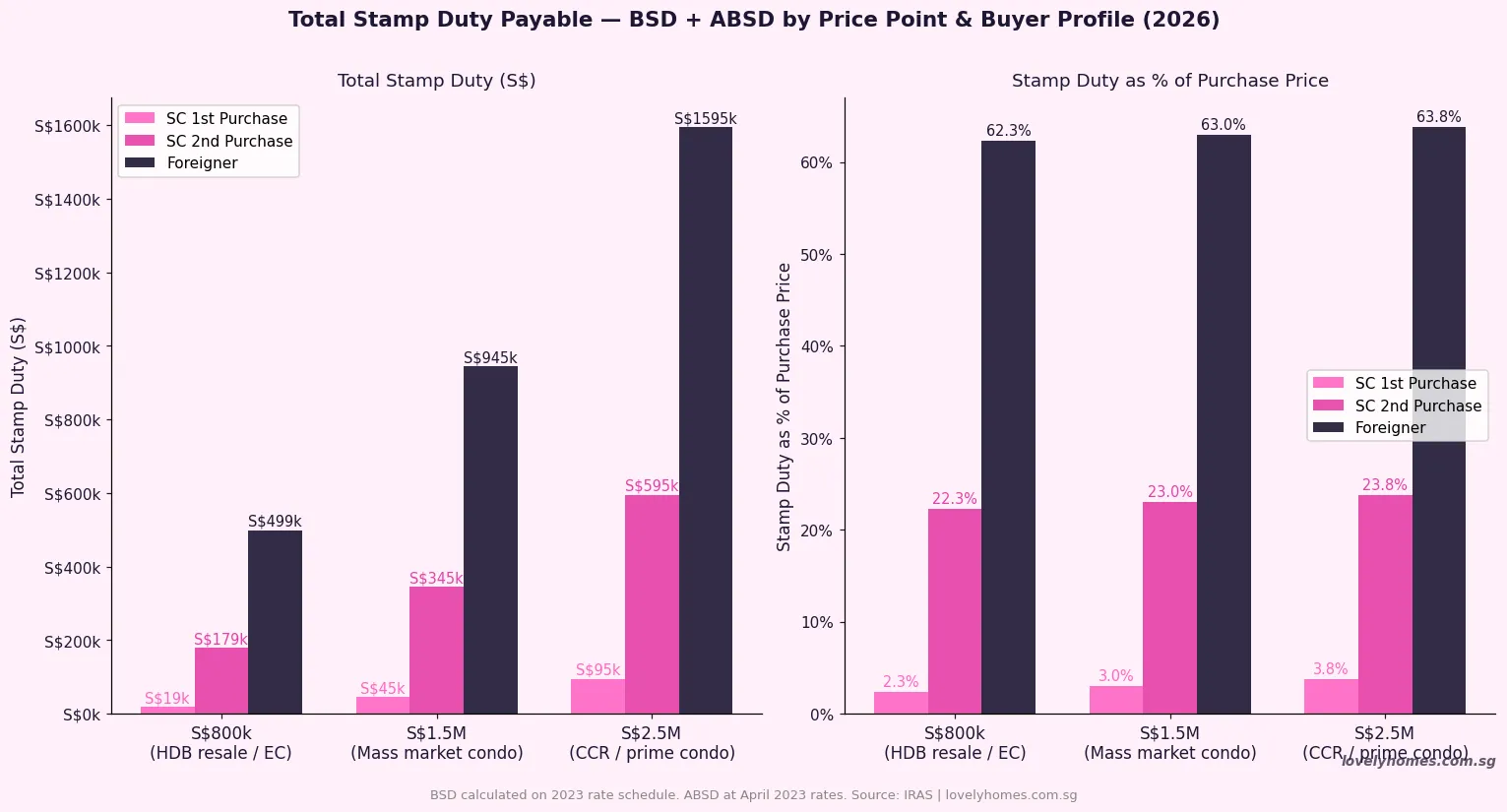
Buyer A: SC purchasing first residential property
BSD: S$1,800 + S$3,600 + S$19,200 + S$20,000 = S$44,600
ABSD: 0% × S$1,500,000 = S$0
Total stamp duty: S$44,600 (about 2.97% of purchase price)

Buyer B: SC already owning one residential property (upgrader)
BSD: S$44,600 (same as Buyer A)
ABSD: 20% × S$1,500,000 = S$300,000
Total stamp duty: S$344,600 (about 22.97% of purchase price)

Buyer C: Foreigner (e.g. EP holder, British national)
BSD: S$44,600
ABSD: 60% × S$1,500,000 = S$900,000
Total stamp duty: S$944,600 (about 62.97% of purchase price)

The difference between Buyer A and Buyer C — on the same S$1.5M property — is S$900,000. This is why foreigners buying Singapore residential property typically need to buy at a meaningful discount to replacement cost for the investment to make financial sense.

Total stamp duty BSD plus ABSD payable by price point and buyer profile Singapore 2026
Figure 3: Total stamp duty (BSD + ABSD) payable by three buyer profiles at three purchase prices (S$800k, S$1.5M, S$2.5M). Left panel: absolute S$ amounts. Right panel: as a percentage of purchase price. Source: IRAS rates; calculations by LovelyHomes.

ABSD Remissions — When You Can Get It Back (or Avoid It)

ABSD paid upfront may be refunded under specific circumstances via ABSD remissions administered by IRAS. The key remissions applicable in 2026 are:

1. SC/SPR Married Couple Remission on Second Property

A married couple in which at least one spouse is a Singapore Citizen, and who together purchase a residential property as their second property, may apply for an ABSD remission — but only if they sell their first residential property within 6 months of the completion of the second purchase (for a completed property) or within 6 months of the TOP of the new property (for an uncompleted unit). The refund is of the ABSD paid on the second purchase. Both spouses must be co-owners on the second purchase to qualify.

This remission is critically important for HDB flat owners considering upgrading to a private property: you must either sell first (and thus hold no property at exercise) or invoke the remission route by selling within 6 months. Many upgraders prefer to sell first to avoid committing S$300,000–S$600,000 of ABSD upfront.

2. Developer ABSD Remission on Residential Development Land

Property developers purchasing land for residential development are subject to 35% ABSD (as entities pay 65%, but licensed developers on qualifying residential land are subject to 35%) with a remission available if the project is completed and all units are sold within the prescribed period — typically 5 years from the date of acquisition for most sites. Projects that do not sell all units within the deadline will have a clawback of the remitted ABSD with interest, which is why Singapore developers have a strong incentive to price aggressively as the deadline approaches.

3. Remissions for Housing Developers — ABSD (Housing Developers) Regime

Under specific circumstances, including the development of public housing or certain integrated developments, additional remission mechanisms may apply. These are complex and project-specific; the developer’s solicitors will advise on eligibility at the time of tender or acquisition.

When Is Stamp Duty Payable?

BSD must be paid within 14 days of signing the OTP (or the Sale & Purchase Agreement if no OTP was issued). ABSD must be paid within 14 days of exercising the OTP (i.e., signing the Sale & Purchase Agreement) or within 14 days of signing the OTP itself if there is no separate exercise. In practice, your solicitor will advise on the precise deadline for your transaction and manage payment on your behalf.

Failing to pay on time attracts penalties: IRAS charges a late payment penalty of up to 10% of the stamp duty amount, plus interest. The clock starts from the execution date, not from when you receive the demand. Most Singapore conveyancing firms send a reminder before the deadline and arrange payment via e-stamping through the IRAS portal.

Paying Stamp Duty Using CPF

Both BSD and ABSD may be paid from the CPF Ordinary Account (OA), subject to the property being eligible for CPF usage. This is a significant benefit for Singapore Citizens and PRs who have built up CPF savings — it means stamp duty does not need to be funded entirely from cash. However, remember that all CPF withdrawals for property are subject to the CPF accrued interest rule: when the property is eventually sold, the CPF principal plus accrued interest (currently 2.5% per annum) must be refunded to your CPF OA before you receive your cash proceeds. This means ABSD paid from CPF today has a compounding cost over the holding period.

Why Stamp Duty Matters for Your Investment Analysis

Stamp duty is not a trivial transaction cost in Singapore — for a second property buyer, it represents a significant upfront capital commitment that materially affects the economics of property investment. A Singapore Citizen buying a second S$2M condominium pays S$69,600 BSD plus S$400,000 ABSD — a combined S$469,600 that is non-refundable (absent the married-couple remission). To break even on that investment, assuming the property appreciates at 3% per annum and the buyer holds for five years, the property needs to appreciate from S$2M to approximately S$2.37M just to recover the stamp duty — before financing costs, maintenance, property tax, and any renovation expenditure.

This is precisely the calculation that has driven the shift in Singapore’s private property market since 2023: the effective entry cost for second-property investors and foreigners has increased substantially, which explains the divergence between first-home buyer activity (robust, because 0% ABSD for SCs) and investor activity (more selective, because the hurdle rate is significantly higher).

Peer comparison: in Hong Kong, the equivalent additional stamp duty for non-residents was set at 30% in 2023 and has since been partially relaxed. Australia charges a foreign buyers’ stamp duty surcharge of 7%–8% at the state level in most jurisdictions. Singapore’s 60% ABSD for foreigners is among the highest residential property transaction taxes in the world.

What Might Come Next — Stamp Duty Outlook

There is no official signal as of July 2026 that the Government intends to revise ABSD rates downward in the near term. The property market has been absorbing the 2023 rates with transaction volumes moderating but prices remaining broadly resilient — particularly in the Core Central Region (CCR), where wealthier buyers have shown a willingness to pay the premium. The Government has made clear that its priority is affordability for Singapore Citizens purchasing their first home, not the investment segment.

What could prompt a revision? Two scenarios are most discussed: first, a sharp cyclical downturn in Singapore residential prices that threatens economic stability and household wealth; second, a regulatory decision that ABSD is no longer necessary as a cooling measure because the market has structurally rebalanced. Neither condition currently applies. The most that market observers speculate is a modest easing of SPR ABSD rates — from 5% to a lower figure for first purchases — if SPR numbers and integration policy makes this desirable. Any changes would be announced in a Budget Statement or a dedicated MAS/MOF press release with immediate effect.

Summary — Key Stamp Duty Facts for 2026

Item Key Fact
BSD — Who pays All buyers, residential and non-residential
BSD — Administered by Inland Revenue Authority of Singapore (IRAS)
BSD — Current schedule 1%/2%/3%/4%/5%/6% (effective 15 Feb 2023)
ABSD — SC first property 0% (exempt)
ABSD — SC second property 20% of purchase price
ABSD — Foreigner 60% of purchase price (any residential property)
ABSD — Joint purchase higher rate Highest applicable rate governs entire purchase
Payment deadline (BSD & ABSD) 14 days from signing OTP / S&P Agreement
CPF usable for stamp duty? Yes — from CPF OA, subject to CPF accrued interest rule

Frequently Asked Questions

Does BSD apply to HDB flat purchases?

Yes. BSD applies to every property purchase in Singapore, including HDB resale flats and Build-to-Order (BTO) flats when they are first purchased from HDB. BTO buyers pay BSD on the flat purchase price. Because BTO prices are typically well below S$500,000, the BSD amount is modest — usually S$4,800–S$11,800 for a 4-room or 5-room BTO flat. Resale HDB buyers pay BSD on the resale price (or valuation, if higher). BSD can be paid from the CPF Ordinary Account for HDB flat purchases.

Is ABSD payable on industrial or commercial property?

No. ABSD applies only to residential property. Commercial properties (shophouses, office units, industrial units, strata retail) are subject to BSD only. This distinction is significant for investors: buying a commercial property as a second or third purchase does not trigger ABSD, whereas buying a residential property as a second or third purchase does. This is one reason some Singapore property investors look at commercial assets as a way to deploy capital without incurring the second-property ABSD surcharge.

If I own an overseas property, does that count for ABSD?

For Singapore Citizens and PRs, overseas properties generally do not count when determining the ABSD property count. ABSD counts residential properties situated in Singapore. This means a Singaporean who owns a flat in London can still buy their first Singapore property as an “SC first purchase” at 0% ABSD. However, you must still make a statutory declaration of your property holdings, and IRAS’s lawyers will verify the position. The rules are complex and it is advisable to seek professional legal advice if you own overseas property and are unsure of your ABSD status.

Can I use SRS funds to pay stamp duty?

No. The Supplementary Retirement Scheme (SRS) funds can only be used for investments in specific SRS-approved instruments (such as shares, unit trusts, and insurance) and for retirement withdrawals. Property stamp duties — neither BSD nor ABSD — are an eligible use of SRS funds. Only CPF OA funds can be used to pay stamp duty on eligible property purchases.

I am an Employment Pass holder buying my first property in Singapore. What stamp duty do I pay?

An Employment Pass (EP) holder who is not a Singapore Citizen or PR is treated as a foreigner for stamp duty purposes and pays the full 60% ABSD plus BSD on any residential property purchase. There is no ABSD exemption for EP holders, long-term pass holders, or Entrepass holders. The Government introduced specific relaxations for nationals of certain countries under Free Trade Agreements (the USA, nationals of Iceland, Liechtenstein, Norway, and Switzerland under the EUSFTA-equivalent bilateral arrangements), where the ABSD is reduced to 15% — but these are narrow categories. All other foreigners pay 60%.

What happens if I underpay or make an error on my stamp duty calculation?

IRAS takes stamp duty compliance seriously. If you underpay — whether through an honest calculation error or a deliberate understatement of the property count — IRAS can issue an assessment for the unpaid amount plus a penalty of up to 400% of the unpaid duty. Voluntary disclosure (contacting IRAS before they identify the discrepancy) results in reduced penalties. Your conveyancing solicitor is required to verify stamp duty calculations before submission, which is the primary safeguard against errors in practice.

Related Articles

Disclaimer

This article is produced by LovelyHomes for general information purposes only and does not constitute tax, legal, or financial advice. Stamp duty rates and rules are set by the Government of Singapore and administered by the Inland Revenue Authority of Singapore (IRAS). While every effort has been made to ensure accuracy as at the date of publication (2 July 2026), readers should verify all figures directly with IRAS at iras.gov.sg and obtain independent professional advice — from a licensed conveyancing solicitor and/or a tax adviser — before making any property purchase decision.

Singapore ABSD Remission and Refund Guide 2026: SC Couple Scheme, 6-Month Window and Clawback Rules

Singapore ABSD Remission and Refund Guide 2026: SC Couple Scheme, 6-Month Window and Clawback Rules

Quick Answer: ABSD Remission & Refund Singapore 2026 — Key Takeaways

  • The ABSD remission scheme for Singapore Citizen (SC) married couples allows a full refund of the 20% ABSD paid on a second residential property purchase — provided both spouses are SC and the existing property is sold within 6 months of the new purchase’s completion date.
  • Remission is not automatic: you must apply to IRAS within the 6-month window. IRAS does not proactively initiate the refund.
  • If the 6-month window is missed, IRAS will clawback the full ABSD plus interest at 5% per annum from the date of the original transaction.
  • ABSD must be paid upfront within 14 days of exercising the OTP — the remission is a refund after the fact, not a waiver at the point of purchase.
  • The remission applies to the first joint property purchase by a SC married couple where both spouses are SC and neither has previously owned another residential property in Singapore simultaneously.
  • For SPR married couples buying their first joint property, a separate 5% ABSD remission applies with no sale requirement.
  • Developers buying residential land for development qualify for a partial ABSD remission if all units are sold within 5 years; the unsold-unit penalty is significant.
  • ABSD remission is separate from BSD — Buyer’s Stamp Duty is never remitted and is always a sunk cost of purchase.
  • Careful timing of the HDB sale is essential: sellers must not delay their HDB OTP exercise if they wish to stay within the 6-month window.

What Is ABSD Remission and Who Administers It?

Additional Buyer’s Stamp Duty (ABSD) is levied by the Inland Revenue Authority of Singapore (IRAS) on residential property purchases in Singapore, on top of the standard Buyer’s Stamp Duty (BSD). The ABSD rates introduced in April 2023 are among the highest in Singapore’s property history — 20% for Singapore Citizens buying a second property, 30% for SC buying a third or subsequent property, and 60% for foreign buyers on any purchase. These rates were designed explicitly to curb speculative activity and cool an overheated market.

However, recognising that many SC married couples engage in sequential upgrading — selling their HDB flat and buying a private condominium as a genuine housing upgrade rather than an investment — the government provides a remission (refund) mechanism for a specific, tightly defined buyer profile. This remission does not reduce the ABSD rate payable at purchase; instead, the full ABSD must be paid upfront, and a refund application is made after the old property is sold within the prescribed window.

ABSD remission policy is set by the Ministry of Finance (MOF) and administered by IRAS. Changes to remission criteria require an MOF announcement, usually as part of the broader set of property cooling measure adjustments. The current remission framework has been in force since the April 2023 cooling measure revision.

Eligibility Matrix: Who Qualifies for ABSD Remission?

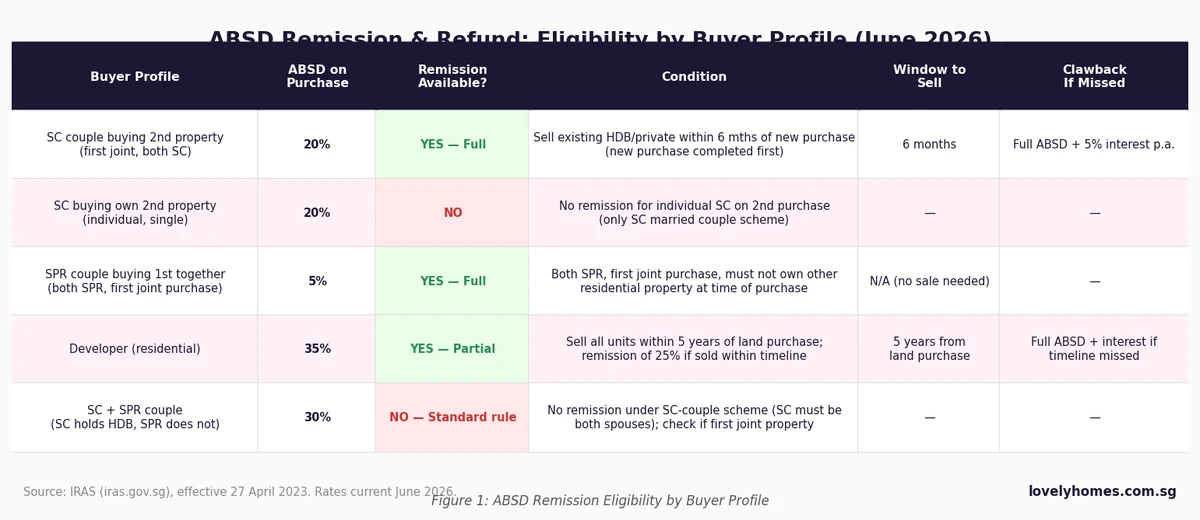
ABSD remission eligibility matrix by buyer profile Singapore 2026
Figure 1: ABSD Remission Eligibility by Buyer Profile — as of June 2026. Source: IRAS.

The eligibility criteria are deliberately narrow. The SC married couple remission is the most widely applicable scenario and applies to upgraders transitioning from their HDB flat to a private condominium. Both spouses must be Singapore Citizens (not Permanent Residents, not foreigners) at the time of the new purchase, the new purchase must be their first jointly-owned residential property together (neither spouse may hold another residential property at the time of purchase), and the existing property — typically an HDB flat — must be sold and the sale completed within 6 months of the new property’s purchase completion date.

Critically, the “completion date” for a new launch condominium is the Temporary Occupation Permit (TOP) date, not the date the OTP was exercised or the Sales and Purchase Agreement (SPA) was signed. For resale private properties, completion is typically 10–12 weeks after OTP exercise. This distinction matters greatly for the 6-month window calculation: an SC couple who exercises an OTP on an under-construction new launch today does not begin their 6-month countdown until the project obtains TOP — which could be 3 to 5 years away. This is a significant planning advantage for new-launch buyers compared to resale buyers.

How Much Is the ABSD Remission Worth?

ABSD remission amounts at various property purchase prices Singapore SC couple 2026
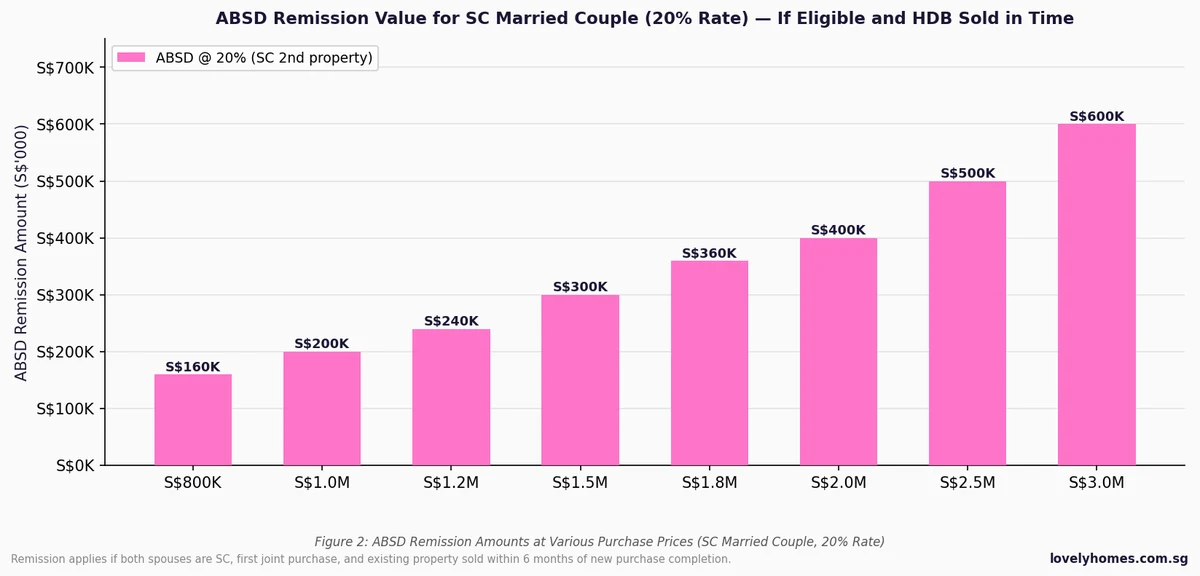
Figure 2: ABSD Remission Value for SC Married Couple at the 20% Rate — Across Various Purchase Prices.

At the current 20% ABSD rate for SC buying a second property, the remission amounts are material — often exceeding the total legal, agent, and renovation costs of the purchase combined. A couple buying a S$1.5 million condominium faces S$300,000 in upfront ABSD, all of which can be recovered if the HDB flat is sold in time. At S$2 million, the recoverable ABSD is S$400,000. These are not marginal amounts: they represent a fundamental difference in the affordability and financial feasibility of the upgrade.

It is worth noting that ABSD cannot be paid from CPF — it must be paid in cash. This means a couple must have S$300,000 to S$600,000 or more in liquid cash available at the time of purchase (before the remission is received). For many upgrading households, this is the single biggest financial planning challenge of the entire transaction. Some couples structure a bridging loan to cover the ABSD temporarily, which is repaid once the HDB flat is sold and the remission is received. The cost of the bridging loan — typically at prime rate or slightly above, for 3–6 months — is a relatively small price for preserving the remission eligibility.

The 6-Month Window: How It Works and the Clawback Risk

ABSD SC couple remission step by step timeline 6 month clawback window Singapore
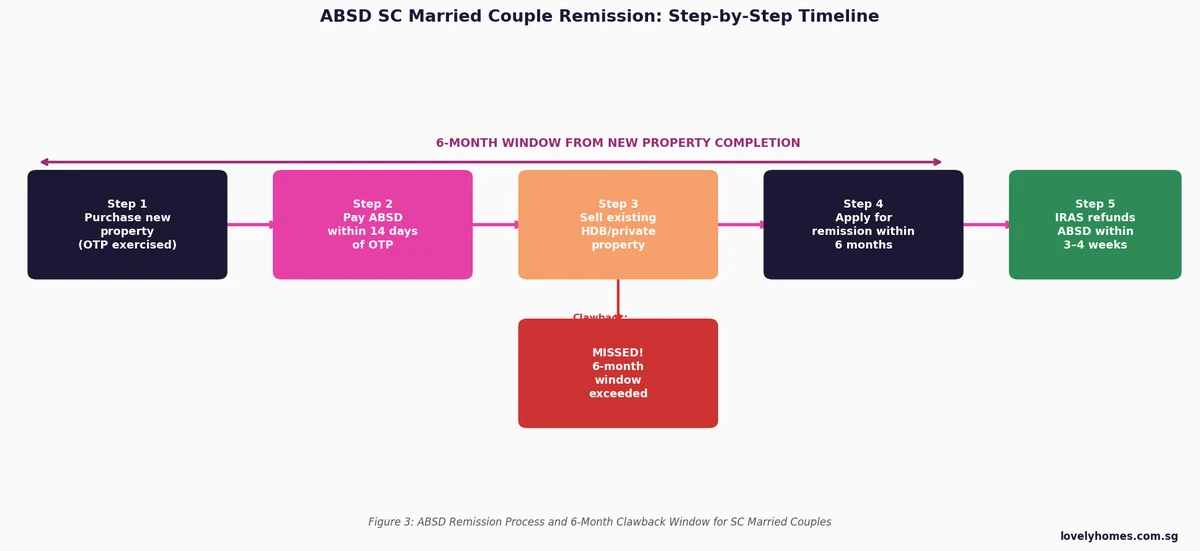
Figure 3: ABSD SC Married Couple Remission — Step-by-Step Timeline and the 6-Month Clawback Window.

The 6-month window begins on the completion date of the new property purchase, not from the OTP date or the SPA signing date. For a private condominium under construction, this is the TOP date. For a resale condominium, it is the completion of the property transfer — typically 10–12 weeks after OTP exercise. The existing property sale must be completed within this 6-month window, not merely contracted or in progress. A scenario where the HDB OTP is exercised on Month 5 but the HDB sale only completes on Month 7 would fail the test.

If the 6-month window is missed — whether due to a buyer falling through on the HDB flat, a delayed completion, or simply poor timeline management — IRAS will issue an assessment for the full ABSD plus interest at 5% per annum from the date of the new property’s stamp duty payment. On a S$300,000 ABSD amount, 5% interest is S$15,000 per year. If the miss is discovered and collected 18 months later, the clawback amount would be approximately S$322,500. There is no grace period and no appeal mechanism short of demonstrating exceptional extenuating circumstances, which IRAS assesses on a case-by-case basis with a high bar for approval.

ABSD Remission at a Glance: Summary Table

Parameter Details
Who qualifies (main scheme) Singapore Citizen married couples — both spouses must be SC; first joint property purchase
ABSD rate paid upfront 20% (SC 2nd property) — must be paid in cash within 14 days of OTP exercise
Remission quantum Full 20% of purchase price refunded if conditions met
Condition — existing property Existing HDB flat or private residential property must be fully sold and completed
Deadline to sell Within 6 months of new property completion date (TOP for new launches; legal completion for resale)
How to apply IRAS e-Stamping portal — submit remission application with documentary proof of sale
Refund timeline Typically 3–4 weeks after IRAS approves the application
Clawback if missed Full ABSD + 5% per annum interest from date of original stamp duty payment
SPR couple (1st joint) 5% ABSD remission — no sale condition; applies to first joint purchase where neither holds residential property
Can CPF be used for ABSD? No — ABSD must be paid in cash; CPF cannot be used for ABSD
Does BSD get remitted? No — BSD is always payable and is not remitted under any scheme

Worked Example: The Ng Family SC Couple Upgrade

Scenario: SC couple selling Sengkang HDB and buying a Tampines resale 3BR condo

Mr and Mrs Ng are Singapore Citizens, married, joint owners of a 5-room HDB flat in Sengkang (Market Value: S$720,000, mortgage outstanding: S$180,000, CPF drawn: S$350,000 + S$65,000 accrued interest = S$415,000). MOP cleared. They wish to upgrade to a 3-bedroom resale condominium in Tampines priced at S$1,600,000.

ABSD calculation:
Purchase price: S$1,600,000
ABSD rate (SC 2nd property): 20%
ABSD payable: S$320,000 (cash, within 14 days of OTP)
BSD: S$44,600 (can use CPF)
Legal fees: ~S$3,500
Agent commission: ~S$16,800 (if using buyer’s agent at 1%+GST)

Cash flow at purchase:
Down payment (25% of S$1.6M): S$400,000 (5% cash = S$80,000 + 20% CPF/cash = S$320,000)
ABSD: S$320,000 cash
BSD (can use CPF): S$44,600
Legal + misc: ~S$20,300
Total cash required before remission: ~S$420,300

HDB sale proceeds (to fund the purchase):
Sale price: S$720,000
Less: outstanding mortgage S$180,000
Less: CPF refund (principal + accrued interest) S$415,000
Less: legal fees + agent commission: ~S$14,800
Net cash from HDB sale: ≈S$110,200

Remission strategy:
The Ngs complete the condominium purchase on 15 July 2026. They have until 15 January 2027 (6 months) to complete the HDB flat sale. They list the HDB at S$720,000 immediately, receive an OTP from a buyer in August 2026, and the sale completes on 15 October 2026 — well within the 6-month window. They apply to IRAS for remission in November 2026 and receive the S$320,000 refund by mid-December 2026.

Net position after remission:
ABSD refunded: S$320,000
Net cash outlay (BSD + legal + agent): ~S$63,100
CPF refund reinvested to CPF OA: S$415,000 (can be redrawn for new condo mortgage servicing)
This is a financially viable upgrade — the key risk is the 6-month sale timeline.

What This Means for Upgraders: Practical Takeaways

For the vast majority of HDB upgraders — SC couples who have cleared their MOP and wish to own a private condominium — the ABSD remission scheme is what makes the upgrade financially viable. Without it, the 20% ABSD on a S$1.5 million–S$2 million condominium would represent a permanent, irrecoverable cost of S$300,000 to S$400,000, which would push many upgrades into the realm of financial imprudence. With the remission, the upgrade structure works — but only if the timing is managed with precision.

The most important practical point is that the HDB sale should not wait until the condominium purchase completes. Upgraders who procrastinate on listing their HDB flat — waiting to see if the condominium purchase proceeds, or delaying to maximise HDB rental income — run a real risk of missing the 6-month window. In a slower resale market, a flat may take 2–4 months to find a buyer and another 8–10 weeks to complete. That is already 5–6 months consumed. There is very little margin for slippage.

The comparison with HDB upgraders buying new launch condominiums is instructive: new launch buyers typically have 3–5 years before TOP, giving them ample time to sell their HDB flat — often at the most favourable market moment. Resale condominium buyers, by contrast, must manage the HDB sale on a much tighter 6-month clock.

What Might Come Next: Remission Policy Outlook

The ABSD remission framework is a carve-out within the broader ABSD system that the Ministry of Finance has maintained consistently since ABSD’s introduction in 2011, though the qualifying conditions and rates have evolved alongside each cooling measure adjustment. There is no current indication that the SC married couple remission will be abolished — it serves an important social function by supporting genuine upgrading rather than speculative multi-property accumulation. However, the remission conditions could tighten further if the government observes systematic abuse or if the market overheats again.

A potential policy direction that has occasionally been discussed in market commentary is the application of ABSD to new launch OTP exercise dates rather than TOP dates, which would eliminate the time advantage new launch buyers currently have over resale buyers in managing the 6-month HDB sale window. If implemented, this would be a material tightening that would force many upgraders to sell their HDB flat before the condominium purchase — reversing the current sequencing that most buyers prefer.

Frequently Asked Questions

Can I use CPF to pay the ABSD before receiving the remission?

No. ABSD must be paid entirely in cash — CPF Ordinary Account funds cannot be used to pay ABSD under any circumstances. This is a hard rule set by IRAS and CPF Board. Only Buyer’s Stamp Duty (BSD) and the property purchase price can be funded using CPF. If you do not have sufficient cash for the ABSD upfront, you may need to explore a bridging loan to cover the amount temporarily, which is repaid once the HDB sale completes and the ABSD remission is received. Always consult a bank or licensed financial adviser about bridging loan options and costs before proceeding.

Does the ABSD remission apply if my spouse is a Singapore Permanent Resident, not a citizen?

No. The SC married couple ABSD remission requires both spouses to be Singapore Citizens at the time of the new property purchase. If one spouse is an SPR and the other is an SC, the SC-couple remission does not apply. In this scenario, the combined SC+SPR buyer profile attracts a 30% ABSD on the second property (or the applicable rate based on the profile with the higher ABSD obligation), and no remission is available for the difference above the SPR rate. SPR married couples buying their first joint residential property can qualify for a separate full remission of their 5% ABSD — but this applies only to SPR+SPR couples on a genuinely first joint purchase where neither holds another residential property.

What if my HDB flat sale falls through after I have already purchased the condominium — can I extend the 6-month window?

IRAS does not provide an automatic extension of the 6-month window due to a failed HDB sale. However, IRAS may consider an extension in exceptional and documented circumstances — for example, if the buyer of the HDB flat absconds or commits a fundamental breach, causing the sale to abort, and the seller (you) acted in good faith to find an alternative buyer promptly. These situations are assessed individually and are not guaranteed. If a buyer falls through, you should immediately relist the flat and notify your conveyancer and IRAS in writing. In a difficult HDB resale market or if the flat is in an over-quota block (EIP), the risk of a failed sale is higher — factor this into your planning before exercising the condominium OTP.

The new launch condominium I bought has been delayed past its expected TOP. Does this affect my 6-month window?

For new launch condominiums, the 6-month remission window begins at the actual TOP date, not the projected or contractual TOP date. If TOP is delayed by 6 or 12 months, your 6-month window shifts accordingly — you have more time to sell your HDB flat. This is generally advantageous: if your HDB flat has already been sold before TOP (as many prudent upgraders do), the delay merely means you wait longer in rental or temporary accommodation before moving into the new property. However, if you have not yet sold the HDB flat and are waiting for clarity on TOP before acting, a TOP delay can compress the effective timeline between TOP and your actual start of marketing, so do not wait for the very last moment.

Is there an ABSD remission for Singapore Citizens who are not married — for example, singles or divorced individuals?

No. The full ABSD remission for a second residential property is only available to married Singapore Citizen couples. Single SC individuals, divorced SC individuals, and cohabiting SC couples (unmarried) do not qualify for the remission and must pay the full 20% ABSD on a second property purchase without any refund mechanism. This is a deliberate policy choice — the remission is designed to support the family unit’s housing upgrade, not individual investment. Singles who wish to own a private condominium after selling their HDB flat may consider selling first and then buying as a first-time private property buyer with no existing HDB — this eliminates the ABSD entirely rather than triggering and then seeking remission.

What documents do I need to apply for the ABSD remission, and how do I submit them?

The ABSD remission application is submitted through IRAS’s e-Stamping portal (mytax.iras.gov.sg). You will need: (a) the stamp duty reference number from the original ABSD payment; (b) a copy of the signed HDB resale completion documents or the private property sale and purchase agreement with evidence of completion (typically a letter from your solicitor confirming that the sale has been completed); (c) evidence that the selling party is the same person/persons who purchased the new property (NRIC details); and (d) your marriage certificate, if not already on record with IRAS. Your conveyancer or property lawyer can typically prepare and submit the remission application as part of the conveyancing engagement — confirm with them early in the process so they are ready to file as soon as the HDB sale completes.

Can the ABSD remission be used if the new property is bought in one spouse’s sole name, not jointly?

This is a nuanced point. The SC married couple remission applies to purchases made in the joint names of both spouses. If the new condominium is purchased in the sole name of one spouse only, the SC married couple scheme may not apply — the buying spouse is effectively treated as an individual, and whether the purchase constitutes a “second property” depends on whether that spouse already holds other residential property. If the buying spouse has never owned a residential property before (having sold their share in the HDB flat prior to purchase, for example), they may qualify as a first-time buyer with 0% ABSD — this is the “decoupling” strategy. Decoupling and ABSD remission are alternative approaches to the same upgrading problem; they are not typically combined in the same transaction. Consult a licensed conveyancer before choosing a structure.

Disclaimer: This article is for general informational purposes only and does not constitute tax, legal, or financial advice. ABSD rates, remission conditions, and application procedures are subject to change by the Ministry of Finance (MOF) and IRAS. Always verify current rates and eligibility conditions at iras.gov.sg before making any property purchase or sale decision. Consult a licensed conveyancer, qualified financial adviser, or tax professional before proceeding with any transaction involving ABSD. The worked examples in this article are illustrative only and may not reflect your specific financial circumstances.

Singapore En Bloc Seller’s Guide 2026: Collective Sale Process, Proceeds and What Owners Need to Know

Singapore En Bloc Seller’s Guide 2026: Collective Sale Process, Proceeds and What Owners Need to Know

Quick Answer: What Is an En Bloc Sale in Singapore?

  • An en bloc sale (collective sale) is where all owners of a strata-titled development — such as a private condo, HUDC estate, or cluster development — collectively sell the entire site to a developer or investor.
  • Governed by the Land Titles (Strata) Act (LTSA), a collective sale requires the consent of owners holding at least 80% by share value and strata area for developments over 10 years old (90% for developments under 10 years old).
  • Minority owners who refuse are bound by the decision if the Strata Titles Board (STB) or High Court approves the sale — they cannot block a properly executed collective sale.
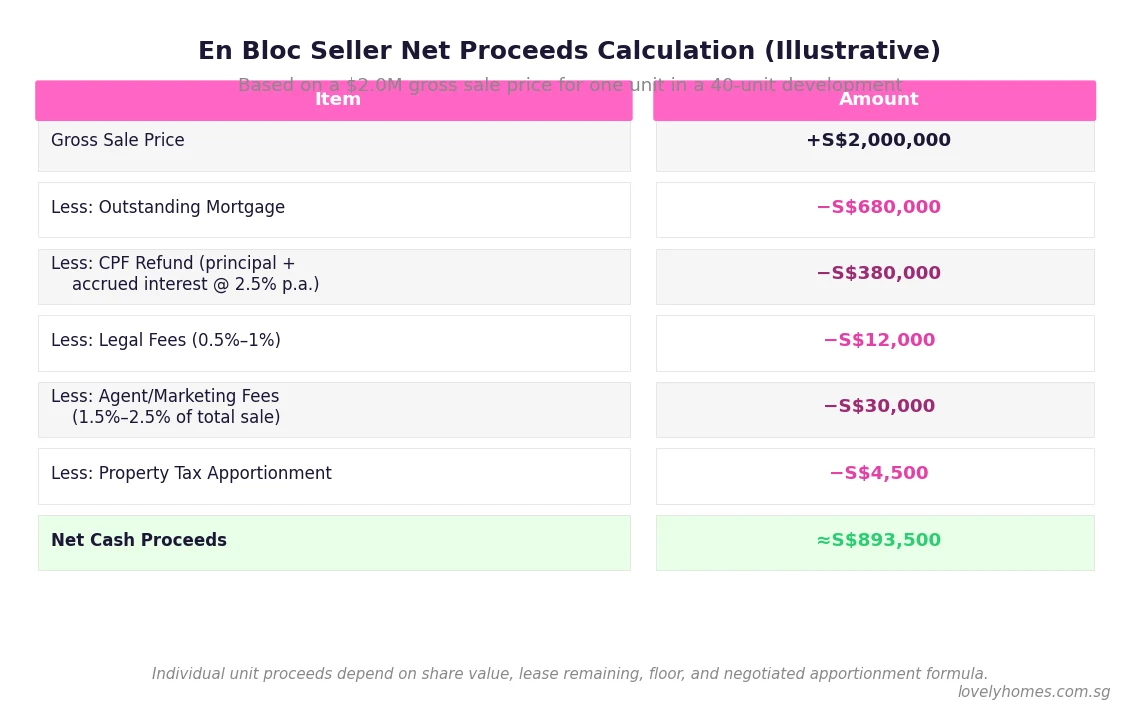
  • Typical proceeds for a seller: the gross sale price for their unit, less their outstanding mortgage, CPF refund (principal + accrued interest at 2.5% p.a.), legal fees (~0.5–1%), and agent/marketing fees (~1.5–2.5% of total site price).
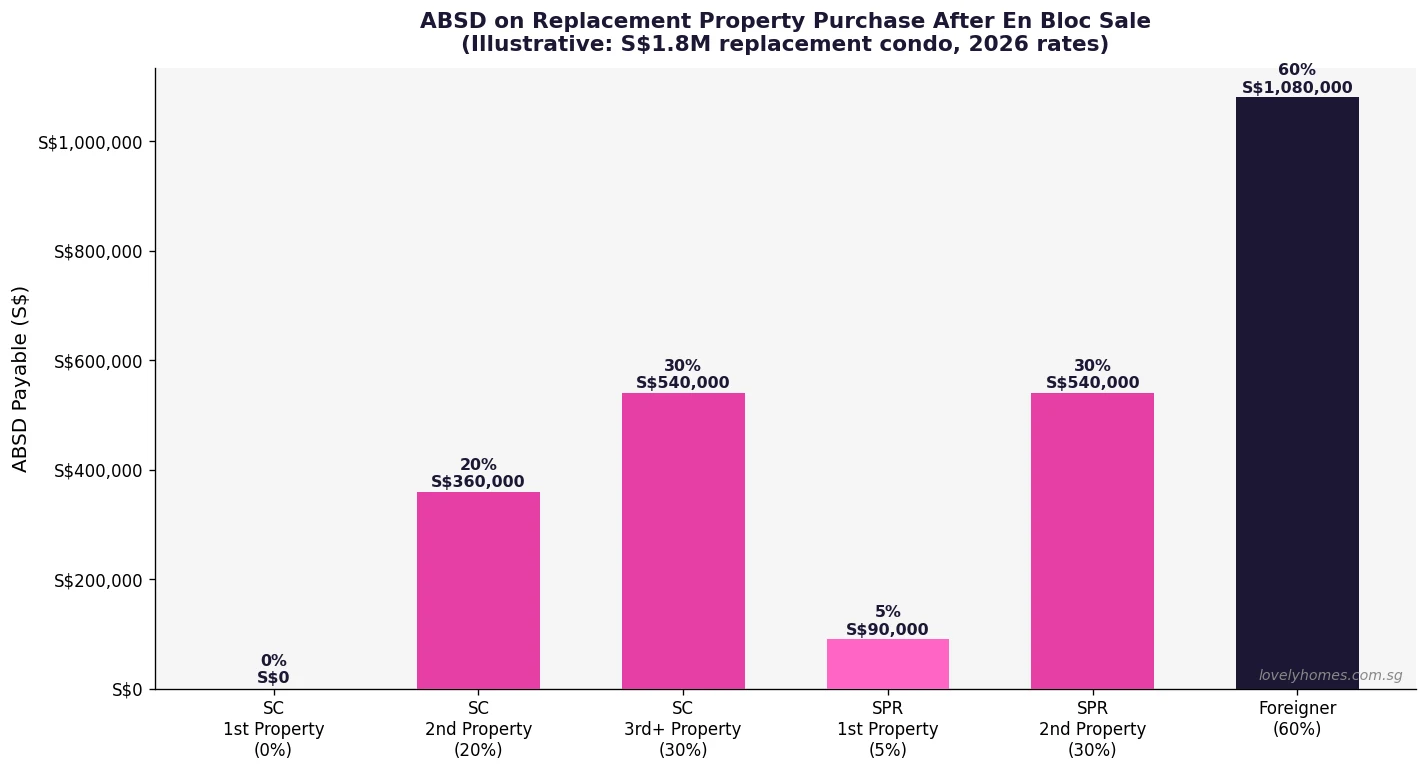
  • The ABSD on any replacement property purchase depends on the owner’s profile — a SC first-time buyer pays 0%; a SC buying a second property pays 20%. Planning the next purchase is essential before accepting the en bloc offer.
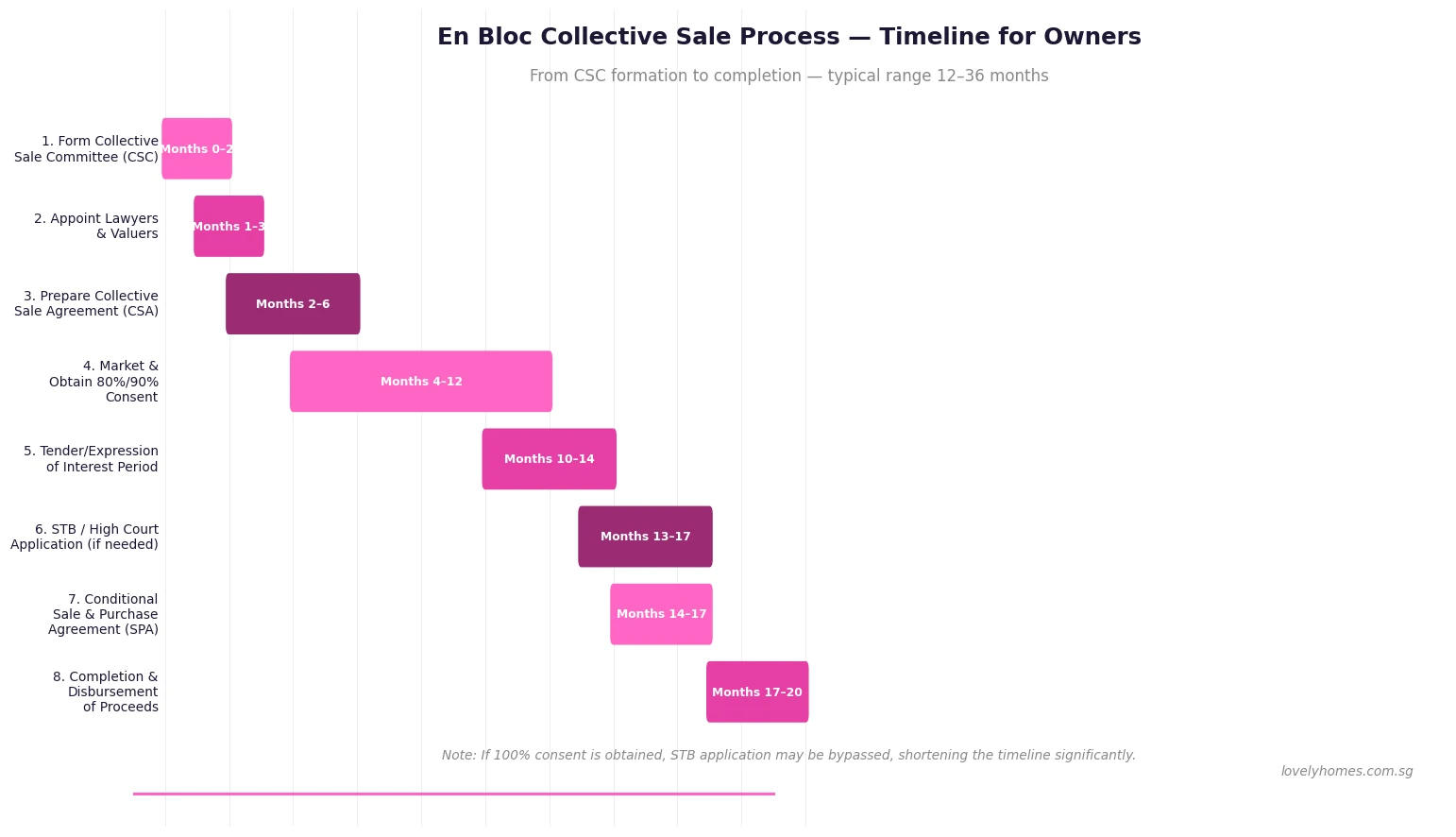
  • Typical timeline: 12–36 months from Collective Sale Committee (CSC) formation to completion. Some contentious sales take longer if STB or court proceedings are required.
  • ABSD remission may be available for SC couples who sell their only property and buy a replacement within 6 months — plan this sequence carefully.

What Is a Collective Sale (En Bloc)?

A collective sale — commonly called an “en bloc” sale — is a transaction under which all unit owners in a strata development sell their units simultaneously to a single buyer, typically a property developer. The buyer acquires the entire site in one transaction, usually with the intention of redeveloping it.

En bloc sales are governed by Part VA of the Land Titles (Strata) Act (Cap. 158) (LTSA), administered by the Singapore Land Authority (SLA). The legislative framework sets out the consent thresholds, procedural requirements, the role of the Collective Sale Committee, and the mechanism for binding dissenting minority owners through the Strata Titles Board (STB) or the High Court.

For property owners, an en bloc sale is both an opportunity and a disruption. The opportunity: receiving a premium above individual unit market value, because developers pay for the land redevelopment potential — the “en bloc premium.” The disruption: forced relocation, the need to find replacement housing quickly, and a complex tax and financial planning exercise involving ABSD, CPF, and mortgage settlement.

Figure 1: En Bloc Collective Sale Process Timeline Singapore 2026 - CSC Formation to Completion 12 to 36 Months
Figure 1: The en bloc process timeline — from Collective Sale Committee formation to proceeds disbursement. Source: LTSA Part VA, SLA, STB.

The Consent Threshold: Who Decides?

The LTSA requires that an en bloc sale be supported by owners holding at least 80% of the share value and 80% of the total strata floor area — for developments that are at least 10 years old from the date of the Temporary Occupation Permit (TOP) or the Certificate of Statutory Completion (CSC). For newer developments (under 10 years from TOP/CSC), the threshold rises to 90% in both measures.

Once the threshold is crossed, the sale can proceed even without the agreement of the remaining minority — provided it meets all other statutory requirements. The STB or High Court may approve the sale over dissenting owners’ objections if it is satisfied that the sale is in good faith, the proceeds are distributed equitably, and the transaction price represents fair market value.

Share value in a condo development is allocated to each unit at the time of strata subdivision, typically proportional to the unit’s floor area. A larger unit with a higher share value has proportionally more voting weight in the en bloc consent process. Strata floor area is the individual unit size as defined in the approved strata plan.

Requirement ≥10-Year Development <10-Year Development
Consent by share value 80% 90%
Consent by strata floor area 80% 90%
Minority bound? Yes, if STB/court approves Yes, if STB/court approves
STB Good Faith Test Required Required
Typical STB timeline 2–4 months 2–4 months

How Proceeds Are Calculated and Distributed

The total sale price for the entire development is determined by the tender or private treaty negotiation process. Each unit’s share of the total proceeds is then calculated according to an apportionment formula agreed upon in the Collective Sale Agreement (CSA). The most common apportionment methods are: by share value, by strata floor area, or a combination of the two.

From each unit’s gross proceeds, the following deductions apply before the owner receives net cash:

Figure 2: En Bloc Net Proceeds Calculation Singapore 2026 - Mortgage CPF Refund Legal Fees Agent Fees
Figure 2: Illustrative net proceeds calculation for one unit in a 40-unit development sold at S$2.0M per unit gross allocation. Actual figures depend on individual unit’s outstanding obligations. Source: CPF Board, SLA, industry estimates.

The most significant deductions — and the ones most commonly misunderstood by owners — are the CPF refund and the agent/marketing fees. The CPF refund is not a fee paid to an external party; it is the owner’s own CPF money being returned to their Ordinary Account (plus compounding at 2.5% per annum). However, because it is returned to CPF — not paid as cash — owners who have drawn heavily on CPF for mortgage servicing may find that their net cash proceeds are lower than they expect.

Agent and marketing fees are typically charged as a percentage of the total site sale price — not just one unit’s share. For a 40-unit development sold for S$200M, a 1.5% commission totals S$3M, or S$75,000 per unit on average. This is negotiable and should be agreed upon before the agent is formally appointed by the CSC.

The Role of the Collective Sale Committee (CSC)

The Collective Sale Committee is elected at an Extraordinary General Meeting (EGM) of the Management Corporation Strata Title (MCST). The CSC is the body that initiates and manages the en bloc process on behalf of all consenting owners. Its key responsibilities include engaging a licensed marketing agent (or conducting a public tender directly), appointing a law firm to prepare the CSA and manage the STB application, commissioning an independent valuation of the site, and setting the reserve price below which the development will not be sold.

The CSC owes a duty of good faith to all owners — including dissenting ones. It must ensure that the sale is conducted transparently, that the reserve price is not set below the independent valuation, and that all owners receive equal access to information about the proposed terms.

Under the LTSA, CSC members cannot be a party to any contract that gives them a personal benefit from the sale that other owners do not share — they must remain impartial fiduciaries. Owners who believe the CSC has acted improperly can lodge objections with the STB.

ABSD on the Replacement Purchase: Planning Ahead

An en bloc sale forces owners to buy replacement housing. The ABSD implications of that replacement purchase are significant — and the planning must begin well before the en bloc sale is completed.

Figure 3: ABSD on Replacement Property After En Bloc Sale Singapore 2026 - SC SPR Foreigner Rates
Figure 3: ABSD rates on a S$1.8M replacement condo, by buyer profile (2026). SC first-time buyers pay 0%; a SC buying a second property pays 20% = S$360,000. Source: IRAS Stamp Duties Act.

The key planning consideration is whether the owner will be a first-time buyer of their replacement property — i.e., will they own zero other properties at the time the replacement OTP is exercised. For most en bloc sellers, this depends on whether they have other private properties. If the en bloc unit is their only property, they will generally be a first-time buyer for ABSD purposes on the replacement purchase.

For Singapore Citizens who sell their only property and buy a replacement private residential property, the ABSD remission for SC couples may also be applicable: if they purchase the replacement property before selling their en bloc unit, they pay 20% ABSD upfront — but can apply to IRAS for a refund once they sell the en bloc property within 6 months of the replacement purchase. This sequence requires careful cash flow management, as the upfront ABSD may need to be funded while the en bloc proceeds are still in the completion pipeline.

Worked Example: The Ramasamy Family’s En Bloc Experience

Situation: Mr and Mrs Ramasamy are both Singapore Citizens. They own a 1,200 sq ft unit in a 48-unit Bishan condo originally purchased in 2010 for S$960,000. The development (TOP 2004, now 22 years old) has successfully obtained 83% consent for a collective sale at a total site price of S$420M. The Ramasamys’ unit’s gross share of proceeds is S$2,100,000 based on the apportionment formula.

Deductions from Gross Proceeds (S$2,100,000):
Outstanding mortgage balance: −S$320,000
CPF used (principal S$350,000 + accrued interest 2.5% p.a. for 16 years ≈ S$175,000): −S$525,000
Legal fees (~0.6%): −S$12,600
Marketing agent fees (their unit’s share at 1.5%): −S$31,500
Property tax apportionment and misc.: −S$5,200
Net Cash Proceeds: ≈ S$1,205,700
CPF OA top-up: S$525,000 (returned to their joint CPF OA accounts)

Replacement Property Planning:
The Ramasamys plan to purchase a S$1.9M freehold condo in District 20 as their replacement home. Since this will be their only property (the en bloc unit is sold), they are SC first-time buyers → ABSD: S$0.
BSD on S$1.9M: S$1,800 + S$3,600 + S$19,200 + S$4,000 (on last S$100K at 4%) = S$28,600 BSD
Downpayment (25%): S$475,000 — funded from net cash proceeds.
Bank loan: S$1,425,000 at 3.0% over 25 years → S$6,744/month.
Combined TDSR: S$6,744 ÷ S$15,000 (combined income) = 45.0% ✓
Net cash remaining after downpayment and costs: ≈ S$695,000

Key Timing Issue: The Ramasamys should confirm the en bloc completion date (typically 12 months after STB approval) before committing to a replacement OTP. If they need to purchase before completion, they may need bridging finance for the downpayment. Consult a mortgage adviser at least 6 months before the expected completion date.

What Minority Owners Can and Cannot Do

A minority owner (one who did not sign the CSA or who explicitly objects) has limited but meaningful protections under the LTSA. They may file an objection with the STB on the following grounds: (a) the sale price is not in good faith and does not reflect market value; (b) the proceeds distribution formula is inequitable; (c) the majority owners’ conduct has been improper; or (d) the sale will cause them a financial loss (i.e., their net proceeds after repaying their mortgage and CPF are negative).

The STB has the power to dismiss such objections if it finds that the sale meets the good-faith test and the distribution is equitable. Once the STB issues its approval order, all owners — including dissenters — are bound and must vacate and transfer title at completion. Refusal to do so may result in the court compelling the transfer.

Minority owners are entitled to receive the same gross proceeds per share as consenting owners. They cannot be offered a lower price for holding out — the CSA must apply the same formula to all units. The only difference is that dissenting owners bear their own legal costs for any STB objections they file.

Why En Bloc Matters: Singapore’s Urban Renewal Cycle

En bloc sales are a structural feature of Singapore’s built environment. Because 99-year leasehold land diminishes in value as the lease runs down, and because the island’s limited land area means underutilised sites are regularly returned to the urban system, collective sales serve as the primary mechanism for private-sector urban renewal. The Urban Redevelopment Authority (URA) monitors and facilitates this process through its Master Plan and development control rules that govern what can be built on a redeveloped site.

En bloc activity tends to be cyclical and correlated with developer land bank depletion and Government Land Sales (GLS) programme supply. When GLS supply is tight and developers need land, en bloc bids rise — driving the en bloc premium that makes collective sales attractive to owners. As of mid-2026, developer land bank levels are moderate, and the en bloc market remains selective — large, well-located developments with strong redevelopment potential continue to attract developer interest.

What Might Come Next

The LTSA en bloc framework has been revised several times — most recently in 2018, when procedural requirements were tightened to protect minority owners and ensure greater transparency in CSC governance. Regulators are unlikely to fundamentally alter the framework, which has proven effective at facilitating urban renewal while providing minority protections. However, incremental adjustments — such as minimum reserve price rules or stricter good-faith disclosure requirements — are possible in future Budget cycles.

For en bloc timing, owners in ageing developments (15–25 years from TOP) located in areas with active redevelopment potential — particularly in the Core Central Region and in major rejuvenation corridors designated in URA’s long-term plans — should monitor their development’s en bloc viability periodically. The window for maximum en bloc premium typically narrows as remaining lease runs below 60 years, at which point CPF and bank financing restrictions reduce the pool of eligible buyers for individual units, lowering their market value.

Frequently Asked Questions

Can I refuse to sell in an en bloc sale?

You can withhold your signature from the CSA — but you cannot ultimately block a sale that meets the LTSA consent threshold and passes the STB’s good-faith test. Once the STB issues its approval, all owners, including those who did not consent, are legally bound by the sale. The only recourse for a dissenting owner is to file an objection with the STB on specific grounds (e.g., financial loss, inequitable distribution, breach of good faith), and to appeal STB decisions to the High Court. Resistance beyond these legal channels will not prevent the sale from proceeding.

How is the reserve price determined?

The reserve price is the minimum price below which the CSC will not accept any offer. It is set by the CSC based on an independent valuation conducted by a licensed property valuer — the reserve price must not be set below this valuation, as doing so would fail the LTSA’s good-faith test. In practice, the reserve price is typically set at the independent valuation level or modestly above it, to reflect the en bloc premium that a developer would need to pay for the redevelopment potential. Once set, the reserve price is disclosed in the public tender documents and to all owners before the CSA signing exercise.

What happens to my HDB flat eligibility after an en bloc sale?

If you sold an en bloc private property and are now a “first-timer” (no current private property ownership), you may be eligible to purchase an HDB flat — provided you meet HDB’s income ceiling and citizenship eligibility criteria. However, if your household income exceeds S$14,000 per month (S$21,000 for extended families), you may not be eligible for a new BTO flat even as a displaced en bloc seller. The HDB Silver Housing Bonus and other schemes are available for elderly en bloc sellers downsizing. Consult HDB or a licensed real estate consultant before making assumptions about HDB eligibility.

Will my rental income from the en bloc unit continue until completion?

Yes, you retain the right to rent out your unit until the legal completion date — typically 12 months after STB approval for the transfer of legal title. However, any tenancy agreement must include a clause allowing early termination upon reasonable notice (usually 2 months) to accommodate the en bloc completion. Under the Residential Tenancies Act, tenants of en bloc units have specific rights regarding notice periods and relocation assistance. Ensure your tenancy agreement is reviewed by your solicitor in light of the en bloc proceedings.

What is the “good faith” test the STB applies?

The Strata Titles Board assesses whether the transaction price was arrived at in good faith, taking into account: (a) the sale price compared to the independent valuation; (b) the method of distributing sale proceeds among owners; (c) the relationship between the purchaser and any owner, or any agent; and (d) the latent defects of title affecting the development. If the STB finds that the transaction price was not arrived at in good faith — for example, if a CSC member had an undisclosed conflict of interest, or if the price was materially below valuation — it may refuse to approve the sale.

Can the developer delay completion and what recourse do I have?

Once the conditional SPA is executed, both parties are contractually bound to complete on the scheduled date, typically 12 months after the date of the Strata Titles Board Order. If the developer fails to complete, the CSA solicitors (acting on behalf of all owners) may pursue the developer for specific performance or damages under the SPA. Conversely, if owners cause delays by refusing to vacate, the purchaser may seek court orders compelling handover. Delays in en bloc completions, while uncommon, have occurred due to financing conditions in the SPA not being met — this should be flagged as a risk by your solicitor when reviewing the SPA terms.

What are the tax implications of receiving en bloc proceeds?

In Singapore, capital gains tax does not apply to individuals. The proceeds you receive from an en bloc sale — whether the gain is derived from an increase in property value or from the en bloc premium — are not subject to income tax for individual owners (as opposed to companies or developers, for whom different tax rules may apply). However, if IRAS determines that you are a “property trader” who regularly buys and sells properties for profit, the gains may be characterised as trading income and subject to income tax. For most homeowners with a single en bloc unit, this risk is low. Consult a tax professional if you are uncertain about your tax position.

Related Articles

Disclaimer: The information in this article is provided for general educational purposes only. LTSA provisions, ABSD rates, CPF rules, and STB procedures cited are based on legislation and regulatory guidance current as at June 2026 and are subject to change. LovelyHomes does not provide legal, tax, or financial advice. Before making any decisions regarding an en bloc sale — whether as a consenting owner, dissenting owner, or CSC member — consult a licensed conveyancing solicitor, a tax specialist registered with IRAS, and a MAS-licensed financial adviser. Authoritative sources: SLA (sla.gov.sg), IRAS (iras.gov.sg), URA (ura.gov.sg), CPF Board (cpf.gov.sg), Singapore Statutes Online (sso.agc.gov.sg).

Translate »