Singapore Private Property Buying Costs 2026: Complete All-In Cost Guide for Every Buyer Profile

Singapore Private Property Buying Costs 2026: Complete All-In Cost Guide for Every Buyer Profile

Quick Answer — Private Property Buying Costs at a Glance

  • Buying private property in Singapore involves three stamp duties: Buyer’s Stamp Duty (BSD), Additional Buyer’s Stamp Duty (ABSD), and — for resale within 3 years — Seller’s Stamp Duty (SSD, paid by the seller).
  • BSD is payable by every buyer on every property purchase, at progressive rates of 1%–6% on the purchase price or market value, whichever is higher.
  • ABSD ranges from 0% (Singapore Citizen first property) to 60% (foreigner) and is computed on the full price from the first dollar — it is not progressive.
  • Beyond stamp duties, buyers face legal fees (est. S$2,500–S$5,000), valuation (S$500–S$2,000), and agent commission for resale purchases (typically 1% + 9% GST).
  • The minimum cash downpayment for a private property bank loan is 5% of the purchase price; the total downpayment is 25% (5% cash + 20% cash or CPF).
  • Ongoing costs after purchase include property tax (administered by IRAS), MCST maintenance fees, mortgage servicing, and insurance.
  • All stamp duties must be paid within 14 days of exercising the Option to Purchase (OTP) or signing the Sale and Purchase Agreement (S&P), whichever is earlier.

What Are the Private Property Buying Costs in Singapore?

Purchasing private property in Singapore — whether a condominium, apartment, landed house, strata-titled shophouse, or commercial unit — involves a structured set of costs that go well beyond the headline purchase price. The Singapore government, through the Inland Revenue Authority of Singapore (IRAS), administers stamp duties that can represent a significant portion of the total outlay. For a foreigner buying a S$2 million condominium in 2026, the combined BSD and ABSD alone amount to S$1,269,600 — nearly two-thirds of the purchase price again.

This guide covers every material cost a private property buyer incurs in Singapore in 2026: upfront stamp duties, legal and professional fees, mortgage-related costs, and the ongoing holding costs that continue after completion. Costs are broken down for five buyer profiles — Singapore Citizen first property, Singapore Citizen second property, Singapore Permanent Resident (SPR) first property, SPR second property, and foreigner — at representative price points.

Singapore private property all-in buying costs by buyer profile at S$1.5M 2026
Figure 1: Total upfront costs (BSD + ABSD + legal fees) at S$1,500,000 for five buyer profiles. The SC first-property buyer pays S$48,100; the foreigner pays S$948,100. Source: IRAS; LovelyHomes, 2026.

Buyer’s Stamp Duty (BSD): What Every Buyer Pays

BSD is a compulsory tax administered by IRAS on every property purchase in Singapore. It applies to all buyers regardless of nationality, residency status, or how many properties they own. It is computed on the higher of the purchase price or the property’s market value as assessed by IRAS.

BSD uses a progressive rate structure. The rates for residential property in 2026 are:

Portion of Value BSD Rate BSD on This Band
First S$180,000 1% S$1,800
Next S$180,000 (S$180K–S$360K) 2% S$3,600
Next S$640,000 (S$360K–S$1.0M) 3% S$19,200
Next S$500,000 (S$1.0M–S$1.5M) 4% S$20,000
Next S$1,500,000 (S$1.5M–S$3.0M) 5% S$75,000
Amount exceeding S$3,000,000 6% Varies

Using the above schedule, BSD on a S$1,500,000 purchase is S$44,600 (effective rate 2.97%); on a S$2,000,000 purchase it is S$69,600 (effective rate 3.48%); on a S$3,000,000 purchase it is S$119,600 (effective rate 3.99%). BSD is due to IRAS within 14 days of the Option to Purchase being exercised (or the date of the contract, whichever is earlier). Late payment attracts a penalty of 5% per annum on the unpaid amount.

BSD can be paid from CPF Ordinary Account (OA) funds, provided the property is residential and the CPF member is eligible. Most buyers use a combination of CPF OA and cash.

Buyer Stamp Duty amount and effective rate by purchase price Singapore 2026
Figure 2: BSD dollar amount (bars) and effective rate (line) at seven price points from S$500,000 to S$5,000,000. The 6% top rate kicks in above S$3,000,000. Source: IRAS; LovelyHomes, 2026.

Additional Buyer’s Stamp Duty (ABSD): The Nationality and Ownership Surcharge

ABSD is a flat-rate stamp duty levied on top of BSD, applied as a percentage of the full purchase price from the first dollar. Unlike BSD, ABSD is not progressive — the stated rate applies to the entire price. ABSD rates are determined by the buyer’s citizenship status and the number of residential properties they own at the time of purchase. The 2026 ABSD schedule, unchanged since the April 2023 round of cooling measures, is:

Buyer Profile 1st Property 2nd Property 3rd+ Property
Singapore Citizen 0% 20% 30%
Singapore Permanent Resident 5% 30% 30%
Foreigner (including most work pass holders) 60% 60% 60%
Entity (company, trust, collective investment scheme) 65% 65% 65%
Developer (housing developer licence) 35% (remittable on completion conditions)

What counts as “owning” a property for ABSD purposes? IRAS counts every residential property in Singapore in which you hold a legal or beneficial interest — including properties held jointly or as a co-owner, properties held through a trust, and properties inherited (even if you did not pay for them). Overseas property does not count. If you are a SC buying your second property, you will pay 20% ABSD on the full purchase price — S$300,000 on a S$1.5M purchase.

ABSD must also be paid within 14 days of exercising the OTP (or signing the S&P). Unlike BSD, ABSD cannot be paid from CPF — it must be paid entirely in cash. This is a crucial planning consideration for second-property buyers who may be CPF-rich but cash-light.

One key relief: Singapore Citizen married couples who own one residential property jointly may apply for ABSD remission when they sell the first property within 6 months of buying a new one. This remission restores the SC couple to effectively 0% ABSD on the second purchase. The 6-month clock starts from the completion of the new purchase.

Seller’s Stamp Duty (SSD): A Reminder for Buyers Who May Resell Quickly

Buyers should also be aware of the Seller’s Stamp Duty (SSD), which applies if the property is resold within three years of acquisition. SSD is paid by the seller, but it affects the resale market because sellers typically factor it into their pricing:

  • Sold within 1 year: 12% SSD
  • Sold within 2 years: 8% SSD
  • Sold within 3 years: 4% SSD
  • Sold after 3 years: 0% SSD

For buyers who contemplate flipping a property within 3 years, the combined SSD exposure can make the transaction economically unattractive. Planning a minimum 3-year hold eliminates SSD entirely.

Professional and Transaction Fees

Beyond stamp duties, buyers incur a set of professional fees for the conveyancing and mortgage process:

Fee Item Typical Range Who Pays Notes
Legal fees (conveyancing — buyer’s solicitor) S$2,500–S$5,000 Buyer Higher for complex transactions; covers OTP, S&P, title search, SLA registration
Valuation fee S$500–S$2,000 Buyer Required by bank for mortgage; Singapore Institute of Surveyors and Valuers (SISV) accredited valuer
Mortgage processing fee S$0–S$500 Buyer Many banks waive this; check with your lender
Agent commission (resale purchase) 1%–2% + 9% GST Buyer Not mandatory; buyer’s agent commission is separately negotiated. New launches: 0% (developer pays co-broke)
Property tax (pro-rated at completion) Varies Shared at completion Seller reimburses buyer for unused portion of pre-paid property tax

Downpayment and Loan Structure

For private property financed by a bank loan, MAS mandates a minimum downpayment of 25% of the purchase price (or market value, whichever is lower). The breakdown is:

  • 5% must be paid in cash (the Option Exercise Fee of 1% + the balance of 4% at exercise, or 5% at S&P signing for new launches)
  • The remaining 20% can be paid from CPF Ordinary Account, cash, or a combination
  • 75% maximum LTV (Loan-to-Value) — i.e., the bank loan covers up to 75% of the lower of price or value

For a second property, the LTV ceiling drops to 45%, meaning a downpayment of 55% — with a minimum of 25% in cash. For a third or subsequent property, the LTV is 35%, with a minimum 25% cash downpayment. MAS’s TDSR (Total Debt Servicing Ratio) framework caps total monthly debt obligations (including the new mortgage) at 55% of gross monthly income.

Full private property cost breakdown 5 buyer profiles S$2M Singapore 2026
Figure 3: Complete upfront cost breakdown for five buyer profiles at S$2,000,000 (BSD + ABSD + legal + valuation + agent 1%). SC first-property buyers face S$74,600 beyond the downpayment; foreigners face S$1,295,600. Source: IRAS; LovelyHomes calculations, 2026.

Ongoing Ownership Costs After Completion

The upfront costs are only part of the picture. Once you own the property, several recurring costs apply:

Ongoing Cost Typical Annual Amount Administered By
Property Tax S$0–S$20,000+ (depends on AV and usage) IRAS
MCST Maintenance Fees (condo) S$3,000–S$30,000 (S$250–S$2,500/mth) MCST (management corporation)
Sinking Fund Contributions Included in MCST fees (10% of maintenance) MCST
Fire Insurance (mandatory for mortgaged property) S$100–S$400 Insurer (MAS-regulated)
Home Contents Insurance S$200–S$800 Optional; insurer
Utilities (electricity, water, gas) S$2,400–S$7,200 (S$200–S$600/mth) SP Group, PUB
Mortgage Servicing Based on loan amount, tenure, rate Bank (MAS-regulated)

Property tax is computed by IRAS on the property’s Annual Value (AV) — a notional figure representing the estimated annual rent the property would fetch unfurnished. Owner-occupied residential properties enjoy concessionary progressive rates starting at 0% on the first S$8,000 of AV. Investment or rented-out properties face higher non-owner-occupier rates. From 2025, IRAS adopted new AV ranges following a property market review.

Worked Example: The Rajan Family’s Private Property Purchase

Scenario: SC Joint Purchase, Second Property at S$2,100,000

Mr Rajan (Singapore Citizen) and Mrs Rajan (Singapore Citizen) currently own a Bishan HDB flat which they plan to sell within 6 months. They are buying a 3-bedroom resale condominium in District 15 (Marine Parade / East Coast) at S$2,100,000. Because they still own the HDB, ABSD at the SC second-property rate of 20% applies upfront; they will apply for ABSD remission after selling the HDB.

Cost Item Amount Notes
Purchase Price S$2,100,000 Market value confirmed S$2,100,000
BSD S$74,600 1%/2%/3%/4%/5% progressive; S$44,600 (on S$1.5M) + S$30,000 (5% × S$600K above S$1.5M)
ABSD (20% — SC 2nd property) S$420,000 Paid upfront in cash; ABSD remission applied after HDB sold within 6 months
ABSD Remission (refund after HDB sale) -S$420,000 Applied to IRAS within 6 months of completing new purchase; HDB must be sold first
Legal Fees (buyer) S$3,500 Conveyancing, SLA registration, title search
Valuation Fee S$800 Bank-appointed SISV valuer
Agent Commission (1% + 9% GST) S$22,890 Buyer’s agent for resale purchase
Downpayment (25% of S$2.1M) S$525,000 5% cash S$105,000 + 20% CPF/cash S$420,000
Bank Loan (75% LTV) S$1,575,000 @3.0% p.a., 30-year tenure, monthly S$6,639
TDSR Check S$6,639 / S$12,000 = 55.3% At the TDSR 55% ceiling — couple must clear any other debt obligations before completing
Net upfront cash outlay (before ABSD refund) S$626,790 BSD + ABSD + legal + val + agent + 5% cash DP
Net upfront after ABSD remission S$206,790 After S$420,000 ABSD refund once HDB sold within 6 months

Key risk: Mr and Mrs Rajan must sell the HDB within 6 months of completing the D15 purchase to qualify for ABSD remission. If they miss the window, the S$420,000 ABSD is forfeited. The transaction should be sequenced carefully with both their agent and solicitor to ensure the disposal timeline is locked in before exercising the OTP on the new purchase.

What This Means for Private Property Buyers in 2026

Singapore’s private property buying cost structure is deliberately designed to differentiate between residents buying their home and investors — domestic or foreign — seeking to accumulate property. The ABSD regime effectively creates three distinct cost environments: near-zero cost for SC first-timers; a moderate but significant surcharge for SC second-timers and SPR first-timers; and a prohibitively high 60% surcharge for foreigners.

In a peer-country comparison, Singapore’s residential property stamp duty regime is among the steepest globally for non-resident investors. Hong Kong’s stamp duty for non-permanent residents stands at 15%; Canada’s foreign buyers’ tax varies by province. Singapore’s 60% ABSD, introduced in April 2023, is explicitly designed to insulate the domestic housing market from speculative capital inflows.

For Singaporeans buying their first private property, the cost structure is relatively benign: BSD of 2.97%–3.99% at S$1.5M–S$3M is comparable to transaction costs in other major cities. The MCST fees, property tax, and financing costs are the recurring burden that deserves more careful modelling — a S$4,000/month mortgage, S$800/month MCST, and S$400/month property tax creates an all-in occupancy cost of S$5,200/month before utilities, which must be assessed against the TDSR of the purchasing household.

What Might Come Next

The following is editorial speculation and should not be relied upon for financial decisions.

The current ABSD regime, introduced in April 2023, has been in force for over three years. In that period, private residential transaction volumes involving foreigners have fallen dramatically. Some industry observers have speculated that the government may consider a modest easing of the foreigner rate if volumes remain suppressed to a degree that affects market liquidity in the luxury segment. However, the government has given no signal of any impending change, and Singapore’s housing policy framework has historically prioritised stability over volume. Any adjustment to ABSD would be announced by MND (Ministry of National Development) and MOF (Ministry of Finance) jointly and implemented immediately at announcement — there is no advance notice period.

Frequently Asked Questions

Can I pay ABSD using CPF Ordinary Account funds?

No. ABSD must be paid entirely in cash. Unlike BSD, which can be paid from your CPF OA for a residential property purchase, ABSD is not an allowable CPF withdrawal purpose. This makes ABSD a significant liquidity consideration for buyers who are CPF-rich but cash-light — for example, a Singapore Citizen buying a second property at S$1.5M would need S$300,000 in cash for ABSD alone, on top of the 5% cash downpayment of S$75,000, totalling S$375,000 in cash before legal fees.

What is the 14-day stamp duty deadline and what happens if I miss it?

BSD and ABSD must be paid to IRAS within 14 calendar days of the date you exercise the Option to Purchase (OTP) or sign the Sale and Purchase Agreement (S&P), whichever is earlier. For new launches, it is typically 14 days from the date of the S&P. If you miss this deadline, IRAS charges a penalty of 5% per annum on the unpaid stamp duty, accruing daily. For large ABSD amounts, even a few days’ delay can cost thousands of dollars in penalties. Your solicitor should be engaged well before the OTP exercise date to ensure the stamping is completed in time.

I am a foreigner but my spouse is a Singapore Citizen. Do we still pay 60% ABSD?

Yes and no. If you and your Singapore Citizen spouse are purchasing the property jointly, ABSD is charged at the rate applicable to the buyer with the highest ABSD liability — which in this case would be 60% for the foreigner. However, since 16 February 2023, there is no longer an ABSD remission for married couples with mixed citizenship (one SC and one foreigner) purchasing their first jointly-owned residential property. The full 60% ABSD applies. One common planning approach is for the SC spouse to purchase the property solely in their own name, in which case no ABSD applies (for their first property). This creates financing and ownership planning considerations that should be discussed with a solicitor.

Is valuation mandatory for all private property purchases?

Valuation is not required by law for every purchase, but it is effectively mandatory whenever you take a bank loan — the bank will appoint its own panel valuer to determine the market value before approving the LTV ratio. If the bank valuation comes in below the purchase price, the LTV is calculated on the lower valuation figure, meaning you must make up the difference in cash. For cash purchases, valuation is optional but advisable for ABSD calculation purposes (ABSD is charged on the higher of price or market value). IRAS can independently assess market value and charge ABSD accordingly.

Can I avoid paying agent commission as a buyer?

For new launch condominiums, developers typically pay the buyer’s agent commission through their co-broke arrangement; buyers pay no direct commission. For resale private properties, a buyer’s agent commission is customary (typically 1% + 9% GST) but not legally mandated. You may choose to transact without a buyer’s agent and negotiate directly with the seller’s agent; however, the seller’s agent represents the seller’s interests, not yours. CEA (Council for Estate Agencies) guidelines distinguish clearly between representing one or both parties. Using a buyer’s agent generally costs 1% but provides representation, market data, and negotiation support.

What ongoing property tax will I pay on a S$2M condominium?

Property tax is based on the Annual Value (AV) — IRAS’s estimate of the annual market rent the property could command, unfurnished. For a S$2M condominium, the AV might be approximately S$48,000–S$60,000 per annum depending on location and unit size. For owner-occupiers, the 2026 progressive rate yields approximately S$2,400–S$4,000/year at those AV levels. For non-owner-occupiers (renting out the unit), the non-OO rates apply and the annual property tax can be S$8,000–S$14,000 on the same AV. Check the IRAS property tax calculator at iras.gov.sg for an accurate estimate for your specific property.

For a new launch, when exactly do I pay BSD and ABSD?

For a new private residential launch, you typically pay a 5% booking fee to the developer upon selecting your unit (this secures the unit). BSD and ABSD are due within 14 days of signing the Sale and Purchase Agreement (S&P), which is typically issued 8 to 12 weeks after the booking date. This means you have roughly 2–3 months from booking to arrange the stamp duty cash — but do not leave it late. Your solicitor will handle the stamping electronically via IRAS e-Stamping and will liaise directly with IRAS on the calculation.

Disclaimer: This article is for general informational purposes only and does not constitute financial, legal, or taxation advice. Stamp duty rates, ABSD schedules, and MAS lending limits are subject to change by the Singapore government without notice and are typically effective immediately upon announcement. Readers should verify current rates directly with IRAS, mortgage eligibility with your bank and MAS, and CPF withdrawal rules with CPF Board. Worked examples use estimated figures for illustration; actual costs will vary by transaction. Consult a licensed property professional (CEA-registered) and a qualified financial adviser before making any property investment decision.

×

Click anywhere to close

HDB Resale Flat Prices Singapore 2026: Complete Guide to Trends, COV and Valuations

HDB Resale Flat Prices Singapore 2026: Complete Guide to Trends, COV and Valuations

Quick Answer: HDB Resale Flat Prices in Singapore 2026

  • 4-room flats transact at a national median of S$498,000 in Q1 2026, up from S$448,000 in 2024.
  • 5-room flats reached a median of S$610,000 in Q1 2026; Executive Maisonettes hit S$710,000.
  • Mature estates like Bukit Timah and Queenstown command 4-room premiums above S$700,000.
  • The HDB Resale Price Index (RPI) stood at 183.1 in Q1 2026, up 8.7 points from Q1 2020.
  • Cash Over Valuation (COV) is the amount paid above HDB’s assessed value — it must be paid in cash, not CPF.
  • HDB resale prices are moderated by the Minimum Occupation Period (MOP), lease decay, and proximity grants.
  • Prices are expected to grow modestly (1–3% annually) through 2026, supported by tight BTO supply and strong household formation.

What Are HDB Resale Flat Prices and How Are They Set?

When you purchase a Housing and Development Board (HDB) resale flat, you are buying from a private seller in the open market — not directly from HDB. The price is negotiated between buyer and seller, but must reflect market conditions and is informed by HDB’s Comparable Transaction data and the official valuation commissioned by the buyer’s bank or HDB loan officer.

Unlike BTO (Build-To-Order) flats, where HDB sets the selling price with subsidies applied, resale flat prices are driven by supply and demand. Factors include the flat’s lease remaining, floor level, renovation condition, proximity to MRT stations and top primary schools, estate amenities, and recent comparable transactions in the same block or vicinity.

HDB monitors and reports resale transaction data every quarter via the HDB Resale Price Index (RPI) and releases median transaction prices by flat type and town. This transparency helps buyers and sellers negotiate from an informed position.

HDB Resale Prices by Flat Type: 2024 vs Q1 2026

Resale prices have risen consistently across all flat types since 2020. The table below and Figure 1 compare median transacted prices in 2024 versus Q1 2026.

HDB resale median prices by flat type 2024 vs Q1 2026 Singapore bar chart
Figure 1: Median HDB resale prices by flat type — 2024 vs Q1 2026. Source: HDB Resale Statistics.
Flat Type 2024 Median Q1 2026 Median Change
2-Room Flexi S$285,000 S$295,000 +3.5%
3-Room S$315,000 S$348,000 +10.5%
4-Room S$448,000 S$498,000 +11.2%
5-Room S$570,000 S$610,000 +7.0%
Executive / Maisonette S$658,000 S$710,000 +7.9%

Source: HDB Resale Statistics. Figures are national medians; individual transactions vary by town, floor, and condition.

Understanding the HDB Resale Price Index (RPI)

The HDB Resale Price Index (RPI) is published by HDB every quarter. It tracks the overall movement of resale flat prices relative to a base period (Q1 2009 = 100). It is the closest equivalent to a benchmark price index for the HDB resale market — similar in concept to the URA Private Residential Property Index for the private market.

In Q1 2026, the RPI stood at 183.1, meaning resale prices are 83.1% higher in nominal terms than they were in Q1 2009. The rate of increase has slowed significantly since the sharp pandemic-era run-up of 2021–2022, when prices rose almost 25 points in two years. The market has since entered a plateau phase with modest quarterly gains of 0.2–0.4%.

HDB Resale Price Index trend Q1 2020 to Q1 2026 Singapore
Figure 2: HDB Resale Price Index (RPI), Q1 2020 – Q1 2026. Base: Q1 2009 = 100. Source: HDB Resale Statistics.

The RPI is a useful trend indicator but does not tell you what any specific flat will transact at. The HDB Resale Portal’s Check Past Resale Transactions tool gives block-level data, which is far more actionable for buyers negotiating a specific unit.

HDB Resale Prices by Town: Where Are Prices Highest?

Resale prices vary enormously by location. The same flat type can fetch more than double in a mature, well-connected estate versus a young non-mature town. Figure 3 shows indicative Q1 2026 median 4-room prices for the ten most actively transacted towns.

HDB resale 4-room flat median prices by town Q1 2026 Singapore
Figure 3: Indicative median 4-room HDB resale prices by town, Q1 2026. Source: HDB Resale Statistics and LovelyHomes analysis.

Bukit Timah (S$810,000), Queenstown (S$720,000), and Bishan (S$660,000) lead the premium tier, driven by central location, proximity to top primary schools (Nanyang, Henry Park, Raffles Girls’), and strong upgrader demand. At the other end, Sengkang (S$495,000) and Hougang (S$510,000) remain among the most affordable mature-ish estates with good MRT coverage.

What Drives HDB Resale Prices?

Understanding the key price drivers helps buyers estimate fair value and sellers price competitively. The main factors are:

1. Location and connectivity. Proximity to MRT stations (within 500 metres) adds a meaningful premium. Flats within 1 km of top primary schools command a further uplift due to the MOE P1 registration priority system — see our guide to buying near top schools.

2. Remaining lease. HDB flats are sold on 99-year leases from the date of construction. A flat with 70 years remaining is worth more than one with 50 years, because CPF usage is restricted for flats with shorter leases — specifically, if the flat’s remaining lease cannot cover the youngest buyer to age 95, CPF usage is prorated. Banks also apply stricter LTV ratios on short-lease flats. The HDB Lease Buyback Scheme and Lease Top-Up programme can extend some leases, but this remains a minority option.

3. Flat condition and renovation. Buyers frequently pay a S$20,000–S$80,000 premium for freshly renovated units with quality kitchen and bathroom fittings, versus an unrennovated unit in the same block. However, overbuilt or highly customised renovations do not recover their full cost at resale.

4. Floor level and orientation. High-floor units with unobstructed views or favourable orientations (e.g., north-south facing to minimise afternoon sun) attract 5–15% premiums over low-floor equivalents in the same block.

5. Flat size (actual square footage). HDB flat-type naming covers a range of actual sizes. A “4-room” flat can be anywhere from 80 to 110 square metres depending on the development era. Buyers should always divide the asking price by the actual size in square metres to compare on a per-square-metre basis.

6. HDB upgrading works. Flats that have completed the Home Improvement Programme (HIP) or Neighbourhood Renewal Programme (NRP) typically command a S$20,000–S$40,000 premium over pre-HIP equivalents, as buyers factor in avoided costs and improved common-area aesthetics.

Cash Over Valuation (COV) Explained

One of the most misunderstood concepts in HDB resale is Cash Over Valuation (COV). When a buyer agrees to pay a price higher than the official valuation of the flat (determined by an accredited valuer appointed by HDB, the buyer’s bank, or HDB’s own valuation office), the excess is the COV — and it must be paid entirely in cash. CPF Ordinary Account funds can only be used up to the officially assessed market value.

For example, if a flat is valued at S$550,000 but the negotiated transacted price is S$575,000, the COV is S$25,000. This S$25,000 must come from cash savings, not CPF. It is paid on top of the standard cash and CPF downpayments for the loan.

COV is common in popular estates and for well-renovated flats. Buyers should check the HDB Resale Portal at resale.hdb.gov.sg for recent transactions in the target block to gauge whether COV is likely and at what level before making an offer.

Worked Example: The Chew Family

Scenario: SC Couple Buying a 5-Room Flat in Tampines

Mr and Mrs Chew are Singapore Citizens. Mr Chew (34) earns S$6,200/month; Mrs Chew (33) earns S$5,100/month. Joint monthly income: S$11,300. They have S$120,000 in CPF Ordinary Account (combined) and S$60,000 in cash savings. They are first-time buyers and have never owned any property.

  • Target flat: 5-room HDB in Tampines, 92 sqm, lease commenced 2001 (remaining ~74 years), renovated 2022.
  • Negotiated price: S$640,000
  • Official valuation: S$618,000
  • COV: S$640,000 − S$618,000 = S$22,000 (cash, not CPF)
  • HDB loan (2.6% p.a., 25 years, LTV 80%): S$494,400 → monthly instalment S$2,240/month
  • MSR check: S$2,240 ÷ S$11,300 = 19.8% (below 30% MSR cap — PASS)
  • CPF downpayment: 20% × S$618,000 (valuation) = S$123,600 → covered by combined CPF OA of S$120,000 + S$3,600 top-up in cash
  • Cash required at exercise: COV S$22,000 + BSD S$12,950 + Legal S$2,800 + HDB admin fee S$80 + CPF shortfall S$3,600 = S$41,430
  • CPF Housing Grants applied: EHG S$50,000 (income S$11,300/mth, eligible) + Family Grant S$50,000 (resale 5-room) = S$100,000 total grants applied against purchase price via CPF OA

Result: The Chews’ effective net price after grants is S$540,000. Monthly instalment of S$2,240 is comfortably within the MSR. Their cash outlay of S$41,430 is manageable given their S$60,000 in savings. They retain approximately S$18,570 in liquid cash after the purchase.

Why HDB Resale Values Hold Up — and When They Don’t

Singapore’s public housing market has historically been resilient because HDB flats serve a fundamental shelter function for the majority of the population. Several structural factors support resale values:

Eligibility restrictions keep demand concentrated. Only Singapore Citizens and Permanent Residents may purchase HDB flats. This excludes the largest category of buyers (foreigners) who are entirely channelled into the private market. Within the eligible pool, demand is strong: household formation rates remain high, BTO supply takes 3–5 years to deliver, and the resale market is the only avenue for those needing a home now.

CPF integration creates a floor price. For most HDB buyers, CPF Ordinary Account savings constitute a large part of the downpayment. This effectively creates a price floor, as buyers are willing to commit CPF savings they might otherwise lose access to if they do not purchase a property. The CPF accrued interest mechanism means sellers must refund CPF usage plus accrued interest on sale, which effectively anchors the minimum sale price needed to recover the seller’s CPF commitment.

When values can soften. Short-lease flats (below 60 years remaining) face structural headwinds: CPF usage restrictions, tighter bank LTV, and lower pool of eligible buyers. Estates where residents have grown older without sufficient HIP investment, or where population resettlement has reduced catchment size, may also see below-average growth. A flat approaching 40–50 years of lease expiry may see steep valuation discounts.

What Might Come Next for HDB Resale Prices?

This section represents editorial analysis and forward-looking opinion, not a guarantee of future price performance.

The HDB resale market is likely to grow at a modest 1–3% annualised rate through 2026 and into 2027, based on the following dynamics. BTO supply delivered in 2023–2024 (from launches in 2020–2021) will start reaching MOP from 2025 onwards, gradually increasing resale supply. However, the June 2026 BTO exercise offering 6,900 flats in popular towns (Bishan, Bukit Merah, Ang Mo Kio) will only arrive on the resale market in 2031–2033 at the earliest.

Interest rate trends matter too. If the Singapore Overnight Rate Average (SORA) continues declining through 2026, bank loan attractiveness relative to the HDB loan (fixed at 2.6% p.a.) shifts. A sustained decline in SORA could bring more buyers back to the market, supporting demand for resale flats, particularly among those who prefer immediate occupation over the 3–5 year BTO wait.

Prime Location Public Housing (PLH) flats with 10-year MOPs, and any further cooling measures, could dampen speculative demand at the top end. However, the entry-level and mid-tier resale segments (3-room and 4-room in non-mature estates) appear structurally well-supported.

Summary Table: HDB Resale Prices at a Glance (Q1 2026)

Flat Type National Median Premium Town Range Affordable Town Range
2-Room Flexi S$295,000 S$380,000–S$450,000 S$220,000–S$270,000
3-Room S$348,000 S$480,000–S$650,000 S$280,000–S$330,000
4-Room S$498,000 S$650,000–S$900,000+ S$400,000–S$480,000
5-Room S$610,000 S$750,000–S$1,000,000+ S$490,000–S$570,000
Executive / Maisonette S$710,000 S$850,000–S$1,100,000+ S$580,000–S$660,000

Frequently Asked Questions: HDB Resale Flat Prices

How do I find out the recent transacted prices for a specific HDB block?

Use the HDB Resale Flat Prices tool on the official HDB website at resale.hdb.gov.sg. You can filter by town, flat type, street name, and period. The tool shows every registered resale transaction, including the transacted price, floor area, storey range, and flat model. This is the most reliable data source for gauging fair value for a specific unit. The URA Real Estate Information System (REALIS) also contains HDB transaction data for subscribers.

Are HDB million-dollar flats common, and what drives them?

HDB resale flats transacting above S$1,000,000 (colloquially called “million-dollar flats”) have become more frequent since 2022. They are overwhelmingly concentrated in mature central estates (Queenstown, Bishan, Toa Payoh, Ang Mo Kio) for large flat types (5-room, Executive Maisonette) on high floors with long remaining leases. In Q1 2026, approximately 80–120 units per quarter transact above S$1,000,000 — this represents less than 2% of total quarterly transactions and is not representative of the broader market. Most resale flats transact between S$300,000 and S$700,000.

Can I use CPF to pay COV?

No. Cash Over Valuation must be paid entirely in cash. CPF Ordinary Account funds can only be applied towards the purchase price up to the officially assessed valuation. If you agree to pay S$560,000 for a flat valued at S$540,000, the S$20,000 COV must come from your cash savings. This is an important planning point — buyers who have substantial CPF balances but limited cash savings may be unable to purchase a flat with a high COV without additional cash top-ups.

How does the Ethnic Integration Policy (EIP) affect resale prices?

The Ethnic Integration Policy (EIP) sets racial proportion limits for each HDB block and neighbourhood. If a block has already reached its Chinese, Malay, or Indian/Other quota for a given ethnic group, buyers of that ethnicity cannot purchase in that block — effectively reducing the pool of eligible buyers. When a block is at or near quota for a popular ethnic group, this can exert downward pressure on transacted prices because fewer buyers qualify. Conversely, a block with open quota availability across all ethnic groups attracts the widest buyer pool and tends to transact at or above comparable blocks with restricted quotas.

Does a shorter lease always mean a lower price?

Generally yes, but the discount is non-linear and depends on specific thresholds. Flats with more than 60 years remaining trade relatively normally. Once a flat’s remaining lease falls below 60 years, CPF restrictions begin to phase in — the amount of CPF that can be used is prorated based on how long the flat’s lease can cover the youngest buyer to age 95. Below 30 years remaining, the flat becomes effectively cash-only, dramatically reducing the buyer pool. Short-lease flats in desirable locations (e.g., Queenstown or Toa Payoh) may still trade at substantial absolute prices due to location premium, but will not appreciate at the same rate as longer-lease counterparts.

What happens to a flat’s price after HDB’s Selective En Bloc Redevelopment Scheme (SERS)?

When HDB announces a SERS for a block, the announcement itself typically causes an immediate uplift in nearby comparable flat prices as the market anticipates compensation plus new-flat allocation. However, SERS is administered selectively by HDB and cannot be applied for by residents — it is announced by HDB when redevelopment is deemed appropriate for planning reasons. Fewer than 5% of HDB estates have ever been selected for SERS, so it is not a reliable investment thesis for most buyers.

How do HDB resale prices compare internationally?

HDB resale flats remain remarkably affordable relative to comparable housing in global cities despite recent price growth. A national median 4-room flat at S$498,000 represents approximately 4–5 years of median household income for a dual-income SC couple — a price-to-income ratio that is far more favourable than Hong Kong, Sydney, or London. The key enabler is Singapore’s CPF-linked savings system, which channels mandatory pension contributions directly into housing affordability, and the Ethnic Integration Policy, which distributes demand across the island rather than concentrating it in a few prime postcodes.

Related Articles


Disclaimer: The information in this article is for general educational purposes only and does not constitute financial, investment, or legal advice. HDB resale flat prices, Resale Price Index figures, grant amounts, and loan parameters are subject to change. Always verify current data directly with the Housing and Development Board (hdb.gov.sg), CPF Board (cpf.gov.sg), IRAS (iras.gov.sg), and the Monetary Authority of Singapore (mas.gov.sg). Property transactions involve significant sums — engage a licensed housing agent accredited by the Council for Estate Agencies (CEA) and a solicitor for conveyancing before committing to any purchase.

Singapore Property Inheritance Law Guide 2026: Intestate Succession, CPF Nomination and Estate Planning Explained

Singapore Property Inheritance Law Guide 2026: Intestate Succession, CPF Nomination and Estate Planning Explained

When a property owner dies in Singapore, what happens to their flat or condo depends on three things: how the property is held, whether there is a valid Will, and whether CPF was used to finance the purchase. Get any one of these wrong and the outcome can be starkly different from what the owner intended — delays of months or years, unintended beneficiaries, or unexpected stamp duty costs for heirs. This guide explains Singapore property inheritance law in plain English: the Intestate Succession Act, CPF nomination, survivorship rules for Joint Tenancy and Tenancy-in-Common, the probate process, and the estate-planning steps every property owner should consider.

Quick Answer — Key Takeaways

  • No estate duty in Singapore since 15 February 2008 (Estate Duty Act repealed).
  • CPF monies are NOT part of your estate — they pass via CPF nomination and bypass your Will entirely.
  • Joint Tenancy triggers the right of survivorship: the surviving co-owner receives the deceased’s share automatically, overriding any Will.
  • Tenancy-in-Common means your share forms part of your estate and is distributed per your Will or the Intestate Succession Act (Cap 146) if you die without one.
  • Without a valid Will, the Intestate Succession Act governs distribution — it does not follow the wishes of the deceased.
  • Probate (Grant of Probate or Letters of Administration) is required for TiC shares and sole-ownership properties before the property can be transferred.
  • Inherited property may attract ABSD if the beneficiary already owns residential property in Singapore.
  • Muslims in Singapore are governed by Islamic Inheritance Law (Faraid) under the Administration of Muslim Law Act — the Intestate Succession Act does not apply to them.

What Governs Property Inheritance in Singapore?

Singapore property inheritance sits at the intersection of three legal regimes. The Intestate Succession Act (Cap 146), administered by the Ministry of Law, governs who receives a deceased’s estate when there is no valid Will — or when a Will does not dispose of all assets. The Conveyancing and Law of Property Act (Cap 61) and the Land Titles Act (Cap 157) govern how the registered title in a property is dealt with on death, including the operation of survivorship in Joint Tenancy. Finally, the Central Provident Fund Act governs CPF monies separately — CPF savings, including amounts used for property, are handled via a CPF nomination and sit entirely outside the estate.

The result is that two co-owners of the same property can have their shares pass in completely different ways depending solely on whether they hold as Joint Tenants or Tenants-in-Common. Understanding this distinction is arguably the single most important estate-planning decision a Singapore property owner can make.

Intestate Succession: Who Inherits If There Is No Will?

If you own a property share (or own solely) and die without a valid Will, your share passes according to the Intestate Succession Act. The Act lays down a fixed priority order — spouse, children, parents, siblings, and so on — and the proportions are non-negotiable. You cannot “informally” direct assets to a partner, a sibling you are close to, or a charity: only a valid Will achieves that.

Singapore intestate succession act property distribution table 2026
Figure 1: Singapore Intestate Succession Act (Cap 146) — How Your Property Share Is Distributed Without a Will. Source: Singapore Statutes Online / Ministry of Law.

A few critical points the Act does not protect against. If you are in a long-term relationship but unmarried, your partner receives nothing under the ISA. If you have step-children but never legally adopted them, they too receive nothing. And if you have children from a prior relationship, the Act distributes equally between all biological children — which may not match your intentions at all. A properly drafted Will, reviewed by a Singapore-qualified solicitor, is the only reliable remedy.

Scenario Spouse Receives Children Receive Parents Receive
Spouse only (no children, no parents) 100%
Spouse + children 50% 50% equally
Spouse + parents (no children) 50% 50%
Children only (no spouse) 100% equally
Parents only (no spouse, no children) 100%
No spouse, no children, no parents Siblings → uncles/aunts → grandparents → Government (bona vacantia)

Joint Tenancy vs Tenancy-in-Common: The Death Outcome

How a property is co-owned is registered in the Certificate of Title held by the Singapore Land Authority (SLA). The two modes — Joint Tenancy and Tenancy-in-Common — have diametrically different consequences on death.

In a Joint Tenancy, all co-owners hold the property as a single, undivided whole. On the death of one co-owner, their interest extinguishes and vests automatically in the surviving co-owner(s) by the right of survivorship. This transmission is recorded by SLA via a statutory declaration — no Grant of Probate is needed, no estate administration is required. Critically, a Joint Tenant cannot bequeath their “share” in a Will because they do not hold a severable share to give: the moment you die, it is gone. This makes Joint Tenancy an extremely efficient mechanism for a married couple intending the property to pass to the surviving spouse, but a potentially inflexible one if their wishes are more nuanced.

In a Tenancy-in-Common, each co-owner holds a defined percentage share (e.g., 60%/40%). That share is a distinct legal asset belonging to the individual. On death, it forms part of their estate and passes per their Will — or per the ISA if there is no Will. The estate must go through probate before the share can be transferred to a beneficiary. This extra step takes time and costs money, but it gives the property owner complete flexibility over who receives their share.

Joint tenancy vs tenancy in common property death Singapore 2026
Figure 2: Joint Tenancy vs Tenancy-in-Common — How Your Property Share Passes on Death in Singapore.

CPF Nomination: The Asset That Bypasses Your Will

Many Singaporeans do not realise that CPF savings — including amounts used for property under the Public Housing Scheme or the Private Properties Scheme — are not part of the estate on death. Under the Central Provident Fund Act, CPF savings are distributed by the CPF Board directly to nominees in the proportions specified in a CPF nomination form. If no nomination is made, the monies are transferred to the Public Trustee for distribution under the ISA. They cannot be directed by a Will.

This creates a common planning gap. Suppose a homeowner uses S$200,000 of CPF OA to pay for a flat over 15 years. When they die, that S$200,000 (with accrued interest) does not form part of the property — it is a CPF debt secured against the estate. CPF will require the estate to refund the principal plus 2.5% per annum accrued interest before the property net proceeds are distributed. If the CPF nomination names different beneficiaries from the Will’s property beneficiaries, the two streams can conflict: the property proceeds go one way, the CPF refund goes another. Co-ordinating CPF nominations and Will provisions is essential.

The Probate and Estate Administration Process

For any property that passes via the estate — either sole ownership or a Tenancy-in-Common share — the personal representative must obtain a Grant of Probate (if there is a Will) or Letters of Administration (if there is no Will) from the Family Justice Courts before title can be transferred to beneficiaries. The process is administered under the Probate and Administration Act (Cap 251) and the Family Justice Act.

Singapore estate administration probate flowchart property 2026
Figure 3: Singapore Estate Administration Flowchart — 7 Steps from Death to Property Transfer.

The timeline for an uncontested, straightforward Singapore estate is typically two to six months from death to completion. Complexity arises when assets are held overseas, when there are disputes between beneficiaries, when the deceased held property under a trust, or when the Will itself is challenged. Cross-border estates involving property in multiple jurisdictions (e.g., a Singapore condo plus a Malaysian property) require re-sealing of the Singapore Grant of Probate or separate proceedings in each jurisdiction.

One important point: no estate duty has applied in Singapore since 15 February 2008. The Estate Duty Act was repealed and the IRAS no longer requires any filing of estate duty returns. This makes Singapore one of the most estate-duty-friendly jurisdictions in Asia.

ABSD on Inherited Property

Receiving a property share by inheritance does not exempt you from Additional Buyer’s Stamp Duty. IRAS treats an inheritance as an acquisition just as any other transfer. If, at the date you inherit the property, you already own one or more residential properties in Singapore, ABSD applies at the rate corresponding to your profile and the number of properties you will then own. As at 2026, for Singapore Citizens, a second residential property attracts ABSD at 20%, and a third or subsequent property attracts 30%.

Buyer Profile 1st Residential Property 2nd Residential Property 3rd+ Residential Property
Singapore Citizen (SC) 0% 20% 30%
Singapore PR (SPR) 5% 30% 35%
Foreigner 60% 60% 60%
Entity (company/trust) 65% 65% 65%

There is a limited ABSD remission for married couples who inherit through a deceased spouse under the Joint Tenancy survivorship mechanism: survivorship does not constitute a separate acquisition, so no ABSD is payable on the automatic transmission to the surviving spouse. However, where a beneficiary inherits via a Will or the ISA and is already a property owner, ABSD is payable.

Worked Example: The Lim Family Estate

Background. Mr Lim Ah Kow (SC) passed away on 1 March 2026. He owned two properties: a 4-room HDB flat in Ang Mo Kio (held in Joint Tenancy with his wife, Mrs Lim) and a 40% share in a D15 condo held as Tenants-in-Common with his brother (60% share).

HDB flat (Joint Tenancy). Mrs Lim, the surviving Joint Tenant, lodges a statutory declaration of survivorship with SLA. The HDB flat vests automatically in Mrs Lim. No probate needed. No ABSD (survivorship is not a fresh acquisition). Total time: approximately 3–4 weeks for SLA to update the title. The HDB flat does not go through Mr Lim’s estate at all.

D15 condo share (40%, Tenancy-in-Common). Mr Lim had a valid Will leaving his entire estate to Mrs Lim. The executor (Mrs Lim’s solicitor) applies for a Grant of Probate at the Family Justice Courts. This takes approximately 6–8 weeks. Once the Grant is issued, SLA transmission orders the condo share registered in Mrs Lim’s name. Because Mrs Lim already owns the HDB flat (her first property), this condo share is her second residential property. ABSD at 20% is payable on the market value of the 40% share. If the condo’s value at the date of transmission is S$2,200,000, the 40% share = S$880,000 × 20% ABSD = S$176,000 payable by Mrs Lim.

CPF refund. Mr Lim used S$95,000 CPF OA principal for the condo, accumulated over 8 years. Accrued interest at 2.5% p.a. ≈ S$21,000. Total CPF refund required from the estate: S$116,000. This is deducted from the condo share’s net sale/transfer proceeds before the estate is distributed.

Takeaway. A well-drafted Will and advance CPF nomination review could have positioned the transfer differently — for example, placing the condo share in trust for adult children who do not yet own property, potentially deferring or eliminating the ABSD exposure.

Why This Matters: Estate Planning for Singapore Property Owners

Singapore’s property market is one of the most valuable wealth stores for middle-class families in Asia. Many households have 70–80% of their net worth locked in residential property. Despite this, surveys consistently find that a large majority of Singaporeans do not have a valid Will. The combination of no estate duty and a straightforward probate system means that the barriers to basic estate planning are genuinely low — a simple Will costs as little as S$200–S$500 through a qualified solicitor, or slightly more through the Public Trustee’s office.

The stakes are high. A Joint Tenant who wants to leave their share to their children (not the co-owner) must first sever the Joint Tenancy — converting to Tenancy-in-Common — before a Will can take effect. Failing to do so means the survivorship mechanism overrides the Will entirely. Conversely, a Tenancy-in-Common owner who wants an immediate, hassle-free transfer to a spouse may benefit from converting to Joint Tenancy to remove the probate burden.

Compared to many Asian jurisdictions, Singapore has no forced heirship rules for non-Muslims (Malaysia, Indonesia, and others do). This means a Singapore resident can, subject to the Inheritance (Family Provision) Act (Cap 138), effectively direct their entire estate to whomever they wish — provided they do so in a valid Will. The flexibility is a planning opportunity that many families leave on the table.

What Might Come Next: Estate Planning Trends in Singapore

Several developments on the horizon are worth monitoring. The Ministry of Law’s ongoing review of the Electronic Wills framework — proposed to allow remote witnessing of Wills in certain circumstances — may reduce friction for Singaporeans who live overseas or who lack access to a physical notary. Any reforms here would be welcome given that Singapore’s expatriate and overseas-resident community is large and mobile.

On the ABSD front, there is no current indication that the government intends to introduce an inheritance exemption for residential property. The ABSD regime, which was significantly tightened in April 2023, continues to treat all acquisitions — including inheritances — on the same footing. Families with complex multi-generation property holdings should seek specialist legal and tax advice rather than assuming future policy relief.

Finally, as more Singapore property assets are held through family trusts and private trust companies — a structure increasingly popular with high-net-worth families — the interaction between trust law and property transmission will become more important. The Trustees Act (Cap 337) and the Variable Capital Companies Act 2018 provide a sophisticated toolkit for those with sufficient assets to justify the complexity.

Frequently Asked Questions

If I hold my HDB flat as Joint Tenants with my spouse, does it still go through my estate when I die?

No. The right of survivorship operates automatically on your death. Your share extinguishes and vests in your surviving spouse without any need for probate or Letters of Administration. The surviving spouse simply files a statutory declaration of survivorship with the Singapore Land Authority (SLA). This process takes approximately three to four weeks. The HDB flat does not form part of your estate and cannot be directed by your Will.

Can I override the Intestate Succession Act by naming someone in my CPF nomination?

No — CPF nominations and the Intestate Succession Act operate on entirely separate assets. A CPF nomination directs only your CPF monies (Ordinary Account, Special Account, Retirement Account, and MediSave), not your property. If you die intestate, your property share passes according to the ISA regardless of what your CPF nomination says. To direct your property to a specific person outside the ISA rules, you must make a valid Will. The two instruments complement each other but address different assets.

My father died without a Will and held his condo solely. How long will it take before I can sell the property?

For an intestate estate (no Will), the appointed administrator must apply for Letters of Administration at the Family Justice Courts. In uncontested cases where the estate is straightforward, this typically takes four to eight weeks from the filing date. Once the Letters are issued, the administrator can instruct solicitors to transfer title to beneficiaries (or to sell). If the estate must first be distributed to multiple beneficiaries who then need to agree to sell, the process can take several months longer. Total timeline from death to sale completion in a typical uncontested case: approximately four to eight months.

Will I have to pay ABSD when I inherit a property from a deceased family member?

It depends on your existing property holdings. IRAS treats an inheritance as an acquisition. If you already own one or more residential properties in Singapore, you will pay ABSD at the applicable rate on the inherited share’s value. The only exception is where property passes via Joint Tenancy survivorship to the surviving co-owner — that automatic vesting is not treated as a fresh acquisition for ABSD purposes. For all other transmissions (Will, intestate succession), ABSD applies. Always seek IRAS and legal advice before accepting an inherited property if you already own residential property.

What is the difference between a Grant of Probate and Letters of Administration?

A Grant of Probate is issued by the Family Justice Courts when the deceased left a valid Will naming an executor, who then applies for the grant. It confirms the Will is valid and authorises the executor to administer the estate. Letters of Administration are issued when there is no Will (intestate), or when the named executor is unable or unwilling to act. An administrator is appointed — usually the next of kin according to a statutory priority order — and letters are issued authorising them to administer the estate. Both documents carry the same practical legal effect: they authorise the holder to deal with the deceased’s assets, including transferring Singapore property via SLA.

Can a Singapore foreigner or Permanent Resident own inherited landed property?

Foreigners (non-Singapore Citizens) are generally prohibited from owning restricted residential property in Singapore, including most landed housing on the mainland (detached houses, semi-detached houses, terrace houses), under the Residential Property Act (Cap 274). However, the RPA contains an exemption for property acquired by inheritance — a foreigner who inherits a restricted property does not automatically breach the RPA. The foreigner has a reasonable period to divest the property. The Singapore Land Authority will generally allow a temporary exemption for estate administration, but the beneficiary should seek legal advice promptly on the timeline and conditions.

Does Singapore recognise foreign Wills for Singapore property?

Singapore courts generally recognise a foreign Will if it is validly executed according to the law of the place where it was made, the place where the testator was domiciled, or the law of Singapore, under the Wills Act (Cap 352). However, even with a recognised foreign Will, a Grant of Probate must still be obtained from the Family Justice Courts (or a foreign grant re-sealed in Singapore) before property in Singapore can be transferred. The practical advice is to make a separate Singapore Will if you own Singapore property and are domiciled overseas — this significantly reduces delay and cost for your estate.

Disclaimer: This article is for general informational purposes only and does not constitute legal or financial advice. Singapore property inheritance law — including intestate succession, probate, CPF nominations, and ABSD on inherited property — is a complex area where individual circumstances vary significantly. Always consult a qualified Singapore solicitor for estate planning, Will drafting, and probate matters, and an IRAS-registered tax professional for stamp duty advice. For authoritative information, refer to the Ministry of Law (mlaw.gov.sg), the Singapore Statutes Online (sso.agc.gov.sg), the IRAS (iras.gov.sg), the CPF Board (cpf.gov.sg), and the Singapore Land Authority (sla.gov.sg). All rates and thresholds are current as at June 2026 and subject to change.
×

Click anywhere or press Esc to close

Singapore Strata-Titled Landed Property Guide 2026: Cluster Houses, MCST Fees, Eligibility and Stamp Duties

Singapore Strata-Titled Landed Property Guide 2026: Cluster Houses, MCST Fees, Eligibility and Stamp Duties

🏡 Quick Answer: Strata-Titled Landed Property Singapore 2026

  • Strata-titled landed (also called cluster housing) combines the feel of a landed home — your own ground floor, private garden or yard — with a shared strata scheme managed by a Management Corporation (MCST), similar to a condo.
  • Not a “restricted residential property” under the Residential Property Act (Cap. 274): Singapore Permanent Residents (PRs) may purchase cluster houses freely without Singapore Land Authority (SLA) approval. Foreigners also may buy, subject to ABSD.
  • Foreigners pay 60% ABSD (same as any private residential property). PRs pay 5% ABSD on their first purchase; 30% on subsequent. Singapore Citizens pay 0% ABSD on their first purchase.
  • Prices range from S$2.5 million (cluster terrace, OCR/RCR) to S$12 million+ (cluster bungalow, prime districts). About 15–25% below equivalent standalone landed in the same location.
  • Monthly MCST maintenance fees typically run S$300–S$700 for cluster terraces, S$500–S$1,200 for cluster bungalows, covering pool, gym, landscaping, security, and lift maintenance.
  • Same BSD and LTV rules as private condos — progressive BSD 1–6%, LTV 75% (first property), TDSR 55%.
  • Seller’s Stamp Duty (SSD) applies within 4 years of purchase at 16%/12%/8%/4% (new regime from 4 July 2025).
  • AV-based property tax: strata landed AV is assessed like a condo (rental comparison), not at the higher rates typical of standalone landed.

What Is Strata-Titled Landed Property?

Singapore’s property market features two broad categories of landed homes. The first — and most familiar — is standalone landed property: your own land title, no shared management, complete independence. The second, less understood but increasingly popular among upgraders and foreign buyers, is strata-titled landed property, more commonly called cluster housing.

A strata-titled landed development consists of multiple individual landed units (terraces, semi-detached houses, or bungalows) built within a single fenced development on a shared piece of land. Each owner holds a strata title under the Land Titles (Strata) Act (Cap. 158), which confers:

  1. Ownership of a defined strata lot (your house, including the ground floor footprint and any private yard or garden).
  2. A proportionate share in the common property — swimming pool, gymnasium, BBQ pavilions, guard house, landscaped gardens, driveways, and visitor parking.

The development is governed by a Management Corporation (MCST) under the Building Maintenance and Strata Management Act (BMSMA, Cap. 30C), administered by the Building and Construction Authority (BCA). The MCST collects monthly management fees and sinking fund contributions, maintains common facilities, and passes by-laws binding on all unit owners — exactly as in a condominium development.

Well-known strata-landed developments in Singapore include Luxus Hills (Sengkang, D19), Watercove (Sembawang, D27), The Cassia (East Coast, D15), Straits at Joo Chiat (D15), Fernvale Lea (Sengkang), and Jervois Prive (Holland, D10). Many are built to semi-luxury specifications with communal facilities rivalling mid-tier condos.

Singapore strata-titled landed property price ranges 2026 cluster terrace semi-D bungalow
Figure 1: Price ranges for strata-titled landed property types vs equivalent standalone landed in Singapore (2026). Cluster terraces are typically 15–25% cheaper than standalone equivalents in the same area. Source: URA Realis caveats, LovelyHomes analysis.

The Critical Legal Distinction: Why PRs and Foreigners Can Buy Cluster Houses

The Residential Property Act (RPA, Cap. 274) restricts foreigners and PRs from purchasing certain categories of Singapore residential property without SLA approval — specifically “restricted residential properties”, which include standalone terrace houses, semi-detached houses, detached houses, and Good Class Bungalows.

Strata-titled landed properties are explicitly excluded from the RPA’s restricted category. Because each unit is held on a strata title (rather than a freehold/leasehold land title for the soil beneath), it falls outside the RPA’s definition of restricted residential property. This has a profound practical implication:

  • Singapore Citizens: May purchase any cluster house freely. No approvals required.
  • Permanent Residents: May purchase cluster houses freely — no CRP (Clearance to Purchase Residential Properties) or SLA approval needed, unlike standalone landed homes.
  • Foreigners (non-PR): May purchase cluster houses freely — again, no SLA approval, unlike standalone landed which is generally only available to SCs and is rarely approved for foreigners. The 60% ABSD still applies.

This eligibility advantage makes strata-titled landed a strategic entry point for PRs who want the feel of a landed home but cannot yet obtain SLA approval for standalone landed, and for high-net-worth foreigners seeking a premium Singapore address with genuine ground-floor living.

Singapore strata landed property eligibility matrix SC SPR foreigner 2026
Figure 2: Eligibility to purchase by buyer nationality — strata-titled landed (green across all buyer types) vs standalone landed (restricted for PRs, prohibited for foreigners). Source: Residential Property Act (Cap. 274), SLA guidelines 2026.

Stamp Duties, Financing and Legal Process

Buyer’s Stamp Duty (BSD)

Strata-titled landed properties attract the same progressive BSD as any private residential property, administered by IRAS under the Stamp Duties Act. For a cluster terrace purchased at S$3.8 million:

BSD Band Amount Subject Rate BSD Payable
First S$180,000 S$180,000 1% S$1,800
Next S$180,000 S$180,000 2% S$3,600
Next S$640,000 S$640,000 3% S$19,200
Next S$500,000 S$500,000 4% S$20,000
Next S$1,500,000 S$1,500,000 5% S$75,000
Above S$3,000,000 S$800,000 6% S$48,000
Total BSD S$3,800,000 Effective 4.41% S$167,600

Additional Buyer’s Stamp Duty (ABSD)

ABSD applies at the same rates as for any private residential purchase: SC first property 0%, SC second 20%, SC third+ 30%; SPR first 5%, SPR second 30%; foreigner 60%. There are no ABSD concessions specific to strata landed — the strata nature of the title does not affect ABSD liability.

Financing: LTV, TDSR and CPF

Bank financing for cluster housing follows the same framework as private condos: LTV up to 75% of the lower of purchase price or market valuation (first property, no outstanding loans), subject to a 55% Total Debt Servicing Ratio (TDSR) and 30% Mortgage Servicing Ratio (MSR, applicable only for HDB purchases). CPF Ordinary Account may be used for the downpayment and monthly instalments on residential strata landed property, subject to the Valuation Limit and Withdrawal Limit rules.

Seller’s Stamp Duty (SSD)

The four-year SSD regime introduced on 4 July 2025 applies fully to cluster housing: sell within Year 1 = 16%, Year 2 = 12%, Year 3 = 8%, Year 4 = 4%. Hold beyond four years and no SSD applies.

Understanding MCST Fees and What They Cover

Unlike standalone landed homeowners who manage their own upkeep entirely, cluster house owners pay monthly MCST contributions. These comprise two components:

  • Management fund contributions (monthly): cover day-to-day operating expenses — security guard services, pool maintenance, landscaping, utilities for common areas, lift maintenance (where applicable), pest control, and MCST administrative costs.
  • Sinking fund contributions (monthly): set aside for long-term capital expenditure — repainting the development, replacing pool pumps, resurfacing driveways, upgrading the guard house, major structural repairs.

Typical monthly MCST fees in 2026 (all-in):

Property Type / Size Low-End (S$/mth) High-End (S$/mth) Typical Facilities
Cluster terrace, 2,000–2,800 sqft S$300 S$500 Pool, BBQ, 24hr security
Cluster terrace, 2,800–3,500 sqft S$400 S$650 Pool, gym, playground, guard
Cluster semi-D, 3,500–5,000 sqft S$500 S$900 Pool, gym, clubhouse, tennis
Cluster bungalow, 4,000–6,000 sqft+ S$700 S$1,300 Full resort facilities, lift

Before purchasing, check the MCST’s Annual General Meeting (AGM) minutes (last two years), the current sinking fund balance relative to the development’s age and size, and whether any special levies are pending. An underfunded sinking fund in an ageing development is a red flag — residents may face unexpected large levies. Sellers are obliged to disclose outstanding MCST debts to buyers as part of completion.

Worked Example: SPR Couple Buying Cluster Terrace

Mr and Mrs Patel — SPR Joint Purchase, Cluster Terrace, S$3.8 Million

Property: Cluster terrace, 2,800 sqft built-up, private garden, Sengkang (D19). New launch from developer.
Buyer profile: Mr Patel (Indian national, SPR); Mrs Patel (Indian national, SPR). Joint purchase. First property for both.

Stamp duties:
BSD: S$167,600 (4.41% effective rate on S$3.8M — calculated in full above).
ABSD: 5% × S$3.8M = S$190,000 (SPR first property).
Total stamp duties: S$357,600.

Financing:
LTV 75%: bank loan S$2,850,000. Downpayment 25%: S$950,000 (minimum 5% cash = S$190,000; balance S$760,000 may use CPF OA if available).
Assume S$190,000 cash + S$420,000 CPF + S$340,000 cash top-up (balance of 25%).
Bank loan S$2.85M @ 3.0% p.a., 30-year term → monthly instalment ~S$12,010/mth.
Gross income needed for TDSR 55%: S$12,010 / 0.55 = S$21,836/mth joint — Mr Patel S$14,000 + Mrs Patel S$10,000 = S$24,000/mth. TDSR PASS (50.0%).

MCST: S$480/mth (pool, gym, 24hr guard, landscaping).
Property tax (OO, est. AV ~S$48,000): ~S$3,160/yr (OO rate).
Total upfront costs: BSD + ABSD + legal S$4,500 + 25% downpayment = S$357,600 + S$4,500 + S$950,000 = S$1,312,100.
Monthly holding costs: Mortgage S$12,010 + MCST S$480 + property tax S$263 = ~S$12,753/mth.

Note: As SPR buyers, Mr and Mrs Patel enjoy one key advantage over standalone landed: no SLA approval required. Had they bought a standalone terrace, they would first need CRP clearance from the SLA — a discretionary process with no guaranteed outcome. The cluster house route removes that uncertainty entirely.

Singapore strata landed vs condo vs standalone landed cost comparison 2026
Figure 3: Comparative one-off and recurring costs for a S$3.5M property across three categories — strata-titled landed (pink), private condo OCR 4BR (navy), and standalone landed terrace (warm). MCST fees are the main added recurring cost for cluster housing vs standalone. Source: IRAS, LovelyHomes calculations, 2026.

Strata Landed vs Standalone Landed: The Trade-Off

The choice between cluster housing and standalone landed involves meaningful trade-offs:

Factor Strata-Titled Landed (Cluster) Standalone Landed
Eligibility (PR) ✅ No approval needed ⚠️ CRP required from SLA
Eligibility (Foreigner) ✅ Permitted (+60% ABSD) ❌ Generally not permitted
Freehold land ownership ❌ Share in common land ✅ Your land title
Renovation freedom ⚠️ Limited by MCST by-laws ✅ Subject only to URA/BCA rules
Shared facilities ✅ Pool, gym, BBQ, security ❌ Self-funded only
Monthly MCST fees ⚠️ S$300–S$1,300/mth ✅ None
Security ✅ Guardhouse, access control ⚠️ Self-arranged
Privacy ⚠️ Shared driveway, neighbours ✅ Highest privacy
Price (equivalent location) ✅ 15–25% cheaper ❌ Price premium
Capital appreciation ⚠️ Slightly lower vs standalone ✅ Historically stronger

What Might Come Next

Strata-titled landed remains a niche but growing segment of Singapore’s residential market. Several trends may shape the sector in the near term. First, the continued rise in standalone landed prices — driven by very limited GLS supply — is pushing more upgraders towards cluster housing as an accessible landed alternative. Second, developers have increasingly favoured mixed strata-landed and condo components within the same development (e.g., Jervois Prive), blurring the boundary between condo and landed lifestyle. Third, the government has shown no intention of reclassifying strata-landed as “restricted” under the RPA, so PR and foreigner access is expected to remain in place. However, ABSD policy for foreigners (currently 60%) is a political lever — any material change would affect foreign demand for this segment immediately.

Frequently Asked Questions

Is a cluster house the same as a townhouse? What about a shophouse?

The terms overlap informally but have distinct legal meanings in Singapore. A cluster house is a strata-titled landed residential unit within a development — each unit has its own ground floor, private yard/garden, and may span multiple storeys. A townhouse typically refers to a multi-storey cluster unit with a similar configuration, though the term is not defined in statute. Both are strata-titled landed in legal terms. A shophouse, by contrast, is a conservation building with commercial use on the ground floor; it is categorised as a non-residential or mixed-use property and carries a different BSD/property tax regime, plus distinct SLA rules for foreign purchasers (who generally may buy shophouses with mixed commercial use).

Can an SPR buy a cluster house on a HDB concession loan?

No. HDB concessionary loans are available only for the purchase of HDB flats. Private residential properties — including strata-titled landed cluster houses — must be financed through commercial bank loans, subject to the LTV cap of 75% (first property), TDSR 55%, and the prevailing mortgage rates offered by licensed financial institutions. There is no government-subsidised loan for private property in Singapore regardless of the buyer’s residency status.

What renovations am I allowed to carry out in a cluster house?

MCST by-laws typically prohibit or restrict works that affect the common property, structural elements, or the external facade of the development. You generally need MCST approval before making external alterations (e.g., installing a patio cover, enlarging windows), carrying out structural works, or adding fixtures that penetrate the boundary wall between your unit and common property. Internal works (painting, flooring, kitchen and bathroom fittings) are usually permitted without MCST approval but may require prior notification if they create noise or affect building services. For all works, standard URA development control rules and BCA building regulations apply — a licensed contractor must be engaged for structural work. Unlike standalone landed owners who deal only with URA/BCA, cluster house owners have an additional layer of MCST approval to navigate.

If I own a cluster house, can I also own an HDB flat?

No. If you (or any occupier of your household nucleus listed in your HDB application) owns a private residential property — including a strata-titled cluster house — you are not eligible to own an HDB flat simultaneously, subject to limited exceptions. HDB rules require flat owners to dispose of any private residential property within six months of purchasing an HDB flat (for resale flats), and bar current private property owners from applying for BTO flats. ECs privatised after 10 years are treated as private property for HDB eligibility purposes. If you already own an HDB flat, buying a cluster house requires you to sell the flat within six months of the cluster house purchase, unless you are beyond the HDB Minimum Occupation Period (MOP) and comply with the HDB’s concurrent ownership rules.

Does strata-titled landed property qualify for ABSD remission for SC upgraders?

Yes. The ABSD upgrader remission available to Singapore Citizen (SC) married couples applies to strata-titled landed purchases in the same way as to any private residential property. If an SC married couple purchases a cluster house while still owning an HDB flat, they pay 20% ABSD upfront on the cluster house, then apply for a refund after selling the HDB flat within six months of the cluster house’s Temporary Occupation Permit (TOP) issue date or date of purchase (for resale cluster houses). The ABSD remission is a refund — IRAS does not waive the payment upfront. The eligibility requirements (SC couple, at least one spouse must be SC, no third residential property) are identical to those for upgrading to a private condo.

How is property tax assessed on a cluster house compared to a standalone landed home?

Property tax is based on Annual Value (AV), which IRAS determines by referencing comparable rental transactions. For a cluster house, IRAS typically looks at rental transactions for similar strata-landed properties in the same development or nearby comparable cluster developments. Because cluster houses rent at slightly lower rates per sqft than equivalent standalone landed (partly due to the shared driveway and MCST constraints), their AVs tend to be assessed somewhat lower than standalone equivalents of the same floor area, making property tax marginally more favourable. For a cluster terrace with AV around S$45,000–S$55,000 owner-occupied, the annual tax would be approximately S$3,000–S$4,640 under the 2026 owner-occupier schedule — comparable to a large CCR condo, and well below the S$12,000–S$20,000 that a standalone terrace of similar rental value would attract under non-OO rates.

What should I look for in the MCST accounts before buying a cluster house?

Request the last two years of AGM minutes and the current MCST financial statements (management fund balance and sinking fund balance). Key red flags: sinking fund below S$500,000 for a development older than 10 years with more than 30 units (may signal deferred maintenance); pending special levies for major works; recurring disputes in AGM minutes about unpaid contributions; and a high percentage of units with overdue MCST fees (signals financial stress in the development). Also check whether there are any pending legal actions against the MCST or individual owners, and whether the MCST has current insurance covering the common property. A well-managed MCST with a healthy sinking fund and regular maintenance is a key quality-of-life factor in cluster living and supports property values.

Related Articles

Disclaimer

This article is intended for general informational purposes only and does not constitute legal, tax, or financial advice. Eligibility rules, stamp duty rates, MCST regulations, and ABSD rates for strata-titled landed property are governed by Singapore statute and administrative guidelines that are subject to change by the relevant authorities. The Singapore Land Authority (SLA) administers the Residential Property Act; the Building and Construction Authority (BCA) administers the BMSMA; and IRAS administers stamp duties and property tax. Readers should obtain independent legal, tax, and financial advice specific to their circumstances before entering into any property transaction. Price and market data are illustrative based on industry information current as at June 2026.

Peck Hay Road GLS Awarded to CDL-Hong Leong JV at S$1,865 PSF PPR: What Buyers Need to Know

Peck Hay Road GLS Awarded to CDL-Hong Leong JV at S$1,865 PSF PPR: What Buyers Need to Know

📌 Quick Answer: Peck Hay Road GLS Award (June 2026)

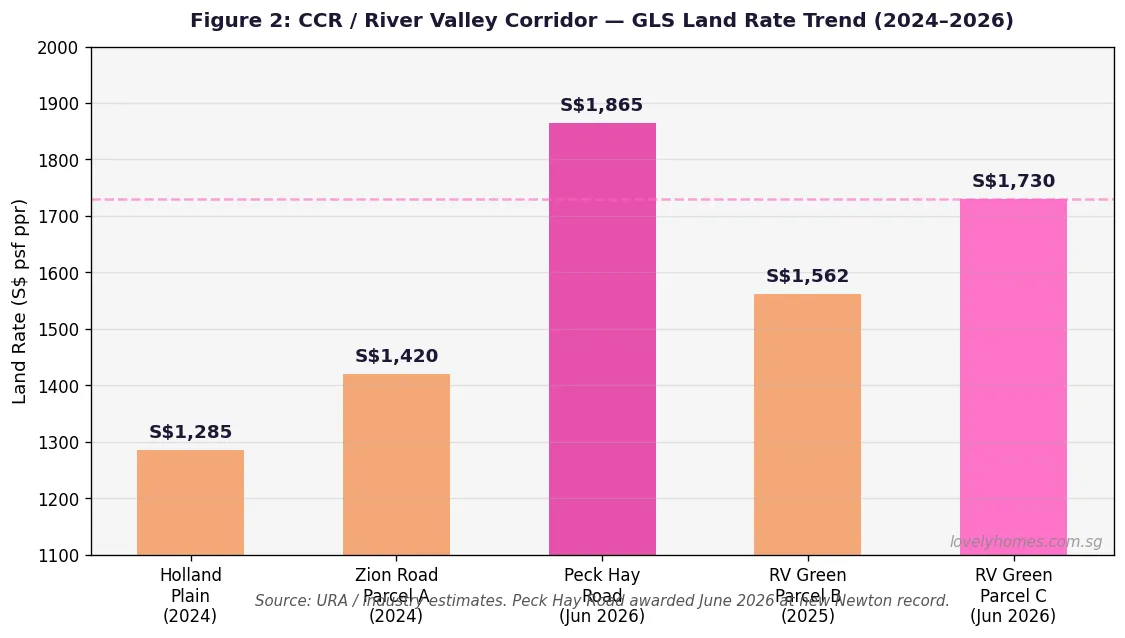
  • Winner: City Developments Limited (CDL) and Hong Realty (a Hong Leong Group subsidiary) joint venture, with a top bid of S$542.4 million or S$1,865 per square foot per plot ratio (psf ppr).
  • Four bids were received when the tender closed on 11 June 2026, with the CDL-Hong Leong JV coming in 8.4% above the second-highest bidder (Sunway MCL Land & CSC Land Group at S$1,720 psf ppr).
  • Development potential: The 0.55-hectare site in the Newton area (District 11, CCR) has a gross plot ratio of 4.9 and is expected to yield approximately 315 private residential units.
  • Projected launch price: Industry observers estimate an average selling price of approximately S$3,600–S$4,000 psf, based on the winning land rate and current CCR construction costs.
  • Market signal: The confident bidding — four bids, strong premium over second — reflects continued developer conviction in prime Singapore residential despite global headwinds.

Singapore’s Newton District Gets a New Landmark: Peck Hay Road GLS Awarded

The Government Land Sale (GLS) site at Peck Hay Road, Newton, has been awarded to a joint venture between City Developments Limited (CDL) and Hong Realty Private Limited, a subsidiary of the Hong Leong Group, following the close of the tender on 11 June 2026. The winning bid of S$542.4 million — equivalent to S$1,865 psf per plot ratio — sets a new benchmark for land rates in the Newton corridor and is the highest price paid for a residential GLS site in the District 11 area in recent memory.

The site sits within a short walk of Newton MRT Station (North-South Line and Downtown Line interchange) in the prime Core Central Region (CCR), minutes from the Orchard Road shopping belt. It is a rare land parcel in a district that has seen virtually no new GLS activity in recent years, making the award a significant event for luxury property buyers and investors who have been waiting for a premium new launch in Newton.

Peck Hay Road GLS tender results 2026 — all four bidders land rate and total bid CDL Hong Leong winner
Figure 1: Peck Hay Road GLS Tender Results — four bids received; CDL-Hong Leong JV won at S$1,865 psf ppr, 8.4% above the second bidder (S$1,720 psf ppr). Tender closed 11 June 2026.

The Bid Results: Four Credible Bids Signal Developer Confidence

The tender drew four bids from established developers — a healthy response by Singapore GLS standards in 2026, where some suburban sites have attracted only two or three bids. The bid results in full:

Bidder Total Bid Land Rate (psf ppr) Premium vs 2nd
CDL & Hong Realty JV 🏆 S$542.4M S$1,865 +8.4%
Sunway MCL Land & CSC Land Group JV S$500.2M S$1,720
China Overseas Land & Investment S$460.3M S$1,583
Hong Leong Holdings & TID JV S$459.5M S$1,580

Source: URA, tender results 11 June 2026. Land area: 5,578 sqm (0.55 ha). GFA: 27,330 sqm. Gross plot ratio: 4.9. Maximum 315 residential units.

The spread between the highest and lowest bids — roughly 18% — is relatively tight for a prime CCR site, suggesting broad alignment among developers on the land’s underlying value. The 8.4% premium that CDL-Hong Leong paid over the second bidder is, by itself, a meaningful commitment to capturing this particular site, likely driven by both parties’ existing pipeline management and brand positioning in the District 11 premium segment.

Notable: Hong Leong Group entities placed two separate bids — via the CDL-Hong Realty JV (winner) and via Hong Leong Holdings-TID JV (fourth place). This is not unusual for large property groups with multiple subsidiaries; different legal entities bid independently and the group as a whole gains optionality on the outcome.

Site Details and Development Parameters

The Peck Hay Road GLS site is located at the intersection of Peck Hay Road and Bukit Timah Road — a prestigious address within the Newton estate. Key development parameters set by URA in the tender conditions:

Parameter Specification
Land area 5,578 sqm (approximately 0.55 hectares)
Gross plot ratio 4.9
Maximum GFA (residential) 27,330 sqm
Permitted use Residential
Estimated unit count Approximately 315 units
Tenure 99-year leasehold
District District 11, Core Central Region (CCR)
Nearest MRT Newton (NS21/DT11) — approximately 300m

The 99-year leasehold tenure is standard for GLS sites in Singapore’s CCR. The site’s location within a short walk of Newton MRT — one of only two MRT interchanges south of the PIE in the CCR — gives it exceptional connectivity: Downtown Line trains reach Marina Bay in approximately 12 minutes, and North-South Line trains reach Orchard in two stops.

Newton CCR corridor GLS land rates historical context 2016-2026 — Peck Hay Road new benchmark psf ppr
Figure 2: Newton and CCR corridor GLS land rates in historical context — the Peck Hay Road award at S$1,865 psf ppr sets a new benchmark for the Newton/CCR precinct, exceeding the previous Bukit Timah Road benchmark of S$1,720 psf ppr (2022).

What Will the Future Development Be Called and How Much Will It Cost?

CDL and Hong Leong have not yet released a project name or official launch timeline. Based on the winning land rate of S$1,865 psf ppr, plus typical construction costs, professional fees, developer profit margin, and marketing costs in the current environment, industry observers estimate a break-even cost of approximately S$3,100–S$3,300 psf and an anticipated average launch price of S$3,600–S$4,000 psf — potentially pushing above S$4,000 psf for premium high-floor or penthouse units with city or Bukit Timah Hill views.

At S$3,800 psf, a typical 1,000 sqft 2-bedroom unit would be priced at approximately S$3,800,000. A 1,500 sqft 3-bedroom unit would approach S$5,700,000. This places the development squarely in CCR luxury territory, targeting high-net-worth buyers — predominantly Singapore Citizens and Permanent Residents given the 60% ABSD applicable to foreigners.

The typical timeline from GLS award to project launch in Singapore is 18–30 months, meaning the Peck Hay Road development could expect to preview in late 2027 or 2028. CDL has a strong track record in the CCR, having previously developed Gramercy Park (84 units, Grange Road) and New Futura (124 units, Leonie Hill), both considered exemplars of luxury Singapore residential design.

What This Means for the Newton Property Market

The award has several implications for Newton and broader CCR buyers and sellers:

Benchmark land rate effect: At S$1,865 psf ppr, this site establishes a new data point that developers, valuers, and banks will reference in assessing residual land values and resale property prices in the Newton, Novena, and Moulmein precincts. Owners of existing CCR condos in the area may find that their properties are valued slightly higher in subsequent bank valuations, reflecting the premium paid for new land.

Supply context: With only approximately 315 units, this development will not materially alter CCR supply dynamics. The total CCR pipeline (units under construction or recently launched but unsold) remains manageable, and the Newton micro-market has seen almost no significant new launches since the Neu At Novena and Pullman Residences projects. The scarcity of prime Newton new launches is itself a pricing support for the future development.

Buyer profile: At the projected S$3,800–S$4,000 psf, this development will largely serve the Singapore affluent and ultra-high-net-worth segment, alongside institutional and family-office buyers. Given the 60% ABSD applicable to foreign nationals (with limited FTA exemptions for US, Swiss, and selected other nationals), the buyer pool will be predominantly local, supplemented by Permanent Residents and FTA-exempt nationalities.

Frequently Asked Questions

What is a GLS tender, and how does it work?
A Government Land Sale (GLS) tender is the process by which the Singapore Land Authority (SLA), on behalf of the government, releases state land for private development by selling it to the highest qualified bidder. GLS sites are released on a Confirmed List (sites that will definitely be tendered) or a Reserve List (sites that can be triggered by developer application). The Peck Hay Road site was on the Confirmed List for the 1H 2026 GLS Programme. Developers submit sealed bids by the tender closing date; the site is typically awarded to the highest bidder, provided the bid exceeds the government’s reserve price. The winning developer pays the full bid price to the state and then develops the land within the conditions set by the Planning Permission.
What is “psf ppr” and why is it used for GLS bids?
PSF PPR stands for “per square foot per plot ratio.” It is the standard metric for comparing GLS bids because it normalises land costs across sites of different sizes and different development densities. For example, a site with a gross plot ratio (GPR) of 4.9 can yield 4.9 times its land area in gross floor area (GFA). Multiplying the site area by the GPR gives the allowable GFA. The land cost per square foot of GFA is then a direct input into the developer’s break-even cost analysis. A higher psf ppr means a higher land cost per unit of development floor area, which in turn implies a higher launch price is needed to achieve a viable profit margin.
When will the CDL-Hong Leong Newton development launch?
No official launch timeline has been announced. Typically, after a GLS award the developer spends 6–12 months on design, planning, and regulatory approvals (including URA Written Permission) before commencing construction, and a further 12–18 months before the first public preview. Based on this typical timeline, the Peck Hay Road development is likely to preview in late 2027 or mid-to-late 2028. LovelyHomes will publish a dedicated New Launch project page when CDL-Hong Leong announces the project name, preview date, and unit mix.
Can foreigners buy units in this development?
Yes — private condominiums in Singapore are open to foreign buyers. However, foreigners pay a 60% Additional Buyer’s Stamp Duty (ABSD) on the full purchase price in addition to the standard Buyer’s Stamp Duty (BSD). At an estimated purchase price of S$3.8M per unit, the ABSD alone would be S$2.28M, making the total acquisition cost approximately S$6.1M+ for a foreign buyer. Nationals from the United States, Switzerland, Iceland, Liechtenstein, and Norway are exempt from ABSD under their respective Free Trade Agreements with Singapore, making the development more accessible to buyers from those countries.
What other CCR GLS sites are coming up?
The River Valley Green (Parcel C) tender — a mixed-use site in District 9 — closes on 18 June 2026. The outcome of that tender will provide another data point on developer appetite for prime Singapore residential land in mid-2026. Beyond that, the 2H 2026 GLS Programme (announced 3 June 2026) includes one CCR confirmed-list residential site. LovelyHomes will publish coverage of each GLS award as results are announced.

Related Articles

Disclaimer: This article is based on publicly available information from URA, property research platforms, and industry commentary as of 12 June 2026. Projected launch prices and development timelines are illustrative estimates based on land rate analysis and historical precedents — they are not confirmed by CDL, Hong Leong Group, or any official source. Property prices, market conditions, and government policy may change. This article does not constitute an offer to buy or sell any property, nor financial or investment advice. Readers should conduct their own due diligence and consult a licensed property agent and financial adviser before making any property investment decision. For official GLS information, visit URA.gov.sg.

Translate »