What is decoupling? One co-owner transfers (sells) their ownership share to the other, leaving the transferee as sole owner — free to purchase a second property as a “first-time” buyer and pay 0% ABSD (SC).
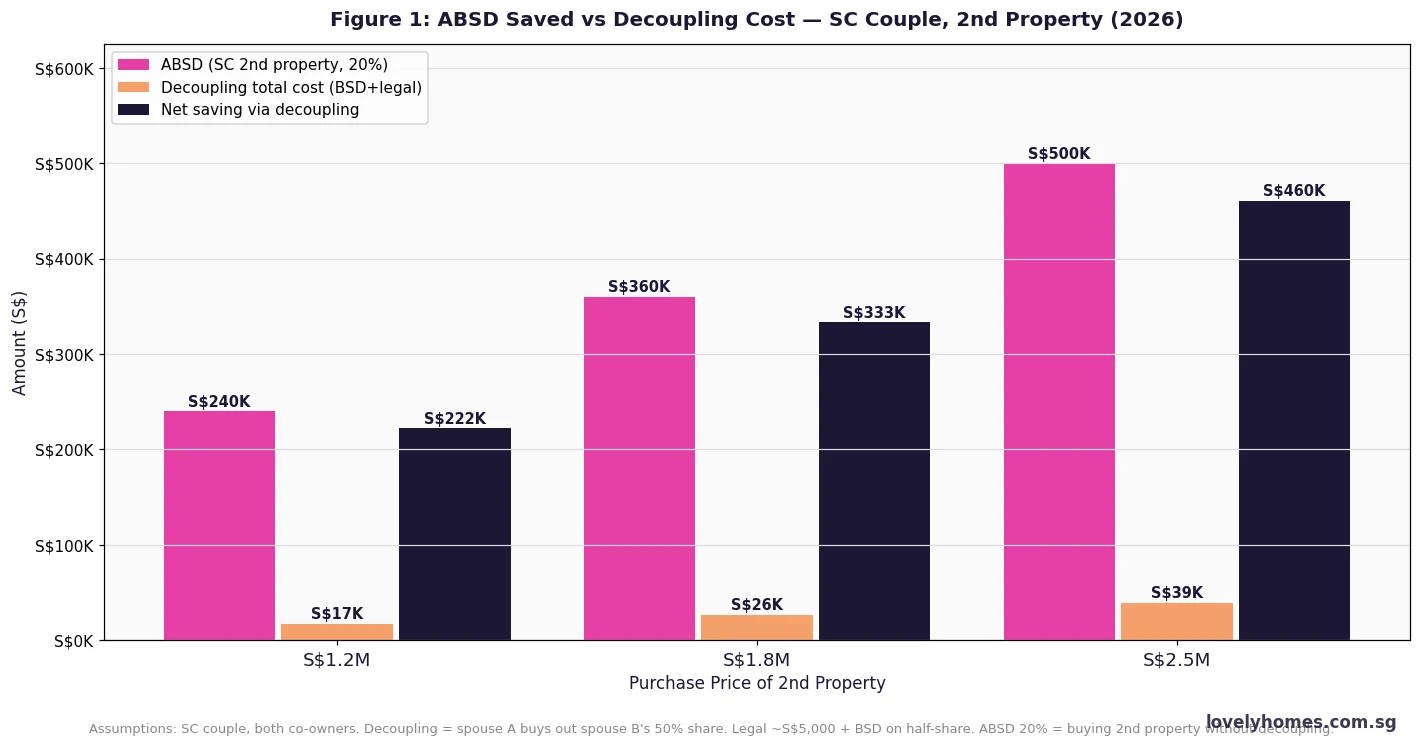
Why decouple? To avoid the 20% Additional Buyer’s Stamp Duty (ABSD) on a second residential property — worth S$240,000 on a S$1.2M purchase, S$360,000 on S$1.8M.
Cost of decoupling: Buyer’s Stamp Duty on the half-share transferred + conveyancing legal fees (~S$4,000–S$6,000) + CPF accrued interest refund considerations. BSD on a 50% share of S$1.5M = approximately S$20,100.
CPF complication: The transferor must refund CPF OA monies (principal + 2.5% p.a. interest) back to their CPF account on the part-disposal. This reduces the available cash to the couple.
Who can decouple? Any co-owners of a private property — married couples, siblings, business partners. HDB flats cannot be decoupled (HDB must approve any ownership change and will not approve part-share sales to achieve ABSD avoidance).
Timeline: Typically 6–10 weeks from legal instruction to registration of transfer with the Singapore Land Authority (SLA).
Risk: IRAS assesses BSD on market value, not agreed price. Undervaluing the transfer to minimise BSD exposes both parties to penalties and back-taxes.
Property decoupling Singapore refers to the legal process of one co-owner divesting their share in a jointly-owned property to the other, with the primary objective of allowing the transferee (or the transferor, if they are the one moving on) to purchase a subsequent property as a sole first-time owner, thereby avoiding ABSD. The strategy became widely discussed after the April 2023 cooling measures raised ABSD on a second property for Singapore Citizens to 20% — equivalent to S$270,000 on a S$1.35M condominium.
Decoupling is entirely legal. IRAS does not prohibit the practice; it merely requires that BSD be paid correctly on the transferred share at market value. What IRAS does scrutinise is any attempt to transact at artificially low prices to reduce stamp duty. The Stamp Duties Act (Cap. 312) empowers IRAS to assess BSD on the market value of the interest transferred, regardless of the stated consideration — so proper valuation is not optional; it is mandatory.
Figure 1: ABSD saved versus total decoupling cost at three property purchase prices, 2026. At S$1.8M, decoupling saves approximately S$284,000 net of all costs. (Source: IRAS BSD schedule; author calculations.)
How Decoupling Works: The Legal Mechanics
In a typical residential decoupling, a married couple owns a condominium together — say, as tenants-in-common in equal 50/50 shares, or as joint tenants. One spouse (the transferor) agrees to sell their 50% share to the other spouse (the transferee). The transaction is treated by IRAS as a sale at arm’s length: BSD is levied on the consideration paid or the market value of the half-share, whichever is higher.
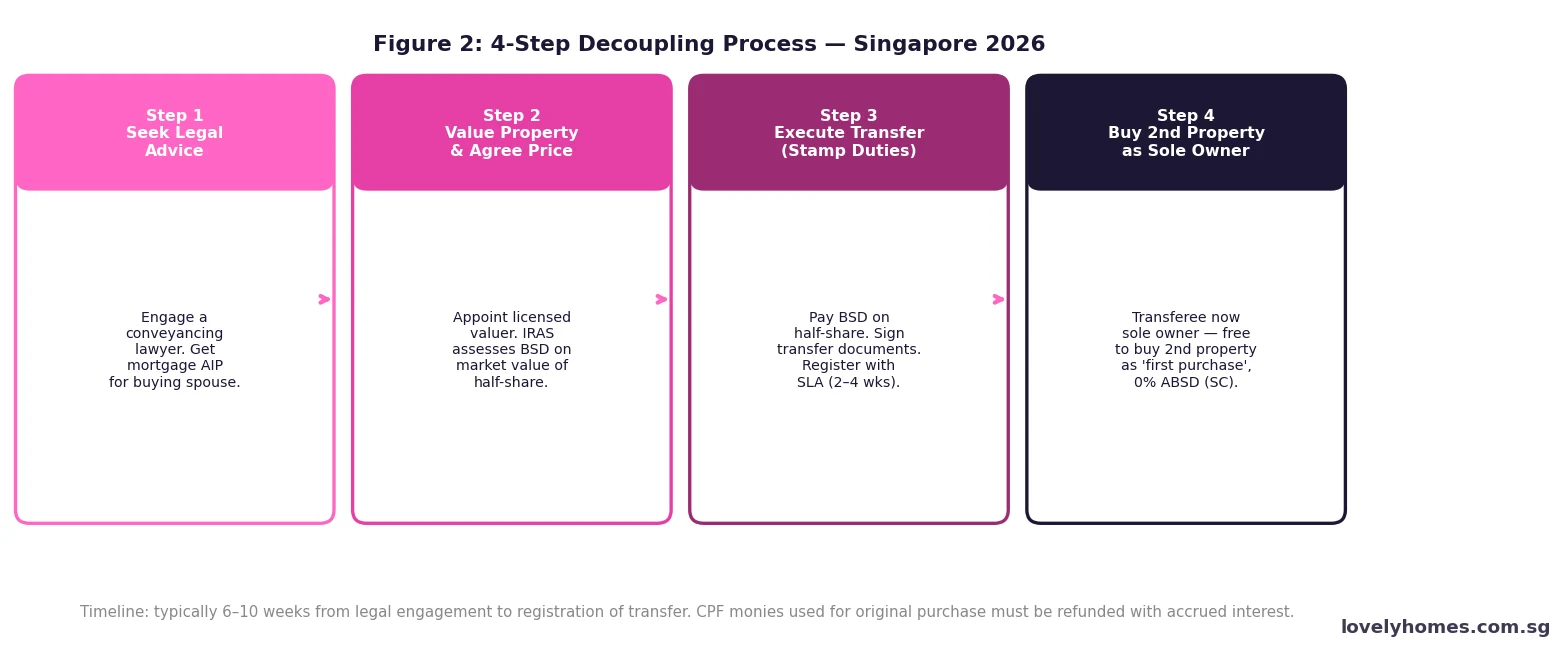
The parties instruct a conveyancing lawyer who: obtains a formal valuation of the property from a licensed valuer, calculates the BSD payable on the half-share, prepares the Transfer Instrument, and lodges it with the Singapore Land Authority (SLA) for registration. BSD is paid electronically to IRAS before lodgement. The entire process takes 6–10 weeks under normal conditions.
Once registered, the transferee is the 100% sole owner of the property. The transferor holds no residential property in Singapore and is classified as a first-time buyer for ABSD purposes. They may now purchase a new private property — condominium, landed, EC (after MOP) — and pay 0% ABSD as a Singapore Citizen buying their first private residential property.
Figure 2: The 4-step decoupling process — from legal advice to purchasing a second property as sole owner. The critical step is completing registration before the transferor exercises the OTP on the new purchase. (Source: SLA, IRAS.)
Decoupling Costs: BSD, Legal Fees and CPF
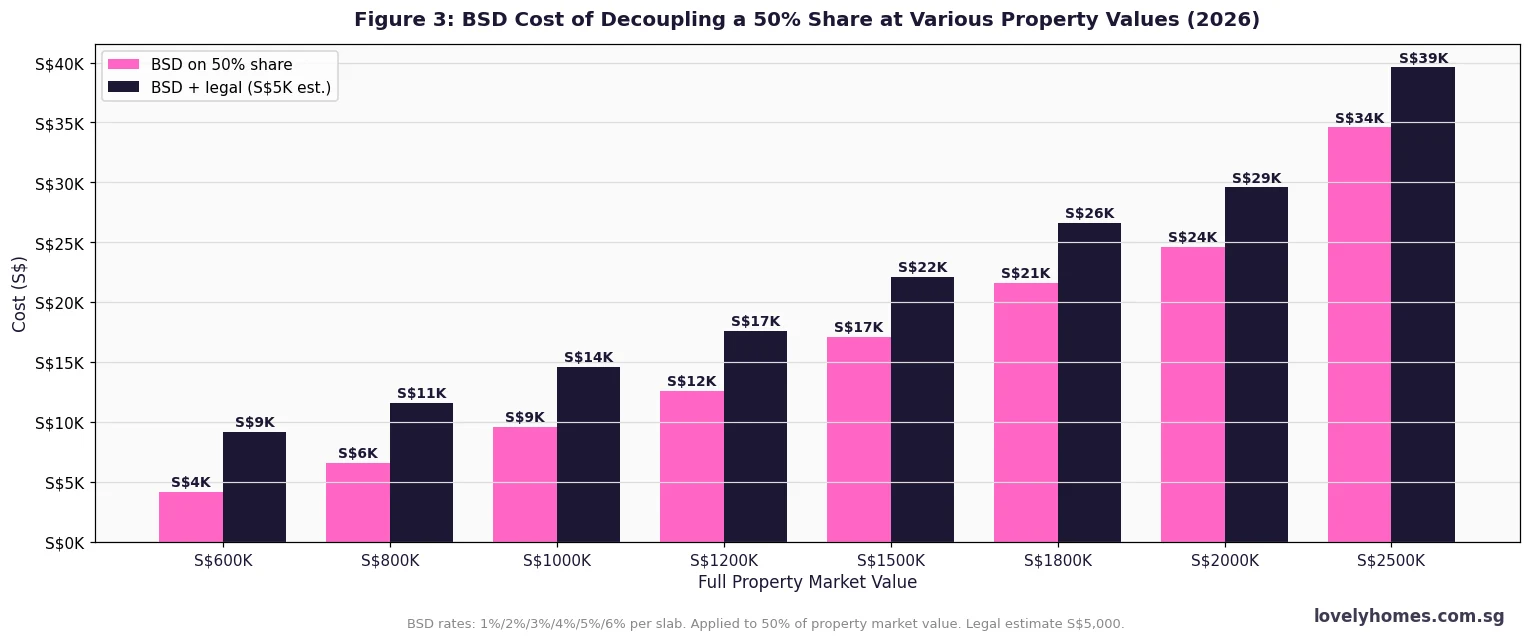
Three cost categories apply to a decoupling exercise. The first and largest is Buyer’s Stamp Duty on the transferred share. BSD is calculated on the market value of the 50% interest: 1% on the first S$180,000, 2% on the next S$180,000, 3% on the next S$640,000, 4% on the next S$500,000, and so forth. For a property valued at S$1,500,000, the half-share is S$750,000 and the BSD is approximately S$20,100. For a S$2,000,000 property, the half-share is S$1,000,000 and BSD is approximately S$29,600.
Second, conveyancing legal fees for both sides (a lawyer is typically appointed for each party to avoid conflicts of interest, though one firm may act for both if both parties provide informed consent under the Legal Profession Act). Expect S$2,500–S$3,500 per side — total S$4,000–S$6,000.
Third, CPF complications arise when the transferor used CPF Ordinary Account funds to finance the original purchase. On a part-disposal of a property, CPF Board requires the transferor to refund the proportionate CPF drawn (including accrued interest at 2.5% p.a.) back to their CPF account. This refund may need to be funded by cash from the transferee — that is, the transferee pays the transferor for their 50% share, and the transferor uses that cash to repay CPF. The net position depends on how much CPF was drawn and how long ago.
Decoupling Cost Summary at Key Property Values
Property Market Value
50% Share
BSD on Half-Share
Legal Fees (est.)
Total Decoupling Cost
ABSD Saved (SC 20%)
Net Saving
S$800,000
S$400,000
S$9,600
S$5,000
S$14,600
S$160,000
S$145,400
S$1,200,000
S$600,000
S$15,600
S$5,000
S$20,600
S$240,000
S$219,400
S$1,500,000
S$750,000
S$20,100
S$5,000
S$25,100
S$300,000
S$274,900
S$1,800,000
S$900,000
S$24,600
S$5,000
S$29,600
S$360,000
S$330,400
S$2,000,000
S$1,000,000
S$29,600
S$5,000
S$34,600
S$400,000
S$365,400
S$2,500,000
S$1,250,000
S$42,100
S$5,000
S$47,100
S$500,000
S$452,900
Figure 3: BSD payable and total decoupling cost (BSD + S$5K legal estimate) across a range of property market values. The cost curve rises gradually as higher BSD slabs apply to larger half-shares. (Source: IRAS.)
Worked Example: The Lee Couple
Mr and Mrs Lee are Singapore Citizens who jointly own a condominium in the River Valley area, purchased in 2019 at S$1,600,000. Current market value: S$2,100,000. Outstanding bank mortgage: S$900,000. CPF drawn (Mr Lee’s OA): S$200,000 principal + S$28,000 accrued interest (7 years at 2.5% p.a.) = S$228,000 to be refunded.
Mr Lee transfers his 50% share to Mrs Lee. Half-share value: S$1,050,000. BSD on S$1,050,000: 1%×S$180,000 + 2%×S$180,000 + 3%×S$640,000 + 4%×S$50,000 = S$1,800 + S$3,600 + S$19,200 + S$2,000 = S$26,600. Legal fees both sides: S$5,500.
Consideration paid by Mrs Lee to Mr Lee: S$1,050,000 (half the market value). Of this, S$450,000 represents Mr Lee’s half of the outstanding mortgage (which Mrs Lee refinances into her sole name), and S$600,000 is cash/CPF to Mr Lee. Mr Lee refunds S$228,000 back to his CPF OA. Net cash Mr Lee receives: S$600,000 − S$228,000 = S$372,000. Mrs Lee’s bank refinances the full S$900,000 mortgage into her sole name (subject to TDSR).
Total decoupling cost to the Lees: BSD S$26,600 + legal S$5,500 = S$32,100. Mr Lee is now a first-time property purchaser. He buys a S$1,800,000 new launch condo: BSD S$53,600, ABSD 0%. Without decoupling, ABSD would have been 20% × S$1,800,000 = S$360,000. Net saving: S$360,000 − S$32,100 = S$327,900.
When Does Decoupling Make Sense?
Decoupling is financially worthwhile when the ABSD saved on the intended second purchase materially exceeds the BSD and legal costs of the transfer. Since ABSD is a flat percentage of the full purchase price and BSD is levied on only half the existing property value at a slab rate, the saving grows steeply with the price of the intended acquisition. At 2026 rates, decoupling is almost always cost-positive for SC couples buying a second property above S$600,000 — the break-even point sits well below the median condo transaction price of approximately S$1.3M (OCR).
Decoupling becomes less attractive — or potentially impossible — in three scenarios. First, when the transferee cannot service the full mortgage alone after TDSR assessment (the bank may require refinancing into the transferee’s sole name, and their income alone may not support the loan quantum). Second, when significant CPF accrued interest reduces the net cash benefit below the headline numbers. Third, when the ownership structure is joint tenancy (which does not recognise distinct shares) and the couple must first convert to tenancy-in-common before the transfer can proceed — a process that also carries legal costs and SLA registration fees.
Can HDB Flats Be Decoupled?
No. HDB resale flats cannot be decoupled in the same way as private properties. Under the Housing & Development Act, any change in ownership of an HDB flat requires HDB approval. HDB will not approve an ownership transfer whose purpose is clearly to circumvent ABSD on a subsequent private property purchase. Any attempt to do so constitutes a breach of HDB rules and may result in the flat being compulsorily acquired. Executive Condominiums during their MOP period are also governed by HDB and cannot be decoupled. After the EC’s 5-year MOP, it transitions to private property status and decoupling becomes legally permissible.
Decoupling Versus Other ABSD Strategies
Decoupling is one of several legally recognised methods for managing ABSD exposure. Alternatives include: the ABSD remission buy-first strategy (SC couple buys second property, pays 20% ABSD upfront, then sells HDB within 6 months and claims remission from IRAS — works only for upgraders selling an HDB); purchasing property in a company structure (ABSD does not technically apply to entities, but Additional Conveyance Duties apply to residential property held by companies, and the rates are punitive); and staggered purchase timing (one spouse buys in their sole name today, the other waits until the first property is sold). Each strategy carries its own cost-benefit profile, legal requirements, and risks. Professional legal and financial advice is essential before committing to any of them.
What Might Come Next for Decoupling in Singapore
This section reflects editorial analysis and is speculative in nature. The Singapore government has been aware of decoupling as a practice for many years. It is sanctioned by law — IRAS collects BSD on every transfer — and there is no indication of an imminent legislative move to prohibit or penalise the practice. However, any significant increase in BSD rates (the last upward revision to the top tier was in February 2023, adding a 6% slab for properties above S$3M) would raise the cost of decoupling proportionally. Conversely, if ABSD rates were ever to be reduced — which would require a material cooling of demand — the financial case for decoupling would diminish but not disappear. For now, decoupling remains a rational and widely-used tax-planning tool for property-owning couples in Singapore.
Frequently Asked Questions
Does IRAS allow decoupling, or is it considered tax evasion?
Decoupling is fully legal and explicitly recognised by IRAS. The Stamp Duties Act requires BSD to be paid on the higher of the agreed consideration or the market value of the transferred interest — IRAS simply ensures the correct amount of stamp duty is paid. What is prohibited is undervaluing the transaction to reduce BSD. Provided the transfer is done at or above market value (supported by a licensed valuation), decoupling is not tax evasion. It is tax planning — the use of lawful structures to minimise tax, as distinct from illegal concealment or misrepresentation.
What does the bank say about decoupling my mortgage?
The bank’s primary concern is that the remaining borrower (the transferee) can independently service the full outstanding mortgage. The bank will reassess the transferee’s TDSR, credit history, and income documentation as if they were applying for the loan afresh. If the transferee’s income alone does not support the existing loan quantum, the bank may require a partial repayment to bring the outstanding loan within acceptable limits. It is advisable to obtain a conditional bank approval before instructing lawyers to proceed with the transfer.
Can unmarried co-owners (e.g. siblings) decouple?
Yes. Decoupling is not restricted to married couples — any co-owners of private property may execute a part-share transfer. The same rules apply: BSD at market value, conveyancing via a licensed lawyer, SLA registration, and CPF refund obligations if applicable. There is no marital relationship requirement. The ABSD saving accrues to whichever party emerges as sole owner and subsequently purchases another property as their “first” private residential acquisition.
Do I need to convert from joint tenancy to tenancy-in-common before decoupling?
Yes, if your property is held as joint tenants. Joint tenancy confers equal undivided ownership with right of survivorship — there are no distinct percentage shares that can be separately transferred. Before a decoupling transfer can proceed, the parties must first sever the joint tenancy and convert to tenancy-in-common (typically 50/50). This severance is registered with SLA and carries a separate fee of approximately S$200–S$500. The lawyer handling the decoupling will usually do this simultaneously as part of the same exercise.
What are the Seller’s Stamp Duty (SSD) implications of decoupling?
If the property being decoupled was acquired less than 3 years ago, the transfer of the half-share may trigger SSD. SSD rates are 12% (if sold in year 1), 8% (year 2), and 4% (year 3) of the higher of the sale price or market value of the interest transferred. For a S$1M half-share disposed of within 2 years of original purchase, SSD could add S$80,000. Most couples planning to decouple therefore wait until their property has been held for at least 3 years. The SSD clock runs from the date of the original purchase, not from the date of decoupling.
What happens to CPF accrued interest when I transfer my share?
When the transferor disposes of their interest in the property (even a 50% share), CPF Board requires the proportionate refund of CPF monies withdrawn for that property — both principal and accrued interest at 2.5% per annum compounded annually. The refund goes back into the transferor’s CPF OA. The amount can be significant on properties held for 10+ years: S$200,000 of CPF drawn at 2.5% compounded annually for 10 years accrues to approximately S$256,000 — meaning the effective CPF refund obligation is S$256,000, not S$200,000. Plan this cash-flow carefully before executing the transfer.
After decoupling, when can the transferor buy a new property?
The transferor can purchase a new property as soon as the decoupling transfer is registered with SLA — typically 6–10 weeks after engaging the lawyers. There is no mandatory waiting period after the transfer. However, it is critical not to exercise the OTP on the new property before the decoupling transfer is registered; doing so could mean you technically hold a 50% share in the existing property at the time of the new purchase, triggering ABSD. The sequencing is: complete decoupling → register transfer → only then exercise OTP on new purchase.
Disclaimer: This article is provided for general informational purposes only and does not constitute legal, financial, tax, or property advice. Decoupling involves complex stamp duty, CPF, mortgage, and legal considerations that are specific to each individual’s circumstances. BSD and ABSD rates, CPF rules, and HDB policies are subject to change without notice. Always verify current rates and rules directly with the Inland Revenue Authority of Singapore (IRAS) at iras.gov.sg, the Singapore Land Authority (SLA) at sla.gov.sg, and the Central Provident Fund Board (CPF Board) at cpf.gov.sg. You should engage a licensed Singapore conveyancing lawyer before proceeding with any property transfer or stamp duty planning strategy.
Singapore stamp duty is not a single tax — it is a suite of four distinct levies that can collectively add hundreds of thousands of dollars to the cost of a property transaction. Understanding each one, when it applies, and how to calculate it is essential before you sign any Option to Purchase. This guide covers all four: Buyer’s Stamp Duty (BSD), Additional Buyer’s Stamp Duty (ABSD), Seller’s Stamp Duty (SSD), and Additional Conveyance Duty (ACD).
All figures are current as at 31 May 2026. For the authoritative position, always refer to the IRAS Stamp Duty page and consult a licensed conveyancing lawyer before transacting.
Quick Answer — Singapore Stamp Duty at a Glance
BSD — payable by EVERY buyer on every property purchase. Progressive rates 1%–6%.
ABSD — additional levy on top of BSD. Singapore Citizens pay 0% on their first property, 20% on their second, 30% on their third+. PRs pay 5%/30%/35%. Foreigners pay 60% on any residential property.
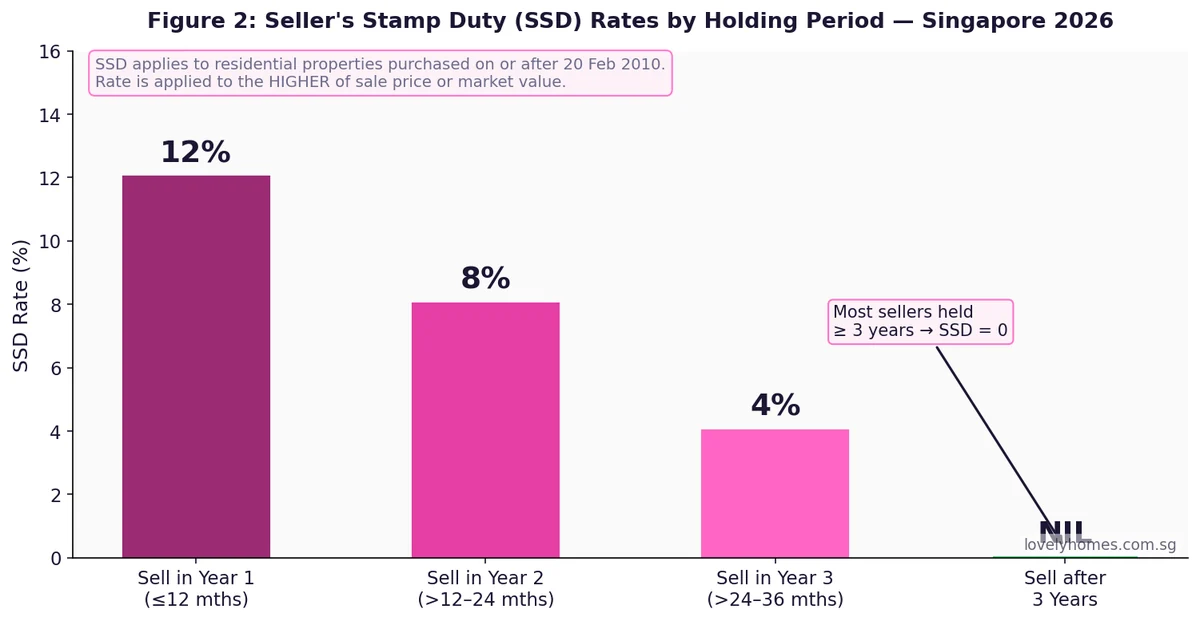
SSD — payable by the SELLER if the property is sold within 3 years of purchase. Rates: 12% (Year 1), 8% (Year 2), 4% (Year 3), nil thereafter.
ACD — applies when residential property is transferred indirectly through corporate equity. Flat 33% on the residential property value component.
BSD and ABSD are payable within 14 days of the Option to Purchase (OTP) or Sale & Purchase Agreement.
SSD is payable within 14 days of the sale contract.
CPF cannot be used to pay stamp duty at the point of purchase — you must pay in cash first, then apply for CPF reimbursement.
ABSD remission is available to Singapore Citizen couples replacing their matrimonial home — subject to conditions and strict timelines.
What Is Stamp Duty and Why Does Singapore Use It?
Stamp duty is a transaction tax levied on documents that effect the transfer of a property or shares in a property-holding entity. In Singapore, the Inland Revenue Authority of Singapore (IRAS) administers all stamp duties under the Stamp Duties Act (Cap. 312). The modern stamp duty regime serves two purposes: raising revenue, and acting as a macro-prudential tool to moderate speculative demand in the residential property market.
When you buy a residential property, you will encounter BSD and possibly ABSD. When you sell, SSD may apply if you sell too quickly. If a property changes hands through an equity transfer in a company, ACD enters the picture. Each levy has its own trigger, its own rate schedule, and its own payment deadline.
Buyer’s Stamp Duty (BSD) — the Baseline Tax Every Buyer Pays
BSD is the foundational property transaction tax. Every buyer — regardless of citizenship, residency status, or how many properties they already own — pays BSD on every property purchase. It is computed on the higher of the purchase price or the market value of the property at the time of acquisition.
The rates are progressive for residential property:
Purchase Price / Market Value
BSD Rate
Max BSD from This Tier
First S$180,000
1%
S$1,800
Next S$180,000
2%
S$3,600
Next S$640,000
3%
S$19,200
Next S$500,000
4%
S$20,000
Next S$1,500,000
5%
S$75,000
Above S$3,000,000
6%
No cap
A separate, flat-rate BSD schedule applies to non-residential property (commercial, industrial): 1% on the first S$180,000, 2% on the next S$180,000, and 3% on the remainder — capped at 3%. The progressive residential schedule shown above took effect for instruments executed on or after 15 February 2023, when the 5% and 6% tiers were introduced for high-value transactions.
Worked example (BSD only, S$1.5M residential condo):
First S$180,000 × 1% = S$1,800 Next S$180,000 × 2% = S$3,600 Next S$640,000 × 3% = S$19,200 Next S$500,000 × 4% = S$20,000 Total BSD = S$44,600
BSD is a fixed cost — there is no way to reduce it lawfully short of negotiating a lower purchase price. It is also not remissible (there are no BSD remission schemes for residential buyers equivalent to the ABSD remission).
Additional Buyer’s Stamp Duty (ABSD) — the Policy Lever
ABSD was introduced in December 2011 and has been raised five times since, most recently in April 2023. It is the single largest upfront cost for most second-property buyers and foreigners. ABSD is levied on top of BSD, at a flat rate on the entire purchase price.
Figure 1: Total stamp duty (BSD + ABSD) payable by buyer profile and property price — Singapore 2026. Source: IRAS.
The current ABSD rate schedule (applicable to instruments executed on or after 27 April 2023) is:
Buyer Profile
1st Property
2nd Property
3rd & Subsequent
Singapore Citizen (SC)
0%
20%
30%
Singapore Permanent Resident (SPR)
5%
30%
35%
Foreigner (individual)
60%
60%
60%
Entity (company, trustee)
65%
65%
65%
Housing developer
40%*
40%*
40%*
* 5% of the developer ABSD is non-remittable. The remaining 35% is remittable upon completing the project and selling all units within 5 years.
FTA nationals — citizens of Iceland, Liechtenstein, Norway, Switzerland, and the United States — are accorded Singapore Citizen ABSD treatment under the respective Free Trade Agreements.
For a detailed breakdown of ABSD remission schemes (including the Married Couple Remission for upgraders), see our ABSD Complete Guide 2026.
Seller’s Stamp Duty (SSD) — the Anti-Flipping Tax
SSD was introduced in February 2010 to discourage short-term residential property speculation. It is paid by the seller (not the buyer) when a residential property is disposed of within three years of its acquisition. The rate depends on how quickly the seller flips the property:
Figure 2: SSD rates by holding period — residential property, Singapore 2026. Source: IRAS.
SSD is calculated on the higher of the sale price or the market value at the time of disposal. The holding period is measured from the date of purchase (execution of the Sale & Purchase Agreement) to the date of sale (execution of the disposal S&P). SSD does not apply to properties acquired before 20 February 2010, nor does it apply to commercial or industrial property.
Note: If you inherit a property and subsequently sell it, the SSD holding period runs from the original purchase date (the date the deceased acquired the property), not from the date of inheritance. This is a common source of confusion. If a parent bought a condo in 2024 and passed away in 2025, and the heir sells in early 2026, SSD at 8% could still apply.
The SSD is the reason most investor-buyers hold Singapore residential property for at least three years before selling. In practice, the combination of SSD and the time needed to recover transaction costs (BSD + ABSD + legal fees + agent commissions) means the effective minimum hold for a profitable flip is typically four to five years.
Additional Conveyance Duty (ACD) — the Entity Transfer Tax
ACD was introduced in May 2017 to close a loophole that allowed buyers to acquire residential property held in companies without paying ABSD — by buying shares in the company rather than the property directly. Under the ACD regime, a transfer of equity interests in a residential-property-holding entity is taxed as if it were a direct property acquisition.
ACD applies when:
The acquirer obtains a significant ownership interest (≥50%) in an entity (company, trust, or partnership);
That entity holds Singapore residential property as its primary asset; and
The residential property component exceeds a de minimis threshold.
The ACD rate is 33% on the residential property value component, levied on top of the existing stamp duty on the share transfer (which is normally 0.2%). For a $10 million residential property held in a company, an ACD transaction could trigger an additional $3.3 million in duty — making it broadly equivalent in cost to a direct ABSD transaction.
ACD is highly specialised and typically arises in commercial real estate transactions, family wealth restructuring, or en-bloc-related scenarios. Most individual residential buyers will never encounter it. If you are structuring a transaction that involves acquiring shares in a company that holds Singapore residential property, engage a tax adviser with stamp-duty expertise before proceeding.
Summary: All Four Singapore Stamp Duties at a Glance
Duty
Who Pays
When It Applies
Rate (Residential)
Deadline
BSD
Buyer
All property purchases
1%–6% progressive
14 days from OTP/S&P
ABSD
Buyer
2nd+ property / foreigner / entity
0%–65% flat on full price
14 days from OTP/S&P
SSD
Seller
Sold within 3 years of purchase
4%–12% flat on full price
14 days from disposal S&P
ACD
Acquirer of equity
≥50% stake in residential-property entity
33% on resi property value
14 days from share transfer
Comprehensive Worked Example: SC Couple Upgrading from HDB to Private Condo
Mr & Mrs Pang are Singapore Citizens. They own a Bishan 5-room HDB flat (purchased 2018, fully paid under CPF). They want to buy a S$2,000,000 2-bedroom freehold condo in District 10 and sell the HDB afterwards. Here is the full stamp duty picture:
Scenario A: Buy the condo BEFORE selling the HDB
Because they still own the HDB, the condo is their second residential property. ABSD at 20% is triggered.
BSD on S$2,000,000: S$64,600
ABSD (20%): S$400,000
Total stamp duty: S$464,600
However, they can apply for the ABSD Married Couple Remission — they get the S$400,000 back if they sell the HDB within 6 months of the later of (a) the condo’s purchase date or (b) its TOP date.
They must pay the ABSD upfront in cash and wait for the refund.
Scenario B: Sell the HDB FIRST, then buy the condo
After selling the HDB, they hold zero residential properties. The condo becomes their first residential property. Zero ABSD.
BSD on S$2,000,000: S$64,600
ABSD: S$0
Total stamp duty: S$64,600
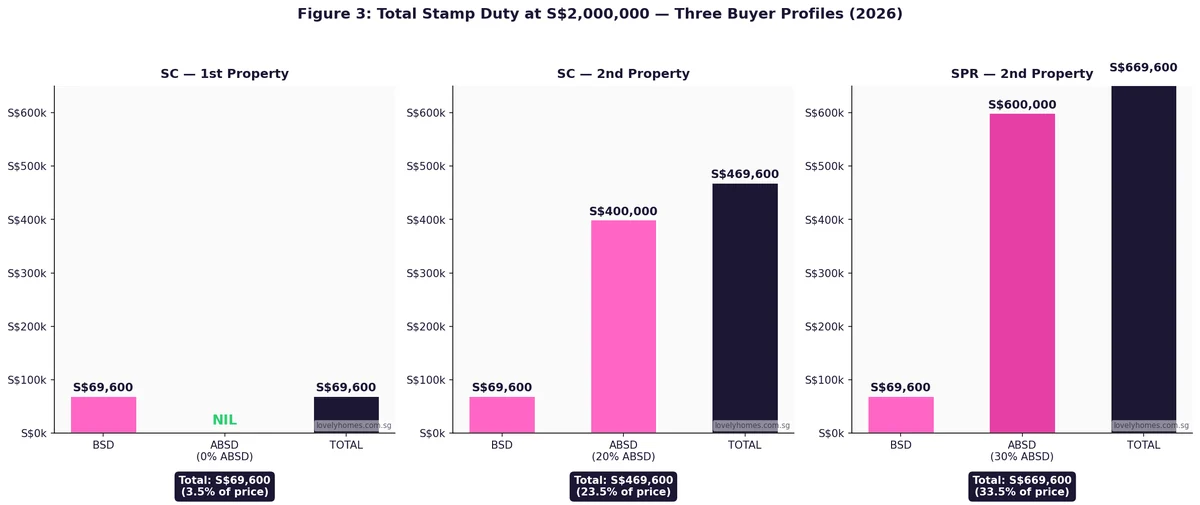
Figure 3: Total stamp duty at S$2,000,000 — SC 1st property, SC 2nd property, and SPR 2nd property compared. Source: IRAS 2026.
Scenario B saves the Pangs S$400,000 and avoids the need for the remission application. The trade-off is the risk of not finding a new home before the HDB sale completes — and potentially needing temporary accommodation in the interim. Many upgrading couples use a bridging loan to manage this gap.
When Does Stamp Duty Really Matter? — Why These Numbers Are So Significant
Stamp duty in Singapore is, by international standards, among the highest in the world for non-citizen buyers. A foreign individual purchasing a S$3 million residential property in 2026 faces: BSD of approximately S$119,600 plus ABSD of S$1,800,000 — a total of S$1,919,600, or 64% of the purchase price. This is intentional: the Government has consistently stated that Singapore’s residential property market is primarily for Singaporeans to live in, and the ABSD is the mechanism that enforces that policy goal.
For Singapore Citizens, the numbers are far more manageable — but still significant. A first-time buyer at S$2 million pays S$64,600 in BSD alone. For an upgrader buying their second property at the same price, adding S$400,000 in ABSD transforms what might otherwise be a healthy financial decision into a transaction that requires either substantial cash reserves or careful sequencing via the remission route.
Stamp duty also has a secondary effect on the property market as a whole: it creates a minimum holding period incentive. Investors who pay BSD and ABSD on entry need their property to appreciate by at least those amounts — plus legal costs, agent commissions, and financing costs — before they break even on a sale. This structurally discourages short-term speculation and was a deliberate part of the policy design when rates were raised in 2021 and 2023.
What Might Change in 2026 and Beyond?
This section is speculative analysis, not official policy.
As at May 2026, there has been no signal from the Ministry of Finance or MAS of imminent changes to the stamp duty regime. Private residential prices rose 0.9% in Q1 2026 — a moderate pace that does not, on its own, suggest further tightening is imminent. The Government has traditionally intervened when quarterly price growth exceeds 2–3% or when transaction volumes indicate re-entry of speculative buyers.
Watch for the following triggers that could lead to a review: (1) sustained quarter-on-quarter private price growth above 2% for two or more consecutive quarters; (2) a significant rise in foreign buyer transactions as a proportion of total; (3) a global interest rate environment that makes Singapore dollar assets more attractive to offshore capital. Conversely, a sharp economic slowdown could prompt targeted relief — as was done in 2020 with the COVID-19 stamp-duty deferral scheme.
Frequently Asked Questions
Can I use my CPF to pay stamp duty?
No, not at the point of payment. BSD and ABSD (and SSD for sellers) must be paid in cash by the statutory deadline. After the duty has been stamped and paid, you may apply to withdraw from your CPF Ordinary Account to reimburse the cash outlay, provided the property qualifies under CPF Board rules and you have sufficient OA balance. The CPF withdrawal is a reimbursement step, not a direct payment channel.
Does SSD apply if I sell because of financial hardship?
There are no hardship exemptions to SSD built into the Stamp Duties Act. SSD is triggered automatically on any disposal within 3 years of purchase, regardless of the reason for sale. IRAS has no general discretion to waive SSD except in the specific circumstances defined in the Act (e.g. compulsory acquisition by the state). If you are facing distress and need to sell within the SSD window, factor the SSD cost into your net sale proceeds before deciding.
My spouse is a foreigner. Do we pay 60% ABSD on our first home together?
For a jointly-owned first matrimonial home where one owner is a Singapore Citizen and the other is a foreigner, the couple can apply for ABSD remission to be taxed at the SC rate (0% on a first property). The remission is available for a property that will be used as the couple’s matrimonial home, and conditions must be met. The ABSD is still payable upfront at the foreigner rate; the remission is applied for thereafter. Engage a conveyancing lawyer well before the OTP is exercised to ensure the remission application is properly structured.
Is stamp duty payable on a property gift (transfer without payment)?
Yes. BSD (and ABSD where applicable) is computed on the market value of the property at the time of transfer, even if no money changes hands. A parent transferring a private condo to an adult child as a gift is treated as a purchase at market value for stamp duty purposes. The child is treated as the buyer and must pay BSD and ABSD based on their own buyer profile and existing property count.
How is stamp duty calculated for an uncompleted property (new launch)?
For an uncompleted unit bought directly from the developer, the stamp duty is computed on the purchase price stated in the Sale & Purchase Agreement (which is executed at the point of booking the unit). ABSD — where applicable — is payable within 14 days of the S&P execution, which means the full ABSD amount is due upfront even though the project may not complete for several years. The Married Couple Remission window (6 months to sell the existing property) runs from the later of the S&P date or the Temporary Occupation Permit (TOP) date.
Does stamp duty apply to HDB flat purchases?
Yes. BSD applies to all HDB flat purchases (new BTO and resale) at the same progressive rates as private residential property. For new BTO flats, BSD is computed on the selling price set by HDB; for resale, it is on the higher of the resale price or HDB’s valuation. ABSD also applies to HDB flat purchases under the same rules — although Singapore Citizen first-time buyers pay 0% ABSD, meaning only BSD is due. SPR first-time buyers face 5% ABSD even on an HDB flat purchase.
Disclaimer: This article is for general informational purposes only and does not constitute legal, tax, or financial advice. Stamp duty rates and remission rules may change. Always verify the current position with the IRAS Stamp Duty page and the Ministry of Finance. Consult a licensed conveyancing lawyer or tax specialist before transacting.
Last updated 28 April 2026. Reflects ABSD rates effective 27 April 2023 and Buyer’s Stamp Duty rates effective 14 February 2023.
Quick Answer — 30-second takeaways
Decoupling is the legal restructuring of a co-owned residential property so that one spouse ends up holding 100% of it. The other spouse is then restored to first-time-buyer status and can buy a second residential property without paying ABSD.
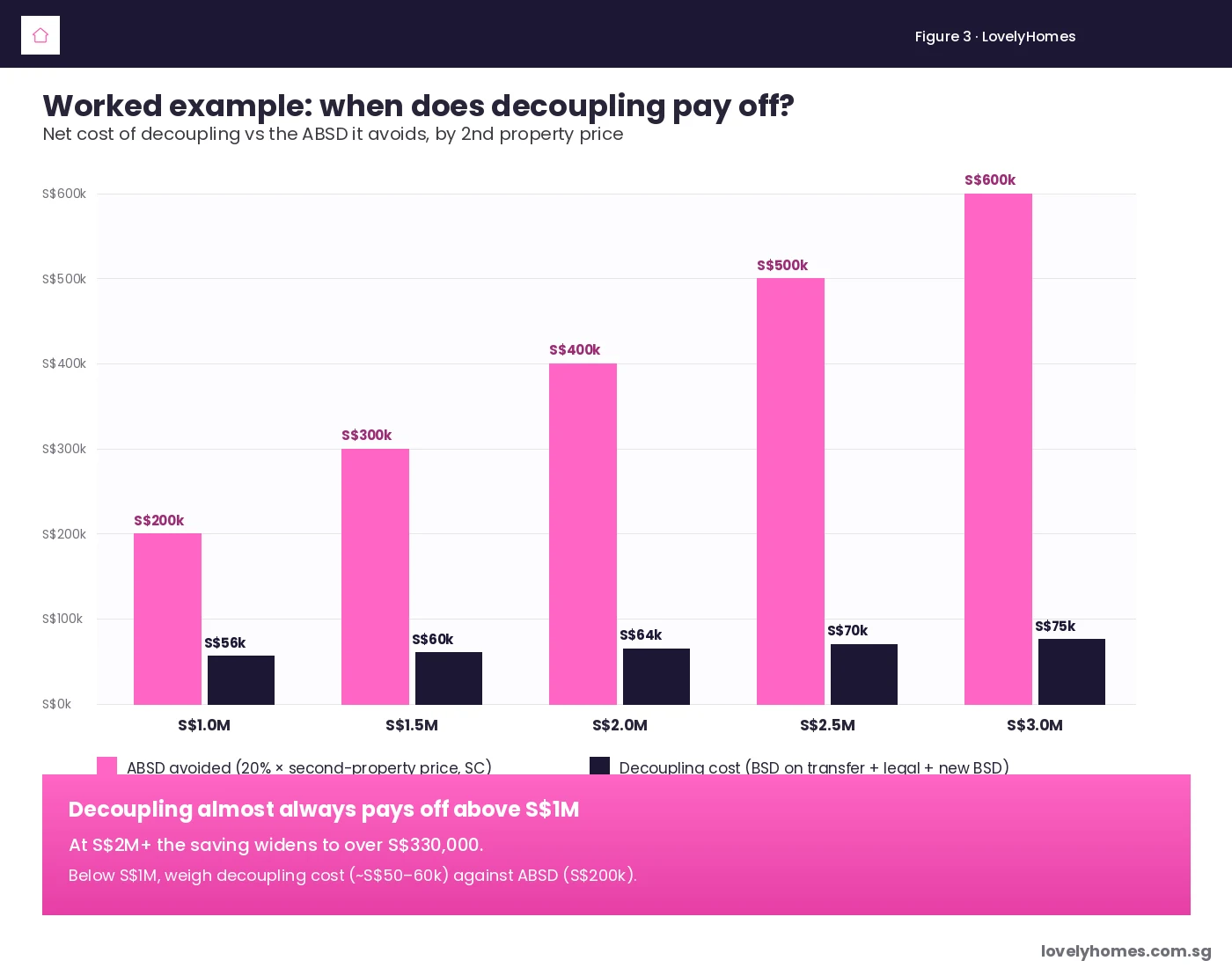
For a married Singapore Citizen (SC) couple, ABSD on a S$1.5 million second home is 20% (S$300,000). Decoupling typically costs S$50,000–S$70,000 in BSD on the internal transfer plus legal fees.
The maths almost always favours decoupling once the second property is above S$1 million.
Decoupling is only legal for private residential property. HDB flats cannot be decoupled (since 1 April 2016, except in narrow exceptions like divorce, death or financial hardship).
The receiving spouse must be able to solo-service the loan under TDSR (60%) and refund any CPF used by the outgoing spouse with 2.5% accrued interest.
Decoupling is administered by IRAS for stamp duty and CPF Board for refund of utilised CPF; conveyancing must be handled by a licensed Singapore lawyer.
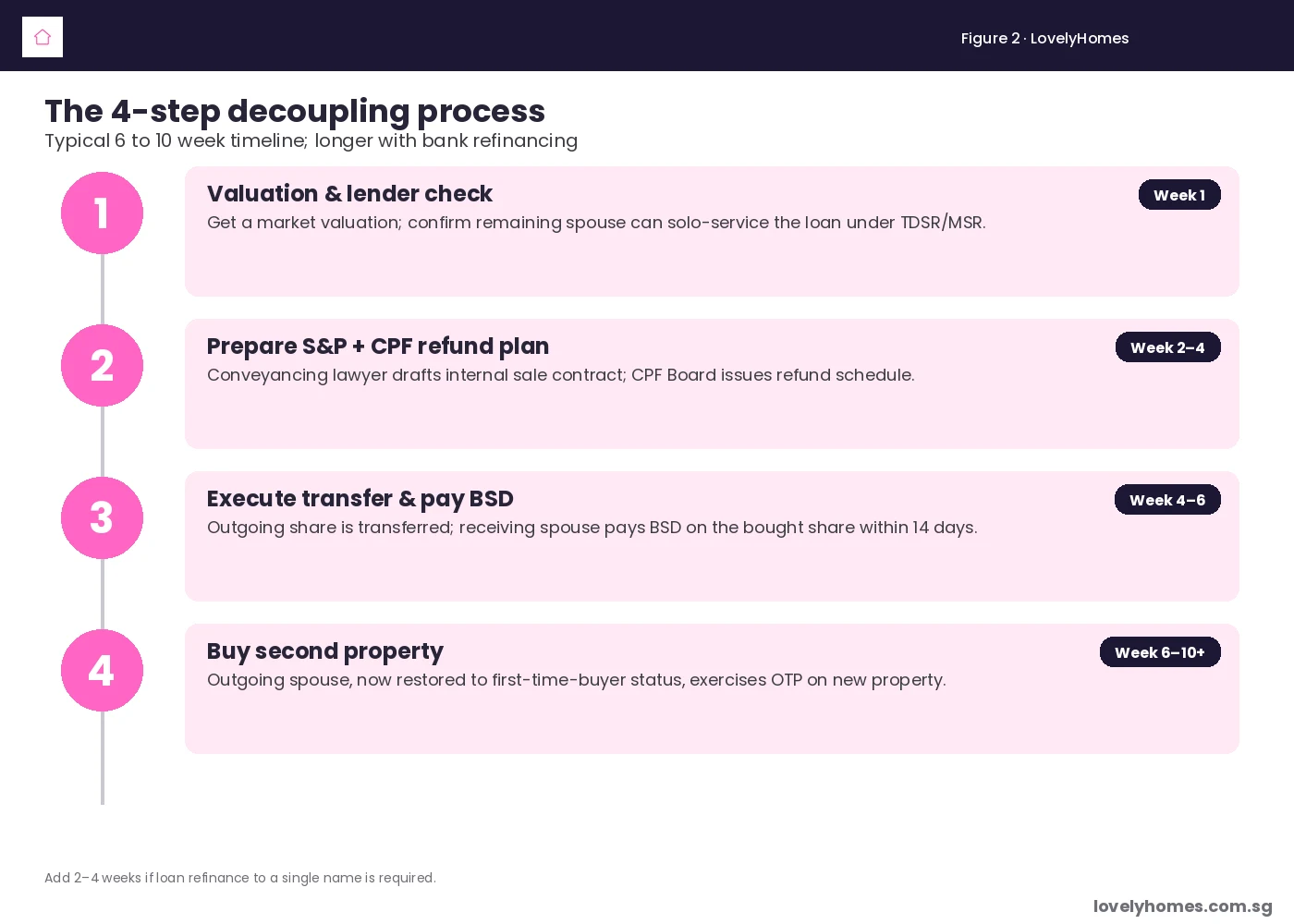
Allow 6 to 10 weeks end-to-end. Add 2–4 weeks if the loan must be refinanced into one name.
What is decoupling?
“Decoupling” is the informal name for a transaction in which co-owners of a Singapore residential property restructure their ownership so that one party transfers their share to the other. The receiving owner ends up with 100% legal title; the outgoing owner ends up with no residential property in their name.
The reason this is done is rarely sentimental. It is an Additional Buyer’s Stamp Duty (ABSD) avoidance technique — and a perfectly legal one, provided it is structured as an arms-length sale at market value, with stamp duty correctly paid on the transferred share. Once the outgoing spouse no longer owns any residential property, they are restored to “first residential property” status with the Inland Revenue Authority of Singapore (IRAS), and any subsequent purchase falls outside the punitive ABSD net.
The technique was already common before the 27 April 2023 ABSD hike that took the second-property rate for SCs from 17% to 20%. After that hike, decoupling became one of the most-discussed topics on Singapore property forums — and a regular line item in mass-affluent household financial plans.
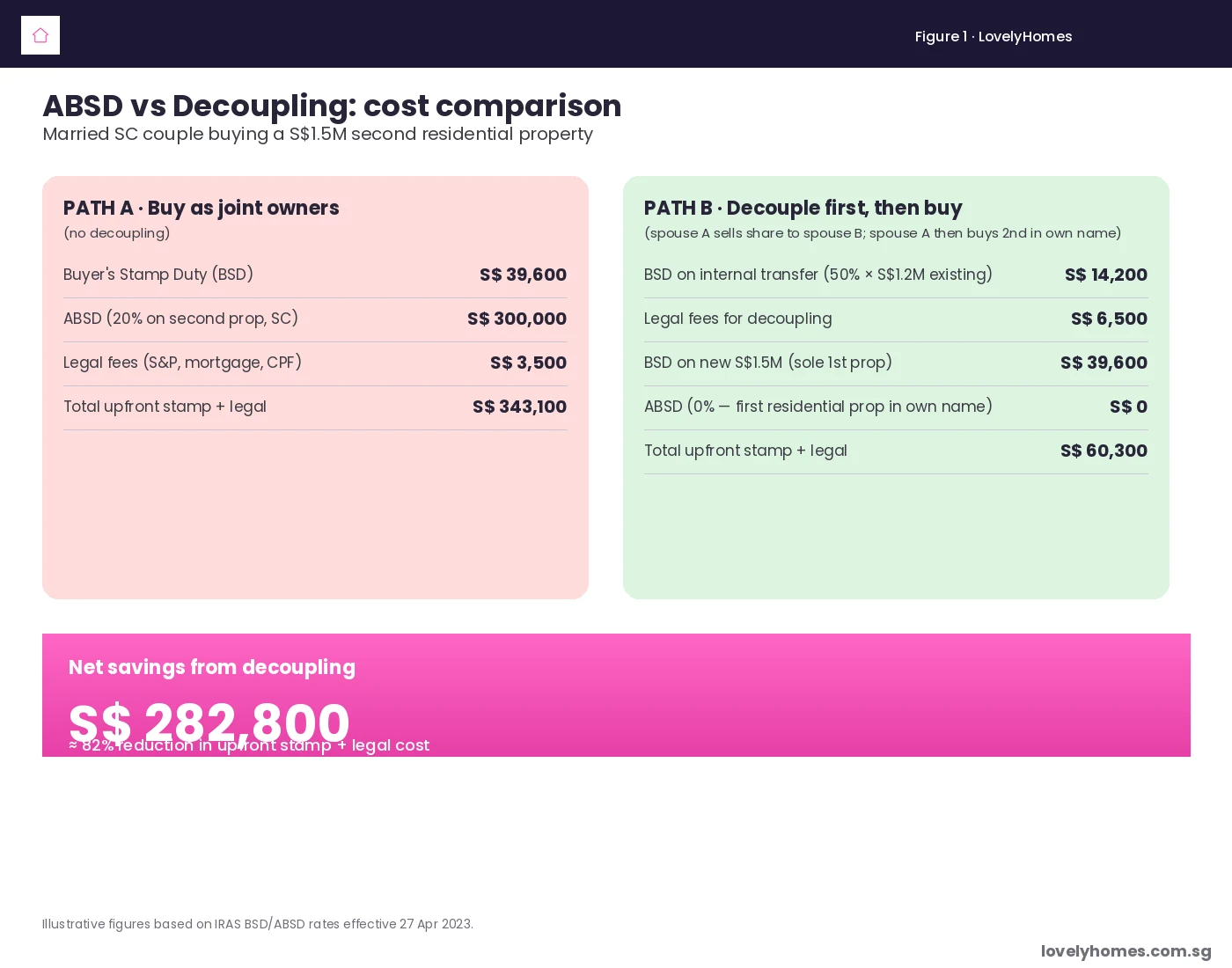
Figure 1: For a married SC couple buying a S$1.5 million second residential property, decoupling cuts upfront stamp + legal cost from S$343,100 to S$60,300 — a saving of S$282,800.
Why decoupling exists — the ABSD wall
Singapore’s ABSD regime treats any residential property held by either spouse as a household-level holding for stamp duty purposes. Under IRAS rules a married couple is taxed as a single buyer profile: if either spouse has an existing residential property, the next purchase is treated as a second (or third) property and attracts ABSD at the higher band, even if the new property is bought solely in the unencumbered spouse’s name.
The 2026 ABSD ladder for residential property is:
Buyer profile
1st residential
2nd residential
3rd & subsequent
Singapore Citizen (SC)
0%
20%
30%
Singapore PR
5%
30%
35%
Foreigner
60%
60%
60%
Entity / Trust
65%
65%
65%
For a married SC couple, the 20% band on a S$1.5 million purchase is S$300,000 — payable upfront, in cash or CPF, within 14 days of exercising the Option to Purchase. That is the wall decoupling is designed to remove.
Who can decouple — and who cannot
Decoupling is only available for private residential property: condos, executive condominiums (after the privatisation date), and landed homes. It is not available for HDB flats — the Housing and Development Board removed the loophole on 1 April 2016, requiring HDB flats to be held jointly under specified eligibility schemes (Public, Fiance, Joint Singles, etc.) and prohibiting “part-share” transfers between named owners except in narrow circumstances like divorce, death of co-owner, financial hardship or marriage to an existing co-owner.
Within private residential property, decoupling typically works for couples where:
The property has appreciated enough that BSD on the transferred share is meaningfully smaller than the avoided ABSD;
The receiving spouse can solo-service the existing mortgage under the 60% Total Debt Servicing Ratio (TDSR);
Both parties are aligned that the outgoing spouse will end up holding the new property in their sole name (with the implications that brings on inheritance, CPF refund and divorce settlement).
The 4-step decoupling process
Figure 2: The decoupling timeline: valuation, S&P drafting, transfer + BSD payment, then the second purchase.
Step 1 — Valuation and lender check
The conveyancing lawyer obtains a market valuation. The receiving spouse approaches the existing mortgagee bank (or an alternative bank) to confirm they can solo-service the loan under TDSR — meaning total monthly debt repayments cannot exceed 60% of gross monthly income. The Monetary Authority of Singapore caps the loan tenure at 30 years for private property and the loan-to-value ratio at 75% for the first housing loan.
Step 2 — Prepare S&P agreement and CPF refund schedule
The lawyer drafts an internal sale and purchase agreement at market value. CPF Board issues a refund schedule covering all CPF principal previously used by the outgoing spouse plus 2.5% accrued interest from the date each contribution was used. This is non-negotiable: the CPF refund is a lien on the property and must be settled at completion.
Step 3 — Execute the transfer and pay BSD
On completion, legal title transfers from joint to sole ownership. The receiving spouse pays BSD on the value of the share bought (i.e., 50% of the market valuation in a 50/50 joint tenancy, scaled accordingly for tenancy-in-common). BSD must be paid within 14 days of execution; late payment attracts IRAS penalties.
Step 4 — Buy the second property
The outgoing spouse, now restored to “no residential property” status, exercises the Option to Purchase on the new property and pays standard BSD only — no ABSD. There is no waiting period required between Step 3 and Step 4, but in practice the second OTP is often timed to coincide with the new launch ballot date or resale negotiation.
What decoupling actually costs
Decoupling is not free. The cost stack is dominated by BSD on the share transferred at market value. Other line items include legal fees, valuation, and any bank refinancing/discharge fees if the loan moves to a single name.
Cost line
Typical range
Notes
BSD on internal transfer
S$8,000 – S$30,000+
Calculated on 50% of market value at standard BSD rates
Conveyancing legal fees
S$5,000 – S$8,000
One firm typically acts for both spouses; ask for an itemised quote
Bank legal subsidy clawback
up to S$2,000
If the existing mortgage was taken < 3 years ago
Valuation report
S$300 – S$600
Required by both bank and lawyer
Bank early-repayment penalty
1.50% of outstanding loan
Only if existing loan is within lock-in period; waived if simply refinancing in same name
CPF refund (with accrued 2.5% interest)
Varies
Cash flow item, not a sunk cost — money is returned to your CPF account
When does decoupling pay off?
Figure 3: Across the S$1 million to S$3 million range, decoupling produces large net savings — and the gap widens with second-property price.
Worked example — Mr and Mrs Tan
Mr and Mrs Tan are both Singapore Citizens. They own a S$1.2 million Outside-Central-Region condo as joint tenants (50/50). They are looking to buy a S$1.5 million Rest-of-Central-Region condo for investment.
Path A — buy as joint owners, no decoupling:
BSD on S$1.5M = S$39,600
ABSD at 20% (second residential property, SC) = S$300,000
Legal fees on the new S&P = S$3,500
Total upfront: S$343,100
Path B — Mrs Tan sells her 50% share to Mr Tan first; Mr Tan then buys the new property in his sole name:
BSD on internal transfer of 50% × S$1.2M = S$14,200 (paid by Mr Tan)
Legal + valuation + bank fees ≈ S$6,500
Mrs Tan now has no residential property. She buys the S$1.5M ROC condo in her sole name.
BSD on new S$1.5M = S$39,600
ABSD = S$0 (first residential property in her name)
Total upfront: S$60,300
Net saving: S$282,800, or roughly 82% of the original cost. That number is the entire reason decoupling exists as a household financial-planning lever.
The risks people forget to weigh
Decoupling looks like a tax-arbitrage layup. It is — but the structure has consequences that linger long after the BSD is paid.
Loss of joint protection. Once the property is in one name, the outgoing spouse has no automatic legal interest in it. In divorce, ancillary matrimonial property division still applies — but creditor exposure (e.g. the sole owner’s business debts) shifts.
Loss of right of survivorship. Joint tenancy carries automatic survivorship: when one spouse dies, the survivor takes the whole property. After decoupling, the property passes via the sole owner’s will (or intestacy rules) — make sure both estate plans are updated immediately.
CPF cash-flow sting. The accrued-interest refund on CPF used can be substantial — often S$50,000 to S$150,000 in cash that has to be parked back in the outgoing spouse’s CPF account.
Refinance friction. If TDSR fails on a single income, decoupling cannot proceed. Some couples bridge this by adding a parent or adult child as a co-borrower, but this triggers fresh ABSD considerations.
Future ABSD changes. The outgoing spouse only retains “first residential property” status until they buy. If the new purchase is delayed and ABSD is hiked again, the saving narrows.
Decoupling vs alternatives
Decoupling is one of three structural ways for couples to manage ABSD. The other two are:
Buying in one spouse’s name from the start. Cheaper than decoupling because there is no internal transfer cost — but only works if you start the journey with this in mind. Most couples don’t.
Buying through a trust for a child. ABSD at the trust rate (65%) is usually paid upfront and refunded if the trust beneficiary is a citizen child under 21 and meets IRAS conditions. This is a niche structure for high-net-worth families.
For most existing joint-owner couples, decoupling is the most direct route. The “buy from one name” technique is preferable for new couples planning their property ladder before the first purchase.
What might come next
The Ministry of Finance has reviewed the decoupling loophole multiple times since 2017 without closing it for private property. The April 2023 ABSD hike effectively made decoupling more attractive, not less, because the avoided amount grew. If a future cooling-measures package extends the post-2016 HDB anti-decoupling rule to private property — for example, by treating the receiving spouse’s holding as a “household second property” if the divestment was within 3 years — the technique would be neutered overnight. As of April 2026 there is no public signal of such a move, and Singapore’s policy preference has been to raise stamp duty rather than restrict ownership structures. Treat this as policy risk, not a base case.
Frequently asked questions
Can I decouple my HDB flat?
No. Since 1 April 2016, HDB flats can only be held under HDB’s eligibility schemes (Public Scheme, Fiance Scheme, Joint Singles, etc.), and “part-share” transfers between named owners are not permitted except in narrow circumstances: divorce, death of co-owner, financial hardship, marriage of a co-owner, or renunciation of citizenship by a co-owner. The pre-2016 path of selling one party’s share to the other to free up an ABSD slot is closed for HDB.
Will IRAS treat decoupling as tax avoidance?
IRAS has consistently treated genuine decoupling as a legitimate restructuring, provided the transfer is at market value and BSD is correctly paid on the share transferred. The General Anti-Avoidance Provision in section 33 of the Stamp Duties Act has not been used to challenge bona fide decoupling. The risk arises only if the transfer is not at arm’s length or if the receiving spouse subsequently transfers the property back — that pattern would attract scrutiny.
How long does the whole process take?
Six to ten weeks is typical: one to two weeks for valuation and S&P drafting, three to four weeks to the transfer completion and BSD payment, and a further two weeks of buffer for the second property’s OTP timeline. If the loan needs to be refinanced into a single name with a different bank, add another two to four weeks for credit underwriting.
Can I decouple just before retirement?
Yes, but think carefully. The receiving spouse must continue to solo-service any remaining loan; if their income drops in retirement, TDSR may already be tight. Many retirees opt to redeem the loan in full at decoupling, which avoids TDSR issues but pulls cash or CPF out of liquid reserves.
Can I decouple if my property is still within Seller’s Stamp Duty (SSD) holding period?
Yes. SSD only applies on a sale to a third party within the holding period (3 years from purchase for residential property). An internal transfer between spouses is ordinarily exempt from SSD, but check with your conveyancing lawyer because the exemption depends on documentation of the transfer being a transfer of beneficial interest, not a market sale to an unrelated party.
Does CPF need to be refunded immediately?
Yes. The outgoing spouse’s CPF principal plus 2.5% accrued interest must be refunded to their CPF Ordinary Account at completion. The CPF refund is a lien on the property — completion will not proceed without it. The funds can subsequently be used by that spouse for the second property’s downpayment, subject to CPF housing rules.
What if I’m not married — can two siblings or partners decouple?
Decoupling is structurally available to any joint owners, not only married couples. However, the ABSD treatment is different: unmarried co-owners are not aggregated for ABSD by IRAS in the same way spouses are. Two unmarried joint owners who each own only one residential property are already at first-property ABSD on their respective slots. Decoupling for unmarried co-owners is mostly relevant for estate planning, debt segregation, or pre-marriage clean-up rather than ABSD avoidance.
Disclaimer. This article is general guidance only and does not constitute legal, tax or financial advice. Stamp duty, CPF and conveyancing rules in Singapore are administered by the Inland Revenue Authority of Singapore (IRAS), the CPF Board and the Singapore Land Authority respectively. Always consult a licensed Singapore conveyancing lawyer and verify current rates against iras.gov.sg, cpf.gov.sg and mas.gov.sg before acting. Loan eligibility under TDSR/MSR is set by the Monetary Authority of Singapore.
Quick Answer — property conveyancing in Singapore at a glance
Conveyancing is the legal transfer of property ownership from seller to buyer, handled by a Singapore-licensed lawyer on each side.
For resale private property: the Option to Purchase (OTP) gives the buyer 14 calendar days to exercise, paying 1% + 4% option fee and BSD/ABSD.
BSD and ABSD are due within 14 days of signing the OTP or Sale and Purchase Agreement — whichever is earlier.
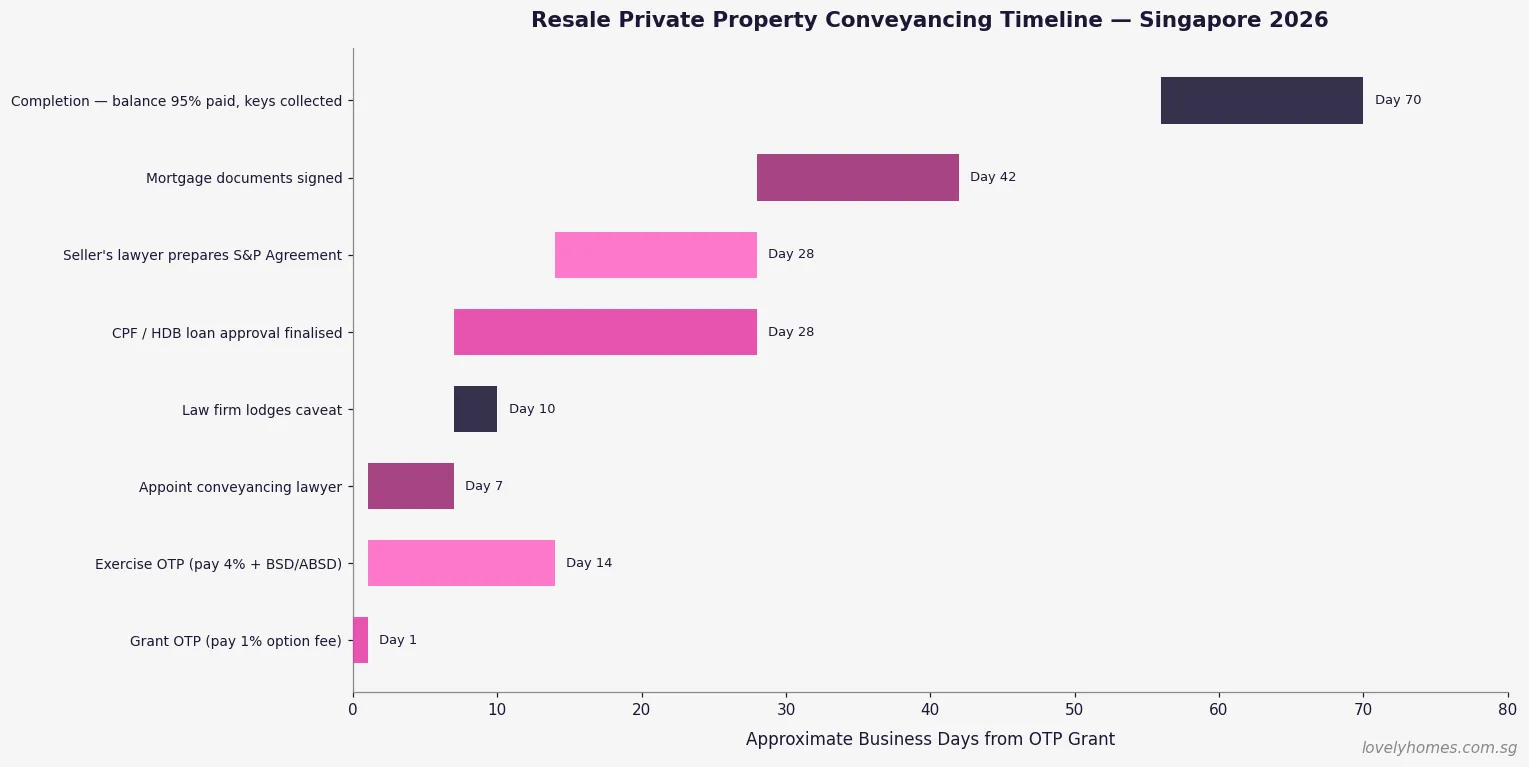
Completion (keys and balance payment) typically occurs 8–12 weeks after exercising the OTP for resale condo; 6–8 weeks for HDB resale.
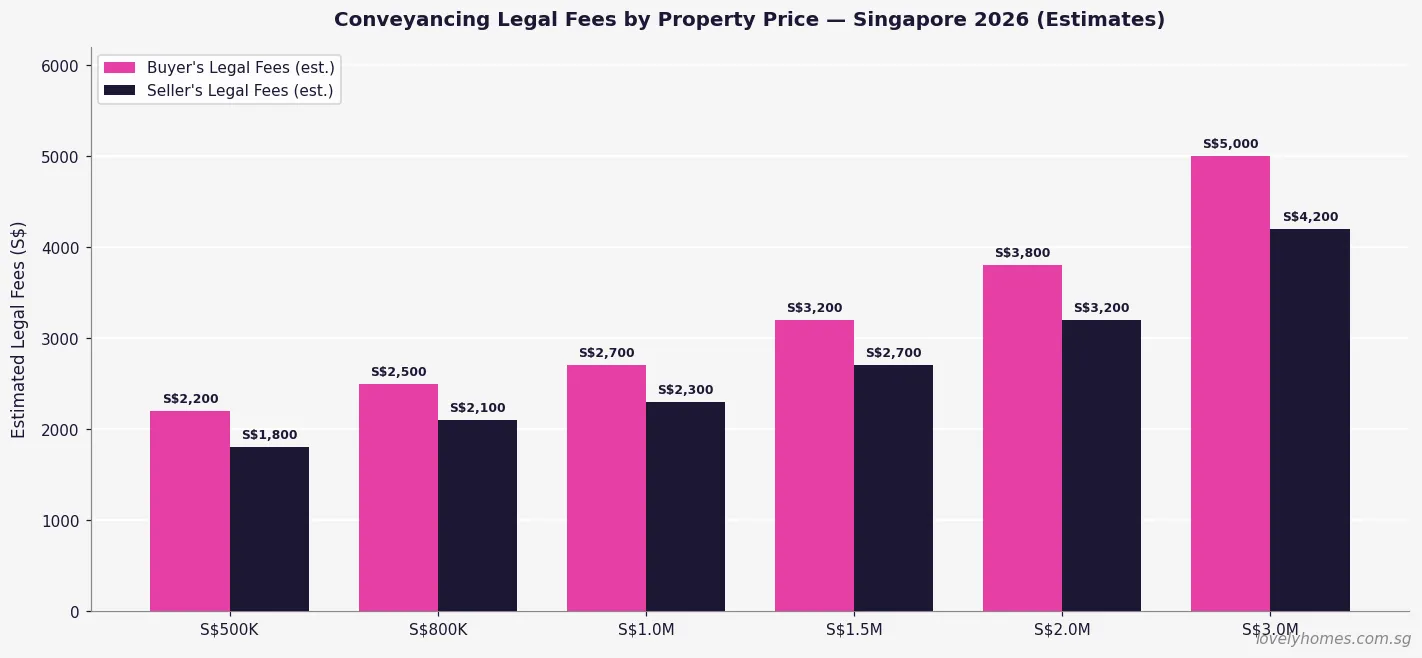
Buyer’s conveyancing legal fees for a S$1 million resale condo are approximately S$2,700–S$3,500 (including GST).
For new launches, the developer’s lawyers handle the Sale and Purchase Agreement; you still need your own lawyer to review and for the mortgage.
CPF OA funds can be used to pay BSD, legal fees, and the balance of the purchase price — but not the 5% mandatory cash downpayment for bank loans.
What Is Conveyancing and Why Do You Need a Lawyer?
Conveyancing is the legal process by which the title (ownership rights) of a property is formally transferred from one party to another. In Singapore, all conveyancing for residential property must be handled by a qualified Singapore-licensed lawyer (advocate and solicitor). You cannot self-convey a property transaction — the Law Society of Singapore and the Land Titles Act require a qualified professional to prepare the instruments of transfer, conduct the requisitions, and handle the lodgement with the Singapore Land Authority (SLA).
The conveyancing lawyer acts as far more than a document drafter. They carry out title searches, verify that the property is free of encumbrances, co-ordinate with CPF Board to release CPF funds, liaise with the mortgagee bank, and ensure that all stamp duties are correctly assessed and paid on time. For buyers in particular, appointing a good conveyancing lawyer early — ideally before exercising the Option to Purchase — can prevent costly mistakes around timing and documentation.
Both buyer and seller must appoint their own separate lawyers. The same law firm cannot act for both parties in the same transaction (conflict of interest rules under the Legal Profession (Professional Conduct) Rules). In HDB transactions, HDB’s legal arm processes the resale procedures and buyers/sellers interact via the HDB Flat Portal, but a buyer may still choose to appoint a private lawyer to advise.
The Option to Purchase (OTP) — Singapore’s Property Buying Trigger
For private residential property, the conveyancing process formally begins with the Option to Purchase (OTP). The OTP is a legal document granted by the seller to the buyer, giving the buyer an exclusive right to purchase the property at the agreed price within a specified period — in Singapore, typically 14 calendar days from the date the option is granted.
The OTP process works as follows. First, the seller grants the OTP upon receipt of the option fee — conventionally 1% of the agreed purchase price, paid in cash. This amount is non-refundable if the buyer chooses not to exercise. The buyer then has 14 days to decide whether to proceed. If proceeding, the buyer exercises the OTP by signing the acceptance copy and returning it to the seller’s lawyer together with:
An additional exercise fee of 4% of the purchase price (also cash); and
Payment of the Buyer’s Stamp Duty (BSD) and, where applicable, Additional Buyer’s Stamp Duty (ABSD) — both are due within 14 days of the OTP being granted, not 14 days from exercise.
The total 5% (1% option + 4% exercise fee) forms the initial deposit, which is typically held by the seller’s solicitors in their client account and released to the seller upon completion. The balance of the purchase price — typically 95% — is paid on the completion date.
Step
Amount
Timing
Payment Mode
Option fee (grant OTP)
1% of price
Day 0
Cash/cashier’s order
Exercise fee (exercise OTP)
4% of price
Within 14 calendar days
Cash/cashier’s order
BSD (all buyers)
Progressive, ~0.6–3%+
Within 14 days of OTP date
Cash or CPF OA
ABSD (where applicable)
5–60% flat rate
Within 14 days of OTP date
Cash only (CPF for reimbursement later)
Balance purchase price
~95% of price
Completion date (8–12 weeks)
CPF OA + bank loan + cash top-up
The Conveyancing Timeline — From OTP to Keys
Figure 1: Approximate conveyancing timeline for a resale private residential property, Singapore 2026. Timings are indicative and may vary depending on parties and conditions. Source: Singapore Law Society / LovelyHomes analysis.
After the OTP is exercised, your conveyancing lawyer moves through a series of standard steps. The requisition phase involves sending formal enquiries to government bodies — the Land Titles Registry (SLA), URA (planning queries), HDB (where applicable), PUB, SP Group, and others — to confirm there are no adverse encumbrances, outstanding charges, or regulatory issues on the title. This typically takes two to three weeks.
Simultaneously, if you are taking a bank loan, the mortgage documentation is being prepared: the bank’s solicitors (often the same firm acting for you) will prepare the mortgage instrument, and CPF Board will be notified to set aside or release your CPF OA funds for the purchase. For new citizens or PRs using CPF for the first time for property, additional verification steps apply.
The completion appointment brings all parties together (or their lawyers in escrow). The buyer’s lawyers hand over the balance payment; the seller’s lawyers hand over the title documents and release the keys. In Singapore, completion is a smooth, paperwork-driven process — you do not physically attend a courtroom or signing ceremony (unlike some other jurisdictions). The average buyer simply receives a call from their lawyer confirming completion, and then collects the keys.
New Launch Private Property — Different Process, Same Stamp Duties
When buying a new launch directly from a developer (whether a condo or an executive condominium), the conveyancing process differs in several important respects:
The developer uses its own solicitors to prepare the Sale and Purchase Agreement (S&P Agreement) — a standardised statutory form prescribed by the Controller of Housing under the Housing Developers (Control and Licensing) Act.
There is no OTP for new launches; instead, you first sign an Option to Purchase issued by the developer (usually after booking a unit and paying a booking fee of typically 5%), followed by the S&P Agreement within 3 weeks.
BSD and ABSD remain payable within 14 days of the S&P Agreement date.
Payment follows the Progressive Payment Scheme (PPS) — instalments tied to construction milestones over the build period (typically 3–5 years to TOP).
You should still appoint your own independent conveyancing lawyer to review the S&P Agreement and handle your CPF and mortgage documentation, even though the developer’s lawyers lead the transaction.
Conveyancing Legal Fees — What to Expect in 2026
Figure 2: Estimated conveyancing legal fees for buyer and seller by property price band, Singapore 2026. All figures are indicative estimates including GST; actual fees vary by law firm and complexity.
Conveyancing legal fees in Singapore are not regulated by a fixed scale for private property transactions (unlike some Commonwealth jurisdictions). Law firms set their own fees, though market rates are broadly competitive. As a rough guide for 2026:
Purchase Price
Buyer’s Legal Fees (est.)
Seller’s Legal Fees (est.)
Up to S$500,000
S$1,800–S$2,500
S$1,500–S$2,000
S$500,001–S$1,000,000
S$2,500–S$3,200
S$2,000–S$2,700
S$1,000,001–S$2,000,000
S$3,000–S$4,200
S$2,500–S$3,500
S$2,000,001–S$3,000,000
S$4,000–S$5,500
S$3,300–S$4,500
Above S$3,000,000
S$5,000+
S$4,000+
These figures include disbursements (SLA lodgement fees, title search fees, stamp certificate) but exclude the mortgage-related legal work, which is typically billed separately by the bank’s panel solicitors. Many buyers find that choosing a law firm on the bank’s mortgage panel saves money — you may qualify for a “combined” rate covering both the purchase and the mortgage documents.
For HDB resale transactions, the HDB Resale Flat Portal provides a standardised suite of forms and handles the administrative process centrally. A buyer may engage a private lawyer for S$1,000–S$2,000 for advice, but the HDB legal process itself is not separately billed to the buyer.
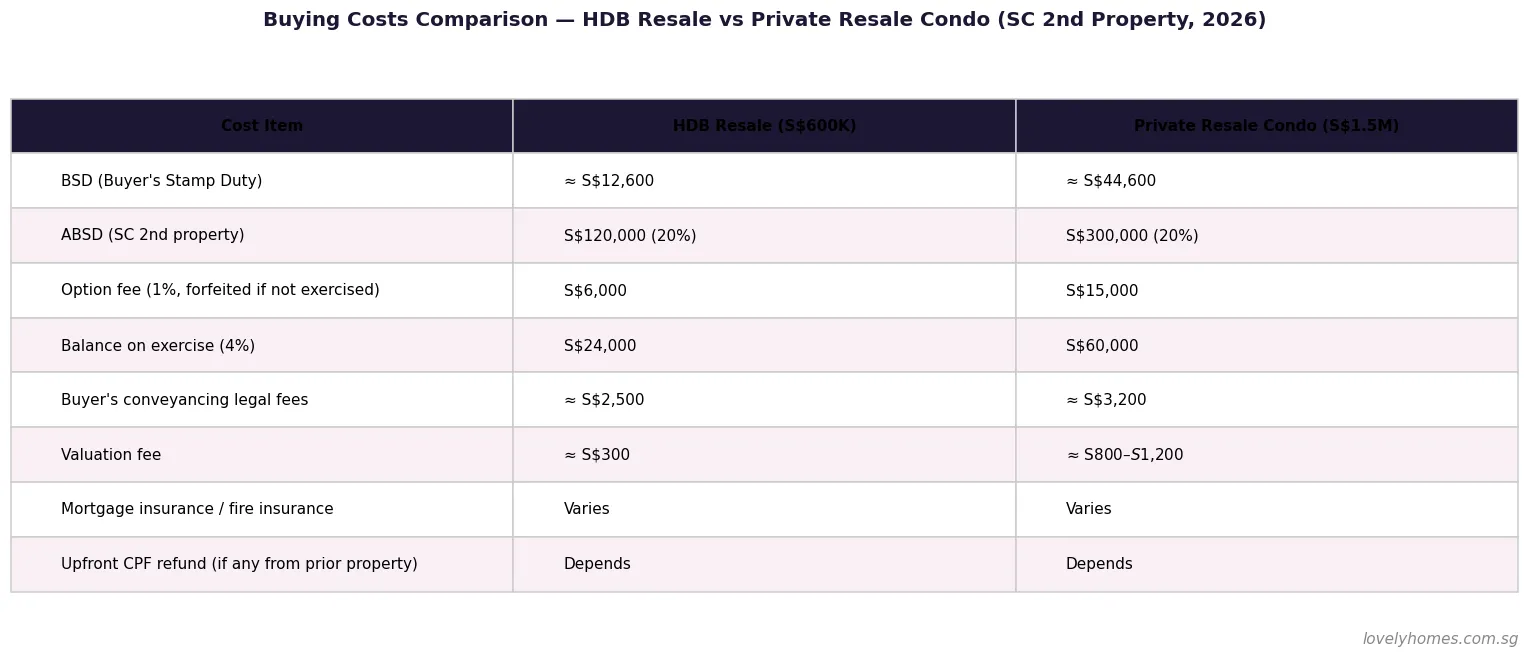
Worked Example — Full Buying Cost Breakdown, Resale Condo S$1.5 Million
Scenario: Singapore Citizen couple buying their second property — Resale Condo, S$1,500,000, District 15
Both buyers are Singapore Citizens. They already own their HDB flat (first property). They are purchasing the condo jointly as their second property.
Option fee (1%, cash): S$15,000 — paid when OTP granted. Non-refundable if not exercised.
Exercise fee (4%, cash): S$60,000 — paid within 14 days of OTP date.
BSD (progressive): S$44,600 — due within 14 days of OTP. Can be paid via CPF OA.
ABSD (20% for SC 2nd property): S$300,000 — due within 14 days of OTP. Must be paid in cash initially; CPF may be used for reimbursement after stamping.
Buyer’s legal fees: approximately S$3,200–S$4,200 (including GST and disbursements).
Valuation fee: approximately S$800–S$1,200 (required by the bank for mortgage drawdown).
Balance 95% at completion: S$1,425,000 — funded via CPF OA balance + bank mortgage.
Total upfront cash required before completion: S$15,000 + S$60,000 + S$300,000 (ABSD) + BSD disbursement + legal fees ≈ S$382,000–S$385,000 in cash before leveraging CPF. This illustrates why ABSD planning is critical for second-property buyers — the S$300,000 ABSD alone is a major cash drain.
Figure 3: Full cost comparison — HDB resale (S$600K) vs private resale condo (S$1.5M) for a SC buying a second property. Source: IRAS / HDB / LovelyHomes analysis (2026).
CPF and Conveyancing — What Can and Cannot Be Paid with CPF
Understanding which costs can be funded from your CPF OA and which must be cash is essential to avoid a last-minute shortfall. As a general rule:
Cost Item
CPF OA Usable?
Notes
Buyer’s Stamp Duty (BSD)
Yes
Deducted from CPF at the time of payment
ABSD
No (initially)
Must be paid in cash first; CPF reimbursement applies after stamping
5% downpayment (bank loan)
No
Mandatory cash requirement; cannot use CPF
Balance above 5% (bank loan LTV)
Yes
CPF OA used for the remainder of the 25% equity requirement
Legal / conveyancing fees
Yes
Up to a cap set by CPF Board based on purchase price
Valuation fee
Generally No
Usually paid directly to the valuer in cash
Monthly mortgage instalments
Yes
Subject to CPF Withdrawal Limit and Valuation Limit
Why Conveyancing Matters — Common Mistakes to Avoid
Many first-time buyers in Singapore underestimate the legal and procedural complexity of a property transaction. The most frequent pitfalls encountered in conveyancing are:
Exercising the OTP without sufficient cash for ABSD: Buyers sometimes discover — after paying the 1% option fee — that they do not have the cash to cover ABSD on exercise. This is a costly error: forfeiting the 1% option fee and walking away. Pre-compute your full buying cost (including ABSD) before paying the option fee.
Delaying the BSD/ABSD payment: Both duties are due within 14 days of the OTP date — not 14 days from exercise. A buyer who exercises on day 13 still has only one day to pay stamp duty. Failure to stamp on time attracts penalties of 2–4× the duty payable.
Not checking encumbrances before exercising: A competent conveyancing lawyer will run a title search and caveat check before the exercise deadline. Buyers who rush this step can find themselves bound to a property with an undisclosed mortgage or legal charge.
Assuming the developer’s lawyer acts for you: For new launches, the developer’s solicitors act exclusively for the developer. Your interests are protected only by your own appointed lawyer.
Forgetting to budget for legal fees in the completion funds: On completion day, your lawyer will draw up a “completion account” showing exactly how the balance is funded (CPF, loan drawdown, cash). Buyers who have not kept the legal fees in their CPF or cash buffer occasionally face a shortfall at the last moment.
What Might Come Next — Conveyancing Reform Outlook 2026–2028
Singapore’s conveyancing framework is relatively mature and stable, but two developments bear watching. First, the Ministry of Law has been progressively digitising the conveyancing process — the Integrated Land Information Service (INLIS) already allows electronic title searches, and there are ongoing discussions around greater use of digital instruments of transfer. Second, the Law Society’s standardisation of HDB resale procedures has reduced friction significantly, and a similar standardisation framework for private property may be on the horizon. Buyers and sellers should expect a leaner, more fully digital process by the late 2020s, but the fundamental legal requirement for a qualified solicitor to handle the transfer is not expected to change.
Frequently Asked Questions
Do I need a lawyer to buy an HDB resale flat, or can HDB handle everything?
For most straightforward HDB resale transactions, the HDB Resale Flat Portal handles the administrative and procedural steps centrally — buyers and sellers submit resale applications online, and HDB’s in-house legal process manages the transfer instruments. You are not strictly required to appoint a private conveyancing lawyer. However, if your situation involves CPF complications, outstanding mortgages, an estate sale, unusual co-ownership structures, or a divorce settlement, engaging a private lawyer (typically S$1,000–S$2,000) for independent advice is well worthwhile. For private property transactions, a private lawyer is mandatory.
Can I use the same lawyer as the seller?
No. A Singapore law firm cannot act for both buyer and seller in the same property transaction. This rule exists to prevent conflicts of interest — your lawyer’s duty is to protect your interests alone, and the seller’s lawyer’s duty is the opposite. If a seller’s law firm approaches you offering to “save costs” by acting for both sides, this is in breach of the Legal Profession (Professional Conduct) Rules and should be declined.
What happens if the seller pulls out after granting the OTP?
The OTP is a binding contractual document. If the seller withdraws after granting the option and you have already exercised it, the seller is in breach of contract. You can seek specific performance (a court order requiring the seller to complete the sale) or claim damages including your costs of conveyancing, financing, and any foreseeable losses. Your conveyancing lawyer should advise you promptly if a seller attempts to back out post-exercise. The 1% option fee paid to obtain the OTP is generally retained by the buyer in such cases, but recovery of the full loss typically requires legal proceedings.
How long does conveyancing take for a new launch (BTO or developer)?
For new BTO flats, the HDB handles the conveyancing entirely in-house upon completion of the flat. The process typically takes 4–8 weeks after HDB notifies you that your flat is ready for collection (after Temporary Occupation Permit is granted and your unit passes inspection). For private new launches, the formal transfer of title occurs upon completion of the building project — conveyancing is triggered at that point, typically 3–5 years after the booking date. During the construction period, you are making progressive payments but do not yet hold the legal title to the unit.
Is there stamp duty on a rental tenancy agreement in Singapore?
Yes, but it is much smaller than BSD or ABSD. Tenancy agreements in Singapore attract stamp duty under the Stamp Duties Act. The rate is S$1 per S$250 of annual rent for leases of 4 years or less, and a higher rate applies for longer tenancies. For a 2-year tenancy at S$4,000/month (S$48,000 annual rent), the stamp duty would be approximately S$192. Stamp duty on tenancy agreements is normally split between landlord and tenant by convention, unless the tenancy agreement specifies otherwise. Payment is via IRAS e-Stamping portal and must be completed within 14 days of execution.
Can foreigners engage a Singapore conveyancing lawyer and buy private property?
Yes. Foreigners may engage any Singapore-licensed advocate and solicitor to handle a private residential property conveyancing. Under the Residential Property Act, foreigners may purchase non-landed private residential properties (condos and apartments) without restriction. Landed property, including terrace houses, semi-detached, and detached houses, generally requires SLA approval for foreign buyers, with limited exceptions (e.g., Sentosa Cove). ABSD at 60% applies on any residential property purchase by a foreigner. Your conveyancing lawyer will advise on eligibility and the ABSD position at the outset of the transaction.
Disclaimer: This article is intended for general information only and does not constitute legal or financial advice. Conveyancing procedures, stamp duty rates, and CPF rules are subject to change. Always consult a Singapore-licensed conveyancing lawyer before entering into any property transaction. For official guidance, refer to the Ministry of Law, Law Society of Singapore, IRAS Stamp Duty, and Singapore Land Authority.
Every property buyer in Singapore pays Buyer’s Stamp Duty (BSD) — a transaction tax levied on the purchase price or market value (whichever is higher) of any residential, commercial, or industrial property. Unlike the Additional Buyer’s Stamp Duty (ABSD), which applies only to second and subsequent property purchases by residents and all properties purchased by foreigners, BSD is the baseline duty that every single buyer must pay, regardless of citizenship, residency status, or how many properties they already own.
Whether you are buying your first HDB flat, upgrading to a private condo, or acquiring commercial premises, understanding how BSD is calculated, when it must be paid, and how it differs from ABSD is essential to budgeting correctly for your purchase. Get BSD wrong, and it can consume tens of thousands of dollars in unexpected costs.
This guide walks you through the exact BSD rates in force in 2026, provides step-by-step calculation examples across multiple property types and price points, explains how CPF reimbursement works, and clarifies how BSD stacks with ABSD. All figures reflect the latest IRAS guidance.
Quick Answer — BSD at a glance
Applies to: Every property purchase (residential, commercial, industrial, land)
Basis: Higher of purchase price or market valuation
Payment timeline: Within 14 days of signing OTP/SPA
CPF: Cannot be paid directly from CPF; reimbursement available after stamping
Top residential rate: 6% on amounts above S$3,000,000
Top non-residential rate: 5% (raised 15 February 2023)
What is Buyer’s Stamp Duty (BSD)?
Buyer’s Stamp Duty is a progressive transaction tax imposed by the Inland Revenue Authority of Singapore (IRAS) on the acquisition of any property in Singapore. The term “stamp duty” originates from the historical practice of stamping documents as proof that tax had been paid; today, the duty is administered entirely through the Stamp Duty system managed by IRAS and supporting conveyancers.
BSD is:
Progressive: The rate increases in tiers as the property price rises
Compulsory: It applies to every buyer, without exception
Upfront: It must be paid within 14 days of executing the Option to Purchase (OTP) for resale, or the Sale & Purchase Agreement (SPA) for new launches
Non-recoverable: Unlike GST or certain taxes, BSD is not refundable
How BSD Differs From ABSD
The key difference between BSD and ABSD often confuses first-time buyers. Here is the distinction in plain terms:
Feature
BSD (Buyer’s Stamp Duty)
ABSD (Additional Buyer’s Stamp Duty)
Who pays
Every buyer
Only 2nd+ residential buyers; all foreigners buying residential
Rate structure
Progressive (1–6% for residential)
Flat (0–60% depending on profile)
Applied to
Residential, commercial, industrial, land
Residential properties only
Purpose
Government revenue; general property transaction tax
Cooling measure; discourages speculation and foreign ownership
Remission available
No
Yes (married couple, developer, etc.)
Example to clarify: A Singapore Citizen buying their first residential property pays BSD but zero ABSD. A Singapore Citizen buying their second residential property pays BSD plus 20% ABSD on top.
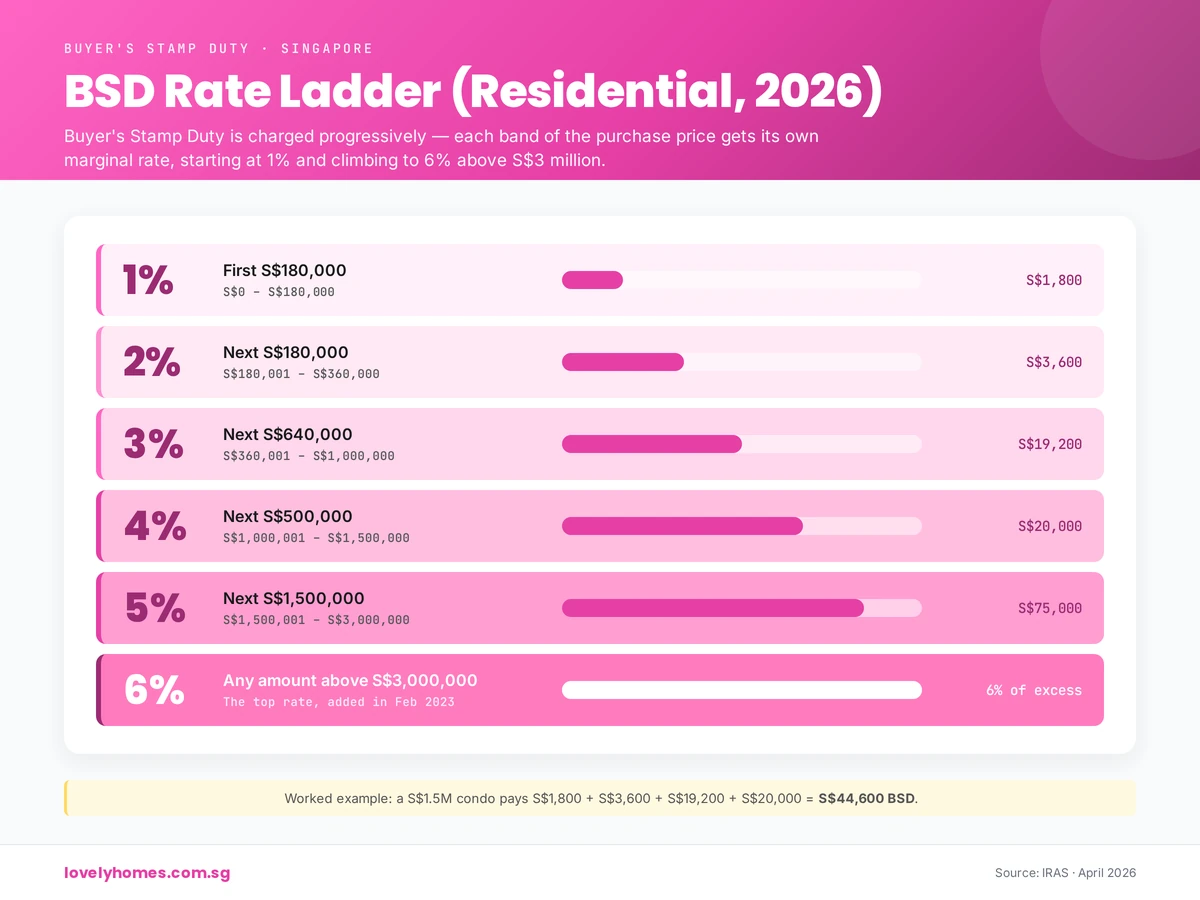
Figure 1: The six-bracket BSD rate ladder for residential property (1% to 6%, IRAS, 2026).
BSD Rates for Residential Properties (2026)
As of 15 February 2023, the residential BSD rates are:
Property Price Bracket
BSD Rate
Cumulative Duty (Example)
First S$180,000
1%
S$1,800
S$180,001 to S$360,000
2%
S$3,600
S$360,001 to S$1,000,000
3%
S$19,200
S$1,000,001 to S$1,500,000
4%
S$20,000
S$1,500,001 to S$3,000,000
5%
S$75,000
Above S$3,000,000
6%
6% on excess
Note: The 6% top rate for residential properties was introduced in July 2018. The 5% top rate for non-residential properties was raised from 4% on 15 February 2023.
BSD Rates for Non-Residential Properties (2026)
Non-residential properties (commercial, industrial, land for non-residential use) follow a similar progressive structure but max out at 5%:
Property Price Bracket
Non-Residential Rate
First S$180,000
1%
S$180,001 to S$360,000
2%
S$360,001 to S$1,000,000
3%
S$1,000,001 to S$1,500,000
4%
Above S$1,500,000
5%
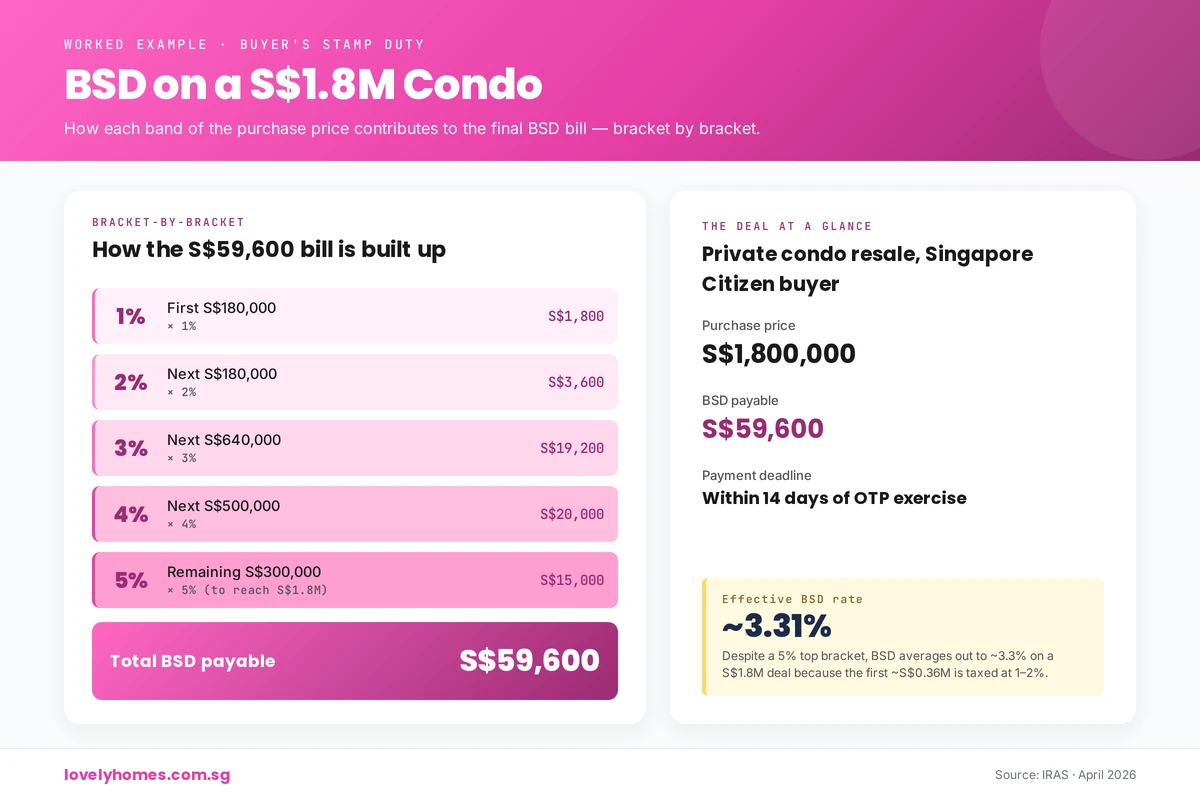
Figure 2: How the bill builds up on a S$1.8M private condo — S$59,600 BSD across five brackets.
How BSD is Calculated: Step by Step
BSD is calculated on the higher of the purchase price or the market value of the property at the time of acquisition. This is a critical point: if the market value (as assessed by IRAS or an independent valuer) exceeds your negotiated purchase price, you pay BSD on the higher figure.
Key rules:
BSD is rounded down to the nearest dollar, subject to a minimum of S$1
The calculation is tiered and progressive — you do not pay the top rate on the entire property price, only on the portion that falls into that bracket
BSD is computed using the property price or market value at the time the OTP is granted (for resale) or the SPA is signed (for new launches)
Worked Example 1: HDB Resale at S$650,000
A Singapore Citizen couple purchases a 4-room HDB resale flat in Yung Ho for S$650,000. This is their first joint property purchase.
Calculation:
First S$180,000 @ 1% = S$1,800
Next S$180,000 (S$180,001–S$360,000) @ 2% = S$3,600
Total BSD = S$1,800 + S$3,600 + S$8,700 = S$14,100
They also pay 0% ABSD (first residential property for a Singapore Citizen). Total stamp duty = S$14,100.
Worked Example 2: Private Condo Resale at S$1,800,000
A Singapore Citizen already owns one residential property and purchases a 3-bedroom condo resale in the central business district for S$1,800,000. This is their second residential property.
BSD calculation:
First S$180,000 @ 1% = S$1,800
Next S$180,000 (S$180,001–S$360,000) @ 2% = S$3,600
Next S$640,000 (S$360,001–S$1,000,000) @ 3% = S$19,200
Next S$500,000 (S$1,000,001–S$1,500,000) @ 4% = S$20,000
0% ABSD (first residential property for a Singapore Citizen)
Total stamp duty payable = S$209,600
Note how the 6% band kicks in at S$3,000,000 and above — on luxury properties, BSD becomes a significant cost.
Who Pays BSD? Property Types and Exemptions
BSD applies to the acquisition of any property in Singapore — residential, commercial, industrial, or undeveloped land — regardless of the buyer’s citizenship or residency status. However, certain transactions are exempt or treated differently:
Properties Subject to BSD
HDB flats (public housing)
Executive Condominiums (ECs) — during MOP and after privatisation
Land (whether for residential or non-residential development)
Transactions Not Attracting BSD
Transfers within families: If a property is transferred from one spouse to another (with no consideration), no BSD is triggered
Transmissions on death: When a property is transmitted via a will or intestacy, no stamp duty is payable on the transmission itself (though a later sale would trigger BSD)
Gifts: A gift of property attracts a nominal stamp duty (10 cents) but not the full BSD rate
Leasehold renewals: Renewing a lease on the same property does not trigger BSD
When Must BSD Be Paid?
BSD (together with ABSD, if applicable) must be paid within 14 days of the date the property transaction is formally documented:
For resale properties: Within 14 days of signing the Option to Purchase (OTP)
For new launch properties: Within 14 days of signing the Sale & Purchase Agreement (SPA)
For contracts executed overseas: Within 30 days of the contract being received in Singapore
Late payment penalty: If BSD is not paid within the prescribed timeframe, IRAS charges a penalty. For delays of up to three months, the penalty is typically 5% of the duty; beyond three months, it escalates to 10%. Interest also accrues.
Can You Pay BSD Using CPF?
No, BSD (like ABSD) cannot be paid directly from your CPF Ordinary Account at the point of purchase. You must pay in cash or by cheque/bank transfer to IRAS.
However, CPF reimbursement is available after the property is stamped:
Once IRAS has stamped your property document, you may apply for CPF reimbursement of BSD (and the purchase price) from your Ordinary Account
The reimbursement claim is typically submitted via the conveyancing lawyer and approved by the CPF Board within 1–2 months
Your CPF funds are refunded to your OA once your legal title to the property has been registered with the Land Authority
This two-step process — pay upfront, then reimburse from CPF — is a key budgeting consideration for many first-time HDB and condo buyers. Ensure you have sufficient cash reserves to bridge the gap between the OTP date and the CPF reimbursement.
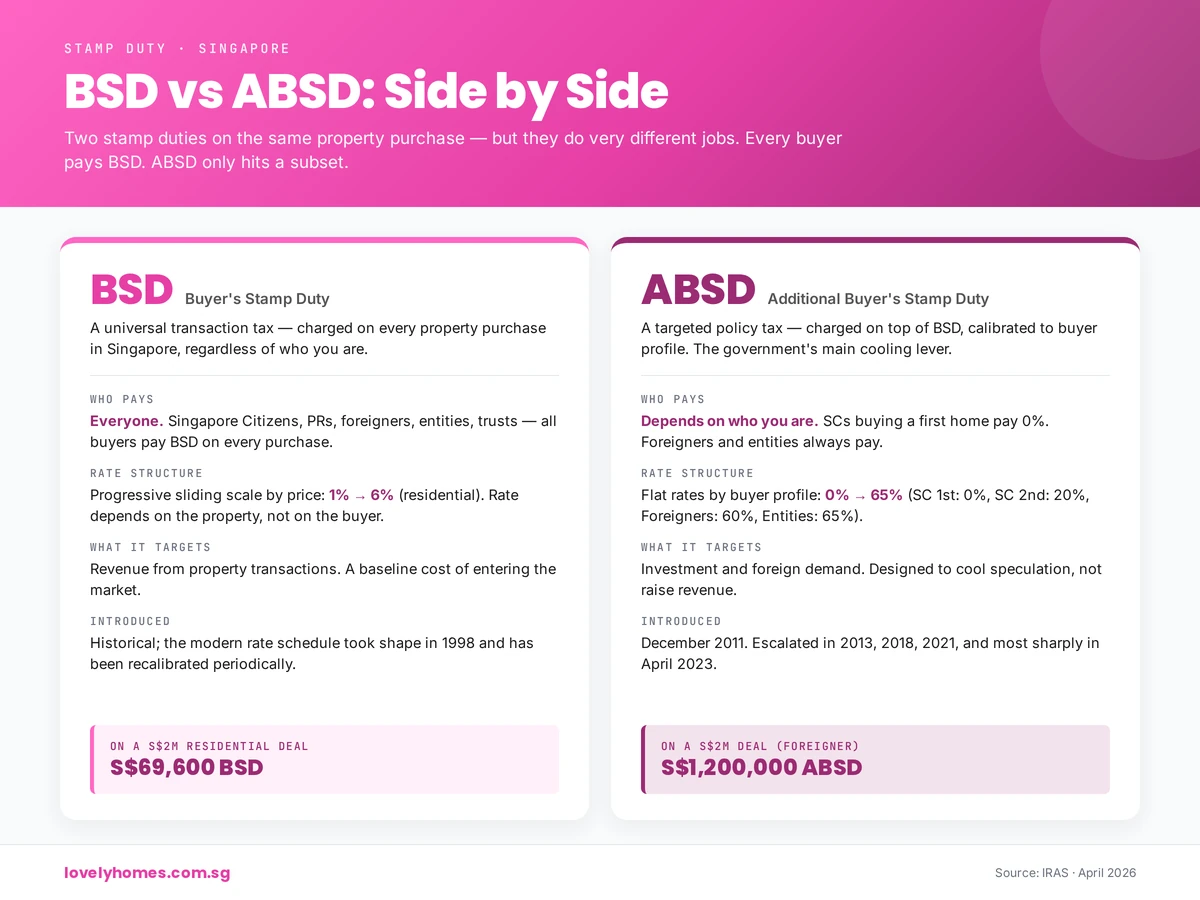
Figure 3: Two stamp duties, very different jobs — BSD is universal; ABSD is targeted.
BSD vs ABSD: Side-by-Side Comparison
To solidify understanding, here is a comprehensive comparison:
Aspect
BSD
ABSD
Full name
Buyer’s Stamp Duty
Additional Buyer’s Stamp Duty
Who pays
Every buyer
Second/third+ residential buyers; all foreigners (residential)
Payment basis
Higher of purchase price or market value
Higher of purchase price or market value
Rate type
Progressive (1%–6% residential)
Flat rate (0%–65% depending on buyer profile)
Applies to
Residential, commercial, industrial, land
Residential only
Example (SC, 2nd property, S$1.8M)
S$59,600
S$360,000
Payment deadline
14 days of OTP/SPA
14 days of OTP/SPA
CPF reimbursement
Yes (post-stamping)
No (non-refundable)
Remission/deferral schemes
No
Yes (married couple, developer, etc.)
The History of BSD in Singapore (2011–2026)
Understanding how BSD has evolved helps explain why the rates stand where they do today:
July 2018: The top residential rate was raised from 5% to 6% on amounts above S$3,000,000 — designed to moderate price growth in the luxury segment
15 February 2023: The top non-residential rate was raised from 4% to 5% in line with a broader cooling-measures update — reflecting rising commercial property prices in Singapore’s business core
The progressive structure itself has remained relatively stable, with the tier brackets unchanged since their introduction. This consistency allows developers and conveyancers to model costs with confidence.
Frequently Asked Questions (FAQ)
Is BSD the same as ABSD?
No. BSD is the baseline stamp duty every buyer pays. ABSD is an additional layer that only applies to second-and-subsequent residential purchases and purchases by foreigners. A first-time buyer pays BSD but zero ABSD; a second-time buyer pays both BSD and ABSD.
Can I pay BSD from my CPF Ordinary Account?
No, not directly at the point of purchase. You must pay BSD in cash. After the property document is stamped and registered, you can apply for CPF reimbursement of the purchase price and stamp duty from your CPF Ordinary Account.
What if the valuation is higher than my purchase price?
BSD is calculated on the higher of the purchase price or the market value. If IRAS or an independent valuer assesses the market value above your negotiated price, you pay stamp duty on the higher figure. This is common in the resale HDB market where transaction prices may lag official valuations. Always budget for this possibility.
Do I pay BSD on inherited property?
No. When property is inherited via a will or intestacy, the transmission to the heirs does not attract stamp duty. However, if you later sell that inherited property, the buyer (not the inheritor) pays BSD based on the sale price.
Is BSD payable on commercial property?
Yes. Commercial and industrial properties are subject to BSD. The rates are the same as residential up to S$1,500,000, then cap at 5% above S$1,500,000 (rather than 6% for residential).
How do I file and pay BSD?
Your conveyancing lawyer handles the submission and payment to IRAS. Upon signing the OTP/SPA, the lawyer prepares the stamped property document and submits it to IRAS for assessment and stamping. Payment is made on behalf of the buyer, typically before the completion date. The stamped document is then lodged with the Singapore Land Authority for registration.
What is the penalty for late BSD payment?
If BSD is not paid within 14 days of the OTP/SPA, IRAS charges a penalty of 5% for delays up to three months, escalating to 10% thereafter. Interest also accrues on the unpaid amount. Late payment can delay the registration of your legal title, so it is critical to meet the deadline.
Can BSD be remitted or waived in any circumstance?
No. Unlike ABSD, which has remission schemes for married couples and property developers, BSD is a fixed tax with no remission or deferral schemes. It must be paid in full within the prescribed timeframe.
What if I buy as a company or trust?
A property acquired by a company, trust, or other entity (not a natural person) is subject to the same BSD rates as a residential or non-residential property. However, such purchases often also trigger higher ABSD rates (65% for entities on residential property, depending on the nature and structure of the entity).
Key Takeaways: How to Manage Your BSD Bill
To wrap up, here are the core points to lock in as you plan a property purchase:
BSD is compulsory. Every buyer, on every property, pays it. There is no avoiding it, and no remission schemes apply.
It is progressive. The more expensive the property, the higher your effective rate, but you only pay the tier rate on each bracket of the purchase price.
Budget for both BSD and ABSD. If you are a second-plus buyer or a foreigner buying residential, both apply. Your total stamp-duty bill can easily exceed S$300,000–S$400,000 on a S$2 million upgrade.
Timing and staging matter. For upgraders, selling your existing property before buying your next one avoids the 20% ABSD entirely — potentially saving six figures.
The payment deadline is strict. 14 days from OTP/SPA signature. Delay incurs penalties and can freeze your legal-title registration.
CPF reimbursement is post-stamping. You must have cash at hand to pay BSD upfront; CPF refund follows weeks or months later.
Always verify with IRAS. This guide reflects the rates as of April 2026, but the Government can change BSD or introduce new cooling measures. Check the IRAS Stamp Duty page before signing an OTP.
What to Do Next
If you are in active purchase planning, we recommend three next steps:
Calculate your true cost of entry. Use our BSD calculator (if available) or work through the examples above with your target property price to see how much stamp duty you’ll owe. Don’t forget ABSD if applicable.
Review your CPF position. Check your CPF Ordinary Account balance via myGov.sg, and confirm that post-reimbursement, you’ll still have sufficient balance for housing withdrawal limits. Our Home Loans & Mortgages guide walks through the interaction between stamp duty, mortgage eligibility (TDSR, MSR, LTV), and CPF withdrawal rules.
If you’re upgrading, model the ‘sell-first’ scenario. Many upgraders can save tens of thousands by selling their existing property before buying the next. See our Upgrader Guide for detailed sequencing advice.
Unsure which property type is right for you? Our detailed property guides — HDB Buying Guide, Condo Buying Guide, Landed Buying Guide — break down the stamp-duty implications alongside financing and market comparison for each property class.
This guide is for general information only and does not constitute legal, tax, financial, or conveyancing advice. Buyer’s Stamp Duty rates, calculation rules, and remission schemes can change. Always verify the current position on the IRAS Stamp Duty page and consult a licensed conveyancing lawyer or tax specialist before committing to any property transaction. The worked examples in this guide are illustrative and assume no market valuation adjustments; your actual BSD may differ if IRAS determines a market value higher than the purchase price.