Buyer’s Stamp Duty Singapore 2026: Complete Guide to BSD Rates, Calculation and Remissions

Buyer’s Stamp Duty Singapore 2026: Complete Guide to BSD Rates, Calculation and Remissions

Buyer’s Stamp Duty (BSD) is the foundational property transaction tax that every buyer in Singapore must pay, regardless of nationality, residency status, or how many properties they own. Unlike the Additional Buyer’s Stamp Duty (ABSD) — which targets second-and-subsequent-property buyers and foreigners — BSD is universal. Whether you are a first-time Singapore Citizen buying a public housing flat or a foreign investor acquiring a luxury penthouse, BSD applies equally. Get it wrong in your budget, and you will face an unexpected six-figure bill at the point of signing.

This guide covers everything you need to know about BSD in 2026: the current rates, exactly how the duty is calculated, what is included in the taxable base, how it differs from ABSD, and the complete picture of stamp duty costs for different buyer profiles. All rates reflect the framework introduced on 15 February 2023 for residential property and remain in force as at the date of publication. For official confirmation, always consult the IRAS Stamp Duty for Property page.

Quick Answer — BSD at a Glance

  • BSD applies to every buyer — Citizens, PRs, foreigners, companies, and trusts alike.
  • Residential rates: 1% → 2% → 3% → 4% → 5% → 6% in progressive tiers (w.e.f. 15 Feb 2023).
  • Non-residential rates: 1% → 2% → 3% (simpler three-tier structure, w.e.f. 20 Feb 2018).
  • Taxable base is the higher of the purchase price or the property’s open market value.
  • BSD must be paid within 14 days of signing the Option to Purchase (OTP) or Sale & Purchase Agreement.
  • BSD for a S$1.5 million condo: S$44,600 (effective rate: 2.97%).
  • BSD for a S$3 million condo: S$109,600 (effective rate: 3.65%).
  • BSD is administered by the Inland Revenue Authority of Singapore (IRAS).

What Is BSD and Why Does It Exist?

Buyer’s Stamp Duty is a documentary tax levied on instruments related to the purchase of property in Singapore. It has existed in Singapore law since the country was a British colony and is codified in the Stamp Duties Act (Cap. 312), administered by IRAS. In contrast to ABSD — which was introduced in December 2011 purely as a demand-management cooling measure — BSD is a revenue instrument: it is part of Singapore’s general tax base and applies to virtually all property acquisitions, not just speculative or investment-driven ones.

BSD was most recently restructured for residential property on 15 February 2023, when the Government added two new upper tiers (5% and 6%) targeting high-value transactions above S$1.5 million and S$3 million respectively. Prior to that, the top residential rate was 4%. The change was targeted at luxury-end transactions and was announced alongside the same cooling-measure package that raised ABSD rates significantly. You can read about the full cooling-measures context in our ABSD Singapore 2026 Complete Guide.

BSD Rates for Residential Property in Singapore (2026)

The current residential BSD rate schedule is progressive, meaning each tier applies only to the portion of the purchase price (or market value, if higher) that falls within that band. The table below sets out the tiers in full.
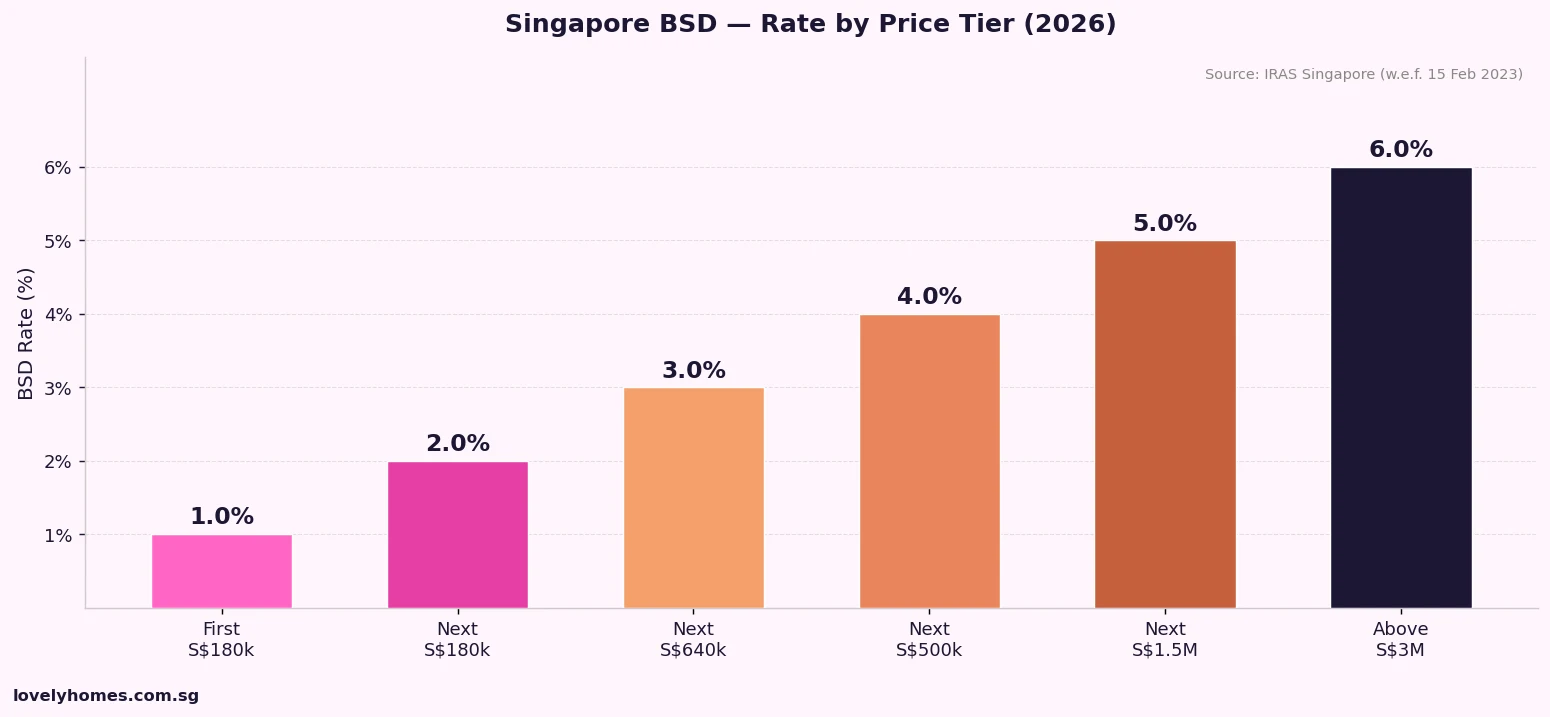
Singapore BSD rate by price tier 2026 bar chart — 1% to 6% progressive
Figure 1: BSD rate by purchase-price tier for residential property — effective 15 February 2023. Source: IRAS Singapore.
Purchase Price (or Market Value) Tier BSD Rate Maximum BSD from This Tier
First S$180,000 1% S$1,800
Next S$180,000 2% S$3,600
Next S$640,000 3% S$19,200
Next S$500,000 4% S$20,000
Next S$1,500,000 5% S$75,000
Amount exceeding S$3,000,000 6% Uncapped

Source: IRAS Singapore. Rates effective 15 February 2023.

The cumulative BSD cap for a S$3 million property — the last tier before the 6% rate kicks in — is S$109,600. For every dollar above S$3 million, the marginal BSD rate is 6%. A S$5 million property, for instance, attracts BSD of S$109,600 + 6% × S$2,000,000 = S$229,600.

BSD for Non-Residential Property (Industrial, Commercial, Mixed-Use)

Non-residential property — offices, shops, industrial units, mixed-use strata titles, and HDB shophouses — attracts a simpler three-tier BSD structure that has been in place since 20 February 2018.

Purchase Price Tier BSD Rate
First S$180,000 1%
Next S$180,000 2%
Amount exceeding S$360,000 3%

Non-residential BSD is therefore considerably less progressive than its residential counterpart. A S$2 million commercial unit attracts BSD of: 1% × S$180,000 + 2% × S$180,000 + 3% × S$1,640,000 = S$1,800 + S$3,600 + S$49,200 = S$54,600 — compared to S$64,600 for a residential property at the same price. Notably, non-residential property is exempt from ABSD, making it an important consideration for investors who have already consumed their ABSD-free residential quota.

How BSD Is Calculated — Step by Step

BSD is calculated on a progressive basis, applying each tier’s rate only to the portion of value that falls within that band. The taxable base is the higher of the agreed purchase price and the property’s open market value as assessed by IRAS. In practice, for arm’s-length transactions, these figures are usually the same. Where a buyer acquires at below market value — for example, from a related party — IRAS will assess BSD on the market value.
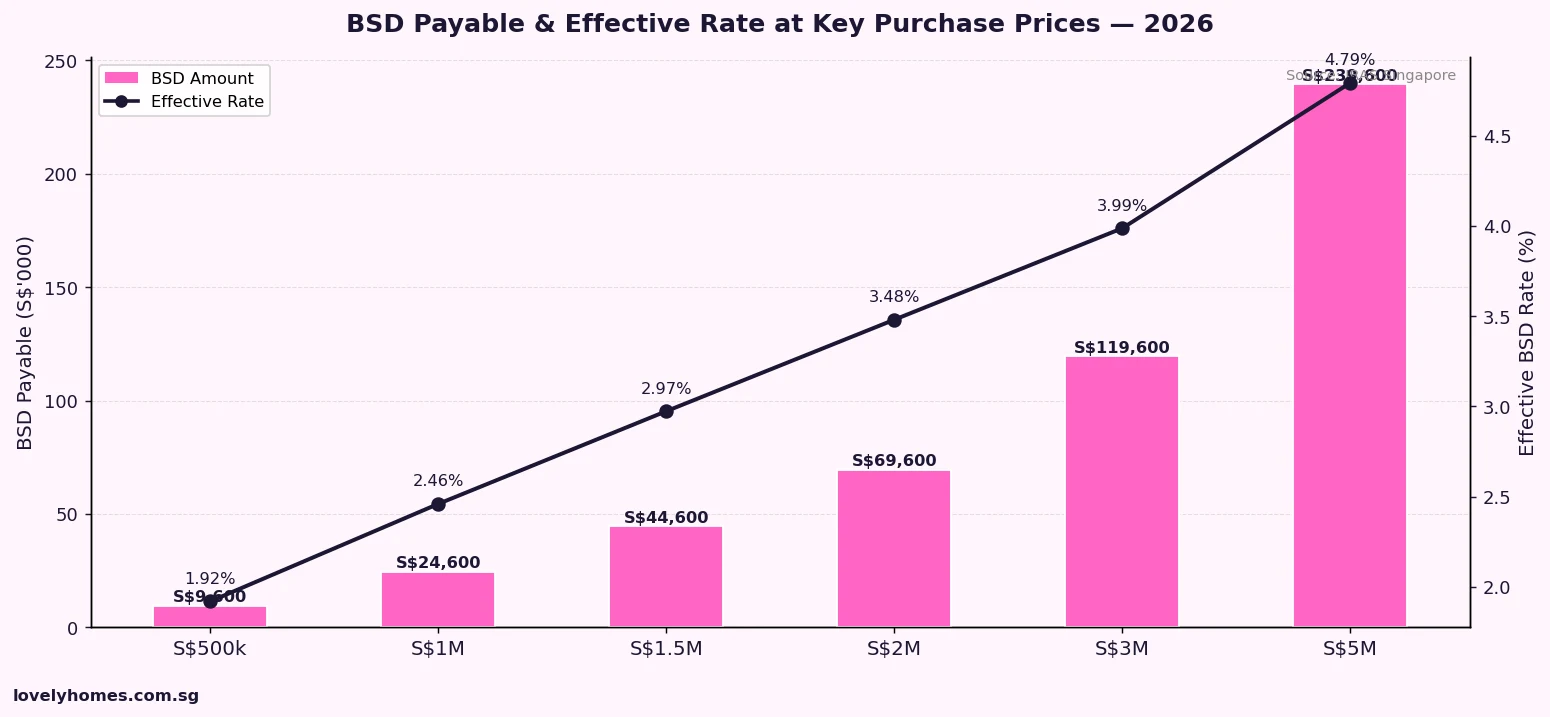
BSD payable and effective rate at key purchase prices Singapore 2026
Figure 2: BSD payable (bars, left axis) and effective BSD rate (line, right axis) at six key purchase prices — Singapore residential property 2026.

The chart above illustrates a key feature of BSD’s progressive structure: the effective rate (total BSD as a percentage of purchase price) rises gradually but never reaches the 6% marginal rate. Even at S$5 million, the effective rate is approximately 4.6%. This distinguishes BSD from ABSD, where — for a foreigner — the entire purchase price is taxed at a flat 60%.

Worked Example — S$1,580,000 Resale Condominium

Mr and Mrs Lim are Singapore Citizens purchasing a resale 3-bedroom condominium in Clementi for S$1,580,000 as their first property. Here is the full BSD calculation:

Price Tier Tier Limit Rate BSD for This Tier
First S$180,000 1% S$1,800
Second S$180,000 2% S$3,600
Third S$640,000 3% S$19,200
Fourth S$500,000 4% S$20,000
Fifth S$80,000 (remaining) 5% S$4,000
Total BSD S$1,580,000 Effective 3.04% S$48,600

Since this is the Lims’ first residential property and both are Singapore Citizens, their ABSD is S$0. Their total stamp duty outlay is therefore S$48,600. This must be paid within 14 days of exercising the OTP. BSD is typically paid via IRAS’s myTax Portal (e-Stamping). Their lawyer will ordinarily manage this on their behalf as part of the conveyancing process.

If this were instead the Lims’ second residential property, they would also owe ABSD at 20% × S$1,580,000 = S$316,000, bringing total stamp duty to S$364,600. The BSD component is identical regardless of how many properties they own.

BSD vs ABSD — Understanding the Key Difference

BSD and ABSD are two distinct taxes that can apply simultaneously to the same transaction. The confusion between them is understandable — both are calculated as a percentage of the purchase price and both are paid to IRAS — but they serve entirely different purposes and have very different rate structures.
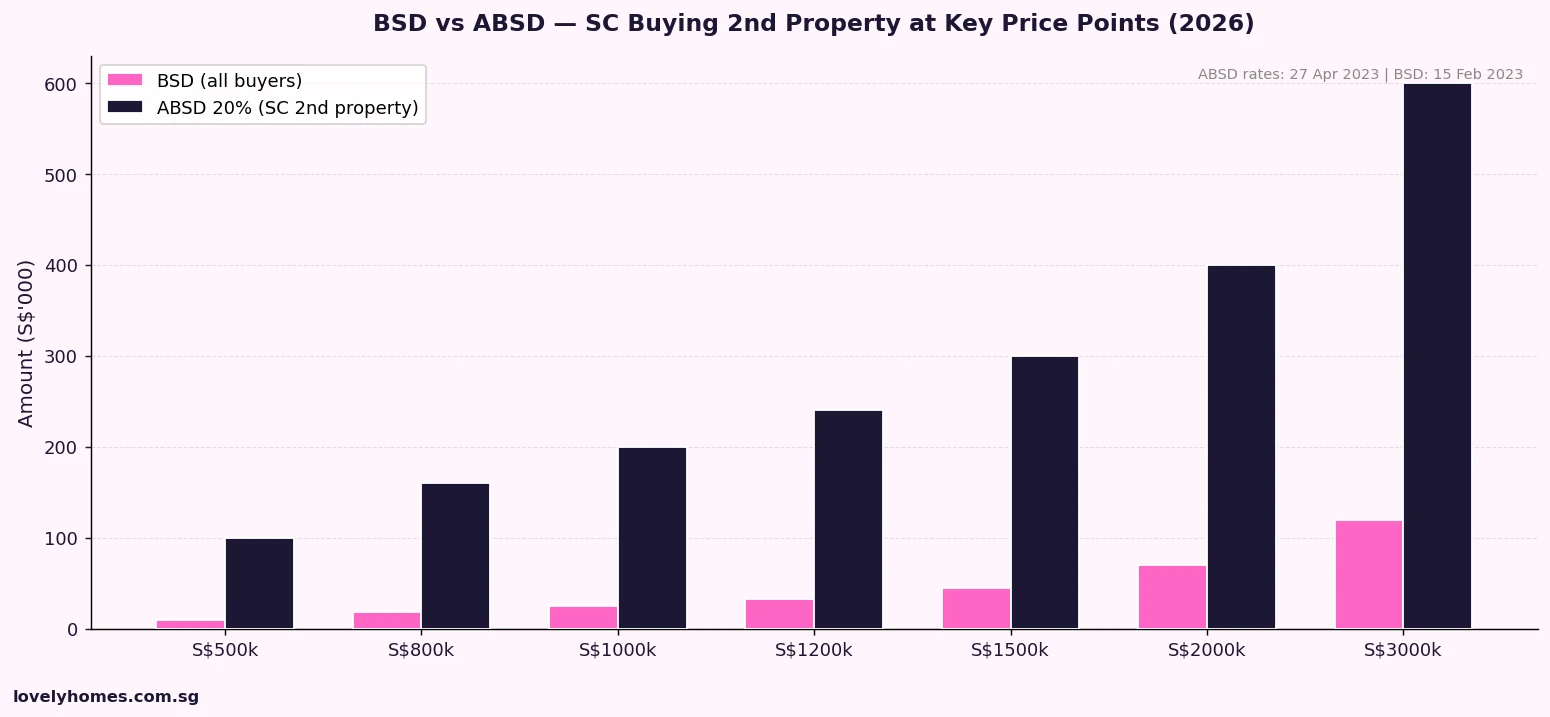
BSD versus ABSD comparison Singapore citizen buying second property 2026 bar chart
Figure 3: BSD (universal) vs ABSD at 20% (SC buying a second property) at key purchase prices — Singapore 2026.
Feature Buyer’s Stamp Duty (BSD) Additional Buyer’s Stamp Duty (ABSD)
Who pays? All buyers Selected profiles only (see ABSD guide)
Policy purpose Revenue instrument (general tax) Demand-management cooling measure
Rate structure Progressive (1–6%) Flat rate on full purchase price (0–65%)
Maximum rate 6% (marginal, above S$3M) 65% (entities & trusts)
Remissions available? Very limited (developer builds only) Yes — married SC/SPR upgrader, developers, etc.
Applies to HDB? Yes Yes (but HDB buyers are usually SC 1st-timers at 0%)
Non-residential? Yes (1%/2%/3% structure) No — ABSD does not apply to non-residential

The practical upshot: for most Singapore Citizens buying their first property, BSD is the only stamp duty they pay. For all other buyer profiles — PRs, foreigners, second-time and subsequent Singapore Citizen buyers, and entities — both BSD and ABSD apply simultaneously. To model your full stamp duty liability, use our ABSD Complete Guide, which includes full worked scenarios for every buyer profile.

Total Stamp Duty by Buyer Profile — S$1.5 Million Residential Property

Buyer Profile BSD ABSD Rate ABSD Amount Total Stamp Duty
SC — 1st property S$44,600 0% S$0 S$44,600
SC — 2nd property S$44,600 20% S$300,000 S$344,600
SC — 3rd+ property S$44,600 30% S$450,000 S$494,600
SPR — 1st property S$44,600 5% S$75,000 S$119,600
SPR — 2nd+ property S$44,600 30% S$450,000 S$494,600
Foreigner — any property S$44,600 60% S$900,000 S$944,600
Entity / Trust S$44,600 65% S$975,000 S$1,019,600

BSD = S$44,600 on S$1.5M (1%×S$180k + 2%×S$180k + 3%×S$640k + 4%×S$500k). ABSD rates: 27 April 2023 framework. SC = Singapore Citizen; SPR = Singapore Permanent Resident.

When and How to Pay BSD

BSD must be paid within 14 days of signing the instrument that triggers the liability. For private residential property, the trigger is typically the Option to Purchase (OTP) or, if no OTP is issued, the Sale and Purchase Agreement (S&P). For HDB flats, the trigger is the signing of the HDB Agreement for Lease.

Payment is made through IRAS’s e-Stamping Portal (accessible via myTax Portal). In practice, your conveyancing lawyer will handle the stamping on your behalf as part of the standard legal process. The stamp certificate is generated electronically and must be produced at completion. Late payment attracts penalties of up to 4× the duty payable under Section 46 of the Stamp Duties Act.

BSD Remissions and Exemptions

Unlike ABSD, BSD has very limited remission provisions. The most relevant situations where BSD may not apply in full are:

Developer remissions for building residential property: Property developers who purchase residential land or existing residential property for the purpose of constructing and selling new residential units may apply to IRAS for BSD remission. This is a specific commercial exception designed to avoid double taxation in the development chain — it does not apply to individual buyers.

Transfers between spouses and immediate family members: The Stamp Duties Act provides for concessionary treatment in limited intra-family transfers, but these are narrow and do not eliminate BSD — they may affect the valuation base or trigger date. Consult a property lawyer before relying on any such arrangement.

HDB Resale Levy and BSD interaction: BSD applies normally to HDB resale flat purchases. There is no interaction between the HDB Resale Levy and BSD — they are entirely separate obligations.

In short: for the vast majority of buyers, there are no BSD remissions. Budget for BSD in full.

What BSD Means for Buyers in 2026

BSD’s restructuring in February 2023 materially increased the cost of high-value acquisitions. A buyer of a S$3 million property now pays S$109,600 in BSD alone — up from S$74,600 under the pre-February 2023 structure, a S$35,000 increase. For S$5 million properties, the increase is S$65,000. These are meaningful sums that affect both the budgeting and the financing of such transactions.

In the broader context of property affordability, BSD at the sub-S$1.5 million residential price range — where most HDB upgraders and first-time private property buyers transact — is relatively modest: S$44,600 on S$1.5 million is 2.97% of the purchase price. The real pinch of Singapore’s stamp duty system comes from ABSD, not BSD. For buyers planning their first property purchase with CPF Housing Grants and a bank loan, BSD is a known, budgetable cost that fits within standard conveyancing estimates.

Singapore’s BSD structure compares favourably with many comparable jurisdictions. Hong Kong charges a flat-rate stamp duty of up to 15% for non-first-time buyers. Australia’s stamp duty is state-based and can reach 5–6% of property value at lower price points. Singapore’s progressive structure, where the 6% rate only applies to the marginal amount above S$3 million, is notably more buyer-friendly at the S$1–2 million range where most transactions occur.

What Might Come Next

BSD rates for residential property have been adjusted three times in the past decade (2018, 2021, and 2023). Each adjustment has moved in one direction: upward, particularly at the high end of the market. If the Government continues its stated objective of moderating luxury segment demand and narrowing the wealth-effects gap between high-end and mass-market property, further BSD increases above S$3 million cannot be ruled out.

Conversely, at the sub-S$1.5 million end — where most owner-occupier transactions occur — there is no political appetite to raise BSD, given the Government’s ongoing commitment to ensuring that public and private housing remains accessible to ordinary Singaporeans. Any future BSD changes are therefore likely to be targeted at the top of the market only. As always, changes to stamp duty rates take effect immediately on the date of announcement and apply to all OTPs granted on or after that date.

Frequently Asked Questions

Does BSD apply to HDB flat purchases?

Yes. BSD applies to all residential property purchases in Singapore, including HDB resale flats, BTO flats (on the Agreement for Lease), and Executive Condominium units. There is no HDB exemption from BSD. For a typical 4-room resale flat at S$550,000, BSD would be: 1%×S$180k + 2%×S$180k + 3%×S$190k = S$1,800 + S$3,600 + S$5,700 = S$11,100.

Is BSD the same as ABSD?

No. They are two separate taxes paid to IRAS on the same transaction. BSD is universal (all buyers, all properties) and progressive (1–6%). ABSD is a surcharge that applies only to selected buyer profiles — foreigners, entities, PRs buying a first property, and all buyers from their second property onward — and is charged as a flat rate on the entire purchase price. You always pay BSD; you only pay ABSD if your buyer profile attracts it. See our ABSD Singapore 2026 Guide for the full rate schedule.

Can BSD be paid using CPF?

Yes, BSD can be paid from your CPF Ordinary Account (OA) for HDB flat purchases. For private residential property, CPF OA funds can also be used to pay BSD, but only after meeting the CPF Minimum Sum requirements and subject to CPF withdrawal limits. In practice, many buyers use cash for stamp duties to preserve their CPF balance for the monthly mortgage servicing — consult your financial planner or mortgage adviser on the optimal approach.

What happens if BSD is paid late?

Under Section 46 of the Stamp Duties Act, late payment penalties are substantial. The penalty is a multiple of the duty payable, depending on the length of the delay: one to three times the duty for delays up to six months, and up to four times for longer delays. In extreme cases, IRAS has the power to seek a court order to enforce payment. In practice, your conveyancing lawyer will ensure that BSD is stamped within the 14-day window. Late stamping almost always results from buyers attempting to handle the stamping themselves without legal assistance.

Does BSD apply to the purchase of a share in a property?

Yes. Where a buyer acquires a fractional share in a property — for example, a 50% interest in a jointly owned private property — BSD is calculated on the proportionate market value of the property that corresponds to the share being acquired. The progressive BSD tiers apply to the full market value of the underlying property first, and the resulting duty is then apportioned to the share acquired. This means the effective BSD rate on a 50% share of a S$2 million property is calculated as if the full S$2 million were the taxable base, then halved — not calculated on S$1 million at a lower tier. IRAS guidance on this is set out in their e-Stamping FAQ.

Is BSD refundable if the sale falls through?

BSD that has been paid on a stamped instrument is generally not refundable if the sale subsequently fails to complete. However, if the instrument itself is rescinded before it takes legal effect — for example, if the OTP lapses without exercise — and the buyer can demonstrate to IRAS that no property changed hands, a refund application under Section 22 of the Stamp Duties Act may be possible. The application must be made within six months of the date of the instrument. IRAS assesses each case on its facts. Always take legal advice before assuming a refund is available.

Do foreign buyers in Singapore pay more BSD than locals?

No. BSD rates are identical for all buyers regardless of nationality or residency status. A Singapore Citizen and a foreign national buying the same S$2 million property both pay exactly the same BSD — S$64,600. The difference in overall stamp duty cost arises entirely from ABSD, which for a foreigner is 60% of the purchase price (S$1,200,000 on a S$2M purchase) versus 0% for a Singapore Citizen buying their first home. This is why total stamp duty for a foreigner buying a S$2 million property (S$1,264,600) is dramatically higher than for a first-time SC buyer (S$64,600).

Related Articles

Disclaimer: This article is for general informational purposes only and does not constitute tax, legal, or financial advice. BSD rates and payment rules are governed by the Stamp Duties Act and IRAS administrative guidelines, which may be amended at any time. Always refer to the IRAS official website for the most current rates and verify your stamp duty liability with a licensed conveyancing lawyer or property tax adviser before transacting. LovelyHomes is not a licensed tax or legal advisory firm.
Foreigners Buying Property in Singapore 2026: ABSD, Eligibility and the Full Cost Guide

Foreigners Buying Property in Singapore 2026: ABSD, Eligibility and the Full Cost Guide

Quick Answer

  • Foreigners (non-PR, non-SC) may purchase private residential property — condominiums, apartments, strata-titled units — in Singapore without restriction, subject to a 60% Additional Buyer’s Stamp Duty (ABSD) payable to IRAS.
  • Foreigners cannot buy HDB flats (resale or BTO) and cannot buy landed residential property (houses, semi-detached, bungalows) without prior approval from the Singapore Land Authority (SLA), which is rarely granted.
  • Executive Condominiums (ECs) become available to foreigners only after privatisation. For ECs from GLS sites tendered from 8 May 2026 onwards, privatisation occurs at 15 years from TOP; earlier ECs remain at 10 years.
  • The 60% ABSD applies to the entire purchase price and must be paid within 14 days of exercising the Option to Purchase (OTP).
  • Buyer’s Stamp Duty (BSD) is payable by all buyers regardless of nationality. On a S$2.5M purchase, BSD is approximately S$94,600.
  • Foreigners can obtain a mortgage from Singapore-licensed banks. LTV limit is 75% for a first property loan with no existing housing loans, subject to Total Debt Servicing Ratio (TDSR) of 55%.
  • Commercial and industrial property carries no ABSD — foreigners may purchase shophouses, office units, factories, and warehouses without the 60% surcharge.
  • Nationals of the USA, Iceland, Liechtenstein, Norway, and Switzerland are exempt from ABSD on their first residential purchase under Free Trade Agreement commitments.

What Is the ABSD and Who Administers It?

The Additional Buyer’s Stamp Duty (ABSD) is a surcharge levied by the Inland Revenue Authority of Singapore (IRAS) on the purchase or acquisition of residential property in Singapore, on top of the standard Buyer’s Stamp Duty (BSD). Introduced in December 2011 as a demand-side cooling measure, the ABSD has been adjusted multiple times. The most significant recent change for foreigners was on 27 April 2023, when the rate was doubled from 30% to 60%.

The policy objective is explicit: ABSD prioritises home ownership for Singaporeans and ensures that property remains affordable for residents. Non-resident buyers must bear a substantial additional cost — and this is intentional. Singapore’s Ministry of National Development has consistently maintained that residential property is primarily for citizens, and the 60% rate is designed to reflect that priority firmly.

Singapore property eligibility by buyer type 2026 — foreigners PRs and citizens comparison table
Figure 1: Property Eligibility by Buyer Type — Singapore 2026 | Source: HDB, URA, SLA, IRAS

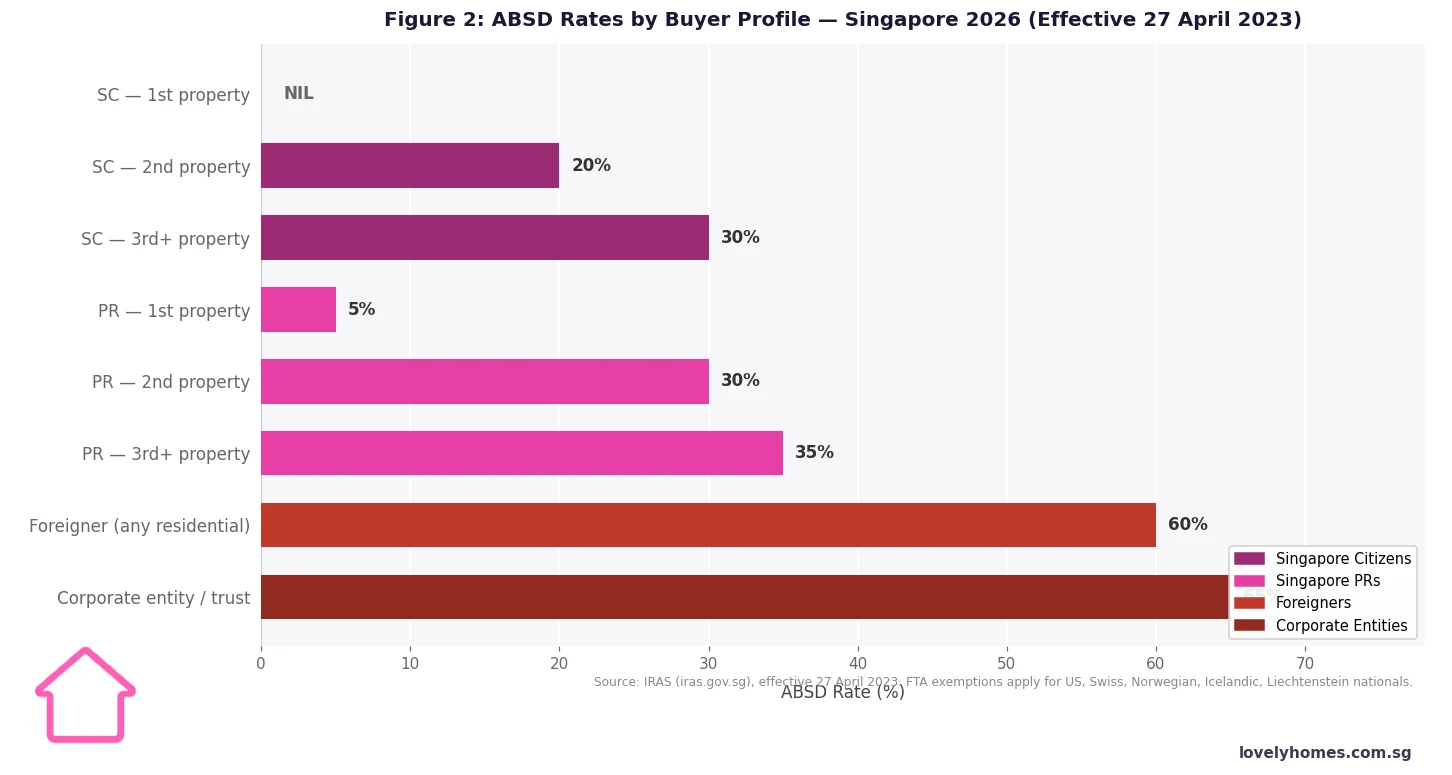
ABSD Rates by Buyer Profile (Effective 27 April 2023)

ABSD is charged on the higher of the purchase price or the property’s market value. The table below shows the current rates, administered by IRAS, for residential property in Singapore:

Buyer Profile 1st Property 2nd Property 3rd+ Property
Singapore Citizen 0% 20% 30%
Singapore Permanent Resident (PR) 5% 30% 35%
Foreigner (non-PR, non-SC) 60% — flat rate, regardless of how many properties held in Singapore
Corporate entity / trust 65% — flat rate on residential property

Source: IRAS, effective 27 April 2023. FTA exemptions apply for nationals of the USA, Switzerland, Iceland, Liechtenstein, and Norway.

ABSD rates by buyer profile Singapore 2026 — foreigners pay 60% on all residential property
Figure 2: ABSD Rates by Buyer Profile — Singapore 2026 | Source: IRAS, effective 27 April 2023

Free Trade Agreement (FTA) Exemptions

Under Singapore’s FTA commitments, nationals of the USA, Iceland, Liechtenstein, Norway, and Switzerland are treated on par with Singapore Citizens for ABSD on their first residential property purchase. This means a US national buying their first Singapore condo pays 0% ABSD. On second and subsequent purchases, the SC schedule applies. The exemption is for individuals only; US-incorporated companies do not benefit. IRAS requires passport proof of nationality when claiming the FTA exemption.

What Foreigners Can Buy — and Cannot Buy

Permitted (60% ABSD where residential): Private condominiums, private apartments, strata-titled units, SOHO units with residential classification. ECs after privatisation (15 years from TOP for new GLS-launched ECs from 8 May 2026; 10 years for earlier ECs). Sentosa Cove landed property. Commercial shophouses, strata office units, retail units, industrial factories, warehouses — all without residential ABSD.

Not permitted without special approval: Landed residential property outside Sentosa Cove (houses, semi-detached, bungalows, terraced houses). The SLA may grant approval under the Residential Property Act in exceptional circumstances, but approvals are rare.

Strictly prohibited: HDB flats (both new BTO and resale). HDB housing is reserved for Singapore citizens and permanent residents under the Housing and Development Act. ECs during their MOP and privatisation period are also off-limits to foreigners.

Buyer’s Stamp Duty (BSD) — Payable by Everyone

BSD is levied by IRAS on every property purchase in Singapore, regardless of nationality. For residential property, the tiered rates are: 1% on the first S$180,000; 2% on the next S$180,000; 3% on the next S$640,000; 4% on the next S$500,000; 5% on the next S$1,500,000; and 6% on amounts above S$3,000,000. On a S$2.5M purchase, total BSD = S$94,600.

Purchase Price Tier BSD Rate BSD on This Tier
First S$180,000 1% S$1,800
Next S$180,000 (up to S$360,000) 2% S$3,600
Next S$640,000 (up to S$1,000,000) 3% S$19,200
Next S$500,000 (up to S$1,500,000) 4% S$20,000
Next S$1,500,000 (up to S$3,000,000) 5% Up to S$75,000
Remainder above S$3,000,000 6% Variable

Sellers’ Stamp Duty (SSD) — The Anti-Flip Tax

SSD is administered by IRAS and applies to all sellers who dispose of residential property within three years of purchase, regardless of nationality. The rates are: 12% within 1 year; 8% within 2 years; 4% within 3 years; nil thereafter. For a foreigner who has paid 60% ABSD, an SSD liability on a short-term resale would be a severe additional burden. Foreign buyers must plan for a meaningful long-term holding horizon.

Holding Period SSD Rate
Up to 1 year 12%
1 to 2 years 8%
2 to 3 years 4%
More than 3 years Nil

Financing — LTV, TDSR, and Mortgage Options

Foreigners may borrow from Singapore-licensed banks subject to MAS macro-prudential rules identical to those applied to residents. The LTV limit is 75% for a first property loan with no existing housing loans (reducing to 55% for a second and 35% for a third). The TDSR cap is 55% of gross monthly income. Loan tenors run up to 35 years, typically reduced by age exceeding 65. Most major Singapore banks lend to foreigners — DBS, OCBC, UOB, Standard Chartered, and HSBC all do so, subject to enhanced documentation requirements including overseas income proof and a valid work pass or Long-Term Visit Pass.

The Buying Process — Step by Step

  1. Arrange in-principle approval: Approach at least two Singapore banks before making offers. Allow 5–10 working days.
  2. Engage a CEA-licensed agent: For new launches, no buyer commission is payable; for resale, co-broking arrangements vary.
  3. Option to Purchase (OTP): On resale, the seller grants an OTP valid for 21 days; a 1% option fee is paid. For new launches, a 5% booking fee is paid directly to the developer.
  4. Pay BSD and ABSD: Both due within 14 days of OTP exercise. On a S$2.5M purchase, this means wiring S$94,600 (BSD) + S$1,500,000 (ABSD) to IRAS — a total of S$1,594,600 within a fortnight of signing.
  5. Engage a conveyancing solicitor: A Singapore-qualified solicitor handles title searches, mortgage documentation, and lodgement with SLA’s eConveyancing portal.
  6. Completion: For resale, typically 8–12 weeks. For new launches, completion occurs at TOP/CSC, which may be 3–5 years away.

Worked Example: Mr David Harrington Buys a S$2.5M CCR Condo

Mr David Harrington, 42, is a British national on an Employment Pass earning S$25,000/month gross. He purchases a two-bedroom unit in District 9 at S$2,500,000, with no existing property loans in Singapore.

Total upfront cash required for foreigner buying SGD 2.5M condo Singapore 2026 cost breakdown
Figure 3: Total Upfront Cash Required — Foreigner Buying SGD 2.5M CCR Condo (2026)
Cost Item Amount (SGD) Notes
25% downpayment (cash) 625,000 75% LTV → loan of S$1,875,000
Buyer’s Stamp Duty (BSD) 94,600 IRAS; payable within 14 days of OTP
ABSD (60% x S$2,500,000) 1,500,000 IRAS; payable within 14 days of OTP
Stamp duty on mortgage (0.4% x loan) 7,500 On S$1,875,000 loan amount
Legal / conveyancing fees (est.) 3,500 Singapore-licensed solicitor
Valuation fee (est.) 600 Required by lender
Total upfront cash required 2,231,200 Excluding ongoing mortgage payments

Monthly mortgage at 3.30% p.a. over 20 years on S$1,875,000 ≈ S$10,633/month. TDSR check: S$10,633 ÷ 55% = S$19,333 minimum monthly gross income required. Mr Harrington’s S$25,000/month comfortably qualifies. However, stamp duties alone represent 63.8% of the purchase price — the property must appreciate significantly for the investment to make financial sense on a net basis.

What This Means for Foreign Buyers

Despite the 60% ABSD headline rate, Singapore continues to attract foreign buyers for structurally sound reasons. Singapore offers secure freehold and 99-year leasehold titles with one of the most transparent property title systems in Asia. There is no capital gains tax, no inheritance tax, and no wealth tax. The SGD has historically been stable and appreciating against most major currencies, and Singapore’s rule of law is consistently ranked among the best globally.

For high-net-worth buyers from jurisdictions with currency risk, political instability, or restricted capital mobility — particularly from certain parts of Southeast Asia, China, and the Middle East — paying 60% ABSD is the premium for a stable, internationally recognised store of value. For US nationals, who pay 0% ABSD on their first purchase thanks to the FTA, Singapore offers one of the most favourable entry points into any developed-market property system globally.

What Might Come Next

The 60% ABSD rate for foreigners is unlikely to be reduced in the near term. Singapore’s government has consistently adjusted rates upward when demand has been firm, and the April 2023 doubling was a clear statement of direction. The EC policy changes of 8 May 2026 — extending MOP to 10 years and privatisation to 15 years, abolishing the Deferred Payment Scheme — further indicate a tightening trajectory. Foreign buyers should plan their acquisitions assuming the 60% rate will persist for the foreseeable future and structure their financial planning accordingly.

Related Articles

Frequently Asked Questions

Can a foreigner on an Employment Pass buy a condo in Singapore?

Yes. Holding an Employment Pass does not confer Singapore PR status, so the buyer is classified as a foreigner for ABSD purposes — meaning 60% ABSD applies. There is no minimum residency duration requirement to purchase private residential property. The buyer must satisfy the bank’s TDSR requirements using their Singapore employment income (fully counted) and any overseas income (subject to a bank haircut, typically around 30% on variable income).

Are there properties foreigners can buy without the 60% ABSD?

Yes. Commercial and industrial properties do not attract the residential ABSD. Strata office units, retail units, commercial shophouses, industrial factories, and warehouses can all be purchased by foreigners without the 60% surcharge. Many foreign investors therefore channel their Singapore property exposure through commercial assets or Singapore REITs listed on SGX, which provide property-linked returns without the ABSD burden.

Can a foreigner married to a Singapore Citizen pay lower ABSD?

Not directly on a joint purchase. If the property is purchased in the Singapore Citizen spouse’s name alone (sole ownership) and it is the SC’s first property, no ABSD is payable. However, if both names appear on the title, the foreigner’s inclusion triggers 60% ABSD. Many cross-nationality couples place the first property in the SC’s sole name. On subsequent purchases in joint names, ABSD at the SC second-property rate of 20% applies. Seek independent legal and tax advice before structuring ownership this way, as there are CPF, mortgage liability, and estate planning implications.

When exactly must the ABSD be paid?

ABSD must be paid within 14 days of the date on which the liability arises — typically the date of exercising the OTP or the date of the Sale and Purchase Agreement, whichever is earlier. Late payment attracts a 5% per annum penalty interest plus potential IRAS prosecution under the Stamp Duties Act. There is no grace period. The full ABSD amount must be available on or before the deadline, not merely committed in a loan facility.

Is ABSD refundable if the purchase falls through after the OTP is exercised?

Generally, no. Once the ABSD liability arises, it is payable regardless of whether the transaction completes. IRAS may consider a remission application in exceptional circumstances if a transaction is aborted, but this is not guaranteed. The ABSD Married Couple Remission — which allows one SC/PR spouse to sell their existing property within six months of a joint purchase and claim a refund — does not apply to foreigners. Always consult a licensed conveyancing solicitor before exercising any OTP if there is uncertainty about financing, as the ABSD liability is triggered on signing.

Can a foreigner buy a shophouse and occupy the upper residential floor?

This depends on the shophouse’s URA zoning and approved use. If the upper floors are classified as residential under the Residential Property Act, a foreigner cannot purchase without SLA approval (rarely granted). Some shophouses are zoned entirely commercial or approved for mixed use with the upper floors treated as non-residential. The correct approach is to check the URA Master Plan zoning and the specific approved use with a conveyancing solicitor before making any offer, as the legal classification is significant and not always obvious from the building’s physical appearance.

Does a foreigner pay ABSD on a privatised Executive Condominium?

Yes. Once an EC is privatised, it is treated as private residential property and all standard ABSD rules apply — including the 60% rate for foreigners. For ECs launched under GLS tenders from 8 May 2026, privatisation occurs at 15 years from TOP; earlier ECs privatise at 10 years from TOP. Buyers purchasing privatised ECs in the secondary market should verify the specific EC’s TOP date and calculate the privatisation milestone accordingly before making an offer.

Disclaimer: This article is for general information only and does not constitute legal, tax, or financial advice. Stamp duty rates, eligibility rules, and financing guidelines are subject to change by IRAS, MAS, HDB, SLA, and URA. Always verify current rates at iras.gov.sg and consult a licensed Singapore conveyancing solicitor, a CEA-registered real estate professional, and a licensed mortgage adviser before committing to any property transaction. All figures are illustrative based on publicly available data as at 16 May 2026.

Seller’s Stamp Duty (SSD) Singapore 2026: When You Pay, How Much, and How to Avoid It Legally

Seller’s Stamp Duty (SSD) Singapore 2026: When You Pay, How Much, and How to Avoid It Legally

Seller’s Stamp Duty (SSD) is the Singapore Government’s anti-flipping tax. If you sell a residential property within three years of buying it, you pay a percentage of the sale price — up to 12% — on top of every other selling cost. Get the holding period wrong by even a single day, and a profitable sale can flip into a six-figure loss.

This guide walks you through SSD in 2026: who pays it, how the rate ladder works, when the holding clock starts and stops, who is exempt, and the strategies sellers actually use to manage it. All rates reflect the framework in force since 11 March 2017, which remains current. For the authoritative figures, always check the IRAS Seller’s Stamp Duty page.

Quick Answer — SSD at a glance

  • SSD applies only to residential property sold within 3 years of acquisition.
  • Rate ladder: 12% (year 1) · 8% (year 2) · 4% (year 3) · 0% thereafter.
  • The clock starts on the date you signed the OTP or accepted the S&P — not the day you collected the keys.
  • Payable within 14 days of contract for sale, on the higher of price or market value.
  • Most short-term sales are caught: divorce sales, job relocations, second properties — SSD applies to nearly all of them.
  • Industrial property has a separate (shorter) ladder; commercial property is exempt.

What Is SSD and Why Does It Exist?

SSD is a transaction tax levied on the seller of a residential property in Singapore when the property is sold within a defined holding period. It is administered by the Inland Revenue Authority of Singapore (IRAS), calculated on the higher of the sale price or the market value, and payable within 14 days of the contract for sale.

The tax was first introduced in February 2010 and progressively widened in 2011 and 2013 as part of the Government’s suite of property cooling measures. The most recent recalibration was in March 2017, which shortened the SSD holding period from four years to three and lowered the headline rate from 16% to the present 12% — a deliberate easing aimed at supporting genuine homeowners rather than speculators. The 2017 framework is still the live rule book in 2026.

The policy goal is simple: discourage speculative flipping while leaving genuine end-users untouched. By the time you have held a private condo or HDB flat for three full years, the cooling-measure case for taxing your sale is gone, and SSD falls to zero.

Seller's Stamp Duty Singapore 2026 — guide cover
Seller’s Stamp Duty Singapore 2026 — the cost of selling too soon.

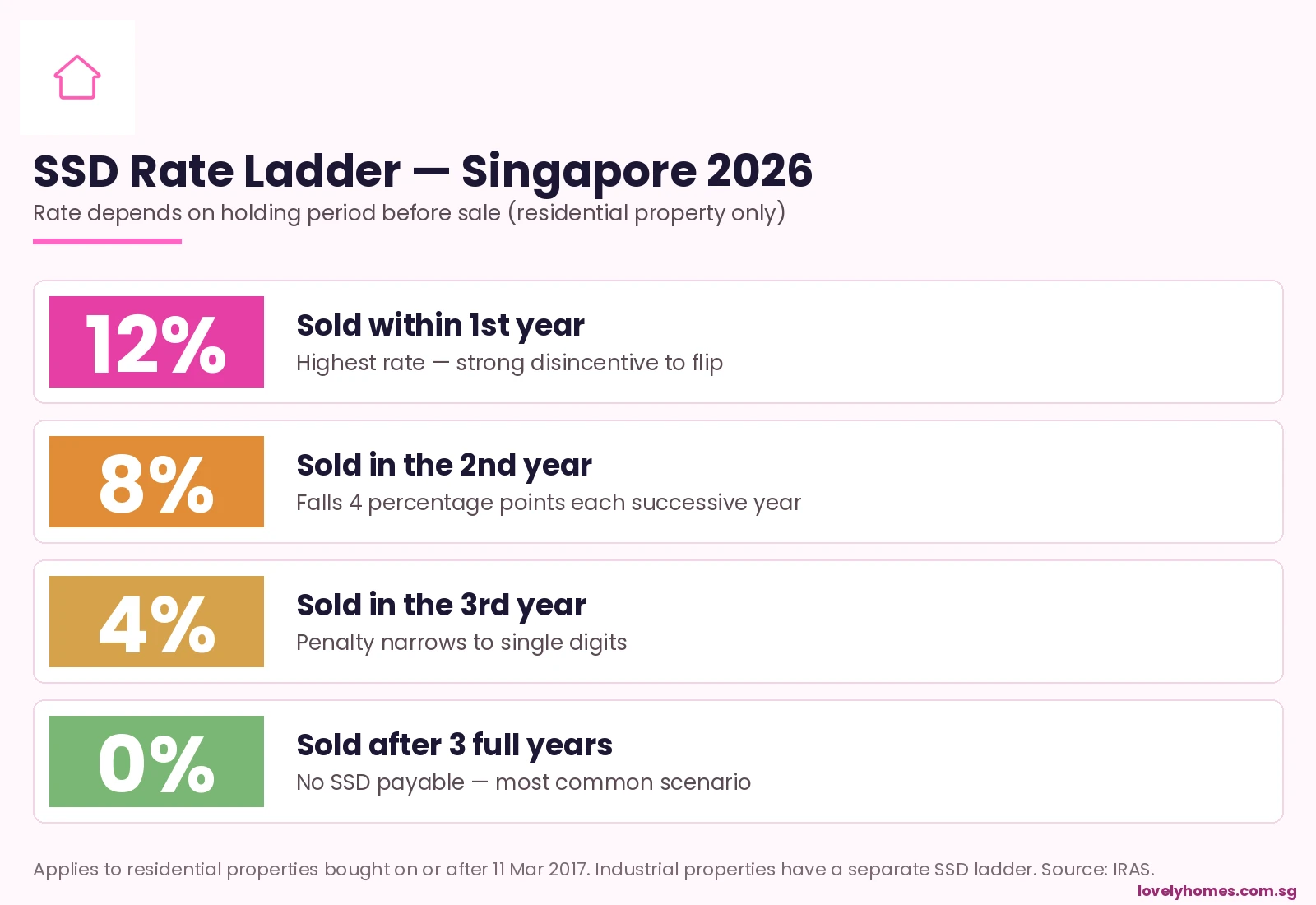
The 2026 SSD Rate Ladder

The rate you pay depends entirely on how long you held the property before signing the contract for sale. The ladder is steep at the top and falls four percentage points each subsequent year:

SSD rate ladder Singapore 2026 — 12% within first year, 8% second year, 4% third year, 0% after
Figure 1: SSD rate ladder by holding period — residential property, 2026.
Holding period at sale SSD rate Apparent on a S$1.5M sale
Up to 1 year (within 1st year) 12% S$180,000
More than 1 to 2 years 8% S$120,000
More than 2 to 3 years 4% S$60,000
More than 3 years 0% Nil

The rate is applied to the higher of the contracted sale price or IRAS’s assessed market value — sellers cannot lower their SSD bill by deliberately under-pricing a transaction.

When Does the Holding Clock Start — and Stop?

This is where most disputes arise, because the holding period is calculated to the day. The general rule is:

  • Start: the date the buyer signs the Option to Purchase (OTP) or, if there is no OTP, the date of the Sale & Purchase Agreement (S&P).
  • End: the date the buyer signs the next OTP or S&P when reselling.

Note carefully — the keys handover (TOP for new condos, vacant possession for resale) is irrelevant to SSD. A buyer who signs an OTP on 1 March 2024 and signs the next OTP on 28 February 2027 has held for one day under three years — SSD at 4% applies. Sign on 2 March 2027 and SSD drops to zero. Conveyancers routinely time exercise dates around this calendar boundary.

For new launches under construction, the start date is the OTP exercise date, not the TOP date. This means a buyer who signed an OTP in early 2023 for a project that only TOP’d in 2026 is already past the SSD window when they collect the keys.

Who Is Exempt or Remitted?

The exemptions list is narrow. SSD remission is granted only in specific situations, including:

  • HDB flats — not subject to SSD because HDB has its own Minimum Occupation Period (MOP) regime, which generally bars resale within five years.
  • Compulsory acquisition by the State (for example, road or MRT line widening).
  • Bankruptcy of the owner, with proof of insolvency proceedings.
  • Owners required by HDB to sell on grounds of policy violation.
  • Inherited property — the holding period is reckoned from the original purchase by the deceased, not the date of inheritance.
  • Property transferred between spouses as part of a court-ordered division on divorce, in some cases.

Standard life events — relocation overseas for work, family expansion, or financial difficulty — are not grounds for SSD remission. The tax applies even if the seller is selling at a loss.

Worked Example — A S$1.5M Condo Flipped in 6 Months

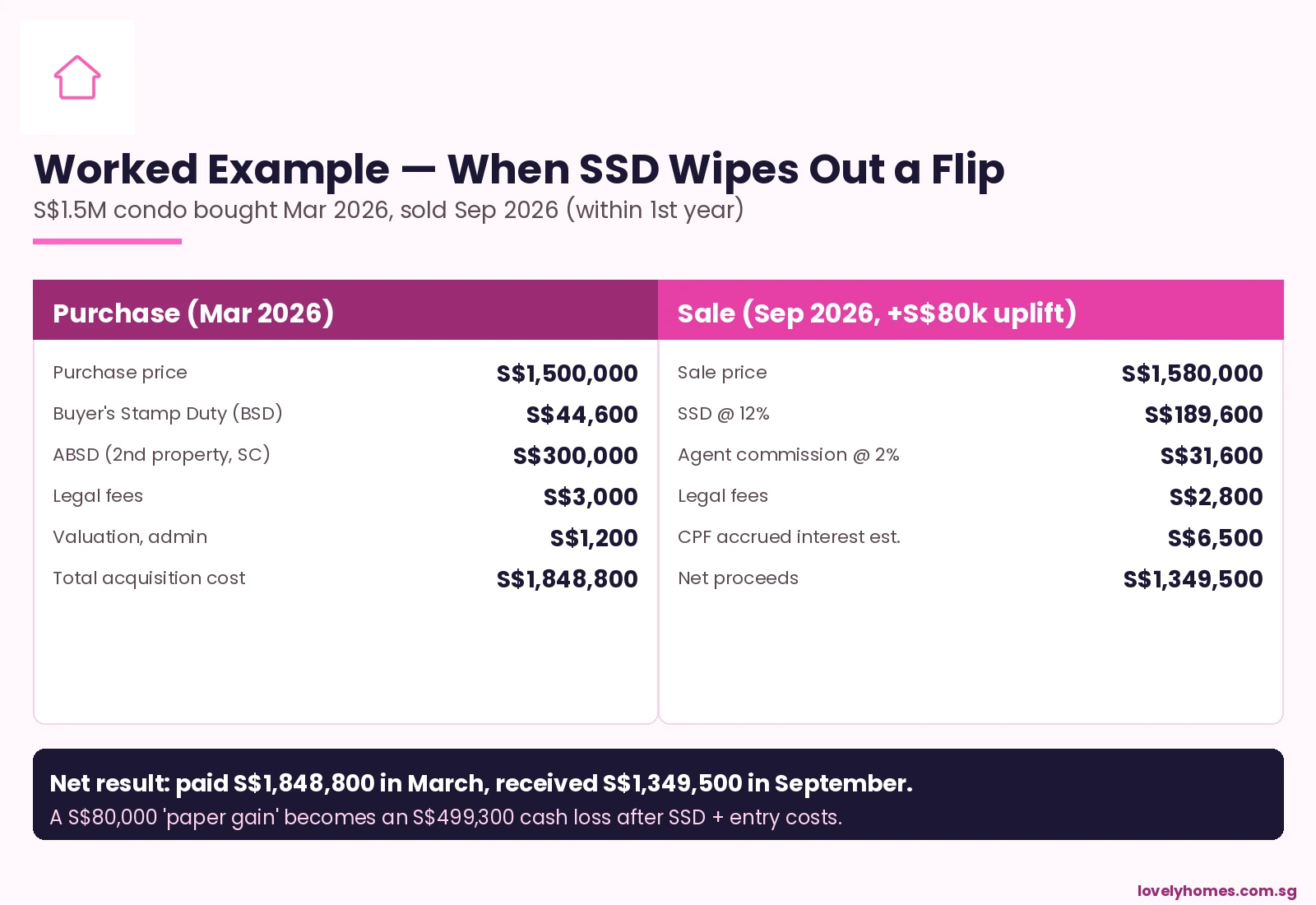
Imagine a Singapore Citizen who buys a S$1.5M private condo as a second property in March 2026, then receives a job offer in Hong Kong six months later and decides to sell at S$1.58M (a S$80,000 paper gain). Here is what the maths actually looks like:

SSD worked example: S$1.5M condo bought Mar 2026 sold Sep 2026 — S$499k cash loss after SSD
Figure 2: Worked example — an apparent S$80k gain becomes an S$499k cash loss when SSD is applied.

Acquisition costs (BSD, ABSD on the second property at 20%, legal fees) total S$348,800. The owner has paid S$1,848,800 to take possession. Six months later, the sale at S$1,580,000 attracts SSD at 12% (S$189,600), broker commission, legal fees, and CPF accrued interest. Net proceeds: S$1,349,500. Cash loss: S$499,300.

The lesson is brutal: SSD is designed to make short-term residential property sales economically unattractive even when the underlying market has moved up. For most second-property buyers, the only way to make the maths work is to stay invested for at least three years.

Strategies Sellers Actually Use

If you find yourself needing to sell within the SSD window, there are a small number of strategies practitioners commonly consider:

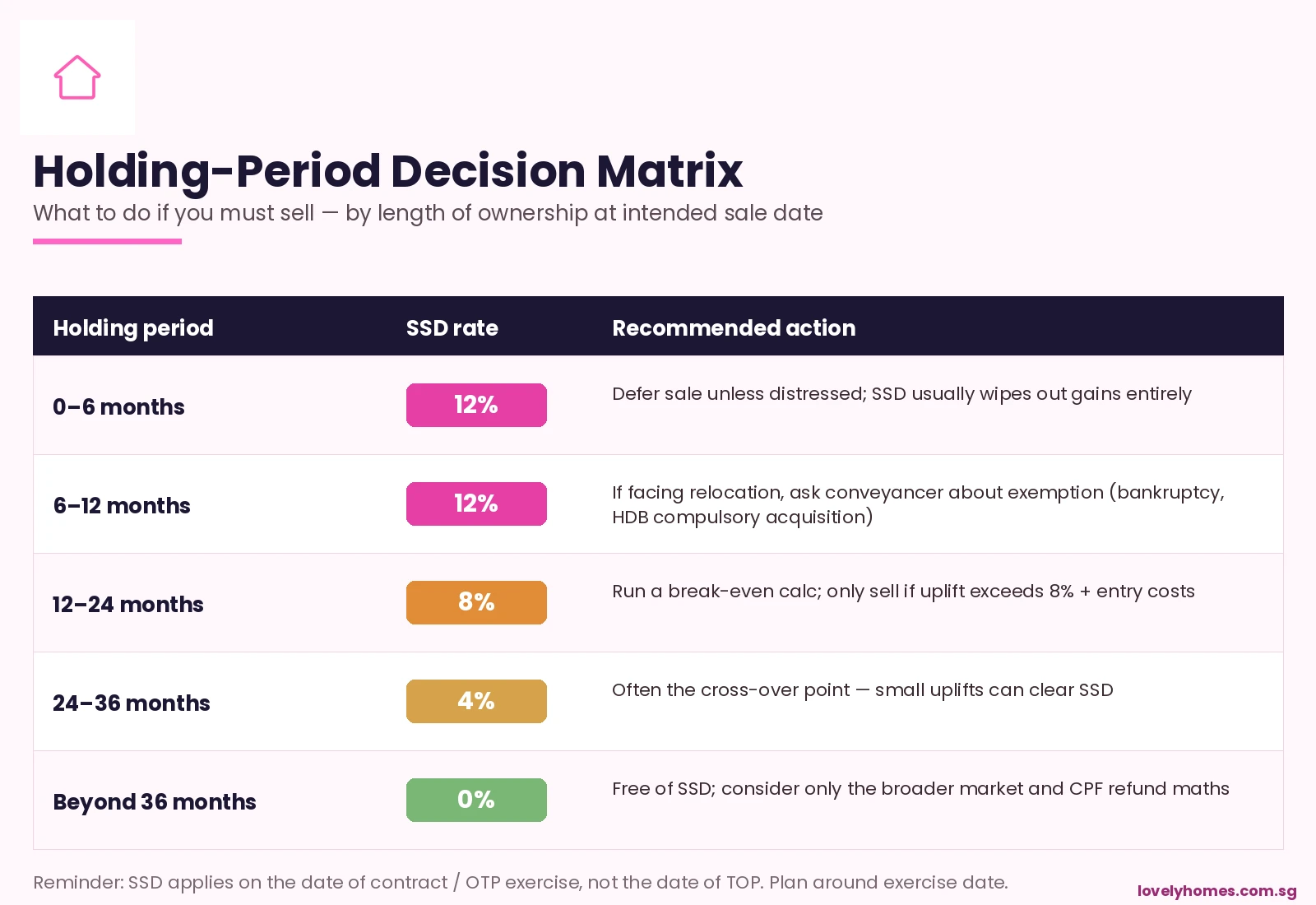
1. Run the holding-period calendar to the day

Conveyancers often time the OTP issue and exercise so that the sale falls just outside the next rate band. Selling on day 365 versus day 367 of the second year can mean a four-percentage-point swing on the sale price.

SSD holding-period decision matrix — what to do if you must sell, by length of ownership
Figure 3: Decision matrix — what to do if you must sell, by length of ownership.

2. Rent out instead of selling

If holding-period maths do not work, leasing the unit until SSD falls to zero can preserve value. Singapore rental yields on private condos run 3.0–3.8% gross in 2026, which often covers the carrying cost of the mortgage during the wait.

3. Decoupling within marriage

Where one spouse needs to free up ABSD allowance for a future purchase, transferring a property between spouses (a Part-Disposal arrangement) may attract SSD on the transferred share. Practitioners check carefully whether the holding clock survives the transfer.

4. Swap residential for commercial

Commercial property (offices, shops) is not subject to SSD. Investors with a short horizon sometimes pivot from residential plays to commercial plays specifically to avoid the SSD window. Commercial does carry GST, however, so the trade-off is real.

SSD on HDB — Yes, Technically — But MOP Comes First

Strictly, SSD does not apply to HDB flats sold during the SSD window because the HDB Minimum Occupation Period (MOP) usually prevents resale within five years anyway. The rare exceptions — flats sold under HDB’s compulsory-sale rules, or flats where MOP has been waived by HDB — are also exempt from SSD.

For practical purposes, most HDB sellers should treat MOP as the binding constraint and ignore SSD entirely.

SSD on Industrial Property — A Different (Shorter) Ladder

SSD on industrial property uses a separate, shorter ladder introduced in January 2013: 15% within the first year, 10% in the second year, 5% in the third year, and 0% thereafter — harsher in headline terms but with the same three-year horizon. Commercial property (offices, shops, hotels) attracts no SSD at all.

What This Means for You as a Buyer in 2026

The 2026 environment makes the holding-period calculus even more important. With ABSD at 20% on the second property for Singapore Citizens and 60% for foreigners, entry costs are already punishing. Adding a 12% SSD on a quick exit means roughly one-third of an investment property’s purchase price is consumed by transaction taxes if the holding period is mismanaged.

For buyer-occupiers, the practical advice is unchanged: buy what you can hold through three full years and a typical Singapore property cycle (roughly 7 to 10 years). For investors, the calculus is whether the projected three-to-five-year capital appreciation comfortably exceeds the entry-cost stack — not just SSD but BSD, ABSD, conveyancing, agent commission, and CPF accrued interest combined.

Frequently Asked Questions

Does SSD apply if I bought before 11 March 2017?

Yes, but at the older rate ladder applicable on the date of acquisition. Properties bought between 14 January 2011 and 10 March 2017 use the four-year, 16% / 12% / 8% / 4% ladder. Properties bought between 20 February 2010 and 13 January 2011 use a three-year, 3% / 2% / 1% ladder. IRAS publishes the historical rate tables for cross-reference.

Is SSD payable on the sale of a property at a loss?

Yes. SSD is calculated on the higher of the contracted sale price or the assessed market value, regardless of whether the seller realised a profit or loss on the transaction. Loss-making short-term sales remain fully taxable.

How is SSD different from ABSD?

ABSD (Additional Buyer’s Stamp Duty) is paid by the buyer at purchase based on residency status and number of properties already owned. SSD (Seller’s Stamp Duty) is paid by the seller at sale based on how long the property was held. They are independent taxes and can both apply to the same transaction at different ends.

What if I co-own a property with my spouse and only my spouse’s share is sold (decoupling)?

SSD applies to the share being transferred, calculated on the value of that share. The holding period for the transferred share is reckoned from the original date of acquisition. Conveyancers will typically structure the transfer documentation so that SSD exposure is calculated correctly for the share at issue.

Can I deduct SSD against my income tax?

No. SSD is a transaction tax, not a deductible business expense for an individual seller. Property held by a corporate vehicle may treat SSD differently — consult a Singapore tax adviser for any company-held holding.

Does SSD apply to gifts or transfers within the family?

Generally yes, where the transfer is treated as a sale at market value. There are limited remissions for transfers between spouses incident to divorce or for inherited property where the holding period is reckoned from the deceased’s original acquisition. Always verify with IRAS directly for non-arm’s-length transfers.

When exactly is SSD due?

SSD must be paid within 14 days of the contract for sale — that is, the date the buyer exercises the OTP or signs the S&P. Late payment attracts penalty interest of 5% on the unpaid duty per annum, plus possible additional charges. The seller’s conveyancer typically pays SSD out of the sale proceeds at completion.

Related Articles

Disclaimer

This article is intended as general information about Seller’s Stamp Duty in Singapore as at May 2026 and does not constitute tax, legal, or financial advice. Rates, exemptions, and procedures are set by the Inland Revenue Authority of Singapore and may be amended at any time without notice. For authoritative figures, refer to IRAS, the Housing & Development Board, the Monetary Authority of Singapore, the Urban Redevelopment Authority, and CPF Board for related procedures. For transactions of any size, engage a licensed Singapore conveyancing solicitor and, if relevant, a chartered accountant or tax practitioner before signing an OTP or S&P.

Singapore Rental Yield Guide 2026: Where to Find 4%+ Gross Yields

Rental yield is the single metric that separates a property bought to rent out from a property bought to live in. In Singapore in 2026, gross rental yields on residential property have settled into a tight 2.5%–5.0% band, with the upper end reserved for suburban three-bedroom condominiums and smaller one-bedroom units in fringe micro-markets. This guide explains exactly how rental yield is calculated, which Singapore districts are delivering 4%+ gross yields in 2026, and the unit-type and tenure trade-offs that determine whether your rental yield translates into meaningful net cash flow after costs, taxes, and leverage.

Singapore rental yield guide 2026 condo yields district comparison
Figure 1: Gross rental yield is the headline, net yield is what pays the bills.

Quick Answer

  • Gross yield = annual rent ÷ purchase price × 100.
  • Singapore average (private condo, 2026): 3.5% gross.
  • Best yielding sub-markets: Woodlands, Jurong East, Sembawang, Tampines and selected OCR one-beds at 4.2%–4.8%.
  • Lowest yielding: CCR luxury freehold (Orchard, River Valley) at 2.2%–2.7%.
  • Net yield after costs is typically 30%–40% lower than gross — budget for maintenance, property tax, agent fees, income tax and vacancy.
  • Smaller units yield more: 1BR beats 3BR on gross yield by 60–120 bps.
  • HDB resale yield is not directly comparable — subletting rules apply (MOP, subletting-of-whole-flat rules).

How Rental Yield Works in Singapore

Rental yield has two forms: gross and net. Gross yield is simply the annual rent divided by the purchase price. Net yield deducts all the carrying costs — property tax, maintenance fees, agent commission, minor repairs, vacancy provision, income tax on rental income — and shows you the actual return before financing.

The formulae:

Metric Formula
Gross Yield (Monthly Rent × 12) ÷ Purchase Price × 100
Net Yield (Annual Rent − Annual Carrying Costs) ÷ Purchase Price × 100
Cash-on-Cash Return Net Cashflow ÷ Cash Downpayment × 100

Why Net Yield Is the Number That Matters

A condominium renting at S$4,500/month on a S$1.5M purchase looks like a 3.6% gross yield. But after you subtract property tax (S$3,600), maintenance (S$4,200), agent commission on a 2-year lease (S$4,500), minor repairs (S$2,000), 1-month annual vacancy provision (S$4,500) and income tax at 22% on taxable rent (approximately S$8,800) — you are looking at a net yield of 1.8%, roughly half the headline number. That is before interest on your mortgage, which would push a leveraged investor into negative cash flow territory unless rents outperform or rates fall.

Key takeaway

Always underwrite to net yield. Singapore investors frequently overestimate returns by anchoring on gross yield figures and ignoring 1.5–2.0 percentage points of carrying costs.

Singapore Rental Yield Map 2026 — By Region

Core Central Region (CCR)

The CCR — Districts 1, 2, 4, 9, 10, 11 and parts of 6 and 7 — is Singapore’s prestige market. It houses the bulk of freehold stock, luxury condominiums, and branded residences. CCR has the lowest gross yields of the three regions:

Sub-Market Tenure Gross Yield Range
Orchard / Tanglin (D10) Freehold / 99-yr 2.3% – 2.8%
River Valley (D9) Freehold / 99-yr 2.4% – 2.9%
Sentosa Cove (D4) 99-yr 2.2% – 2.6%
Newton / Novena (D11) Freehold / 99-yr 2.8% – 3.3%
Tanjong Pagar CBD (D2) Freehold / 99-yr 2.8% – 3.2%

Rest of Central Region (RCR)

The RCR — the districts ringing the CCR — has become Singapore’s sweet spot for balanced yield and capital growth:

Sub-Market Tenure Gross Yield Range
Queenstown / Alexandra (D3) 99-yr 3.2% – 3.8%
Science Park / Pasir Panjang (D5) 99-yr 3.0% – 3.6%
Toa Payoh / Bishan (D12 / D20) 99-yr 3.3% – 3.9%
Marine Parade / East Coast (D15) Freehold / 99-yr 2.9% – 3.5%
Bukit Merah / HarbourFront (D4 fringe) 99-yr 3.1% – 3.7%

Outside Central Region (OCR)

OCR — the suburbs — delivers the highest gross yields in Singapore, driven by cheaper acquisition costs, stable suburban rents and high tenant demand from upgrading locals and middle-management expats:

Sub-Market Tenure Gross Yield Range
Woodlands (D25) 99-yr 4.2% – 4.8%
Jurong East (D22) 99-yr 4.0% – 4.6%
Tampines (D18) 99-yr 3.9% – 4.5%
Sembawang / Yishun (D27) 99-yr 4.1% – 4.7%
Punggol / Sengkang (D19) 99-yr 3.8% – 4.3%
Clementi / West Coast (D5 West) 99-yr 3.5% – 4.0%

Unit-Size Effect: Why One-Bedders Lead the League Table

Within any single sub-market, smaller units yield more — a consistent pattern across OCR, RCR and CCR. The reason is mechanical: rent per square foot falls more slowly than purchase price per square foot as units grow. A 500 sqft 1BR in Jurong East might transact at S$930 psf and rent at S$3.80 psf/month (4.9% gross). The same project’s 1,100 sqft 3BR trades at S$1,150 psf and rents at S$3.20 psf/month (3.3% gross).

Unit Type Region Gross Yield
1-Bedroom (500–550 sqft) OCR 4.3% – 4.9%
2-Bedroom (700–750 sqft) OCR 3.8% – 4.3%
3-Bedroom (950–1,050 sqft) OCR 3.3% – 3.8%
4-Bedroom + (1,250 sqft+) OCR 2.8% – 3.3%
1-Bedroom (500–550 sqft) RCR 3.5% – 4.0%
3-Bedroom (950–1,050 sqft) RCR 2.8% – 3.3%

The trade-off: 1-bed demand is narrower — single tenants, young couples without children, international postings — meaning vacancy risk is higher in a downturn. Our shoebox unit guide dives deeper into the investment case.

Worked Example: OCR 1-Bedroom vs CCR 2-Bedroom

Consider two investors each deploying S$1.2M of equity:

Metric Investor A — OCR 1BR (Cash) Investor B — CCR 2BR (Leveraged)
Purchase Price S$1,200,000 S$2,400,000 (75% LTV ⇒ S$1.2M equity)
Location D22 Jurong East, 1BR 517 sqft D09 River Valley, 2BR 732 sqft
Monthly Rent S$4,000 S$5,800
Gross Yield 4.0% 2.9%
Annual Property Tax (non-owner) S$4,440 S$8,700
Annual Maintenance S$4,200 S$4,800
Annual Insurance S$600 S$800
Annual Agent Fees (avg) S$2,000 S$2,900
Vacancy Provision (1 month) S$4,000 S$5,800
Gross Rent p.a. S$48,000 S$69,600
Net Rent p.a. (pre-tax, pre-interest) S$32,760 S$46,600
Net Yield on Price 2.7% 1.9%
Mortgage Interest p.a. (4% on S$1.2M) S$0 (cash buyer) S$48,000
Pre-tax Net Cashflow S$32,760 −S$1,400

Investor A’s unleveraged OCR 1-bed generates positive cash flow of S$32,760 a year. Investor B’s leveraged CCR 2-bed is marginally cash-flow negative — which is fine if the strategy is capital appreciation on freehold tenure, but devastating if the investor miscalculated TDSR headroom. Stress-test using our TDSR/MSR guide.

The Six Factors That Drive Singapore Rental Yield

1. Transport Connectivity

Walk-to-MRT (within 400m) commands a 5%–8% rent premium over non-MRT peers, but also a price premium — so net yield effect is marginal. However, developments that are MRT-adjacent with a line upgrade coming (e.g. Cross Island Line or Jurong Region Line stations) see yields compress post-opening as prices re-rate faster than rents.

2. School Proximity

Tenants with Primary 1 registration imperatives pay a premium for the 1km and 2km catchment zones of sought-after primary schools. This is a tenant-pool effect, not a rent-per-sqft effect — it reduces vacancy rather than raising headline rents.

3. Unit Size and Facing

North-south facing with unblocked views, high-floor > 20th storey, and natural cross-ventilation all contribute 3–8% rent premium. Low-floor pool-facing units can underperform by 5%+.

4. Tenure

Contrary to popular belief, freehold commands a price premium but not a rent premium — tenants do not pay more for freehold because they are not buying. This directly compresses freehold yields below 99-year leasehold yields for otherwise-equivalent stock.

5. Age of Development

New launches rent at a premium in year 1–3 post-TOP, tapering towards market norms by year 5. 10–20 year old developments trade at the stable mid-range. 30+ year old freeholds often underperform on rent (dated finishes) but beat on yield (low purchase price).

6. Macro Cycle

Rental growth in Singapore tracks non-resident inflows (EP/PR approvals, multinational relocations). Expect outperformance during policy easing and underperformance when ICA and MOM tighten approvals. Check MAS Financial Stability Review annually.

Yield vs Capital Growth: The Eternal Trade-off

Singapore investors historically face a stylised choice:

  • OCR 1BR: 4.5% gross yield, 3% capital growth p.a. ⇒ 7.5% total return.
  • CCR freehold 2BR: 2.5% gross yield, 6% capital growth p.a. ⇒ 8.5% total return.

CCR wins on total return, OCR wins on cashflow. If you need the property to service its own mortgage, choose yield. If you can fund the shortfall from employment income and are playing for long-term wealth preservation, capital growth wins.

Tax Treatment of Rental Income

Singapore residents (citizens and PRs) are taxed on rental income at their marginal rate (up to 24% in 2026), with deductible expenses. Non-residents are taxed at a flat 24% without expense deductions (unless they elect to be taxed as tax-residents subject to the 183-day rule). Deductible expenses include mortgage interest, property tax, fire insurance, repairs, agent commission, and in certain cases, a 15% deemed rental expense in lieu of itemised receipts.

See the IRAS rental income and expenses page for the current deduction rules.

Five Ways to Increase Rental Yield

  1. Buy smaller. 1- and 2-bedroom units consistently out-yield 3- and 4-bedroom units in the same project.
  2. Buy older. 15–20 year old resale condos in established suburban districts often yield 80–120 bps more than comparable new launches next door.
  3. Avoid prestige premium. Freehold premium rarely justifies the yield compression; 99-year leasehold suburbs offer better cashflow.
  4. Furnish strategically. A S$20,000 furnishing package typically boosts monthly rent by S$300–S$500 — payback in 4–6 years, not 10+.
  5. Optimise vacancy. List at market, not above. Every month of vacancy is 8.3% of annual income lost.

Frequently Asked Questions

What is a good rental yield in Singapore?

Anything above 3.5% gross for a condominium in 2026 is above market average. Above 4.0% gross is considered strong. Above 4.5% is exceptional and usually limited to OCR shoebox units or distressed stock.

Why is my CCR condo’s yield so low?

CCR prices are elevated due to freehold tenure, land scarcity, and aspirational demand. Rents do not scale at the same rate as price because tenants are indifferent between freehold and 99-year leasehold for the same product. Result: headline yields of 2.3%–2.9% in prime Orchard, Tanglin, Sentosa.

Is HDB subletting a better yield play than condo rentals?

HDB subletting yields can be strong (3.5%–4.5%) but come with strict rules: minimum occupation period (5 years), subletting-of-whole-flat approvals, citizenship mix limits. See our HDB subletting guide.

What is a typical agent commission on a lease?

Standard market practice: 0.5 months’ rent for a 1-year lease, 1 month’s rent for a 2-year lease, 1.5 months for a 3-year lease, payable by the landlord.

Can I claim mortgage interest as a deductible expense?

Yes — mortgage interest on the rented property is deductible against rental income, as are property tax, fire insurance, repairs (not improvements) and agent commission.

How does the 15% deemed rental expense rule work?

IRAS allows landlords to claim 15% of gross rental as a deemed expense in lieu of itemised deductions, on top of mortgage interest and property tax. This simplifies tax filing for small landlords.

What is cash-on-cash return?

Net annual cashflow divided by total cash equity (downpayment + stamp duty + legal + furnishing). This is the number you actually experience in your bank account. Often divergent from net yield when leverage is high.

Can foreigners earn rental income in Singapore?

Yes — foreigners who own Singapore residential property can let it and earn rental income, subject to 24% non-resident tax rate.

Related Guides

External Authority Sources

Disclaimer: Rental yields are indicative and compiled from URA rental contract data, public transaction records, and market-survey estimates current at the time of writing. Individual yields vary by unit facing, floor, tenant profile and macro cycle. Nothing on this page is financial, tax, or investment advice — consult a qualified advisor before committing to a purchase.


Rental Stamp Duty Singapore (2026): The 0.4% Formula Explained

Rental Stamp Duty Singapore (2026): The 0.4% Formula Explained

QUICK ANSWER

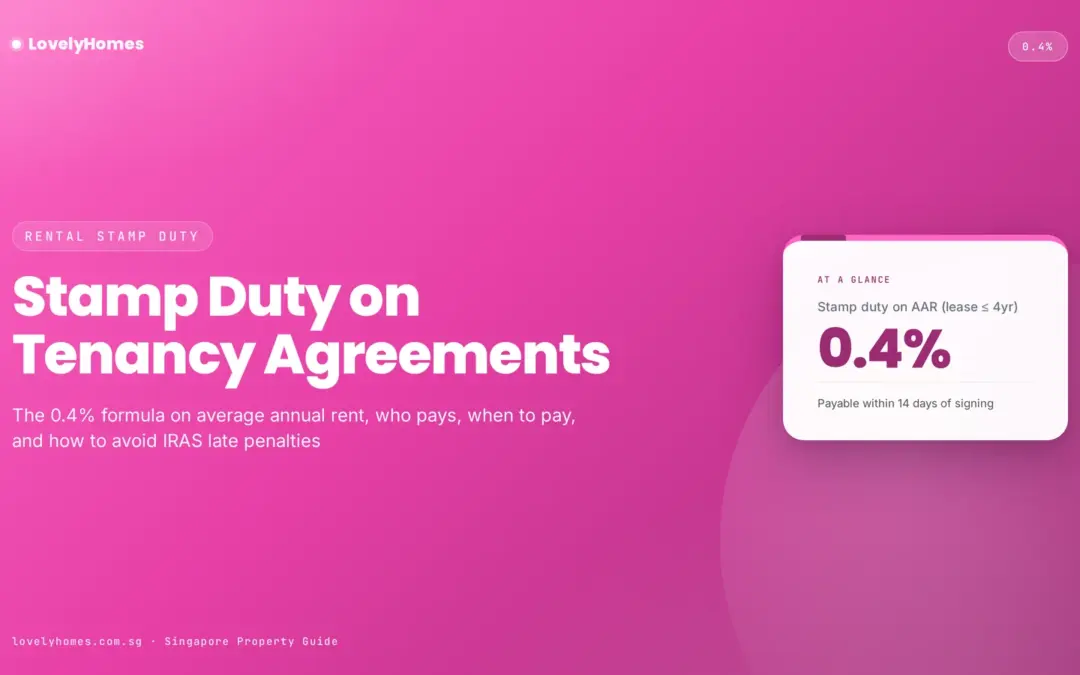
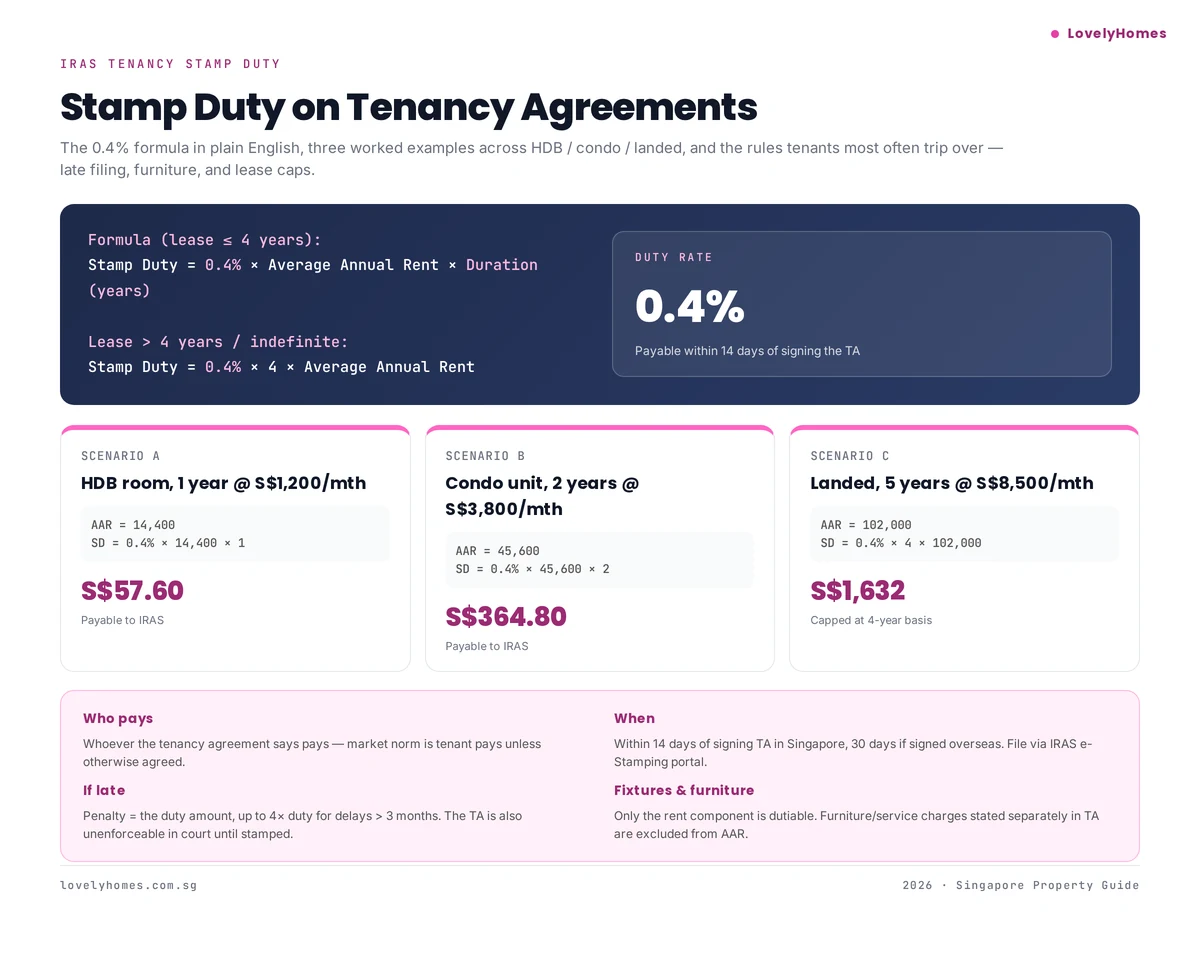
Rental stamp duty in Singapore is 0.4% of the Average Annual Rent (AAR) for leases up to 4 years. Leases longer than 4 years or indefinite are capped at 0.4% × 4 × AAR. Pay within 14 days of signing the TA (30 days if signed overseas). Most TAs have the tenant pay. Late filing penalty: up to 4× the duty if delay exceeds 3 months.

Rental stamp duty trips up more first-time tenants in Singapore than any other rental rule. The formula itself is simple — 0.4% of average annual rent — but the 14-day filing deadline, overseas-signed exception, and what counts as dutiable rent (furniture excluded, service charge maybe) create confusion. This guide explains the rules in plain English with three worked examples.

Rental stamp duty formula and worked examples infographic
The 0.4% formula with three worked examples across HDB, condo, and landed

The formula

For a tenancy agreement with a fixed term:

Stamp Duty = 0.4% × Average Annual Rent (AAR) × Duration (in years)
Where AAR = Total rent over lease period ÷ Lease length in years

If the lease is longer than 4 years, or is indefinite/renewable, the multiplier is capped at 4:

Stamp Duty = 0.4% × 4 × Average Annual Rent

Three worked examples

Example 1 — HDB room, 1-year lease at S$1,200/month

  • AAR = S$1,200 × 12 = S$14,400
  • Duty = 0.4% × S$14,400 × 1 year = S$57.60

Example 2 — Condo unit, 2-year lease at S$3,800/month

  • AAR = S$3,800 × 12 = S$45,600
  • Duty = 0.4% × S$45,600 × 2 years = S$364.80

Example 3 — Landed, 5-year lease at S$8,500/month

  • AAR = S$8,500 × 12 = S$102,000
  • Duty = 0.4% × 4 × S$102,000 = S$1,632 (capped at 4-year basis)

Who pays

Under the Stamp Duties Act, either party can pay — the TA dictates who. Market convention in Singapore is tenant pays, but always check the clause. If the TA is silent, the party presenting it for registration pays.

When to pay

File and pay through the IRAS e-Stamping portal:

  • Within 14 days of signing if the TA is executed in Singapore.
  • Within 30 days if signed overseas.

You’ll need SingPass or a CorpPass login. IRAS sends the stamp certificate by email — store it with your TA.

Late payment penalties

Delay Penalty
Up to 3 months late S$10 or the duty amount (whichever is higher)
More than 3 months late S$25 or 4× the duty amount (whichever is higher)

Beyond the fine, an unstamped TA cannot be used as evidence in court — so if you ever dispute a deposit refund or breach claim, your unstamped TA is worthless until you stamp it (and pay the late penalty).

What is and isn’t dutiable

Component Dutiable?
Rent Yes
Maintenance fee (if stated separately in TA) No
Furniture rental (stated separately) No
Utility estimates bundled in rent Yes (if not separated)
Security deposit No (it’s refundable)
Agent commission No

To lower the dutiable amount, ensure the TA separately itemises rent, furniture rental, and maintenance charges. Bundling them into “all-in rent” means everything becomes dutiable.

How to file step-by-step

  1. Log into the IRAS e-Stamping portal with SingPass.
  2. Select “Lease / Tenancy Agreement”.
  3. Enter the property address, landlord and tenant details, TA signing date, lease start and end dates.
  4. Enter the monthly rent or annual rent — portal auto-calculates the AAR and duty.
  5. Pay by PayNow, eNETS, GIRO, or credit card (surcharge applies).
  6. Download the stamp certificate PDF — attach to your TA and keep for records.

Frequently asked questions

Does the stamp duty increase if rent changes mid-lease?

Only if there’s a written variation to the TA. Automatic CPI-linked increases written into the original TA are captured in the AAR calculation when you stamp at signing.

Do I need to stamp a room-only rental?

Yes — any tenancy agreement, including for a single room, is dutiable. The duty amount will just be smaller.

Can I deduct stamp duty from my income tax?

If you paid the stamp duty as a landlord, it’s a deductible rental expense. If you paid as a tenant (and the property isn’t used for business), it’s not deductible.

What if both parties refuse to pay?

Either party can pay and recover from the other. The TA itself cannot be enforced in court until stamped, so the party needing legal enforcement usually ends up paying.

Disclaimer

This guide is for general information only. Singapore’s rental rules, HDB policies, and IRAS stamp duty rates change periodically. Always verify against the HDB, URA and IRAS websites before signing a lease or filing with IRAS. LovelyHomes is not a licensed property agent or tax adviser. For personalised advice, please engage a registered CEA agent or a qualified tax professional.


Translate »