HDB Resale Flat Eligibility Singapore 2026: Who Can Buy, Citizenship Rules and How to Qualify

HDB Resale Flat Eligibility Singapore 2026: Who Can Buy, Citizenship Rules and How to Qualify

HDB Resale Flat Eligibility Singapore 2026: Who Can Buy, Citizenship Rules and How to Qualify

Quick Answer

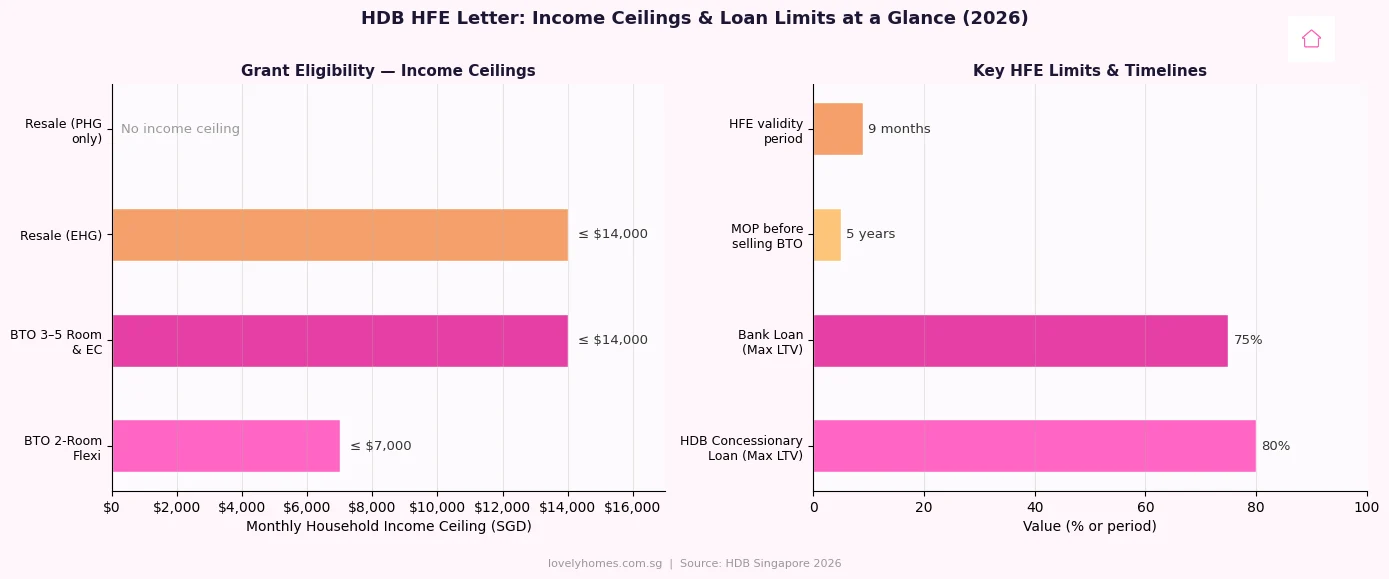
  • No income ceiling to purchase an HDB resale flat — income caps apply only to the HDB Concessionary Loan (≤ S$14,000/month for families; ≤ S$7,000 for singles) and to grants such as the EHG (≤ S$9,000/month).
  • Singapore Citizens may buy under the Public Scheme, Singles Scheme (35+), Joint Singles, Fiancé/Fiancée, Non-Citizen Spouse or Orphans Scheme depending on their household composition.
  • Singapore PRs must have held PR status for at least 3 continuous years and must form a valid family nucleus. PR singles cannot buy HDB resale.
  • Foreigners and non-PRs are not eligible under any HDB resale purchase scheme.
  • Private property owners are subject to a 30-month wait-out period (introduced 30 September 2022) after disposing of their private property before they may buy a resale HDB flat. Exception: Singapore Citizens aged 55 and above buying a 4-room or smaller flat.
  • EIP quotas apply to all resale purchases — available units depend on the ethnic composition of the block and neighbourhood (see our HDB Ethnic Integration Policy guide).
  • Eligibility is determined at the date of HDB application, not the Option to Purchase date.

What Is HDB Resale Flat Eligibility?

HDB resale flat eligibility refers to the set of rules administered by the Housing and Development Board (HDB) that determine who may purchase a resale flat on the open market in Singapore. Unlike Build-To-Order (BTO) flats, which are sold directly by HDB at subsidised prices, resale flats are transacted between a seller and a buyer at market prices. The resale market is open to a broader range of buyers than the BTO programme — including Singapore PRs — but it still operates within a strict framework of nationality, household composition, age, and ownership rules.

Understanding eligibility is the essential first step before placing an Option to Purchase (OTP). Submitting an HDB application for a flat you are not eligible to buy will result in rejection and the forfeiture of the OTP exercise fee (typically 1% of the purchase price). Eligibility is confirmed at the point of HDB application, so it is important that you qualify on the date you submit — not just on the date you sign the OTP.

The Eight Eligibility Schemes at a Glance

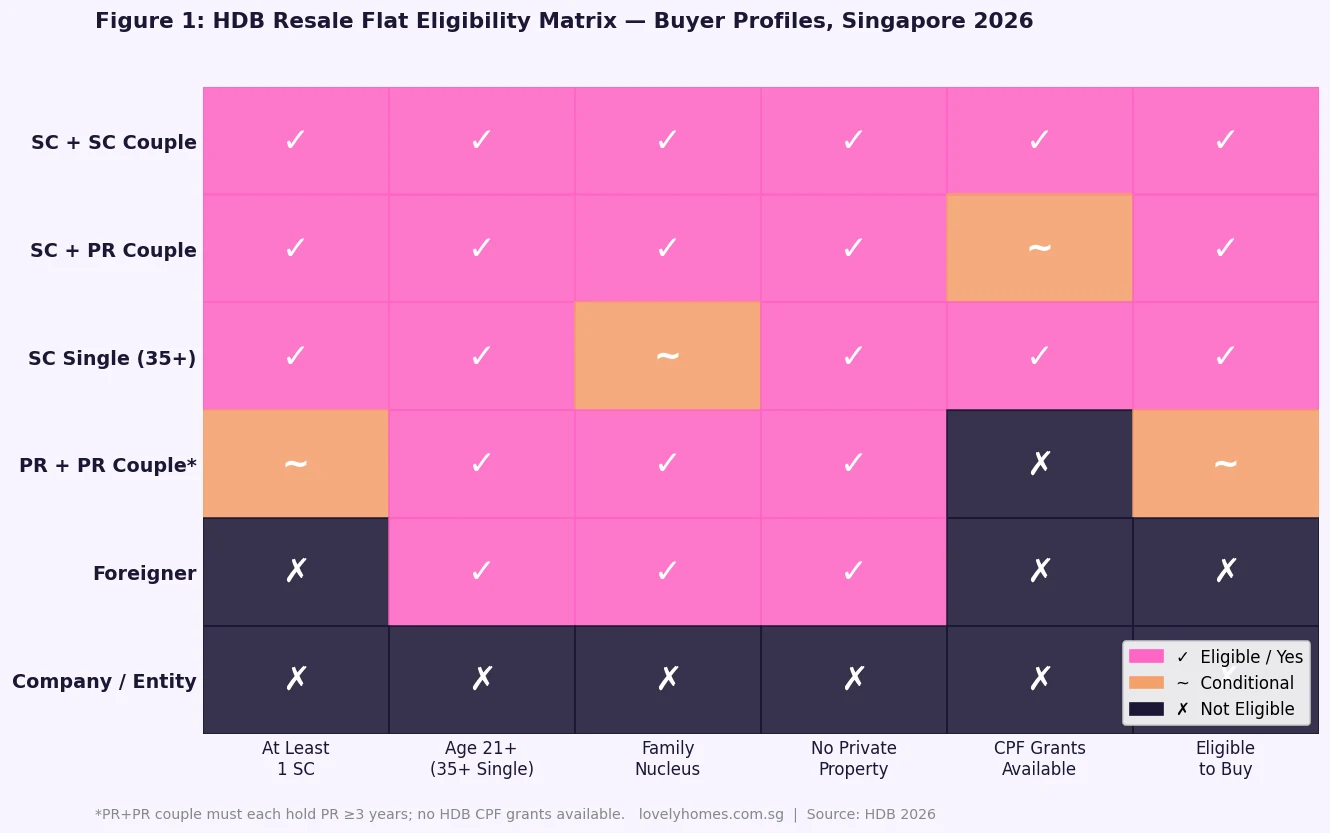
HDB administers eight distinct eligibility schemes for resale flat purchases. Each scheme defines who may be listed as an essential occupier or co-applicant. The table below summarises all eight.

HDB resale flat eligibility matrix 2026 — eight buyer profiles including public scheme, singles, PR family, foreigners
Figure 1: HDB resale eligibility at a glance — the eight buyer profiles and their flat-type entitlements under 2026 rules. Source: HDB Singapore.

Singapore Citizens: Eligibility Schemes in Detail

Singapore Citizens (SCs) have the broadest access to the HDB resale market. Most SC buyers will purchase under the Public Scheme, which requires at least one SC applicant forming a family nucleus with a spouse (SC, PR or foreigner on a long-term pass), children, parents, or unmarried siblings. There is no age restriction under the Public Scheme beyond the minimum legal age of 21.

For singles, the Singles Scheme allows an unmarried, divorced, or widowed SC aged 35 and above to purchase a resale flat of any room type (2-room to 5-room) independently. Two or more single SCs who each meet the age criterion may combine under the Joint Singles Scheme to co-purchase a flat — this is particularly useful for siblings or friends who wish to buy together before meeting eligibility under the Public Scheme.

Other SC-specific schemes include the Fiancé/Fiancée Scheme (for couples who will marry within three months of the HDB application) and the Non-Citizen Spouse Scheme (for SCs whose spouses hold neither SC nor PR status but are on a long-term Singapore pass). Under the Non-Citizen Spouse Scheme, the flat is restricted to 2-room through 5-room types. The Orphans Scheme enables a single SC who has lost both parents and is at least 35 years old to purchase a resale flat, listing unmarried siblings as essential occupiers.

Singapore Permanent Residents: What You Need to Know

Singapore PRs can purchase HDB resale flats — but with important restrictions that do not apply to SCs. The key rules are summarised in the infographic below.

Singapore PR rules for HDB resale purchase 2026 — 3-year PR minimum, family nucleus required, PR singles not eligible
Figure 2: Singapore PR eligibility rules for HDB resale purchases — the 3-year minimum, family nucleus requirement and restrictions at a glance. Source: HDB Singapore.

The most significant PR restriction is the 3-year minimum: every PR applicant (and co-applicant) must have held PR status for at least three continuous years before submitting the HDB application. This clock starts from the date on the PR In-Principle Approval (IPA) letter, not the date of collection of the NRIC. A couple where both spouses obtained PR status in January 2023 would not be eligible to buy a resale HDB flat until January 2026 at the earliest.

PRs must also form a valid family nucleus. A PR may co-purchase with an SC spouse, SC parents, SC children, or another PR who is a spouse or parent. Critically, PR singles cannot buy HDB resale — there is no singles or joint-singles scheme equivalent for PRs. A single, unmarried PR has no pathway to HDB ownership and must rent or purchase private property instead.

PRs are also limited to the resale market. BTO flats, new HDB flats sold under the Sale of Balance Flats (SBF) exercise, and EC projects during their initial launch window are reserved for SCs only (ECs become available to PRs only after they pass their 5-year Minimum Occupation Period). Additionally, PR households cannot own a private residential property simultaneously with an HDB resale flat — they must dispose of their private property within six months of completing the HDB resale purchase.

Foreigners and Non-Residents

Non-citizens who are not PRs are generally not eligible to purchase any HDB flat — resale or new. This includes foreigners on Employment Passes, Dependant Passes, Student Passes, and Long-Term Visit Passes. The only limited exception is the Non-Citizen Spouse Scheme, which allows an SC to co-purchase with a foreign spouse (not holding PR status) — but the SC must be the sole applicant and the flat is restricted to 2-room through 5-room resale types. The foreign spouse is listed as an essential occupier, not a co-owner, and cannot hold legal title to the flat.

Key Disqualifications and the 30-Month Private Property Wait-Out

Even if you meet the citizenship and household composition requirements, you may be disqualified from buying an HDB resale flat if certain ownership or financial conditions apply. The most significant disqualification to understand in 2026 is the 30-month private property wait-out period, which was introduced as part of the September 2022 cooling measures.

HDB resale flat eligibility disqualifications 2026 — 30-month private property wait-out period, concurrent HDB ownership, income ceiling
Figure 3: Key disqualifications for HDB resale purchases, including the 30-month private property wait-out period introduced in September 2022. Source: HDB Singapore.

The 30-month wait-out period means that if you or any listed occupier have disposed of a private residential property (local or overseas), you must wait 30 months from the date of disposal before you can apply for a resale HDB flat. This rule was specifically designed to prevent buyers from “downgrading” to a subsidised HDB flat while pocketing private property gains. The exception is for Singapore Citizens aged 55 and above buying a 4-room or smaller resale flat — they are exempt from the 30-month wait-out entirely, recognising that downsizing in retirement is a legitimate and healthy housing progression.

Summary Table: HDB Resale Eligibility at a Glance

Buyer Profile Min Age Family Nucleus Flat Types Key Restrictions
SC (Public Scheme) 21 Required All types EIP quotas apply
SC (Singles Scheme) 35 Not required 2–5 room Single, divorced or widowed
SC (Joint Singles) 35 each Co-purchasers 2–5 room All co-purchasers must be SC
SC (Non-Citizen Spouse) 21 SC applicant only 2–5 room Spouse is occupier, not co-owner
Singapore PR 21 Required 2–5 room 3-yr PR minimum; no BTO
PR Single Not eligible No HDB scheme available
Foreigner / Non-PR Not eligible No HDB scheme available

Worked Example: Divorced SC Buying Under the Singles Scheme

Scenario. Ms Tan Wei Ling, 39, is a Singapore Citizen who divorced in 2023. She has one child, aged 9. She sold her former matrimonial HDB flat as part of the divorce settlement in early 2023. She has not owned any private property. She earns S$6,800 per month and is looking at a 4-room resale flat in Tampines priced at S$620,000.

Eligibility check. As a divorced SC aged 35 or above, Ms Tan qualifies under the Singles Scheme. Her child (a minor) can be listed as an essential occupier on the application — this does not change the scheme type. She has not owned private property, so the 30-month wait-out does not apply. Her previous HDB flat was sold in 2023, and she is not concurrently owning another HDB flat, so concurrent ownership is not an issue.

Loan and grant eligibility. Ms Tan’s gross monthly income of S$6,800 is just under the S$7,000 singles income ceiling for the HDB Concessionary Loan. She is eligible to apply for the HDB loan at 2.6% per annum. At 80% LTV, her loan would be S$496,000. Over a 25-year tenure, the monthly repayment is approximately S$2,230. Her Mortgage Servicing Ratio (MSR) is 2,230 ÷ 6,800 = 32.8%, which slightly exceeds the 30% MSR cap. To stay within MSR, she can: extend her tenure to 30 years (monthly ~S$1,975, MSR 29.0% ✓); or switch to a bank loan at ~1.5% (monthly ~S$1,706 on S$464,250 at 75% LTV, MSR 25.1% ✓, though requiring more cash upfront). For the Enhanced Housing Grant (EHG), her income of S$6,800 is under the S$9,000 ceiling — she may qualify for EHG of up to S$40,000 as a single first-timer.

What This Means for You

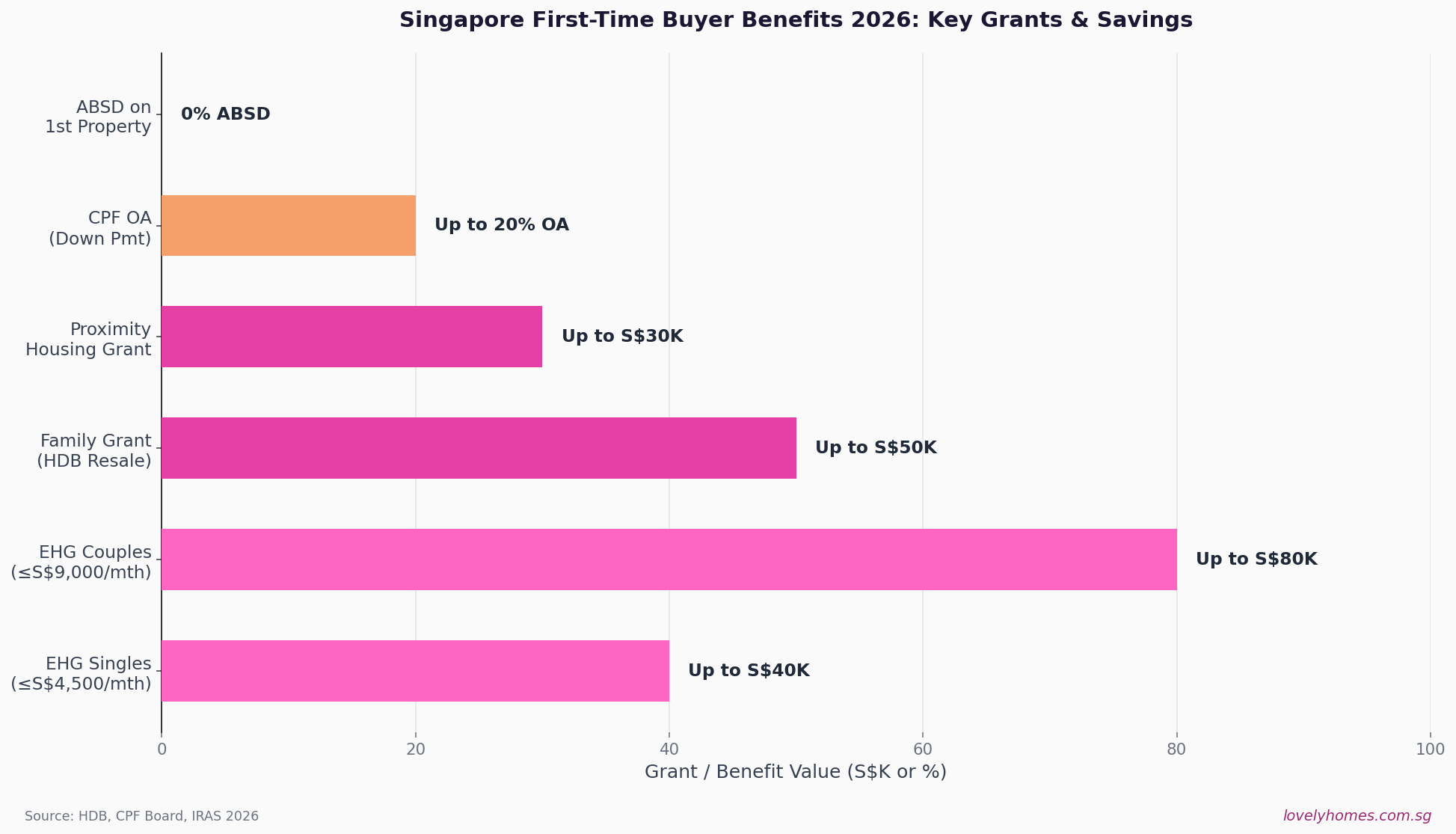
The HDB resale market offers a pragmatic pathway to home ownership for groups who cannot access BTO flats — including PRs, older singles, divorced buyers, and those who need to move quickly without a BTO wait of several years. The key trade-off is price: resale flats are priced at market rates, which in 2026 means a 4-room flat in a mature estate typically costs S$580,000–S$780,000, substantially more than BTO pricing for comparable units. However, the grants system (EHG, CPF Housing Grant, Proximity Housing Grant) can offset S$30,000–S$160,000 of the purchase price depending on your household profile.

Understanding which scheme you qualify under is more than a bureaucratic exercise — it determines your flat-type entitlements, whether you need a co-applicant, and the grants you can access. If you are unsure which scheme applies to your situation, HDB’s e-Service portal provides an eligibility self-assessment tool, and HDB sales teams at HDB Hub (Toa Payoh) can advise on individual circumstances.

What Might Come Next

The HDB eligibility framework has remained broadly stable since the September 2022 cooling measures, but there are two areas to watch. First, the government has signalled continued attention to the resale market — if the Resale Price Index (RPI) resumes material increases after Q1 2026’s modest 0.1% dip, further demand-side measures targeting eligibility or wait-out periods cannot be ruled out. Second, the ongoing rollout of HDB’s new flat classification system (Standard, Plus and Prime) is reshaping what constitutes a “subsidised” flat — future eligibility amendments may further restrict resale proceeds from Plus and Prime flats, which already carry a 6%–9% subsidy clawback on sale.

Frequently Asked Questions

Can I buy an HDB resale flat if I own a private property overseas?

No. The disqualification applies to any private residential property, whether in Singapore or overseas. If you or any listed occupier own a foreign private property, you must dispose of it before applying for an HDB flat. The 30-month wait-out period runs from the date of disposal, unless you are an SC aged 55 and above buying a 4-room or smaller flat (who is exempt from the wait-out).

My spouse is a foreigner on an Employment Pass. Can we buy an HDB resale flat?

Yes, under the Non-Citizen Spouse Scheme, you (as the SC applicant) can purchase a 2-room to 5-room resale flat with your foreign spouse listed as an essential occupier. Your spouse will not be a co-owner — the flat is held in your name only. You must be the sole applicant, and the flat type is limited to 2-room through 5-room (not 3Gen or certain premium flat types). Standard EIP quotas and CPF/grant rules apply based on your citizenship and income.

I became a PR three years ago. Does that mean I can buy an HDB resale flat immediately?

Yes, provided you meet all other eligibility conditions — you must form a valid family nucleus (you cannot buy as a PR single), you cannot own another HDB flat concurrently, and you cannot own a private residential property. The 3-year PR minimum is measured from the date on your In-Principle Approval (IPA) letter, not your NRIC collection date. If your PR was granted in April 2023, you would be eligible from April 2026 onwards, assuming all other criteria are met.

I sold my condo in January 2025. Can I buy an HDB resale flat now in May 2026?

Yes — by May 2026, 16 months have passed since your January 2025 disposal. However, the 30-month wait-out period requires 30 months from disposal, which means you would not be eligible until July 2027 (30 months after January 2025). Unless you are an SC aged 55 and above buying a 4-room or smaller flat, you will need to wait until July 2027 before submitting an HDB resale application.

What is the difference between an applicant and an essential occupier?

The HDB applicant (and any co-applicant) is the legal owner of the flat. An essential occupier is someone who forms part of the family nucleus for the purpose of qualifying for the flat, but who does not hold any ownership interest. For example, under the Non-Citizen Spouse Scheme, the foreign spouse is an essential occupier — they live in the flat and are listed on the application, but are not on the title. Essential occupiers are bound by certain ownership restrictions and must remain listed for a minimum period as specified by HDB.

Can I apply for an HDB resale flat if I am an undischarged bankrupt?

Yes, with conditions. HDB does allow undischarged bankrupts to apply for a resale flat, but you cannot use an HDB Concessionary Loan if you are bankrupt — you must finance using a bank loan or cash. Additionally, your co-applicant (if any) may face restrictions on CPF usage. You should disclose your bankruptcy status in the HDB application; non-disclosure is an offence under the Housing and Development Act and can result in compulsory acquisition of the flat.

Does the Ethnic Integration Policy (EIP) affect my eligibility to buy a specific flat?

Yes. The EIP sets ethnic quotas at both the block level and neighbourhood level to maintain racial integration across HDB estates. If the block or neighbourhood quota for your ethnic group has been reached, you will not be able to purchase that specific flat, regardless of your broader eligibility. The EIP quota is checked at the time of the HDB application — it is possible to receive an OTP and then find the flat is unavailable under EIP when you apply. See our detailed guide on the HDB Ethnic Integration Policy for block-level and neighbourhood quota mechanics.

Related Articles

Disclaimer: This article is for general informational purposes only and does not constitute legal, financial or housing advice. HDB eligibility rules are subject to change. Always verify your eligibility directly with HDB via the MyHDBPage portal or by visiting an HDB sales office. Grants, loan eligibility and specific scheme conditions should be confirmed with HDB and, where relevant, a MAS-licensed financial adviser. For conveyancing, consult a Singapore-qualified lawyer. Official source: www.hdb.gov.sg.

HDB Grants Singapore 2026: EHG, CPF Housing Grant, Proximity Grant and Step-Up Grant Explained

HDB Grants Singapore 2026: EHG, CPF Housing Grant, Proximity Grant and Step-Up Grant Explained

Quick Answer: HDB Grants Singapore 2026 — Key Facts

  • Enhanced CPF Housing Grant (EHG): Up to S$120,000 for eligible first-timer families; up to S$40,000 for eligible singles. Applies to both BTO and resale flats.
  • CPF Housing Grant (CHG): Up to S$80,000 for first-timer families buying a resale HDB flat; S$40,000 for singles.
  • Proximity Housing Grant (PHG): Up to S$30,000 for families who buy a resale flat to live with or near parents; S$15,000 for singles.
  • Step-Up CPF Housing Grant: S$15,000 for second-timer families upgrading from a 2-room to a 3-room or larger flat in a non-mature estate.
  • Government Housing Grant (EC): S$30,000 for eligible first-timer families buying a new Executive Condominium.
  • Grants are CPF-credited: All grants go into your CPF Ordinary Account and offset the purchase price — you do not receive cash.
  • No double-counting: You can stack compatible grants (e.g., EHG + PHG for resale) but each grant type can only be used once per application.

What Are HDB Grants and Who Administers Them?

HDB housing grants are government subsidies administered jointly by the Housing & Development Board (HDB) and the Central Provident Fund (CPF) Board. They are designed to make homeownership accessible to Singapore Citizens and, in some cases, Permanent Residents, by directly reducing the effective purchase price of an HDB flat.

Grants are credited into your CPF Ordinary Account (OA) — not paid as cash — and can be applied towards the purchase price of your flat or used to reduce your outstanding home loan. This is an important distinction: you cannot withdraw grant amounts in cash, and they are subject to the CPF accrued interest rules when you eventually sell your property.

The grant framework in Singapore is tiered by household income, citizenship status, flat type, and whether you are a first-timer or second-timer applicant. First-timers consistently receive significantly higher grants than second-timers, reflecting the government’s policy of prioritising owner-occupancy and discouraging property speculation within the public housing segment.

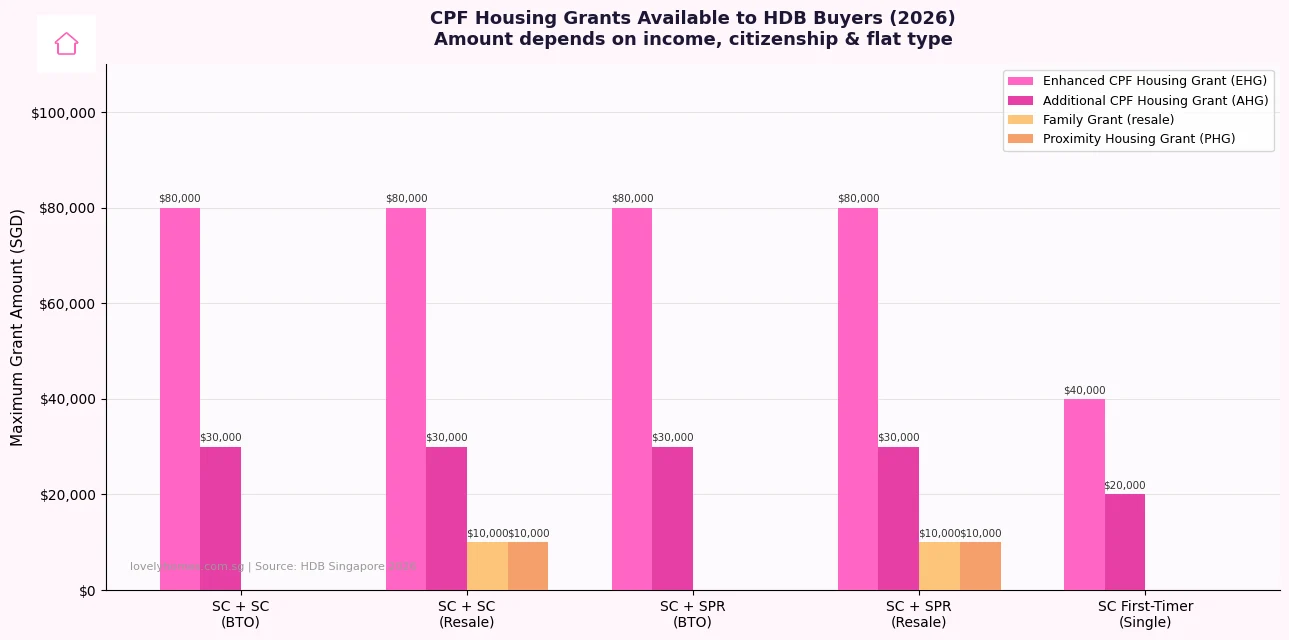
HDB grant amounts by scheme Singapore 2026 — EHG CPF Housing Grant PHG Step-Up Government Housing Grant EC
Figure 1: Maximum grant amounts across all HDB and EC grant schemes as at 2026. Subject to individual eligibility — verify with HDB/CPF Board before purchase.

Enhanced CPF Housing Grant (EHG) — The Largest Grant Available

The Enhanced CPF Housing Grant, introduced in September 2019, replaced the Additional CPF Housing Grant (AHG) and Special CPF Housing Grant (SHG). It is the most substantial grant available to first-timer Singapore Citizen households and is specifically calibrated to assist lower- and middle-income buyers.

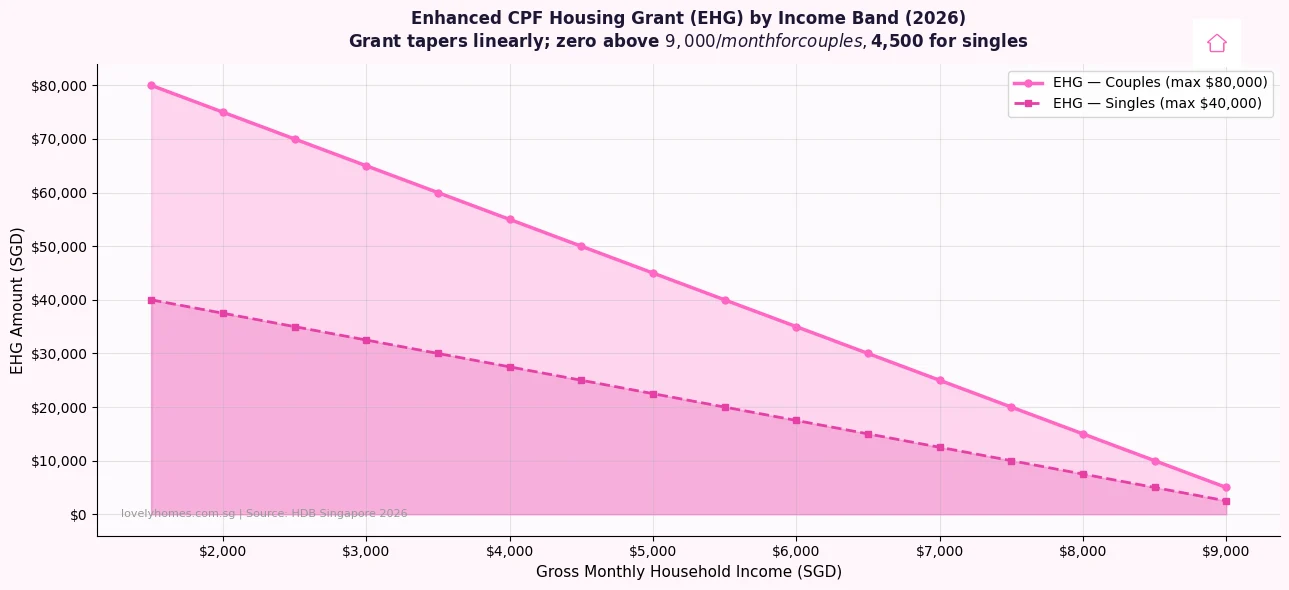
The EHG is means-tested: the amount decreases as household income rises, and the eligibility ceiling is S$9,000 per month for families and S$4,500 per month for singles (as at 2026). To qualify, at least one applicant must have worked continuously for at least twelve months before the flat application date, and must continue working at the time of application.

One critical requirement that catches many applicants off-guard: the EHG is only available for flats purchased with a remaining lease of at least 20 years at the time of application, and whose remaining lease can cover the youngest buyer to at least age 95. This lease requirement affects certain older resale flats, which may otherwise be eligible by income but fail the lease longevity test.

EHG Enhanced CPF Housing Grant income tiers and amounts table Singapore 2026
Figure 2: EHG grant amounts by monthly household income bracket, 2026. Grants are maximum amounts; actual award = lower of EHG table amount or flat purchase price.

CPF Housing Grant (CHG) — For Resale Flat Buyers

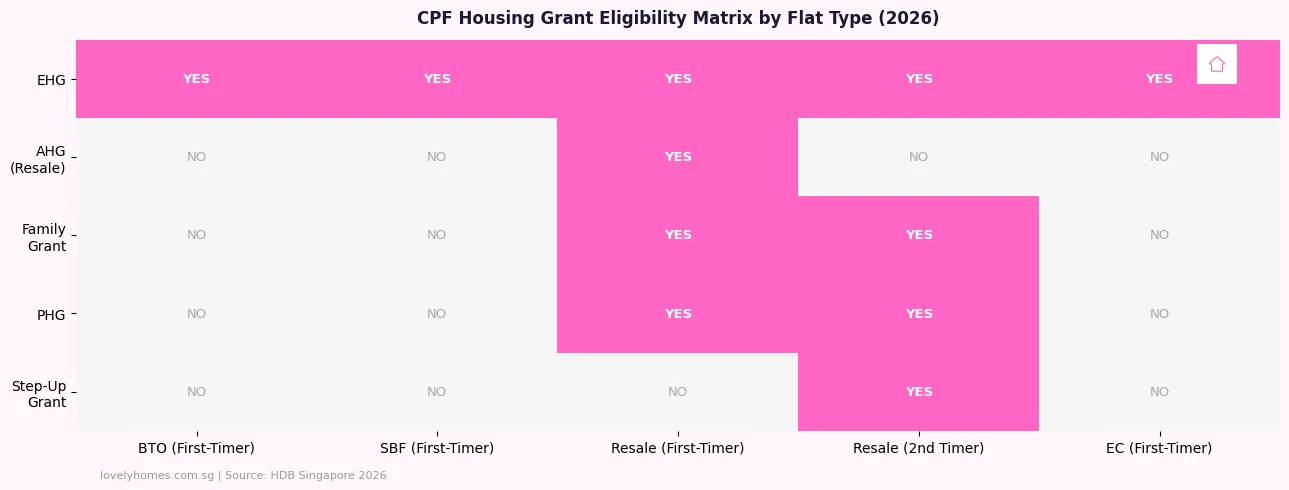
The CPF Housing Grant (sometimes called the Family Grant or Singles Grant in older HDB materials) is specifically available to first-timer buyers purchasing a resale HDB flat on the open market. Unlike the EHG, which applies to both BTO and resale purchases, the CHG is resale-only — BTO buyers receive the EHG instead.

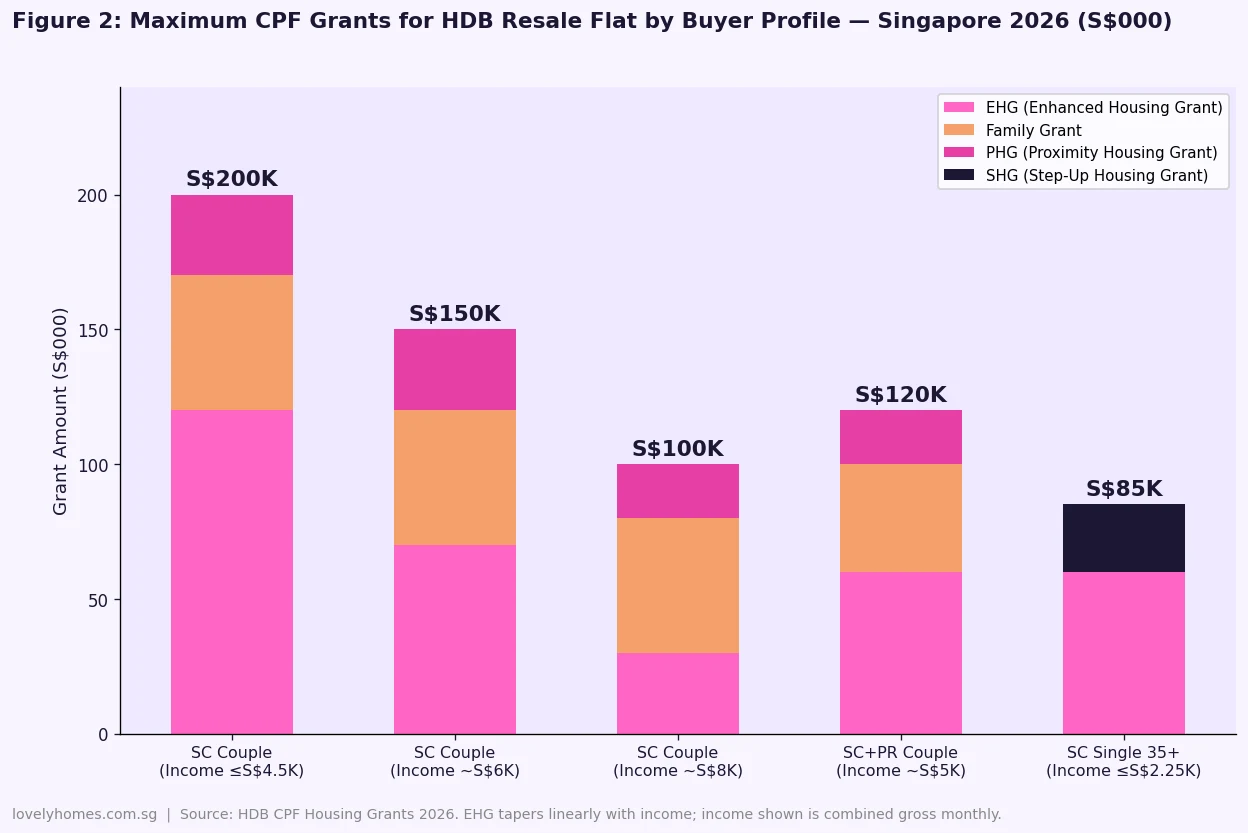
As at 2026, the maximum CHG is S$80,000 for first-timer Singapore Citizen families (where both applicants are Singapore Citizens) and S$40,000 for first-timer Singles aged 35 or above. For households where one applicant is a Singapore Citizen and the other is a Permanent Resident, the grant reduces to S$50,000. The income ceiling for the CHG is S$14,000 per month — notably higher than the EHG ceiling, meaning more households are eligible.

Proximity Housing Grant (PHG) — For Families Buying Near Parents

The Proximity Housing Grant incentivises multigenerational living by rewarding families who buy a resale HDB flat to live with or within 4 kilometres of their parents’ or children’s existing HDB flat. It is a resale-only grant and is available regardless of whether the buyer is a first-timer or second-timer, making it one of the few grants accessible to second-timers on a meaningful scale.

To live with parents or married children (same address), the PHG is S$30,000 for families and S$15,000 for singles. To live within 4 km of parents’ or children’s existing flat, the PHG is S$20,000 for families and S$10,000 for singles. There is no income ceiling for the PHG — any household, regardless of income, may apply as long as the proximity and family relationship conditions are met.

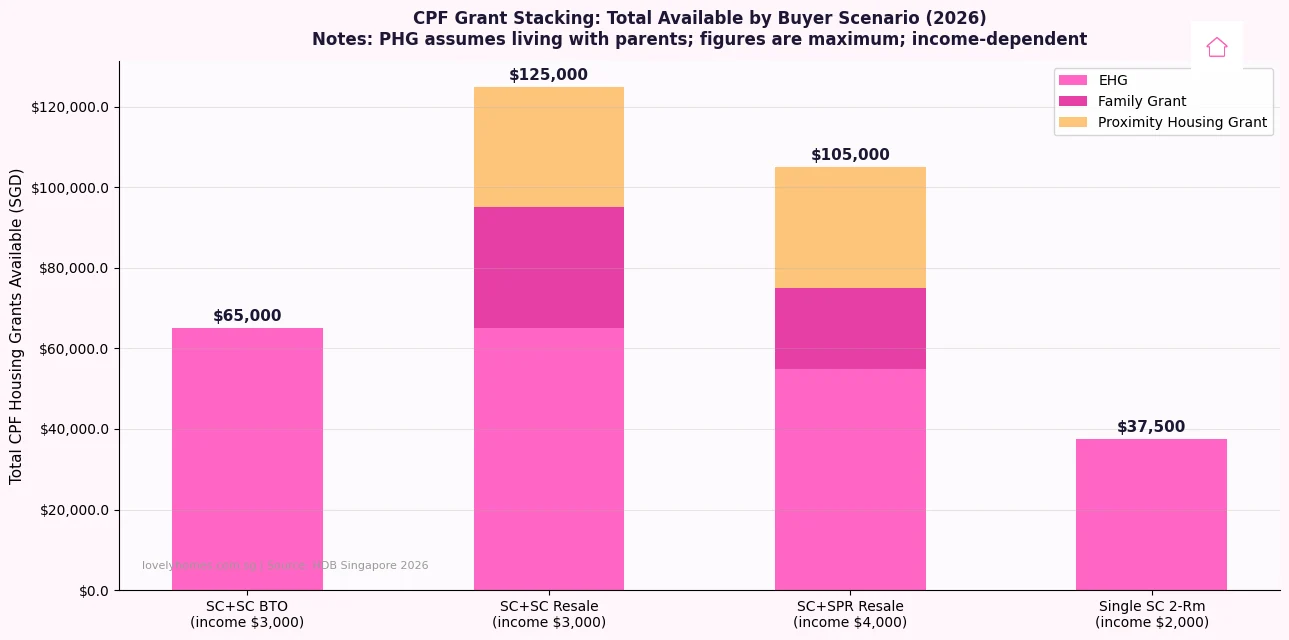
The PHG can be stacked with the EHG and CPF Housing Grant for resale buyers. A first-timer SC+SC couple earning S$8,500 per month buying a resale flat to live near parents could, in theory, receive EHG of S$40,000 + CHG of S$80,000 + PHG of S$30,000 = a total of S$150,000 in grants — making a resale flat in a mature estate substantially more affordable than it appears at headline price.

Step-Up CPF Housing Grant — Second-Timers Upgrading Within HDB

The Step-Up CPF Housing Grant of S$15,000 is specifically for second-timer Singapore Citizen families who currently live in a 2-room HDB flat (Flexi or standard) and wish to upgrade to a larger 3-room or bigger flat in a non-mature housing estate, sourced directly from HDB (i.e., a BTO flat in the relevant sales exercise). It is not available for resale flat purchases.

The income ceiling for the Step-Up Grant is S$7,000 per month, and at least one applicant must have been a Singapore Citizen for at least five years. This grant is deliberately narrow in scope — it targets a specific population of residents in smaller flats who need a capacity upgrade but remain in the lower-to-middle income band.

Government Housing Grant (GHG) for Executive Condominiums

First-timer Singapore Citizen families purchasing a new Executive Condominium (EC) directly from a developer are eligible for the Government Housing Grant of S$30,000, credited into the purchaser’s CPF OA. The income ceiling for the EC grant is the same as the EC purchase income ceiling — S$16,000 per month as at 2026. This grant cannot be combined with the EHG or CHG, as those apply only to HDB flat purchases; the GHG is the equivalent grant mechanism for the EC segment.

Total HDB grants available first-timer couple BTO resale scenarios Singapore 2026
Figure 3: Total grants available across key first-timer scenarios, 2026. Scenario 3 (resale near parents) shows maximum stacking of EHG + CHG + PHG = S$150,000.

Summary: Grant Comparison Table

Grant Max (Family) Max (Singles) Income Ceiling BTO? Resale? First-Timer?
EHG S$120,000 S$40,000 S$9,000 / S$4,500 Required
CPF Housing Grant S$80,000 S$40,000 S$14,000 Required
PHG (live with) S$30,000 S$15,000 None Not required
PHG (within 4km) S$20,000 S$10,000 None Not required
Step-Up Grant S$15,000 S$7,000 Not required
Govt HG (EC) S$30,000 S$16,000 EC only Required

Worked Example: The Lim Family — Maximising HDB Grants on a Resale Flat

Mr and Mrs Lim are a Singapore Citizen married couple, both aged 29. Their combined gross monthly household income is S$6,500. They are first-timers. Mrs Lim’s parents own an HDB flat in Queenstown, and the couple would like to buy a resale 4-room flat in Buona Vista to live together with the parents.

Step 1 — EHG eligibility: Income S$6,500 → EHG for families at this income bracket = S$75,000. (From the EHG tier table: ≤S$7,500/mth = S$55,000. Correcting: S$6,000–S$7,500 range → S$55,000 EHG.)

Step 2 — CPF Housing Grant (resale): Income S$6,500 ≤ S$14,000 → CHG = S$80,000 (both SCs, first-timers, resale flat).

Step 3 — PHG (living with parents): Living with parents at same address → PHG = S$30,000. No income ceiling.

Step 4 — Total grants:

Grant Amount
Enhanced CPF Housing Grant (EHG) S$55,000
CPF Housing Grant (CHG) S$80,000
Proximity Housing Grant (PHG — live with parents) S$30,000
Total Grants (CPF OA credited) S$165,000
Indicative resale flat price (Buona Vista 4-room) S$780,000
Effective price after grants S$615,000
HDB Concessionary Loan (80% of S$780k − grants offset) ~S$459,000
Cash + CPF down payment (20%) ~S$156,000

The Lims’ S$165,000 in grants reduces a S$780,000 resale flat to an effective out-of-pocket position requiring approximately S$156,000 in down payment (cash + CPF, with grants credited to OA first). Their HDB Concessionary Loan at 2.6% p.a. on approximately S$459,000 produces a monthly repayment of roughly S$2,060 — a MSR-compliant 31.7% of their S$6,500 combined income, below the 30% MSR cap when rounded down on the concessionary loan basis (HDB concessionary loan MSR = 30% of gross monthly income).

Note: CPF accrued interest will apply to the grants and CPF OA amounts used, payable upon eventual sale of the flat. The Lims should factor this into their long-term financial planning.

Why HDB Grants Matter in Singapore’s Property Market

Singapore’s HDB grant system is one of the most comprehensive public housing subsidy frameworks in the world. Unlike many countries where housing subsidies take the form of direct cash payments or tax credits, Singapore’s approach links grants directly to the CPF system and the property purchase process — ensuring subsidies are deployed towards asset acquisition rather than consumption spending.

For first-timer households earning S$6,000–S$8,000 per month — the Singapore median household income bracket — the combined effect of EHG, CHG, and PHG can reduce the effective purchase price of a resale flat by S$100,000 to S$165,000. On a S$600,000–S$800,000 resale flat, this represents a 15–25% effective discount, which is transformative for affordability.

The grant structure also reveals HDB’s policy priorities clearly: it heavily favours first-timers over second-timers, rewards proximity to elderly parents, and calibrates generosity inversely to income. Buyers who understand this structure can make significantly better purchase decisions — for example, choosing a resale flat with PHG eligibility over a BTO flat, purely because the grant stacking arithmetic makes the resale option more affordable net of grants.

What Might Come Next

The Singapore government reviews HDB grant parameters periodically, typically in line with National Day Rally announcements or budget statements. The most recent significant change was the introduction of the EHG in 2019 and the progressive upward revision of resale grant amounts in 2023. Given the ongoing focus on housing affordability — and the political salience of the HDB resale market — further adjustments to grant ceilings or income thresholds cannot be ruled out ahead of the next general election cycle. Buyers currently in the planning phase should check for the most current figures on the official HDB website before committing to a purchase.

Frequently Asked Questions

Can I receive grants as cash instead of CPF?

No. All HDB housing grants — EHG, CPF Housing Grant, PHG, Step-Up, and the Government Housing Grant for ECs — are credited directly into your CPF Ordinary Account. You cannot receive them as cash and you cannot use them for renovation or any purpose other than the property purchase. When you eventually sell the flat, the grant amounts (plus CPF accrued interest at 2.5% per annum) must be refunded to your CPF OA.

Do Singapore Permanent Residents qualify for HDB grants?

PRs have limited access to HDB grants. A PR who is part of an SC-PR couple applying for a resale flat may be eligible for a reduced CPF Housing Grant (S$50,000 for SC+PR families versus S$80,000 for SC+SC families). The EHG is only available where at least one applicant is a Singapore Citizen. The PHG and Step-Up Grant require at least one Singapore Citizen applicant. PRs applying as singles (single-nucleus PR household) are generally not eligible for HDB grants.

What is the difference between a first-timer and a second-timer?

A first-timer is a Singapore Citizen who has not previously received any HDB housing subsidy — meaning they have never owned an HDB flat bought directly from HDB, received a CPF Housing Grant, or been listed as an occupier of a subsidised flat that subsequently received a grant. A second-timer is anyone who has previously received an HDB housing subsidy. First-timers receive substantially higher grants and priority balloting across BTO exercises.

Can I use grants for the down payment?

Grants are credited to your CPF OA, which can then be used for the CPF-eligible portion of the down payment. For an HDB Concessionary Loan, the minimum cash down payment is 10% of the purchase price; the remaining 10% can be funded from CPF (including grants credited to CPF OA). For a bank loan, the cash down payment is 5% and the next 20% can be from CPF. So yes — grants effectively reduce the CPF component you need to contribute from your own savings, improving cash affordability.

What happens to grants when I sell my HDB flat?

When you sell your HDB flat, the total grant amount received — plus CPF accrued interest at 2.5% per annum compounded from the date of purchase — must be returned to your CPF OA. This is not a penalty; the accrued interest compensates for the fact that the grant money was in your CPF OA earning interest that was “diverted” to your flat purchase. The refunded amount forms part of your CPF savings and can be used for your next property purchase, subject to the applicable rules.

Do HDB grants affect how much I can borrow?

Not directly — grants do not increase your borrowing capacity, as loan quantum is determined by your income, credit profile, TDSR, and MSR (for HDB loans). However, grants reduce the effective purchase price, which means the loan quantum required to complete the purchase is lower. A lower loan quantum means lower monthly repayments, which in turn may make a higher-priced flat MSR/TDSR-compliant that would otherwise breach the borrowing limit.

Can grants be used to buy private property?

No. HDB housing grants — EHG, CHG, PHG, and Step-Up Grant — can only be used to purchase HDB flats (for BTO or resale). The Government Housing Grant can be used for EC purchases. None of these grants may be applied to the purchase of a fully private condominium, landed property, or commercial property. If you use grants to purchase an HDB flat and subsequently sell it to buy private property, the grant amounts plus accrued interest must first be refunded to your CPF OA.

Related Articles

Disclaimer: This article is for general informational purposes only and does not constitute financial or legal advice. HDB grant amounts, eligibility criteria, and income ceilings are subject to change by HDB and CPF Board at any time. Readers are strongly advised to verify current grant parameters directly with HDB at www.hdb.gov.sg, the CPF Board at www.cpf.gov.sg, and to consult a licensed financial adviser before making any property purchase decision.

Renovation Loan Singapore 2026: Complete Guide to Rates, Limits and Approved Works

Renovation Loan Singapore 2026: Complete Guide to Rates, Limits and Approved Works

Quick Answer: Renovation Loan Singapore 2026 — Key Facts

  • What is it? An unsecured personal loan offered by licensed financial institutions to finance home renovation works.
  • Loan limit: Typically up to S$30,000 or 6× your monthly income, whichever is lower.
  • Interest rates: Flat rates of approximately 2.88%–3.49% p.a. (Effective Interest Rate 5.4%–6.5% p.a.).
  • Tenure: Up to 5 years (most banks offer 1–5 years).
  • CPF not allowed: You cannot use your CPF Ordinary Account for renovation — cash or loan only.
  • Who qualifies: Singapore Citizens, Permanent Residents, and eligible Employment Pass holders aged 21+.
  • HDB flats: Structural and civil works require prior approval from HDB before renovation begins.
  • GST applies: As of 1 January 2024, GST is 9% on all renovation contractor invoices.

What Is a Renovation Loan in Singapore?

A renovation loan is a purpose-bound unsecured loan offered by Monetary Authority of Singapore (MAS)-regulated banks and licensed financial institutions. Unlike a home loan — which is secured against your property — a renovation loan is a personal credit facility ring-fenced for approved home improvement works. It is administered separately from your mortgage and does not require additional collateral.

The objective is straightforward: to help Singaporean homeowners spread the cost of renovating a newly purchased HDB flat, executive condominium, or private property over manageable monthly instalments, rather than drawing down lump-sum savings in one hit.

In 2026, renovation costs in Singapore have continued to climb, driven by higher material costs, post-pandemic labour tightness, and the mandatory 9% GST applied since January 2024. A typical 4-room HDB flat renovation now costs between S$35,000 and S$60,000 for a full-gut-and-rebuild scope, making the renovation loan a meaningful financing tool for most first-time buyers.

Renovation loan Singapore 2026 bank comparison table — DBS OCBC UOB Standard Chartered rates limits tenure
Figure 1: Key renovation loan features across major Singapore banks, May 2026. Rates indicative — verify directly with each lender before applying.

Who Administers Renovation Loans?

Renovation loans are offered exclusively by MAS-licensed banks and finance companies. They are not government-subsidised products, unlike the CPF Housing Grant or the HDB Concessionary Loan. The key lenders as at 2026 include DBS/POSB, OCBC, UOB, Standard Chartered, Citibank, and several others. Each sets its own flat rate, effective interest rate, minimum loan amount, and processing fee structure — which is why comparing offers before committing is essential.

The Moneylenders Act (Cap. 188) prohibits licensed moneylenders from marketing loans specifically labelled as “renovation loans” to unsecured personal credit borrowers, though some borrowers do turn to licensed moneylenders for shortfall amounts; rates there are materially higher (up to 4% per month on outstanding balances) and should be approached with extreme caution.

Eligibility: Who Can Apply?

Bank renovation loan eligibility criteria are broadly consistent across lenders, though specific income thresholds vary:

Criterion Typical Requirement Notes
Age Minimum 21 years old Some banks cap at 65 at loan maturity
Citizenship SC, PR, or EP/S-Pass holder Non-residents may face stricter income requirements
Minimum Income S$24,000–S$30,000 per annum Loan limit = lower of S$30,000 or 6× monthly income
Credit History Good CBS credit grade (AA–BB preferred) Checked via Credit Bureau Singapore at application
Property Ownership Must be owner/co-owner of property to be renovated Proof via HDB/URA records or title deed
Renovation Quotes Contractor invoices or at least 1 quotation required Loan disbursed to contractor, not directly to borrower

Approved Renovation Works — What the Loan Covers

The defining feature of a renovation loan — as distinct from a general personal loan — is that it can only be used for approved renovation or improvement works. Banks require contractors’ invoices as proof, and funds are typically disbursed directly to the contractor. This protects lenders from the loan being diverted to non-renovation spending.

Approved vs not-approved renovation works for Singapore renovation loan 2026
Figure 2: Works covered and excluded under Singapore bank renovation loans, 2026. Always confirm with your lender before signing the contractor agreement.

For HDB flat owners, an additional layer of approval applies. Under HDB’s Renovation Guidelines, certain works — including demolishing non-structural walls, hacking floor tiles, installing heavy feature walls, and any works affecting the building’s structural integrity — require prior written approval from HDB before work can commence. Failure to obtain this approval can result in a Rectification Order, fines, and in severe cases, compulsory reinstatement at the owner’s cost.

HDB’s e-Service portal allows flat owners to apply for Renovation Permits online; most approvals for standard works are granted within three to five working days. Your bank does not liaise with HDB on your behalf — this is entirely your responsibility as the flat owner.

Interest Rates, Loan Limits and Repayment

Understanding the difference between a flat interest rate and an Effective Interest Rate (EIR) is critical when comparing renovation loans. Banks advertise the flat rate because it sounds lower, but the EIR — which accounts for the reducing loan balance over time — is the true cost of borrowing.

For example, a 2.88% flat rate on a 5-year, S$30,000 loan translates to an EIR of approximately 5.4% per annum. On a monthly repayment basis, that works out to roughly S$565 per month across 60 months, with total interest paid of approximately S$3,900 — a meaningful but manageable premium for spreading renovation costs over five years.

The MAS-mandated borrowing limit cap means that if your gross monthly income is S$4,000, your maximum renovation loan is S$24,000 (6× S$4,000), even if the bank’s product ceiling is S$30,000. This aggregate unsecured credit limit (across all unsecured credit facilities) is capped at 12× monthly income for borrowers with annual income below S$120,000.

Can You Use CPF for Renovation?

No. The CPF Board explicitly prohibits the use of CPF Ordinary Account (OA) savings for home renovation. Your CPF OA may only be used for the purchase of an approved HDB flat, executive condominium, or private residential property, and for the repayment of an approved housing loan. Renovation is not an approved purpose under the CPF Act (Cap. 36).

This means that regardless of how much you have accumulated in your CPF OA, every dollar of your renovation must be funded either from cash savings or a renovation loan. This is a common misconception among first-time buyers who assume that CPF — having covered the down payment — can also cover the renovation tab.

4-room HDB renovation cost breakdown Singapore 2026 — kitchen bathroom flooring carpentry painting air-conditioning
Figure 3: Indicative 4-room HDB renovation cost breakdown, 2026. Total S$40,000: loan covers S$30,000; S$10,000 self-funded. Monthly repayment at 2.88% flat over 5 years: ~S$565.

Worked Example: The Tan Family’s S$40,000 HDB Renovation

Mr and Mrs Tan, both Singapore Citizens aged 32 and 30, have just collected keys to their 4-room BTO flat in Tengah. They received keys in March 2026. Their combined gross monthly income is S$9,500. After accounting for their home loan, their existing monthly financial commitments are modest. They plan a full renovation costing approximately S$40,000.

Step 1 — CPF check: They confirm they cannot use CPF for renovation. Their CPF OA savings remain untouched for future home-loan instalments.

Step 2 — Loan limit: 6 × S$9,500 = S$57,000. The bank product ceiling is S$30,000. Their loan is capped at S$30,000.

Step 3 — Cash shortfall: S$40,000 total cost − S$30,000 loan = S$10,000 cash top-up from savings.

Step 4 — Repayment at 2.88% flat rate, 5-year tenure:

Item Amount
Loan amount S$30,000
Monthly repayment (60 months) ~S$565
Total interest paid (5 years) ~S$3,900
Cash top-up (out of pocket) S$10,000
Total renovation outlay (cash + interest) S$13,900

The Tans’ TDSR is unaffected in terms of their home loan (renovation loans, being unsecured credit, count towards the MAS aggregate unsecured credit limit rather than the TDSR property-loan computation). Their S$565 monthly renovation repayment does, however, reduce disposable income for the duration of the loan — a practical cash-flow consideration when budgeting for the first five years in their new flat.

What This Means for Singapore Homebuyers in 2026

With renovation costs continuing to rise — industry data points to a 15–20% increase in contractor rates between 2021 and 2026 — the renovation loan has become a near-universal fixture in a first-time buyer’s financial plan. The important discipline is to draw only what is needed: a maxed-out S$30,000 loan taken simply because it is available creates an unnecessary debt burden on top of your mortgage.

Experienced buyers typically adopt a phased renovation strategy: loan the absolute essentials (kitchen, bathrooms, flooring) in Phase 1, then fund discretionary aesthetics (feature walls, bespoke carpentry, statement lighting) from savings in Phase 2, twelve to twenty-four months later when cash flow has normalised.

What Might Come Next

There is no current signal from MAS that renovation loan limits will be increased. Some financial observers have called for the S$30,000 ceiling — last reviewed several years ago — to be revised upward to reflect inflation in renovation costs. Whether MAS acts on this in its next review of unsecured credit guidelines remains to be seen. Separately, should Singapore’s interest rate environment continue to normalise post-2026, bank flat rates on renovation loans may ease modestly, improving affordability.

Frequently Asked Questions

Can I apply for a renovation loan before I collect my flat keys?

Most banks require you to have already collected the keys to your property before disbursing a renovation loan, as they will ask for proof of ownership (e.g., HDB acknowledgement or title deed). Some banks allow you to apply up to three months before key collection, but disbursement is only triggered upon confirmation of ownership. Check with your specific lender on their pre-key-collection policy.

Does a renovation loan affect my home loan TDSR?

Not directly. Renovation loans are classified as unsecured credit under MAS guidelines, not as property loans. They do not form part of the Total Debt Servicing Ratio (TDSR) computation for your home loan. However, they do count toward your aggregate unsecured credit limit (capped at 12× monthly income). If you are applying for a renovation loan shortly after taking a home loan, the bank will assess your credit capacity on a consolidated basis.

What happens if my renovation costs exceed S$30,000?

You will need to fund the excess from personal savings, or consider taking a personal loan (which may carry a higher interest rate than a dedicated renovation loan). Some homeowners choose to phase renovations — borrowing the maximum S$30,000 for the initial works, repaying part of the loan over one to two years, then applying for a top-up or second loan for subsequent phases. It is generally inadvisable to combine renovation loan funds with high-interest credit card debt to bridge a shortfall.

Can I claim renovation costs as a tax deduction?

No, if the property is owner-occupied and not generating rental income. You cannot claim renovation costs against personal income tax for your primary residence. If you are renting out a room or the entire unit, renovation costs may be deductible as allowable expenses against your rental income — but only for the income-producing portion and only for works that are not of a capital improvement nature. Consult IRAS guidelines or a tax adviser for your specific situation.

Do I need HDB approval before I start renovation on my flat?

Yes, for certain categories of work. HDB requires prior written approval for structural changes, hacking of floor tiles, installation of heavy feature walls, and any modifications to the flat’s structural elements. Cosmetic works such as painting, installing blinds, and placing furniture do not require HDB approval. You can apply for an HDB Renovation Permit through the HDB e-Service portal. Works commenced without required approval can result in Rectification Orders and fines.

How long does renovation loan approval take?

Most major banks in Singapore process renovation loan applications within two to five working days. Approval in principle can sometimes be obtained on the same day for existing bank customers with a good credit profile. Full disbursement to your contractor typically follows within three to seven working days of loan approval, depending on the bank’s internal processes and the verification of contractor invoices.

Is there a penalty for early repayment of a renovation loan?

This varies by lender. Some banks impose an early repayment fee of one to two months’ interest if you settle the loan before the agreed tenure ends. Others, especially those competing aggressively for market share, have removed early repayment penalties. Always read the Loan Agreement carefully before signing. If you expect a lump sum (e.g., year-end bonus, CPF refund from property sale) that would let you repay early, factor the penalty into your net savings calculation.

Related Articles

Disclaimer: This article is intended for general informational purposes only and does not constitute financial, legal, or banking advice. Renovation loan rates, limits, and terms are subject to change at any time by individual lenders and are not guaranteed. Readers should verify current product terms directly with their chosen bank and consult a licensed financial adviser for personalised guidance. For official information on CPF usage rules, visit www.cpf.gov.sg. For MAS regulations on unsecured credit, refer to www.mas.gov.sg. For HDB Renovation Permits, visit www.hdb.gov.sg.

Singapore Property Valuation Guide 2026: How Banks Value Your Home and What the Gap Costs You

Singapore Property Valuation Guide 2026: How Banks Value Your Home and What the Gap Costs You

Singapore Property Valuation Guide 2026: How Banks Value Your Home and What the Gap Costs You

Property valuation is the quietest of the four big numbers in a Singapore home purchase — price, loan, valuation and stamp duty — but it is the one most likely to ambush a first-time buyer at the worst possible moment. Sign the Option to Purchase at S$1.6 million, watch the bank’s appointed valuer come in S$50,000 lower, and the buyer is staring at a cash bridge that has to clear before completion. This guide explains how Singapore banks actually value your home in 2026, why the methods differ across HDB resale, condos and commercial property, and how to manage the gap before it becomes a forced sale.

Quick Answer

  • Banks lend on the LOWER of purchase price or valuation — a valuation shortfall must be bridged in cash, not financed.
  • Three valuation methods exist: comparable sales (used for HDB and condos), income capitalisation (commercial and rental), replacement cost (GCBs and niche).
  • Comparable sales takes 3-5 recent same-block transactions, adjusts for floor, view, age, layout and renovation, and lands at a figure within +/- 3% on a 90-day window.
  • An indicative valuation (free or S$120-500) before signing the OTP is the single most useful preparation a buyer can do.
  • The formal bank valuation is mandatory after OTP exercise, takes 5-10 working days and costs S$300-700 + GST for private property (S$120 for HDB).
  • If valuation comes in S$50,000 below price, expect to bridge S$50,000 in extra cash; LTV of 75% applies to the lower figure.
  • Cap rates for commercial property in 2026: prime retail 3.5-4.0%, CBD office 3.5-4.5%, B1 industrial 5.5-6.5% — a 50 bps move shifts value by ~10%.

Why valuation matters more than buyers expect

Property valuation is the bank’s defence against lending more than the asset is worth. Under MAS rules, the loan amount is capped at the LTV ratio applied to the LOWER of the purchase price or the bank’s valuation. For an owner-occupier with no other home loan, the maximum LTV is 75%. So if a buyer agrees a price of S$1,600,000 and the bank’s panel valuer returns S$1,550,000, the maximum loan is S$1,162,500 — not S$1,200,000. The S$37,500 difference must come from cash. The buyer cannot bridge this gap with a second mortgage, an unsecured loan, or borrowed CPF. MAS’ total debt servicing ratio (TDSR) framework explicitly disallows leveraging the down payment.

This is why a valuation that comes in below price is the most common reason a private property purchase falls apart at the OTP exercise stage. Buyers who have not budgeted for a S$30,000 to S$100,000 cash buffer find themselves choosing between forfeiting the option fee or scrambling to liquidate other assets. Either choice is expensive.

The three valuation methods Singapore uses

Singapore valuers, almost all of whom are members of the Singapore Institute of Surveyors and Valuers (SISV), reconcile three classical valuation approaches: comparable sales, income capitalisation, and replacement cost. The weight given to each depends on the property type and the data available.

Singapore property valuation methods -- comparable sales, income capitalisation, replacement cost
Figure 1: The three valuation methods Singapore banks reconcile. For HDB and condos, comparable sales does ~85% of the work; for shophouses and commercial, income capitalisation dominates.

Comparable sales — the residential workhorse

The comparable sales method takes 3-5 recent transactions of similar properties — same block, same stack where possible, otherwise neighbouring developments — and adjusts for the differences. For HDB resale, the data is exhaustive: every transaction is reported through the HDB Resale Portal within days, with floor, type and price published. For private property, valuers pull from the URA caveat database, which is updated weekly with all stamped transactions. The adjustments are mechanical: a high-floor unit is worth ~1% per floor more than a comparable low-floor unit; a north-south orientation is worth ~2-3% more than east-west; a unit with renovations less than five years old is worth ~3-5% more than an unrenovated equivalent.

The accuracy is high — experienced valuers come within plus or minus 3% on a 90-day window for typical mass-market condos and HDB flats. The method breaks down where comparables are scarce: brand-new launches with no resale market, GCBs (Singapore has fewer than 3,000 of them), and unique properties like shophouses with conserved facades.

Income capitalisation — the investment lens

For shophouses, retail strata, office towers, industrial estates and any rental-income-producing property, the income capitalisation method takes the property’s net operating income (gross rent minus operating expenses) and divides by a market cap rate. The cap rate reflects the buyer’s required yield. As of mid-2026 the bands are: prime retail in Orchard or Marina Bay at 3.5-4.0%, CBD office at 3.5-4.5%, B1 industrial at 5.5-6.5%, and shophouses on Telok Ayer or Joo Chiat at 2.5-3.5% (driven down by scarcity rather than yield). A 50 bps move in cap rate — from 4.0% to 4.5%, say — shifts the implied value by roughly 10%, which is why interest-rate cycles move commercial property valuations more sharply than residential.

Replacement cost — for the unique and the new

Replacement cost takes the cost of building the structure today, plus the land value, minus depreciation. It is the workhorse for GCBs and conserved properties, and is sometimes used as a sanity check on brand-new TOP units where comparable resale evidence does not yet exist. Construction cost benchmarks from the Building and Construction Authority (BCA) for 2026 are roughly S$320-400 per square foot for mass-market condos, S$500-650 psf for luxury condos, and S$700-900 psf for GCBs. The method is less reliable for trading assets — a buyer pays for the home, not for what it would cost to rebuild it — so banks typically rely on it only when sales evidence is insufficient.

Indicative versus full bank valuation

There are two valuation moments in every Singapore property purchase. The first is informal and optional — the indicative valuation. The second is formal and mandatory once the OTP is exercised — the full bank valuation. Confusing the two is one of the most common buyer mistakes.

An indicative valuation is a quick desktop estimate. HDB will provide one for S$120 through the Resale Portal once the buyer has an offer in mind. Banks will run an in-house indicative for free during the Approval-in-Principle (AIP) process — useful but rough, typically accurate to plus or minus 5-8%. Licensed independent valuers offer desktop indicative valuations for S$300-500. Indicative valuations are designed for shortlisting and negotiation. They are not binding on the bank that issues the eventual loan.

A full bank valuation is conducted by a MAS-licensed valuer on the bank’s panel after the OTP is signed. It involves a physical site inspection, photographs, comparable evidence and a written report. The cost — S$300-700 + GST for private property, S$120 for HDB — is paid by the buyer. The bank uses this figure to lock in the loan amount. Once issued, the formal valuation is binding on the loan structure; if it comes in below price, the gap is the buyer’s problem.

Singapore property valuation process -- indicative vs full bank valuation timing and cost
Figure 3: The right time to commission each type of valuation. Indicative goes BEFORE the OTP; the formal bank valuation is mandatory AFTER OTP exercise.

Summary table — valuation choices and costs in 2026

Valuation type Provider Cost Turnaround Use for
Bank in-house indicative Lender during AIP Free Same day Shortlisting; +/- 5-8%
HDB indicative HDB Resale Portal S$120 5-7 days HDB resale offer
Independent desktop SISV-licensed valuer S$300-500 3-5 days Negotiation; investor screening
Full bank valuation (private) MAS-licensed panel valuer S$300-700 + GST 5-10 days Loan disbursement (binding)
Full HDB valuation HDB-appointed valuer S$120 (Resale Portal) 5-10 days HDB / bank loan sizing (binding)
Specialist (GCB, shophouse) Senior SISV valuer S$1,500-3,500 2-3 weeks Niche assets without comparables

Worked Example — the S$50,000 valuation gap

Tan Mei Ling and her husband, both Singapore Citizens with no other property, agree to buy a four-bedroom condo in District 19 for S$1,600,000. They have S$420,000 between cash and CPF Ordinary Account, expecting to put down 25% (S$400,000) and borrow S$1,200,000.

They sign the OTP on Day 0 and pay the 1% option fee of S$16,000. The bank’s panel valuer visits on Day 5 and returns the formal valuation on Day 11: S$1,550,000. The bank now lends 75% of S$1,550,000 = S$1,162,500. Mei Ling has 14 days from OTP grant to either exercise (and find S$37,500 of bridging cash) or walk away (and forfeit the S$16,000 option fee).

Singapore property valuation gap vs purchase price -- LTV impact across three scenarios
Figure 2: How the same purchase price interacts with three valuation outcomes. The bridge cash gets larger as the gap widens, and there is no way to finance it.

Mei Ling pulls together the S$37,500 from a fixed deposit she had earmarked for renovation, exercises the OTP on Day 13, and pays the S$64,000 option exercise fee. By completion 10 weeks later her total cash and CPF outlay reaches S$487,500 — S$87,500 more than the S$400,000 she had originally budgeted. The valuation gap pushed her renovation budget out by a year, and the family is reconsidering whether to do a full kitchen re-do or live with the existing fittings for now. That is the practical cost of a S$50,000 valuation gap.

What this means for buyers

The single most useful preparation is to get an indicative valuation BEFORE signing the OTP. For HDB resale, that means submitting a Request for Value via the Resale Portal once the seller has accepted the offer in principle — the S$120 fee is trivial relative to the deposit at risk. For private property, the bank will run a free in-house indicative for buyers with an Approval-in-Principle on a home loan, and an independent SISV valuer will provide a desktop figure for S$300-500 within three days. Either route gives the buyer a number to negotiate against.

The second protection is liquidity. A buyer should hold a 5% buffer on top of the down payment to cover potential valuation shortfalls. On a S$1.6 million purchase, that is S$80,000 in cash that should not be earmarked for anything else until completion is confirmed. Buyers who run their CPF down to zero or borrow against the down payment have no margin for valuation surprises.

The third is to time the valuation request well. The formal valuation cannot happen until the OTP is signed (the valuer needs the OTP as instruction), but bank panel valuers typically take 5-10 working days. Sign on Day 0, get the formal figure by Day 8-11, and you still have 3-5 days within the 14-day private OTP window to decide whether to exercise. HDB’s 21-day window gives a more comfortable buffer.

What might come next

Property valuation in Singapore is increasingly data-driven. URA’s caveat database, HDB’s resale portal feed, and private databases like SquareFoot and EdgeProp are now used by valuers as primary inputs, with site visits supplementing rather than driving the valuation. Automated valuation models (AVMs) used by banks for indicative figures are getting more accurate — some banks are reporting AVM accuracy within plus or minus 3% on mass-market condos, closing the gap with formal valuations. Industry observers expect that within 3-5 years, regulatory frameworks may permit AVM-driven loan disbursement for standard mass-market transactions, with full valuations reserved for non-standard properties. Until then, the indicative-then-formal sequence is the buyer’s best protection.

FAQ

Can I challenge a bank valuation that comes in below my purchase price?

You can request a re-valuation, but it rarely changes the figure unless you can present new comparable evidence the valuer missed. The more practical route is to instruct a SECOND valuer (not on the same bank’s panel) and ask the bank to consider the higher figure. Some banks will use the higher of two valuations; others stick with their panel valuer. The cost of the second valuation is yours, and there is no guarantee the bank will adjust.

Why are different banks giving me different valuations on the same property?

Banks use different panel valuers, who use different comparable sets and apply different adjustments. Variations of 3-5% on the same property are normal. This is also why some buyers shop their loan with two or three banks — the valuation differences can move the loan amount by tens of thousands of dollars. Note that the formal valuation only happens after OTP is signed, so multi-bank shopping is more useful at the AIP stage than at the formal valuation stage.

How accurate are online property valuation tools like 99.co or PropertyGuru?

Online AVM-style tools have improved markedly — the better ones are accurate to plus or minus 5-7% on mass-market HDB flats and condos. They are useful for screening and shortlisting but should not be relied on for negotiation or for determining the OTP price. The free in-house indicative valuation from any bank during the AIP process is more accurate because it draws on the bank’s own loan-disbursement history.

Does the valuation include or exclude renovations and built-in furniture?

It depends on what is being valued. If renovations are part of the property’s existing fittings (e.g. built-in wardrobes, kitchen cabinets, hardwood flooring) they are typically included — the valuer will photograph them and adjust upward. Loose furniture, appliances and ornaments are not included; the value attaches to the property, not the chattels. If the seller is leaving “fully furnished”, the buyer should price the chattels separately and check whether the bank is happy to include them in the loan basis.

For new launch units, how does the bank value something with no resale comparable?

For brand-new launches, the bank typically accepts the developer’s purchase price as the valuation, provided the price is in line with comparable new launches in the same district at the same time. The valuation is essentially a check on whether the developer is pricing within market. Once a few resale transactions occur in the same project, comparable sales method takes over for subsequent buyers.

Can I use the valuation to negotiate the price down?

Yes — an indicative valuation lower than the seller’s asking price is a strong negotiating lever. If the bank will only lend on a S$1.55M figure for a property listed at S$1.6M, the buyer can show the valuation to the seller and propose meeting at S$1.57M. Many sellers prefer to drop the price than risk losing the buyer to a financing collapse. This conversation needs to happen BEFORE the OTP is signed; once the OTP is granted, the seller has no obligation to renegotiate.

How is GCB or specialist commercial valuation different?

For Good Class Bungalows and conserved shophouses, the comparable set is extremely thin — sometimes only one or two transactions per year in the same gazetted area. Senior SISV valuers blend all three methods (sales evidence + replacement cost + investment value if the property generates rent), discount for any heritage or development restrictions, and produce a figure that may carry a wider valuation band than mass-market property. Buyers should expect to pay S$1,500-3,500 for a specialist valuation and to allow 2-3 weeks for completion.

Related Articles

Disclaimer

This article is general information for the Singapore property market in 2026. Cap rates, valuation methodologies and bank LTV rules may change — verify with primary sources at the time of any transaction: the Monetary Authority of Singapore (mas.gov.sg), Singapore Institute of Surveyors and Valuers (sisv.org.sg), Urban Redevelopment Authority (ura.gov.sg), HDB (hdb.gov.sg), and the Building and Construction Authority (bca.gov.sg). Engage a SISV-licensed valuer and a MAS-licensed financial adviser before signing any property contract. LovelyHomes accepts no liability for actions taken on the basis of this article.

Tags: Property Valuation, Singapore Valuation, Bank Valuation, Comparable Sales, Income Capitalisation, Cap Rate, LTV, Loan-to-Value, MAS, SISV, HDB Valuation, Property Finance, GCB Valuation.

Option to Purchase Singapore 2026: How OTP, Exercise Windows and Stamp Duties Actually Work

Option to Purchase Singapore 2026: How OTP, Exercise Windows and Stamp Duties Actually Work

Option to Purchase Singapore 2026: How OTP, Exercise Windows and Stamp Duties Actually Work

The Option to Purchase (“OTP”) is the single most expensive 21 lines of paper in Singapore property. A buyer who signs in the morning has 14 calendar days — or, for HDB resale, 21 calendar days — to find S$80,000 to S$320,000 in cash and CPF, secure a loan, and decide whether the home really is the one. Walk away and the option fee is gone. Pay late on stamp duty and IRAS levies a penalty. This is the practical guide we wish we had been handed across the table on the day we signed our first OTP.

Quick Answer

  • An OTP is a unilateral contract: the seller is locked in, the buyer has the option to exercise (sign and pay) by a deadline.
  • HDB resale OTP exercise window is fixed at 21 calendar days; the form is prescribed by HDB and issued via the Resale Portal.
  • Private property OTP exercise window is typically 14 days; option fee is conventionally 1% of the price; balance deposit on exercise is 4%.
  • HDB option fee is between S$1 and S$1,000; combined with the option exercise fee, the deposit cannot exceed S$5,000.
  • Buyer’s Stamp Duty (BSD) and any Additional Buyer’s Stamp Duty (ABSD) must reach IRAS within 14 days of OTP exercise.
  • If the buyer does not exercise, the option fee is forfeited; if the seller backs out, the buyer can sue for specific performance or damages.
  • Get an indicative valuation BEFORE signing — the formal bank valuation only kicks in after exercise, and any shortfall must be covered in cash.

What an OTP actually is (and why it is not a sale)

In Singapore conveyancing, an Option to Purchase is a unilateral contract granted by the seller to the buyer. In exchange for an option fee — modest for HDB, conventional 1% for private property — the seller agrees not to sell to anyone else for a fixed period. During that period, the buyer alone holds the right to bring the deal forward into a binding sale and purchase agreement. The buyer “exercises” the OTP by signing the acceptance copy of the document and paying a further sum (the option exercise fee) to the seller. Until exercise happens, no enforceable sale exists.

This asymmetry is the reason the OTP is so powerful and so expensive. The seller cannot change their mind without exposing themselves to a damages claim. The buyer can change their mind, but loses the option fee. That trade-off — option fee in exchange for the seller’s commitment — is the central economic exchange of Singapore home buying.

Option to Purchase Singapore timeline -- 8 milestones from offer to completion
Figure 1: The 8 milestones of an OTP, from offer to completion. (HDB variant uses a 21-day exercise window in place of 14 days.)

HDB resale OTP — the prescribed-form regime

HDB resale OTPs use a prescribed form issued through the HDB Resale Portal. The seller cannot draft their own version and the form’s clauses cannot be varied. This is a deliberate consumer-protection move: in a market where 80% of households live in HDB flats, the regulator has standardised the contract so first-time buyers cannot be tripped up by unfamiliar clauses.

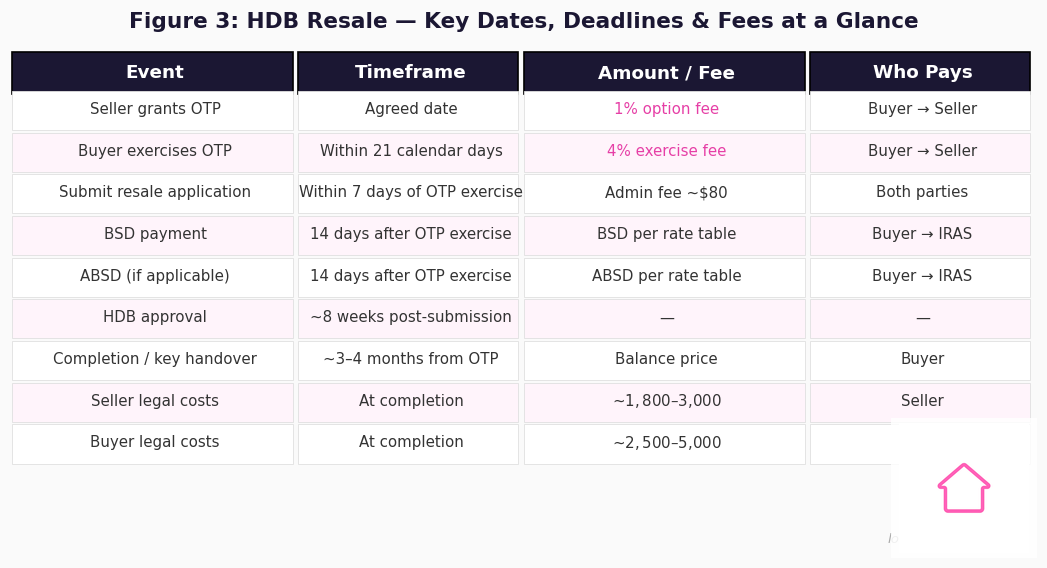
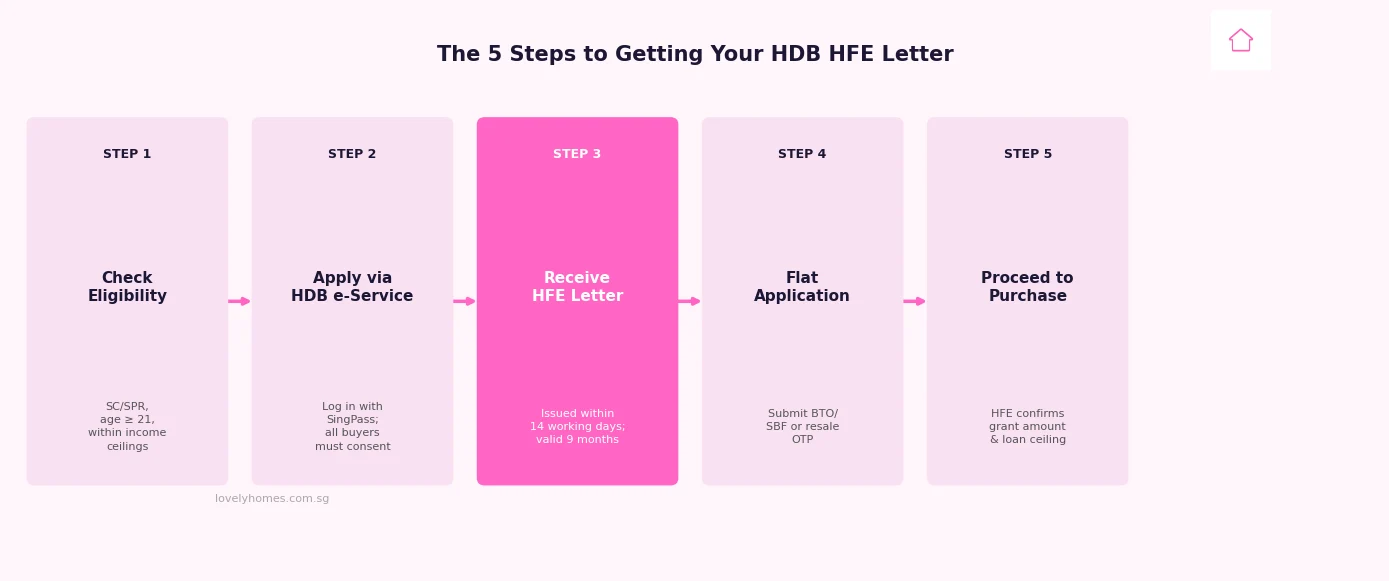
The mechanics are tight. The option fee is anything from S$1 to S$1,000, agreed by the parties. The exercise window is exactly 21 calendar days, including weekends and public holidays, expiring at 4pm on the 21st day. Both parties must already hold a valid HDB Flat Eligibility (HFE) Letter before the OTP is granted — the HFE confirms the buyer’s eligibility, income ceiling status, grant entitlement and loan position. The combined option fee and option exercise fee cannot exceed S$5,000, so the entire deposit on an HDB resale flat is capped at less than 1% of a typical S$650,000 four-room transaction.

If the buyer fails to exercise the OTP within the window, the option fee is forfeited and the seller can re-list the flat the next day. If the buyer exercises, the OTP becomes a binding contract and the parties move to completion through HDB’s First and Second Appointment process — legal completion is roughly eight to ten weeks from exercise.

Private property OTP — the bespoke-contract regime

Private property OTPs are drafted by the seller’s law firm. There is no prescribed form, although market practice has converged on a fairly stable template. The option fee is conventionally 1% of the agreed price — on a S$1.6 million condo, that is S$16,000 paid on the day the OTP is granted. The exercise window is typically 14 days, although it can be negotiated longer for buyers who need more time to arrange financing.

On exercise, the buyer pays a further 4% — the balance deposit — bringing the total deposit to 5%. The remaining 95% is settled at completion, typically 10 to 12 weeks later, through a combination of bank loan, CPF Ordinary Account and cash.

Because the form is bespoke, buyers’ lawyers should be reading every clause: search clauses (does the seller warrant clear title?), encumbrance disclosures, completion-date provisions, and any handover conditions on fixtures or tenanted units. A sloppy private OTP can leave the buyer footing a six-figure surprise — an undischarged caveat, a sitting tenant, or an unconsented renovation that the bank refuses to finance.

HDB OTP vs Private Property OTP Singapore -- 9-row comparison matrix
Figure 2: The two OTP regimes side-by-side. The deposit caps and exercise mechanics are the points where most first-time buyers come unstuck.

Stamp duties — the 14-day clock that catches everyone

Buyer’s Stamp Duty (BSD) is the duty payable on every property purchase in Singapore, levied by the Inland Revenue Authority of Singapore (IRAS) under the Stamp Duties Act. For residential property, BSD scales from 1% on the first S$180,000 up to 6% on amounts above S$3 million. Additional Buyer’s Stamp Duty (ABSD) sits on top: 0% for first-property Singapore Citizens, 20% on a second residential property, 30% on a third, and 60% for foreigners on any residential purchase. Permanent Residents pay 5% on a first home and 30% on a second.

The 14-day clock starts running on OTP exercise, not on completion. A buyer who exercises on 1 June must have paid BSD and ABSD by 15 June. Late payment attracts a penalty of 5% per month (or S$5 per day, whichever is greater), and IRAS will not register the sale until the duty is paid in full. The trap is that buyers focused on completion paperwork, loan documentation and renovation planning sometimes assume stamp duty waits until completion. It does not.

Summary table — the OTP at a glance

Stage HDB Resale Private Property
Pre-condition Buyer holds valid HFE Letter Loan AIP recommended
Form HDB-prescribed via Resale Portal Drafted by seller’s lawyer
Option fee S$1 to S$1,000 ~1% of price
Exercise window 21 days (expires 4pm Day 21) 14 days (negotiable)
Exercise fee Combined deposit capped at S$5,000 ~4% of price (deposit reaches 5%)
BSD / ABSD Within 14 days of OTP exercise Within 14 days of OTP exercise
Buyer non-exercise Option fee forfeited Option fee (1%) forfeited
Seller default Specific performance via HDB Damages or specific performance via court
Completion ~8-10 weeks via HDB appointments ~10-12 weeks via private conveyancing

Worked Example — S$1.6M private condo OTP

Lim Wei Sheng, a 34-year-old Singapore Citizen first-time buyer, has agreed to buy a three-bedroom condo in District 15 for S$1,600,000. The seller’s lawyer issues an OTP on Day 0; Wei Sheng pays a 1% option fee of S$16,000 to the seller. He has 14 days to exercise.

On Day 7, his bank’s panel valuer comes back at S$1,550,000 — S$50,000 below the price. Wei Sheng can either walk away (forfeiting S$16,000) or bridge the gap in cash. He has S$420,000 in his Ordinary Account plus S$280,000 in cash savings; he chooses to bridge. On Day 13, he exercises the OTP, signing the acceptance copy and paying a further 4% (S$64,000) as the option exercise fee. The deposit now stands at 5% — S$80,000 — held by the seller’s lawyer in escrow.

The 14-day stamp-duty clock starts the same day. By Day 27, his lawyer files BSD with IRAS: 1% on the first S$180,000, 2% on the next S$180,000, 3% on the next S$640,000, 4% on the next S$500,000 and 5% on the remaining S$100,000 = approximately S$48,600. As a first-property Singapore Citizen, no ABSD applies. His total cash and CPF outlay across the 14-day exercise period and the next two weeks is S$128,600 (option fee + exercise fee + BSD).

Completion happens 10 weeks after exercise. On completion day, the bank disburses S$1,162,500 (75% LTV on the S$1,550,000 valuation, not the S$1,600,000 price — the lower of the two). Wei Sheng tops up with S$357,500 from CPF + cash to bridge the difference, plus the S$50,000 valuation gap that he had budgeted for. Total cash and CPF deployed by completion: roughly S$486,100.

Option to Purchase Singapore worked example -- S$1.6M private condo cash and CPF flow
Figure 3: Wei Sheng’s cash flow across the 14-day exercise window and beyond, plus the failure modes that catch first-time buyers.

What this means for buyers

The OTP is the moment financial flexibility evaporates. Before signing, the buyer can walk away costlessly. After signing, every option costs four to five figures. The single most useful piece of preparation is to commission an indicative valuation before the OTP is granted — banks will provide a free desktop estimate to applicants who have an Approval-in-Principle (AIP) for a home loan, and HDB charges a flat S$120 for a formal valuation request. A buyer who walks into negotiations knowing the bank’s valuation band can avoid the most expensive surprise in the process.

The second protection is liquidity. A buyer should hold the option fee, the option exercise fee, the stamp duty AND a 5% buffer for valuation shortfalls in cash or CPF before signing the OTP. Borrowing the deposit from family or running CPF down to zero in expectation of the loan is precisely the situation that creates forced re-bridging or forfeiture.

What might come next

The Singapore Land Authority and HDB have, over the past decade, gradually moved more of the OTP process onto digital platforms — the HDB Resale Portal launched in 2018, electronic stamping has been mandatory since 2010, and the Smart Nation Initiative has consistently pushed for more end-to-end conveyancing digitisation. Industry observers expect further consolidation of the private OTP process, possibly with a standardised electronic template that lawyers customise rather than draft from scratch. None of that will change the underlying economics: the option fee, the exercise window, the BSD clock and the valuation gap will continue to be the four pressure points that determine whether a buyer’s transaction completes smoothly.

FAQ

Can I extend the OTP exercise window if I need more time for my loan?

For HDB resale OTPs, no — the 21-day window is fixed by the prescribed form. For private property OTPs, yes, but only if the seller agrees. Some sellers will extend by a week in exchange for additional consideration; some will not. Buyers asking for extensions are often perceived as financially weak, so it is better to delay signing until financing is confirmed.

What happens if the bank’s valuation comes in below my purchase price?

The bank lends 75% of the LOWER of price or valuation. If you bought at S$1.6M and the valuation is S$1.55M, the maximum loan is S$1,162,500 (75% of S$1.55M). The S$50,000 difference must come from cash. You cannot finance the gap with another mortgage. If you cannot bridge, your only options are to walk away (forfeit the option fee) or renegotiate the price down to the valuation, which the seller is under no obligation to accept.

Can the seller back out after granting an OTP?

Not without consequence. The OTP locks the seller in for the exercise window. If they refuse to honour an exercised OTP, the buyer can sue for specific performance (forcing the sale through) or for damages. In practice, most disputes settle — sellers typically pay the buyer’s legal costs plus a reasonable damages amount rather than litigate. The protection is far stronger than many buyers realise.

Do I need a lawyer to sign the OTP, or can I sign it myself?

For HDB resale, the prescribed form is straightforward and many buyers handle it themselves through the Resale Portal. For private property, you should engage a conveyancing lawyer BEFORE signing — the bespoke clauses can hide significant exposure (sitting tenants, undisclosed encumbrances, completion-date traps). Lawyers’ fees for a standard private OTP plus completion typically run S$2,500-3,500 plus disbursements. The HDB equivalent is roughly S$1,800-2,500.

Can I assign or transfer my OTP to someone else?

Generally no. Both HDB and private OTPs are issued in the buyer’s name and are not assignable without the seller’s consent. An attempt to “flip” an OTP to another party before exercise is a contractual breach and, if it involves stamp duty avoidance, an offence under the Stamp Duties Act. The 99-to-1 audit by IRAS in 2023 showed that the authorities take naming changes between OTP and completion seriously.

What if I lose my job between OTP exercise and completion?

This is one of the most punishing scenarios. Once the OTP is exercised, you are bound to complete. If you cannot secure the loan because your income drops, you are still legally obligated to pay the seller. In practice, the buyer’s deposit (5% on private property) is forfeited and the seller can sue for any further loss if they re-sell at a lower price. This is the reason buyers are advised to lock in firm loan offers in writing, not just an AIP, before exercising.

How is the OTP different from a Sale and Purchase Agreement (SPA)?

An OTP is an option contract; an SPA is a binding sale contract. When a buyer exercises an OTP, the OTP itself becomes the binding sale contract — there is usually no separate SPA for resale transactions. For new launches buying directly from a developer, the structure is different: the buyer signs an Option to Purchase, exercises by signing the SPA within three weeks, and pays 4% on top of the 5% booking fee. The new-launch SPA is statutorily prescribed under the Sale of Commercial Properties Rules / Housing Developers (Show Unit) Rules.

Related Articles

Disclaimer

This article is general information for the Singapore property market in 2026 and does not constitute legal, financial or tax advice. Stamp duty rates, OTP forms and HDB regulations change — verify the current position with primary sources at the time of any transaction: the Inland Revenue Authority of Singapore (iras.gov.sg), Housing and Development Board (hdb.gov.sg), Urban Redevelopment Authority (ura.gov.sg), and the Monetary Authority of Singapore (mas.gov.sg). Engage a qualified conveyancing lawyer and a MAS-licensed financial adviser before signing any OTP. LovelyHomes accepts no liability for actions taken on the basis of this article.

Tags: Option to Purchase, OTP Singapore, HDB OTP, Private Property OTP, Buyer’s Stamp Duty, BSD, ABSD, Conveyancing, HDB Resale, Property Law Singapore, First-Time Buyer, Property Finance.

HPS Mortgage Insurance Singapore 2026: Home Protection Scheme, MRTA & When to Opt Out

HPS Mortgage Insurance Singapore 2026: Home Protection Scheme, MRTA & When to Opt Out

When you buy a Singapore home, the lender is not the only party who wants to be sure the loan gets repaid. The state, your family, and your CPF balance all have a stake — which is why mortgage insurance is built into the rules, not bolted on later. Singapore runs two parallel systems: the Home Protection Scheme (HPS) for HDB-loan flats, administered by the CPF Board, and Mortgage-Reducing Term Assurance (MRTA) for private bank loans, sold by commercial insurers. They look similar but behave very differently — and choosing wrong can cost you S$300 to S$1,200 a year, or worse, leave your spouse holding a six-figure loan.

Quick Answer

  • HPS is mandatory for any flat owner servicing an HDB loan and using CPF for repayments — no exceptions unless you can prove equivalent cover.
  • MRTA is optional on bank loans, but most lenders strongly encourage it, and you can often pay the premium with CPF (subject to caps).
  • Both pay the lender first on death or total permanent disability (TPD). Only what is left after settling the loan reaches your estate.
  • HPS premium rises sharply after age 50 — a 30-year-old pays roughly S$200 to S$400 a year on a S$400,000 loan; a 55-year-old can pay over S$1,800.
  • Opt-out is allowed only if you hold a separate life policy that covers the outstanding HDB loan and names the lender or estate appropriately.
  • MRTA can carry critical-illness or retrenchment riders; HPS cannot. For older buyers or self-employed earners, the rider economics often beat HPS.
  • If you redeem the HDB loan early, CPF Board refunds a pro-rata HPS premium. MRTA’s surrender value depends on the policy.
HPS Mortgage Insurance Singapore 2026 hero — Home Protection Scheme guide
LovelyHomes — HPS vs MRTA: how Singapore’s two mortgage-insurance systems compare in 2026.

What HPS actually is — and why it exists

The Home Protection Scheme is a statutory mortgage-reducing decreasing term insurance administered by the CPF Board. Every owner who services an HDB loan and uses CPF Ordinary Account (OA) for repayments must be covered, with sums assured equal to the outstanding HDB loan and a coverage period matching the remaining loan tenure (capped at age 65). When a covered owner dies or is certified TPD, CPF Board pays the outstanding HDB loan on the deceased’s share — so the surviving family inherits a flat that is unencumbered to the extent of the deceased’s HPS share.

HPS exists because the policy intent of public housing is to keep families housed even after a tragedy. Without HPS, a sudden death could force a forced sale to clear the HDB mortgage, exactly when the family can least afford to move. The trade-off is mandatory enrolment — and a premium schedule that rises with age and outstanding loan size.

What MRTA covers and where it differs

MRTA is the private-market analogue: a decreasing term-life policy underwritten by a commercial insurer, sized to your bank-loan amortisation. Unlike HPS, MRTA is voluntary, requires full medical underwriting rather than a simple declaration, and offers the flexibility of single-premium upfront payment (often funded out of the bank loan itself or your CPF OA up to a cap) or annual premiums.

The key practical edges MRTA has over HPS:

  • Critical illness (CI) rider — pays out on a covered diagnosis (cancer, heart attack, stroke and a defined list) before death. HPS does not offer this.
  • Retrenchment or disability income riders — keep paying instalments for 6 to 12 months on involuntary unemployment.
  • Smoker / non-smoker pricing — a healthy young non-smoker can be priced below HPS, especially for large bank loans.
  • Joint policies — couples can buy a single MRTA covering both lives, with the loan paid on the first death.
HPS vs MRTA comparison matrix Singapore 2026
Figure 1: HPS (CPF Board) and MRTA (private bank-loan cover) compared across 10 features.

How HPS premiums are calculated

HPS uses a single-premium annual model: each year the CPF Board recalculates your premium based on your age (next birthday), the outstanding loan, your share of ownership, and the remaining tenure. The single premium can be paid from CPF OA (most common) or in cash. Because the sum assured falls each year as you amortise the loan, the premium tends to plateau or fall mildly through your 30s and 40s, before rising sharply through your 50s and into early 60s.

The shape of the curve is the most important number for buyers to internalise. A 30-year-old buying a S$400,000 HDB-loan flat might pay around S$210 in year one. The same flat held by a 55-year-old refinancing across to a longer tenure could see HPS premium hit S$1,800 a year — a 9-fold gap that compounds across the loan term.

HPS premium curve by age S$400,000 loan Singapore 2026
Figure 2: indicative HPS premium by age, S$400,000 outstanding HDB loan. The curve steepens after age 50.

CPF use, eligibility and payout mechanics

HPS premium can be paid from CPF OA without breaching the broader CPF housing limits — it is treated as an essential cost of using CPF for housing. MRTA can also be funded from CPF OA, but the amount is capped (typically by the lender’s policy and the CPF Board’s housing rules), and any excess must be in cash.

On a death claim, both schemes pay the lender first. The HPS payout is calculated on the deceased’s ownership share of the flat — so a 50/50 couple sees HPS settle 50% of the outstanding HDB loan on the first death, leaving the survivor responsible for the remaining 50%. This is why most mortgage planners recommend HPS coverage be sized to your full share of the loan, not just half.

Opt-out: who qualifies and how

HPS is mandatory by default, but the CPF Act allows opt-out where the owner already holds equivalent insurance. In practice, “equivalent” means a life or term-assurance policy with sum assured at least equal to the outstanding HDB loan, naming a beneficiary structure that ensures the proceeds clear the loan on death — usually by naming the lender or the estate. Whole-life, term, and Group Term Life policies issued by employers can all qualify, subject to the policy term and sum assured tests.

The application is filed with CPF Board with a copy of the in-force policy schedule. Approval typically takes 4 to 6 weeks. If your equivalent policy lapses, you must rejoin HPS — at the age you are then, which may be considerably more expensive.

HPS opt-out decision scenarios Singapore 2026
Figure 3: five buyer scenarios where opting out of HPS in favour of private MRTA usually pays off.

Summary table — at-a-glance feature comparison

The matrix below condenses the most-asked questions into a single summary view. Use it as the quick reference; the worked example below brings the numbers to life.

Dimension HPS MRTA
Required for HDB loan Yes No (HPS applies)
Required for bank loan No Optional, encouraged
Age 30 indicative premium (S$400k loan) ~S$210/yr ~S$180–S$320/yr
Age 50 indicative premium ~S$1,100/yr ~S$650–S$1,200/yr
CI rider available No Yes (~S$200–S$600/yr)
Underwriting Health declaration only Full medical
Smoker loading No Yes (15–35%)
Premium fundable from CPF OA Yes Yes (capped)
Refund on early loan payoff Pro-rata Surrender value if applicable

Worked Example: Mr and Mrs Tan, age 35, S$520,000 HDB loan

Profile. Tan, 35 (non-smoker), and Mrs Tan, 33 (non-smoker). Both Singapore Citizens, joint owners (50/50) of a S$650,000 4-room BTO in Sengkang, financed with a S$520,000 HDB concessionary loan over 25 years at 2.6% interest.

Default HPS path. Both spouses enrol in HPS at policy inception, each covering 50% (S$260,000) of the outstanding loan on their share. CPF Board’s age-35 single premium for a S$260,000 sum assured comes to roughly S$165 per spouse per year in year one — about S$330 combined. Premiums fall slowly through their 30s, plateau in the 40s, then rise into the 50s.

Alternative MRTA path. Both Tans hold a S$300,000 30-year level-term policy from before the BTO purchase, with sums assured already exceeding their HDB-loan share. Filing for HPS opt-out with CPF Board (typically 4 to 6 weeks) eliminates the HPS premium entirely. Annual saving in year one: S$330. Over a 25-year horizon, with HPS premiums rising into the 40s and 50s, the cumulative saving is approximately S$18,000 to S$24,000 in nominal terms.

Caveat. The opt-out only holds while the equivalent policies are in force. If either Tan’s term policy lapses or is cancelled, CPF Board requires immediate re-enrolment in HPS at the prevailing age — which by then could be 45 or 50, with premiums an order of magnitude higher.

What this means for you

For most young HDB buyers, HPS is exactly the right product: low premium, simple paperwork, no medical underwriting, and a state-administered safety net for the family. Trying to “optimise” it can quickly turn into false economy — especially if your existing life cover is only just large enough today and might not be tomorrow.

For older buyers, self-employed primary earners, or households with health-screening concerns ahead of a remortgage, the calculation changes. MRTA’s CI rider, smoker / non-smoker pricing differential, and the ability to lock in a single-premium policy at today’s age can compound into meaningful five-figure savings over a 20-year tenure. Run both quotes through the worked-example structure above before committing.

What might come next

The CPF Board reviews HPS premium tables periodically. With Singapore’s mortality assumptions improving and longevity stretching beyond age 85, the long-run direction of HPS premiums for younger buyers is broadly flat to slightly down, while older-age premiums may face upward pressure as more borrowers stretch tenures into their late 60s. Industry observers also expect the private MRTA market to continue expanding CI rider coverage and adding mental-health and severe-disability triggers — a useful tailwind for buyers who can underwrite cleanly today.

Separately, with the Plus and Prime flat categories taking root since August 2024, the universe of HDB-loan buyers will increasingly skew younger and tied to longer 10-year MOPs. That suggests HPS will remain the dominant cover for at least the next decade, with private MRTA growing its share among bank-loan EC buyers and refinancers above 45.

FAQ

Is HPS the same as life insurance?

No. HPS is a mortgage-reducing decreasing term assurance tied to your HDB-loan balance. The sum assured falls each year as the loan amortises, and HPS pays only on death or TPD — not on critical illness, hospitalisation or retrenchment. It is best thought of as protection for the bank, not protection for the family’s lifestyle. You still need separate life and CI cover for those.

Can I use CPF to pay HPS or MRTA premiums?

HPS premium is paid out of CPF OA by default — you do not need to top up cash unless your OA is depleted. MRTA premiums can also be funded from CPF OA up to a cap; any excess must be paid in cash. This makes HPS slightly more “cash-flow friendly” for younger buyers with healthy OA balances, even before comparing premium tables.

What happens if my spouse is uninsurable?

HPS uses a simple health declaration rather than full medical underwriting, so it accepts most applicants who can answer “no” to a small set of yes / no questions. If your spouse is medically declined for MRTA — for example, due to a chronic condition — HPS often becomes the only practical cover and is therefore precious. Plan accordingly: opt-out is rarely the right answer if one spouse is borderline insurable.

Does HPS pay out if I’m diagnosed with cancer?

Only if the cancer leads to death or to a state of total permanent disability as defined by CPF Board. HPS does not pay on diagnosis. If CI cover is important to you — and for buyers over 45 it usually is — pair HPS or MRTA with a separate CI rider or standalone CI policy, sized to the loan and ideally to a year or two of household income.

Can I switch from HPS to MRTA after buying?

Only by refinancing your HDB loan over to a bank loan and applying for HPS exemption with proof of equivalent cover. Once refinanced to a bank loan, HPS no longer applies (it covers HDB-loan flats only). This is an irreversible direction — once on a bank loan, you cannot return to an HDB concessionary loan, so weigh the long-term interest-rate exposure against the insurance economics carefully.

What does HPS cost relative to my mortgage repayment?

For a typical S$400,000 HDB-loan buyer in their 30s, HPS premium runs at well under 5% of annual interest. Through the 50s, that ratio can push 8 to 12% as premiums rise sharply with age. The cost is meaningful but not punishing — and the economics flip dramatically against any uninsured outcome where the family inherits an outstanding loan they cannot service.

If my equivalent insurance lapses, what happens?

You must rejoin HPS at the prevailing age. CPF Board will notify you, and you will need a fresh declaration. If you fail to rejoin, you risk being uncovered on the HDB loan — a bad outcome both for the lender and for any beneficiaries. Treat the equivalent-policy condition as a long-term commitment, not a temporary workaround.

Related Articles

Disclaimer

This article is general information for Singapore property buyers and does not constitute financial, insurance or legal advice. HPS is administered by the CPF Board and detailed premium tables and eligibility rules are published there and on the HDB portal. Bank-loan MRTA terms vary by insurer and lender; verify with the issuing insurer and consult a licensed financial adviser before committing. Premium figures cited are indicative and should not be relied upon for purchase decisions. For tax and CPF interaction, refer to IRAS and CPF Board guidance.

Tags: HPS Singapore, MRTA, mortgage insurance, Home Protection Scheme, HDB loan, bank loan, CPF Ordinary Account, decreasing term assurance, critical illness rider, opt-out, mortgage refinancing, Singapore property finance.

Translate »