Singapore HDB Resale Market Guide 2026: Price Trends, What Drives Values and How to Read HDB Data

Singapore HDB Resale Market Guide 2026: Price Trends, What Drives Values and How to Read HDB Data

The HDB resale market in Singapore is one of the most transparent and data-rich property markets in the world. HDB publishes quarterly resale price indices, transacted price data by flat type and town, and volume statistics — yet most buyers and sellers never go beyond checking the headline figure. This guide teaches you how to read the data properly, what drives HDB resale prices in different estates, and what the Q1 2026 numbers actually mean for your buying or selling strategy.

Quick Answer — HDB Resale Market at a Glance (Q1 2026)

  • The HDB Resale Price Index (RPI) stood at 203.4 in Q1 2026, a −0.1% quarter-on-quarter dip — the first decline since Q2 2019 and a sign of market moderation after six years of growth.
  • Total HDB resale transactions in Q1 2026 were approximately 6,620 flats, with 4-room flats the most transacted at 2,690 units.
  • Median prices ranged from S$280,000 for 2-room Flexi flats to S$910,000 for multi-generation flats.
  • 412 HDB flats transacted at S$1 million or above in Q1 2026, a new quarterly record.
  • Mature estates (Queenstown, Bishan, Bukit Merah, Toa Payoh) continued to command median 4-room prices of S$760,000–S$860,000 — substantially above non-mature estates at S$450,000–S$510,000.
  • The 15-month wait-out period for private property sellers buying HDB resale (introduced April 2023) continues to suppress some upgrader demand in the mid-range segment.
  • URA Q2 2026 flash estimates for private property are expected in early July 2026; comparable HDB resale data will follow approximately two weeks later.

What Is the HDB Resale Price Index (RPI) and How Is It Compiled?

The HDB Resale Price Index is a quarterly statistic published by the Housing & Development Board that measures the change in resale prices of HDB flats over time. The base period is Q1 2009 = 100. An RPI of 203.4 in Q1 2026 means that the average price of an HDB resale flat is approximately 103.4% higher than it was in Q1 2009 — or, expressed differently, prices have more than doubled over 17 years.

The RPI is a mix-adjusted index. Rather than simply averaging transaction prices — which would be distorted by changes in the mix of flat types transacted each quarter — HDB uses a hedonic regression methodology that controls for flat type, storey range, floor area, estate, and remaining lease. This makes the RPI a more reliable indicator of underlying price change than raw median price movements.

The RPI is distinct from the median transacted price, which is the midpoint of all resale prices in a given period and is influenced by the mix of flats transacted. A quarter with unusually high sales of large 5-room flats in mature estates will show a higher median price even if underlying prices have not changed. The RPI strips out this compositional effect. For understanding whether prices are rising or falling, the RPI is the right metric; for understanding how much to pay for a specific flat type in a specific estate, median transacted prices and psf figures are more useful.

HDB Resale Price Index RPI trend Q1 2020 to Q1 2026 Singapore property market
Figure 1: HDB Resale Price Index from Q1 2020 to Q1 2026. The three shaded phases show the pandemic-era recovery (2020–21), the surge driven by construction delays and demand spillover (2021–23), and the current moderation phase (2024–26). The Q1 2026 reading of 203.4 represents the first quarterly dip since Q2 2019.

Reading HDB Resale Volume: What Transaction Counts Tell You

Volume data — the number of resale transactions in a given period — is a leading indicator of market sentiment. Volumes typically rise when sentiment is bullish (buyers are willing to transact), and fall when buyers are cautious or when supply alternatives (BTO launches, new private launches) absorb demand. HDB publishes resale volume data monthly via the HDB Resale Flat Prices dataset on data.gov.sg, updated within approximately two weeks of the end of each month.

In Q1 2026, total HDB resale volumes were approximately 6,620 transactions. The 4-room flat segment dominated at 2,690 transactions, followed by 5-room at 1,980. 3-room flats at 1,250 and executive/multi-gen flats at 420 combined make up the remainder. The dominance of 4-room flats reflects both the breadth of stock — 4-room flats are the most common type in the HDB inventory — and the preference of first-timer upgrader families for this size.

HDB resale transactions volume and median price by flat type Q1 2026 Singapore
Figure 2: HDB resale transactions (bars, left axis) and median transacted price (diamonds, right axis) by flat type in Q1 2026. The 4-room flat is both the most transacted segment and the anchoring data point for most market comparisons. Multi-generation flats show the highest median price but the smallest volume by some margin.

What Drives HDB Resale Prices in Different Estates?

The single largest driver of HDB resale prices is estate classification — specifically, whether the flat is in a mature or non-mature estate. HDB classifies 24 of its 26 towns as either mature or non-mature; the two newest, Tengah and Bidadari (Woodleigh), sit in between. Mature estates include Queenstown, Toa Payoh, Bishan, Bukit Merah, Ang Mo Kio, Clementi, Tampines, Marine Parade, Kallang/Whampoa, Geylang, Bedok, Serangoon, Hougang (partial), and Pasir Ris. Non-mature estates include Woodlands, Jurong West, Bukit Batok, Bukit Panjang, Choa Chu Kang, Sembawang, Sengkang, Punggol, and Yishun.

Within the mature-non-mature distinction, five further factors determine the price premium or discount a specific block commands:

MRT and transport connectivity is the most consistent price driver in Singapore research. Flats within a 5-minute walk of an MRT station typically command a 5–15% premium over comparable flats in the same estate further from the station, depending on the line, the interchange status, and the destination accessibility. The Thomson-East Coast Line has boosted prices in previously underserved areas such as Woodlands North and Caldecott.

Remaining lease has become increasingly important since the introduction of the CPF remaining-lease framework in 2019. Flats with fewer than 60 years of lease remaining are significantly harder to finance with CPF, and many banks apply stricter LTV limits. In practice, this suppresses demand and prices for older flats in mature estates, while newer BTO cohorts completing their MOP in the same estate attract a premium.

School catchment drives demand in proximity to popular primary schools with competitive phases 2A and 2B registration. Flats within 1 kilometre of consistently over-subscribed primary schools — such as Raffles Girls’ Primary, Nan Hua Primary, and Catholic High Primary — command a measurable premium, particularly among families with primary-school-aged children making buying decisions in Q4 and Q1.

Block storey and flat orientation account for a further 3–8% variance within the same block. High-floor corner units with unobstructed city or greenery views can command premiums substantially above median, while low-floor units facing a car park or multi-storey car park trade at a discount.

Recent upgrader activity and MOP waves create localised price effects. When a large BTO project completes its 5-year MOP in a non-mature estate, the sudden availability of relatively new flats for resale can temporarily suppress prices for that flat type in that town as supply increases. Conversely, in a mature estate where no new BTO completions are due, scarcity sustains prices.

Town-by-Town Analysis: Mature vs Non-Mature Estate Pricing

The table below summarises median 4-room resale prices for selected towns in Q1 2026, sourced from HDB’s resale portal data. These figures represent the midpoint of all registered resale transactions for that flat type in that town in the quarter and are indicative only — individual block, floor, and remaining lease will cause material variation within any estate.

Town / Estate Classification Median 4-Room Price (Q1 2026) Approx. Median PSF
Queenstown Mature S$860,000 ~S$930
Bishan Mature S$820,000 ~S$890
Bukit Merah Mature S$790,000 ~S$860
Toa Payoh Mature S$760,000 ~S$820
Ang Mo Kio Mature S$660,000 ~S$715
Tampines Mature S$578,000 ~S$625
Bedok Mature S$560,000 ~S$605
Hougang Non-Mature S$510,000 ~S$555
Sengkang Non-Mature S$490,000 ~S$530
Woodlands Non-Mature S$460,000 ~S$500
Jurong West Non-Mature S$450,000 ~S$487

The Million-Dollar HDB Flat Phenomenon: What Is Driving It?

In Q1 2026, 412 HDB resale flats transacted at S$1 million or above — a new record for a single quarter. This compares with 82 transactions in the whole of 2021, 370 in 2022, 469 in 2023, and 983 in 2024. The trajectory is clear: what was once a curiosity has become a structural feature of Singapore’s resale market.

The drivers of million-dollar HDB transactions are well-documented by HDB and academic researchers. The vast majority of million-dollar transactions involve large flat types (5-room, executive, and multi-generation) in mature estates with strong MRT accessibility. Queenstown, Bishan, Toa Payoh, Kallang/Whampoa, and Bukit Merah account for a disproportionate share of such transactions. Floor level and remaining lease also matter: high-floor executive flats with 80–90 years of lease remaining in well-maintained blocks trade at significant premiums.

The broader macro context matters too. The April 2023 cooling measures (which raised ABSD for second-property Singapore Citizens from 17% to 20% and for foreigners from 30% to 60%) suppressed some private property demand and redirected a portion towards the HDB resale market. At the same time, the 15-month wait-out period for private property owners purchasing HDB resale flats means that private-to-public downgraders face a meaningful waiting cost, which tends to push up the price they are willing to pay when they can transact. These two dynamics — more buyers competing for top-tier HDB resale flats and a constrained supply of such units — sustain million-dollar transaction volumes even as overall HDB prices plateau.

Million dollar HDB flat transactions trend 2021 to Q1 2026 and town median prices Singapore
Figure 3 (left): Million-dollar HDB resale transactions by year/quarter. Q1 2026 set a new quarterly record of 412 transactions. Figure 3 (right): Selected town median 4-room resale prices, Q1 2026 — illustrating the wide price range across mature and non-mature estates.

How to Use HDB Resale Data for Buying and Selling Decisions

The most important data source for any HDB buyer or seller is the HDB Resale Flat Prices dataset, available free at data.gov.sg. This dataset lists every registered HDB resale transaction by address (block and street), flat type, storey range, floor area (sqm), resale price, remaining lease, and month of registration. Updated monthly with approximately a 2–4 week lag, it is the primary reference for any price benchmarking exercise.

For a seller, the process is: identify all 4-room resale transactions in your block and neighbouring blocks over the past 6–12 months. Isolate the transactions by storey range (high, mid, low) closest to your own floor. Compute the median price and median psf. Compare your flat’s specifications (floor area, remaining lease, renovation state) against those comparables to arrive at a pricing range. A well-renovated high-floor unit with 75+ years remaining lease should price at or above the top quartile of comparables; an older low-floor unit below the median.

For a buyer, the same dataset allows you to compute the Cash Over Valuation (COV) — the difference between the transacted price and the HDB-assessed value — though COV is not published directly. Instead, compare the transacted price against the HDB valuation you receive after submitting an Intent to Buy. If transacted prices for comparable units consistently exceed valuations by S$20,000–S$50,000, factor that COV into your cash planning: COV must be paid in cash, not CPF.

Our Singapore HDB Resale Price Index Guide 2026 covers how to interpret RPI movements in full, while our HDB Resale Buying Process Guide 2026 walks through the full transaction process from HFE application to key collection.

Worked Example: The Lim Family’s Resale Pricing Strategy

Profile: Mr and Mrs Lim (Singapore Citizens), sellers of a 5-room HDB flat in Ang Mo Kio, 1,291 sqft, Floor 12–14, MOP cleared January 2024. They purchased at S$520,000 in 2019 and used S$150,000 CPF (with S$40,000 accrued interest by 2026) and an HDB loan at 2.6%.

Market benchmarking: Using the data.gov.sg dataset, they identify 18 transactions of 5-room flats in their estate over the past 12 months: floors 07–09 ranged from S$580,000–S$620,000; floors 10–14 ranged from S$610,000–S$665,000; floor 15+ ranged from S$650,000–S$700,000. Median for their storey band: S$635,000.

Their flat’s specifications: 76 years remaining lease (2026). Recently renovated kitchen and bathrooms (2022, S$35,000 spend). North-facing with corridor view (modest discount). No outstanding Town Council arrears.

Pricing decision: Given renovation premium but below-median orientation, they price at S$638,000 — fractionally above the storey-band median. They receive two offers: S$625,000 (no agent, cash-light buyer) and S$640,000 (buyer using CPF and bank loan). They accept the second offer.

Net proceeds calculation: Gross S$640,000 − outstanding HDB loan (S$195,000) − CPF refund with accrued interest (S$190,000) − legal fees (S$2,500) = approximately S$252,500 net cash to the Lims after completion. They use this as the down payment for an RCR resale condo, subject to the 15-month wait-out period (they are SPR buyers) not applying to them as Singapore Citizens without a pre-existing private property interest.

Why This Matters: HDB as a Wealth Accumulation and Affordability Tool

The HDB resale market occupies a unique position globally: it is simultaneously a public housing programme and a significant component of household wealth for the majority of Singapore residents. More than 80% of Singapore residents live in HDB flats, and for most of them, the flat represents the single largest asset on the household balance sheet. Understanding how to read market data, price correctly, time the market cycle, and manage the proceeds of a resale transaction is therefore a financial literacy issue with material consequences.

The Q1 2026 RPI dip of −0.1% is modest and may not persist, but it represents the first evidence of supply catching up with demand after the extraordinary 2021–2023 surge. The June 2026 BTO launch of 6,952 flats across 7 projects — including Plus and Prime-category flats in Lakeview/Shunfu and Kallang/Whampoa — will provide further supply that, upon TOP in 5–6 years, adds to the MOP pipeline. Buyers considering a resale flat today should factor in this medium-term supply trajectory when assessing whether to pay a market-rate or below-market price in a particular estate.

For sellers, the plateau in overall RPI does not mean all estates are equally flat: the data shows continued strength in well-located mature estates and continued moderation in non-mature estates where BTO supply has been most generous. Estate-level and block-level analysis, not national headline figures, should drive pricing decisions.

What Might Come Next: URA Q2 Flash Estimates and HDB Policy Watch

The URA Q2 2026 private residential property flash estimates are expected in the first week of July 2026, with HDB’s comparable Q2 resale statistics following approximately two weeks later. These will be the first quarterly data points to reflect a full quarter of market activity since the June 2026 BTO launch and the Lorong Puntong GLS tender (launched June 2026, tender close expected mid-July 2026). Industry observers are watching whether the modest Q1 2026 RPI dip translates into a sustained trend or whether volumes and prices recover in Q2 driven by year-end school-allocation planning by families.

On the policy front, the Ministry of National Development has indicated no immediate plans to adjust existing HDB resale market measures. The 15-month wait-out period and the PLH 10-year MOP rules introduced in May 2026 are expected to remain in place for the foreseeable future. Any relaxation would likely require evidence of a sustained demand-driven price correction, which the Q1 2026 data alone does not provide.

Frequently Asked Questions

What does the RPI −0.1% in Q1 2026 mean in practical terms?

A −0.1% quarter-on-quarter change in the RPI means that, controlling for flat type, storey range, floor area, estate, and remaining lease, the average resale price in Q1 2026 was marginally lower than in Q4 2025. In absolute terms, a flat that would have been worth S$650,000 at the Q4 2025 pricing level is now worth approximately S$649,350 at Q1 2026 pricing — a difference of S$650. This is a statistical signal of a turning point rather than a meaningful financial impact on any individual transaction. The significance is in the directionality: it is the first decline in six years and suggests the period of sustained price growth has paused, if not reversed. Whether this becomes a sustained trend depends on supply (BTO completions, MOP waves) and demand (income growth, interest rates, immigration policy) dynamics over the next 2–4 quarters.

How do I find the actual transacted prices for flats near the one I want to buy?

The most direct source is the HDB Resale Flat Prices dataset on data.gov.sg, updated monthly. You can download the full dataset as a CSV and filter by block, street, flat type, and storey range. Alternatively, the HDB Resale Portal (myHDBPage) provides a built-in comparable transaction search for buyers with an active Intent to Buy. The HDB Resale Portal also shows HDB’s assessed valuation for each flat, which you can compare against recent transacted prices to gauge the current COV level. SRX and 99.co also aggregate this data in more user-friendly dashboards, though they typically have a 1–3 week lag relative to data.gov.sg.

Is the 15-month wait-out period for private property sellers buying HDB resale still in force?

Yes. The 15-month wait-out period, introduced on 30 September 2022, requires a person who has disposed of a private residential property (whether by sale, gift, or compulsory acquisition) to wait 15 months before submitting an Intent to Buy for an HDB resale flat. This applies to both the main applicant and all listed occupiers. The period is measured from the date of disposal (typically the legal completion date for a sale, or the date of distribution for a gift). There are limited exceptions: persons over 55 buying a 4-room or smaller flat are exempt. The measure was introduced to reduce private-to-public downgrader demand pressure on the HDB resale market and remains in force as at June 2026.

How does the remaining lease of an HDB flat affect its resale value?

Remaining lease affects resale value through two direct channels. First, CPF withdrawal is restricted for flats with fewer than 60 years remaining lease, which narrows the pool of eligible buyers and reduces their purchasing power — the immediate effect is a discount to market. Second, bank financing may be more restrictive for short-lease flats, as banks apply LTV adjustments when the property’s remaining lease at the end of the loan term is below certain thresholds. Empirically, research shows that HDB flats lose value more rapidly once remaining lease falls below 60 years, and the effect accelerates below 40 years. For sellers, a flat with 80–90 years remaining trades at a meaningful premium over an otherwise identical flat with 55–60 years remaining.

Can Singapore Permanent Residents buy HDB resale flats, and are there restrictions?

Singapore Permanent Residents (SPRs) can purchase HDB resale flats but face additional restrictions compared to Singapore Citizens. SPRs cannot purchase new BTO flats (except as part of a household with at least one SC). For resale, the SPR household must have obtained a valid HDB Flat Eligibility (HFE) letter, which is granted if the SPR has held PR status for at least 3 years. SPRs are subject to ABSD of 5% on their first residential property, and if buying as a single SPR, they must be at least 35 years old. SPR households are also subject to the Ethnic Integration Policy quota when purchasing resale flats. Our HDB Flat Eligibility Guide 2026 covers SPR eligibility in full.

What CPF grants can I use when buying an HDB resale flat?

HDB resale buyers may be eligible for the Enhanced Housing Grant (EHG), Family Grant, and Proximity Housing Grant (PHG), subject to household income ceilings and eligibility criteria. For a first-timer SC couple buying a resale flat, the maximum combined grants can reach up to S$230,000 (EHG S$120,000 + Family Grant S$80,000 + PHG S$30,000) at the lowest income tier. The EHG is income-tested and tapers from a maximum of S$120,000 for households earning S$1,500 or less per month to S$0 for those earning above S$9,000. Unlike BTO grants, resale grants are not subject to a flat-type restriction — they can be applied to any flat type in any estate. Our CPF Housing Grant Guide 2026 explains each grant scheme in detail.

Is ABSD payable when buying an HDB resale flat?

Yes. ABSD applies to HDB resale flats in the same way as private residential properties. A Singapore Citizen buying their first residential property (including an HDB resale flat) pays 0% ABSD. A Citizen buying a second residential property pays 20% ABSD on the purchase price. A Singapore PR buying their first residential property pays 5% ABSD. Because ABSD is calculated on the full purchase price and must be paid in cash (CPF cannot be used), the ABSD liability can be material — 20% of S$580,000 on a Tampines 4-room resale would be S$116,000 in cash. For SC couples where one spouse owns private property, the ABSD remission scheme may allow recovery of the ABSD if the private property is sold within 6 months of the HDB resale completion.

Related Articles


Disclaimer: This article is for general informational purposes only and does not constitute financial, legal or professional advice. HDB resale prices are indicative and based on publicly available data; individual transaction prices will vary significantly by block, storey, remaining lease, and flat condition. Always verify prices using official sources including HDB’s Resale Flat Prices dataset at data.gov.sg, and seek advice from a licensed property agent and financial adviser before transacting. For HDB eligibility and grants, refer to hdb.gov.sg. For ABSD and stamp duty matters, refer to iras.gov.sg.

Singapore HDB Resale Buying Process Guide 2026: Complete Step-by-Step from HFE to Keys

Singapore HDB Resale Buying Process Guide 2026: Complete Step-by-Step from HFE to Keys

Buying an HDB resale flat in Singapore involves a carefully sequenced set of steps — from securing your HDB Flat Eligibility (HFE) letter before you even make an offer, to submitting paperwork through the HDB Resale Portal, to collecting your keys weeks later. Unlike new BTO flats, resale transactions happen on the open market between private buyers and sellers, which means the process is faster but also requires more independent action from you. This guide walks through every stage of the Singapore HDB resale buying process for 2026, with exact timelines, fees, CPF rules, and a worked dollar example so you know precisely what to expect.

Quick Answer: HDB Resale Buying Process 2026

  • Obtain your HFE letter first — it confirms eligibility, grants, and HDB loan status. Processing takes roughly 2–3 weeks.
  • The OTP (Option to Purchase) is granted by the seller; you have 21 calendar days to decide whether to exercise it.
  • Option fees: up to S$1,000 to grant the OTP; up to S$4,000 (flat ≤ S$500K) or S$9,000 (flat > S$500K) to exercise — total capped at S$5,000 or S$10,000 respectively.
  • Both buyer and seller must register on the HDB Resale Portal within 7 days of exercising the OTP.
  • HDB takes roughly 6–8 weeks to process and approve the transaction after submission.
  • Buyer’s Stamp Duty (BSD) is payable within 14 days of exercising the OTP; it can be paid via CPF Ordinary Account (OA).
  • CPF housing grants (EHG, Family Grant, PHG) are credited at the point of completion — they reduce your outstanding loan or boost your CPF contribution.
  • Total timeline from HFE to key collection: typically 18–24 weeks (faster if seller is cooperative and solicitors are prompt).
  • No ABSD for first-time Singapore Citizens buying a single property; second-property buyers pay 20%.
  • HDB resale flats carry a 5-year Minimum Occupation Period (MOP) from the date you receive the keys.

What Is the HDB Resale Market?

HDB resale flats are public housing units that have already completed their MOP and are being sold by the original flat owners to new buyers on the open market. Unlike BTO flats — which are priced by HDB at a subsidy below market and require a 3- to 5-year wait for construction — resale flats are priced by negotiation between buyer and seller, are immediately available for occupation, and can be bought by a wider range of buyers including Singapore Permanent Residents (SPRs). As of Q1 2026, HDB resale transaction volume stood at approximately 7,030 units for the quarter, with median prices ranging from S$330,000 for 2-room flats to over S$910,000 for executive and multi-generation units.

The process is administered jointly by HDB and the buyer’s and seller’s legal solicitors. Since the introduction of the HDB Resale Portal in 2018, much of the paperwork has moved online, making transactions faster but also more procedurally exacting — missing a step or a deadline can cause a transaction to collapse. The HFE letter, introduced in May 2023, replaced the earlier HDB Loan Eligibility (HLE) letter and is now a mandatory first step for all resale purchases.

Step-by-Step Process: HDB Resale Buying in 2026

Figure 1: HDB resale buying process 10 steps timeline Singapore 2026
Figure 1: The HDB resale buying process — 10 steps from HFE check to key collection. Timeline is indicative; actual duration depends on seller cooperation and solicitor speed. Source: HDB Resale Portal | lovelyhomes.com.sg

Step 1 — Obtain Your HFE Letter (Allow 2–3 Weeks)

The HDB Flat Eligibility (HFE) letter is a mandatory prerequisite before you can receive an Option to Purchase from a seller. It is applied for through MyHDBPage and covers three things in one document: (1) your eligibility to buy an HDB flat, (2) the CPF housing grants you qualify for, and (3) whether you qualify for an HDB concessionary loan and your indicative loan amount. The HFE letter is valid for 9 months from the date of issue.

To apply, you and all co-applicants must log in with your SingPass, provide income declarations (typically the past 12 months’ CPF contribution history or payslips for self-employed individuals), and declare existing property ownership history. HDB processes most HFE applications within 2–3 weeks. You may not grant or receive an OTP without a valid HFE letter.

Step 2 — Plan Your Budget and Financing

Once you have your HFE letter, you know your maximum HDB loan quantum and which grants you qualify for. Use this to set your maximum price. Key parameters: the HDB concessionary loan is pegged to the HDB rate (2.6% p.a. as of June 2026), covers up to 80% of the lower of the purchase price or HDB’s market valuation, and carries a Mortgage Servicing Ratio (MSR) cap of 30% of gross monthly income. If you prefer a bank loan, the Loan-to-Value (LTV) limit is 75% for a first housing loan, with a Total Debt Servicing Ratio (TDSR) cap of 55%. Read our Singapore Property Financing Guide 2026 for a full breakdown of HDB vs bank loan trade-offs.

Step 3 — Flat Search and Viewing

Use the HDB flat listings portal to search for resale flats by town, flat type, and price range. You can also check HDB’s resale statistics to understand median transacted prices in each estate, which helps you assess whether an asking price is reasonable.

Before making any offer, check: (a) the flat’s remaining lease and Bala’s Table decay for CPF usage eligibility; (b) whether the seller has completed MOP; (c) the Ethnic Integration Policy (EIP) quota for the block — your citizenship category must not have hit the block or neighbourhood quota. See our HDB EIP Guide 2026 for how to navigate this.

Step 4 — Grant the OTP (Option to Purchase)

When you and the seller agree on a price, the seller grants you an OTP. The option fee is paid at this stage: up to S$1,000 for a flat of any price. The OTP entitles you to buy the flat at the agreed price within a 21-calendar-day window. During those 21 days, the flat cannot be offered to another buyer. If you decide not to proceed, the option fee is forfeited to the seller. If you proceed, the option fee is credited toward the purchase price.

Step 5 — Register on the HDB Resale Portal

Both seller and buyer must independently register their intent to proceed on the HDB Resale Portal (hdb.gov.sg) within 7 days of the OTP being granted. The system cross-checks that both parties’ details match before allowing the transaction to proceed to the OTP exercise stage. If you plan to use CPF funds or take an HDB loan, you must log this at registration.

Step 6 — Exercise the OTP

Within the 21-day OTP window, you must formally exercise the OTP by paying the balance exercise fee to the seller. The total OTP fee is:

  • Flat priced ≤ S$500,000: option fee (up to S$1,000) + exercise fee (up to S$4,000) = total up to S$5,000
  • Flat priced > S$500,000: option fee (up to S$1,000) + exercise fee (up to S$9,000) = total up to S$10,000

These fees form part of the purchase price (they are not in addition to it). If you do not exercise by the 21st day, the option lapses and the seller may transact with another buyer.

Step 7 — Submit HDB Resale Application

Within 7 days of exercising the OTP, both buyer and seller must proceed to the HDB Resale Portal to submit their respective halves of the resale application. The buyer’s submission includes: proof of exercise, CPF withdrawal authorisation (if using CPF), grant application details, and the bank’s Letter of Offer (if using bank financing). The seller submits their CPF refund details, outstanding loan redemption figures, and proceeds distribution instructions. HDB will acknowledge receipt and assign a case officer.

Step 8 — Engage Solicitors

You are legally required to appoint a solicitor (law firm) to handle the conveyancing — the transfer of legal title from seller to buyer. Your solicitor will conduct title searches, review the OTP and Sale & Purchase Agreement (S&P), handle BSD payment, liaise with your lender, and ensure SLA lodgement. Typical buyer’s legal fees for an HDB resale transaction range from S$2,500 to S$3,500 inclusive of disbursements. See our Singapore Property Conveyancing Guide 2026 for a full walkthrough of the legal steps.

Step 9 — Pay BSD and Await HDB Approval

Buyer’s Stamp Duty is due within 14 days of the date you exercise the OTP. BSD is calculated on the purchase price (or market value, whichever is higher). BSD can be paid via CPF OA funds; any shortfall must be topped up in cash. HDB takes roughly 6–8 weeks to process, verify, and approve the resale transaction. During this period, your solicitor handles the mortgage and title transfer. You may not move in until HDB issues formal approval and the completion appointment is confirmed.

Step 10 — Completion and Key Collection

The HDB completion appointment is held at HDB Hub or a satellite HDB branch. At completion: legal title transfers to the buyer; the balance purchase price is disbursed; CPF grants are credited; and mortgage drawdown (if applicable) occurs. Keys are handed over at the end of the completion appointment. From that date, your 5-year MOP clock begins. You may not sell, sublet the whole flat, or buy a private property without ABSD exposure until MOP is completed. Read our HDB MOP Guide 2026 for the full rules.

HDB Resale Purchase Costs at a Glance

Figure 2: HDB resale purchase costs BSD legal agent fees by flat price Singapore 2026
Figure 2: HDB resale purchase costs by flat price — BSD, legal fees, and agent commission. BSD is the largest cost item; legal fees are relatively fixed. Source: IRAS BSD rates 2026 | lovelyhomes.com.sg
Cost Item Rate / Amount CPF Payable? Notes
Option Fee Up to S$1,000 No (cash) Credited to purchase price
Exercise Fee Up to S$4,000 / S$9,000 No (cash) Depends on flat price (≤/> S$500K)
Buyer’s Stamp Duty (BSD) 1–4% progressive Yes IRAS rates; due within 14 days
Legal / Conveyancing ~S$2,500–S$3,500 No (cash) Buyer’s solicitor fees incl. disbursements
Agent Commission (buyer) 0–1% of purchase price No (cash) Negotiable; buyer may appoint agent or go direct
HFE Letter Application S$0 N/A Free; via MyHDBPage with SingPass
OTP Stamp Duty S$10–S$500 No (cash) Stamping the OTP document at IRAS
Fire Insurance (HDB) ~S$6–S$17/year No (cash) Mandatory for HDB loan; very low cost

CPF Housing Grants for HDB Resale Flats

Unlike BTO flats where government subsidies are built into the launch price, HDB resale buyers receive their subsidies as explicit CPF housing grants credited at completion. The three main grants applicable to resale purchases are:

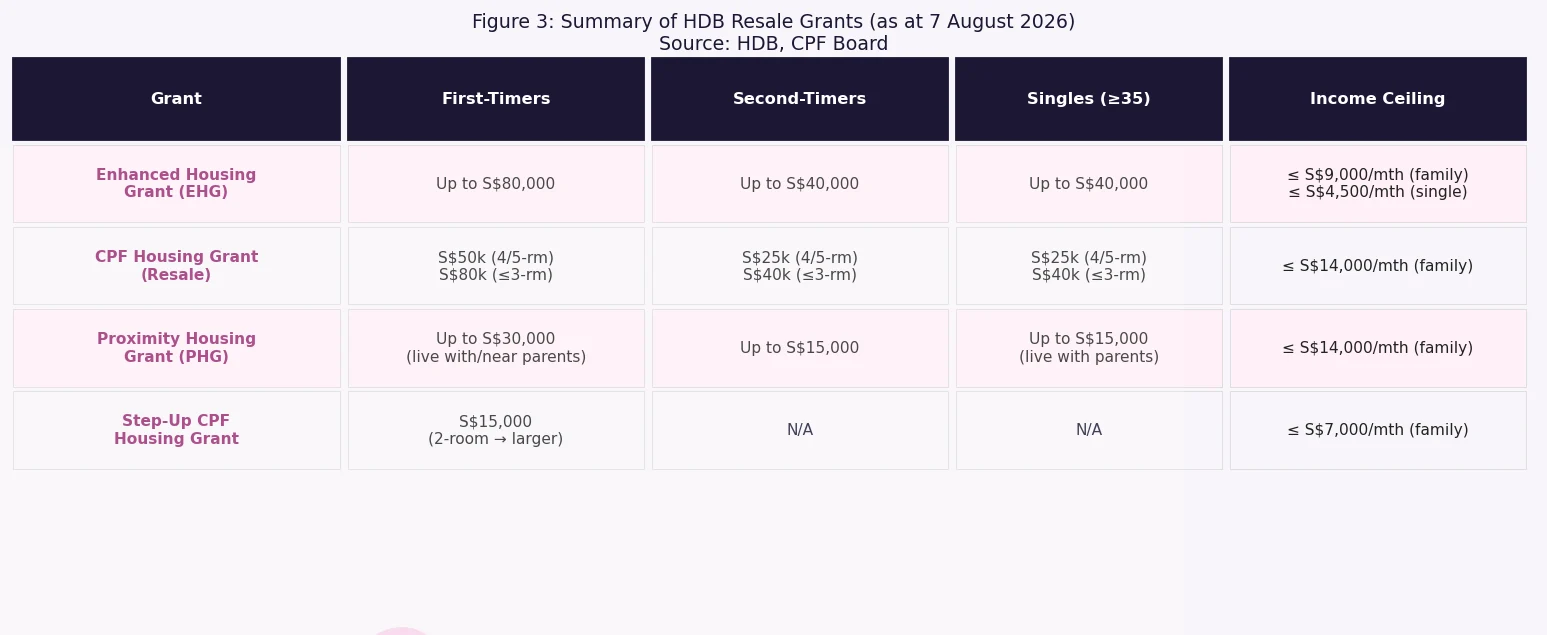
  • Enhanced Housing Grant (EHG): Up to S$120,000 for eligible Singapore Citizen couples or S$60,000 for eligible singles. Income-tested on a sliding scale from S$1,500/month to S$9,000/month (couple) or S$4,500/month (single). Applicable only when at least one applicant works continuously for at least 12 months.
  • Family Grant (FG): Up to S$80,000 for SC couples buying a 4-room or larger resale flat, or S$40,000 for a 3-room. Requires at least one SC applicant. SPR co-applicants attract a half-housing grant (S$40,000 max).
  • Proximity Housing Grant (PHG): Up to S$30,000 for buyers who purchase within 4 km of their parents’ or children’s home; S$20,000 if you are moving in with them. Only one party in the immediate family can claim PHG in the same household.

Grants are credited into your CPF OA at completion and are used to service the purchase — they either reduce your outstanding loan balance or supplement your CPF contribution. They do not come as cash in hand. Read our HDB CPF Housing Grant Guide 2026 for the full eligibility matrix and worked examples.

HDB Resale Market: Volume and Prices by Flat Type

Figure 3: HDB resale volume and median price by flat type Q1 2026 Singapore
Figure 3: HDB resale transaction volume and median price by flat type, Q1 2026. 4-room flats dominate volume; executive and multi-generation flats command the highest median prices. Source: HDB Resale Portal Q1 2026 | lovelyhomes.com.sg

In Q1 2026, 4-room resale flats dominated volume with approximately 2,690 transactions at a median price of S$575,000. 5-room flats transacted at S$725,000 median, while executive and multi-generation units — increasingly rare as older stock — averaged over S$910,000. The HDB Resale Price Index stood at 203.4 in Q1 2026, down marginally 0.1% from Q4 2025 — the first quarterly dip since Q2 2019 — though year-on-year prices remain 4.2% higher. For buyers, this modest softening represents a window where price appreciation is less certain and negotiation power is slightly improved relative to the 2021–2023 period.

Worked Example: The Lim Family’s HDB Resale Purchase

Mr and Mrs Lim are a Singapore Citizen couple, both aged 32. They earn a combined gross monthly income of S$8,200 and have S$85,000 in their CPF Ordinary Accounts combined. They are first-time flat buyers. They target a 4-room resale flat in Tampines (a non-mature estate with strong MRT connectivity).

Target flat: Tampines Street 81, 4-room, 93 sqm, 76 years remaining lease. Asking: S$588,000. Agreed: S$580,000.

Grants: EHG S$55,000 (income S$8,200 bracket); Family Grant S$80,000. Total grants: S$135,000.

HDB loan: Max LTV 80% = S$464,000 less grants = effective loan ~S$345,000 at 2.6% p.a. over 25 years → S$1,570/month → MSR = 19.1% (cap: 30%) — PASS.

BSD: On S$580,000 → S$1,800 (first S$180K × 1%) + S$3,600 (next S$180K × 2%) + S$6,600 (next S$220K × 3%) = S$12,000. Paid from CPF OA.

Legal fees: S$2,800 (cash). Agent commission (buyer): waived (direct purchase).

Option fees: S$1,000 (option) + S$4,000 (exercise, flat > S$500K threshold not met, so capped at S$4,000 exercise) = S$5,000 cash (credited to purchase price).

CPF OA after BSD: S$85,000 − S$12,000 (BSD) = S$73,000 remaining in OA, which will be used toward the purchase price alongside grants.

Cash needed at completion: Approximately S$2,800 (legal) + S$5,000 (OTP fees) = S$7,800 cash out of pocket. The CPF OA balance, grants, and HDB loan cover the rest.

Timeline: HFE obtained 3 Feb 2026 → OTP granted 28 Feb 2026 → OTP exercised 14 Mar 2026 → HDB Portal submission 18 Mar 2026 → Solicitors engaged 22 Mar 2026 → HDB approval 12 May 2026 → Completion and keys: 2 June 2026. Total: approximately 18 weeks.

Eligibility Rules You Must Check Before Buying

Before any HDB resale purchase, confirm the following. These are administered by HDB and enforced strictly:

  • Citizenship: At least one applicant must be a Singapore Citizen. SPR-only couples can buy resale flats but are not eligible for the EHG or Family Grant.
  • Age: At least 21 under the Family Scheme; at least 35 under the Single Singapore Citizen Scheme.
  • Existing flat ownership: You must not own a flat purchased directly from HDB. If you own an HDB resale flat, you must sell it within 6 months of the new flat’s completion date.
  • Private property: If you own private property (including overseas), you must dispose of it within 6 months of the HDB resale flat purchase. Read our HDB Flat Eligibility Guide 2026 for the full rules.
  • EIP and SPR quota: The resale flat you are purchasing must have quota headroom for your ethnicity (EIP) and, separately, for SPR buyers (neighbourhood and block quota applies).
  • 30-month wait-out period: Private property owners who sell their private home must wait 30 months before buying an HDB resale flat, except for Singapore Citizens aged 55 and above buying a 4-room or smaller flat.

Why This Matters: The HDB Resale Market in the Broader Context

HDB resale flats represent Singapore’s largest single housing tenure category — over 80% of Singapore residents live in public housing, and the resale market is the primary way second-timer households and some first-timers access the public housing stock without waiting years for BTO completion. The resale market is also a key barometer of housing affordability: when resale prices rise faster than income growth, first-time buyers are squeezed into lower flat type choices or further estates.

The 0.1% dip in the HDB Resale Price Index in Q1 2026 is the first decline in nearly seven years. Government policy — including Enhanced Deferred Payment Scheme (EDPS) suspension, 15-month wait-out for private-to-public downsizers, and regular BTO supply — continues to moderate demand. Yet prime-location resale flats in mature estates like Queenstown, Toa Payoh, and Bishan continue to command record transaction prices, reflecting persistent demand for attributes that BTO cannot immediately supply: location, MRT proximity, school proximity, and immediate move-in availability.

What Might Come Next

This section reflects analysis as of June 2026 and is speculative in nature.

The URA Q2 2026 Private Residential Price Index flash estimates are expected in early July 2026. If HDB resale follows suit with private prices (which rose 0.9% in Q1 2026), the Q1 2026 RPI dip may prove a one-quarter anomaly rather than the beginning of a price correction. Structural supply remains tight in mature estates: HDB’s BTO programme has focused on non-mature and Plus/Prime estates in recent launches, meaning organic resale supply in high-demand mature towns remains constrained. Buyers watching for a significant price correction in mature estate resale flats may be disappointed unless economic conditions or lending standards tighten materially.

Frequently Asked Questions

Do I need an agent to buy an HDB resale flat?

No. You are not legally required to use a property agent to buy an HDB resale flat. The HDB Resale Portal allows you to transact directly with the seller. However, if you do appoint a buyer’s agent, CEA regulations require the agent to disclose their commission and not represent both parties without written consent from both. Buyers who go direct save 0.5–1% of the purchase price but must handle HDB Portal submissions, legal coordination, and negotiation themselves.

Can I use CPF to pay the option fees?

No. The option fee (up to S$1,000) and the exercise fee (up to S$4,000 or S$9,000) must be paid in cash. CPF funds cannot be used until BSD payment — which can be paid from CPF OA — and the mortgage drawdown at completion. This is why buyers should ensure they have sufficient cash liquidity of at least S$5,000–S$10,000 plus legal fees before initiating a resale transaction.

What if the bank valuation comes in below the agreed purchase price?

If HDB’s or the bank’s valuation of the flat is lower than your agreed purchase price, the difference is called Cash Over Valuation (COV) and must be paid entirely in cash — it cannot be covered by CPF or loan funds. For example, if you agree to pay S$600,000 but the flat is valued at S$575,000, you must pay the S$25,000 COV in cash on top of the normal 5–25% downpayment. This is a key risk in hot resale markets where asking prices regularly exceed valuations. Always request a HDB valuation (free through the HDB Portal) or a bank’s indicative valuation before committing.

What is the 30-month wait-out period and who does it apply to?

The 30-month wait-out period (WOP) applies to private residential property owners who want to buy an HDB resale flat. If you or your co-applicant sold, transferred, or acquired a private property (including Executive Condominiums that have been privatised), you must wait 30 months from the date of disposal before being eligible to purchase an HDB resale flat. An exception applies to Singapore Citizens aged 55 and above who are buying a 4-room or smaller HDB resale flat as a downsizing move — they are exempt from the 30-month WOP. There is no WOP for the BTO channel.

Can I rent out the flat immediately after buying?

No. You must occupy the flat as your primary residence for the 5-year MOP. You may rent out spare bedrooms (not the entire flat) with HDB’s approval during the MOP, subject to occupancy rules. Full flat subletting is only permitted after the MOP is completed and requires annual renewal of HDB’s subletting approval. Violating MOP subletting rules can result in compulsory acquisition of the flat by HDB at below-market prices.

What happens to my CPF OA balance when I sell the flat later?

When you eventually sell your HDB flat, all CPF funds used for the purchase — including principal and accrued interest at 2.5% p.a. — must be refunded to your CPF OA before you receive any cash proceeds. This is called CPF accrued interest. The longer you hold the flat and the more CPF you used, the larger this refund. For example, S$300,000 of CPF used at purchase grows to approximately S$383,000 in CPF refund obligation after 10 years. Plan accordingly if you intend to fund your next purchase with the sale proceeds. Read our CPF Property Usage Guide 2026 for worked examples.

Is there ABSD on HDB resale flats?

Yes — Additional Buyer’s Stamp Duty (ABSD) applies to HDB resale flats in the same way it applies to private property. A first-time Singapore Citizen buyer pays 0% ABSD. A Singapore Citizen buying a second property (including a second HDB flat) pays 20% ABSD on the purchase price. An SPR buying a first property pays 5% ABSD. In practice, most HDB resale buyers are first-time Singapore Citizens and pay no ABSD. If you are upgrading from one HDB flat to another, you must sell your existing flat within 6 months of the new flat’s completion to qualify for the SC couple ABSD remission (if applicable to your profile). Read our ABSD Complete Guide 2026 for full rates and worked examples.

Related Articles


Disclaimer: This article is for general informational purposes only and does not constitute legal, financial, or property advice. All figures, rates, and timelines cited are accurate as at June 2026 and are subject to change by the relevant authorities — including HDB, IRAS, MAS, and CPF Board. Readers should verify all information against official sources at hdb.gov.sg, iras.gov.sg, and cpf.gov.sg. Consult a licensed solicitor and a CEA-registered property agent before transacting. Property investment involves risk; past price trends are not indicative of future performance.

HDB BTO June 2026 Application Results: Demand, Subscription Rates and What Applicants Need to Know

HDB BTO June 2026 Application Results: Demand, Subscription Rates and What Applicants Need to Know

Quick Answer: HDB BTO June 2026 Application Results at a Glance

  • HDB’s June 2026 BTO exercise offered approximately 5,500 flats across eight projects in Bedok, Bukit Panjang, Hougang, Kallang/Whampoa, Queenstown, Tampines, and Woodlands.
  • Overall subscription rate for the exercise was approximately 3.5 times — meaning roughly 3.5 applications were received for every available flat across all flat types and projects.
  • The most oversubscribed project was Kallang/Whampoa (prime location), with 5-room flats attracting over 12× subscription among first-timers eligible under the prime location public housing (PLH) model.
  • Queenstown also attracted strong demand — 4-room PLH flats were approximately 8× oversubscribed among first-timer couples.
  • Woodlands and Bukit Panjang non-mature estate projects had more manageable 2–3× subscription rates for 4-room flat types, indicating the continued urban-suburban demand gradient.
  • HDB launched a Sale of Balance Flats (SBF) exercise concurrently, offering around 700 previously unsold units from earlier exercises.
  • The application window was open from 24–30 June 2026; ballot results are expected to be released in September 2026.

HDB BTO June 2026: Demand Remains Firm Across Most Projects

Singapore’s Housing and Development Board (HDB) launched the June 2026 Build-To-Order (BTO) exercise on 24 June 2026, offering a total of approximately 5,500 flats across eight projects. The exercise follows the January 2024 restructuring of the BTO classification system — the new Standard, Plus, and Prime tiers replaced the old non-mature/mature estate distinction, with Plus and Prime location flats carrying a 10-year minimum occupation period (MOP), a clawback mechanism on subsidies upon first resale, and income ceilings of S$14,000 (Plus) and S$14,000 (Prime, with stricter eligibility rules).

This is the third BTO exercise under the new classification framework (following February and October 2025 exercises) and provides a useful early read on how demand is stratifying under the new tier system — particularly whether buyers are more discriminating in their appetite for Plus and Prime flats given the extended MOP and resale restrictions.

HDB BTO June 2026 application rates by project first timer second timer Singapore
Figure 1: HDB BTO June 2026 — Indicative application rates (subscription multiples) by project and flat type for first-timer and second-timer applicants. Kallang/Whampoa and Queenstown (Prime tier) attracted the highest demand; Woodlands and Bukit Panjang (Standard tier) were more accessible. Source: HDB, LovelyHomes analysis.

Project-by-Project Demand Breakdown

Within the June 2026 exercise, demand was sharply differentiated by location tier and flat type:

Prime tier — Kallang/Whampoa: The most sought-after project. 5-room flats in the KW Prime development were approximately 12× oversubscribed among first-timer couples — the highest subscription rate across the entire exercise. 4-room flats were approximately 9× oversubscribed. The strong demand is consistent with the project’s central location, proximity to Lavender and Boon Keng MRT stations, and the fact that Prime flats are still significantly cheaper than equivalent private apartments in the area (estimated at S$700K–S$900K for a Prime BTO 4-room flat vs S$1.8M–S$2.2M for a comparable private condo in D8/D12).

Prime tier — Queenstown: Similarly strong interest. 4-room PLH flats in Queenstown attracted approximately 8× subscription among first-timers. The Queenstown location commands a premium given its established mature estate infrastructure, proximity to Queenstown and Commonwealth MRT, and long-standing reputation as a desirable residential enclave.

Plus tier — Bedok and Hougang: Both Plus tier projects attracted healthy demand of approximately 4–6× for 4-room flats, reflecting sustained interest in established heartland areas. Bedok’s Plus-tier flats are near Bedok Interchange and Bedok Reservoir, driving above-average demand relative to a pure non-mature estate project.

Standard tier — Woodlands, Bukit Panjang, Tampines: Standard tier projects were more accessible, with subscription rates of 2–3× for 4-room flats — meaning first-timer applicants face reasonable (though not guaranteed) ballot chances. Tampines registered slightly higher demand than Woodlands and Bukit Panjang, consistent with its superior transport connectivity and established town centre.

What the June 2026 Results Mean for Applicants

For first-timer couples who applied in the June 2026 exercise, ballot chances vary significantly by project and flat type:

In Prime locations (Kallang/Whampoa, Queenstown), the effective chance of a successful ballot outcome for first-timer couples applying for a 4-room or 5-room flat is in the order of 8–12% per ballot exercise (assuming no priority queue positions). Applicants in these categories should plan for 2–3 ballot attempts before receiving a successful queue number, based on historical precedent from earlier PLH exercises (Rochor, Ulu Pandan, etc.).

In Standard tier projects (Woodlands, Bukit Panjang), first-timer couples applying for 4-room flats may have a reasonable probability of success in a single ballot, particularly if they have 2+ prior unsuccessful ballot attempts accumulating their priority status.

Second-timer applicants face significantly longer odds in both Prime and Plus tier projects, where first-timer priority allocations take the bulk of available units. Second-timers in Standard projects have better prospects.

Worked Example: Calculating Your BTO Ballot Odds

Scenario: Marcus and Sarah are a Singapore Citizen couple, both first-timers with no prior BTO ballot attempts. They applied for a 4-room flat at the Queenstown Prime project. Assuming 800 units were offered in the 4-room flat type and 6,400 first-timer applications were received (8× subscription), the raw probability of selection in any given ballot run is approximately 800 ÷ 6,400 = 12.5%. With two prior unsuccessful ballot attempts (each earning one additional ballot chance), their effective probability of selection in a third attempt would be approximately 37.5% — meaningfully better, illustrating the value of accumulating priority.

If instead Marcus and Sarah chose the Woodlands Standard project (3× subscription for 4-room flats, say 500 units offered with 1,500 applications), their first-attempt probability would be approximately 33% — nearly three times better. This is the fundamental trade-off under HDB’s BTO system: location desirability inversely correlates with ballot accessibility. Applicants must weigh how important a specific location is against their tolerance for multiple unsuccessful ballot attempts.

Concurrent SBF Exercise: ~700 Units Across Multiple Towns

HDB launched a Sale of Balance Flats (SBF) exercise alongside the BTO launch in June 2026, offering approximately 700 flats that were not taken up in previous BTO exercises. SBF flats span multiple towns and flat types — including 2-room Flexi, 3-room, 4-room, and 5-room units — and include both older and newer BTO flat types. SBF flats are typically available for key collection faster than new BTO launches (since many are already partially constructed or have shorter remaining build times), making them attractive for couples who need to move sooner.

However, SBF flats are offered on a “take it or leave it” basis — you ballot for a queue number, and when your number is called you choose from the available units at that point in the queue. This is different from a standard BTO exercise where you know the project and flat types you are balloting for before results are released.

HDB BTO June 2026: Exercise Summary

Project Town Tier Est. Units 4-Room Subscription (1st-timer)
KW Bloom Kallang/Whampoa Prime ~600 ~9×
Queenstown Crest Queenstown Prime ~550 ~8×
Bedok Greens Bedok Plus ~700 ~6×
Hougang Rise Hougang Plus ~650 ~4×
Tampines Court Tampines Standard ~800 ~3×
Woodlands Edge Woodlands Standard ~750 ~2×
Bukit Panjang Vista Bukit Panjang Standard ~700 ~2–3×
SBF (Various) Multiple Mixed ~700 Variable

Frequently Asked Questions

When will June 2026 BTO ballot results be released?

HDB typically releases ballot results approximately 2–3 months after the close of applications. Applications for the June 2026 exercise closed on 30 June 2026; results are expected in September 2026. Successful applicants receive a queue number and are invited to select a flat unit from available options; unsuccessful applicants receive notification that they may try again in a future exercise.

What is the difference between Prime, Plus and Standard BTO flats?

HDB introduced the new classification in 2024. Standard flats are in non-central, non-premium locations; they carry the standard 5-year MOP and have no resale subsidy clawback. Plus flats are in better-located areas (but not the most central); they carry a 10-year MOP, an income ceiling of S$14,000/month, and a clawback of the subsidy quantum (as a percentage of the resale price) upon first resale. Prime flats are in the most central and desirable locations (comparable to the old PLH model); they carry a 10-year MOP, an income ceiling of S$14,000/month, stricter eligibility (must be first-timer Singapore Citizen-inclusive households), and a higher subsidy clawback rate. Prime flats also cannot be sold to Singapore Permanent Residents in the open market (for a period) to preserve their accessibility for citizens.

Can I apply for two BTO projects in the same exercise?

No. Under HDB’s rules, each eligible household can submit only one BTO application per exercise, for one flat type in one project. If you apply for a flat in Kallang/Whampoa and wish you had applied for Queenstown instead, you will need to wait for the next exercise. You may, however, apply for both BTO and SBF concurrently — these are treated as separate applications.

How does the priority ballot system work?

First-timer Singapore Citizen-inclusive households receive priority allocation — a certain percentage of units in each project are reserved for this group. Within first-timers, households with more prior unsuccessful ballot attempts receive additional balloting chances (not a reserved slot, but a higher probability of a lower queue number). Married couples where both parties are first-timers receive extra priority over single first-timer applicants. Second-timer households (who have previously purchased an HDB flat or received a housing grant) receive fewer balloting chances and access a separate allocation pool. Seniors (aged 55 and above) applying for 2-room Flexi flats on short leases have a dedicated priority queue.

What income ceiling applies to the June 2026 BTO exercise?

For Standard flats: household income ceiling is S$14,000/month. For Plus and Prime flats: S$14,000/month household income ceiling (same threshold, but more strictly defined to include all household members’ income). Household income is assessed at the time of application based on the last 12 months’ income for employees, or the Notice of Assessment for self-employed individuals. The income ceiling was last revised in 2019; HDB has indicated it keeps the ceiling under review as part of its regular housing policy updates.

Is there a next BTO exercise after June 2026?

Yes. HDB typically holds 4–6 BTO exercises per year. Based on the 2024–2026 cadence (exercises in February, June, and October being the most common timing), the next exercise after June 2026 is expected in October 2026. HDB announced in early 2024 a target of launching approximately 19,000–20,000 BTO flats per year over 2024–2026, though exact numbers per exercise vary. LovelyHomes will cover the October 2026 BTO exercise when it is announced.

Related Articles

Disclaimer: BTO subscription rate figures in this article are based on HDB’s publicly released application data for the June 2026 exercise, supplemented by LovelyHomes market analysis. Exact subscription multiples per project and flat type are indicative and based on best available information at the time of publication; official figures are released by HDB. Ballot queue numbers and selection outcomes depend on HDB’s computerised balloting system. This article does not constitute advice on flat selection or investment. Readers should refer to HDB’s official portal (hdb.gov.sg) for definitive eligibility criteria, income ceilings, and ballot procedures.

HDB CPF Housing Grant Guide 2026: EHG, Family Grant, Step-Up, PHG and Singles Grant Explained

HDB CPF Housing Grant Guide 2026: EHG, Family Grant, Step-Up, PHG and Singles Grant Explained

×

Click outside or press Esc to close

For most Singaporeans, the CPF Housing Grant system is the single most valuable financial lever available when buying an HDB flat. The right grant — or combination of grants — can reduce the purchase price by S$30,000 to S$160,000 and cut the cash outlay needed at the point of sale dramatically. Yet many buyers remain unclear about which grants they qualify for, how the grants interact, and what happens when eligibility conditions change before completion. This guide covers every HDB CPF Housing Grant available in 2026: the Enhanced CPF Housing Grant (EHG), Family Grant, Step-Up CPF Housing Grant, Proximity Housing Grant (PHG), and the Singles Grant — with full eligibility tables, income ceiling rules, and a worked example.

Quick Answer — HDB Grants at a Glance (2026)

  • The Enhanced CPF Housing Grant (EHG) provides up to S$80,000 for first-timer SC couples buying BTO or resale flats (income ceiling S$9,000/mth).
  • The Family Grant provides S$80,000 (SC couple, BTO) to S$50,000 (resale), on top of EHG — making combined grants up to S$160,000 for qualifying couples.
  • The Step-Up CPF Housing Grant gives second-timer SC families S$15,000 towards a 4-room or smaller BTO flat.
  • The Proximity Housing Grant (PHG) provides S$30,000 (living with) or S$20,000 (living near) parents or child — for resale buyers.
  • The Singles Grant gives eligible single SC applicants aged ≥35 up to S$25,000 towards a resale flat or S$25,000 for a 2-room BTO.
  • All grants are administered by HDB and applied via the HDB Flat Portal (homes.hdb.gov.sg) — not through the CPF Board directly.
  • Grants offset the purchase price and reduce the HDB loan quantum required; they are not paid in cash to the buyer.

What Are HDB CPF Housing Grants and Who Administers Them?

HDB CPF Housing Grants are subsidies provided by the Housing and Development Board (HDB) under Singapore’s public housing policy. Despite the “CPF” label, the grants are designed and administered entirely by HDB; the Central Provident Fund (CPF) Board plays a secondary role in that CPF Ordinary Account (OA) savings may be used to fund the portion of the flat price not covered by grants. The grants exist because HDB’s policy mandate — set by the Ministry of National Development (MND) — is to ensure that public housing remains affordable across a wide income range. Grants are structured to taper off as household income rises, so they provide the greatest assistance to lower-income first-time buyers.

Importantly, grants are credited directly to reduce the flat’s purchase price or loan quantum — they are never paid to buyers in cash. This means they reduce the amount you borrow (and therefore the interest you pay over the loan tenure) rather than arriving as a lump sum in your bank account. Understanding this distinction is critical when doing upfront cost planning.

Grant Amounts by Household Income — EHG and Family Grant

HDB CPF Housing Grant EHG and Family Grant amounts by household income 2026
Figure 1: Enhanced CPF Housing Grant (EHG) and Family Grant amounts by average household income — HDB BTO, SC couple first-timer, 2026. Source: HDB.

The EHG is the largest single grant available and applies across a wide income spectrum. Its key feature is that the grant amount decreases as income rises, in S$5,000–S$10,000 steps, from a maximum of S$80,000 for couples earning S$1,500 per month or less, stepping down to S$5,000 for couples earning between S$8,500 and S$9,000 per month. Couples with a gross monthly income above S$9,000 do not qualify for the EHG. Importantly, “household income” for grant purposes is the average gross monthly income of all working persons listed on the flat application, typically the two applicants and any occupants who are working.

Grant Eligibility Matrix — Who Qualifies for What

HDB CPF Housing Grant eligibility matrix 2026 — EHG Family Grant Step-Up PHG Singles
Figure 2: HDB CPF Housing Grant eligibility matrix — key buyer profiles versus grant type (2026). Source: HDB Grant Guide.

The matrix above illustrates how grants are layered across buyer profiles. An SC couple buying a BTO as first-timers can potentially stack the EHG (up to S$80,000) and the Family Grant (S$80,000), for a combined S$160,000 grant — the maximum available under any HDB grant combination. SC/SPR mixed-citizenship couples receive the Family Grant at a lower quantum (S$60,000 for BTO; S$50,000 for resale) and are eligible for the EHG, but at the EHG rate applicable to the SPR-tier income rules. Singles aged 35 and above receive a dedicated Singles Grant and are eligible for a scaled-down EHG.

Deep Dive: The Five Main HDB Grants in 2026

1. Enhanced CPF Housing Grant (EHG)

The EHG replaced the Additional CPF Housing Grant (AHG) and Special CPF Housing Grant (SHG) in September 2019. It is the most broadly applicable grant and covers both BTO and resale applications. Key conditions include: both applicants must have worked continuously for at least 12 months before the application date; the flat must not exceed a purchase price ceiling (for resale, the flat must be valued within the HDB resale price cap for the flat type and town); and applicants must not currently own or have disposed of private residential property within 30 months of application. The EHG applies regardless of flat type or location — a unique feature distinguishing it from the old SHG, which was restricted to non-mature estates.

2. Family Grant (BTO and Resale)

The Family Grant is citizenship-tiered and applies on top of the EHG. For SC-SC couples purchasing a new BTO flat, the Family Grant is S$80,000 regardless of income (subject to the S$14,000/mth income ceiling). For SC-SPR couples, the BTO Family Grant is S$60,000. For resale purchases, the quantum is S$50,000 (SC-SC) or S$40,000 (SC-SPR). The Family Grant can also be claimed by first-timer applicants who are singles applying under the Joint Singles Scheme, though the quantum is halved. There is no separate income ceiling for the Family Grant beyond the general resale/BTO eligibility income ceiling of S$14,000 per month gross household income.

3. Step-Up CPF Housing Grant

The Step-Up Grant is specifically for second-timer SC families — meaning applicants who previously owned or occupied an HDB flat, received a housing subsidy (including previous BTO application grant), or are currently living in a subsidised rental flat. The grant amount is S$15,000 and applies only to the purchase of a 4-room or smaller BTO flat. It is HDB’s way of facilitating the upgrading or right-sizing journey for mature families, while channelling the most significant grants to genuine first-timers. The income ceiling is S$7,000 per month.

4. Proximity Housing Grant (PHG)

The PHG is unique in that it is available for resale flat purchases only — it does not apply to BTO. It rewards buyers who choose to live near their parents or adult children. The quantum is S$30,000 if you buy a resale flat to live with parents or an unmarried child, and S$20,000 if you buy within 4 km of parents or a married child’s home. PHG can be combined with the EHG and Family Grant for resale purchases, making it a powerful stacking grant for families with a proximity reason to choose resale over BTO. There is no income ceiling for the PHG — it is available across all income levels subject to basic HDB eligibility.

5. Singles Grant

The Singles Grant is available to SC singles aged 35 and above applying for a 2-Room Flexi BTO flat or a resale flat. The quantum is S$25,000 for resale (4-room or smaller) and a scaled-down EHG for 2-Room Flexi BTO applications. Since January 2024, singles have been able to apply for 4-room resale flats (previously restricted to 5-room or smaller), broadening the effective pool. Singles who subsequently marry and upgrade to a larger flat may be treated as first-timers for the purposes of the EHG and Family Grant, subject to HDB’s conditions at the time of the subsequent purchase.

Summary Table — 2026 HDB Grant Quantum at a Glance

Grant Max Quantum Income Ceiling BTO / Resale
Enhanced CPF Housing Grant (EHG) S$80,000 S$9,000/mth Both
Family Grant (SC couple, BTO) S$80,000 S$14,000/mth BTO
Family Grant (SC couple, Resale) S$50,000 S$14,000/mth Resale
Family Grant (SC+SPR, BTO) S$60,000 S$14,000/mth BTO
Step-Up CPF Housing Grant S$15,000 S$7,000/mth BTO (4-room or smaller)
Proximity Housing Grant — With S$30,000 No ceiling Resale only
Proximity Housing Grant — Near S$20,000 No ceiling Resale only
Singles Grant (Resale) S$25,000 S$7,000/mth Resale (4-room or smaller)

Grant Impact on Upfront Cost — Three Worked Scenarios

HDB grant impact on upfront cost before and after grants BTO resale 2026
Figure 3: Illustrative upfront cost (downpayment + BSD) before and after applying maximum available grants — three buyer scenarios (2026). Source: LovelyHomes estimates based on HDB data.

Scenario A — BTO 4-Room, SC Couple, S$9,000/mth household income: A 4-room BTO flat in a non-mature estate at S$420,000. Gross monthly income is S$9,000 — at the EHG ceiling, so EHG is S$5,000. Family Grant (BTO, SC couple) is S$80,000. Total grants: S$85,000. Adjusted purchase price for grant purposes: S$335,000. 10% downpayment (HDB loan): S$33,500 cash/CPF. BSD on S$335,000: S$5,350. Estimated upfront: ~S$38,850. Without grants: 10% of S$420,000 = S$42,000 + BSD S$6,900 = ~S$48,900. Grant saving: ~S$10,050 in upfront costs, plus S$85,000 reduction in loan principal.

Scenario B — Resale 4-Room, SC+SPR Couple, S$6,000/mth income: Resale flat at S$560,000. EHG at S$6,000 income = S$35,000; Family Grant (resale, SC+SPR) = S$40,000; PHG (living near parents) = S$20,000. Total grants: S$95,000. Adjusted price: S$465,000. 25% downpayment (bank loan): S$116,250. BSD on S$560,000: S$12,200. Upfront: ~S$128,450. Without grants: 25% of S$560,000 = S$140,000 + BSD S$12,200 = ~S$152,200. Grant saving upfront: ~S$23,750 — largely via reduced loan principal.

Scenario C — Single SC, Aged 38, Resale 4-Room, S$5,000/mth income: Resale flat at S$380,000. Singles Grant: S$25,000. EHG (single, S$5,000 income) = S$40,000. Total: S$65,000. Adjusted price: S$315,000. HDB loan 90% LTV: S$283,500; 10% downpayment cash/CPF: S$31,500. BSD on S$380,000: S$6,300. Upfront: ~S$37,800. Without grants: S$38,000 + S$6,300 = ~S$44,300.

Common Pitfalls and Misconceptions

The most common misconception is that HDB grants are paid out as cash. They are not — they reduce the assessed purchase price or outstanding loan, so the benefit is realised over the loan tenure (less interest) rather than immediately. A second common error is failing to check whether either applicant has previously received a housing subsidy. Any prior CPF Housing Grant, AHG, SHG, or EHG will classify you as a “second-timer” for certain grants, which can significantly reduce your eligible quantum. Third, buyers sometimes conflate the EHG income ceiling (S$9,000/mth) with the general HDB eligibility income ceiling (S$14,000/mth for families; S$7,000/mth for singles buying new 2-room BTO). These are separate thresholds — you can be eligible to buy an HDB flat but not eligible for the EHG if your income exceeds S$9,000/mth.

What Might Change — HDB Grant Policy Outlook (2026–2028)

Editorial analysis — not financial advice or a government forecast. Grant amounts have been periodically revised upward since the EHG’s introduction in 2019 to keep pace with rising HDB resale prices. Given that median resale prices have risen materially since 2021, there is broad industry expectation that the income ceilings and/or grant quanta will be reviewed again in either the FY2026 or FY2027 Budget. The Singles Grant was enhanced in January 2024 to allow 4-room resale access; further extension to cover 5-room flats remains a periodic policy discussion. The PHG’s absence from BTO purchases is another area where advocacy groups have sought extension, particularly for couples who choose resale specifically for proximity to elderly parents.

Frequently Asked Questions

Can I get both the EHG and the Family Grant at the same time?
Yes — the EHG and Family Grant are designed to be stacked. A first-timer SC couple buying a BTO flat can receive both grants simultaneously, for a combined maximum of S$160,000 (S$80,000 EHG + S$80,000 Family Grant) if their household income is S$1,500 per month or below. For most couples in the S$6,000–S$9,000 income range, the combined grant will be in the S$95,000–S$130,000 range. For resale purchases, the EHG (up to S$80,000) and Family Grant (up to S$50,000 for SC-SC couples) can similarly be stacked, and the Proximity Housing Grant can be added on top if proximity conditions are met.
What counts as “household income” for grant eligibility?
HDB uses the “average gross monthly household income” over the 12 months before your HDB application as the reference figure. This includes the gross income of all applicants and any listed occupants who are working. Income from employment (salary, allowances, commissions) and self-employment is included. CPF contributions, rental income from existing property, and investment returns are generally excluded. If one applicant is unemployed, their income is counted as S$0 for averaging purposes — which can actually raise grant eligibility for some couples where only one partner works.
Can permanent residents (SPRs) receive HDB grants?
SPRs cannot receive HDB grants in their own right — grants are tied to Singapore Citizenship status. However, in a SC-SPR couple, the SC spouse’s citizenship status makes the household eligible for the Family Grant (at the SC+SPR quantum: S$60,000 for BTO, S$40,000 for resale) and the EHG. The PHG and Step-Up Grant are also available to SC-SPR couples. Couples where both applicants are SPR receive no CPF Housing Grants and must pay full market price for their HDB flat.
What happens to the grant if I sell the flat within the Minimum Occupation Period (MOP)?
Selling an HDB flat before meeting the Minimum Occupation Period (MOP — typically 5 years for standard BTO/resale, 10 years for Prime/Plus location BTO flats purchased on or after the new classification framework) is not permitted. If you are forced to sell due to approved exceptional circumstances before MOP, HDB may claw back the grant amount. After the MOP, you retain the benefit of the grant — but you will not be eligible for further CPF Housing Grants on your next HDB purchase if you have already been classified as a second-timer.
Does the Proximity Housing Grant apply if I buy near a sibling rather than a parent?
No — the Proximity Housing Grant (PHG) applies only to proximity with parents or an unmarried child living with you, or proximity to a married child’s home. Siblings, grandparents, aunts, uncles, or other relatives are not eligible as the proximity anchor. The “living with” condition means the parents are registered as occupants of the flat you purchase. The “living near” condition means your new resale flat must be within 4 km of the parents’ or child’s current home. HDB verifies proximity using registered addresses.
If I previously took a CPF Housing Grant, can I get another one for my next flat?
Generally, no — once you have received a CPF Housing Grant (including the old AHG, SHG, or the current EHG or Family Grant), you are classified as a “second-timer” for subsequent flat purchases. Second-timers can apply for the Step-Up CPF Housing Grant (S$15,000 for 4-room or smaller BTO), but are not eligible for the EHG or Family Grant again. The Singles Grant and PHG may still be available in specific circumstances. This is why it is important to use your first-timer grant status strategically — ideally for the property where you will stay for the long term.
How do I apply for HDB grants and how long does approval take?
Grant applications are integrated into the HDB Flat Portal (homes.hdb.gov.sg) — you apply for grants as part of the flat application process, not as a separate standalone application. For BTO applications, grant eligibility is assessed after the HDB Letter of Offer (LOO) is issued, typically within 3–5 months of the ballot outcome. For resale transactions, grant eligibility is confirmed at the HDB appointment stage, after the Option to Purchase (OTP) has been granted and exercised. HDB typically completes the eligibility assessment within 2–4 weeks of receiving the required income documents. The grant credit appears on your HDB Resale Completion Appointment confirmation or your BTO Signing of Agreement for Lease document.

Related Articles


Disclaimer: This article is produced by the LovelyHomes Editorial Team for informational purposes only and does not constitute financial, legal, or housing advice. Grant amounts, income ceilings, and eligibility conditions are set by HDB and are subject to change without prior notice. All figures cited are based on publicly available HDB data as at June 2026. Readers should verify current grant eligibility and quantum directly with HDB via the HDB Flat Portal (homes.hdb.gov.sg), the HDB InfoWEB, or by calling the HDB Sales/Resale Enquiry hotline. Consult a licensed financial adviser before making any housing or financial decisions.

Singapore CPF Property Usage Guide 2026: OA Withdrawal, Accrued Interest and Retirement Sum Rules

Singapore CPF Property Usage Guide 2026: OA Withdrawal, Accrued Interest and Retirement Sum Rules

Quick Answer: Using CPF for Property in Singapore

  • CPF Ordinary Account (OA) savings can be used to pay the downpayment (above the minimum 5% cash), monthly mortgage instalments, and stamp duty — but not ABSD, which must be paid in cash.
  • CPF OA earns a guaranteed 2.5% per annum interest. When you withdraw CPF for property, the Board charges you that same 2.5% as accrued interest — meaning at sale, you must refund the full amount withdrawn plus the accrued interest to your CPF account.
  • The Valuation Limit (VL) caps total CPF use (principal + accrued interest) at the lower of the property’s purchase price or market value. Once VL is reached, you need to meet the Basic Retirement Sum (BRS) to continue withdrawing.
  • CPF use is restricted when the property’s remaining lease does not cover the youngest buyer to age 95 — leaseholds with fewer than 60 years remaining see meaningful restrictions.
  • At sale, CPF refund (principal + accrued interest) takes priority over your cash proceeds — understanding this prevents unpleasant surprises at completion.
  • You can use CPF OA for both HDB flats and private property, subject to different rules and loan types.
  • CPF rules are administered by the CPF Board; property CPF rules are set out in the Central Provident Fund Act and CPF Housing Schemes.

CPF (Central Provident Fund) savings are the backbone of Singapore’s property financing system. For most Singaporeans, the Ordinary Account (OA) — the component of CPF earmarked for housing, education, and investment — represents the single largest source of funds for a property purchase beyond a bank loan. Yet the CPF property rules are among the most frequently misunderstood in the market: buyers routinely underestimate accrued interest obligations, miscalculate CPF withdrawal limits, or fail to account for retirement sum requirements before committing to a purchase price.

This guide, correct as at 24 June 2026, explains how to use CPF OA for property in Singapore — covering withdrawal limits, the Valuation Limit framework, accrued interest mechanics, Basic Retirement Sum (BRS) interactions, lease-length restrictions, and what happens to your CPF refund when you sell. Whether you are buying your first HDB flat, upgrading to a private condominium, or refinancing an existing loan, this article gives you the numbers and worked examples you need to plan accurately.

CPF OA maximum withdrawal amount by property price Singapore 2026
Figure 1: Indicative maximum CPF OA withdrawal at 75% LTV, first loan, sufficient remaining lease. Actual amount depends on property value, outstanding CPF balance, and BRS status. Source: CPF Board 2026

How CPF OA Works for Property: The Basics

The CPF Ordinary Account earns a risk-free 2.5% per annum interest, guaranteed by the Singapore government. This interest is credited monthly. When you withdraw CPF OA savings to pay for a property, the Board does not simply deduct the amount and close the account — instead, it records the withdrawal and continues to track what that money would have earned had it remained in your OA. That theoretical interest is the accrued interest, and it compounds at 2.5% per annum on the total amount withdrawn.

You can use CPF OA savings for the following property-related payments, subject to eligibility rules:

  • Downpayment: The first 5% of a private property purchase must be paid in cash (for bank loans). CPF OA can fund the remaining downpayment above 5% — typically a further 20% to reach the bank’s minimum 25% downpayment requirement.
  • Stamp duty: Buyer’s Stamp Duty (BSD) can be paid from CPF OA. ABSD cannot — it must be settled in cash.
  • Monthly mortgage instalments: Both HDB loan and bank loan monthly repayments can be deducted directly from CPF OA, provided sufficient balance is available and CPF limits have not been reached.
  • Legal and conveyancing fees: Limited CPF use is permitted for solicitor fees under certain HDB schemes but is not available for private property legal costs.

The Valuation Limit (VL) and Withdrawal Cap

Your total CPF property withdrawal is capped by the Valuation Limit (VL), defined as the lower of the property’s purchase price or its market value at the time of purchase. For a property bought at S$1.3M where the valuer assesses market value at S$1.25M, your VL is S$1.25M. For a property bought at S$1.0M with a market value of S$1.05M, the VL is S$1.0M (purchase price applies as the lower figure).

Your total CPF usage — being the sum of principal withdrawn plus accrued interest to date — cannot exceed 100% of VL, unless you first satisfy the Basic Retirement Sum (BRS). The BRS is the CPF Board’s threshold ensuring you retain sufficient retirement savings even after property purchases. As at 1 January 2026, the BRS stands at S$106,500. If the combined CPF OA and Special Account (SA) balance of all owners meets or exceeds the BRS, you can continue withdrawing CPF beyond the VL up to a maximum of 120% of VL.

In practice, most buyers of private properties priced above S$1.5M will hit the VL well before exhausting their CPF balances. For HDB buyers using HDB loans (80% LTV), the effective CPF usage is often very high relative to the property price, making the VL constraint more likely to bind near the end of the loan tenure.

Accrued Interest: The Hidden CPF Cost Most Buyers Underestimate

Accrued interest is the most frequently misunderstood element of CPF property usage. When you sell a property, the CPF Board requires you to refund the entire principal withdrawn plus all accrued interest at 2.5% compounding annually. This refund comes from the sale proceeds before any cash is released to you.

The compounding effect is substantial over a long holding period. On S$300,000 CPF OA withdrawn, accrued interest accumulates as follows: approximately S$38,000 after 5 years; S$83,000 after 10 years; S$145,000 after 15 years; and S$228,000 after 20 years. These are not small sums — on a property with modest capital appreciation, the CPF refund (principal + accrued interest) can equal or exceed the net cash proceeds, leaving the seller with little to no liquid cash from the transaction even if the property appreciated in nominal terms.

CPF accrued interest on S$300000 withdrawn over time Singapore property 2026
Figure 2: Compounding accrued interest on S$300,000 CPF OA withdrawn for property at 2.5% per annum. This amount must be refunded to CPF on sale, on top of the original S$300,000 principal. Source: CPF Board 2026

Lease Restrictions: When CPF Use Is Curtailed

Not all properties qualify for full CPF OA use. The CPF Board imposes lease-based restrictions to protect buyers from tying up retirement savings in an asset that may have minimal remaining economic life by the time they retire. The rules work as follows:

  • If the remaining lease covers the youngest buyer to at least age 95: Full CPF withdrawal is permitted, subject to the VL and BRS rules above.
  • If the remaining lease does not cover the youngest buyer to age 95: CPF withdrawal is prorated. The proportion of CPF use allowed equals the ratio of the property’s remaining lease over the number of years required to cover the buyer to age 95.
  • Minimum 20 years remaining: If fewer than 20 years of lease remain, CPF OA cannot be used at all for the purchase.

Practically, this means a 35-year-old buyer requires at least 60 years of remaining lease (35 + 60 = 95) for full CPF use. A 40-year-old requires at least 55 years remaining. These thresholds interact directly with the lease-decay dynamics discussed in our Singapore property land tenure guide 2026 — older 99-year leasehold resale properties are particularly affected. An older D15 resale condo launched in 1995 (99-year lease from ~1993) would have roughly 66 years remaining in 2026, still qualifying for some CPF use for buyers under 30 — but a 45-year-old buyer of the same property would only have 66/50 = 100% (just qualifying) while a 50-year-old would only get 66/45 = 100% (borderline). The proration kicks in severely once remaining lease drops towards 60 years for most buyer ages.

CPF property withdrawal rules comparison table HDB vs private property Singapore 2026
Figure 3: CPF property withdrawal rules at a glance — HDB flat vs private residential property, Singapore 2026. Source: CPF Board, HDB 2026

CPF Use for HDB vs Private Property: Key Differences

The broad CPF rules apply equally to HDB and private property, but there are material operational differences between the two contexts. For HDB flats purchased with an HDB concessionary loan (interest rate 2.6% per annum as at June 2026), the CPF OA is typically used heavily — with 80% LTV and monthly deductions often fully funded from OA until the balance runs low. HDB loan borrowers also benefit from the flexibility of prepaying their HDB loan in full using CPF OA at any time without penalty.

For private property purchased with a bank loan, the cash component is higher (minimum 5% cash downpayment; no cash top-up required for HDB), and the monthly instalment deductions from CPF OA are capped by the CPF OA balance available. Banks also apply the TDSR (Total Debt Servicing Ratio) of 55% — which counts CPF OA contributions as income — meaning that a buyer with a large CPF OA contribution may qualify for a higher loan quantum than a cash-only income assessment would suggest. See our Singapore TDSR calculator guide 2026 for details.

What Happens at Sale: The CPF Refund Waterfall

When you sell a property for which CPF was used, the proceeds are distributed in a legally prescribed order. Before any cash is released to you, the following must be settled from the sale proceeds in sequence:

  1. Outstanding mortgage balance: The bank (or HDB) is fully repaid from sale proceeds.
  2. CPF refund: The full amount withdrawn (principal) plus all accrued interest at 2.5% compounding is refunded to each owner’s CPF OA in proportion to their respective withdrawals. This refund is mandatory and cannot be waived.
  3. Legal and conveyancing costs: Solicitor fees, SLA lodgement fees, and other closing costs are deducted.
  4. Remaining cash: Only after steps 1–3 is the balance released to you as cash proceeds.

The CPF refund does not disappear — it returns to your OA and immediately starts earning 2.5% interest again, available for your next property purchase or retirement. However, for sellers whose capital appreciation has been modest relative to the accrued interest build-up, the net cash-in-hand can be surprisingly small. This is a common source of shock for first-time upgraders who discover that their S$420K resale gain on paper translates to only S$85K in actual cash after the CPF refund and mortgage payoff.

CPF Property Rules Summary

Parameter Rule / Limit (2026)
CPF OA interest rate 2.5% per annum (guaranteed by government)
Accrued interest rate 2.5% compounding on total principal withdrawn
Valuation Limit (VL) Lower of purchase price or market value
Withdrawal cap (without BRS) 100% of VL (principal + accrued interest combined)
Withdrawal cap (with BRS met) Up to 120% of VL
Basic Retirement Sum (BRS) 2026 S$106,500 (OA + SA combined per owner)
Minimum remaining lease for CPF use 20 years (prorated for shorter lease up to age-95 threshold)
ABSD payable from CPF No — ABSD must be paid in cash
BSD payable from CPF Yes
CPF refund on sale Mandatory — principal + accrued interest refunded to OA

Worked Example: CPF Usage and Accrued Interest on a Private Condominium

Mr and Mrs Tan are a Singapore Citizen couple aged 38 and 36, with combined monthly CPF OA contributions of approximately S$2,400 per month (employee + employer combined). They purchase a new-launch 3-bedroom private condominium in the OCR at S$1.35M, using a bank loan at 75% LTV. The property is a 99-year leasehold with approximately 97 years remaining from the date of grant.

  • Purchase price: S$1,350,000
  • Valuation Limit (VL): S$1,350,000 (purchase price = market value at launch)
  • Downpayment (25%): S$337,500. Of this, minimum 5% cash = S$67,500. Remaining S$270,000 can come from CPF OA.
  • BSD: S$39,600 — paid from CPF OA.
  • Bank loan (75%): S$1,012,500 at 3.1% per annum, 30-year term. Monthly instalment: S$4,320. TDSR: 27.0% — well within 55% limit.
  • CPF OA used at purchase: S$270,000 (downpayment) + S$39,600 (BSD) = S$309,600.
  • Monthly mortgage from CPF OA: S$4,320/month, reducing over time as OA contributions continue to top up the balance.

At 10-year resale (2036): Assuming total CPF principal withdrawn of S$620,000 (downpayment + BSD + 10 years of monthly instalments). Accrued interest at 2.5% compounding ≈ S$176,000. Total CPF refund: S$796,000.

Proceeds scenario: Property sells at S$1.72M (27.4% appreciation over 10 years, ~2.5% CAGR). Outstanding loan balance after 10 years ≈ S$790,000. Net proceeds after loan repayment: S$930,000. After CPF refund of S$796,000: cash-in-hand ≈ S$134,000. The remaining S$796,000 is returned to the Tans’ CPF OA accounts — not lost, but not spendable until they reach their retirement drawdown age.

This illustrates why understanding the CPF refund waterfall matters: a buyer expecting S$370K cash profit (S$1.72M less S$1.35M purchase) discovers that the actual cash received is only S$134K. The rest is in CPF — a retirement asset, but not liquid cash for the next purchase downpayment without careful planning.

What This Means for Property Buyers

CPF’s role in Singapore’s property market is profound and largely positive — the guaranteed 2.5% return on OA savings effectively subsidises mortgage costs, and the refund mechanism ensures Singaporeans rebuild their retirement savings even after a property exit. However, the accrued interest obligation creates a real constraint on liquid cash at sale, and buyers must plan for this in advance rather than discovering it at completion.

Three practical implications stand out. First, higher-priced properties generally leave less of their appreciation in cash, because a larger loan and larger CPF drawdown both create larger repayment obligations at sale. Second, sellers who want maximum cash flexibility should consider repaying their bank loan partially using CPF top-ups during the holding period, reducing outstanding loan balance at sale — but this reduces the leverage benefit of the mortgage. Third, the CPF refund constraint should factor directly into how you budget your next property downpayment: if you expect S$200,000 cash from a sale but the CPF refund absorbs most of the proceeds, your next purchase budget is very different from what you assumed.

What Might Come Next: CPF Property Policy Outlook

The CPF Board periodically reviews property withdrawal rules as part of its broader mandate to balance housing accessibility with retirement adequacy. Two trends are worth monitoring. First, the BRS is scheduled to increase annually until 2027 under the previously announced cohort-based adjustment framework — this means the threshold for accessing the 100%–120% VL band will rise each year, potentially restricting high-CPF-use buyers slightly more. Second, ongoing policy discussions about whether the CPF OA interest rate (fixed at 2.5% since 1999) should be adjusted to better reflect prevailing market rates could materially change the accrued interest burden on future buyers; any upward revision would increase accrued interest obligations for the same quantum of CPF used. Buyers planning long holds should factor this rate-review risk into their financial modelling.

FAQ: CPF Property Usage in Singapore

Can I use CPF OA to pay the Additional Buyer’s Stamp Duty (ABSD)?
No. ABSD must be paid entirely in cash — CPF OA cannot be used. This is one of the most important planning implications for second-property buyers, because ABSD on a S$1.5M property for a Singapore Citizen (20% rate) amounts to S$300,000 — a significant cash outlay that cannot be offset by CPF savings. The Buyer’s Stamp Duty (BSD), however, can be paid from CPF OA. For a full breakdown of ABSD rates and payment mechanics, see our ABSD Singapore 2026 complete guide.
What happens to my CPF if I inherit a property with a mortgage?
If you inherit a property, the CPF withdrawal history belongs to the deceased owner, not to you. You do not inherit CPF obligations — the estate handles the CPF refund (principal + accrued interest) from the deceased’s CPF savings, which are distributed under CPF nomination rules rather than the will. If you subsequently take over the mortgage on the inherited property in your own name, you start a fresh CPF usage record for your own withdrawals. Estate planning involving jointly owned property and CPF can be complex; consult a solicitor familiar with CPF estate administration for your specific circumstances. See also our guide on joint property ownership in Singapore 2026.
Can I use CPF to buy a second property if I still have an outstanding mortgage on my first?
Yes, subject to the CPF withdrawal limits applying independently to each property. For your second property, the VL and BRS rules apply to the second property’s purchase price and value. However, your total debt-servicing capacity (TDSR of 55%) across both mortgages will constrain how much you can borrow, which in turn affects how much CPF you need to deploy for the downpayment and instalments. Note that the second property will attract ABSD — for a Singapore Citizen that is 20% of the purchase price, payable in cash. CPF contributions each month will be split between the two mortgage deductions if you use OA for both. The CPF Board website allows you to check your available OA balance and projected usage across multiple properties using their online calculators.
Does refinancing my mortgage affect my CPF accrued interest?
No — refinancing changes your loan terms and lender but does not affect your CPF accrued interest calculation. Accrued interest continues to compound at 2.5% per annum on the total CPF principal withdrawn to date, regardless of which bank is financing your mortgage. What refinancing does affect is your monthly instalment — if you refinance to a lower rate, your monthly CPF deduction for mortgage repayment may decrease, freeing up OA balance for other uses or allowing it to accumulate faster. See our Singapore home loan refinancing guide 2026 for a full analysis of when and how to refinance profitably.
If my CPF refund at sale is large, does all of it go back into CPF OA?
Yes — the full refund (principal + accrued interest) is credited back to each owner’s CPF OA in proportion to their withdrawals. Once credited, the money immediately starts earning 2.5% OA interest again. If you are above 55, the refund may be directed partly to your Retirement Account (RA) to top up your Retirement Sum before the excess flows to OA. For buyers who have used very large amounts of CPF on a long-held property, this refund can actually boost their retirement savings meaningfully — the CPF system is designed so that property serves as a medium through which Singaporeans cycle retirement savings in and out, rather than a vehicle that permanently depletes them.
Can foreigners use CPF to buy property in Singapore?
Foreigners who are CPF members (typically those employed in Singapore on an Employment Pass or S Pass who have contributed to CPF) can use their CPF OA for property purchases in Singapore, subject to the same VL, BRS, and lease rules that apply to Singapore Citizens and PRs. However, most foreigners buying residential property in Singapore are subject to 60% ABSD — a cash-only obligation that typically dwarfs any CPF savings available. In practice, very few foreigners use CPF for property purchases; the ABSD barrier and the requirement to own only non-restricted property types (private condominiums only — no HDB, no landed for most foreigners) make it a niche scenario. For the full rules on foreigner property ownership, refer to the URA’s residential property restrictions.
How do I check my CPF property withdrawal limit before making an offer?
The CPF Board provides an online CPF Housing Usage Calculator on its official website. You can input the property’s purchase price, remaining lease, and the ages of all buyers to receive an immediate estimate of your CPF withdrawal limit, the applicable VL, and whether BRS needs to be met. This check takes about 5 minutes and should be done before signing any OTP — do not assume full CPF availability for older leasehold resale properties without first running this check. Your solicitor will also independently verify CPF eligibility as part of the conveyancing process, but it is far better to know the constraints before you commit to a purchase price. See our Singapore property conveyancing guide 2026 for the full timeline of a property purchase.

Disclaimer: This article is for general informational purposes only and does not constitute financial, legal, or CPF advice. CPF rules, BRS thresholds, and property financing regulations change periodically. All figures are indicative and correct as at 24 June 2026. For current rules and calculators, refer to the CPF Board, the Housing & Development Board (HDB), and the Monetary Authority of Singapore (MAS). Consult a licensed financial adviser and a solicitor before making any property purchase decision.

Singapore HDB Resale Price Index Guide 2026: What the RPI Measures, How to Read It and Q1 2026 Data

Singapore HDB Resale Price Index Guide 2026: What the RPI Measures, How to Read It and Q1 2026 Data

Quick Answer: HDB Resale Price Index (RPI) Guide 2026

  • The RPI measures price movement, not price levels — it shows whether HDB resale flats are getting more or less expensive on a like-for-like basis, quarter by quarter.
  • Current base: Q1 2012 = 100 — an RPI of 203.4 in Q1 2026 means prices have doubled (+103.4%) since the 2012 base year on a quality-adjusted basis.
  • Q1 2026 RPI: 203.4 (−0.1% QoQ) — the first quarterly dip since Q2 2019; still +1.2% year-on-year.
  • The index is published by HDB quarterly, approximately 4 weeks after each quarter end, alongside full transaction data at hdb.gov.sg.
  • 6,179 HDB resale transactions in Q1 2026 — a 17.6% QoQ increase in volume, confirming active demand even as prices edged down.
  • 412 million-dollar HDB flats in Q1 2026 — a record quarterly high, concentrated in mature estates and larger flat types.
  • The RPI controls for composition — if more cheaper flats transact in one quarter, the index removes that mix effect so you see pure price movement.
  • Best used alongside median prices and psf data — the RPI tells you trend direction; median prices and psf data tell you absolute costs for the specific flat type and town you are targeting.

What Is the HDB Resale Price Index?

The HDB Resale Price Index, commonly abbreviated to RPI, is Singapore’s official measure of price movement in the public housing resale market. Published by the Housing & Development Board (HDB) on a quarterly basis, it tracks how much the price of a typical HDB resale flat has changed relative to a defined base period — currently Q1 2012, which is set at a value of 100.

Crucially, the RPI is an index of price change, not an index of absolute price levels. An RPI of 203.4 in Q1 2026 does not mean that the average HDB flat costs S$203,400. It means that, on a quality-adjusted basis, HDB resale prices have more than doubled (+103.4%) since Q1 2012. To understand what a specific flat type costs in your target town today, you need to look at HDB’s median transaction data or check resale listings — but to understand whether the overall market is rising, falling, or holding steady, the RPI is the definitive source.

The RPI is administered by HDB under the Housing and Development Act and forms part of the quarterly real estate statistics package released jointly with the Urban Redevelopment Authority (URA). Unlike anecdotal price reports or listing-based averages, it is grounded in actual completed transactions registered through HDB’s resale portal, making it the most authoritative measure of HDB market conditions available to buyers, sellers, researchers, and policymakers.

How the HDB Resale Price Index Is Computed

The RPI is constructed using a hedonic regression model — a statistical technique that isolates the effect of price changes from changes in the mix of properties transacted. In practice, this means that if a given quarter sees relatively more transactions of smaller, cheaper flats in non-mature estates (compared to the previous quarter), the index adjusts for this compositional shift so that the resulting index movement reflects genuine price change rather than a change in what was being sold.

The regression model controls for multiple property characteristics simultaneously:

  • Flat type: 2-room Flexi, 3-room, 4-room, 5-room, executive / multi-generation
  • Town: each of Singapore’s 26 HDB towns is represented separately
  • Floor area: larger flats typically command higher prices, controlling for size isolates per-square-metre movements
  • Remaining lease: flats with shorter remaining leases trade at discounts; the model controls for the CPF and HDB loan accessibility cliff at 60 years remaining lease
  • Storey range: higher floors command premiums, particularly in mature estates

The resulting index is chain-linked quarterly — meaning each period’s change is calculated relative to the immediately preceding period, and the cumulative chain is then rescaled to Q1 2012 = 100. This approach allows the model to be updated with new transaction data each quarter without retroactively revising earlier index values materially.

HDB publishes the RPI alongside full transaction data, including the number of registered resale applications, median transaction prices by flat type and town, and the number of million-dollar transactions. All data is freely available at hdb.gov.sg under “Resale Statistics.”

HDB resale price index RPI historical trend chart 2009 to Q1 2026 Singapore
Figure 1: HDB Resale Price Index (RPI) — Historical Trend 2009 to Q1 2026 (Q1 2012 = 100). From the 2009 base, the RPI peaked at 108 (2013), corrected to 98.8 (2019), then surged to 203.6 (Q4 2025) before dipping −0.1% in Q1 2026. Source: HDB.

Historical Trend: Three Distinct Phases

The RPI’s history from its inception is best understood as three distinct phases, each shaped by different policy and macroeconomic forces administered by HDB and the Ministry of National Development (MND).

Phase 1 — The Boom (2009–2013): Following the Global Financial Crisis, Singapore’s HDB resale market surged as demand for public housing far outpaced the supply of new BTO flats. Buyers — including permanent residents who were then eligible to purchase resale flats from the open market — competed aggressively, pushing the RPI from approximately 73 (2009) to a peak of 108 in 2013. Cash Over Valuation (COV) payments — cash premiums paid above HDB’s official valuation — became endemic, sometimes reaching S$30,000 to S$50,000 on popular blocks.

Phase 2 — The Correction (2013–2019): The government responded to the HDB boom with a combination of cooling measures: tighter ABSD rates, loan-to-value (LTV) restrictions, the Total Debt Servicing Ratio (TDSR) framework (introduced June 2013), and a significant expansion of BTO supply. The abolition of the cash-over-valuation mechanism in March 2014 was particularly impactful, removing the ability of sellers to demand cash premiums above the official HDB valuation. The RPI fell from its 2013 peak of 108 to a trough of approximately 98.8 in 2019 — a 8.5% correction over six years.

Phase 3 — The Recovery and Surge (2019–2026): A combination of pandemic-driven demand (more time at home, family formation decisions, desire for larger spaces), supply disruptions to the BTO pipeline from COVID-19 construction delays, and low interest rates drove an extraordinary resale price surge from 2020 onwards. The RPI climbed from approximately 98.8 (2019) to 203.6 (Q4 2025) — a doubling over six years. In Q1 2026, the index recorded its first quarterly dip (−0.1%) in nearly seven years, closing at 203.4 and signalling a possible inflection point.

Q1 2026: The Data in Detail

The Q1 2026 HDB resale market delivered a nuanced picture. The headline RPI fell 0.1% to 203.4 — the first quarterly decline since Q2 2019. Yet transaction volumes surged 17.6% QoQ to 6,179 registered applications. These two data points are not contradictory: rising volume alongside a modestly lower index indicates that demand remains healthy but that buyers are exercising greater price discipline, with fewer sellers able to command the premium pricing that characterised 2022 to 2024.

Year-on-year, the RPI remains 1.2% higher than Q1 2025, confirming that the long-term trajectory is still upward — the Q1 2026 dip is most accurately described as a pause rather than a reversal. Regionally, mature estates (Queenstown, Toa Payoh, Bishan, Clementi) continued to command premiums of 20% to 40% above HDB’s median valuation for comparable flat types, driven by proximity to MRT stations, reputable schools, and established amenities.

HDB resale transactions and median prices by flat type Q1 2026 bar chart Singapore
Figure 2: HDB Resale Transactions and Median Prices by Flat Type, Q1 2026. 4-room flats dominate with 2,690 transactions (43.5% of total). Median resale price range: S$270K (2-room Flexi) to S$910K (Executive). Source: HDB.

Million-Dollar HDB Flats: A Market Within a Market

One of the most discussed HDB market phenomena of the 2020s is the emergence of million-dollar resale flats. In Q1 2026, a record 412 HDB resale flats transacted at S$1 million or above — surpassing the previous quarterly record and representing approximately 6.7% of all Q1 2026 resale transactions.

These transactions are concentrated in a specific subset of the HDB stock: 5-room flats and executive flats with large floor areas (typically above 120 square metres), located in mature estates with long remaining leases (above 80 years), on high floors with favourable orientations, and near MRT interchanges or in prime postal districts (D10, D11, D20). Bishan, Queenstown, Toa Payoh, and Ang Mo Kio feature prominently in million-dollar transaction data; newer towns such as Punggol, Sengkang, and Sembawang feature far less frequently.

Importantly, million-dollar HDB transactions are not captured differently in the RPI computation — the regression model treats them as part of the overall market. However, they have an outsized influence on public perception of the HDB resale market’s valuation and can distort discussions of “average” or “median” prices if the underlying flat-type mix is not considered. A buyer targeting a 3-room flat in Sengkang should not benchmark their purchase against a 5-room executive unit in Queenstown that transacted at S$1.1 million.

Million dollar HDB resale flat transactions quarterly trend Q1 2021 to Q1 2026 Singapore
Figure 3: S$1 Million+ HDB Resale Transactions — Quarterly Trend Q1 2021 to Q1 2026. Record 412 units in Q1 2026. Concentrated in executive/5-room flats in mature estates. Source: HDB.

How to Read and Use the RPI

The RPI is most useful as a directional indicator of market momentum rather than a precise predictor of any specific flat’s price. When the index rises consecutively for several quarters, it signals broad-based market strength — a time when buyers may need to act decisively and sellers can price assertively. When the index is flat or declining, as in Q1 2026, it signals that the balance of power is shifting toward buyers, who have more negotiating leverage and face less competition from other purchasers.

For buyers, the RPI should be read alongside HDB’s median resale price data by town and flat type, which provides the absolute dollar benchmarks needed to assess whether a specific listed price is fair. For example, if the median 4-room resale price in Tampines is S$575,000 and a seller is asking S$630,000, you know you are being asked to pay a 9.6% premium — which may or may not be justified by the specific unit’s attributes (level, renovation, facing, proximity to MRT). The RPI tells you nothing about that specific 9.6% premium; it only tells you whether the overall market is trending up or down.

For sellers, the RPI provides market context for pricing decisions. A flat priced well above the market trend during a period of RPI softening (as in Q1 2026) is likely to sit unsold for longer, accumulating mortgage costs and opportunity cost. Pricing within 5% of recent comparable transactions (using HDB’s open data on recent resale transactions, updated weekly) optimises both speed of sale and realised price.

RPI vs Median Prices: Understanding the Difference

Measure What It Shows Best Used For Limitation
HDB Resale Price Index (RPI) Quality-adjusted price movement QoQ and YoY Trend direction, timing decisions Does not give absolute price levels
Median Resale Price (by town/type) Mid-point of all transacted prices for a flat type in a town Benchmarking a specific purchase or sale Sensitive to composition; large-flat bias if few 3-rooms transact
Median PSF (S$/sqft) Price normalised for size, allowing cross-town comparison Comparing value across different flat sizes Remaining lease and floor level differences not reflected
Transaction Volume Number of completed resale deals per period Gauging market activity and liquidity Volume and price can move independently
Cash-Over-Valuation (COV) Premium paid above HDB valuation (post-2014: now rare in formal sense) Historical context; indicative of seller leverage HDB abolished mandatory COV reporting in 2014

Worked Example: Using the RPI to Time a Resale Flat Sale

Mr and Mrs Tan are a Singapore Citizen couple who purchased a 4-room HDB flat in Ang Mo Kio (AMK) in 2019 at S$495,000. Their flat completed its 5-year MOP in Q1 2024. They are now considering selling to upgrade to a condominium. They want to use the RPI to assess whether Q2 2026 is a good time to list the flat.

Step 1 — Reading the RPI: The RPI stood at approximately 98.8 in 2019 (when they bought) and is at 203.4 as at Q1 2026. This represents a 106% increase in the index — suggesting that on a market-wide basis, resale prices have roughly doubled since their purchase. However, this is the market-wide figure; AMK is a mature estate and may have outperformed or underperformed the market.

Step 2 — Checking median data: HDB’s resale statistics show that the median 4-room resale price in Ang Mo Kio was approximately S$585,000 in Q1 2026, up from S$490,000 in Q1 2024. This is a 19.4% increase in two years — slightly above the RPI gain for the same period (+2.4% over those 6 quarters), suggesting AMK has outperformed the market slightly.

Step 3 — Evaluating timing: With the RPI at 203.4 and a first quarterly dip in Q1 2026, the market is at a high valuation point relative to history. Selling in a cooling market typically takes longer — average HDB resale time-to-sell in Q1 2026 was approximately 4 to 6 weeks for well-priced units. The Tans’ flat has a long remaining lease (approximately 86 years), which preserves CPF eligibility for buyers. They price the flat at S$595,000 (2% above median), engage an agent to list it in April 2026, and it transacts within 5 weeks at S$588,000. Net equity after repaying the outstanding HDB loan of S$120,000 and CPF refund of S$210,000 (with accrued interest) is approximately S$258,000 in cash — which they use as part of the ABSD remission exercise for their condominium purchase.

What the Q1 2026 Dip Means for the Market

The −0.1% QoQ RPI reading in Q1 2026 is best interpreted as a signal of market equilibration rather than the start of a downturn. Several structural factors underpin this view. First, the large BTO pipeline of the 2022–2024 period — including the Plus and Prime Plus flat categories introduced under the new HDB flat classification framework — is beginning to reach completion and release first-timers back into the HDB ecosystem. As these buyers resell, they add supply to the market. Second, the June 2026 BTO exercise (6,952 units including the landmark Bishan Lakeview and Bishan Shunfu projects) will absorb first-timer demand that might otherwise have competed in the resale market. Third, affordability constraints at current price levels — with a median 4-room resale flat in a mature estate costing S$570,000 to S$730,000 — are more binding today than at any time in HDB’s history.

None of this suggests an imminent price crash. The structural demand drivers for HDB resale — the marriage and family formation rate, the 5-year MOP cycle releasing flat supply, the absence of new HDB supply in many mature estates, and the continued preference of Singapore households for home ownership — remain robust. The most likely H2 2026 scenario is continued modest volume growth in HDB resale transactions alongside approximately flat-to-slightly-positive quarterly RPI changes, with individual estate and flat-type performance diverging significantly from the market average.

What Might Come Next for the RPI

The Q2 2026 HDB resale statistics will be released by HDB in late July 2026 and will provide the next definitive data point. Given that: (a) BTO application volumes for June 2026 are high (suggesting first-timer demand has been partially redirected to BTO); (b) the resale market in April and May 2026 maintained healthy volume; and (c) private property prices continued to rise in Q1 2026, keeping resale HDB prices competitive relative to condominium alternatives — the most likely outcome for Q2 2026 is a small positive RPI change in the range of 0% to +0.5%.

Over the medium term, the million-dollar HDB flat segment is likely to remain buoyant — sustained by the finite supply of large flats in mature estates with long leases, and by the fact that each en-bloc cycle in the private market temporarily redirects sellers back to the public housing segment. Conversely, the mass-market 4-room resale segment in non-mature estates may see modest price moderation as BTO completions add supply and as the affordability ceiling binds more buyers.

Frequently Asked Questions

How often is the HDB Resale Price Index published?

The RPI is published by HDB on a quarterly basis, typically within four weeks of the end of each calendar quarter. The Q1 (January–March) data is released in late April; Q2 (April–June) in late July; Q3 (July–September) in late October; and Q4 (October–December) in late January of the following year. HDB also publishes flash estimates for the quarter before the full release — these are preliminary figures that may be revised slightly in the final report. All releases are publicly available on hdb.gov.sg under “Resale Statistics.”

Does the RPI measure the price of all HDB flats, including new BTO flats?

No. The RPI measures only HDB resale flat transactions — flats that have completed their Minimum Occupation Period (MOP) and are being sold on the open market by existing owners. It does not capture the price of new BTO flats sold directly by HDB, which are heavily subsidised and priced below market. The RPI therefore reflects the “market price” of public housing rather than the subsidised launch price of new flat exercises. This is why the RPI can rise substantially even when HDB continues to offer new BTO flats at subsidised prices — the resale market and the BTO market serve partly different buyer profiles and operate under different pricing mechanisms.

What does an RPI of 203.4 mean in practical terms?

An RPI of 203.4 (Q1 2026, with Q1 2012 = 100) means that the quality-adjusted price of a typical HDB resale flat has increased by approximately 103.4% since Q1 2012. This is a market-wide average — individual flat types, towns, and specific blocks will have diverged from this average significantly. Mature estate flats in Bishan, Queenstown, and Toa Payoh have outperformed the market, while flats in newer estates such as Punggol and Sengkang, or smaller flat types, may have underperformed. The 203.4 level also tells you that, relative to the 2013 RPI peak of 108, the current market is approximately 88% higher — highlighting how dramatically the affordability environment for resale HDB buyers has changed over the past decade.

Can I use the RPI to predict the future price of a specific flat?

The RPI is not designed to predict the price of a specific flat. It measures broad market trends using a hedonic regression approach, which means it controls for the average influence of flat characteristics. Your specific flat’s future price will be influenced by factors the RPI does not capture individually: the quality of your renovation, whether a new MRT station is planned nearby, the school allocation proximity, the remaining lease length relative to CPF accessibility rules, and whether the block has been earmarked for Selective En-bloc Redevelopment Scheme (SERS) consideration. For flat-specific valuation, obtain an HDB-commissioned valuation report or consult a licensed appraiser before signing any Option to Purchase.

What is the significance of the 60-year remaining lease threshold?

The 60-year remaining lease threshold is critical because it governs both CPF usage and HDB loan eligibility for resale flat purchasers. Under the CPF rules administered by the Central Provident Fund Board (CPFB), buyers can use CPF Ordinary Account funds to purchase a resale flat only if the flat’s remaining lease covers the youngest buyer to at least age 95. For a 35-year-old buyer, this means the flat must have at least 60 years of remaining lease. Similarly, HDB requires a minimum remaining lease of 20 years for a resale flat to be eligible for an HDB loan, and the loan tenure is capped so that the flat’s remaining lease meets the age-95 requirement. Flats approaching the 60-year lease boundary typically transact at a discount of 10% to 20% below comparable flats with longer leases — making remaining lease length one of the most important pricing variables in the HDB resale market.

How does the HDB RPI compare to the URA’s private property PPI?

The HDB RPI and the URA Private Property Price Index (PPI) are both hedonic regression-based indices, but they measure different markets. The PPI covers private residential properties (non-landed condominium and apartment transactions), while the RPI covers only HDB resale flats. Historically, the two indices have moved in the same broad direction but at different rates: private property prices tend to be more volatile, amplifying both upturns and downturns relative to the HDB market, which benefits from more structural demand (the 80% of Singapore residents who live in HDB flats). In Q1 2026, the indices diverged — the PPI rose 0.9% QoQ while the RPI fell 0.1% QoQ — reflecting the differing supply dynamics, buyer profiles, and regulatory contexts of the two markets.

Is the HDB resale market affected by Additional Buyer’s Stamp Duty (ABSD)?

Yes, but less directly than the private market. HDB resale flats are subject to ABSD when purchased as a second or subsequent property. A Singapore Citizen buying a resale HDB flat as a first home pays zero ABSD — this is the typical scenario for most resale buyers. However, an SC couple who already own a private property and wish to purchase a resale HDB flat would face ABSD of 20% on the second property — making the transaction financially unattractive in most cases. Permanent Residents purchasing their first HDB resale flat pay 5% ABSD, while PRs purchasing a second property pay 30%. Foreigners cannot purchase HDB resale flats at all under the Residential Property Act. These ABSD rules effectively concentrate HDB resale demand among first-time SC buyers and upgrading SC couples in the ABSD remission window — shaping the demographics and price sensitivity of the resale market.

Related Articles

Disclaimer

This article is for general informational and educational purposes only and does not constitute financial, investment, or property advice. All HDB Resale Price Index data is sourced from official HDB quarterly releases. CPF rules, ABSD rates, HDB loan eligibility criteria, and remaining lease policies are correct as at June 2026 and are subject to change by the relevant authorities. For the most current data, visit hdb.gov.sg, cpf.gov.sg, and iras.gov.sg. Individual property valuations and transaction outcomes vary. Consult a CEA-registered property agent and a conveyancing solicitor for advice specific to your circumstances.


Click anywhere or press Esc to close

Translate »