Property Auction Singapore 2026: Mortgagee Sales, Bidding Mechanics and Deposit Forfeiture Explained

Property Auction Singapore 2026: Mortgagee Sales, Bidding Mechanics and Deposit Forfeiture Explained

A property auction is the open public sale of a Singapore property under conditions printed in advance — a fixed reserve price, a published Conditions of Sale, a 10% deposit on the fall of the hammer, and a binding contract that crystallises the moment the highest bid is accepted. Most auction listings in Singapore are mortgagee sales — the seller is a bank exercising its power of sale after a defaulted mortgage, not the original homeowner. Mortgagee-sale auction listings jumped roughly 28.8% quarter-on-quarter in the first quarter of 2026, the sharpest single-quarter rise in five years, and industry research expects the climb to extend through the rest of the year. This guide walks through how the auction route actually works in Singapore in 2026, where the legal traps lie, what the 10% deposit really binds you to, and a worked S$1.95 million bid-and-completion example.

Quick Answer

  • Two routes: mortgagee sale (bank as vendor under its power of sale) and owner sale (registered proprietor selling voluntarily). Mortgagee sales were ~71% of Q1 2026 listings.
  • The hammer creates a binding contract the moment it falls. There is no cooling-off period, no Option to Purchase, no 14-day reflection window.
  • Buyer pays a 10% deposit on the fall of the hammer — cashier’s order, payable to the vendor’s solicitor — and the auction memorandum is signed within the same hour.
  • Buyer’s Stamp Duty (BSD), Additional Buyer’s Stamp Duty (ABSD) and any Lender’s Duty on Acquiring Units (LDAU) fall due to IRAS within 14 days of the contract — exactly as for a private-treaty sale.
  • Standard completion: balance 90% in 12–14 weeks; failure to complete forfeits the 10% deposit and exposes the buyer to a damages claim if the property is re-auctioned at a lower price.
  • Mortgagee sales are sold on an “as-is, where-is” basis. Vacant possession is not guaranteed in many mortgagee deals — squatters, holdover tenants, and pending caveats can survive completion.
  • ABSD applies in full at the buyer’s profile rate. Citizens 60% on second property; PRs and entities tagged at higher rates. The auction route confers no stamp-duty discount.

Why Auctions Are Suddenly Busier in 2026

Auction activity is countercyclical. Through the strong 2021–2022 price run, mortgagee sales were rare — refinancing was easy, valuations had risen comfortably above purchase prices, and distressed sellers preferred the open market. Through 2024 and 2025, however, two forces pushed listings higher. The first was the lagged effect of the 2022–2024 rate rise: borrowers on three-year fixed packages from 2022 rolled onto materially higher floating rates in 2025, and households at the margin began missing instalments from the second half of 2024. The second was the 2024 wave of small commercial and shophouse defaults, particularly in F&B-heavy enclaves, which fed niche commercial lots into the auction calendar.

By the first quarter of 2026, mortgagee-sale auction listings had jumped roughly 28.8% quarter-on-quarter — Knight Frank’s Q1 auction-market update flagged the figure and noted that the climb is expected to continue through 2026 even as benchmark rates ease. The composition is also shifting: prime-district condominium units in Districts 9, 10 and 11 made up a larger share of Q1 2026 mortgagee listings than in any quarter of 2025, reflecting strain among investor-borrowers who funded second-home purchases on tight cash flow.

Property Auction Singapore 2026 mortgagee sale vs owner sale matrix
Figure 1: Mortgagee sale and owner sale — the two routes onto the Singapore auction block.

Mortgagee Sale: How the Bank Actually Sells

The legal foundation of a mortgagee sale in Singapore is the power of sale conferred on the lender under the mortgage instrument and the Conveyancing and Law of Property Act 1886. Banks invoke that power only after a documented default — typically six months or more of unpaid instalments — and after issuing a formal demand letter and a Letter of Demand under section 75 of the Act. The borrower is given a final window, usually 30 days, to remedy the default. If the arrears are not cleared, the bank instructs an auctioneer, agrees a reserve price benchmarked to the lender’s panel valuation, and lists the property at the next scheduled public auction.

The bank’s duty is narrow but real. It must obtain the “true market value” of the property — meaning the reserve cannot be set artificially low simply to clear the loan. If the property is sold materially below value and the borrower can prove a breach of that duty, the borrower retains a residual claim against the bank. In practice Singapore reserve prices on mortgagee sales are set within 5–10% of the lender’s valuer’s market estimate.

The mortgagee sale extinguishes the bank’s mortgage on completion. The buyer takes title free of that charge — but not necessarily free of other caveats, such as a second-mortgage caveat held by another financial institution, a maintenance charge from a management corporation, or a CPF charge against the borrower’s withdrawal. Ascertaining the full encumbrance position is the responsibility of the buyer’s solicitor before the auction; once the hammer falls there is no scope to renegotiate.

Owner Sale: Auctions as a Speed Tool

The second route is the owner sale — a voluntary auction by the registered proprietor. Owners use the auction route for three reasons. First, speed: an auction marketed for two weeks delivers a binding contract in a single afternoon, against the multi-week dance of options, exercise and conveyancing in a private-treaty sale. Second, price discovery: when the property is unusual (a freehold conservation shophouse, an estate-administered Good Class Bungalow, a subdivided strata mix) and there is no obvious comparable, an auction extracts the highest bidder rather than the highest opening offer. Third, process discipline: estate executors, divorce-mandated sales and corporate liquidations face fiduciary duties to obtain market value, and a public-auction record is the cleanest defensible audit trail.

Owner sales are typically sharper on title quality. The owner remains in possession until completion and contracts to deliver vacant possession on legal completion — that is the usual position for a private-treaty sale and it carries through to the owner’s auction. Caveats are routinely discharged on completion using the sale proceeds. The buyer faces fewer “legacy” risks than on a mortgagee lot.

The Auction-Day Mechanic

Singapore auctions follow a near-uniform script. The auctioneer reads the lot description, calls a starting price (usually 5–10% below the reserve), and accepts ascending bids in fixed increments — typically S$10,000 for residential lots under S$2 million, S$50,000 above that. Bids in the room are visible; absentee written bids are submitted to the auctioneer on a sealed form before the lot is called. Online and telephone bidding are now standard at every major Singapore auction house since 2021. The reserve is undisclosed but the lot is withdrawn if no bid clears it.

When the highest bid clears the reserve and three calls fail to produce a higher bid, the hammer falls. The successful bidder produces a 10% cashier’s order on the spot — issued in advance to the auctioneer’s instruction — and signs the auction memorandum. That memorandum, attaching the printed Conditions of Sale, becomes the executed Sale and Purchase Agreement. From that moment the buyer is locked in: no cooling-off, no inspection contingency, no financing contingency.

Property Auction Singapore 2026 hammer-to-completion 14-week timeline
Figure 2: From the fall of the hammer to legal completion — a standard mortgagee auction takes 12–14 weeks.

The 10% Deposit and Forfeiture

The 10% deposit is more than earnest money — it is liquidated damages. If the buyer fails to complete on the contractual completion date (typically 12–14 weeks after the hammer), the vendor is entitled to forfeit the deposit absolutely under the Conditions of Sale. There is no notion of partial forfeiture; the entire 10% is lost. If the property is later re-auctioned at a price below the original bid, the defaulting buyer is liable for the shortfall as further damages — including the costs of the re-auction.

This is the single highest-risk feature of the auction route. A buyer who cannot complete because financing fell through (the bank’s loan amount was lower than expected once a fresh valuation came in below the bid), or because vacant possession proved harder than expected, has no escape. The 10% deposit on a S$2 million lot is S$200,000 of cash. That cash is gone.

Stamp Duties on the Auction Buyer

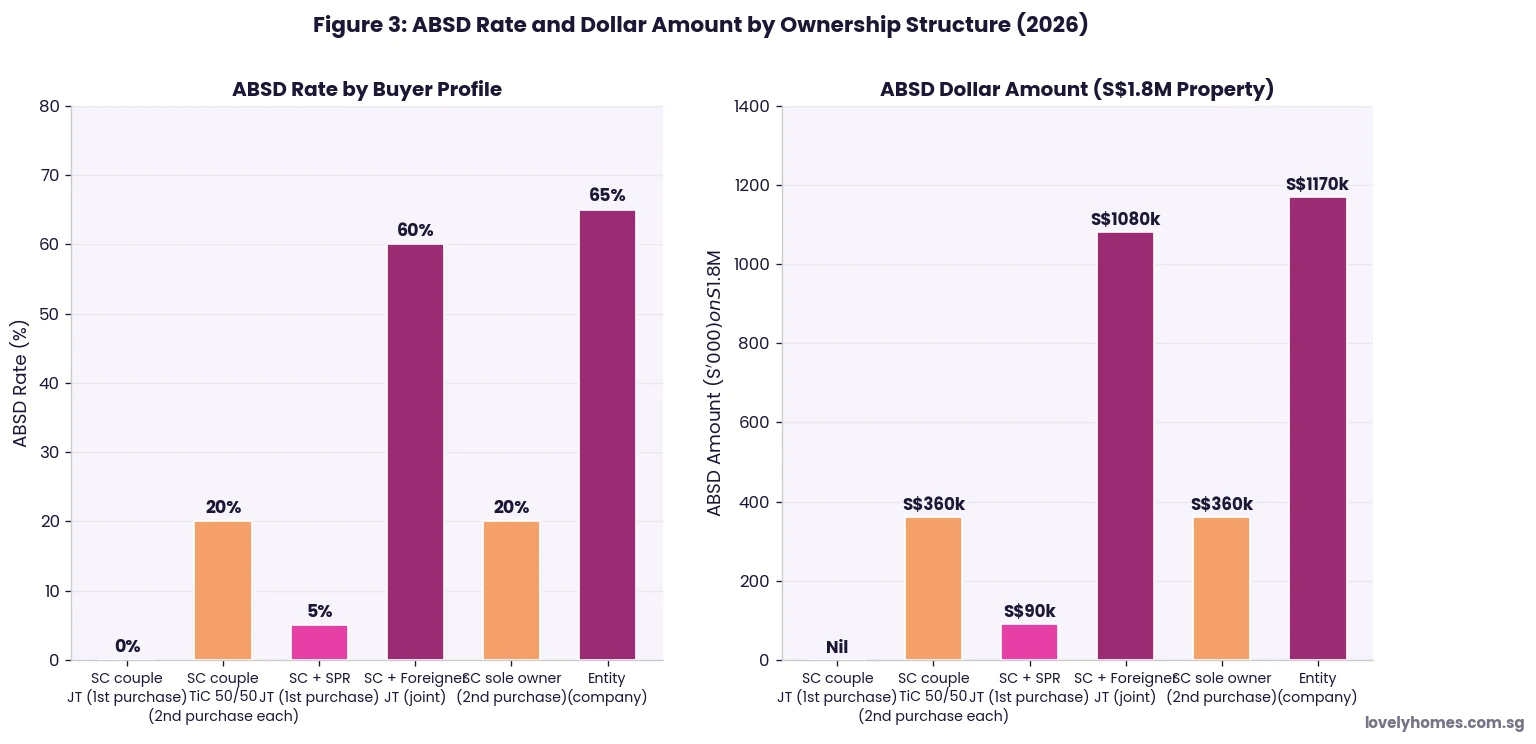
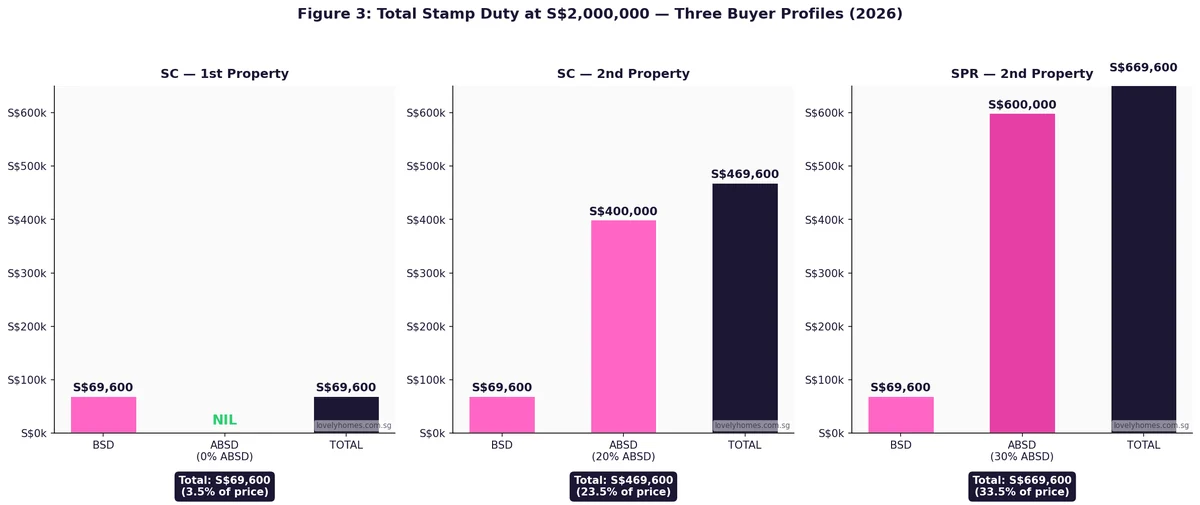
Auction purchases attract the same stamp-duty regime as private-treaty purchases — there is no auction-route discount. Buyer’s Stamp Duty applies on a sliding scale up to 6% on the slab above S$3 million for residential property. Additional Buyer’s Stamp Duty applies at the buyer’s profile rate: 0% for a Singapore Citizen first home, 20% on a Citizen second home, 30% on a third or subsequent home; 5% for a Permanent Resident first home, 30% on second; 60% for foreigners; 65% for entities; with a 35% LDAU surcharge for housing-developer entities. Stamp duty falls due to IRAS within 14 days of the contract date, which for an auction is the date the hammer falls.

Buyers planning an auction bid should compute the all-in cost — bid price plus BSD plus ABSD plus typical S$2,500 of legal cost plus 10% deposit financing — before raising the paddle. A foreigner bidding S$2 million on a residential lot pays S$1.2 million in ABSD on top, taking the all-in cost beyond S$3.25 million.

Q1 2026 Listings — Where Volume Came From

Property Auction Singapore 2026 mortgagee sale listings Q1 2026 +28.8 percent quarter on quarter
Figure 3: Mortgagee-sale listings climbed roughly 28.8% quarter-on-quarter in Q1 2026 — owner-sale activity remained range-bound.

The Q1 2026 climb in mortgagee-sale listings was concentrated in three property classes. Strata-titled commercial units — small office and retail lots in mixed-use buildings — accounted for the largest single increment, reflecting accumulated rental softness from the 2024 supply wave. Prime-district condominiums in Districts 9, 10 and 11 made the second-largest contribution, particularly two-bedroom and three-bedroom investment units bought between 2018 and 2021 with high LTV. Suburban executive condominiums and freehold landed terraces in Districts 13, 15 and 19 made up the third stream, mostly owner-occupier defaults rather than investor-driven listings. Owner-sale listings were broadly flat across the same period — the rise in auction volume was overwhelmingly distress-driven, not voluntary.

Worked Example: A Foreigner Bid on a S$1.95 Million Mortgagee Lot

Mr Ravi, a Permanent Resident on his second residential property in Singapore, attends a major April 2026 auction. The lot is a 1,184 sq ft three-bedroom freehold condominium unit in District 15, listed under mortgagee sale by a major retail bank. The reserve, undisclosed, has been set at S$1,950,000 (~S$1,647 psf). The starting bid is S$1.85 million; the room runs the bid up in S$10,000 increments to S$1,960,000, where Mr Ravi’s S$1.97 million bid sees off a final telephone bidder. The hammer falls.

On the spot. Mr Ravi produces a S$197,000 cashier’s order — 10% of the bid — payable to the auction firm. He signs the auction memorandum and the printed Conditions of Sale. The contract is binding.

Within 14 days. Mr Ravi’s solicitor lodges and pays:

  • Buyer’s Stamp Duty: ~S$70,000 (sliding scale to S$1.97M)
  • ABSD at PR-second-home rate: 30% × S$1.97M = S$591,000
  • Total stamp duties to IRAS: S$661,000

Weeks 1–4. Solicitor runs full title search at SLA, verifies discharge of the bank’s first mortgage on completion, and probes for any second-charge caveat or maintenance lien. Two outstanding maintenance arrears of S$11,400 are flagged from the management corporation; under the Conditions of Sale these survive completion and the buyer settles them as a post-completion debt to the MC.

Weeks 4–10. Mr Ravi finalises a refinance loan from a different bank at 1.65% fixed for 2 years, 75% LTV on his bid price. He receives the Letter of Offer at week 8. Critically, the new bank’s valuer puts indicative market value at S$1,920,000 — S$50,000 below the bid. The bank lends 75% of the lower of bid price and valuation, so the loan amount is S$1.44 million, not the S$1.4775 million Mr Ravi modelled. He has to top up S$37,500 in cash from the LTV gap, on top of the 25% he already had ready.

Week 14 — completion. Balance 90% (S$1.773 million) paid; legal completion at SLA. Mr Ravi takes vacant possession (the unit was already vacant — the previous borrower had moved out at default). All-in cost: bid S$1.97M + BSD S$70k + ABSD S$591k + legals S$3.5k + maintenance arrears top-up S$11.4k + cash gap S$37.5k = ~S$2.683 million. The “discount to market” once stamp duties are layered in is closer to 1% than the headline 5–10% reserve discount the auction was marketed at.

The Five Traps Newcomers Miss

Trap What goes wrong
Vacant possession not guaranteed Mortgagee sales are “as-is, where-is”. Holdover tenants, family members in occupation, or squatters can survive completion; the buyer must apply for a writ of possession at extra cost and time.
Loan in principle is not loan certainty A pre-auction LIP is not binding. The lender’s actual loan amount is determined post-bid, on a fresh valuation. If valuation comes in below bid, the LTV gap is the buyer’s cash problem, not the bank’s.
CPF release is slower than expected CPF Board needs an executed S&P plus the new mortgage instrument before disbursing OA funds. On a 12-week auction completion, the CPF release usually arrives just-in-time; missed paperwork can push the buyer into late-completion penalties.
Outstanding caveats survive A second-mortgage or judgment-debt caveat that isn’t the bank’s own first charge can ride through completion and become the buyer’s title problem to solve post-hand-over.
“Below valuation” can be illusion The bank’s panel valuation is not the same as a buyer-side valuation. A reserve set at the bank’s number can sit above what an independent valuer signs off — and that is the number that drives loan size.

Why This Matters

For most Singapore homeowners the auction route is simply not the right purchase channel — the binding-contract speed, the no-financing-contingency rule and the deposit forfeiture risk are unforgiving. For experienced investors with cash buffers, however, the auction calendar through 2026 is likely to widen the opportunity set: more mortgagee listings, in better postcodes, with reserves anchored to the lender’s valuation rather than seller aspiration. Anyone planning to bid should treat the auction not as a discount channel but as a different procurement mechanism with its own legal architecture and its own failure modes.

What Might Come Next

Three signals will tell you where the 2026 auction year is heading. First, watch the quarterly mortgagee-listings count reported by the major Singapore auction houses — Q2 2026 figures, due in July, will confirm whether Q1’s 28.8% rise is the start of a multi-quarter trend or a one-off catch-up. Second, track average winning-bid spread to reserve: a tight spread (winning bid 0–3% above reserve) signals weak buyer pool; a wider spread (5–10%) signals contested bidding and stronger market psychology. Third, monitor commercial vs residential mix: a continued tilt toward strata commercial and shophouse lots would suggest that 2026 distress is corporate and small-business, not household, and that residential auction risk stays bounded.

Frequently Asked Questions

Can I attend a Singapore property auction without bidding?

Yes. Public auctions are open to attend; you can register as a non-bidder simply to observe. Most major Singapore auctions are also live-streamed online, and recordings of past auctions are sometimes posted by the auction house. Attending two or three auctions before raising your own paddle is the cheapest education there is on how the room actually behaves under bidding pressure.

Can I bid online or by phone?

Yes. Every major Singapore auction house since 2021 supports online bidding, telephone bidding, and absentee bid forms. Pre-registration is required, including identity verification and proof of funds. The auctioneer reads remote bids into the room as they come in; a remote bidder who wins still has to deliver a 10% cashier’s order to the auctioneer within hours of the hammer.

Is there any cooling-off period after the hammer falls?

No. Auctions are expressly excluded from the Sale of Commercial Properties Act / Housing Developers Act cooling-off framework. The contract created by the auction memorandum is binding from the moment of execution. There is no 14-day Holding Period, no 3-day reflection window. This is the single most important difference between auction and private-treaty purchase.

Do I pay ABSD if I buy at auction?

Yes. The auction route confers no stamp-duty discount whatsoever. BSD applies on the sliding scale to the bid price, and ABSD applies at the buyer’s profile rate — 0%/20%/30% for Citizens by property count, 5%/30% for PRs, 60% for foreigners, 65% for entities. Both fall due to IRAS within 14 days of the auction date.

What happens if my financing falls through after I win the bid?

The 10% deposit is forfeited. If the property is re-auctioned at a lower price, the defaulting buyer is also liable for the shortfall plus the costs of the re-auction. There is no financing contingency in the auction Conditions of Sale. Bidders should secure a Letter of Offer or at minimum an in-principle approval before bidding, and should bid at a level the LIP supports — not a level that depends on a higher post-bid valuation.

Are there auctions for HDB flats?

HDB resale flats are not sold at public auction in Singapore. HDB resale transactions must go through HDB’s own resale portal and require the seller to be the registered owner. Mortgagee-sale auctions therefore concern only private property — condominiums, apartments, executive condominiums (post-privatisation), landed homes, strata commercial and shophouse lots. Where an HDB flat enters a forced-sale scenario, HDB itself supervises the sale through its resale process rather than via a third-party auction house.

Do reserve prices change during an auction calendar?

Frequently. If a lot fails to sell at the published reserve in one auction round, the auctioneer will discuss a revised reserve with the vendor before the next round. Mortgagee sales typically see reserve cuts of 2–5% per failed round, capped by the bank’s duty to obtain market value. Owner-sale reserves are more elastic — the owner may withdraw the lot entirely if bidding is weak. Tracking a lot through two or three rounds is a routine technique among experienced auction investors.

Related Articles

Disclaimer

This article is editorial commentary for general information only and does not constitute legal, financial, or stamp-duty advice. Auction Conditions of Sale, reserve prices and bidding procedures vary by auction house and by lot; always read the printed Conditions of Sale issued for the specific lot before bidding. Consult IRAS at iras.gov.sg for the prevailing BSD, ABSD and LDAU rates and the 14-day stamping deadline; consult SLA at sla.gov.sg for INLIS title-search and caveat information; consult MAS at mas.gov.sg for the prevailing TDSR cap and stress-rate; and engage a qualified solicitor familiar with auction conveyancing before raising a paddle.

Property Inheritance Singapore 2026: Estate Duty, Intestacy, ABSD on Inherited Property and CPF Nominations Explained

Property Inheritance Singapore 2026: Estate Duty, Intestacy, ABSD on Inherited Property and CPF Nominations Explained

Property inheritance in Singapore is governed by a small library of statutes — the Land Titles Act, the Probate and Administration Act, the Intestate Succession Act, and (for Muslim deceased) the Administration of Muslim Law Act. The headline numbers are deceptively simple. There has been no estate duty in Singapore since 15 February 2008, and inheritance itself does not attract Buyer’s Stamp Duty (BSD) or Additional Buyer’s Stamp Duty (ABSD). What actually drives outcomes is the ownership structure of the property and whether the deceased left a valid will.

Quick Answer

  • No estate duty since 15 February 2008. Singapore abolished estate duty by amendment to the Estate Duty Act; deaths from that date forward attract zero estate-duty liability.
  • Joint tenancy property bypasses the estate. The surviving co-owner takes the deceased’s share automatically by survivorship. The will is irrelevant to that property.
  • Tenancy-in-common shares form part of the estate. They pass via the will (Grant of Probate) or, if there is no will, per the Intestate Succession Act (Letters of Administration).
  • ABSD does not apply on inheritance. But an inherited property counts toward future ABSD — the heir’s “property count” goes up.
  • CPF moneys pass by CPF Nomination, not by will. Without a nomination, the Public Trustee distributes per the Intestate Succession Act after a court application.
  • Insurance with named beneficiaries bypasses the estate by virtue of the section 49L Insurance Act statutory trust.
  • HDB flat eligibility is rechecked at inheritance. Beneficiary must satisfy citizenship and family-nucleus rules or HDB will require sale within a defined period.
  • Muslim deceased follow Faraid rules under the Administration of Muslim Law Act, applied through the Syariah Court.
  • No estate duty does NOT mean no costs. Probate or Letters of Administration require court fees, lodgement fees, and legal fees that typically run S$3,000-S$8,000 for a straightforward estate.

The Backdrop — Why Singapore Has No Estate Duty

Singapore abolished estate duty for deaths occurring on or after 15 February 2008. The Estate Duty Act remains on the books for legacy estates from earlier dates, but for any contemporary death there is no estate-duty assessment, no requirement to file an estate-duty return, and no clearance certificate from the Inland Revenue Authority of Singapore (IRAS) before assets can be distributed.

The policy logic was straightforward: estate duty had become a leaky tax. High-net-worth individuals routinely structured their wealth into trusts, joint accounts, foreign holding vehicles, and life-insurance products that legally bypassed the duty. By the mid-2000s, most of the burden was falling on middle-class estates, especially those holding a single HDB flat or condominium with limited cash to settle the duty before distribution. Abolition simplified administration and removed a regressive tax in fact, even if not in headline rate.

The absence of estate duty does not mean the absence of administration. Probate or Letters of Administration are still required to convey title; CPF moneys still need to be claimed; insurance still needs to be filed for. The mechanics matter even when the tax does not.

Ownership Type — The Single Biggest Determinant

Singapore property is held under one of two ownership structures, and the difference is decisive on death.

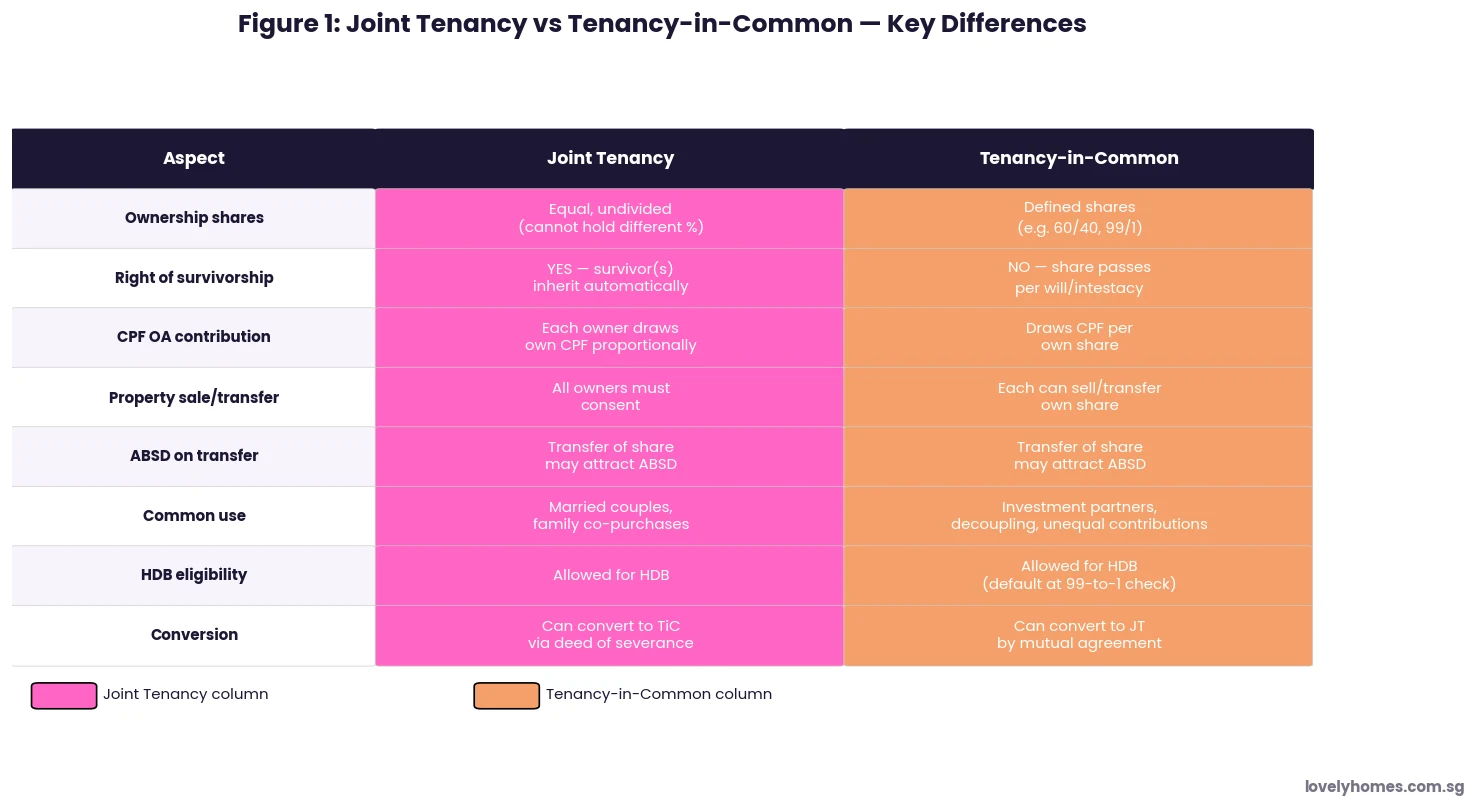
Joint tenancy creates a unified ownership where each co-owner holds the whole property, subject to the others’ equal claims. It is the default form for HDB flats co-owned by spouses and is common for condominium units owned by married couples. On the death of one joint tenant, the right of survivorship (jus accrescendi) operates by force of law: the surviving co-owner(s) take the deceased’s interest automatically. The deceased’s share never falls into their estate. The will, even if it purports to leave the property to someone else, has no effect on a joint-tenancy property. Title is updated by lodging a Notice of Death with the death certificate at the Singapore Land Authority (SLA); no probate is needed for that property.

Tenancy-in-common creates defined shares (50%/50%, 70%/30%, 1%/99%, etc.) that each owner holds independently. On death, that defined share falls into the deceased’s estate and passes by will or, if there is no will, per the Intestate Succession Act. The share is conveyed via Grant of Probate or Letters of Administration. Typical scenarios for tenancy-in-common include: married couples who deliberately want each spouse’s share to pass to children rather than to the surviving spouse, business partners co-owning commercial property, family members co-investing in a condominium, and “99-to-1” arrangements (now under heightened IRAS scrutiny — see our separate piece).

Unsure which form applies? Title can be checked at SLA’s INLIS (Integrated Land Information Service) for any property in Singapore — a S$5.40 per record search. The title document itself names the form: “Joint Tenants” or “Tenants-in-Common in shares of [X:Y]”.

Property Inheritance Singapore 2026 - joint tenancy vs tenancy-in-common routing on death decision tree
Figure 1: How a property routes to heirs depends first on ownership type, then on whether there is a will.

If There Is a Will — Probate

A valid Singapore will is one signed by a testator aged 21 or older, in writing, witnessed by two persons present at the same time, neither of whom is a beneficiary or a beneficiary’s spouse. Wills made overseas are recognised if they comply with the law of the place where they were made or with Singapore law. The will should name an executor — the person responsible for administering the estate — and should ideally be lodged with the executor and a solicitor for safekeeping.

On death, the executor applies to the Family Justice Courts for a Grant of Probate. Application is via the eLitigation electronic filing system. The court assesses the will’s validity, the executor’s appointment, and the schedule of assets. For an estate without contest, a Grant of Probate is typically issued in 4-8 weeks. The executor then collects the assets, settles debts and expenses, files the deceased’s final income tax return, and distributes the estate per the will’s terms. For property, this means executing transfer documents in favour of the named beneficiaries and lodging them with SLA.

Court fees: S$50-S$1,500 depending on estate value (graduated). Lodgement at SLA: approximately S$120 per title. Legal fees for an uncontested probate of a typical Singapore estate: S$3,000-S$6,000. Where the estate is contested or complex (foreign assets, business interests, contested executor appointment), costs scale rapidly and probate can take 6-12 months or longer.

If There Is No Will — Intestacy

The Intestate Succession Act (Cap 146) sets out a fixed distribution rule for non-Muslim deceased who died without a valid will. The administrator — typically the closest surviving relative — applies for Letters of Administration, again via the Family Justice Courts. The bonded administrator then distributes the estate per the statutory rules.

Property Inheritance Singapore 2026 - Intestate Succession Act distribution rules table
Figure 2: Intestate Succession Act distribution table – the statutory rules that apply when a non-Muslim Singaporean dies without a will.

The rules in plain language: a surviving spouse always takes priority; children share equally with the spouse where both exist; in the absence of children, the surviving spouse shares with the deceased’s parents; in the absence of all of these, the estate moves outward to siblings, then grandparents, then uncles and aunts. If no person within the statutory classes survives, the estate escheats — that is, falls to the State.

Several pitfalls trip up families relying on intestacy. Step-children are excluded unless legally adopted. A long-term partner without marriage receives nothing under the ISA — Singapore does not recognise common-law marriage and there is no equivalent statutory inheritance for unmarried partners. Foreign assets are governed by the law of the place where they sit, so an HDB flat in Singapore distributes per ISA but a Malaysian property distributes per Malaysian law (which requires a separate grant). Where the deceased held property as joint tenant with someone unrelated, that share is taken by the survivor by operation of law, regardless of intestacy intentions.

ABSD and Inherited Property — The Common Misunderstanding

Inheritance itself does not trigger Buyer’s Stamp Duty (BSD) or Additional Buyer’s Stamp Duty (ABSD). The transfer of property by way of inheritance is exempt from stamp duty under the Stamp Duties Act. This is true whether the property passes by will, by survivorship, or by intestacy.

The misunderstanding arises on the heir’s next property purchase. An inherited property counts as a “property owned” for ABSD-rate purposes. So a Singaporean who has never owned property, but inherits a 50% share of a condominium from a parent, becomes — for ABSD purposes — an owner of one residential property. If she subsequently buys her first home in her own right, she will face the second-property ABSD rate (currently 20% for Singapore Citizens) rather than the first-property zero rate.

Three consequences flow from this. First, families should plan inheritance with the next-purchase ABSD impact in mind, particularly for adult children who will be buying property soon. Second, where a property is held jointly between, say, a parent and an adult child for the parent’s protection in old age, the child’s ABSD profile is permanently affected — the child is treated as already owning a property even if their actual interest is small. Third, decoupling — the practice of transferring a share between spouses to “free up” one spouse’s first-property ABSD slot — is a separate planning move that has no overlap with inheritance and is governed by its own rules. Inheritance does not “reset” the ABSD count; only an outright transfer or sale of all property holdings can do so.

CPF Moneys — Do Not Pass by Will

This is the single most-missed point in Singapore estate planning. CPF moneys — Ordinary Account, Special Account, MediSave Account, and from age 55, the Retirement Account — do not form part of the deceased’s estate and do not pass by will. They pass by CPF Nomination. Without a CPF Nomination, the Public Trustee distributes the moneys after the estate is administered, applying the Intestate Succession Act rules but with administration fees deducted upfront (currently 0.3% of the first S$1,000, 0.15% of the next S$10,000, 0.075% of the next S$988,000, and 0.0375% of any amount above that).

A CPF Nomination is a separate instrument from a will. It is filed online via the CPF Board’s website with myInfo authentication, or in person at a CPF Service Centre. It can be updated at any time. Marriage and divorce automatically revoke an existing nomination — so a spouse who divorces and remarries must file a fresh nomination, or the post-divorce CPF moneys default to the Public Trustee on death. CPF Nominations cover only CPF balances; they do not cover any property purchased using CPF (the property itself follows ownership-type rules, not the nomination).

Insurance proceeds with a named beneficiary under section 49L of the Insurance Act 1966 also bypass the estate by virtue of the statutory trust. A spouse, child or parent named as beneficiary under section 49L receives the proceeds directly from the insurer, regardless of will or intestacy. Where the policy beneficiary is named under the older section 73 (now superseded but still in force for old policies), the trust position is the same.

HDB Flats — A Special Eligibility Recheck

HDB flats inherited by way of joint tenancy survivorship pass to the surviving co-owner without a fresh eligibility assessment, provided the survivor was already a registered owner. Where an HDB flat passes via probate or intestacy to someone who was not previously a registered owner — for example, a son inheriting his deceased mother’s solely-owned flat — HDB applies an eligibility assessment.

The assessment looks at: citizenship (Singapore Citizen or Permanent Resident with at least one Singapore Citizen co-occupier); family nucleus (the heir must form a recognised family unit with the flat); concurrent property holding (heirs already owning private property may be required to dispose of it); and where the inherited flat is a Plus or Prime classification, the resale income ceiling of S$14,000 monthly applies. Where the heir cannot satisfy eligibility, HDB requires the flat to be sold within a defined window (typically six to twelve months from inheritance), with the heir taking the cash proceeds rather than retaining the flat.

Because HDB classification rules can intervene unexpectedly, estate planners typically advise married couples in HDB flats to hold as joint tenants (default and usually optimal) and to discuss any tenancy-in-common arrangement with HDB before locking it in. Any change of HDB ownership form mid-tenure (e.g. converting joint tenancy to tenancy-in-common) requires HDB consent and is a separate stamping event.

Worked Example — An Ordinary Singaporean Estate

Mr Tan, 65, Singapore Citizen, dies intestate. He is survived by his wife Mrs Tan (62, SC), one adult son (35, married, lives separately) and one adult daughter (33, single, lives separately). His assets:

  • HDB 4-room in Tampines, held in joint tenancy with Mrs Tan, current market valuation S$700,000.
  • 50% tenancy-in-common share in a District 19 freehold condominium, valuation of his half-share S$1.2 million. The other 50% is held by his brother.
  • CPF moneys totalling S$220,000 across OA, SA, MA and RA.
  • Whole-life insurance policy with sum assured S$200,000 and Mrs Tan named as section 49L beneficiary.
  • Bank deposits in his sole name totalling S$80,000.
Property Inheritance Singapore 2026 - worked example Mr Tan estate distribution
Figure 3: Mr Tan’s estate distributed across spouse and two adult children – asset by asset, the routing differs sharply.

HDB flat: Mrs Tan takes 100% by survivorship. Notice of Death lodged at SLA with death certificate; title is updated within weeks. No probate needed for the flat. No BSD, no ABSD.

Condo share (50% TIC): Falls into the estate. Per ISA, Mrs Tan takes 50% (S$600,000 of equity), son takes 25% (S$300,000), daughter takes 25% (S$300,000). Letters of Administration are needed to convey title. ABSD-wise: the son becomes a part-owner of the District 19 condo; this affects his future ABSD profile permanently. The brother’s 50% TIC share is unaffected.

CPF S$220,000: Mrs Tan filed a CPF Nomination for 100% to her benefit some years ago. The CPF Board distributes S$220,000 to Mrs Tan within 6-8 weeks of receiving the death certificate. No probate required for the CPF moneys.

Insurance S$200,000: Filed directly with the insurer. Mrs Tan is named beneficiary under section 49L. S$200,000 paid directly to Mrs Tan within 2-4 weeks of claim filing. No probate required.

Bank deposits S$80,000: Falls into the estate. Distributed per ISA. Mrs Tan takes S$40,000, son takes S$20,000, daughter takes S$20,000. Letters of Administration required to release bank moneys.

Estate administration cost: court fees, S$200; lodgement fees, S$120 per title; bond fees, S$300; solicitor’s fees for Letters of Administration, S$3,500-S$5,000. Total: approximately S$4,000-S$5,500. No estate duty (zero rate since 2008). No BSD or ABSD on the inheritance itself. Future ABSD on subsequent purchases by the son will be calibrated to recognise his now-existing condo share.

Summary Table — Asset Routing on Death

Asset type Default routing Document needed Stamp duty / tax
Property in joint tenancy 100% to surviving co-owner by survivorship Notice of Death + death cert at SLA No BSD, no ABSD, no estate duty
Property in tenancy-in-common (with will) Per will Grant of Probate No BSD, no ABSD on the inheritance; impacts heir’s future ABSD
Property in TIC (intestate) Per Intestate Succession Act Letters of Administration Same as above
CPF (with nomination) Per CPF Nomination CPF Board claim form + death cert No tax
CPF (no nomination) Public Trustee per ISA Court application via PTO PTO administration fees apply
Insurance with s.49L beneficiary Direct to named beneficiary Insurer claim form + death cert No tax; bypasses estate
Bank deposits (sole) Per will or ISA Probate or Letters of Admin No estate duty
Bank deposits (joint) Surviving account holder takes (subject to bank’s internal rules) Death cert + bank’s release form No estate duty
HDB flat with non-eligible heir HDB requires sale; cash to heir Probate / LOA + HDB resale process No tax on the inheritance; resale process attracts BSD on next purchase

Why This Matters — Estate Planning in 2026

The absence of estate duty has not made Singapore estate planning trivial. Three forces are now driving more careful planning. First, ABSD: with the rate at 20% for Singapore Citizens on a second property and 30% on a third, an inheritance that “uses up” an heir’s first-property ABSD slot can cost six figures on their next purchase. Second, the Plus / Prime HDB framework: an HDB flat inherited by a heir whose family income exceeds S$14,000 may force a forced sale, with the heir taking cash rather than the flat. Third, longer life expectancy: the median Singaporean now dies at 84 (men) or 88 (women), and with substantially more accumulated property and CPF wealth than a generation ago.

The estate-planning toolkit has not changed dramatically: a current will, a current CPF Nomination, a clear understanding of which properties are joint-tenancy versus tenancy-in-common, named beneficiaries on insurance, and a record of foreign assets. What has changed is that the cost of getting it wrong has risen, particularly for heirs about to enter the property market.

What Might Come Next — A Forward View

Three policy currents are worth watching. First, the periodic discussion of reintroducing some form of inheritance or wealth tax — flagged in academic and policy circles in 2024-25, but not adopted. Any reintroduction would likely come with substantial thresholds and would target estates well above the median. Second, refinement of HDB inheritance rules under the Plus / Prime framework, particularly around how the S$14,000 income ceiling is applied to inherited resale flats — currently it is applied at the moment of inheritance, which is unforgiving. Third, digital-estate developments: the growing weight of digital assets (cryptocurrency, online accounts) and how they interact with traditional estate administration is an unsettled area, and Singapore courts have only begun to encounter the issues.

Frequently Asked Questions

Do I need a will if my estate is simple and held in joint tenancy?

For property held in joint tenancy with a spouse, the will has no effect on the property — survivorship operates regardless. But your other assets (bank accounts, investments, personal items, foreign assets) still pass through the estate. Without a will, intestacy rules apply, which may not match your intentions — particularly for blended families, unmarried partners, or where you want to provide for a charity or non-relative. A simple Singapore will costs S$300-S$800 to prepare and is strongly advisable for any adult with assets, even if those assets are modest.

If I inherit a condo from my late father, do I pay ABSD on it?

No. Inheritance itself does not attract Buyer’s Stamp Duty or Additional Buyer’s Stamp Duty. The transfer is exempt under the Stamp Duties Act. However, the inherited property now counts as a property you own — so when you next buy a property in your own right, you will be assessed at the second-property ABSD rate (20% for SCs, 25% for SPRs, 65% for foreigners as of May 2026) on the new purchase, not at the first-property zero or 5% rate.

Can my will override a joint tenancy on a HDB flat?

No. Joint tenancy survivorship operates by force of law; the will is irrelevant to that property. If you and your spouse hold an HDB flat as joint tenants, your spouse takes 100% on your death regardless of what your will says. To direct the flat to someone else (for example, an adult child from a prior marriage), you must first sever the joint tenancy and convert it to tenancy-in-common — a documented act involving HDB consent — and then provide for the share in your will.

My CPF nomination names my mother — but I am now married. Do I need to update it?

Yes — and likely sooner than you realise. Marriage and divorce automatically revoke an existing CPF Nomination. Without a fresh nomination after marriage, your CPF moneys default to the Public Trustee on your death, who distributes per the Intestate Succession Act with administration fees deducted. The Intestate rules give your spouse a 50% share alongside your parents (no children scenario) — which may not match your intentions. Update your CPF Nomination online via the CPF Board portal within weeks of marriage. The same applies after divorce.

How long does probate or Letters of Administration take in Singapore?

For a straightforward, uncontested estate where all documents are in order, Grant of Probate or Letters of Administration is typically issued by the Family Justice Courts in 4-10 weeks from filing. Estates with foreign assets, contested wills, or complex business holdings can take 6-12 months or longer. Court fees scale with estate value (S$50-S$1,500 graduated), legal fees for an uncontested matter are typically S$3,000-S$6,000, and administrator’s bond requirements (for intestacy) add a small further cost. Cash flow during the probate period: insurance with named beneficiaries pays out within weeks; CPF with a nomination pays within 6-8 weeks; everything else waits for the grant.

What about Muslim deceased — do the same rules apply?

No. For Muslim deceased, the Administration of Muslim Law Act applies and the Faraid (Islamic inheritance) rules govern the distribution. The Syariah Court issues an Inheritance Certificate that sets out each beneficiary’s fixed share. The Faraid scheme is fundamentally different from the Intestate Succession Act — it provides fixed fractions to defined classes of relatives (spouse, children, parents, siblings) and does not allow more than one-third of the estate to be willed away from the Faraid scheme. Muslims who wish to deviate from Faraid for a portion of their estate (within the one-third limit) typically use a will (wasiyyah) and a hibah (lifetime gift). Specialist Syariah-law guidance is essential.

If my late spouse owned an overseas property, does Singapore probate cover it?

No. Singapore probate covers Singapore-situated assets only. For an overseas property, a separate grant must be obtained in the jurisdiction where the property sits — typically a “resealing” of the Singapore grant where the foreign jurisdiction recognises Commonwealth probate (Australia, the United Kingdom, Malaysia), or a fresh grant where it does not (mainland China, Indonesia, Thailand). Foreign tax may apply on the inheritance even when Singapore tax does not — Australia, the United Kingdom and the United States all impose some form of estate or inheritance tax on assets situated in their jurisdictions. Cross-border estate planning requires advice from solicitors qualified in both Singapore and the foreign jurisdiction.

Related Articles

Disclaimer

This article provides general information about property inheritance in Singapore as at May 2026 and is not legal, tax or financial advice. Inheritance outcomes depend on individual ownership structures, the validity of any will, the applicable rules under the Land Titles Act, Probate and Administration Act, Intestate Succession Act and Administration of Muslim Law Act, and may change. For binding determinations consult a Singapore-qualified solicitor specialising in probate and estate administration. For CPF-specific guidance refer to the Central Provident Fund Board; for stamp duty refer to the Inland Revenue Authority of Singapore; for HDB-specific inheritance rules refer to the Housing & Development Board. Numerical figures and the worked example are illustrative only.

99-to-1 Property Purchase Singapore 2026: How Tenancy-in-Common Carve-outs Met IRAS’ ABSD Anti-Avoidance Probe

99-to-1 Property Purchase Singapore 2026: How Tenancy-in-Common Carve-outs Met IRAS’ ABSD Anti-Avoidance Probe

The phrase 99-to-1 Property Purchase Singapore 2026 describes a tenancy-in-common structure where one buyer holds 99 per cent of the property and a second buyer holds 1 per cent. Used legitimately, it is a perfectly valid form of co-ownership recognised under the Land Titles Act. Used as a two-step manoeuvre to add a co-owner after the original purchase, the structure became the subject of one of the most public anti-avoidance probes the Inland Revenue Authority of Singapore (IRAS) has run in the post-2010 cooling-measure era — a probe that recovered an estimated S$60 million in unpaid Additional Buyer’s Stamp Duty (ABSD) and surcharges.

This guide explains how the 99-to-1 structure works, why IRAS has scrutinised it, when a 99-to-1 split is legitimate and when it crosses the line into tax avoidance under the General Anti-Avoidance Rule (Section 33A of the Income Tax Act, with parallel application to stamp duties), and what the practical implications are for any Singapore household considering a tenancy-in-common purchase in 2026. The framework is administered by IRAS under the Stamp Duties Act, with anti-avoidance powers drawn from Section 33A of the Income Tax Act 1947.

Quick Answer — 99-to-1 in Singapore at a glance

  • What it is: a tenancy-in-common (TIC) ownership split where one party holds 99 per cent and another holds 1 per cent of a single residential property.
  • Why people use it: to bring a second income onto a bank loan, to plan an estate, or to manage the marital-asset split.
  • Why IRAS scrutinised it: a two-step variant — Buyer A purchases 100 per cent first, then Buyer B (who already owns property) is added 1 per cent later — was used to dodge ABSD that should have applied at the higher second-property rate.
  • The 2023 IRAS probe: 166 cases reviewed, an estimated S$60 million in ABSD and surcharge recovered, with a 50 per cent surcharge layered on top of the avoided tax.
  • Bright-line test: if the 1 per cent share is added after the original purchase, with the only commercial reason being to avoid a higher ABSD bracket, IRAS treats it as one composite transaction and reassesses ABSD on the full price.
  • Statute of limitations: up to six years backward under Section 33A.
  • Legitimate use is unaffected: a 99-to-1 split applied at the OTP itself, with both parties paying ABSD on their respective shares from Day 1, is fine.

What 99-to-1 Actually Means in Singapore Property Law

Singapore property co-ownership comes in two legal forms — joint tenancy and tenancy-in-common. Joint tenancy means co-owners share an undivided 100 per cent interest, and the property passes by survivorship to the surviving joint tenant on death. Tenancy-in-common means each owner holds a defined percentage of the property, and that share passes by will (or by intestacy) on death rather than to the other co-owners. Two co-owners as tenants-in-common can hold the property in any split that adds to 100 per cent — 50/50 is the default, but 80/20, 70/30 and 99/1 are all permitted. The Land Titles Act recognises any defined share. The 99/1 split is unusual mathematically but unremarkable legally.

For stamp duty purposes, a tenancy-in-common purchase is treated as a single transaction at the property level. Each co-owner is a “buyer” under the Stamp Duties Act, and ABSD is computed against each buyer’s profile. Where the buyers fall into different ABSD brackets — for example, one with no prior Singapore property (0 per cent) and one with one prior Singapore property (20 per cent) — the rule is unambiguous: the highest ABSD rate among the joint buyers applies to the entire purchase price, not just to the higher-rate buyer’s share.

This rule is what makes the 99-to-1 split structurally different from, say, a 50-50 split. The economic exposure of the 1-per-cent owner is one one-hundredth of the property; but the ABSD effect is the same as if they owned the whole thing. The Government’s logic is straightforward — the rule is meant to plug the obvious workaround of giving a higher-rate buyer a tiny notional share to access a joint loan while ducking the corresponding ABSD.

The Two-Step Mechanic IRAS Targeted

The 99-to-1 manoeuvre that IRAS publicly scrutinised in April 2023 was not the upfront 99-to-1 split. Upfront splits, where both buyers appear on the original Option to Purchase, the Sale and Purchase Agreement and stamping documents, were never the issue — the highest-rate ABSD applies cleanly and the tax is paid in full. The structure that drew IRAS’ attention was a two-step purchase:

99-to-1 Singapore 2026 two-step ABSD avoidance mechanic — Buyer A first, Buyer B added one per cent later
Figure 1: The two-step pattern targeted by IRAS — original 100% buy by the lower-rate party, followed days or weeks later by a 1% transfer to the higher-rate party.

Step 1. Buyer A — a Singapore Citizen or Permanent Resident with no other Singapore property — exercises the Option to Purchase as the sole 100-per-cent owner of, say, a S$2 million condominium. ABSD on Buyer A is 0 per cent (or 5 per cent for a PR). Buyer’s Stamp Duty is computed normally (about S$64,600 for S$2 million). The buy is clean from the stamp-duty perspective.

Step 2. A short period later — sometimes days, sometimes weeks, occasionally a couple of months — Buyer A executes a transfer of 1 per cent of the property to Buyer B, who already owns one or more Singapore residential properties. Buyer B’s ABSD profile sits at 20, 30 or 60 per cent depending on their citizenship and prior holdings. Stamp duty would be paid on the 1-per-cent transfer at face value (BSD on S$20,000 = S$200; ABSD on S$20,000 at 20 per cent = S$4,000). The household has now achieved its real goal — both names on the title — but has paid only a fraction of the ABSD that would have been due if both names had appeared on the original OTP.

The motivation for the two-step structure is almost always financing-related. Banks underwrite home loans against the income of the named borrowers; many households need both incomes to meet the Total Debt Servicing Ratio (TDSR) cap of 55 per cent. If the higher-income borrower already owns property, putting both names on the OTP triggers the higher ABSD bracket on the entire purchase. The 99-to-1 two-step purports to achieve the loan-support outcome without the ABSD outcome.

How IRAS Pulled the Pattern Apart

IRAS announced in April 2023 that it had reviewed 166 cases of 99-to-1 (and similar structures like 95-to-5 or 90-to-10) where there was no commercial reason for the two-step pattern other than ABSD avoidance. The agency invoked Section 33A of the Income Tax Act 1947 — Singapore’s General Anti-Avoidance Rule — together with its parallel powers under the Stamp Duties Act, to recharacterise the two-step transaction as a single composite purchase. Once recharacterised, the ABSD is recalculated as if both buyers had been on the original OTP at the higher rate.

99-to-1 Singapore 2026 ABSD rates joint buyers — highest rate wins on entire purchase
Figure 2: The ABSD rate matrix for joint buyers in 2026. The highest applicable rate among co-owners applies to the whole purchase, not just to that owner’s share.

The reassessment can be material. On a S$2 million joint purchase by an SC with no prior property and an SC with one prior property, the original transaction collected ABSD only on the 1-per-cent transfer (about S$4,000). The composite reassessment applies 20 per cent ABSD to the entire S$2 million — S$400,000 — with the difference (S$396,000) recovered as additional duty. On top, IRAS imposes a 50 per cent surcharge on the avoided ABSD under the surcharge provisions of the Stamp Duties Act. Total exposure: roughly S$594,000 in additional ABSD, surcharge and interest on an originally clean-looking S$2 million buy.

The surcharge is what makes the structure so dangerous in retrospect. A buyer who would have happily paid the full ABSD upfront — perhaps deciding the higher rate was worth paying for joint-name ownership — is now exposed to half-as-much-again-on-top simply because the structure was used to sidestep it.

The Bright-Line Test — Legitimate vs Avoidance

IRAS does not publish a closed-list rule on which 99-to-1 structures are acceptable. The framework is principles-based, drawn from the long-established interpretation of Section 33A: a transaction or arrangement is voidable for tax purposes if its sole or dominant purpose is to obtain a tax advantage and there is no genuine commercial reason for it. The case law on Section 33A — including the leading Comptroller of Income Tax v AQQ decision — emphasises substance over form, intent over labels, and the natural commercial reality of what the parties actually did.

99-to-1 Singapore 2026 legitimate carve-out vs avoidance pattern under section 33A bright-line test
Figure 3: The bright-line markers IRAS uses to separate a legitimate 99-to-1 carve-out from an avoidance pattern. Time gap, contribution, intent and disclosure all matter.

Practically, four indicators tend to push a 99-to-1 split into the legitimate column. First, both names appear on the original OTP itself — the 1 per cent is part of the original transaction, not bolted on later. Second, both parties contribute economic value proportionate to their share — for example, a child contributes a small cash deposit and is rightly entered on the title for that contribution. Third, the structure has a non-tax purpose — estate planning, succession, marital-asset planning, or a parent-and-child purchase with a real intent to leave the 1 per cent in the second name. Fourth, disclosure is clean — both parties stamp at their full ABSD rate from Day 1.

Three indicators tend to push a 99-to-1 split into the avoidance column. First, the 1-per-cent owner is added after the original purchase, with no documented commercial trigger for the late addition. Second, the only practical effect of the addition is to bring the higher-rate party’s income onto a bank loan that would otherwise not have qualified at TDSR 55 per cent. Third, the time gap between the original 100-per-cent purchase and the 1-per-cent transfer is short — days, weeks, or a small number of months — and there is no intervening event (such as a marriage, an inheritance, a job change creating a new income source) that explains the delay.

The IRAS audits in 2023 focused on cases where multiple of these markers were present together. A two-step purchase by itself is not automatically voided; what IRAS looks for is the conjunction of the markers — late addition, no commercial reason, financing motivation, short gap, and the higher-rate party already in a prior-property bracket.

What “Legitimate” Looks Like in Practice

Three real-world patterns of 99-to-1 are routinely accepted by IRAS as commercially sound and not subject to anti-avoidance recharacterisation. The first is parent-and-child estate planning: a parent buys a property and includes the child as a 1-per-cent tenant-in-common to facilitate eventual succession at fair value. The 1 per cent is part of the original OTP, ABSD is paid at the parent’s full applicable rate (with the child’s portion stamped at the child’s rate, if different), and the structure has a clear non-tax purpose.

The second is marital asset structuring before divorce: a couple in the late stages of separation may carve out a 99-to-1 split to give one party a residual interest pending the matrimonial settlement, with the larger holder having the operational control to sell. As long as the carve-out is at the OTP itself and ABSD is paid at the highest rate, this is unobjectionable.

The third is commercial co-investment with documentation: a friend-of-friend joint purchase where one party puts up the bulk of the equity and the other contributes a small share for a defined investment purpose (renovation works, future development, occupancy rights). Provided ABSD is fully paid at the highest applicable rate from Day 1, IRAS has no anti-avoidance angle to pursue.

Worked Example — Mr Lee and Mrs Lee on a S$2 Million Tampines Condo

Worked Example. Mr Lee, 36, Singapore Citizen, owns one HDB flat already. Mrs Lee, 33, Singapore Citizen, has no other property. They want to buy a S$2 million private condominium in Tampines. Mr Lee’s gross income is S$14,000 a month; Mrs Lee’s is S$5,000. Mr Lee’s prior HDB will continue to be occupied by his parents. Both names are needed on the bank loan to clear the TDSR 55 per cent test on the S$1.5 million loan they have in mind.

The legitimate joint purchase. Mr and Mrs Lee both go on the OTP as tenants-in-common at any agreed split — 50/50, 99/1, 1/99, whatever. Mr Lee falls into the 20 per cent ABSD bracket (second Singapore property). The highest-rate-wins rule applies the 20 per cent rate to the entire S$2 million purchase. ABSD = S$400,000. BSD = S$64,600. The bank underwrites the S$1.5 million loan against both incomes; TDSR clears comfortably. The Lees write the cheque, take the keys, and IRAS is satisfied.

The avoidance variant (do not do this). Mrs Lee buys 100 per cent of the condo on the OTP at S$2 million. ABSD on Mrs Lee is 0 per cent (first Singapore property). BSD = S$64,600. Six weeks later, Mr Lee is added at 1 per cent for a notional consideration of S$20,000. ABSD on the 1 per cent at his 20 per cent rate = S$4,000. The household has paid roughly S$396,000 less ABSD than it would have under the legitimate joint purchase.

The IRAS reassessment. If IRAS audits the file under Section 33A and finds the financing motivation — the bank loan was sized off both incomes from the start, and there is no commercial reason for the six-week delay other than the ABSD differential — the agency reassesses the original transaction as a composite joint purchase. ABSD becomes S$400,000. The avoided amount of approximately S$396,000 attracts a 50 per cent surcharge of S$198,000. Plus simple interest from the original stamping date to the date of the IRAS notice. Total exposure: around S$594,000 in additional duty and surcharge — most of which would have been zero if the household had simply gone on the OTP together at the start.

The arithmetic is the lesson. Households who can afford to pay the ABSD on a joint purchase should do so. Households who cannot afford it should not be using a 99-to-1 to make themselves “afford” it — the 50 per cent surcharge erases the saving and adds a felt embarrassment to the file.

Summary Table — 99-to-1 Considerations 2026

Question Answer (2026)
Is a 99-to-1 split itself illegal? No. Tenancy-in-common at any defined share is recognised under the Land Titles Act.
Is an upfront 99-to-1 acceptable? Yes. As long as both names are on the original OTP and ABSD is paid at the highest applicable rate.
Is a two-step 99-to-1 acceptable? Only if there is a documented commercial reason for the delay. If not, IRAS may invoke Section 33A.
What rule applies on joint name? Highest ABSD rate among the buyers applies to the entire purchase price.
Surcharge if avoidance is found? 50 per cent surcharge on the avoided ABSD, plus simple interest from original stamping date.
Lookback period for IRAS Up to six years from original stamping under Section 33A.
Legitimate alternatives Decoupling (sale of one share to the other after MOP), staggered purchases over time, or paying full ABSD upfront.
Cases reviewed in 2023 probe 166 cases; estimated S$60 million in ABSD and surcharge recovered.
Does HDB allow 99-to-1? Generally not for HDB purchases — HDB applies its own joint-tenancy rules and prohibits decoupling since 10 April 2018.

What This Means for You

The 99-to-1 ABSD episode is one of the clearest illustrations of how Singapore’s tax authorities use a principle-based General Anti-Avoidance Rule rather than a closed-list code. There is no specific rule banning 99-to-1 splits; there is a broader rule that any tax-driven structure with no commercial purpose can be recharacterised. Households making property co-ownership decisions in 2026 should treat this less as a single closed file and more as a continuing posture by IRAS toward stamp-duty avoidance.

The practical advice is simple. If you and a co-buyer want to be on the title, get on the title at the OTP. Pay ABSD at the highest applicable rate from Day 1. Do not invent a delayed structure to manage the bank loan unless there is a real, documentable, non-tax reason for the delay. If you are unsure whether your circumstance qualifies, consult a Singapore conveyancing solicitor before signing the OTP — restructuring is far cheaper than reassessment.

For households who genuinely cannot afford the higher ABSD bracket — for example, an upgrader couple where one spouse already owns property — the legitimate alternative is decoupling after the Minimum Occupation Period on the existing flat (if HDB, subject to the 2018 prohibition), or a staggered purchase strategy over time. These approaches respect the cooling-measure intent and do not invite the 50 per cent surcharge that attaches to recharacterised avoidance.

What Might Come Next

The 99-to-1 enforcement was a high-visibility action that has materially shifted market behaviour since 2023. Conveyancing solicitors now flag two-step structures as a matter of course; banks increasingly require ABSD payment confirmation before disbursing on transfers; and IRAS has signalled that anti-avoidance scrutiny extends to other patterns where the form of a transaction differs materially from its substance — for example, trust structures, nominee purchases, and serial divorce-and-remarriage carve-outs in property settlements.

Looking forward, two areas of policy attention deserve watching. First, the Stamp Duties Act may be tightened to make composite-transaction recharacterisation more procedurally straightforward, replacing the case-by-case Section 33A review with a clearer presumption against short-interval transfers. Second, the surcharge level — currently 50 per cent — has historical precedents at higher levels in other Singapore tax regimes, and could be revisited if avoidance patterns continue to surface. The direction of policy travel since 2010 has been toward closing perceived loopholes, not loosening them; households should plan accordingly.

Frequently Asked Questions

Is the 99-to-1 split itself illegal in Singapore?

No. Tenancy-in-common at any defined share — including 99/1 — is a recognised form of co-ownership under the Land Titles Act. What IRAS scrutinises is the two-step pattern where the 1 per cent is added after the original 100 per cent purchase, with no commercial reason other than to avoid the higher ABSD rate that would have applied if both buyers had been on the OTP from the start.

If both names are on the original OTP, do I avoid the IRAS issue?

Yes. The April 2023 IRAS probe focused exclusively on two-step transactions where the second co-owner was added later. An upfront 99-to-1 split where both names appear on the original Option to Purchase, and ABSD is paid at the highest applicable rate from Day 1, is not subject to anti-avoidance recharacterisation.

What is the IRAS surcharge if avoidance is found?

50 per cent on the additional ABSD assessed, plus simple interest from the original stamping date. On a S$2 million purchase where avoided ABSD is S$396,000, the surcharge is S$198,000 — bringing the total reassessment to roughly S$594,000 plus interest. The surcharge is what makes anti-avoidance recharacterisation economically punitive: paying upfront would have been about two-thirds of the post-audit cost.

How far back can IRAS reassess?

Up to six years from the original stamping date under Section 33A. In practice, the 2023 probe looked at transactions over the preceding several years where the two-step pattern was identifiable from records. The lookback window means structures executed in 2020–22 remained exposed when the probe was announced.

Can I do a 99-to-1 for an HDB flat?

Generally not. HDB applies its own joint-tenancy rules — most BTO and resale purchases must be in joint tenancy, not tenancy-in-common — and decoupling has been prohibited since 10 April 2018 to prevent ABSD-avoidance manoeuvres on second properties. The 99-to-1 conversation is largely confined to private property purchases.

My family bought a property in 2021 with a 99-to-1 split. Should I worry?

Read the structure carefully. If both names appeared on the original OTP and ABSD was paid at the highest applicable rate at the time, there is nothing to worry about — that is a legitimate upfront 99-to-1. If the second name was added after the original purchase and the only motivation was financing or ABSD avoidance, the file is potentially exposed under Section 33A’s six-year lookback. Consult a solicitor or tax adviser to assess the position; voluntary disclosure ahead of an audit attracts considerably more lenient treatment than reactive disclosure.

Are there legitimate alternatives that achieve a similar financing outcome?

For households where one party already owns property and the other does not, the cleanest alternatives are: (a) pay the higher ABSD rate upfront on a joint purchase; (b) execute the purchase under the non-owning party’s name with the financing structured to qualify on that party’s income alone; or (c) wait until the existing property is sold (subject to the 30-month decoupling rule for ABSD remission on a Singaporean married couple’s first new property). Each has trade-offs, but none invites a Section 33A reassessment.

Disclaimer

This article is general guidance on Singapore’s stamp-duty framework as administered by the Inland Revenue Authority of Singapore as at the publication date and is not financial, tax or legal advice. Anti-avoidance enforcement under Section 33A of the Income Tax Act 1947 and the corresponding provisions of the Stamp Duties Act is highly fact-specific; the application to any particular transaction depends on the documents, sequence and intent. For the rule that applies to your circumstances, consult IRAS, a licensed Singapore solicitor and a registered tax practitioner. Always rely on official sources — IRAS, the Stamp Duties Act and the Income Tax Act 1947 — for the latest position before transacting.

Related Articles

Capital Gains and Rental Income Tax Singapore 2026: How Property Investors Are Actually Taxed

Capital Gains and Rental Income Tax Singapore 2026: How Property Investors Are Actually Taxed

Capital gains tax on property in Singapore 2026 — that is the search every aspiring property investor types into Google before clicking Buy. The short answer is Singapore has no capital gains tax when you sell a property held genuinely as long-term investment. The longer answer is that rental income while you hold the property is fully taxable, and a gain on sale can be reclassified as taxable trade income if IRAS decides you behaved like a property trader rather than an investor. Get either nuance wrong, and you can hand the Inland Revenue Authority of Singapore a tax bill running into six figures.

This guide walks you through both halves of the property-investment tax regime in 2026: the capital-gains side (what you pay on disposal — usually nothing, sometimes everything, depending on intent) and the rental-income side (what you pay every year you let out the property). All figures and rules reflect the framework administered by the Inland Revenue Authority of Singapore (IRAS) under the Income Tax Act 1947.

Quick Answer — Property Tax for Singapore Investors at a glance

  • Capital gains tax (CGT): none in Singapore. A long-held investment property sold at a profit attracts zero CGT.
  • Rental income tax: fully assessable income. Rent is reported on your annual Form B / B1 and taxed at your marginal rate (0% to 24% for tax residents).
  • Deductions: mortgage interest, MCST/management fees, repairs, property tax, agent fees, fire insurance — all deductible against rental income.
  • 15% deemed expense: alternative to actual-expense claims, since YA 2016. Mortgage interest is still claimable on top of the 15%.
  • “Trader” reclassification: IRAS may treat a gain as trade income taxable at 0–24% if the badges of trade are met (frequency, holding period, financing, intent).
  • Seller’s Stamp Duty (SSD): separate from income tax. Up to 12% for sales within the first year, 8% within two, 4% within three.
  • Property Tax: separate annual property tax (4–32% of Annual Value) levied by IRAS regardless of rental status.

Why Singapore Does Not Have a Capital Gains Tax

Singapore is one of a handful of jurisdictions in the world that does not levy a general capital gains tax. The Income Tax Act 1947 taxes income — defined under section 10(1) as gains from a trade, profession, or vocation, plus dividends, interest, rents, royalties, and various other categories. A gain on sale of a long-held asset is, in principle, a capital gain rather than income, and falls outside the section 10(1) net.

This is policy, not oversight. The Singapore government has long taken the view that low capital-mobility costs are a competitive advantage for the financial centre and the housing market. The same principle covers shares, corporate sales, business goodwill, and — critically for property investors — long-held investment properties. The cooling-measure regime taxes property at the buying side (BSD, ABSD) and the disposal side (SSD if disposed within three years), but a clean investment hold-and-sell at year five is untaxed at the gain.

Capital gains vs rental income Singapore 2026 — two different tax regimes for the same property
Figure 1: The two-tax framework — Singapore does not tax the capital gain on a long-held investment property, but rental income is taxable income each year.

The Trader Trap — When IRAS Reclassifies Your Gain

The capital gains exemption is not unconditional. IRAS reserves the right to reclassify a property gain as trade income if the taxpayer’s behaviour resembles property trading rather than long-term investment. The legal hook is section 10(1)(a) of the Income Tax Act, which taxes “gains or profits from any trade, business, profession or vocation”. Once a gain is reclassified as trade income, it is fully taxable at the individual’s marginal rate (up to 24% for tax residents) or the prevailing 17% corporate rate for entities.

Singapore’s courts and the Comptroller of Income Tax apply the badges of trade test, a doctrine inherited from UK case law and refined locally through cases such as Comptroller of Income Tax v IA and the IRAS e-Tax Guide on the matter. The badges are weighed together — no single factor is decisive — and they ask, in essence, “did this taxpayer behave like an investor or like a trader?”

Badges of trade test Singapore IRAS — six factors that recharacterise property gain as taxable trade income
Figure 3: The six classical badges of trade. The more that point toward trade activity, the more likely IRAS will assess the gain as taxable trade income.

The practical implication for the typical Singapore property investor is straightforward: hold the property for at least three to five years, generate genuine rental income during the hold, and document your investment intent (rental tenancies, declared rental income, no immediate resale marketing). For most owner-occupier-then-investor patterns, the badges of trade are not met and the gain is non-taxable. For someone buying multiple units off-plan at a single launch and subsaling within 12 months, the badges of trade are very likely met and the gains will be taxable.

Rental Income — The Annual Tax You Cannot Avoid

Owning an investment property does not get you out of income tax. Whatever rent you collect from a tenant in a Singapore property is fully assessable income in the year it is earned, taxed at your marginal rate. Singapore tax residents face a progressive band running from 0% (first S$20,000) to 24% (income above S$1,000,000) for Year of Assessment 2026. Non-residents pay a flat 24% on rental income, with limited deductions.

The reporting mechanism is your annual income tax return — Form B (self-employed) or Form B1 (employees) — on which rental income from immovable property in Singapore is declared in the “Rent from Property” section. Rental from properties held in joint names is split between the joint owners according to legal share. Rental from a property held in a private trust may be assessed differently — that needs specific tax advice.

Allowable Deductions — Two Paths

The good news is that net rental income, not gross, is what gets taxed. Singapore allows a generous list of deductions for the costs of producing rental income, with two paths to the calculation.

Singapore rental income deductions ladder — actual expenses path A versus 15 percent deemed expense path B
Figure 2: The two deduction paths for rental income — Path A (actual receipts) usually wins for landlords with a sizeable mortgage; Path B (15% deemed) is administratively simpler.

Path A — Actual expenses. The traditional method requires you to keep receipts and claim the actual expenses incurred. Allowable items include the interest portion of your mortgage instalment (not the principal), property tax, MCST or management corporation fees, repairs and replacements (including replacing furniture and appliances), property agent commission for finding the tenant (capped at the equivalent of one month’s rent for first leases), fire insurance, and utilities you pay directly. You cannot deduct your initial purchase costs, the principal repayment of your mortgage, or capital improvements that extend the property’s life.

Path B — 15% deemed expense. Since Year of Assessment 2016, IRAS has offered an alternative under which you simply deduct 15% of your gross rent as deemed expense, without needing receipts for non-mortgage costs. Critically, you can still claim mortgage interest on top of the 15%. Path B is administratively far simpler and tends to win when your non-mortgage costs are low (newer condos with low MCST, no major repairs, no agent fees in renewal years). Path A wins when your non-mortgage costs are heavy or when you incurred significant repairs in the year. You can switch between the two methods year to year and per property.

Worked Example — Mr Tan’s S$1.5M D15 Investment Condo

Mr Tan, a 42-year-old Singapore Citizen tax resident, bought a S$1.5 million condo in District 15 in 2022 as his second property (paying ABSD of 20% — S$300,000 — at the time). He moved out of his old marital home and rented out the new condo at S$5,500 per month. In 2026 he is filing his Year of Assessment 2026 return covering rental for calendar year 2025. Below is the actual tax he will pay.

Step 1 — Gross rent. 12 × S$5,500 = S$66,000.

Step 2 — Path A (actual expenses). Mortgage interest on the outstanding S$1.05 million loan at an effective 3.4% averaged across the year = approximately S$35,700. Property tax at the non-owner-occupier rate (12% to 36% of Annual Value) on an Annual Value of S$54,000 ≈ S$8,200. MCST at S$420/month = S$5,040. One small repair of S$1,800. Agent fee (re-let in 2025, half-month commission on a renewal) ≈ S$2,750. Fire insurance S$300. Total expenses S$53,790. Net taxable rent = S$66,000 − S$53,790 = S$12,210.

Step 3 — Path B (15% deemed + mortgage interest). 15% × S$66,000 = S$9,900 deemed expense. Plus actual mortgage interest of S$35,700. Total deductions S$45,600. Net taxable rent = S$66,000 − S$45,600 = S$20,400.

Step 4 — Path A wins by S$8,190 of taxable income because Mr Tan’s non-mortgage costs (S$18,090) are well above 15% of gross rent (S$9,900). At Mr Tan’s marginal rate, the difference saves him roughly S$1,560 in tax. He files Path A and keeps his receipts.

Step 5 — When Mr Tan eventually sells. Assume Mr Tan sells the condo in 2030 for S$1.85 million — gain of S$350,000. He held for eight years. He rented continuously (clear investment intent). He has only one investment property. The badges of trade are not met. His S$350,000 gain is a non-taxable capital gain. He pays no tax on the gain itself, although he will have paid SSD if the sale had been within three years (zero SSD beyond year three) and BSD on his original purchase.

What Happens If You Are Classified as a Trader

If IRAS reclassifies a property gain as trade income, the consequences cascade. The gain is taxed at the marginal rate. Prior years may be reopened if the trading pattern goes back further. GST may apply if the trading scale is significant enough to constitute a taxable supply of services (the supply-of-property GST framework is narrow, but it exists). For a high-frequency flipper with a S$300,000 gain on each of three units in a single year, the tax bill at the top marginal rate is meaningful — and the SSD on early disposals adds another layer.

The cleanest defence to a trader-classification challenge is documentation. Keep tenancy agreements and rental receipts for every year of the hold. Keep correspondence showing investment intent. Avoid marketing the unit for resale while the OTP is still outstanding. Avoid bridging loans that scream resale-to-resale. Treat each purchase like a long-term investment, not a 12-month flip.

Property Tax — A Separate Annual Charge

Property tax is sometimes confused with income tax on rental, but it is a different head of tax administered by IRAS. Every owner of immovable property in Singapore pays property tax annually, calculated as a percentage of the Annual Value (AV) of the property — IRAS’ estimate of the market rent the property could fetch in a year, regardless of whether it is actually rented. Owner-occupier rates are progressive from 4% to 32% of AV (Budget 2024 calibration, in force from 2025). Non-owner-occupier rates are higher, running from 12% to 36% of AV. Property tax is paid quarterly or annually and is fully deductible against rental income for income-tax purposes.

For Mr Tan’s S$1.5M condo with an AV of S$54,000 (typical for a mid-D15 condo), the non-owner-occupier property tax in 2026 is in the range of S$8,200 — which is the figure he claimed as a deduction in Step 2 above. Owner-occupied, the same property would attract roughly S$2,200 of property tax — a S$6,000 annual swing that materially affects the holding-cost arithmetic of an investor.

Comparison with Other Asian Markets

Singapore’s no-CGT-on-investment-property position is at one end of the regional spectrum. Hong Kong has no CGT either, treating long-held property gains as capital and taxing only rental income at the standard 15% property-tax rate (with allowable expenses). Japan taxes capital gains on property at 30.63% if held five years or less, and 15.315% if held longer (national portion). South Korea taxes property capital gains at 6–45% with various adjustments and surcharges that can drive the effective rate above 50% for short-term flips of multiple homes. Australia taxes capital gains at the marginal rate with a 50% discount for assets held over 12 months. Singapore’s regime is, on balance, the most investor-friendly in the region — reinforced by the deductibility of mortgage interest and the optional 15% deemed-expense election on the rental side.

What Might Come Next

The Singapore government has periodically reviewed whether to introduce a capital gains tax, with the question raised most recently in the context of the 2022 Wealth Tax Working Group discussions and the post-COVID fiscal review. The Ministry of Finance’s stated position has been that a CGT would conflict with Singapore’s positioning as a regional capital hub and would not raise meaningful revenue from the property segment relative to existing stamp duties (BSD and ABSD already capture transaction-side cooling). The watch-points for 2026–28 are: (a) sustained widening of inequality metrics that make capital-gains taxation politically more urgent; (b) significant rental-yield compression that would invite a tightening of the deemed-expense scheme; and (c) any reform of property tax bands at Budget 2026 (announced February 2026) that reset the AV thresholds. None of these are signalled by MOF as imminent at this writing.

Summary Table — Singapore Property Investment Tax 2026 at a Glance

Tax / Rule 2026 Position Notes
Capital gains tax — long-held investment 0% Singapore has no CGT for investment-held property.
Trade income reclassification 0% to 24% Applies if badges of trade are met (frequency, intent, holding period).
Rental income — tax-resident individual 0% to 24% Progressive band; YA 2026 schedule. Net of allowable deductions.
Rental income — non-resident individual 24% flat Limited deductions available.
15% deemed-expense election Available since YA 2016 Mortgage interest still deductible on top of the 15%.
Property tax — owner-occupier 4% to 32% of AV Budget 2024 calibration, effective from 2025.
Property tax — non-owner-occupier 12% to 36% of AV Higher rates for investment property.
Seller’s Stamp Duty Up to 12% / 8% / 4% Three-year holding-period schedule, separate from income tax.
Buyer’s Stamp Duty 1% to 6% Tiered on purchase price; one-off purchase-side cost.
Additional Buyer’s Stamp Duty 0% to 65% By buyer profile; 27 April 2023 cooling-measures schedule.

Frequently Asked Questions

Does Singapore have a capital gains tax on property?

No, not on property held genuinely as long-term investment. The Income Tax Act 1947 taxes income — gains from a trade, dividends, interest, rents — but not capital gains on long-held assets. A condo bought as investment, rented out for several years, and sold at a profit attracts no income tax on the gain. The exception is when IRAS classifies the taxpayer as a property trader using the badges of trade test, in which case the gain is reassessed as trade income and taxed at the marginal rate.

What are the badges of trade?

The classical six badges, applied by IRAS: (1) frequency of transactions; (2) length of holding period; (3) financing structure (geared for resale or for rental yield); (4) purpose or intent at purchase; (5) scale of transactions; (6) modifications or work done specifically to enable resale. No single badge is decisive — IRAS weighs them together. A pattern of multiple short-hold flips with bridging loans and active resale marketing is heavily indicative of trading; a long-hold, rented-out, single-investment pattern is heavily indicative of investment.

Is rental income taxable in Singapore?

Yes. Rental income from immovable property in Singapore is fully assessable income for tax residents, taxed at the marginal rate (0% to 24% for YA 2026). Non-residents pay 24% flat. You declare rental income on your annual Form B or Form B1, alongside other income sources. Net rental — gross rent less allowable deductions — is what is actually taxed.

What can I deduct from my rental income?

Mortgage interest (not principal), property tax, MCST or management fees, repairs and replacements, fire insurance, agent commission for finding tenants (capped at one month’s rent for first leases), and utilities you pay directly. You cannot deduct your original purchase costs, mortgage principal repayments, or capital improvements that extend the property’s life. You can also elect the 15% deemed-expense option in lieu of itemised non-mortgage deductions, on top of which mortgage interest is still claimable.

Can I switch between actual expenses and the 15% deemed-expense method?

Yes. The election is annual and per-property, so you can pick whichever method delivers the lower taxable rent each year. Use the actual-expense path when your non-mortgage costs (MCST, repairs, agent fees) are heavy in a particular year. Use the 15% deemed path when those costs are light and the simplicity is worth the small tax difference.

Is property tax the same as income tax on rental?

No. They are two separate taxes administered by IRAS. Property tax is an annual tax on the ownership of immovable property, calculated as a percentage of the Annual Value, and applies whether or not you rent the property out. Income tax on rental is an annual tax on the rent you actually receive. Property tax is itself a deductible expense against rental income for income-tax purposes.

What if I let out my property for short-term stays?

For private residential property, short-term stays under 90 days are not permitted under URA’s residential-zoning rules — running such a lease attracts URA enforcement separate from the tax question. Where short-term lets are legitimate (serviced apartments, certain shophouse zones), the rental income is still assessable in the normal way, and GST can apply if the supplier crosses the registration threshold. Short-stay listings on platforms like Airbnb in standard residential property are non-compliant with URA’s planning rules and should not be assumed to be available as an investment strategy.

Related Articles

Disclaimer: This guide is for general information only and does not constitute legal, tax, or financial advice. Singapore’s tax framework is administered by the Inland Revenue Authority of Singapore (IRAS) under the Income Tax Act 1947 and the Property Tax Act, and rules are revised through annual Budgets and IRAS e-Tax Guides. Always verify the current position on the IRAS website and consult a licensed tax adviser, financial planner, or accountant for advice on your specific circumstances.

Freehold vs 99-Year Leasehold Singapore 2026: The Tenure Question Buyers Keep Asking

Freehold vs 99-Year Leasehold Singapore 2026: The Tenure Question Buyers Keep Asking

Freehold or 99-year leasehold? It is the single most-asked question on every Singapore condo viewing — and the most-misunderstood. The freehold premium is real but smaller than most buyers think. Lease decay is real but slower in the early years than buyers fear. Whether the freehold premium is worth paying depends almost entirely on your holding period, not your gut feeling.

This guide unpacks how Singapore property tenure actually works in 2026 — the four tenure types you will encounter, the maths behind Bala’s Curve (the lease-relativity table the Singapore Land Authority uses internally), the financing and CPF rules that bite as a lease shortens, and a worked 20-year hold comparison on a S$1.8 million condo in the same district. Where useful, we cross-link to the underlying frameworks at IRAS and CPF.

Quick Answer — Freehold vs 99-Year Leasehold at a glance

  • Freehold premium in comparable locations: typically 10–20% over 99-year leasehold
  • Bala’s Curve sets leasehold value at ~74.7% of freehold at 50 years remaining; ~60% at 30 years; ~49% at 20 years
  • CPF restrictions kick in when remaining lease is below 60 years; cannot use CPF at all if lease falls below 30 years for the next buyer
  • Bank financing tightens when remaining lease is below 40 years
  • Lease must cover the youngest applicant’s age + 95 for full CPF usage
  • Most new-launch condos and ECs are 99-year leasehold; freehold supply is fixed at ~5% of Singapore’s land area
  • For holding periods under 20 years in good locations, leasehold often outperforms freehold on a return-on-capital basis
  • For multi-generational holds (40+ years), the freehold premium pays for itself

What Are You Actually Buying? The Four Tenure Types

Singapore property comes with four main tenure types — and the difference between them is more legal than emotional. Tenure determines how long the State (or your descendants) recognises your interest in the land beneath your unit. Strata-Title in your condo gives you ownership of your apartment and a share in the land — for as long as the land tenure runs.

Singapore property tenure types — freehold 5 percent of land area, 999-year, 99-year leasehold, 60-30 year industrial
Figure 1: The four tenure types you will encounter in Singapore.

Freehold (Estate in Fee Simple)

You own the land in perpetuity, with the right to sell, lease or pass it to heirs without time limit. About 5% of Singapore’s land area is freehold — concentrated in the prime districts (D9, D10, D11) and pockets of D15. The State has not generally released new freehold land since 1965; almost all freehold supply today is from pre-1965 grants. This is why freehold supply is functionally fixed and cannot be created.

999-Year Leasehold

Issued mostly under pre-1900 colonial grants. Functionally identical to freehold for any sensible holding period — banks and valuers treat 999-year as a freehold equivalent. About 1% of Singapore’s land area sits on 999-year tenure. When you read a marketing brochure that says “freehold equivalent”, this is what is meant.

99-Year Leasehold

By far the most common tenure for new condos, Executive Condominiums, HDB flats, and almost every site released through the Government Land Sales (GLS) programme. The lease starts running on the date of issuance — which for a new launch is typically 1–2 years before TOP. Land reverts to the State at the end of the 99 years, with the building demolished or redeveloped. Subject to Bala’s Curve depreciation, which we cover next.

60-Year and 30-Year Leases

Unusual outside specific commercial or industrial sites. Some HDB shophouses sit on 60-year leases; certain industrial GLS plots are 30-year. CPF, bank-financing and resale rules are sharply restricted on these — not the tenure for a typical residential buyer.

Bala’s Curve — The Maths Behind Lease Decay

The single most important framework for understanding 99-year leasehold pricing is Bala’s Table (sometimes called Bala’s Curve, after Mr V K Balasubramaniam who developed it for the Singapore Land Authority in the 1990s). Bala’s Table sets out the value of a leasehold property as a percentage of its equivalent freehold value, indexed to the years remaining on the lease.

Bala's Curve Singapore — leasehold value as percent of freehold across 99 years remaining, non-linear depreciation
Figure 2: Bala’s Curve — non-linear lease decay across the 99-year lease. Steepest depreciation falls in the final 30 years.

Two features of the curve matter most:

  1. The depreciation is non-linear. A fresh 99-year lease is worth roughly the same as freehold — the curve sits at 100%. After 50 years remaining (i.e. ~half-life), value is still ~74.7% of freehold — a far gentler decay than the simple linear “halfway = 50%” intuition. The steep portion of the curve falls in the last 30 years, when value drops from ~60% (30 years remaining) to ~17% (5 years remaining).
  2. Bala’s Table is the floor, not the market. Real-world transactions rarely match the table exactly. Local demand, building condition, en-bloc potential, and lease topping-up rumours can push prices well above (or below) the Bala line. The table is what SLA uses to price lease top-ups and to convert tenure for tax purposes — not what the open market necessarily pays.

For a buyer, the practical implication is that the first 30–40 years of a 99-year lease behave very like freehold. A 99-year condo at TOP today is essentially “freehold for two generations”. The depreciation problem is real for buyers planning to hold past Year 60 or thinking about en-bloc redevelopment as the exit strategy.

The CPF and Financing Cliffs — When Lease Decay Starts to Bite

Bala’s Curve is the underlying valuation framework, but two regulatory cliffs determine when lease decay actually starts to hurt resale liquidity:

The CPF Usage Rules

CPF can be used in full only if the remaining lease covers the youngest buyer’s age plus 95 years. For a 35-year-old buying a property today, the remaining lease must be at least 60 years for full CPF use; otherwise CPF usage is pro-rated and capped. If the remaining lease is below 30 years, CPF cannot be used at all by your next buyer — which collapses the buyer pool to cash buyers only.

The Bank Financing Rules

Bank loan tenure cannot exceed (lease remaining minus a buffer; typically 5 years). If the remaining lease is below 40 years, banks will quote shorter loan tenures, lower LTVs, and higher rates — and some banks will decline outright. When this happens, your effective buyer pool narrows further.

Together, these two cliffs mean that the Bala’s Curve depreciation is amplified in the secondary market by liquidity contraction. A 40-year-remaining lease may be worth 67% of freehold in pure Bala terms, but the smaller buyer pool means actual transactions can clear at a steeper discount. This is why the “sweet spot” for selling a 99-year leasehold is usually before Year 50, not after.

Worked Example — 20-Year Hold, Same District, Same Specs

Let’s strip out emotion and compare on the maths. Mr Tan is 40, a Singapore Citizen first-time buyer. He is choosing between two condos in the same District 15 micro-market: a brand-new 99-year leasehold at S$1,800,000 and a 999-year (freehold-equivalent) unit at S$2,070,000 — a 15% freehold premium, which is roughly the historic norm. He plans to hold 20 years.

20-year hold cost stack freehold vs 99-year leasehold Singapore 2026 — S$1.8M condo identical district worked example
Figure 3: 20-year hold — freehold vs 99-year leasehold, identical-district worked example.
Cost / Outcome 99-Year Leasehold Freehold
Year 0 purchase price S$1,800,000 S$2,070,000
Year 0 BSD S$56,600 S$67,400
Year 0 ABSD (1st home, SC) S$0 S$0
Year 0 conveyancing S$3,500 S$3,500
Total upfront outlay S$1,860,100 S$2,140,900
Year 20 sale price (assume 2.0% pa district appreciation, freehold; leasehold capped at Yr 79 Bala factor ~92% of freehold) S$2,520,000 S$2,950,000
Capital gain S$720,000 (40%) S$880,000 (43%)
Effective annual return (capital only) ~1.7% pa ~1.8% pa
Return on incremental S$280,800 ~3.4% pa — the marginal freehold premium implies a ~3.4% annualised return on the extra capital tied up

The headline finding: in this worked example, the freehold buyer earns a ~3.4% annualised return on the extra S$280,800 tied up in the freehold premium — modest, and below typical bond returns. For a 20-year hold, the leasehold often comes out marginally ahead on a return-on-capital basis, especially if the freed-up capital can earn 4–5% in conservative investments.

Where the maths flips is at longer holding periods. Repeat the calculation across 40 years — with the leasehold now at Yr 59 remaining (~78% Bala) versus a still-perpetual freehold — and the freehold premium starts compounding strongly. By Year 50 of holding, the freehold has typically earned a meaningful spread.

When Freehold Wins, When Leasehold Wins

The framework most experienced Singapore buyers use is to match tenure to holding period and exit strategy:

  • Hold under 15 years: 99-year leasehold typically wins on return-on-capital. Lease decay is too gentle in this window to matter, and the freed-up capital can earn elsewhere. This is the typical short-to-medium hold investor case.
  • Hold 15–30 years: A toss-up. Outcome turns on (a) the actual freehold premium paid and (b) the district’s underlying appreciation rate. In high-growth districts, leasehold often wins; in slow-growth districts, the freehold premium does its job.
  • Hold 30+ years or multi-generational: Freehold wins. Lease decay enters its accelerating zone, and the freehold becomes a meaningfully stronger compounding asset. This is the family-legacy or trust-held case.
  • Buying for own-stay, expecting to en-bloc: Leasehold can win if the project has clear redevelopment upside (high plot ratio uplift, supportive URA zoning, agreeable owner mix). The collective sale becomes the “lease top-up” you couldn’t buy directly.
  • Buying for rental yield: Leasehold typically yields more — lower entry price for the same rent. Yield-focused investors generally prefer leasehold.

For a deeper read on holding-period maths and exit strategies, see our En-Bloc Sale Process Guide and our Seller’s Stamp Duty Singapore 2026 article, which together set out the cost of an early exit on either tenure.

What About Lease Top-Ups?

Owners and developers occasionally apply to SLA to top up a depleting lease — restoring it to a fresh 99 years for a payment based on the difference between the current and the topped-up value. The cost is calculated against Bala’s Table. In practice, lease top-ups are most often initiated as part of an en-bloc / collective sale, where the developer negotiates the top-up alongside the redevelopment approval.

An individual owner cannot reliably plan for a private top-up. The Government’s VERS (Voluntary Early Redevelopment Scheme), announced in 2018 for selected HDB precincts, is a separate framework from private leasehold top-ups and applies only to public-housing estates. There is no equivalent statutory framework for private leasehold properties — which means private leasehold owners cannot count on lease top-ups as part of their long-term plan.

What This Means for You

If you take only five things away from this guide, take these:

  1. Match tenure to holding period. Under 15 years, leasehold typically wins. Over 30 years, freehold typically wins. In between, run the maths on the actual freehold premium versus the capital-cost spread.
  2. Don’t pay more than ~15–20% premium for freehold. Above this, the maths almost never works for typical holding periods. Some new-launch freehold projects have asked for 25–30% premiums — treat those with caution.
  3. Watch the lease-remaining number when buying resale. 60 years is the CPF cliff for buyers in their late 30s. Below that, you start losing CPF eligibility for your next buyer — which compresses your exit price more than Bala’s Table would suggest.
  4. Check the lease commencement date carefully. A new-launch 99-year condo often has a lease that started 1–2 years before TOP, so a buyer at TOP only gets ~97–98 years remaining, not 99.
  5. If en-bloc is your exit strategy, leasehold can win. The collective-sale premium effectively converts the 99-year lease into a one-time cash payout that bypasses Bala’s Curve. But en-bloc success rates vary — do not assume your project will get there.

What Might Come Next

Three policy and market variables to watch in 2026–2027:

  • Bala’s Table revision. SLA last refreshed Bala’s Table several years ago. A revision — especially one that flattens the curve or pushes the steep zone closer to lease end — would mark up secondary leasehold values across the board. There is no current signal of revision in 2026.
  • Freehold premium compression. Several recent freehold launches have struggled to clear meaningful premiums over comparable leasehold launches in the same district. If this trend continues, the structural freehold premium may compress towards the 5–10% range, weakening the case for paying up.
  • VERS or analogous private-lease scheme. If the Government extends a VERS-style framework to private leaseholds (an idea floated occasionally by industry figures), the long-tail risk of holding past Year 60 reduces sharply — and the freehold premium loses some of its insurance value.

Frequently Asked Questions

Is freehold always better than leasehold?

No. Freehold is structurally lower-risk for very long holds (30+ years) and multi-generational holds. For shorter holds (under 15 years), the capital tied up in the freehold premium often earns a lower return than the same capital deployed elsewhere. The right answer depends entirely on your holding period.

What happens at the end of a 99-year lease?

The land reverts to the State. Owners typically receive no compensation unless a private collective-sale or a public scheme (e.g. VERS for HDB) intervenes earlier. In practice, almost every 99-year property in Singapore exits via en-bloc or major redevelopment well before the lease expires — full lease expiry is rare for residential land.

Can CPF be used for any leasehold property?

Only if the remaining lease covers the youngest applicant’s age plus 95. For full CPF withdrawal limits to apply, the lease must run at least to that age. Where the lease is shorter, CPF usage is pro-rated. Below 30 years remaining, CPF cannot be used at all by the next buyer.

How is Bala’s Curve different from straight-line depreciation?

Straight-line depreciation would assume the leasehold loses 1/99 of its value every year. Bala’s Curve recognises that the early years of a long lease have negligible depreciation (because the buyer pool is large and time-to-expiry is far away), while the final 20–30 years see steep depreciation (because financing and CPF rules compress the buyer pool sharply). Bala’s Table is non-linear and far more accurate for real-world pricing.

Are HDB flats freehold or leasehold?

All HDB flats are 99-year leasehold. The lease starts when the block is completed and the title issued. By the time most BTO buyers move in, the lease typically has between 96 and 99 years remaining. HDB resale flats from the 1970s and 1980s have far less remaining lease — some now under 60 years — which is why CPF eligibility for older HDB resale is increasingly tight.

Does freehold matter for rental yield?

Not really. Tenants pay for liveability, location and amenities — not for tenure. Rental yield is therefore a function of the lower entry price, which favours leasehold. Yield-focused investors typically prefer leasehold because the same rent against a lower entry price gives a higher gross yield.

Can I top up a 99-year lease privately?

An individual owner cannot reliably do so. SLA does process lease top-up applications, but they are typically in the context of an en-bloc / collective sale where the developer pays for the top-up as part of the redevelopment approval. A private owner asking SLA to extend their personal 99-year lease should not assume approval — nor should they assume the cost would be commercially reasonable.

Related Articles

Disclaimer: This guide is for general information only and does not constitute legal, tax, or financial advice. Bala’s Table and CPF / financing rules are administered by the Singapore Land Authority, the Central Provident Fund Board, and the Monetary Authority of Singapore respectively, and may be revised from time to time. Always verify the current position with the Singapore Land Authority, the CPF Board, and a licensed conveyancing lawyer before signing any Option to Purchase.

Seller’s Stamp Duty (SSD) Singapore 2026: When You Pay, How Much, and How to Avoid It Legally

Seller’s Stamp Duty (SSD) Singapore 2026: When You Pay, How Much, and How to Avoid It Legally

Seller’s Stamp Duty (SSD) is the Singapore Government’s anti-flipping tax. If you sell a residential property within three years of buying it, you pay a percentage of the sale price — up to 12% — on top of every other selling cost. Get the holding period wrong by even a single day, and a profitable sale can flip into a six-figure loss.

This guide walks you through SSD in 2026: who pays it, how the rate ladder works, when the holding clock starts and stops, who is exempt, and the strategies sellers actually use to manage it. All rates reflect the framework in force since 11 March 2017, which remains current. For the authoritative figures, always check the IRAS Seller’s Stamp Duty page.

Quick Answer — SSD at a glance

  • SSD applies only to residential property sold within 3 years of acquisition.
  • Rate ladder: 12% (year 1) · 8% (year 2) · 4% (year 3) · 0% thereafter.
  • The clock starts on the date you signed the OTP or accepted the S&P — not the day you collected the keys.
  • Payable within 14 days of contract for sale, on the higher of price or market value.
  • Most short-term sales are caught: divorce sales, job relocations, second properties — SSD applies to nearly all of them.
  • Industrial property has a separate (shorter) ladder; commercial property is exempt.

What Is SSD and Why Does It Exist?

SSD is a transaction tax levied on the seller of a residential property in Singapore when the property is sold within a defined holding period. It is administered by the Inland Revenue Authority of Singapore (IRAS), calculated on the higher of the sale price or the market value, and payable within 14 days of the contract for sale.

The tax was first introduced in February 2010 and progressively widened in 2011 and 2013 as part of the Government’s suite of property cooling measures. The most recent recalibration was in March 2017, which shortened the SSD holding period from four years to three and lowered the headline rate from 16% to the present 12% — a deliberate easing aimed at supporting genuine homeowners rather than speculators. The 2017 framework is still the live rule book in 2026.

The policy goal is simple: discourage speculative flipping while leaving genuine end-users untouched. By the time you have held a private condo or HDB flat for three full years, the cooling-measure case for taxing your sale is gone, and SSD falls to zero.

Seller's Stamp Duty Singapore 2026 — guide cover
Seller’s Stamp Duty Singapore 2026 — the cost of selling too soon.

The 2026 SSD Rate Ladder

The rate you pay depends entirely on how long you held the property before signing the contract for sale. The ladder is steep at the top and falls four percentage points each subsequent year:

SSD rate ladder Singapore 2026 — 12% within first year, 8% second year, 4% third year, 0% after
Figure 1: SSD rate ladder by holding period — residential property, 2026.
Holding period at sale SSD rate Apparent on a S$1.5M sale
Up to 1 year (within 1st year) 12% S$180,000
More than 1 to 2 years 8% S$120,000
More than 2 to 3 years 4% S$60,000
More than 3 years 0% Nil

The rate is applied to the higher of the contracted sale price or IRAS’s assessed market value — sellers cannot lower their SSD bill by deliberately under-pricing a transaction.

When Does the Holding Clock Start — and Stop?

This is where most disputes arise, because the holding period is calculated to the day. The general rule is:

  • Start: the date the buyer signs the Option to Purchase (OTP) or, if there is no OTP, the date of the Sale & Purchase Agreement (S&P).
  • End: the date the buyer signs the next OTP or S&P when reselling.

Note carefully — the keys handover (TOP for new condos, vacant possession for resale) is irrelevant to SSD. A buyer who signs an OTP on 1 March 2024 and signs the next OTP on 28 February 2027 has held for one day under three years — SSD at 4% applies. Sign on 2 March 2027 and SSD drops to zero. Conveyancers routinely time exercise dates around this calendar boundary.

For new launches under construction, the start date is the OTP exercise date, not the TOP date. This means a buyer who signed an OTP in early 2023 for a project that only TOP’d in 2026 is already past the SSD window when they collect the keys.

Who Is Exempt or Remitted?

The exemptions list is narrow. SSD remission is granted only in specific situations, including:

  • HDB flats — not subject to SSD because HDB has its own Minimum Occupation Period (MOP) regime, which generally bars resale within five years.
  • Compulsory acquisition by the State (for example, road or MRT line widening).
  • Bankruptcy of the owner, with proof of insolvency proceedings.
  • Owners required by HDB to sell on grounds of policy violation.
  • Inherited property — the holding period is reckoned from the original purchase by the deceased, not the date of inheritance.
  • Property transferred between spouses as part of a court-ordered division on divorce, in some cases.

Standard life events — relocation overseas for work, family expansion, or financial difficulty — are not grounds for SSD remission. The tax applies even if the seller is selling at a loss.

Worked Example — A S$1.5M Condo Flipped in 6 Months

Imagine a Singapore Citizen who buys a S$1.5M private condo as a second property in March 2026, then receives a job offer in Hong Kong six months later and decides to sell at S$1.58M (a S$80,000 paper gain). Here is what the maths actually looks like:

SSD worked example: S$1.5M condo bought Mar 2026 sold Sep 2026 — S$499k cash loss after SSD
Figure 2: Worked example — an apparent S$80k gain becomes an S$499k cash loss when SSD is applied.

Acquisition costs (BSD, ABSD on the second property at 20%, legal fees) total S$348,800. The owner has paid S$1,848,800 to take possession. Six months later, the sale at S$1,580,000 attracts SSD at 12% (S$189,600), broker commission, legal fees, and CPF accrued interest. Net proceeds: S$1,349,500. Cash loss: S$499,300.

The lesson is brutal: SSD is designed to make short-term residential property sales economically unattractive even when the underlying market has moved up. For most second-property buyers, the only way to make the maths work is to stay invested for at least three years.

Strategies Sellers Actually Use

If you find yourself needing to sell within the SSD window, there are a small number of strategies practitioners commonly consider:

1. Run the holding-period calendar to the day

Conveyancers often time the OTP issue and exercise so that the sale falls just outside the next rate band. Selling on day 365 versus day 367 of the second year can mean a four-percentage-point swing on the sale price.

SSD holding-period decision matrix — what to do if you must sell, by length of ownership
Figure 3: Decision matrix — what to do if you must sell, by length of ownership.

2. Rent out instead of selling

If holding-period maths do not work, leasing the unit until SSD falls to zero can preserve value. Singapore rental yields on private condos run 3.0–3.8% gross in 2026, which often covers the carrying cost of the mortgage during the wait.

3. Decoupling within marriage

Where one spouse needs to free up ABSD allowance for a future purchase, transferring a property between spouses (a Part-Disposal arrangement) may attract SSD on the transferred share. Practitioners check carefully whether the holding clock survives the transfer.

4. Swap residential for commercial

Commercial property (offices, shops) is not subject to SSD. Investors with a short horizon sometimes pivot from residential plays to commercial plays specifically to avoid the SSD window. Commercial does carry GST, however, so the trade-off is real.

SSD on HDB — Yes, Technically — But MOP Comes First

Strictly, SSD does not apply to HDB flats sold during the SSD window because the HDB Minimum Occupation Period (MOP) usually prevents resale within five years anyway. The rare exceptions — flats sold under HDB’s compulsory-sale rules, or flats where MOP has been waived by HDB — are also exempt from SSD.

For practical purposes, most HDB sellers should treat MOP as the binding constraint and ignore SSD entirely.

SSD on Industrial Property — A Different (Shorter) Ladder

SSD on industrial property uses a separate, shorter ladder introduced in January 2013: 15% within the first year, 10% in the second year, 5% in the third year, and 0% thereafter — harsher in headline terms but with the same three-year horizon. Commercial property (offices, shops, hotels) attracts no SSD at all.

What This Means for You as a Buyer in 2026

The 2026 environment makes the holding-period calculus even more important. With ABSD at 20% on the second property for Singapore Citizens and 60% for foreigners, entry costs are already punishing. Adding a 12% SSD on a quick exit means roughly one-third of an investment property’s purchase price is consumed by transaction taxes if the holding period is mismanaged.

For buyer-occupiers, the practical advice is unchanged: buy what you can hold through three full years and a typical Singapore property cycle (roughly 7 to 10 years). For investors, the calculus is whether the projected three-to-five-year capital appreciation comfortably exceeds the entry-cost stack — not just SSD but BSD, ABSD, conveyancing, agent commission, and CPF accrued interest combined.

Frequently Asked Questions

Does SSD apply if I bought before 11 March 2017?

Yes, but at the older rate ladder applicable on the date of acquisition. Properties bought between 14 January 2011 and 10 March 2017 use the four-year, 16% / 12% / 8% / 4% ladder. Properties bought between 20 February 2010 and 13 January 2011 use a three-year, 3% / 2% / 1% ladder. IRAS publishes the historical rate tables for cross-reference.

Is SSD payable on the sale of a property at a loss?

Yes. SSD is calculated on the higher of the contracted sale price or the assessed market value, regardless of whether the seller realised a profit or loss on the transaction. Loss-making short-term sales remain fully taxable.

How is SSD different from ABSD?

ABSD (Additional Buyer’s Stamp Duty) is paid by the buyer at purchase based on residency status and number of properties already owned. SSD (Seller’s Stamp Duty) is paid by the seller at sale based on how long the property was held. They are independent taxes and can both apply to the same transaction at different ends.

What if I co-own a property with my spouse and only my spouse’s share is sold (decoupling)?

SSD applies to the share being transferred, calculated on the value of that share. The holding period for the transferred share is reckoned from the original date of acquisition. Conveyancers will typically structure the transfer documentation so that SSD exposure is calculated correctly for the share at issue.

Can I deduct SSD against my income tax?

No. SSD is a transaction tax, not a deductible business expense for an individual seller. Property held by a corporate vehicle may treat SSD differently — consult a Singapore tax adviser for any company-held holding.

Does SSD apply to gifts or transfers within the family?

Generally yes, where the transfer is treated as a sale at market value. There are limited remissions for transfers between spouses incident to divorce or for inherited property where the holding period is reckoned from the deceased’s original acquisition. Always verify with IRAS directly for non-arm’s-length transfers.

When exactly is SSD due?

SSD must be paid within 14 days of the contract for sale — that is, the date the buyer exercises the OTP or signs the S&P. Late payment attracts penalty interest of 5% on the unpaid duty per annum, plus possible additional charges. The seller’s conveyancer typically pays SSD out of the sale proceeds at completion.

Related Articles

Disclaimer

This article is intended as general information about Seller’s Stamp Duty in Singapore as at May 2026 and does not constitute tax, legal, or financial advice. Rates, exemptions, and procedures are set by the Inland Revenue Authority of Singapore and may be amended at any time without notice. For authoritative figures, refer to IRAS, the Housing & Development Board, the Monetary Authority of Singapore, the Urban Redevelopment Authority, and CPF Board for related procedures. For transactions of any size, engage a licensed Singapore conveyancing solicitor and, if relevant, a chartered accountant or tax practitioner before signing an OTP or S&P.

Translate »