Pasir Ris Neighbourhood Guide Singapore 2026: Property Prices, Schools, MRT and Investment Outlook

Pasir Ris Neighbourhood Guide Singapore 2026: Property Prices, Schools, MRT and Investment Outlook

Pasir Ris Neighbourhood Guide Singapore 2026: Property Prices, Schools, MRT and Investment Outlook

Quick Answer — Pasir Ris at a Glance

  • HDB 4-room resale: median S$638,000; 5-room: S$735,000; Executive: S$930,000
  • Private condo (resale): S$1,550–S$1,900 psf; Pasir Ris 8 (new launch): S$1,934–S$3,728 psf
  • MRT: EW1 Pasir Ris on East West Line today; Elias MRT on Cross Island Line (Punggol Extension) expected ~2032
  • Gross rental yield (HDB 4-room): ~4.1–4.2% — among the higher-yielding OCR estates
  • ~1,200–1,400 HDB flats reaching MOP in Pasir Ris during 2026 — creating upgrader demand
  • Pasir Ris Park (70 ha), White Sands, Downtown East and Changi General Hospital all within the estate
  • Investment catalyst: Elias MRT, Neighbourhood 8 precinct development, and growing CRL network

Pasir Ris sits at the far east of Singapore — coastal, spacious, and historically associated with family living rather than prestige addresses. But in 2026, that picture is changing. Cross Island Line infrastructure is being built, a new Neighbourhood 8 precinct is taking shape around the former MINDEF land near Elias Road, and Pasir Ris 8 — the integrated development at the MRT station — has firmly repriced what private property in this estate can command. For HDB upgraders watching MOP numbers and investors hunting yield in the Outside Central Region, Pasir Ris is an estate worth examining carefully.

This guide covers everything you need to know about buying, renting, or investing in Pasir Ris in 2026 — from exact resale prices by flat type, to the MRT connectivity timeline, to a worked upgrader cost analysis.

Property Prices in Pasir Ris — 2026 Overview

Pasir Ris is predominantly an HDB estate, with approximately 50,600 public housing flats across the town. Private residential supply is anchored by Pasir Ris 8 (the integrated development directly above Pasir Ris MRT station) and a small number of older condominiums and landed houses along the coastal and park-fronting streets.
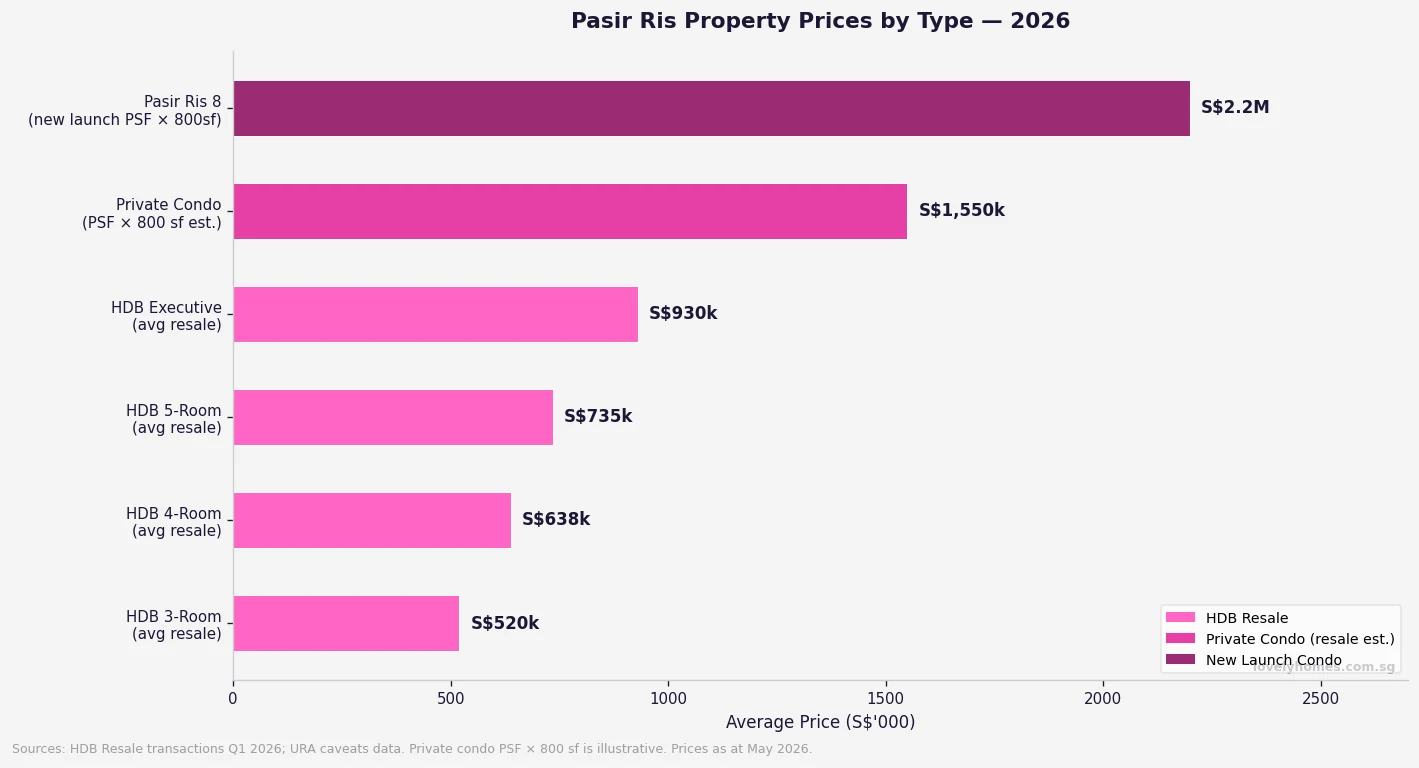
Pasir Ris property prices by type 2026 — HDB resale and private condo comparison
Figure 1: Pasir Ris property prices by type — HDB resale averages and private condo estimates, May 2026. Sources: HDB Resale Statistics, URA Caveats.
Property Type Typical Price Range Median / Avg Notes
HDB 3-Room (resale) S$400k – S$620k ~S$520k Older stock; strong rental demand from singles
HDB 4-Room (resale) S$548k – S$720k ~S$638k Most traded flat type; strong median
HDB 5-Room (resale) S$650k – S$850k ~S$735k Larger format; MOP supply wave lifting liquidity
HDB Executive / Jumbo (resale) S$800k – S$1.08M ~S$930k Limited supply; strong demand from large families
Private Condo (resale, OCR) S$1,200 – S$1,900 psf ~S$1,550 psf Older projects; limited resale stock
Pasir Ris 8 (new launch) S$1,934 – S$3,728 psf ~S$2,600 psf est. Integrated development above MRT; luxury positioning

The wide range within Pasir Ris 8 reflects its mixed product offering — from studio-format units to spacious 4-bedroom penthouses. For buyers focused on yield, the older resale condominiums at S$1,200–S$1,600 psf offer a more favourable entry point relative to rental demand, though they come with shorter remaining lease durations.

HDB Resale Market Dynamics

Pasir Ris has approximately 700 HDB resale transactions per year across all flat types, placing it in the mid-tier for transaction volume among OCR estates. Of these, 4-room flats account for roughly 40% of transactions, making them the most liquid asset class in the estate.

A notable dynamic in 2026 is the MOP wave. Nationally, around 13,480 HDB flats are reaching the end of their five-year (or ten-year Plus/Prime) minimum occupation period this year. Of these, Pasir Ris contributes an estimated 1,200–1,400 flats — primarily 4-room and 5-room units from developments built in 2019–2021. Sellers from these developments are typically younger upgraders, and their exit into the resale market is creating both additional supply and, indirectly, upgrader demand for private condominiums within and around the estate.

MRT Connectivity — Today and Tomorrow

Pasir Ris’s connectivity story is defined by two chapters: today’s East West Line (EWL) coverage and tomorrow’s Cross Island Line (CRL) expansion.

Today, Pasir Ris MRT station (EW1) is the eastern terminus of the East West Line — one of Singapore’s busiest rail corridors. From Pasir Ris, commuters can reach Raffles Place in approximately 38 minutes and Jurong East in roughly 55 minutes. The station is integrated with Pasir Ris 8, White Sands shopping centre, and a bus interchange, making it one of the better-connected suburban interchanges in the east.

By approximately 2032, the Cross Island Line’s Punggol Extension will add a second MRT station to the estate: Elias MRT, located at the junction of Pasir Ris Drive 10 and Pasir Ris Drive 3. Pasir Ris main station itself will also become an interchange with the CRL Punggol Extension, creating a direct link to Punggol, Sengkang, and the broader north-eastern corridor without requiring a change at Tampines. This dual-line connectivity, when realised, would meaningfully reduce Pasir Ris’s current perceived remoteness for residents commuting to the north-east.

Neighbourhood Amenities at a Glance
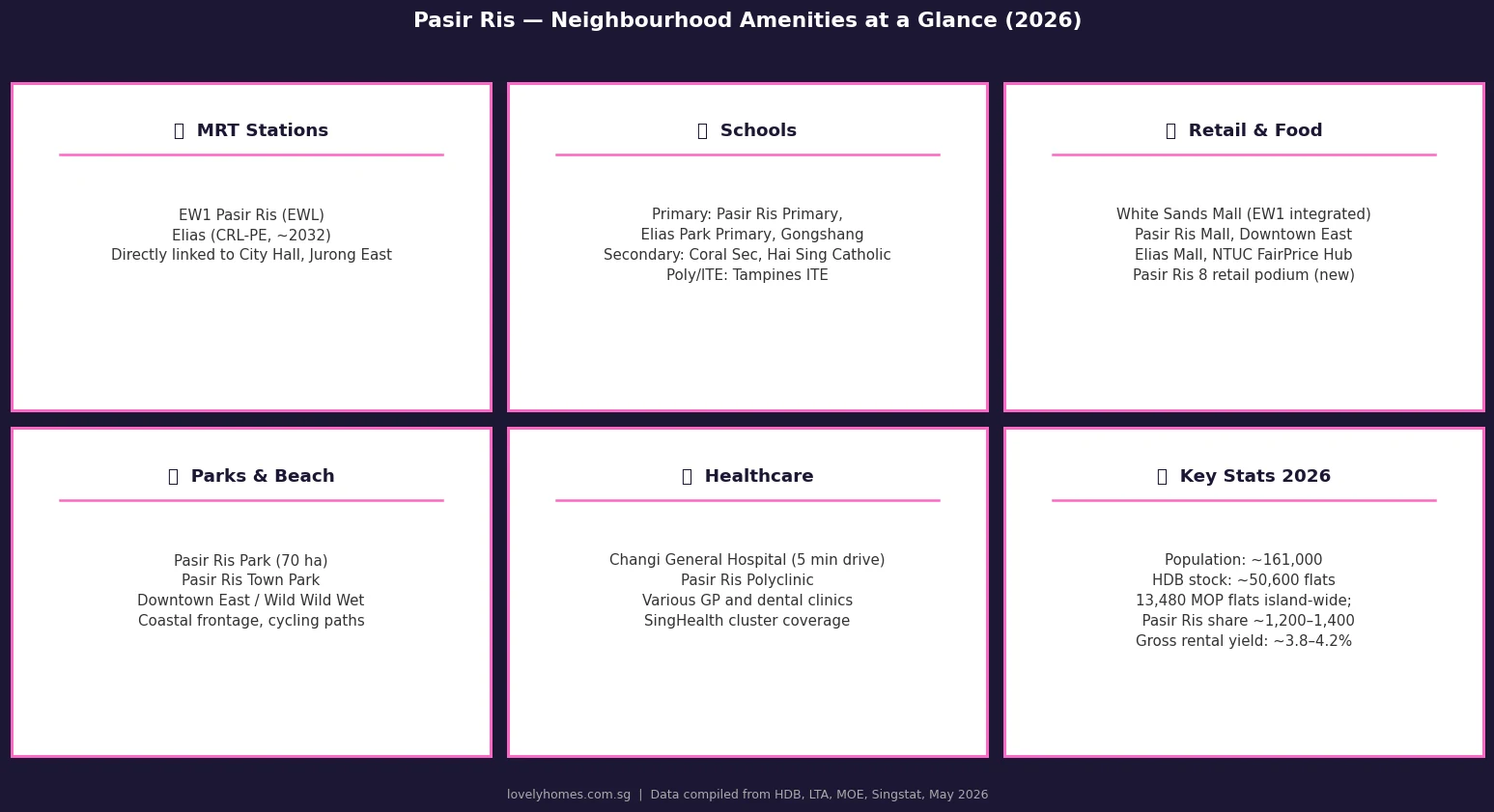
Pasir Ris neighbourhood amenities grid 2026 — MRT, schools, retail, parks, healthcare, key stats
Figure 2: Pasir Ris neighbourhood amenities — schools, retail, healthcare, parks and key statistics, 2026. Source: HDB, MOE, LTA, SingStat.

Schools and Education

Pasir Ris is well-served for primary education, with several schools within 1–2 km of most residential blocks. Pasir Ris Primary School, Elias Park Primary School, and Gongshang Primary School are the main feeder schools for the estate. For secondary education, Coral Secondary School and Hai Sing Catholic School sit within the town’s boundaries, while Dunman High School (an autonomous school offering the Integrated Programme) is accessible via a short bus or car journey near the Tampines–Pasir Ris border.

The MOE School Finder shows that families seeking a primary school within 1 km of popular Pasir Ris residential streets — particularly around Pasir Ris Drive 1, 3, and 6 — generally have strong in-zone admission chances at Pasir Ris Primary and Elias Park Primary. This factor alone drives family buyer demand for 5-room and executive HDB flats in those streets.

For post-secondary and tertiary education, the ITE College East and Tampines Meridian Junior College are both accessible within 20 minutes by bus or rail.

Retail, Food and Lifestyle

White Sands (integrated with Pasir Ris MRT) is the estate’s anchor mall, offering a full suite of food courts, supermarkets, pharmacies, and lifestyle retailers. Downtown East — one of Singapore’s largest lifestyle and entertainment hubs — sits adjacent to Pasir Ris Park and provides a Wild Wild Wet waterpark, indoor sports facilities, hotel accommodation, and an extensive food and beverage offering. Elias Mall and Pasir Ris Mall serve the internal town areas.

The upcoming Pasir Ris 8 development adds a retail podium above the MRT station, expanding the commercial offering with higher-end dining and lifestyle options that have historically been absent in the estate.

Pasir Ris Park and Outdoor Living

One of Pasir Ris’s most tangible lifestyle advantages is its greenery. Pasir Ris Park covers 70 hectares of managed parkland abutting the coastline — featuring cycling paths, mangrove boardwalks, a family-friendly beach, and barbecue pits. Singaporeans who value nature proximity will find Pasir Ris among the more green-affluent estates in the OCR, comparable to Bishan’s proximity to Bishan-AMK Park but with the added dimension of coastal access.

Investment Outlook — Rental Yield and Capital Growth
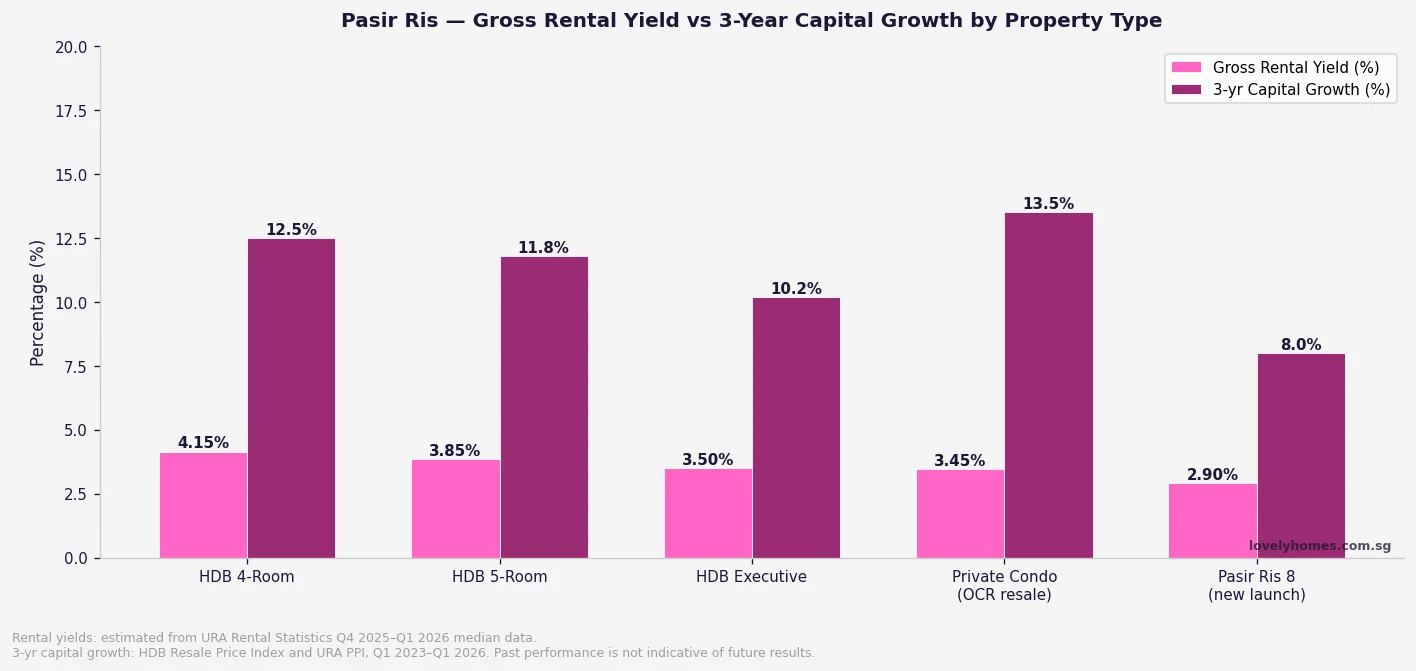
Pasir Ris gross rental yield versus 3-year capital growth by property type 2026
Figure 3: Pasir Ris gross rental yield vs 3-year capital growth by property type, Q1 2023–Q1 2026. Sources: URA Rental Statistics, HDB Resale Price Index, URA Private Property Price Index.

For HDB landlords, Pasir Ris delivers gross rental yields of approximately 3.8–4.2% on 4-room and 5-room flats — above the HDB island-wide average and driven by proximity to Changi Airport, Changi Business Park, and the wider east industrial corridor. Median monthly rents for a 4-room flat in Pasir Ris were approximately S$2,600–S$2,900 as at Q1 2026, according to HDB rental data.

For private condo investors, the older resale condominiums in Pasir Ris generate gross yields of approximately 3.4–3.6%, while Pasir Ris 8’s premium pricing means net yields will be tighter. The investment case for Pasir Ris 8 buyers rests more on capital appreciation (from MRT connectivity, new-launch premium, and precinct gentrification) than on near-term rental income cover.

Over the three years from Q1 2023 to Q1 2026, HDB resale prices in Pasir Ris have appreciated approximately 11–13% on a total-return basis across 4-room and 5-room flats, in line with broader OCR HDB trends as tracked by the HDB Resale Price Index.

Worked Example — HDB Upgrader Buying a Pasir Ris Condo in 2026

Consider Mr and Mrs Lim, a Singapore Citizen couple aged 38 and 36, with a combined monthly income of S$14,500. They own a 5-room HDB flat in Pasir Ris that cleared its five-year MOP in early 2026. They purchased the flat as a BTO for S$350,000; it is now transacting at S$750,000 on the resale market. They have S$260,000 in CPF Ordinary Account used for the flat, with accrued interest of S$48,000 (at 2.5% p.a. over six years).

Step 1 — Sale proceeds: Gross sale S$750,000 → outstanding bank loan S$220,000 → CPF principal refund S$260,000 → accrued interest S$48,000 → legal and agent costs S$12,000. Estimated cash-in-hand: approximately S$210,000.

Step 2 — Buying a S$1.60M Pasir Ris condo: As they are selling first, they hold zero residential properties at OTP signing. ABSD: 0% (Singapore Citizens, first property). BSD on S$1.60M = 1%×S$180k + 2%×S$180k + 3%×S$640k + 4%×S$600k = S$1,800 + S$3,600 + S$19,200 + S$24,000 = S$48,600.

Step 3 — Financing: 75% LTV (bank loan on private property, SC first property) = S$1,200,000 loan. 25% down = S$400,000 (S$308,000 CPF OA re-deposited after refund + S$92,000 cash). Legal and miscellaneous costs: ~S$7,000 cash. Total immediate cash outlay: S$48,600 (BSD) + S$92,000 (cash top-up on down payment) + S$7,000 = ~S$147,600.

Step 4 — Monthly repayment: S$1,200,000 at a fixed rate of 1.80% over 25 years = approximately S$4,930/mth. TDSR check: S$4,930 ÷ S$14,500 = 34.0% — comfortably within the 55% TDSR ceiling. The couple’s post-purchase cash reserve is approximately S$62,000, providing a meaningful liquidity buffer.

What Might Come Next for Pasir Ris

The 2032 completion of Elias MRT is the most significant near-term catalyst for the estate. New MRT stations in Singapore have historically generated price premium expansion in the two-to-four years leading up to opening, as market participants anticipate connectivity improvements. Areas within 600–800 metres of the future Elias station — particularly the emerging Neighbourhood 8 precinct — will be worth tracking.

The former MINDEF training land adjacent to Elias Road is earmarked for public and private housing development as part of Neighbourhood 8. While no definitive URA masterplan details or GLS tenders have been announced for this precinct as at May 2026, it represents a potential supply of several thousand new homes on relatively underutilised land in an estate where new private supply has historically been scarce.

On the rental side, Changi Airport’s continued expansion (Terminal 5, expected post-2030) and the growth of Changi Business Park as a technology and financial services hub both support sustained rental demand in the eastern corridor, benefiting Pasir Ris landlords.

Frequently Asked Questions

Is Pasir Ris a good place to buy property in 2026?

Pasir Ris offers a compelling combination of yield (HDB gross yields of 4%+), greenery, family-friendly infrastructure, and a clear near-term catalyst in the Cross Island Line’s Elias station (~2032). It is not a prestige address and will not command the PSF of Bishan, Queenstown, or the CCR — but for owner-occupiers seeking space and affordability, and for investors prioritising yield, it performs well within the OCR category. The key risk is the estate’s current single-line MRT exposure (EWL only) until the CRL Punggol Extension is operational.

Which MRT stations serve Pasir Ris?

Currently, Pasir Ris MRT (EW1) on the East West Line is the sole station. It is the eastern terminus of the EWL and is integrated with the Pasir Ris Bus Interchange. By approximately 2032, the Cross Island Line’s Punggol Extension will add Elias MRT within the estate (at Pasir Ris Drive 10 / Drive 3), and Pasir Ris station itself will become an interchange with the CRL Punggol Extension — enabling direct connectivity to Punggol, Sengkang, and Bishan without changing trains.

What is the HDB resale record in Pasir Ris?

The highest recorded HDB resale transaction in Pasir Ris, as at our research date, is an Executive flat that transacted at approximately S$1.08M — reflecting the scarcity of large-format flats in the estate. For 5-room flats, transactions in excess of S$850,000 have been recorded for well-located blocks near Pasir Ris Park and the MRT. These represent outlier premium transactions; the estate-wide median for 5-room flats remains approximately S$735,000 as at Q1 2026.

How does Pasir Ris compare to Tampines and Bedok for property investment?

Compared to Tampines, Pasir Ris tends to offer slightly higher HDB rental yields (4%+ vs Tampines’ ~3.8%) but lower private condo capital growth potential in the short term, as Tampines benefits from more established commercial infrastructure and multiple MRT lines. Compared to Bedok, Pasir Ris offers lower entry prices for similar flat types but lacks Bedok’s three-MRT-line advantage. The upcoming Elias MRT and Neighbourhood 8 development are Pasir Ris-specific catalysts that neither Tampines nor Bedok can replicate on the same timeline.

Can HDB upgraders avoid ABSD when buying Pasir Ris 8?

Yes — if the HDB flat is sold before (or simultaneously with) the OTP signing for the private property. When a Singapore Citizen sells their only existing residential property before acquiring a new one, they hold zero properties at the point of OTP and therefore pay 0% ABSD. This is the standard “sell-first, then buy” upgrader route. The key constraint is timing: you will need to arrange bridging accommodation between your HDB sale completion and your new condo’s TOP date. See our Upgrading from HDB to Private Property guide for the full timeline and cost analysis.

Are there BTO flats available in Pasir Ris in 2026?

As at May 2026, no standard BTO launch has been announced specifically for Pasir Ris in the June 2026 BTO exercise, which covers Bishan, Ang Mo Kio, Bukit Merah, Sembawang, and Woodlands. However, the emerging Neighbourhood 8 precinct (former MINDEF land near Elias Road) is expected to yield future BTO launches — likely announced in the 2027–2028 BTO exercise window once planning and land clearance is completed. Prospective buyers wanting to live in Pasir Ris in the near term should look at the resale market, the Sale of Balance Flats (SBF) exercises, or the Pasir Ris EC at Jalan Loyang Besar for qualifying buyers.

Related Articles

Disclaimer: This neighbourhood guide is for general informational purposes only and does not constitute financial, investment, or property advice. All prices, yields, and market data cited are drawn from publicly available sources including HDB Resale Statistics, URA Caveats Lodged, LTA announcements, and SingStat as at May 2026, and are subject to change without notice. Past performance and historical price trends are not indicative of future results. Always conduct independent verification and consult a licensed property agent, financial adviser, or conveyancing lawyer before making any property decision. For official data, refer to HDB, URA, LTA, SingStat, and MAS.
Bedok Neighbourhood Guide Singapore 2026: Property Prices, Schools, MRT and Investment Outlook

Bedok Neighbourhood Guide Singapore 2026: Property Prices, Schools, MRT and Investment Outlook

Last updated: 17 May 2026  |  Data: URA, HDB, SRX Q1 2026

Quick Answer: Is Bedok a Good Place to Buy Property?

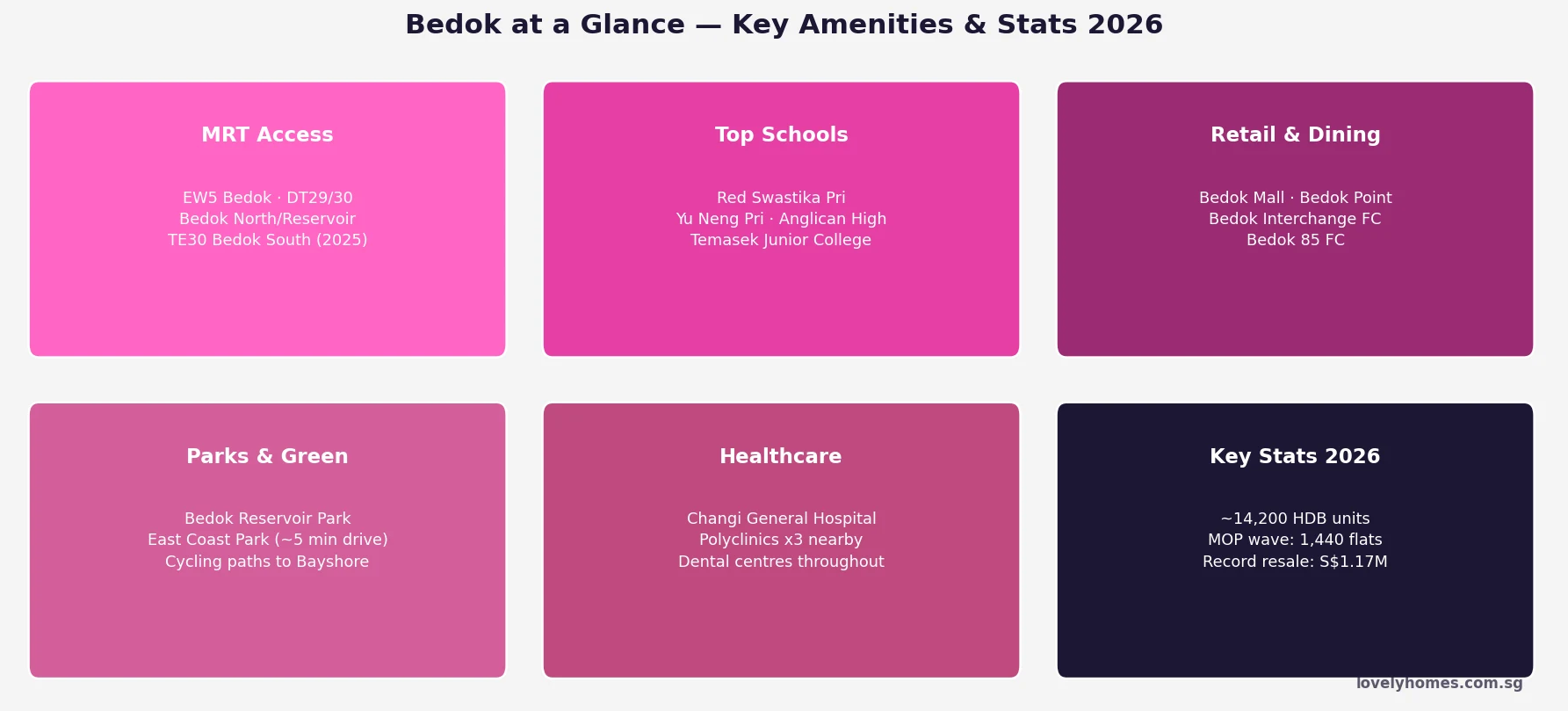
  • Mature OCR estate with strong MRT connectivity — EW5 Bedok, DT29/30, and the new TE30 Bedok South (Thomson-East Coast Line, opened 2025).
  • HDB resale prices range from ~S$440,000 for a 3-room to ~S$910,000 for an EA/Jumbo flat; the 4-room average sits at around S$662,000.
  • Record sale: a 4-room flat at Bedok South Horizon transacted at S$1.17M in April 2026 — the highest ever in the entire Bedok estate.
  • Private condos trade at S$1,500–S$2,100 PSF (resale); new launches like Sky Eden approach S$2,150 PSF.
  • 1,440 HDB flats reaching their Minimum Occupation Period (MOP) in 2026, injecting fresh supply into the resale pool.
  • Bayshore precinct (just east of Bedok South MRT) is emerging as Singapore’s next waterfront estate, with a 1,280-unit mixed-use GLS site tendering until July 2026.
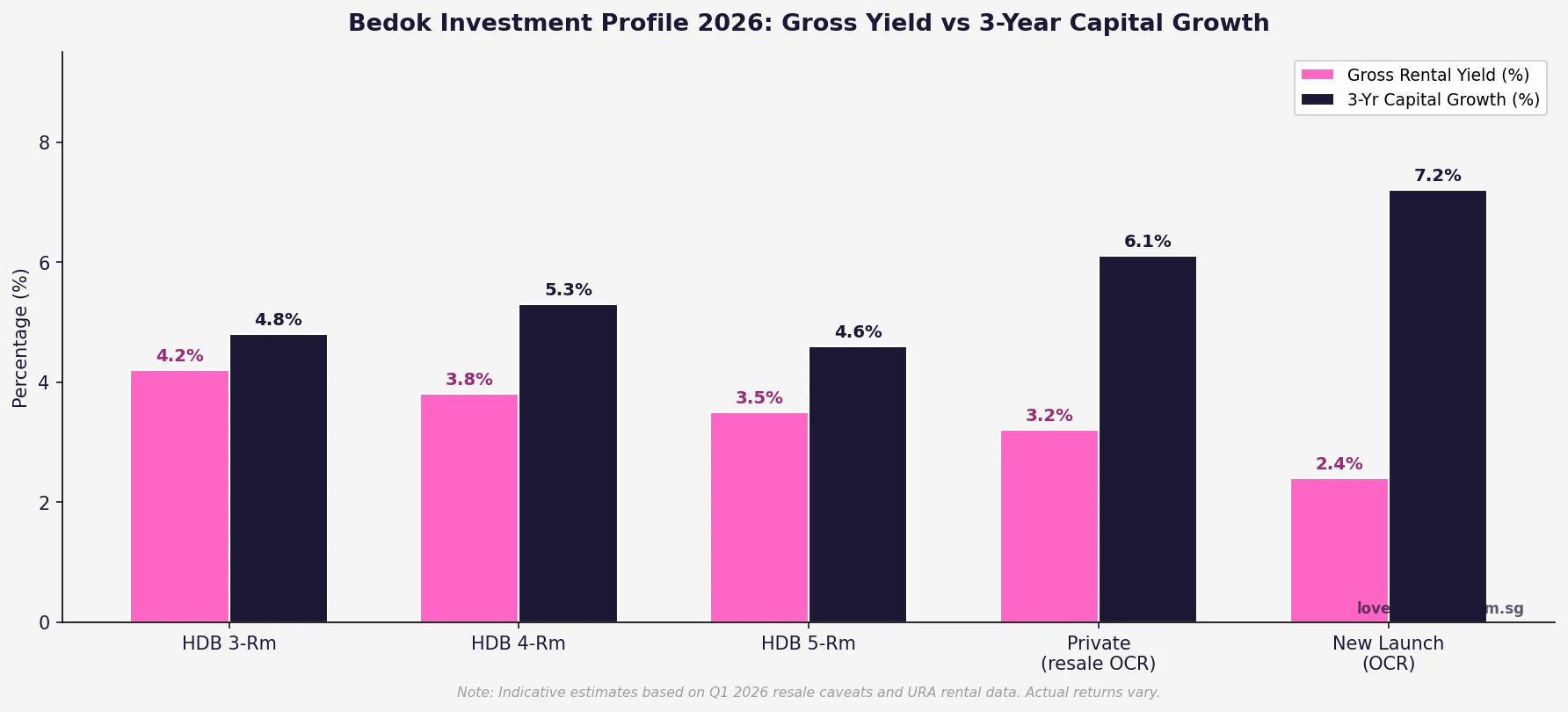
  • Gross rental yields: 3.5%–4.2% for HDB; 2.4%–3.2% for private condos.
  • Top schools include Red Swastika Primary, Yu Neng Primary, Anglican High School, and Temasek Junior College.

What Is the Bedok Estate?

Bedok is one of Singapore’s largest and most well-established Housing Development Board (HDB) towns, administered by the HDB and occupying the eastern tip of mainland Singapore. Home to more than 75,000 households, the estate stretches from Upper Changi Road in the north to the East Coast Park shoreline in the south, encompassing the sub-zones of Bedok North, Bedok Reservoir, Bedok South, and the newly activated Bayshore precinct adjacent to the Bedok South MRT station.

Governed by the Urban Redevelopment Authority (URA) under the East planning region, Bedok sits within the Outside Central Region (OCR) for private property pricing purposes. Its combination of mature amenities, direct East-West Line access since 1989, and now a third rail line (the Thomson-East Coast Line, TEL Stage 4 completed in 2025) makes it consistently one of the most sought-after HDB resale towns on the island.

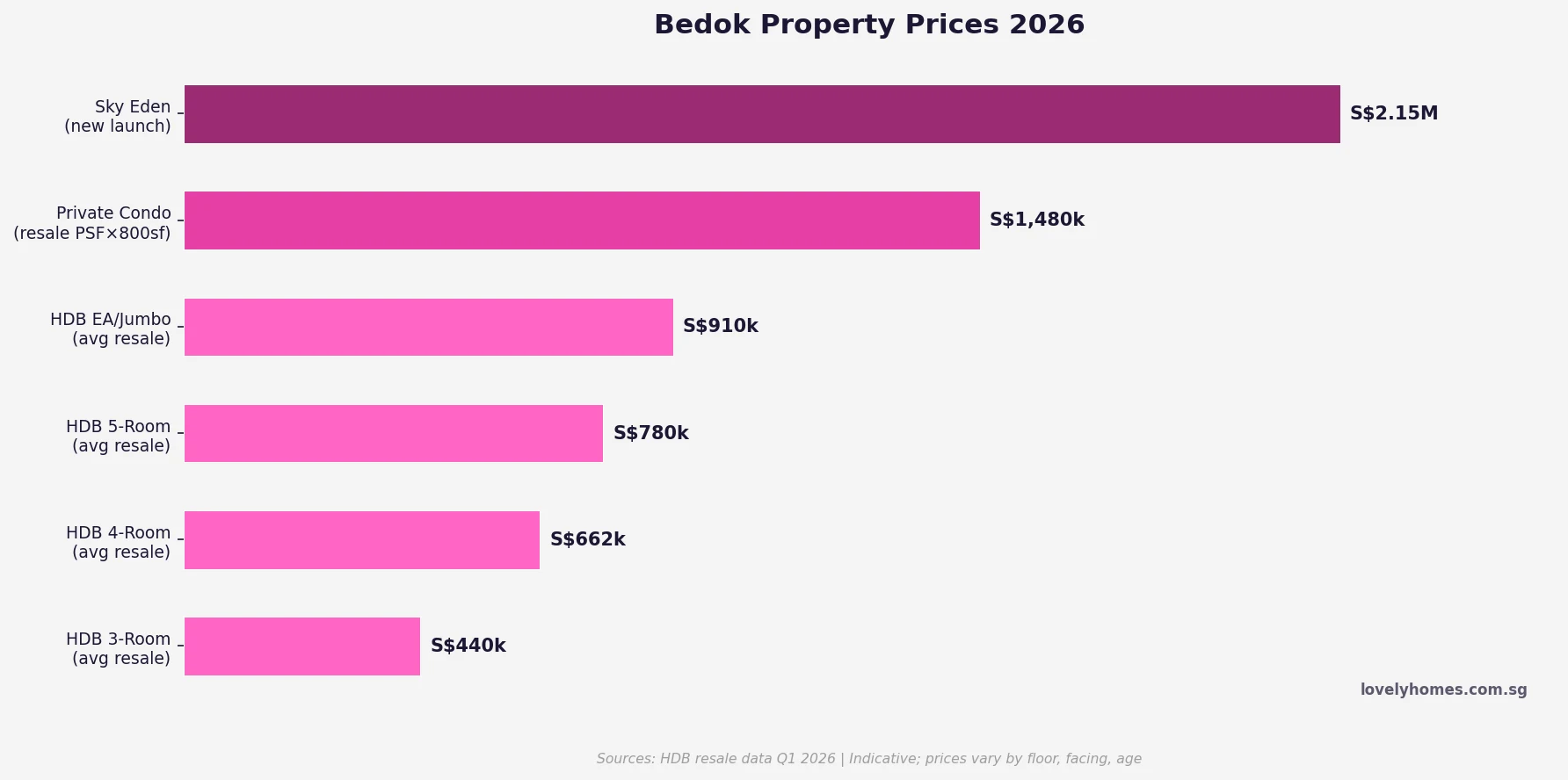
Bedok property prices 2026 — HDB resale and private condo price comparison
Figure 1: Bedok property prices 2026 — HDB resale averages and private condo indicative pricing. Sources: HDB resale caveats Q1 2026; URA REALIS.

Bedok Property Prices 2026

Bedok’s HDB resale market entered 2026 with a notable divergence: the majority of the estate’s 3-room and 4-room blocks trade within predictable OCR ranges, yet select clusters — particularly the recently MOP-ed flats at Bedok South Horizon — are commanding prices previously associated with premium mature estates like Queenstown and Toa Payoh.

HDB Resale

Flat Type Avg Resale Price Record Transacted Notes
3-Room ~S$440,000 ~S$630,000 Older blocks closer to S$350k
4-Room ~S$662,000 S$1,170,000 Bedok South Horizon MOP record
5-Room ~S$780,000 ~S$1,000,000 Mature estates commands premium
EA / Jumbo ~S$910,000 ~S$1,100,000 Rare in Bedok; strong demand

The S$1.17M transaction at Bedok South Horizon in April 2026 — which set a new all-time record for 4-room flats across the entire Bedok estate — was driven by the unit’s position within a newly MOP-ed block at S$1,168 PSF, approaching or exceeding the PSF of nearby 99-year leasehold condominiums. Industry figures suggest the block’s direct-link bridge to Bedok South MRT station (TEL) was the critical premium driver.

Private Condominiums

Private condo supply in Bedok is limited relative to HDB stock, which tends to support pricing. Key projects include:

  • Bedok Residences (completed 2015, 583 units) — integrated development above Bedok MRT; resale units currently S$1.5M–S$2.9M, with an average transaction around S$1.96M in the past six months.
  • Sky Eden @ Bedok (completing 2026, 158 units) — boutique new launch on Bedok Road trading at approximately S$2,150 PSF; fully sold at launch in late 2022.
  • Savannah CondoPark and Bayshore Park — older 99-year leasehold condos in the Bayshore belt offering sub-S$1,500 PSF resale opportunities.
Bedok neighbourhood amenities 2026 — MRT, schools, retail, parks and healthcare
Figure 2: Bedok at a glance — MRT connectivity, top schools, retail, parks, and healthcare facilities as at 2026. Sources: LTA, MOE, HDB.

MRT Connectivity

Bedok’s transport story is one of the most compelling in Singapore’s eastern region, having been progressively upgraded from a single-line town to a three-line node between 1989 and 2025.

  • Bedok MRT (EW5) — East-West Line (green), opened 1989. The town’s anchor station; connects to Tanah Merah interchange (EW4) for Changi Airport Branch Line, and directly to Raffles Place and City Hall within ~25 minutes.
  • Bedok North (DT29) and Bedok Reservoir (DT30) — Downtown Line (blue), opened 2015. Dramatically shortened journey times to Buona Vista, MacPherson, and the city centre via Promenade.
  • Bedok South (TE30) — Thomson-East Coast Line (TEL), opened late 2025 as part of Stage 4. This new station, located near the Bedok South Horizon HDB cluster and adjacent to the emerging Bayshore precinct, provides direct one-seat travel northward to Marina Bay, Orchard, and Woodlands, as well as southward connectivity to future TEL Stage 5 stations. It is widely credited as the catalyst for the unprecedented premium pricing at Bedok South Horizon.
  • Kembangan (EW6) — East-West Line, just one stop east of Bedok; serves the upper-east part of the estate.

Schools in Bedok

Families consistently name Bedok’s school portfolio as a key factor in their decision to buy or upgrade here. Under the Ministry of Education’s (MOE) Primary 1 Registration framework, children within 1km of a school enjoy priority registration. Key institutions include:

Level School Notes
Primary Red Swastika School Consistently popular; Bedok North Road
Primary Yu Neng Primary School Bedok South; smaller, nurturing environment
Primary Bedok Green Primary School Bedok North Ave area
Secondary Anglican High School SAP school; bilingual programme; Aljunied Ave 3
Secondary Bedok View Secondary School Bedok North; established neighbourhood school
JC Temasek Junior College Strong academic track record; Tampines Ave 7 (borderline)

Retail, Dining and Lifestyle

Bedok’s retail and F&B scene is anchored by Bedok Mall (CapitaLand, opened 2013), a four-storey integrated mall above Bedok MRT offering over 200 outlets including Cold Storage, cinema, and food court. Bedok Point on New Upper Changi Road provides additional retail options, while the legendary Bedok Interchange Hawker Centre and the iconic Bedok 85 (Bedok North Street 3) Food Centre satisfy the estate’s reputation as one of Singapore’s great supper-and-hawker destinations. East Coast Park — Singapore’s longest and busiest park — is accessible via a 5-minute drive or a pleasant cycle along the coastal connector.

The Bayshore Precinct: Bedok’s Next Catalyst

Perhaps the most significant medium-term catalyst for Bedok property values is the development of the Bayshore precinct — a 60-hectare waterfront residential estate flanking the TEL Bedok South and Bayshore stations. The URA’s 2019 Master Plan earmarks Bayshore as a car-lite, green-intensive waterfront neighbourhood with direct park-connector links to East Coast Park.

In 2026 alone, two GLS (Government Land Sales) sites have been tendered in the precinct. The first — a private residential site along Bayshore Road — closed in March 2026 with eight bids, with SingHaiyi-Garnet submitting the highest bid at S$1,388 PSF per plot ratio for a 515-unit site. The second — a landmark 1,280-unit mixed-use integrated development site on Bayshore Drive — is currently being tendered, closing 15 July 2026. Industry forecasts suggest this site could attract bids of up to S$2 billion, setting a new benchmark for eastern Singapore land values.

Bedok investment profile 2026 — gross rental yield vs 3-year capital growth by property type
Figure 3: Bedok investment profile 2026 — estimated gross rental yield versus 3-year capital growth by property type. Sources: URA REALIS, HDB resale caveats, industry estimates.

Bedok as an Investment: Gross Yield and Capital Growth

Bedok consistently ranks among Singapore’s top OCR estates for stable gross rental yields. HDB flats — particularly 3-room and 4-room units that have cleared the 5-year MOP — command yields of 3.5%–4.2% in a rental market where demand is underpinned by the estate’s MRT connectivity and school proximity. Private condos deliver lower headline yields (2.4%–3.2%) but have demonstrated stronger 3-year capital appreciation, particularly those within the Bayshore/Bedok South MRT catchment.

Worked Example: HDB Upgrader Buying into Bedok

Worked Example — Mr and Mrs Lim, Singapore Citizens, Combined S$11,000/month
Selling their Tampines 4-room HDB at S$780,000. After repaying their outstanding HDB loan (S$85,000) and CPF principal + accrued interest (S$245,000 principal + S$72,000 accrued), cash proceeds ≈ S$378,000.

Target: 3-bedroom resale condo in Bedok, S$1,650,000. Buyer profile: SC purchasing first private property.
ABSD: 0% (first private property, having sold HDB).
BSD: 1% × S$180k + 2% × S$180k + 3% × S$640k + 4% × S$650k = S$3,600 + S$3,600 + S$19,200 + S$26,000 = S$52,400.
Down payment (25% minimum): S$412,500 — funded S$245,000 from CPF (existing OA balance) + S$167,500 cash.
Bank loan (75% LTV): S$1,237,500 @ 1.80% fixed 2yr → monthly instalment ~S$4,380.
TDSR check: S$4,380 / S$11,000 = 39.8% — within 55% TDSR limit ✓.
Total cash needed at completion: BSD S$52,400 + cash down S$167,500 + legal ~S$5,200 = ~S$225,100.

The 2026 MOP Wave: 1,440 Flats Entering the Resale Pool

Approximately 1,440 Bedok HDB flats are expected to complete their 5-year MOP in 2026, the largest single-year cohort for the estate in recent memory. The bulk of these units are in the Bedok South Horizon development and several Bedok North blocks that received keys in 2021. This supply injection creates two opposing forces: short-term pricing pressure as sellers compete in the resale pool, and medium-term upgrader demand that flows into the private condo and EC market.

For buyers, this supply wave represents a rare window to acquire near-MRT HDB flats without paying an extreme premium over earlier transactions. The MOP flats typically transact at a 15%–20% premium over comparable older resale flats in the first 12–18 months post-MOP, before the premium normalises.

What Might Come Next for Bedok Property

Looking ahead, several structural factors support a constructive long-term view on Bedok property values. The Bayshore integrated development (GLS closing July 2026) is expected to create a new lifestyle destination that will further lift the southern half of the estate. TEL Stage 5, which extends the line further south and east, will complete the network loop and is targeted for opening in 2027–2028, adding another layer of accessibility to the Bedok South catchment. On the public housing front, URA’s longer-term plans for Bayshore envisage a mixed-tenure precinct with 10,000+ homes over two decades, cementing the area’s status as one of Singapore’s premier eastern growth nodes.

FAQ: Bedok Property Questions Answered

Is Bedok a good place to buy property in 2026?
Yes, by most measures. Bedok offers mature estate amenities, multiple MRT lines, consistently high HDB resale demand, and a near-term capital growth catalyst in the Bayshore precinct development. For HDB upgraders, the 2026 MOP wave provides fresh supply at various price points. For private property investors, the Bedok/Bedok South MRT catchment offers some of the best yield-and-growth combinations in Singapore’s OCR segment. The key caveat is that the Bedok South Horizon price records have narrowed the traditional gap between HDB and private condo pricing in parts of the estate.
Which MRT stations serve Bedok?
Bedok is served by four MRT stations: Bedok (EW5, East-West Line), Bedok North (DT29, Downtown Line), Bedok Reservoir (DT30, Downtown Line), and Bedok South (TE30, Thomson-East Coast Line, opened 2025). Kembangan (EW6) on the East-West Line, just one stop from Bedok, is also within the estate boundary. This multi-line access is rare in Singapore’s OCR estates and is a significant premium driver for properties within walking distance of more than one station.
Why did a Bedok 4-room HDB sell for S$1.17M in 2026?
The S$1.17M transaction at Bedok South Horizon in April 2026 was driven by the unit’s position within a newly MOP-ed development that enjoys direct pedestrian access to the new Bedok South MRT (TE30) via a link bridge. At S$1,168 PSF, this flat was priced at or above comparable 99-year leasehold condominiums in the vicinity — a reflection of how MRT access has redefined the valuation ceiling for well-located public housing. The broader context is Singapore’s MOP supply wave: with 1,440 Bedok flats entering the resale market in 2026, buyers are competing intensely for the best-located units.
What is the Bayshore precinct and how does it affect Bedok prices?
The Bayshore precinct is a 60-hectare waterfront estate flanking the Bedok South and Bayshore MRT stations, earmarked by the URA in its 2019 Master Plan for high-density, car-lite residential development. Two GLS sites are being tendered in 2026: a 515-unit residential site (closed March 2026; won by SingHaiyi-Garnet at S$1,388 PSF ppr) and a 1,280-unit mixed-use integrated development (tender closes 15 July 2026). When completed, the precinct will introduce significant new retail, F&B, and lifestyle amenities directly adjacent to Bedok South, lifting capital values across the southern end of the Bedok estate.
How does Bedok compare to Tampines and Pasir Ris for property buyers?
All three estates are OCR towns in the east, but they differ meaningfully. Bedok is the most mature and centrally located of the three, with stronger MRT connectivity (3 lines vs Tampines’ 2 and Pasir Ris’ planned TEL extension). Bedok HDB prices are generally 8%–15% higher than Tampines and 15%–25% higher than Pasir Ris on a like-for-like basis, reflecting the maturity premium. Private condo PSF in Bedok is broadly comparable to Tampines but higher than Pasir Ris. For yield-focused investors, Tampines or Pasir Ris may offer slightly better initial yields; for capital growth and MRT premium, Bedok (particularly the Bayshore belt) has the clearer structural tailwind in 2026.
Can HDB upgraders from Bedok afford private property in 2026?
Yes, if they have cleared MOP and their household income meets TDSR requirements. A Bedok 4-room HDB selling at S$662,000 (average) would net a couple approximately S$250,000–S$380,000 in cash and CPF refund proceeds (after repaying the outstanding HDB loan and CPF accrued interest), depending on their original purchase price and CPF usage. This equity is typically sufficient for the 25% down payment on an OCR private condo in the S$1.3M–S$1.7M range, with the buyer taking out a 75% LTV bank loan. The key constraints are TDSR (monthly obligations must not exceed 55% of gross income) and ABSD (0% if this is their first private property, provided the HDB is sold before or simultaneously).

Related Articles

Disclaimer: The property prices, yield estimates, and capital growth figures cited in this article are indicative and sourced from publicly available URA REALIS caveat data, HDB resale statistics (Q1 2026), and industry research. Actual prices, yields, and returns depend on specific unit details, negotiation, market conditions, and timing. Bedok Neighbourhood Guide Singapore 2026 is produced for general informational purposes only and does not constitute financial, investment, or legal advice. Always verify current prices on URA’s Property Market Information portal and consult a licensed valuer or registered housing agent before making property decisions. CPF usage for private property is governed by CPF Board rules; seek up-to-date guidance from cpf.gov.sg.

Tampines Neighbourhood Guide Singapore 2026: Property Prices, Schools, MRT and Investment Outlook

Tampines Neighbourhood Guide Singapore 2026: Property Prices, Schools, MRT and Investment Outlook

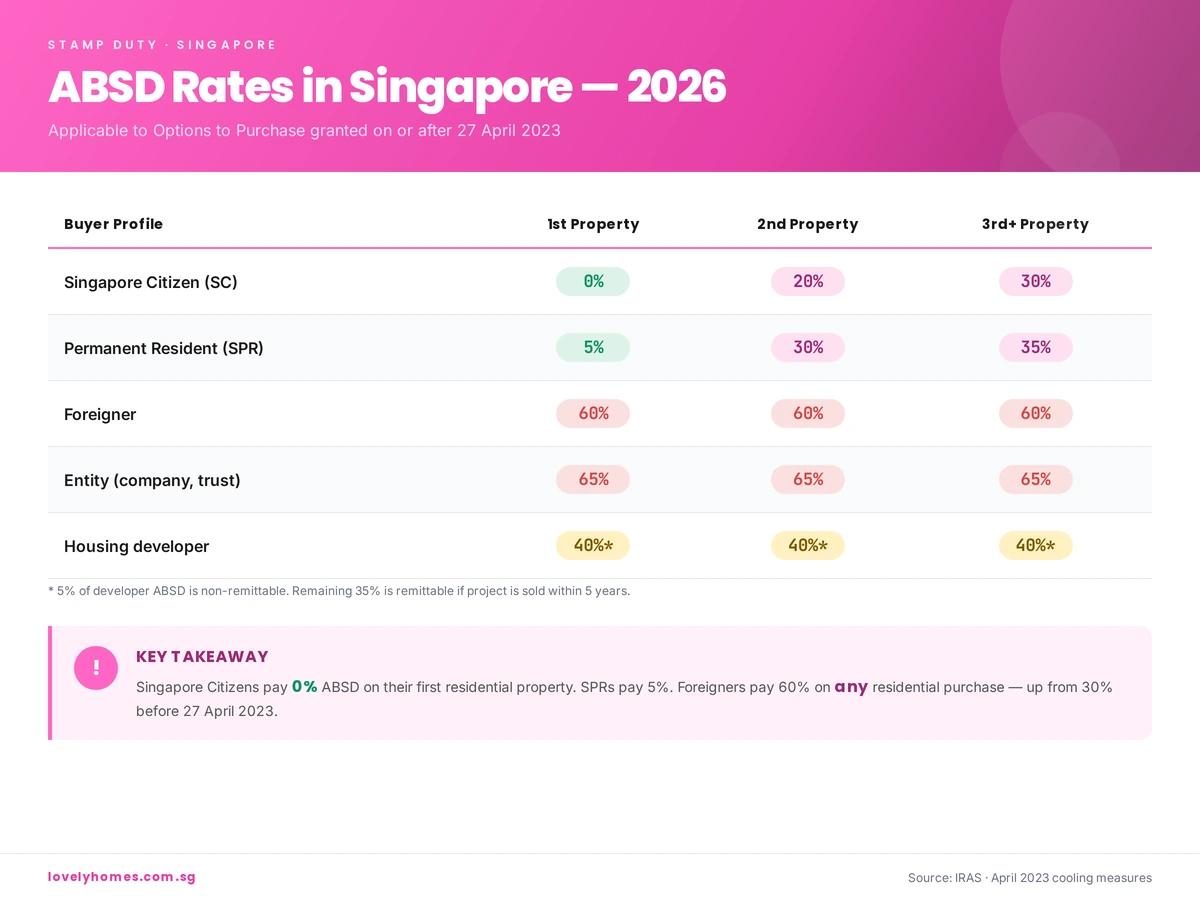
ABSD Singapore — short for Additional Buyer’s Stamp Duty — is the single largest upfront cost most buyers face when purchasing a second (or third, or fourth) residential property in Singapore. If you are buying as a foreigner, ABSD can add 60% of the purchase price to your cost. If you are a Singapore Citizen buying your second property, that figure is 20%. Get this number wrong in your budgeting, and you can very quickly wipe out years of planning.

This guide walks you through exactly how ABSD works in 2026 — who pays, how much, how it is calculated, what remissions are available, and the legitimate strategies property buyers use to manage it. All figures reflect the Government’s 27 April 2023 cooling measures, which remain the applicable framework. For the latest rates, always check the IRAS Additional Buyer’s Stamp Duty page.

Quick Answer — ABSD at a glance

  • Singapore Citizens: 0% on 1st property, 20% on 2nd, 30% on 3rd+
  • Singapore PRs: 5% / 30% / 35%
  • Foreigners: 60% on any residential property
  • Companies, trusts and other entities: 65%
  • ABSD is payable within 14 days of signing the Option to Purchase (OTP) or Sale & Purchase Agreement.

What is ABSD and Why Does It Exist?

ABSD is a transaction tax levied on the buyer when acquiring a residential property in Singapore. It sits on top of the regular Buyer’s Stamp Duty (BSD) that every buyer pays. Where BSD is progressive and maxes out at 6% for the portion of price above S$3 million, ABSD is a flat rate applied to the entire purchase price or market value (whichever is higher).

The tax was introduced in December 2011 as part of the Government’s suite of cooling measures — the tools Singapore uses to moderate speculative demand, manage affordability for owner-occupiers, and prevent the kind of runaway price inflation seen in other global cities. Because it targets second-and-subsequent-property buyers and non-citizens disproportionately, ABSD is the single most powerful lever in the cooling-measures toolbox. You can read more about the broader framework in our Property Cooling Measures section.

ABSD Rates in Singapore (2026)

The table below sets out the ABSD rates currently in force. Rates apply based on the profile of the buyer at the time the Option to Purchase (OTP) is granted.

ABSD rates in Singapore 2026 table by buyer profile — Citizens, PRs, Foreigners, Entities
ABSD rates by buyer profile — applicable to OTPs granted on or after 27 April 2023.
Buyer Profile 1st Residential Property 2nd Residential Property 3rd & Subsequent
Singapore Citizen (SC) 0% 20% 30%
Singapore Permanent Resident (SPR) 5% 30% 35%
Foreigner (non-PR individual) 60% 60% 60%
Entity (e.g. company, trustee for a trust) 65% 65% 65%
Housing developer 40%* 40%* 40%*

* 5% of a developer’s ABSD is non-remittable. The remaining 35% is remittable subject to conditions, including selling all units in a qualifying project within five years.

How ABSD is Calculated — A Worked Example

ABSD is applied to the higher of the purchase price or the market value of the property. It is not charged on a tiered basis — the full rate applies to the entire amount.

Example: A Singapore Citizen couple already owns their first home (a 4-room HDB flat). They decide to buy a S$2,000,000 resale condominium in District 15 as an upgrader investment. ABSD on the second property for a Singapore Citizen is 20%.

  • Purchase price: S$2,000,000
  • ABSD (20%): S$400,000
  • BSD (progressive, on S$2m): approximately S$64,600
  • Total stamp duty payable: S$464,600

That S$400,000 ABSD alone would consume most of the typical upgrader’s CPF and cash reserves. This is why many Singaporean couples take the ‘sell first, buy second’ upgrade route — selling the existing HDB or condo before buying the next home — which we cover later in this guide.

Who Pays ABSD? Exemptions and Special Cases

ABSD applies when you purchase an additional residential property. Commercial property, industrial property, and pure-land parcels are not within its scope. A property is counted toward your “property count” if:

  • You hold the title as a sole owner, joint tenant, or tenant-in-common;
  • You are a beneficial owner via a trust;
  • You are a beneficiary of an estate that holds residential property.

Properties not counted include: properties you merely reside in but do not own (e.g. as a tenant), inherited shares in a deceased estate within the administration period, and certain industrial/commercial units.

Executive Condominiums (ECs)

For new ECs bought directly from the developer during the minimum occupation period of the scheme, ABSD is not triggered because the buyer must commit to an owner-occupier arrangement. ABSD rules apply normally if an EC is purchased on the resale market after its 5-year MOP and 10-year privatisation milestones.

Free Trade Agreement (FTA) Nationals

Citizens and Permanent Residents of countries with which Singapore has an FTA extending National Treatment on stamp duty — namely Iceland, Liechtenstein, Norway, Switzerland, and United States citizens — are accorded the same ABSD treatment as Singapore Citizens. An eligible US citizen buying their first Singapore residential property therefore pays 0% ABSD, not 60%.

ABSD Remission Schemes — How to Get Some (or All) of It Back

Several remission schemes let qualifying buyers claim back part or all of the ABSD they initially pay. The big three to know are:

1. Married Couple Remission (Sale of First Residential Property)

If a Singapore Citizen (or mixed SC & SPR, SC & foreigner) couple buys a replacement home before selling their existing one, they can apply for ABSD remission provided they sell the first property within six months of the later of (a) the date of purchase of the replacement property, or (b) the TOP/CSC date if buying an uncompleted unit. This is effectively a “grace period” that allows upgraders to move without double-paying ABSD.

2. Mixed-Nationality Married Couples

An SC spouse married to a foreigner buying a matrimonial home jointly can enjoy SC rates (rather than foreigner rates) if the property will be used as their matrimonial home and conditions are met. Again, for a first joint home this means 0% ABSD.

3. Developer ABSD Remission

Licensed housing developers pay 40% ABSD upfront (5% non-remittable, 35% remittable) on land purchased for residential development. The 35% is remittable upon meeting development and sales conditions — typically completing the project and selling all units within 5 years.

Remissions must be applied for within strict timeframes (usually 14 days of the triggering event). We strongly recommend engaging a conveyancing lawyer who is experienced in stamp-duty remission applications before signing any OTP where remission will be relied upon.

ABSD vs BSD: What is the Difference?

Every property purchase in Singapore attracts Buyer’s Stamp Duty (BSD), which is a progressive tax on the purchase price:

  • 1% on the first S$180,000
  • 2% on the next S$180,000
  • 3% on the next S$640,000
  • 4% on the next S$500,000
  • 5% on the next S$1,500,000
  • 6% on the portion above S$3,000,000 (residential only)

BSD applies to every buyer; ABSD is the additional layer that may or may not apply depending on your citizenship status and property count. BSD and ABSD are payable together, within 14 days of signing the OTP.

The History of ABSD in Singapore (2011–2026)

Understanding how we arrived at today’s ABSD rates helps you anticipate where the Government may go next. The key milestones:

  • December 2011: ABSD introduced. Foreigners paid 10%; entities 10%; SPRs 3% on 2nd property; SCs 3% on 3rd+.
  • January 2013: First major hike. Foreigners to 15%, entities 15%, SPRs 5%/10%, SCs 7%/10% on 2nd/3rd.
  • July 2018: Rates raised again amid a reflating market. Foreigners to 20%, entities to 25%.
  • December 2021: Another round. Foreigners to 30%, entities to 35%, SPR 2nd property to 25%, SC 2nd to 17% / 3rd to 25%.
  • April 2023: The current regime. Foreigners doubled to 60%, entities to 65%, SPR 2nd to 30%, SC 2nd to 20%.

Each tightening has coincided with a period of accelerating private-residential price growth. For a full chronology including LTV, SSD and TDSR changes, see our comprehensive Property Cooling Measures archive.

How to Legally Minimise Your ABSD Bill

ABSD is not optional, but there are a handful of legitimate strategies buyers use to reduce the amount payable or to avoid triggering higher rates:

  1. Sell first, then buy. For couples upgrading, timing the sale of your existing HDB or condo before the purchase of the next means you never hold two properties simultaneously and therefore pay 0% ABSD on the new first home (as an SC).
  2. Use the matrimonial home remission. A mixed SC–foreigner couple buying their matrimonial home jointly enjoys SC rates if structured correctly.
  3. Decouple responsibly. Where one spouse transfers their share of an existing property to the other, only the transferring spouse is freed to buy a second property as a “first” purchase. Decoupling has legal, CPF refund, and mortgage implications — always take specialist advice first.
  4. Consider commercial or industrial property instead. Commercial and industrial properties do not attract ABSD. They have their own financing, GST, and tax considerations — but for investors focused on yield, they are worth analysing. See our Property Investment section for how commercial yields compare with residential.
  5. Look offshore for second and third properties. Singaporeans investing in Malaysia (JB/Iskandar), Thailand, the UK, Australia, or Japan pay no ABSD to the Singapore Government for those purchases. Each destination has its own foreign-buyer regime, which we cover in our Foreign Property Investment guide.
  6. Time your citizenship/PR application carefully. For families where PR or citizenship is in progress, the ABSD profile at the date the OTP is granted determines the rate. Moving the OTP date by a few weeks can, in edge cases, change the applicable rate by 15–25 percentage points.

Frequently Asked Questions

Is ABSD payable on the land value or the built-up value?

ABSD is calculated on the higher of the purchase price or the market value of the property at the time of acquisition. For new launches, this is typically the purchase price; for resale, IRAS may apply an independent market valuation.

When exactly is ABSD due?

Within 14 days from the date of the document triggering the duty — usually the signing of the Option to Purchase (for resale) or the Sale & Purchase Agreement (for new launches). Late payment attracts penalties.

Can CPF be used to pay ABSD?

No. ABSD (like BSD) cannot be paid from CPF directly at the point of purchase — it must be paid in cash. You can, however, apply for CPF reimbursement after the stamping is complete, drawing from your Ordinary Account against the purchase price.

Do I pay ABSD if I inherit a property?

No. A property acquired by way of inheritance is not a purchase and does not attract ABSD on the transfer itself. However, an inherited property does count toward your property count for future purchases.

I already own a commercial shophouse. Do I pay ABSD on my residential condo?

The residential-only count means commercial and industrial holdings are not included in your ABSD property count. If you are a Singapore Citizen buying your first residential property while owning commercial real estate, you still pay 0% ABSD.

How does ABSD affect an Executive Condominium purchase?

Buying a new EC from the developer under the EC scheme does not attract ABSD during the initial owner-occupation period. Once an EC is privatised (10 years after TOP) and traded on the open market, normal ABSD rules apply.

What to Do Next

ABSD changes how much house you can afford, how you time an upgrade, and sometimes whether a purchase makes sense at all. If you are weighing your options right now, we suggest three next steps:

  1. Read our Home Loans & Mortgages guide to pair your ABSD planning with loan eligibility (TDSR, MSR, LTV).
  2. If you are an upgrader, study our Upgrader Guide — the sequencing question (sell first vs buy first) is the single biggest lever for managing ABSD.
  3. Review current market conditions in our Property News and Property Trends sections — if further cooling measures are telegraphed, timing your OTP becomes critical.

Looking at a specific development? Our detailed condo reviews — including One Marina Gardens, Arina East Residences, and our Aurea vs Chuan Park showdown — include the full ABSD-inclusive cost breakdown for various buyer profiles, so you can see the true entry cost before committing.

Disclaimer: This guide is for general information only and does not constitute legal, tax, or financial advice. ABSD rates and remission rules change over time. Always verify the current position on the IRAS Stamp Duty page and consult a licensed conveyancing lawyer or tax specialist before acting on any property transaction.

⚡ Quick Answer: Tampines at a Glance — 2026

  • Location: Planning Area in the East Region (District 18). Approximately 25 km from the CBD.
  • HDB resale prices: 4-room flats median around S$620,000–S$680,000; 5-room flats S$720,000–S$820,000 (Q1 2026).
  • Private condo PSF: OCR condos in Tampines trade at approximately S$1,300–S$1,500 psf (Q1 2026).
  • MRT: East-West Line (Tampines, Simei stations). Cross Island Line (CRL) Phase 2 extension to Tampines slated for completion around 2030.
  • Top schools: Poi Ching School, St Hilda’s Primary School, Tampines Primary, Ngee Ann Secondary, Anglican High School, Temasek Polytechnic.
  • Major malls: Tampines Mall, Century Square, Tampines 1, Tampines Hub (Our Tampines Hub — largest in Singapore), IKEA Tampines.
  • Gross rental yield (est.): HDB 4-room ~4.0%; private condo ~3.2% (Q1 2026).
  • MOP wave: 2,133 Tampines HDB flats clearing MOP 2026–2028 — the third-largest district inflow after Punggol and Queenstown. This is expected to moderately increase resale supply.

Tampines — the largest HDB town in Singapore’s eastern heartland — has long punched above its weight as a residential destination. It is simultaneously a self-contained town (with multiple malls, a regional library, sports hub, hospital and polyclinic all within its borders) and a commuter-friendly node on the East-West MRT line, placing it within striking distance of both Changi Business Park and the CBD.

For property buyers and investors, Tampines in 2026 presents a nuanced picture: a large and stable HDB resale market absorbing a meaningful wave of MOP-cleared flats, a modest but growing private condo pipeline, and the longer-term catalyst of the Cross Island Line (CRL) extension due around 2030. This guide covers everything you need to know — from current property prices and investment returns to schools, amenities and planning outlook — as of 15 May 2026.

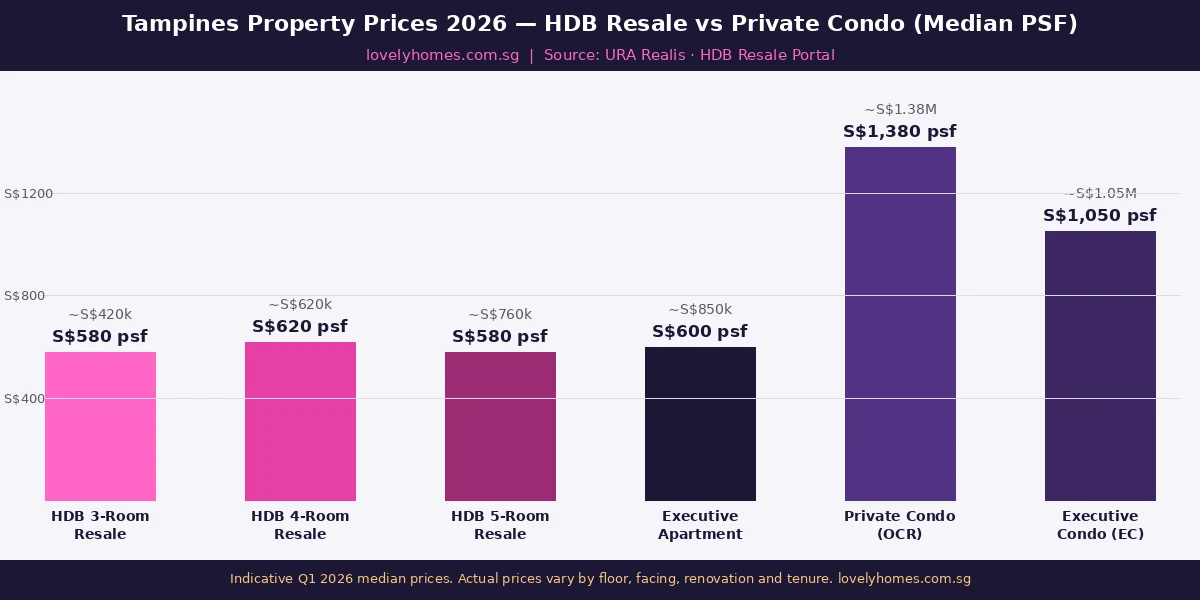
Figure 1: Tampines property prices 2026 — HDB resale vs private condo median PSF infographic
Figure 1: Median transacted PSF and indicative total price for different property types in Tampines, Q1 2026. Source: URA Realis, HDB Resale Portal | lovelyhomes.com.sg

Property Overview: HDB, Executive Condos and Private Residential

Tampines is overwhelmingly an HDB town — roughly 82,000 HDB flats across 12 residential zones house the bulk of its approximately 260,000 residents. The HDB resale market here is liquid, with a steady stream of transactions throughout the year. As of Q1 2026, URA and HDB transaction data indicate the following median price benchmarks:

Property Type Approx. Median PSF Approx. Median Price (Q1 2026) Notes
HDB 3-Room Resale ~S$580 psf ~S$400k–S$450k Strong demand from singles & couples
HDB 4-Room Resale ~S$620 psf ~S$620k–S$680k Most liquid segment
HDB 5-Room Resale ~S$580 psf ~S$720k–S$820k Upgrader-driven demand
Executive Apartment (EA) ~S$600 psf ~S$800k–S$950k Limited supply; premium over 5-room
EC (e.g. Tampines GreenGems) ~S$1,050 psf ~S$1.0M–S$1.2M EC rules: income cap S$16k/mth
Private Condo (OCR) ~S$1,380 psf ~S$1.2M–S$1.6M (2BR–3BR) Small pool of projects; CRL upside

The MOP Wave: 2,133 Tampines Flats Clearing MOP by 2028

One of the most consequential supply-side developments for Tampines’s property market in the near term is the incoming Minimum Occupation Period (MOP) wave. HDB data published in Q1 2026 shows that 2,133 Tampines HDB flats are expected to complete their 5-year MOP between 2026 and 2028 — making Tampines the third-largest contributor to the national MOP wave of 53,816 units, behind Punggol (3,222) and Queenstown (2,405). Flats clearing MOP become available for resale or as platforms for upgrading to private property; a concentrated wave in a single town typically softens short-term resale price appreciation as supply enters the market simultaneously. Buyers looking at Tampines HDB resale should factor this modestly increased supply into their price negotiations over the 2026–2028 window.

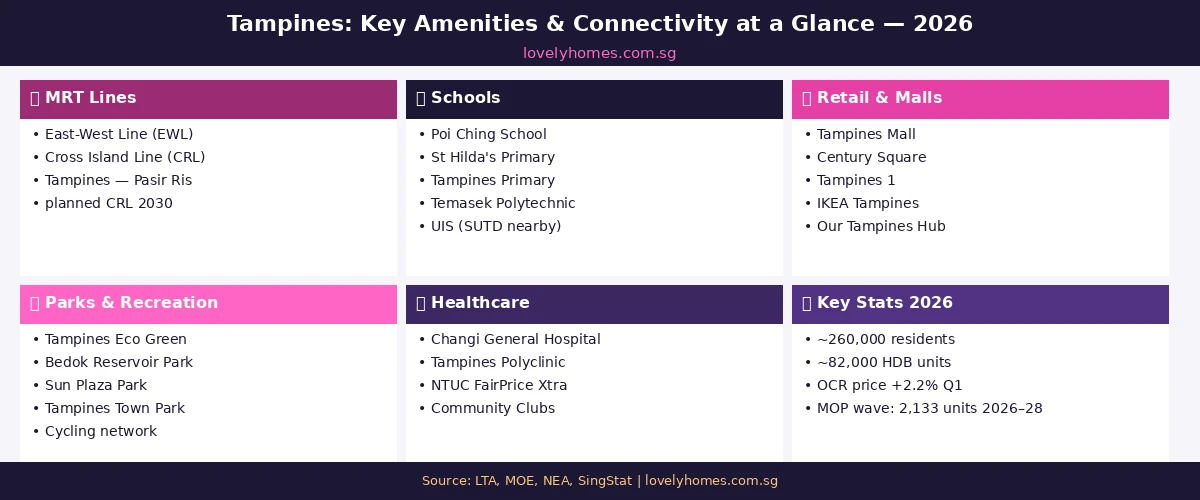
Figure 2: Tampines key amenities connectivity schools retail healthcare 2026 infographic
Figure 2: Tampines 2026 — key amenities, transport connectivity, schools, retail and healthcare at a glance. Source: LTA, MOE, NEA | lovelyhomes.com.sg

Transport Connectivity: EWL Today, CRL Tomorrow

Tampines currently has four MRT stations on the East-West Line (EWL): Simei (EW3), Tampines (EW2), Tampines West (DT31, Downtown Line, which serves the western fringe of the estate) and Tampines East (DT32). The EWL provides direct access to Changi Airport (two stops from Tampines EWL), the Changi Business Park cluster, and the CBD via Raffles Place. Typical journey time from Tampines to the City Hall area is 35–40 minutes on the MRT.

The transformative catalyst for Tampines is the Cross Island Line (CRL). The CRL Phase 2 extension — which the Land Transport Authority (LTA) has confirmed will include a Tampines North station — is scheduled for completion around 2030. When operational, this will provide Tampines residents with a second cross-island route connecting them to Punggol, Ang Mo Kio, Buona Vista and eventually West Coast, without requiring a change at Jurong East or Raffles Place. Property-market analysis consistently shows that proximity to new MRT lines generates a measurable premium (typically 5–15% above otherwise comparable units) as the completion date approaches.

Schools: Primary, Secondary and Tertiary

Tampines is well-served by educational institutions at every level, making it a perennial favourite for young families. At the primary level, Poi Ching School and St Hilda’s Primary School are consistently over-subscribed due to strong parent networks and community ties. Tampines Primary and White Sands Primary offer additional places for residents within 1–2 km. For secondary school, Anglican High School, Ngee Ann Secondary and Tampines Secondary serve the estate. At the post-secondary level, Temasek Polytechnic — one of Singapore’s five polytechnics — sits within the Tampines planning area, and the Singapore University of Technology and Design (SUTD) is located in the adjacent Changi area.

For HDB buyers, proximity to a primary school is a priority consideration: within 1 km of an oversubscribed primary school, flats command a premium of up to S$30,000–S$80,000 relative to units further away, according to industry analysis of transaction caveats.

Retail, Recreation and Community Amenities

Tampines has one of the densest concentrations of retail infrastructure of any OCR town. Tampines Mall, Century Square and Tampines 1 — three large malls clustered around the Tampines MRT station — together provide over 400 retail and food-and-beverage tenants. IKEA Tampines (one of only two IKEA outlets in Singapore) and Courts Megastore provide large-format retail. Our Tampines Hub (OTH) — opened in 2017 as Singapore’s largest integrated community and lifestyle hub — includes a hawker centre, library, swimming complex, indoor sports hall and community club all under one roof. Tampines Eco Green, a 36-hectare nature park, provides green space adjacent to the town’s residential estates.

Rental Market: Who Rents in Tampines?

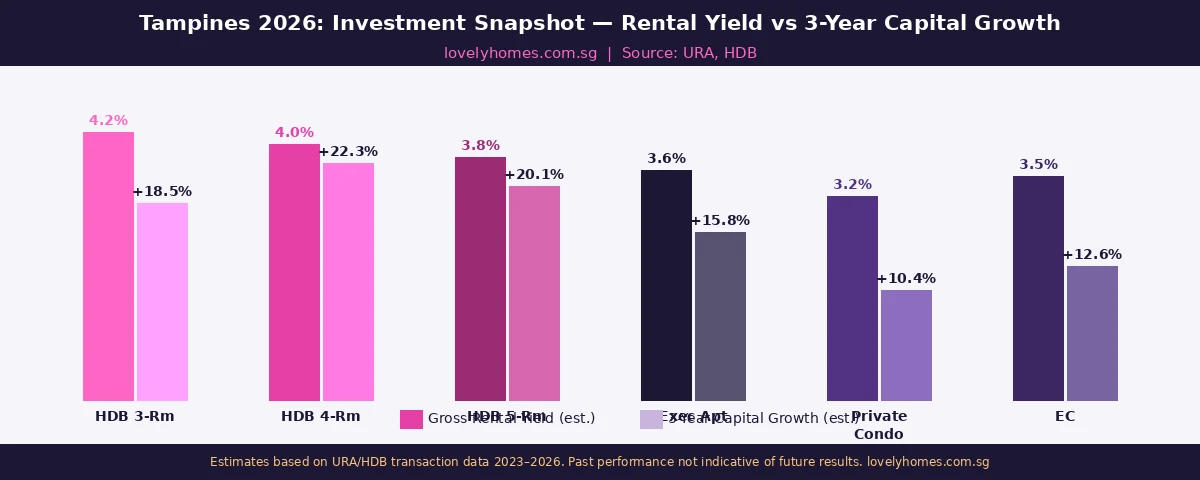
The rental market in Tampines is driven primarily by: (1) expatriate families priced out of CCR/RCR who need proximity to Changi Business Park or Singapore Expo; (2) domestic tenants occupying HDB rooms or whole flats while waiting for BTO completion; and (3) investors holding private condo units between sales. Indicative whole-unit HDB rental rates in Q1 2026 range from approximately S$2,200–S$2,600 per month for a 4-room flat to S$2,600–S$3,200 for a 5-room flat. Private condo 2-bedroom units in Tampines transact at approximately S$3,200–S$4,000 per month. Gross rental yields for HDB units are estimated at 3.8–4.2%, compared to 3.0–3.5% for private condos, reflecting the difference in purchase prices relative to achievable rents.

Figure 3: Tampines 2026 investment snapshot gross rental yield vs 3-year capital growth infographic
Figure 3: Tampines — estimated gross rental yield vs 3-year capital growth (2023–2026) by property type. Source: URA, HDB | lovelyhomes.com.sg

Worked Example: HDB Upgrader Buying Tampines Private Condo

Mr and Mrs Wong are Singapore Citizens who purchased a 5-room Tampines HDB flat in 2019 for S$550,000. Their MOP completed in October 2024. By Q1 2026, their HDB flat has appreciated to approximately S$760,000. They wish to sell the HDB and purchase a 3-bedroom private condo in Tampines priced at S$1,400,000.

  • HDB sale proceeds: S$760,000 gross. Outstanding HDB loan: S$310,000. CPF refund (principal + accrued interest): S$185,000. Cash proceeds: ~S$265,000.
  • BSD on new condo: S$1,800 + S$3,600 + S$19,200 + S$16,000 = S$40,600
  • ABSD: S$0 (SC first property, having sold HDB before purchase)
  • Down payment (25%): S$350,000 (5% cash S$70,000 + CPF OA S$280,000 — after CPF refund from HDB)
  • Bank loan (75%): S$1,050,000 at 1.80% for 2 years, 25-year tenure → ~S$4,326/month
  • Combined gross income needed: S$4,326 ÷ 55% (TDSR) = minimum ~S$7,866/month, leaving ample headroom for the Wongs on a combined S$12,500 income.

What Might Come Next: CRL Uplift and Bayshore Connectivity

The two most significant medium-term catalysts for Tampines property values are the CRL Phase 2 completion (estimated 2030) and the broader development of the Bayshore/East Coast masterplan by URA. The Bayshore GLS site — a mixed-use tender with a tender close date of 15 July 2026 — will unlock a major new residential and commercial node adjacent to the East Coast, which URA envisions as a sea-facing precinct with good walking access to future MRT and park connector links. While Bayshore is not in Tampines per se, the development of the eastern corridor broadly supports demand for Tampines residential property from spillover buyers seeking relative value.

Conversely, the incoming MOP supply wave (2,133 flats by 2028) and the large pipeline of new BTO launches in nearby Tampines (the February 2026 BTO exercise included Tampines North flats) mean that resale HDB price growth in Tampines is likely to moderate compared to the strong gains seen in 2021–2024. Buyers should approach the market with realistic price expectations and longer holding horizons of at least 5–8 years to capture the full CRL uplift.

Frequently Asked Questions

Is Tampines a good area to buy property in Singapore?
Tampines offers strong fundamentals for both owner-occupiers and investors. Its self-contained town infrastructure — multiple malls, good schools, Changi General Hospital, Temasek Polytechnic and extensive recreational facilities — makes it consistently attractive for families. For investors, rental demand from the Changi Business Park and Singapore Expo clusters supports stable occupancy. The CRL Phase 2 extension, expected around 2030, is the single largest near-term price catalyst. However, the incoming MOP wave (2,133 flats clearing by 2028) means short-term HDB resale price growth is likely to be more measured than in the 2021–2023 peak. Private condos in Tampines currently offer better capital appreciation prospects due to limited supply and the CRL premium.
Which MRT stations serve Tampines?
Tampines is currently served by three East-West Line (EWL) stations — Simei (EW3), Tampines (EW2), and the upcoming Tampines East and Tampines West stations on the Downtown Line (DTL). The Cross Island Line (CRL) Phase 2 will add a Tampines North station, providing the estate with a direct diagonal cross-island route to Ang Mo Kio, Jurong and West Coast. LTA has confirmed the CRL Phase 2 alignment; the target completion is approximately 2030. The addition of a second MRT line is historically associated with meaningful property price premiums in Singapore — buyers near the Tampines North CRL station area should monitor land parcel activity and showflat prices in that sub-zone.
What are the best primary schools in Tampines?
The most sought-after primary schools in Tampines, based on past Phase 2C vacancy ballot history, are Poi Ching School (strong CCA and PSLE track record) and St Hilda’s Primary School (historically over-subscribed, alumni-linked admission priority). Within 1 km of these schools, HDB resale flats typically command a meaningful premium. Other well-regarded primary schools in the area include Tampines Primary School, White Sands Primary and Park View Primary. Families who prioritise school proximity should identify units within 1 km of their preferred school and check distance eligibility on the MOE Primary One Registration portal before purchasing.
What is the price difference between Tampines HDB and private condos?
As of Q1 2026, there is a significant price gap between HDB resale flats and private condos in Tampines. A 4-room HDB resale flat trades at approximately S$620,000–S$680,000 (around S$620 psf), while a 2-bedroom private condo trades at approximately S$1.2M–S$1.4M (around S$1,300–S$1,400 psf). This price-per-square-foot premium reflects the private condo’s freehold or 99-year strata title, no income eligibility restrictions, no MOP before resale, private facilities (pool, gym) and the ability to be rented to any nationality. For Singapore Citizens buying a first property, the private condo requires no ABSD but involves a significantly larger financial commitment — especially the 5% mandatory cash down payment (S$60,000–S$70,000 on a S$1.2M–S$1.4M purchase) versus an HDB purchase where no mandatory cash component beyond the option fee is required if using an HDB loan.
How does Tampines compare to Pasir Ris or Bedok for property investment?
Each eastern OCR town has a distinct risk/return profile. Tampines offers the highest liquidity (most transactions per year) and the most comprehensive retail/lifestyle amenities, but the incoming MOP wave will add near-term resale supply. Pasir Ris benefits from the Pasir Ris 8 integrated development (which opened in 2023 adjacent to the new Pasir Ris MRT interchange on the Cross Island Line) and a newer HDB stock profile, giving it stronger near-term price momentum. Bedok is the most mature of the three, with limited new supply and higher PSF for HDB resale (reflecting age-adjusted desirability and proximity to both the EWL and the upcoming Thomson-East Coast Line), but also the smallest pipeline of new private projects. Investors prioritising rental yield may prefer Tampines for its Changi-cluster employment demand; those prioritising capital appreciation may find Pasir Ris’s CRL interchange premium more compelling.
Are there upcoming HDB BTO launches in Tampines?
Yes. Tampines North was included in HDB’s February 2026 BTO exercise with Standard-type flats. HDB has confirmed it will launch approximately 19,600 BTO flats across three exercises in 2026 (February, June and October). Future Tampines BTO projects may include Plus-type classifications under HDB’s new flat classification framework (Standard, Plus, Prime), which affect resale restrictions and subsidy recovery conditions. Buyers considering a BTO in Tampines North (which has proximity to the future CRL Tampines North station) should monitor HDB’s official launch announcements via HDB InfoWEB and the Flat Portal.

Related Articles

Disclaimer: Property prices, rental rates, school enrolment criteria and planning information cited in this article are indicative figures based on publicly available URA, HDB, MOE and LTA data as at May 2026, and are subject to change. This article is for general informational purposes only and does not constitute investment, financial or legal advice. Prospective buyers should conduct their own due diligence, consult a MAS-licensed financial adviser and verify all transaction data on URA Realis, HDB Flat Portal and IRAS before making any property purchase decision. LovelyHomes does not provide brokerage services.

En-Bloc Sale Process Singapore 2026: A Homeowner’s Step-by-Step Guide

En-Bloc Sale Process Singapore 2026: A Homeowner’s Step-by-Step Guide

En-bloc sale process Singapore 2026 hero
En-Bloc Sale Process Singapore 2026 — what every owner should know before voting yes or no.

Quick Answer

  • An en-bloc (collective) sale is when the majority of owners in a strata development sell the entire site to a single buyer, normally a developer planning redevelopment.
  • The legal framework is the Land Titles (Strata) Act 1967 (Cap. 158) and the regulator is the Strata Titles Board (STB).
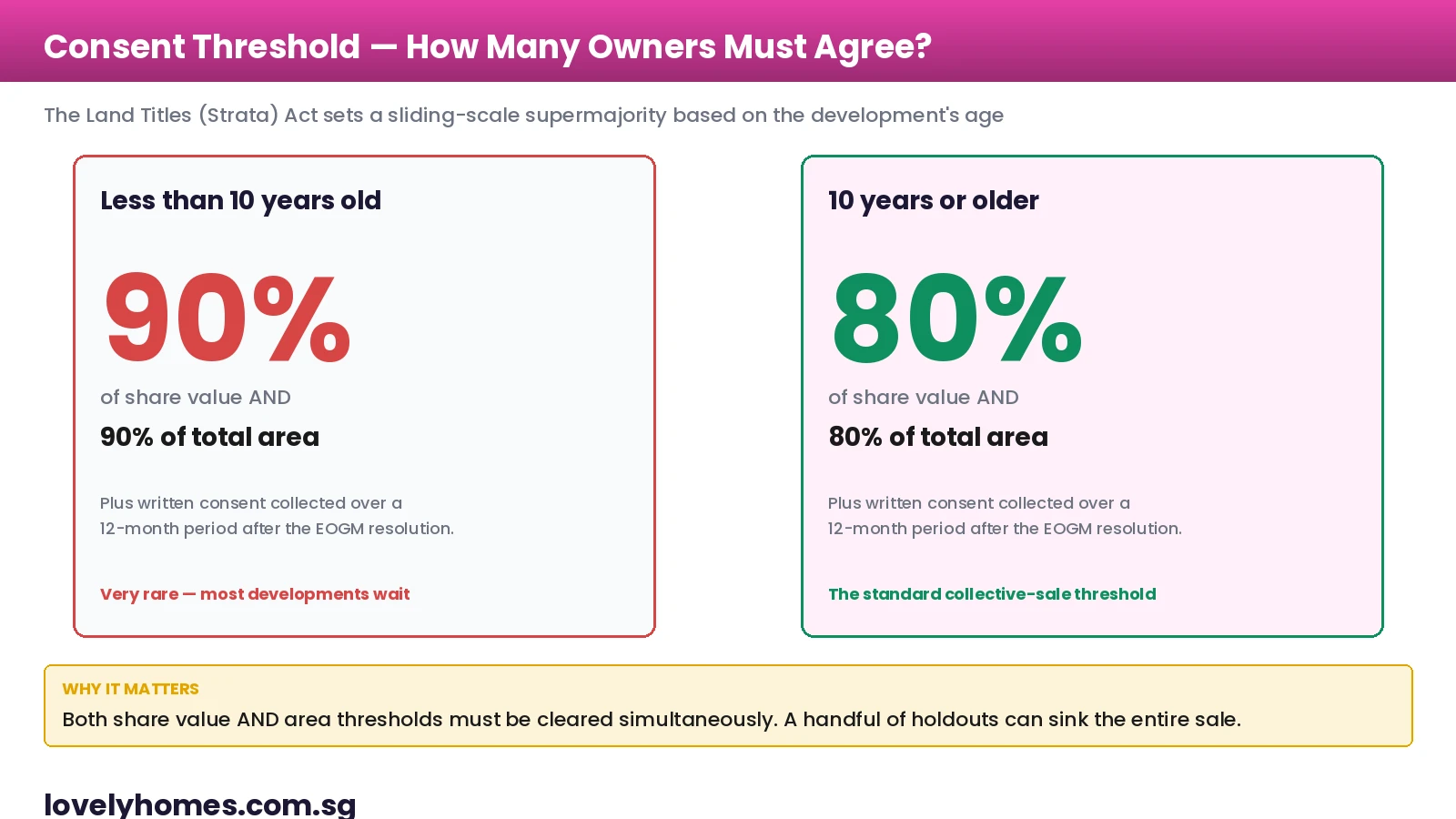
  • The consent threshold is 80% of share value AND 80% of total area for developments at least 10 years old; 90%/90% for younger developments.
  • The full process from idea to payout takes 18 to 30 months if everything goes well; failed attempts still consume 12-18 months of effort.
  • Owners must elect a Sale Committee (CSC) at an EOGM. The CSC appoints a tender consultant and a lawyer through a competitive tender.
  • Loyang Valley sold for S$880m in March 2026 — the largest residential en bloc since Thomson View. Activity is otherwise subdued; only two residential collective sales completed in 2025.
  • Owners pay no stamp duty on the sale itself but ABSD applies on any replacement property; consider lease decay, tax leakage and the ABSD trap before voting yes.

What an En-Bloc Sale Actually Is

An en-bloc — short for “en bloc” — sale is a collective sale of every unit in a strata-titled development to a single buyer. Once the supermajority of owners agree and the Strata Titles Board approves the sale, the ownership of the entire estate transfers and the development is typically demolished and rebuilt at a higher density. The Singapore framework sits between two competing public-policy goals: protecting individual owners’ property rights, and freeing up well-located but ageing land for renewal so the city can densify.

The mechanism was created by the Land Titles (Strata) Act 1967 and significantly tightened in 1999 and again in 2007 after a wave of acrimonious sales. The current law gives owners robust procedural rights — STB scrutiny, mediation, the right to be heard — but the underlying economic deal is binary: 80% (or 90%) of share value and area must agree, and the remaining minority is then bound by the supermajority’s decision.

En-bloc consent threshold 80 percent 90 percent Land Titles Strata Act
Figure 1: The two consent thresholds set by the Land Titles (Strata) Act.

Who Initiates an En-Bloc Attempt?

Almost every successful collective sale begins with a small group of owners — usually two to five — who privately agree the development is undervalued, ageing, and primed for redevelopment. They circulate a paper at the next AGM, gauge interest informally, then call for an Extraordinary General Meeting (EOGM) to authorise the formation of a Collective Sale Committee.

The CSC is elected by simple majority and is bound by strict statutory duties of good faith. It must consist of at least three owners, ideally with a mix of demographics — younger families, retirees, investor-owners — so the committee credibly represents the development. The CSC is not paid; members serve voluntarily, although the tender consultant’s fee (between 0.5% and 1.0% of the sale price) is a substantial professional cost that comes out of the proceeds.

The Numbers That Decide Everything

An en-bloc sale lives or dies on two consent percentages and two financial numbers.

The consent percentages. These come from the Sixth Schedule of the Land Titles (Strata) Act. Below 10 years old, you need 90% of share value and 90% of total area. From the 10th anniversary onwards, the threshold drops to 80%/80%. Both numbers must clear simultaneously, calculated against the date the last owner signs the Collective Sale Agreement (CSA). The CSC has up to 12 months from launch to collect the signatures.

The reserve price. This is the lowest price the CSC is authorised to accept on the public tender. Set it too high and the tender fails outright; set it too low and minority owners can credibly argue at STB that the CSC did not act in good faith. The reserve price is supported by an independent valuation report from a SISV-accredited valuer and is normally pegged to a “redevelopment land value” benchmarked off recent comparable GLS bids.

The breakeven psf. This is the developer’s target — purchase price plus 35% land ABSD plus construction plus financing plus a target margin, divided by the gross floor area allowed by URA. If the breakeven psf comes out higher than what new launches in the same micromarket are achieving, no developer will bid.

The payout per unit. This is what each owner receives, calculated by a formula in the CSA — usually a hybrid of strata-area weighting, share-value weighting, and a uniform per-unit premium. The CSA must specify the formula on day one; you cannot change it after signing.

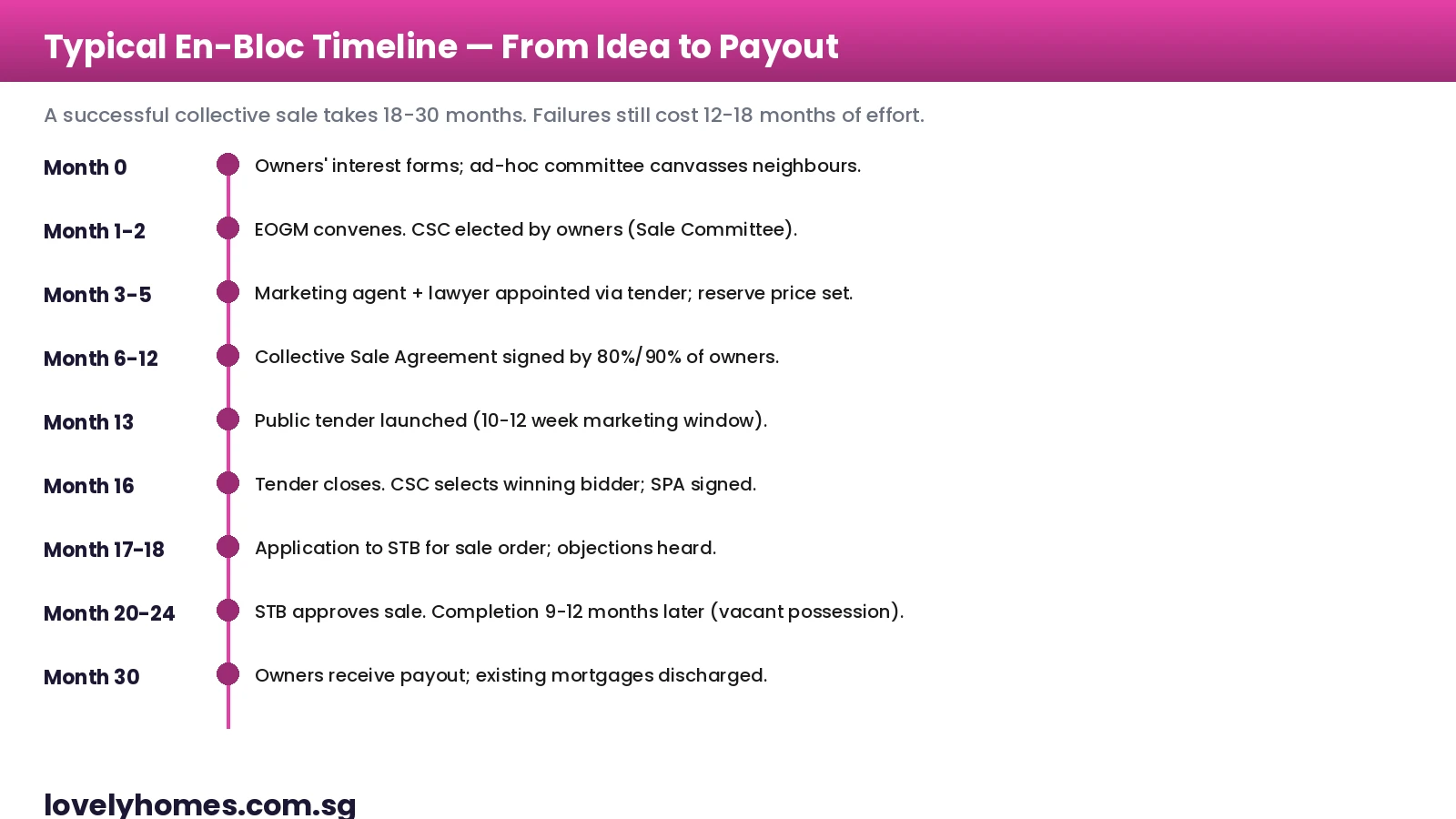
En-bloc collective sale timeline Singapore 18 to 30 months
Figure 2: A typical 30-month timeline from EOGM to payout.

The Process Step by Step

Step 1 — Preliminary canvassing (Months 0-2). Informal interest forms; CSC elected at EOGM by simple majority; statutory affidavits filed.

Step 2 — Professional appointments (Months 3-5). CSC tenders the tender consultant appointment and the lawyer appointment. Both run on a no-deal-no-fee or lightly weighted fixed-fee basis. Parallel valuation engagement; reserve price drafted and agreed.

Step 3 — Collective Sale Agreement (Months 6-12). The CSA is the master contract that all consenting owners sign. It contains: the reserve price, the apportionment formula, the tender-consultant fees, the legal fees, the powers granted to the CSC, the cooling-off period (5 days), and the time-bar for revocation. STB will scrutinise this document closely.

Step 4 — Public tender (Months 13-16). The tender consultant runs a 10-12 week tender. Developers submit sealed bids. The CSC selects the highest acceptable bid above the reserve price; a Sale & Purchase Agreement (SPA) is then signed with the winning bidder, normally subject to STB approval.

Step 5 — STB application and hearing (Months 17-24). The CSC files Form 1 with the Strata Titles Board within four weeks of the SPA. STB serves notice on every owner; objecting minority owners may file written objections. Mediation typically follows; if no settlement, a contested hearing.

Step 6 — Completion and payout (Months 25-30). Once STB issues a sale order, vacant possession is delivered (typically 9-12 months later). Each owner’s outstanding mortgage and CPF Accrued Interest are repaid first; the net proceeds are then released to the owner.

Worked Example — Distributing a S$880m Sale

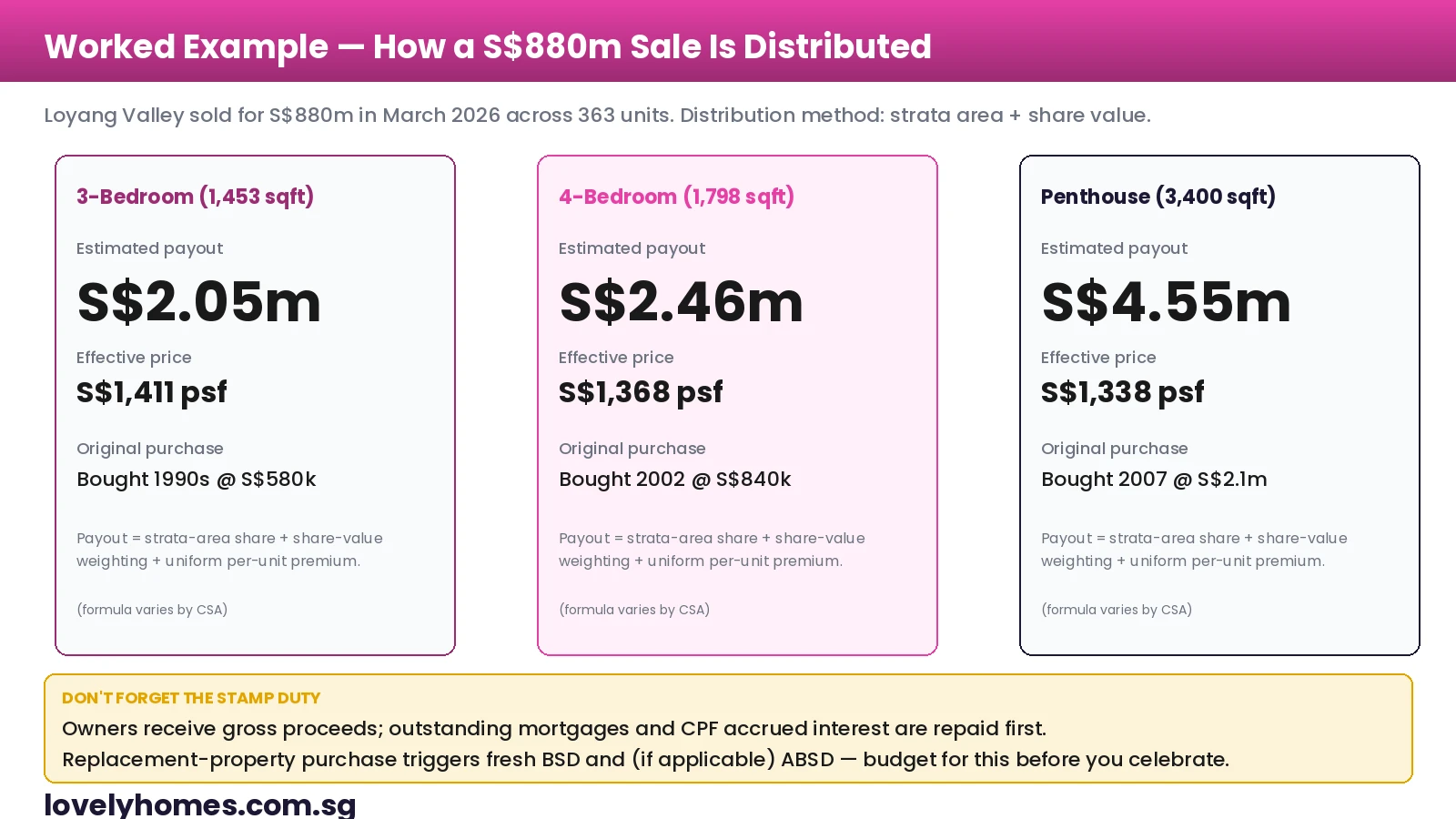
Loyang Valley, the 363-unit Yio Chu Kang Road development that sold to SingHaiyi for S$880m in March 2026, illustrates the payout mechanics. The CSA used the standard hybrid formula: roughly 50% weighting on strata floor area and 50% on share value, with a small uniform per-unit premium. A 1,453 sqft three-bedder bought in the early 1990s at around S$580,000 walked away with approximately S$2.05m gross — a 3.5x return on the original purchase before adjusting for inflation. A 3,400 sqft penthouse received roughly S$4.55m.

The gross numbers are the headline, but the math owners actually care about runs net. Outstanding mortgage and CPF Accrued Interest are repaid before any cash leaves the lawyer’s escrow account. CPF Accrued Interest in particular has been compounding at 2.5% for decades, so an owner who used S$200,000 of CPF in 1995 is now seeing roughly S$590,000 deducted at completion.

En-bloc payout distribution worked example Loyang Valley S$880m
Figure 3: Three sample units inside Loyang Valley and what each owner received.

The ABSD Trap That Catches Replacement Buyers

The single most common surprise for en-bloc sellers is the Additional Buyer’s Stamp Duty bill on their replacement property. Owners assume the en-bloc sale and the replacement purchase are the “same transaction”; the law says they are not. Once the en-bloc completes and the proceeds land, you are a Singapore citizen buying your second property — which currently attracts 20% ABSD on the new purchase price.

The remission you may be thinking of is for married couples buying a single matrimonial home: provided you sell your first property within six months of the new purchase, the ABSD on the second property is refunded. But the en-bloc payout schedule (typically 9-12 months for vacant possession) means the existing flat is sometimes not fully extinguished by the time you have committed to the new home. Sequence the purchase carefully and consult a conveyancing lawyer before signing the Option to Purchase on a replacement.

Why En-Bloc Activity Is Subdued in 2026

The market in 2025-2026 has been notably quiet, with only two successful residential collective sales completing in 2025 and Loyang Valley headlining the early-2026 cycle. Three structural forces are at work.

Land ABSD at 35%. Developers buying en-bloc sites pay 35% ABSD on the land cost (with a 5-year remission if all units in the new development are sold within five years of the date of contract). On a S$700m site that is S$245m of upfront cash. Combined with construction inflation, the breakeven psf for redeveloped units is S$2,800-3,200 — uncomfortable in many OCR submarkets.

Abundant GLS supply. The 1H 2026 Government Land Sales programme is large. Developers prefer GLS sites because they are pre-zoned, free of strata-title messiness, and avoid the ABSD payable on en-bloc land. Anecdotally, the same developer often will not bid for both a collective sale and a parallel GLS tender; they pick one.

Owner expectations. Owners have watched their estates rise at 5-7% per annum on the URA Property Price Index and now expect en-bloc premiums of 20-30% over individual market value. Developers can rarely price that.

Pros and Cons for the Individual Owner

Pros Cons
Premium of 20-40% over individual market value (when conditions are right) Time and emotional cost — 18-30 months of meetings and uncertainty
Liquidity event for older owners with most of their wealth tied up in the home Forced relocation; very few replacement options at the same psf in mature estates
Resets the lease clock — buyer normally redevelops on a fresh 99-year tenure ABSD bill on replacement property if not sequenced carefully
Releases capital that may be redeployed into smaller, newer or yield-bearing assets CPF Accrued Interest has compounded for decades; net cash often less than expected
Avoids ageing-estate maintenance levies and lift/cladding upgrades For minority objectors, the supermajority decision is binding once STB approves

What Minority Objectors Can Actually Do

If you are in the 20% who voted no, your statutory protections are real but narrow. You may file a written objection at the STB hearing on grounds set out in section 84A(7) of the Land Titles (Strata) Act: that the transaction is not in good faith having regard to the sale price, the method of distribution of the proceeds, or the relationships between the parties. You may also object on the grounds that the proceeds will be insufficient to redeem your outstanding mortgage and CPF — STB has historically given weight to genuine financial hardship in this scenario.

What you cannot do is force a higher sale price or insist on staying. If STB rules the sale was made in good faith, you must convey within the SPA’s completion period. Costs of objection are usually modest because STB is meant to be accessible to lay parties, but engaging a property lawyer is strongly recommended.

What Might Come Next

The en-bloc cycle in Singapore tends to swing on five-year horizons. The 2017-2018 cycle saw 38 successful sales in 18 months before cooling-measure tightening squeezed it. The 2021-2022 cycle saw a smaller wave. The current 2025-2026 cycle is so far measured in single-digit completions per year. The next significant catalyst would be either a meaningful cut in land ABSD for collective-sale sites, or a cut in the 80%/80% threshold to 75%/75% — both have been floated by industry but neither is on the legislative pipeline as of April 2026.

For owners in eligible developments, the practical advice is to sequence the conversation rather than wait for a perfect cycle. The base rate of CSCs that achieve a successful sale on the first attempt is below 30%, so plan for the long arc. For developers, sites with low plot ratios that can be uplifted under the latest URA Master Plan remain the only consistently viable plays.

Frequently Asked Questions

What is the difference between an en-bloc sale and a collective sale?

The two terms are used interchangeably in Singapore. “En bloc” is the historic French legal term that appears in older case law; “collective sale” is the term used in the Land Titles (Strata) Act and STB’s published forms. The mechanism is identical: the supermajority of owners selling the whole development as one parcel.

Can I refuse to sign the Collective Sale Agreement?

Yes. Signing the CSA is voluntary. If you do not sign, you are simply not part of the consent percentage. However, if the supermajority is achieved without you and STB approves the sale, you are still bound by the order to convey your unit at the apportioned price — refusal to sign the CSA only removes your voice from the proceeds-distribution negotiations, not your obligation to convey.

How is the share value of my unit calculated?

Share value is fixed at the time the development is granted strata title and is recorded in the strata roll held by the MCST. It is broadly proportional to floor area but with adjustments for unit type (penthouses and shop units typically get a slightly higher share value per sqft). You can check your share value on your management corporation’s records or on a recent maintenance-fee invoice.

What if my outstanding mortgage exceeds my en-bloc payout?

This is a “negative equity” scenario and is rare in Singapore but possible at older luxury sites where buyers paid peak prices. The mortgagee bank’s redemption is paid first; if the proceeds are insufficient, you owe the bank the shortfall. STB has historically given some weight to genuine financial hardship objections under section 84A(7) but cannot order a higher price.

Do I have to pay stamp duty on the en-bloc sale?

No. The en-bloc seller pays no stamp duty on the sale itself — stamp duty (BSD and, where applicable, ABSD) is payable by the buying developer on the purchase price. However, you do pay BSD and possibly ABSD on any replacement property you purchase. Plan the timing so that the matrimonial-home ABSD remission applies to the new purchase if you qualify.

Can the tender consultant guarantee a successful sale?

No, and any agent who promises one should be avoided. The tender consultant’s role is to run a competitive tender, advise on the reserve price, and prepare the marketing pack. Whether developers actually bid above the reserve depends on market conditions, the development’s location and density potential, and prevailing land ABSD rates. Fees are typically structured as no-deal-no-fee precisely because of this uncertainty.

What happens to my tenants if my unit is going through an en-bloc sale?

Existing tenancies survive the change of ownership but the new buyer (the developer) is unlikely to renew them. Most tenancies have a “redevelopment” or “early termination” clause anyway. If yours does not, the tenant is entitled to remain until the lease expiry; the developer will typically negotiate an early-termination payment to deliver vacant possession.

Disclaimer. This article is general information about en-bloc and collective-sale procedure in Singapore as at 29 April 2026. It is not legal, tax, valuation or financial advice. Always verify the current statutory thresholds, fees and procedures with the Strata Titles Board, the Land Titles (Strata) Act, and your own licensed property lawyer or tender consultant before voting on a Collective Sale Agreement.

Tenancy Agreement Singapore 2026: A Landlord and Tenant’s Complete Guide to the Rental Contract

Tenancy Agreement Singapore 2026: A Landlord and Tenant’s Complete Guide to the Rental Contract

Last updated 28 April 2026. Reflects IRAS lease stamp duty rules current as at FY2026 and standard market norms reported by URA’s quarterly rental statistics.

Quick Answer — 30-second takeaways

  • A Singapore tenancy agreement is the binding contract between a landlord and tenant. It is governed by Singapore contract law and the principles of the Civil Law Act and the Conveyancing and Law of Property Act.
  • Standard residential terms are 12 or 24 months. Anything shorter than 3 months risks being treated as serviced accommodation, which is regulated separately.
  • Security deposit: typically 1 month’s rent per year of lease, capped at 2 months. Refundable within 14 days of handover, less reasonable deductions.
  • Diplomatic clause: standard on 24-month leases, lets the tenant terminate after 12 months on 2 months’ notice if posted out of Singapore.
  • Lease stamp duty (LSD): 0.40% of total rent across the lease term, payable by the tenant within 14 days of execution, e-stamped at iras.gov.sg.
  • Minor repairs cap: tenant pays first S$150–S$250 of any repair; landlord pays the excess. Aircon servicing 3-monthly is the tenant’s cost.
  • Disputes ≤ S$30,000 can be heard at the Small Claims Tribunals (SCT) with both parties’ consent. Larger disputes go to the State Courts.

What a tenancy agreement is — and what it isn’t

A tenancy agreement (often abbreviated TA) is the written contract that creates a legal lease between a property owner (the landlord) and an occupant (the tenant). It records the parties, the property, the term, the rent, the deposit, and the rules for living in and looking after the home.

Singapore does not have a dedicated Residential Tenancy Act. Tenancy agreements are governed by general contract law, supplemented by the Civil Law Act 1909, the Conveyancing and Law of Property Act 1886, and — for HDB rentals — by the rules of the Housing and Development Board. This means that what is “standard” in a Singapore tenancy is largely set by market practice and by widely-used template clauses, not by statute. Landlords and tenants who do not read every clause carefully can find themselves bound by terms the other side considers normal but they did not expect.

A tenancy agreement is not a Letter of Intent (LOI). The LOI is the pre-contract document the prospective tenant submits with a good-faith deposit. The TA is the binding lease that follows once the LOI is accepted. Stamp duty is payable on the TA, not the LOI.

Singapore tenancy agreement 2026 — 10 key clauses every landlord and tenant should read line by line
Figure 1: The 10 clauses that do most of the work in a Singapore tenancy agreement.

Who can be a landlord, and who can be a tenant

For private property, any property owner can lease their unit, subject to building by-laws and the conditions of any mortgage. The Urban Redevelopment Authority requires a minimum lease of 3 months for private residential property; below that threshold the lease is treated as short-stay accommodation and is generally not allowed unless the unit is licensed serviced apartment stock.

For HDB flats, the rental rules are stricter:

  • The flat must have met its Minimum Occupation Period (MOP), which is typically 5 years for new flats and 5 years for resale flats with grant.
  • The owner must apply for HDB approval to rent out the whole flat or individual rooms.
  • Rentals to non-citizen households must respect the Ethnic Integration Policy (EIP) and Singapore Permanent Resident (SPR) quota.
  • Maximum 6 unrelated occupants per flat (4 for 1- and 2-room flats).
  • The minimum rental period is 6 months for whole-flat HDB rentals.

Tenants can be Singapore Citizens, Permanent Residents, work-pass holders, students or any other lawfully present individual. For non-resident tenants, landlords must verify that the tenant holds a valid pass throughout the lease — leasing to an individual without a valid pass is an offence under the Immigration Act.

The 10 clauses that do all the work

A typical Singapore residential TA runs to 8–14 pages. Most of the legal heavy-lifting happens in ten clauses, summarised in Figure 1 above and explored below.

Term and renewal

The lease term is fixed: it has a defined start date and end date. Holding-over (continuing to occupy after expiry without a new TA) creates a tenancy at will, which is terminable on short notice and offers neither party much protection. Most landlords negotiate renewal 2–3 months before expiry; the LSD on the renewal lease must be re-stamped at the new rent.

Rent and security deposit

Rent is payable monthly in advance. The market norm for the security deposit is 1 month’s rent per year of lease, capped at 2 months. The deposit secures the landlord against damage beyond fair wear and tear, unpaid rent, and unpaid utility bills. It is refunded within 14 days of handover, less itemised deductions. Disputes over deposit deductions are the single most common Singapore tenancy dispute, and the Small Claims Tribunals see hundreds each year.

Diplomatic clause and reimbursement clause

The diplomatic clause allows a tenant to terminate after 12 months on 2 months’ written notice if they are required to leave Singapore (typically because of a job posting or visa cancellation). It is market-standard on 24-month leases and rare on 12-month leases. The mirror is the reimbursement clause: if the tenant terminates early, they must reimburse the landlord on a pro-rated basis for the agent’s commission and legal fees of the original lease.

Minor repairs cap

Tenants are responsible for minor repairs up to a contractual cap, typically S$150–S$250 per item. Landlords pay the excess. The clause prevents petty disputes about light bulbs and tap washers, while keeping major repairs (aircon compressor failure, roof leaks, structural defects) on the landlord’s account. Air-conditioner servicing every 3 months is the tenant’s cost; receipts must be produced at handover.

Inventory and handover

An inventory list — usually a schedule attached to the TA — records every item of furniture, every appliance, and every fixture provided. At move-in, both parties walk through and sign off. At move-out, deductions for missing or damaged items are calculated against this list. Photo evidence at both ends saves arguments.

Stamp duty clause

The TA will state which party is responsible for paying lease stamp duty. By Singapore market practice and IRAS guidance, the tenant pays. Failure to e-stamp within 14 days exposes the lease to a penalty of 4 times the duty or S$10, whichever is higher, and the unstamped lease is inadmissible as evidence in a Singapore court (the duty must be paid before the lease can be relied on in litigation).

Singapore tenancy agreement 2026 — market norms for deposit, diplomatic clause, minor repairs cap, and stamp duty
Figure 2: The four “norms” most often negotiated — deposit, diplomatic clause, repairs cap, and stamp duty.

Lease stamp duty: the maths

Lease stamp duty (LSD) is the only tax on a Singapore tenancy. It is levied at 0.40% of total rent across the lease term, capped at four times the average annual rent for leases longer than 4 years. The duty is the tenant’s legal obligation under section 33 of the Stamp Duties Act, payable within 14 days of execution.

Lease term Stamp duty formula Notes
≤ 4 years 0.40% × total rent across the term Most common; covers all 12- and 24-month leases
> 4 years 0.40% × 4 × average annual rent Caps the duty for long leases
Lease with premium / variable rent BSD-style staircase rates apply to premium; LSD on the rent component Rare in residential — common in commercial
Singapore lease stamp duty worked examples 2026 for HDB, condo and landed properties
Figure 3: Worked LSD examples across HDB and private property at 2026 market rents.

The IRAS portal e-stamps the lease in real time. The tenant pays via PayNow, eNETS or credit card, prints the certificate, and brings the original to the lease signing. Many landlords now make production of the e-stamp certificate a precondition to handing over keys — a sensible safeguard, because once keys are handed over the landlord’s leverage drops sharply.

Negotiating the lease — what to push on, what to leave alone

Singapore tenancy agreements are negotiable. The points that move most often:

  • Diplomatic clause activation date. Tenants often ask for activation at month 9 instead of month 12. Landlords typically refuse. The 12-month default holds.
  • Minor repairs cap. Tenants ask for S$300; landlords often want S$150. The S$200 LivingPlus number is the comfortable middle.
  • Whitegoods inclusion. Whether refrigerator, washer, dryer, microwave, oven, vacuum and rice cooker are included is line-by-line negotiation. List each item by brand and model in the inventory schedule.
  • Repainting before handover. A clause requiring the tenant to repaint before move-out used to be standard. It is increasingly replaced by a fixed reinstatement fee (S$300–S$800) plus normal wear-and-tear treatment.
  • Pet clause. “No pets” is the default. Tenants with pets must negotiate a specific carve-out and an additional deposit. HDB has its own approved-breed list for flats.
  • Smoking. “No smoking inside the unit” is now standard, and landlords reasonably claim against deposit if walls and curtains carry residual smoke odour.

What happens if things go wrong

The Singapore framework for tenancy disputes is informal but well-trodden:

  • Small Claims Tribunals (SCT). Hears disputes ≤ S$20,000 (or up to S$30,000 with both parties’ consent in writing) for tenancies of up to 2 years. Hearings are tenant- and landlord-friendly: no lawyers in the courtroom, fees from S$10, decisions usually within 4–6 weeks. The most common claims are deposit deductions, damage to inventory, and unpaid rent.
  • State Courts. Larger disputes, longer leases, and complex commercial-residential overlaps. Lawyers represent both sides; costs follow the event.
  • HDB and the Housing & Estate Disputes Resolution Centre. For HDB rental disputes specifically, HDB will mediate before parties resort to the SCT.
  • Mediation via the Singapore Mediation Centre. Voluntary and confidential. Useful where the parties want to preserve a working relationship — for example, a landlord who wants the tenant to stay another year.

What this means for you

For tenants: read every clause. Push back on anything ambiguous. Pay LSD on time and keep the certificate. Photograph the unit on move-in and move-out. Save every WhatsApp message about repairs — these are evidence in any future SCT claim.

For landlords: use a template TA from a Singapore conveyancing lawyer (not a generic internet template). Check the tenant’s pass status throughout the lease. Inspect the unit twice during a 24-month lease — once at month 6, once at month 18 — with proper notice. Reply in writing to repair requests. The landlord’s deposit deduction is much harder to defend in the SCT if the inspection trail is thin.

What might come next

The Ministry of National Development has been studying the case for codifying residential tenancy law in Singapore — the United Kingdom, Australia and several jurisdictions in continental Europe have moved in this direction. As at April 2026, no draft Bill has been tabled. The likeliest medium-term reforms are: a statutory deposit scheme along the lines of the UK Tenancy Deposit Scheme; a standard tenancy agreement template published by URA or HDB; and clearer rules on the deductibility of fair wear and tear. None of these are imminent, but landlords and tenants who structure their TAs around the existing market norms are well-positioned for any future statutory framework.

Frequently asked questions

Who pays the property agent’s commission?

Singapore market practice is that each side pays its own agent. The landlord pays the landlord’s agent (typically 1 month of annual rent on a 24-month lease, half a month on a 12-month lease). The tenant typically pays the tenant’s agent only on shorter or smaller-rent leases (under S$3,500/month) where the landlord’s agent’s fee is too thin to share. CEA’s Code of Ethics and Professional Client Care requires written disclosure of who pays whom before any signing.

Can a tenant break the lease before the diplomatic clause activates?

Only if the landlord agrees, or if the landlord is in fundamental breach (uninhabitable conditions, refusal to make repairs, harassment). Otherwise, an early termination is a breach of contract. The tenant remains liable for rent until the landlord re-lets the unit; the security deposit is forfeited; the original agent’s commission is clawed back pro-rata. Most landlords are willing to release a tenant if a replacement tenant on equivalent terms is presented.

Can the landlord enter the property without notice?

No. The TA grants the tenant exclusive possession. The landlord may enter only with reasonable notice (typically 24 hours in writing) and at reasonable times, except in emergencies (fire, flood, gas leak). Repeated unannounced visits are a breach of the covenant for quiet enjoyment and can support a tenant’s claim for damages.

What if the tenant has overstayed or won’t leave?

Self-help eviction is unlawful in Singapore. The landlord must give the contractual notice (or, if the lease has expired, a notice to quit), and if the tenant still does not leave, file for a Writ of Possession at the State Courts. Locking the tenant out, removing belongings, or cutting utilities is a criminal offence under the Protection from Harassment Act 2014 and the Distress Act 1872.

Does GST apply to residential rent?

No. Residential rent is exempt from GST under the Fourth Schedule to the GST Act. GST applies only to commercial leases — and only when the landlord is GST-registered (i.e., turnover above S$1 million in a 12-month period).

Can a tenant sub-let to a third party?

Only with the landlord’s written consent. Most TAs have an express anti-subletting clause. Even where consent is given, the head tenant remains liable to the landlord for the sub-tenant’s behaviour, rent and damage. For HDB rentals, all sub-letting must additionally have HDB approval; unauthorised sub-letting is a serious offence and can result in compulsory acquisition of the flat.

Is a verbal lease enforceable?

A verbal residential lease for 3 years or less is technically enforceable under the Conveyancing and Law of Property Act, but in practice it is almost impossible to prove the terms. For any lease over 3 years, the law requires a written, signed deed, registered with the Singapore Land Authority. As a landlord or tenant, you should never proceed without a written, e-stamped TA.

Disclaimer. This article is general guidance only and does not constitute legal advice. Singapore tenancy law is governed by the Civil Law Act 1909, the Conveyancing and Law of Property Act 1886, the Stamp Duties Act 1929, the Small Claims Tribunals Act 1984, and HDB regulations for public housing. Always read your specific tenancy agreement carefully and consult a licensed Singapore lawyer for high-value or unusual terms. Verify lease stamp duty rates against iras.gov.sg, HDB rental approval rules against hdb.gov.sg, and URA short-stay rules against ura.gov.sg.
Tenancy Agreement
Rental
Lease Stamp Duty
Singapore Property
Renting Guide
Diplomatic Clause
Security Deposit
Landlord
Tenant
HDB Rental

Translate »