99-to-1 Property Purchase Singapore 2026: How Tenancy-in-Common Carve-outs Met IRAS’ ABSD Anti-Avoidance Probe

99-to-1 Property Purchase Singapore 2026: How Tenancy-in-Common Carve-outs Met IRAS’ ABSD Anti-Avoidance Probe

The phrase 99-to-1 Property Purchase Singapore 2026 describes a tenancy-in-common structure where one buyer holds 99 per cent of the property and a second buyer holds 1 per cent. Used legitimately, it is a perfectly valid form of co-ownership recognised under the Land Titles Act. Used as a two-step manoeuvre to add a co-owner after the original purchase, the structure became the subject of one of the most public anti-avoidance probes the Inland Revenue Authority of Singapore (IRAS) has run in the post-2010 cooling-measure era — a probe that recovered an estimated S$60 million in unpaid Additional Buyer’s Stamp Duty (ABSD) and surcharges.

This guide explains how the 99-to-1 structure works, why IRAS has scrutinised it, when a 99-to-1 split is legitimate and when it crosses the line into tax avoidance under the General Anti-Avoidance Rule (Section 33A of the Income Tax Act, with parallel application to stamp duties), and what the practical implications are for any Singapore household considering a tenancy-in-common purchase in 2026. The framework is administered by IRAS under the Stamp Duties Act, with anti-avoidance powers drawn from Section 33A of the Income Tax Act 1947.

Quick Answer — 99-to-1 in Singapore at a glance

  • What it is: a tenancy-in-common (TIC) ownership split where one party holds 99 per cent and another holds 1 per cent of a single residential property.
  • Why people use it: to bring a second income onto a bank loan, to plan an estate, or to manage the marital-asset split.
  • Why IRAS scrutinised it: a two-step variant — Buyer A purchases 100 per cent first, then Buyer B (who already owns property) is added 1 per cent later — was used to dodge ABSD that should have applied at the higher second-property rate.
  • The 2023 IRAS probe: 166 cases reviewed, an estimated S$60 million in ABSD and surcharge recovered, with a 50 per cent surcharge layered on top of the avoided tax.
  • Bright-line test: if the 1 per cent share is added after the original purchase, with the only commercial reason being to avoid a higher ABSD bracket, IRAS treats it as one composite transaction and reassesses ABSD on the full price.
  • Statute of limitations: up to six years backward under Section 33A.
  • Legitimate use is unaffected: a 99-to-1 split applied at the OTP itself, with both parties paying ABSD on their respective shares from Day 1, is fine.

What 99-to-1 Actually Means in Singapore Property Law

Singapore property co-ownership comes in two legal forms — joint tenancy and tenancy-in-common. Joint tenancy means co-owners share an undivided 100 per cent interest, and the property passes by survivorship to the surviving joint tenant on death. Tenancy-in-common means each owner holds a defined percentage of the property, and that share passes by will (or by intestacy) on death rather than to the other co-owners. Two co-owners as tenants-in-common can hold the property in any split that adds to 100 per cent — 50/50 is the default, but 80/20, 70/30 and 99/1 are all permitted. The Land Titles Act recognises any defined share. The 99/1 split is unusual mathematically but unremarkable legally.

For stamp duty purposes, a tenancy-in-common purchase is treated as a single transaction at the property level. Each co-owner is a “buyer” under the Stamp Duties Act, and ABSD is computed against each buyer’s profile. Where the buyers fall into different ABSD brackets — for example, one with no prior Singapore property (0 per cent) and one with one prior Singapore property (20 per cent) — the rule is unambiguous: the highest ABSD rate among the joint buyers applies to the entire purchase price, not just to the higher-rate buyer’s share.

This rule is what makes the 99-to-1 split structurally different from, say, a 50-50 split. The economic exposure of the 1-per-cent owner is one one-hundredth of the property; but the ABSD effect is the same as if they owned the whole thing. The Government’s logic is straightforward — the rule is meant to plug the obvious workaround of giving a higher-rate buyer a tiny notional share to access a joint loan while ducking the corresponding ABSD.

The Two-Step Mechanic IRAS Targeted

The 99-to-1 manoeuvre that IRAS publicly scrutinised in April 2023 was not the upfront 99-to-1 split. Upfront splits, where both buyers appear on the original Option to Purchase, the Sale and Purchase Agreement and stamping documents, were never the issue — the highest-rate ABSD applies cleanly and the tax is paid in full. The structure that drew IRAS’ attention was a two-step purchase:

99-to-1 Singapore 2026 two-step ABSD avoidance mechanic — Buyer A first, Buyer B added one per cent later
Figure 1: The two-step pattern targeted by IRAS — original 100% buy by the lower-rate party, followed days or weeks later by a 1% transfer to the higher-rate party.

Step 1. Buyer A — a Singapore Citizen or Permanent Resident with no other Singapore property — exercises the Option to Purchase as the sole 100-per-cent owner of, say, a S$2 million condominium. ABSD on Buyer A is 0 per cent (or 5 per cent for a PR). Buyer’s Stamp Duty is computed normally (about S$64,600 for S$2 million). The buy is clean from the stamp-duty perspective.

Step 2. A short period later — sometimes days, sometimes weeks, occasionally a couple of months — Buyer A executes a transfer of 1 per cent of the property to Buyer B, who already owns one or more Singapore residential properties. Buyer B’s ABSD profile sits at 20, 30 or 60 per cent depending on their citizenship and prior holdings. Stamp duty would be paid on the 1-per-cent transfer at face value (BSD on S$20,000 = S$200; ABSD on S$20,000 at 20 per cent = S$4,000). The household has now achieved its real goal — both names on the title — but has paid only a fraction of the ABSD that would have been due if both names had appeared on the original OTP.

The motivation for the two-step structure is almost always financing-related. Banks underwrite home loans against the income of the named borrowers; many households need both incomes to meet the Total Debt Servicing Ratio (TDSR) cap of 55 per cent. If the higher-income borrower already owns property, putting both names on the OTP triggers the higher ABSD bracket on the entire purchase. The 99-to-1 two-step purports to achieve the loan-support outcome without the ABSD outcome.

How IRAS Pulled the Pattern Apart

IRAS announced in April 2023 that it had reviewed 166 cases of 99-to-1 (and similar structures like 95-to-5 or 90-to-10) where there was no commercial reason for the two-step pattern other than ABSD avoidance. The agency invoked Section 33A of the Income Tax Act 1947 — Singapore’s General Anti-Avoidance Rule — together with its parallel powers under the Stamp Duties Act, to recharacterise the two-step transaction as a single composite purchase. Once recharacterised, the ABSD is recalculated as if both buyers had been on the original OTP at the higher rate.

99-to-1 Singapore 2026 ABSD rates joint buyers — highest rate wins on entire purchase
Figure 2: The ABSD rate matrix for joint buyers in 2026. The highest applicable rate among co-owners applies to the whole purchase, not just to that owner’s share.

The reassessment can be material. On a S$2 million joint purchase by an SC with no prior property and an SC with one prior property, the original transaction collected ABSD only on the 1-per-cent transfer (about S$4,000). The composite reassessment applies 20 per cent ABSD to the entire S$2 million — S$400,000 — with the difference (S$396,000) recovered as additional duty. On top, IRAS imposes a 50 per cent surcharge on the avoided ABSD under the surcharge provisions of the Stamp Duties Act. Total exposure: roughly S$594,000 in additional ABSD, surcharge and interest on an originally clean-looking S$2 million buy.

The surcharge is what makes the structure so dangerous in retrospect. A buyer who would have happily paid the full ABSD upfront — perhaps deciding the higher rate was worth paying for joint-name ownership — is now exposed to half-as-much-again-on-top simply because the structure was used to sidestep it.

The Bright-Line Test — Legitimate vs Avoidance

IRAS does not publish a closed-list rule on which 99-to-1 structures are acceptable. The framework is principles-based, drawn from the long-established interpretation of Section 33A: a transaction or arrangement is voidable for tax purposes if its sole or dominant purpose is to obtain a tax advantage and there is no genuine commercial reason for it. The case law on Section 33A — including the leading Comptroller of Income Tax v AQQ decision — emphasises substance over form, intent over labels, and the natural commercial reality of what the parties actually did.

99-to-1 Singapore 2026 legitimate carve-out vs avoidance pattern under section 33A bright-line test
Figure 3: The bright-line markers IRAS uses to separate a legitimate 99-to-1 carve-out from an avoidance pattern. Time gap, contribution, intent and disclosure all matter.

Practically, four indicators tend to push a 99-to-1 split into the legitimate column. First, both names appear on the original OTP itself — the 1 per cent is part of the original transaction, not bolted on later. Second, both parties contribute economic value proportionate to their share — for example, a child contributes a small cash deposit and is rightly entered on the title for that contribution. Third, the structure has a non-tax purpose — estate planning, succession, marital-asset planning, or a parent-and-child purchase with a real intent to leave the 1 per cent in the second name. Fourth, disclosure is clean — both parties stamp at their full ABSD rate from Day 1.

Three indicators tend to push a 99-to-1 split into the avoidance column. First, the 1-per-cent owner is added after the original purchase, with no documented commercial trigger for the late addition. Second, the only practical effect of the addition is to bring the higher-rate party’s income onto a bank loan that would otherwise not have qualified at TDSR 55 per cent. Third, the time gap between the original 100-per-cent purchase and the 1-per-cent transfer is short — days, weeks, or a small number of months — and there is no intervening event (such as a marriage, an inheritance, a job change creating a new income source) that explains the delay.

The IRAS audits in 2023 focused on cases where multiple of these markers were present together. A two-step purchase by itself is not automatically voided; what IRAS looks for is the conjunction of the markers — late addition, no commercial reason, financing motivation, short gap, and the higher-rate party already in a prior-property bracket.

What “Legitimate” Looks Like in Practice

Three real-world patterns of 99-to-1 are routinely accepted by IRAS as commercially sound and not subject to anti-avoidance recharacterisation. The first is parent-and-child estate planning: a parent buys a property and includes the child as a 1-per-cent tenant-in-common to facilitate eventual succession at fair value. The 1 per cent is part of the original OTP, ABSD is paid at the parent’s full applicable rate (with the child’s portion stamped at the child’s rate, if different), and the structure has a clear non-tax purpose.

The second is marital asset structuring before divorce: a couple in the late stages of separation may carve out a 99-to-1 split to give one party a residual interest pending the matrimonial settlement, with the larger holder having the operational control to sell. As long as the carve-out is at the OTP itself and ABSD is paid at the highest rate, this is unobjectionable.

The third is commercial co-investment with documentation: a friend-of-friend joint purchase where one party puts up the bulk of the equity and the other contributes a small share for a defined investment purpose (renovation works, future development, occupancy rights). Provided ABSD is fully paid at the highest applicable rate from Day 1, IRAS has no anti-avoidance angle to pursue.

Worked Example — Mr Lee and Mrs Lee on a S$2 Million Tampines Condo

Worked Example. Mr Lee, 36, Singapore Citizen, owns one HDB flat already. Mrs Lee, 33, Singapore Citizen, has no other property. They want to buy a S$2 million private condominium in Tampines. Mr Lee’s gross income is S$14,000 a month; Mrs Lee’s is S$5,000. Mr Lee’s prior HDB will continue to be occupied by his parents. Both names are needed on the bank loan to clear the TDSR 55 per cent test on the S$1.5 million loan they have in mind.

The legitimate joint purchase. Mr and Mrs Lee both go on the OTP as tenants-in-common at any agreed split — 50/50, 99/1, 1/99, whatever. Mr Lee falls into the 20 per cent ABSD bracket (second Singapore property). The highest-rate-wins rule applies the 20 per cent rate to the entire S$2 million purchase. ABSD = S$400,000. BSD = S$64,600. The bank underwrites the S$1.5 million loan against both incomes; TDSR clears comfortably. The Lees write the cheque, take the keys, and IRAS is satisfied.

The avoidance variant (do not do this). Mrs Lee buys 100 per cent of the condo on the OTP at S$2 million. ABSD on Mrs Lee is 0 per cent (first Singapore property). BSD = S$64,600. Six weeks later, Mr Lee is added at 1 per cent for a notional consideration of S$20,000. ABSD on the 1 per cent at his 20 per cent rate = S$4,000. The household has paid roughly S$396,000 less ABSD than it would have under the legitimate joint purchase.

The IRAS reassessment. If IRAS audits the file under Section 33A and finds the financing motivation — the bank loan was sized off both incomes from the start, and there is no commercial reason for the six-week delay other than the ABSD differential — the agency reassesses the original transaction as a composite joint purchase. ABSD becomes S$400,000. The avoided amount of approximately S$396,000 attracts a 50 per cent surcharge of S$198,000. Plus simple interest from the original stamping date to the date of the IRAS notice. Total exposure: around S$594,000 in additional duty and surcharge — most of which would have been zero if the household had simply gone on the OTP together at the start.

The arithmetic is the lesson. Households who can afford to pay the ABSD on a joint purchase should do so. Households who cannot afford it should not be using a 99-to-1 to make themselves “afford” it — the 50 per cent surcharge erases the saving and adds a felt embarrassment to the file.

Summary Table — 99-to-1 Considerations 2026

Question Answer (2026)
Is a 99-to-1 split itself illegal? No. Tenancy-in-common at any defined share is recognised under the Land Titles Act.
Is an upfront 99-to-1 acceptable? Yes. As long as both names are on the original OTP and ABSD is paid at the highest applicable rate.
Is a two-step 99-to-1 acceptable? Only if there is a documented commercial reason for the delay. If not, IRAS may invoke Section 33A.
What rule applies on joint name? Highest ABSD rate among the buyers applies to the entire purchase price.
Surcharge if avoidance is found? 50 per cent surcharge on the avoided ABSD, plus simple interest from original stamping date.
Lookback period for IRAS Up to six years from original stamping under Section 33A.
Legitimate alternatives Decoupling (sale of one share to the other after MOP), staggered purchases over time, or paying full ABSD upfront.
Cases reviewed in 2023 probe 166 cases; estimated S$60 million in ABSD and surcharge recovered.
Does HDB allow 99-to-1? Generally not for HDB purchases — HDB applies its own joint-tenancy rules and prohibits decoupling since 10 April 2018.

What This Means for You

The 99-to-1 ABSD episode is one of the clearest illustrations of how Singapore’s tax authorities use a principle-based General Anti-Avoidance Rule rather than a closed-list code. There is no specific rule banning 99-to-1 splits; there is a broader rule that any tax-driven structure with no commercial purpose can be recharacterised. Households making property co-ownership decisions in 2026 should treat this less as a single closed file and more as a continuing posture by IRAS toward stamp-duty avoidance.

The practical advice is simple. If you and a co-buyer want to be on the title, get on the title at the OTP. Pay ABSD at the highest applicable rate from Day 1. Do not invent a delayed structure to manage the bank loan unless there is a real, documentable, non-tax reason for the delay. If you are unsure whether your circumstance qualifies, consult a Singapore conveyancing solicitor before signing the OTP — restructuring is far cheaper than reassessment.

For households who genuinely cannot afford the higher ABSD bracket — for example, an upgrader couple where one spouse already owns property — the legitimate alternative is decoupling after the Minimum Occupation Period on the existing flat (if HDB, subject to the 2018 prohibition), or a staggered purchase strategy over time. These approaches respect the cooling-measure intent and do not invite the 50 per cent surcharge that attaches to recharacterised avoidance.

What Might Come Next

The 99-to-1 enforcement was a high-visibility action that has materially shifted market behaviour since 2023. Conveyancing solicitors now flag two-step structures as a matter of course; banks increasingly require ABSD payment confirmation before disbursing on transfers; and IRAS has signalled that anti-avoidance scrutiny extends to other patterns where the form of a transaction differs materially from its substance — for example, trust structures, nominee purchases, and serial divorce-and-remarriage carve-outs in property settlements.

Looking forward, two areas of policy attention deserve watching. First, the Stamp Duties Act may be tightened to make composite-transaction recharacterisation more procedurally straightforward, replacing the case-by-case Section 33A review with a clearer presumption against short-interval transfers. Second, the surcharge level — currently 50 per cent — has historical precedents at higher levels in other Singapore tax regimes, and could be revisited if avoidance patterns continue to surface. The direction of policy travel since 2010 has been toward closing perceived loopholes, not loosening them; households should plan accordingly.

Frequently Asked Questions

Is the 99-to-1 split itself illegal in Singapore?

No. Tenancy-in-common at any defined share — including 99/1 — is a recognised form of co-ownership under the Land Titles Act. What IRAS scrutinises is the two-step pattern where the 1 per cent is added after the original 100 per cent purchase, with no commercial reason other than to avoid the higher ABSD rate that would have applied if both buyers had been on the OTP from the start.

If both names are on the original OTP, do I avoid the IRAS issue?

Yes. The April 2023 IRAS probe focused exclusively on two-step transactions where the second co-owner was added later. An upfront 99-to-1 split where both names appear on the original Option to Purchase, and ABSD is paid at the highest applicable rate from Day 1, is not subject to anti-avoidance recharacterisation.

What is the IRAS surcharge if avoidance is found?

50 per cent on the additional ABSD assessed, plus simple interest from the original stamping date. On a S$2 million purchase where avoided ABSD is S$396,000, the surcharge is S$198,000 — bringing the total reassessment to roughly S$594,000 plus interest. The surcharge is what makes anti-avoidance recharacterisation economically punitive: paying upfront would have been about two-thirds of the post-audit cost.

How far back can IRAS reassess?

Up to six years from the original stamping date under Section 33A. In practice, the 2023 probe looked at transactions over the preceding several years where the two-step pattern was identifiable from records. The lookback window means structures executed in 2020–22 remained exposed when the probe was announced.

Can I do a 99-to-1 for an HDB flat?

Generally not. HDB applies its own joint-tenancy rules — most BTO and resale purchases must be in joint tenancy, not tenancy-in-common — and decoupling has been prohibited since 10 April 2018 to prevent ABSD-avoidance manoeuvres on second properties. The 99-to-1 conversation is largely confined to private property purchases.

My family bought a property in 2021 with a 99-to-1 split. Should I worry?

Read the structure carefully. If both names appeared on the original OTP and ABSD was paid at the highest applicable rate at the time, there is nothing to worry about — that is a legitimate upfront 99-to-1. If the second name was added after the original purchase and the only motivation was financing or ABSD avoidance, the file is potentially exposed under Section 33A’s six-year lookback. Consult a solicitor or tax adviser to assess the position; voluntary disclosure ahead of an audit attracts considerably more lenient treatment than reactive disclosure.

Are there legitimate alternatives that achieve a similar financing outcome?

For households where one party already owns property and the other does not, the cleanest alternatives are: (a) pay the higher ABSD rate upfront on a joint purchase; (b) execute the purchase under the non-owning party’s name with the financing structured to qualify on that party’s income alone; or (c) wait until the existing property is sold (subject to the 30-month decoupling rule for ABSD remission on a Singaporean married couple’s first new property). Each has trade-offs, but none invites a Section 33A reassessment.

Disclaimer

This article is general guidance on Singapore’s stamp-duty framework as administered by the Inland Revenue Authority of Singapore as at the publication date and is not financial, tax or legal advice. Anti-avoidance enforcement under Section 33A of the Income Tax Act 1947 and the corresponding provisions of the Stamp Duties Act is highly fact-specific; the application to any particular transaction depends on the documents, sequence and intent. For the rule that applies to your circumstances, consult IRAS, a licensed Singapore solicitor and a registered tax practitioner. Always rely on official sources — IRAS, the Stamp Duties Act and the Income Tax Act 1947 — for the latest position before transacting.

Related Articles

Capital Gains and Rental Income Tax Singapore 2026: How Property Investors Are Actually Taxed

Capital Gains and Rental Income Tax Singapore 2026: How Property Investors Are Actually Taxed

Capital gains tax on property in Singapore 2026 — that is the search every aspiring property investor types into Google before clicking Buy. The short answer is Singapore has no capital gains tax when you sell a property held genuinely as long-term investment. The longer answer is that rental income while you hold the property is fully taxable, and a gain on sale can be reclassified as taxable trade income if IRAS decides you behaved like a property trader rather than an investor. Get either nuance wrong, and you can hand the Inland Revenue Authority of Singapore a tax bill running into six figures.

This guide walks you through both halves of the property-investment tax regime in 2026: the capital-gains side (what you pay on disposal — usually nothing, sometimes everything, depending on intent) and the rental-income side (what you pay every year you let out the property). All figures and rules reflect the framework administered by the Inland Revenue Authority of Singapore (IRAS) under the Income Tax Act 1947.

Quick Answer — Property Tax for Singapore Investors at a glance

  • Capital gains tax (CGT): none in Singapore. A long-held investment property sold at a profit attracts zero CGT.
  • Rental income tax: fully assessable income. Rent is reported on your annual Form B / B1 and taxed at your marginal rate (0% to 24% for tax residents).
  • Deductions: mortgage interest, MCST/management fees, repairs, property tax, agent fees, fire insurance — all deductible against rental income.
  • 15% deemed expense: alternative to actual-expense claims, since YA 2016. Mortgage interest is still claimable on top of the 15%.
  • “Trader” reclassification: IRAS may treat a gain as trade income taxable at 0–24% if the badges of trade are met (frequency, holding period, financing, intent).
  • Seller’s Stamp Duty (SSD): separate from income tax. Up to 12% for sales within the first year, 8% within two, 4% within three.
  • Property Tax: separate annual property tax (4–32% of Annual Value) levied by IRAS regardless of rental status.

Why Singapore Does Not Have a Capital Gains Tax

Singapore is one of a handful of jurisdictions in the world that does not levy a general capital gains tax. The Income Tax Act 1947 taxes income — defined under section 10(1) as gains from a trade, profession, or vocation, plus dividends, interest, rents, royalties, and various other categories. A gain on sale of a long-held asset is, in principle, a capital gain rather than income, and falls outside the section 10(1) net.

This is policy, not oversight. The Singapore government has long taken the view that low capital-mobility costs are a competitive advantage for the financial centre and the housing market. The same principle covers shares, corporate sales, business goodwill, and — critically for property investors — long-held investment properties. The cooling-measure regime taxes property at the buying side (BSD, ABSD) and the disposal side (SSD if disposed within three years), but a clean investment hold-and-sell at year five is untaxed at the gain.

Capital gains vs rental income Singapore 2026 — two different tax regimes for the same property
Figure 1: The two-tax framework — Singapore does not tax the capital gain on a long-held investment property, but rental income is taxable income each year.

The Trader Trap — When IRAS Reclassifies Your Gain

The capital gains exemption is not unconditional. IRAS reserves the right to reclassify a property gain as trade income if the taxpayer’s behaviour resembles property trading rather than long-term investment. The legal hook is section 10(1)(a) of the Income Tax Act, which taxes “gains or profits from any trade, business, profession or vocation”. Once a gain is reclassified as trade income, it is fully taxable at the individual’s marginal rate (up to 24% for tax residents) or the prevailing 17% corporate rate for entities.

Singapore’s courts and the Comptroller of Income Tax apply the badges of trade test, a doctrine inherited from UK case law and refined locally through cases such as Comptroller of Income Tax v IA and the IRAS e-Tax Guide on the matter. The badges are weighed together — no single factor is decisive — and they ask, in essence, “did this taxpayer behave like an investor or like a trader?”

Badges of trade test Singapore IRAS — six factors that recharacterise property gain as taxable trade income
Figure 3: The six classical badges of trade. The more that point toward trade activity, the more likely IRAS will assess the gain as taxable trade income.

The practical implication for the typical Singapore property investor is straightforward: hold the property for at least three to five years, generate genuine rental income during the hold, and document your investment intent (rental tenancies, declared rental income, no immediate resale marketing). For most owner-occupier-then-investor patterns, the badges of trade are not met and the gain is non-taxable. For someone buying multiple units off-plan at a single launch and subsaling within 12 months, the badges of trade are very likely met and the gains will be taxable.

Rental Income — The Annual Tax You Cannot Avoid

Owning an investment property does not get you out of income tax. Whatever rent you collect from a tenant in a Singapore property is fully assessable income in the year it is earned, taxed at your marginal rate. Singapore tax residents face a progressive band running from 0% (first S$20,000) to 24% (income above S$1,000,000) for Year of Assessment 2026. Non-residents pay a flat 24% on rental income, with limited deductions.

The reporting mechanism is your annual income tax return — Form B (self-employed) or Form B1 (employees) — on which rental income from immovable property in Singapore is declared in the “Rent from Property” section. Rental from properties held in joint names is split between the joint owners according to legal share. Rental from a property held in a private trust may be assessed differently — that needs specific tax advice.

Allowable Deductions — Two Paths

The good news is that net rental income, not gross, is what gets taxed. Singapore allows a generous list of deductions for the costs of producing rental income, with two paths to the calculation.

Singapore rental income deductions ladder — actual expenses path A versus 15 percent deemed expense path B
Figure 2: The two deduction paths for rental income — Path A (actual receipts) usually wins for landlords with a sizeable mortgage; Path B (15% deemed) is administratively simpler.

Path A — Actual expenses. The traditional method requires you to keep receipts and claim the actual expenses incurred. Allowable items include the interest portion of your mortgage instalment (not the principal), property tax, MCST or management corporation fees, repairs and replacements (including replacing furniture and appliances), property agent commission for finding the tenant (capped at the equivalent of one month’s rent for first leases), fire insurance, and utilities you pay directly. You cannot deduct your initial purchase costs, the principal repayment of your mortgage, or capital improvements that extend the property’s life.

Path B — 15% deemed expense. Since Year of Assessment 2016, IRAS has offered an alternative under which you simply deduct 15% of your gross rent as deemed expense, without needing receipts for non-mortgage costs. Critically, you can still claim mortgage interest on top of the 15%. Path B is administratively far simpler and tends to win when your non-mortgage costs are low (newer condos with low MCST, no major repairs, no agent fees in renewal years). Path A wins when your non-mortgage costs are heavy or when you incurred significant repairs in the year. You can switch between the two methods year to year and per property.

Worked Example — Mr Tan’s S$1.5M D15 Investment Condo

Mr Tan, a 42-year-old Singapore Citizen tax resident, bought a S$1.5 million condo in District 15 in 2022 as his second property (paying ABSD of 20% — S$300,000 — at the time). He moved out of his old marital home and rented out the new condo at S$5,500 per month. In 2026 he is filing his Year of Assessment 2026 return covering rental for calendar year 2025. Below is the actual tax he will pay.

Step 1 — Gross rent. 12 × S$5,500 = S$66,000.

Step 2 — Path A (actual expenses). Mortgage interest on the outstanding S$1.05 million loan at an effective 3.4% averaged across the year = approximately S$35,700. Property tax at the non-owner-occupier rate (12% to 36% of Annual Value) on an Annual Value of S$54,000 ≈ S$8,200. MCST at S$420/month = S$5,040. One small repair of S$1,800. Agent fee (re-let in 2025, half-month commission on a renewal) ≈ S$2,750. Fire insurance S$300. Total expenses S$53,790. Net taxable rent = S$66,000 − S$53,790 = S$12,210.

Step 3 — Path B (15% deemed + mortgage interest). 15% × S$66,000 = S$9,900 deemed expense. Plus actual mortgage interest of S$35,700. Total deductions S$45,600. Net taxable rent = S$66,000 − S$45,600 = S$20,400.

Step 4 — Path A wins by S$8,190 of taxable income because Mr Tan’s non-mortgage costs (S$18,090) are well above 15% of gross rent (S$9,900). At Mr Tan’s marginal rate, the difference saves him roughly S$1,560 in tax. He files Path A and keeps his receipts.

Step 5 — When Mr Tan eventually sells. Assume Mr Tan sells the condo in 2030 for S$1.85 million — gain of S$350,000. He held for eight years. He rented continuously (clear investment intent). He has only one investment property. The badges of trade are not met. His S$350,000 gain is a non-taxable capital gain. He pays no tax on the gain itself, although he will have paid SSD if the sale had been within three years (zero SSD beyond year three) and BSD on his original purchase.

What Happens If You Are Classified as a Trader

If IRAS reclassifies a property gain as trade income, the consequences cascade. The gain is taxed at the marginal rate. Prior years may be reopened if the trading pattern goes back further. GST may apply if the trading scale is significant enough to constitute a taxable supply of services (the supply-of-property GST framework is narrow, but it exists). For a high-frequency flipper with a S$300,000 gain on each of three units in a single year, the tax bill at the top marginal rate is meaningful — and the SSD on early disposals adds another layer.

The cleanest defence to a trader-classification challenge is documentation. Keep tenancy agreements and rental receipts for every year of the hold. Keep correspondence showing investment intent. Avoid marketing the unit for resale while the OTP is still outstanding. Avoid bridging loans that scream resale-to-resale. Treat each purchase like a long-term investment, not a 12-month flip.

Property Tax — A Separate Annual Charge

Property tax is sometimes confused with income tax on rental, but it is a different head of tax administered by IRAS. Every owner of immovable property in Singapore pays property tax annually, calculated as a percentage of the Annual Value (AV) of the property — IRAS’ estimate of the market rent the property could fetch in a year, regardless of whether it is actually rented. Owner-occupier rates are progressive from 4% to 32% of AV (Budget 2024 calibration, in force from 2025). Non-owner-occupier rates are higher, running from 12% to 36% of AV. Property tax is paid quarterly or annually and is fully deductible against rental income for income-tax purposes.

For Mr Tan’s S$1.5M condo with an AV of S$54,000 (typical for a mid-D15 condo), the non-owner-occupier property tax in 2026 is in the range of S$8,200 — which is the figure he claimed as a deduction in Step 2 above. Owner-occupied, the same property would attract roughly S$2,200 of property tax — a S$6,000 annual swing that materially affects the holding-cost arithmetic of an investor.

Comparison with Other Asian Markets

Singapore’s no-CGT-on-investment-property position is at one end of the regional spectrum. Hong Kong has no CGT either, treating long-held property gains as capital and taxing only rental income at the standard 15% property-tax rate (with allowable expenses). Japan taxes capital gains on property at 30.63% if held five years or less, and 15.315% if held longer (national portion). South Korea taxes property capital gains at 6–45% with various adjustments and surcharges that can drive the effective rate above 50% for short-term flips of multiple homes. Australia taxes capital gains at the marginal rate with a 50% discount for assets held over 12 months. Singapore’s regime is, on balance, the most investor-friendly in the region — reinforced by the deductibility of mortgage interest and the optional 15% deemed-expense election on the rental side.

What Might Come Next

The Singapore government has periodically reviewed whether to introduce a capital gains tax, with the question raised most recently in the context of the 2022 Wealth Tax Working Group discussions and the post-COVID fiscal review. The Ministry of Finance’s stated position has been that a CGT would conflict with Singapore’s positioning as a regional capital hub and would not raise meaningful revenue from the property segment relative to existing stamp duties (BSD and ABSD already capture transaction-side cooling). The watch-points for 2026–28 are: (a) sustained widening of inequality metrics that make capital-gains taxation politically more urgent; (b) significant rental-yield compression that would invite a tightening of the deemed-expense scheme; and (c) any reform of property tax bands at Budget 2026 (announced February 2026) that reset the AV thresholds. None of these are signalled by MOF as imminent at this writing.

Summary Table — Singapore Property Investment Tax 2026 at a Glance

Tax / Rule 2026 Position Notes
Capital gains tax — long-held investment 0% Singapore has no CGT for investment-held property.
Trade income reclassification 0% to 24% Applies if badges of trade are met (frequency, intent, holding period).
Rental income — tax-resident individual 0% to 24% Progressive band; YA 2026 schedule. Net of allowable deductions.
Rental income — non-resident individual 24% flat Limited deductions available.
15% deemed-expense election Available since YA 2016 Mortgage interest still deductible on top of the 15%.
Property tax — owner-occupier 4% to 32% of AV Budget 2024 calibration, effective from 2025.
Property tax — non-owner-occupier 12% to 36% of AV Higher rates for investment property.
Seller’s Stamp Duty Up to 12% / 8% / 4% Three-year holding-period schedule, separate from income tax.
Buyer’s Stamp Duty 1% to 6% Tiered on purchase price; one-off purchase-side cost.
Additional Buyer’s Stamp Duty 0% to 65% By buyer profile; 27 April 2023 cooling-measures schedule.

Frequently Asked Questions

Does Singapore have a capital gains tax on property?

No, not on property held genuinely as long-term investment. The Income Tax Act 1947 taxes income — gains from a trade, dividends, interest, rents — but not capital gains on long-held assets. A condo bought as investment, rented out for several years, and sold at a profit attracts no income tax on the gain. The exception is when IRAS classifies the taxpayer as a property trader using the badges of trade test, in which case the gain is reassessed as trade income and taxed at the marginal rate.

What are the badges of trade?

The classical six badges, applied by IRAS: (1) frequency of transactions; (2) length of holding period; (3) financing structure (geared for resale or for rental yield); (4) purpose or intent at purchase; (5) scale of transactions; (6) modifications or work done specifically to enable resale. No single badge is decisive — IRAS weighs them together. A pattern of multiple short-hold flips with bridging loans and active resale marketing is heavily indicative of trading; a long-hold, rented-out, single-investment pattern is heavily indicative of investment.

Is rental income taxable in Singapore?

Yes. Rental income from immovable property in Singapore is fully assessable income for tax residents, taxed at the marginal rate (0% to 24% for YA 2026). Non-residents pay 24% flat. You declare rental income on your annual Form B or Form B1, alongside other income sources. Net rental — gross rent less allowable deductions — is what is actually taxed.

What can I deduct from my rental income?

Mortgage interest (not principal), property tax, MCST or management fees, repairs and replacements, fire insurance, agent commission for finding tenants (capped at one month’s rent for first leases), and utilities you pay directly. You cannot deduct your original purchase costs, mortgage principal repayments, or capital improvements that extend the property’s life. You can also elect the 15% deemed-expense option in lieu of itemised non-mortgage deductions, on top of which mortgage interest is still claimable.

Can I switch between actual expenses and the 15% deemed-expense method?

Yes. The election is annual and per-property, so you can pick whichever method delivers the lower taxable rent each year. Use the actual-expense path when your non-mortgage costs (MCST, repairs, agent fees) are heavy in a particular year. Use the 15% deemed path when those costs are light and the simplicity is worth the small tax difference.

Is property tax the same as income tax on rental?

No. They are two separate taxes administered by IRAS. Property tax is an annual tax on the ownership of immovable property, calculated as a percentage of the Annual Value, and applies whether or not you rent the property out. Income tax on rental is an annual tax on the rent you actually receive. Property tax is itself a deductible expense against rental income for income-tax purposes.

What if I let out my property for short-term stays?

For private residential property, short-term stays under 90 days are not permitted under URA’s residential-zoning rules — running such a lease attracts URA enforcement separate from the tax question. Where short-term lets are legitimate (serviced apartments, certain shophouse zones), the rental income is still assessable in the normal way, and GST can apply if the supplier crosses the registration threshold. Short-stay listings on platforms like Airbnb in standard residential property are non-compliant with URA’s planning rules and should not be assumed to be available as an investment strategy.

Related Articles

Disclaimer: This guide is for general information only and does not constitute legal, tax, or financial advice. Singapore’s tax framework is administered by the Inland Revenue Authority of Singapore (IRAS) under the Income Tax Act 1947 and the Property Tax Act, and rules are revised through annual Budgets and IRAS e-Tax Guides. Always verify the current position on the IRAS website and consult a licensed tax adviser, financial planner, or accountant for advice on your specific circumstances.

Singapore EC Sales Top 1,000 Units in Q1 2026 — First Time in 13 Quarters

Singapore EC Sales Top 1,000 Units in Q1 2026 — First Time in 13 Quarters

Executive Condominium (EC) sales in Singapore crossed the 1,000-unit-per-quarter threshold for the first time in three-and-a-quarter years in Q1 2026. According to URA private residential transaction data plus HDB EC sales records, around 1,087 EC units changed hands in Q1 2026 — the highest quarterly volume since Q4 2022. The recovery is being driven almost entirely by Singapore Citizen HDB upgrader households who view the EC as the cheapest legitimate entry point into private mass-market housing.

Quick Answer — what just happened in the EC market

  • 1,087 EC units sold in Q1 2026 — first time above 1,000 in 13 quarters.
  • Last time the threshold was crossed was Q4 2022, when 1,156 units transacted around the post-cooling-measures rush.
  • Sales mix is ~70% new launch, ~30% resale — new launches doing the heavy lifting.
  • Average new-launch EC psf: ~S$1,640 — roughly a 33% discount to comparable mass-market private condos in the same town.
  • Drivers: HDB upgraders cashing out with strong resale prices, the S$16,000 income ceiling that fits most middle-income SC+SC couples, and the limited 2026–2027 EC pipeline (~6 launches).

The 13-Quarter Drought, Broken

The EC market in Singapore has been quietly grinding through a thin patch since the Q4 2022 sales spike of 1,156 units — that quarter was an outlier driven by the September 2022 cooling-measures package, which tightened TDSR and raised stamp duty for second-property purchases. Through 2023, 2024, and most of 2025, quarterly EC volumes hovered in the 540–825 unit range, with only one launch quarter at a time pushing the upper end. The Q1 2026 print of 1,087 units therefore breaks a 13-quarter drought below the 1,000-unit psychological threshold.

Singapore EC sales Q1 2026 — quarterly volume chart 2022 to 2026
Figure 1: 13-quarter EC sales chart — Q1 2026’s 1,087 units broke above the 1,000-unit threshold for the first time since Q4 2022.

Why ECs Are Outselling Mass-Market Private Condos

The EC value proposition rests on three structural pillars. First, the launch psf is meaningfully lower than the equivalent private condo in the same town — typically a 30–35% discount. Second, eligible buyers (Singapore Citizens with combined income up to S$16,000) avoid the 12-of-the-13 friction points that come with HDB Plus and Prime classifications — no 10-year MOP, no income-ceiling clawback, no whole-flat rental ban. Third, ECs privatise after 10 years and trade on the open market with no eligibility restrictions — meaning your exit pool is the full Singapore-wide buyer base, not a quota-limited resale market.

Singapore EC sales Q1 2026 — EC vs mass-market condo affordability comparison
Figure 2: At launch psf, an EC delivers ~33% savings vs comparable private condo, with mortgage instalments roughly S$3,100/month lower for a 4-bedroom unit.

For a S$2.05M EC versus a S$3.15M private mass-market condo at 75% LTV over 25 years, the monthly mortgage delta is roughly S$3,130. Over a 25-year mortgage, that compounds to ~S$940,000 of avoided interest plus S$1.1M of avoided principal — a S$2M lifetime difference. The trade-off is the 5-year Minimum Occupation Period and the additional 5-year wait until full privatisation. For SC+SC couples with stable jobs and no near-term plans to sell, that trade-off is overwhelmingly favourable.

Who Is Buying — The HDB Upgrader Profile

The buyer profile of Q1 2026 EC sales skews heavily towards HDB upgraders in their mid-30s to mid-40s, typically a SC+SC couple selling a 4-room or 5-room HDB flat that has appreciated significantly since key collection. The HDB Resale Price Index hit a record high in Q4 2024 before drifting -0.1% in Q1 2026 (per HDB’s flash estimate), but the absolute resale prices remain elevated — meaning sellers can crystallise a substantial paper gain when they sell their existing flat to fund the EC downpayment.

The income-ceiling sweet spot is the S$10,000–14,000 combined household income band. Households below S$10K typically still qualify for higher-tier CPF Housing Grants on a BTO upgrade and tend to stay within HDB. Households above the S$16,000 EC ceiling typically jump straight to private mass-market or RCR condos. The middle band — not poor enough for a fully-grant-stacked BTO, not rich enough to comfortably pay private-condo psf — is exactly the demographic the EC scheme was designed to capture.

What Drove Q1 2026 Specifically — The Aurelle/Otto/Novo Triple

Three EC launches absorbed the bulk of Q1 2026 volume:

  • Aurelle of Tampines — a District 18 EC by Sim Lian, launched late Q4 2025 and continuing strong sales through Q1 2026. Indicative launch psf around S$1,640.
  • Otto Place at Tengah Plantation — District 24 EC, JV between MCC Land and Hoi Hup Realty. Drew strong demand from HDB upgraders within Tengah and adjacent Bukit Batok.
  • Novo Place at Plantation Close — District 24 EC by Hoi Hup. Sister project to Otto, leveraging the same Tengah catchment.

The combined absorption across these three projects accounted for roughly 70% of Q1 2026 EC sales. Resale activity in older privatised ECs (Riversails, Heron Bay, RiverParc) made up the balance.

Summary — EC Market Snapshot Q1 2026

Metric Q1 2025 Q4 2025 Q1 2026 Notes
Total EC units sold ~645 ~825 ~1,087 +32% QoQ; first >1,000 since Q4 2022
New-launch share ~55% ~62% ~70% Aurelle + Otto + Novo dominated
Avg new-launch psf ~S$1,575 ~S$1,610 ~S$1,640 +1.9% QoQ
Income-ceiling buyers (~S$10–14K) ~58% ~62% ~64% HDB upgrader demographic

What This Means for Buyers, Sellers, and Developers

For buyers in the income band: the EC value proposition is the strongest it has been since 2022, but supply is thinning. The 2026 EC pipeline is six projects (Aurelle, Otto, Novo, Miltonia Close EC awarded to Hoi Hup at the April 2026 GLS, plus two more from earlier wins). Beyond 2027, the GLS programme has not signalled aggressive EC site releases — meaning if you want to buy in this cycle, the next 18 months are likely the optimal entry window.

For HDB upgraders considering the move: the maths still works in 2026. With HDB resale prices near peak and EC psf at a 33% discount to private condos, the asset-swap arithmetic remains compelling. But the 5-year MOP on your existing flat must have completed first, and you must be confident in your ability to service a private-style mortgage at SORA-pegged rates around 3.5–3.8%.

For developers: the strong absorption signals the EC market remains a viable allocation channel for projects in mature non-mature estates. Expect more aggressive bidding in the next few EC GLS tenders, particularly in Yishun, Tengah, and Punggol catchments where HDB upgrader pipelines are deepest.

What Might Come Next

Three watch-points for Q2 2026. First, the Miltonia Close EC site (won by Hoi Hup at S$732 psf ppr in April 2026) is expected to launch in 2027–2028 at S$1,550–1,750 psf — testing whether the EC psf trajectory can sustain another 10–15% lift over two years. Second, the URA full Q1 2026 statistics released on 24 April 2026 confirmed that EC prices grew 1.4% QoQ — faster than the overall private 0.9% QoQ — suggesting the segment is leading the wider market. Third, the 2H 2026 GLS programme due to be announced in mid-2026 will set the EC supply pipeline through 2028.

Frequently Asked Questions

Why does the income ceiling for EC sit at S$16,000?

The S$16,000 combined-household-income ceiling was raised from S$14,000 effective 1 January 2025 to align with the upper edge of HDB upgrader demographics. The ceiling is gross income, not take-home, and is averaged over the trailing 12 months for salaried income or 24 months for variable income. Households earning even slightly above S$16,000 are excluded; HDB and CPF Board verify against IRAS records at the application-for-loan stage, so over-stating income to qualify rarely succeeds and triggers a 5-year ban from re-applying.

How does an EC differ from a private condo?

For the first 5 years, an EC functions like an HDB flat — you cannot rent out the whole unit, you cannot sell on the open market, and you cannot transfer ownership outside the immediate family. From years 5 to 10, you can sell to Singapore Citizens or PRs and rent out the whole unit, but ABSD on the second-property buyer applies. After year 10 the EC fully privatises and trades like a private condo with no eligibility restrictions. Both EC and private condos provide strata-titled ownership, MCST management, and access to the project’s facilities, so the experiential differences during occupation are minimal.

Are ECs a better investment than mass-market private condos?

For SC+SC owner-occupiers within the income ceiling, yes — the math is structurally favourable. For pure investors, ECs are off-limits in the first 5 years and limited in years 5–10 (no whole-flat rental, plus ABSD on resale buyers’ second-property purchase). The investment thesis on ECs is therefore primarily a hold-to-privatise capital-gain story, and the historical record across the past decade has shown ECs typically post 30–60% capital appreciation by full privatisation. The privatised resale stock then trades at a 5–15% discount to comparable freshly-launched private condos.

Can a couple combine HDB Resale Levy with EC purchase?

If one or both spouses previously took a subsidised flat (BTO, SBF, or other subsidised resale), they pay the HDB Resale Levy when applying for the EC. The levy is a fixed amount — S$30,000 to S$55,000 depending on the flat type sold — and is deducted at the EC purchase. Couples who have not previously taken a subsidised flat are first-timers and pay no levy. See our HDB Resale Levy guide for the full schedule.

What happens to my EC if my income later rises above the ceiling?

Nothing — the income ceiling applies at the point of application only. Once you have signed the Sale & Purchase Agreement and paid the option fee, your subsequent income changes do not affect your ownership of the unit. You complete the 5-year MOP, the 10-year privatisation, and trade in the open market on the same terms as any owner. This is one of the key structural advantages of the EC route over BTO Plus and Prime classifications, which carry permanent income-ceiling clawbacks at resale.

Is the limited 2026–2027 EC pipeline a buying signal?

Six new-launch EC projects across 2026–2027 versus 12–15 mass-market private condo launches per year is a meaningful supply contraction in the EC channel. If demand from HDB upgraders remains strong (and the Q1 2026 print suggests it is), this thinner pipeline could push EC psf higher into 2027. Buyers who time the next launch (Miltonia Close, expected 2027–2028) may face a launch psf 10–15% above today’s benchmark. Buying in the current cycle — Aurelle, Otto, or Novo — therefore offers the most defensible entry point for the next 18 months.

Related Articles

Disclaimer

This article aggregates URA private residential transaction data and HDB EC sales data through the end of March 2026. Quarterly figures are preliminary and subject to revision. Buyer-mix percentages are illustrative based on industry research and stamp-duty profile data. Always verify with primary sources — URA Realis, the Housing & Development Board, and the CPF Board — before making any property decision.

Singapore Luxury Home Sales Hit 2-Year High: 188 Deals ≥ S$5M in Q1 2026, Highest Since Q4 2023

Singapore Luxury Home Sales Hit 2-Year High: 188 Deals ≥ S$5M in Q1 2026, Highest Since Q4 2023

Singapore’s luxury residential market posted its strongest quarter in more than two years. 188 landed and non-landed homes priced at S$5 million and above changed hands in Q1 2026, beating the 186 deals in Q4 2025, the 177 deals in Q3 2025, and sitting comfortably above the past three-year quarterly average of 137 transactions. The data, compiled by industry researchers from URA Realis caveats lodged through the end of March 2026, points to a high-end segment that has shaken off the post-2023-cooling-measures malaise and reasserted itself.

Quick Answer — what just happened in Singapore’s luxury market

  • 188 deals at S$5M and above in Q1 2026 — highest quarterly count since Q4 2023.
  • 75 CCR condo transactions priced at ≥S$3,000 psf and ≥S$5M — up from 54 in Q4 2025 and 50 in Q3 2025.
  • 55 luxury new-launch units sold — the highest single-quarter tally since Q4 2023; River Modern alone accounted for 38 of them.
  • Ultra-luxury (≥S$10M) deals rose from 14 in Q4 2025 to 17 in Q1 2026.
  • Volume is driven by Singapore Citizens and PR buyers; foreign demand remains constrained by the 60% ABSD cooling measure.

The Headline Number — 188 Deals at S$5M and Above

The 188-deal print for Q1 2026 is the highest in nine quarters, and the third consecutive quarter of expansion in the absolute volume of luxury transactions. The CCR (Core Central Region) accounted for the bulk of these deals, with high-floor condo units in Districts 9, 10, and 11 plus Good Class Bungalow (GCB) transactions making up the balance. Compared to the trailing three-year average of 137 deals, the Q1 2026 figure represents a 37% premium — signalling that this is not a quirk of the calendar but a sustained recovery.

Singapore luxury home sales Q1 2026 — quarterly transaction volume at S$5M and above
Figure 1: Quarterly luxury home transactions in Singapore (S$5M+). Q1 2026’s 188 deals top the past nine quarters.

The CCR Premium Segment — 75 Deals at S$3,000 psf+

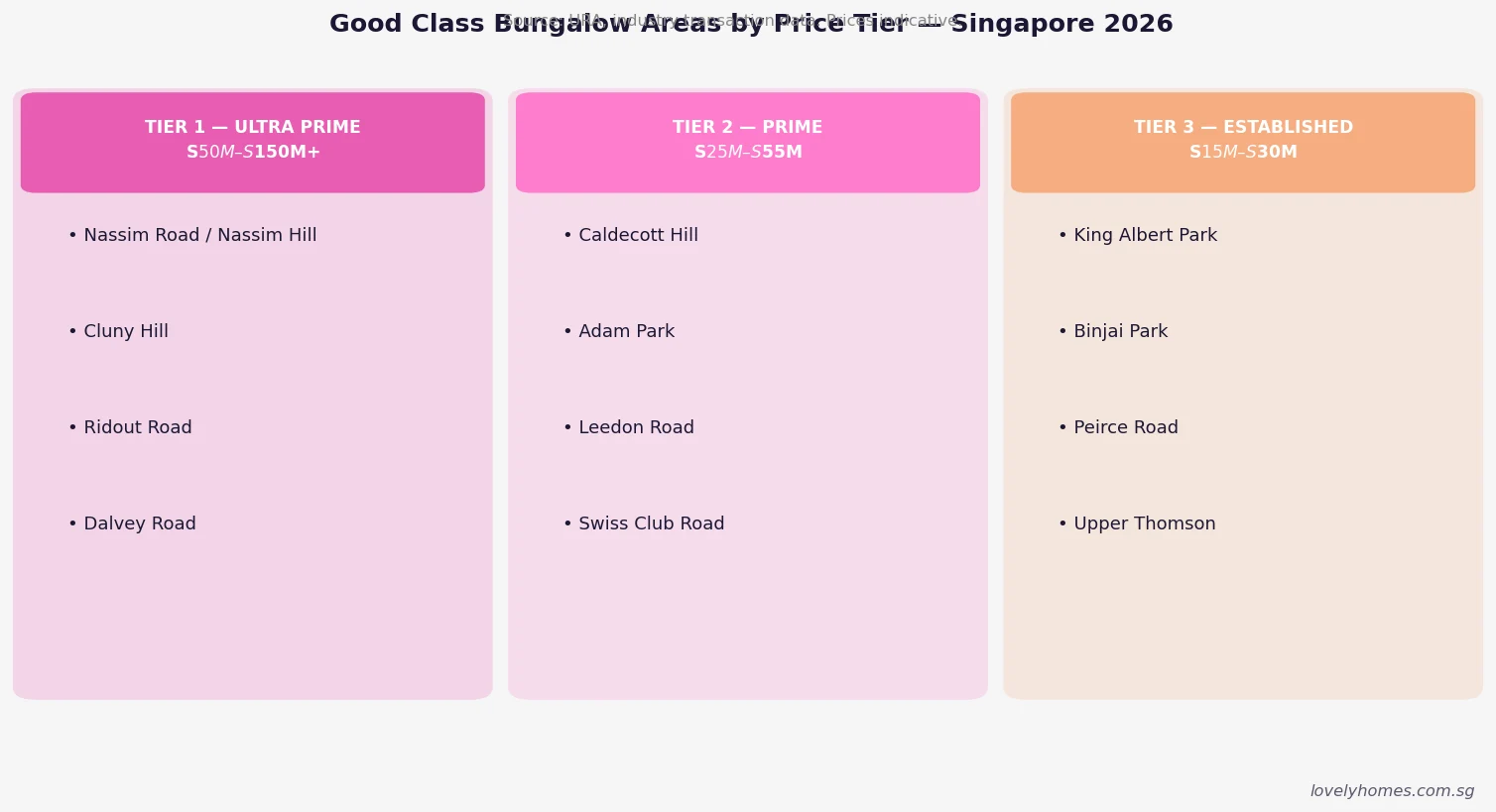
Look one layer deeper and the picture sharpens. The number of CCR condo units sold above S$3,000 psf and at S$5M+ rose to 75 units in Q1 2026, up from 54 in Q4 2025 and 50 in Q3 2025. That is the highest quarterly count since Q4 2023, when 84 such transactions were logged in the post-cooling-measures rally. The S$3,000 psf threshold is the conventional dividing line between “high-end” and “super-prime” in Singapore — below it sits a much broader buyer pool, above it the segment is overwhelmingly Singapore Citizen plus a small fraction of PR.

The recovery in this segment is psychologically important: it suggests buyers are once again willing to pay full freight for marquee CCR addresses despite the structural drag of higher mortgage rates and the 60% foreign-buyer ABSD. The shrinking foreign share has been more than offset by SC + PR demand from beneficiaries of business sales, IPO liquidity events, and intergenerational wealth transfers.

What Drove It — Three New Launches Did the Heavy Lifting

Luxury new-launch activity climbed for the fourth consecutive quarter, with 55 new units sold at S$5M+ in Q1 2026 — the highest single-quarter tally since Q4 2023’s 74. The skew was extreme. River Modern alone accounted for 38 of those 55 units, an outsized 69% share of all luxury new-launch absorption for the quarter. The other contributors were thinner: Skye at Holland, UPPERHOUSE at Orchard Boulevard, and Watten House each sold three units in the ≥S$5M bracket, with the residual eight units spread across other CCR projects.

Singapore luxury home sales Q1 2026 — top luxury new launches by units sold above S$5M
Figure 2: Q1 2026 luxury new-launch absorption was concentrated in River Modern.

That concentration is a cautionary note. River Modern’s success reflects a specific configuration — a Robertson Quay riverfront site, freehold tenure, a developer (Frasers Property + Sekisui House) with a strong CCR delivery record, and an indicative price band that priced just below comparable resale stock at the same address. Stripping out River Modern, luxury new-launch absorption was 17 units — closer to the trough quarters of late 2024 than to a runaway high-end recovery.

Ultra-Luxury — The S$10M+ Cohort

At the very top of the market, the count of luxury condo transactions priced at S$10 million and above rose from 14 in Q4 2025 to 17 in Q1 2026. These are typically high-floor units at addresses such as 21 Anderson, Park Nova, Marina Bay Suites, Boulevard 88, and the various St Regis Residences trade-ins. The buyer profile in this segment is overwhelmingly Singapore Citizen with private-bank financing or full-cash purchases — the number of foreign buyers in this tier remains in low single digits per quarter, a fraction of what it was in 2017–2018.

Summary — The Q1 2026 Luxury Print at a Glance

Segment Q3 2025 Q4 2025 Q1 2026 QoQ change
All luxury homes ≥ S$5M 177 186 188 +1.1%
CCR condos ≥ S$3,000 psf & ≥ S$5M 50 54 75 +38.9%
Luxury new-launch units ≥ S$5M ~30 ~42 55 +31%
Ultra-luxury ≥ S$10M 12 14 17 +21%

Why This Matters for the Broader Market

Singapore’s luxury segment has historically led the broader market by 2–3 quarters at major inflection points. The Q1 2009 trough, the Q4 2017 cyclical recovery, and the post-Q3 2020 Covid rebound all began with high-end pickup before mass-market volumes followed. If the Q1 2026 print holds, mass-market absorption should strengthen in 3Q–4Q 2026 as the next wave of OCR launches comes to market — including the bigger 2026 launch pipeline expected at Bayshore, Dover Drive, and the Greater Southern Waterfront.

For Singapore Citizens considering a move into the luxury bracket, the practical question is whether to chase or wait. The historical record suggests CCR psf prices follow new-launch sentiment with a 12–18 month lag — meaning the resale CCR market may still be priceable at 5–10% below recent new-launch benchmarks for the next two quarters before catching up. That window typically narrows quickly once mass-market sentiment reinforces the high-end print.

What Might Come Next

Three watch-points for Q2 2026. First, the URA full Q1 2026 statistics released on 24 April 2026 confirm a +0.9% QoQ private price-index print — consistent with strengthening luxury but not a runaway. Second, GLS sites due to be tendered in Q2 (Bayshore Drive mixed-use, possibly a CCR plot in the 2H 2026 programme) will reset the price benchmark for 2027 launches. Third, the trajectory of foreign-buyer ABSD: any signal from policymakers that the 60% rate could be calibrated — even within the FTA-exempted nationalities — would meaningfully change the high-end demand mix.

Frequently Asked Questions

Does the Q1 2026 luxury print mean prices are rising fast?

Volume rose; price-per-square-foot was steadier. The URA private property price index rose just 0.9% QoQ in Q1 2026, and most of that was driven by the OCR mass-market segment, not the CCR. The CCR sub-index rose roughly 0.6% QoQ. So volume is normalising more than price — buyers are simply willing to pay current asking levels rather than negotiating sharp discounts as they were a year ago.

Are foreign buyers driving the recovery?

No. Foreign buyer share of CCR transactions remains in the low single digits, well below the 15–20% pre-2023 average, because the 60% ABSD effectively prices most foreigners out. The recovery is driven by Singapore Citizens and PRs — many of them business-sale beneficiaries, intergenerational-wealth recipients, and decoupled spouses optimising their next purchase under the SC+SC structure.

What is “River Modern” and why did it dominate?

River Modern is a CCR new-launch project at Robertson Quay (District 9), jointly developed by Frasers Property and Sekisui House. It launched in late 2025 with an indicative price from S$3,150 psf. Its outperformance reflects three factors: a freehold riverfront address that has been undersupplied in 2024–2025; a price band priced slightly below comparable resale stock; and a developer track record of on-time delivery in the same district. Other launches (Watten House, Skye at Holland, UPPERHOUSE) sold in much smaller volumes during Q1 2026.

Should I time a CCR resale purchase now or wait?

Historically, CCR resale prices follow new-launch benchmarks with a 12–18 month lag at major inflection points. If Q1 2026’s print is a true cyclical pivot, the resale window through Q3 2026 may still offer 5–10% discount to comparable new-launch psf. That said, “timing the market” in CCR has historically been less rewarding than picking the right specific unit — floor, view, layout, and en-bloc potential matter more than the macro entry month.

How does this compare to Hong Kong or Sydney’s luxury markets?

Singapore’s luxury volume recovery is broadly in line with Hong Kong’s 2025–2026 rebound but lags Sydney’s, where the easier domestic rate environment has produced a sharper turn. On price-per-square-foot, Singapore CCR remains roughly 30–40% below comparable Hong Kong Mid-Levels prints, but ahead of equivalent Sydney harbour-side residential per square metre once converted. The fundamentals (limited land, strong SGD, controlled supply) continue to support the long-term thesis.

Where is the Q2 2026 supply pipeline likely to land?

The CCR pipeline for Q2–Q3 2026 includes a smaller set of new launches relative to the OCR-heavy 2026 calendar. Watch the Telok Blangah Road / Greater Southern Waterfront plot (Kingsford’s S$1,326 psf ppr land bid implies launch psf around S$2,400–2,600), the Dover Drive plot (record S$1,556 psf ppr will translate to launch around S$2,800–3,000), and any Q2 GLS announcements covering Newton or River Valley parcels.

Related Articles

Disclaimer

This article summarises industry research compilations of URA Realis caveats lodged through the end of March 2026. Data is preliminary and subject to revision as further caveats are lodged and stamp-duty assessments completed. Figures are illustrative as at April 2026. Always verify with primary sources — URA Realis, URA media releases, and the Inland Revenue Authority of Singapore — before making any property decision.

Singapore Private Property Q1 2026 Full Statistics: Prices Rise 0.9%, Developer Sales Fall 32%, Rents Recover

Singapore Private Property Q1 2026 Full Statistics: Prices Rise 0.9%, Developer Sales Fall 32%, Rents Recover

URA Q1 2026 Singapore private residential full statistics prices up sales down

Quick Answer — Q1 2026 Key Findings

  • Overall private residential prices rose +0.9% QoQ in Q1 2026 — a significant upward revision from the +0.3% flash estimate issued 1 April
  • Non-landed segment led with +1.3% QoQ; landed homes fell −0.4% (first decline since Q1 2025)
  • Developer sales (excl. EC): 2,013 units — down 32% QoQ from 2,940 in Q4 2025; new launches: 1,844 units
  • Total private home sales (incl. resale & sub-sale): 5,413 units — down 19% QoQ
  • Rental prices reversed: +0.3% QoQ after −0.5% in Q4 2025; leasing volume +4% to 20,861 contracts
  • OCR led price growth at +1.3%; RCR +0.9%; CCR +0.4% — a reversal of the prior quarter’s CCR outperformance
  • Source: URA Full Q1 2026 Real Estate Statistics, released 25 April 2026 (pr26-31)

The Headline: Prices Firmer Than Expected, but Activity Cools

Singapore’s private residential property market ended the first quarter of 2026 on a note that confounded earlier market caution. The Urban Redevelopment Authority’s (URA) full Q1 2026 real estate statistics — released on 25 April 2026 — confirmed a price increase of 0.9% quarter-on-quarter, a significant upward revision from the flash estimate of +0.3% published on 1 April. The upward revision reflects the inclusion of transactions that settled late in the quarter and the complete dataset across all market segments.

This marks the sixth consecutive quarter of overall price appreciation, and comes despite a sharp slowdown in transaction volumes. Developer sales of new private homes (excluding executive condominiums) fell 32% quarter-on-quarter to 2,013 units in Q1 2026, compared with 2,940 in Q4 2025 — the lowest quarterly developer sales figure since Q1 2025. The divergence between resilient prices and declining volumes reflects constrained new supply, selective buyer behaviour, and the legacy of affordability compression from 2023–2025 price appreciation.

URA Q1 2026 Singapore private residential price change by segment developer sales data infographic
Figure 1: Q1 2026 price change by market segment (left) and developer sales trend (right). Source: URA Full Q1 2026 Real Estate Statistics, 25 April 2026.

Price Performance by Segment

Segment Q1 2026 QoQ Change Q4 2025 QoQ Change Commentary
Non-Landed (Overall) +1.3% −0.1% Strongest QoQ in 5 quarters; reversal of Q4 dip
OCR (Outside Central) +1.3% +1.2% Mass market continues to outperform; HDB upgrader demand
RCR (Rest of Central) +0.9% +0.5% Strong; reflects demand for city-fringe new launches
CCR (Core Central) +0.4% +1.1% Moderated from prior quarter; luxury demand more selective
Landed (Overall) −0.4% +3.4% First decline since Q1 2025; mean-reversion after strong 2025

The OCR’s continued leadership at +1.3% QoQ reflects the powerful structural driver of HDB upgraders — households completing their 5-year MOP on government flats and redeploying equity into mass-market private condominiums in districts 18, 19, 20, 23, and 27. This demographic pipeline is well-documented and shows no signs of abating through 2027.

The CCR’s moderation from +1.1% in Q4 2025 to +0.4% is consistent with a market where luxury buyers are more selective in an environment of elevated global uncertainty — including the US-China trade tensions and the spill-over effects of US tariff regimes on Singapore’s export-oriented economy. That said, +0.4% still represents appreciation, and the CCR has not seen negative quarterly price movement since Q3 2023.

The landed segment’s −0.4% retreat follows a very strong Q4 2025 (+3.4%). Landed properties are thinly traded and highly volatile on a quarterly basis; the Q1 dip is best read as mean-reversion rather than trend reversal, particularly given the structural scarcity of landed housing stock in Singapore.

Developer Sales and New Launches

Developers sold 2,013 private residential units (excluding ECs) in Q1 2026 — a 32% drop from the 2,940 sold in Q4 2025, and the weakest quarterly figure since Q1 2025. New project launches totalled 1,844 units, concentrated in the OCR and CCR, reflecting the pipeline of projects that had received sales licences after significant delays in late 2024.

The pull-back in volumes should be contextualised: Q4 2025 was exceptionally strong, driven by the simultaneous launch of multiple large-scale projects (THE ORIE, Promenade Peak, Elta, Parktown Residence) that collectively captured pent-up demand. Q1 2026’s normalisation is partly seasonal and partly a function of the reduced number of new projects in the pipeline following the Q4 burst.

Resale and sub-sale transactions also fell, with total private home sales (all categories) coming to 5,413 units — down 19% from 6,699 in Q4 2025. Industry observers note that the absolute volume remains healthy relative to the 2019–2022 baseline and that the quarter started slowly before accelerating in March 2026 following the Lunar New Year holiday period.

Rental Market Reversal — What It Means

Private residential rents reversed their recent softening trend, rising +0.3% QoQ in Q1 2026 after declining −0.5% in Q4 2025. Leasing volume also strengthened, climbing 4% quarter-on-quarter to 20,861 rental contracts. This is the first positive quarterly rental movement since Q4 2023, and may mark the end of the post-pandemic rental correction that saw prices ease from their 2022–2023 highs.

The rental recovery is supported by two converging forces: a continued influx of foreign professionals amid Singapore’s sustained tech and financial sector hiring, and a temporary tightening of rental supply as a number of large residential projects that reached TOP in 2023–2024 move past initial tenant search periods. The question for Q2 and Q3 2026 is whether this modest recovery sustains, or whether the global economic headwinds translate into reduced expatriate inflows and renewed rental softening.

What Might Come Next

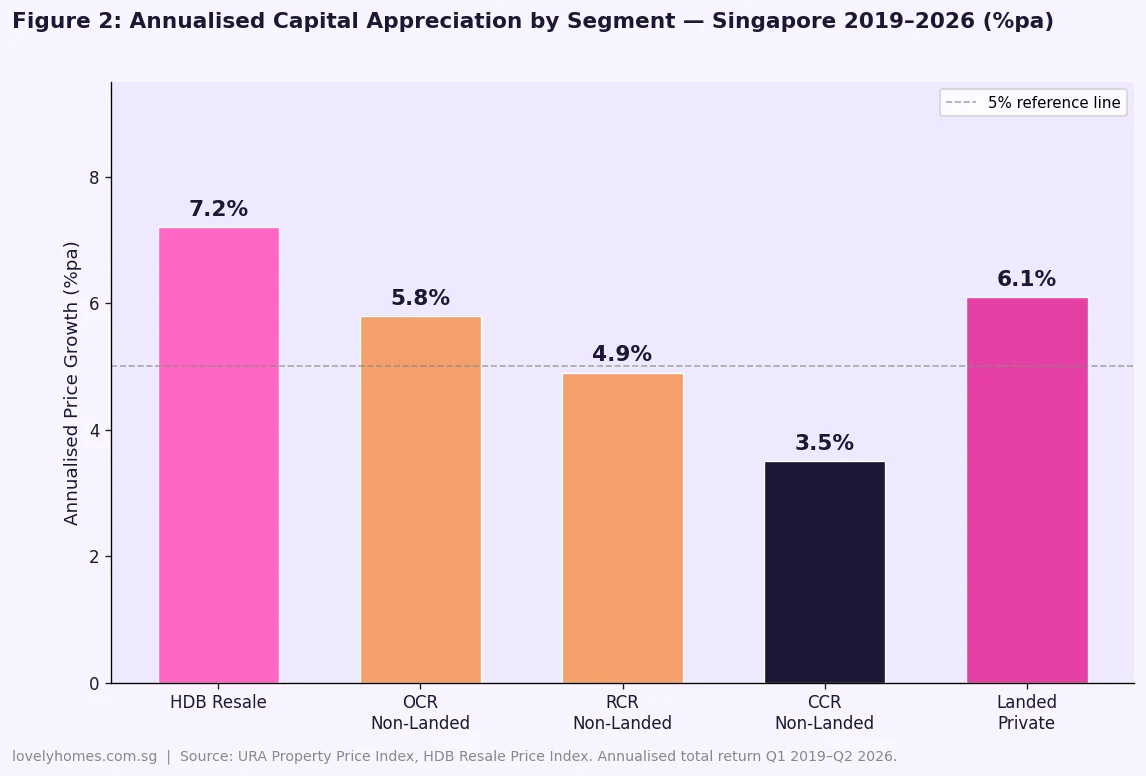
The price upward revision from +0.3% (flash) to +0.9% (full) is the quarter’s most significant data surprise. It suggests that the late-quarter transactions — many of which were sub-sales and resales settled in March — carried higher psf values than the new launch transactions recorded earlier in the quarter. If this pattern holds into Q2 2026, the annual price growth trajectory for 2026 could exceed the more cautious industry forecasts of 2–4%, potentially tracking closer to 4–6%.

The key risk factors for H2 2026 remain: (a) global trade disruption and its impact on Singapore GDP growth and business confidence; (b) SORA rate movements — 3M compounded SORA remains above 2.9% as at April 2026, keeping home loan servicing costs elevated; (c) potential further ABSD measures if price momentum accelerates unexpectedly; and (d) the supply pipeline — with 17+ new project launches anticipated across Q2–Q4 2026, increased competition between developers for buyers could moderate per-unit pricing.

Note: This analysis is editorial commentary based on publicly available URA data. It is not investment advice.

Frequently Asked Questions

Why did the Q1 2026 price figure revise upward from the flash estimate?

The URA flash estimate, published 3–4 weeks into the following quarter, uses only transactions registered up to approximately mid-March. The full statistics incorporate all transactions completed through 31 March 2026, including late-settling resale and sub-sale contracts. These late transactions often involve higher-priced units (larger formats, upper floors, prime locations) that take longer to process — hence the full release tends to show a stronger price outcome than the flash.

Is the slowdown in developer sales a warning sign for the market?

Not necessarily. Developer sales of 2,013 units in Q1 2026 represent a normalisation after a bumper Q4 2025 that saw multiple large launches coincide. Historical Q1 figures often dip due to the Chinese New Year effect — reduced transaction activity during the festive period. The more telling metric is the 12-month trailing average, which remains above 8,500 units annually — a healthy pace for Singapore’s market size. Price resilience at +0.9% QoQ alongside lower volumes actually points to supply-demand balance rather than demand erosion.

What does the rental recovery mean for property investors?

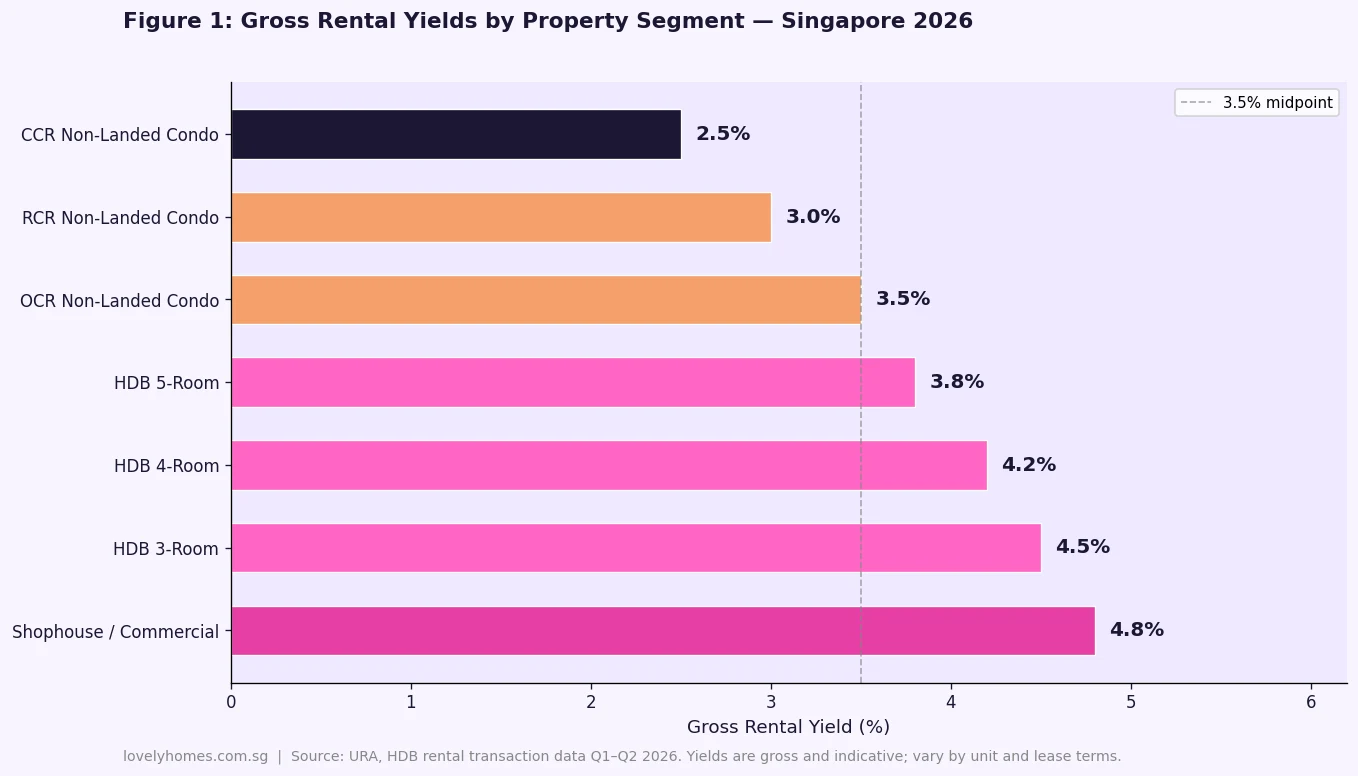
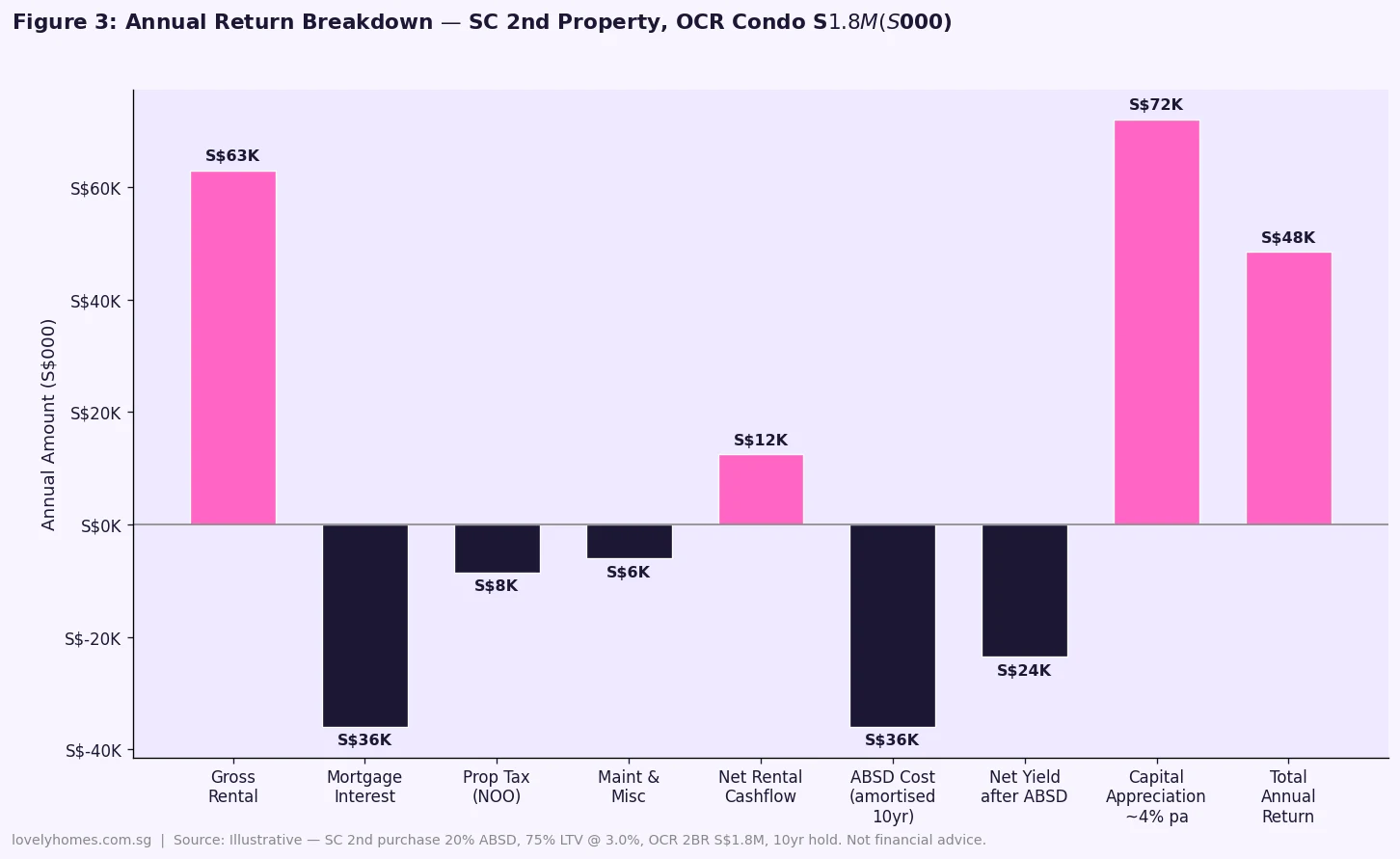
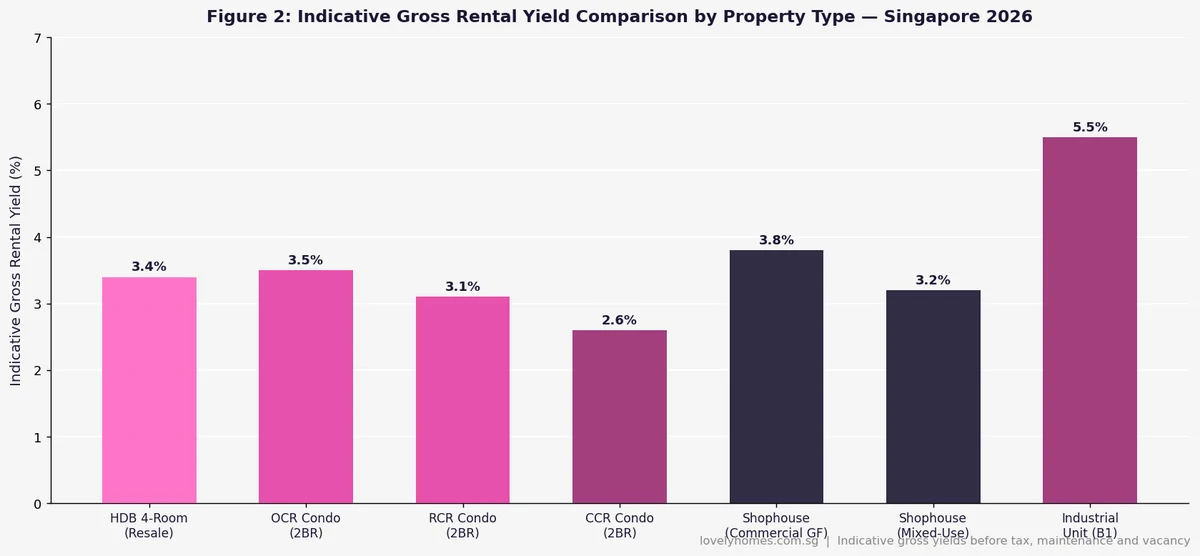
The +0.3% QoQ rental increase in Q1 2026 (after −0.5% in Q4 2025) is a positive signal for landlords who have been holding property through the 2023–2025 rental correction. If rental yields stabilise or improve through H2 2026, the investment case for Singapore residential property — which was weakened during the high-ABSD, high-SORA, lower-yield environment of 2023–2024 — may recover modestly. However, with gross yields for most CCR and RCR condominiums still in the 2.5–3.2% range versus SORA-linked mortgage rates of ~3.5–3.7%, properties remain net-cash-flow negative on a leveraged basis for most investors.

Related Articles

Disclaimer: This article is editorial commentary based on data published by the Urban Redevelopment Authority of Singapore (URA). It is for general information only and does not constitute investment, financial, or property advice. All figures sourced from URA Media Release pr26-31 (25 April 2026). Verify data directly at ura.gov.sg. LovelyHomes.com.sg does not hold a real estate agency licence.


Private Condo Rents Tick Up in Q1 2026 — The Singapore Rental Market Turn Has Begun

Private Condo Rents Tick Up in Q1 2026 — The Singapore Rental Market Turn Has Begun

Singapore private condominium rents edged up 0.8% quarter-on-quarter in Q1 2026 according to the URA rental index flash estimate released at the end of April. This is the first positive print since Q4 2023 — ending a nine-quarter stretch in which rents corrected from their post-pandemic peak. The flash estimate will be finalised in early May; historically the full release has moved within 0.2 percentage points of the flash.

Private condo rental index — quarter-on-quarter change URA flash estimate for Q1 2026

Core Central Region %1.2

Rest of Central Region %0.9

Outside Central Region %0.5

Overall private %0.8

Q4 2025 (prior) %-0.3

Q3 2025 (prior) %-0.4

Q2 2025 (prior) %-0.6

Q1 2025 (prior) %-0.8

lovelyhomes.com.sg Source: URA private residential rental index flash estimate — Q1 2026

The regional picture

All three geographic segments moved up. The Core Central Region (CCR — districts 9, 10, 11 and the Marina area) led with a 1.2% quarter-on-quarter increase. The Rest of Central Region (RCR) gained 0.9%. The Outside Central Region (OCR) — the suburban bulk of the private market — rose 0.5%. The CCR’s stronger performance reflects a tighter top-end rental pool; prime CCR units are thinner in supply and the relocation-driven expatriate demand has firmed since the start of the year.

For context, the private rental index had declined every quarter since Q4 2023, with the 2024-25 cooling driven by the large pipeline of TOP completions meeting a softer expatriate demand backdrop. The 2026 turn suggests that pipeline pressure has worked itself through and the market is returning to an equilibrium where rents track wage and demand growth.

HDB rentals — still positive

HDB subletting continues its separate trajectory. The HDB rental approvals index (IRAS data, which lags URA by roughly one quarter) has risen 3.8% year-on-year through Q4 2025. HDB rents never corrected in the 2024-25 window the way private rents did — the HDB rental stock responds to a different demand base (mid-income professionals, young families waiting for keys, short-term relocation) and the supply-side discipline (subletting caps, minimum occupation period) keeps the rental inventory tight.

What’s driving the turn?

Three forces matter. First — supply. The TOP pipeline for private condos peaked in 2024-25; 2026 sees materially fewer new completions. Fewer new units hitting the rental market means the absorption rate improves. Second — demand. Employment pass approvals are up in financial services, tech and healthcare in the first quarter. Each new Employment Pass holder is a prospective renter for the first 6-12 months. Third — positive feedback. The URA flash estimate signals that the rental decline is over, which tends to pull forward renewal decisions; existing tenants renewing on marginal rent increases rather than trying to negotiate down.

Landlord implication
For landlords, the shift from rent cuts in 2024-25 to modest increases in Q1 2026 is the first signal that rental reversion is positive again. Model future cashflow with a conservative 1.5-2.5% annual reversion assumption, not the 0% baseline that worked for the last 18 months.

District-level colour

Within the CCR, the strongest performers were rental comparables in D09 Orchard / River Valley and D10 Tanglin / Holland / Bukit Timah, where the flight-to-quality dynamic has been most pronounced. Luxury segment rents (3-bedroom and above in CCR condos) were up 1.6% QoQ, outpacing 1-bedroom rents (+0.9% QoQ) — a reversal of the prior-year pattern where compact units outperformed.

In the OCR, the strongest gains were in D15 Katong / Marine Parade and D19 Hougang / Serangoon / Punggol, where the retiree and family-owner-occupier demographic has kept the rental inventory thin. OCR 2-bedroom rents were up 0.7% QoQ; 3-bedroom up 0.6%.

What happens in Q2 2026?

Two signals to watch. First — the full URA Q1 2026 release around 24 April will confirm the flash number and give the district-level breakdown. Any significant revision from the flash estimate would be a short-term market mover. Second — the IRAS rental-assessment data for Q2, due in August, will test whether the flash signal converts into actual transaction-level evidence. Landlords and tenants negotiate new leases on the flash, but the real test is whether signed leases in April and May reflect the flash.

On current trajectory, the base case is that Q2 2026 prints another +0.6-1.0% QoQ — a continuation of the turn, not an acceleration. A breakout above 1.5% QoQ would suggest the market is pricing in a tighter supply-demand balance than currently evident in the TOP pipeline. A return to zero or negative prints would indicate the Q1 reading was noise, not signal.

Implications for property investors

If you are holding a Singapore private condo as investment property, three things follow. First — rental yields, which had been compressing since early 2024, should stabilise. On a constant-denominator basis (ignoring capital value changes), a unit pulling S$4,500 rent two quarters ago and S$4,536 now is earning an extra S$864 annually — modest but directionally positive. Second — the tax arithmetic matters more at the margin. Non-owner-occupier property tax is flat-banded, so modestly higher rent drops more cleanly to the bottom line than the gross reversion suggests. Third — refinancing windows: lenders use rental income in TDSR computation; a hotter rental market eases borrowing capacity for investors.

Cross-read — what this means for buyers

For buyers currently deciding between purchase and continued rental, the rental turn removes one of the ‘wait and see’ arguments. In a market where rents were falling every quarter, the financial case for delaying purchase was concrete — every quarter of rental saved versus the carry cost of owning. With rents turning up, that argument weakens. Paired with the stable mortgage-rate environment (SORA has held in the 2.8-3.1% band through Q1), the total cost of owning relative to renting has improved on the margin for eligible first-property buyers.

Bottom line

The Q1 2026 private rental print is the first clear turn after nine quarters of decline. At +0.8% QoQ, the move is modest but broad-based. The full URA release in early May will confirm whether the flash signal holds. For landlords, it is the first time since 2023 that modest positive rental reversions are a reasonable planning assumption. For tenants, the negotiating leverage of the last 18 months has narrowed — lock in renewal terms if they are already favourable.

Related reading on LovelyHomes

Sources: Urban Redevelopment Authority (URA) Q1 2026 private rental index flash estimate (https://www.ura.gov.sg/); IRAS rental approvals data. This article is editorial commentary produced by the LovelyHomes team and does not constitute investment or financial advice. Rates, indices and figures are current as at the date of publication. Buyers and investors should consult a licensed professional before making a property-related decision.


Translate »