Singapore Buyer’s Stamp Duty (BSD) Guide 2026: Rates, Calculation and Worked Examples

Singapore Buyer’s Stamp Duty (BSD) Guide 2026: Rates, Calculation and Worked Examples
Singapore buyer's stamp duty BSD 2026 complete guide — rates, calculation and exemptions lovelyhomes.com.sg
Singapore Buyer’s Stamp Duty (BSD) 2026 — Complete Guide to Rates, Calculation and Exemptions

💰 Quick Answer: BSD at a Glance

  • Buyer’s Stamp Duty (BSD) is a tax on the purchase of any property in Singapore — residential, commercial or industrial — payable by the buyer.
  • BSD is calculated on the higher of the purchase price or market value at the date of the contract.
  • Rates are progressive from 1% to 6% across six price bands, effective 20 February 2023.
  • BSD is separate from ABSD (Additional Buyer’s Stamp Duty) — ABSD is an additional tax layered on top of BSD for certain buyer profiles and applies only to residential property.
  • BSD must be paid within 14 days of signing the OTP acceptance letter or Sale and Purchase Agreement, via the IRAS e-Stamping Portal.
  • There are no BSD exemptions for first-time buyers — every buyer of every property type pays BSD (though CPF OA funds can be used to pay it).
  • For a S$1.5M property, BSD works out to S$44,600 (2.97% effective rate).

What Is Buyer’s Stamp Duty? The Basics

Buyer’s Stamp Duty (BSD) is a documentary stamp tax levied by the Inland Revenue Authority of Singapore (IRAS) on instruments relating to the purchase or transfer of property in Singapore. Unlike the Additional Buyer’s Stamp Duty (ABSD) — which is a policy tool designed to moderate residential demand and targets specific buyer profiles — BSD is a baseline transactional tax that applies universally to all property types and all buyer profiles without exception. Whether you are a Singapore Citizen buying your first HDB resale flat, a permanent resident purchasing a condominium or a foreign company acquiring industrial land, BSD applies.

BSD is governed by the Stamp Duties Act (Cap. 312) and has been part of Singapore’s property transaction framework for decades. The current progressive rate structure — reaching a top rate of 6% on the portion of the property value above S$3 million — was introduced on 20 February 2023 as part of a broader package of property market cooling measures, replacing the previous top rate of 4% that had been in effect since March 2017.

BSD Rates — The Full Rate Schedule

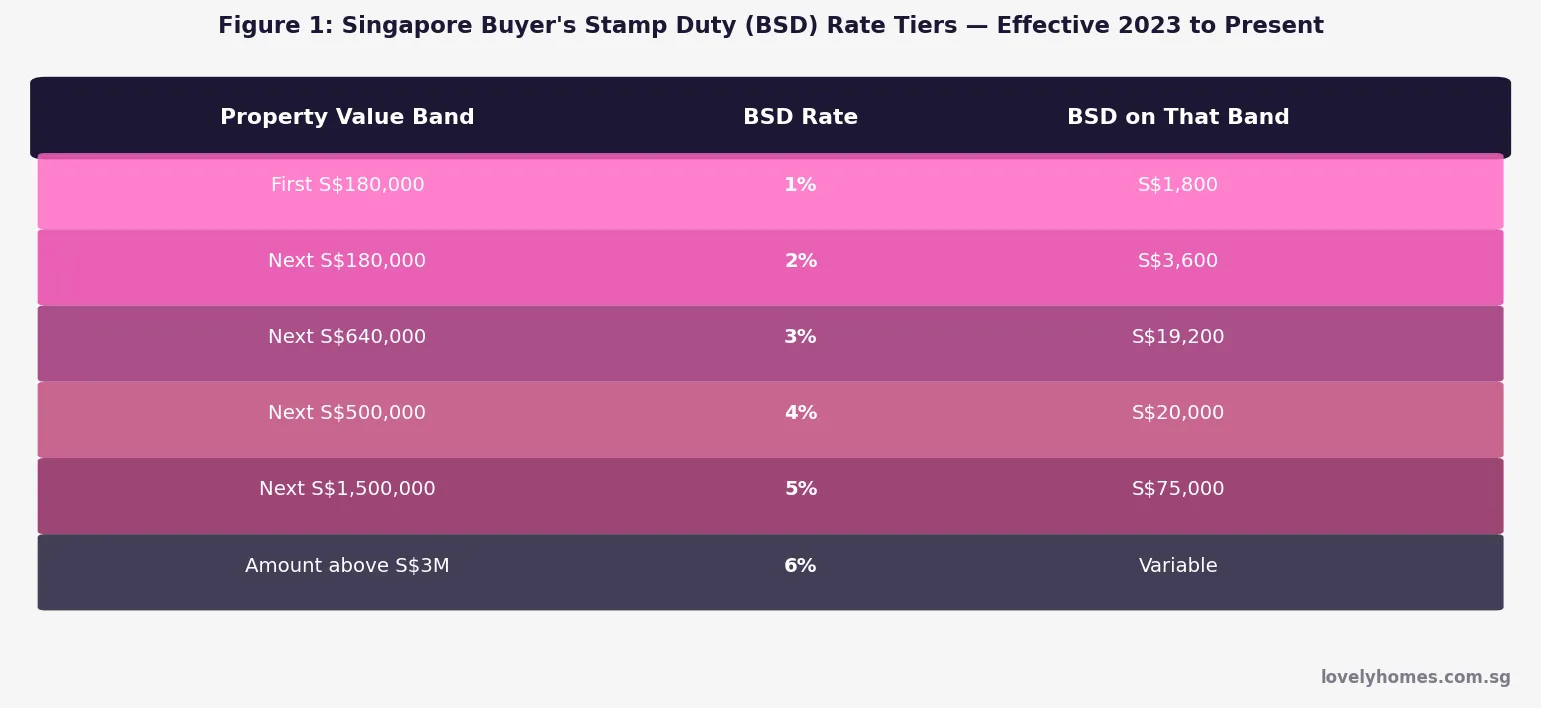
BSD is calculated band by band on the cumulative purchase price (or market value, whichever is higher). The six bands and their rates are as follows:
Singapore buyer's stamp duty BSD rate tiers table 2026 — 1% to 6% progressive rates by property value band
Figure 1: Singapore BSD Rate Tiers — Progressive Bands from 1% to 6% (Effective 20 February 2023)
Property Value Band BSD Rate Maximum BSD on Band Cumulative Max BSD
First S$180,000 1% S$1,800 S$1,800
Next S$180,000 (S$180,001–S$360,000) 2% S$3,600 S$5,400
Next S$640,000 (S$360,001–S$1,000,000) 3% S$19,200 S$24,600
Next S$500,000 (S$1,000,001–S$1,500,000) 4% S$20,000 S$44,600
Next S$1,500,000 (S$1,500,001–S$3,000,000) 5% S$75,000 S$119,600
Amount above S$3,000,000 6% Variable S$119,600 + 6% of excess

A useful shortcut: for any property priced at exactly S$1,000,000, BSD is S$24,600. For S$1,500,000, BSD is S$44,600. For S$2,000,000, BSD is S$69,600. These are the cumulative amounts where each band maxes out cleanly.

BSD by Purchase Price — Key Reference Points

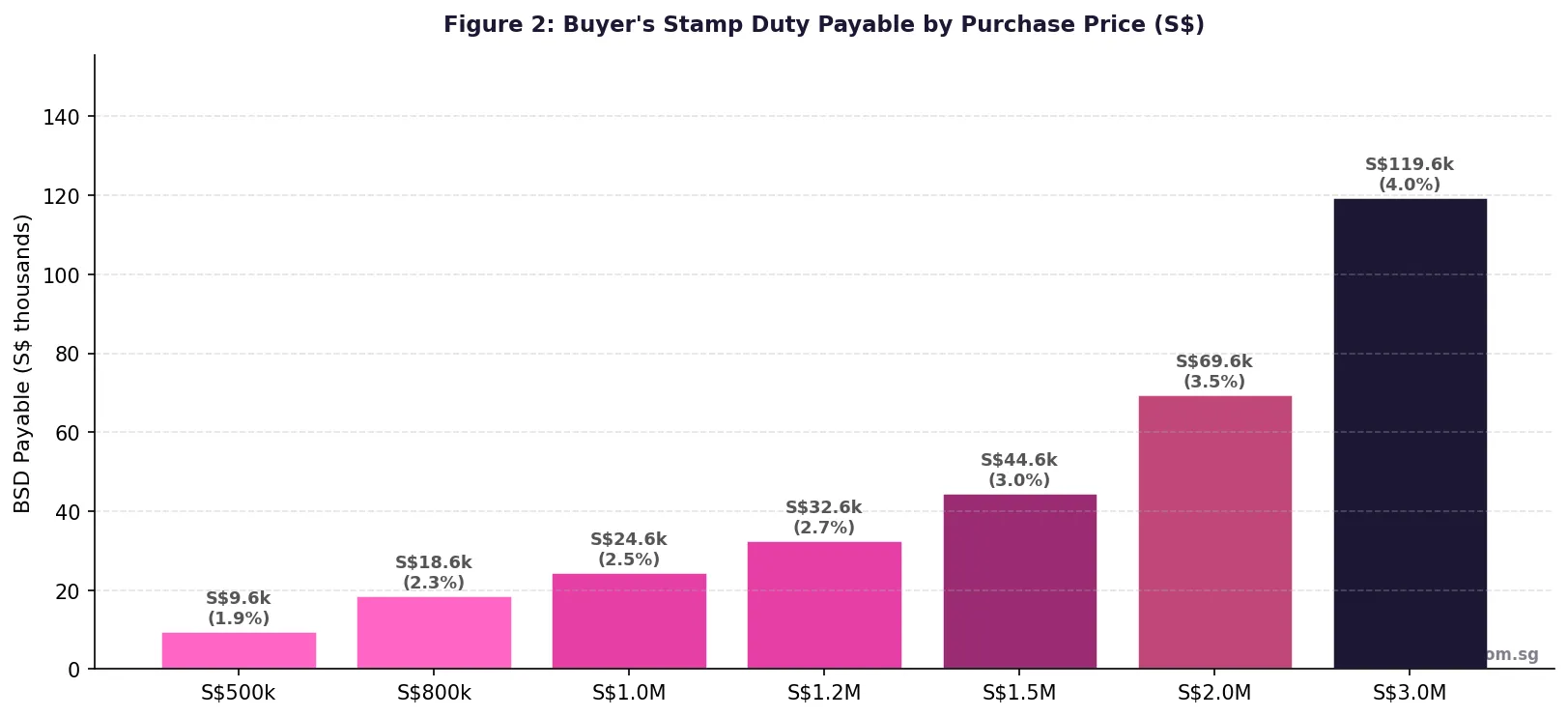
The chart below shows BSD payable at common price points, alongside the effective BSD rate (BSD ÷ purchase price), illustrating how the progressive structure causes the effective rate to rise steadily from approximately 1.9% at S$500,000 to close to 4% at S$3,000,000.
Singapore BSD payable by purchase price 2026 — stamp duty amounts for S$500k to S$3M properties
Figure 2: BSD Payable by Purchase Price — S$500K to S$3M Properties (Singapore 2026)
Purchase Price BSD Payable Effective Rate Typical Property Type
S$500,000 S$9,600 1.92% HDB 3–4 room resale (non-mature estate)
S$800,000 S$18,600 2.33% HDB 4–5 room resale (mature estate)
S$1,000,000 S$24,600 2.46% HDB 5-room / million-dollar flat; entry condo OCR
S$1,200,000 S$32,600 2.72% Mass-market condominium OCR
S$1,500,000 S$44,600 2.97% Mid-market condo RCR/OCR
S$2,000,000 S$69,600 3.48% City-fringe RCR condo / entry CCR unit
S$3,000,000 S$119,600 3.99% CCR condo; semi-detached house OCR
S$5,000,000 S$239,600 4.79% Landed property; Good Class Bungalow land

BSD vs ABSD — Understanding the Difference

BSD and ABSD are two separate stamp duties that apply to residential property transactions, but they operate differently and for different purposes.

BSD is a fixed transactional tax — it applies to all property types (residential, commercial, industrial, land) and all buyer profiles. It raises general revenue and has been part of Singapore’s tax framework since the colonial era. The buyer pays BSD regardless of their nationality, residency status, or how many properties they own.

ABSD, by contrast, is a targeted demand-management tool introduced in December 2011 and revised multiple times since. It applies only to residential property and its rate varies by buyer profile: Singapore Citizens pay 0% on their first residential property, 20% on their second and 30% on their third and beyond. Permanent Residents pay 5% on their first and 30% on their second and beyond. Foreigners pay a flat 60% on any residential property purchase.
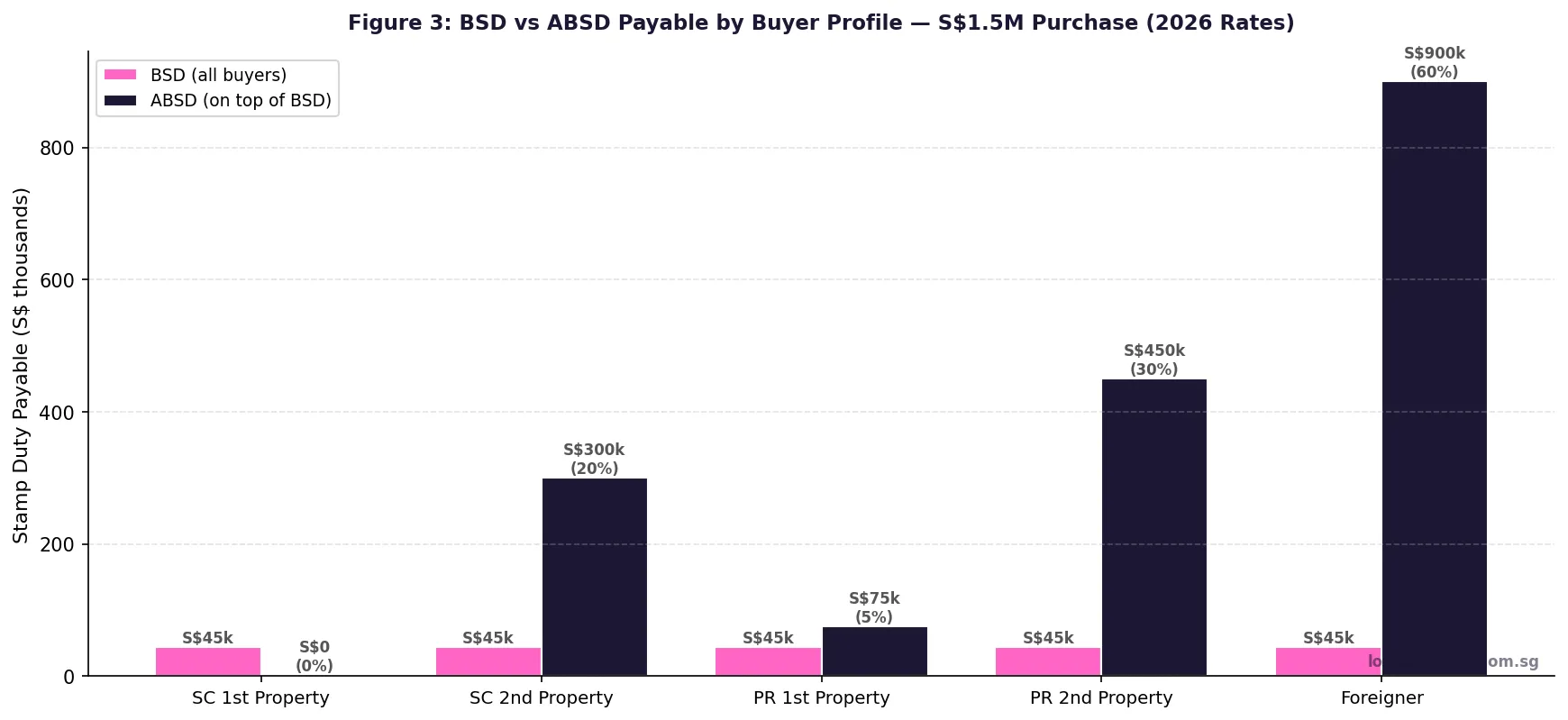
Singapore BSD vs ABSD comparison by buyer profile 2026 — stamp duty payable on S$1.5M property
Figure 3: BSD vs ABSD Payable by Buyer Profile — S$1.5M Residential Property (2026 Rates)

The practical implication: for a Singapore Citizen buying their first residential property, BSD is the only stamp duty payable. For a foreigner, both BSD (S$44,600 at S$1.5M) and ABSD (S$900,000 at 60% of S$1.5M) apply, making the total stamp duty burden S$944,600 — more than 60% of the purchase price.

How to Calculate BSD Step by Step

BSD is calculated on the basis of the higher of (a) the agreed purchase price and (b) the market value at the date of the contract (for residential property, this is typically the Option to Purchase date). If you negotiate a price below market value — for example, in a family transfer or a motivated seller situation — IRAS will still compute BSD on the market value, not the transacted price.

The formula, applied band by band, is:

  1. Identify the taxable value (higher of price vs. market value).
  2. Apply 1% to the first S$180,000 → produces up to S$1,800.
  3. Apply 2% to the next S$180,000 → produces up to S$3,600.
  4. Apply 3% to the next S$640,000 → produces up to S$19,200.
  5. Apply 4% to the next S$500,000 → produces up to S$20,000.
  6. Apply 5% to the next S$1,500,000 → produces up to S$75,000.
  7. Apply 6% to any remaining amount above S$3,000,000.
  8. Sum all bands.

For a property value of S$V, where S$360,000 < V ≤ S$1,000,000, a quick formula applies: BSD = 3% × V − S$5,400. For S$1,000,000 < V ≤ S$1,500,000: BSD = 4% × V − S$15,400. These shortcuts are convenient for mental estimates.

Worked Example: BSD on an RCR Condominium Purchase

Ms Priya is a Singapore Citizen purchasing her first property — a 2-bedroom condominium unit in the Rest of Central Region (RCR) at a negotiated price of S$1,780,000. IRAS values the unit at S$1,720,000 (below the purchase price). BSD is computed on the higher figure of S$1,780,000.

First S$180,000 × 1%S$1,800
Next S$180,000 × 2%S$3,600
Next S$640,000 × 3%S$19,200
Next S$500,000 × 4%S$20,000
Remaining S$280,000 × 5% (S$1,780,000 − S$1,500,000)S$14,000
Total BSD payableS$58,600
Effective BSD rate3.29%

Because Ms Priya is an SC first-time buyer, her ABSD is S$0. Her BSD of S$58,600 must be paid within 14 days of exercising the Option to Purchase (i.e. within 14 days of the date she signs the OTP acceptance letter). She may pay BSD from her CPF Ordinary Account, from cash, or a combination of both. BSD is a one-time payment and is not refundable if the transaction falls through after the OTP is exercised (though the OTP deposit itself is a separate matter governed by the OTP terms).

When Is BSD Due? Payment Timing and Process

BSD must be paid within 14 days of the date of the instrument (OTP acceptance, Sale and Purchase Agreement, or Instrument of Transfer) giving rise to the liability. The IRAS e-Stamping Portal (estamping.iras.gov.sg) is the online gateway for BSD payment. For residential property transactions handled by lawyers, the conveyancing firm typically manages BSD payment on behalf of the buyer as part of the standard legal process — the amount is included in the lawyers’ completion account.

Failure to stamp within 14 days attracts a late stamping penalty of S$10 or the unpaid duty amount, whichever is higher, plus an interest charge. IRAS may also disallow the property instrument in legal proceedings if it has not been duly stamped.

BSD for Non-Residential Property

BSD applies to all property types, not just residential. For commercial and industrial property, the same BSD rate schedule applies (1%–6% progressive). However, ABSD does not apply to non-residential property acquisitions — meaning a company or individual purchasing an office unit or warehouse pays only BSD, with no ABSD overlay.

For land transactions, BSD is computed on the land price (or market value of the land). Conversion of leasehold to freehold tenure also triggers stamp duty in certain circumstances. Foreign ownership restrictions on residential property do not apply to commercial or industrial property, making those asset classes particularly attractive to foreign investors who wish to avoid the 60% ABSD on residential purchases.

BSD Exemptions and Remissions

BSD exemptions are narrow. The main categories are:

  • Transfers pursuant to a will or intestate succession: Property inherited through a deceased estate is exempt from BSD, though the transfer must be completed through a grant of probate or letters of administration process.
  • Transfers between spouses: A spousal transfer of residential property that was purchased before marriage is eligible for BSD remission under Section 22A of the Stamp Duties Act, provided both parties remain married and the property will be the matrimonial home.
  • GST-registered entities acquiring commercial or industrial property may claim input tax credits on the GST component, though BSD itself remains payable.

There is no BSD exemption for first-time buyers. Unlike the ABSD, which has a 0% rate for SC first-property purchases, BSD applies at the standard progressive rates to every buyer regardless of property count or citizenship. This distinguishes Singapore’s BSD from stamp duty regimes in some other jurisdictions (such as the UK, which provides first-time buyer relief up to certain thresholds).

What BSD Means for Property Buyers in 2026

The 2023 BSD increase — introducing the 5% and 6% top bands — meaningfully raised the transaction cost for high-value residential purchases. For a S$3M property, BSD rose from S$89,600 (under the pre-2023 schedule) to S$119,600, an increase of S$30,000 or approximately 33%. For a S$5M property, BSD is now S$239,600 versus S$179,600 previously — an additional S$60,000.

For buyers in the mass-market segment — properties below S$1,000,000 — the BSD structure is unchanged from 2017; only the top two bands were revised in 2023. The change therefore disproportionately affects luxury segment buyers, collective sale (en bloc) participants and industrial/commercial property investors acquiring high-value assets.

For HDB resale buyers, BSD at common price points (S$500,000–S$800,000) works out to S$9,600–S$18,600 — typically payable from CPF OA as part of the conveyancing process, with no cash top-up required for most buyers.

What Might Come Next

The 2023 BSD enhancement was explicitly designed to improve tax progressivity — ensuring that the wealthy pay proportionally more on high-value property purchases. The government has indicated that the BSD rate structure will be reviewed periodically alongside other property market measures. A further revision to the top band (6%) is unlikely in the near term given that property transaction volumes have moderated since the 2022–2023 peak. More likely is continued adjustment of the ABSD rate schedule as a more targeted demand-management lever, while BSD remains stable as a baseline revenue measure. For buyers acquiring property in 2026, the current BSD schedule should be treated as the effective framework for the foreseeable future.

Frequently Asked Questions

Does BSD apply if I buy property through a company?

Yes. BSD applies to all acquisitions of Singapore property, whether by an individual or a legal entity such as a company, trust or other vehicle. For residential property acquired through a company or trust, ABSD also applies at elevated rates (entities pay 65% ABSD on any residential property acquisition). BSD rates for corporate buyers follow the same progressive schedule as for individuals. Note that a company purchasing property as a GST-registered trader may be able to claim input tax credits on the GST element of the transaction, but BSD itself is not recoverable as input tax and is always a cost to the buyer.

Can I pay BSD from my CPF Ordinary Account?

Yes. BSD on the purchase of both HDB and private residential property may be paid using CPF OA funds. In practice, your conveyancing lawyer will request a CPF withdrawal authorisation as part of the legal completion process, and the CPF Board will disburse the BSD amount (along with the purchase price component funded by CPF) directly to the relevant parties. BSD for commercial or industrial property, however, cannot be paid from CPF — the CPF Act restricts CPF withdrawals for property purchases to residential property only. If your CPF OA balance is insufficient to cover BSD, the shortfall must be paid in cash.

How is BSD calculated for an HDB resale flat?

For an HDB resale flat, BSD is computed on the higher of the resale price or the HDB valuation. If you agree to pay above-valuation (a Cash-Over-Valuation, or COV), BSD is computed on the resale price. If the resale price is below valuation — which is uncommon but occurs in distressed situations — BSD is computed on the (higher) valuation. HDB instructs buyers on the applicable stamp duty amount as part of the resale application process. BSD for HDB resale flats priced at S$500,000 to S$800,000 (the most common range) runs from approximately S$9,600 to S$18,600 and is typically paid from CPF OA at the point of legal completion.

Is BSD refundable if my property purchase falls through?

Generally, no. BSD is levied on the instrument (the signed OTP acceptance letter or S&P agreement) and is payable even if the transaction subsequently falls through — for example, if the buyer fails to obtain a loan, cannot exercise the OTP within the validity period, or the sale is cancelled by mutual consent. IRAS does provide for ad hoc remissions in specific circumstances (such as a developer’s project being abandoned, or a court-ordered rescission), but these are exceptions that require a formal application to IRAS. The standard position is that BSD paid on a lapsed or cancelled transaction is not refundable. This underscores the importance of confirming financing (HFE Letter for HDB, AIP for private property) before exercising any OTP.

What is the difference between BSD and stamp duty on tenancy?

BSD is the stamp duty payable on the purchase of property. Tenancy stamp duty (also called lease stamp duty) is a separate levy payable on a tenancy agreement or lease contract. For a residential tenancy, the stamp duty rate is 0.4% of the total rent for leases of up to 4 years, or 0.4% of four times the average annual rent for longer leases. Tenancy stamp duty must be paid within 14 days if the lease is signed in Singapore, or within 30 days if signed abroad. It is typically paid by the tenant, though the tenancy agreement can specify otherwise. The two duties are entirely independent — a property owner may incur tenancy stamp duty on a lease entered into during ownership, and BSD is payable by the buyer at the time of acquisition.

Do foreign buyers pay BSD at a higher rate?

No. The BSD rate schedule is identical for all buyer profiles — Singapore Citizens, Permanent Residents, foreigners and entities. What differs is the ABSD overlay, which is substantially higher for foreigners (60%) than for citizens and PRs. The BSD table in this guide applies to all buyers without adjustment. A foreigner purchasing a S$2,000,000 residential unit pays BSD of S$69,600 (same as any other buyer) and additionally pays ABSD of S$1,200,000 (60%), for a combined stamp duty of S$1,269,600.

When was the BSD schedule last changed?

The current BSD schedule — featuring 5% on the band from S$1,500,001 to S$3,000,000 and 6% above S$3,000,000 — took effect on 20 February 2023. Prior to that, the top rate was 4% on all amounts above S$1,000,000, a schedule that had been in force since 22 February 2018 (when the rate on the S$180,001–S$1,000,000 band was raised from 2% to 3%). Properties transacted under an OTP granted before 20 February 2023 but exercised on or after that date were subject to the new schedule unless the OTP was exercised within the original validity period before 20 February 2023. Buyers who purchased before that date enjoy the lower effective rates of the prior schedule for all outstanding BSD amounts computed at that time.

Related Articles

Disclaimer

This guide is published by LovelyHomes for general informational purposes only and reflects the BSD rates and rules as at 11 August 2026. Stamp duty rates and legislation are administered by the Inland Revenue Authority of Singapore (IRAS) and are subject to change by the Singapore Government without notice. BSD computations in this guide are illustrative and may not account for all individual circumstances, interim changes in legislation, or IRAS administrative concessions. Nothing in this guide constitutes tax, financial, legal or property advice. Readers are strongly encouraged to verify current BSD rates and payment procedures at iras.gov.sg/taxes/stamp-duty, consult the IRAS Stamp Duty calculator, and seek professional advice from a licensed conveyancing lawyer or tax adviser before completing any property transaction. Additional Buyer’s Stamp Duty (ABSD), Seller’s Stamp Duty (SSD) and other property taxes are governed by separate provisions of the Stamp Duties Act and are not comprehensively covered in this guide.

Singapore Stamp Duty Guide 2026: BSD, ABSD and SSD Explained

Singapore Stamp Duty Guide 2026: BSD, ABSD and SSD Explained

Quick Answer — Singapore Stamp Duty 2026

  • Singapore levies three main property stamp duties: Buyer’s Stamp Duty (BSD), Additional Buyer’s Stamp Duty (ABSD), and Seller’s Stamp Duty (SSD).
  • BSD is payable by all buyers. It follows a six-tier progressive scale ranging from 1% on the first S$180,000 to 6% on the portion above S$2.5 million (effective 15 February 2023).
  • ABSD applies on top of BSD for certain buyer profiles. Singapore Citizens (SC) pay 20% on a 2nd property and 30% on a 3rd or subsequent property. Foreigners pay 60%; entities pay 65% (effective 27 April 2023).
  • SSD is payable by sellers who dispose of a residential property within 3 years of purchase: 12% in year 1, 8% in year 2, and 4% in year 3.
  • BSD and ABSD are due within 14 days of exercising the Option to Purchase (OTP). SSD is due within 14 days of legal completion of sale.
  • ABSD cannot be paid using CPF Ordinary Account (OA) funds — it must be settled in cash. BSD, however, may be paid from CPF OA for eligible purchases.
  • Qualifying SC upgraders who sell their existing HDB flat or private property within a prescribed window may claim an ABSD remission, effectively recovering the ABSD paid on their second property.
  • All stamp duty is administered by the Inland Revenue Authority of Singapore (IRAS) via its e-Stamping portal.
  • BSD is computed on the higher of the purchase price or the market value of the property.
  • Both residential and non-residential properties are subject to BSD; ABSD and SSD apply only to residential properties unless stated otherwise.

What Is Stamp Duty? Singapore’s Property Stamp Duties Explained

Stamp duty is a tax levied on documents that evidence certain legal transactions — in the context of Singapore property, that means the instruments (Option to Purchase, Sale and Purchase Agreement, Transfer document) used to buy, sell, or lease real estate. The Inland Revenue Authority of Singapore (IRAS) administers all property stamp duties under the Stamp Duties Act (Chapter 312). Payment is made online via the e-Stamping portal at myTax.iras.gov.sg.

There are three distinct stamp duties that Singapore property buyers and sellers need to understand: Buyer’s Stamp Duty (BSD), Additional Buyer’s Stamp Duty (ABSD), and Seller’s Stamp Duty (SSD). Each has a different purpose, rate structure, and payment timeline. This guide consolidates everything in one place — from rate tables to worked examples — so you can plan your property transaction with clarity and confidence.

A note on scope: BSD and ABSD apply to the buyer at the point of purchase. SSD applies to the seller if the property is disposed of within a stipulated holding period. These duties are separate from annual Property Tax, which is an ongoing yearly levy based on the Annual Value (AV) of the property.

Buyer’s Stamp Duty (BSD) — Rates, Computation and Examples

Buyer’s Stamp Duty is payable by every purchaser of real property in Singapore — residential or non-residential — without exception. The current six-tier progressive scale took effect on 15 February 2023, when the Ministry of Finance introduced two additional top tiers as part of property market stabilisation measures.

BSD is computed on the higher of the purchase price or the market value of the property. If a buyer pays S$1.4 million for a property that IRAS values at S$1.45 million, BSD is computed on S$1.45 million.

Property Value Tranche BSD Rate Max BSD for Tranche Cumulative BSD
First S$180,000 1% S$1,800 S$1,800
Next S$180,000 2% S$3,600 S$5,400
Next S$640,000 3% S$19,200 S$24,600
Next S$500,000 4% S$20,000 S$44,600
Next S$1,000,000 5% S$50,000 S$94,600
Remainder (above S$2.5M) 6% S$94,600 + 6% on excess

As the table above makes clear, BSD is not flat — the effective rate rises with price. A buyer paying S$500,000 pays an effective BSD of 1.92%, while a buyer paying S$3 million pays an effective rate of 4.15%. The progressive structure means the rate on the last dollar spent is meaningfully higher than the average rate paid across the whole purchase price.

Singapore Buyer's Stamp Duty amounts and effective rates by property price 2026
Figure 1: BSD payable amounts and effective rates at six common Singapore property price points (2026). Amounts computed under the six-tier BSD scale effective 15 February 2023. Source: IRAS / lovelyhomes.com.sg.

BSD payment is due within 14 days of exercising the OTP (for private property) or signing the Sale and Purchase Agreement (for HDB resale). It may generally be paid using CPF Ordinary Account (OA) funds for eligible properties. Non-payment or late payment attracts a penalty of up to four times the amount unpaid under the Stamp Duties Act.

Non-residential properties (commercial, industrial) follow the same six-tier BSD scale from 15 February 2023 onwards. Prior to that date, the non-residential scale topped out at 4% — the additional tiers introduced in February 2023 apply equally to both residential and non-residential purchases.

Additional Buyer’s Stamp Duty (ABSD) — Rates by Buyer Profile

Additional Buyer’s Stamp Duty is a demand-side policy instrument that the government has used repeatedly since its introduction in December 2011 to moderate investment demand in residential property and prioritise owner-occupation. Unlike BSD, ABSD does not apply to all buyers equally — the rate depends on the residency status and property count of the purchaser. ABSD is levied on residential property only.

The current ABSD rates, which took effect on 27 April 2023 following a further round of property cooling measures, are as follows:

Buyer Profile ABSD Rate ABSD on S$1M ABSD on S$2M
Singapore Citizen — 1st property 0% Nil Nil
Singapore Citizen — 2nd property 20% S$200,000 S$400,000
Singapore Citizen — 3rd & subsequent 30% S$300,000 S$600,000
Singapore Permanent Resident — 1st property 5% S$50,000 S$100,000
Singapore Permanent Resident — 2nd property 30% S$300,000 S$600,000
Singapore Permanent Resident — 3rd & subsequent 35% S$350,000 S$700,000
Foreigner (any residential property) 60% S$600,000 S$1,200,000
Entity (company, LLP, trust) 65% S$650,000 S$1,300,000

The property count is assessed at the individual buyer level, not the household level. If a married SC couple jointly own one property each, a second joint purchase counts as the 2nd property for each spouse — a point that catches many buyers by surprise. For married couples where each spouse holds one property, decoupling or using the remission route may be worth exploring.

ABSD is computed on the same basis as BSD — the higher of purchase price or market value — and must be paid within 14 days of exercising the OTP. Critically, ABSD cannot be paid using CPF OA funds — it is a cash-only obligation. At the rates currently in force, an SC buying a S$1.5M second property owes S$300,000 in ABSD cash, before accounting for BSD and the down payment.

Singapore ABSD rates by buyer profile 2026 — Singapore Citizen SPR foreigner entity
Figure 2: ABSD rates by buyer profile, effective 27 April 2023. SC buying a first property pays no ABSD; foreign buyers pay 60%. Source: IRAS / MOF / lovelyhomes.com.sg.

Housing developers who purchase residential land for development may claim a remission on ABSD, subject to the condition that all units are sold within 5 years of acquiring the land (3 years for smaller developments). From 27 April 2023, the developer ABSD rate rose to 35% (35% upfront, with partial remission on sale completion), raising the carrying cost of unsold inventory significantly.

For a deeper dive into ABSD — including the upgrader remission mechanics and worked examples for each buyer profile — see our Singapore ABSD Complete Guide 2026.

Seller’s Stamp Duty (SSD) — Rates and Holding Period Rules

Seller’s Stamp Duty is a disincentive to short-term property flipping. Introduced in 2010 and recalibrated several times since, SSD in its current form (effective 11 March 2017) applies to sellers of residential property disposed of within 3 years of acquisition. It does not apply to HDB flats (HDB has separate rules against disposal within the Minimum Occupation Period) or to non-residential property purchases.

The holding period for SSD purposes is measured from the date the OTP is exercised (i.e., the date of the Sale and Purchase Agreement, not the date of legal completion). Key SSD rates for residential property:

Holding Period SSD Rate SSD on S$1.2M Sale SSD on S$1.8M Sale
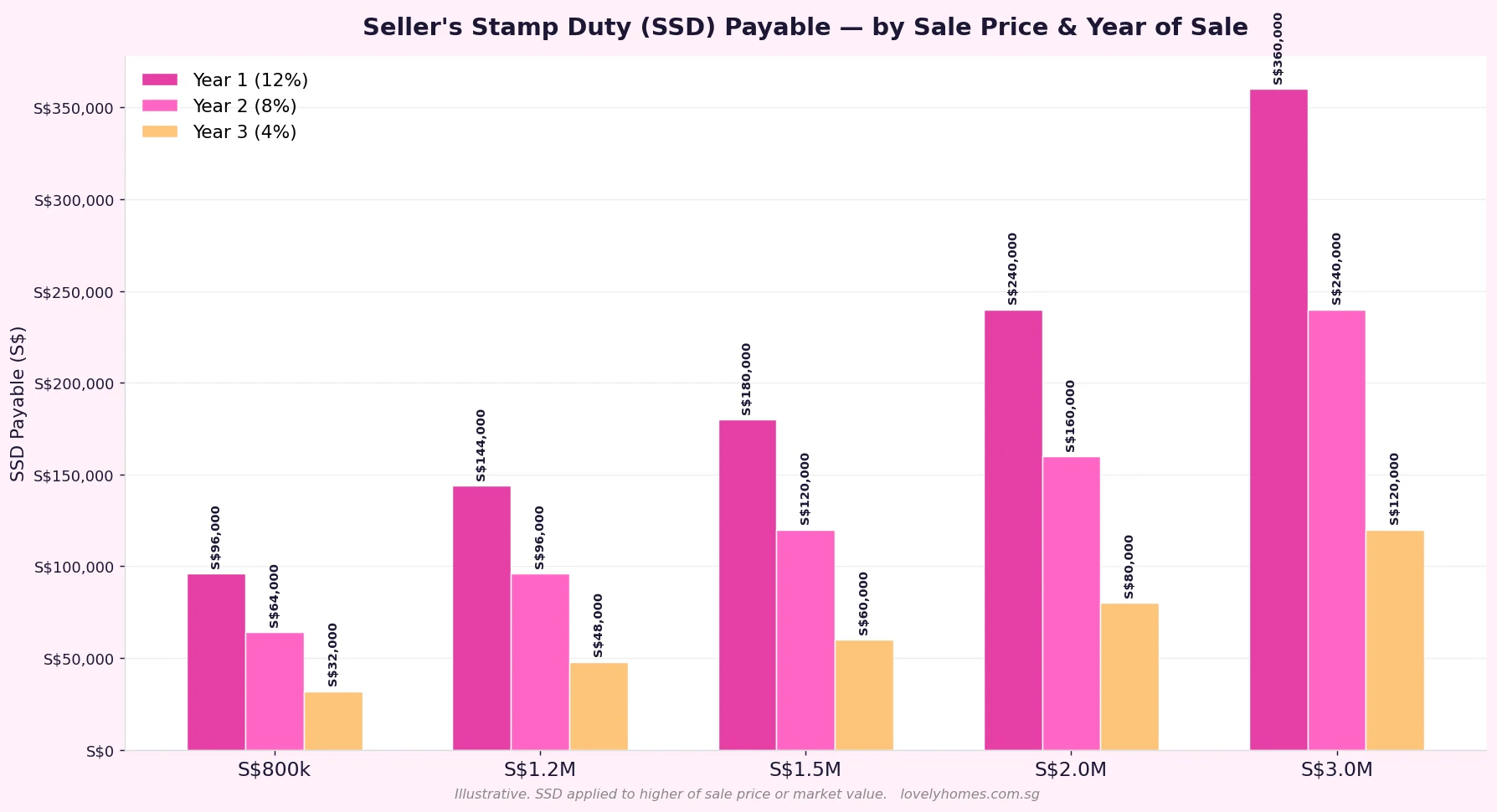
Sold within 1 year 12% S$144,000 S$216,000
Sold in year 2 (more than 1, up to 2 years) 8% S$96,000 S$144,000
Sold in year 3 (more than 2, up to 3 years) 4% S$48,000 S$72,000
Sold after 3 years Nil

SSD is payable by the seller and is due within 14 days of the date of the instrument (i.e., the Sale and Purchase Agreement or transfer document at completion). It is computed on the higher of the sale price or the market value. Late payment attracts a penalty under the Stamp Duties Act.

There are exemptions. SSD does not apply to a transfer of residential property by way of gift between spouses or between lineal descendants (subject to IRAS approval), nor to court-ordered transfers arising from divorce proceedings. A property that is compulsorily acquired by the government is also exempt.

Singapore Seller's Stamp Duty SSD rates 2026 and BSD ABSD SSD quick reference table
Figure 3: SSD rates by holding period (residential property) and a consolidated quick reference covering BSD, ABSD, and SSD. Source: IRAS / lovelyhomes.com.sg.

ABSD Remissions — When You Can Get ABSD Back

Not all ABSD paid is lost forever. IRAS administers two principal remissions that allow qualifying buyers to recover ABSD paid on a second residential purchase.

1. SC or SC/SPR Couple Upgrader Remission. A married couple comprising at least one SC who buys a replacement private property while still owning a first residential property may claim a remission of ABSD paid on the second purchase, provided they sell the first property within 6 months of purchasing the replacement (or within 6 months of the replacement property’s Temporary Occupation Permit, for new launches under construction). The remission covers the full 20% ABSD paid — which, at today’s property prices, frequently represents several hundred thousand dollars.

2. SC Couple Remission (Both First-Time). A married couple where both are SC and neither owns any other residential property is treated as a single unit buying their first property, so ABSD is nil from the outset — no remission is needed.

For full details on how remissions are computed, which documents IRAS requires, and the deadlines that must be met to avoid losing the refund, see our Singapore Stamp Duty Remission Guide 2026.

Worked Example: Complete Stamp Duty Liability for Two Scenarios

To bring the numbers to life, consider Mr and Mrs Lim — a Singapore Citizen married couple. They currently own a 4-room HDB flat in Toa Payoh purchased in 2019. They are evaluating two scenarios for upgrading to an OCR condominium priced at S$1.5 million.

Scenario A: Sell HDB first, then buy condo (1st property). After selling their HDB flat, neither spouse owns any residential property. BSD on S$1.5M = S$44,600. ABSD = S$0 (SC, 1st property). Total stamp duty = S$44,600. BSD may be paid via CPF OA.

Scenario B: Buy condo first, claim upgrader ABSD remission, sell HDB within 6 months. At time of purchase, each spouse owns the HDB flat — so this is their 2nd residential property. BSD = S$44,600. ABSD = 20% × S$1,500,000 = S$300,000 (cash only). Total stamp duty paid upfront = S$344,600. If they sell the HDB within 6 months of purchasing the condo, IRAS will refund S$300,000 ABSD — leaving net stamp duty at S$44,600, the same as Scenario A. However, the S$300,000 must be held in cash (not CPF) for up to 6 months, which has a real financing and opportunity cost.

Scenario C: Retain HDB, buy condo (2nd property — no remission intended). Same BSD S$44,600 plus ABSD S$300,000. No remission planned. Total permanent stamp duty burden = S$344,600. The S$300,000 ABSD is sunk cost. The combined investment may still make financial sense if rental yield and capital appreciation projections justify the outlay — but it requires significantly more cash upfront and affects TDSR calculations.

This example illustrates why the sequencing and timing of property transactions matters enormously in Singapore’s stamp duty environment. The choice of whether to sell before buying, buy before selling, or hold both permanently has six-figure financial consequences.

How to Pay Stamp Duty — IRAS e-Stamping Portal

All stamp duty for Singapore property transactions is paid electronically via the IRAS e-Stamping portal (accessible at myTax.iras.gov.sg). In practice, the buyer’s law firm handles the computation and payment on the buyer’s behalf as part of the conveyancing process. The steps are straightforward: the firm uploads the instrument, computes the duty, and processes payment from the client’s funds prior to the 14-day deadline.

Buyers who transact without a law firm (rare in Singapore) must stamp the document themselves. Late stamping attracts a penalty of up to four times the unpaid duty. If IRAS determines that the declared purchase price undervalues the property, it may assess the duty on market value instead, and the difference (plus penalties) becomes payable immediately.

What Might Come Next — Stamp Duty Outlook

Property cooling measures in Singapore have historically been responsive to market conditions. ABSD has been adjusted upwards seven times since its introduction in 2011. The current rates — particularly the 60% foreigner ABSD — are the highest ever. Analysts and market observers broadly expect the government to maintain these elevated rates as long as private residential property prices continue to rise, but may calibrate them if transaction volumes fall significantly or global economic conditions shift. SSD and BSD, by contrast, have been more stable — the BSD top-tier additions in February 2023 were the first BSD change in a decade. Market participants should monitor MOF and IRAS announcements, particularly around Budget season each February, for any adjustments.

Frequently Asked Questions

Can I use CPF to pay ABSD?

No. ABSD must be paid entirely in cash. This is a firm rule — CPF Ordinary Account funds cannot be used to meet the ABSD obligation, even if you have sufficient funds in your CPF OA. BSD, by contrast, may be paid from CPF OA for qualifying residential property purchases, subject to the applicable CPF withdrawal limits and property type eligibility. The distinction matters enormously at today’s ABSD rates: a foreigner buying a S$2M property must have S$1.2M in cash earmarked for ABSD alone.

When exactly is BSD/ABSD due?

For private property, BSD and ABSD must be stamped (paid) within 14 days of the date the OTP is exercised. For HDB resale transactions, the deadline is 14 days from the date of the Sale and Purchase Agreement. If the instrument is executed outside Singapore, the 14-day clock runs from the date the document is received in Singapore. Late payment attracts penalties of up to four times the unstamped duty. Your law firm will typically ensure this deadline is met as part of the conveyancing process, but buyers should be aware of the obligation in case of any procedural delays.

Does ABSD apply to HDB flats?

HDB flats purchased directly from the HDB (BTO, resale) are subject to ABSD only when the buyer already owns other residential property. An SC buying their first property — whether HDB or private — pays no ABSD. An SC buying an HDB resale flat as a second residential property would theoretically face 20% ABSD; however, in practice, HDB’s eligibility rules generally preclude ownership of both an HDB flat and a private residential property simultaneously (because of the MOP and concurrent private property ownership restrictions). A more common scenario is an SPR purchasing an HDB resale flat as their first property — this attracts 5% ABSD. For details see our HDB Resale Eligibility Guide 2026.

How is SSD computed if I inherited the property?

If you acquired a property by inheritance rather than by purchase, the acquisition date for SSD purposes is the date of the deceased’s death, not the date of the grant of probate or transmission to you. If you sell the inherited property within 3 years of the date of death, SSD is payable at the applicable rate. This catches some beneficiaries by surprise — if the estate takes 12 months to administer, you may already be in year 2 of the SSD holding period before you have legal title. An exemption applies to transfers that are part of a compulsory acquisition by the government. Consult a solicitor before selling an inherited property within the 3-year window.

What happens if I undervalue the property on the stamp duty form?

IRAS computes stamp duty on the higher of the purchase price and the market value. If IRAS assesses the market value to be higher than the declared purchase price, it will issue a Notice of Assessment for the additional duty and impose a penalty of up to four times the underpaid amount. Purchasers who knowingly understate the purchase price to reduce stamp duty face criminal penalties under the Stamp Duties Act. In the normal course of arm’s-length transactions, this is rarely an issue — stamp duty is simply computed on the agreed price and confirmed against a bank valuation report. The rule exists to prevent artificial deflation of declared prices in related-party or distressed transactions.

Is BSD payable on commercial property?

Yes. BSD applies to all real property in Singapore — residential, commercial, and industrial. ABSD and SSD, however, apply only to residential property. So a buyer purchasing an office unit or shophouse pays BSD at the six-tier scale but owes no ABSD (regardless of how many properties they own) and faces no SSD if they sell the commercial property within 3 years. This makes commercial property relatively more attractive on a stamp-duty basis for buyers who already own residential properties and would otherwise face significant ABSD. Note: industrial SSD (separate from residential SSD) applies to industrial property disposed of within 3 years of acquisition — rates are 15% (year 1), 10% (year 2), 5% (year 3).

Related Articles

Disclaimer

This article is for general informational and educational purposes only. Stamp duty rates, rules, and eligibility criteria are subject to change by the Ministry of Finance and IRAS. The worked examples and figures in this guide are based on rates effective as at 4 August 2026. Always verify the current rates at iras.gov.sg before any transaction, and engage a qualified Singapore solicitor for legal advice specific to your circumstances. LovelyHomes is not a legal or financial adviser.

Singapore Seller’s Stamp Duty (SSD) Guide 2026: Rates, Rules and Worked Examples

Singapore Seller’s Stamp Duty (SSD) Guide 2026: Rates, Rules and Worked Examples

Seller’s Stamp Duty (SSD) is a tax levied by the Inland Revenue Authority of Singapore (IRAS) on the sale of residential and industrial properties that are disposed of within a specified holding period. Introduced in 2010 and subsequently revised, SSD is one of Singapore’s core property market stabilisation tools — designed to discourage short-term speculative “flipping” of property. Sell too early, and you pay. Hold long enough, and you pay nothing.

For most property owners, SSD is straightforward in concept but easy to miscalculate in practice. The rate, the holding period clock, the definition of the “date of acquisition”, and the rare exemptions all matter. This guide covers every dimension of Singapore SSD in 2026, with rates, worked examples, and Singapore-dollar figures drawn from IRAS’s official stamp duty guidance.

Quick Answer — Singapore SSD at a Glance

  • Residential SSD rates (2026): 12% if sold within 1 year; 8% within 1–2 years; 4% within 2–3 years; Nil thereafter. Administered by IRAS.
  • Industrial SSD rates (2026): 15% within 1 year; 10% within 1–2 years; 5% within 2–3 years; Nil thereafter.
  • SSD is calculated on the higher of purchase price or market value at the time of sale.
  • The holding period clock starts from the date of purchase (Option to Purchase exercise date, or date of sale and purchase agreement, whichever applies).
  • SSD is payable by the seller, not the buyer, within 14 days of execution of the instrument of transfer.
  • HDB flats are generally exempt from residential SSD (the Minimum Occupation Period rules serve the same function).
  • SSD is not refundable if the sale subsequently falls through after the transfer instrument has been stamped.

What Is Seller’s Stamp Duty (SSD)?

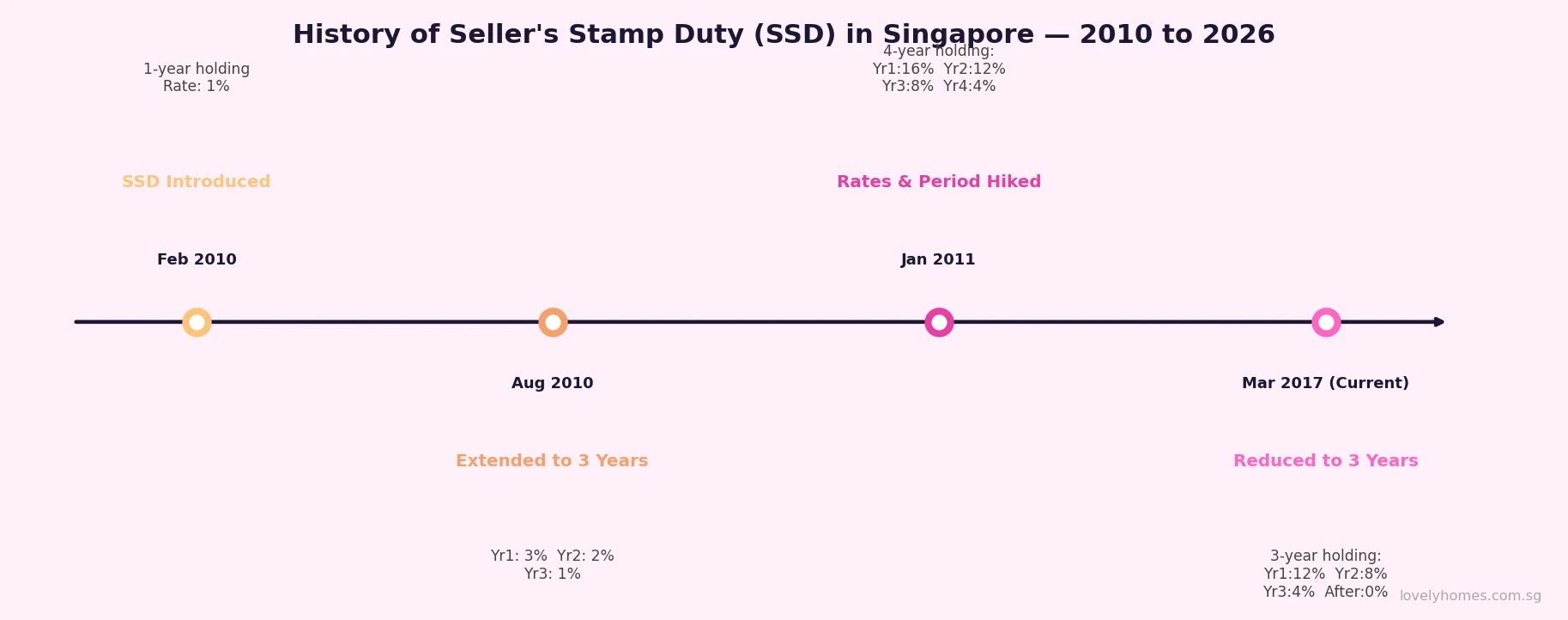
Seller’s Stamp Duty is a stamp duty applied under the Stamp Duties Act (Chapter 312) to the conveyance or transfer of residential and industrial properties that are sold within the SSD holding period. It was first introduced for residential properties on 20 February 2010, following concerns about speculative activity in Singapore’s property market, and the rates have been adjusted several times since — most recently on 11 March 2017, when the residential SSD rates were simplified and the holding period was reduced from four years to three years.

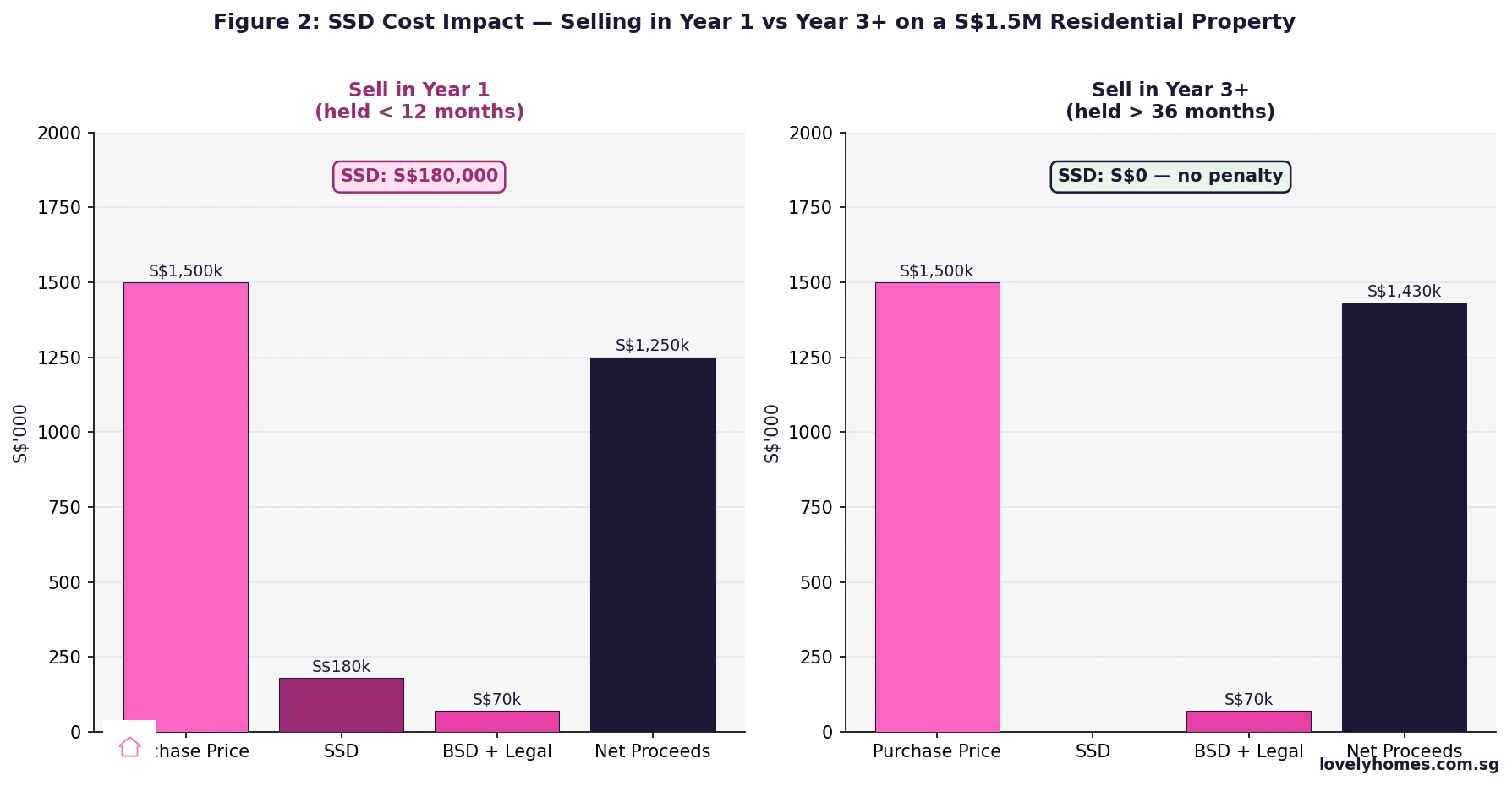
The SSD is administered by IRAS and collected alongside Buyer’s Stamp Duty (BSD) and Additional Buyer’s Stamp Duty (ABSD) as part of Singapore’s stamp duty framework. Unlike BSD and ABSD (which are paid by the buyer), SSD falls squarely on the seller. It is a significant cost: on a S$1,500,000 residential property sold within the first year, SSD alone amounts to S$180,000.

Residential SSD Rates 2026

The residential SSD rates that apply in 2026 — effective from 11 March 2017 — are tiered by the number of years the property was held, measured from the date of acquisition to the date of sale. IRAS defines “years” in complete calendar years, so a property held for 364 days is treated as “held within 1 year” and incurs the 12% rate.

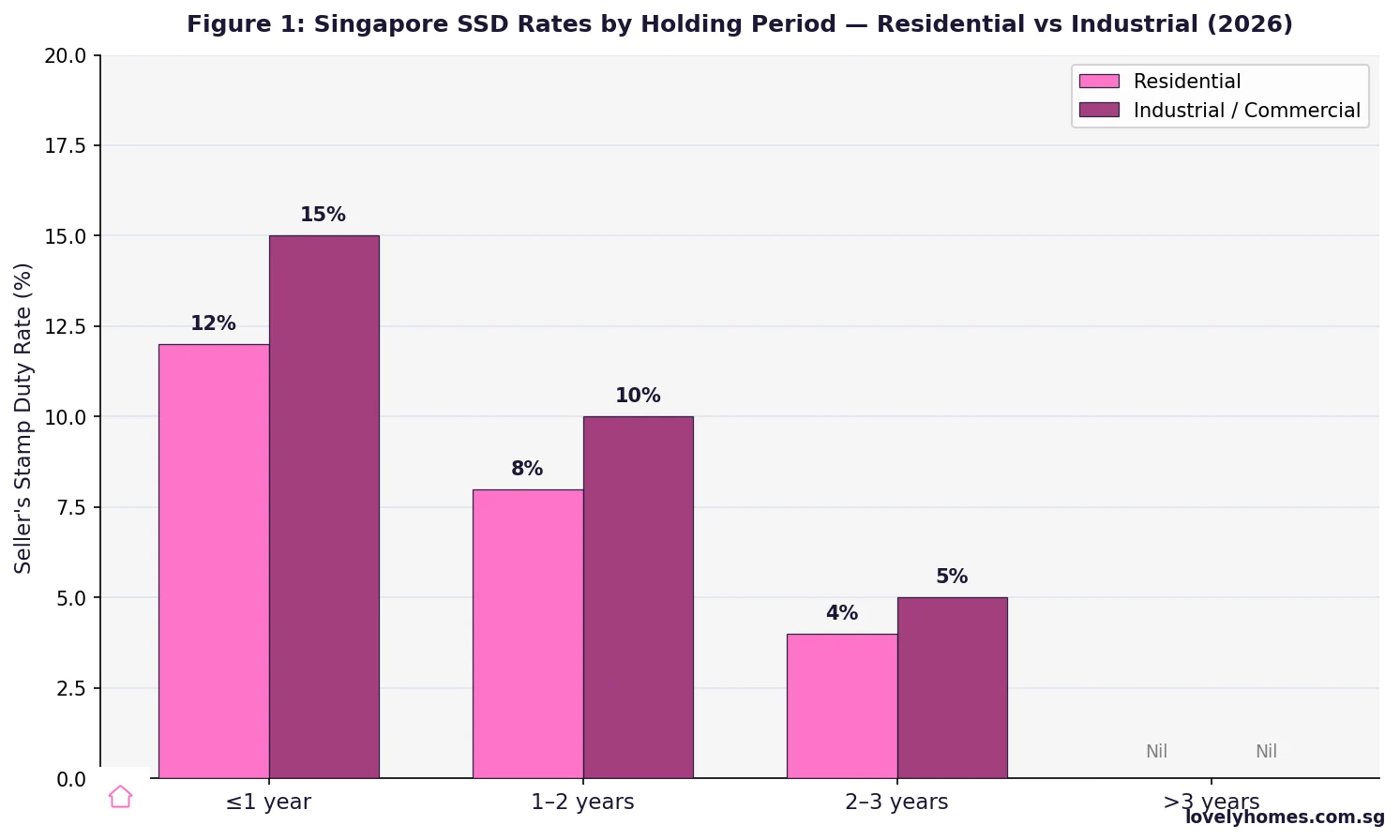
Singapore Seller's Stamp Duty SSD rates by holding period residential industrial 2026
Figure 1: Singapore SSD rates by holding period — residential property (pink) vs industrial/commercial property (wine). Both asset classes attract nil SSD after 3 years.
Holding Period Residential SSD Rate Industrial SSD Rate
Up to and including 1 year 12% 15%
More than 1 year and up to 2 years 8% 10%
More than 2 years and up to 3 years 4% 5%
More than 3 years Nil Nil

SSD is levied on the higher of the sale price or the market value of the property at the time of sale, as determined by IRAS. For most arm’s-length transactions, the sale price is the applicable figure. If IRAS determines that the sale price is below market value (for example, in a related-party transaction), the market value will be used instead.

Industrial Property SSD

Industrial SSD was introduced later than residential SSD — on 12 January 2013 — following a rapid run-up in industrial property prices in 2011–2012. The rates are slightly higher than residential (15% > 12% in year one; 10% > 8% in year two; 5% > 4% in year three), and the definition of “industrial property” covers properties that are zoned as Business 1 (B1), Business 2 (B2), or Business Park in URA’s Master Plan — including warehouses, factories, and workshop units. Commercial properties (retail shophouses, office units) are not subject to industrial SSD.

HDB Flats and SSD Exemption

HDB flats are generally exempt from residential SSD. The rationale is that the HDB Minimum Occupation Period (MOP) — typically five years for BTO flats and three years for DBSS flats — already prevents early disposal of HDB flats, serving the same policy function as SSD. Any attempt to sell an HDB flat before the MOP expires without HDB’s approval is a breach of HDB’s conditions of purchase, not merely a stamp duty matter. After the MOP, HDB resale flats can be sold freely with no SSD payable.

How SSD Is Calculated

The SSD amount is simply: SSD Rate × Higher of (Sale Price or Market Value). There are no deductions for renovation costs, CPF refunds, or outstanding loan balances. It is applied on the gross disposal price. Because SSD is a cost to the seller, it is typically considered in net proceeds calculations when deciding whether an early sale makes financial sense.

SSD Seller's Stamp Duty cost impact selling year 1 vs year 3 Singapore 2026 comparison
Figure 2: SSD cost impact on a S$1,500,000 property — selling in Year 1 (S$180,000 SSD) vs selling after Year 3 (no SSD). The difference in net proceeds is substantial.

Worked Example: The Tan Family’s Early Sale Decision

Scenario: Mr Tan (Singapore Citizen) purchased a condominium unit in the Outside Central Region (OCR) for S$1,200,000 on 15 June 2025 using Option to Purchase. His employer has offered him a posting overseas and he is considering whether to sell in August 2026 (approximately 14 months after purchase) or to hold until after the 3-year SSD window expires (after 15 June 2028).

If he sells in August 2026 (held approximately 14 months — within 1–2 years):

  • Assumed sale price: S$1,280,000 (6.7% gain over purchase price)
  • SSD rate: 8% (held more than 1 year, up to 2 years)
  • SSD payable: S$1,280,000 × 8% = S$102,400
  • BSD paid at purchase: S$42,600 (already sunk cost)
  • Legal & agent fees on sale: approximately S$16,000
  • Net proceeds from sale: S$1,280,000 − S$102,400 (SSD) − S$16,000 (fees) = S$1,161,600
  • vs purchase price of S$1,200,000: net loss of S$38,400 (excluding financing costs)

If he waits and sells after June 2028 (held over 3 years):

  • Assumed sale price: S$1,350,000 (modest appreciation over 3 years)
  • SSD: S$0
  • Legal & agent fees: approximately S$17,000
  • Net proceeds: S$1,350,000 − S$17,000 = S$1,333,000
  • vs purchase price: net gain of S$133,000 (excluding financing costs)

Conclusion: The 3-year wait delivers a S$171,400 improvement in net proceeds (after SSD and fees). Unless the posting income or an immediate property need makes the sale unavoidable, holding past the SSD window is typically the better financial decision.

What “Date of Acquisition” Means for SSD

For residential properties purchased under an Option to Purchase (OTP), IRAS measures the holding period from the date the OTP was exercised (typically 14 days after the option is granted). For Sale and Purchase agreements where no OTP is involved (common in new launches), the holding period runs from the date of the Sale and Purchase agreement. For inherited property, the acquisition date is the date of the deceased’s death (or, for gifts, the date the gift is accepted). This last point is critical: if you inherit a property and sell it within three years of the deceased’s death, SSD may apply even if you personally held the property for a short period.

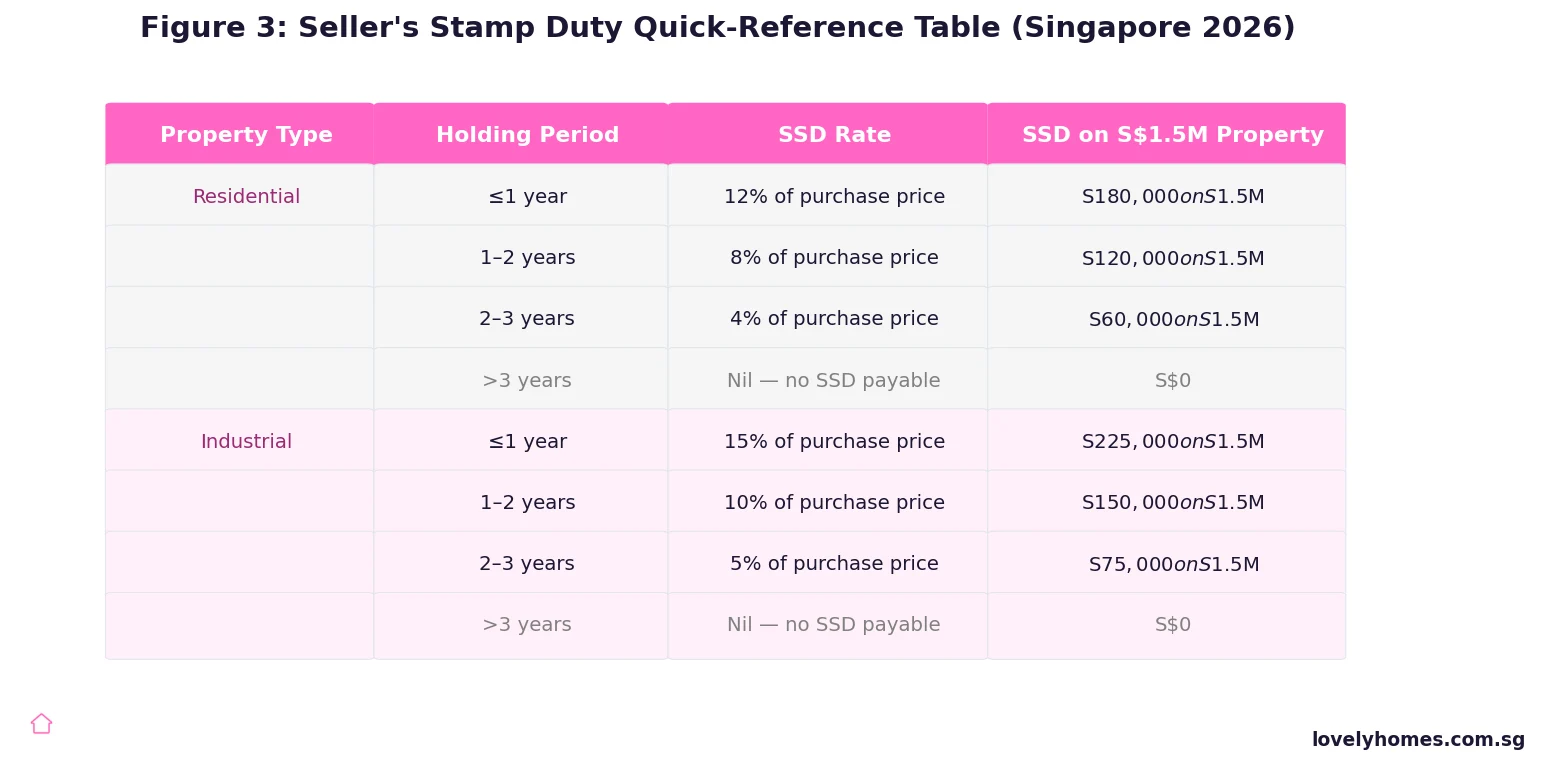
Seller's Stamp Duty SSD quick reference table Singapore 2026 all rates residential industrial
Figure 3: Complete SSD quick-reference table for Singapore 2026 — residential and industrial rates by holding period, with examples on a S$1.5M property.

SSD Remissions and Exemptions

IRAS provides remissions from SSD in a narrow set of circumstances:

  • Deceased estate: SSD is remitted if the property is sold by the executor or administrator of the estate and the sale is necessary to pay estate duties or administration expenses, subject to IRAS approval.
  • Compulsory acquisition: If the property is compulsorily acquired by the government under the Land Acquisition Act, no SSD is payable — the government acquisition is not a “sale” for SSD purposes.
  • HDB flats: As noted above, HDB flats are exempt (subject to MOP rules).
  • Restructuring / corporate reorganisation: Intra-group transfers that qualify for IRAS’s reconstruction relief may be exempt, but these apply only to corporate entities and require an advance ruling.

There is no general hardship remission for personal circumstances (divorce, job loss, medical emergency). If you sell within the SSD window for personal reasons, the duty applies regardless of why you are selling.

Why SSD Matters for Property Investors in 2026

Singapore’s property market in 2026 continues to attract investor interest despite the full suite of cooling measures in place since April 2023. Understanding SSD is essential for any property investor modelling returns: a 12% first-year SSD on a S$2 million property is S$240,000 — more than the ABSD payable by a Singapore Citizen buying a second property (20% = S$400,000, but note SSD is a seller cost while ABSD is a buyer cost). The interaction of ABSD on purchase and SSD on early sale creates a powerful “lock-in” effect that effectively discourages all but long-term investors.

Compared to jurisdictions such as Hong Kong (which abolished its Buyer’s Stamp Duty for non-residents in February 2024), Singapore has maintained its full cooling measure suite. Industry data from URA’s Q2 2026 statistics show that short-hold transaction activity (sub-3-year disposals) in private residential remains well below pre-2010 levels, indicating that SSD continues to be effective as a speculative brake.

What Might Change for SSD

As at 1 August 2026, the Singapore government has not announced any changes to residential or industrial SSD rates. Property analysts note that any relaxation would likely signal a shift in the government’s assessment of market stability. Given that private residential prices rose by approximately 1.8% in Q2 2026 (URA data, pr26-57), there is little immediate pressure to relax SSD. LovelyHomes will monitor MAS and IRAS announcements and update this guide accordingly. For the most current rates and guidance, consult the IRAS SSD page.

SSD Quick-Reference Summary

Parameter Detail
Administered by IRAS (Inland Revenue Authority of Singapore)
Residential rates 12% (≤1 yr) / 8% (1–2 yr) / 4% (2–3 yr) / 0% (>3 yr)
Industrial rates 15% (≤1 yr) / 10% (1–2 yr) / 5% (2–3 yr) / 0% (>3 yr)
Calculated on Higher of sale price or IRAS-assessed market value
Paid by Seller (within 14 days of execution of transfer instrument)
HDB flats Generally exempt (subject to MOP rules)
Date of acquisition Date OTP exercised (or S&P date if no OTP)
Remissions Estate disposal, compulsory acquisition, HDB exemption, qualifying restructuring
Introduced 20 February 2010 (residential); 12 January 2013 (industrial)
Current rates effective 11 March 2017

FAQ — Seller’s Stamp Duty Singapore 2026

Do I have to pay SSD on an HDB resale flat?

In virtually all circumstances, no. HDB resale flats are exempt from the residential Seller’s Stamp Duty framework. The HDB Minimum Occupation Period (MOP) — five years for most BTO flats, three years for DBSS flats — fulfils the same anti-speculation function. If you attempt to sell your HDB flat before completing the MOP, you will be in breach of HDB’s conditions of sale, and HDB may take enforcement action (including compulsory acquisition of the flat). The SSD framework simply does not apply to HDB disposals in the way it applies to private residential properties.

If I transfer the property to my spouse, does SSD apply?

Yes, in most cases. A transfer of property — even between spouses — is treated as a disposal for SSD purposes if it occurs within the SSD holding period, unless the transfer qualifies for a specific IRAS remission. Transfers between spouses that are required by a court order in divorce proceedings may qualify for SSD remission, but voluntary transfers between spouses (for example, to restructure ownership) are generally dutiable. You should seek legal and tax advice before proceeding with any intra-family transfer within the SSD window. IRAS must be consulted in advance for any remission application.

When exactly does the 3-year SSD clock start and stop?

The clock starts on the date the Option to Purchase is exercised by the buyer (i.e., when you, as the original purchaser, accepted the signed OTP and exercised your right to purchase). For properties purchased under a Sale and Purchase agreement without a prior OTP (common for new launch developer sales where the OTP was not formally used), the clock starts from the date of the Sale and Purchase agreement. The clock stops on the date you sign the sale and purchase agreement as seller (or exercise the OTP for the sale if an OTP is used). If the gap between start and end is three complete calendar years or less, SSD may apply. IRAS’s practice is to count by the exact number of years elapsed — a disposal on the third anniversary date is SSD-free; a disposal the day before is not.

Can I negotiate with the buyer to share the SSD cost?

As a matter of commercial negotiation, nothing prevents you from agreeing with the buyer that they will contribute to the SSD cost as part of the sale price. However, IRAS remains indifferent to whatever agreement you reach: SSD is legally the seller’s liability and must be paid by the seller (through the conveyancing lawyer) from the sale proceeds. In practice, most buyers simply factor in a discounted sale price rather than paying a separate SSD contribution. If you increase the declared sale price to offset the SSD cost, you should be aware that the buyer’s BSD, ABSD, and any stamp duty will also be computed on that higher declared price.

What if I buy a property, fail to complete the purchase, and the seller forfeits my deposit — do I face SSD?

No. SSD is payable only on the completion of a sale and purchase — specifically, on the execution of the instrument of transfer that changes legal title. If a transaction is aborted before completion (for example, the buyer defaults and forfeits the deposit, or the seller exercises a right to terminate), no title transfer occurs, so no SSD is triggered. The SSD framework applies to completed disposals, not to failed transactions. However, the forfeited deposit, legal fees, and OTP costs are non-recoverable, and any BSD or ABSD that has already been paid by the buyer is generally not refundable (though IRAS allows refund applications in some circumstances).

Does SSD apply to commercial shophouses or office units?

No. The residential SSD applies only to residential properties, and the industrial SSD applies only to properties zoned as B1, B2, or Business Park under the URA Master Plan. Commercial properties — including retail shophouses, office units, and F&B premises zoned Commercial or Commercial & Residential — are not subject to either residential or industrial SSD. This means commercial shophouses and office units can be bought and sold in any timeframe without SSD. Note, however, that conservation shophouses in mixed-use zones may have specific heritage restrictions administered by URA that govern their use and alteration, independent of stamp duty rules.

Related Articles

Disclaimer

This article is published for general informational and educational purposes only. It does not constitute legal, financial, or tax advice. Seller’s Stamp Duty rates and rules in Singapore may change. Always refer to the IRAS website for the most current stamp duty rates, and consult a qualified Singapore solicitor or tax adviser before making any property transaction decisions. IRAS has sole authority to determine whether any remission from SSD is available in a specific case.

Buyer’s Stamp Duty (BSD) Singapore: Complete Guide 2026

Buyer’s Stamp Duty (BSD) Singapore: Complete Guide 2026

📌 Quick Answer: BSD in Singapore (2026)

  • What: Buyer’s Stamp Duty (BSD) is a tax levied on all property purchases in Singapore, paid by the buyer. It applies to every transaction — residential and non-residential — regardless of nationality or residency status.
  • Who collects it: The Inland Revenue Authority of Singapore (IRAS), under the Stamp Duties Act (Cap. 312).
  • Rates (2026): 1%–6% on a progressive scale across six price bands, from the first $180,000 to amounts above $3,000,000.
  • When to pay: Within 14 days of signing the Option to Purchase (OTP) or Sale & Purchase Agreement (SPA), whichever is earlier.
  • Difference from ABSD: BSD is the base stamp duty all buyers pay. ABSD is an additional layer imposed on certain buyers (second properties, PRs, foreigners). Both are separate charges.
  • Example: On a $1.5M condo, BSD = $43,800 (effective rate ~2.92%). A Singaporean citizen buying their first property pays only BSD; a Singaporean buying their second pays BSD + 20% ABSD on top.
  • Exemptions: Licensed developers purchasing land for immediate development, certain intra-family transfers (subject to conditions), and HDB flats purchased directly from HDB under specific schemes may qualify for remission.

What is Buyer’s Stamp Duty (BSD)?

Buyer’s Stamp Duty — commonly abbreviated as BSD — is a mandatory tax that every property purchaser in Singapore must pay to the government upon acquiring any interest in immovable property. Administered by IRAS under the Stamp Duties Act (Cap. 312), BSD has been a core feature of Singapore’s tax architecture since the modern stamp duty framework was established in the 1960s. It is entirely separate from Additional Buyer’s Stamp Duty (ABSD), which was introduced in December 2011 as a demand-cooling measure and applies only to certain buyer categories.

BSD applies to all property types — private residential condominiums, HDB resale flats, landed houses, shophouses, commercial units, and industrial properties. There is no nationality exemption: Singaporean citizens, Permanent Residents (PRs), foreigners, and companies all pay BSD on every qualifying transaction. What changes across buyer profiles is not BSD itself, but the ABSD layer added on top.

In July 2023, the Ministry of Finance significantly revised BSD rates for higher-value properties. From 15 February 2023, the top marginal BSD rate increased from 4% to 6% for amounts above $3,000,000, with a new 5% band introduced for the $1,500,001–$3,000,000 tranche. These changes were part of a broader effort to maintain progressive taxation and were the most significant BSD revision in over a decade.

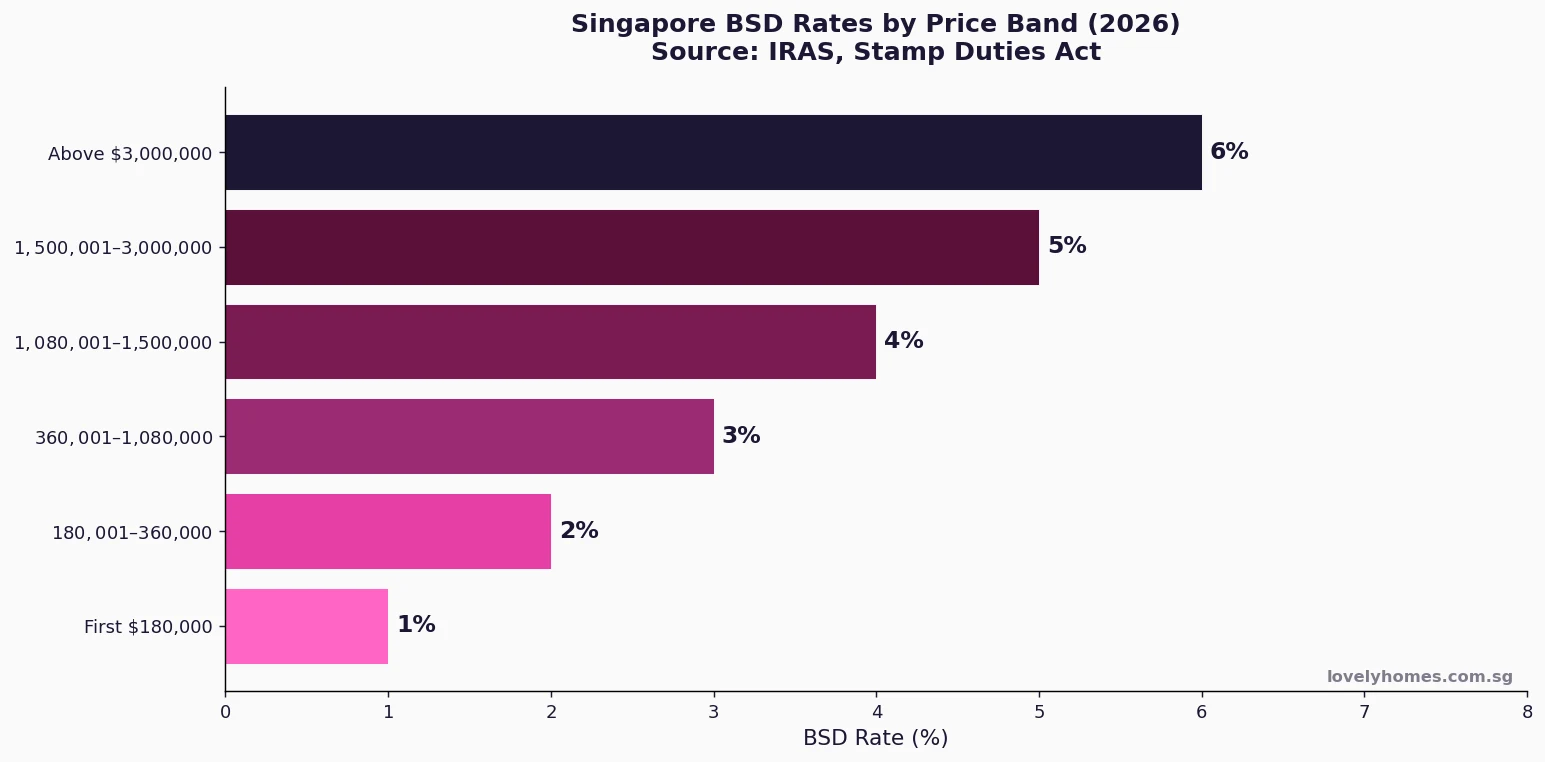
Singapore BSD rate bands 2026 infographic
Figure 1: Singapore BSD rates across six progressive price bands (2026). Source: IRAS, Stamp Duties Act.

BSD Rate Structure 2026: The Six Progressive Bands

As of 15 February 2023 (rates unchanged through 2026), BSD is computed on a sliding-scale basis. The rate does not apply uniformly to the entire purchase price — it applies to each band separately, like income tax brackets. The full six-band schedule is as follows:

Purchase Price Band BSD Rate BSD Payable on Band
First $180,000 1% Up to $1,800
Next $180,000 ($180,001–$360,000) 2% Up to $3,600
Next $720,000 ($360,001–$1,080,000) 3% Up to $21,600
Next $420,000 ($1,080,001–$1,500,000) 4% Up to $16,800
Next $1,500,000 ($1,500,001–$3,000,000) 5% Up to $75,000
Remaining amount (above $3,000,000) 6% Unlimited

For non-residential properties (commercial units, industrial spaces), a separate but similarly progressive scale applies. For the residential rates above to apply, the property must be classified as residential under the Stamp Duties Act. Mixed-use properties are assessed by the predominant use.

The rates effective from 15 February 2023 were set via the Stamp Duties (Amendment) Act 2023. Prior to that date, the top BSD rate was 4%, which applied to all amounts above $1,080,000. The two new bands — the 5% band ($1.5m–$3m) and 6% band (above $3m) — were introduced simultaneously with ABSD hikes for SC second-property buyers (from 17% to 20%) and foreigners (from 30% to 60%), making early 2023 the single most significant episode of property-related tax tightening in Singapore’s post-2013 history.

How to Calculate BSD: Step-by-Step

BSD is computed by applying the relevant rate to each price band in sequence. The formula for the most common residential purchase price ranges is as follows. For a property at purchase price P:

  • If P ≤ $180,000: BSD = P × 1%
  • If $180,001 ≤ P ≤ $360,000: BSD = $1,800 + (P − $180,000) × 2%
  • If $360,001 ≤ P ≤ $1,080,000: BSD = $5,400 + (P − $360,000) × 3%
  • If $1,080,001 ≤ P ≤ $1,500,000: BSD = $27,000 + (P − $1,080,000) × 4%
  • If $1,500,001 ≤ P ≤ $3,000,000: BSD = $43,800 + (P − $1,500,000) × 5%
  • If P > $3,000,000: BSD = $118,800 + (P − $3,000,000) × 6%

IRAS also provides an online BSD Calculator at iras.gov.sg where buyers can compute their exact liability. The calculation is based on the higher of the purchase price or the market value of the property — an important caveat for transactions where a property may be purchased at below-market value (for example, in related-party transfers).

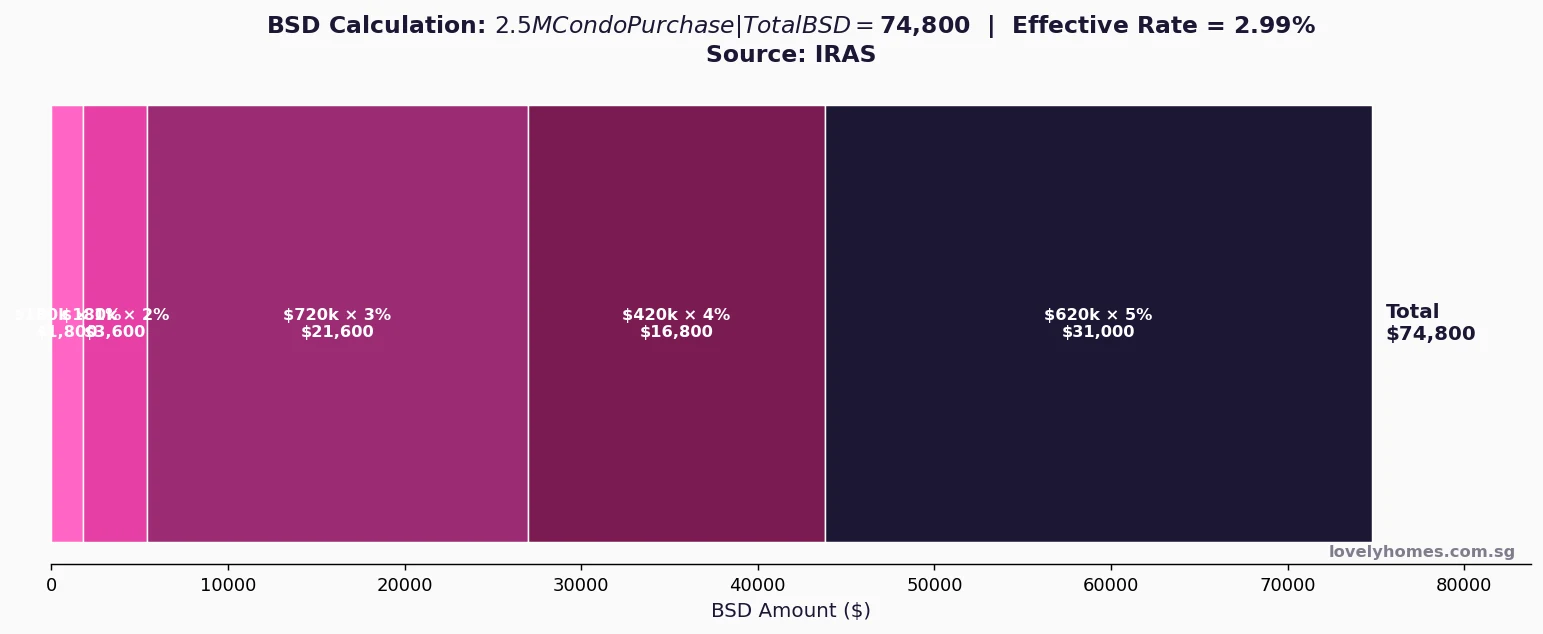
BSD calculation Singapore 2.5M condo 2026 infographic
Figure 2: BSD calculation walk-through for a $2.5M condo purchase. Total BSD = $74,800 (effective rate 2.99%). Source: IRAS.

Worked Example: Buying a $2.5M Condo

Let us trace the BSD computation for a Singaporean citizen purchasing a $2,500,000 private condominium as their first property in July 2026.

Price Band Amount Taxed Rate BSD Due
First $180,000 $180,000 1% $1,800
$180,001–$360,000 $180,000 2% $3,600
$360,001–$1,080,000 $720,000 3% $21,600
$1,080,001–$1,500,000 $420,000 4% $16,800
$1,500,001–$2,500,000 $1,000,000 5% $50,000
Total BSD $2,500,000 $93,800

Effective BSD rate: $93,800 ÷ $2,500,000 = 3.75%.

ABSD payable: $0 (Singaporean citizen buying first property).

Total stamp duty outlay: $93,800.

Had the same buyer been purchasing their second property, ABSD of 20% would apply: $2,500,000 × 20% = $500,000. Combined stamp duty = $93,800 (BSD) + $500,000 (ABSD) = $593,800 — more than six times the BSD-only liability. This gap illustrates why ABSD dominates the conversation for repeat buyers, even though BSD is the foundational charge that cannot be avoided.

BSD vs ABSD: Understanding the Difference

One of the most common points of confusion for property buyers — especially first-timers — is the relationship between BSD and ABSD. They are legally distinct taxes imposed under the same Stamp Duties Act but with different policy objectives.

BSD is a revenue tax — it has existed in some form since Singapore’s colonial era and is designed to generate government revenue from property transactions proportional to the value transacted. It is fiscally efficient and broadly accepted as a transaction cost. ABSD, by contrast, is a corrective tax — introduced in December 2011 when private residential property prices were rising sharply, to moderate investment demand and ensure housing remains broadly affordable. ABSD rates are politically calibrated and have been raised multiple times (in 2013, 2018, 2021, and 2023) to maintain the cooling effect as market conditions changed.

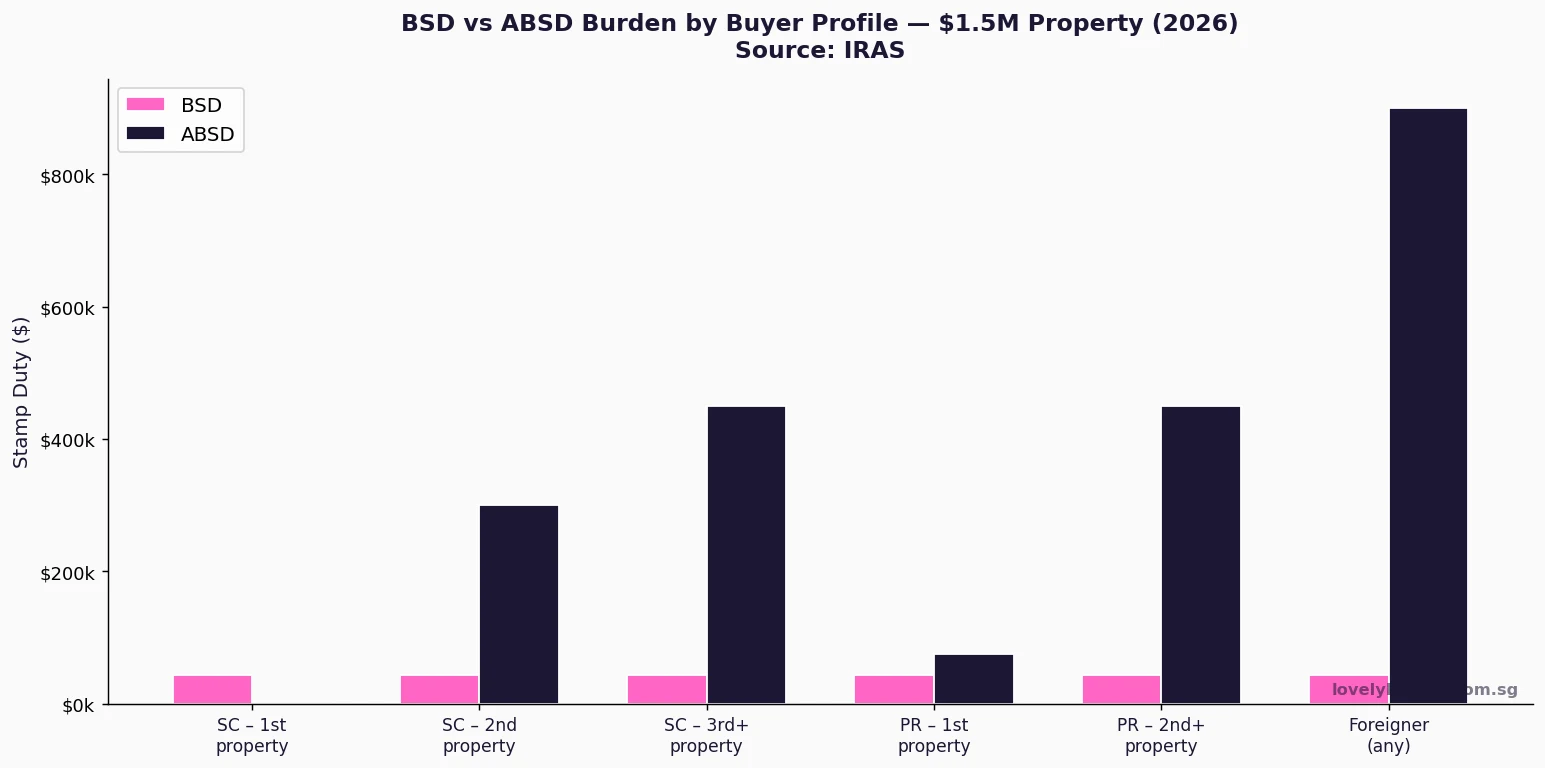
BSD vs ABSD stamp duty comparison by buyer profile Singapore 2026 infographic
Figure 3: BSD vs ABSD stamp duty burden on a $1.5M property for different buyer profiles (2026). BSD is constant across all profiles; ABSD varies dramatically. Source: IRAS.
Buyer Profile BSD ($1.5M) ABSD Rate ABSD ($1.5M) Total
Singapore Citizen — 1st property $43,800 0% $0 $43,800
Singapore Citizen — 2nd property $43,800 20% $300,000 $343,800
Singapore Citizen — 3rd+ property $43,800 30% $450,000 $493,800
Singapore PR — 1st property $43,800 5% $75,000 $118,800
Singapore PR — 2nd+ property $43,800 30% $450,000 $493,800
Foreigner (any property) $43,800 60% $900,000 $943,800
Entity (company) $43,800 65% $975,000 $1,018,800

BSD Payment: Deadline, Method, and Late Payment Penalty

BSD must be paid within a strict statutory timeframe:

  • If the document is signed in Singapore: within 14 days of execution.
  • If signed overseas: within 30 days of its receipt in Singapore.

Payment is made through IRAS’s e-Stamping portal (estamping.iras.gov.sg), which allows buyers or their lawyers to assess the duty online and pay via PayNow, GIRO, or cheque. In practice, BSD is almost always handled by the conveyancing solicitor — buyers simply receive a statement showing the computed duty and the corresponding deduction from their CPF savings or cash proceeds at completion.

Late payment carries a penalty of up to 4× the unpaid stamp duty (under Section 46 of the Stamp Duties Act). In practice, IRAS typically charges a tiered penalty: a flat $10 for lateness up to three months, then 10% of the unpaid duty thereafter, escalating further for sustained non-compliance. This penalty regime makes prompt payment by conveyancing solicitors an industry standard — late BSD is extremely rare in normal residential transactions.

BSD on HDB Resale Flats

BSD applies equally to HDB resale flat purchases. The rates are identical to those for private residential property. On a $700,000 four-room HDB resale flat — a typical price in mature estates in 2026 — the BSD computation is: $1,800 + $3,600 + $21,600 + (($700,000 – $360,000) × 3%) = $1,800 + $3,600 + $10,200 = $15,600. The effective rate is 2.23%.

HDB flat purchases directly from HDB (Build-to-Order or resale allocation) are assessed at the HDB selling price or valuation, whichever is higher, in the same way as private transactions. CPF Ordinary Account savings can be used to pay BSD on HDB resale flat purchases, provided the buyer’s CPF balance is sufficient and the flat qualifies under the relevant HDB CPF usage rules. This makes BSD largely invisible to first-time HDB buyers, as the charge is deducted seamlessly from CPF at completion.

BSD on Non-Residential Properties

For commercial, industrial, and other non-residential properties, BSD rates are different (and generally lower than the post-2023 residential rates). As of 2026, the non-residential BSD schedule is:

Purchase Price Band BSD Rate
First $180,000 1%
Next $180,000 2%
Next $640,000 3%
Remaining amount 4%

This is notable because, unlike residential BSD, the non-residential schedule was not changed in February 2023. A $5M commercial shophouse therefore attracts a lower effective BSD rate than a $5M luxury residential apartment. This differential reflects the government’s deliberate policy of not applying the same cooling framework to commercial property — the ABSD regime does not apply to commercial transactions, and even the base BSD is structured to be less onerous for commercial buyers.

BSD Exemptions and Remissions

Several categories of buyers may qualify for BSD remission (a partial or full reduction), as opposed to an exemption (total non-imposition). The distinction matters: remissions are granted after duty is assessed, and the buyer applies for remission via the e-Stamping portal. Key categories include:

  • Licensed housing developers: Under the Housing Developers (Control and Licensing) Act, developers purchasing residential land for immediate residential development may apply for BSD remission, typically up to 100%, subject to conditions including a development timeline requirement.
  • HDB flat purchases under specific schemes: Certain HDB assistance schemes provide partial BSD relief for first-time buyers in specific income bands — these are administered by HDB and not directly by IRAS.
  • Intra-family transfers at below-market value: Where a property is transferred between immediate family members at a consideration below market value, BSD is assessed on the higher market value. A full remission is not available in this scenario; BSD must be paid on the full market value unless the transfer qualifies as a gift (which has its own stamp duty treatment).
  • Dissolution of estates: Property passing on death (via will or intestacy) is generally stamp-duty-exempt, though transfers to beneficiaries following estate administration may attract BSD if they constitute a conveyance on sale.

What BSD Means for Your Property Budget

Unlike ABSD — which for a Singaporean first-time buyer is zero — BSD is an unavoidable acquisition cost. It should be factored into every property purchase budget as a non-negotiable line item, similar to conveyancing fees or home insurance. At the price points most common in the Singapore private residential market in 2026 (approximately $1.2M–$2.5M for a typical new-launch or resale condo), BSD ranges from approximately $27,000 to $93,800, representing 2.1%–3.75% of the purchase price.

Unlike conveyancing fees, BSD cannot typically be financed through a bank mortgage — it must be paid in cash or from CPF at the time of stamp duty assessment. Buyers who are CPF-dependent should verify their Ordinary Account balance before committing, as BSD alone can consume a meaningful portion of the CPF balance available for down payment.

BSD is also fully absorbed into the total property cost for the purpose of computing ABSD (where applicable) — i.e., ABSD is calculated on the purchase price, not on the purchase price net of BSD. This means BSD does not reduce your ABSD exposure, and the two taxes compound.

What Might Change: BSD Outlook for 2026–2028

The current BSD rate structure — including the two new bands introduced in February 2023 — was presented by the Ministry of Finance as a durable reform rather than a temporary adjustment. Unlike ABSD rates (which the government has described as calibrated to market conditions and potentially adjustable), BSD is treated as a structural revenue measure. As such, near-term changes to BSD rates appear unlikely based on public statements through mid-2026.

That said, several factors bear watching. First, if private residential transaction volumes continue the moderation observed since mid-2023 (when ABSD hikes sharply reduced foreign and investor demand), there may be political pressure to review the upper BSD bands, which now make luxury residential property in Singapore among the most stamp-duty-intensive jurisdictions in the Asia Pacific. Second, any significant HDB resale price correction — which could stress affordability for upgraders relying on CPF — might prompt targeted BSD concessions for first-time HDB buyers. These remain speculative; as at July 2026, IRAS has signalled no imminent change to the BSD framework.

BSD Frequently Asked Questions

Is BSD different from stamp duty?

In informal usage, “stamp duty” in Singapore often refers to BSD specifically, because BSD is the stamp duty all buyers pay. Technically, stamp duty is the overarching category that includes BSD, ABSD, Seller’s Stamp Duty (SSD), and other instruments. When a conveyancer or property agent says “stamp duty”, they generally mean BSD unless the context involves ABSD or SSD. It is worth asking for clarification if in doubt.

Can I use CPF to pay BSD?

Yes — CPF Ordinary Account savings can be used to pay BSD on both HDB resale flat purchases and private property purchases, subject to the prevailing CPF usage rules. For private residential property, CPF usage for BSD is permitted provided the property is on a leasehold of at least 30 years at the time of purchase and satisfies other CPF Board requirements. The payment is deducted from CPF at completion and handled by your conveyancing solicitor via the CPF e-payment system. You cannot use CPF Medisave or Special Account for BSD.

When exactly must BSD be paid?

The payment deadline for BSD is 14 calendar days from the date of execution of the dutiable document (typically the Sale & Purchase Agreement or the Option to Purchase once exercised) if the document is signed in Singapore, or 30 calendar days from the date the document is received in Singapore if it was signed abroad. In almost all residential transactions, your conveyancing solicitor will handle BSD payment and ensure it is made within the deadline. Buyers are advised to appoint their conveyancing solicitor promptly upon exercising their OTP to avoid any risk of late payment.

Does BSD apply when I inherit a property?

In general, property passing on death — by will, intestacy, or through a trust — is not subject to BSD if it is truly a succession and not a sale. However, where a beneficiary receives a property and later transfers it to another person for consideration (even below market value), BSD applies on the transfer. Estates in the process of administration may encounter BSD on specific legal instruments — the precise treatment depends on the nature of each document. A conveyancing solicitor or estate lawyer with stamp duty expertise should be consulted for complex estate situations.

Is BSD negotiable or can it be split with the seller?

No. BSD is a statutory tax imposed on the buyer and cannot be negotiated away or split with the seller. The seller bears a separate cost — Seller’s Stamp Duty (SSD) — if they are selling within the SSD holding period (currently three years). Some buyers in private treaty negotiations attempt to have the seller absorb part of the BSD through a price reduction, but legally, the obligation to pay BSD rests solely with the buyer. Any arrangement to have the seller “pay BSD” is effectively a price concession, and IRAS will still assess BSD on the contract price or market value, whichever is higher.

Does BSD apply to new launch condos bought directly from developers?

Yes. All purchases of new launch private residential units — including direct sales from developers under the Housing Developers (Control and Licensing) Act — are subject to BSD at the standard residential rates. The BSD is assessed on the agreed purchase price in the Sale & Purchase Agreement. Developers typically inform buyers of the BSD amount payable at the signing of the SPA, and the buyer’s solicitor arranges payment. BSD for new launches follows the same 14-day deadline as resale transactions and can be paid from CPF subject to the usual rules.

How is BSD treated for tax deduction or accounting purposes?

For individual buyers purchasing property for personal occupation, BSD is a capital expense and is not tax-deductible against income tax. For investors and companies purchasing property as an investment or for business use, BSD forms part of the cost of acquisition of the property and is therefore included in the cost base for the purpose of computing gains on a subsequent disposal — though Singapore does not currently impose a capital gains tax on property (other than the SSD mechanism for short holding periods). For companies subject to corporate income tax, BSD may form part of the depreciable cost of the property under specific accounting standards. Professional tax advice should be sought for complex corporate or investment structures.

Related Articles

Disclaimer

This article is intended as general educational information about Buyer’s Stamp Duty in Singapore and does not constitute legal, tax, or financial advice. BSD rates, remission conditions, and administrative procedures are governed by the Stamp Duties Act (Cap. 312) and IRAS guidelines, which may be updated by the relevant authorities. Always verify the current rates and applicable rules at iras.gov.sg or consult a qualified Singapore conveyancing solicitor, tax advisor, or financial planner before making any property purchase decision. LovelyHomes does not warrant the completeness or currency of any figures cited herein.

Seller’s Stamp Duty (SSD) Singapore 2026: Complete Guide to Rates, Rules & Exemptions

Seller’s Stamp Duty (SSD) Singapore 2026: Complete Guide to Rates, Rules & Exemptions

Quick Answer — Seller’s Stamp Duty at a Glance

  • SSD applies when you sell a Singapore residential property within 3 years of purchase (for properties acquired on or after 11 March 2017).
  • Rates: Year 1 — 12%, Year 2 — 8%, Year 3 — 4%. No SSD after the 3-year holding period.
  • SSD is levied on the higher of the sale price or market value — IRAS may conduct an independent valuation.
  • SSD applies to both private residential properties and HDB resale flats — though HDB’s 5-year MOP means SSD is rarely triggered in practice for HDB owners.
  • SSD must be paid within 14 days of the date of the sale contract or transfer document.
  • There is no remission for SSD based on citizenship or residency status — it applies equally to Singapore Citizens, PRs and foreigners selling within the holding period.
  • Prior regime (properties acquired 14 Jan 2011–10 Mar 2017): 4-year holding period, rates of 16% / 12% / 8% / 4%.

What Is Seller’s Stamp Duty (SSD) and Why Does It Exist?

Seller’s Stamp Duty is a tax levied by the Inland Revenue Authority of Singapore (IRAS) when a property owner sells a residential property within a specified holding period after purchase. Unlike the Additional Buyer’s Stamp Duty (ABSD) — which targets the buyer — SSD targets the seller, specifically those who sell quickly after buying. The rationale is straightforward: rapid reselling of residential property is a hallmark of speculative activity. By making short-term flipping expensive, SSD reduces the incentive to buy property purely for a quick profit rather than for genuine occupation or long-term investment.

SSD was first introduced in February 2010 as part of Singapore’s broader property market cooling framework — the same suite of tools that also includes ABSD, the Total Debt Servicing Ratio (TDSR), and Loan-to-Value (LTV) limits. For a full account of how Singapore has used these levers over the years, see our Property Cooling Measures Timeline.

SSD Rates in Singapore — Current and Historical

The rates below reflect the current SSD regime, which has applied to all residential properties acquired on or after 11 March 2017. Properties purchased before that date are subject to the rates in force at the time of acquisition.

Seller's Stamp Duty SSD rates Singapore 2026 by holding year — current and previous regime
Figure 1: SSD rates by holding year — current regime (from 11 March 2017) versus the previous 4-year regime (14 January 2011 to 10 March 2017). Source: IRAS.
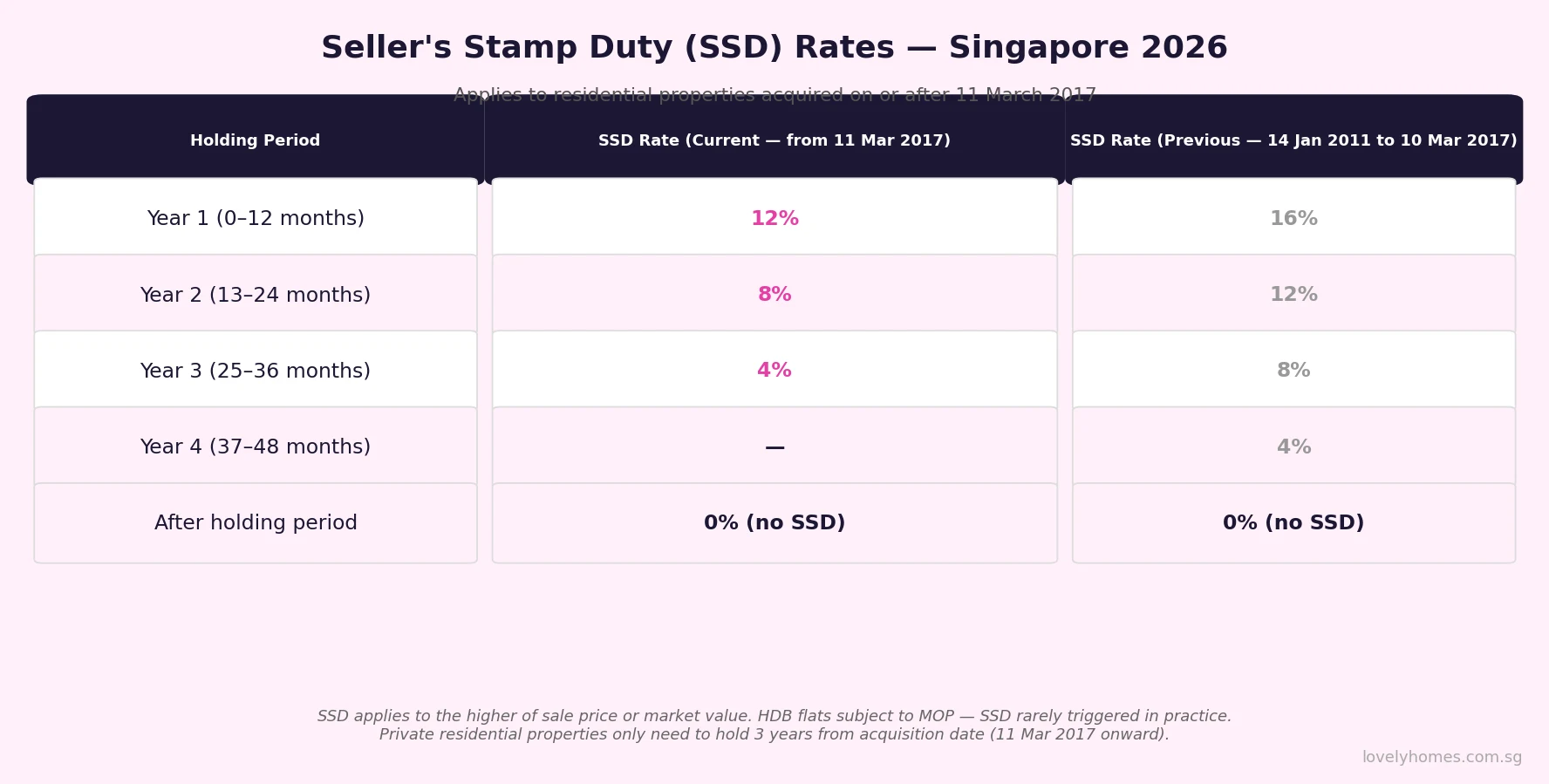
Holding Period SSD Rate — Current (from 11 Mar 2017) SSD Rate — Previous (14 Jan 2011–10 Mar 2017)
Year 1 (0–12 months from purchase) 12% 16%
Year 2 (13–24 months) 8% 12%
Year 3 (25–36 months) 4% 8%
Year 4 (37–48 months) 4%
After holding period 0% (no SSD) 0% (no SSD)

The holding period is measured from the date of purchase — specifically, the date the Option to Purchase (OTP) was exercised, or the date of the Sale & Purchase Agreement if no OTP was used. For an uncompleted property (buying off-plan), IRAS calculates from the date of the S&P Agreement, not the TOP date.

How Much SSD Will You Pay? A Worked Example

SSD is a flat rate applied to the entire sale price or market value — whichever is higher. It is not a progressive or tiered tax.

Example: Mr and Mrs Chen (Singapore Citizens) purchased a S$1.8 million District 10 resale condominium in April 2025. In November 2026 — 19 months after purchase — they receive a job relocation offer and decide to sell. The property is now valued by IRAS at S$1.95 million.

  • Holding period: 19 months → Year 2 — SSD rate 8%
  • SSD base: higher of S$1.95M (IRAS valuation) or sale price S$1.9M → S$1,950,000
  • SSD payable: S$1,950,000 × 8% = S$156,000
  • Payment due within 14 days of the date of the sale contract.

That S$156,000 would eliminate most of the capital appreciation they had hoped to realise. This is precisely the deterrent effect SSD is designed to create.

SSD payable by sale price and year of sale Singapore 2026 bar chart
Figure 2: Seller’s Stamp Duty payable by sale price and year of sale. All figures illustrative; SSD applied to the higher of sale price or market value.

Does SSD Apply to HDB Flats?

Yes — SSD applies to both private residential properties and HDB resale flats. There is no exemption for HDB sellers. However, in practice, SSD almost never applies to HDB flat sales because of the Minimum Occupation Period (MOP).

Most HDB flats — including BTO, resale, and EC purchases — require a 5-year MOP before the flat can be sold on the open market or rented out in full. Since the current SSD holding period is only 3 years, any HDB flat owner who has completed the MOP has also automatically cleared the SSD period. The SSD and MOP rules only interact in edge cases — for example, if an HDB owner obtains a special exemption to sell before MOP completion (which is rare and requires HDB approval), SSD may still apply to the transaction.

For private residential properties, there is no equivalent of the MOP, so SSD is the primary mechanism discouraging early resale.

SSD and the Different Holding Period Regimes

The holding period and rates under SSD have changed three times since its introduction. The applicable regime depends on when you purchased the property, not when you sell it:

  • Acquired on/after 11 March 2017: 3-year holding period; rates 12% / 8% / 4%.
  • Acquired 14 January 2011–10 March 2017: 4-year holding period; rates 16% / 12% / 8% / 4%.
  • Acquired 30 August 2010–13 January 2011: 3-year holding period; lower rates 3% / 2% / 1%.
  • Acquired 20 February–29 August 2010: 1-year holding period; rate 1%.
  • Acquired before 20 February 2010: SSD did not exist; no SSD payable.
History of Seller's Stamp Duty SSD Singapore timeline 2010 to 2026
Figure 3: Timeline of SSD regime changes in Singapore, February 2010 to present. Source: IRAS / Ministry of Finance.

What Transactions Attract SSD?

SSD is triggered on the disposal of a residential property within the applicable holding period. This includes:

  • Open-market resale of a private condo, landed house, or HDB resale flat.
  • Transfer of a property by way of sale (including between related parties at market value).
  • A gift of property — where IRAS deems a market value applies, SSD may be chargeable on the transferor.
  • Assignment of an OTP or S&P agreement where the sub-purchaser takes over before the property is transferred.

SSD is not triggered by:

  • Transfer of a residential property by way of inheritance or pursuant to a court order (e.g. in divorce proceedings) — though legal advice should be taken on the specifics.
  • Compulsory acquisition of land by the Government under the Land Acquisition Act.
  • Transfer between spouses pursuant to a divorce court order (subject to conditions).

Can SSD Be Avoided or Remitted?

Unlike ABSD — which has several remission schemes for qualifying buyers — there is no standard remission scheme for SSD. Once SSD is triggered, it is generally payable in full. The only legitimate ways to avoid SSD are:

  1. Hold for the full SSD period. The most reliable approach: simply do not sell within 3 years of purchase. Time your decision to sell around the anniversary of your OTP exercise date.
  2. Rely on a recognised exemption. Government compulsory acquisitions and specific court-ordered transfers may not attract SSD — take specialist legal advice.
  3. Negotiate for the buyer to absorb it. In strong markets, some sellers negotiate for the buyer to pay a higher price that effectively covers the SSD. This is a commercial negotiation rather than a legal remission.

Attempting to circumvent SSD through artificial schemes — such as inserting a related party as an intermediate buyer — is a criminal offence under the Stamp Duties Act. IRAS has the power to set aside transactions that it determines were structured to avoid stamp duty.

Selling Before the SSD Period: What to Consider

Occasionally, life events force a sale within the SSD window: a job relocation, financial hardship, divorce, or death. In such cases, SSD is generally unavoidable, but sellers should take steps to maximise their net proceeds:

  • Engage a conveyancing lawyer to confirm which SSD regime applies and calculate the exact sum due.
  • Factor SSD into your reserve price — selling for anything less than the minimum price required to cover SSD, mortgage redemption, and CPF refund (with accrued interest) will result in a cash shortfall.
  • Check whether any CPF accrued interest obligations further eat into proceeds.
  • If you are also buying a replacement property, account for the full chain of stamp duty costs: you may owe SSD on the sale and ABSD on the purchase.

SSD vs ABSD — What Is the Difference?

Feature SSD (Seller’s Stamp Duty) ABSD (Additional Buyer’s Stamp Duty)
Who pays? The seller The buyer
When triggered? Selling within the SSD holding period Buying a 2nd+ residential property (or any property as foreigner/entity)
Applies equally regardless of citizenship? Yes No — rates vary by citizenship & property count
Current rates 12% / 8% / 4% (years 1–3) 0%–65% depending on buyer profile
Remission available? Very limited Yes — married couple, developer, FTA nationals
Primary purpose Deter short-term speculation / flipping Moderate demand from investors and foreigners

What Might Come Next for SSD?

SSD was last adjusted in March 2017, when the Government reduced the holding period from 4 years to 3 years and lowered rates, signalling greater confidence in market stability. As of May 2026, there has been no indication from the Ministry of Finance or MAS of any imminent change to the SSD framework. That said, Singapore’s cooling-measures framework has historically been responsive to price pressures — if private residential prices were to accelerate meaningfully, a tightening of SSD (or other measures) cannot be ruled out. For up-to-date guidance, monitor IRAS and the Ministry of Finance.

Frequently Asked Questions

Is SSD payable on the sale price or the market value?

SSD is calculated on the higher of the actual sale price or the market value of the property at the time of sale, as determined by IRAS. If you sell a property at a price below its market value — for example, in a family transfer — IRAS will use the market value for the SSD calculation. This prevents sellers from artificially suppressing prices to reduce their SSD bill.

Does SSD apply to commercial or industrial property?

No. SSD applies only to residential properties — private condominiums, landed houses, HDB resale flats, and executive condominiums. Commercial shophouses, office units, industrial buildings, and pure-land plots are not subject to SSD. This is one reason some investors prefer commercial or industrial assets for shorter-term investment horizons.

When must SSD be paid after signing the sale contract?

SSD must be paid within 14 days of the date of the document that triggers the duty — typically the sale contract or the transfer document. Your conveyancing lawyer will stamp the document and collect the SSD as part of the closing process. Late payment attracts penalties and interest under the Stamp Duties Act.

I inherited a property less than 3 years ago. Do I pay SSD if I sell it?

A property acquired by way of inheritance is not a purchase — it is a transmission on death. IRAS’ position is that where a property is acquired through inheritance, the SSD holding period does not apply in the same way as a purchase. However, if the estate purchased the property (rather than having long held it), the executor’s position can be complex. You should seek specific advice from a conveyancing solicitor familiar with stamp-duty rules before proceeding with any sale of an inherited property.

Can I use CPF to pay SSD?

No. Stamp duties — including SSD and ABSD — cannot be paid directly from your CPF Ordinary Account. They must be settled in cash. Before committing to a sale within the SSD window, ensure you have sufficient liquid funds to cover the SSD liability on top of all other closing costs (agent commission, legal fees, mortgage redemption penalty if any).

My property was purchased jointly with my spouse. How does SSD apply?

For jointly owned property, SSD is assessed on the entire transaction — not split between owners. Both joint tenants or tenants-in-common are jointly and severally liable for the SSD. The holding period is measured from when the property was originally acquired. If you are selling a jointly owned property and the holding period has not expired, both parties must factor in the full SSD liability when planning the sale.

Does SSD apply to the sale of a new launch (uncompleted) condo?

Yes, but the holding period starts from the date of the Sale & Purchase Agreement (the date you signed the S&P with the developer), not the TOP date. This means that if you bought an uncompleted project in 2024 and it TOPs in 2027, you may already be past the SSD window by the time you are able to sell. However, some buyers who assigned or sub-sold their S&P agreements before completion have historically triggered SSD on the assignment — IRAS treats such assignments as a disposal.

Related Articles

Disclaimer

This article is for general informational purposes only and does not constitute legal, tax, or financial advice. SSD rates and rules are set by the Inland Revenue Authority of Singapore (IRAS) and are subject to change. The worked examples and figures in this article are illustrative only and do not constitute a valuation or legal opinion. Before entering into any property transaction — particularly one that may attract SSD — you should consult a licensed conveyancing solicitor, a certified financial planner, and verify the current position directly with IRAS.

×

Click anywhere or press Esc to close

Translate »