Bukit Timah District 21 Property Investment Guide 2026
Quick Answer: Bukit Timah / District 21 Property — Key Facts 2026
- District 21 covers Bukit Timah, Holland Road, Clementi Park, and Upper Bukit Timah — one of Singapore’s most prestigious residential addresses.
- Average transacted condo prices in D21 range from S$2,200–S$2,650 PSF depending on sub-location; Good Class Bungalow (GCB) land trades at S$2,600–S$3,200 PSF (land area basis).
- D21 contains Singapore’s most concentrated school belt, including Nanyang Primary, Methodist Girls’ School, Hwa Chong Institution, and National Junior College. School proximity commands a 10–20% price premium.
- Good Class Bungalows (GCBs) — minimum 1,400 sqm plot — can only be owned by Singapore Citizens; this restriction is a long-standing policy administered by the Land Dealings (Approval) Unit.
- D21 condo prices have appreciated approximately 55% from 2016 to H1 2026, outperforming the national non-landed residential average by roughly 10 percentage points over the same period.
- Key MRT connectivity: Beauty World (DT line), King Albert Park (DT line), Farrer Road (CC line), Botanic Gardens (CC/DT interchange), Clementi (EW line).
- Upcoming infrastructure: the Cross Island Line (CRL) Phase 2 will add Clementi MRT as a CRL–EW interchange, expected to support long-term capital values in the western corridor of D21.
What Is District 21?
Singapore’s residential districts are a legacy planning classification used by the real estate industry, broadly corresponding to postal zones. District 21 encompasses the Bukit Timah planning area together with the Holland Road and Clementi Park sub-markets. Geographically, it runs from the Botanic Gardens at its eastern edge westward through the Bukit Timah corridor to Upper Bukit Timah Road, and south towards the Clementi Road boundary.
The district is administered under the broader Central Region for URA planning purposes, though much of its housing stock sits in areas that straddle the boundary between the Rest of Central Region (RCR) and the Outside Central Region (OCR). This geographical nuance means that D21 residents enjoy proximity to the city core while benefiting from the relative tranquillity — and often the lower density — of the western residential belt.
URA’s Urban Redevelopment Authority data, compiled from URA REALIS (Real Estate Information System), shows D21 as one of Singapore’s most actively transacted non-landed and landed districts, with consistent buyer depth across both the SC-and-PR pool and the international buyer community for properties that have undergone privatisation or are classified as private from inception.
Property Prices in District 21: What the Data Shows
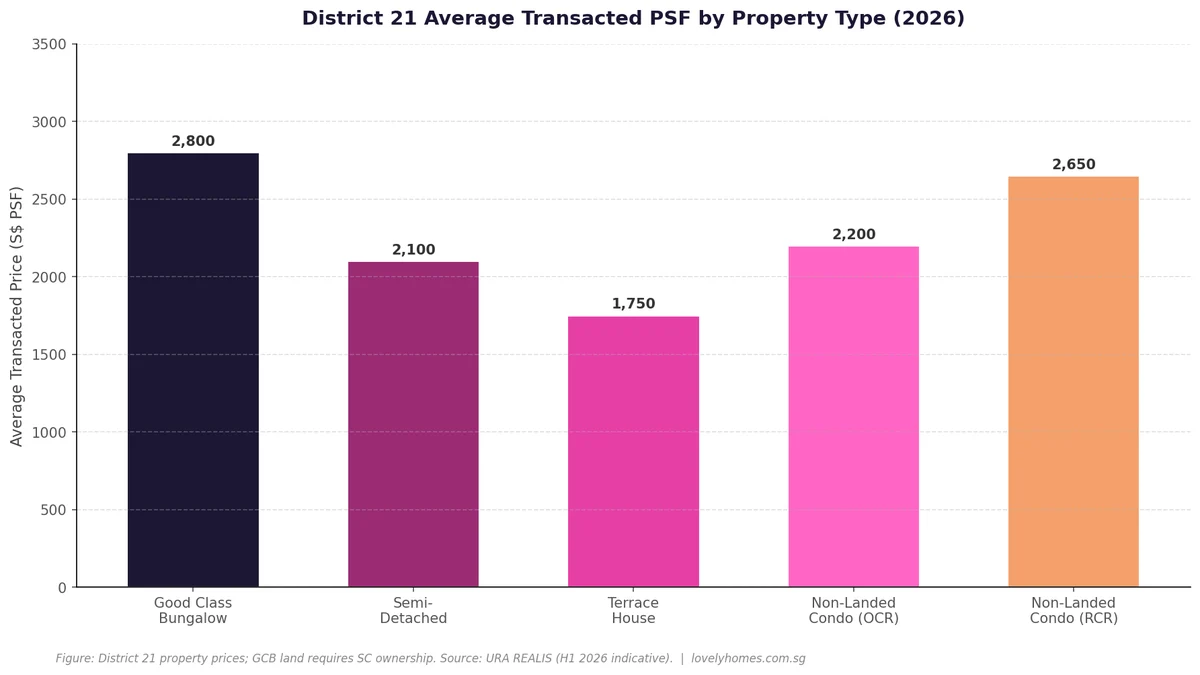
Transaction data for the first half of 2026 shows a clear stratification within D21. Good Class Bungalows — the pinnacle of Singapore’s landed housing market — transact at S$2,600–S$3,200 PSF of land area, with individual deals ranging from S$18 million to above S$60 million for prime Nassim Road and Swiss Club Road plots. These are rare, illiquid, and SC-only assets.
Semi-detached and terrace houses in D21 are more accessible in absolute terms, transacting at S$1,750–S$2,300 PSF of floor area or S$900–S$1,400 PSF of land area. Non-landed condominiums show the widest sub-market variation: projects in the Beauty World corridor (OCR-adjacent) have averaged S$2,100–S$2,300 PSF, while those closer to the Botanic Gardens and Farrer Road (firmly RCR) have achieved S$2,500–S$2,800 PSF in recent transactions.
Rental yields for D21 condominiums average 2.5–3.3% gross, reflecting the premium pricing in this district. The tenant profile is disproportionately weighted towards expatriate families — particularly those from Europe and North America stationed in Singapore — who prioritise school proximity and access to the Bukit Timah Nature Reserve and Holland Village lifestyle corridor.
The School Belt Premium: D21’s Defining Feature
No factor shapes D21 property values more durably than school proximity. The district contains the highest concentration of prestigious primary and secondary schools in Singapore, several of which are consistently oversubscribed and carry a long history of academic excellence.
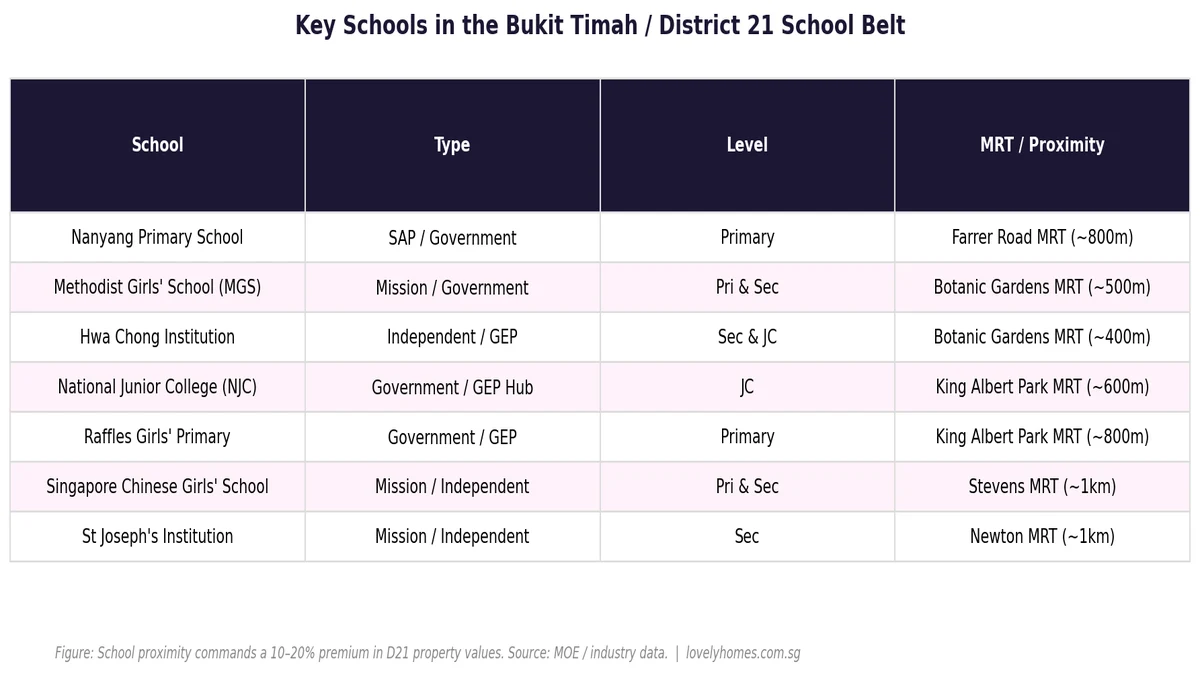
Ministry of Education (MOE) primary school registration rules allocate places in phases — Phase 2B and 2C priority goes to children whose parents live within 1 km and 2 km of the school respectively. For the most sought-after schools in D21 — Nanyang Primary, Methodist Girls’ School, and Raffles Girls’ Primary — the practical effect is that properties within the 1 km circle command a measurable premium: industry estimates suggest 10–20% above comparable properties outside the zone.
For secondary schools and junior colleges, proximity matters less through the registration system (secondary school entry is merit-based via the PSLE score) but continues to drive tenant demand from families with school-age children. International families relocating to Singapore frequently shortlist D21 properties specifically because the area places multiple school options within a single neighbourhood.
This school-belt dynamic provides D21 with a demand floor that is somewhat insulated from broader property market cycles. Even during the 2020 COVID-19 disruption, rental demand in D21 held up more strongly than in many other districts, supported by families unwilling to compromise on school proximity.
Connectivity and Lifestyle Amenities
Connectivity in D21 has improved markedly since the Downtown Line (DTL) opened its Bukit Timah stations. Beauty World MRT (DT5) and King Albert Park MRT (DT6), both on the Downtown Line, provide a direct link to the Central Business District at Marina Bay in under 35 minutes. Farrer Road MRT (CC20) on the Circle Line connects to Orchard Road and Bishan. Botanic Gardens MRT (CC9/DT9) is a Circle Line–Downtown Line interchange.
The upcoming Cross Island Line (CRL) Phase 2, expected to open in the early 2030s, will add a new station at Clementi, creating a second MRT interchange on the EW Line. While this development primarily benefits the western edge of D21, it strengthens the district’s overall rail connectivity and supports long-term infrastructure-driven appreciation.
Lifestyle amenities are well-developed: The Grandstand (former Turf Club), Beauty World Centre, and Bukit Timah Shopping Centre provide neighbourhood retail. Holland Village — adjacent to D21 — offers a mature food and beverage corridor popular with both locals and expatriates. The Bukit Timah Nature Reserve (163 hectares of primary and secondary rainforest) provides residents with rare direct access to green space within a city-state context.
Capital Appreciation: D21’s Historical Track Record
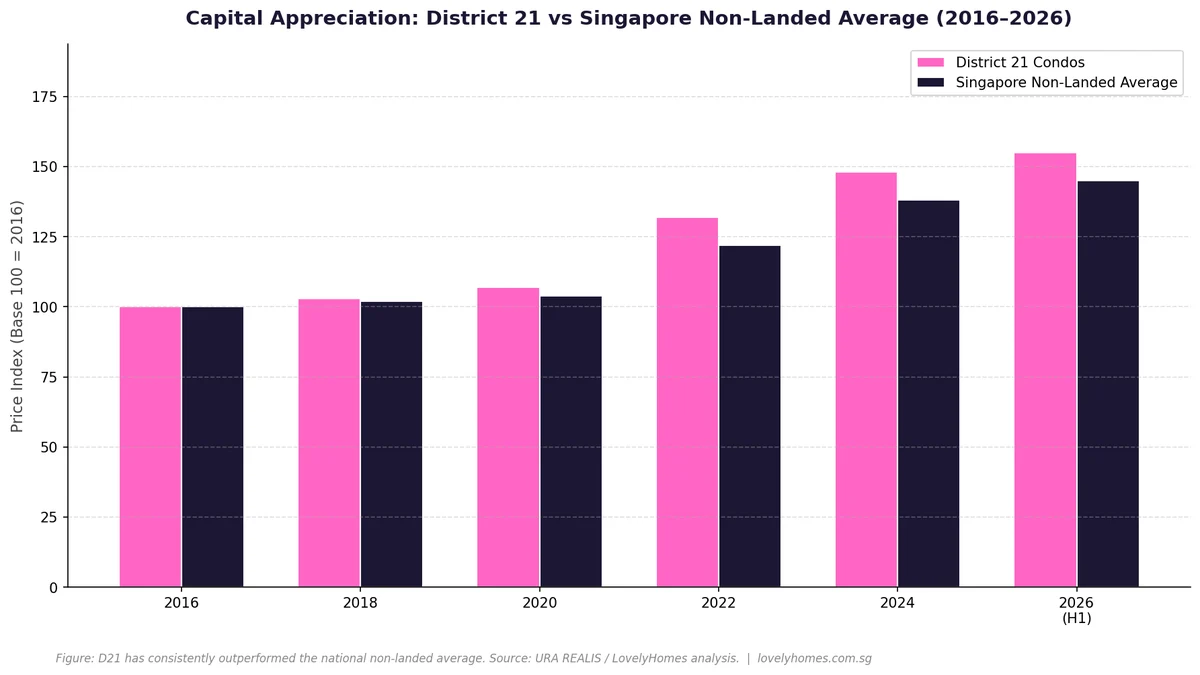
Since 2016, D21 condominium prices have appreciated by approximately 55%, compared to roughly 45% for the Singapore non-landed residential average over the same period. This outperformance is consistent with broader empirical patterns: premium districts with constrained land supply, strong school catchment areas, and diverse buyer demographics tend to outperform mass-market segments through property cycles.
The 2022–2023 cooling measure cycle — which included ABSD rate increases implemented in September 2022 (SC second property raised to 20%; SPR second property to 30%; foreigner rate raised to 60%) — had a pronounced effect on foreign buyer demand across Singapore. D21’s landed segment, being SC-only for GCBs, was partially sheltered from this cooling effect, though the non-landed condo segment saw a dip in foreign interest. Domestic upgrader demand from the HDB resale market, which was simultaneously buoyant, partially offset this headwind.
Summary: District 21 at a Glance
| Attribute | District 21 (Bukit Timah / Holland Road) |
|---|---|
| Sub-districts | Bukit Timah, Holland Road, Clementi Park, Upper Bukit Timah, Toh Tuck |
| URA Planning Area | Bukit Timah Planning Area (partly RCR, partly OCR) |
| Condo avg PSF (H1 2026) | S$2,100–S$2,700 depending on sub-location |
| GCB land PSF | S$2,600–S$3,200 (SC ownership only) |
| Landed avg PSF (Semi-D) | S$1,750–S$2,300 (floor area basis) |
| Rental yield (condo) | 2.5–3.3% gross |
| Primary MRT lines | Downtown Line (DT5, DT6); Circle Line (CC9, CC20) |
| Key schools | Nanyang Primary, MGS, Hwa Chong, NJC, Raffles Girls’ Primary |
| 10-yr capital appreciation (condo) | ~55% (2016–H1 2026); ~10pp above national avg |
| GCB ownership restriction | Singapore Citizens only |
| Upcoming infrastructure | Cross Island Line Phase 2 (Clementi interchange, early 2030s) |
| Key lifestyle draws | Bukit Timah Nature Reserve, Holland Village, Botanic Gardens |
Worked Example: Buying a Condo in District 21
Case Study — Mr & Mrs Lim: Upgrading to a D21 Condo
Profile: Mr Lim (SC, 42) and Mrs Lim (SC, 40), married. They currently own a 5-room HDB flat in Clementi. They plan to sell the HDB flat and purchase a 3BR condo in D21 (near Beauty World). As this will be their only property after the HDB sale, ABSD treatment hinges on the timing of the sale.
Purchase price: S$2,350,000. They have sold the HDB flat; at the time of signing the EC Sales & Purchase Agreement, they no longer own the HDB flat.
Buyer’s Stamp Duty (BSD): administered by IRAS.
- First S$180,000 @ 1% = S$1,800
- Next S$180,000 @ 2% = S$3,600
- Next S$640,000 @ 3% = S$19,200
- Next S$500,000 @ 4% = S$20,000 (S$1M to S$1.5M)
- Next S$850,000 @ 5% = S$42,500 (S$1.5M to S$2.35M)
- Total BSD = S$87,100
ABSD: If they own only the D21 condo after selling the HDB flat, ABSD is Nil (first and only property for SC). However, if the HDB flat has not yet been sold at the time of signing the OTP, ABSD at 20% (S$470,000) would be payable upfront, with a claim for refund after the HDB flat is disposed of within six months (subject to IRAS conditions). Careful transaction sequencing is critical.
Bank loan (75% LTV): S$1,762,500. Assumed rate 3.30%/25 years. Monthly repayment ≈ S$8,557.
Combined monthly income: S$22,000. TDSR: S$8,557 ÷ S$22,000 = 38.9% — PASS (below 55%).
Cash outlay (25% down): S$587,500 (of which 5% cash = S$117,500; balance from CPF).
Total estimated outlay at completion: BSD S$87,100 + cash S$117,500 + legal fees ~S$5,000 = ≈ S$209,600 cash (plus CPF S$470,000 if applicable).
Why District 21 Remains Resilient: The Investment Case
District 21’s investment appeal rests on three structural pillars that are difficult to replicate in other parts of Singapore. First, land supply is fundamentally constrained. The Bukit Timah corridor adjoins the Central Catchment Nature Reserve and the Bukit Timah Nature Reserve — both gazetted protected areas — meaning that new residential land simply cannot be created to the west or north of the existing built-up zone. This supply scarcity underpins the long-term price floor for existing properties.
Second, the school belt generates demand that is not merely a lifestyle preference but a structural feature of how primary school registration works in Singapore. As long as the Phase 2B/2C proximity allocation system remains in place, properties within 1 km of Nanyang Primary, Methodist Girls’ School, or Raffles Girls’ Primary will command a measurable premium. Policymakers have shown no appetite for dismantling this system; if anything, the continued oversubscription of these schools reinforces the relevance of proximity.
Third, D21 benefits from an internationally diverse buyer base. While GCBs are SC-only, the broader condominium stock attracts SPR and foreigner purchasers, as well as SC buyers upgrading from HDB estates. This diversification of demand reduces the district’s dependence on any single buyer segment, providing resilience during cycles when one segment (e.g., foreign buyers) is more constrained by cooling measures.
For comparison, premium residential districts in Hong Kong (e.g., Mid-Levels, Repulse Bay) and in Sydney (e.g., the Eastern Suburbs, North Shore school belt) show similar structural dynamics: constrained supply, education premium, and diverse buyer depth tend to produce above-average long-run appreciation relative to the national index.
Risks and What to Watch
District 21 is not without risk. The primary macroeconomic risk is interest rate sensitivity: at the elevated price points common in D21, a sustained increase in SORA-linked mortgage rates would meaningfully expand the monthly repayment burden and compress buyer affordability. MAS data for 2025–2026 shows that the proportion of property loans at variable rates remains high; any prolonged rate spike could dampen transaction volumes and exert downward pressure on achievable prices.
A second risk is policy risk on ABSD for foreigners. The 60% ABSD rate introduced in April 2023 has materially reduced foreigner purchasing in Singapore’s private condo market. If this rate is further increased — or if equivalent measures are introduced for SPRs — demand from the international buyer segment could compress further, disproportionately affecting the premium districts where foreigners have historically been most active.
Finally, buyers should monitor the quantum of new supply entering D21 and the adjacent RCR. While land is constrained, redevelopment of older strata-titled developments (collective sales or en-bloc activity) can introduce pockets of new supply that temporarily reset achievable prices in specific sub-locations.
What Might Come Next for District 21
The opening of CRL Phase 2 in the early 2030s is the most clearly identified infrastructure catalyst in D21’s near-term horizon. The Clementi–CRL interchange will reduce cross-island travel times significantly, potentially bringing properties in the Upper Bukit Timah sub-area within closer effective proximity to the eastern employment clusters. This is speculative at this stage; buyers acquiring D21 property today should not price in CRL-driven appreciation as a certainty, but it is a plausible medium-term tailwind.
There is ongoing industry debate about whether the GCB land ownership restriction (SC-only) will ever be relaxed. Given that this policy was specifically tightened in 2012 (raising the minimum GCB plot size from 1,400 sqm to 1,400 sqm — unchanged — and reaffirming SC-only ownership), any relaxation would represent a major policy reversal. Most commentators consider this unlikely in the foreseeable future; if it did occur, the GCB market could see significant foreign demand, potentially re-pricing the entire D21 landed market upwards. Again, this is speculative; buyers should not rely on this scenario.
Frequently Asked Questions
Can foreigners buy a condo in District 21?
Yes — foreigners can purchase non-landed private condominiums in District 21 (or anywhere in Singapore that is not a restricted residential property). The Additional Buyer’s Stamp Duty (ABSD) rate for foreigners is currently 60% of the purchase price, administered by IRAS. This rate, introduced in April 2023, significantly increases the effective cost for foreign buyers. Good Class Bungalows (GCB) in D21 are categorised as restricted residential properties and can only be owned by Singapore Citizens; foreigners cannot purchase GCBs under any circumstances.
What defines a Good Class Bungalow (GCB) and why are they SC-only?
A Good Class Bungalow is a detached house situated in one of 39 designated GCB areas in Singapore, with a minimum plot area of 1,400 sqm. GCBs are classified as restricted residential properties under the Residential Property Act (Cap. 274). The SC-only restriction is a deliberate policy designed to ensure that this premium landed housing category — representing the most exclusive residential land in Singapore — remains accessible to citizens. Foreign nationals wishing to purchase a bungalow in Singapore may do so only on Sentosa Cove (subject to government approval), and even there cannot purchase GCBs.
How does school proximity affect property prices in D21?
School proximity affects D21 prices through Singapore’s primary school registration system. MOE Phase 2B and Phase 2C registration gives priority to children whose parents live within 1 km and 2 km of the school respectively. For oversubscribed schools such as Nanyang Primary, Methodist Girls’ School, and Raffles Girls’ Primary — all located in or immediately adjacent to D21 — the 1 km priority zone is consistently oversubscribed. Academic research and market data consistently show that properties within these zones command a 10–20% premium over otherwise comparable units outside the zone. This premium is a structural, persistent feature of D21 pricing rather than a cyclical phenomenon.
Is District 21 considered OCR or RCR?
District 21 straddles both sub-markets. Properties close to Farrer Road MRT, Botanic Gardens, and the Holland Road corridor are generally classified as Rest of Central Region (RCR), while those in the Beauty World and Upper Bukit Timah areas are classified as Outside Central Region (OCR). In practice, the RCR–OCR boundary runs broadly through the middle of D21. RCR properties command a price premium over OCR properties of a similar specification, reflecting proximity to the core central area. Buyers should verify each specific address’s classification using URA’s property market data portal.
What is the typical rental yield for a D21 condo?
Gross rental yields for non-landed condominiums in District 21 average 2.5–3.3% per annum as of H1 2026. The wide range reflects the significant variation in absolute prices — a S$2.5 million 3BR unit renting for S$6,500/month yields roughly 3.1%, while a S$3.5 million 4BR unit renting for S$8,500 yields approximately 2.9%. Net yields, after accounting for property tax, condo management fees, agent fees, and vacancy periods, typically run 1.5–2.2 percentage points lower than gross. D21 rentals are sustained by consistent demand from expatriate families, particularly in years when MNC hiring in Singapore is buoyant.
Are there any en-bloc opportunities in District 21?
D21 has seen periodic collective sale (en-bloc) activity, particularly among older condominium developments built in the 1980s and 1990s. Successful en-bloc sales require 80% of owners (by share value and strata lot) to agree, and the collective sale price must be at a premium to the open market individual unit price to incentivise consent. The cycle of en-bloc activity in Singapore broadly tracks the property market cycle; when developer demand for redevelopable sites is strong (typically during periods of robust condo sales), the probability of D21 en-bloc launches increases. Buyers interested in en-bloc potential should focus on older freehold or long-leasehold developments with relatively low plot ratios that are below the current Gross Plot Ratio (GPR) permitted under the URA Master Plan 2025.
What due diligence should I conduct before buying in D21?
Buyers in D21 should check: (1) the remaining lease (freehold vs 99-year leasehold — a material distinction given D21’s price quantum); (2) the development’s maintenance track record and sinking fund balance (obtainable from the MCST); (3) the property’s precise URA sub-market classification (RCR vs OCR) and zoning under the Master Plan 2025; (4) flood risk — parts of the Bukit Timah watershed have historically experienced flash flooding, and buyers should check NEA flood risk maps; (5) the GCB area boundary — if purchasing a landed property near a GCB zone, confirm whether the specific plot is or is not classified as GCB, as this determines ownership eligibility and planning conditions; and (6) any development charge or differential premium that may be payable if the buyer intends to redevelop or seek planning permission for a larger built-up area.
Disclaimer: This article is for general information purposes only and does not constitute financial, property, or legal advice. All price data and market statistics quoted are derived from URA REALIS and industry sources and are indicative only; individual property transactions will differ materially. Property prices, rental yields, ABSD rates, and eligibility rules are subject to change by the government. Readers should verify all factual claims with URA (ura.gov.sg), HDB (hdb.gov.sg), IRAS (iras.gov.sg), and SLA (sla.gov.sg) and consult a licensed property agent and qualified solicitor before making any purchase. All figures are in Singapore Dollars (SGD). LovelyHomes does not provide property agency services and does not receive referral commissions from developers or agencies.