Singapore HDB Minimum Occupation Period (MOP) 2026: Complete Guide — Rules, Restrictions and Upgrade Options

Singapore HDB Minimum Occupation Period (MOP) 2026: Complete Guide — Rules, Restrictions and Upgrade Options

Quick Answer: HDB MOP Singapore 2026

  • Standard HDB BTO and resale flats have a 5-year Minimum Occupation Period (MOP) counted from the date you collect the keys (TOP/possession date), not from when you sign the Sales & Purchase agreement.
  • Plus and Prime (PLH) classification flats introduced from the August 2024 BTO exercise have a longer 10-year MOP, reflecting their more desirable locations and heavier subsidy.
  • During MOP, you cannot sell your flat, rent out the entire flat, or purchase any other residential property in Singapore — including private property or an overseas residential investment.
  • You CAN rent out individual HDB bedrooms with prior HDB approval, and run approved home-based businesses from your flat during MOP.
  • Executive Condominiums (ECs) have a 5-year MOP before they can be sold to Singapore Citizens and PRs, and a 10-year window before they are fully privatised and open to foreign buyers.
  • Breaching MOP rules can result in compulsory acquisition of the flat by HDB at a value set by HDB — typically below market value. Criminal penalties may also apply under the Housing & Development Act.
  • After MOP, you can sell the flat, upgrade to a private property, and — for HDB sellers upgrading to private — apply for ABSD remission if you complete the sale within 6 months of purchasing the private property.

What Is the HDB Minimum Occupation Period (MOP)?

The Minimum Occupation Period (MOP) is a statutory rule administered by the Housing & Development Board (HDB) that requires flat owners to physically occupy their HDB flat for a minimum period before they can sell it on the open market, rent it out entirely, or purchase other residential property in Singapore. The MOP is a key plank of Singapore’s public housing philosophy: HDB flats are subsidised national assets intended primarily as homes rather than investment vehicles, and the MOP is one mechanism through which HDB ensures flats remain owner-occupied.

The MOP was first introduced in the 1970s and has been refined multiple times since, most recently in 2024 with the introduction of the Plus and Prime flat classifications under the enhanced HDB framework. Understanding which MOP applies to your flat — and what you can and cannot do during that period — is critical before making any property decisions.
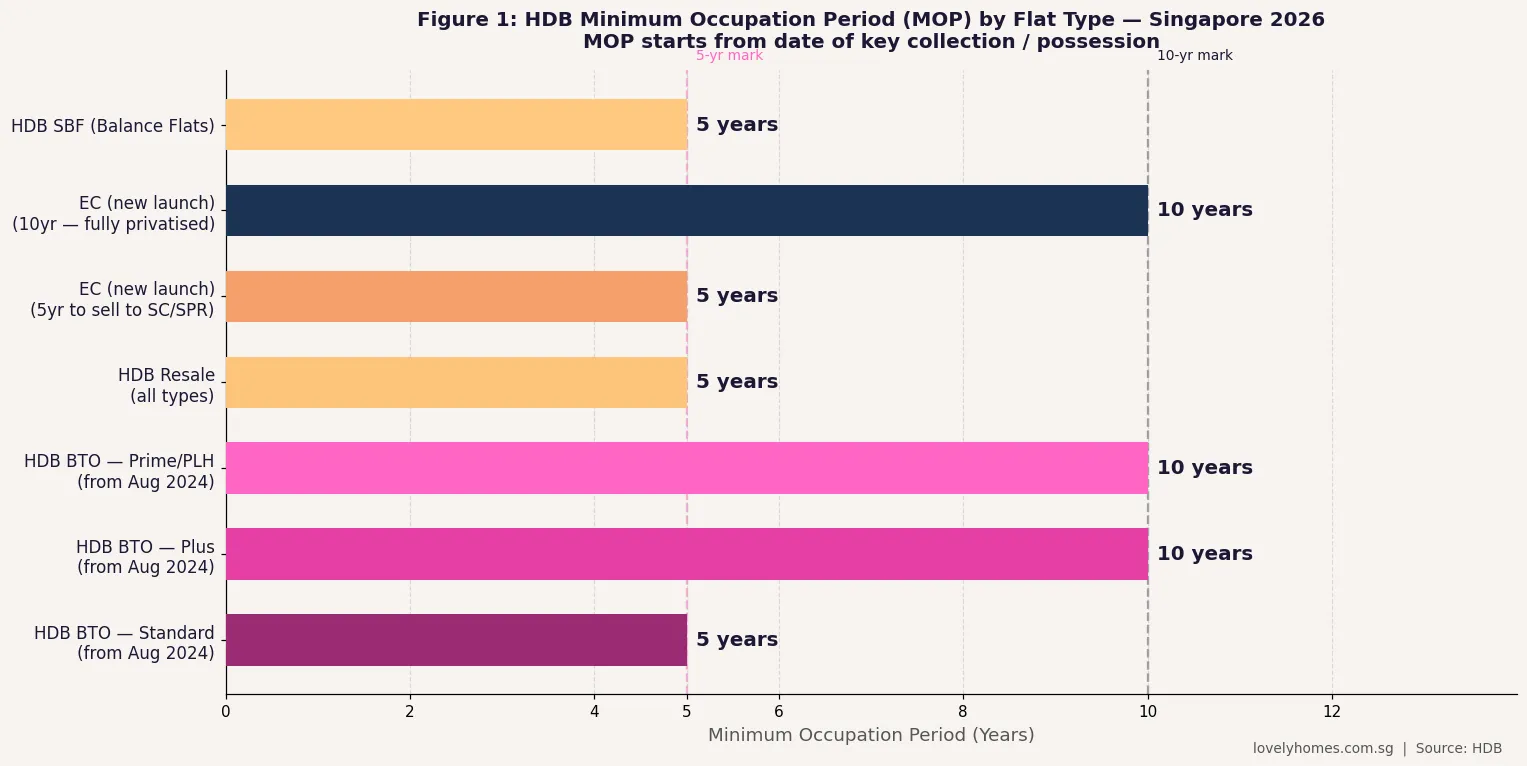
HDB MOP by flat type Singapore 2026 — Standard 5 years, Plus and Prime 10 years, EC 5 then 10 years
Figure 1: HDB Minimum Occupation Period by flat type, Singapore 2026. Plus and Prime classification flats (introduced from August 2024 BTO exercise) carry a 10-year MOP, double the Standard flat MOP. Source: HDB.

MOP Duration by Flat Type (2026)

Flat Type MOP Duration MOP Start Date Notes
Standard BTO Flat 5 years Date of key collection Applies to all pre-Aug 2024 BTO; continued for Standard classification from Aug 2024
Plus Classification BTO Flat 10 years Date of key collection From Aug 2024 BTO exercise; typically near MRT/town centres; subsidy clawback on resale
Prime / PLH Classification BTO Flat 10 years Date of key collection Central-location flats; subsidy clawback ~6–9% of resale price; income ceiling at resale
HDB Resale Flat 5 years Date of resale completion Fresh 5-year MOP runs from the date the resale transaction is completed (not from when the previous owner moved in)
Executive Condominium (EC) 5 years → 10 years Date of TOP At 5yr can sell to SC/PR; at 10yr fully privatised — open to foreigners (60% ABSD applies)
HDB Sale of Balance Flats (SBF) 5 years Date of key collection SBF flats unsold from previous BTO exercises; Standard classification MOP applies

Important note on the Plus and Prime MOP: The new 10-year MOP for Plus and Prime flats applies only to flats launched under the August 2024 BTO exercise onwards. Flats purchased in earlier exercises, even if they are in desirable locations that would now be classified as Plus or Prime, retain their original 5-year MOP. To confirm which classification applies to your flat, check your HDB flat portal or the original flat details under your BTO exercise.

What You Cannot Do During the HDB MOP
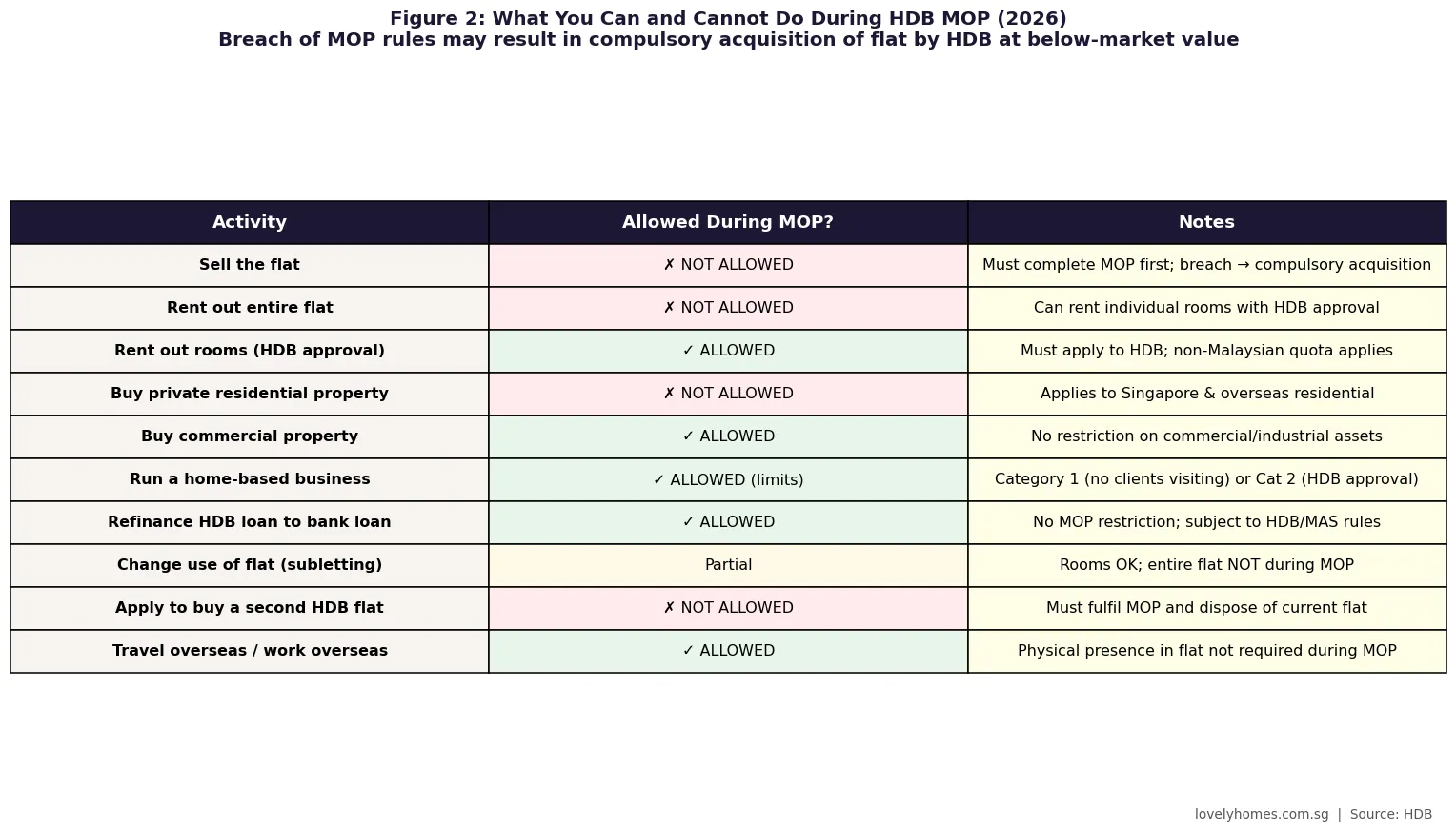
HDB MOP rules matrix 2026 — what you can and cannot do during the minimum occupation period
Figure 2: HDB MOP rules — allowed and prohibited activities during the Minimum Occupation Period. Source: HDB Housing & Development Act.

Selling the Flat

You cannot sell your HDB flat on the open resale market before your MOP is complete. This applies even if you face financial hardship — HDB does not grant MOP exemptions for distressed sellers. The only exception is a compulsory acquisition by HDB or by the State for public purposes, which is not initiated by the flat owner. If you attempt to sell before MOP, the transaction will be rejected by HDB’s system during the eligibility check.

Renting Out the Entire Flat

Renting out the entire flat (as a whole unit) is not allowed during MOP. This applies to both short-term and long-term rental arrangements. Platforms such as Airbnb and similar short-term rental services are also not permitted on HDB flats — the minimum lease tenure for any rental on HDB flats is three consecutive months. After MOP, whole-flat rental is allowed with HDB prior approval and is subject to the non-Malaysian foreign tenant quota.

Purchasing Other Residential Property in Singapore

During MOP, you and your co-owners on the flat cannot purchase any other private residential property in Singapore. This restriction extends to new launch condominiums, resale condominiums, Executive Condominiums (as a new buyer), landed property, and private apartments. Purchasing a second HDB flat is also not allowed during MOP.

Crucially, HDB’s definition of “residential property” in the MOP context refers to Singapore property only. There is no restriction on purchasing overseas residential property during MOP — only Singapore residential property is covered.

Purchasing a Second HDB Flat

HDB’s policy generally allows only one HDB flat per family nucleus at any time. Applying for a second BTO, SBF, or resale flat during MOP is not permitted. Once MOP is fulfilled, you may apply for a second HDB flat under specific schemes (e.g., the Studio Apartment scheme for elderly, or a new BTO after disposing of the first flat).

What You CAN Do During the HDB MOP

Rent Out Individual Rooms

Renting out individual bedrooms in your HDB flat (while you continue to live in the flat) is permitted during MOP, subject to HDB’s prior written approval. You must apply through the HDB Flat Portal before subletting. Each tenancy must be for a minimum of six months (for whole-flat subletting after MOP) or at least three months for room rental. Non-Malaysian foreign tenants are subject to the non-Malaysian quota: a maximum of two non-Malaysian foreign tenants per flat in the same block is the guideline, though HDB publishes real-time quota data by block.

Run Approved Home-Based Businesses

HDB permits flat owners to operate home-based businesses during MOP, subject to type and scale restrictions. Category 1 businesses (no employees visiting, no clients visiting, no signage) are allowed without prior approval. Category 2 businesses (up to two non-resident employees, clients may visit in small numbers) require prior approval from HDB. Manufacturing, food businesses, or any business that involves goods storage, noise, or frequent deliveries is not permitted.

Refinance to a Bank Loan

Switching from an HDB housing loan to a bank loan (or switching between bank loan packages) is allowed during MOP. There is no MOP restriction on refinancing decisions, and many flat owners take advantage of the 5-year MOP period to monitor interest rate movements and refinance when rates are favourable. MAS’s LTV and TDSR rules govern the refinancing terms.

When Does the MOP Start and End?

The MOP starts from the date you collect your keys (for BTO and SBF flats, this is the TOP date; for resale flats, this is the date of completion of the resale transaction — both milestones are reflected in your HDB Flat Portal). The MOP does not start from the date you sign the Sales & Purchase Agreement or from the date you pay the initial booking fee.

You can check your MOP end date in the HDB Flat Portal under “My Flat” → “Purchase Details”. The portal clearly shows whether your MOP has been fulfilled. Do not rely on verbal estimates from agents or CPF advisers — always verify on the portal directly.

One nuance: physical occupation is expected during MOP. HDB conducts periodic checks to ensure flat owners are residing in the flat. Extended overseas absences without HDB’s knowledge have been cited in compulsory acquisition cases. If you must be overseas for an extended period (e.g., for work), inform HDB and keep the flat in a lived-in condition.

Executive Condominium (EC): The Hybrid MOP Rules
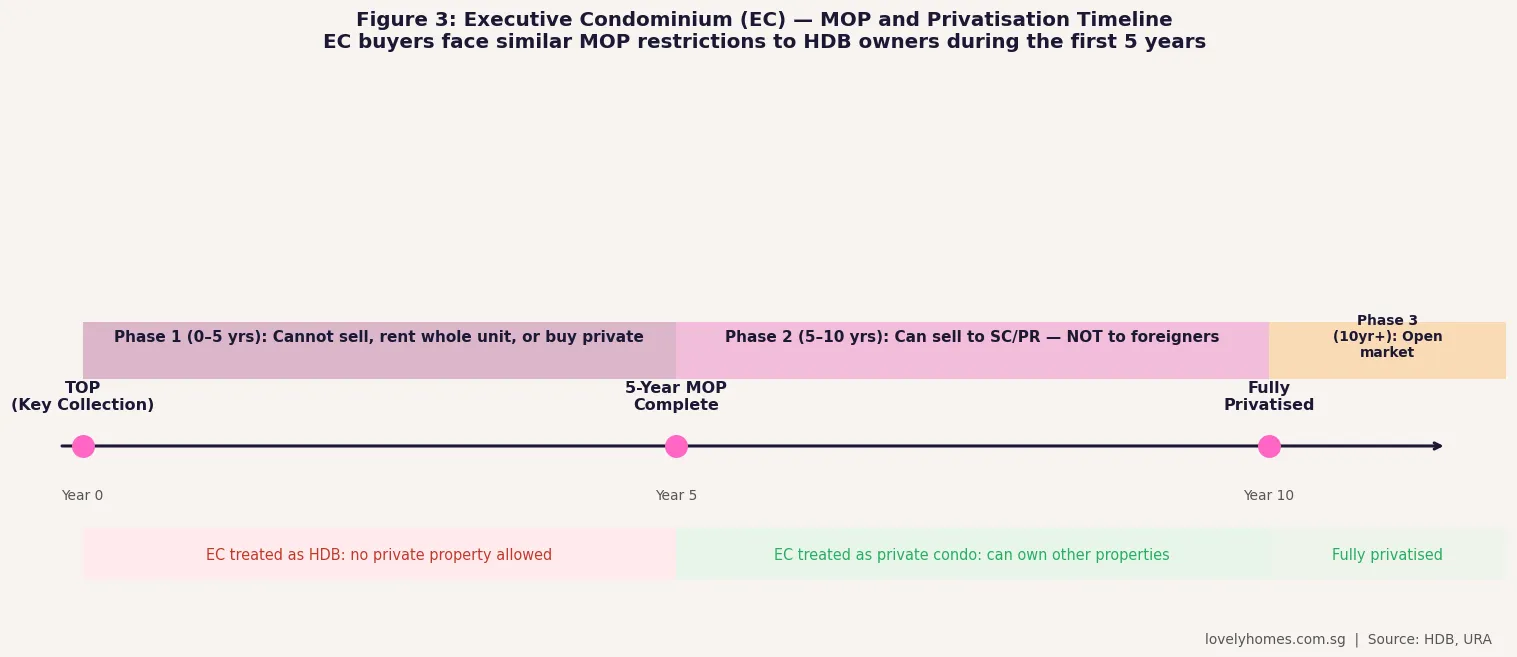
Executive Condominium EC MOP and privatisation timeline Singapore 2026 — 5-year and 10-year milestones
Figure 3: Executive Condominium MOP and privatisation timeline. During the first 5 years, EC owners face HDB-equivalent MOP restrictions. At the 5-year mark, ECs can be sold on the open market to SC and PR buyers. At 10 years, ECs are fully privatised and open to foreign buyers (60% ABSD applies). Source: HDB, URA.

Executive Condominiums occupy a hybrid position between public and private housing. They are built by private developers but are sold at a subsidised price to qualifying buyers (income ceiling S$16,000 per month household income as of 2026). From a MOP standpoint, ECs are treated like HDB flats for the first 5 years:

During years 1–5: EC owners cannot sell their unit, rent out the whole unit, or purchase any other Singapore residential property. The rules are identical to HDB MOP. Critically, the 5-year MOP runs from the TOP date, not the booking date — for large EC projects, this can mean a 3–4 year gap between booking and TOP, followed by 5 more years of MOP, making the effective holding period 8–9 years from initial purchase commitment.

After year 5 (first privatisation): The EC can be sold on the open resale market to Singapore Citizens and Singapore PRs. It cannot yet be sold to foreigners, and ECs in the first 5–10 year window are not listed on the private market as “privatised condos” — they trade in a narrower SC/SPR market. ABSD rules for the buyer apply (5% for PR 1st property, 30% for PR 2nd+, etc.).

After year 10 (full privatisation): The EC is fully privatised and treated identically to a private condominium. Foreigners may purchase it, though the 60% foreigner ABSD applies. Owners may also rent the entire unit without prior HDB approval at this stage.

Plus and Prime Flat Additional Restrictions After MOP

The 2024 housing framework introduced substantive additional conditions for Plus and Prime classification flats beyond just the longer 10-year MOP. These are restrictions that run with the flat even after MOP and affect future resale:

Subsidy clawback: When you sell a Plus or Prime flat after your MOP, HDB claws back a portion of the subsidy embedded in the original purchase price — approximately 6–9% of the resale price, payable to HDB. This clawback is calculated as a percentage of the resale transaction price, not the original purchase price, so it increases in dollar terms as the flat appreciates.

Income ceiling for buyers: Buyers of Plus and Prime resale flats are subject to an income ceiling (the ceiling is the same as for BTO buyers — S$14,000/month for 4-room and larger Plus flats as of 2026). This narrows the pool of eligible resale buyers and may dampen price appreciation relative to Standard flats.

Ethnic Integration Policy (EIP): As with all HDB resale flats, EIP quotas apply — both block and neighbourhood levels. Buyers must check the relevant block’s EIP availability before submitting an offer.

After MOP: Your Property Upgrade Options

Once your MOP is fulfilled, your options expand significantly. The most common upgrade path is from HDB flat to private condominium. The timing of this upgrade carries stamp duty implications:

Option A — Sell HDB first, then buy private: You clear the HDB flat, receive sale proceeds (net of CPF refund), and purchase the private property as a “first property” — no ABSD for SC buyers, 5% ABSD for PR buyers. This is the most common and financially efficient path but requires temporary accommodation between the two transactions.

Option B — Buy private first, then sell HDB (concurrent ownership): As an SC buying private property while still owning an HDB flat (post-MOP), you pay 20% ABSD on the private property purchase. You then have six months from the private property’s completion (or from the purchase date for resale private properties) to sell the HDB flat and apply for an ABSD remission from IRAS. If the HDB is sold within six months, IRAS refunds the 20% ABSD. If you miss the six-month window, the 20% ABSD is forfeited.

The six-month window starts from either the issue of Temporary Occupation Permit (TOP) for a new private property or the date of exercise of the OTP for a resale private property. Given the complexity of timing, many HDB upgraders consult a lawyer and financial adviser before committing to Option B.

The 15-Month Wait-Out Period: From Private Back to HDB

The wait-out period is often confused with MOP. They are different rules targeting different situations. The 15-month wait-out period (introduced in September 2022) applies to private property owners who want to purchase an HDB resale flat. If you own or recently disposed of a private property, you must wait 15 months from the date of disposal before you can purchase an HDB resale flat.

This rule does not apply to HDB MOP — it is a separate downstream restriction. For example, if you complete your HDB MOP, sell your HDB flat, buy a private condo, and then later want to downgrade back to HDB, you must wait 15 months after selling the private condo before buying an HDB resale flat. This rule applies to both SC and PR private property owners.

Worked Example: The Tan Family’s Upgrade Journey

Mr and Mrs Tan (both Singapore Citizens) purchased a 4-room BTO flat in Punggol under the Standard classification in September 2019. They collected their keys in August 2021. Their MOP end date is therefore August 2026 — five years from key collection.

In March 2026, Mrs Tan checks the HDB portal and sees MOP will end in 5 months. The couple begin their private condo search. They find a 3-bedroom OCR resale condo in Jurong East priced at S$1.5M in June 2026.

They choose Option B (buy private first). As SC buying a second property: BSD ~S$42,600 + ABSD 20% = S$300,000. They pay S$342,600 in stamp duties. Their flat is still within MOP (keys August 2021, MOP August 2026 — they are just before MOP end), so HDB must confirm MOP end before they list the flat for sale.

After August 2026 (MOP fulfilled), they list their HDB flat. Sell it in October 2026 for S$780,000 — within the 6-month window from the condo OTP exercise date of June 2026. IRAS refunds the S$300,000 ABSD. Net stamp duty retained: S$42,600 BSD only. The family books temporary accommodation for 2 months while bridging the purchase and sale timelines.

Total net proceeds from HDB: S$780,000 − CPF refund S$220,000 (principal + accrued interest) − agent 1% S$7,800 − legal S$2,500 = net S$549,700 cash. The upgrade is financially viable.

Will MOP Rules Change?

The 10-year MOP for Plus and Prime flats is a relatively recent policy (from August 2024) and unlikely to be rolled back in the near term. If anything, the trend in Singapore public housing policy has been toward tightening MOP and adding post-MOP conditions rather than relaxing them, as the government works to ensure HDB flats remain primary homes rather than investment properties. The subsidy clawback mechanism for Plus and Prime flats may be extended to more flat types if HDB determines that Standard flat resale prices are diverging too sharply from BTO prices in certain areas. Buyers should model their long-term exit strategy under current rules and build in buffer for possible tightening.

Frequently Asked Questions

Can I stay overseas during my HDB MOP?

You are expected to physically occupy the flat during MOP, but there is no absolute rule against overseas travel. Extended absences (months or years) without HDB’s knowledge can attract scrutiny, and in confirmed cases of non-occupation, HDB may commence compulsory acquisition proceedings. If you need to relocate overseas temporarily for work (e.g., on a company secondment), inform HDB in writing and keep the flat utilities active. HDB conducts inspection exercises and spot checks and has compulsorily acquired flats where owners were clearly not residing in them during MOP.

Does my MOP reset if I add or remove an owner from the flat?

No — adding or removing an owner (for example, through marriage or divorce) does not reset the MOP clock. The MOP continues to run from the original key collection date. However, any change of ownership within MOP is a restricted transaction and must be approved by HDB. Not all ownership changes are approved during MOP — for example, transferring a flat to an ineligible person would be rejected. Consult HDB or a lawyer before any ownership change within the MOP window.

Can I buy an overseas investment property during MOP?

Yes. The HDB MOP restriction applies only to Singapore residential property. There is no restriction on purchasing overseas property (residential or commercial) during MOP. You are not required to declare overseas property purchases to HDB. However, if you are financing an overseas property purchase with a Singapore bank loan, that loan will be factored into your TDSR for future Singapore loan applications. From a Singapore tax perspective, rental income from overseas property is taxable in Singapore as foreign-sourced income if remitted to Singapore.

What happens if I breach the MOP?

A breach of MOP (typically: selling the flat, subletting the entire flat, or buying other residential property in Singapore without completing MOP) can result in HDB compulsorily acquiring the flat. HDB sets the acquisition price, which is typically the assessed market value minus a penalty deduction — in practice, this means the owner receives significantly less than the open-market value they would have received after MOP. In the most serious cases involving deliberate deception or fraud (e.g., falsely declaring occupancy), criminal charges may be brought under the Housing & Development Act, which carries fines of up to S$5,000 and/or imprisonment.

Does MOP apply to inherited HDB flats?

If you inherit an HDB flat from a deceased owner, the MOP of the original owner does not transfer to you as a fresh 5-year obligation. Instead, the inherited flat is subject to HDB’s estate rules — the eligible inheritor (e.g., a spouse or child who meets eligibility criteria) may retain the flat. If the inheritor already owns a flat, they may need to dispose of one within six months. Inherited flats that have not yet met MOP at the time of death are subject to HDB’s direction — in practice, HDB often allows the eligible inheritor to complete the remaining MOP. Always consult HDB’s estate administration team for inherited flat cases.

Can I buy a private property if my HDB is still within MOP and my spouse is not on the HDB title?

No — the restriction applies to the entire family nucleus (owner and spouse / co-habitant), not just the named owners on the HDB title. If one spouse is within MOP on an HDB flat, the other spouse (even if not on the HDB title) is also restricted from purchasing Singapore residential property. HDB looks at the family nucleus holistically. Attempting to buy private property in a non-owning spouse’s name to circumvent MOP is a known scheme that HDB and IRAS are alert to — it will be scrutinised and may result in both the stamp duty assessment and a referral for investigation.

Is there a MOP for HDB shophouses or commercial units?

No. MOP is specific to HDB residential flat units. HDB shophouses (commercial properties on the ground floor of HDB blocks) are governed by different rules and do not carry a MOP. Commercial properties generally do not have any MOP equivalent — you can sell or rent them freely at any time after purchase. The restrictions and ABSD rules that apply to residential property do not apply to commercial property purchases.

Related Articles

Disclaimer

This article provides general information about HDB MOP rules as at July 2026 and is not legal or financial advice. MOP durations, clawback percentages, and related policy conditions may change. Always verify current MOP status for your flat at hdb.gov.sg and check the specific BTO exercise details in your Lease Agreement. For estate planning, inheritance, and structural ownership changes, consult a Singapore-qualified lawyer. For ABSD remission eligibility, consult IRAS at iras.gov.sg.

Singapore HDB Ethnic Integration Policy (EIP) 2026: Quotas, SPR Limits and How It Affects Your Flat Purchase

Singapore HDB Ethnic Integration Policy (EIP) 2026: Quotas, SPR Limits and How It Affects Your Flat Purchase

When you decide to buy an HDB resale flat in Singapore, you may encounter an unusual hurdle that has no equivalent in most other housing markets: your ethnicity matters. The Ethnic Integration Policy (EIP), administered by the Housing & Development Board (HDB) since 1 March 1989, sets maximum proportions for each of Singapore’s three broad ethnic categories — Chinese, Malay, and Indian & Others — at both the block and neighbourhood level. If the sale of a flat would push the proportion of your ethnic group beyond the designated quota, HDB will not approve the transaction.

Understanding the EIP — how it works, who it affects, when a block is quota-full, and how the related Singapore Permanent Resident (SPR) Quota interacts with it — is essential for any resale HDB buyer, seller, or property professional in 2026.

Quick Answer — Key Takeaways

  • The EIP sets maximum ethnic proportions at two levels: the block (individual HDB building) and the neighbourhood (surrounding precinct).
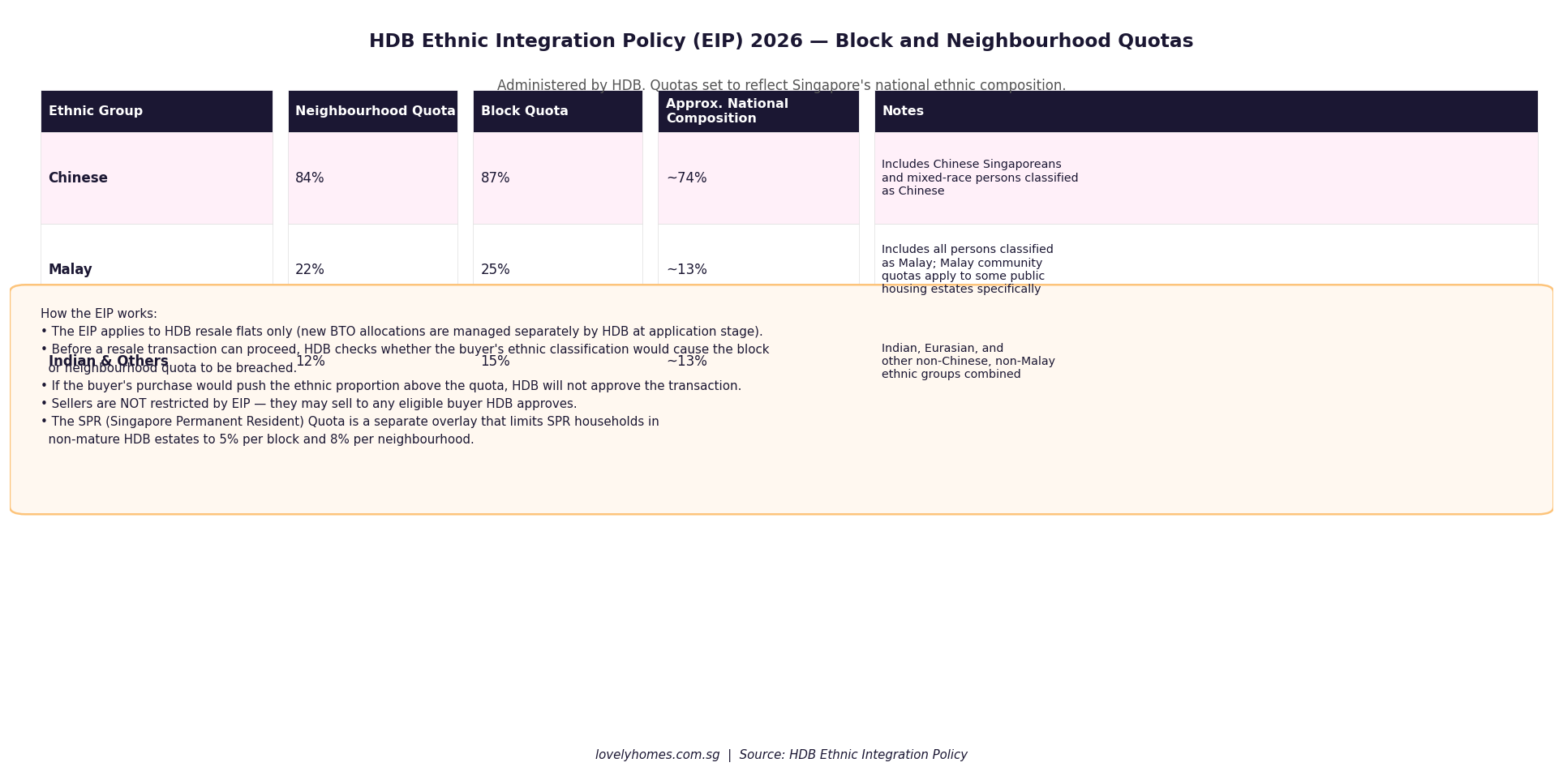
  • Current quotas: Chinese up to 87% (block) / 84% (neighbourhood); Malay up to 25% (block) / 22% (neighbourhood); Indian & Others up to 15% (block) / 12% (neighbourhood).
  • EIP applies only to HDB resale transactions — not to new BTO flat applications, which are managed separately.
  • A buyer whose ethnic group has exceeded the block or neighbourhood quota cannot purchase a resale flat in that block or neighbourhood until the proportion drops back below the limit.
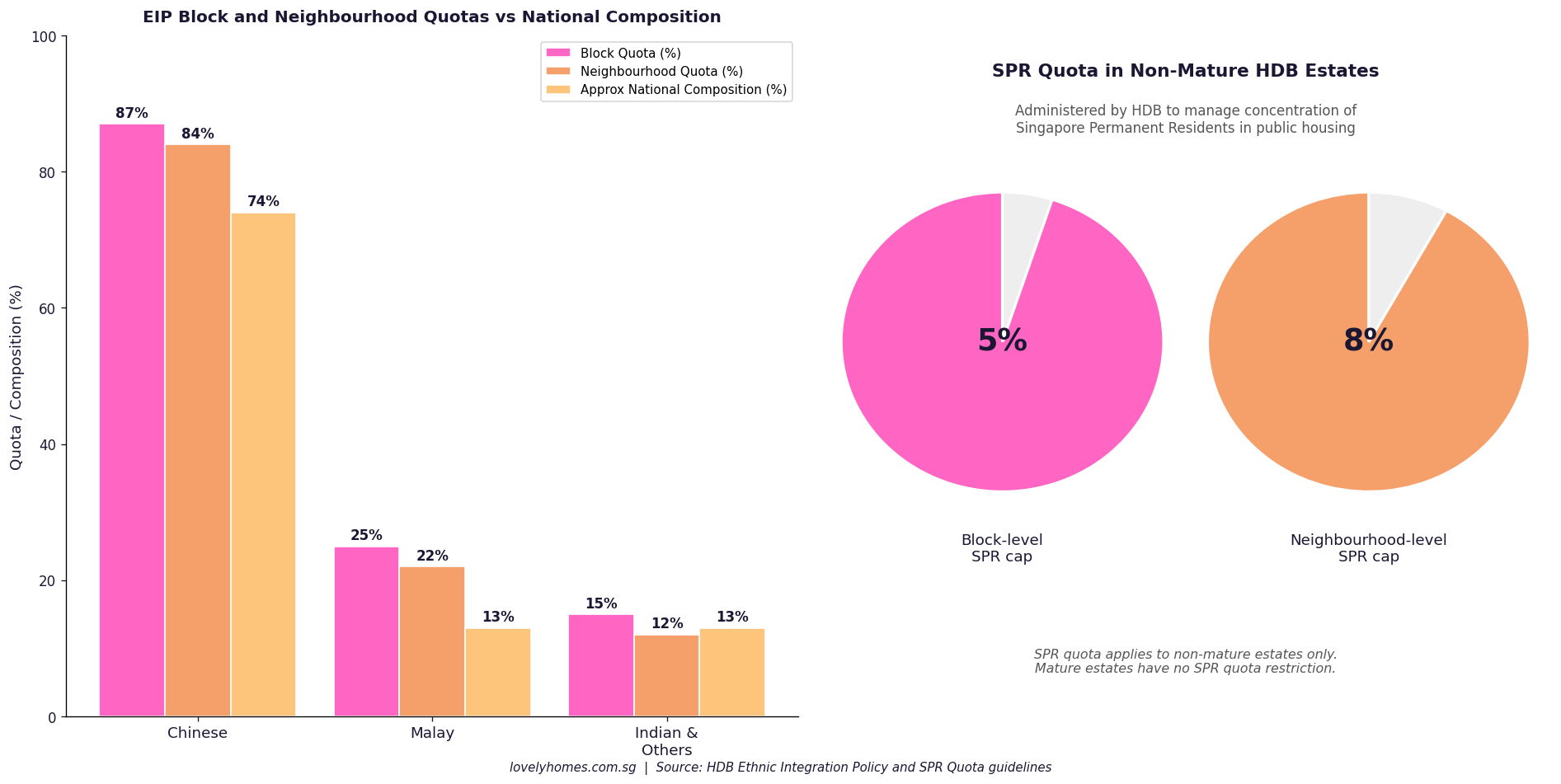
  • The SPR Quota is a separate restriction: SPR households are limited to 5% of units in any block and 8% in any neighbourhood in non-mature HDB estates.
  • Sellers can sell to any ethnically eligible buyer — the EIP restricts buyers, not sellers.
  • A flat in a quota-full block may be priced lower than comparable units in non-restricted blocks, as the pool of eligible buyers is smaller.
  • You can check whether a specific block is EIP- or SPR-quota-full using HDB’s online e-service before making an offer.

What Is the Ethnic Integration Policy?

The EIP was introduced by the Singapore government in 1989, during a period when natural market forces were producing ethnic concentration in certain HDB estates — reversing the government’s longstanding policy of distributing ethnic groups evenly across public housing. Before 1989, resale transaction patterns had allowed Chinese Singaporeans to cluster in newer, higher-demand estates, while Malay and Indian households remained concentrated in older estates. The EIP was HDB’s mechanism to enforce ethnic integration as a social policy objective, reflecting Singapore’s commitment to multiracialism as a founding principle of the nation.

The policy is administered by HDB under the Housing and Development Act. HDB sets the quota limits and updates them periodically (though they have been broadly stable for many years) based on Singapore’s national ethnic composition as measured by the Department of Statistics Singapore (SingStat).

EIP Block and Neighbourhood Quotas — The Numbers

HDB Ethnic Integration Policy 2026 block and neighbourhood quotas for Chinese Malay Indian Singapore
Figure 1: EIP Block and Neighbourhood Quotas (2026) versus approximate national ethnic composition. Source: HDB Ethnic Integration Policy guidelines; SingStat population data.

The current EIP quotas are set above the national composition to give headroom for natural movement while still preventing concentration. A block is considered quota-full for a particular ethnic group when adding one more household of that group would breach the block-level cap. At that point, only buyers of a different ethnic group (or mixed-race buyers whose reported ethnicity is in a different category) can purchase units in that block until existing residents move out and reduce the proportion.

The two-tier system (block + neighbourhood) means a buyer might face no restriction at the neighbourhood level but encounter a quota-full block — or vice versa. Both must be satisfied before HDB will approve the transaction.

Ethnic Group Block Quota Neighbourhood Quota Who Is Counted
Chinese 87% 84% SC and SPR registered as Chinese
Malay 25% 22% SC and SPR registered as Malay
Indian & Others 15% 12% SC and SPR registered as Indian, Eurasian, or Others
SPR Households (non-mature estates) 5% 8% SPR-only households (no SC members) — non-mature estates only

Who Is Affected and How?

HDB EIP and SPR Quota buyer eligibility matrix 2026 — SC SPR foreigner affected or not
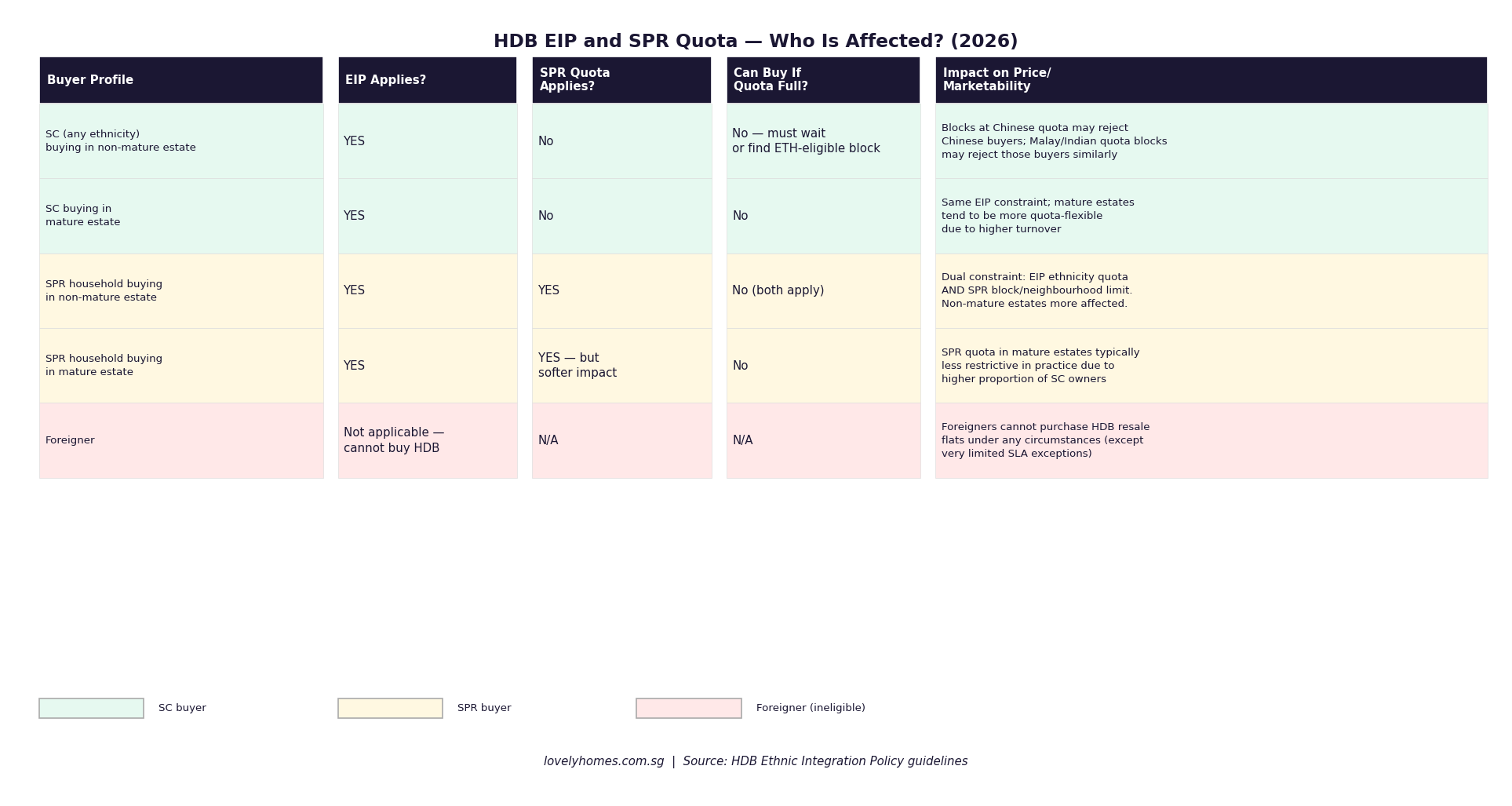
Figure 2: Matrix showing how the EIP and SPR Quota affect different buyer profiles in 2026. Source: LovelyHomes editorial based on HDB guidelines.

The SPR Quota — A Separate Overlay

HDB SPR Quota 2026 — 5% block and 8% neighbourhood cap for Singapore Permanent Residents non-mature estates
Figure 3: SPR Quota limits for non-mature HDB estates: 5% per block and 8% per neighbourhood. The SPR Quota is separate from and additional to the EIP ethnic quotas. Source: HDB Singapore.

The Singapore Permanent Resident (SPR) Quota was introduced in 2010 and is a distinct policy from the EIP, though both are administered by HDB. The SPR Quota limits SPR-only households to 5% of units in a block and 8% in a neighbourhood, but only in non-mature HDB estates. Mature estates — broadly, estates established before 1990, such as Toa Payoh, Ang Mo Kio, and Queenstown — are exempt from the SPR Quota.

A household qualifies as “SPR-only” (i.e., subject to the SPR quota) if all owners and occupants are SPRs with no Singapore Citizens. Households that include at least one SC are not counted against the SPR Quota, even if the flat is primarily purchased by an SPR. This means an SC-SPR couple is exempt from the SPR Quota (though they still face the EIP ethnic quota for the SPR’s ethnicity classification).

How to Check EIP and SPR Quota Status Online

HDB provides a free e-service on its website that allows prospective buyers to check the EIP and SPR Quota status of a specific block before making an offer. The tool requires the block number and the buyer’s IC number (or similar identifier). It returns a clear indication of whether the buyer’s ethnic group is eligible to purchase in that block and neighbourhood at the time of enquiry. This check should be the first thing any resale buyer does after identifying a property of interest — before arranging viewings, making verbal offers, or paying any booking fees.

Note that quota status is dynamic: a block that is quota-full today may become eligible again in weeks if a unit in the over-represented ethnic group is sold to a buyer of a different ethnicity. Conversely, a block that is eligible today may become quota-full by the time you complete your Option to Purchase exercise.

Worked Example: The Ramanan Family — Indian SPR Couple in Punggol

Mr and Mrs Ramanan are a married couple of Indian ethnicity holding Singapore Permanent Residence. They wish to purchase a 4-room resale flat in Punggol, which is a non-mature estate. Before viewing, they check HDB’s e-service.

  • EIP check — Indian & Others quota: HDB’s e-service shows the specific block they are interested in has an Indian & Others proportion of 12% at block level — within the 15% block quota. They are eligible.
  • SPR Quota check: The same block has an SPR-only household proportion of 6.2% — above the 5% block cap. The Ramanan family, as an SPR-only household, cannot purchase in this block despite passing the EIP ethnicity check.
  • Resolution: Mr and Mrs Ramanan check an adjacent block in the same neighbourhood. That block has an SPR-only proportion of 3.8% and an Indian & Others proportion of 11.4% — both within limits. They proceed to make an offer on a unit there.

This example illustrates how the SPR Quota can be the binding constraint even when ethnicity is not an issue, and why checking both quotas before viewing is essential for SPR buyers in non-mature estates.

Impact on Flat Prices: When a Block Is Quota-Full

When a block is quota-full for the dominant ethnic group (typically Chinese), the pool of eligible buyers shrinks significantly — sometimes to just two or three per cent of potential buyers. This reduced marketability can suppress prices for those units relative to comparable flats in non-restricted blocks. Sellers may accept lower offers because their buyer pool is smaller. Conversely, buyers who happen to be of the rarer ethnicity eligible to purchase in a quota-full block may find better value in those units.

Industry observation suggests that the price discount for a flat in a quota-full Chinese block (where only Malay and Indian & Others buyers are eligible) can range from 3% to 8% below comparable non-restricted flats, depending on the estate and flat type. This is not an official figure from HDB or any regulator — it reflects observed transacted price trends — and buyers should form their own view.

EIP and New Launches (BTO Flats)

The EIP as described above applies to resale transactions. For new BTO flats, HDB manages ethnic integration differently: at the allocation stage, HDB applies similar ethnic proportion targets when assigning balloted flats to successful applicants. Buyers do not interact with the EIP directly when applying for a BTO flat — HDB handles the integration mechanically during the allocation process. Once allocated, the flat is subject to the standard Minimum Occupation Period (MOP) of five years before it can be sold on the resale market, at which point the EIP would apply to the buyer in the resale transaction.

What Might Come Next

The EIP has remained broadly unchanged since 1989, though quota levels have been adjusted marginally over the decades in line with shifting national demographic compositions. As Singapore’s population continues to evolve — with a declining Chinese majority share and growing Indian community share in newer cohorts — HDB may review quota levels periodically. The introduction of the SPR Quota in 2010 reflects the government’s willingness to add new layers to the integration framework as housing market dynamics shift. Whether the EIP will be extended or modified to address new demographic realities (such as multiracial households whose classification is more complex) is a policy question that HDB and the Ministry of National Development (MND) are best placed to address.

Frequently Asked Questions

Does the EIP apply if I am buying a new BTO flat directly from HDB?

Not in the same direct way. When you apply for a BTO flat, you do not check EIP quota status yourself — HDB manages ethnic integration during the allocation process administratively. However, the result is functionally similar: HDB ensures that no single ethnic group exceeds the policy proportions in any block. For resale flats, the responsibility shifts to the buyer to check EIP eligibility before making an offer. This is one of the key differences between the BTO and resale processes.

What happens if the block becomes quota-full after I make my offer but before HDB approval?

HDB assesses EIP eligibility at the point of resale application submission, not at the time of the initial offer. If the block became quota-full between your offer and your application, HDB may decline the transaction. This is why solicitors and experienced buyers recommend submitting the HDB resale application as quickly as possible after exercising the OTP. The window between OTP exercise and HDB approval submission is typically one to four weeks, during which quota status can change if another transaction is approved first.

Can a mixed-race (Eurasian or multiracial) buyer choose which ethnic category to use for EIP purposes?

No. Ethnic classification in Singapore follows the IC (identity card) classification, which is assigned at birth and follows the father’s ethnicity for Singapore Citizens. Mixed-race individuals may carry a dual classification in some circumstances, but for HDB and EIP purposes, the primary classification on their NRIC is used. If a buyer feels their classification is incorrect or outdated, they should first seek to update it with the Immigration & Checkpoints Authority (ICA) before applying to purchase a resale flat.

If I am an SC married to a foreigner, which ethnicity is counted for EIP?

For an SC-foreigner household, the flat ownership is registered in the SC’s name (foreigners cannot own HDB flats). The EIP is therefore assessed based on the SC’s ethnicity. The foreign spouse is listed as an approved occupant but not as an owner. This means the EIP constraint tracks the SC, not the foreigner’s nationality or ethnicity.

Does the SPR Quota apply if my household has one SC and one SPR?

No. The SPR Quota only applies to households where all registered owners and occupants are SPRs — i.e., there is no SC in the household. A household with at least one SC member is exempt from the SPR Quota (though the EIP ethnic quota still applies based on the SC’s ethnicity). This distinction is important for SC-SPR couples planning to buy in a non-mature estate.

Are there any exemptions to the EIP for certain types of buyers?

There are limited circumstances where HDB may grant an EIP exemption, but these are rare and not publicly detailed. Elderly Singaporeans wishing to live near family members, or specific compassionate cases, may apply for HDB’s consideration. In practice, the EIP is enforced consistently and buyers should not assume an exemption will be granted. The practical solution for most buyers facing a quota-full block is to expand their search to nearby blocks or different neighbourhoods where their ethnic group has quota space.

Can an SPR couple buy in a mature estate without facing the SPR Quota?

Yes. Mature estates (broadly, those established before 1990) are exempt from the SPR Quota. An SPR-only household can purchase a resale flat in a mature estate such as Toa Payoh, Queenstown, Ang Mo Kio, Bedok, or Clementi without the SPR Quota constraint. They would, however, still be subject to the standard EIP ethnic quota for the owner’s ethnicity. This makes mature estate resale flats generally more accessible for SPR buyers, though they typically command higher prices than comparable flats in non-mature estates.

Related Articles

Disclaimer: This article is produced for general informational purposes only and does not constitute legal, financial, or property advice. Ethnic Integration Policy quotas, SPR Quota limits, and HDB eligibility rules are administered by the Housing & Development Board and are subject to periodic review. Always verify current EIP and SPR Quota status for a specific block using HDB’s e-service at www.hdb.gov.sg before making any property purchase decisions. For personalised advice on your specific circumstances, consult a CEA-registered property salesperson or solicitor.

Singapore New Launch Condo Buying Guide 2026: Showflat, Balloting, Progressive Payments and Everything to Know Before You Buy

Singapore New Launch Condo Buying Guide 2026: Showflat, Balloting, Progressive Payments and Everything to Know Before You Buy

Quick Answer: Key Takeaways

  • Buying a new launch condo in Singapore means purchasing directly from the developer before or shortly after the project receives Temporary Occupation Permit (TOP).
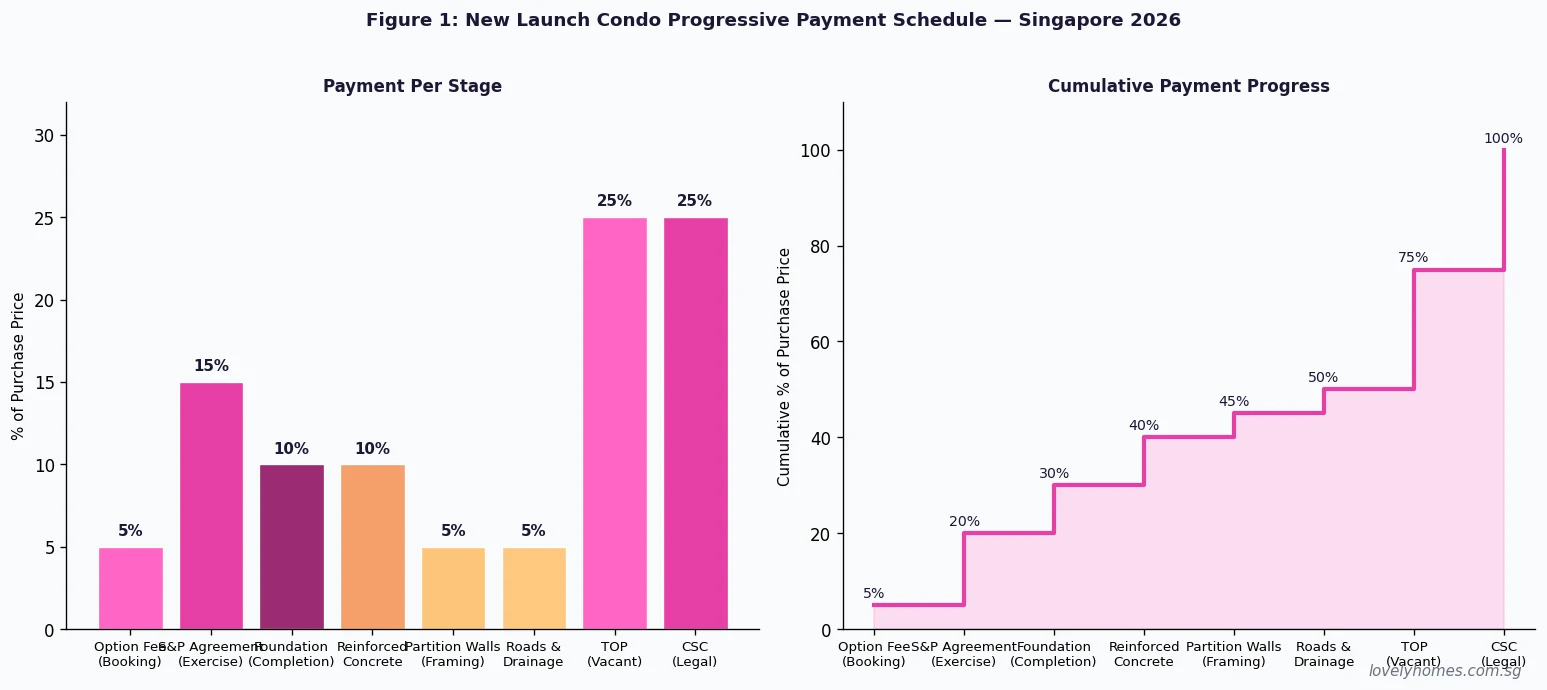
  • You pay via the Progressive Payment Scheme (PPS): 5% booking fee at OTP, 15% on exercising the Sales & Purchase (S&P) Agreement, then staged payments tied to construction milestones.
  • ABSD applies upfront and is due within 2 weeks of the OTP exercise. For Singapore Citizens buying their second property: 20%. Foreigners: 60%. Plan for this before you commit.
  • New launches carry a 5-year Seller’s Stamp Duty (SSD) lock-in — you cannot sell without a significant penalty within 5 years of purchase.
  • Unlike resale, you receive the flat in its bare shell at TOP. Renovation costs (typically S$50,000–S$120,000 for a standard 2-bedroom) must be budgeted separately.
  • The ballot system — especially for highly anticipated launches — means you may not get the unit or floor you want even after registering interest.
  • New launch condos in Singapore have historically outperformed resale on price quantum appreciation from launch to TOP, but this is not guaranteed and varies by project and location.

What Is a New Launch Condo?

A new launch condo (or new launch private residential property) is a condominium development released for sale by the developer before or shortly after it receives TOP. In Singapore’s context, most new launches happen via a showflat sales exercise during the construction phase — you view show units and buy off-plan, before the actual building is complete. The developer holds a licence from the Urban Redevelopment Authority (URA) to sell, and the transaction is governed by the Housing Developers (Control and Licensing) Act.

New launches are distinct from resale condos (completed units bought on the secondary market) and from executive condominiums (ECs) (hybrid developments with HDB-like eligibility restrictions for the first five years). This guide focuses exclusively on private new launch condos.

Step 1: Registering Interest and the Showflat Preview

Before a formal launch, developers typically invite potential buyers to register their interest (EOI). Registering is non-binding — it gives you priority access to a showflat preview before the public, and ensures you receive the developer’s price list and floor plan release in advance. At the preview, you view the show units (which may be furnished or bare-shell mock-ups) and indicate interest in specific units and stacks.

For highly subscribed projects, the developer may hold a ballot: if more buyers are interested in a particular unit type than units available, a computerised draw selects the order of purchase. Being balloted does not guarantee you receive your preferred unit — you may be offered an alternative or invited to return if units remain after the first round.

Under URA rules, developers must release at least 35% of available units in the first sale tranche. Price lists must be published at least 24 hours before the launch, and developers may not collect more than 5% as a booking fee (OTP fee) before exercising the Sale & Purchase Agreement.

New launch condo purchase timeline Singapore 2026 — EOI, showflat, OTP, S&P, progressive payments, TOP, CSC
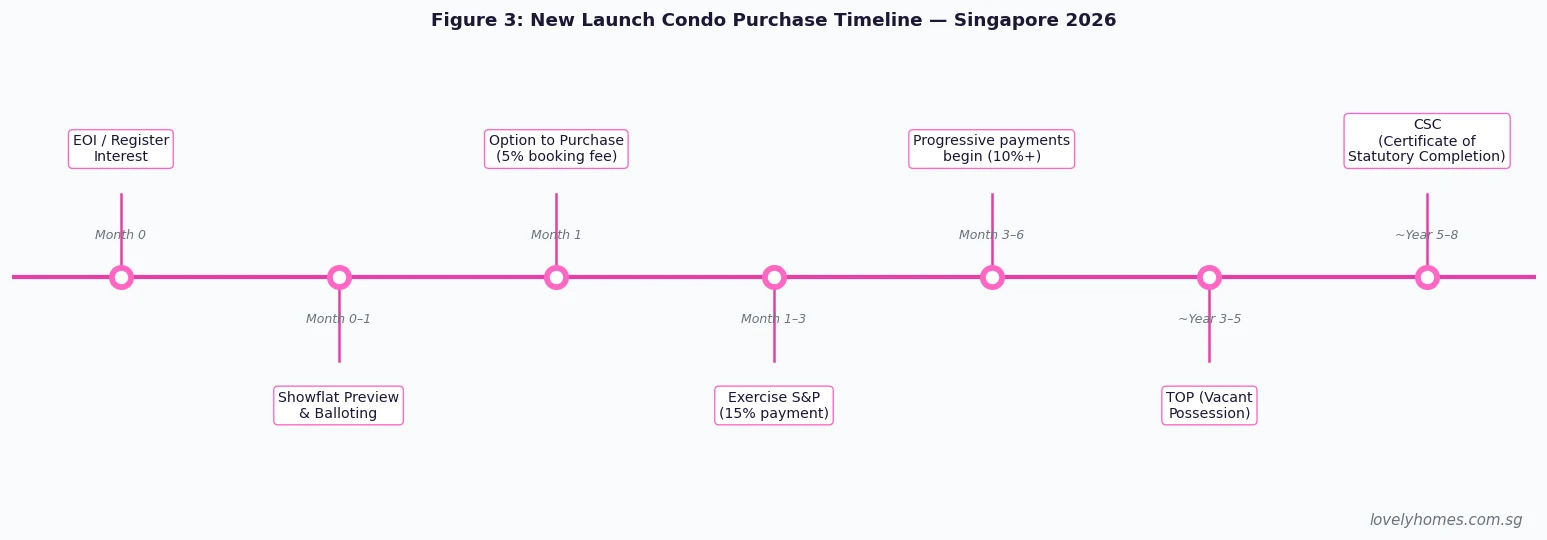
Figure 3: New launch condo purchase timeline from EOI to CSC — Singapore 2026. Source: URA, HDB (indicative milestones).

Step 2: The Option to Purchase (OTP) and Booking Fee

When you decide to proceed, you sign an Option to Purchase (OTP) and pay the booking fee — typically 5% of the purchase price. In Singapore, developer OTPs for new launches have a standard form prescribed by the Controller of Housing. You then have a fixed period — typically 3 weeks — to exercise the OTP by signing the Sales & Purchase Agreement (S&P) and paying the next instalment.

The booking fee is non-refundable if you decide not to exercise. However, if you exercise the OTP and subsequently fail to complete (e.g., cannot obtain financing), the forfeiture is typically 25% of the purchase price — an extremely significant sum. This underscores why financing pre-approval matters before you sign any OTP.

Step 3: Stamp Duties — BSD and ABSD

Singapore imposes Buyer’s Stamp Duty (BSD) on all property purchases, calculated on the higher of the purchase price or market value:

  • 1% on the first S$180,000
  • 2% on the next S$180,000
  • 3% on the next S$640,000
  • 4% on the next S$500,000
  • 5% on the next S$1,500,000
  • 6% on any excess above S$3,000,000

For most new launch condos — commonly priced between S$1.5M and S$3M in 2026 — BSD is typically S$39,600 to S$69,600.

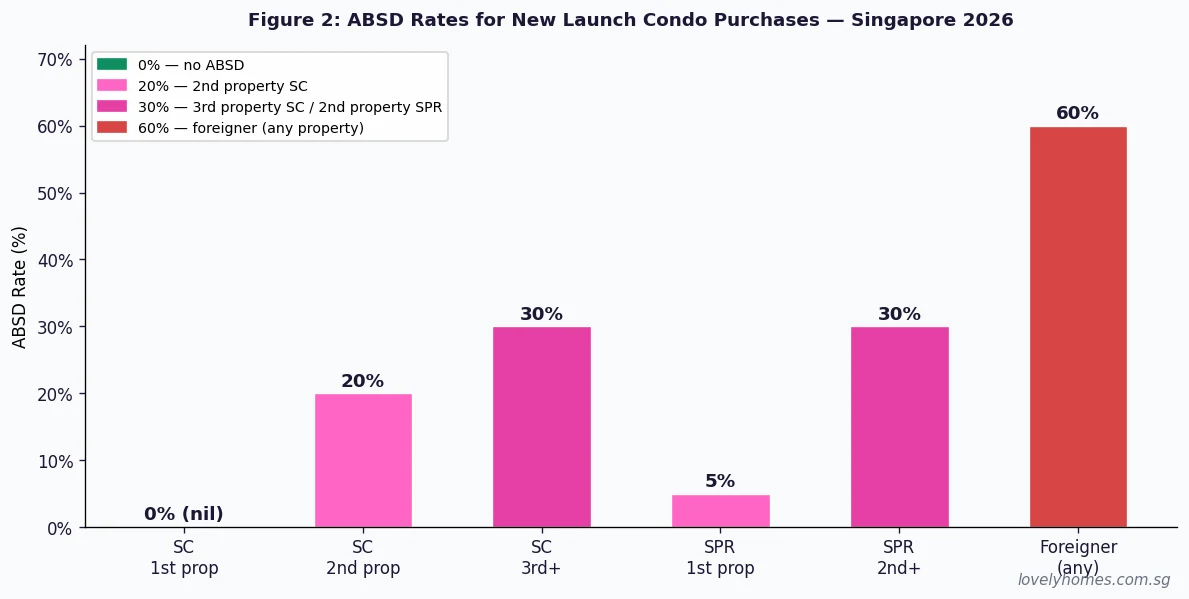
Additional Buyer’s Stamp Duty (ABSD) applies on top of BSD for buyers beyond their first property, PRs, and all foreigners:

ABSD rates for new launch condo purchases Singapore 2026 — bar chart showing 0% to 60% by buyer profile
Figure 2: ABSD rates applicable to new launch condo purchases by buyer profile — Singapore 2026. Source: IRAS.
ABSD is due within 2 weeks of the OTP date — not after TOP, not at completion. For a S$2M condo, a Singapore Citizen buying a second property owes ABSD of S$400,000 within a fortnight. Ensure your liquidity is in place before signing the OTP.

Married couples where one spouse is an SC and the other is a PR buying their first property together are eligible for ABSD remission — the ABSD paid is refunded after holding the property for 5 years, provided they sell the other property (if any) within 6 months of TOP or purchase, and the purchased property remains their primary residence.

Step 4: Financing — LTV, TDSR and MSR (if applicable)

Private condo financing in Singapore is governed by the Total Debt Servicing Ratio (TDSR) framework: total monthly debt obligations (all loans) must not exceed 55% of gross monthly income. The Loan-to-Value (LTV) limit for private properties depends on your loan count:

Loan Count Max LTV (bank loan) Min Cash Down Min CPF/Cash Down
1st housing loan 75% 5% cash 20% cash/CPF
2nd housing loan 45% 25% cash 30% cash/CPF
3rd and beyond 35% 25% cash 40% cash/CPF

Note: these are the LTV limits for standard bank loans. HDB loans are not available for private properties. There is no MSR cap for private condos — only TDSR applies.

Step 5: The Progressive Payment Scheme (PPS)

Unlike resale purchases (where you pay the full price in one transaction), new launch condos use the Progressive Payment Scheme. You pay in stages as the building reaches construction milestones. Each payment is called a “progress payment” and corresponds to a defined stage of construction certified by an architect.

New launch condo progressive payment schedule Singapore 2026 — bar chart showing % at each construction milestone
Figure 1: Progressive Payment Scheme stages — typical new launch condo in Singapore 2026. Source: Housing Developers Rules.

Each progress payment triggers a corresponding drawdown of your bank loan. This is why you need a bank’s Letter of Offer (LO) before or shortly after exercising the S&P — the bank needs to be ready to disburse as each stage is reached. You pay interest on the disbursed loan amount as construction progresses, typically at the bank’s prevailing rate (SORA-based in 2026).

Step 6: Deferred Payment Scheme (DPS) — Is It Still Available?

The Deferred Payment Scheme (DPS) allows buyers to defer up to 80% of the purchase price until TOP or CSC, rather than paying progressively. However, since 2007, the Monetary Authority of Singapore (MAS) has effectively restricted DPS on standard residential properties. Most developers no longer offer DPS as a standard option; where it appears, it is typically for high-end projects (luxury segment) under specific conditions. The PPS is the default for virtually all new launch condos launched from 2026 onwards.

Step 7: TOP, Possession and Renovation

When the building receives its Temporary Occupation Permit (TOP) from the Building and Construction Authority (BCA), you can take vacant possession of your unit. At this stage, you pay the remaining progress payments: typically 25% on TOP (vacant possession) and a final 5% on CSC (Certificate of Statutory Completion).

A new launch unit at TOP is delivered as a bare shell — bare concrete floors, unpainted walls, basic sanitary fittings (unless the developer has included a renovation package). You will need to engage contractors for flooring, painting, kitchen and bathroom fittings, carpentry, air-conditioning, and more. Budget conservatively: renovation for a 2-bedroom (around 700–850 sqft) typically ranges from S$50,000 to S$100,000 in Singapore’s 2026 market; for larger units, S$120,000 or more is common. Include this in your total acquisition cost model.

Seller’s Stamp Duty (SSD): The 5-Year Lock-In

Singapore’s SSD was introduced in 2011 to curb short-term speculation. For residential properties purchased on or after 11 March 2017, SSD applies if you sell within 3 years of purchase:

  • Sold within 1st year: 12%
  • Sold within 2nd year: 8%
  • Sold within 3rd year: 4%
  • Sold after 3rd year: 0%

SSD is calculated on the higher of the sale price or market value. For new launch condos, this effectively means you cannot profitably flip a unit until at least 3 years after OTP. Since most new launches take 3–5 years to reach TOP, many buyers hold well past the SSD window regardless.

New Launch vs Resale: Quick Comparison

Factor New Launch Resale Condo
Payment structure Progressive (PPS) Full payment on completion
Condition at handover Bare shell Existing fittings
Waiting time 3–5 years to TOP Immediate
Price Usually at or above market premium Negotiated market price
HDB grant eligibility Not applicable (private) Not applicable (private)
CPF usage Yes (Ordinary Account) Yes
Renovation budget needed Yes (significant) Usually lower (existing fit-out)
ABSD Same rates as resale Same rates as new launch

Worked Example: The Teo Family

Mr and Mrs Teo are Singapore Citizens, both aged 34. They own a 4-room HDB flat in Bishan (fully paid). They wish to buy a new launch 2-bedroom condo in Jurong East at S$1,600,000. This will be their second property.

BSD: 1%×S$180K + 2%×S$180K + 3%×S$640K + 4%×S$600K = S$1,800 + S$3,600 + S$19,200 + S$24,000 = S$48,600

ABSD: 20% on second property (SC) = S$320,000 — due within 2 weeks of OTP.

Booking fee (5%): S$80,000 cash.

S&P exercise (15%): S$240,000 (cash/CPF). Total upfront = S$320,000 cash + S$368,600 stamp duties.

Bank loan (75% LTV on first loan — but this is their 2nd property): LTV = 45%, so bank loan max = S$720,000. Total cash + CPF must cover S$880,000 (55%) — plus S$368,600 stamp duties already paid. Renovation budget: S$70,000.

Total funds required: approximately S$1,320,000 in cash and CPF before loan proceeds. The Teos should model whether their HDB flat sale proceeds (if they plan to sell) are sufficient, or whether they can service a bridging gap.

Planning note: Many buyers purchase a new launch before selling their existing property, intending to sell after TOP. Be aware that (a) if TOP is delayed, you may hold both properties for longer than expected, (b) carrying two mortgages or a mortgage plus HDB loan simultaneously can stress TDSR, and (c) the ABSD for the second property is paid now and is not refunded unless you meet the strict ABSD remission criteria (married SC/SPR couple, first home only).

Common Pitfalls to Avoid

  • Not stress-testing TDSR at higher SORA: SORA-based mortgage rates have fluctuated. Ensure you can service your loan even if rates rise 1–2 percentage points above today’s levels.
  • Underestimating renovation costs: Get a proper quote before committing; budget overruns on renovation are extremely common in Singapore.
  • Assuming your preferred unit is available: Popular stacks (high floor, pool-facing, corner units) are typically balloted first. Be prepared to accept alternatives.
  • Overlooking maintenance fees: New launch condos with extensive facilities (pool, gym, concierge) can carry maintenance fees of S$400–S$800/mth or more for larger units.
  • Not checking the developer’s track record: Review the developer’s past completions — quality, adherence to timeline, and handover defects. Singapore’s REDAS and the Controller of Housing maintain records of licensed developers.

Frequently Asked Questions

Can I use CPF to pay for a new launch condo?

Yes. You may use your CPF Ordinary Account (OA) balance to pay for the S&P downpayment and progressive payments (except the booking fee — the initial 5% OTP fee must be in cash). You can also use CPF OA for BSD and legal fees. However, you cannot use CPF for ABSD payments — ABSD must be paid in cash. CPF usage on private property is subject to the valuation limit and the withdrawal limit (typically capped at the assessed value of the property); once the OA balance used for the property reaches the assessed valuation, you must pay subsequent instalments from your bank loan or cash.

What happens if the developer delays TOP?

Developers in Singapore are legally required to obtain TOP by the Delivery Possession Date (DPD) stated in the S&P Agreement. If they fail to do so, they must pay Liquidated Damages (LD) to buyers — typically calculated at 8% per annum on the progressive payments already made, pro-rated for each day of delay. LD is automatically due; you do not need to take legal action to claim it. For extended delays (beyond 6 months), the Controller of Housing may also take action against the developer’s licence.

Can I back out after signing the S&P Agreement?

You can withdraw after exercising the S&P, but the consequences are severe. Under the standard Housing Developers (Show Units) Rules, the developer can forfeit up to 25% of the purchase price as liquidated damages. You also lose your 5% booking fee. In practice, most buyers do not withdraw after exercising — the financial penalty makes it uneconomical except in extreme circumstances (e.g., inability to obtain financing).

What is the difference between TOP and CSC?

TOP (Temporary Occupation Permit) is issued by BCA when the building meets minimum safety, fire safety, and occupancy standards. You can move in and begin renovation after TOP. CSC (Certificate of Statutory Completion) is issued when the development fully meets all planning and statutory requirements — typically 1–3 years after TOP. The final 5% payment is due on CSC. Legal completion (transfer of title) typically happens at or shortly after CSC. Until CSC, the developer retains the final 5% and your strata title has not yet been issued.

Do I need a lawyer for a new launch condo purchase?

Yes. All property transactions in Singapore require a licensed Singapore solicitor to act for you on conveyancing. For new launches, the developer typically has a panel of law firms; you may use one of these or appoint your own solicitor. Your solicitor will review the S&P Agreement, verify that the developer’s housing licence is valid, liaise with CPF Board (if you are using CPF), liaise with your bank (if you have a mortgage), and register the transfer of title at the Singapore Land Authority (SLA). Legal fees for a new launch typically range from S$2,500 to S$5,000 for standard condos.

Related Articles

Disclaimer

This article is for general information only and does not constitute financial, legal, or property advice. Stamp duty rates, LTV limits, TDSR rules, and grant schemes are subject to change by the Singapore government. Always verify current rules with the Inland Revenue Authority of Singapore (IRAS), Urban Redevelopment Authority (URA), and Monetary Authority of Singapore (MAS) before making any purchase decision. Consult a licensed conveyancing solicitor and a licensed financial adviser for advice specific to your circumstances.

×Click anywhere to close
Singapore HDB Inheritance and Transfer Guide 2026: Joint Tenancy, CPF Rules and Who Can Inherit

Singapore HDB Inheritance and Transfer Guide 2026: Joint Tenancy, CPF Rules and Who Can Inherit

Quick Answer: Singapore HDB Inheritance & Transfer Guide 2026

  • HDB flats held under Joint Tenancy (JT) pass automatically to the surviving owner by right of survivorship — no probate required and no Will can override this.
  • Flats held under Tenancy-in-Common (TIC) pass according to the deceased’s Will or, if there is no Will, the Intestate Succession Act (ISA). Muslim estates are governed by the Administration of Muslim Law Act (AMLA) and Faraid rules.
  • The deceased owner’s CPF principal and accrued interest used for the flat is refunded to their CPF account — not to the estate — and distributed to CPF nominees or the CPF Public Trustee.
  • Any outstanding HDB loan on the flat must be assumed by the inheriting owner (subject to HDB approval) or discharged; the flat cannot be retained if the inheritor cannot service the loan.
  • The inheritor must meet HDB eligibility criteria to retain the flat. Ineligible inheritors (including foreigners) must sell within 6 months or HDB may compulsorily acquire the flat.
  • Singapore Citizens generally have the widest inheritance eligibility; SPRs and family members in non-standard situations require case-by-case HDB assessment.
  • The Minimum Occupation Period (MOP) typically restarts from the date of the transfer for the new owner when the flat is transferred (other than via JT survivorship).
  • Making a Will and CPF nomination while alive is the single most important step HDB owners can take to ensure their wishes are carried out on death.

Introduction: When a HDB Owner Passes Away

The death of a Housing & Development Board (HDB) flat owner raises a series of consequential legal and practical questions: Who takes over the flat? What happens to the outstanding mortgage? Are there CPF refunds? How long does the process take? For the 1.1 million HDB households in Singapore, understanding the inheritance and transfer rules is not just academic — it is part of responsible property ownership and estate planning.

Singapore’s framework for HDB flat inheritance is governed by several bodies of law operating concurrently: HDB’s own eligibility and transfer rules, the Conveyancing and Law of Property Act which recognises the right of survivorship for Joint Tenancy, the Intestate Succession Act (ISA) which distributes estates without Wills, and — for Muslim Singaporeans — the Administration of Muslim Law Act (AMLA) and the principles of Faraid Islamic inheritance. The CPF Board administers the refund of CPF monies on death separately from the flat transfer.

HDB Flat Ownership Structures: Joint Tenancy vs Tenancy-in-Common

When two or more people purchase an HDB flat together, they must choose between two forms of co-ownership: Joint Tenancy (JT) or Tenancy-in-Common (TIC). The choice made at purchase has profound consequences on what happens to the flat when one owner dies.

Under Joint Tenancy, all owners hold the flat jointly without defined individual shares. The central legal feature of JT is the right of survivorship: on the death of any one joint tenant, that person’s interest in the flat automatically vests in the surviving joint tenant(s). No probate or letters of administration are required; no Will can override this automatic transfer. HDB flats purchased by couples are registered in Joint Tenancy by default.

Under Tenancy-in-Common, each owner holds a specified, separate share — for example, 50%/50% or 60%/40%. On the death of a TIC owner, their share forms part of their estate and is distributed according to their Will, or the ISA if they die intestate (without a Will). TIC must be specifically elected at the time of purchase or during ownership via a legal severance of the JT arrangement.

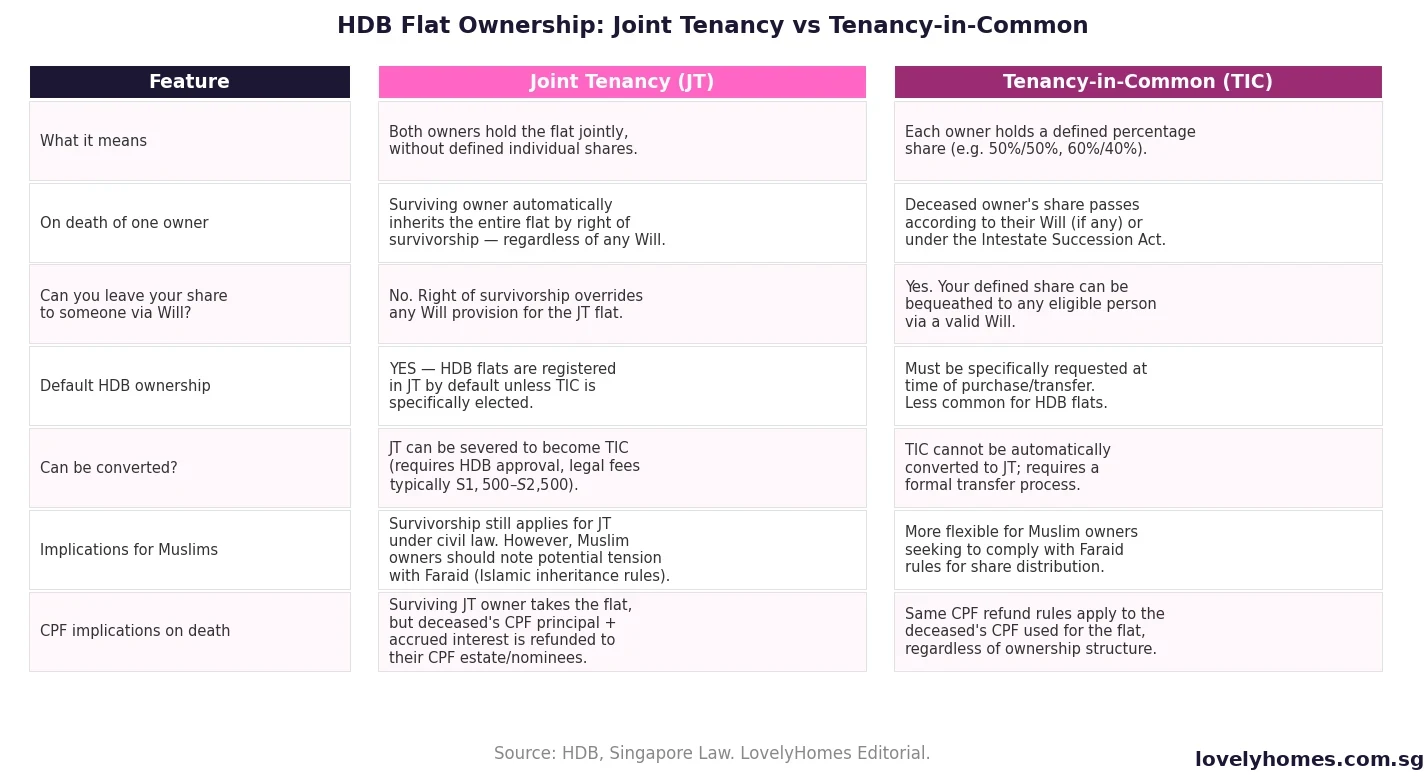
Singapore HDB Joint Tenancy vs Tenancy-in-Common comparison table — right of survivorship inheritance Will implications 2026
Figure 1: Joint Tenancy vs Tenancy-in-Common — seven key differences for HDB flat co-owners. Source: HDB, Singapore Law. Click to enlarge.

The Right of Survivorship: How Joint Tenancy Works on Death

The right of survivorship is a powerful legal mechanism that simplifies the transfer of HDB flats in the common scenario where a married couple owns a flat and one spouse passes away. When the first spouse dies, the surviving spouse automatically becomes the sole owner of the flat — there is no need to go through the courts, apply for probate, or even instruct a solicitor for the transfer itself (though an application must be made to HDB to update the records).

The process involves notifying HDB within 30 days of the death, submitting the death certificate, the original title deeds or relevant HDB documentation, and completing HDB’s survivorship transfer form. HDB will then update its records to reflect the surviving owner as the sole registered proprietor. The entire administrative process typically takes 3–6 weeks once documents are submitted.

The surviving JT owner inherits the flat subject to any outstanding HDB or bank loan. If the deceased was the primary borrower and the surviving spouse does not meet the bank’s income criteria to assume the sole loan, they may need to make other arrangements — including partial repayment, sourcing a guarantor, or selling the flat. It is advisable for couples to ensure both spouses are listed as co-borrowers on any mortgage to avoid this complication.

Tenancy-in-Common and the Intestate Succession Act

For flat owners holding the property under Tenancy-in-Common, the death of one owner requires a formal estate administration process before the flat can be transferred to the inheritor. If the deceased left a valid Will, executors named in the Will apply for a Grant of Probate from the Singapore High Court. If there is no Will, the next-of-kin applies for Letters of Administration. Both processes take 3–6 months on average for uncontested estates, though complex cases can take longer.

Where there is no Will, the ISA prescribes how the estate is distributed based on the family structure. For example, if the deceased leaves a spouse and children, the spouse receives 50% of the estate and the children share the remaining 50% equally. If only a spouse survives (no children, no living parents), the spouse receives the entire estate. The ISA does not apply to Muslim Singaporeans, whose estates are governed by Faraid rules under AMLA, administered through the Syariah Court for distribution certificates.

CPF and HDB on the Death of an Owner

CPF monies used to purchase an HDB flat do not form part of the flat’s transfer on death — they are handled separately by the CPF Board. When an owner dies, all CPF funds used to purchase the flat — including both the original principal withdrawn and the accrued interest at 2.5% p.a. compounded — must be refunded to the deceased’s CPF account. These funds are then distributed to CPF nominees (designated by the deceased via a CPF nomination form before death), or — if there is no nomination — to the Public Trustee for distribution under the Intestate Succession Act.

This CPF refund is separate from the flat’s ownership transfer. The inheritor who takes over the flat does not receive the deceased’s CPF monies as part of the flat — they receive only the flat itself, potentially subject to an outstanding mortgage. The CPF refund may significantly reduce the equity available in the flat if the loan is outstanding, as the CPF monies do not offset the mortgage on death.

If the flat has an outstanding HDB concessionary loan at the time of death, the surviving owner or inheritor must arrange with HDB to either assume the loan (if they qualify) or repay it. In some cases where the deceased had Home Protection Scheme (HPS) insurance (a mortgage-reducing insurance administered by CPF Board), the outstanding HDB loan may be discharged on death, passing the flat to the inheritor debt-free. All HDB flat owners with an outstanding HDB loan are required to maintain HPS cover, making this a meaningful protection for families.

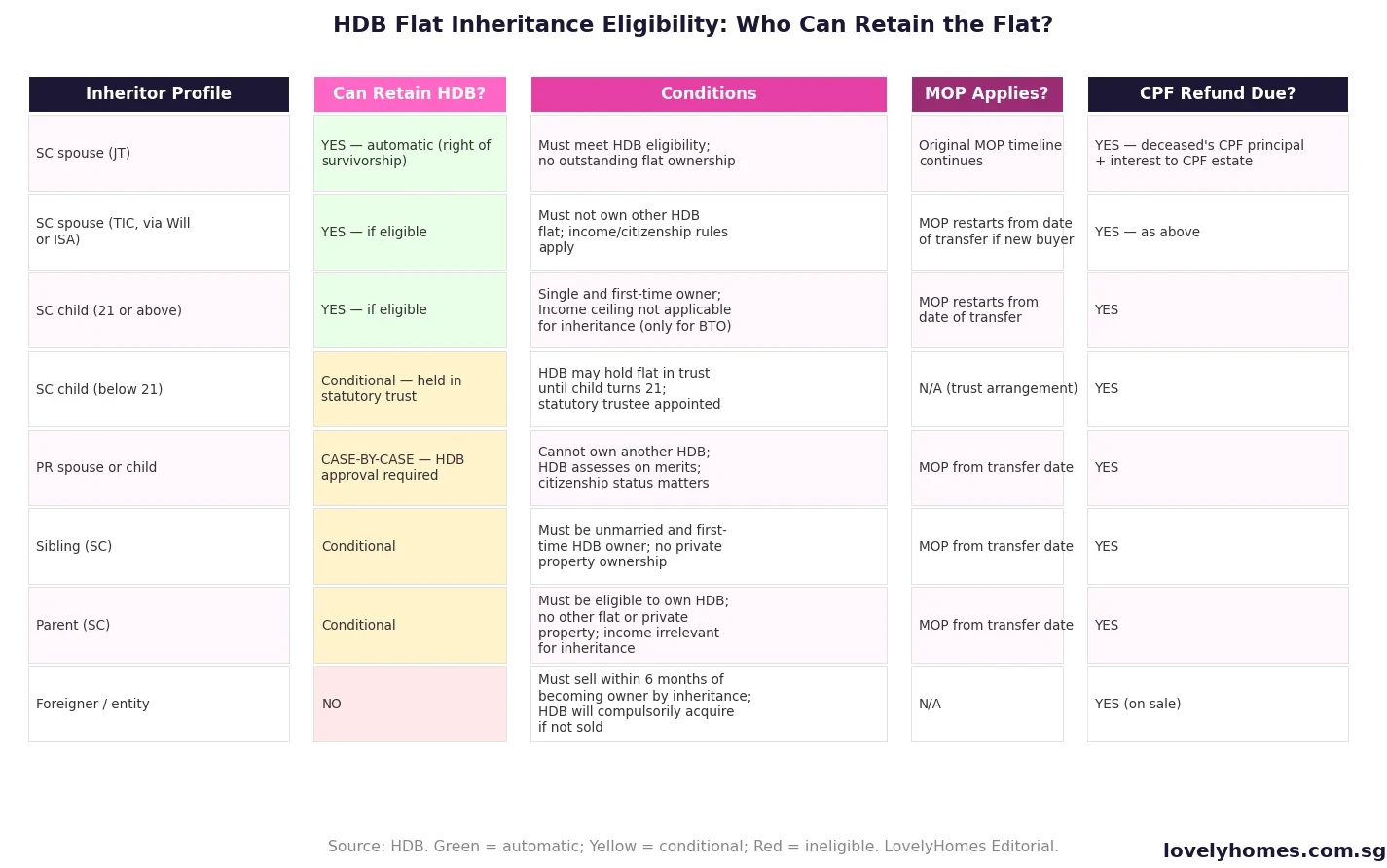
HDB flat inheritance eligibility Singapore 2026 — who can retain an HDB flat SC spouse child PR sibling parents foreigners
Figure 2: HDB Inheritance Eligibility — who can retain an HDB flat and under what conditions. Green = generally eligible; Yellow = conditional/HDB approval required; Red = must sell. Source: HDB. Click to enlarge.

Who Can Retain an Inherited HDB Flat?

The right to retain an inherited HDB flat is subject to HDB’s standard eligibility criteria. The core principle is that HDB flats are public housing meant for Singapore citizens and permanent residents who meet the relevant conditions. Simply inheriting a flat does not guarantee the right to keep it if the inheritor does not meet HDB’s eligibility framework.

Singapore Citizen beneficiaries in a nuclear family context — such as a surviving SC spouse or adult SC children — generally have the widest eligibility to retain an HDB flat. However, they must not already own another HDB flat (subject to the non-concurrent ownership rule) and must not hold any private residential property at the time of inheritance (or must dispose of private property within 6 months). Singapore Permanent Resident inheritors are assessed on a case-by-case basis by HDB and face more restrictions. Foreigners (non-PRs) are not eligible to own HDB flats and must sell any inherited flat within 6 months; failure to do so can result in HDB compulsorily acquiring the flat.

Where a flat is inherited by a minor (below 21), HDB typically holds the flat in a statutory trust arrangement until the child reaches majority. A statutory trustee (often a parent or guardian) is appointed to manage the flat in the interim.

Applying to Transfer or Retain the HDB Flat

The formal process of applying to retain or transfer an HDB flat after a death involves several steps that typically span 3–9 months depending on the estate complexity, whether probate is required, and HDB’s processing time. The beneficiary or executor must submit an application to HDB with the death certificate, identity documents, Grant of Probate or Letters of Administration (if TIC), and supporting documents evidencing eligibility (e.g. income documents, CPF statement, private property declaration).

HDB will assess the application, verify eligibility, check for any outstanding charges or HDB loans on the flat, and — where the inheritor is taking over a loan — require the inheritor to meet the relevant debt servicing criteria. If approved, the transfer is completed via a legal instrument lodged with the Singapore Land Authority (SLA), and the Land Register is updated to reflect the new owner.

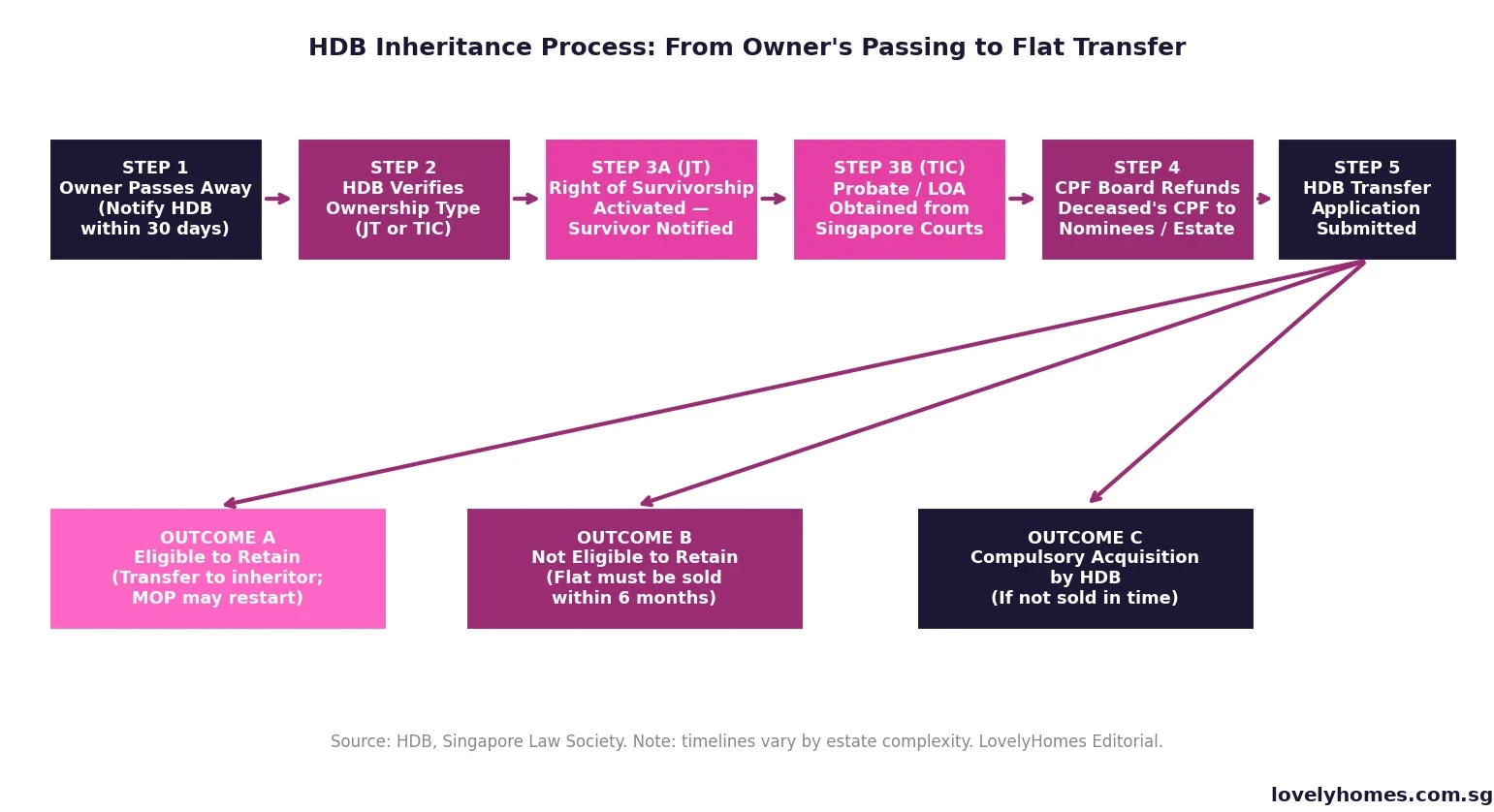
HDB inheritance process flowchart Singapore 2026 — steps from death notification to flat transfer outcomes
Figure 3: HDB Inheritance Process — from the owner’s passing to the three possible outcomes: retention, sale, or compulsory acquisition. Source: HDB, Singapore Law Society. Click to enlarge.

Selling an Inherited HDB Flat

Where the inheritor is ineligible to retain the HDB flat — either because they do not meet HDB’s eligibility criteria or because they choose to liquidate the asset — the flat must be sold on the open HDB resale market. The 6-month timeline begins from when ownership is formally transferred to the ineligible inheritor (not from the date of death), giving families some breathing room to arrange the estate and marketing process.

The sale proceeds are handled as follows: the outstanding HDB loan (if any) is repaid first from the sale price; CPF monies used by all owners over the flat’s ownership history are refunded (with accrued interest) to each respective owner’s CPF account or estate; legal and agent costs are deducted; and the net cash proceeds form part of the estate for distribution. If the flat was sold at the prevailing resale market price, the estate may receive a meaningful cash sum — particularly for flats in mature estates with substantial appreciation.

Scenario Ownership Type Legal Process Required Timeline (est.) MOP Reset?
SC surviving spouse (JT) Joint Tenancy Notify HDB; submit death cert + survivorship docs 3–6 weeks admin No (continuity)
SC child inheriting via Will (TIC) Tenancy-in-Common Grant of Probate + HDB transfer application 4–8 months Yes (from transfer date)
SC child inheriting — intestate (TIC) Tenancy-in-Common Letters of Administration + HDB transfer application 5–10 months Yes
PR beneficiary (TIC or JT estate) Either Probate/LOA + HDB case-by-case assessment 6–12 months Yes
Ineligible beneficiary — must sell Either Transfer to ineligible owner + list for HDB resale Must sell within 6 months of transfer N/A (sold)
Minor inheritor (below 21) Either Statutory trust arrangement via HDB; trustee appointed Until majority Assessed at age 21

Worked Example: The Lim Family — SC Widow Inheriting Under Joint Tenancy

David and Susan Lim are Singapore Citizens who purchased a 4-room HDB flat in Ang Mo Kio in 2015 under Joint Tenancy at S$450,000, financed by an HDB concessionary loan. Their outstanding HDB loan as at June 2026 is S$210,000. David passes away unexpectedly in June 2026 at age 58.

Step 1 — Survivorship: As the flat was held in JT, Susan automatically becomes the sole owner of the flat by right of survivorship. No probate is required. Susan notifies HDB within 30 days and submits the death certificate and survivorship transfer form.

Step 2 — CPF refund: David had used S$180,000 in CPF OA (principal) towards the flat purchase and monthly instalments over 11 years. Accrued interest on these CPF withdrawals at 2.5% p.a. amounts to approximately S$61,000. The total CPF refund of S$241,000 is credited back to David’s CPF account. As David made a CPF nomination naming Susan and their two adult children, the S$241,000 in David’s CPF is distributed per the nomination — not as part of the flat’s transfer.

Step 3 — Mortgage: David maintained Home Protection Scheme (HPS) insurance on the HDB loan. On his death, the outstanding S$210,000 HDB loan is discharged by HPS, passing the flat to Susan debt-free.

Outcome: Susan now owns the flat in sole name, free of mortgage, with the flat’s estimated resale value at ~S$620,000 (based on comparable resale transactions in the area in 2026). The net equity in the flat for Susan is approximately S$620,000 (since the CPF refund went to David’s CPF estate, not reducing the flat’s market value). The HDB admin process took approximately 5 weeks from death notification to registration of Susan as sole owner.

Key lesson: The combination of JT ownership, HPS insurance, and CPF nomination meant that the inheritance process was administratively simple and economically optimal for Susan. Had David not maintained HPS, Susan would have needed to service the S$210,000 loan herself from retirement savings or a new bank loan — a significant burden at age 56.

What This Means for HDB Flat Owners

Estate planning for HDB flat owners in Singapore is not a complex exercise, but it does require deliberate action rather than relying on defaults. The most important steps any HDB owner can take are: first, confirm the current ownership structure of their flat (JT or TIC) and whether it reflects their actual wishes; second, maintain a valid and up-to-date CPF nomination so that CPF monies reach the intended beneficiaries; third, consider making a Will to address any TIC share and other non-CPF assets; and fourth, ensure adequate HPS cover is maintained on any outstanding HDB loan to protect the family from the mortgage burden on death.

Joint Tenancy works well for most married couples as a default — it is simple, automatic, and avoids probate delays. However, for blended families, second marriages, business partners owning flats together, or Muslim families seeking Faraid-compliant distributions, Tenancy-in-Common provides greater flexibility and should be considered with legal advice.

What Might Come Next

There are no announced changes to Singapore’s HDB inheritance framework as at June 2026. The Law Reform Commission has previously considered but not implemented recommendations on simplifying intestate succession for HDB flats, and the Ministry of Law continues to review options for making probate processes faster and less costly for estates with modest assets. The digitisation of the Probate Court and HDB’s integrated estate management platform (accessible via MyHDBPage) has already reduced administrative timelines in recent years. HDB owners and estate practitioners should monitor any future legislative changes to the Probate and Administration Act, the Intestate Succession Act, and HDB’s Housing Policy as Singapore’s population ages and inheritance scenarios become more common.

Frequently Asked Questions: HDB Inheritance & Transfer

Can I change my HDB flat from Joint Tenancy to Tenancy-in-Common?

Yes. A Joint Tenancy in an HDB flat can be severed to become a Tenancy-in-Common through a legal process called a severance of joint tenancy. This involves instructing a solicitor to prepare and lodge the relevant instrument at the Singapore Land Authority. Both owners must consent to the severance. The legal costs typically range from S$1,500 to S$2,500 depending on the complexity. Once severed, each owner’s defined share (usually 50%/50% unless otherwise specified) can be bequeathed to beneficiaries via a Will, bypassing the right of survivorship. HDB’s approval may be required in some cases.

What if the deceased HDB owner did not leave a CPF nomination?

If the deceased did not make a CPF nomination, the CPF Board will transfer the CPF savings (including the refunded flat-related CPF monies) to the Public Trustee’s Office. The Public Trustee distributes these funds according to the Intestate Succession Act — meaning they follow the same intestate distribution rules as other estate assets (e.g., 50% to spouse, 50% to children). This process adds time and cost to the estate administration. It is strongly advisable to make a CPF nomination and to update it whenever family circumstances change.

Does the Minimum Occupation Period (MOP) restart when I inherit an HDB flat?

Generally yes, when a flat is transferred to a new owner via inheritance (other than a Joint Tenancy survivorship transfer, where the surviving owner continues the original MOP timeline), the MOP is assessed from the date the new owner takes legal title of the flat. For example, if you inherit a flat in June 2026, your 5-year MOP (or 10-year MOP for Plus/Prime flats purchased under the new classification rules) begins from June 2026. You must continue to occupy the flat and cannot sublet the whole flat or purchase any other residential property during the MOP period. Always confirm the specific MOP conditions with HDB when applying for the transfer.

What is the Home Protection Scheme (HPS) and is it compulsory?

HPS is a mortgage-reducing insurance administered by CPF Board that covers the outstanding HDB home loan in the event of the insured owner’s death, terminal illness, or total permanent disability. It is compulsory for all HDB flat owners with outstanding HDB concessionary loans who have CPF OA savings. For HDB flat owners with bank loans, HPS cover is not mandatory but CPF Board strongly recommends it. HPS premiums are payable from CPF OA and are relatively affordable. On the insured event (e.g., death), HPS discharges the outstanding loan balance up to the insured amount, passing the flat to the family debt-free. Reviewing your HPS coverage amount (especially if you have refinanced to a bank loan) is an important part of property ownership in Singapore.

Can a Muslim Singaporean’s HDB flat be distributed via Faraid rules?

Under Singapore law, a Muslim person’s estate — including any HDB flat held under Tenancy-in-Common — is governed by Faraid (Islamic inheritance law) as applied by the Syariah Court under the Administration of Muslim Law Act (AMLA), rather than the civil Intestate Succession Act. The Syariah Court issues an Inheritance Certificate specifying the Faraid shares to each beneficiary. For HDB flats under Joint Tenancy, however, the civil right of survivorship technically applies — a tension between civil and religious law that some Muslim families resolve by electing Tenancy-in-Common and making a Will consistent with Faraid requirements. Muslim HDB owners are strongly advised to consult both a Syariah lawyer and HDB to ensure their ownership structure and estate plans align with their religious obligations.

How long does the HDB inheritance transfer process typically take?

The timeline varies significantly by case type. For Joint Tenancy survivorship transfers — the simplest scenario — the HDB administrative process typically takes 3 to 6 weeks once all required documents are submitted. For Tenancy-in-Common cases where probate is needed, the Grant of Probate or Letters of Administration alone typically takes 3–6 months, after which the HDB transfer application takes a further 4–8 weeks. Complex estates involving disputes, overseas beneficiaries, or unusual eligibility circumstances can take 12–24 months or more. Throughout this period, the flat can generally continue to be occupied by eligible family members, though it cannot be sold or rented out until the transfer is completed and any applicable MOP is met.

Disclaimer: This article is produced by LovelyHomes Editorial for informational and educational purposes only. It does not constitute legal, estate planning, or financial advice. HDB eligibility rules, CPF policies, probate procedures, and Islamic inheritance law described are based on information current as at June 2026. These rules can change. In particular, individual circumstances vary greatly — factors including citizenship status, existing property ownership, outstanding loans, and family composition can materially affect outcomes. Always consult a licensed Singapore solicitor (for estate planning and probate matters), a Muslim law practitioner for Syariah-related estates, and refer to HDB, CPF Board, Ministry of Law, and Syariah Court of Singapore official sources.
×

Click anywhere outside to close

Singapore MCST Guide 2026: Management Fees, Sinking Fund, By-Laws and Your Rights as a Condo Owner

Singapore MCST Guide 2026: Management Fees, Sinking Fund, By-Laws and Your Rights as a Condo Owner

Quick Answer: Singapore MCST and Condo Management 2026

  • MCST stands for Management Corporation Strata Title — the legal body that owns and manages common property in every privatised strata development in Singapore.
  • Management Council (MC) is elected by all unit owners at the Annual General Meeting (AGM) and is responsible for running the estate on their behalf.
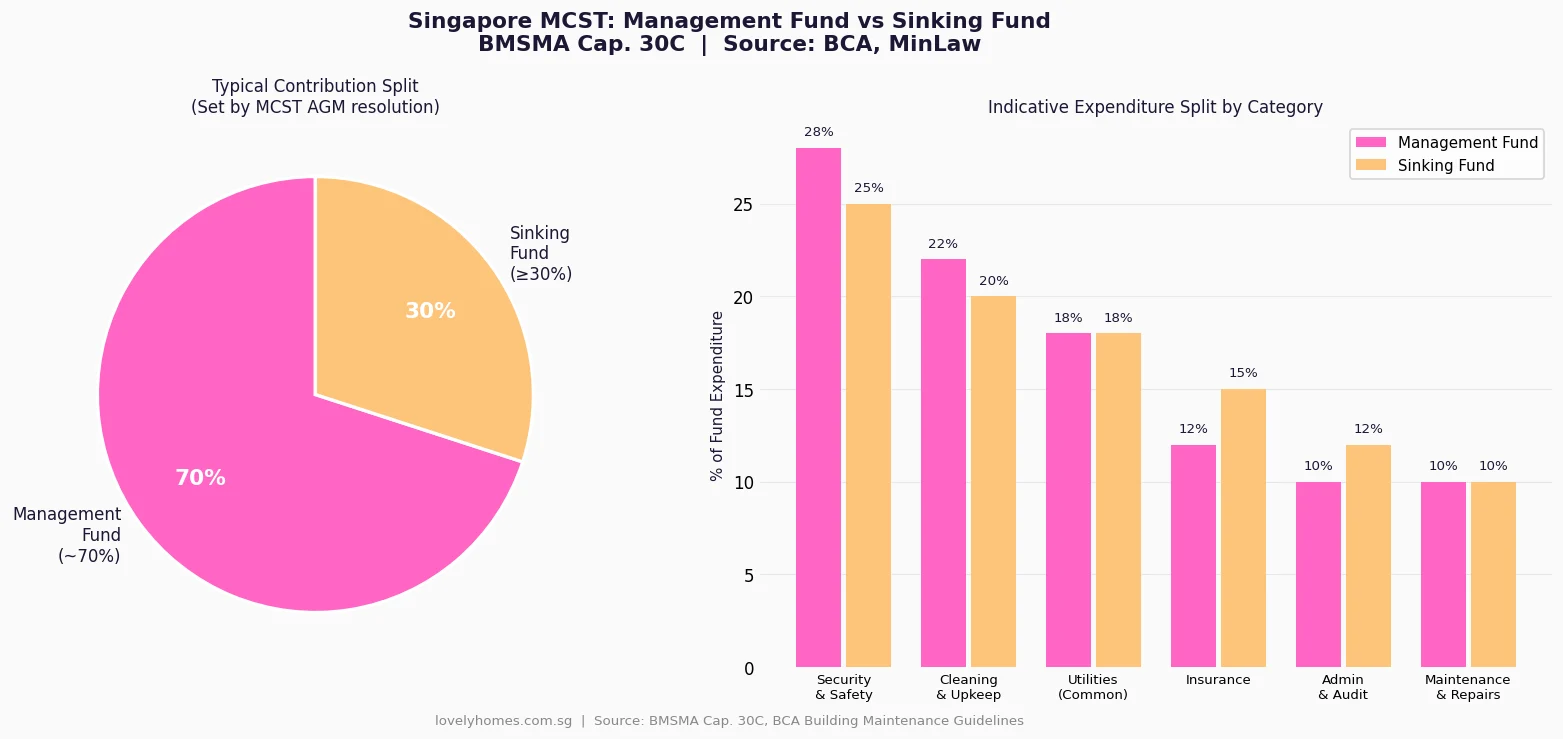
  • Two statutory funds: the Management Fund (day-to-day operations) and the Sinking Fund (capital expenditure reserve, minimum 10% of total contributions under BMSMA).
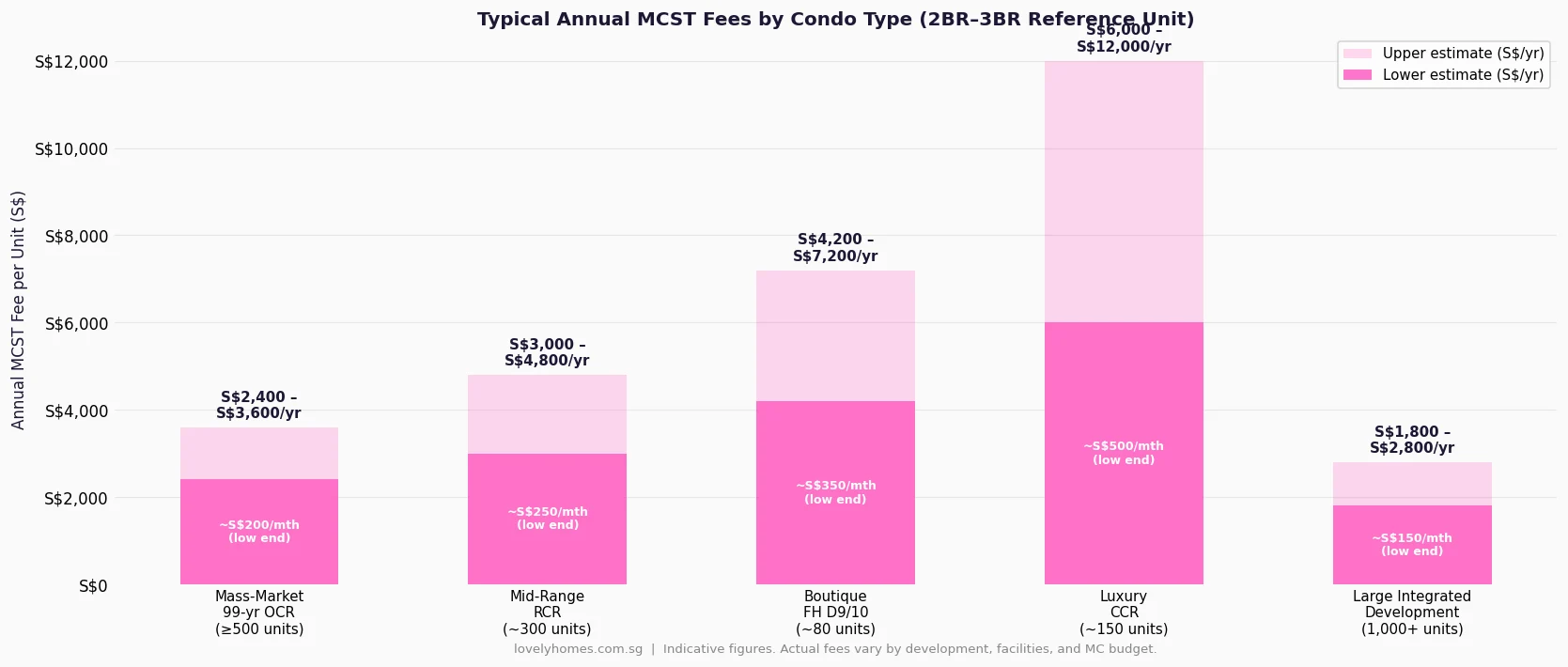
  • Typical fees range from S$200–S$600/month for a 2–3 bedroom unit, depending on development size, facilities, and location.
  • By-laws are the rules governing unit owners’ rights and obligations — breach can result in fines of up to S$5,000 under the Building Maintenance and Strata Management Act (BMSMA).
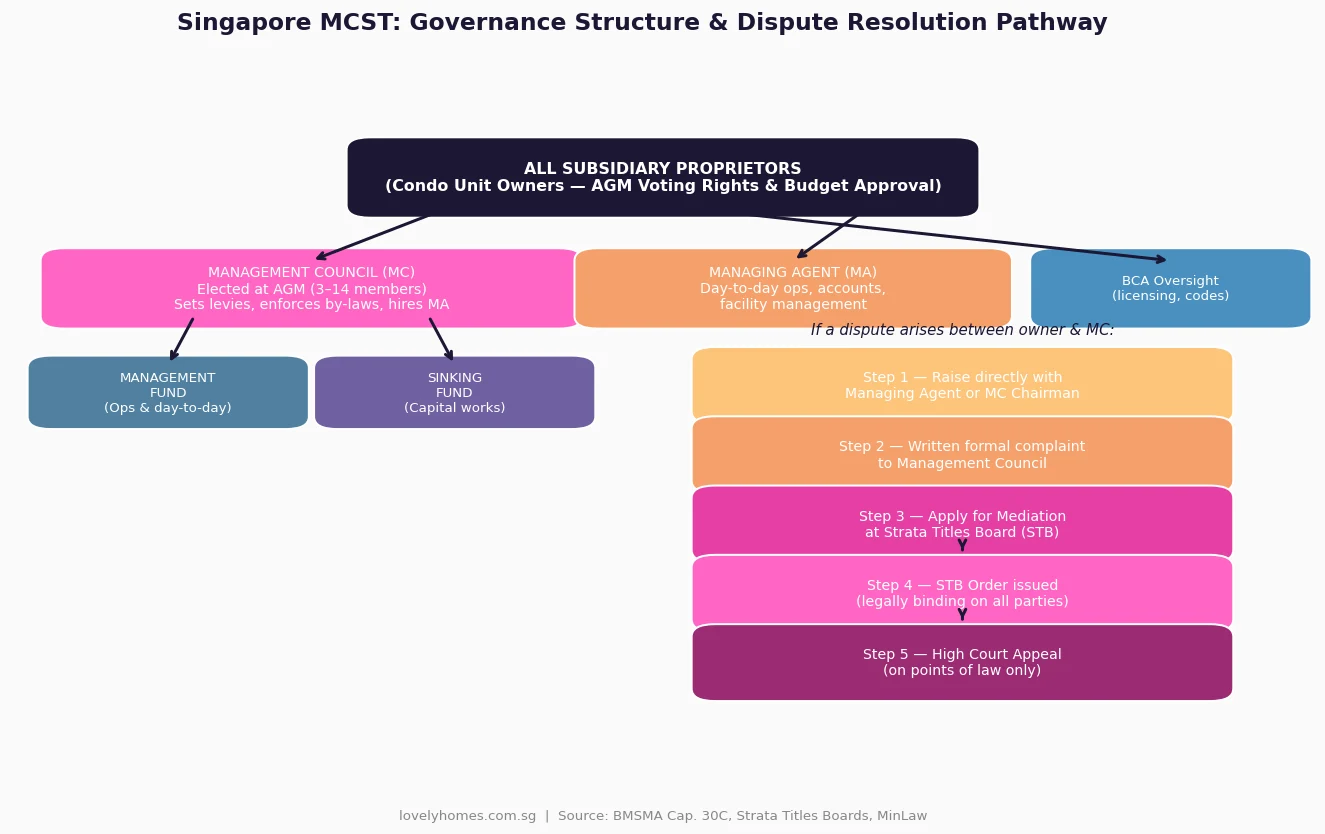
  • Dispute resolution follows a clear pathway: raise with MC → formal complaint → Strata Titles Board (STB) mediation → STB Order (legally binding).
  • Legislation: the BMSMA (Cap. 30C) governs all strata management in Singapore, administered by the Building and Construction Authority (BCA).

What Is an MCST? The Legal Foundation of Condo Living

Every private strata development in Singapore — be it a condo, mixed development, or strata-titled commercial building — is governed by a Management Corporation Strata Title, commonly abbreviated as MCST. The MCST is not a service provider or a management company: it is a statutory body corporate created automatically by law when a strata development’s subsidiary strata certificates of title are issued. In plain terms, the moment you become a subsidiary proprietor (i.e., a unit owner) in a strata development, you automatically become a member of the MCST. You have voting rights, you share in the obligations, and you benefit from the management of common property.

The legal framework is the Building Maintenance and Strata Management Act (BMSMA), Chapter 30C of Singapore’s statutes. The BMSMA is administered by the Building and Construction Authority (BCA) under the Ministry of National Development (MND). It prescribes how MCSTs are constituted, how they manage funds, how by-laws are made and enforced, and how disputes are resolved. For buyers and investors, understanding the MCST is not optional — it directly affects your monthly costs, your rights in the estate, and your ability to renovate or use your unit.

The Management Council: Who Runs Your Condo?

The day-to-day affairs of the MCST are delegated to the Management Council (MC), a committee of elected subsidiary proprietors. Under BMSMA, the MC must have a minimum of 3 members and a maximum of 14, and council members must be unit owners (or nominees of corporate owners). The MC is elected at the AGM, which must be held within 15 months of the previous AGM.

The MC holds significant authority: it sets the annual budget, approves expenditure from both the Management Fund and Sinking Fund, engages and supervises the Managing Agent (MA), enforces by-laws, grants or denies renovation approvals, and represents the MCST in legal matters. In practice, the MC also exercises considerable informal authority over the day-to-day “feel” of an estate — how promptly maintenance issues are addressed, how strictly by-laws are enforced, how transparently accounts are reported to owners.

Most MCSTs engage a professional Managing Agent (MA) — a licensed company that handles operational tasks on the MC’s behalf, including maintenance scheduling, security rostering, contractor management, accounting, and AGM administration. The MA operates under a service contract and is accountable to the MC, not to individual unit owners. Disputes with the MA are resolved through the MC.

Management Fund and Sinking Fund: Your MCST Levies Explained

Every subsidiary proprietor pays monthly contributions (commonly called “maintenance fees”) to the MCST. Under BMSMA, these contributions are split between two statutory funds:

The Management Fund covers recurring operational costs: security services, cleaning, common area utilities (lifts, lighting, pool pumps), landscaping, insurance (fire and public liability), administration, audit fees, and routine minor repairs. Think of this as the MCST’s operating budget.

The Sinking Fund is a capital reserve for major future expenditure: lift overhauls, façade waterproofing, roof replacement, mechanical and electrical system replacements, pool refurbishment, road resurfacing, and similar major works. BMSMA requires that the Sinking Fund must receive contributions equivalent to at least 10% of the total contributions collected (i.e., at least one-tenth of the combined Management Fund and Sinking Fund contributions must go to the Sinking Fund). Most well-managed developments set a higher target — 25–35% of total contributions — to build an adequate reserve.

Singapore MCST management fund sinking fund breakdown BMSMA
Figure 1: MCST Management Fund vs Sinking Fund — Typical Contribution Split and Indicative Expenditure Categories. Source: BMSMA Cap. 30C, BCA Building Maintenance Guidelines.

Contributions are allocated per unit according to share values — a number assigned to each unit based on its area and type when the development is first surveyed. A larger unit typically carries a higher share value and pays a proportionately larger monthly contribution. Share values are fixed and cannot be changed without a unanimous resolution.

How Much Are MCST Fees? A Guide by Condo Type

MCST fees vary enormously across Singapore’s condo landscape. Key factors include the number of units in the development (more units spread fixed costs over a larger base, reducing per-unit fees), the range of facilities (pools, gyms, tennis courts, concierge all cost money to maintain), the age of the development (older buildings have higher maintenance costs), and the quality of financial management by the MC.

Singapore MCST annual fees by condo type 2026 indicative range
Figure 2: Indicative Annual MCST Fees per Unit by Condo Type (2BR–3BR Reference Unit), 2026. Figures are estimates based on typical fee structures; actual fees depend on each development’s budget.

As a general benchmark: a mass-market OCR condominium with 500 or more units and standard facilities (pool, gym, BBQ area) might charge S$200–S$300 per month for a 3BR unit. A mid-range RCR development with around 300 units and a fuller facility suite (multiple pools, function rooms, tennis court) might charge S$250–S$400 per month. A boutique freehold development in Districts 9 or 10 with 80 units and concierge services might charge S$350–S$600 or more per month — the smaller the development, the fewer units to share fixed costs.

Buyers should always request and study the MCST’s audited financial statements (particularly the Sinking Fund balance and adequacy ratio) before purchasing any resale unit. A development with an underfunded Sinking Fund is a red flag — owners will face either a special levy or deteriorating maintenance when major capital works are required.

By-Laws: The Rules of Strata Living

MCST by-laws govern the obligations and restrictions on subsidiary proprietors and their tenants and visitors. Singapore law establishes two tiers of by-laws. The Model By-Laws, set out in the Fourth Schedule of BMSMA, apply automatically to all strata developments and cover fundamentals: prohibiting nuisance to neighbours, keeping common areas clean, not obstructing stairways and corridors, maintaining smoke and cooking fumes within units, and not damaging common property.

Developments may additionally pass additional by-laws by ordinary resolution at an AGM. These can cover matters such as pet policies (breed or size restrictions), short-term rental rules (many condos have by-laws restricting Airbnb-style rentals to a minimum 3-month or 6-month tenancy), renovation hours and noise restrictions, car park allocation rules, and use of facilities. Critically, additional by-laws cannot override the BMSMA or conflict with it — a by-law purporting to ban all pets entirely, for example, may be challengeable as unreasonable.

Breach of by-laws can result in fines of up to S$5,000 per breach under BMSMA, imposed by order of the Strata Titles Boards (STB). In practice, MCSTs typically issue written warnings first; formal enforcement action is reserved for persistent or serious breaches.

Renovation Approvals: What You Need the MCST’s Permission For

If you own a strata unit, you generally have the right to carry out renovation works within your unit, subject to certain approvals and restrictions. Works that affect common property — balcony modifications, structural walls that may be shared, roof access, plumbing in common risers — require MCST approval in addition to any Building and Construction Authority (BCA) or Urban Redevelopment Authority (URA) permits. Internal reconfigurations (knocking down non-structural internal walls, replacing flooring, kitchen refits) typically do not require MCST approval but must comply with time and noise restrictions in the by-laws.

A common area of confusion is the aircon ledge and balcony enclosure. These are typically common property, meaning any modification (enclosing, expanding, adding screens) requires MCST approval. Unauthorised enclosures are one of the most frequent by-law enforcement issues in Singapore condominiums. Always confirm with the MC in writing before commencing any works that touch external walls, balconies, or roof areas.

Summary: Key MCST Rules at a Glance

Topic Rule / Key Point Legislation / Source
MCST formation Automatically formed when strata title issued; all unit owners are members BMSMA s. 29
Management Council size 3–14 members elected at AGM; must be unit owners or nominees BMSMA s. 53
AGM frequency Must be held annually; not more than 15 months since last AGM BMSMA s. 27
Sinking Fund minimum At least 10% of total contributions; MC can set higher target BMSMA s. 38
By-law breach fines Up to S$5,000 per breach, by STB order BMSMA s. 32
Common property works Require MCST written consent; MC can set conditions BMSMA s. 37
Dispute resolution STB mediation → STB Order → High Court appeal (law only) BMSMA Part VI
Quorum for ordinary resolution ≥30% of total share values represented at a general meeting BMSMA s. 75
Pets Governed by by-laws; model by-laws do not prohibit pets; additional by-laws may impose restrictions BMSMA 4th Schedule
Short-term rentals Permitted subject to by-laws and URA regulations; many MCSTs have by-laws requiring minimum 3–6 month tenancy URA guidelines

Worked Example: Mr Tan’s S$9,000 Balcony Dispute

Mr Tan owns a 3BR unit in a mid-range RCR condominium. His balcony faces a pleasant courtyard and he wishes to enclose it with floor-to-ceiling glass panels to create a larger living area. He proceeds without MCST consent and engages a contractor who completes the works over two weekends.

The MC sends a formal notice of breach under the by-laws: the balcony is common property under the strata plan, and any modification requires prior written MCST approval. The MC orders the works to be removed at Mr Tan’s expense within 30 days. Mr Tan disputes this — he argues the panels are removable and he is not damaging the building.

The MC applies to the Strata Titles Boards (STB) for an order requiring reinstatement. At mediation, the STB mediator helps both parties reach a compromise: Mr Tan may retain the glass enclosure provided it is a fully removable system (no drilling into structural walls), an engineer certifies it does not affect load-bearing elements, and he pays a S$500 administrative fee to the MCST. Without compromise, a formal STB Order could have required full reinstatement at an estimated cost of S$8,000–S$12,000 in contractor fees, plus a potential fine of up to S$5,000.

Lesson: always obtain MCST written approval before any works touching common property. The cost of a dispute far exceeds the inconvenience of applying in advance. For guidance on tenant-related strata disputes, see our Rental Tenant Rights Guide 2026.

Dispute Resolution: The Strata Titles Boards (STB)

When a dispute arises between a subsidiary proprietor and the MCST (or between two unit owners about strata matters), Singapore provides a dedicated tribunal: the Strata Titles Boards (STB), established under BMSMA and administered by the Ministry of Law (MinLaw). STB proceedings are designed to be accessible and affordable — filing fees are modest, legal representation is optional, and the process is less adversarial than court litigation.

Common STB applications include: orders requiring the MCST to carry out maintenance works; disputes about by-law enforcement or breach penalties; objections to special levies; disputes about the allocation of car park lots; and applications to invalidate decisions made at AGMs where proper notice was not given. The STB first attempts mediation — parties meet with a mediator in a structured session. If mediation fails, the STB constitutes a formal hearing panel, receives evidence, and issues an Order. STB Orders are legally binding and enforceable in the courts. Appeal lies to the High Court, but only on questions of law.

Singapore MCST governance structure dispute resolution pathway STB BMSMA
Figure 3: Singapore MCST Governance Structure and Dispute Resolution Pathway — from unit owners through Management Council to Strata Titles Boards. Source: BMSMA Cap. 30C, MinLaw.

What Might Change: BMSMA Review and Future Reforms

The BMSMA was comprehensively amended in 2010 and has been updated periodically since. BCA periodically reviews strata management regulations in response to industry feedback and changing market conditions. Areas of ongoing discussion as at mid-2026 include: tightening rules on managing agents’ qualifications and licensing; improving transparency of MCST financial reporting to unit owners; and clarifying the rules on short-term rental by-laws in the context of Singapore’s broader short-term rental regulatory framework. Buyers should monitor BCA and MinLaw announcements for any legislative updates that might affect their rights and obligations as condo owners.

Frequently Asked Questions About Singapore MCSTs

Can the MCST increase maintenance fees without my consent?

Yes. The Management Council has the authority to set the annual budget and the contribution amounts (maintenance fees) required from each unit owner, subject to approval at the AGM by ordinary resolution. An ordinary resolution requires a simple majority of votes cast (by share value) at a general meeting. If you disagree with a fee increase, you can vote against it at the AGM or requisition an extraordinary general meeting to challenge it. Practically speaking, however, fee increases are usually incremental and reflect genuine cost increases — MCSTs that chronically underfund their budgets end up with deteriorating estates and greater special levy calls down the line.

What is a special levy and when can the MCST impose one?

A special levy is a one-time additional contribution imposed on all unit owners to fund a specific capital expenditure that has arisen unexpectedly or that the Sinking Fund is insufficient to cover. Common triggers include emergency structural repairs, lift replacements ahead of schedule, or the costs of defending the MCST in legal proceedings. Under BMSMA, a special levy must be approved by ordinary resolution at a general meeting. The amount allocated to each unit is based on share value. Special levies are a red flag in developments that have historically underfunded their Sinking Fund — which is why buyers should always check the Sinking Fund balance and recent spending history before purchasing a resale unit. A healthy Sinking Fund protects against special levies.

What happens if I stop paying my MCST fees?

Unpaid MCST contributions are a debt owed to the MCST. Under BMSMA, the MCST has a statutory lien over your unit for unpaid contributions — it can register this lien with the Singapore Land Authority (SLA) and ultimately pursue recovery through the courts. If you are selling your unit, solicitors acting on the sale will identify any outstanding MCST arrears, which must be settled before completion. Persistent non-payment can also result in the MCST applying to the STB for enforcement orders. There is no grace period prescribed in law, though most MCSTs will issue demand letters before proceeding to formal enforcement action.

Can I attend an AGM and vote even if I have outstanding MCST fees?

Under BMSMA, unit owners who are in arrears of contributions may be denied the right to vote at a general meeting. Specifically, a subsidiary proprietor is not entitled to vote at any general meeting if any contribution payable in respect of their lot has been in arrears for more than 30 days before the date of the meeting. You retain the right to attend and speak, but you lose voting rights until the arrears are cleared. This is an important incentive for timely payment, particularly for contentious AGM resolutions such as special levies or managing agent contract renewals.

My neighbour is violating the condo by-laws — what can I do?

The primary enforcement mechanism for by-law breaches is through the MCST, not individual unit owners. You should first report the breach in writing to the Managing Agent or Management Council, providing clear details (date, nature of breach, evidence where available). The MC has the authority and obligation to investigate and take enforcement action. If the MC fails to act on a legitimate complaint, you can raise the matter at the AGM or requisition an extraordinary general meeting. As a last resort, you may apply to the STB directly under BMSMA section 111 for an order requiring the MC to take enforcement action. The STB process is designed to be accessible — you do not need a lawyer to file an application.

Can I rent out my condo unit on Airbnb or short-term rental platforms?

Short-term rental of private residential properties in Singapore is regulated by URA under its Short-Term Accommodation (STA) Framework. As at 2026, private residential properties listed for short-term rental must meet URA’s requirements, including a minimum rental period of three consecutive months per tenant. Many MCSTs additionally pass by-laws imposing their own minimum tenancy periods or restricting short-term rentals entirely within their estates. You should check both URA’s current STA guidelines and your specific development’s by-laws before listing your property. Breach of URA regulations can result in fines, and breach of MCST by-laws can result in STB enforcement. For the rental rules from the tenant’s perspective, see our Singapore Rental Tenant Rights Guide 2026.

I want to buy an en bloc / collective sale — how does the MCST factor in?

In an en bloc (collective sale), the MCST plays a key administrative role but does not initiate or block the sale. The en bloc process is governed by the Land Titles (Strata) Act (LTSA), not BMSMA. Owners seeking a collective sale form a collective sale committee (CSC), separate from the MC. The CSC must obtain consent from subsidiary proprietors holding 80% of total share value (for developments over 10 years old) or 90% (for developments under 10 years old) before applying to the STB for a sale order. Dissenting owners can file objections with the STB. The MC continues to manage the estate throughout the en bloc process, including collecting maintenance fees and addressing day-to-day repairs, until the sale is completed and the strata title scheme is wound up.

Related Articles

Disclaimer: This article is for general informational purposes only and does not constitute legal, financial, or property advice. Information on BMSMA provisions is based on the Act as at June 2026; amendments may occur — readers should verify against the current statutes at sso.agc.gov.sg and consult the Building and Construction Authority (bca.gov.sg), the Strata Titles Boards (mlaw.gov.sg/strata-titles-boards), or a qualified lawyer for advice specific to their strata development and circumstances.

Singapore Property Market Forecast 2H 2026: Price Outlook, Key Risks and What Buyers Should Know

Singapore Property Market Forecast 2H 2026: Price Outlook, Key Risks and What Buyers Should Know

Quick Answer: Singapore Property Market Forecast 2H 2026

  • Private residential prices rose 0.9% QoQ and 2.63% YoY in Q1 2026, with the Outside Central Region (OCR) leading at +2.2% QoQ — price growth is positive but moderating.
  • HDB resale recorded its first quarterly dip (-0.1% QoQ) since Q2 2019; index sits at 203.4. Not a crash — more of a pause after a five-year run.
  • 2H 2026 GLS launches 9 confirmed-list sites (4,745 units), adding meaningful supply to OCR and RCR. Pricing discipline from developers is expected.
  • Key risk: interest rates remain elevated at 3.0–3.5% for bank mortgages; affordability is stretched for many first-time buyers.
  • Key catalyst: any US Federal Reserve rate cut signals would unlock significant pent-up demand — watch the September and December 2026 Fed meetings.
  • For buyers: fundamentals remain sound — Singapore’s employment is near-full, rental demand supports investment yield, and supply is finite. Timing the market is less reliable than time in the market.
  • URA Q2 2026 Flash Estimates are expected in early July 2026 and will be the next major data point.

H1 2026 in Review: Where the Singapore Property Market Stands

As the calendar turns to the second half of 2026, Singapore’s property market presents a nuanced picture. Private residential prices continued their gradual upward trajectory in Q1 2026, with the Urban Redevelopment Authority (URA) reporting a Property Price Index (PPI) increase of 0.9% quarter-on-quarter — a modest but consistent gain that extends a trend stretching back to the post-pandemic recovery that began in mid-2020. On a year-on-year basis, the private residential index is up 2.63%, a pace that is firm but well below the double-digit growth seen during the post-pandemic surge of 2021 to 2023.

The Housing Development Board’s Resale Price Index (RPI), however, told a slightly different story. At 203.4 in Q1 2026, the HDB resale market recorded a 0.1% quarterly decline — the first such dip since Q2 2019. This is not alarming in isolation: the index had surged more than 54% since its 2019 trough, and a modest pause is consistent with natural market digestion. What it does signal is that the exceptional run of HDB resale price appreciation is transitioning into a more measured phase.

Singapore property market H1 2026 key metrics scorecard URA HDB data
Figure 1: Singapore Property Market H1 2026 Key Metrics Scorecard — URA Q1 2026 Real Estate Statistics and HDB Resale Statistics.

Private Residential Market: A Three-Speed Story

The defining characteristic of Singapore’s private residential market in 2026 is regional divergence. The three planning zones administered by URA — the Core Central Region (CCR), Rest of Central Region (RCR), and Outside Central Region (OCR) — have performed at markedly different speeds in 2026.

The OCR is the undisputed pace-setter. A 2.2% quarterly gain in Q1 2026, following similar momentum in late 2025, reflects genuine demand from HDB upgraders — a cohort whose Minimum Occupation Period (MOP) clears in waves and who target mass-market new launches in the S$1.3M–S$1.8M range. The 2H 2026 GLS programme deliberately concentrates supply here (Tampines Street 94, Bayshore Road), which should moderate any further sharp price acceleration without causing a price correction.

The RCR recorded 0.8% QoQ growth — solid mid-field performance driven by a mix of first-time private buyers, professionals, and some foreign-related buying in the city-fringe. River Valley Green Parcel C (awarded June 2026 at a top bid of approximately S$1,730 psf ppr) is the headline indicator of developer confidence in this zone.

The CCR grew just 0.3% QoQ, a subdued reading that reflects several headwinds: the 60% Additional Buyer’s Stamp Duty (ABSD) on foreigners that has been in place since April 2023 continues to suppress international transaction volumes; and the global macro uncertainty discussed in the risk section below has weighed on ultra-high-net-worth discretionary buying. That said, CCR is not in distress — it remains a long-term beneficiary of Singapore’s family office growth and wealth inflows.

Singapore private residential price index CCR RCR OCR Q1 2026 regional trends
Figure 2: Singapore Private Residential Price Index by Region (Q1 2020–Q1 2026) and QoQ Change for Q1 2026. Source: URA Q1 2026 Real Estate Statistics.

HDB Resale Market: A Healthy Pause, Not a Reversal

Singapore’s HDB resale market has been one of the defining investment stories of the 2020s. From a low point in 2019 (RPI ≈ 132), prices surged to an index of 203.4 by Q1 2026 — a 54% cumulative increase. The Q1 2026 dip of 0.1% QoQ is, in that context, the market catching its breath after an exceptional run rather than a structural reversal.

Two counterintuitive data points reinforce this view. First, million-dollar HDB transactions reached a record quarterly high of 412 in Q1 2026 — indicating that at the premium end of the resale market (large mature-estate flats, high-floor units in sought-after towns), demand remains fierce. Second, overall HDB resale transaction volumes for Q1 2026 remained healthy, with four-room flats accounting for the largest share (approximately 2,690 transactions in Q1 2026 alone) at a median price of around S$575,000.

For 2H 2026, the HDB resale market is likely to remain range-bound rather than sharply appreciating or correcting. MOP cohorts from the 2016–2019 BTO launches are gradually clearing, releasing units back to the resale market — but supply from this channel is relatively thin compared to the 2013–2016 peak cycle. Demand remains supported by couples who cannot access BTO (due to income ceiling, citizenship mix, or urgency) and Permanent Residents who remain ineligible to buy BTO directly.

Developer Sales and the New Launch Pipeline

Developer sales activity is the indicator most directly shaped by new launch timing. The monthly data tells a story of feast and famine: January to April 2026 saw 1,120, 895, 1,348 and 1,548 units sold respectively — solid months driven by a cluster of project launches. May 2026 crashed to 447 units (-71.1% month-on-month), not because demand evaporated, but because there were few projects launching that month.

The pipeline going into 2H 2026 remains substantial. URA data shows 17,032 unsold units in the private pipeline as of Q1 2026 (total pipeline including units not yet launched: 42,561). The 2H 2026 GLS Confirmed List adds nine further sites including Lentor Gardens Parcel A and B, Bayshore Road, Tampines Street 94, and an EC site at Jurong East. These launches are phased across 2H 2026 into 2027, so the impact on completed supply will be felt primarily in 2028–2030.

Rental Market: Correction Underway, Yields Compressing

Singapore’s private residential rental market began correcting in 2024 after a record two-year surge and that correction extended into 2026. The URA rental index fell 1.2% QoQ in Q1 2026, following declines across 2024 and 2025. In absolute terms, rents remain significantly above their pre-pandemic levels — a 2BR in D15 that rented for S$2,800/month in 2019 may still command S$4,200–S$4,800/month in 2026 depending on specification — but the exceptional post-pandemic pricing has normalised.

For investors, this rental correction compresses gross yields. A S$1.5M 2BR in the RCR yielding S$4,500/month gross generates a gross yield of approximately 3.6%, which is broadly comparable to bank deposit rates in 2026. Net yield after management fees, property tax, and maintenance is lower — making the case for property investment in 2026 primarily a capital appreciation thesis rather than a pure income play.

2H 2026 Market Outlook Summary

Segment Base Case Bull Case Bear Case
Private Residential (Overall) +1%–2% for full year 2026 +3%–4% if rates ease and demand recovers Flat to -1% if global recession deepens
OCR (Mass Market) Continues outperforming; +2%–3% YoY +4%–5% with strong HDB upgrader demand Supply pressure from GLS launches moderates gains
RCR (City Fringe) Steady +1%–2% YoY +3% with new launch interest Flat if affordability ceiling is hit
CCR (Core Central) Sideways to +1%; foreign buyer ABSD drag +2%–3% if ABSD reviewed or wealth inflows surge -1%–2% if global HNW sentiment deteriorates
HDB Resale ±0.5% QoQ; range-bound in H2 +1%–2% if upgrader demand stays robust -1% if affordability stress bites flat demand
Private Rental Further -2%–4% as supply catches up Stabilises if employment influx resumes Deeper correction if expat headcount falls

Worked Example: The Chen Family — Buy in 2H 2026 or Wait?

Mr and Mrs Chen are Singapore Citizens in their early 30s. They have cleared their HDB MOP on their Bishan 4-room flat and are looking to upgrade to a 3-bedroom OCR condo. They have combined income of S$13,500 per month, CPF OA savings of S$180,000, and cash of S$120,000.

They are eyeing a 3BR at an upcoming OCR launch in Q3 2026 priced at S$1.65M. Under the ABSD SC couple remission scheme, they can purchase the new condo and claim a full refund of the 20% ABSD (S$330,000) provided they sell their HDB flat within six months of the condo purchase date.

Key numbers: BSD S$47,600 (payable from CPF); ABSD S$330,000 (cash, but refundable within six months of HDB sale); 5% cash S$82,500; legal fees ~S$5,500. Bank loan: 75% LTV = S$1,237,500 at 3.2% over 30 years → monthly repayment approximately S$5,338. TDSR = S$5,338 ÷ S$13,500 = 39.5% (PASS, under 55%). Total cash needed upfront: ~S$208,000 (cash component + ABSD float pending HDB sale).

Should they wait? If OCR prices rise another 2% by Q1 2027, the same unit would cost S$1,683,000 — an additional S$33,000. If interest rates fall 50 bps by then, monthly repayments fall by ~S$300/month. The calculus slightly favours acting when they are ready rather than trying to time the market precisely, provided the ABSD remission window can be managed. See our guide on ABSD remission for SC couples for the full rules.

What Might Come Next: Risks and Catalysts for 2H 2026

The Singapore property market operates at the intersection of domestic fundamentals (employment, wage growth, HDB upgrader cohorts) and global macro forces (US interest rates, geopolitical risk, capital flows). For the second half of 2026, both sides of that equation are in play.

Key downside risks include the persistence of elevated interest rates — if the US Federal Reserve holds rates through 2026 without cutting, Singapore bank mortgage rates (which track SORA and swap rates) will remain in the 3.0–3.5% range, keeping affordability stretched. Continued global trade disruptions from US tariff policy create a dampening effect on business investment sentiment and, indirectly, on expatriate headcounts and rental demand. China’s economic slowdown reduces the pool of Chinese-origin buyers who were historically active in the CCR.

Key upside catalysts include the prospect of Fed rate cuts in September or December 2026 — even one 25-basis-point cut would move Singapore’s forward rates and boost buyer confidence. Singapore’s own fundamentals remain strong: the unemployment rate is approximately 2.0%, wage growth is positive, and the Government’s managed-supply approach via the GLS programme means developers are not flooding the market with distressed inventory. Any relaxation of ABSD for permanent residents (which has been debated, though there is no official signal) would be an immediate CCR and RCR catalyst.

Singapore property market second half 2026 risks catalysts analysis
Figure 3: Singapore Property Market 2H 2026 — Key Risks vs Catalysts. Editorial assessment as at June 2026. Not investment advice.

Frequently Asked Questions

Will Singapore property prices drop in 2H 2026?

A broad price correction in 2H 2026 is not the base-case scenario for most analysts. Singapore’s property market is underpinned by limited land supply, robust employment, and the Government’s disciplined GLS programme which calibrates supply to demand. The most likely outcome for 2H 2026 is modest positive growth in the private residential segment (0%–2% for the full year in a base case) and range-bound movement in HDB resale. A sharp correction would require a confluence of events unlikely to materialise simultaneously: a major spike in unemployment, a severe global financial shock, and a government decision to release large additional land supply. None of these is the current outlook.

When will the URA Q2 2026 Flash Estimates be released?

Based on URA’s established release pattern, the Q2 2026 Flash Estimates for the private residential property price index are expected in the first week of July 2026 — likely 1 or 2 July. The full Q2 2026 real estate statistics (including detailed regional breakdowns, rental index, and developer sales data) typically follow approximately three to four weeks later. The flash estimate gives a preliminary QoQ price change figure; the full release provides granular transaction and rental data. LovelyHomes will publish a dedicated analysis article as soon as the data is available.

What does the HDB resale -0.1% dip in Q1 2026 actually mean for sellers?

A -0.1% quarterly change in the HDB Resale Price Index is, in practical terms, negligible. On a S$600,000 flat, it represents a S$600 notional price movement — far smaller than the typical negotiation buffer in any individual transaction. What it signals is a shift in market psychology: buyers are less willing to pay premiums above valuation (Cash-Over-Valuation, or COV), and the exceptional seller’s market conditions of 2021–2024 have normalised. Sellers should still expect good prices — the index is 54% above its 2019 trough — but they should set realistic expectations and price to comparable transactions rather than aspirationally. For guidance on reading HDB data, see our HDB Resale Price Index Guide.

Is this a good time to buy a private property in Singapore?

This depends entirely on your personal financial circumstances, intended holding period, and purpose. If you are buying for genuine owner-occupation (primary home or long-term family residence), timing the market precisely is less important than buying within your means — ensuring your TDSR is comfortable, that you have adequate cash reserves, and that your loan tenor is appropriate. If you are buying as an investment (rental yield or capital appreciation), you need to stress-test the numbers at current mortgage rates (3.0–3.5%) and assess whether the rental yield justifies the carrying cost. For a personalised assessment, consult a licensed financial adviser and a property professional. See also our Singapore Property Financing Guide for a full breakdown of LTV, TDSR, and MSR rules.

How does the 2H 2026 GLS supply affect new launch prices?

The 2H 2026 Government Land Sales Confirmed List adds nine sites capable of yielding approximately 4,745 private and EC units. This is a substantial supply injection, particularly into the OCR and RCR. In theory, more supply means developers compete harder for buyers, which moderates launch prices. In practice, Singapore developers rarely slash prices — they tend to phase launches to match demand and hold firm on pricing. The more likely outcome is that new launches in 2H 2026 are priced at modest premiums (5%–8%) to recent comparables rather than at exceptional premiums. Buyers interested in specific sites such as Lentor Gardens Parcels A and B, Bayshore Road, or Tampines Street 94 should monitor the URA tender awards and developer launch announcements as they are made throughout 2H 2026. Full details of all 2H GLS sites are in our 2H 2026 GLS Programme Guide.

What is the ABSD rate for Singapore Citizens buying a second property in 2026?

A Singapore Citizen purchasing a second residential property pays 20% ABSD on the purchase price or market value, whichever is higher. This is paid in cash (CPF cannot be used for ABSD). For SC couples who own an HDB flat, the 20% ABSD on their second private property can be refunded under the SC Couple ABSD Remission Scheme, provided the HDB flat is sold within six months of the completion of the private property purchase. The full rules are detailed in our ABSD Remission Guide and Complete ABSD Singapore 2026 Guide.

How do I track the Singapore property market between official URA releases?

Between URA quarterly releases, you can monitor real-time trends through several free sources. The URA REALIS portal (accessible via My SingPass) provides transaction-level data for private residential properties. The HDB Resale Flat Prices portal shows individual HDB transactions. SRX Property and EdgeProp Singapore publish weekly market commentaries based on caveats lodged. The Business Times Real Estate section and Channel NewsAsia Property cover major announcements and tender results. For a guide on how to interpret the data you find, see our HDB Resale Price Index Guide and CCR RCR OCR Property Guide.

Related Articles

Disclaimer: This article is for general informational purposes only and does not constitute financial, investment, or property advice. All property market data is sourced from the Urban Redevelopment Authority (URA) and Housing Development Board (HDB) official releases as at Q1 2026. Property prices, interest rates, and government policies can change — readers should refer to the latest official URA (ura.gov.sg), HDB (hdb.gov.sg), MAS (mas.gov.sg), and IRAS (iras.gov.sg) publications and consult a licensed financial adviser or property professional before making any property-related decision. Past price performance is not indicative of future results.

Translate »