Singapore GLS Guide 2026: How the Government Land Sales Programme Works

Singapore GLS Guide 2026: How the Government Land Sales Programme Works

Quick Answer — Key Takeaways

  • The Government Land Sales (GLS) programme is the primary mechanism by which the Singapore government releases state land for private residential, commercial, and mixed-use development.
  • GLS operates through two lists: the Confirmed List (sites released on a fixed schedule regardless of demand) and the Reserve List (sites released only when triggered by developer interest).
  • For 2H 2026, the Urban Redevelopment Authority (URA) placed 9 sites on the Confirmed List yielding 4,745 residential units — part of a full-year record of 9,320 units, over 50% above the 10-year annual average.
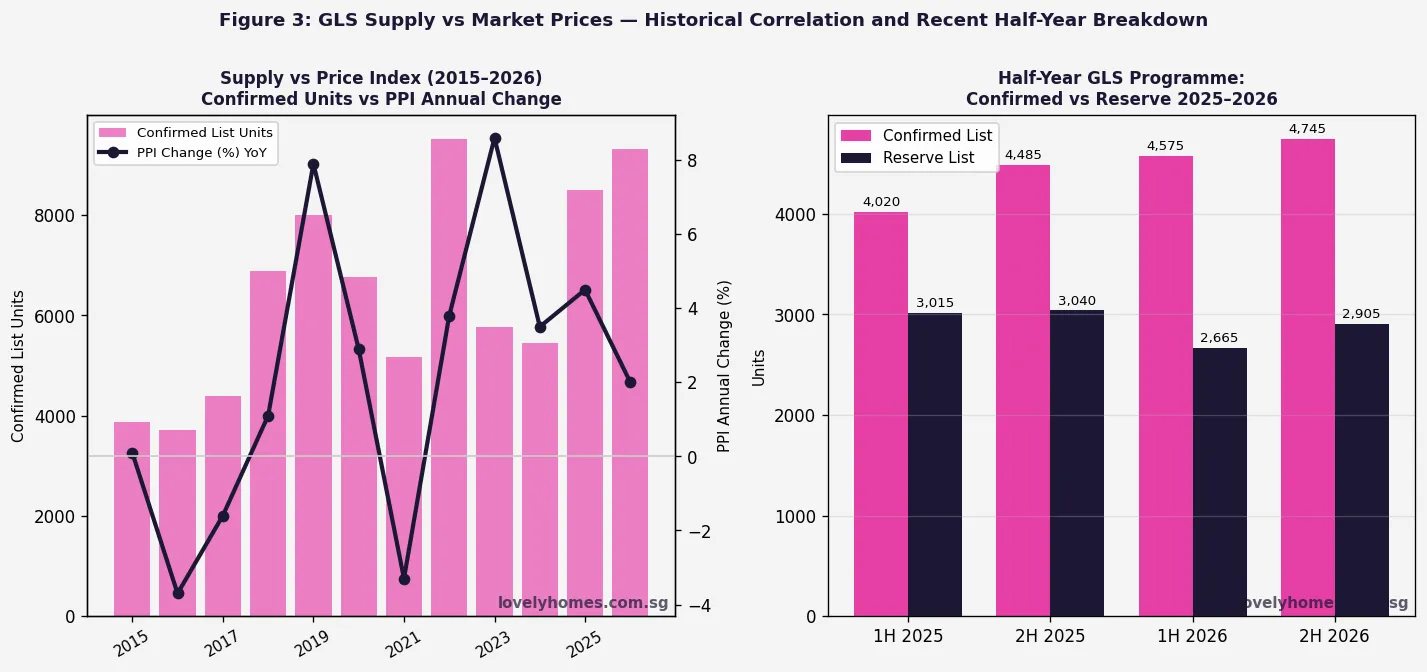
  • GLS supply directly influences new launch pricing: high supply generally moderates price growth; constrained supply in 2021–2022 contributed to the sharp private property price surge of 8–10% per year.
  • Key 2H 2026 sites include the JLD White Site (Town Hall Link, up to 1,200 units plus major office component) and new launches at Lentor Gardens, Dunearn House (Turf City), and two EC sites.
  • The full-year Q2 2026 private residential statistics — including detailed take-up by GLS site — will be released by URA on 24 July 2026.
  • Understanding GLS helps buyers and investors anticipate pipeline supply, assess whether a launch represents fair value, and time their entry into the market.

What Is the Government Land Sales Programme?

The Government Land Sales programme is administered by the Urban Redevelopment Authority (URA) and the Housing and Development Board (HDB) on behalf of the Singapore Land Authority (SLA) and the Ministry of National Development (MND). Since its formalisation in the 1990s, GLS has been the cornerstone of Singapore’s land supply policy — ensuring that private housing, commercial space, and mixed-use developments remain adequately supplied to meet demand without stoking speculative excess.

Each calendar half-year (1H and 2H), the government announces the GLS programme for that period, specifying which sites will be sold and whether they sit on the Confirmed List or the Reserve List. Developers bid for these sites through public tender, and the winning bid — assessed not only on price but on concept proposals for White sites — determines the land cost that ultimately feeds into new launch pricing.

For property buyers, the GLS programme is the earliest possible signal of future new launch supply. A large Confirmed List means more launches in 12–24 months; a reduced supply signals potential price pressure. Singapore’s land supply policy is explicitly counter-cyclical: the government increases GLS supply when prices rise strongly, and eases it when the market softens — a pattern clearly visible in the data since 2010.

Confirmed List vs Reserve List — How They Work

The two-list structure is deliberately designed to balance certainty of supply with responsiveness to market conditions.

Confirmed List sites are released for tender on a published schedule regardless of developer demand. These sites represent the government’s baseline supply commitment for the half-year. Developers know the tender timeline in advance and can plan their acquisition strategy accordingly. The Confirmed List is typically used for sites in areas where the government has strong urban planning reasons to catalyse development — for instance, new growth corridors like Tengah, Jurong Lake District, or the Greater Southern Waterfront.

Reserve List sites are only triggered when a developer submits an Application to Purchase (ATP) committing to a minimum price. If the government finds the minimum price acceptable, the site is formally launched for tender. If no developer submits an ATP, the site remains undeveloped. Reserve List sites thus act as a buffer — they expand effective supply precisely when developer appetite is high, dampening the price spikes that a purely fixed-supply regime might allow.
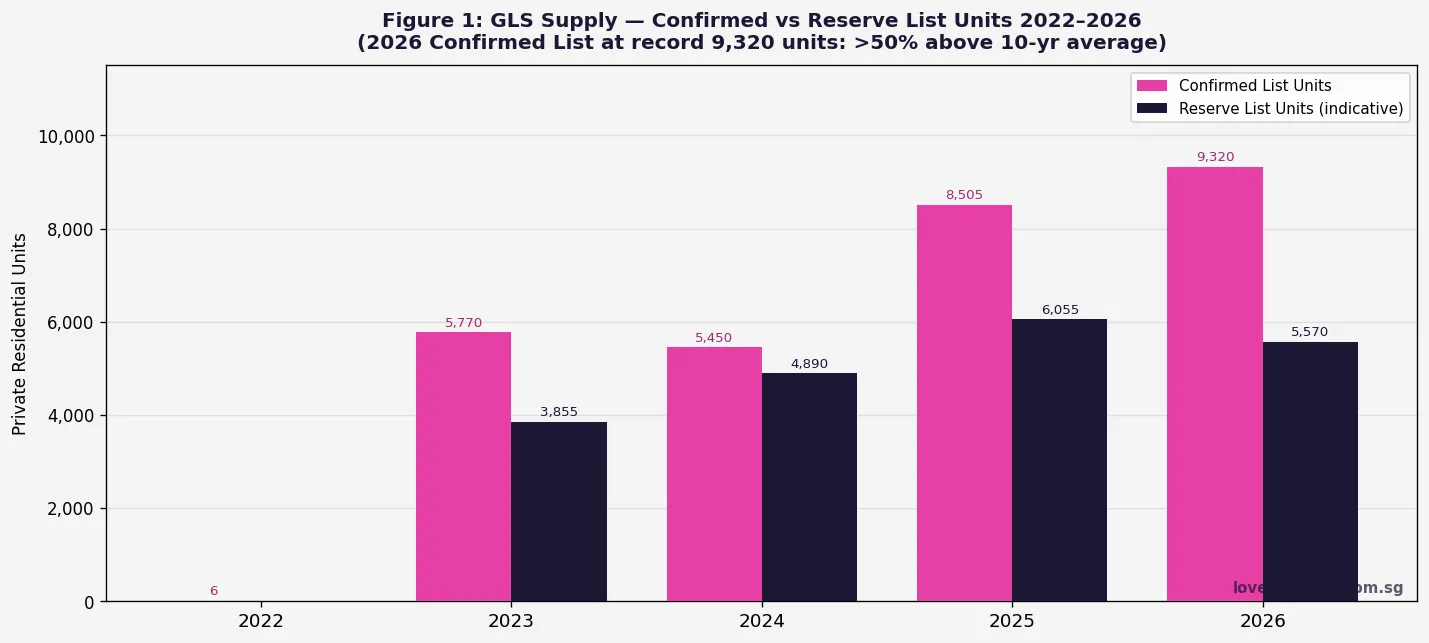
GLS confirmed and reserve list supply units 2022 to 2026 Singapore
Figure 1: GLS Confirmed List units 2022–2026. The 2026 programme stands at 9,320 Confirmed List units — the highest in over a decade and more than 50% above the 10-year annual average of approximately 6,100 units.

The 2026 GLS Programme — Record Supply

The 2026 GLS programme represents the most aggressive supply injection since the post-2013 cooling measures suppressed demand. For the full year 2026, the Confirmed List totals 9,320 private residential units (including 735 Executive Condominium units) across two half-year programmes, plus substantial commercial and white-site GFA.

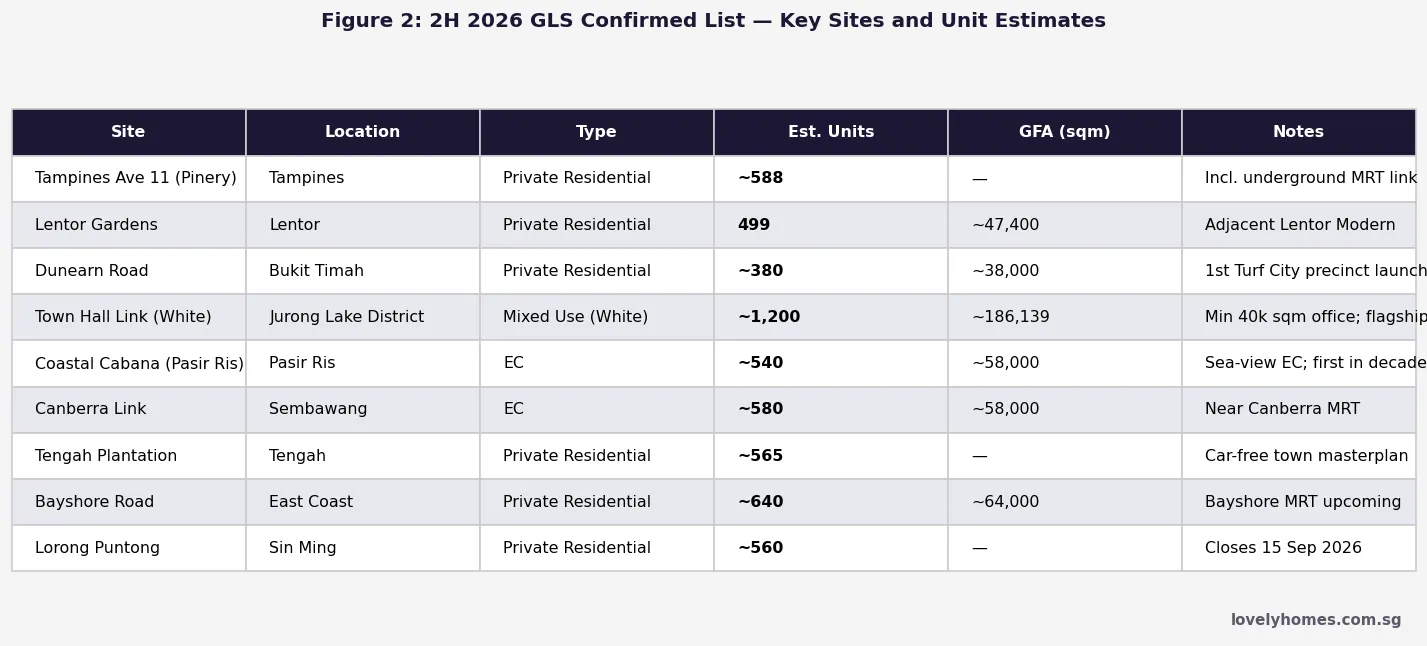
The 2H 2026 Confirmed List, announced by URA, comprises eight private residential sites and one White site, with a combined potential yield of 4,745 private residential units (including 735 EC units) and 83,350 sqm gross floor area (GFA) of commercial space. Taken together with 1H 2026’s 4,575 units, the full-year total of 9,320 units is over 50% higher than the past 10-year annual average of approximately 6,100 units.
2H 2026 GLS confirmed list sites locations unit estimates Singapore
Figure 2: Key 2H 2026 GLS Confirmed List sites, locations, and unit estimates. The JLD White Site (Town Hall Link) is the most significant, with up to 1,200 residential units and a minimum 40,000 sqm office component.

The Jurong Lake District White Site — Singapore’s Most Ambitious GLS Parcel

The centrepiece of the 2H 2026 GLS programme is the White site at Town Hall Link in Jurong Lake District (JLD), launched for tender on 3 July 2026 (URA Press Release pr26-53). White sites differ from standard residential or commercial tenders: developers must propose a concept for the entire parcel, and evaluation criteria include urban design quality, environmental sustainability, and integration with the surrounding masterplan — not just the land bid price.

The JLD White site has a total potential GFA of 186,139 sqm, comprising a minimum of 40,000 sqm of office space, up to 1,200 private residential units, and 44,000 sqm of complementary uses (retail, hotel, community facilities). The site reflects the government’s vision to transform Jurong into Singapore’s second Central Business District — a project that has been two decades in the making and will reshape the western corridor of Singapore’s property market. The tender closes on 17 November 2026.

How GLS Pricing Flows to New Launch Prices

The relationship between GLS land cost and new launch prices is direct but not perfectly linear. Developers account for land cost, construction cost (currently elevated at approximately S$450–S$600 per sqft for mid-range condominiums, driven by labour and materials), financing charges, and their target margin (typically 12–20%) when setting indicative prices. The break-even price for a developer with a land cost of S$1,200 psf ppr (price per square foot per plot ratio) and build costs of S$530 psf might be approximately S$1,800–S$1,900 psf at a target yield — before marketing and sales overheads.

This is why GLS tender results, when reported by URA, attract intense industry scrutiny. A land bid that exceeds market expectations (a “bullish bid”) signals that the developer expects strong selling prices; a conservative bid signals caution. The Lentor Gardens site (land cost approximately S$920 psf ppr), resulting in launch prices averaging S$2,350 psf, illustrates the mechanics: at a plot ratio of approximately 2.5, the land contribution per saleable sqft works out to roughly S$920 / 2.5 ≈ S$368 psf, plus build cost, fees, margin.

GLS and the Executive Condominium (EC) Market

ECs occupy a unique position in the GLS framework. EC sites are sold exclusively to developers who must then offer the units to eligible buyers (Singapore Citizens and SPRs meeting HDB income and eligibility criteria) at capped prices before the EC is privatised after 10 years. The MND sets EC GLS sites separately from standard private residential sites, with two EC sites on the 2H 2026 Confirmed List: Coastal Cabana at Pasir Ris (approximately 540 units) and a site at Canberra Link (approximately 580 units). The effective land cost per EC unit is generally lower than private residential, reflecting the restrictions on initial buyer eligibility and resale during the Minimum Occupation Period (MOP).

Notably, from 8 May 2026, the MOP for future EC sites (those with tender closing dates on or after that date) was extended from 5 years to 10 years — a significant policy tightening that reduces the liquidity appeal of ECs as investment vehicles while preserving their affordability role for first-time buyers. The 2H 2026 EC sites are subject to this new 10-year MOP requirement.
GLS supply versus private residential property price index PPI correlation 2015 to 2026 Singapore
Figure 3: Historical GLS Confirmed List units versus the Private Residential Property Price Index (PPI) annual change (left), and the half-year GLS programme breakdown for 2025–2026 (right). High supply years generally correspond to moderating price growth, with a 12–18 month lag.

Summary Table: GLS Programme 2025–2026 at a Glance

Parameter 1H 2025 2H 2025 1H 2026 2H 2026
Confirmed List Units 4,020 4,485 4,575 4,745
Reserve List Units (est.) 3,015 3,040 2,665 2,905
Total Programme 7,035 7,525 7,240 7,650
EC Units (within Confirmed) 640 695 0 735
White Sites 1 (JLD Town Hall Link)
Commercial GFA (Confirmed) ~28,000 sqm ~32,000 sqm ~35,000 sqm 83,350 sqm
Full-Year Confirmed 8,505 (2025) 9,320 (2026) — 10-yr high

Worked Example: Reading a GLS Tender Result as a Buyer

In June 2026, Kingsford was awarded the Lentor Gardens site at approximately S$920 psf ppr (price per square foot per plot ratio) against a site area of approximately 18,900 sqm and a gross plot ratio of 2.5, yielding 499 units. The land cost per saleable unit works out to approximately S$920 × 2.5 × average unit size 500 sqft / 499 units ≈ S$2.3M land component per unit.

Adding estimated construction cost (S$530 psf × 500 sqft = S$265,000), developer overhead and margin (~15%), and marketing costs, the break-even for a 500 sqft unit is approximately S$2.9M to S$3.0M — or roughly S$5,800–S$6,000 psf break-even before profit. The launch average of S$2,350 psf implies a unit size closer to 700 sqft (S$1.645M average), consistent with the development’s product mix. This breakdown helps buyers assess whether a launch price is commercially justifiable or whether a developer is selling at a margin that leaves room for future appreciation.

The key takeaway: GLS land cost sets a price floor for the surrounding resale market. When developers pay record land prices, they launch at record prices — and those prices become the new benchmark for nearby resale units. Buyers tracking GLS results in their target district are effectively monitoring the minimum that future launches must achieve, and thus the direction of resale competition.

Why This Matters: Supply Overshooting vs. Structural Demand

The 9,320-unit 2026 Confirmed List is large by historical standards, but Singapore’s structural property demand is equally robust. Net household formation runs at approximately 20,000–25,000 per year, immigration adds a steady flow of new permanent residents and employment pass holders, and owner-occupier replacement demand (upgrading, right-sizing) generates consistent transaction volumes. Against this backdrop, even a record 9,320-unit programme represents roughly 4–5 months of annual demand absorption. Analysts at major research desks argue that the supply wave will moderate price growth — particularly in the Outside Central Region where GLS supply is most concentrated — but is unlikely to cause a sustained price correction of the magnitude seen in 2013–2017, when cooling measures and oversupply combined to push prices down approximately 12% over four years.

The Core Central Region and landed market remain structurally supply-constrained: fewer GLS sites exist in prime districts, freehold land is not created through GLS, and the luxury buyer profile is less sensitive to GLS supply volumes. This bifurcation between a moderating mass market and resilient prime and landed segment is the dominant property market narrative for the second half of 2026.

What Might Come Next

Several key GLS milestones are approaching in the remainder of 2026 and into 2027. The Lorong Puntong/Sin Ming site tender closes on 15 September 2026, and the JLD White Site tender closes on 17 November 2026 — both will be closely watched as barometers of developer confidence. URA’s full Q2 2026 private residential statistics, expected on 24 July 2026, will provide detailed take-up data for recent GLS launches and will likely influence the quantum of the 1H 2027 programme. If new-home sales remain above 7,000 units for the full year 2026, the government will likely maintain or even expand the confirmed list in 2027. If sales disappoint, a modest pullback in GLS quantum — as seen in 2015–2016 — is the most probable policy response.

Frequently Asked Questions

How long does it take from a GLS award to a new launch?

Typically 12 to 24 months. Once a developer wins a GLS tender, it must obtain planning approval, finalise the development’s concept and design, and satisfy various conditions before launching for sale. For straightforward residential sites, the timeline from award to launch preview is usually 12–18 months. For complex mixed-use or White sites, it can run to 24–36 months. The JLD White Site, for example, is unlikely to launch for sale before late 2028 or 2029, given the complexity of the development brief. Buyers tracking a GLS award as a proxy for future supply in their target district should add at least 18 months to the tender date to estimate when competition might appear on the market.

Can individual buyers participate in GLS tenders directly?

No. GLS tenders are open to developers and property companies, not individual buyers. The minimum land parcel values involved (typically S$200M to over S$1 billion for larger sites) and the development obligations attached to the tender conditions are designed for institutional participants. Individual investors participate in the GLS ecosystem indirectly — by purchasing units from developers who have won GLS sites and developed them into saleable projects. The closest an individual can get to a direct land transaction is through a collective sale (en bloc) of an existing strata development, or through a private land auction — neither of which is part of the GLS programme.

What is a White site and how does it differ from a standard residential GLS parcel?

A White site is a GLS parcel where the permissible uses are not pre-specified — the developer has flexibility to propose a mix of residential, commercial, hotel, and community uses, subject to minimum requirements and the Urban Redevelopment Authority’s concept proposal evaluation. Standard residential sites have a defined use (private housing), a specified gross plot ratio, and are awarded purely on the highest bid price. White sites are evaluated on a combination of price and concept quality, with URA assessing the urban design, public realm, sustainability, and programming. The JLD White site, Paya Lebar Central, and Marina South are examples of major White site developments in Singapore’s recent history. White sites typically result in more architecturally and programmatically complex developments that become landmark projects in their district.

Does high GLS supply mean property prices will fall?

Not necessarily, and not immediately. The GLS-to-prices relationship operates with a 12–24 month lag and is moderated by demand conditions, interest rates, and the composition of sites. High GLS supply increases the pipeline of future new launches, which gives buyers more options and reduces urgency — typically moderating the pace of price increases rather than causing outright falls. Singapore experienced a genuine price correction (12% over 2013–2017) only when a record GLS pipeline coincided with significant cooling measures, rising interest rates, and softening foreign demand simultaneously. In 2026, cooling measures remain in place (ABSD, SSD, TDSR) but demand is supported by historically low mortgage rates (3M SORA near 1%) and resilient employment. The base case from industry research is price growth of 2–4% for 2026 despite the record supply programme — a soft landing rather than a reversal.

Where can I track GLS tenders and results?

The URA publishes the current GLS programme, all active tenders, and awarded tender results on its official website at ura.gov.sg/Corporate/Land-Sales/Sites-For-Tender. The SLA also publishes related information at sla.gov.sg. For EC sites and HDB land sales, the HDB website at hdb.gov.sg publishes the relevant information. URA press releases accompanying new tender launches and awards are the primary source for official quantum, GFA, and evaluation outcomes. Industry portals compile GLS data in more digestible formats, but always cross-reference against the primary URA/SLA source for accuracy.

How does GLS land cost affect HDB resale prices?

The relationship is indirect but real. GLS-derived new launch prices set a psychological reference point: when buyers compare an HDB resale flat in the same area against a new private condo launched at S$2,200 psf, the HDB flat at S$700–S$900 psf appears relatively affordable — supporting demand and prices. Conversely, if GLS supply moderates new launch prices, the urgency premium embedded in HDB resale prices may also ease. The more direct driver of HDB resale prices is HDB’s own build programme (BTO supply) and the Minimum Occupation Period pipeline: the 2026 surge of over 13,000 resale flats entering the market (5-year MOP completions from the 2021 BTO launches) is a stronger supply signal for the HDB resale market than GLS data. For a detailed discussion of the HDB resale market outlook, see our Singapore Property Market Outlook 2H 2026.

Related Articles

Disclaimer

This article is intended for general informational purposes only and does not constitute investment, financial, or legal advice. GLS programme details, unit yield estimates, and site information are based on publicly available URA and SLA announcements and may change. All supply figures, land cost estimates, and pricing illustrations are indicative. Readers should verify current GLS programme details with the Urban Redevelopment Authority at ura.gov.sg and the Singapore Land Authority at sla.gov.sg before making property decisions. Consult a licensed property professional or financial adviser for personalised guidance.

Singapore Property Market Outlook 2H 2026: CCR Rally, OCR Softening and the GLS Supply Wave

Singapore Property Market Outlook 2H 2026: CCR Rally, OCR Softening and the GLS Supply Wave

Quick Answer: Singapore Property Market Outlook 2H 2026

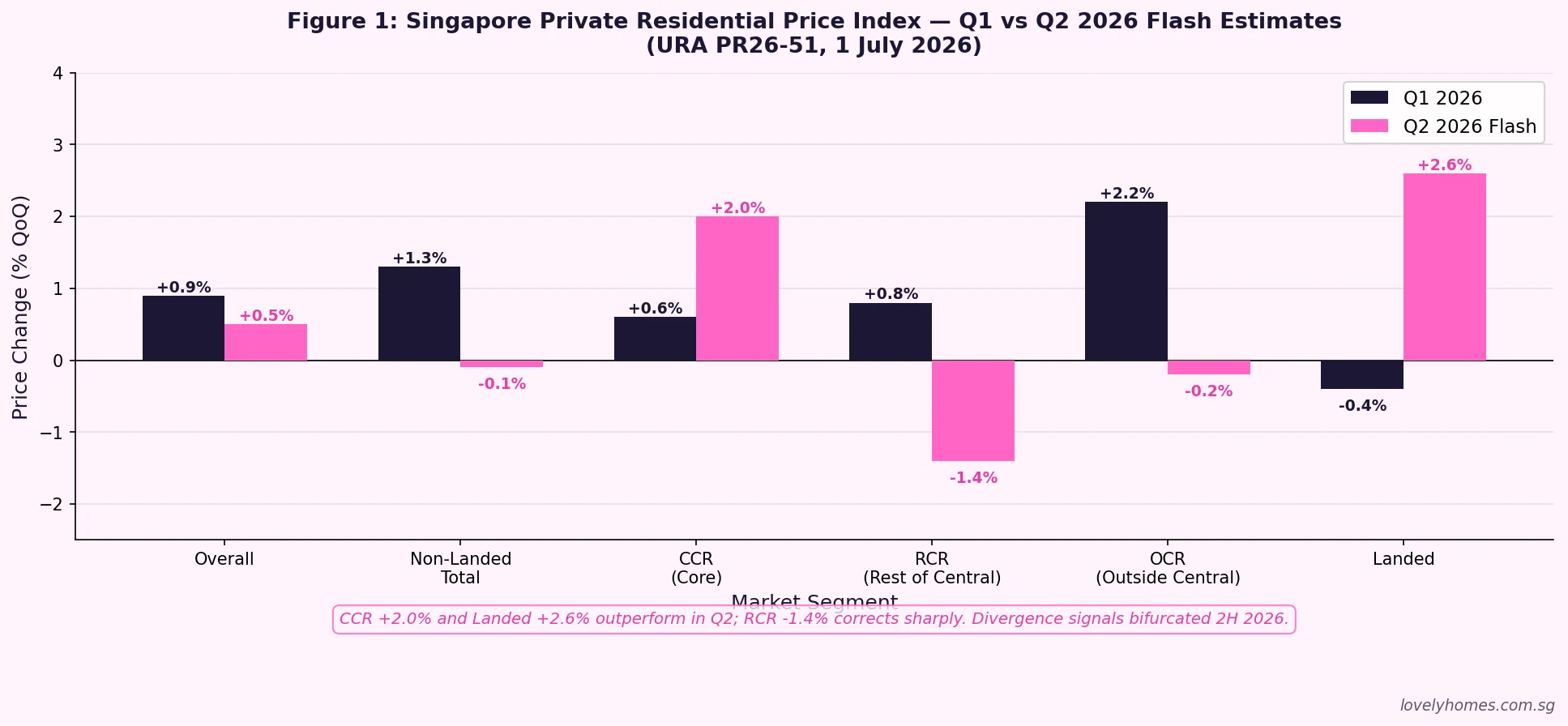
  • Q2 2026 private prices: Overall +0.5% QoQ (flash estimate). CCR (Core Central Region) surged +2.0%; Landed properties rose +2.6%. RCR (Rest of Central Region) fell -1.4%; OCR (Outside Central Region) softened -0.2%.
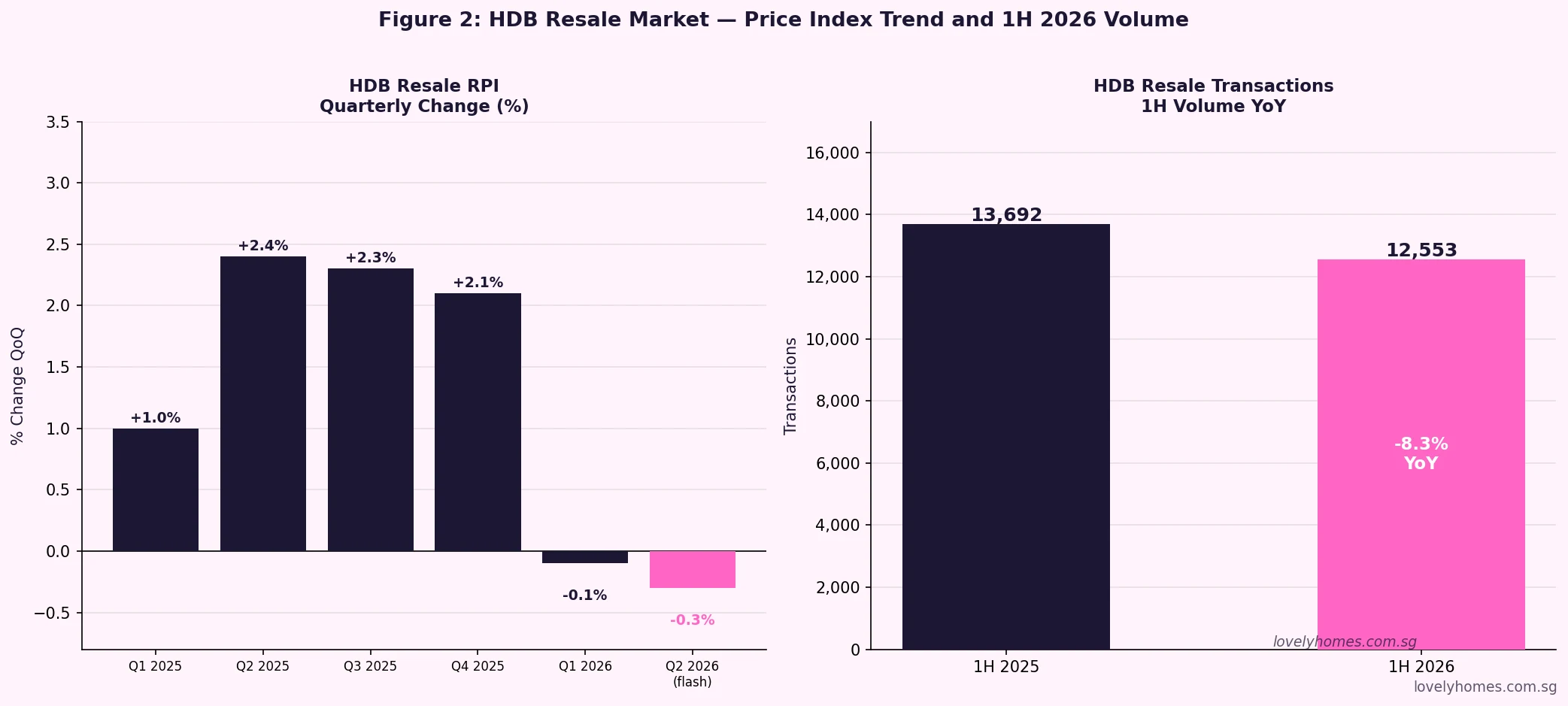
  • HDB resale: The Resale Price Index (RPI) slipped to 202.7 in Q2 2026, down -0.3% — the second consecutive quarterly decline since 2018. Resale volumes for 1H 2026 fell 8.3% year-on-year to 12,553 transactions.
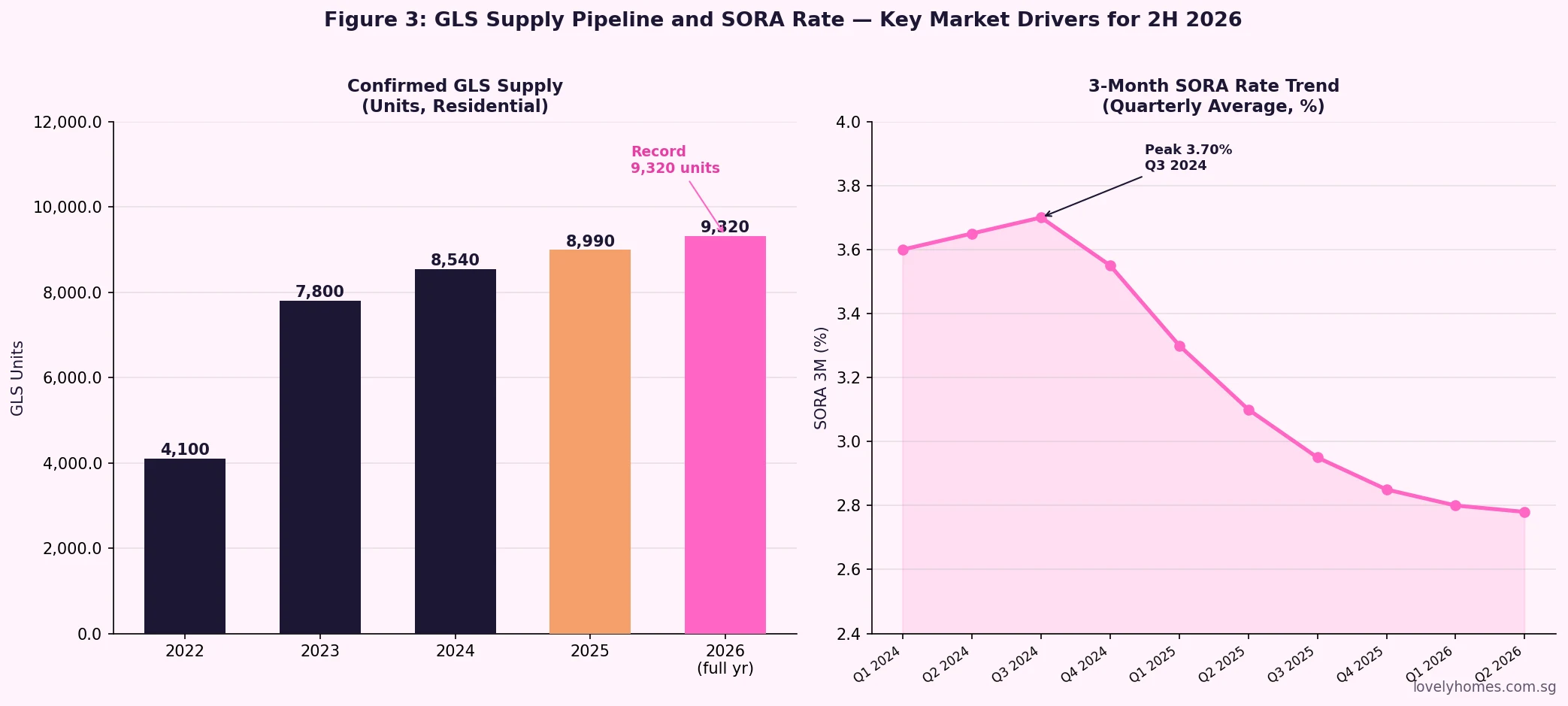
  • Supply headwind: Record Government Land Sales (GLS) of approximately 9,320 Confirmed List units in 2026 will put sustained pressure on OCR mass-market prices once completions accelerate from 2027.
  • SORA easing: The 3-month compounded SORA has fallen from a Q3 2024 peak of approximately 3.70% to around 2.78% in Q2 2026, materially reducing monthly instalment burdens for new buyers.
  • Key watch items for 2H 2026: URA full Q2 data (~24 July), HDB full Q2 resale data (~23 July), the Lorong Puntong and Kitchener GLS tender results, and the first major new launches of the second half.
  • LovelyHomes outlook: A market of two halves — CCR and landed supported by safe-haven demand and limited supply; OCR and HDB resale facing a gradual correction as GLS completions build. Selective buying, not blanket avoidance.

Where Singapore Property Prices Stand at Mid-2026

The URA released its Q2 2026 flash estimate on 1 July 2026 (PR26-51), confirming that the overall Private Residential Property Price Index (PPI) rose 0.5% quarter-on-quarter — a deceleration from the 0.9% gain recorded in Q1 2026. Beneath that headline number lies a market fracturing along segment lines: luxury and landed assets are accelerating while mass-market and city-fringe properties are softening.

This bifurcation is not accidental. It reflects the interplay of three structural forces: a record Government Land Sales pipeline adding future supply predominantly in the Outside Central Region (OCR); persistent demand from regional wealth for Singapore's premier residential addresses in the Core Central Region (CCR); and the cooling effect of ABSD on speculative or multiple-property demand in all segments. Understanding which segment you are buying in — and why each segment is behaving the way it is — is the essential starting point for any property decision in 2H 2026.

Singapore private residential property price index Q1 vs Q2 2026 by segment CCR RCR OCR landed
Figure 1: URA Private Residential Property Price Index — Q1 2026 vs Q2 2026 Flash by Segment. Source: URA PR26-51, 1 July 2026. CCR outperforms; RCR corrects sharply.

The CCR Rally: Why Luxury Properties Are Leading

The Core Central Region — comprising the prime Districts 9, 10, and 11, the Marina Bay Financial District, and Sentosa Cove — posted a flash price gain of +2.0% in Q2 2026, the strongest regional performance in Singapore's residential market. This follows +0.6% in Q1 2026, suggesting that the CCR recovery that began in late 2025 is gathering momentum rather than fading.

The drivers are well understood. As one of Asia's most politically stable and legally transparent jurisdictions, Singapore functions as a safe haven for regional wealth. Family offices, of which Singapore had surpassed 2,000 registered by end-2025 according to the Monetary Authority of Singapore (MAS), constitute a consistent source of demand for Orchard Road residences, Nassim Hill bungalows, and Marina Bay service apartments. Unlike retail buyers who are sensitive to monthly instalment affordability, family-office purchasers are frequently cash buyers for whom SORA movements and LTV limits are largely irrelevant.

The supply picture reinforces this demand. Conservation Good Class Bungalows (GCBs) in Districts 10 and 11 are subject to a government-mandated minimum plot size of 1,400 sq m and strict conservation restrictions — the result is a permanently supply-constrained asset class. Similarly, the Orchard Road corridor's freehold apartment inventory does not meaningfully grow: new completions in the CCR represent a small fraction of total pipeline. When global risk appetite is strong and the Singapore dollar holds firm, these segments benefit disproportionately.

RCR Correction: City Fringe Faces Re-Pricing

The Rest of Central Region — covering Districts 1 to 4 (city centre fringe), Districts 7, 8, 12, 13, 14, 15, and 20 — recorded a -1.4% quarterly decline in the Q2 2026 flash estimate, the sharpest segment correction this cycle. This follows a +0.8% gain in Q1 2026, marking an abrupt reversal.

The RCR has been the primary arena for new-launch condominium activity over the past three years. Developers of projects in Toa Payoh, Upper Serangoon, Queenstown, and the River Valley area set aggressive launch prices in 2023 and 2024 on the back of strong take-up. By mid-2026, secondary market sellers in these same estates are discovering that buyers who absorbed aggressive launch prices are now reluctant to transact at further premiums in the resale market — particularly given the mounting GLS supply pipeline and the moderating economic backdrop.

The -1.4% flash reading likely overstates the correction to some degree (flash estimates are based on caveated transactions within a shortened window), but the directional signal is consistent with anecdotal reports from the industry of reduced viewing traffic and longer days-on-market for RCR resale listings in Q2 2026.

OCR Softening: Mass Market Feels Supply Pressure

The Outside Central Region — covering the large residential estates of Woodlands, Jurong West, Pasir Ris, Tampines, Sengkang, Punggol, and Tengah — declined -0.2% in Q2 2026 after posting the strongest Q1 2026 gain of any segment at +2.2%. This sharp reversal from the previous quarter underscores how quickly sentiment can shift in the mass-market segment when buyers perceive that alternative options — HDB resale, new BTO launches, and a growing pipeline of GLS completions — are available at lower effective cost.

The GLS supply factor warrants particular attention. URA released its H2 2026 Confirmed List on 25 June 2026 (PR26-49), adding sites at Lorong Puntong/Sin Ming Avenue (approximately 570 units) and Kitchener Link (approximately 530 units). When combined with the H1 2026 Confirmed List and sites already in the pipeline, total 2026 Confirmed List supply for private residential amounts to approximately 9,320 units — the highest annual volume since 2013, when the government was actively cooling a market running at fever pitch. These units will begin reaching the completion and occupation stages from approximately 2028–2029, adding significant inventory at a time when overall market demand is not expected to grow at the pace it did during the 2021–2022 pandemic-rebound period.

HDB Resale: Second Consecutive Quarterly Decline

The HDB resale market delivered its second consecutive quarterly price decline in Q2 2026, with the Resale Price Index (RPI) falling 0.3% QoQ to 202.7 — the first back-to-back decline since the 2018–2019 cooling measure correction. For the first half of 2026, total HDB resale transactions reached 12,553, down 8.3% from 13,692 in 1H 2025.

The paradox of the HDB resale market in 2026 is that headline RPI softening coincides with a continued surge in million-dollar flat transactions: 902 such transactions occurred in 1H 2026, up 18.2% from 763 in 1H 2025. This apparent contradiction reflects compositional effects — the supply of large (5-Room, Executive) flats in prime locations continues to command premium prices, pulling up the million-dollar count, while the bulk of the market in heartland estates is moderating as fresh BTO supply absorbs first-timer demand that would otherwise have entered the resale market.

HDB resale price index trend and volume 2025 2026 Singapore
Figure 2: HDB Resale Price Index quarterly change (Q1 2025 to Q2 2026 flash) and 1H transaction volumes. Source: HDB flash estimates, 1 July 2026. Two consecutive quarterly declines; volumes down 8.3% year-on-year.

Financing Conditions: SORA at Post-Peak Ease

The 3-month Compounded Singapore Overnight Rate Average (SORA) — the benchmark that replaced SIBOR for most bank mortgage packages from 2022 — peaked at approximately 3.70% in Q3 2024. By Q2 2026, the 3-month SORA had eased to approximately 2.78%, reducing the monthly instalment on a S$1 million, 25-year loan by approximately S$500 relative to the peak rate environment.

This easing is meaningful at the margin. A household that found a S$1.5 million HDB resale or OCR condo marginal in 2024 on affordability grounds may find the same unit comfortably within TDSR limits at 2026 SORA rates — and this dynamic is one factor supporting transaction volumes despite softer prices. However, lenders continue to apply a stress-test buffer when assessing borrower eligibility, and MAS has indicated no intention to relax the TDSR of 55% or the MSR of 30% for HDB purchases.

GLS Pipeline and New Launches: What to Expect

The H2 2026 GLS programme confirms Singapore's commitment to supply-side management as the primary tool for long-run price stability. Beyond the record Confirmed List volume, two sites in the pipeline carry outsized significance for 2H 2026 market narrative:

The Lorong Puntong/Sin Ming Avenue GLS tender, launched on 25 June 2026 (PR26-49), closes on 15 September 2026. The site sits adjacent to Bishan-Ang Mo Kio Park and proximate to the Upper Thomson MRT corridor — a location that supports premium pricing relative to typical OCR land. The tender result will signal developer appetite for GLS land at current price levels, and any unusually low bid would be read as a bearish signal for near-term launch pricing.

The Jurong Lake District White Site, launched under the June 2026 programme (PR26-53), closes on 17 November 2026. This is a transformational commercial and mixed-use site that will anchor the second CBD vision for western Singapore. The developer who wins this tender will shape the Jurong East skyline for decades — and the land bid quantum will be a leading indicator of long-term commercial investment confidence in Singapore.

Singapore GLS supply pipeline 2022 to 2026 and SORA rate trend 2024 to 2026
Figure 3: Annual GLS Confirmed List supply (residential units) and 3-month compounded SORA rate trend. Sources: URA GLS programmes 2022–2026; MAS SORA data. Record 9,320 GLS units in 2026; SORA easing from Q3 2024 peak.

Summary: Market Snapshot at July 2026

Indicator Latest Reading Trend
Private Overall PPI (Q2 2026 flash) +0.5% QoQ Slowing
CCR prices (Q2 2026 flash) +2.0% QoQ Accelerating
RCR prices (Q2 2026 flash) -1.4% QoQ Correction
OCR prices (Q2 2026 flash) -0.2% QoQ Softening
Landed prices (Q2 2026 flash) +2.6% QoQ Accelerating
HDB Resale RPI (Q2 2026 flash) 202.7 (-0.3% QoQ) 2nd consecutive decline
HDB Resale volume 1H 2026 12,553 transactions -8.3% YoY
GLS Confirmed List 2026 ~9,320 units Record high
SORA 3M (Q2 2026) ~2.78% Easing from 3.70% peak
URA full Q2 data Expected ~24 July 2026 Monitor
HDB full Q2 resale data Expected ~23 July 2026 Monitor

Worked Example: How SORA Easing Changes the Affordability Calculation

Mr and Mrs Goh are Singapore Citizens considering a 5-Room HDB resale flat in Bishan at S$850,000. They have no existing property loans. Their combined gross monthly income is S$14,000.

At Q3 2024 peak SORA (~3.70% bank package rate ~4.20%):

  • Loan amount (HDB not eligible; income exceeds S$9,000 cap): bank loan 75% LTV = S$637,500
  • Monthly instalment at 4.20% over 25 years: ~S$3,450
  • MSR: S$3,450 / S$14,000 = 24.6% — borderline
  • TDSR headroom: 55% x S$14,000 = S$7,700; used S$3,450 — comfortable

At Q2 2026 SORA (~2.78% bank package rate ~3.30%):

  • Same loan S$637,500 at 3.30% over 25 years: ~S$3,110
  • MSR: S$3,110 / S$14,000 = 22.2% — comfortably within 30%
  • Monthly saving versus 2024 peak: ~S$340
  • Total interest saving over 25-year loan: approximately S$102,000

Conclusion: SORA easing has added roughly S$340 per month of headroom for the Goh family — equivalent to bringing approximately 12% more buyers into affordability range for this price bracket. This is a meaningful structural support for HDB resale and OCR condominium demand, partially offsetting the headwind from increased GLS supply.

Why This Matters: Singapore in the Regional Property Context

Singapore's property market is often benchmarked against Hong Kong as the other major established gateway city in Asia. In 2026, the comparison is instructive: Hong Kong's residential market has been in a multi-year correction following the 2019 civil unrest and subsequent COVID-era lockdowns, with prices falling more than 20% from the 2021 peak. Singapore, by contrast, is experiencing a controlled deceleration rather than a correction — the price level in nominal terms remains substantially above any pre-pandemic reference point.

This relative resilience reflects the effectiveness of Singapore's demand-side management toolkit (ABSD, TDSR, MSR) in preventing speculative excess, and the credibility of the government's commitment to using supply (GLS) as a long-run moderator. International investors who choose Singapore over Hong Kong, Tokyo, or Sydney are selecting stability of institutional framework over raw yield or growth potential — and 2H 2026 data continues to validate that preference.

What Might Come Next in 2H 2026

The most significant scheduled data release is the URA full Q2 2026 private residential statistics, expected around 24 July 2026. The full release will confirm the flash estimate, provide transaction volume breakdowns, vacancy rates, and the rental index — the latter being a key lead indicator of future price direction. LovelyHomes will publish a dedicated analysis immediately upon release.

The HDB full Q2 2026 resale statistics, expected around 23 July 2026, will confirm the RPI reading and provide the complete breakdown of transactions by flat type, estate, and price band — including an updated million-dollar flat count that will receive significant media attention regardless of the direction.

On the policy front, no ABSD adjustment is widely anticipated for 2H 2026 given that price levels are moderating rather than surging. Any upward ABSD adjustment would likely be reserved for a scenario where CCR prices re-accelerate materially — a possibility if US Fed rate cuts in H2 2026 trigger renewed capital flows into Asian safe-haven assets. Conversely, any downward ABSD adjustment (e.g., relaxation of the 65% foreigner rate) would be a major bullish signal for the CCR and would likely be announced in the annual Budget Statement (February 2027) if at all.

Frequently Asked Questions

Is the Singapore property market in a bubble in 2026?

The empirical evidence does not support a bubble characterisation. The price-to-income ratio for Singapore private residential property has risen materially since 2020, but the primary driver has been genuine household formation, immigration-driven demand, and supply shortfalls during the COVID construction hiatus — rather than speculative leverage. MAS stress tests continue to show that the mortgage book is resilient at a hypothetical 200-basis-point rate increase. The HDB resale market is now experiencing a controlled moderation, which is the textbook outcome of effective demand management rather than a bubble correction. That said, buyers at elevated entry prices in the RCR and OCR should model their returns conservatively given the supply pipeline.

Should I buy property in Singapore now or wait until 2027?

Timing the market is notoriously difficult and not the approach LovelyHomes advocates. For owner-occupiers, the primary question is whether the property meets your household needs at an affordable instalment given current income and rates — not whether prices will be 5% higher or lower in 12 months. For investors, the relevant question is whether the rental yield after financing costs, taxes, and maintenance is adequate for the risk undertaken — and whether the specific asset class you are targeting (CCR luxury, HDB resale, industrial) has supply fundamentals that support occupancy over your intended hold period. 2H 2026 presents genuinely attractive opportunities in the CCR for cash-rich buyers with safe-haven motivations, and in the industrial space for yield-focused investors. Blanket avoidance is as problematic as indiscriminate buying.

What is the full Q2 2026 URA data release date and what will it cover?

The URA typically releases full quarterly private residential data approximately 3 to 4 weeks after the flash estimate. With the Q2 2026 flash released on 1 July 2026, the full release is expected around 24 July 2026. The full publication will include the finalised Property Price Index for all segments, transaction volumes by project and unit type, vacancy rates, uncompleted unit statistics, new sales and subsales data, rental index by region and property type, and median unit prices by postal district. LovelyHomes will publish a dedicated analysis within 24 hours of the full data release.

How does the record GLS supply affect property prices?

The impact of the 2026 GLS supply on transaction prices is lagged by approximately 3 to 5 years — the time between land tender and project completion. Units from sites awarded in 2026 will typically reach the resale market between 2029 and 2031. In the near term (2H 2026), the GLS supply primarily creates a perception headwind for OCR prices: buyers and sellers both know that future supply is coming, which moderates the urgency of purchase and weakens sellers' ability to hold firm on asking prices. The effect is most pronounced in OCR estates near new GLS sites (e.g., Tengah, Plantation) and less significant in CCR or landed segments where GLS supply is structurally limited.

Will ABSD be reduced in 2026 or 2027?

As at July 2026, there is no publicly signalled intention from the Ministry of Finance or MAS to reduce ABSD rates in the near term. Singapore's Finance Minister has consistently reiterated that ABSD remains necessary to maintain housing affordability for Singaporeans and to prevent a destabilising price surge. For ABSD to be reduced materially, the government would typically need to observe sustained price declines (not just moderation), rising vacancy rates, or a structural change in underlying demand dynamics. None of those conditions is currently met. LovelyHomes will update this analysis immediately if any Budget 2027 ABSD announcement is made.

How do I interpret the CCR vs RCR vs OCR classification?

The URA divides Singapore's residential market into three regions based on planning area and District designations. The Core Central Region (CCR) covers the most prime addresses: Districts 9, 10, 11, the Downtown Core, Sentosa, and Marina Bay. The Rest of Central Region (RCR) covers Districts 1 to 4, 7, 8, 12 to 15, and 20 — essentially the city-fringe and inner-suburb estates. The Outside Central Region (OCR) covers all remaining Districts — the HDB-dominated heartland areas of Woodlands, Jurong, Tampines, Sengkang, Punggol, and Tengah. Property prices and rental yields differ substantially across these regions, and the supply pipeline dynamics discussed above apply differently to each. Buyers should be clear about which region they are investing in before comparing projects by price per square foot alone.

Related Articles


Disclaimer: This article is published for general informational purposes only and does not constitute investment, legal, or financial advice. Price index data is sourced from URA and HDB flash estimates as at 1 July 2026; full official data expected ~23–24 July 2026. SORA figures are approximate quarterly averages based on MAS published data. GLS unit counts are estimates based on URA press releases and are subject to final confirmation. Forward-looking statements and market outlook commentary represent the editorial views of LovelyHomes and should not be relied upon for investment decisions. Consult a licensed financial adviser, mortgage broker, or property professional before making any property purchase or sale decision.

JLD White Site Launched 3 July 2026: Up to 1,200 Homes and 186,000 sqm Mixed-Use Development at Jurong Lake District

JLD White Site Launched 3 July 2026: Up to 1,200 Homes and 186,000 sqm Mixed-Use Development at Jurong Lake District

Singapore’s Jurong Lake District (JLD) took a significant leap forward on 3 July 2026 when the Urban Redevelopment Authority (URA) launched the tender for a major White site at Town Hall Link under the second-half 2026 Government Land Sales (GLS) Confirmed List. The site, adjacent to the Jurong Town Hall national monument and flanked by two MRT lines, is earmarked for up to 1,200 private residential units and a minimum of 40,000 sqm of office space within a total potential Gross Floor Area (GFA) of 186,139 sqm. It is the most significant new residential supply announcement for JLD in several years, and it reinforces the Government’s long-standing commitment to transforming the Jurong corridor into Singapore’s largest mixed-use business district outside the city centre.

Quick Answer — JLD White Site at a glance

  • What: URA has launched a GLS tender for a White site at Town Hall Link, Jurong Lake District.
  • Scale: 186,139 sqm total GFA — minimum 40,000 sqm office, up to 1,200 residential units, 44,000 sqm complementary uses.
  • MRT access: Direct connection to Jurong East MRT interchange (EWL + NSL + JRL) and the future CR19 Cross Island Line station (2032).
  • Context: Part of Singapore’s decentralisation strategy; JLD is targeted to become the largest mixed-use business node outside the CBD.
  • Tender close: 17 November 2026, 12 noon.
  • Property implication: First major new private residential supply in the JLD precinct for several years; expect strong developer interest and premium pricing on award.

What Is the JLD White Site and Why Does It Matter?

A White site in Singapore’s GLS framework is a land parcel where the developer is given significant flexibility in determining the mix of uses, subject to minimum requirements. At Town Hall Link, the developer must deliver at least 40,000 sqm of office space (non-negotiable) and may add up to 1,200 private residential units alongside 44,000 sqm of complementary commercial uses such as retail, serviced apartments, hotel, sports and recreational facilities, community spaces, medical clinics, or visitor attractions. The White classification is typically reserved for strategically significant sites where the Government wants the market to determine the optimal product mix — making this tender a test of developer confidence in the JLD vision.

The significance of this announcement extends well beyond the site itself. JLD has been a Government-backed transformational project for more than a decade, anchored by the relocation of Singapore’s second CBD away from the congested city core. The area has seen the revitalisation of the 90-hectare Jurong Lake Gardens, the completion of the Jurong Region Line (JRL), and plans for the Cross Island Line (CRL) station at CR19 in the heart of the precinct (targeted for opening in 2032). The Town Hall Link White site is “seamlessly connected” to the Jurong East MRT interchange via multi-level pedestrian linkages, according to URA.

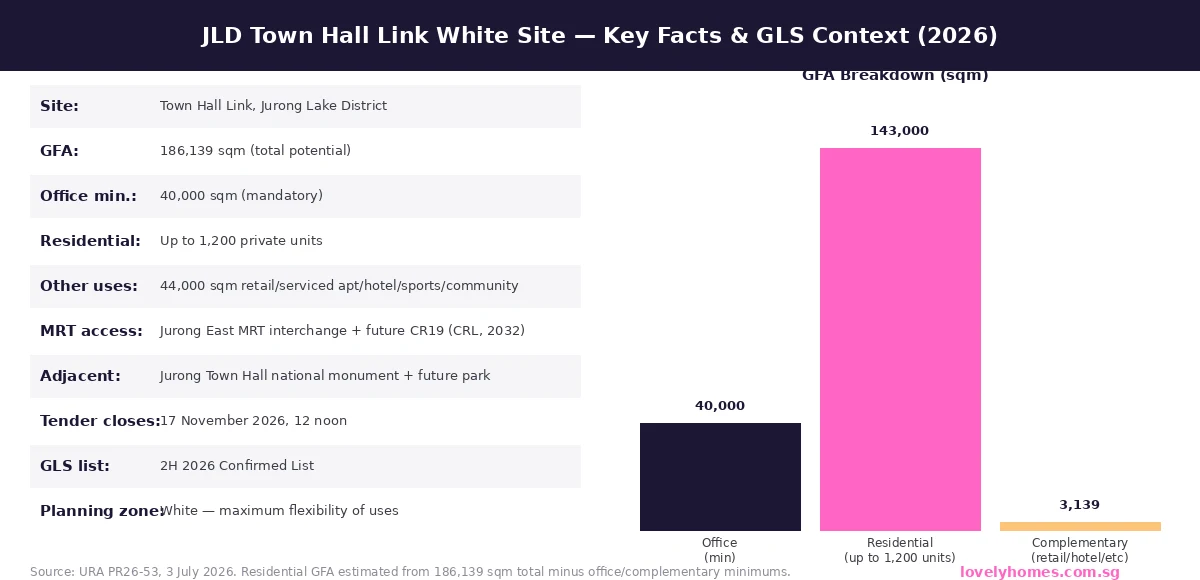
JLD white site 2026 key facts — GFA 186,139 sqm, 40,000 sqm office, up to 1,200 residential units, tender closes 17 November 2026
Figure 1: JLD Town Hall Link White Site — Key Facts and GFA Breakdown (Source: URA PR26-53, 3 July 2026)

The JLD Vision: Decentralisation in Action

Singapore’s decentralisation strategy is a long-held urban planning objective. Concentrating economic activity exclusively in the Central Business District and Orchard Road corridor creates congestion, inflates commercial rents, and forces workers into lengthy commutes. JLD is the flagship expression of the alternative vision: a large-scale, self-sustaining regional centre in the west of Singapore, integrating employment, retail, housing, and recreational space in a single walkable precinct.

The Government has invested heavily in the infrastructure backbone. The Jurong Lake Gardens, opened in phases from 2019, provides 90 hectares of recreational greenery wrapping around Jurong Lake and the Chinese and Japanese Gardens. The JRL, opened in stages from 2026, connects the precinct to Tengah, Choa Chu Kang, and Boon Lay. The forthcoming CR19 station on the Cross Island Line will add a further orbital connection in 2032, making JLD one of the best-connected suburban nodes in Singapore’s rail network.

Complementing the White site, two major anchor projects are already under development nearby: the New Science Centre (relocating from its Jurong East home of four decades) and the Jurong Gateway Hub, an integrated development comprising a bus interchange, offices, shops, a library, a community club, and sports facilities. Together with the White site, these projects will define the physical character of the precinct for the next generation.

What the White Site Means for Property Buyers and Investors

Dimension Detail Property Implication
New supply Up to 1,200 private residential units at Town Hall Link First significant new private supply in the JLD precinct for several years; relieves latent demand from west Singapore buyers
Price premium JLD White site is likely an RCR or OCR premium location; comparable JLD projects (J’den, Lake Grande) have traded at S$2,000–S$2,500 psf Expect developer ask price in the S$2,200–S$2,800 psf range on new launch; potential for appreciation as JLD matures
MRT connectivity Jurong East interchange (3 lines) + future CR19 (CRL, 2032) Transport connectivity among the best in any non-central precinct; key demand driver for both owner-occupiers and investors
Tender timeline Tender closes 17 November 2026; award ~January 2027; launch likely 2027–2028; TOP ~2032–2033 Buyers planning a JLD purchase should not expect keys before 2032; factor progressive payment schedule and interim housing into planning
Office anchor Min. 40,000 sqm office must be delivered; targets MNC tenants and financial/professional services firms Office anchor strengthens daytime population and amenity spending, supporting residential values in the precinct
Government commitment New Science Centre, Jurong Gateway Hub, JRL, CRL CR19 all delivering 2026–2032 Infrastructure already committed; limited execution risk vs speculative master plans in other regions

JLD Property Market Context

The private residential market in the JLD corridor has been characterised by limited new supply in recent years. J’den (formerly JEM 2 / Jurong Point 2 site), launched in 2023, sold briskly at an average of approximately S$2,450 psf at launch, underscoring demand from west Singapore buyers seeking integrated development proximity. Older condominiums in the area (Lake Grande, Parc Westlake, Lakeville) have traded resale at lower psf levels but have appreciated meaningfully over their launch prices.

The White site at Town Hall Link is a different proposition: a larger, more prominent, and better-connected site adjacent to both heritage (Jurong Town Hall) and nature (the future park). Developers tendering for this site will need to deliver a mixed-use product integrating office, residential, and retail — a complex brief that typically appeals to the largest developers with integrated development track records. The 1,200-unit residential cap, while meaningful, represents a medium-density residential component within a predominantly commercial site.

For buyers tracking west Singapore property, the White site tender provides a clear signal: JLD is still an active, Government-supported investment in Singapore’s urban future. The tender award (expected early 2027) and any subsequent launch announcement will be significant market events for the west corridor.

What to Watch Next

The tender closes on 17 November 2026. Bids are expected from Singapore’s major developers, and possibly consortia given the scale and complexity of the White site requirements. The tender award will reveal the market’s view of JLD land value — a key data point for pricing expectations on the eventual new launch. Any premium bid above market expectations would signal high developer confidence in JLD residential absorption; a cautious single bidder would suggest more measured enthusiasm.

Separately, the full Q2 2026 URA private residential data release (expected ~24 July 2026) will include CCR, RCR, and OCR transaction data that contextualises JLD’s position in the wider market. The Q2 flash estimate showed overall prices up +0.5% with CCR leading — a context in which a well-connected, large-scale JLD development arriving in 2027–2028 could attract strong demand from both upgraders and investors seeking alternatives to pricier CCR addresses.

Frequently Asked Questions About the JLD White Site

What is a White site in Singapore’s GLS programme?

A White site is a land parcel sold by URA under the Government Land Sales programme where the developer has flexibility to incorporate a range of uses — residential, commercial, hotel, recreational, and community — subject to minimum requirements set by URA. The White classification is used for strategic locations where the Government wants the private market to determine the most commercially viable use mix, while ensuring a minimum anchor use (in this case, 40,000 sqm of office) is delivered to support the Government’s planning goals. White sites are typically larger and more complex than single-use residential or commercial sites, and they attract the largest and most financially capable developers.

When will the JLD White site residential units be available for purchase?

The tender closes on 17 November 2026. Following award (likely early 2027), the developer will typically spend 12–18 months on design, approvals, and construction preparation before launching for sale. A reasonable estimate for launch to the public is late 2027 to 2028. Construction of a mixed-use development of this scale typically takes 4–5 years, suggesting Temporary Occupation Permit (TOP) around 2032–2033 — which coincides with the opening of the CR19 Cross Island Line station in the heart of JLD. Buyers interested in this project should plan for a progressive payment schedule over this period and interim housing arrangements.

How does the JLD White site compare to other west Singapore property options?

The JLD White site will deliver a qualitatively different product from most west Singapore residential projects. Its direct connection to the Jurong East interchange (which currently serves the East-West Line, North-South Line, and Jurong Region Line) and the future CR19 station makes it exceptionally well-connected — comparable connectivity exists in only a handful of suburban locations in Singapore. The adjacent Jurong Town Hall national monument and future park provide irreplaceable location attributes. However, buyers should note that the residential component is capped at 1,200 units within a larger commercial development, meaning the residential element is not a standalone condominium but part of an integrated mixed-use project — similar to Duo Residences in Bugis or Marina One Residences at Marina Bay. Pricing will reflect this premium integrated product positioning.

Is Jurong Lake District a good area for property investment?

JLD has strong structural fundamentals as a long-term investment: committed Government infrastructure, rail connectivity improving through 2032, a large employment base (Jurong East, International Business Park, Biopolis in one-stop range), and a diversified demographic base. The risk factors are the long development timeline (appreciation is gradual rather than immediate), competition from other west corridor supply (Tengah, Bukit Batok, Jurong East BTO supply is meaningful), and execution risk on the commercial components of the mixed-use development. Industry analysts generally view JLD as a medium-term (5–10 year) capital appreciation story rather than a short-term trading position. The announcement of the White site tender strengthens the longer-term investment case. As with all property investments, buyers should assess their own holding capacity and financial position carefully before committing.

What is the Cross Island Line and why does it matter for JLD?

The Cross Island Line (CRL) is a new MRT line currently under construction by the Land Transport Authority. It will run across Singapore from Changi in the east to Jurong in the west, passing through several major nodes including Clementi, Jurong Lake District, and Ang Mo Kio. The CR19 station, located in the heart of JLD, is planned to open in 2032. When operational, CR19 will add a key orbital connection to the existing East-West Line and North-South Line services at Jurong East interchange, effectively giving JLD three distinct MRT lines through the precinct. This level of rail connectivity is rare outside the central area of Singapore, and it is a significant long-term demand driver for both commercial and residential property in JLD.

Related Articles

Disclaimer: This article is based on URA press release PR26-53 dated 3 July 2026 and publicly available Government data. Residential unit count, GFA figures, and MRT opening dates are as stated by URA and LTA and are subject to change. Price projections, investment analysis, and developer interest assessments represent editorial analysis only and do not constitute financial advice. Readers should conduct their own due diligence and consult licensed professionals before making any property purchase decision. For the authoritative site details, visit URA Land Sales. LovelyHomes does not provide financial or property advisory services.

Singapore ‘Long Island’ Preparatory Works to Begin End-2026: East Coast Property Outlook

Singapore ‘Long Island’ Preparatory Works to Begin End-2026: East Coast Property Outlook

Singapore’s most ambitious infrastructure undertaking in a generation took a concrete step forward on 30 June 2026, when the Urban Redevelopment Authority (URA) and the Housing & Development Board (HDB) announced that preparatory works for ‘Long Island’ — the Government’s large-scale coastal protection strategy for the East Coast — will commence from end-2026. For property owners, investors, and anyone watching the long arc of Singapore’s planning, this announcement sets a firm starting gun on a project that will reshape the East Coast’s future land supply, flood resilience, and lifestyle amenities over the next several decades.

‘Long Island’ is not simply a reclamation project — it is Singapore’s primary response to the threat of rising sea levels to its low-lying East Coast. The Government has long signalled that without proactive intervention, the East Coast’s beaches, parks, and existing development would become increasingly vulnerable as global sea levels rise. Long Island will ultimately create a new landmass off the East Coast, incorporating a reservoir, an expanded coastal park, and mixed-use development land — but that is decades away. What changes now is that the ground work begins.

Quick Answer — Long Island: What You Need to Know

  • Preparatory works (seabed clearing, sand bunds, sand infilling) begin end-2026, in the waters west of Bedok Jetty.
  • Phase 1 covers approximately 570 hectares — roughly 1.5 times the size of Marina Bay — spanning about 7km east-to-west and up to 1km wide.
  • Phase 2 (east of Bedok Jetty, ~155 ha) begins only after the 2029 SEA Games.
  • Beaches and parks along East Coast Park remain fully open throughout the preparatory works; near-shore swimming and jogging/cycling paths are unaffected.
  • Main reclamation works will only begin after further technical studies and public engagement — likely the early 2030s at the earliest.
  • The completed Long Island will include a new reservoir, a larger coastal park, and new urban land — potentially adding thousands of residential and commercial units in the long term.
  • An Environmental Study published alongside the announcement found no significant water quality impact and only localised, short-term biodiversity effects from the preparatory works.
  • The public has until 28 July 2026 to submit feedback on the Environmental Study report at go.gov.sg/long-island.

What Are the Preparatory Works — and Why Now?

The preparatory works announced on 30 June 2026 are a precursor to the main reclamation. They involve three primary activities: removal of seabed obstructions (existing cables, pipelines, and debris), construction of temporary sand bunds (underwater embankments to contain the work area), and sand infilling to begin building up the seabed. These are engineering prerequisites — the seabed must be cleared and stabilised before full-scale reclamation can proceed.

The timing reflects two pressures. First, the Government has identified that sea level rise poses an increasingly urgent risk to the East Coast, and delaying the preparatory works extends the timeline for protection. Second, the 2029 SEA Games — to be hosted partly at East Coast Park — limits when Phase 2 can begin. By starting Phase 1 now and phasing Phase 2 to avoid disrupting the Games, the Government has threaded the needle between urgency and community impact.

The preparatory works will take place at least 130 metres from the shoreline and will be demarcated by silt screens and floating barriers. HDB, as the appointed reclamation agent, will monitor water quality, sediment levels, noise, and dust throughout.

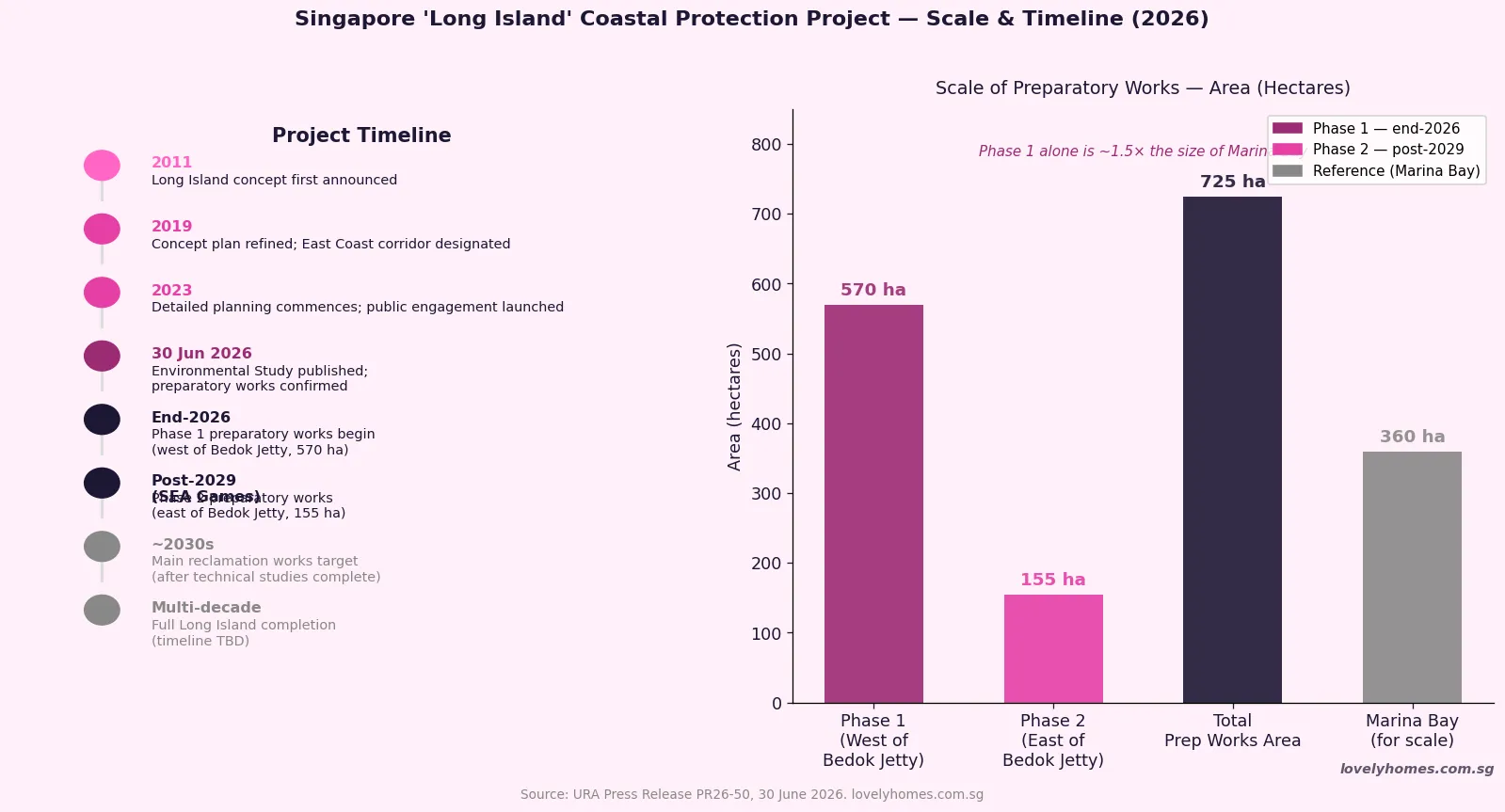
Singapore Long Island project timeline and preparatory works scale 570 hectares 2026
Figure 1: Long Island project timeline from concept to preparatory works commencement, and scale of the Phase 1 and Phase 2 preparatory works areas relative to Marina Bay. Source: URA Press Release PR26-50, 30 June 2026.

Environmental Impact — What the Study Found

HDB commissioned an Environmental Study specifically for the preparatory works phase. The study’s key findings provide important context for how the works will affect the surrounding environment:

On water quality: no significant changes are expected. Water quality will continue to meet prevailing marine water quality criteria throughout the works. Silt screens will contain sediment plumes.

On marine biodiversity: there is up to minor impact on some coral and seagrass beds near the works site, with potential short-term and localised effects from sediment plumes. The majority of coral and seagrass in the vicinity — including Sisters’ Islands Marine Park — are assessed to be largely unaffected. This will reassure the nature community, which had concerns about the proximity of Phase 1 to some of the East Coast’s more ecologically sensitive zones.

On sea sports: kiteboarding will be the most affected activity, with moderate displacement from the reduced sea space. Other sea sport users face minor to moderate impact. Agencies have committed to working with affected sea sport users to find alternative sites for the interim period.

The Environmental Study report is open for public feedback for four weeks from 30 June 2026. An Environmental Monitoring and Management Plan (EMMP) will be put in place to manage environmental conditions throughout the works.

What This Means for East Coast Property

Long Island will be one of the most significant drivers of East Coast property values over the coming decade — but it is a slow-burn catalyst rather than an immediate price mover. Here is the framework LovelyHomes uses to think about the property implications:

Short term (2026–2030): Neutral to slightly negative. The preparatory works bring marine vessels, sand infilling activity, and restricted sea space off the East Coast. Buyers considering East Coast properties — particularly those with sea-facing units or sea-sports lifestyle utility — should factor in construction-adjacent disruption. This is unlikely to cause price falls (East Coast fundamentals remain strong), but it may dampen the marginal premium that sea-view units command during this period.

Medium term (2030s): Watch for planning signals. When the detailed reclamation plans are released — expected after the technical studies are completed in the early 2030s — the market will get clarity on the eventual land profile, the new waterfront layout, the reservoir location, and potential residential zones. This is when the property market will begin to price in the Long Island uplift meaningfully. Marine Parade, Bedok, and Siglap properties in particular may benefit from the signal that the East Coast will gain a significant new green and waterfront amenity.

Long term (2040s and beyond): Transformative. If Long Island proceeds as currently envisaged — a new coastal park, a freshwater reservoir, and new urban land — it represents the creation of entirely new prime East Coast real estate. The precedent is Bishan, which was built on former agricultural land and is now one of Singapore’s most sought-after mature estates. Long Island’s eventual waterfront development could command premium valuations similar to the Marina Bay waterfront, which today represents some of Singapore’s highest residential and commercial values.

Long Island in Context — Singapore’s Coastal Planning History

This is not the first time Singapore has reclaimed land to address long-term needs. Marina Bay itself was reclaimed over several decades — the land that now hosts Marina Bay Sands, the financial district, and Gardens by the Bay was once open sea. Jurong Island was created by amalgamating seven smaller islands for petrochemical use. Changi Airport’s runways sit on reclaimed land. What is different about Long Island is its explicit dual purpose: it is simultaneously a climate adaptation measure (coastal protection) and a land creation exercise — and it is being planned with unusually extensive public engagement, reflecting a more consultative planning era.

The Government’s message is clear: Long Island is going ahead, and it will be built in a way that is sensitive to the environment, the existing East Coast community, and the interests of future residents. For property investors, that certainty has real value — it means the East Coast’s long-term trajectory is upward.

Summary — Long Island Key Facts

Item Detail
Lead agencies URA (planning), HDB (reclamation agent)
Purpose Coastal protection from sea level rise; new land supply
Phase 1 start End-2026, west of Bedok Jetty
Phase 1 area ~570 ha (7km long × up to 1km wide)
Phase 2 start After 2029 SEA Games, east of Bedok Jetty
Phase 2 area ~155 ha
Main reclamation start TBD — after technical studies (early 2030s est.)
Beach/park access Fully maintained throughout works
Feedback period 4 weeks from 30 June 2026 (closes ~28 July 2026)

Frequently Asked Questions

Will Long Island be built for housing? When will new homes be available?

The Government has said Long Island will include new urban land — but has not yet confirmed the mix of residential, commercial, industrial, or recreational uses. Given the project timeline, any new housing on Long Island is at least 20–30 years away. The more immediate property implication is the uplift to existing East Coast properties as the project progresses and its final scope becomes clear. The Government’s track record — Marina Bay, Bidadari — suggests Long Island’s eventual homes will be well-planned and high-quality, but buyers looking for a near-term supply injection from this project will be disappointed.

Does the Long Island announcement affect East Coast Park access?

No. URA and HDB have explicitly confirmed that beaches, jogging and cycling paths, and near-shore swimming areas along East Coast Park will remain open and accessible throughout the preparatory works. Works are at least 130 metres from the shoreline. The main restriction is on certain sea sports users — particularly kiteboarding — who will need to use alternative sea space during the Phase 1 period. East Coast Park itself, as a recreational asset, is unaffected.

Will the preparatory works affect sea views from East Coast condominiums?

In the near term, marine vessels, sand bunds, and floating barriers will be visible from East Coast properties with sea views — particularly during active infilling operations. However, these are temporary structures for the preparatory phase. The visual impact during preparatory works is expected to be significant from units with direct sea views but modest from properties further back. The more important long-term consideration is that once Long Island is reclaimed, those “sea view” units may have their sightlines altered permanently — a factor that discerning buyers of high-floor sea-facing East Coast units should factor into their purchase decision today.

How does this compare to Singapore’s previous reclamation projects?

Long Island is comparable in scale to the Tuas reclamation (which expanded Singapore’s western coast for industrial use) and the Changi East reclamation (which expanded Changi Airport). In terms of residential property impact, the closest precedent is Marina Bay — which transformed from open sea to the city’s premier commercial and residential address. Long Island’s combination of climate resilience purpose and mixed-use development potential makes it perhaps the most strategically significant reclamation in Singapore since Marina Bay, with a potentially larger impact on the East Coast residential market than any single policy change in recent memory.

Where can I read the full Environmental Study and submit feedback?

The Environmental Study report for the preparatory works is available at go.gov.sg/long-island. The public feedback period runs for four weeks from 30 June 2026, closing approximately 28 July 2026. Feedback can be submitted via the portal at that link. URA and HDB have committed to evaluating feedback thoroughly and incorporating suitable suggestions before finalising the mitigation measures for the preparatory works.

Related Articles

Disclaimer

This article is an editorial analysis produced by LovelyHomes based on URA Press Release PR26-50 (30 June 2026) and publicly available government planning documents. All timelines, area figures, and project details are drawn from official URA and HDB sources. Property market analysis represents LovelyHomes’ editorial view and does not constitute investment advice. Readers should conduct their own due diligence and consult a licensed property professional before making any purchase decision. For official information about the Long Island project, visit go.gov.sg/long-island.

HDB BTO October 2026 Guide: All 7 Projects, Prices, Grants and Application Tips for Bedok Bayshore, Toa Payoh Caldecott, Yishun, Tengah and More

HDB BTO October 2026 Guide: All 7 Projects, Prices, Grants and Application Tips for Bedok Bayshore, Toa Payoh Caldecott, Yishun, Tengah and More

Quick Answer: HDB BTO October 2026 Key Facts

  • Total supply: approximately 7,970 flats across 7 projects in 6 towns.
  • Towns: Bedok (Bayshore ×2), Toa Payoh (Caldecott), Geylang (Mattar), Yishun (Chencharu), Tengah (Garden Avenue), Sembawang North.
  • Classification: Bedok Bayshore (Prime), Toa Payoh Caldecott (Prime), Geylang Mattar (Plus), Yishun/Tengah/Sembawang (Standard).
  • HFE letter deadline: Submit all supporting documents to HDB by 15 September 2026 to ensure your HDB Flat Eligibility (HFE) letter is ready for the October sales exercise.
  • Estimated 4-room prices: Standard (Yishun/Tengah) ~S$360K–S$400K; Plus (Geylang) ~S$500K–S$540K; Prime (Bedok/Toa Payoh) ~S$500K–S$555K.
  • MOP: 5 years for Standard; 10 years for Plus and Prime classifications.
  • Subsidy clawback: Plus and Prime flats are subject to a subsidy clawback on resale, calculated as a percentage of the resale price or value.
  • Hottest picks: Toa Payoh Caldecott (only Prime project; next to Caldecott MRT interchange); Bedok Bayshore (waterfront precinct; near East Coast Park).

Overview: Singapore’s Final BTO Launch of 2026

The October 2026 Build-To-Order (BTO) exercise is the final sales launch of the year and one of the largest in recent memory, with the Housing and Development Board (HDB) offering approximately 7,970 flats across seven projects in six towns. The October exercise completes the government’s 2026 BTO calendar, which has collectively offered around 19,600 new flats — matching HDB’s earlier public commitment to sustain high supply to moderate resale prices and address first-timer demand.

The exercise is notable for the geographic spread of its projects: it spans the sought-after east (Bedok’s new Bayshore waterfront precinct), the central region (Toa Payoh’s Caldecott precinct), an inner-city mixed area (Geylang’s Mattar neighbourhood near the Downtown Line), and the established growth corridors of Yishun and Tengah. For first-timer applicants who missed earlier launches, this is a high-stakes application exercise with a meaningful mix of price points and location quality.

HDB BTO October 2026 all 7 projects overview table classification units MRT prices
Figure 1: All 7 projects in the HDB BTO October 2026 exercise — location, classification, flat types, unit count, nearest MRT station and indicative 4-room prices. Prices are pre-launch market estimates and will be confirmed only when HDB releases official pricing during the sales exercise.

Project-by-Project Analysis

Bedok — Bayshore I & II Prime

The two Bedok Bayshore projects together supply 2,500 flats (1,640 and 860 units respectively) in the new Bayshore housing estate along Bayshore Drive, adjacent to East Coast Park. Both are served by Bayshore MRT station on the Thomson-East Coast Line (TEL), which provides direct access to the CBD via Marina Bay. The Bayshore precinct is a purpose-built waterfront residential neighbourhood — the first HDB estate developed in this part of Singapore — and the BTO flats sit alongside private condominiums and commercial amenities in a mixed-use environment.

Both projects carry Prime classification under HDB’s 2023 flat classification framework, meaning buyers are subject to a ten-year Minimum Occupation Period (MOP) and a subsidy clawback on resale. Flat types span 2-room Flexi, 3-room, and 4-room, with no 5-room units offered — reflecting the Prime classification’s intent to maximise accessibility for first-timers rather than offer larger investment-grade units. Indicative 4-room pricing is estimated at approximately S$500,000–S$520,000.

Toa Payoh — Caldecott Prime

The Toa Payoh Caldecott project is expected to be the single most competitive project in October 2026. With 1,430 units — comprising around 590 two-room Flexi flats, 580 four-room flats, and a tranche of public rental units — it occupies land immediately adjacent to Caldecott MRT station, the interchange between the Circle Line (CCL) and the Downtown Line (DTL). This provides unparalleled MRT connectivity in a mature estate known for its proximity to Bishan, Ang Mo Kio, and Novena.

Caldecott is the only Pure Prime project in this exercise. Indicative 4-room prices are estimated to start from approximately S$550,000, reflecting the mature estate premium and the exceptional MRT interchange location. The ten-year MOP and subsidy clawback apply. Ballot competition is expected to be intense — the June 2026 Queenstown Prime project saw approximately 8× first-timer ballot rates for 4-room units, and Caldecott may approach similar demand.

Geylang — Mattar Plus

The Geylang Mattar project offers approximately 440 flats near Mattar MRT station on the Downtown Line (DTL3), within walking distance of MacPherson and the MacPherson estate. Geylang carries Plus classification — a ten-year MOP and subsidy clawback — reflecting its central location and good MRT connectivity without meeting the full Prime threshold. Flat types are expected to be 2-room Flexi and 4-room, with indicative 4-room pricing around S$500,000–S$540,000. The Geylang Mattar neighbourhood is undergoing gradual upgrading, and the BTO project sits in an area with established hawker centres, schools, and neighbourhood commercial facilities.

Yishun — Chencharu Standard

The Yishun Chencharu project is the largest single project in the October 2026 exercise at 1,580 units. Flat types run the full range — 390 two-room Flexi, 80 three-room, 460 four-room, and 650 five-room units — making it the most options-rich project for buyers seeking larger flat types at Standard pricing. Chencharu is the fifth BTO project launched in this new Yishun sub-precinct, which HDB is systematically building out on the former Chencharu estate lands near Khatib MRT station. Standard classification means a five-year MOP and no subsidy clawback. Indicative 4-room prices are estimated around S$360,000–S$400,000 — among the most affordable in this exercise.

Tengah — Garden Avenue Standard

Tengah Garden Avenue continues the ongoing build-out of Tengah New Town, the first car-lite eco-town in Singapore’s western corridor. The project is expected to offer approximately 620 units with 3-room, 4-room, and 5-room flat types. Tengah’s future MRT stations on the Jurong Regional Line (JRL) are under construction; the nearest current public transport option is bus connectivity to Bukit Gombak and Bukit Batok MRT stations. Standard classification applies; indicative 4-room prices are approximately S$360,000–S$380,000. Tengah’s car-free town centre design and green corridors are a lifestyle draw for buyers who prioritise environment over MRT proximity.

Sembawang — North Standard

The Sembawang North project adds approximately 400 units in the northern growth corridor, near Canberra MRT on the North-South Line. Flat types are expected to include 2-room Flexi, 3-room, 4-room, and 5-room options. Standard classification; indicative 4-room prices around S$320,000–S$360,000 — the most affordable in this exercise. Sembawang has seen a consistent stream of BTO launches in recent years as HDB continues to develop the Sembawang New Town precinct. The area is served by Canberra Plaza (opened 2020), Sembawang Shopping Centre, and a growing number of amenities. Bus connectivity is the primary mode of access to the town centre from the BTO site.

HDB BTO October 2026 indicative 4-room prices and unit count by project bar chart
Figure 2: Left — Indicative 4-room BTO prices by town and classification. Right — Unit count by project. Prime projects (Bedok, Toa Payoh) are expected to command the highest ballot rates. Prices are indicative pre-launch estimates; actual prices will be confirmed by HDB at launch.

BTO Flat Classification — Standard, Plus and Prime in October 2026

The October 2026 exercise marks the third full year under HDB’s revised flat classification framework (Standard / Plus / Prime), which replaced the former Open Market / Prime Location Housing (PLH) and Mature / Non-Mature estate designations. The classification is determined by HDB based on locational advantage, transport connectivity, and proximity to the city centre:

Feature Standard Plus Prime
MOP 5 years 10 years 10 years
Subsidy clawback on resale None Yes (% of resale price) Yes (higher % of resale price)
Private property ownership during MOP Not allowed Not allowed Not allowed
Eligible buyers Usual HDB eligibility Only first-timers (for 95% of units at launch) Only first-timers (for 95% of units at launch)
Rental during MOP With HDB approval after 3 yrs (rooms only) Not allowed during MOP Not allowed during MOP
October 2026 projects Yishun, Tengah, Sembawang Geylang Mattar Bedok Bayshore, Toa Payoh Caldecott

A critical implication of Plus and Prime classification is the subsidy clawback: when you resell a Plus or Prime flat after the ten-year MOP, HDB recovers a percentage of the gross resale price. This amount is not refunded to you — it is recovered by HDB as a repayment of the additional subsidy embedded in the below-market launch price. For buyers who plan to sell their flat after MOP to unlock equity, the subsidy clawback meaningfully reduces net sale proceeds.

Grants — What First-Timers Can Receive in October 2026

First-timer Singapore Citizen households applying for BTO flats may be eligible for the following CPF housing grants:

Grant Maximum Amount Eligibility Income Ceiling
Enhanced CPF Housing Grant (EHG) S$80,000 (couple); S$40,000 (single) First-timer SC couple or single; buying new or resale HDB S$9,000/mth (couple); S$4,500/mth (single)
CPF Housing Grant — BTO S$40,000 (SC couple); S$20,000 (single) First-timer buying directly from HDB (BTO, SBF) S$14,000/mth
Step-Up CPF Housing Grant S$25,000 Second-timer moving from 2-room to larger BTO in non-mature/Standard estate S$7,000/mth
Proximity Housing Grant (Resale only) S$30,000 (couple); S$20,000 (single) Buying resale HDB within 4km of parents; does not apply to BTO Not applicable for BTO

For a qualifying SC first-timer couple with household income below S$9,000 per month, the maximum combined BTO grant (EHG + CPF Housing Grant) is S$120,000. This means a Yishun Standard 4-room BTO estimated at S$380,000 could effectively cost as little as S$260,000 after grants — making it among the most subsidised home-ownership options available in 2026.

HDB BTO October 2026 CPF housing grant EHG by buyer profile eligibility bar chart
Figure 3: Maximum CPF housing grant amounts by buyer profile and grant type for the October 2026 BTO exercise. SC couples (both first-timers) are eligible for the highest total grant quantum of up to S$120,000 for BTO. Grants are means-tested against average household income over the 12 months preceding application.

How to Apply — Key Steps and Dates

The October 2026 BTO application process follows the standard HDB BTO application procedure:

1. Obtain a valid HDB Flat Eligibility (HFE) Letter. An HFE letter confirms your eligibility to buy an HDB flat, the loan amount you qualify for, and the grants you may receive. HFE letters are valid for six months. HDB recommends applying for the HFE letter early — submit all required documents by 15 September 2026 to ensure your letter is processed before the October application window opens. Apply via the HDB Flat Portal at homes.hdb.gov.sg.

2. Select your project and flat type. When the October 2026 sales exercise opens (HDB will announce the exact application window), log into the HDB Flat Portal, browse available projects, and submit your application for one project and flat type.

3. Ballot and queue number. HDB conducts a computer ballot. First-timer SC applicants receive priority balloting status (two ballot chances before being deemed a second-timer). Your queue number determines the order in which you book a flat. A lower queue number (closer to 1) means you have first pick of available units within your shortlisted flat type.

4. Flat selection and signing of Agreement for Lease (AFL). When called for flat selection, you choose a specific unit, pay the option fee (typically S$2,000), and subsequently sign the Agreement for Lease and pay the down payment (5% of flat price from cash/CPF, plus stamp duty).

5. Keys collection. BTO construction timelines typically run 3–5 years. For most projects in non-mature towns (Yishun, Tengah, Sembawang), expected completion is 2029–2031. For Prime projects in mature areas, timelines may be shorter given higher development priority, though HDB has not yet released official completion estimates for the October 2026 projects.

Worked Example: The Wong Family Apply for Yishun Chencharu 4-Room

Scenario

Mr and Mrs Wong, both Singapore Citizens aged 28, are first-time home buyers. Combined gross monthly income: S$7,500/mth. Both are applying for the Yishun Chencharu 4-room BTO in October 2026.

Grant eligibility:

  • EHG (S$7,500/mth income → proportionate to income): approximately S$50,000
  • CPF Housing Grant (BTO, SC couple): S$40,000
  • Total grants: S$90,000

Estimated 4-room flat price: S$380,000

Effective price after grants: S$380,000 − S$90,000 = S$290,000

HDB Loan (90% LTV on post-grant price, subject to MSR):

  • Maximum HDB loan: 80% of flat price = S$304,000 (before grants reduce the price quantum; HDB loan is on flat price, grants reduce initial outlay)
  • Monthly instalment at HDB loan rate 2.6% p.a., 25 years on ~S$290,000: approximately S$1,320/mth
  • MSR check: S$1,320 / S$7,500 = 17.6% — well within the 30% MSR cap — PASS

Cash outlay at sign of AFL: approximately S$3,200 (option fee S$2,000 + legal S$1,200)

BSD payable: S$290,000 × 1% = S$2,900 (paid from CPF OA)

Estimated waiting time: approximately 3.5–4 years; expected keys collection 2030–2031.

For this couple, the Yishun BTO is an exceptionally affordable path to home ownership — the effective post-grant cost of S$290,000 for a new 4-room flat in a growth precinct compares favourably to current HDB resale 4-room prices in Yishun (~S$420,000–S$490,000).

What Might Come Next — BTO Supply and Policy Outlook

The October 2026 exercise completes the government’s publicly stated 19,600-flat target for 2026. For 2027, HDB is expected to announce the BTO supply target in January — industry observers anticipate a maintained high supply of 18,000–22,000 units given continued strong first-timer demand. The government has signalled that BTO supply will remain elevated until the HFE application-to-first-timer-receipt wait time is consistently below four years for most non-Prime projects.

The longer-term supply story for October 2026 buyers is positive: Bedok Bayshore (TEL fully operational 2025), Toa Payoh Caldecott (Caldecott interchange operational), and Yishun Chencharu (fifth project in a maturing precinct) will all benefit from continued infrastructure investment and precinct maturation during the waiting period. Tengah buyers face a longer MRT wait — the Jurong Regional Line stations serving Tengah are not expected to open until 2028–2029 — but the car-free town centre design and cycling-focused layout are increasingly valued by younger buyers.

Summary: October 2026 BTO At-a-Glance

Town Project Class Units MOP Est. 4-Room MRT
Bedok Bayshore I Prime 1,640 10 yrs ~S$510K Bayshore (TEL)
Bedok Bayshore II Prime 860 10 yrs ~S$510K Bayshore (TEL)
Toa Payoh Caldecott Prime 1,430 10 yrs ~S$555K Caldecott (CCL+DTL)
Geylang Mattar Plus ~440 10 yrs ~S$520K Mattar (DTL)
Yishun Chencharu Standard 1,580 5 yrs ~S$380K Near Khatib (NSL)
Tengah Garden Avenue Standard ~620 5 yrs ~S$370K Future JRL
Sembawang North Standard ~400 5 yrs ~S$340K Canberra (NSL)
Total ~7,970 HFE deadline: 15 September 2026

Frequently Asked Questions

What is the difference between Prime, Plus and Standard BTO flats in October 2026?

The classification reflects the locational advantage of each project and determines the restrictions placed on the flat. Prime flats (Bedok Bayshore, Toa Payoh Caldecott) carry a ten-year MOP, a subsidy clawback on resale, and a restriction on renting out the whole flat or any room during the MOP period. Plus flats (Geylang Mattar) have the same ten-year MOP and clawback, but the subsidy is calibrated as less than Prime. Standard flats (Yishun, Tengah, Sembawang) have a five-year MOP and no subsidy clawback — they behave like traditional BTO flats and can be resold on the open market at prevailing prices after the MOP. If you are buying primarily as a home rather than as an investment, the classification matters mainly for your lifestyle flexibility during MOP. If you intend to sell after five to seven years, Standard is strongly preferable.

Can I apply if I currently own a private property?

No. HDB BTO eligibility requires that you do not own a private residential property (in Singapore or overseas) at the time of application, and that you have not disposed of any private property within 30 months before the HDB flat application date. If you or your co-applicant own or recently sold a private property, you are ineligible to apply for a BTO flat. This 30-month wait-out period also applies if your private property is held through a company or other entities where you hold a significant interest. Check your eligibility carefully via the HDB Flat Eligibility portal before submitting an application.

What happens if my ballot number is beyond the available units — can I try again for free?

Yes. If you applied as a first-timer and your ballot number is beyond the available units (or you did not receive any ballot chance), you are considered to have made an unsuccessful attempt. Your first-timer priority status is not used up by simply not receiving a queue number low enough to select a flat. You retain your first-timer priority ballot chips for future exercises. However, if you receive a queue number and are called for flat selection but decline to select a flat, you lose one ballot chip and may be deemed a non-first-timer for subsequent exercises. HDB provides two priority ballot attempts for first-timer SC households before reclassifying them as second-timers.

Can Singapore Permanent Residents (SPRs) apply for October 2026 BTO flats?

SPRs cannot apply for BTO flats as the sole applicant or as two SPR co-applicants. However, a SPR can co-apply as a joint applicant with a Singapore Citizen spouse or family member under the Public Scheme or Fiance/Fiancee Scheme. In that case, the SC-SPR household is eligible to apply for Standard and Plus classification BTO flats but may not apply for Prime classification flats (which are restricted to SC households only at launch). The SC-SPR household also qualifies for a reduced set of CPF grants — for example, the CPF Housing Grant for BTO is capped at S$20,000 (rather than S$40,000 for SC-SC couples), and EHG applies at the SC first-timer level for the SC co-applicant only.

How is the EHG (Enhanced CPF Housing Grant) calculated — is it always S$80,000?

The EHG is means-tested. The maximum of S$80,000 (for SC couples) is only available to households with an average gross monthly income of S$1,500 or less. As income rises, the EHG tapers down in steps. At S$4,500/mth the EHG for a couple is approximately S$50,000; at S$6,000/mth it is approximately S$30,000; at S$9,000/mth (the income ceiling) it is S$5,000. Income is assessed as the average gross monthly household income over the 12 months preceding the flat application, including variable components such as overtime, commissions, and bonuses. Check the official HDB EHG calculator at hdb.gov.sg for your specific income band.

Can I buy a BTO flat on a single income if I am not applying as a single?

Yes, but your borrowing capacity and grant eligibility are assessed on the household’s combined income. If you are applying as a couple (Public Scheme or Fiance/Fiancee Scheme) but only one person is currently working, HDB assesses your income ceiling based on the working person’s income alone for grant purposes, but the MSR (Mortgage Servicing Ratio) of 30% is applied to the working person’s gross monthly income for loan affordability. At an income of S$4,000/mth, MSR 30% allows a monthly HDB loan repayment of up to S$1,200, which at 2.6% over 25 years supports a loan of approximately S$268,000. Combined with grants, this can comfortably support a 4-room BTO in a Standard estate like Yishun or Tengah.

Is there a priority ballot for applicants near the project location?

Yes, under certain conditions. HDB provides a Married Child Priority Scheme (MCPS) for applicants whose parents live in the same town or within 4km of the BTO project. MCPS allocates a portion of units (typically 30% for those in the same town, 15% for within 4km) to eligible applicants before the general ballot. This priority scheme is separate from the EHG and does not require an income ceiling. To qualify, both the applicant household and the parents’ household must be Singapore Citizens, and the parents must be registered at an HDB address in the applicable town or within 4km of the BTO site. There is no corresponding scheme for applicants working near the project — only family proximity qualifies.

Disclaimer: This article is for general informational and educational purposes only. Flat prices shown are indicative pre-launch estimates compiled from publicly available market commentary and are not official HDB figures. Actual flat prices, flat types, unit counts and specific project details will be confirmed only when HDB officially launches the October 2026 sales exercise. Grant eligibility and amounts are subject to HDB’s assessment of your specific household circumstances. Always verify eligibility, pricing, and grant quantum directly with HDB at hdb.gov.sg or homes.hdb.gov.sg before making any decision. This article does not constitute financial, legal, or housing advice.

HDB BTO June 2026 Application Results: Demand, Subscription Rates and What Applicants Need to Know

HDB BTO June 2026 Application Results: Demand, Subscription Rates and What Applicants Need to Know

Quick Answer: HDB BTO June 2026 Application Results at a Glance

  • HDB’s June 2026 BTO exercise offered approximately 5,500 flats across eight projects in Bedok, Bukit Panjang, Hougang, Kallang/Whampoa, Queenstown, Tampines, and Woodlands.
  • Overall subscription rate for the exercise was approximately 3.5 times — meaning roughly 3.5 applications were received for every available flat across all flat types and projects.
  • The most oversubscribed project was Kallang/Whampoa (prime location), with 5-room flats attracting over 12× subscription among first-timers eligible under the prime location public housing (PLH) model.
  • Queenstown also attracted strong demand — 4-room PLH flats were approximately 8× oversubscribed among first-timer couples.
  • Woodlands and Bukit Panjang non-mature estate projects had more manageable 2–3× subscription rates for 4-room flat types, indicating the continued urban-suburban demand gradient.
  • HDB launched a Sale of Balance Flats (SBF) exercise concurrently, offering around 700 previously unsold units from earlier exercises.
  • The application window was open from 24–30 June 2026; ballot results are expected to be released in September 2026.

HDB BTO June 2026: Demand Remains Firm Across Most Projects

Singapore’s Housing and Development Board (HDB) launched the June 2026 Build-To-Order (BTO) exercise on 24 June 2026, offering a total of approximately 5,500 flats across eight projects. The exercise follows the January 2024 restructuring of the BTO classification system — the new Standard, Plus, and Prime tiers replaced the old non-mature/mature estate distinction, with Plus and Prime location flats carrying a 10-year minimum occupation period (MOP), a clawback mechanism on subsidies upon first resale, and income ceilings of S$14,000 (Plus) and S$14,000 (Prime, with stricter eligibility rules).

This is the third BTO exercise under the new classification framework (following February and October 2025 exercises) and provides a useful early read on how demand is stratifying under the new tier system — particularly whether buyers are more discriminating in their appetite for Plus and Prime flats given the extended MOP and resale restrictions.

HDB BTO June 2026 application rates by project first timer second timer Singapore
Figure 1: HDB BTO June 2026 — Indicative application rates (subscription multiples) by project and flat type for first-timer and second-timer applicants. Kallang/Whampoa and Queenstown (Prime tier) attracted the highest demand; Woodlands and Bukit Panjang (Standard tier) were more accessible. Source: HDB, LovelyHomes analysis.

Project-by-Project Demand Breakdown

Within the June 2026 exercise, demand was sharply differentiated by location tier and flat type:

Prime tier — Kallang/Whampoa: The most sought-after project. 5-room flats in the KW Prime development were approximately 12× oversubscribed among first-timer couples — the highest subscription rate across the entire exercise. 4-room flats were approximately 9× oversubscribed. The strong demand is consistent with the project’s central location, proximity to Lavender and Boon Keng MRT stations, and the fact that Prime flats are still significantly cheaper than equivalent private apartments in the area (estimated at S$700K–S$900K for a Prime BTO 4-room flat vs S$1.8M–S$2.2M for a comparable private condo in D8/D12).

Prime tier — Queenstown: Similarly strong interest. 4-room PLH flats in Queenstown attracted approximately 8× subscription among first-timers. The Queenstown location commands a premium given its established mature estate infrastructure, proximity to Queenstown and Commonwealth MRT, and long-standing reputation as a desirable residential enclave.

Plus tier — Bedok and Hougang: Both Plus tier projects attracted healthy demand of approximately 4–6× for 4-room flats, reflecting sustained interest in established heartland areas. Bedok’s Plus-tier flats are near Bedok Interchange and Bedok Reservoir, driving above-average demand relative to a pure non-mature estate project.

Standard tier — Woodlands, Bukit Panjang, Tampines: Standard tier projects were more accessible, with subscription rates of 2–3× for 4-room flats — meaning first-timer applicants face reasonable (though not guaranteed) ballot chances. Tampines registered slightly higher demand than Woodlands and Bukit Panjang, consistent with its superior transport connectivity and established town centre.

What the June 2026 Results Mean for Applicants

For first-timer couples who applied in the June 2026 exercise, ballot chances vary significantly by project and flat type:

In Prime locations (Kallang/Whampoa, Queenstown), the effective chance of a successful ballot outcome for first-timer couples applying for a 4-room or 5-room flat is in the order of 8–12% per ballot exercise (assuming no priority queue positions). Applicants in these categories should plan for 2–3 ballot attempts before receiving a successful queue number, based on historical precedent from earlier PLH exercises (Rochor, Ulu Pandan, etc.).

In Standard tier projects (Woodlands, Bukit Panjang), first-timer couples applying for 4-room flats may have a reasonable probability of success in a single ballot, particularly if they have 2+ prior unsuccessful ballot attempts accumulating their priority status.

Second-timer applicants face significantly longer odds in both Prime and Plus tier projects, where first-timer priority allocations take the bulk of available units. Second-timers in Standard projects have better prospects.

Worked Example: Calculating Your BTO Ballot Odds

Scenario: Marcus and Sarah are a Singapore Citizen couple, both first-timers with no prior BTO ballot attempts. They applied for a 4-room flat at the Queenstown Prime project. Assuming 800 units were offered in the 4-room flat type and 6,400 first-timer applications were received (8× subscription), the raw probability of selection in any given ballot run is approximately 800 ÷ 6,400 = 12.5%. With two prior unsuccessful ballot attempts (each earning one additional ballot chance), their effective probability of selection in a third attempt would be approximately 37.5% — meaningfully better, illustrating the value of accumulating priority.

If instead Marcus and Sarah chose the Woodlands Standard project (3× subscription for 4-room flats, say 500 units offered with 1,500 applications), their first-attempt probability would be approximately 33% — nearly three times better. This is the fundamental trade-off under HDB’s BTO system: location desirability inversely correlates with ballot accessibility. Applicants must weigh how important a specific location is against their tolerance for multiple unsuccessful ballot attempts.

Concurrent SBF Exercise: ~700 Units Across Multiple Towns

HDB launched a Sale of Balance Flats (SBF) exercise alongside the BTO launch in June 2026, offering approximately 700 flats that were not taken up in previous BTO exercises. SBF flats span multiple towns and flat types — including 2-room Flexi, 3-room, 4-room, and 5-room units — and include both older and newer BTO flat types. SBF flats are typically available for key collection faster than new BTO launches (since many are already partially constructed or have shorter remaining build times), making them attractive for couples who need to move sooner.

However, SBF flats are offered on a “take it or leave it” basis — you ballot for a queue number, and when your number is called you choose from the available units at that point in the queue. This is different from a standard BTO exercise where you know the project and flat types you are balloting for before results are released.

HDB BTO June 2026: Exercise Summary

Project Town Tier Est. Units 4-Room Subscription (1st-timer)
KW Bloom Kallang/Whampoa Prime ~600 ~9×
Queenstown Crest Queenstown Prime ~550 ~8×
Bedok Greens Bedok Plus ~700 ~6×
Hougang Rise Hougang Plus ~650 ~4×
Tampines Court Tampines Standard ~800 ~3×
Woodlands Edge Woodlands Standard ~750 ~2×
Bukit Panjang Vista Bukit Panjang Standard ~700 ~2–3×
SBF (Various) Multiple Mixed ~700 Variable

Frequently Asked Questions

When will June 2026 BTO ballot results be released?

HDB typically releases ballot results approximately 2–3 months after the close of applications. Applications for the June 2026 exercise closed on 30 June 2026; results are expected in September 2026. Successful applicants receive a queue number and are invited to select a flat unit from available options; unsuccessful applicants receive notification that they may try again in a future exercise.

What is the difference between Prime, Plus and Standard BTO flats?

HDB introduced the new classification in 2024. Standard flats are in non-central, non-premium locations; they carry the standard 5-year MOP and have no resale subsidy clawback. Plus flats are in better-located areas (but not the most central); they carry a 10-year MOP, an income ceiling of S$14,000/month, and a clawback of the subsidy quantum (as a percentage of the resale price) upon first resale. Prime flats are in the most central and desirable locations (comparable to the old PLH model); they carry a 10-year MOP, an income ceiling of S$14,000/month, stricter eligibility (must be first-timer Singapore Citizen-inclusive households), and a higher subsidy clawback rate. Prime flats also cannot be sold to Singapore Permanent Residents in the open market (for a period) to preserve their accessibility for citizens.

Can I apply for two BTO projects in the same exercise?

No. Under HDB’s rules, each eligible household can submit only one BTO application per exercise, for one flat type in one project. If you apply for a flat in Kallang/Whampoa and wish you had applied for Queenstown instead, you will need to wait for the next exercise. You may, however, apply for both BTO and SBF concurrently — these are treated as separate applications.

How does the priority ballot system work?

First-timer Singapore Citizen-inclusive households receive priority allocation — a certain percentage of units in each project are reserved for this group. Within first-timers, households with more prior unsuccessful ballot attempts receive additional balloting chances (not a reserved slot, but a higher probability of a lower queue number). Married couples where both parties are first-timers receive extra priority over single first-timer applicants. Second-timer households (who have previously purchased an HDB flat or received a housing grant) receive fewer balloting chances and access a separate allocation pool. Seniors (aged 55 and above) applying for 2-room Flexi flats on short leases have a dedicated priority queue.

What income ceiling applies to the June 2026 BTO exercise?

For Standard flats: household income ceiling is S$14,000/month. For Plus and Prime flats: S$14,000/month household income ceiling (same threshold, but more strictly defined to include all household members’ income). Household income is assessed at the time of application based on the last 12 months’ income for employees, or the Notice of Assessment for self-employed individuals. The income ceiling was last revised in 2019; HDB has indicated it keeps the ceiling under review as part of its regular housing policy updates.

Is there a next BTO exercise after June 2026?

Yes. HDB typically holds 4–6 BTO exercises per year. Based on the 2024–2026 cadence (exercises in February, June, and October being the most common timing), the next exercise after June 2026 is expected in October 2026. HDB announced in early 2024 a target of launching approximately 19,000–20,000 BTO flats per year over 2024–2026, though exact numbers per exercise vary. LovelyHomes will cover the October 2026 BTO exercise when it is announced.

Related Articles

Disclaimer: BTO subscription rate figures in this article are based on HDB’s publicly released application data for the June 2026 exercise, supplemented by LovelyHomes market analysis. Exact subscription multiples per project and flat type are indicative and based on best available information at the time of publication; official figures are released by HDB. Ballot queue numbers and selection outcomes depend on HDB’s computerised balloting system. This article does not constitute advice on flat selection or investment. Readers should refer to HDB’s official portal (hdb.gov.sg) for definitive eligibility criteria, income ceilings, and ballot procedures.

Translate »