HDB Upgrader’s Complete Guide 2026: From HDB Flat to Private Property

HDB Upgrader’s Complete Guide 2026: From HDB Flat to Private Property

Quick Answer — HDB Upgrader Guide Singapore 2026

  • MOP first: You must fulfil the Minimum Occupation Period (5 years for most flats; 10 years for Prime and Plus flats launched from August 2024) before selling your HDB flat on the open market or buying a private residential property while retaining the flat.
  • Two upgrade strategies: “Sell first, buy later” avoids ABSD on your private purchase (you are a first-time private buyer). “Buy first, sell later” triggers 20% ABSD on the private property for SCs — S$270,000 on a S$1.35M condo — though an ABSD remission is available if you sell within 6 months.
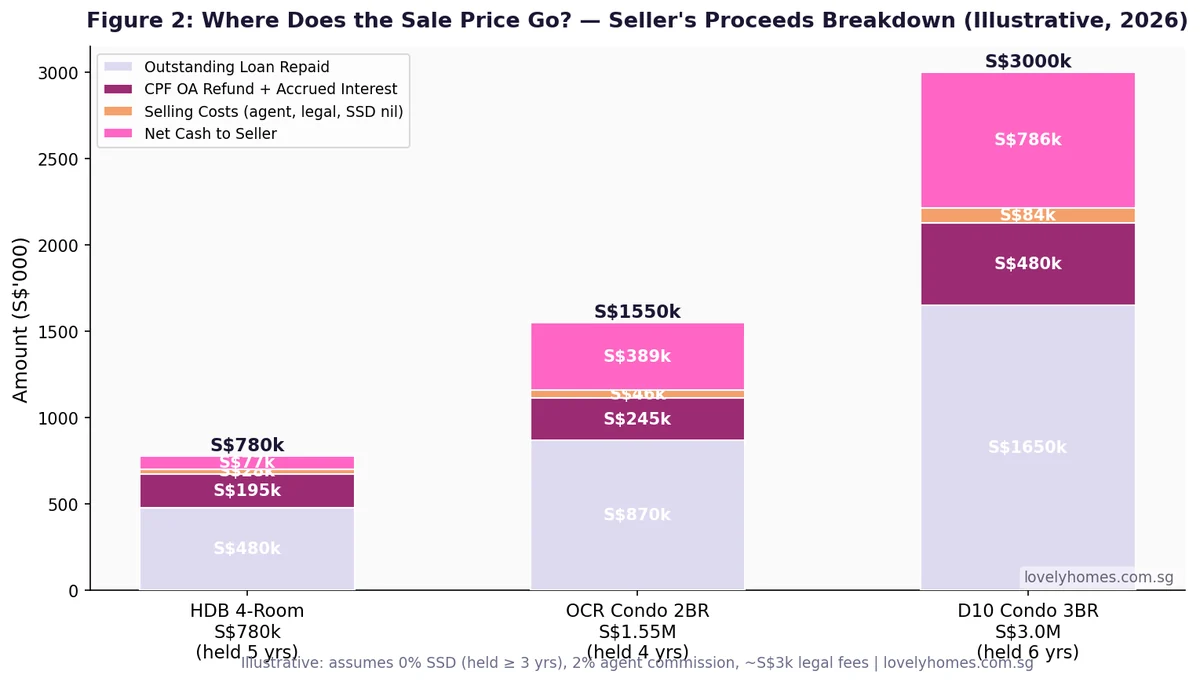
  • CPF refund: When you sell your HDB flat, all CPF OA monies used for the purchase — plus accrued interest — must be refunded to your CPF account. The net cash you receive is the sale price minus the outstanding HDB loan (if any) and the CPF refund.
  • Grant repayment: CPF Housing Grants (EHG, Family Grant, etc.) used for the HDB flat do not need to be repaid upon sale — they are subsumed into the CPF OA refund.
  • HDB loan discharged on sale: The HDB loan is discharged at the point of the flat sale. Any outstanding balance is deducted from the sale proceeds before cash is released.
  • Private property financing: After selling your HDB flat, you are eligible for a bank loan of up to 75% LTV for a private property purchase. You cannot use an HDB concessionary loan for private property.
  • ABSD remission (SC married couples): If you buy a private property before selling your HDB flat, you can claim an ABSD refund if the HDB flat is sold within 6 months of completing the private purchase.

Who is an HDB Upgrader?

In Singapore’s property lexicon, an HDB upgrader is a flat owner — typically a Singapore Citizen couple who purchased a Housing & Development Board flat as their first home — who subsequently wishes to sell the flat and purchase a private residential property. The upgrade journey is one of the most significant financial decisions many Singaporeans make: it unlocks accumulated HDB equity, introduces bank mortgage financing (with its stricter credit requirements), and subjects the buyer to ABSD unless the timing is managed carefully.

The upgrader market is a structural pillar of Singapore’s private residential demand. According to the Urban Redevelopment Authority (URA), HDB upgraders historically account for 30–40% of new private condominium sales in Outside Central Region (OCR) developments. Policy levers — chiefly ABSD and MOP duration — are calibrated in part to pace the rate at which HDB flat owners enter the private market.

Understanding the mechanics of the upgrade journey — from MOP completion to key collection — is essential to avoid costly timing errors, particularly the S$270,000+ ABSD cash outlay that catches many upgraders off guard.

Step 1: Confirm Your MOP Status

The Minimum Occupation Period (MOP) is the period during which an HDB flat owner must occupy the flat as their principal residence before they are permitted to sell it on the open market or to purchase a private residential property.

The standard MOP is 5 years from the date the keys are collected (the date of possession), not from the date the sale was exercised or the mortgage was drawn. The MOP clock stops if the flat is rented out in full, if the flat owner stays overseas for extended periods, or in other prescribed circumstances — so owners who sublet their flat prematurely may find their effective MOP extended.

For Prime and Plus classification flats launched from August 2024 onwards under the new HDB classification framework, the MOP is 10 years, and additional ownership restrictions apply (including an income ceiling on resale buyers and a clawback provision on subsidy). Owners of these flats face a longer upgrader journey.
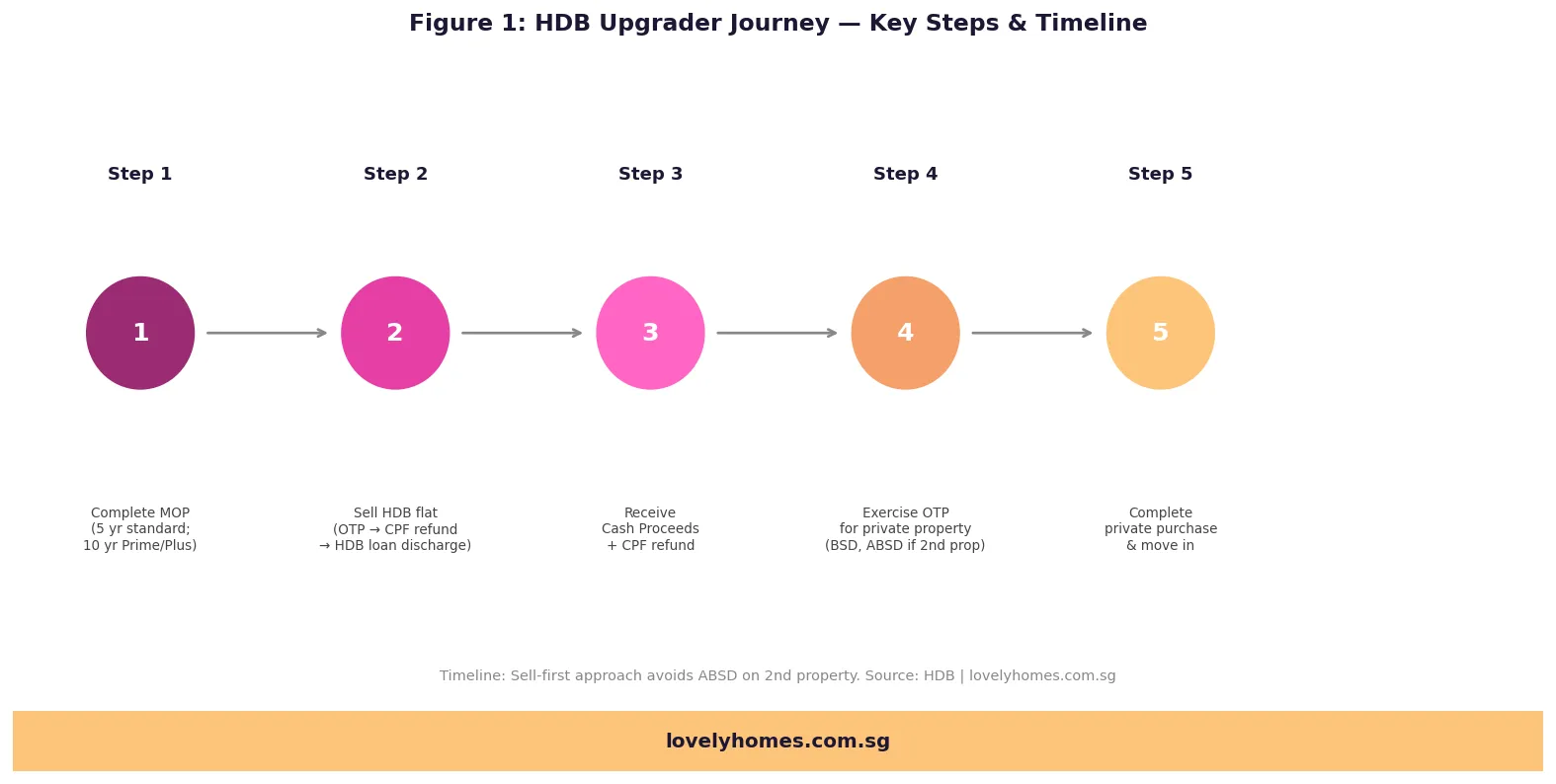
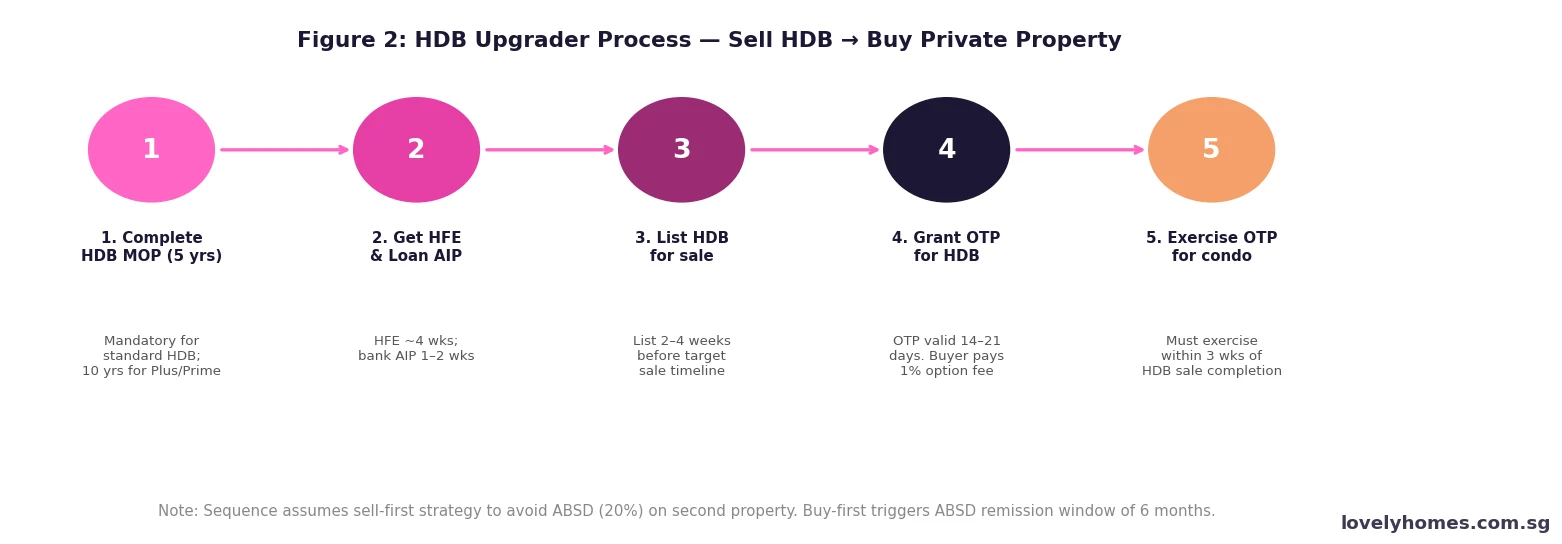
HDB upgrader journey 5 steps timeline Singapore 2026

Figure 1: The HDB upgrader’s journey — five key steps from MOP completion to private property key collection. Source: HDB | lovelyhomes.com.sg

Step 2: Understand What You Will Receive from the HDB Sale

The sale of your HDB flat generates two streams of value: a cash component and a CPF refund. The distinction matters enormously for financial planning, because the CPF refund goes back into your CPF Ordinary Account — it cannot be used freely as cash, though it can be used for the down payment and stamp duty on your subsequent private property purchase.

The CPF OA refund comprises: (a) the principal CPF OA amount withdrawn for the flat, and (b) accrued interest — the notional interest CPF Board charges on those withdrawn funds at the CPF OA rate (currently 2.5% p.a. on the first S$20,000 of OA, 3.5% p.a. thereafter, effective 1 January 2024). Accrued interest compounds over the full holding period and can be significant: on S$150,000 CPF withdrawn over 8 years, accrued interest at 2.5% compounding amounts to approximately S$34,000.
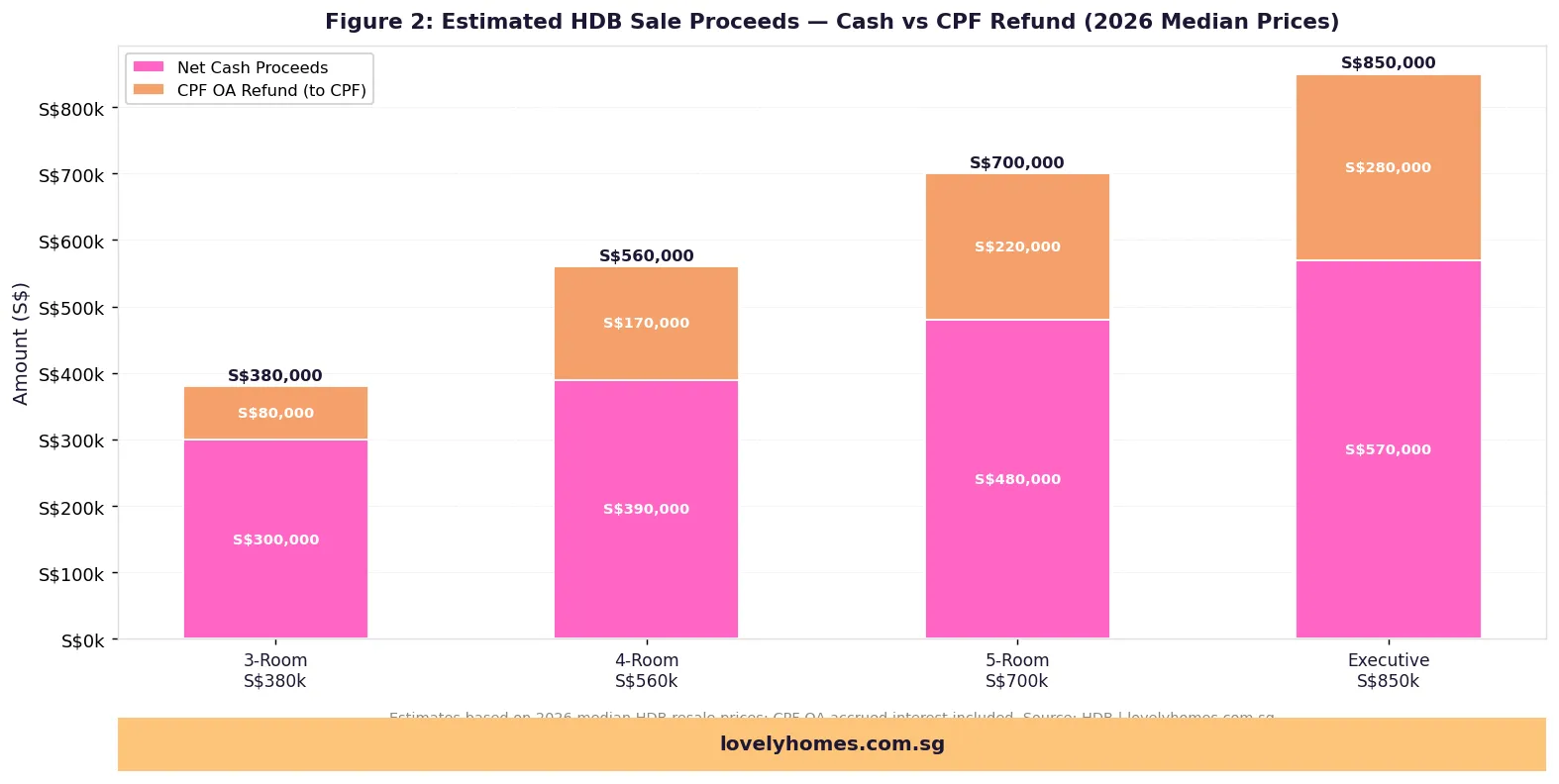
HDB sale proceeds by flat type cash vs CPF refund 2026 median prices

Figure 2: Estimated HDB sale proceeds by flat type — cash component vs CPF OA refund, based on 2026 median resale prices. Source: HDB | lovelyhomes.com.sg

If there is an outstanding HDB concessionary loan, the remaining balance is deducted from sale proceeds before cash is released to the seller. HDB loan interest rate is currently set at the CPF OA rate + 0.1% (i.e. approximately 2.6% p.a.), making it among the most competitive mortgage rates in Singapore — but flat owners who have used HDB loans extensively may find less net cash available after discharge.

Step 3: Decide on Your Upgrade Strategy — Sell First or Buy First?

The single most consequential decision in the upgrade journey is the sequencing of transactions: do you sell your HDB flat before purchasing the private property, or do you purchase first and sell after?

The sell-first strategy means you complete the sale of your HDB flat, receive the sale proceeds (cash + CPF refund), arrange interim accommodation (typically renting), and then purchase the private property as a first-time private-property buyer. The key advantage: you pay 0% ABSD on the private purchase (for SC buyers with no other property). The key risk: you may miss your preferred private property while searching for one during the rental period, and the private property market may move against you in the interim.

The buy-first strategy means you exercise an OTP on a private property while still owning the HDB flat, paying 20% ABSD on the private purchase price in cash. You then have 6 months from the date of completing the private property purchase (Legal Completion) to sell the HDB flat and apply for an ABSD remission refund from IRAS. If the HDB flat is sold within 6 months, IRAS refunds the ABSD paid (less a processing deduction of 0.1% p.p. on the refunded amount, effective from certain periods). If you miss the 6-month window, the ABSD is forfeited — a potentially catastrophic financial loss.
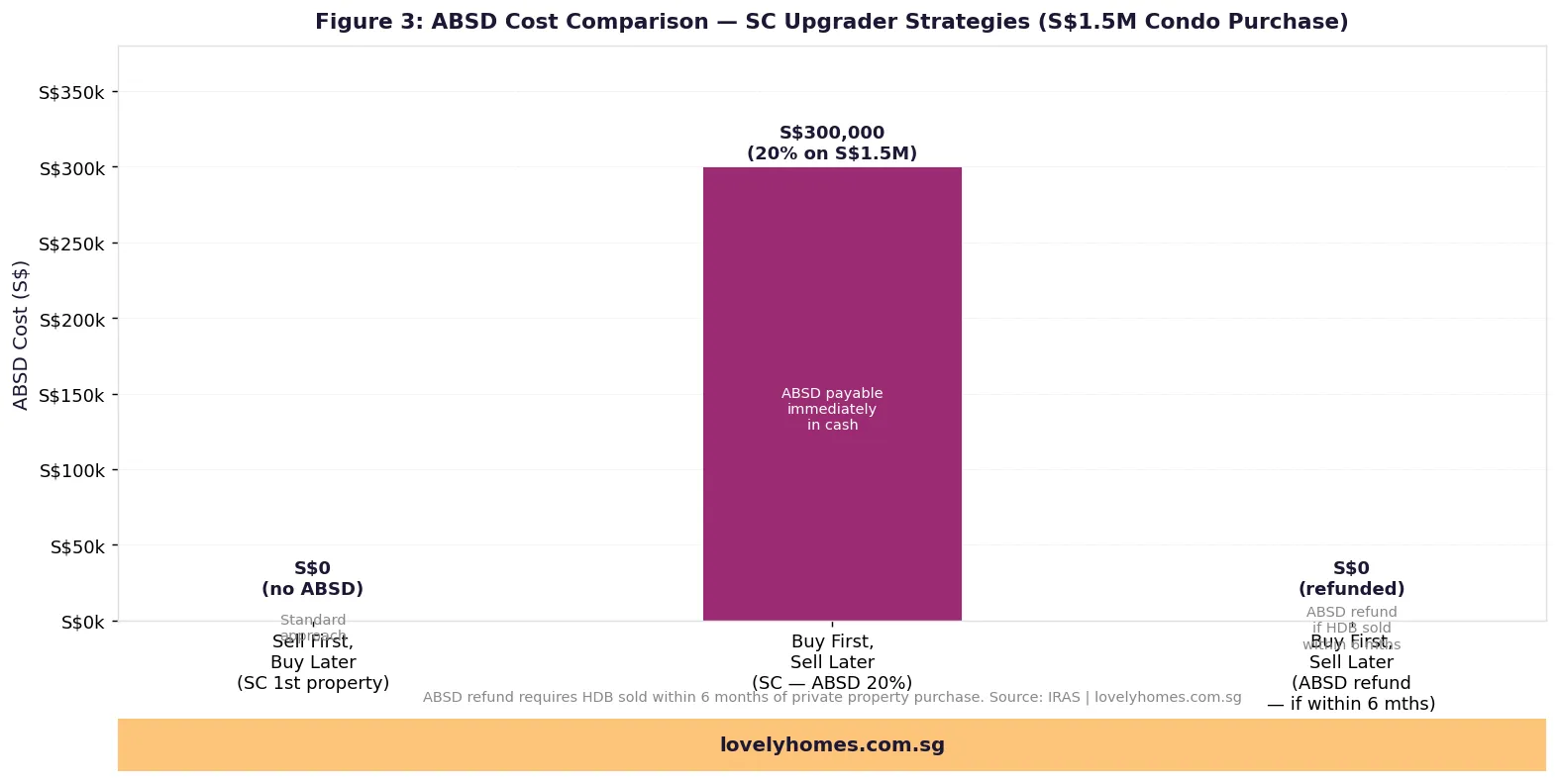
ABSD cost comparison sell first vs buy first HDB upgrader Singapore 2026

Figure 3: ABSD cost comparison — “sell first” avoids ABSD entirely; “buy first” triggers 20% ABSD but may be remitted if HDB flat sold within 6 months. Source: IRAS | lovelyhomes.com.sg

Summary Table: Key Upgrader Decision Points

Decision Point Sell First, Buy Later Buy First, Sell Later (+ ABSD remission)
ABSD upfront S$0 (first-time private buyer) 20% on purchase price (e.g. S$270,000 on S$1.35M) — cash only
ABSD recovery N/A — not paid Refundable if HDB sold within 6 months of private completion
CPF available Full CPF refund from HDB sale usable for private downpayment CPF still tied up in HDB until flat sold
Accommodation Must rent during search period Can stay in HDB until private is ready
Market risk Private prices may rise during rental period Locks in private price; HDB sale price uncertainty
Bridge financing Not required May need bridging loan if cash-flow is tight
MOP Standard flat 5 years from possession 5 years from possession
MOP Prime/Plus flat 10 years from possession 10 years from possession

Worked Example: The Tan Family Upgrade

Profile: Mr Tan (SC, 42) and Mrs Tan (SC, 40) own a 4-room HDB flat in Bishan, purchased in 2016 for S$470,000 using an HDB concessionary loan of S$376,000. MOP completed May 2021. Current market value: S$620,000. Outstanding HDB loan: S$92,000 (after 10 years of repayments). Total CPF OA withdrawn (both): S$185,000. Accrued CPF interest: S$42,000. Combined gross income: S$13,000/month.

HDB Sale proceeds:

  • Sale price: S$620,000
  • Less HDB loan discharge: S$92,000
  • Less CPF refund (principal + accrued interest): S$227,000
  • Net cash proceeds: S$301,000
  • CPF OA balance after refund: S$227,000 (reusable for private purchase)

Target private property: 3-bedroom resale condominium in Bishan (D20), S$1,380,000.

Sell-first strategy (0% ABSD):

  • BSD = 1% × S$180,000 + 2% × S$180,000 + 3% × S$640,000 + 4% × S$380,000 = S$1,800 + S$3,600 + S$19,200 + S$15,200 = S$39,800 (can use CPF OA)
  • 25% down payment = S$345,000 (5% cash min = S$69,000; remaining S$276,000 from CPF OA)
  • Available CPF OA after BSD: S$227,000 − S$39,800 = S$187,200 → cash shortfall of S$276,000 − S$187,200 = S$88,800 (to be covered by net cash proceeds S$301,000)
  • Bank loan: 75% × S$1,380,000 = S$1,035,000 at 3.5% over 25 years → monthly S$5,183
  • TDSR: S$5,183 / S$13,000 = 39.9% — PASS (well within 55% cap)
  • Total cash outlay: S$69,000 (down) + S$88,800 (CPF shortfall) + S$0 ABSD + S$8,000 legal fees = ~S$165,800 in cash

Buy-first strategy (20% ABSD, remission expected):

  • ABSD = 20% × S$1,380,000 = S$276,000 cash upfront (before HDB sale)
  • The Tans must fund S$276,000 ABSD + S$345,000 down payment + S$39,800 BSD simultaneously — total cash need: S$660,800 at exercise. If their HDB sale is completed within 6 months of private legal completion, IRAS refunds S$276,000 ABSD (less 0.1% = S$275,724 net refund).
  • Risk: HDB not sold within 6 months → S$276,000 lost.

Verdict: For the Tan family, sell-first is clearly superior — the net cash from HDB sale is sufficient to fund the private purchase without triggering ABSD, and TDSR is comfortably met. Buy-first requires bridge financing of ~S$660,000 simultaneously, which is feasible but expensive and risky if HDB sale stalls.

Why This Matters: Common Upgrader Mistakes

The three most expensive upgrader mistakes in Singapore each carry a six-figure price tag. First, miscounting the MOP: flat owners who sublet their entire flat for periods during the MOP — even with HDB approval — pause the MOP clock, sometimes discovering that their expected MOP date is later than they assumed. A single year’s delay translates into a year’s additional rent if the family has already moved out.

Second, assuming ABSD remission is automatic: the IRAS remission must be actively applied for, with evidence of the HDB sale completion. Families who miss the 6-month window — even by days — forfeit the remission entirely. Delays in HDB sale registration at the HDB Hub can erode the 6-month window; upgraders should build in a buffer and not list the HDB flat for sale at the last possible moment.

Third, ignoring CPF accrued interest: many upgraders are surprised to find that their CPF OA balance after the flat sale is materially lower than expected, because accrued interest — compounding for 5–10 years — has grown the CPF refund obligation substantially. This reduces the CPF available for the private property down payment and may require a larger cash component.

What Might Come Next: Policy Outlook for Upgraders

The Singapore government has shown a willingness to adjust ABSD policy in response to market conditions. The August 2024 introduction of the Prime and Plus HDB flat classification — with its 10-year MOP — signals an intent to slow the entry of Prime/Plus flat owners into the private market, preserving HDB estates as long-term communities rather than transient stepping-stones.

The ABSD remission for SC married couples remains in place as at July 2026. There is periodic market commentary that the 6-month window may be reduced if private prices accelerate — buyers should not rely on the remission window remaining unchanged. IRAS reviews the scheme in conjunction with broader cooling measure calibration.

On financing, MAS guidelines on TDSR and LTV have been stable since 2023. Any future tightening — such as a reduction in the 75% LTV cap for bank loans on private residential property — would increase the cash required for the down payment and could reduce upgrader demand at higher price points.

Frequently Asked Questions

1. Can I buy a private property while still in my HDB flat’s MOP?

No. HDB rules prohibit flat owners from owning or purchasing a private residential property in Singapore during the MOP. You must wait until the MOP is fully served before exercising an OTP on a private property. If you purchase a private property during the MOP, HDB may compulsorily acquire your flat. The prohibition covers direct ownership — owning shares in a company that owns private property is a separate issue and subject to its own rules.

2. Do I have to sell my HDB flat when I buy a private property?

No — you are not legally required to sell your HDB flat when you purchase a private property after MOP completion, provided you pay the applicable ABSD (20% for SC buying a 2nd residential property). Many upgraders choose to retain the HDB flat as a rental asset. However, renting out an HDB flat requires HDB approval, and both flat owners must be at least 35 years old (for non-family schemes). Also note: retaining both properties means the HDB flat rental income may affect TDSR calculations for the private property mortgage.

3. How long does an HDB resale typically take to complete?

An HDB resale transaction typically takes 8–12 weeks from the date an Option to Purchase (OTP) is granted to the HDB Hub’s completion and key handover. The process involves the HDB resale portal submission within 7 days of exercising the OTP, a First Appointment (HDB confirms eligibility), and a Second Appointment (key handover). Delays can occur if there are CPF accrued interest calculations to resolve, outstanding town council arrears, or if HDB flat type or scheme eligibility checks surface issues.

4. What is a bridging loan and when do upgraders need one?

A bridging loan is a short-term loan from a bank that covers the period between purchasing the new private property and receiving the proceeds from the HDB flat sale. Upgraders who adopt the buy-first strategy often need a bridging loan to fund the initial private property down payment (or ABSD, if applicable) before their HDB sale proceeds are available. Bridging loans in Singapore typically carry interest rates of 5–7% per annum and are repaid in full when the HDB sale is completed. They are a useful tool but add cost — every month the bridge is outstanding costs approximately S$400–S$500 per S$100,000 borrowed.

5. Can I use CPF OA from my HDB sale refund to pay the ABSD on my new private property?

No. ABSD must be paid entirely in cash — it cannot be funded from CPF OA. This is one of the most important cash-flow constraints in the upgrade journey. At S$270,000 ABSD on a S$1.35M private property, an upgrader using the buy-first strategy must have S$270,000 in cash available at the point of OTP exercise, in addition to the cash portion of the 25% down payment. CPF OA (including the refund from the HDB sale) can be used for the BSD and the down payment for the private property, but not for ABSD.

6. What happens if I cannot sell my HDB flat within 6 months for the ABSD remission?

If the HDB flat is not sold (legal completion of resale) within 6 months of the private property’s legal completion, the 20% ABSD paid upfront is forfeited — it is not refundable under any extension of time. IRAS does not grant extensions. If you have not yet found a buyer for the HDB flat and the 6-month deadline is approaching, you may need to price the flat more aggressively to accelerate the sale. This is why upgraders using the buy-first strategy typically list their HDB flat for sale as soon as they have exercised the OTP on the private property.

7. Are there any grants available to HDB upgraders buying private property?

No — CPF Housing Grants (EHG, Family Grant, Step-Up Grant, Singles Grant, Proximity Housing Grant) are only available for HDB flat purchases, not for private residential property. When you upgrade to a private property, you do not receive any government grant. The only financial assistance is the ability to use your CPF OA savings for the private property down payment and BSD, subject to the CPF Withdrawal Limit and Valuation Limit rules.

Related Articles

Disclaimer: This article is for general informational purposes only and does not constitute legal, financial, or tax advice. ABSD rates, MOP requirements, CPF rules, HDB regulations, and financing policies are subject to change. Readers should verify current information with the relevant authorities — the Housing & Development Board (HDB) at hdb.gov.sg, the Inland Revenue Authority of Singapore (IRAS) at iras.gov.sg, the Central Provident Fund Board (CPF) at cpf.gov.sg, and the Monetary Authority of Singapore (MAS) at mas.gov.sg — and consult a licensed conveyancing solicitor and/or a registered estate agent before making any property transaction decisions.
Singapore Condo MCST Guide 2026: Maintenance Fees, AGM, By-Laws and Your Rights as a Subsidiary Proprietor

Singapore Condo MCST Guide 2026: Maintenance Fees, AGM, By-Laws and Your Rights as a Subsidiary Proprietor

Every condominium and privatised executive condominium in Singapore is governed by a Management Corporation Strata Title — the MCST. If you own a condo unit, you are automatically a member of the MCST. The monthly maintenance fees that hit your bank account, the Annual General Meeting (AGM) notice that lands in your letter box each year, the by-law that governs what colour your front door can be, the sinking fund that pays for the carpark resurfacing in 2030 — all of this flows from the MCST framework.

Yet the MCST is one of the least understood aspects of condo ownership in Singapore. Most buyers ask about price, location, and facilities; few ask about management fee trajectory, sinking fund adequacy, or the quality of the Management Council before they sign. This guide fixes that gap. It explains how MCSTs work, what your rights and obligations are as a Subsidiary Proprietor (SP), how maintenance fees are set, what the AGM process involves, and how to handle disputes — covering the full framework under the Building Maintenance and Strata Management Act (BMSMA) Cap 30C, administered by the Building and Construction Authority (BCA) and adjudicated at the Strata Titles Board (STB).

Quick Answer — MCST at a Glance

  • Every condo or privatised EC is automatically governed by an MCST from the moment the first subsidiary strata certificate of title is issued. You cannot opt out.
  • As a unit owner (Subsidiary Proprietor / SP), you must pay monthly contributions — a management fund charge (for day-to-day operations) and a sinking fund charge (for capital works). Together these form your “maintenance fee”.
  • The MCST is governed by an elected Management Council (MC) of up to 10 councillors chosen at the AGM. Day-to-day operations are usually delegated to a Managing Agent (MA).
  • The AGM must be held once a year. SPs can vote on the annual budget, elect the MC, pass special resolutions (which require a 75% majority by share value), and raise issues via a general meeting.
  • Typical monthly maintenance fees in 2026 range from about S$250 (studio in budget condo) to S$1,700+ (4BR in premium development).
  • The sinking fund must by law be maintained at no less than 10% of the total annual contributions, but most well-managed developments target significantly more.
  • Disputes between SPs and the MCST — or between SPs — are adjudicated by the Strata Titles Board (STB), which is a specialist tribunal under the BMSMA.
  • Before buying a condo, check the MCST’s annual accounts, AGM minutes, and sinking fund balance. A poorly managed MCST with a depleted sinking fund is a major hidden liability.

What Is an MCST?

An MCST — Management Corporation Strata Title — is the legal body that owns, manages, and maintains the common property of a strata-titled development. Common property is everything that is not part of an individual lot — the pool, gym, lobby, lifts, carpark, garden, external façade, rooftop, and all the pipes and cables running through the common areas. The MCST is a body corporate under the BMSMA: it can sue and be sued, enter contracts, hold bank accounts, and own property (specifically, the common property it manages).

Singapore’s MCST system derives from the Strata Titles Act (Cap 158) and the BMSMA. The MCST is formed automatically when the Commissioner of Buildings registers the strata roll. Each MCST has a unique strata title plan number — e.g., “MCST No. 1234” — which is filed with the Singapore Land Authority (SLA). An MCST covers exactly one strata development. There is no such thing as a shared MCST across multiple developments.

Share Values — The Key to MCST Voting and Fees

Each lot (unit) in the development is assigned a share value by the Singapore Land Authority at the time the strata plan is approved. Share values are calculated based on the floor area of the unit relative to all units in the development. A 2BR unit of 800 sqft in a development with a total share value of 1,000 might be assigned a share value of 8. Share values matter for two reasons: they determine your proportionate share of the maintenance fees; and they determine your voting weight at general meetings (each share value = one vote).

Singapore MCST monthly maintenance fees by condo tier and unit size 2026
Figure 1: Indicative Monthly MCST Maintenance Fees by Condo Tier & Unit Size (Singapore 2026). Click to expand.

The Management Fund and Sinking Fund

MCSTs collect contributions through two separate accounts, both mandatory under the BMSMA:

Management Fund

The management fund covers the operational costs of running the development. This includes the MA’s fees, security guard salaries and contracts, utilities for common areas, cleaning and landscaping, lift maintenance, swimming pool upkeep, pest control, insurance premiums (for fire and public liability), and minor repairs. The management fund is essentially the development’s operating budget.

Sinking Fund

The sinking fund is a capital reserve for major, long-term works — repainting the external façade, replacing the lifts (typically every 20–25 years), resurfacing the carpark, upgrading the security system, replacing ageing pipes, and replacing major mechanical and electrical plant. Under BMSMA s.38(4), the sinking fund must be maintained at no less than 10% of total annual contributions. In practice, a well-managed development that is 15+ years old will typically hold a sinking fund equal to 2–5 years of total annual contributions.

Typical Maintenance Fee Ranges in 2026

Singapore’s maintenance fee landscape in 2026 spans a wide range depending on development tier, facilities, and unit size. Industry figures suggest the following broad ranges:

Development Tier Studio / 1BR 2BR 3BR 4BR+
Budget / Small Boutique (<300 units, basic facilities) S$250–S$320 S$370–S$470 S$470–S$600 S$650–S$900
Mid-Tier (300–600 units, pool/gym/function room) S$320–S$450 S$500–S$700 S$700–S$950 S$950–S$1,250
Premium / Full-Facilities (600+ units, concierge, indoor sports, spa) S$500–S$700 S$800–S$1,100 S$1,100–S$1,500 S$1,500–S$2,500+

These are indicative only. In a large development like Tampines Concourse or The Pinnacle@Duxton (if it were private), the lower per-unit cost benefits from economies of scale. A boutique development of 20 units with a rooftop pool will have a disproportionately high per-unit fee because the fixed costs are spread over fewer owners. Maintenance fee rates are set annually by the MC at the AGM and can increase over time, particularly as buildings age and require more expensive maintenance.

The Management Council — How Your Condo Is Governed

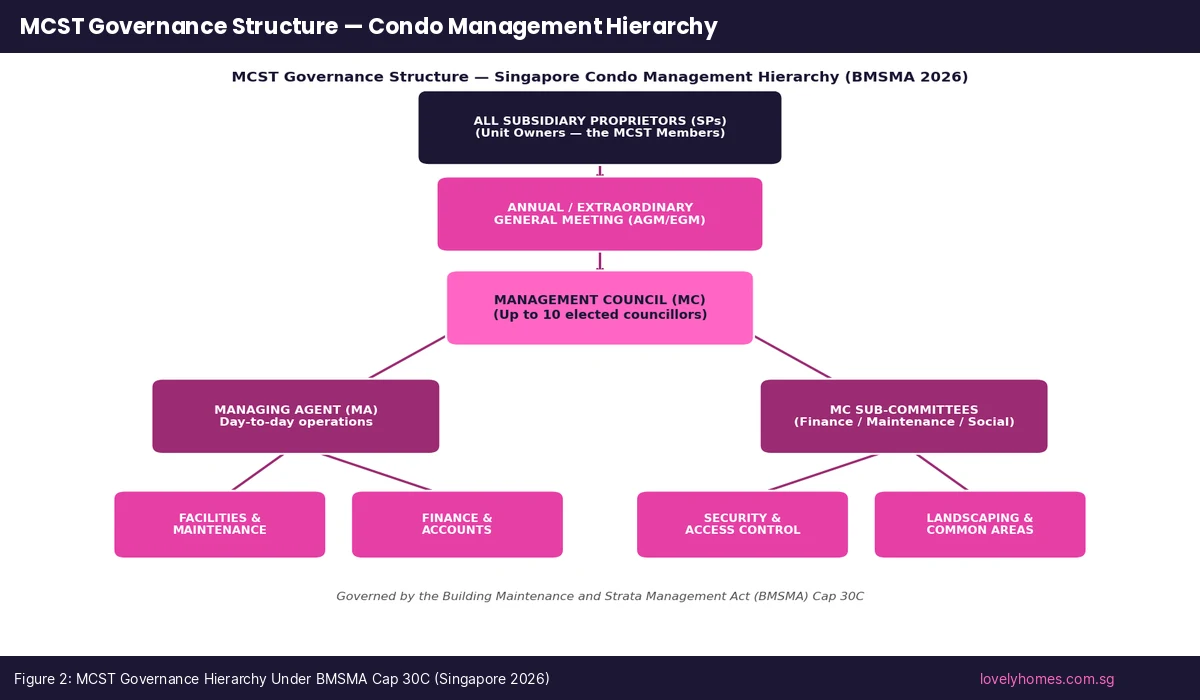
The Management Council (MC) is elected at the AGM by the SPs of the development. The MC is responsible for the management and control of the use and enjoyment of the common property, and for carrying out the powers and duties of the MCST under the BMSMA. The MC can have up to 10 councillors. It elects a Chairperson, Secretary, and Treasurer from among its members. MC meetings are typically held monthly or bi-monthly.

In practice, many MC councillors are owner-occupiers with a genuine stake in how well the development is managed. Inactive or absentee-dominated MCs — where the majority of councillors are landlords who do not live in the development — can lead to conflicts between short-term cost minimisation and the long-term wellbeing of the asset. Owner-occupiers buying for the long term should consider attending AGMs and, if they have the time, standing for election to the MC.

Singapore MCST governance structure Management Council Managing Agent flowchart BMSMA 2026
Figure 2: MCST Governance Hierarchy — Subsidiary Proprietors, Management Council, and Managing Agent (BMSMA 2026). Click to expand.

The Managing Agent (MA)

Most MCSTs engage a professional MA to handle the operational day-to-day work. Singapore’s leading MAs include CBRE Property Management, Savills Property Management, Jones Lang LaSalle, Knight Frank Property Asset Management, and a number of specialist condo management firms. The MA is hired by and reports to the MC. The MA does not own or control the MCST — it is a contractor. The MA’s contract is typically a 1-to-3-year appointment, renewed (or re-tendered) at the MC’s discretion.

The MA typically handles: collection of maintenance fees, payment of invoices, procurement of service contracts (lifts, security, pest control), organising the AGM, keeping strata roll records, liaising with BCA on regulatory compliance, and managing day-to-day resident queries and complaints.

The Annual General Meeting (AGM)

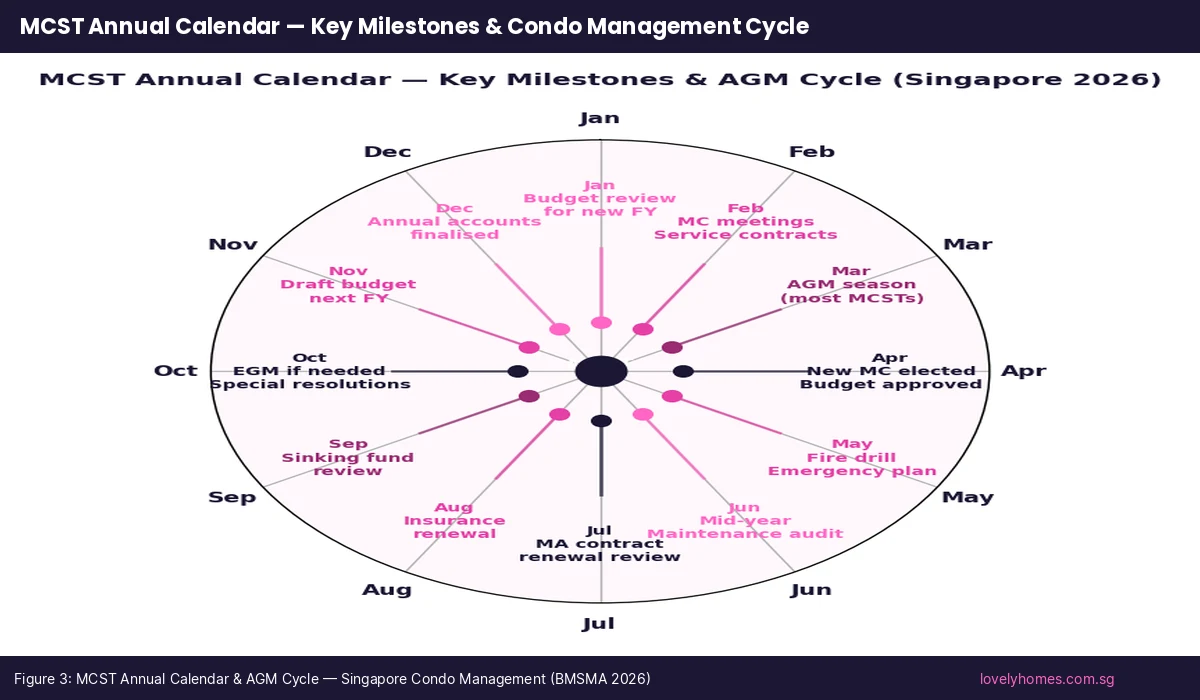
The AGM is the primary mechanism through which SPs exercise democratic control over their MCST. Under BMSMA s.27, the first AGM must be held within 13 months of the MCST’s formation. Thereafter, the AGM must be held at least once every calendar year and not more than 15 months after the preceding AGM. Most Singapore condominiums hold their AGM between January and April, after the financial year end.

Standard AGM Agenda

A typical AGM agenda includes: (1) adoption of the previous year’s financial accounts and auditor’s report; (2) approval of the budget for the coming financial year (management fund and sinking fund contributions); (3) election of the Management Council; (4) appointment of the auditor; (5) any motions submitted by SPs; and (6) any other business. The budget approval item is the most consequential — it sets the monthly maintenance fee for the year ahead.

Voting at the AGM

Votes at an AGM are counted in one of two ways depending on the resolution type. Ordinary resolutions (routine decisions like budget approval and election of councillors) are decided by a simple majority of the share values of SPs present and voting. Special resolutions (which include significant changes like amending by-laws, changing the method of allocation of contributions, or entering major contracts above a threshold) require 75% of the share values of all SPs — not just those present. This is a high bar and means that contentious changes to how a development is managed require broad consensus.

Extraordinary General Meetings (EGMs)

EGMs can be called between AGMs by the MC, or by SPs representing at least 25% of the total share value submitting a written requisition. EGMs are used for urgent decisions — unexpected major repairs, a change of MA, or resolutions that cannot wait for the next AGM. The notice requirements for an EGM are the same as for an AGM: at least 14 days’ written notice must be given to all SPs.

Singapore MCST annual calendar AGM milestones condo management cycle 2026
Figure 3: MCST Annual Calendar — Key Milestones & AGM Cycle for Singapore Condominiums (BMSMA 2026). Click to expand.

By-Laws — What You Can and Cannot Do in Your Condo

By-laws are the rules that govern behaviour within a strata development. The BMSMA prescribes a set of default by-laws in the Second Schedule that apply to every development unless specifically amended by a special resolution at a general meeting. These default by-laws cover matters such as: not interfering with the peaceful enjoyment of other lots; keeping animals only with MC approval; not hanging laundry on the external façade; not obstructing common property; not making structural alterations without MC approval; and not creating noise nuisance.

Developments may add their own by-laws to supplement the statutory defaults. A development with a strict “no pets” policy, a ban on short-term rentals (Airbnb is already prohibited by law in Singapore for stays under 3 months), or a rule requiring parquet flooring to be covered by rugs to reduce noise transmission, can encode these in its registered by-laws. Registered by-laws are binding on all SPs, tenants, and residents — including buyers who purchase the unit after the by-law was registered.

Before buying a resale condo, ask your solicitor to obtain the MCST’s registered by-laws and review them carefully. A by-law prohibiting pets, for instance, may not be waivable even with the MC’s informal approval — the by-law governs.

Your Rights and Obligations as a Subsidiary Proprietor

As an SP, you have a set of substantive rights and corresponding obligations under the BMSMA:

Your Rights Your Obligations
Attend and vote at AGMs/EGMs Pay maintenance contributions on time (late fees apply)
Stand for election to the Management Council Comply with MCST by-laws and the BMSMA
Inspect the MCST’s financial accounts and strata roll Obtain MC approval before carrying out renovations affecting common property or load-bearing structures
Submit motions for consideration at general meetings Not cause nuisance or hazard to other residents
Apply to the Strata Titles Board to resolve disputes Maintain your lot in good repair so as not to damage common property
Share in the common property proportionate to share value Not carry out alterations to common property without consent

Renovation Approvals — The Most Common Flashpoint

Renovation disputes are the most frequent source of conflict in Singapore condominiums. The key rules under the BMSMA and HDB/BCA guidelines (for SPs who engage licensed renovation contractors) are: any works that affect or penetrate the floor slab, any works that affect the common property (including the external façade, windows, and any shared walls), and any hacking or structural works, require prior MC approval. The SP must submit a renovation application to the MA with details of the works, the contractor’s name and licence number, and drawings or specifications as required. The MC has the right to inspect the works and to require rectification if the works deviate from what was approved.

The MA will typically send a renovation notice to neighbours within the affected units before works commence. Renovation hours are governed by the BMSMA and the NEA: Monday to Saturday 9am–6pm; no works on Sundays and public holidays.

Dispute Resolution — The Strata Titles Board

The Strata Titles Board (STB) is the specialist tribunal established under the BMSMA to adjudicate disputes arising in strata developments. Filing a complaint with the STB is significantly cheaper and faster than going to court. The STB handles disputes between SPs, between SPs and the MCST/MC, and between the MCST and its MA. Common STB applications include: enforcement of by-laws; disputes over maintenance fee quantum; improper conduct at AGMs; failure of the MCST to carry out repairs; and disputes over the validity of a special resolution.

Before filing at the STB, parties are required to attempt mediation at the Singapore Mediation Centre (SMC). Many condo disputes — particularly neighbour noise complaints and renovation disputes — are resolved at mediation without proceeding to a full STB hearing.

Worked Example — Buying a Resale Condo: MCST Due Diligence

Ms Chen is purchasing a resale 3BR condominium in the East Coast (D15) for S$1,650,000. Before exercising the OTP, her solicitor requests the following MCST documents from the vendor’s solicitor:

  • The most recent 3 years of annual financial accounts (management fund and sinking fund audited statements).
  • The last 2 years of AGM minutes.
  • The current year’s approved budget and contribution rates.
  • Any outstanding arrears on the unit being purchased.
  • A copy of the registered by-laws (including any special by-laws passed since the development was completed).
  • Any pending special levies or special assessments (capital works that have been voted for at an AGM but not yet reflected in the monthly maintenance fee).

From the accounts, she notes that the sinking fund stands at S$1.2M for a 180-unit development — approximately S$6,700 per unit. Given the development is 18 years old and will need a major façade repainting and lift replacement within the next 5 years (estimated cost: S$2.5M), she raises with her agent that the sinking fund appears under-funded. At the AGM 3 months earlier, a special levy of S$3,000 per unit was voted through to top up the sinking fund. This is a real cash cost she factors into her budget. Armed with this analysis, she negotiates a S$20,000 price reduction. Monthly maintenance fee: S$780 (her 3BR unit’s share value × contribution rate of S$5.50 per share value per month).

What Might Change — MCST Reform and BCA Digitalisation

The BCA has been progressively digitalising MCST administration. By 2025, all MCST annual accounts and AGM minutes must be filed electronically with BCA via the Integrated Property Management System (IPMS). This creates a searchable public record of every registered MCST in Singapore — a significant transparency improvement for prospective buyers conducting due diligence. The BCA has also been reviewing minimum sinking fund contribution requirements, with a proposal to increase the 10% minimum for older developments (15 years+) to better reflect actual capital expenditure needs. Any regulatory change here would increase monthly fees for owners of older condominiums.

Frequently Asked Questions

Can the MCST prevent me from renting out my unit?

Generally, no. The MCST cannot prohibit an SP from renting out their lot — the right to rent out a freehold or leasehold unit is a fundamental property right. However, the MCST can and typically does require: (a) advance notice of any tenancy and the tenant’s details for the strata roll; (b) the SP to ensure the tenant complies with all MCST by-laws; and (c) that tenancy periods comply with the legal minimum of 3 months (short-term rentals are prohibited in Singapore for all private residential properties). If a tenant repeatedly violates by-laws, the MCST can take action against the SP (as the lot owner responsible for the tenant’s conduct) rather than against the tenant directly.

What happens if I do not pay my maintenance fees?

Under BMSMA s.40, the MCST may recover unpaid contributions as a debt due in any court. The MA will first send reminder letters and impose late payment charges (typically 2–5% per month on the overdue amount, as specified in the by-laws). If the arrears persist, the MCST may obtain a judgment against the SP and register a charge against the unit on the land register — effectively a lien on the property that must be discharged before any sale can proceed. In extreme cases, the MCST may apply for a court order for the sale of the unit to recover arrears, although this is rare in practice. Arrears do not disappear on a change of ownership — buyers should confirm there are no outstanding contributions before completing a resale purchase.

How is the monthly maintenance fee calculated for my specific unit?

Your monthly maintenance fee is calculated as: your share value × the contribution rate per share value per month. The MC sets the contribution rate annually at the AGM when it approves the budget. For example, if your unit has a share value of 8 and the MC has approved a contribution rate of S$60 per share value per month, your monthly maintenance fee is S$480. Within that, the split between management fund and sinking fund contributions is also set by the MC, subject to the BMSMA minimum sinking fund requirement. Your share value is fixed at the time the strata plan is registered and can only be changed by a unanimous resolution of all SPs plus approval from the Commissioner of Buildings — a very high bar in practice.

Can I paint my front door a different colour?

This is one of the most asked questions in Singapore condo forums. The answer depends on whether your front door is considered part of your lot or part of the common property, and whether the development’s by-laws specify approved colours. In most strata developments, the front door is considered a boundary element: the outer surface (facing the common corridor) is common property; the inner surface (facing your unit) is your property. This means you generally cannot change the exterior colour of your door without MC approval. Some developments have standardised door colours as part of the building’s design consistency and enforce this via by-law. Check the development’s by-laws and ask the MA before making any exterior changes.

What is a Special Levy and can the MC impose one without an AGM?

A special levy is a one-time additional contribution charged to SPs to fund a specific capital project — for example, an urgent roof repair, replacing ageing air-handling units, or upgrading the security system beyond what the sinking fund can cover. Under the BMSMA, the MC can impose a special levy for urgent works (where waiting for the AGM would cause disproportionate damage) without first convening a general meeting, but must seek ratification at the next general meeting. For non-urgent capital works, a special levy should ideally be approved by a general meeting before it is imposed. The quantum of the levy is typically proportionate to share value, so each SP pays in line with their proportionate interest in the development.

How do I check the sinking fund health of a condo before buying?

Request the MCST’s audited annual accounts for the past 3 years from the vendor’s solicitor or the MA. The sinking fund balance will appear as a liability in the MCST’s balance sheet. To assess adequacy, compare the sinking fund balance to the development’s age and condition, and any Capital Expenditure Plan (CapEx plan) that the MCST or MA has prepared. A useful rule of thumb: a development that is 10–15 years old in good condition should have a sinking fund of at least S$5,000–S$10,000 per unit; a development over 20 years old should ideally have S$15,000+ per unit. These are rough benchmarks — actual adequacy depends on the specific works required. Also review the AGM minutes for any discussions of upcoming capital works that may trigger a special levy.

Can I attend an AGM as a tenant rather than an owner?

No. Only Subsidiary Proprietors (unit owners) and their authorised proxies may attend and vote at MCST general meetings. Tenants have no standing at the AGM and cannot vote on MCST matters. If you are an SP but cannot attend the AGM in person, you may appoint a proxy by submitting a duly executed proxy form before the meeting. The proxy can be any person — it does not have to be another SP. If you rent out your unit and want a say in how the development is managed, you must attend the AGM personally or appoint a proxy.

Related Articles

Disclaimer

This article is published for general informational and educational purposes only. It does not constitute legal, financial, or property management advice. MCST rules, BMSMA provisions, and BCA regulations are subject to amendment. Always refer to the BCA BMSMA resources and the Building Maintenance and Strata Management Act on Singapore Statutes Online for authoritative guidance. For specific MCST disputes or governance issues, consult a Singapore-qualified lawyer or the Strata Titles Board. Maintenance fee figures quoted are indicative industry estimates and will vary by development.

Singapore Executive Condo (EC) Buying Guide 2026: Eligibility, Prices, MOP and the New 10-Year Rules Explained

Singapore Executive Condo (EC) Buying Guide 2026: Eligibility, Prices, MOP and the New 10-Year Rules Explained

Quick Answer — Singapore Executive Condo (EC) at a glance

  • EC household income ceiling: S$16,000/month (unchanged in 2026)
  • EC prices in 2026: roughly S$1.3M–S$2.2M for new launches, depending on unit size
  • At least one Singapore Citizen applicant required; co-applicant can be SC or PR
  • New EC sites from 8 May 2026: 10-year MOP and 15-year wait to full privatisation
  • Existing launched ECs retain the older 5-year MOP and 10-year privatisation timeline
  • ECs occupy the unique “sandwich class” position — priced above HDB BTO but below private condos
  • CPF Housing Grant of up to S$30,000 (Proximity Housing Grant) available for eligible EC buyers
  • Foreigners and companies cannot buy ECs during the initial launch period from developers

An Executive Condominium — universally abbreviated to EC in Singapore — is a hybrid housing type administered by the Housing & Development Board (HDB) but developed and sold by private property developers. ECs were introduced in 1995 to serve the “sandwich class” of Singaporeans who earn above the HDB BTO income ceiling of S$14,000/month but find private condominiums financially out of reach. In 2026, ECs remain one of Singapore’s most compelling property purchases for eligible buyers: they offer condominium-standard facilities (swimming pool, gym, function room, landscaped grounds, 24-hour security) at prices roughly 15–25% below comparable private condominiums, with the bonus of becoming fully private after a defined holding period. This guide covers every aspect of buying an EC in Singapore in 2026 — eligibility, pricing, the new 10-year MOP and 15-year privatisation rules, CPF usage, financing, and a worked financial example.

What Makes an EC Different from an HDB BTO and a Private Condo?

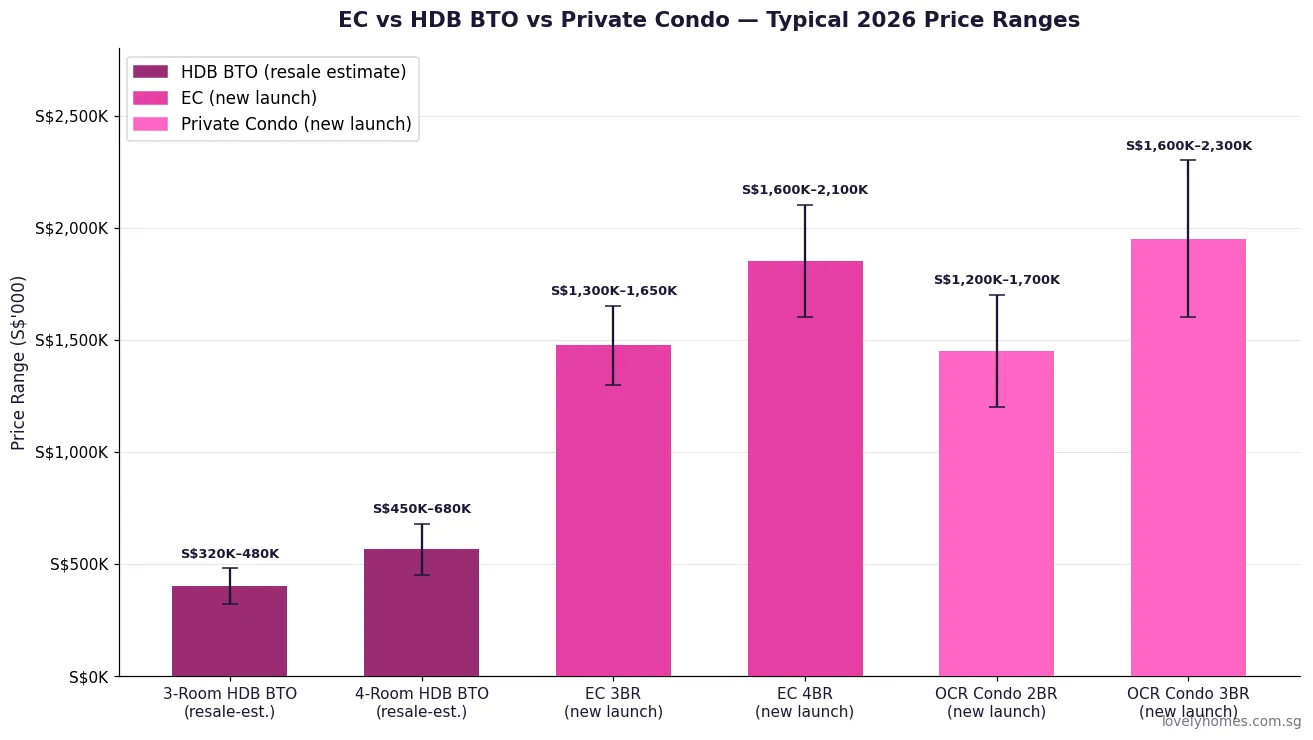
Understanding where an EC sits in Singapore’s housing ecosystem is the starting point for any prospective buyer. HDB Build-To-Order (BTO) flats are owned by the government, subject to significant resale restrictions, carry an income ceiling of S$14,000/month, and cannot be sold on the open market for five years from the date of key collection. At the other extreme, fully private condominiums have no income ceiling, no nationality restriction (subject to ABSD rates), and no minimum occupation period — but typically cost S$1.4M–S$3M+ for a new launch in 2026.

ECs sit between these two. During the initial restricted period, ECs operate under HDB rules — they must be sold by the developer at launch to eligible SC/PR applicants, buyers must meet the income ceiling, and a Minimum Occupation Period applies. Once privatised, an EC becomes indistinguishable from any other private condo in the eyes of the law. This trajectory — from subsidised hybrid to fully private asset — is what makes ECs uniquely attractive as a long-term investment vehicle, particularly for first-time buyers who can benefit from CPF grants while locking in capital appreciation over 10–15 years.

EC vs HDB BTO vs private condo price comparison Singapore 2026
Figure 1: Typical 2026 price ranges for 3-room/4-room HDB BTO flats (resale value estimates), EC new launches (3BR/4BR), and private OCR condo new launches. EC pricing typically falls 15–25% below equivalent private condos. Source: URA, HDB, developer sales data.

EC Eligibility — Who Can Buy?

EC eligibility is more restrictive than private condo eligibility and must be carefully assessed before any application. All of the following conditions must be met simultaneously.

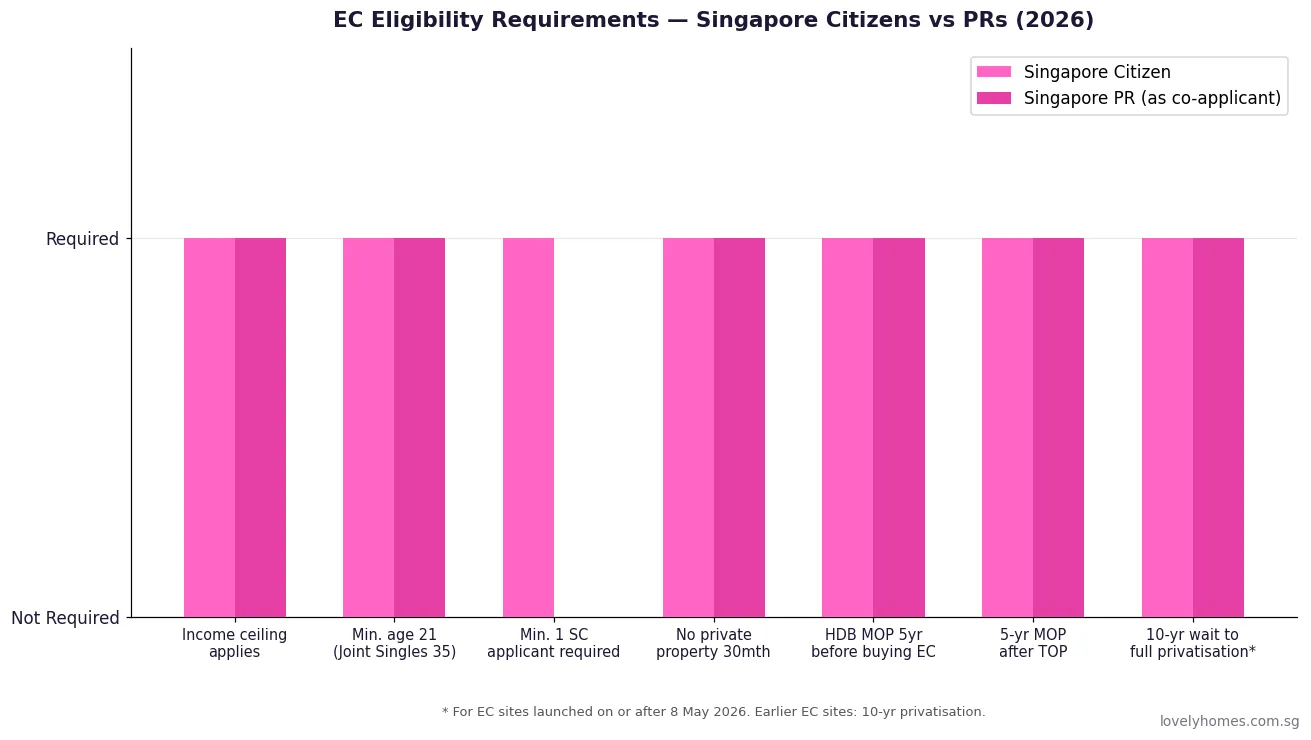
Citizenship: At least one applicant in the application must be a Singapore Citizen. Co-applicants can be Singapore Citizens or Singapore Permanent Residents. Foreigners are categorically ineligible to purchase ECs during the initial launch period from the developer. Only after 10 years from the date the EC obtained its Temporary Occupation Permit (TOP) may foreigners purchase ECs on the open market.

Household income ceiling: The combined gross monthly household income of all applicants and any occupants listed in the application must not exceed S$16,000. This ceiling has not changed in Budget 2026. Gross income includes all sources — base salary, allowances, bonuses averaged over 12 months, self-employment income, rental income, and foreign income if the applicant is assessed for Singapore tax. Exceeding the ceiling by even S$1 at the time of application results in automatic disqualification, and HDB verifies income through IRAS tax assessments and CPF contribution records.

Age: All applicants must be at least 21 years old. Under the Joint Singles Scheme (JSS), two or more unmarried Singapore Citizens may jointly apply for an EC, but each must be at least 35 years old.

Private property cooling-off period: Applicants must not have disposed of any private residential property (locally or overseas) within 30 months before the EC application date. If you sold a private property on 1 January 2024, you cannot apply for an EC until 1 July 2026.

HDB ownership history: If you or any applicant has previously owned an HDB flat, the Minimum Occupation Period of that flat must be fully served before you may apply for an EC. Additionally, if you currently own or are listed as an occupant of an HDB flat, you must dispose of that HDB flat within six months of taking possession of the EC.

Singapore executive condo EC eligibility requirements 2026
Figure 2: EC eligibility requirements for Singapore Citizens and PRs as co-applicants, 2026. All criteria (income ceiling, citizenship, age, cooling-off period, MOP) must be satisfied simultaneously. Source: HDB.

EC Pricing in 2026 — What to Expect

New EC launches in 2026 are priced in the S$1,300–S$2,200 per square foot (psf) range, reflecting rising land costs. Upcoming EC sites at Jalan Loyang Besar (Pasir Ris) and Tampines Street 95 are expected to launch at around S$1,700 psf when they come to market, which translates to absolute prices of approximately S$1.4M for a 3-bedroom unit and S$1.8–S$2.0M for a 4-bedroom unit.

Currently available ECs illustrate the pricing landscape. Novo Place — a 504-unit development by Hoi Hup Realty and Sunway Developments — was released at indicative prices starting from S$1.298M for a 2-bedroom unit up to S$1.779M for a 4-bedroom-plus-study. Aurelle of Tampines is another active launch in 2026, reflecting the continued concentration of EC supply in the north-east corridor near good MRT connectivity.

EC Development Location Year of TOP (est.) Price Range (new launch) Units
Aurelle of Tampines Tampines Ave 11 ~2029 S$1.35M–S$2.0M 760
Novo Place Tengah Garden Walk ~2029 S$1.30M–S$1.78M 504
Lumina Grand Bukit Batok West Ave 5 ~2028 S$1.31M–S$1.65M (est.) 495
Altura Bukit Batok West Ave 8 ~2028 S$1.30M–S$1.65M (est.) 360
Jalan Loyang Besar (upcoming) Pasir Ris ~2030 ~S$1.40M–S$2.0M (projected) TBC

The New 10-Year MOP and 15-Year Privatisation Rules (From 8 May 2026)

On 8 May 2026, the Singapore Government announced a significant tightening of EC holding period rules for EC sites awarded on or after that date. Understanding the distinction between old-regime ECs (already launched) and new-regime ECs (future GLS site awards) is essential for any EC buyer in 2026.

Singapore EC executive condo privatisation timeline old vs new regime 2026
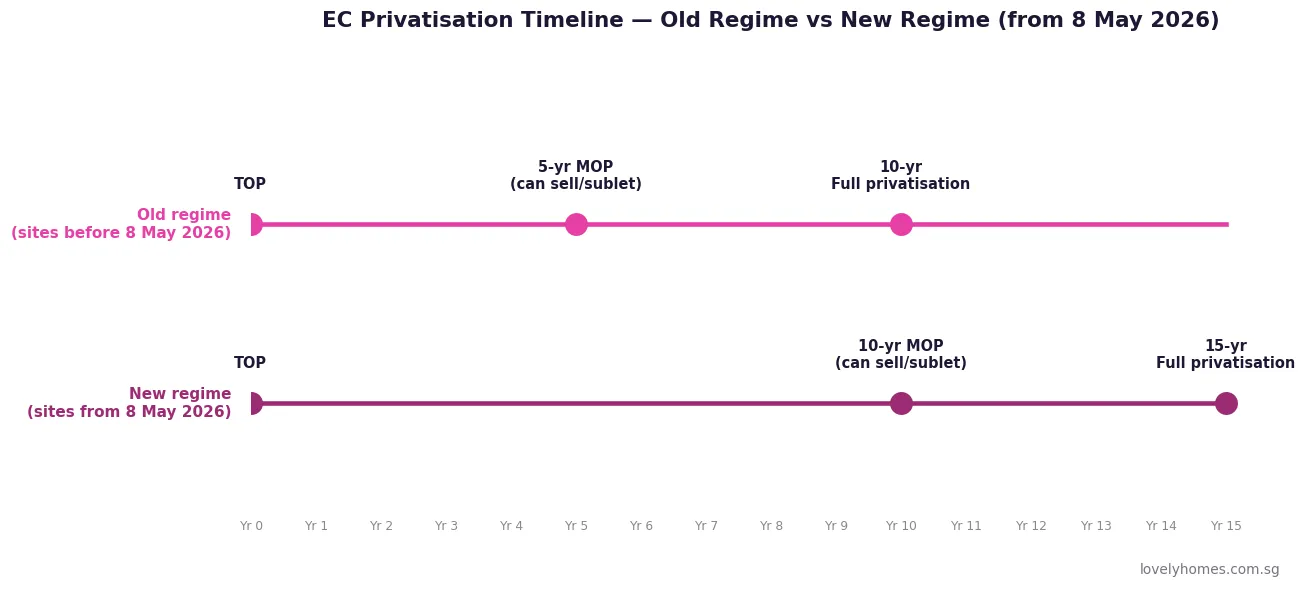
Figure 3: EC privatisation timeline — old regime (EC sites awarded before 8 May 2026) vs new regime (EC sites awarded from 8 May 2026). Source: HDB announcement, 8 May 2026.

Old regime (Aurelle of Tampines, Novo Place, Lumina Grand, Altura, and all ECs launched before 8 May 2026): The familiar 5-year MOP applies from TOP. After the MOP, the EC may be sold on the open market to Singapore Citizens or PRs. After 10 years from TOP, the EC is fully privatised and may be sold to foreigners and entities — subject to ABSD.

New regime (EC sites awarded from 8 May 2026 onwards): The MOP extends to 10 years from TOP. Full privatisation — when the unit may be transacted with foreigners and entities — does not occur until 15 years from TOP. This significantly extends the illiquidity period and reduces the short-to-medium-term capital gain that characterized earlier EC purchases. The Government’s stated rationale is to ensure ECs genuinely serve the long-term housing needs of eligible Singaporeans rather than shorter-cycle investment objectives.

The practical implication for buyers in 2026: the four currently launched ECs (Aurelle, Novo Place, Lumina Grand, Altura) are old-regime projects and retain the more liquid 5-year MOP and 10-year privatisation timeline. New EC sites awarded after 8 May 2026 will carry the extended restrictions. Buyers who prioritise resale flexibility should prioritise current launches over future GLS-derived ECs.

Financing an EC — CPF, Bank Loans and TDSR

ECs are financed through bank loans (HDB concessionary loans are not available for ECs). The bank will assess the application under the Total Debt Servicing Ratio (TDSR) framework administered by the Monetary Authority of Singapore (MAS), capping total monthly debt repayments at 55% of gross monthly income. The maximum loan-to-value (LTV) ratio for an EC bank loan is 75% of the purchase price or valuation (whichever is lower), so buyers must have at least 25% in cash and/or CPF.

CPF Ordinary Account (OA) savings may be used for the downpayment (subject to the Valuation Limit and Withdrawal Limit), monthly mortgage instalments, and stamp duties on the EC purchase. However, CPF usage for ECs is governed by the same accrued interest rules as HDB loans — when you sell the EC, you must return to your CPF account the principal withdrawn plus 2.5% per annum accrued interest. This is not a penalty but a refund to your own retirement account, and it reduces the net cash proceeds from any eventual sale.

Buyers who currently own an HDB flat and are eligible to purchase an EC simultaneously (e.g., within the six-month disposal window) must be careful about ABSD exposure: if they have not yet sold their HDB when they execute the EC Sales and Purchase Agreement, they will technically hold two residential properties and may attract ABSD at 20% (SC second property) on the EC purchase price. Planning the HDB sale to precede the EC SPA execution by at least one day is the standard approach.

Worked Example: Mr and Mrs Lim — Buying Aurelle of Tampines EC

Mr Lim (SC) and Mrs Lim (SC) are a married couple in their mid-30s. Mr Lim earns S$9,500/month and Mrs Lim earns S$5,800/month — combined S$15,300/month, comfortably below the S$16,000 income ceiling. They currently live in Mrs Lim’s parents’ HDB flat and have no prior private property ownership. They are applying for a 4-bedroom unit at Aurelle of Tampines at S$1,780,000.

Eligibility checks:

  • Income: S$15,300/month — below S$16,000 ceiling ✓
  • Citizenship: both SC ✓
  • Age: both 34 and 36 — above 21 ✓
  • Private property cooling-off: neither has owned private property ✓
  • HDB ownership: neither owns an HDB flat in their own names ✓

Purchase costs:

  • Purchase price: S$1,780,000
  • Buyer’s Stamp Duty (BSD): S$1,780,000 × BSD schedule = S$4,600 (first S$180,000 × 1%) + S$27,600 (next S$360,000 × 2%) + S$36,000 (next S$360,000 × 3%) + S$39,200 (next S$880,000 × 4%) = S$56,600 (standard BSD calculation: (180,000×1%)+(360,000×2%)+(360,000×3%)+(880,000×4%) = 1,800+7,200+10,800+35,200 = S$55,000)
  • Additional Buyer’s Stamp Duty (ABSD): S$0 — SC buying first residential property ✓
  • Legal fees (EC S&P): approximately S$3,500
  • Total acquisition cost: approximately S$1,783,500 + S$55,000 BSD + S$3,500 legal = S$1,841,500

Financing:

  • Downpayment (25%): S$445,000 — funded from CPF OA + cash savings
  • Bank loan (75%): S$1,335,000 at 3.2% fixed over 25 years = approx S$6,420/month
  • TDSR check: S$6,420 ÷ S$15,300 = 42.0% — well within 55% TDSR ✓
  • MSR note: MSR (Mortgage Servicing Ratio) of 30% applies only to HDB loans, not to EC bank loans

Grant eligibility: The Lims do not qualify for the CPF Housing Grant (available only for HDB BTO buyers) or the Enhanced Housing Grant (EHG). However, if one set of parents lives within 4km of Aurelle of Tampines, the Proximity Housing Grant (PHG) of S$10,000 (living near parents) or S$20,000 (living with parents) may apply — reducing the effective purchase price.

Projected holding value: Assuming Aurelle of Tampines follows a typical EC appreciation trajectory, comparable ECs that TOPed around 2019–2020 and privatised around 2029–2030 have demonstrated 35–50% resale premium over launch price during the privatisation window. This is speculative — past EC performance does not guarantee future returns — but the long-term track record of ECs converting to fully private assets in strong MRT-connected locations has been broadly positive.

Why ECs Matter: The Sandwich Class Opportunity

ECs were specifically designed by the Ministry of National Development (MND) to address Singapore’s “sandwich class” dilemma — households too affluent for subsidised HDB housing but not wealthy enough to comfortably absorb private condo prices without significant financial strain. In 2026, this remains the precise demographic challenge: private condo prices have risen substantially since 2020, the income ceiling for HDB BTO remains S$14,000/month, and the S$14,001–S$16,000 income band represents hundreds of thousands of eligible Singaporean households.

For buyers who qualify, an EC in a well-located development is arguably the most efficient use of S$1.3–S$2.0M in Singapore’s property market — providing private facilities and capital appreciation without the full ABSD burden on a second purchase or the income-test barriers of HDB. The caveat is the holding period: buyers must be prepared for the unit to remain illiquid (under old-regime rules) for 5 years and (under new-regime rules) for 10 years before they can sell. EC buying is fundamentally a medium-to-long-term commitment, not a short-cycle trade.

What Might Come Next — EC Policy Outlook

The 8 May 2026 announcement extending the MOP to 10 years and privatisation to 15 years for new EC sites signals that the Government intends to reinforce EC’s owner-occupation objective and reduce speculative pressure. It is plausible that income ceilings may be reviewed upward if private condo prices continue to rise faster than household income growth — a precedent exists from the 2021 rise in the HDB BTO income ceiling from S$12,000 to S$14,000 and the parallel EC ceiling rise from S$14,000 to S$16,000. Future EC GLS allocations will likely continue to be concentrated in MRT-connected OCR towns such as Tengah, Tampines, Pasir Ris, and the north corridor, aligning with long-term infrastructure investment in these areas.

Summary: EC vs HDB BTO vs Private Condo

Feature HDB BTO Executive Condo (EC) Private Condo
Income ceiling S$14,000/mth S$16,000/mth None
Eligibility SC/PR (various schemes) Min. 1 SC; SC/PR only Open (with ABSD for foreigners)
MOP (new launch) 5 years 5 yrs (old) / 10 yrs (new*) None
Full privatisation N/A 10 yrs (old) / 15 yrs (new*) Already private
CPF Housing Grant Up to S$120,000 (EHG) PHG up to S$30,000 None
HDB loan available? Yes (2.6%) No — bank only No — bank only
Typical 2026 price S$300K–S$700K (resale) S$1.3M–S$2.2M S$1.4M–S$3.5M+
Foreign buyer eligible? No After 10 yrs TOP (old) / 15 yrs (new*) Yes (60% ABSD for foreigners)

* For EC GLS sites awarded from 8 May 2026 onwards.

Frequently Asked Questions

Can a Singapore Permanent Resident buy a new EC?

A PR cannot buy a new EC as the sole or principal applicant. At least one Singapore Citizen must be part of the application. A PR may be a co-applicant alongside a SC spouse under the Public Scheme, or an EC may be purchased under a family nucleus that includes at least one SC. After the EC is fully privatised (10 years under old-regime rules, 15 years under new-regime rules), PRs and foreigners may purchase ECs on the open market. On the open market, a PR purchasing a fully privatised EC is subject to PR ABSD rates (5% for first residential property, 30% for second+).

What is the difference between the 5-year MOP and the 10-year MOP?

The Minimum Occupation Period (MOP) is the period during which the EC cannot be sold on the open market. Under the old regime (ECs launched before 8 May 2026), the MOP is 5 years from the date the EC obtained its TOP. After 5 years, the EC may be sold to Singapore Citizens or PRs on the open market. After 10 years from TOP, it becomes fully private (saleable to foreigners). Under the new regime (EC GLS sites awarded from 8 May 2026), the MOP extends to 10 years from TOP, and full privatisation occurs only at 15 years. During the MOP period, the EC cannot be sublet in its entirety (individual rooms may be sublet with HDB approval), and the owner must occupy the unit as their primary residence.

Can I use my CPF to pay for an EC?

Yes. CPF Ordinary Account (OA) savings may be used for the downpayment (subject to the Valuation Limit — VL — which is the lower of purchase price or valuation), monthly mortgage instalments, legal fees, and stamp duties. When CPF OA is used, the CPF Act requires you to refund the principal amount withdrawn plus 2.5% per annum accrued interest when you sell the EC. This refund goes back into your CPF OA (and, where applicable, Special or Retirement Account up to the prevailing Full Retirement Sum). The accrued interest is not a penalty — it is your own retirement savings with its minimum guaranteed return. Buyers should model this refund when calculating net sale proceeds from a future EC sale.

Does ABSD apply when buying an EC?

Yes, the same ABSD schedule that applies to private condominiums applies to ECs. Singapore Citizens buying their first residential property pay 0% ABSD — this is the most favourable scenario and why many EC buyers time their HDB disposal to precede the EC purchase. Singapore Citizens buying a second residential property pay 20% ABSD on the EC’s purchase price. If a buyer still holds their HDB flat when they execute the EC Sales and Purchase Agreement, the HDB flat counts as a first property, making the EC the second — triggering 20% ABSD. HDB provides a conditional ABSD remission for married SC couples who sell their HDB flat within six months of purchasing the private property (including EC). Always consult an IRAS-registered solicitor to verify your ABSD status before signing.

What happens to my HDB flat if I buy an EC?

If you currently own an HDB flat and wish to purchase an EC, you must dispose of your HDB flat within six months of taking possession of the EC (i.e., within six months of key collection). Selling before key collection is the cleanest approach to avoid ABSD exposure. If you sell your HDB after executing the EC Sales and Purchase Agreement, you may be subject to ABSD at 20% on the EC, but may apply for ABSD remission from IRAS provided the HDB is disposed of within six months of the EC SPA date. The remission is available to married SC couples and requires a formal application — it is not automatic. Failure to meet the six-month timeline results in forfeiture of any ABSD remission.

Are there any resale restrictions during the MOP?

During the Minimum Occupation Period, the EC may not be sold, transferred, or sublet as a whole unit without HDB approval. Individual bedrooms may be rented to lodgers with HDB approval — the same rules that apply to HDB flat owners. The owner must continue to occupy the unit as their principal residence throughout the MOP. Breaching MOP restrictions is treated as an offence under the Housing and Development Act and the Planning Act, and may result in compulsory acquisition of the unit by HDB at the original purchase price — a severe financial consequence. After the MOP expires, the EC may be transacted freely on the open market.

Are ECs a good investment in 2026?

ECs have historically been strong investments for eligible buyers due to the price discount at launch relative to comparable private condos, CPF grant support for eligible applicants, and the capital appreciation that typically accompanies privatisation. Past ECs that TOPed around 2017–2020 and privatised around 2027–2030 are, in many cases, transacting at premiums of 40–60% over their original launch prices in 2014–2018. However, the extension of the holding period to 10 years (MOP) and 15 years (privatisation) for new-regime ECs significantly changes the investment calculus — it reduces the short-cycle gain that previous buyers enjoyed and increases the commitment required. ECs remain a sound medium-to-long-term investment for buyers who genuinely intend to live in the property, but are less suitable as shorter-horizon plays. As with any property purchase, future value is not guaranteed — economic conditions, interest rates, supply, and government policy all influence outcomes.

Related Articles

Disclaimer: This article is intended as general information only and does not constitute legal or financial advice. EC eligibility, income ceilings, ABSD rates, MOP rules, and privatisation timelines are set by government policy and may be revised without notice. All figures are based on information available as at June 2026. Always verify current conditions with the Housing & Development Board (HDB), the Inland Revenue Authority of Singapore (IRAS), and a qualified property solicitor before making any purchase decision. Past capital appreciation of ECs does not guarantee future returns. LovelyHomes does not act as a property agent and does not endorse any developer or property service provider.

Singapore HDB Upgrading Guide 2026: Costs, ABSD, CPF and Step-by-Step Process

Singapore HDB Upgrading Guide 2026: Costs, ABSD, CPF and Step-by-Step Process

Quick Answer: HDB Upgrading Guide 2026

  • Who can upgrade? SC and PR households who have fulfilled the HDB Minimum Occupation Period (MOP) — 5 years for standard flats, 10 years for Plus/Prime flats classified from October 2024.
  • Typical upgrade path: Sell HDB first (avoid ABSD), then buy a private condo. Alternatively, buy first and claim ABSD remission within 6 months of selling.
  • ABSD on 2nd property: SC pays 20%, PR pays 30%, foreigners 65%. Selling HDB first means the condo is your 1st private purchase — 0% ABSD for SC couples.
  • Upgrader costs at S$1.35M condo: BSD ~S$37,200 + agent ~S$27,000 (selling + buying). No ABSD if HDB is sold first.
  • CPF: All CPF used for HDB (principal + 2.5% p.a. accrued interest) must be refunded to your CPF OA on sale. Net cash proceeds fund the condo down payment.
  • TDSR cap: 55% of gross monthly income. For a S$1.35M condo at 30-year tenor, monthly repayment at 3.0% is ~S$5,690 — household income of at least S$10,345/mth needed.
  • Sell-first vs buy-first: Sell-first saves 20% ABSD but carries gap-period risk. Buy-first triggers ABSD upfront, claimable back within 6 months of HDB sale completion.

For many Singaporean families, the journey from an HDB flat to a private property is the single largest financial milestone of their lives. The HDB upgrading guide process — commonly called “upgrading” — involves selling your public housing flat and buying a condominium, landed property, or Executive Condominium (EC) once your Minimum Occupation Period (MOP) is met. In 2026, upgrading remains very much alive: URA Q1 2026 data shows Outside Central Region (OCR) condo prices up 2.2% quarter-on-quarter, and HDB resale volumes continue to provide upgraders with strong equity to deploy.

Upgrading is simultaneously a financial decision, a tax-planning exercise, and a lifestyle transition. This guide, updated for Singapore HDB upgrading 2026, covers everything from MOP eligibility and ABSD implications to working through the exact stamp duties, CPF obligations, and loan calculations that determine whether the numbers stack up for your household.

Upgrader cost comparison chart showing BSD, ABSD and fees for 4 buyer profiles at S$1.35M condo Singapore 2026
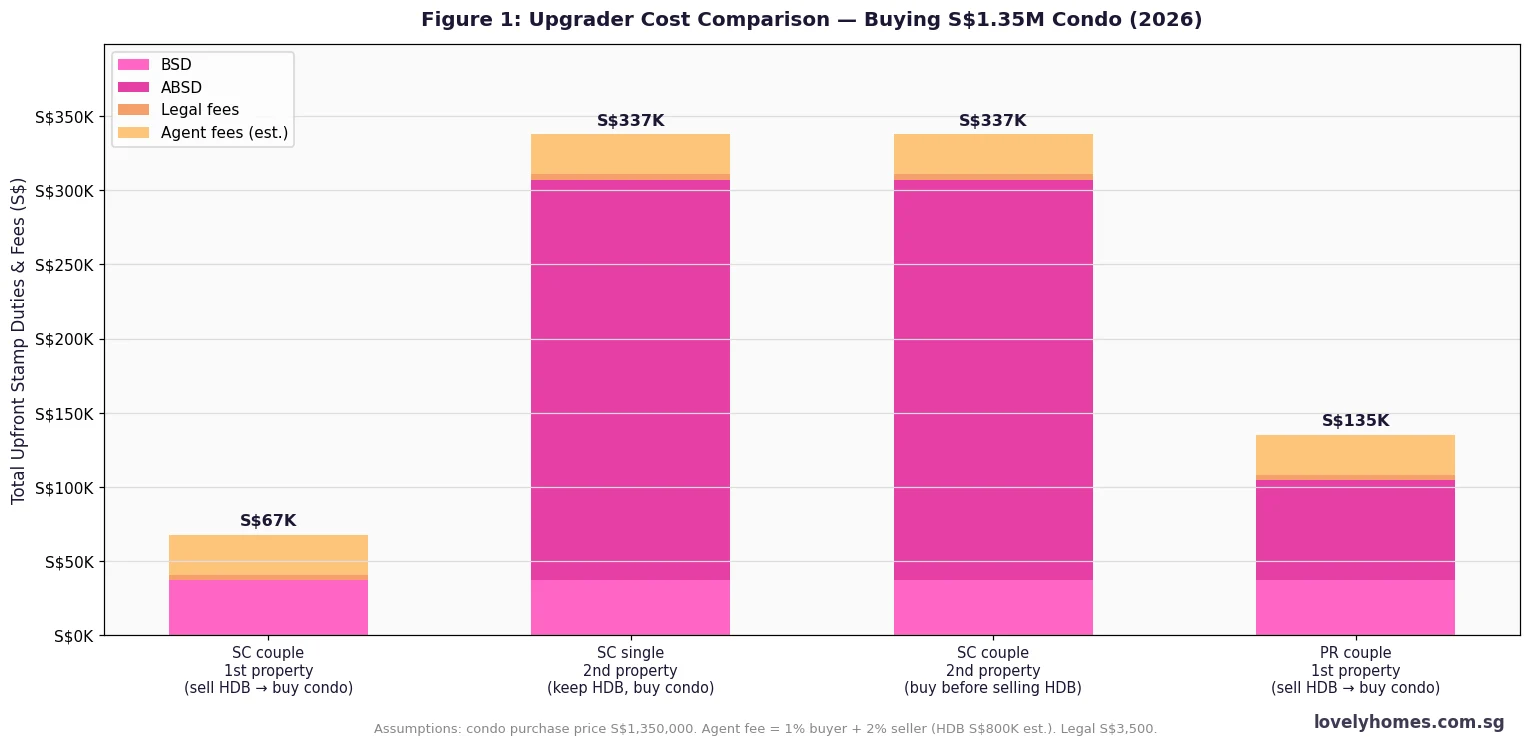
Figure 1: Upgrader cost comparison — buying a S$1,350,000 condo under four common profiles. SC couples who sell their HDB first face only BSD + agent fees, with zero ABSD. (Source: IRAS BSD schedule; author calculations.)

Who Is Eligible to Upgrade from HDB?

The primary eligibility gate is the Minimum Occupation Period administered by the Housing & Development Board (HDB) under the Housing & Development Act. For most HDB flats bought on the open market or through BTO exercises before October 2024, the MOP is 5 years from the date the keys are collected. For Plus and Prime flats classified under the new framework introduced in October 2024, the MOP is 10 years. If you purchased a Prime Location Public Housing (PLH) flat before October 2024, the MOP for that flat is also 10 years.

During the MOP, you cannot sell the flat, rent out the entire flat, or acquire any private residential property in Singapore or overseas. Once the MOP is fulfilled, these restrictions are lifted — you are free to sell your HDB and buy private property simultaneously or in sequence. Singapore Citizens (SC) have the most favourable ABSD profile for this transition; Permanent Residents (PR) and foreigners face significantly higher stamp duties on private property acquisition.

The Core Upgrade Decision: Sell-First or Buy-First?

The most consequential choice in the upgrading journey is sell-first versus buy-first. Both strategies are legal and used regularly; the right answer depends on your household’s liquidity, risk appetite, and the current market cycle.

Under sell-first, you obtain an Option to Purchase (OTP) for your HDB buyer, complete the HDB sale, then use the proceeds to exercise an OTP on your chosen condo. Because your HDB is sold before you acquire private property, the condo is treated as your first private residential purchase — 0% ABSD for SC couples, 5% for PRs. The downside is a gap period between vacating your HDB and taking possession of the condo (typically 3–6 months if buying resale, or 3–5 years if buying a new launch off-plan).

Under buy-first, you exercise the condo OTP before completing the HDB sale. Because you momentarily own both properties, IRAS treats the condo as a second property and levies ABSD upfront — 20% for SC couples at the time of writing. The Inland Revenue Authority of Singapore (IRAS), however, provides a ABSD remission window of 6 months from the date the condo is purchased (or the date the condo is completed, for new launches). If you sell and complete the HDB transfer within that window, 20% ABSD is refunded in full. If you miss the 6-month window, the ABSD is forfeited.

HDB upgrader 5-step process timeline from MOP completion to condo purchase Singapore 2026
Figure 2: HDB upgrader process — 5 steps from MOP fulfilment to condo purchase (sell-first strategy). Completing the HDB sale before exercising the private property OTP eliminates ABSD exposure entirely for SC couples. (Source: HDB, IRAS.)

Stamp Duties: BSD, ABSD and Seller’s Stamp Duty

Stamp duties administered by IRAS are the biggest variable cost in any upgrading exercise. Three taxes are relevant.

Buyer’s Stamp Duty (BSD) is payable by the condo purchaser on a slab-rate schedule: 1% on the first S$180,000, 2% on the next S$180,000, 3% on the next S$640,000, 4% on the next S$500,000, 5% on the next S$1,500,000, and 6% on amounts above S$3,000,000. For a S$1,350,000 purchase, BSD works out to S$37,200.

Additional Buyer’s Stamp Duty (ABSD) is levied on the acquisition of private residential property. The 2026 ABSD rates, effective since 27 April 2023, are: SC buying 1st property — 0%; SC buying 2nd property — 20%; SC buying 3rd or subsequent — 30%. For PR buying 1st — 5%; 2nd — 30%. Foreigners — 65% (with limited exemptions for nationals of countries with FTA provisions). If you sell your HDB first, your condo purchase is your 1st private property and you pay 0% ABSD.

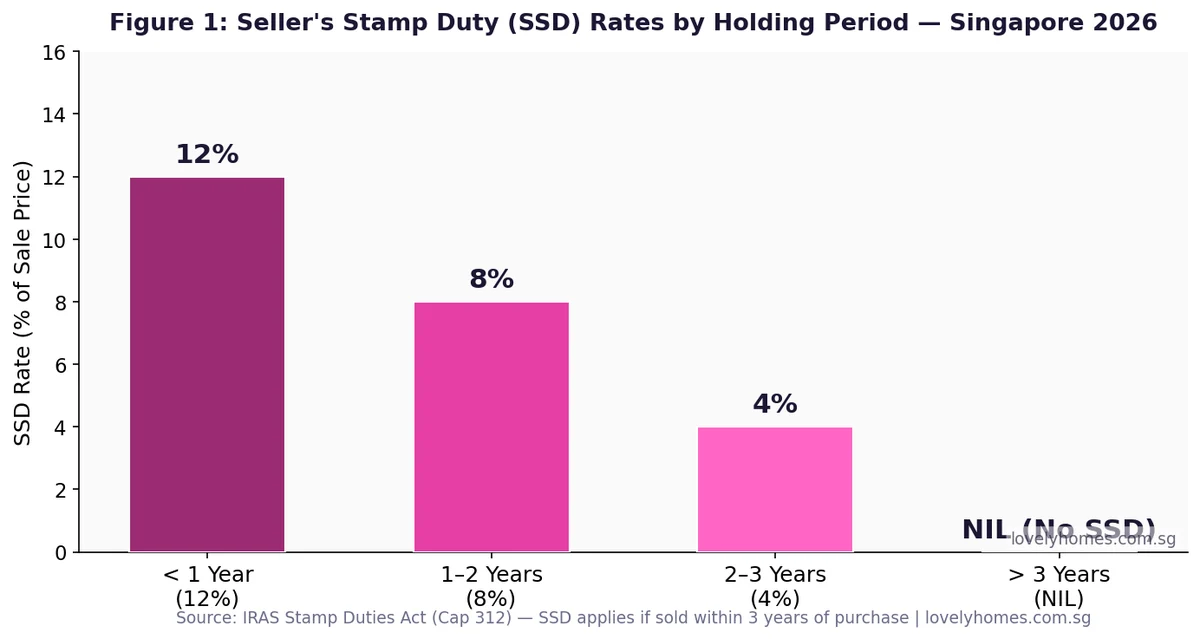
Seller’s Stamp Duty (SSD) does not apply to HDB flats (HDB imposes its own MOP rules instead). SSD applies to private residential properties sold within 3 years of acquisition: 12% in year 1, 8% in year 2, 4% in year 3. If you are buying a new launch condo off-plan, SSD starts running from the date you exercise the OTP, not the date of key collection.

Upgrader Stamp Duty Summary

Scenario BSD (S$1.35M condo) ABSD SSD Total Duties
SC couple, sell HDB first (condo = 1st private) S$37,200 0% Nil (hold >3 yrs) S$37,200
SC couple, buy-first + remission (sell HDB within 6 mths) S$37,200 20% → refunded Nil S$37,200 net
SC couple, buy-first — miss 6-mth window S$37,200 S$270,000 (20%) Nil S$307,200
SC single, keep HDB + buy condo (2nd property) S$37,200 S$270,000 (20%) Nil S$307,200
PR couple, sell HDB first (condo = 1st private) S$37,200 S$67,500 (5%) Nil S$104,700
PR couple, buy-first (2nd property, 30%) S$37,200 S$405,000 Nil S$442,200

Worked Example: The Tan Family Upgrade

Mr and Mrs Tan are Singapore Citizens, joint owners of a 5-room HDB flat in Tampines purchased in January 2019 at S$620,000. Their combined gross monthly income is S$14,000. The flat is MOP-cleared in January 2024. In Q1 2026, they list the flat at S$820,000 and receive an offer.

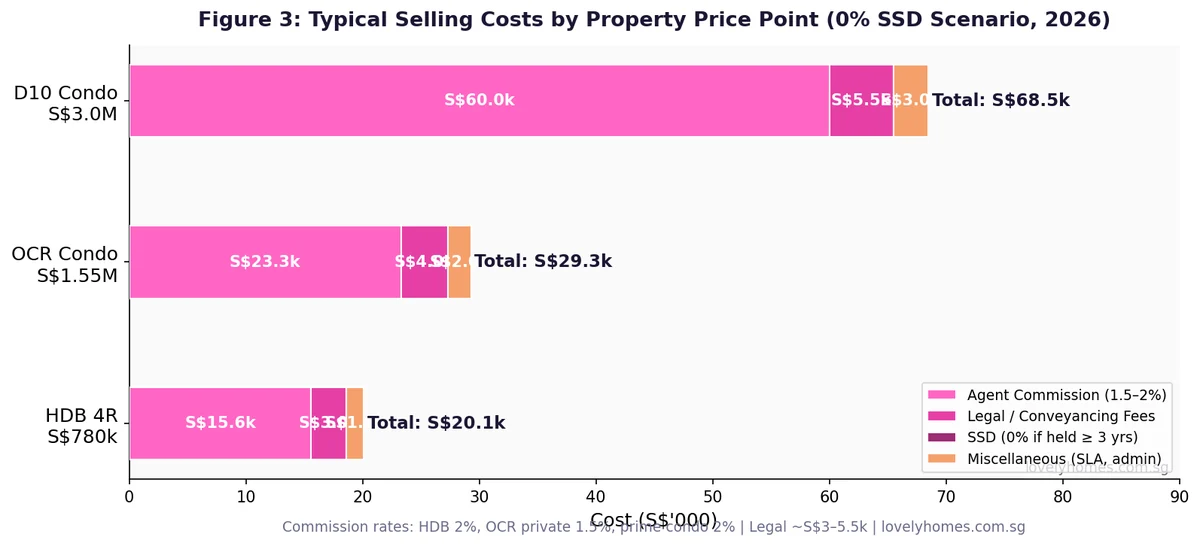
Step 1 — Net proceeds from HDB sale. Outstanding HDB loan at point of sale: S$280,000. CPF drawn (principal + 2.5% p.a. accrued interest over 7 years): S$180,000 (principal) + S$33,600 (accrued interest) = S$213,600. Agent commission at 2%: S$16,400. Legal fees (seller): S$2,800. Net calculation: S$820,000 − S$280,000 (loan) − S$213,600 (CPF refund) − S$16,400 (agent) − S$2,800 (legal) = net cash S$307,200. The S$213,600 is returned to the Tans’ CPF OA and is available for reuse on the condo purchase.

Step 2 — Condo purchase. The Tans target a 3-bedroom OCR condo at S$1,450,000. BSD: S$40,600. Agent (buyer): S$14,500 (1%). Legal (purchaser): S$3,500. Total acquisition costs: S$58,600. CPF OA balance after HDB refund: S$213,600 + regular contributions ≈ S$230,000 available. Minimum cash down at LTV 75%: 5% = S$72,500 cash + 20% CPF/cash = S$290,000 combined. Total down payment: S$362,500. Of this, S$230,000 from CPF, S$132,500 from cash. Bank loan: S$1,087,500 at 3.0% for 30 years → monthly repayment S$4,584. TDSR: S$4,584 ÷ S$14,000 = 32.7% — well within the 55% cap.

Cash position check: Net cash from HDB sale S$307,200 less cash down S$132,500 less acquisition costs S$58,600 = surplus cash S$116,100. The Tans proceed comfortably.

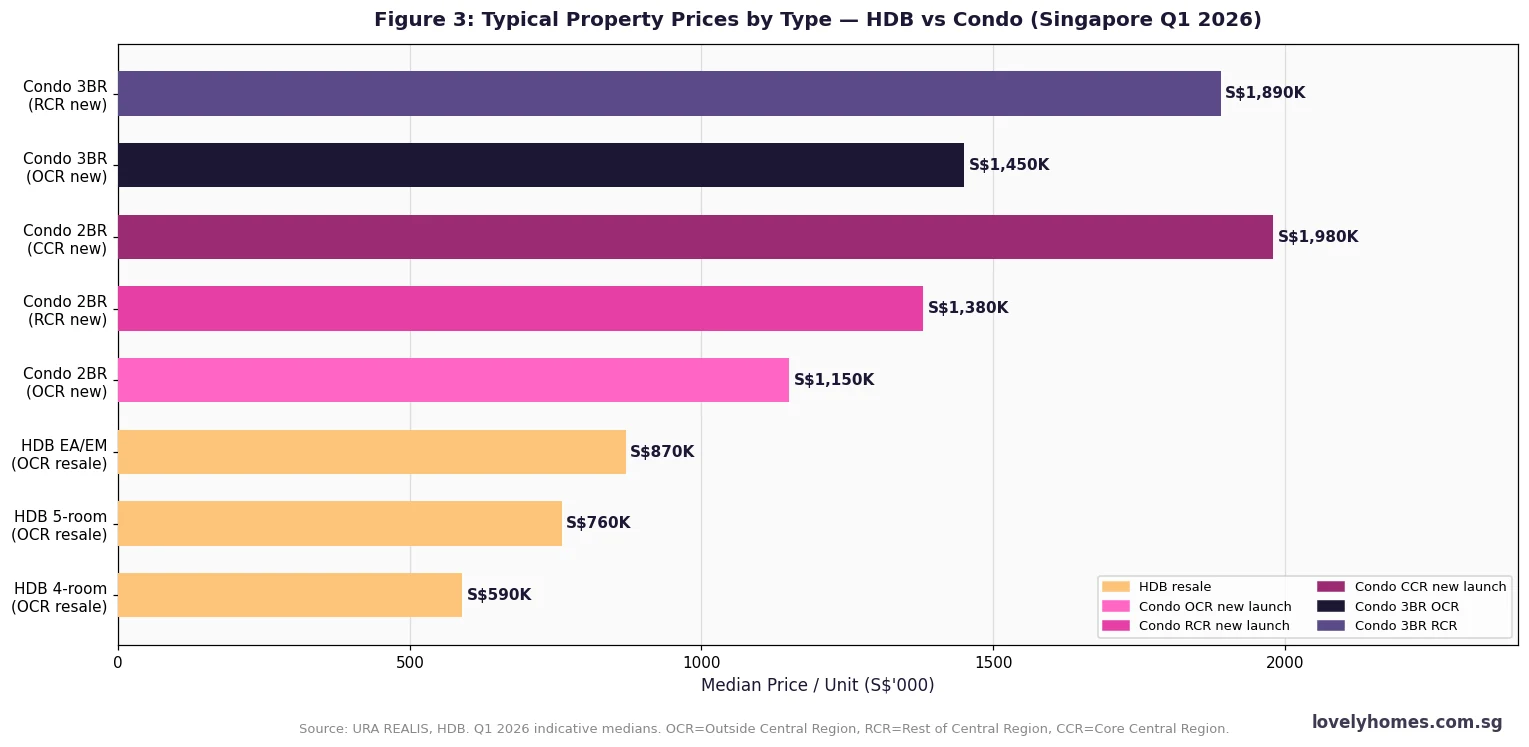
Singapore property price comparison HDB resale versus new launch condo by region Q1 2026
Figure 3: Typical unit prices by property type and region — HDB resale versus condominium new launches, Singapore Q1 2026. OCR condos remain the most accessible rung for HDB upgraders. (Source: URA REALIS, HDB.)

CPF in the Upgrading Equation

CPF is both your biggest asset and the most misunderstood element of the upgrading calculation. When you sell your HDB, the Central Provident Fund Board (CPF Board) requires you to return to your CPF OA the full amount withdrawn — principal plus accrued interest at 2.5% per annum, compounded annually. This refund is mandatory regardless of whether you have an outstanding mortgage.

The good news: the money does not disappear. It goes back into your CPF OA, where it can immediately be reused for the private property purchase (BSD, initial down payment, or progressive payments on a new launch). The CPF Withdrawal Limits on private property are governed by the Valuation Limit (VL) and the Withdrawal Limit (WL): you can use CPF OA up to the VL (property market value or purchase price, whichever is lower) freely, and up to 120% of VL if the property’s remaining lease covers the youngest buyer to age 95.

Why Upgrading Still Makes Financial Sense in 2026

Three structural factors continue to make the HDB-to-private upgrade compelling. First, HDB resale prices have risen 41% since Q1 2019 (RPI 153.2 → 216.3 as of Q1 2026), materially increasing the equity pool available to upgraders. A household that bought a 4-room HDB in an OCR town for S$450,000 in 2018 may now realise S$620,000–S$680,000 on sale — generating S$150,000–S$200,000 in net equity above the original purchase price.

Second, OCR condo prices have appreciated 73% since Q1 2019, but entry-level 2-bedroom units in OCR developments remain accessible at S$1.0M–S$1.3M for resale or S$1.15M–S$1.4M for new launches. For a dual-income SC household earning S$12,000–S$16,000/mth, these price points sit comfortably within TDSR thresholds at current bank loan rates of approximately 3.0–3.5%.

Third, the absence of capital gains tax in Singapore means any appreciation in your private property value — whether you eventually sell, rent, or pass it on — accrues entirely to you. This structural advantage makes Singapore property one of the most tax-efficient long-term wealth vehicles available to residents.

What Might Come Next for Upgraders

This section reflects editorial analysis and is speculative in nature. The government has signalled a sustained commitment to housing supply: 19,600 BTO flats are scheduled for 2026, and the 2H 2026 GLS Confirmed List adds approximately 4,010 private residential units to pipeline supply. Greater supply should moderate new launch price growth, potentially improving affordability for upgraders who are not yet MOP-cleared. Conversely, a prolonged high-interest-rate environment (3M SORA at approximately 2.4% in mid-2026) raises mortgage servicing costs, and any reversal of ABSD policy is not anticipated — the 20% rate for a second residential property has been stable since April 2023 and serves a deliberate demand-management function.

Frequently Asked Questions

Can I buy a condo while still living in my HDB during the MOP?

No. During the MOP you cannot acquire any interest in a private residential property in Singapore or overseas. Doing so constitutes a breach of the HDB ownership conditions and may result in compulsory acquisition of the flat by HDB at below-market rates. You must wait until the MOP is fulfilled before exercising an OTP on any private property. For Plus and Prime flats (classified from October 2024 onwards), the MOP is 10 years.

What happens to my CPF when I sell my HDB?

All CPF monies withdrawn from your CPF Ordinary Account for the HDB purchase — including the down payment, progressive mortgage payments, and BSD — must be refunded to your CPF OA upon sale, together with accrued interest at 2.5% per annum compounded annually. This refund is deducted from the sale proceeds before you receive any cash. The refunded amount is then available in your OA for use on your next property purchase, subject to CPF Withdrawal Limits. It is not lost — it simply moves from property equity back into your CPF account.

Is the ABSD remission for buy-first upgraders automatic?

No. It must be applied for. After completing the HDB sale within the 6-month window, you must submit an ABSD remission application to IRAS within 6 months of the later of: (a) the date of purchase of the private property, or (b) the date of completion of the HDB disposal. IRAS will process the refund of the 20% ABSD (SC couple on 2nd property) back to you. If you miss the window or fail to apply, the ABSD is permanently forfeited. It is strongly advisable to appoint a conveyancing lawyer who tracks these timelines for you.

How does the TDSR affect how much I can borrow?

The Total Debt Servicing Ratio (TDSR), introduced by the Monetary Authority of Singapore (MAS) in June 2013, caps all debt obligations (mortgage + car loan + personal loans + credit card minimum payments) at 55% of verified gross monthly income. For a S$1.35M condo at 3.0% over 30 years, the monthly repayment is approximately S$5,690. To pass TDSR on this loan alone, a household needs gross income of at least S$10,345/mth (S$5,690 ÷ 55%). If you carry a car loan of S$1,200/mth, your required income rises to S$12,527/mth. Clear outstanding personal loans and credit card balances before applying for a bank loan to maximise your borrowing capacity.

Can I keep my HDB and buy a condo at the same time?

Yes, SC households may own one HDB and one private residential property simultaneously, provided the HDB MOP has been met. However, the condo purchase would be treated as a second property and attract 20% ABSD (SC rate) — approximately S$270,000 on a S$1.35M condo. Many owners with sufficient financial capacity choose this route to retain rental income from the HDB or for personal family use. Note that you cannot rent out the entire HDB flat during MOP; once MOP is cleared, HDB resale flat owners may apply to rent out the whole flat subject to HDB approval.

What is the difference between upgrading to a resale condo versus a new launch?

A resale condo can be occupied within 8–12 weeks of completion, eliminating the gap period. You pay the full purchase price in one tranche. A new launch (off-plan) typically takes 3–5 years to complete, during which you make progressive payments tied to construction milestones. This gives cash-flow breathing room — you do not need to fund the full purchase at once — but you carry developer and construction risk. New launches also attract a 12%/8%/4% SSD if sold within the first 3 years. Buyers purchasing at launch must ensure their financial position can sustain both any interim rental during the construction period and mortgage servicing once the loan disburses progressively.

Do ECs count as private property for ABSD purposes after privatisation?

Yes. Executive Condominiums (ECs) are considered HDB flats for the first 5 years (during MOP) and private property thereafter. After 10 years from the date of purchase, ECs are fully privatised and become indistinguishable from private condominiums for all regulatory purposes, including ABSD. If you are an EC owner past the 5-year MOP, you may buy a private property — but the EC’s privatisation status at 10 years means your EC becomes “private property held” from ABSD counting at that point. Seek legal advice on timing if you hold an EC and are planning to acquire additional private property.

Related Articles

Disclaimer: This article is for general informational purposes only and does not constitute financial, legal, or property advice. ABSD rates, CPF rules, HDB policies, and bank lending criteria are subject to change. Always verify current rates with the Inland Revenue Authority of Singapore (IRAS) at iras.gov.sg, the Housing & Development Board (HDB) at hdb.gov.sg, the Central Provident Fund Board (CPF Board) at cpf.gov.sg, and the Monetary Authority of Singapore (MAS) at mas.gov.sg. Consult a licensed conveyancing lawyer and, where appropriate, a MAS-licensed financial adviser before making any property transaction.

Singapore Property Selling Guide 2026: How to Sell Your HDB, Condo or Landed Property — Step by Step

Singapore Property Selling Guide 2026: How to Sell Your HDB, Condo or Landed Property — Step by Step

Singapore property selling guide 2026 — complete step-by-step guide for HDB flat, condo and landed property sellers
Quick Answer — Key Takeaways

  • There is no capital gains tax in Singapore — profit from a property sale is not taxed unless IRAS deems you a property trader.
  • Seller’s Stamp Duty (SSD) applies if you sell within 3 years of purchase: 12% (under 1 year), 8% (1–2 years), 4% (2–3 years), 0% thereafter.
  • HDB flat sellers effectively never pay SSD because the 5-year Minimum Occupation Period (MOP) exceeds the 3-year SSD window.
  • All CPF Ordinary Account (OA) monies used for the property must be refunded upon sale — principal plus accrued interest at 2.5% per annum.
  • Agent commission is typically 2% for HDB resale and 1–2% for private property (negotiable; no government-mandated rate).
  • SC married couples who buy a new private property before selling their HDB flat pay ABSD 20% upfront but may claim a remission if the HDB is sold within 6 months.
  • The HDB resale process takes approximately 8–12 weeks; private property completion typically runs 10–16 weeks after OTP exercise.
  • Sellers must file the Resale Checklist (HDB) or grant an Option to Purchase (private) as the formal first step — verbal agreements are not binding.

What This Guide Covers

Selling a property in Singapore is a structured, multi-step process governed by the Housing and Development Board (HDB), the Urban Redevelopment Authority (URA), the Inland Revenue Authority of Singapore (IRAS), and the Singapore Land Authority (SLA). Whether you are selling an HDB flat, a private condominium or landed home, understanding your obligations — and your costs — before you sign anything will protect both your timeline and your net proceeds.

This guide walks through every stage of the selling process: from registering your intent to sell through to collecting your sale proceeds. We cover Seller’s Stamp Duty (SSD), CPF Ordinary Account refunds, agent commission, legal fees, the ABSD remission for upgraders, and what the numbers actually look like at three common price points.

Step 1: Confirm Your Eligibility to Sell

HDB Flat Sellers

Before listing your HDB flat, confirm that you have fulfilled the Minimum Occupation Period (MOP). Under HDB rules, the MOP is generally five years from the date of flat collection (key collection) for BTO and resale flats, and 10 years for Prime Location Public Housing (PLH) flats in areas such as Rochor, Central, and River Peaks. Flats under the Plus category (introduced from the October 2024 BTO exercise onwards) also carry a 10-year MOP.

Once your MOP is satisfied, register your Intent to Sell on the HDB Resale Portal at least seven days before granting any Option to Purchase (OTP). HDB uses this window to flag eligibility issues — for example, outstanding upgrading contributions or HDB loan arrears — before any buyer is committed.

Private Property Sellers

There is no waiting period for selling private residential property, but you must check whether SSD applies (see Section 3 below). If you purchased the property as an investment under a corporate entity, the Additional Conveyance Duties (ACD) regime administered by IRAS may also be relevant. Most owner-occupier sellers are unaffected by ACD, which primarily targets equity interest transfers.

Step 2: Appoint an Agent and Set a Price

In Singapore, sellers of private property engage their own agent and pay their own commission. For HDB resale transactions, the seller’s agent is also typically paid by the seller. The Council for Estate Agencies (CEA) licences all property agents in Singapore; you may verify any agent’s registration at the CEA Public Register.

Commission is negotiable — there is no statutory rate. Market practice is approximately 2% of the sale price for HDB flats and 1–2% for private property. For very high-value or difficult-to-move properties, the rate may be negotiated higher. Some sellers opt for a fixed fee arrangement. Always confirm the agreed commission in writing before signing any appointment letter.

Setting the right asking price requires reviewing recent comparable transactions (available free via URA’s REALIS portal and HDB’s public resale flat transaction data). Overpricing slows your sale; underpricing erodes your equity position.

Step 3: Seller’s Stamp Duty (SSD) — Know Your Exposure Before You List

SSD is administered by IRAS under the Stamp Duties Act (Cap 312). It was reimposed in January 2011 and refined in March 2017, when the current three-year, three-tier structure took effect. SSD applies to all residential properties — HDB flats, condominiums, and landed homes alike — sold within three years of purchase.

Seller's Stamp Duty SSD rates by holding period Singapore 2026 — bar chart showing 12% under 1 year, 8% 1 to 2 years, 4% 2 to 3 years, NIL after 3 years
Figure 1: SSD Rates by Holding Period — Singapore 2026. Holding period is measured from the date of purchase to the date of the sale contract (OTP date for private; HDB Resale Application date for HDB). Source: IRAS.
Holding Period SSD Rate Example: Property Sold at S$1,200,000 Who This Affects Most
Less than 1 year 12% S$144,000 Short-term flippers; forced sellers
1 year to 2 years 8% S$96,000 Sellers whose circumstances changed
2 years to 3 years 4% S$48,000 Early investors; job relocation sellers
3 years or more NIL S$0 Most owner-occupiers and long-term investors

SSD is calculated on the higher of the sale price or the market value assessed by IRAS at the time of sale. It is payable by the seller within 14 days of the sale contract date (OTP exercise date for private property, or HDB Resale Application date for HDB transactions). Late payment attracts a penalty of up to four times the unpaid duty.

Practical note for HDB sellers: Because the HDB MOP is five years and SSD applies only within three years, HDB flat sellers who complete their MOP will never be subject to SSD. The SSD window closes at the three-year mark; the MOP does not open until the five-year mark.

Hardship exemptions exist but are rarely granted. IRAS considers genuine financial distress, medical incapacity, or divorce — the applicant must demonstrate that the sale was necessitated by a circumstance beyond their control.

Step 4: CPF Ordinary Account Refund — How Accrued Interest Works

When you use CPF savings to purchase a property, you are borrowing from your own retirement account. To prevent erosion of retirement savings, the CPF Board requires that upon sale, all CPF monies withdrawn for the property are refunded to your CPF OA — including the interest those monies would have earned had they remained in the OA. This “accrued interest” accrues at the prevailing CPF OA interest rate, currently 2.5% per annum (guaranteed floor rate as of 2026).

The refund sequence is: (1) principal CPF withdrawn, (2) accrued interest. Only after this refund do you receive your net cash proceeds. For sellers who purchased many years ago with large CPF drawdowns, the accrued interest component can be substantial.

Illustration: If you drew S$200,000 from CPF OA to purchase a property in January 2019 and sell it in June 2026 (7.4 years), the accrued interest is approximately S$200,000 × 2.5% × 7.4 = S$37,000. Your CPF refund is therefore S$237,000, not S$200,000. This money goes back into your CPF OA and will be available for your next property purchase or for retirement withdrawal at age 55+.

The accrued interest is not a penalty; it is simply the return of the compounded interest your CPF savings would have earned in the OA. Sellers sometimes mistake this for a “profit tax” — it is not. It does, however, reduce your net cash-in-hand on sale, which matters if you need cash for your next purchase’s downpayment.

Summary of Key Seller Obligations

Obligation Administered by When Due Penalty for Default
Register Intent to Sell (HDB) HDB ≥ 7 days before OTP Cannot proceed with sale
Pay SSD (if applicable) IRAS Within 14 days of contract Up to 4× unpaid duty
Repay outstanding HDB loan HDB At legal completion Completion delayed
Refund CPF OA principal + accrued interest CPF Board At legal completion Sale proceeds withheld
Discharge caveat (if private property) SLA At legal completion Title cannot pass
Pay agent commission CEA-licenced agent At legal completion Civil action by agent
Pay conveyancing legal fees Seller’s solicitor At legal completion Files withheld

Step 5: Understanding Your Net Proceeds

Your net cash proceeds from a property sale are what remains after repaying all outstanding obligations. Most sellers are surprised to find that the headline sale price bears little resemblance to the cash they actually receive, particularly if the property was heavily financed and CPF funds were used extensively.

Seller net proceeds breakdown by property price point HDB 4-Room condo OCR D10 stacked bar chart Singapore 2026
Figure 2: Where Does the Sale Price Go? — Seller’s Proceeds Breakdown at Three Price Points (Illustrative, 2026). Assumes 0% SSD (held ≥ 3 years), 2% agent commission, and ~S$3k legal fees. Actual figures vary by loan balance, CPF drawdown history, and tenure.

The chart above shows three illustrative scenarios for a seller who has held the property for more than three years (SSD = nil). In every case, the outstanding loan repayment is the single largest deduction. The CPF refund (principal plus accrued interest) is the second largest. Net cash to the seller ranges from S$77,000 on an HDB flat to S$786,000 on a prime district condominium — which underscores why understanding your equity position before listing is critical.

Step 6: Selling Costs — Agent, Legal, and Sundry Fees

Selling costs breakdown agent commission legal SSD by property price point Singapore 2026 horizontal stacked bar chart
Figure 3: Typical Selling Costs by Property Price Point (0% SSD Scenario, 2026). The largest variable cost is agent commission, which is fully negotiable. SSD = nil for properties held ≥ 3 years.

Selling costs in Singapore are modest by regional standards, but they still add up:

  • Agent commission: The dominant selling cost. Typically 2% of the sale price for HDB (both seller and buyer each pay their own agent). For private property, 1–2% is standard. On a S$3 million condominium at 2%, commission is S$60,000.
  • Conveyancing legal fees: S$2,000–S$4,500 for most standard transactions. Solicitors in Singapore generally follow the Law Society scale but are free to quote fixed fees. Complex transactions (e.g., partial CPF pledging, foreign seller, multiple mortgagees) may cost more.
  • HDB administrative fees: For HDB resale, an administrative fee of S$80 is charged at the Resale Completion Appointment.
  • SLA caveat withdrawal: If you lodged a caveat as buyer (common for private property), the caveat must be withdrawn at sale. Fee: S$64.45 via the SLA e-filing portal.
  • SSD (if applicable): As described above — 0% if held ≥ 3 years, up to 12% for sub-one-year sales.

Worked Example: Mr & Mrs Goh — Selling HDB, Upgrading to Private

Mr and Mrs Goh are Singapore Citizens, married, with a combined monthly income of S$15,000. They purchased a 5-room Bishan HDB flat in January 2019 at S$600,000 via an HDB concessionary loan (80% LTV). They have fulfilled their MOP (January 2024) and wish to sell in June 2026 and purchase an Outside Central Region (OCR) condominium unit.

HDB Sale Proceeds Breakdown (Sale price S$920,000):

Item Amount Notes
Sale price S$920,000 Agreed transacted price
Less: Outstanding HDB loan (S$376,000) Approx balance after 7.5 years at 2.6% p.a.
Less: CPF OA principal refund (S$120,000) Total CPF drawn for downpayment + instalments
Less: CPF accrued interest (S$22,200) ~2.5% p.a. on S$120k × 7.4 years
Less: Agent commission (2%) (S$18,400) Seller pays own agent
Less: Legal / conveyancing fees (S$2,800) Seller’s solicitor
Less: SSD NIL Held > 3 years; MOP confirmed cleared
Net cash to Mr & Mrs Goh S$380,600 Available for next purchase + cash savings

Next Step — OCR Condo Purchase (S$1,350,000): After selling the HDB first, Mr and Mrs Goh own zero residential properties. As Singapore Citizens purchasing their first private property, ABSD is nil. BSD on S$1.35M is S$37,200 (progressive rates up to 4% above S$1M). Bank loan at 75% LTV = S$1,012,500 at 3.0% p.a. over 25 years = S$4,800/month. TDSR: S$4,800 ÷ S$15,000 = 32% — comfortably within the 55% threshold. Cash upfront: S$337,500 (downpayment) + S$37,200 (BSD) = S$374,700 — funded from the S$380,600 net HDB sale proceeds. The transaction is feasible without additional savings.

ABSD Remission for SC Married Couples — The “Buy First, Sell Later” Option

Some upgraders prefer to secure their new private property before selling the HDB to avoid a gap period where they are without a home. Under the current rules (effective April 2023), a Singapore Citizen married couple buying a second residential property must pay ABSD at 20%. However, they may apply to IRAS for an ABSD remission if the HDB flat is sold within six months of the purchase of the private property (for a completed unit) or within six months of the private property’s Temporary Occupation Permit (TOP) date (for an uncompleted unit).

This is a powerful option but carries risk: if the HDB sale falls through or is delayed beyond the six-month window, the ABSD is forfeited. On a S$1.35 million purchase, ABSD at 20% is S$270,000. Couples considering this route must maintain sufficient liquidity to fund the ABSD upfront while awaiting the refund.

What This Means for Property Sellers in 2026

Singapore’s property market in Q1 2026 recorded private residential price growth of 0.9% (URA), with the Outside Central Region leading at 2.2% gains. HDB resale prices remain elevated, with a five-room flat at Henderson Road transacting at S$1.728 million in April 2026 — the highest-ever HDB resale price. In this environment, sellers generally hold the advantage, but the SSD and ABSD frameworks mean that timing your sale matters enormously. Selling within the three-year SSD window destroys value fast; holding beyond three years and structuring your purchase correctly (sell first or use remission carefully) preserves it.

What Might Come Next

The MAS Financial Stability Review (November 2025) flagged property market resilience but noted that elevated interest rates and slowing transaction volumes in the CCR warranted monitoring. Industry analysts suggest that the government is unlikely to ease cooling measures in 2026 absent a material correction in prices — meaning the SSD and ABSD frameworks should be treated as fixed parameters for planning purposes at least through 2027. Any revision to the ABSD remission window (currently six months) would require a formal policy announcement from the Ministry of Finance and IRAS.

Frequently Asked Questions

Can I use CPF to pay agent commission or legal fees when selling?

No. CPF savings cannot be used directly to pay agent commission or legal fees for a property sale. These costs must be paid in cash. CPF can only be used for property-related purposes at the point of purchase — specifically downpayment, monthly instalments, and BSD/ABSD (subject to timing rules). Upon sale, your CPF OA receives the principal refund plus accrued interest, which then becomes available for future property purchases or CPF-approved uses.

Is there any tax on the profit I make from selling my property?

Singapore does not levy a capital gains tax. Profit from the sale of a private residential property or HDB flat is generally not taxable. However, IRAS retains the discretion to treat gains as income if you are deemed to be carrying on a business of property trading — characterised by a pattern of frequent, short-hold purchases and sales with profit intent. Owner-occupiers and genuine long-term investors are almost never subject to this treatment. SSD is the government’s primary disincentive against short-term speculation and is entirely separate from income tax.

What happens to my CPF accrued interest when I sell? Is it lost?

The accrued interest is not lost — it goes back into your CPF OA, where it continues to earn the 2.5% guaranteed rate (with the additional 1% on the first S$60,000 of combined CPF balances). If you are below 55, you can use the CPF OA funds for your next property purchase. If you are 55 or above, the refund first tops up your Retirement Account to the Full Retirement Sum (S$213,000 in 2026), and any excess in the OA can be used for property or withdrawn. The accrued interest does reduce your cash-in-hand at sale, which is why planning your equity position before listing is important.

If I sell my HDB flat, can I buy a private property immediately?

Yes. Once your HDB flat is sold and the legal completion has taken place, you no longer own an HDB flat and your residential property count drops accordingly. Singapore Citizens purchasing their first private property pay no ABSD. Singapore Permanent Residents purchasing their first private property pay 5% ABSD. However, note that CPF proceeds from the HDB sale are returned to your CPF OA and are not accessible as cash on the day of completion — they typically post to your OA within a few working days. Ensure your cash flow for the new property’s downpayment is sourced accordingly.

What is the difference between the Option to Purchase (OTP) and the Sale & Purchase Agreement (S&P)?

The OTP is a contractual right granted by the seller to the buyer, giving the buyer a period (typically 14 days for private property) to decide whether to exercise the option. The option fee (typically 1% of the purchase price) is paid when the OTP is granted. If the buyer exercises the OTP, they pay the exercise fee (typically 4%), bringing the total deposit to 5%. The Sale & Purchase Agreement (S&P) is the binding contract executed upon exercise of the OTP, setting out all terms of the transaction including the completion date (usually 8–12 weeks). For HDB resale, the equivalent process uses a standardised OTP issued by HDB and submitted through the HDB Resale Portal — there is no separate S&P document.

How does SSD apply if I inherited the property?

SSD is based on the original purchase date of the property, not the date of inheritance. If the deceased purchased the property in March 2024 and you inherited it and sell it in May 2026 (approximately 2 years), SSD at 8% would apply. This catches many beneficiaries off guard. The SSD holding period is not reset by the change in ownership via inheritance. Beneficiaries who inherit property that is within the SSD window should factor this into their estate planning and timing decisions. There is no automatic exemption for inherited properties.

Do I need to pay property tax up to the day of completion?

Yes. Property tax is levied on an annual basis by IRAS and is the seller’s liability up to the date of legal completion. Your solicitor will apportion the property tax between seller and buyer in the completion account — the buyer reimburses the seller for property tax from the completion date to the end of the calendar year (or whatever period the annual tax covers). This apportionment is standard practice and will appear in your completion account prepared by your conveyancing lawyer. Owner-occupier rates (0% on the first S$8,000 AV, 4% on the next S$47,000 AV) typically mean property tax is modest for residential sellers.

Related Articles


Disclaimer: This article is for general informational purposes only and does not constitute legal, financial, tax, or property advice. Property transactions in Singapore are governed by a complex and evolving framework of legislation and regulations administered by HDB, URA, IRAS, CPF, MAS, CEA, and SLA, among others. All figures, rates, and timelines cited are accurate as at 1 June 2026 based on publicly available sources, but may change. Always consult a licensed property agent, conveyancing solicitor, and financial adviser before proceeding with any property transaction. For official guidance, refer to: hdb.gov.sg, iras.gov.sg, cpf.gov.sg, ura.gov.sg.

Translate »