Singapore HDB Room Rental Guide 2026: Complete Guide to Renting Out Your HDB Room

Singapore HDB Room Rental Guide 2026: Complete Guide to Renting Out Your HDB Room

Quick Answer: HDB Room Rental Singapore 2026

  • No MOP required — you can rent out a room in your HDB flat immediately after taking possession; the Minimum Occupation Period applies only to whole-flat subletting.
  • HDB portal approval is required before any tenancy starts, including room rentals to non-citizens.
  • Non-Citizen Quota (NCQ): only 8% of flats in a neighbourhood and 11% in any block may house non-citizen, non-Malaysian tenants at any one time.
  • Malaysian citizens are NCQ-exempt — they may rent from any eligible HDB flat owner regardless of the quota.
  • Minimum tenancy is 6 months; maximum is 2 years per tenancy agreement (renewable).
  • Maximum occupancy for a 4-room or larger flat is 6 unrelated persons across all rooms.
  • All rental income is taxable under the Income Tax Act 1947; deductible expenses include mortgage interest, property tax, and maintenance fees.
  • IRAS filing deadline is 15 April each year for the preceding year’s rental income.

What Is HDB Room Rental and Who Administers It?

Renting out a room in your Housing Development Board (HDB) flat is one of the most tax-efficient ways to generate supplementary income in Singapore. Unlike renting out the entire flat — which requires the flat to have cleared its Minimum Occupation Period (MOP) — room rental has no MOP prerequisite. You can begin renting a spare bedroom the day after you collect your keys, provided you register the tenancy through the HDB e-Service portal and comply with the occupancy and quota rules administered by HDB.

HDB oversees room rental under the Housing and Development Act 1959 (Cap 129) and associated policies. The Inland Revenue Authority of Singapore (IRAS) governs the tax treatment of rental income under the Income Tax Act 1947. Both agencies updated their guidelines in 2024–2025; this guide reflects the rules as at June 2026.

Room rental is distinct from whole-flat subletting, which requires MOP clearance and a distinct approval process. For subletting of the entire flat, refer to our HDB Subletting Guide 2026.

HDB room rental eligibility matrix Singapore 2026 who can rent to whom
Figure 1: HDB room rental eligibility and tenant rules across citizenship categories — including the NCQ.

HDB Room Rental Eligibility Rules

To rent out a room in your HDB flat, you must be a registered owner who satisfies all of the following conditions:

  • Flat ownership: You must be a registered owner of the flat (joint or sole). Tenants of HDB flats cannot sublet rooms.
  • Residency: At least one owner must continue to reside in the flat during the rental period. You cannot rent out all bedrooms and vacate — that constitutes whole-flat subletting and requires separate approval.
  • No MOP restriction for room rental: Unlike whole-flat subletting, there is no MOP period to serve before renting a room. This applies to BTO, resale, and DBSS flats.
  • Citizen/PR ownership: Only Singapore Citizens and Singapore Permanent Residents may own HDB flats.

Who Can Be Your Tenant?

Eligible tenants include Singapore Citizens, Singapore Permanent Residents, and non-citizens holding long-term passes such as Employment Passes (EP), S Passes, Work Permits (WP), Long-Term Visit Passes (LTVP), Student Passes, and Dependent’s Passes. Short-term visitors and tourists are not eligible. Non-citizens are subject to the Non-Citizen Quota (NCQ) — with the important exception that Malaysian citizens are NCQ-exempt.

Before commencing any tenancy with a non-citizen tenant, verify that NCQ slots are available for your block and neighbourhood, then register the tenancy on the HDB e-Service portal. Tenancies with Citizens and PRs do not require quota checks but must still be registered.

The Non-Citizen Quota (NCQ): How It Works

Non-Citizen Quota NCQ HDB room rental Singapore 8 percent neighbourhood 11 percent block
Figure 2: The NCQ caps — 8% neighbourhood, 11% block — apply to all non-citizen, non-Malaysian tenants in HDB room rentals.

The Non-Citizen Quota was introduced by HDB to maintain social integration in public housing estates and prevent over-concentration of foreign nationals in any single block or neighbourhood. Under the NCQ:

  • No more than 8% of all HDB flats in a neighbourhood may be occupied by non-citizen, non-Malaysian tenants at the same time.
  • No more than 11% of all HDB flats in any single block may be occupied by non-citizen, non-Malaysian tenants at the same time.

If either limit is reached, no new tenancy with a non-citizen, non-Malaysian tenant may commence in that neighbourhood or block until an existing occupancy clears. Malaysian citizens are entirely exempt from the NCQ. You can check real-time NCQ availability using the HDB NCQ portal.

Tenancy Duration and Registration

Each room rental tenancy must have a minimum duration of 6 months and a maximum of 2 years per agreement. Tenancies of less than 6 months — including Airbnb-style arrangements — are strictly prohibited and may result in compounding or flat confiscation. Registration is completed online via the HDB e-Service portal within 7 days of the tenancy start date.

Maximum Occupancy Limits

Flat Type Max. Occupants (All Rooms Combined) Notes
1-Room / 2-Room 4 unrelated persons Including the flat owner(s)
3-Room 6 unrelated persons Including the flat owner(s)
4-Room and above 6 unrelated persons Including the flat owner(s)
Executive / DBSS 6 unrelated persons Including the flat owner(s)
Studio Apartment Not eligible for room rental Intended for elderly residents only

The occupancy cap includes the flat owner(s) and all residents. A 4-room flat with two owner-occupiers can therefore accommodate at most 4 additional persons as tenants across all rooms.

Rental Income Tax: What You Must Declare to IRAS

All rental income from HDB room rental is assessable income under the Income Tax Act 1947 administered by IRAS. There are no exemptions for small amounts or casual arrangements. IRAS allows a range of deductible expenses that significantly reduce your net taxable rental income.

HDB room rental income tax deductibles net taxable Singapore 2026
Figure 3: Gross rental income versus allowable deductibles and the net taxable position at three common rent levels.

What Is Taxable?

Your gross rental income includes all amounts received from tenants: monthly rent, any lump-sum advance payment, and reimbursements for utilities or services. Security deposits are not income when received but become income if forfeited.

Allowable Deductions

Deductible Expense Basis Notes
Mortgage interest Actual interest portion of HDB or bank loan payments Principal repayment is NOT deductible
Property tax Annual property tax paid to IRAS Deductible in full as a cost of letting
Maintenance and conservancy charges Monthly S&CC paid to Town Council Pro-rated to rental period if flat was partly vacant
Repairs and maintenance Revenue repairs to restore lettable condition Capital improvements are NOT deductible
Insurance premiums Fire/content insurance attributable to the rental Home Protection Scheme premiums are NOT deductible
Agent commission Fees to a licensed estate agent for securing the tenancy Deductible in full in the year paid

The net rental income is added to your other income and taxed at Singapore’s progressive personal income tax rates (0% on the first S$20,000 of chargeable income, up to 24% above S$1,000,000 effective from YA 2024).

When and How to File

Rental income must be declared annually in your income tax return via IRAS’s myTax Portal. The filing deadline is 15 April of the following year. Retain receipts and tenancy agreements for at least 5 years as IRAS may audit rental declarations.

Worked Example: The Tan Family, Tampines 4-Room

Mr and Mrs Tan are Singapore Citizens who own a 4-room HDB flat in Tampines. They have one spare room and decide to rent it to a Malaysian work-pass holder at S$1,500 per month from 1 April 2026.

Step 1 — Eligibility: No MOP required. NCQ check: Malaysian citizens are NCQ-exempt. HDB portal registration completed 29 March 2026.

Income calculation (Year of Assessment 2027, calendar year 2026):

  • Gross rental income: S$1,500 x 9 months (Apr–Dec 2026) = S$13,500
  • Mortgage interest (annual S$8,400, pro-rated 9/12): S$6,300
  • Property tax (annual S$720, pro-rated 9/12): S$540
  • Maintenance fees (S&CC S$56 x 9 months): S$504
  • Total allowable deductions: S$7,344
  • Net taxable rental income: S$13,500 minus S$7,344 = S$6,156

Tax impact: Mr Tan earns S$72,000/yr. Adding S$6,156 raises chargeable income to approximately S$78,156. Marginal rate: 7% (S$40K–S$80K band). Incremental tax: approximately S$431. Net monthly cash after all costs and taxes: approximately S$1,014/month.

Why HDB Room Rental Matters for Flat Owners

Singapore has one of the highest rates of homeownership in the world — roughly 90% of residents live in public housing. Room rental offers a way to monetise a spare bedroom without the complexity of selling or refinancing. Industry figures show median room rents ranging from S$900/month in non-mature estates to S$2,200/month in central areas as at early 2026. With Singapore’s economy drawing a continued influx of international professionals, demand for affordable HDB rooms is expected to remain resilient.

For retirees, room rental income can supplement CPF LIFE payouts and reduce dependence on drawing down CPF savings. The Silver Housing Bonus (SHB) scheme, administered by HDB, provides additional cash bonuses of up to S$30,000 for elderly flat owners who right-size to smaller flats.

What Might Come Next: Future Policy Considerations

This section is editorial speculation and does not constitute confirmed government policy.

Short-term rental platforms such as Airbnb remain prohibited in HDB flats, and HDB is expected to continue enforcing this restriction. IRAS is rolling out auto-assessment for rental income by 2027, cross-checking declared rental income against HDB portal tenancy registrations. Flat owners who have not been filing rental income should consider voluntary disclosure via IRAS’s myTax Portal before automated enforcement begins. The NCQ thresholds of 8% and 11% have remained unchanged since 2012 and selective adjustments in newer estates with lower foreign-national density remain a possibility, though no change has been signalled as at June 2026.

Frequently Asked Questions

Can I rent out my HDB room before completing the Minimum Occupation Period?

Yes. The MOP restriction applies only to renting out the entire flat (whole-flat subletting), not to individual rooms. Room rental may commence immediately after the flat is handed over to you, subject to HDB portal registration and compliance with tenant eligibility and NCQ rules. If you are in the MOP period, you must continue to reside in the flat.

My block’s Non-Citizen Quota is full. Can I still rent to my Malaysian colleague?

Yes. Malaysian citizens are entirely exempt from the Non-Citizen Quota. The NCQ applies only to non-citizens who are not Malaysian. Your Malaysian colleague does not count toward the 8% neighbourhood or 11% block quota regardless of the pass type they hold. You can proceed with registration on the HDB portal without a quota check for Malaysian tenants.

Does HDB rental income affect my CPF contributions?

No. Rental income from HDB room rental is not employment income and is not subject to CPF contributions. It is, however, assessable income under the Income Tax Act and must be declared to IRAS. CPF voluntary top-up contributions remain available regardless of whether you earn rental income.

What happens if I rent out my room without registering on the HDB portal?

Renting out a room without HDB portal registration is a breach of the HDB lease. Consequences include a formal warning and compounding fine of up to S$5,000 per breach. Repeated or serious violations can result in HDB compulsorily acquiring the flat at HDB’s assessed valuation, which may be below open-market value. HDB conducts enforcement raids and acts on complaints from neighbours and town councils.

Can I deduct renovation costs or furniture purchases against rental income?

Generally, no. IRAS distinguishes between capital expenditure (acquiring or improving an asset) and revenue expenditure (maintaining the asset in its existing condition). Only revenue repairs are deductible. Furniture purchases are capital in nature and are not deductible. For specific situations, seek advice from a qualified tax practitioner or consult IRAS’s e-Tax Guide on rental income at iras.gov.sg.

How do I calculate the deductible mortgage interest for a joint HDB loan?

For an HDB concessionary loan, your annual statement from HDB shows the principal and interest breakdown for each repayment. Add up the interest components paid during the calendar year — this is your deductible amount. For a bank loan, your bank provides an annual loan statement. If you jointly own the flat, each co-owner may only deduct interest in proportion to their ownership share.

Can I rent a room to a family member who is a foreigner?

Yes, provided the family member holds an eligible pass (EP, S Pass, WP, LTVP, DP, Student Pass) and the NCQ is not exhausted for your block and neighbourhood (unless the family member is Malaysian). You still need to register the tenancy on the HDB portal. Close family ties do not create any exemption from HDB’s room rental registration requirements, though there is no restriction on the commercial terms of the tenancy.

Related Articles

Disclaimer

This article is produced by the LovelyHomes Editorial Team for general information purposes only. It is not legal, tax, or financial advice. HDB rules and IRAS tax regulations are updated periodically; always verify current requirements on hdb.gov.sg and iras.gov.sg before entering into any tenancy agreement. For personalised tax advice, consult a qualified tax practitioner.

Buying a Condo in Singapore 2026: OTP, Stamp Duties, TDSR and Step-by-Step Process Explained

Buying a Condo in Singapore 2026: OTP, Stamp Duties, TDSR and Step-by-Step Process Explained

×

Click anywhere to close
Quick Answer — Buying a Condo in Singapore 2026: Key Facts

  • Any Singapore Citizen (SC), Permanent Resident (SPR), or foreigner may buy a private condominium — no eligibility restrictions apply beyond the owner-occupier requirement lifted for private property.
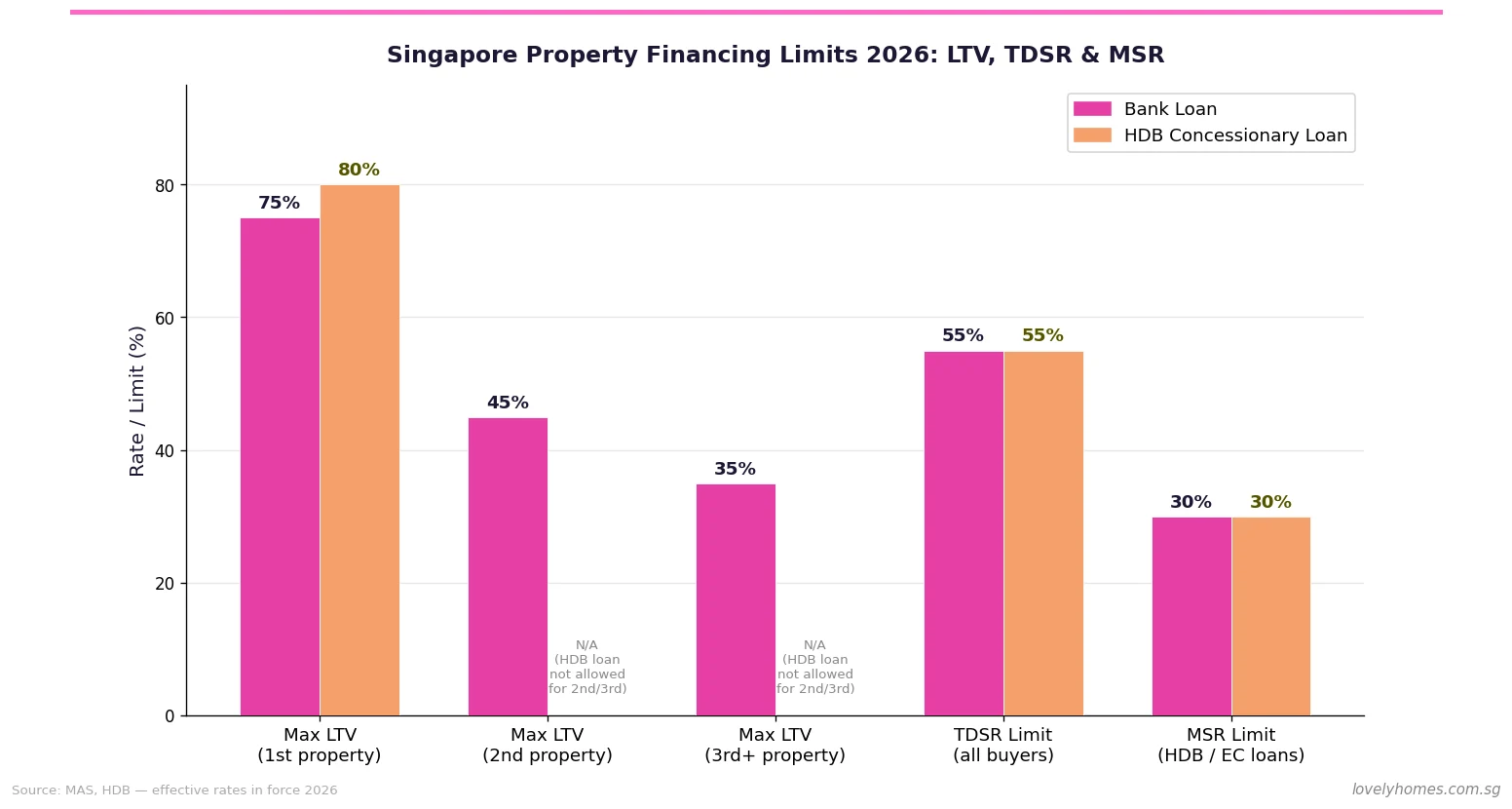
  • Bank loans cover up to 75% LTV; minimum cash downpayment is 5% of purchase price; the remaining 20% may come from CPF OA.
  • Total Debt Servicing Ratio (TDSR) cap: 55% of gross monthly income. No Mortgage Servicing Ratio (MSR) applies to private property.
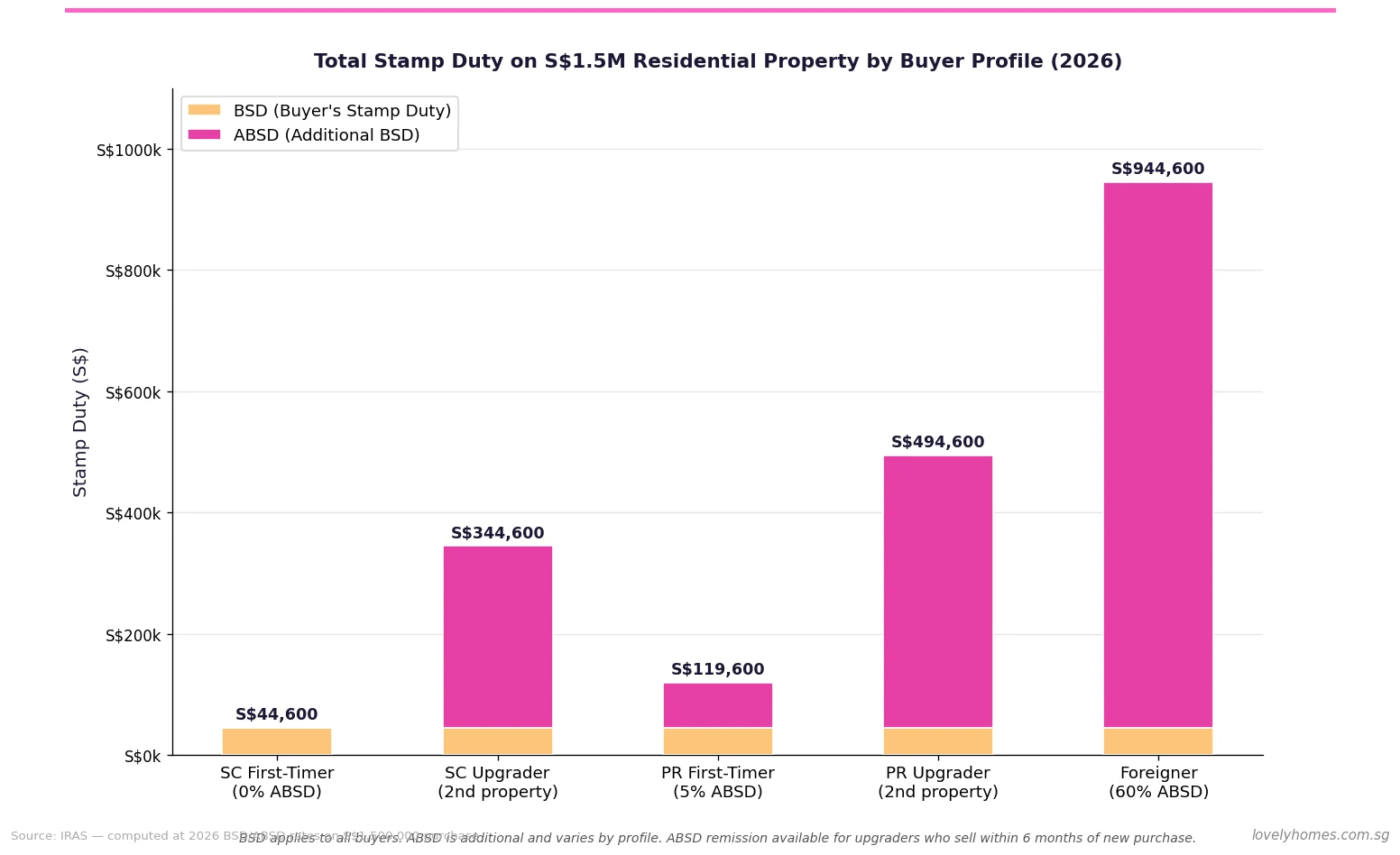
  • Buyer’s Stamp Duty (BSD) is payable by everyone: S$44,600 on a S$1.5M condo; S$69,600 on S$2.0M.
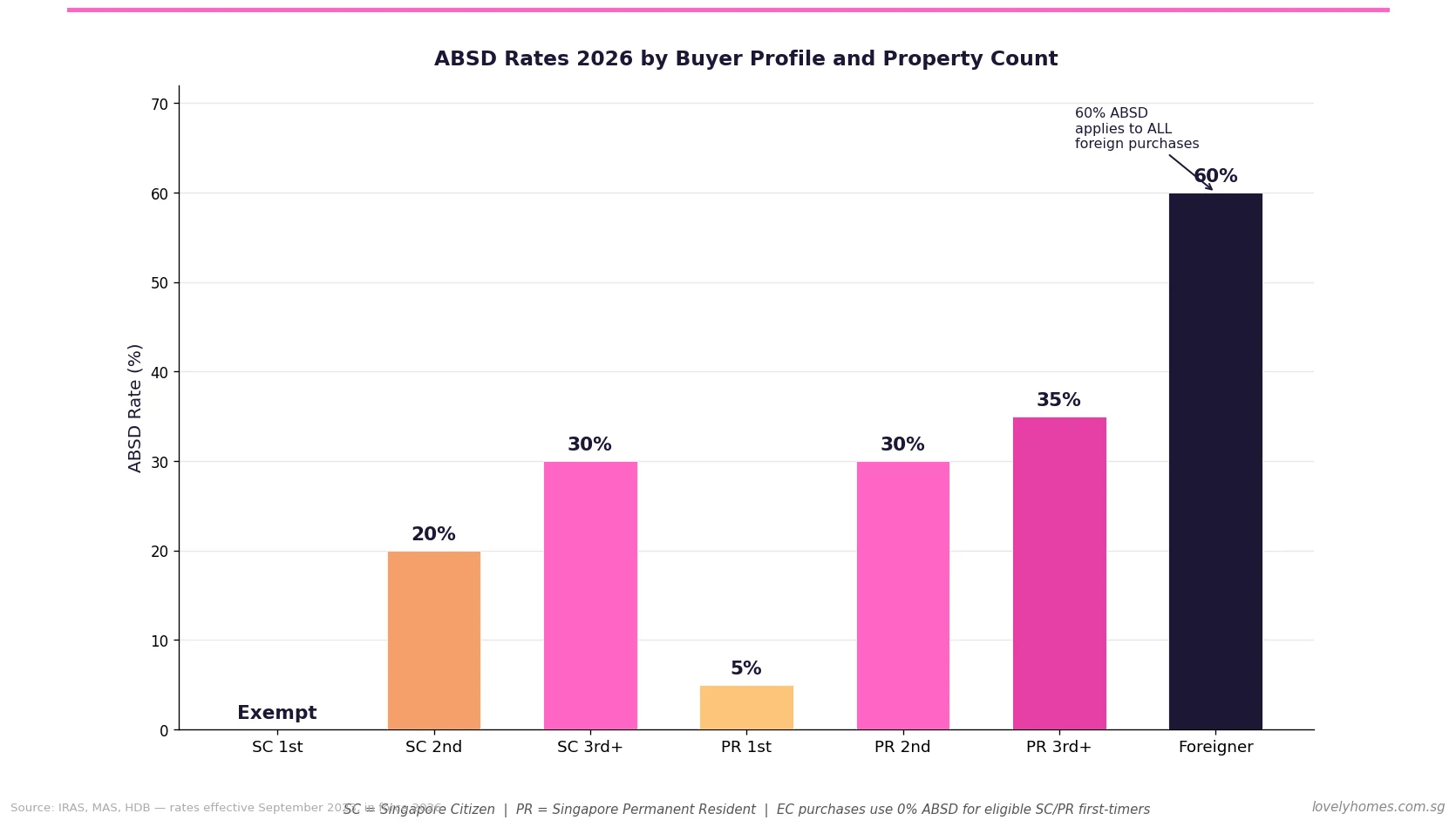
  • Additional Buyer’s Stamp Duty (ABSD): 0% for SC buying their first property; 20% for SC second property; 60% for foreigners.
  • For resale condos, the Option to Purchase (OTP) process runs 14 days; completion typically 70–90 days. New launch condos use a booking fee/S&P process taking 8–12 weeks to first payment milestone.
  • Condo prices range from roughly S$700K (OCR 1BR) to S$6.5M+ (CCR 4BR) in 2026.
  • No Capital Gains Tax applies in Singapore — profits on sale are generally tax-free (Seller’s Stamp Duty applies if sold within 4 years).

A private condominium is the most aspirational stepping stone in Singapore’s property ladder. It represents the point at which a buyer exits the HDB framework — and its attendant rules — and enters the open market. Yet the process of buying a condo, especially for first-timers, involves a layer of documents, timelines, and financial calculations that can feel daunting. This guide walks through every stage: from eligibility and financing, to the Option to Purchase (OTP), stamp duties, CPF rules, and what you will actually pay before you get the keys.

All figures are current as at 11 June 2026. Regulations on loan-to-value (LTV), TDSR, and stamp duties are set by the Monetary Authority of Singapore (MAS), the Inland Revenue Authority of Singapore (IRAS), and the CPF Board respectively.

Who Can Buy a Condo in Singapore?

Private condominium units are open to all buyers regardless of citizenship or residency status — Singapore Citizens, Singapore Permanent Residents, and foreigners may all purchase. There is no income ceiling, no minimum occupation period restriction prior to purchase, and no ethnic integration quota. The key constraints are purely financial: ABSD rates, LTV limits, and TDSR/income requirements.

One constraint that often surprises first-time private buyers: if you currently own an HDB flat, you must dispose of it within six months of taking possession of the condo (if you are an SC) — failing to do so means you will have paid 20% ABSD on the condo and will face IRAS penalties. This “sell first” obligation is the operational heart of the Singapore upgrader journey and we cover it in detail in our HDB Upgrading Guide 2026.

Condo Price Ranges in Singapore 2026

Prices vary dramatically by location. Singapore’s private residential market is segmented into three main regions: Outside Central Region (OCR), Rest of Central Region (RCR), and Core Central Region (CCR). OCR encompasses the heartland suburbs — Tampines, Sengkang, Jurong, Punggol. RCR covers the city fringe — Queenstown, Toa Payoh, Bishan, Eunos. CCR is prime — Districts 9, 10, 11, Marina Bay, Sentosa.

Singapore condo price ranges by region 2026 — OCR RCR CCR comparison bar chart
Figure 1: Singapore private condo price ranges by unit type and region (2026). OCR = Outside Central Region; RCR = Rest of Central Region; CCR = Core Central Region. Source: URA, industry transaction data.

For a 3-bedroom unit in 2026, an OCR condo typically transacts at S$1.4M–S$1.9M; the same unit in the CCR can reach S$2.6M–S$4.5M or beyond for prime addresses. New launches carry a new-launch premium over resale units of roughly 5–15% in most districts.

New Launch vs Resale: Key Differences

The most fundamental decision before buying a condo is whether you are looking at a new launch (bought directly from the developer, often before the building is complete) or a resale unit (bought from a private seller on the open market).

New launches are typically launched with deferred payment: a booking fee of 5% (cash only), then 15% at S&P signing (within 8 weeks), then progressive payments tied to construction milestones. You take possession 3–5 years after booking. During that period, no rental income and no physical inspection of the unit. The upside: you lock in today’s price and CPF/mortgage cashflow spreads across years. Developers often offer stamp-duty absorption or furniture voucher promotions on slow-moving units.

Resale condos are completed units. You can inspect them, move in within 10–12 weeks of OTP exercise, and rent them out immediately. The OTP process involves a 1% option fee, followed by 14 days to decide and exercise. On exercise, you pay a further 4% (totalling 5% of purchase price), then complete within 70–90 business days.

Feature New Launch Resale Condo
Payment structure Progressive (booking fee → milestones) Full 5% on OTP + balance at completion
Time to possession 3–5 years (from booking) 10–12 weeks from OTP exercise
Physical inspection Show unit only (not actual unit) Full inspection possible
Rental income Only after TOP (3–5 years) Immediately after completion
CPF + loan drawdown Progressive during construction Full drawdown at completion
SSD risk Only on re-sale within 4 years of TOP Applies if sold within 4 years of purchase
Price premium vs resale Typically +5–15% for comparable location Benchmark price
Renovation needed? Bare unit; full reno required Often move-in ready or partial reno

The Condo Buying Process — Step by Step

Singapore condo buying process step-by-step timeline 2026 — OTP exercise BSD ABSD completion
Figure 2: Step-by-step condo buying timeline for a resale transaction. New launch timelines differ: milestone payments replace the single-completion structure.

For a resale condo, the legal process is tightly choreographed:

Step 1 — Loan Pre-Approval (IPA). Before making any offer, obtain an In-Principle Approval (IPA) from your chosen bank. This confirms your borrowing capacity and signals seriousness to sellers. IPAs are valid for 30 days.

Step 2 — Property Search & Negotiation. View units, compare recent caveats on URA’s Real Estate Information System (REALIS), and negotiate the price. Once agreed, the seller’s representative issues the OTP.

Step 3 — Receive and Pay OTP Option Fee (1%). The option fee is typically 1% of the purchase price (negotiable for very high-value properties). This gives you the exclusive right to purchase for 14 days.

Step 4 — Exercise OTP (+ 4% cash). Within 14 days, your lawyers will advise you to exercise the OTP by paying the remaining 4% exercise fee (total 5% paid). At this stage, you engage a conveyancing lawyer if you haven’t already.

Step 5 — Stamp Duty: BSD + ABSD (within 14 days of OTP). Both BSD and ABSD must be stamped within 14 calendar days of signing the OTP. Late payment incurs IRAS penalties. BSD can be reimbursed from CPF post-stamping; ABSD must be paid in cash.

Step 6 — CPF Drawdown & Mortgage Disbursement. Your lawyers submit the CPF withdrawal application and lodge a caveat at the Singapore Land Authority (SLA). The bank releases the loan funds.

Step 7 — Completion (S&P / Transfer). Typically within 70–90 days of OTP exercise for a resale condo. Title transfers, keys are handed over.

Financing a Condo Purchase: LTV, TDSR and Loan Options

Private condo buyers borrow from commercial banks (not HDB). The key regulatory frameworks are:

Loan-to-Value (LTV) limits. For your first property mortgage with a bank: LTV 75%, meaning you can borrow up to 75% of the purchase price or valuation (whichever is lower). For a second property, LTV drops to 45%; third and subsequent to 35%. These MAS limits were last updated in August 2024, when the HDB loan LTV was reduced from 80% to 75%.

Total Debt Servicing Ratio (TDSR). No more than 55% of your gross monthly income may be committed to total debt obligations — home loan, car loan, credit card minimum payments, personal loans, all included. Banks apply a stress test interest rate of 4.0% (as at 2026) regardless of the actual offered rate, which is usually lower.

No MSR for private property. The Mortgage Servicing Ratio (MSR) — which caps housing loan payments at 30% of income — only applies to HDB flats and ECs bought from developers. Private condo buyers only need to satisfy TDSR.

Interest rates. Most banks in 2026 offer SORA-pegged packages (3-month SORA at approximately 2.4%) or fixed-rate packages. All-in rates for 30-year private property loans typically range 3.1%–3.8% in mid-2026. Always compare SIBOR-to-SORA transition implications with your relationship manager. More detail in our Singapore Home Loan Complete Guide 2026.

Stamp Duties: BSD and ABSD Explained

Every condo buyer pays Buyer’s Stamp Duty (BSD) — a progressive tax on purchase price. On top of that, ABSD applies for second-and-subsequent properties or non-citizens:

Purchase Price BSD Payable Effective BSD Rate
S$800,000 S$18,600 2.33%
S$1,200,000 S$33,600 2.80%
S$1,500,000 S$44,600 2.97%
S$2,000,000 S$69,600 3.48%
S$2,500,000 S$94,600 3.78%
S$3,000,000 S$119,600 3.99%
S$4,000,000 S$219,600 5.49%

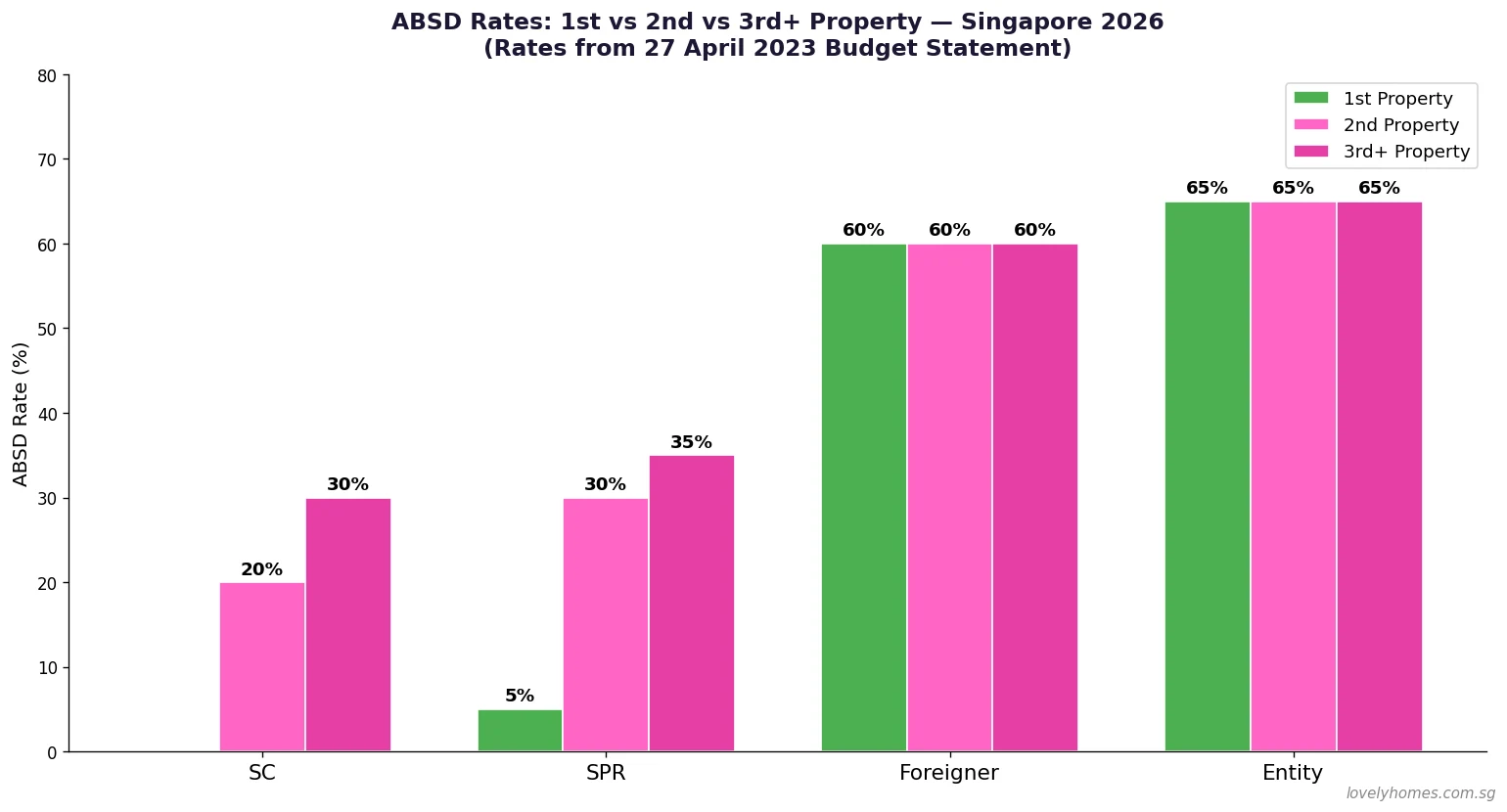
For ABSD, remember: SC 1st property = 0% ABSD; SC 2nd = 20%; SC 3rd+ = 30%; SPR 1st = 5%; SPR 2nd = 30%; Foreigner = 60% (all properties). Full details in our ABSD Complete Guide 2026.

Total upfront cost to buy S$1.5M condo by buyer profile 2026 — BSD ABSD downpayment comparison
Figure 3: Total upfront cash and CPF required for a S$1.5M condo across buyer profiles (2026). LTV 75% assumed (25% downpayment). BSD S$44,600 applies to all profiles.

Using CPF to Buy a Condo

Your CPF Ordinary Account (OA) may be used to pay the downpayment (the 20% non-cash portion) and ongoing monthly mortgage instalments for a private condo, subject to:

The Valuation Limit (VL): total CPF usage cannot exceed the lower of the purchase price or the valuation at the time of purchase — so if you pay S$1,650,000 for a condo valued at S$1,600,000, your CPF ceiling is S$1,600,000.

The Withdrawal Limit (WL): once you have drawn CPF up to the VL and still have an outstanding bank loan, you may draw a further 20% of VL provided you have set aside the applicable Basic Retirement Sum (BRS — S$106,500 in 2026) in your CPF accounts.

The 5% cash rule: the minimum 5% downpayment must be in cash. CPF may only fund the remaining 20% of the 25% total downpayment.

Critically: every dollar of CPF drawn for property accrues interest at 2.5% per annum compounding. When you eventually sell, you must refund the principal plus all accrued interest back to your CPF OA. This does not reduce your profit on paper, but it does reduce the cash you take home from the sale. Read the full analysis in our CPF Private Property Guide 2026.

Choosing Between OCR, RCR and CCR

The three-region framework is more than a price guide — it reflects fundamentally different buyer profiles, rental markets, and investment theses:

OCR (Outside Central Region) is where most Singaporean families and HDB upgraders buy. Yields are strongest here — typically 3.8%–4.8% gross for 2BR/3BR units — because rental demand from expats, young professionals, and domestic upgraders is broad. Capital appreciation can be rapid when an infrastructure catalyst (a new MRT line, a GLS announcement) lands nearby. The tradeoff: commute times to CBD are longer, and CCR-calibre tenants (senior bankers, diplomats) rarely rent in OCR.

RCR (Rest of Central Region) is the sweet spot for many: city-fringe convenience, more manageable entry prices than CCR, yet close enough to attract both expat and local renters. Districts 3, 10 (parts), 14, 15, 20 are all RCR. Yields run 3.2%–4.2%. New launches here have outperformed on price appreciation in the 2020–2026 run, driven by URA master-plan transformations (Queenstown, Kallang, Pearl’s Hill).

CCR (Core Central Region) is Singapore’s luxury and investment-grade market. Prices per square foot range from S$2,500 to S$5,000+ for prime District 9/10/11 addresses. Rental yields are the weakest (2.5%–3.5%) because asset values are high, but capital preservation in USD/GBP/EUR terms attracts significant foreign (FTA-exempt) and ultra-high-net-worth demand. The 60% ABSD has effectively handed CCR supply to the FTA-exempt buyer pool.

Worked Example: Mr & Mrs Chen Buy Their First Condo

Profile: SC couple, first private property, joint income S$16,000/mth

Property: 3-bedroom OCR condo in Sengkang, S$1,650,000. Freehold.

BSD: S$180K×1% + S$180K×2% + S$640K×3% + S$500K×4% + S$150K×5% = S$1,800 + S$3,600 + S$19,200 + S$20,000 + S$7,500 = S$52,100

ABSD: 0% (SC, first residential property)

Financing: Bank loan 75% LTV = S$1,237,500 @3.2% 30yr
Monthly repayment = approximately S$5,354/mth
TDSR = S$5,354 / S$16,000 = 33.5% — PASS (below 55% ceiling)

Downpayment (25%): S$412,500
  — Cash (min 5%): S$82,500
  — CPF OA (up to 20%): S$330,000

Total upfront outlay:
Downpayment: S$412,500
BSD (can reimburse from CPF after stamping): S$52,100
Legal & conveyancing fees: ~S$4,200
Grand total: ~S$468,800

Note on SSD: If the Chens sell within 4 years of purchase, SSD applies: 16% (Year 1), 12% (Year 2), 8% (Year 3), 4% (Year 4). They plan to hold long-term, so SSD is not a concern. Full details: SSD Guide 2026.

What This Means for Singapore Property Buyers in 2026

The private condo market in 2026 sits in a period of relative stability after the sharp price run of 2020–2023. URA’s private residential price index for Q1 2026 shows OCR prices up 1.1% quarter-on-quarter — moderate, not frothy. Interest rates, while above the near-zero era of 2010–2021, have stabilised: 3M SORA has hovered around 2.4% since late 2025. The TDSR and LTV framework means buyers are better-capitalised than in previous cycles.

For SC first-timers, the 0% ABSD window is exceptionally powerful: you can buy a S$1.6M condo and pay zero ABSD. Compare this to your SPR peer who pays 5% (S$80,000) or your foreigner colleague who pays 60% (S$960,000). Singapore citizenship carries extraordinary financial value in the property market — an advantage worth leveraging before your second purchase triggers the 20% ABSD.

What Might Come Next for the Condo Market

The Government’s track record on cooling measures is well-established: when private prices accelerate beyond what income growth can justify, additional rounds of ABSD increases, LTV tightening, or supply-side intervention (GLS increases) follow. The 2H2026 GLS programme announced in June 2026 adds approximately 4,010 private residential units to the Confirmed List — a signal that supply is being managed upward to prevent affordability deterioration.

Speculation (not official MAS guidance): if private price growth accelerates beyond 5–6% annually in the second half of 2026, the Government may revisit ABSD or TDSR thresholds, as it has done in April 2023. Buyers with strong holding power and clear owner-occupier intent are best insulated from policy risk; leveraged short-term investors should be especially mindful of SSD exposure within the four-year window.

Frequently Asked Questions

Can I buy a condo while still owning an HDB flat?

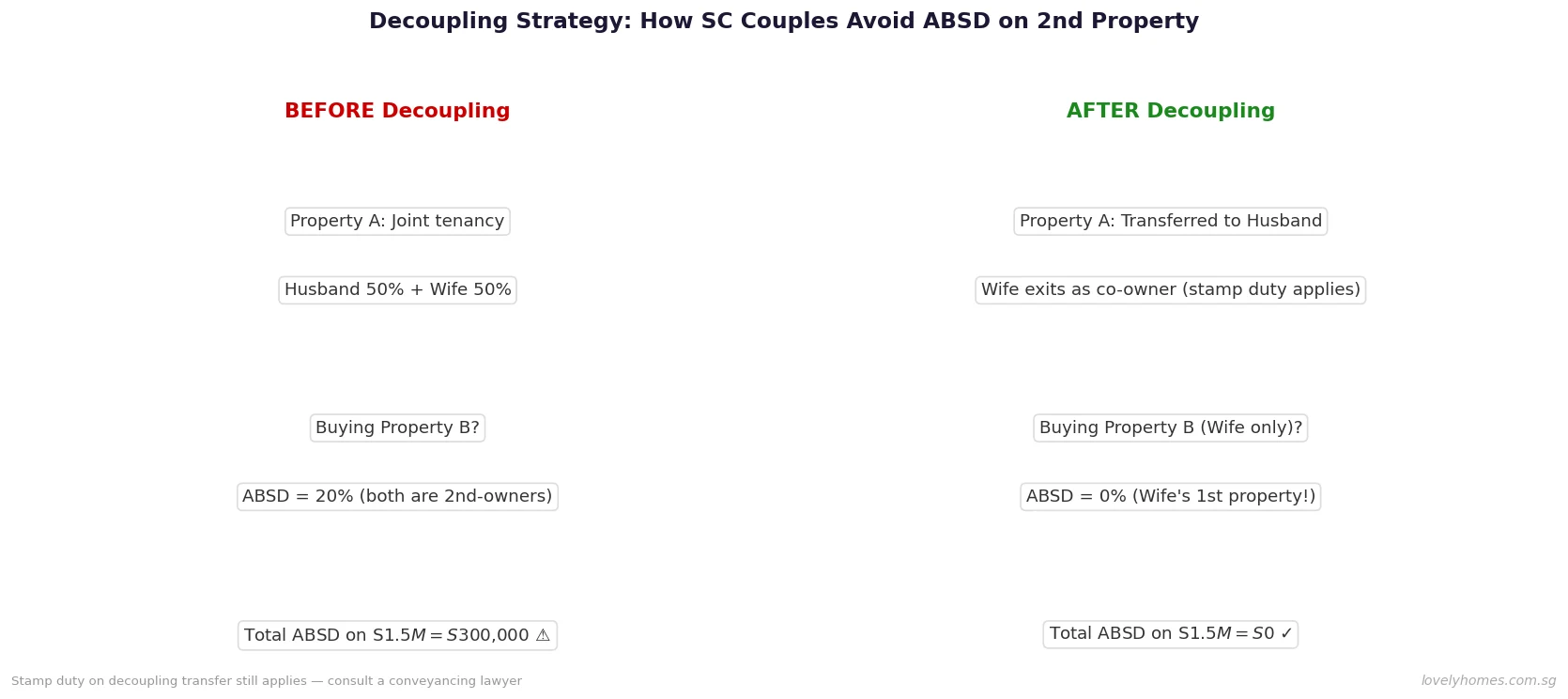
Yes — but with significant financial consequences. An SC who holds an HDB flat and buys a private condo will trigger 20% ABSD on the condo (second property rate), as they are deemed to hold two residential properties. To avoid ABSD, most upgraders adopt a “sell first, buy second” sequence, disposing of the HDB before exercising the condo OTP. Alternatively, the ABSD remission scheme allows an SC couple to buy a replacement home while still owning the first property, provided they sell the first within six months of the later of the condo’s purchase or its TOP date. See our full analysis in the HDB Upgrading Guide 2026.

Is there a minimum income to buy a private condo?

There is no statutory minimum income requirement. However, the TDSR framework means that your borrowing capacity — and therefore the price range you can access with a loan — is directly tied to gross income. A borrower with S$6,000/mth gross income is limited to a monthly mortgage payment of approximately S$3,300 (55% TDSR). At 3.2% over 30 years, that equates to roughly a S$762,000 loan. At 75% LTV, the maximum purchase price would be around S$1,016,000. Buyers with no debt obligations will find this headroom useful; those with car loans and credit card debt will find it tighter.

What is the difference between freehold and 99-year leasehold condos?

In Singapore, freehold (FH) and 999-year leasehold condos hold title in perpetuity, while 99-year leasehold (LH99) condos revert to the State at lease expiry. As a practical matter, a 99-year leasehold condo built today has roughly 92–95 years remaining — well within the CPF “cover to age 95” rule for most buyers. LH99 condos are typically 10–15% cheaper than equivalent freehold units, and price growth on LH99 units can be equally strong within the first 30 years. CPF usage becomes restricted once remaining lease falls below a threshold that does not cover the youngest buyer to age 95. Read more about lease decay implications in our related investment analysis.

Can I use CPF to pay ABSD?

No. ABSD (and BSD) must be paid in cash within 14 days of signing the OTP or S&P Agreement. However, you may apply to CPF Board to reimburse BSD from your OA after it has been stamped — so while the cash must flow out first, you can recover the BSD component from CPF. ABSD remains a pure cash cost and cannot be reimbursed from CPF.

What happens if I cannot exercise the OTP within 14 days?

If you fail to exercise the OTP within 14 days, the option lapses and the seller retains your 1% option fee as forfeiture. You have no further obligation to proceed with the purchase. If you have already stamped the OTP (i.e. paid BSD), you may apply to IRAS for a refund of part of the stamp duty paid — though this process involves fees and is not guaranteed. Always ensure your financing is in order before paying the option fee.

Is there Capital Gains Tax on condo profits in Singapore?

Singapore does not levy a Capital Gains Tax (CGT). Profits from the sale of a private condo are generally not taxable, provided the activity is not deemed a trade (i.e. you are not treated as a property dealer by IRAS). The exception is the Seller’s Stamp Duty (SSD) — introduced as a transaction deterrent — which applies at 16%/12%/8%/4% if you sell within 4 years of purchase respectively. Beyond the four-year holding window, there is no SSD and no CGT. See our detailed SSD Guide 2026.

Can a foreigner buy a condo in Singapore, and how much does it cost?

Yes — foreigners may purchase private condominium units without restrictions (other than ABSD). However, the ABSD rate for foreigners is 60% of the purchase price or valuation (whichever is higher). On a S$1.5M condo, that is S$900,000 in ABSD alone, on top of BSD of S$44,600. Citizens of Iceland, Liechtenstein, Norway, Switzerland, and the United States are entitled to Singapore Citizen ABSD rates under Free Trade Agreement provisions — so an American buying their first Singapore condo pays 0% ABSD. Our Foreign Buyer Guide 2026 covers the full picture.

Disclaimer: This guide is for general information purposes only and does not constitute legal, financial, or tax advice. All figures are current as at 11 June 2026 and are subject to change by MAS, IRAS, CPF Board, or HDB. LTV, TDSR, and ABSD rules are regularly reviewed by the Singapore Government. Always verify current rates at IRAS, MAS, and CPF Board, and engage a licensed conveyancing lawyer and mortgage broker before committing to any property transaction.

How to Choose a Property Agent in Singapore 2026: CEA Checks, Red Flags and Questions to Ask

How to Choose a Property Agent in Singapore 2026: CEA Checks, Red Flags and Questions to Ask

Choosing how to select a property agent in Singapore 2026 is a decision that could save — or cost — tens of thousands of dollars. With approximately 35,000 licensed real estate salespersons registered with the Council for Estate Agencies (CEA) as at 2026, the quality and suitability of agents varies widely. This guide gives you a structured, step-by-step framework for finding, vetting, and working with the right agent for your specific transaction — whether you are buying, selling, or renting.

Quick Answer: How to Choose a Property Agent Singapore 2026 — Key Facts

  • CEA registration is mandatory: Every property agent in Singapore must be registered with the Council for Estate Agencies. Unregistered agents cannot lawfully conduct property transactions. Verify at eservices.cea.gov.sg using the agent’s phone number — if it does not match, stop dealing immediately.
  • Client’s Agreement is required by law: Under the Estate Agents Act, an agent must enter into a written Client’s Agreement with you before conducting any work on your behalf. Refuse any agent who asks you to proceed without one.
  • Dual representation is restricted: An agent cannot represent both buyer and seller in the same transaction — unless both parties give informed written consent. This is a common cause of conflict-of-interest disputes.
  • Commission rates are advisory, not fixed: CEA publishes advisory rates as a market benchmark; actual commission is negotiable. New launch buyer agents are paid by the developer, not the buyer.
  • Check disciplinary record: CEA’s Public Register shows past sanctions, fines, and licence suspensions. This is a critical check many buyers skip.
  • Specialisation matters: An agent who primarily transacts HDB resale may not have the market knowledge, network, or sub-sale experience for a D9 new launch.
  • Red flags: WhatsApp-only contact, pressure to pay before viewing, no CEA registration match on phone number, reluctance to sign Client’s Agreement.

Why the Right Property Agent Matters More Than the Platform

Online property portals, valuation tools, and AI-assisted market data have made property information more accessible than ever. But the actual execution of a property transaction — negotiating on price, managing the OTP timeline, coordinating between buyer’s and seller’s solicitors, handling mortgage applications, navigating HDB procedures — still depends heavily on the agent’s competence, ethics, and market network. A well-chosen agent protects your interests actively; a poor choice, or worse, a fraudulent one, can expose you to misrepresentation, conflicts of interest, and financial loss.

Step 1: Verify CEA Registration Before Anything Else

This is the single most important step and takes under two minutes. Visit eservices.cea.gov.sg and search using the phone number the agent contacted you from. If the phone number does not return a matching, currently active salesperson licence, stop all engagement immediately — this is a classic fraud indicator.

Do not rely solely on the business card, name, or IC number that the agent provides. Scammers regularly impersonate real agents by using stolen photos and legitimate-sounding names while substituting a different phone number that you are meant to contact.

The Public Register also shows:

  • The estate agency the agent is currently registered under.
  • Whether the licence is active, lapsed, or suspended.
  • The agent’s transaction history for the past 36 months (categories: HDB resale, HDB rental, private sale/resale, private rental).
  • Any disciplinary actions taken by CEA, including fines, reprimands, and licence revocations.
How to verify a CEA-registered property agent Singapore step by step guide 2026
Figure 2: How to Verify a CEA-Registered Property Agent — Six Steps from the CEA Public Register to signing the Client’s Agreement.

Step 2: Match the Agent’s Specialisation to Your Transaction

Transaction history is your most objective indicator of an agent’s specialisation. An agent with 50 HDB resale transactions in the past 36 months and zero private property transactions is unlikely to be the best choice for a high-value CCR condominium purchase. Conversely, a specialist in D9–D11 luxury resales may be unfamiliar with HDB procedures and the nuances of the CPF Housing Grant application process.

Ask the agent directly: “How many transactions of this specific type — resale 4-room HDB in Tampines / new launch in OCR / commercial shophouse — have you done in the past 12 months?” A trustworthy agent will show you their track record rather than deflect the question.

Key specialisation signals to look for:

  • HDB resale buyer: Look for 10+ HDB resale transactions in the past 36 months, familiarity with HFE letter procedures, and knowledge of the NCQ (Non-Citizen Quota) for rental scenarios.
  • Private resale buyer: Look for private property transaction history, knowledge of current sub-sale volumes in your target district, and relationships with mortgage brokers.
  • New launch buyer: Developer accreditation and attendance at developer previews; knowledge of ballot priority systems; familiarity with the Progressive Payment Scheme.
  • Seller (HDB or private): Track record of actual listings sold, average days on market for recent listings, familiarity with comparative market analysis.
Singapore property agent advisory commission rates 2026 by transaction type
Figure 1: Advisory Commission Rates by Transaction Type — Singapore 2026. Rates are non-binding benchmarks published by CEA. New launch buyer agents are compensated by the developer at no cost to the buyer.

Step 3: Understand Commission and Negotiate Clearly

Commission rates in Singapore are not regulated by law — the figures published by CEA are advisory rates that serve as market benchmarks. They are not binding on either party. In practice, most HDB seller agents charge around 2% of the transaction price; HDB buyer agents typically charge 0–1%. For private property, seller agents charge approximately 2% and buyer agents 0–1% on resale transactions.

For new launch private condominiums, the developer pays the buyer’s agent directly — the buyer pays no commission. Developer commissions for buyer’s agents typically range from 2% to 3% of the purchase price, sometimes higher for international buyers or premium units. This creates a structural incentive that is worth understanding: the buyer’s agent in a new launch transaction is economically the developer’s agent. Ask whether the agent has compared alternative units in different projects at the same price point before endorsing a specific development.

Always agree on commission in writing as part of the Client’s Agreement before any work begins. Verbal agreements on commission are difficult to enforce and frequently the source of disputes lodged with CEA.

Step 4: Insist on a Client’s Agreement

Under section 64 of the Estate Agents Act (Cap 95A), an estate agent and a registered salesperson must sign a Client’s Agreement with any client before performing any estate agency work. The Client’s Agreement must specify: the scope of services, the commission rate (or formula), the duration of the exclusive arrangement (if any), and the salesperson’s and agency’s registration details.

An agent who is reluctant to sign a Client’s Agreement is operating outside the legal framework — and likely has good reason to avoid a paper trail. Refuse to proceed without a signed Client’s Agreement in every circumstance. The Client’s Agreement also gives you a formal dispute mechanism: if an agent breaches its terms, you have grounds to file a complaint with CEA and seek compensation.

Dual Representation: Know Your Rights

Dual representation occurs when a single agent acts for both the buyer and the seller (or both landlord and tenant) in the same transaction. CEA rules permit dual representation only if both parties provide informed written consent — and only if the agent discloses the arrangement and both clients agree they understand the conflict of interest involved.

If an agent introduces you to a property and then reveals they are also representing the seller, you have every right to refuse and engage a separate buyer’s agent. In practice, the seller’s agent who shows you a property is acting for the seller; you should either negotiate directly or engage your own buyer’s agent to represent your interests.

Singapore property agent evaluation checklist criteria importance how to check 2026
Figure 3: Property Agent Evaluation Checklist — criteria ranked by importance and how to check each one before engaging.

Summary Table: What to Check When Choosing a Property Agent

Check How to Do It Importance
CEA licence is active Search phone number at eservices.cea.gov.sg Mandatory — do not proceed without this
No disciplinary record CEA Public Register → check actions tab Mandatory
Transaction history matches your property type CEA Public Register → transaction history tab High
Client’s Agreement signed before any work Request before first viewing or listing appointment Mandatory by law
Commission agreed in writing Included in Client’s Agreement High
Dual representation disclosed and consented to (if applicable) Ask directly; get written confirmation High
Reviews from past clients for same property type Google Business profile, referrals, developer feedback Moderate
Comparative market data provided Request a CMA report before pricing your listing or making an offer Moderate

Worked Example: Mr Tan — Selling an HDB Flat in Tampines

Mr Tan holds a 5-room HDB resale flat in Tampines (MOP completed). He shortlists three agents by asking each the same set of questions:

  • Agent A: CEA-registered, 22 HDB resale transactions in past 36 months including 8 in Tampines, no disciplinary record, quoted 2% commission, offered to sign Client’s Agreement immediately. Provided a Comparative Market Analysis showing recent 5-room transacted prices in Tampines (S$680K–S$760K range). Explained the SSD regime for his acquisition year (no SSD applicable — MOP completed, held more than 4 years).
  • Agent B: CEA-registered, 5 transactions in past 36 months (mix of HDB and private), quoted 1.5% but said “we can discuss after the listing”. Did not proactively offer the Client’s Agreement. Could not provide a CMA on the spot.
  • Agent C: Could not be verified by phone number on CEA Public Register — immediately disqualified.

Decision: Mr Tan engaged Agent A. The higher commission (2% vs 1.5%) was justified by the stronger local track record and the immediate CMA. The listing was priced at S$720,000, received three offers within 10 days, and was sold at S$736,000 — S$16,000 above asking price.

Commission paid: 2% × S$736,000 = S$14,720 + 9% GST = S$16,044.80 — fully accounted for in Mr Tan’s net sale proceeds.

Questions to Ask a Property Agent Before Engaging

The following 10 questions help filter out unsuitable agents quickly and give you the information you need to make an informed choice. A competent, ethical agent will answer each question directly:

  1. Can I search for your CEA registration using your phone number right now?
  2. How many transactions have you completed in the past 12 months for my specific property type and area?
  3. Are you willing to sign a Client’s Agreement today before we proceed further?
  4. Are you representing the seller (or buyer) of any properties you will show me?
  5. What is your commission rate and is it inclusive of GST?
  6. Can you provide a Comparative Market Analysis for my target area or my listing price?
  7. What is your exclusive period, and what are the exit conditions if I am unhappy?
  8. How do you handle co-broking — will you share commission with a buyer’s agent?
  9. Have you been subject to any CEA disciplinary proceedings?
  10. How and how often will you update me on enquiries and market feedback?

Why This Matters: The Cost of Getting It Wrong

CEA received approximately 370 consumer complaints against property agents in FY2025, the majority relating to misrepresentation, failure to disclose material facts, and commission disputes. An agent who misrepresents the remaining lease, the NCQ position, or the property’s Minimum Occupation Period status can expose you to legal liability and significant financial loss. The consequences of working with an unverified or unregistered agent are even more severe — any contract entered into with an unregistered person is voidable, and the agent has no professional indemnity insurance.

The estate agency industry in Singapore is regulated under the Estate Agents Act (Cap 95A) and the CEA Code of Ethics and Professional Client Care. CEA has the power to fine agents, suspend or revoke licences, and impose a public reprimand. These enforcement tools exist precisely because the consequences of dishonest or incompetent agency work in a high-value property market are severe.

What Might Change: Digital Tools and AI in Property Agency

Several platforms now offer AI-assisted valuations and transaction matching that reduce the information asymmetry between buyers, sellers, and agents. Industry watchers expect the share of transactions involving “self-service” buyer portals to grow modestly, particularly for straightforward HDB resale transactions. However, for higher-value or more complex transactions (CCR condos, commercial properties, en-bloc proceedings, cross-border purchases), the regulatory, legal, and negotiation complexities mean the licensed agent remains the essential professional for the foreseeable future.

CEA is also exploring digital licence verification tools embedded in property portal listings, which would surface real-time CEA registration status alongside every listing. If implemented, this would make basic verification automatic — though the more nuanced checks (disciplinary history, specialisation fit, commission terms) will always require the buyer or seller to engage directly.

Frequently Asked Questions

Do I have to pay an agent as a buyer in Singapore?

For new launch private condominiums, no — the developer pays the buyer’s agent’s commission. For HDB resale and private resale transactions, the convention is that the seller pays the seller’s agent and the buyer may or may not engage their own buyer’s agent (typically at 0–1% of the purchase price). Some buyers choose to rely on the seller’s agent to facilitate the transaction, which is permitted only if dual representation is disclosed and consented to in writing. Engaging your own buyer’s agent provides independent representation for a relatively modest fee and is generally advisable for high-value or complex transactions.

What is a Co-Broking arrangement and should I be concerned?

Co-broking occurs when a listing agent (representing the seller) works with another agent (representing the buyer), splitting the total commission between them. This is a standard and healthy market practice — it incentivises seller’s agents to accept viewings from co-brokers, widening the pool of buyers. The seller typically pays the full commission, which the two agents then divide. As a buyer, co-broking generally means you are properly represented. As a seller, you should ask whether your listing agent is willing to co-broke; an agent who refuses co-broking is limiting your buyer pool, which can reduce your final sale price.

What are the consequences if an agent misrepresents a property to me?

Misrepresentation by a licensed property agent is actionable under both the Estate Agents Act and the Misrepresentation Act (Cap 390). You may file a complaint with CEA for disciplinary action against the agent, claim damages from the agent’s estate agency (which carries professional indemnity insurance), and, in cases of fraudulent misrepresentation, pursue civil action or a police report. If the misrepresentation relates to material facts — remaining lease, whether the property is encumbered, rental tenancy status — and you can demonstrate reliance and loss, damages claims can be substantial. Always get material facts confirmed in writing during the offer process, and instruct your solicitor to conduct due diligence independently.

How do I check if a property agent has been disciplined by CEA?

The CEA Public Register at eservices.cea.gov.sg shows the disciplinary record for every registered salesperson, including the date, nature, and sanction of any disciplinary proceedings. You can search by the agent’s name, registration number, or phone number. Disciplinary actions range from advisory letters and fines (minor breaches) to licence suspension or revocation (serious breaches such as misrepresentation, unauthorised receipt of monies, or criminal convictions). An advisory letter for a minor procedural breach should not necessarily disqualify an otherwise strong candidate; a licence suspension for misrepresentation is a clear disqualifier.

Can I switch agents if I am unhappy after signing a Client’s Agreement?

The Client’s Agreement will specify its duration, typically 60–90 days for an exclusive listing or buyer-representation arrangement. Most agreements include early termination provisions with notice periods of 7–14 days. If the agent has materially breached the agreement — failed to meet agreed obligations, made misrepresentations, acted without authority — you may have grounds to terminate immediately without notice. If the agent has merely been unsatisfactory without a clear breach, you will typically need to wait out the notice period or negotiate a mutual early termination. Any dispute about termination rights can be escalated to CEA’s Dispute Resolution Scheme before going to the courts.

What if I want to buy or sell property without an agent?

Transacting without an agent is legally permissible for private property and HDB resale (the HDB also facilitates direct seller-to-buyer transactions through its Resale Portal). However, you take on the full responsibility for negotiating the OTP, conducting due diligence, managing the conveyancing timeline, coordinating with the other party’s solicitor, and ensuring all regulatory conditions are met. A licensed solicitor is still required for the legal transfer. For straightforward transactions in a familiar market, experienced buyers and sellers sometimes transact direct; for first-time buyers, those unfamiliar with Singapore property law, or those handling complex transactions, engaging a qualified agent is strongly advisable.

Related Articles

Disclaimer: This article is for general information only and does not constitute financial, legal, or professional advice. Information on CEA registration requirements and the Estate Agents Act may be updated by the Council for Estate Agencies. Verify all agent details at eservices.cea.gov.sg and consult the CEA website for the current Code of Ethics and professional standards. Engage a licensed solicitor for all conveyancing matters.

Tampines North Neighbourhood Guide Singapore 2026: Property Prices, MRT, Schools and Investment Outlook

Tampines North Neighbourhood Guide Singapore 2026: Property Prices, MRT, Schools and Investment Outlook

Quick Answer — Tampines North 2026 at a Glance

  • Tampines North is Singapore’s newest planned sub-town within the established Tampines New Town in District 18 (D18), located in the northeast of Singapore, approximately 25 km from the CBD.
  • The area currently has excellent EWL access via Tampines MRT (EW2) and DTL access via Tampines DT32; the upcoming Cross Island Line (CRL) Tampines North Station (~2030) will significantly reduce journey times to the west and Jurong Lake District.
  • Parktown Residence (1,193 units), the largest launch in Tampines in years, is integrated with the future Tampines North MRT station and includes a new hawker centre, community club, and retail space.
  • HDB resale 4-room flats in Tampines currently trade between S$520,000 and S$700,000; executive condominiums such as Aurelle of Tampines launched from around S$1,100,000.
  • Gross rental yields in D18 run from 4.8% (HDB 4-room) down to 2.9% (private 3-bedroom), above the Singapore average for the same flat types.
  • UWCSEA East Campus, Temasek Polytechnic, and Singapore University of Technology and Design (SUTD) all anchor the area’s education catchment.
  • Tampines Hub, Singapore’s largest community centre (60,000 sqm), Tampines Mall, Century Square, White Sands, and IKEA make Tampines North one of the best-served retail sub-markets outside the city.
  • The 5-year HDB resale price growth in D18 has been approximately 24–28%, in line with the broader OCR market and supported by the CRL pre-announcement uplift.

Tampines North: Where Is It and Why Does It Matter?

Tampines North is the designated northern section of Tampines New Town — a planned urban extension built out on land that was, until the mid-2010s, largely farmland and industrial reserve. In URA’s parlance, “Tampines North” refers specifically to the sub-town north of Tampines Avenue 10, anchored by the future Tampines North MRT station on the Cross Island Line. The rest of Tampines — served by Tampines MRT on the East-West Line and Tampines DTL on the Downtown Line — is the mature, established town Singaporeans know well.

For property buyers, the distinction matters because Tampines North carries a CRL uplift thesis — the Cross Island Line station is expected to open circa 2030, bringing a third MRT line to the area and cutting the journey time to Jurong Lake District, Singapore’s second CBD, by more than 30 minutes compared to the current EWL route. This pre-station infrastructure play is similar to the uplift enjoyed by Jurong East in the early 2010s as the EWL–NSL interchange became a recognised commercial hub.

The broader Tampines district is classified as an OCR (Outside Central Region) submarket by URA, commanding lower per-square-foot prices than the city core but delivering superior gross rental yields for buy-to-let investors. In Q1 2026, URA data shows OCR private residential prices up approximately 2.2% quarter-on-quarter and HDB resale prices broadly stable across the east.

Property Prices — What You Can Expect to Pay in 2026

Tampines North D18 property price ranges 2026 — HDB resale EC and private condo
Figure 1: Tampines North / D18 property price ranges — 2026. Indicative. Source: URA, HDB, industry data.

HDB resale prices in Tampines have risen meaningfully since the 2021 cooling-measure-driven market trough. A typical HDB 4-room resale flat in the Tampines North sub-town trades between S$520,000 and S$700,000 depending on floor level, specific block location relative to greenery and noise, and remaining lease. Units closer to Tampines North (the newer blocks built from 2018–2023) tend to command slight premiums given longer remaining leases and proximity to the future CRL station.

Executive Condominiums — a uniquely Singaporean asset class that blends subsidised pricing for SC/PR buyers with private condominium facilities — are prominent in Tampines North. Aurelle of Tampines EC (583 units, Sim Lian Group) launched in 2025 at an average of approximately S$1,350 per square foot, with entry prices from around S$1.1M for 2-bedroom units. The project sits within a 10-minute walk of the future CRL station site. Tenet EC, an older privatised EC in the area, now trades on the resale market between S$1.0M and S$1.3M for 3-bedroom units.

Private condominiums in Tampines North are dominated by the mega-project Parktown Residence — a 1,193-unit, 99-year leasehold integrated development launched in 2025 by a UOL Group, CapitaLand and HDB co-development. It is physically integrated with the Tampines North MRT station and includes a hawker centre, a community club, and a retail precinct. Entry pricing for 1-bedroom units started at approximately S$800,000–S$900,000; 3-bedroom units were in the S$1.35M–S$1.7M range at launch.

MRT Connectivity — The CRL Catalyst

Tampines North is already well-connected by two existing MRT lines and will gain a third by around 2030, making it one of the best-positioned OCR sub-towns for transport connectivity outside the mature estates closer to the city.

The East-West Line (EWL) passes through Tampines (EW2) and Simei (EW3), connecting directly to Changi Airport in one stop and to the city core via Paya Lebar in seven stops. The Downtown Line (DTL) has Tampines (DT32) as its eastern terminus, connecting via Bedok Reservoir, Kembangan, and Marine Parade to the Botanic Gardens and Buona Vista, then turning north-west toward the city. The DTL journey from Tampines to the Botanic Gardens is approximately 30 minutes.

The transformative addition is the Cross Island Line (CRL), specifically Phase 2 (CRL2), which brings a dedicated Tampines North station. CRL links Tampines North westwards through Defu, Hougang, Serangoon North, Ang Mo Kio, and onwards to Jurong Lake District — bypassing the city core and eliminating the need for a transfer at Paya Lebar or City Hall for passengers heading west. The LTA has indicated Phase 2 is targeted for completion around 2030. For property buyers, the practical implication is that the CRL uplift is currently priced into Parktown Residence (which fronts the station site) but only partially priced into the wider HDB resale market, meaning today’s buyers may capture some of the remaining discount-to-station pricing.

Amenities — Everything You Need Within 10 Minutes

Tampines North Singapore amenities overview 2026 MRT schools retail parks healthcare
Figure 2: Tampines North key amenities overview — MRT, schools, retail, parks, healthcare and district statistics.

Retail and food. Tampines is arguably the best-served OCR sub-market for retail outside Bishan/Ang Mo Kio. The town centre is anchored by Tampines Mall (280,000 sqft), Century Square (revamped in 2021, 560,000 sqft), and White Sands. The IKEA Tampines store and Courts Megastore on Tampines North Link add destination retail. Tampines Hub — opened in 2017 and at 60,000 sqm Singapore’s largest integrated community and lifestyle hub — houses the community library, an Olympic-sized swimming complex, a hawker centre, sports courts, and a 5,000-seat stadium.

Parks and greenery. The Tampines Boulevard Park (completed late 2025) runs along the length of Tampines Avenue 9 as a 3.2-km linear park connecting Tampines North to the Central Catchment, with cycling paths, fitness stations, and community gardens. Tampines Eco Green (36 ha) is a secondary forest reserve within the town, unusual for an urban estate and valued by residents for birdwatching and nature trails. The Bedok Reservoir Regional Park is a 10-minute cycle away.

Healthcare. Changi General Hospital (CGH), a 1,000-bed acute regional hospital, is approximately 5 km from Tampines North. Tampines Polyclinic and Bedok Polyclinic both serve the broader catchment, with a third polyclinic at Pasir Ris serving the eastern corridor.

Schools — A Strong Education Catchment

UWCSEA East Campus (United World College of South-East Asia) sits within Tampines, consistently ranked among the top international schools in Singapore and drawing an expat tenant base that anchors higher-end rental demand. Temasek Polytechnic (TP), one of Singapore’s five polytechnics, is located on Tampines Avenue 1 and adds a significant student population of approximately 18,000 enrolled students. Singapore University of Technology and Design (SUTD), a research university set up in partnership with MIT and ZHEJIANG University, is located at the Changi-Tampines border and draws an educated demographic to the wider east. Primary and secondary schools within the Tampines North catchment include Tampines Primary School, Elias Park Primary, Junyuan Secondary, and St. Hilda’s Primary (popular 1-km circle school further south).

Investment Outlook — Yield vs Capital Growth

Tampines North D18 gross rental yield vs 5-year capital growth by property type 2026
Figure 3: D18 Tampines North — estimated gross rental yield vs 5-year capital growth (2021–2026) by property type. Indicative.

The investment case for Tampines North rests on two distinct thesis strands depending on the buyer’s horizon. Short-to-medium-term (1–5 years), the yield-on-cost argument favours HDB resale and older privatised ECs: gross yields of 4.8% on a S$600,000 4-room resale flat, with low vacancy and a large tenant pool anchored by UWCSEA, SUTD, and TP staff and students. Longer-term (5–10 years), the capital growth argument points to the CRL opening circa 2030 as the primary catalyst, with EC and Parktown Residence buyers positioned to benefit from station-adjacency re-rating.

Five-year price growth (2021–2026) in D18 has been approximately 24–28% for HDB resale and 35–38% for privatised ECs, both broadly in line with or slightly above the URA OCR PPI growth over the same period. Private condominiums have grown more modestly at 18–22% given higher absolute entry prices. The important caveat is that the Tampines North private market is predominantly occupied by projects launched from 2022–2025 whose resale data is limited; the 2030 CRL opening is the true test of the station-adjacency premium thesis.

Property Comparison Summary

Property Type Price Range (2026) PSF (est.) Gross Yield Tenure Key Development
HDB 3-Room (Resale) S$360k – S$500k S$420–S$560 psf ~5.2% 99yr (remaining) Various blocks
HDB 4-Room (Resale) S$520k – S$700k S$450–S$600 psf ~4.8% 99yr (remaining) Tampines North BTO blocks
HDB 5-Room (Resale) S$700k – S$900k S$420–S$540 psf ~4.3% 99yr (remaining) Various blocks
EC (privatised/resale) S$1.0M – S$1.4M S$900–S$1,200 psf ~4.0% 99yr leasehold Tenet EC, Aurelle of Tampines
Private Condo 1BR S$800k – S$1,050k S$1,400–S$1,700 psf ~4.2% 99yr leasehold Parktown Residence
Private Condo 2BR S$1.0M – S$1.35M S$1,300–S$1,600 psf ~3.6% 99yr leasehold Parktown Residence, Pinery
Private Condo 3BR S$1.25M – S$1.70M S$1,200–S$1,500 psf ~2.9% 99yr leasehold Parktown Residence

Worked Example — Mr & Mrs Ng, Buying Tampines North 4-Room HDB Resale

Mr and Mrs Ng are a Singapore Citizen married couple, both in their early 30s. Their combined gross monthly income is S$9,500. They wish to sell their current 3-room HDB flat in Jurong West (fully paid off at S$480,000) and upgrade to a 4-room resale HDB flat in Tampines North, targeting proximity to Temasek Polytechnic where Mrs Ng works.

They identify a 4-room resale flat on the 12th floor of a Tampines North block with a remaining lease of 72 years, listed at S$660,000.

Stamp duties: BSD on S$660,000 — first S$180,000 at 1% = S$1,800; next S$180,000 at 2% = S$3,600; next S$300,000 at 3% = S$9,000. BSD = S$14,400. ABSD: nil — SC married couple, concurrent sale of existing HDB means property count stays at one.

Grants: At S$9,500 joint income, EHG for resale is S$15,000. PHG: if Tampines North is within 4 km of Mrs Ng’s parents’ home in Pasir Ris — qualifying distance — PHG = S$20,000 (living near parents). Total grants = S$35,000. Net effective price = S$660,000 − S$35,000 = S$625,000.

Financing: HDB concessionary loan LTV 80% = S$500,000. Monthly instalment: S$500,000 at 2.6% over 25 years ≈ S$2,274/month. MSR: S$2,274 / S$9,500 = 23.9% — within the 30% MSR limit. TDSR: 23.9% — well within 55%. Cash upfront (5% cash + BSD): S$33,000 + S$14,400 = S$47,400.

Outcome: The Ngs can feasibly complete the purchase, using the S$480,000 proceeds from their Jurong West flat to fund the upfront costs and CPF top-up, with the CRL opening in 2030 providing a potential capital gain catalyst within their 10-year holding horizon.

What Might Come Next for Tampines North

The structural story for Tampines North is the CRL. Once the Cross Island Line Tampines North station opens (~2030), the area transitions from “well-connected east sub-town” to “triple-line MRT hub” — a designation shared by fewer than ten stations in Singapore. The immediate consequence is typically a rental yield compression (higher prices) and a transaction volume uplift as buyers from outside the east discover the area.

Beyond CRL, the URA Master Plan 2025 identifies a stretch of land near Sungei Loyang — northeast of Tampines North — as a potential new neighbourhood study area. An environmental study is underway; if positive, this could yield an additional residential supply pipeline of several thousand units beyond 2030, including park space and community facilities that would benefit Tampines North residents further north.

For existing Tampines residents, the advice is to document their lease adequacy carefully: flats with remaining leases dropping below 60 years within a 20-year horizon will lose CPF financing eligibility, which progressively reduces the buyer pool for those units on resale. This is a watch-point particularly for older blocks in the southern part of Tampines town.

Frequently Asked Questions

Is Tampines North a good area to buy property in 2026?

For buyers with a 7-10 year investment horizon, Tampines North has a credible structural case built on the CRL opening (~2030), strong rental demand from UWCSEA and TP, one of Singapore’s best OCR retail hubs, and prices that remain below RCR comparables for similar connectivity. Short-term buyers should be aware that private condo prices in Tampines North are already partly pricing in the CRL uplift, particularly Parktown Residence. HDB resale buyers get better value relative to future connectivity than private condo buyers.

Which MRT lines serve Tampines North?

As of 2026, Tampines North is served by the East-West Line (EWL) at Tampines (EW2) and the Downtown Line (DTL) at Tampines (DT32). Both stations share a common paid concourse. The upcoming Cross Island Line (CRL) Tampines North station, targeted around 2030, will add a third line specifically serving the northern sub-town and integrated with Parktown Residence. Simei (EW3) on the EWL also serves the southern edge of Tampines North.

Can foreigners buy property in Tampines North?

Foreign individuals (non-PRs) may purchase private condominium units in Tampines North, such as Parktown Residence, subject to the 65% Additional Buyer’s Stamp Duty (ABSD) on the purchase price. Singapore PRs buying their first property pay 5% ABSD. Foreigners and PRs cannot purchase HDB flats or executive condominiums below 10 years old (except PRs buying resale HDB with a Citizen spouse). The 65% ABSD rate was introduced in April 2023 and remains in force as of June 2026.

What is Parktown Residence and how is it different from a regular condo?

Parktown Residence is a 1,193-unit 99-year leasehold integrated development co-developed by UOL Group, CapitaLand, and HDB, launched in 2025. “Integrated” in this context means it is physically connected to the Tampines North MRT station (CRL), a hawker centre, a community club, and a retail precinct within a single development. Residents will have sheltered, direct access to the CRL station without going to street level. This is similar to the Bidadari integration model (Woodleigh Residences + Woodleigh MRT) and commands a moderate premium over non-integrated private condos nearby.

How does Tampines North compare to nearby Bedok or Pasir Ris for property investment?

Tampines North has a younger housing stock on average than Bedok (where many leases are entering the 40-50 year range) and a cleaner CRL catalyst story than Pasir Ris (which benefits from the EWL and the Pasir Ris-Punggol Regional Line, but has already partly priced in those upgrades). Bedok offers more mature amenities and better CBD commute times via the EWL, while Pasir Ris offers more land area and green space. Tampines North is the strongest play for buyers specifically betting on the CRL station uplift over a 5-10 year horizon.

What income is needed to buy a condo in Tampines North in 2026?

For a 2-bedroom private condo in Tampines North at approximately S$1.2M, assuming a bank loan at LTV 75% and a 30-year tenure at 3.0% per annum: the loan quantum is S$900,000 and the monthly instalment approximately S$3,795. Under TDSR at 55%, the required gross monthly income is approximately S$6,900. In practice, lenders typically want comfortable headroom, so a combined household income of S$10,000–S$12,000 per month is advisable for sustainable financing at this quantum. Cash/CPF available for the downpayment (25%) plus BSD should be in the S$320,000–S$350,000 range.

Related Articles

Disclaimer: This article provides general information about the Tampines North property market as at 3 June 2026. Property prices, yields, and infrastructure timelines are indicative and subject to change. This is not investment advice. Refer to official sources including URA, HDB, and LTA for authoritative figures, and consult a licensed property agent and financial adviser before making any property purchase decision.

Singapore HDB BTO Guide 2026: Eligibility, Grants, Step-by-Step Process and Prices Explained

Singapore HDB BTO Guide 2026: Eligibility, Grants, Step-by-Step Process and Prices Explained

Quick Answer — HDB BTO 2026 at a Glance

  • HDB Build-To-Order (BTO) is Singapore’s primary scheme for first-time buyers to purchase a new public flat directly from HDB at a subsidised price, with a 3–5 year construction wait.
  • Since October 2024, all BTO flats fall into one of three tiers — Standard, Plus, or Prime — with progressively tighter resale restrictions as location value increases.
  • The Minimum Occupation Period (MOP) is 5 years for Standard and 10 years for Plus and Prime flats before you can sell or rent out the whole flat.
  • Eligible first-timer families can receive the Enhanced CPF Housing Grant (EHG) of up to S$80,000; singles can receive up to S$40,000.
  • The Proximity Housing Grant (PHG) adds up to S$30,000 for resale buyers living near parents; the Step-Up CPF Housing Grant adds S$15,000 for 2-room Flexi to 3-room upgraders.
  • A valid HDB Flat Eligibility (HFE) letter is mandatory before applying for any BTO or Sale of Balance Flats exercise (introduced May 2023).
  • HDB will launch approximately 19,600 BTO flats in 2026 across four exercises (February, June, October; the fourth in Q4 2026).
  • First-timer applicants who do not book a flat in their first or second ballot receive additional chances through the First-Timer Priority scheme.
  • The Tenants’ Priority Scheme (TCPS) was raised to 10% from the June 2026 BTO exercise, giving current HDB rental tenants a better chance of balloting a flat.
  • BSD applies on all property purchases including BTO; ABSD is nil for Singapore Citizens buying their first residential property.

What Is HDB Build-To-Order (BTO)?

The Build-To-Order scheme is the Housing & Development Board’s main mechanism for selling new public flats to Singaporeans. Unlike the earlier system where HDB built flats speculatively before putting them on the market, BTO works in reverse: HDB announces a project, collects applications for approximately one month, then — only if take-up is sufficient — awards a construction contract and begins building. This demand-driven model, introduced progressively in the early 2000s, reduces the risk of unsold inventory and allows HDB to calibrate supply to genuine demand across Singapore’s towns.

The practical consequence for buyers is a waiting time of three to five years between balloting and key collection, though HDB has been actively piloting shorter-wait BTO projects with waiting times of under three years. As of 2026, projects like Tampines Nova and selected Woodlands projects have offered sub-three-year waiting times under the Short Waiting Time (SWT) initiative.

BTO flats are priced at a discount to the open market to ensure affordability. The subsidy is built into the purchase price — not paid as a separate cheque — and is “clawed back” when you sell the flat by requiring CPF refunds and, in the case of Plus and Prime flats, a percentage of the resale price to be returned to HDB.

HDB BTO flat type price ranges Singapore 2026 — 2-Room Flexi to 5-Room Plus Prime Standard
Figure 1: Typical HDB BTO launch price ranges by flat type — 2026. Source: HDB. Indicative; actual prices vary by project and location.

Standard, Plus and Prime — The October 2024 Framework

The biggest structural change to the BTO system since the scheme’s launch was the introduction of the Standard, Plus and Prime classification framework in October 2024. The framework replaced the older Build-To-Order and Prime Location Public Housing (PLH) Model and applies to all BTO projects from the October 2024 exercise onwards.

Standard flats are in suburban locations with no exceptional accessibility advantage. They carry the existing 5-year MOP, can be rented out in whole after MOP, and carry no clawback on the resale price. Most estates — Woodlands, Choa Chu Kang, Sembawang, Sengkang — will be Standard designation.

Plus flats are in locations with better-than-average accessibility and amenities — typically mature towns or well-served suburban sites. They carry a 10-year MOP, may not be rented out in whole before the end of MOP, carry a clawback of a percentage of the resale price returned to HDB, and have an income ceiling of S$14,000 per month (identical to Standard in 2026). Bishan, Ang Mo Kio, and many Bukit Merah BTO sites now fall under Plus.

Prime flats are in the most central and accessible locations, including city-fringe and central-area sites such as Queenstown, Kallang/Whampoa, and Henderson. They carry the same 10-year MOP and clawback as Plus, have stricter subletting restrictions, and apply a higher clawback rate. The June 2026 BTO exercise includes Bukit Merah Berlayar, widely expected to be classified as Prime.

The rationale is that public housing subsidies should be appropriately scaled to how choice a location is. A flat at Queenstown — where resale prices touch S$1,000 per square foot — receives a larger implicit subsidy than a flat in Woodlands. The clawback is the mechanism for recapturing some of that subsidy when owners eventually sell at market prices.

Grants: EHG, PHG, Step-Up CPF and More

Singapore’s housing grants form a multi-layered system designed to ensure that the effective cost of a first BTO flat is within reach of lower- and middle-income families. The key grants available in 2026 are:

Enhanced CPF Housing Grant (EHG). Administered by CPF Board and HDB jointly, the EHG replaced the Additional CPF Housing Grant and Special CPF Housing Grant in September 2019. It is means-tested against average gross monthly household income over the preceding 12 months. For families, EHG ranges from S$5,000 at an income of S$9,000/month to S$80,000 at an income of S$1,500/month or below. Singles buying a 2-room Flexi flat receive half the family rate. EHG is paid into your CPF Ordinary Account (OA) and can be used for the flat’s purchase price and mortgage payments; it is not a cash grant.

Proximity Housing Grant (PHG). The PHG is available for resale flat purchases (not BTO directly, but relevant to those who buy resale instead of BTO). It pays S$30,000 if you live with parents/children or within 4 km of them, and S$20,000 if you live with or near a sibling. Singles receive half the family rate.

Step-Up CPF Housing Grant. For second-timer applicants who currently live in a 2-room HDB flat (rental or owned) and wish to buy a 2-room Flexi or 3-room BTO flat, the Step-Up Grant provides S$15,000. It recognises that some residents need a nudge rather than a full subsidy to upgrade from the smallest flat types.

Enhanced CPF Housing Grant EHG amount by monthly household income Singapore 2026 families and singles
Figure 2: EHG grant amount by monthly household income — families (max S$80k) vs singles (max S$40k). Source: HDB / CPF Board.

Eligibility: Who Can Apply for a BTO Flat?

BTO eligibility is governed by several overlapping criteria under the Housing and Development Act (Cap. 129). The main conditions in 2026 are:

Citizenship. At least one applicant must be a Singapore Citizen. Singapore Permanent Residents may only apply under the Public Scheme together with a Citizen family member. Foreigners are not eligible to buy new HDB flats.

Age. Applicants must be at least 21 years old for family schemes. Singles may apply from age 35 under the Single Singapore Citizen (SSC) Scheme, but only for 2-room Flexi flats in non-mature estates.

Family nucleus. Eligible family units include married couples, fiancé/fiancée (Option to Purchase granted on condition of marriage within 3 months), parents with children, and orphaned siblings. Singles must buy alone (no co-applicant outside of parents or siblings if orphaned).

Income ceiling. For Standard and Plus flats, the gross monthly household income ceiling is S$14,000 (S$7,000 for singles). For 2-room Flexi flats in non-mature estates, there is no income ceiling for some schemes.

Ownership restrictions. Applicants must not own or have recently sold private residential property in Singapore or overseas, and must not have enjoyed a previous housing subsidy (e.g., a previous BTO purchase) within the applicable waiting period.

HFE letter. Since May 2023, all applicants must obtain a valid HDB Flat Eligibility (HFE) letter before applying for any BTO or Sale of Balance Flats (SBF) exercise. The HFE letter confirms your eligibility, loan eligibility, and grant amounts in a single integrated assessment. It is valid for 9 months and should be obtained well before any exercise opens.

The Application and Balloting Process

HDB opens BTO application windows for approximately one month, typically twice a year (February and June/July, with an October exercise since 2022). During the window, eligible buyers submit a single application for one project of their choice, along with their preferred flat type. There is no fee to apply.

After the application window closes, HDB runs a computerised ballot to determine the order in which applicants may choose their units. Priority queues exist within the ballot: Married Child Priority Scheme (MCPS) for applicants buying near parents, Multi-Generation Priority Scheme (MGPS) for two households applying together, Tenants’ Priority Scheme (TCPS) for existing HDB rental tenants (raised to 10% from June 2026), and First-Timer Families Priority ensuring first-timers get precedence.

Applicants who are balloted but do not find a flat they want, or who miss their booking appointment, are deemed “unsuccessful” and may re-apply in future exercises. After a first unsuccessful ballot, first-timers receive one additional ballot chance in subsequent applications. After two unsuccessful ballots, they receive priority queue status, significantly improving their odds. HDB has indicated that the median waiting time for a first-timer to successfully book a BTO flat is approximately two application exercises.

Upon selection, applicants pay a booking fee of S$500 to S$2,000 (depending on flat type) and sign the Agreement for Lease, committing to buy the flat. The balance of the purchase price, plus BSD, is paid in tranches as construction milestones are met.

What Does a BTO Flat Actually Cost?

The out-of-pocket cost of a BTO flat depends on flat type, location (Standard vs Plus vs Prime), income-linked grants, whether you use a HDB concessionary loan or a bank loan, and CPF OA balances. The figures below represent the after-grant purchase prices for a typical Singapore Citizen first-timer family with a joint monthly income around S$6,000–8,000.

Net entry cost comparison HDB BTO vs resale vs EC vs private condo Singapore 2026 first-timer buyer
Figure 3: Effective entry cost (after grants, including BSD) — HDB BTO vs resale vs EC vs OCR private condo for a SC first-timer. Indicative figures.

Summary Comparison Table

Parameter Standard BTO Plus BTO Prime BTO HDB Resale
Location Non-mature estates Mature / well-served towns Central / city-fringe Any estate
MOP 5 years 10 years 10 years 5 years (existing MOP)
Whole-unit rental after MOP Yes Yes (after 10yr MOP) Restricted Yes
Resale clawback No Yes (% of resale price) Yes (higher %) No
EHG applicable? Yes Yes Yes Yes
PHG applicable? No No No Yes (up to S$30k)
Typical 4-Room price (2026) S$280k – S$450k S$350k – S$580k S$400k – S$700k S$500k – S$900k
Waiting time 3–5 years 3–5 years 3–5 years Immediate

Worked Example — Mr & Mrs Lim, Bishan Standard 4-Room BTO

Mr and Mrs Lim are a Singapore Citizen married couple in their late 20s. Their combined gross monthly income is S$7,200. They apply for a 4-Room Standard BTO flat in a Bishan project priced at S$395,000 (hypothetical launch price).

Grant calculation: At a household income of S$7,200, EHG for families is S$25,000. The flat is a BTO (not resale), so PHG does not apply. Net purchase price: S$395,000 − S$25,000 = S$370,000.

BSD: On S$370,000 — first S$180,000 at 1% = S$1,800; next S$180,000 at 2% = S$3,600; balance S$10,000 at 3% = S$300. BSD = S$5,700. ABSD: nil (SC first property).

Financing: HDB concessionary loan LTV 80% → loan = S$370,000 × 80% = S$296,000 (subject to HFE eligibility and credit assessment). The couple must fund at least 20% (S$74,000) from CPF OA and/or cash. Monthly instalment on a S$296,000 HDB loan at 2.6% over 25 years: approximately S$1,345 per month. MSR check: S$1,345 / S$7,200 = 18.7% — within the 30% MSR limit. TDSR: 18.7% — well within 55%.

Upfront cash: Booking fee (4-room) S$2,000 + BSD S$5,700 + balance of 20% downpayment via CPF OA S$72,000. If CPF OA balance is below S$72,000, the shortfall must be paid in cash.

Outcome: The Lims can feasibly service the flat on their combined income. The total effective entry cost of S$335,700 (after grants) is S$364,300 less than the equivalent OCR private condo — illustrating the ongoing role of BTO as Singapore’s primary affordability tool.

What Might Come Next — BTO Pipeline for 2026–2028

HDB has confirmed approximately 19,600 BTO flats for 2026 across the four exercises. Noteworthy launches expected in the second half of 2026 and beyond include the Toa Payoh West BTO project slated for the October 2026 exercise — the first significant public housing release in central Toa Payoh in over a decade and almost certain to attract oversubscription as a Standard or Plus project. Pearl’s Hill — a large site in the Chinatown/Outram Park corridor — is expected to yield approximately 1,700 new homes in a future exercise, potentially as a Prime project given its proximity to the CBD.

HDB is also studying the gradual release of land in the Greater Southern Waterfront (GSW) area for public housing over the longer term, and the Tengah “forest town” BTO pipeline will continue with further phases through 2027–2028. Buyers who miss the current exercises should monitor the HDB website for upcoming announcements and apply for an HFE letter in advance.

Frequently Asked Questions

Can I rent out my BTO flat before MOP?

No. You are not permitted to rent out the entire flat before the end of your MOP (5 years for Standard, 10 years for Plus/Prime). You may, however, rent out individual rooms within your flat at any time, subject to HDB’s approval and occupancy limits. Renting out the whole flat before MOP is a breach of the Housing & Development Act and can result in HDB compulsorily acquiring the flat at below-market value.

What happens if I miss my BTO booking appointment?

If you do not attend your booking appointment or decline to select a flat during your appointed slot, your application is cancelled. You forfeit your booking priority for that exercise. You may re-apply in future exercises, but your first-timer queue advantage resets. HDB does not guarantee a rescheduled appointment.

Is a HDB loan or a bank loan better for a BTO flat?

The HDB concessionary loan offers a rate of 0.1 percentage points above the CPF OA rate — currently 2.6% per annum — and is generally lower than bank rates, which were around 3.0–3.5% per annum in 2026. The HDB loan allows an LTV of 80% and does not require a cash downpayment; the full 20% downpayment can come from CPF OA. However, if you take a bank loan, you must pay at least 5% of the purchase price in cash (with the remaining 20% from CPF or cash), and LTV is capped at 75%. For most first-time buyers with limited cash savings, the HDB loan is generally more accessible.

What is the Minimum Occupation Period and does it restart if I sell?

The MOP begins from the date you receive your keys. For Standard BTO flats, MOP is 5 years; for Plus and Prime BTO flats launched from October 2024 onwards, it is 10 years. When you sell and buy a second HDB flat, the MOP for the second flat runs from the date of that flat’s key collection — it does not inherit or carry over from the first flat. Crucially, you must have satisfied the MOP before you are eligible to sell on the open market or purchase a private residential property concurrently with HDB flat ownership.

Can PRs buy a BTO flat?

Singapore Permanent Residents (PRs) cannot buy new BTO flats on their own. A PR can only buy a BTO flat if they are applying together with a Singapore Citizen spouse or family member under an eligible scheme (e.g., Public Scheme). The Citizen must be a co-applicant, not just a supporting document. PRs buying alone may purchase HDB resale flats (but not new BTO units), subject to their own eligibility conditions and a minimum 3-year PR residency requirement.

What is the TCPS and how does it help current HDB tenants?

The Tenants’ Priority Scheme (TCPS) allocates up to 10% of BTO flat supply across all exercises — raised from 5% in the June 2026 BTO exercise — to eligible existing HDB rental flat tenants. To qualify, the applicant must have been living in an HDB rental flat for a minimum period and meet all standard BTO eligibility criteria. The scheme is designed to give long-term rental tenants a pathway to home ownership with a statistical advantage in the ballot. Applications under TCPS count alongside other priority schemes (MCPS, MGPS, First-Timer Priority) where multiple schemes apply.

Related Articles

Disclaimer: This article provides general information about the HDB Build-To-Order scheme and housing grants as at 3 June 2026. It is not financial, legal, or housing advice. Eligibility criteria, grant amounts, income ceilings, and BTO project details are subject to change by HDB and CPF Board. Always verify your eligibility and loan limits with the official HDB website, the CPF Board, and your preferred financial institution before making any property purchase decision.

Translate »