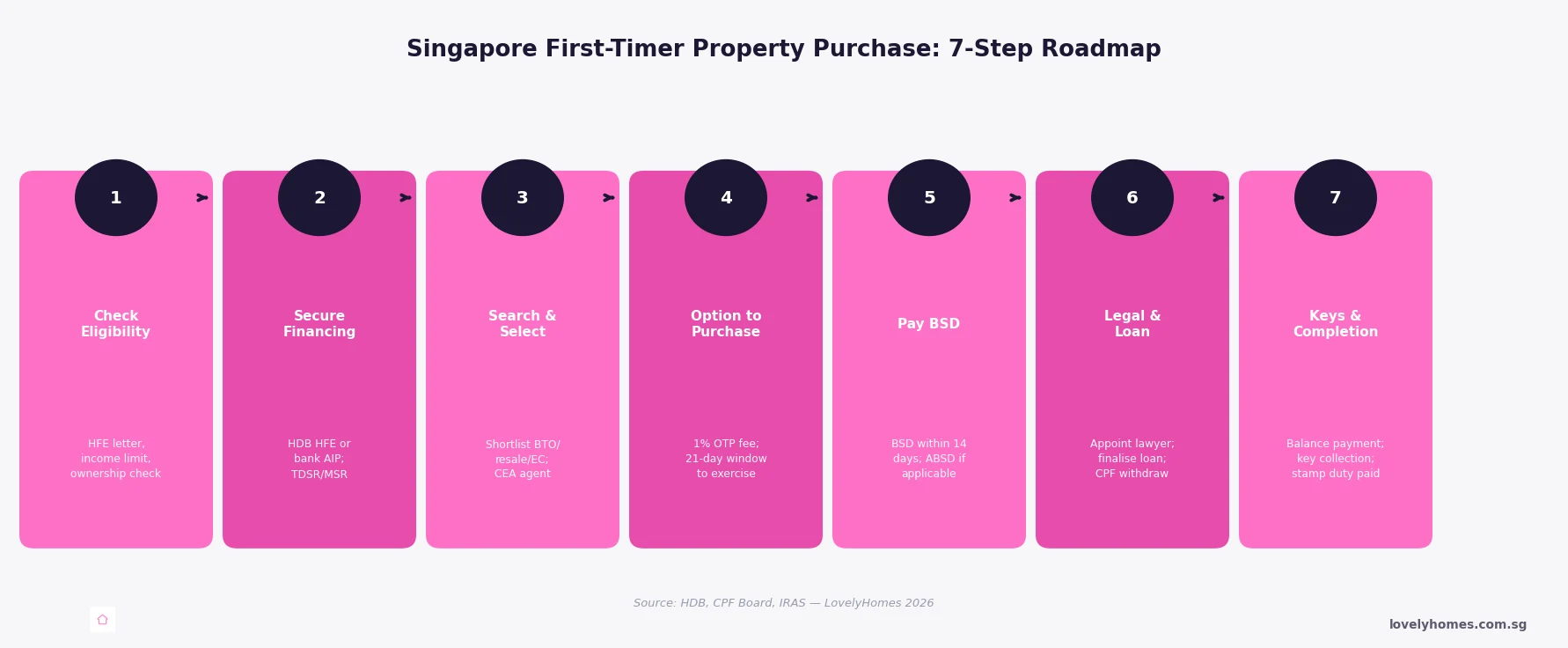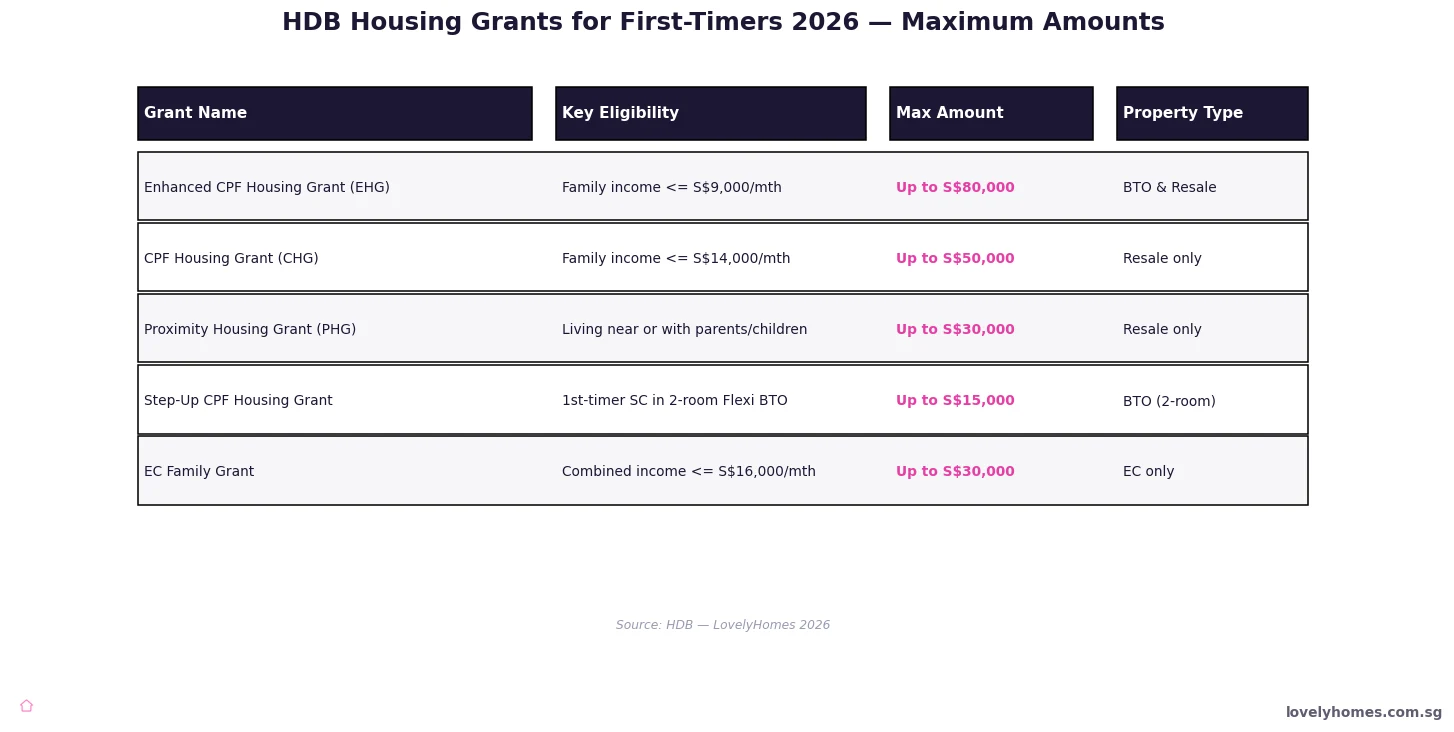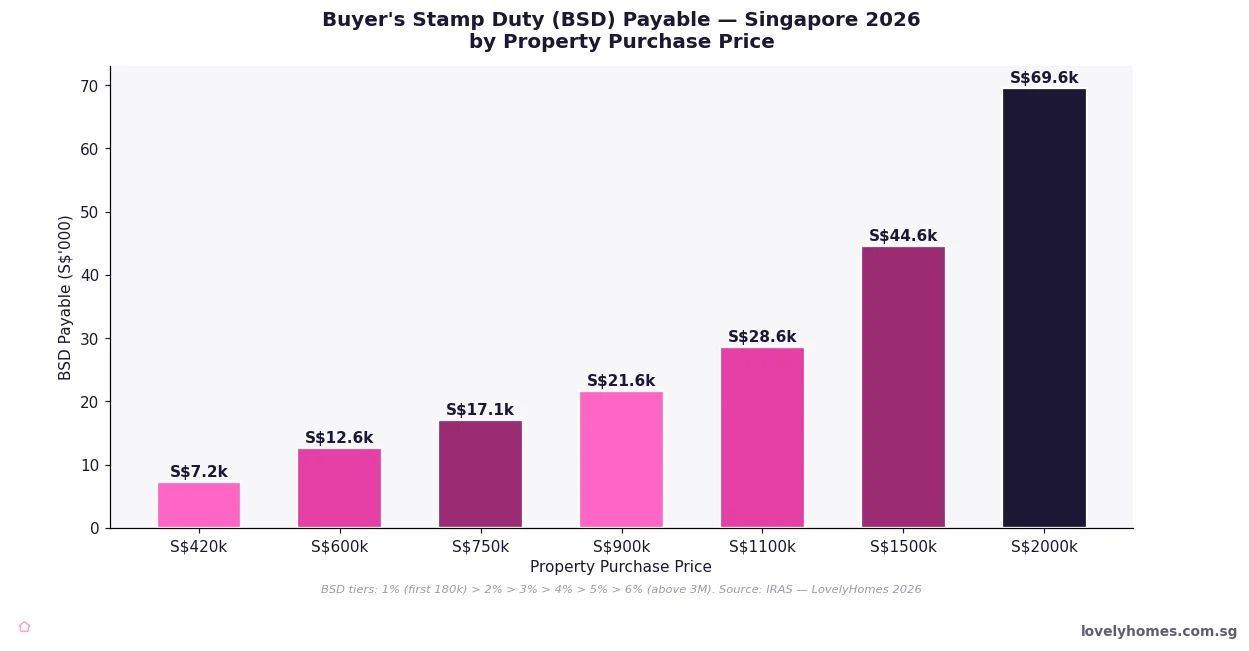
Ang Mo Kio Neighbourhood Guide Singapore 2026: Property Prices, MRT, Schools and Investment Outlook

Ang Mo Kio Neighbourhood Guide Singapore 2026: Property Prices, MRT, Schools and Investment Outlook

Quick Answer — Ang Mo Kio at a Glance (2026)

  • Location: Central-North Singapore; URA planning area “Ang Mo Kio”; part of District 20 corridor.
  • MRT: NSL stations — Ang Mo Kio (NS16), Yio Chu Kang (NS15), Marymount (NS18). Cross Island Line (CRL) Phase 2 station in AMK expected ~2030.
  • HDB resale prices (2026): 3-Room S$360k–S$500k · 4-Room S$600k–S$850k · 5-Room S$780k–S$1,050k. First million-dollar 4-room deal (S$1.11M) recorded at AMK Court in January 2026.
  • Private condo prices: 2-Bedroom S$1.1M–S$1.65M · 3-Bedroom S$1.5M–S$2.2M (limited supply, mostly 99-year leasehold).
  • Gross rental yield (2026 est.): HDB 4-Room ~4.0–4.4% · Condo 2BR ~3.2–3.5%.
  • Schools: Ai Tong Primary (SAP), CHIJ AMK Primary, Nanyang Junior College, Anderson Serangoon Junior College.
  • Healthcare: Khoo Teck Puat Hospital (762 beds), AMK Polyclinics (2 branches).
  • June 2026 BTO: HDB is launching two Plus-class projects in Ang Mo Kio as part of the June 2026 exercise — expect tighter resale restrictions (10-year MOP, subsidy clawback) on these units.

What Is Ang Mo Kio — and Why Does It Matter to Property Buyers?

Ang Mo Kio (AMK) is one of Singapore’s oldest and most established Housing & Development Board (HDB) new towns, planned by the HDB and URA in the 1970s and progressively built out through the 1980s. The name — loosely translated from Hokkien as “junction of the Ang Mo (European/Western) bridge” — hints at its colonial-era heritage. Today, AMK is a thriving, self-contained community of approximately 149,600 HDB residents spread across 12 subzones and roughly 48,915 flats.

For property buyers, AMK sits at an interesting intersection: it is close enough to the city (Ang Mo Kio MRT is approximately 20 minutes from Raffles Place by North–South Line) to command a pricing premium over more distant towns such as Woodlands or Jurong West, yet its predominantly HDB landscape keeps prices meaningfully below the Core Central Region (CCR). In the first quarter of 2026, four-room resale flats in AMK transacted at a median of S$720,000–S$750,000 — competitive with neighbouring Bishan and Toa Payoh, and well below the CCR’s equivalent private housing.

The URA’s master plan for AMK focuses on renewal: upgrading ageing commercial nodes, expanding park connectivity through the 62-hectare Bishan–Ang Mo Kio Park, and improving public transport with the forthcoming Cross Island Line (CRL) Phase 2 station, which will add a second rail line to the town by around 2030.

Ang Mo Kio Property Prices 2026 — HDB Resale and Private Market

AMK’s property market is dominated by HDB resale flats, which account for well over 95% of all transactions in the planning area. Private condominiums are relatively scarce, making the few available developments — such as The Panorama (698 units, 99-year leasehold, AMK Avenue 2) — significant benchmarks for the area.

Ang Mo Kio D20 property price ranges 2026 — HDB 3-room to condo 3BR
Figure 1: Ang Mo Kio property price ranges (2026 secondary market). Sources: HDB Resale Flat Prices dataset, URA Realis, industry transaction data.

HDB resale highlights (Q1 2026):

  • 3-Room flats: S$360,000–S$500,000. Common in older precincts such as AMK Avenue 3 and AMK Avenue 6. Compact at 60–69 sqm, these are popular with singles (age 35+), divorcees, and small families on tighter budgets.
  • 4-Room flats: S$600,000–S$850,000. The workhorse of AMK’s resale market. The first million-dollar 4-room deal in AMK Court was registered in January 2026 at S$1,110,000 — a landmark that signals premium-located units (high floor, near MRT) now breach seven figures even in non-CCR towns.
  • 5-Room and Executive Apartments (EA): S$780,000–S$1,150,000+. Larger families and upgraders seeking spacious HDB living without the private-condo price tag favour these units. EA layouts in AMK typically offer around 140–145 sqm.

Private condominium prices (2026): With very limited new supply, AMK condominiums trade on scarcity. The Panorama (TOP 2018, 698 units) remains the main 2BR benchmark at S$1.1M–S$1.55M; 3BR units range from S$1.5M to S$2.2M depending on floor level and facing. Gross rental yields on AMK condominiums are estimated at 3.2–3.5% for 2BR units — lower than equivalent HDB yields but supported by a steady tenant pool including Nanyang Junior College lecturers, hospital staff from Khoo Teck Puat Hospital, and corporate professionals working in the nearby Ang Mo Kio industrial estate.

The June 2026 BTO Launch and Its Implications

HDB’s June 2026 BTO exercise — the largest single launch of the year at approximately 6,900 flats across seven projects in five towns — includes two Plus-class projects in Ang Mo Kio. Under HDB’s classification framework (Prime, Plus, Standard), Plus flats carry tighter resale conditions: a 10-year Minimum Occupation Period (MOP), income ceiling of S$14,000/month for buyers, and a subsidy clawback upon resale. Buyers considering these BTO units should factor in that the longer MOP reduces near-term liquidity, and the clawback mechanism limits capital appreciation on the resale of Plus flats compared with Standard flats in the same town.

MRT Access and Transport Connectivity

AMK’s North–South Line (NSL) connectivity is its biggest transport asset. Three NSL stations serve the planning area:

  • Ang Mo Kio (NS16): The town’s primary interchange. Train travel time to Orchard is approximately 14 minutes; Raffles Place approximately 22 minutes. AMK MRT is directly integrated with AMK Hub shopping centre and the AMK bus interchange.
  • Yio Chu Kang (NS15): Serves the northern AMK precincts and the Yio Chu Kang Stadium area. Journey time to City Hall is approximately 25 minutes.
  • Marymount (NS18): Serves the southern AMK fringe bordering Bishan; useful for residents in AMK Avenue 1 and the Thomson area.

The upcoming Cross Island Line (CRL) Phase 2, currently under planning by the Land Transport Authority (LTA), is expected to include a station in the AMK planning area by approximately 2030. A second rail line would significantly improve east–west connectivity for AMK residents — currently, all NSL journeys into town require heading south before branching east or west.

Schools and Education

AMK has long been one of Singapore’s most sought-after school belts, anchored by several high-demand primary schools within the 1-km priority registration radius of key precincts:

  • Ai Tong School: Special Assistance Plan (SAP) primary school; one of the most oversubscribed schools in AMK, drawing buyers to precincts within 1 km of AMK Avenue 6.
  • CHIJ Ang Mo Kio Primary: All-girls school under the Singapore Catholic Mission; strong ballot demand in Phase 2B registration.
  • Pei Chun Public School: Bilingual SAP school near Marymount MRT.
  • Mayflower Primary School: Government school serving AMK’s northern subzones.
  • Anderson Serangoon Junior College (ASRJC): Formed in 2020 from the merger of Anderson JC and Serangoon JC; located on Upper Serangoon Road, approximately 2.5 km from AMK MRT.
  • Nanyang Junior College (NYJC): On Serangoon Avenue 3, near the AMK–Serangoon border; one of Singapore’s highest-performing JCs by A-Level results.
Ang Mo Kio amenities grid 2026 — MRT schools retail parks healthcare stats
Figure 2: Ang Mo Kio key amenities and infrastructure summary (2026). Sources: URA, LTA, MOH, HDB.

Amenities: Retail, Recreation and Healthcare

Retail: AMK Hub at the town centre is the neighbourhood’s retail anchor — a six-storey, 580,000 sq ft mall directly connected to AMK MRT. It houses over 200 tenants spanning food, fashion, electronics, and family services. Junction 8 in Bishan (approximately 700 m from the AMK border) provides additional retail depth for residents in southern AMK precincts near Marymount MRT.

Recreation: The 62-hectare Bishan–Ang Mo Kio Park is Singapore’s largest urban park and one of the country’s best examples of biophilic urban design — the Kallang River was naturalised in 2012 to run through the park, creating a rain garden ecosystem. It is a favourite for cycling, jogging, kayaking, and weekend picnics. Thomson Nature Park and the Lower Peirce Reservoir Park add further green buffer to AMK’s northern fringe.

Healthcare: Khoo Teck Puat Hospital (KTPH), a 762-bed acute-care hospital administered by the National Healthcare Group (NHG), is located approximately 700 m from AMK MRT. Two Ang Mo Kio Polyclinics (AMK Ave 10 and AMK Ave 9) serve primary care needs. Residents requiring specialist care can access Tan Tock Seng Hospital (TTSH) in Novena, approximately 20 minutes by NSL.

Investment Analysis — Why Ang Mo Kio Holds Its Value

AMK’s investment case rests on four structural pillars:

  1. Scarcity of private supply: Unlike Tampines, Bedok, or Woodlands — which have significant private condo pipelines — AMK has no meaningful new private residential launch since The Panorama in 2014. Scarcity supports secondary-market pricing.
  2. Transport upgrade optionality: The CRL Phase 2 station represents a structural re-rating catalyst. Investors tracking Singapore’s MRT pipeline history will note that the opening of TEL stations in Marine Parade and Marine Terrace (June 2023) triggered a 12–18% uplift in nearby transaction prices within 12 months. An equivalent re-rating in AMK is plausible upon CRL opening.
  3. School belt premium: Properties within 1 km of Ai Tong School consistently command a 6–10% price premium over equivalent flats in the same precinct but outside the priority radius — a durable premium driven by annual demand from parents in the Phase 2B registration priority window.
  4. Rental demand: AMK’s employment node (AMK Industrial Park and the Ang Mo Kio Avenue 10 light industrial precinct) sustains a tenant base of technicians, healthcare professionals, and small-business owners who prefer proximity to their workplace. KTPH’s ~4,000 staff represent a structural rental demand pool.
Ang Mo Kio gross rental yield vs 3-year capital growth by property type 2026
Figure 3: Ang Mo Kio — Gross Rental Yield vs 3-Year Capital Growth by property type (Q1 2024–Q1 2026 estimates). Sources: HDB, URA Realis, industry estimates.

Ang Mo Kio Property Price Summary Table

Property Type Est. Price Range (2026) Typical Size Gross Yield (est.) Tenure
HDB 3-Room S$360k – S$500k 60–69 sqm ~4.2–4.6% 99-yr lease (HDB)
HDB 4-Room S$600k – S$850k 90–105 sqm ~4.0–4.4% 99-yr lease (HDB)
HDB 5-Room / EA S$780k – S$1,150k 110–145 sqm ~3.6–4.0% 99-yr lease (HDB)
Condo 2BR (D20) S$1.1M – S$1.65M 65–90 sqm ~3.2–3.5% 99-yr leasehold
Condo 3BR (D20) S$1.5M – S$2.2M 90–120 sqm ~2.8–3.2% 99-yr leasehold

Table 1: AMK property price summary. Prices are estimated secondary-market ranges for Q1–Q2 2026. Yields are gross estimates based on advertised rental data and HDB/URA transaction records. Not a valuation or financial advice.

Worked Example — Upgrading to AMK: Mr & Mrs Lim

Profile: Mr & Mrs Lim, Singapore Citizens, joint gross income S$10,500/month. Selling their Toa Payoh 4-room HDB flat (Minimum Occupation Period cleared). Moving to a larger 4-room HDB flat in Ang Mo Kio to be closer to parents (qualifying for the Proximity Housing Grant).

  • Purchase price: AMK 4-room resale HDB at S$728,000
  • Proximity Housing Grant (PHG): S$30,000 (parents/in-laws living within 4 km of proposed purchase, applicable to SC second-timers buying within 30 km of family)
  • Buyer’s Stamp Duty (BSD): First S$180k × 1% = S$1,800 + next S$180k × 2% = S$3,600 + remaining S$368k × 3% = S$11,040 → Total BSD: S$16,440
  • Additional Buyer’s Stamp Duty (ABSD): Nil — sell-first approach: Toa Payoh flat sold and transferred before exercising AMK OTP. At point of purchase, property count = 0 for SCs. (See our ABSD complete guide for remission options.)
  • HDB loan quantum (80% LTV): S$582,400 at 2.6% p.a. (CPF OA rate + 0.1%) over 25 years = approx. S$2,638/month
  • Mortgage Servicing Ratio (MSR) check: S$2,638 ÷ S$10,500 = 25.1% — PASS (MSR ceiling 30%, administered by MAS)
  • Upfront CPF/cash outlay: 20% downpayment S$145,600 − PHG S$30,000 = S$115,600 from CPF OA + BSD S$16,440 payable from CPF OA + legal/admin ~S$3,250 = approx. S$135,290 total (largely from CPF OA savings; zero min-cash requirement under an HDB loan)

Outcome: The Lims comfortably qualify on MSR. The sell-first approach eliminates ABSD entirely. The PHG grant reduces their effective CPF draw by S$30,000 at the point of downpayment. On a joint income of S$10,500/month, the monthly repayment of S$2,638 (25.1% MSR) leaves meaningful household cash flow for living expenses and savings. For CPF withdrawal limit rules, see our CPF property withdrawal limits guide.

Why Ang Mo Kio Matters — and What Comes Next

AMK occupies a strategic position in Singapore’s property hierarchy: it offers the school-belt credentials of Bishan and Toa Payoh at a modest discount, the healthcare infrastructure of a regional hub, and the CRL optionality of a town that investors have not yet fully priced in. For owner-occupiers — particularly HDB upgraders with school-age children — AMK’s combination of established amenities, transport access, and community facilities makes it one of the more defensible choices in Singapore’s non-CCR market.

Looking ahead to 2026–2030, three catalysts could reshape AMK’s property landscape: (1) the finalisation of CRL Phase 2 station details and tender award, which would crystallise the re-rating thesis; (2) the wave of maturing Plus-class BTO units from the June 2026 exercise becoming resaleable after 2036 — reshaping the supply composition of AMK’s resale market; and (3) possible Urban Redevelopment Authority master plan revisions under the forthcoming Long-Term Plan Review, which could unlock higher plot ratios in AMK’s town centre precinct.

None of these are certainties. Buyers should weigh AMK’s established fundamentals against the fact that the town has fewer “upside surprises” than less-developed areas such as Tengah or Bayshore — the infrastructure is largely in place, which means less speculative upside but also lower execution risk.

Frequently Asked Questions — Ang Mo Kio Property 2026

Is Ang Mo Kio a good place to buy property in 2026?

AMK is well-regarded for its school belt (Ai Tong, CHIJ AMK, Nanyang JC), mature HDB infrastructure, and proximity to Khoo Teck Puat Hospital. It is competitively priced relative to Bishan and Toa Payoh yet significantly cheaper than CCR neighbourhoods such as Orchard or Newton. The upcoming CRL Phase 2 station adds long-term transport upside. For buyers prioritising liveability, school proximity, and healthcare access, AMK scores highly. However, private condo supply is very limited, restricting choice for buyers who require private residential options.

Which MRT lines serve Ang Mo Kio?

AMK is served by three stations on the North–South Line (NSL): Ang Mo Kio (NS16), Yio Chu Kang (NS15), and Marymount (NS18). There is no current East–West or Downtown Line access within the planning area. The Cross Island Line (CRL) Phase 2 is expected to add at least one station in the AMK corridor, improving east–west connectivity, but construction is not expected to complete until approximately 2030.

Can a Singapore Permanent Resident (PR) or foreigner buy property in AMK?

HDB resale flats in AMK — like all HDB flats — are available to eligible Singapore PRs (subject to HDB’s ethnic integration policy, income ceilings, and the PR scheme eligibility rules under the Public Scheme or Fiancé/Fiancée Scheme). PRs buying an HDB flat must occupy it as their principal residence and are subject to a 5-year resale levy deferral rule under certain conditions. Foreigners (non-PR, non-SC) cannot purchase HDB flats at all, but may purchase private condominiums in AMK subject to the Additional Buyer’s Stamp Duty (ABSD) of 60% as of April 2023. See our ABSD guide for the full rate table.

What are the best condominiums in Ang Mo Kio?

AMK has very limited private condominium supply. The most prominent completed development is The Panorama (698 units, 99-year leasehold, TOP 2018, AMK Avenue 2), which is the dominant price benchmark for 2- and 3-bedroom private units in the planning area. Grandeur 8 (99yr, earlier vintage) and Thomson Three (on the AMK–Thomson border) are secondary benchmarks. Given the scarcity of supply, buyers considering AMK condominiums should also compare nearby Bishan options — such as Sky Vista — which offer similar school-belt access with slightly different MRT coverage.

How does AMK compare to Bishan or Toa Payoh for property investment?

All three are mature NSL towns with strong school belts and established amenities. AMK typically offers slightly lower pricing than Bishan (which benefits from the Junction 8/Bishan MRT dual interchange) and is broadly comparable to Toa Payoh. Bishan commands a premium due to its CCR-adjacent positioning and the Thomson–East Coast Line (TEL) overlay at Caldecott (one stop from Bishan). Toa Payoh has a tighter new HDB supply pipeline but older flat leases. AMK’s differentiator is its forthcoming CRL re-rating potential and the Ai Tong/CHIJ school belt. For most buyers, the choice hinges on specific school requirements and whether proximity to Junction 8 or AMK Hub better suits daily life.

What is the impact of the June 2026 BTO Plus-class projects on AMK’s resale market?

Plus-class BTO flats are subject to a 10-year Minimum Occupation Period (double the standard 5 years), an income ceiling of S$14,000/month for buyers on the resale market, and a subsidy clawback upon resale that reduces the seller’s net proceeds. These restrictions mean that Plus flats will transact at a discount to Standard resale flats in the same town once they become eligible for resale — effectively creating a two-tier resale market within AMK by the mid-2030s. Buyers of existing Standard-class AMK resale flats are unlikely to be directly affected; if anything, restricted supply of Plus flats on the resale market may support pricing on the unrestricted Standard inventory.

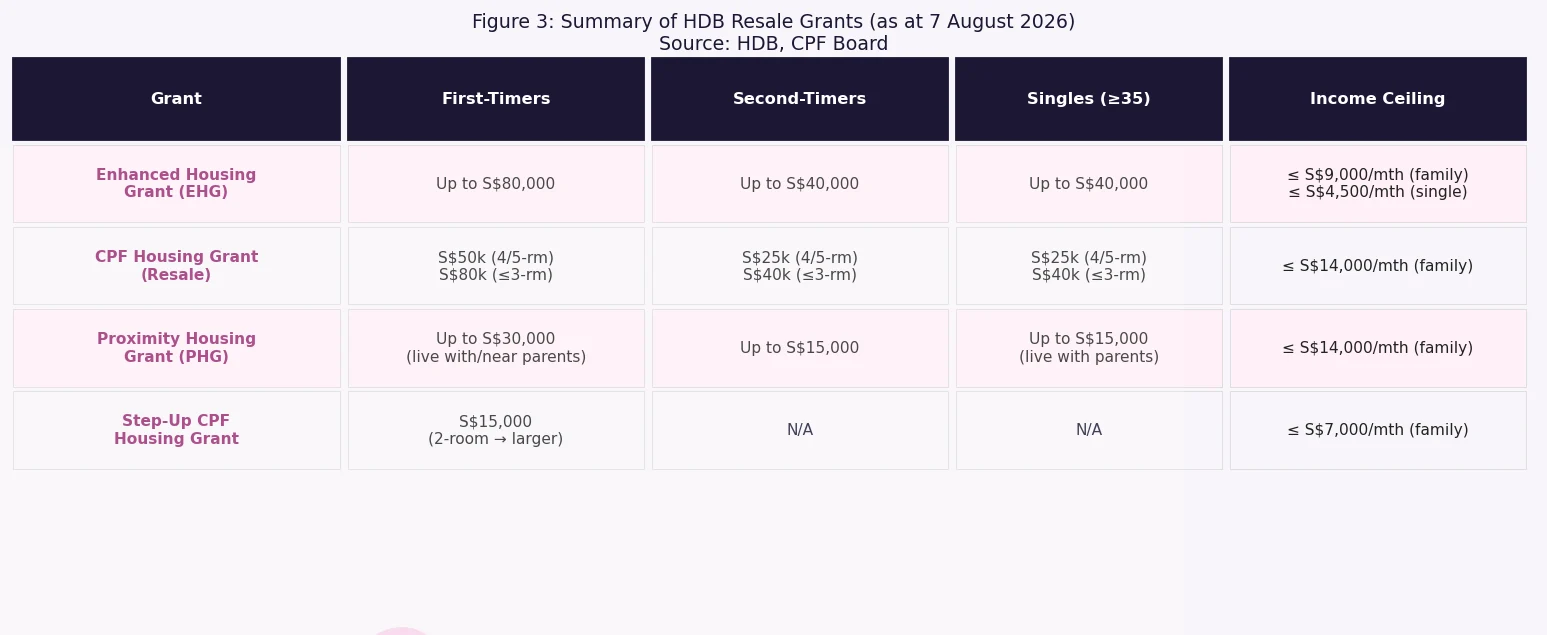
What grants are available when buying an AMK HDB resale flat?

Eligible Singapore Citizen buyers purchasing HDB resale flats in AMK can access the Enhanced Housing Grant (EHG) of up to S$120,000 (families) or S$60,000 (singles), subject to income ceilings and a first-timer eligibility requirement. The Proximity Housing Grant (PHG) provides up to S$30,000 for families (S$15,000 for singles) who buy within 4 km of parents or children. The Step-Up CPF Housing Grant of S$15,000 is available to eligible second-timer families purchasing 2- or 3-room resale flats. See our CPF Housing Grant guide for full eligibility conditions and stacking rules.

Related Articles

Disclaimer

This article is produced by LovelyHomes for general informational and educational purposes only. Property prices, rental yields, grant amounts, and stamp duty rates are subject to change; figures cited reflect publicly available data as of Q1–Q2 2026 and are estimates only. This article does not constitute financial, legal, or property valuation advice. Readers should verify current rates and eligibility conditions directly with the relevant authorities: Housing & Development Board (HDB) at hdb.gov.sg, Urban Redevelopment Authority (URA) at ura.gov.sg, Inland Revenue Authority of Singapore (IRAS) at iras.gov.sg, and Central Provident Fund Board (CPF) at cpf.gov.sg. Engage a licensed property agent and, where appropriate, a lawyer and financial adviser before making any property decision.

HDB June 2026 BTO Launch: 6,900 Flats Across 5 Towns — Complete Buyer’s Guide

HDB June 2026 BTO Launch: 6,900 Flats Across 5 Towns — Complete Buyer’s Guide

Quick Answer

  • The June 2026 BTO exercise will offer approximately 6,900 flats across 7 projects in 5 towns: Ang Mo Kio, Bishan, Bukit Merah, Sembawang, and Woodlands. The application window opens in the second week of June 2026.
  • Nearly half the supply (approximately 3,250 units, or 47%) is classified as Prime — concentrated in Bishan (Lakeview Crescent) and Bukit Merah (Berlayar). Prime flats carry a 10-year MOP, SC-only resale, and a subsidy clawback on first resale.
  • Bishan — Lakeview Crescent is the headline project: the first new HDB development in Bishan in over 40 years, near Marymount MRT. Indicative 4-room prices are approximately S$820k before grants. Classified as Prime.
  • Berlayar (Bukit Merah) offers 1,960 units on the former Keppel Club site. Indicative 4-room: approximately S$710k. Classified as Prime.
  • Sembawang North offers the largest Standard supply (~2,000 units) at the most affordable prices — indicative 4-room from approximately S$350k before grants, with full EHG eligibility.
  • First-timer SC households earning up to S$9,000/month qualify for the Enhanced Housing Grant (EHG) of up to S$120,000 on Standard and Plus flats.
  • Ballot results are expected approximately 3 weeks after the application window closes, with flat selection appointments typically following 1–2 months later.

Overview: What Is on Offer in June 2026

The June 2026 BTO exercise is the second of three sales exercises HDB has planned for 2026, following the February 2026 exercise (4,692 flats) and ahead of the October 2026 exercise. At approximately 6,900 flats, it is the largest of the three 2026 tranches and includes some of the most sought-after locations in years — particularly the Bishan and Bukit Merah (Berlayar) projects.

HDB will launch the exercise on its HDB Flat Portal in the second week of June 2026. Potential buyers should prepare eligibility documents — including income declaration and citizenship verification — in advance, as these must be on file before a successful application can proceed to booking.

June 2026 HDB BTO projects unit supply and indicative pricing chart Singapore
Figure 1: June 2026 BTO — Unit Supply by Project and Indicative Pricing | Source: HDB, industry estimates. Before grants.

Project-by-Project Analysis

Bishan — Lakeview Crescent (~1,210 units, Prime): This is the standout project of the exercise and arguably the most significant HDB launch in years. Bishan last received new BTO flats in 1984 — a gap of over 40 years. Lakeview Crescent sits near Marymount MRT (Circle Line) adjacent to the vast Bishan-Ang Mo Kio Park. CCL connectivity is excellent: Marymount to Dhoby Ghaut interchange in three stops, to Marina Bay in approximately seven. Blue-chip schools in the catchment include Catholic High School and St Gabriel’s Primary. Being classified Prime, it carries a 10-year MOP, income ceiling on resale, SC-only resale pool, and a subsidy clawback. Indicative 4-room: approximately S$820k before grants (EHG not available for Prime).

Bukit Merah — Berlayar (~1,960 units, Prime): Located on the former Keppel Club site off Telok Blangah Road, adjacent to the Southern Ridges nature corridor. Nearest MRT: Labrador Park or Telok Blangah (CCL). Unit mix is heavy on 4-room (~980) and 2-room Flexi (~810). Classified Prime: 10-year MOP, SC-only resale. Indicative 4-room: S$695k–S$730k. Strong lifestyle appeal for those who value the Southern Ridges and Harbourfront precinct.

Ang Mo Kio — Mayflower Rise (~1,050 units, Standard/Plus): Two projects near Mayflower MRT (Thomson-East Coast Line). Project 1 (480 units, Plus) near CHIJ St Nicholas Girls’: 3-room and 4-room at ~S$440k. Project 2 (570 units, Standard) near Bishan-AMK Park: 2-room Flexi and 4-room at ~S$430k. TEL provides direct access to Orchard Road and Marina Bay without interchange. EHG eligible for Standard project.

Sembawang North (~2,000 units, Standard): Largest town supply, most affordable pricing. Two projects near Canberra and Sembawang MRT (NSL). Indicative 4-room: S$350k–S$370k before EHG. Full EHG eligibility for qualifying households. Site A includes eating house, minimart, preschool, Residents’ Network Centre.

Woodlands — Woodgrove Avenue (~640 units, Standard): Moderate supply near Marsiling/Woodlands MRT (NSL). Indicative 4-room: ~S$375k before grants. Woodlands Regional Centre is undergoing long-term transformation as a northern business hub.

June 2026 BTO classification mix Prime Standard Plus and 4-room price ranges by town
Figure 2: June 2026 BTO Classification Mix and Indicative 4-Room Pricing (Before Grants) | Source: HDB, industry estimates

Classification Mix and Ballot Strategy

The June 2026 exercise is polarised: 47% Prime (Bishan + Berlayar), 48% Standard (Sembawang + Woodlands + AMK Project 2), and just 5% Plus (AMK Project 1). Buyers who need to sell or upgrade within five to eight years should avoid Prime flats — the 10-year MOP is a genuine life commitment and the subsidy clawback at resale partially offsets the apparent price advantage.

For Standard and Plus flats, first-timer SC applicants receive 95% of ballot queue allocations. Demand for Standard flats in Sembawang and Woodlands is historically more moderate than for central locations, improving odds for applicants who are flexible on location.

Summary Table: June 2026 BTO at a Glance

Town / Project Units Class MOP Indicative 4-Rm Nearest MRT
AMK Mayflower Rise 1 480 Plus 10 yr ~S$440k Mayflower (TEL)
AMK Mayflower Rise 2 570 Standard 5 yr ~S$430k Mayflower (TEL)
Bishan Lakeview Crescent 1,210 Prime 10 yr ~S$820k Marymount (CCL)
Bukit Merah Berlayar 1,960 Prime 10 yr ~S$710k Labrador Pk (CCL)
Sembawang North A 1,130 Standard 5 yr ~S$360k Canberra (NSL)
Sembawang North B 870 Standard 5 yr ~S$360k Canberra (NSL)
Woodlands Woodgrove Ave 640 Standard 5 yr ~S$375k Marsiling (NSL)
Total ~6,860 47% Prime · 48% Standard · 5% Plus

Worked Example: The Lim Couple Comparing Sembawang vs Bishan

Mr and Mrs Lim are both Singapore Citizens aged 30, applying as first-timers for the June 2026 BTO. Combined household income: S$7,000/month. They are comparing a Sembawang North Standard 4-room at S$360,000 versus a Bishan Lakeview Prime 4-room at S$820,000.

Item Sembawang Standard Bishan Prime
Selling price (indicative) S$360,000 S$820,000
EHG (income S$7,000/mth) – S$20,000 Not eligible (Prime)
Net price after EHG S$340,000 S$820,000
CPF OA downpayment (20%) S$68,000 S$164,000
HDB loan (80%, 25-yr, 2.60%) S$272,000 S$656,000
Monthly instalment (HDB loan) ~S$1,230 ~S$2,966
MSR check (30% of S$7,000) PASS (S$2,100 limit) FAIL (exceeds S$2,100)
MOP duration 5 years 10 years
Earliest eligible to sell ~2031 ~2036
Resale eligibility after MOP SC/SPR buyers SC only (income ceiling)

The MSR check reveals an important constraint: the Lim couple on S$7,000/month can borrow at most 30% × S$7,000 = S$2,100/month via an HDB loan. On the Bishan Prime flat, the required monthly instalment of ~S$2,966 exceeds this limit — meaning an HDB loan is insufficient and a bank loan would be required (subject to TDSR and prevailing rates). On the Sembawang Standard flat, the monthly instalment of ~S$1,230 easily clears the MSR, leaving S$870/month in MSR headroom for other debts. For a first-timer couple with moderate income, the Sembawang Standard flat is clearly the financially sound choice.

What Happens After You Apply

The BTO application process follows HDB’s standard sequence: applicants submit via the HDB Flat Portal within the application window (second week of June 2026, approximately one week long) and pay a S$10 application fee. Ballot results are typically released 3 weeks after the window closes. First-timers receive 95% of ballot queue allocation. Applicants with a queue number are called for flat selection in order — upon selecting a unit, a booking fee of approximately S$2,000 is payable. Key collection for June 2026 flats is estimated in the 2029–2030 range, depending on project and contractor progress.

Related Articles

Frequently Asked Questions

When does the June 2026 BTO application window open?

The application window is expected to open in the second week of June 2026 for approximately one week. HDB will announce the exact dates on the HDB Flat Portal (homes.hdb.gov.sg). There is no advantage to applying on the first day — all applications within the window are treated equally in the computer ballot. Prepare eligibility documents (income declaration, citizenship, prior HDB ownership history) before the window opens to avoid delays.

Is the Bishan Lakeview Prime flat worth the premium?

For a SC couple in their late 20s to early 30s with stable employment and no plans to move for at least 10 years, Bishan Lakeview at approximately S$820k is excellent value relative to nearby private condo prices of S$1.8M–S$2.5M. The Circle Line connectivity and park access are genuine quality-of-life advantages. The 10-year MOP is the key constraint — if there is any chance of needing to upgrade, downsize, or relocate internationally within a decade, a Standard flat is the more prudent choice. Buyers should also confirm they can satisfy the Mortgage Servicing Ratio (30% of income cap) at the Bishan price point before applying.

Can SC-SPR couples apply for the June 2026 BTO?

Yes. An SC-SPR household is eligible to apply for HDB BTO flats as a family nucleus. For Plus and Prime flats, the SC member’s status governs the resale conditions — the SPR spouse co-owns but the SC-only resale restriction (Prime) or income ceiling (Plus/Prime) applies when the flat is later sold. Both spouses’ incomes are counted for grant eligibility and MSR purposes.

Can I apply for two June 2026 BTO projects?

No. Each household may submit only one BTO application per exercise. If unsuccessful or if no suitable unit remains in the ballot, you receive enhanced priority (deferred applicant status) in the next exercise.

Are Prime flats eligible for the EHG grant?

No. Enhanced Housing Grant (EHG) is not available for Prime BTO flats. The EHG is designed to make Standard and Plus housing affordable for middle-income first-timers; Prime flats already carry a significant built-in subsidy through their pricing. The Proximity Housing Grant (PHG) — which gives S$20k–S$30k for buying near parents — is available for Prime flats. Verify the latest grant conditions directly with HDB at the time of application.

Disclaimer: This article is for general information only. All pricing is indicative and based on publicly available industry estimates as at 16 May 2026; actual selling prices will be released by HDB at the time of launch. Grant eligibility and amounts are subject to HDB review and may change. Always verify the latest requirements at hdb.gov.sg before making housing decisions. Monthly instalment figures are illustrative only.

Foreigners Buying Property in Singapore 2026: ABSD, Eligibility and the Full Cost Guide

Foreigners Buying Property in Singapore 2026: ABSD, Eligibility and the Full Cost Guide

Quick Answer

  • Foreigners (non-PR, non-SC) may purchase private residential property — condominiums, apartments, strata-titled units — in Singapore without restriction, subject to a 60% Additional Buyer’s Stamp Duty (ABSD) payable to IRAS.
  • Foreigners cannot buy HDB flats (resale or BTO) and cannot buy landed residential property (houses, semi-detached, bungalows) without prior approval from the Singapore Land Authority (SLA), which is rarely granted.
  • Executive Condominiums (ECs) become available to foreigners only after privatisation. For ECs from GLS sites tendered from 8 May 2026 onwards, privatisation occurs at 15 years from TOP; earlier ECs remain at 10 years.
  • The 60% ABSD applies to the entire purchase price and must be paid within 14 days of exercising the Option to Purchase (OTP).
  • Buyer’s Stamp Duty (BSD) is payable by all buyers regardless of nationality. On a S$2.5M purchase, BSD is approximately S$94,600.
  • Foreigners can obtain a mortgage from Singapore-licensed banks. LTV limit is 75% for a first property loan with no existing housing loans, subject to Total Debt Servicing Ratio (TDSR) of 55%.
  • Commercial and industrial property carries no ABSD — foreigners may purchase shophouses, office units, factories, and warehouses without the 60% surcharge.
  • Nationals of the USA, Iceland, Liechtenstein, Norway, and Switzerland are exempt from ABSD on their first residential purchase under Free Trade Agreement commitments.

What Is the ABSD and Who Administers It?

The Additional Buyer’s Stamp Duty (ABSD) is a surcharge levied by the Inland Revenue Authority of Singapore (IRAS) on the purchase or acquisition of residential property in Singapore, on top of the standard Buyer’s Stamp Duty (BSD). Introduced in December 2011 as a demand-side cooling measure, the ABSD has been adjusted multiple times. The most significant recent change for foreigners was on 27 April 2023, when the rate was doubled from 30% to 60%.

The policy objective is explicit: ABSD prioritises home ownership for Singaporeans and ensures that property remains affordable for residents. Non-resident buyers must bear a substantial additional cost — and this is intentional. Singapore’s Ministry of National Development has consistently maintained that residential property is primarily for citizens, and the 60% rate is designed to reflect that priority firmly.

Singapore property eligibility by buyer type 2026 — foreigners PRs and citizens comparison table
Figure 1: Property Eligibility by Buyer Type — Singapore 2026 | Source: HDB, URA, SLA, IRAS

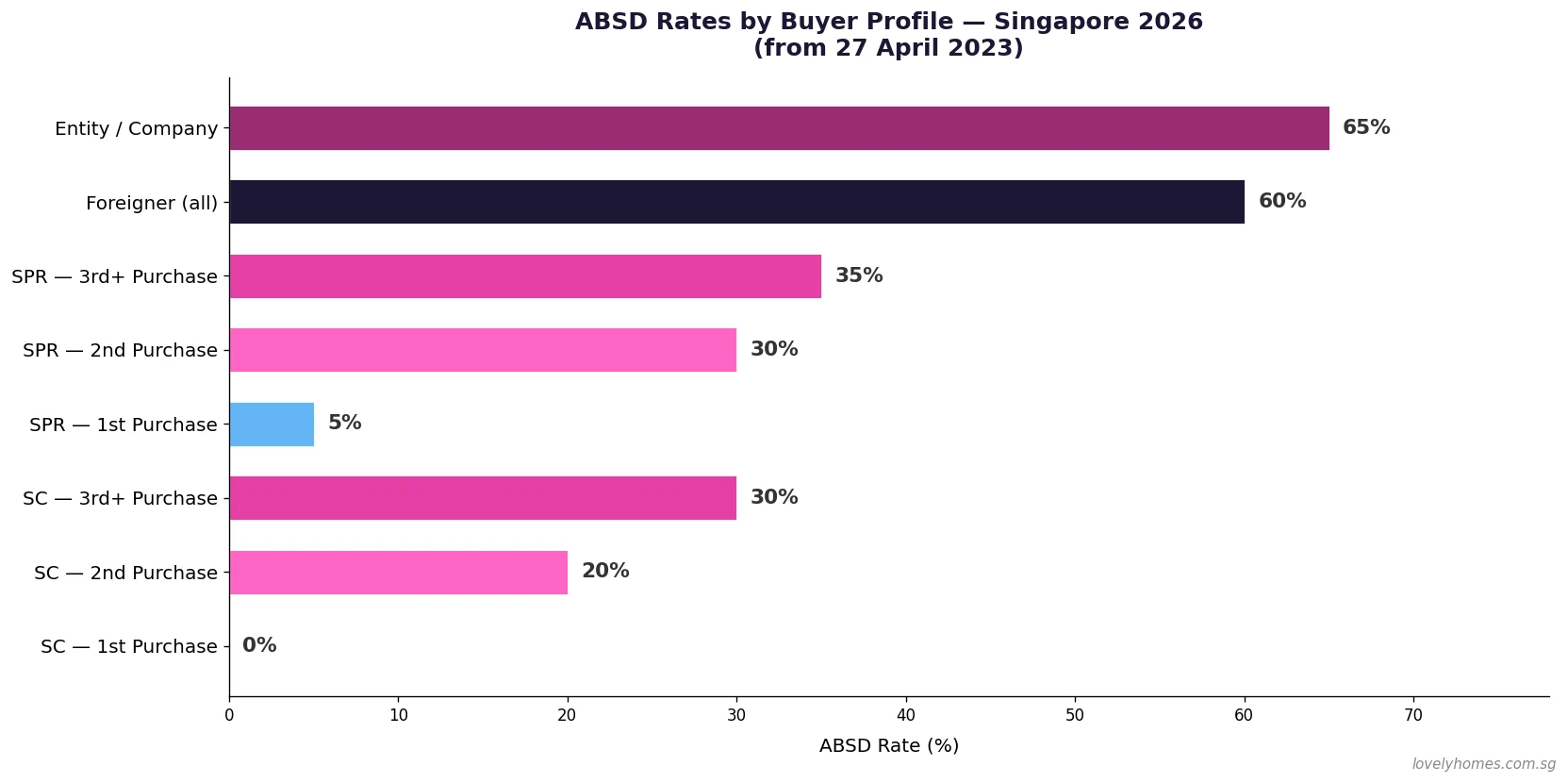
ABSD Rates by Buyer Profile (Effective 27 April 2023)

ABSD is charged on the higher of the purchase price or the property’s market value. The table below shows the current rates, administered by IRAS, for residential property in Singapore:

Buyer Profile 1st Property 2nd Property 3rd+ Property
Singapore Citizen 0% 20% 30%
Singapore Permanent Resident (PR) 5% 30% 35%
Foreigner (non-PR, non-SC) 60% — flat rate, regardless of how many properties held in Singapore
Corporate entity / trust 65% — flat rate on residential property

Source: IRAS, effective 27 April 2023. FTA exemptions apply for nationals of the USA, Switzerland, Iceland, Liechtenstein, and Norway.

ABSD rates by buyer profile Singapore 2026 — foreigners pay 60% on all residential property
Figure 2: ABSD Rates by Buyer Profile — Singapore 2026 | Source: IRAS, effective 27 April 2023

Free Trade Agreement (FTA) Exemptions

Under Singapore’s FTA commitments, nationals of the USA, Iceland, Liechtenstein, Norway, and Switzerland are treated on par with Singapore Citizens for ABSD on their first residential property purchase. This means a US national buying their first Singapore condo pays 0% ABSD. On second and subsequent purchases, the SC schedule applies. The exemption is for individuals only; US-incorporated companies do not benefit. IRAS requires passport proof of nationality when claiming the FTA exemption.

What Foreigners Can Buy — and Cannot Buy

Permitted (60% ABSD where residential): Private condominiums, private apartments, strata-titled units, SOHO units with residential classification. ECs after privatisation (15 years from TOP for new GLS-launched ECs from 8 May 2026; 10 years for earlier ECs). Sentosa Cove landed property. Commercial shophouses, strata office units, retail units, industrial factories, warehouses — all without residential ABSD.

Not permitted without special approval: Landed residential property outside Sentosa Cove (houses, semi-detached, bungalows, terraced houses). The SLA may grant approval under the Residential Property Act in exceptional circumstances, but approvals are rare.

Strictly prohibited: HDB flats (both new BTO and resale). HDB housing is reserved for Singapore citizens and permanent residents under the Housing and Development Act. ECs during their MOP and privatisation period are also off-limits to foreigners.

Buyer’s Stamp Duty (BSD) — Payable by Everyone

BSD is levied by IRAS on every property purchase in Singapore, regardless of nationality. For residential property, the tiered rates are: 1% on the first S$180,000; 2% on the next S$180,000; 3% on the next S$640,000; 4% on the next S$500,000; 5% on the next S$1,500,000; and 6% on amounts above S$3,000,000. On a S$2.5M purchase, total BSD = S$94,600.

Purchase Price Tier BSD Rate BSD on This Tier
First S$180,000 1% S$1,800
Next S$180,000 (up to S$360,000) 2% S$3,600
Next S$640,000 (up to S$1,000,000) 3% S$19,200
Next S$500,000 (up to S$1,500,000) 4% S$20,000
Next S$1,500,000 (up to S$3,000,000) 5% Up to S$75,000
Remainder above S$3,000,000 6% Variable

Sellers’ Stamp Duty (SSD) — The Anti-Flip Tax

SSD is administered by IRAS and applies to all sellers who dispose of residential property within three years of purchase, regardless of nationality. The rates are: 12% within 1 year; 8% within 2 years; 4% within 3 years; nil thereafter. For a foreigner who has paid 60% ABSD, an SSD liability on a short-term resale would be a severe additional burden. Foreign buyers must plan for a meaningful long-term holding horizon.

Holding Period SSD Rate
Up to 1 year 12%
1 to 2 years 8%
2 to 3 years 4%
More than 3 years Nil

Financing — LTV, TDSR, and Mortgage Options

Foreigners may borrow from Singapore-licensed banks subject to MAS macro-prudential rules identical to those applied to residents. The LTV limit is 75% for a first property loan with no existing housing loans (reducing to 55% for a second and 35% for a third). The TDSR cap is 55% of gross monthly income. Loan tenors run up to 35 years, typically reduced by age exceeding 65. Most major Singapore banks lend to foreigners — DBS, OCBC, UOB, Standard Chartered, and HSBC all do so, subject to enhanced documentation requirements including overseas income proof and a valid work pass or Long-Term Visit Pass.

The Buying Process — Step by Step

  1. Arrange in-principle approval: Approach at least two Singapore banks before making offers. Allow 5–10 working days.
  2. Engage a CEA-licensed agent: For new launches, no buyer commission is payable; for resale, co-broking arrangements vary.
  3. Option to Purchase (OTP): On resale, the seller grants an OTP valid for 21 days; a 1% option fee is paid. For new launches, a 5% booking fee is paid directly to the developer.
  4. Pay BSD and ABSD: Both due within 14 days of OTP exercise. On a S$2.5M purchase, this means wiring S$94,600 (BSD) + S$1,500,000 (ABSD) to IRAS — a total of S$1,594,600 within a fortnight of signing.
  5. Engage a conveyancing solicitor: A Singapore-qualified solicitor handles title searches, mortgage documentation, and lodgement with SLA’s eConveyancing portal.
  6. Completion: For resale, typically 8–12 weeks. For new launches, completion occurs at TOP/CSC, which may be 3–5 years away.

Worked Example: Mr David Harrington Buys a S$2.5M CCR Condo

Mr David Harrington, 42, is a British national on an Employment Pass earning S$25,000/month gross. He purchases a two-bedroom unit in District 9 at S$2,500,000, with no existing property loans in Singapore.

Total upfront cash required for foreigner buying SGD 2.5M condo Singapore 2026 cost breakdown
Figure 3: Total Upfront Cash Required — Foreigner Buying SGD 2.5M CCR Condo (2026)
Cost Item Amount (SGD) Notes
25% downpayment (cash) 625,000 75% LTV → loan of S$1,875,000
Buyer’s Stamp Duty (BSD) 94,600 IRAS; payable within 14 days of OTP
ABSD (60% x S$2,500,000) 1,500,000 IRAS; payable within 14 days of OTP
Stamp duty on mortgage (0.4% x loan) 7,500 On S$1,875,000 loan amount
Legal / conveyancing fees (est.) 3,500 Singapore-licensed solicitor
Valuation fee (est.) 600 Required by lender
Total upfront cash required 2,231,200 Excluding ongoing mortgage payments

Monthly mortgage at 3.30% p.a. over 20 years on S$1,875,000 ≈ S$10,633/month. TDSR check: S$10,633 ÷ 55% = S$19,333 minimum monthly gross income required. Mr Harrington’s S$25,000/month comfortably qualifies. However, stamp duties alone represent 63.8% of the purchase price — the property must appreciate significantly for the investment to make financial sense on a net basis.

What This Means for Foreign Buyers

Despite the 60% ABSD headline rate, Singapore continues to attract foreign buyers for structurally sound reasons. Singapore offers secure freehold and 99-year leasehold titles with one of the most transparent property title systems in Asia. There is no capital gains tax, no inheritance tax, and no wealth tax. The SGD has historically been stable and appreciating against most major currencies, and Singapore’s rule of law is consistently ranked among the best globally.

For high-net-worth buyers from jurisdictions with currency risk, political instability, or restricted capital mobility — particularly from certain parts of Southeast Asia, China, and the Middle East — paying 60% ABSD is the premium for a stable, internationally recognised store of value. For US nationals, who pay 0% ABSD on their first purchase thanks to the FTA, Singapore offers one of the most favourable entry points into any developed-market property system globally.

What Might Come Next

The 60% ABSD rate for foreigners is unlikely to be reduced in the near term. Singapore’s government has consistently adjusted rates upward when demand has been firm, and the April 2023 doubling was a clear statement of direction. The EC policy changes of 8 May 2026 — extending MOP to 10 years and privatisation to 15 years, abolishing the Deferred Payment Scheme — further indicate a tightening trajectory. Foreign buyers should plan their acquisitions assuming the 60% rate will persist for the foreseeable future and structure their financial planning accordingly.

Related Articles

Frequently Asked Questions

Can a foreigner on an Employment Pass buy a condo in Singapore?

Yes. Holding an Employment Pass does not confer Singapore PR status, so the buyer is classified as a foreigner for ABSD purposes — meaning 60% ABSD applies. There is no minimum residency duration requirement to purchase private residential property. The buyer must satisfy the bank’s TDSR requirements using their Singapore employment income (fully counted) and any overseas income (subject to a bank haircut, typically around 30% on variable income).

Are there properties foreigners can buy without the 60% ABSD?

Yes. Commercial and industrial properties do not attract the residential ABSD. Strata office units, retail units, commercial shophouses, industrial factories, and warehouses can all be purchased by foreigners without the 60% surcharge. Many foreign investors therefore channel their Singapore property exposure through commercial assets or Singapore REITs listed on SGX, which provide property-linked returns without the ABSD burden.

Can a foreigner married to a Singapore Citizen pay lower ABSD?

Not directly on a joint purchase. If the property is purchased in the Singapore Citizen spouse’s name alone (sole ownership) and it is the SC’s first property, no ABSD is payable. However, if both names appear on the title, the foreigner’s inclusion triggers 60% ABSD. Many cross-nationality couples place the first property in the SC’s sole name. On subsequent purchases in joint names, ABSD at the SC second-property rate of 20% applies. Seek independent legal and tax advice before structuring ownership this way, as there are CPF, mortgage liability, and estate planning implications.

When exactly must the ABSD be paid?

ABSD must be paid within 14 days of the date on which the liability arises — typically the date of exercising the OTP or the date of the Sale and Purchase Agreement, whichever is earlier. Late payment attracts a 5% per annum penalty interest plus potential IRAS prosecution under the Stamp Duties Act. There is no grace period. The full ABSD amount must be available on or before the deadline, not merely committed in a loan facility.

Is ABSD refundable if the purchase falls through after the OTP is exercised?

Generally, no. Once the ABSD liability arises, it is payable regardless of whether the transaction completes. IRAS may consider a remission application in exceptional circumstances if a transaction is aborted, but this is not guaranteed. The ABSD Married Couple Remission — which allows one SC/PR spouse to sell their existing property within six months of a joint purchase and claim a refund — does not apply to foreigners. Always consult a licensed conveyancing solicitor before exercising any OTP if there is uncertainty about financing, as the ABSD liability is triggered on signing.

Can a foreigner buy a shophouse and occupy the upper residential floor?

This depends on the shophouse’s URA zoning and approved use. If the upper floors are classified as residential under the Residential Property Act, a foreigner cannot purchase without SLA approval (rarely granted). Some shophouses are zoned entirely commercial or approved for mixed use with the upper floors treated as non-residential. The correct approach is to check the URA Master Plan zoning and the specific approved use with a conveyancing solicitor before making any offer, as the legal classification is significant and not always obvious from the building’s physical appearance.

Does a foreigner pay ABSD on a privatised Executive Condominium?

Yes. Once an EC is privatised, it is treated as private residential property and all standard ABSD rules apply — including the 60% rate for foreigners. For ECs launched under GLS tenders from 8 May 2026, privatisation occurs at 15 years from TOP; earlier ECs privatise at 10 years from TOP. Buyers purchasing privatised ECs in the secondary market should verify the specific EC’s TOP date and calculate the privatisation milestone accordingly before making an offer.

Disclaimer: This article is for general information only and does not constitute legal, tax, or financial advice. Stamp duty rates, eligibility rules, and financing guidelines are subject to change by IRAS, MAS, HDB, SLA, and URA. Always verify current rates at iras.gov.sg and consult a licensed Singapore conveyancing solicitor, a CEA-registered real estate professional, and a licensed mortgage adviser before committing to any property transaction. All figures are illustrative based on publicly available data as at 16 May 2026.

Foreigner Property Buyer Singapore 2026: What You Can Buy, ABSD Rates & Residential Property Act Rules

Foreigner Property Buyer Singapore 2026: What You Can Buy, ABSD Rates & Residential Property Act Rules

Foreigner Property Buyer Singapore 2026: What You Can Buy, ABSD Rates & Residential Property Act Rules

The rule set that governs every non-Singaporean residential transaction — from condominium purchases at standard rates to landed property approvals through the Land Dealings Approval Unit.

Quick Answer — Foreigner Buying in Singapore in 30 seconds

  • A "foreigner" for property purposes is anyone who is not a Singapore Citizen (SC), Singapore Permanent Resident (SPR), or a Singapore-incorporated entity wholly-owned by SCs/SPRs.
  • Foreigners can freely buy strata-titled condominium and apartment units, certain commercial / industrial property, and privatised executive condominiums (ECs that are at least 10 years old).
  • Foreigners cannot buy HDB BTO flats, HDB resale flats, or new (≤10y) executive condominiums under any circumstance.
  • Landed residential property requires written approval from the Land Dealings Approval Unit (LDAU) under the Residential Property Act, with limited exceptions in Sentosa Cove.
  • Additional Buyer's Stamb Duty (ABSD) for foreigners is currently 60% of dutiable price (Apr 2023 cooling measures), payable to IRAS within 14 days of executing the OTP.
  • Five FTA-treaty nationalities — United States, Iceland, Liechtenstein, Norway, Switzerland — are taxed at the same ABSD rate as Singapore Citizens (0%/20%/30%) under their respective Free Trade Agreements.
  • Buyer's Stamp Duty (BSD) at the standard tiered rate (1–6%) applies on top of ABSD; BSD has no foreigner premium.

What "foreigner" means under the Residential Property Act

The Residential Property Act (Cap. 274) is the principal statute governing who may buy and hold residential property in Singapore. Section 4 defines a "foreign person" as any natural person who is not a Singapore Citizen and not a Singapore Permanent Resident, or any company / society / partnership / association that is not wholly Singapore-owned. The Act's policy objective, set out in its 1973 origins and reaffirmed at every cooling-measures cycle since, is to keep landed residential property as predominantly Singaporean ownership while permitting foreigners to participate in the strata-titled, apartment, and condominium segments.

The Ministry of National Development (MND), through the Singapore Land Authority (SLA) and the Land Dealings Approval Unit (LDAU), administers the Act. Buyer status is checked at every conveyancing transaction — your solicitor will request the buyer's NRIC, FIN or passport, and the Inland Revenue Authority of Singapore (IRAS) cross-verifies that information at the BSD/ABSD stamping stage.

Foreigner property buyer Singapore 2026 hero — pink sunset over Singapore skyline
Foreigner Property Buyer Singapore 2026 — every rule, rate and approval explained.

What can a foreigner actually buy in Singapore?

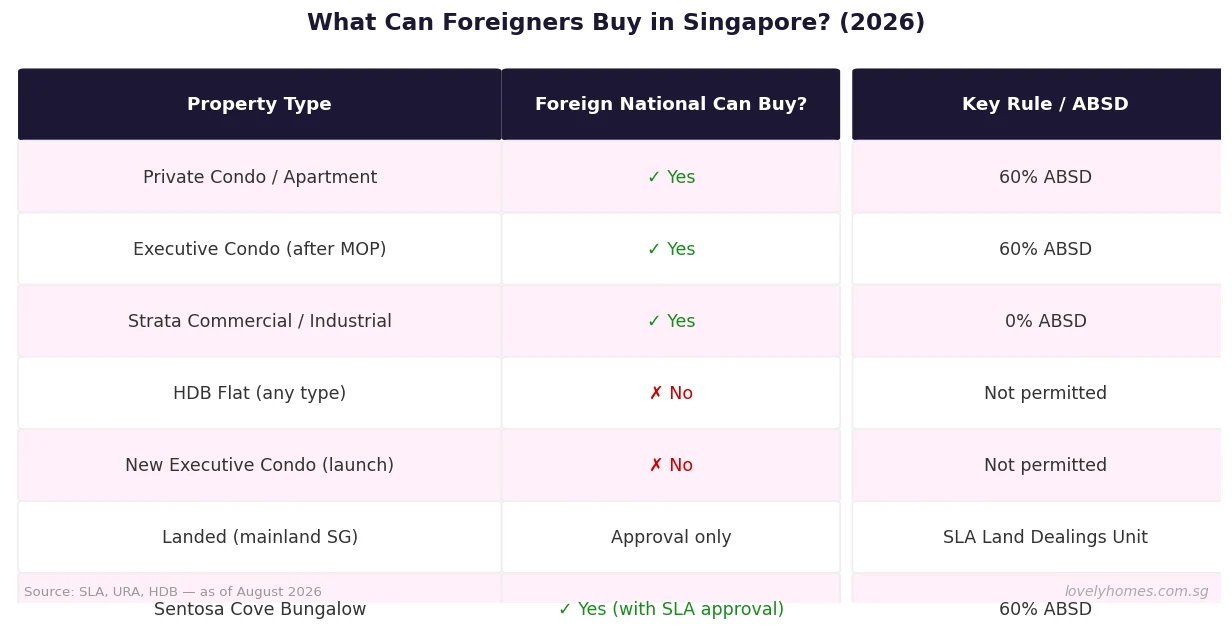
The matrix below summarises the position as at 03 May 2026. The colour-coding maps to three regimes: green (allowed without prior approval, subject to ABSD), amber (allowed with LDAU approval), and red (not allowed at all).

Foreigner property purchase matrix Singapore 2026 — what is allowed and what needs LDAU approval
Figure 1 — What foreigners can and cannot buy in Singapore (2026 matrix). LDAU approval typically takes 4–8 weeks.

The free-purchase segment

The simplest path for a foreigner is the strata-titled condominium or apartment market. Any project on a private-title development (i.e. not under HDB) is open to foreign buyers without LDAU approval, subject only to the standard BSD and the foreigner-rate ABSD. This is by far the largest segment by transaction volume — over 95% of foreigner private residential transactions in 2025 fell into this bucket.

Privatised executive condominiums

Executive condominiums begin life as a hybrid public-private flat with a 10-year Minimum Occupation Period and citizenship restrictions. After year 11 (when the EC is fully "privatised"), it is treated like any private condominium and may be bought by foreigners. Examples in 2025–2026 included The Topiary (privatised 2023), Privé (2025) and Lush Acres (2025) — all then opened to foreign buyers in the resale market.

The LDAU-approved segment

Landed residential property — terrace houses, semi-detached houses, bungalows, and good-class bungalows — is restricted under the Act. A foreigner who wants to buy a landed dwelling must apply to the LDAU under section 25 of the Act. The application form (LD-1) is filed via the SLA e-services portal, accompanied by a CV, a statement of funds, and a justification of why the applicant should be permitted. Approvals are typically granted only to foreigners who have made "exceptional economic contributions to Singapore" — a high bar, applied case-by-case.

The Sentosa Cove exception

Sentosa Cove is the one geographic carve-out: foreigners can apply to LDAU for landed property in Sentosa Cove on a quicker, more permissive basis (typically 4–6 weeks), provided the property is for owner-occupation. Sentosa Cove approvals do not require "exceptional contributions" — they are granted on largely fit-and-proper-person grounds.

The hard prohibitions

HDB flats — both BTO and resale — are entirely closed to foreigners. The HDB framework is built around Singapore Citizen and SPR family nuclei; the only path for a foreigner to occupy an HDB flat is as a tenant (with the host SC/SPR's sub-letting permission) or as a non-citizen spouse on a joint application (where the SC/SPR family nucleus carries the eligibility). New executive condominiums (within their 10-year MOP) are similarly closed, since they are tied to the EC eligibility framework.

ABSD — the dominant cost for foreign buyers

Additional Buyer's Stamp Duty was introduced in December 2011 as a cooling measure. It is layered on top of the standard Buyer's Stamp Duty, and the foreigner rate has been ratcheted upward at every subsequent cooling-measures cycle: 10% (2011), 15% (2013), 20% (2018), 30% (2021), and 60% (April 2023, the current rate).

ABSD rates by buyer profile Singapore 2026 — citizens, PRs, foreigners and entities
Figure 2 — ABSD by buyer profile in Singapore (2026). Foreigners pay 60%; FTA nationalities pay the SC rate.

FTA-treaty exemption — the five nationalities

Singapore's Free Trade Agreements with the United States (USSFTA), Iceland, Liechtenstein, Norway, and Switzerland (the EFTA states) include Most-Favoured-Nation clauses on tax-on-property that effectively bind Singapore to charge those nationalities at the Singapore Citizen ABSD rate. So a US national buying their first Singapore residential property pays 0% ABSD, the same as an SC. A US national buying a second pays 20% (same as an SC second-property rate). The buyer claims the exemption by producing their passport and a Letter of Confirmation (or completed FTA-exempt declaration form) at the e-stamping stage; the solicitor stamps at the SC rate on that basis.

Other foreigners — 60% flat

Every other foreigner — regardless of property count, age, residency duration, or marital status — pays the 60% flat ABSD rate. The rate applies from the very first private property purchase. There is no "remission for marriage" available for two foreigners marrying each other (unlike SC + SC couples who can claim ABSD remission on their first matrimonial home).

Married-to-an-SC remission

A foreigner married to a Singapore Citizen can buy their first matrimonial home jointly with the SC spouse and claim the ABSD Remission for Married Couples — provided the property is jointly purchased, neither party already owns residential property, and they live in the property as their matrimonial home. This is the most-used path for foreign spouses to acquire Singapore residential property at the 0% ABSD rate.

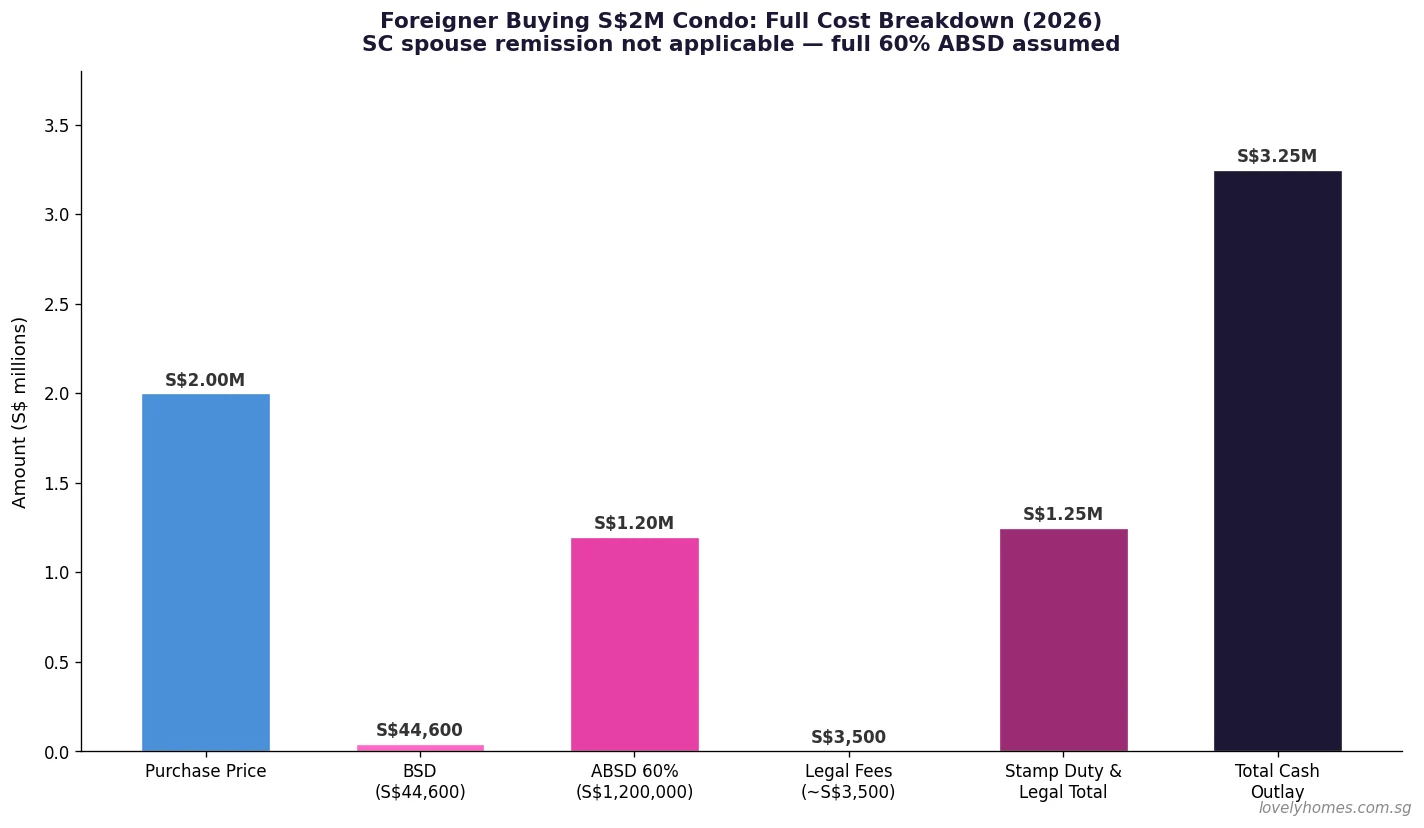
Worked Example — Ms Lim, foreign buyer of a S$2M condo

Buyer profile

Ms Lim is a 32-year-old Indonesian national who works in Singapore on an Employment Pass. She is buying a S$2,000,000 strata-titled three-bedroom condominium in District 9 as her first Singapore property, in her sole name (not married to an SC), with a 75% LTV bank loan. She is not from a FTA-treaty country, so the foreigner ABSD rate of 60% applies.

Stamp duty calculation

  • BSD on S$2,000,000 (tiered): 1% × first S$180,000 + 2% × next S$180,000 + 3% × next S$640,000 + 4% × next S$500,000 + 5% × next S$500,000 = S$64,600.
  • ABSD at 60% × S$2,000,000 = S$1,200,000.
  • Total stamp duty = S$1,264,600, payable to IRAS within 14 days of OTP exercise.

Cash and CPF needed

  • Cash 5% downpayment: S$100,000 (Employment Pass holders cannot use CPF).
  • Cash balance 20% downpayment: S$400,000 (no CPF for non-PRs).
  • BSD + ABSD: S$1,264,600 (cash to IRAS within 14 days).
  • Conveyancing legal fees + disbursements (incl. GST): ≈ S$5,500.
  • Mortgage stamp duty (capped): S$500.

Total acquisition cost

Headline price + stamp duty + legal = S$3,270,600. Bank loan = S$1,500,000; cash + CPF leg = S$1,770,600. Effectively, Ms Lim brings S$1,770,600 in cash to the table on a S$2M asset — the ABSD alone is the largest line item, exceeding the 25% cash-and-CPF downpayment.

Foreigner property buyer Singapore 2026 worked example — S$2M condo with 60% ABSD
Figure 3 — Foreigner buyer S$2M condo cost stack. ABSD at 60% is the dominant line.

The LDAU application — landed property approval in detail

Foreigners targeting landed property must clear LDAU approval before completion. The application is governed by section 25 of the Residential Property Act and processed by the Land Dealings (Approval) Unit within SLA. The applicant submits Form LD-1 with supporting documents — passport, residence history in Singapore (a minimum of 5 years is typical), tax-resident status, evidence of economic contribution (employment, investment, business operations), and a statement of family ties to Singapore. The committee evaluates each application on its individual merits; approvals are not appealable, though re-applications after a substantive change in circumstances are accepted.

For Sentosa Cove specifically, the application is processed on a fast-track within 4–6 weeks; outside Sentosa Cove, expect 8–16 weeks. Approvals come with conditions: the property must be used as the foreigner's sole residence; the property cannot be sold within 5 years; and the property cannot be rented out without LDAU's further approval.

Beyond ABSD — what foreign buyers also pay

Stamp duty is the largest line, but foreign buyers should plan for several other costs. Property tax is charged at the higher non-owner-occupier rate (12–36%) if the foreigner does not occupy the property — a meaningful uplift over the 0–32% owner-occupier scale. Rental income is taxable at the non-resident rate (24% flat, withholding deducted at the agent level). And on eventual disposal, while Singapore does not levy capital gains tax, the Seller's Stamp Duty (12%/8%/4% of price within 1/2/3 years of purchase) applies to all sellers regardless of citizenship.

Comparison — Singapore vs Hong Kong vs Australia for foreign buyers

Hong Kong applies a flat 15% Buyer's Stamp Duty on non-permanent-resident buyers (cut from 30% in late 2024) — substantially lower than Singapore's 60% ABSD. Australia's Foreign Investment Review Board (FIRB) regime allows foreigners to buy only newly-constructed dwellings, with a stamp-duty foreign-buyer surcharge ranging 7–8% across the states. New Zealand effectively bans foreign residential purchases entirely (Overseas Investment Amendment Act 2018). On any global comparison, Singapore's ABSD-60 sits at the top end of the "allowed but heavily taxed" spectrum.

Why Singapore taxes foreign residential buyers so heavily

The official policy rationale, repeated by the Ministry of Finance at the April 2023 announcement, is that residential property prices in Singapore have risen faster than incomes, that foreign demand has historically been a meaningful contributor to that pressure (~9% of private new sales pre-2023), and that the cooling measures aim to keep housing affordable for citizens first. The 60% rate has materially compressed foreign demand since April 2023 — foreign buyers fell from ~9% of private new sales pre-cooling to under 4% by Q1 2026 (URA data).

What might come next

The 60% rate has been consistently cited by industry bodies as the principal headwind on the prime CCR market (where foreign demand was concentrated), and the FTA-exempt-nationality list has periodically been raised as either too narrow or in need of recalibration. A March 2026 Bloomberg report flagged that policy reviewers had begun examining whether to extend FTA-style preferential treatment to additional treaty partners, although the Ministry of Finance has made no announcement to date. Any future reduction in the foreigner ABSD rate (or expansion of the FTA-exempt list) would be a material market signal — particularly for the CCR.

Summary table — foreign buyer rules at a glance

Property type Foreigner rule Approval needed? ABSD rate
HDB BTO / resale flat Not allowed
New EC (≤10y MOP) Not allowed
Privatised EC (≥10y) Allowed None 60% (or SC rate for FTA-5)
Strata condo / apartment Allowed None 60% (or SC rate for FTA-5)
Landed in Sentosa Cove Allowed with LDAU 4–6 weeks 60% (or SC rate for FTA-5)
Other landed property Allowed with LDAU 8–16 weeks 60% (or SC rate for FTA-5)
Vacant residential land Allowed with LDAU Yes 65% (entity rate often applies)
Commercial / industrial Allowed None (some industrial restrictions) 0% (no ABSD on commercial)

Frequently Asked Questions

Am I a foreigner if I hold an Employment Pass or S Pass?

Yes. For Residential Property Act purposes, the binary distinction is Singapore Citizen / Singapore Permanent Resident vs everyone else. Holders of EP, S Pass, Dependant's Pass, Long-Term Visit Pass, Student Pass, or any other work or visit pass are foreigners and pay the 60% ABSD rate (unless from one of the five FTA-treaty nationalities).

Can I get the FTA exemption if I'm a US-Indonesian dual national?

Generally yes — the FTA exemption attaches to nationality, not residence. As long as you can produce a valid US passport at the e-stamping stage, your solicitor can stamp at the Singapore Citizen ABSD rate (0% on first property, 20% on second, etc.). The same applies to dual nationals of Iceland, Liechtenstein, Norway and Switzerland. The exemption is not extended to dual nationals of any other country.

Can a foreigner take a Singapore bank loan to buy property here?

Yes, subject to the standard MAS Loan-to-Value (LTV) framework — typically up to 75% LTV for first private property (with TDSR at 55% of monthly income, stress-tested at 4.0% pa). Foreigners cannot use CPF (no Ordinary Account), so the 25% downpayment plus all stamp duty must come from cash. Some banks impose an internal LTV cap of 70% for foreigners regardless of MAS rules.

Will I become a Singapore Permanent Resident faster if I buy property here?

No. Property ownership is not a criterion in the SPR application process administered by the Immigration & Checkpoints Authority (ICA). SPR applications are evaluated on age, qualifications, employment, length of residency, family ties, and economic contribution. Owning Singapore residential property may signal commitment in a borderline case but does not change the formal eligibility framework.

Can a foreigner sell within a year and still pay only 60% ABSD?

The 60% ABSD applies on purchase. On selling within 1, 2, or 3 years of purchase, the Seller's Stamp Duty (SSD) of 12%, 8%, or 4% on the disposal price applies — irrespective of citizenship. So a foreigner who buys at S$2M with 60% ABSD and sells within a year for S$2.1M owes the original S$1.2M ABSD plus another S$252,000 SSD. Practically, foreign buyers should plan for a 4-year minimum hold to avoid SSD entirely.

Are there any "hidden" foreigner restrictions in commercial property?

Commercial property (Grade A office, retail, hotel, etc.) is broadly open to foreigners and entities, with no ABSD. Industrial property carries some Singapore-ownership requirements imposed by JTC for industrial leases, and certain industrial-zoned freehold land is restricted by the Residential Property Act if it includes any residential component. Always verify the property's zoning (URA Master Plan) and the seller's leasehold conditions before signing the OTP.

What happens if a foreigner inherits HDB or landed Singapore property?

Inheritance is treated separately. A foreigner who inherits a Singapore HDB flat must dispose of it within 6 months of probate (HDB rule); a foreigner who inherits landed property must obtain LDAU's approval to retain the property, failing which the property must be disposed of within 12 months. ABSD does not apply on inheritance because no transfer for value is taking place.

Disclaimer. This article is general guidance only and is not legal, tax or immigration advice. Foreigner property rules in Singapore — including ABSD rates, LDAU policy and FTA-exemption nationalities — change with cooling-measures and treaty-revision cycles; readers should verify the current position with the Singapore Land Authority (SLA) and the Land Dealings (Approval) Unit, the Inland Revenue Authority of Singapore (IRAS), the Ministry of National Development (MND), and the Monetary Authority of Singapore (MAS). Engage a Singapore-qualified solicitor before signing any OTP. Worked figures use indicative published rates as at 03 May 2026.

Conveyancing Process Singapore 2026: OTP, S&P Agreement, Legal Fees & Key Timelines

Conveyancing Process Singapore 2026: OTP, S&P Agreement, Legal Fees & Key Timelines

Conveyancing Process Singapore 2026: OTP, S&P Agreement, Legal Fees & Key Timelines

The legal mechanics that turn an Option to Purchase into your set of keys — by step, by date, and by SGD figure.

Quick Answer — Conveyancing Singapore 2026 in 30 seconds

  • Conveyancing is the regulated legal process that transfers Singapore property title from seller to buyer; it is conducted by lawyers admitted to the Singapore Bar.
  • For a typical resale condo, the timeline runs 8–10 weeks from OTP grant to completion. New launches follow the staggered Progressive Payment Scheme over 36–40 months.
  • The buyer pays a 1% option fee on Day 0 and a 4% top-up on OTP exercise (typically Day 14), together making up the standard 5% booking deposit.
  • Buyer's Stamp Duty (BSD) and Additional Buyer's Stamp Duty (ABSD), if any, must be paid to IRAS within 14 days of OTP exercise (or 30 days if executed overseas).
  • Indicative legal fees and disbursements for a resale condo are around S$3,500–S$4,200 inclusive of 9% GST; CPF panel rates apply if you are using CPF Ordinary Account funds.
  • Completion typically happens 8–10 weeks after OTP grant, when the buyer pays the balance 95% (loan + CPF + cash), the lawyer hands over the title deed, and keys are exchanged.
  • HDB resale conveyancing follows a parallel HDB-Resale-Portal process, with HDB acting as solicitor for one or both parties and a fixed 8-week official timeline once the resale application is accepted.

What is conveyancing, and who runs it?

Conveyancing is the legal work involved in transferring ownership of immovable property — in Singapore's case, residential, commercial, or industrial land — from one party to another. It is regulated under the Conveyancing and Law of Property Act and the Conveyancing and Law of Property (Conveyancing) Rules. Only a Singapore-qualified lawyer (an advocate and solicitor on the Roll, holding a current practising certificate from the Singapore Institute of Legal Education) may conduct private-property conveyancing for a buyer or seller.

Three parties matter to the timeline. The seller's solicitor handles the title, encumbrances, and statutory declarations on the property. The buyer's solicitor (often the same firm appointed by the bank as the mortgagee's solicitor) handles searches, requisitions, the apportionment of property tax, and the lodgement of the new instrument of transfer. The financier — your home-loan bank or HDB — controls the loan disbursement timing, which is why mortgage acceptance must align with completion to the day. For HDB resale, HDB itself runs the conveyancing for the flat, with parties having the option to engage private solicitors instead.

Conveyancing Process Singapore 2026 hero — pink sunset over Singapore skyline
Conveyancing Process Singapore 2026 — every fee, deadline and signature explained.

The 10 stages of a resale condominium conveyancing

The standard resale-condo path runs from OTP grant to completion in roughly 60–70 days. Each stage has either a contractual deadline (under the OTP) or a statutory deadline (under the Stamp Duties Act, the Land Titles Act, or the relevant CPF Housing rules). Missing any of them can break the chain or trigger penalty interest.

Conveyancing timeline Singapore — OTP grant to completion 8 to 10 weeks
Figure 1 — Resale condominium conveyancing timeline. Day 0 OTP; Day 14 exercise; Day 60–70 completion.

Stage 1 — Option to Purchase (Day 0)

The OTP is a short contract granted by the seller to the buyer in consideration of a 1% option fee (computed on the agreed sale price). It locks the seller in for the option period (commonly 14 days) and gives the buyer an exclusive right to exercise the option at the stated price. If the buyer does not exercise within the option period, the option lapses and the 1% is forfeited to the seller.

Stage 2 — Engaging your conveyancing lawyer (Day 1–7)

The buyer should engage a CPF-panel conveyancing solicitor immediately after granting the OTP — most banks require their appointed firm to also act for the buyer (joint representation) so that the mortgage disbursement aligns with completion. Get a written fee proposal that lists professional fees, GST, and itemised disbursements (caveat lodgement, title search, requisitions, postage). Section 1.5 below shows the typical fee stack.

Stage 3 — Exercise of OTP (Day 14)

To exercise, the buyer signs the acceptance copy of the OTP and delivers it together with the 4% balance deposit to the seller's solicitor. From that moment, the OTP becomes a binding contract for sale. The 14-day stamp-duty clock (BSD/ABSD) starts on the day the document is signed. IRAS must receive payment within 14 days for documents executed in Singapore, or within 30 days if executed overseas.

Stage 4 — Caveat lodgement (Day 15–20)

The buyer's solicitor lodges a caveat at the Singapore Land Authority (SLA) registering the buyer's contractual interest. The caveat protects the buyer's position against later inconsistent dealings — e.g. if the seller tries to grant a fresh option to a third party. Caveat fees are nominal (~S$65) but the lodgement is mandatory in market practice.

Stage 5 — Title searches and legal requisitions (Day 18–35)

The buyer's solicitor then conducts a slate of searches and sends requisitions to the relevant statutory boards. Standard items include: SLA title search; URA road-line clearance and conservation status; LTA road-reserve and MRT easement check; bankruptcy and litigation searches against the seller; pest and structural-defect declarations; outstanding property-tax position with IRAS. The seller's solicitor must reply to requisitions within the OTP-stipulated period (usually within 14 days of receipt).

Stage 6 — Mortgage and CPF processing (Day 15–40)

In parallel, the buyer's mortgage banker issues a Letter of Offer or Facility Letter, which the buyer accepts. The buyer then submits a CPF Housing Application via the my cpf portal if Ordinary Account monies will be used; CPF Board cross-verifies the buyer's remaining withdrawal limit and checks that the property has at least 30 years of lease remaining at the buyer's 95th birthday (full CPF use) or 20 years (capped use).

Stage 7 — Statement of Account and apportionment (Day 45–55)

Roughly two weeks before completion, the seller's solicitor circulates a Statement of Account that itemises the property-tax apportionment, MCST maintenance fee apportionment, and any reimbursable services (water, electricity meter readings). The buyer's solicitor verifies these against the original quarterly tax notice and the latest MCST fee voucher.

Stage 8 — Final inspection (Day 56–60)

The buyer (and their solicitor) physically inspect the unit one to two days before completion to confirm the property is delivered in the agreed condition (vacant possession; furniture removed unless inventoried; defects from the time of OTP made good). Any unrectified items can be negotiated as a price retention or a written undertaking from the seller.

Stage 9 — Completion (Day 60–70)

On completion day, all parties (or their solicitors) gather (often at the buyer's solicitor's office or by document exchange via the Conveyancing Money Service for cashless settlement). The buyer's solicitor releases the loan, CPF, and cash balance to the seller's solicitor; the seller's solicitor hands over the keys, the duplicate certificate of title (or the CSC for unregistered land), the building plan, the maintenance fee receipts, and the warranty cards. Title transfer is registered at SLA shortly thereafter.

Stage 10 — Post-completion (Week 10+)

After completion, the buyer's solicitor lodges the Instrument of Transfer with SLA, releases the discharge of the seller's mortgage, and closes the file with a final completion report. The buyer registers as the new owner with the MCST, IRAS, and the utility authorities; the buyer can then occupy the property as the registered proprietor.

Legal fees and disbursements — what you actually pay

Singapore conveyancing fees were liberalised in 2007 — there is no longer a statutory fee scale. CPF Board, however, maintains a panel of solicitors who agree to charge concessionary fees for buyers using CPF funds; most retail buyers fall under this panel. Typical 2026 indicative fees for a resale condo at the S$1.5M mark, including disbursements but excluding GST, are shown below.

Conveyancing legal fees Singapore 2026 — resale condo S$1.5M fee breakdown
Figure 2 — Conveyancing legal fees and disbursements for a S$1.5M resale condominium. Indicative; specific firms vary.

Reading the fee stack

The conveyancing legal fee itself (S$2,500–S$3,000 on a S$1.5M condo on the CPF panel) is the largest line. Mortgage stamp duty is a fixed S$500 cap under the Stamp Duties Act for any single mortgage instrument. Title search, caveat lodgement, and bankruptcy searches are SLA / official-registry fees passed through at cost. The 9% GST applies to the professional fees portion (and to most disbursements that are not pure statutory fees).

HDB resale legal fees

If both parties use HDB to act on the resale, HDB charges a flat scaled fee (~S$15 per S$10,000 of the price for a 4-room flat, with a minimum), inclusive of standard searches. Engaging private solicitors is also permitted; private-firm pricing for an HDB resale typically sits at S$1,800–S$2,500 plus disbursements.

Worked Example — Mr Tan's S$1.5M Tampines condo

Buyer profile

Mr Tan, 36, Singapore Citizen, single, first private property. He is buying a 99-year leasehold three-bedroom condominium in Tampines for S$1,500,000 with a 75% LTV bank loan, paying 5% in cash and 20% from CPF Ordinary Account. He grants the OTP on Saturday 4 May 2026 and is targeting completion within 70 days.

Cash and CPF needed at each stage

  • Day 0 (OTP grant): 1% option fee in cash = S$15,000.
  • Day 14 (OTP exercise): 4% top-up in cash = S$60,000, bringing the booking deposit to 5% / S$75,000. BSD on S$1.5M = S$44,600 payable to IRAS within 14 days. ABSD = nil (first SC property).
  • Day 14–60 (CPF and loan processing): CPF Housing Application submitted; CPF Board approves up to S$300,000 from OA towards the 25% downpayment.
  • Day 60–70 (completion): Bank disburses 75% loan = S$1,125,000; CPF releases S$300,000; Mr Tan tops up the cash balance and pays legal fees and disbursements ≈ S$4,200.

Pure cash leg

Option fee + exercise top-up + BSD + minimum 5% cash + legal fees ≈ S$198,800. The CPF leg is a further S$300,000 from OA. The bank leg is S$1,125,000. Total acquisition cost: S$1,548,800 excluding mortgage stamp duty (capped at S$500).

Conveyancing cash needed Singapore 2026 — first-time buyer S$1.5M condo cost stack
Figure 3 — Cash and CPF needed on completion. The cash leg dominates Day 0–14; CPF and bank funds dominate Day 60.

Conveyancing for new launches — the Progressive Payment Scheme

For new-launch private residential property bought directly from a developer, the conveyancing follows the Progressive Payment Scheme (PPS) instead of a single-completion model. The buyer signs a Sale & Purchase Agreement after exercising the OTP, and the price is paid in instalments tied to construction milestones — 5% on grant, 15% on signing of the S&P, 10% on foundation completion, and so on, ending with the final 15% on Temporary Occupation Permit (TOP) and 15% on Certificate of Statutory Completion (CSC). The legal fee schedule is similar but spread across three to four years.

Deferred Payment Scheme (DPS) — only at developer's discretion

Some developers offer a Deferred Payment Scheme on completed-and-unsold inventory, where the buyer pays 20% on signing, 80% on completion (typically up to 36 months later), with no progress payments in between. DPS units typically carry a 4–6% premium on price; conveyancing legal fees are largely the same as PPS but the cash-flow profile is back-loaded.

Common pitfalls and how to avoid them

Singapore conveyancing is procedurally rigorous, but four issues account for the bulk of disputes. First, the BSD/ABSD 14-day deadline is unforgiving — IRAS imposes penalty surcharges of 5% per month (capped at 4 times the duty) for late stamping, regardless of the buyer's reason. Second, requisition replies that flag a road reserve, a building-line set-back, or a heritage conservation overlay can materially affect the property value; insist that your solicitor extracts the URA reply in full before completion. Third, the seller's solicitor occasionally tries to insist on unauthorised retention amounts at completion (for "defects to be repaired") — these must be agreed in writing in the OTP, otherwise the buyer is entitled to insist on payment in full. Fourth, mortgage timing slippage is the single most common cause of completion delay; chase the bank's acceptance, valuation, and disbursement at every step.

What the process means for you

For most retail buyers, the conveyancing process feels invisible — you grant an OTP, you sign acceptance, and seventy days later you collect keys. But the costs you do not see (statutory fees, requisition turnaround, lawyers' cross-checking) are the difference between a clean transfer and a litigation-prone one. Two practical recommendations follow. First, choose a solicitor on your bank's and CPF's panel — joint representation halves the legal fee and removes one moving part. Second, build a 14-day cash buffer beyond your stamp-duty cheque so the IRAS deadline is never the gating event.

Comparison — Singapore vs Hong Kong vs UK conveyancing

Singapore's conveyancing model sits between Hong Kong's (similar OTP-and-completion structure but with shorter timelines and no CPF equivalent) and the UK's (chain-based exchange-and-completion with a longer search phase and more dependencies on local-authority replies). Singapore's integrated SLA electronic title system and CPF-panel solicitor regime keep retail conveyancing among the most predictable globally — typical 8–10 weeks compared with 12–16 weeks in the UK.

What might come next — digital conveyancing and e-completion

SLA and the Ministry of Law have signalled phased adoption of electronic title transfers and CPF Money Service-style digital settlement to compress the post-exercise timeline. The Conveyancing Money Service (CMS) is already used widely for cashless settlement; further digitalisation of caveat lodgement and bankruptcy searches in 2026–2027 may shave 1–2 weeks off the standard 10-week timeline. Industry conversations have also raised the prospect of a fully digital OTP for resale transactions, mirroring the existing digital S&P for new launches; if implemented, this would be the most material change to retail conveyancing in over a decade.

Summary table — Conveyancing fees, deadlines and parties at a glance

Stage Trigger Fee / Cost Statutory Deadline
OTP grant Seller signs OTP 1% of price (cash)
OTP exercise Buyer signs acceptance 4% top-up (cash) 14 days from OTP grant
BSD & ABSD Stamp Duties Act BSD ≈ 3–4% (tiered); ABSD up to 65% 14 days from execution
Caveat lodgement Buyer's solicitor at SLA ~S$65 Practice norm: within 7 days
Mortgage acceptance Bank Letter of Offer Stamp duty capped S$500 Per Letter of Offer
CPF approval my cpf portal S$80 processing Before completion
Statement of Account Seller's solicitor ~14 days before completion
Final inspection Buyer 1–2 days before completion
Completion All parties Balance 95% paid Per OTP (typ. 8–10 weeks)
Title registration Buyer's solicitor at SLA ~S$140 After completion

Frequently Asked Questions

Can I do my own conveyancing in Singapore?

Practically, no. Conveyancing of registered land in Singapore must be handled by a Singapore-qualified solicitor with a current practising certificate; the SLA, CPF Board and most banks will not accept lodgements or releases without a solicitor's involvement. Self-representation is theoretically possible for an all-cash purchase between two individuals, but you will still need a solicitor for the SLA caveat and instrument of transfer.

How long do I have to pay BSD and ABSD?

Within 14 days of the date the OTP is exercised (the "date of execution" of the document), if executed in Singapore. Within 30 days if executed overseas. IRAS imposes a penalty of 5% of the unpaid duty per month (subject to a cap of 4 times the duty) for late stamping. Pay early — your solicitor can stamp electronically through e-Stamping the same day.

What is the difference between an OTP and a Sale & Purchase Agreement?

An OTP is a unilateral contract granted by the seller in consideration of the option fee — it gives the buyer a time-limited right to enter into a binding sale. The S&P (or, in resale practice, the exercised OTP itself) is the binding bilateral contract for sale. For new-launch developer sales, a separate S&P document is signed within 3 weeks of OTP exercise.

Can I rescind after exercising the OTP?

Once exercised, the OTP becomes a binding contract for sale. Rescission requires either a contractual right under the OTP (rare; usually a financing-out clause), a mutual termination agreement with the seller, or a court order. Otherwise, the seller can sue for specific performance or for the lost deposit plus damages. Treat OTP exercise as a point of no return.

Who chooses the conveyancing solicitor — buyer, bank, or CPF?

The buyer formally appoints the solicitor, but the appointment must be acceptable to the bank (the mortgagee's solicitor) and to CPF Board (if CPF funds are used). The simplest path is to appoint a firm that sits on both your bank's panel and CPF's panel, so the same firm represents you, the bank, and CPF — this is "joint representation" and roughly halves the legal fee.

What does "completion" actually involve on the day?

Completion is the simultaneous exchange of money and title. The buyer's solicitor releases the bank loan, CPF disbursement, and the buyer's cash balance to the seller's solicitor through the Conveyancing Money Service. The seller's solicitor releases the duplicate certificate of title, the original Building Plan, the keys, the security cards, and any warranty documents. Title registration with SLA is lodged shortly after.

What happens if my mortgage is delayed at completion?

Late completion attracts default interest under the OTP — typically 8% per annum on the outstanding balance — running from the contractual completion date until actual completion. If the delay extends beyond a contractually defined "long stop" (commonly 14–28 days), the seller may rescind and sue for damages. Always insist that your bank's Letter of Offer is dated at least 30 days before completion.

Disclaimer. This article is general guidance only and is not legal, financial or tax advice. Conveyancing rules, fees, deadlines and statutory rates change; readers should verify the current position with the Singapore Land Authority (SLA), the Inland Revenue Authority of Singapore (IRAS), the Central Provident Fund Board (CPF), the Monetary Authority of Singapore (MAS), and the Singapore Statutes Online for the latest text of the Conveyancing and Law of Property Act and the Stamp Duties Act. Engage a practising Singapore solicitor and a licensed mortgage broker before committing to any transaction. Worked figures use indicative published rates as at 03 May 2026.

Translate »