HDB Upgrader’s Complete Guide 2026: From HDB Flat to Private Property

HDB Upgrader’s Complete Guide 2026: From HDB Flat to Private Property

Quick Answer — HDB Upgrader Guide Singapore 2026

  • MOP first: You must fulfil the Minimum Occupation Period (5 years for most flats; 10 years for Prime and Plus flats launched from August 2024) before selling your HDB flat on the open market or buying a private residential property while retaining the flat.
  • Two upgrade strategies: “Sell first, buy later” avoids ABSD on your private purchase (you are a first-time private buyer). “Buy first, sell later” triggers 20% ABSD on the private property for SCs — S$270,000 on a S$1.35M condo — though an ABSD remission is available if you sell within 6 months.
  • CPF refund: When you sell your HDB flat, all CPF OA monies used for the purchase — plus accrued interest — must be refunded to your CPF account. The net cash you receive is the sale price minus the outstanding HDB loan (if any) and the CPF refund.
  • Grant repayment: CPF Housing Grants (EHG, Family Grant, etc.) used for the HDB flat do not need to be repaid upon sale — they are subsumed into the CPF OA refund.
  • HDB loan discharged on sale: The HDB loan is discharged at the point of the flat sale. Any outstanding balance is deducted from the sale proceeds before cash is released.
  • Private property financing: After selling your HDB flat, you are eligible for a bank loan of up to 75% LTV for a private property purchase. You cannot use an HDB concessionary loan for private property.
  • ABSD remission (SC married couples): If you buy a private property before selling your HDB flat, you can claim an ABSD refund if the HDB flat is sold within 6 months of completing the private purchase.

Who is an HDB Upgrader?

In Singapore’s property lexicon, an HDB upgrader is a flat owner — typically a Singapore Citizen couple who purchased a Housing & Development Board flat as their first home — who subsequently wishes to sell the flat and purchase a private residential property. The upgrade journey is one of the most significant financial decisions many Singaporeans make: it unlocks accumulated HDB equity, introduces bank mortgage financing (with its stricter credit requirements), and subjects the buyer to ABSD unless the timing is managed carefully.

The upgrader market is a structural pillar of Singapore’s private residential demand. According to the Urban Redevelopment Authority (URA), HDB upgraders historically account for 30–40% of new private condominium sales in Outside Central Region (OCR) developments. Policy levers — chiefly ABSD and MOP duration — are calibrated in part to pace the rate at which HDB flat owners enter the private market.

Understanding the mechanics of the upgrade journey — from MOP completion to key collection — is essential to avoid costly timing errors, particularly the S$270,000+ ABSD cash outlay that catches many upgraders off guard.

Step 1: Confirm Your MOP Status

The Minimum Occupation Period (MOP) is the period during which an HDB flat owner must occupy the flat as their principal residence before they are permitted to sell it on the open market or to purchase a private residential property.

The standard MOP is 5 years from the date the keys are collected (the date of possession), not from the date the sale was exercised or the mortgage was drawn. The MOP clock stops if the flat is rented out in full, if the flat owner stays overseas for extended periods, or in other prescribed circumstances — so owners who sublet their flat prematurely may find their effective MOP extended.

For Prime and Plus classification flats launched from August 2024 onwards under the new HDB classification framework, the MOP is 10 years, and additional ownership restrictions apply (including an income ceiling on resale buyers and a clawback provision on subsidy). Owners of these flats face a longer upgrader journey.
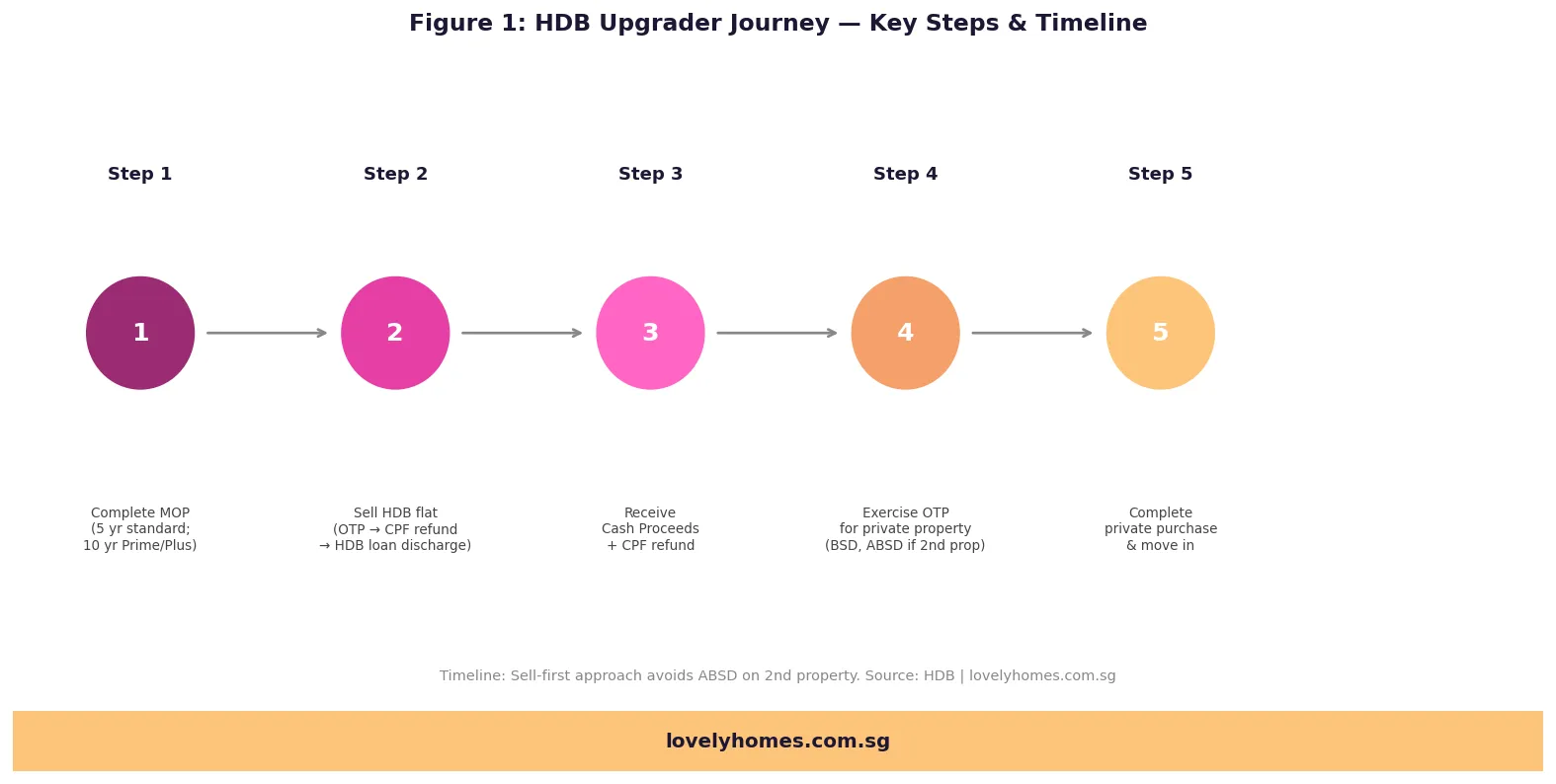
HDB upgrader journey 5 steps timeline Singapore 2026

Figure 1: The HDB upgrader’s journey — five key steps from MOP completion to private property key collection. Source: HDB | lovelyhomes.com.sg

Step 2: Understand What You Will Receive from the HDB Sale

The sale of your HDB flat generates two streams of value: a cash component and a CPF refund. The distinction matters enormously for financial planning, because the CPF refund goes back into your CPF Ordinary Account — it cannot be used freely as cash, though it can be used for the down payment and stamp duty on your subsequent private property purchase.

The CPF OA refund comprises: (a) the principal CPF OA amount withdrawn for the flat, and (b) accrued interest — the notional interest CPF Board charges on those withdrawn funds at the CPF OA rate (currently 2.5% p.a. on the first S$20,000 of OA, 3.5% p.a. thereafter, effective 1 January 2024). Accrued interest compounds over the full holding period and can be significant: on S$150,000 CPF withdrawn over 8 years, accrued interest at 2.5% compounding amounts to approximately S$34,000.
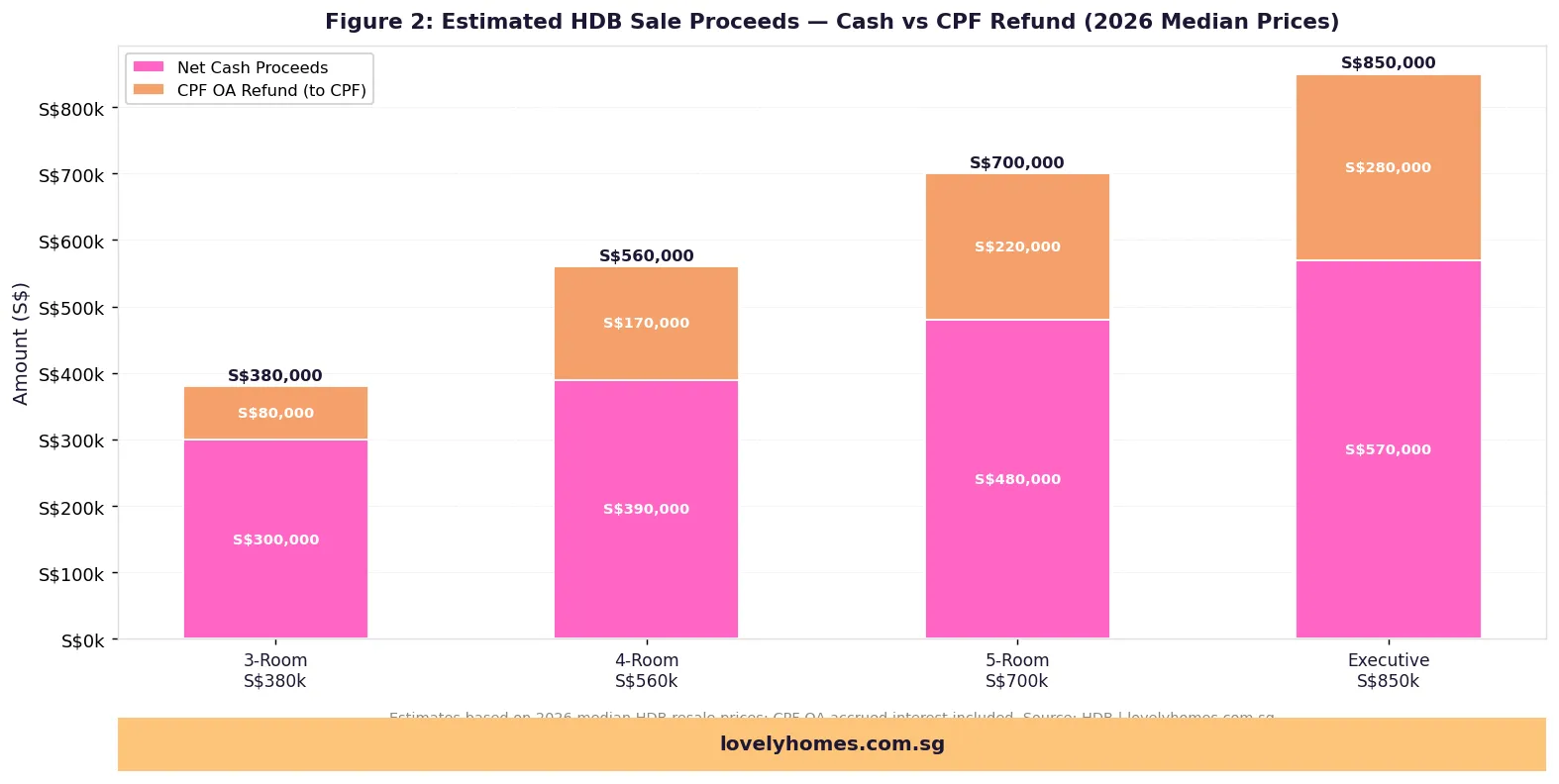
HDB sale proceeds by flat type cash vs CPF refund 2026 median prices

Figure 2: Estimated HDB sale proceeds by flat type — cash component vs CPF OA refund, based on 2026 median resale prices. Source: HDB | lovelyhomes.com.sg

If there is an outstanding HDB concessionary loan, the remaining balance is deducted from sale proceeds before cash is released to the seller. HDB loan interest rate is currently set at the CPF OA rate + 0.1% (i.e. approximately 2.6% p.a.), making it among the most competitive mortgage rates in Singapore — but flat owners who have used HDB loans extensively may find less net cash available after discharge.

Step 3: Decide on Your Upgrade Strategy — Sell First or Buy First?

The single most consequential decision in the upgrade journey is the sequencing of transactions: do you sell your HDB flat before purchasing the private property, or do you purchase first and sell after?

The sell-first strategy means you complete the sale of your HDB flat, receive the sale proceeds (cash + CPF refund), arrange interim accommodation (typically renting), and then purchase the private property as a first-time private-property buyer. The key advantage: you pay 0% ABSD on the private purchase (for SC buyers with no other property). The key risk: you may miss your preferred private property while searching for one during the rental period, and the private property market may move against you in the interim.

The buy-first strategy means you exercise an OTP on a private property while still owning the HDB flat, paying 20% ABSD on the private purchase price in cash. You then have 6 months from the date of completing the private property purchase (Legal Completion) to sell the HDB flat and apply for an ABSD remission refund from IRAS. If the HDB flat is sold within 6 months, IRAS refunds the ABSD paid (less a processing deduction of 0.1% p.p. on the refunded amount, effective from certain periods). If you miss the 6-month window, the ABSD is forfeited — a potentially catastrophic financial loss.
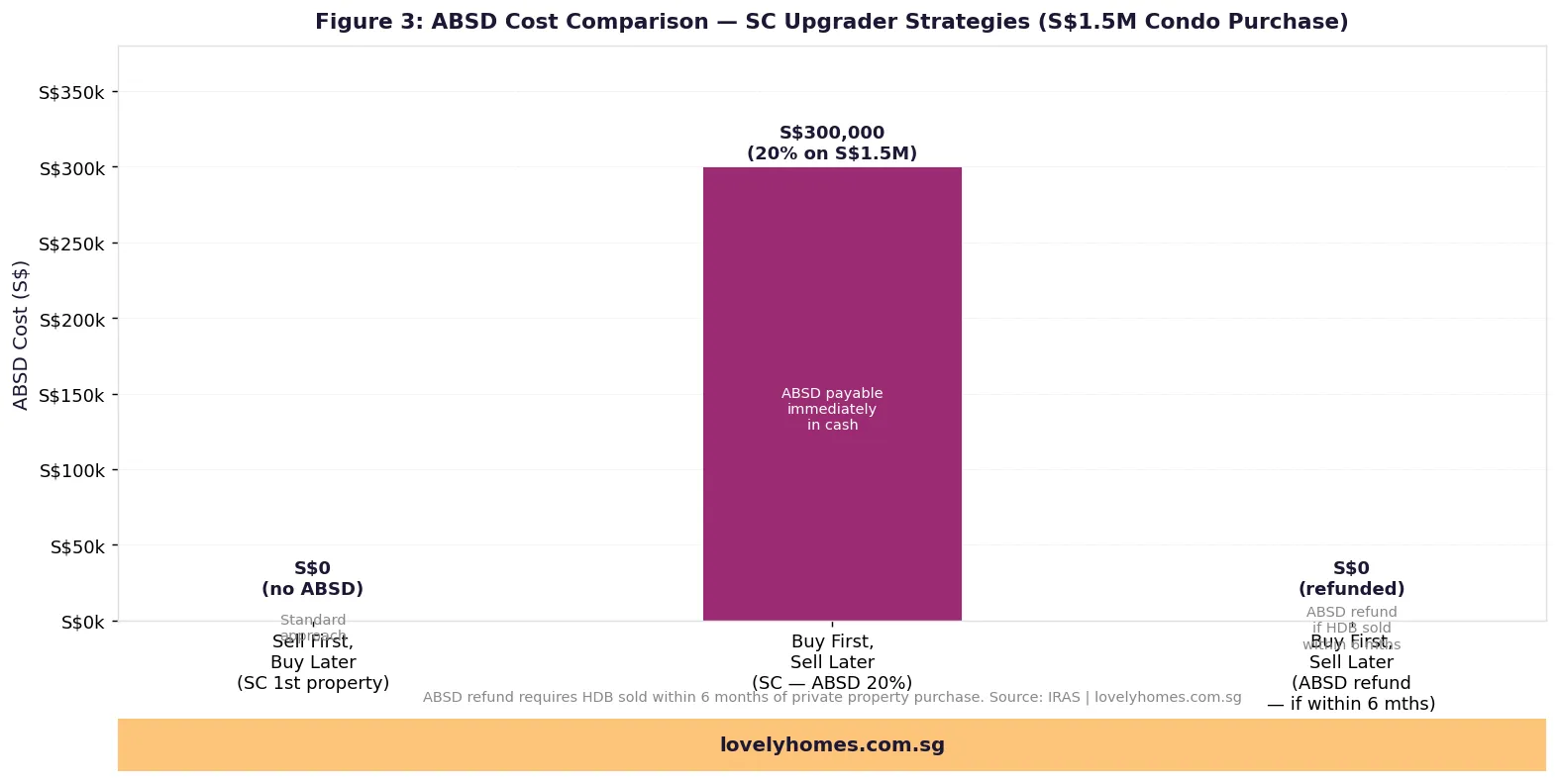
ABSD cost comparison sell first vs buy first HDB upgrader Singapore 2026

Figure 3: ABSD cost comparison — “sell first” avoids ABSD entirely; “buy first” triggers 20% ABSD but may be remitted if HDB flat sold within 6 months. Source: IRAS | lovelyhomes.com.sg

Summary Table: Key Upgrader Decision Points

Decision Point Sell First, Buy Later Buy First, Sell Later (+ ABSD remission)
ABSD upfront S$0 (first-time private buyer) 20% on purchase price (e.g. S$270,000 on S$1.35M) — cash only
ABSD recovery N/A — not paid Refundable if HDB sold within 6 months of private completion
CPF available Full CPF refund from HDB sale usable for private downpayment CPF still tied up in HDB until flat sold
Accommodation Must rent during search period Can stay in HDB until private is ready
Market risk Private prices may rise during rental period Locks in private price; HDB sale price uncertainty
Bridge financing Not required May need bridging loan if cash-flow is tight
MOP Standard flat 5 years from possession 5 years from possession
MOP Prime/Plus flat 10 years from possession 10 years from possession

Worked Example: The Tan Family Upgrade

Profile: Mr Tan (SC, 42) and Mrs Tan (SC, 40) own a 4-room HDB flat in Bishan, purchased in 2016 for S$470,000 using an HDB concessionary loan of S$376,000. MOP completed May 2021. Current market value: S$620,000. Outstanding HDB loan: S$92,000 (after 10 years of repayments). Total CPF OA withdrawn (both): S$185,000. Accrued CPF interest: S$42,000. Combined gross income: S$13,000/month.

HDB Sale proceeds:

  • Sale price: S$620,000
  • Less HDB loan discharge: S$92,000
  • Less CPF refund (principal + accrued interest): S$227,000
  • Net cash proceeds: S$301,000
  • CPF OA balance after refund: S$227,000 (reusable for private purchase)

Target private property: 3-bedroom resale condominium in Bishan (D20), S$1,380,000.

Sell-first strategy (0% ABSD):

  • BSD = 1% × S$180,000 + 2% × S$180,000 + 3% × S$640,000 + 4% × S$380,000 = S$1,800 + S$3,600 + S$19,200 + S$15,200 = S$39,800 (can use CPF OA)
  • 25% down payment = S$345,000 (5% cash min = S$69,000; remaining S$276,000 from CPF OA)
  • Available CPF OA after BSD: S$227,000 − S$39,800 = S$187,200 → cash shortfall of S$276,000 − S$187,200 = S$88,800 (to be covered by net cash proceeds S$301,000)
  • Bank loan: 75% × S$1,380,000 = S$1,035,000 at 3.5% over 25 years → monthly S$5,183
  • TDSR: S$5,183 / S$13,000 = 39.9% — PASS (well within 55% cap)
  • Total cash outlay: S$69,000 (down) + S$88,800 (CPF shortfall) + S$0 ABSD + S$8,000 legal fees = ~S$165,800 in cash

Buy-first strategy (20% ABSD, remission expected):

  • ABSD = 20% × S$1,380,000 = S$276,000 cash upfront (before HDB sale)
  • The Tans must fund S$276,000 ABSD + S$345,000 down payment + S$39,800 BSD simultaneously — total cash need: S$660,800 at exercise. If their HDB sale is completed within 6 months of private legal completion, IRAS refunds S$276,000 ABSD (less 0.1% = S$275,724 net refund).
  • Risk: HDB not sold within 6 months → S$276,000 lost.

Verdict: For the Tan family, sell-first is clearly superior — the net cash from HDB sale is sufficient to fund the private purchase without triggering ABSD, and TDSR is comfortably met. Buy-first requires bridge financing of ~S$660,000 simultaneously, which is feasible but expensive and risky if HDB sale stalls.

Why This Matters: Common Upgrader Mistakes

The three most expensive upgrader mistakes in Singapore each carry a six-figure price tag. First, miscounting the MOP: flat owners who sublet their entire flat for periods during the MOP — even with HDB approval — pause the MOP clock, sometimes discovering that their expected MOP date is later than they assumed. A single year’s delay translates into a year’s additional rent if the family has already moved out.

Second, assuming ABSD remission is automatic: the IRAS remission must be actively applied for, with evidence of the HDB sale completion. Families who miss the 6-month window — even by days — forfeit the remission entirely. Delays in HDB sale registration at the HDB Hub can erode the 6-month window; upgraders should build in a buffer and not list the HDB flat for sale at the last possible moment.

Third, ignoring CPF accrued interest: many upgraders are surprised to find that their CPF OA balance after the flat sale is materially lower than expected, because accrued interest — compounding for 5–10 years — has grown the CPF refund obligation substantially. This reduces the CPF available for the private property down payment and may require a larger cash component.

What Might Come Next: Policy Outlook for Upgraders

The Singapore government has shown a willingness to adjust ABSD policy in response to market conditions. The August 2024 introduction of the Prime and Plus HDB flat classification — with its 10-year MOP — signals an intent to slow the entry of Prime/Plus flat owners into the private market, preserving HDB estates as long-term communities rather than transient stepping-stones.

The ABSD remission for SC married couples remains in place as at July 2026. There is periodic market commentary that the 6-month window may be reduced if private prices accelerate — buyers should not rely on the remission window remaining unchanged. IRAS reviews the scheme in conjunction with broader cooling measure calibration.

On financing, MAS guidelines on TDSR and LTV have been stable since 2023. Any future tightening — such as a reduction in the 75% LTV cap for bank loans on private residential property — would increase the cash required for the down payment and could reduce upgrader demand at higher price points.

Frequently Asked Questions

1. Can I buy a private property while still in my HDB flat’s MOP?

No. HDB rules prohibit flat owners from owning or purchasing a private residential property in Singapore during the MOP. You must wait until the MOP is fully served before exercising an OTP on a private property. If you purchase a private property during the MOP, HDB may compulsorily acquire your flat. The prohibition covers direct ownership — owning shares in a company that owns private property is a separate issue and subject to its own rules.

2. Do I have to sell my HDB flat when I buy a private property?

No — you are not legally required to sell your HDB flat when you purchase a private property after MOP completion, provided you pay the applicable ABSD (20% for SC buying a 2nd residential property). Many upgraders choose to retain the HDB flat as a rental asset. However, renting out an HDB flat requires HDB approval, and both flat owners must be at least 35 years old (for non-family schemes). Also note: retaining both properties means the HDB flat rental income may affect TDSR calculations for the private property mortgage.

3. How long does an HDB resale typically take to complete?

An HDB resale transaction typically takes 8–12 weeks from the date an Option to Purchase (OTP) is granted to the HDB Hub’s completion and key handover. The process involves the HDB resale portal submission within 7 days of exercising the OTP, a First Appointment (HDB confirms eligibility), and a Second Appointment (key handover). Delays can occur if there are CPF accrued interest calculations to resolve, outstanding town council arrears, or if HDB flat type or scheme eligibility checks surface issues.

4. What is a bridging loan and when do upgraders need one?

A bridging loan is a short-term loan from a bank that covers the period between purchasing the new private property and receiving the proceeds from the HDB flat sale. Upgraders who adopt the buy-first strategy often need a bridging loan to fund the initial private property down payment (or ABSD, if applicable) before their HDB sale proceeds are available. Bridging loans in Singapore typically carry interest rates of 5–7% per annum and are repaid in full when the HDB sale is completed. They are a useful tool but add cost — every month the bridge is outstanding costs approximately S$400–S$500 per S$100,000 borrowed.

5. Can I use CPF OA from my HDB sale refund to pay the ABSD on my new private property?

No. ABSD must be paid entirely in cash — it cannot be funded from CPF OA. This is one of the most important cash-flow constraints in the upgrade journey. At S$270,000 ABSD on a S$1.35M private property, an upgrader using the buy-first strategy must have S$270,000 in cash available at the point of OTP exercise, in addition to the cash portion of the 25% down payment. CPF OA (including the refund from the HDB sale) can be used for the BSD and the down payment for the private property, but not for ABSD.

6. What happens if I cannot sell my HDB flat within 6 months for the ABSD remission?

If the HDB flat is not sold (legal completion of resale) within 6 months of the private property’s legal completion, the 20% ABSD paid upfront is forfeited — it is not refundable under any extension of time. IRAS does not grant extensions. If you have not yet found a buyer for the HDB flat and the 6-month deadline is approaching, you may need to price the flat more aggressively to accelerate the sale. This is why upgraders using the buy-first strategy typically list their HDB flat for sale as soon as they have exercised the OTP on the private property.

7. Are there any grants available to HDB upgraders buying private property?

No — CPF Housing Grants (EHG, Family Grant, Step-Up Grant, Singles Grant, Proximity Housing Grant) are only available for HDB flat purchases, not for private residential property. When you upgrade to a private property, you do not receive any government grant. The only financial assistance is the ability to use your CPF OA savings for the private property down payment and BSD, subject to the CPF Withdrawal Limit and Valuation Limit rules.

Related Articles

Disclaimer: This article is for general informational purposes only and does not constitute legal, financial, or tax advice. ABSD rates, MOP requirements, CPF rules, HDB regulations, and financing policies are subject to change. Readers should verify current information with the relevant authorities — the Housing & Development Board (HDB) at hdb.gov.sg, the Inland Revenue Authority of Singapore (IRAS) at iras.gov.sg, the Central Provident Fund Board (CPF) at cpf.gov.sg, and the Monetary Authority of Singapore (MAS) at mas.gov.sg — and consult a licensed conveyancing solicitor and/or a registered estate agent before making any property transaction decisions.
Singapore Property Tax Guide 2026: IRAS Annual Value, Owner-Occupied Rates and How to Pay

Singapore Property Tax Guide 2026: IRAS Annual Value, Owner-Occupied Rates and How to Pay

⚡ Quick Answer: Singapore Property Tax 2026

  • Administered by: IRAS (Inland Revenue Authority of Singapore) — not URA, not HDB.
  • Based on Annual Value (AV): Property tax is charged on the AV of your property — the estimated annual market rent — not on the purchase price or the outstanding mortgage.
  • Two rate schedules: Owner-Occupied (OO) rates are significantly lower and progressive; Non-Owner-Occupied (NOO) rates are higher and apply to all investment properties, vacant units, and rented-out homes.
  • HDB flats included: All property owners — HDB flat owners included — pay property tax. However, most HDB flats have low AVs and benefit from the 0% OO tier on the first S$8,000.
  • Paid annually: IRAS issues property tax bills in January each year, payable by 31 January. GIRO instalments are available.
  • AV is IRAS’s estimate: IRAS reviews AVs periodically based on market rental data. You may object to your AV if you believe it is too high.
  • Commercial property: Non-residential property (offices, shops, industrial) is taxed at a flat 10% on AV — not the progressive residential schedule.

What Is Property Tax in Singapore?

Property tax is an annual tax levied by the Singapore Government on all property owners — whether the property is owner-occupied, rented out, or vacant. It is administered by the Inland Revenue Authority of Singapore (IRAS) under the Property Tax Act (Cap. 254). Property tax is distinct from income tax, stamp duty, and Goods and Services Tax, though all may apply to property-related transactions.

The key distinction that most buyers and owners misunderstand is that property tax is not a tax on rental income or on capital gains — it is a tax on the right to own a property in Singapore, computed against the property’s Annual Value (AV). It does not matter whether you are currently receiving rental income: if you own a property that sits empty, IRAS still levies property tax at the higher Non-Owner-Occupied (NOO) rate unless you have formally declared the property as your own residence.

Every property owner in Singapore — from the owner of a humble 2-room HDB flat to the holder of a Good Class Bungalow (GCB) in District 10 — receives a property tax bill from IRAS each January. For most HDB owner-occupiers, the annual bill is relatively modest. For high-value investment properties, it can run into tens of thousands of dollars.

Understanding property tax matters for several reasons: it affects the true cost of ownership, it influences net rental yield calculations, and it is a recurring holding cost that does not diminish with time the way a mortgage does.

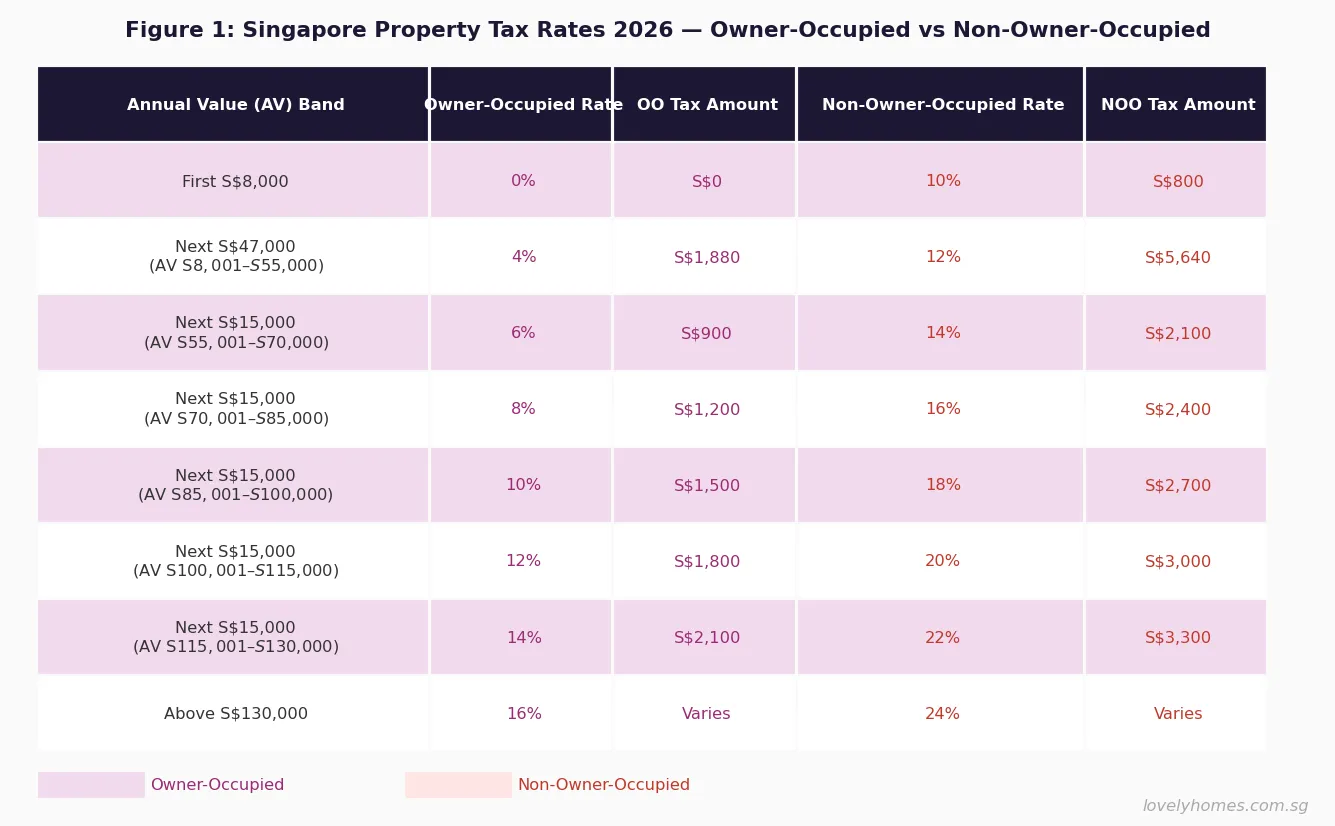
Singapore property tax rates 2026 owner-occupied vs non-owner-occupied IRAS
Figure 1: Singapore residential property tax rate schedule — Owner-Occupied (OO) vs Non-Owner-Occupied (NOO). Rates shown are indicative of the progressive schedule; verify current rates at iras.gov.sg. Click to zoom.

What Is Annual Value (AV) and How Does IRAS Calculate It?

The Annual Value (AV) of a property is IRAS’s estimate of the gross annual rent the property would fetch if it were rented out on the open market for a year, exclusive of furniture and maintenance. This is not based on what you actually receive in rent (or what you would receive if you rented it out) — it is IRAS’s independent assessment of market rental value, derived from rental transaction data for comparable properties.

IRAS reviews AVs periodically — typically when there are significant changes in the rental market — and updates them to reflect current conditions. The 2022–2023 rental surge in Singapore, which pushed private condo rents up by 30–40% in some segments, triggered widespread AV reviews and upward revisions, which in turn increased property tax bills for many owners.

How IRAS Arrives at the AV

IRAS uses three main reference points when assessing AV: (1) actual rental transactions for comparable properties in the same area and building type, sourced from rental contracts stamped with IRAS; (2) URA rental statistics for private residential properties by district and property type; and (3) HDB rental data for public housing. For unique properties such as landed homes and GCBs, IRAS may use direct comparisons with known rental transactions for nearby similar properties.

If your property has never been rented — for example, you bought a new condo and moved in immediately — IRAS will estimate the AV by reference to rents achieved by comparable units in the same development or comparable developments nearby.

Owner-Occupied (OO) vs Non-Owner-Occupied (NOO)

The most important variable in your property tax calculation is whether the property is classified as owner-occupied. If you live in the property as your principal place of residence, you pay the lower, progressive OO rates. All other residential properties — rented out, left vacant, or used as a secondary home — are taxed at the higher NOO rates.

Only one property may be declared OO. If you own two residential properties, one must be NOO. You notify IRAS of your OO status by filing an OO declaration; failure to do so defaults the property to the NOO rate. If your circumstances change — for example, you move out and rent the property — you must update IRAS within 30 days.

Singapore Property Tax Rates 2026

Singapore uses a progressive property tax rate system for residential property. As the AV increases, higher tiers of AV are taxed at higher rates. The OO schedule is significantly more generous than the NOO schedule, reflecting the Government’s intent to support owner-occupiers while taxing investment and rental properties more heavily.

Note: The rates below represent the progressive schedule as applied to residential property. Always verify the current year’s exact rates with IRAS at iras.gov.sg, as rates are subject to revision.

Annual Value Band OO Rate (%) OO Tax on Band NOO Rate (%) NOO Tax on Band
First S$8,000 0% S$0 10% S$800
Next S$47,000 (AV S$8,001–S$55,000) 4% S$1,880 12% S$5,640
Next S$15,000 (AV S$55,001–S$70,000) 6% S$900 14% S$2,100
Next S$15,000 (AV S$70,001–S$85,000) 8% S$1,200 16% S$2,400
Next S$15,000 (AV S$85,001–S$100,000) 10% S$1,500 18% S$2,700
Next S$15,000 (AV S$100,001–S$115,000) 12% S$1,800 20% S$3,000
Next S$15,000 (AV S$115,001–S$130,000) 14% S$2,100 22% S$3,300
Above S$130,000 16% Proportional 24% Proportional

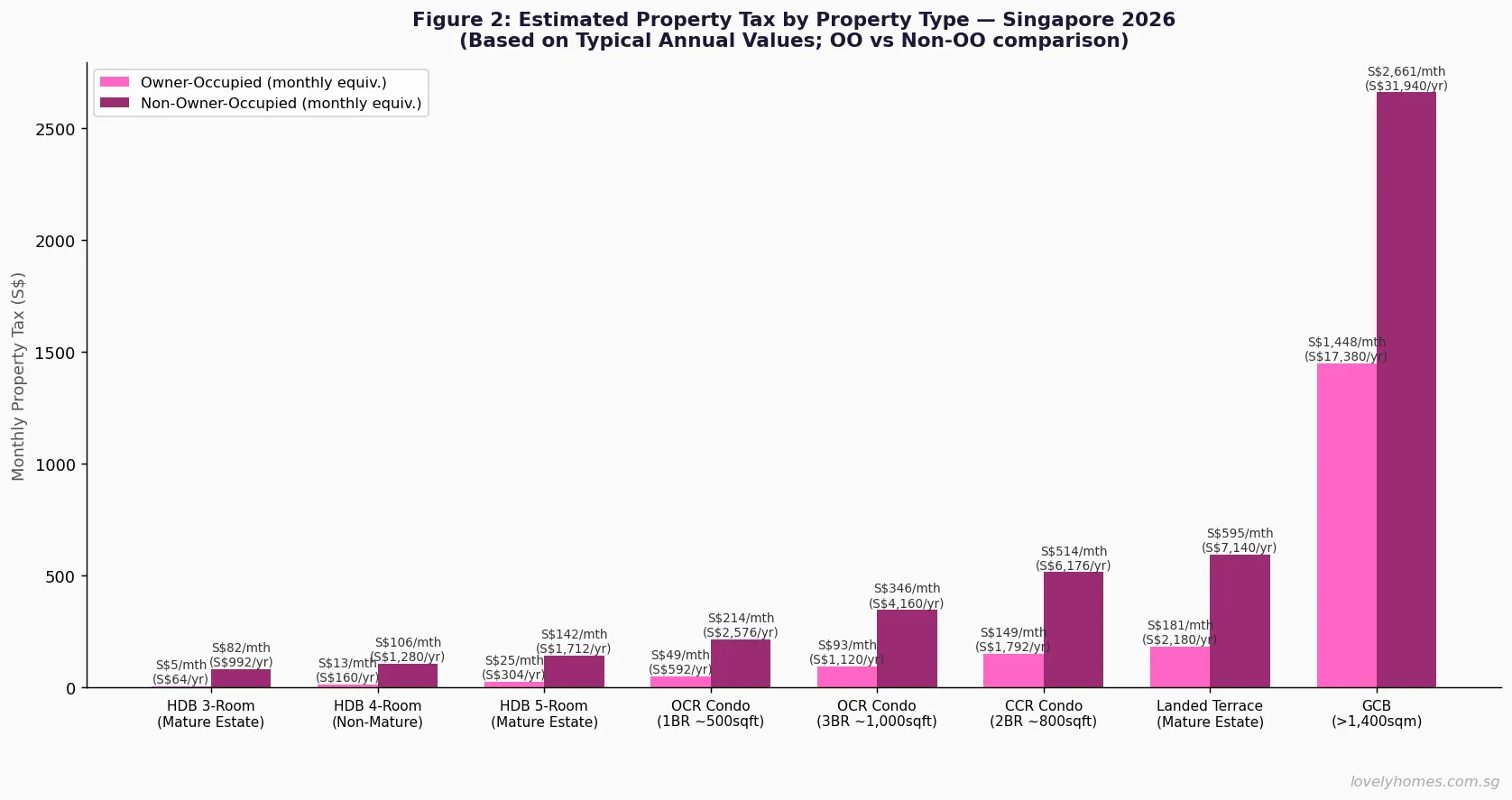
The progressive structure means you do not pay the top rate on your entire AV — only on the portion that falls within each band. An HDB 4-room flat with a typical AV of S$12,000 pays 0% on the first S$8,000 and 4% on the remaining S$4,000, totalling S$160 per year in property tax if owner-occupied — less than S$14 per month.

Singapore property tax annual value examples HDB condo landed 2026
Figure 2: Estimated monthly property tax (OO vs NOO) for typical property types in Singapore, based on representative Annual Values. Click to zoom.

How to Check Your Property’s Annual Value

IRAS publishes each property’s AV in the annual property tax bill sent each January. You can also check your AV anytime via the IRAS myTax Portal at mytax.iras.gov.sg — log in with your Singpass and navigate to “Property Tax” to view the current AV, rate applied, and tax amount for any property you own.

The AV is not the same as the purchase price, the valuation for bank loan purposes, or the market value of the property. It is specifically the rental-equivalent estimate. As a rough rule of thumb, the AV of private residential property is often around 2.5–4.0% of market value, reflecting rental yields in the broader market. For a condo valued at S$1.5 million yielding 3.2% gross, the AV would be approximately S$48,000.

Investment Properties and the Non-Owner-Occupied Rate

For property investors, the NOO property tax rate is a significant recurring cost that must be factored into yield calculations. On a private condo with an AV of S$40,000 — consistent with a mid-tier OCR 2-bedroom unit — the annual property tax at the NOO schedule amounts to approximately S$4,640 per year. On an AV of S$60,000 (a larger OCR or mid-CCR unit), the annual NOO tax rises to approximately S$8,040.

This cost is tax-deductible against rental income for income tax purposes if the property is genuinely rented out and declared as rental income under IRAS’s income tax framework. Investors should factor property tax, maintenance fees, sinking fund contributions, insurance, and depreciation into their true net yield calculations — gross rental yield does not reflect these holding costs.

If you own two or more residential properties, your second property will always be taxed at the NOO rate regardless of whether it is rented out. There is no provision to designate a second property as OO. Planning the sequence of property ownership — particularly for HDB upgraders moving to private property — requires careful thought about the tax implications of continuing to hold the HDB while buying private.

How to Pay Your Singapore Property Tax

IRAS issues property tax bills in January each year, covering the period from 1 January to 31 December. Payment is due by 31 January. Late payment attracts a 5% penalty on the outstanding amount, and further penalties may apply for continued non-payment.

Payment methods accepted by IRAS include: GIRO (the recommended method — set up once and IRAS auto-debits monthly instalments or annually); PayNow (via Singpass, referencing the IRAS tax reference); internet banking (using IRAS’s provided bill reference); and AXS stations for cash payments. CPF cannot be used to pay property tax — it must be paid in cash.

Worked Example: Property Tax for an HDB and a Private Condo

Scenario A — Owner-Occupied HDB 4-Room Flat (Tampines, AV S$12,000)

Annual Value: S$12,000. Owner-Occupied declaration filed. Tax computation:

  • First S$8,000 @ 0% = S$0
  • Next S$4,000 @ 4% = S$160
  • Total annual property tax: S$160 (approx. S$13 per month)

Scenario B — OCR Condo, 2BR, Owner-Occupied (AV S$30,000)

  • First S$8,000 @ 0% = S$0
  • Next S$22,000 @ 4% = S$880
  • Total annual property tax: S$880 (approx. S$73 per month)

Scenario C — Same OCR Condo Rented Out (NOO Rate, AV S$30,000)

  • First S$8,000 @ 10% = S$800
  • Next S$22,000 @ 12% = S$2,640
  • Total annual property tax: S$3,440 (approx. S$287 per month)

The difference between owner-occupied and non-owner-occupied on the same S$30,000 AV condo is S$2,560 per year — a meaningful recurring cost for investors. At a monthly rent of S$3,500, this property tax alone reduces the effective net monthly income by S$213 per month (before maintenance fees, income tax, and other costs).

Scenario D — CCR Condo Investment Property (AV S$60,000, NOO)

  • First S$8,000 @ 10% = S$800
  • Next S$47,000 @ 12% = S$5,640
  • Next S$5,000 @ 14% = S$700
  • Total annual property tax: S$7,140 (approx. S$595 per month)

Singapore property tax rate history changes 2011 to 2025 IRAS
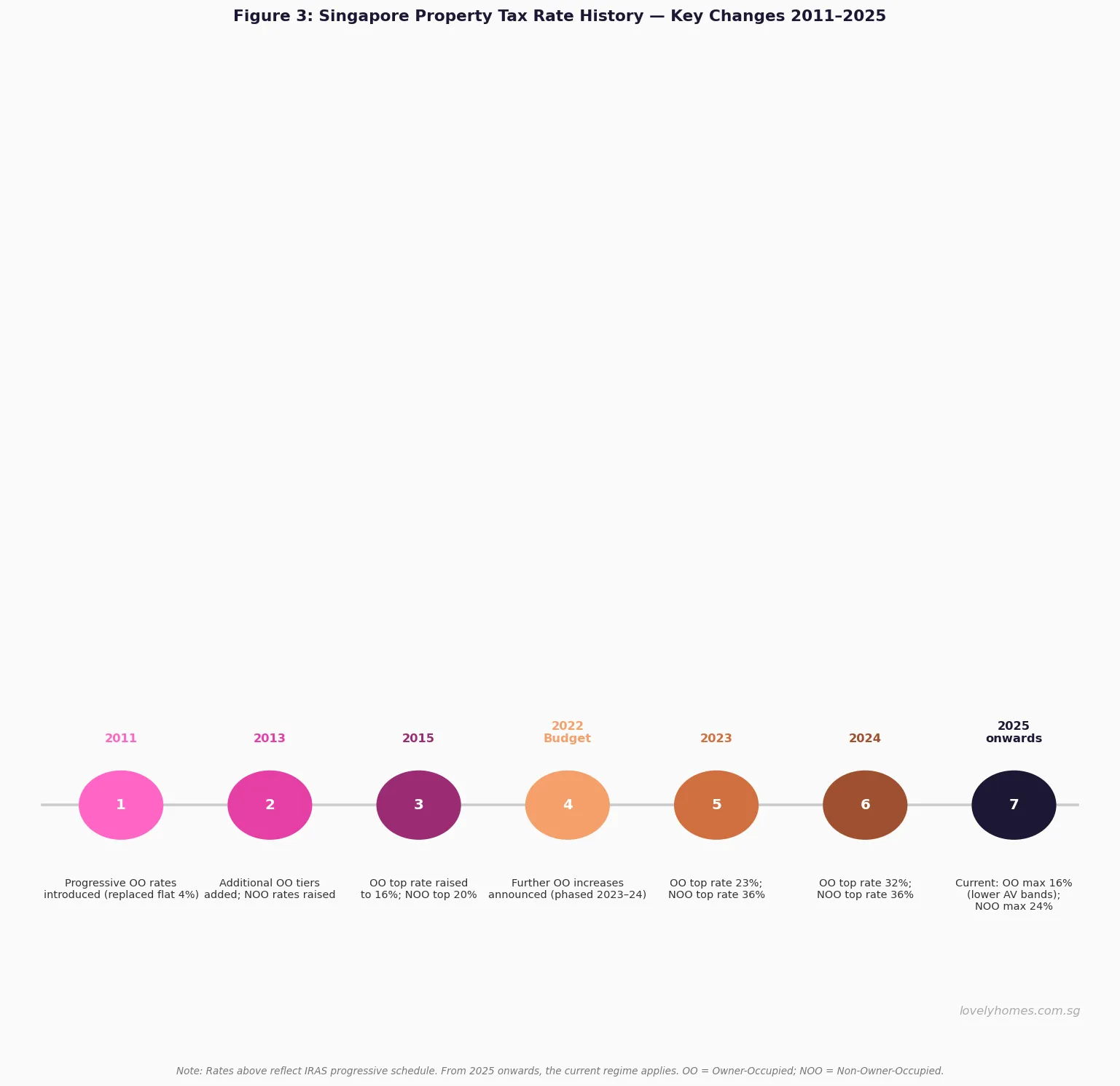
Figure 3: Key milestones in Singapore property tax rate history — from the introduction of progressive OO rates in 2011 to the 2022 Budget increases phased in through 2024. Click to zoom.

How Singapore Property Tax Has Evolved — And Why It Matters

Singapore introduced progressive owner-occupied property tax rates in 2011, replacing a flat rate that had applied for decades. The shift reflected a recognition that a flat rate was regressive — owners of high-value properties in prime districts were paying the same percentage rate as HDB flat owners. The progressive structure effectively subsidises modest owner-occupiers while placing a heavier burden on high-value residential holdings.

The 2022 Budget took this further, announcing phased increases to property tax rates for higher-value residential property (both OO and NOO) effective from 2023 and 2024. The stated rationale was to make the property tax regime more progressive and to fund Singapore’s social expenditure needs. The changes had the most significant impact on owners of private property in the CCR and GCB areas, where AV levels frequently exceed S$100,000.

Compared internationally, Singapore’s property tax rates remain moderate. Hong Kong’s rates are typically 5% of assessable rent (a rate applied to actual rent, not an official AV). Australia’s state-based land taxes vary but are broadly comparable. The UK’s Council Tax is a flat charge by property band — arguably less progressive than Singapore’s AV-based system.

Property Tax Rebates and Reliefs

IRAS has periodically granted property tax rebates to help owner-occupiers manage their tax bills during periods of high AV or economic stress. The Government has in the past granted rebates to HDB flat owners, typically covering 20–60% of the OO property tax bill for HDB flats during COVID years and periods of elevated inflation. Similar rebates have been granted to commercial property owners during the same period.

As at July 2026, no general property tax rebate is in force for private residential property. HDB flat owners should check the most recent Budget Statement for any rebate applicable to the current year. IRAS publishes rebate details on its website alongside the annual property tax bill.

Objecting to Your Annual Value

If you believe IRAS has assessed an AV that is too high — perhaps because rental market conditions have deteriorated, your property has structural issues that depress its rentability, or IRAS has used an inappropriate comparable property — you may lodge an objection within 30 days of receiving the property tax notice. The objection process requires you to provide evidence of comparable rental transactions that support a lower AV.

IRAS will review the objection and may revise the AV, maintain it, or issue an explanation. If you disagree with IRAS’s determination after the objection, you may appeal to the Valuation Review Board (VRB), an independent tribunal. Note that property tax is still payable at the assessed amount pending the outcome of any objection — you are not entitled to withhold payment while an objection is being reviewed.

What Might Come Next for Singapore Property Tax

This section represents editorial analysis — not official guidance.

The AV review cycle and any further rate adjustments are the two main variables to watch. Given that rental market growth moderated through 2025 and into 2026 — with some segments seeing rents stabilise or soften — the next AV review cycle may result in downward revisions for certain property types and regions. This would be a modest relief for NOO property investors who have seen property tax bills rise significantly since 2022.

On the rate side, Singapore’s progressive property tax has achieved a reasonable degree of progressivity since the 2022 Budget changes. Further rate increases targeting ultra-high-AV properties (GCBs with AV > S$200,000) are a political possibility at future Budgets, consistent with the Government’s stated goal of distributing the tax burden more broadly across wealth brackets.

Frequently Asked Questions

Can I use CPF to pay my property tax?

No. Property tax must be paid in cash. CPF funds — including the Ordinary Account — cannot be used to pay IRAS property tax. This is a common point of confusion since CPF can be used for certain other property-related costs such as BSD, mortgage repayments (subject to limits), and HDB purchase price. If you are setting up GIRO for property tax, it must be linked to a bank account, not a CPF account.

Is property tax deductible as a rental expense?

Yes, if you rent out your property and declare the rental income to IRAS for income tax purposes, the property tax paid on that property is an allowable deduction against your rental income. You may deduct either the property tax actually paid, or take the default 15% deduction for deemed maintenance expenses (which includes property tax). You cannot claim both — choose whichever gives you the larger deduction. Consult a tax adviser for your specific situation.

My property is vacant — do I still pay property tax?

Yes. Property tax applies whether the property is occupied, rented out, or vacant. If the property is not your principal residence, it is taxed at the NOO rate even if nobody lives in it. There is no exemption for vacancy. This means owning a second property that is left empty carries both the opportunity cost of foregone rental income and the ongoing cost of NOO property tax, maintenance fees, and insurance.

When does IRAS review and change Annual Values?

IRAS reviews AVs on an ongoing basis, typically triggering a revision when market rents for comparable properties show a sustained movement of 10% or more from the current assessed AV. IRAS may review individual properties (for example, after a major renovation or a change in the property’s rentable area) or conduct broader sector-wide reviews when rental market conditions change materially. You will receive a notice from IRAS if your AV is revised, and you have 30 days to object if you disagree.

Does property tax apply to commercial shophouses?

Yes, but at a flat 10% rate on the AV, not the progressive residential schedule. Non-residential property — including commercial shophouses, offices, retail units, and industrial property — is taxed at this flat 10% rate. If a shophouse has a residential upper floor and commercial ground floor, IRAS apportions the AV between the two components and applies the residential rates (OO or NOO) to the residential portion and 10% to the commercial portion. This nuanced treatment is one reason shophouses are a structurally distinct investment category.

Do I need to pay property tax if I just bought a new launch condo that has not been completed?

Property tax begins accruing from the date the property is officially completed and issued a Temporary Occupation Permit (TOP) or Certificate of Statutory Completion (CSC). During the construction period, no property tax is levied. Once the TOP is issued, IRAS will assess the AV and begin charging property tax — typically at the OO rate if you declare it as your principal residence, or the NOO rate if you have not moved in or have another OO property. You do not need to do anything proactively; IRAS will write to you.

Related Articles on LovelyHomes

Disclaimer: The property tax rates and Annual Value figures cited in this article are illustrative and based on the progressive rate schedule as at mid-2026. Singapore property tax rates and thresholds are subject to change at each Budget. Always verify the current year’s exact rates and your property’s AV with IRAS at iras.gov.sg. This article is for general information only and does not constitute tax or legal advice. Consult a licensed tax adviser or property professional before making any decisions based on this information. Property values and rental markets fluctuate — figures cited are indicative only.

×Click anywhere outside the image to close

Singapore MCST Guide 2026: Management Fees, Sinking Fund, By-Laws and Your Rights as a Condo Owner

Singapore MCST Guide 2026: Management Fees, Sinking Fund, By-Laws and Your Rights as a Condo Owner

Quick Answer: Singapore MCST and Condo Management 2026

  • MCST stands for Management Corporation Strata Title — the legal body that owns and manages common property in every privatised strata development in Singapore.
  • Management Council (MC) is elected by all unit owners at the Annual General Meeting (AGM) and is responsible for running the estate on their behalf.
  • Two statutory funds: the Management Fund (day-to-day operations) and the Sinking Fund (capital expenditure reserve, minimum 10% of total contributions under BMSMA).
  • Typical fees range from S$200–S$600/month for a 2–3 bedroom unit, depending on development size, facilities, and location.
  • By-laws are the rules governing unit owners’ rights and obligations — breach can result in fines of up to S$5,000 under the Building Maintenance and Strata Management Act (BMSMA).
  • Dispute resolution follows a clear pathway: raise with MC → formal complaint → Strata Titles Board (STB) mediation → STB Order (legally binding).
  • Legislation: the BMSMA (Cap. 30C) governs all strata management in Singapore, administered by the Building and Construction Authority (BCA).

What Is an MCST? The Legal Foundation of Condo Living

Every private strata development in Singapore — be it a condo, mixed development, or strata-titled commercial building — is governed by a Management Corporation Strata Title, commonly abbreviated as MCST. The MCST is not a service provider or a management company: it is a statutory body corporate created automatically by law when a strata development’s subsidiary strata certificates of title are issued. In plain terms, the moment you become a subsidiary proprietor (i.e., a unit owner) in a strata development, you automatically become a member of the MCST. You have voting rights, you share in the obligations, and you benefit from the management of common property.

The legal framework is the Building Maintenance and Strata Management Act (BMSMA), Chapter 30C of Singapore’s statutes. The BMSMA is administered by the Building and Construction Authority (BCA) under the Ministry of National Development (MND). It prescribes how MCSTs are constituted, how they manage funds, how by-laws are made and enforced, and how disputes are resolved. For buyers and investors, understanding the MCST is not optional — it directly affects your monthly costs, your rights in the estate, and your ability to renovate or use your unit.

The Management Council: Who Runs Your Condo?

The day-to-day affairs of the MCST are delegated to the Management Council (MC), a committee of elected subsidiary proprietors. Under BMSMA, the MC must have a minimum of 3 members and a maximum of 14, and council members must be unit owners (or nominees of corporate owners). The MC is elected at the AGM, which must be held within 15 months of the previous AGM.

The MC holds significant authority: it sets the annual budget, approves expenditure from both the Management Fund and Sinking Fund, engages and supervises the Managing Agent (MA), enforces by-laws, grants or denies renovation approvals, and represents the MCST in legal matters. In practice, the MC also exercises considerable informal authority over the day-to-day “feel” of an estate — how promptly maintenance issues are addressed, how strictly by-laws are enforced, how transparently accounts are reported to owners.

Most MCSTs engage a professional Managing Agent (MA) — a licensed company that handles operational tasks on the MC’s behalf, including maintenance scheduling, security rostering, contractor management, accounting, and AGM administration. The MA operates under a service contract and is accountable to the MC, not to individual unit owners. Disputes with the MA are resolved through the MC.

Management Fund and Sinking Fund: Your MCST Levies Explained

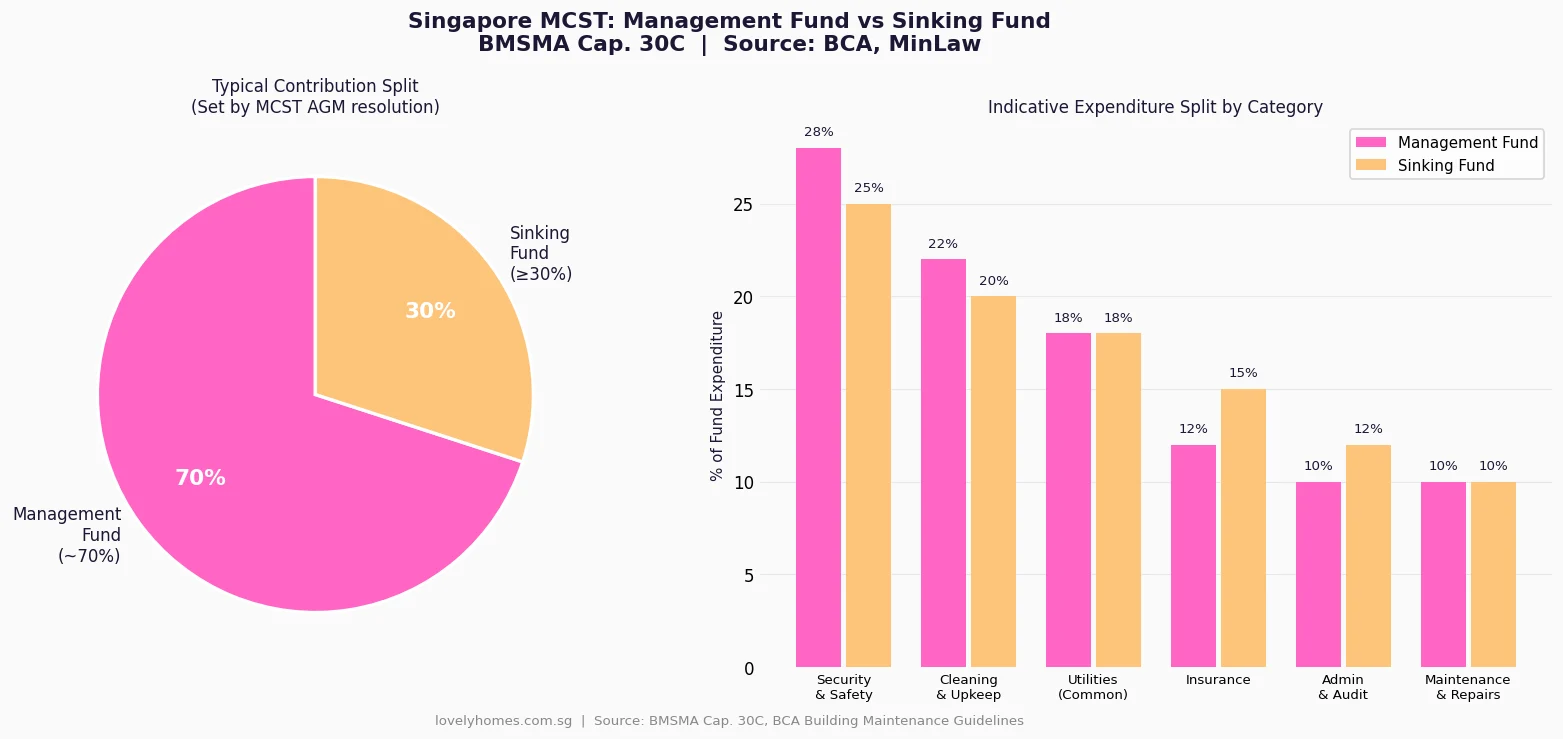
Every subsidiary proprietor pays monthly contributions (commonly called “maintenance fees”) to the MCST. Under BMSMA, these contributions are split between two statutory funds:

The Management Fund covers recurring operational costs: security services, cleaning, common area utilities (lifts, lighting, pool pumps), landscaping, insurance (fire and public liability), administration, audit fees, and routine minor repairs. Think of this as the MCST’s operating budget.

The Sinking Fund is a capital reserve for major future expenditure: lift overhauls, façade waterproofing, roof replacement, mechanical and electrical system replacements, pool refurbishment, road resurfacing, and similar major works. BMSMA requires that the Sinking Fund must receive contributions equivalent to at least 10% of the total contributions collected (i.e., at least one-tenth of the combined Management Fund and Sinking Fund contributions must go to the Sinking Fund). Most well-managed developments set a higher target — 25–35% of total contributions — to build an adequate reserve.

Singapore MCST management fund sinking fund breakdown BMSMA
Figure 1: MCST Management Fund vs Sinking Fund — Typical Contribution Split and Indicative Expenditure Categories. Source: BMSMA Cap. 30C, BCA Building Maintenance Guidelines.

Contributions are allocated per unit according to share values — a number assigned to each unit based on its area and type when the development is first surveyed. A larger unit typically carries a higher share value and pays a proportionately larger monthly contribution. Share values are fixed and cannot be changed without a unanimous resolution.

How Much Are MCST Fees? A Guide by Condo Type

MCST fees vary enormously across Singapore’s condo landscape. Key factors include the number of units in the development (more units spread fixed costs over a larger base, reducing per-unit fees), the range of facilities (pools, gyms, tennis courts, concierge all cost money to maintain), the age of the development (older buildings have higher maintenance costs), and the quality of financial management by the MC.

Singapore MCST annual fees by condo type 2026 indicative range
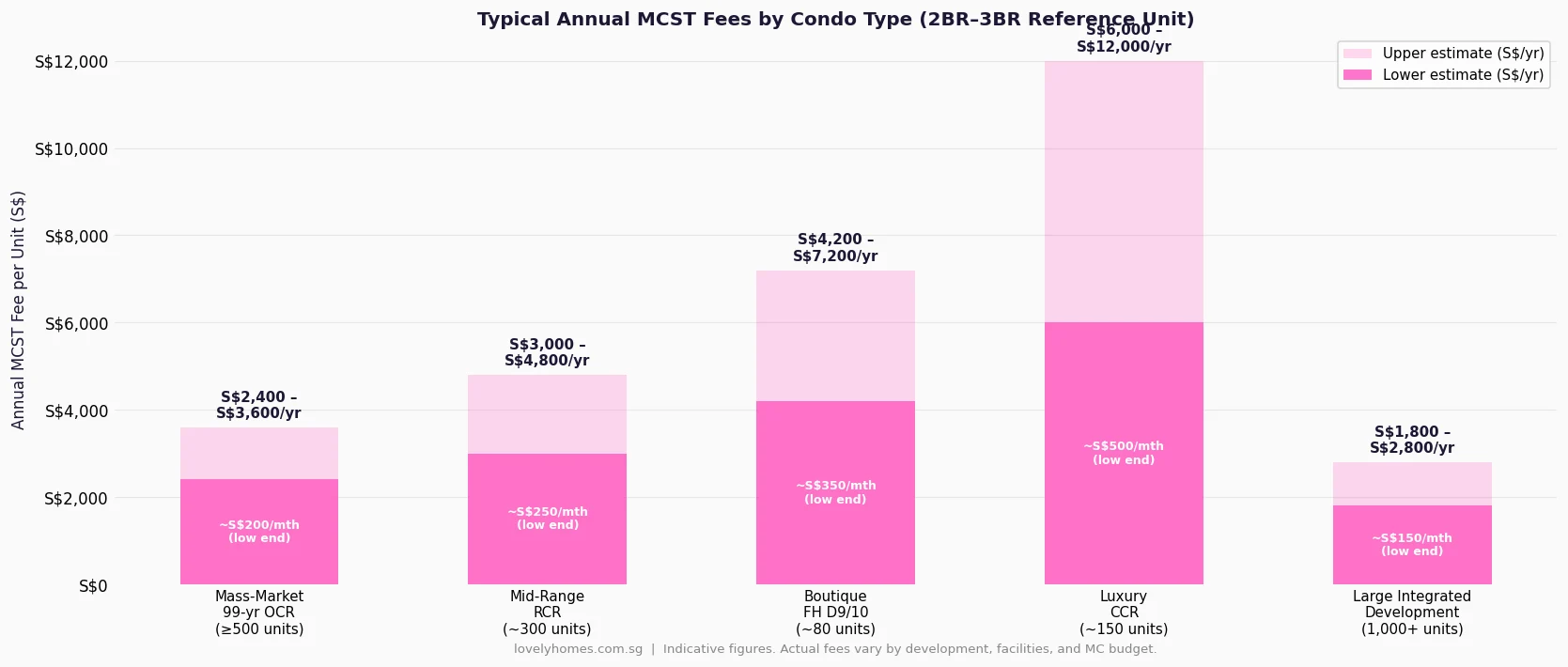
Figure 2: Indicative Annual MCST Fees per Unit by Condo Type (2BR–3BR Reference Unit), 2026. Figures are estimates based on typical fee structures; actual fees depend on each development’s budget.

As a general benchmark: a mass-market OCR condominium with 500 or more units and standard facilities (pool, gym, BBQ area) might charge S$200–S$300 per month for a 3BR unit. A mid-range RCR development with around 300 units and a fuller facility suite (multiple pools, function rooms, tennis court) might charge S$250–S$400 per month. A boutique freehold development in Districts 9 or 10 with 80 units and concierge services might charge S$350–S$600 or more per month — the smaller the development, the fewer units to share fixed costs.

Buyers should always request and study the MCST’s audited financial statements (particularly the Sinking Fund balance and adequacy ratio) before purchasing any resale unit. A development with an underfunded Sinking Fund is a red flag — owners will face either a special levy or deteriorating maintenance when major capital works are required.

By-Laws: The Rules of Strata Living

MCST by-laws govern the obligations and restrictions on subsidiary proprietors and their tenants and visitors. Singapore law establishes two tiers of by-laws. The Model By-Laws, set out in the Fourth Schedule of BMSMA, apply automatically to all strata developments and cover fundamentals: prohibiting nuisance to neighbours, keeping common areas clean, not obstructing stairways and corridors, maintaining smoke and cooking fumes within units, and not damaging common property.

Developments may additionally pass additional by-laws by ordinary resolution at an AGM. These can cover matters such as pet policies (breed or size restrictions), short-term rental rules (many condos have by-laws restricting Airbnb-style rentals to a minimum 3-month or 6-month tenancy), renovation hours and noise restrictions, car park allocation rules, and use of facilities. Critically, additional by-laws cannot override the BMSMA or conflict with it — a by-law purporting to ban all pets entirely, for example, may be challengeable as unreasonable.

Breach of by-laws can result in fines of up to S$5,000 per breach under BMSMA, imposed by order of the Strata Titles Boards (STB). In practice, MCSTs typically issue written warnings first; formal enforcement action is reserved for persistent or serious breaches.

Renovation Approvals: What You Need the MCST’s Permission For

If you own a strata unit, you generally have the right to carry out renovation works within your unit, subject to certain approvals and restrictions. Works that affect common property — balcony modifications, structural walls that may be shared, roof access, plumbing in common risers — require MCST approval in addition to any Building and Construction Authority (BCA) or Urban Redevelopment Authority (URA) permits. Internal reconfigurations (knocking down non-structural internal walls, replacing flooring, kitchen refits) typically do not require MCST approval but must comply with time and noise restrictions in the by-laws.

A common area of confusion is the aircon ledge and balcony enclosure. These are typically common property, meaning any modification (enclosing, expanding, adding screens) requires MCST approval. Unauthorised enclosures are one of the most frequent by-law enforcement issues in Singapore condominiums. Always confirm with the MC in writing before commencing any works that touch external walls, balconies, or roof areas.

Summary: Key MCST Rules at a Glance

Topic Rule / Key Point Legislation / Source
MCST formation Automatically formed when strata title issued; all unit owners are members BMSMA s. 29
Management Council size 3–14 members elected at AGM; must be unit owners or nominees BMSMA s. 53
AGM frequency Must be held annually; not more than 15 months since last AGM BMSMA s. 27
Sinking Fund minimum At least 10% of total contributions; MC can set higher target BMSMA s. 38
By-law breach fines Up to S$5,000 per breach, by STB order BMSMA s. 32
Common property works Require MCST written consent; MC can set conditions BMSMA s. 37
Dispute resolution STB mediation → STB Order → High Court appeal (law only) BMSMA Part VI
Quorum for ordinary resolution ≥30% of total share values represented at a general meeting BMSMA s. 75
Pets Governed by by-laws; model by-laws do not prohibit pets; additional by-laws may impose restrictions BMSMA 4th Schedule
Short-term rentals Permitted subject to by-laws and URA regulations; many MCSTs have by-laws requiring minimum 3–6 month tenancy URA guidelines

Worked Example: Mr Tan’s S$9,000 Balcony Dispute

Mr Tan owns a 3BR unit in a mid-range RCR condominium. His balcony faces a pleasant courtyard and he wishes to enclose it with floor-to-ceiling glass panels to create a larger living area. He proceeds without MCST consent and engages a contractor who completes the works over two weekends.

The MC sends a formal notice of breach under the by-laws: the balcony is common property under the strata plan, and any modification requires prior written MCST approval. The MC orders the works to be removed at Mr Tan’s expense within 30 days. Mr Tan disputes this — he argues the panels are removable and he is not damaging the building.

The MC applies to the Strata Titles Boards (STB) for an order requiring reinstatement. At mediation, the STB mediator helps both parties reach a compromise: Mr Tan may retain the glass enclosure provided it is a fully removable system (no drilling into structural walls), an engineer certifies it does not affect load-bearing elements, and he pays a S$500 administrative fee to the MCST. Without compromise, a formal STB Order could have required full reinstatement at an estimated cost of S$8,000–S$12,000 in contractor fees, plus a potential fine of up to S$5,000.

Lesson: always obtain MCST written approval before any works touching common property. The cost of a dispute far exceeds the inconvenience of applying in advance. For guidance on tenant-related strata disputes, see our Rental Tenant Rights Guide 2026.

Dispute Resolution: The Strata Titles Boards (STB)

When a dispute arises between a subsidiary proprietor and the MCST (or between two unit owners about strata matters), Singapore provides a dedicated tribunal: the Strata Titles Boards (STB), established under BMSMA and administered by the Ministry of Law (MinLaw). STB proceedings are designed to be accessible and affordable — filing fees are modest, legal representation is optional, and the process is less adversarial than court litigation.

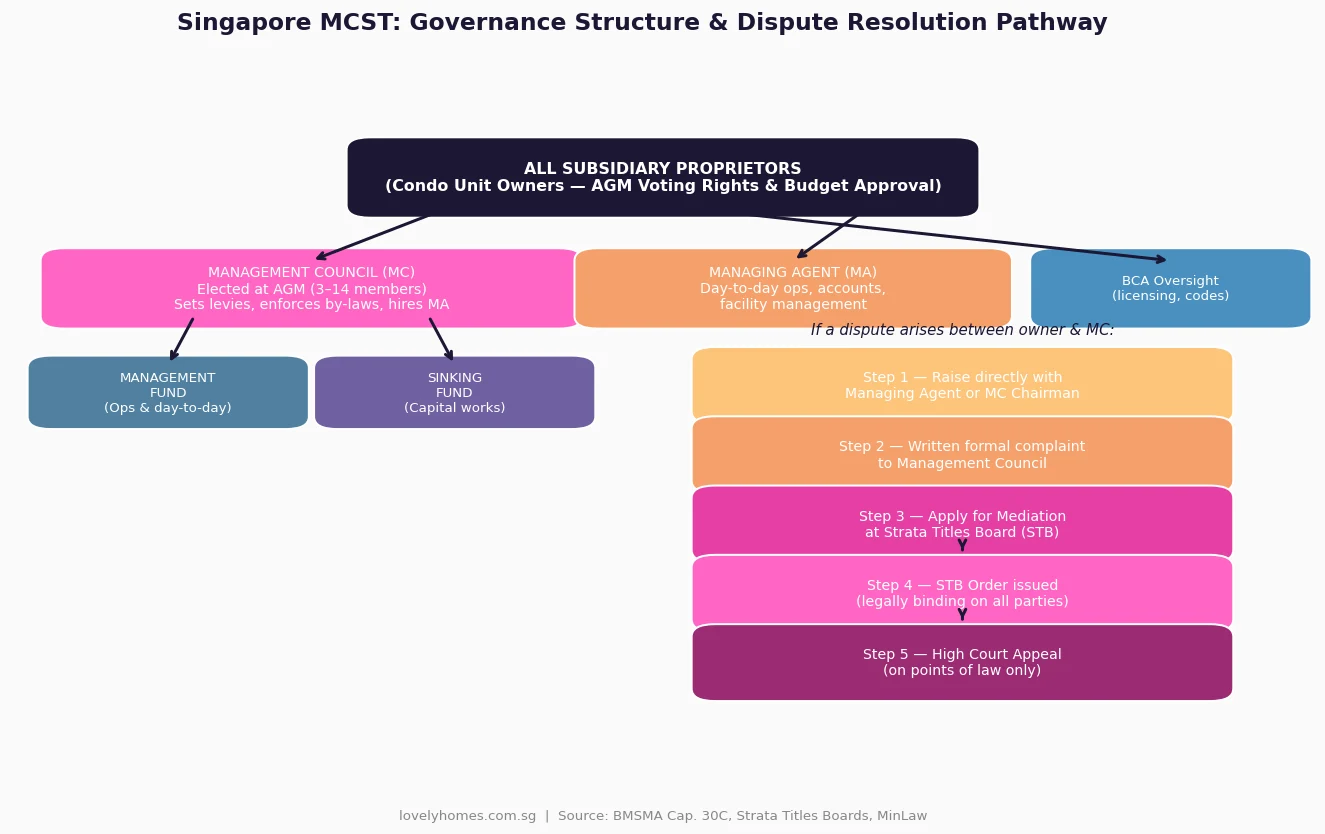
Common STB applications include: orders requiring the MCST to carry out maintenance works; disputes about by-law enforcement or breach penalties; objections to special levies; disputes about the allocation of car park lots; and applications to invalidate decisions made at AGMs where proper notice was not given. The STB first attempts mediation — parties meet with a mediator in a structured session. If mediation fails, the STB constitutes a formal hearing panel, receives evidence, and issues an Order. STB Orders are legally binding and enforceable in the courts. Appeal lies to the High Court, but only on questions of law.

Singapore MCST governance structure dispute resolution pathway STB BMSMA
Figure 3: Singapore MCST Governance Structure and Dispute Resolution Pathway — from unit owners through Management Council to Strata Titles Boards. Source: BMSMA Cap. 30C, MinLaw.

What Might Change: BMSMA Review and Future Reforms

The BMSMA was comprehensively amended in 2010 and has been updated periodically since. BCA periodically reviews strata management regulations in response to industry feedback and changing market conditions. Areas of ongoing discussion as at mid-2026 include: tightening rules on managing agents’ qualifications and licensing; improving transparency of MCST financial reporting to unit owners; and clarifying the rules on short-term rental by-laws in the context of Singapore’s broader short-term rental regulatory framework. Buyers should monitor BCA and MinLaw announcements for any legislative updates that might affect their rights and obligations as condo owners.

Frequently Asked Questions About Singapore MCSTs

Can the MCST increase maintenance fees without my consent?

Yes. The Management Council has the authority to set the annual budget and the contribution amounts (maintenance fees) required from each unit owner, subject to approval at the AGM by ordinary resolution. An ordinary resolution requires a simple majority of votes cast (by share value) at a general meeting. If you disagree with a fee increase, you can vote against it at the AGM or requisition an extraordinary general meeting to challenge it. Practically speaking, however, fee increases are usually incremental and reflect genuine cost increases — MCSTs that chronically underfund their budgets end up with deteriorating estates and greater special levy calls down the line.

What is a special levy and when can the MCST impose one?

A special levy is a one-time additional contribution imposed on all unit owners to fund a specific capital expenditure that has arisen unexpectedly or that the Sinking Fund is insufficient to cover. Common triggers include emergency structural repairs, lift replacements ahead of schedule, or the costs of defending the MCST in legal proceedings. Under BMSMA, a special levy must be approved by ordinary resolution at a general meeting. The amount allocated to each unit is based on share value. Special levies are a red flag in developments that have historically underfunded their Sinking Fund — which is why buyers should always check the Sinking Fund balance and recent spending history before purchasing a resale unit. A healthy Sinking Fund protects against special levies.

What happens if I stop paying my MCST fees?

Unpaid MCST contributions are a debt owed to the MCST. Under BMSMA, the MCST has a statutory lien over your unit for unpaid contributions — it can register this lien with the Singapore Land Authority (SLA) and ultimately pursue recovery through the courts. If you are selling your unit, solicitors acting on the sale will identify any outstanding MCST arrears, which must be settled before completion. Persistent non-payment can also result in the MCST applying to the STB for enforcement orders. There is no grace period prescribed in law, though most MCSTs will issue demand letters before proceeding to formal enforcement action.

Can I attend an AGM and vote even if I have outstanding MCST fees?

Under BMSMA, unit owners who are in arrears of contributions may be denied the right to vote at a general meeting. Specifically, a subsidiary proprietor is not entitled to vote at any general meeting if any contribution payable in respect of their lot has been in arrears for more than 30 days before the date of the meeting. You retain the right to attend and speak, but you lose voting rights until the arrears are cleared. This is an important incentive for timely payment, particularly for contentious AGM resolutions such as special levies or managing agent contract renewals.

My neighbour is violating the condo by-laws — what can I do?

The primary enforcement mechanism for by-law breaches is through the MCST, not individual unit owners. You should first report the breach in writing to the Managing Agent or Management Council, providing clear details (date, nature of breach, evidence where available). The MC has the authority and obligation to investigate and take enforcement action. If the MC fails to act on a legitimate complaint, you can raise the matter at the AGM or requisition an extraordinary general meeting. As a last resort, you may apply to the STB directly under BMSMA section 111 for an order requiring the MC to take enforcement action. The STB process is designed to be accessible — you do not need a lawyer to file an application.

Can I rent out my condo unit on Airbnb or short-term rental platforms?

Short-term rental of private residential properties in Singapore is regulated by URA under its Short-Term Accommodation (STA) Framework. As at 2026, private residential properties listed for short-term rental must meet URA’s requirements, including a minimum rental period of three consecutive months per tenant. Many MCSTs additionally pass by-laws imposing their own minimum tenancy periods or restricting short-term rentals entirely within their estates. You should check both URA’s current STA guidelines and your specific development’s by-laws before listing your property. Breach of URA regulations can result in fines, and breach of MCST by-laws can result in STB enforcement. For the rental rules from the tenant’s perspective, see our Singapore Rental Tenant Rights Guide 2026.

I want to buy an en bloc / collective sale — how does the MCST factor in?

In an en bloc (collective sale), the MCST plays a key administrative role but does not initiate or block the sale. The en bloc process is governed by the Land Titles (Strata) Act (LTSA), not BMSMA. Owners seeking a collective sale form a collective sale committee (CSC), separate from the MC. The CSC must obtain consent from subsidiary proprietors holding 80% of total share value (for developments over 10 years old) or 90% (for developments under 10 years old) before applying to the STB for a sale order. Dissenting owners can file objections with the STB. The MC continues to manage the estate throughout the en bloc process, including collecting maintenance fees and addressing day-to-day repairs, until the sale is completed and the strata title scheme is wound up.

Related Articles

Disclaimer: This article is for general informational purposes only and does not constitute legal, financial, or property advice. Information on BMSMA provisions is based on the Act as at June 2026; amendments may occur — readers should verify against the current statutes at sso.agc.gov.sg and consult the Building and Construction Authority (bca.gov.sg), the Strata Titles Boards (mlaw.gov.sg/strata-titles-boards), or a qualified lawyer for advice specific to their strata development and circumstances.

Singapore ABSD Remission and Refund Guide 2026: SC Couple Scheme, 6-Month Window and Clawback Rules

Singapore ABSD Remission and Refund Guide 2026: SC Couple Scheme, 6-Month Window and Clawback Rules

Quick Answer: ABSD Remission & Refund Singapore 2026 — Key Takeaways

  • The ABSD remission scheme for Singapore Citizen (SC) married couples allows a full refund of the 20% ABSD paid on a second residential property purchase — provided both spouses are SC and the existing property is sold within 6 months of the new purchase’s completion date.
  • Remission is not automatic: you must apply to IRAS within the 6-month window. IRAS does not proactively initiate the refund.
  • If the 6-month window is missed, IRAS will clawback the full ABSD plus interest at 5% per annum from the date of the original transaction.
  • ABSD must be paid upfront within 14 days of exercising the OTP — the remission is a refund after the fact, not a waiver at the point of purchase.
  • The remission applies to the first joint property purchase by a SC married couple where both spouses are SC and neither has previously owned another residential property in Singapore simultaneously.
  • For SPR married couples buying their first joint property, a separate 5% ABSD remission applies with no sale requirement.
  • Developers buying residential land for development qualify for a partial ABSD remission if all units are sold within 5 years; the unsold-unit penalty is significant.
  • ABSD remission is separate from BSD — Buyer’s Stamp Duty is never remitted and is always a sunk cost of purchase.
  • Careful timing of the HDB sale is essential: sellers must not delay their HDB OTP exercise if they wish to stay within the 6-month window.

What Is ABSD Remission and Who Administers It?

Additional Buyer’s Stamp Duty (ABSD) is levied by the Inland Revenue Authority of Singapore (IRAS) on residential property purchases in Singapore, on top of the standard Buyer’s Stamp Duty (BSD). The ABSD rates introduced in April 2023 are among the highest in Singapore’s property history — 20% for Singapore Citizens buying a second property, 30% for SC buying a third or subsequent property, and 60% for foreign buyers on any purchase. These rates were designed explicitly to curb speculative activity and cool an overheated market.

However, recognising that many SC married couples engage in sequential upgrading — selling their HDB flat and buying a private condominium as a genuine housing upgrade rather than an investment — the government provides a remission (refund) mechanism for a specific, tightly defined buyer profile. This remission does not reduce the ABSD rate payable at purchase; instead, the full ABSD must be paid upfront, and a refund application is made after the old property is sold within the prescribed window.

ABSD remission policy is set by the Ministry of Finance (MOF) and administered by IRAS. Changes to remission criteria require an MOF announcement, usually as part of the broader set of property cooling measure adjustments. The current remission framework has been in force since the April 2023 cooling measure revision.

Eligibility Matrix: Who Qualifies for ABSD Remission?

ABSD remission eligibility matrix by buyer profile Singapore 2026
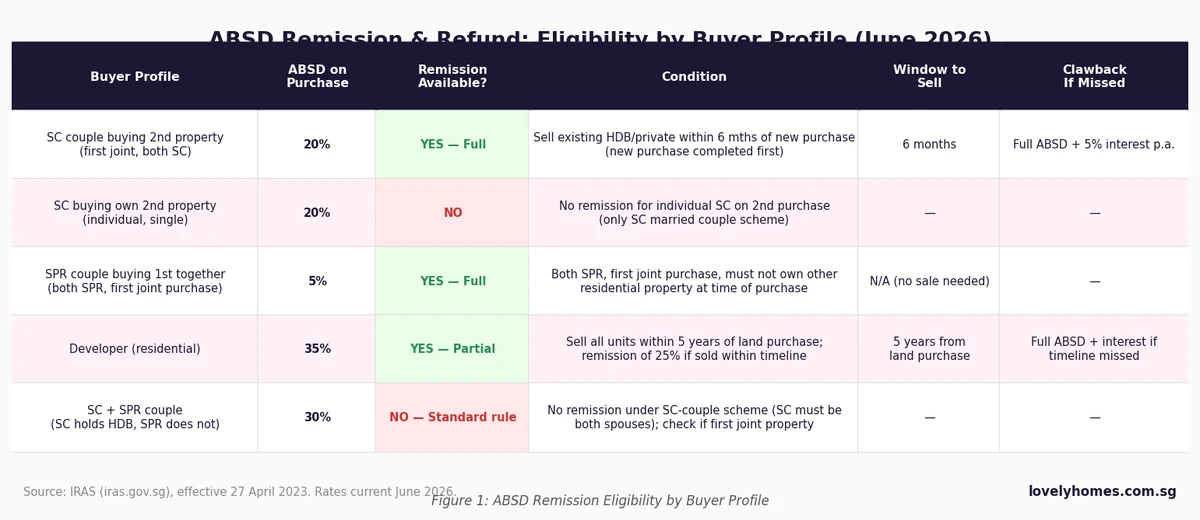
Figure 1: ABSD Remission Eligibility by Buyer Profile — as of June 2026. Source: IRAS.

The eligibility criteria are deliberately narrow. The SC married couple remission is the most widely applicable scenario and applies to upgraders transitioning from their HDB flat to a private condominium. Both spouses must be Singapore Citizens (not Permanent Residents, not foreigners) at the time of the new purchase, the new purchase must be their first jointly-owned residential property together (neither spouse may hold another residential property at the time of purchase), and the existing property — typically an HDB flat — must be sold and the sale completed within 6 months of the new property’s purchase completion date.

Critically, the “completion date” for a new launch condominium is the Temporary Occupation Permit (TOP) date, not the date the OTP was exercised or the Sales and Purchase Agreement (SPA) was signed. For resale private properties, completion is typically 10–12 weeks after OTP exercise. This distinction matters greatly for the 6-month window calculation: an SC couple who exercises an OTP on an under-construction new launch today does not begin their 6-month countdown until the project obtains TOP — which could be 3 to 5 years away. This is a significant planning advantage for new-launch buyers compared to resale buyers.

How Much Is the ABSD Remission Worth?

ABSD remission amounts at various property purchase prices Singapore SC couple 2026
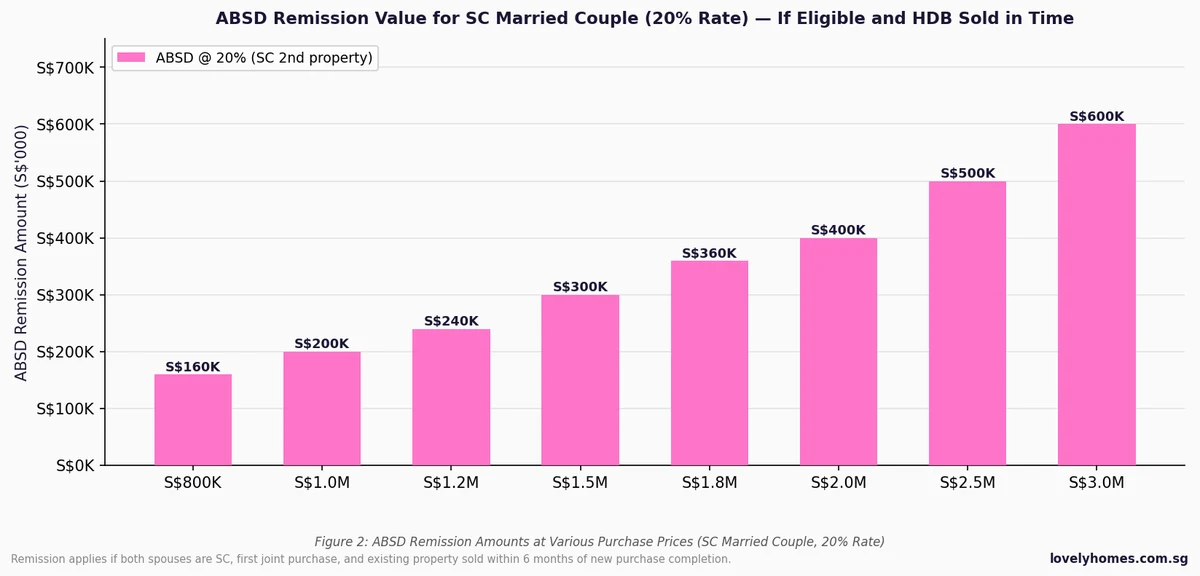
Figure 2: ABSD Remission Value for SC Married Couple at the 20% Rate — Across Various Purchase Prices.

At the current 20% ABSD rate for SC buying a second property, the remission amounts are material — often exceeding the total legal, agent, and renovation costs of the purchase combined. A couple buying a S$1.5 million condominium faces S$300,000 in upfront ABSD, all of which can be recovered if the HDB flat is sold in time. At S$2 million, the recoverable ABSD is S$400,000. These are not marginal amounts: they represent a fundamental difference in the affordability and financial feasibility of the upgrade.

It is worth noting that ABSD cannot be paid from CPF — it must be paid in cash. This means a couple must have S$300,000 to S$600,000 or more in liquid cash available at the time of purchase (before the remission is received). For many upgrading households, this is the single biggest financial planning challenge of the entire transaction. Some couples structure a bridging loan to cover the ABSD temporarily, which is repaid once the HDB flat is sold and the remission is received. The cost of the bridging loan — typically at prime rate or slightly above, for 3–6 months — is a relatively small price for preserving the remission eligibility.

The 6-Month Window: How It Works and the Clawback Risk

ABSD SC couple remission step by step timeline 6 month clawback window Singapore
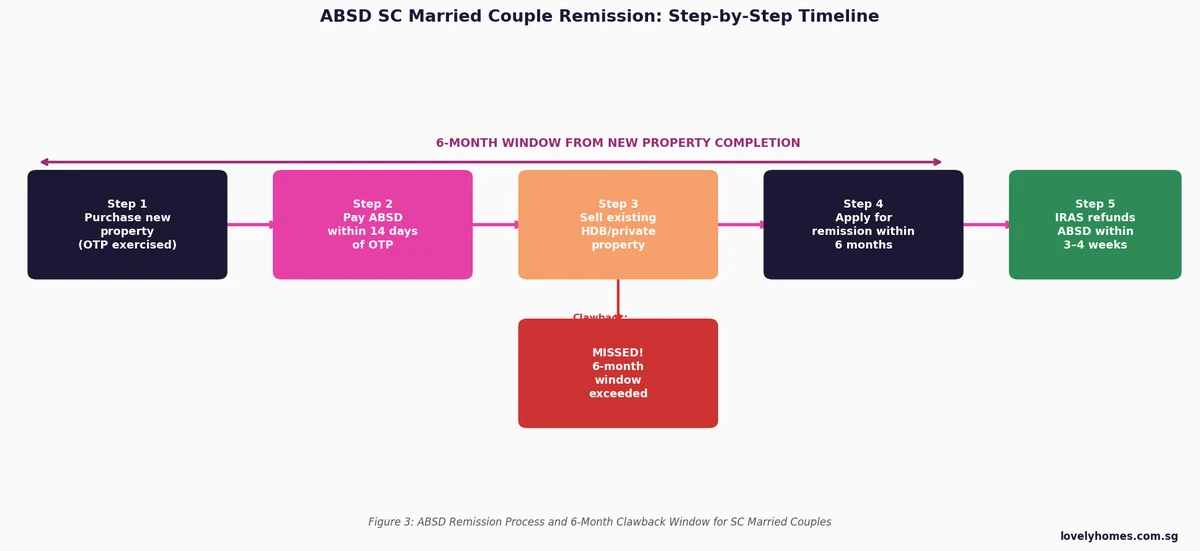
Figure 3: ABSD SC Married Couple Remission — Step-by-Step Timeline and the 6-Month Clawback Window.

The 6-month window begins on the completion date of the new property purchase, not from the OTP date or the SPA signing date. For a private condominium under construction, this is the TOP date. For a resale condominium, it is the completion of the property transfer — typically 10–12 weeks after OTP exercise. The existing property sale must be completed within this 6-month window, not merely contracted or in progress. A scenario where the HDB OTP is exercised on Month 5 but the HDB sale only completes on Month 7 would fail the test.

If the 6-month window is missed — whether due to a buyer falling through on the HDB flat, a delayed completion, or simply poor timeline management — IRAS will issue an assessment for the full ABSD plus interest at 5% per annum from the date of the new property’s stamp duty payment. On a S$300,000 ABSD amount, 5% interest is S$15,000 per year. If the miss is discovered and collected 18 months later, the clawback amount would be approximately S$322,500. There is no grace period and no appeal mechanism short of demonstrating exceptional extenuating circumstances, which IRAS assesses on a case-by-case basis with a high bar for approval.

ABSD Remission at a Glance: Summary Table

Parameter Details
Who qualifies (main scheme) Singapore Citizen married couples — both spouses must be SC; first joint property purchase
ABSD rate paid upfront 20% (SC 2nd property) — must be paid in cash within 14 days of OTP exercise
Remission quantum Full 20% of purchase price refunded if conditions met
Condition — existing property Existing HDB flat or private residential property must be fully sold and completed
Deadline to sell Within 6 months of new property completion date (TOP for new launches; legal completion for resale)
How to apply IRAS e-Stamping portal — submit remission application with documentary proof of sale
Refund timeline Typically 3–4 weeks after IRAS approves the application
Clawback if missed Full ABSD + 5% per annum interest from date of original stamp duty payment
SPR couple (1st joint) 5% ABSD remission — no sale condition; applies to first joint purchase where neither holds residential property
Can CPF be used for ABSD? No — ABSD must be paid in cash; CPF cannot be used for ABSD
Does BSD get remitted? No — BSD is always payable and is not remitted under any scheme

Worked Example: The Ng Family SC Couple Upgrade

Scenario: SC couple selling Sengkang HDB and buying a Tampines resale 3BR condo

Mr and Mrs Ng are Singapore Citizens, married, joint owners of a 5-room HDB flat in Sengkang (Market Value: S$720,000, mortgage outstanding: S$180,000, CPF drawn: S$350,000 + S$65,000 accrued interest = S$415,000). MOP cleared. They wish to upgrade to a 3-bedroom resale condominium in Tampines priced at S$1,600,000.

ABSD calculation:
Purchase price: S$1,600,000
ABSD rate (SC 2nd property): 20%
ABSD payable: S$320,000 (cash, within 14 days of OTP)
BSD: S$44,600 (can use CPF)
Legal fees: ~S$3,500
Agent commission: ~S$16,800 (if using buyer’s agent at 1%+GST)

Cash flow at purchase:
Down payment (25% of S$1.6M): S$400,000 (5% cash = S$80,000 + 20% CPF/cash = S$320,000)
ABSD: S$320,000 cash
BSD (can use CPF): S$44,600
Legal + misc: ~S$20,300
Total cash required before remission: ~S$420,300

HDB sale proceeds (to fund the purchase):
Sale price: S$720,000
Less: outstanding mortgage S$180,000
Less: CPF refund (principal + accrued interest) S$415,000
Less: legal fees + agent commission: ~S$14,800
Net cash from HDB sale: ≈S$110,200

Remission strategy:
The Ngs complete the condominium purchase on 15 July 2026. They have until 15 January 2027 (6 months) to complete the HDB flat sale. They list the HDB at S$720,000 immediately, receive an OTP from a buyer in August 2026, and the sale completes on 15 October 2026 — well within the 6-month window. They apply to IRAS for remission in November 2026 and receive the S$320,000 refund by mid-December 2026.

Net position after remission:
ABSD refunded: S$320,000
Net cash outlay (BSD + legal + agent): ~S$63,100
CPF refund reinvested to CPF OA: S$415,000 (can be redrawn for new condo mortgage servicing)
This is a financially viable upgrade — the key risk is the 6-month sale timeline.

What This Means for Upgraders: Practical Takeaways

For the vast majority of HDB upgraders — SC couples who have cleared their MOP and wish to own a private condominium — the ABSD remission scheme is what makes the upgrade financially viable. Without it, the 20% ABSD on a S$1.5 million–S$2 million condominium would represent a permanent, irrecoverable cost of S$300,000 to S$400,000, which would push many upgrades into the realm of financial imprudence. With the remission, the upgrade structure works — but only if the timing is managed with precision.

The most important practical point is that the HDB sale should not wait until the condominium purchase completes. Upgraders who procrastinate on listing their HDB flat — waiting to see if the condominium purchase proceeds, or delaying to maximise HDB rental income — run a real risk of missing the 6-month window. In a slower resale market, a flat may take 2–4 months to find a buyer and another 8–10 weeks to complete. That is already 5–6 months consumed. There is very little margin for slippage.

The comparison with HDB upgraders buying new launch condominiums is instructive: new launch buyers typically have 3–5 years before TOP, giving them ample time to sell their HDB flat — often at the most favourable market moment. Resale condominium buyers, by contrast, must manage the HDB sale on a much tighter 6-month clock.

What Might Come Next: Remission Policy Outlook

The ABSD remission framework is a carve-out within the broader ABSD system that the Ministry of Finance has maintained consistently since ABSD’s introduction in 2011, though the qualifying conditions and rates have evolved alongside each cooling measure adjustment. There is no current indication that the SC married couple remission will be abolished — it serves an important social function by supporting genuine upgrading rather than speculative multi-property accumulation. However, the remission conditions could tighten further if the government observes systematic abuse or if the market overheats again.

A potential policy direction that has occasionally been discussed in market commentary is the application of ABSD to new launch OTP exercise dates rather than TOP dates, which would eliminate the time advantage new launch buyers currently have over resale buyers in managing the 6-month HDB sale window. If implemented, this would be a material tightening that would force many upgraders to sell their HDB flat before the condominium purchase — reversing the current sequencing that most buyers prefer.

Frequently Asked Questions

Can I use CPF to pay the ABSD before receiving the remission?

No. ABSD must be paid entirely in cash — CPF Ordinary Account funds cannot be used to pay ABSD under any circumstances. This is a hard rule set by IRAS and CPF Board. Only Buyer’s Stamp Duty (BSD) and the property purchase price can be funded using CPF. If you do not have sufficient cash for the ABSD upfront, you may need to explore a bridging loan to cover the amount temporarily, which is repaid once the HDB sale completes and the ABSD remission is received. Always consult a bank or licensed financial adviser about bridging loan options and costs before proceeding.

Does the ABSD remission apply if my spouse is a Singapore Permanent Resident, not a citizen?

No. The SC married couple ABSD remission requires both spouses to be Singapore Citizens at the time of the new property purchase. If one spouse is an SPR and the other is an SC, the SC-couple remission does not apply. In this scenario, the combined SC+SPR buyer profile attracts a 30% ABSD on the second property (or the applicable rate based on the profile with the higher ABSD obligation), and no remission is available for the difference above the SPR rate. SPR married couples buying their first joint residential property can qualify for a separate full remission of their 5% ABSD — but this applies only to SPR+SPR couples on a genuinely first joint purchase where neither holds another residential property.

What if my HDB flat sale falls through after I have already purchased the condominium — can I extend the 6-month window?

IRAS does not provide an automatic extension of the 6-month window due to a failed HDB sale. However, IRAS may consider an extension in exceptional and documented circumstances — for example, if the buyer of the HDB flat absconds or commits a fundamental breach, causing the sale to abort, and the seller (you) acted in good faith to find an alternative buyer promptly. These situations are assessed individually and are not guaranteed. If a buyer falls through, you should immediately relist the flat and notify your conveyancer and IRAS in writing. In a difficult HDB resale market or if the flat is in an over-quota block (EIP), the risk of a failed sale is higher — factor this into your planning before exercising the condominium OTP.

The new launch condominium I bought has been delayed past its expected TOP. Does this affect my 6-month window?

For new launch condominiums, the 6-month remission window begins at the actual TOP date, not the projected or contractual TOP date. If TOP is delayed by 6 or 12 months, your 6-month window shifts accordingly — you have more time to sell your HDB flat. This is generally advantageous: if your HDB flat has already been sold before TOP (as many prudent upgraders do), the delay merely means you wait longer in rental or temporary accommodation before moving into the new property. However, if you have not yet sold the HDB flat and are waiting for clarity on TOP before acting, a TOP delay can compress the effective timeline between TOP and your actual start of marketing, so do not wait for the very last moment.

Is there an ABSD remission for Singapore Citizens who are not married — for example, singles or divorced individuals?

No. The full ABSD remission for a second residential property is only available to married Singapore Citizen couples. Single SC individuals, divorced SC individuals, and cohabiting SC couples (unmarried) do not qualify for the remission and must pay the full 20% ABSD on a second property purchase without any refund mechanism. This is a deliberate policy choice — the remission is designed to support the family unit’s housing upgrade, not individual investment. Singles who wish to own a private condominium after selling their HDB flat may consider selling first and then buying as a first-time private property buyer with no existing HDB — this eliminates the ABSD entirely rather than triggering and then seeking remission.

What documents do I need to apply for the ABSD remission, and how do I submit them?

The ABSD remission application is submitted through IRAS’s e-Stamping portal (mytax.iras.gov.sg). You will need: (a) the stamp duty reference number from the original ABSD payment; (b) a copy of the signed HDB resale completion documents or the private property sale and purchase agreement with evidence of completion (typically a letter from your solicitor confirming that the sale has been completed); (c) evidence that the selling party is the same person/persons who purchased the new property (NRIC details); and (d) your marriage certificate, if not already on record with IRAS. Your conveyancer or property lawyer can typically prepare and submit the remission application as part of the conveyancing engagement — confirm with them early in the process so they are ready to file as soon as the HDB sale completes.

Can the ABSD remission be used if the new property is bought in one spouse’s sole name, not jointly?

This is a nuanced point. The SC married couple remission applies to purchases made in the joint names of both spouses. If the new condominium is purchased in the sole name of one spouse only, the SC married couple scheme may not apply — the buying spouse is effectively treated as an individual, and whether the purchase constitutes a “second property” depends on whether that spouse already holds other residential property. If the buying spouse has never owned a residential property before (having sold their share in the HDB flat prior to purchase, for example), they may qualify as a first-time buyer with 0% ABSD — this is the “decoupling” strategy. Decoupling and ABSD remission are alternative approaches to the same upgrading problem; they are not typically combined in the same transaction. Consult a licensed conveyancer before choosing a structure.

Disclaimer: This article is for general informational purposes only and does not constitute tax, legal, or financial advice. ABSD rates, remission conditions, and application procedures are subject to change by the Ministry of Finance (MOF) and IRAS. Always verify current rates and eligibility conditions at iras.gov.sg before making any property purchase or sale decision. Consult a licensed conveyancer, qualified financial adviser, or tax professional before proceeding with any transaction involving ABSD. The worked examples in this article are illustrative only and may not reflect your specific financial circumstances.

Singapore HDB Ethnic Integration Policy Guide 2026: EIP Quotas, Resale Impact and Buyer Strategy

Singapore HDB Ethnic Integration Policy Guide 2026: EIP Quotas, Resale Impact and Buyer Strategy

Quick Answer: HDB EIP Singapore 2026 — Key Takeaways

  • The Ethnic Integration Policy (EIP) was introduced by HDB in 1989 to prevent racial enclaves from forming in Singapore’s public housing estates.
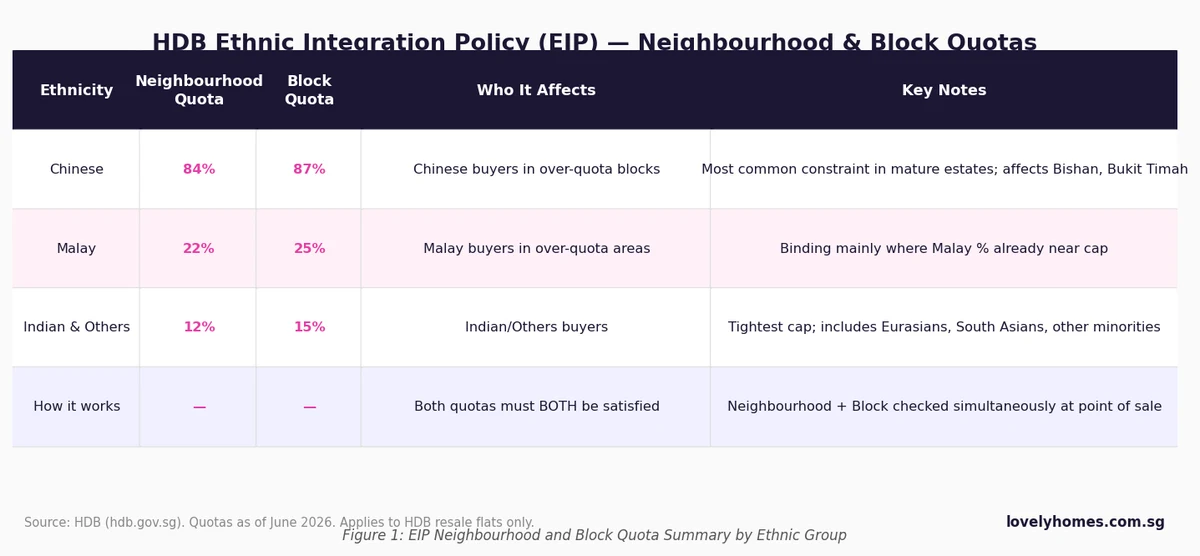
  • EIP sets neighbourhood and block quotas for each ethnic group: Chinese 84%/87%, Malay 22%/25%, Indian & Others 12%/15%.
  • EIP applies only to HDB resale flats — it does not apply to new BTO flats, private property, or HDB rental flats.
  • If a block or neighbourhood has already reached the quota for your ethnic group, you cannot buy a resale flat there — regardless of any other eligibility criteria.
  • Sellers in over-quota blocks face a restricted buyer pool: they can only sell to buyers whose ethnic group still has quota headroom, which can affect pricing and time on market.
  • Always check the HDB Resale Portal before making any offer — EIP status is block-specific and changes as transactions are registered.
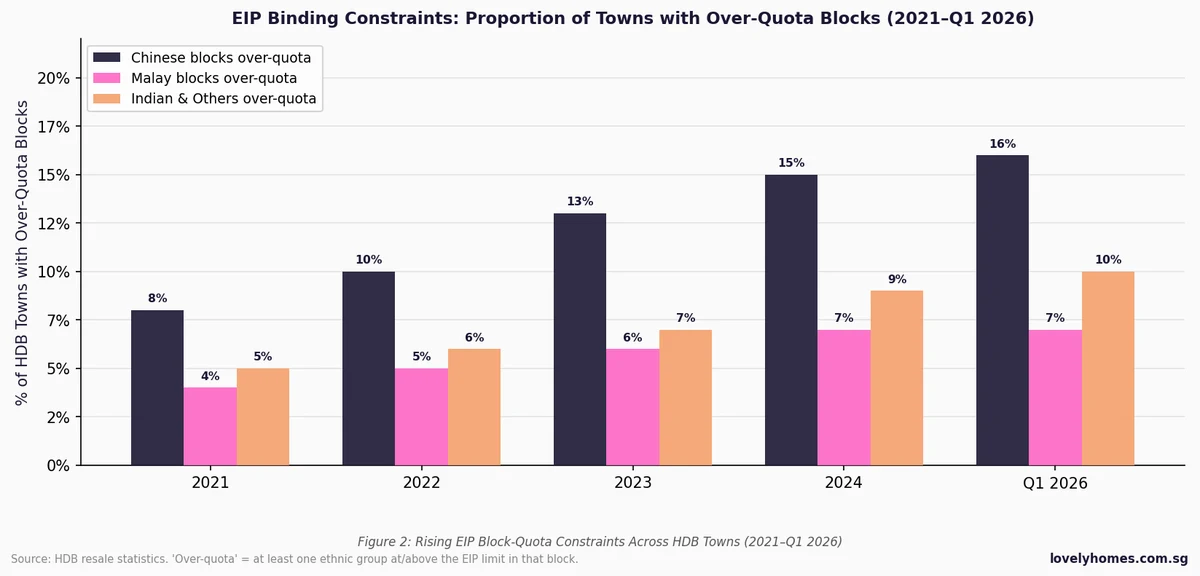
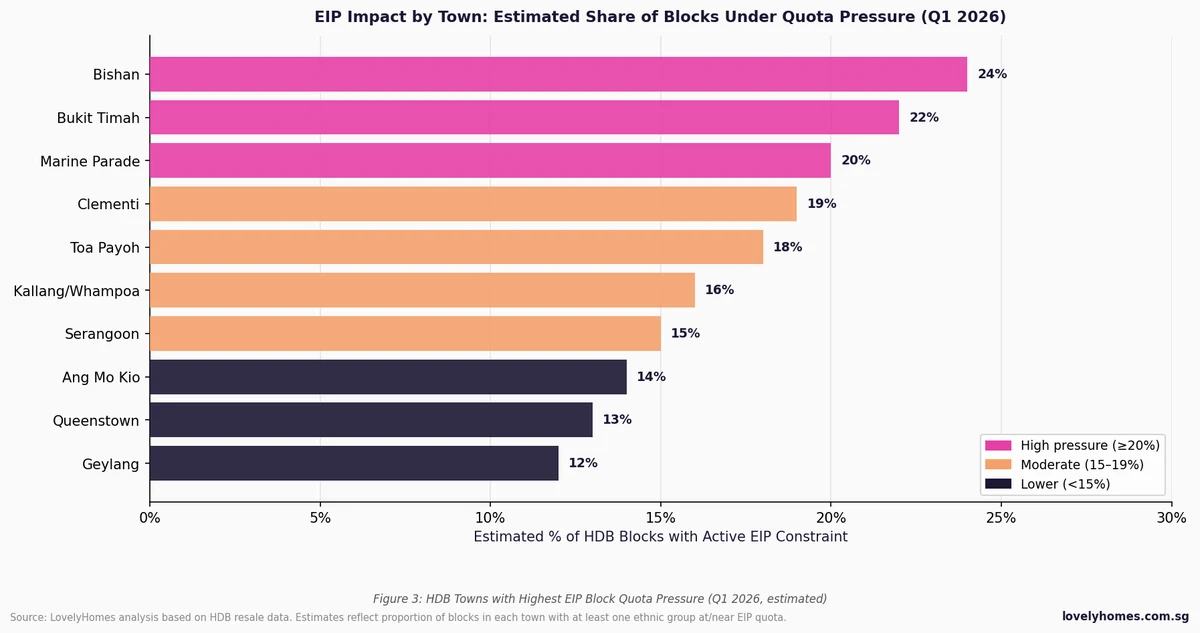
  • EIP constraints are tightening in mature estates such as Bishan, Bukit Timah, Marine Parade, and Toa Payoh as proportions converge.
  • Indian & Others buyers face the tightest cap (12% neighbourhood / 15% block) and are most frequently constrained in desirable central-region towns.
  • Understanding EIP before shortlisting flats can save weeks of wasted negotiation and prevent abortive OTP costs.

What Is the Ethnic Integration Policy (EIP) and Why Does It Exist?

Singapore’s HDB towns are not only housing estates — they are, by deliberate government design, microcosms of the nation’s multiracial society. The Ethnic Integration Policy, administered by the Housing and Development Board (HDB) since 1 March 1989, is the mechanism that ensures Singapore’s public housing estates remain ethnically diverse rather than gradually concentrating into racial enclaves.

Before EIP, Singapore had begun to experience informal ethnic clustering in older estates. Certain mature towns developed notably higher concentrations of particular ethnic groups through natural social networks and community preferences. The government, recognising that segregated neighbourhoods could erode social cohesion — a cornerstone of Singapore’s national identity — introduced EIP to cap each ethnic group’s share at both the block and neighbourhood level, locking in a composition broadly reflective of Singapore’s national demographic make-up.

The rationale is straightforward: when neighbours share staircases, lifts, and void decks with people of different backgrounds, cross-cultural interaction occurs organically. EIP is the structural guarantee of that interaction. It operates not through direct regulation of individual choice — Singaporeans can still prefer certain towns, floor levels, or orientations — but by imposing a ceiling on the cumulative ethnic composition of any given block or neighbourhood.

How EIP Quotas Work: Neighbourhood and Block Levels

EIP operates at two simultaneous levels, and both must be satisfied for any resale transaction to proceed.

HDB EIP neighbourhood and block quota table by ethnicity Singapore 2026
Figure 1: HDB EIP Neighbourhood and Block Quota Summary — as of June 2026. Source: HDB.

The neighbourhood quota reflects the ethnic composition of an entire planning area or neighbourhood zone (typically a cluster of several blocks). The block quota is more granular — it governs the ethnic proportion within a single HDB block. Because ethnic distributions are rarely uniform across a neighbourhood, a specific block may hit its ethnic ceiling even when the surrounding neighbourhood still has headroom. This means a buyer can be blocked at the block level even if the neighbourhood quota is technically not yet exhausted.

Crucially, these quotas are based on the resident population, not floor area. Each time a resale transaction is completed and a new household registers with HDB, the ethnic composition of that block and neighbourhood is recalculated. The thresholds — Chinese 84%/87%, Malay 22%/25%, Indian & Others 12%/15% — were originally calibrated to Singapore’s 1989 census ethnic composition and have remained substantially unchanged, though HDB reviews them periodically.

One important clarification: these quotas apply to the buyer’s ethnicity as declared on their NRIC, not to the seller’s ethnicity. A Chinese seller in a block that has reached its Chinese quota can only sell to a non-Chinese buyer — specifically, a Malay or Indian & Others buyer whose group still has remaining quota in that block. This restriction flips the usual power dynamic: in some over-quota blocks, sellers effectively have a constrained buyer pool regardless of the flat’s quality or market price.

EIP and Buyers: What to Check Before You Bid

For buyers, EIP is the first filter to apply — before engaging any conveyancer, before negotiating price, and certainly before exercising an Option to Purchase (OTP). The HDB Resale Portal (resale.hdb.gov.sg) provides a real-time EIP check for any block address. Buyers enter the block address and their NRIC ethnicity, and the system returns a pass or fail result. This check takes under a minute and is freely available to the public.

HDB EIP block quota constraint trend 2021 to Q1 2026 rising pressure by ethnicity
Figure 2: Rising EIP Block-Quota Constraints Across HDB Towns (2021–Q1 2026). More towns now have over-quota blocks in every ethnic category.

The trend in Figure 2 is instructive: the proportion of HDB towns with at least one over-quota block has risen steadily across all three ethnic categories since 2021. This is partly a function of natural demographic equilibration — as resale market activity in mature estates normalises ethnic proportions toward the cap — and partly driven by the prolonged resale boom since 2021. Higher transaction volumes accelerate quota convergence. Indian & Others buyers, working with the tightest caps, face the fastest-tightening constraints in central-region towns.

The practical implication is that buyers from minority groups should widen their shortlist geographically or be prepared to act quickly when a suitable flat in a quota-compliant block appears. It also means that a flat you viewed and loved on a Saturday may no longer be accessible by the following Wednesday if another transaction in that block tips it over the quota.

EIP and Sellers: Restricted Pools and Pricing Implications

For sellers, the EIP dynamic is less immediately visible but equally significant. If the block has reached or is near its quota for the seller’s ethnic group, the universe of eligible buyers shrinks to only those whose ethnic group still has headroom. In practice, this means a Chinese owner in a block already at 87% Chinese cannot sell to another Chinese buyer. The flat must be sold to a Malay or Indian & Others purchaser — and their demand in that specific block, at that price point, may be materially thinner.

HDB EIP quota pressure by town in Singapore Q1 2026 highest constraint towns
Figure 3: HDB Towns with Highest Estimated EIP Block Quota Pressure (Q1 2026). Mature central-region estates face the greatest constraint burden.

Towns with the highest EIP pressure (Figure 3) — including Bishan, Bukit Timah, Marine Parade, and Toa Payoh — are, notably, some of Singapore’s most sought-after mature estates with strong historical price appreciation. Sellers in these towns who happen to own flats in over-quota blocks may find that a smaller buyer pool translates to longer time-on-market and a need to price more competitively to attract the eligible ethnic minority. This can depress achieved prices relative to neighbouring quota-compliant blocks in the same town.

Conversely, sellers in blocks that remain quota-compliant — particularly in estates with robust Chinese demand — face no restriction on their buyer pool and can generally command fuller market prices. This creates an intra-town pricing differential that is sometimes overlooked by buyers and sellers alike.

EIP Rules at a Glance: Summary Table

Rule / Parameter Details
Administered by Housing and Development Board (HDB)
Introduced 1 March 1989
Applies to HDB resale flat transactions (not BTO launches, not private property)
Chinese quota 84% (neighbourhood) / 87% (block)
Malay quota 22% (neighbourhood) / 25% (block)
Indian & Others quota 12% (neighbourhood) / 15% (block)
Determined by Buyer’s declared ethnicity on NRIC
Both levels must pass Yes — neighbourhood AND block quota checked simultaneously
How to check HDB Resale Portal (resale.hdb.gov.sg) — free, real-time, block-specific
Consequence of breach Transaction cannot proceed; no OTP can be exercised
Applies to SPR buyers Yes — Singapore Permanent Residents declared on their Blue IC are subject to EIP

Worked Example: The Tan Family’s EIP Navigation

Scenario: SC Indian couple upgrading to a 4-room resale flat in Queenstown

Mr and Mrs Selvam are Singapore Citizens (Indian ethnicity, NRIC declared). They have completed their HDB MOP on their 3-room Yishun flat and wish to upgrade to a 4-room resale flat in Queenstown (Queen’s Close / Tanglin Halt area) for the schools and proximity to work. Budget: S$700,000–S$750,000.

Step 1 — EIP Pre-check: They identify three blocks in the area. Using the HDB Resale Portal, they check each block against their Indian & Others ethnicity:

  • Block A, Tanglin Halt Road — FAIL: Indian & Others block quota at 15% (over-quota). Cannot proceed.
  • Block B, Commonwealth Drive — PASS: Indian & Others at 11%, headroom remains. Can proceed.
  • Block C, Holland Avenue — FAIL: Neighbourhood quota at 12% ceiling. Cannot proceed.

Step 2 — Focus on Block B: A 4-room flat in Block B is listed at S$730,000. Valuation commissioned by HDB: S$718,000. Cash Over Valuation (COV): S$12,000 (must be paid in cash, cannot use CPF).

Step 3 — Cost breakdown:
BSD on S$730,000: First S$180,000 @ 1% = S$1,800 + Next S$180,000 @ 2% = S$3,600 + Remaining S$370,000 @ 3% = S$11,100 = S$16,500
ABSD: S$0 (SC couple buying first property as Indian & Others is not subject to ABSD on 1st purchase)
HDB resale admin fee: S$80 (for flat application)
Legal conveyancing: ~S$2,500
COV: S$12,000 (cash)
Total cash outlay (excluding down payment and loan): ~S$31,080

Outcome: By running the EIP check before negotiating, the Selvams avoided two abortive OTP exercises and focused their offer on the only compliant block. They secured the flat and received the HDB Flat Eligibility (HFE) letter confirming they meet all requirements including EIP.

Why EIP Matters: Social Engineering That Shapes Your Investment

EIP is one of the most distinctive features of Singapore’s housing system — a policy with no direct parallel in Hong Kong, South Korea, or Australia’s public housing sectors, all of which have faced varying degrees of ethnic concentration in social housing. Singapore’s approach is deliberately top-down: rather than leaving ethnic integration to market forces or individual goodwill, the government mandated it structurally.

From an investment standpoint, EIP creates a two-tier reality within the resale market. Quota-compliant blocks command the full market price because the buyer pool is unrestricted. Over-quota blocks may see price suppression — not because the flat is inferior, but because the eligible buyer pool is structurally smaller. Buyers who can only consider certain ethnic-group quotas must be particularly attentive to this dynamic, as it affects not only their own purchase but their eventual exit when they resell.

For upgraders from HDB to private property, EIP does not apply to the private transaction. However, the HDB flat they sell must comply with EIP — if they are selling from an over-quota block, they must find a buyer from the eligible ethnic group, which can extend the sale timeline and affect whether they can meet the 6-month window for ABSD remission on their subsequent private purchase.

What Might Come Next: The EIP in a Tightening Market

EIP quotas have remained largely static since 1989, calibrated to demographic proportions that have since shifted — Singapore’s Indian and Other Minority population share has grown modestly, while the Malay share has remained relatively stable. There is periodic academic and policy debate about whether the thresholds should be recalibrated to reflect updated census data, but HDB has not announced any revision as of June 2026.

As the resale market continues to transact at elevated volumes — driven by BTO supply shortfalls and strong demand from upgraders — EIP constraints in mature estates are likely to tighten further before any policy adjustment. Buyers in minority ethnic groups planning purchases in desirable central-region towns should factor in longer search timelines and a readiness to move quickly when compliant blocks become available. Those in the Chinese majority group face less immediate concern but should remain aware of the policy’s seller-side implications when they eventually exit their flats.

Frequently Asked Questions

Does EIP apply when I buy a new BTO flat directly from HDB?

No. EIP applies only to HDB resale transactions between private parties in the open market. When you purchase a new BTO flat directly from HDB at a launch exercise, HDB controls the allocation and manages ethnic integration through its own internal allocation criteria. You do not need to check EIP quotas for BTO applications. EIP becomes relevant only if you later sell your flat on the resale market, or if you are buying a resale flat from another owner.

Can I appeal to HDB if I fail the EIP check for a block I want?

There is no formal appeal mechanism to override an EIP failure for a specific block. The quotas are administered by HDB as hard limits — if the block or neighbourhood is over-quota for your ethnic group, the transaction simply cannot proceed in that block. Your practical options are: (a) search for another flat in a different block in the same town that is quota-compliant; (b) expand your search to a different town where quota headroom exists for your ethnic group; or (c) wait for an existing household in the over-quota block to sell and move out, which marginally reduces the ethnic proportion and may eventually restore headroom. HDB does not grant exceptions to EIP quotas for individual buyers.

Does EIP affect Singapore Permanent Residents (SPRs) buying HDB resale flats?

Yes. Singapore Permanent Residents are subject to the same EIP quotas as Singapore Citizens. HDB uses the ethnicity declared on the SPR’s Blue Identity Card (NRIC) to assess which ethnic group the buyer falls under for quota purposes. SPR buyers must satisfy both neighbourhood and block EIP quotas, in addition to the separate SPR eligibility rules for HDB resale flats (SPRs must form a family nucleus, must have held SPR status for at least 3 years, and are subject to their own resale eligibility conditions). Foreigners without SPR status cannot purchase HDB resale flats at all and are therefore unaffected by EIP.

What happens if EIP is breached after a sale — for example, if I make an error in my ethnicity declaration?

Making a false ethnic declaration to circumvent EIP is a serious offence under HDB’s framework and can constitute fraud. If HDB discovers that a buyer misrepresented their ethnicity — for example, declaring a different ethnic identity than that shown on their NRIC — HDB has the power to compulsorily acquire the flat at a price lower than market value, cancel the resale approval, or take other enforcement action. Buyers should use only the ethnicity as declared on their NRIC, even if they are mixed-race or identify differently culturally. Mixed-race buyers typically use the ethnicity registered with ICA on their NRIC, which may be either parent’s ethnicity depending on the registration at birth.

I am an Indian buyer. Can I buy a resale flat in a block where the Chinese quota is not yet reached, even if the Indian quota is full?

No. Your EIP eligibility is assessed based on your own ethnic group’s quota, not other groups’ quotas. If the Indian & Others block quota has been reached (15%), you cannot purchase that flat — regardless of whether the Chinese or Malay quotas still have headroom. The quotas function independently: each ethnic group’s proportion is measured against its own ceiling. The fact that another ethnic group still has room in the block does not create eligibility for an Indian & Others buyer whose group’s quota is full.

Does the EIP restriction affect landed HDB housing, such as terrace or semi-detached HDB properties?

HDB landed housing (such as the older HDB terrace houses in estates like Toa Payoh and Queenstown) is subject to EIP in the same way as HDB flats, as they are resale transactions on the open market. However, there is very limited HDB landed stock, and most of it is in mature estates where quota pressures can be acute. If you are considering an HDB landed property, you must run the same EIP check on the HDB Resale Portal. Note that HDB landed housing transactions are subject to all the usual HDB resale eligibility rules, MOP requirements, and HFE letter requirements in addition to EIP.

If I am selling an HDB flat in an over-quota block, how do I find eligible buyers efficiently?

The most effective approach is to advertise the listing with the EIP status disclosed upfront — noting which ethnic group(s) can purchase the flat — so that only eligible buyers engage with your listing. This saves time for both parties and reduces abortive OTP risks. Because the eligible buyer pool is smaller, you may need to price the flat more competitively or allow a longer marketing period. Note that while CEA-registered salespersons can help you market the flat, you remain responsible for ensuring EIP compliance — the HDB system will reject a resale application that fails the EIP check regardless of what has been agreed between buyer and seller. Always verify the buyer’s ethnicity against the current EIP status on the Resale Portal before exercising the OTP.

Disclaimer: This article is for general informational purposes only and does not constitute legal, financial, or property advice. EIP quotas are subject to change by HDB and should be verified directly at the HDB Resale Portal (resale.hdb.gov.sg) before any transaction. Always consult a licensed conveyancer, HDB-registered salesperson, or qualified financial adviser before making any property purchase or sale decision. Figures and estimates in this article are based on publicly available HDB data as of June 2026.

Translate »