Quick Take: Berlayar Drive GLS — What You Need to Know
Single bid only — Hong Leong Holdings-GuocoLand JV was the sole bidder; analysts had expected 4–6 bids.
New RCR land price record — S$1,515 psf ppr surpasses Holland Plain (S$1,491 psf ppr, May 2026).
Total bid: S$576 million for a 99-year leasehold site of ~271,932 sqft yielding ~415 units.
Second sole-bid GLS of 2026 — Holland Plain (Sim Lian Group, May 2026) was the first.
Location: ~7 min walk to Telok Blangah MRT, near VivoCity, within Greater Southern Waterfront masterplan.
Berlayar Estate masterplan: ~10,000 homes total (7,000 HDB + 3,000 private) along Singapore’s southern coast.
Bid exceeded analyst projections of S$1,100–S$1,450 psf ppr by approximately 4.5%.
What Happened: The Berlayar Drive Tender Result
The Urban Redevelopment Authority (URA) closed the tender for the Berlayar Drive Government Land Sale (GLS) site on 4 August 2026, recording a single bid of S$576 million — or approximately S$1,515 per square foot per plot ratio (psf ppr) — submitted by a joint venture comprising Hong Leong Holdings and GuocoLand. The bid is the highest ever achieved for a Rest of Central Region (RCR) residential GLS site.
The result surprised the market on two counts: the thin participation (analysts had forecast four to six bids), and the price (the sole bidder paid above the top of the projected range). The site was released under Singapore’s 1H 2026 Confirmed List GLS Programme.
Figure 1: 2026 Sole-Bid GLS Tenders — Land Price Comparison. Berlayar Drive (S$1,515 psf ppr) sets new RCR record. Source: URA, industry analysts.
The Site: Waterfront Land in a Transforming Precinct
The Berlayar Drive site is a 99-year leasehold plot of approximately 271,932 sq ft within the nascent Berlayar Estate — a HDB-planned mixed-tenure waterfront neighbourhood in Bukit Merah, part of Singapore’s Greater Southern Waterfront (GSW) masterplan. The development will yield an estimated 415 private residential units.
Connectivity is a core draw: the future development is approximately a 7-minute walk from Telok Blangah MRT station (Circle Line), with Labrador Park MRT also nearby. VivoCity, Alexandra Retail Centre, and the upcoming HarbourFront redevelopment are all within easy reach. The Berlayar Estate masterplan envisions approximately 10,000 homes in total — around 7,000 public housing units and 3,000 private units — alongside 10 hectares of parks and green corridors.
The first BTO project in Berlayar Estate, Berlayar Residences, was launched in October 2025 (~1,000 flats). The Berlayar Drive GLS site (together with the earlier Telok Blangah Road GLS site) will account for more than one-third of the estate’s planned private residential supply. The most recent comparable private development in the immediate area — The Reef at King’s Dock, launched 2021 — has since sold out entirely.
A Year of Cautious Developer Participation
Berlayar Drive is the second 2026 GLS site to attract only a single bid. In May 2026, Sim Lian Group submitted the lone offer of S$454 million (S$1,491 psf ppr) for the Holland Plain site (~510 homes). Both outcomes reflect a broader pattern of more selective developer land banking, driven by elevated construction costs, tighter financing conditions, and ABSD headwinds on buyer demand.
Yet in both cases, the winning bidder priced the land above or near the upper end of analyst expectations — suggesting that for the right site with a compelling long-term narrative, developer conviction remains strong even in a cautious climate.
GLS Site
Date Closed
Bidder
No. of Bids
Bid (S$M)
psf ppr
Est. Units
Holland Plain
May 2026
Sim Lian Group
1
S$454M
S$1,491
~510
Berlayar Drive
4 Aug 2026
HL-GuocoLand JV
1
S$576M
S$1,515
~415
Marina Gdns Crescent
Jan 2024
GuocoLand-led consortium
1
S$770M
S$984
~790
Worked Example: Indicative Buyer Price at Launch
Projecting Future Launch Prices from Land Cost
Land cost per unit (S$576M / 415 units)~S$1,388,000
Est. construction cost (~S$480 psf on ~950 sqft avg)~S$456,000
Marketing, finance, design, other (~12%)~S$220,000
Implied breakeven~S$2,064,000 per unit
Developer margin (~20–25% on costs)~S$413,000–S$516,000
Indicative launch ASP (2BR ~950 sqft)S$2,500,000–S$2,580,000 (~S$2,630–S$2,716 psf)
These figures are indicative industry estimates based on comparable RCR land and construction costs. Actual pricing will be set by the developer. Independent research is strongly recommended.
What This Means for Buyers
The new RCR land cost benchmark at S$1,515 psf ppr will pull up price expectations for future launches in the Berlayar precinct and the wider Bukit Merah corridor. A development acquired at this land cost is likely to launch at well above S$2,500 psf for compact units. For buyers already tracking the GSW story, the tender result signals that entry-level pricing in the precinct may rise further before more supply comes to market. For the broader RCR resale market, a new GLS land record typically nudges comparable second-hand prices upward as sellers recalibrate their expectations.
The bifurcation in Singapore’s land market is now clearly visible: story-driven, location-advantaged sites continue to attract premium bids even from a single developer, while less differentiated suburban sites see thinner interest. Berlayar Drive falls firmly in the former camp.
What to Watch Next
Watch for URA’s formal acceptance of the bid (typically within a few weeks of tender close), and for any planning application submitted by the developer, which would give further clues on unit mix and development concept. LovelyHomes will continue tracking Berlayar Estate as HDB progresses its masterplan and as the private development takes shape — follow our New Launches section for updates as they emerge.
Frequently Asked Questions
What does psf ppr mean and why is it relevant to buyers?
PSF ppr (per square foot per plot ratio) measures the effective cost of a GLS site relative to how much floor space it can legally accommodate. A higher psf ppr means the developer is paying more per unit of buildable area, which pushes up the break-even price and ultimately the selling price of completed units. The Berlayar Drive land cost of S$1,515 psf ppr — the highest ever for an RCR GLS site — is a strong forward indicator that the eventual launch prices will be significantly higher than prior launches in the area.
Is a sole bid a negative sign for the project?
Not necessarily. A sole-bid outcome signals that only one developer saw the risk-reward profile as compelling at the prevailing market conditions — but the fact that the winning bid exceeded analyst price projections by 4.5% suggests Hong Leong-GuocoLand has strong conviction in the Berlayar location. Historical sole-bid GLS outcomes in Singapore have produced some successful projects (e.g., The Reef at King’s Dock, developed from the Keppel Club site). The thin bidder field is more a reflection of broader developer caution than a verdict on the site itself.
When might the Berlayar Drive condo launch for sale?
After URA formally accepts the GLS bid, the developer typically needs 12–24 months to complete planning, design, and sales licensing before launching. A plausible launch window is late 2027 to mid-2028, subject to URA planning approval timelines and market conditions. LovelyHomes will update when the developer files a development application or announces a showflat preview.
What is the Greater Southern Waterfront and why does it matter for property?
The Greater Southern Waterfront (GSW) is Singapore’s most ambitious urban transformation project — a ~2,000-hectare regeneration of the former southern port and industrial coastline. It will deliver tens of thousands of new homes, parks, and commercial spaces over decades, linking precincts from Pasir Panjang through Keppel, Tanjong Pagar, and Marina South. For buyers, it represents a long-horizon capital appreciation thesis: owning property in a precinct at an early stage of a government-led transformation with strong connectivity, waterfront, and greenery credentials.
How does ABSD affect demand for a high-priced RCR launch like this?
At indicative launch prices of S$2,500,000–S$2,580,000 per unit, the buyer profile shifts toward Singapore Citizens and PRs purchasing a second or subsequent property (ABSD 20–30%), investors, and — for foreigners — those who can absorb the 60% ABSD on a S$2.5M+ purchase (total stamp duty approaching S$1.5M). The developer’s marketing strategy will need to focus on owner-occupier first-time and upgrader buyers (who pay 0–5% ABSD) and may price smaller units to maximise SC owner-occupier accessibility. ABSD at current rates constrains investor demand significantly for higher-priced units.
Disclaimer: This article is an editorial summary based on publicly available information from URA, 99.co, and industry sources. Price projections are indicative estimates only and do not constitute investment advice. Conduct independent research and consult a licensed property professional before any purchase decision. Source data: URA (ura.gov.sg).
What is TDSR? The Total Debt Servicing Ratio — a rule set by the Monetary Authority of Singapore (MAS) that caps your total monthly debt repayments at 55% of your gross monthly income.
What counts as debt? All outstanding loan instalments: home loan, car loan, personal loan, student loan, credit card revolving balances (at 5% monthly outstanding), and investment property loans.
When does it apply? For all bank loans for private property purchases. For HDB loans via banks (not HDB directly), both TDSR and the more restrictive MSR (30% cap) apply simultaneously.
Stress test rate: Banks use 4.0% per annum (private property) and 3.0% p.a. (HDB bank loans) to compute the monthly instalment — regardless of the actual market rate offered.
TDSR vs MSR: MSR (30%) applies only to HDB flat bank loans and covers only the home loan instalment. TDSR (55%) covers all debts and applies to all property types.
Key pitfall: Undisclosed debts — even a S$500/month instalment — can push your TDSR above 55% and cause your home loan to be declined at the credit assessment stage.
Who can be exempt? Owner-occupier refinancing with no cash-out, and certain HDB concessionary loans from HDB directly, may be partially exempt. MAS requires banks to apply TDSR consistently across borrowers.
When a Singapore bank evaluates a home loan application, one ratio sits at the centre of the credit decision: the Total Debt Servicing Ratio, or TDSR. Introduced by the Monetary Authority of Singapore (MAS) in June 2013 as part of a suite of property cooling measures, the TDSR framework remains one of the most consequential policies affecting Singapore property buyers in 2026. Get it right and your loan is approved; get it wrong and the sale falls through regardless of how large your down payment is.
This guide explains exactly how TDSR works, how banks compute it, the critical difference between TDSR and the Mortgage Servicing Ratio (MSR), the stress-test interest rates that apply in 2026, and the strategies Singapore buyers use to manage their TDSR effectively before applying for a loan.
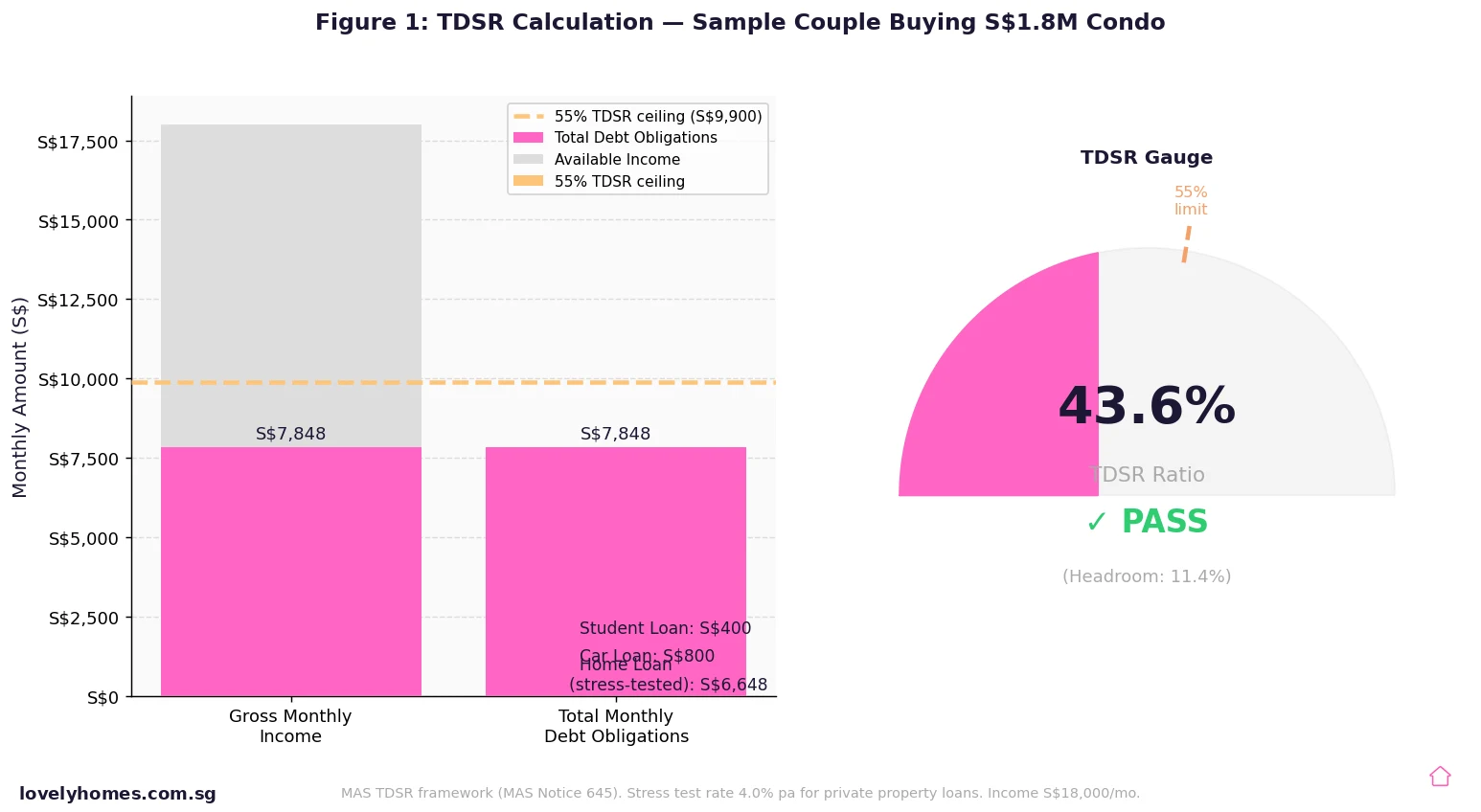
Figure 1: TDSR Calculation — Sample Couple Buying a S$1.8M Condo (2026). Total monthly debt obligations of S$7,848 against gross income of S$18,000 = TDSR of 43.6%, comfortably below the 55% MAS ceiling. Source: MAS Notice 645.
What Is the TDSR Framework and Who Administers It?
The TDSR framework is a macro-prudential measure administered by the Monetary Authority of Singapore (MAS) under MAS Notice 645 (for banks) and various related notices for finance companies. Its stated purpose is to “ensure that borrowers do not borrow beyond their means” — it is a supply-side constraint on credit, not a market-price control.
In practice, every bank in Singapore must compute a borrower’s TDSR before approving any property loan. The MAS audits banks’ compliance with TDSR as part of its regular supervisory programme. Banks that consistently breach TDSR rules face formal censure, capital add-ons, and potential restrictions on their mortgage lending activities. TDSR is not a guideline — it is a hard regulatory requirement.
The result must not exceed 55%. “Total monthly debt obligations” includes every regular debt payment you have, and the home loan instalment is computed using a stress-tested interest rate rather than the actual rate the bank offers you. The stress test rate in 2026 is:
Loan Type
Stress Test Rate (2026)
MAS Basis
Private property bank loan
4.0% per annum
MAS Notice 645, para 7
HDB flat bank loan (TDSR portion)
3.0% per annum
MAS Notice 645, Annex A
HDB direct loan (HDB Loan)
No TDSR — MSR 30% applies
HDB Loan Policy
Refinancing (private, owner-occupier)
4.0% per annum
MAS Notice 645
Importantly, the stress test rate does not reflect the actual rate you will pay. In 2026, three-month SORA (Singapore Overnight Rate Average) is approximately 2.8%, making bank fixed-rate packages generally available in the 3.0–3.6% range. The 4.0% stress test is deliberately conservative — MAS wants to ensure borrowers can still service their loan if rates rise by 100–130 basis points above current levels.
What Counts as Debt?
Banks must include the following in the TDSR computation:
Debt Type
How Counted
Notes
Home loan (new)
Monthly instalment at stress-test rate, full tenure
Computed using 4.0% for private property
Car loan
Outstanding monthly instalment
Hire-purchase treated the same as bank loan
Personal loan
Outstanding monthly instalment
Includes renovation and education loans
Investment property loan
30% of outstanding monthly instalment
Income from rental offsets some obligation
Credit card revolving balance
5% of total outstanding monthly
Only revolving — not the full credit limit
Student loan
Outstanding monthly instalment
Government tuition fee loans included
Guarantees
Pro-rated based on guarantee exposure
Banks have discretion on treatment
Notably, investment property loans are counted at only 30% of their instalment — MAS acknowledges that rental income offsets part of the servicing cost. This is significant for upgraders who retain their HDB flat for rental while buying a private property. However, HDB flat rental income must be verified and cannot be used to inflate gross income beyond what MAS permits.
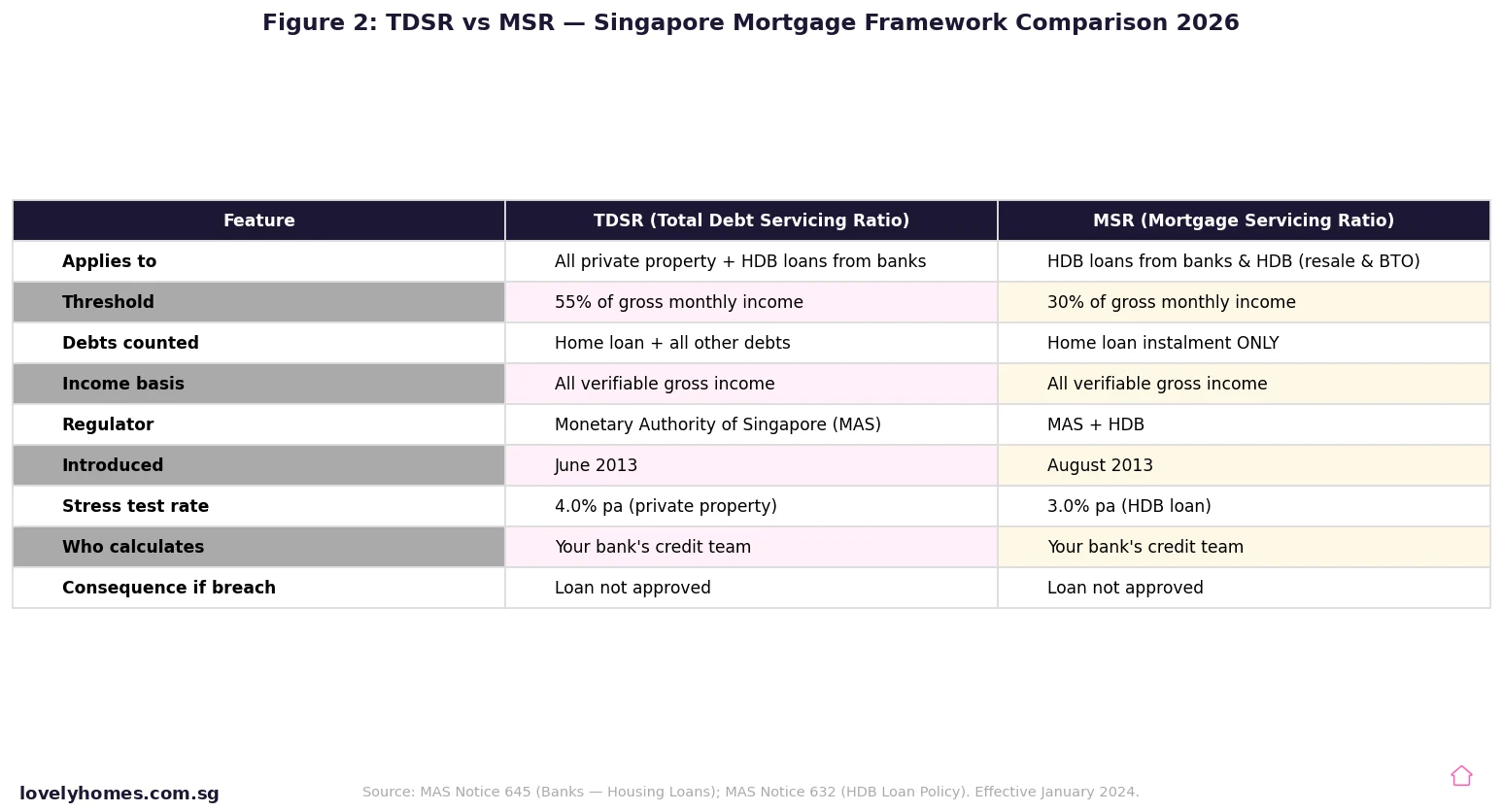
Figure 2: TDSR vs MSR — Singapore Mortgage Framework 2026. The 55% TDSR covers all property types and all debts; the 30% MSR applies exclusively to HDB bank loans and considers only the home loan instalment.
TDSR vs MSR: The Critical Difference
Singapore’s mortgage framework actually contains two separate ratio tests. Every buyer obtaining a bank loan for an HDB flat must satisfy both. For private property, only TDSR applies. Understanding the difference prevents misunderstanding your borrowing capacity.
The Mortgage Servicing Ratio (MSR) was introduced in August 2013, one month after TDSR. It caps monthly home loan instalments (and only home loan instalments — not other debts) at 30% of gross monthly income, and applies exclusively to bank loans for HDB flats. If you are buying an HDB resale flat with a bank loan, your bank will compute both TDSR and MSR. You must pass both — and the MSR at 30% is the binding constraint for the vast majority of HDB buyers, because 30% of most buyers’ incomes is reached before the 55% TDSR ceiling is hit.
For a buyer earning S$10,000 per month: the MSR cap means the home loan instalment cannot exceed S$3,000 per month; the TDSR cap means total debt (including that home loan) cannot exceed S$5,500 per month. For private property, only the S$5,500 TDSR ceiling applies (with no separate MSR constraint).
How Gross Income Is Measured
MAS defines gross monthly income for TDSR purposes to include: basic salary, fixed allowances, 12 months’ variable bonus averaged over 12 (or less if tenure is shorter), commission income averaged over 12 months, rental income (haircut to 70% of gross rental), and CPF contribution income. Self-employed income is typically assessed using the net trade income from the Inland Revenue Authority of Singapore (IRAS) Notice of Assessment, averaged over the most recent two years.
Banks apply haircuts to variable income to reflect its less certain nature. A senior banker’s S$20,000 monthly package consisting of S$12,000 base plus S$8,000 variable bonus may be assessed at only S$12,000 + (S$8,000 × 12 / 12 × 70%) = S$17,600 for TDSR purposes — not S$20,000. The bank’s credit officers have discretion within MAS’s guidelines on how to treat borderline income types.
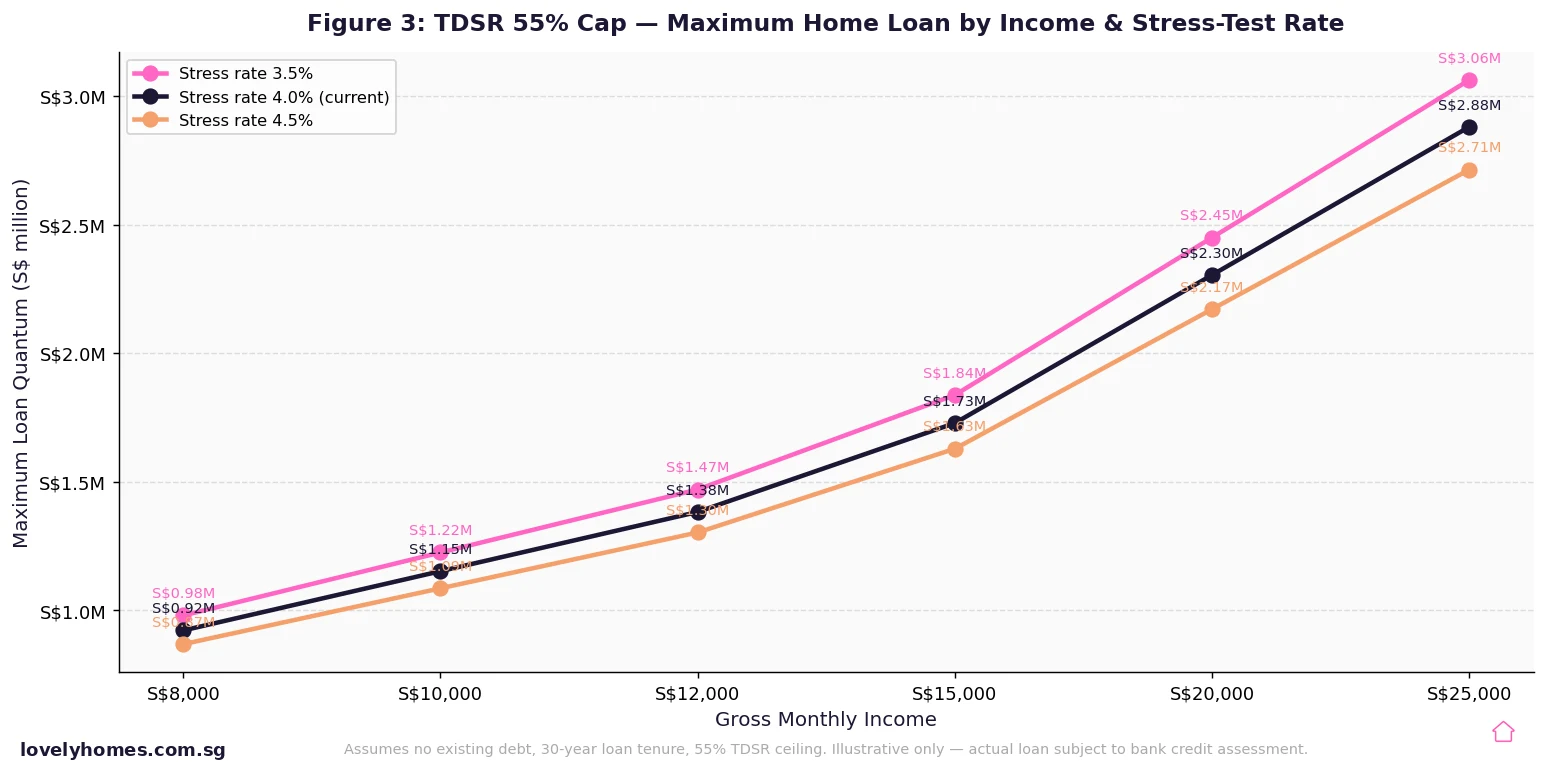
Figure 3: Maximum Home Loan Quantum (S$M) by Gross Monthly Income under the TDSR 55% Framework — Singapore 2026. Assumes no existing debt, 30-year tenure. Stress rate 4.0% p.a. applies to private property; 3.0% for HDB bank loans would yield slightly higher loan amounts.
Loan-to-Value Limits and TDSR: How They Interact
The TDSR tells you what instalment you can afford based on income; the Loan-to-Value (LTV) limit tells you what loan you can take based on property value. Both constraints operate simultaneously, and the binding constraint is whichever is lower.
For a first property purchase with no outstanding home loans: the LTV limit is 75% (for private property loans from banks). However, if TDSR limits your loan to, say, S$800,000 while 75% LTV on a S$1.5M property permits S$1,125,000, the TDSR is the binding constraint and you can only borrow S$800,000. If you are buying a second property while still servicing the first, the LTV drops to 45%, and TDSR must also accommodate both loans’ instalments.
Outstanding Home Loans
LTV Limit (Private)
LTV Limit (HDB)
Additional TDSR Note
None (first property)
75%
80% (HDB loan) 75% (bank loan)
Only home loan in TDSR
1 outstanding loan
45%
45%
Both home loans in TDSR
2+ outstanding loans
35%
35%
All home loans in TDSR
Worked Example: Couple Buying a S$1.8M Condominium
🏢 Case Study — SC Couple Buying S$1.8M OCR Condo (31 July 2026)
Buyer profile: Singapore Citizen couple (joint purchase). First property. Combined gross monthly income: S$18,000. No CPF withdrawal from prior property. Existing debts: car loan S$800/month, student loan S$400/month.
Proposed loan: S$1.26M (70% LTV). Tenure: 25 years. Bank fixed rate: 3.2% p.a. (years 1–2), thereafter SORA + 1.0%.
Step 4 — Headroom: 55% − 43.6% = 11.4% headroom. Expressed in dollar terms: S$18,000 × 11.4% = S$2,052/month of additional debt capacity remaining after this purchase.
What if they had a personal loan of S$1,000/month on top?
TDSR = (S$6,648 + S$800 + S$400 + S$1,000) ÷ S$18,000 = 49.2% → still passes. But adding another S$1,500/month debt would push TDSR to 57.8% → FAIL ✗ — loan declined even though their actual rate would be 3.2%.
What This Means for Singapore Buyers in 2026
The TDSR framework has meaningfully shaped Singapore’s property market since 2013. By capping total debt at 55% of income, MAS has effectively anchored the maximum property price any given income bracket can access — regardless of how cheap credit temporarily becomes. This is a deliberate design choice: it insulates Singapore households from the kind of debt stress that accompanied property busts in countries without equivalent prudential frameworks.
In 2026, the stress test rate of 4.0% continues to act as a meaningful speed governor. Singapore’s three-month SORA (approximately 2.8%) sits well below the stress rate, which means that most borrowers are tested at a rate approximately 120 basis points above their actual cost of borrowing. This preserves a meaningful buffer if MAS or central bank rates rise. A buyer who passes TDSR at 4.0% can continue servicing their loan if rates rise to, say, 4.5% or even 5.0% without breaching income limits — provided no new debts are added.
Strategies for Managing TDSR
For buyers approaching the TDSR ceiling, several lawful strategies exist to manage the computation. First, paying down car loans or personal loans before the home loan application reduces the monthly debt obligations and directly lowers TDSR. Every S$500/month of debt eliminated translates into S$500/month of home loan capacity added. Second, extending the home loan tenure from 20 years to 30 years reduces the monthly instalment and thus the TDSR contribution from the new home loan, though it increases total interest paid over the life of the loan. Third, adding a co-borrower (e.g., a parent or sibling with stable income and low existing debts) expands the gross income base used in the TDSR denominator.
Buyers should note that deliberately concealing debts from a bank to pass TDSR is mortgage fraud. MAS has clear guidance that banks must conduct their own credit bureau checks through the Credit Bureau Singapore (CBS), which records all outstanding credit facilities. Undisclosed debts are typically discovered at the credit check stage — and at that point, the home loan will be declined regardless of how advanced the purchase is.
What Might Come Next
MAS has periodically reviewed and adjusted TDSR parameters since 2013. A temporary relaxation was introduced in 2022 (raising the ceiling from 60% to 55% — in fact, a tightening after an earlier relaxation during COVID) and the current 55% ceiling has been in place since September 2022. Industry observers have speculated about whether MAS might raise the stress test rate further if SORA rises substantially, or introduce a separate stress test for variable-rate borrowers. There is also ongoing discussion about whether TDSR should explicitly account for rising property tax rates (which increase holding costs but are not currently captured in the TDSR computation). MAS has given no firm guidance on these points as at July 2026, but buyers with long investment horizons should monitor MAS circulars closely.
Frequently Asked Questions
Does the TDSR apply if I pay for a property fully in cash?
No. TDSR is a loan regulation — it governs when a bank can extend credit, not when you can purchase property. If you purchase a property entirely with cash (and CPF, which is not a bank loan), the TDSR framework does not apply because no bank is extending you credit. You are free to purchase any property in Singapore (subject to other regulatory restrictions such as ABSD and foreign ownership rules) without any TDSR constraint if no bank loan is involved. The practical significance: high-net-worth buyers who purchase in cash are not limited by TDSR and can acquire multiple properties without the leverage ceiling that applies to loan-dependent buyers.
If my spouse has high debts, does their TDSR affect my home loan application?
It depends on whether you are applying jointly or individually. If you and your spouse apply jointly for the home loan, the bank computes TDSR based on your combined gross monthly income and combined monthly debt obligations — so your spouse’s debts are fully included. If you apply individually (sole borrower), only your income and your debts are used; your spouse’s debts are excluded unless they are a guarantor. The implication: if one spouse has significant existing debt, it may be more favourable for the other spouse to apply as the sole borrower — provided their individual income is sufficient to support the loan quantum required. Note that if CPF OA funds from both spouses are used, both spouses become co-owners, which typically makes a joint loan application necessary.
How does rental income from my current HDB flat affect TDSR when I buy a private property?
If you intend to retain your HDB flat and rent it out after purchasing a private property, you may include that expected rental income in your gross income for TDSR purposes — but only at 70% of verified rental income (MAS applies a 30% haircut to rental income to account for vacancy and maintenance). Your existing HDB loan instalment (if you took an HDB loan) is not counted in TDSR for HDB direct loans, but the outstanding HDB loan is still considered for LTV purposes on the new private property purchase. Additionally, ABSD at 20% (SC second property) will apply to your private property purchase unless you sell the HDB flat first. See our ABSD complete guide for the full stamp duty implications.
Can I get a bank loan if my TDSR exceeds 55%?
Not under standard MAS-regulated lending. Banks are prohibited from granting mortgage loans to borrowers whose TDSR exceeds 55%. There are limited exceptions for owner-occupier refinancing (where no new money is drawn and the purpose is genuinely to reduce the borrower’s debt burden), but these exceptions are narrowly defined and do not apply to new purchases. Borrowers who cannot pass TDSR have three main options: (a) reduce existing debts before applying; (b) increase their provable gross income; or (c) reduce the loan quantum by increasing the down payment (which reduces the monthly instalment and hence the TDSR contribution from the home loan). Borrowing from unlicensed lenders to finance a property purchase is illegal and exposes buyers to significant legal and financial risk.
How does TDSR affect EC (Executive Condominium) purchases?
Executive Condominiums are a hybrid product: they are developed by private developers but subject to HDB eligibility rules during the first ten years. For new EC purchases (from developers), buyers take bank loans — not HDB loans. Both TDSR (55%) and MSR (30%) apply to EC bank loans under MAS Notice 645 and MAS Notice 632 respectively, in the same way they apply to HDB flat bank loans. The MSR constraint (30%) is typically the binding one for EC buyers. Once an EC is fully privatised after ten years, subsequent resale purchases are governed only by TDSR (not MSR), and can be purchased by foreigners and permanent residents subject to ABSD.
What is the difference between TDSR and Debt-to-Income ratio used in other countries?
Singapore’s TDSR is conceptually similar to debt-to-income (DTI) ratios used in the United States, United Kingdom, and Australia — all measure monthly debt obligations relative to income. The key differences are: (a) Singapore’s TDSR uses a stress-tested interest rate rather than the actual loan rate, making it more conservative than simple DTI calculations; (b) Singapore applies the ceiling at the point of origination but does not continuously monitor borrowers’ DTI, whereas some jurisdictions have ongoing monitoring requirements; and (c) Singapore’s 55% TDSR ceiling is among the stricter ceilings globally — Australia’s typical guideline is 30–35% for the housing cost alone, while UK mortgage rules use a stress test income multiple approach rather than a ratio. The MAS framework is widely credited as having contributed to Singapore’s relative residential mortgage market stability compared to other major cities.
Disclaimer: This article is for general information purposes only and does not constitute financial or legal advice. The TDSR framework described is based on MAS Notice 645 as in effect in July 2026; readers should consult the current MAS notices and their mortgage banker for the most up-to-date requirements. LTV limits, stress test rates, and TDSR thresholds are subject to change by MAS without notice. Engage a licensed mortgage adviser or bank representative to assess your specific borrowing capacity. This article references official data from the Monetary Authority of Singapore, the Housing Development Board, and the Inland Revenue Authority of Singapore. LovelyHomes is not a licensed financial adviser and does not provide financial planning services.
⚡ Quick Answer: Singapore Conveyancing Fees at a Glance
What are conveyancing fees? Legal fees charged by a solicitor to handle the transfer of property ownership — mandatory for every Singapore property transaction.
Who sets them? The Law Society of Singapore prescribes minimum fee scales under the Solicitors’ Remuneration Order (SRO); fees are non-negotiable below these floors.
HDB resale: Buyer’s lawyer fees typically S$1,500–S$2,500; seller’s lawyer S$1,200–S$2,000 (excluding disbursements and 9% GST).
Disbursements (title searches, caveats, SLA registration) add approximately S$500–S$1,500 per transaction.
GST: 9% applies to all professional fees and most disbursements as of 1 January 2024.
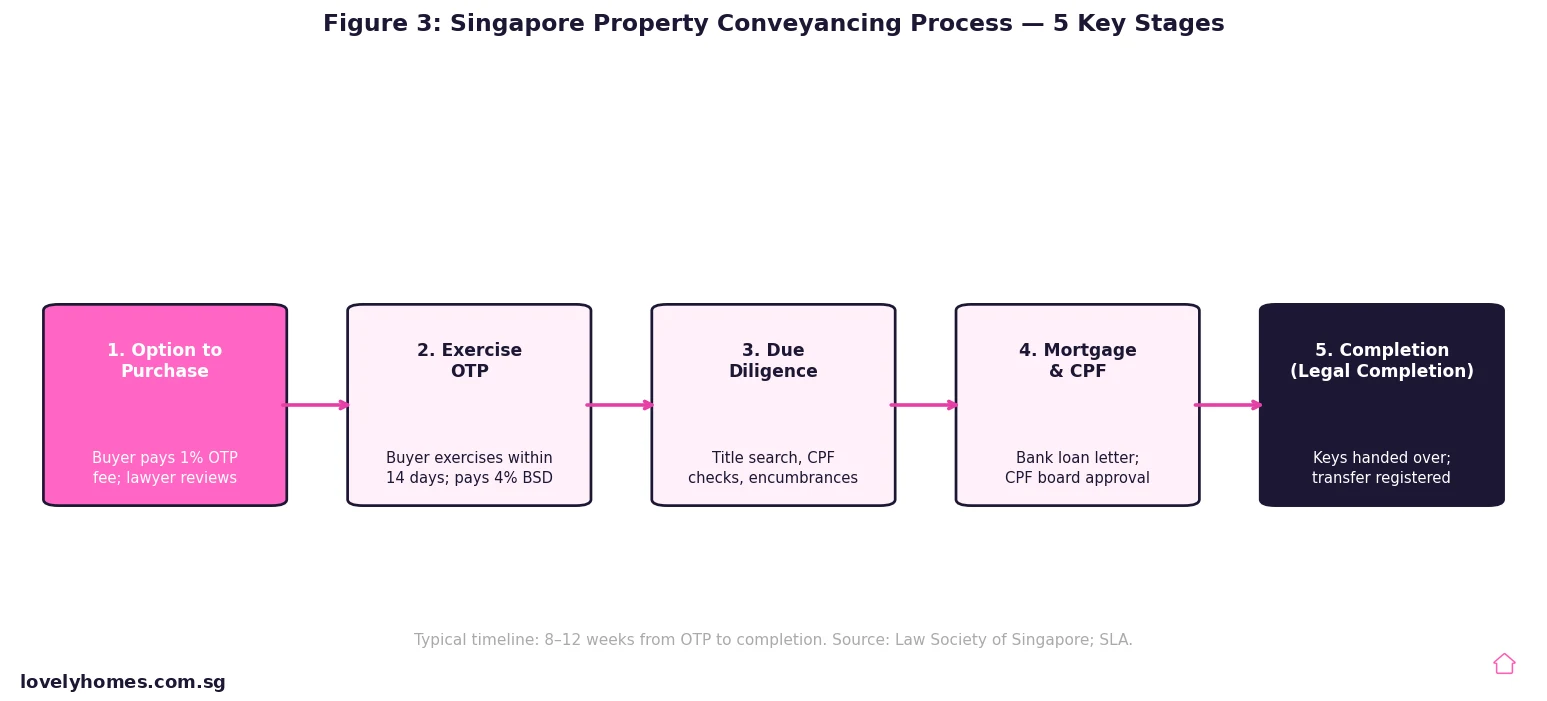
Timeline: Typical private property conveyancing takes 8–12 weeks from Option to Purchase to legal completion.
Key tip: Always engage your own independent solicitor — never use the seller’s or developer’s lawyer exclusively, as there is an inherent conflict of interest.
Conveyancing is the legal process by which ownership of a property is transferred from seller to buyer. In Singapore, it is governed by the Conveyancing and Law of Property Act (Cap. 61), overseen by the Singapore Land Authority (SLA) and the Law Society of Singapore. Whether you are buying an HDB flat, a condominium, or a landed property, engaging a conveyancing solicitor is not optional — it is a statutory requirement for the transaction to be registered at the SLA.
Yet despite its mandatory nature, conveyancing fees remain poorly understood by most buyers and sellers. This guide explains the full fee structure, what each component pays for, how to estimate your total legal costs, and the common pitfalls that end up costing buyers thousands more than expected.
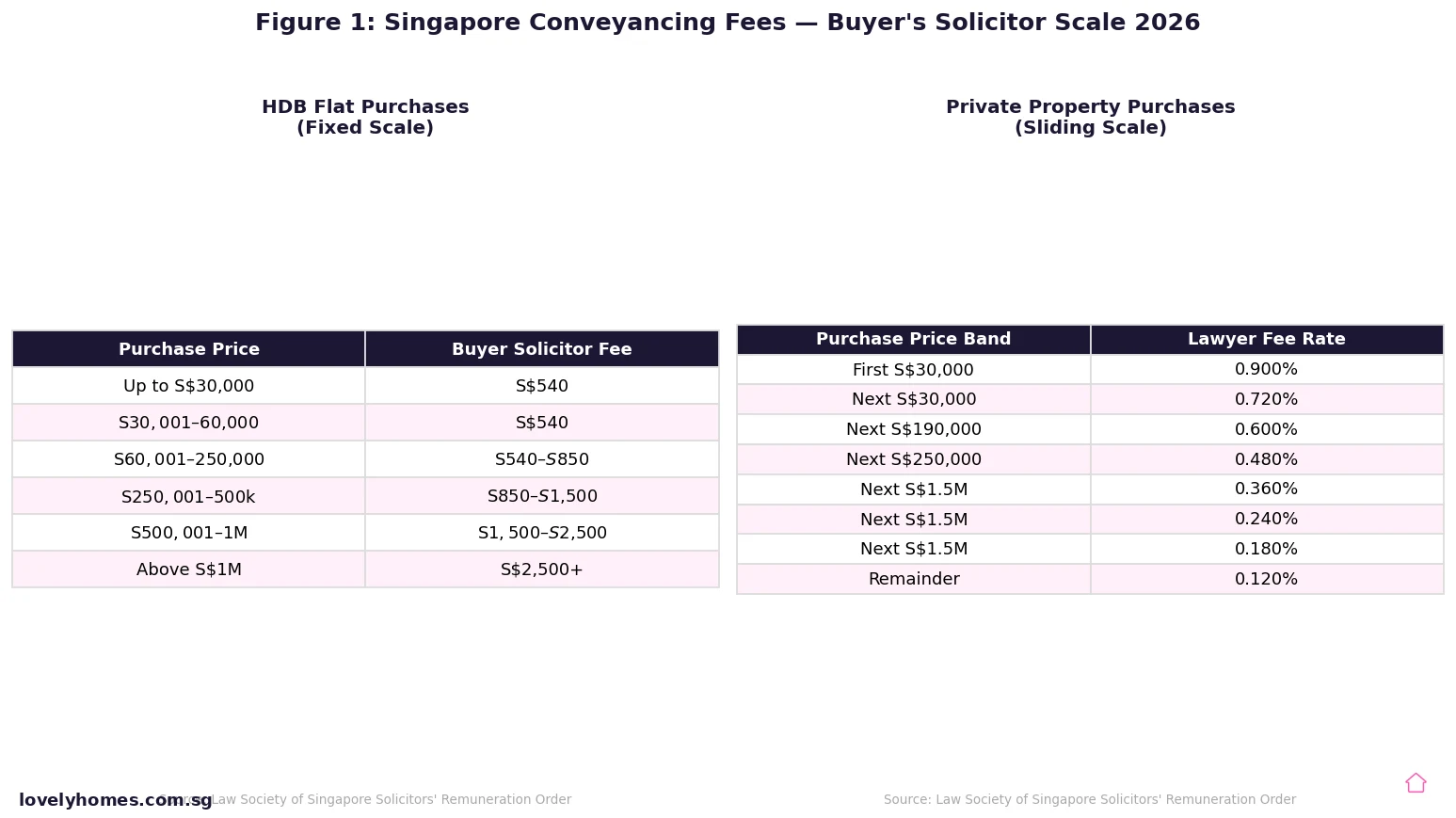
Figure 1: Buyer’s Solicitor Fee Scale 2026 — HDB flats (fixed scale) vs Private Property (Law Society sliding scale). Source: Law Society of Singapore, Solicitors’ Remuneration Order.
What Is Conveyancing and Why Is It Compulsory?
Conveyancing encompasses the full suite of legal work required to transfer a property: verifying the seller’s title, conducting property searches, preparing the sale and purchase agreement, registering the transfer with the Singapore Land Authority, and arranging the discharge of any existing mortgages. Because Singapore uses the Torrens title system — where the SLA register is the definitive record of ownership — all transactions must pass through the legal system to be valid.
In practice, this means every buyer must appoint a conveyancing solicitor, and so must every seller. For HDB resale transactions, the process is facilitated through HDB’s resale portal and the Singapore Academy of Law (SAL) e-conveyancing system, but a solicitor is still required to advise both parties. For private property transactions, the parties’ solicitors handle everything from the Option to Purchase through to legal completion.
Who Administers Conveyancing Fees?
The Law Society of Singapore prescribes minimum fee scales for legal work under the Solicitors’ Remuneration Order (SRO). These are statutory minimums — solicitors may charge more, but they cannot charge less. In practice, most established conveyancing firms charge within a narrow band above the minimum scale. The SRO applies to private property transactions; for HDB transactions, HDB-approved solicitors follow a schedule set in consultation with HDB.
For mortgage-related conveyancing (preparing the mortgage instrument and lodging the CPF charge), there is a separate mortgage conveyancing scale — again a non-negotiable statutory minimum.
Types of Conveyancing Fees You Will Pay
A Singapore property transaction typically involves four distinct streams of legal fees. Understanding each one prevents budget surprises at completion.
1. Buyer’s Solicitor Fees
These cover the buyer’s lawyer reviewing and approving the Option to Purchase, advising on legal issues (encumbrances, planning restrictions, strata title requirements), conducting property searches, and lodging a caveat to protect the buyer’s interest. For HDB resale transactions, buyer’s lawyer fees typically range from S$1,500 to S$2,500. For private property, the Law Society sliding scale applies (see Figure 1 above).
2. Seller’s Solicitor Fees
The seller’s lawyer prepares the sale documents, investigates any outstanding mortgages, discharges the mortgage with the seller’s bank, and manages the transfer of the sale proceeds. Seller’s lawyer fees are slightly lower than buyer’s fees — typically 60–80% of the buyer’s scale — because the scope of work is narrower (no title search from scratch, no caveat lodging).
3. Mortgage Conveyancing Fees
When you take a bank loan, there are two sets of mortgage legal fees. The mortgagor’s solicitor (your lawyer) prepares and reviews the mortgage documents on your behalf. The mortgagee’s solicitor (the bank’s panel lawyer) acts for the lender; you, as the borrower, typically bear this cost. For private property, the combined mortgage conveyancing fees add S$2,000–S$4,000 depending on the loan quantum.
Many banks offer to absorb or subsidise legal fees as part of their home loan package — particularly for refinancing. This subsidy typically covers the mortgagee’s legal fees only, not your own conveyancing costs.
4. CPF Charge Fees
If you use CPF funds to purchase property, the CPF Board requires a CPF charge to be registered against the property. The fee for lodging this charge (prepared by your solicitor and submitted to CPF Board and SLA) is approximately S$228–S$428 depending on the property type and number of CPF members involved.
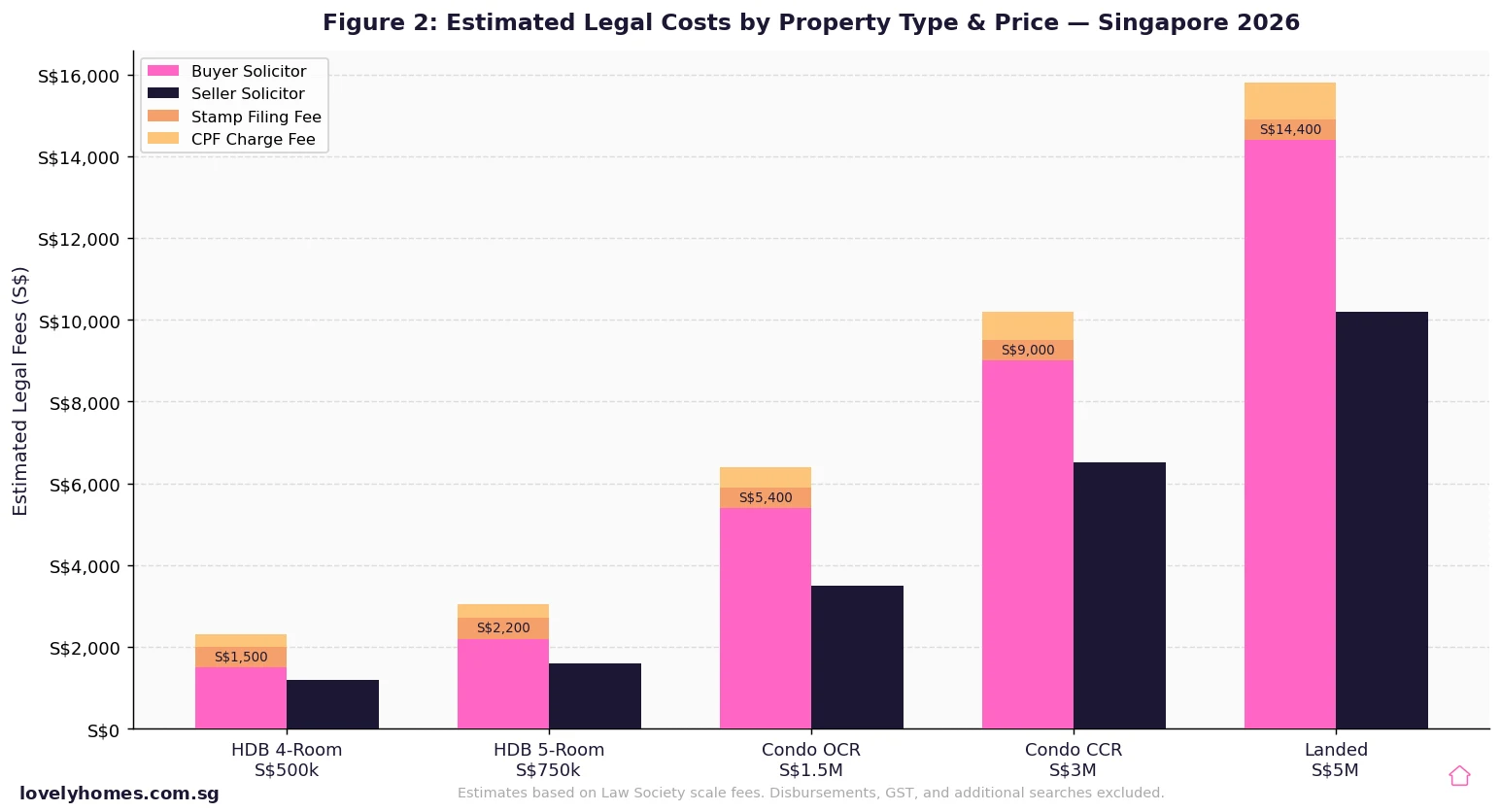
Figure 2: Estimated Total Legal Costs by Property Type — Singapore 2026 (buyer’s fees, seller’s fees, stamp filing and CPF charge). Figures are illustrative averages; actual costs depend on firm, complexity and disbursements.
Disbursements: The Hidden Add-Ons
On top of professional fees, your solicitor will pass through a range of disbursements — third-party costs incurred on your behalf. These are not the lawyer’s income; they are payments to government agencies and third-party search providers. Common disbursements include:
Disbursement Item
Approx. Cost (S$)
Paid To
Caveat lodging fee
S$64.45 per caveat
Singapore Land Authority
Title search fee
S$75–S$150
SLA / approved search providers
Land register inspection
S$25–S$60
Singapore Land Authority
Property tax search
S$10–S$25
IRAS
Bankruptcy search (per person)
S$6–S$10
Insolvency Office
CPF charge registration
S$228–S$428
CPF Board / SLA
Stamp duty filing
S$10–S$50
IRAS (via e-Stamping)
Photocopying & postage
S$50–S$150
Law firm
Total disbursements for a straightforward purchase typically run S$500–S$1,200. Complex transactions — those involving multiple caveats, joint buyers across different nationalities, or CPF from multiple members — can push disbursements past S$1,500.
The Law Society Sliding Scale Explained
For private property, the buyer’s solicitor’s professional fees follow the Solicitors’ Remuneration Order scale. The scale is tiered: a higher percentage applies to the first tranche, declining as the purchase price increases. As of 2026, the scale for purchase conveyancing is:
Purchase Price Band
Rate
Fee on Band
First S$30,000
0.900%
S$270 (min S$540 across first two bands)
Next S$30,000
0.720%
S$216
Next S$190,000 (up to S$250k)
0.600%
S$1,140
Next S$250,000 (up to S$500k)
0.480%
S$1,200
Next S$1,500,000 (up to S$2M)
0.360%
Up to S$5,400
Next S$1,500,000 (up to S$3.5M)
0.240%
Up to S$3,600
Next S$1,500,000 (up to S$5M)
0.180%
Up to S$2,700
Remainder (above S$5M)
0.120%
Variable
A minimum fee of S$1,080 applies to all purchase transactions regardless of scale. Firms may add a complexity premium for particularly involved transactions (e.g., foreign buyers, multi-party agreements, urgent transactions).
Figure 3: Singapore Conveyancing Process — The 5 Stages from Option to Purchase to Legal Completion. Typical timeline: 8–12 weeks for private property; 8–10 weeks for HDB resale.
HDB vs Private Property: Key Differences
The conveyancing process differs meaningfully between HDB and private property transactions. For HDB resale flats, both buyer and seller must engage HDB-approved solicitors, and the process is administered through HDB’s Resale Portal and the Singapore Academy of Law’s e-conveyancing platform. HDB conveyancing fees are lower than private property fees and are fixed by HDB within a prescribed schedule. Importantly, HDB levies no agent commission cap but does require all legal work to be conducted by approved solicitors on its panel.
For private property — condominiums, executive condominiums sold in the secondary market, and landed property — the buyer and seller appoint solicitors from the wider pool of Singapore-practising firms. The Law Society scale governs fees. Timelines are slightly longer because the due diligence is more extensive, including strata title verification, Management Corporation Strata Title (MCST) checks, and developer clearance for new launches.
Worked Example: Conveyancing Costs for a S$1.5M Condominium
🏢 Case Study — SC Buyer Purchases a S$1.5M OCR Condo (31 July 2026)
Buyer profile: Singapore Citizen (SC), first property, no ABSD payable. Bank loan of S$1.05M (70% LTV). CPF OA balance used: S$300,000.
Bank’s lawyer (mortgagee’s legal costs, borne by borrower): S$2,200
9% GST on all professional fees + disbursements: S$924
Total legal and conveyancing costs: ≈ S$11,712
Note: Buyer stamp duty (BSD) of S$44,600 on S$1.5M is separate from conveyancing fees — it is a tax paid to IRAS, not a legal fee. See the ABSD Singapore 2026 Complete Guide for a full stamp duty breakdown.
What Does “Good” Conveyancing Cost?
Because the Law Society scale is a statutory floor, the real differentiator between law firms is service quality, responsiveness, and the ability to handle complications. Boutique conveyancing firms often charge within 10–15% above scale and can complete standard transactions faster than large full-service firms. For straightforward HDB resale transactions, HDB-approved conveyancing firms provide very competitive packages. For complex transactions — joint purchases across nationalities, CPF accrued interest waivers, or properties with encumbrances — it is worth paying for a more senior practitioner.
Property buyers should be aware that some developers and banks will recommend their own panel solicitors. While these firms are reputable, it is important to understand that they may be acting for both the developer/bank and for you. Engaging an independent solicitor who acts exclusively for you — even at a marginal extra cost — is strongly advisable for any transaction above S$1M.
What This Means for Singapore Buyers in 2026
As property prices have risen — the URA’s second-quarter 2026 private residential index showed an overall increase of 0.9% QoQ — the absolute cost of conveyancing has risen proportionally, since most fee scales track purchase price. A buyer purchasing at S$3M pays roughly S$10,800 in buyer’s solicitor professional fees alone before disbursements and GST. Budgeting for total legal costs at approximately 0.8–1.0% of the purchase price (for private property) is a reasonable rule of thumb, though it should be treated as a floor, not a ceiling.
What Might Come Next
The Law Society periodically reviews the Solicitors’ Remuneration Order. The last substantive revision was in 2011; legal practitioners and consumer advocates have argued that the minimum scales no longer reflect the complexity of modern real estate transactions, particularly given the proliferation of ABSD, CPF-for-property, and en-bloc considerations. A revision to the SRO in 2026 or 2027 is considered possible, particularly as 9% GST continues to be layered on top of statutory minimums, effectively raising the real cost to buyers without a corresponding increase to lawyers’ net income.
Frequently Asked Questions
Can I negotiate conveyancing fees below the Law Society scale?
No. The Solicitors’ Remuneration Order sets statutory minimums — it is a legal requirement, not a guideline. Solicitors who charge below the prescribed scale risk disciplinary action by the Law Society. You can, however, negotiate for the inclusion of certain disbursements in a fixed package fee, or request that the firm waive small ancillary charges. For competitive quotes, approach two or three HDB-approved or conveyancing-specialist firms and compare their full quotations including all disbursements and GST.
Do I need a lawyer for an HDB resale purchase, or can I DIY?
You must engage a solicitor for an HDB resale transaction. HDB’s Resale Portal requires that both buyer and seller appoint an HDB-approved solicitor to advise on the transaction, complete the legal documentation, and register the transfer with the Singapore Land Authority. There is no self-conveyancing option for HDB resale. For HDB BTO (Build-to-Order) purchases, HDB acts as its own solicitor for the buyer as part of the purchase process, with much-reduced legal fees.
What happens if I use CPF for my property purchase — does it add to legal costs?
Yes. Using CPF OA funds to pay for your property requires a CPF charge (essentially a mortgage in favour of the CPF Board) to be registered against the property. Your solicitor prepares and lodges this charge, which incurs additional professional fees and a disbursement to CPF Board and SLA. The CPF charge registration fee typically adds S$228–S$428 to your disbursements. Additionally, if your CPF accrued interest amount changes the refund calculation at sale, your solicitor may need to obtain a CPF Board statement and possibly an updated charge instrument — again at additional cost.
Who pays the conveyancing fees — buyer, seller, or both?
Both buyer and seller each pay their own solicitor’s fees. These are entirely separate bills. The buyer bears: (a) buyer’s solicitor fees, (b) mortgage conveyancing fees (both their own and the bank’s panel lawyer), and (c) CPF charge fees where applicable. The seller bears: (a) seller’s solicitor fees and (b) the cost of discharging any existing mortgage on the property. In a private sale negotiation, it is uncommon (but not impossible) for either party to offer to bear the other’s legal costs as part of the deal terms — seek legal advice before agreeing to any such arrangement.
How are conveyancing fees affected if the transaction falls through?
If you pay a 1% option fee but decide not to exercise the Option to Purchase, you forfeit the option fee. Your solicitor will still charge for work done to that point — typically a partial fee or a fixed abortive fee. If the transaction collapses after the option is exercised but before completion (e.g., due to financing failure or a defect in title), you may lose the 4% deposit and face a bill for your solicitor’s work up to that stage. Always clarify your solicitor’s abortive fee policy upfront. Some firms charge abortive fees at full scale; others charge only for disbursements incurred.
Is conveyancing more expensive for foreigners buying Singapore property?
The Law Society scale fees apply equally regardless of the buyer’s citizenship. However, foreigners purchasing restricted property types face additional steps — in particular, obtaining approval from the Singapore Land Authority’s Legal Group for purchases of landed residential property. This approval process adds both time (4–12 weeks for SLA processing) and legal work, typically adding S$1,500–S$3,000 to the solicitor’s professional fees. Foreign buyers should also account for 60% ABSD on top of BSD — an amount that dwarfs the legal costs. See our complete ABSD guide for details.
What is the difference between the buyer’s solicitor and the developer’s solicitor in a new launch purchase?
In a new launch (developer sale) transaction, the developer appoints its own solicitor to handle the Sale and Purchase Agreement. Technically this solicitor acts for the developer, not the buyer — though in many standard-form HDB DBSS and private condo launches, the same firm may be appointed to act for both parties with the buyer’s informed consent. For purchases above S$500,000 or where you have any concerns about the standard terms, engaging your own independent solicitor is strongly recommended. The cost of doing so (S$2,000–S$4,000 for a standard new launch review) is modest relative to the price of the property and the contractual risks involved.
Disclaimer: This article is for general information purposes only and does not constitute legal advice. Conveyancing fee scales cited are based on the Law Society of Singapore’s Solicitors’ Remuneration Order as in force in 2026; readers should verify the current schedule directly with the Law Society of Singapore. Property searches, SLA fees and CPF charge costs are sourced from the Singapore Land Authority and CPF Board published schedules. Stamp duty rates are administered by the Inland Revenue Authority of Singapore (IRAS). Nothing in this article should be relied upon as legal advice. Engage a qualified Singapore solicitor to advise on your specific transaction. LovelyHomes is not a law firm and does not provide legal services.
Quick Answer — CPF Housing Grants at a glance (2026)
Singapore Citizens buying an HDB flat may qualify for up to S$190,000 in CPF housing grants (EHG + Family Grant + Proximity Housing Grant combined).
Grants do not need to be repaid — they are funded by the Government and credited directly against the flat purchase price.
The Enhanced CPF Housing Grant (EHG) is the largest grant: up to S$80,000 for couples, up to S$40,000 for eligible singles. It applies to both BTO and resale flats.
The Family Grant (up to S$30,000) and Proximity Housing Grant (up to S$30,000) apply to resale flat purchases only.
Your grant eligibility is confirmed in your HDB HFE Letter. You must obtain an HFE letter before applying for any HDB flat.
Income ceilings: S$9,000/month for EHG (couples); S$14,000/month for Family Grant; no ceiling for PHG.
Grants are not transferable to private property — they apply exclusively to HDB flat purchases.
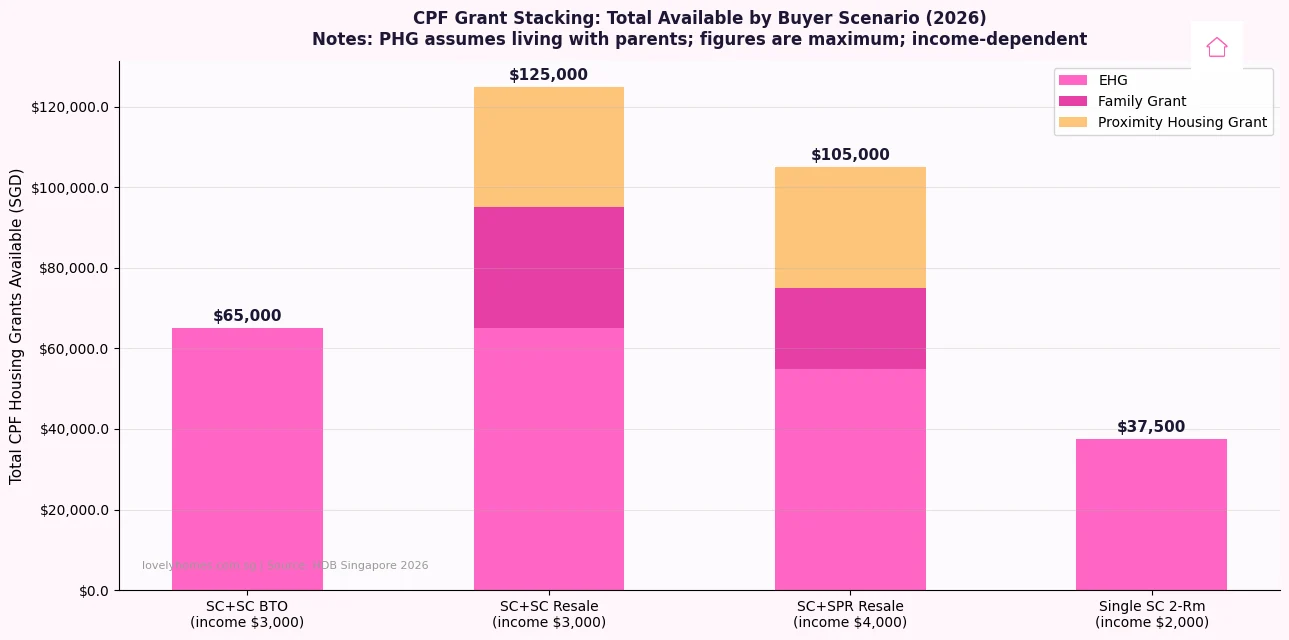
CPF housing grants are one of the most powerful but least understood tools in Singapore’s housing system. For a first-timer couple on a combined income of S$3,000/month buying a resale flat near their parents, total grants can reach S$125,000 — a sum that meaningfully reduces both the flat price and the mortgage they need to service for the next 25 years. Yet many eligible buyers under-claim or miss grants entirely because they do not understand which schemes apply to their specific profile.
This guide covers every CPF housing grant available in 2026, how to calculate what you qualify for, how the grants stack with one another, and how they interact with the HDB concessionary loan. All figures reflect the framework administered by the Housing & Development Board (HDB) and the Central Provident Fund (CPF) Board as at 31 July 2026.
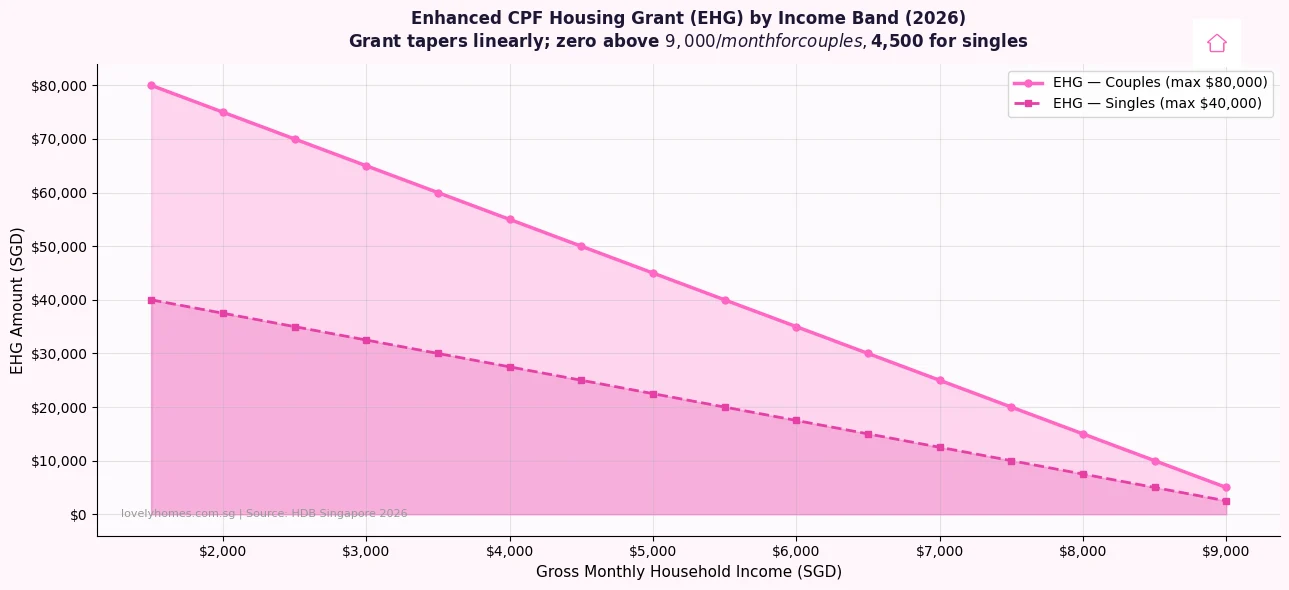
Figure 1: EHG amount by gross monthly household income (2026). The grant tapers linearly from S$80,000 at S$1,500/month to S$5,000 near the S$9,000 ceiling for couples.
What Are CPF Housing Grants?
CPF housing grants are direct subsidies paid by the Singapore Government to eligible HDB flat buyers. Unlike the HDB concessionary loan (which must be repaid with interest) or CPF Ordinary Account savings (which are your own money that must be refunded with accrued interest when you sell), grants are free money. They are credited at the point of flat booking or resale completion and applied directly to reduce the purchase price, which in turn reduces the loan quantum you need to service.
Grants are funded from the Singapore Government’s budget allocation for housing affordability and are not drawn from the CPF fund pool itself. Despite being called “CPF housing grants,” the CPF Board administers the disbursement, but the grants are Government expenditure. This distinction matters because grants received do not attract CPF accrued interest — only the CPF OA savings you use toward the flat purchase do.
The Five Main CPF Housing Grants in 2026
1. Enhanced CPF Housing Grant (EHG)
The EHG is the flagship grant, introduced in September 2019 to replace both the Special CPF Housing Grant (SHG) and the Additional CPF Housing Grant (AHG) for new flat buyers. It is now available for both BTO and resale flat purchases, making it the first grant to apply universally regardless of flat type.
The EHG is income-tiered. For first-timer couples earning up to S$9,000/month: the grant ranges from S$5,000 (at the S$9,000 income ceiling) to S$80,000 (at or below S$1,500/month). The formula is linear — every additional S$1,000 in monthly household income reduces the EHG by approximately S$10,000. For eligible singles aged 35 and above under the Single Singapore Citizen scheme, the EHG is half the couple amount: up to S$40,000 for incomes at or below S$4,500/month.
Critical condition: to qualify for EHG, at least one applicant must not have previously received an EHG, SHG, or AHG. There is also a work requirement — at least one applicant must be employed continuously for the 12 months immediately before the flat application.
2. Additional CPF Housing Grant (AHG — Resale Only)
The AHG for resale flats is a legacy grant now superseded for BTO purchases by the EHG. For resale flat purchases only, first-timer families earning at or below S$5,000/month may receive the AHG (up to S$40,000) in addition to the EHG. This stacking of EHG + AHG is specifically designed to support lower-income families who need to buy on the resale market because BTO wait times (3–5 years) are not compatible with their immediate housing needs.
Note: the AHG for resale is distinct from the old AHG that applied to BTO purchases, which was discontinued when the EHG launched.
3. Family Grant
The Family Grant applies exclusively to resale flat purchases by first-timer and second-timer families. The amount depends on citizenship composition:
Buyer Profile
Family Grant (Resale)
Income Ceiling
SC + SC (first-timer couple)
S$30,000
None
SC + SPR (first-timer couple)
S$20,000
None
SC or SC+SC (second-timer couple)
S$15,000
None
SC + SPR (second-timer couple)
S$10,000
None
The Family Grant has no income ceiling, which makes it accessible to all HDB buyers in the resale market regardless of earnings. However, it does require a qualifying family nucleus and that neither applicant previously received a Family Grant or Half-Housing Grant for the same flat type.
4. Proximity Housing Grant (PHG)
The PHG is designed to encourage multi-generational living and reduce inter-generational distance. It applies to resale flat purchases only. The grant is tiered by how close the buyer lives to their parents (or parents-in-law) or children:
Living Arrangement
PHG Amount
Income Ceiling
Living with parents / parents-in-law (in the same flat)
S$30,000
None
Living within 4 km of parents / parents-in-law
S$20,000
None
Living with children (in the same flat)
S$10,000
None
Living within 4 km of children
S$10,000 (same unit) / S$20,000 (within 4 km)
None
The PHG is stackable with the Family Grant and EHG for resale purchases. A couple buying a resale flat near their parents could receive EHG + Family Grant + PHG simultaneously, bringing total grants to S$80,000 + S$30,000 + S$30,000 = S$140,000 if they are on a low income.
5. Step-Up CPF Housing Grant
The Step-Up Grant (S$15,000) specifically targets second-timer families who currently live in a 2-Room Flexi or smaller HDB flat (bought with housing subsidies) and are upgrading to a 3-Room or larger resale flat. Income ceiling: S$7,000/month. This grant acknowledges that a family’s circumstances improve over time and that the move from a small starter flat to a larger home deserves targeted support. Unlike the Family Grant which is available to all second-timers, the Step-Up Grant is exclusively for this transitional scenario.
Figure 2: Total CPF grant amounts across four buyer scenarios (2026). A low-income SC+SC couple buying resale near parents can stack up to S$125,000 in grants.
Grant Eligibility Matrix: Which Grant Applies to Which Flat Type
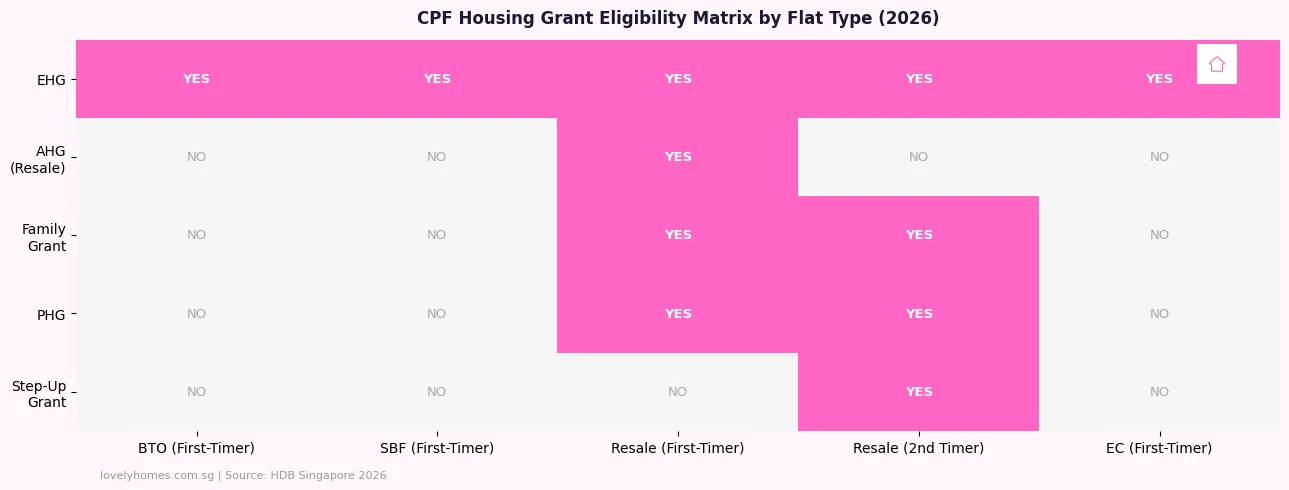
Figure 3: CPF housing grant eligibility by flat type. Resale flat buyers have access to the widest range of grants, including Family Grant and PHG not available for BTO.
Summary: All Grants at a Glance
Grant
Max Amount
BTO?
Resale?
Income Ceiling
Citizenship
Enhanced CPF Housing Grant (EHG)
S$80,000 (couples) S$40,000 (singles)
Yes
Yes
S$9,000/mth (couples) S$4,500/mth (singles)
At least 1 SC
AHG (Resale)
S$40,000
No
Yes
S$5,000/mth
At least 1 SC
Family Grant
S$30,000 (SC+SC)
No
Yes
None
At least 1 SC
Proximity Housing Grant (PHG)
S$30,000
No
Yes
None
At least 1 SC
Step-Up CPF Housing Grant
S$15,000
No
Yes (3-Rm+)
S$7,000/mth
At least 1 SC
EHG (EC)
S$30,000 (tiered)
EC only
No
S$9,000/mth
At least 1 SC
Worked Example: The Wong Family at S$3,000/month Income
Mr and Mrs Wong are a married Singapore Citizen couple, both first-timers. Their combined gross monthly income is S$3,000. They want to buy a 4-Room resale HDB flat near Mrs Wong’s parents in Tampines (within the same block).
EHG: Income S$3,000/month → EHG = S$65,000 (couples, tapering from S$80,000 at S$1,500 to S$5,000 at S$9,000).
Family Grant: SC+SC first-timer resale → S$30,000.
PHG: Living with parents (same flat) → S$30,000. (Note: the Wongs are buying to live with Mrs Wong’s parents; parents apply for the PHG on their side if they are the purchasers. Here, the Wongs buy the resale flat and the parents move in — PHG of S$30,000 applies to the Wongs’ purchase.)
HDB loan (80% LTV on S$395,000 net): approximately S$316,000 → monthly instalment ~S$1,444/month at 2.6% p.a. over 25 years, payable from CPF OA.
Minimum cash required at exercise: 1% OTP deposit = S$5,200. Balance 19% from CPF OA (S$93,800 less grants already applied).
This example demonstrates the transformative effect of grant stacking for lower-income first-timers. Without grants, the Wongs would need to fund S$104,000 (20% of S$520,000) from CPF and cash, plus service a S$416,000 loan at S$1,901/month — an 80% higher monthly payment than the grant-assisted scenario.
How Grants Interact with CPF OA Savings and Accrued Interest
One nuance that many buyers miss: grants reduce the flat price at the point of purchase, but they do not attract CPF accrued interest. Your CPF OA savings used toward the flat, however, do attract the prevailing CPF OA interest rate (2.5% p.a.) on the amount withdrawn, compounded annually. When you eventually sell the flat, the CPF Board requires you to refund the principal withdrawn plus the accrued interest back into your CPF OA before you receive any net cash proceeds.
Because grants are not CPF OA funds but Government subsidies, no accrued interest accumulates on the grant portion. The practical implication: using grants to reduce your flat price is strictly better than using CPF OA savings, because the grant portion carries zero future repayment obligation.
Second-Timer Grant Restrictions and the 30-Month Rule
Second-timer buyers — those who have previously purchased a subsidised HDB flat or received a housing grant — face reduced or nil grant eligibility for a second HDB purchase. HDB’s general rule is that second-timers must wait 30 months from the date of disposal of the first subsidised flat before purchasing another HDB flat with subsidies. Some grant schemes (Family Grant, Step-Up Grant) are available to second-timers under specific conditions; the EHG is not available to second-timers. Always verify your second-timer status via the HDB HFE letter before budgeting on grants.
What Might Come Next: Grant Evolution in Singapore’s Housing Policy
As at July 2026, Singapore’s CPF housing grant framework has been relatively stable since the EHG’s introduction in 2019. However, two policy pressures suggest evolution is possible: rising resale flat prices in prime estates (where even lower-income buyers face S$600,000–S$800,000 price points), and the expanding Prime Location Public Housing (PLH) model which restricts resale to Singapore Citizens only for 10 years. There is ongoing discussion among housing researchers about whether the PHG could be extended to BTO purchases to encourage multi-generational flat selection from the outset. No announcement has been made as at this guide’s publication date.
Can I use CPF housing grants to buy a private condominium?
No. CPF housing grants — the EHG, Family Grant, PHG, Step-Up Grant, and all related HDB schemes — apply exclusively to HDB flat purchases. They cannot be used toward a private condominium, landed property, or Executive Condominium after the EC has been privatised. If you are buying a new EC (before privatisation), a scaled-down EHG may apply, but the Family Grant and PHG do not. Private property buyers may still use their CPF Ordinary Account savings toward the purchase, but those savings attract accrued interest obligations, not grants.
Do I need to repay CPF housing grants if I sell my HDB flat?
No. CPF housing grants are non-repayable Government subsidies. Unlike CPF OA savings (which must be refunded with accrued interest to your CPF OA account when you sell), grants do not need to be repaid. However, if you sell a subsidised HDB flat and then buy another subsidised flat, the second purchase will typically not attract the same grants (particularly the EHG), because most grants are available only to first-timers. Selling and buying again does not “reset” your grant entitlement unless HDB explicitly designates a new category for second-timers.
Can singles receive CPF housing grants?
Yes, but with restrictions. Single Singapore Citizens aged 35 and above may receive the EHG for singles (up to S$40,000) when buying a 2-Room Flexi BTO flat or any size resale flat. The income ceiling for singles is S$4,500/month. Singles are not eligible for the Family Grant or PHG (which require a family nucleus), but may apply for a reduced PHG under certain conditions if moving near their parents. The Step-Up Grant is available to eligible singles who own a 2-Room Flexi flat and are upgrading.
What is the income used to calculate CPF housing grants?
HDB uses the gross monthly household income for the 12 months immediately preceding the flat application. This includes all income sources: employment income, self-employment income, rental income, and overseas income. The 12-month average is calculated and compared against the income ceiling. Bonuses, director’s fees, and commission income are included. CPF contributions (both employee and employer) are not deducted for this calculation — HDB uses the gross figure before CPF deduction. Individuals with zero income (e.g., homemakers) are recorded at zero; the total is the combined household figure of all persons listed on the flat application.
Can both the buyer and seller of a resale flat receive grants in the same transaction?
Grant eligibility is assessed independently for buyer and seller. The buyer of a resale flat may receive the EHG, Family Grant, and/or PHG as applicable to their profile. The seller has no grant entitlements in relation to the sale — grants are a buyer-side benefit. If the seller is using their sale proceeds to purchase another subsidised HDB flat, they would apply for grants in that subsequent purchase. The fact that the buyer receives S$125,000 in grants does not affect the sale price negotiation — grants reduce the effective cost to the buyer but do not change what the seller receives.
How are grants disbursed — cash or CPF?
CPF housing grants are credited directly to your CPF Ordinary Account at the point of flat booking (for BTO) or upon completion (for resale). They are not paid in cash. The credited amount is then used toward the flat purchase together with your other CPF OA savings, reducing the loan quantum required. Because grants are added to your CPF OA rather than paid directly to the seller, they are subject to standard CPF housing withdrawal rules — you must have sufficient CPF OA balance to cover the required down payment after the grant is applied. Critically, because grants arrive in your CPF OA, they also carry no accrued interest obligation when the flat is eventually sold.
What happens to my CPF housing grants if my flat application is cancelled?
If you cancel a BTO flat application before booking (i.e., before grants are formally disbursed), your grant entitlement is preserved — cancellation at the application stage does not consume your first-timer grant status. However, if you have already booked a flat and grants have been credited to your CPF OA, then you cancel or forfeit the flat, the situation becomes more complex: HDB will recover the grant from your CPF OA, and depending on the circumstances, your first-timer status and future grant eligibility may be affected. For resale transactions, if the OTP lapses before completion, grants that have not been formally disbursed are simply not paid. Always check with HDB directly if you are in a cancellation scenario.
Disclaimer
This article is for general informational purposes only. CPF housing grant amounts, income ceilings, and eligibility conditions are subject to revision by the Singapore Government. Always verify current grant entitlements directly with the Housing & Development Board (HDB) and the CPF Board through the HDB My Flat Journey portal and your HDB Flat Eligibility (HFE) letter. This article does not constitute financial, legal, or housing advice.
The HDB Flat Eligibility (HFE) letter replaced the old HDB Loan Eligibility (HLE) letter from 9 May 2023.
You must have a valid HFE letter before submitting a BTO application, selecting a resale flat, or exercising an Option to Purchase (OTP).
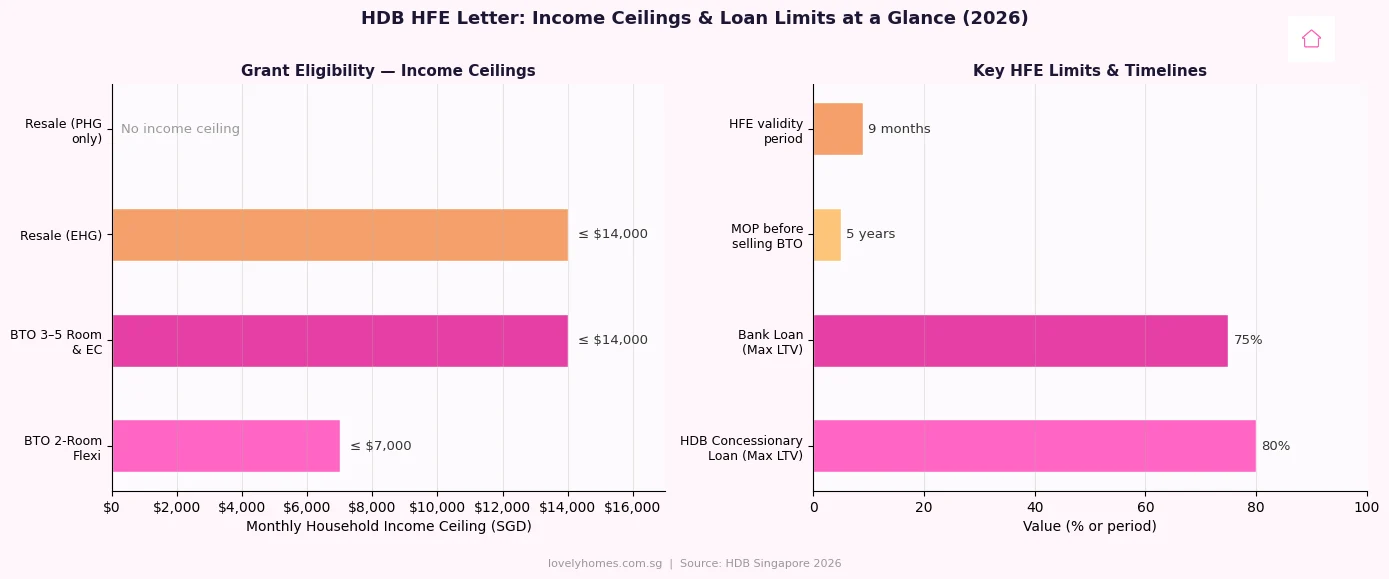
An HFE letter is issued within 14 working days and is valid for 9 months.
It covers in one document: flat eligibility, CPF housing grant eligibility, and HDB concessionary loan eligibility.
The application is done entirely online via HDB My Flat Journey (MFJ) using SingPass; all co-applicants must consent.
Income ceiling for most grants: S$14,000/month for couples; S$7,000/month for singles (select flat types).
HDB concessionary loan LTV: up to 80%; bank loan LTV: up to 75%.
If you are buying an HDB flat in Singapore — whether a new Build-To-Order (BTO) flat, a Sale of Balance Flat (SBF), or a resale flat from the open market — the HDB Flat Eligibility (HFE) letter is the gateway document that determines what you can buy, how much you can borrow from HDB, and how much in CPF housing grants you qualify for. Without it, you cannot proceed to application.
This guide explains exactly what the HFE letter is, who needs it, how to apply step by step, what to do if your application is rejected, and how to use your HFE letter once you have it. All figures reflect the rules administered by the Housing & Development Board (HDB) as at 31 July 2026.
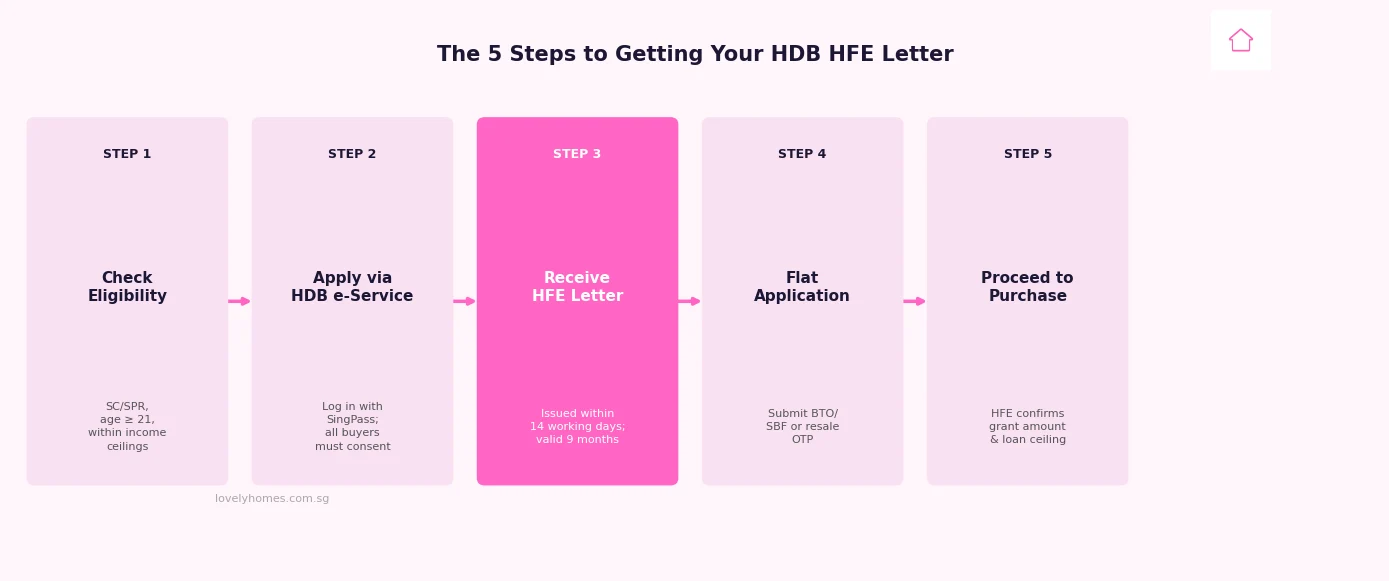
Figure 1: The 5 steps to obtaining your HDB HFE Letter — from eligibility check to flat purchase.
What is the HDB HFE Letter?
The HDB Flat Eligibility (HFE) letter is an integrated eligibility assessment issued by HDB. Prior to 9 May 2023, buyers had to obtain separate documents: a Housing Loan Eligibility (HLE) letter for HDB loans, a CPF housing grant eligibility check, and a general flat eligibility check. The HFE letter consolidates all three into a single, time-limited document. HDB administers it; the CPF Board and the Monetary Authority of Singapore (MAS) inform the underlying eligibility rules for grants and loan-to-value (LTV) caps respectively.
The HFE letter tells you three things before you spend a single dollar:
Which HDB flat types you are eligible to purchase (BTO, SBF, resale, or Executive Condominium).
The CPF housing grants you qualify for — the Enhanced CPF Housing Grant (EHG), Additional CPF Housing Grant (AHG, resale), Family Grant, Proximity Housing Grant (PHG), and Step-Up CPF Housing Grant.
Whether you qualify for an HDB concessionary loan and the maximum loan quantum HDB will extend to you based on your income, CPF balances, and existing property.
Who Needs an HFE Letter?
You need a valid HFE letter if you intend to:
Apply for a new flat under a BTO, SBF, or Open Booking exercise;
Register intent to buy a resale HDB flat; or
Exercise an Option to Purchase (OTP) for a resale flat.
You do not need an HFE letter if you are buying a private condominium or landed property — that falls outside HDB’s remit entirely. However, if you intend to use CPF Ordinary Account (OA) savings toward a private property purchase, you will need a CPF withdrawal application separately.
Eligibility Criteria: Who Can Apply?
To be eligible for an HFE letter, you and your co-applicant(s) must meet HDB’s flat eligibility conditions. The core criteria are citizenship and family nucleus requirements — HDB does not sell new flats to individuals; a qualifying family nucleus is the fundamental test. The following applies as at 2026:
Criterion
Requirement (General)
Citizenship
At least one applicant must be a Singapore Citizen (SC). Co-applicants may be SC or Singapore Permanent Resident (SPR). Foreigners may not purchase HDB flats.
Age
All applicants must be at least 21 years old (single or widowed orphan schemes: 35 years old).
Family nucleus
Must form a qualifying family nucleus: married couple, fiancé/fiancée couple, parent(s) with child(ren), siblings, or single (35+, specific schemes only).
Property ownership
Must not own or have disposed of any HDB flat, DBSS flat, or private residential property in the 30 months before application (resale) or flat application (BTO).
Income ceiling
Combined gross monthly household income ≤ S$14,000 for most schemes; ≤ S$7,000 for singles (2-Room Flexi BTO). Executive Condominiums: ≤ S$16,000.
Previous housing subsidies
Second-timer restrictions apply if you have previously received a CPF housing grant or purchased a subsidised flat.
CPF Housing Grants Available via the HFE Letter
The HFE letter is the gateway to CPF housing grants. These grants are funded by the Singapore Government and administered through HDB. The amount you receive is calculated based on your household income, citizenship composition, and flat type. Grants are used to offset the purchase price directly — they reduce the amount you need to pay in cash or CPF OA, or they reduce your outstanding mortgage with HDB.
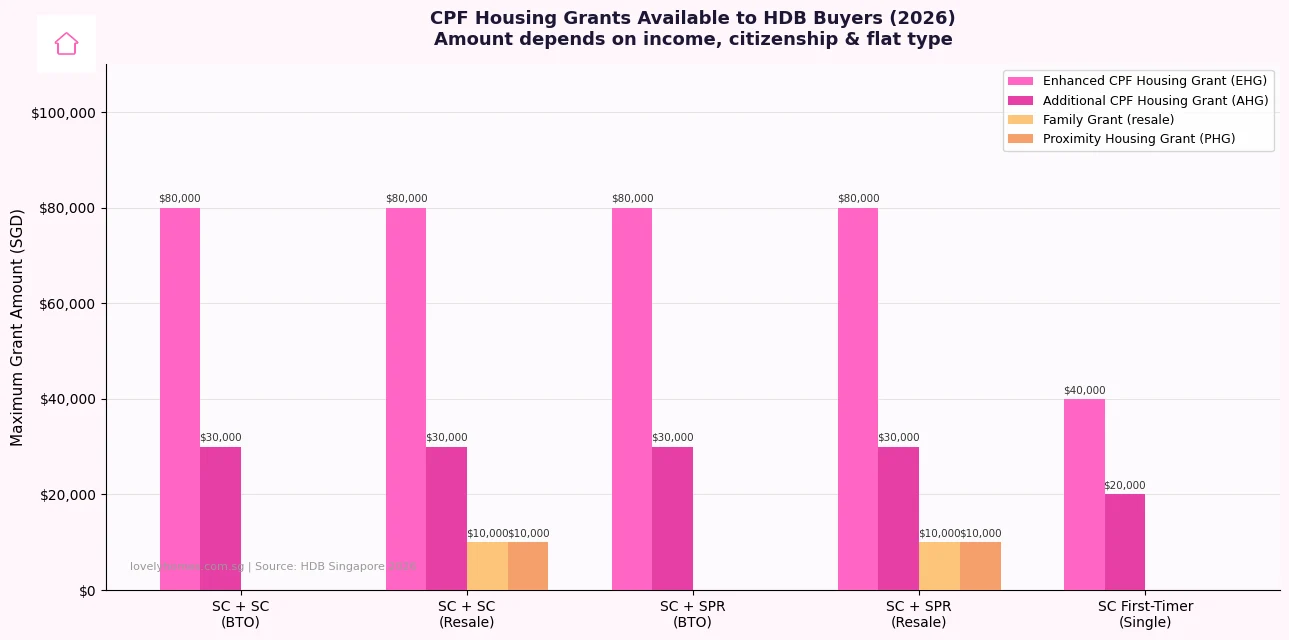
Figure 2: Maximum CPF housing grant amounts by buyer profile and flat type (2026). Actual amounts depend on income tier.
Enhanced CPF Housing Grant (EHG)
The EHG is the largest grant available and replaced the Special CPF Housing Grant (SHG) and Additional CPF Housing Grant (AHG) for new flat purchases. It is available to first-timer families earning ≤ S$9,000/month. The maximum is S$80,000 for couples earning up to S$1,500/month; the grant tapers to S$5,000 for incomes near the S$9,000 ceiling. Critically, EHG can be used toward both BTO and resale HDB flats — the grant amount is determined at application based on the preceding 12 months’ income.
Additional CPF Housing Grant (AHG — Resale)
The AHG for resale flat purchases (up to S$40,000) applies to first-timer families earning ≤ S$5,000/month who are buying a resale flat. It is used alongside the EHG to give lower-income buyers meaningful purchasing power in the resale market without requiring a new BTO flat.
Family Grant
The Family Grant (up to S$30,000 for SC+SC couples, S$20,000 for SC+SPR couples) applies to resale flat purchases. It does not have an income ceiling but does require a qualifying family nucleus. It is used with the EHG for resale purchases.
Proximity Housing Grant (PHG)
The PHG (up to S$30,000 for living with parents; S$20,000 for living within 4 km of parents) is available for resale flat purchases only. It has no income ceiling. The PHG is designed to encourage multi-generational living and reduce the burden on Singapore’s public transport and caregiving infrastructure.
Step-Up CPF Housing Grant
The Step-Up Grant (S$15,000) is specifically for second-timer families who currently live in a 2-Room or smaller HDB flat and are moving to a 3-Room or larger resale flat. Income ceiling: S$7,000/month. This grant bridges the gap for families who have already used previous housing subsidies.
HDB Concessionary Loan vs Bank Loan: What the HFE Tells You
Once the HFE letter is issued, it also states your eligibility for the HDB concessionary loan. This loan charges an interest rate pegged at 0.1% above the prevailing CPF Ordinary Account (OA) interest rate, which has been 2.5% per annum since 1999 — giving an effective rate of 2.6% p.a. (as at July 2026). This is generally lower than bank mortgage rates, which in mid-2026 have drifted between 3.2–3.7% p.a. for 2-year fixed packages.
Key differences the HFE letter determines:
Feature
HDB Concessionary Loan
Bank Loan
Max LTV (new flat)
80% of purchase price
75% of purchase price / valuation
Interest rate (Jul 2026)
2.6% p.a. (CPF OA + 0.1%)
3.2–3.7% p.a. (market rates)
Down payment (cash)
None required (can be fully CPF)
Minimum 5% in cash
Eligibility restriction
Must not own private property; income ceiling applies
Assessed by lender on TDSR/MSR
Refinancing
No — fixed for life of loan
Refinanceable after lock-in period
Prepayment penalty
None
May apply within lock-in
HDB’s LTV cap of 80% means you must fund the remaining 20% from CPF OA savings and/or cash. If your CPF OA balance is sufficient, you may pay no cash at all at the point of purchase — a critical advantage for first-time buyers.
Figure 3: HDB HFE letter income ceilings and key borrowing limits at a glance.
How to Apply for the HFE Letter: Step by Step
The entire HFE application process is handled online through HDB’s My Flat Journey (MFJ) portal. There is no physical form, no queue at the HDB Hub, and no in-person interview required for a standard application. Here is the process in full:
Step 1 — Check flat eligibility. Log in to HDB My Flat Journey with SingPass. Use the online self-assessment tool to confirm you meet the basic eligibility criteria before investing time in the full application.
Step 2 — Initiate the HFE application. All co-applicants must log in and give their digital consent via SingPass. HDB will draw on Myinfo data (income records from IRAS, CPF balances, property ownership records) automatically. You do not need to upload payslips separately if your employer reports income through SingPass Myinfo.
Step 3 — Wait for processing. HDB targets a turnaround of 14 working days. Complex cases (self-employed applicants, overseas income, undischarged bankrupts) may take longer. You will be notified via the MFJ portal and by SMS/email when the letter is ready.
Step 4 — Receive and review your HFE letter. The letter will state: (a) flat types you may purchase; (b) grant amounts you qualify for; (c) whether you are eligible for an HDB concessionary loan and the maximum loan ceiling. Review it carefully — the loan ceiling is calculated conservatively and may differ from your actual borrowing capacity under TDSR.
Step 5 — Proceed to flat application or OTP exercise. Your HFE letter is valid for 9 months from the date of issue. You must submit your BTO/SBF application, register intent to buy, or exercise the OTP within this window. If it lapses, you must reapply.
Worked Example: The Lim Family’s HFE Journey
Mr and Mrs Lim are a Singapore Citizen couple, both aged 30, getting married in October 2026. Their combined gross monthly income is S$7,200. They want to apply for a BTO 4-Room flat in Tengah (OCR). Here is how the HFE letter plays out for them:
Eligibility: Married couple, both SC, income ≤ S$14,000 — eligible for BTO.
EHG: Combined income S$7,200/month → EHG = S$25,000 (grant tapers; full S$80,000 is for ≤ S$1,500/month couples).
HDB concessionary loan: Maximum loan quantum is calculated at approximately 30% of monthly income × loan tenure in months. At S$7,200/month income and 25-year tenure: roughly S$720,000 ceiling (subject to TDSR and MSR). The 4-Room BTO in Tengah is estimated at S$490,000 — well within the loan ceiling.
Down payment required: 20% × S$490,000 = S$98,000. EHG of S$25,000 offsets the purchase price → effective amount to fund: S$73,000 from CPF OA. If CPF OA balance is sufficient, zero cash required at purchase.
Monthly instalment (HDB loan 2.6% p.a., 25 yr): Loan = S$465,000 (S$490,000 less S$25,000 EHG) × 0.8 = S$372,000 → approximately S$1,700/month, payable entirely from CPF OA.
This example illustrates why the HFE letter is not bureaucracy for its own sake — it gives buyers a precise financial picture before they commit to a flat.
Minimum Occupation Period (MOP) and Why It Matters
Once you purchase an HDB flat, you are subject to a Minimum Occupation Period (MOP) before you can sell or rent out the entire flat. The MOP for most HDB flats is 5 years from the date you collect your keys. For new BTO flats in prime locations under the Prime Location Public Housing (PLH) model, the MOP is extended to 10 years. The HFE letter does not state the MOP directly, but the flat type it confirms eligibility for will determine which MOP applies.
Understanding MOP is critical for buyers who may wish to upgrade to a private property in the medium term. The MOP clock starts only from key collection — not from the BTO application date or the signing of the sale agreement. For a BTO flat with a typical 3–5 year construction period, a buyer applying in 2026 might not complete their MOP until 2033 or 2034.
What if Your HFE Letter is Rejected or Shows Lower Entitlements?
An HFE letter may come back with lower grant amounts than expected, or it may indicate ineligibility entirely. Common reasons include: income exceeding the ceiling; a previous HDB flat disposal within the 30-month window; undischarged debts to HDB from a prior flat; or a co-applicant who owns private property. If you believe an error has been made, you may appeal in writing to HDB within 30 days of the letter’s issuance date, providing documentary evidence (IRAS tax assessments, CPF statements, deed of sale for previous property, etc.).
What This Means for You: HFE as a Planning Tool
The HFE letter is best understood not as an obstacle but as a planning tool. By applying early — before you even know which BTO exercise you want to ballot for — you gain five advantages: (1) you know your maximum loan ceiling under the HDB concessionary rate; (2) you have exact grant figures to plug into your financial model; (3) you avoid the risk of exercising an OTP and then discovering you cannot access the loan or grants you assumed; (4) the 9-month validity window gives you two full BTO ballot cycles to use it; and (5) it demonstrates to property agents and sellers that you are a financially ready buyer.
What Might Come Next: HFE and the Evolving HDB Landscape
As at July 2026, HDB has signalled an ambitious BTO pipeline for the remainder of 2026 and into 2027, with projects in Tengah, Kallang/Whampoa, and Queenstown expected in the October 2026 exercise. The PLH model continues to expand to more prime-location sites, which will carry a 10-year MOP and subsidy clawback on resale. Buyers should consider whether PLH restrictions align with their 10–15 year plans before balloting.
There is also ongoing discussion around whether the income ceilings for grants will be adjusted in the next Budget. The S$14,000 combined income ceiling has been in place since 2019; with median household incomes rising, a revision upward has been speculated. No official announcement has been made as at this article’s publication date.
Yes — you need a valid HFE letter before you can register your Intent to Buy (ITB) on the HDB Resale Portal. The ITB is the first step in the resale process and must be completed before the seller can register their Intent to Sell. Without a valid HFE letter, you cannot proceed with the resale transaction. The HFE letter for resale purchases also confirms your eligibility for the Family Grant, AHG (resale), and PHG.
How long is the HFE letter valid, and can I renew it?
An HFE letter is valid for 9 months from the date of issuance. If you do not complete your purchase or flat application within this window, you must reapply for a new HFE letter. There is no formal “renewal” — each application is a fresh assessment based on current income and circumstances. If your income has changed significantly (promotion, job change, becoming self-employed), your new HFE letter may reflect different grant amounts or loan ceiling figures. There is no fee to apply for or reapply for an HFE letter.
What is the difference between the HFE letter and the old HLE letter?
The Housing Loan Eligibility (HLE) letter was the predecessor document, phased out on 9 May 2023. It covered only HDB loan eligibility and did not include a full grant eligibility assessment or flat eligibility determination. Buyers previously had to navigate three separate checks: HLE, a grant eligibility tool on HDB’s website, and a flat eligibility self-assessment. The HFE letter consolidates all three. One practical difference: the HFE letter requires all co-applicants to give SingPass consent simultaneously, which the HLE did not strictly enforce.
Can singles apply for an HFE letter and purchase an HDB flat?
Yes, but with restrictions. Singapore Citizens aged 35 and above may apply under the Single Singapore Citizen (SSC) scheme for a 2-Room Flexi BTO flat (income ceiling S$7,000/month) or resale flats of any type. The EHG for singles is up to S$40,000. Singles may not purchase 3-Room or larger BTO flats under the SSC scheme. Divorced or widowed Singapore Citizens with children may apply under the Orphan Scheme or other applicable schemes with different eligibility conditions. SPR singles cannot purchase new HDB flats.
Does an HFE letter mean I am guaranteed an HDB concessionary loan?
No — the HFE letter indicates your eligibility for the HDB concessionary loan and the maximum ceiling, but the final loan offer is made only at the point of flat booking (BTO) or after valuation (resale). Between the HFE issuance and your actual flat purchase, your financial circumstances may change (income drop, new liabilities, default on another loan). HDB will re-assess your loan quantum at disbursement. You should also be aware that the HDB loan amount is subject to the Mortgage Servicing Ratio (MSR) cap of 30% of gross monthly income and the Total Debt Servicing Ratio (TDSR) cap of 55%.
What happens to my HFE letter if I miss the BTO ballot or do not find a suitable resale flat?
Nothing happens automatically — the HFE letter simply remains valid until it expires at the end of its 9-month window. You can use it for any number of BTO applications or Intent to Buy registrations during that period. If the HFE letter expires before you complete a purchase, you reapply. There is no penalty for an unused HFE letter, nor is there a limit on how many times you may apply. The only cost is the 14-working-day wait for each new letter.
Can I use an HFE letter for an Executive Condominium (EC)?
Yes. The HFE letter also covers Executive Condominium purchases. However, ECs are developed and sold by private developers under a hybrid scheme — HDB sets eligibility rules, but the developer signs the Sales and Purchase Agreement. The income ceiling for ECs is S$16,000/month. ECs do not qualify for the HDB concessionary loan (you must take a bank loan), but eligible buyers may receive the EHG (capped depending on income). ECs are subject to a 5-year MOP from key collection, after which they may be sold on the open market to Singapore Citizens and PRs, and become fully privatised after 10 years.
Disclaimer
This article is for general informational purposes only and does not constitute legal, financial, or housing advice. Eligibility conditions, grant amounts, income ceilings, loan-to-value limits, and interest rates are subject to change without notice. Always verify current figures directly with the Housing & Development Board (HDB), the Central Provident Fund Board (CPF Board), and the Monetary Authority of Singapore (MAS). For loan-specific advice, consult a licensed financial adviser or mortgage broker.