En Bloc Sale Singapore 2026: Complete Guide to Collective Sales, 80% Consent and Owner Rights

En Bloc Sale Singapore 2026: Complete Guide to Collective Sales, 80% Consent and Owner Rights
En bloc sale Singapore 2026 complete guide — LTSA process, 80% consent and owner rights
Figure 0: En Bloc Sale Singapore 2026 — Complete Guide to the Collective Sale Process, Consent Thresholds and Owner Rights

Quick Answer — En Bloc Sale at a Glance

  • An en bloc sale (also called a collective sale) occurs when the majority of owners in a strata development agree to sell the entire development to a developer, who typically demolishes it and rebuilds.
  • The governing legislation is the Land Titles (Strata) Act (LTSA), administered by the Strata Titles Board (STB) under the Ministry of Law.
  • Consent threshold: 80% (by strata area and share value) for buildings aged 10 years or more; 90% for buildings aged under 10 years.
  • Owners who dissent but are in the minority can be overruled by the STB once the threshold is met, provided the sale is not prejudicial to the minority and the transaction is bona fide.
  • Typical en bloc payout: anywhere from S$800,000 to S$5M+ per unit, depending on development size, location, and land value.
  • The process typically takes 12–24 months from the formation of a Sales Committee to sale completion.
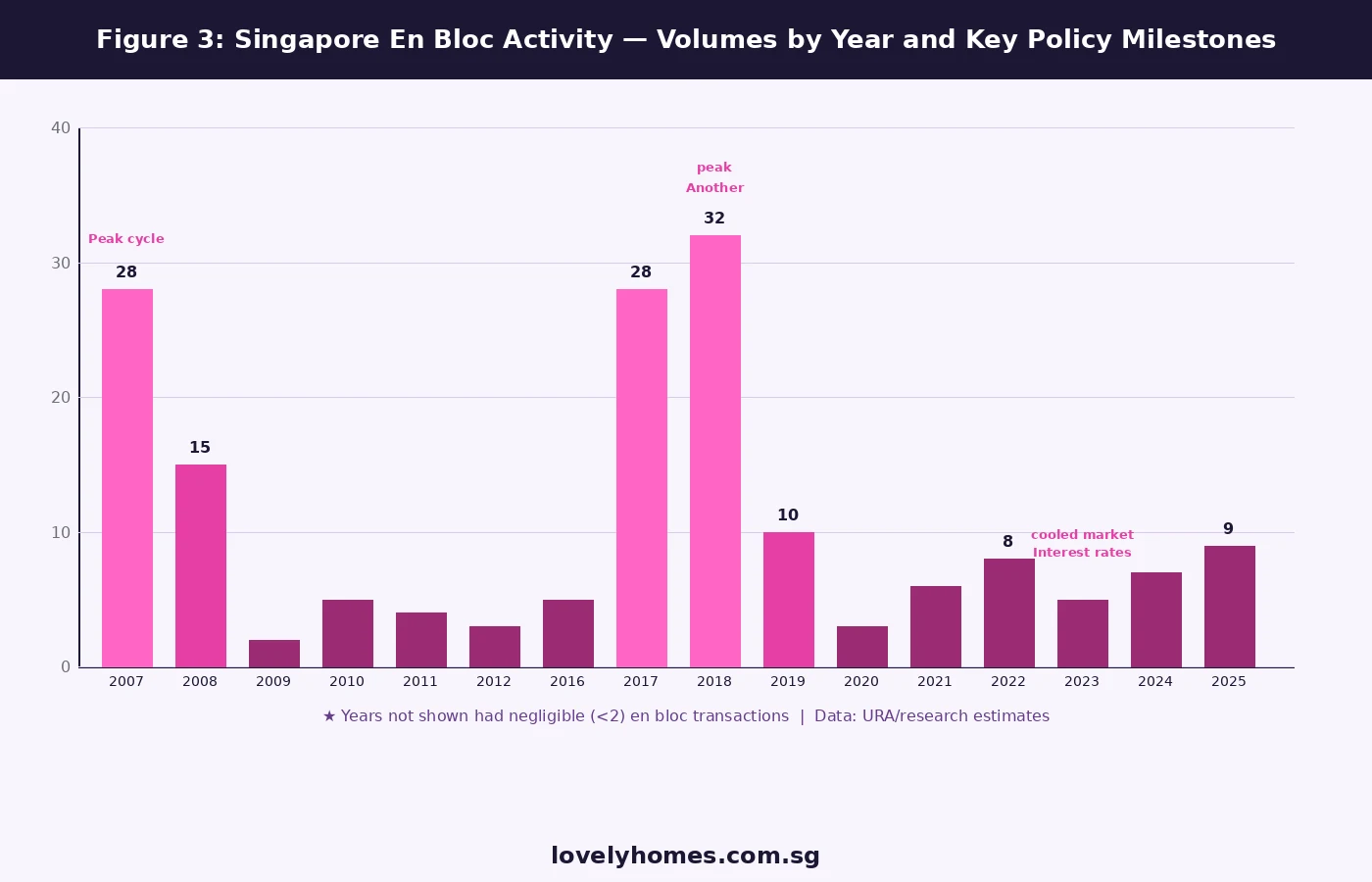
  • En bloc activity in Singapore is cyclical, spiking during low-interest-rate, high-land-demand periods (2007 and 2017–18 being recent peaks).

What Is an En Bloc Sale in Singapore?

An en bloc sale — from the French en bloc, meaning “as a whole” — is a collective sale of all the individual strata-title units in a development to a single buyer, usually a property developer. Rather than selling your individual unit separately, all (or most) owners sell their units together as one package, typically because the combined land value exceeds what individual unit sales could achieve.

In Singapore, en bloc sales are governed by Part VA of the Land Titles (Strata) Act (Cap. 158) (LTSA), which was amended in 2007 to introduce the current safeguards and procedures. The Strata Titles Board (STB), a quasi-judicial tribunal under the Ministry of Law, plays the key role of approving contested collective sales where a minority of owners object.

En bloc sales tend to occur when: the development is ageing and maintenance costs are rising; the plot ratio on the site has not been fully maximised and a developer can build more units; or land prices in the area have risen sufficiently that developers will pay a premium above individual unit values to unlock the redevelopment potential. In most cases, successful en bloc owners receive well above the prevailing open-market price for their unit — but they must also vacate and find replacement housing, which comes with its own costs and complexities.
En bloc sale process timeline Singapore 2026 — 9 stages from sales committee to completion
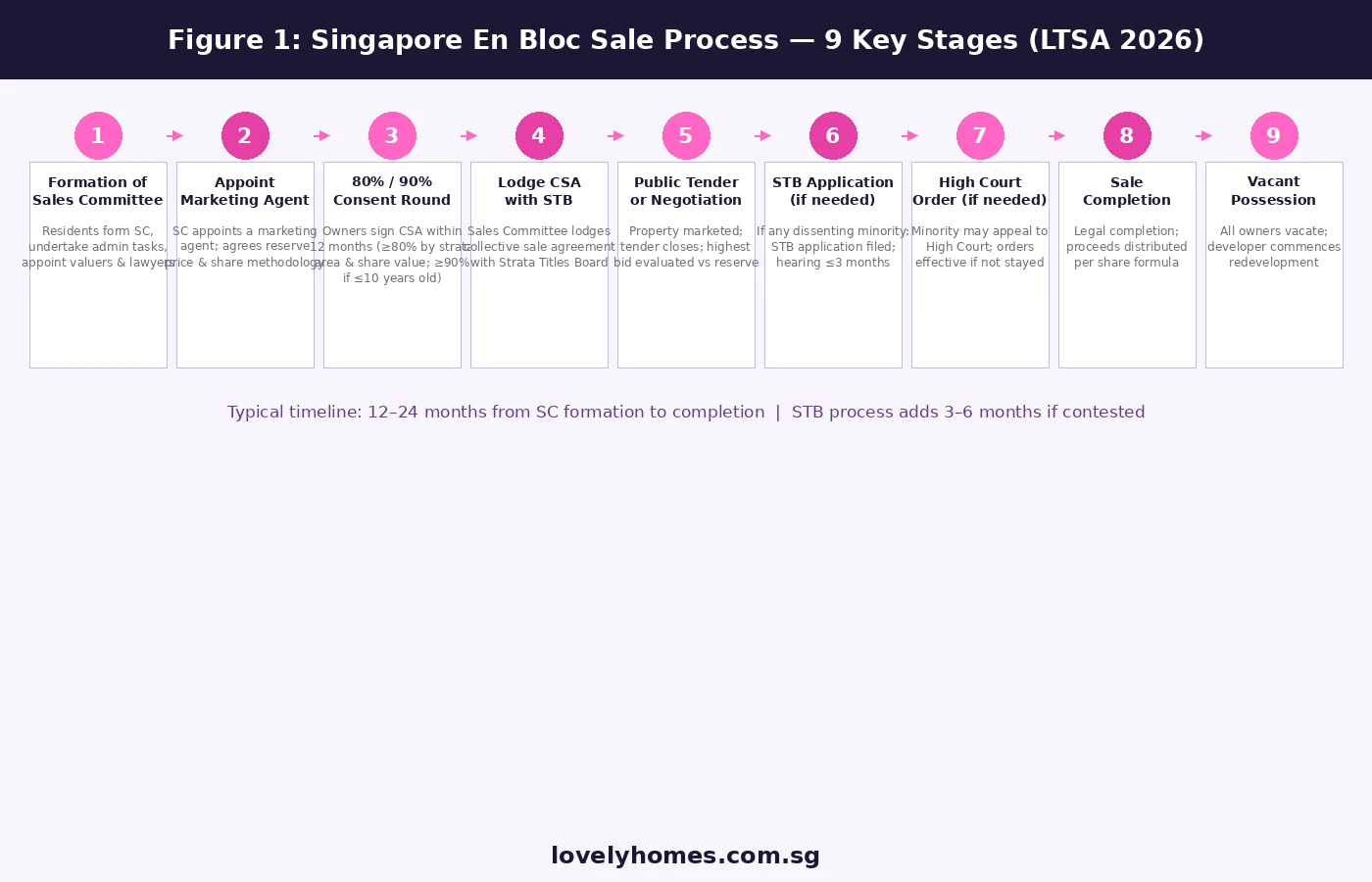
Figure 1: Singapore En Bloc Sale Process — 9 Key Stages under LTSA. Typical timeline: 12–24 months. Source: Ministry of Law / STB Singapore.

The En Bloc Sale Process — Stage by Stage

Stage 1: Formation of the Collective Sale Committee (CSC)

The process begins at a general meeting of the management corporation (MC) of the development, where owners vote to form a Collective Sale Committee (CSC) — commonly called the Sales Committee (SC). The CSC is elected by the owners and is responsible for managing the entire en bloc process on behalf of the consenting majority. The CSC must act in the best interests of all owners, not just those who support the sale.

Importantly, since the 2007 LTSA amendments, the formation of the CSC requires no minimum consent — any owner can propose it at an AGM or EOGM, and a simple majority vote (by share value) elects the CSC members. The 80% or 90% consent threshold comes later, when owners sign the Collective Sale Agreement (CSA).

Stage 2: Appointing Professionals

Once constituted, the CSC appoints three sets of professionals: a property valuer (to establish the reserve price and independent appraisal); a marketing agent (a licensed estate agent firm to run the public tender); and a law firm specialising in collective sales (to draft the CSA, manage STB filings, and handle the legal completion). All these appointments must be made by public tender among the professionals — the CSC cannot simply nominate a preferred firm without a competitive process.

Stage 3: Collecting Signatures — The 80%/90% Threshold

This is the pivotal stage. Owners are invited to sign the Collective Sale Agreement (CSA), which sets out the reserve price, the apportionment method, and the conditions of sale. The CSC must collect signatures from owners representing:

  • At least 80% of the total share value AND at least 80% of the total strata area — for developments aged 10 years or more.
  • At least 90% of the total share value AND at least 90% of the total strata area — for developments under 10 years old.

Both conditions must be met simultaneously. If a development has very large penthouses or commercial units with high strata areas, their owners’ signatures carry significant weight in the area test, even if their share values are proportionally lower. This dual-test structure was deliberately designed to protect both large-unit owners and those with high share values.

The signature collection exercise must be completed within 12 months from the date the first owner signs the CSA. If the threshold is not achieved within 12 months, the CSA lapses and the process must restart from scratch.

Stages 4–6: STB Lodgement, Tender and (if needed) Hearing

Once the threshold is met, the CSC lodges the CSA with the STB and simultaneously launches the public tender. If all owners (including dissenters) ultimately agree, the STB approves the sale by order on consent — a relatively quick administrative process. If there are dissenting minority owners who refuse to agree, the STB holds a hearing to determine whether the sale should be approved. The STB will approve the sale if it is satisfied that: (a) the sale is in good faith, (b) the transaction is at arm’s length, and (c) the sale is not prejudicial to the interests of the minority owners.
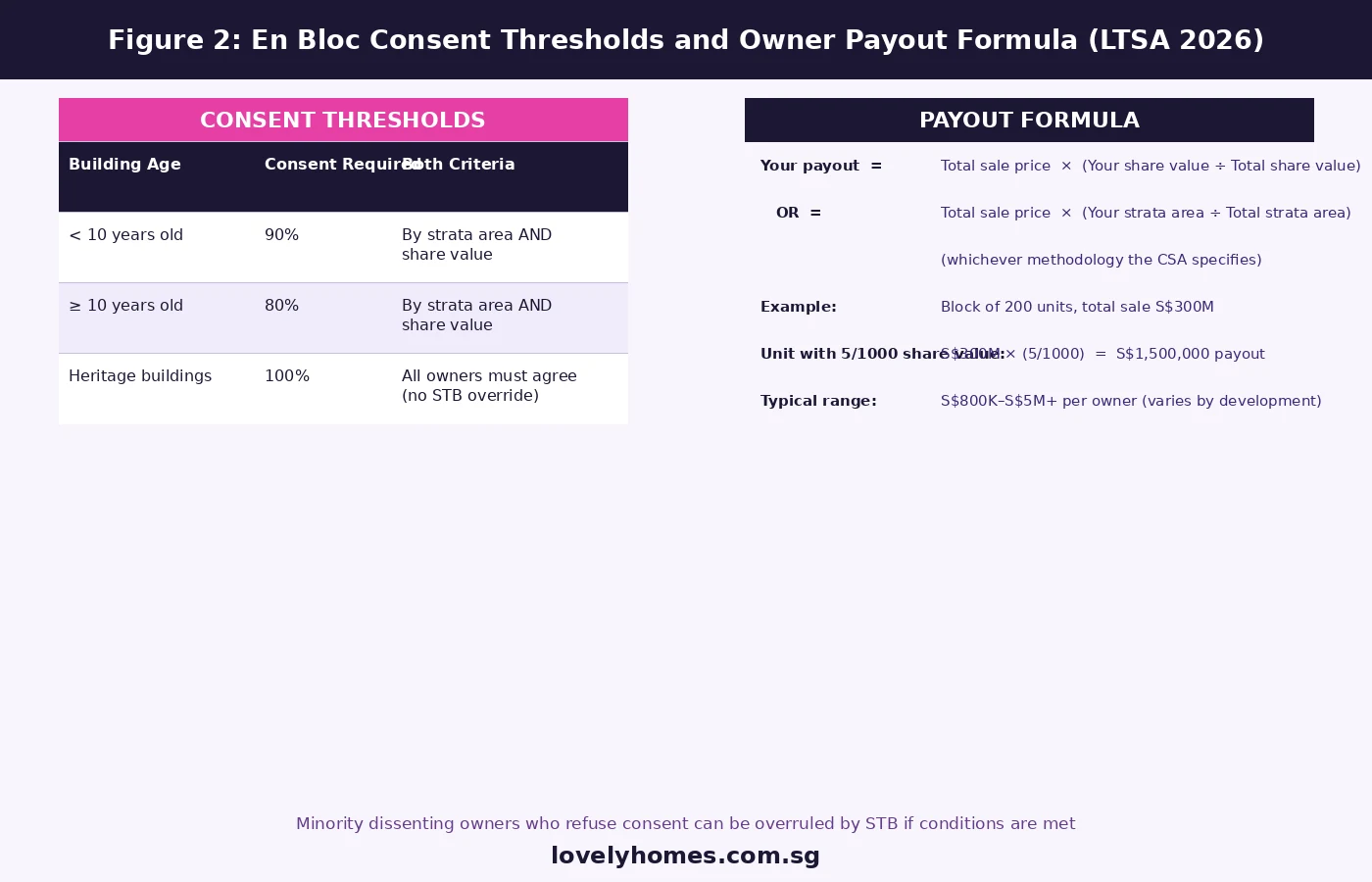
En bloc consent thresholds and owner payout formula Singapore 2026 — 80% and 90% rules LTSA
Figure 2: En Bloc Consent Thresholds and Payout Formula (LTSA 2026). The dual test (strata area AND share value) means large-unit owners and high-share owners both have meaningful leverage. Source: Ministry of Law / STB Singapore.

How Much Will Each Owner Receive?

The total sale price is distributed to individual owners according to a formula set out in the CSA. Two common methods are used, and the CSA must specify which applies:

  1. Share value method: Your payout = Total sale price × (Your share value ÷ Total share value of the entire development). This method tends to benefit owners of units with higher share values (typically larger or higher-floor units).
  2. Strata area method: Your payout = Total sale price × (Your strata area ÷ Total strata area). This method benefits owners of larger units by floor space.

In practice, many developments use a combination formula that blends both methods to produce a result acceptable to the majority. The valuer advises on the apportionment, and the CSC negotiates with owners to achieve sign-on. Some CSAs also incorporate a “premium” for ground-floor units or units with additional features.

Individual payouts vary enormously. In central Singapore, successful en bloc sales of small freehold developments have produced payouts of S$2M–S$5M+ per unit. In suburban or leasehold developments, payouts are typically S$800K–S$1.5M. The key driver is the land rate the developer is willing to pay for the site — which itself depends on the Gross Floor Area (GFA) the developer can build, the development charge payable to URA, and the estimated selling price of the new project.

Key Facts: What Makes a Development En Bloc Ready?

Factor What It Means Impact
Age of development Older = lower consent threshold (80% vs 90%) Easier to achieve consensus
Plot ratio Under-utilised plot = more GFA for developer Higher land price bid; higher per-unit payout
Tenure (freehold vs 99-year) Freehold land commands a premium Higher payout for freehold en bloc
Number of units Smaller number of units = fewer signatures needed Easier to reach 80% threshold
Homogeneity of unit sizes Similar units = smaller spread in payout Easier to get all owners to agree
Location and URA masterplan Upzoning potential increases developer appetite Key demand driver for developer bids
Interest rate environment Low rates reduce developers’ cost of capital En bloc cycles coincide with low rate periods

Singapore en bloc sale activity by year 2007 to 2025 — historical volumes chart
Figure 3: Singapore En Bloc Sale Activity — Estimated Transactions by Year. Activity peaked in 2007 and again in 2017–2018, both periods of low interest rates and high developer demand. Sources: URA / research estimates.

Worked Example: The Greenview Court En Bloc

Development Profile

Greenview Court is a fictional illustration. Actual en bloc outcomes will vary.

Development Greenview Court (hypothetical) — freehold, 28 units, built 2001
Location River Valley, Singapore (CCR) — URA zoning: Residential, 2.8 plot ratio
Age at time of en bloc launch 24 years → 80% consent threshold applies
Total reserve price S$168,000,000
Your unit 2BR, 850 sqft, share value 10/280 of total
Your en bloc payout S$168M × (10/280) = S$6,000,000
Estimated open market value of your unit S$4,500,000 (individual sale)
En bloc premium over individual sale S$1,500,000 (33% premium)

Costs to factor in after receipt of proceeds: CPF refund (principal + accrued interest), outstanding mortgage repayment, legal fees (~S$3,000–S$8,000), and the cost of temporary accommodation while you find a replacement home. The net windfall is generally still significant — but always model cash flows before assuming you can immediately afford a replacement at the same tenure and size.

Rights of Dissenting Minority Owners

Owners who do not wish to sell and who are in the minority have several avenues available to them. They may object to the STB on grounds set out in the LTSA, including: the transaction is not in good faith (e.g. the reserve price is too low or there are undisclosed relationships between the CSC and the buyer); they will suffer financial loss (i.e. the payout is less than their replacement cost); or the proceeds of sale are insufficient to enable them to obtain a replacement property of similar quality.

The STB will hear submissions from both the CSC and the dissenting owners. If the STB is satisfied that the sale is proper, it will issue a collective sale order that is binding on all owners, including dissenters. Dissenting owners may appeal to the High Court on points of law but not on factual grounds. In practice, High Court appeals are rare and generally unsuccessful unless there is a genuine procedural irregularity.

Once a collective sale order is issued, all owners — including dissenters — must vacate the development and hand over their units to the purchaser by the completion date. Refusal to vacate can result in court enforcement proceedings.

What an En Bloc Sale Means for Singapore Property Buyers

For buyers of older developments — particularly freehold condominiums in the Core Central Region (CCR) — en bloc potential is both an opportunity and a risk. An en bloc windfall can deliver a premium well above open-market value, making older freehold developments attractive investments for buyers who are patient and comfortable with the uncertainty. On the other hand, a successful en bloc means you are forced to sell and relocate — which may not suit occupiers who value stability, especially families with children in nearby schools.

From a market perspective, en bloc sales supply developers with land for new projects — replenishing the pipeline of new launches. The URA Q2 2026 Flash Estimates showed the CCR recovering (+2.0% QoQ), partly driven by anticipation of new launches that will replace older en bloc sites. Monitoring URA’s Master Plan and plot ratio changes helps identify which neighbourhoods are most likely candidates for the next en bloc cycle.

If you are currently in a development that is being discussed for en bloc, it is worth engaging a property lawyer early — even before the signature collection exercise begins. Understanding your rights, the valuation methodology, and the likely payout range will help you make an informed decision about whether to support or resist the collective sale. See our Singapore Property Seller Guide 2026 for broader context on your options when selling.

Frequently Asked Questions — En Bloc Sale Singapore 2026

Q1. Can I refuse to sell even if 80% of owners agree?

You can object, but once the 80% (or 90%) threshold is met and the STB issues a collective sale order, you are legally bound by it and must sell. Your remedy is to object before the STB on limited grounds (principally, financial loss or bad faith). The order, once granted, is enforceable against all owners including dissenters. The Singapore Court of Appeal has upheld this framework as constitutional.

Q2. Do I have to pay ABSD or SSD on an en bloc payout?

No. The Seller’s Stamp Duty (SSD) does not apply to en bloc sales — SSD applies only to residential property resales by individual sellers, not to collective sales under the LTSA. Similarly, the en bloc sale itself does not trigger ABSD (ABSD applies to buyers, not sellers). You may, however, trigger ABSD if you buy a replacement property and already own other residential properties at the time of that new purchase — consult our ABSD Guide 2026 for details.

Q3. What happens to my CPF after an en bloc sale?

Just as with any property sale, the CPF principal you withdrew plus the accrued interest (at 2.5% p.a.) must be refunded to your CPF Ordinary Account (OA). The refund comes from the sale proceeds before any net cash is paid to you. If the en bloc payout exceeds your outstanding loan and CPF refund obligations, you receive the balance in cash. For a detailed explanation of how CPF refunds work on property sales, see our CPF for Property Guide 2026.

Q4. How long does an en bloc sale take?

A typical en bloc sale takes 12–24 months from the formation of the Collective Sale Committee (CSC) to legal completion. The signature collection exercise alone can take 6–12 months. If the STB process is contested, add another 3–6 months for hearings. Legal completion after a sale agreement typically takes 6–9 months (including any High Court delay). Some en blocs have taken up to 3 years for complex developments with significant dissenting minorities.

Q5. Can HDB flats be sold en bloc?

Not in the conventional sense. HDB flats are public housing and cannot be collectively sold to a private developer under the LTSA — HDB retains the freehold title on all HDB land. However, HDB administers its own Selective En-bloc Redevelopment Scheme (SERS), under which HDB selects old precincts for redevelopment and offers affected residents replacement flats at a subsidised price, plus compensation. SERS is a government-initiated exercise, not owner-initiated, and the rules governing compensation and replacement flat eligibility are entirely separate from LTSA collective sales.

Q6. Is now (mid-2026) a good time for an en bloc?

En bloc activity in 2024–2026 has been below the 2017–2018 peak, primarily because elevated interest rates globally raised developers’ cost of capital and reduced their appetite for large land acquisitions. As at mid-2026, interest rates have started to ease, and developer sentiment has improved slightly — particularly in the CCR, which saw a +2.0% price increase in Q2 2026. However, this is speculative commentary, not advice. Individual development decisions depend on the specific site, its plot ratio, lease term, and the willingness of your specific neighbour cohort to agree. Any indication that the market is “ready” is a general observation, not a guarantee of a successful en bloc for any particular development.

Q7. What is the difference between an en bloc sale and a private treaty sale?

A public tender is the most common route for en bloc sales — the property is publicly advertised and developers submit sealed bids. A private treaty sale is a negotiated sale directly with a single buyer, without a public process. The LTSA allows private treaty, but it is less common as the CSC has a fiduciary duty to maximise value for all owners, and a competitive tender is the most defensible way to demonstrate that the reserve price is fair. A private treaty requires all the same STB approvals if there are dissenting owners.

Related Articles

Disclaimer: This article is for general educational purposes only. En bloc sale law in Singapore is technical and fact-specific. Individual outcomes depend on the precise terms of the Collective Sale Agreement, the development’s profile, market conditions, and the STB’s assessment. Always engage a qualified property lawyer and a licensed valuer before making any decision about a collective sale. Official guidance is available from the Ministry of Law, the Urban Redevelopment Authority (URA), and the Strata Titles Board. This article does not constitute legal or financial advice.

×

Click anywhere outside to close

Singapore HDB Inheritance and Transfer Guide 2026: Joint Tenancy, CPF Rules and Who Can Inherit

Singapore HDB Inheritance and Transfer Guide 2026: Joint Tenancy, CPF Rules and Who Can Inherit

Quick Answer: Singapore HDB Inheritance & Transfer Guide 2026

  • HDB flats held under Joint Tenancy (JT) pass automatically to the surviving owner by right of survivorship — no probate required and no Will can override this.
  • Flats held under Tenancy-in-Common (TIC) pass according to the deceased’s Will or, if there is no Will, the Intestate Succession Act (ISA). Muslim estates are governed by the Administration of Muslim Law Act (AMLA) and Faraid rules.
  • The deceased owner’s CPF principal and accrued interest used for the flat is refunded to their CPF account — not to the estate — and distributed to CPF nominees or the CPF Public Trustee.
  • Any outstanding HDB loan on the flat must be assumed by the inheriting owner (subject to HDB approval) or discharged; the flat cannot be retained if the inheritor cannot service the loan.
  • The inheritor must meet HDB eligibility criteria to retain the flat. Ineligible inheritors (including foreigners) must sell within 6 months or HDB may compulsorily acquire the flat.
  • Singapore Citizens generally have the widest inheritance eligibility; SPRs and family members in non-standard situations require case-by-case HDB assessment.
  • The Minimum Occupation Period (MOP) typically restarts from the date of the transfer for the new owner when the flat is transferred (other than via JT survivorship).
  • Making a Will and CPF nomination while alive is the single most important step HDB owners can take to ensure their wishes are carried out on death.

Introduction: When a HDB Owner Passes Away

The death of a Housing & Development Board (HDB) flat owner raises a series of consequential legal and practical questions: Who takes over the flat? What happens to the outstanding mortgage? Are there CPF refunds? How long does the process take? For the 1.1 million HDB households in Singapore, understanding the inheritance and transfer rules is not just academic — it is part of responsible property ownership and estate planning.

Singapore’s framework for HDB flat inheritance is governed by several bodies of law operating concurrently: HDB’s own eligibility and transfer rules, the Conveyancing and Law of Property Act which recognises the right of survivorship for Joint Tenancy, the Intestate Succession Act (ISA) which distributes estates without Wills, and — for Muslim Singaporeans — the Administration of Muslim Law Act (AMLA) and the principles of Faraid Islamic inheritance. The CPF Board administers the refund of CPF monies on death separately from the flat transfer.

HDB Flat Ownership Structures: Joint Tenancy vs Tenancy-in-Common

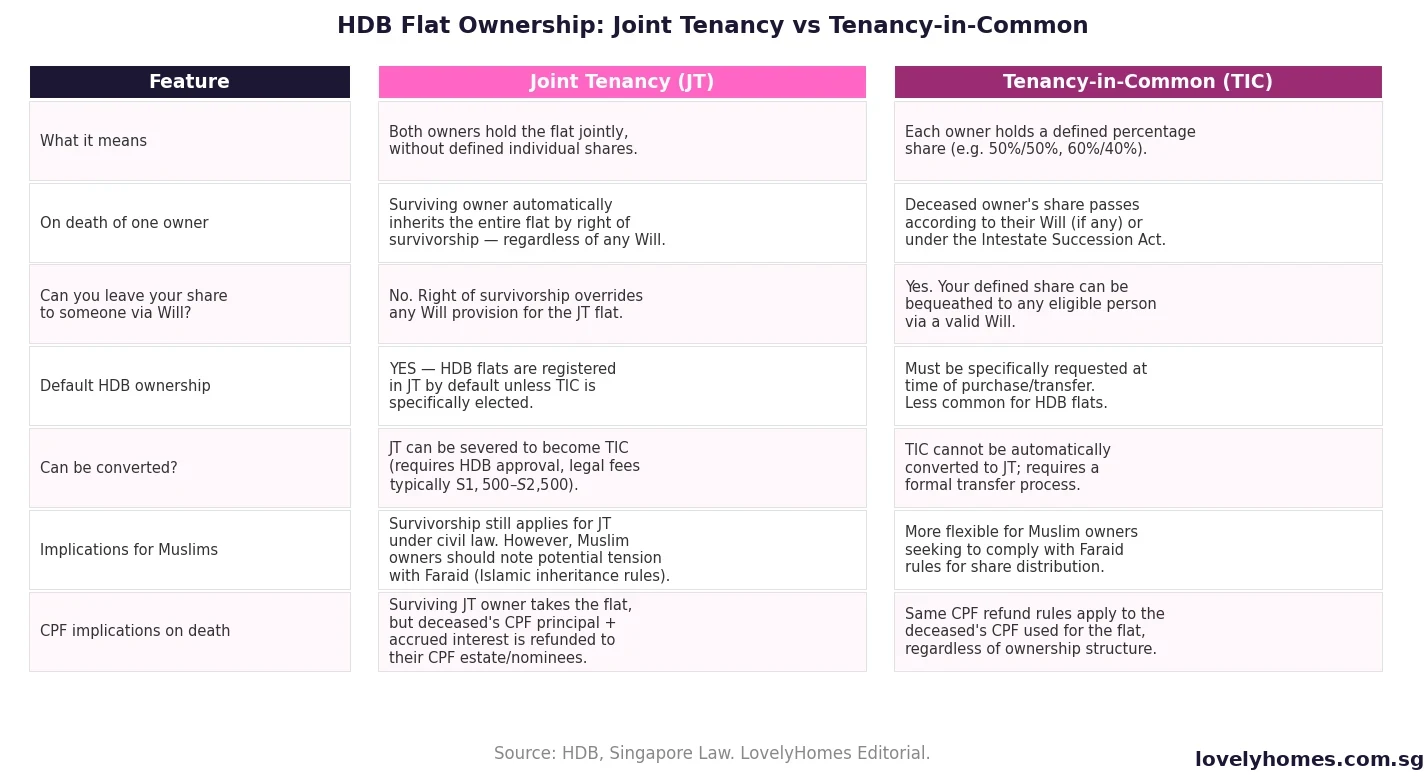
When two or more people purchase an HDB flat together, they must choose between two forms of co-ownership: Joint Tenancy (JT) or Tenancy-in-Common (TIC). The choice made at purchase has profound consequences on what happens to the flat when one owner dies.

Under Joint Tenancy, all owners hold the flat jointly without defined individual shares. The central legal feature of JT is the right of survivorship: on the death of any one joint tenant, that person’s interest in the flat automatically vests in the surviving joint tenant(s). No probate or letters of administration are required; no Will can override this automatic transfer. HDB flats purchased by couples are registered in Joint Tenancy by default.

Under Tenancy-in-Common, each owner holds a specified, separate share — for example, 50%/50% or 60%/40%. On the death of a TIC owner, their share forms part of their estate and is distributed according to their Will, or the ISA if they die intestate (without a Will). TIC must be specifically elected at the time of purchase or during ownership via a legal severance of the JT arrangement.

Singapore HDB Joint Tenancy vs Tenancy-in-Common comparison table — right of survivorship inheritance Will implications 2026
Figure 1: Joint Tenancy vs Tenancy-in-Common — seven key differences for HDB flat co-owners. Source: HDB, Singapore Law. Click to enlarge.

The Right of Survivorship: How Joint Tenancy Works on Death

The right of survivorship is a powerful legal mechanism that simplifies the transfer of HDB flats in the common scenario where a married couple owns a flat and one spouse passes away. When the first spouse dies, the surviving spouse automatically becomes the sole owner of the flat — there is no need to go through the courts, apply for probate, or even instruct a solicitor for the transfer itself (though an application must be made to HDB to update the records).

The process involves notifying HDB within 30 days of the death, submitting the death certificate, the original title deeds or relevant HDB documentation, and completing HDB’s survivorship transfer form. HDB will then update its records to reflect the surviving owner as the sole registered proprietor. The entire administrative process typically takes 3–6 weeks once documents are submitted.

The surviving JT owner inherits the flat subject to any outstanding HDB or bank loan. If the deceased was the primary borrower and the surviving spouse does not meet the bank’s income criteria to assume the sole loan, they may need to make other arrangements — including partial repayment, sourcing a guarantor, or selling the flat. It is advisable for couples to ensure both spouses are listed as co-borrowers on any mortgage to avoid this complication.

Tenancy-in-Common and the Intestate Succession Act

For flat owners holding the property under Tenancy-in-Common, the death of one owner requires a formal estate administration process before the flat can be transferred to the inheritor. If the deceased left a valid Will, executors named in the Will apply for a Grant of Probate from the Singapore High Court. If there is no Will, the next-of-kin applies for Letters of Administration. Both processes take 3–6 months on average for uncontested estates, though complex cases can take longer.

Where there is no Will, the ISA prescribes how the estate is distributed based on the family structure. For example, if the deceased leaves a spouse and children, the spouse receives 50% of the estate and the children share the remaining 50% equally. If only a spouse survives (no children, no living parents), the spouse receives the entire estate. The ISA does not apply to Muslim Singaporeans, whose estates are governed by Faraid rules under AMLA, administered through the Syariah Court for distribution certificates.

CPF and HDB on the Death of an Owner

CPF monies used to purchase an HDB flat do not form part of the flat’s transfer on death — they are handled separately by the CPF Board. When an owner dies, all CPF funds used to purchase the flat — including both the original principal withdrawn and the accrued interest at 2.5% p.a. compounded — must be refunded to the deceased’s CPF account. These funds are then distributed to CPF nominees (designated by the deceased via a CPF nomination form before death), or — if there is no nomination — to the Public Trustee for distribution under the Intestate Succession Act.

This CPF refund is separate from the flat’s ownership transfer. The inheritor who takes over the flat does not receive the deceased’s CPF monies as part of the flat — they receive only the flat itself, potentially subject to an outstanding mortgage. The CPF refund may significantly reduce the equity available in the flat if the loan is outstanding, as the CPF monies do not offset the mortgage on death.

If the flat has an outstanding HDB concessionary loan at the time of death, the surviving owner or inheritor must arrange with HDB to either assume the loan (if they qualify) or repay it. In some cases where the deceased had Home Protection Scheme (HPS) insurance (a mortgage-reducing insurance administered by CPF Board), the outstanding HDB loan may be discharged on death, passing the flat to the inheritor debt-free. All HDB flat owners with an outstanding HDB loan are required to maintain HPS cover, making this a meaningful protection for families.

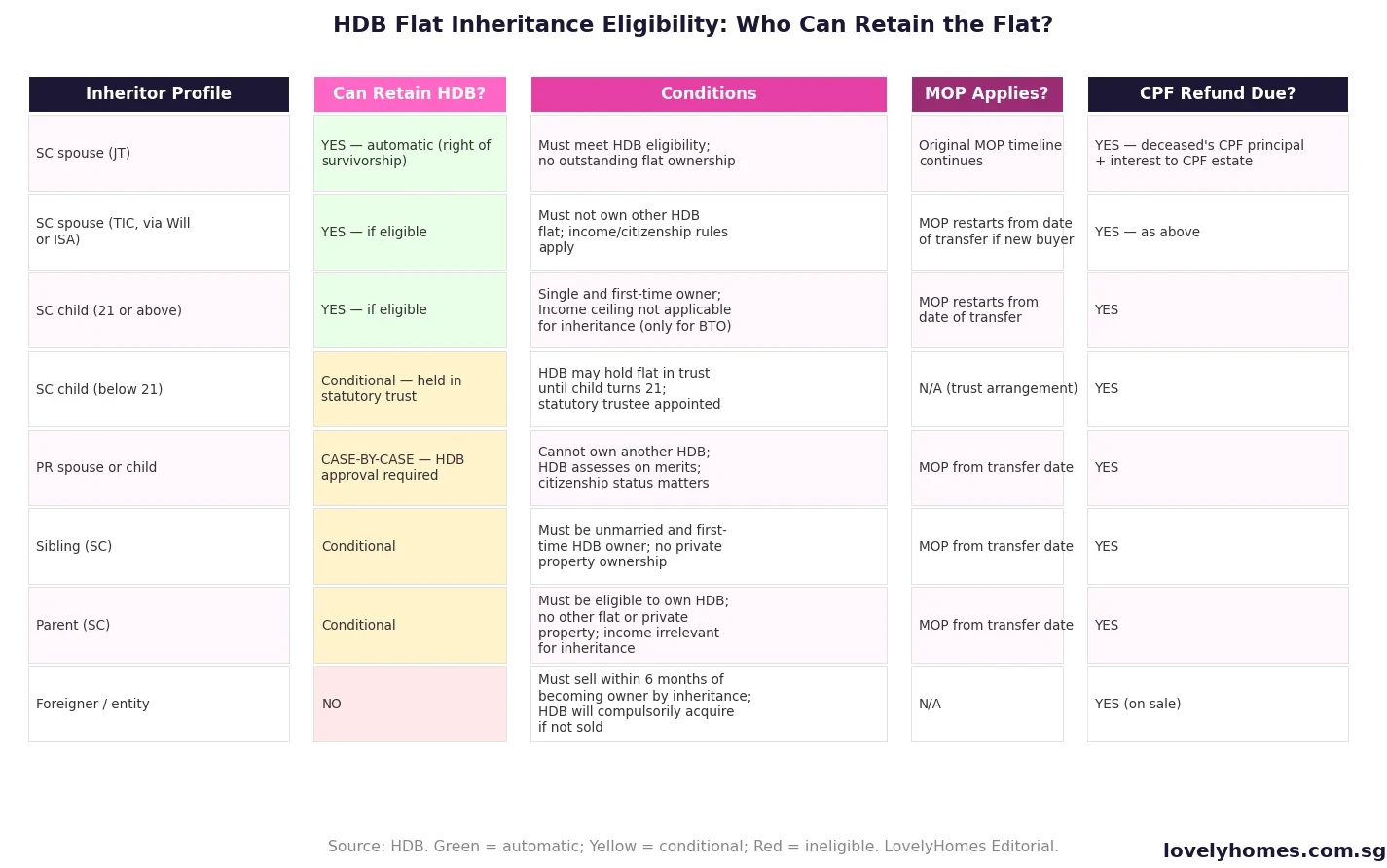
HDB flat inheritance eligibility Singapore 2026 — who can retain an HDB flat SC spouse child PR sibling parents foreigners
Figure 2: HDB Inheritance Eligibility — who can retain an HDB flat and under what conditions. Green = generally eligible; Yellow = conditional/HDB approval required; Red = must sell. Source: HDB. Click to enlarge.

Who Can Retain an Inherited HDB Flat?

The right to retain an inherited HDB flat is subject to HDB’s standard eligibility criteria. The core principle is that HDB flats are public housing meant for Singapore citizens and permanent residents who meet the relevant conditions. Simply inheriting a flat does not guarantee the right to keep it if the inheritor does not meet HDB’s eligibility framework.

Singapore Citizen beneficiaries in a nuclear family context — such as a surviving SC spouse or adult SC children — generally have the widest eligibility to retain an HDB flat. However, they must not already own another HDB flat (subject to the non-concurrent ownership rule) and must not hold any private residential property at the time of inheritance (or must dispose of private property within 6 months). Singapore Permanent Resident inheritors are assessed on a case-by-case basis by HDB and face more restrictions. Foreigners (non-PRs) are not eligible to own HDB flats and must sell any inherited flat within 6 months; failure to do so can result in HDB compulsorily acquiring the flat.

Where a flat is inherited by a minor (below 21), HDB typically holds the flat in a statutory trust arrangement until the child reaches majority. A statutory trustee (often a parent or guardian) is appointed to manage the flat in the interim.

Applying to Transfer or Retain the HDB Flat

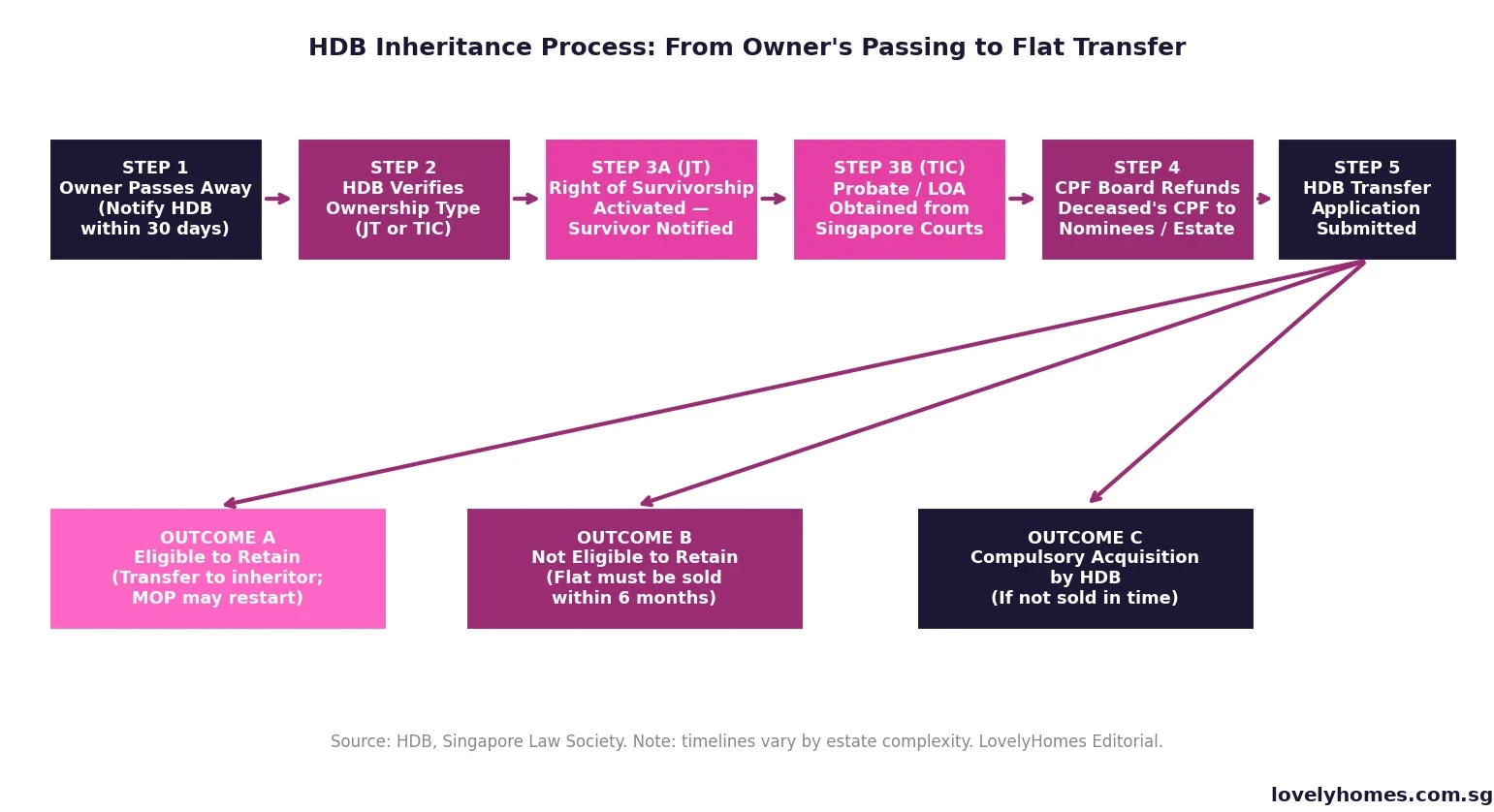
The formal process of applying to retain or transfer an HDB flat after a death involves several steps that typically span 3–9 months depending on the estate complexity, whether probate is required, and HDB’s processing time. The beneficiary or executor must submit an application to HDB with the death certificate, identity documents, Grant of Probate or Letters of Administration (if TIC), and supporting documents evidencing eligibility (e.g. income documents, CPF statement, private property declaration).

HDB will assess the application, verify eligibility, check for any outstanding charges or HDB loans on the flat, and — where the inheritor is taking over a loan — require the inheritor to meet the relevant debt servicing criteria. If approved, the transfer is completed via a legal instrument lodged with the Singapore Land Authority (SLA), and the Land Register is updated to reflect the new owner.

HDB inheritance process flowchart Singapore 2026 — steps from death notification to flat transfer outcomes
Figure 3: HDB Inheritance Process — from the owner’s passing to the three possible outcomes: retention, sale, or compulsory acquisition. Source: HDB, Singapore Law Society. Click to enlarge.

Selling an Inherited HDB Flat

Where the inheritor is ineligible to retain the HDB flat — either because they do not meet HDB’s eligibility criteria or because they choose to liquidate the asset — the flat must be sold on the open HDB resale market. The 6-month timeline begins from when ownership is formally transferred to the ineligible inheritor (not from the date of death), giving families some breathing room to arrange the estate and marketing process.

The sale proceeds are handled as follows: the outstanding HDB loan (if any) is repaid first from the sale price; CPF monies used by all owners over the flat’s ownership history are refunded (with accrued interest) to each respective owner’s CPF account or estate; legal and agent costs are deducted; and the net cash proceeds form part of the estate for distribution. If the flat was sold at the prevailing resale market price, the estate may receive a meaningful cash sum — particularly for flats in mature estates with substantial appreciation.

Scenario Ownership Type Legal Process Required Timeline (est.) MOP Reset?
SC surviving spouse (JT) Joint Tenancy Notify HDB; submit death cert + survivorship docs 3–6 weeks admin No (continuity)
SC child inheriting via Will (TIC) Tenancy-in-Common Grant of Probate + HDB transfer application 4–8 months Yes (from transfer date)
SC child inheriting — intestate (TIC) Tenancy-in-Common Letters of Administration + HDB transfer application 5–10 months Yes
PR beneficiary (TIC or JT estate) Either Probate/LOA + HDB case-by-case assessment 6–12 months Yes
Ineligible beneficiary — must sell Either Transfer to ineligible owner + list for HDB resale Must sell within 6 months of transfer N/A (sold)
Minor inheritor (below 21) Either Statutory trust arrangement via HDB; trustee appointed Until majority Assessed at age 21

Worked Example: The Lim Family — SC Widow Inheriting Under Joint Tenancy

David and Susan Lim are Singapore Citizens who purchased a 4-room HDB flat in Ang Mo Kio in 2015 under Joint Tenancy at S$450,000, financed by an HDB concessionary loan. Their outstanding HDB loan as at June 2026 is S$210,000. David passes away unexpectedly in June 2026 at age 58.

Step 1 — Survivorship: As the flat was held in JT, Susan automatically becomes the sole owner of the flat by right of survivorship. No probate is required. Susan notifies HDB within 30 days and submits the death certificate and survivorship transfer form.

Step 2 — CPF refund: David had used S$180,000 in CPF OA (principal) towards the flat purchase and monthly instalments over 11 years. Accrued interest on these CPF withdrawals at 2.5% p.a. amounts to approximately S$61,000. The total CPF refund of S$241,000 is credited back to David’s CPF account. As David made a CPF nomination naming Susan and their two adult children, the S$241,000 in David’s CPF is distributed per the nomination — not as part of the flat’s transfer.

Step 3 — Mortgage: David maintained Home Protection Scheme (HPS) insurance on the HDB loan. On his death, the outstanding S$210,000 HDB loan is discharged by HPS, passing the flat to Susan debt-free.

Outcome: Susan now owns the flat in sole name, free of mortgage, with the flat’s estimated resale value at ~S$620,000 (based on comparable resale transactions in the area in 2026). The net equity in the flat for Susan is approximately S$620,000 (since the CPF refund went to David’s CPF estate, not reducing the flat’s market value). The HDB admin process took approximately 5 weeks from death notification to registration of Susan as sole owner.

Key lesson: The combination of JT ownership, HPS insurance, and CPF nomination meant that the inheritance process was administratively simple and economically optimal for Susan. Had David not maintained HPS, Susan would have needed to service the S$210,000 loan herself from retirement savings or a new bank loan — a significant burden at age 56.

What This Means for HDB Flat Owners

Estate planning for HDB flat owners in Singapore is not a complex exercise, but it does require deliberate action rather than relying on defaults. The most important steps any HDB owner can take are: first, confirm the current ownership structure of their flat (JT or TIC) and whether it reflects their actual wishes; second, maintain a valid and up-to-date CPF nomination so that CPF monies reach the intended beneficiaries; third, consider making a Will to address any TIC share and other non-CPF assets; and fourth, ensure adequate HPS cover is maintained on any outstanding HDB loan to protect the family from the mortgage burden on death.

Joint Tenancy works well for most married couples as a default — it is simple, automatic, and avoids probate delays. However, for blended families, second marriages, business partners owning flats together, or Muslim families seeking Faraid-compliant distributions, Tenancy-in-Common provides greater flexibility and should be considered with legal advice.

What Might Come Next

There are no announced changes to Singapore’s HDB inheritance framework as at June 2026. The Law Reform Commission has previously considered but not implemented recommendations on simplifying intestate succession for HDB flats, and the Ministry of Law continues to review options for making probate processes faster and less costly for estates with modest assets. The digitisation of the Probate Court and HDB’s integrated estate management platform (accessible via MyHDBPage) has already reduced administrative timelines in recent years. HDB owners and estate practitioners should monitor any future legislative changes to the Probate and Administration Act, the Intestate Succession Act, and HDB’s Housing Policy as Singapore’s population ages and inheritance scenarios become more common.

Frequently Asked Questions: HDB Inheritance & Transfer

Can I change my HDB flat from Joint Tenancy to Tenancy-in-Common?

Yes. A Joint Tenancy in an HDB flat can be severed to become a Tenancy-in-Common through a legal process called a severance of joint tenancy. This involves instructing a solicitor to prepare and lodge the relevant instrument at the Singapore Land Authority. Both owners must consent to the severance. The legal costs typically range from S$1,500 to S$2,500 depending on the complexity. Once severed, each owner’s defined share (usually 50%/50% unless otherwise specified) can be bequeathed to beneficiaries via a Will, bypassing the right of survivorship. HDB’s approval may be required in some cases.

What if the deceased HDB owner did not leave a CPF nomination?

If the deceased did not make a CPF nomination, the CPF Board will transfer the CPF savings (including the refunded flat-related CPF monies) to the Public Trustee’s Office. The Public Trustee distributes these funds according to the Intestate Succession Act — meaning they follow the same intestate distribution rules as other estate assets (e.g., 50% to spouse, 50% to children). This process adds time and cost to the estate administration. It is strongly advisable to make a CPF nomination and to update it whenever family circumstances change.

Does the Minimum Occupation Period (MOP) restart when I inherit an HDB flat?

Generally yes, when a flat is transferred to a new owner via inheritance (other than a Joint Tenancy survivorship transfer, where the surviving owner continues the original MOP timeline), the MOP is assessed from the date the new owner takes legal title of the flat. For example, if you inherit a flat in June 2026, your 5-year MOP (or 10-year MOP for Plus/Prime flats purchased under the new classification rules) begins from June 2026. You must continue to occupy the flat and cannot sublet the whole flat or purchase any other residential property during the MOP period. Always confirm the specific MOP conditions with HDB when applying for the transfer.

What is the Home Protection Scheme (HPS) and is it compulsory?

HPS is a mortgage-reducing insurance administered by CPF Board that covers the outstanding HDB home loan in the event of the insured owner’s death, terminal illness, or total permanent disability. It is compulsory for all HDB flat owners with outstanding HDB concessionary loans who have CPF OA savings. For HDB flat owners with bank loans, HPS cover is not mandatory but CPF Board strongly recommends it. HPS premiums are payable from CPF OA and are relatively affordable. On the insured event (e.g., death), HPS discharges the outstanding loan balance up to the insured amount, passing the flat to the family debt-free. Reviewing your HPS coverage amount (especially if you have refinanced to a bank loan) is an important part of property ownership in Singapore.

Can a Muslim Singaporean’s HDB flat be distributed via Faraid rules?

Under Singapore law, a Muslim person’s estate — including any HDB flat held under Tenancy-in-Common — is governed by Faraid (Islamic inheritance law) as applied by the Syariah Court under the Administration of Muslim Law Act (AMLA), rather than the civil Intestate Succession Act. The Syariah Court issues an Inheritance Certificate specifying the Faraid shares to each beneficiary. For HDB flats under Joint Tenancy, however, the civil right of survivorship technically applies — a tension between civil and religious law that some Muslim families resolve by electing Tenancy-in-Common and making a Will consistent with Faraid requirements. Muslim HDB owners are strongly advised to consult both a Syariah lawyer and HDB to ensure their ownership structure and estate plans align with their religious obligations.

How long does the HDB inheritance transfer process typically take?

The timeline varies significantly by case type. For Joint Tenancy survivorship transfers — the simplest scenario — the HDB administrative process typically takes 3 to 6 weeks once all required documents are submitted. For Tenancy-in-Common cases where probate is needed, the Grant of Probate or Letters of Administration alone typically takes 3–6 months, after which the HDB transfer application takes a further 4–8 weeks. Complex estates involving disputes, overseas beneficiaries, or unusual eligibility circumstances can take 12–24 months or more. Throughout this period, the flat can generally continue to be occupied by eligible family members, though it cannot be sold or rented out until the transfer is completed and any applicable MOP is met.

Disclaimer: This article is produced by LovelyHomes Editorial for informational and educational purposes only. It does not constitute legal, estate planning, or financial advice. HDB eligibility rules, CPF policies, probate procedures, and Islamic inheritance law described are based on information current as at June 2026. These rules can change. In particular, individual circumstances vary greatly — factors including citizenship status, existing property ownership, outstanding loans, and family composition can materially affect outcomes. Always consult a licensed Singapore solicitor (for estate planning and probate matters), a Muslim law practitioner for Syariah-related estates, and refer to HDB, CPF Board, Ministry of Law, and Syariah Court of Singapore official sources.
×

Click anywhere outside to close

Strata Title and MCST in Singapore 2026: How Your Condo Is Actually Run

Strata Title and MCST in Singapore 2026: How Your Condo Is Actually Run

If you own a condominium, executive condo, or strata-titled landed home in Singapore, you do not really own a building — you own a slice of one, a “strata lot“. Everything outside that slice (the lift you ride to work, the pool you swim in, the lobby that smells faintly of Diptyque) is common property, and it is run by a body corporate called the Management Corporation Strata Title — the MCST.

Most owners pay their monthly maintenance fee, attend an AGM once in a blue moon, and never think about it again. Then a leak appears in the carpark, the lifts hit 25 years and need a S$2 million modernisation, or someone wants to put a new awning on their balcony — and suddenly the structure that runs your home becomes very real, very fast. This guide walks you through how strata title actually works in Singapore, what your MCST does, where your money goes, and the rights and obligations you signed up for the moment your conveyancing lawyer registered your title at the Singapore Land Authority.

Quick Answer — strata title and MCST in 30 seconds

  • You own a strata lot (your unit + accessory areas) plus a share value in common property.
  • The MCST manages common property under the Building Maintenance and Strata Management Act (BMSMA 2004).
  • Your monthly bill funds two ring-fenced pots: a Management Fund (~75%) for day-to-day running and a Sinking Fund (~25%) for major capital works.
  • Decisions are made at AGMs by share-value vote — ordinary majority for routine matters, ≥75% special resolution for capital expenditure above S$200,000.
  • Indicative monthly fees: S$280-450 OCR mass-market, S$420-680 mid-tier RCR, S$780-1,400 luxury CCR, S$1,500+ ultra-luxury.
  • Renovations affecting common property require written MCST approval before BCA submission (BMSMA s.37).
  • Disputes above the council level go to the Strata Titles Boards — not the civil courts in the first instance.

What Is Strata Title and Why Does Singapore Use It?

Strata title is the legal mechanism that makes vertical, multi-owner property possible. When a developer builds a condominium, the Singapore Land Authority registers a strata plan dividing the building into individual lots (the units, plus accessory lots like balconies, planter boxes and air-con ledges) and common property (everything else). Each lot is a separate parcel of land in law, with its own title deed, its own share value, and its own set of rights to the common property.

Without strata title, only the developer or a single co-owner group could hold the title to a multi-storey building — you would be buying a long lease from them, not freehold ownership of a defined unit. Strata title gives you genuine real-estate ownership, the right to mortgage your lot independently, and the right to participate in governance of the building. The trade-off is that you must accept a co-ownership regime: a council elected by other owners, by-laws that bind you, and a duty to contribute to communal expenses whether you use the facilities or not.

Singapore’s strata regime sits inside the Building Maintenance and Strata Management Act 2004 (BMSMA), supplemented by the Land Titles (Strata) Act 1967. Together they cover roughly 12,000 strata-titled developments and over 750,000 strata lots across the island as at the start of 2026. If you own anywhere in Singapore that is not landed-on-its-own-plot, you are almost certainly subject to BMSMA.

The Core Concept: Strata Lot, Common Property, Share Value

Three pieces of paper are issued when your conveyancing completes: the certificate of title for your strata lot, the strata plan for the development, and the schedule of share values. They define everything that follows.

Strata lot

Your physical unit, defined by the centre line of internal walls, the upper surface of the floor, and the under-side of the ceiling slab. Accessory lots include balconies, private enclosed spaces (PES), aircon ledges, and any car-park or storage spaces specifically allocated to your unit on the strata plan. You can renovate inside your strata lot largely as you wish — subject to BCA rules, MCST house rules, and structural integrity.

Common property

Everything outside your strata lot that is not somebody else’s lot. Lifts, lobbies, pools, gyms, gardens, common corridors, the external façade, the roof, the basement carpark, M&E plant rooms, and the structural slabs themselves. Common property is owned collectively by all subsidiary proprietors as tenants-in-common in the proportion of their share values, and managed by the MCST.

Share value

A whole number assigned to each lot in the strata plan that determines (a) your voting weight at general meetings and (b) your contribution to the common funds. Larger units get higher share values. A typical 1,000 sqft 3-bedroom unit might carry 10 share values; a 600 sqft 2-bedroom might carry 6. If your unit’s share value is 10 out of a building total of 5,000, you pay 0.2% of every common-fund expense and cast 10 votes (out of 5,000) on every resolution.

Indicative MCST Fees by Condo Segment (2026)

Before you commit to a unit, look at the monthly maintenance bill. It is the single biggest variable holding cost of ownership and varies enormously by segment. The figure below sets out what most owners actually pay across five common segments of the Singapore market in 2026.

Singapore MCST monthly maintenance fees by condo segment 2026 — OCR mid-tier RCR luxury CCR ultra-luxury mixed-use comparison
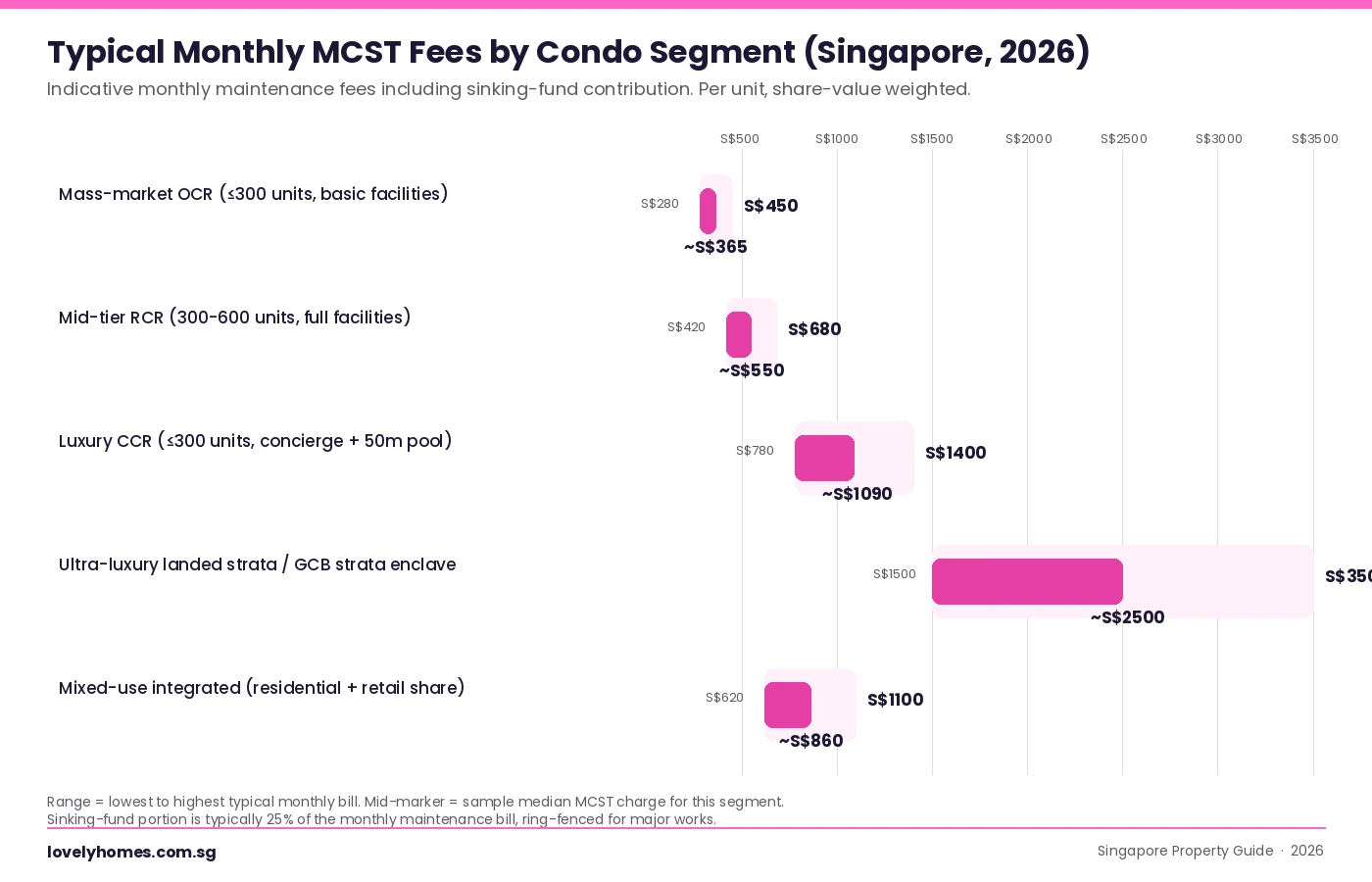
Figure 1. Typical monthly MCST fees by condo segment, 2026. Mid-tier RCR developments cluster around S$550/month; CCR luxury and integrated mixed-use developments routinely exceed S$1,000/month due to higher staffing, premium finishes and shared retail-component costs.
Segment Typical monthly fee (per unit) Sinking fund share Drivers of cost
Mass-market OCR S$280-450 ~25% Basic facilities, lower headcount, fewer lifts, surface carparks
Mid-tier RCR S$420-680 ~25% Full facilities suite, multi-deck basement carpark, larger landscape
Luxury CCR S$780-1,400 ~25-30% 24-hr concierge, valet, branded F&M for plant, smaller lot count to share costs
Strata landed / GCB enclave S$1,500-3,500 ~30% Few lots, large land area, perimeter security, private roads
Mixed-use integrated S$620-1,100 ~25% Shared cost-allocation with retail/commercial component, dual-MCST structures

One important nuance: integrated developments often have two MCSTs — one for the residential strata, one for the entire development. Your monthly bill is therefore the sum of both layers. Always ask the marketing agent for the dual-MCST cost breakdown before signing.

The Two Funds Inside Every MCST Bill

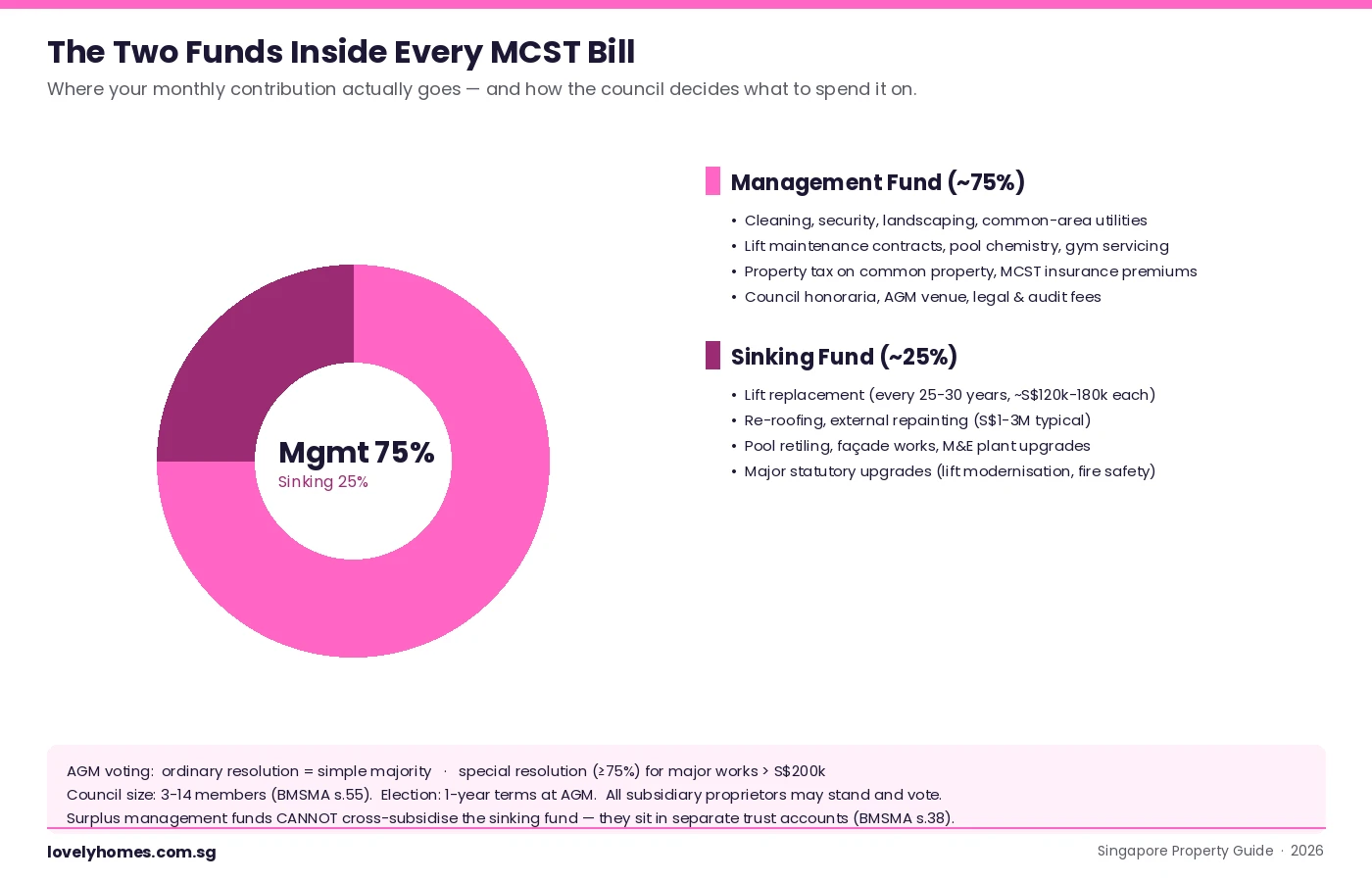
Your monthly maintenance fee is not a single pot of money. By law it splits into two ring-fenced trust accounts — the Management Fund (general operations) and the Sinking Fund (capital reserves) — and the council cannot move money freely between them.

Singapore MCST management fund vs sinking fund 75-25 split with AGM voting structure under BMSMA 2026
Figure 2. Where your MCST contribution actually goes. The 75/25 management/sinking split is convention, not law — specific developments may sit anywhere between 70/30 and 80/20 depending on age, plant complexity, and council appetite.

Management Fund

Pays for everything that recurs: cleaning contracts, security guarding, lift maintenance, pool chemistry, gym servicing, common-area utilities, landscaping, MCST insurance premiums, property tax on common property (yes — the building itself is taxed on the rental value of its common areas), council members’ honoraria, AGM venue, audit and legal fees, and the salary of the appointed managing agent. If the toilet roll runs out in the lobby, the management fund replaces it.

Sinking Fund

Funds large, infrequent capital works that would otherwise hit owners with sudden special levies. Lift modernisation (typically required at 25-30 years and costing S$120k-180k per lift), exterior repainting, re-roofing, façade re-cladding, pool retiling, M&E plant replacement, and statutory upgrades (e.g. lift safety upgrades mandated by BCA, fire-system retrofits required by SCDF). A well-run building should hold roughly 2-3 years of operating expenditure in the sinking fund at any time.

Why the wall between them matters

Section 38 of the BMSMA prohibits using management-fund money to pay for sinking-fund items, and vice versa. This protects future owners: if the council were free to spend the sinking fund on day-to-day items, you would arrive at the 25-year mark with no money for the lift modernisation, and the council would have to issue a one-off levy of, say, S$15,000 per unit to make up the gap. Always read the audited accounts before bidding on a resale unit — a depleted sinking fund is a hidden liability the buyer inherits.

Governance: Council, AGMs, Voting

The MCST is the body corporate; the council is its elected board. Owners (subsidiary proprietors) elect a council of 3 to 14 members at the AGM, each serving one-year terms. The council appoints office-bearers (chair, secretary, treasurer) and engages a managing agent — a licensed property-management firm that runs the day-to-day operation.

Annual General Meeting (AGM)

Must be held within 15 months of the previous one. Owners receive at least 14 days’ written notice with the agenda, audited accounts, the proposed annual budget, and any resolutions for vote. Standard agenda items: receive the audited accounts, fix the next year’s budget and contribution rates, elect the council, appoint the auditor, transact special resolutions.

Resolution thresholds

  • Ordinary resolution — simple majority of the share values voted. Used for routine business: budget approval, council elections, day-to-day spending decisions within budget.
  • Special resolution — ≥75% of share values voted in favour, with ≤25% against. Required for capital expenditure exceeding S$200,000 (s.40 BMSMA), variation of by-laws, and certain by-law-affecting matters.
  • 90% resolution — required to vary common property boundaries or transfer common property.
  • Unanimous resolution — required for any change that affects an individual lot owner’s title or rights.

Extraordinary General Meetings (EGM)

Called between AGMs for urgent matters — usually a special-resolution capital project (e.g. lift modernisation), an unplanned major repair, or to vote on a collective sale resolution. Owners holding ≥20% of share values can requisition an EGM directly.

Worked Example: What a S$1.5M OCR Condo Owner Pays in a Year

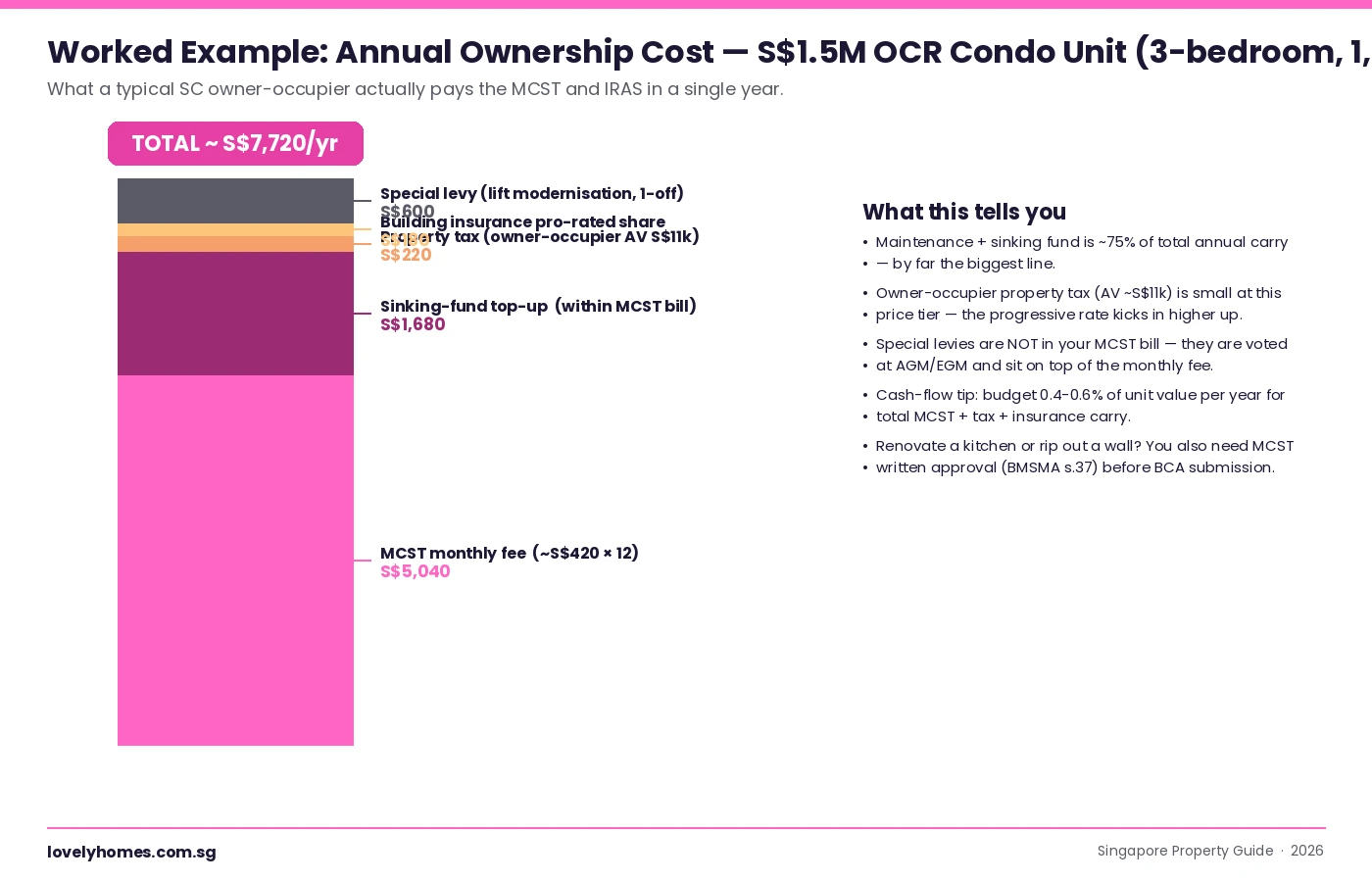
Numbers ground the abstract. Here is what a typical Singapore Citizen owner-occupier of a 1,000-sqft, 3-bedroom unit in a mid-tier OCR development worth S$1.5 million actually pays the MCST and IRAS over a year, assuming no leasehold-related issues and no rental income.

Worked example annual ownership cost S$1.5M Singapore OCR condo 2026 — MCST sinking property tax insurance special levy stack
Figure 3. Annual ownership cost stack for a S$1.5M OCR 3-bedroom condo unit, 2026. Maintenance and sinking-fund contributions dominate; property tax is comparatively small at this AV tier. A one-off lift modernisation special levy of S$600 is included to show how capital works can spike a single year’s bill.

Three observations stand out. First, the recurring carry on a S$1.5M unit is a real number — about S$5,000-7,000 per year, or 0.4-0.5% of unit value, before any one-off special levies. Second, the property-tax line at this AV tier is genuinely small; most of your tax burden was paid up front as BSD when you bought. Third, special levies are not in the monthly bill — they are voted at AGM/EGM and sit on top, often with 3-6 months’ notice. Plan a 1-2% capital reserve of unit value over a 10-year horizon if you want to avoid surprises.

Your Rights and Obligations as a Subsidiary Proprietor

Buying a strata lot binds you to a contract you may never have read — the by-laws of the development, set out in the First Schedule of the BMSMA (the prescribed by-laws) and in any additional by-laws passed by special resolution at the AGM. Key obligations every owner has:

  • Pay contributions on time — arrears attract interest (often 10% p.a.) and the MCST may register a charge on your title under s.34 BMSMA after 30 days, blocking refinancing or sale until paid.
  • Get written approval before altering common property — even private balcony tinting or aircon-ledge enclosures usually need MCST consent under s.37.
  • Comply with the by-laws on noise hours, pet keeping, short-let restrictions (typically minimum 3 months for residential), commercial use limitations, and exterior-facade alterations.
  • Allow access for the MCST or its contractors to perform repairs to common property running through your lot, on reasonable notice.

Conversely, the rights you can enforce:

  • Inspect the records — minutes, accounts, contracts. Owners are entitled to see anything in the corporate register on reasonable notice (a small fee may apply).
  • Stand for council, attend and vote at general meetings, and propose resolutions.
  • Requisition an EGM if you can muster 20% of share values.
  • Apply to the Strata Titles Boards if the council acts unreasonably, refuses by-law-approved alterations, or makes invalid decisions.

Disputes: The Strata Titles Boards

The Strata Titles Boards (STB) — constituted under the BMSMA and the Building Maintenance Act — are the specialised tribunal that hears strata disputes. Most owner-vs-MCST or owner-vs-owner strata disputes cannot go to the High Court in the first instance; they must come through the STB. Common applications:

  • Section 92 applications to compel the MCST to take a specific action (e.g. carry out a long-overdue repair).
  • Section 31 applications to vary or invalidate a by-law that is unreasonable or oppressive.
  • Collective-sale applications under the Land Titles (Strata) Act — the 80%/90% en-bloc consent threshold mechanic is litigated here.
  • Disputes over share values, accessory-lot rights, and exclusive-use grants over common property.

STB filing fees are modest (S$500-1,000 typically) and the process is faster and lighter than the High Court — expect 6-9 months from filing to determination on most matters.

What to Watch When Buying Resale

If you are buying a strata-titled resale, the MCST is going to be your landlord-of-sorts. A few things to inspect before exercising the OTP:

  1. Last 3 years of audited accounts. Look for a healthy sinking fund, no qualified audit opinions, and no pattern of outsized recurring deficits.
  2. Latest AGM minutes. Check for upcoming capital works that may trigger a special levy. Lift modernisation, repainting, and façade works in the pipeline will hit your wallet.
  3. Outstanding maintenance arrears on the lot. Ask your conveyancer to obtain a section 50 certificate from the MCST — arrears transfer with the lot.
  4. By-laws. Read the additional by-laws — some buildings restrict pet weight, prohibit short-lets entirely, ban exterior changes, or impose dress codes in common areas.
  5. Legal disputes. Ask whether the MCST is currently in any STB or High Court proceedings — ongoing disputes can mean a deteriorating building or financial drain.

How Strata Title Differs From Other Tenure Forms

Singapore’s strata regime is similar in principle to Hong Kong’s multi-storey buildings regime, the Australian strata title system (from which the term originates), and US condominium ownership — but the BMSMA framework is more prescriptive than most. By comparison:

  • vs HDB ownership — HDB flat owners are not subsidiary proprietors of an MCST. The HDB itself manages the estate. Town councils handle the day-to-day common-property functions, funded by service-and-conservancy charges (S&CC).
  • vs landed property — A standalone landed home on a freehold or 99-year leasehold parcel has no MCST and no shared common property. You bear all costs and decisions yourself, but you also have full autonomy.
  • vs strata-landed — Cluster housing and strata-landed enclaves do have an MCST, but with a much smaller lot count (often 30-100). Their fees are correspondingly higher per unit because fixed costs are spread thin.

What Might Come Next: Strata Reform Watch

BCA and the Ministry of National Development have been quietly consulting on a third tranche of BMSMA amendments since 2024. The most-talked-about proposals as at April 2026:

  • Mandatory minimum sinking-fund balance tied to building age (e.g. 18 months of opex once the building is over 10 years old). Aimed at preventing under-funded sinking funds.
  • Compulsory professional MCST chairs for buildings of over 500 lots, in response to dispute volumes from large integrated developments.
  • Streamlined STB process for routine repairs — a fast-track procedure to compel obvious common-property maintenance.
  • Stricter rules on short-term lets — aligning the BMSMA with URA’s 3-month minimum-let regime to give MCSTs cleaner enforcement teeth.

None of the above is yet law. We will update this guide when the next round of amendments is gazetted.

Frequently Asked Questions

Can the MCST force me to renovate or repair my own unit?

Generally no — renovations inside your strata lot are your decision, subject to BCA structural rules and any by-law restrictions (e.g. flooring requirements above the second storey). The MCST can however require you to remedy a condition inside your lot that is causing damage to common property or to neighbouring lots — a leaking bathroom waterproofing membrane, for example, where moisture is reaching the unit below. If you fail to act, the MCST can perform the works and charge them back to your lot under s.41 BMSMA.

What happens if the council goes broke?

If the management fund runs out, the MCST cannot pay contractors or salaries. The council must call an EGM to pass a special levy (a one-off contribution from all owners pro-rata to share value) to recapitalise. Repeated insolvency is a sign of either chronic under-budgeting or council misconduct — in extreme cases the STB can appoint an interim manager to run the MCST under s.85.

Can I rent out my parking space to non-residents?

It depends on whether your parking lot is an accessory lot, an exclusive-use common-property right, or a transient-use right. Accessory lots can typically be sublet to anyone in some buildings but most modern by-laws restrict carpark sub-letting to residents of the development only for security reasons. Always check the additional by-laws and house rules — sub-letting to non-residents in breach of by-laws is enforceable by the STB.

How are votes weighted — one-lot-one-vote or by share value?

Share-value votes apply by default. So a penthouse with a share value of 24 has roughly 4 times the voting weight of a 1-bedroom unit with a share value of 6. This is intentional: larger units pay more to the common funds and bear more of the financial impact of decisions, so they vote in proportion. Some routine matters (e.g. council elections) may also be conducted on a one-vote-per-lot basis under the BMSMA’s voting rules.

If I am buying a brand-new condo, when does the MCST actually come into existence?

The MCST is constituted automatically on the date the strata-title plan is registered with the SLA. In practice, the developer manages the building from TOP onwards under an “interim period” with an interim management committee (often staffed by the developer and a few early-mover owners). The first AGM — where the permanent council is elected — must be held within 13 months of the first lot being conveyed (s.27 BMSMA). Until then, your monthly fee is charged at developer-set rates, which may be re-budgeted up or down at the first AGM.

Do I need MCST consent for a kitchen renovation?

If the renovation is purely cosmetic and stays within your lot — new countertops, replacement appliances, repainting — you usually only need to notify the managing agent and pay any renovation deposit / debris fee under house rules. If you are touching any wet area, structural element, exterior, or anything that could affect a neighbouring lot or common property, you need written MCST approval before submitting plans to BCA. Most buildings require approved-contractor lists, work-hour windows (typically 9am-6pm Monday-Saturday, no Sundays/public holidays), and a renovation deposit of S$1,000-3,000.

How do collective sales fit into the strata regime?

Collective sale (en-bloc) is the process by which the MCST as a whole sells the entire development to a redeveloper, with proceeds distributed among lot owners. Under the Land Titles (Strata) Act, an 80% share-value-and-floor-area consent threshold applies to developments over 10 years old (90% for younger ones). The STB hears applications and may approve, vary, or reject the sale. Successful collective sales effectively dissolve the MCST on completion. We cover the process in detail in our En-Bloc Sale Process Guide.

Related Articles

Disclaimer

This guide is for general information only and does not constitute legal, tax, or financial advice. The Building Maintenance and Strata Management Act, the Land Titles (Strata) Act, and associated subsidiary legislation are the authoritative sources of strata-title law in Singapore and have been amended several times since 2004. Always verify the current position with the Building and Construction Authority, the Singapore Land Authority, the Ministry of Law, and the Inland Revenue Authority of Singapore — and consult a licensed conveyancing or strata-management lawyer before acting on any specific matter.

Translate »